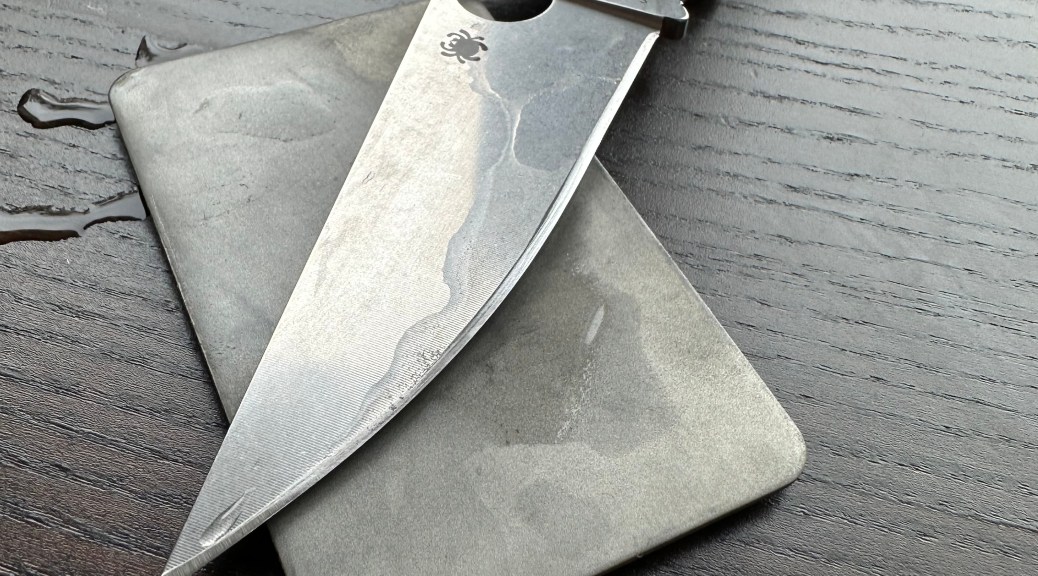

You know what ? It’s time to thin the edge of Gambit.
Pictures are better than thousand words.

The gaffer is here to protect the blade against my clumsiness.
The Double Stuff 2 is the main tool. But it is old now.
It has lost some of its teeth in many many edges reprofiling…
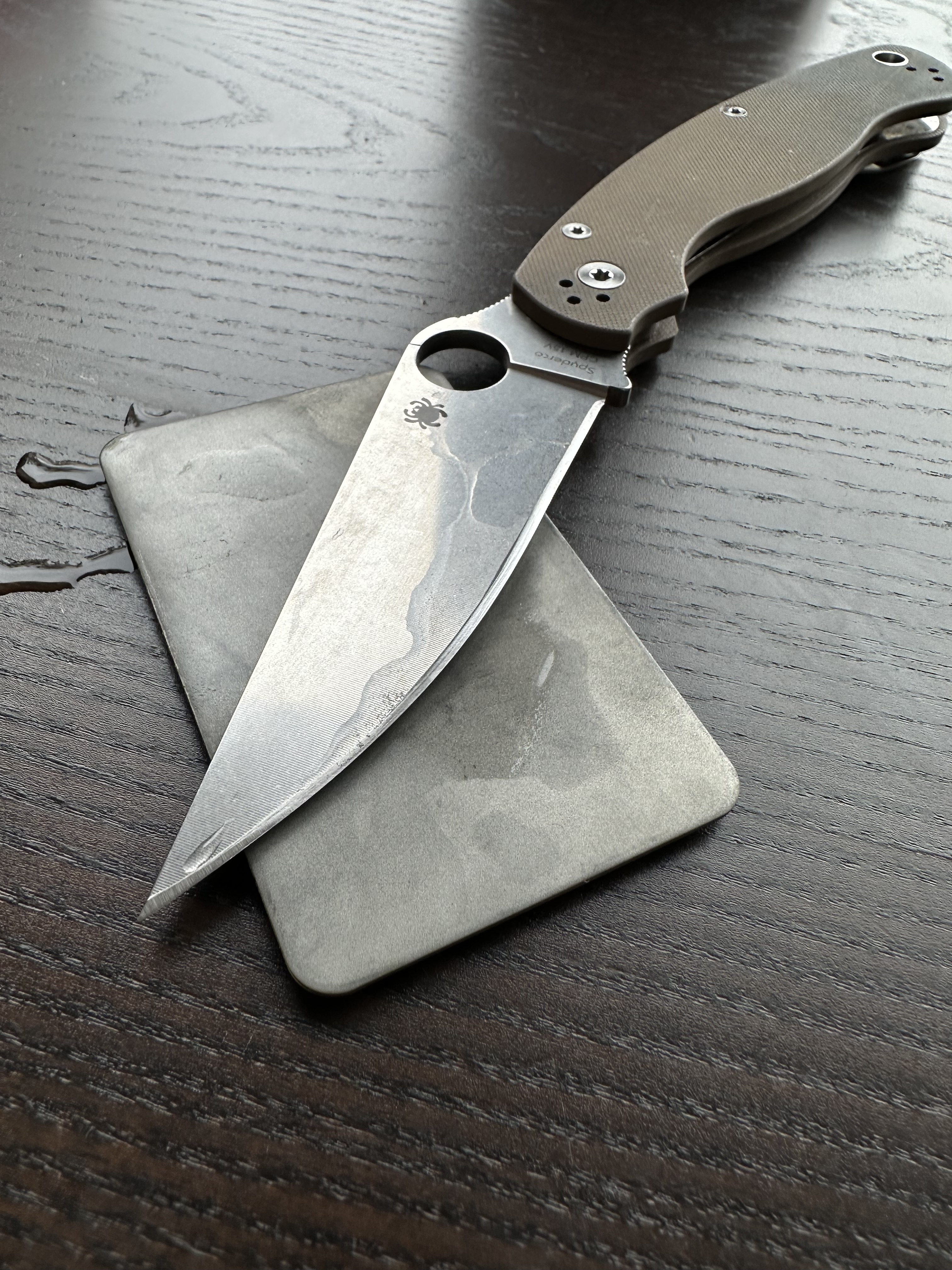
But eventually it is a cheap Sharpy bought on Amazon which seems to be 15V best friend. It is 800 grit.
And it bites into 15V like no tomorrow.
So I was able to round the edge’s shoulder. Let’s test it.
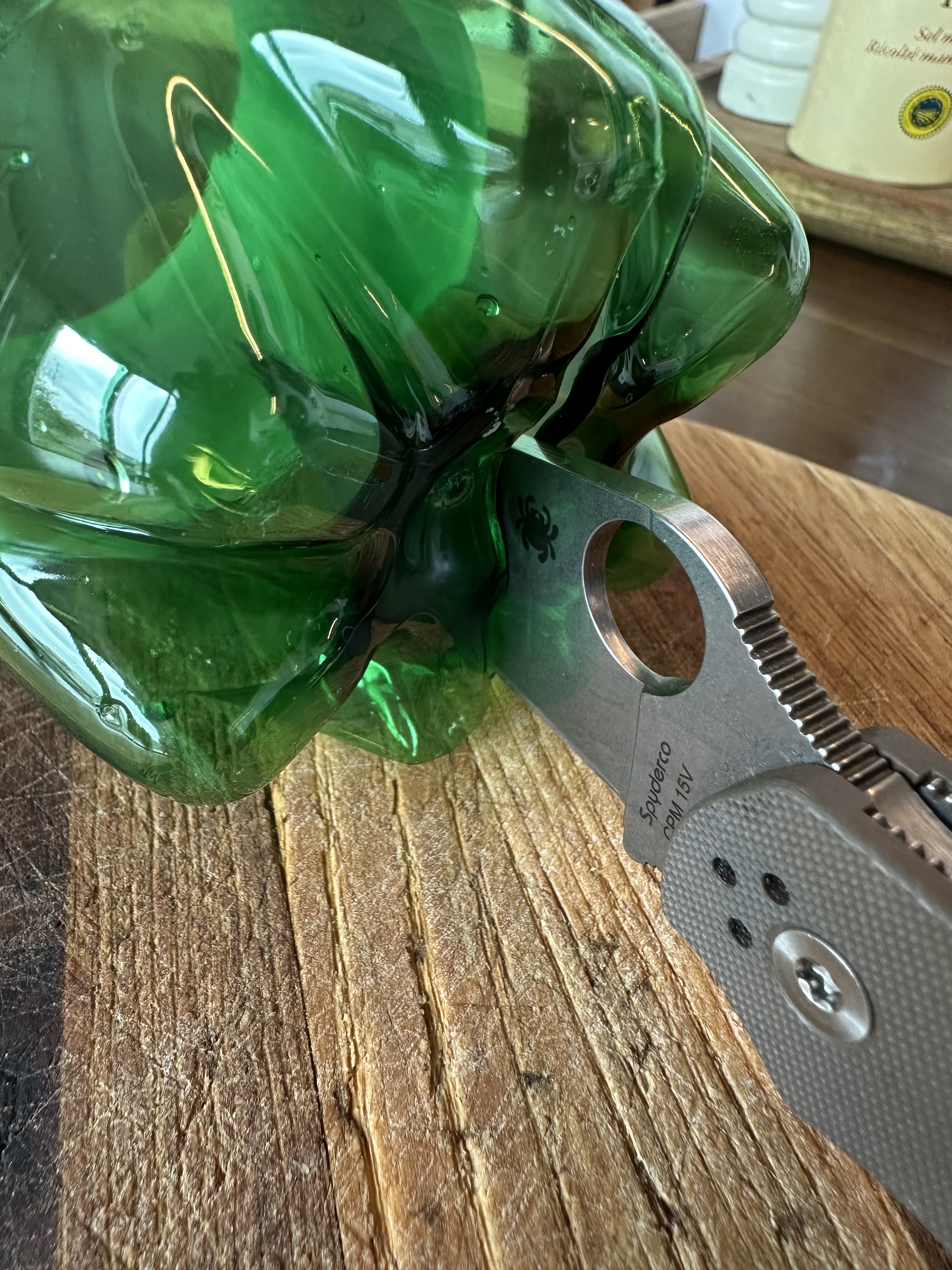
It goes deep and steady.
There is real improvement. But gosh, 15V do not like to lose its particules. Compared to Magnacut or SPY27, CPM-15V is hellish.
Now I perhaps don’t have the best diamond tools for that.
But really, it is not a piece of cake in my book.

Now could it be a answer: The Military 2 reaching the 67 HRC ?
But that was exactly my impression after watching the YouTuber’s video — until Jake, a metallurgist for 14 years, left an exceptionally detailed, well-sourced comment under this review.
To quote his conclusion:
“… Spyderco did an amazing job getting a near custom level heat treatment on an amazing steel at an affordable price to many people who otherwise wouldn’t have been able to spend large sums of money on customs. But expecting 67Rc is a bit too much. Shawn has said it repeatedly that it isn’t realistic for a production knife company to hit hardness levels that high and also be able to work the material.“
Many thanks to Jake for his eye-opening comment — truly appreciated!


 NemoKnivesReview
I feel this is something that’s very important to be said because there’s a lot of misconceptions being spread by that specific YouTube individual. These blades are not getting to 67Rc.
A true 67Rc requires a rapid plate quench and into cryo within minutes from reaching room temperature. That YouTuber has been spreading false information about blades and hardness test results for years. He literally only got the Phase II Rockwell tester because numerous people (myself included) had told him numerous times that the cheaper portable testers like the Leeb that rely on rebound (think a hammer hitting an anvil, it rebounds high, think a hammer hitting a small piece of steel, it barely rebounds, this video explains it more: https://m.youtube.com/watch?v=cxeLNWGxnrk) was more accurate than real Rockwell machines that have been being used by the knife industry for decades. He would often site the accuracy of thr Vickers scale (0.7~HV=1HRC) as a way of saying the machines were more accurate, ignoring that he was using the incorrect “probe” (the testers come with a type D probe, only suitable for 6mm and up, and again need to be large samples, type C is the correct probe, but is an extra $300 on top of the tester. He used gel and the 57Rc testing block to make up for the thickness, which leads to wildly varying results depending on the steel composition and carbide volume).
So he has only about a two months worth of experience with these real Rockwell testers. He likely didn’t have a professional set it up, professionals that specialize in these machines can tell that all of the small and large components inside and outside of the machine are working properly and there are no defects or problems with the machine (even new machines should have someone who’s certified look them over, I’ve used this specific machine before, and yes just spinning the dial will help you calibrate it between inspections, but just like old dial calipers, there can be something within the machine that causes the dial to “skip” past part of the measurement, regardless of how many times you turn that dial back to zero). All of this is ignoring the biggest factor with these types of Rockwell machines that lead to user error: improper testing. I’ve been using Rockwell testers for 14 years, and been in the metal field for just as long. I’ve taken classes on austenitic stainless, dual phase stainless, precipitation hardening alloys, martensitic alloys(stainless and non stainless alloys used for knives and tooling applications), and nickel based “super alloys” (think Inconel). Testers like the Phase II that this person used requires a bit more knowledge than just reading the manual to understand to get accurate readings.
That YouTuber is an engineer, he doesn’t specialize in metals, he has no real knowledge on how heat treatments and alloy additions work (I’ve had to correct him several times on things he didn’t understand, specifically thinking Magnacut got lower corrosion resistance at higher hardness, which is only possible if heat treated using the upper tempering range (500°F-1000°F) where the steel pulls elements like chromium from the matrix and turns them into carbides(where they can’t contribute to the passive film that resists corrosion), it also changes existing monocarbides that are undissolved from the initial austenitizing step(high heat before quenching).
This article explains it easier, I’m glad Larrin released an article explaining this misconception that was caused by a high-profile big name knife manufacturer getting Magnacut to high hardness using the upper tempering range, prior I had to explain much more telling people that hardness typically increases corrosion resistance given the proper heat treatment, Magnacut always has all its chromium in solution of the matrix of the steel: https://knifesteelnerds.com/2025/07/14/corrosion-resistance-vs-hardness-in-knife-steels/)
Now that we’ve gotten past a few things, CBRx is definitely not trained, nor does he understand everything that goes into getting consistent results, and true results, with analog based Rockwell machines. I doubt he’s looked looked over everything that ASTM E18 and to a lesser extent ISO 6508 standards that go into testing metallic objects. A big thing that can affect the readings is the dwell time (needle wiggle between pre-load and full load) this timing is very critical on less expensive machines, simpler, and older machines, as if you test it too fast after the pre-load it will give inaccurate readings. Temperature variations can also affect machines like these.
This is all ignoring that he is the only person that I’ve seen test a 15V blade made by Spyderco that has gotten to 67Rc. Shawn and Sal have confirmed that the target for all 15V knives is 65Rc. Spyderco typically has very consistent results. Heat treating larger batches, there will be some inconsistencies between blades, that’s the downside of factory heat treatments but Spyderco is typically always within 1Rc of target. I’ve only so far tested two blades that are slightly outside the range, which are rare outliers considering the heat treatment process Spyderco uses. One was the 15V Shaman, the other was the 15V Mule. The results I’ll share only the lower one’s tested on a Starrett 3834 Digital Twin (a 20 grand Rockwell tester that is regularly professionally inspected/tuned/calibrated despite the ability to calibrate the machine yourself, it’s still important to get these machines professionally check at least yearly). 15V Shaman: 66.3Rc; 15V Mule: 66.2Rc. The Mule being a larger thin full flat grind distal taper has more of a chance of being outside the range, compared to a thicker blade that has more consistent in its overall blade (example: the Military 2). I’ve tested 3 Military 2 knives in 15V. These are the results on a Mitutoyo HR-320MS (10 grand machine, analog dial, but electric controlled, so similar to the Starrett you can enter calibration mode, it has several modes of testing, and it automatically takes care of dwell time itself, you push the test button, same as the Starrett, and it does the pre-load and full load all on its own further eliminating user error) the results of the three Military 2 15V knives I’ve tested, again averaged between two points: 64.8Rc, 65.2Rc, 65.4Rc.
There’s been numerous models I’ve seen average under 65Rc by people who are much more experienced with these machines, of them are the Millie 2, Para2, Para3, Manix LW, 15V Mule, and original G10 15V Manix. Hopefully everyone has read the factory vs custom heat treatments article, as Shawn has stated several times that he can get higher hardness on his own heat treating one blade at a time(using low tempering, rapid plate quenching, and cryo) and has said its unrealistic for a production company to get to his results using mass production means, here’s an example of one of his 15V custom knives at 67.3Rc:
The custom maker I’m working with currently has also told me he was using these same basic methods to (low tempering, rapid plate quenching with forced air induction to speed plate quenching, and into cryo within minutes) to get to 67Rc-68Rc on 15V since at least 2007. This isn’t an alloy like Rex 45, Rex 121, or Maxamet where 67Rc-68Rc is much easier to get to high hardness levels, those alloys don’t rely on rapid cooling speed and sub-zero temperatures to get high hardness, they are heat treated in the high tempering range, being high speed steels, which causes precipitation hardening, or elements to be pulled from the steel matrix and turned into carbides, some so small like eta and epsilon transition carbides they’re measured in the nanometer range instead of the micron range, to strengthen the iron matrix and give it hot hardness for tooling. Cold work martensitic alloys like 10V and 15V have next to no secondary hardening response, so heat treatment like this will result in a degraded microstructure (it even does in high speed steels, but the hot hardness is needed for the tooling the alloys are made for) that will rarely get above 64Rc, next to impossible to hit 65Rc using this method.
CBRx hasn’t ever been a great source of hardness testing. Apex Alchemy, and Outdoors55 are much more experienced in this field for YouTubers. CBRx’s controlled destruction testing is accurate, but his Rockwell testing has, and may never be overly accurate (it took me and several other people to even convince him that portable testers aren’t accurate for hardness testing of knives and for him to even get a real Rockwell machine). He remains this day the only person to test a 15V blade from Spyderco at 67Rc. Numerous custom makers, both before Shawn Houston even began sharpening knives let alone making them, have only been able to get 67Rc-68Rc using rapid plate quenching and cryo treatments. This is also ignoring that to get to 67Rc a higher austenitizing temperature has to be chosen, cooling variations will only get you so far, with the target being 65Rc on all Spyderco 15V blades, and the highest of 3 Military 2 knives in 15V I tested coming out at 65.4Rc, the highest in general at 66.3Rc, it’s safe to say CBRx isn’t currently, and might never be, a good resource for hardness testing. His results tske with a grain of salt, as he’s the only person to ever test a 15V blade from Spyderco at 67Rc. His controlled destruction tests are one one thing, but his hardness testing is another.
This just needed to be said, because there’s too much misinformation being spread and people not knowing about metals and heat treatments (much like CBRx himself) will take anything he says seriously. He hasn’t studied metals. He’s an engineer. The engineers from the office at my work can probably come down and use our Rockwell machine and get completely different results on the same piece of steel as me.
Spyderco did an amazing job getting a near custom level heat treatment on an amazing steel at an affordable price to many people who otherwise wouldn’t have been able to spend large sums of money on customs. But expecting 67Rc is a bit too much. Shawn has said it repeatedly that it isn’t realistic for a production knife company to hit hardness levels that high and also be able to work the material.
Just my 2 cents. Been in this field 14 years now.
LikeLiked by 1 person
Thank you so much, Jake, for your detailed and well-sourced comment.
It’s a real eye-opener — both thorough and informative. This kind of contribution is truly precious, and it deserves to be highlighted and featured.
LikeLiked by 1 person