
As I have found, a Scandi grind blade is not the easiest to be honed to your desire especially with modern powder metallurgy steels but once obtained it is a pleasure for the whittler. With that in mind I have bought two Mora Knives: a Morakniv Pro-C and a Bushcraft Survival Knife both in Carbon Steel and rubber handle. My idea was to get easily razor sharp scandi edges like I was able to obtain on the BuscraftUK from Spyderco.
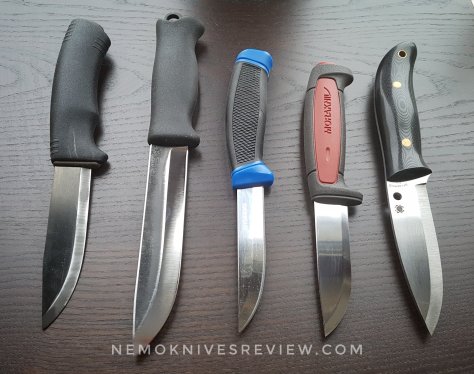
On the picture above only 3 of the knives are true scandis with no micro bevels.
I have been able to compared how Scandi behave with plastic bottles and also on wood . In fact, in my own experience, Scandi edge bites with some kind of hunger the cellulose fibers and soon also acts as a wedge which makes all the cuts strong and controlled. It doesn’t go as deep as a thin convexed full flat ground blade but the wooden chips produced are thicks. It’s a pleasure to use a Scandi ground knife on wood, there is precision in the cuts which can be shallow or radical (with the wedge effect).

The “Zero Ground” Nilakka being an exception as it combines the strong cuts of the Scandi with the deep push cuts of the full flat ground blades. Which makes it voracious on wood and explain the 5mm stock of the Nilakka blade.


On the two Mora Kniv, the cheaper was the sharper. The Pro-C bites immediately when the Mora BSK was dull. I have put that on the fact there is some kind of coating and no secondary edge. So, my first move has been to remove that coating.
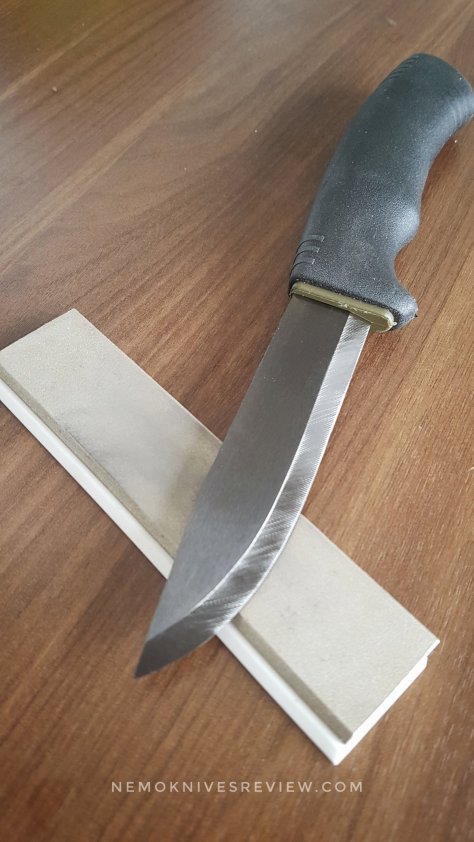
The secondary edge put flat on a stone, the coating was removed steadily and the edge was quick able to shave hairs then the Mora BSK was able to bite in wood and was a pleasure to hold and work with.
Both Mora are much lighter than my Spyderco Bushcrafters as they are not full tang. as i don’t plan to do any batoning with them, it is not an issue. Both Mora are true Scandis like my Spyderco Wolfspyder and Buscrafters.
It’s not always the case, even in Norway.
Normally Norwegian knives looks like that:

Scandi knives are a pleasure to cut and drill with as the thickness of the blade runs to almost the point of the blade, making a very strong tip.
But now you can also buy a Korean Puukko from Hyundai.

It will cost you around 40 Krons, which is around 4 Euros, 5 dollars…
But here you can see. It’s not a scandi but a thick saber grind with a visible micro bevel.


It means that even Scandinavian countries are not protected against pure cutlery heresy. It also means that Viking don’t mind to buy crappy tools for half the price of a Mora.

Why ? Because true scandi means a good steel and a good heat treatment to stand the thin geometry. It’s a century old design adapted to people building everything from wood: home, tools, furnitures… A true scandi edge angle is acute enough to be reliable and sharp.
Quoting “Patriot Dan” on the blade forums:
“There isn’t one angle really but 22 degree inclusive (11 per side) is a typical swedish midway edge angle for a scandi grind. The angle can be anything from 15 – 25 depending on use. (This is with the steels and the heat treat typical for those knives, some steels may not be optimal for such acute edge angles).The swedish and Norwegian grinds/edges are more obtuse than their Finnish counterparts. I believe the english bushcraft (woodlore being the most famous) knives that sport a scandi grind are based on swedish grinds but that’s just because they’re very similar.”
So true Scandi are NOT saber grind on disguise and NOT convexed. You need to put the bevel on the stone to keep them “true” hence my work of patience on the Nilakka, restoring her edge to zero grind after some convexing.
I haven’t made that kind of mistake on my Wolfspyder and S30V have proven to be reliable with zero chipping making that little folder a pure joy to use on wood.
More to come soon as the tests will take some time.

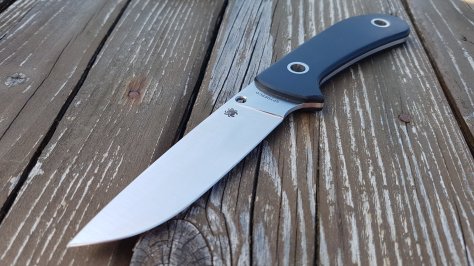 It has all started when I wanted to review the Spyderco Gayle Bradley Junction. It’s a great design for an EDC fixed blade which can be used for everything. Easy to carry in its pancake constructed bolteron sheath. But the edge was just too thick for my own use.
 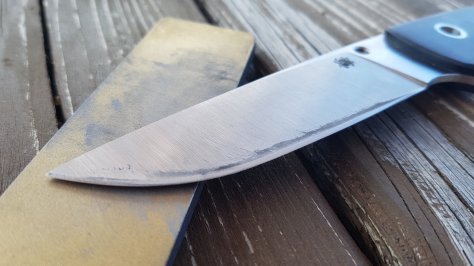 To my knowledge, SPF27 is some kind of CPM D2 steel. A lot of carbon 1.5% and not a lot of chromium around 12%. Not the easiest on the stone as a semi stainless. It was not very soft under the diamonds compared to another blade in N690 HRC59 I got with me. And it was not really easy to remove the shoulder to create a gentle convex edge. Patience… In sharpening is important. And I often lack of it but I was able to improve it.
 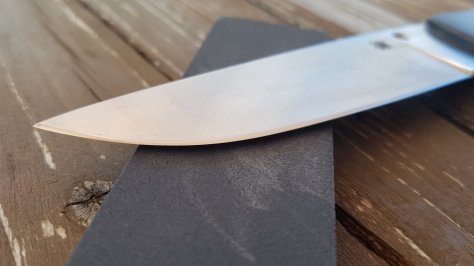 Next some black stone mostly to remove the scratches.
  And then the white ceramic to get a better finish and a razor steel.
 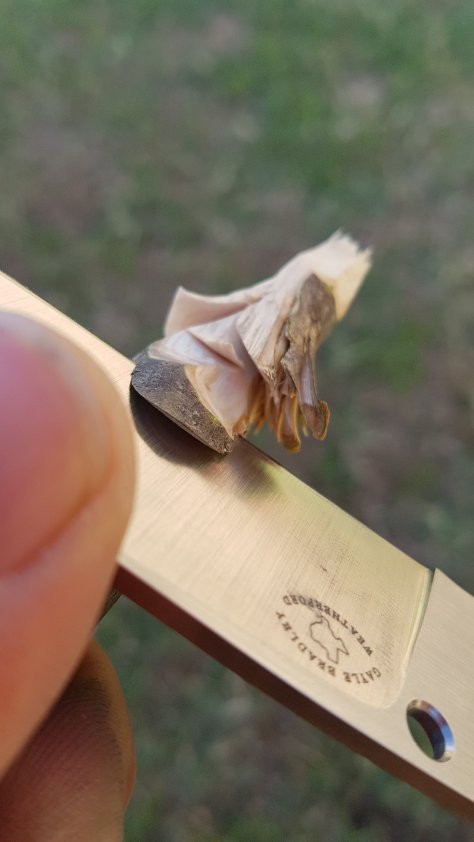 You can notice the chamfered signature hole on the Junction. A première. The cuts were deeper. It was better! Much more enjoyable.
  But the spine was too sharp for my thumb and diamonds came handy to rounded the angles. It would never be a Sebenza spine….
  Again the control during whittling was much much better. One should never be scared to round the edges for suiting your own needs.
  The handle is very flat on that knife. It’s an attention for people who wish to stash their knife in a pocket or a backpack without leaving a print.
  But a flat knife is not the most comfortable in the palm of your hand… Especially when cutting hard things for a long time.
 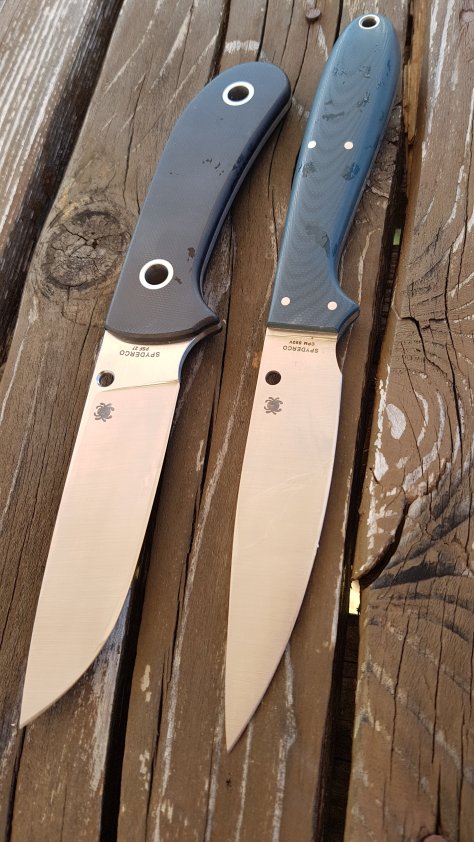 I decided to make a quick comparison with the Spyderco Sprig which is a pleasure to use.
  You can notice how the Phil Wilson’s Sprig got a thicker handle. And it change everything when cutting hard things. Also Phil Wilson’s is all about performances. Its geometry is stellar.
  It immediately cuts deep in wood without any real improvement needed….
 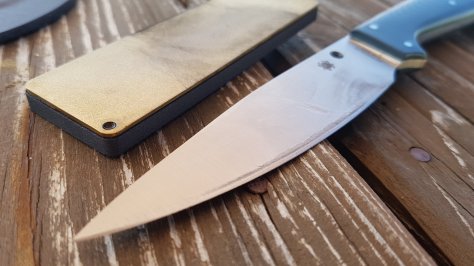 But diamonds were there to be usef. 🙂
  I was able to get thin regular cuts into the wood. So I have decided to try the diamonds on the Gayle Bradley Bowie I have brought with me. This one got a thicker geometry and is made if the same pulverized alloy as the Junction
 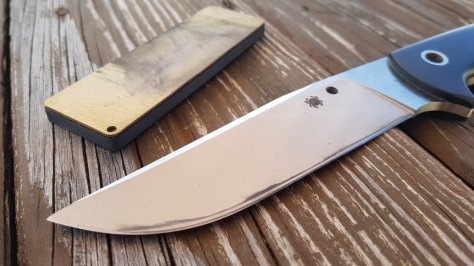 You can always improve an edge.
  Used as a light chopper it worked just fine.
  Gayle Bradley has provided a great compact Bowie which can be used as a light camp knife.
 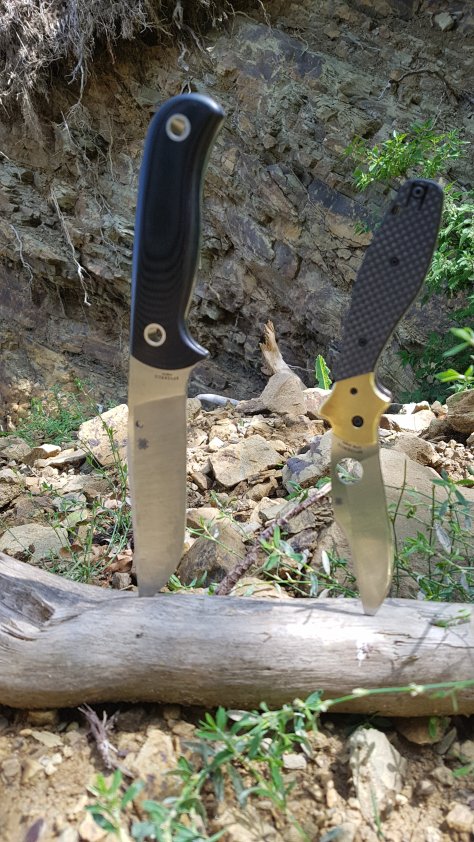 You can see: it’s not a lot bigger compared to my Ed Chempp Bowie.
  And the edge once thinned is honorable.
 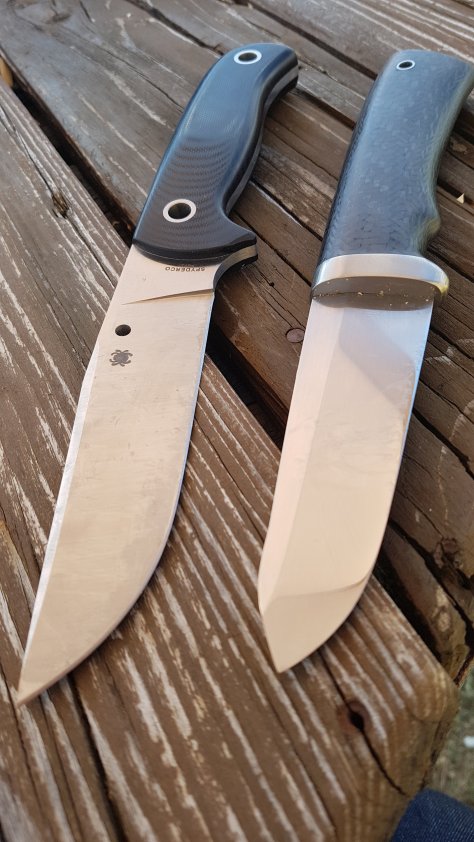 Of course it is not as thin as my Pekka Tuominen Urban II for example. And not as aggressive as the Sprig…
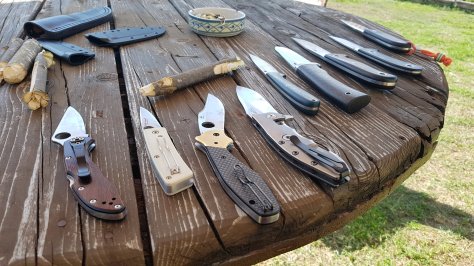 I got…. too much knives on my table…
 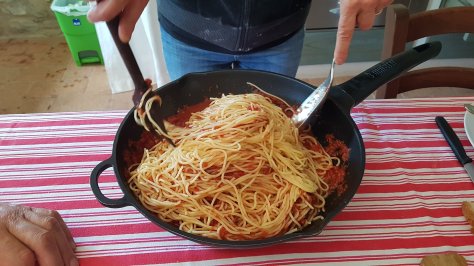 An Francesca knows how to prepare the pasta with pomodori.
  Crostini a la Toscane. Poultry liver, oignons, red wine, bread and a Bowie.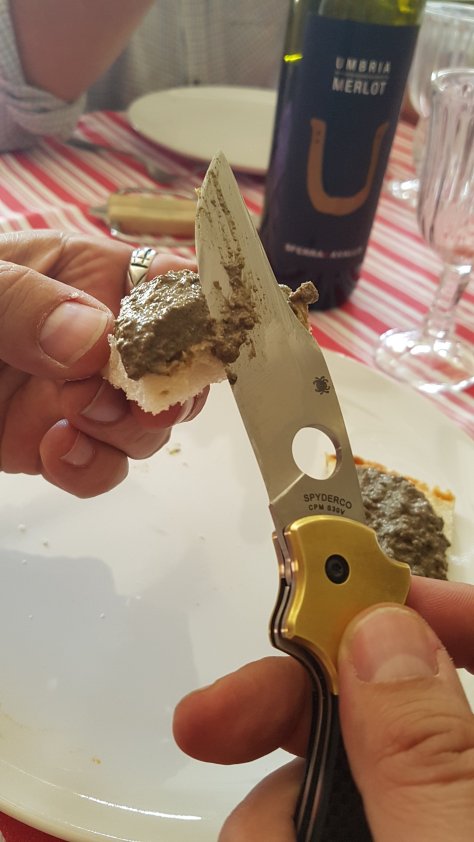
 Back in the outside I was thinking of a simple way to see the “impact” of good geometry on whittling. On the right, a single cut if the thin Delica and, on the left, a single cut of the thicker
  Also the Delica was able to cut from the ricasso to the point without any hard pressure. In the end, I had noticed that the Junction was less good than the Sprig and the Delica was still the best whittler in the batch. No matter the steel, for wood cutting, geometry is queen. So I have taken my Bowie back to the diamonds and put a keener edge. Tomorrow it will be hunting day.


 NemoKnivesReview