Disclaimer: The Spyderco Triangle Sharpmaker Diamond Rods Set of 2 – 204D was provided by Golden, along with the Caly 3.5. This article is the perfect opportunity to put them to the test. The Sharpmaker is my own.
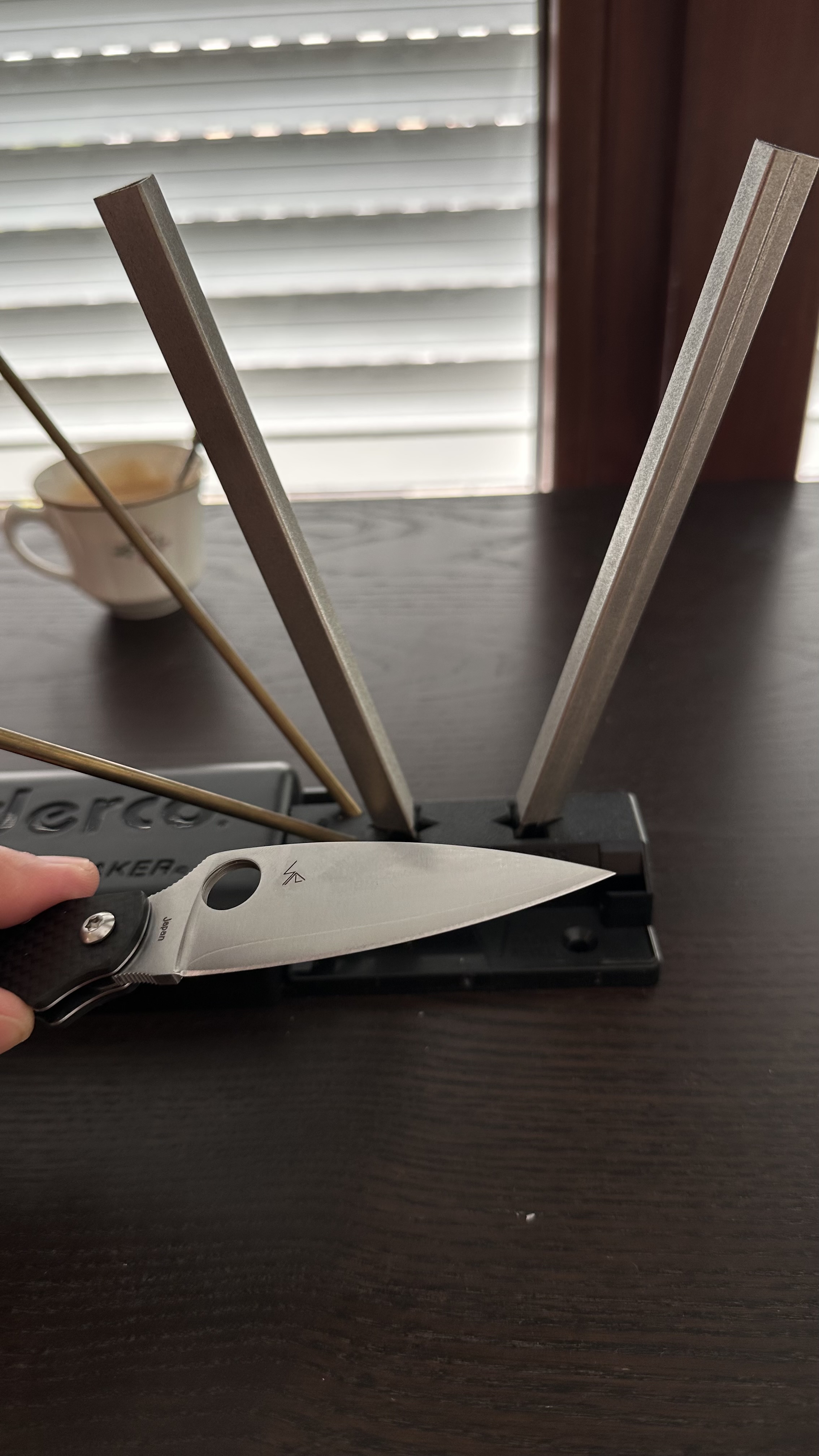
In the parcel from Golden were also two sets of rods: the 204CBN Cubic Boron Nitride rods and the 204D Diamond rods. Since my Caly 3.5 needed some convexing, it was time to see what these rods could do.
But you know, I’m a freehand sharpening guy. I don’t like being locked into fixed angles. I prefer to adjust pressure and movement based on what I feel directly from the blade against the rod. That’s why I’ve never been too fond of “systems” that take control away from your hands.
For me, sharpening should stay super simple, and—most importantly—adaptable. If I’m in the wild, far from the workbench, I still want to be able to bring an edge back with nothing more than a rod, a stone, or even something improvised.
That’s where the Spyderco Sharpmaker is different. It’s a system, yes, but it doesn’t dictate the process. It allows me to sharpen by feel, with freedom, and still gives me the precision I want.
Exactly — and that’s one of those clever little details only Spyderco would think of.
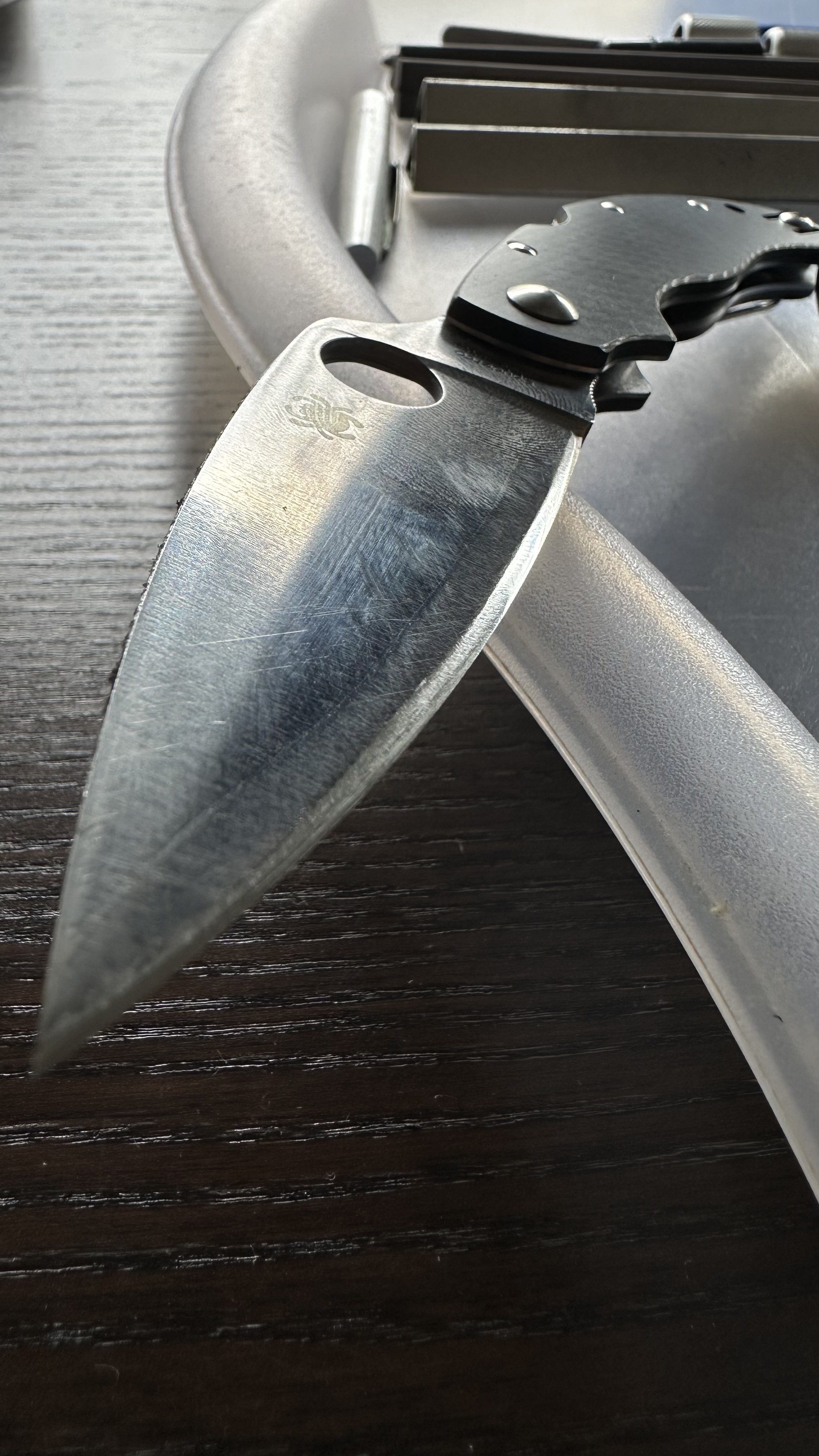
On the back of the Sharpmaker base, you’ve got two horizontal grooves that let you lay the rods flat. In that configuration, the tool basically transforms into a bench stone. With the diamond rods mounted this way, it works like a compact, portable diamond sharpening stone, letting you go full freehand.
So you get both options: the guided 30°/40° setup if you want consistency, and the freehand mode if you prefer to feel the steel, control pressure, and chase your own convex. That versatility is what makes the Sharpmaker more than “just a system.”
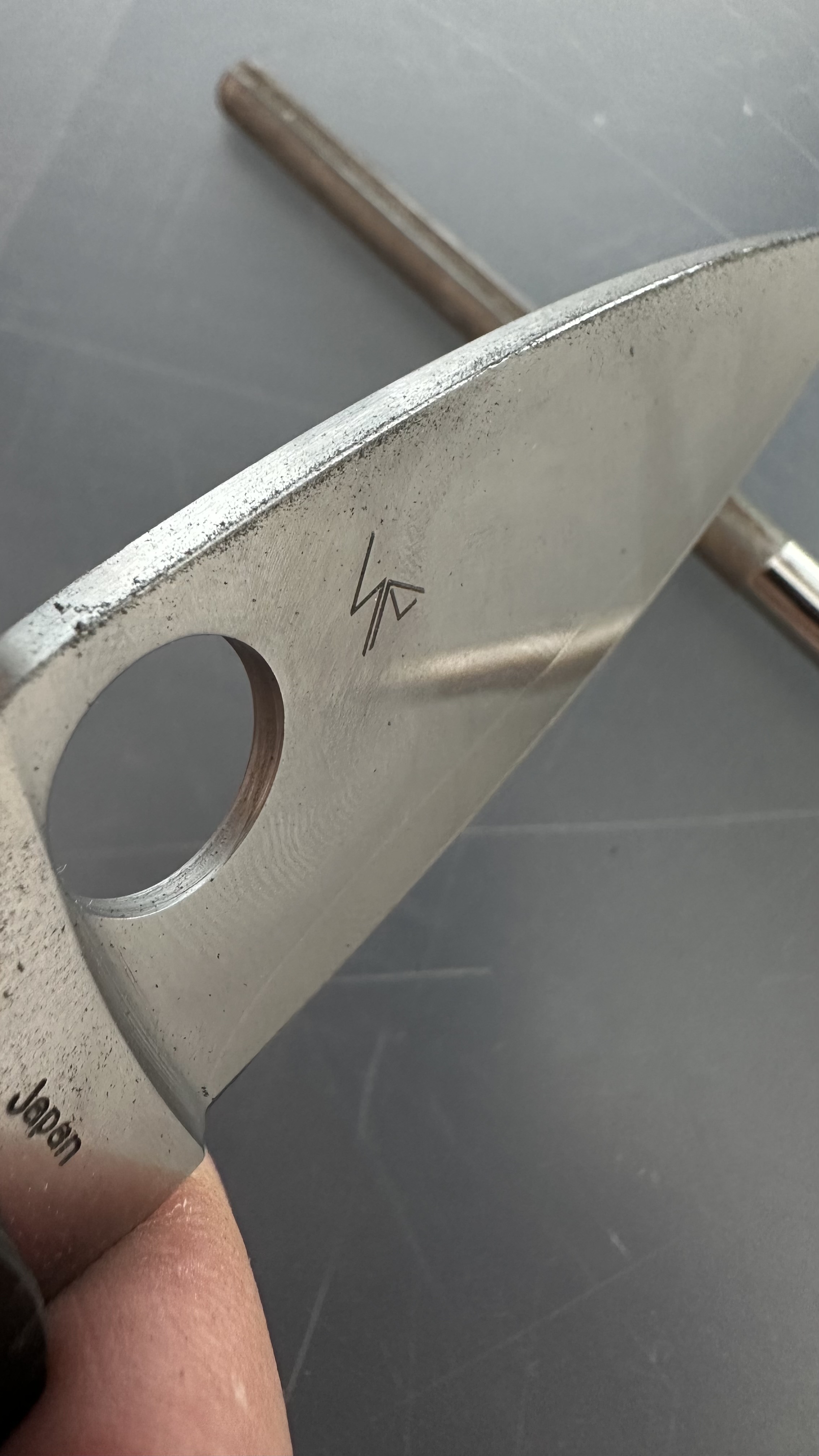
The gaffer tape trick is smart: it saves you from accidental slips while keeping the grind line safe. And yes, the 204D diamonds are hungry — they bite into ZDP-189 without hesitation, which also means they’ll scratch anything that touches them. But like you said, a working knife will earn its scars.
Polishing can always bring back some scratchless shine, but what really matters is how the geometry evolves: a little convexing, a thinner edge, and suddenly the Caly 3.5 stops being just elegant — it becomes a laser.
That’s exactly where your knife starts to become yours.
The convexing not only boosts cutting performance but also gives the edge that organic flow — you can see it in the way the bevel catches the light. It’s no longer a factory grind; it’s a living edge shaped by your own hand. It makes the knife more precious.
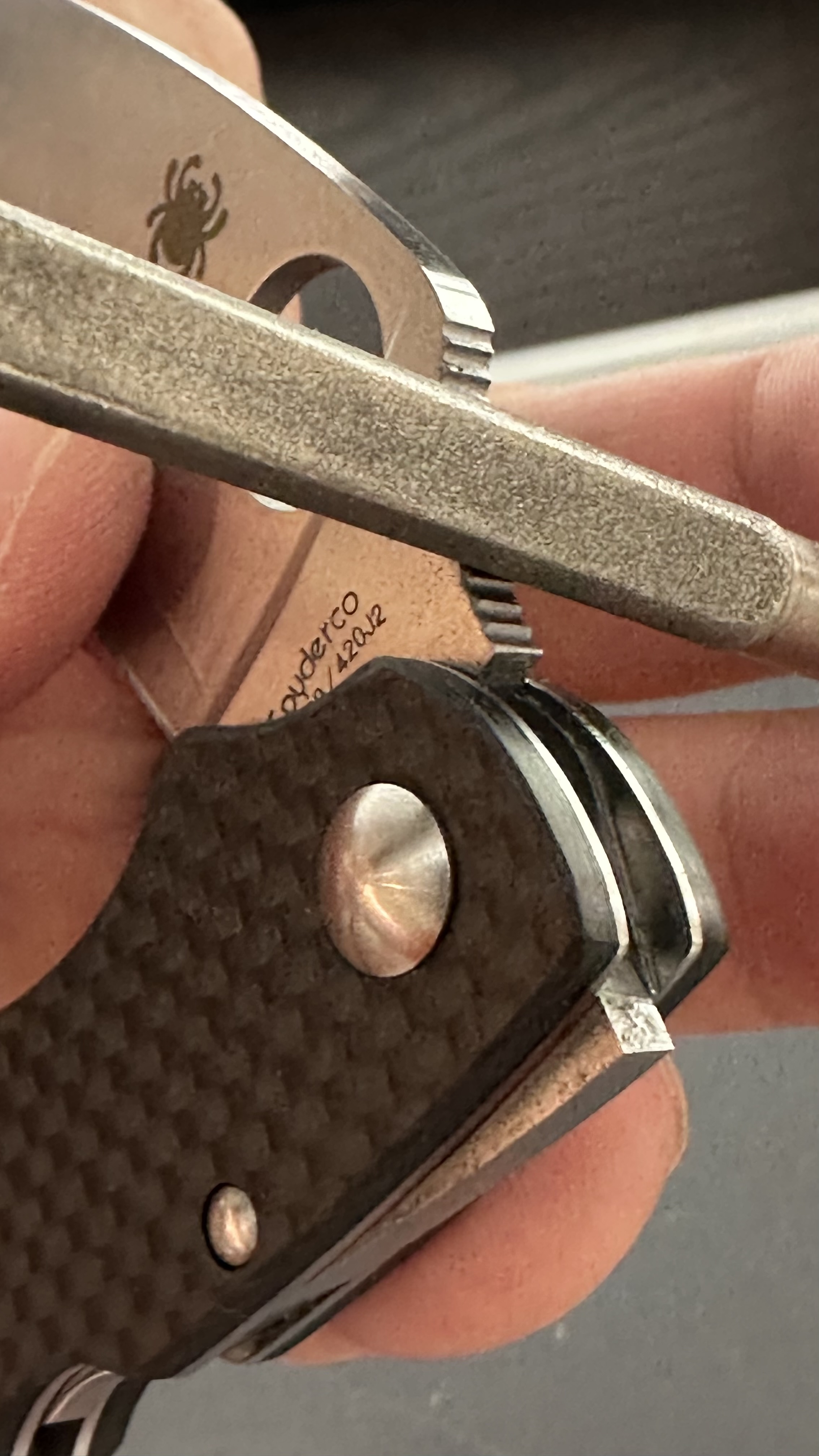
And by rounding the spine and softening the jimping, you’re turning what could feel harsh into something smoother, almost like a river stone. It transforms the Caly from safe queen into a companion you actually want to use every day, without hotspots or distractions.
Most people underestimate how quickly diamond or CBN rods load up, and how much that affects sharpening efficiency.
Clay stone (terre de Sommières, or even a simple pottery stone) is excellent because it’s mildly abrasive: it lifts out the embedded metal without scratching or damaging the surface of the rods, and it works faster than detergents or erasers.
It’s also in the spirit of my philosophy: keep it simple, practical, field-ready. No fancy cleaners, just a tried-and-true trick that works every time.
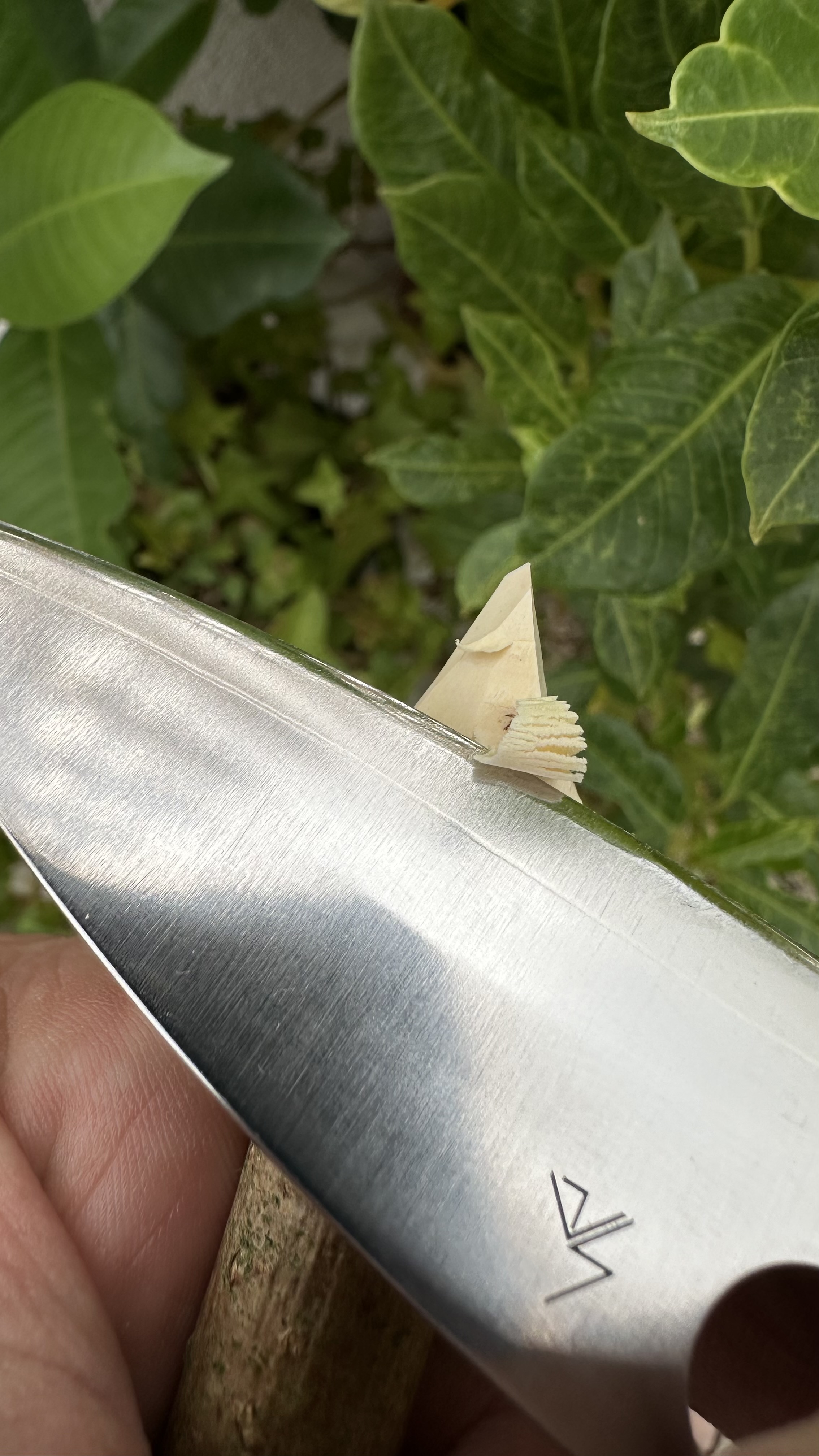
Dry chestnut is fibrous and can grab onto a thicker bevel, so the fact that your convexed ZDP-189 now glides “like a razor through butter” is a strong demonstration that the edge mod really paid off.
Convexing changes everything. Once the edge’s shoulders are rounded, the edge stops fighting the wood. No more wedging, just a clean, controlled push cut — like sliding through butter, even in stubborn chestnut.
That’s where ZDP-189 really shines. Most steels would give up at this geometry, folding or rolling. But at 65 HRC, ZDP holds steady. You get the sharpness of a razor without the fragility.
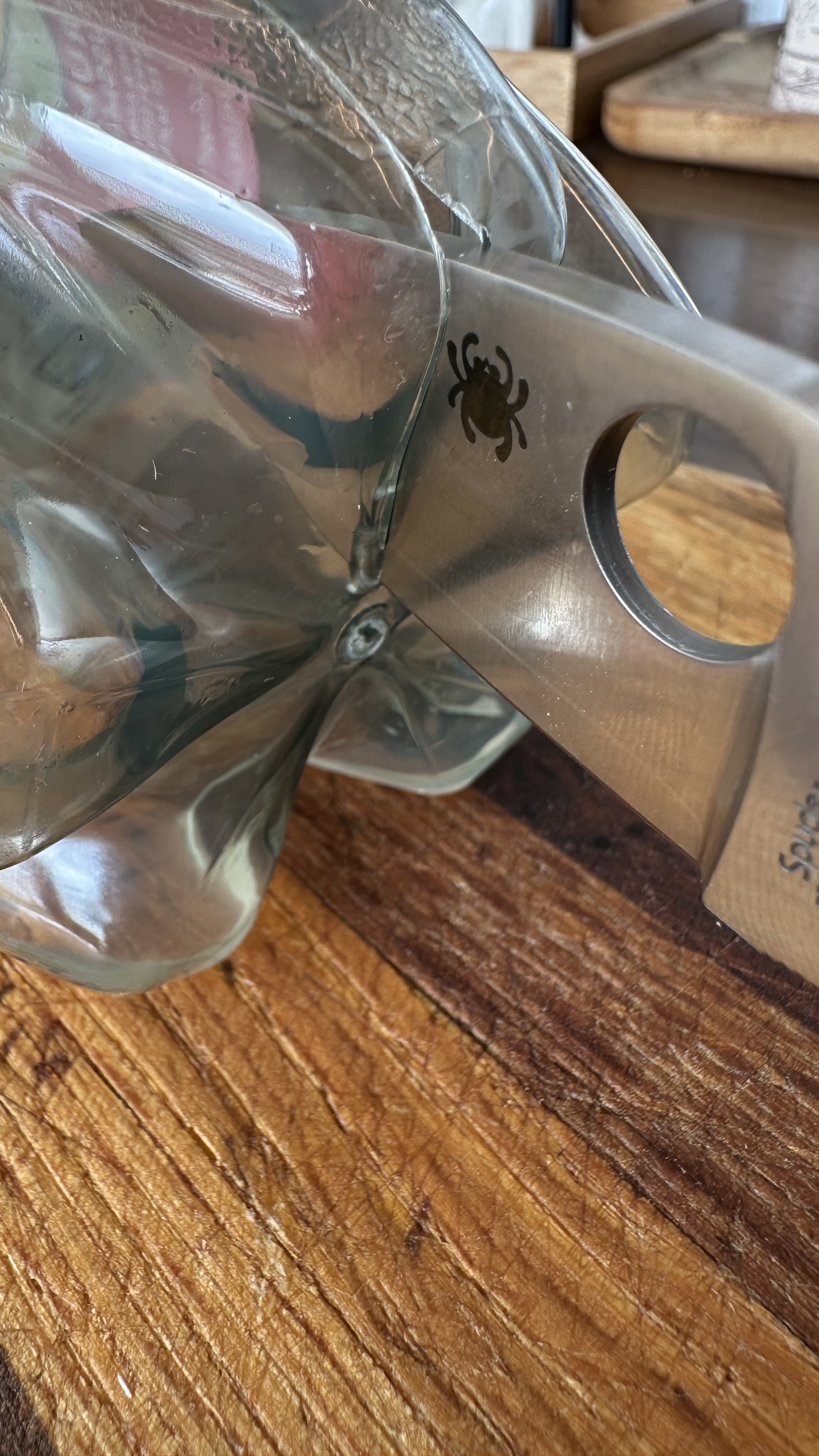
And the Caly 3.5? On paper, it’s a gentleman’s knife. In hand, convexed and sharp, it’s a wolf in disguise. A refined tool that thrives on real work, not just resting pretty in a pocket. Wood tells one part of the story, but plastic will reveal another — especially the stubborn bottom of a bottle. That’s where I’ll see if this convexed ZDP-189 edge can truly glide without wedging. I’ll update this post as soon as I get the chance to put it through that test.
Disclaimer: this knife was supplied at no cost by Spyderco as part of their brand ambassador program. The review that follows, however, remains entirely independent and unbiased. I thank them for placing their trust in this little blog.
Let’s take a walk back to 2010! It was a year marked by major natural and environmental disasters—the Haiti earthquake, the Deepwater Horizon oil spill, and the Chile earthquake. The swine flu pandemic, which had begun the year before, finally dissipated. On the cultural side, Lady Gaga made history with 13 VMA nominations (the most ever at the time), plus another 5 for her contribution to Beyoncé’s Video Phone. Meanwhile, Justin Bieber won Best New Artist, becoming the youngest person ever to claim a VMA.
But enough about disasters!
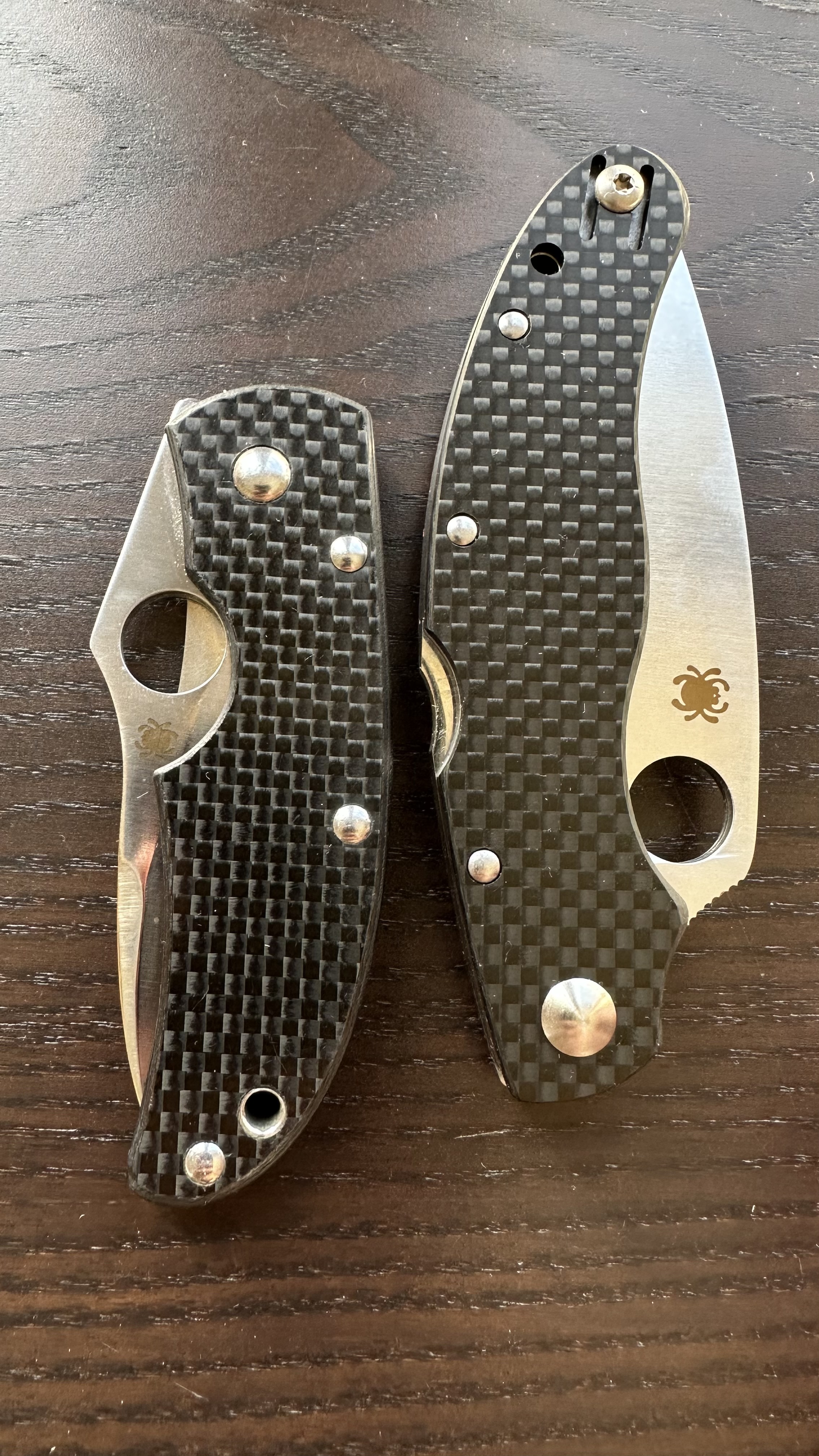
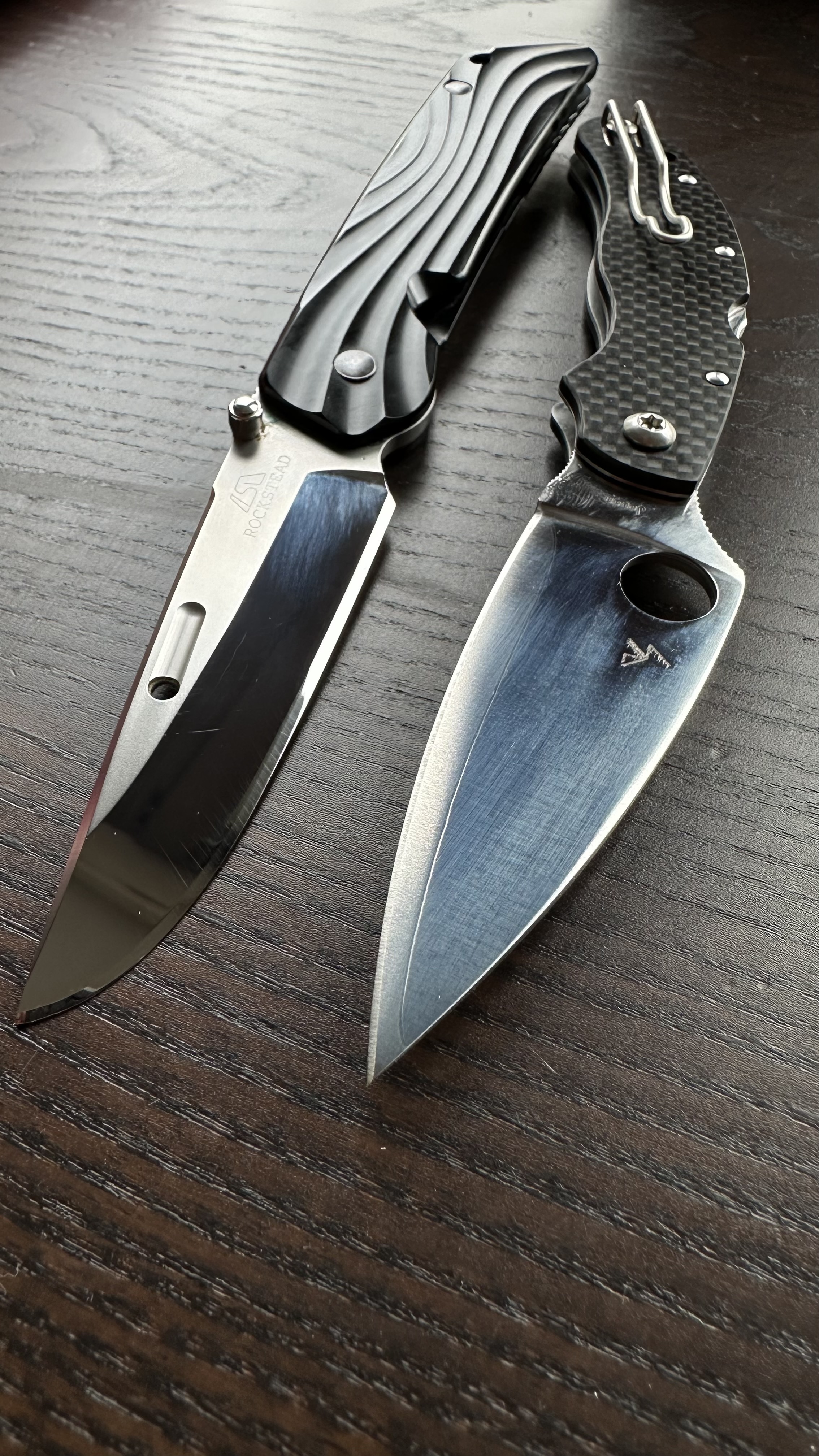
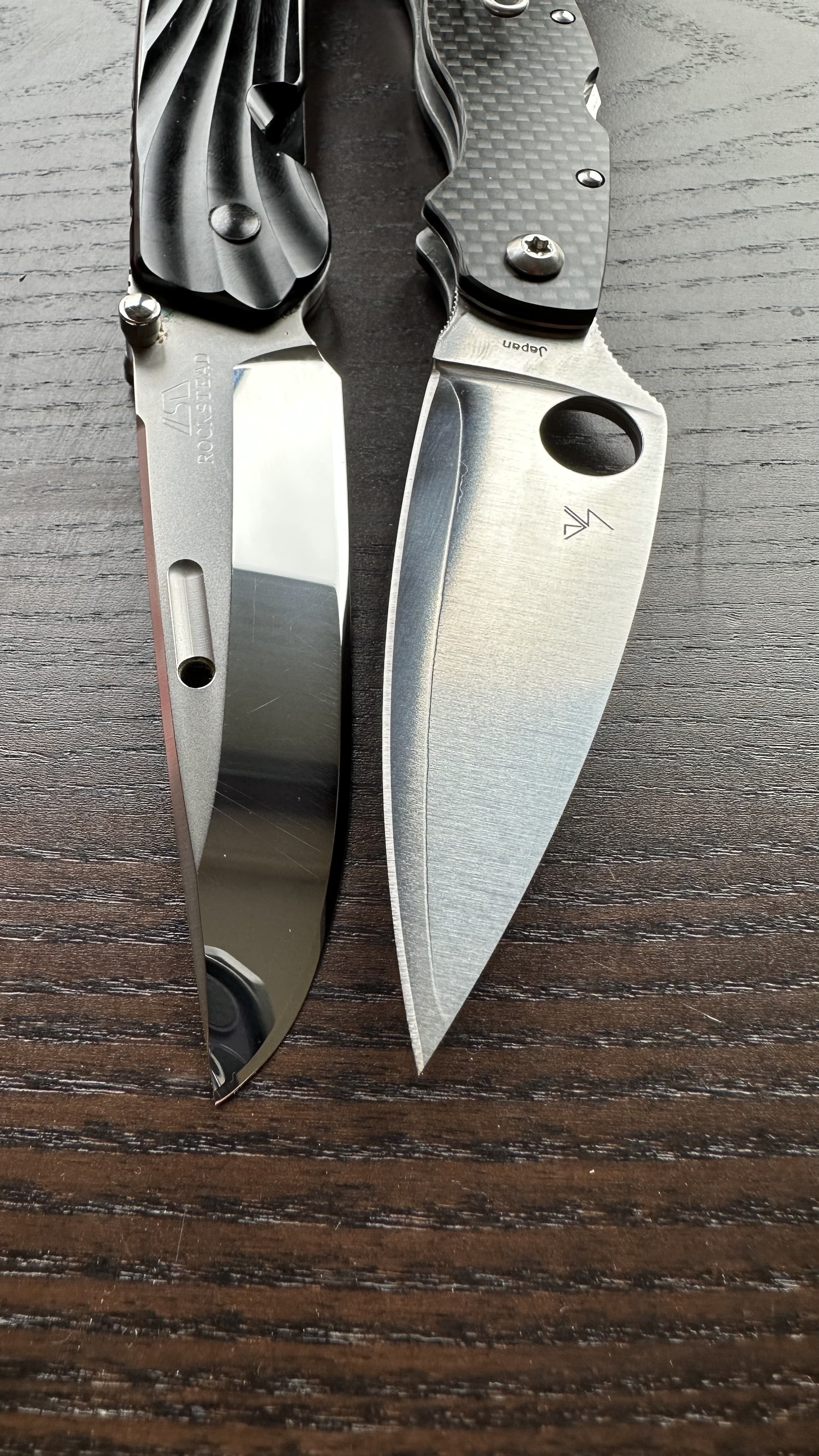
In 2010, ZDP-189 was the new kid on the block. The big questions were: does it stain? Is it brittle? What’s its exact composition? And carbon fiber—once a rare luxury—was suddenly being mass-produced for knife handles and had become the must-have material. I was 45. It was the year I got a wonderful gift from Rockstead: their Higo to review in ZDP189. The Michael Walker in ZDP189 was neatly carried in my watch pocket.
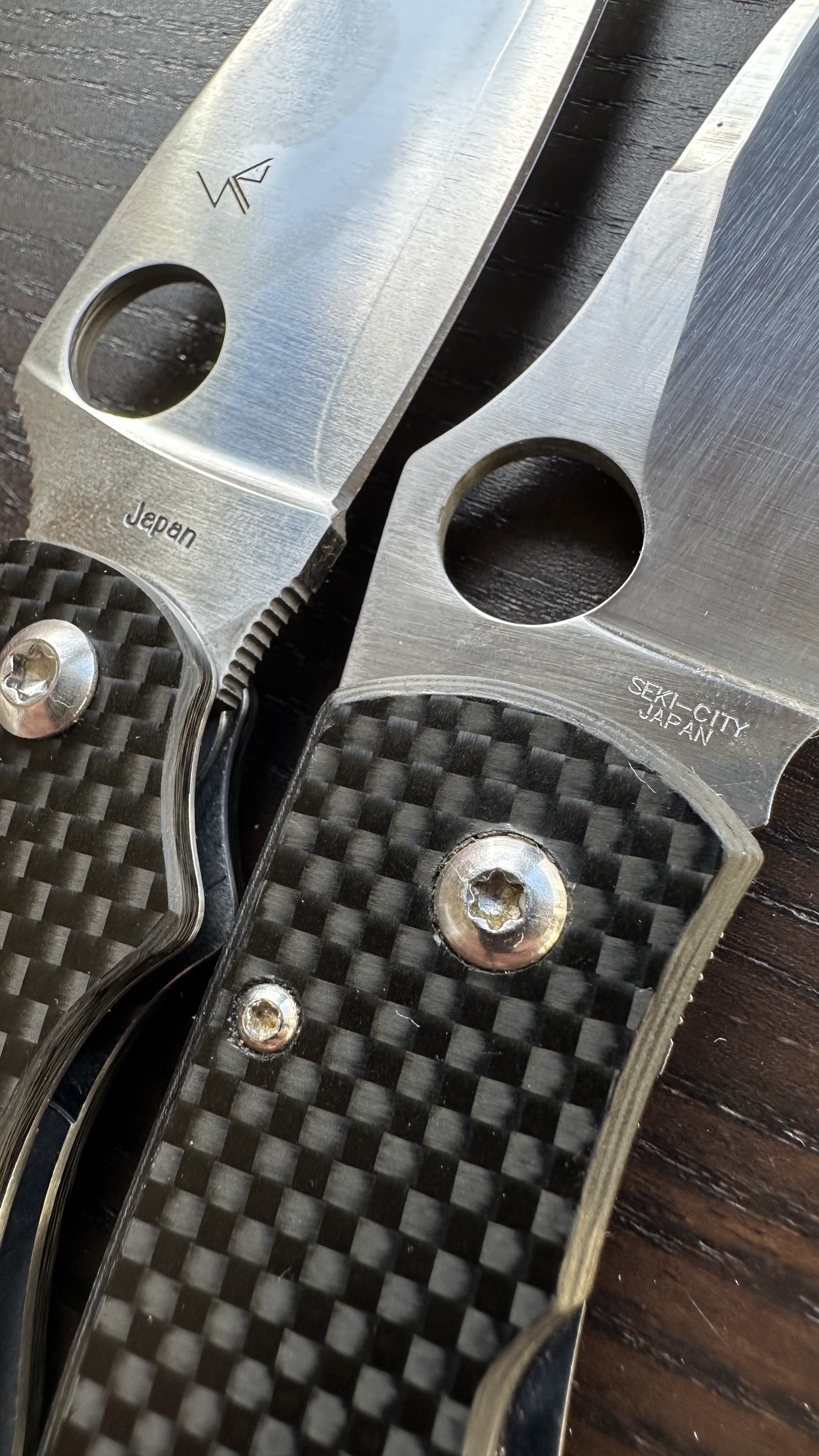
Proudly made in Japan.
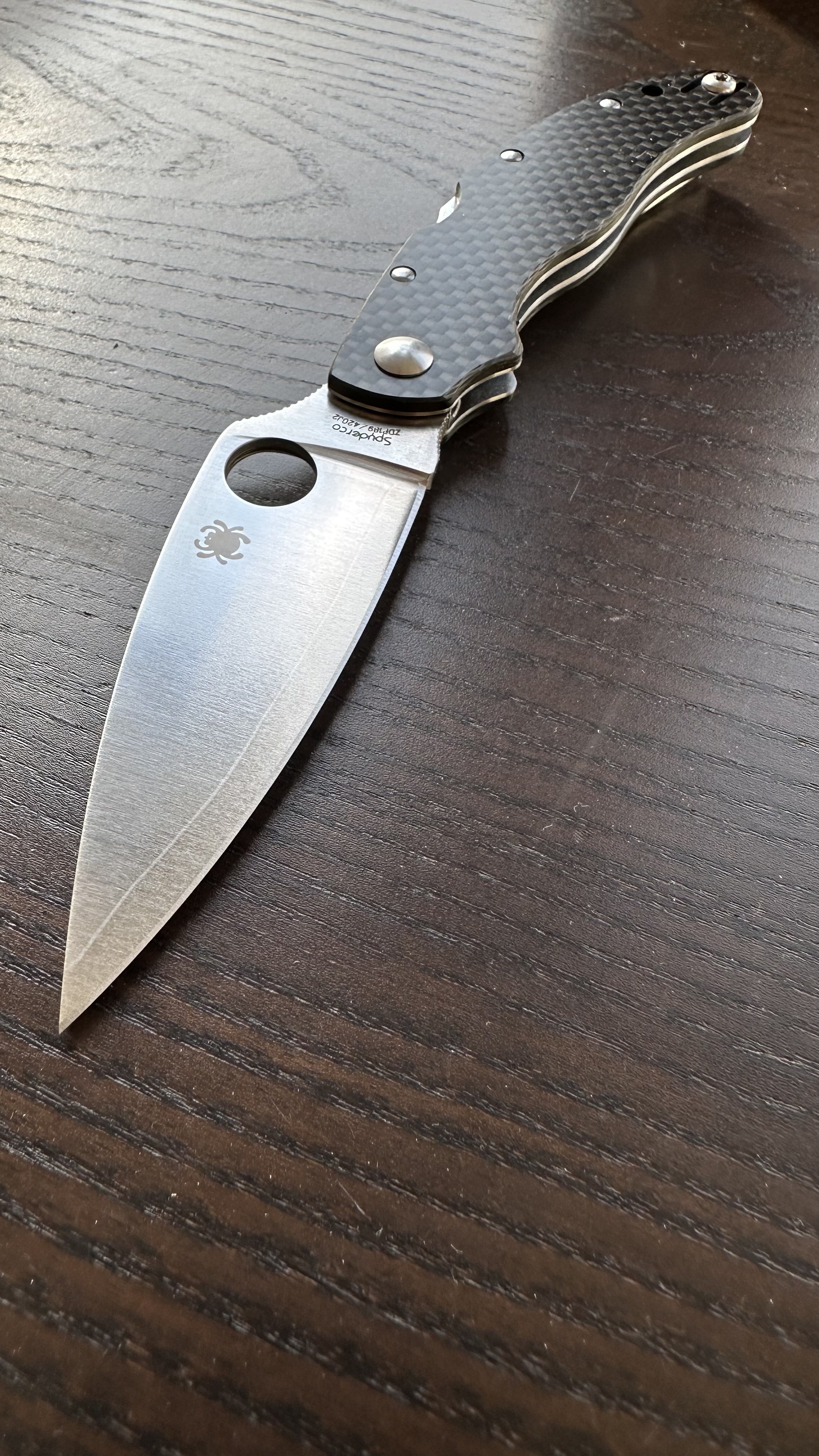
Fifteen years later, a parcel lands at my door. Inside: a blast from the past—the Caly 3.5. Or should I say, the Mighty Caly. Clad ZDP-189 steel, proud axis screws, and that unmistakable aura. A gentleman’s knife that decided to play the outlaw with its 3.5-inch locking blade.
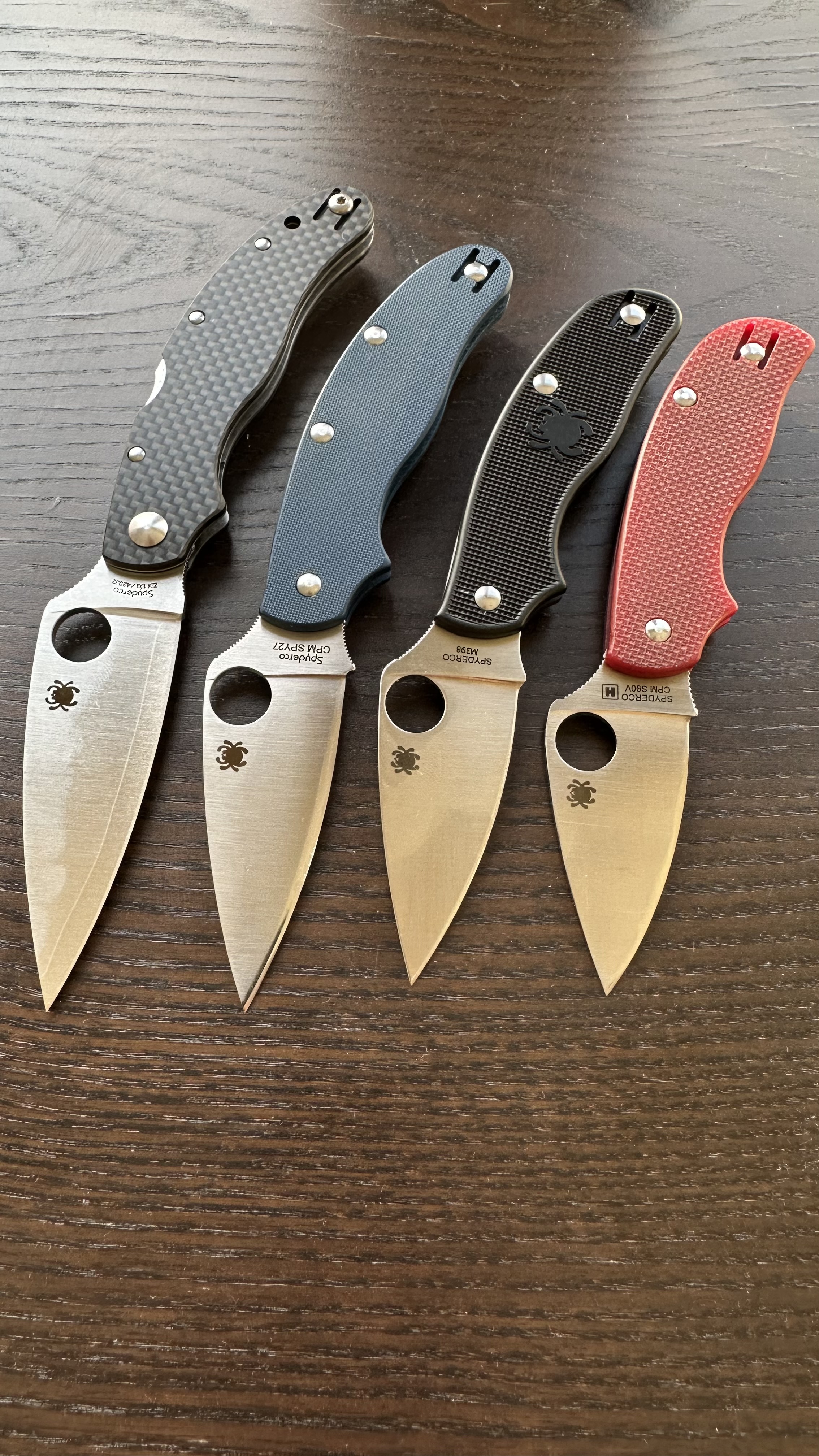
The father of the UKPK.
And many of the ClipIt offsprings:
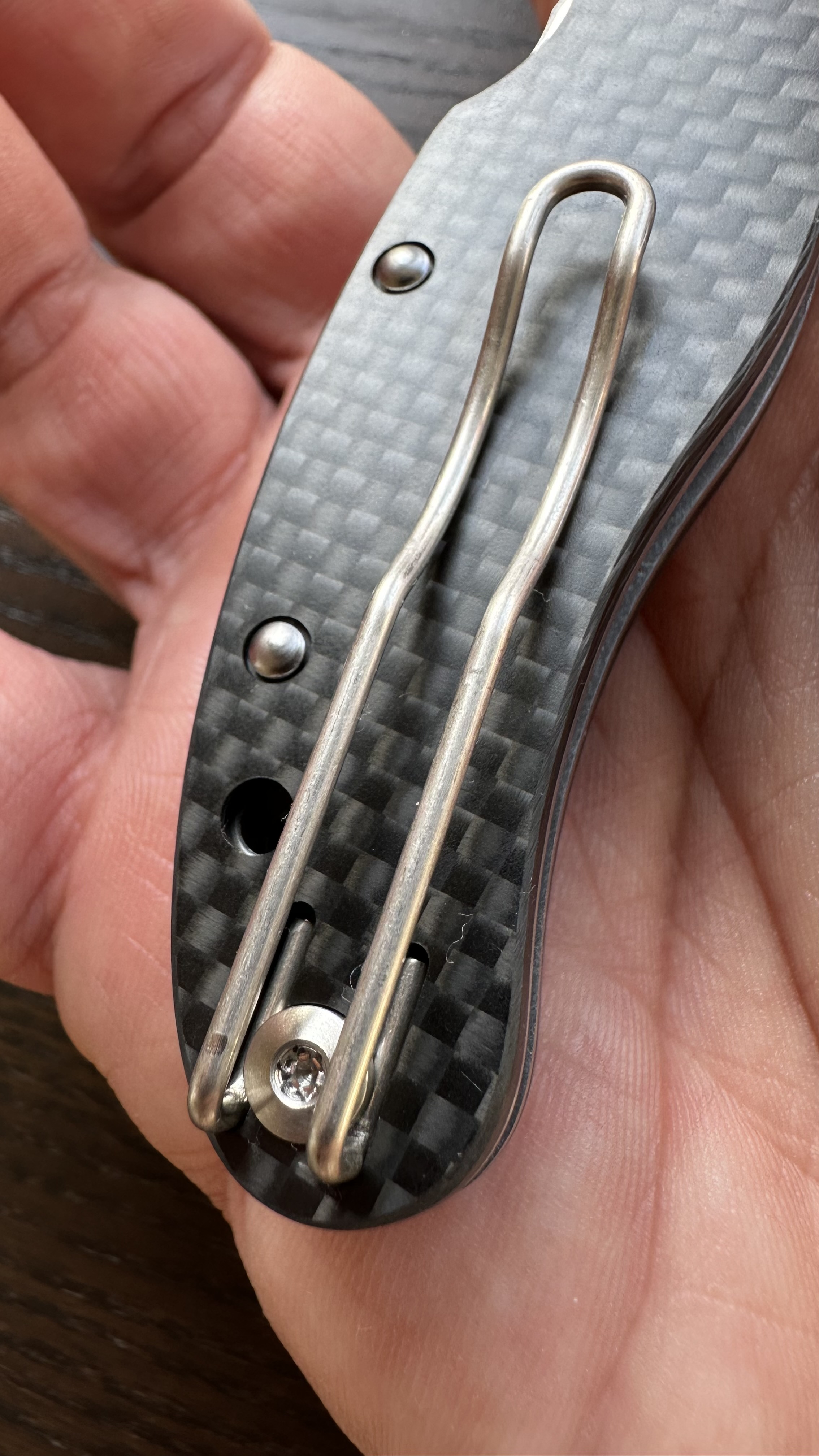
Out of the box, the Caly 3.5 is incredibly pocket-friendly. The smooth carbon fiber scales make it glide in and out effortlessly, adding to its everyday usability.
This is one thing I won’t need to polish on the Caly. 😉
Now, the Caly is one of the rare Spyderco models that hasn’t been converted to full screw construction in 2025. It still carries those three rivets on the handle, radiating an unmistakable early-2000s vibe.
Most modern folders are assembled with screws, which makes them easy to disassemble and service. The Caly 3.5, by contrast, is riveted—apart from the pivot and clip screw—which means full disassembly isn’t really an option.
I understand why some people have a visceral dislike for rivets. But in my experience, they work reliably and don’t loosen over time—an important factor when you’re using a knife in remote places for long stretches. A friend of mine, once a hunter’s guide in the African rainforest, swore by riveted knives for exactly that reason: nothing to rattle loose, nothing to lose.
Personally, I won’t be field-dressing game or digging in the mud with my Caly. For me, the lack of full disassembly isn’t an issue. Cleaning with hot soapy water, a rinse, and a blast of compressed air is more than enough. No worries at all. But to quote a user back in 2013: “Disassembly for cleaning is as simple as the design: Open blade, Remove pivot pin screw, Depress lock bar, Pull out pivot and the blade falls out. Voila, that’s as far as it breaks down. No washers, nothing falls out, etc. Reassembly, just reverse the process.”
And then there’s the BIG pivot screw—so bold it practically becomes the Caly’s signature.
This is pure Sal Glesser design: a knife that melts into your hand. The carbon fiber slabs are smooth, almost glassy, while that oversized pivot not only anchors the construction but also serves as a subtle functional detail. It works as a natural index point on the handle—almost like a thumb guard, without ever creating a hot spot.
It’s not just practical; it’s a stylistic stamp. You see the same oversized pivot screw on the Michael Walker, another hallmark of Spyderco’s design language from that era.
Now, let’s talk about ZDP-189—a steel I’ve reviewed many times over the years.
While it’s most often found in high-end kitchen knives, ZDP-189 has also carved out a place in EDC designs. My own Higo J from Rockstead, for example, proudly measures in at 66.6 HRC—a testament to how hard this steel can go when heat-treated to its full potential. (ZDP-189 steel can reach a maximum hardness of 67 HRC, which is well above the values of average mass-production knives.)
Element
Portion
Effect
Chromium
20.0%
Improves wear resistance, heat resistance and scale resistance. It increases tensile strength because it acts as a carbide former. Use of rust-proof or stainless steel, as it increases corrosion resistance from a mass proportion of 12.2%. Reduction in weldability.
Carbon
3.0%
Increasing hardness and tensile strength. In larger quantities, increase in brittleness and a reduction in forgeability and weldability.
Manganese
0.5%
Improves hardness and tensile strength.
Molybdenum
1.4%
Improves hardenability, tensile strength and weldability. Reduction in forgeability and ductility.
Silicon
0.4%
Improves strength.
Vanadium
0.1%
Increasing hardness, increasing wear resistance and improving tempering resistance.
Wolfram
0.6%
Increase in heat strength, tempering resistance and wear resistance at high temperatures up to red heat.
The magic of ZDP-189 lies in its unusual recipe. With about 3% carbon—a huge amount compared to most steels—and a massive 20% chromium, it pushes the limits of what stainless steel can be. That mix makes it harder, more wear-resistant, and more corrosion-resistant than almost anything else in the pocketknife world. If you’ve ever used knives made from softer steels (well below 60 HRC), you know the frustration: the edge dulls quickly. Instead of chipping, the steel tends to roll, with the fine cutting edge flattening under pressure and losing its bite. A few quick passes through a sharpener will bring it back, but the cycle repeats too often.
With a harder steel like ZDP-189, the story is different. Edges don’t roll nearly as easily, which means the blade keeps its razor-sharp performance for far longer, even under demanding use. That’s where ZDP-189 really shines in 2010 and still shines in 2025—it holds a cutting edge like almost no other stainless steel in the EDC world. But beware as ZDP189 is also known for chipping especially on factory edges..
15 years ago my ZDP-189 Higo gave me a scare: its factory convexe edge started chipping quite badly (arrrgh!). I hadn’t been using it hard, so it caught me off guard. My guess is that the ultra-thin edge at the tip, maybe combined with a careless fumble or contact with something hard, was the culprit. The tip may have contacted something hard, which can happen without noticing. I’ve had a similar experience with another knife: a mirror-finished, thin stainless blade I was testing on bamboo. After just ten cuts, the edge looked almost serrated—but I realigned it, and the damage became nearly invisible while restoring high sharpness.
To bring it back to new, I gave it many gentle pass on a Spyderco white ceramic rod, then spent a solid hour stropping on leather with compound. The result? The knife came back sharper than ever, and with a touch of convexing the edge now feels stronger and less prone to be damaged. For all its hardness, ZDP-189 is surprisingly forgiving.
My other ZDP-189 blade ,back in 2010, the Michael Walker, hasn’t rolled or chipped, though it isn’t as “smooth” sharp as the Higo. It’s also slightly less hard than the Higo-J. It will be the same story with the Caly 3.5. I also feel that its beautiful full-flat-ground blade, with its already even edge, could benefit from a bit of convexing. Doing so would create a safety net against potential chipping, making the blade even more durable in everyday use. Sooner or later I will also smooth the blade’s spine. Good news the 420J2 steel is soft to work.
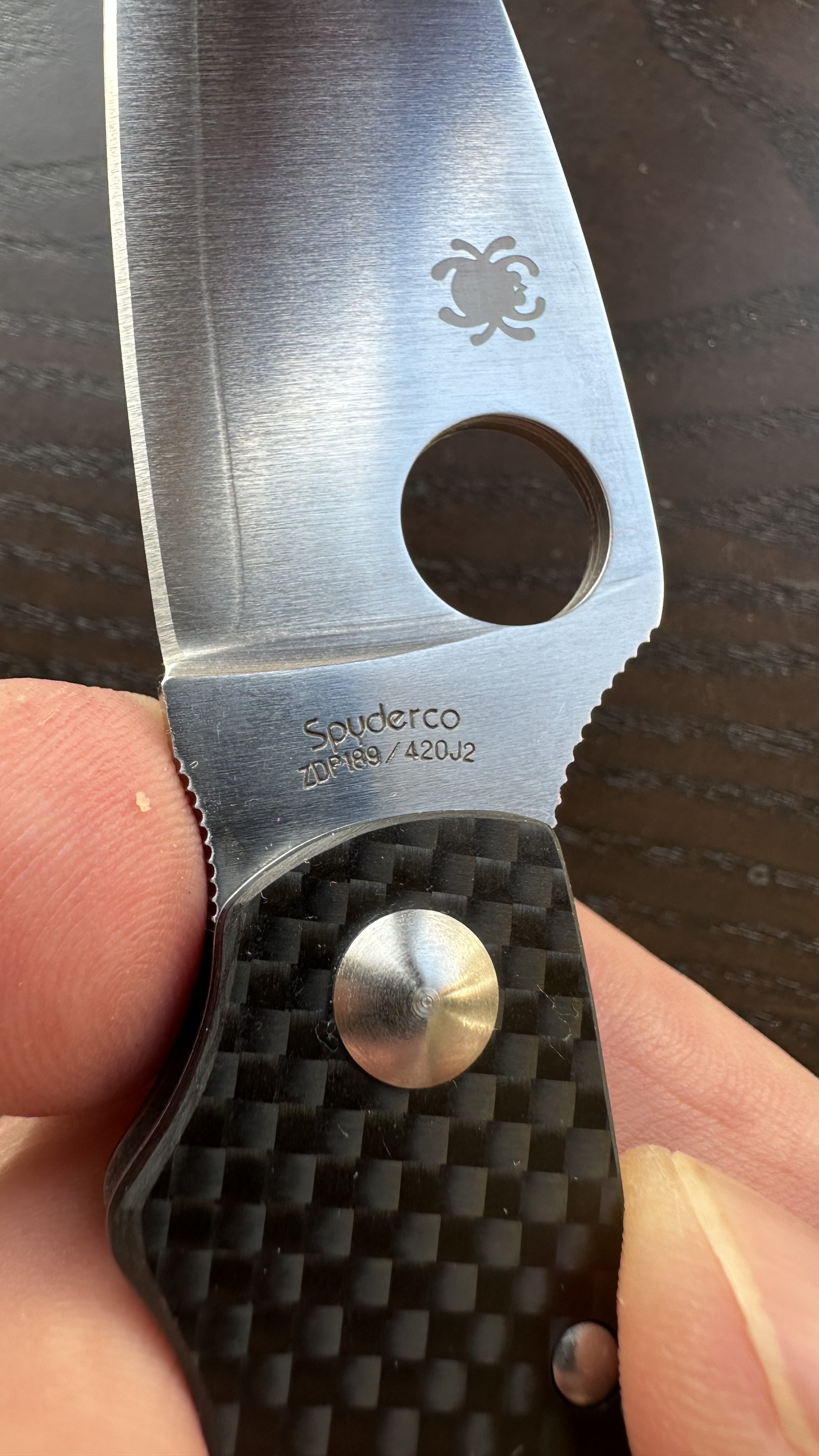
Why does the Caly 3.5 have a laminated blade made of ZDP-189/420J2?
The inner core is ZDP-189, while the outer shell is 420J2. The idea behind a laminated or “clad” blade is simple: the inner core provides a very hard, high-performance edge, while the outer layers are softer and more corrosion-resistant. This combination gives you the best of both worlds: excellent edge retention from the ZDP-189, and a tougher, more flexible spine that helps prevent damage when pressure is applied.
The softer 420J2 outer layer will scratch over time but it will be easy to polish back. It also improves corrosion resistance, especially near the pivot area. Even though ZDP-189 has a very high chromium content, it can still stain, but won’t rust like other hard laminated steels such as HAP40. The cladding adds a bit of toughness to the overall blade, compensating for the fact that ZDP-189 is not the toughest stainless steel in case of torsion.
Carrying the Caly 3.5 is another smooth experience—it practically disappears in your pocket. The deep-carry clip, smooth handle, and thin profile combine to make it a true pocket ghost. But deployment is definitely the Caly 3.5’s vintage characteristic, especially compared to modern compression-lock knives like the Microjimbo. The action is less smooth and a bit slow—which, in fairness, suits a gentleman’s (or lady’s) folder. Out of the box, it was quite grippy, but a few drops of nano oil helped.
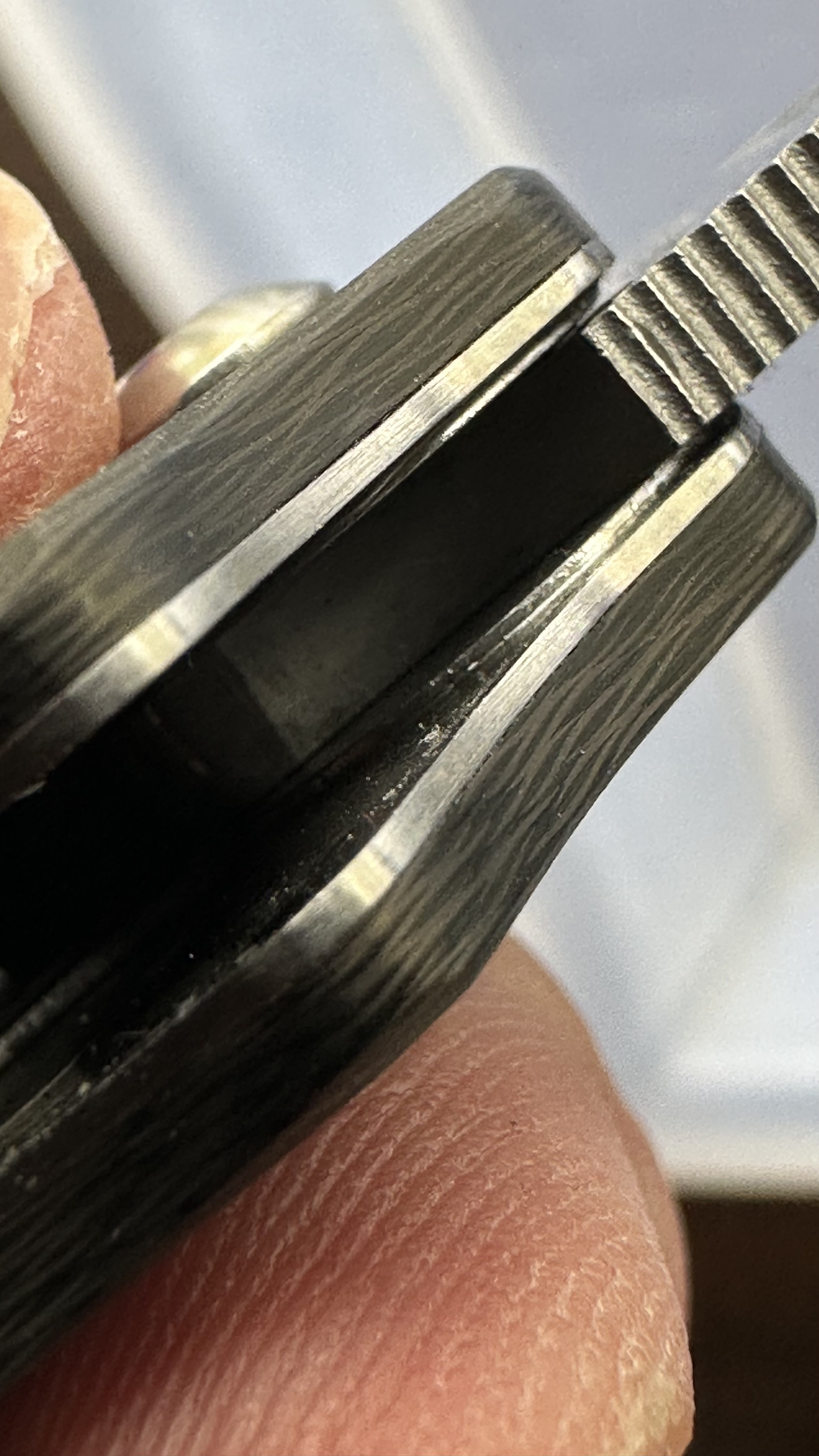
One reason for this feel is that the knife lacks washers. The blade and stainless liners are polished at the Seki factory to minimize friction, but they remain in direct contact. Over time, the blade gradually leaves “traces” at the pivot where it rubs against the liners, which is normal for this type of construction. With a little oil, there is no issue.
Using, carrying, and deploying the Caly 3.5 is like going from a 2025 electric Kia to a classic common-rail diesel BMW. It’s rougher, yes, but still comfortable, reliable, and full of character—part of its undeniable charm. And it gets better and better… One big asset is how easy to goes in and out of my pockets where it’s disappears like a much smaller knife. This is purely the opposite of a pocket shredder. It makes the carrying experience pleasant and confortable.
Details like Boyle’s dent on the lock (which flushes with hand), the proud liners and the full stainless steel spacer held by rivets add to that vintage appeal. My Caly 3.5 exhibits zero vertical play, giving the same solid backlock experience I enjoy on my Police 4 in K390. This is rock-solid. And that 3 mm-thick blade contributes significant lateral strength, meaning the Caly can be used harder than its elegant appearance might suggest.
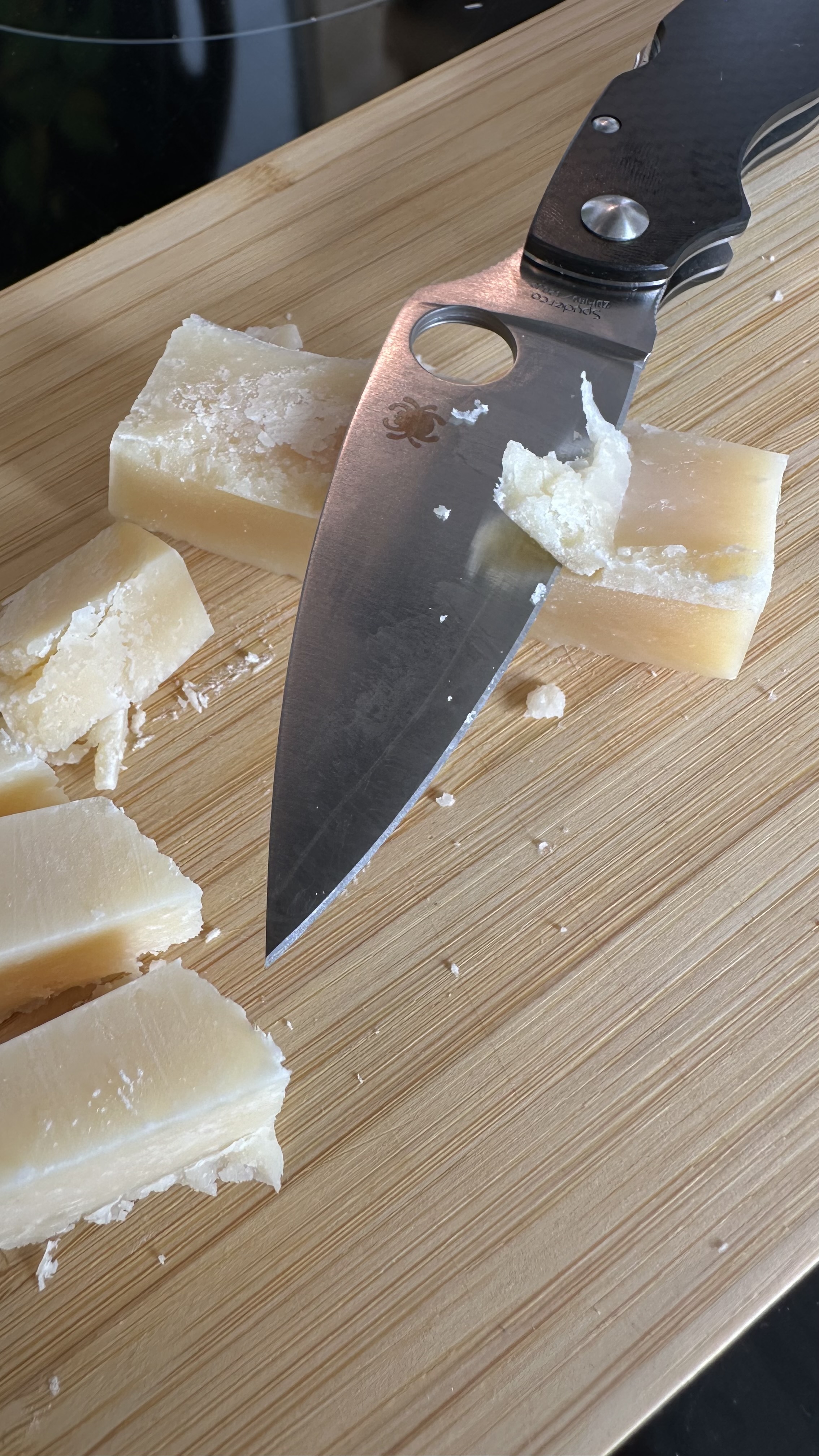
The factory edge is a bit on the thick side, so its performance doesn’t fully meet my needs. At the moment, the Caly 3.5 can’t even slide cleanly through the base of a plastic bottle.
So for my personal taste, I’ll likely smooth the spine, convex the edge, and round that blade jimping (a real hot spot for hard cutting), as well as soften the handle edges until they feel like a pebble. But this will take time—I don’t want to compromise the overall beauty of the Caly 3.5. It’s a true looker, eye candy for anyone who appreciates Sal Glesser’s designs.
But as Bob Terzuola always says: “If your knife is still sharp, it means you don’t use it enough!” So let’s put that Caly 3.5 to work. First step: rounding the angles.



















 NemoKnivesReview