Tag Archives: CPM S30V

POCKET LEGENDS OF THE FALL FEAT. SPYDERCO SCHEMPP BOWIE ~ C190CF

Today is the day the world mourns David Bowie.
It’s the perfect time to talk about another Bowie and another hommage: Ed Schempp’s Folding Bowie.

ED schempp Bowie

I have met again Ed at the Police National shooting range at avenue Fosh, Paris, in November. It was some kind of a mini knife show hosted by Patrick Bonetta, coutelier and keen master in sharpening. Both old friends were showcasing there their last knives, from kitchen to law enforcement duty. (Patrick will be the subject of my next articles BTW, the man desserve an entiere book !!)

Immediately Ed introduced me proudly to his last Spyderco collaboration: his bowie. What a gem !
The knife is simply oozing quality from all its pores: brass guard integrated bolster, carbon fiber handles…. a smoooooth opening. The beautiful symmetry once open and the gentle angle between the blade and the handle are trademarks of Ed’s designs we enjoyed so much on his Tuff and Persian.

This is not the first folding Bowie in the Spyderco catalog. Remember the Slysz Bowie ?
And I’m really a sucker for bowie shape blades. They got belly and they are pointy.
So deciding to put my Nilaka at rest for a while, immediately Ed’s Bowie got a ride in my front pocket.

“It has been made to be worn as a much smaller knife” Ed told me.

And he was right, the wire clip is so well designed that the knife disappears and ride deep in the pocket. It won’t be as quick draw friendly as the C36 Military, for example, but it is so discreet in this days of low profile mania.
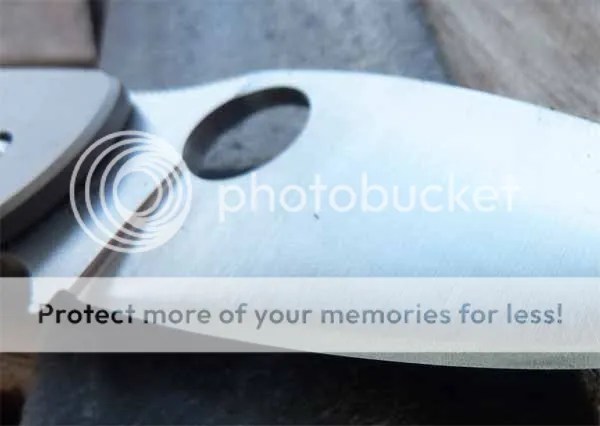
Once open, the beautiful blade is impressive. Narrower than his Navaja but elegantly theatrical !
Again this is a Gentleman folder destin to be used served by an ‘almost” full flat ground thin blade.
At 2.5mm thick, far are the days of the 4mm hollowground Starmate (pictured here in the Gayle Bradley review).
I was not impressed by the initial factory sharpening and since I have thinned its edge to more akeen result. It was done patiently as CPMS30V is not the easiest steel to let its molecules go away…


The bottle bottom tests are now passed with flying colors. Even the mineral water bottle, thinner and easier to collapse).
The natural angle found in the Kukris is again a nice plus even with a short knife. Ed is a farmer and he creates and builds tools for his ranch.
The integrated guard was a technical requirement which is cleverly accomplished. My first knife ever was a small bowie and its guard was a PITA. I was 5 year old and I knew this knife was not well designed…
On Ed’s Bowie, the guard is nicely “anchoring” the hand as a thumb rest for example. All is smooth and gentle under your fingers. Even in hammer’s grip the small guard doesn’t come in the way.

Reverse grip either.

So if you want a small folding bowie with a great attention to details, a nice belly, a slick and smooth action, the C190CF can be your choice.
I enjoy the brass bolsters and its soft texture contrasting with the woven carbon fibers. It’s a very sensual tool with the handle resting securely in my palm avoiding any lose of grip.
Back in the 90’s they were some very long conversations on the forums about how reliable the linerlocks were. In this bowie, the handle is very rigid and the lock very well executed in Taichung. The knife has passed my tests including the carpet test which was not easy with the Spyderco Tuff. I absolutely got zero concern about the lock on this one. I got zero play lateral or vertical even with white knuckles. It is stout.
This is another ‘home run’ from Ed and another very clever hommage to a legendary design. Once in the pocket it is very addictive.
Also used in the plates, the knife is elegant and do not raise any eye’s brows even in the restaurant. A great steak knife !

Some size comparaisons:

Two worlds but equally great usability. Eric Glesser Manix 2 lightweight in CPM110V is a Nasa dream.


Two Bowie brothers as the Slysz’s was invited for the picture.


Another pocket Bowie, this one made by Xavier Conil.


With the Mighty K2.


With Fred Perrin’s Streetbowies father and sonny Streetbeat.


My good old Benchmade BM806S. Another slick design wich has proven to be reliable in all situation.


With my very first knife purchased at Thiers in 1971 ! Yes it was a Bowie too !


With my good old rehandled Carbon V Cold Steel Trailmaster !


Fred Perrin custom Bowie La Griffe from the 90’s !

SPYDERCO NILAKKA ~ C164GBN – Round 2 – Hard Use Folding Puukko

I could not imagine that a knife with a 4.5mm thick stock blade could be considered as some kind of safe queen ever. A delicate collection folder destined to open letters (and clean nails). The Nilakka is from Pekka Tuominen for God’s sake. He is a exmilitary, a countryman, a masterbladesmith and a gifted knifemaker who is also genuinely “tool oriented” (even if he also loves precision and is “attention to details” driven). So. No safe queen. Let’s use his Nilakka like it deserves it: hard. Everyday. In all conditions. And it has to be successful ! I’m a grandson of a farmer which used to clean his knife on his trousers, drink like a hole, spit on the ground, and fart loudly to make his point. I will use the Nilakka like he would have use it.

But before, I needed to change some details to have that gorgeous folder fitting my personal tastes. First thing to be tuned was the clip. This a great deep pocket clip but this one was going to eat my pants pocket faster than a porcupine in love. Also, it was so tight, the Nilakka was not a fast drawing tool at all. Easy peezy lemon squeezy, some sanding with sandpaper (600 grit) and the handle is now soften as a hedgehog neck. And also, the Nilakka is much easy to pocket (in and out). I need to have my tools out of the way as fast as I need them to be drawn.
Second important personal tuning: the back of the blade is just too sharp for my delicate thumb. It would be a blister magnet to keep it with all those sharp angles that way. Again, some elbow grease and some sandpaper were able to fix that and… now my thumb can push the blade with confidence. this is important for power and control of my cuts.

Like I had noticed it, My C164GBM is from the second generation Nilakka: it is not a zero ground blade. There is a tiny tiny bevel.
Anyway, that knife does pushcuts into hard wood with an ease which is simply unreal! The Nilakka is by far one of the best wood cutters in my collection if not the best. Even my CPM Cruewear Military with its now impoved with a thin convexed edge is not a match for the S30V blade of the C164GBN. Into wood, the Nilakka goes deep, steady and makes big chunks of wood. It’s so easy. It’s so fun ! It’s so reliable on the long run.

Oh, I’m so disappointed: I was not able to have my edge ruined !! I was expecting to have some damages by cutting bambu, hard plastic and bones… Nothing. I was able to dull it and I have also able to use ceramic and leather stropping to maintain the edge on a very keen level. In 2 minutes, S30V (which is not my favorite steel after using CPM M4, CPM3V…) is back to high level of sharpness and more stropping can make it a true razor able to whittle some hairs.

The handle is strange, isn’t it ? Diamond shape. But once you know how to palm it it is very comfortable to use despite all its sharp corners. And yes I have grind the corner with sand paper too. Why it’s so confortable in use ? It’s certainly because the handle is fat and in “3D”. This a particular shape you can find on Finnish fixed blades (Tapio Wirkkala’s design and Sisu’s version of Cold Steel named the Finn Bear, it’s the same diamond shape handle…). It’s very effective even when my hands are wet. If I need to stab anything I will rest the handle’s butt in my palm. (Sanded sharp corners…) Anyway, such a thin edge doesn’t need too much force to cut deep in any hard materials. I even cut into aluminium cans. I wanted to see how S30V would behave if I was using it like a CPM Cruewear blade. Spyderco excellent heat treatment and micro bevel is the key of success. The Nilakka’s edge is now reliable.

So far so good. We still got a thin point blade which makes look the Military as a crowbar. After drilling some holes in chestnut wood, I have lost half a millimeter of that thin needle pointy point. In fact, I had noticed it after drilling a dozen of holes, twisting the blade again and again… No big deal, there is still enough point sharpness to pop any balloon around. I had the same with my Spyderco Ronin, Dodo and Yojimbo and it was not a big deal. It’s relatively easy to regrind by hand and the new point is much more sturdy.

The kitchen is my main battlefield. You need to be able to process, flesh, bones, tomatoes,plastic bottles, cardboards, cling but also aluminium. Again as thin as it is, I was not able to damage the Nilakka edge. OK, I did not try to hammer the Nilakka through a concrete block just for the sake of breaking it. This would be (pardon the pun) pointless. But this is not a safe queen !
And I had used my folding puukko like my grandfather or my father in law would have use it.

Now, the Coke bottles are one of my favorite test and many famous knives were not able to cut through the hard plastic bottom center. This is the thicker part of the plastic. Try that on your favorite knives and you will be surprised. Try to cut right in the middle of the butt. Here, the Nilakka was able of miracles. The same kind of powerful push cuts a sharp Opinel can provide. You know, thin ground blade Opinel are really kings in pushcutting hard materials. Try any of them on plastic and you will be really surprised. The Nilakka is in the same league. It is even better than Urban II, the Hunting knife from Pekka Tuominen I carry in my bag. This is something that many “tactical” knives makers are forgetting. (Mad Dog knives or Striders are not the sharpest tools for that…)
I was really surprise in how the S30V thin edge behaved on the long run. No more chipping, no bending, no more damage (but the point). I was really impressed.

Through all the holidays, the C164 has been rinse after use but not oiled (I use Nano Oil than I get from Isidore in Armes Bastille) and the Nilakka is as smooth as the first day. The lock has not moved. I was not able to have lock failure. The knife is easy to clean and shows no rust despite its use for cutting lemon without real cleaning.
The absence of guard on that design is not an issue if you know how to adapt and how to use a knife. There is plenty of ways to choke up the blade for delicate work and the absence of the usual Spyderco choil did not bother me at all.

Something, I have noticed and that I love about that blade’s shape: it starts like a sharp wedge and ends like a needle. This is unique and radical in design. And you can find many use to it. The penetration power is tremendous and the slashing power at the top of my records.
I was not even able to notice any wears or scratches on the metal spacer.
So it has kicked my Millie from my pocket. And I will continue to EDC the Nilakka for the coming months until it fails me. Which is not certain.
I’m really surprised in how the mechanism is reliable and easy to rinse but most of all the keen blade is a pleasure to use and put all my other knives under a new perspective.
For example my Gayle Bradley seems like much duller knife compared to the easy deep cuts provided by the Nilakka geometry.
Also Pekka’s design is so unique and beautiful, open and closed… it’s really “sheeple friendly”.
So the test will be continued in round 3.

Nilakka Nemo Sandman

Nilakka Nemo Sandman
Stropping the blade is the best way to keep it to razor sharp level. It’s easy and quick.

O
One of the most beautiful back in the folding knives industry. A steel spacer, a thick blade and a thin point. Unique !
Edit August 2017: Since then a Lil Nilakka has born !

SPYDERCO NILAKKA ~ C164GBN – Pekka’s Folding Puukko is a North Star !

Pekka Tuominen Nilakka

I have had the chance to meet Pekka Tuominen two years ago at the SICAC (Paris Knifeshow) but six month before I was handling a prototype of his Folding Puukko at the Amsterdam Minimeet.
The design was very ZEN. For me it was like a Japanese hidden blade in a bambu handle. I was also impressed by the smoothness, the thickness and the profile of the blade.

For me, it was an object for collector. A tour de force, including the famous hidden stop pin.
Also the final choice of choosing S30V for a zero ground blade was really disturbing. I was hoping CPM3V or CPMM4 or even O1. But my experience with S30V has never been extraordinary.
Frankly S30V is not a steel which gave me good results even with the knives of the people who introduced that steel in the first place… I prefer VG10 for exemple which is not a powder steel but at least a reliable edge on thin grinds.

Anyway a folding Puukko in S30V was like a bushcraft knife in S30V. Why not. But I was not very excited by that choice…
Then I heard and read on Cliff Stamps forum how the burned edge was rolling. I was not surprised as S30V would have not been my steel of choice. Now perhaps the thickness of the stock available was the reason it was chosen ?
It was a shame as everything in Pekka design was oozing quality and his quest for excellence. It is also a very very clever mechanism. He is a perfectionnist. I remeber how he was inspecting the prototype of his Spyderco (not folding) Puukko’s sheath. He wanted everything to be perfect. And he knows his business about Puukkos.

I had experience with thin stainless grind blade rolling on very pricey folders too. My Rockstead was an example and since I have been able to hone a secondary bevel and the de-stress the edge for excellent results.
Then I got the honor to receive a gift from Pekka: his Nilakka, second generation.
I immediately tested on hard bambu and the edge did not suffered.
There is a micro bevel which now strengthen the edge. So there is no reason not to use it hard.
Again, the folder is smooth like Normandy butter. The heel of the blade is very thick when the blade point is thin like a needle. You find yourself contemplating, trying to understand how the tappered design works. The large gap between the liners on the back of the handle is not an issue when you know how to switch your grip (like I did on my Lionspy) to avoid hurting your palm during cuts on hard materials.
What I love in the Nilakka is how original, practical and radical the design is. Closed it is wonderful to handle and manipulate. It’s an absolutely non threatening design. The gentle curve of the handle give a very natural look to the package. Open, it’s real Puukko. There is no hint, no axis, showing this is a folder. (The axis screw is hidden under the G10 slabs!)
It is a pleasure to take on hike and use in the forest. The open design makes it easy to clean by blowing air and rinsing it. The choice of a stainless steel blade gives confidence to mechanism maintenance. There is no reason not to EDC and use that knife in the wild like it was designed. It is not a safe queen curiosity anymore. (A first generation after some work on the edge would have been the same anyway.)

Looking at Pekka official site and it’s easy to find other eye candy !
His blog: http://www.puukkopekka.com/ is a feast for the eyes !!!
Living in Finnish countryside, Pekka is a colossus with a great sens of humour. You can feel in every details of his Art that he has blown passion, intelligence and a special pinch of that natural cleverness from farmers and pragmatism of soldiers. His knives need to be reliable and beautiful. Also he needs to have fun while making them. From the design, to the forge, to the heat treatment, to the choice of materials, to the different type of sheath, Pekka does everything !

So eventually the Nilakka in its second incarnation is a very unique and practical EDC. It is also a great conversation starter because this folding Puukko is a great ambassador to modern and traditional cutlery. Mine is going to be used on a EDC basis and I will complete that review later.

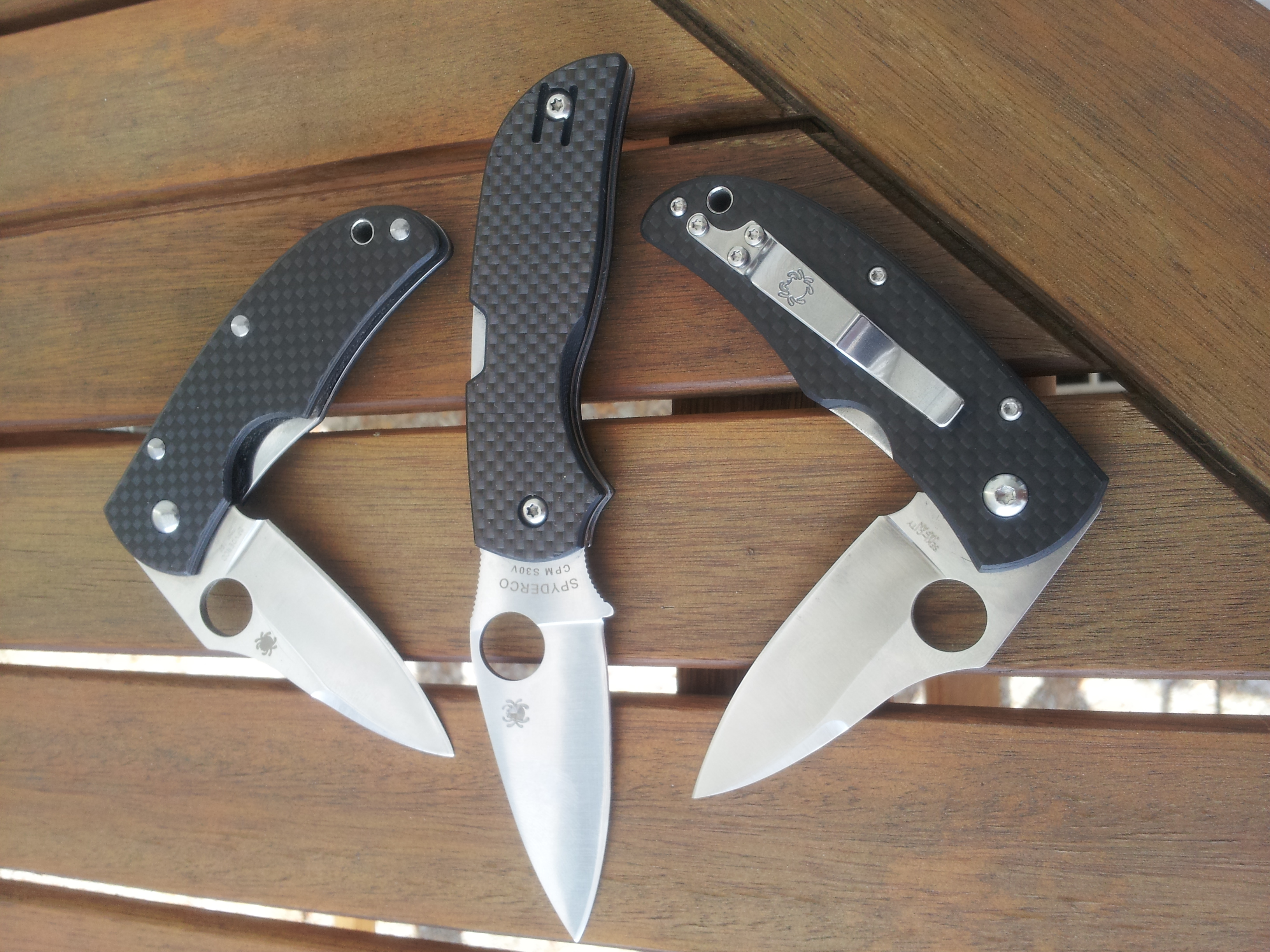
Spyderco Chaparral. – Gentleman extra flat companion.

image

The Chaparral is the new true gentleman folder designed by Sal Glisser. Is it destined to be proposed with various handles. The first batch was supposed to be titanium but due to some delays the carbon fiber handle version get released first.

What amazed me on that little jewelry is the flatness of the overall design and the smoothness of the operations.
I read somewhere (I think it was Paul the Deacon who wrote that) the Chaparral was an alternative to the Michael Walker.
It is ambidextrous and even smoother, flatter and its wire clip is much better than the metal one on the C22.
The Chaparral is inobstructive and sleek design. The CF handle give you perfect retention. It’s a joy to operate.
Like all Taichung release this a jewel. No blade play in any direction. A hidden pin mechanism has been added to the pivot to strengthen the lock and can be felt during opening and closing. The knife despite its ultra thin feel very solid.
Compared to my beloved C22 Michael Walker, well it’s almost beats it but on the edge, the steel, the blade to handle ratio.
I would say the Walker is a BMW Series One when the Chaparral is an Audi A3. 😉
Two great knives for sure but with different performance.
The edge on the Chaparral is a little thick for my test when the ZDP of the C22 is thin and hard.
On hard plastic the Walker is even better than my Gayle Bradley and since I have been able to buy a safe queen, my first Walker will be used hard this year.
On hard matters the Chaparral cannot compete with the Walker.
I have deshouldered its edge a bit but it is not as aggressive as that C22.
But for office task and EDC it is perfect. Also I’m certain someone gifted sharpeners like my friend JD or Tom Krein would easily turn their Chaparral into Vorpals.
Overall the Chaparral is pure pleasure to operate. I use mine when I need a discreet companion at the office or in the city. You will forget it is clipped on you and will bring you a big grin when you will use it.
Another great design with and incredible smooth and flat alternative.
This could be James Bond choice. 😉

image

image

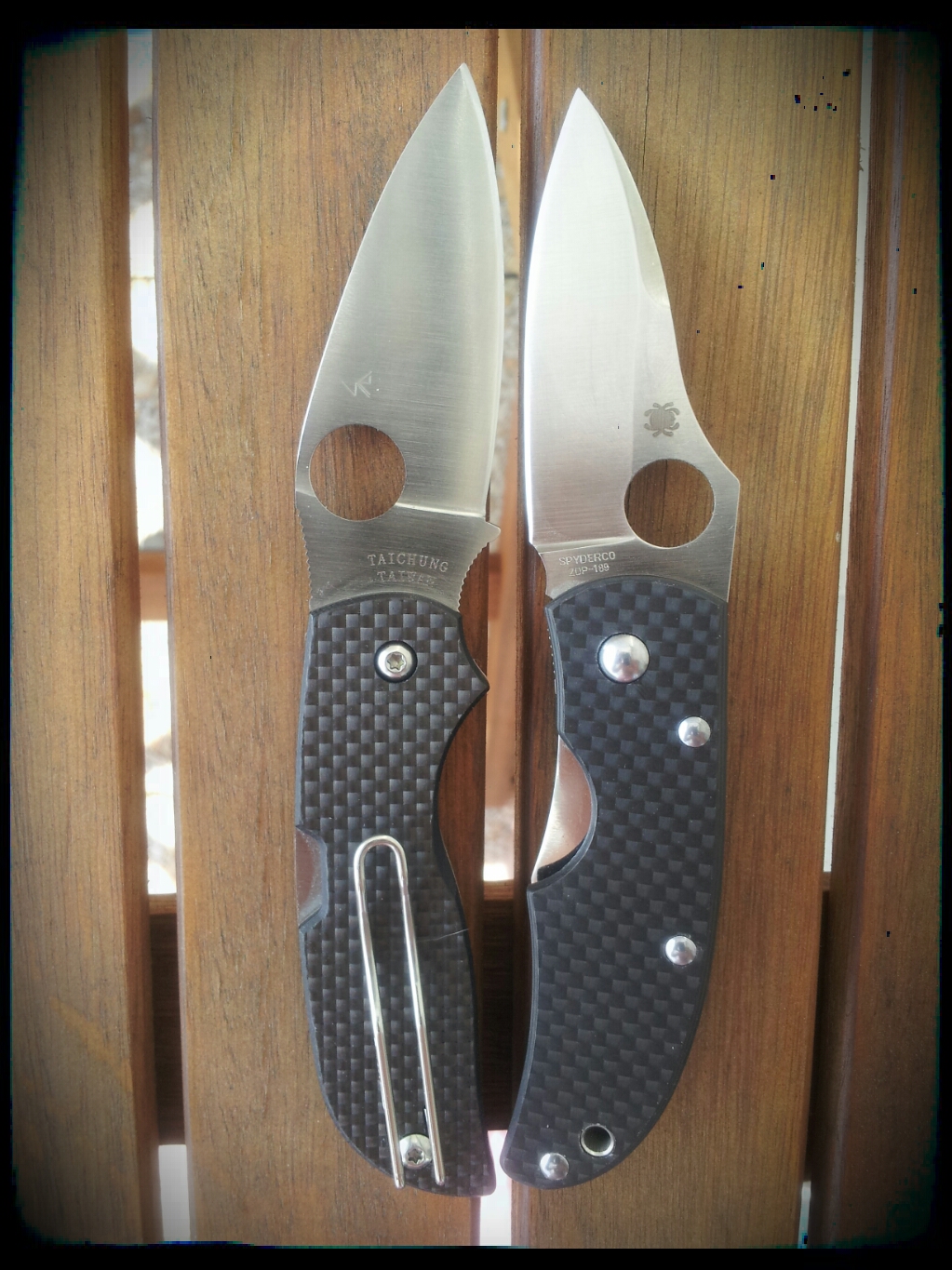
This is my Chaparral saluted by my two Walkers. Can you identified the safe queen?
image<

image

Spyderco Navaja Carbon Fiber ~ C147CF – Spirit of Spaniards

Nemo and his Navaja

The Navaja is a legendary folding knife. For the first time in History, a folding knife was considered as the poor man sword in a country were sword fencing was the highest art. Actually they were three schools in fencing: the French, the Italian and the Spanish school. In Spain however, everybody were encouraged to be armed with a sword at the end of the 15th century. It was the time of Isabelle de Castille (born a 22nd of april) and Ferdinand II d’Aragon who both were in charge of the greatest occidental power of that time.

navaja-fighting-knife-stylized-ornamental-elaborate-handle-design-AMH73J

Navaja
Early navajas were not much smaller than swords

La Navaja was the first Tactical Folding Knife. It was born in the 16th century in Andalusia for one main purpose—fighting. For the first time a folding knife was not made as a tool but as a weapon. James Loriega, wrote two great books about it: Sevillian Steel and the Manual of Baratero and I can only encourage you to read them !
For Randy (Ransom) Price: “These magnificent knives have an ominous appearance when open and it’s easy to understand why many people believe the early navaja was the original inspiration for the Bowie knife. No doubt a navaja unfolded before an unsuspecting victim must have had the same effect as Jim Bowie unsheathing his monster fixed blade.

Here come the Spyderco reboot and hommage to the mighty Navaja. The Golden princes of tactical folding knives take a bow to the queen of spanish edge.
There is a very strong “spirit” in this design: centuries in refinement which were really inspiring Ed Schemp.
The knife is gorgeous. Made in Taiwan with the highest quality material ( S30V steel blade, Carbon Fiber handle and Stainless Steel bolsters) the C147 is simply a pleasure to the eyes and to the hand.
Opening the blade and you got the “sound” of Caracas. I really like it. It’s discreet and sound like an old camera to me. It gives something dramatically “mechanical” to the opening and closing of the blade. Respecting its heritage, the edge is a little on the thick side and totally weapon oriented. This is minor and it can be improved with some elbow grease to have it turned into a better push cutter. Something I’m planning to do as S30V is a very forgiving steel to convex and to polish. Also the fact that the belly doesn’t start at the ricasso like on a Paramilitary for exemple, change the way you use the knife on hard matter but again, Ed thought about everything and It’s easy to choke up the blade with its very large choil and work with full control.
The long handle gives also the opportunity to have a much better range/reach. Again this is a reminiscence of the 17th Century Navaja made as edge weapon. The balance of the C147 is actually just in front of the index finger when holding the knife that way. The blade is fast and “alive”, easy to control and prompt for backcuts. This is really a fighting folding knife.
But when closed the Navaja keeps all its elegance as this is really a knife to admire in all circonstances.

OK, now this was not a real review as I need to test the knife in my EDC rotation. But as it’s a beauty, I wanted to share it with you.
I’ll be back on this.

Spyderco Navaja C147

The Paramillie 2 and the Navaja: two beauties ! Notice the difference in the belly.

Spyderco Navaja C147
The Navaja in the spring roses.

Spyderco Navaja C147

A fang at the ready !

Spyderco Navaja C147

Detail of the blade.

Spyderco Navaja C147
The beautiful bolster announcing the Sage 4 ?

Spyderco Navaja C147
This is the pure concept of elegance.

Spyderco Navaja C147

A grip with a long reach.

Spyderco Navaja C147
The folded beauty.

Spyderco Navaja C147
Details of the pivot.

Quoting Ed Schempp:

My goal in knife design is to put a very usable blade in the hands of the ELU. I chose the Corsican version as inspiration for the knife. I own a handmade Corsican Navaja made by my Corsican friend Alexander Musso. My interpretation is stylized with Spyderco and my style influences.

The Carraca mechanism is self destructive. The mechanism in the Spyderco Navaja is not part of the lock and on a different axis of impact from the original inspiration for this piece. This knife should bring Spyderco’s reliable high performance to this centuries old ethnic design.

I hope that you get a chance to handle and use this piece…Take care…Ed

Spyderco Navaja C147
Now I wanted to convex the edge of the Navaja to really turn the weapon into an EDC tool.

Spyderco Navaja C147
The tools of the trade are not really fancy: sandpaper, sharpmaker and white compound…

Spyderco Navaja C147
And elbow grease…
Spyderco Navaja C147
Nonw the edge is convexed. Some passes on the white ceramic of the Sharpmaker to erase the burr… and it’s a Razor !
Spyderco Navaja C147
Closed the Navaja is as big as the Paramillie 2 ! But, once open… it’s another story ! 🙂
Spyderco Navaja C147

Spyderco Sage II – The Wise Choice

Sage II and Tie Millie

And if the alternative of the a Tie Millie was not a Tie Paramilitary (which is not yet born) but the SC123TIP: the Spyderco Sage II ?

The Sage line is a collection made in Taiwan (now a high quality of execution guarantee). and “represents Spyderco’s 30-year pledge to knife crafting and learning to make better knives at every available opportunity. The plan is to offer an ongoing series of Sage Folders with many of the different and ingenious locking devices and mechanisms the knife industry has to offer.” (sic)

The Sage I was a carbon fiber handle linerlock, an hommage to Michael Walker. The Sage II is a titanium handle integral lock, an hommage to Chris Reeve.

Let’s give a quick look at the design of that folder: not to big, flat, beautiful lines, taking in consideration a lot of Spyderco unique improvements — the wire clip, the choil, the full falt ground leaf blade… The C123 is standing on the shoulders of many great spyderknives, taking the best.

Tie Millie and Sage II closed

Comparing the Sage II (up) and the Tie Military there is an obvious family ressemblance. Full flat ground blade, integral lock and choil. The “cockpits” on both knives are very similar. The construction is rock solid, the titanium handles are offering enough grip for a smooth surface which is very “gentle” with your trouser pockets (where you gonna clip those knives eventually). The Sage could be a civilian version of the Tie Millie as the fact to go in the city with a long gorgeous knife like a C36 is not the best way to be “reasonnable” in regard of the laws, the sage while offering many of the great features of his big cousin but it will be more pratical to go with it “under the radar”.

Clipped Sage II
The silver wire clip on a black trouser. This is the max visibility you will have from the Sage II once clipped.

The wire clip, for example, with its deep carrying positing is almost invisible and got no flashing names on it telling to every one: this is a knife !!!
Similar to pen clips and with almost no handle to tell tale, your Sage is following you and he’s easy forgettable.
The Millie is a very compact package and car easily find a place on your person, but the Sage looks like a wise choice to go light.

Handles
A close look at the handle of the Sage II (left) and  Tie Millie (right)

How the Sage II will handle “hard use” in the country side ? There is a lot of way to qualify what “hard use” means. Folders knives are not prybars or even fixed blade knives. The folder which are designed to be used as prybar often offers bad performance in the cutting departement. The grind here is flat and the blade relatively thin and I have noticed the Taiwanese edge grind is not flat but already gently convexed. This is amazing as your Sage II only needs some pass of gently stropping on a leather belt to get absolutely vorpal ! The cutting power has been already demonstrated in some video. They are some French videos torturing a “La Redoute catalog” with Bast2a, and American one with BLUNTRUTH4U reviewing a Sage 1 (same blade diffrent handles and locks) and they are very impressive. Cutting wood the Sage 2, the blade goes deep.
Now I like to do pushcuts with my thumb on the back of the blade and the Sage got almost sharp edge there: great for obtaining sparks from a fire rod but eventually painful without gloves. I have used some diamonds rods to blunt mine and really you can notice the difference in confort when you start to work by hand on that CPM S30V blade how much that steel is damn hard ! I would love to have a ruonded back and perharps will try to round it more a little bit. But here, without a backstand, you can notice how hard the steel is…
Anyway, you got a 3mm thin high flat ground blade with a convexed edge: all the condition for a great slicer and ideal folding friendly tool for bushcrafters. The belly of the blade improves the cuts in hard matter, working like a guillotine. (My best wood cutter is still the incredible Spyderco Dodo with its S edge which cant be compare to none as a “wood eater” !)

Sage II Nemo cutting test
My favorite cutting test: going through the butt of a cola plastic bottle. you will be surprised how many great designs cant do it… The Sage passed it with flying colors !
Many so called “hard used” folders with really thick blade cannot pass that test at all.

Esee 3 and Sage II
The  ESEE 3 and the Sage II make a great high performance compact combo for going in the woods BTW.
Also the open construction on the Sage II and the simple reliable mechanism improved by Chris Reeve on his Sebenza Line is a breeze to get clean.

As the handle is not straight but gently curved to spouse the palm of your hand, there is no need for an abbrasive matter (like G10) to get and conserve a positive grip even with wet and slippy hands. There is a lot of intuitive security in that design. The choil and the jimping for example are so great to communicat direct force to the blade without to stress the pivot. This is a great feature which was first developped on the C36 Military and which is now used in the Slipjoint line of Spyderco: even with no lock your hand and fingers are safe.

For a reason unknown, when I have received my Sage II it was not smooth and the lock was sticky. No blade play in any direction though. This problem was easily worked around by adjusting the pivot and gently bend the lock beyond the handle to rub some pencil on the locking surface. Now the knife is as smooth as my Gayle Bradley and the “galling” (sticky lock) absolutly disappeared. The cute Sage II got something of a jewell and I have noticed many owner who first decided to baby it and use it only on weekend then eventually happilly use them very hard everyday.

There is a lot of wisdom behind the design of  the Sage collection. The choice to get a worker knives collection all performance oriented in the legal non threatning package is the wisest.  And the first designs so far are really workhorse. The carbon fibers on the Sage I for example can take a beating without to get marked or scratched and the frame lock on the second give a you a lot of confidence in your tool just by squizing the handle you know the blade won’t fold.  Eventually the Sage II got everything I love in a knife: reliability, beauty, efficiency and sheeple friendship. And my trousers love them too. The Sage II is simply a great knife to EDC.

Balanced Sage II

Tha handle gives to four fingers a very confortable grip. The open ended construction while easy to clean would get painful for long hard cut. Gloves can help.

One sage said: “Think twice and cut once…”

Later, I was tempted to slightly convex the blade of my Sage II. The improvement in pure performance worse the time passed with sandpaper.
The discussion is located here on the Bladeforums
Sage COnvexed
Sage Convexed

Spyderco C36 Military: from G10 to Titanium, 15 years of excellence.

Military Titanium

At the occasion of the release of the Military Ti C36 which is some kind of superb hybrid: 80% Sal Glesser and 20% Chris Reeve, I have digged in my archives to find and reedit the loooooong review we made with Fred Perrin back in the 20th century (2nd march 1999).  Anyway here it is with some quotes:

“Yes, the Military is big. Yes, it has a large heavy blade (though the knife as a total is lightweight for its size). But if you are looking for a knife that has the absolute best blade size/weight ratio that fits into the slimmest, lightest handle, this is the knife for you. Not to mention that because of it’s weight forward massive blade, it is probably the quickest and easiest manual knife to open there is. Also with its great flat ground thin edged blade, it is one of the handiest do-it-all knives you’ll ever use. It is not the knife for everyone, but what knife is? Almost 99% of the complaints you’ll ever hear about the Military (and 100% about sticking open), can be blamed on the first generation batch. These new improved versions are FAR superior. Do not buy a Military if you are looking for a collectible. Do not buy it just because a whole lot of us forumites like it a lot. Buy it because you’ll USE IT! And therein lies its beauty.”
-GENE, MEMBER OF THE BLADE FORUMS-

“Gene – Thank you. The Military Model was designed to be the ‘state of the art’ production folder of the time. We believe the 2nd generation version is that. Every one of the many parts in this model was examined and refined. We listen to all of the comments (good and some negative), but our own constant testing enforces our beliefs. We believe that nested liners are more evolved and stronger than separate liners. And more expensive to produce. (Ask for favorite custom maker how much more they will charge you to nest their ‘full liner’ just inside the scale like Spyderco’s Military). ‘Form’ in addition to the ‘pins’ create rigidity. It may be possible to ‘white knuckle’ a lock release, but this hasn’t happened to our knowledge. Being able to easily close the knife after hard user with gloves on was a major consideration. Any of you that have had a folder lock open and not be able to close it? It’s like a chain saw that won’t stop . . . what do you do with it? The new ‘SecurLok’ that Frank Centofante invented is scheduled to be added to the Military Model sometime in ’99. This would eliminate the fear of accidental lock release.

The Military Model was not designed as a fighting knife, nor was it designed for suit and tie carry. It was designed to be the most dependable cutting tool accessory a soldier might need while in the ‘bush.’ The handle is a little larger to afford the dual grip potential. Design is always a great discussion, because there are so many points of view, e.g., blades are for cutting, handles are for holding. A 2″ blade specifically designed for controlled cutting loses its ability to control if the handle is only just long enough to cover the blade. Nothing to purchase on. A scalpel is a good example of this. What is the knife designed to do? To look at? By all means, balance the sizes to appearance. To use? Tougher problem here. Just one designer’s point of view. I have avoided responding to this thread, as it was my design in question and this was a comparison type question. It would be expected that I would be biased.”
-SAL GLESSER, CEO OF SPYDERCO INC. MODERATOR OF THE  SPYDERCO FORUM AND INVENTOR-
Millie Balance
“The designer is Sal. He has a teen-age son. He designed the Military Model with the idea that if his son had to go to war and could carry only one knife, the Military Model is what he would want him to carry. Sal’s came up with this model because he wanted a ‘survival,’ ‘camp,’ ‘all-around’ knife that could perform any task in the field, from cutting branches and small trees, field dressing animals, to personal survival.”
-JOYCE LAITURI, DIRECTOR OF MARKETING AND PUBLIC RELATION AT GOLDEN COLORADO-

“I remember years ago when Jeff Randall of Adventure Training fame used to take various knives and survival equipment deep into the Jungles of Peru for extensive testing. This period was before Jeff had developed his RAT series of knives. He and his mates beat the snot out stuff, and then posted their evaluations on the Adventure web site. Sal gave him a CMP-440V Military to test; that folder was absolutely abused. There were photos of the knife being used to process vegetation for shelter……skin, slice and dice cayman for the stew pot….and even split firewood. The Military received a Triple A+ endorsement from all who used it; the lock never failed ! Unfortunately , once Randall developed his own line of knives, the test results were eventually removed. Too bad…it made for some good reading. Just as an aside, after having read Randall’s review of the Spyderco Military I promptly went out and bought a Military and then signed myself up for a seven day canoe expedition down the lower canyons of the Rio Grande, south of Big Bend National Park….intending to put my Military through it’s paces……and perhaps skin a hippo or two, was I. After all was said and done I think the most challenging task the knife performed was to snag the remaining pickle from the bottom of the jar during a lunch stop. Despite the fact that the canoe trip fell slightly short of a National Geographic expedition to the remote wilds of my youthful imagination……I had a fine time, and am very pleased to own one, tough, folding knife !
Given what’s available in current production the G-10 Military is a hell of a bargain and more than adequate for daily duty……and SV30 takes a great edge, and will hold it, even with lots of use, for at least a week. What’s it take to put a good edge back on a SV30 Millie with a Sharpmaker ??….a few minutes ? Heck, put a convex edge on that knife and you can strop it on the back of a piece of cardboard and bring the edge “back” even faster.

How important is it that your knife blade go a month until you sharpen it ?

If titanium is to your liking, the Ti Millie is a work of art !

DIAMONDBACK
Spyderco Forum Registered Member

“The millie’s only a big knife for the first week, then all your other knives are suddenly too small.
ElThomsono
Rogue Simulant on BritishBlades Forum
Fred Millie
And now the 1999 Fred Perrin/Nemo review:

Millie and old timer

This picture show the C36 Military and Nemo’s grand grandfather personnal knife used during Wold War I. This knife has been in real close combat (and you can notice how many time it was used by counting the marks on the handle). The Military is somewhere the grand grandson of that old folding knife, used and abused long time before all that “tactical” hype starts to exist. (Also notice, the full flat ground blade has been so many times resharpen, it is almost now half of his lenght!)
Old Timer
Old timer
WWI was the first war with enough media coverage for people to discover how much a knife can be a useful tool for the soldiers.

“Thank to Joyce, we have received from Golden three Militaries for us to test and abuse: one full serrated and two plain edge in CPM440V. (Now known as CPMS60V. And the current version is CPM S30V…)
In our own humble opinion, we prefer a plain edge, because we know how to get a really sharp edge on it and we believe a serrated edge is the best option for people who need to cut ropes, plastic, fibrous materials or even rubber everyday…. The Plain Edge is the real Polyvalent Edge. The serrated edge, even though it is really impressive for its nasty cuts and slashes, is not the best cutter in a tactical situation for us. (In fact, we always had a better result with a plain edge!) In a word, a serrated edge is perfect for people who don’t like to sharpen their blade. So we can also advise you to carry always two Militaries in your pocket: one serrated in the left and one plain in the right one!” (Some may consider it a joke, but Fred used to be carrying a plain edge Military as well as a serrated Ladybug II!)

Millie grip

“The Military Model is really feather weight and thank to that, for the first time since a really long time – since 5 inch Cold Steel Voyager was released – we are carrying a big folder.) It’s the first time we could really trust a linerlock. This is one of the rare linerlocks that survived our really hard tests. It’s easy to see the hollow ground side where the liner comes to lock against the blade. Michael Walker, the father of the “Liner Lock,” is involved directly in the improvements noticed in Military.

So, like we said, Military is one of the rare big folder that gives enough confidence for us to carry on a daily basis. Now that we handle our C36, we really enjoy them. Understand this simple facts: it’s light, big, and reliable.
Why do we love this knife now? Because it’s a beautiful knife ? We have seen so many so called “tactical” craps. How serious the design of the Military Model appears immediately at first sight. No useless cosmetics: this is the M16 of knives !
But first let’s have a look at the handle: it’s a “real” handle! This is enough rare to be noticed: its handle is the handle of a tool destined to be used.  That extra inch gives a real grip and you cannot lose control of your knife, unless you are clumsy “like a seal” ! Have you ever seen many knives with this kind of long ergonomic handle? The Rescue (from Spyderco) and the Voyager (from Cold Steel) also have one.

On the other side of the handle where is the blade: there is some kind of false guard integrated to the blade where you can apply direct pressures on it without putting excessive force on the handle and the lock.  Even the large clip mounted on the handle is not messing with your grip.  The G10 handle is really strong. You can trust us about that point. We have used G-10 since 1993. We have even made blades of G-10, even G-10 balisongs and stealth folders. It is really a strong and light material. We have hammered it without any problem. This combination of Fiber Glass and Epoxy is almost made to be bullet proof !
The liner lock, as we said, is excellent (despite our efforts to break it and make it fail). It’s easy to think that most folders are only made for light chores and are not designed for combat, chopping, or other hard chores. Folders are often considered as “city knives,” but the Millie has such a reliable lock that you can use it for hard chores without any pity for it.

Now about the C36 blade. We would like to advise Spyderco to stop drilling these big holes in their blades! Their hole is too small for our fingers to get in and too big to be soap bubble proof. But we noticed that we can use the hole to open the blade really fast. 🙂 It’s a pure joy! When your knife rests in your pocket, you just have to pick it up by the hole in the blade and with a flick of the wrist, the knife is open and ready. The C36 is really easy to open just with a flick of the wrist!!!
No need for any “torsion spring.” Why do we need the automatic? Sal would say.
Spyderdrop
The CPM440V (i.e., the C36 blade material in 1999) is top notch in cutting ability and edge holding with the good heat treatment applied in Golden. The Full Flat Ground of the blade has high performance in blade geometry. It gives a really good penetration power and is the most polyvalent grind available! No more no less! This was the main difference between the Military Model and the old Police Model. The excellent Calypso also has this kind of grind. Just watch the old knives from the 19th century Thiers (France) or Sheffield (England). This V flat grind is nothing new; our ancestors have shown us what grinds are all about! Let’s stop believing that we have invented anything new in cutlery. The new “news” in cutlery are often only rediscoveries and “complemental combinations” of old systems. (The clip is 4 centuries old; the serrated edge is also very old; and the Hole also; but Spyderco’s genius move was to combine all these features together.)

That C36 was designed as a utility knife and this is a proof of real wisdom from Sal. But let’s not forget that a good tool is often an excellent weapon also. Dirty fighting is only another chore after all. The Military is also a good self-defense knife, because it opens really quickly, thanks to the hole and the smooth action. And, as we said, the lock is a rock! The long handle improves your reach, and the slashing ability of this tool is outstanding! You can thrust it, because you trust it. A thrust with a folder is not our favorite move. In this case, we prefer the hammer grip with the edge UP, because the lock is far from our fingers. Just try to hold Military with the edge up, and you will feel a formidable thrusting weapon in your hand.
Millie up
If you don’t have possibility to carry a fixed blade or a balisong, the C36 puts its reliability in the balance. It’s so easy to forget where you clipped your Military, when you cannot forget where you try to hide a fixed blade with the same reach as the Military.

Cutting power? We are not aficionados of so called “super steel.” The type of steel is not the most important part of the blade. The geometry and the heat treatment are two much more important points. But we think CPM440V is a really good steel, because we have always been satisfied with this steel in our own made knives and other makers knives. Piercing bullet proof vests and performing  multiple rope cutting tests were part of our tests and CPM440V is excellent! The only thing is not to have it harden to high rockwell number. RC56 for CPM440 is even not necessary. In mechanics, soft can often erode hard. Also when a knife is too hard, the edge will be hard to re-sharpen, too much of a hassle for not such results. When it is around HC61, it becomes painfull to re-sharpen and is really prone to break. With CPM440V, we have a really good alternative! It cuts a very very very long time and is easy to re-sharpen, because we don’t always have a back stand to re-sharpen our knives (after one entire week of using Military, one minute with a ceramic rod was enough to give it its razor edge back!).  There is no way we don’t love CPM440V, and it is no surprise that excellent knives like the Panama Fighters by Sean MacWilliams made of this steel are so good. The only problem with CPM440V is the high difficulty and cost of heat treatment (at least in Europe).  Sometimes, we would really like to borrow Sal Glesser’s heat treatment machinary for a moment. 🙂  CPM440V, like VG-10, is a very important stainless steel, but we don’t believe in mystic super steels! We already tested some crappy CPM440V knives, even some designed by famous designers! Spyderco knows how to heat treat their blades, and their designs are good in the first place.

Something really important: Military is not a NEW knife. It’s a knife in perpetual metamorphosis since 1996.

1. Stainless steel torx head assembly screws
2. Double steel posts in back spacer
3. Concave tang ramp
4. Redesigned choil
5. Improved dyeing procedure for the G-10
6. Nested stop pin threaded and screwed from both sides
7. Eccentric pivot pin
8. Redefined serration angle
9. Stronger clip
10. Polished linerlock
11. Harder linerlock material

You see now it’s harder, stronger, improved, redesigned and eccentric ! It shows us that, despite the fame of Spyderco products gained through the years, Sal Glesser and his Spyderwomen/Spydermen are always listening to critics and are searching to improve their products. This is so rare !

The 1999 Military is now a second generation knife. It acquired this kind of mega-reliability by standing on the giant shoulders of its 1996 fathers. You can trust people who want to improve things and believe in Quality before Quantity. A good idea is like a good wine: it gets better and better with age. Some people would like a smaller Military. Why not? But we feel it is not necessary. Spyderco offers so many great smaller designs (check C61, C62, and C57!!!).
We think for a tour of duty, the C36 Military Model has a perfect size.

Millie on the Spyderco Story