Tag Archives: #edcknife

A DECADE WITH ED SCHEMPP’S BOWIE

Ten years, and counting…

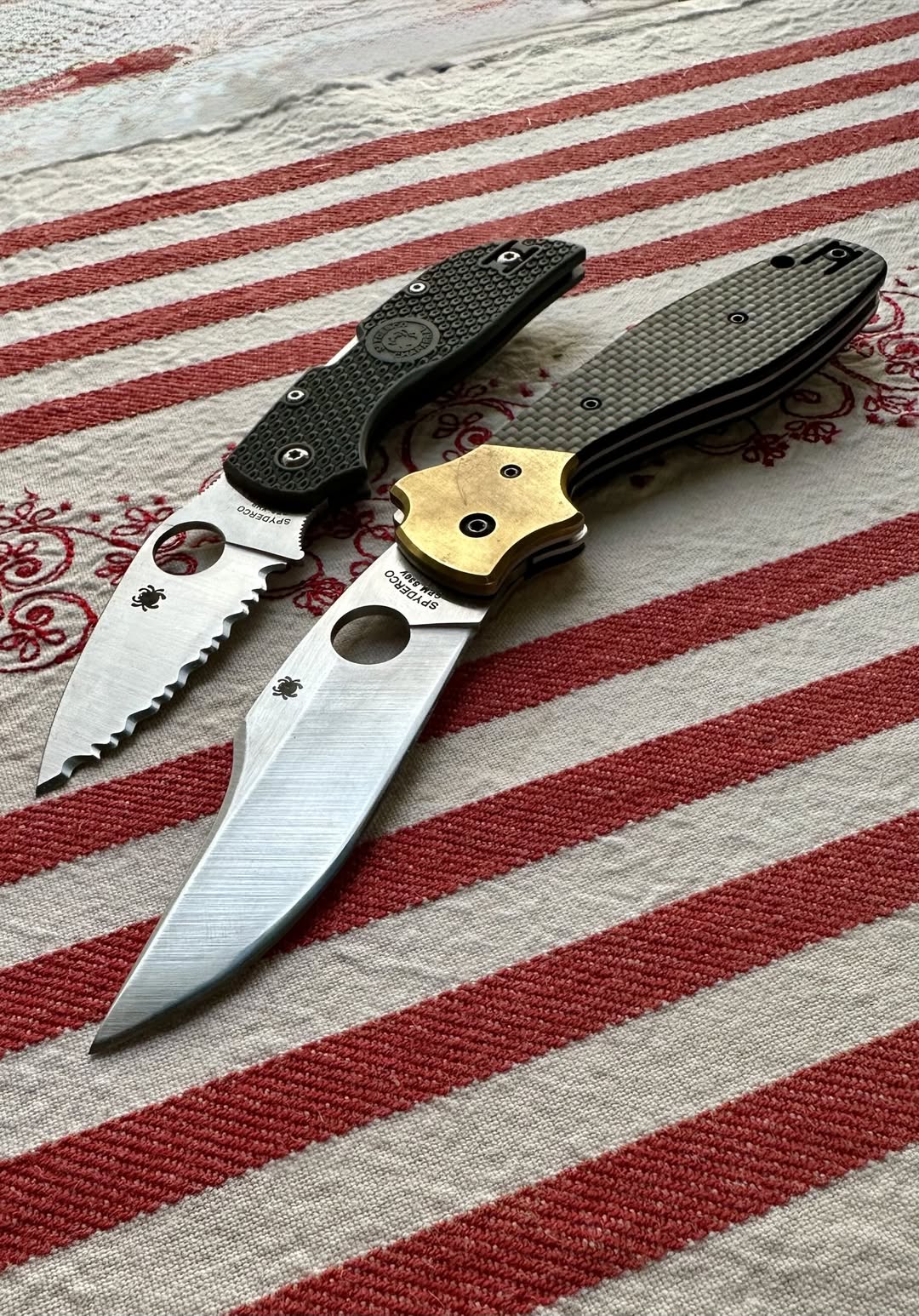
A decade. How time flies, huh ? That’s how long Ed Schempp’s Bowie has been part of my life. Ten years since it first review and a decade of regular pocket carry, countless cutting tasks, meals prepared, packages opened, and all those little everyday jobs that never make it into a knife review.

I own older knives, too. Honor, my Chris Reeve Sebenza, for example, has been with me for years. But Ed’s Spyderco C190CF Schempp Bowie holds a special place in my heart. Some knives earn your respect through their engineering, others through their history. And then there are those that, for reasons you can’t always explain, become part of your life. The Schempp Bowie is one of those knives for me. And you know what? It has never let me down. Not once.
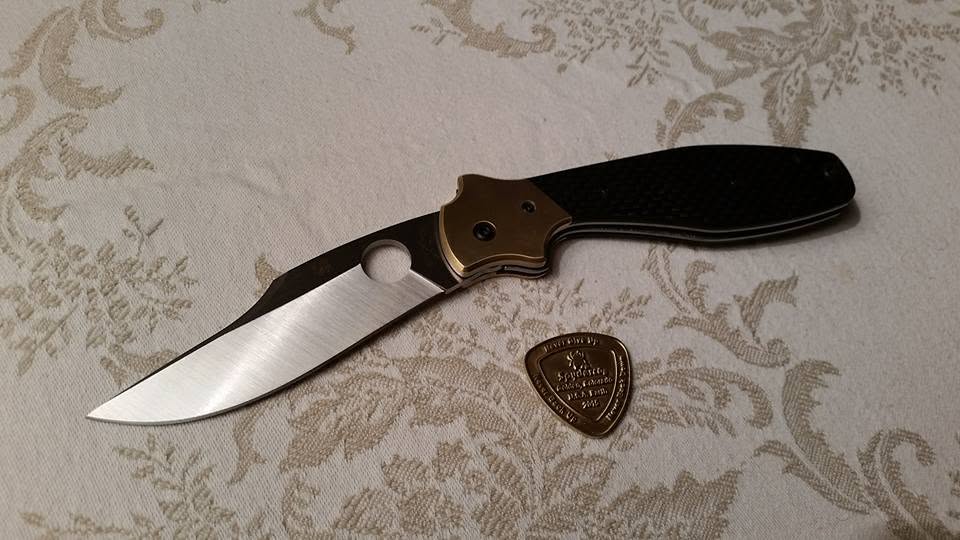
I first wrote about this beautiful folding Bowie back in January 2016, in Pocket Legends of the Fall feat. Spyderco Schempp Bowie. Later, I took it to Tuscany, where it proved that a knife with such a distinctive silhouette could be just as comfortable around the dinner table as it was doing the less glamorous jobs of everyday life. Back then, I already knew I was dealing with something special.

Today, after ten years of ownership, I can tell you that my first impressions were not mistaken.
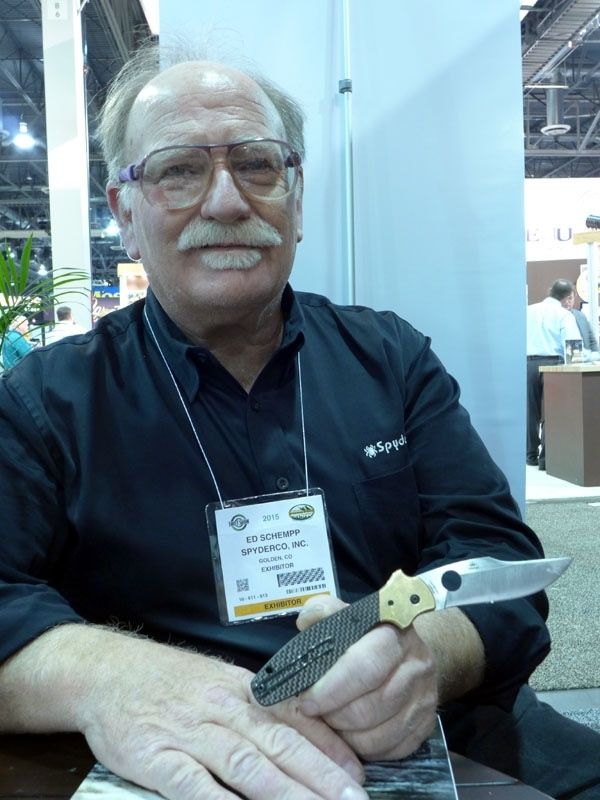
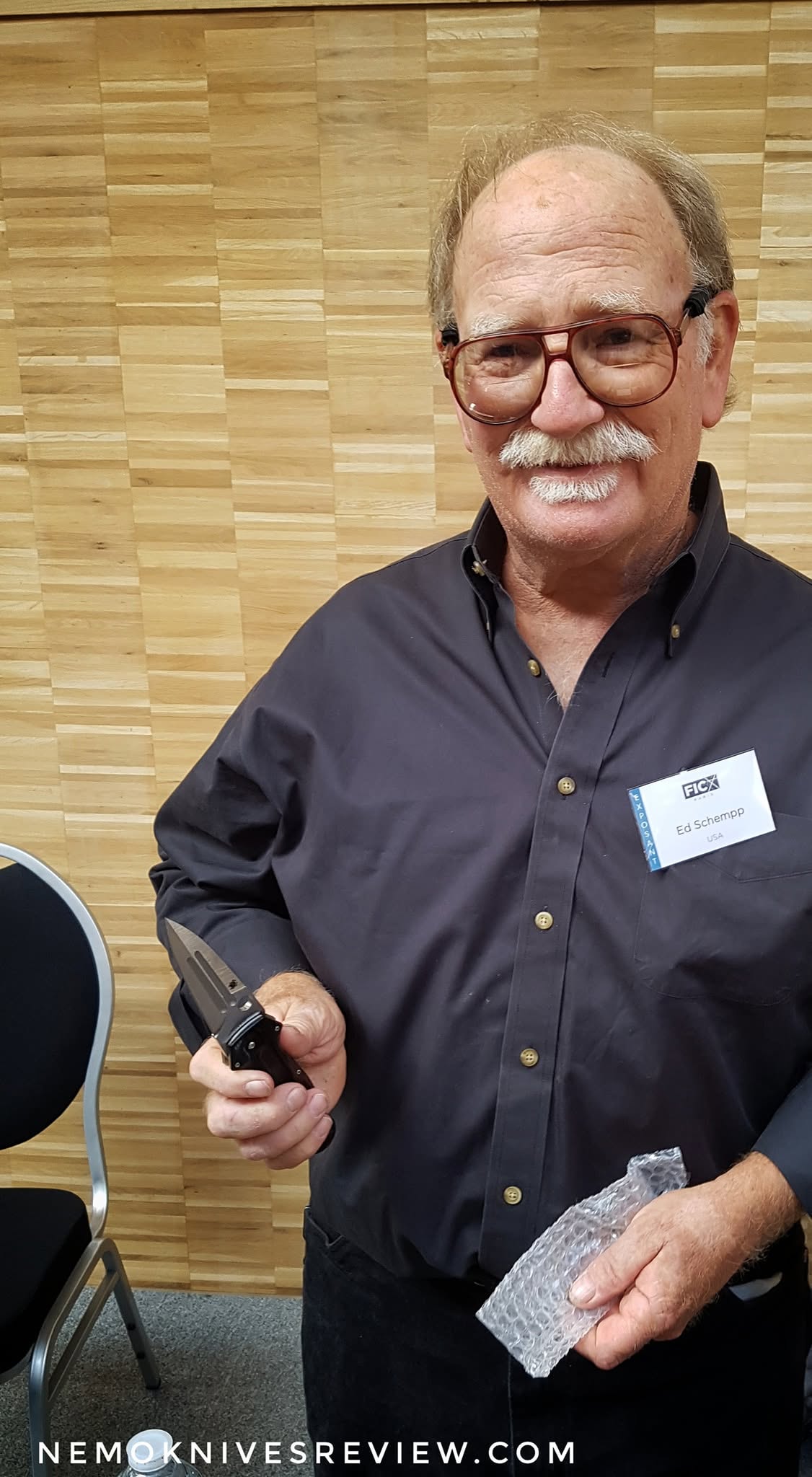
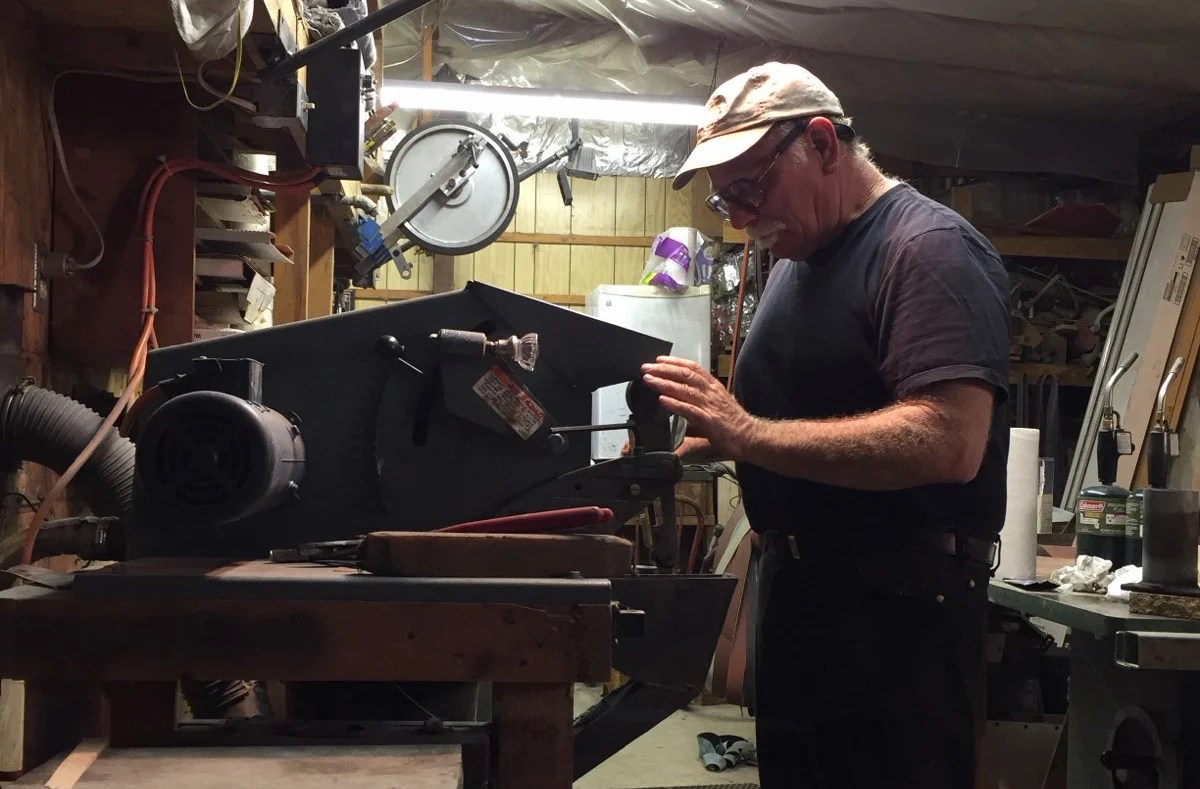
Ed presenting his new folder in 2015 (credits: Photo from https://www.candlepowerforums.com/threads/knife-review-the-spyderco-schempp-bowie-3-7-blade-–-cpm-s30v.406083/)

But here’s the funny thing: Ed himself has been putting his Bowie to work every day for a decade, too! So, when you own this knife, you’re carrying the EDC of a legendary knifemaker.
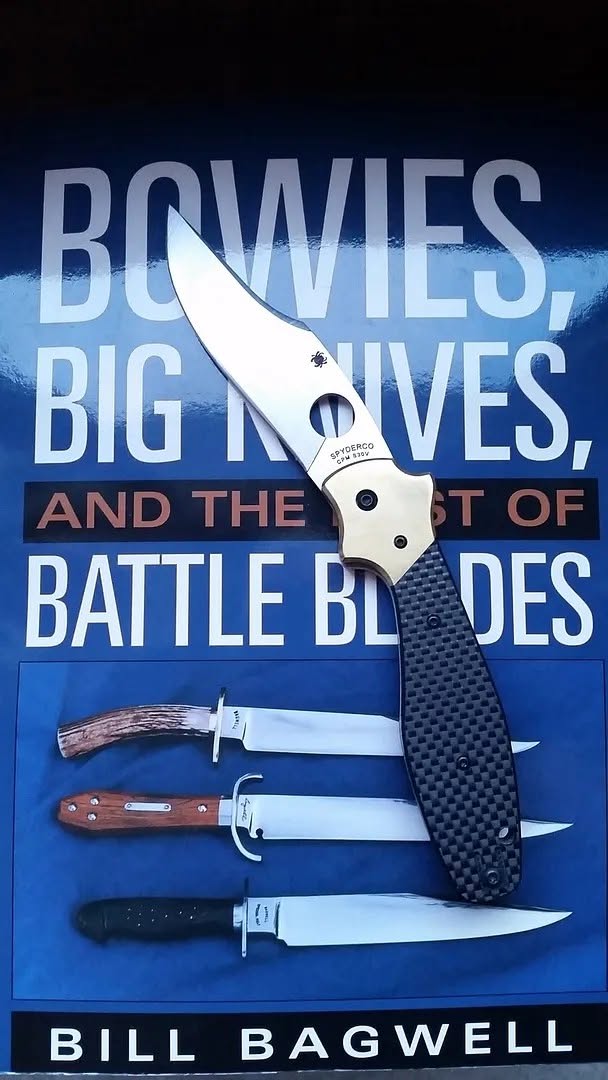
Ed’s own Spyderco Bowie lives on his ranch and accompanies him through everyday life. His has picked up deeper wear marks than mine, but that’s hardly surprising. Ed is a man who makes things, repairs things, builds things, and puts his tools to work. His personal Bowie looks like it has lived a little harder than mine… and that’s exactly how it should be. These are knives to be used, not locked away in a display case.
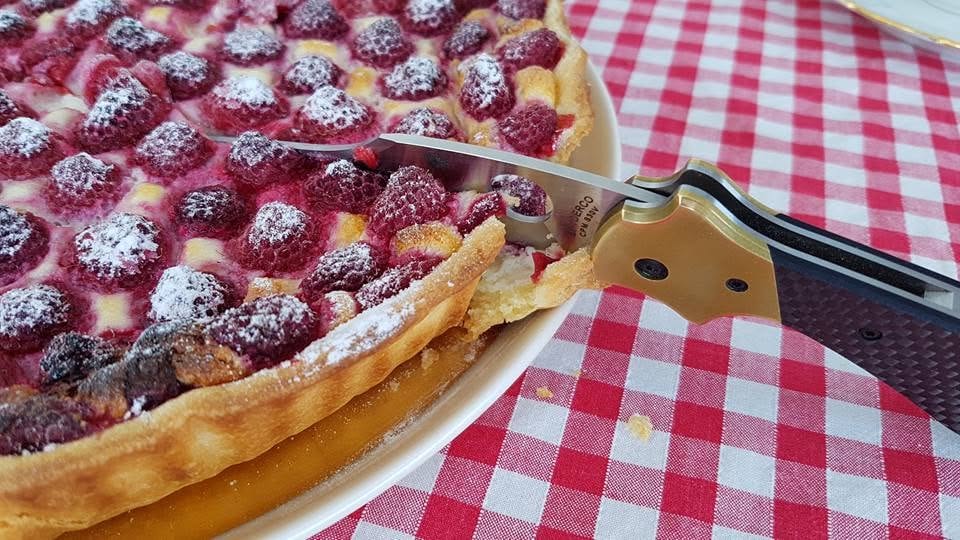
Mine has been treated with somewhat more consideration, perhaps, but make no mistake: neither knife is a safe queen.
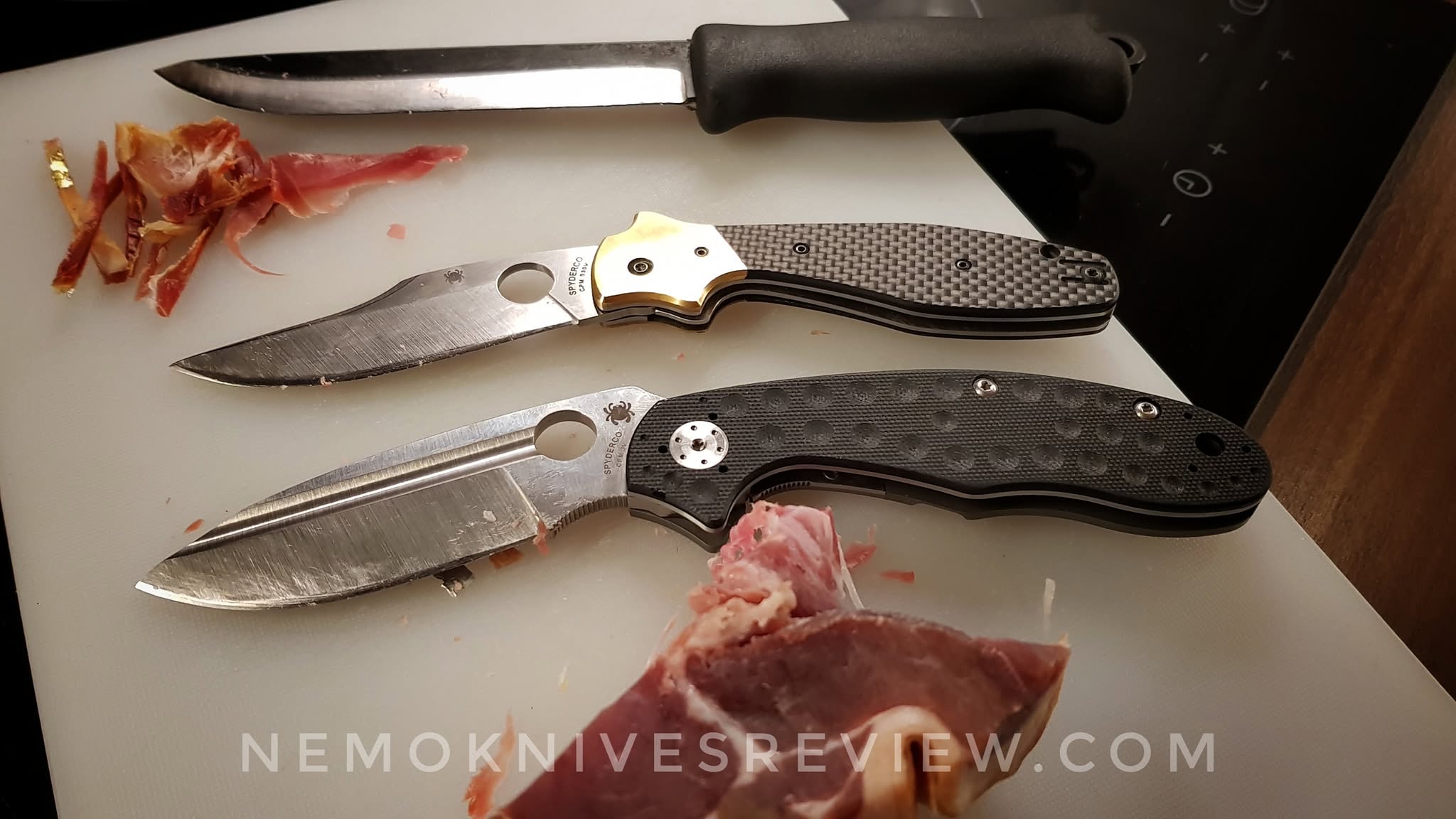
Ed Schempp’s are knives to live with.
Taichung: where craftsmanship meets obsession

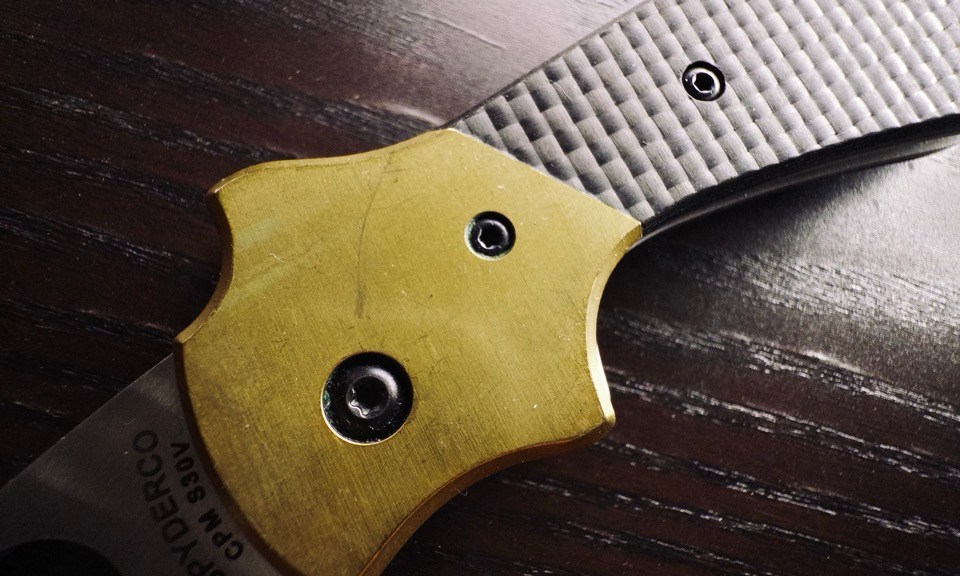
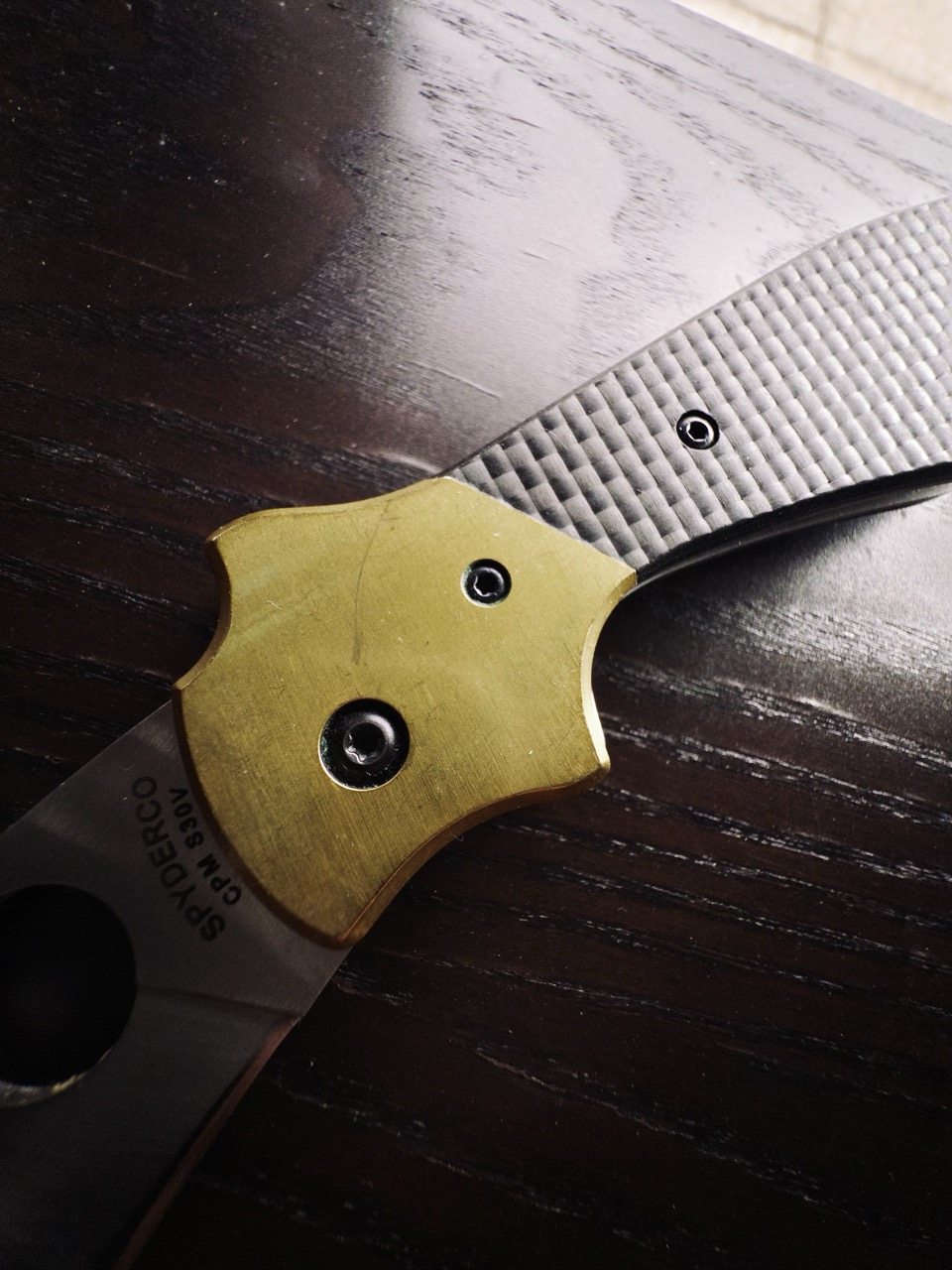
There is something I admired from the very beginning, and something that has become even more impressive with time. The work performed by Spyderco’s Taichung factory on the junction between the carbon-fiber scales and the brass bolsters.

Look at it. Then run your fingers over it. The transition is so beautifully executed that your eyes and fingertips tell you the same story. There are no crude edges, no unpleasant transitions, no little manufacturing sins that reveal themselves only after a few months of handling.

It is a remarkably clean piece of work.

Manufacturing a knife with this level of fit and finish is one thing. Maintaining that precision in a production knife, at a price that remains within reach of ordinary enthusiasts, is quite another.

« My brother in law is a cowboy action shooter. I wanted to redo the primary scale for a special knife for him to carry at shoots. I removed the bolster and scale on one side of the knife. The scale is dovetailed under the bolster so both parts had to be removed. Besides the two screws holding the bolster onto the knife there were also two 3mm shoulder pins pressed into the liners. These pins positioned the bolsters to the scales perfectly. There were two 3mm shoulder studs pressed into the carbon fiber scales that fit precisely into holes in the liners, besides the 3 screws holding the scale in place. This knife exceeds most methods of custom knife production, by far. I’m proud to have my name on this knife…Take Care…Ed Schempp P.S. It will take me awhile to do the scale replacement, I’d like to do it at the standard it was produced. »
Ed on Bladeforums February the 15th 2016.

And after a decade? Nothing has moved. The carbon-fiber scales remain intact. There is no separation, no loosening, no unpleasant surprise waiting for me after all these years. The fit between the scales and the bolsters remains as satisfying as it was when the knife was new. This is the kind of craftsmanship that does not need a marketing department to explain itself. You simply pick up the knife, even the one used for ten years, and look at it again…
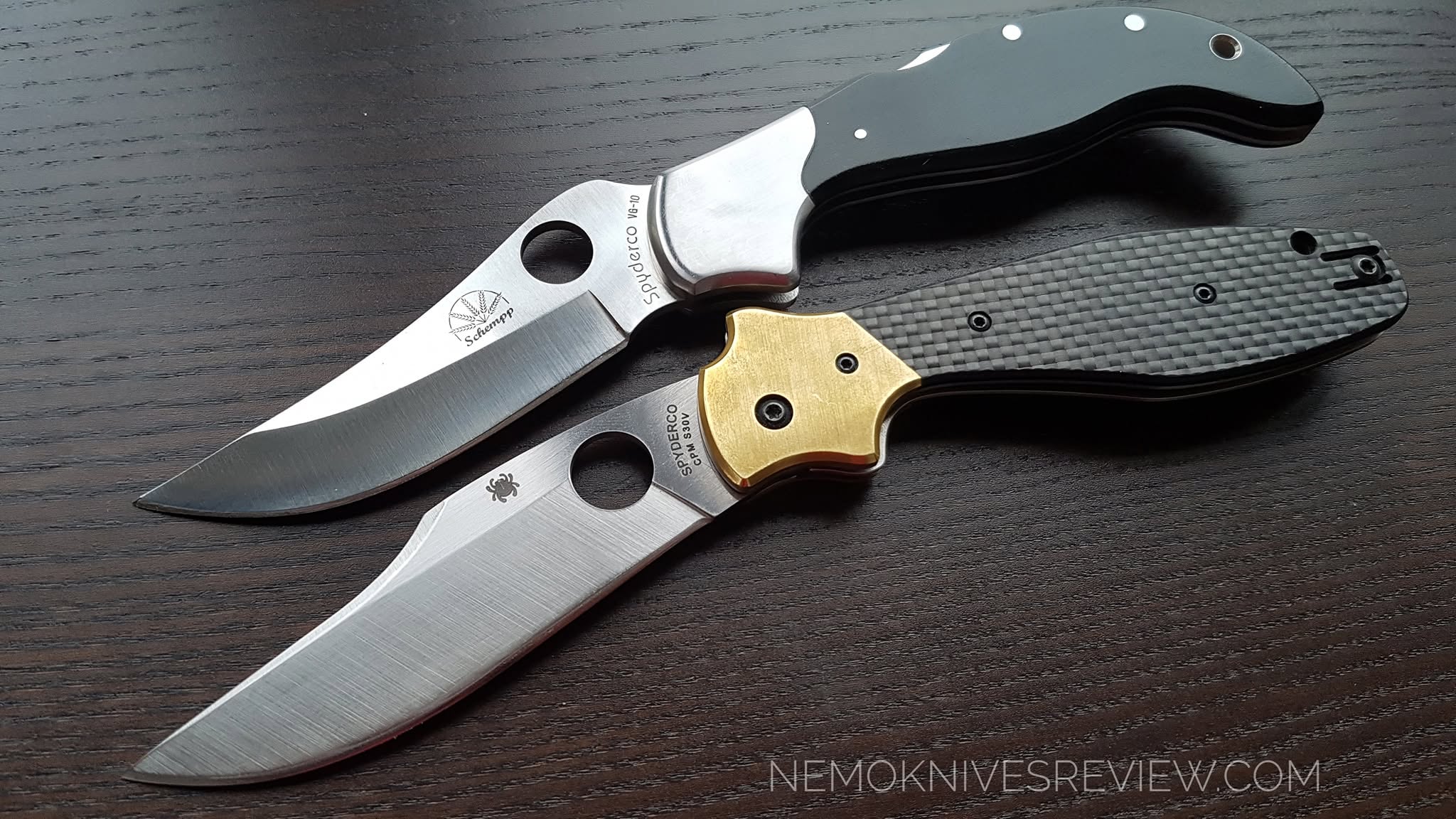
Ed told me on his goal was to create a knife that, despite its generous blade length, would ride in the pocket like a much smaller folder. The design had to be compact and comfortable to carry, without sacrificing cutting performance.
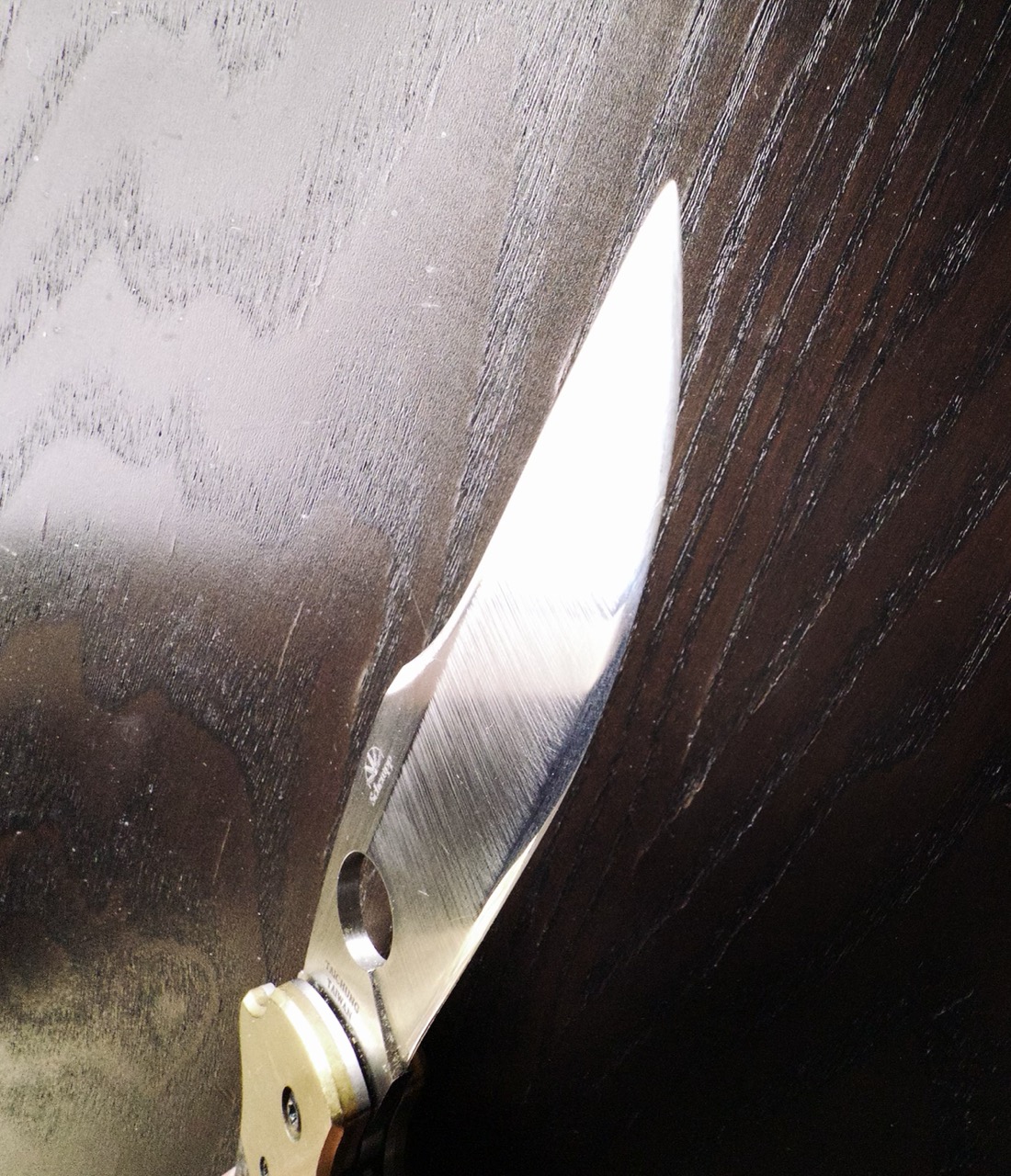
The Bowie combines a substantial cutting edge with a relatively thin blade stock of approximately 2.5 mm. Its full-flat grind makes excellent use of that geometry, delivering the cutting performance that remains one of its strongest arguments.
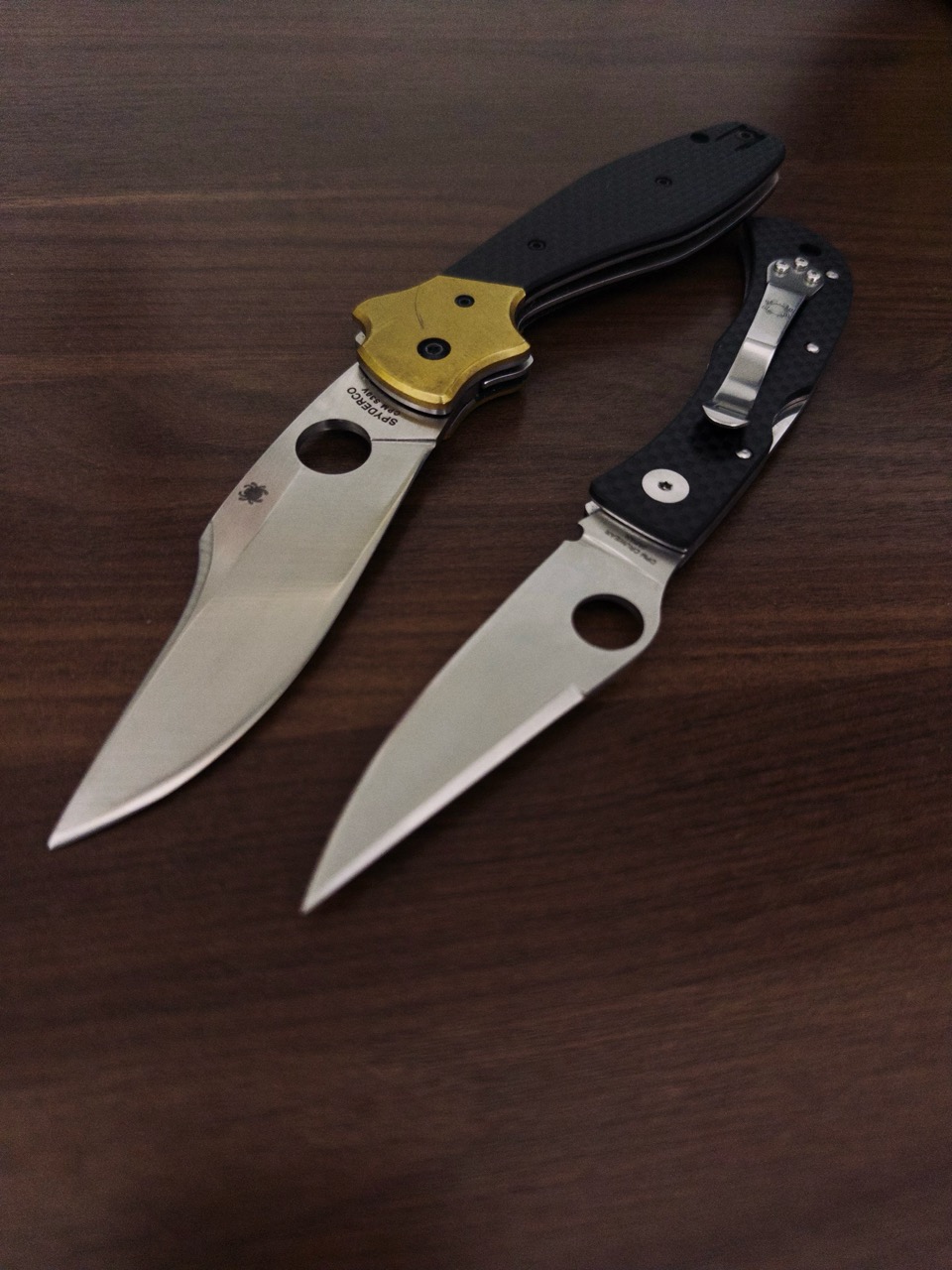
The lack of a choil gives you more usable edge length, much like on my Jess Horn. You get more cutting edge out of the same overall blade length, without sacrificing the clean lines of the design.

It is a long blade in a surprisingly manageable package. And it cuts. Not because it needs to be aggressively marketed as a cutting machine, but because its ergos and geometry doe the talking.
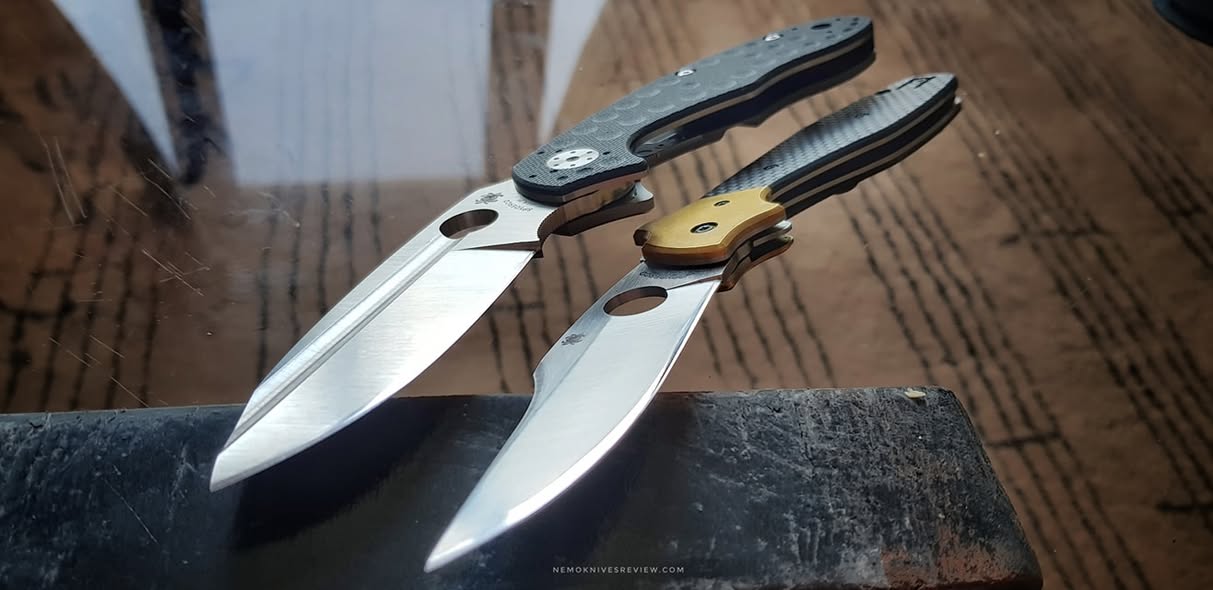
Over the years, I have also given my blade a convex reprofile. This is as usual a very personal modification rather than a factory specification, but it suits the knife beautifully. Maintaining it on a leather strop is an absolute pleasure. A few passes, a little attention, and the edge comes back to life without requiring an elaborate sharpening ritual. The convex profile has become part of the way I live with this knife.

Of course, this is not a claim that a convex edge is universally superior. Different geometries suit different jobs, and the original full-flat grind already gives the Schempp Bowie excellent cutting credentials.
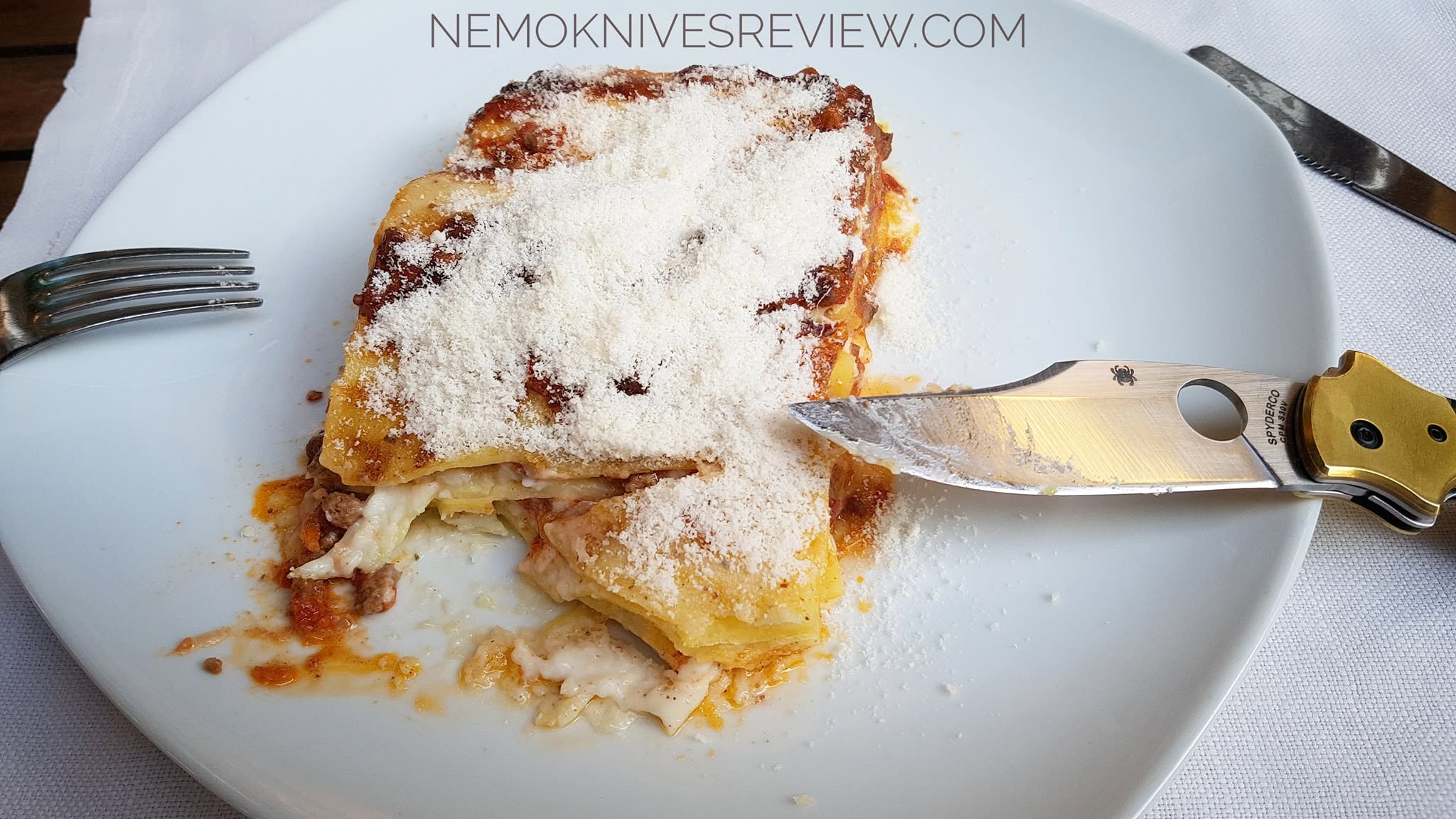
But for my own use, this combination works wonderfully. And the blade itself? Still perfectly centred. No corrosion whatsoever on my example. After ten years of regular carry, that is worth mentioning.

The CPM S30V blade has aged gracefully, although I would not attribute its condition to the steel alone. Regular use, sensible maintenance, and the conditions in which a knife is carried all matter.

Still, there is something deeply satisfying about opening a knife you have owned for a decade and finding that it remains exactly where it should be.
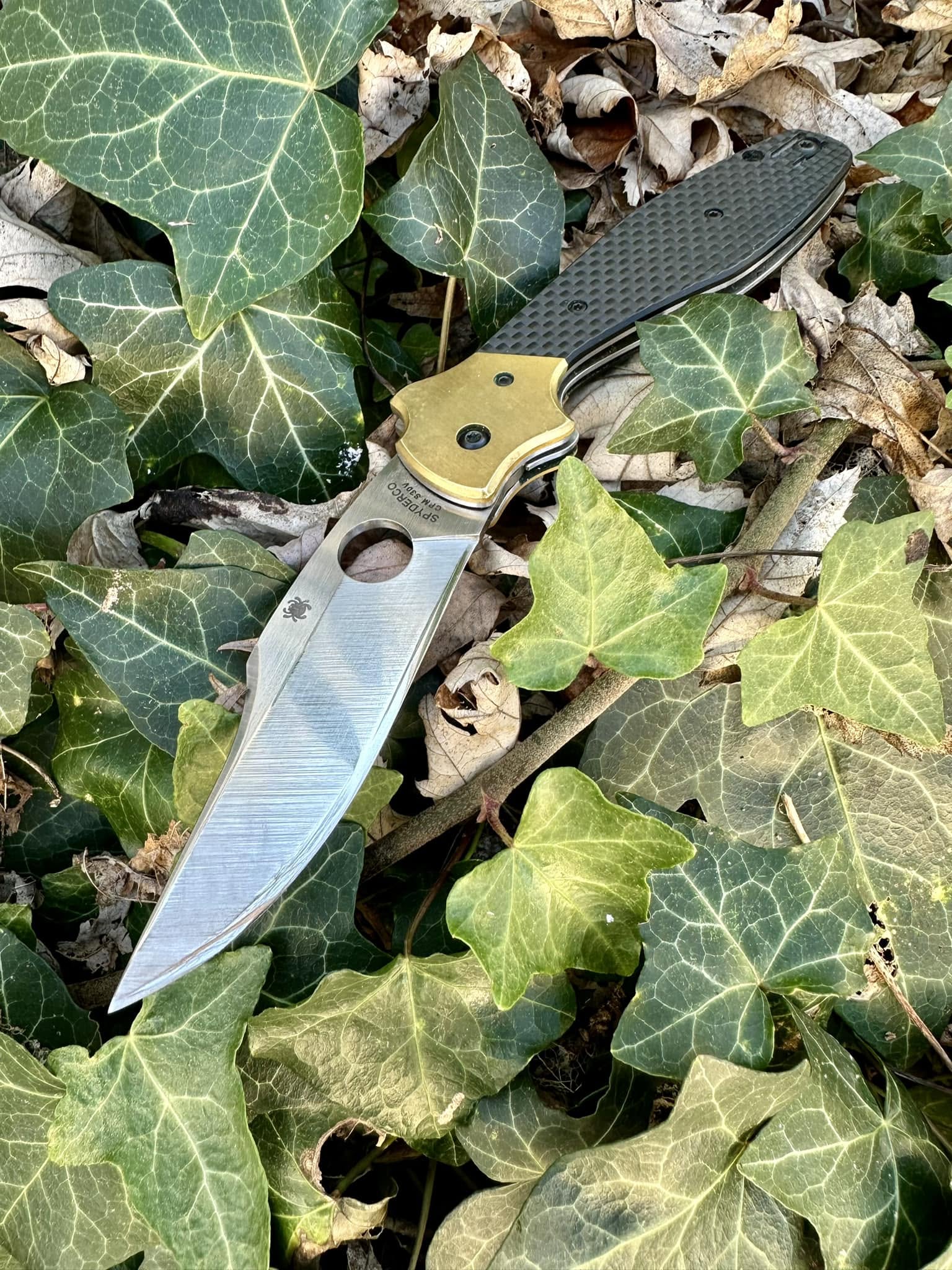
Let’s talk about the lock. Michael Walker’s liner lock may no longer be the most fashionable choice, but it was all the rage at the turn of the century, when tactical folders exploded in popularity. Think of the knives from Bob Terzuola or Ernest Emerson, among others. The titanium liner lock was practically synonymous with the modern tactical folder, and for good reason: it was simple, effective, and allowed for slim, lightweight designs without compromising on strength when properly executed.

The Bowie lockbar is made of stainless steel, not titanium. And after all these years, it shows no significant wear. Some of my titanium liner-lock folders (AFCK), on the other hand, have reached the end of their useful life due to lockbar wear. Using a steel liner has made all the difference.
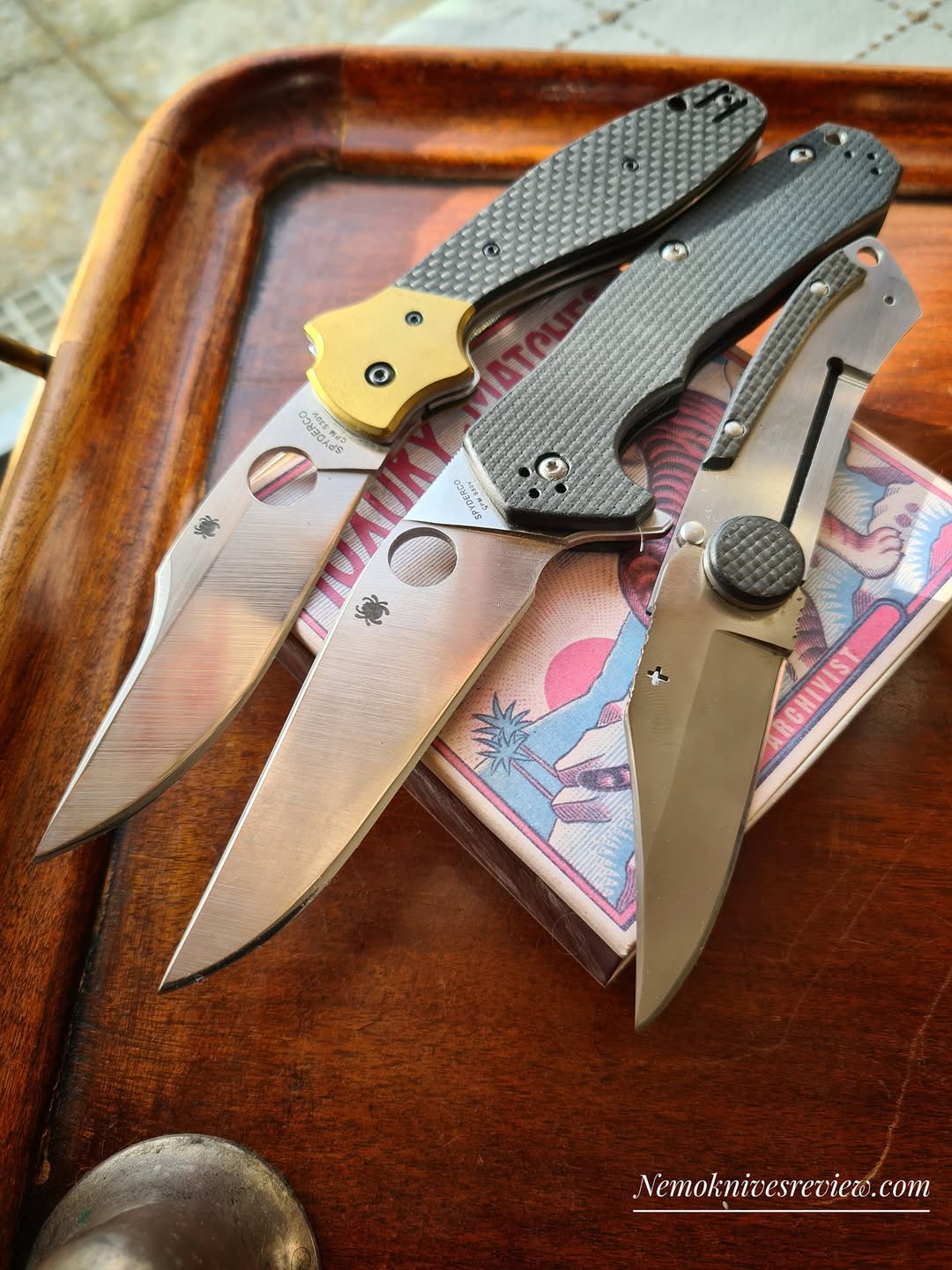
Ten years later, the action remains one of those small pleasures that are difficult to quantify in any specification sheet. Silky smoothness makes you appreciate the quality of the underlying construction.
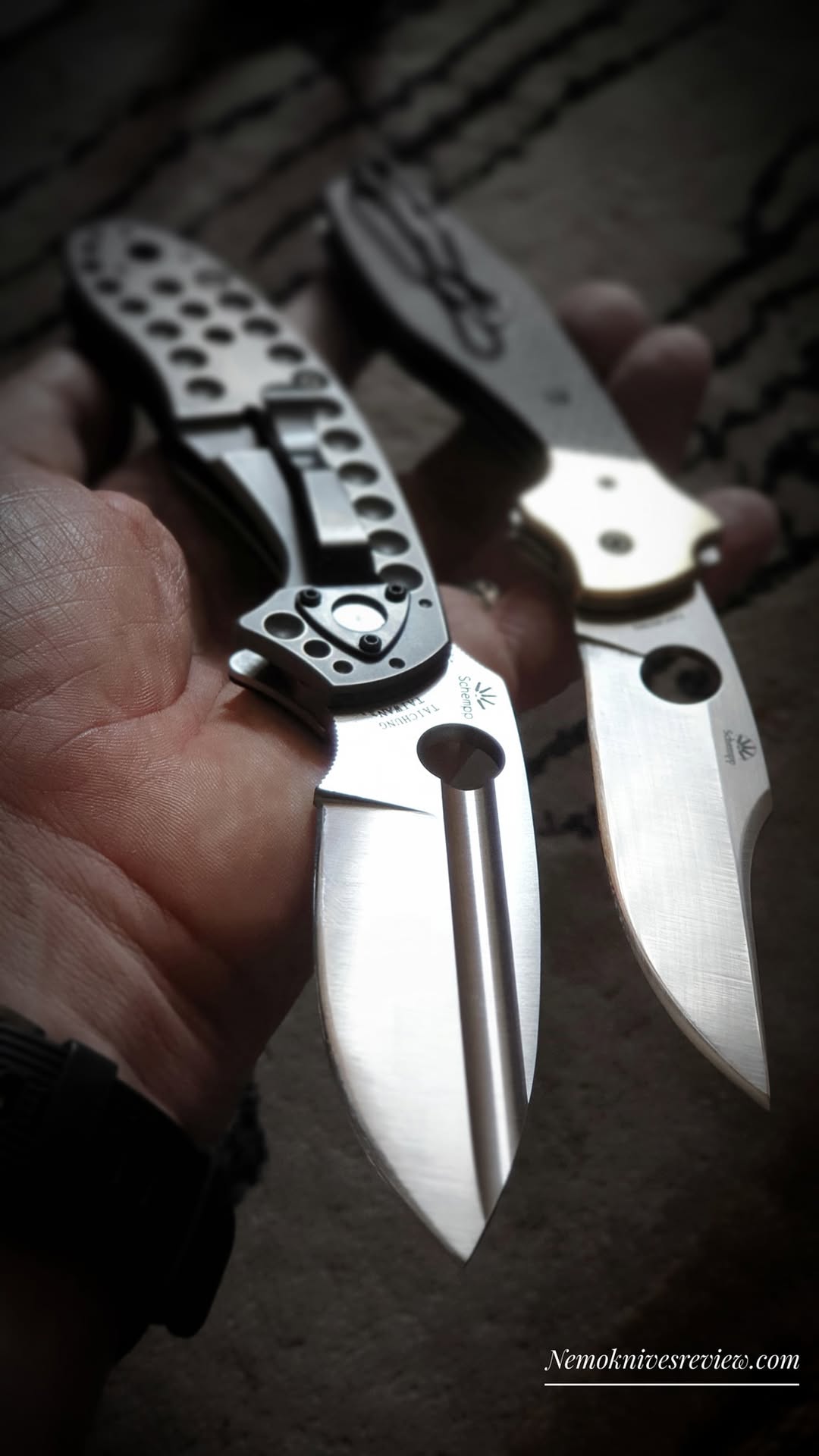
It is Ed Schempp’s interpretation of the folding Bowie, and that interpretation makes a difference.

The blade’s angle and curvature give the knife that particular feel in the hand. The handle seems to settle naturally into the palm, while the geometry provides a satisfying combination of control and leverage during cutting.

The result is a knife that feels comfortable and powerful without needing to be oversized.
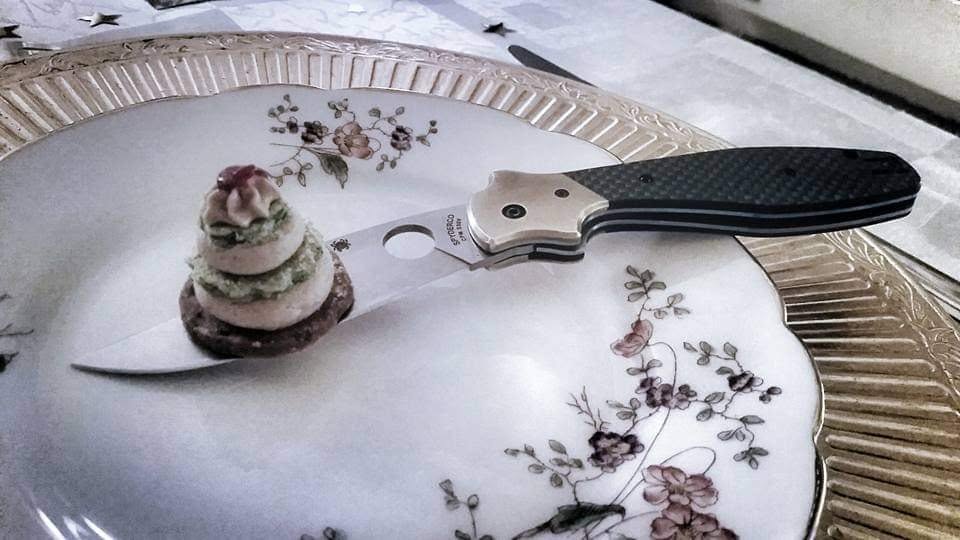
Ed’s Bowie manages to combine a distinctive visual identity—that of a gentleman’s knife—with genuine utility at its heart. His designs have strong personalities, but that personality is never merely decorative. Every curve, every angle, every detail serves a purpose. They are unmistakably Ed Schempp’s designs, but first and foremost, they are tools meant to be used.
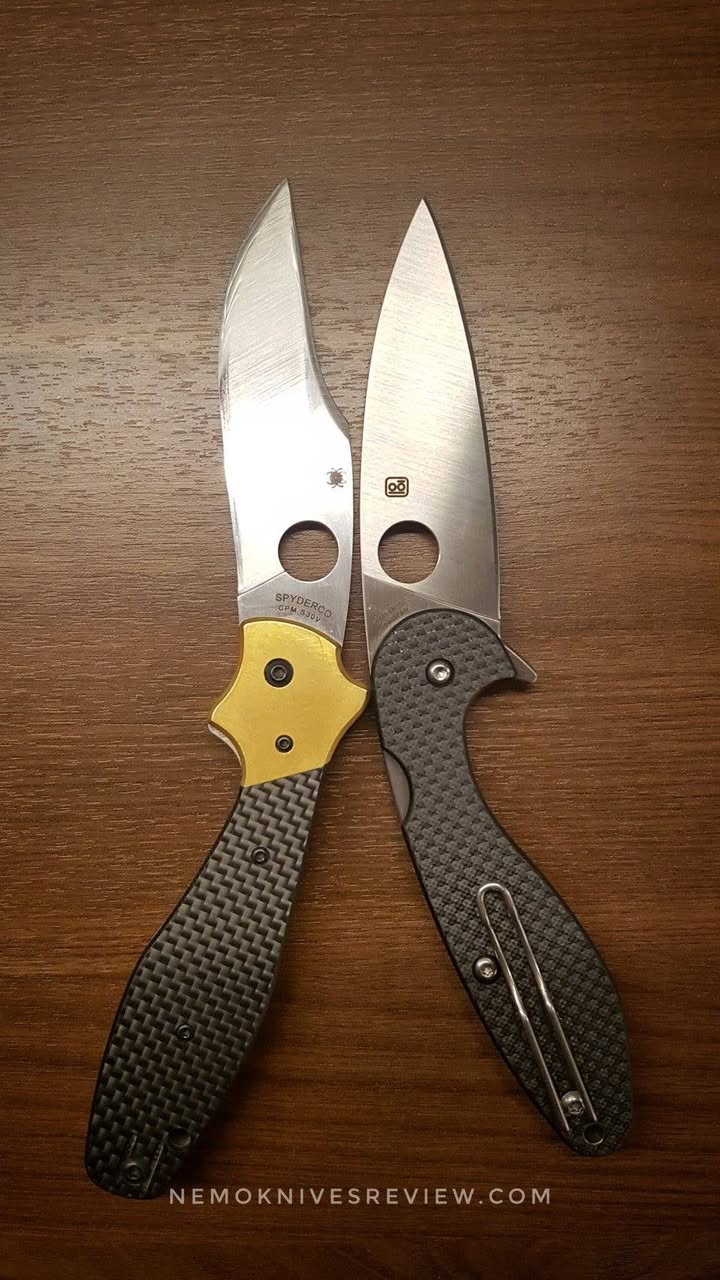
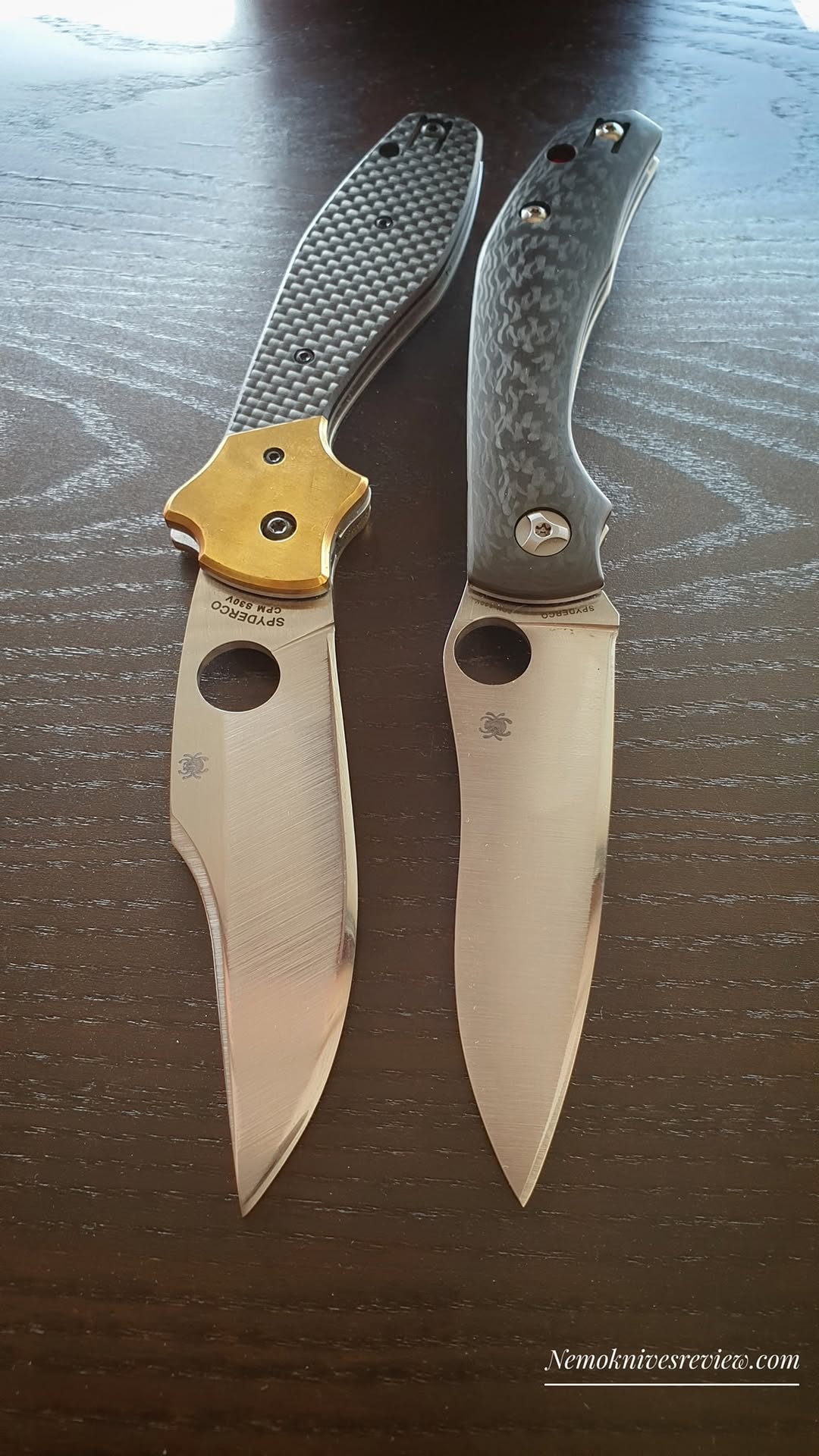
That elegance comes from the combination of materials. The woven carbon fiber gives the handle a distinctly modern character, while the brass bolsters and integrated guard introduce a more traditional touch. It is an unusual marriage of old and new, but one that feels entirely natural.

On mine, there are, admittedly, a few scratches on the full steel backspacer. Nothing serious. When you carry a knife clipped to your pocket, it will inevitably rub against other objects. In my case, part of my wallet is made of aluminium, and the two have occasionally met in the confined space of a pocket. It seems like aluminium corners won a few rounds. The backspacer bears the evidence. But these are superficial marks, not structural concerns. They are the sort of little scars that accumulate when an object is actually used rather than admired from a distance.

The carbon fibers scales, on the other hand, remains in excellent condition, and the brass bolsters continue to provide that tactile contrast that makes the Schempp Bowie so recognizable. And then there’s that peculiar smell. Because brass has a smell of its own, and that’s part of this knife’s character, too. 😀
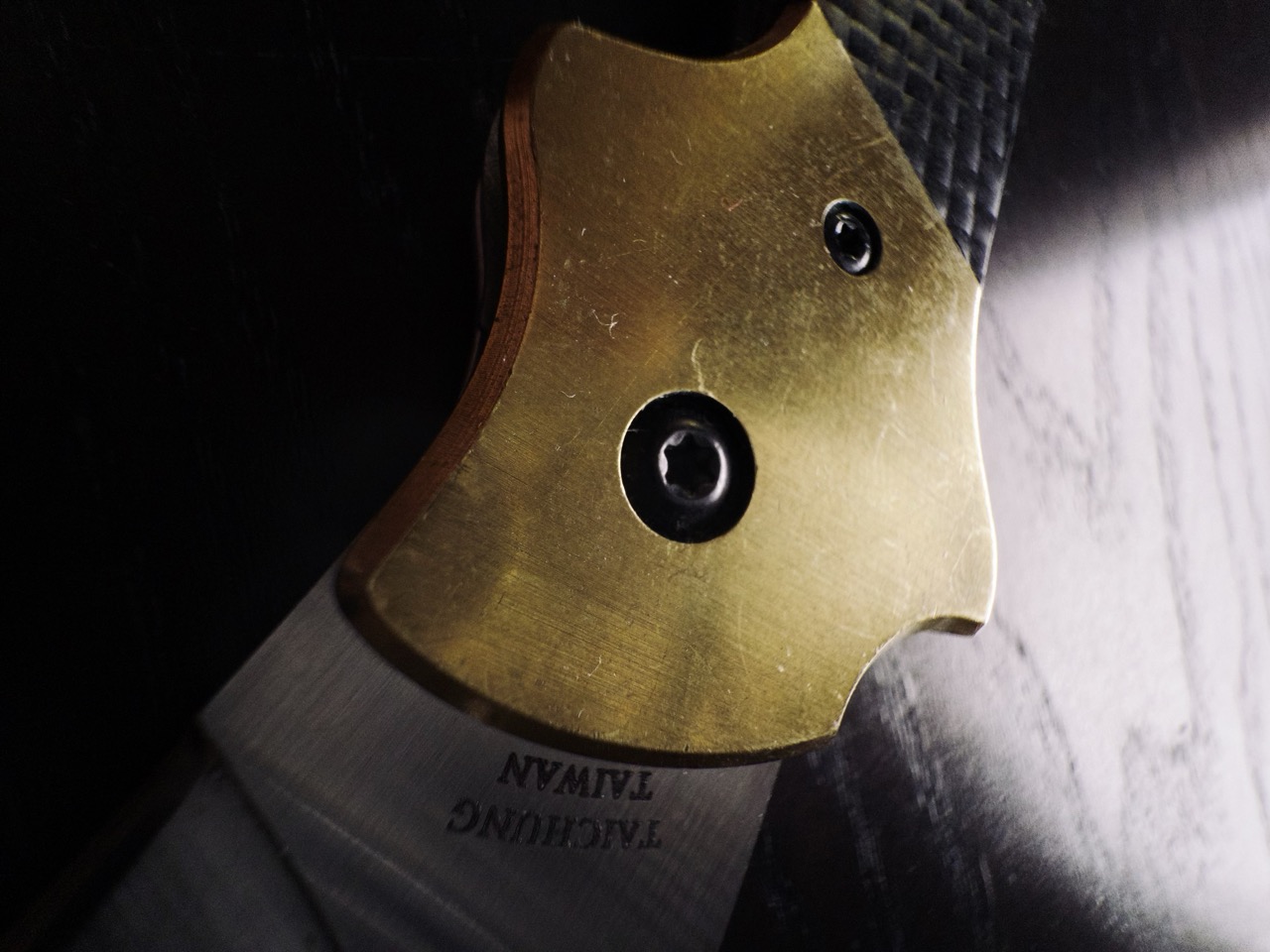
Those brass bolsters are not simply a decorative flourish. It is part of Ed Schempp’s design language.

(I had already appreciated the way it was integrated into the Bowie, both aesthetically and ergonomically. But seeing Ed’s work on the Spyderco Native 5 50th Anniversary edition brought that appreciation into sharper focus.)

The use of brass, and the way it can be incorporated into a knife’s architecture, tells us something about the designer’s willingness to look beyond the usual modern conventions.

(Today, the knife industry is full of familiar combinations of titanium, G10, Micarta, and carbon fiber Nothing wrong with that, of course, but sometimes you can’t help feeling that we’ve seen it all before. Old-timers will remember the Buck 110 and its many heavy German clones, with brass bolsters and liners everywhere. They had their own kind of elegance, but they were also hefty beasts in the pocket. Ed Schempp has blended the warmth and traditional character of brass bolsters with modern materials and a surprisingly pocket-friendly design. A nod to the old school.)

On the Schempp Bowie, the brass bolsters help bridge the gap between a classic American knife pattern and his thoroughly modern touch.
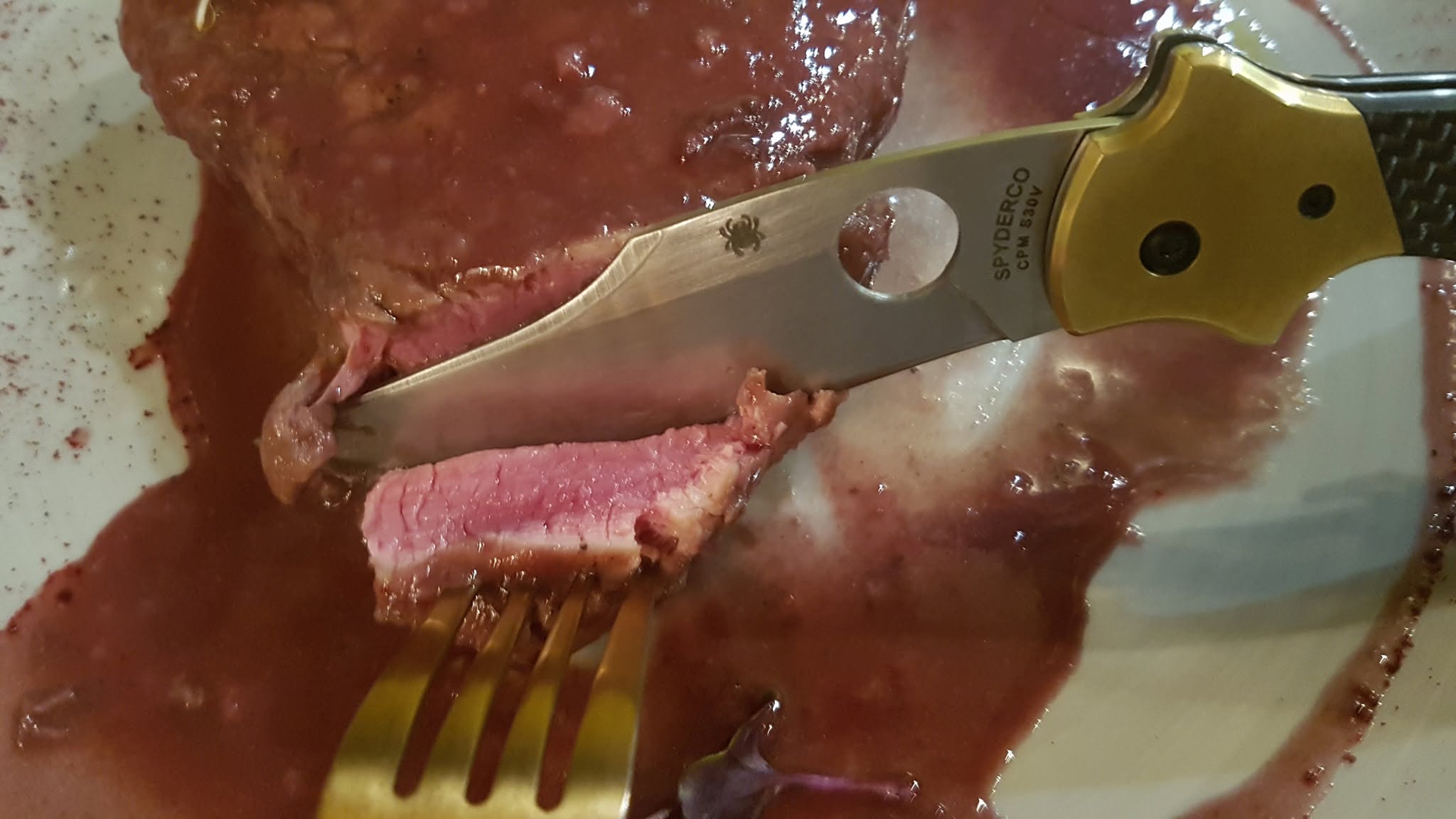
They give the knife warmth. They give it character. And they make it instantly recognisable.

Looking at that work today, I find myself appreciating the design more deeply than I did when I first took the knife out of its box.

I love its quillons. My thumb naturally finds its place on either side of the guard, depending on the grip and the task at hand. It’s playful, almost as if the knife invites you to experiment with your grip.

Yes, sometimes it takes a decade to fully understand what a designer was trying to tell you—and to realise, years later, just how much you had understood at first glance, ten years earlier.
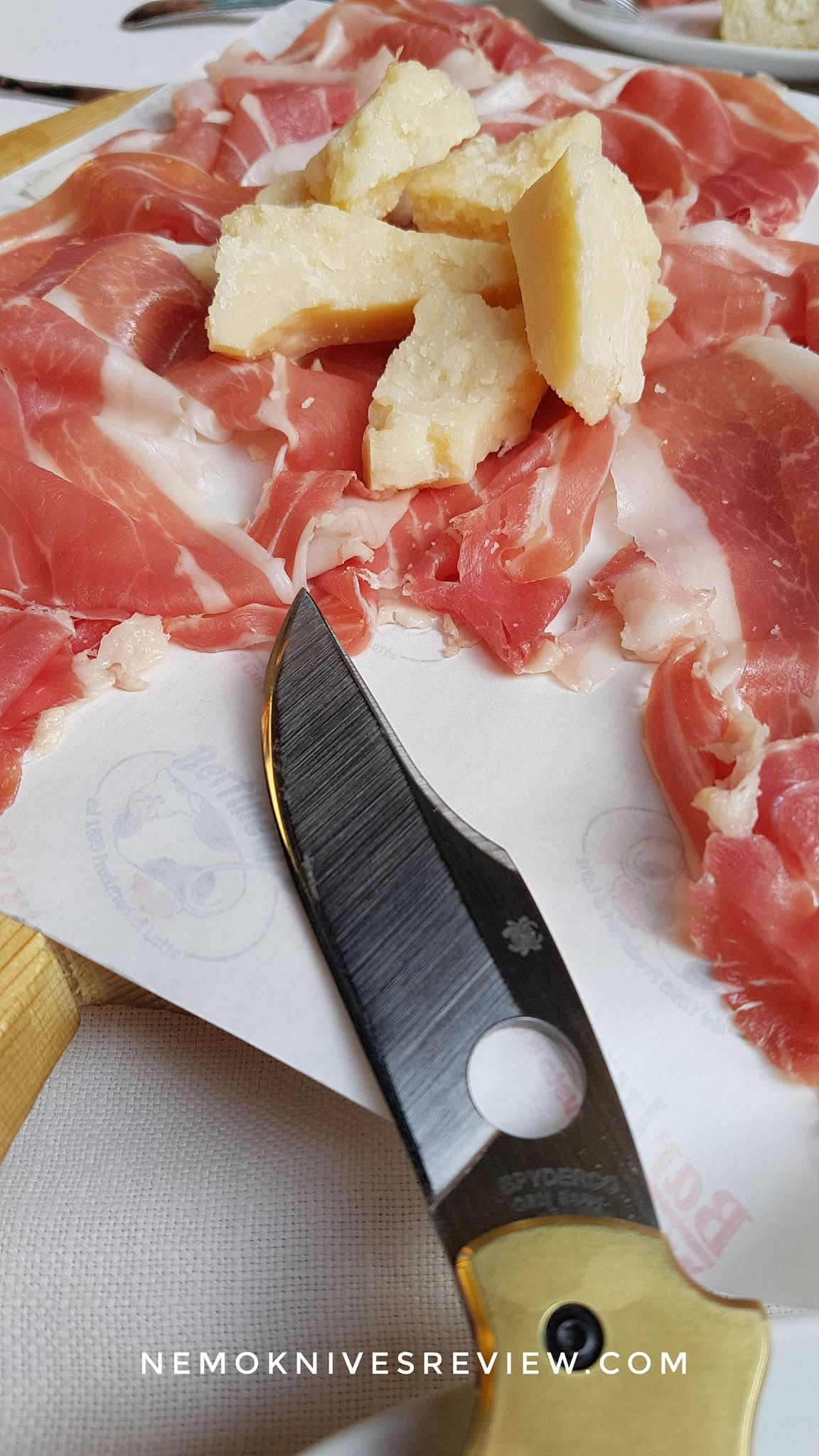
I am obviously not the only person who appreciates this knife.

When I revisited the Spyderco forums and BladeForums, I found several comments that echoed my own experience, particularly concerning the blade geometry, the fit and finish, and the way the design combines elegance with everyday usefulness.

One of the more detailed discussions appeared on the Spyderco Forums in 2015.

The reviewer initially thought the knife might not be for him. After meeting Ed Schempp and handling the Bowie, however, he began to understand the design and found himself increasingly reluctant to put it down. He praised the smooth action, the blade centring, and the quality of the lock engagement. More importantly, he described the knife as an elegant, controlled slicer rather than a heavy-duty brute.
A second discussion, on BladeForums in February 2015, reached similar conclusions.

The owner was struck by the knife’s appearance, the amount of blade available in such a compact handle, and its surprisingly comfortable pocket carry. He also praised the thin blade stock and the smooth action, while noting that the handle provided good control and leverage.

The Spyderco Forums discussion on Ed Schempp’s designs offers another interesting perspective. One owner specifically highlighted the Bowie, praising its distinctive handle shape, carbon-fiber scales, brass bolsters, and versatility, including its usefulness as a camp cooking knife.

Finally, a 2025 Spyderco Forums discussion about long, thin blades included a particularly telling comment from someone who had acquired a second-hand Schempp Bowie and was enjoying its long, relatively thin, slicey blade. It’s never too late to appreciate that knife. 😉

Nearly a decade after the knife first appeared, its cutting geometry was still giving an owner a reason to seek it out and that is perhaps the most interesting point to emerge from these discussions.

The Bowie has never been a universally conventional design. The guard, the blade angle, and the overall silhouette may not appeal to everyone. Some users will prefer a more familiar handle configuration, while others may simply dislike liner locks. And that is perfectly fair. But for those who appreciate what Ed was trying to achieve, the design continues to make sense.
Yes, really, even if I’m repeating myself a little, the Schempp Bowie was never just about looking like a Bowie. It was about translating the character of a classic blade into a modern folding knife without losing the qualities that made the original pattern interesting in the first place. It had to be elegant, but not fragile. Distinctive, but not impractical. Modern, without becoming anonymous.
And capable of cutting properly, rather than simply looking the part.

Ed Schempp and Spyderco’s Taichung factory got that combination remarkably right.

My knife is still perfectly centered. Its lock remains free of perceptible play. The action is still silky smooth. The carbon-fiber scales remain intact, the bolster smells and the knife shows no sign of corrosion.

And I intend to keep using it. Not because it is perfect in some abstract, laboratory sense, but because it has earned my confidence through years of everyday ownership. That is a much more meaningful achievement.
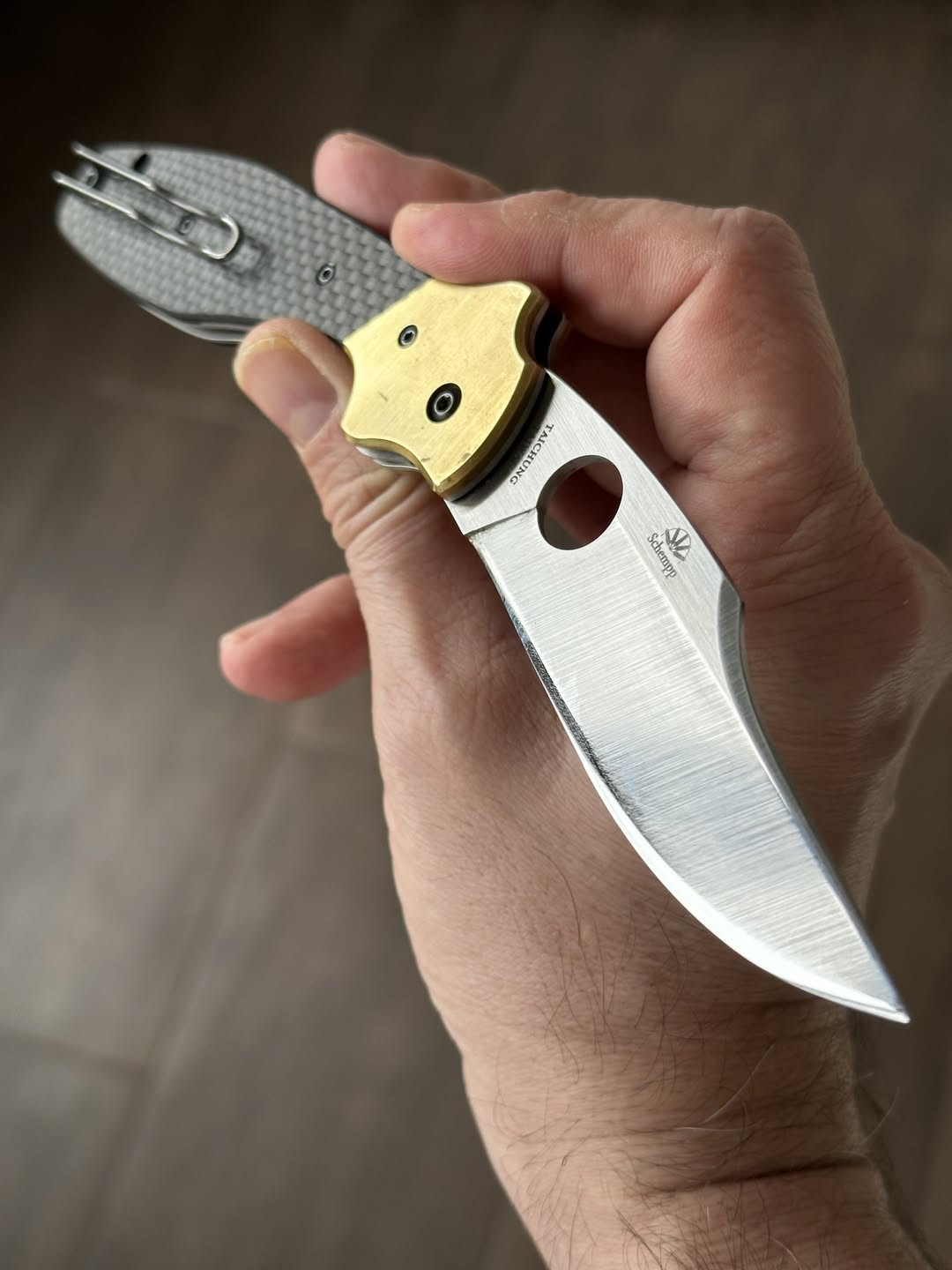

Looking back at my previous articles about Ed Schempp’s Bowie, I realize that my opinion has changed very little. What has changed is the depth of my appreciation. Ten years ago, I admired its unusual lines, its beautiful materials, its silky action, and the meticulous work performed in Taichung. Today, I can add something more substantial to that list: experience.

Speaking of experience… and Legends of the Fall.
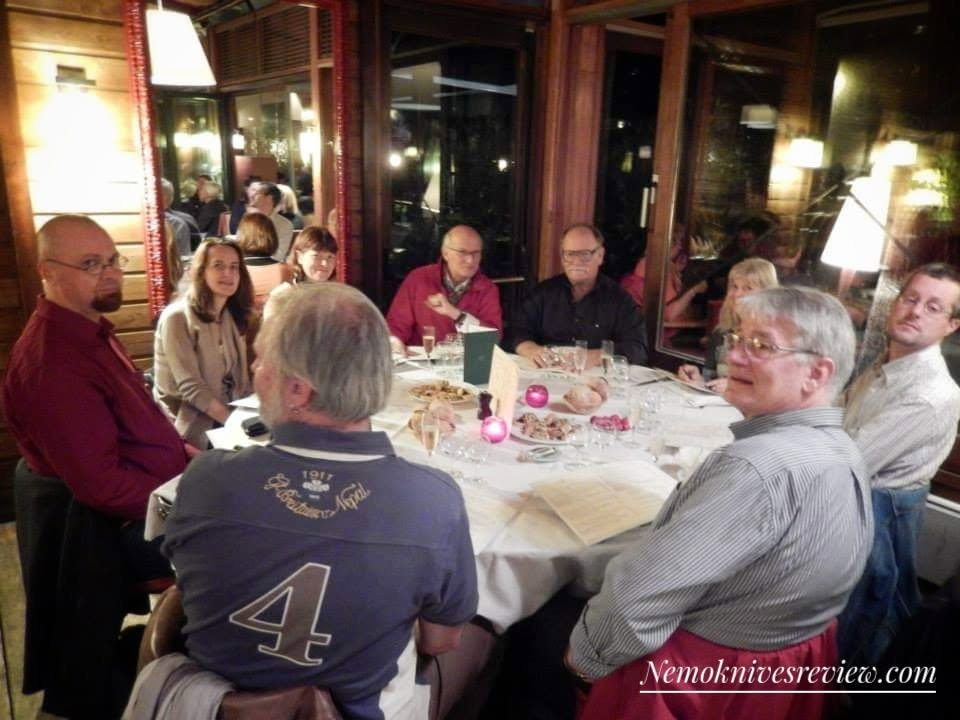
Pekka, Sylvie, Pirkko, Jur, Ed, Linda, Jan Dirk, Des… in September 2013.

Yep, my first encounter with Ed Schempp dates back to 2013, after the SICAC knife show in Paris. Spyderco had kindly invited us to dinner at Le Petit Poucet, in Neuilly-sur-Seine, in the company of Ed Schempp, Des Horn and Pekka Tuominen, among others.

It was one of those evenings that make the knife world such a special place. Beyond the knives themselves, there were the people who design them, make them, and share the same passion for their craft. Meeting Ed for the first time gave a human dimension to the name I already knew from his work. (Little did I know that, three years later, his Spyderco Bowie would become one of my regular companions — and that, ten years on, I would still be carrying it.)

Looking back at that photograph, I realise how much time has passed. Some things have changed, but Ed’s Bowie is still in my pocket. And that’s a pretty good way to measure the lasting appeal of a well-designed knife.
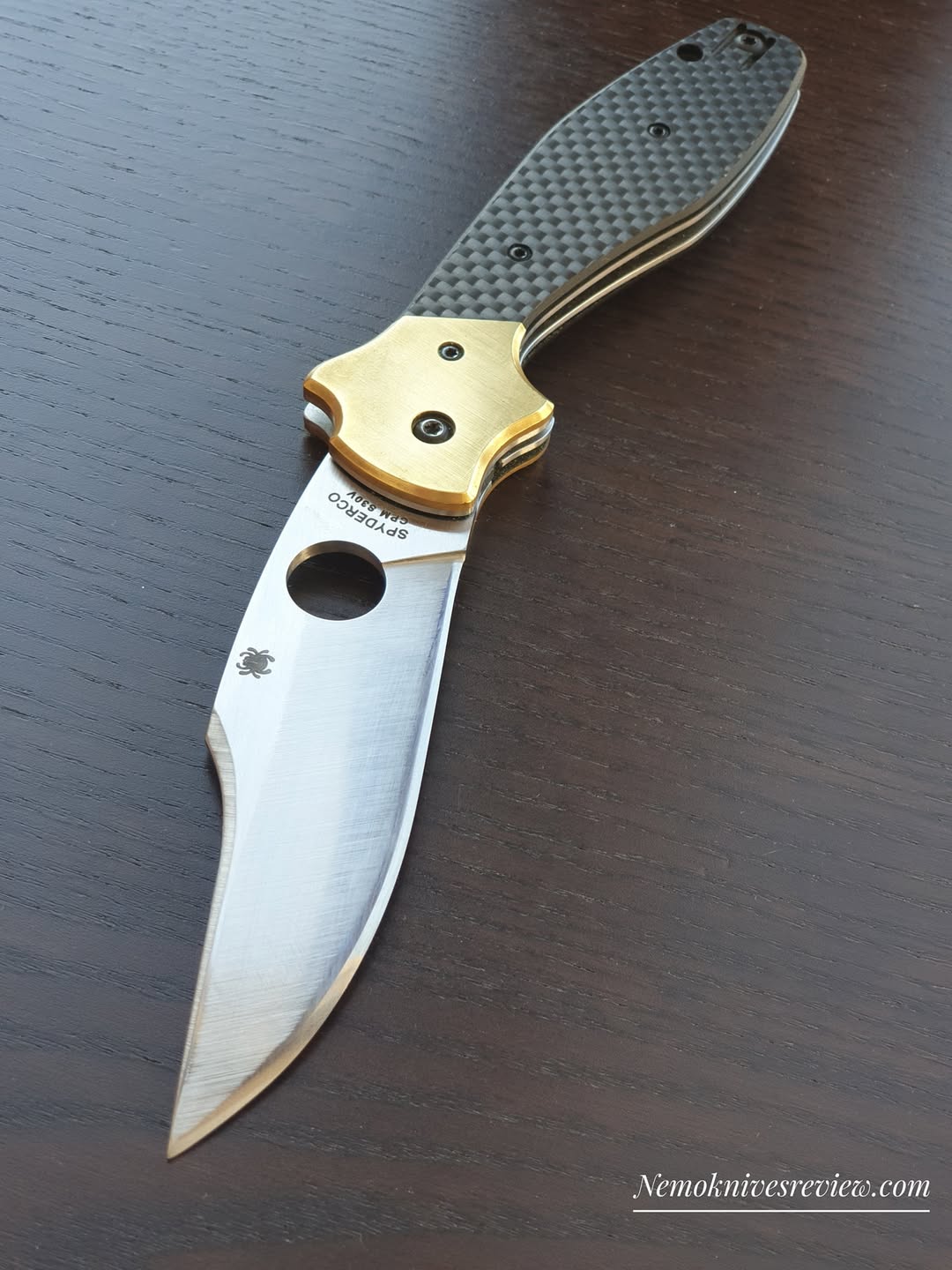
This is a knife built to last, and one of the relatively rare modern folders that combines a long blade with genuinely slim stock and excellent cutting geometry.

There is a certain irony in the fact that a folding Bowie, a pattern that might initially seem a little old-fashioned or even theatrical, has proved to be such a dependable everyday companion.

I think that says quite a lot.

Ed still uses his own Bowie every day on his ranch. Mine continues to accompany me through the ordinary business of life. Our knives have accumulated different marks and scratches, but they share the same essential purpose.

And if I had to sum up Ed Schempp’s Bowie in a single sentence, it would be this:

Some knives impress you when they are new. The best ones make you appreciate them even more ten years later.

This one has earned its place in my pocket. And it isn’t going anywhere.
MANTRA™ 2 Titanium – C203TI – Still alive and kicking ?

In 2026, does the decade-old Mantra 2 still have what it takes to stay relevant?

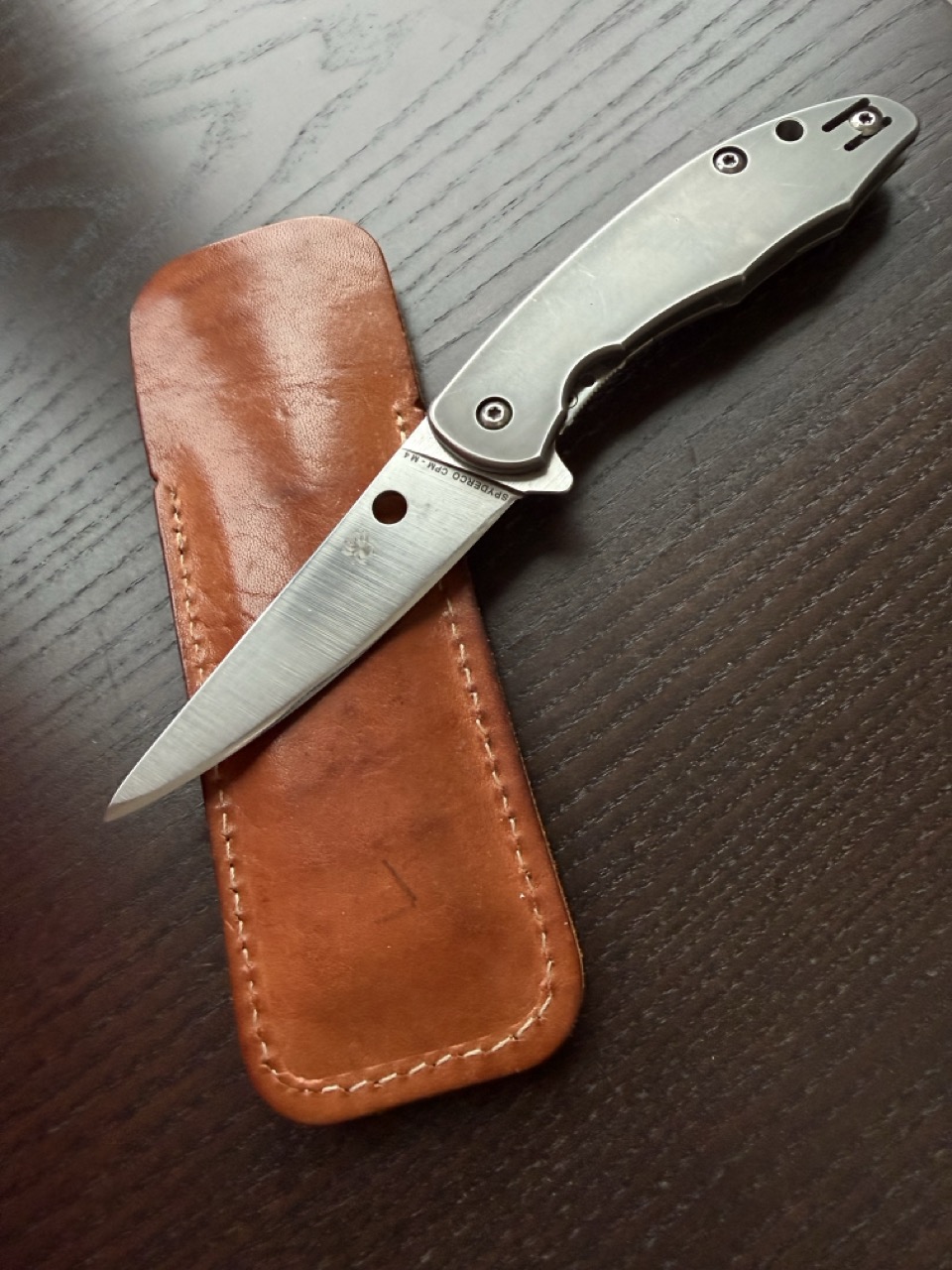
(For the record, the Spyderco Mantra 2 is a flipper-style folding knife. It features ergonomic twin titanium handle scales, a robust Reeve Integral Lock, and a lightweight open-backed construction. Its narrow drop-point profile suits a wide range of cutting tasks, and it opens quickly via an integral flipper and ball-bearing pivot.)

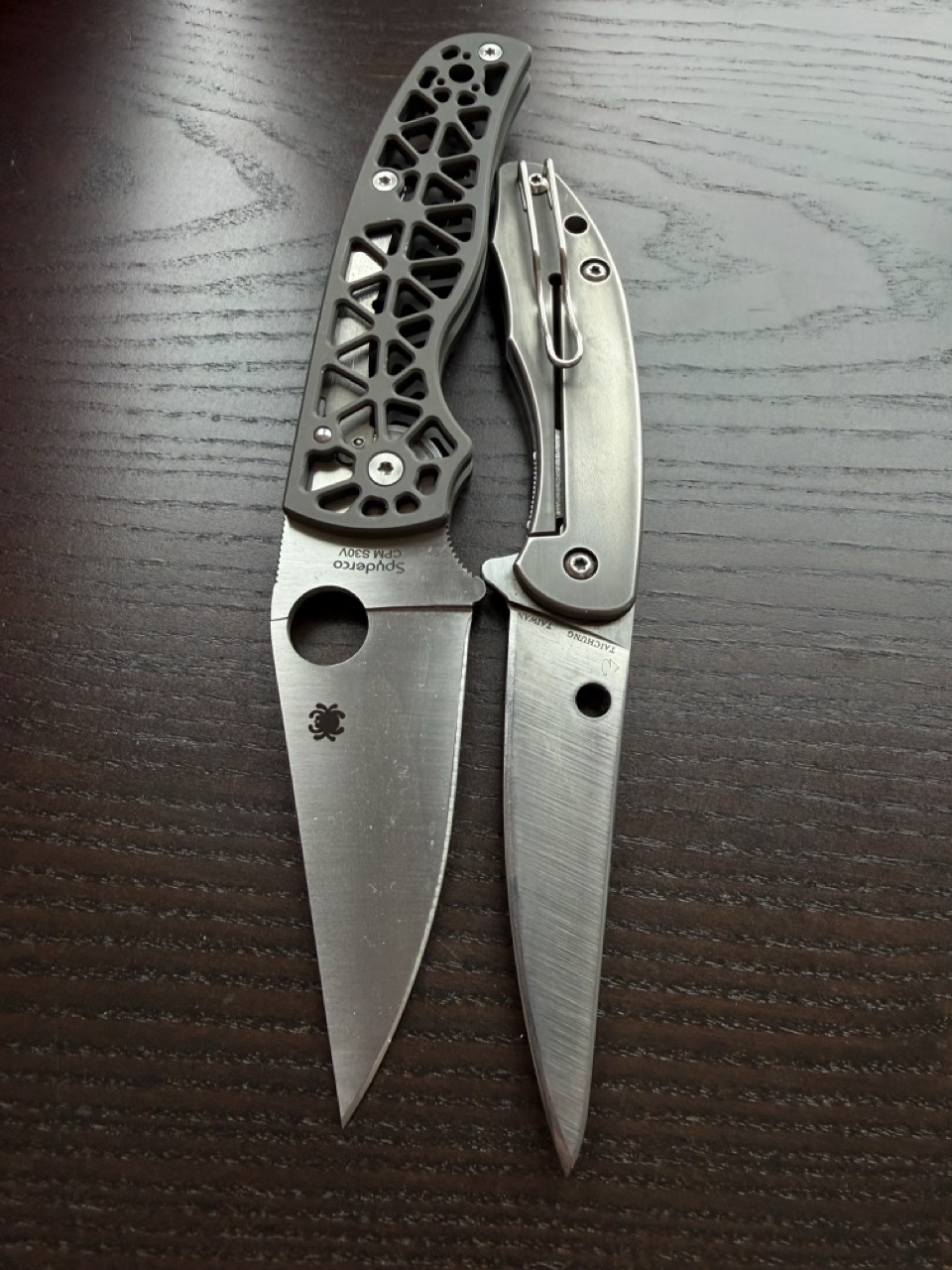
This question inevitably comes to mind when placing it next to the Edgerati, you know ? It’s that beautifully executed modern lightweight workhorse that embodies contemporary folding-knife design. On the surface, the comparison might seem unfair. The Mantra 2 belongs to an earlier design generation, one that predates today’s obsession with extreme lightness and visual minimalism. Yet, in actual use, the gap is far narrower than expected.

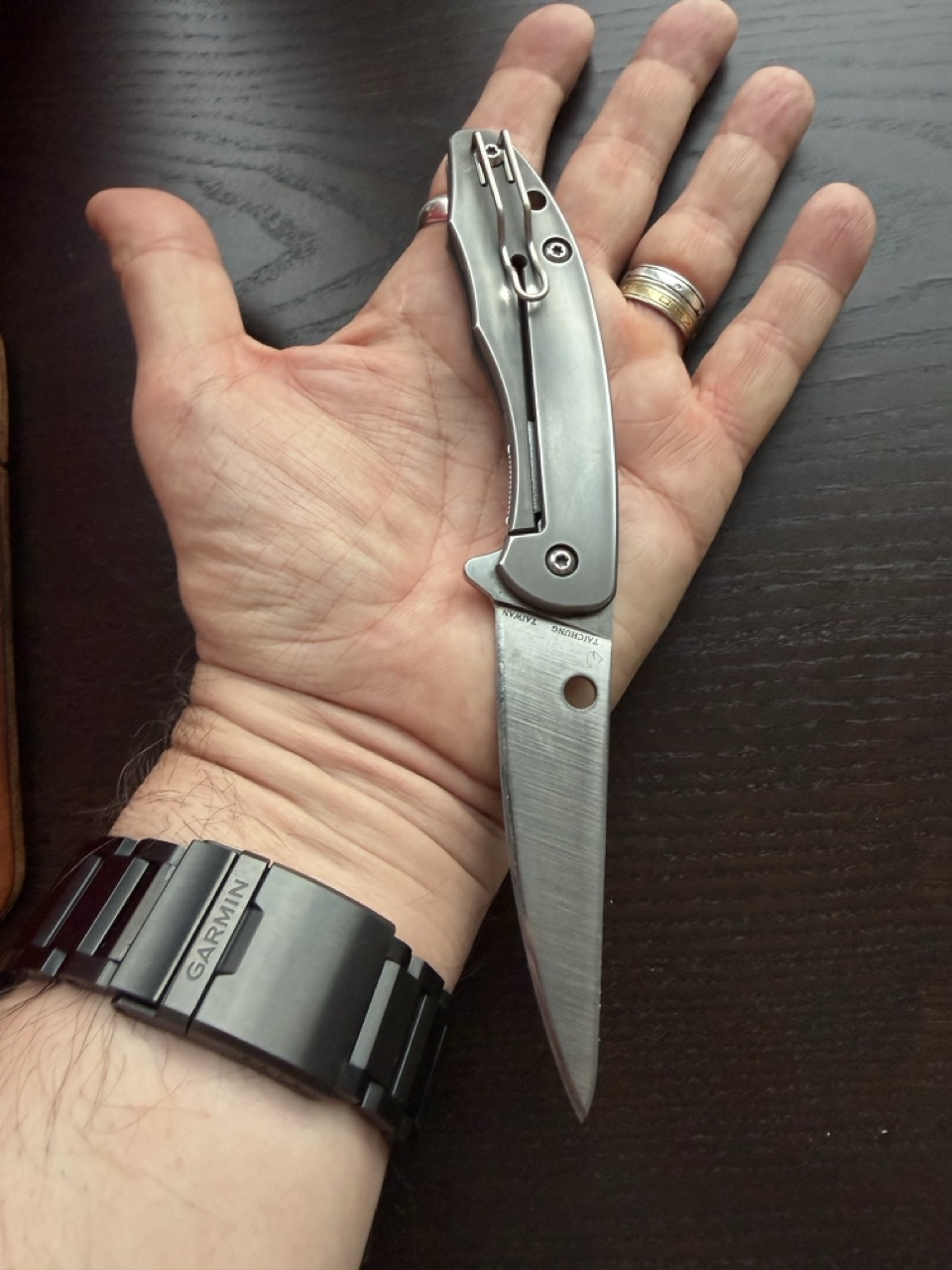
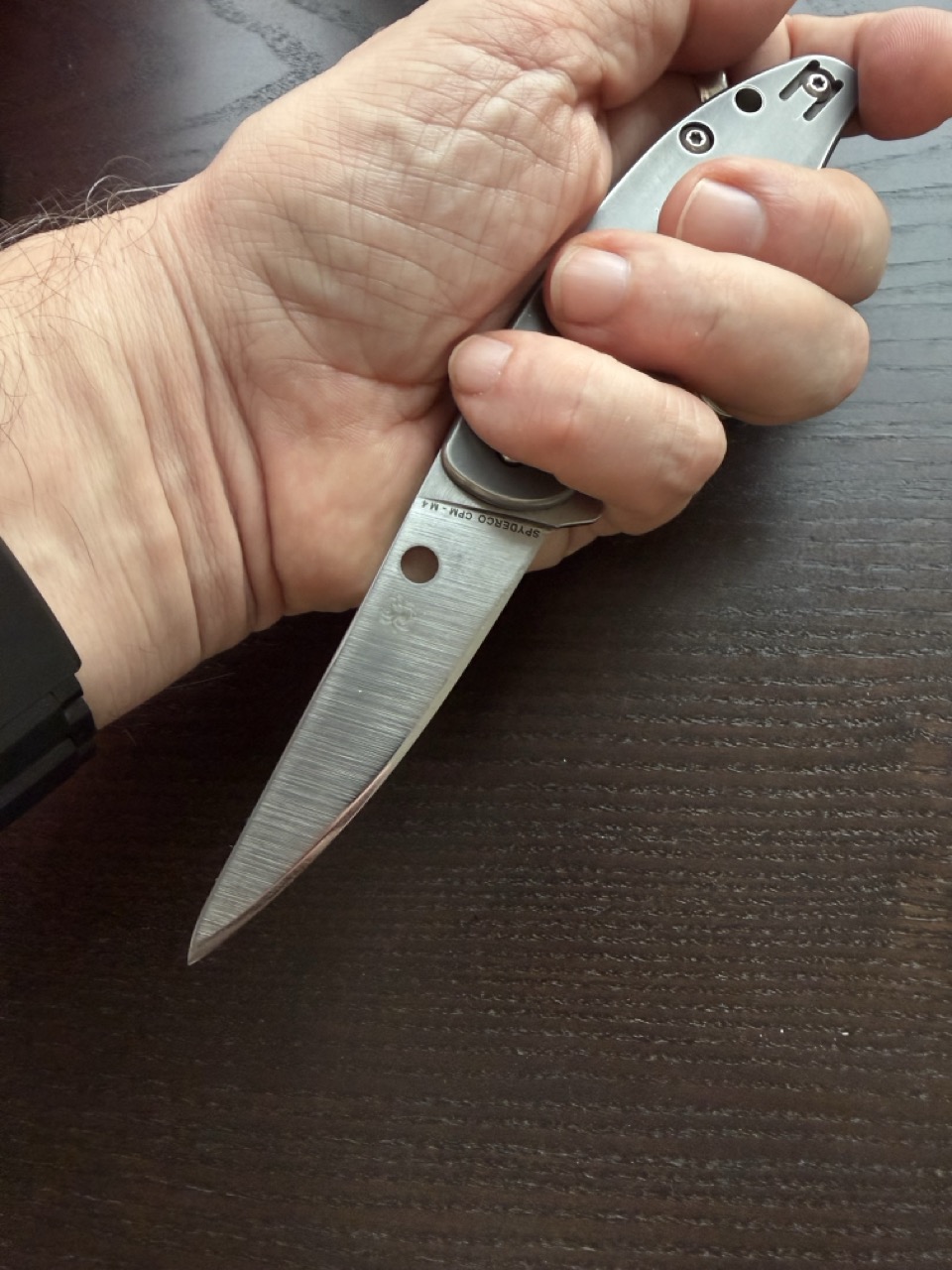
One aspect where Eric Glesser’s design continues to impress me is that blade-to-handle ratio. It remains among the most efficient in its class, extracting maximum cutting edge from a remarkably compact footprint. This efficiency translates directly into real-world ergonomics, with no sense of compromise in grip or control.

Pocket carry is another domain in which the Mantra 2 quietly exceeds expectations. Its footprint is remarkably discreet—once clipped in place, the slim, folded knife nearly vanishes. In daily carry, it becomes an almost invisible companion, a subtlety that even many newer designs struggle to achieve despite advances in materials and manufacturing.

A decade on, the Mantra 2 shows no signs of obsolescence. Rather, it stands as a testament to the enduring value of thoughtful fundamentals and intelligent proportions, which age far more gracefully than fleeting trends. It has been wielded in the kitchen, carried deep into the woods, relied upon as a traveling companion, and pressed hard into demanding materials—yet it continues to perform flawlessly, a quiet tribute to its lasting design.

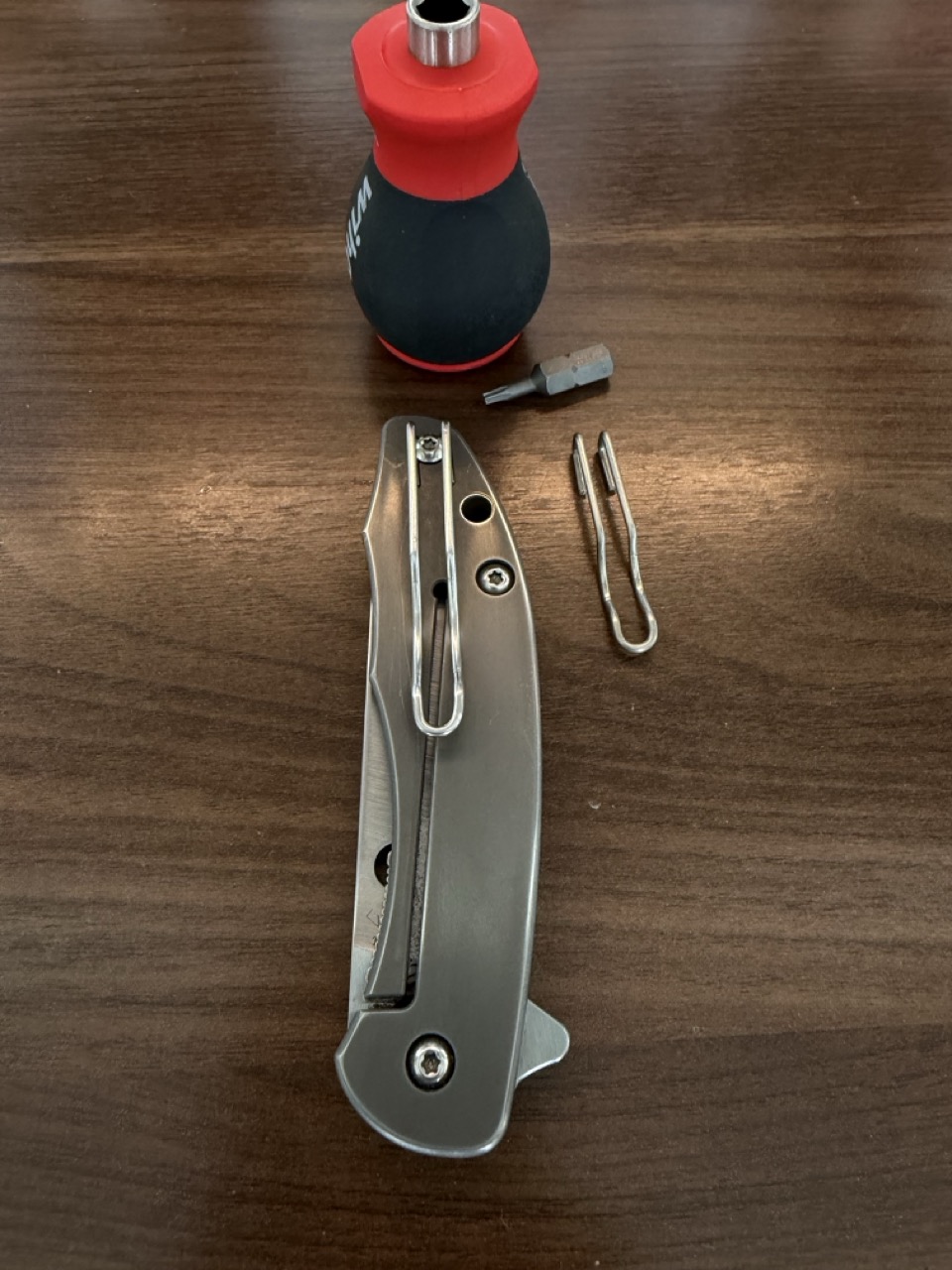
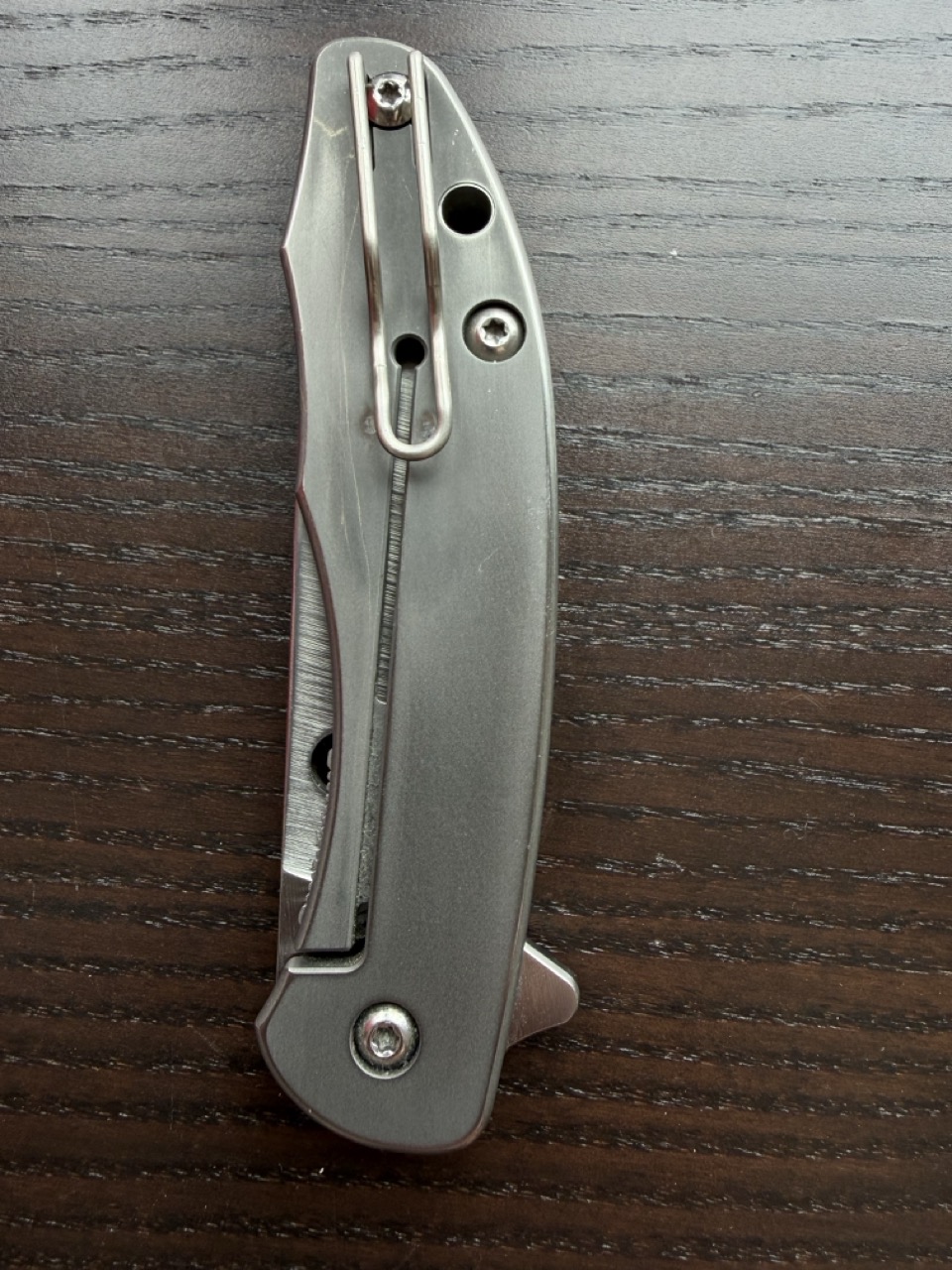
Along the way, I decided to upgrade the Mantra 2 with a shorter mini pocket clip—the kind found on the Lil’ Native Compression Lock, the Microjimbo, or the Dragonfly. A seemingly minor adjustment, it nevertheless has a surprisingly tangible impact on daily carry, subtly refining accessibility and pocket presence without altering the knife’s elegant proportions.

The shorter clip further reduces the knife’s visual footprint in the pocket, enhancing an already discreet carry profile. More importantly, it improves comfort in motion, removing any unnecessary contact points while preserving secure retention, making the Mantra 2 feel almost weightless and effortless throughout the day.

This small modification feels entirely in line with the original design philosophy of the Mantra 2: efficiency over excess, function over spectacle. Rather than altering the knife’s character, the shorter clip refines it, subtly updating the platform without betraying its intent.

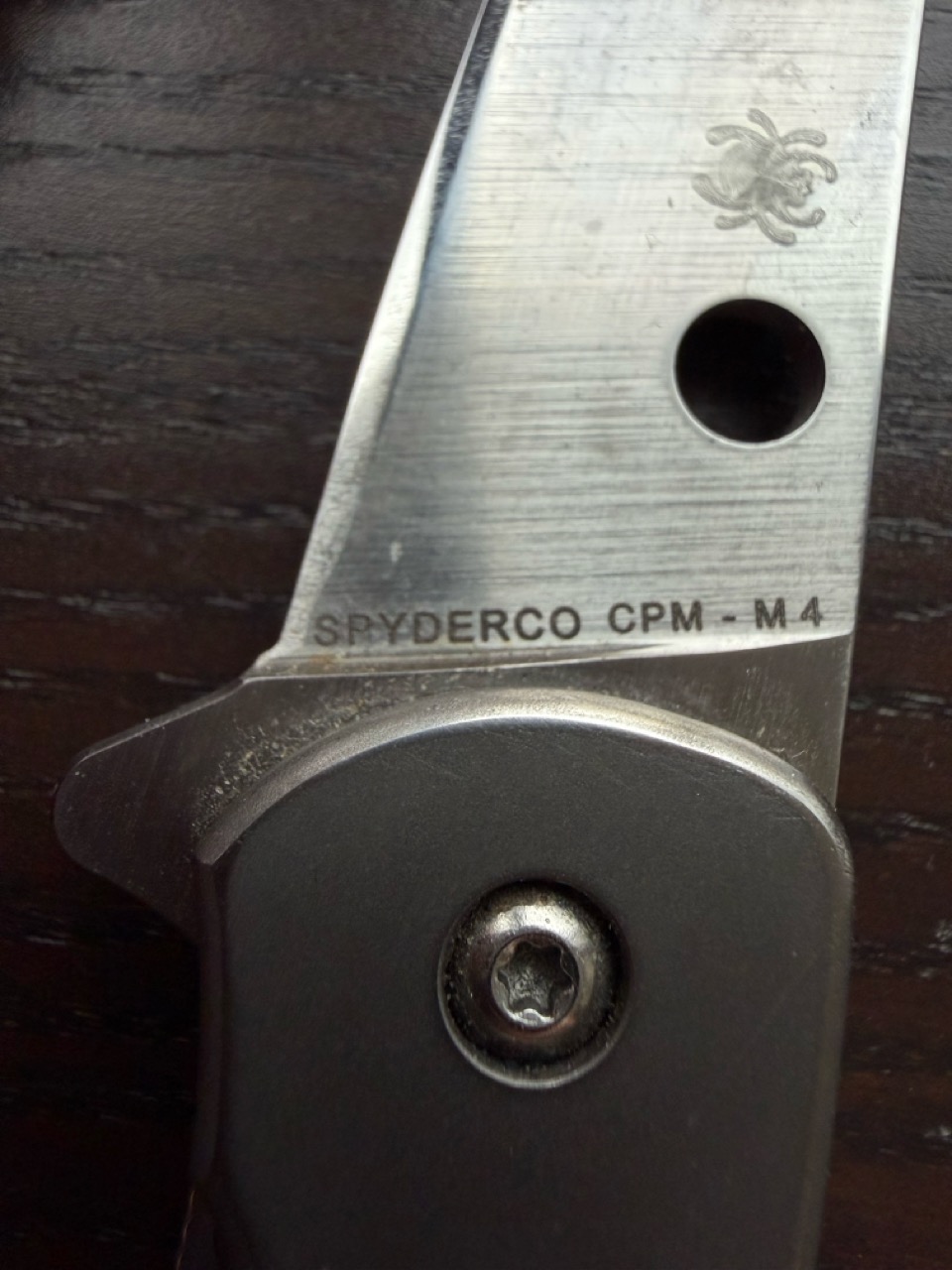
In a way, this simple upgrade underscores the enduring strength of the Mantra 2’s design. A decade on, the knife requires no reinvention—its fundamentals remain exemplary. One minor critique persists: I’ve never been particularly fond of the small Trademark Round Hole™, which tends to trap debris and demands occasional cleaning. Personally, I would have preferred a simple laser-engraved circle as Spyderco’s signature—subtle, elegant, and maintenance-free.

Even so, the knife’s core mechanics continue to impress. After ten years of regular use, the liner lock has not shifted a single bit. Its stability and reliability remain flawless, a quiet testament to Spyderco’s engineering and the robustness of the Reeve Integral Lock.

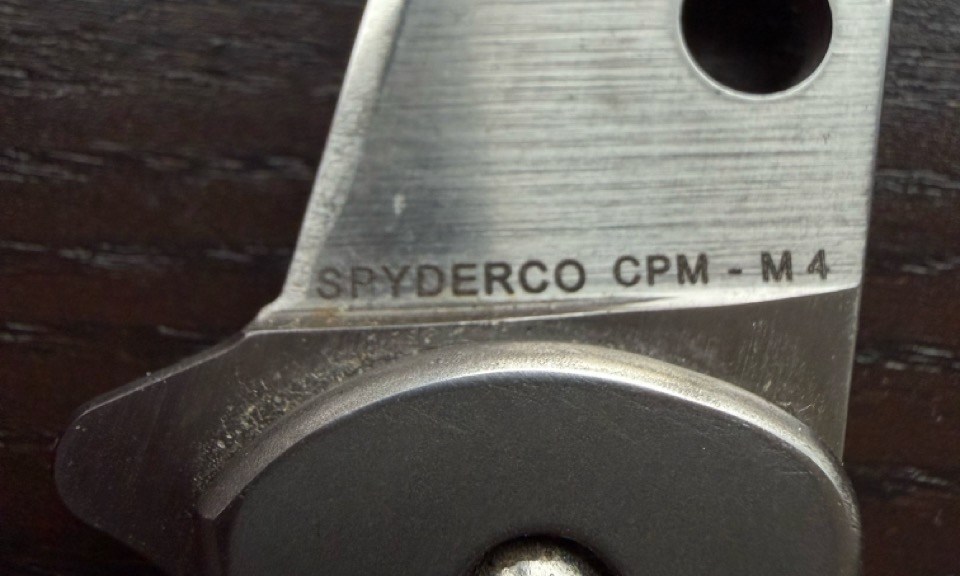
It is also worth remembering that the Mantra 2’s blade is crafted from CPM M4, a choice that says a great deal about the era—and the intent—behind the design. At the time, M4 was far from a marketing buzzword. It was selected for performance, not for trend alignment.

In use, CPM M4 still delivers what made it so respected: outstanding edge retention, a fine, aggressive cutting feel, and a toughness that inspires confidence during harder, more demanding tasks. Even when compared to newer powder metallurgy steels, it remains deeply relevant, particularly for users who prioritize cutting performance over corrosion resistance.

On this particular example, the steel is allowed to fully express its potential thanks to the work of my friend JD, who polished and sharpened the blade with remarkable efficiency. His edge work brings out everything M4 has to offer, resulting in a cutting performance that feels both refined and uncompromising. His skill is undeniable, and it shows immediately in use.

Of course, M4 comes with its own expectations. It asks for a certain level of care, a willingness to maintain the blade and accept patina as part of its character. Yet this trade-off feels entirely coherent with the Mantra 2’s tool-first philosophy. Rather than chasing stainless convenience, it embraces performance and durability.

A decade on, the CPM M4 blade reinforces the sense that the Mantra 2 was designed as a serious cutting instrument first—and as an object of design second. In 2026, that approach feels less dated than it does refreshingly honest.

Set against the PITS 2 in Böhler M398, the Mantra 2 reveals just how differently two knives can approach the same everyday cutting mission. Where the PITS 2 leans heavily into modern metallurgy, with M398 offering extreme edge retention and near-total corrosion resistance, the Mantra 2 counters with a more tactile, tool-driven philosophy embodied by CPM M4.

The PITS 2 feels engineered for low-maintenance efficiency: a steel designed to hold an edge seemingly forever, largely indifferent to environment or neglect. In contrast, the Mantra 2 demands engagement. Its M4 blade rewards attention, maintenance, and sharpening skill with a cutting feel that remains distinctly more aggressive and communicative.

In practical terms, the difference is less about absolute performance and more about attitude. The PITS 2 represents the pinnacle of contemporary refinement—clean, controlled, and technically flawless. The Mantra 2, meanwhile, feels more alive. It is a knife that invites use, interaction, and care, developing character over time rather than resisting it.

In 2026, choosing between the two is not a question of old versus new, but of values. The PITS 2 in M398 showcases where modern EDC design has arrived. The Mantra 2 in CPM M4 reminds us why performance-driven fundamentals still matter—and why some designs age not by fading, but by deepening.

Ultimately, the Mantra 2 (linked to JD review)remains an outstanding choice in 2026. Its exceptional blade-to-handle ratio and discreet, effortless portability continue to set a benchmark that many newer designs still struggle to match.

Notably, my own example—part of the very first generation—has never exhibited the slightest issue with its ball-bearing pivot. A decade on, it operates with the same smoothness and reliability as it did out of the box.

Proof, if any were needed, that strong proportions, intelligent engineering, and a focus on real-world use can stand the test of time.
The Mantra 2 is a pure flipper workhorse.

Massdrop Ferrum Forge Gent — The Ultimate Contender.

My first experience with Massdrop exclusive design was one year ago.
The Falcon has been a surprise in its quality and design and since has been my Spyderco Techno replacement. The Gent is even a better deal !! We are in presence of a real masterpiece in modern cutlery and, pardon my French but I weight my words.
First thing I have noticed is the blade to handle ratio: in a folder, the blade will be most of the time shorther than the handle but with some designers tricks you can give the illusion… It was already the case with the Falcon: we got a real elegant knife despite being short, the blade is perfectly centered, the blade evenly ground, the action is smooth as butter and the edge cut my hairs… WOW !!

The large choil seems to be a Ferrum Forge signature and it is handy for precision cutting. Also when not using it I can hold the handle with 4 fingers. It is much more ergonomic and fonctionnal that my Izulas in that matter.

The lock is similar to the Spyderco PPT.  It is a thick pride liner lock made of bead blasted grey titanium. The slabs are G10 with a very nice texture. Attention to details is stunning: quality is at the rendez vous. The lock feels strong and any way your hand is protected by the flipper used a guard and by the choil if you choose to use it. This is a very solid folder.

The blade is exquisitely ground and the edge is thin, razor sharp our of the box.

The opening construction is ultra minimalist and VERY EASY to keep clean !!
I love ultra minimalists design as found on the Spyderco K2 for example.

The spine is gently chanferred for an excellent confort in thumb pushing cuttings.
Something I won’t have to do myself.

Immediatly you want to play with and put the high saber flat ground S35VN blade in its pace. A steel first introduced to me through the Spyderco Native 5.

As a Lady/Gent knife it is small like a jewel.

Non threatening is a must in that kind of EDC knife. But don’t get fooled by its size; this is a real workhorse !

The detent is a little harder than the one of my Falcon or my ZT0562CF but it works and fires every time. It is really smooth and no side play so far. I was not able easily to open the blade without using the flipper.

The deep carry clip is well thought and it makes the knife disappearing in the pocket. EDC is often better in low profile configuration.

So let’s put a little convexing on that baby: Stuff 2, Fallkniven DC4 and leather…

Diamonds are in play for the first round. The thin edge makes it easy to scratch and of course I have scratched it. You can notice the very nice belly on the blade.

But nothing some use and future stropping won’t erase in a “beautility” attempt. The idea is just to bring convex in the middle of the belly.

Leather stropping, razor sharp let try it on my favorite test in ergos and edge: the Bottle Butt !!

As you can see it was an easy cut for that little knife. There is power in this one. The blade is just thick enough to provide a comfortable spine to strongly push through.

The Belly always help for push cutting in hard material.

So far what do we got:

an elegant, non threatening short folder with premium materials (Titanium and S35VN).
It can be deployed and close with one hand.  Great balance with its sweet spot just behind the pivot. Great ergos, thin edge and easy to clean ?
This is almost the perfect EDC, worst it the best EDC you can buy for 80 dollars !!
This kind of high quality knife could be the only folder to bring with you anywhere. A great little big knife ready for anything ! Thank you to my friend Dan Sharpe for having introduced me to that little wonder !

SPECS

  • Produced by Drop
  • Designed by Ferrum Forge
  • Manufactured by WE Knife (in Guangdong, China)
  • Blade: CPM-S35VN stainless steel
  • HRC: 58–61
  • Blade type: Drop-point
  • Grind: Flat saber
  • Finish: Stonewashed
  • Handle: 6AL4V titanium with rosewood or carbon fiber scales
  • Lock: Liner lock
  • Open: Flipper tab
  • Ceramic detent ball
  • Caged pivot bearings, hardened steel washers
  • Choil for easy sharpening
  • Reversible, deep-carry steel pocket clip
  • Blade thickness: 0.13 in (3.2 mm)                       
  • Handle thickness: 0.4 in (1.1 cm)
  • Blade length: 3 in (7.8 cm)
  • Closed length: 3.6 in (9.7 cm)
  • Overall length: 6.6 in (17.5 cm)
  • Weight: 2.4 oz (68 g)

Founded in 2009, Ferrum Forge started from humble beginnings in Elliot Williamson’s garage in Southern California. Using found pieces of steel like old files and leaf springs, Elliot gradually taught himself the art of knifemaking and metallurgy. As his skills and passion grew, so too did the demand for his work. Luckily, Elliot’s brother Chris joined the team in 2012 to help expand Ferrum Forge to what it is today: a small operation dedicated to designing and producing custom knives through a rigorous process of development, machining, iteration, and quality control.

The story of the Gent starts back in 2016 when Elliot and Chris Williamson from Ferrum Forge teamed up with Drop (formerly MassDrop) for a cross brand collaboration. Ferrum Forge designed a series of unique Drop x Ferrum Forge knives that they produced, but none would compare to the Gent. After the success of the first few models, Drop asked for a less aggressive design better suited for carrying in an office environment.  It was time for Elliot from Ferrum Forge to break away from aggressive, “tactical” style and give the world his take on a modern, gentlemen’s folding knife.  Not only did he accomplish his goal, he created the most popular, best selling knife that Drop ever sold.  

Ironically, Elliot didn’t like the Gent after he rendered it in 3D. His artistic side screamed it was boring and too simple. Meanwhile, Chris, lacking that artistic side, saw the elegance in the simplicity and loved it. Drop cast the tie breaking vote and the Gent came to life. 

The Gent started their evolution toward slimmer, lighter, more pocket friendly, and less expensive knives. It was the first ever Ferrum Forge liner lock design and would eventually lead them to creating liner locks like the Stinger, Mini Archbishop, and Prolix. 

Unfortunately their collaboration with Drop ran its course and they discontinued the Gent. 

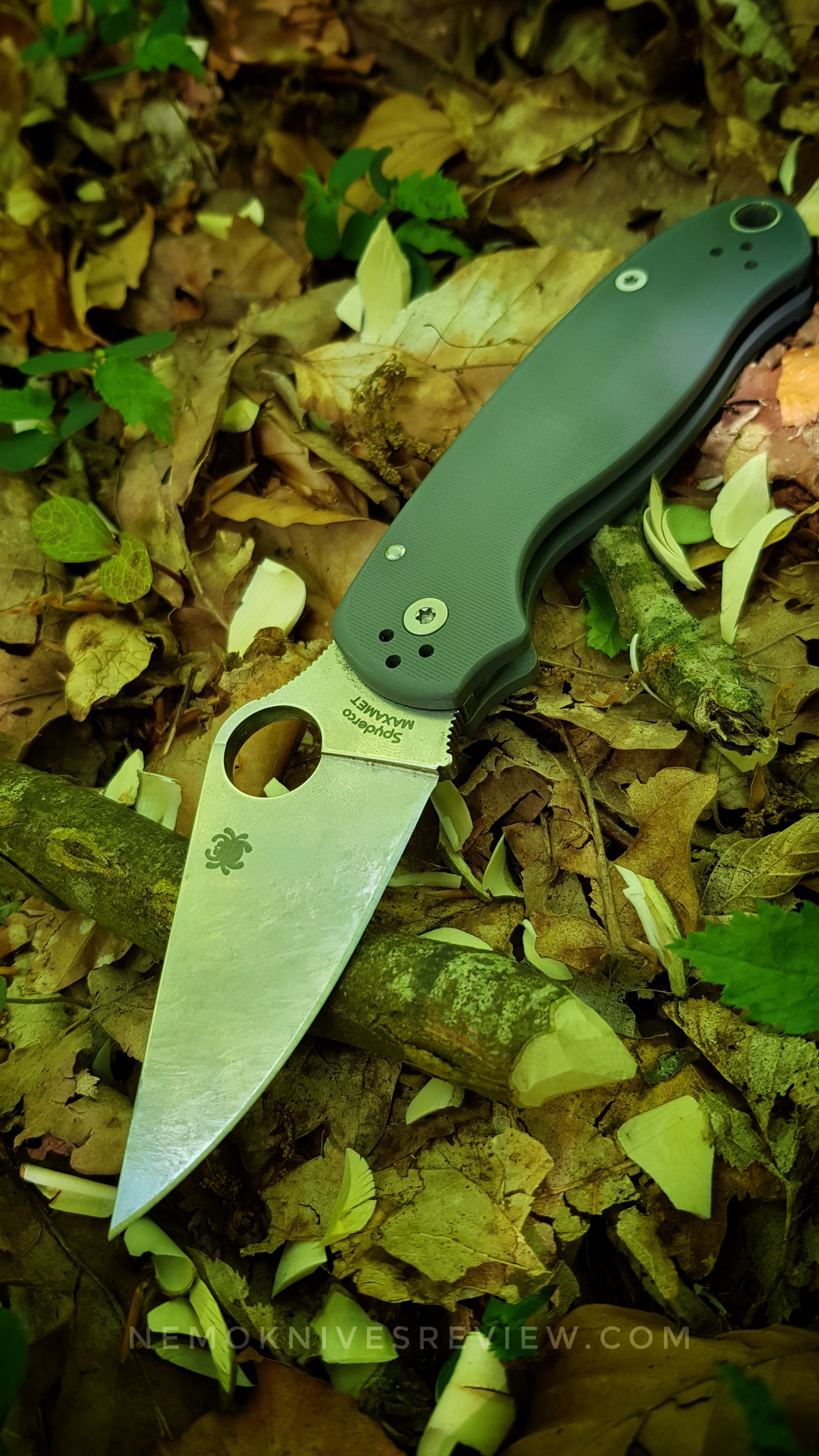
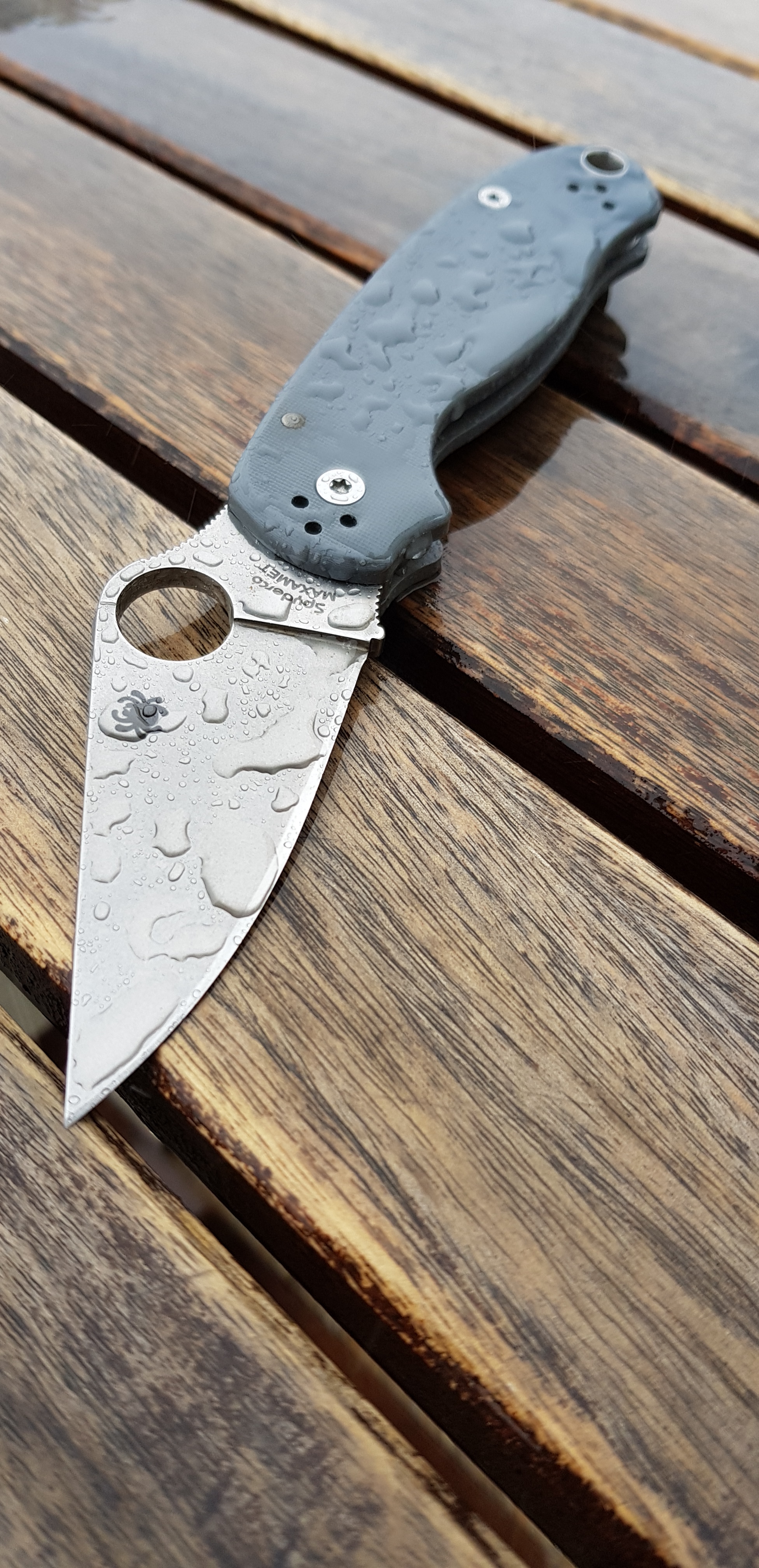
Spyderco C223GPDGY Para 3 Maxamet Part II.

20180508_140104-01.jpeg

The Grey Mouser has been in my EDC rotation since it has arrived in my pocket.
So this a little report.

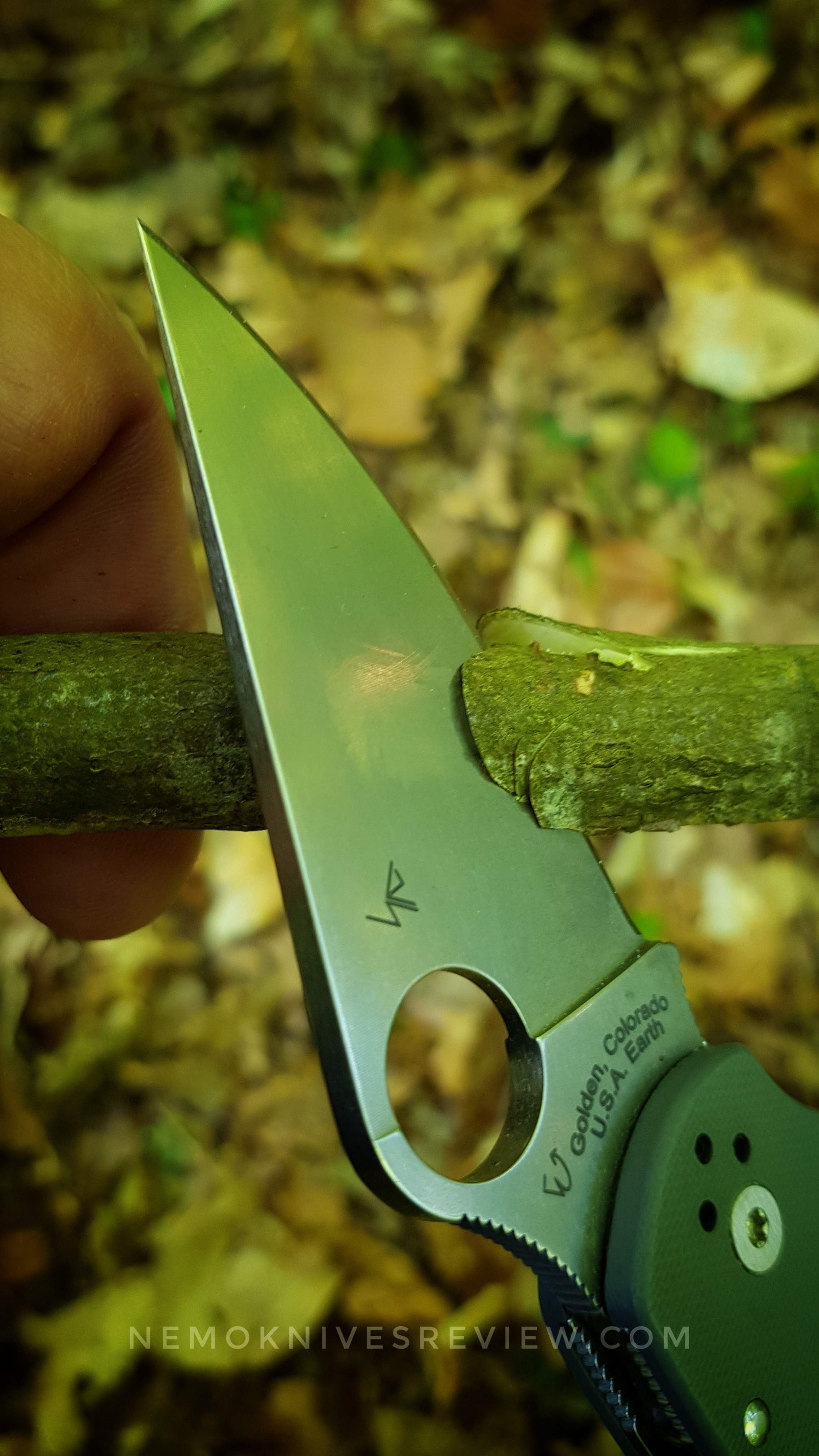
Maxamet is like a super CPM M4 to me, it cannot seem to get dull. I have deshouldered the edge and keep it sharp (razor) with white ceramic and leather. The edge behaviour in wood is like M2, it gives a gentle patina to the part cut.
20180508_135014-01.jpeg

The gently rounded spine is a must for thumb push cutting.

20180508_125601-01.jpeg

The lock is solid and did not give in to any vertical or lateral play.

The Para3 is really a friendly 3 inches knife with a wide spectrum of uses.
Near the pivot you got as much as any C36 Millie strenght for power cutting as this is the same “cockpit” as the good old Military. The point is easier to control as your hand grabs the blade and the handle with more ease on smaller knives. So you got a very capable knife for the outdoors, able to carve and trim wood.

20180508_130547-01.jpeg

20180513_135809-01.jpeg

Maxamet is giving a beautiful orange red patina. I have not been able to get any pit of rust despite my every day use on acidic foods.

20180520_203331-01.jpeg

It’s less sensitive to medium than K390 and close to CPM10V. You got stain but nothing more in my experience.

20180610_135242.jpg

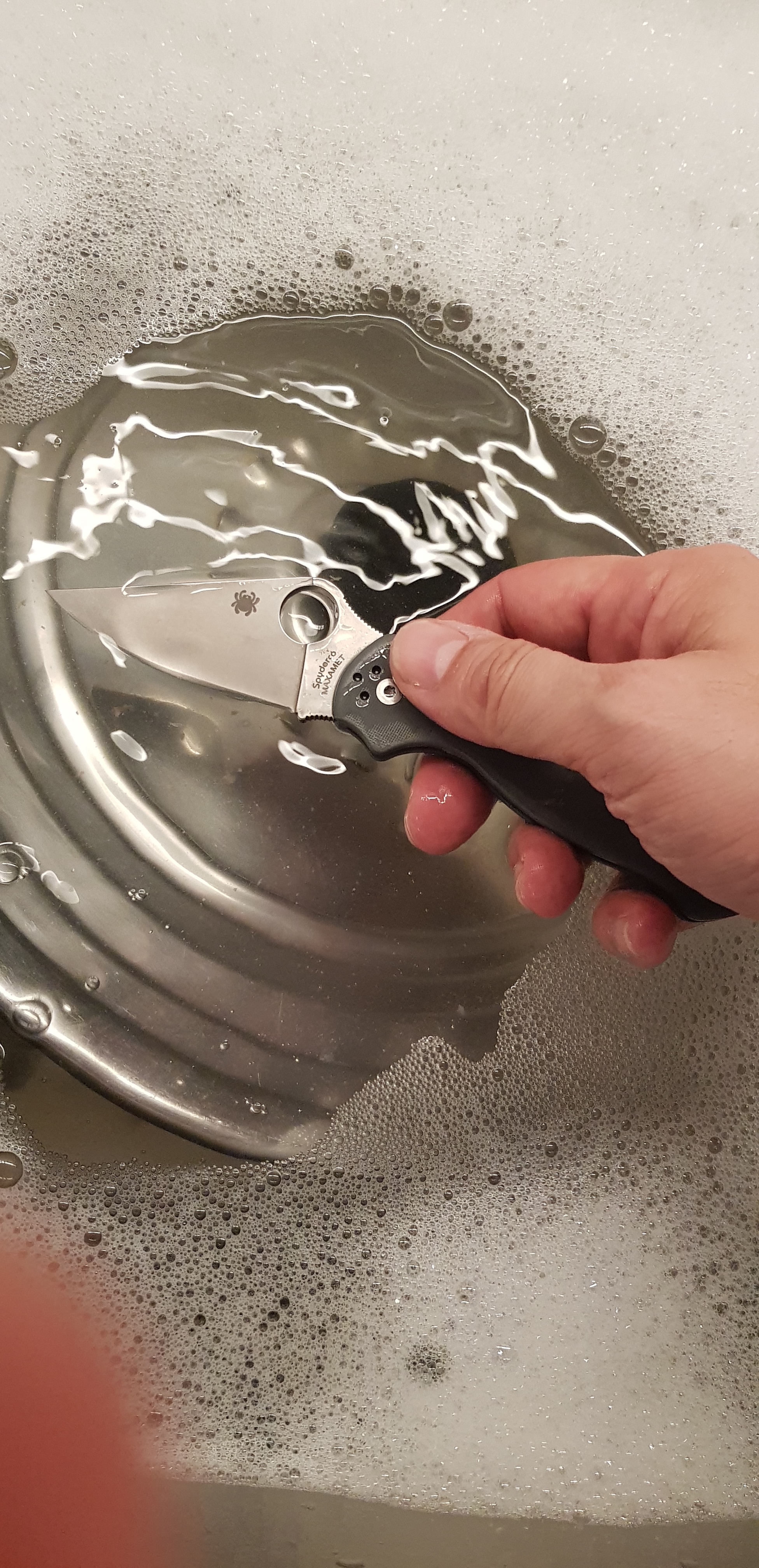
I clean it directly under the tap of in a soapy water. Nothing extravagant. The action is on the smooth side even without any oil near the pivot. I have decided to treat it the hard way.

20180530_100841.jpg

So far I’m really impressed by the ease of keeping razor sharp that very special alloy. It’s not difficult with only white ceramic and leather and it happen once a week just for a refresh.
The deep carry clip is back for tip up carry and it makes a very low signature for an EDC.

20180602_122936.jpg

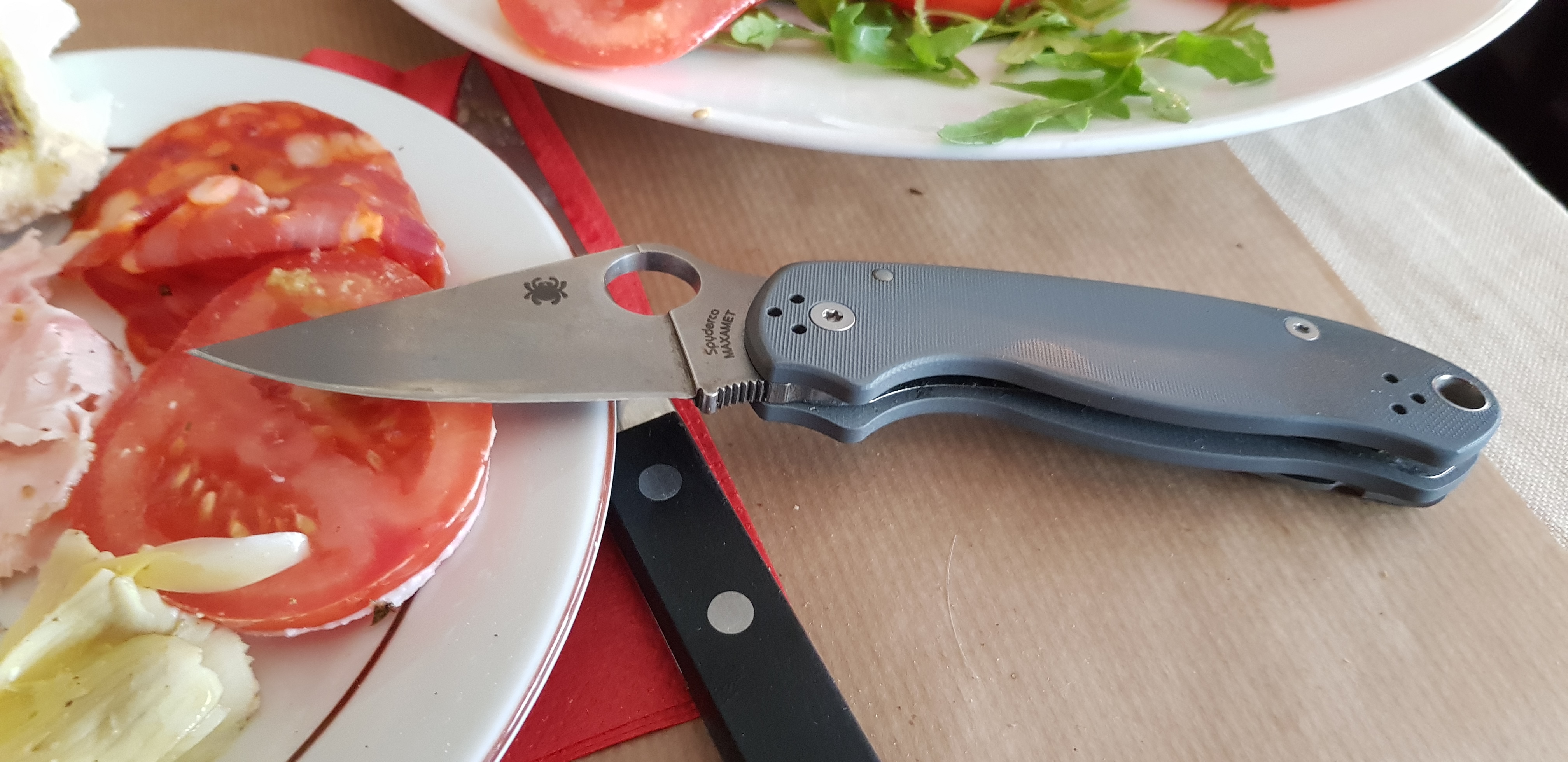
It’s used every day for eating and mostly I use the spine to push in the plate.

20180608_121015-01.jpeg

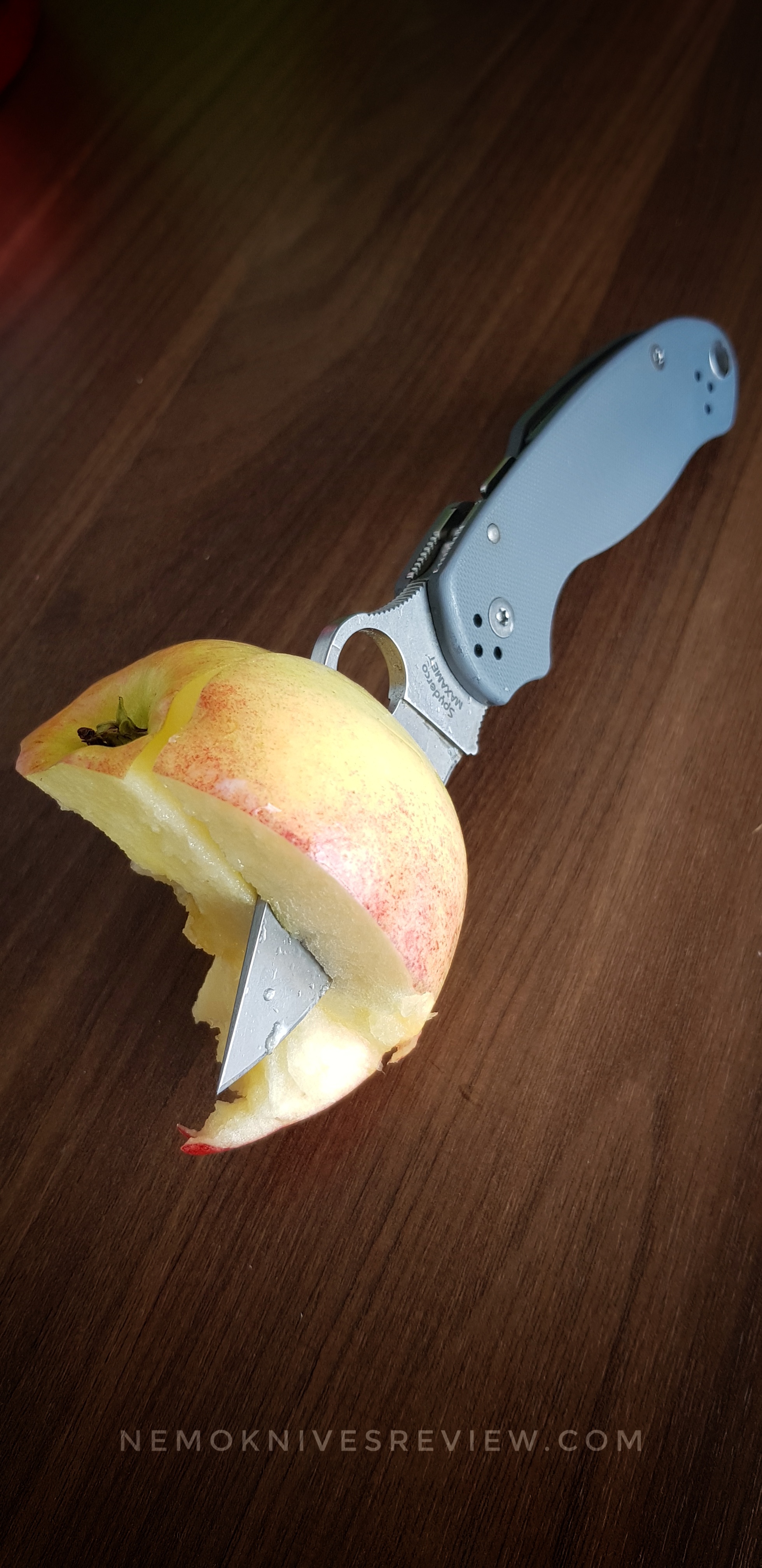
An apple a day keep the doctor away, especially if you got a good aim.
More to come soon but so far this is a very satisfying experience.

20180611_140943.jpg

Manly Comrade S90V – Heavy Duty Slipjoint !

20180117_120800632258680.jpg

What strikes first when you hold the Comrade is its thickness and weight.
This 9 cm blade non-locking slipjoint folder is massive; once open, see how its beautiful classical lines are gentle to the eye.
20180117_115940-011587795469.jpeg

I have chosen the CPM S90V version with a camo G10 theme. As this non locking knife, it deserves some virility. It’s a a slipjoint with a very strong attitude. The kind of knife our grandfather would have loved. The notch in the blade is like a reminiscence of my childhood…

20180117_115859-01824010058.jpeg

Also it is such a pleasure to have a non-locking traditional knife with a CPM420V AKA CPM S90V blade.

20180117_115932-011623092329.jpeg

As you can notice the blade is perfectly centered !

20180117_115945-011101523947.jpeg

And it comes with a clip which is unfortunately not a need carry clip.

Surprisingly it is much more beefy and thick handled than its grand brother the Peak.

The Peak has got hidden recessed liners whereas the Comrade has got a more simple layered construction. It gives a real confort as the square handle fits the palm of your hand.

There are three steps before to open it completly. The last one is the harder to pass giving a very secure feel in the non locking open position. This is really a knife to open with two hands. Once open the choil forms almost a quillon where the index goes to secure it.
Like on a locking Spydie Millie, this is a system found first in boot knives. The force applied during the cut goes directly to the blade.

I have sanded mine to my taste and for that I removed the clip.
No doubt we got here a hardchore workhorse non-locking folder with enough blade for many tasks and a steel which is hard to beat in term of edge holding.
Its clip makes it easy to carry. The edge is thin like on the Peak and it’s going to be a great knife to go around places where locking knives are forbidden.

Also after watching the video of BlackforestGhost here, I think batonning with a slipjoint non locking knife is less stressful for the tool as there is nob lock to take the impact. The slipjoint is a spring ! So no lock failure possible. 😉 “I bend and do not break…” from the Oak and the Reed from Jean de la fontaine.
I really love that Bulgarian Comrade which is the only industrial S90V slipjoint I know so far. Manly, please do a 3 inches version and a one hand open version !! 🙂
More to come soon.

A shorter version The WASP can be found here.
20180117_120226-014947166.jpeg

edited by Pascal Jaffré on 17 jan 2018

Short Locking Folders — A plethora of choices !

Those are the knives I choose when going out. I prefer a 3 inches locking blade.
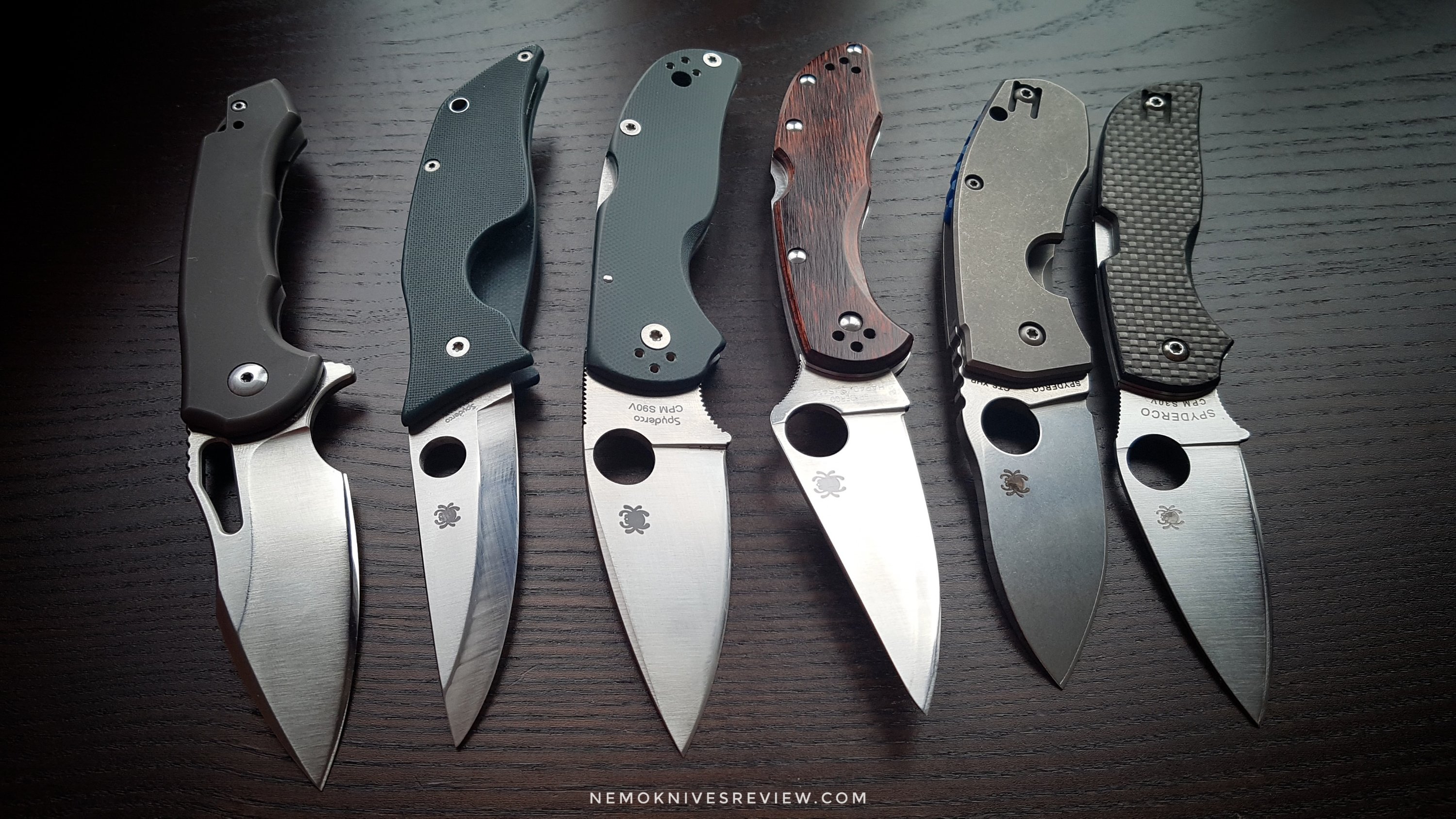
From left to right we have got: the Falcon, the Wolfspyder, the Native 5, the Delica, the Techno and the Chaparral. They are just examples of knives I have got around and which fit the purpose to carry a non threatening but useful locking knife.  You could easily add the Lil’Nilakka which are the favorite EDC of JD and Pjaffre.
As far as I love my Para2 or my Sliverax, I tend to go shorter on the blade and keep the 4 inches for in-house uses unless I’m going in the woods. Also, most of the chores can be done with a 3 in blade without rising any eyebrow.

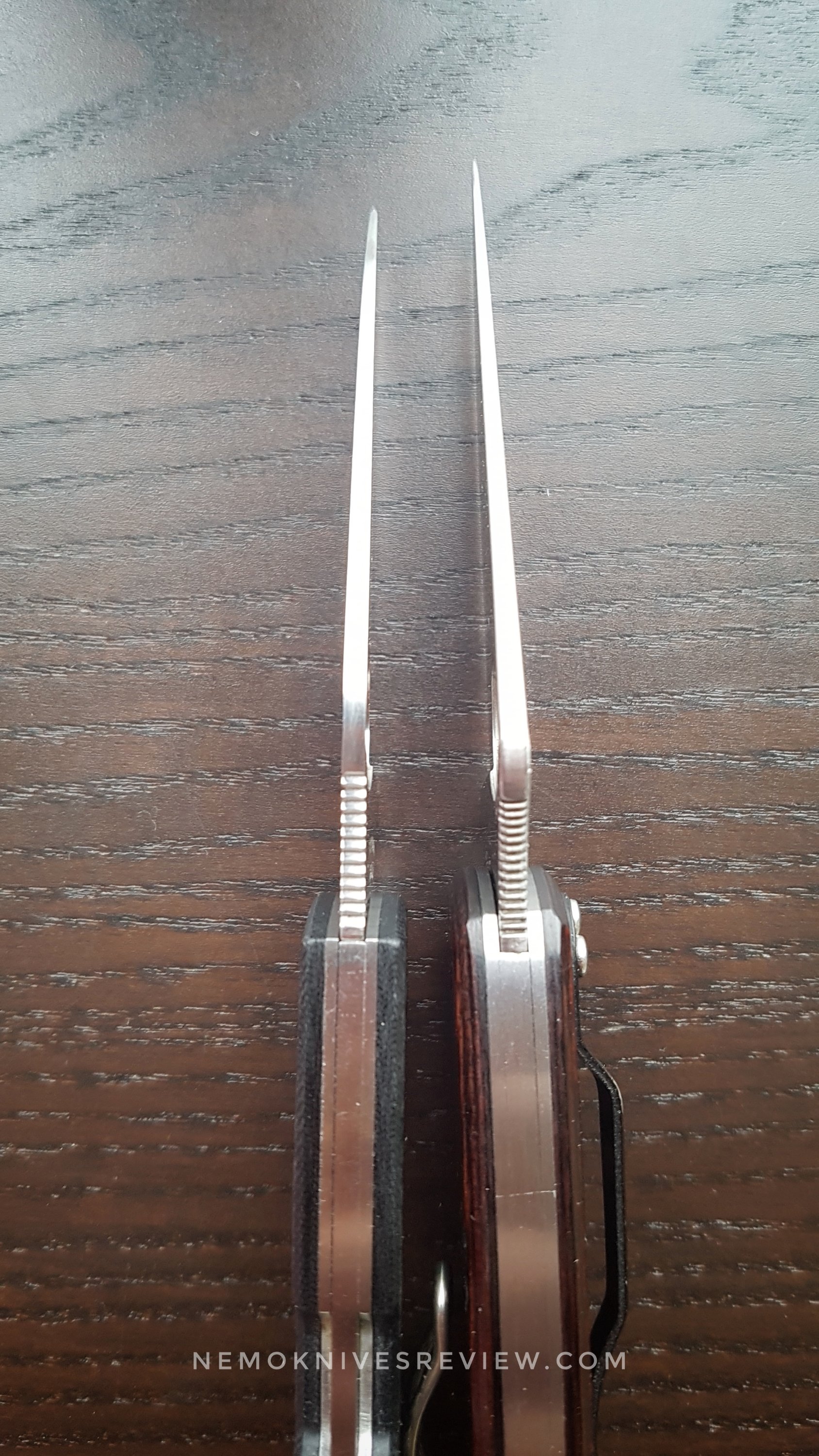
If you think to go thin in stock, the Delica and the Chaparral are the way to go. You can notice on the picture how thin the Delica goes and with the KnifeCenter special edition, your edge is made of HAP40, a steel which refuses to chip.

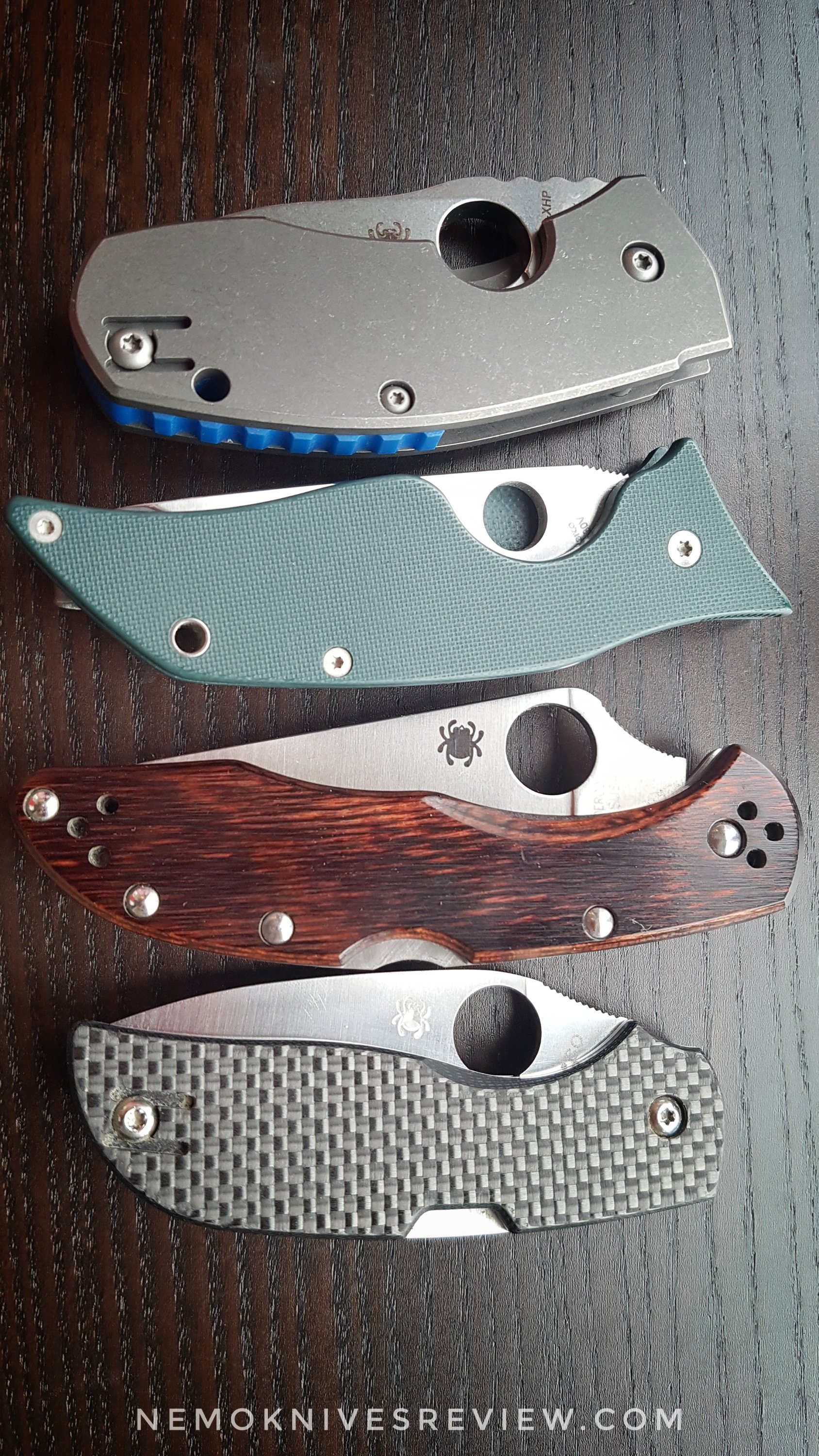
Lockbacks are in fashion since… the Buck110. On the three pictures, only one has got vertical play: the Delica. This tiny play is only felt when cutting on a board and won’t bother you.
The Chaparral has a hidden pin which acts as a second locking system ala Triadlock. The Native 5 has got very high tolerance and none of them I have handled has shown any play in any direction. Let say, in that matter, that the Delica although an old fashion folder with her own character, has the best thinner slicer of the bunch and her blade shape gives a lot of polyvalence. The Delica is also the only short folder I can Spyderdrop. It is made possible by the full steel spacer’s weight. Spyderdrops is the fastest way I know to have your knife ready to cut. It’s also the safest as you are holding it by the blade.

You can notice, there are a lot of materials for the handle. Titanium handle are great as they can be easily cleaned but can be scratched easily too. G10, I do love, especially thick G10 with no liners like found on that Native 5 version and the Cold Steel Recon 1 collection. Pakkawood is a new thing for me. It’s got a warm feeling and I can rinse the handle under the tap with no after-thought. Carbon Fibers (CF) are actually very resistant to abrasion. Your knife can fall and be kicked, the CF handle will not show any scars.

Now I do cut hard material by pushing with my thumb on the back of the blade. This is also why I tend to favor a thicker spine. The Techno is king in that matter, but lately I have discovered how much the Falcon and the Wolfspyder are great. What makes the Wolfspyder very special is the ease you can twist the blade in the cut thank to her lack of blade’s height.

You can notice the amount of pocket lint in the handle, giving you an hint on which knife I carry the most. You can get a lot of great locks: RIL’s, Compression Lock… The new Lil’Native offers a very small package (I think it’s the shortest of Spyderco’s with that lock nowadays) and the choil makes the blade even shorter on that design.

To have or not to have a choil ? On a very short folder, a choil can take a lot of edge off. The good old Delica shines again but the Wolfspyder and the Techno are beating her choil-wise; they both provide one of the best solid locks with the maximum edge possible. IMHO for the 3 inches folders, choils would be really important if the knives were slip joints. They are still important in my books on longer folders which are used harder, like on Millie,

Strangely short folders are often used out of their scope like a Pradel would be. Mondane chores and abuses can occured very easily. This is also a reason why I tend to choose strong locks and tips on my 3 inches folders. When it’s possible I also choose tool steels which can provide better lateral strength.

Delica: No real choil, vertical play, very thin blade, very thin spine. Bonus: spyderdrop.
Falcon: Choil, thick spine, nice belly but not deep carry clip. Bonus: great flipper.
Lil’Nilakka: No choil, deep carry clip, thin blade. Bonus: very thin geometry.
Native 5: Choil, thin spine, thin blade but not deep carry clip. Bonus: great ergonomy.
Techno: No choil, deep carry clip, thick blade and thick geometry. Bonus: built like a tank.
Chaparral: choil, deep carry and thin spine and thin blade. Bonus: idem pin lock.
Wolfspyder: no choil, thick blade, deep carry (now). Bonus: thin scandi edge.

The most eye candies would be the Native 5 and Falcon and the most surprisingly effective in cutting power would be the Lil’Nilakka and the Delica…
The easiest to carry would be the Chaparral which is the thinnest of the bunch.
That said my best pick for hard workers would be a deep carried, solid lock, no choil, strong, thick spine and thin geometry folder: the Techno and especially the Wolfspyder.

They are just a few example of brainstorming for choosing a 3 inches folder to carry.

Oh well, there is also the Kopa… Guess I need to start this over !
The Kopa has got a choil, no vertical play, can be spyderdropped…
Dragonfly? Where?!

More on https://nemoknivesreview.com/2017/10/05/choosing-a-knife-for-the-city/

20171230_113247-012025157230.jpeg

last edited: pjaffre 03 jan 2018

SLIVERAX — ELEGANT DREAMED ENGINEERED KNIFE – ACT II: Convexing.

20171118_103910-01362796173.jpeg

Many times, people asked me how I was honing my knives to my taste.
I love thin edges and I love edges which can be maintain by stropping on leather.
For that any sharp angle but the edge itself need to removed.

So my first step on the Sliverax full flat ground blade is to remove the shoulder on the secondary bevel. For that I use Fallkniven FB04 diamonds or Spyderco Double Stuff II.

As I don’t want recreate two other angles, I do it free hand creating a gentle natural convexed medium between the grind and the edge.

20171120_123347-01267367917.jpeg

Soo some dark dust of removed metal appears. The edge of the blade is untouched as after some initial testing I do trust it.

20171120_124143-011125093009.jpeg

I need that convexed edge on the belly of my blade, I don’t minde about the tip and the choil which are not where I do apply the most force to push cut through wood for example. It takes 30 minutes to get where I want without to make a mess by scratching the blade finish. It means each pass on the diamond is check with my finger before, sto be certain to focus on that edge shoulder. To obtuse it will scratch the edge and to acute it would scratch the blade finish. So it takes time to be certain for each stroke.

Luckily the manufacturing lines on the blade exactly follow my pass and some miss strokes were not visible.  It takes around 500 passes on each side on S30V.
Then I switch to white ceramic directly.

20171120_125333-011773286312.jpeg

White ceramic brings some mirror polish on the convexed edge and also hone it to razor.
Here I can go much faster as I won’t ruin my blade if I’m clumsy. White ceramic are very forgiving…
Soon I got a very nice mirror on both side and I can go to leather.

20171120_125945-01492821791.jpeg

I use a century old barber accessories I have found in a garage sale in Italy. With some white compound, it has honed my blade for 15 years.
Time to test the blade on a chesnut road.
20171120_125455-011458232424.jpeg

The thinner edge goes much more deeper and with more control and more ease.
Eventually after playing with the knife for 5 minutes on various material, I inspect the edge and there is no chipping or rolling.
It takes me around 45 minutes.
That’s how I proceed to get an edge which suits my need. 🙂
20171120_130035-011101427946.jpeg

52100 Paramilitary 2 by the ocean.

So here I’m in Southern Bretagne near Lorient, city of Eric Tabarly with my Paramillie Exclusive Run in 52100 Ball Bearing Steel.
For those who don’t know Sal is a fan, this is why Eric is named Eric. 🙂

The moisture and salt are present and cars got a serious tendacy to rust just by being parked outdoor.

The knife has been used on food and for all the chores around another anniversary preparations. The Patina is a real surface protector as no pit or coloration has been noticed during that 4 days week end.

It eventually has been used to pop the remaining balloons after the party.
No oil needed. The edge did not rust. It was used daily. Very happy with that knife.
This is a very robust folder, with a strong blade.
It was still shaving hairs after 4 days of mild but constant uses. I did not process a lot of cardboard for example, but a lot of meat ! Duck for the matter.

The 52100 makes a beautiful blade with its mirror convexed edge. It was noticed.

Massdrop x Ferrum Forge Falcon S35VN Folding Knife — Flipping Modern Lady/Gentleman Knife at a bargain !

20171010_113323-011525776241.jpeg
(Fresh from out of the box)

As my friend and co author JD I had ordered the Ferrum Forge Falcon for 124 dollars. Titanium handle à la Sebenza (* the RIL is a South African invention ) with steel insert in the lock to prevent excessive wear, S35V blade with high flat grind, reasonable size for the city. And a two main screws construction ? What not to love ?


(Here with a new convexed edge the day after)

This was a first time for me with those companies. The knife has been made by WE knives in China and designed by San Diego based Ferrum Forge.
124 dollars for a knife this quality, this is almost the third I would normally pay.
This kind of excellent ratio price/quality have been noticed on the Megalodon folder.
And like the Meg, the only flaw on my Falcon is…. the clip.


Error
This video doesn’t exist

First thing I have noticed: it was smooth as my ZT0562CF. It fires easily. A lot of work has gone on the blade and the handle to smooth everything. It’s as good as Taichung factory in the attention to details. It runs on ball bearings and the detent is perfect on mine. The blade feels heavier than the handle, it gives a nice momentum.

Zero play in any direction. The handle is smooth with its rounded edges and so nice under the thumb. No hot spot even if the jimping are quite aggressive. The blade is chanfered on the right places making a very precious package.


Second thing I had noticed is the great balance. The knife is perfectly balanced. The blade looks wider than the thick titanium handle.

20171010_113206-011497905212.jpeg

See how small it is ? I even think it would be a great knife for smaller female hands. For bigger hand it would be a three finger handle unless using the big choil.
This big choil is part of the charm of that design and it could be some kind of Native hommage: thick handle and false edge drom point blade.

20171010_113217-011997002469.jpeg

It’s about the size of my beloved Wolfspyder but more elegant. Let’s not forget Spyderco places function before the look. But the wide blade on the thinner handle does a lot in easthetics. The hole in the blade is purely for the looks and to remove some weight, you won’t open he knife with it. OK, you can do it but this is not made for that.
Also the large choil can be a problem when you cut ropes or strings and they get stuck into it. But the Native 5 got the same issue, it’s no major when the finger is in the choil.


The insert of steel in visible and the lock is new and the blade is perfectly centered.
As you can notice the titanium notch to bend the integral liner to create the lock is not on the outside but inside. This is pleasure to keep the handle smooth.
This notch combine to pocket clips often get caught in the pocket lip while drawing. It was the case of the Megalodon or even the Slyscz Bowie where I had changed the clip size !

20171011_111117-0123625350.jpeg

20171010_113443-01383379047.jpeg

Right out of the box the knife is not shaving but the edge is thin and the geometry is good. It will be a matter of minutes on ceramics to get to the sharpness I want.

Only the clip is an issue. Like on the Megalodon, this is the only flaw but unlike the Real Steel flagship, I will get rid of the Falcon clip if it bends and carry it in the pocket.
First this clip is too thick and is not going enough deep inside the pocket. It has also a tendancy to bend, So we will see how it will go.

20171010_113511-01856726999.jpeg

20171010_131438-011913492656.jpeg

Compared to my Delica, you can notice it is even shorter.

20171010_131510-01126596164.jpeg

And delica is a tad longer in edge value.


Now its thick handle makes it very confortable in the palm for hard cuts.


You can see the attention to details on the titanium spacer and the pivot.

page_20170419105825

Two screws construction. The pivot and handle. Add the two clip screws and the two from the steel insert and a pin for the spacer but after all it is a very clean design.

“The Falcon’s 2.9-inch drop-point blade features a sizable choil for index finger placement when choking up. The spine has a concave cutout offering a natural thumb rest for a forward grip. As far as hardware, the Falcon has been crafted with the best materials on the market. Thanks to titanium’s spring properties, it makes for a safe and reliable frame lock that is almost impossible to accidentally disengage. The hardened steel lockbar insert won’t wear out in the long haul, drastically increasing the folder’s longevity. Holding the knife together is a titanium backspacer, bead blasted in gray. Also notable is the titanium clip, which has been adjusted for tension so that it stays put on the go, but it won’t rip your pants apart when taking out the knife.”
From the Massdrop page.


Compared to the ZT0562CF the Falcon can sustain the comparaison. But the clip in the ZT is one of the best ever made making the big folder easy to carry.


Sharpening is OK. CPM S35V is not the easiest steel to deal with but it can hold an edge if well heat treated. After diamonds, ceramics and leather, my edge is now convexed and the high flat grind gives deep cuts.
This is something wich needs to be tested on a long run. So more to come soon… But so far for the price 124 dollars shipping including, this is a great bargain and a beautiful knife especially compared to over marketed knives…
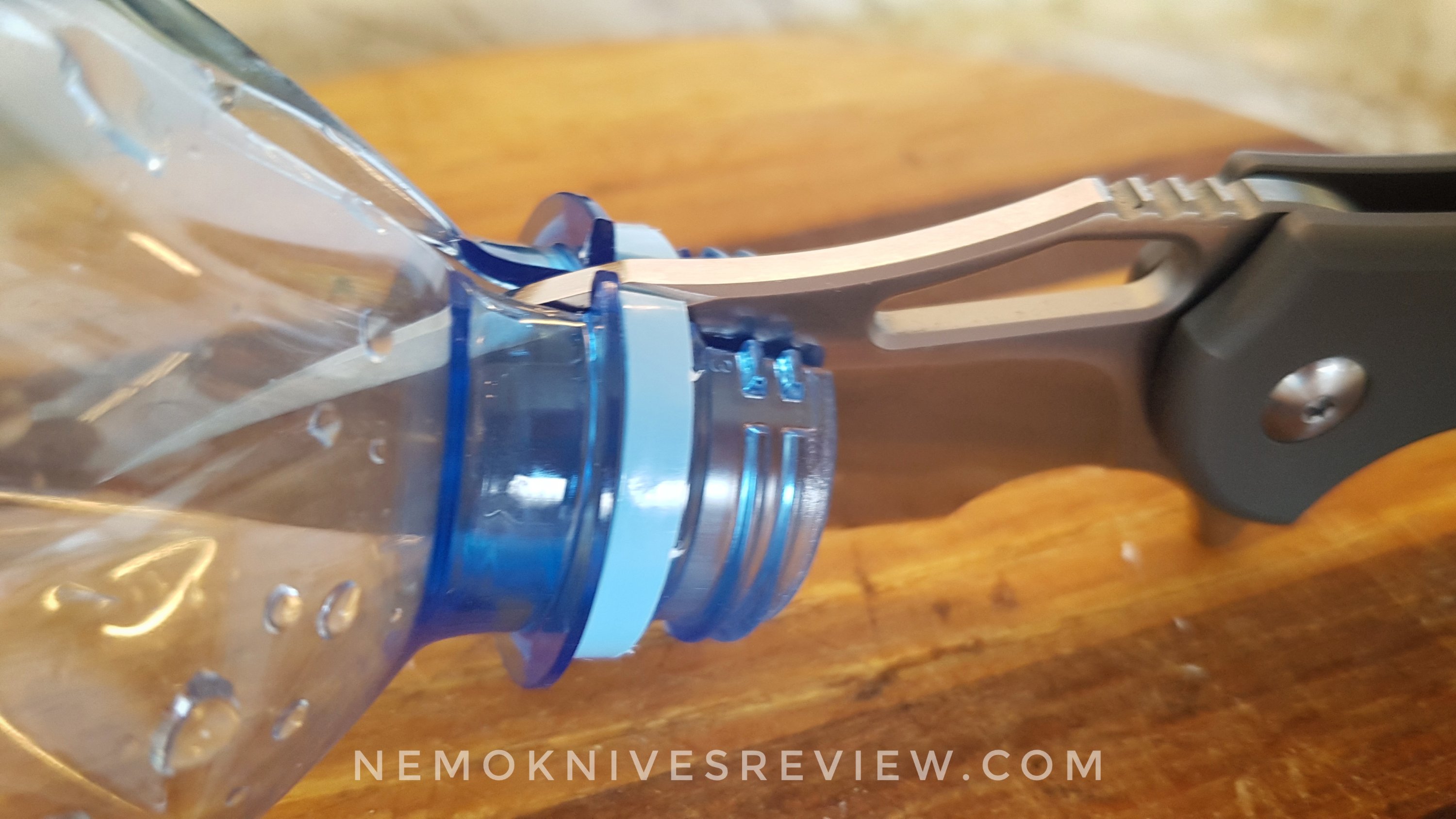
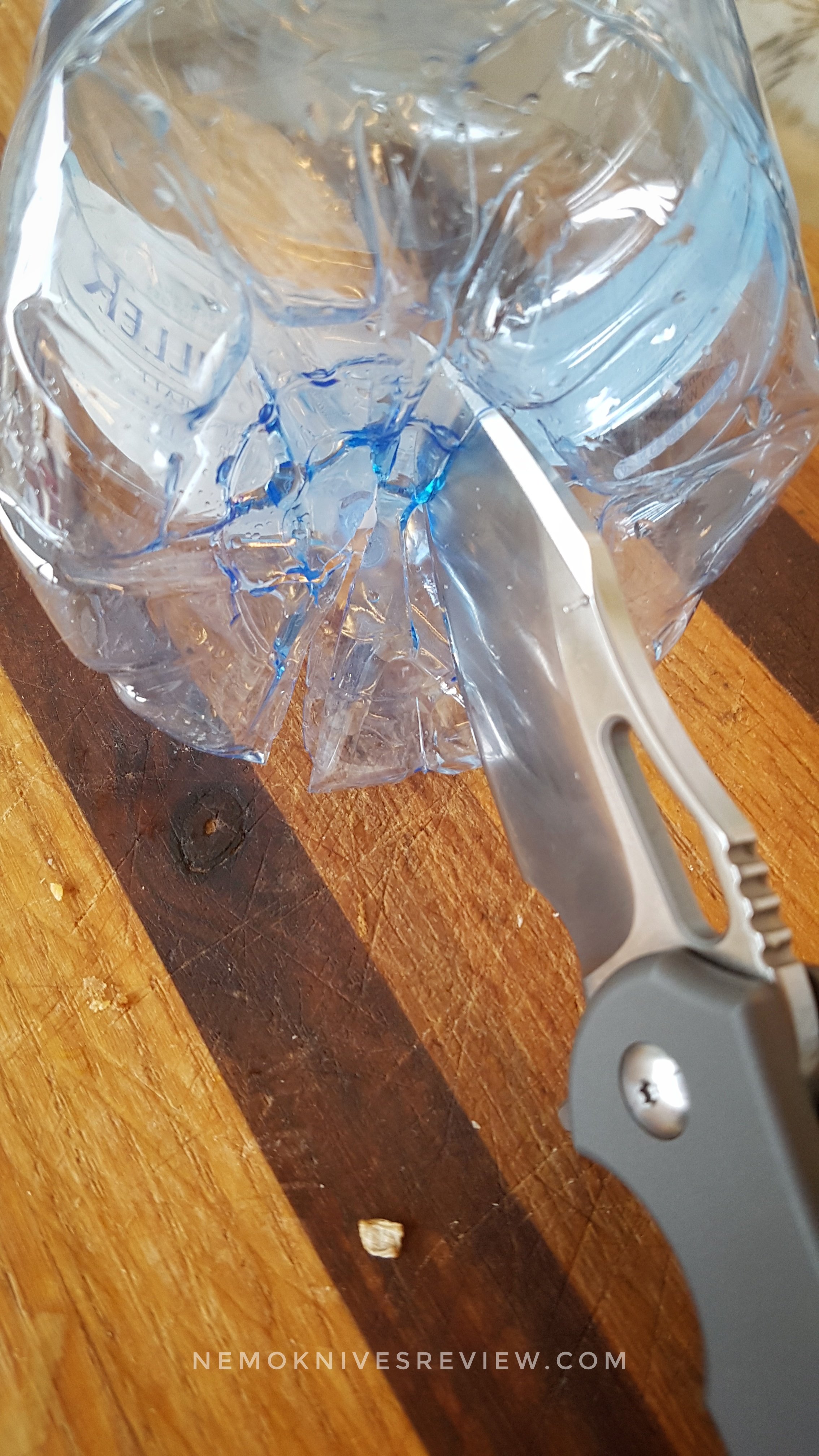
And once convexed the edge was able to cut through the 4mm plastic butt of a 2 liters Coke bottle. Excellent !!


*(Like…. the 300 dollars Urban S35V and Titanium handle from Canadian Robert Young Peyton claiming the Integral lock is an American invention when, Chris got an South African Award for his Pre Sebenza in 1987, move to Boise in 91 and get naturalized in 2001…The Integral lock is a South African invention by Chris Reeve !! )


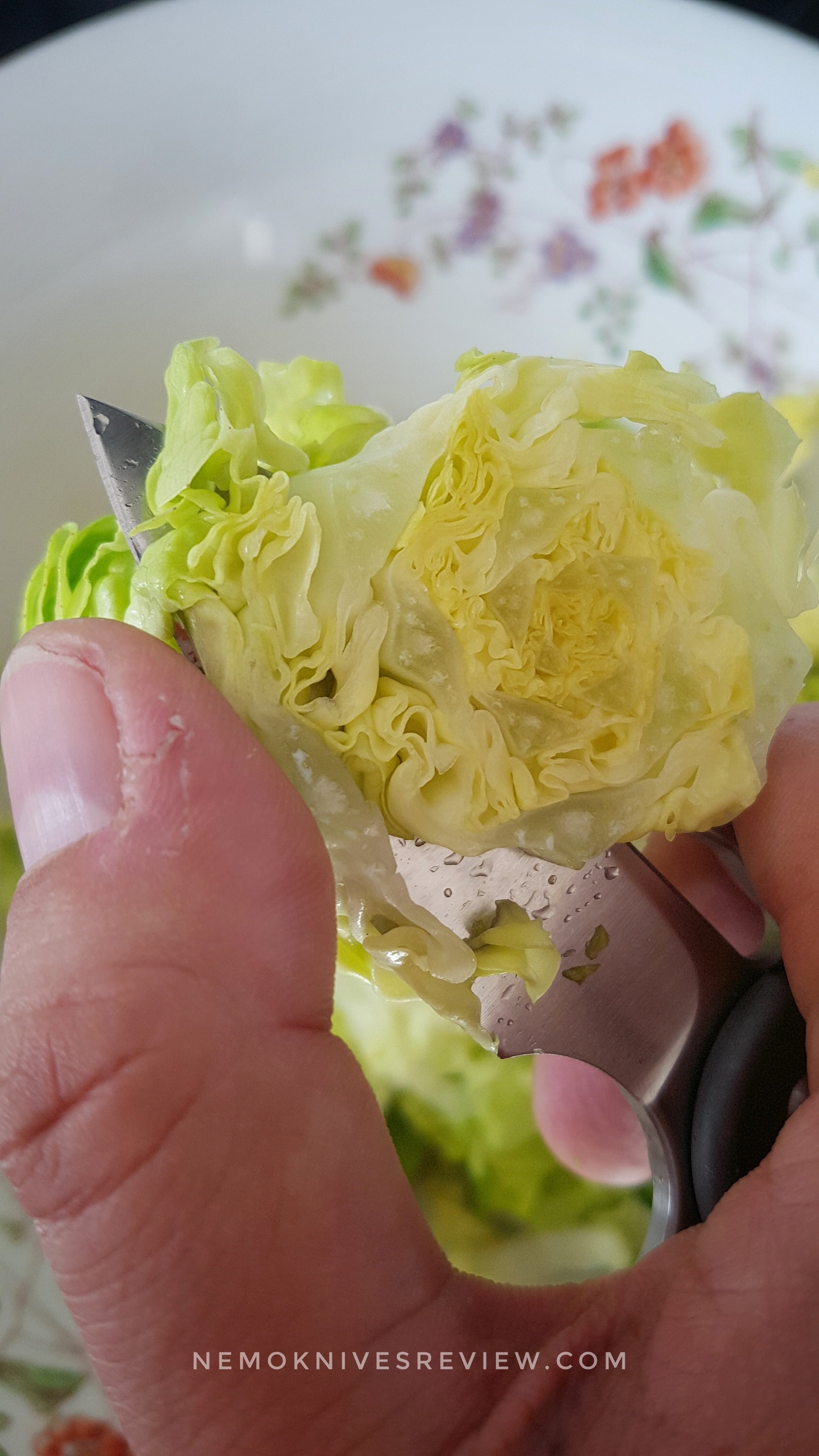
Cutting the leaves of sucres…

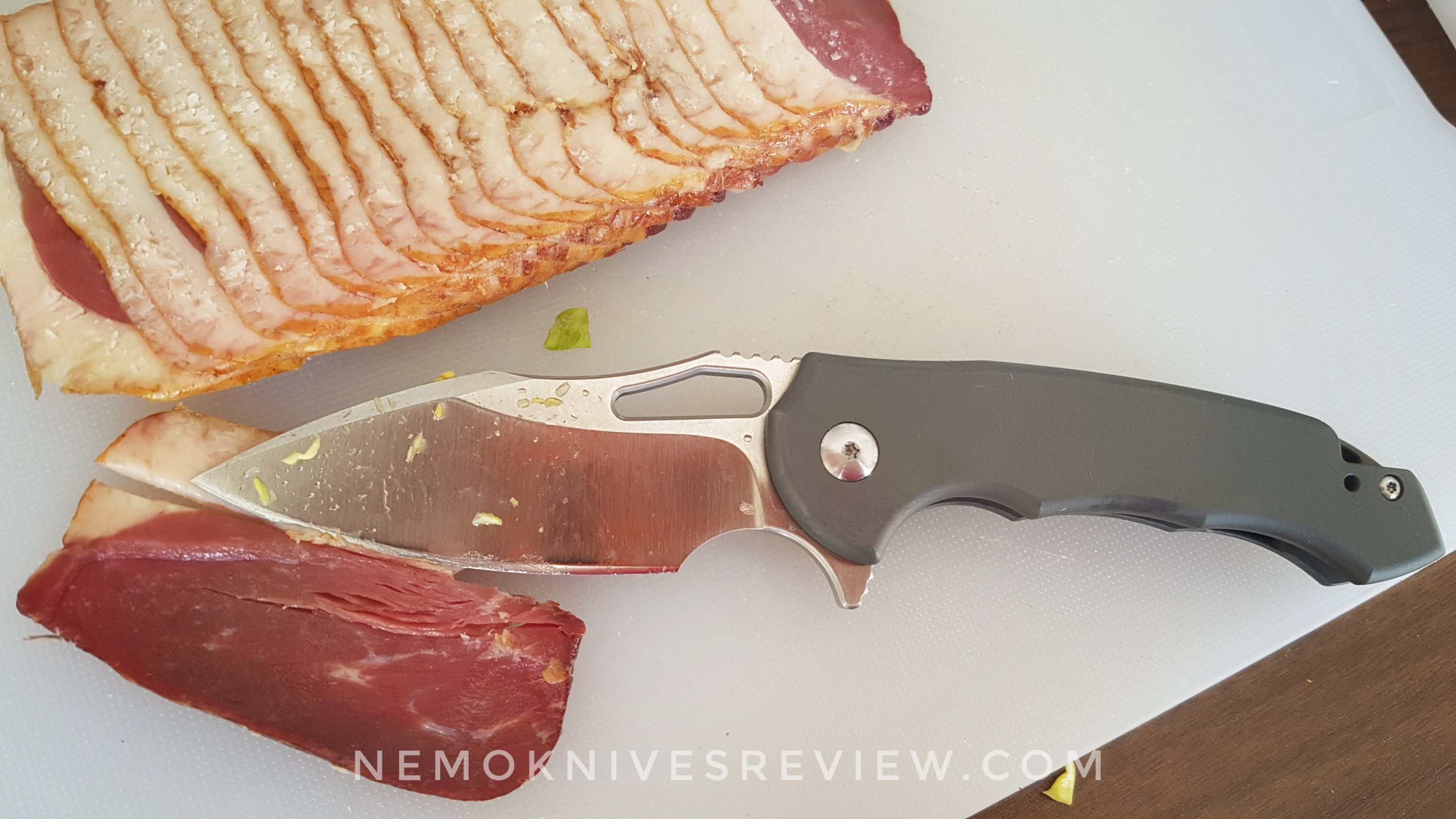
Slicing the dried duck breast.

Removing the fat.

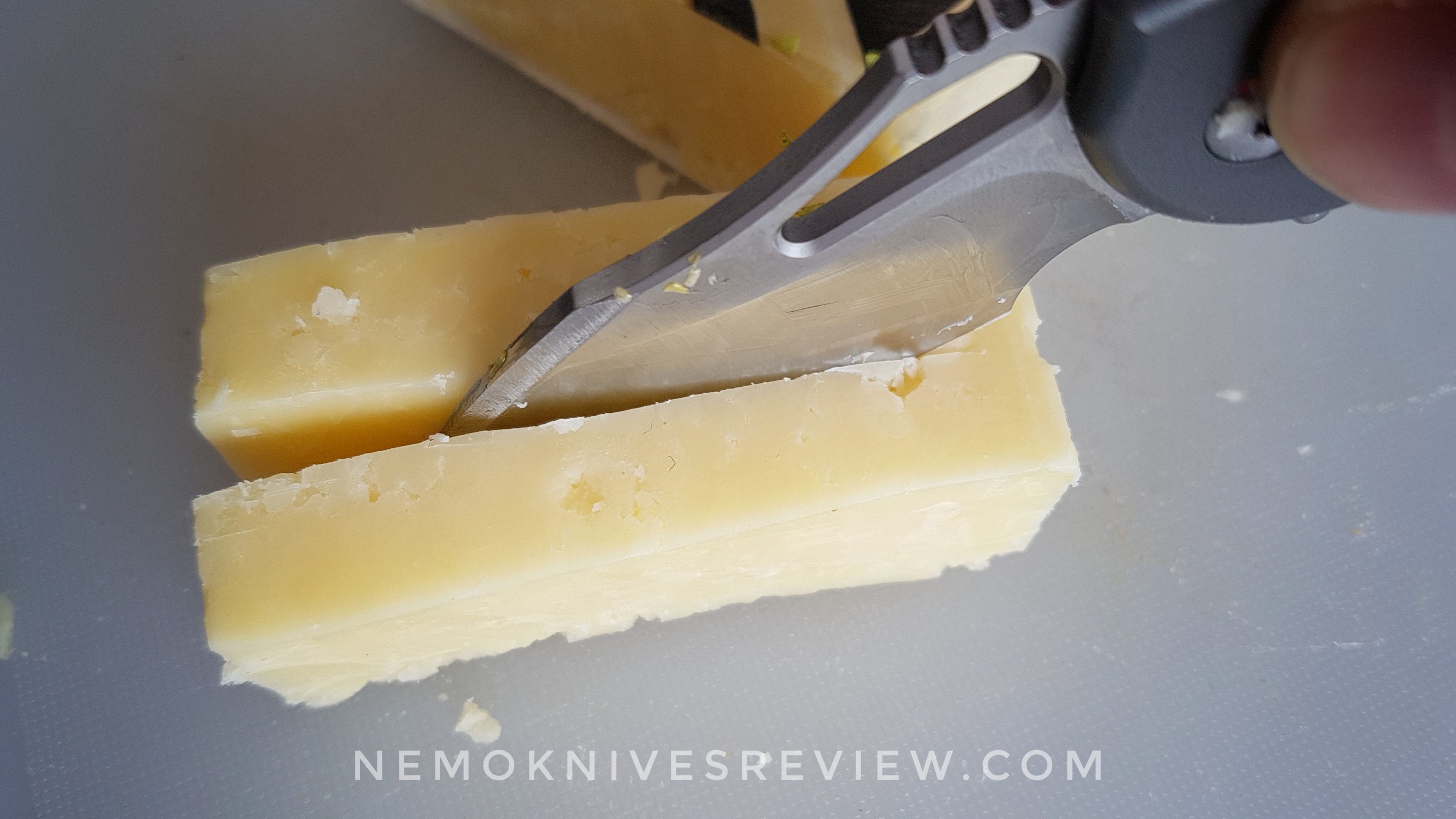
Dicing the cantal cheese.

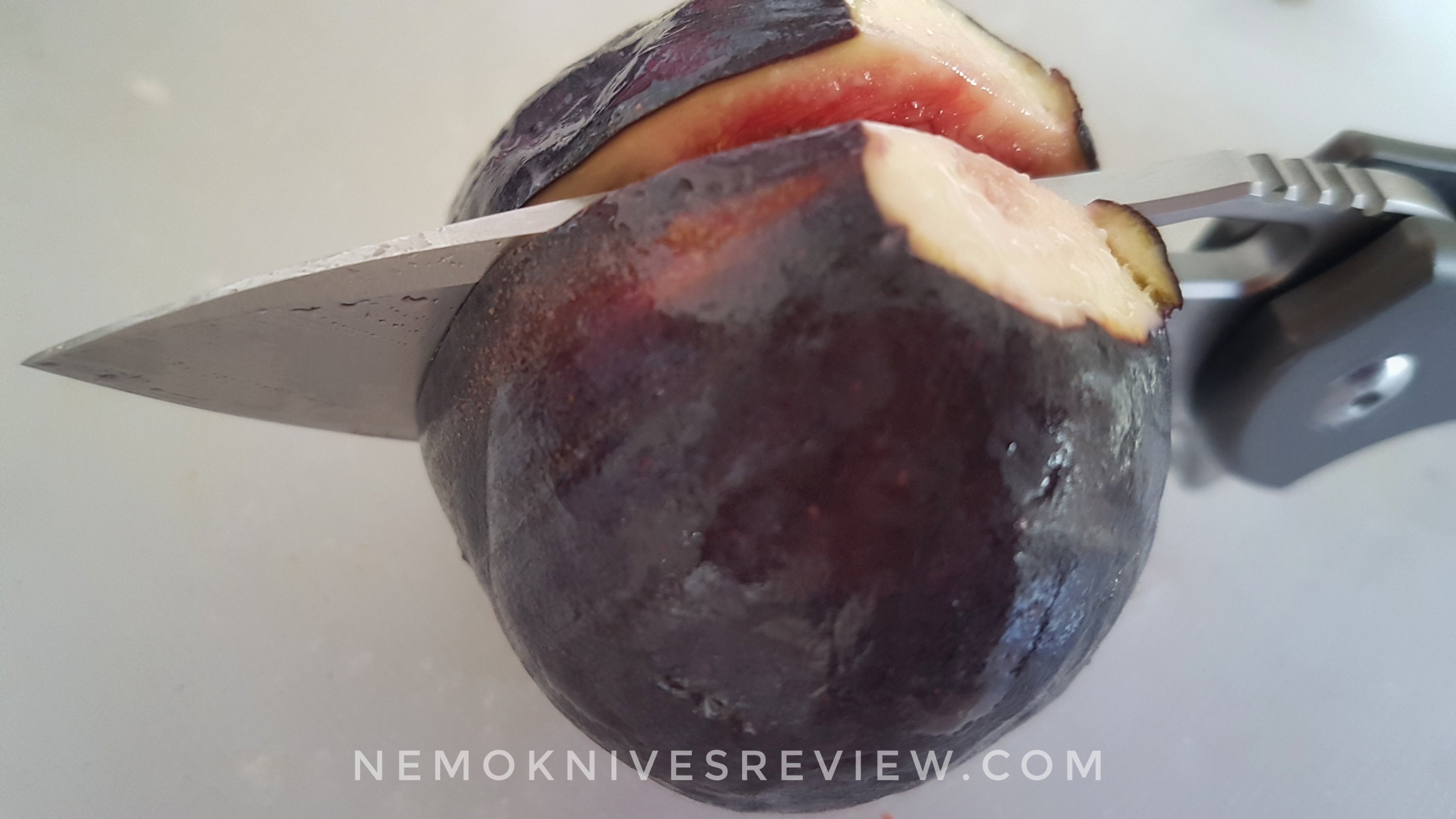
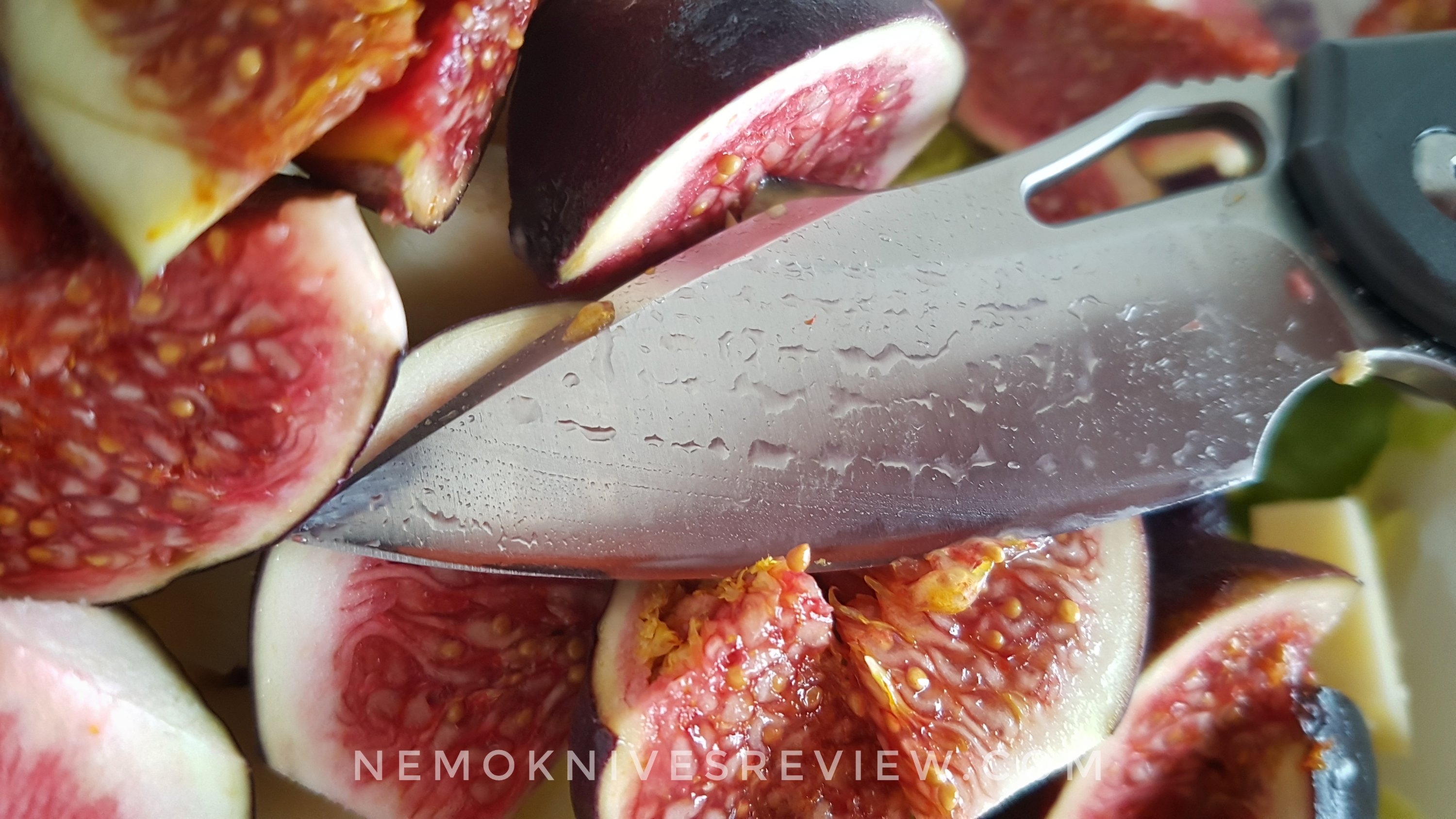
Splitting fresh figs…

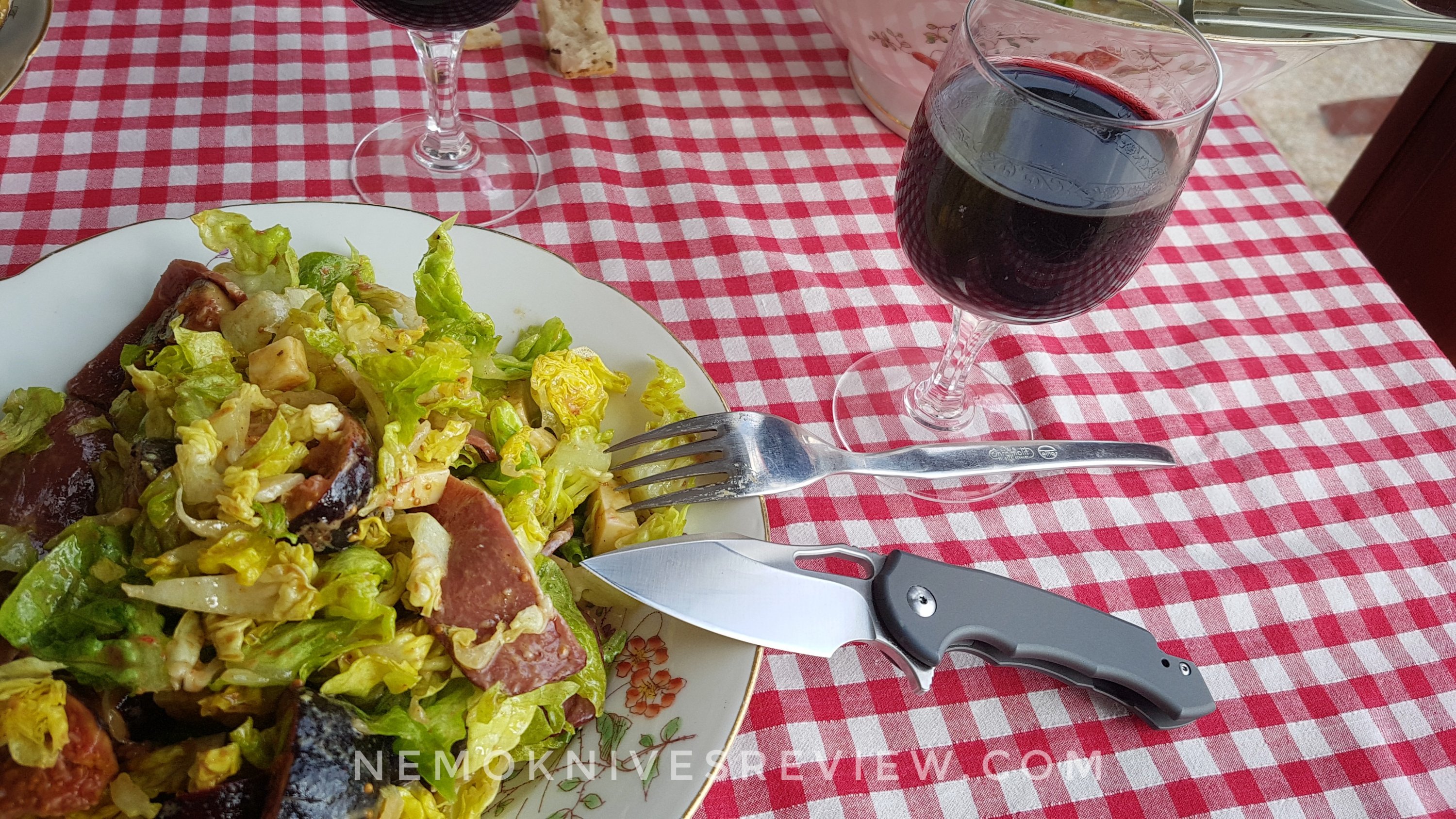
All the ingredients are ready. Add some sauce mixing olive oil, mustard, wine vinager and soja sauce.
The soft texture and fruity taste of the young cantal combine particularly well with figs and duck breast. But you can replace it with other cheeses, for example, tomme de Savoie, salers or laguiole.

JD got also a Falcon but he did not like it: here is review.
https://nemoknivesreview.com/2017/10/14/the-falcon-has-landed-by-jd/

Choosing a knife for the city.

You don’t need a reason to carry a knife.
Whatever they ask you, just lie or tell them what they want to hear.
In the woods or in the countryside carrying a knife, whatever your gender, is wise.
But in the city ?
You really think you will defend yourself with a knife ? Let’s forget about it. A chair, a stiletto shoe, an ashtray will be better defense tools if you know how to train your mind first. And be prepared mentally whatever your gender, is wise.
Knife is not the best tool to get away of trouble. It’s like playing with matches in a gaz tank. It’s used by madness and idiots to create horrors. So unless you want to be an idiot.
Since knives, cheap and ugly dull knives, are often used to hurt people. Worst, some people think knives has been used when they were not even in history.
An example ? When Lucheni, a madman, has stabbed the Empress Elisabeth of Austria in Geneva he did it with a file. “There was no blood on the file and the tip was broken off, which occurred when Lucheni threw it away. The file was so dull in appearance it was speculated that it had been deliberately selected because it would be less noticeable than a shiny knife, which would have given Lucheni away as he approached.”
So you want to carry a knife in the city. It’s your choice, your business. Nobody else business. Your freedom of choice. In those days where metal detectors are common and official journalists are scanned all over their body before filming some president from ten yards away, when policemen can search you with no good reason because of the state of emergency… you better carry something which is small and sheeple friendly.
Better: you should conform with the laws of your country.

Younger I felt some kind of thrills being an outlaw. My first knife even was a folding AF dagger from Gerber. Go figure ! But later, I have found it is more fun to be lawful and cleverly respect the rules, because it gives you the occasion to try new designs and new makers. Of course you can always carry a Swiss Army knife. I almost never do. It’s in my bag not in my pocket. Because since the 90’s I have fallen in love with clips. Clips are such a great way to avoid a pouch or a scabbard or anything used to say to the world: I carry a knife !! So the clip is mandatory for me. My last clipless knife has been slipping under my wallet and at the Airport it has been taken away from me. So no more clipless knife for me.

So, in the city, I need to follow the rules and I need a flat design clipped to a pocket’s lip. Again a thick Victorinox Swiss Champ is a no-no as is an rounded handle Opinel. Opinel are not for the city unless they are under N°8. And I want a slick design something easy in and easy out without telegraphing around I’m going to use it.
I love the Worker design from Sal Glesser , the very first clip it, which could be used without opening it completely the blade thanks to its false edge. Very clever.
In the city I want elegance. the object needs to be warm and tell a story. I’m not a predator, I carry a tool not a weapon. For the records, hammer, screwdrivers are much more lethal than any Perrin Lagriffe destined to wound and not kill. I like to be able to cut my food without using the dull silverware of restaurants. Because there is some places which are not fast food too. And even at the Macdonalds, using a sharp knife can help to share in two portions a single burger. But in restaurants nowadays it’s not common to find good steak knives. I always enjoyed bringing my own knife like my grandfather used to and that manner that my father hated so much. My father was carrying a switchblade for SD and then a La Griffe. He also used a small turtle shell slipjoint folder made in Nogent in his bag. The exact opposite of my way. Strange how generations go counter clockwise just to complete a full circle thinking they are re-inventing the wheel.

A knife, may it be a slipjoint of a locking folder, is a door for adventures. I often walk on the avenue of the Opera remembering Ernest Hemingway.
“He was a customer of the house Kindal, 33 avenue de l’Opéra, he used to go through the shop, after his purchases, to the Ritz, Place Vendôme. His Parisian triangle was the Harris Bar, Kindal then the bar of the Hotel Ritz. His deer stag handle locking folder, with blade, saw, bottle opener and corkscrew, was his daily companion, he even packed his tobacco and curated his pipe with it. The stag’s wood cracked at the end with time and the tobacco was constantly caught in the cracks, obliging him to clean his knife regularly, he had the idea to place an ivory knob, coming from one of his African hunts probably.
Many years after his death, Mrs. May Kindal, found Hemingway’s knife at the bottom of a drawer, left there for maintenance.
She had him reborn by Jacques Mongin, knifemaker and Meilleur Ouvrier de France.
Since then, the Hemingway knife is sold exclusively by the Kindal cutlery.” Translated from Kindal.

I remember the first time I have seen Ray Mears on the TV. He was walking in the beautiful English countryside and he used one of his elegant Woodlore fixed blade to cut some plant and give some stories. Wait a minute, this guy is walking in the UK and carries a fixed blade in his pocket. But as a black belt in Judo he won’t go in trouble with bushcraft knife anyway.

In the city, knives are making conversations. So it will leave your hands for those of a friend who want to see it. And you will be sitting in the sun drinking a cappucino. So the knife needs to be beautiful and smooth and not aggressive in any way because it can be display in public like smartphones and cameras.

I also need the knife to be out of the way, because I carry stuffs in my pockets or I got a messenger back and it happen sometimes: the knife get hooked to something and falls. So the clip and the way to carry it needs to be secure.
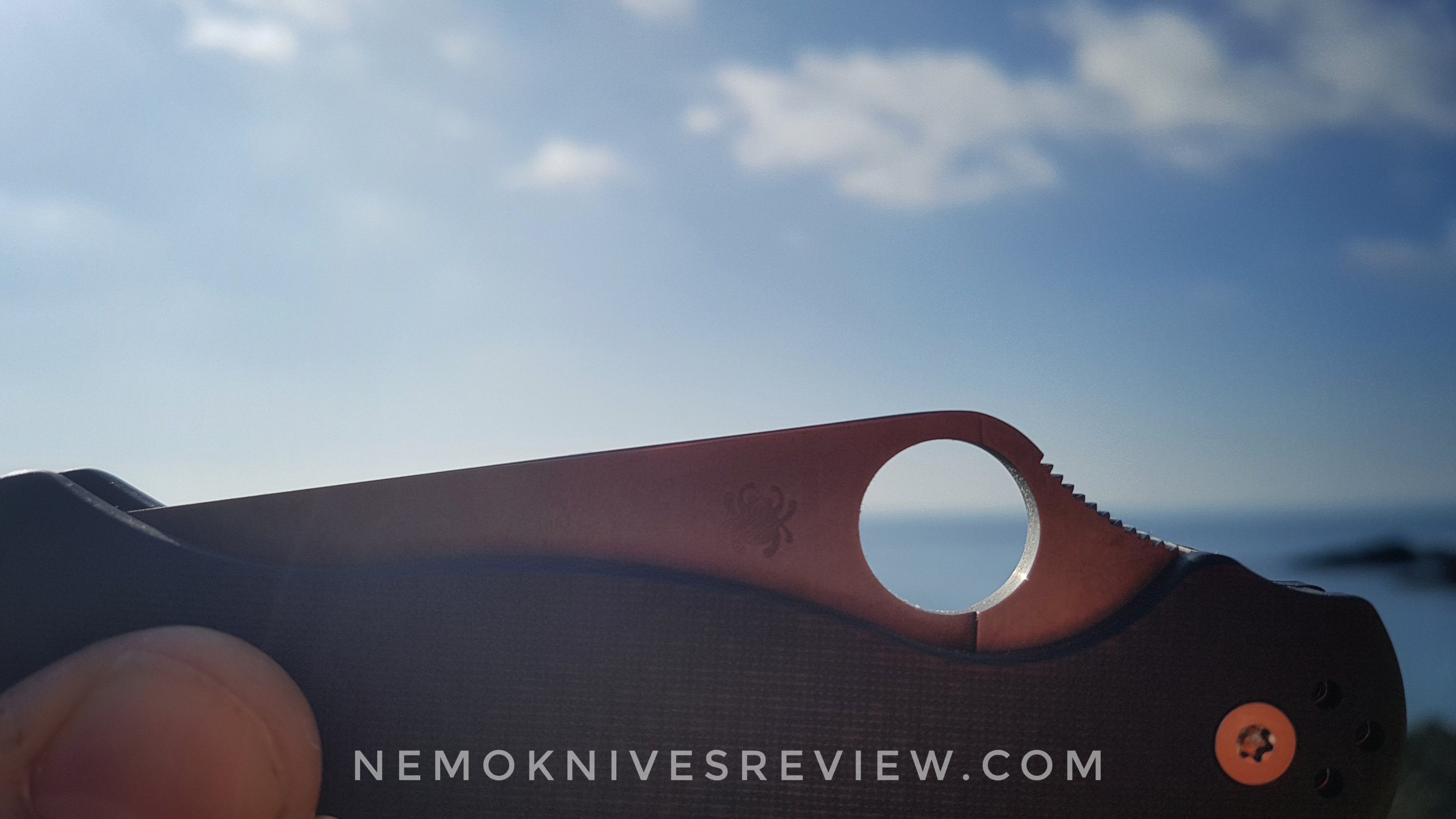
It needs to be very sharp also. And stays sharp. Because I’m not going to show my honing and sharpening skills in the street and a dull edge is dangerous for your finger. So, a good geometry and a good steel. A knife thought to be used not only to be displayed.

So here are some examples.

The Delica in its Knifecenter Special Edition is my actual companion. This one is so sharp it goes beyond my scale. HAP40 can be thinly honed, it’s a true razor. More can be found on it following that link:

In the very highest performances you also got Pekka Tuominen little Wonder Nilakka. You can click on its link. Again a little big knife with performance and ergos which change the game of current gentlemen folders.

The Michael Walker is a rare Gem and this Sprint run has proven how excellent it was as a skinner for very serious hunters.

In the Slip It territory the Urban is the perfect companion unless one hand operation is forbidden by the law. The steel of this one just does wonder and I’m thinking a lot about testing the new Police Model…

One of my old little city companion has been that little Tim Wegner Mouse II knife.

Spyderco has covered all the ground about small knives to carry by men or women. The Dragonfly is one of their pure example of acceptable locking Clip It.

My friends Xavier Conil and Laurent Monnier propose an elegant not threatening folder: le Pointu.

This knife got no clip and is not one hand opening but I have bought it in South Africa at the Good Hope Cape’s shop. This is my Southern souvenir. It has no vertical play and got a story to tell.

respecting the Danish law, the Pingo is one of the solutions for having a clipped knife with no opening hole.  The hole here is only a trademark.
There is a Sprint run with Elmax blade and Titanium handle, I often look with envious eyes…

This one is French, it’s JD’s folder a Sacha Thiel which will be reviewed soon. The blade can be open with a gentle flick helped by the thumb and the deep pocket clip makes it disappears.

So here my knives for the city. My Griptilians are too tactical. My small Sebenza has been lost. I could dig my drawers for more but I think you were able to catch my drift.
Here is a following up about choosing a 3 inches folder.