Tag Archives: Spyderco Forums

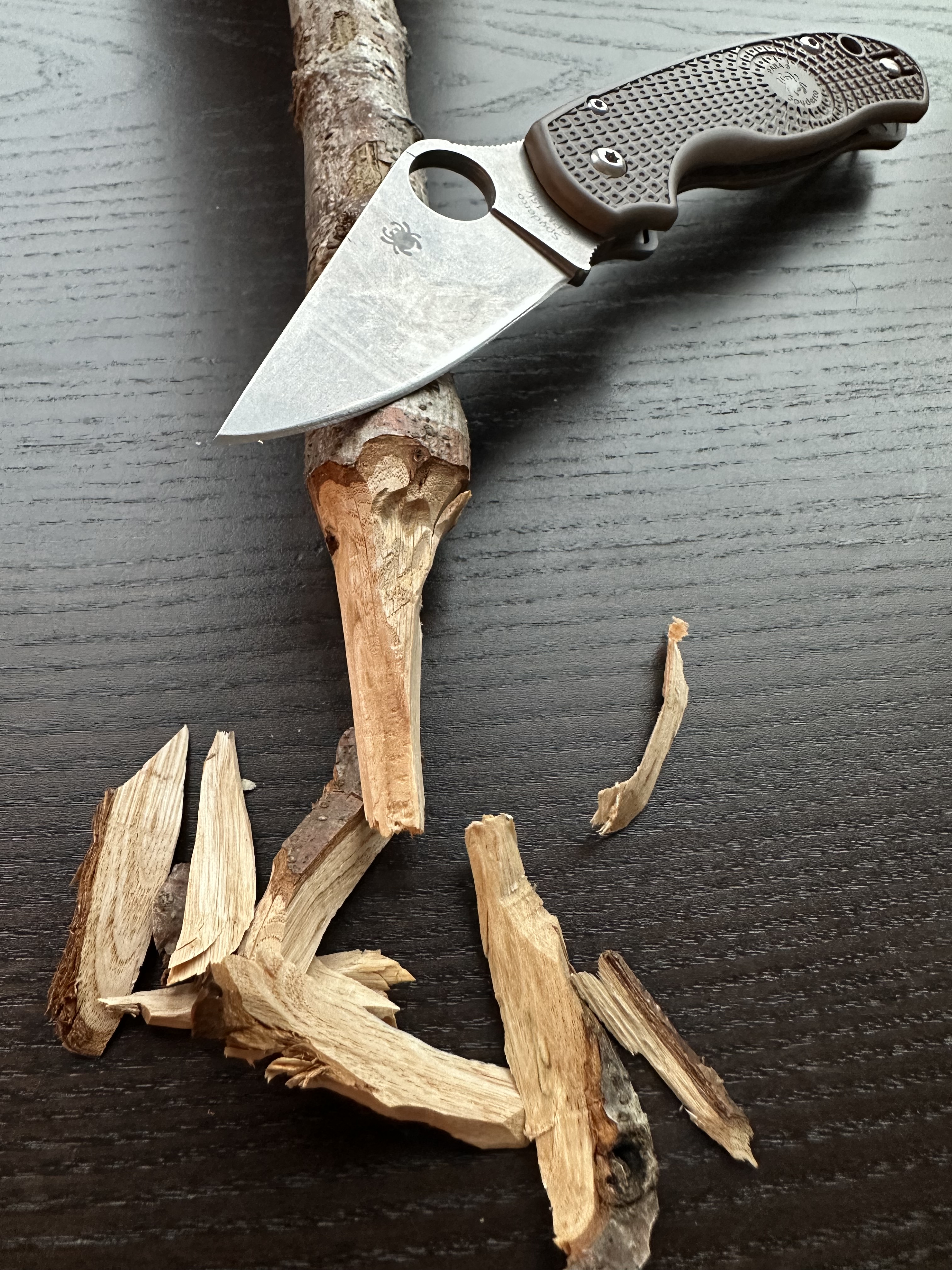
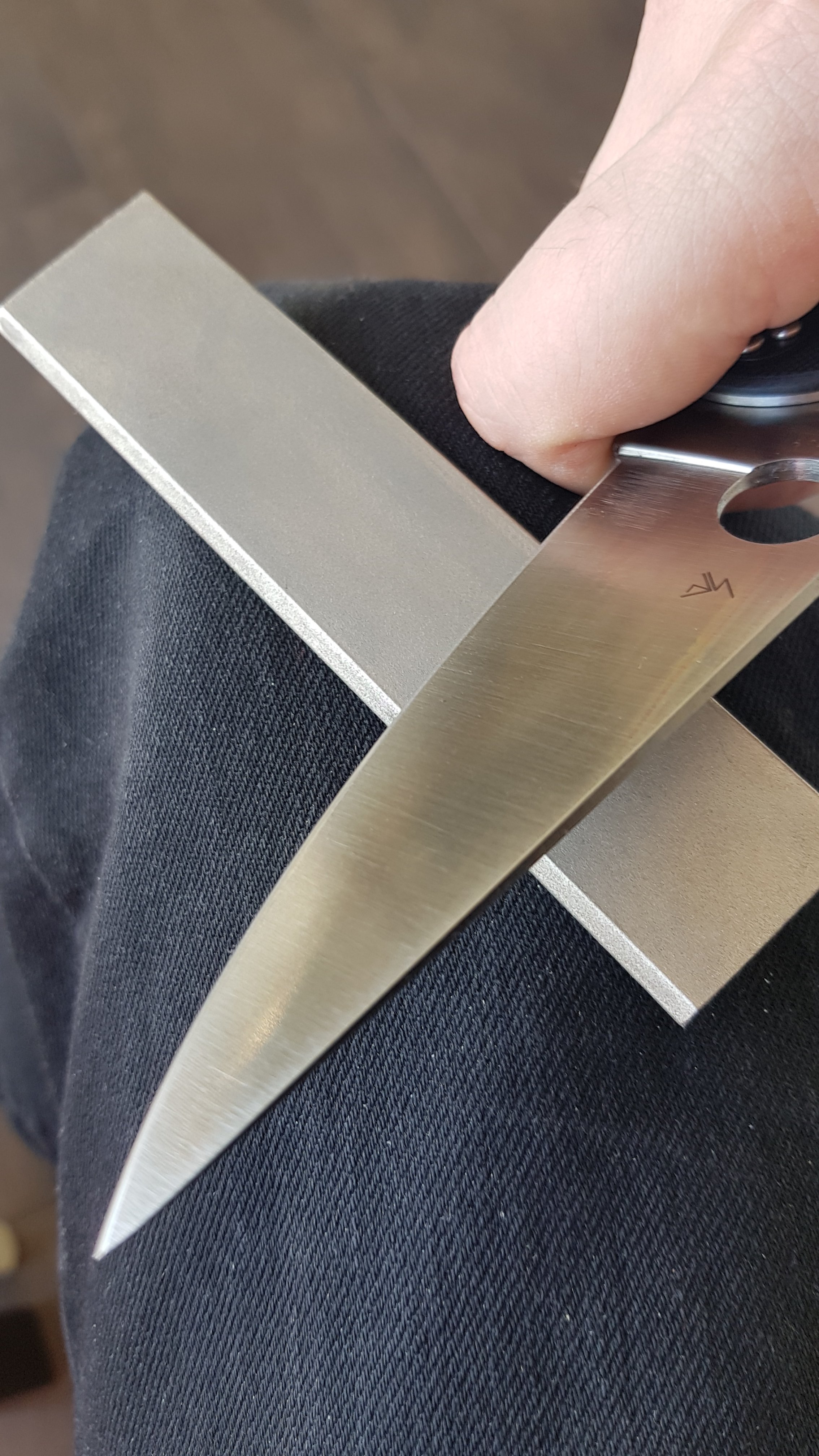
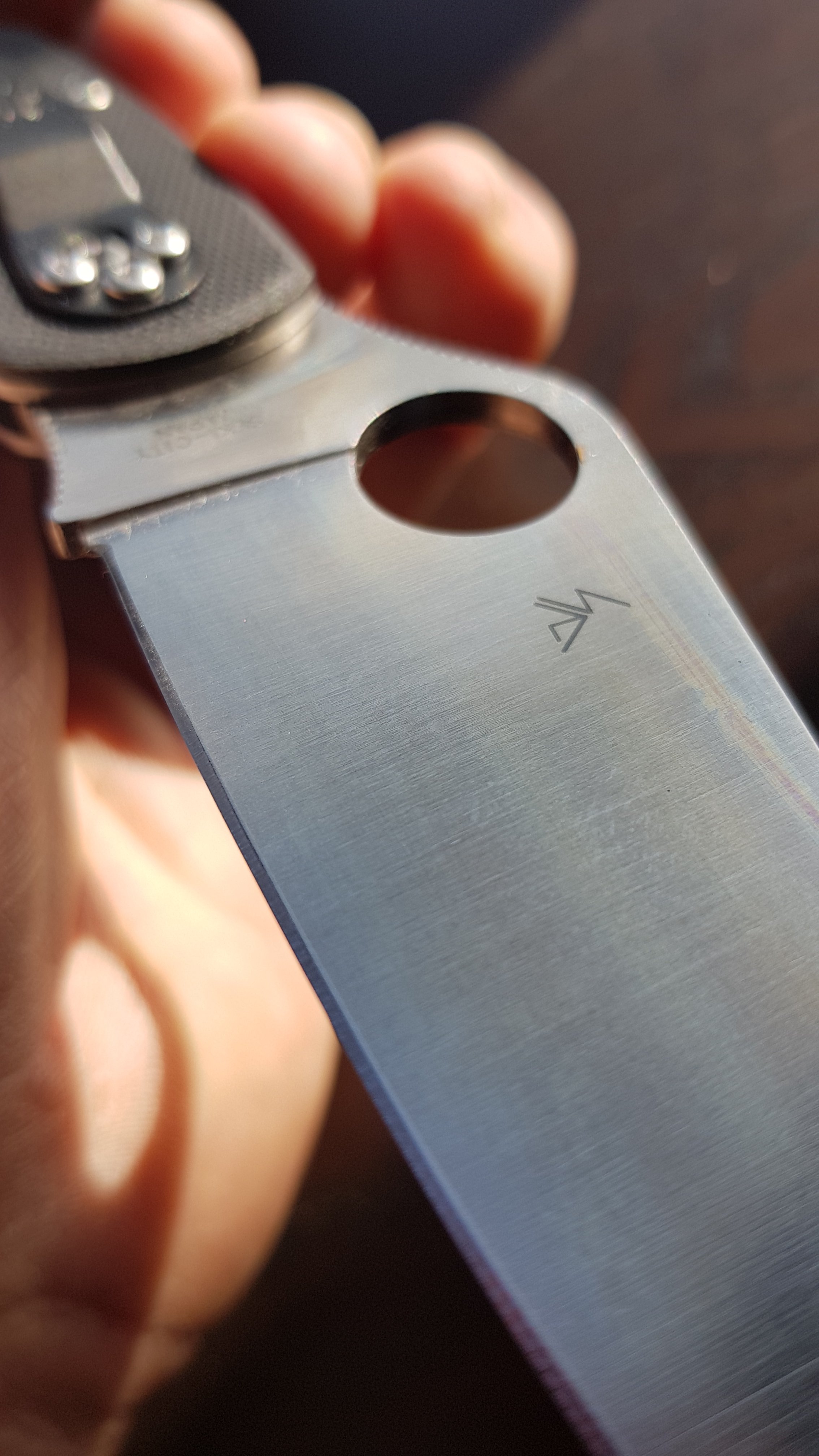
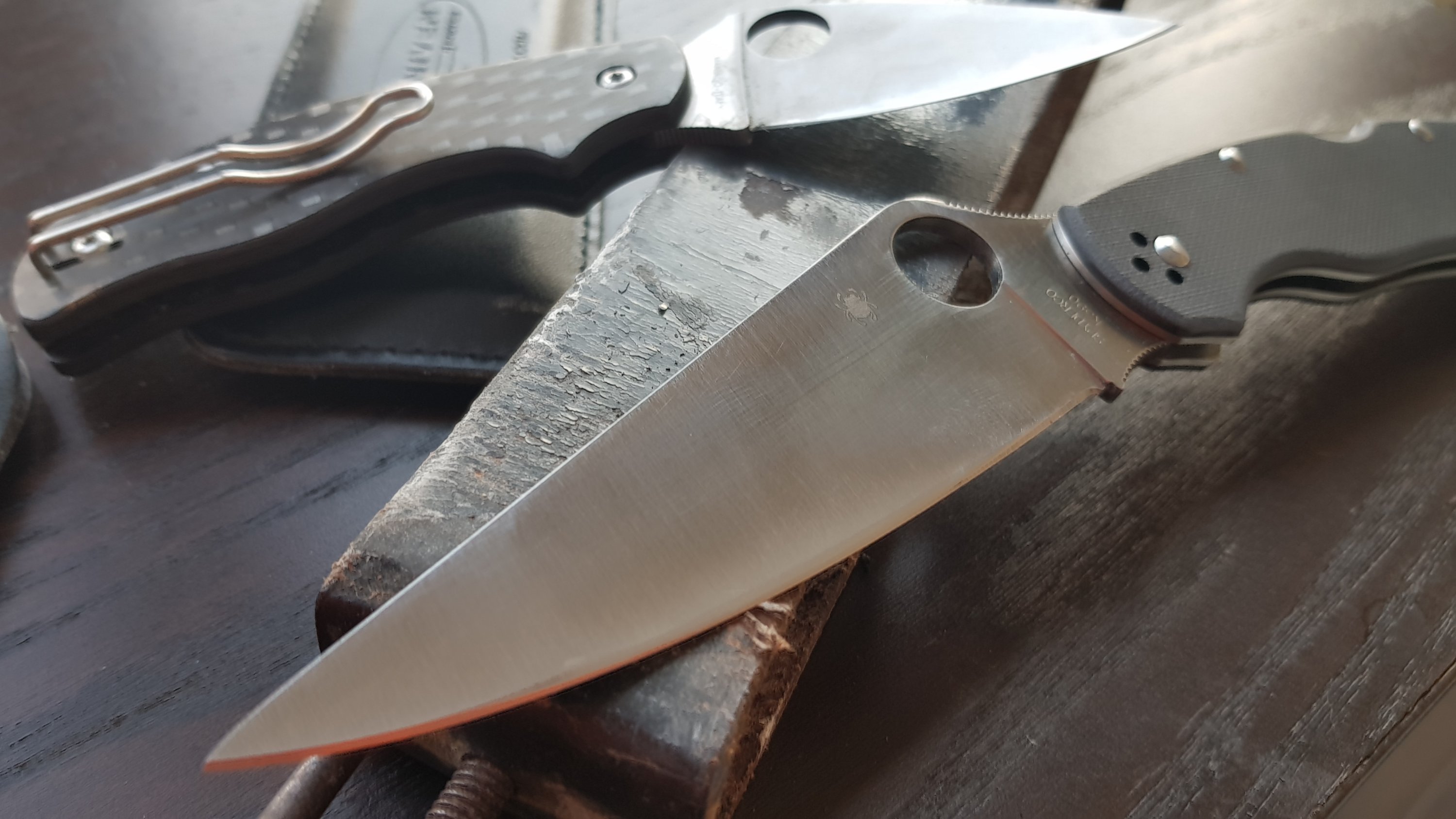
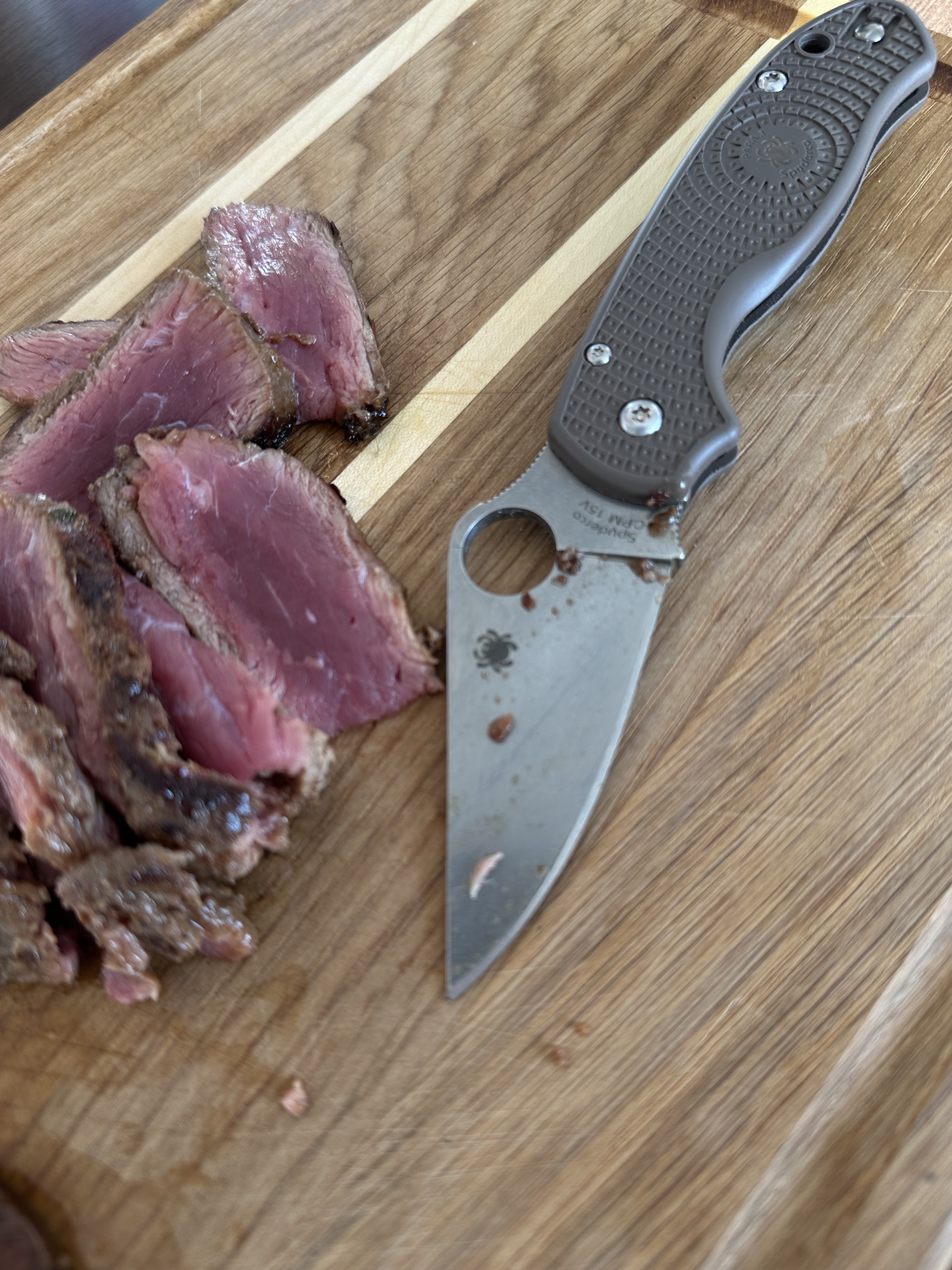
Getting a convex edge with the CPM-15V blade of the Houlahoula Para3 Lightweight.

I have enjoyed the Para3 in CPM15V for a week now and after the first pictures, one of my friend Alexandre wrote to me “Looking forward for a convex edge”.
And I have answered to him that I was not in a hurry to do it on this little wonder of modern cutlery. The steel seemed so hard !
But guess what ? What’s bred in the bone will come out in the flesh.
After a week of frustration trying to get any good (spectacular) result on leather and white ceramic….

Some gaffer is on the blade to protect it from any scratches.
My goal is just to “de-shoulder” the edge, to round it for a better leather stropping experience.

It is not rocket science and I’m clumsy and impatient.
So I’m not helped by natural tendencies.
As you can notice the edge near the guard will have less attention.
My friend JD is able to go even but I’m not to his level in making beautiful edges.
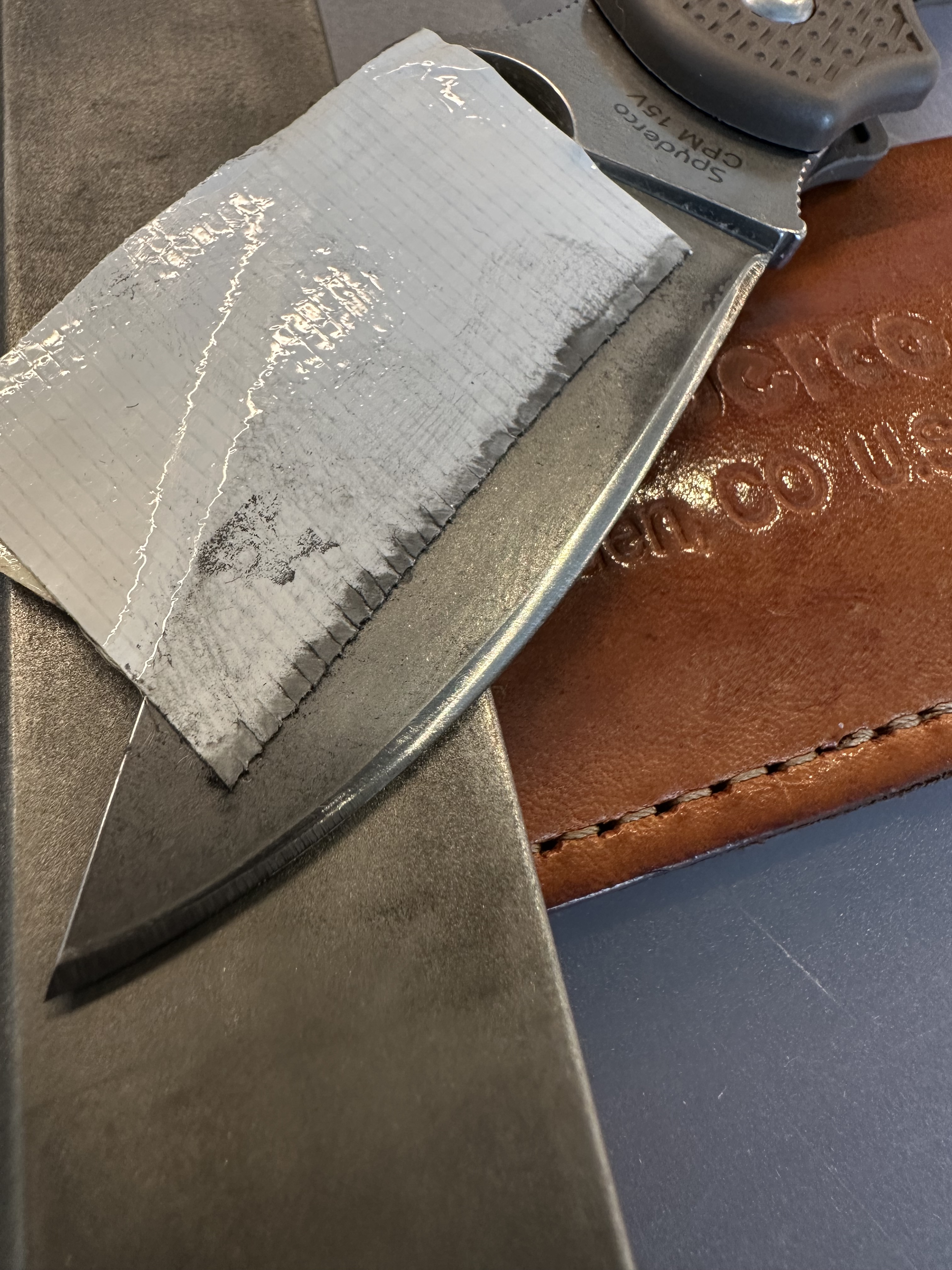
But as you can notice it is getting better.
I use a Double Stuff 2 from Spyderco. Mine is old and the glue between the ceramic slate has gone. The diamond slate is not as efficient as some decades ago but it should bite into CPM15V despite its humungous pourcentage of vanadium.

Since CPM 15V has a high volume (23%) of vanadium carbides (87 HRC) which are harder than the ceramic alumina abrasives. (79 HRC)

That means 23% of the overall microstructure is being pulverized, burnished and adhesively worn to shape rather than cut at the apex.

Over the years I’ve observed a pattern in some folks complaining that these types of steels cannot get very sharp yet the same folks seemingly would refuse to use the abrasive that will cut the remaining 23% of that microstructure cleanly.

I do think that would be fascinating to do a controlled test and look at the differences between the starting sharpness and how that sharpness dies off with cut testing and then compare the loss of sharpness between the two with the same amount of cuts.

I’ve certainly seen this behavior in my personal experience, however, I’ve not documented and shared data publicly.

I’ve mentioned many times that my current favorites for sharpening are the bonded super abrasives rather than the electroplated abrasives. However, there is a cost difference, but in my experience it certainly pays for itself and has better performance.
Shawn Houston on the Spyderco Forums

First look at the result.

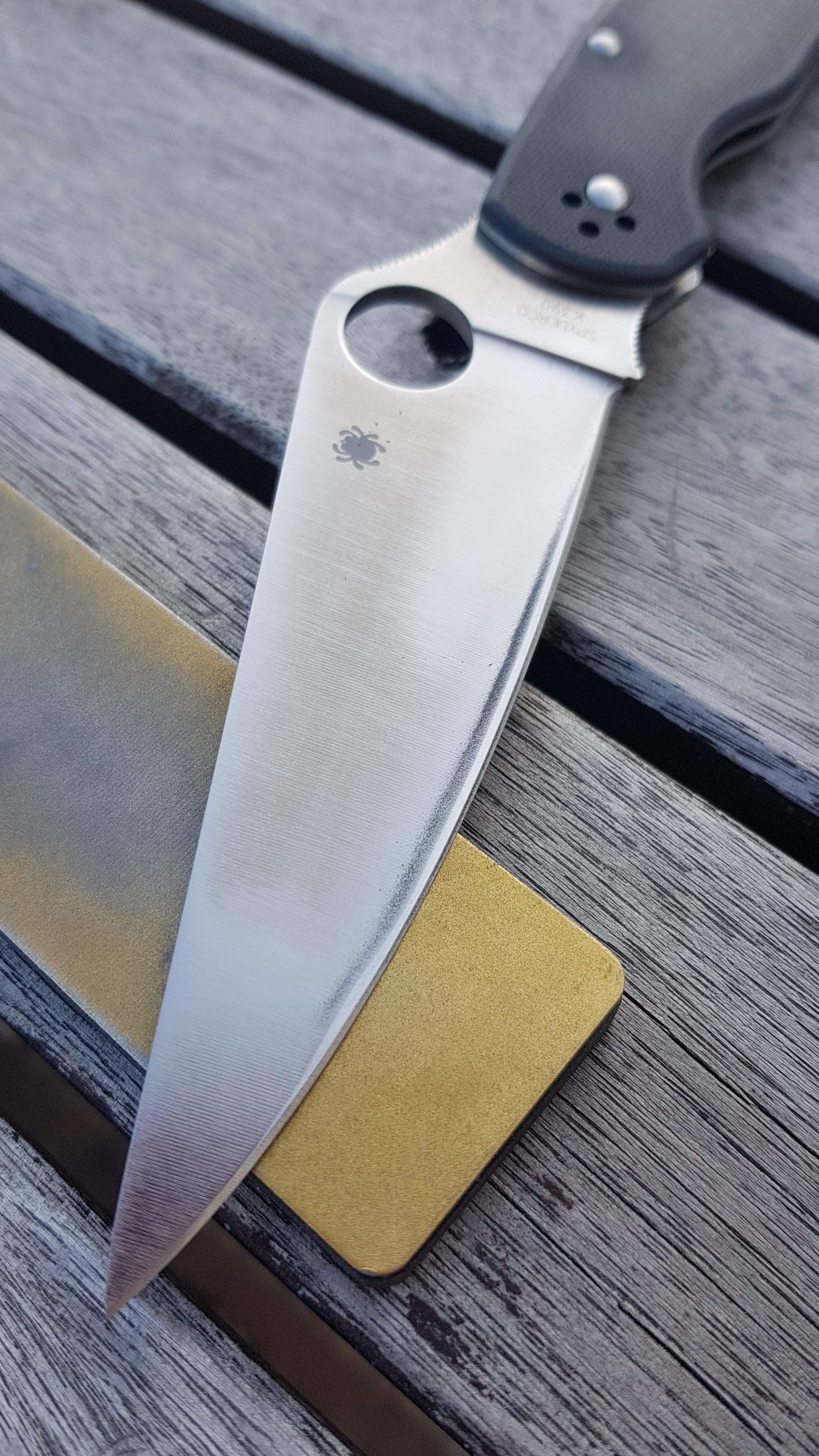
Humm it needs to go one more round.

Ah, I am starting to enjoy the result and how the steel takes the light on the belly of the blade.

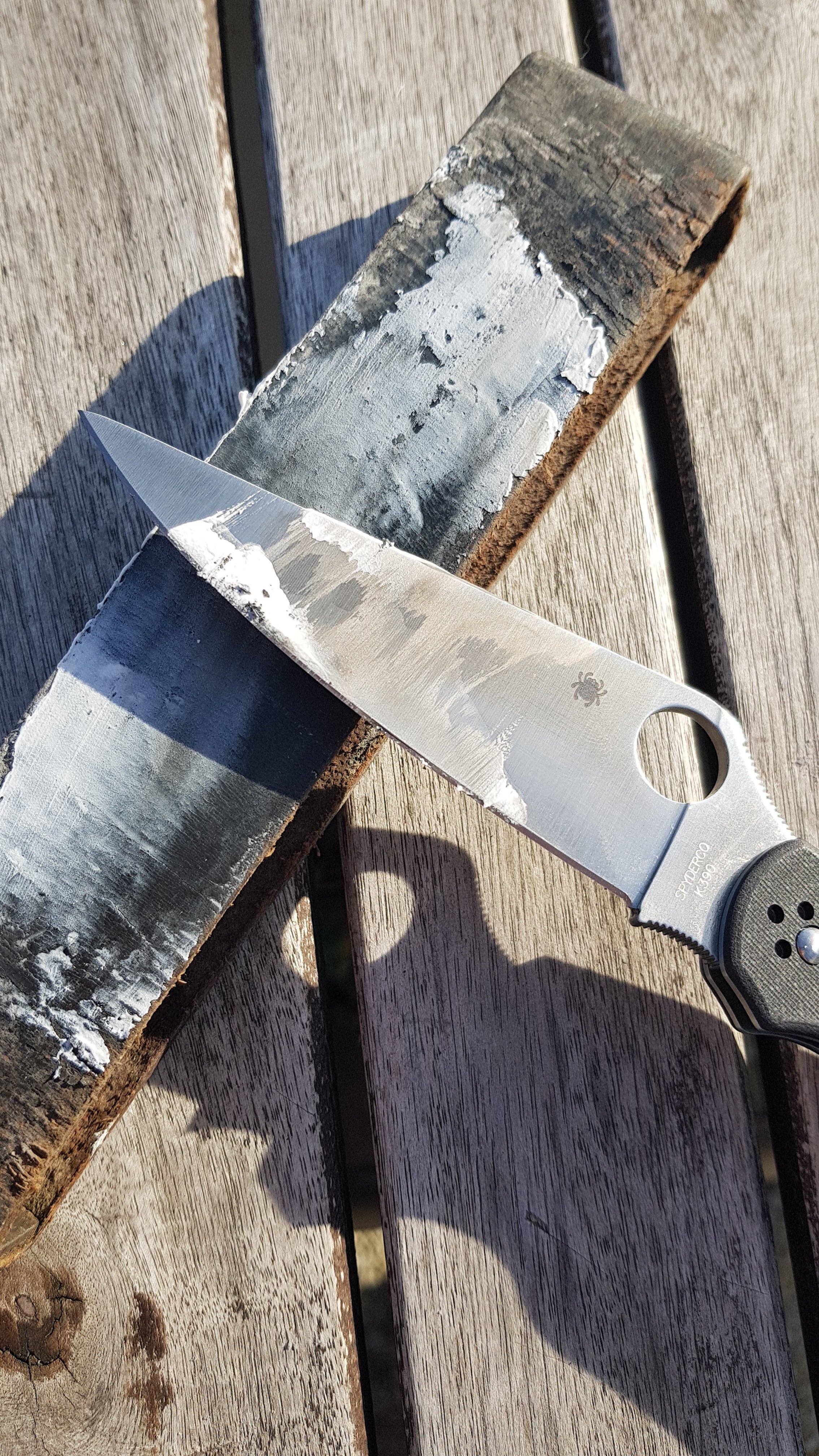
Now time to put some white compound polish on the leather.

Again I’m not focusing on getting it sharper it but just to polish the edge and remove any scratches. I want a better geometry like I use to have on the Para3 in M390.
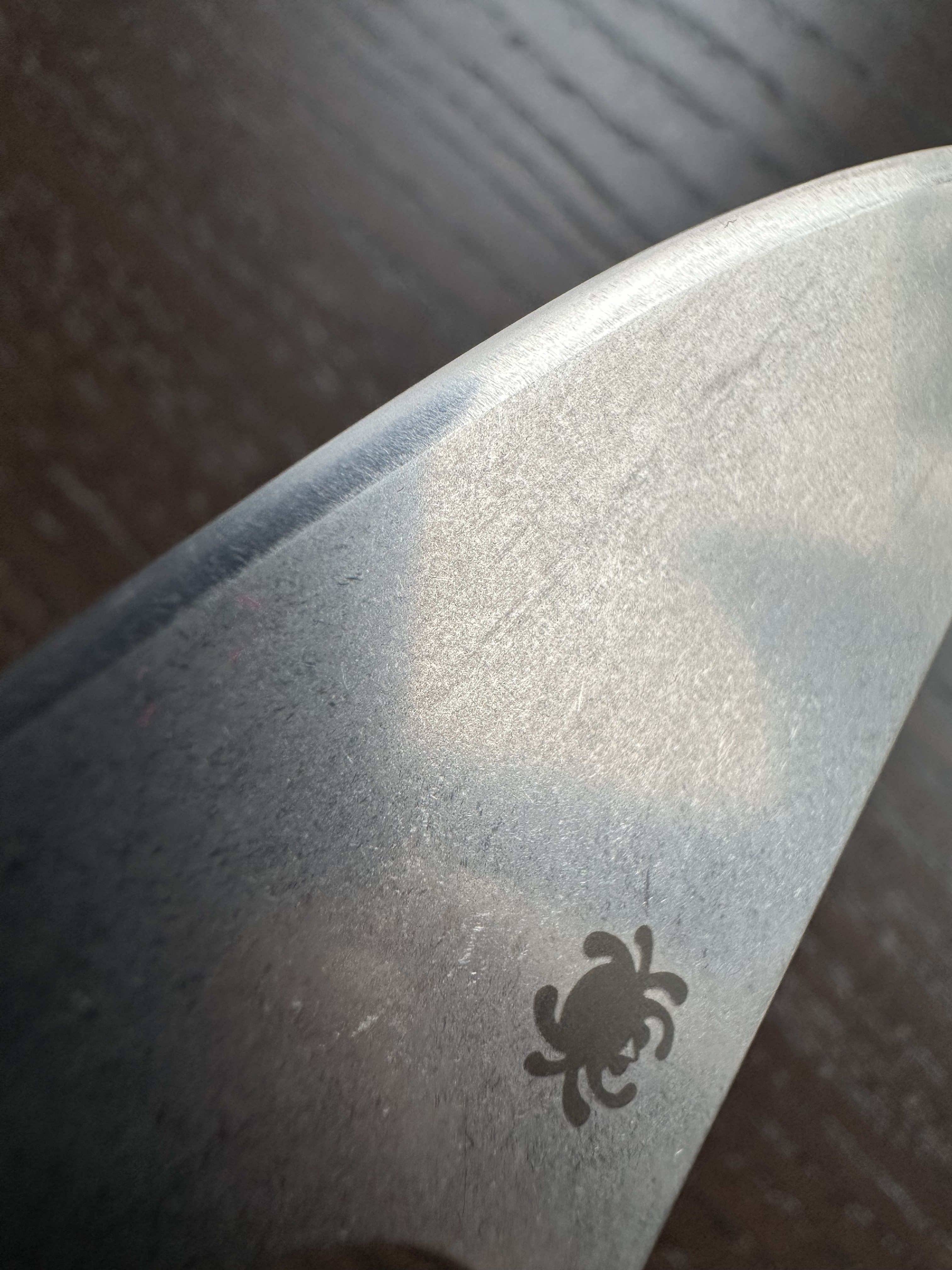
CPM15V does not like to give away its particules.
When I have been able to get mirror edges on D2, 52100 or SPY27 I’m not able to get it on 15V. I need certainly to upgrade my equipement and my game for that.
I will polish it on Jade stone and post better results in the coming weeks.
So far I’m happy with the result. More to come later as 15V is not as easy as I thought to work on (JD adviced me “I think diamond past would help with the stropping. Diamonds or cbn can cut the vanadium carbides, of with this steel has a lot”. Not impossible, especially with diamonds but easy. Maxamet on the other side has proven to be much easier to restore even after catastrophic damages.
But I’m very happy with that Para3 which could be the HoulaHoula (*) of folding knives.

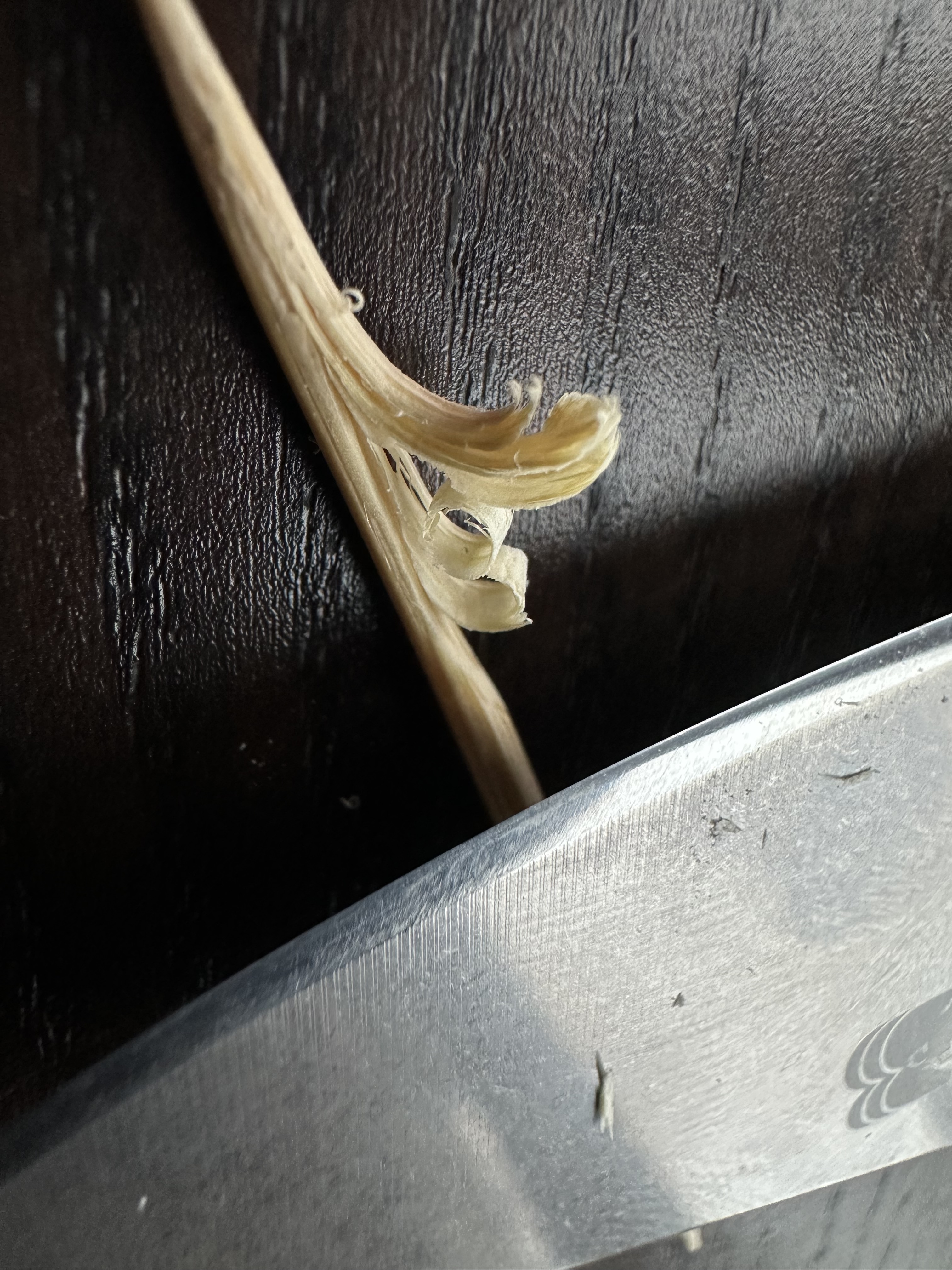
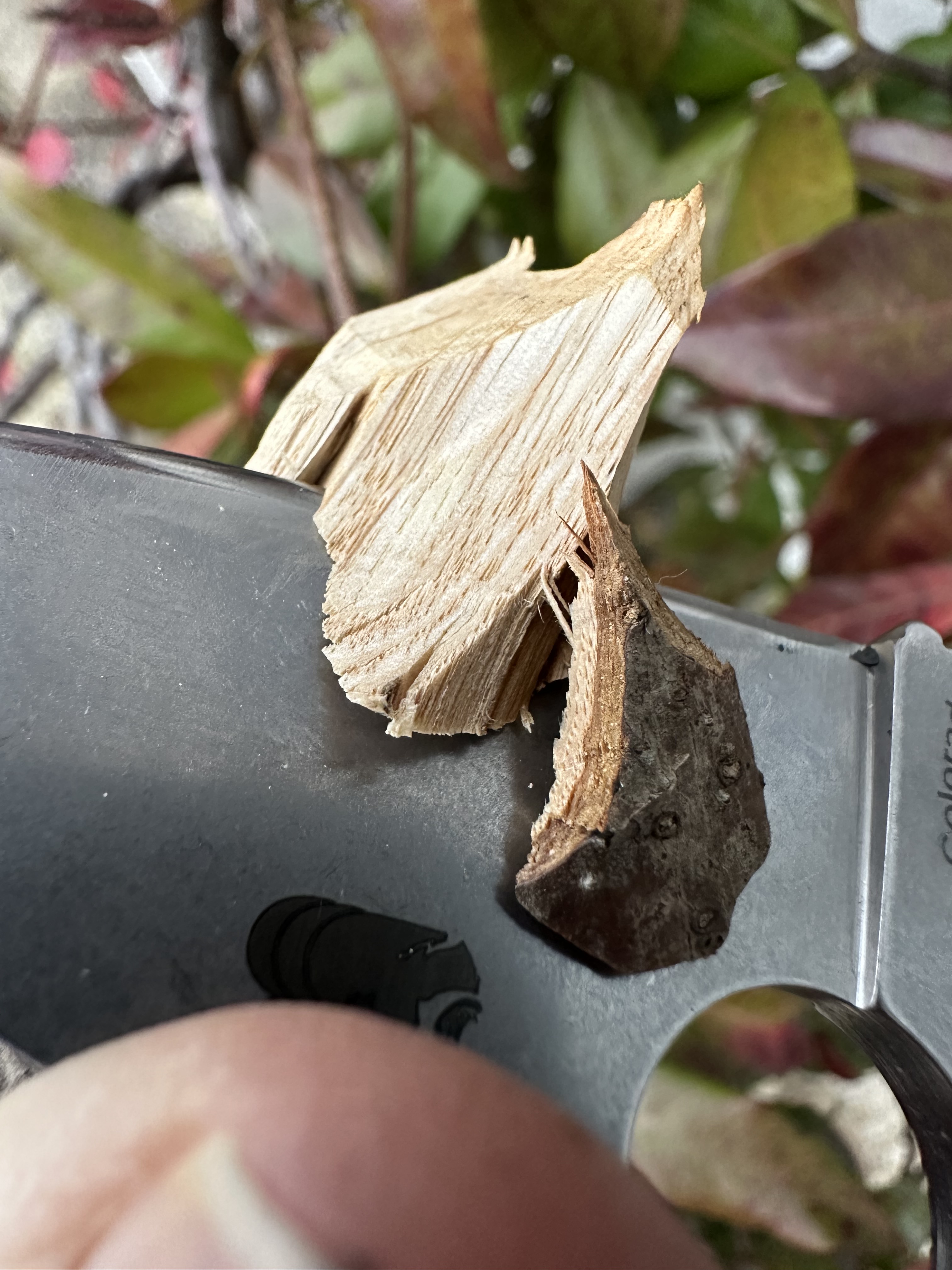
(*) Houlahoula are little birds with big balls and when they land they sing “Houla ! Houla !


On the Spyderco Forums Shawn Houston was kind enough to give some advice about how to get a mirror edge on CPM 15V:

“I recommend skipping the White Ceramic and Jade.
23% of the matrix in the 15V is harder than those abrasives.
A bonded diamond/cBN stone should help with the desired finish.


You deburr the best you can with light alternating passes on the stone. From here, the edge should be sharp enough to cut paper cleanly before moving on. Afterwards, go to a leather strop loaded with 1um Gunny Juice and use alternating edge trailing passes.

This is a good benchmark; keeps the “bite” at the edge without smoothing out the slicing effect. It also helps keep the “grab” at the edge for draw cuts but still keen enough for push cuts.

There’s different kinds of stones. They’re not all created equal.
You can take a diamond stone with the same abrasive and the same grit and it will leave a different surface roughness depending on the construction of the stone.
Yes, there are three major types of bonded stone.

Metallic, resin and vitrified.

There’s even some that are hybrids. However, these are not the same as electroplated diamond abrasives.The work more like regular water stones with better surface finishes.

“Diamond or CBN are the way. You can put a functional edge on 15V with ceramics, but if you’re wanting the real performance 15V has to offer, you need to sharpen with abrasives that will cut the carbides in the steel.”
Wandering_About on the Forums has sum it up.

Shawn Houston was also kind enough to share an AI summary of Instagram Reviews.

Based on the latest set of reviews, BBB CPM 15V steel demonstrates exceptional performance and user satisfaction.

Performance:
* Excellent edge retention: Maintains a sharp edge for extended periods, even with demanding use (e.g., cutting blackberry roots, heavy use).
* High edge stability: Resistant to chipping and rolling, even with hard use.
* Versatile: Performs well with different edge angles and finishes (from toothy to mirror).

Comparisons:
* Compared to K390, Maxamet, S90V: Sharpening is considered easier than K390 and Maxamet.
* Compared to M4: Sharpening is considered comparable in difficulty to M4.

Key findings:
* Sharpening Ease: Despite its high hardness and carbide content, 15V is surprisingly easy to sharpen. Users report successful sharpening experiences on a variety of tools, from diamond stones and CBN plates to simpler systems. Burr removal is consistently described as effortless.
* Edge Retention and Stability: 15V exhibits excellent edge retention, maintaining sharpness through demanding tasks and heavy use. It also demonstrates high edge stability, showing resistance to chipping and rolling.

* Versatility: The steel is versatile, capable of achieving both aggressive, toothy edges and refined, smooth edges.
* User Enthusiasm: Many users express high levels of satisfaction with 15V, with some even considering it their favorite steel.
Overall:
BBB CPM 15V appears to be a top-tier steel that effectively balances exceptional performance with user-friendly sharpening characteristics. Its combination of edge retention, stability, and ease of use makes it a strong contender for demanding tasks and a highly recommended choice for knife enthusiasts.”

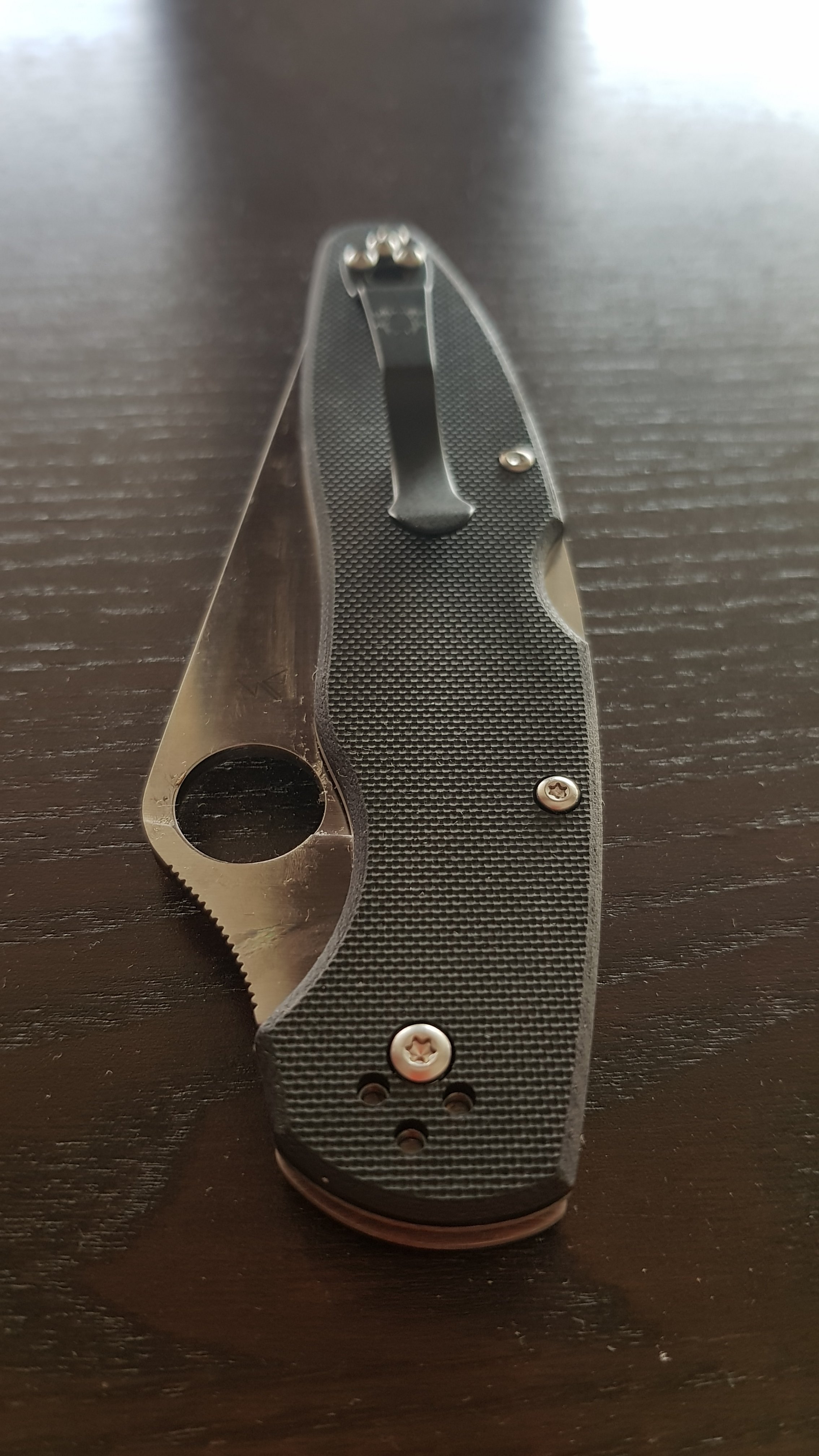
 

Spyderco Police C07GP4 – The Steel Cheetah.

“The original Police model was a response to a request from Police for a Mariner with a point. I saw that as an opportunity to create a new design that was closer to what I personally liked. I thought to call it “LaSalle”, but in the end, i pushed the ego out and called it the Police model. As the design evolved, details changed and from those changes I was able to see what I didn’t like and went from there. As you said, it was decades in the development.
Sal Glesser

I remember one of the very first advertising of the Clip It collection of Spyderco. The Police was presented in its stainless handle serrated edge version of that time (80’s…) and it was written something like: “Pure Performance” … The cheetah is a good example of incredible fast and lean animal and as this knife, it is thin and light and totally performance oriented.

Nouveau document 2019-02-19 17.02.25_1
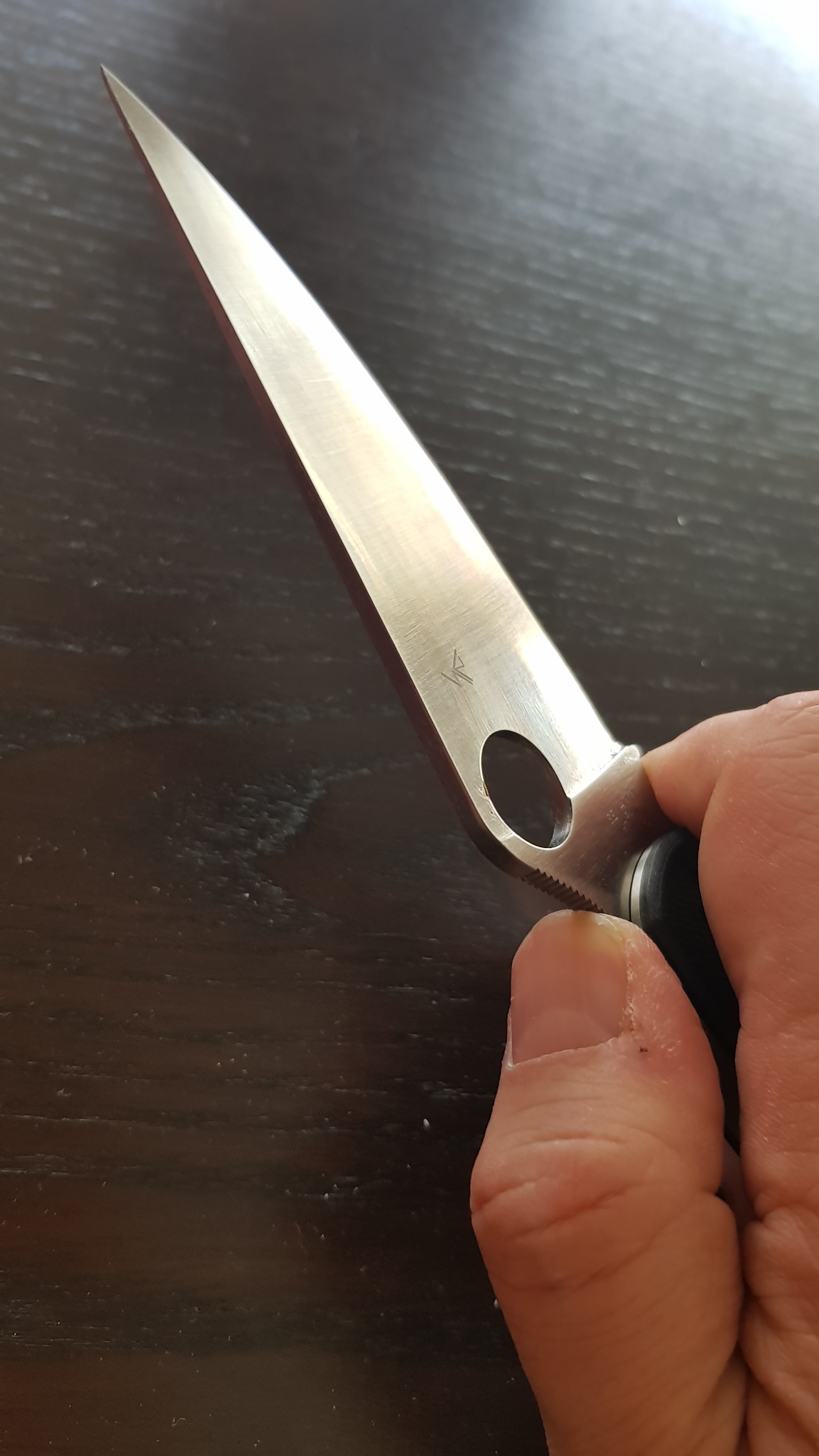
The venerable Police model designed by Sal Glesser is at its 4th version. Born in the early 80’s it is now part of Spyderco’s Legendary knives. I remember seeing some models with “Pride Integrity and Guts” engraved on their blade: they were the very first. This knife can be spotted in so many Hollywood movies, mostly in the hands of bad guys and even in the excellent classical Spike Jonze’s musical video for the Beastie Boys: Sabotage ! The stainless serrated hollow ground blade was really catching the lights hence it’s success for a dramatic entry in various films !

Nouveau document 2019-02-19 17.02.25_2

I was never a real fan of the first 3 versions of the Police models even if I recognized it has a valuable tool. In my book, the Tantaka was the true heir of those years. The fourth version caught my eye as it was promoting a new steel the KC390.

Many times I had noticed some vertical play on “Made In Japan” folders from Spyderco and decided to buy one if only I could test it before.
But this one came from a Massdrop sale and I was very happy to get one with zero blade play in any direction. Mine feels solid and knowing how strong a good backlock is, this flat long folder is really impressive. So it was about time to review this venerable classic folder which is delivered with a plain edge only and K390 … but why choosing a “staining “steel high performance steel when the Police as always been serrated and stainless ?

Nouveau document 2019-02-19 17.02.25_4

“We make quite a few designs for the Law Enforcement market at this time, so the design for Police use is (not?) necessarily the case anymore, like it was in 1984. I designed the Police 4 to include what I would like in a knife, more than what a LEO might like. It’s still a kissing cousin, and large for most people. I widened the blade, enlarged the hole and selected a steel that I like to use. The design’s success in the marketplace is unknown at this time. But I get to have one. ” Sal Glesser on Spyderco Forums in 2016.


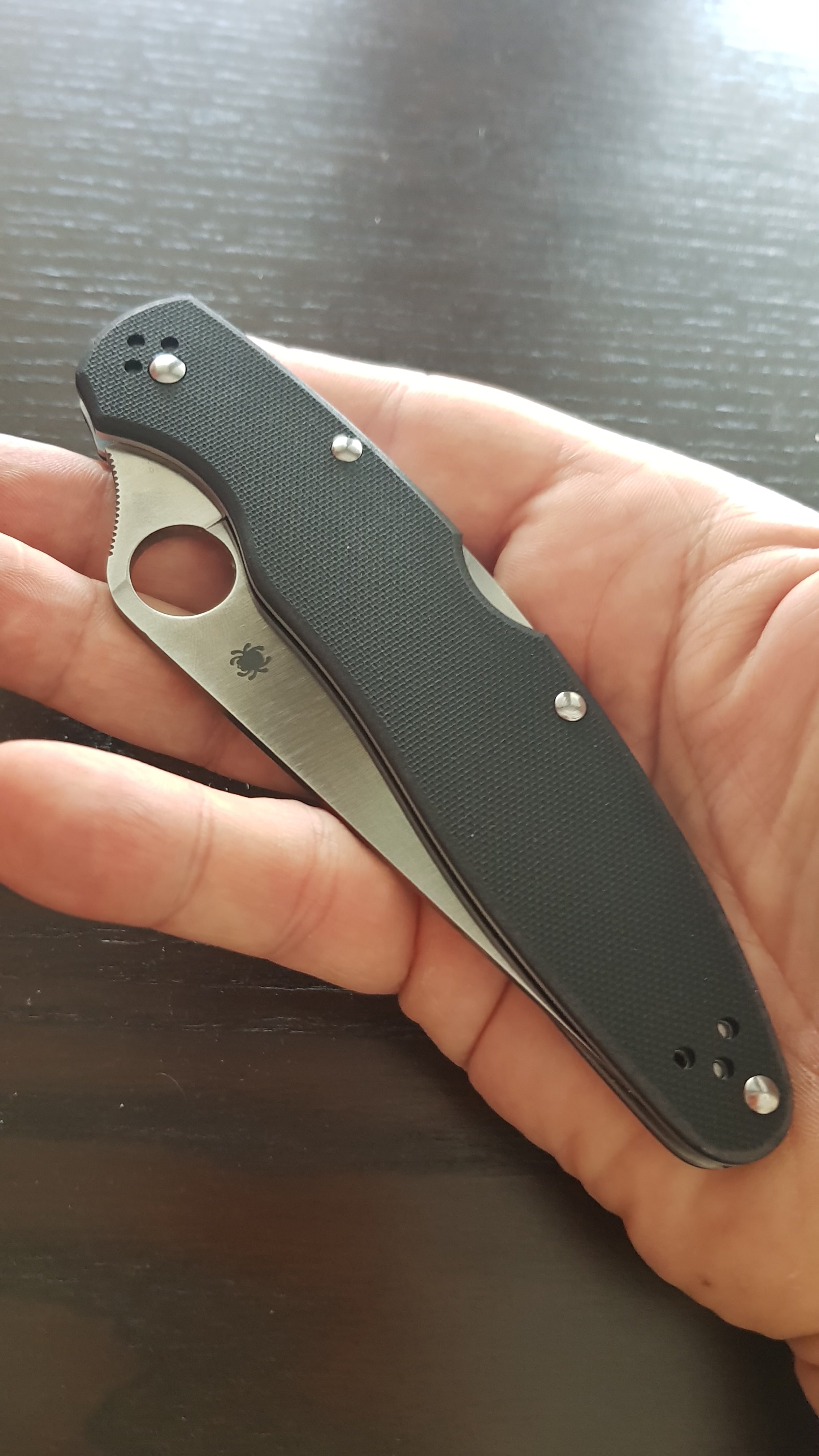
Also the blade is perfectly centered. The construction is the same as my Endura and Delica, sandwiching the steel liners with the handle material. Here it’s black G10 on skeletonized liners: the knife doesn’t feel heavy at all but very well balanced and fast in the hands.

The long flat blade is still intimidating while deployed. Let’s see some comparaison pictures. Notice the black could of forming patina in the middle.

Here with Ed Schempp’s Bowie which is one of the best blade/handle ratio folder in the Spyderco collection, full flat ground versus high saber flat ground. The Bowie has been convexed to my taste. The large choil on the police is confortable though.

Here compared to the wonderful Manly Peak, another thin backlock lightsaber. The Manly has not been really convexed; it is really thin ground ! With its S90V blade, better edge/handle ratio and zero blade play construction, it is a real contender to the fourth version of the Police.

They share the same thin stock blade. The Manly (on the right) is even pushing the envelop a little further by proposing hidden nested liners for the same handle thickness.

It is obvious the Delica and the Police are sharing the same DNA even if the Delica main difference is the absence of real choil to choke up the blade. I have both in tip down carry position for easy spyderdrops opening. Here is the Knifecenter special edition of the Delica.

The Delica still got the Boy indentation on the lock when the Police is now leaner. This raffinement has never made a real difference to me. The spring on the Police model is quite strong actually so no worry about unlocking it will chocking the handle.

Here you can notice how longer the Millie handle is compared to the Police. Also the belly of the Millie is much more pronounced. I think now the Police 4 has been also designed to be used while wearing gloves (one of the Military plusses). Both finger holes are equally wide with a very pronounced blade’s hump. The Police’s choil is even wider than the Millie’s !

Also the Military blade is thicker as is its handle. The Police is perhaps more “urban” oriented: it is a large folder easy to wear with any suits.

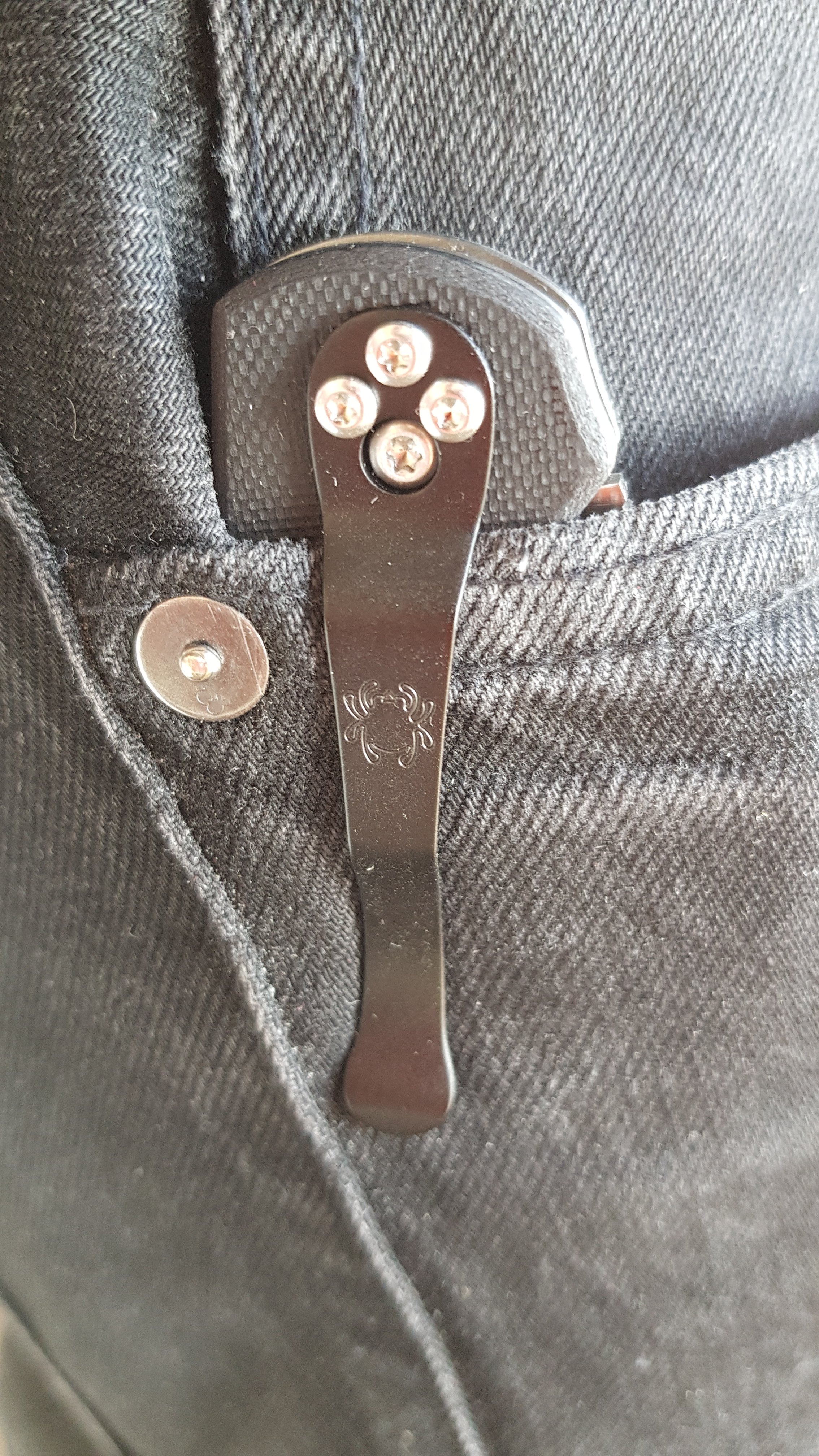
Here you can admire how the Police is a steel cheetah: lean and mean. The clip was mounted that way and I was tempted to add a deep carry clip but eventually, the spyderdrop is the more handy way to open that large folder so the clip is now mounted near the pivot.

This thin blade enhanced by a great steel (K390) is pushing that venerable model to new heights. We are far from the serrated hollow ground model of the 80’s which was respecting special requirements from the LEO. “It was designed to have an as large as possible blade built into a thin, equally sized handle. Because of this, Save and Serve professionals continue buying the Police Model as an essential tool for their trade.”
From Spydiwiki.

It is a flat and elegant design with a very clever purpose: to insert easily the knife inside the pocket when tip down carried.

Some sanding was required to get the handle even smoother for easier pocketing.
Aerodynamism is one thing, pocketodynamism is another.

Again, never breath that dust it is toxic for your lungs.
“”The benefits of G-10 as a handle material are many. It can support a building, be drilled and sawed. It’s doesn’t retain heat or cold, shuns chemicals, discoloration and peeling. “

And that makes it long folder which can easily be pocketed. Carried tip down, the handle shape pushes my wallet away  when inserted and allow very quick and positive spyderdrop openings. They are four positions to mount the clip on the Police since the 3rd version in 2008.

Next step, with some diamonds, it was time to reprofile the blade to a Manly Peak level and to thin the edge by “deshouldering”. Not an easy task as K390 is a bear to sharpen.

The occasion to picture the blade before to scratch it.

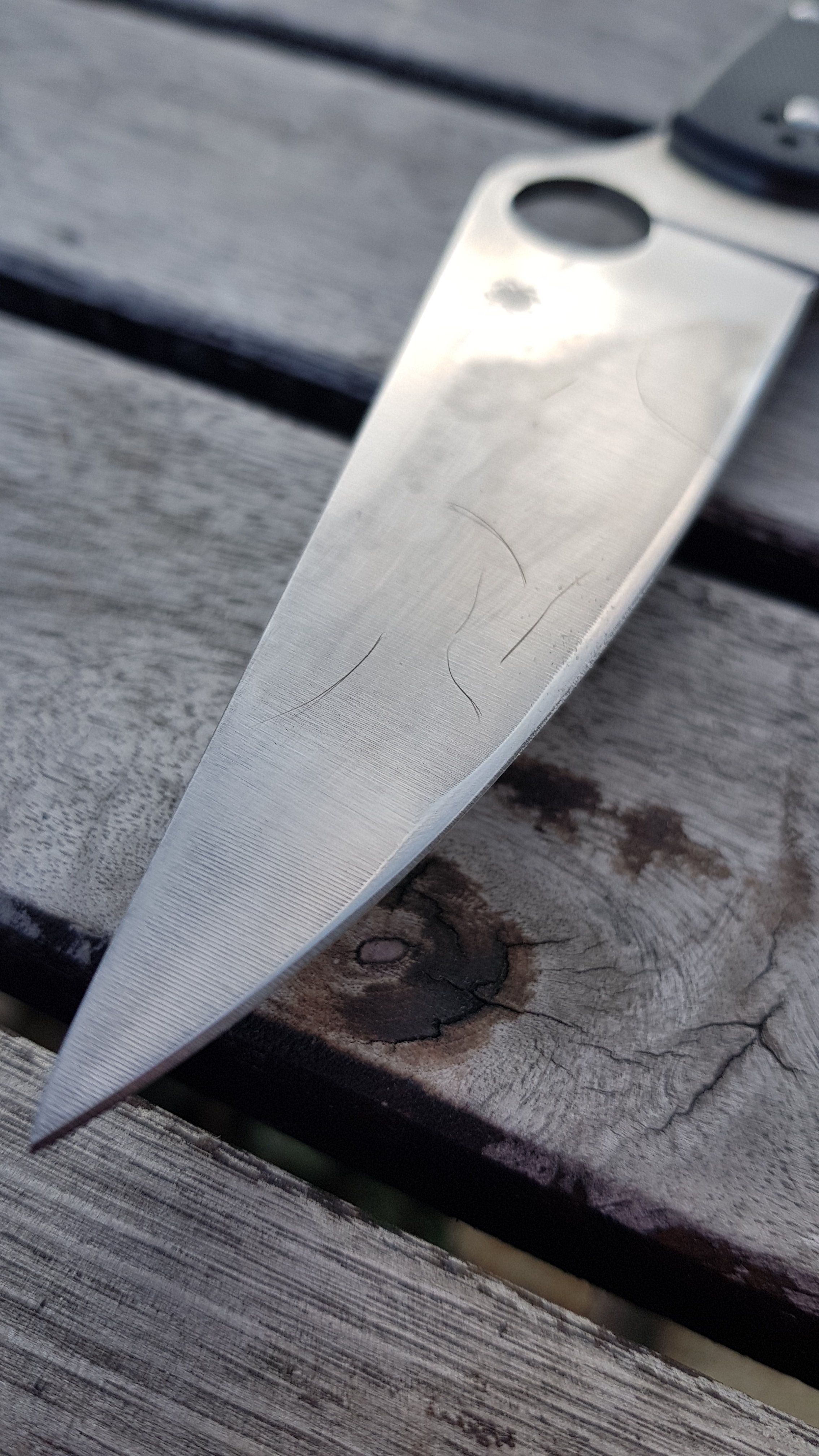
The light reflections on the blade shows it has already started a mild patina while being stored.
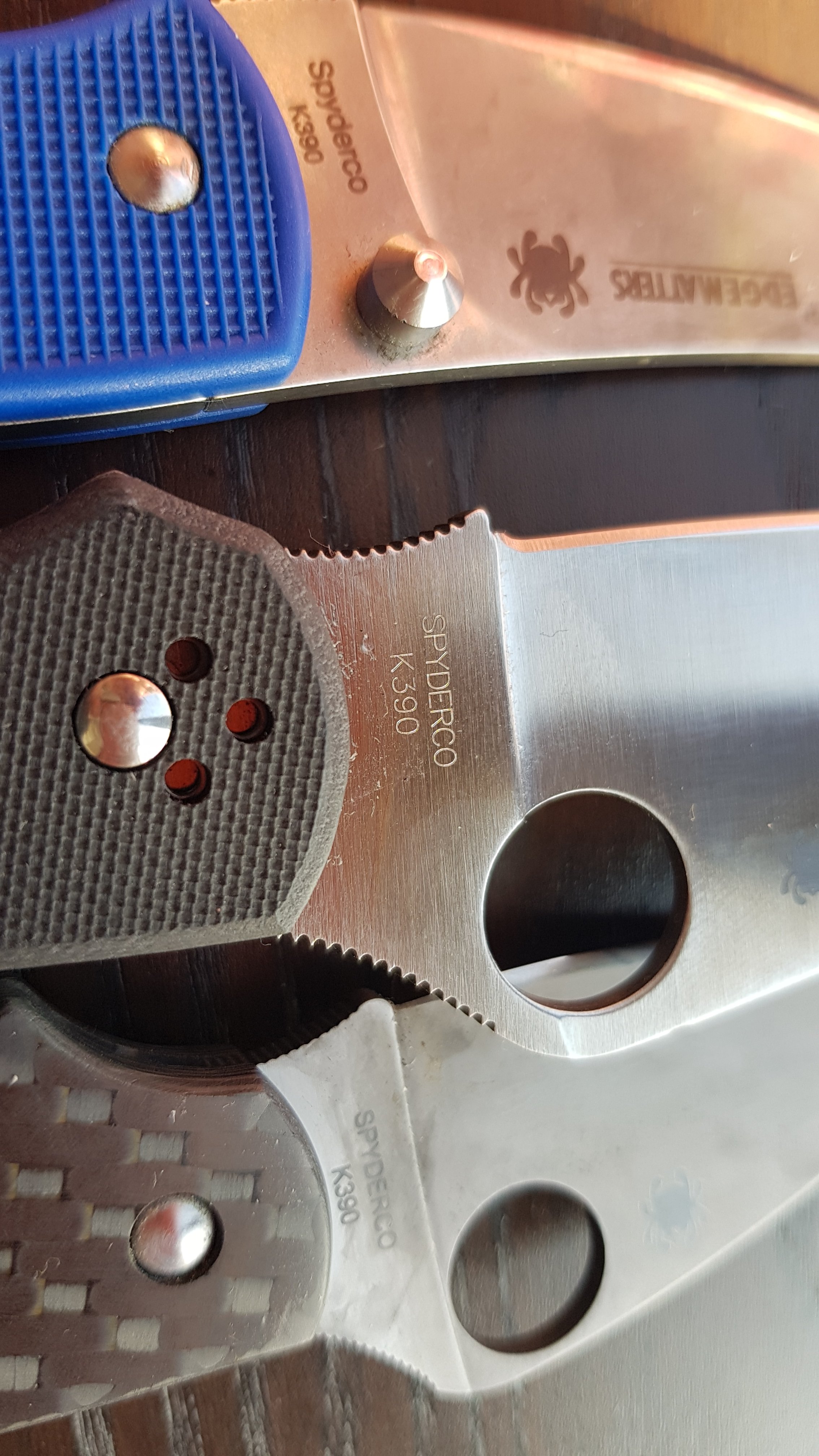
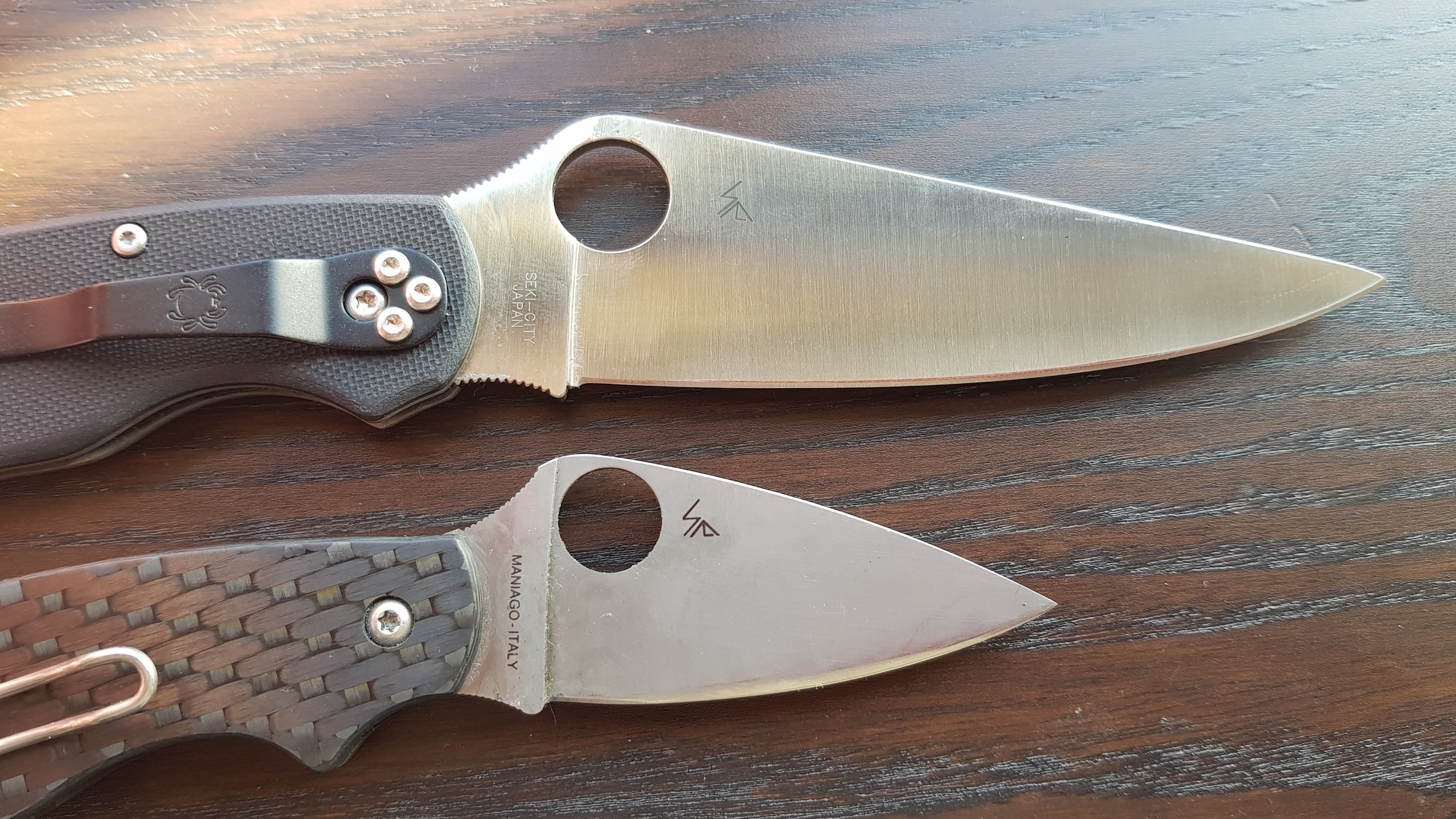
K390 develops naturally a beautiful patina like storm clouds. Here is the Police with my Pingo and Urban.

Funny how it is hard to catch on photography but the Urban got the convexed grind I want to achieve for the Police. Both knives are signed by Sal Glesser’s logo.

I have check how the patina was easy to remove before going back to sharpening.

Here you can see the dust formed by the diamonds of a DC4.
K390 is a very wear resistant steel…


Here what Phil Wilson said about it in the Spyderco Forums:
“I have been using K390 from the start ever since it was introduced by Bohler and I got some small samples to try. A bit of history is that it is the European version of CPM 10V but not the exact chemistry (about 1% less V plus small addition of a few others). That is because the CPM 10V chemistry was protected by patent at the time. If you check the K390 data sheet it claims that the bit less V gives K 390 a little boost in impact toughness. It also can be heat treated at a lower temp. than 10v. So it is pretty much the same as the A11 grade but different in a few small details. It is hard to tell the difference between CPM 10v and BU K390 in the real world in my experience. I like both grades and they are the base line (along with Vanadius 10 and K294) from which I measure wear resistance. The 5 chrome is there to make them all air hardening among other things and does not contribute much to corrosion resistance. It is going to make a killer knife in the new offering and be another classic. Phil”

So slowly it is deshouldered but I will be obliged to go back to the blade later. It is, for me, like painting a ceiling… I always come back for another layer… 😉

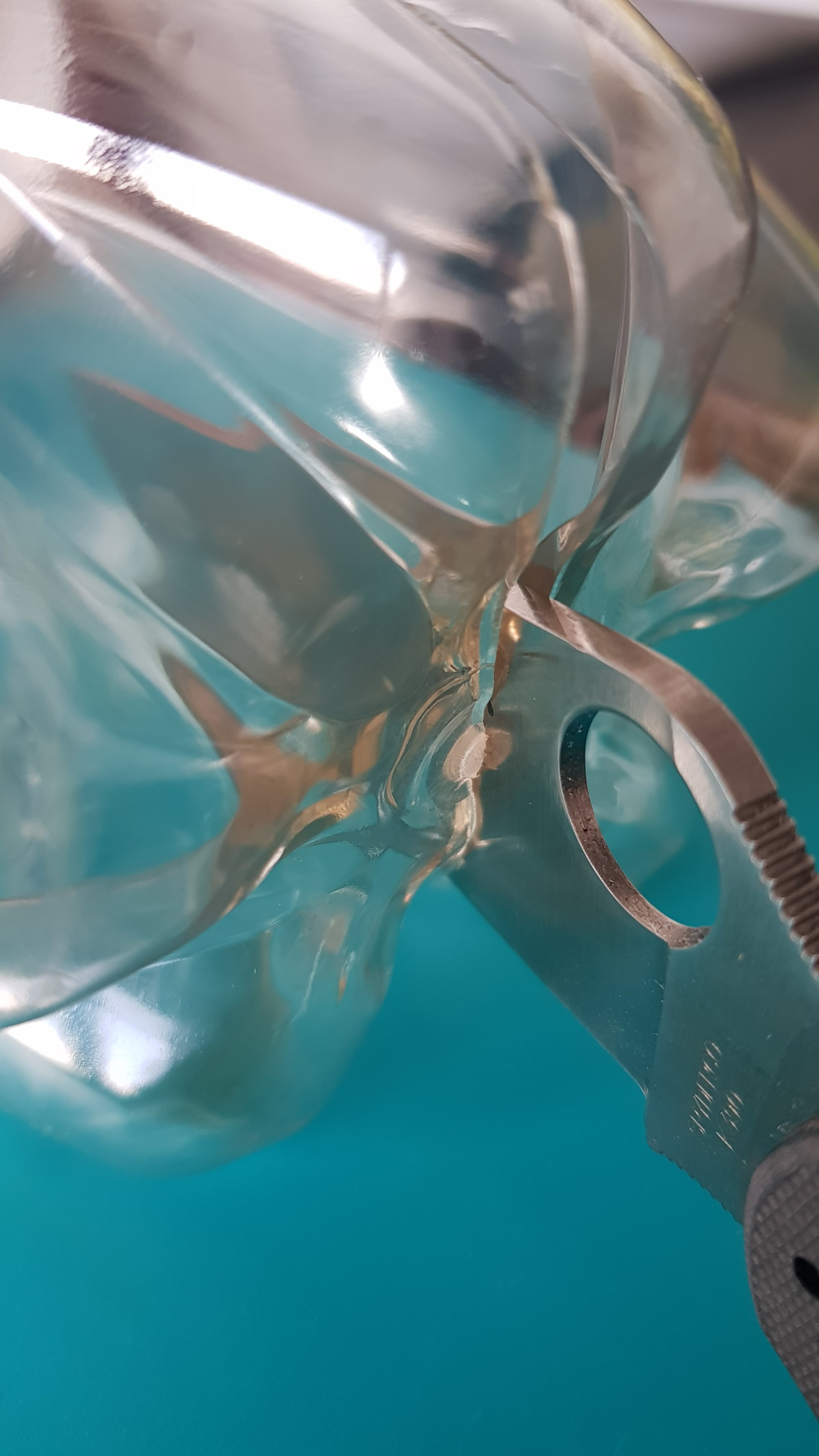
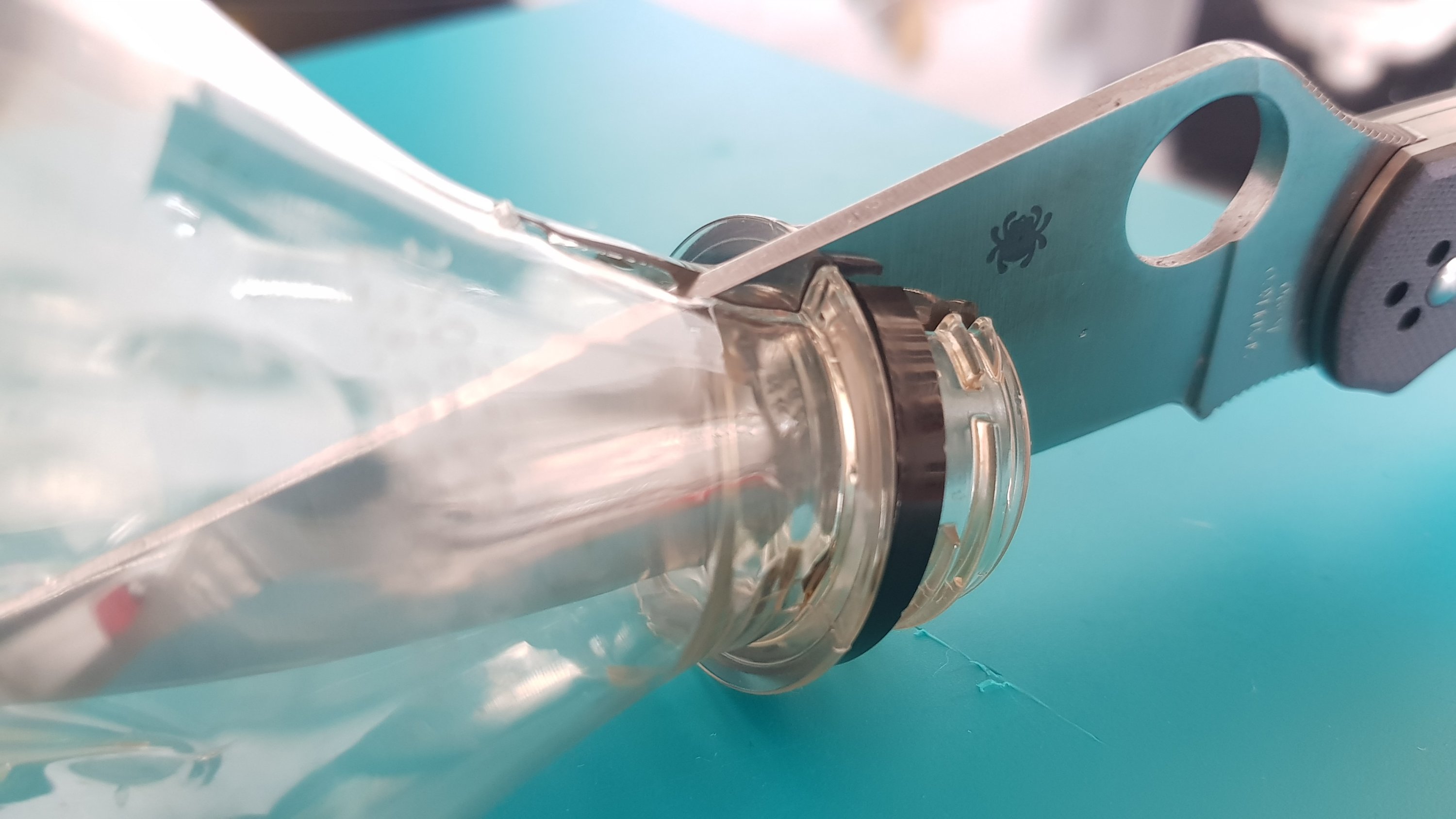
All right, the performance are already promising. The plastic Bottle Butt is as thick as the blade itself but it has been able to got through it right in the middle. Again, zero blade play on that huge folder: very happy.  Same punition for the bottle neck. The Police shows how powerful it is and that the recipe of “thin blade + super steel” is always a winner for high performance knives. More to come, as this one is going to be user !

20190220_1612574854410471853068372.jpg

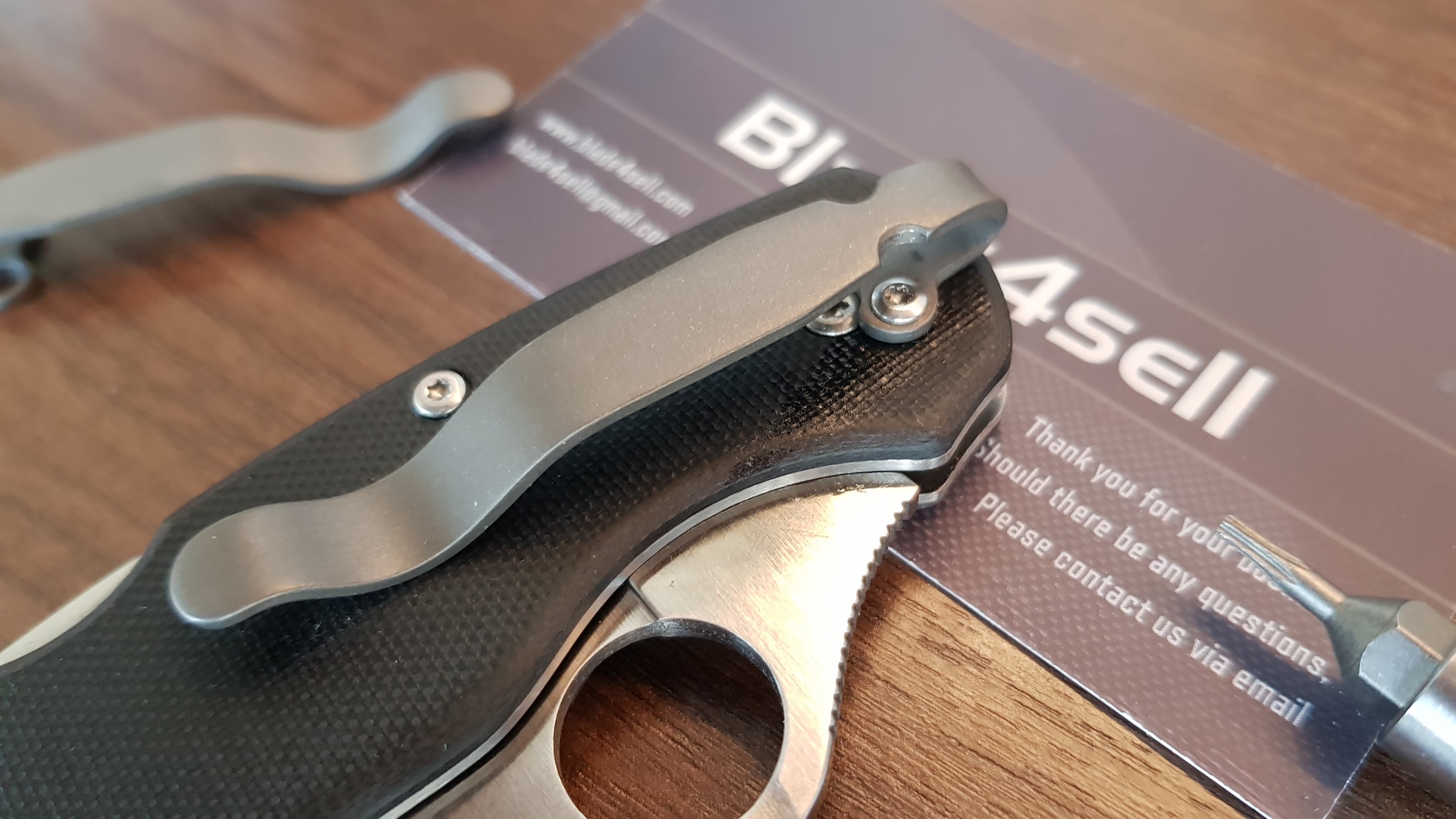
I have mounted a deep carry clip from Blade4sell.

20190220_1553438892665025613971523.jpg

20190220_1553534864525016576944791.jpg