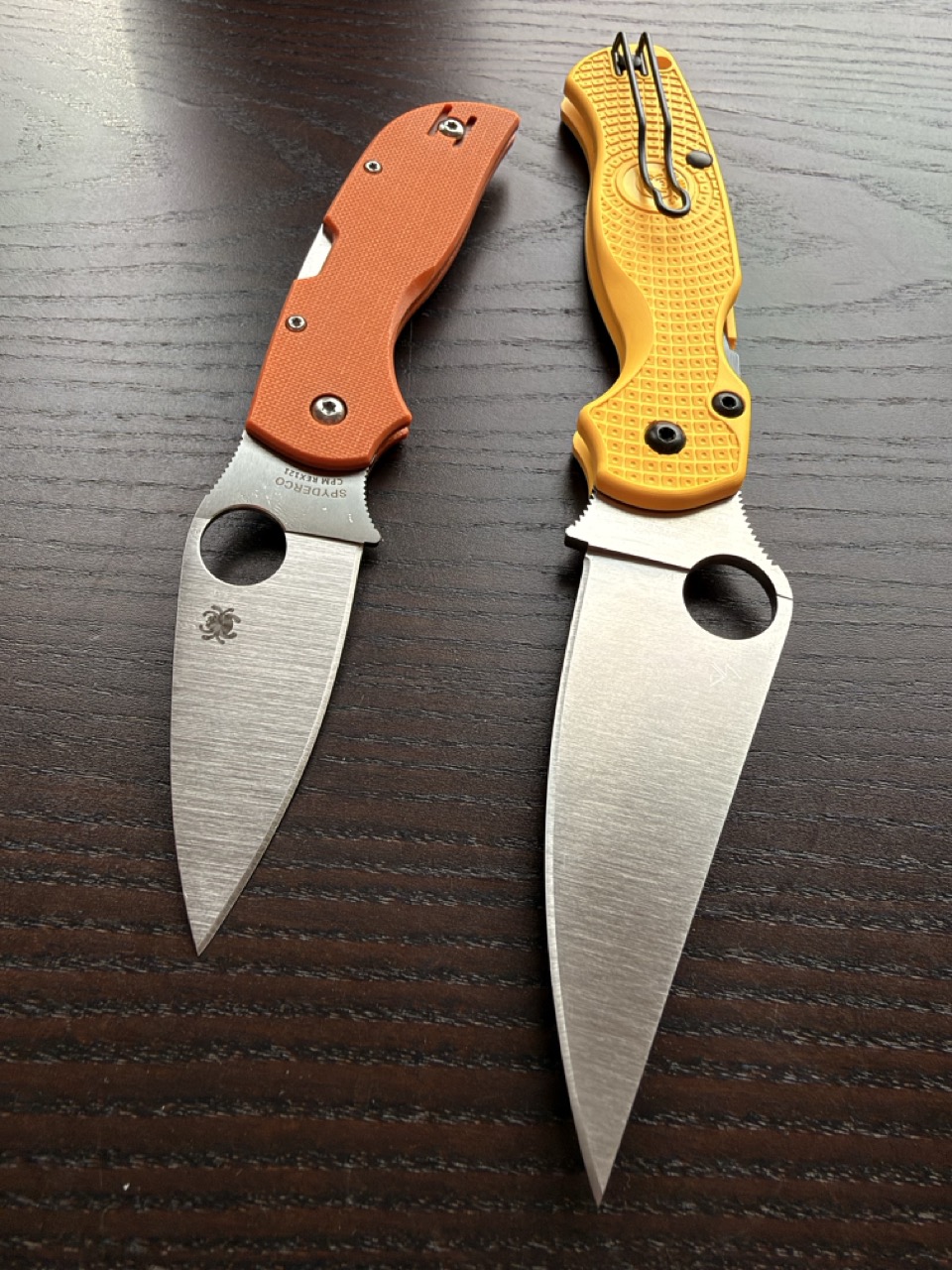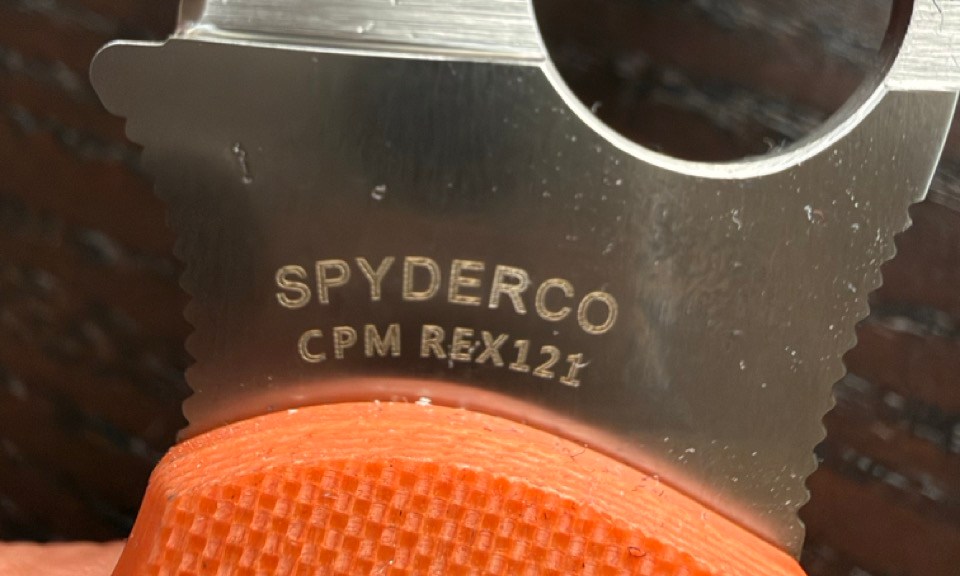
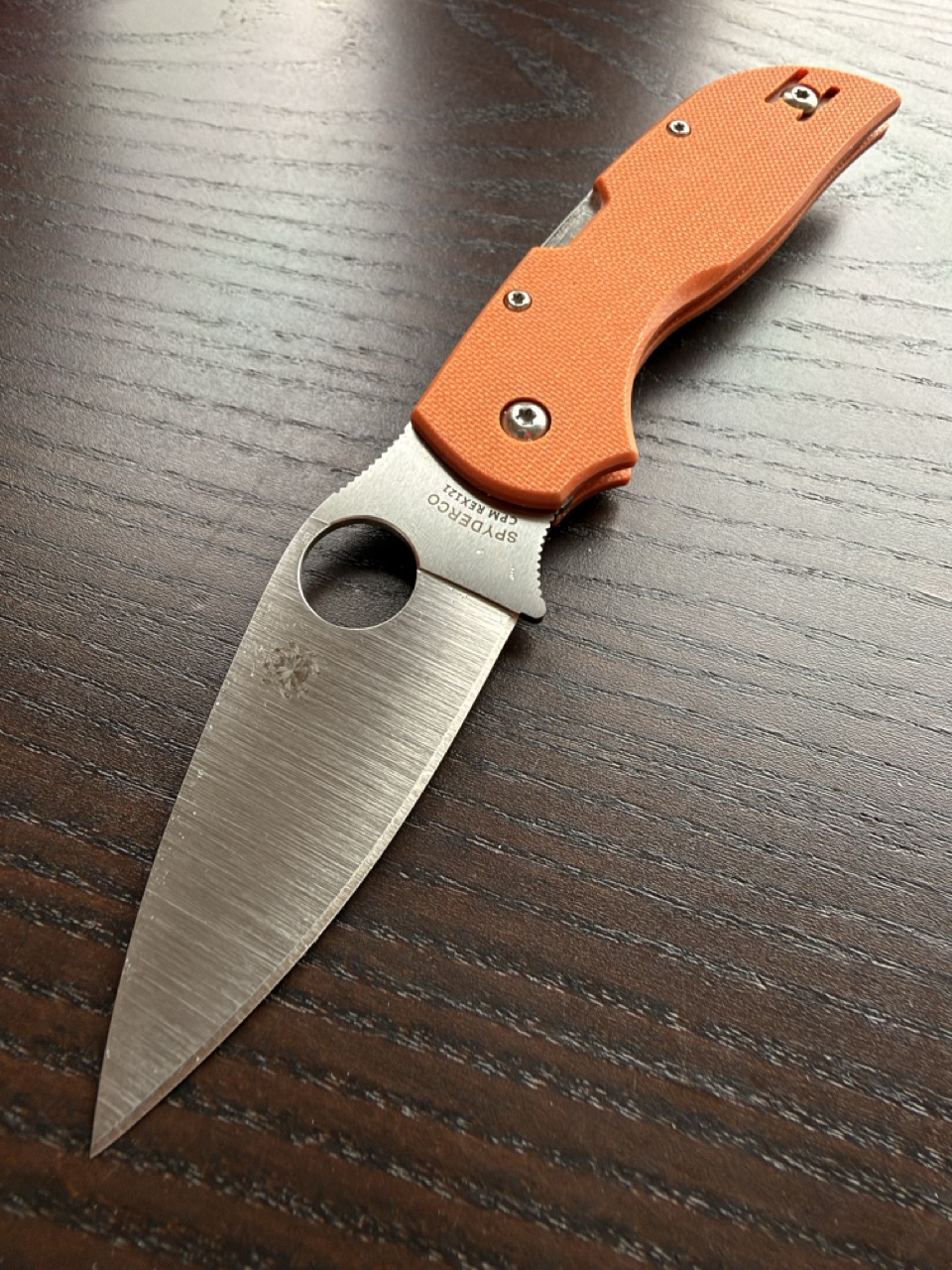
I’ve reviewed quite a few members of the Spyderco Chaparral family over the years, so I thought I knew pretty much what to expect from another variation of this compact gentleman’s folder. But this new Chaparral, featuring REX 121 blade steel, has made a particularly strong first impression.
Because… Spyderco is doing more than simply introducing an exceptional steel into a small gentleman’s knife. The company is positioning this Chaparral among its most premium offerings, with a price tag that even exceeds those of previous titanium-handled variants !
By the way: a big thank you to Golden as I received this stunning Spyderco Chaparral CPM REX 121 as part of their Ambassador Program. As always, my reviews reflect my own experience and honest opinions.
Right out of the box, the first thing I noticed was the outstanding quality of the action. Everything feels exceptionally smooth, precise, and refined. As expected from Spyderco’s Taiwanese production, the fit and finish are simply superb. There is absolutely no blade play in any direction. The action is buttery smooth, while the blade itself is razor sharp. Everything feels exactly as it should.
And that’s just as well, considering the price tag: it costs more than three Lightweight versions, which are already masterpieces of EDC design.
This Chaparral isn’t just the queen of the family. It might very well be the Empress of all Chaparrals!
And actually… As I hold Her Orange Majesty, there is something else about this particular Chaparral that sets it apart, something harder to put into words.
It feels denser, more substantial in the hand.
Perhaps this impression of greater density comes just from the fact that I’ve handled the mighty Lightweight Serrated version so extensively. I’m so used to its featherweight feel that the REX 121 version feels more substantial in comparison. That’s probably all there is to it!
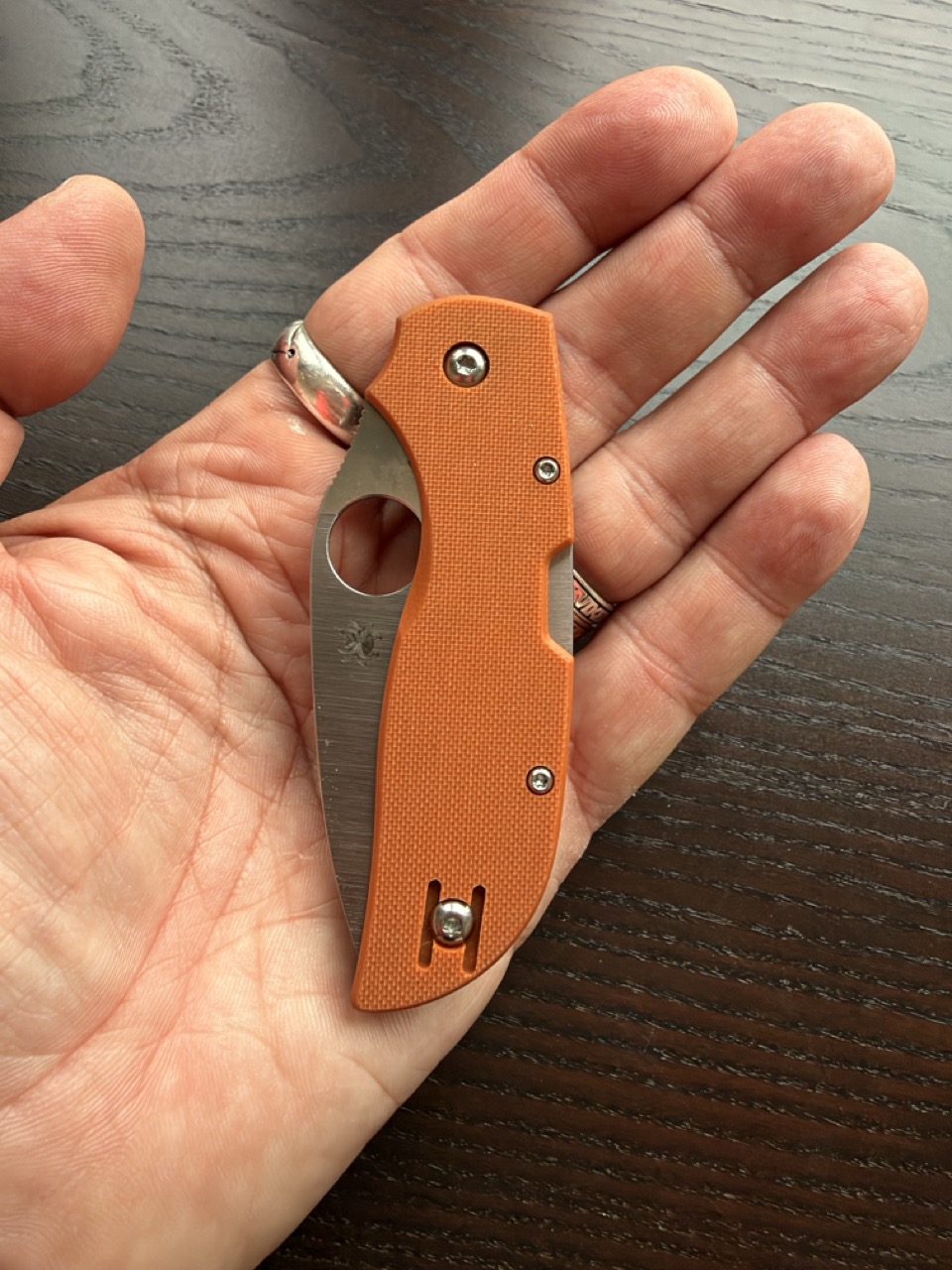
But really, compared with the other Chaparrals I’ve handled, this one feels noticeably more substantial in the hand. Its slightly rear-biased balance gives it a reassuring sense of solidity, allowing the knife to sit naturally and securely in the palm.
And then it hit me: this is my very first G10 Chaparral!
That realization actually means something, because the Chaparral Collection has always been about more than just being a great little EDC. Sal Glesser conceived the series as a platform for exploring different handle materials, rather than different locking mechanisms, which is the territory of the Spyderco Sage family. Over the years, we’ve seen Chaparrals in carbon fiber, FRN, wood, Titanium and various other materials, each bringing its own character to this remarkably slim design.
Yet somehow, until now, I’d never owned a G10 version.
And what a difference it makes! G10 has a distinctly different feel from carbon fiber or FRN. It gives a knife that unmistakable workhorse character: solid, purposeful, and ready to be used without ceremony. It’s not merely about appearance or exclusivity; it’s about the way the knife feels when you put it to work.
This Chaparral isn’t a gentleman’s knife designed to sit pretty in a collection. It’s a performance-oriented EDC, built around an exceptionally thin blade and one of the most extreme edge-retention steels available today. The other Chaparral oriented toward hard chore is the extraordinary FRN Serrated Chap.
So… Her Orange Majesty isn’t here to show off. She’s here to cut, and keep cutting, for a very long time between touch-ups.
That’s why despite its compact dimensions and lightweight construction, this Orange Chap feels remarkably robust. It has a reassuring presence that sets it apart, without sacrificing the slim profile and effortless carry.
Now I get it.
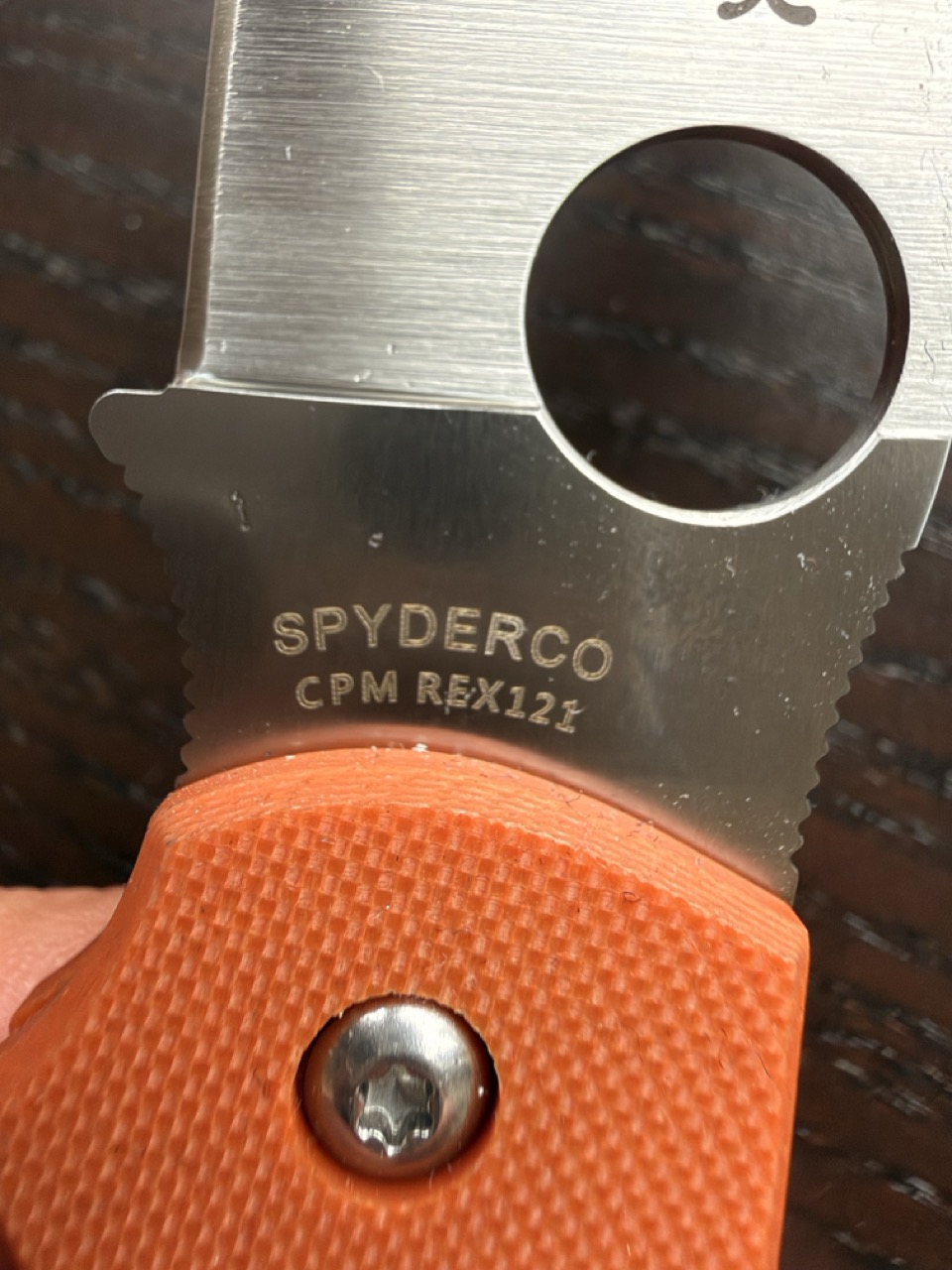
The REX 121 blade is the main attraction, naturally. Until now, the Chaparral family has relied primarily on CTS-XHP, with S30V used in the very first production run.
And here is the Tour de Force: as with every Chaparral, we’re looking at an exceptionally thin blade, measuring just 2 mm at the spine. But this time, Spyderco has paired that remarkably slim profile with one of the most wear-resistant steels available in a production knife. It’s an intriguing combination: an ultra-thin blade designed for effortless cutting, backed by a steel renowned for its extraordinary edge retention.
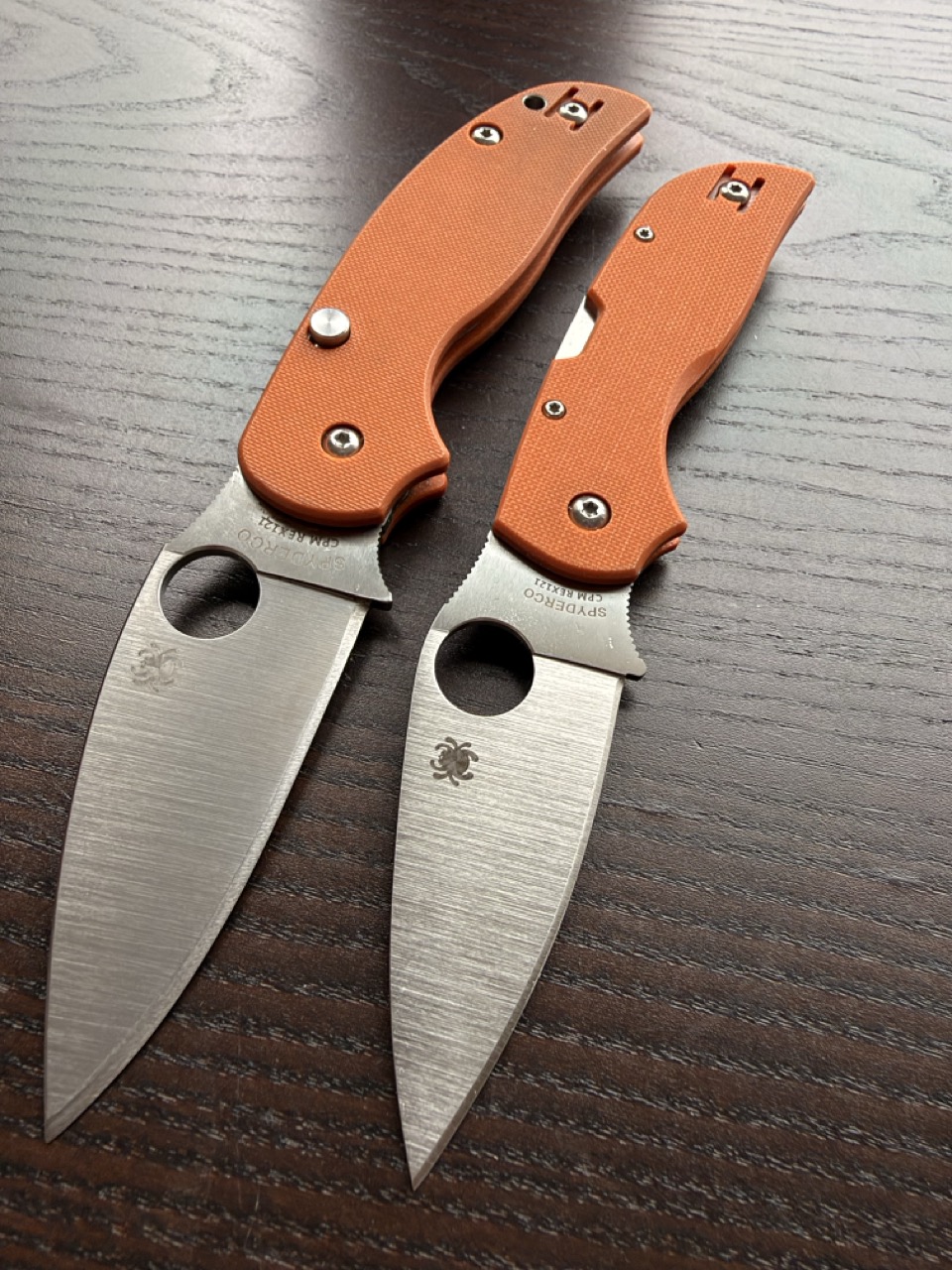
I’ve already spent considerable time testing this steel, particularly on my Spyderco Sage 6 REX 121, which I nicknamed Tango. That knife has been an interesting demonstration of what REX 121 can do in real-world use, including its remarkable ability to retain a working edge over extended periods.
So, if the Sage 6 is Tango, what should we call its smaller relative?
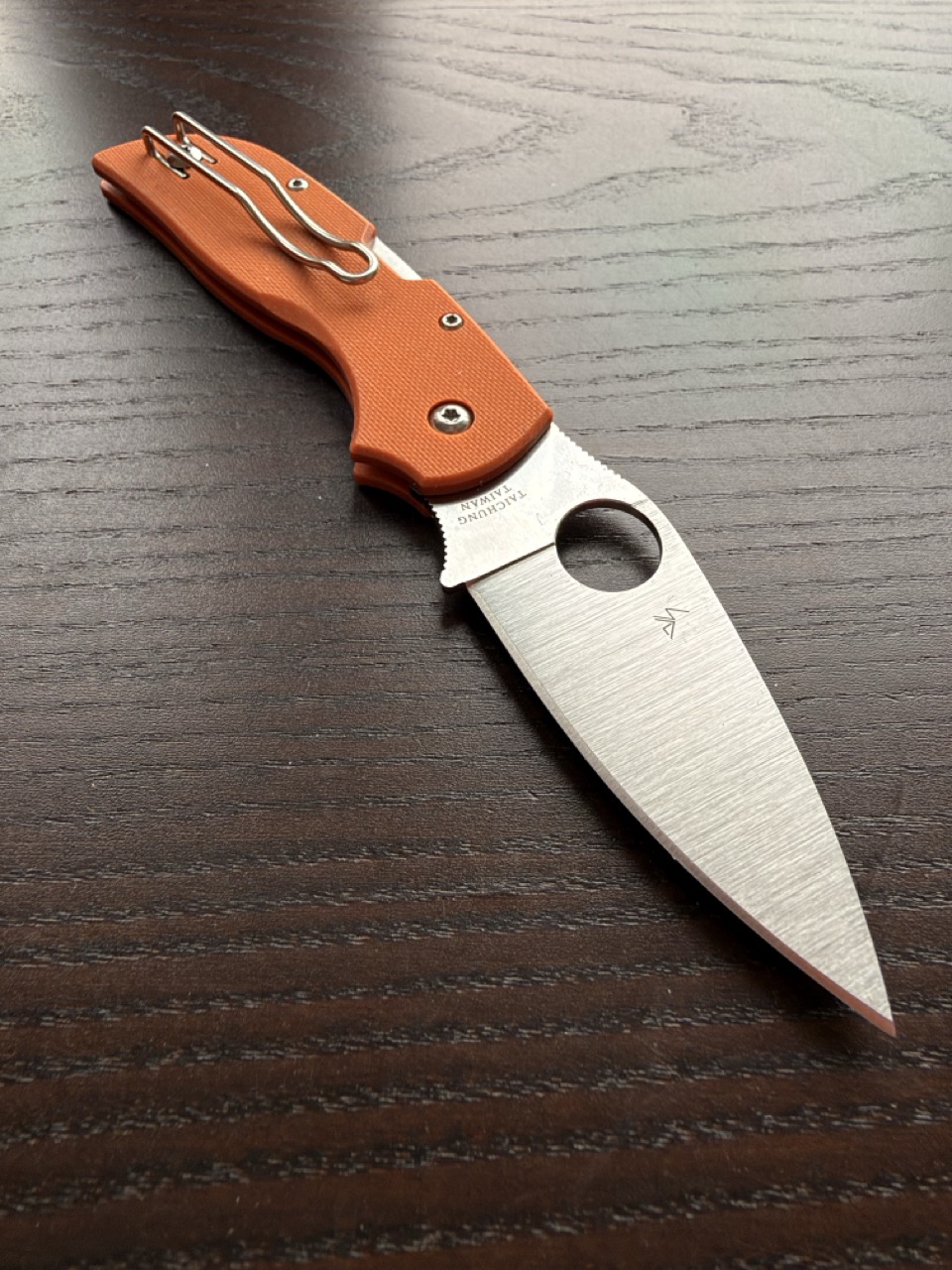
Meet Tanga! Empress Tanga ! 😀
The name seems appropriate for this smaller, more urban-oriented companion. Both knives share the same fundamental attraction: an extremely fine blade combined with a steel designed to retain its edge for an exceptionally long time.
My first cutting tests confirmed that Tanga arrived with an impressively sharp edge. It cuts like a razor, which is exactly what I want to see on a knife made from REX 121. There is little point in choosing a steel with extraordinary edge retention if the knife doesn’t cut properly in the first place. REX 121 can hold a keen edge for a very long time, but that potential needs to be matched by good factory sharpening and an appropriate edge geometry.
So far, so good.
There is, however, one aspect I wanted to investigate immediately: the relationship between the extremely thin blade and the relatively brittle nature of that steel !
At about 70HRC, the über hard REX 121 excels at wear resistance, but it is not a steel I would choose for applications involving substantial lateral stress or twisting. Its impressive edge retention does not make it immune to chipping or other damage when subjected to inappropriate forces. With a blade only 2 mm thick, this was worth checking before putting the knife into regular use.
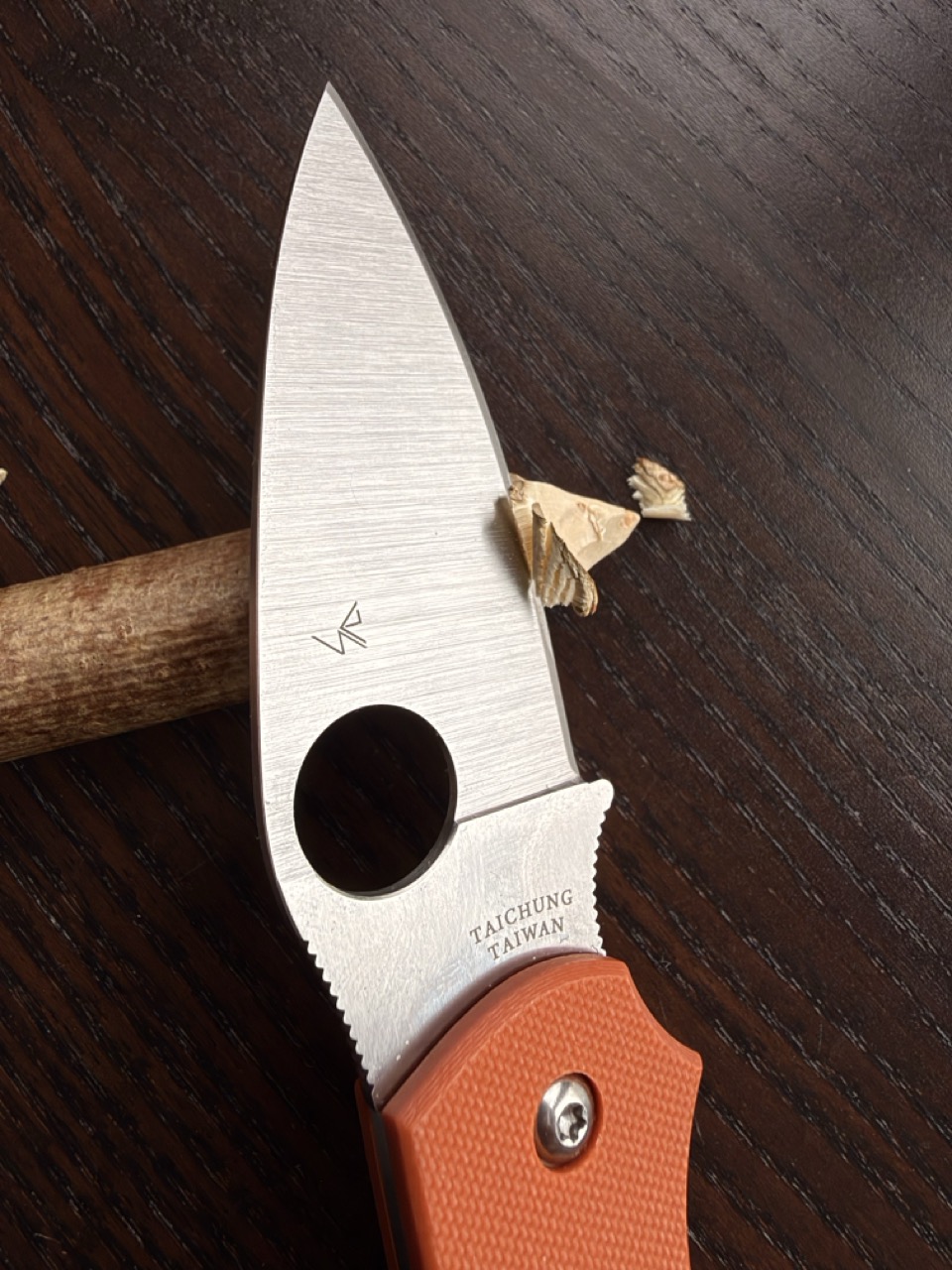
For now, I wouldn’t feel comfortable using Tanga to carve wood by twisting the blade to remove shavings. I simply don’t have that level of confidence in its resistance to lateral stress, especially given the combination of a 2 mm blade and REX 121 steel. Its extraordinary edge retention is one thing; its resistance to lateral forces is another. Until I’ve gained more experience with this particular knife, I’ll stick to cutting tasks that don’t put the blade under unnecessary lateral stress.
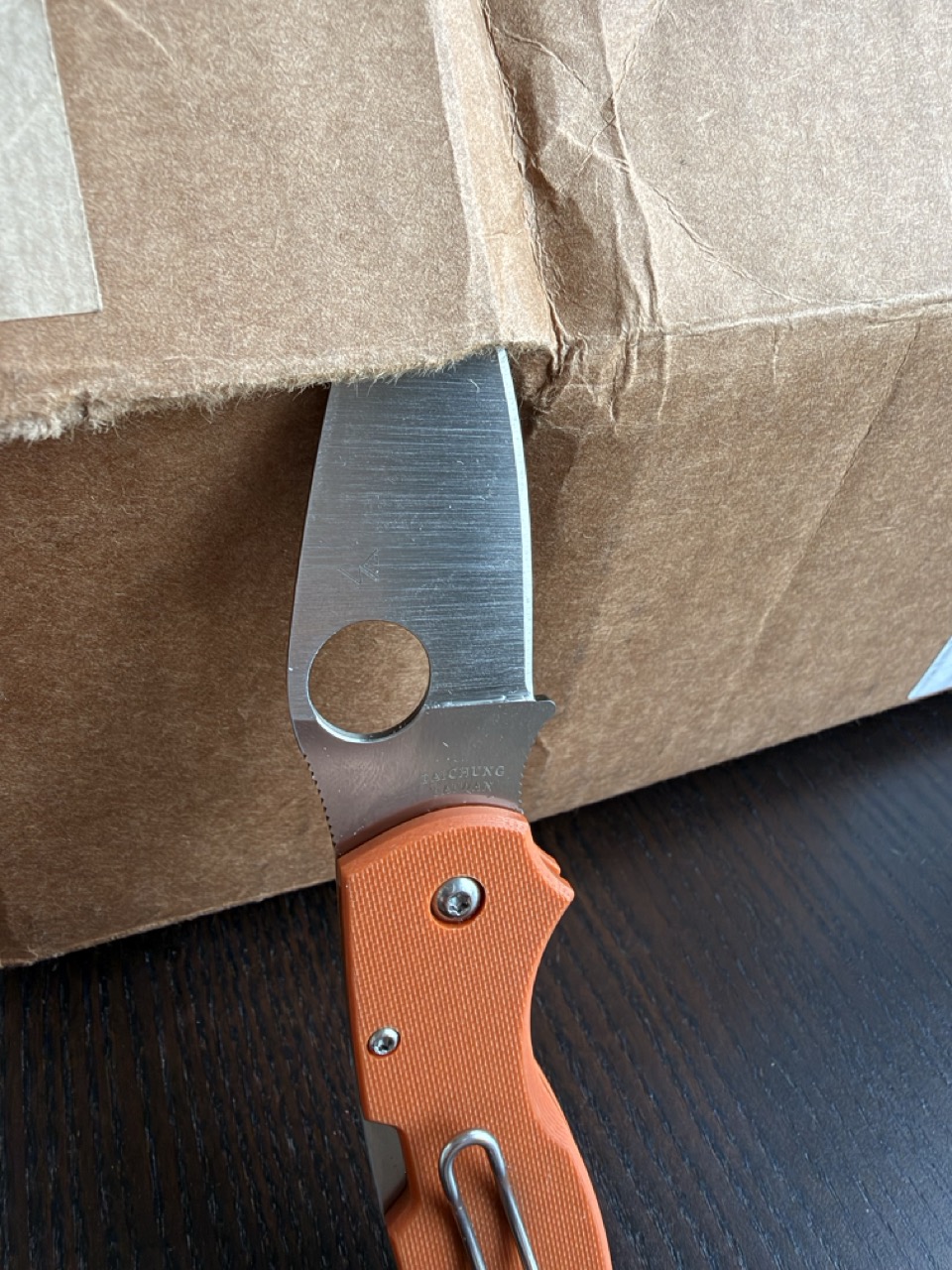
I’ll feel much more comfortable using Tanga for long cuts through corrugated cardboard, for example. The exceptionally thin blade should slice through it with very little resistance, making it ideal for breaking down cardboard boxes into smaller pieces before recycling them. This is exactly the kind of task where the combination of an ultra-thin blade and REX 121’s outstanding edge retention should really shine.
For an initial, informal test, I used the knife to cut through the bottom of a Coca-Cola plastic bottle. The purpose was to assess the factory edge geometry, straight out of the box, independently of the steel itself. Regardless of whether a blade is made from REX 121 or any other steel, its immediate cutting performance depends heavily on the geometry of the edge. We already know that the blade is exceptionally thin, but what about the edge angle? That’s what I wanted to find out.
This is not a comprehensive toughness test, nor does it establish how the knife would perform under more demanding conditions. It was simply a practical way to get an initial feel for the blade’s behavior in hard materials.
I used a pure push cut, driving the blade straight through the plastic without any sawing motion. This is a demanding test of edge geometry, as the blade has to penetrate the material through direct pressure alone.
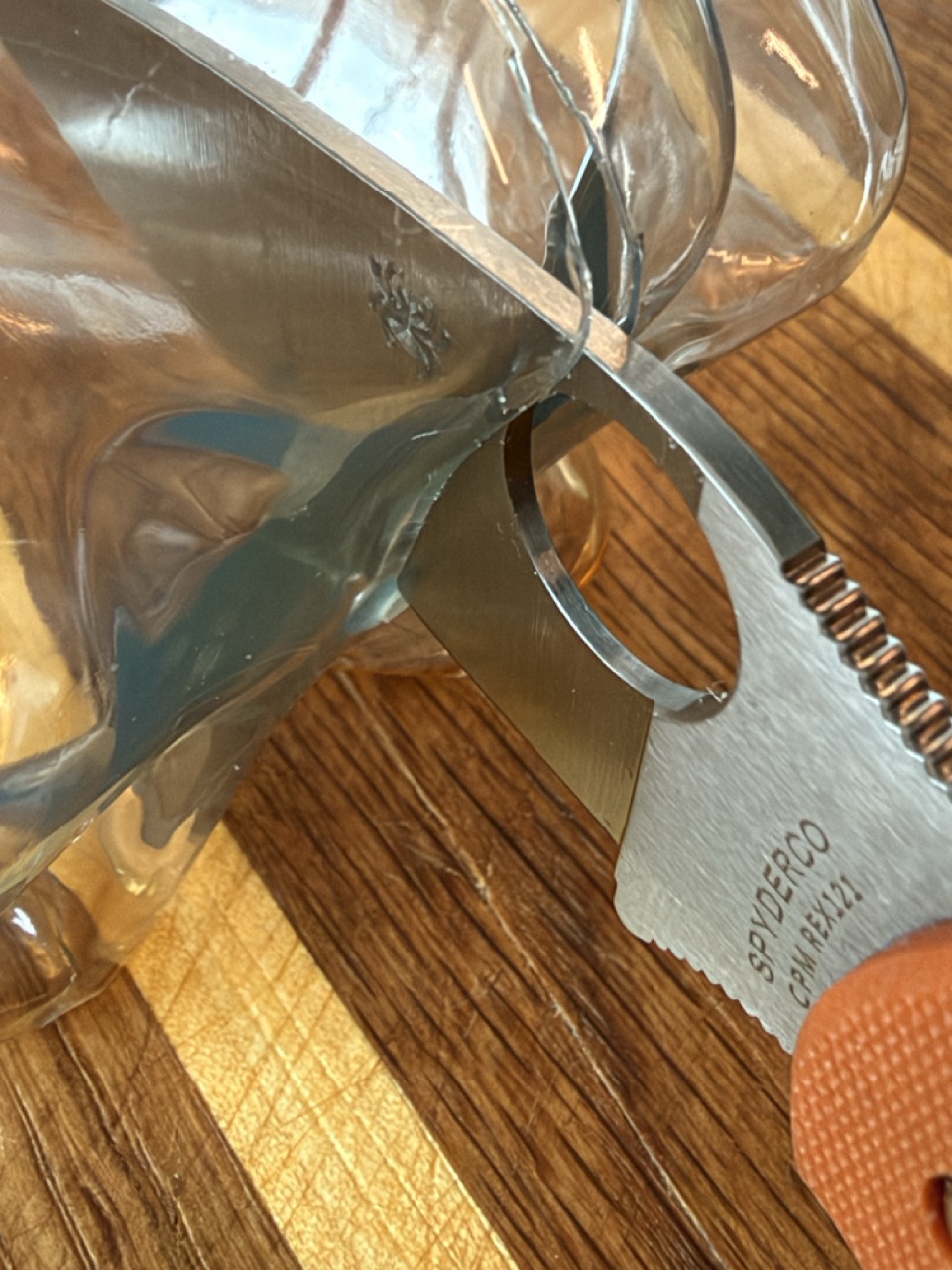
You have to keep in mind that this is a surprisingly tricky cutting task. The base of a plastic bottle tends to collapse under pressure, and while the blade may initially cut through the material, getting through the thicker central section can be considerably more difficult.
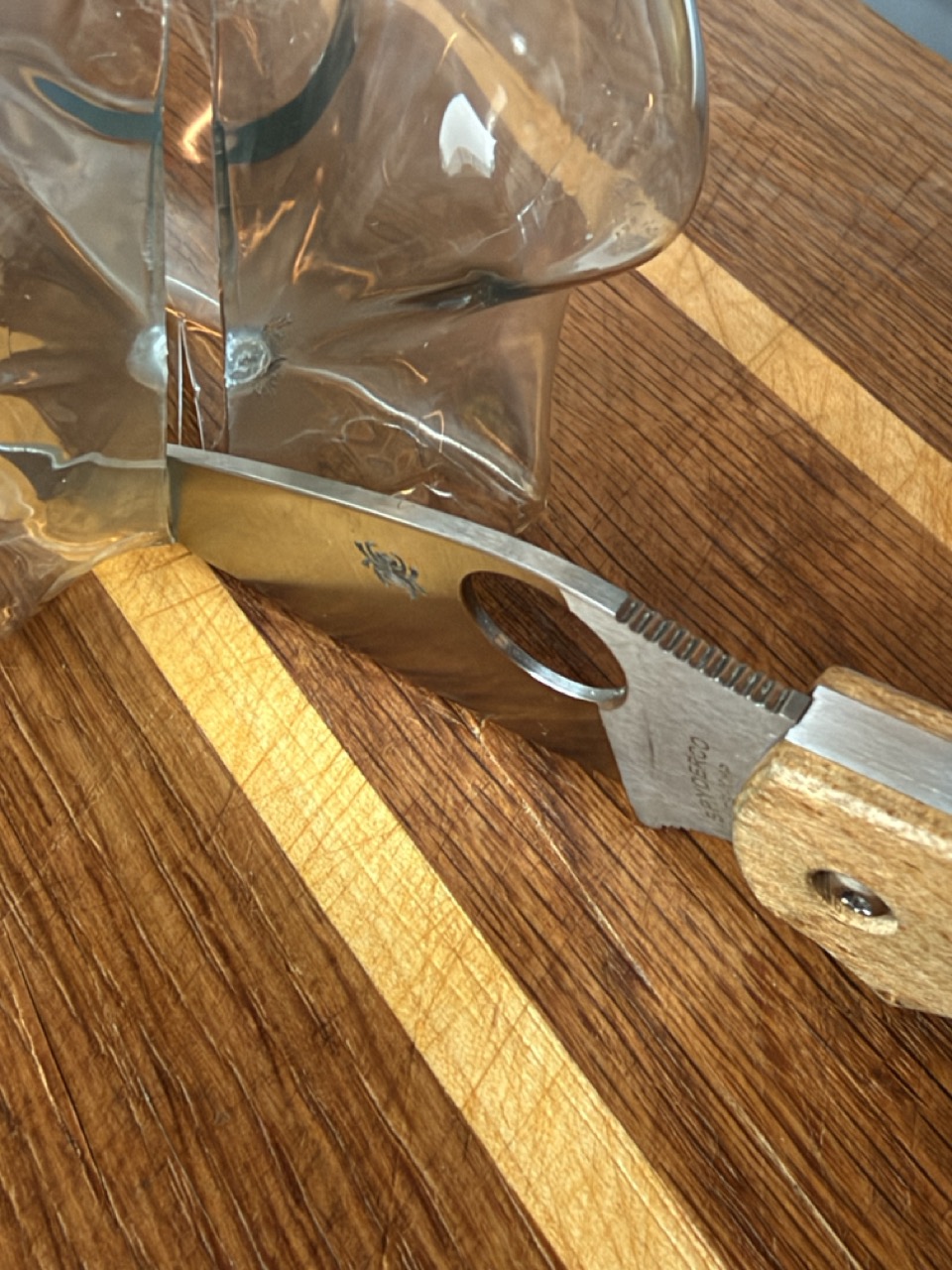
That’s exactly where Tanga got stuck. The blade made its way through the plastic but stalled at the thickest part in the centre. I decided not to push any further. This knife had only just come out of the box, and I would have been rather annoyed with myself if I’d damaged the edge during such an early test.
Interestingly, its little sister, the Chaparral Slipjoint, managed to get through the same obstacle. Another thin-bladed knife I’ve recently tested, the Jess Horn, also performed better in this test. This suggests that there may be a difference in edge geometry between those knives, with Tanga possibly sporting a more obtuse factory edge. Perhaps Spyderco opted for this geometry as a precaution against edge chipping, given the characteristics of REX 121 ? I don’t know.
However, my experience with REX121 suggests that it can handle a much thinner edge and a finer edge angle. When I refined the edge on my Sage 6 REX 121, following the same general approach Sal Glesser had taken with his own Sage 6, I found that the steel could perform very well with a more acute geometry. No chipping at all !
This first test has raised an interesting question: has Spyderco prioritized edge durability over cutting performance with its factory sharpening, or is there simply more to this particular geometry than meets the eye? That is not necessarily a disadvantage. A slightly more robust edge geometry can be a sensible choice for a steel like REX 121, particularly on such a thin blade.
I may eventually give Tanga a little attention with diamond abrasives to refine the geometry and introduce some convexity. For now, however, I’m going to leave the factory edge untouched and see how it performs in everyday use. There is no reason for me to modify an edge before giving it a fair chance.
One of the more interesting things I’ve learned while testing the Sage 6 Tango in Italy is that REX 121 can perform surprisingly well in an everyday food-cutting role, including cutting on ceramic plates. That is not a claim that ceramic contact has no effect whatsoever on an edge. Repeated contact with a hard ceramic surface can eventually affect any knife’s sharpness. But my experience with the Sage 6 has been encouraging, with no obvious premature loss of cutting performance from this type of use and no chipping !
I intend to put Tanga through the same kind of testing.
After all, a small urban folder is likely to encounter food preparation and ordinary daily cutting tasks far more often than any particularly demanding outdoor application.
If it can reproduce Tango’s performance in this respect, that will be another argument in favour of this little knife.
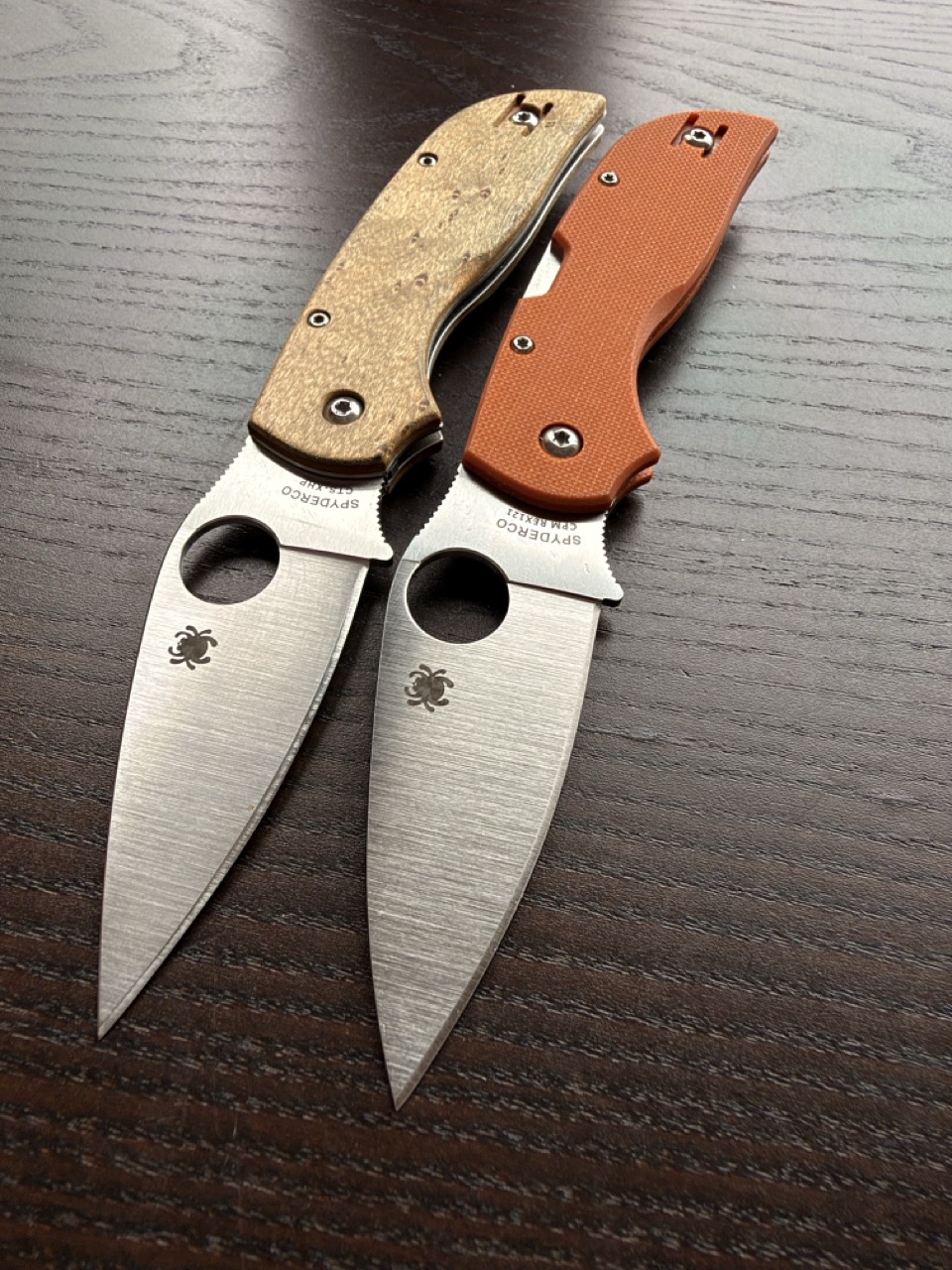
As you can see on the picture: I have deshouldered the SlipIt Chap.
The Chaparral has always made sense as a compact everyday-carry knife. Its size makes it particularly convenient when walking around town, where a larger folder can feel unnecessarily cumbersome.
That is where I intend to concentrate my testing of Tanga.
Tango, my Sage 6 REX 121, has already demonstrated that this steel can be useful well beyond purely urban environments. I see no reason why Tanga should be incapable of handling occasional outdoor tasks, provided her limitations are respected.
But her natural territory is more mundane… more urban: slipping into a pocket, handling everyday cutting jobs, and providing excellent cutting performance without taking up much space in the 5th pocket.
Over the coming weeks, I’ll be using it in precisely that way, paying attention to edge retention, cutting performance, handling, and how well the knife stands up to the routine demands of everyday life.
The real test is not how impressive a knife feels on the first day. It is how well it continues to perform after weeks of use.
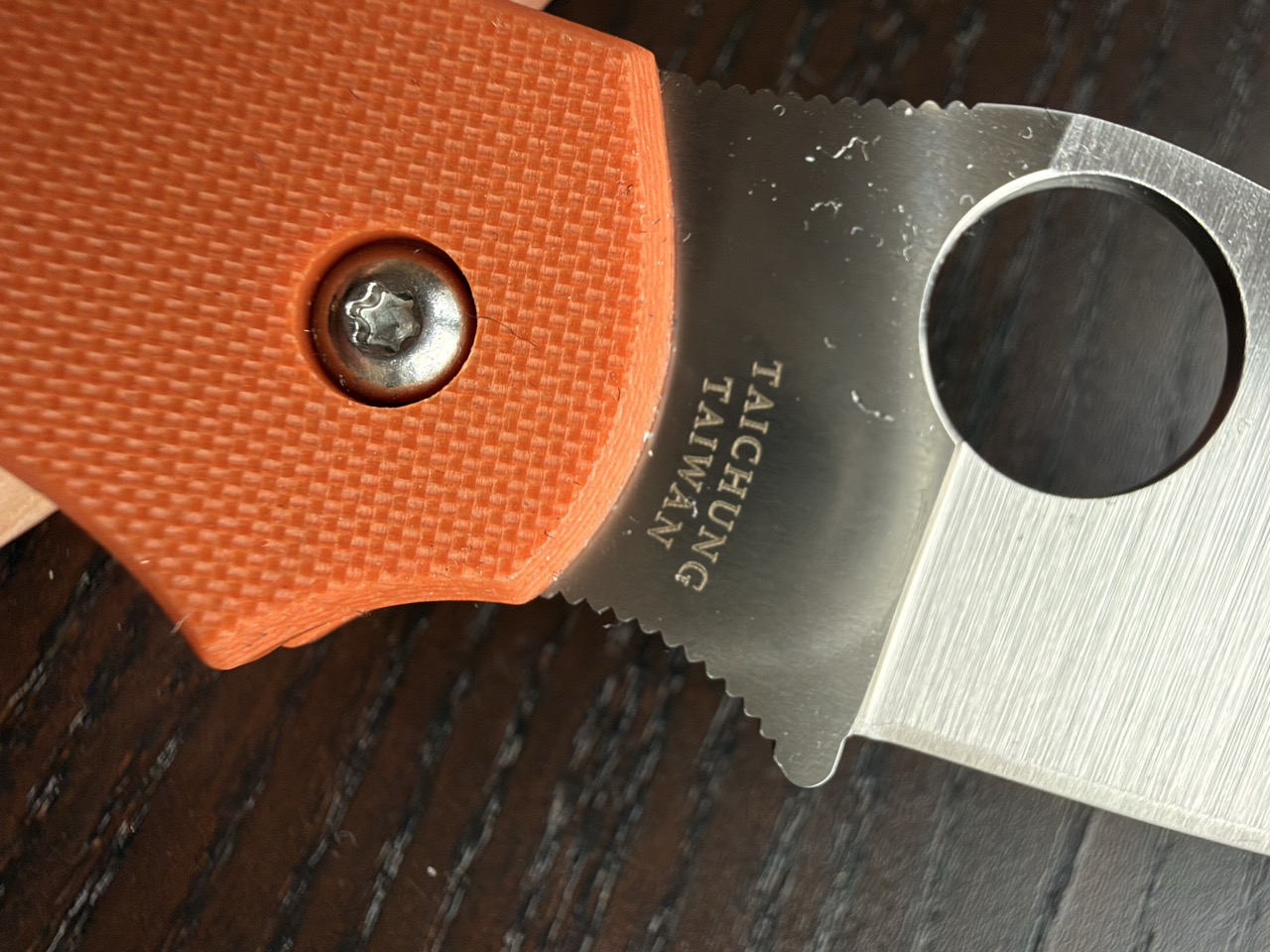
There is another detail worth mentioning: the Chaparral’s construction. Spyderco’s hidden pin construction helps prevent vertical blade play, contributing to the sense of rigidity that makes this design feel more substantial than its size would suggest.
There is just one small detail I may address before carrying Tanga regularly: G10 provides excellent grip, but its slightly abrasive texture can sometimes wear against pocket fabric over time. I may gently smooth the area around the clip with fine sandpaper to reduce that risk. This is a minor precaution rather than a criticism of the knife itself.
Otherwise, Tanga is ready to go.
My first encounter with the Spyderco Chaparral REX 121 has been extremely positive. The action is superb, the fit and finish are excellent, the blade is razor sharp, and the knife feels unexpectedly solid for something so compact and thin. The factory edge geometry may deserve some attention in the future, but I’m in no hurry to change it. First, I want to see how it performs as delivered.
So let’s see whether the empress can live up to her family name.
To be continued.