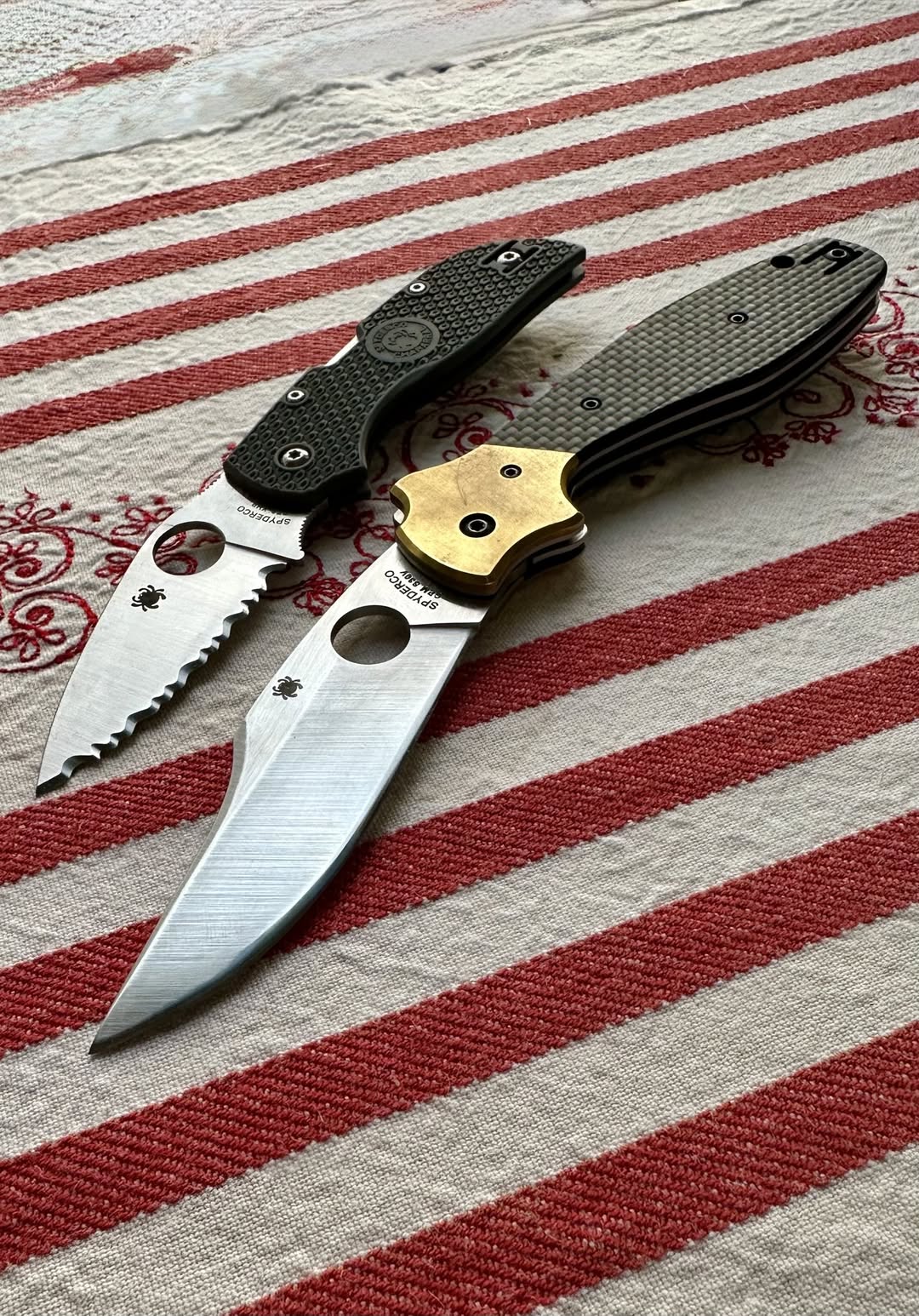
Ten years, and counting…
A decade. How time flies, huh ? That’s how long Ed Schempp’s Bowie has been part of my life. Ten years since it first review and a decade of regular pocket carry, countless cutting tasks, meals prepared, packages opened, and all those little everyday jobs that never make it into a knife review.
I own older knives, too. Honor, my Chris Reeve Sebenza, for example, has been with me for years. But Ed’s Spyderco C190CF Schempp Bowie holds a special place in my heart. Some knives earn your respect through their engineering, others through their history. And then there are those that, for reasons you can’t always explain, become part of your life. The Schempp Bowie is one of those knives for me. And you know what? It has never let me down. Not once.
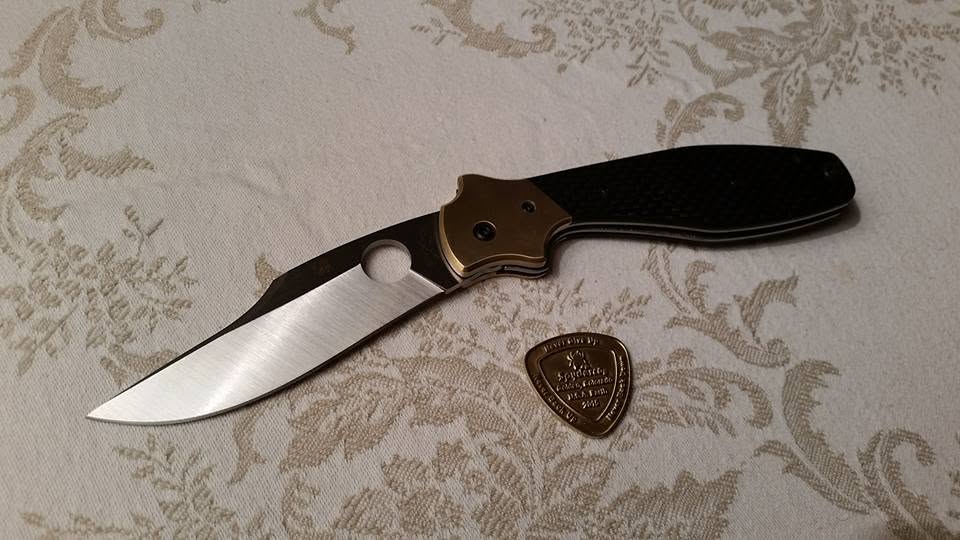
I first wrote about this beautiful folding Bowie back in January 2016, in Pocket Legends of the Fall feat. Spyderco Schempp Bowie. Later, I took it to Tuscany, where it proved that a knife with such a distinctive silhouette could be just as comfortable around the dinner table as it was doing the less glamorous jobs of everyday life. Back then, I already knew I was dealing with something special.
Today, after ten years of ownership, I can tell you that my first impressions were not mistaken.
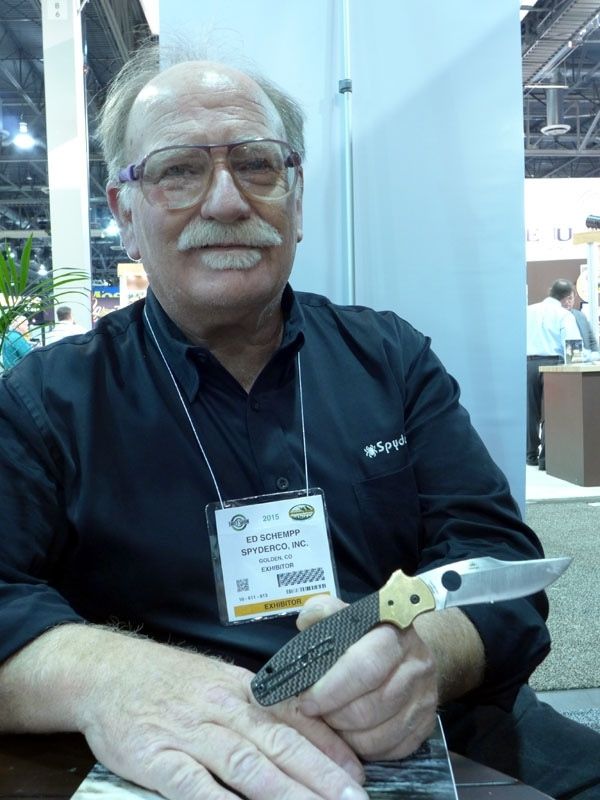
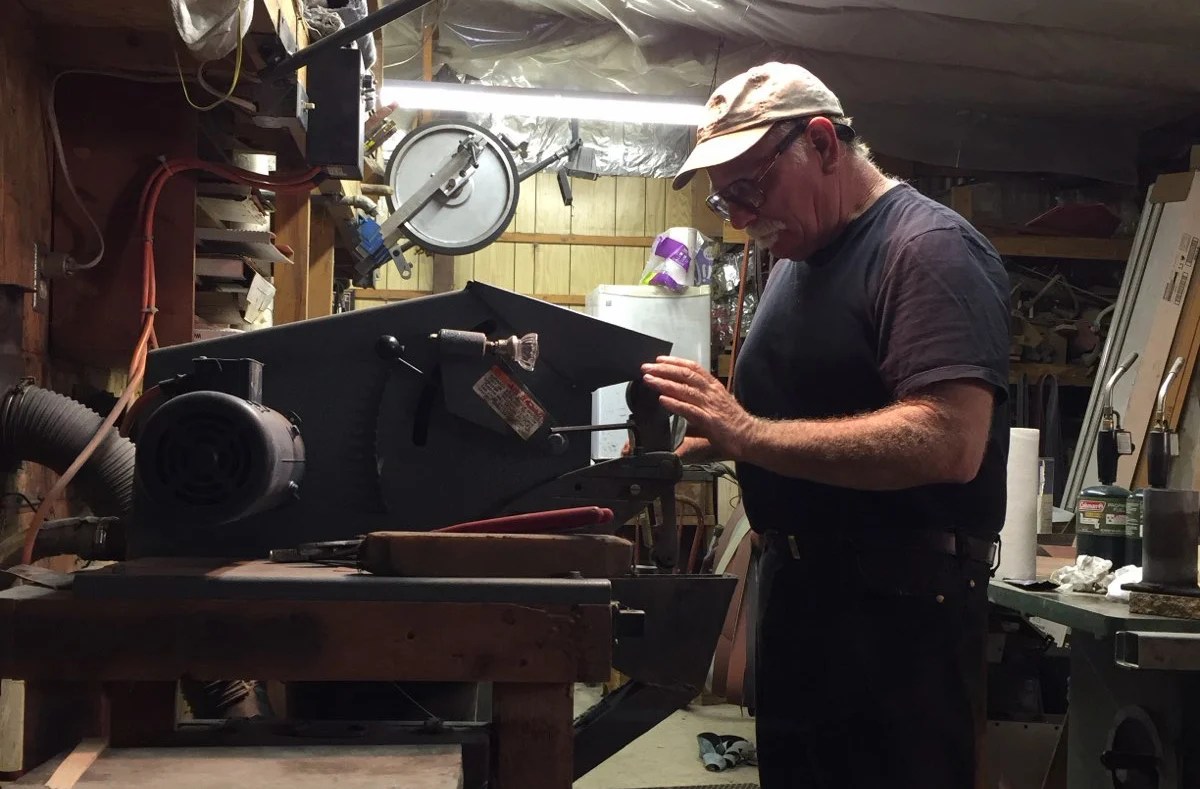
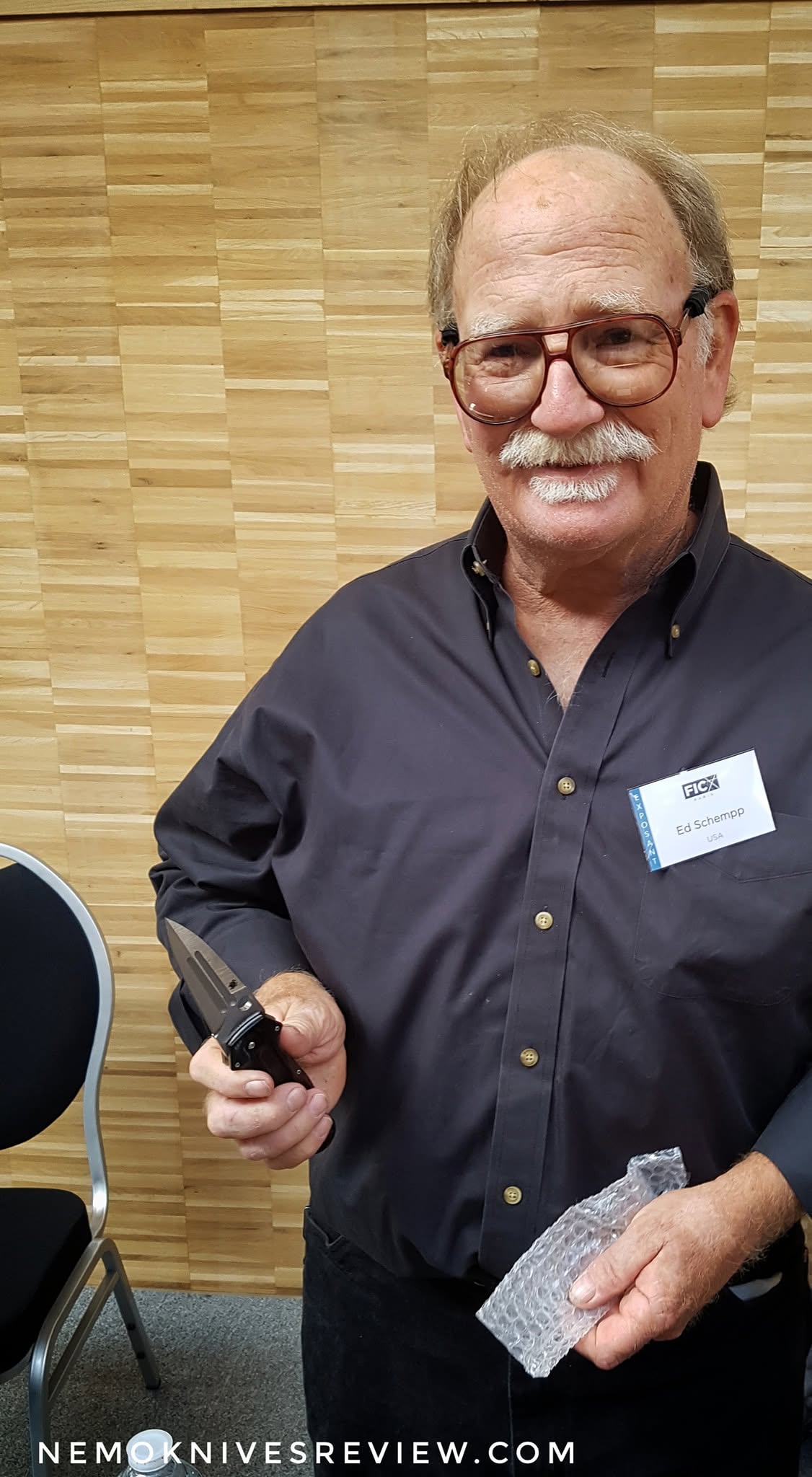
Ed presenting his new folder in 2015 (credits: Photo from https://www.candlepowerforums.com/threads/knife-review-the-spyderco-schempp-bowie-3-7-blade-–-cpm-s30v.406083/)
But here’s the funny thing: Ed himself has been putting his Bowie to work every day for a decade, too! So, when you own this knife, you’re carrying the EDC of a legendary knifemaker.
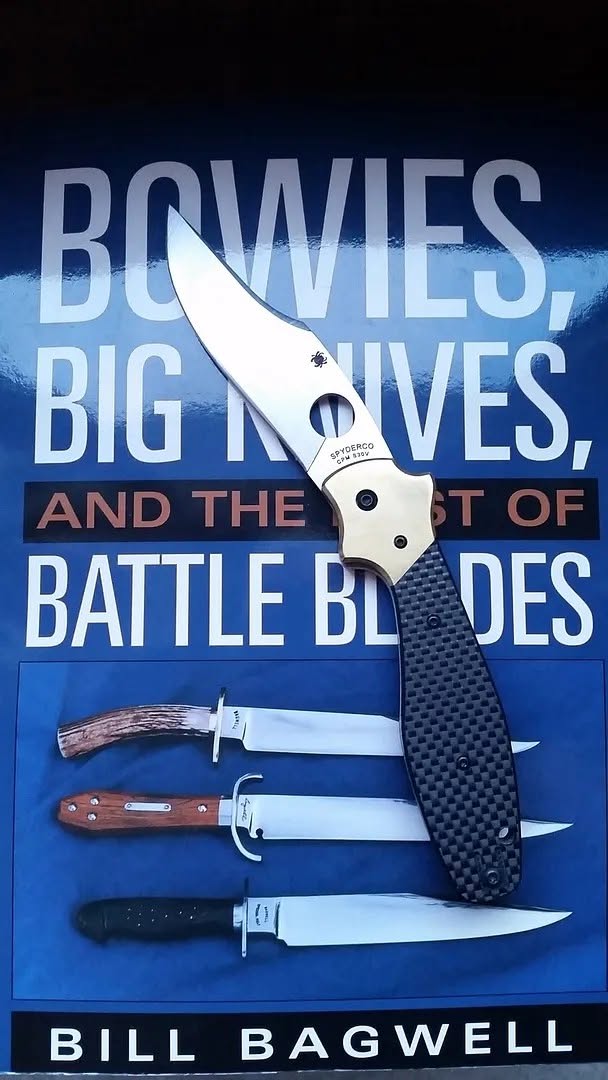
Ed’s own Spyderco Bowie lives on his ranch and accompanies him through everyday life. His has picked up deeper wear marks than mine, but that’s hardly surprising. Ed is a man who makes things, repairs things, builds things, and puts his tools to work. His personal Bowie looks like it has lived a little harder than mine… and that’s exactly how it should be. These are knives to be used, not locked away in a display case.
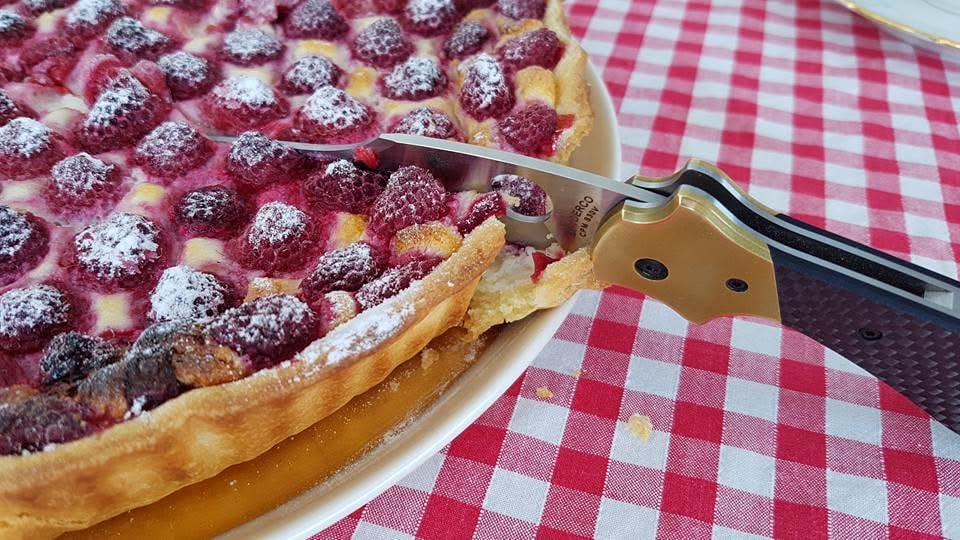
Mine has been treated with somewhat more consideration, perhaps, but make no mistake: neither knife is a safe queen.
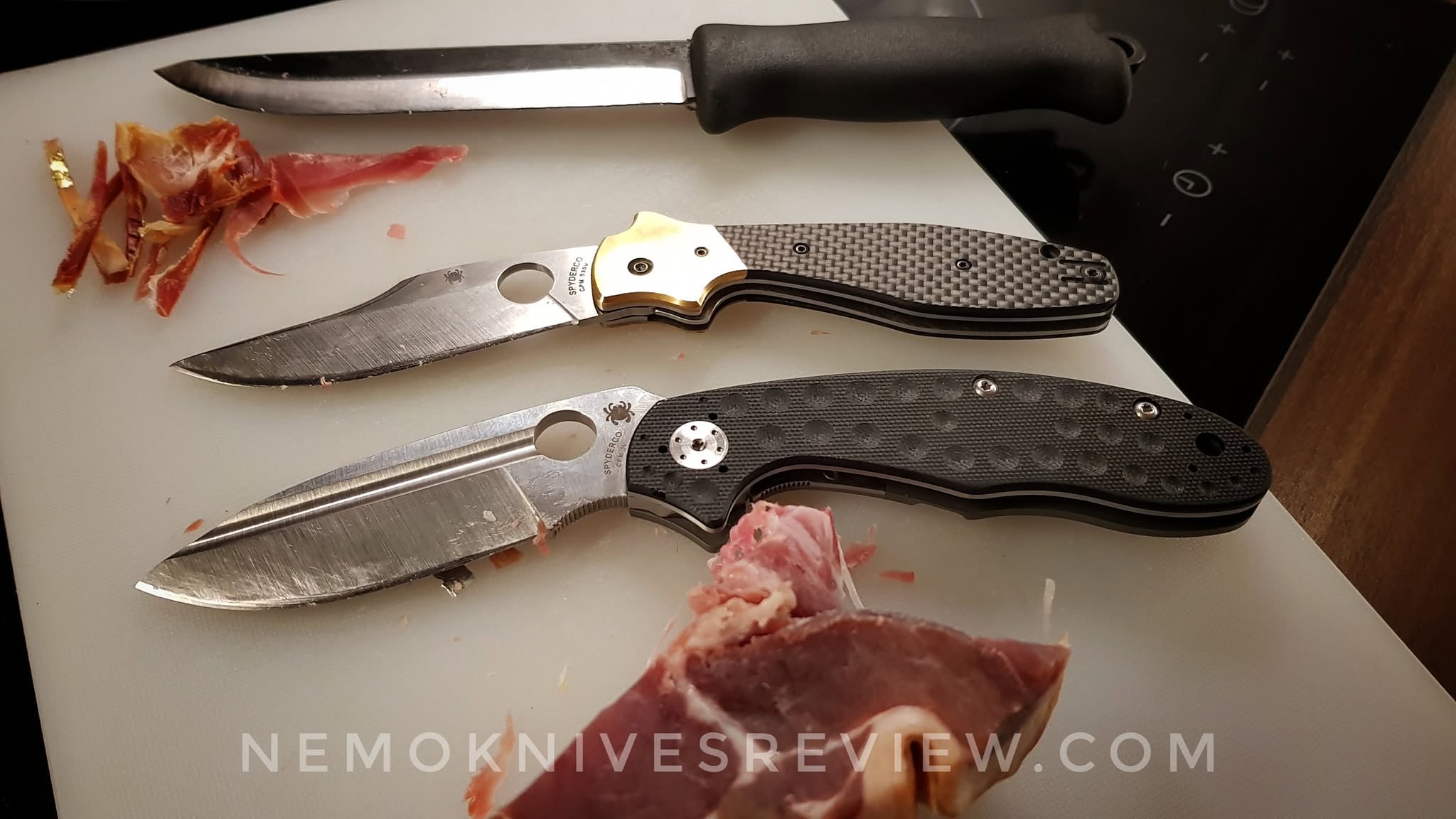
Ed Schempp’s are knives to live with.
Taichung: where craftsmanship meets obsession
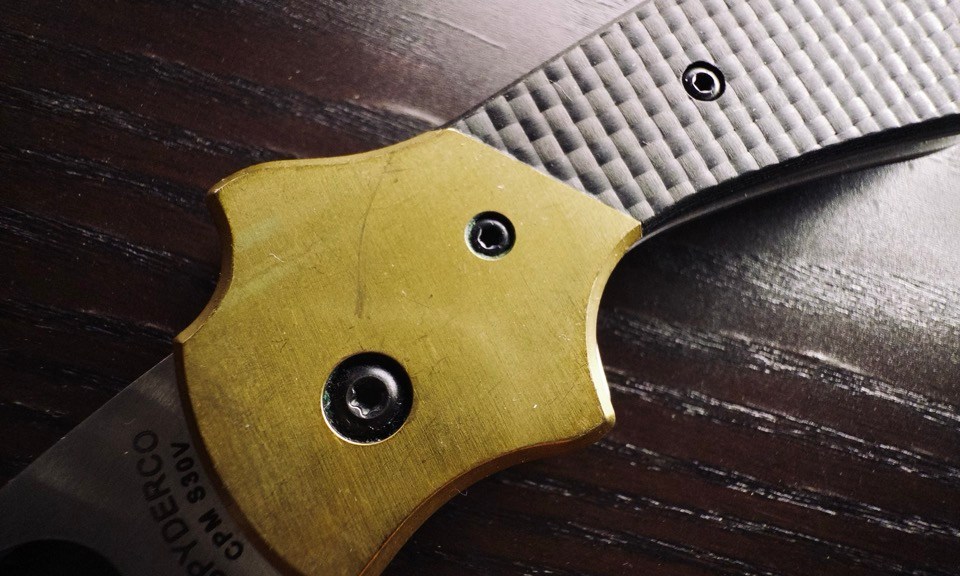
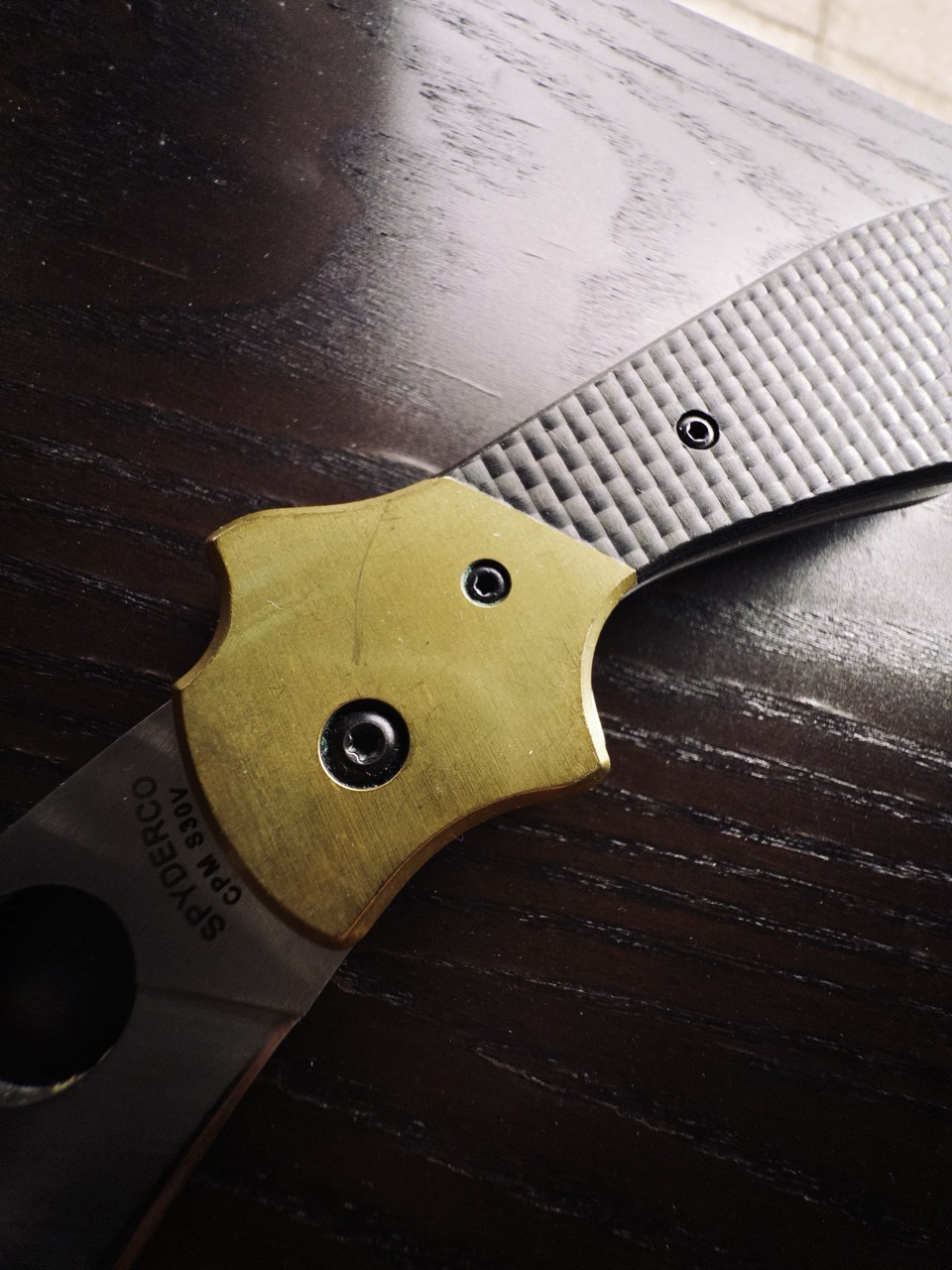
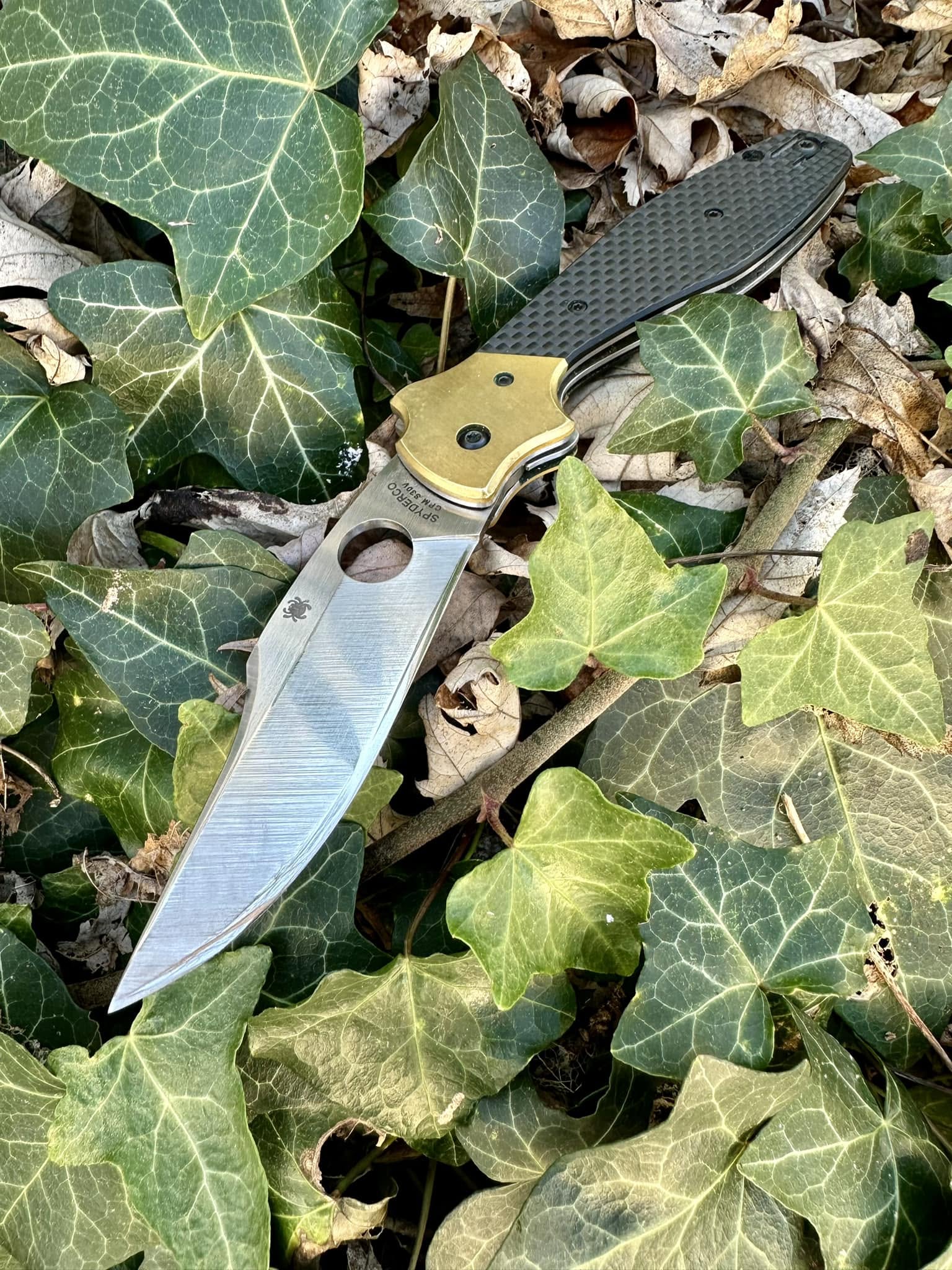
There is something I admired from the very beginning, and something that has become even more impressive with time. The work performed by Spyderco’s Taichung factory on the junction between the carbon-fiber scales and the brass bolsters.
Look at it. Then run your fingers over it. The transition is so beautifully executed that your eyes and fingertips tell you the same story. There are no crude edges, no unpleasant transitions, no little manufacturing sins that reveal themselves only after a few months of handling.
It is a remarkably clean piece of work.
Manufacturing a knife with this level of fit and finish is one thing. Maintaining that precision in a production knife, at a price that remains within reach of ordinary enthusiasts, is quite another.
« My brother in law is a cowboy action shooter. I wanted to redo the primary scale for a special knife for him to carry at shoots. I removed the bolster and scale on one side of the knife. The scale is dovetailed under the bolster so both parts had to be removed. Besides the two screws holding the bolster onto the knife there were also two 3mm shoulder pins pressed into the liners. These pins positioned the bolsters to the scales perfectly. There were two 3mm shoulder studs pressed into the carbon fiber scales that fit precisely into holes in the liners, besides the 3 screws holding the scale in place. This knife exceeds most methods of custom knife production, by far. I’m proud to have my name on this knife…Take Care…Ed Schempp P.S. It will take me awhile to do the scale replacement, I’d like to do it at the standard it was produced. »
Ed on Bladeforums February the 15th 2016.
And after a decade? Nothing has moved. The carbon-fiber scales remain intact. There is no separation, no loosening, no unpleasant surprise waiting for me after all these years. The fit between the scales and the bolsters remains as satisfying as it was when the knife was new. This is the kind of craftsmanship that does not need a marketing department to explain itself. You simply pick up the knife, even the one used for ten years, and look at it again…
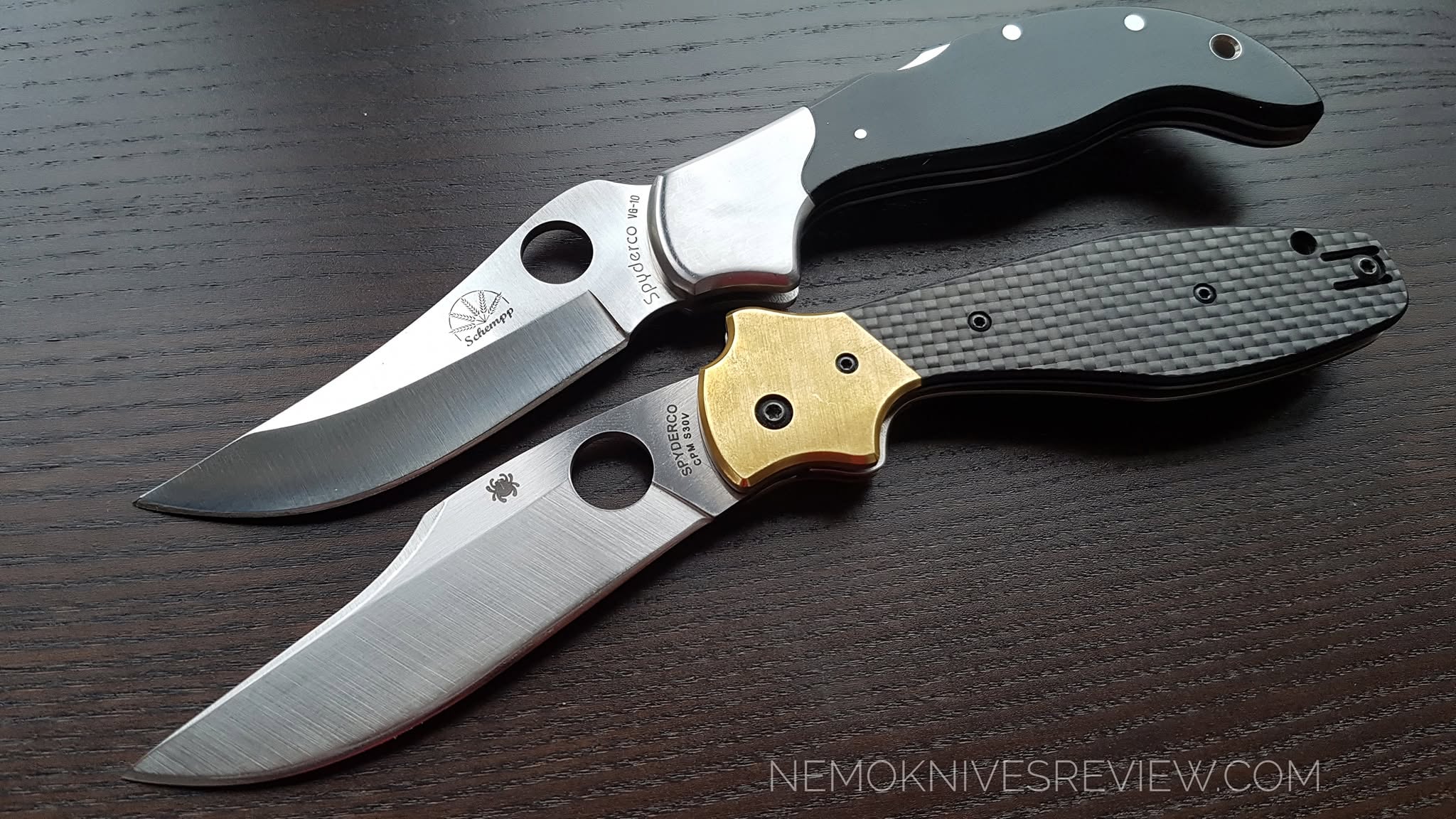
Ed told me on his goal was to create a knife that, despite its generous blade length, would ride in the pocket like a much smaller folder. The design had to be compact and comfortable to carry, without sacrificing cutting performance.
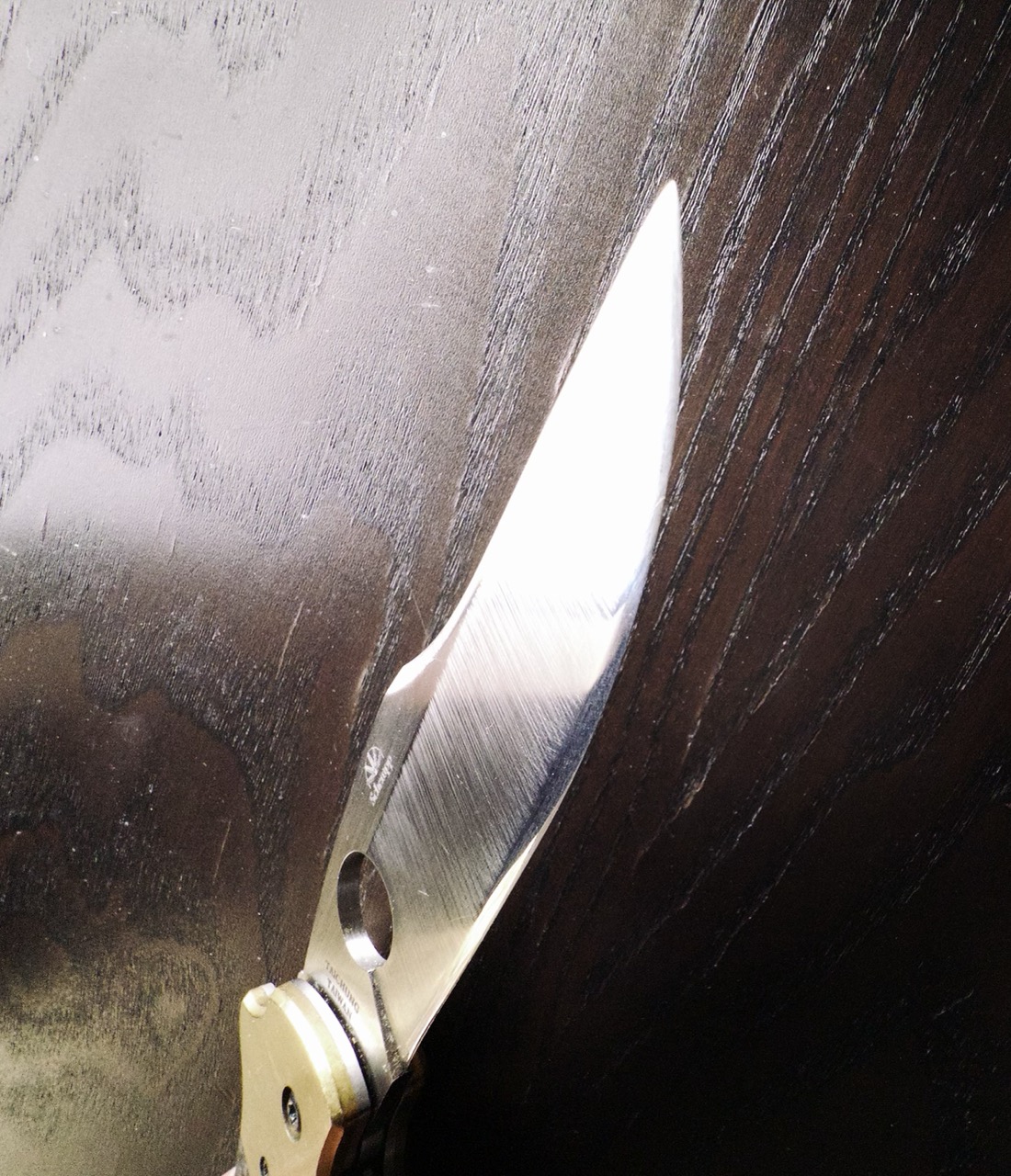
The Bowie combines a substantial cutting edge with a relatively thin blade stock of approximately 2.5 mm. Its full-flat grind makes excellent use of that geometry, delivering the cutting performance that remains one of its strongest arguments.
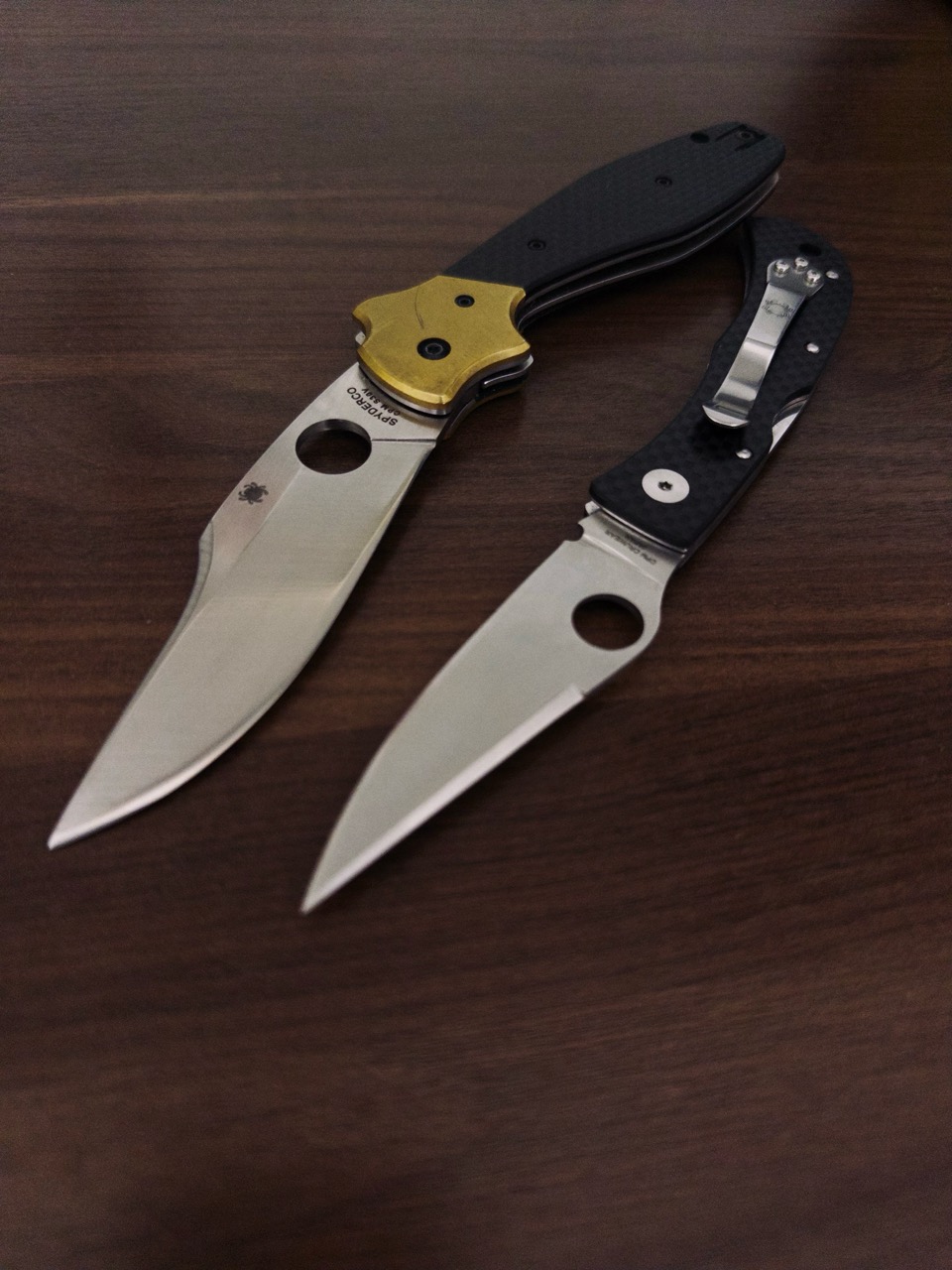
The lack of a choil gives you more usable edge length, much like on my Jess Horn. You get more cutting edge out of the same overall blade length, without sacrificing the clean lines of the design.
It is a long blade in a surprisingly manageable package. And it cuts. Not because it needs to be aggressively marketed as a cutting machine, but because its ergos and geometry doe the talking.
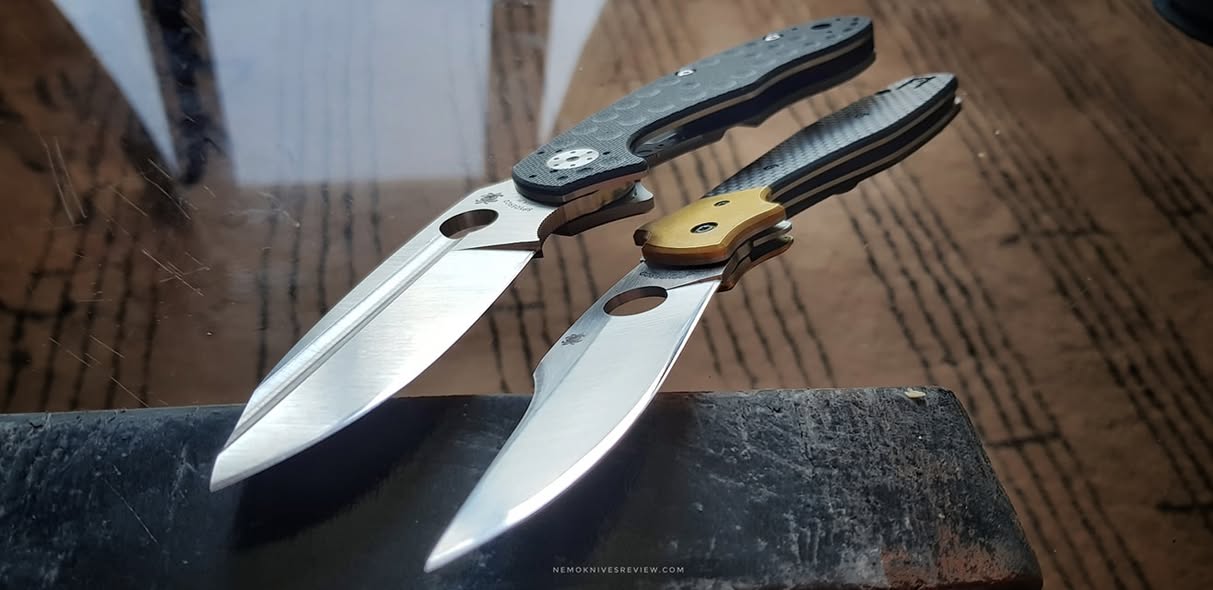
Over the years, I have also given my blade a convex reprofile. This is as usual a very personal modification rather than a factory specification, but it suits the knife beautifully. Maintaining it on a leather strop is an absolute pleasure. A few passes, a little attention, and the edge comes back to life without requiring an elaborate sharpening ritual. The convex profile has become part of the way I live with this knife.
Of course, this is not a claim that a convex edge is universally superior. Different geometries suit different jobs, and the original full-flat grind already gives the Schempp Bowie excellent cutting credentials.
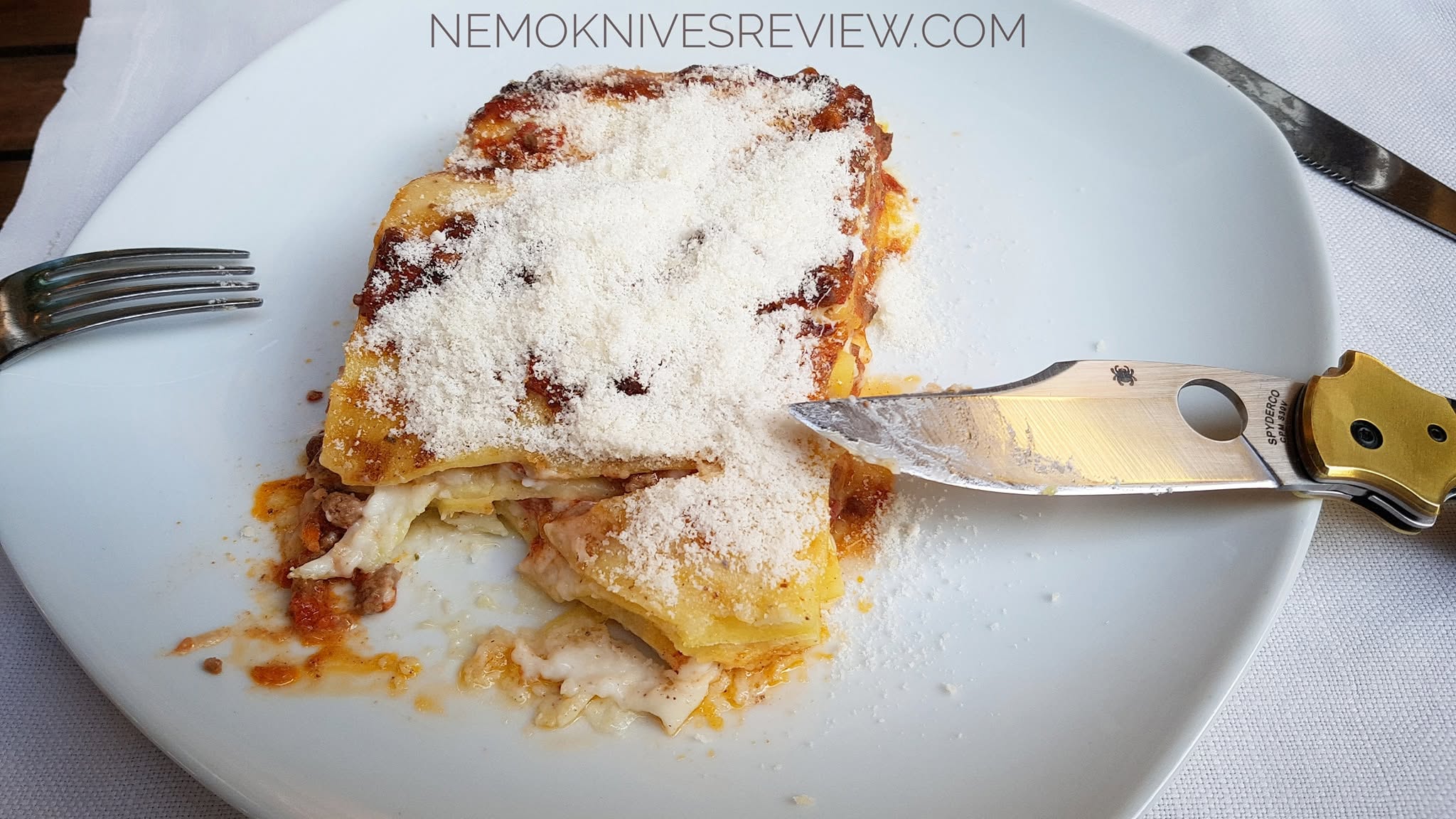
But for my own use, this combination works wonderfully. And the blade itself? Still perfectly centred. No corrosion whatsoever on my example. After ten years of regular carry, that is worth mentioning.
The CPM S30V blade has aged gracefully, although I would not attribute its condition to the steel alone. Regular use, sensible maintenance, and the conditions in which a knife is carried all matter.
Still, there is something deeply satisfying about opening a knife you have owned for a decade and finding that it remains exactly where it should be.
Let’s talk about the lock. Michael Walker’s liner lock may no longer be the most fashionable choice, but it was all the rage at the turn of the century, when tactical folders exploded in popularity. Think of the knives from Bob Terzuola or Ernest Emerson, among others. The titanium liner lock was practically synonymous with the modern tactical folder, and for good reason: it was simple, effective, and allowed for slim, lightweight designs without compromising on strength when properly executed.
The Bowie lockbar is made of stainless steel, not titanium. And after all these years, it shows no significant wear. Some of my titanium liner-lock folders (AFCK), on the other hand, have reached the end of their useful life due to lockbar wear. Using a steel liner has made all the difference.
Ten years later, the action remains one of those small pleasures that are difficult to quantify in any specification sheet. Silky smoothness makes you appreciate the quality of the underlying construction.
It is Ed Schempp’s interpretation of the folding Bowie, and that interpretation makes a difference.
The blade’s angle and curvature give the knife that particular feel in the hand. The handle seems to settle naturally into the palm, while the geometry provides a satisfying combination of control and leverage during cutting.
The result is a knife that feels comfortable and powerful without needing to be oversized.
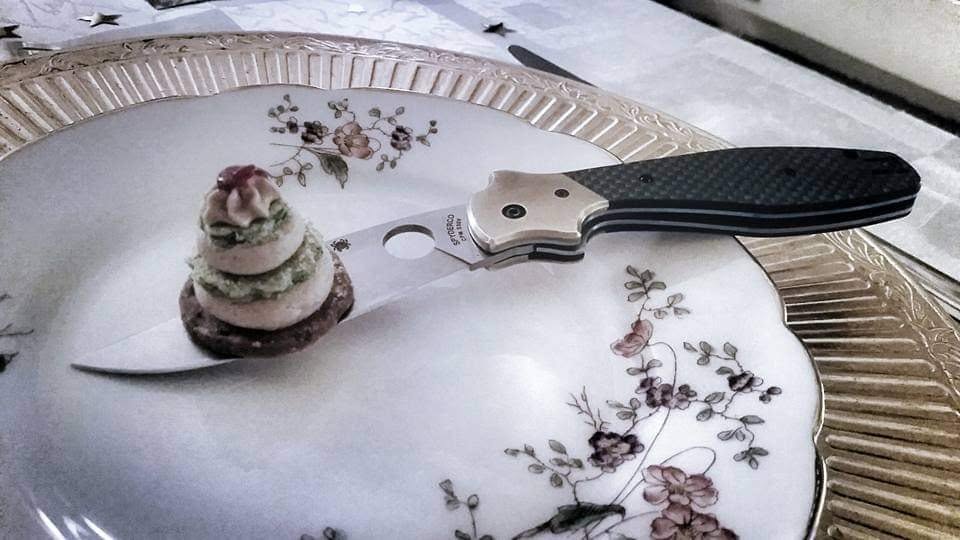
Ed’s Bowie manages to combine a distinctive visual identity—that of a gentleman’s knife—with genuine utility at its heart. His designs have strong personalities, but that personality is never merely decorative. Every curve, every angle, every detail serves a purpose. They are unmistakably Ed Schempp’s designs, but first and foremost, they are tools meant to be used.
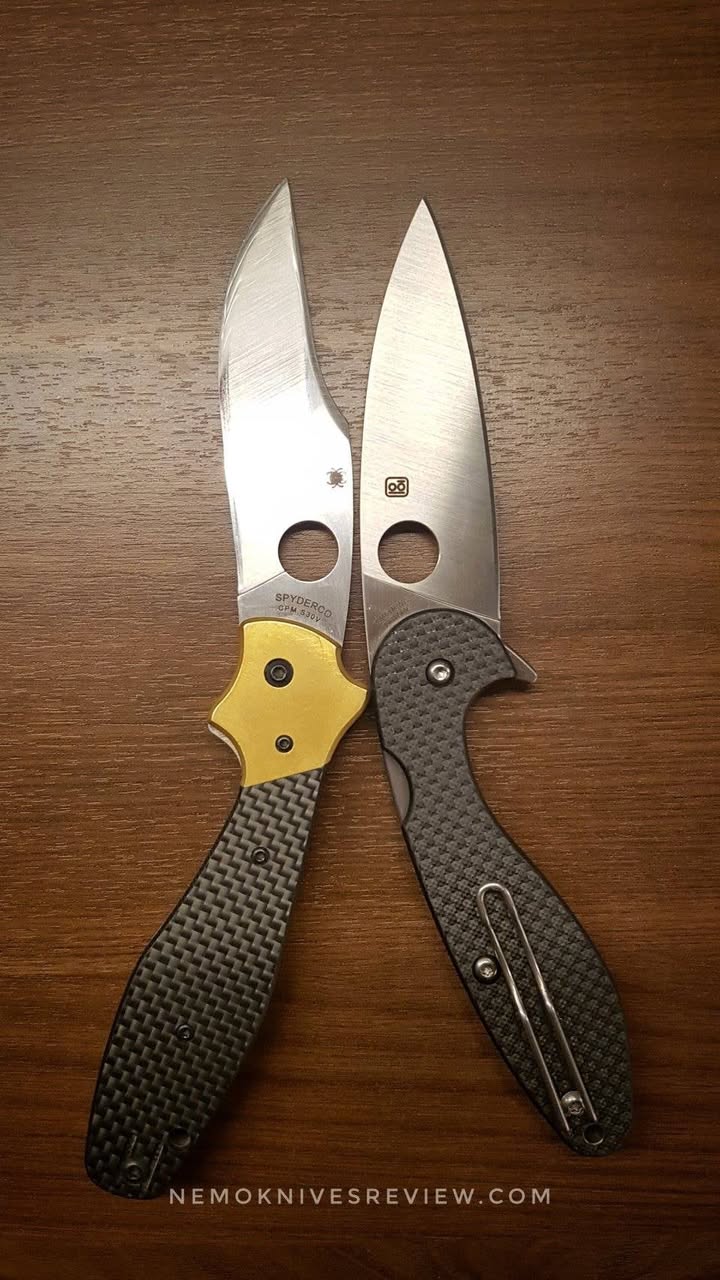
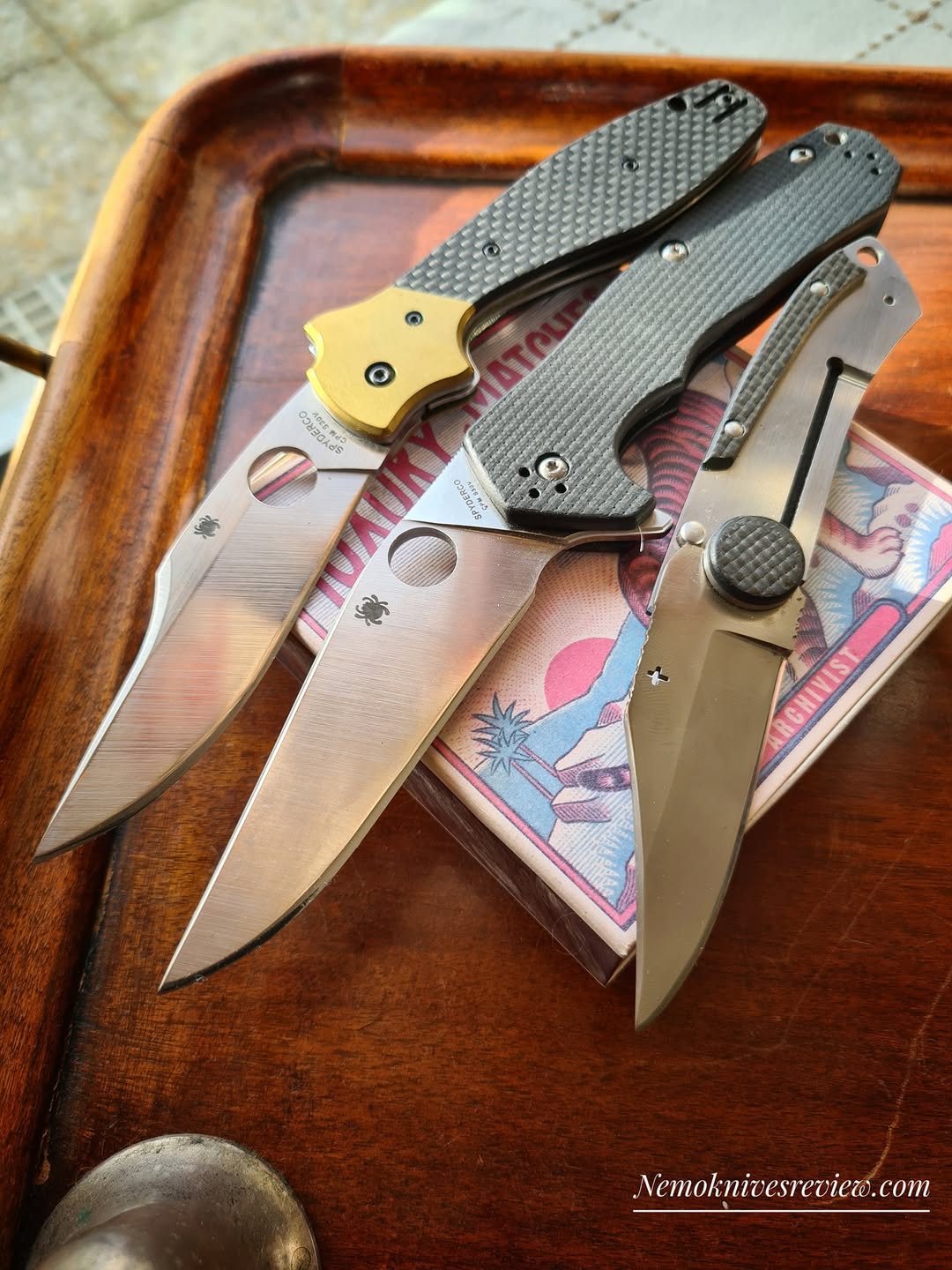
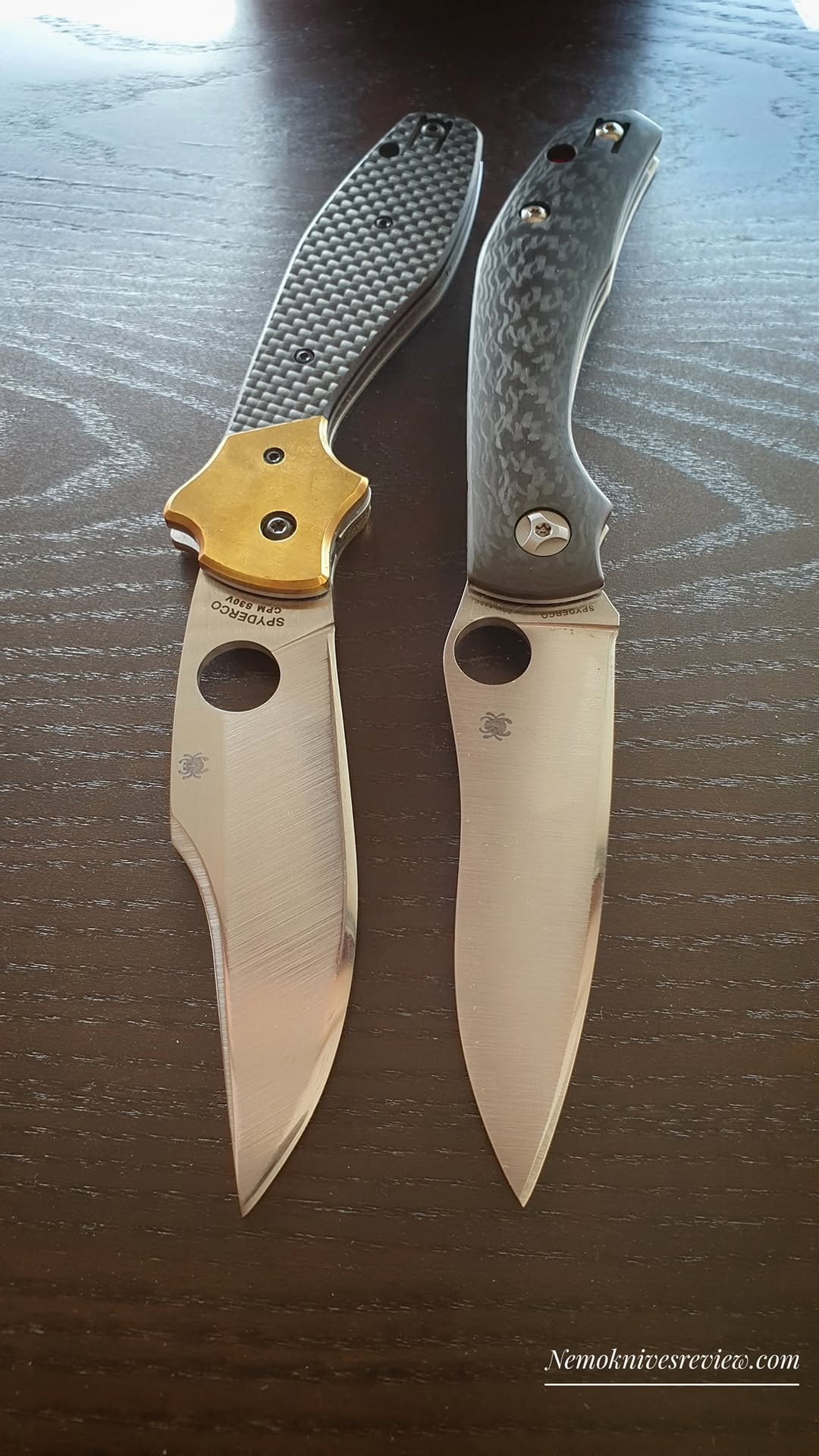
That elegance comes from the combination of materials. The woven carbon fiber gives the handle a distinctly modern character, while the brass bolsters and integrated guard introduce a more traditional touch. It is an unusual marriage of old and new, but one that feels entirely natural.
On mine, there are, admittedly, a few scratches on the full steel backspacer. Nothing serious. When you carry a knife clipped to your pocket, it will inevitably rub against other objects. In my case, part of my wallet is made of aluminium, and the two have occasionally met in the confined space of a pocket. It seems like aluminium corners won a few rounds. The backspacer bears the evidence. But these are superficial marks, not structural concerns. They are the sort of little scars that accumulate when an object is actually used rather than admired from a distance.
The carbon fibers scales, on the other hand, remains in excellent condition, and the brass bolsters continue to provide that tactile contrast that makes the Schempp Bowie so recognizable. And then there’s that peculiar smell. Because brass has a smell of its own, and that’s part of this knife’s character, too. 😀
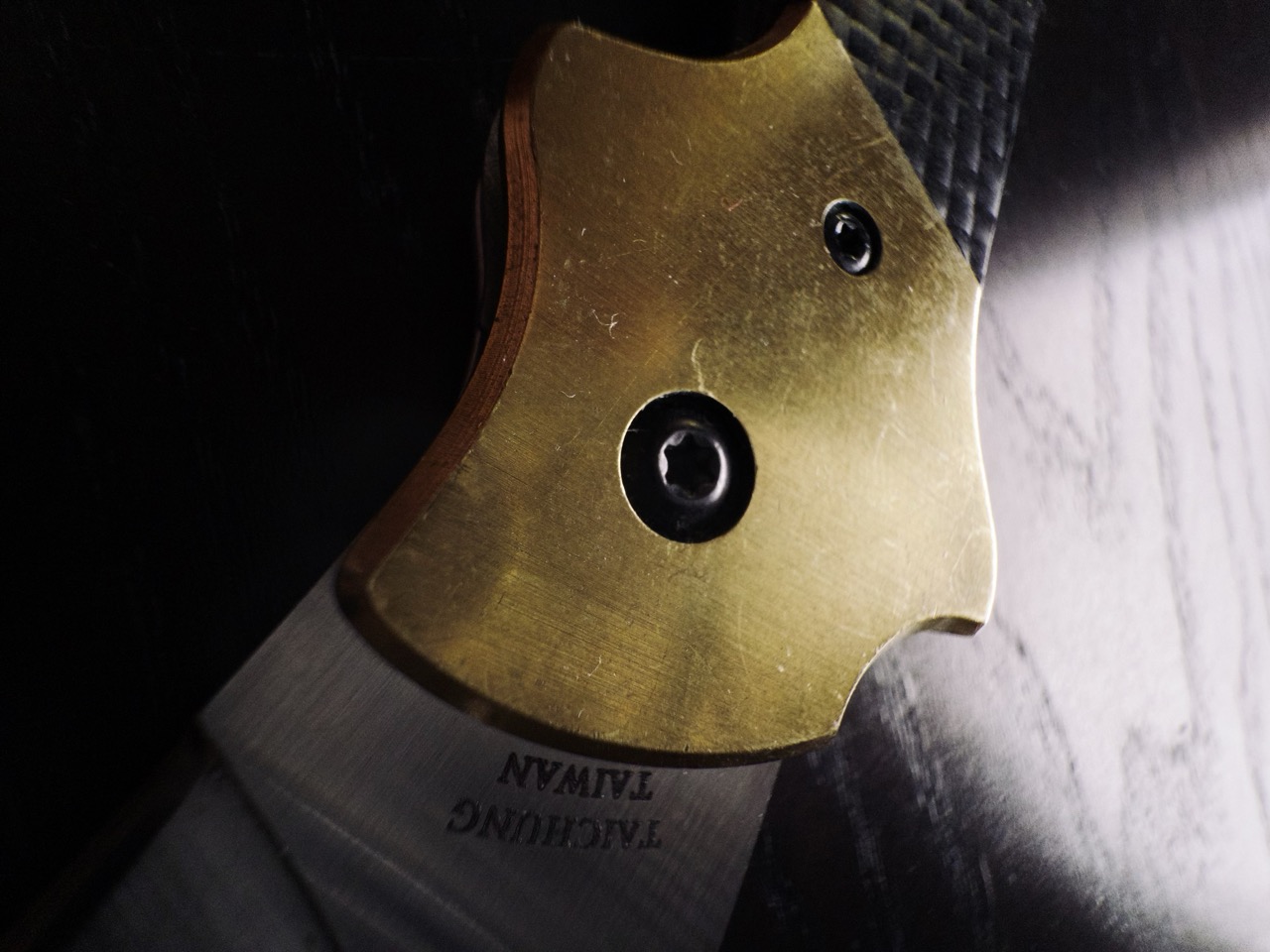
Those brass bolsters are not simply a decorative flourish. It is part of Ed Schempp’s design language.
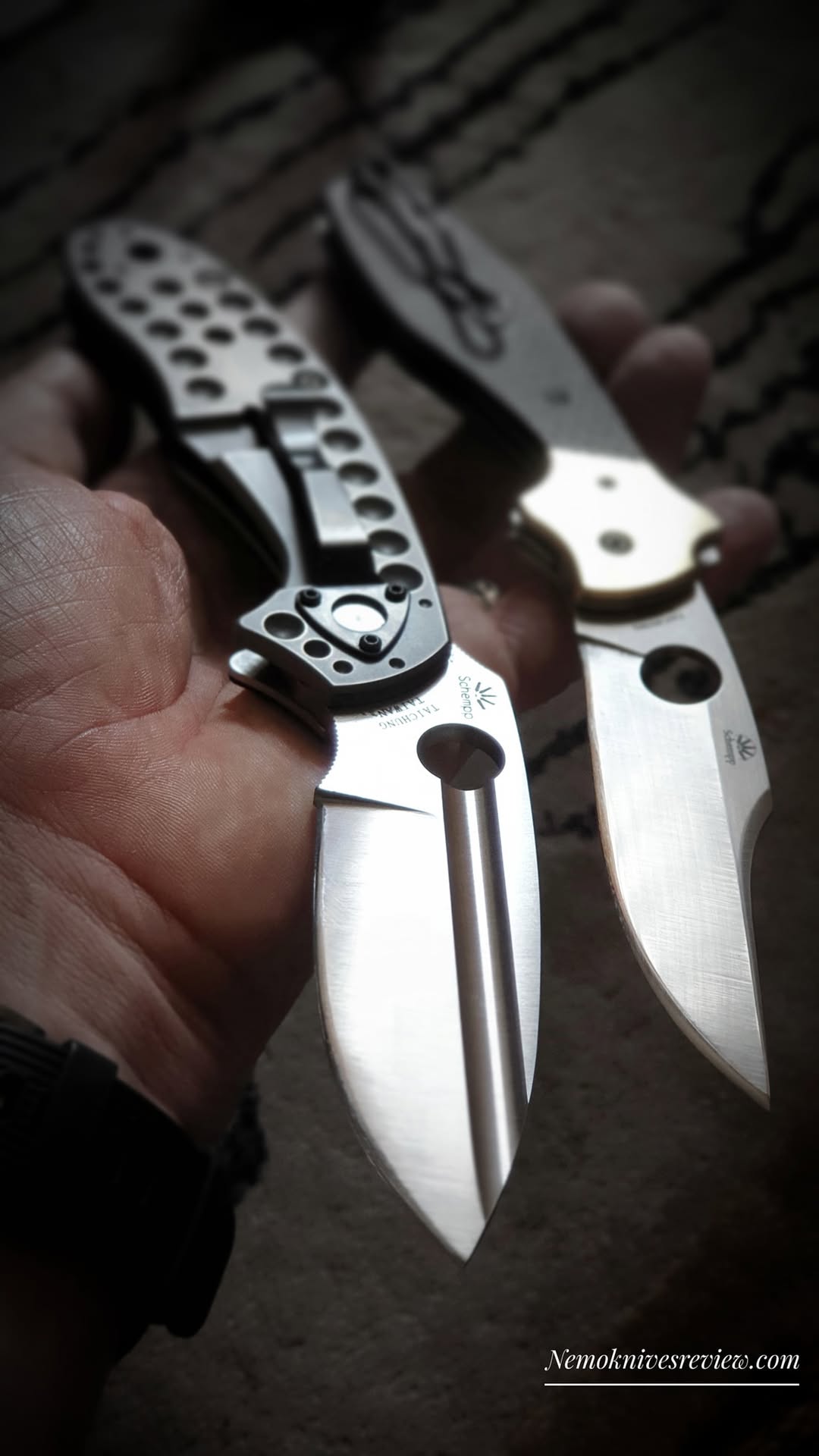
(I had already appreciated the way it was integrated into the Bowie, both aesthetically and ergonomically. But seeing Ed’s work on the Spyderco Native 5 50th Anniversary edition brought that appreciation into sharper focus.)
The use of brass, and the way it can be incorporated into a knife’s architecture, tells us something about the designer’s willingness to look beyond the usual modern conventions.
(Today, the knife industry is full of familiar combinations of titanium, G10, Micarta, and carbon fiber Nothing wrong with that, of course, but sometimes you can’t help feeling that we’ve seen it all before. Old-timers will remember the Buck 110 and its many heavy German clones, with brass bolsters and liners everywhere. They had their own kind of elegance, but they were also hefty beasts in the pocket. Ed Schempp has blended the warmth and traditional character of brass bolsters with modern materials and a surprisingly pocket-friendly design. A nod to the old school.)
On the Schempp Bowie, the brass bolsters help bridge the gap between a classic American knife pattern and his thoroughly modern touch.
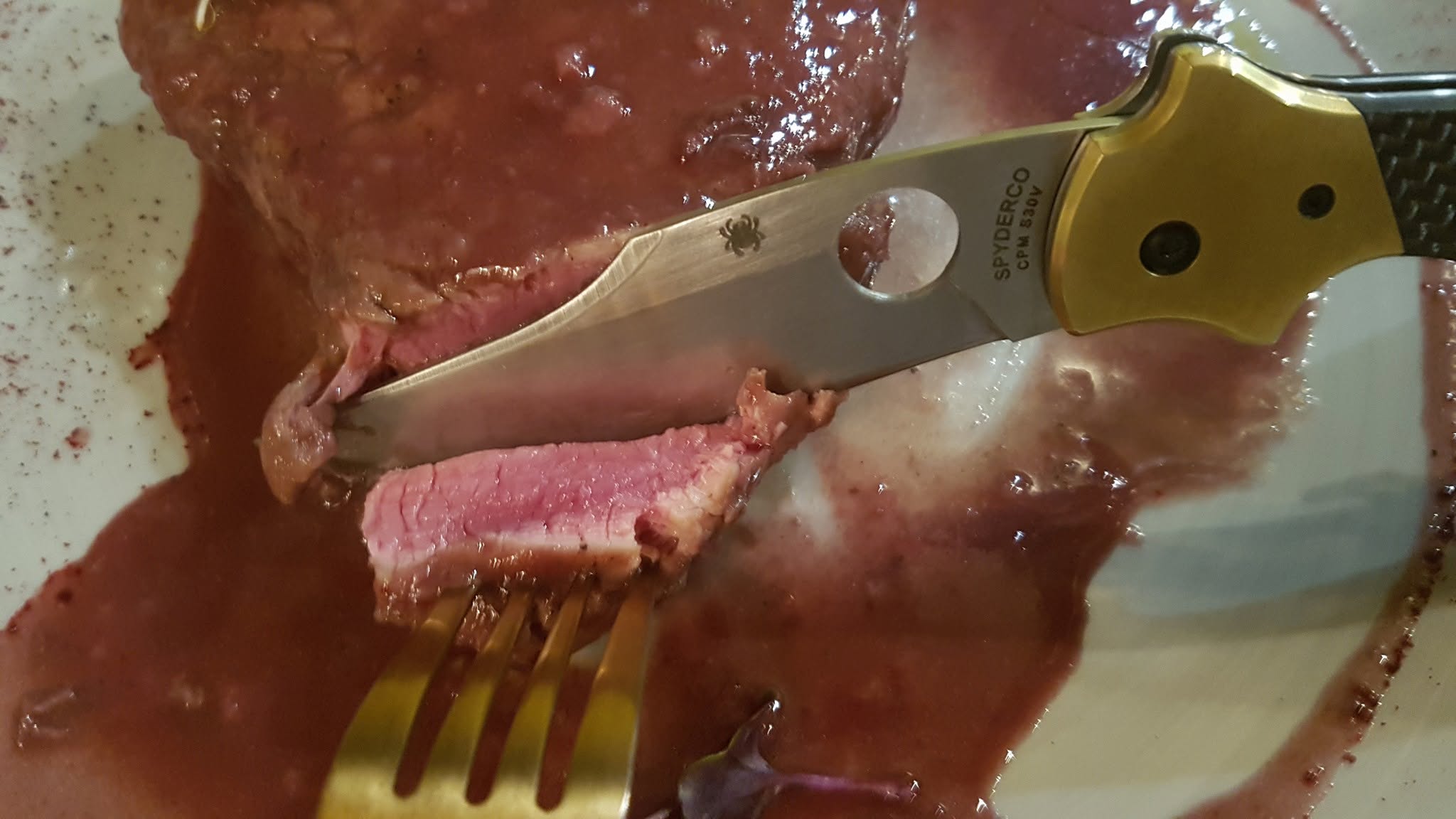
They give the knife warmth. They give it character. And they make it instantly recognisable.
Looking at that work today, I find myself appreciating the design more deeply than I did when I first took the knife out of its box.
I love its quillons. My thumb naturally finds its place on either side of the guard, depending on the grip and the task at hand. It’s playful, almost as if the knife invites you to experiment with your grip.
Yes, sometimes it takes a decade to fully understand what a designer was trying to tell you—and to realise, years later, just how much you had understood at first glance, ten years earlier.
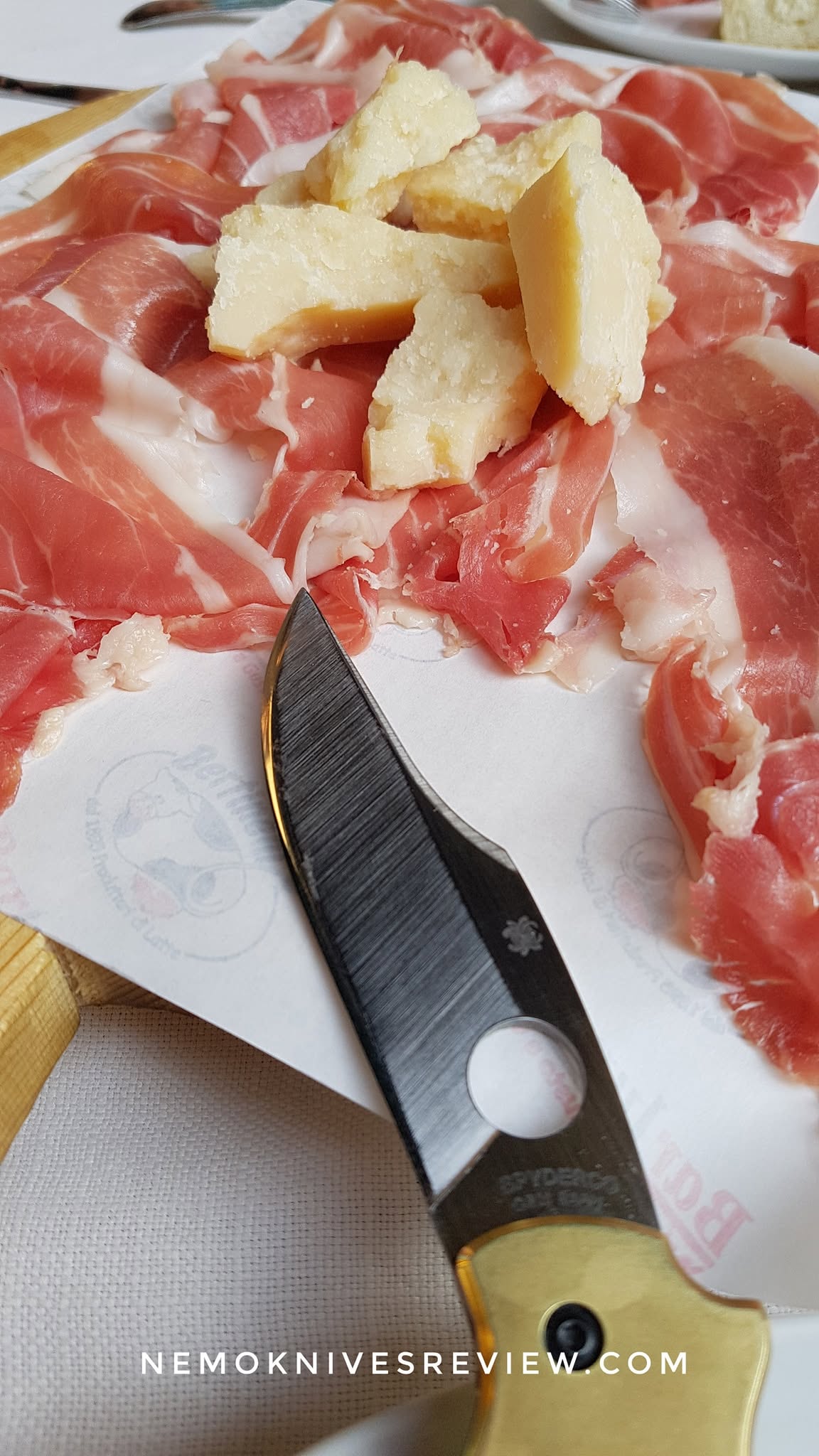
I am obviously not the only person who appreciates this knife.
When I revisited the Spyderco forums and BladeForums, I found several comments that echoed my own experience, particularly concerning the blade geometry, the fit and finish, and the way the design combines elegance with everyday usefulness.
One of the more detailed discussions appeared on the Spyderco Forums in 2015.
The reviewer initially thought the knife might not be for him. After meeting Ed Schempp and handling the Bowie, however, he began to understand the design and found himself increasingly reluctant to put it down. He praised the smooth action, the blade centring, and the quality of the lock engagement. More importantly, he described the knife as an elegant, controlled slicer rather than a heavy-duty brute.
A second discussion, on BladeForums in February 2015, reached similar conclusions.
The owner was struck by the knife’s appearance, the amount of blade available in such a compact handle, and its surprisingly comfortable pocket carry. He also praised the thin blade stock and the smooth action, while noting that the handle provided good control and leverage.
The Spyderco Forums discussion on Ed Schempp’s designs offers another interesting perspective. One owner specifically highlighted the Bowie, praising its distinctive handle shape, carbon-fiber scales, brass bolsters, and versatility, including its usefulness as a camp cooking knife.
Finally, a 2025 Spyderco Forums discussion about long, thin blades included a particularly telling comment from someone who had acquired a second-hand Schempp Bowie and was enjoying its long, relatively thin, slicey blade. It’s never too late to appreciate that knife. 😉
Nearly a decade after the knife first appeared, its cutting geometry was still giving an owner a reason to seek it out and that is perhaps the most interesting point to emerge from these discussions.
The Bowie has never been a universally conventional design. The guard, the blade angle, and the overall silhouette may not appeal to everyone. Some users will prefer a more familiar handle configuration, while others may simply dislike liner locks. And that is perfectly fair. But for those who appreciate what Ed was trying to achieve, the design continues to make sense.
Yes, really, even if I’m repeating myself a little, the Schempp Bowie was never just about looking like a Bowie. It was about translating the character of a classic blade into a modern folding knife without losing the qualities that made the original pattern interesting in the first place. It had to be elegant, but not fragile. Distinctive, but not impractical. Modern, without becoming anonymous.
And capable of cutting properly, rather than simply looking the part.
Ed Schempp and Spyderco’s Taichung factory got that combination remarkably right.
My knife is still perfectly centered. Its lock remains free of perceptible play. The action is still silky smooth. The carbon-fiber scales remain intact, the bolster smells and the knife shows no sign of corrosion.
And I intend to keep using it. Not because it is perfect in some abstract, laboratory sense, but because it has earned my confidence through years of everyday ownership. That is a much more meaningful achievement.
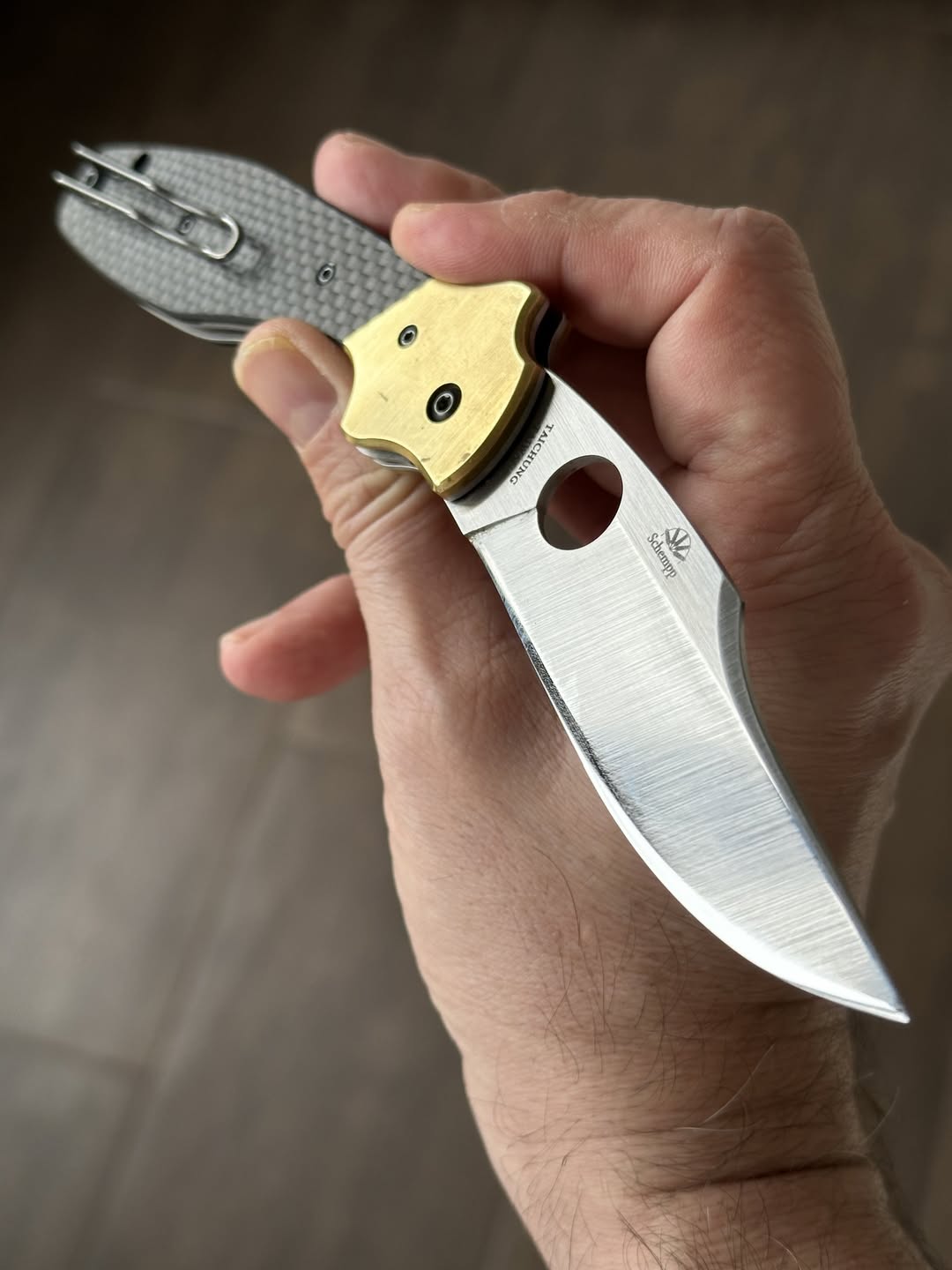
Looking back at my previous articles about Ed Schempp’s Bowie, I realize that my opinion has changed very little. What has changed is the depth of my appreciation. Ten years ago, I admired its unusual lines, its beautiful materials, its silky action, and the meticulous work performed in Taichung. Today, I can add something more substantial to that list: experience.
Speaking of experience… and Legends of the Fall.
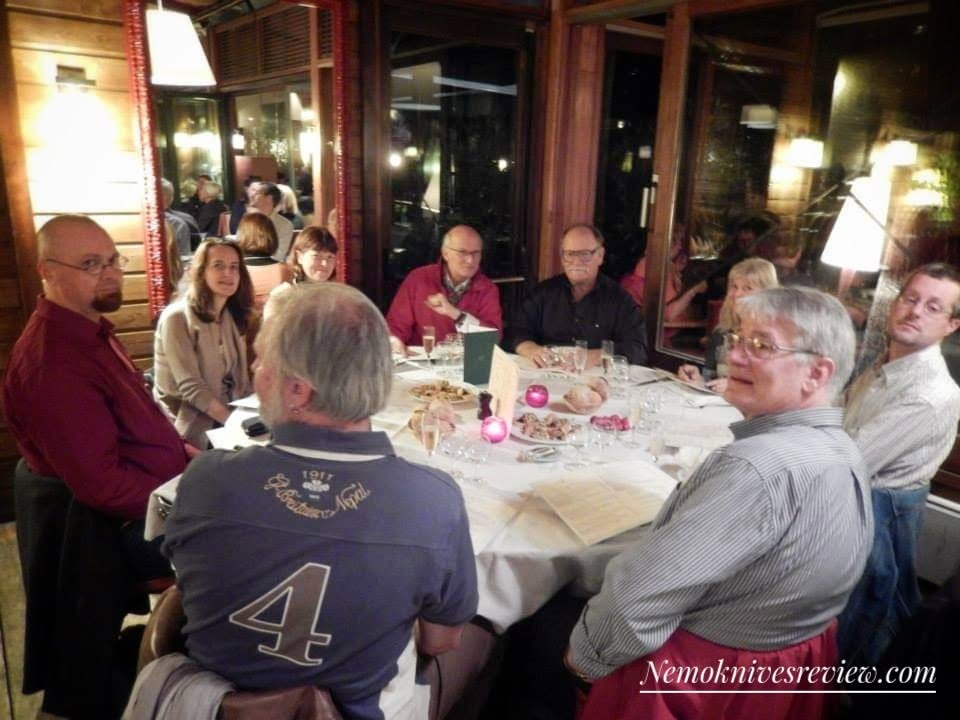
Pekka, Sylvie, Pirkko, Jur, Ed, Linda, Jan Dirk, Des… in September 2013.
Yep, my first encounter with Ed Schempp dates back to 2013, after the SICAC knife show in Paris. Spyderco had kindly invited us to dinner at Le Petit Poucet, in Neuilly-sur-Seine, in the company of Ed Schempp, Des Horn and Pekka Tuominen, among others.
It was one of those evenings that make the knife world such a special place. Beyond the knives themselves, there were the people who design them, make them, and share the same passion for their craft. Meeting Ed for the first time gave a human dimension to the name I already knew from his work. (Little did I know that, three years later, his Spyderco Bowie would become one of my regular companions — and that, ten years on, I would still be carrying it.)
Looking back at that photograph, I realise how much time has passed. Some things have changed, but Ed’s Bowie is still in my pocket. And that’s a pretty good way to measure the lasting appeal of a well-designed knife.
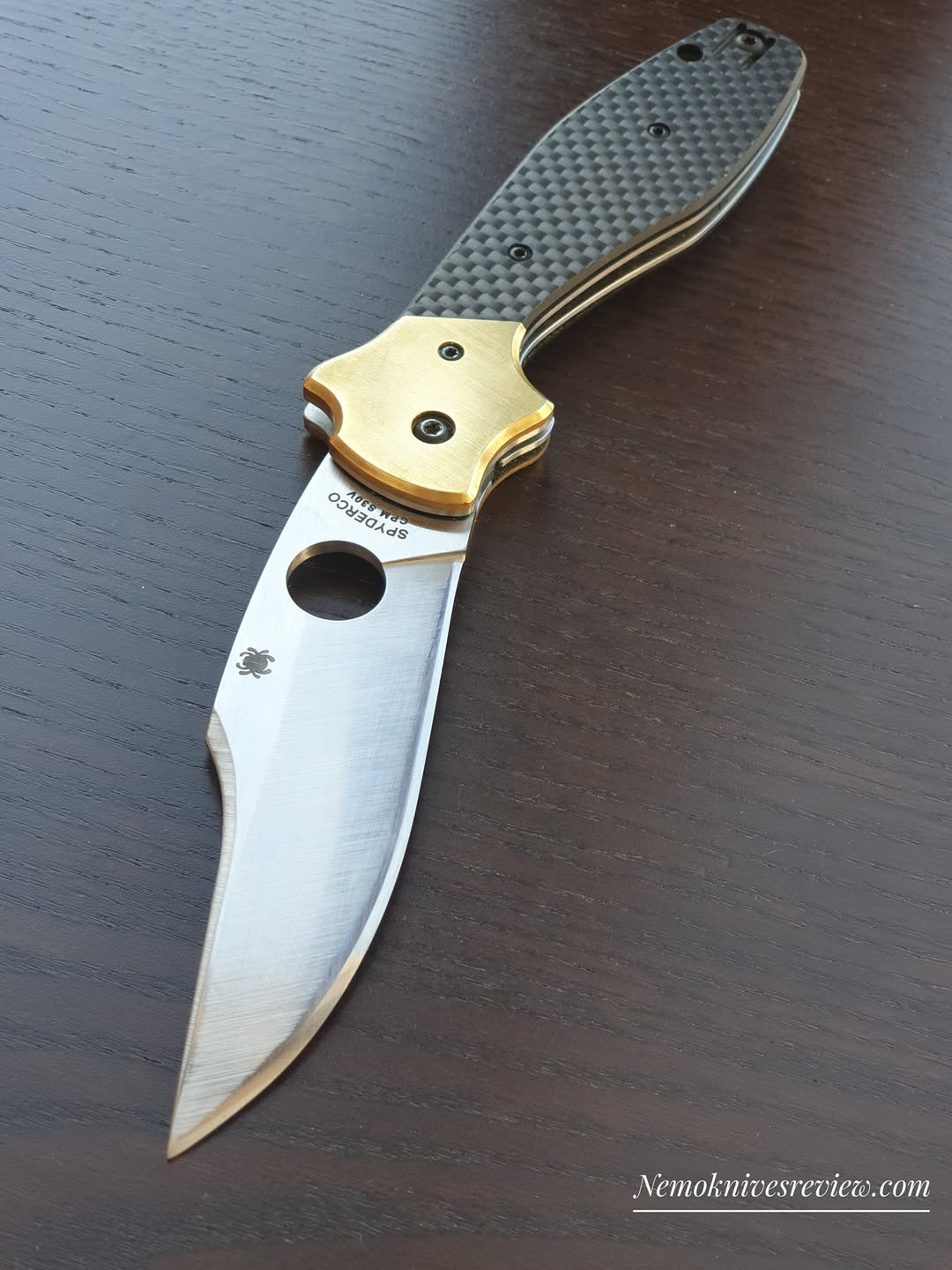
This is a knife built to last, and one of the relatively rare modern folders that combines a long blade with genuinely slim stock and excellent cutting geometry.
There is a certain irony in the fact that a folding Bowie, a pattern that might initially seem a little old-fashioned or even theatrical, has proved to be such a dependable everyday companion.
I think that says quite a lot.
Ed still uses his own Bowie every day on his ranch. Mine continues to accompany me through the ordinary business of life. Our knives have accumulated different marks and scratches, but they share the same essential purpose.
And if I had to sum up Ed Schempp’s Bowie in a single sentence, it would be this:
Some knives impress you when they are new. The best ones make you appreciate them even more ten years later.
This one has earned its place in my pocket. And it isn’t going anywhere.