Tag Archives: Workhorse

Spyderco C220GPGY Polestar – Workhorse for the budget-conscious user.

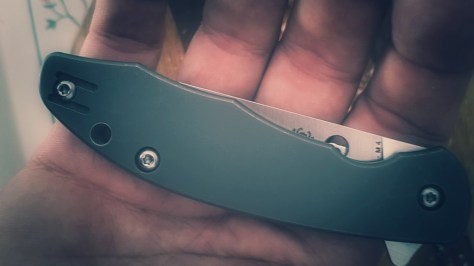
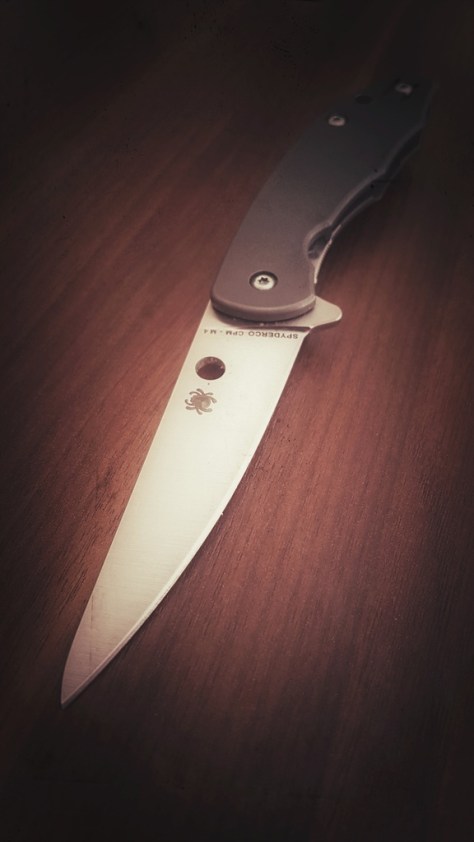
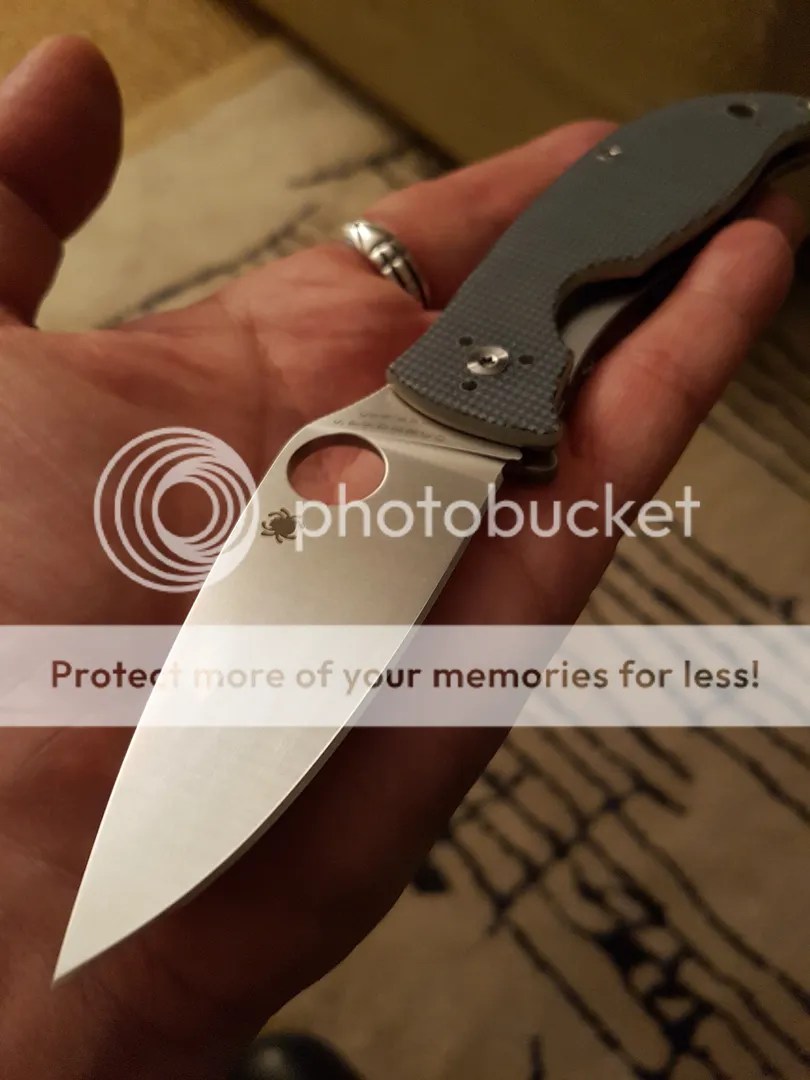
Spyderco Polestar

Designed for budget-conscious knife users who demand genuine Spyderco quality, the Polestar was offered to all attendants at the last Amsterdam Minimeet (2017). That’s how I got mine.

What could be the definition of a Workhorse ? We got example of knives which has been used hard, lost, bought again, always in our pocket, the one we use for dirty jobs and that we trust.
Classic examples are: Swisschamp from Victorinox and their Spartan, Buck110, Spyderco Delica, Opinel N°8, Mora’s Companion, Benchmade’s Griptilian, Coldsteel’s Voyager, Pradel’s folder, Doukdouks… to name a few…
Those manufactured knives do not have the best new hyper duper high carbide power metallurgy steel but they can get a keen edge and you won’t need a sharpmaker on the field to keep them sharp. And you don’t pay a premium.
So the Polestar leaf-shaped plain edge blade is a full-flat ground from American-made CTS BD1 stainless steel.

Again, the equation for a great blade is: steel + Heat Treatment + geometry. Fred Perrin uses 1075 steel but his geometry, heat treatment and great ergonomy makes the trick.
Twenty years ago, with Fred, we were testing a famous “tactical” collection names “Master of Defense” now discontinuited. Eventually we found, despite their high sexiness (black blade, premium material and designs) they were not able to hold an edge for a long time. Compared to our Spyderco Military (CPM440V) and my Sebenza (ATS34) they were almost useless for us. Thick edges on CPM154 did not make the trick for users.
The same year (I think it was 1996) we got the opportunity to test some Pakistani 1 dollars folders (Laguiole knockoff). Their thin blade were really capable. We were really impressed. Those shitty knives were users and keepers.

In June 2012 I was able to test a Spyderco Persistence. I enjoy many things in that knife but I did not like how fast its edge could get dull. I have tried to get beyond the factory (burned) edge but without any improvement. Based on that sample, it was really frustrating for my use. No chipping though, but a real tendency to ask for ceramic touch up twice a day. Since then, I have been staying away from Chinese Spyderco and Byrds.

I still got a Titanium Catbyrd wich has been a running test of 200 pieces to try the equivalent of 440C in China 9CR13MO. And despite a thick edge to my own standard, it has proven to be a much better option for an EDC user.

Back to the Polestar, this time the steel is American, made by Carpenter. You can find it on Spyderco Kitchen knives, a Mule, my UKPK and a lightweight version of the Manix 2. So this is a folding kitchen knife blade after all !!

What make the Polestar loveable is its design. Even if Spyderco recognised it has made some kind of retro engineering on one of their Byrd linerlock, for me the Polestar is the heir of their infamous Tenacious: there is no choil ! 🙂
The open construction makes cleaning easy. The wide lanyard hole is a reminiscence of the Paramillie 2. You got four positions for the clip which is much better than the Rubicon 2 in term of usability and “clipability”.

It can be easily open using the Spyderdrop technique so I have mounted the clip for tipdown carry. It’s fast and the knife is ready to cut. It suits my need.
At 3,3mm (0,13″) of thickness the full flat ground blade is a really beauty. There is a lot of Spyderco DNA in it. And it works great.
Yes, there are also a lot of quality  and attention in the manufacturing: my Polestar is perfectly centered and locks with zero play. This knife is serious business.
The G10 texture is something new. Some kind of peeled blue and grey G10 which gives IMHO a premium look to that knife. And under the thumb it is not abrasive at all. No sandpaper needed for my own use. The stainless steel construction give also some weight and no lateral bending.

So what do we got for around 60 dollars ? A solid sharp knife you can use with no second thought.
Like I wrote in the very first article of that blog here quality is not synonym with the geography. Viking used to got to Persia (using the Volga river) to buy the best steel for their swords because back in that time, some of the best alchemists were there. Chinese manufacturers are getting better and better. Just look at the Real Steel collection and especially at their Megalodon flipping folders. Chinese production will soon get pricey as they are investing a lot in robots. If you study the age pyramid in China they will be confronted to a demographic problem. So they need robots and computer controlled production able to deliver constant quality in manufacturing. Never forget all our expensive Apple toys are made in China not in Frankfurt !!

So, the Polestar is the choice for a hard use EDC and also a great guinea pig if you want to master the art of sharpening too. You will enjoy how fast you can get a popping edge back. And you won’t mind using the blade on hard surfaces. This what a workhorse also made for, cutting on a plate or on concrete, with no second thought.
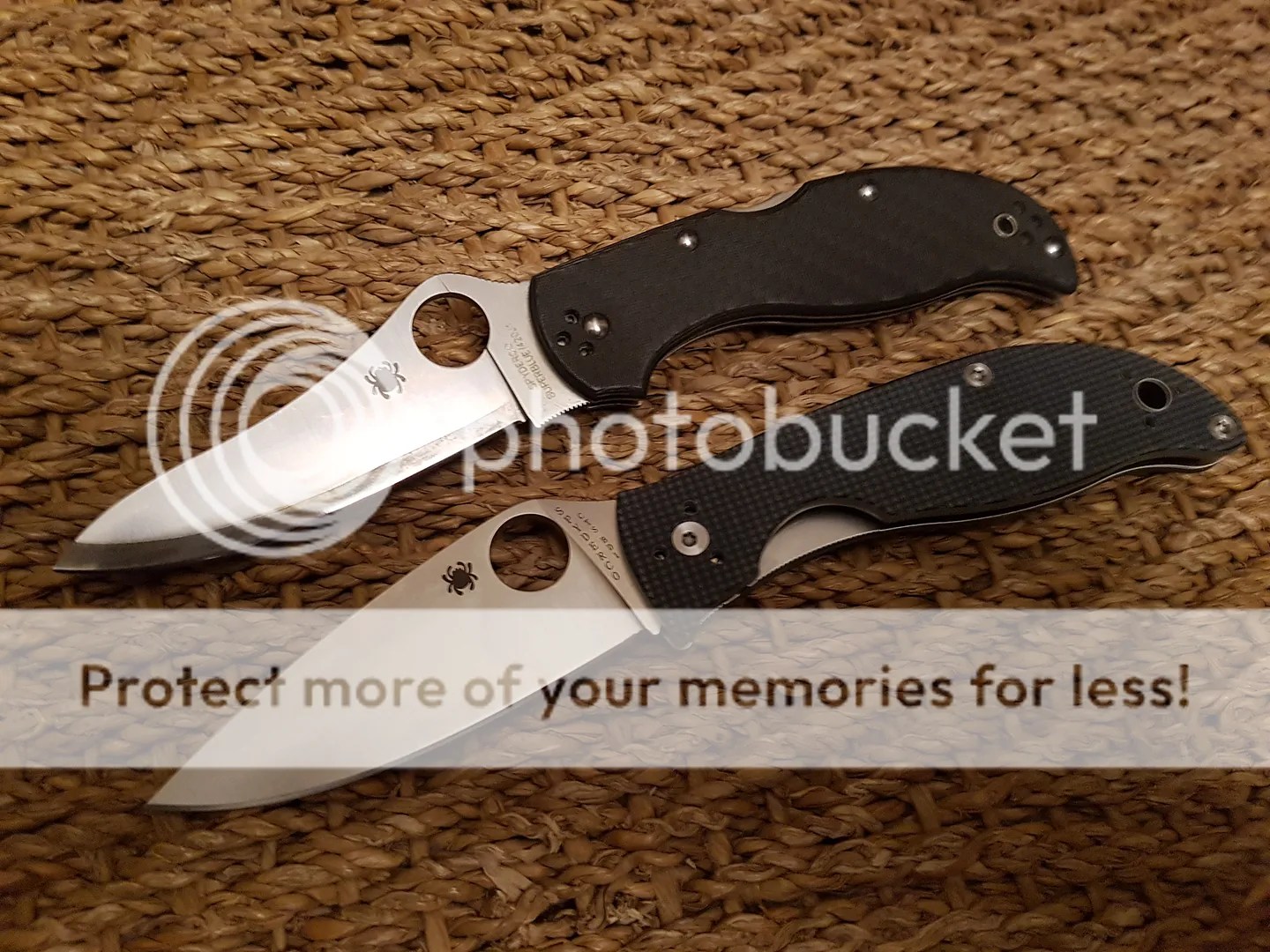
My FranckenStrech is equipped with a Super Blue Steel. That was my idea of a EDC Workhorse: thin angry edge, easy to maintain, easy to carry and sheeple friendly. This tough cookie is hard to beat. Both designed by Sal Glesser.

The edge is not the thinnest (not bad actually !) but the cuts are precise and powerful. It can be thinned easily with sandpaper.

The Parmigiano chips is also a good test. They are transparent !

After whittling hairs, to cut against hard material like glass is not a concern.

You can notce where the edge has rolled. In two ceramic passes it was straight again.
I won’t have the same ease of realignment with K390 I think. 🙂

Some of my Spyderco workhorses: the Millie, the Manix, the Polestar, the Stretch and the Slysz Bowie.
Different budgets for different tastes. All those knives are easy to clip, got enough edge for a lot of application and are easy to clean. The three knives I have not reprofiled are the Slysz and the Polestar.


Spyderco Mantra 2 – Pure Flipper Workhorse !

20160806_155644-01_zpssysruzfx
The Mantra 2 is Eric Glesser’s design and is one of a kind Spyderco as its blade’s hole is only here as a trademark. Your only way to flick the knife open is the flipper invented by Kit Carson at the end of the 90’s. There is no hump. It’s a very slick knife.

20160806_155626-01_zpszuhzxtei

There is a lot of edge on this blade/handle ratio as there is no choil too !  Not your typical Spydie huh ? (Apart from the autos destined for Militaries and LEO, you won’t find that in Spyderco Catalog.)
All of these makes the Mantra 2 a compact design with a deep wire pocket carry. A solid R.I.L. lock , an ergonomic handle and a full flat ground CPM M4 blade. This powder metalurgy super tool steel once introduced on Gayle Bradley’s designs has proven to be one of the best in strenght and edge retention.
So the Mantra 2 is a very powerful package which can withstand punishing and be easily washed under tap water thanks to its all open handle design (no back spacer).
Its strange nose seems here to strenghten the tip of the blade. Again with Spyderco, aesthetics come  second in their knives.

20160806_155734-01_zpsi1kcywds

The lock is wearproof and reinforced  with steel. All engineering details has been thought to get to the ELU a reliable heirloom tool.

20160806_160235-01_zps9fy8lwxb

Dwarfed next to my K2, I use my M2 for mondaine chores including eating in a plate. M4 has no stain yet BTW.
It’s not the kind of knives which raise any eyebrows in the sheeple crowd which is good nowadays. It’s low profile apart from its flipping opening. There it could almost look like an auto. There is no way to open it in a softer way but to use both hands. It works also.

The deep carry clip doesn’t make it very fast to draw compared to the Wolfspyder for example. But it disappears in your pocket and is very stealthy, perfect for an EDC.

Edgewise I have found mine a little on the thick side. I will thin it even if CPM M4 can a bear on a stone.  Nothing serious there.

20160806_155658-01_zpssylww13n

All in all the Mantra 2 is a very unique design. A compact tool with a lot of applications.
Again this is a gentleman knife with the power of a much bigger knife.
Eric Glesser has provided another very clever design with the best material available and a great attention to details. This is not a safe queen but a compact and slick workhorse.

And FYI a portion of sales of the Mantra is donated to The National Parkinson Foundation.


Gayle Bradley 2 years after – The Workhorse of outstanding performances.

Two years ago in March 2012 I have ordered and received overseas within 5 working days my Spyderco Gayle Bradley.
I knew at first glance this knife was going to be a hit. You feel it in your hand and in the way it’s operate.
Back then, some people were “blocked” by the fact it was made in Taiwan and were nagging about the fact it was not made at 100% in the USA, simply forgetting that Seki was also importing knives into the USA and since Spyderco’s first success Sal Glesser have been able to build a plant in Golden Colorado to start a local production.
Also some forumites, like myself, have been wasted their time, throwing pearls to the swines, explaining Taiwan is NOT North Korea….
But despites those “retards”, everybody able to hold a GB were going “WOW !!!”
This knife is incredibly smooth and well finished. Oh the gorgeous liners… Some friends who are also in business with Taichung told me each parts of their knives are marked and numbered. We are almost in jewelry.

Two years ago, this is my favorite hard used folding knife: why ?
Answer: outstanding performances thanks to:
its hollow grind is thin and gently convexed. The steel is great. The GB is one the best push cutter in my collection (with the C22 ZDP Walker which is a true state of the art!).
Another great asset: the chunky heavy (I got the first batch more on that later) handle.
This square handle give you a great grip for turning/twisting the edge during the cutting to remove matter, the kind of abuse the Gayle Bradley blade can withstand easily thanks to that great CPM-M4 steel!

On hard materials, the GB is the King. You control the cuts. You feel the blade making constant thick chips of removed platic/wood…. The hidden choil give the control and the “feedback”/feel of the hardware during the hard cutting. Many times you think: it won’t do it but… it does, steady and smoothly separating matters. I have noticed how the edge near the choil is usefull and got a lot of applied force for hard matters cutting. This is the same bonus you got with the small Spydie Michael Walker design. Those “hidden” choil give you a lot of leverage near the axis. You can push with all your weight on that portion of the blade, it will separate matter smoothly.

So after two years of constant use: no rust or pitting on the non stainless steel blade. No blade play what so ever. And the lock is still at the same engagement as new.
I was not able to chip /damage the handle. I was taking care of it enough not to have the liners scratched (the blade is scratched though on its sides but it gives caracter to the knife)
My GB is one of the first batch, the liner of the first version are not skeletonized and it helps a lot to rinse and to clean under tap water. It makes it a little butt heavy but I like it that way… Also the clip was so tigh I was obliged to sand the carbon fiber to have it loose. But since that first adjustement, my GB did not change a bit.
I was even able to keep it sharp with only ceramic and stropping. The edge is thin and is easy to realigned. It’s especially forgiving, like a well tempered carbon steel and with the incredible perf of a high tech alloy. I have also used the handle liners to break glass and I was glad they were exposed that way.
This is the knife I put to the test each time I got something “hairy” to cut, something, I’m not certain I can do it with a knife. And each time the Spyderco Gayle Bradly was able to do it with ease and each time I have try another knife just to check if it was able to do it as “easily” but no. The only contender is the C22 and it’s not a workhorse but a gentleman knife.
Really you can be surprise has how the GB get through wooden knots and with a twist of the handle your break the branch with no damage. The edge goes deep and the blade is resilient. What a knife !

Nemo Sandman Gayle Bradley

Nemo Sandman Gayle Bradley

Nemo Sandman Gayle Bradley

Nemo Sandman Gayle Bradley

Nemo Sandman Gayle Bradley

Edit of 20th of may 2012:
I have found those words of Gayle Bradley on the Bladeforums some times ago and I really think this is something to read:

“First of all, thank you for your interest in my Spyderco collaboration. I thought I would address some questions I have read on the forums.

I chose a hollow grind because it gives you a thinner edge with less resistance to the material being cut. The blade material (CPM M4) is so tough and strong it will allow for a very thin edge and still have ample strength for a rough use knife. (My competition knives have an edge thickness of about .014 before the sharpening bevel is ground.) The blade has belly from tip to ricasso for better cutting ability in most cases. The tip is slightly thicker for additional strength. The handle is large enough to accomodate any hand size and most types of grips. Some dimensions not covered in the spec sheet are: liners are .068; blade is .120; thickness is .517. Because of the size of the knife and thickness of the liner material, I chose carbon fiber to reduce weight and add furher strength. One last thing about CMP M4, it is not stainless, but I have found that applying silicone to the blade will prevent most corrosion and stains.

Thank you for your interest in my work-horse design and your trust in Spyderco knives.

Stay sharp, Gayle Bradley”
Nemo Sandman Gayle Bradley