The Spyderco PPT Round 2 — The Son of Anarchy.

20180424_184458-01.jpeg

Strangely I am coming back often to the PPT when I first thought it would be a collection and a safe queen. Safe queen my a$$ ! Pardon my French but there is something quite sensual when holding this knife, something which makes the other feel “hollow” in comparaison. The PPT got that heavy butt “anchoring” it to the palm but also the toxicated finish of the handle’s slab is a delight under the thumb.
There is something almost “paleo” in the finish. Something primal in the mechanical way it feels. It’s dense but is designed to be heavy metal. It’s a knife Opie could have admire…

20180424_184506-01.jpeg

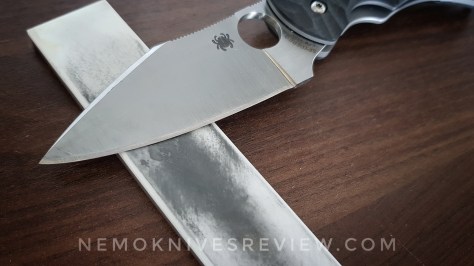
On the performance side, I have decided to get a convexed edge. Diamonds are the only language stubborn S90V seems to understand and scratches on the blade side are, well especially for the clumsy sharpener, something hard to avoid especially when using the stone at a 10° angle to get rid of that secondary bevel. The performance in pushcutting are really enhanced now. I can measure it to the Manly Peak and its thin S90V blade.

20180424_184620-01.jpeg

I use white ceramic to make the steel shiny but S90V is really a tough cookie in the kindergarden of alloys: it’s a game of patience to obtain a nice finish.

But now on plastic I can enjoy the enhancement of that already very thin edge. It goes easy through.

Someone asked me why using a workhorse knife on tomatoes ? Tomatoes may look like some fragile fruits but they are not: their skin got no pity for any dull knife and their flesh will give in under any pressure. The best tools for tomatoes are serrated and micro serrated knives.

20180429_134118-01.jpeg
Hence that test on my polished edges. You need a very keen blade to push cut in a tomato and make thin loaves. Plastic and bambou can be used to test the edge stability which often is only due to thermic treatment of steel.

20180429_134128-01.jpeg

The alignement of the point on the PPT is very different from my Millie and is very close to the experience of the YO2: its makes powerful cuts.
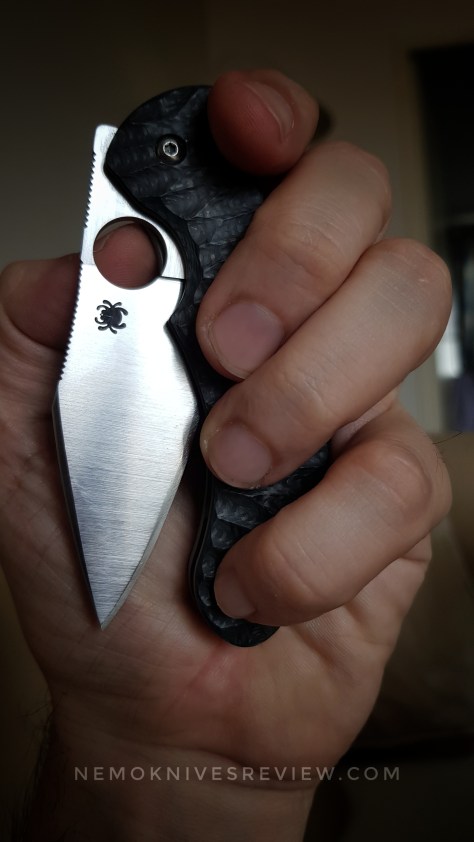
Also the handle makes Icepick/reverse grip very confortable, knowing this is the favorite grip of Philippe Perroti on La Griffe, a grip I have found handy in forcing a door. Just kidding but the confortable reverse grip (à la “griffe de chat” in French) is not a joke.

20180429_143749-01.jpeg

You get also an excellent blade/handle ratio for a choiled knife compared to my Para3 for example.

20180429_143822-01.jpeg

And as good as the non-choiled Sliverax !!

20180429_142459-01.jpeg
My PPT has been used in the kitchen is not easy to clean because the way the hole in the liners are not accessible. This is serious issue if, for example, a piece of raw meat get stuck there and could contaminated the blade. The full Reeve Integral Locks are the best lock for checking your folding for any debris. I would have preferred solid titanium liners without that hidden cheese holes which ask for special maintenance starting by unscrewing the slabs to get full access and complete cleaning.

So in a wrap, the PPT is a compact hard user with very high performances featured by great ergos. It has a really strong character (it feels like it has been done for some Hell’s Angel fan) but once deployed it will pierce and cut with high reliability. Once the PPT is entering the game: this is serious business. For the record being represented to bikers gathering, bikers love La Griffe and various neckknife which are handy on a ride. So it’s easy to understand some DNA in the PPT design.

20180429_141539-01.jpeg

About Locks — How to choose ?

wp-image-1457197829
Nowadays rendering of three iconic 90’s lock: Liner Lock, Back Lock and Integral Lock.

They are plethora of locks since the 90’s when the Tactical Folders trend started.
“Tactical” , a term which has been mainly used in a marketing way, means you can get access to your knife easily — A clip or a well thought pouch — and more important: to be able to open it and close it with one hand.
The blade needs to be locked in open position and also to stay closed while in the pocket.
Let’s have a look on the locks I prefer and use.
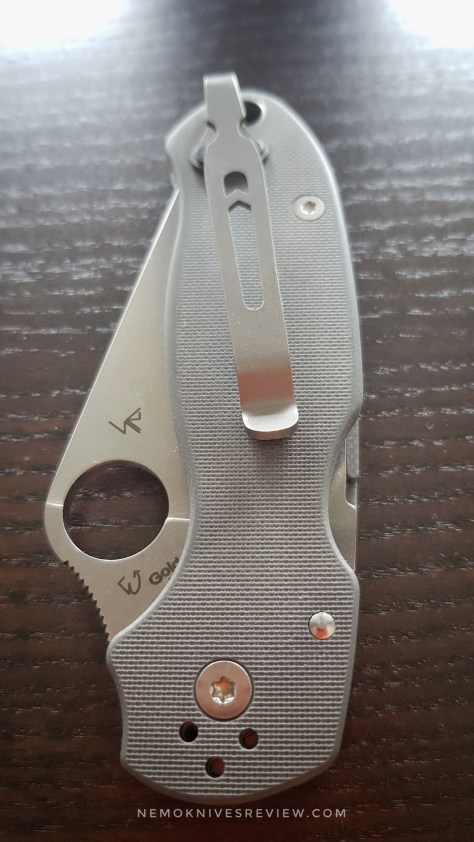
20180410_134558-01.jpegMaxamet Para3 Compression Lock.

The Compression Lock.
Described as:
“A lock mechanism that uses a leaf-like spring from a split liner in the handle to wedge laterally between a ramp on the blade tang and the stop pin (or anvil pin).”
What I like about that Spyderco in-house engineered system is how smooth the action is.
Spyderco is now developing and proposing flippers with the CL because the breaking action on the pivot is minimal. On my different CL folders I can open the blade in different ways: using the index, pushing the paddle to unlock the blade…
It’s fun. It depends on a detent ball to keep the blade closed.
It’s a lock easy to clean and check as the handle are all open framed. It also asked for some nested liners which, when they are skeletonized, need more attention for cleaning, especially when you use you knife in the kitchen like I do. I rinse them under hot tap water , wipe the blade and make them dry inside the pocket with body heat.
Also the compression lock can be hurting the palm of your hand when cutting hard matters.
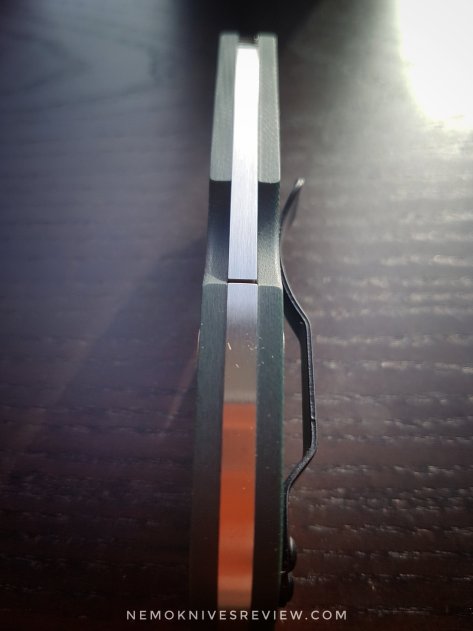
20171208_120329-011500186881.jpegNative 5 Back Lock.

The Back Lock.
Described on the Spyderco” Edge-U-Cation pages as: “A locking system positioned on the back of the handle that uses a rocker arm that pivots in the center. A lug on one end of the arm engages a notch in the blade’s tang to lock the blade open.”
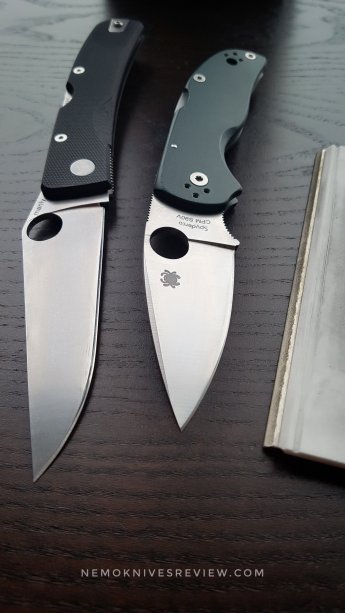
The Manly Peak and the Native 5.
This lock has been infamous since the Buck110 and all its copycats. Spyderco has developed mainly mid-locking system which can be unlock without changing your grip lick on a Buck110. It was demonstrated with the first Native how safe it was it unlock their knife and let the choil of the blade get in touch with your finger before to close it.
This is still the way I do it, even on my Delica and Endura which got no proper choil: unlocking the blade by pushing the lock free and let the blade falling half way on your finger. The Back Lock got a spring which is strong enough to avoid a detent ball. Old timers used to pu a match inside their closed Buck110 to pass the stronger spring tension and get it open faster. On Spyderco’s, it’s also easy to avoid any locking noise just by pression the paddle before it get completely opened. Unless the blade is very heavy like on XL Cold Steel Voyager, it’s not a lock for gravity opening. But it’s one of the most solid lock. In fact because of the way it’s engaged, it can be much more solid than all the other locks. Spyderco were testing their strong back found on the Chinooks and Manix with amazing results.

wp-image-1298363584
It’s not the easiest lock to clean as there is no open framed handle. It’s hard to see if debris can be jammed in. Also it’s not the funniest lock to use as the spring tension is felt during all the opening and closing motion. The Spydies with relatively heavy handles can be spyderdropped for quick opening. I do that on my Knifecenter stainless steel spacered Delica for example. It’s also easy on your palm during hard cuts because of their closed handle spine. Some Compression Lock haters are Back Lock lovers because of that confortable handles.
Also I have noticed on many of my Back Locks knives some vertical play when cutting on board which brings us to…


The TriAd Lock
Featured on Cold Steel’s folders it is essentially a Back Lock with a stop pin. There is no more vertical play when cutting. It doesn’t change anything toward the negative force used to close the lock blade.
You can also find inside the Chaparral an hidden stop pin invisible as it’s hidden near the pivot.
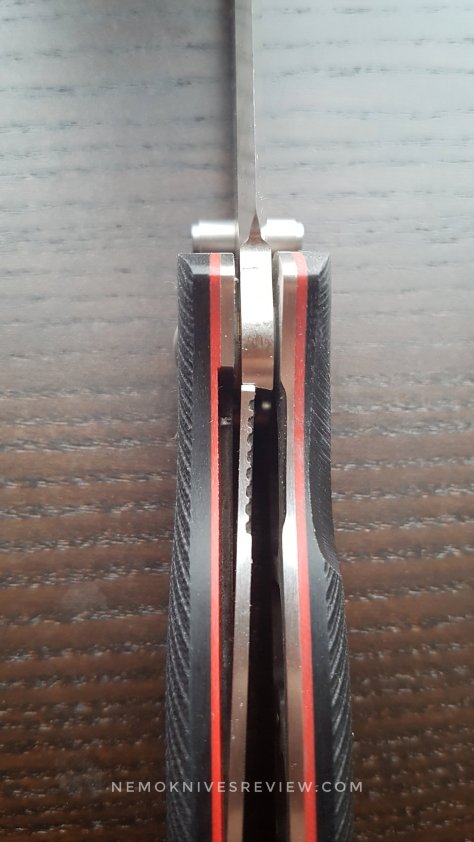
20180116_150406-01423043377.jpeg
The Liner Lock.
“A locking system developed by custom knifemaker Michael Walker that uses a leaf-like spring split from the liner to wedge laterally against a ramped surface on the tang of the blade.”
This lock was the king of Tactical frenzyness back in the 90’s. The Benchmade CQC7 and AFCK promoted them in titanium and Spyderco developped their Military with a stainless steel liner lock. If I remember well Sal Glesser and Les de Asis were together private students of Bob Terzuola which is a master in liner locks making before to start their own production. Depending on a detent ball, the liner lock was bringing that smoothness the Back Lock could not provide but it was not the strongest lock available.
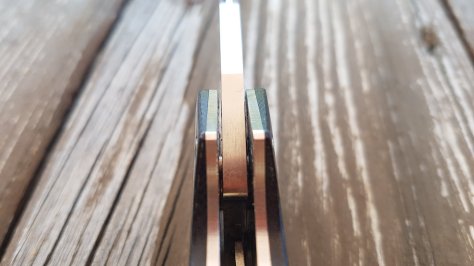
wp-image-1554915927Ed Schempp Euroedge strong liner lock.

To test it many people tried the infamous and stupid spine whack and many time with shock the liner was unlocked and damaged by that treatment.
It’s a very easy to lock to get open and close fast just be careful to put your finger out of the way when closing.
Titanium liner locks are wearing more than stainless steel liners.
It should not be difficult to clean depending of the handle conception. On that matter the last version of the C36 Military got rid of they spacer and got now a full open handle for easy check.

The RIL
Then Chris Reeve came with his Sebenza and used a lock bar that is integral to one of the handle scales. It was giving you the sentiment, you hand’s grasp was also enhancing the locking mechanism. It’s also a very easy mechanism to clean and check hence the Spydiechef, or the K2 which are easy to use in the kitchen even after being defiled by grease and meat…
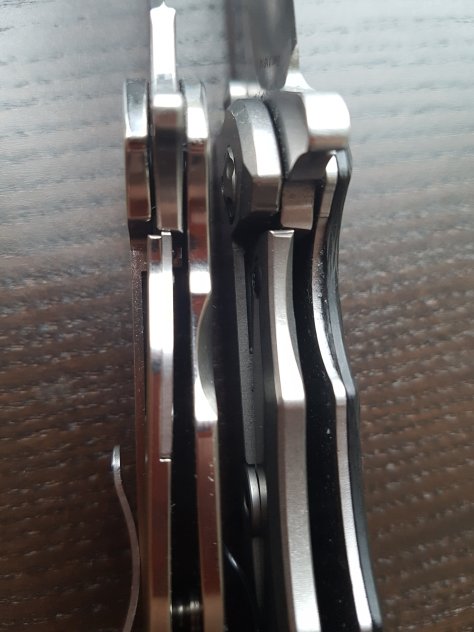
20171130_113248312135934.jpgRIL of the Advocate and the ZT550.

20180326_173400-01.jpeg
The PPT is a mix of both RIL and liner designs with the possibility to grasp it and hold it in opening position.


BALL BEARING LOCK
“A patented compressive lock that wedges a ball bearing between a fixed anvil and the blade tang. The mechanism also serves as a detent to hold the blade in the closed position.” I was developed by Eric Glesser for his Dodo and can be found on the Manix 2 folders with a caged ball version. Some people found a lot of similitude with the Axis Lock from Benchmade but here, instead of two omega springs, it is a coil spring pushing a ball bearing made of ceramic of stainless steel. It’s smooth but not as easy to clean as other locks. Actually I prefer it on the Lightweight version of the Manix which is my main travelling knife with its CPM110V blade. It’s engineering makes it one of the strongest as you can not squeeze a ball bearing easily and it is also self adjusting.

The cage ball can be exchange with a custom titanium cage in case of breaking after years of using. It happen to my cousin who has modeled his own resin ball.

The Balisong Lock.
This could be the most fun system to use and also the strongest. Easy maintenance, no spring… It’s a very old design. The first trace was found in 1780 in France with a knife called “Le Pied Du Roy” (The King’s Foot) and circa 1800, butterfly knives were uncommon. They were made in Paris and Thier. There is a beautiful collection of the old Butterfly Knives in the Thiers Museum.  French Army troops were provided with Butterfly Knives, but after WW2 there is no more trace of Butterflies made by this brand.
(More to come in the re-edition of the Fred Perrin’s balisong review soon.)

Image24.jpg

Locking a folding blade has been a puzzle for engineers for centuries. The roman folders were not locking and 2000 years ago a folding knife’s handle was considered as an attached sheath which means it was hold like a razor: by the blade.

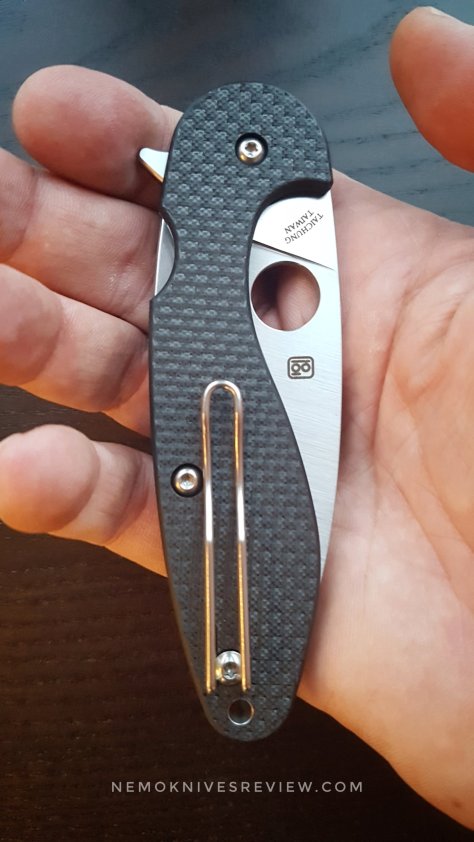
So how to choose a lock ? Recently I have been surprised on how well the Bulgarian Manly Peak was operating: no vertical or lateral play on its very strong Back Lock. I have been playing with the Sliverax Compression Lock flipping options. My old Sebenza RIL lock is still in great shape and my Ed Schempp Bowie flies in opening position…
20171117_170036-011737684962.jpeg

Lock is just a matter of taste and use, selling a design just by its lock won’t work. Some designs are made for compression lock like the Sliverax wasp shape flipper design could not go easily with another lock.

But always remember a folder cannot be as strong as a fixed blade. Marketing can be your enemy but the main enemy of locks are shocks because its weakest element will give in, bend or broke. Now when you choose a knife made by reknown makers and manufacturers you can trust their locks but it’s not the case with all the copycats and cheap knives which often got very bad quality elements ready to break or bend at the first use. I’m not saying the best locks are the most expensive but looking for quality in the making should be mandatory in your choice.

Spyderco C223GPDGY Para3 Maxamet — The Grey Mouser.

20180410_132821-01.jpeg

It has been half a year of patience before my pre order turns into a mail call. Howard Korn from the Knifecenter.com was kind enough to send it to me as soon as he has received it. It was a quick 6 days of travelling from Fredericksburgh, Virginia to Paris.
The name of this Para3 should be”Desire” but it will be “Mouser” in honor of its color: grey. Also in honor of its almost magical alloy used: Maxamet.
20180410_132835-01.jpeg

What is Maxamet ?
According to Spyderco its full name is “Carpenter® steel’s Micro-Melt® Maxamet® alloy”. “Maxamet is an extremely hard high-speed powdered tool steel possessing properties that transcend conventional high-speed tool steels and approach those of cemented carbides – the ultra-hard materials used to machine other steels. When Carpenter developed this amazing alloy for the rollers in their steel mills, they sent samples to various companies in the knife industry to evaluate as a blade material. Although many tried, Spyderco was one of only a handful of companies to successfully develop the specialized methods necessary to machine, heat treat, and grind this demanding material to yield reliable, high-performance knife blades.”
It so difficult to work with that it has given some headaches to Eric and Sal hence the 6 months late in the production of that Para 3.
Maxamet should have better performance than CPM110V.  Now that I got both steel, I will try to see if I feel and see a difference.
What its composition reveals ?
Carbon 2,15% ; sulfure : 0.070% – 0,23%; chromium : 4,75% ; vanadium 6,00% ; manganese 0,30% ; silicium 0,25% ; cobalt : 10,00% ; tungsten 13,00%.

It’s not a stainless steel it’s an high tech tungsten alloy !!

Here its data sheet in Carpenter’s.

The wear resistance of Micro-Melt Maxamet alloy is better than that of conventional powder metal high speed steel grades and is equivalent to AISI A11 cold work powder metal tool steel. A11 is CPM 10V. Better? How much better ?
According to Cliff Stamps: “Maxamet is an extreme alloy, for comparison, it is to 10V what S90V is to 420J2. Maxamet is used when HSS like M4 fail because they are too soft or wear too fast – just consider that for a matter of perspective.”
(For the record he’s not talking about CPM M4 which comes from powder metallurgy process but good old M4HSS.)

So far Mouser is shaving my arm’s hairs which are flying of its blade. Its factory edge is really thin. With that amount of tungsten it should not be sensitive to its final tooling in the Golden plant. I’m not planning to work on it yet and keep it that way for its first run.

Its complex heat treatment and the HRC should be on the very high..

Spyderco is offering that steel on many knives: not counting a Mule but a LW grey Manix 2 , a G10 grey Paramillie 2 and a lightweight grey Native…
The Maxemet version is not a Sprint run.

20180410_134614-01.jpeg

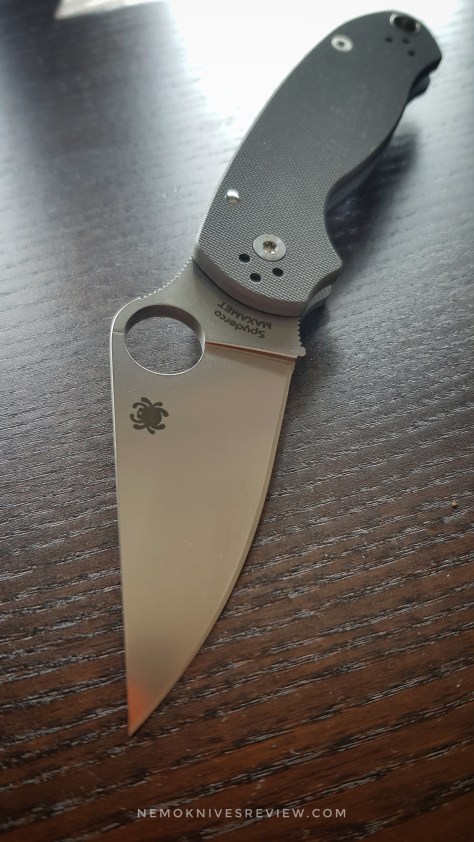
I have also noticed the chamfered work they have made on the spine and the spyderhole and the jimping behind the hump. I don’t have to use my diamond rat tail file anymore !!
Thank you Golden ! 🙂

20180410_134623-01.jpeg
Also the blade has been gently beadblasted which gives it a very industrial look. The grind is perfectly symetrical as always on my Colorado’s made.

20180410_132849-01.jpeg
The thick grey G10 slab also concours to give that toolish look, again the attention to detail are stellar. There is nothing to change when you open your black and red box.

So far what I have changed is the clip, as I don’t plan to spyderdrop this little guy.
The smooth compression lock permits a lot of other way to open it elegantly.
Also I have sanded the G10 to smooth it to my taste and keep my pocket lips healthy.
I keep the pivot area rough for the ergos.
Now the game is on, let see all this fuzz about that Maxamet steel !
Spyderco catalog’s sheet is here.

EDIT: Eventually I have gone back to the OEM hourglass clip in a Tip Down carry option.
Because it’s so fast to draw like a I do on my Millie and Paramillie 2.
The spyderdrop is so elegant and bound to the spyderhole: it works like a breeze.
Also I have starting to test the sharpness which is uncanny right our of the box.
I did not have that kind of result with its S30V bro. The Maxamet thin edge goes through the plastic bottle butt to make tagliatelle !! The edge is really hungry.


Also my previous review on the Para3 is here.


Between both knives there is a little difference. It is the sound of the mechanism.
The opening and locking on the S30V version will be a TAK.
When the opening of the Maxamet version will be a TIK.
The pitch of Mouser is much higher. Different alloys, different hardness produce different sounds.

20180410_134558-01.jpeg

The Mouser is a small (not much more than five feet) mercurial thief, gifted and deadly at swordsmanship (often using a sword in one hand named “Scalpel” and a long dagger or main-gauche in the other named “Cat’s claw”), and a former wizard’s apprentice who retains some skill at magic.
The cynical-sounding Mouser is prone to showing strains of sentiment at unexpected times. He’s a rogue, living in a decadent world where to be so is a requirement of survival. It was created by Fritz Leiber.
Part II is here:
https://nemoknivesreview.com/2018/06/12/spyderco-c223gpdgy-para-3-maxamet-part-ii/

tumblr_mo4whrL9371ro2bqto2_400.jpg

20180410_152321-01.jpeg