Tag Archives: camping

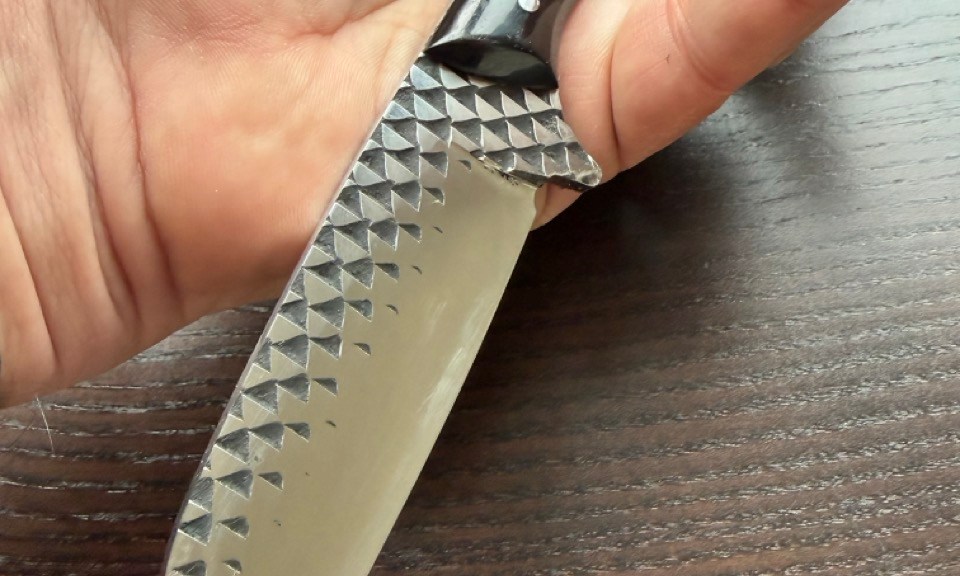
Teeth Don’t Lie: Field Notes on a Rasp Knife named “Bull Cutter”.

There are teeth… and then there are teeth.
Serrations — and rasp.
Let’s get one thing straight.
This is not a “knife made from a rasp.”
This is a farrier rasp that refused to die.
(A farrier takes care of the feet and hooves of equines, whether donkeys, ponies or horses. He takes care of fitting and trimming the shoes.)
And when the knifemaker knows exactly what he’s doing — and here, Robin Medina Thomas from La Coutellerie de la Vallée clearly does — you end up with a blade that doesn’t just cut. It commits. Playfully.
Carrying its inheritance in both form and function.
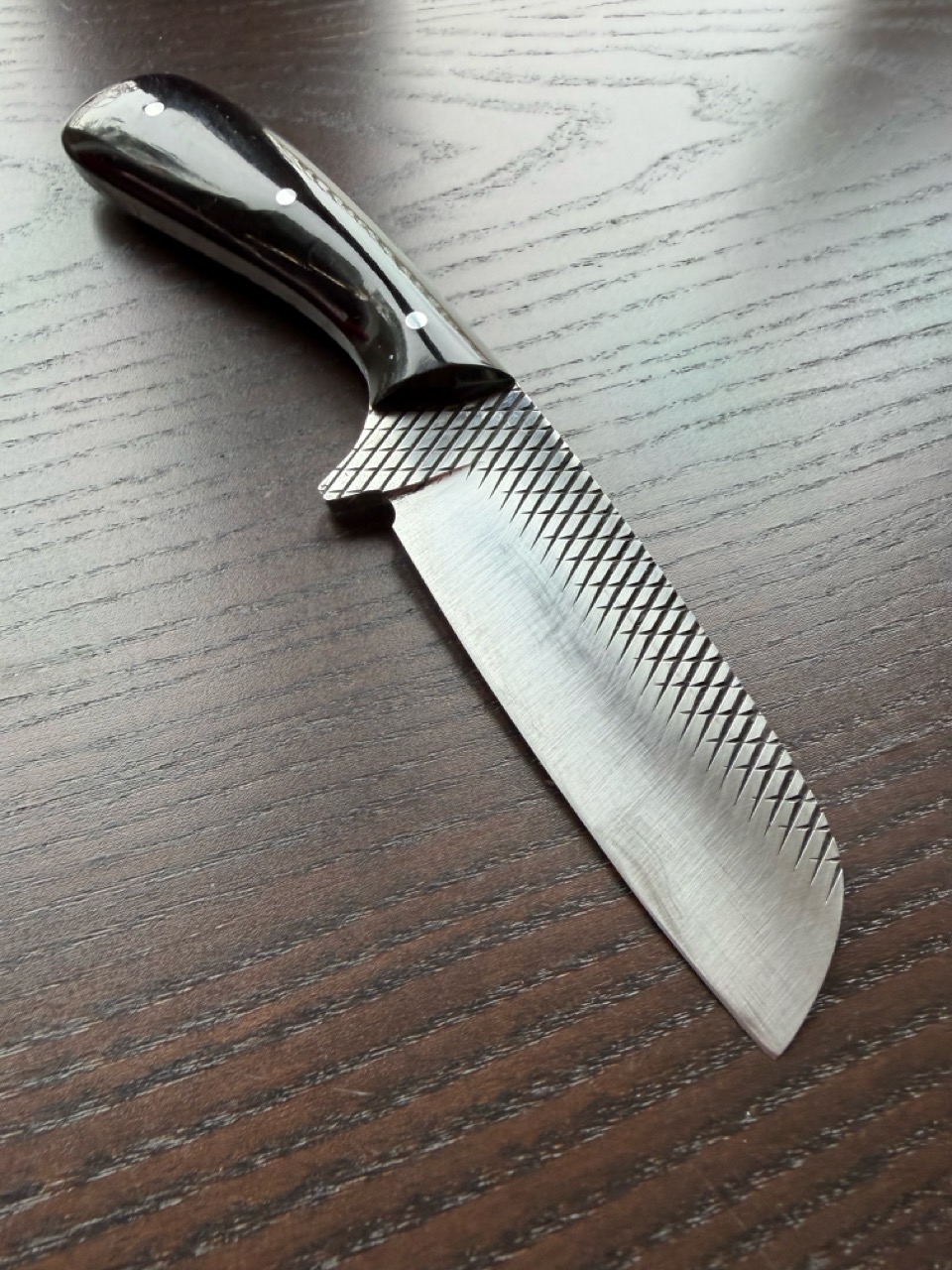
The blade retains the unmistakable imprint of its former rasp life.
A thick spine, yet a remarkably fine cutting geometry. Along the upper section, the rasp’s triangular teeth remain smoothed — not as ornament, but as a deliberate act of preservation… a generous spine that offers a wide, comfortable track for the thumb.
These elements speak of force.
From abrasion to raw, unapologetic function.
And then, just below, everything shifts — through transformation.
In an age of excess and waste, this feels almost essential.
Not just recycling, but refinement.
A second life in excellence !

Rasp steel is high-carbon steel, typically around 1% carbon.
An old-timer alloy — simple, proven, and unforgiving if mishandled. No modern complexity.
Just steel that responds directly to heat, to grinding, to use.

And when treated right, it delivers exactly what matters:

Edge, bite, and honesty — with a potential remarkable tolerance for abuse.

That’s why this kind of steel has long been favored for expedition and field knives (TOPS, ESEE…). It has proven itself where it matters most: in wood, in weather, in real use.

Not in theory. In the field. You cant go more traditional than this.
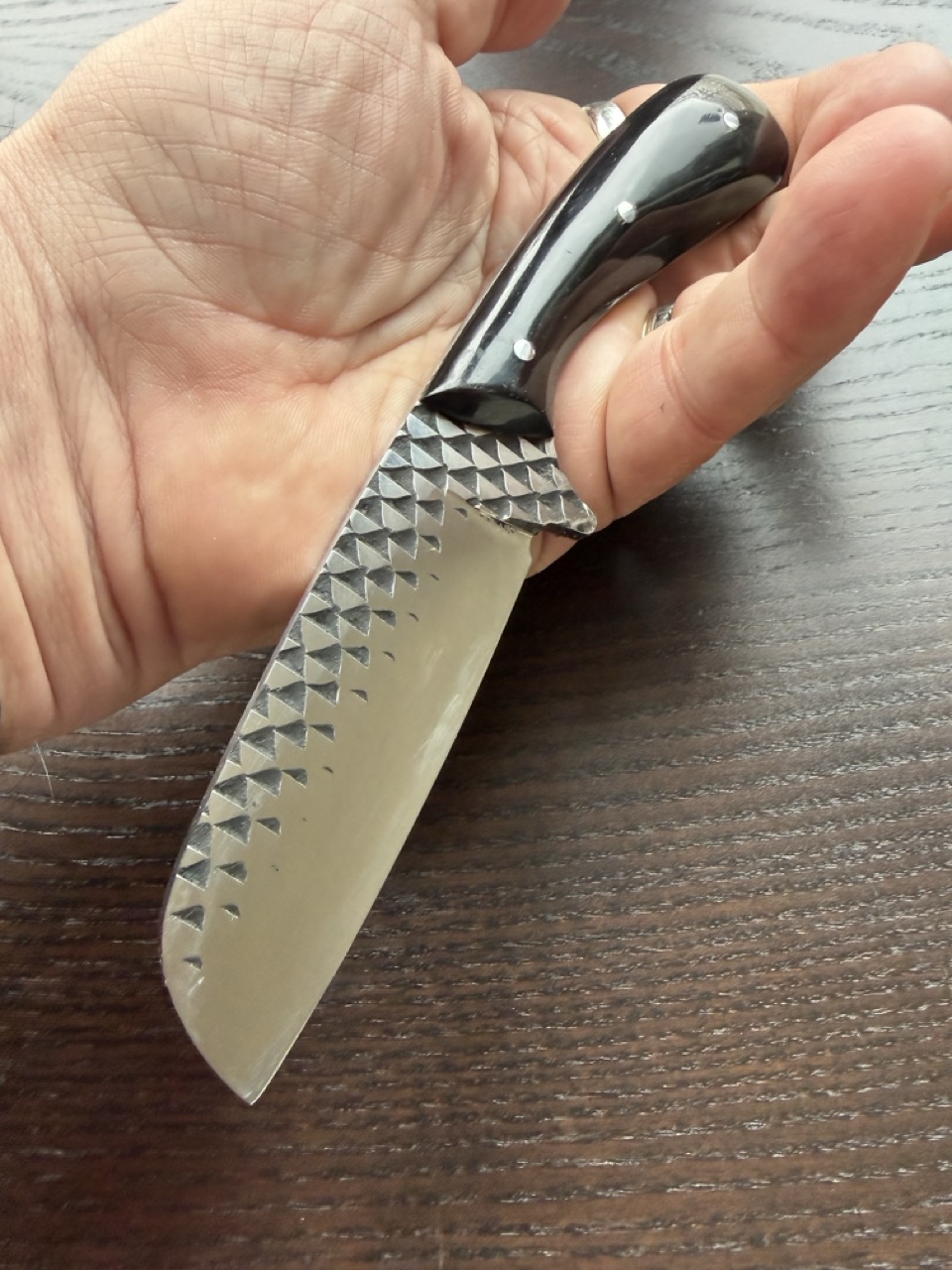

Deep, smooth, almost liquid in its reflection, the zebu horn handle creates a striking contrast with the blade’s aggressive texture — a dialogue between softness and bite.
The transition is not only visual. It is tactile. Almost sensual.
Oh, this is a tool made with love, and a companion, still becoming.

And you feel it immediately in the balance and ergonomics.
The fingers and palm find their place naturally — no adjustment, no hesitation, no hot spots.

The spine is just right for controlled push cuts, offering both comfort and precision.
This is, above all, an excellent trimming knife.
It can also find its place in bushcraft.
Easy to bring back to a razor edge, and forgiving in use — a knife that works with you, not against you.
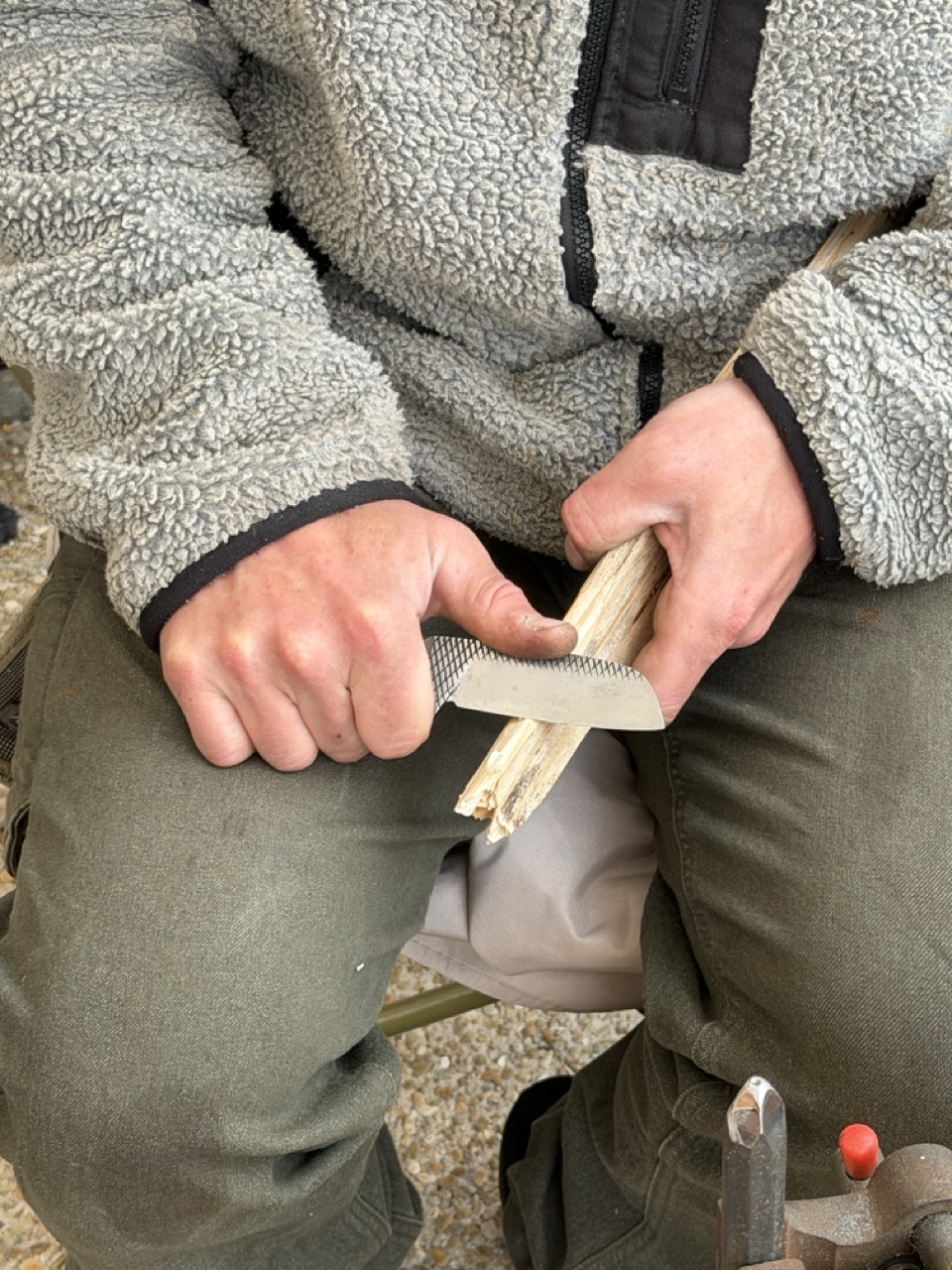
The profile remains restrained.
A compact geometry, balanced, with a gentle curvature that favors control over demonstration. The bevel is generous, inviting engagement without excess resistance.

Used in wood, the blade reveals its true character. It confirms the visual promise: entry is immediate, the cut remains stable, the material yields without fracture.

Under diamond stones, the edge feels stubborn—almost reluctant to yield.
But that resistance is a good thing.
As legendary knifemaker Des Horn once put it: “It’s not easy to grind carbon steel without raising the temperature too high. If it turns blue while grinding, it’s much softer.”
And that Bull Cutter’s rasp steel? It’s properly hard.
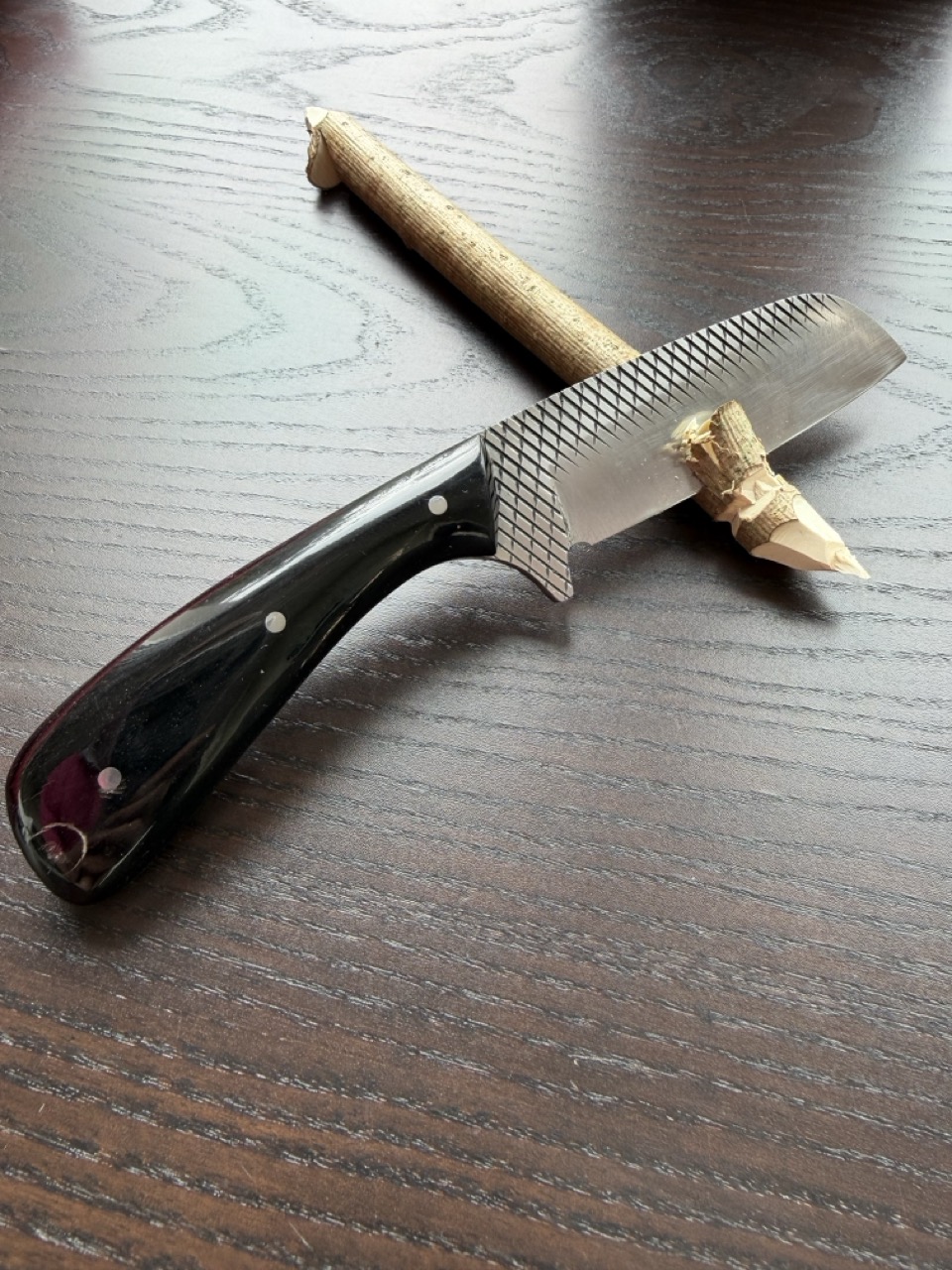
As a bonus:
Carbon steel and zebu horn share a common trait: they will change.
The steel will soon take on a patina, marking time and use.
The dark brown horn will slowly deepen, its surface already showing and gaining subtle complexity.
These are not signs of wear. These are the continuation of the object.

And Robin’s Bull Cutter is really a knife made to be enjoyed in the woods. He will see a lot of kitchen times too because the sheepfoot blade is non-threatening, almost reassuring — even to those who don’t speak the language of knives, as they are drawn to the story of a farrier’s rasp given a second life.
The guard locks the hand in place with quiet confidence, and the thin edge invites controlled push cuts with ease.
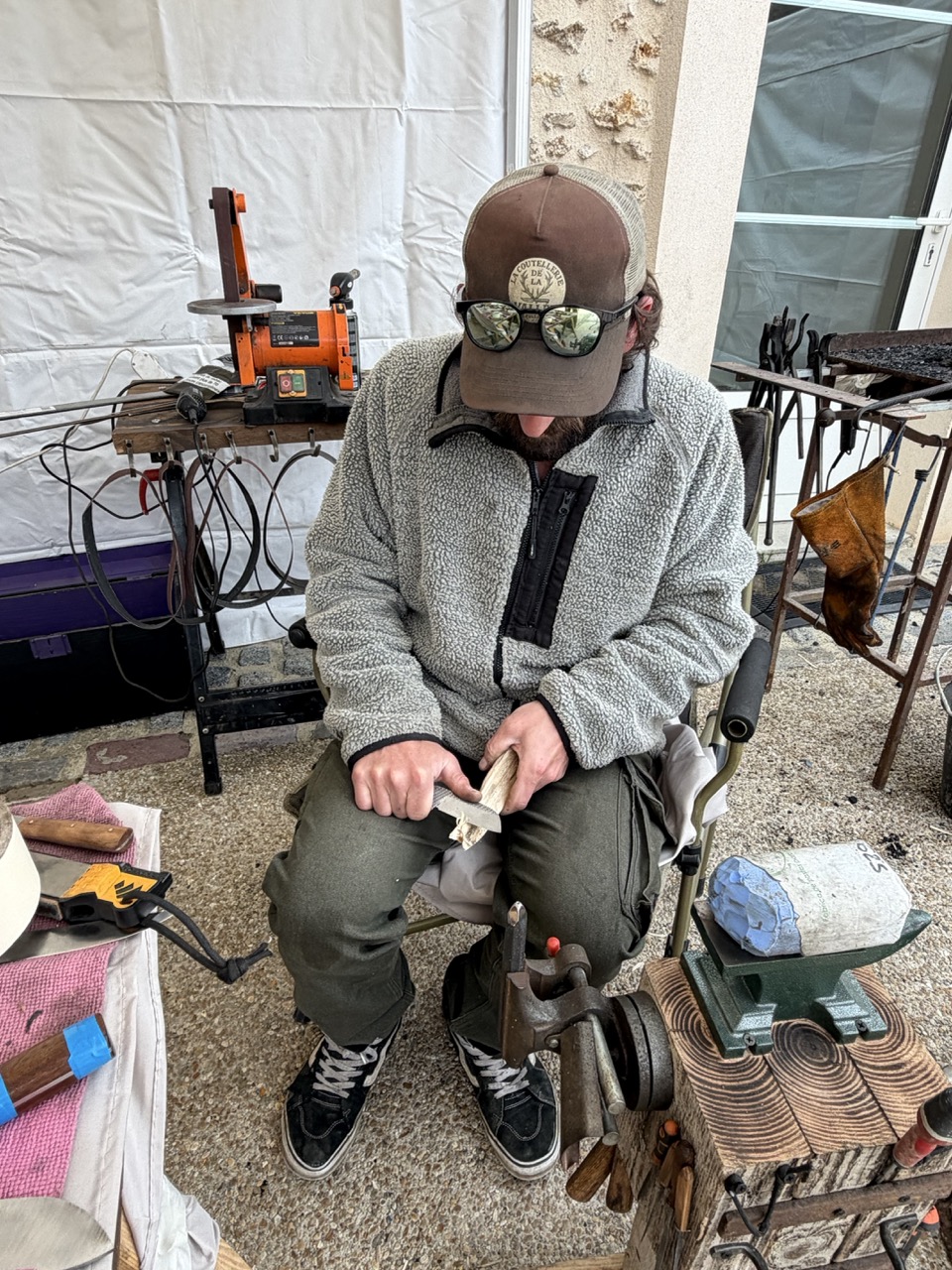
Robin made this knife for his own enjoyment — and you can feel it.
There is substance here. A certain heft in the hand, just enough to carry momentum when working light branches. It’s not meant for show — it’s meant to be used.
A compact blade with presence.
A small tank, stripped of frills and completely free of tacticool pretension.
Instead, it carries something rarer:

There is an old-timer aura….
The kind of knife that feels familiar the moment you pick it up as if that steel had already lived a looong life before reaching your hand.
It also echoes my long-standing appreciation for Schrade Old Timer fixed blades: the same kind of steel, the same pragmatic lineage.

“Excellent. Those are heat treated for hardness and not strength but are thick enough to be strong enough.” Des Horn.
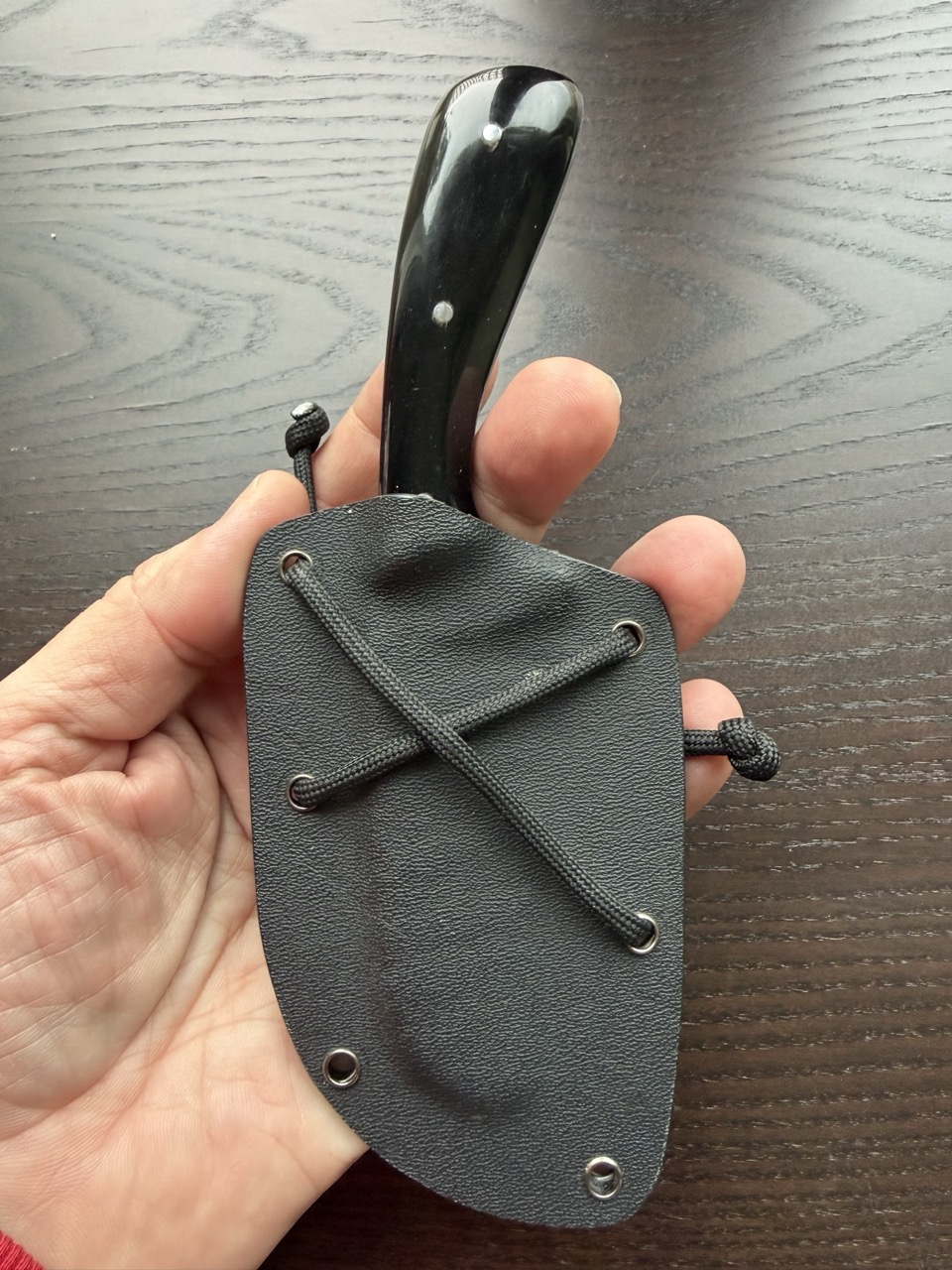
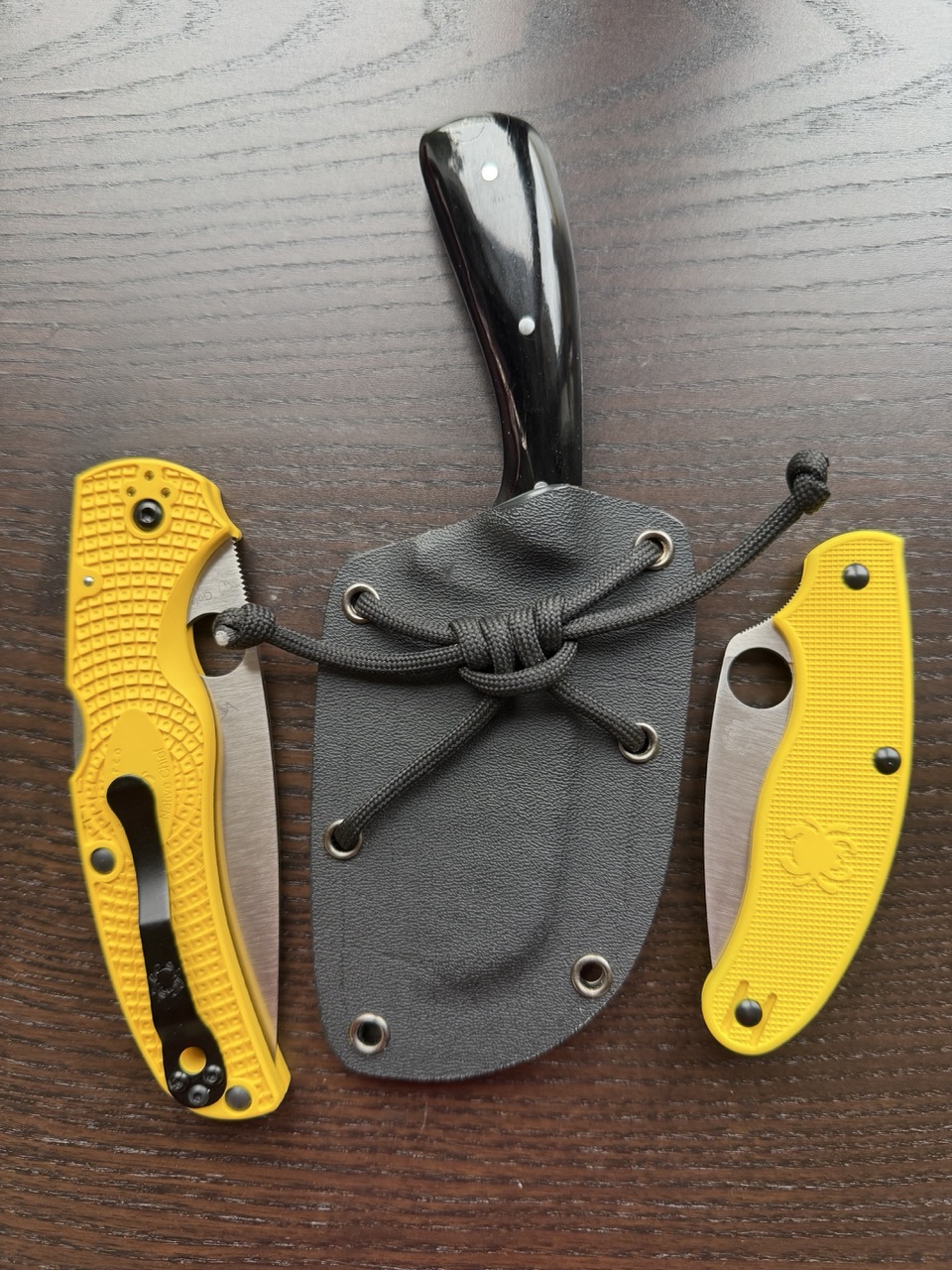
And then there is the sheath. Modern. Minimal. Black. Functional.
No unnecessary flourish — just a pancake kydex shell, shaped tight to the blade, held by a simple cord system that lets you adapt carry without overthinking it.
Your knife is a tool, destined to be in your pocket, belt or bag, when you go in the woods.
This kind of sheath are indestructible and they dry easy.
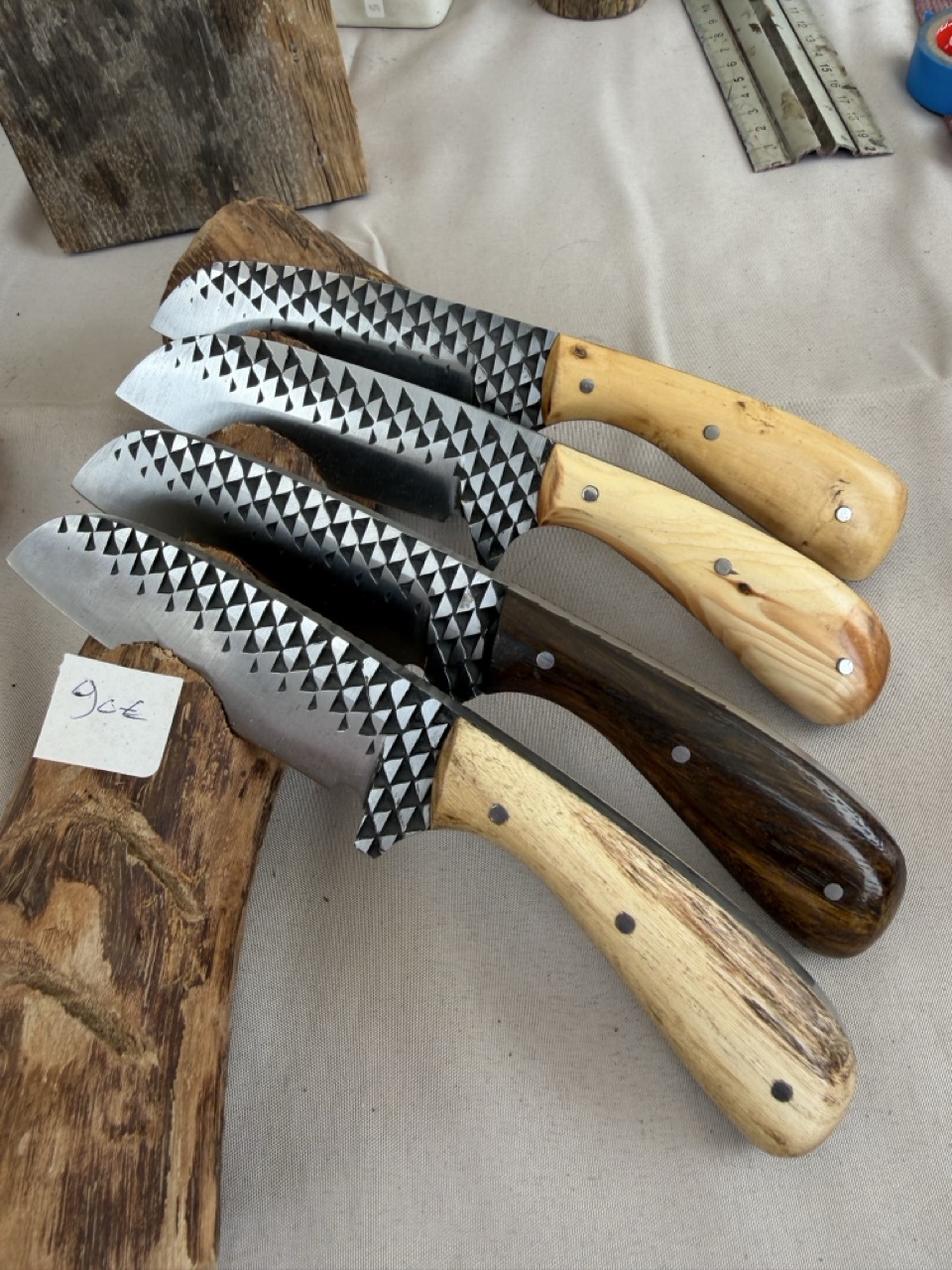
The handle can be crafted from a selection of carefully chosen woods and natural materials, each bringing its own character and depth:

  • Curly Birch — light-toned and finely figured, with subtle flame patterns that shift under the light, offering both elegance and warmth.
  • Boxwood — dense and smooth, with a pale golden hue that evokes traditional European craftsmanship and understated refinement.
  • Yew — rich in contrast, blending warm amber tones with darker veins, a wood long associated with heritage and resilience.
  • Yellow Locust (Black Locust) — robust and naturally durable, with a deep, earthy coloration that speaks of strength and longevity.
  • Rosewood — dark, luxurious, and complex, with deep reddish-brown tones and a natural luster that brings a sense of quiet opulence.
  • The list goes on…

For around 100 euros (mine was 110), the Bull Cutter doesn’t belong in a display case. This is Robin’s favorite design and best seller. It belongs in the forest — in valleys of green and grey, following the rivers as they meander through the land.
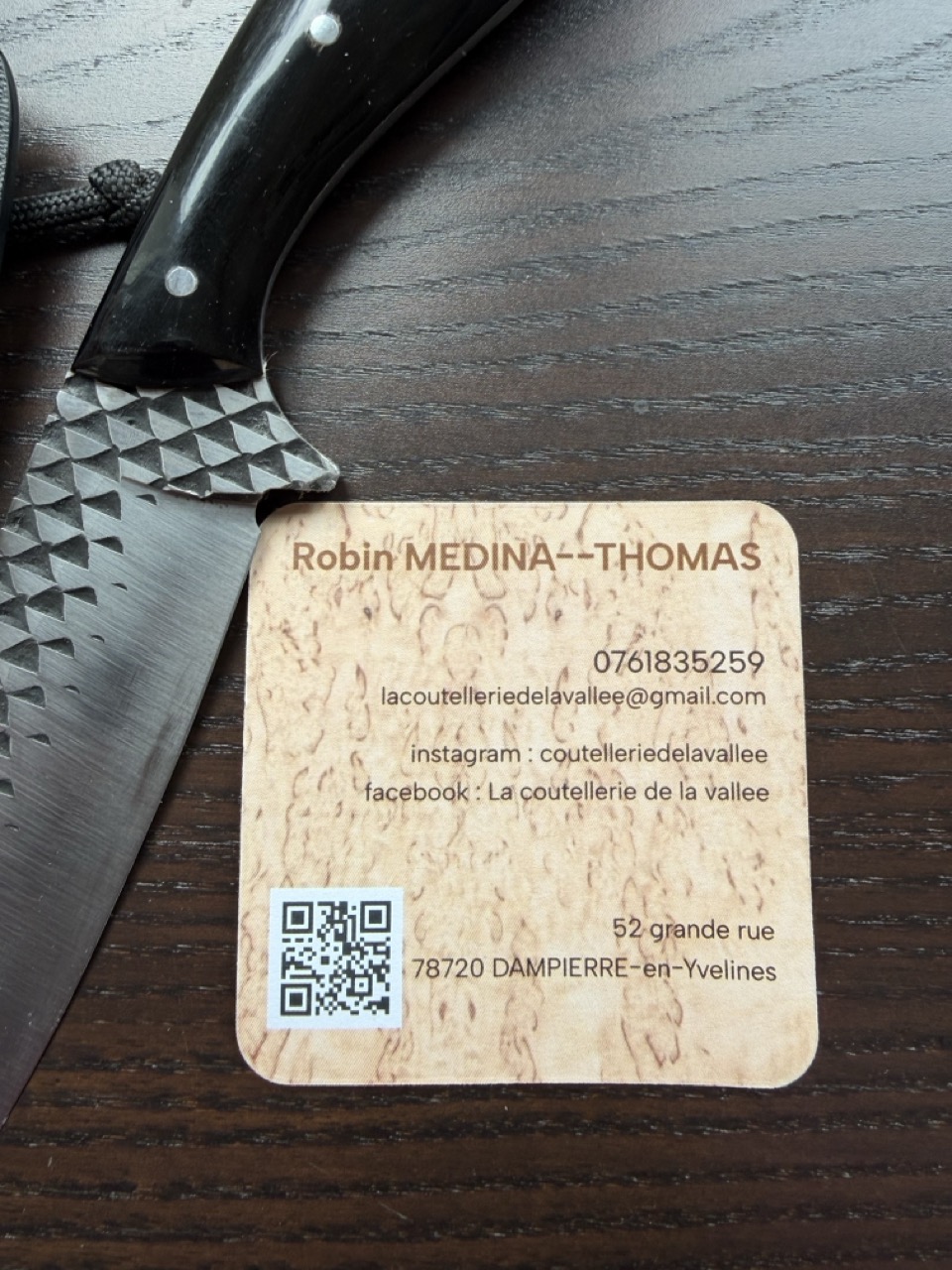
It is a coup de cœur for me — and my kind of tribute to a young, gifted knifemaker.

In use. This rasp steel was born to remove matter.
It still does in a new sharp shape.
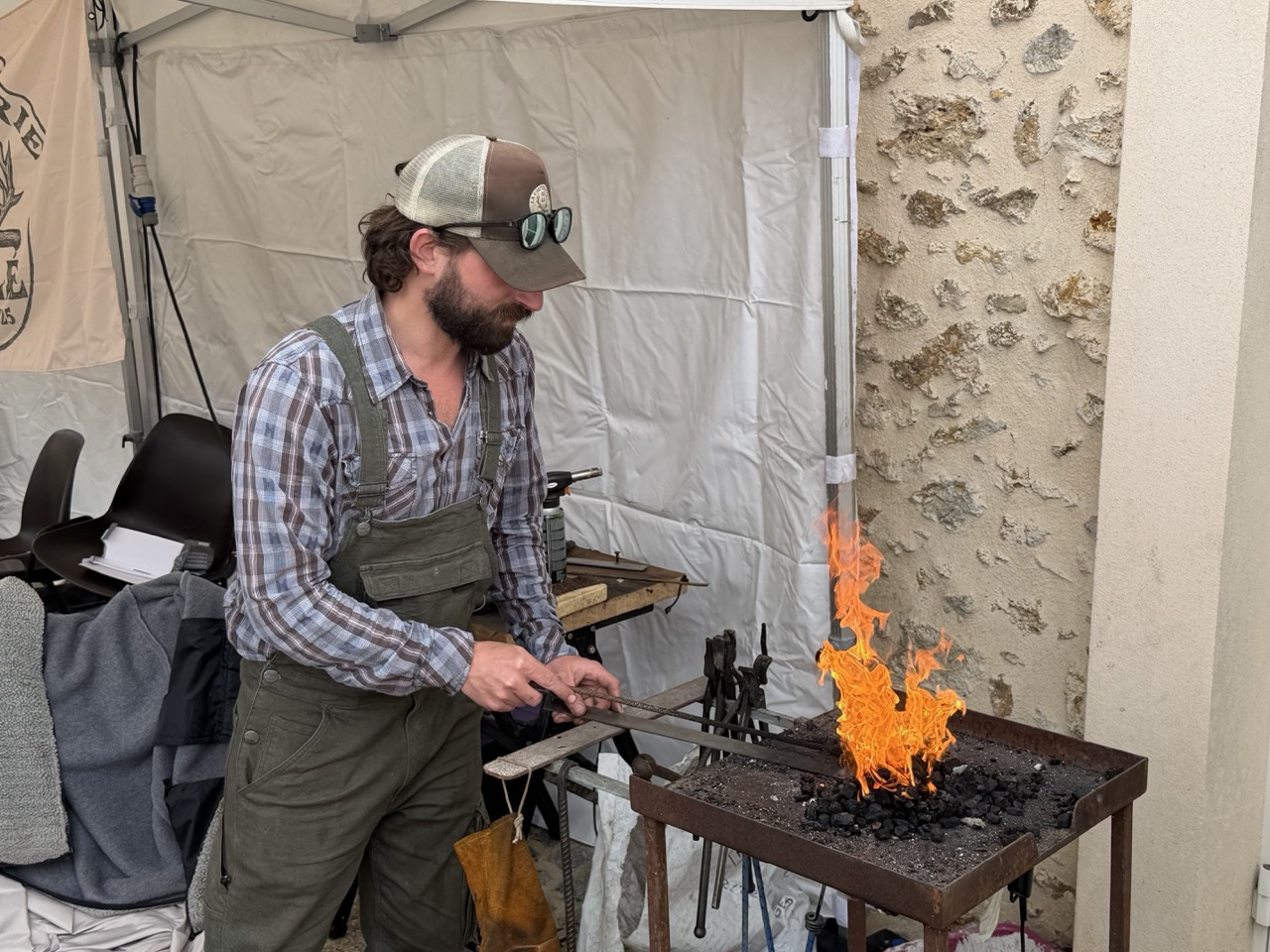
La Coutellerie de la Vallée
https://www.facebook.com/profile.php?id=61582645504772
Dampierre-en-Yvelines, France
An artisan workshop dedicated to the crafting of bespoke knives and the art of fine sharpening.
Each piece is shaped with care, guided by tradition, and made to endure in use.

📞 +33 7 61 83 52 59
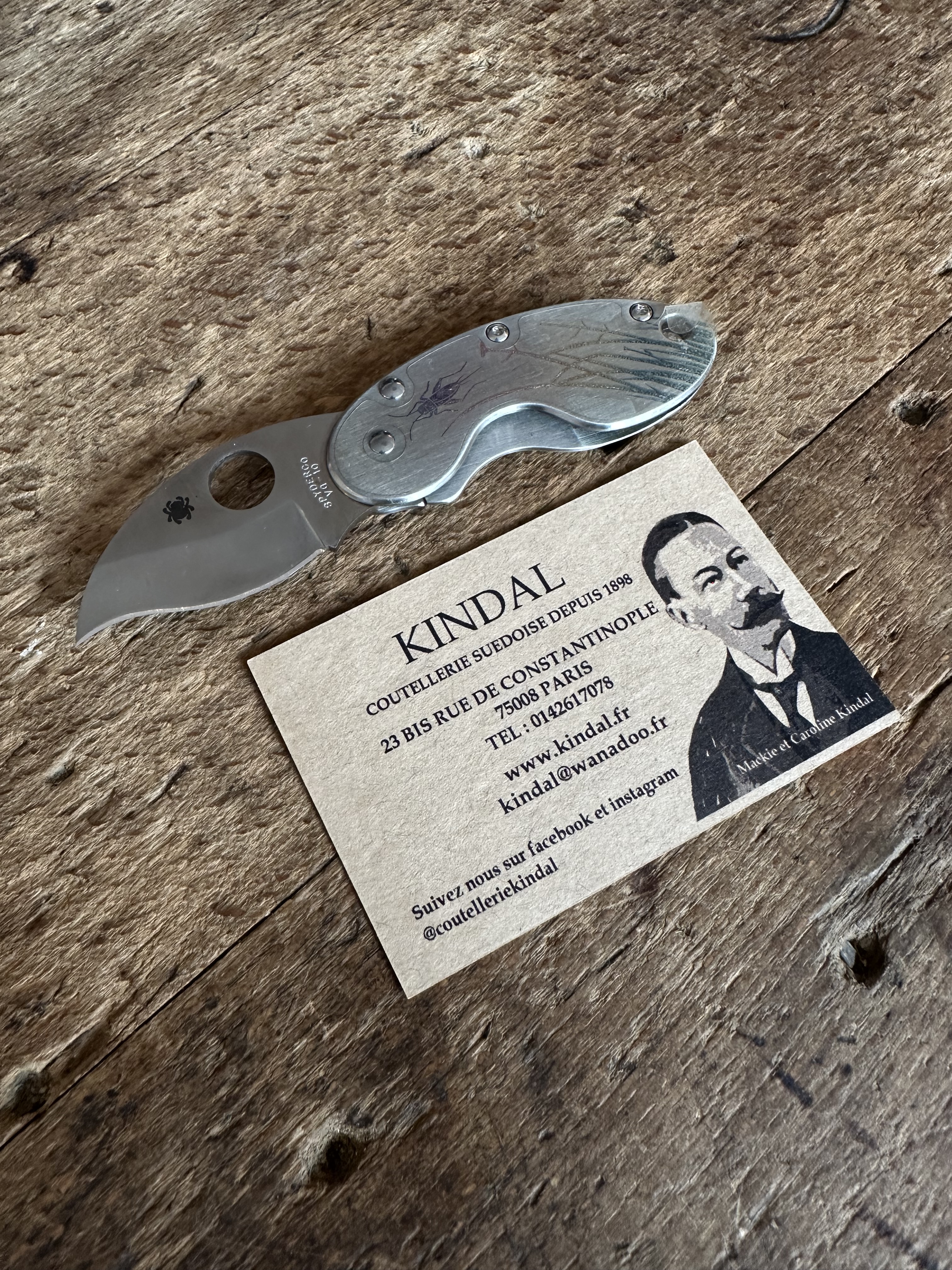
CRICKET™ STAINLESS STEEL TATTOO

C29T – “When You Wish Upon a Star”

I know Jiminy (Cricket) since 1994. I even have used to have a pink version of this little bugger in the last millenium.
Today, while making a little pilgrimage in famous Kindal cutlery shop in Paris,

Mme Kindal has displayed me one of her many treasures displayed, next to a Janisong and a Military titanium…
It was love at first sight for that blast from the past little big knife.
Because there is a lot of power in that compact package, it was the chance to carry another one of those New Old Stock.

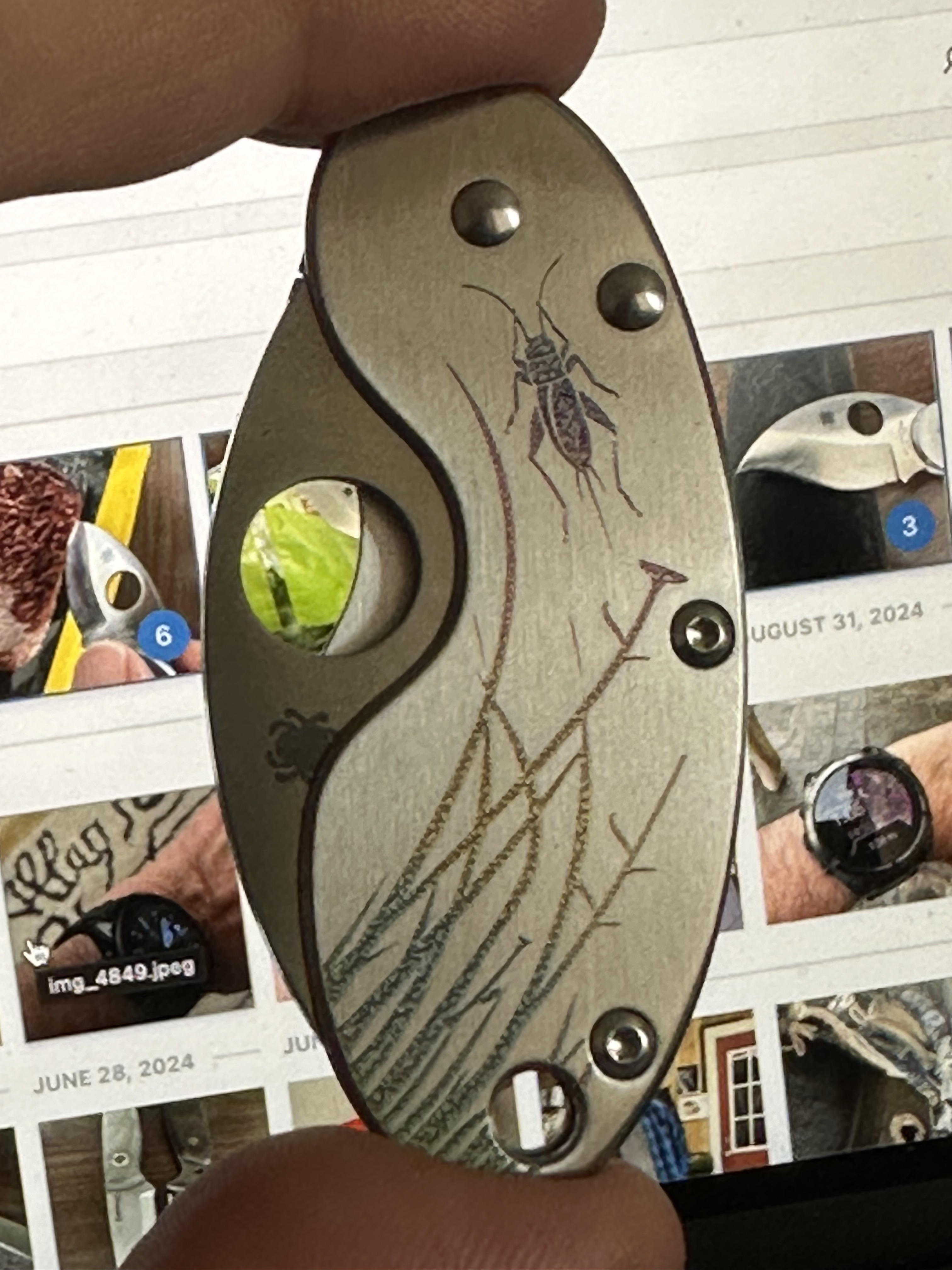
It is true, the Tattoo version of the Cricket is a pure jewel and delight to look at and to use. It has been cleverly designed in House by Sal Glesser (but I won’t be surprise if Ed Schempp would have been also its inspiration).
Based on the stainless steel version of the Cricket Tattoo it is really well made piece of cutlery.

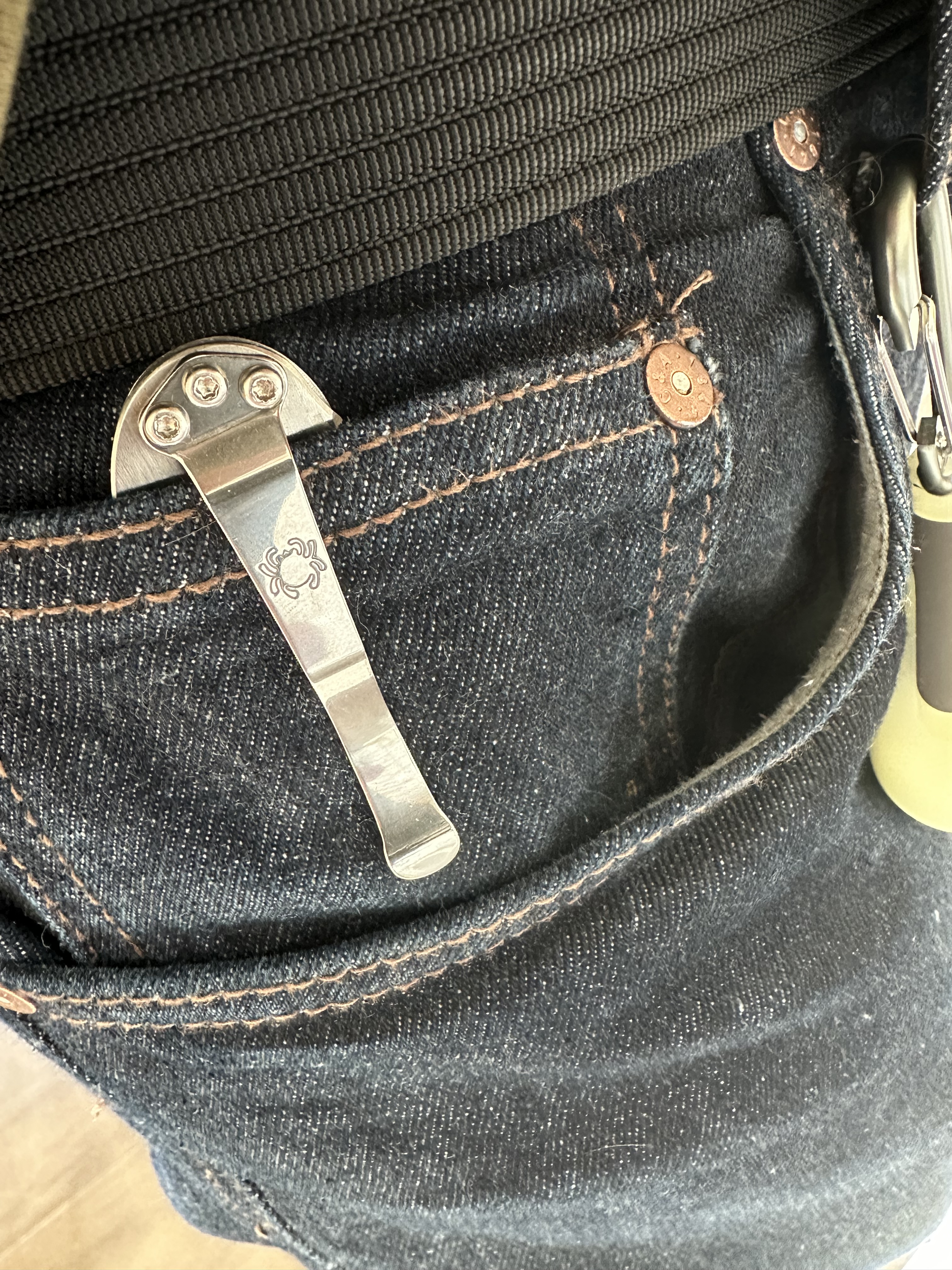
Folded the C29T creates a rounded package that carries nearly invisibly in the pocket. The pocket clip carries right-handed tip-down but also attaches to a tie or makes a fashionable money clip. The anodized illustration is really elegant.


The Stainless Steel design using a Chris Reeve Integral Lock makes it really thin and easy to wear even in a shirt pocket.


It is a tip down carry which allow a very fast an elegant Spyderdrop opening. So its reverse “S” shaped blade get in action very very fast.

Its 2mm thick and 48mm long blade is tricky, thanks to its “S” shape: you got a longer edge to use. And like Eric Glesser’s Dodo, Sal Glesser Cricket is a geometrical trickster: the cutting angle is almost never at 90° to the separated material, acting like a sinusoïdal guillotine. It is very powerful. For a knife of its length, the Cricket is packing a lot of cutting power hence the name “Little Big Knife” used for that kind of Spyderco.

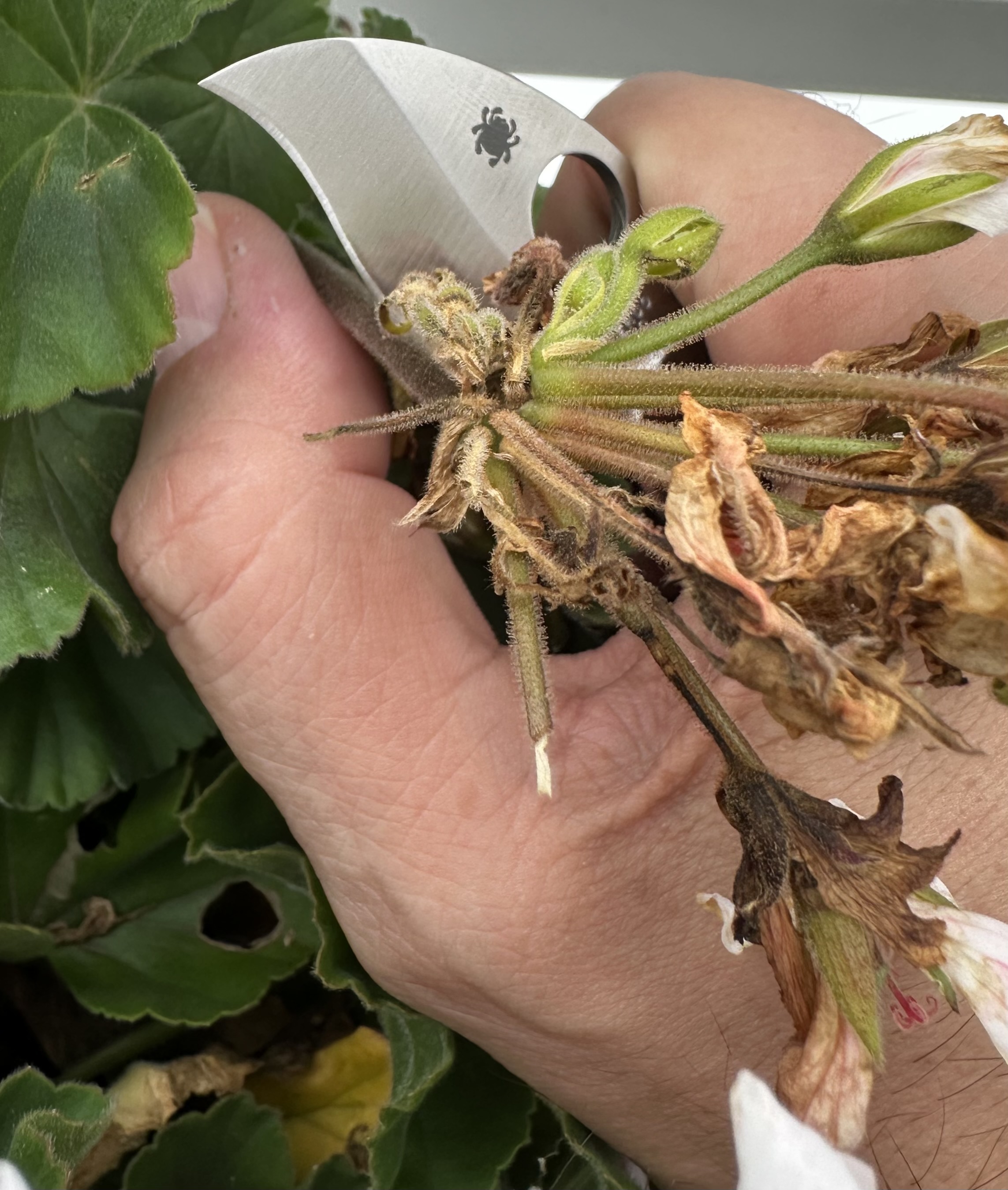
The Cricket is a joy to use in the garden on hard material…

… and on soft material.

Beware of that S Shape, beak or claw design, loves to catch anything around, you thumb for example can bleed in a blink of the eye.

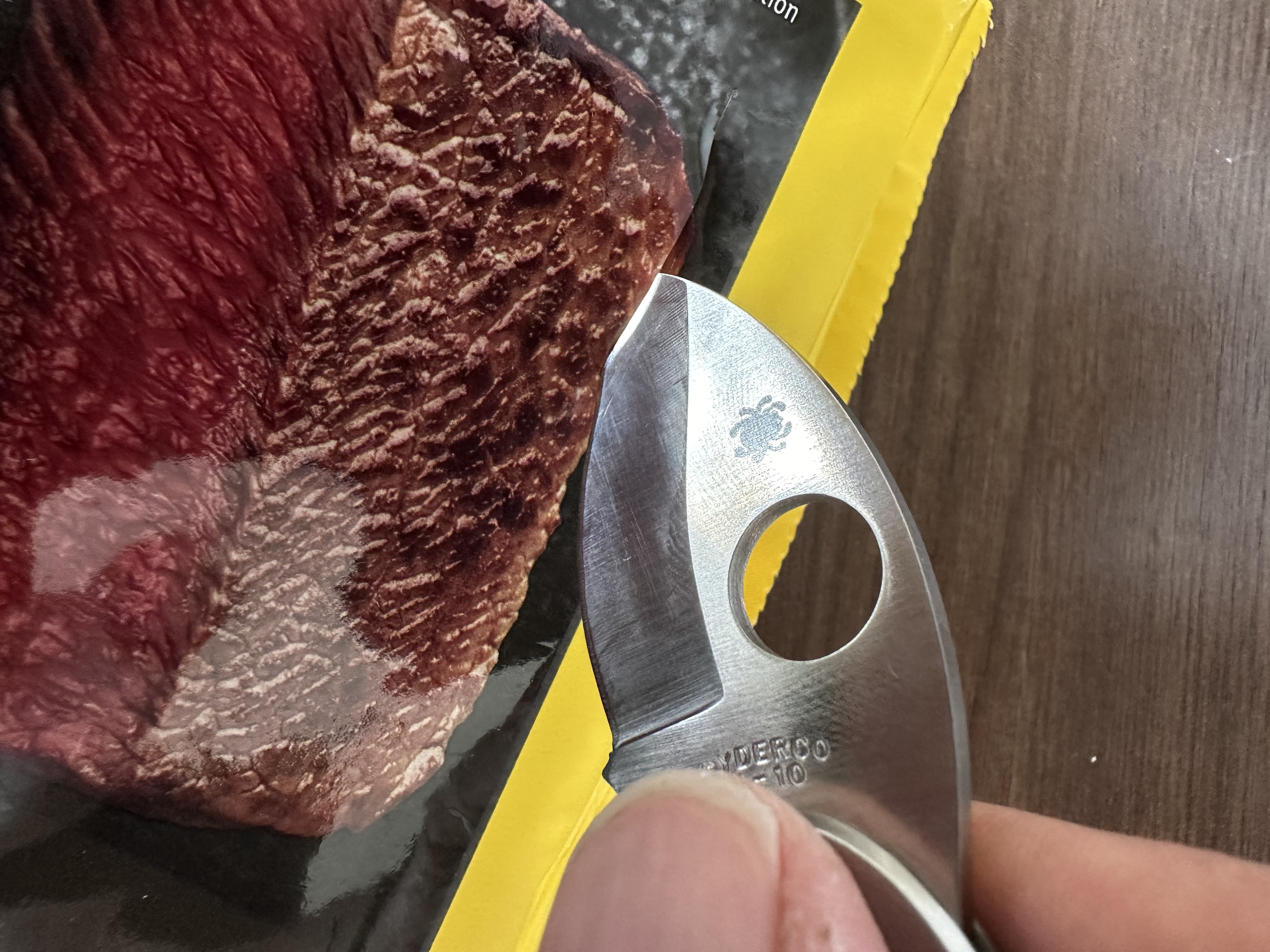
The beak penetrates in any plastic sheet very aggressively. It is even surprising how easy it can open packages.

Some people are not fans of S Shape blade or any blade with recurved edge. It is a natural shape found in claws, talons, teeth and beaks.
But by using a rounded ceramic (VG10 is not difficult to get back to razor) and the corner of the leather pad, the Cricket keep its razor edge.

Here is with a Jade sharpener. I sharp the belly on the flat and the beak on the corners.

It opened design makes it a breeze to clean under the tap.

I highly recommend the Cricket as an EDC knife. It is a little but powerful “matter separator” destined for Ladies or Gentlemen for daily duties which can be clipped to a purse, a pocket even a bra. I also knew a former French Marines, six-foot-four and full of muscle, who had adopted the Pink Cricket as his main EDC. Go figure how this little knife makes you wish upon a star !

Spyderco Native Chief: HELLBOY 2 – The Kitchen Army

Since the reception of my Chief Native I have found that he was a sole survivor from a Xmas Mystery Box bought in Spyderco’s plant in Golden in December.
In that box were different items and a rare Sprint Run Second Factory which was destined to end in my pocket and considered by myself IMHO as the perfect realisation of Sal and Eric ideas about pocket knives. In fact I think it is my favorite Spyderco ever.
I have written a first review here.
And now it is time for a second approach of Hellboy which has succeeded in kicking other knives from my pocket and quench my thirst for novelty.

So why ?

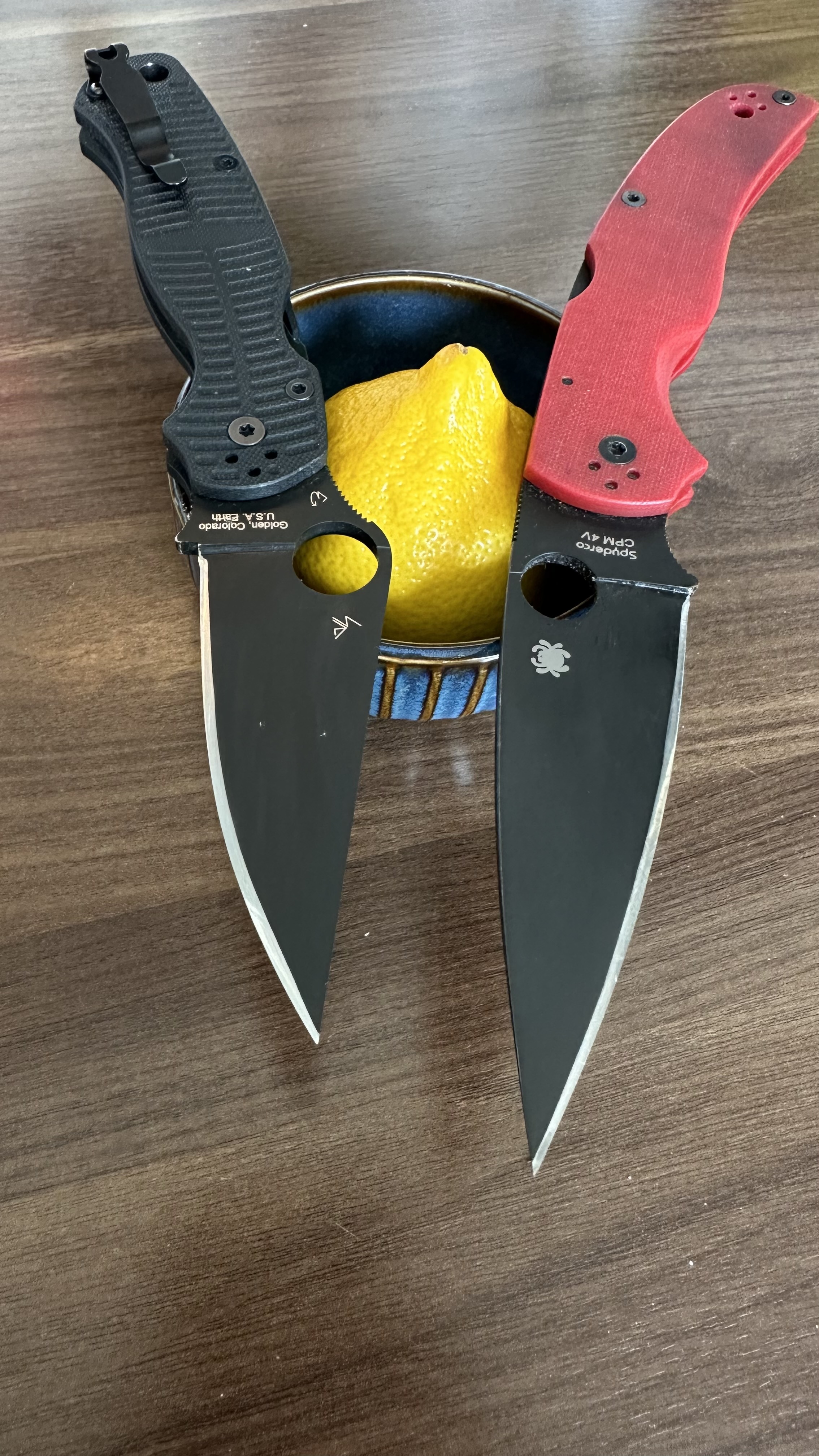
First the Native family feature an absence of hump on the blade making them very slick and beautiful.

Even the Shaman benefits from that.

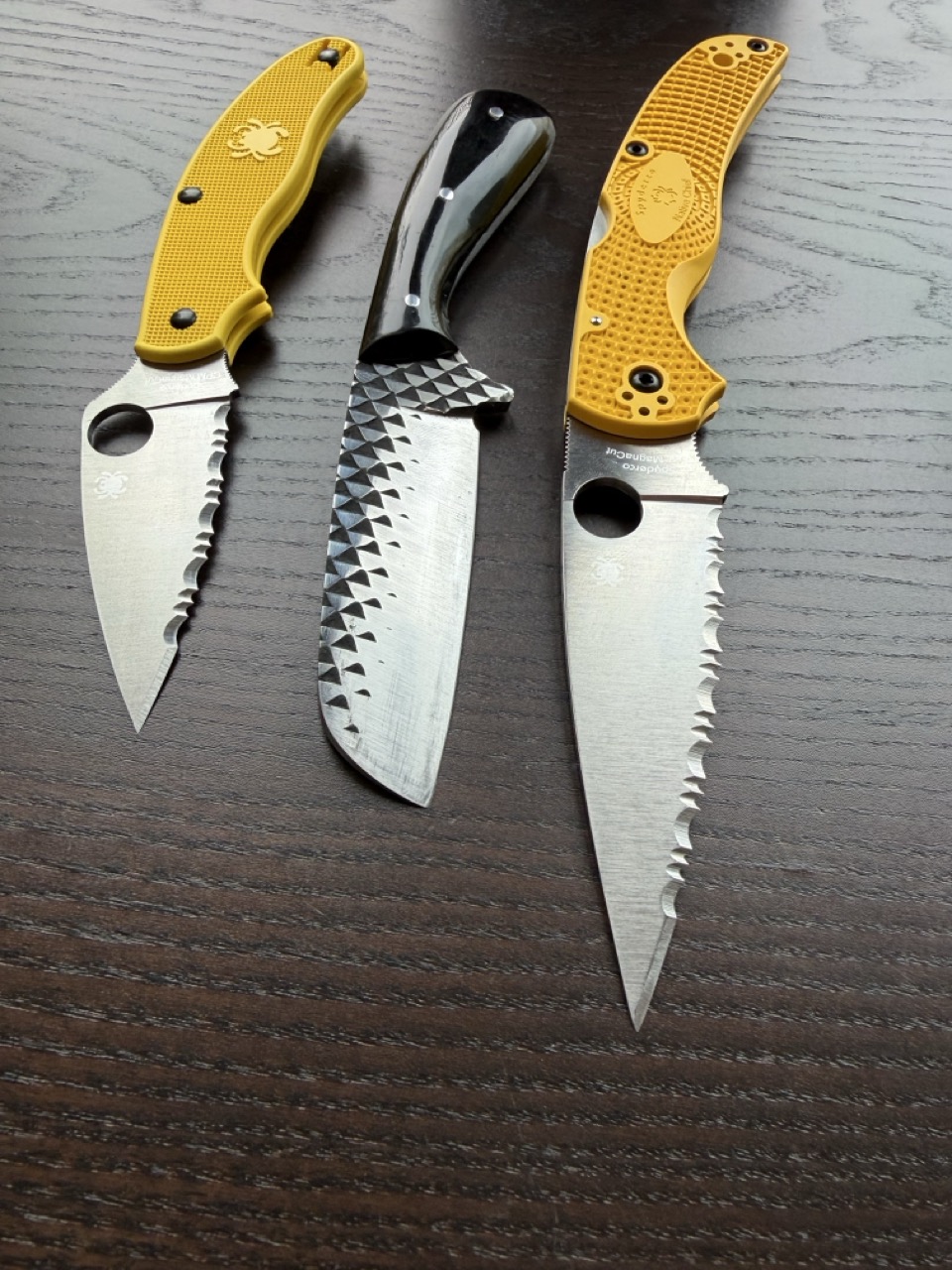
The Chief is on the left and the Shaman on the right.

As you can notice the design of the Native Chief is really close to one of my favorite design: the AFCK.
Sal Glesser was no stranger in the Benchmade BM800 AFCK back in the 90’s. He helped Les De Asis founder of Benchmade on it. They had both learned how to make Michael Walker’s linerlocks at Bob Terzuola shop.
Both company were accelerating on the tactical lane in close formation.

As you can notice, my AFCKs (Advanced Folding Combat Knife) which was also designed by Chris Caracci a former Navy SEaL have been used a lot. The first version got a Spydiehole and the second version got an oval hole and an axislock.
This design was one of my favorite for a big folding knife as EDC.
And back then I was really in love with concept of tool highspeed steel on a modern plateform.

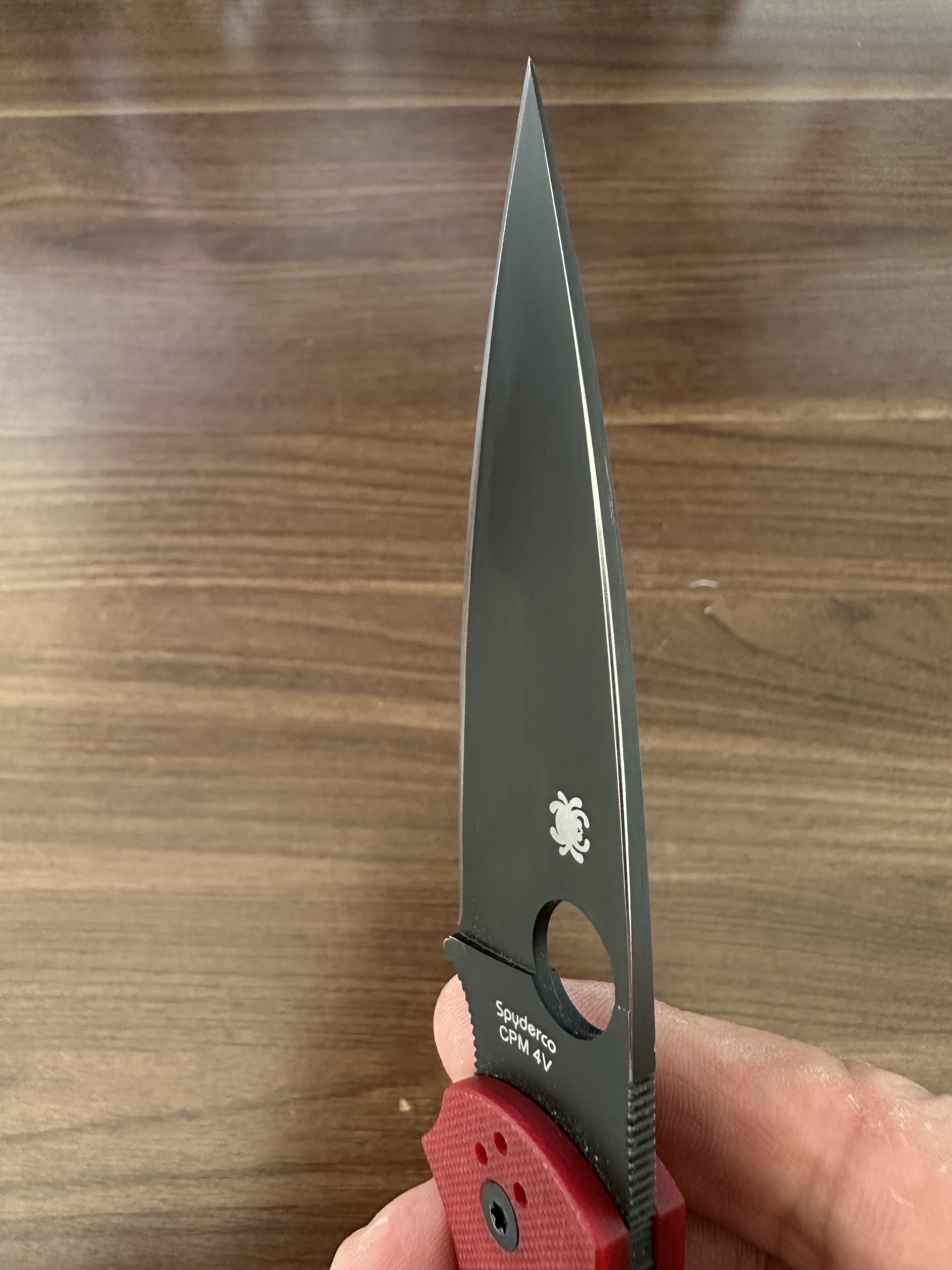
The same happend with that special Native Chief which got a very special alloy for its blade: CPM-4V.
With that steel, the edge is strong and the thin blade is very solid.
It gives a lot of confidence when cutting on a plate made of ceramic of glass. No chipping can happen.
Hellboy has been used a lot for cutting pies and cake on glass plates and the edge behavior was not disappointing. When I have noticed a little shiny spot, some white ceramic was able to put everything back on line but it was really minor.

Now CPM4V is not stainless. It will form a patina or, worst, rust very quick and easily when used in acidic matters like cutting lemons and being used on a salad with vinegar.
DLC coating is really welcome for that kind of behavior. Back in the 90’s Benchmade was offering only PVD coating which is really inferior to Diamond Like Coating. So far the blade of my Chief is not marked and scar by it various cutting tasks even when cutting.
My previous Chief was a naked Rex45 blade and it was another story told here.

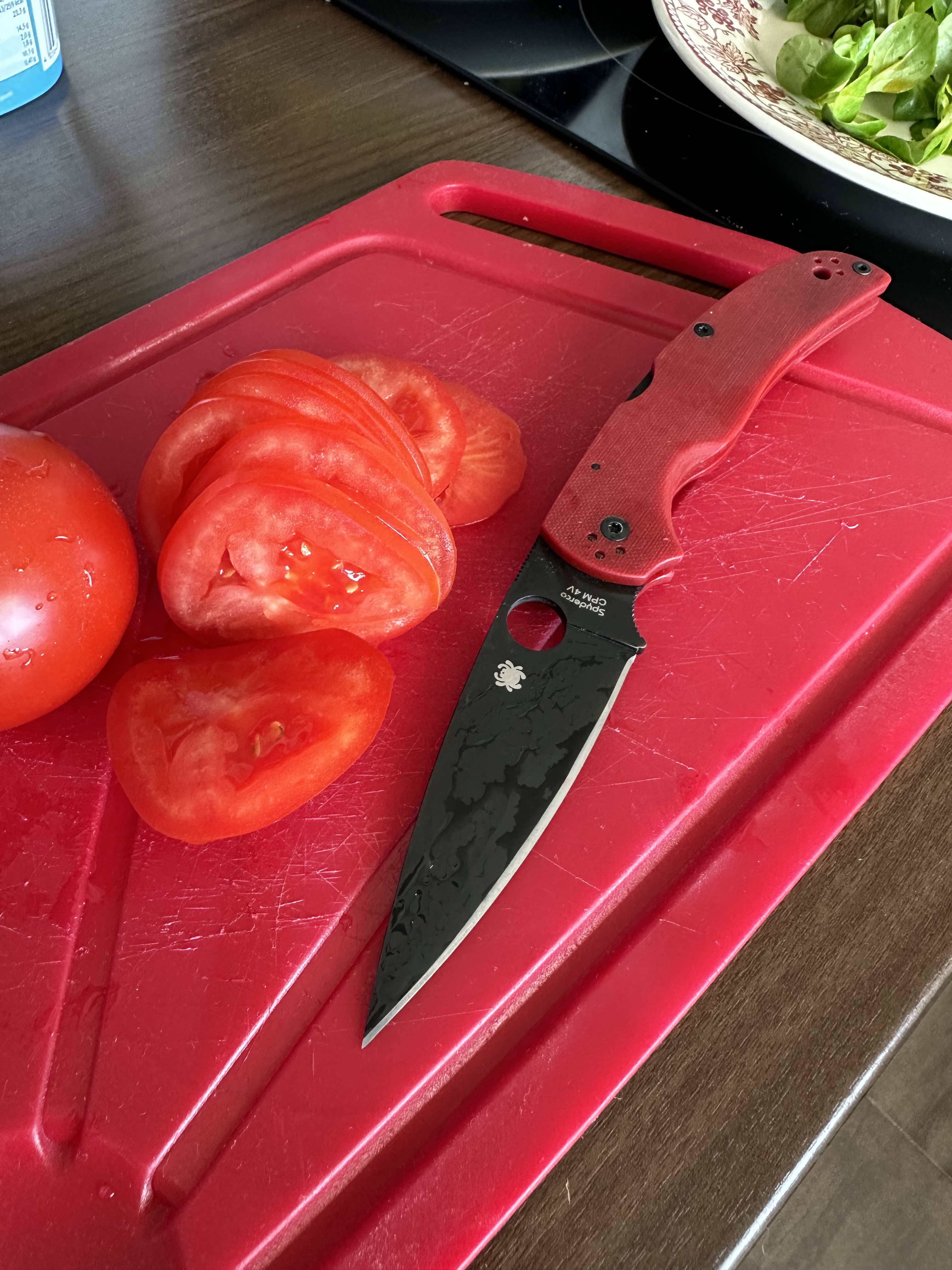

Even strawberries can darken the edge of CPM 4V.

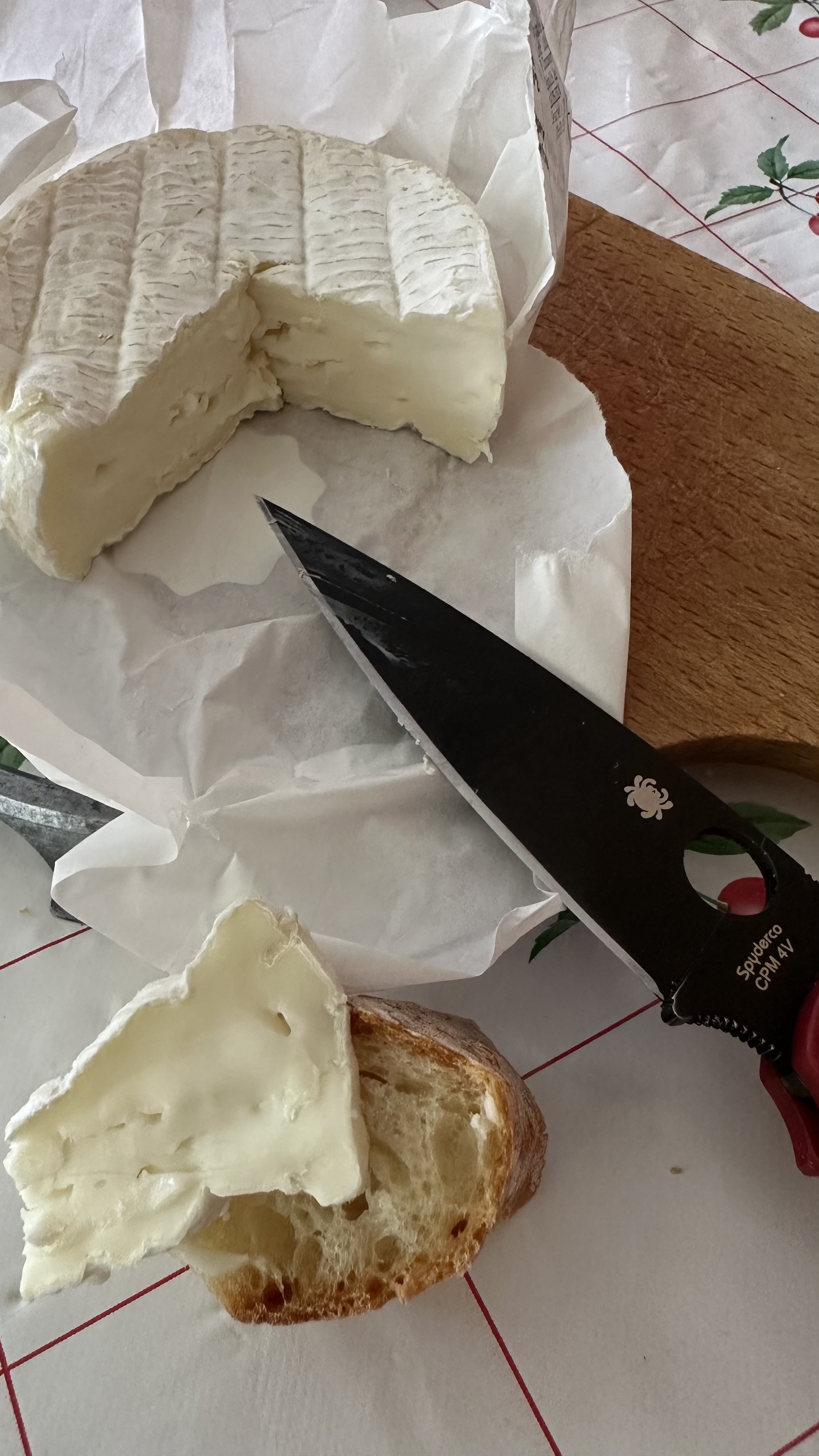
But cheese is a great way to notice how DLC is making the surface of the blade less sticky but more stinky.

The Chief was not always used on gentle medium like wood.

It was also used on plate with vinegar salsa. Here it is basamic vinegar from Modena.

In the kitchen the knife is really behaving like an paring knife. It is really handy on fruits and vegetables. Its very pointy blade is great to carve.
.The mechanism has never suffered from being wet and rinsed under water. The knife was smooth through and through its various wet works.

Now I like to have chamfered and smooth handles and blade spine. The Chief is known to be very square everywhere. The G10 has been easy to smooth with sandpaper used wet to avoid toxical dust.
Now the blade spine is DLC coated and it was my esthetic choice to remove the coating on all the length of its spine.

I love the result.

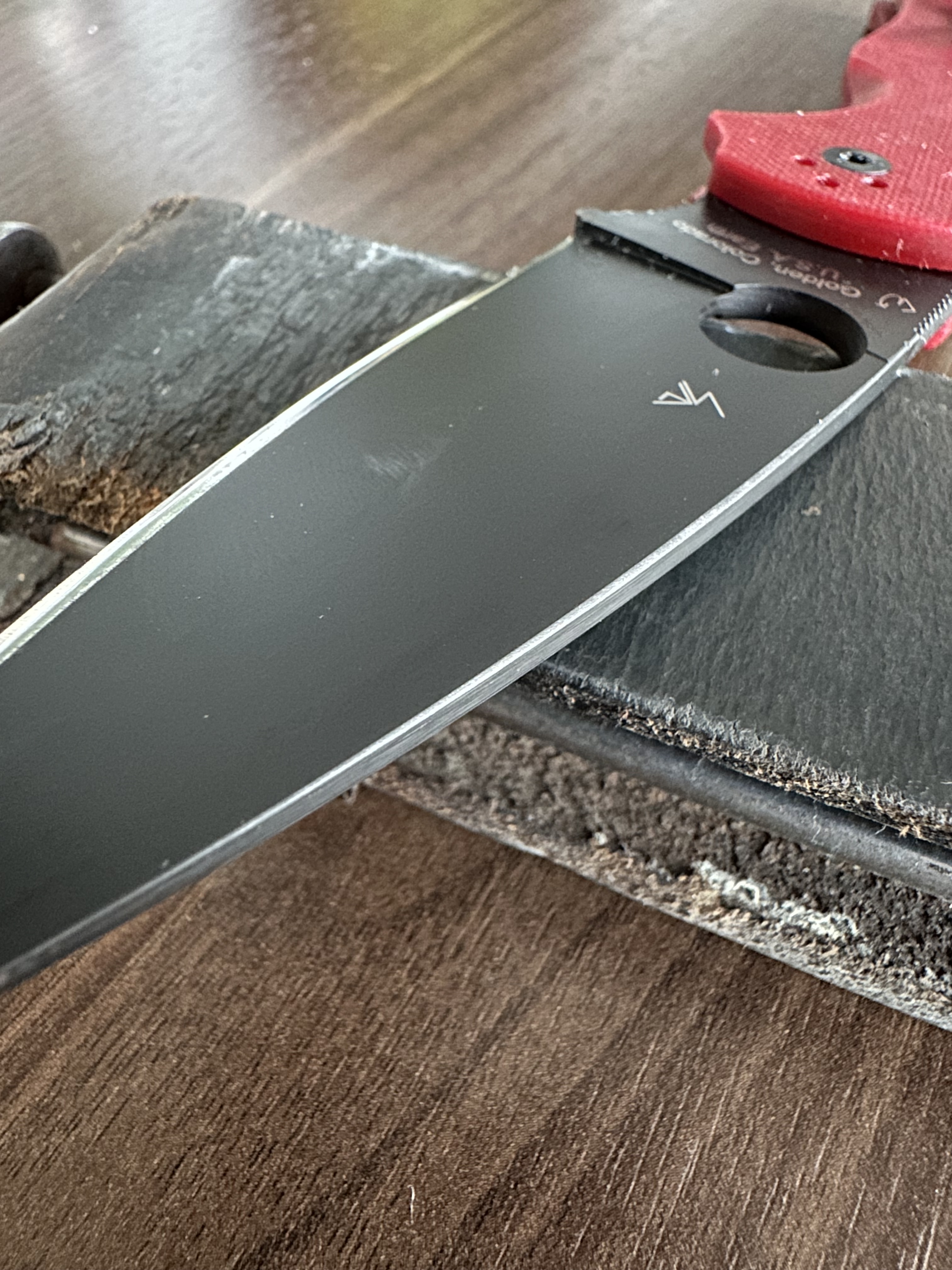
It has been done with some diamond rods.
Now the spine is much more confortable for my thumb in case of push cuts.

CPM 4V on that Native Chief platform is really the bread and butter for a strong thin folder. I’m not afraid to use hard on wood and plastic.
And it is a must in the kitchen various missions.
It has been also test on different hard wood and compared (geometry speaking) with many other knives I got.
One of my champion is the Swayback in term of smooth pushcuts.
But also the Wolfspyder and the Yojimbo.

My Chief needed more convexing and thinning to go to the level I was expecting. Again diamonds has been used handfree to remove the shoulder of the edge.
CPM 4V keeps a very very crispy edge and bites in the wood very aggressively.

CPM M4 is a stunning alloy which is prefered on fixed blade but it is a gem on a long and thin folder. It makes it super solid with a very permissive edge.

Quoting Larrin Thomas Phd:

Some will argue that toughness is not important in folders or fine slicing knives and feel that only edge retention matters in that case because they don’t use their knives in aggressive ways which are likely to lead to chipping. However, broken tips are still common on small knives and kitchen knives. And with higher toughness, the knives are better able to handle thin, low angle edges without chipping. And they can be heat treated to higher hardness to help prevent edge rolling and deformation, while still maintaining good toughness. This means that, indirectly, higher toughness can lead to better cutting performance because of the possibility of thinner edges.

The good news is that CPM Magnacut has been copied on CPM 4V behavior.

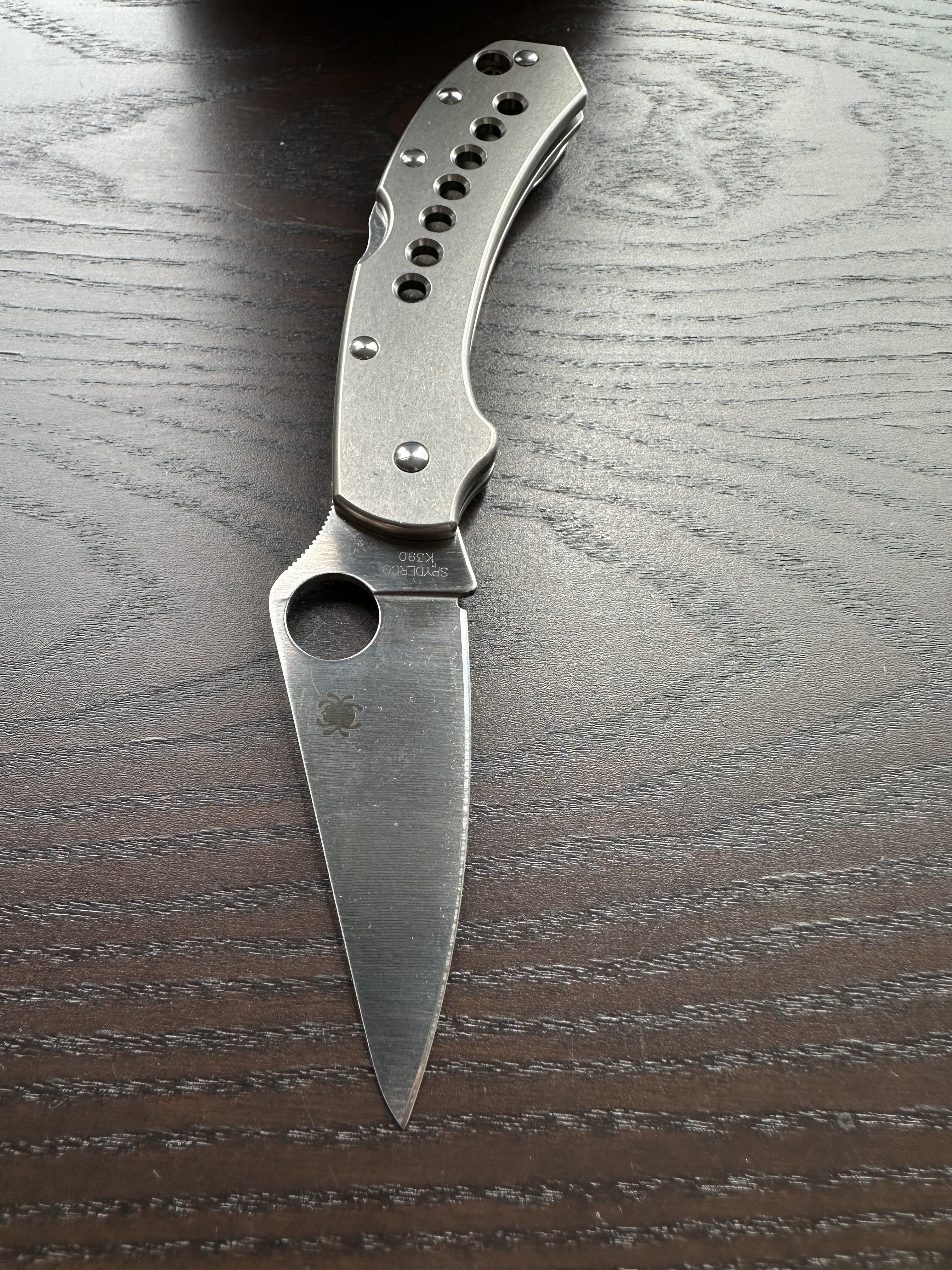
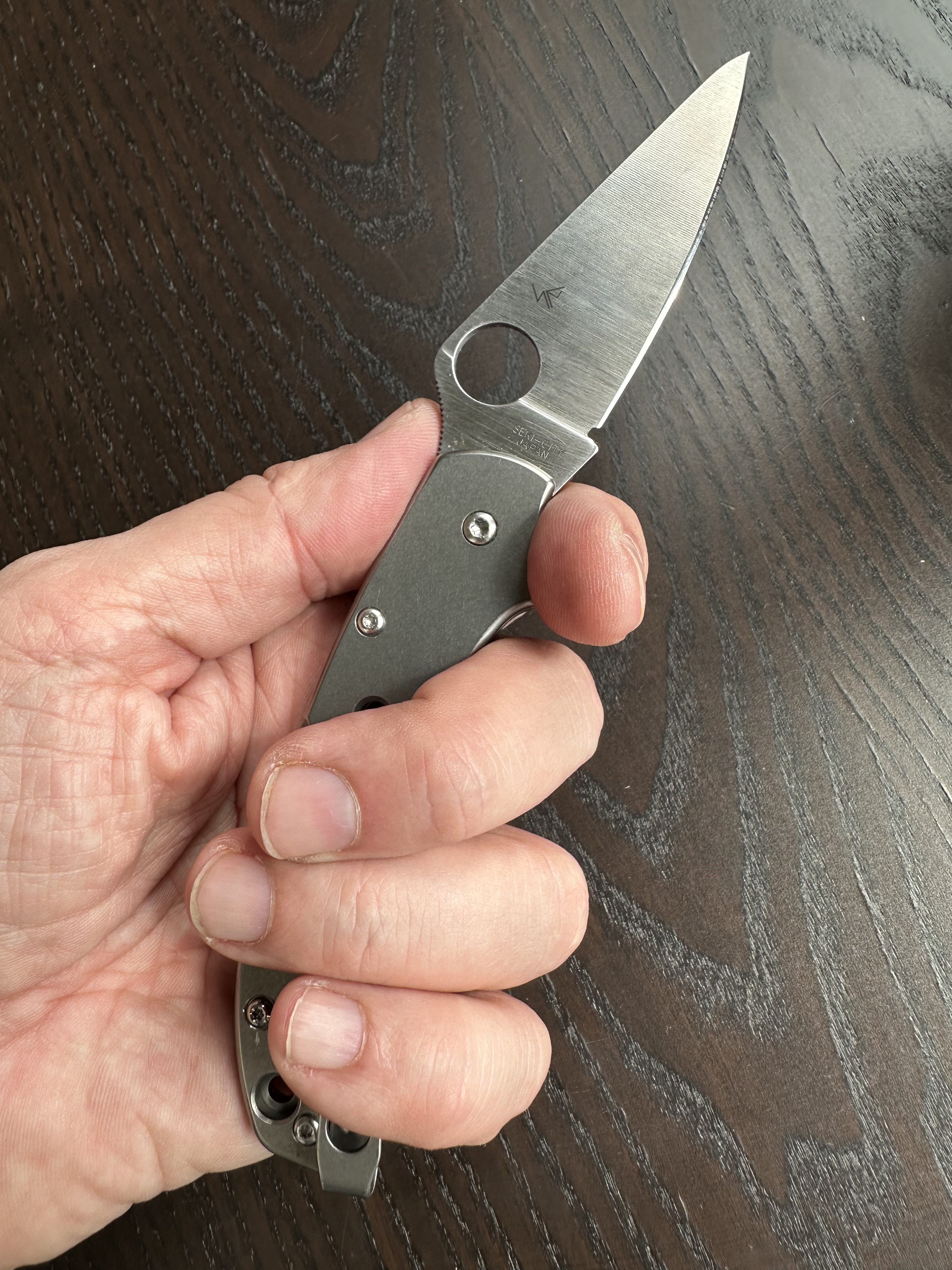
Delica K390 with Lynch Titanium Scales – A Wolf in Sheep’s Clothing !

I got the chance to get that customized Delica through Henri Ramsey, a Spydiefriend from the Facebook French Spyderco Fan Club.

The K390 Delica has always been a monster of pocket knife (click on the name to go to my old review of the Delica with buffed sprint alloy). The thin blade mixed with the super tool steel allow (K390) alloy has proven to be amazing for hardchore.
From their Seki Japan plant, Spyderco is producing many different K390 model, folders and fixed blades. The Stretch 2 being highly regarded as one of their best design.

The Blue Pingo has been made in Golden though.

So here you got an incredibly tough, strong and wear resistant blade on scales produced by Lynch. A typical Sal Glesser design: performance first !

But Lynchnw has taken that game to another league with their scale:

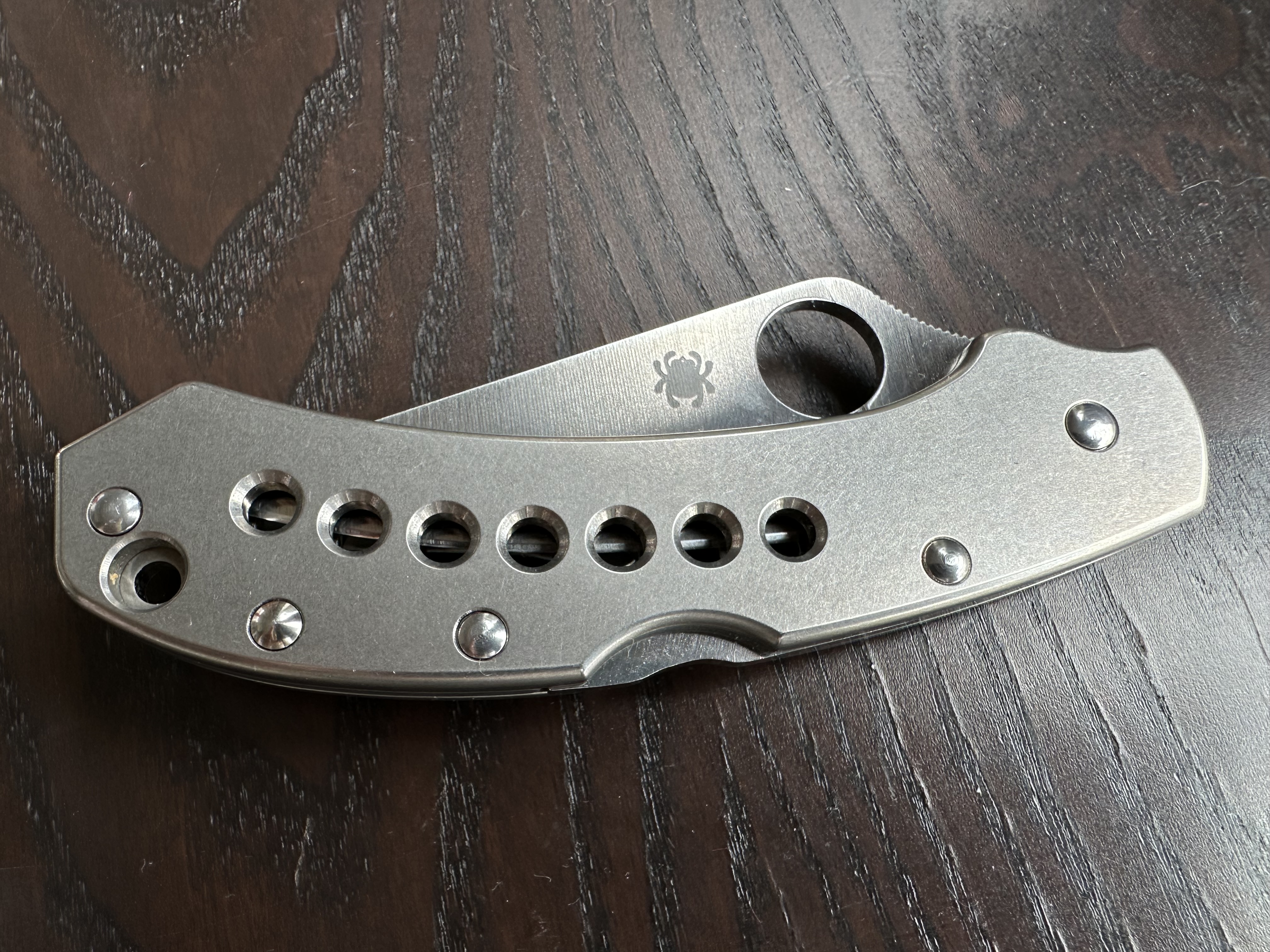
A few years ago Casey put out a very limited run of the LynchNW MOD 1 Delica 4 and some scale sets. This is our newest Delica MOD 2 Titanium Scale Kit, modifying your choice of Delica 4 Knife with a set of Custom Titanium scales, featuring a forward finger choil, blade profiled scale holes, smooth bellied profile, a custom titanium back-spacer, enlarged lanyard hole, and a custom designed deep carry titanium clip. ” To quote Lynchnw.com site.”

What bring these new scales apart of adding titanium for the pure neo industrial look of it ?
It bring many things:

A finger choil. A real one.


A longer handle and your pinkie will thank you for that.


A slim package which is soft on your pocket trousers.


Seven holes which are showing the edge of your knife when it’s closed.

See how cute is it ?

So here we got a very friendly city pocket knife which is not screaming “I’m a sword from Hell !!” like my new beloved Hellboy Chief or this AFCK in M2.


It looks like a lady and gentleman knife.
But beware of the wolf in sheep’s clothing.

This one share the same core engine as a Police 4: K390 at 65HRC in a thin geometry ! It is a Metropolice knife.