Tag Archives: Bushcraft

SPYDERCO LIL’ TEMPERANCE™ 3 LIGHTWEIGHT K390 -C69PBL3K390 -Part 3 – Use Shorty !

It has been established on the two previous chapters:
SPYDERCO LIL’ TEMPERANCE™ 3 LIGHTWEIGHT K390 -C69PBL3K390- Get Shorty ! – Part 1
and
SPYDERCO LIL’ TEMPERANCE™ 3 LIGHTWEIGHT K390 -C69PBL3K390 -Part 2 – Draw Shorty !

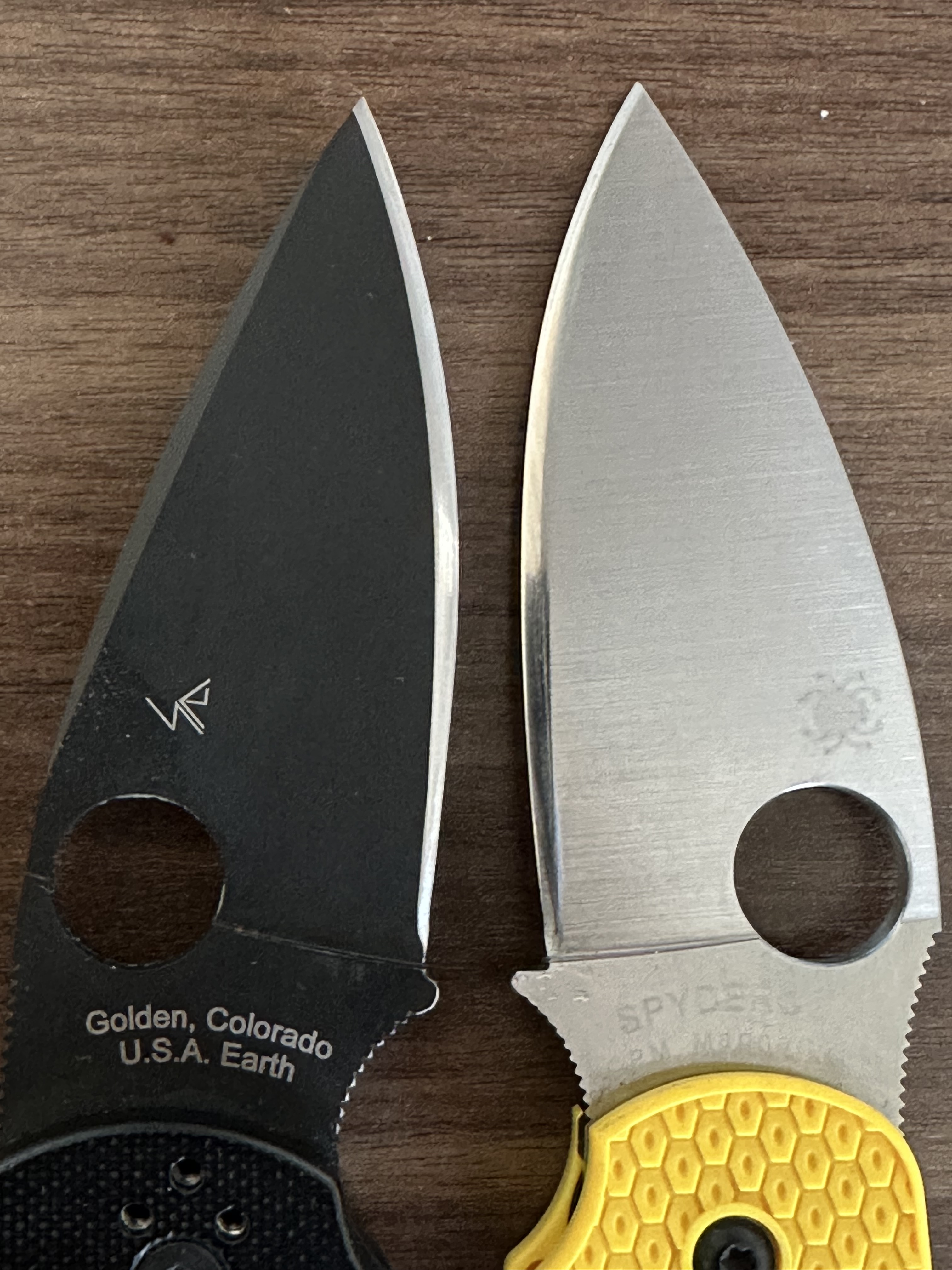
that the Lil’ Temp is very much a hidden gem, refined over two decades by Sal Glesser. In essence, it’s his answer to the compact, heavy-duty 3-inch folder — a kind of “Techno Glesser” that still offers a full, hand-filling grip. Its tall blade profile allows for a finely tuned convex geometry, translating into cutting performance that feels far beyond its size.

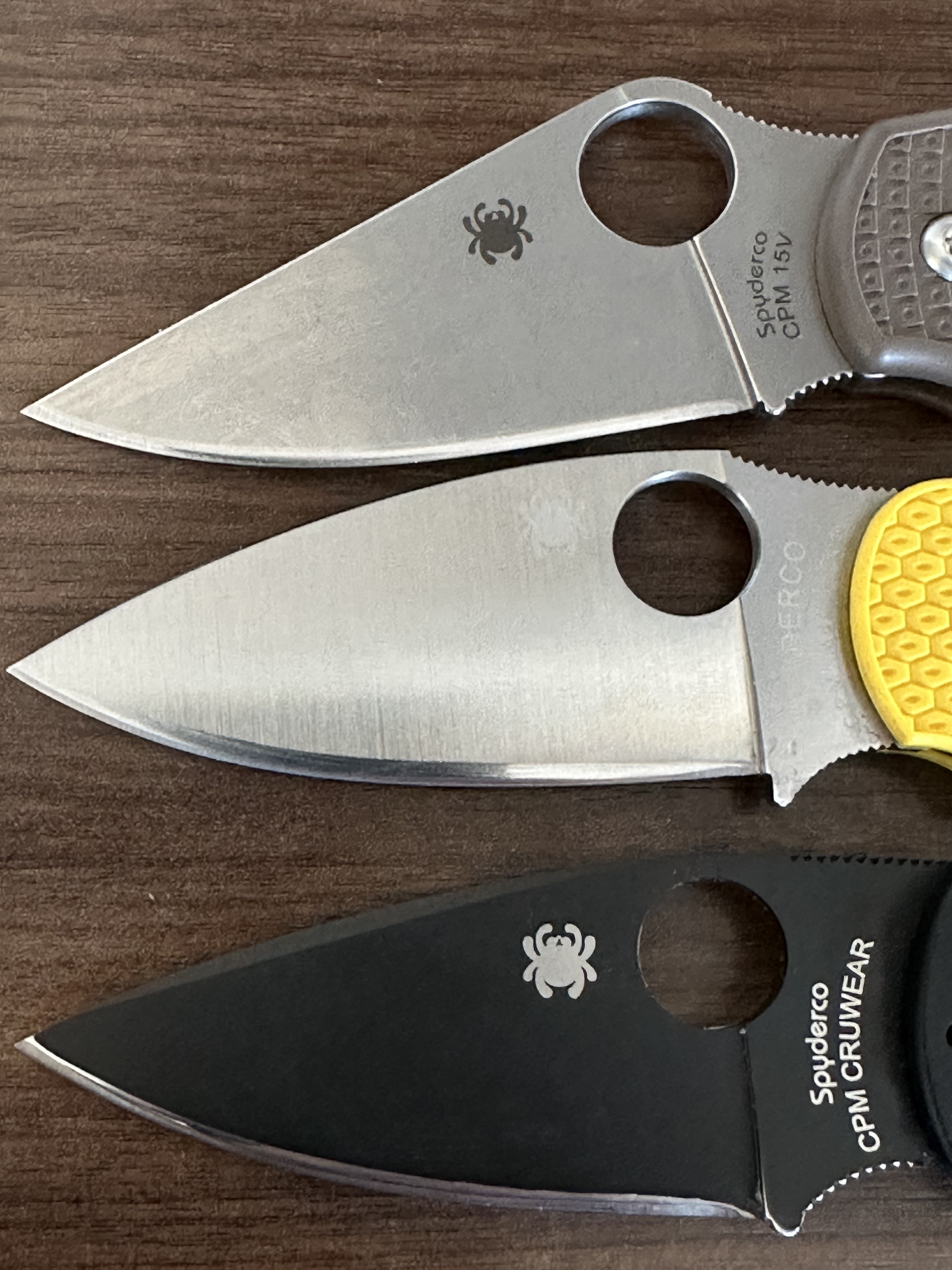
K390 is, in my book, a friendly steel. By that I mean it sharpens up to a razor edge without too much effort. It isn’t quite as easy to work with as CPM Magnacut, but it’s far more forgiving than something like CPM 15V. The trade-off is that K390 will stain readily, so regular wiping is part of the routine.

The trade-off is that K390 stains readily, so a quick wipe-down is essential to keep it looking and performing at its best.
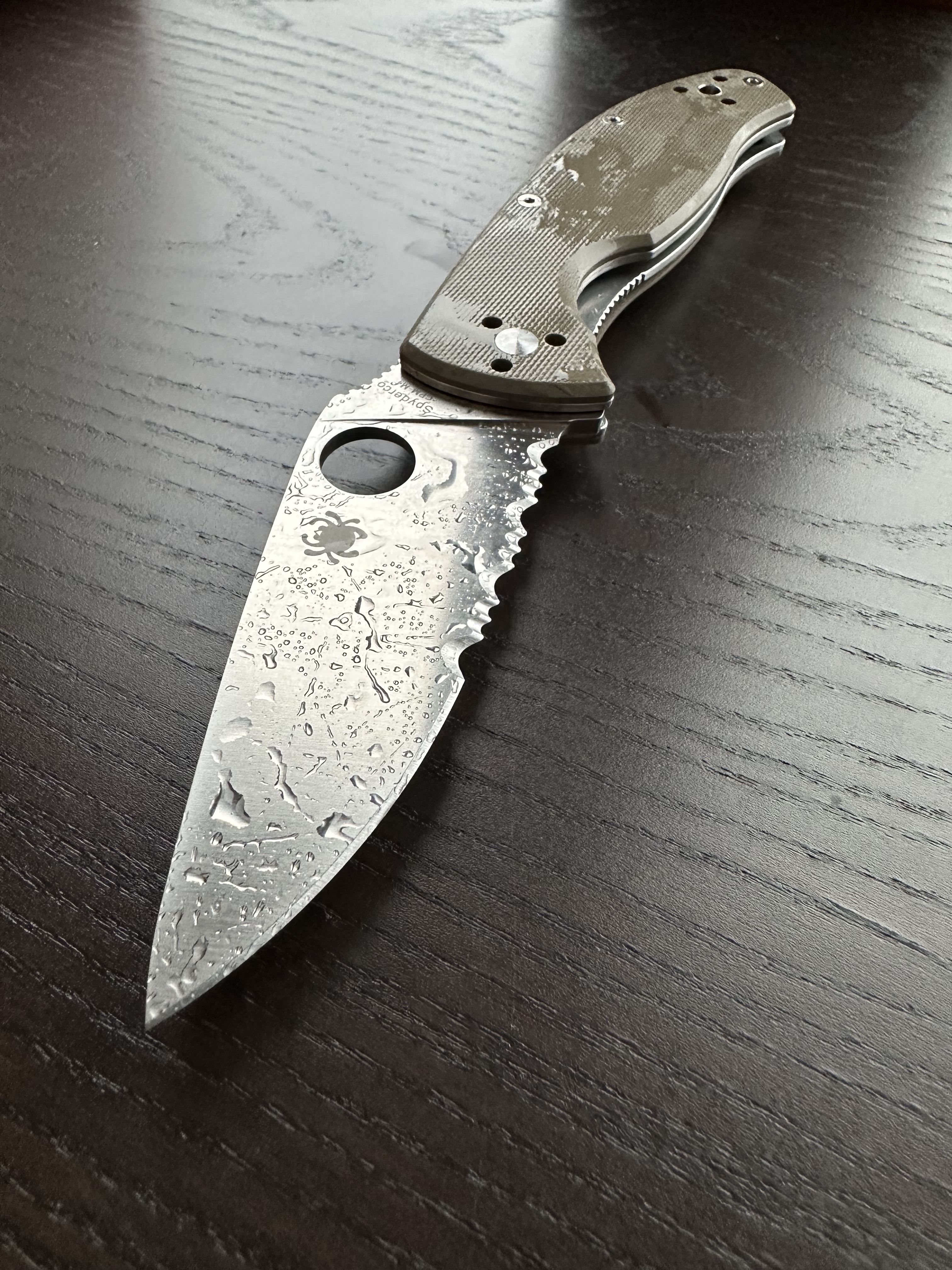
The fact that K390 isn’t stainless is not really an issue if you keep the blade clean and check it regularly for any sign of rust. In practice, a bit of grease or oil is enough to protect it, and over time the steel develops a natural patina that gives the knife real character. My own Lil’ Temp is already showing that patina, and it only adds to its appeal.

Geometry is absolutely critical when working with wood. No matter how tough the steel, without the right blade geometry the knife simply won’t bite or carve efficiently.
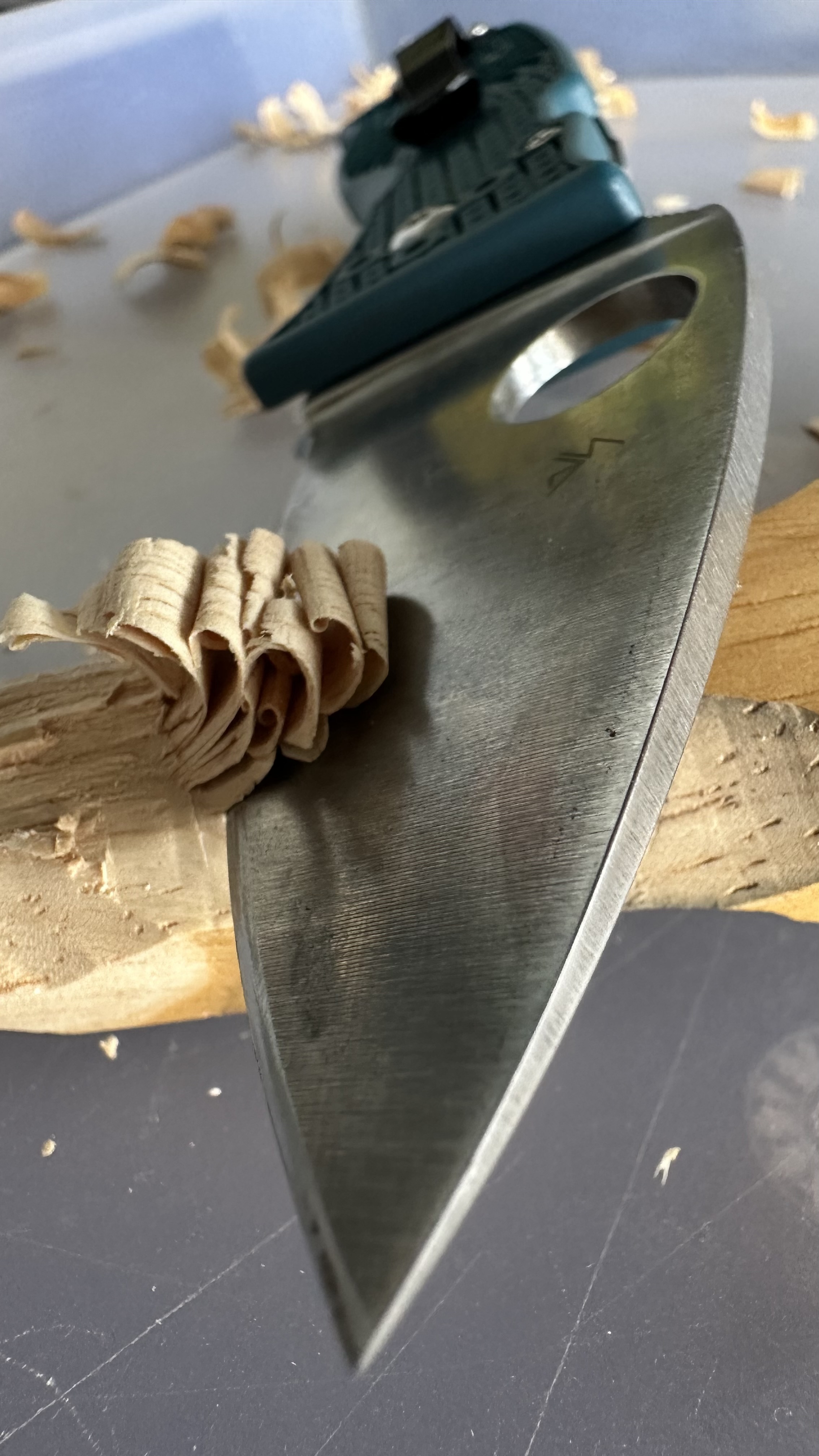
A full flat-ground high blade simply can’t compete when working on hard wood. That’s why Sal Glesser’s “Lambo of bushcraft knives,” the Proficient, stands out: it combines a high full-flat ground blade made from a high-carbide super steel (S90V) with an exceptionally comfortable handle. The result is a knife that slices, carves, and handles demanding tasks with ease — the kind of tool that performs all day without fatigue.

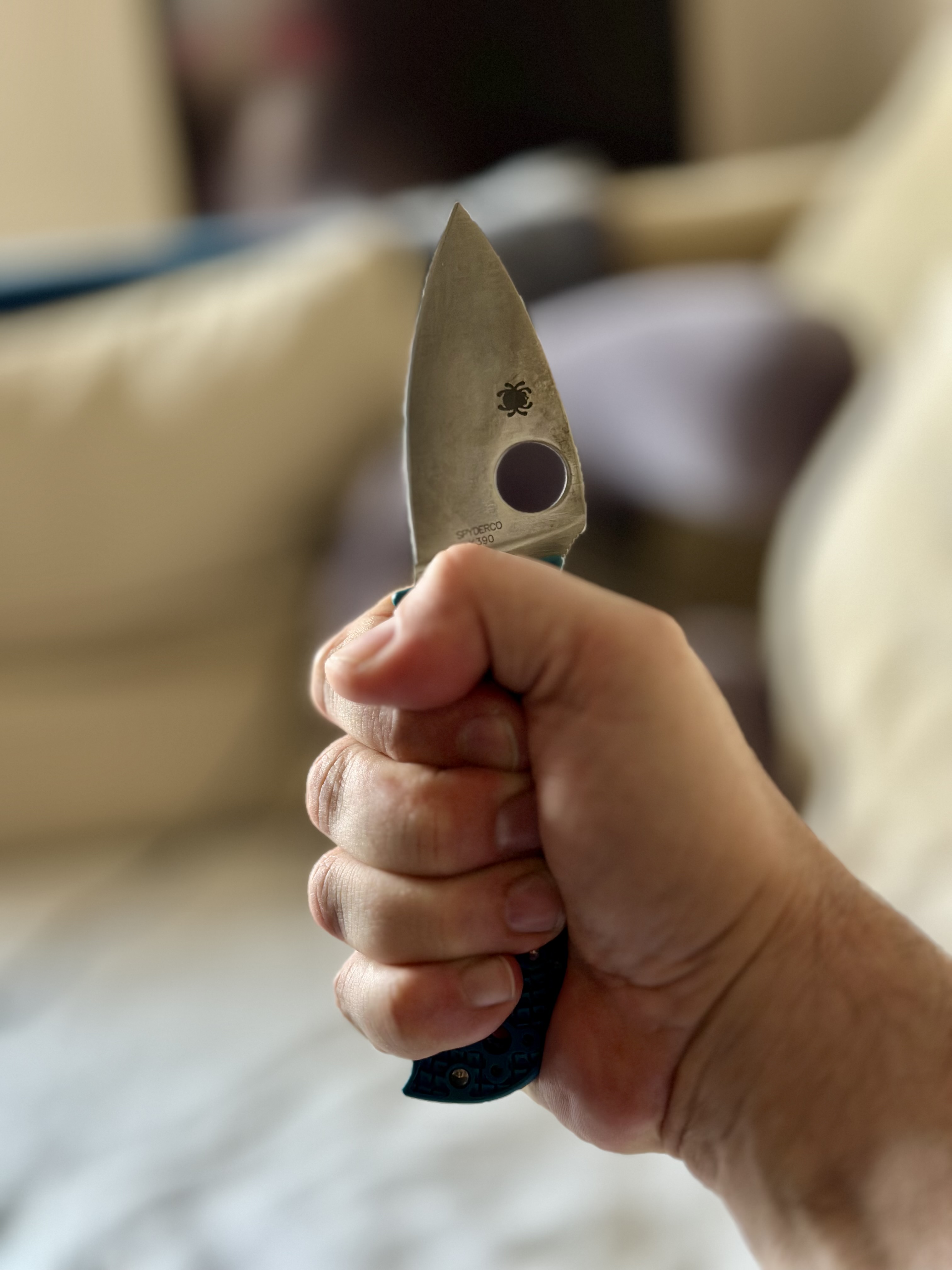
The relatively thick handle of the Lil’ Temp makes it extremely comfortable to hold and use. Its design also provides excellent indexation, making it easy to know exactly where the edge is — even easier than on an Opinel or the round handle of the Proficient.

In the woods, the Lil’ Temp is easy to deploy and put into action. Its point is robust enough to withstand some abuse. While K390 isn’t the toughest steel available, it’s still harder and more wear-resistant than many stainless alloys, making it highly capable in practical use.
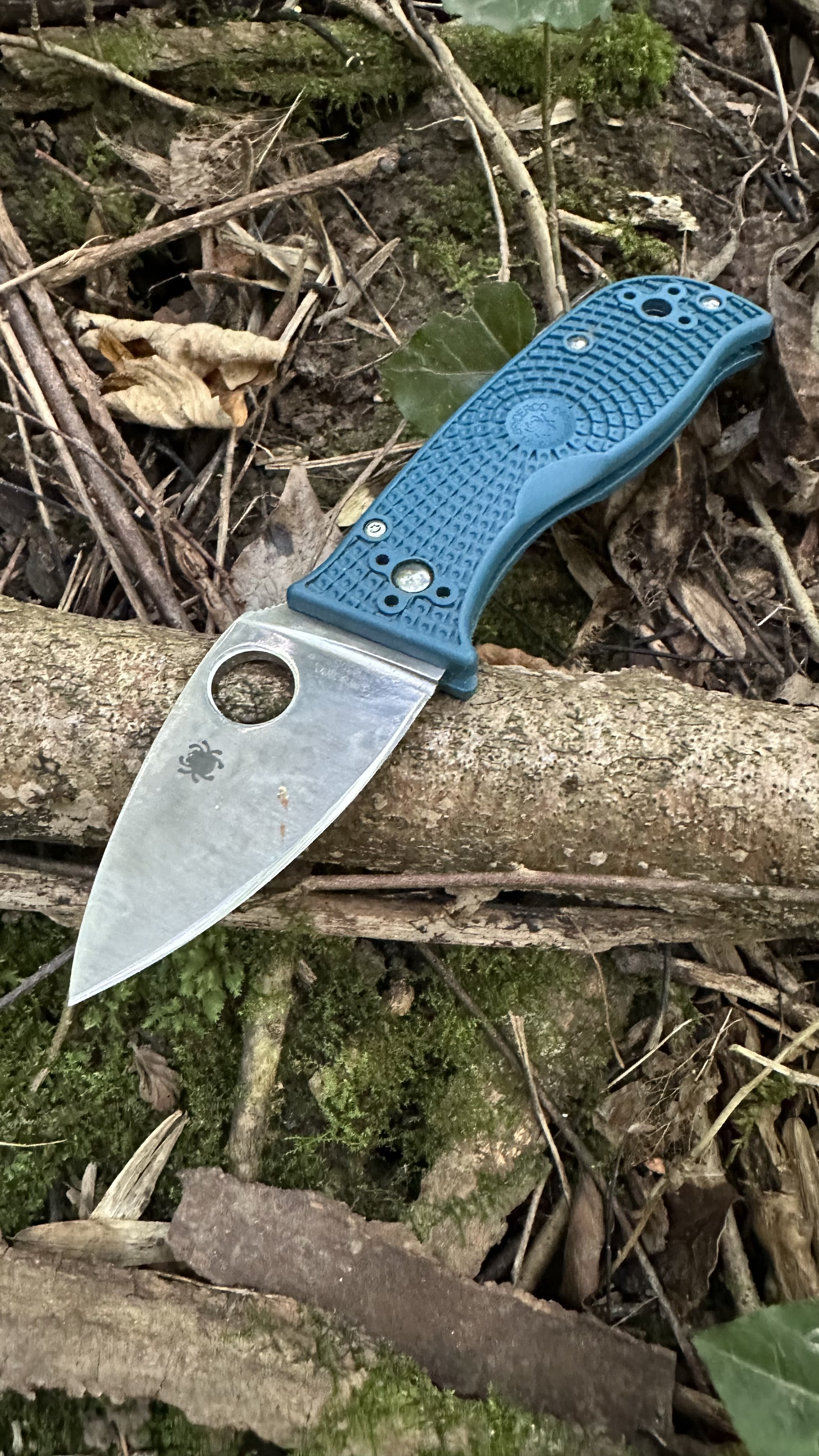
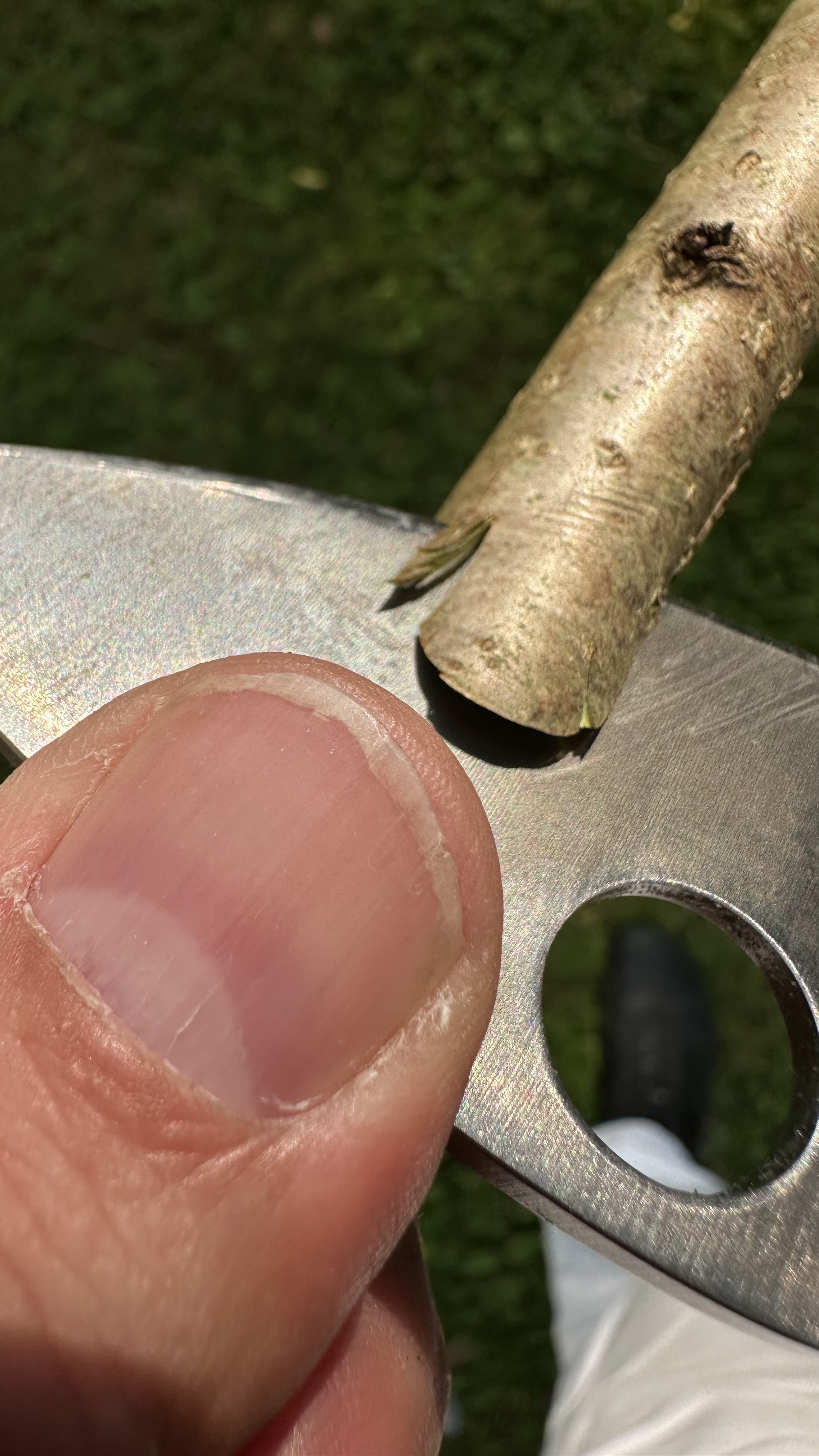
The thick spine of the Lil’ Temp provides an easy resting spot for the thumb, especially on push cuts. This gives excellent control and allows you to apply strength precisely where it’s needed.
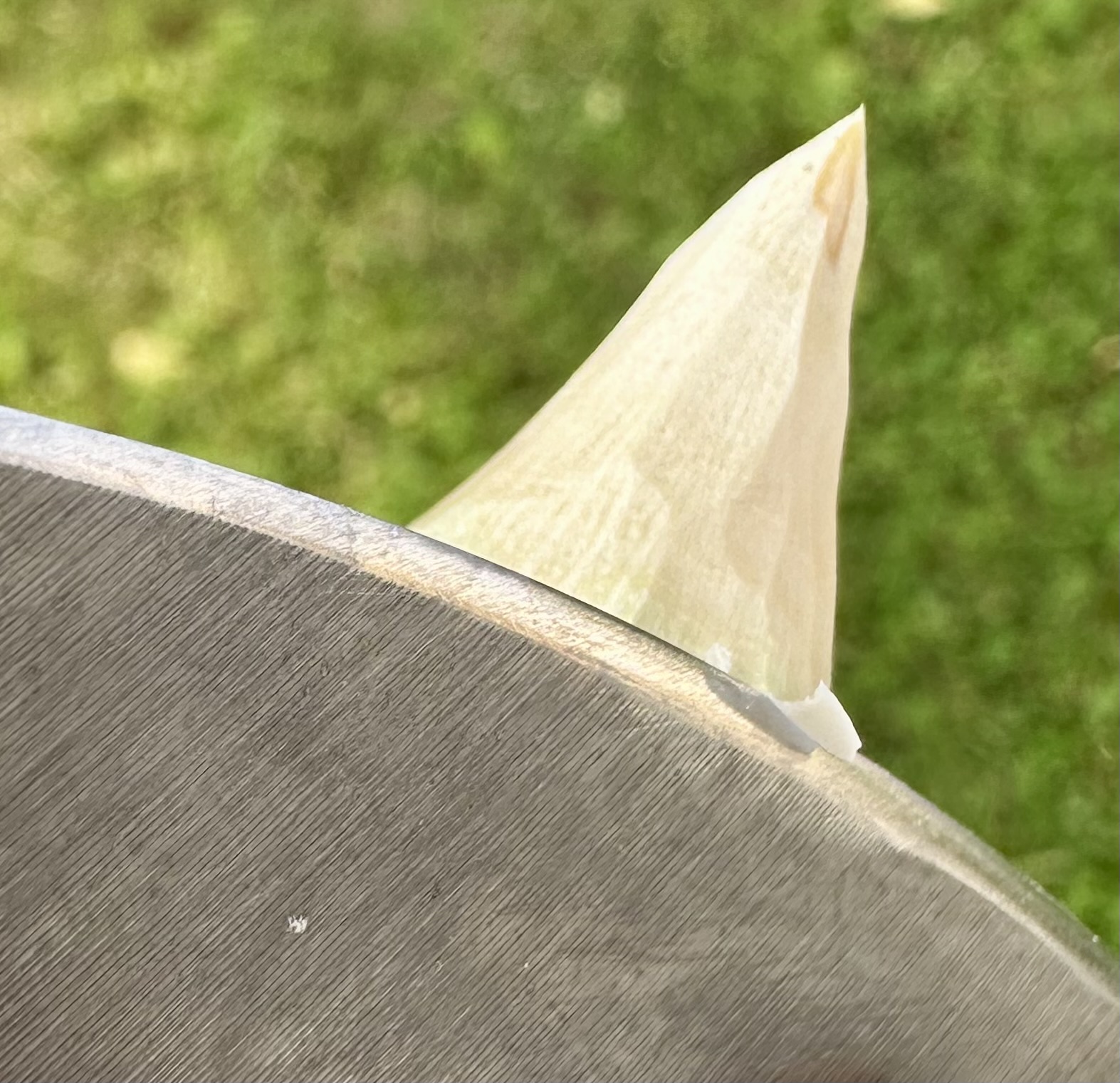
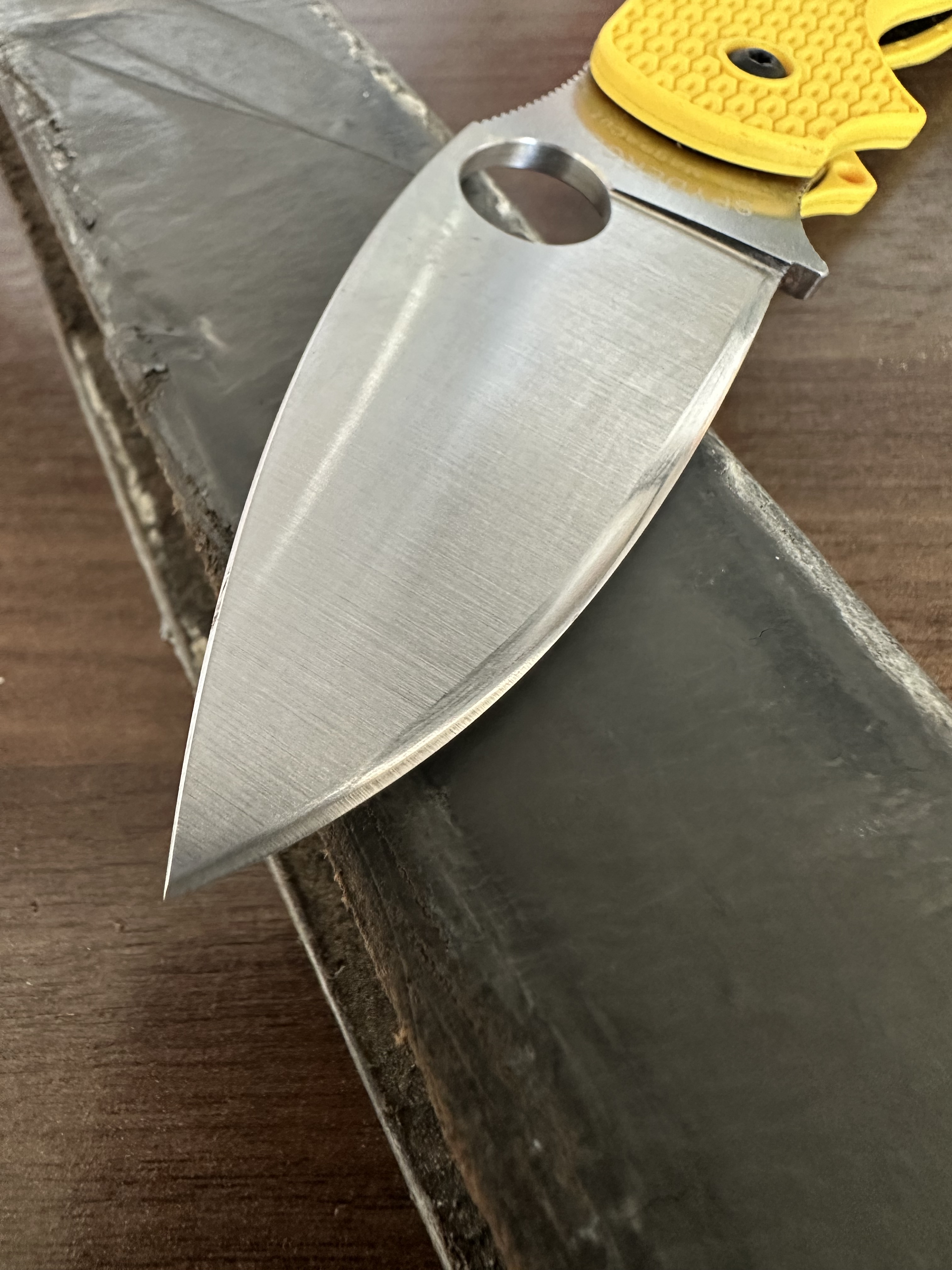
The grain structure of K390 responds exceptionally well when working on wood. After some careful convexing on diamond stones, the edge has developed a shape that balances sharpness and durability perfectly for carving and utility tasks.

I was able to carve pickets without breaking a sweat. The knife’s gentle belly plays a key role, working like a guillotine on the wood fibers and making controlled cuts effortless.

The true kings of woodworking and whittling remain the Wolfspyder and the Boker Vigtig vs Wild. Their authentic Scandi grinds allow them to bite into wood with astonishing ease, making controlled carving and fine whittling effortless.
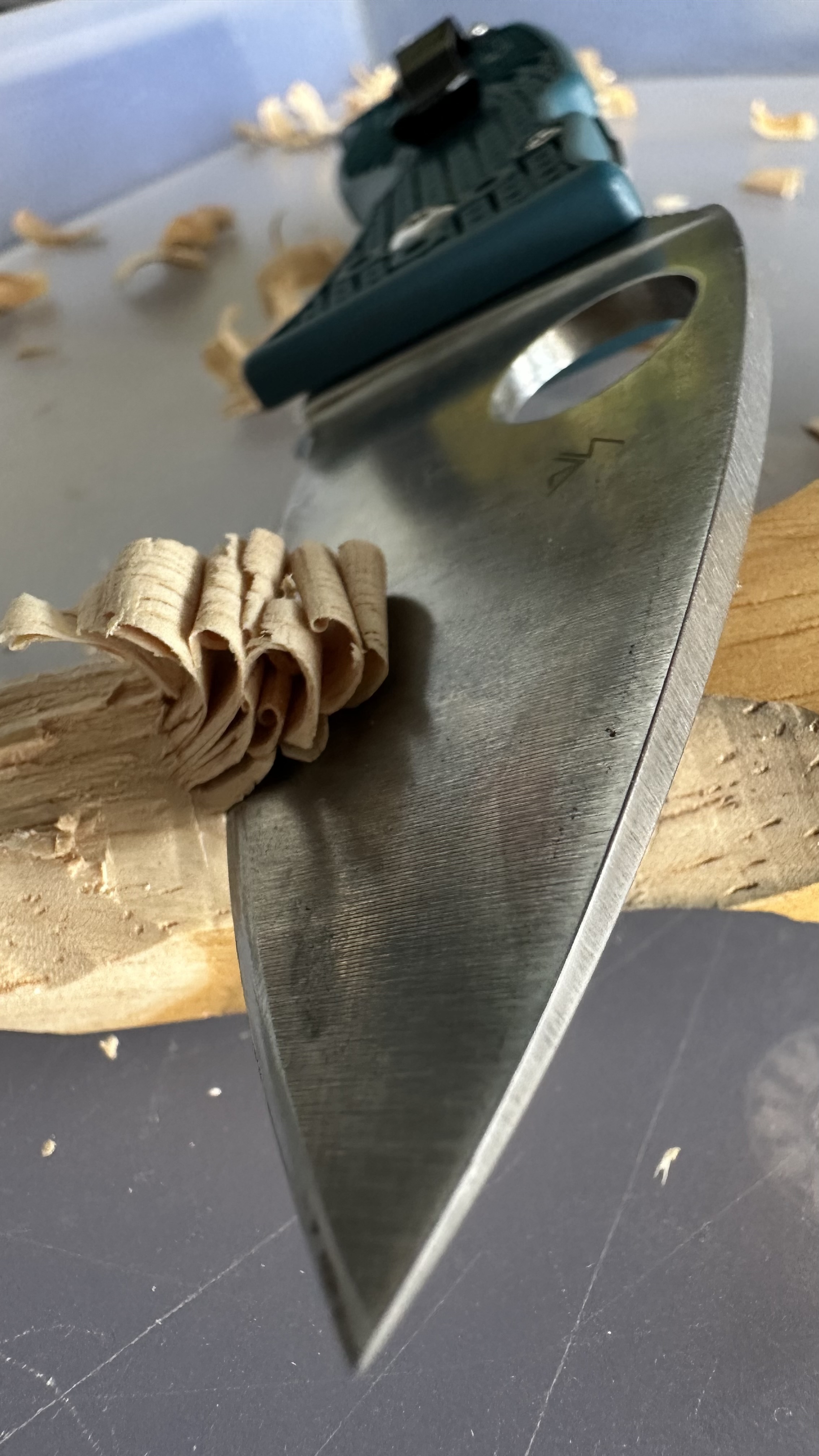
In that context, one of my favorite full-flat-ground folders for whittling is the Native 5 Salt, once convexed. It’s an absolute pleasure to use on wood, combining smooth slicing with precise control.

A folder’s handle will always be less comfortable than that of a good fixed blade, simply because of the compromise required to fold the blade into it.

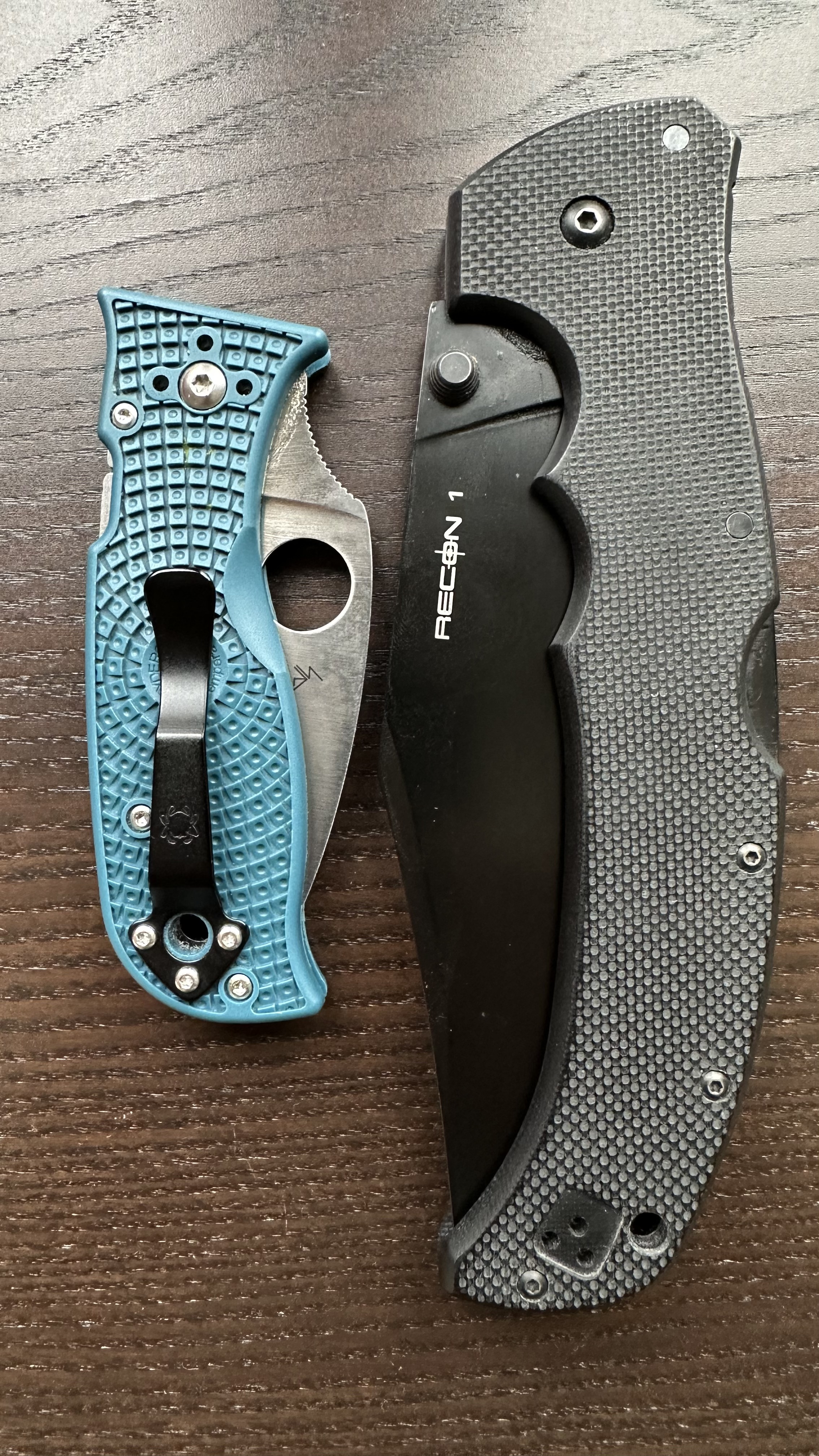
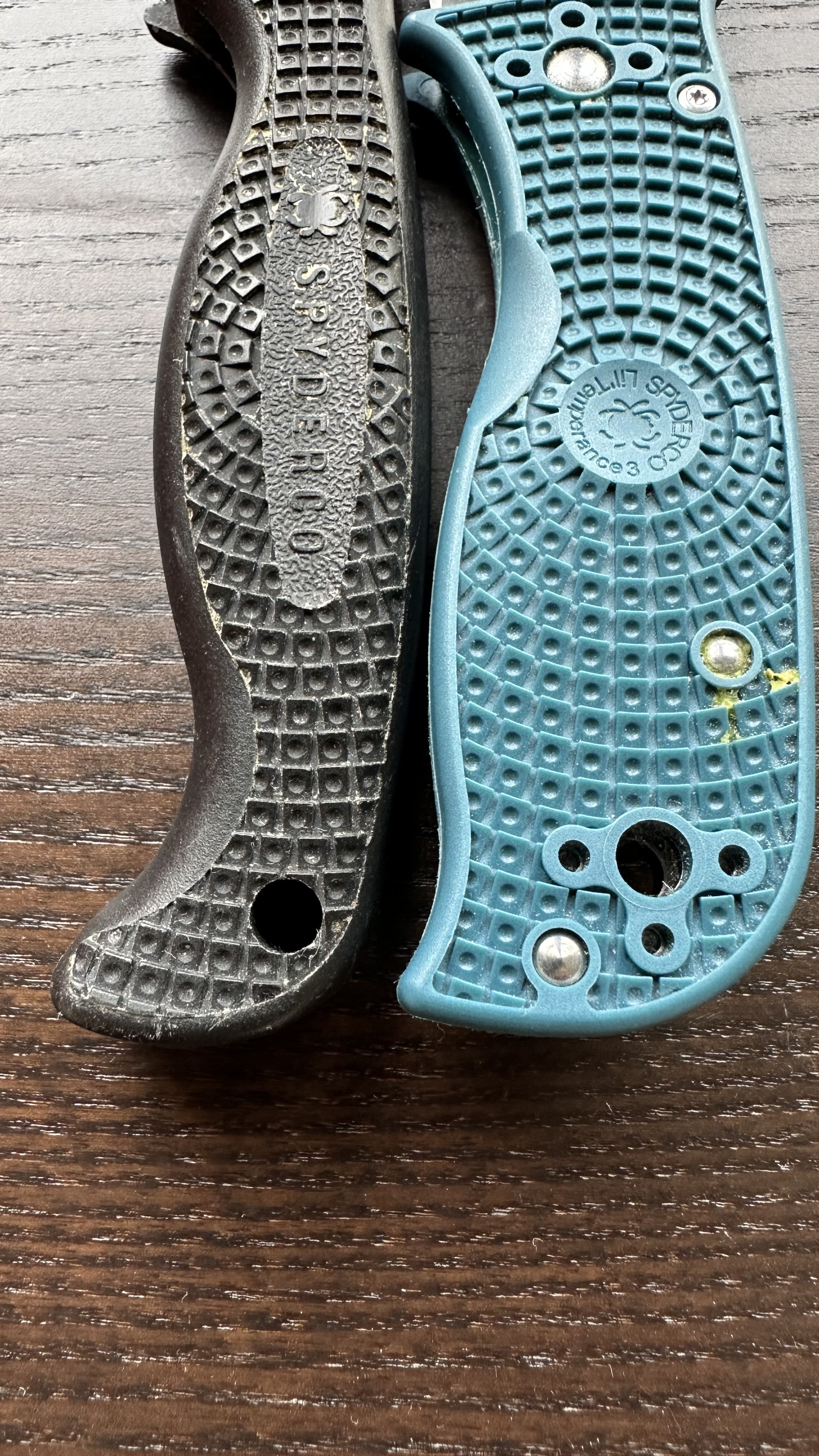
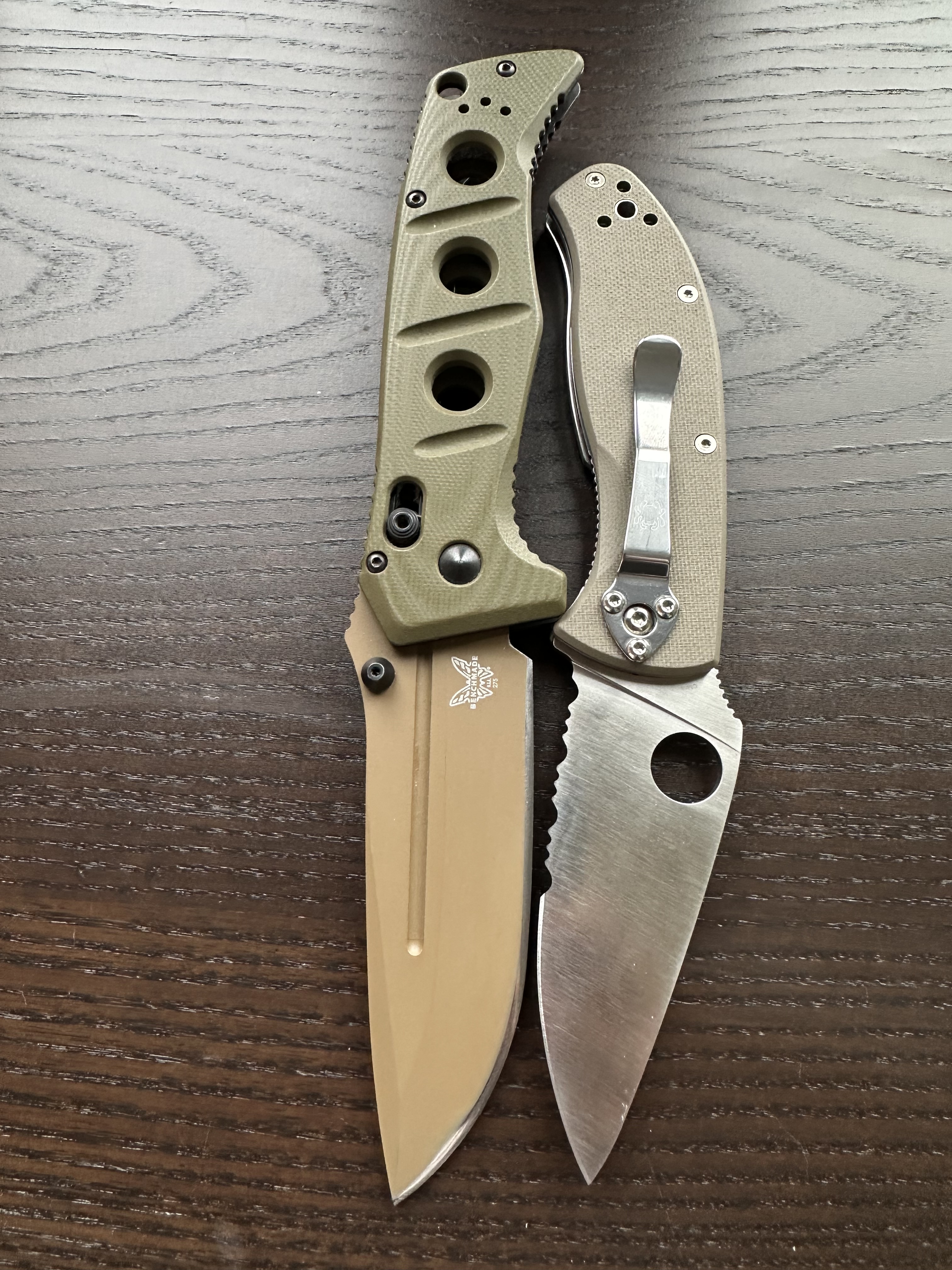
That said, the Lil’ Temp is among the very best in this regard. Other outstanding handles include the Manly Comrade, the Benchmade Adamas, the Cold Steel Recon 1, and the Wolfspyder — the latter benefiting from Ray Mears’ design philosophy, focused on knives you can use all day long without developing hot spots or splinters.
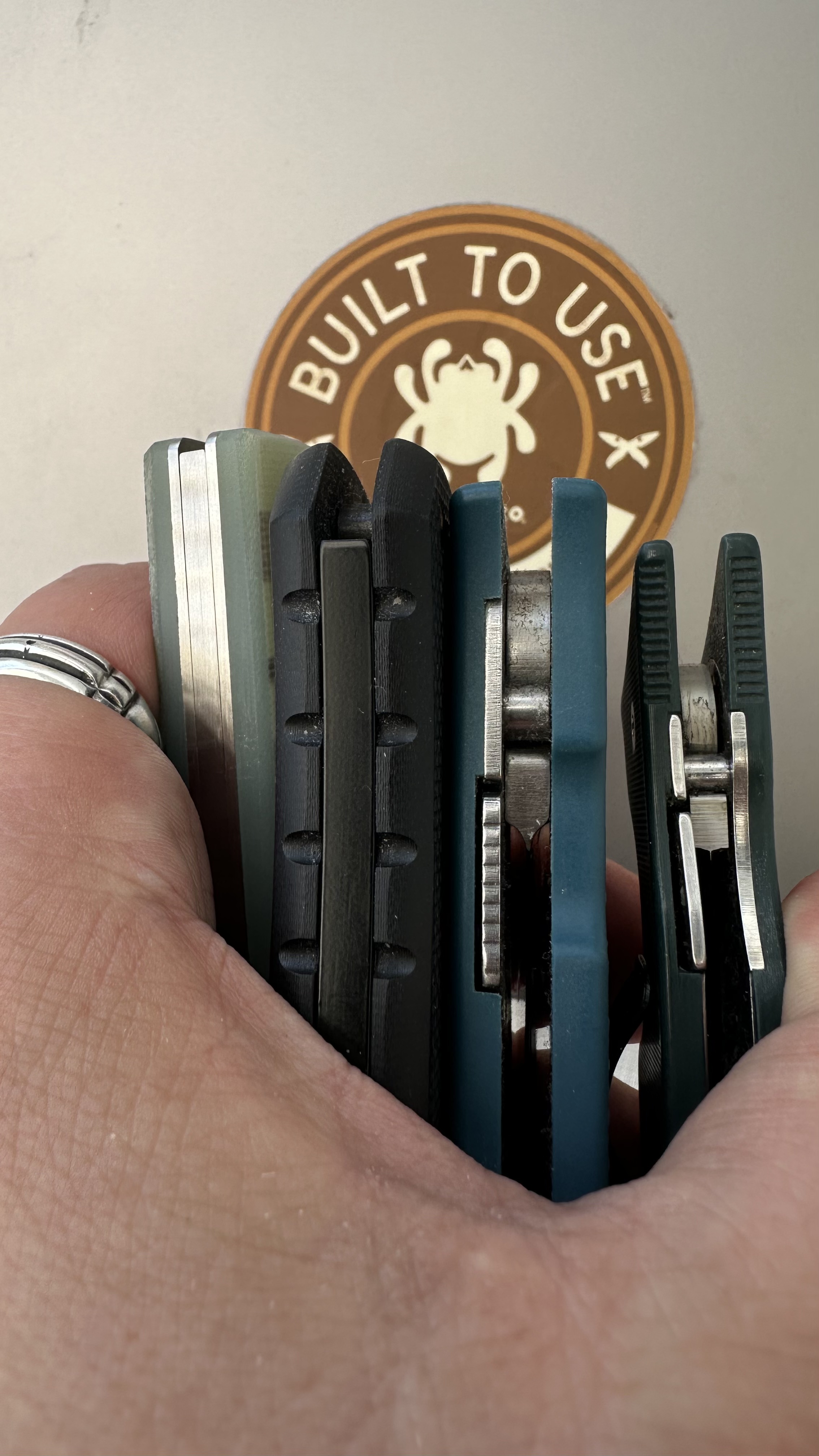
(Comrade, Recon 1 on the LT’s left and Wolfspyder on its right)
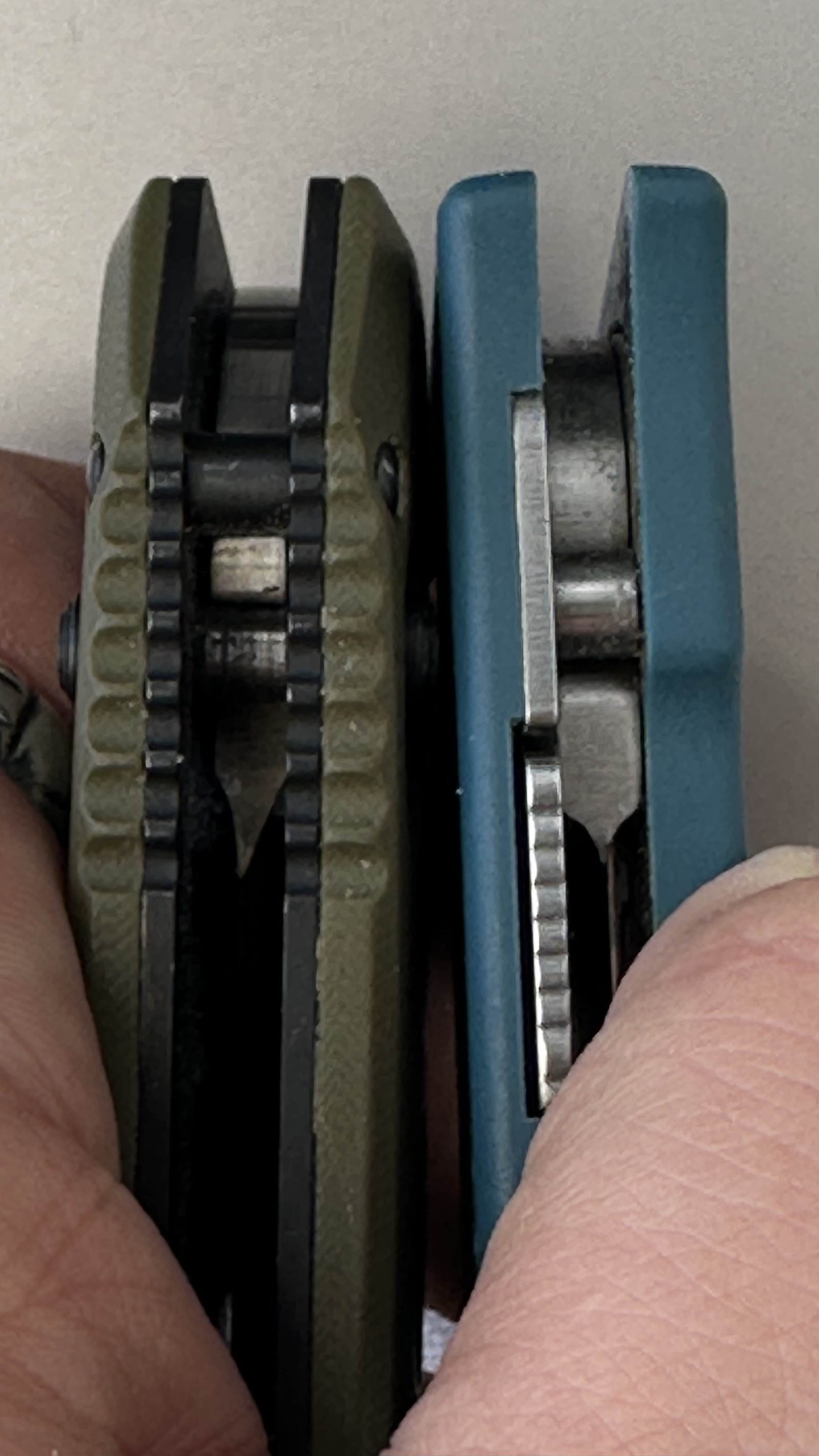
(Adamas and Lil’ Temp)

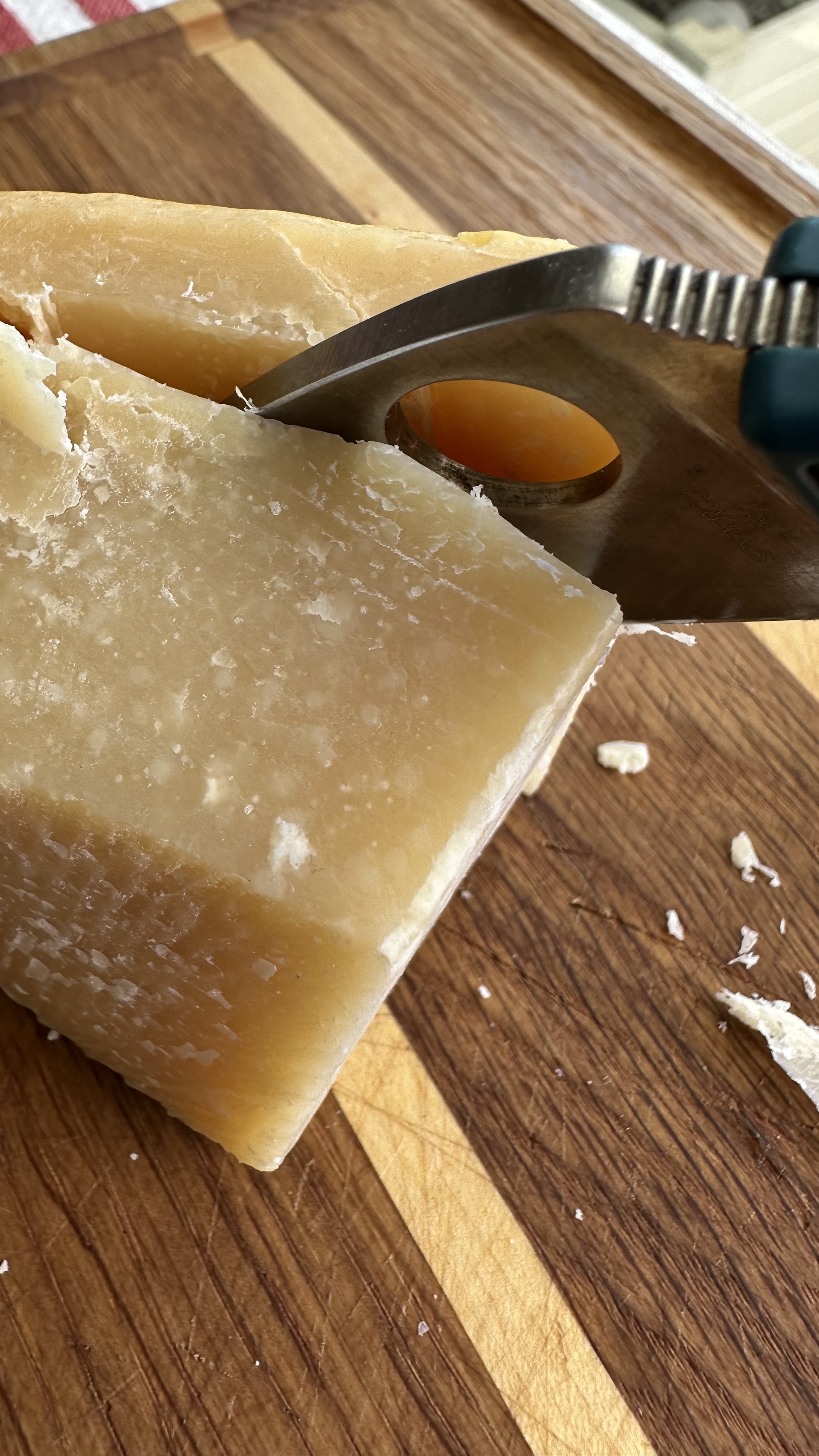
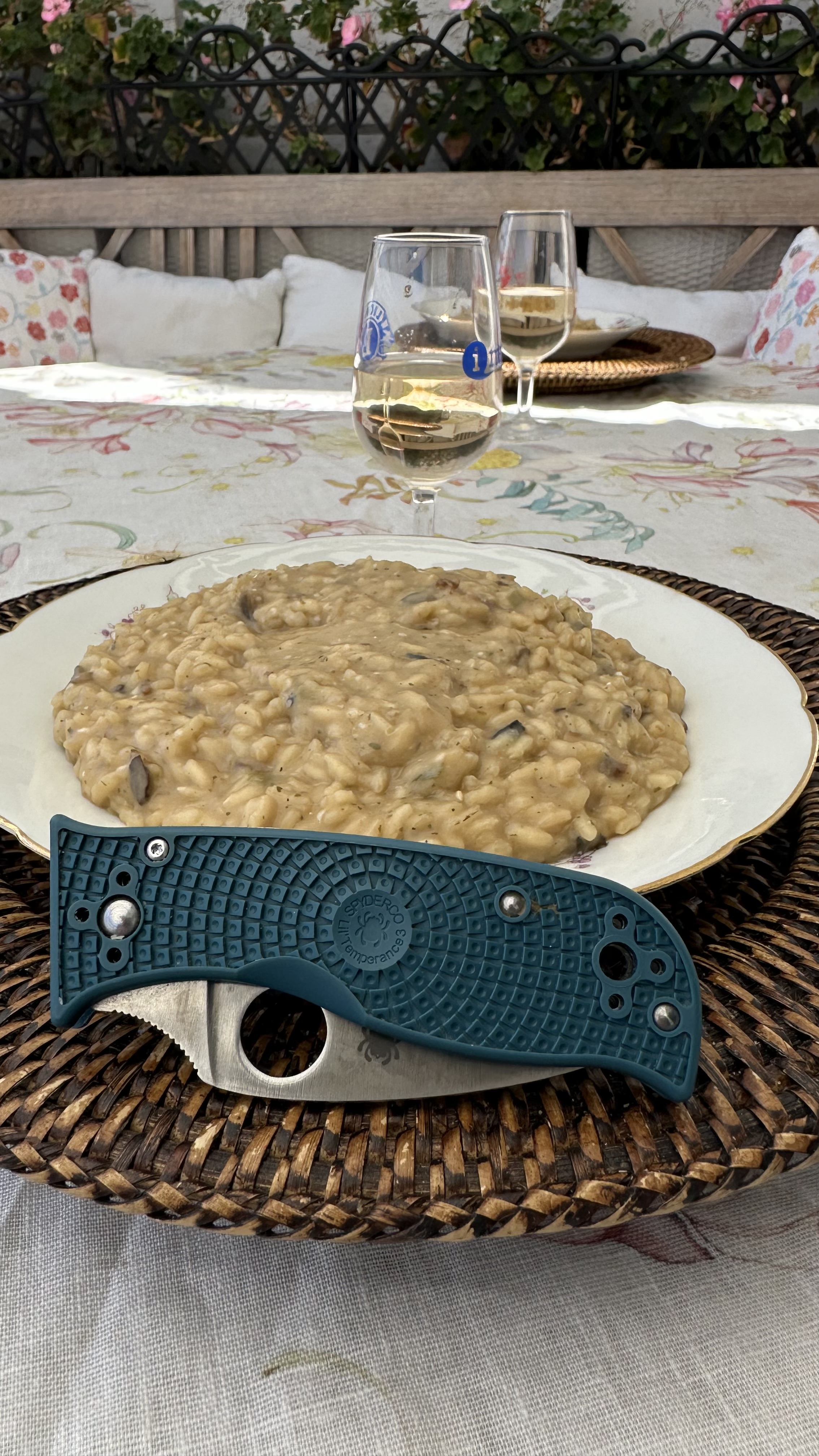
Another example of relatively demanding use is making this risotto using
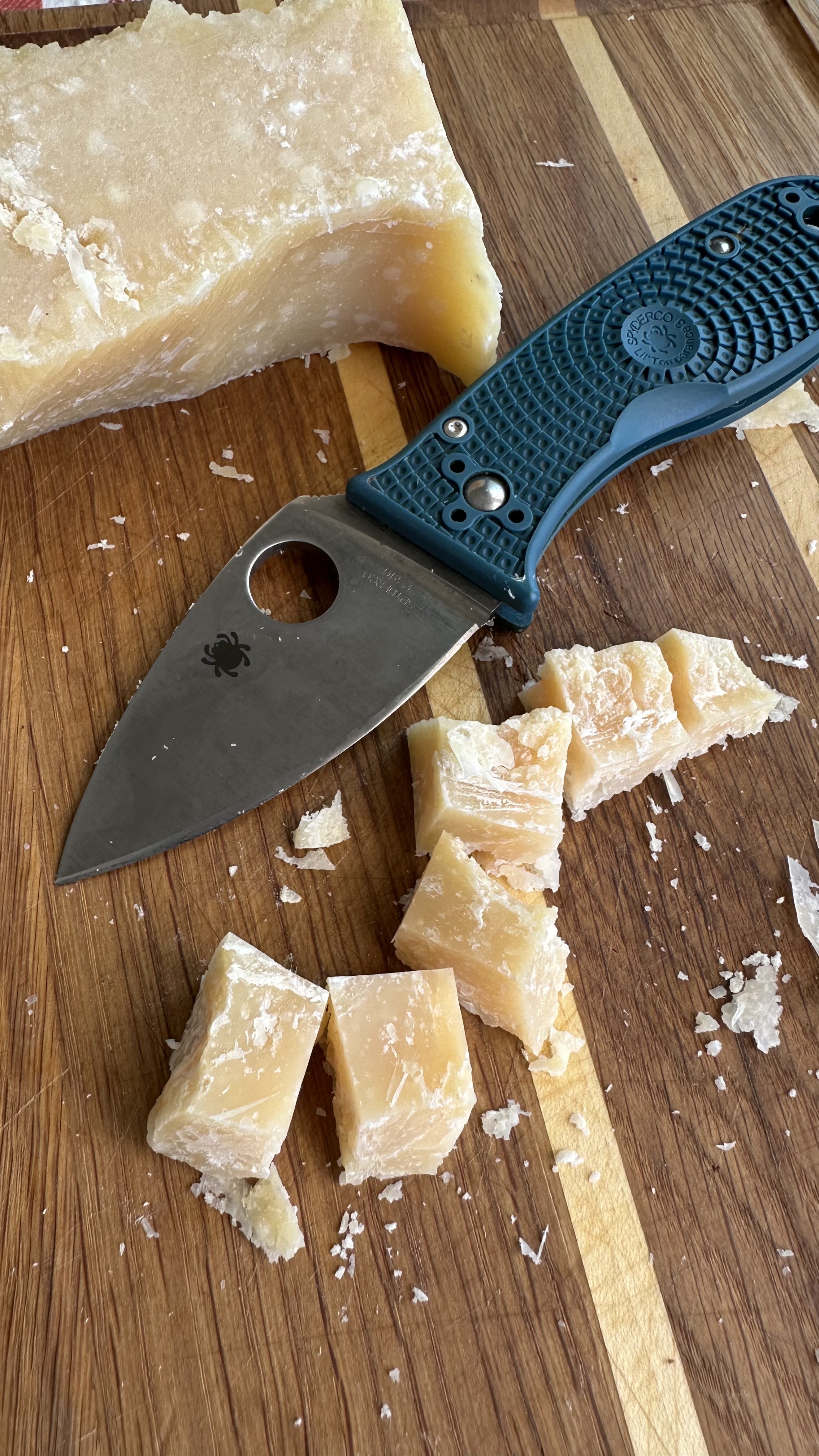
an old chunk of dry Parmigiano which needs to have its rind removed, then cut into half-inch cubes — no easy task given how hard the cheese can be.

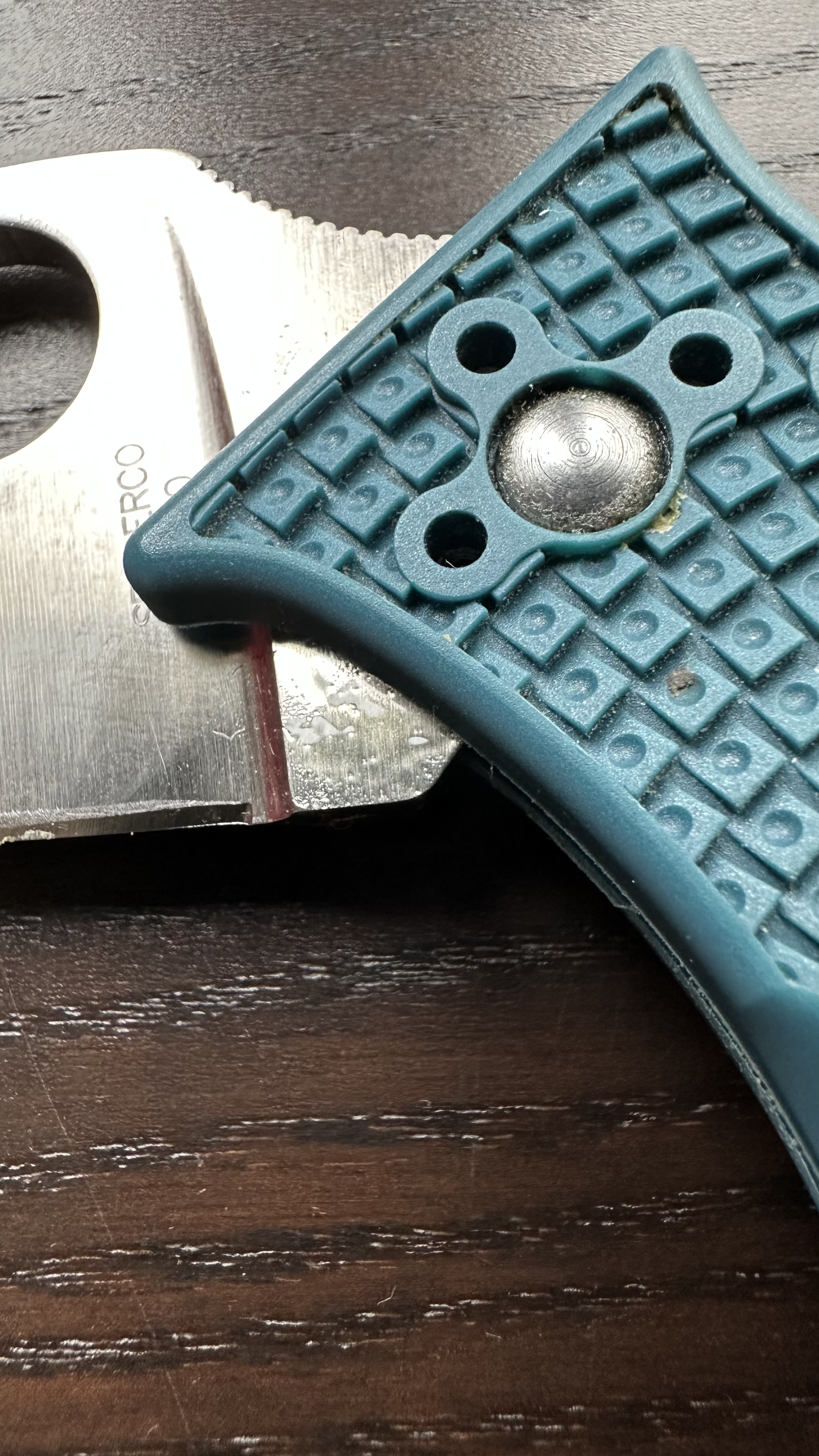
It’s also a great way to detect hot spots: the weakest point, if any, in the compression lock. That notch on the back of the handle all but guarantees a sore hand after extended use.

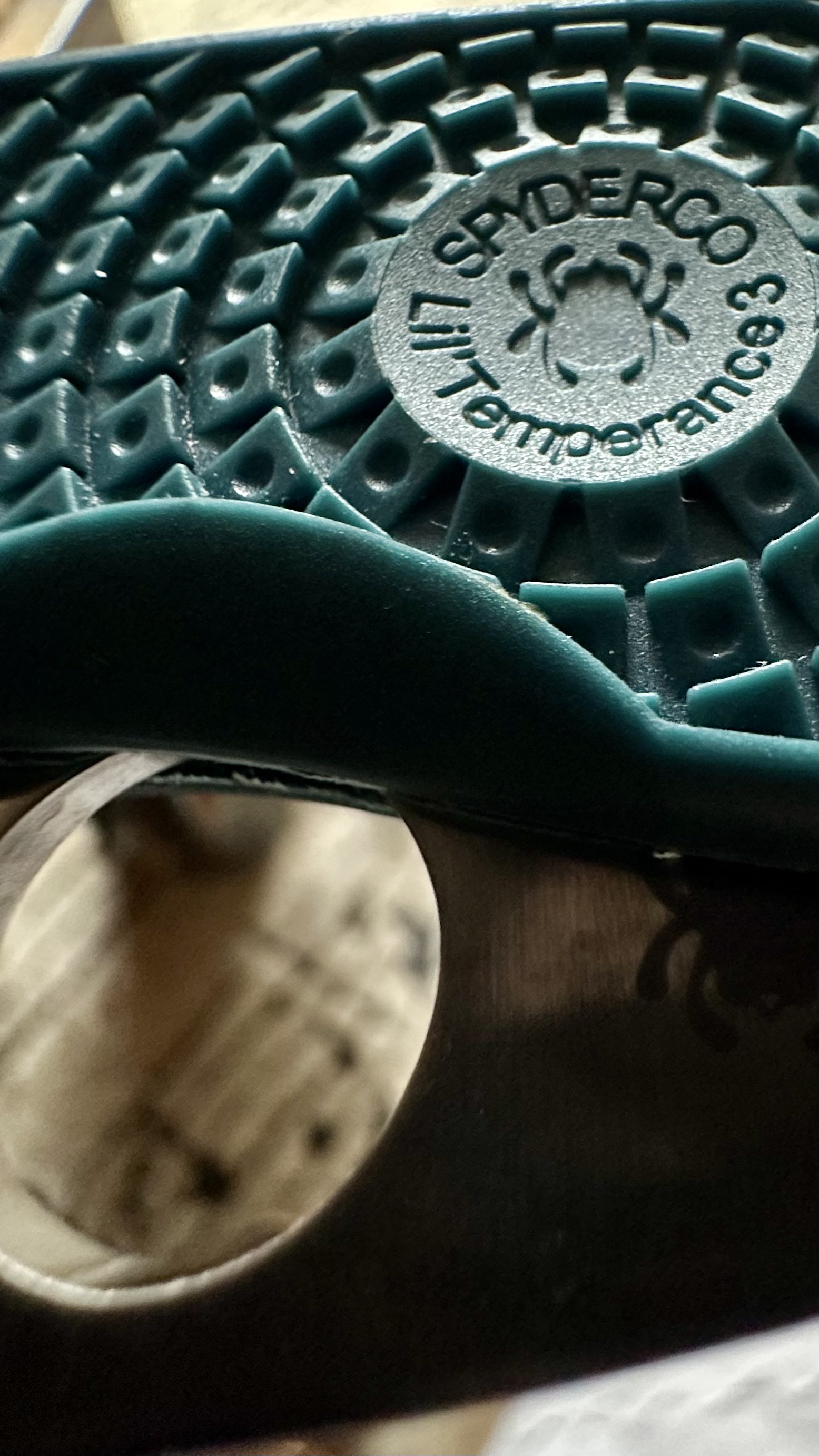
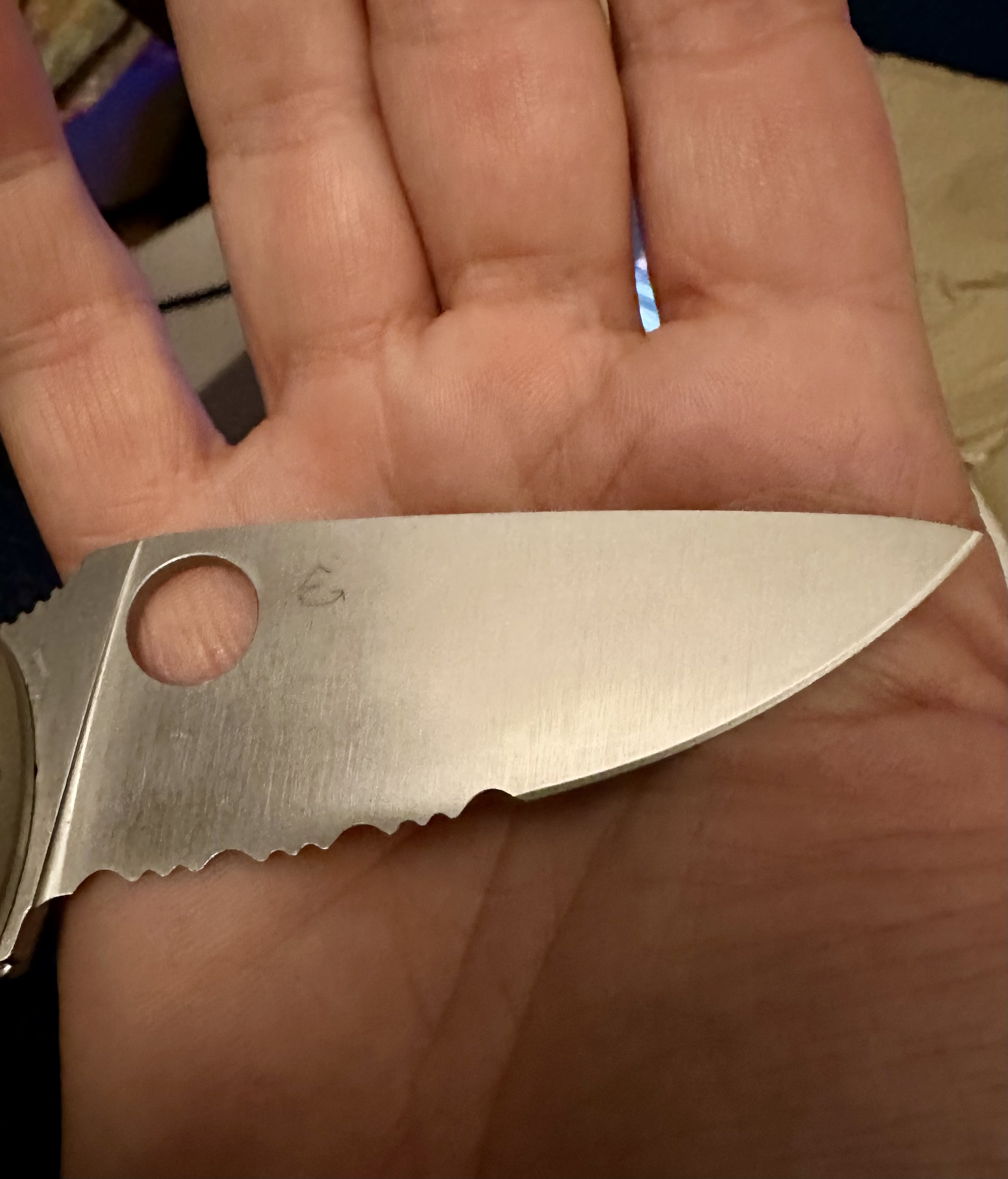
Apart from a single trip into the woods, I’ve mostly used the Lil’ Temp in the kitchen, where it’s been steadily building a nice patina. I’ve also taken the opportunity to test its ergonomics with wet hands. The FRN handle pattern is one of Sal Glesser’s great innovations: it gives the knife a no-nonsense, tool-like appearance while ensuring the handle stays locked in place once gripped.

Conclusion

The Lil’ Temperance 3 K390 Lightweight (“Shorty”) stands out as a compact powerhouse in Spyderco’s lineup. With its super-steel blade and excellent geometry, it elevates everyday carry versatility, combining cutting performance, ergonomics, and durability in a smaller format.

Its lightweight build and aggressive handle design make it a tool you can truly rely on. Whether in the kitchen, at the workbench, or outdoors, the Lil’ Temp proves itself capable of handling demanding tasks without compromise. The FRN handle texture, designed by Sal Glesser, not only lends a purposeful, tool-like look but also ensures a secure grip, even with wet hands.

From reviews across the community, a consistent picture emerges:

  1. Exceptional cutting performance — even in tasks where utility blades struggle
  2. Superior carving and utility — excels at both fine control and hard work
  3. Secure lockup — the compression lock feels noticeably beefier than on similar models
  4. Excellent ergonomics — comfortable for long use, even damp conditions
  5. Edge retention — the K390 steel holds its sharpness impressively well
  6. Durability — little to no wear after months of use
  7. Practical carry — light, compact, and easy to deploy one-handed
  8. Minimal maintenance — just regular wiping and light oiling keeps it in peak condition

As one reviewer put it, this “box-destroying little chode of a knife” punches well above its size. Another called it “a tank… carefree, strong AF, and super comfortable.” After extended use — from food prep to cardboard — users report only minor stropping needed, with many calling it one of their favorite Spydercos in decades.

In short, the Lil’ Temperance 3 K390 Lightweight is a sleeper hit: not the most popular Spyderco, but for those who carry it, often a personal favorite. A compact EDC with the heart of a work horse.
SPYDERCO LIL’ TEMPERANCE™ 3 LIGHTWEIGHT K390 -C69PBL3K390 -Part 2 – Draw Shorty !

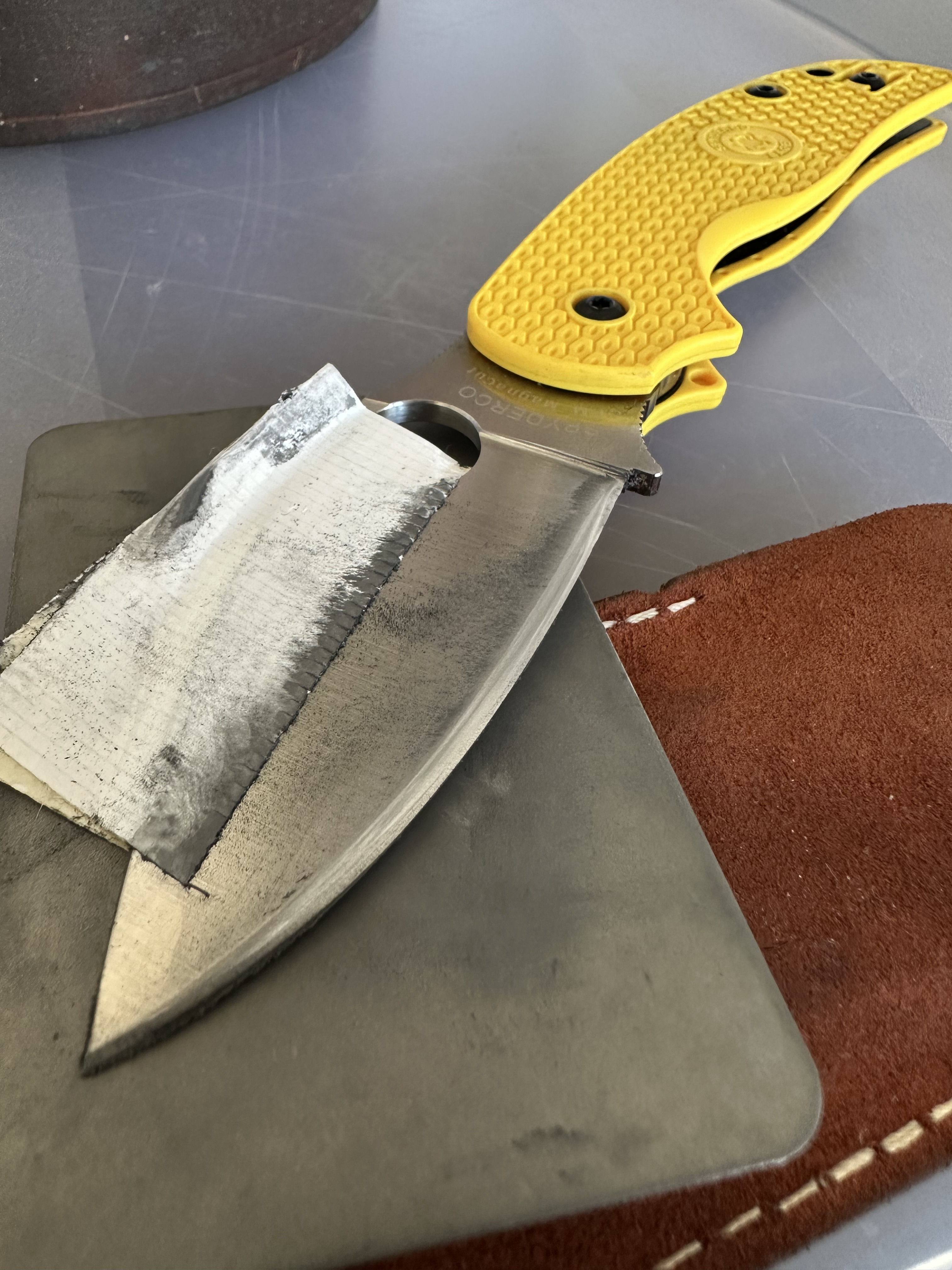
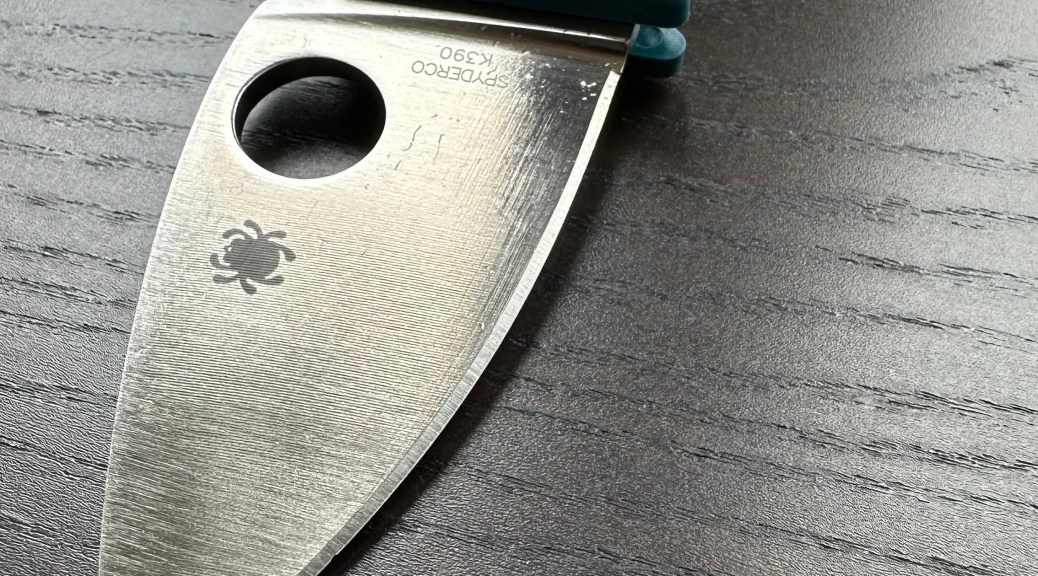
First things first: I needed to “de-shoulder” the edge, and K390 proved its reputation as a hard steel. I noticed it again when rounding the spine a bit — those vanadium carbides really make sanding a challenge. Then again, sanding has always been something of a signature for me, especially when shaping convex edges. With 2% cobalt in the mix, keeping the blade clean is essential to avoid stains or rust.

Now, onto the fun part! When you get a new knife, what matters most is how it fits into your life: what makes you smile, how people react to it, and how it feels to carry and draw it from your pocket. The joy of using a good tool should always be a pleasant experience.

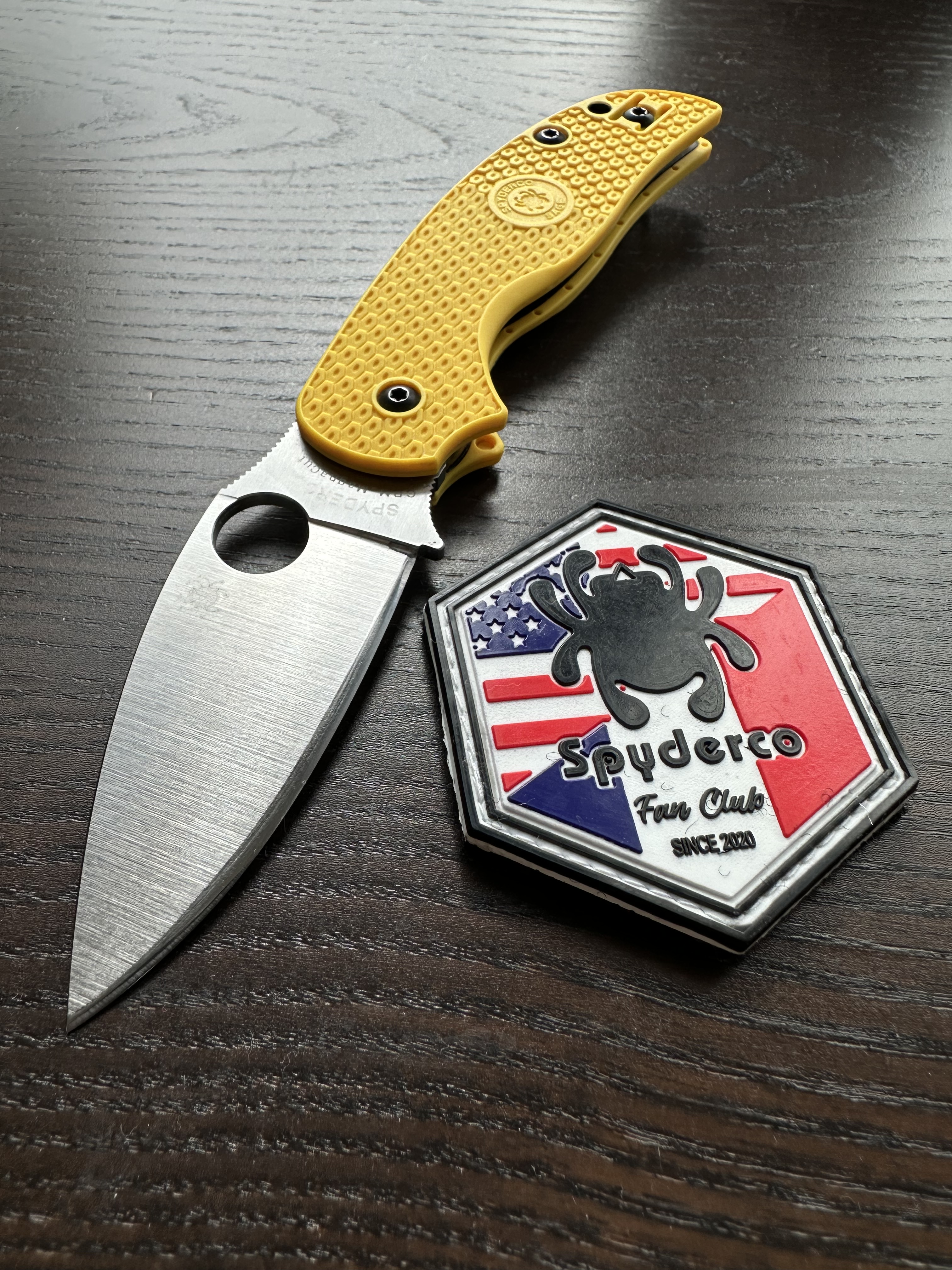
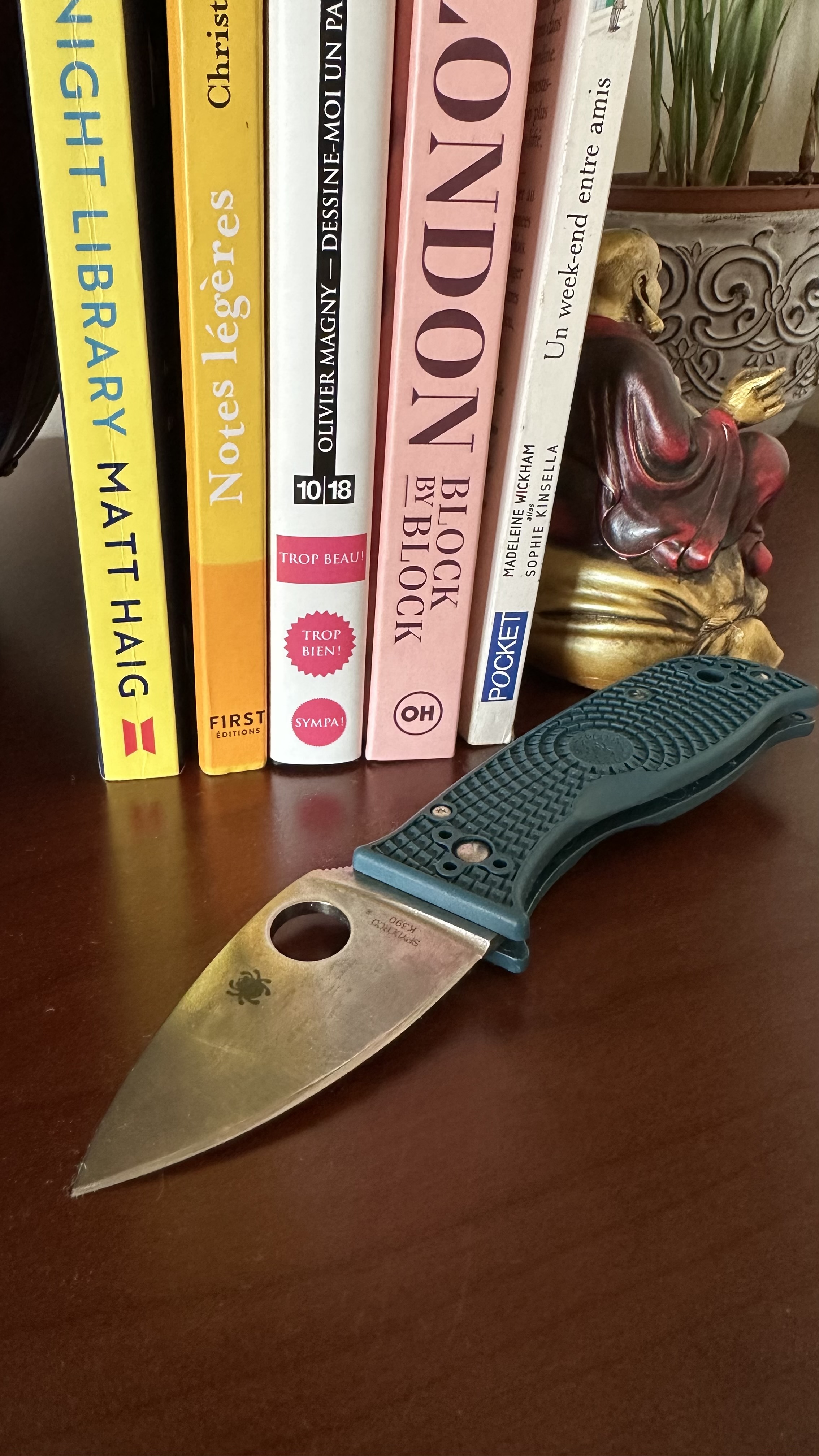
The Lil’ Temp 3 is stubby, with a distinctly modern folding knife look. Its blue handle helps it appear approachable — a friendly tool rather than a “ninja weapon.”

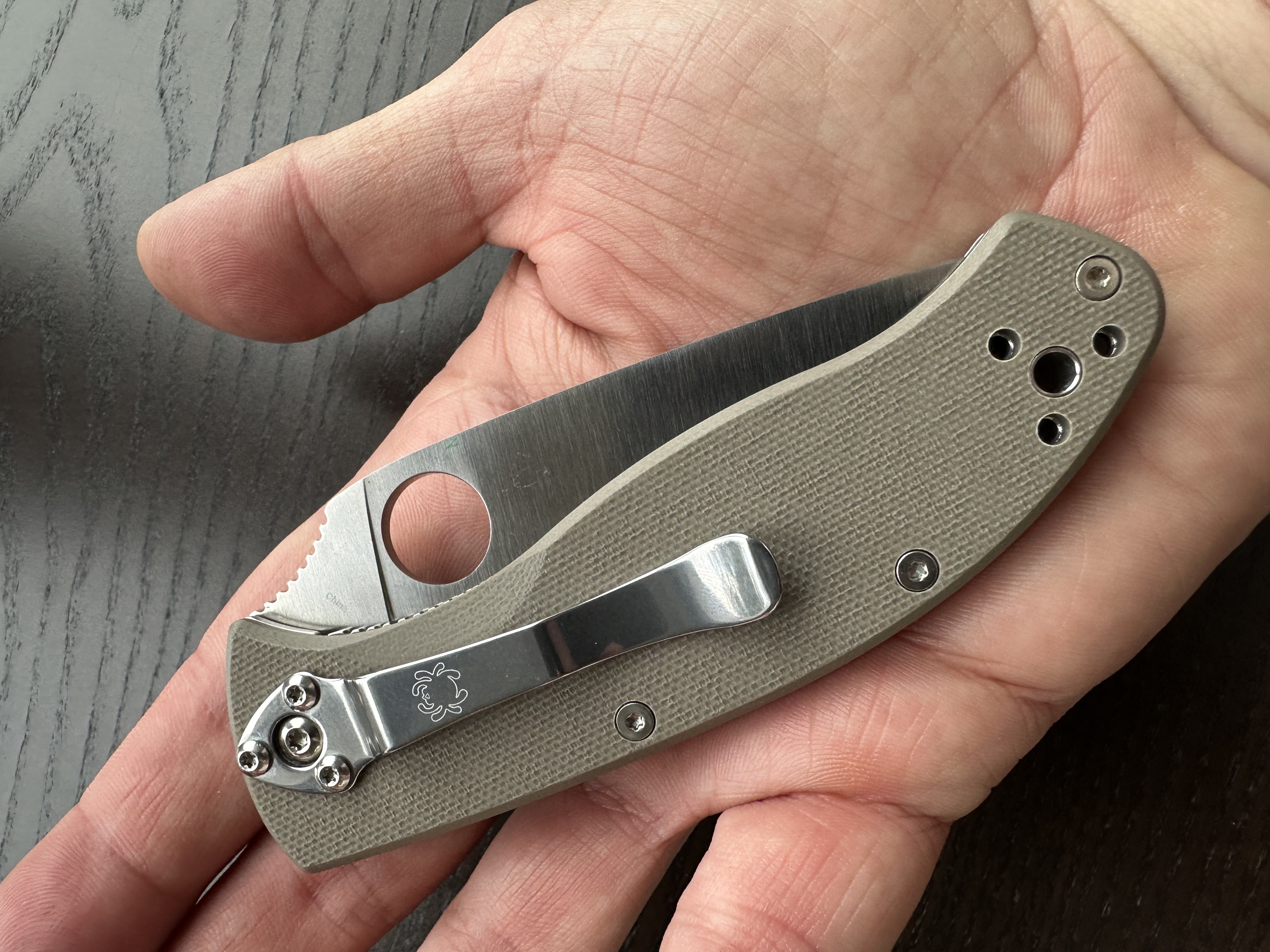
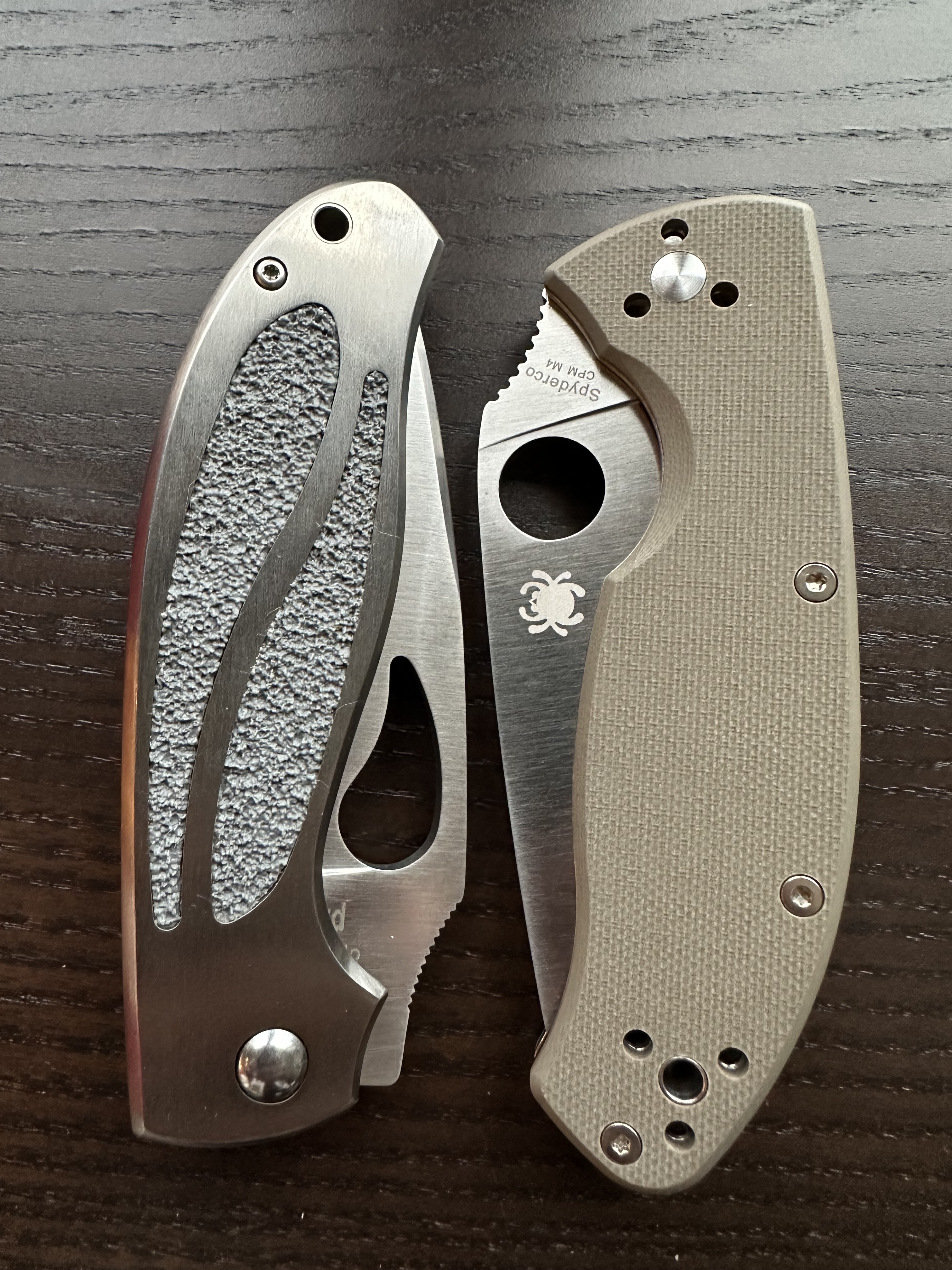
One of the biggest drawbacks of the original Lil’ Temp back in 2001 was its clip. That thick, rigid piece of steel with four screws made getting the knife in and out of your pocket more difficult than it needed to be.

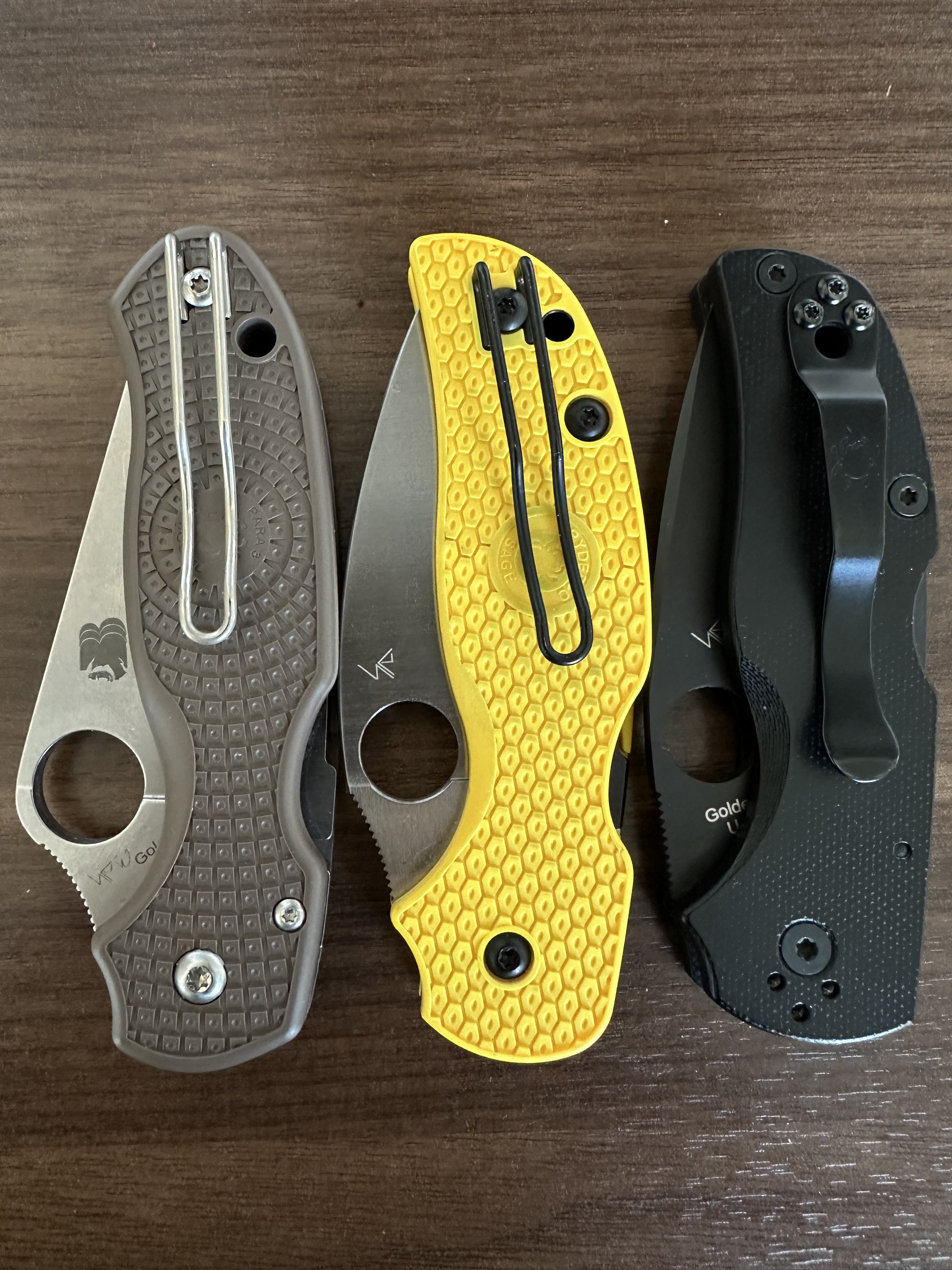
The LT3 solves this with its spoon clip, which is easy to tune. Following Sal’s advice, the knife is now effortless to retrieve from the pocket — a huge improvement. The LT3’s handle design also helps: I carry the folder tip-up, and the beak at the end of the handle, combined with the FRN traction patterns, makes the knife practically jump into my hand. Drawing it is effortless, even while sitting in a car.

The squarish handle also is a big plus: it helps indexing the knife instinctively : You know where is your edge immediately.
So, it is very safe and easy to draw it and open it, do the cut and then close it and pu it back in the pocket. You do that without thinking. Muscles memory…
It is a huge plus for a working knife’s user to be able to use the LT3 and close it and put it away back in the pocket in a breeze.
This is also really enjoyable, and coming from many great Spyderco Designs like the Military 2 or the Sage 5 or the Para 3, it is noticeable how nice that LT3 LW is in getting into action.
To sum up, it is really pleasant !

For exemple my lovely Lionsteel Nano is not the easiest to bring into action but it is forgiven as it is considered as a “Lady & Gentleman” folder.

But for a workhorse they are other specifications. Safety and reliability in putting in action your knife is mandatory.

FRN once molded in scales can propose high tech shapes and pattern designed by Sal Glesser which are enhancing the ergos even with wet hands.

The LT3 is one of the most confortable folder i have ever grip. The handle is thick, filling my hand’s palm and ready to be squeezed for hard cuts. The thick blade spine is asking to be pushed into materials.
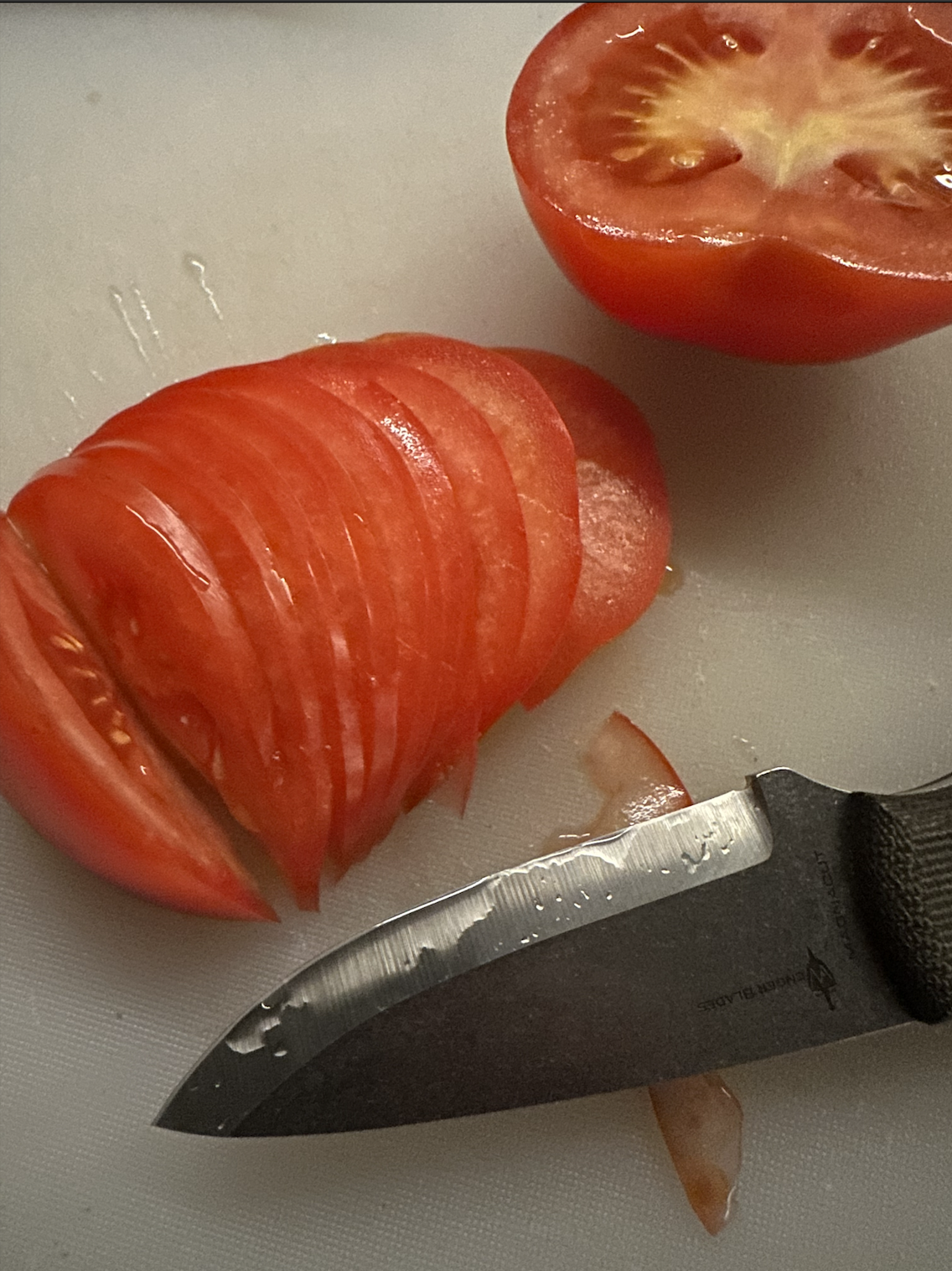
That’s why my first mission was in the kitchen with tomatoes and lemons…. 😉

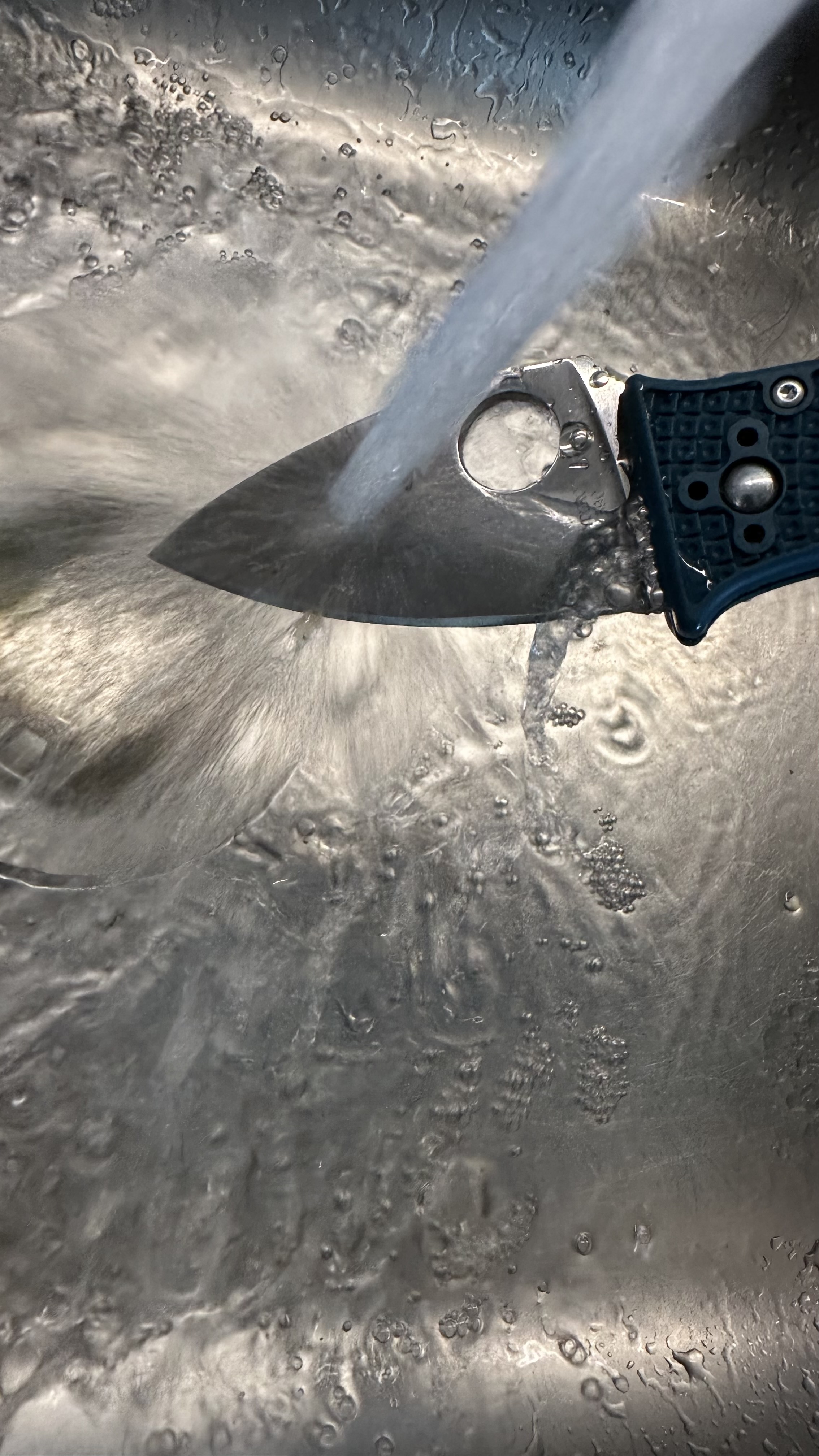
After a first cut into lime and avocados the blade was already getting its nice patina. K390 is deadly serious about getting stained and it is a good thing as that patina will protect the naked steel from pitting. I just wipe it clean after a rinse under the tap and check that the pivot to be well oiled.
This is exactly the opposite I do with the Sage 5 Salt ! I’m careless wth those Salt folders. This Sage is smooth like butter even without any oiled pivot. Magnacut and the Sage pivot design turn it like into a knife you can keep dirty and forget in the sink.
Not the LT3.
As strong as its is, its Achilles heel will always been proper care and maintenance. But serious users know how to take care of their tools. And maintenance is also part of the fun of owning good knives. The patina on the K390 blade will always show proudly that your knife is a user not a safe queen.

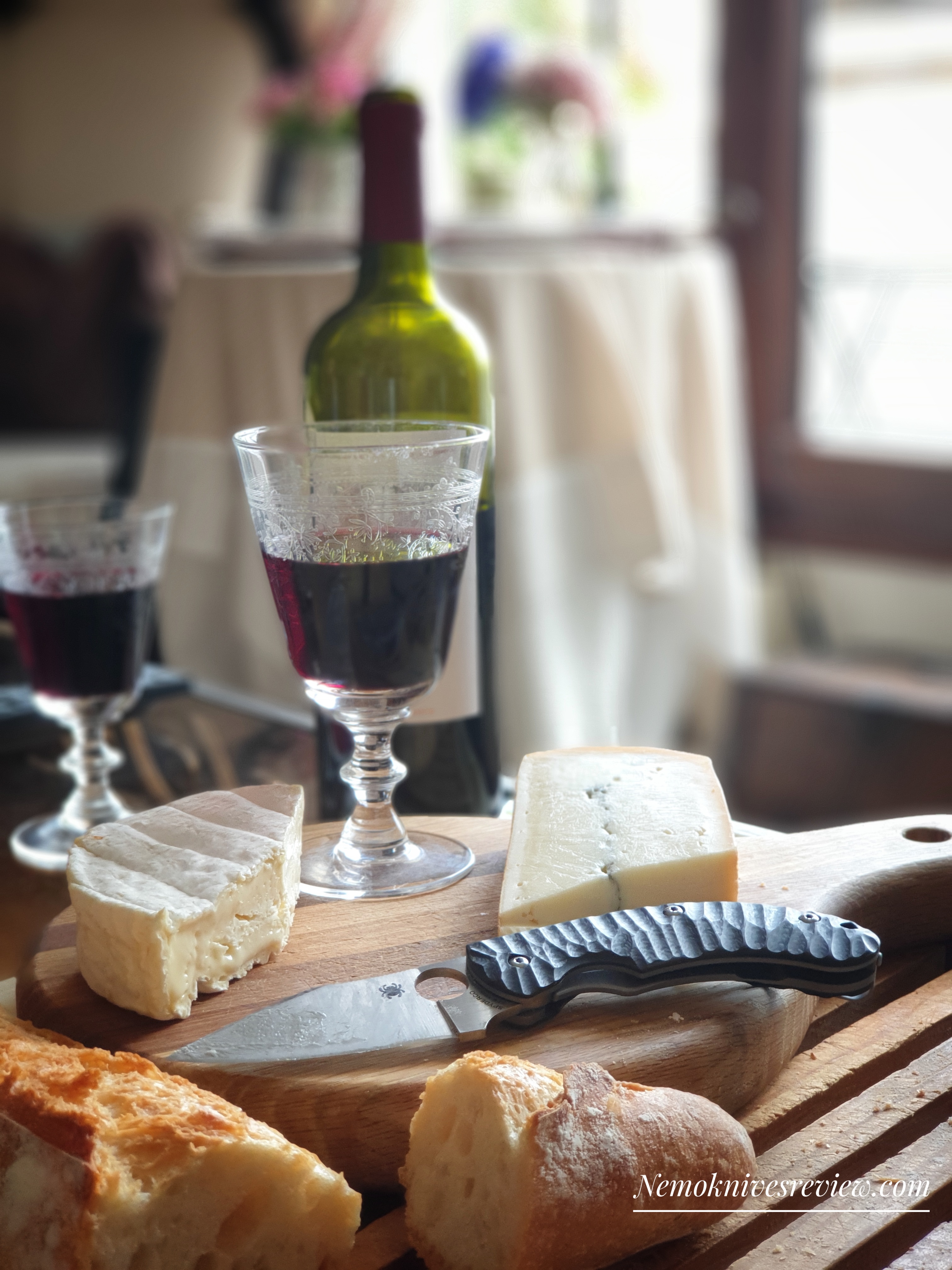
There is also the solution to cut cheese to keep naturally some grease your blade.
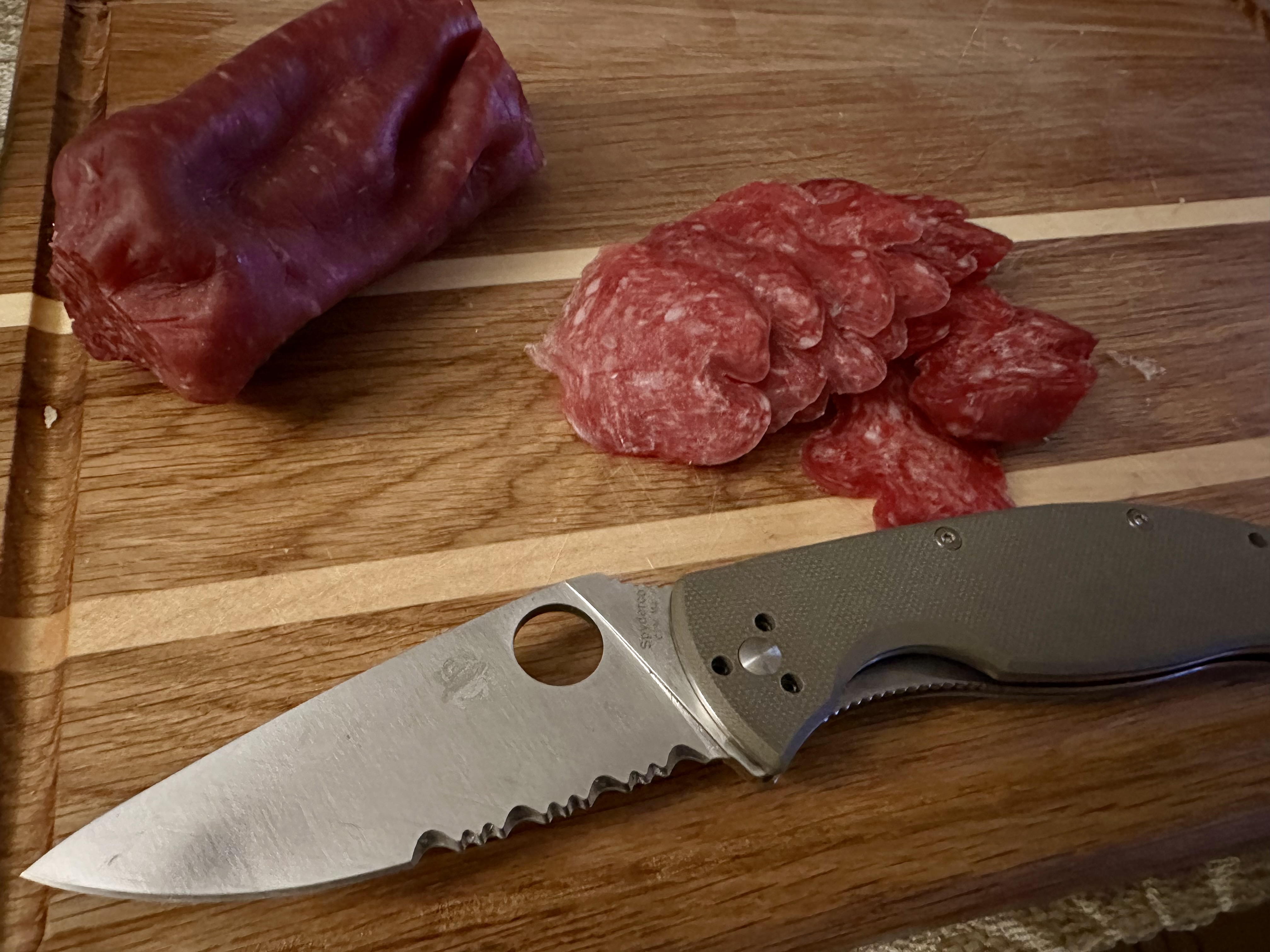
Those two cuts here has been made with the LT3. As you can notice those are clean push cuts. the geometry is that great.
Actually, in the kitchen, or preparing the meal in a camp, that LT3 is at home. That 4mm thick spine is not an obstacle as the blade is tall.

This is one of the things I love in my Cold Steel Voyager or Recon 1 XL: thick high blade but thin geometry. Thhose got much longer blades than the LT3 !

But the C69PBL3K390 does not act like a wedge on fruits like avocado or apple.
But once you turn it against harder material like plastic, you can apply a lot of force ! The handle is so comfy you can use it like a fixed blade. This stubby folder turns into one of the most solid “matter separator” ever made by Spyderco. It feels much more solid than their flagship, the Military and much confortable than their Shaman ! Go figure !
Let’s not forget they all got the same designer but, after 25 years of in house refinement, the LT3 is not a small contender. I even feel the LT3 could be the personal answer from Sal to the Spyderco Techno !
3 inches of pure K390 performance.

Now thickness is always an important factor in performance.
The UKPK is uncanny sharp with its thin blade. But it is designed for more mundane and delicate works not for being used hard in a construction site, for example.
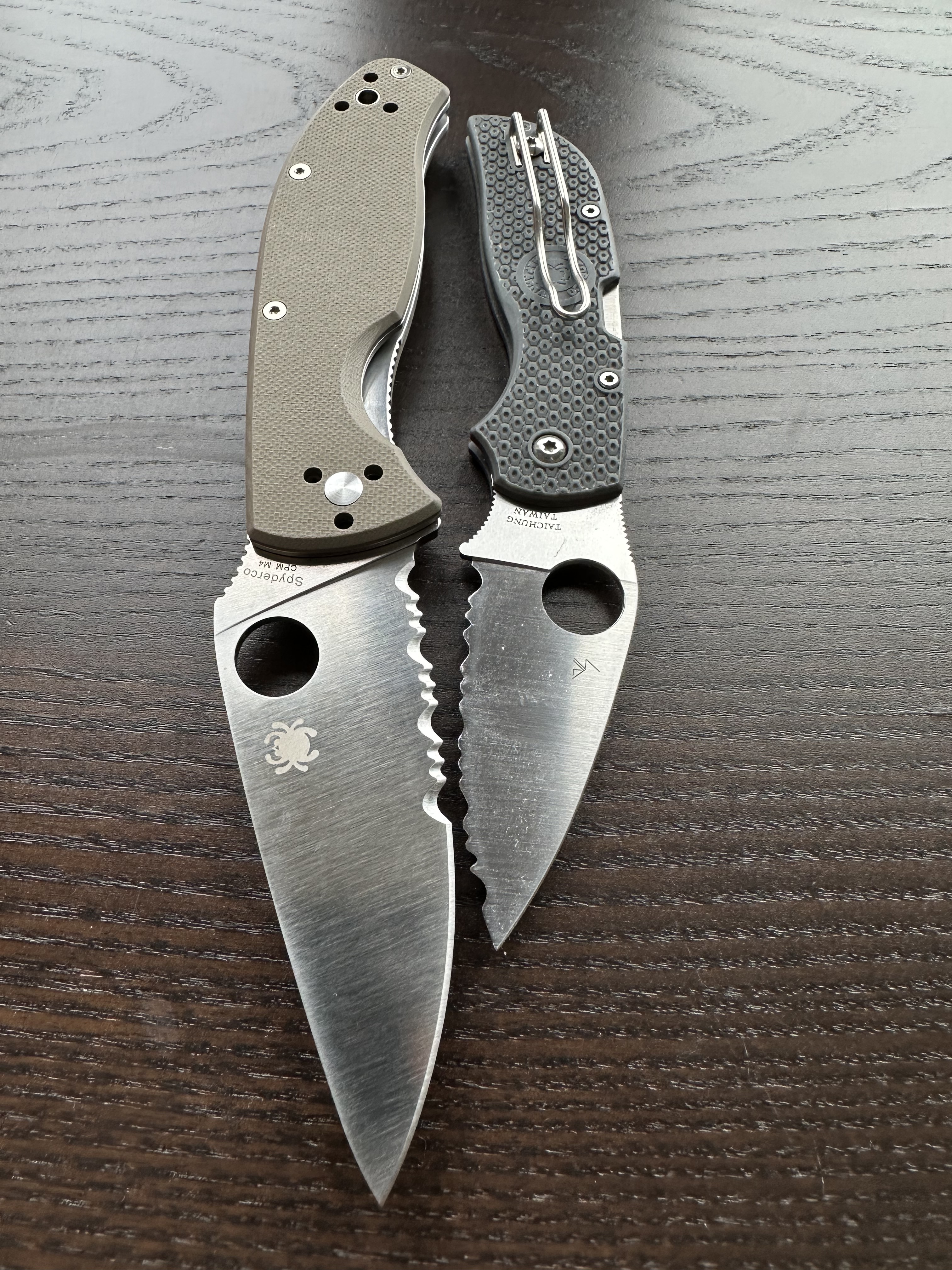
The LT3 plays in the same field as the Tenacious. (The last sprint run in CPM-M4 is really perfect for dirty hard chores.)

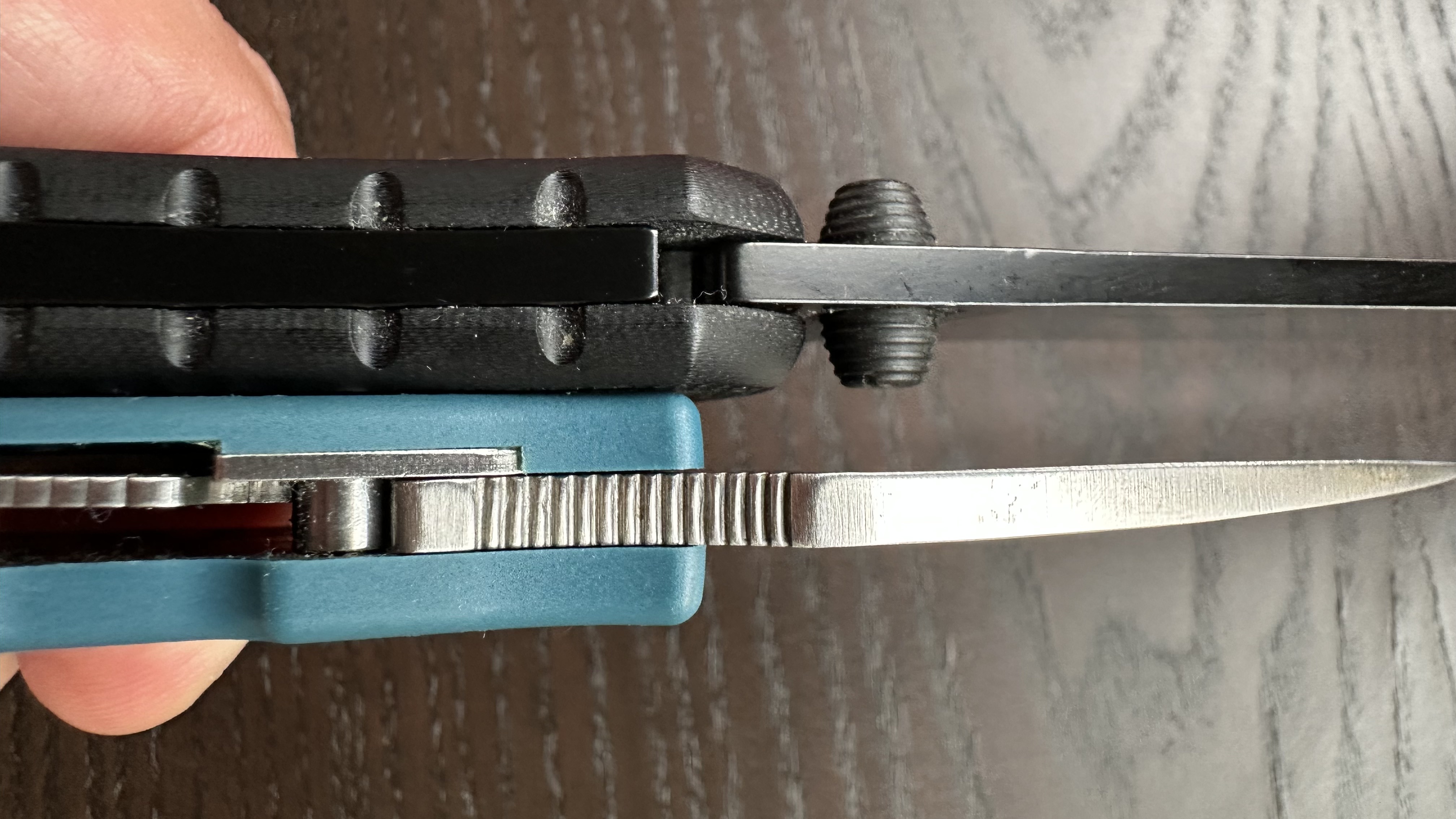
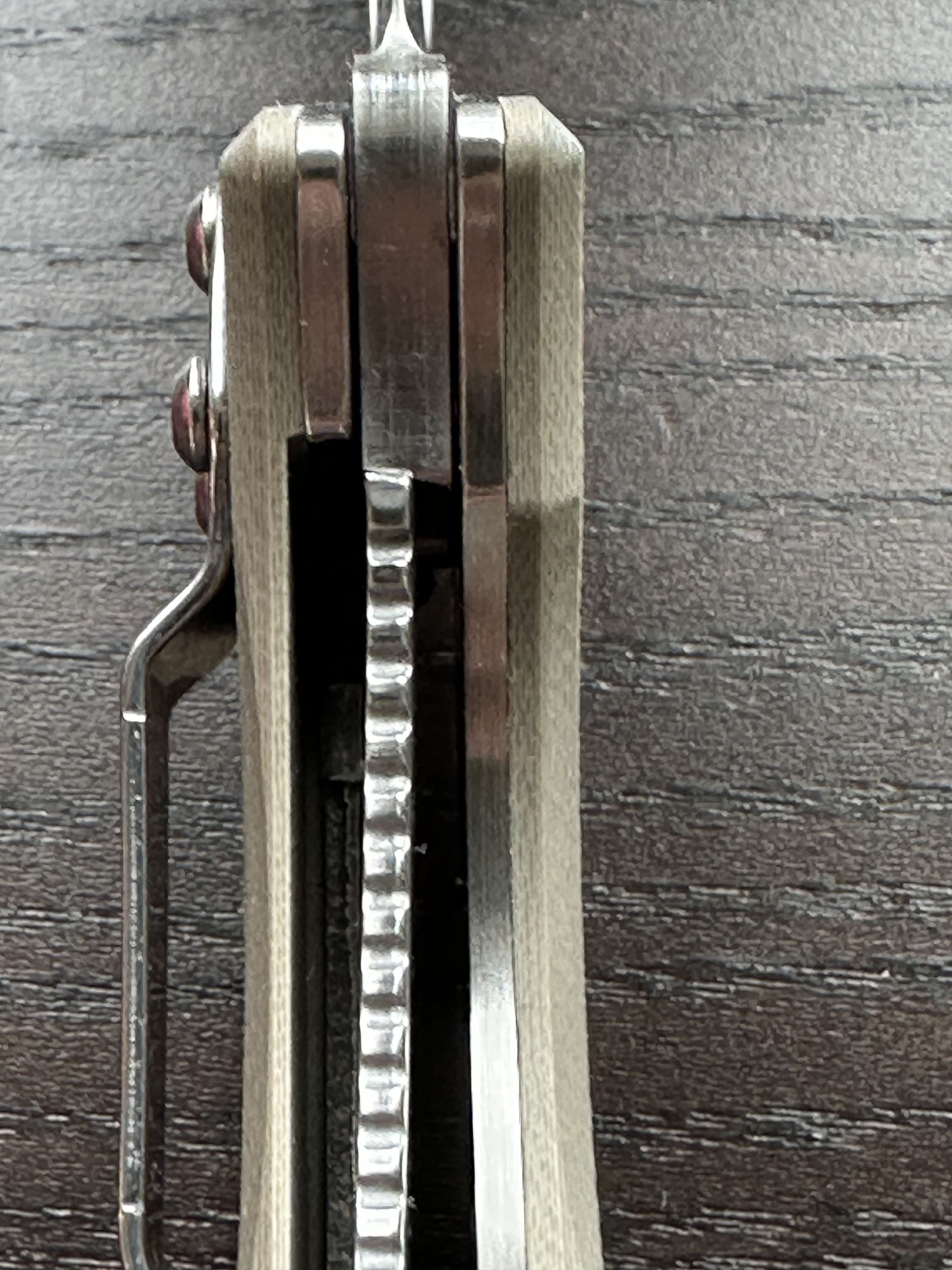
Both knives are choil less, with full flat ground blades, and they got an open back construction handle, easy to check and clean.
The Tenacious is a little bit longer offering a great blade/handle ratio.
But the LT3 got a stouter blade and a much better action/ compression lock.
And also a much much confortable handle.

About blade ratio, let’s quote Sal:

Many of our blades are designed to a blade length legality. The Delica is a perfect example. The blade length is 3.0″ which is acceptable in many places for legal reasons and for social concerns. The handle designed to the blade length is just not large enough for many of the people that use knives as tools. So I made the choice to give the handle extra length for safety and control. 

In my opinion, blade to handle ratios are an “eye” thing, which is fine, but I prefer to design with the bend towards function and safety. “A scalpel would not perform better if the handle were smaller or the blade longer”.

“Choil less” does not mean that your index finger is in jeopardy !
In case the ultra strong compression lock would fail or get disengaged…
There is no choil but there is a kick ! So your index finger is relatively safe !

Wait a minue! That LT3 Lightweight’s handle reminds the handle of the now discontinued Spyderco Vagabond. (The FB12 Vagabond was a compact fixed blade designed for on-the-go food preparation, such as picnics or packed lunches.)

See?

Same “beak” at the pommel too !

Thick handle and thick 3 inches blade on both.

Same designer again. 😉
I told you the LT3 was a “wandering rōnin” 😉

So once the LT3 has jumped in your hand, it is really sheeple friendly with all its gentle curves and nice handle color. It looks like a puppy of a bigger knife, a cute knife actually. That’s also a big plus for a low profile working tool.
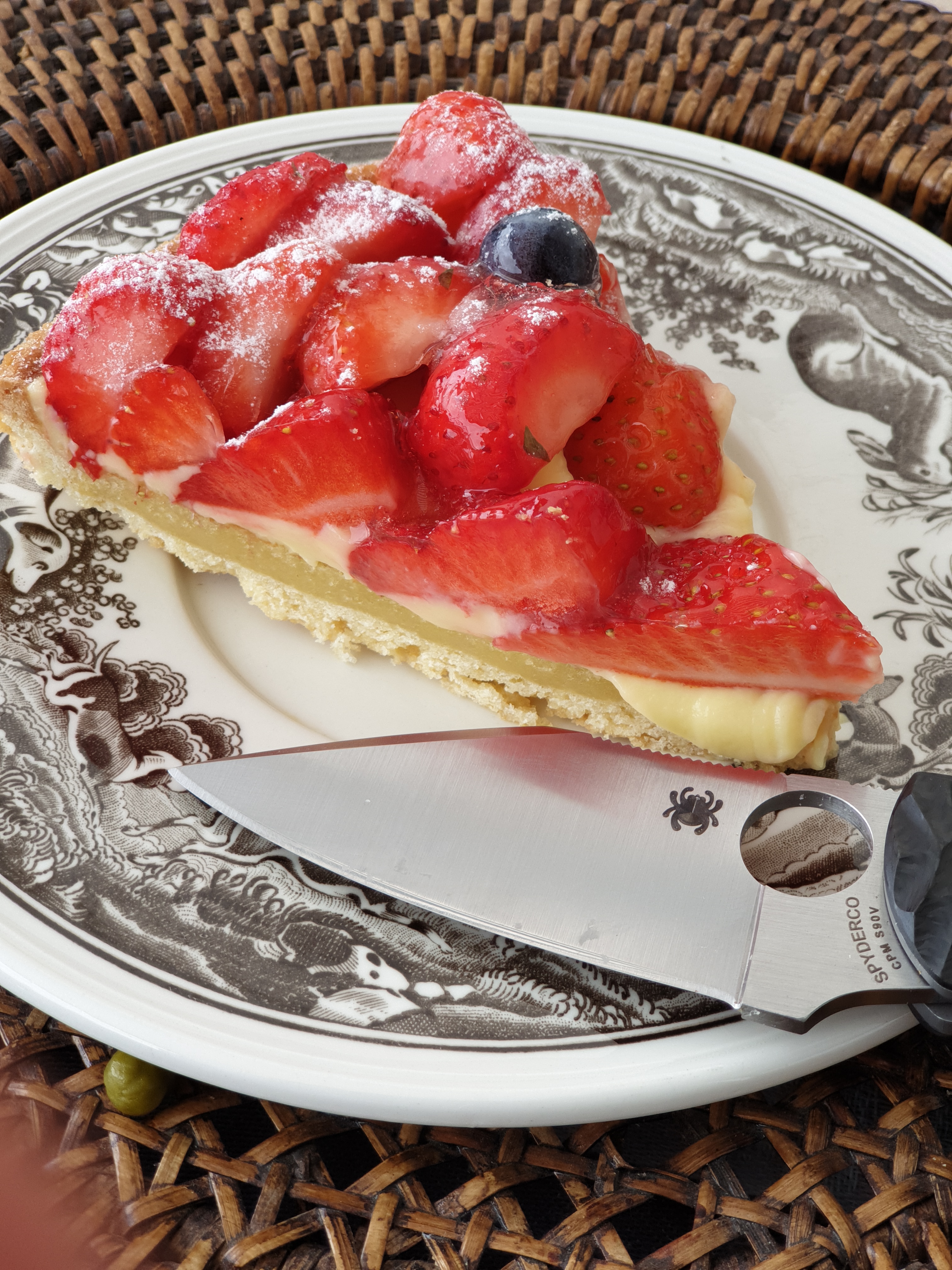
If someone working in a ranch uses a LT3, it won’t raise any eyebrows. It is as threatening as a screwdriver. Nowadays this is a big plus to own a low profile knife. Also when in sheeple hands, the LT3 is able to deliver. Yesterday, the family kept borrowing my knife, even to cut the crust of the pie for the Grand Ma ! This would not happen with my beautiful pointy Military 2 (Even my pointy UKPK was seen by them as a weapon able to pierce some armor…) ! The Lil’Temperance is just seen as a high tech folding tool, easy to control and put on “safe” and this is just what we ask when children are running around the table.

“The game never ends when your whole world depends
On the turn of a friendly card” Alan Parson Project.

The Temperance tarot card represents balance, moderation, and harmony. It encourages patience and finding the right mix in life – whether in emotions, relationships or work. It is a sign of inner peace and divine timing.
And this is exactly what the Lil Temperance3 Lightweight is oozing from its synthetic pores right at the moment you hold it.

For another fistful of minutes – De-shouldering the Spyderco Sage Salt Part 2

Let’s go back to the same process but adding 15 minutes more can be a game changer in term of geometry. But let’s be clear this is typically the Pareto law which says: “The Pareto principle states that for many outcomes, roughly 80% of consequences come from 20% of causes.”
It means that in 15minutes + this new 15 minutes it is not the most efficient as 80% of the job was done during the 6 first minutes last time.
But those added fistful of minutes are a little bonus to even the bevels.

As you can notice I have concentrated my thinning process mainly on widing the bevel.

10 minutes later, I got a more even larger bevel which should go shining after some leather stropping.

On another fistful of minutes, I will work on the tip but I like to keep some material here.
Now I’m basically dealing with a flat grind with a convex edge at the end.
In Japanese a convex grind is also called a hamaguri grind. Literally this means: clam. This name comes from the convex way the side of the shell moves to the end. Exactly like the full convex edge. A full convex grind is sometimes also called an appleseed grind. Again because of the pointy tip of the seed of an apple.( I’m a fan of  アップルシードa Japanese manga series written and illustrated by Masamune Shirow.)
But for now it is much than satisfying in terms of whittling and dealing with hard maetrail to cut.
The edge goes deep in every push cuts and the high FFG blade five a lot of control for powerful results.

(Badge designed by Guillaume Xais)

So far my initial impression are confirmed: the Sage 5 Salt is a keeper and another 3 inches blade length Spyderco to rule them all like the Delica 4, the Native 5 or the Para 3 or even the UKPK ! All are Sal Glesser’s children (The Para 3 paternity is shared with Eric !)


It is perfect in all aspects – sharp thin blade, centered, strong detent compared to the Military 2, no blade play, suuuper smooth.
The Sage5 is the best implementation of a compression lock I have ever had… Perfect tolerances and no lock stick.


The open-backed construction allows easy cleaning. This Sage 5 is really asking to be used and, thanks to its yellow handle, retrieved even on the forest or ocean floor. Really a must have 3 inches knife for all occasions.
And I’m a huge fan of the Native 5 and the Para3. But this Sage 5 seems to lead the pack.

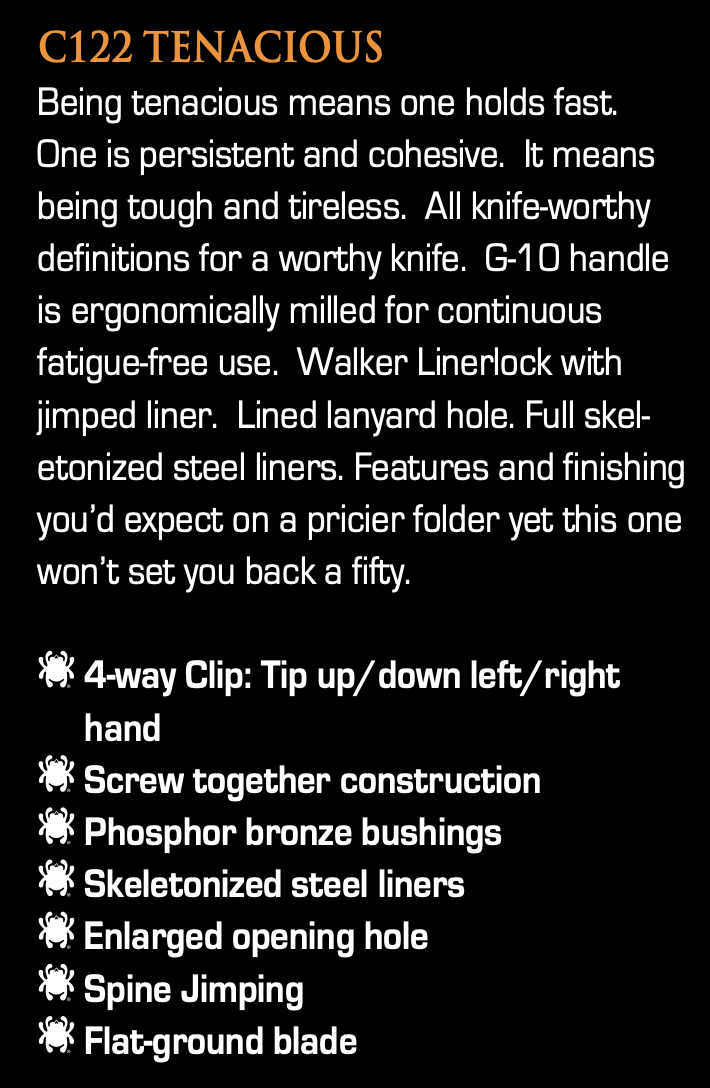
Spyderco Tenacious C122GBNM4PS – CPM-M4 with Serrations – Pure Workhorse

I’ve been tenacious — truly tenacious — in resisting the C122 Tenacious, even though I’d had my eye on that folder since 2008. After 17 years of flirtation, I finally ordered one. Why the delay? Its main weakness was always the less-than-stellar steel compared to the high-end knives I already owned.

Now, the CPM-M4 version is here to quench that long-standing thirst.

I don’t have much memory of a CPM-M4 serrated edge, except with another Eric Glesser design: the Dodo Exclusivefrom Blade HQ (C80GM4S). The Dodo was a real wood slasher — its S-shaped blade trimmed vines deeper and faster than almost any other, and the comfortable handle was perfect for power cuts.

Opportunities to play with a serrated CPM-M4 edge have been rare — until now. Here it is.

Back in 2008, when the Tenacious have been released it was a success.

Eric Glesser’s design was appealing to many for a simple reason: it was a well-thought-out, tough workhorse knifeavailable for around €30 (or less). A true blue-collar tool — built to be used and abused, like a modern-day Buck 110 for the pocket.


The best thing about the Tenacious was that it offered a thick, sturdy, well-built liner lock at a time when liner locks were falling out of fashion. Easy to display, easy to use, this no-choil, long-edge, compact working folder from Eric Glesser was a hit — and one of the best ways to catch the Spydervirus.


Now there is a FRN version in CPM S35VN. But it is as heavy as the G10 version and I’m not really a fan of FRN… Even if I absolutely love the FRN scales of my Serrated Chaparral.

I remember Bushcrafters being the first to sing the praises of the Tenacious. An example:

I’ve thrown it, dropped it, batoned wood as thick as my wrist, chipped the edge multiple times (didn’t think 8cr13mov could chip, thought it was too soft but was wrong), I’ve left in outside ONCE in the rain overnight because I forgot I placed it on my front porch the previous day, I have spine whacked it (just don’t, I most likely have an impulse problem… lol … same problem that causes me to buy a lot of knives) I’ve dug holes, stabbed the ground to cut weed roots out, and much much more...

I think by now you get the point. I treated the tenacious as if I got it for free and had 1000 more to replace it if something happened. I treated this knife as if I hated it.

The result? 4 years later, the Tenacious opens smoother than it ever has, not a speck of rust since I purchased it, I have oiled the blade a couple times but I can guarantee it was less than 20 times total in the last 4 years, lockup is a bit less solid, BARELY any blade play from side to side, even less blade play from front to back, g10 scales look smoothed over and scarred, but to be honest there is still plenty of traction.
All in all, this knife is much more than what most of you need from a folder.”

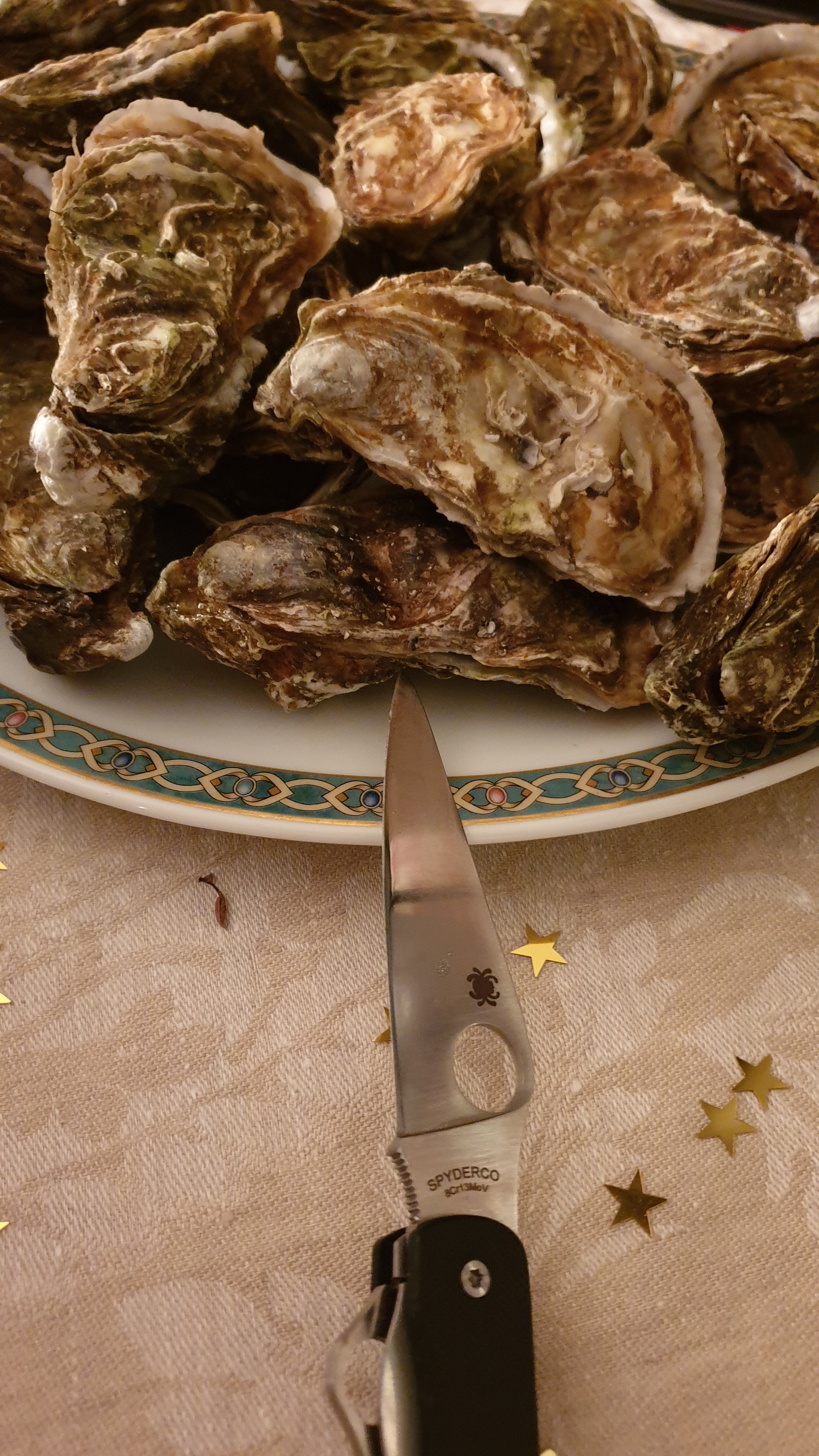
My Persistence experience was excellent as described in my 2012 review (green words lead to link) but eventually I was disappointed with their steel. 8Cr13MoV can get sharp but lose sharpness much too fast for my uses. It was frustratring. I still got 8Cr13MoV knives like the Clipitool which is a great oyster knife. 8Cr13MoV is tough for a stainless steel, no surprise it was chosen for the Tenacious line.

The Tenacious is a sturdy well made liner lock folder with a super tool steel blade.

“This remarkable expression of the Tenacious® elevates this best-selling design to all-new heights with a blade crafted from American-made CPM M4 tool steel. Produced by the particle metallurgy process, CPM M4’s sophisticated alloy composition, high vanadium content, and extremely fine grain structure give it exceptional wear resistance and toughness-properties that translate to outstanding edge retention and impact resistance in knife blades. This knife’s full-flat-ground blade is available in both PlainEdge™ and CombinationEdge™ formats and is housed in a handle featuring brown peel-ply-textured G-10 scales.

I have written many reviews about that fabulous alloy CPM-M4 it has never disappointed me and since I have sold my CPM-M4 Military and kept my Yojimbo 2 and Mantra 2 (reviewed and sharpened by JD) and use them hard, I know it is reliable and get a nice patina.

A lil’oil will prevent rust. CPM M4 is not 52100 and the patina will come slowly after cutting some lemons…
CPM M4 has good edge holding, sharpening ease, toughness, strength, and is not a rust monster…” to quote Rangodash.

Now a blade is 1/3 steel, 1/3 Heat Treatment and 1/3 geometry.

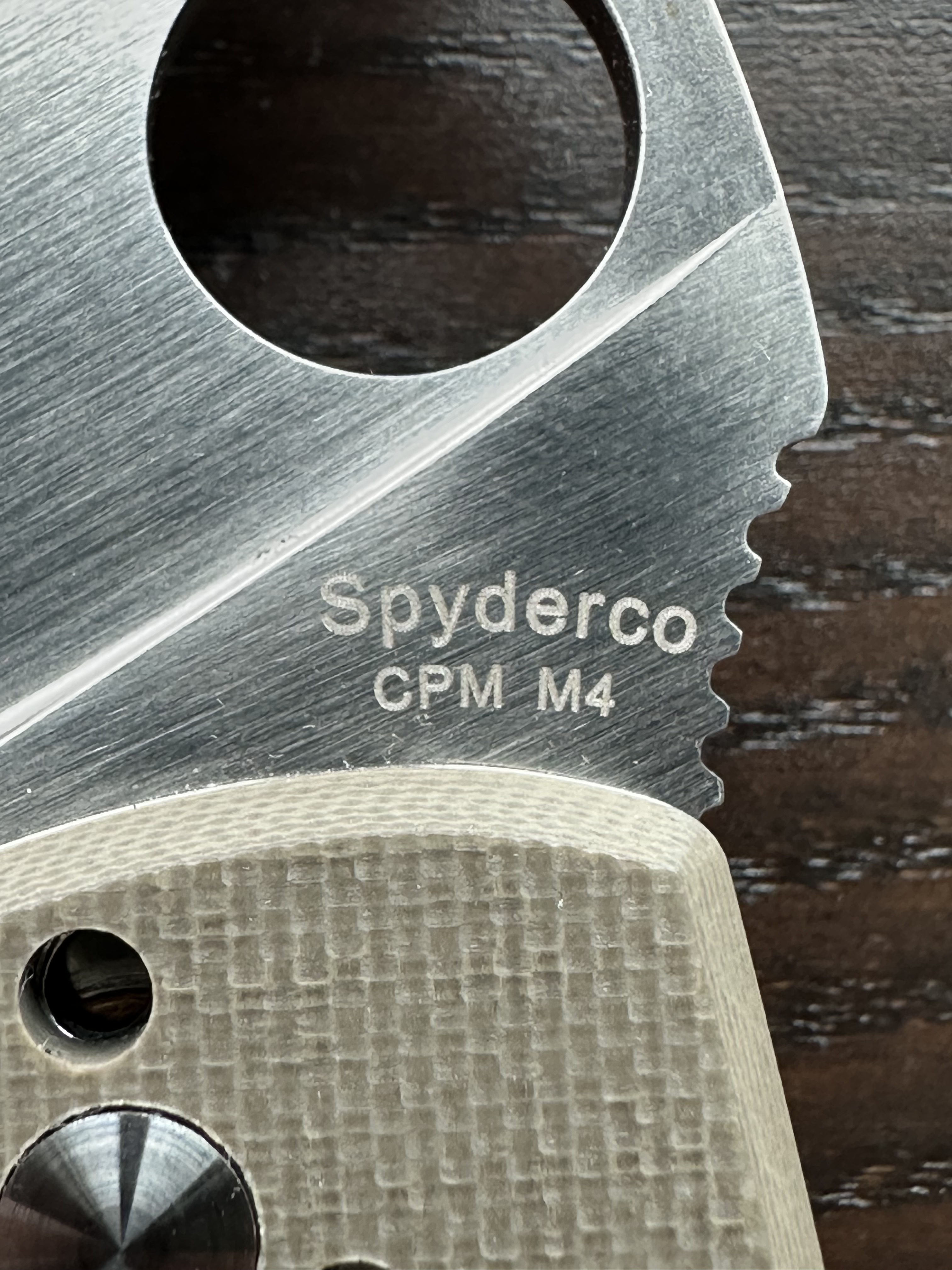
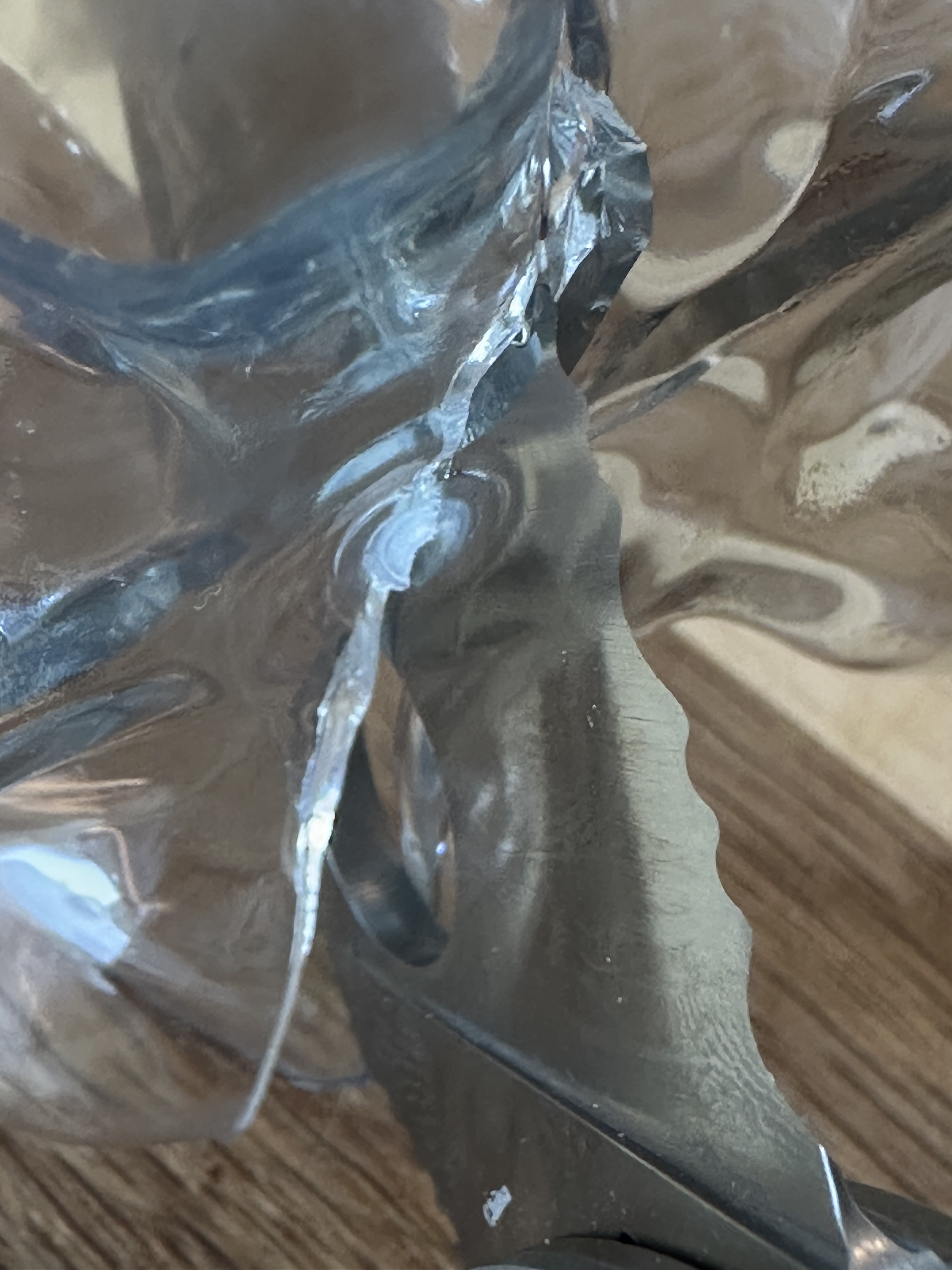
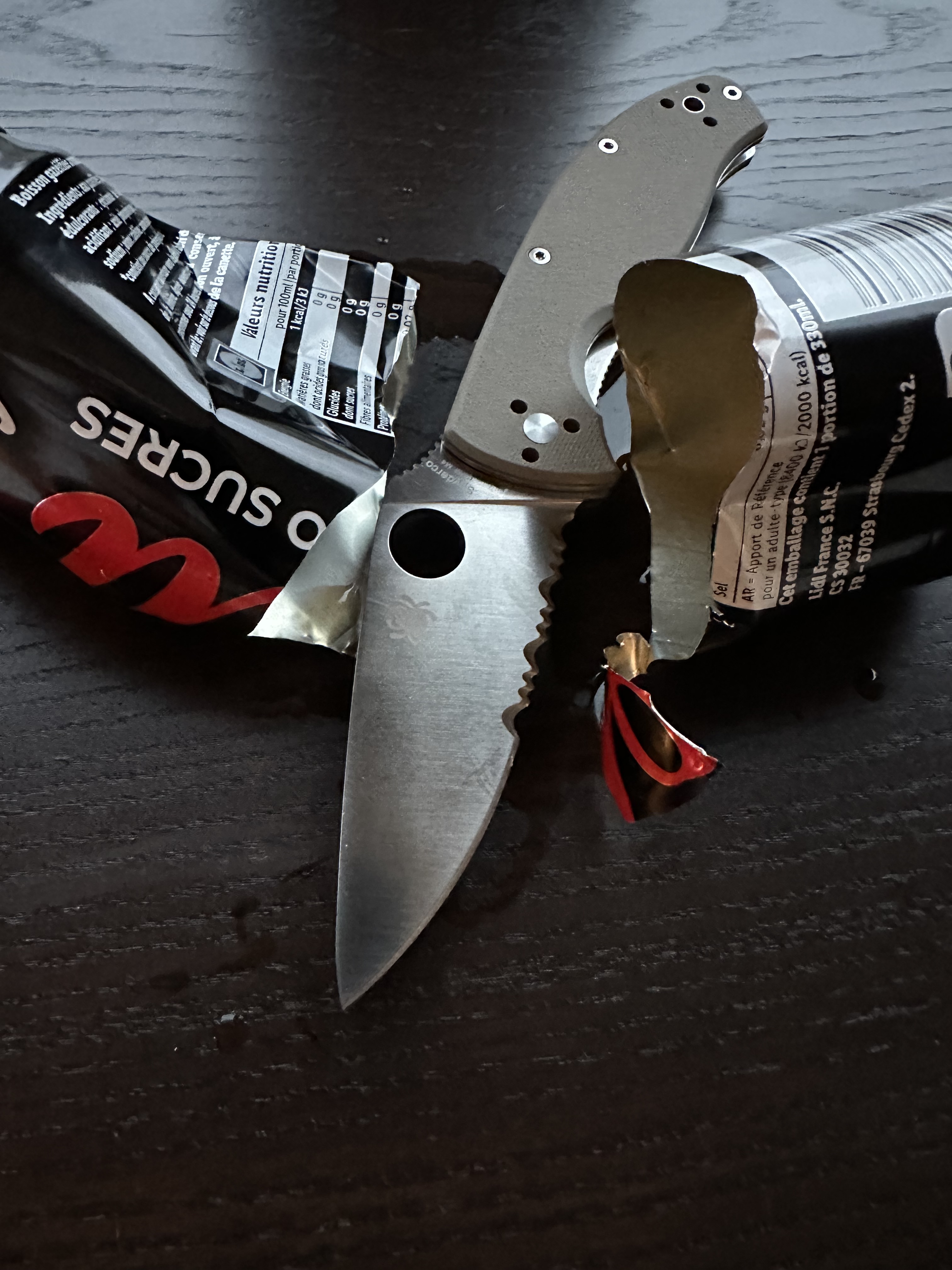
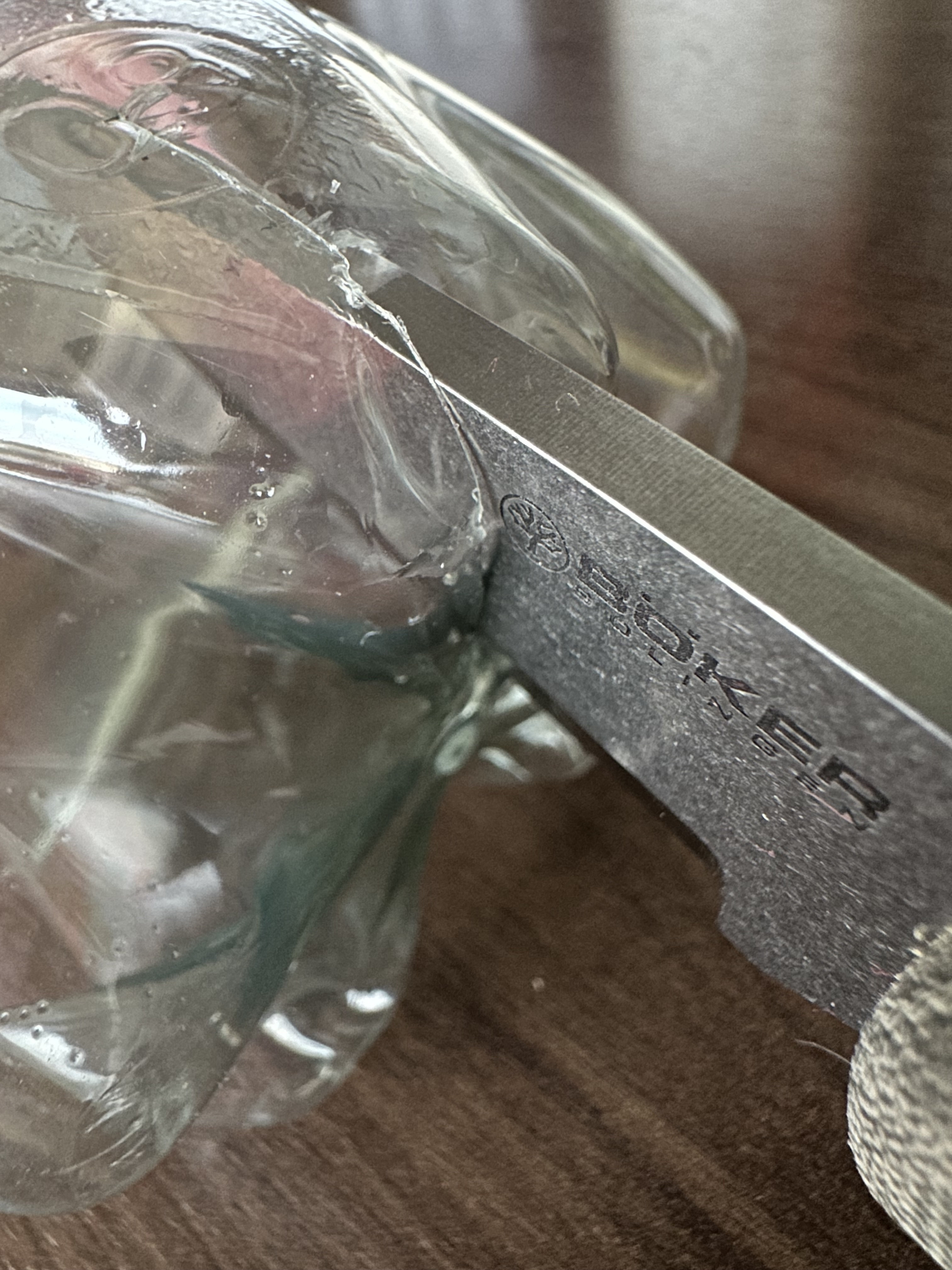
The Coke butt bottle pushing cutting test has been done with the factory edge right out of the box. It is thin behind the edge.  It’s a good blade thickness for more nuanced jobs, but there is added strength from the thicker spine. 

The knife sliced right in the middle were the materiel is thicker.
This is just outstanding !

There are a great geometry and a thin edge on that tough CPM-M4 blade. The result is a sturdy matter separator.

It is not an exploit to cut into some tin can but the same “shallow”, “non snaggy” kind of serrations as the Chaparral made it easy.

Again, this is a “performance oriented” knife. The blade is not too thick like some “tactical” toys. It is made to perform not to show off.

“For notching, serrated edges work great. Feathersticking, maybe, maybe not. Serrated edges are ground on the show side, so they actually work better when used left-handed for cuts like that. I carry a serrated K390 Police4 all the time for rough work. It goes through little volunteer elm trees like a chainsaw. A SharpMaker makes it a breeze to maintain the edge.” to quote Yablanowitz.

The liner lock is thick in the same spirit of Gayle Bradley’s folders.
The knife opens with a loud KLAK! — no blade play in any direction. The detent is strong but slightly “elastic,” meaning the blade moves a little before the release/tipping point engages. This makes it very secure, with no risk of accidental opening. I’ve noticed the same elasticity on the titanium version of the Tenacious. It’s important to note: this is not a weak detent — the blade won’t open without a deliberate, serious force.

Using the knife in Spyderdrop mode, a flick of the wrist catches the blade in the Spyderhole with no issue. Closing remains perfectly secure. There’s a tiny squeak out of the box, but a few drops of nano oil should mute it. The action isn’t buttery smooth like a compression lock on ball bearings, but after a bit of breaking-in and running-in, it will be wonderful.

The solid clip is delivered mounted in Tip Down carry, which suits well this knife for the Spyderco Drop featured on the Military 1 which got the same kind of “around the pivot” clip.

I have no intention of using tip-up carry or a deep-carry clip. This knife is a tool, meant for easy access rather than a stealthy edge. The Tenacious is always noticeable in the pocket, but that sturdy clip guarantees quick availability — reminding me of Massad Ayoob’s teachings.

Spyderdropping is an extremely fast way to get the blade into action — faster than many switchblades. Sal Glesser was already demonstrating this skill almost 30 years ago: grab the knife by the Spyderhole and SCHLAK! — it’s open and ready to cut.

The Tenacious features full steel liners, unlike the nested liners on the Military line. There are no backspacers, making it easy to clean under running water. At 120 grams, it’s not a lightweight folder — I appreciate a bit of heft on a working tool. (For reference, the new titanium version is 93 grams.)

Notice how perfectly centered the blade is right out of the box. The quality control on this “made in China” folder is impressively high.

(Sal’s Titanium Catbird (only 200 were made) next to Eric’s Tenacious.)

Eric and Sal have taken their time with the Byrd Line and their budget line to get the best from a family of makers in China. The Glessers have moved slowly but steadily, developing a trustworthy and excellent relationship with the knifemakers there.


To quote JustinRose40 on the forums in 2011:
“Yes, every time I show someone my Tenacious I have to say “well it’s made in China but it’s not a China Knife, it’s still a Spyderco”. To which they usually say something like, “yeah I could tell that as soon as you handed to me”.

Since 2011, China has made huge leaps in knife manufacturing quality, and this steady improvement is clearly noticeable in the “new” rendition of the venerable Tenacious.

On Eric’s designs, there’s sometimes no choil, but you can notice a clever feature: a “proto-flipper” that acts as a quillon or guard to protect your fingers in case the lock ever failed.

Since 2008, I haven’t heard of any critical lock failures on the Tenacious or the larger Resilience. The Tenacious has earned its legendary status for a reason.

Another Eric design with an excellent blade-to-handle ratio is the Mantra 2, which uses a flipper. (I’m not a fan of that little opening hole — dirt always collects there!) Still, it’s a great design. The Mantra 1, with an opening hole, feels like the Taichung-made “uncle” of the M4 Tenacious.

The peel-ply-textured G10 scales don’t need sanding; they’re well balanced and won’t shred pockets. The brown color makes it feel less threatening, in my book.

Let’s put it to use while the satin blade is still silver.

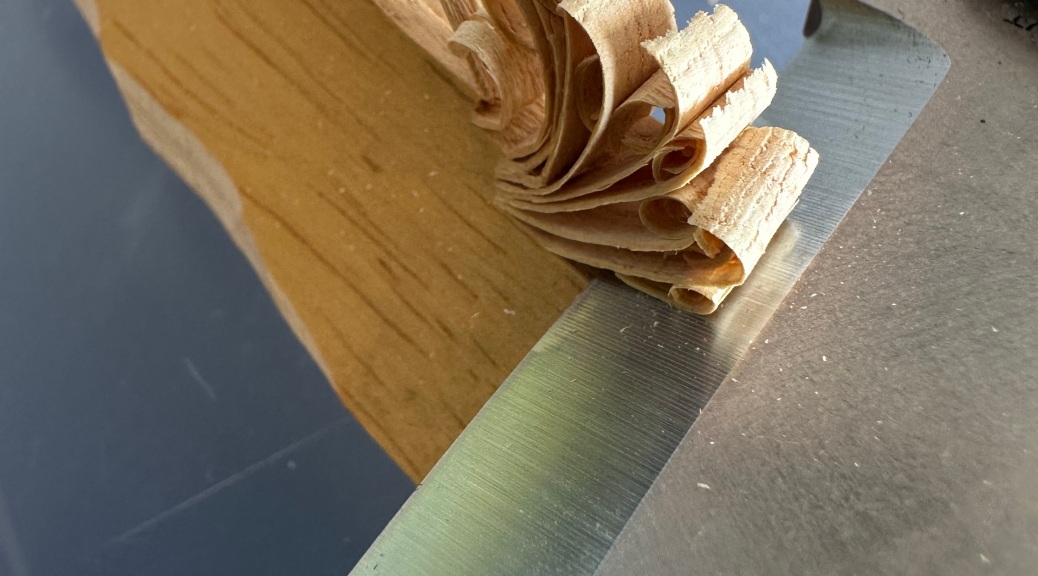
The knife bites into wood like no tomorrow. The serrated CPM-M4 edge is a joy to use — it goes deep and steady, putting a smile on my face every time.

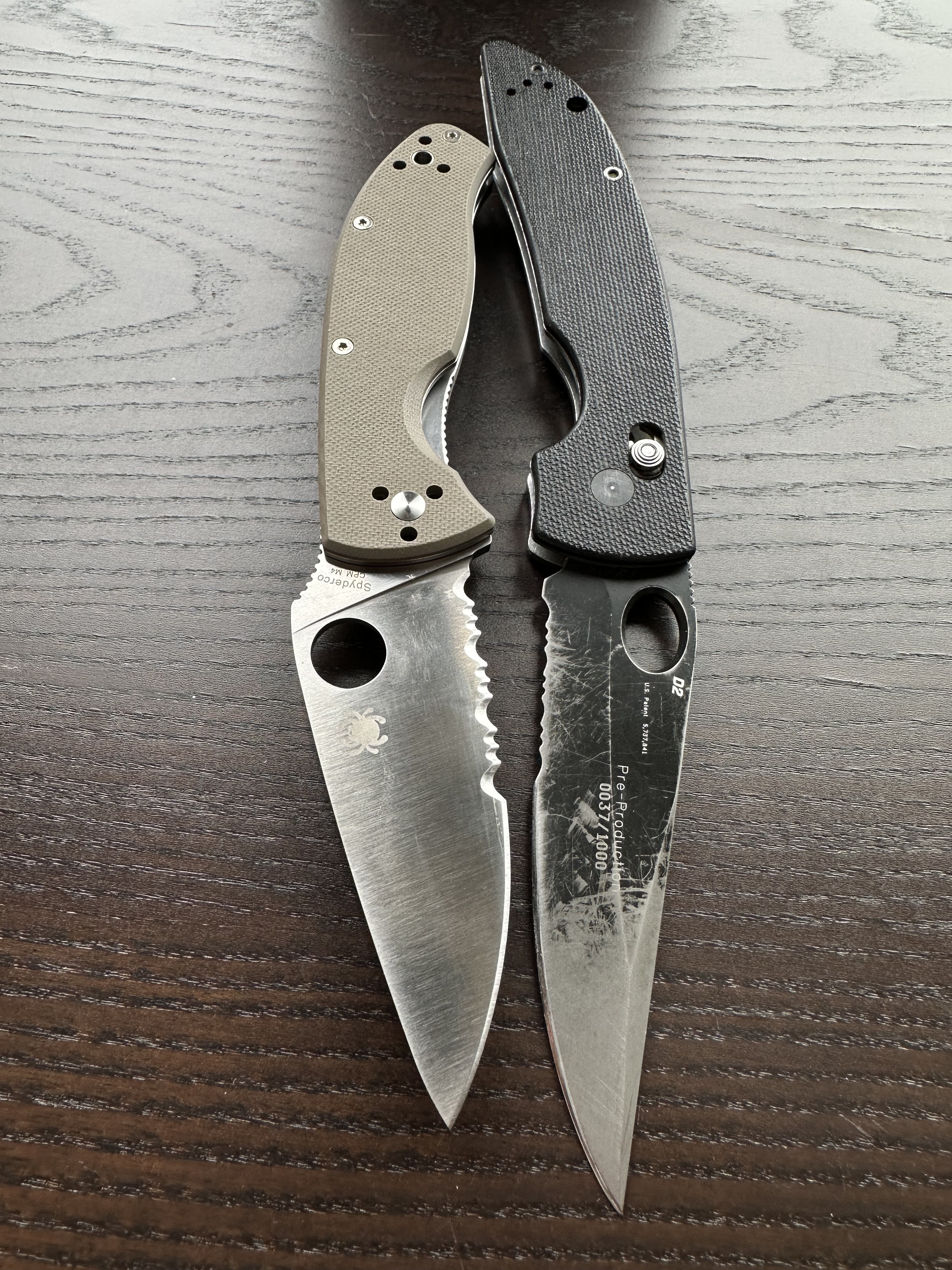
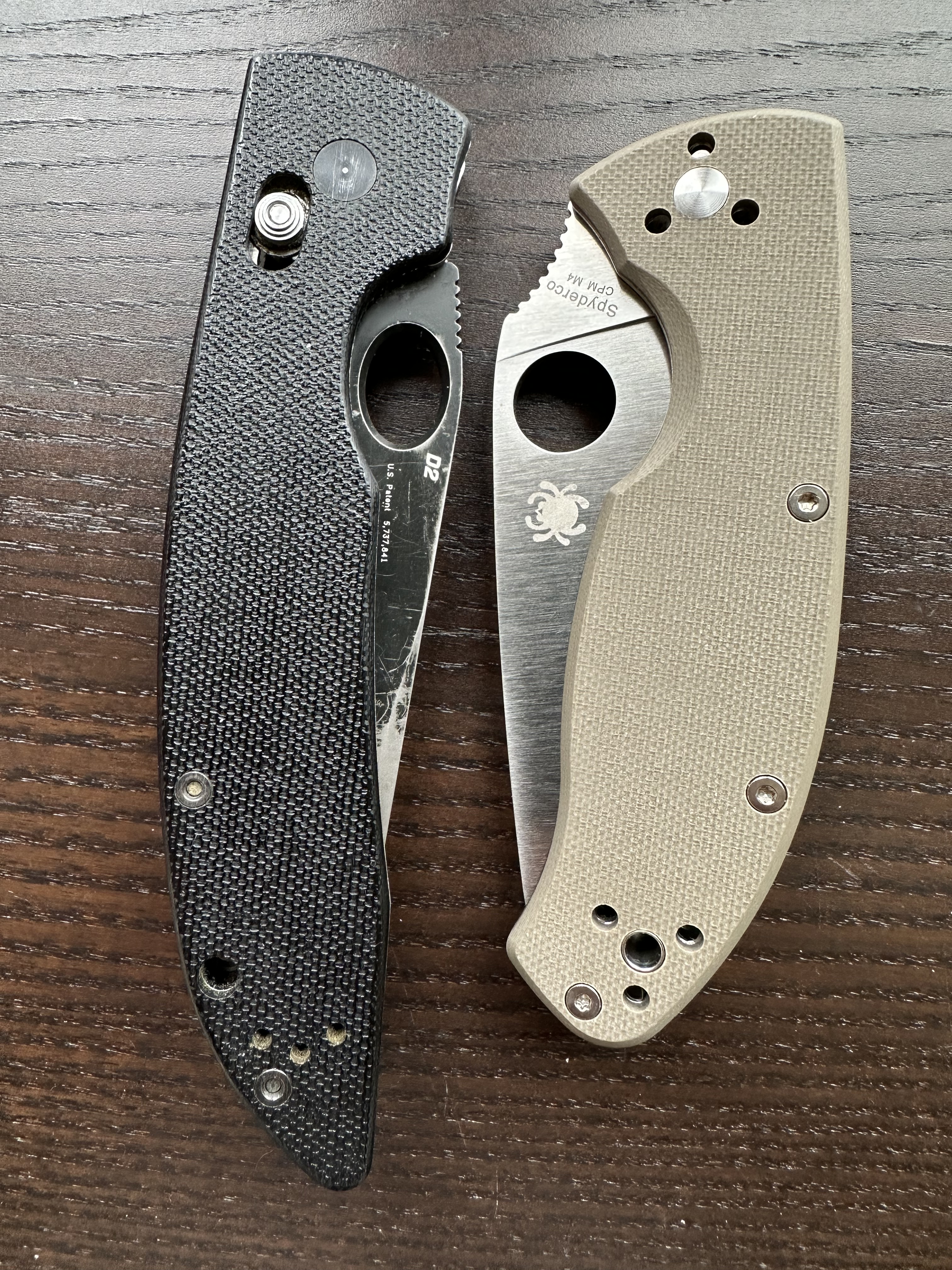
Blast from the past: the last combo-edge/semi-serrated knife I used was over 20 years ago — a Pre-Production D2 AFCK. As you can see, it’s been heavily used, and its geometry, steel, and blade-to-handle ratio aren’t nearly as refined as the Tenacious.

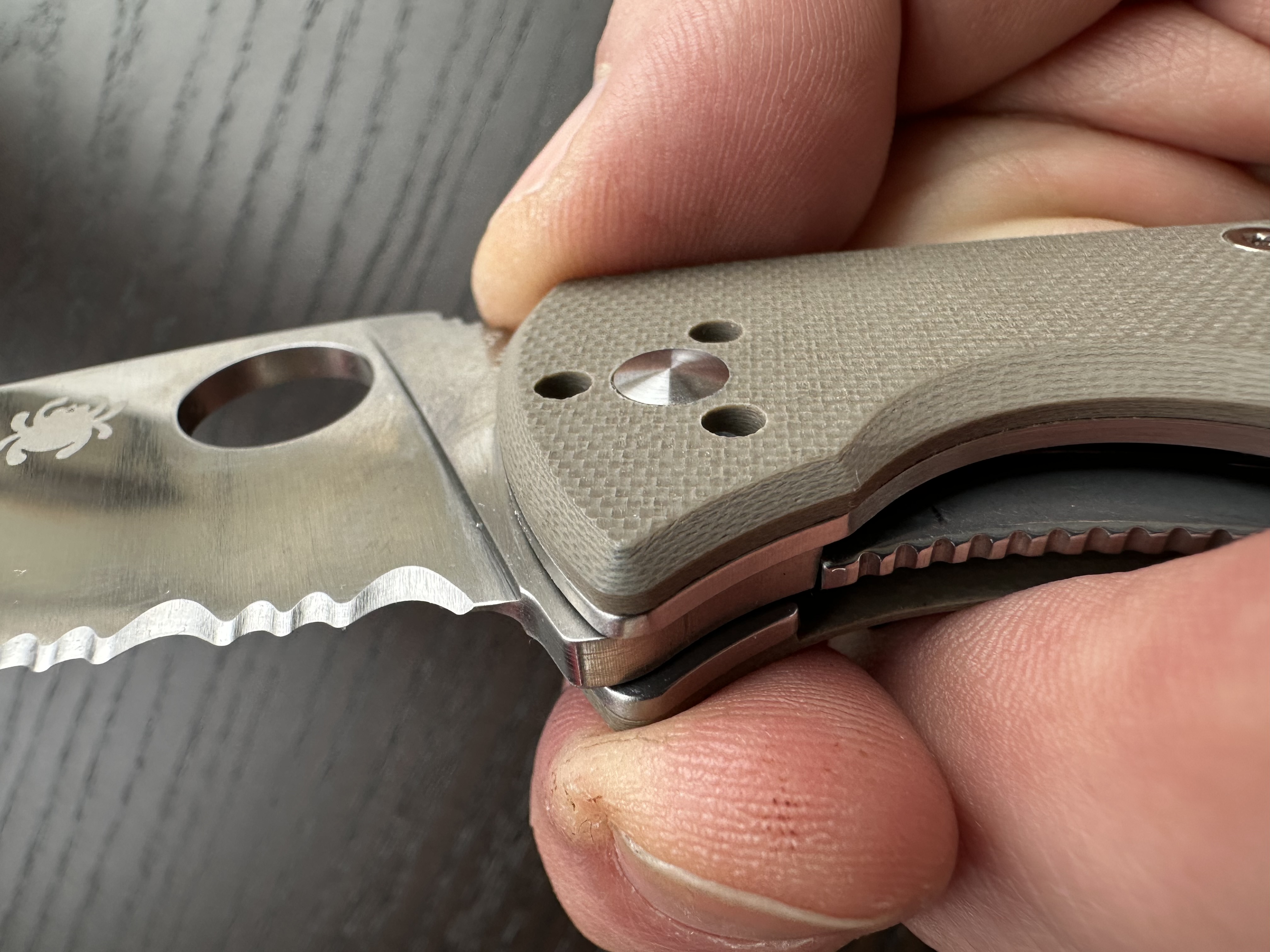
That macro shot shows the very smooth way to go from chisel ground serrations to plain edge.

“Serrated edges aren’t for everyone, and you may not like them, but you’ve got to get at least one just to try! Keep it around for nasty work, wet abrasive rope, zip-ties, yardwork, or playtime like in the pool, or at the lake or beach. Not to mention fishing duties.” to quote Benben.

The difference in cutting efficiency between a saber grind and a full flat grind is obvious. I don’t need to tiptoe around it — the advantage is clear.

Now let’s compare the Tenacious with various folders and fixed blades.

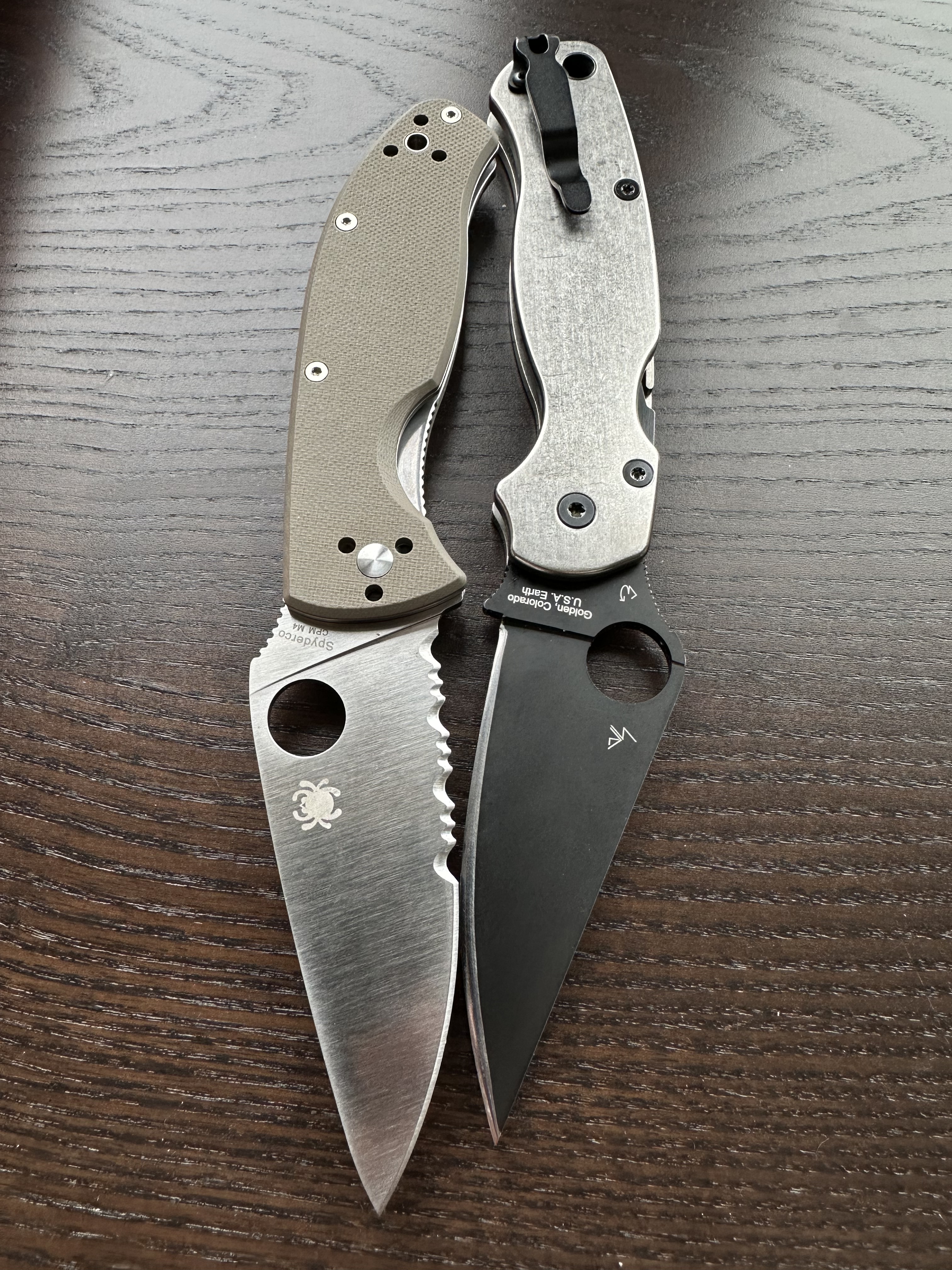
The Tenacious got a better blade/handle ratio than the Paramilitary 2 and a longer blade for a shorter handle. This is one key of the success of that design.

Almost the same length as the Chief.

No choil on the Wolfspyder too.

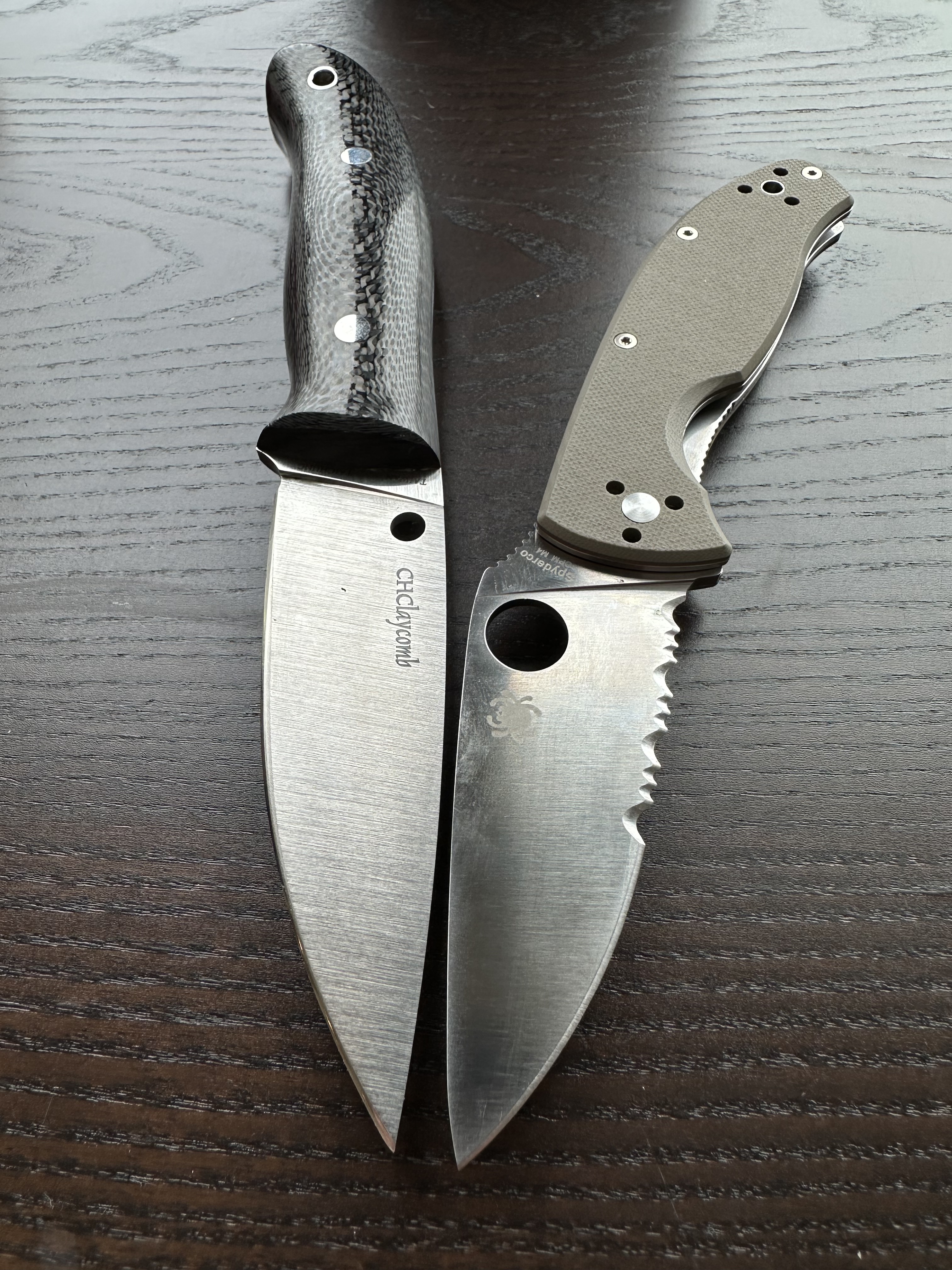
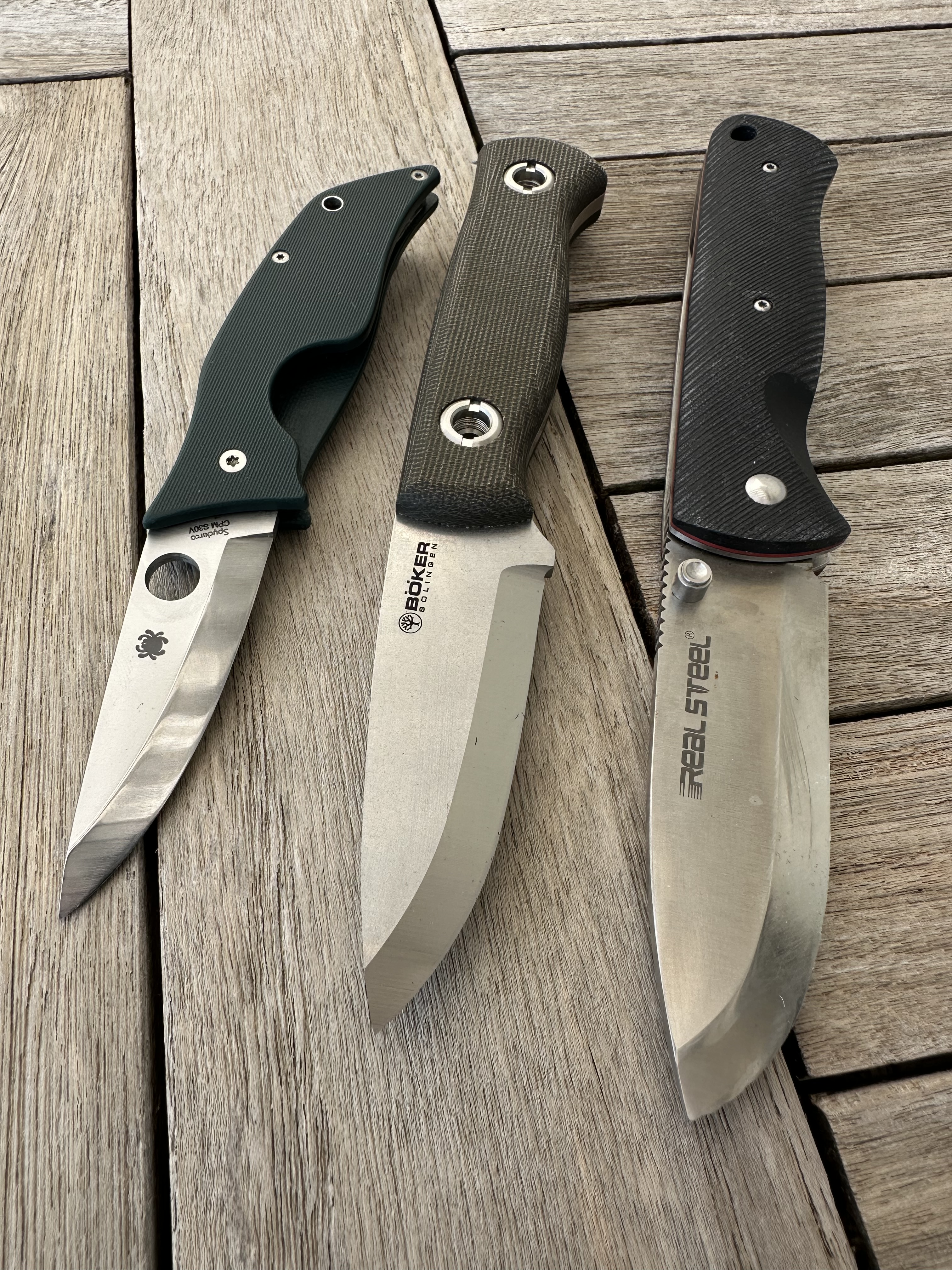
Since I play with Bushcraft here a nice combo to go in the wood. The Proficient is a masterpiece.

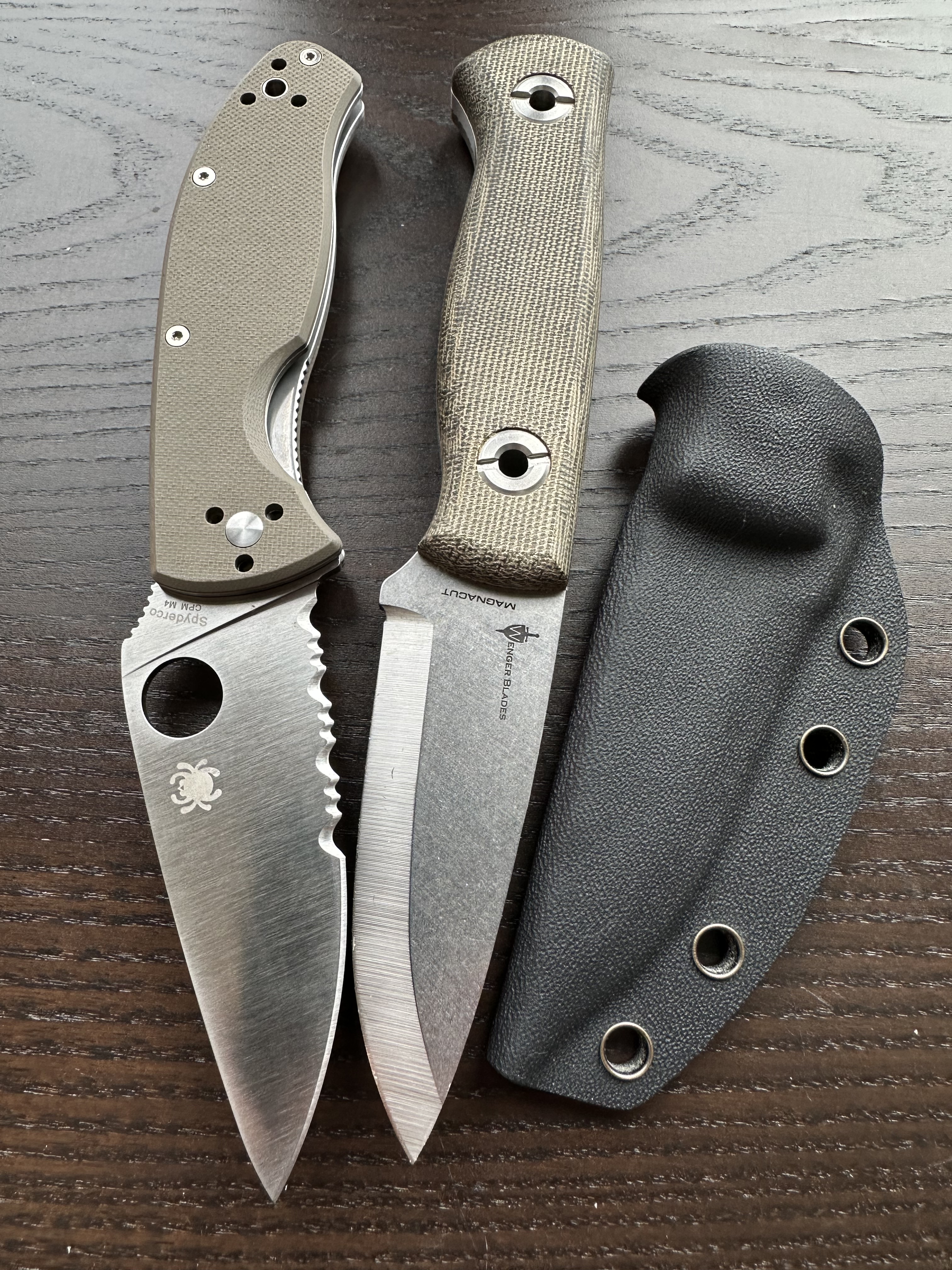
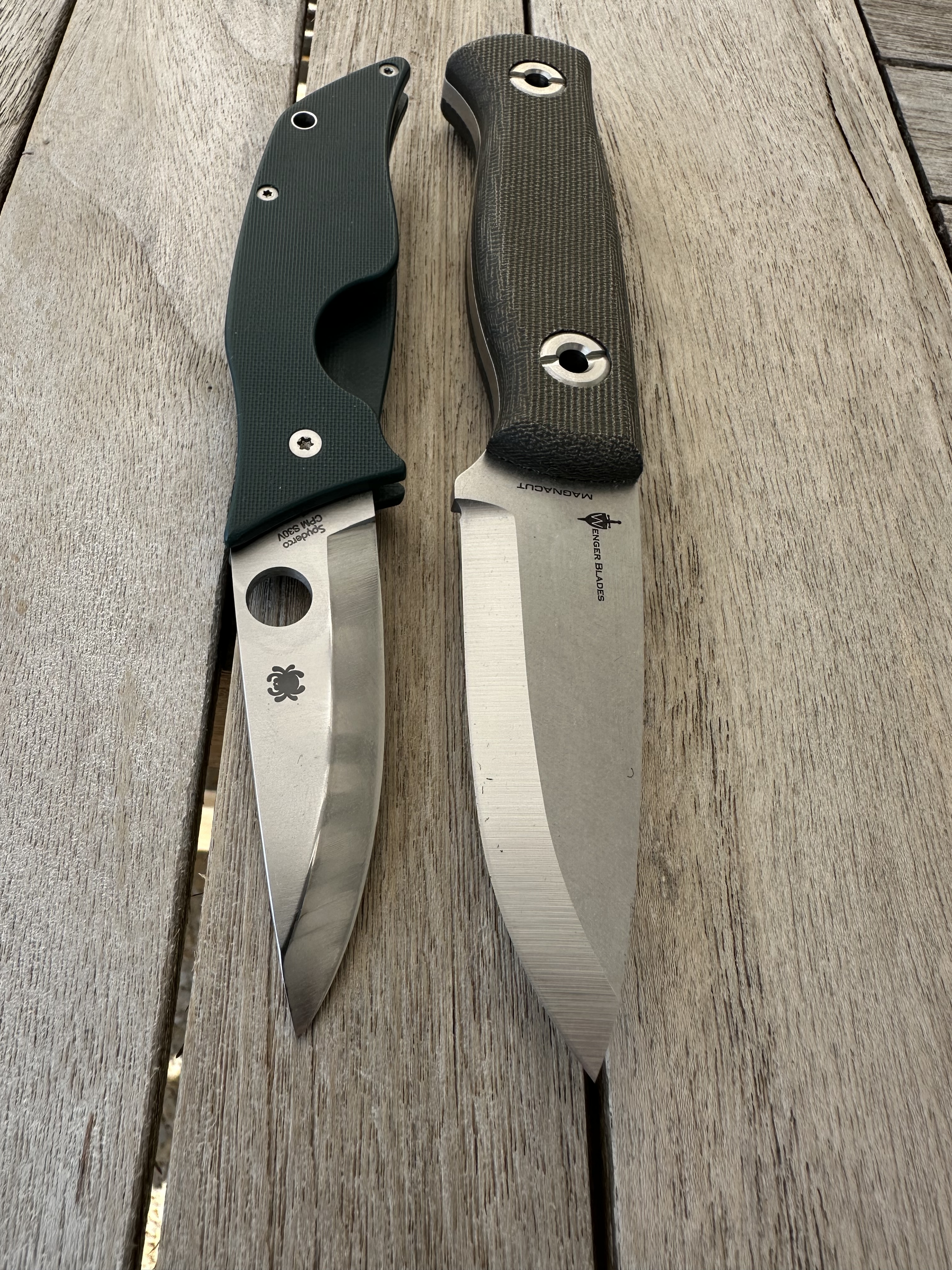
And with the ultra solide Boker in Magnacut. The 8,6 centimeter long blade of the Tenacious is generous edge wise.

Of course, I’ll strop that partially serrated blade on leather — no fear at all. I have my method for serrations, using the corner of the leather pad.

Maintaining the combo edge won’t be an issue; I’ll keep it sharp with cornered ceramic and jade stones.

So what do you get for €139 — the price I paid at the Coutellerie Champenoise? I’m really happy with my purchase. I plan to use the Tenacious a lot and on anything, simply for the pleasure of testing it on various materials. This knife isn’t afraid of plastic, wood, food, bones, cardboard, or aluminum.
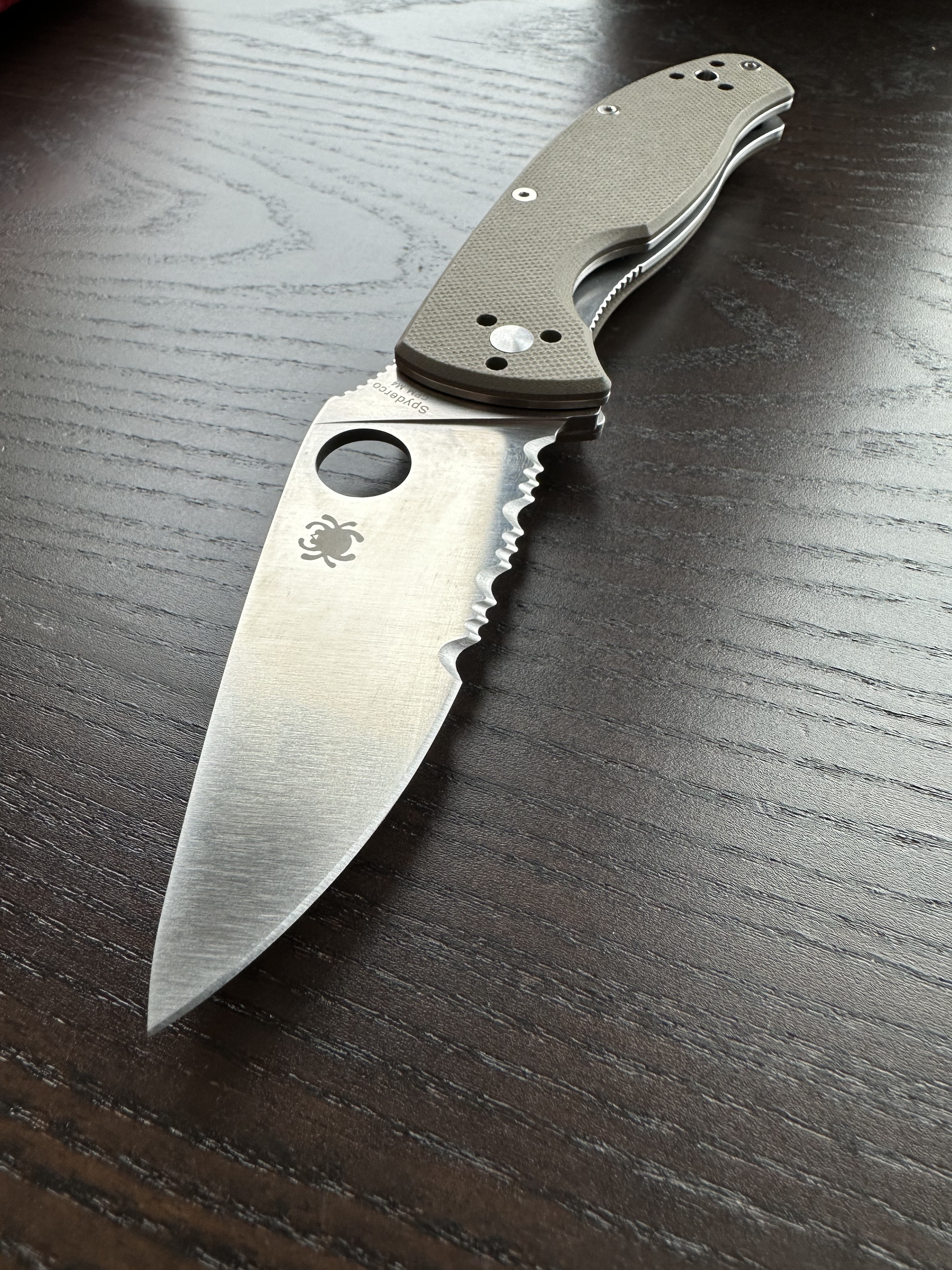
This CPM-M4 version is set to show the full potential of one of the beefier EDC knives, especially with its serrated half-edge carved from super tool steel. Over 17 years, the Tenacious has proven it can withstand a lot of abuse.

  The CPM-M4 Tenacious is not only a workhorse but a warhorse, like the pictured Adamas. I can easily imagine any soldier being glad to have such a reliable knife at this budget.

It’s slightly larger than small pocket knives, but smaller than the oversized ones some carry just to show off. The Tenacious would make an excellent day-hiking knife — a folder ready for the great outdoors. I’d take it on a trip to Africa or on a photo safari in the natural parks of Tuscany.

(this will often dull the blade’s edge with a little shining spot. Not here… Thanks to the serrations again ! )

This CPM-M4 Tenacious is sold at roughly double the price of the standard version, but in my opinion, it’s a rare chance to have this alloy on that knife. CPM-M4 pushes the boundaries of reliability and is a real pleasure to keep razor-sharp.
CPM-M4 will not chip and stays sharp for long. It’s a steel that has been used in cutting competitions. While Tuff Glideand various oils can keep it spotless, I prefer the protection of a gentle natural patina.

For twice the price of the vanilla Tenacious, this upgraded version delivers another level of performance in terms of toughness and edge retention.

“Old school cool with the Walker lock and satin finish. Well done Eric Glesser!” to quote Clay H on the Forums.
My brown Tenacious looks gorgeous in its “beautility”, practically begging to be used across all terrains — sand, rain, or more. All in all, this beater is a beefed-up workhorse, built to be used hard and carried proudly.


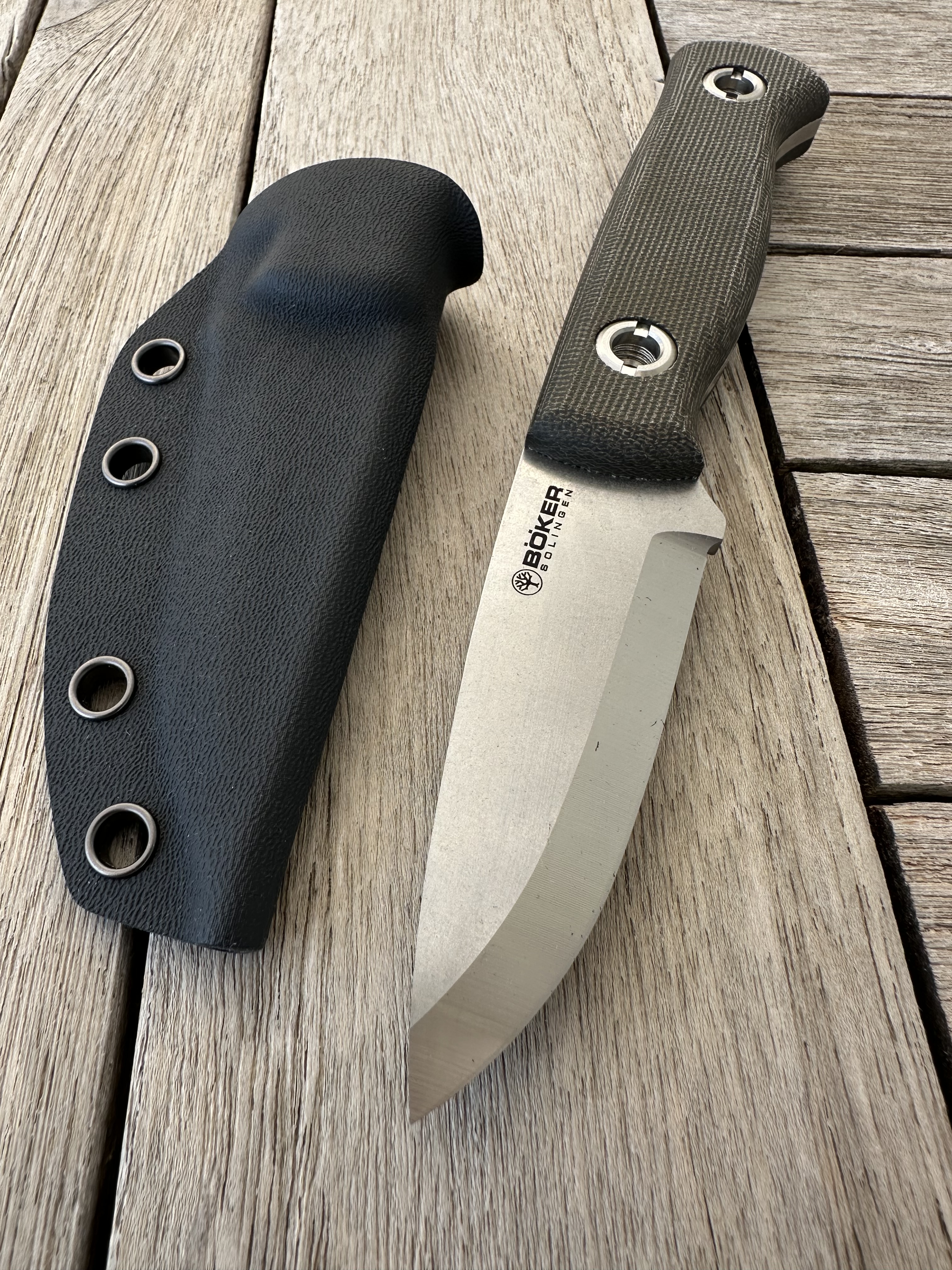
Böker “Vigtig vs. Wild” in CPM Magnacut – The Bushcraft Supreme EDC designed by David Wenger.


I got a passion for short fixed blades EDC. And they are hard to find.
Now the
I was lurking at the new Pocket Tango with its magnetic sheath but my first intention was to buy a Lulu from KNAFS. Until I have found it was a not true scandi with its microbevel because they have found that Magnacut was chipping with there grind.
At least they were honest to announced it but for the price I have found my Wolfspyder was doing the same job in a folding package.

So I wanted a robust small fixed blade which was bringing new option compared to a folding knife: lateral strength for example and by looking around all the new Magnacut fixed blades made in Italy, I have found one which was made in Solingen…. Germany !
And for less than half the price than the beautiful little Lulu.

I have found it has been designed for a TV game and for German Youtubers who are filmed while surviving in Canada.

Quoting Böker’s site:
Two streamers in the wilderness? (…) Trymacs (29) from Hamburg and Rumathra (27) from Bonn will compete together as a team in the upcoming season of 7 vs. Wild and face the 14-day adventure in the wilderness of Canada. The two heavyweights from the German streaming/gaming scene together have over 4 million followers on Twitch (Trymacs 3.4 million, Rumathra 0.7 million) and also have a strong presence on YouTube and Instagram. As part of the intensive preparation for this borderline experience, the choice of the right equipment – especially because all items have to be stored together in a 1L Nalgene bottle – played an elementary role for the two.”
OK. Why not. But eventually who was the designer ?
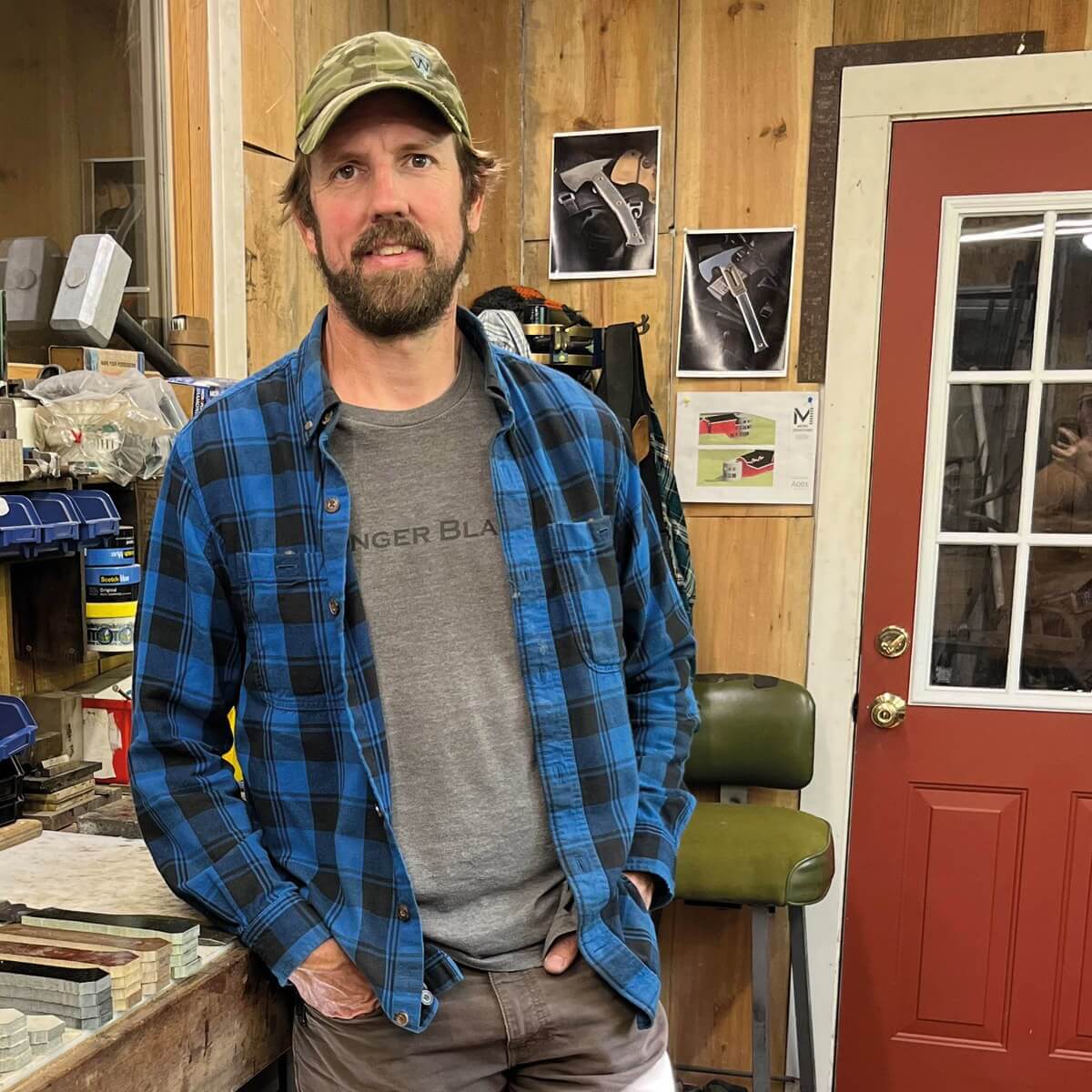
He’s American and his name is David Wenger and his interview can be found here on Böker site.

David knows his art as he is a bushcrafter and former builder. So looking at his own knives you can see his passion for dependable tools to be used hard in the wilderness or in the garden and as far as I am concern, he has created a great fixed blade for Böker.
Especially knowing that simple designs are not simple to create.

Remember how I was impressed by the Casström N°10, seven years ago ? This “Vigtig” is taking the same path as far as I am concerned. Its design looks simple but in fact it is really refined. It is a robust and sharp knife !

First thing to consider is the price of this knife: 135 euros with shipping in Knives&Tools. Not bad at all as K&T are not the cheapest on the web.
But it is sold cheaper than the Casström which is at 166 euros (June 2024). (The imported LULU is topping at 295 euros !!)
And the Vigtig (“Important” in German) is provided in CPM Magnacut like the LULU !! But with a real Scandi grind ! Sharp as my mother in law’s tongue !
And that’s simply one of the cheapest knife in CPM Magnacut today.
Also with a 8,5cm blade length it is not made as “companion” knife but as a main bushcrafter and truly solid survival tool.

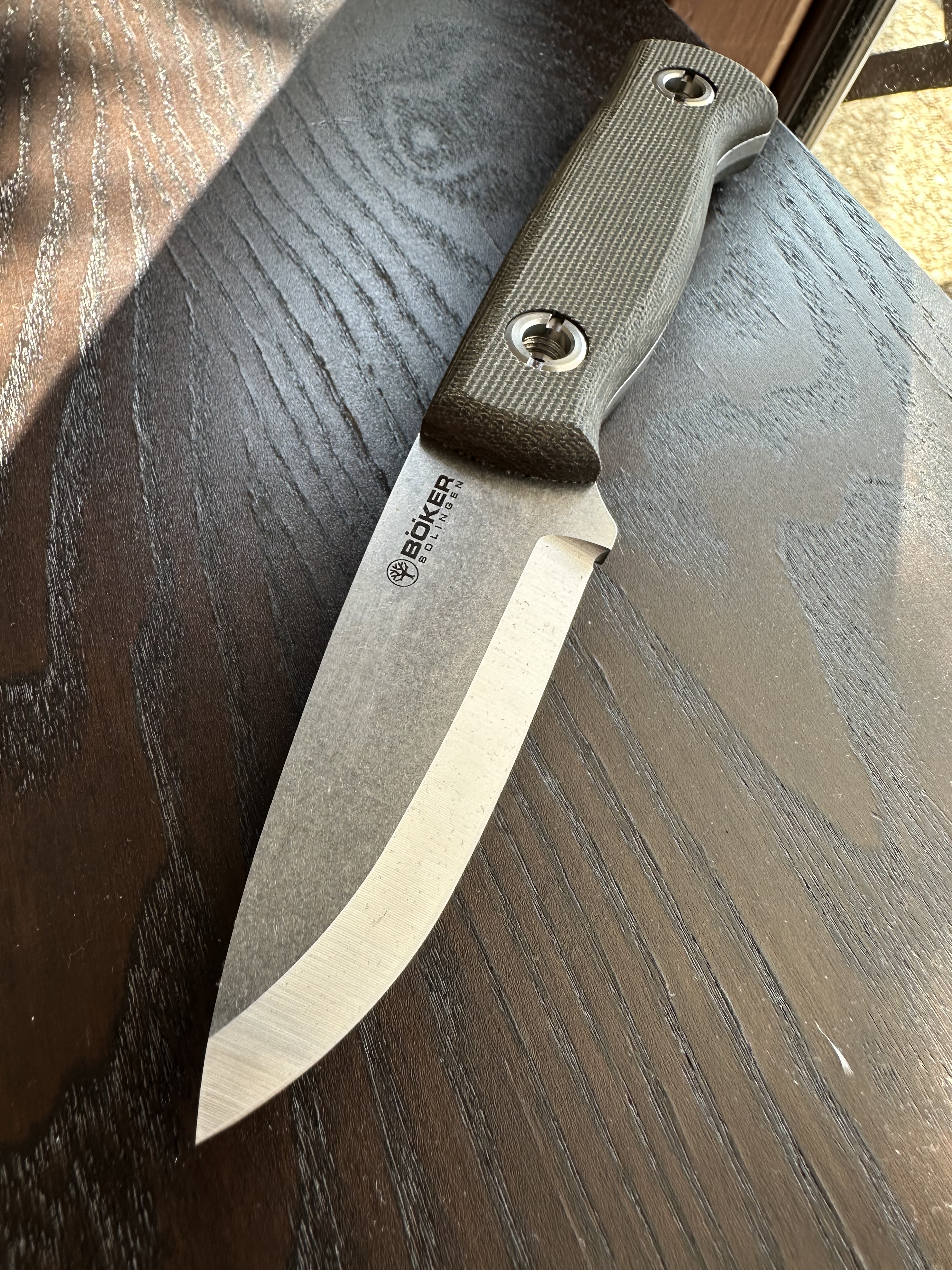
Immediately when I held the Vigtig I have appreciated its ergos of its green micarta handle. This knife feels good in the hand. It well balanced. It is alive ! (Something I really miss in the Spyderco lately and that’s coming from a Spyderco french fanboy who loves to strop his Magnacut blade on leather. Because CPM Magnacut is a pleasure to strop.)
The micarta is smooth but naturally grippy. Oh boy, when you hold the “Important” you are gripping a real tool. Something to be used hard in a very compact size. Let’s not forget it even is shorter than an deployed Endura (22cm against 19cm for the Vigtig !)
The scales are not totally rounded but this soft boxy shape helps to know in which direction/angle the edge is. That’s why I prefer boxy/flat folders like the Native or the Wolfspyder picture here.
The Vigtig is labelled as a “survival” knife but in my opinion it is also a bushcraft knife, lengthwide and it term of ergonomy.

The rounded handle of an Opinel has always been some kind of issue for me. You gain in comfort what you lose in precision in your cut. For that I was always using my thumb on the blade to know exactly at what angle it was.
On the Vigtig you feel the knife is at ease in your palm. It is really confortable and oozes quality and strength in the tool. There are some heavy working vibes (like just said David of the KCI about the new Manix XL Crucarta.) ! This is mandatory for a compact tool you suppose to use for hours (as the Proficient for example which is hard to beat but feels more premium, less Blue Collar than the Vigtig. The Vigtig is perhaps not “excellent” here but at least very very good in ergos and eventually is even qualified as Super Knife by the Dutch Bushcraft Knives boys.


There is a sharp spine to use with fire rod near the tip of the blade. As the stock is 4mm thick it is not an issue with my left thumb confort. Those sharp edge can also be used to scrap the bark for various uses. I would have preferred a round spine for my own use as I push cuts wiuth my left hand’s thumb.

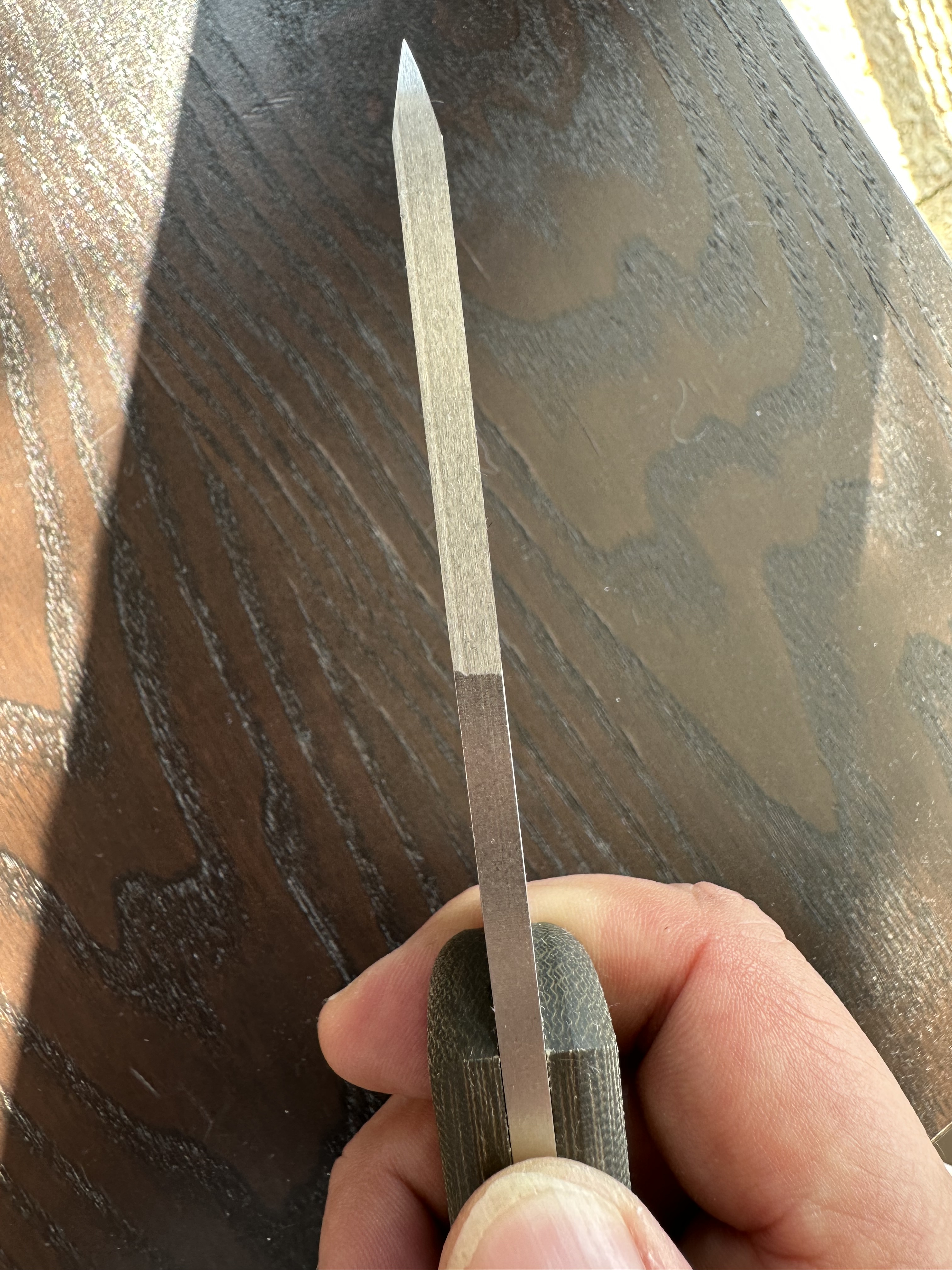
Now we got a True Scandi Grind. Not micro bevelled.
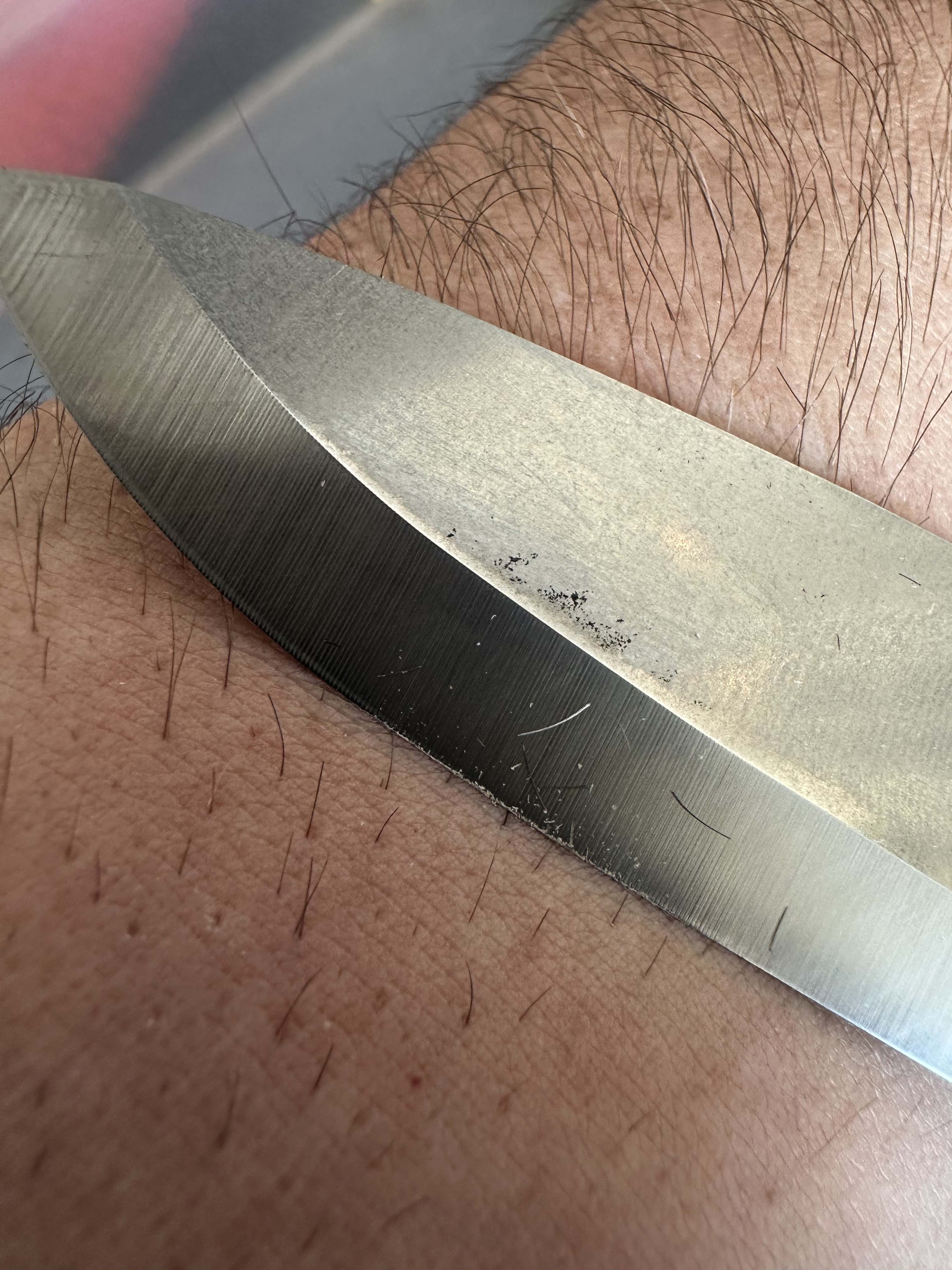
The Vigtig makes hair popping right out of the box.
Magnacut is known for its very very fine grain and strength and toughness.

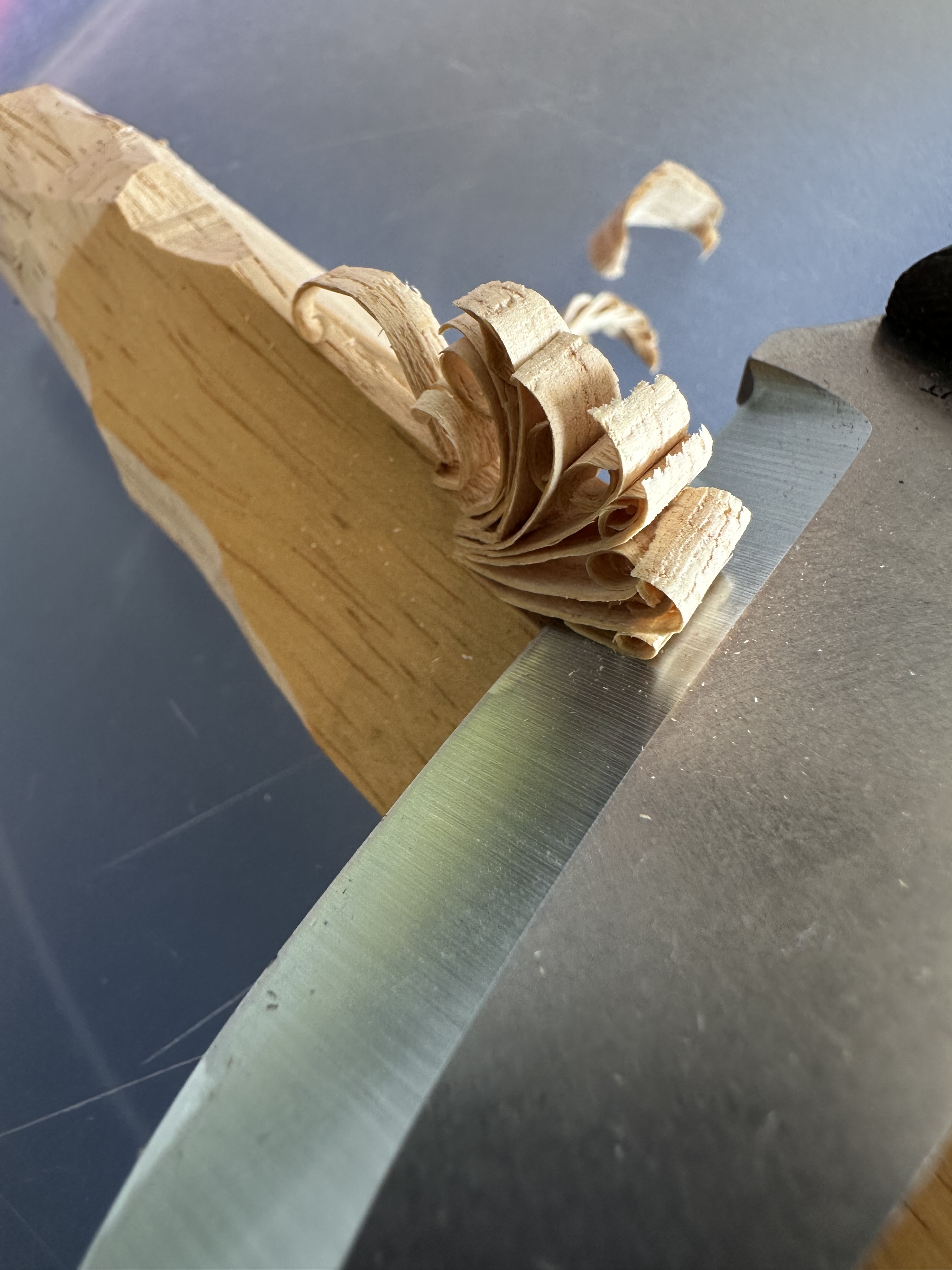
It bites in wood like nothing matters and keeps its crispy edge.
Böker announced a HRC of 62-63. Its hard but tough !

If there is one thing the scandi sucks at is my Plastic Butt Bottle test.
Where a Nilakka or an Opinel will got through it with ease, scandi get stuck and this is pure geometry issue. Scandi acts like a wedge.

CPM Magnacut is also a leather stropping lover. It brings the same behavior of tool steel in a very very stainless alloy. Frankly this is a bushcrafter dream ! The edge is impervious to the elements and it is a easy going tool which can be used even near saltwater without after thought.

Especially because there is an hidden compartment inside the handle.
A special highlight can be found inside the handle. Instead of hollow studs, the two large screws can be easily removed with the help of a coin, revealing an ample compartment with a depth of 14 mm compared to the outer dimensions of the handle, where tweezers, tinder, charcoal tablets, a fishing kit and safety pins, for example, can be easily accommodated.”

I will not use it. And certainly will secure the screws with some blue thread locker. But as least, if needed you can use the knife without its micarta scales and just use the hidden compartment. Rambo is never far away when we talk about survival knives.

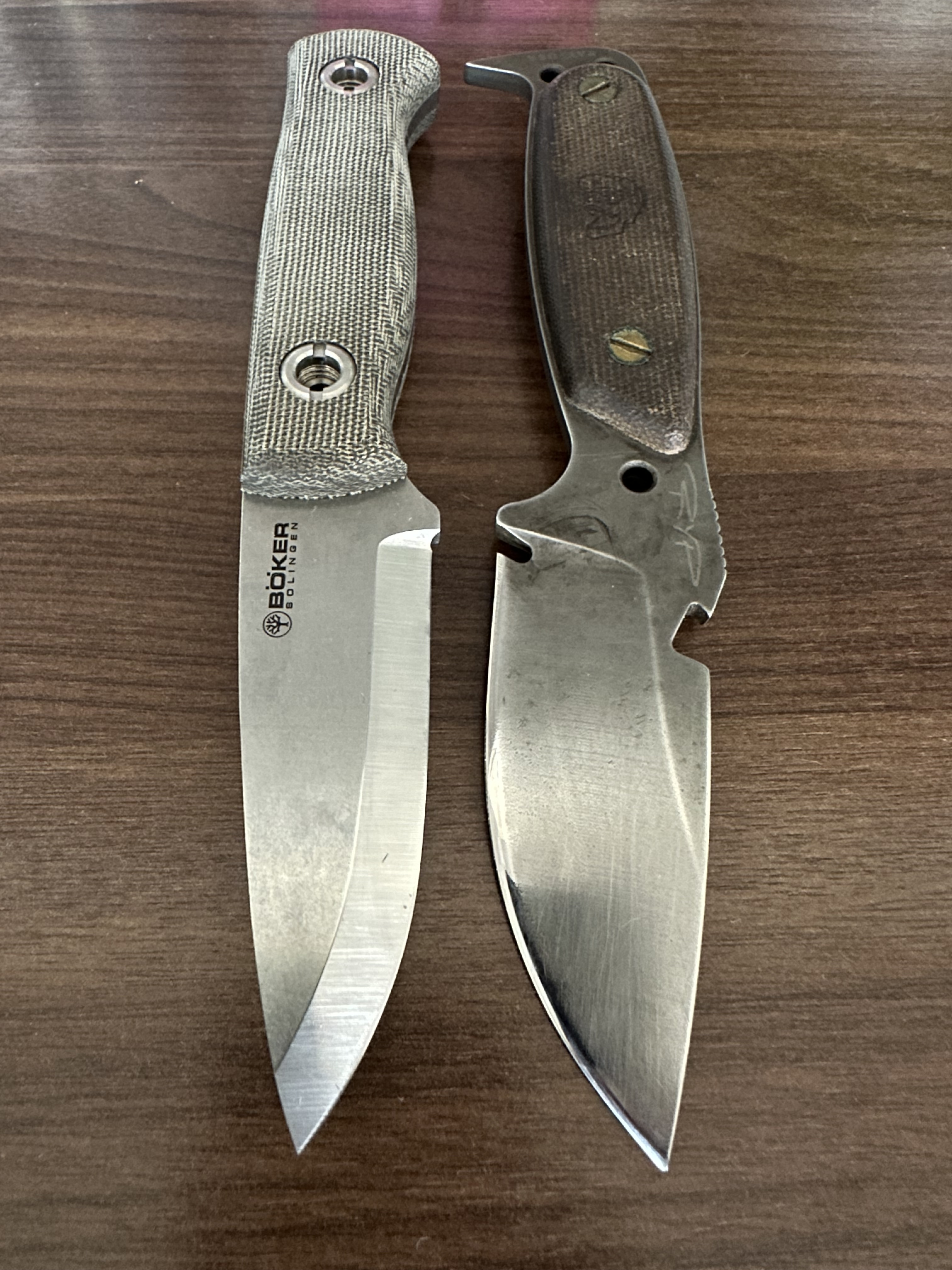
My previous hardchore EDC fixed blade has been this 1095 fixed multitool. It is now replaced by the Vigtig as it is much sharper and with a much better alloy. Notice how convexed I had the old 1095, I won’t need that with the CPM Magnacut scandi edge as I got zero damage even when used on hard dry bamboo. Those compact robust fixed blades can do everything a big folder can do and much more ! The main difference is the obligation to clean the blade before to resheath it.

And another important thing to test in a fixed blade is the sheath ! The Vigitig sheath is also perfect in my book and provided with a clip to be used on a belt or in the pocket. The taco style kydex shape is my favorite as it is slimmer than the pancake style shape.

I carry the knife directly in my pocket where it is easily removed by thumb pushing the kydex lip of the sheath and replace in the sheath with one hand. The sheath’s entry is wide enough for repositionning the knife back in it with one hand. The clip is a little on the strong side for me and I like to easily dispatch a sheathed knife into a bag. So the sheath only without any hardware but its slim profile fits perfectly in my pocket against my wallet.
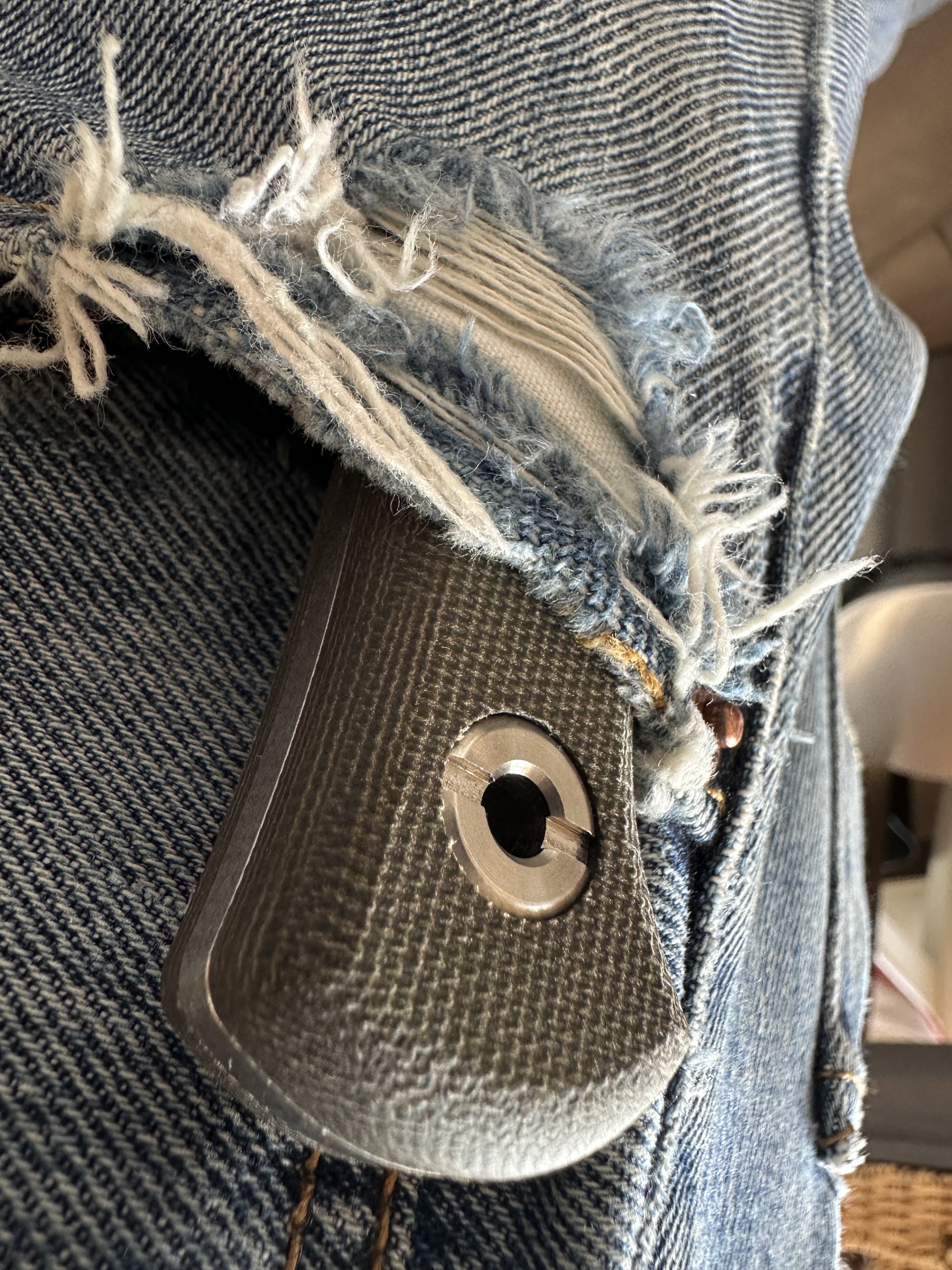
Inside the front pocket of my old denim, the Vigtig stays put and is immediately forgotten thanks to its perfect dimension for EDC.
Great sheath !

So, yes, really, it is designed to be a fixed blade EDC. It enters a territory forbidden to folding knives: to be ultra solid, robust and forgiving when used hard without compromising its carrying.
I’m really looking forward to use it in the forest and even I won’t mind using it by the sea ! The Vigtig could even be considered as an amphibious ambitious bushcrafter. For now it will be used in the house for mondane tasks as it is the best way to know it.

For those who consider Scandi not kitchen worthy… 😉
So far I have been able to use it with ease in the kitchen despite its 4mm thick stock blade. It zipped easily for thin loafs. Frabnkly for having using it in the kitchen, it works amazingly for such a short thick tool.

This is just a glimpse. I will certainly update that little review with new elements and pictures and make another chapter soon.
So, kuddos to David Wenger for this robust knife design and to Böker for bringing it at a great price.
The Vigtig is not a tool to destroy but a tool to build designed by a builder !

One video reviewer I really enjoy is Floriano Bitturini with his Vlog PDT Il Parchetto di Tagliagole . The Cutthroat Park.
Here is his video in Italian:

And here is a French video I really enjoyed too:

Spyderco Proficient FB36CFP — The Nasa Lamborghini Bushcrafter – Part 1

Article written by Nemo Sandman – Edited the 5th of November 2025.
All rights (pictures and text) reserved.

Have you ever wondered why so many Spyderco Sprint Runs seem to appear out of nowhere, featuring gorgeous carbon fiber handles and impressive CPM S90V blades?

It’s simple — Sal Glesser loves both materials.

For him, carbon fiber reflects his lifelong passion for motorsports, while S90V stands out as a stainless steel in a league of its own, combining high performance and outstanding reliability.

So, long story short:
Full Flat Grind + Carbon Fiber + S90V = Sal Glesser’s favorite combo!

And to quote my friend Spydercollector:

“When the Bushcraft fixed blade was first announced, Sal also planned to do a so-called NASA version; a version of the Bushcraft knife with all high-tech materials. I believe NASA is a protected name, but Endeavour still evokes the high-tech approach most people associate with the famous space agency. The Endeavour features a full flat grind S90V blade and full sculpted carbon fiber handles. It was a beautiful knife with a grip that had me looking around for stuff to cut.”

https://spydercollector.wordpress.com/tag/chris-claycomb-endeavour-prototype/

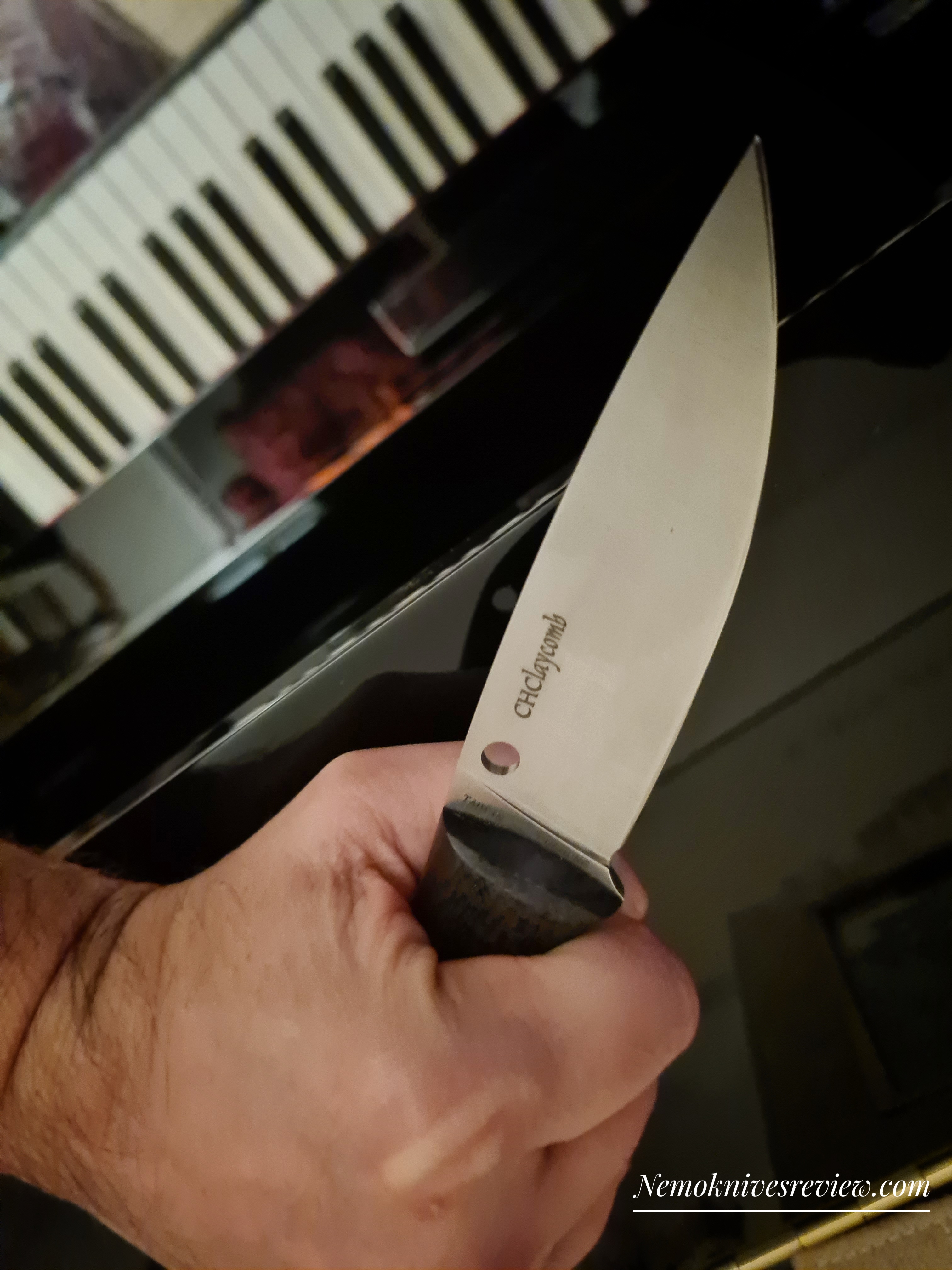
Here is the Proficient: it is designed by wilderness expert Chris Claycomb of Bushcraft UK, the Proficient functions perfectly with traditional bushcraft skills and cutting methods. Carefully contoured and polished to eliminate hot spots and ensure maximum comfort during prolonged use.

https://www.spyderco.com/catalog/details/FB36CF/Proficient-trade-/943

Bushcraft knives are defined by specific parameters — typically featuring blades between 4 and 6 inches. Spyderco’s Bushcraft model fits perfectly within that tradition: a 4-inch, full-tang blade with no handguard, purpose-built for control and versatility.

In true Bushcraft spirit, users generally favor high-carbon tool steels over stainless options, prioritizing edge retention and cutting performance rather than corrosion resistance. The O-1 tool steel used here, with its high carbon content, delivers excellent long-term sharpness while remaining easy to resharpen in the field.

Carried on the belt or strap in a leather sheath, this knife is blueprinted for wilderness chores — slicing, chopping, whittling, and processing game — all in the traditional Bushcraft style.

To quote Spyderco:
The Spyderco Proficient takes the concept of the traditional “do-all” bushcraft knife and elevates it to new levels of performance with state-of-the-art materials and manufacturing methods. Designed by wilderness expert Chris Claycomb of Bushcraft UK, the Proficient functions perfectly with traditional bushcraft skills and cutting methods while offering superior durability, edge retention, cutting performance, and corrosion resistance
Instead of traditional carbon steel and an axe-like “Scandi” (Scandinavian) grind, the Proficient’s blade is crafted from vanadium-rich CPM®S90V particle-metallurgy stainless steel and boasts a full-flat grind for low-friction cutting performance.

This concept of a stainless blade paired with a black polished handle has, ten years later, been fully embraced — a perfect example being the Casström No.10 Swedish Forest Knife in Black Micarta with a 14C28N flat grind.

I first discovered CPM S90V back when it was still known as CPM 420V, thanks to Darrel Ralph (RIP) and his beautiful Apogee folder. The blade was astonishingly wear-resistant — so much so that, without diamond abrasives, only a backstand could bring it from dull to sharp. It was a bear to sharpen then… and still is today.

The difference is, as end-line users, we now have easy access to industrial diamond tools, making steels like S90V finally practical to maintain at their full potential.


I have written a lot about S90V. This alloy has proven it can be tough enough as a stainless steel to be used in any all terrain tools; especially since it is available on Manly folders which got the reputation of using a very fine thin geometry on their blades.
Modern Bushcrafters (like the Benchmade Puukko) are focused on toughness with the use of the very tough CPM 3V.

What does CPM S90V bring to the table?

It’s incredibly wear-resistant.
This steel is notoriously hard to dull, even when cutting abrasive materials like brown cardboard loaded with silica. It keeps its edge far longer than most steels, making it ideal for demanding, real-world use.
Also the full flat grind is a must in a matter separator specialized in wood works. As much as I love Scandi Grind found on Woodlore clones (first designed by Ray Mears).
I have found that especially in the wonderful Spyderco Sprig full flat ground knives can be really efficient on hard wood.
(BTW when the writing appears in green: it is a link !! and I have tested them here.)

It’s stainless!
Even if you (like me) enjoy the patina that forms on a great carbon steel blade, there’s real peace of mind in using a reliable stainless steel — especially when working near water, in the rain, or by the sea.

The Sprig was an impressive tool in terms of pure geometry. Designed as a hunting and fishing knife, it was a real wood eater — a beaver of a blade, cutting deep and effortlessly.

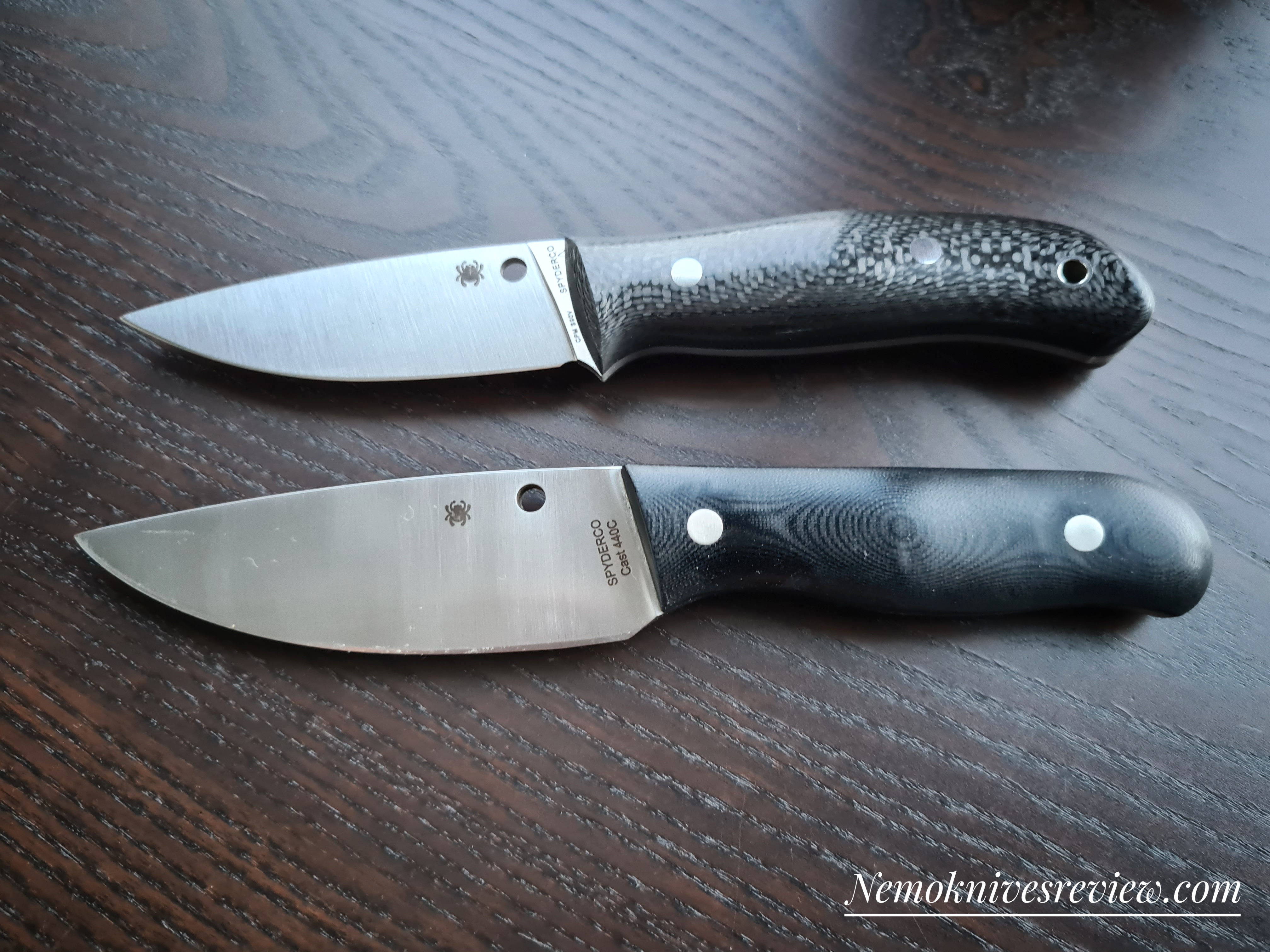
Guess what? The Proficient shares the same profile, especially after a bit of convexing — which I’ll be covering soon in a second article.

So far, that contoured handle is an absolute delight to use, and I’ll be putting it to the test in the upcoming piece. While the old O1 Bushcrafter had enough heft for light chopping, the Proficient excels at powerful push cuts — a completely different experience.

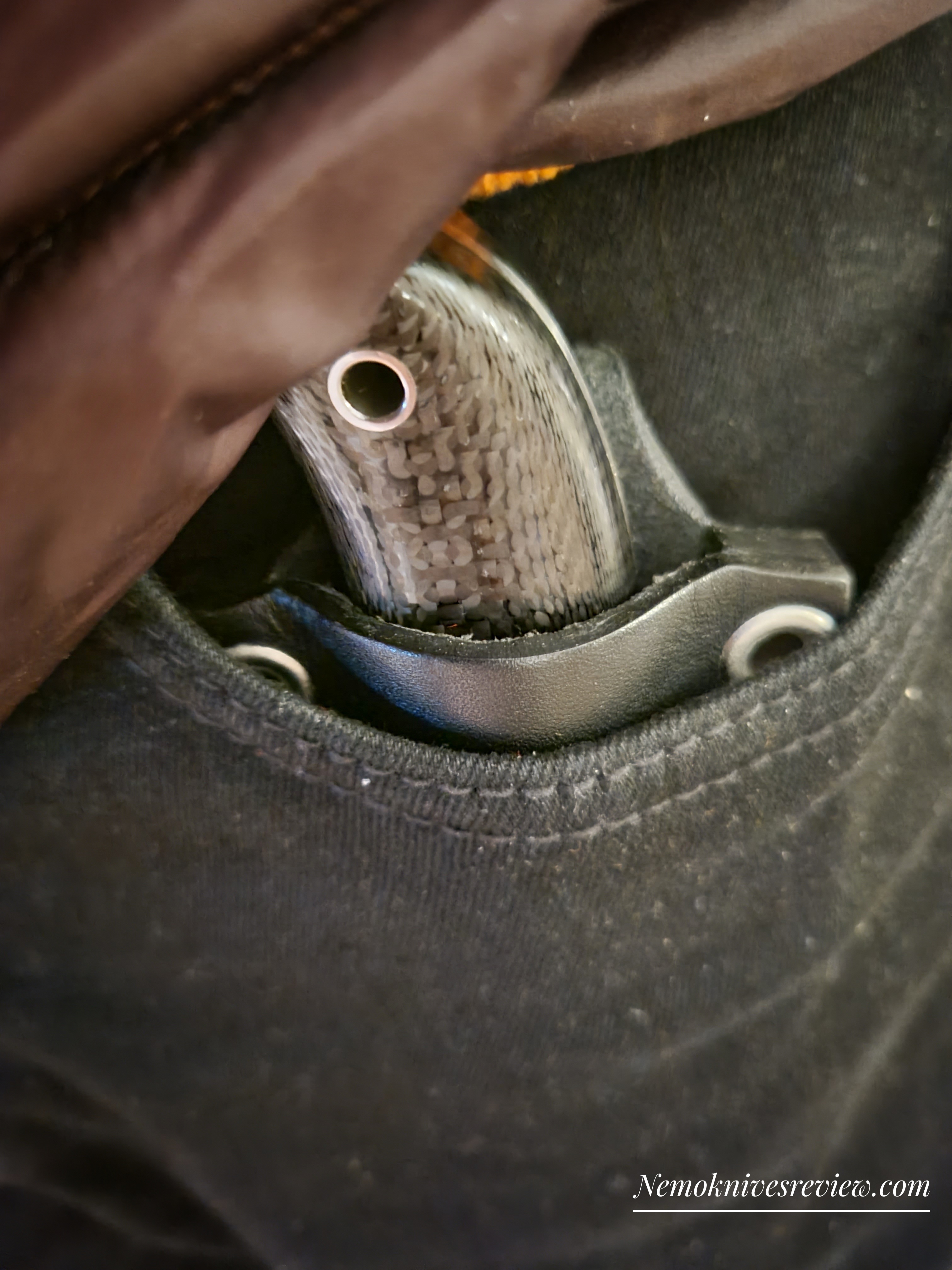
Interestingly, the Proficient isn’t a big knife. Once sheathed, it can disappear into the front pocket of a pair of denim jeans — no need to let it dangle from a belt.
So what do we got ? Imagine the plateforme of the Bushcrafter (link) a solid companion, a reliable 4×4 and you just turn it into some Urus from Lamborghini: stellar alloy and lighter tougher handle.
The Proficient is Sal Glesser’s gambit — a bold move in a world where the bushcraft community traditionally favors carbon steel and natural wooden handles. This knife dares to break from that norm.

Of course, this jewel comes at a price, and most bushcrafters aren’t Wall Street sharks. They use OpinelMora, or at best a €100 fixed blade — unless they’re ready to splurge on an original Woodlore.

So, the “stealth wealth” of this NASA-grade bushcrafter isn’t for everyone.
It’s like a Lamborghini — not the most practical, but a statement of refined performance and engineering excellence.
Because in the end, real performance comes at a price.

Article written by Nemo Sandman – Edited on November 5th, 2025.
All rights (pictures and text) reserved.

The Spyderco PPT Round 3- Long Term Review of a Faithful EDC with Supersteel.

20190527_091110.jpg

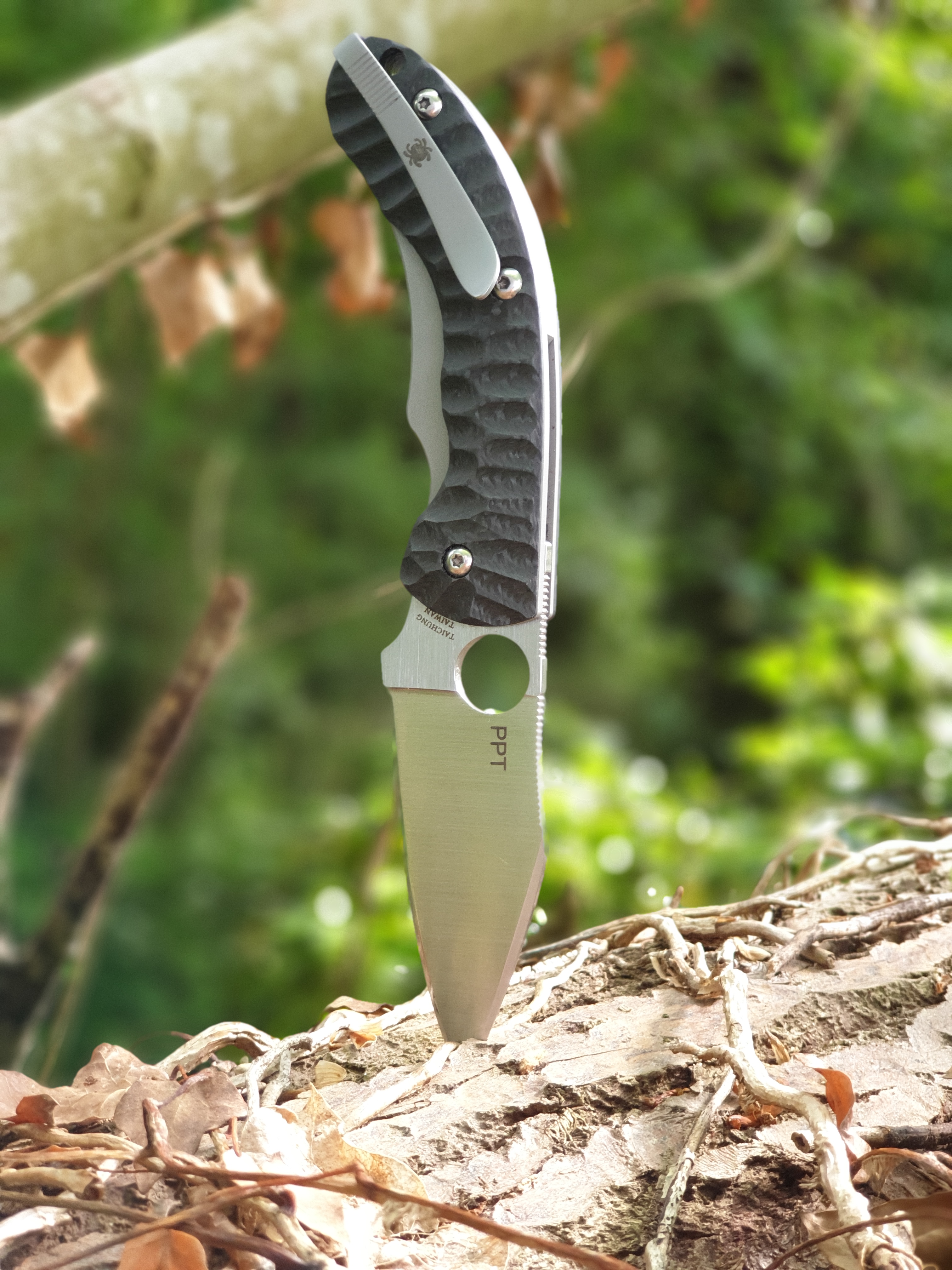
Since last year round with the PPT, the very unique ergos of this unique folder have made me come back again to its radical design and I have decided to EDC it in all circumstances (instead to keep it safe).

20190526_133858.jpg

Still, I really enjoy how the weight of the handle glue it to my hand and I have found zero hot spots after filing a bit the choil. Smoothness of its action has been really enhanced by using it everyday. Now it deploys fast and close by gravity.
After some work on the blade, the edge has been thinned as my Manly’s.

20190526_134348.jpg

The PPT is a very easy companion. My main battlefield is the kitchen. It is not an open handle design but with some hot water I have been able to keep the spacer and the skeletonized liners clean. A dip in very hot soap water is all my maintenance after a full day in the kitchen but a tiny drop of oil is then always welcome. It has been used in the woods where I was able to use it on wood. The knife has behave perfectly even when twisting the edge. Zero issue here. The chips are flying everywhere as the full flat ground is fast in making deep cuts in wood. While in the forest, when working with it, most of the time I have thrusted its blade’s point in a tree instead closing it and opening again.

No damage at all. For the record, Sal has developed and sold his own version of a Bushcraft knife, at first named the NASA Bushcrafter with S90V blade and Carbon Fibers handle and later the Proficient. It means that the melange S90V plus CF is approved by Sal for being used in the wood with reliability.

20190525_202132-01.jpeg

The lock which is almost a RIL lock has not failed me because your grasp reinforced it when you hold the knife in your hand. Zero movement vertical or horizontal. I have not been able to fumble my grasp when closing. The opening of the knife is now made with my major finger flicking it like.


I have sanded the handle (just a bit) to smooth the edges of the corrugated CF, just to protect my trousers from being chewed. Nothing changed in the look but the PPT is now much easy to retrieve and introduce in my denims. I carry it in my right front pocket along with a leather wallet.

20190526_132205.jpg

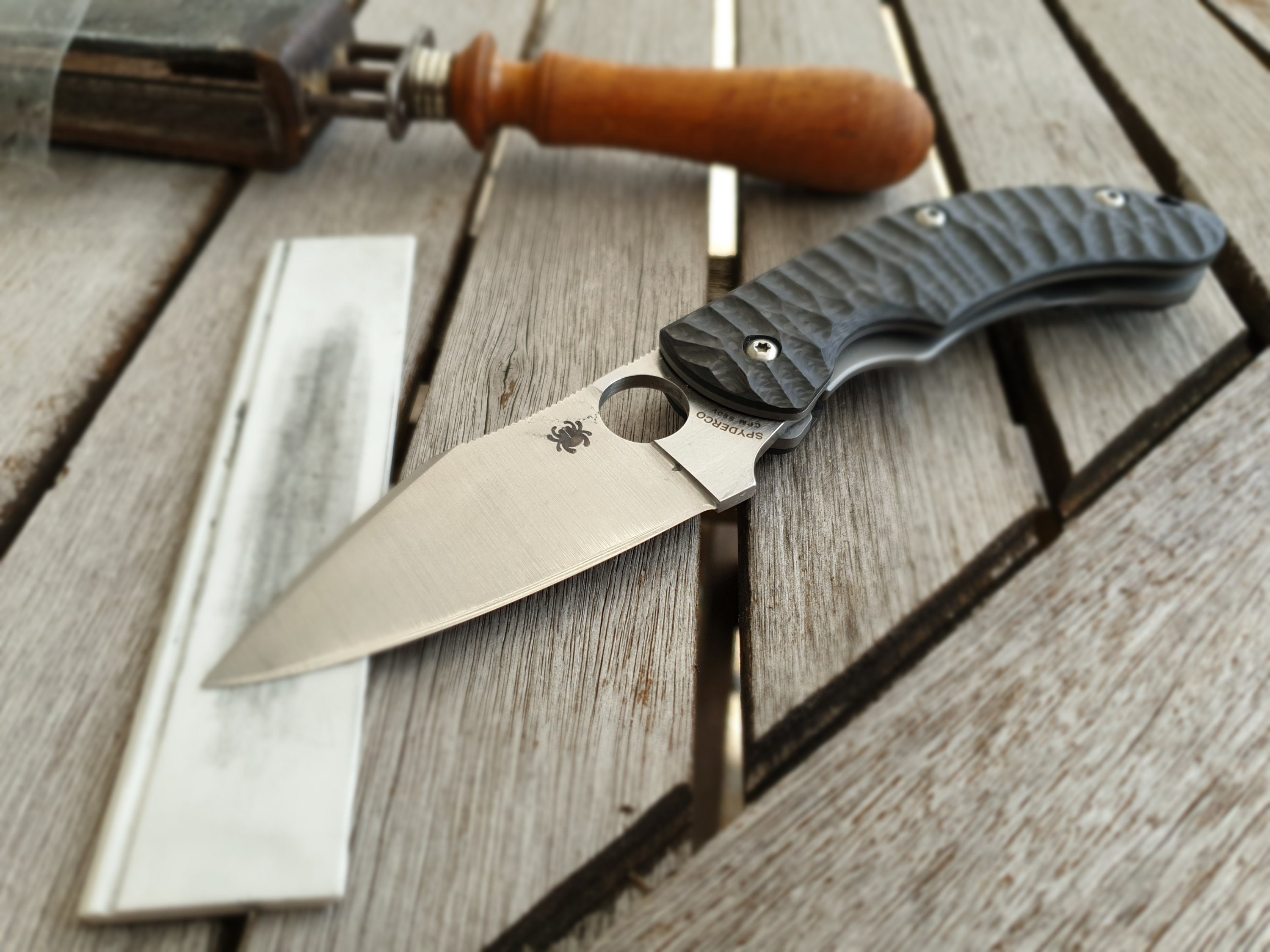
Once brought to “razor sharp level”, S90V is easy to maintain to that level mostly only with white ceramic and some leather stropping. ( JD has given me some diamond compound that help the process too). After some cardboard cutting, the ultra razor level is lost but the working edge is keen enough to slit through paper and this sharpness will last for a very long time. Zero chipping even after various cuts into very hard plastics. It is almost a maintenance free knife, like my Manix in CPM110V which I use for travelling (It is light and stays sharp for a very long time avoiding me to bring some sharpening tool).

20190525_194311-01.jpeg

When cutting with the PPT you got a very agile blade with its center of gravity inside your hand and, by just holding it by its hole, it immediately orients itself tip up. It helps when you need to change your grip: it like a compass telling you where is the point and the very sharp edge even with greasy or wet hands.

20190526_125800.jpg

Despite its martial pedigree, sheeples seems not afraid of my PPT. No raising eyebrows even when used in restaurant or family dinners. Nobody seems to notice it which is a very good thing.


61222845_10156664360180958_6031297147842854912_n

Eventually if the PPT was a dog, it would be an Amstaff : compact, bold and powerful.

20190528_190957-01.jpeg

Benchmade 200 Puukko – Call me Snake.

This is the first Benchmade’s review for a long time. Why ? Not because of the quality of Les De Asis company’s products but because I was not really excited by their production in the last decade after a huge love with their AFCK back in 90’s, and also with Nimravus and all those blades in M2HS which is a tungsten high speed steel, the granddaddy of CPM M4.
I still got a AFCK in M2HSS and browsing that blog, you will find it here.

So here we go, two words has caught my attention on that new Benchmade: Puukko and CPM3V.

“CPM 3V is a high toughness, wear-resistant tool steel made by the Crucible Particle Metallurgy process. It is designed to provide maximum resistance to breakage and chipping in a high wear-resistance steel. It offers impact resistance greater than A2, D2, Cru-Wear, or CPM M4, approaching the levels provided by S7 and other shock resistant grades. CPM 3V is intended to be used at 58/60 HRC in applications where chronic breakage and chipping are encountered in other tool steels, but where the wear properties of a high alloy steel are required.” Source Crucible.

COMPOSITION
C Mn Si Cr Mo V
0.80 0.30 1.00 7.50 1.30 2.75

To quote my friend Max Wedge:
“3V loses 1/3 of the toughness going from 58hrc to 60 hrc (still 1/3 above A2 at 60 hrc, and A2 is indestructible… almost). Both 4V and Cruware start to shine around 60-62 Hrc… so, 3V for choppers, 4V or Cruware for slicers, Cruware having best corrosion resistance ( trait appreciated by soldiers & foresters)”

So this tough short blade made of chopper steel is at a very good bargain !! Let see what it is all about.

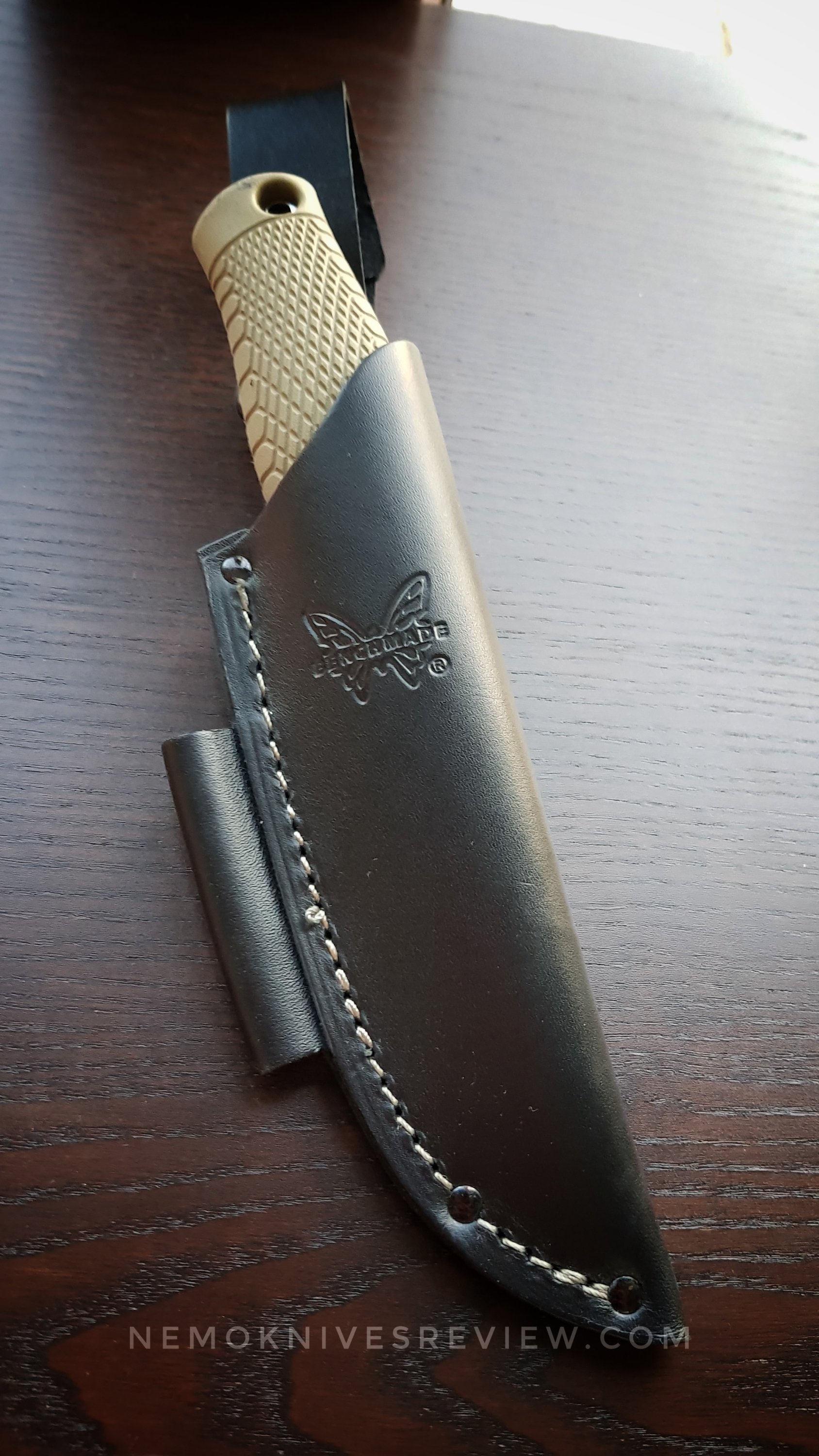
The leather sheath is beautiful even (if there is a loop in the stitching… I will upgrade it into a kydex for pocket carry.) and cleverly designed as a dangler. You can remove the loop to transform it into a classical sheath.
There is a place for sparkling rod in the Bushcraft fashion. I don’t care about carry a knife of that size attached to my belt. I prefer to have it inside my pocket or my bag.

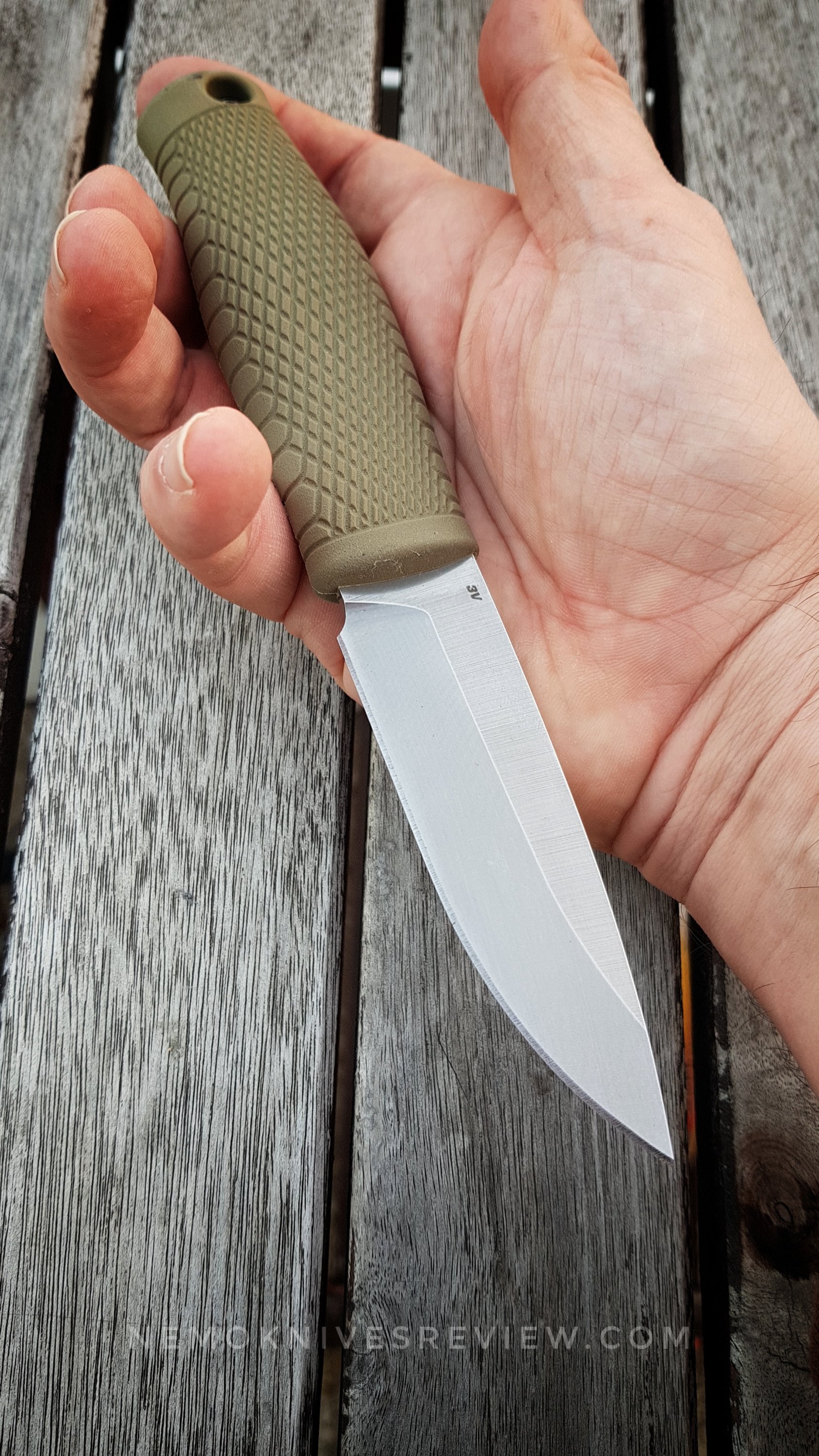
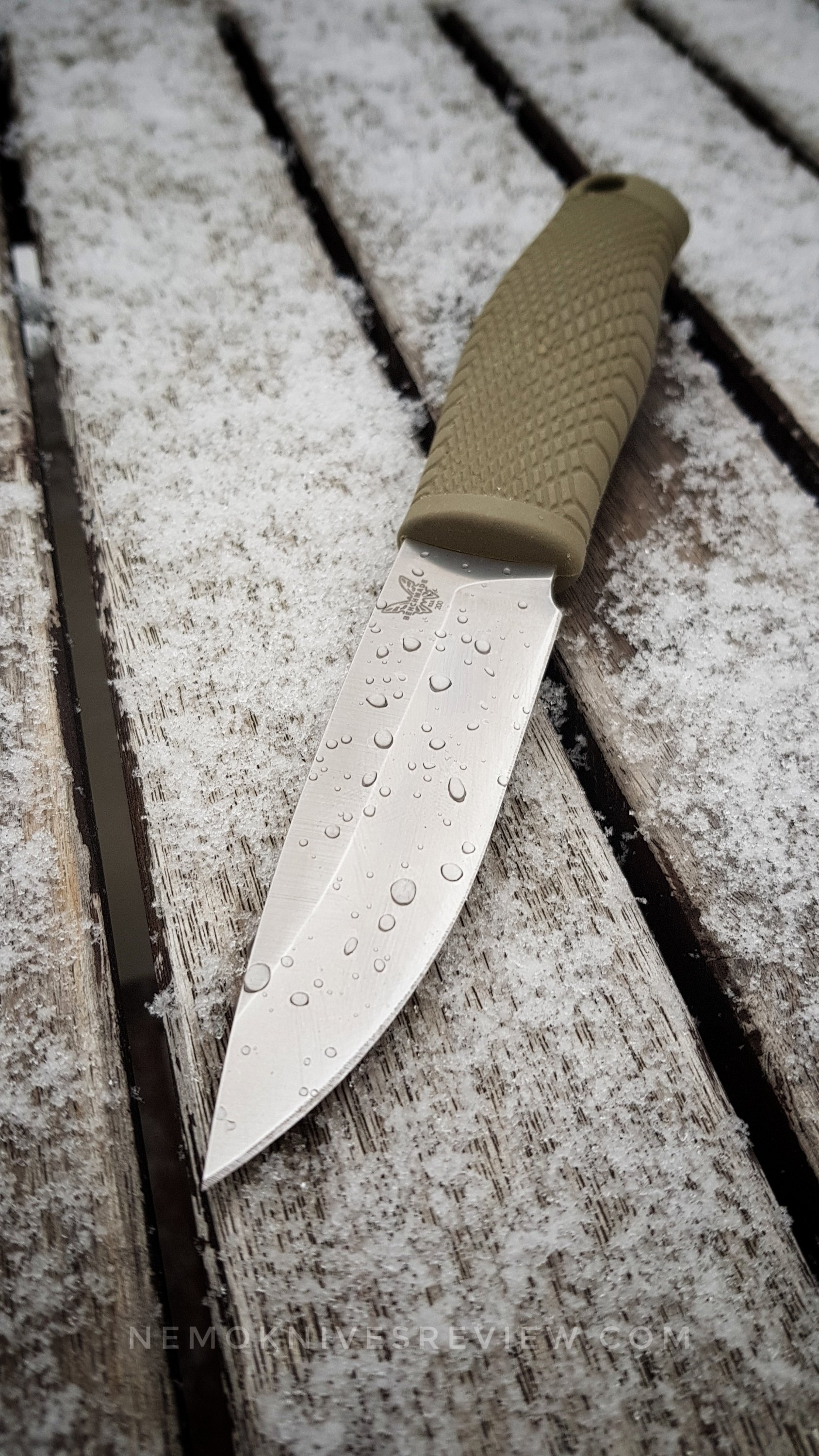
The blade is an eye candy for some reason it reminds me the small SOG Seal Pup knife with no false edge but that’s me… Is this a Puukko ?

That handle is made in some kinf of thermorun… but it is rubberized Santoprene is a soft, non-hygroscopic elastomer which exhibits excellent surface appearance, a durable soft-touch feel, excellent colorability and excellent “processability”… made by Exxon.
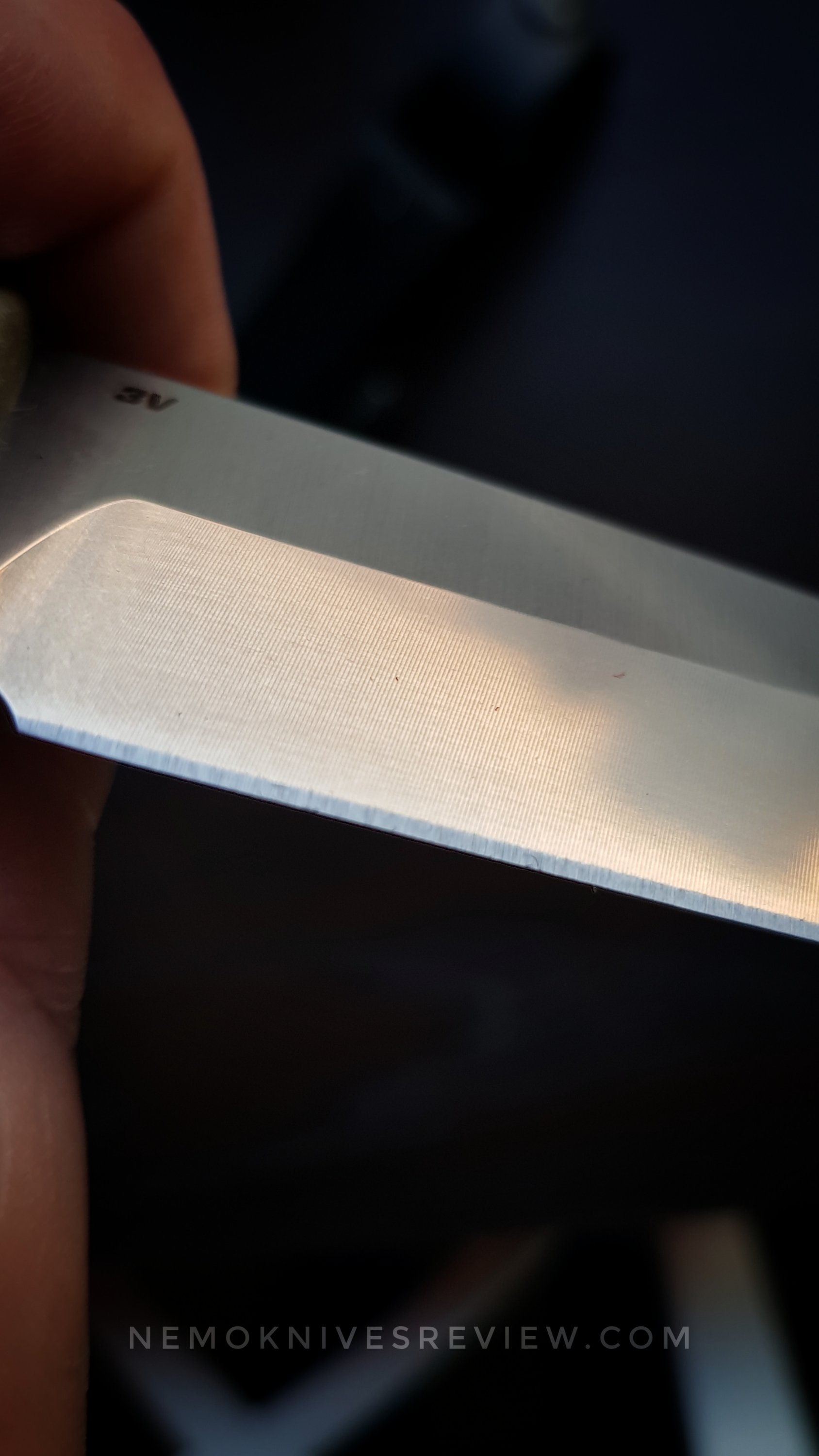
It is made from underground forgotten dinosaurs and jurassic biomass aka “petroleum” hence the look of scales on it ?  Because that handle looks like some sort of snake or cold blood creature. I love it.

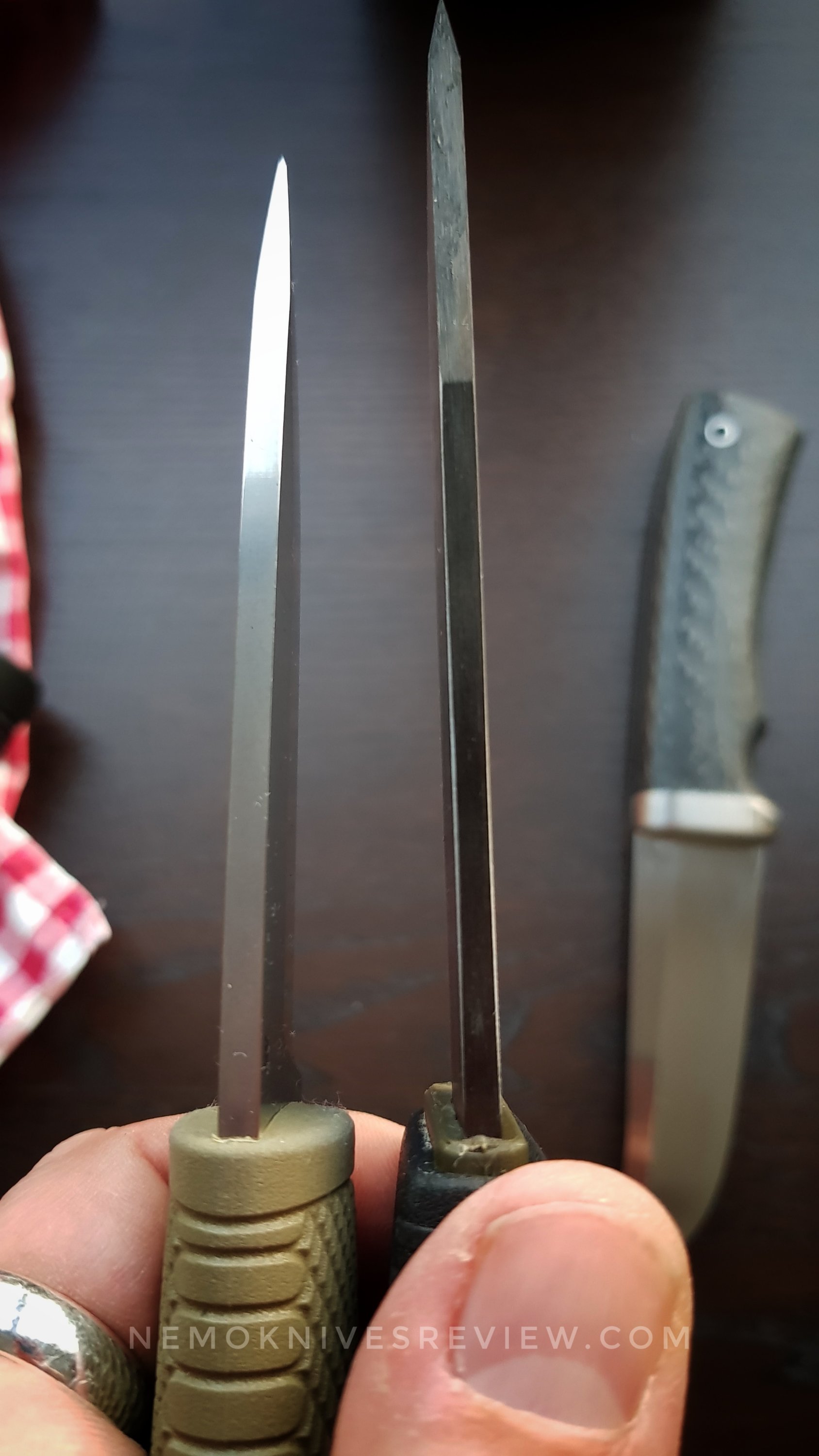
Now is this a scandi ground blade ? Nope. There is a secondary bevel. Is the knife sharp ? Yep, very sharp but could be better. Later/soon on that.

It is a hidden tang construction and you can see the steel in the lanyard hole. This knife is solid as CPM3V is really tough !!
Hidden tang are great when you work in cold weather, protecting your hand from a frozen steel.

That blade is short but handy: it asks to be used hard like… Snake Plissken’s hard actually ! Because 3V is magic in toughness ! 😀

Compared to a Mora or the Urban Hunter (from Pekka Tuominen) the Benchmade 200 stands its ground.

Here are two vision of CPM3V industrial use. Ed Schempp Spyderco Tuff is pure business. So that BM200 should be even tougher as a fixed blade.

Teamed with a Manly Wasp, you got a great combo.


But a puukko (in my book) needs a thinner edge and it is time to scratch that blade to de-shoulder all that. Diamonds do scratches but then scratches will be polished later. Thinner convexed edge is destin to go deep and get twisted; this is a tough steel.

Diamonds, ceramic and leather. Who needs more ?  CPM 3V is really like chewing gum you need abrasive medium to form that convex edge.

A some compound with the leather stropping is mandatory to erase those scratches

See ? Now it is convexed and will be smooth on whittling wood. No worry for that edge stability again 3V is perfect for that use.

Standing next my Serrata which is my only naturally serrated knife.

So now, I just need some white ceramic to keep it sharp and some stropping. It is ready for testing. The Puukko shape is more for me a “Coutelas de Rahan” shape actually (French people will understand but here is the link: Rahan in Wikipedia.
making this little tough knife very appealing to bring it everywhere.
Everywhere is a good point to start. 😉

20190122_092816-017697724220268595202.jpeg

SPYDERCO C192TIP – My Knife In Law.

20180125_120959-011231389590.jpeg

Following the arrival of the PITS, the daily testing has come quite quickly as it hasn’t left my pocket still so there have been a bunch of opportunities to put it in play.
The first thing I noticed was the action required to open the folder which is much harder than for any compression locks. This is something to keep in mind as you won’t be opening it quicky;  the Urban for example is faster to open.
This resistance is also a proof of how sturdy the spring and the design are.
The second thing I had noticed was how quickly the blue handle was subjet to getting scratched.
So, I was obliged to put my mind at rest by simply sanding the handle…

I just used a 600 grind sandpaper and the result kept the blue inside the holes and inside the mechanism, like a well worn denim jacket… The scratches are easy to keep at bay and the blue aura and reflections are beautiful.

20180123_124834-0135617257.jpeg

Another thing which I had noticed: there is one very hot spot…. The horn on the talon of the blade can bite you ! It happen once when I was sanding; a sharp and neat cut!
20180123_122720-011476827124.jpeg

After some convexing of the blade’s bevel, I was able to improve the geometry and cut really easily through plastic bottles which are everyday processed before recycling.

This is also a knife I wanted to compare with my faithful Urban.
20180125_145647-011336037209.jpeg

My Urban has got a hightech tool steel blade and a customized Cuscadi carbon fiber handle. I can carry it in my watch pocket. The PITS cannot go there but it provides a much stronger mechanism and a longer blade which makes it a real all terrain folder when the Urban is really limited to the city sleakers.
So far, and that’s not surprising, the N190co steel blade has been kept as a razor using some white ceramic and leather stropping. The PITS unique mechanism makes it great to strop on leather as the blade cannot easily fold on your fingers when the Urban softer mechanism asks for a lot more attention.
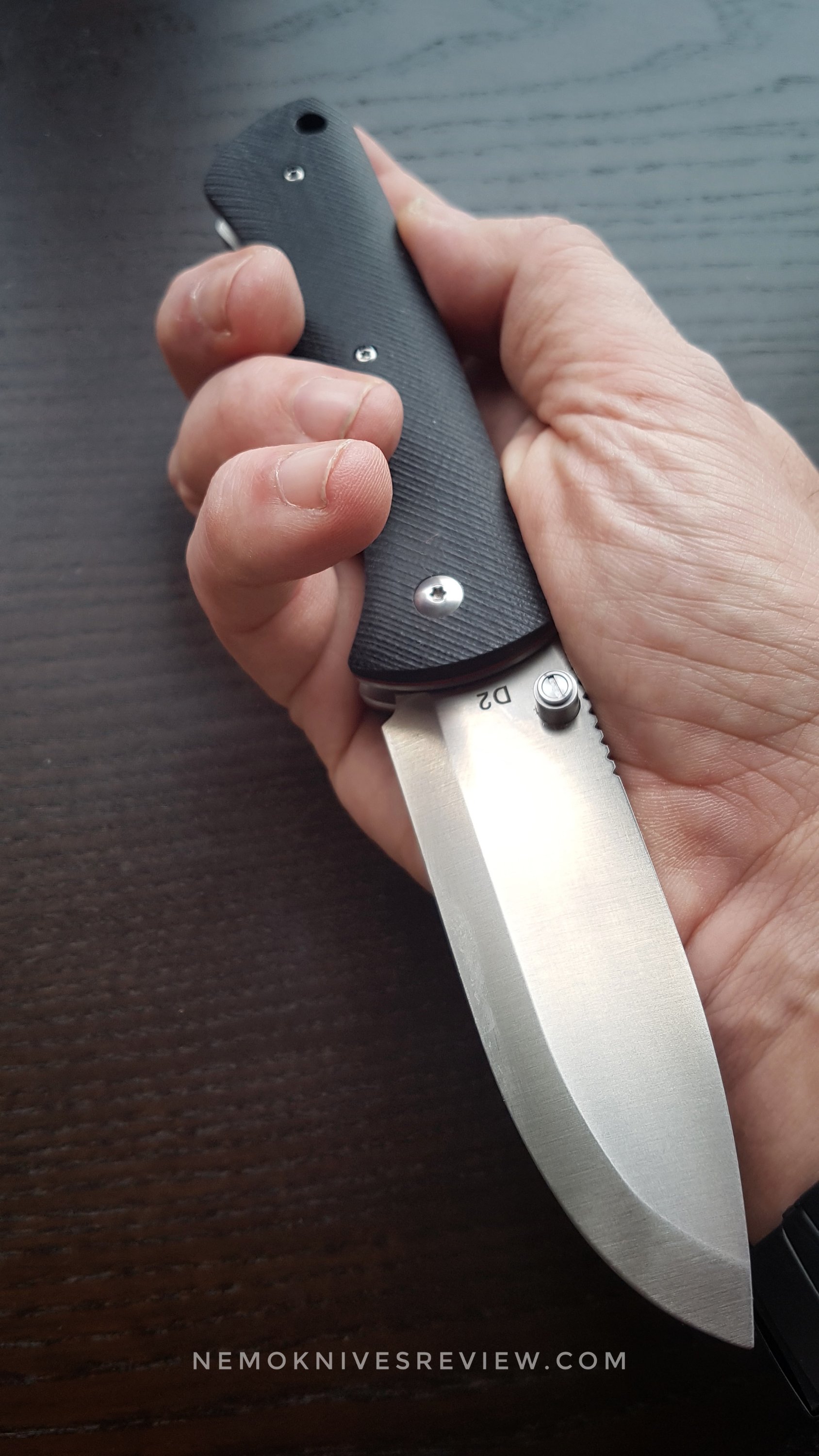
The PITS is really easy to live with. The steel keeps an excellent edge with no chipping or rolling and is easy to touch up. The bad weather these days makes it outside wet and cold but the titanium handle conveys a warm touch and the grip is secure. Currently I make it team up with the big bad Real Steel D2 bushcraft folder and both seems to go very well together.
Those are the two extreme among the folding cutlery bow.

20180125_143613-02657503993.jpeg

Oh and just for the pleasure, you can also play the comparaison game with the Spydiechef !


lasted edited by Pascal Jaffré on 25 jan 2018

RealSteel Knives Bushcraft Folder – Beefy Folding Tool.

I have been dreaming about that kind of folder for quite a long time. Something heavy, strong with a rounded handle to take in the forest and built some shelter.
RealSteel Knives, a Chinese company, may have heard my prayer as they are producing a Bushcraft Folder in two versions: with and without the one hand opening option provided with two studs.
180 grams of a very well balanced 90mm blade length beefy companion.
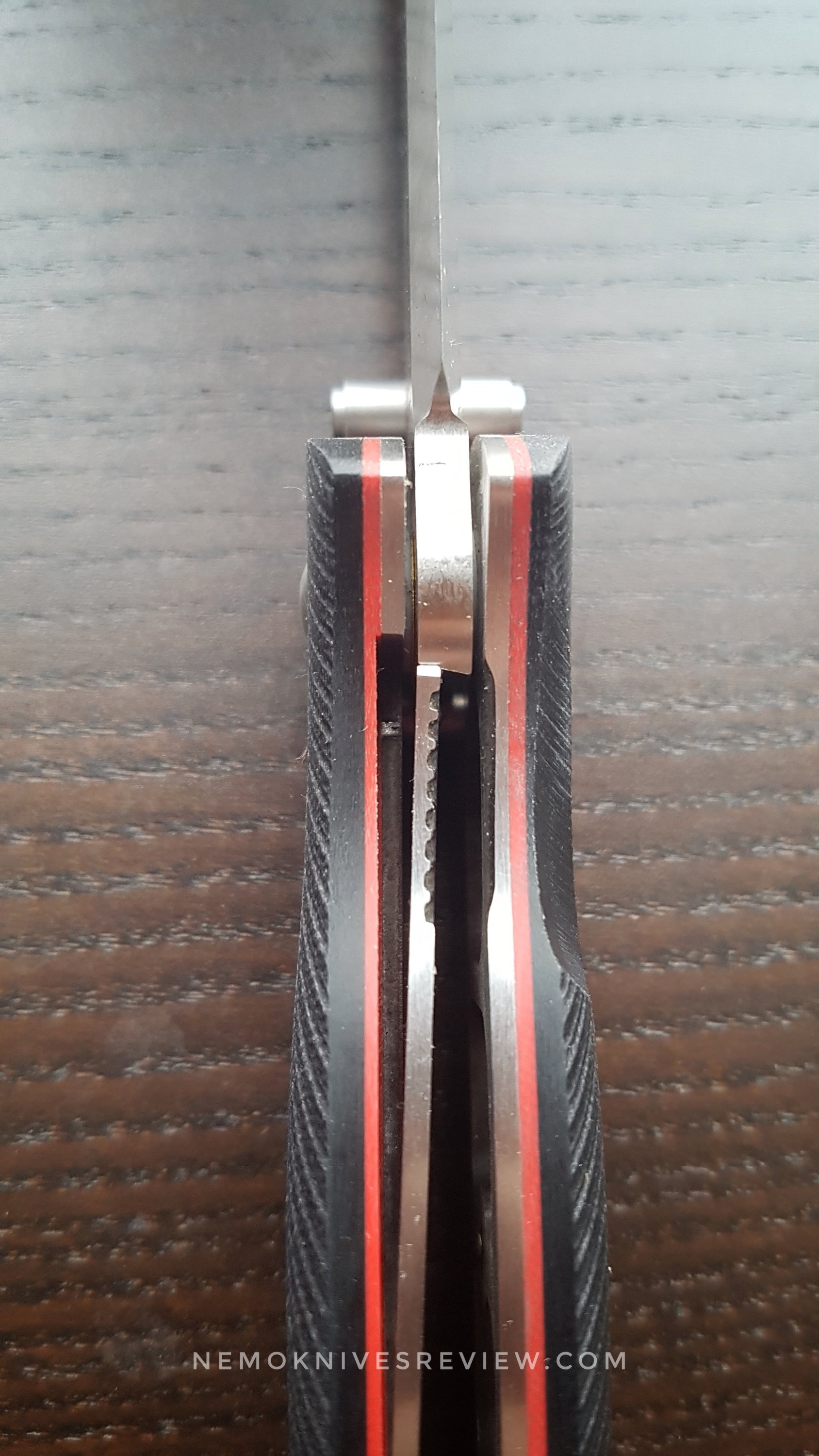
My first experience with Real Steel was the beautiful Megalodon which has had review here. Its main flaw was the awful clip and you know what ? The Bushcraft Folder has no clip but a beautiful textured G10 handle. Also the red liners are a very nice touch bringing a real touch of class. The blade is perfectly centered; the action is smooth; the action Southpaw friendly…
So let’s have a look:

The blade is made of D2. This air hardening classical steel is not my favorite but some of my friends and co-writers like JD do have an excellent opinion about it. As a reminder let’s not forget D2 has 13% chrome steel which can stain and can be a bear to get sharp. RealSteel seems to have bought tons of D2 as their production of fixed blades is mainly using that alloy. The HRC is 58-60 which is not the hardest heat treatment for that steel but it seems appropriate for a knife destined to resharpen in the field. Oh and this is a true scandi: no secondary bevel on that baby ! You can put it flat on some stone and you should be able to keep it like a razor !


The lock is a thick Michael Walker’s liner lock and it reminds me of the one on Spyderco Gayle Bradley; thick liners locks are easy and confortable to use. Here the steel liners are heavily skeletonized to reduce weight and keep a great balance.
Don’t forget: batoning with a folder is not a good idea with the lock engaged. Let’s say it’s not a good idea, period. Some chores are better kept for the uses of thick fixed blades. But the RealSteel BF can easy drill in wood and be twisted while cutting: there is no movement, no play; everything is very well adjusted. So this is a very serious outdoor knife. The spine of the blade is sharp, certainly for striking a rod and lighting fire. I will soon round mine, as I prefer to have a confortable ramp to push with my thumb during woodworking. The handle does not have a fully open construction; there is a G10 spacer in the butt along with a lanyard hole. It looks really easy to rinse and keep clean.

The G10 has got a very nice texture: not harsh. You can notice it on the picture. Also there is no hot spot on that handle so you can hold it really tight; it’s almost like a fixed blade. The linerlock is recessed and you can not disengage it by holding tight the handle. Just be careful and always remember: regardless how strong a folder is, it will never be as strong as fixed blade. Use it with respect and care; should the lock fail, there is no choil to protect your precious fingers!

This the heaviest folding blade in a 4 inches folder I have ever owned!
You certainly can put that 3,5mm thick blade in good use. Especially as the scandi is very keen and easy to keep ultra sharp – as much as you don’t create a bevel.
Even though the studs do not get in the way when sharpening, it should be easy to remove them with a flat screwdriver if you want a pure two hands opener.

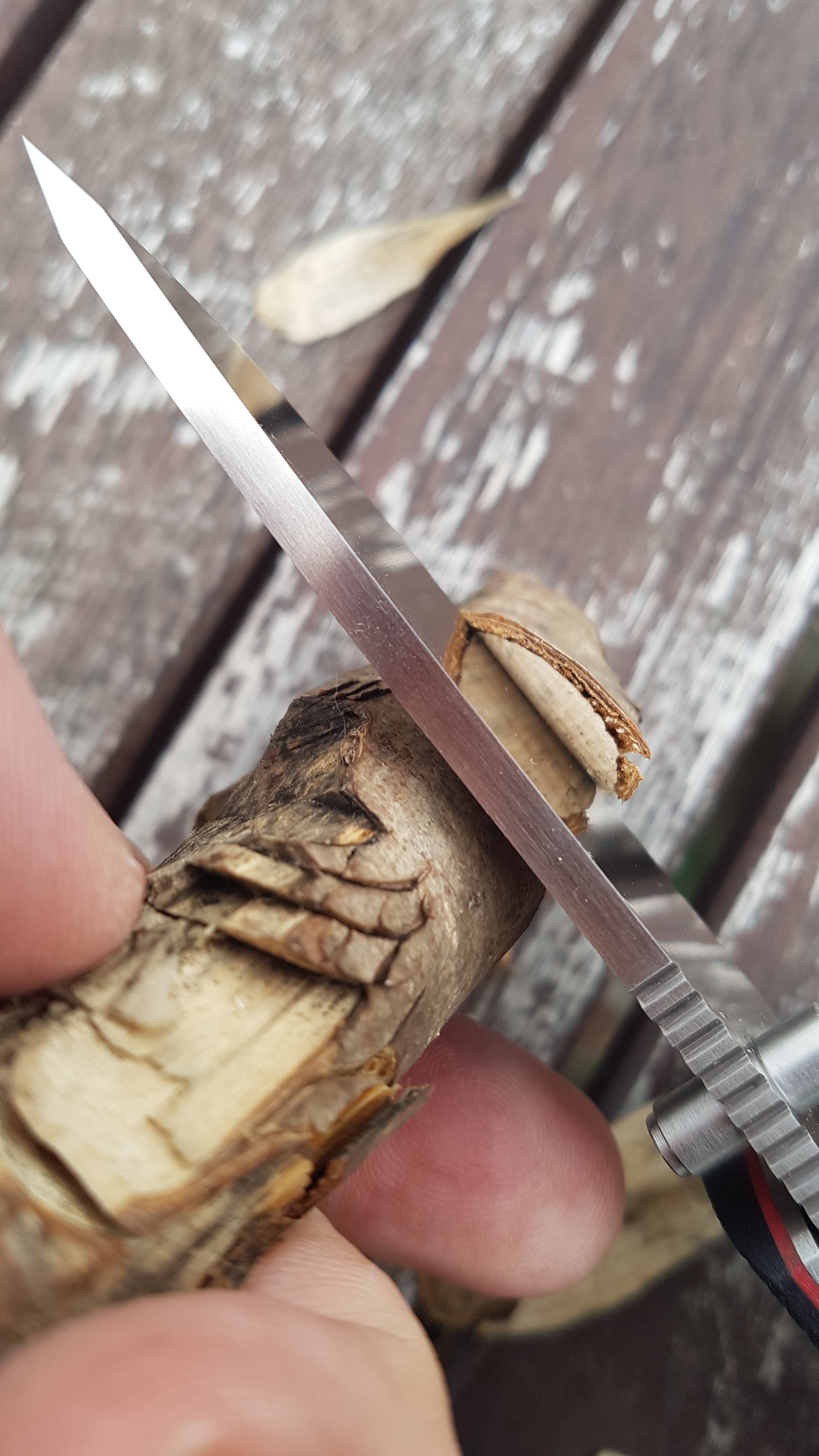
A first test on dry wood shows I have got a very serious contender; the blade cuts deep and makes as good chips as my Casstrom (Scandi type blades give you a lot of control when cutting wood). This is always such a pleasure to use them. Also the solid tip is great to drill and open crates without fear of breaking it.

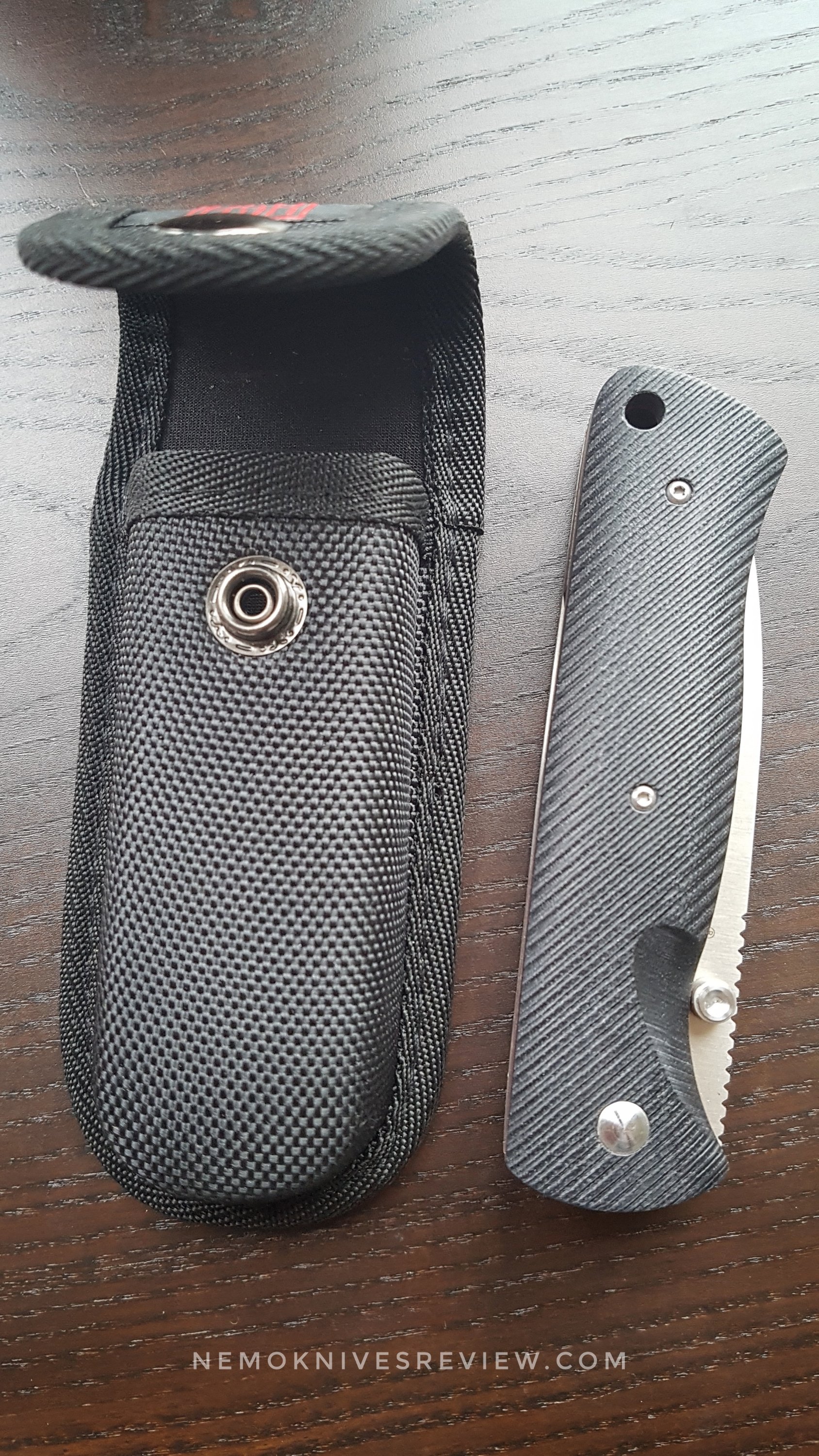
The pouch which is provided with that big heavy workhorse is well made, but I will certainly carry it vertically in my front pocket against my leather wallet. I have tried that before going for a one hour walk and the knife did not move.

The knife snuggles perfectly inside the pouch you can pass in a belt.
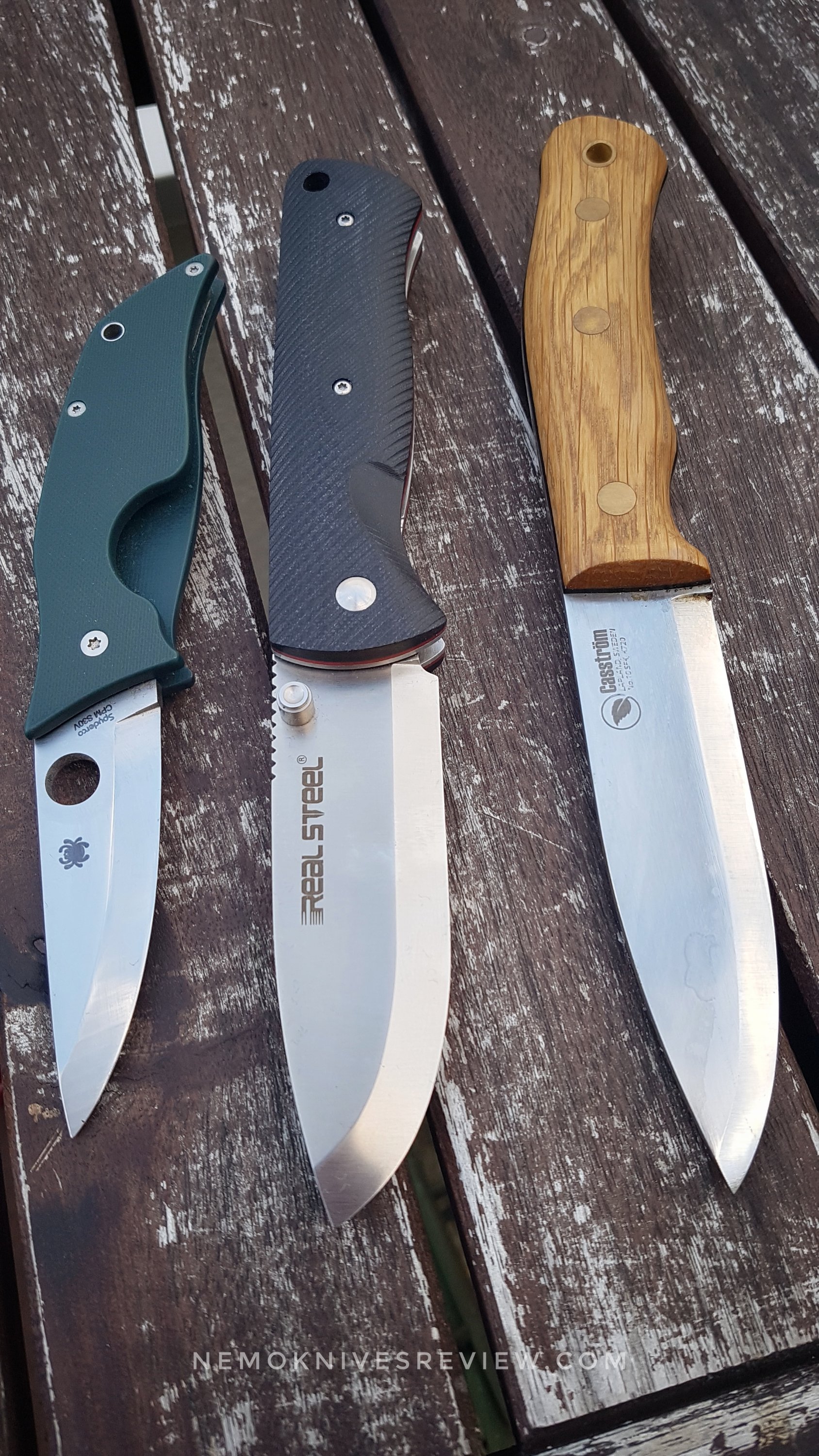
In my opinion a nice cocoon to transport the knife in a coat pocket or in a bag, featuring its toolish function in opposition to all those fast draw tactical response tools always regarded as weapon and also marketed as “tactical” knives, conveys a comforting message.

My wonderful Wolfspyder is dwarfed by the heavy RealSteel folder which’s size is very close to any classical bushcraft fixed blade. You feel you can easily use it for light chopping, for finishing off a cut. Again, impacts are not folding knives’ best friends, but the momentum of that heavy blade could be used for light chopping in wood, like trimming branches in one whip of the wrist.

This is a mean blade perfectly centered beware parallax illusion in this photography.

And the handle is even thicker than the fixed blade.

Of course the main limitation of a folder is the blade length which cannot exceed the handle length (except for some hunting daggers).

So what have we got in the end ? An heavy, solid, easy to keep sharp bushcraft tool.
OK. But for what price ? Mine was bought for less than 60 euros ! This is great for a knife destined to be used a lot and not kept in a safe.
In my opinion, this is a very solid bargain for a very serious wood companion.
“Made in China” tools are getting better and better in terms of quality, prices are competitive and don’t forget…. your Iphone X are also made in China. Here you have got a Chinese Viking Folding Knife, which is great !!
More to come soon !

last edited by Pascal Jaffré on 17 jan 2018.