Tag Archives: Sharpening

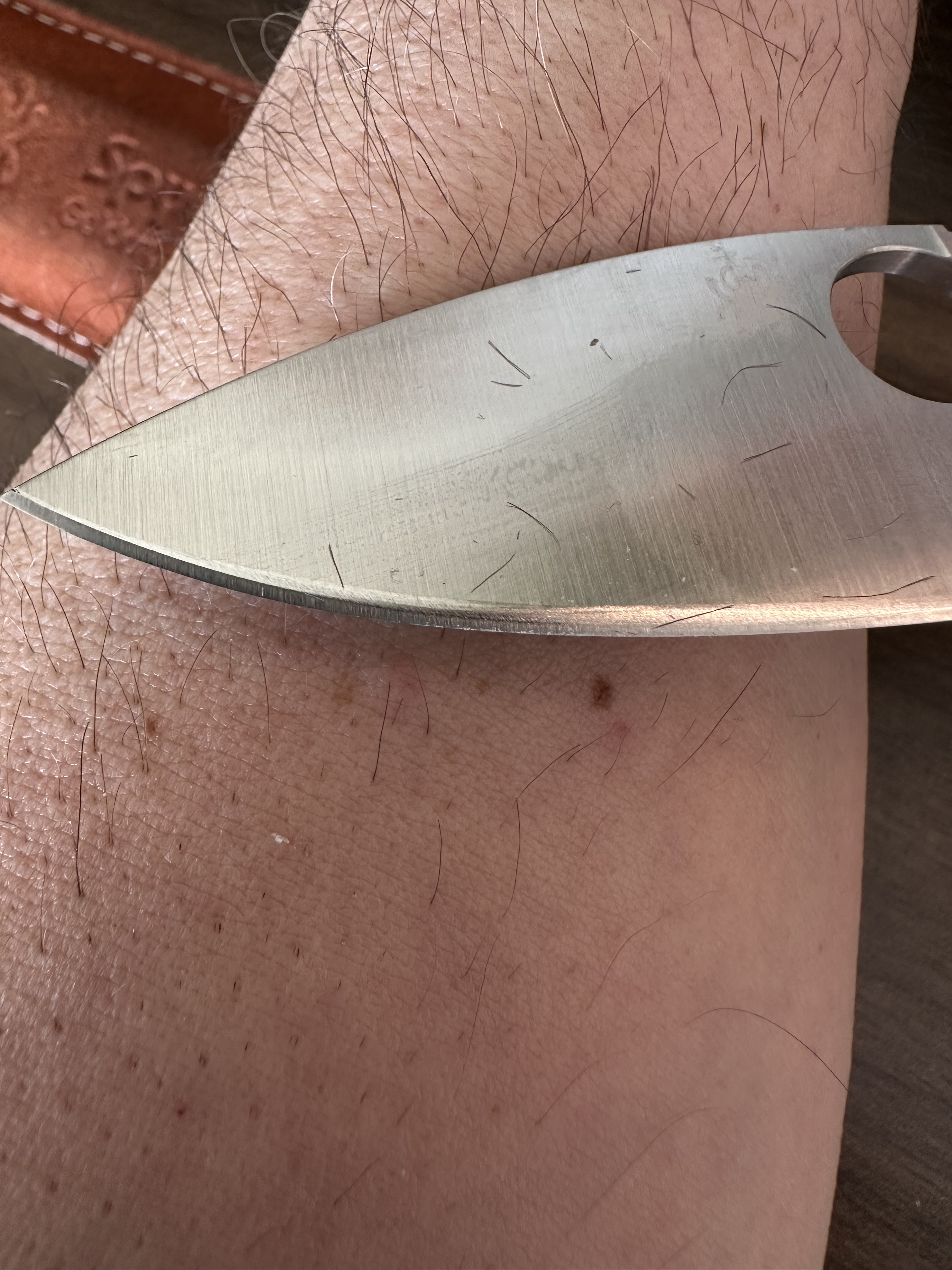
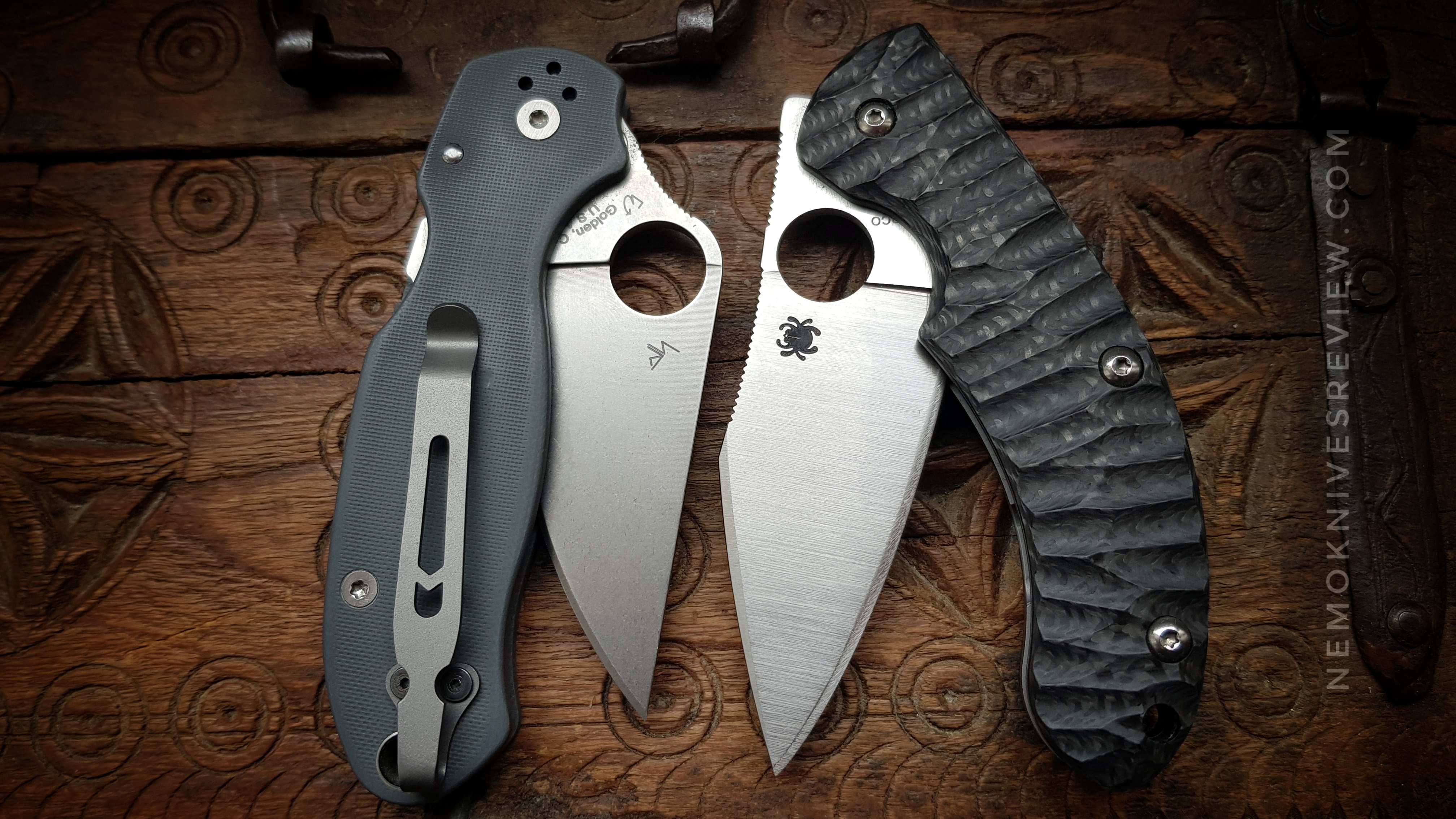
Spyderco CALY™ 3.5 – C144CFPE Caly 3.5 ZDP – Part II – Back To The Convex edge !

Disclaimer: The Spyderco Triangle Sharpmaker Diamond Rods Set of 2 – 204D was provided by Golden, along with the Caly 3.5. This article is the perfect opportunity to put them to the test.
The Sharpmaker is my own.

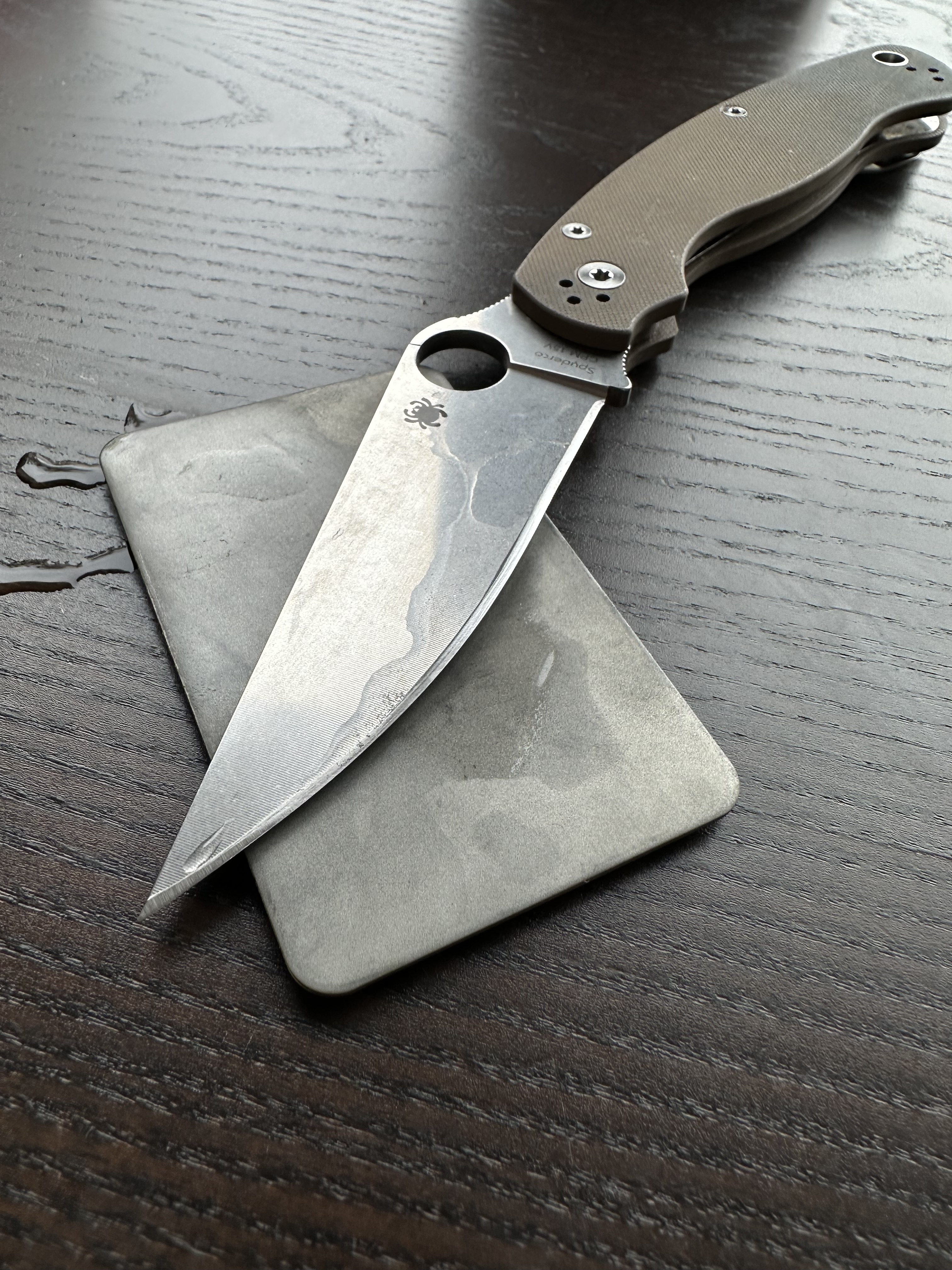
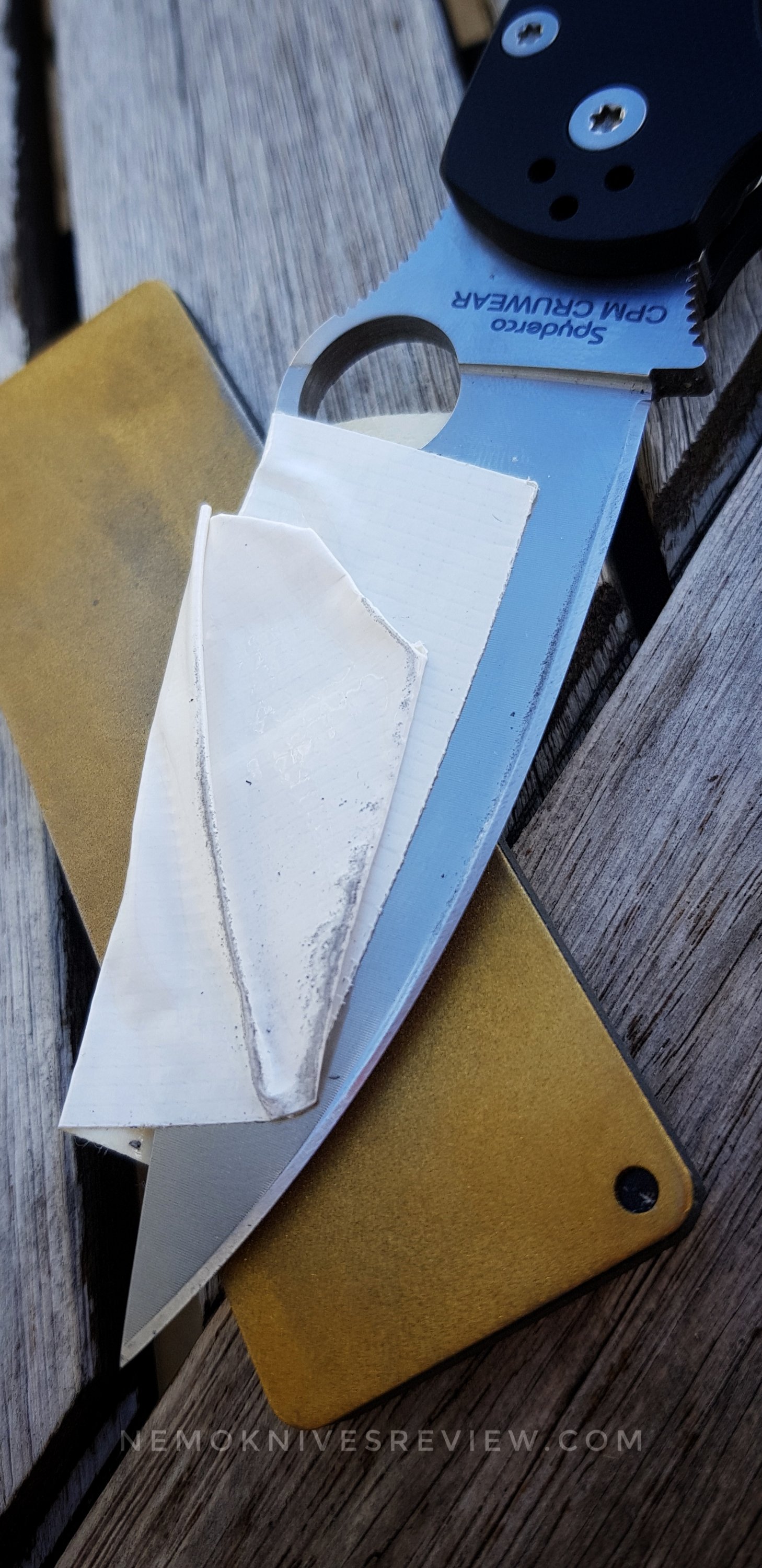
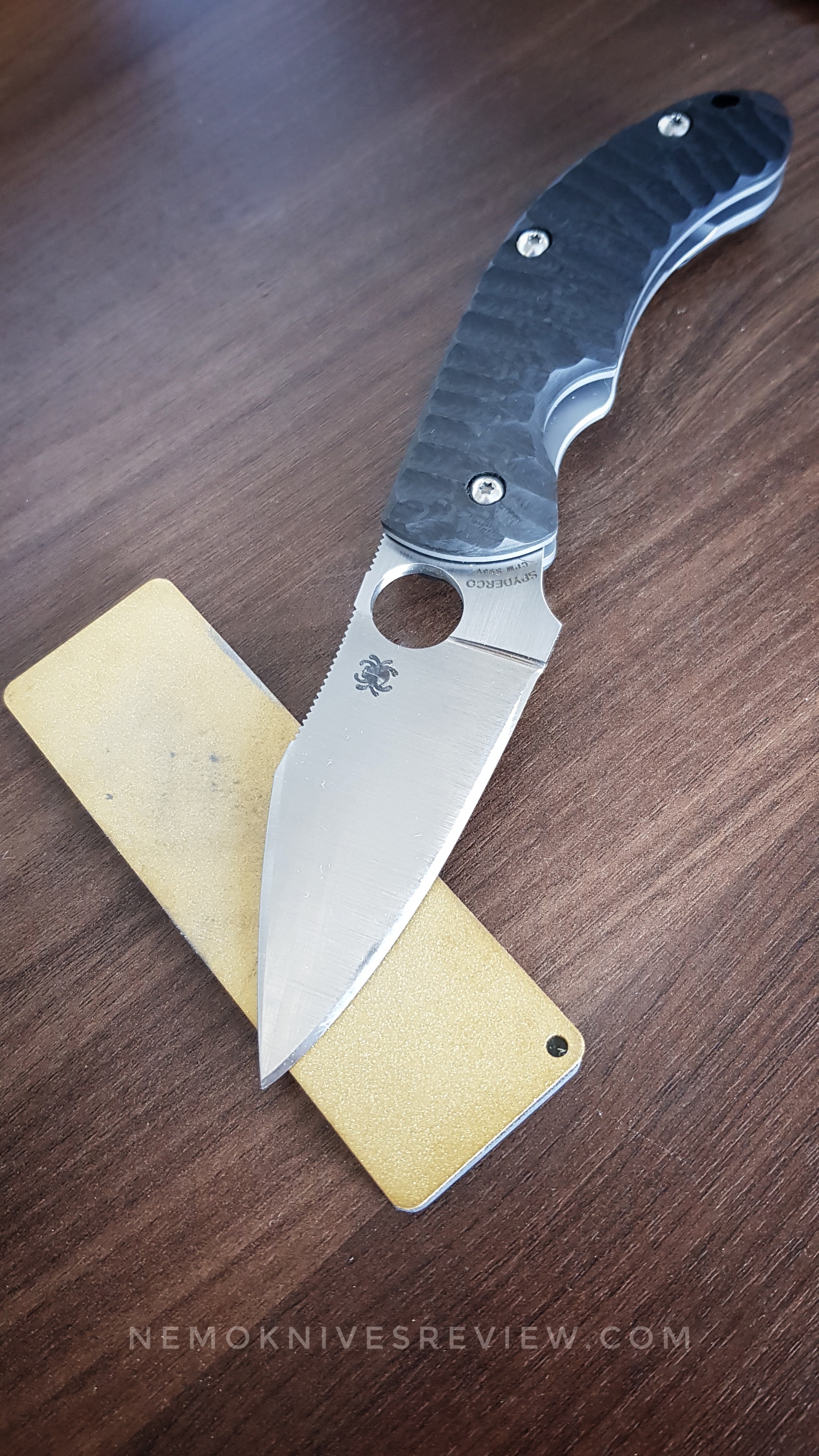
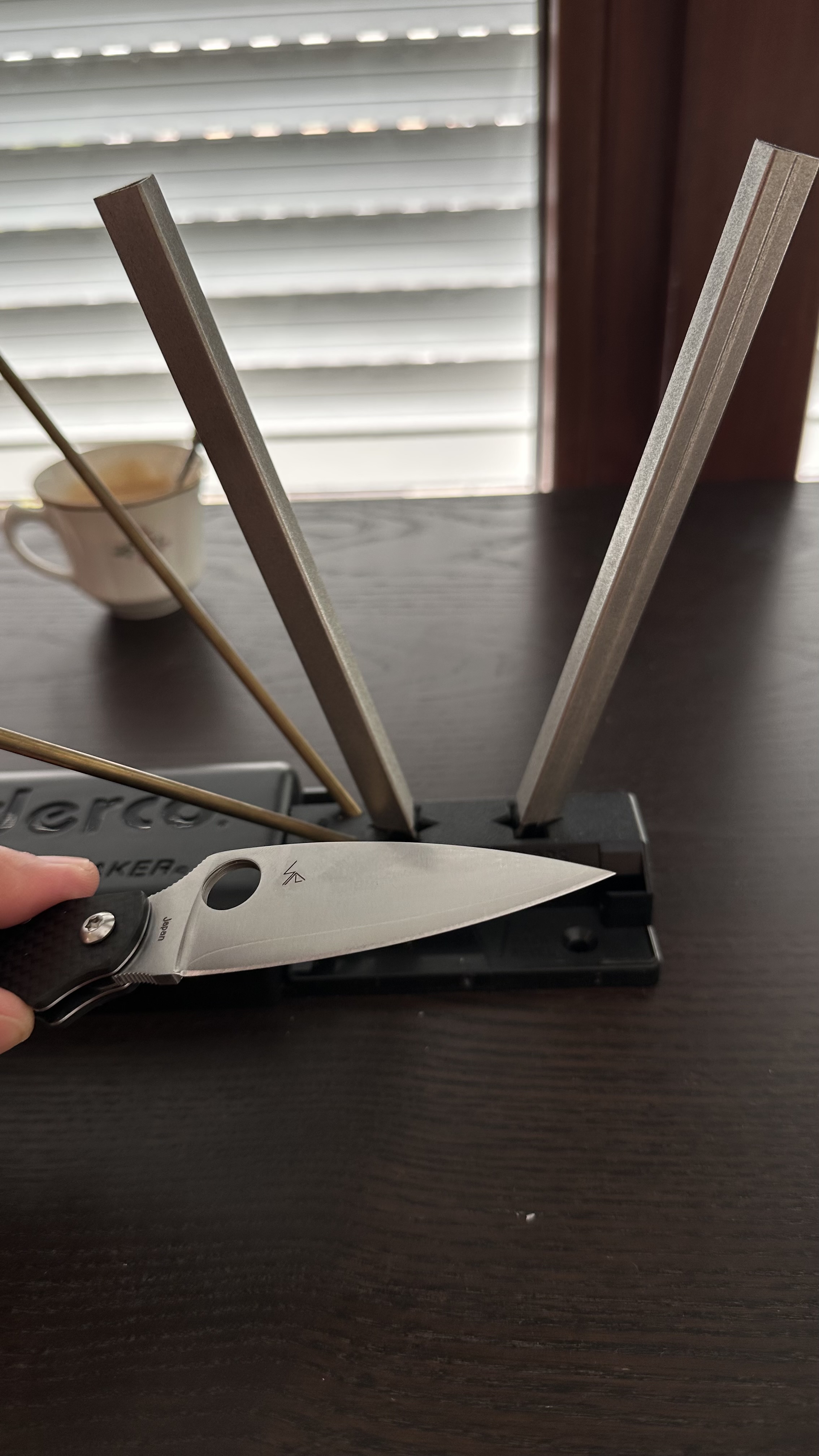
In the parcel from Golden were also two sets of rods: the 204CBN Cubic Boron Nitride rods and the 204D Diamond rods. Since my Caly 3.5 needed some convexing, it was time to see what these rods could do.

But you know, I’m a freehand sharpening guy. I don’t like being locked into fixed angles. I prefer to adjust pressure and movement based on what I feel directly from the blade against the rod. That’s why I’ve never been too fond of “systems” that take control away from your hands.

For me, sharpening should stay super simple, and—most importantly—adaptable. If I’m in the wild, far from the workbench, I still want to be able to bring an edge back with nothing more than a rod, a stone, or even something improvised.

That’s where the Spyderco Sharpmaker is different. It’s a system, yes, but it doesn’t dictate the process. It allows me to sharpen by feel, with freedom, and still gives me the precision I want.

Exactly — and that’s one of those clever little details only Spyderco would think of.

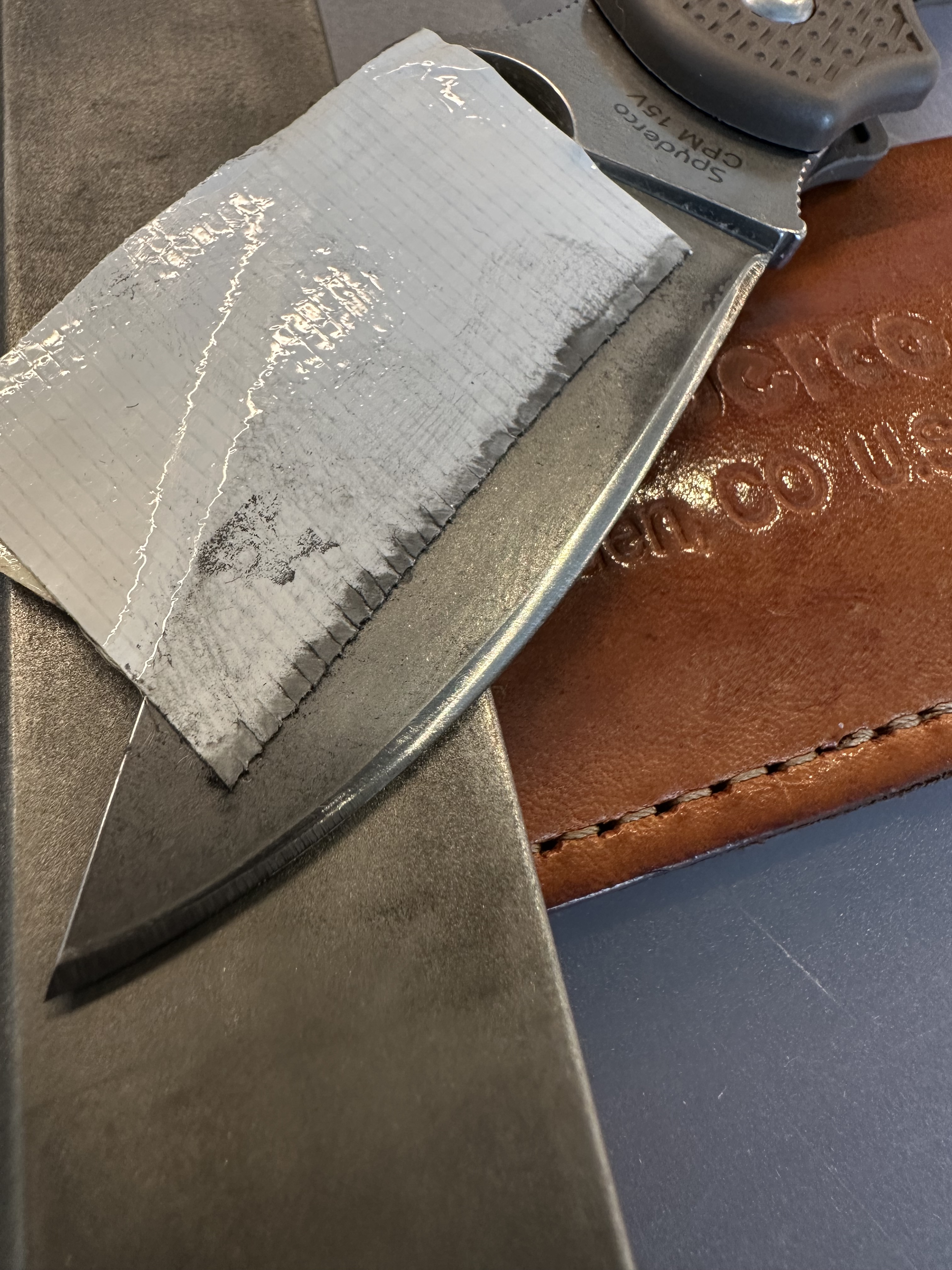
On the back of the Sharpmaker base, you’ve got two horizontal grooves that let you lay the rods flat. In that configuration, the tool basically transforms into a bench stone. With the diamond rods mounted this way, it works like a compact, portable diamond sharpening stone, letting you go full freehand.

So you get both options: the guided 30°/40° setup if you want consistency, and the freehand mode if you prefer to feel the steel, control pressure, and chase your own convex. That versatility is what makes the Sharpmaker more than “just a system.”

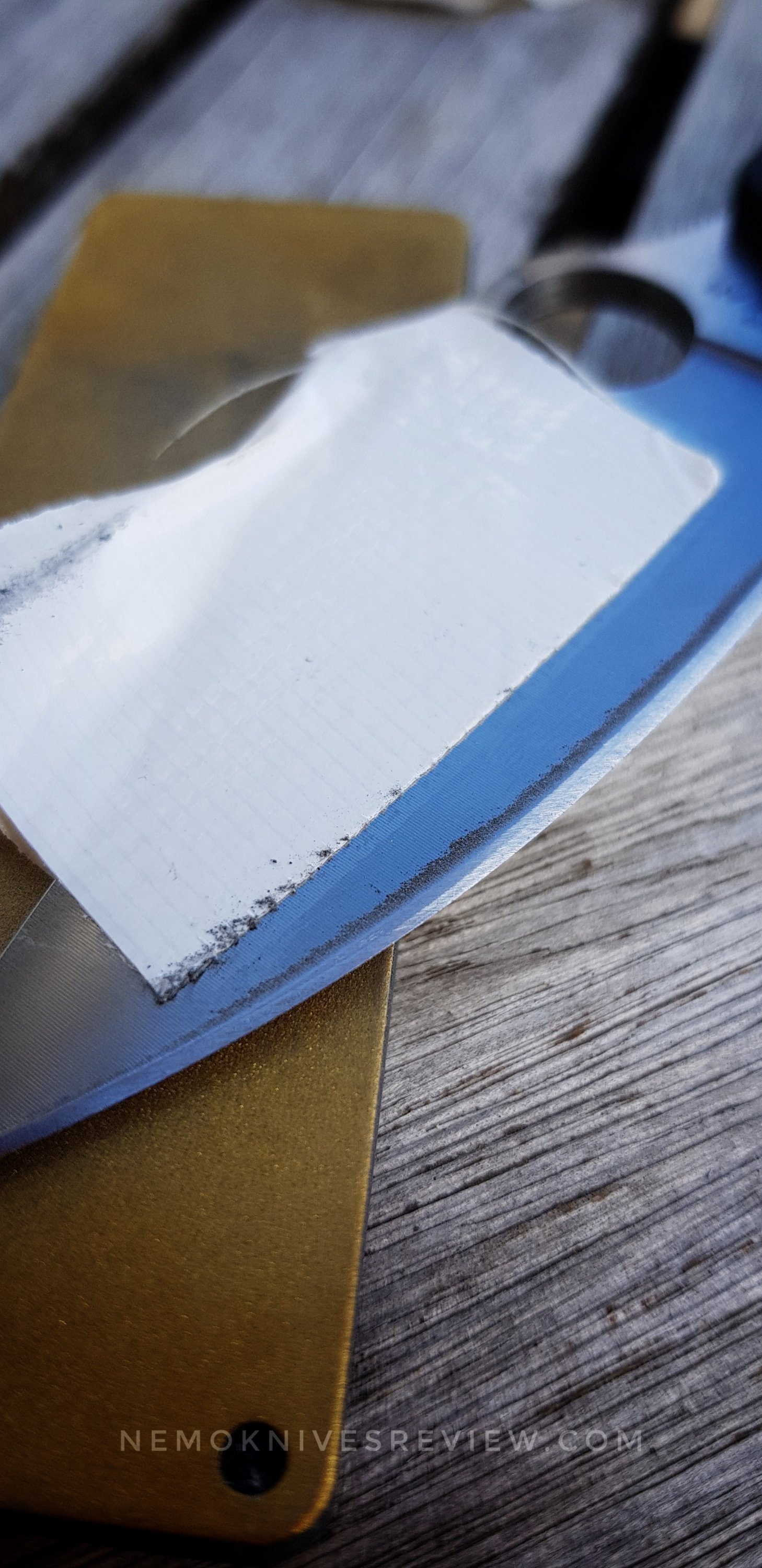
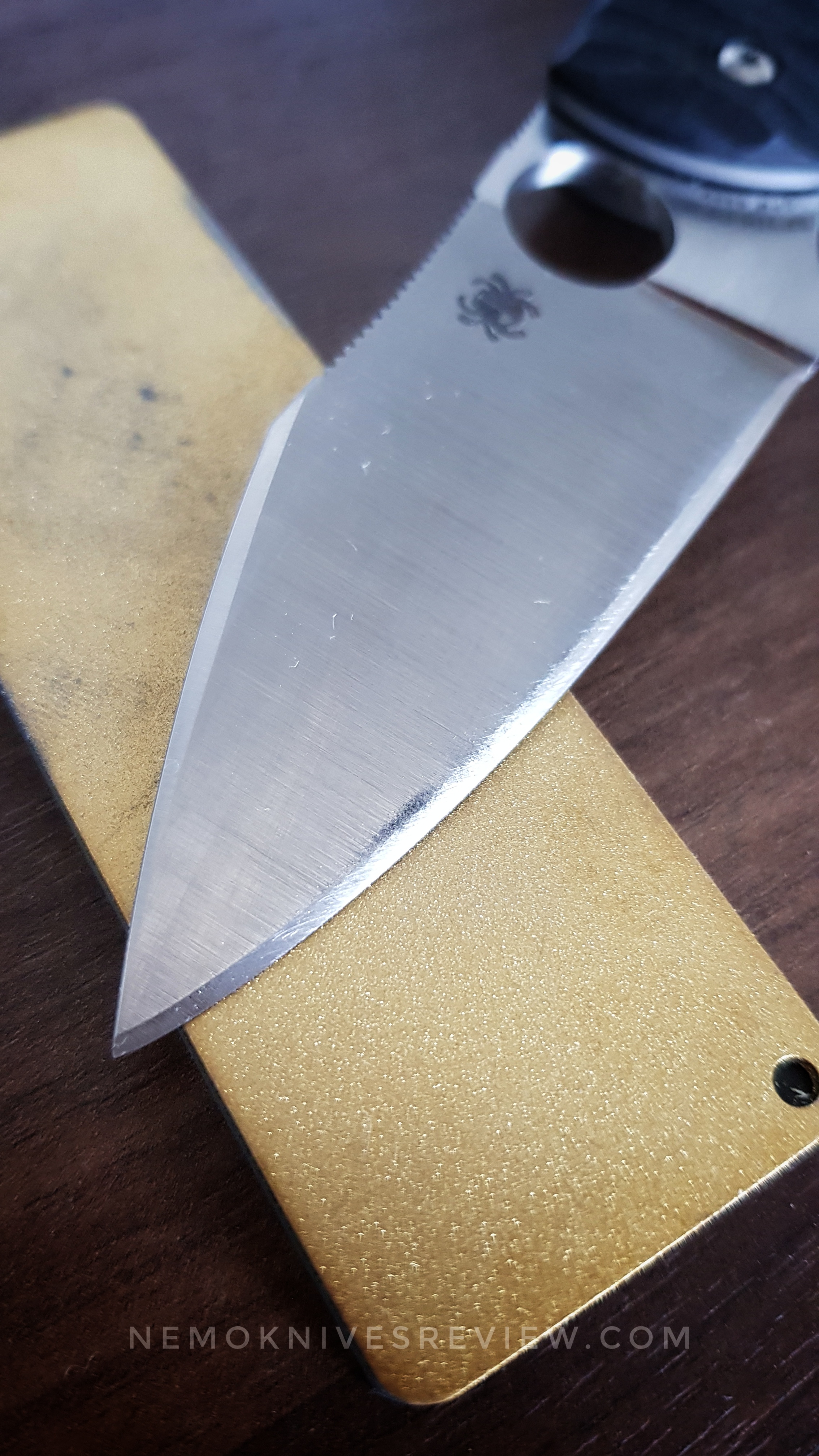
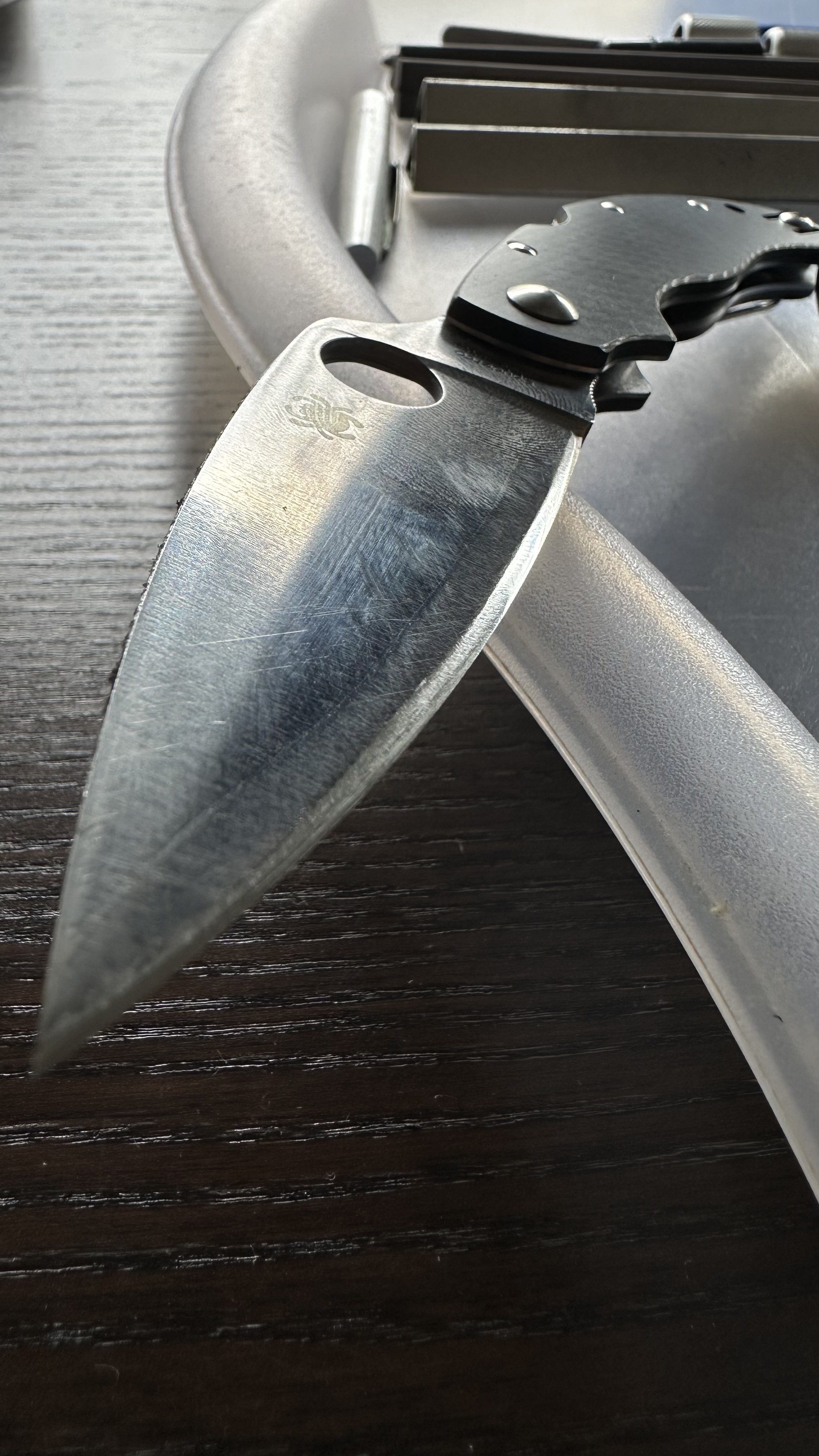
The gaffer tape trick is smart: it saves you from accidental slips while keeping the grind line safe. And yes, the 204D diamonds are hungry — they bite into ZDP-189 without hesitation, which also means they’ll scratch anything that touches them. But like you said, a working knife will earn its scars.

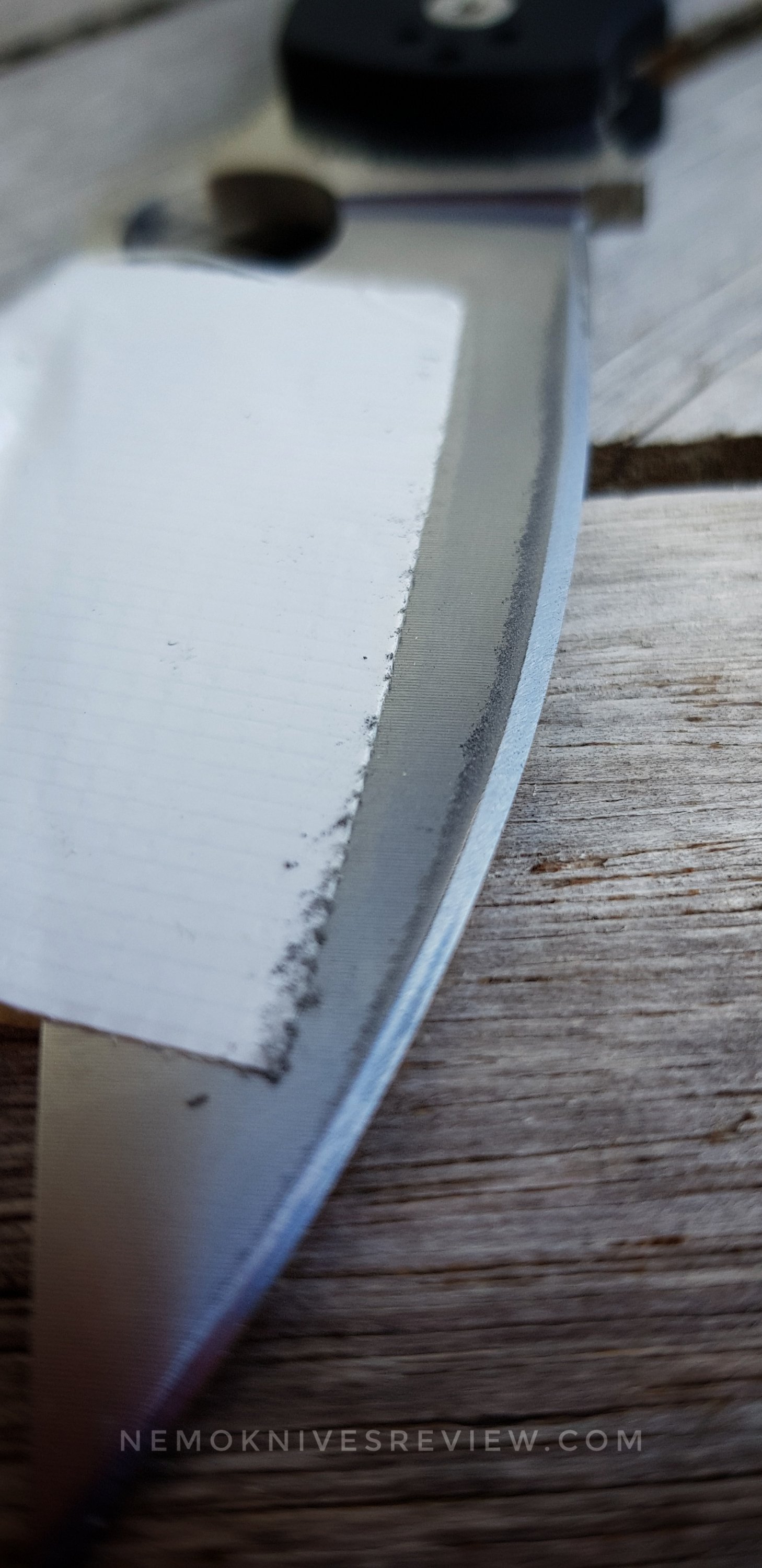
Polishing can always bring back some scratchless shine, but what really matters is how the geometry evolves: a little convexing, a thinner edge, and suddenly the Caly 3.5 stops being just elegant — it becomes a laser.
That’s exactly where your knife starts to become yours.

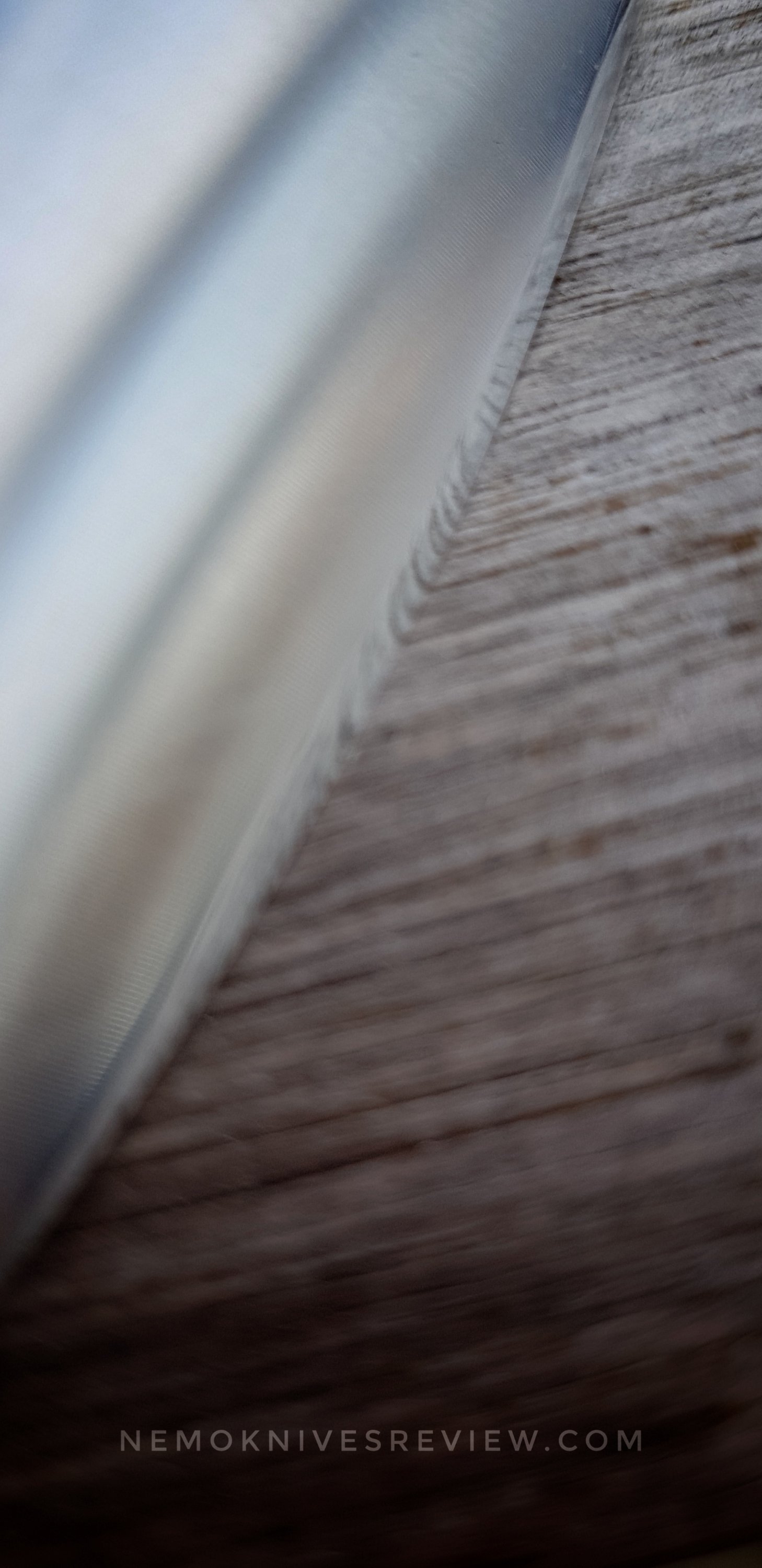
The convexing not only boosts cutting performance but also gives the edge that organic flow — you can see it in the way the bevel catches the light. It’s no longer a factory grind; it’s a living edge shaped by your own hand. It makes the knife more precious.

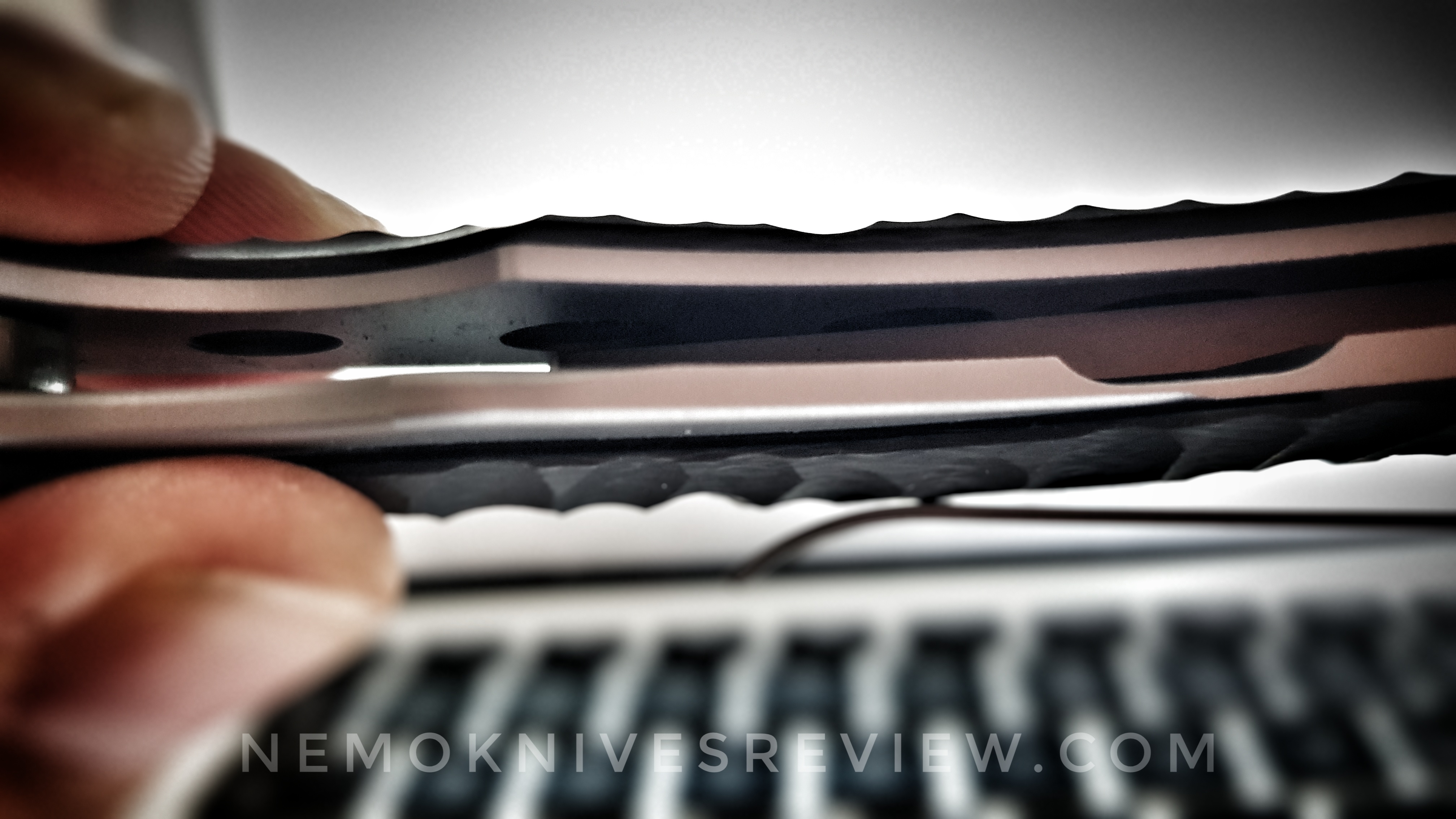
And by rounding the spine and softening the jimping, you’re turning what could feel harsh into something smoother, almost like a river stone. It transforms the Caly from safe queen into a companion you actually want to use every day, without hotspots or distractions.
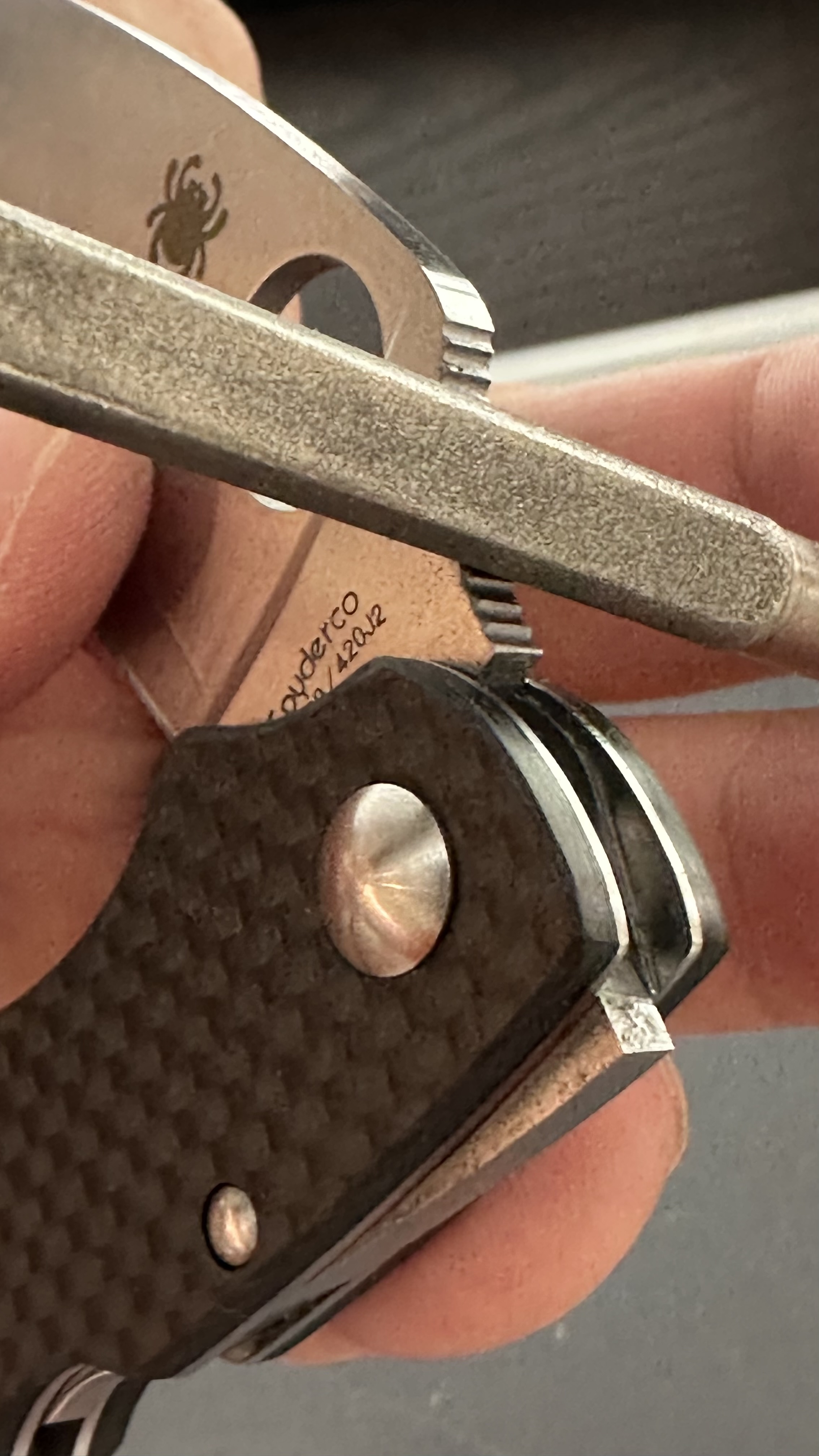
Most people underestimate how quickly diamond or CBN rods load up, and how much that affects sharpening efficiency.

Clay stone (terre de Sommières, or even a simple pottery stone) is excellent because it’s mildly abrasive: it lifts out the embedded metal without scratching or damaging the surface of the rods, and it works faster than detergents or erasers.

It’s also in the spirit of my philosophy: keep it simple, practical, field-ready. No fancy cleaners, just a tried-and-true trick that works every time.

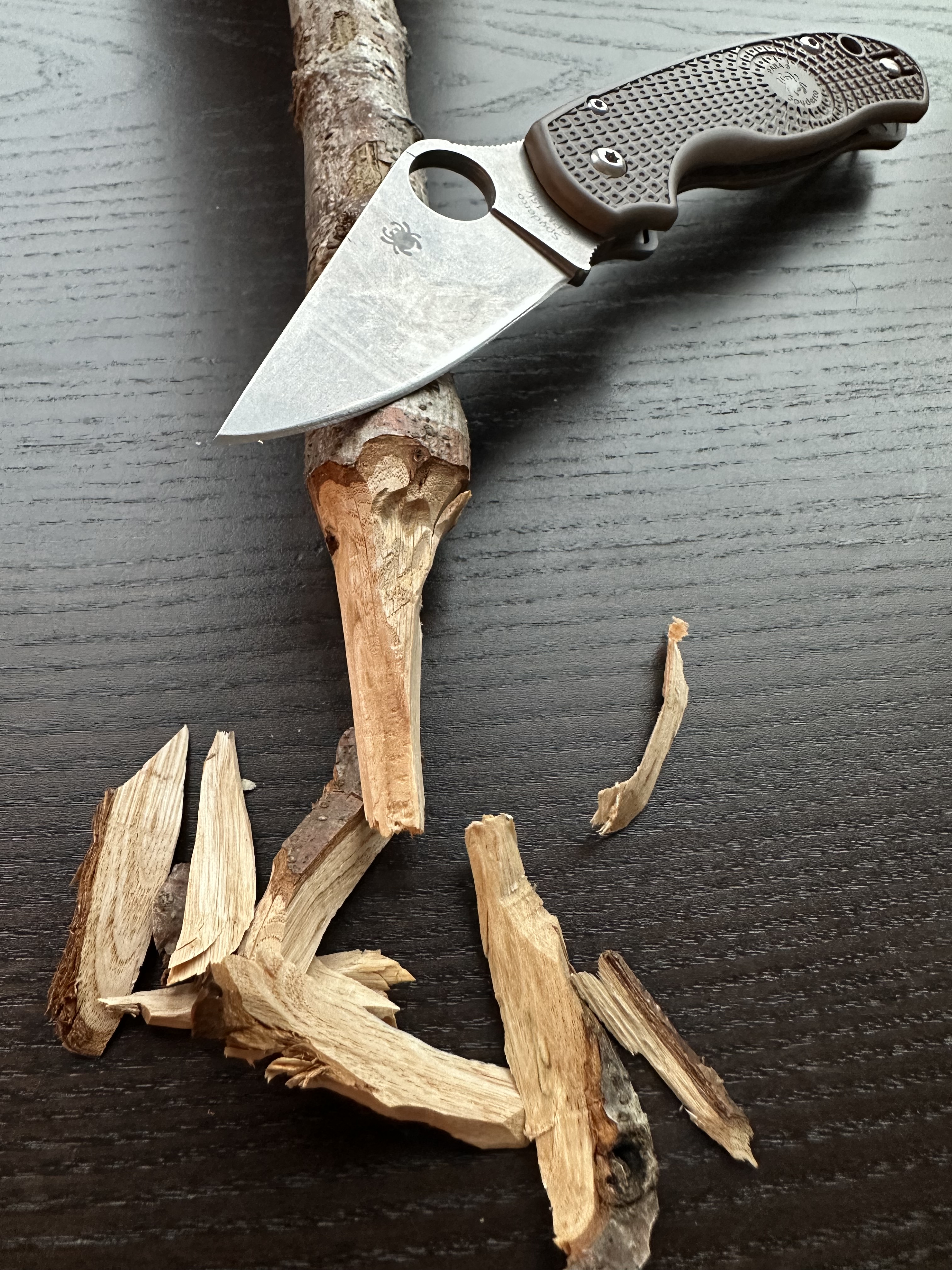
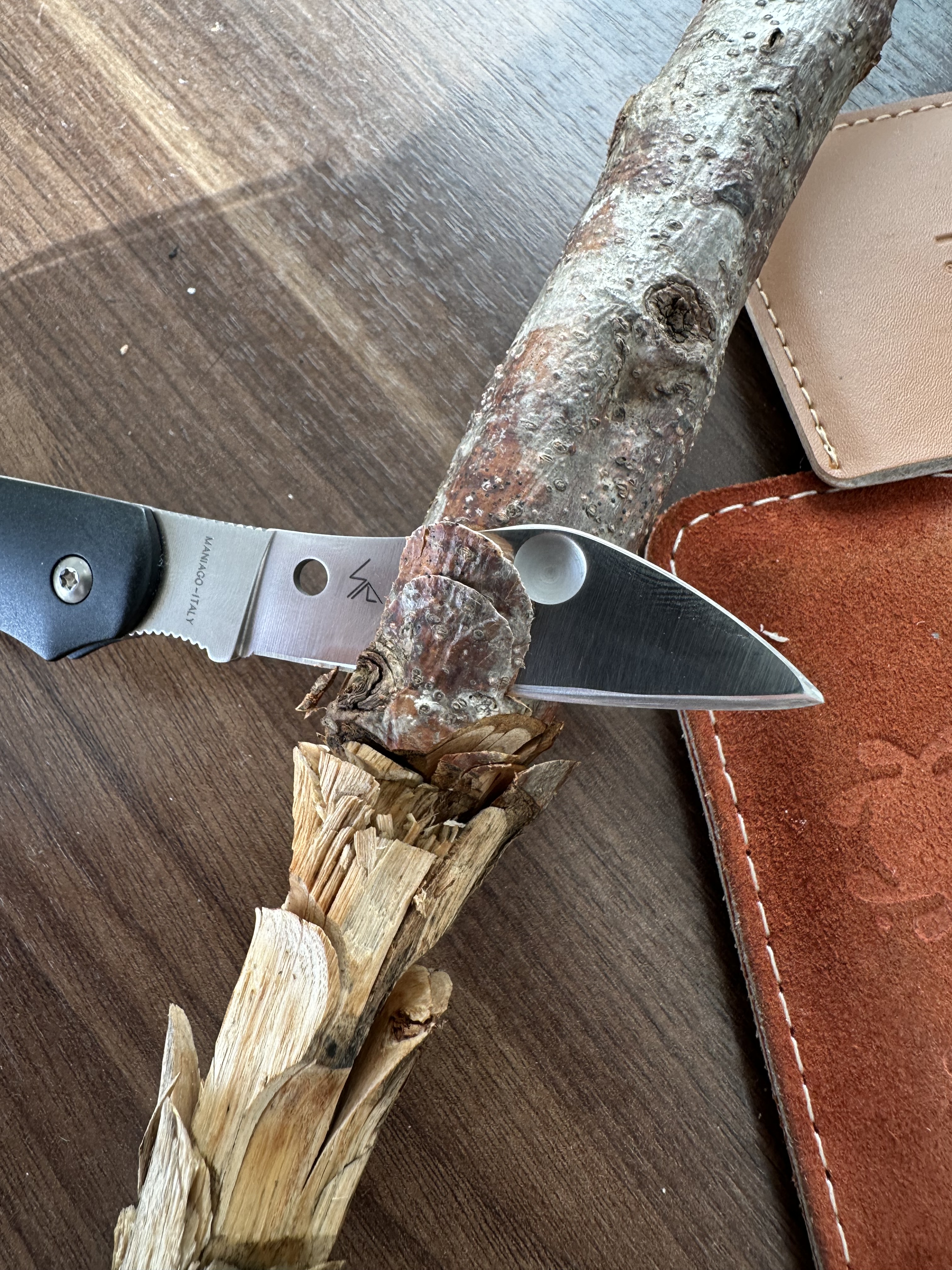
Dry chestnut is fibrous and can grab onto a thicker bevel, so the fact that your convexed ZDP-189 now glides “like a razor through butter” is a strong demonstration that the edge mod really paid off.
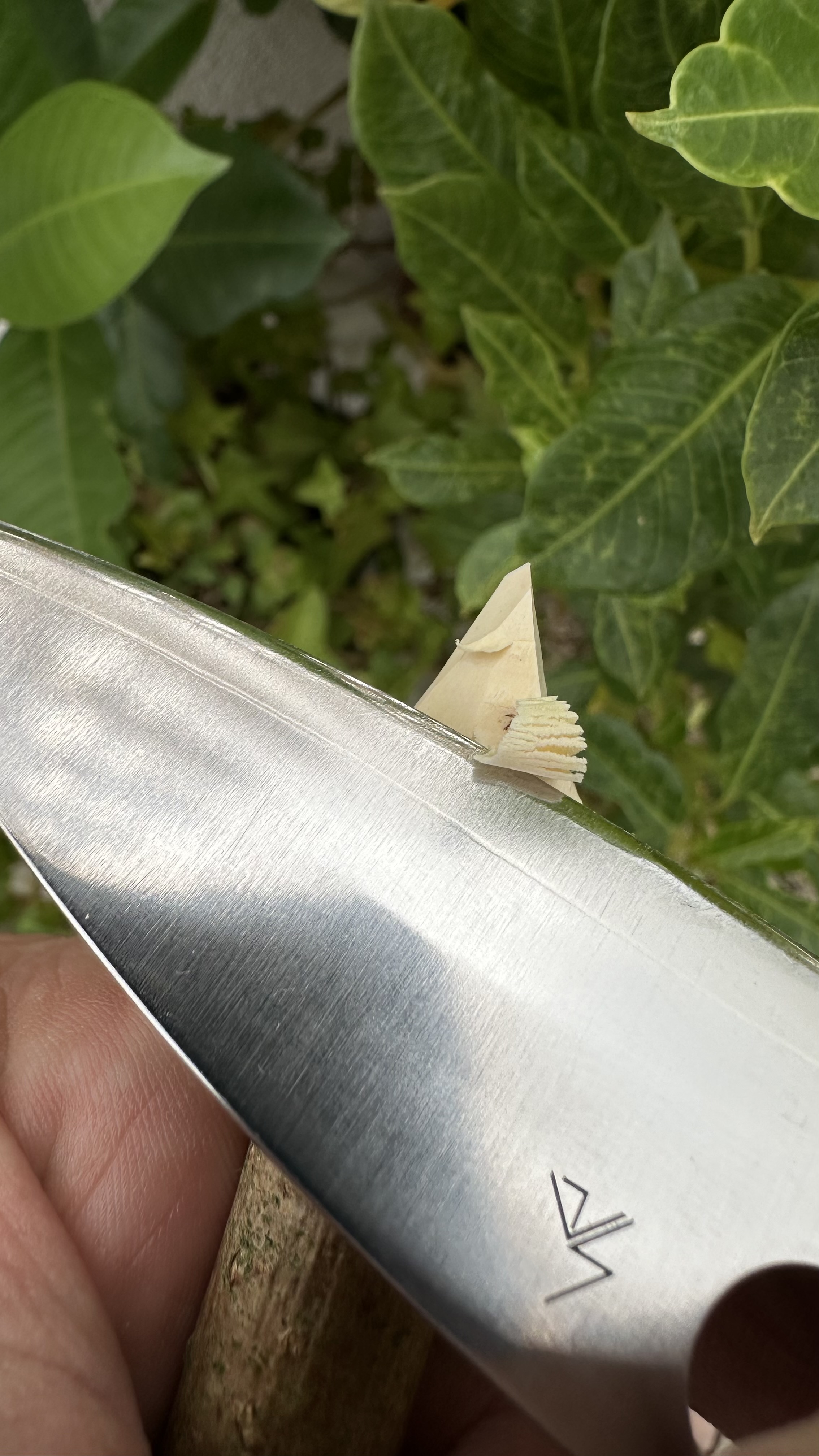
Convexing changes everything. Once the edge’s shoulders are rounded, the edge stops fighting the wood. No more wedging, just a clean, controlled push cut — like sliding through butter, even in stubborn chestnut.

That’s where ZDP-189 really shines. Most steels would give up at this geometry, folding or rolling. But at 65 HRC, ZDP holds steady. You get the sharpness of a razor without the fragility.

And the Caly 3.5? On paper, it’s a gentleman’s knife. In hand, convexed and sharp, it’s a wolf in disguise. A refined tool that thrives on real work, not just resting pretty in a pocket.
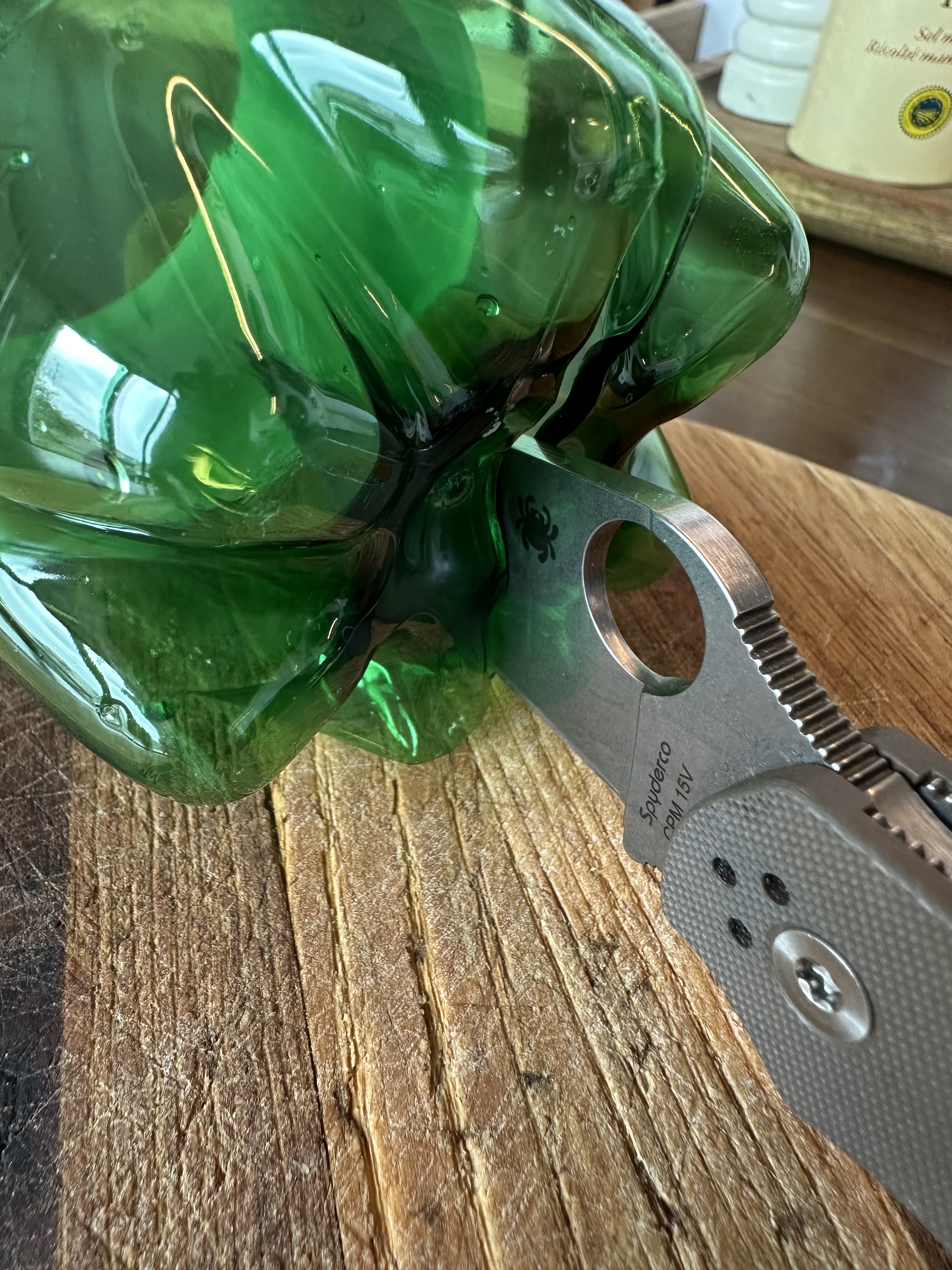
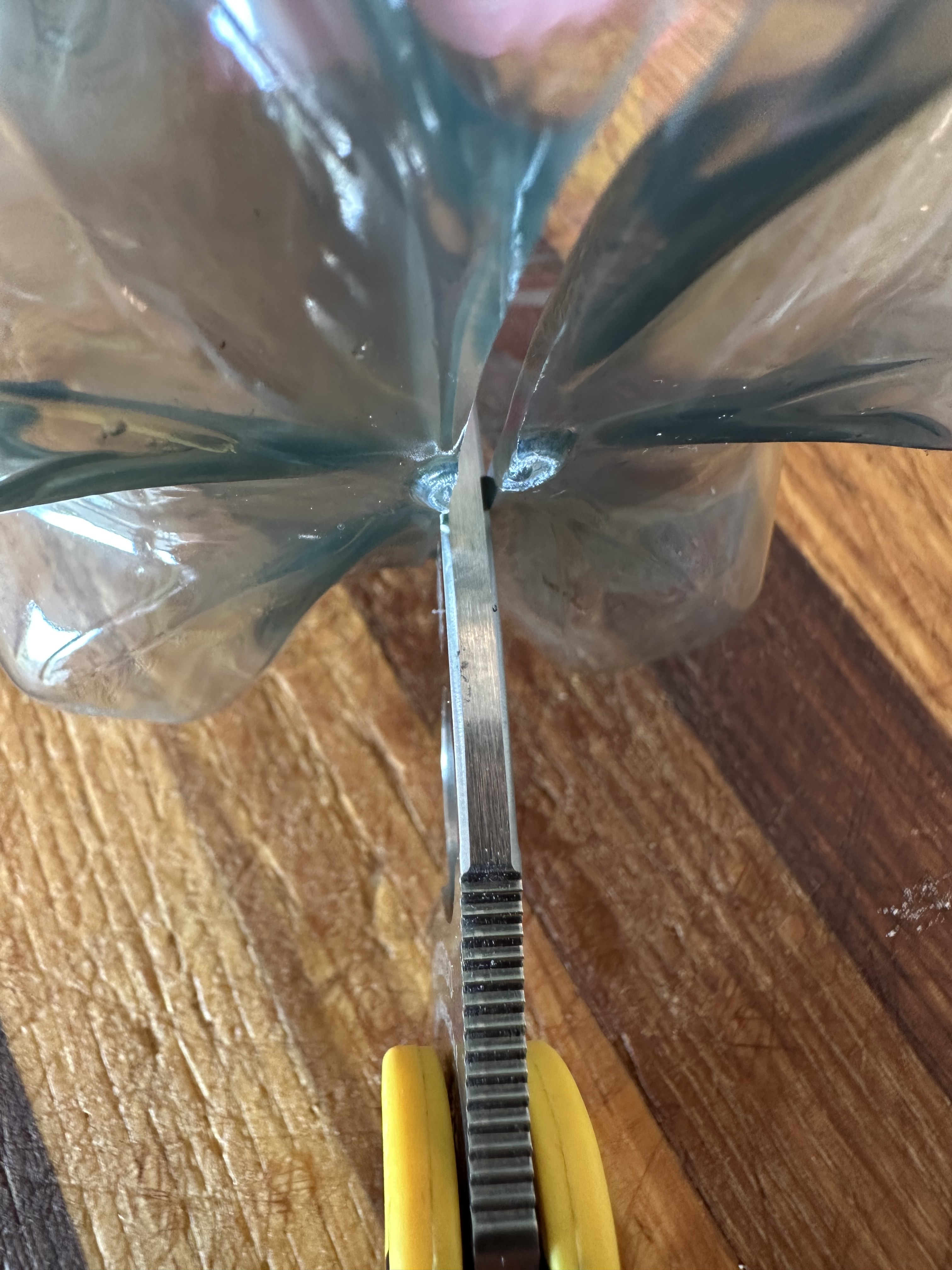
Wood tells one part of the story, but plastic will reveal another — especially the stubborn bottom of a bottle. That’s where I’ll see if this convexed ZDP-189 edge can truly glide without wedging. I’ll update this post as soon as I get the chance to put it through that test.

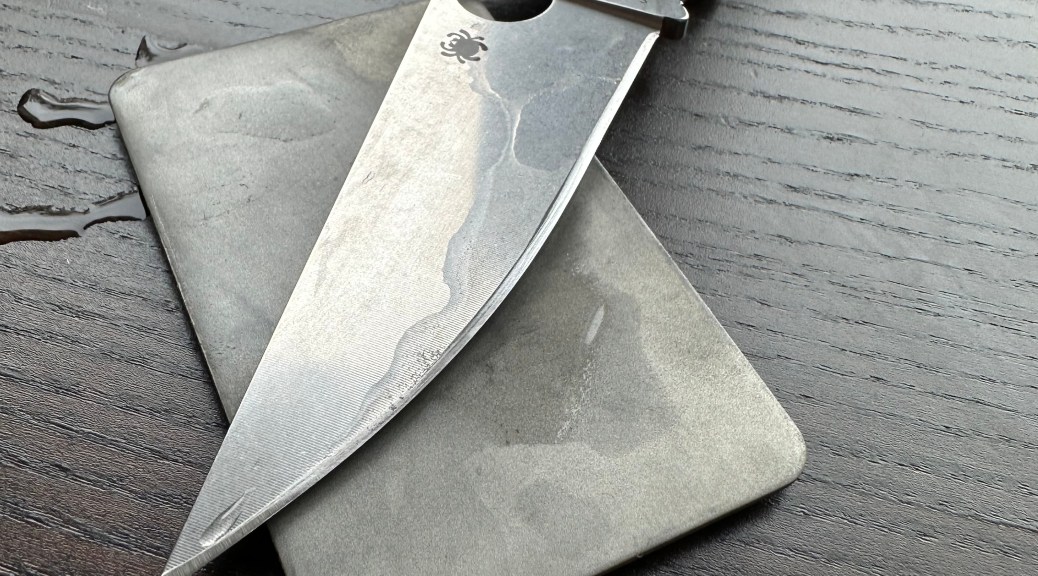
MILITARY™ 2 BROWN G-10 CPM® 15V® SPRINT RUN® – Part 2: Convexing the edge.

You know what ? It’s time to thin the edge of Gambit.
Pictures are better than thousand words.

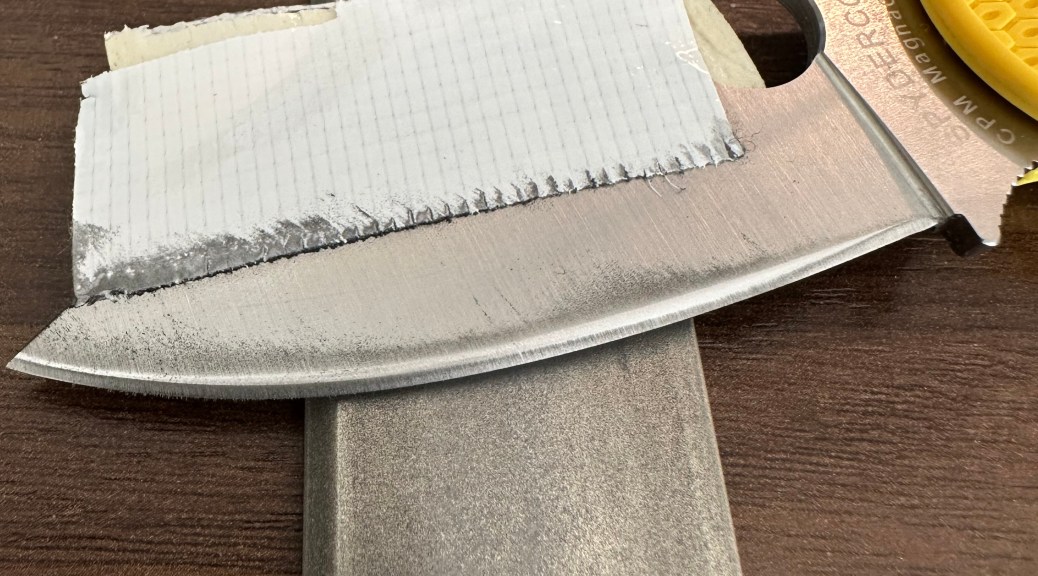
The gaffer is here to protect the blade against my clumsiness.

The Double Stuff 2 is the main tool. But it is old now.
It has lost some of its teeth in many many edges reprofiling…

But eventually it is a cheap Sharpy bought on Amazon which seems to be 15V best friend. It is 800 grit.
And it bites into 15V like no tomorrow.
So I was able to round the edge’s shoulder. Let’s test it.

It goes deep and steady.
There is real improvement. But gosh, 15V do not like to lose its particules. Compared to Magnacut or SPY27, CPM-15V is hellish.
Now I perhaps don’t have the best diamond tools for that.
But really, it is not a piece of cake in my book.

Now could it be a answer: The Military 2 reaching the 67 HRC ?
But that was exactly my impression after watching the YouTuber’s video — until Jake, a metallurgist for 14 years, left an exceptionally detailed, well-sourced comment under this review.
To quote his conclusion:

“… Spyderco did an amazing job getting a near custom level heat treatment on an amazing steel at an affordable price to many people who otherwise wouldn’t have been able to spend large sums of money on customs. But expecting 67Rc is a bit too much. Shawn has said it repeatedly that it isn’t realistic for a production knife company to hit hardness levels that high and also be able to work the material.

Many thanks to Jake for his eye-opening comment — truly appreciated!

De-Shouldering Process – How I get a convex edge in 15 minutes.

The new Sage 5 Salt got a great geometry but I love convex edges.
I like to remove the shoulder on the edge and with diamonds it is only a matter of minutes.

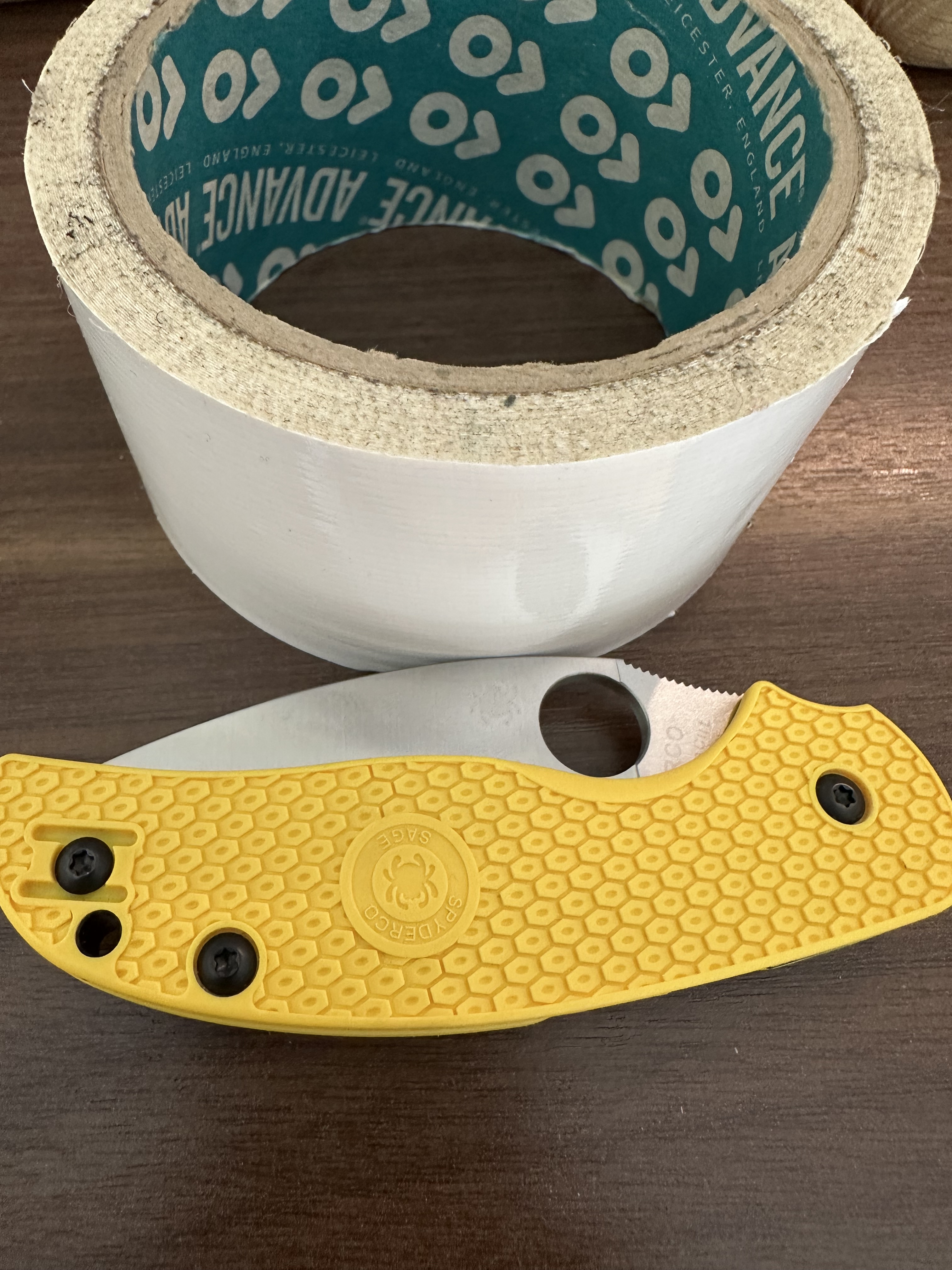
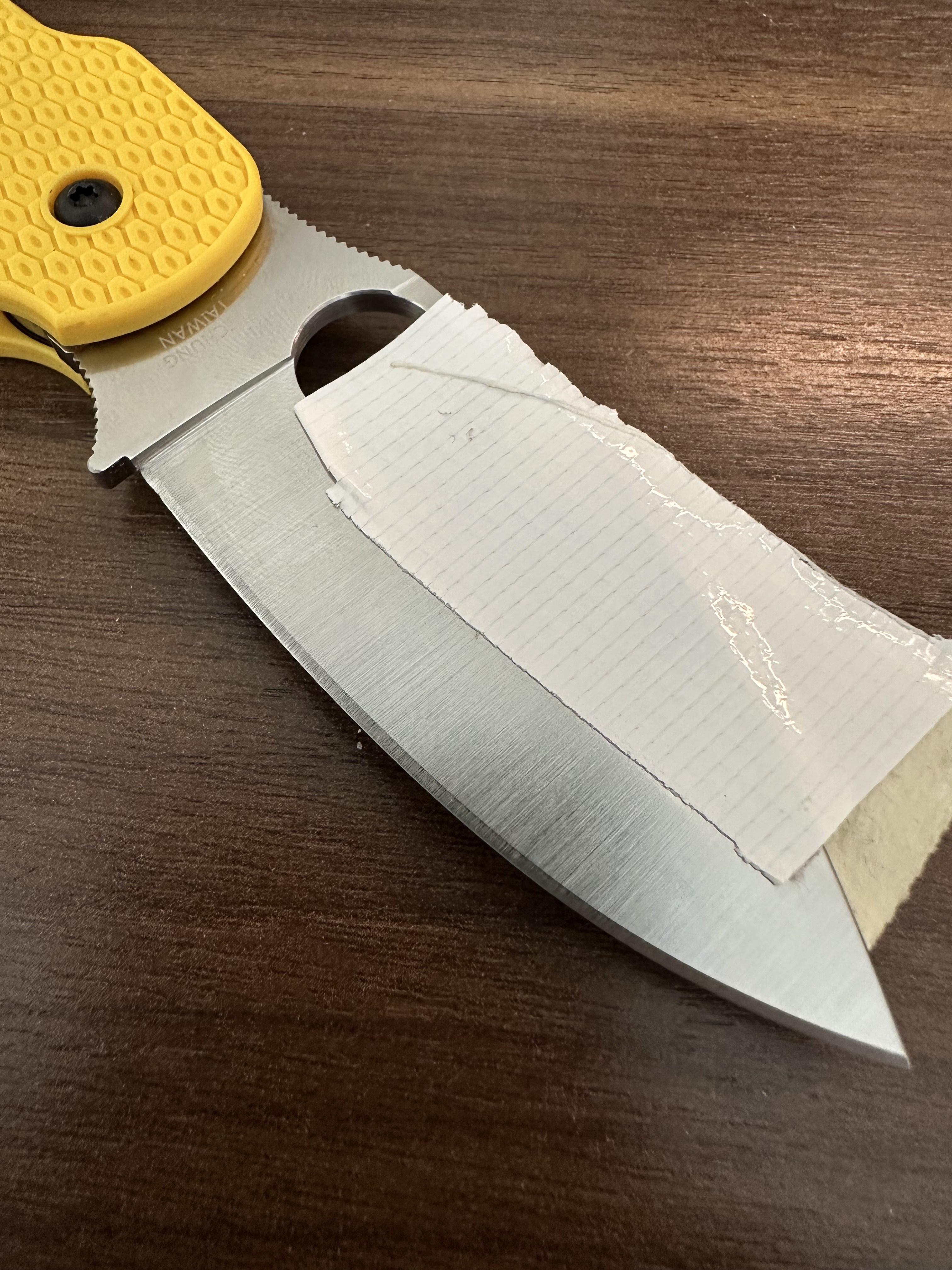
First thing. I do protect the sides of the blade to avoid scratching because I’m clumsy. I use thick duct tape AKA gaffer used to fix everything on the movie sets for everything including marks on the floor or information on magazines.

As I’m clumsy it even not symetrical.

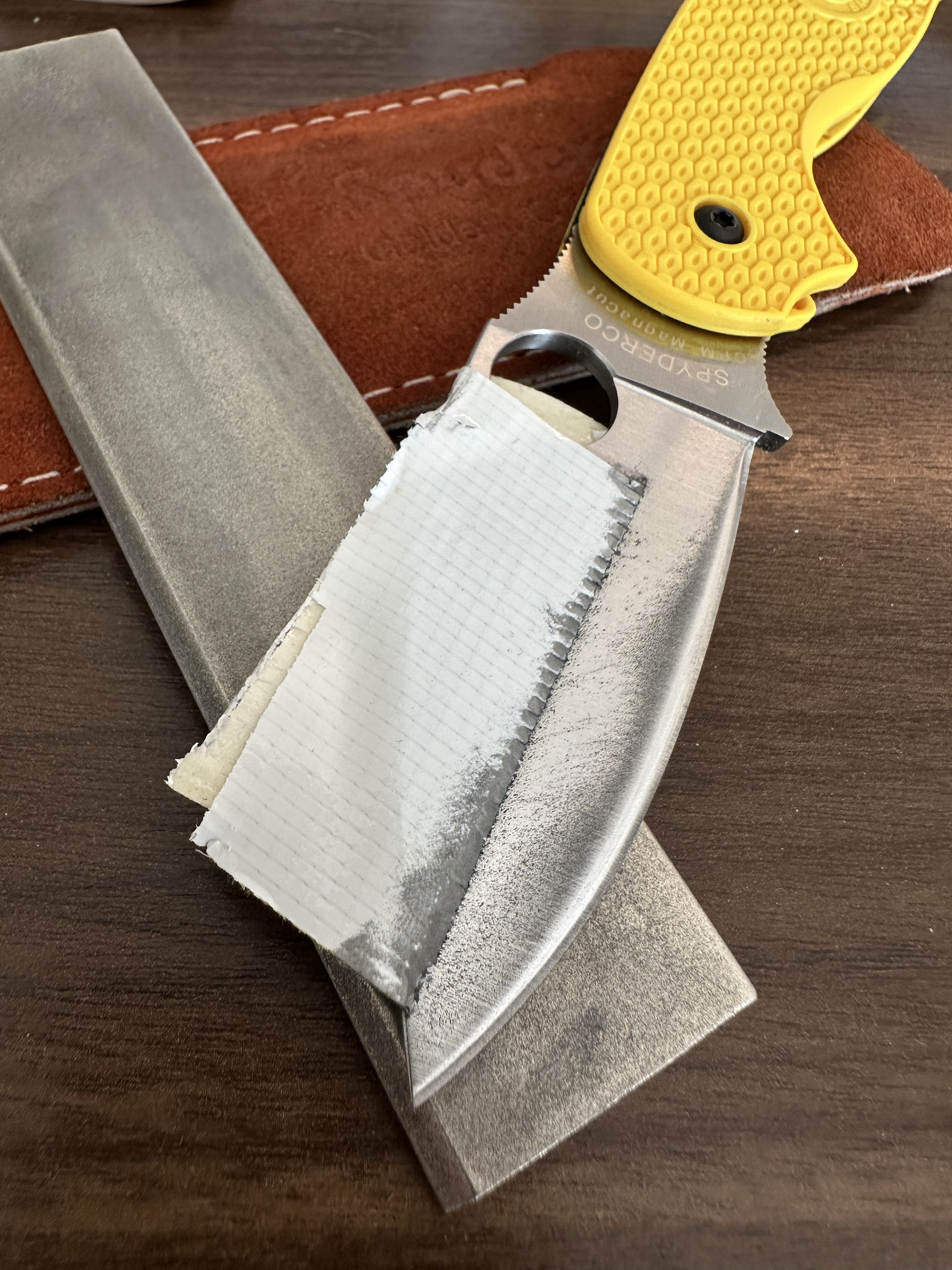
Next I use some diamond. Here it is a Spyderco Double Stuff II.

A two-sided pocket stone has long been the sharpening tool of choice for fishermen, outdoorsmen, and other knife users who needed a handy, versatile sharpener for touch-ups in the field.

In 7 minutes I got that result.
I do not touch up the edge, my angle is aim toward the shoulder of the edge to thin it.
You can see the edge is styill the factory edge.

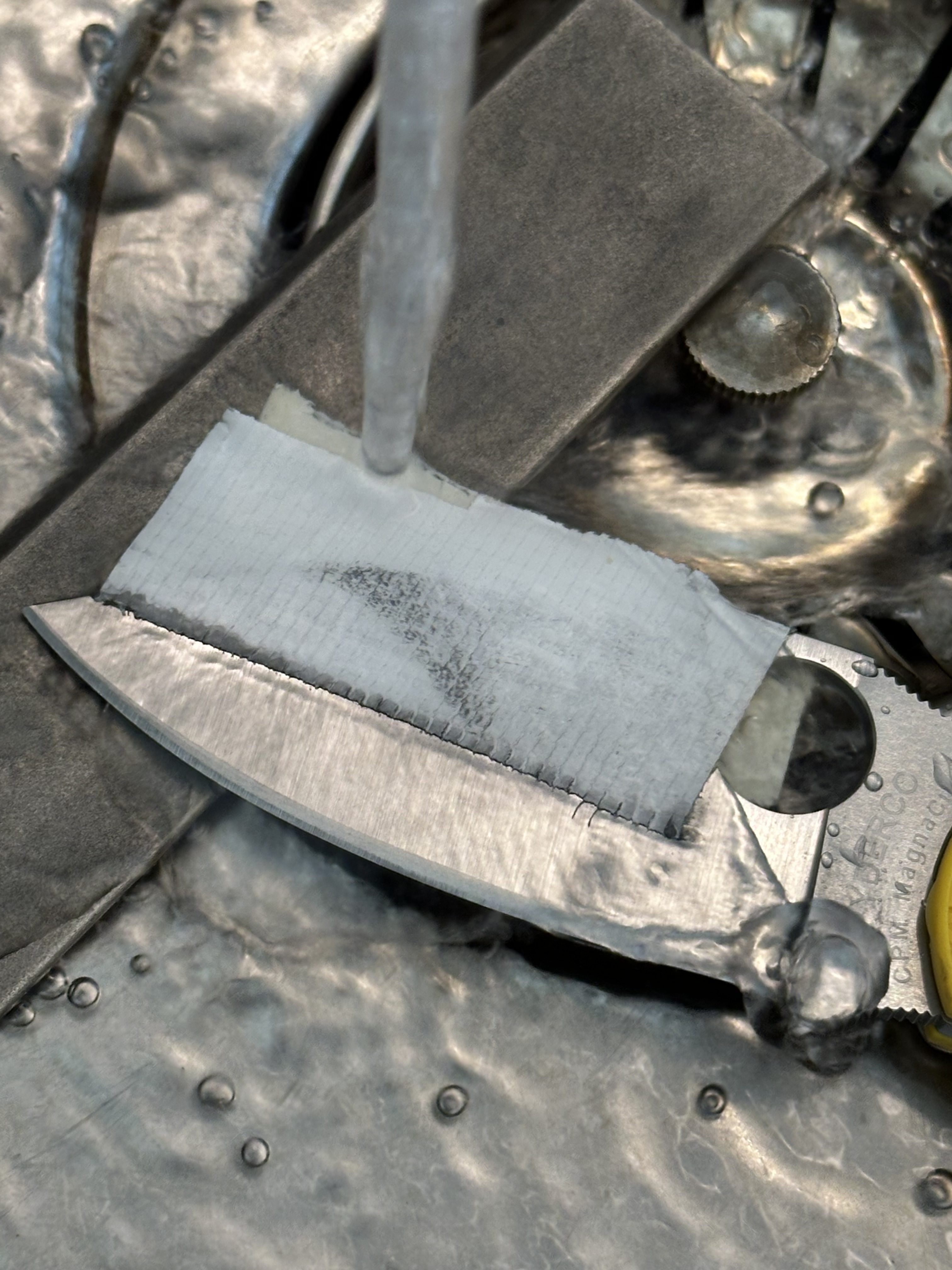
Now it is just a matter to rinse it.

The factory edge still is razor sharp.
But the geometry is improved and it cuts much more easily into hard matter.
In 15 minutes I got an edge like I want. This was made on my Sage Magnacut.

Now with a more convex edge it is easier to strop it on leather.
Magnacut behave a lot like Cruwear and both love leather.
It won’t be that easy on CPM – 15V which needs much more patience !
Anyway a part 2 is now available.

Getting a convex edge with the CPM-15V blade of the Houlahoula Para3 Lightweight.

I have enjoyed the Para3 in CPM15V for a week now and after the first pictures, one of my friend Alexandre wrote to me “Looking forward for a convex edge”.
And I have answered to him that I was not in a hurry to do it on this little wonder of modern cutlery. The steel seemed so hard !
But guess what ? What’s bred in the bone will come out in the flesh.
After a week of frustration trying to get any good (spectacular) result on leather and white ceramic….

Some gaffer is on the blade to protect it from any scratches.
My goal is just to “de-shoulder” the edge, to round it for a better leather stropping experience.

It is not rocket science and I’m clumsy and impatient.
So I’m not helped by natural tendencies.
As you can notice the edge near the guard will have less attention.
My friend JD is able to go even but I’m not to his level in making beautiful edges.

But as you can notice it is getting better.
I use a Double Stuff 2 from Spyderco. Mine is old and the glue between the ceramic slate has gone. The diamond slate is not as efficient as some decades ago but it should bite into CPM15V despite its humungous pourcentage of vanadium.

Since CPM 15V has a high volume (23%) of vanadium carbides (87 HRC) which are harder than the ceramic alumina abrasives. (79 HRC)

That means 23% of the overall microstructure is being pulverized, burnished and adhesively worn to shape rather than cut at the apex.

Over the years I’ve observed a pattern in some folks complaining that these types of steels cannot get very sharp yet the same folks seemingly would refuse to use the abrasive that will cut the remaining 23% of that microstructure cleanly.

I do think that would be fascinating to do a controlled test and look at the differences between the starting sharpness and how that sharpness dies off with cut testing and then compare the loss of sharpness between the two with the same amount of cuts.

I’ve certainly seen this behavior in my personal experience, however, I’ve not documented and shared data publicly.

I’ve mentioned many times that my current favorites for sharpening are the bonded super abrasives rather than the electroplated abrasives. However, there is a cost difference, but in my experience it certainly pays for itself and has better performance.
Shawn Houston on the Spyderco Forums

First look at the result.

Humm it needs to go one more round.

Ah, I am starting to enjoy the result and how the steel takes the light on the belly of the blade.

Now time to put some white compound polish on the leather.

Again I’m not focusing on getting it sharper it but just to polish the edge and remove any scratches. I want a better geometry like I use to have on the Para3 in M390.

CPM15V does not like to give away its particules.
When I have been able to get mirror edges on D2, 52100 or SPY27 I’m not able to get it on 15V. I need certainly to upgrade my equipement and my game for that.
I will polish it on Jade stone and post better results in the coming weeks.
So far I’m happy with the result. More to come later as 15V is not as easy as I thought to work on (JD adviced me “I think diamond past would help with the stropping. Diamonds or cbn can cut the vanadium carbides, of with this steel has a lot”. Not impossible, especially with diamonds but easy. Maxamet on the other side has proven to be much easier to restore even after catastrophic damages.
But I’m very happy with that Para3 which could be the HoulaHoula (*) of folding knives.


(*) Houlahoula are little birds with big balls and when they land they sing “Houla ! Houla !


On the Spyderco Forums Shawn Houston was kind enough to give some advice about how to get a mirror edge on CPM 15V:

“I recommend skipping the White Ceramic and Jade.
23% of the matrix in the 15V is harder than those abrasives.
A bonded diamond/cBN stone should help with the desired finish.


You deburr the best you can with light alternating passes on the stone. From here, the edge should be sharp enough to cut paper cleanly before moving on. Afterwards, go to a leather strop loaded with 1um Gunny Juice and use alternating edge trailing passes.

This is a good benchmark; keeps the “bite” at the edge without smoothing out the slicing effect. It also helps keep the “grab” at the edge for draw cuts but still keen enough for push cuts.

There’s different kinds of stones. They’re not all created equal.
You can take a diamond stone with the same abrasive and the same grit and it will leave a different surface roughness depending on the construction of the stone.
Yes, there are three major types of bonded stone.

Metallic, resin and vitrified.

There’s even some that are hybrids. However, these are not the same as electroplated diamond abrasives.The work more like regular water stones with better surface finishes.

“Diamond or CBN are the way. You can put a functional edge on 15V with ceramics, but if you’re wanting the real performance 15V has to offer, you need to sharpen with abrasives that will cut the carbides in the steel.”
Wandering_About on the Forums has sum it up.

Shawn Houston was also kind enough to share an AI summary of Instagram Reviews.

Based on the latest set of reviews, BBB CPM 15V steel demonstrates exceptional performance and user satisfaction.

Performance:
* Excellent edge retention: Maintains a sharp edge for extended periods, even with demanding use (e.g., cutting blackberry roots, heavy use).
* High edge stability: Resistant to chipping and rolling, even with hard use.
* Versatile: Performs well with different edge angles and finishes (from toothy to mirror).

Comparisons:
* Compared to K390, Maxamet, S90V: Sharpening is considered easier than K390 and Maxamet.
* Compared to M4: Sharpening is considered comparable in difficulty to M4.

Key findings:
* Sharpening Ease: Despite its high hardness and carbide content, 15V is surprisingly easy to sharpen. Users report successful sharpening experiences on a variety of tools, from diamond stones and CBN plates to simpler systems. Burr removal is consistently described as effortless.
* Edge Retention and Stability: 15V exhibits excellent edge retention, maintaining sharpness through demanding tasks and heavy use. It also demonstrates high edge stability, showing resistance to chipping and rolling.

* Versatility: The steel is versatile, capable of achieving both aggressive, toothy edges and refined, smooth edges.
* User Enthusiasm: Many users express high levels of satisfaction with 15V, with some even considering it their favorite steel.
Overall:
BBB CPM 15V appears to be a top-tier steel that effectively balances exceptional performance with user-friendly sharpening characteristics. Its combination of edge retention, stability, and ease of use makes it a strong contender for demanding tasks and a highly recommended choice for knife enthusiasts.”


Spyderco Roadie XL C267BK – Part II – Shattered Tip.

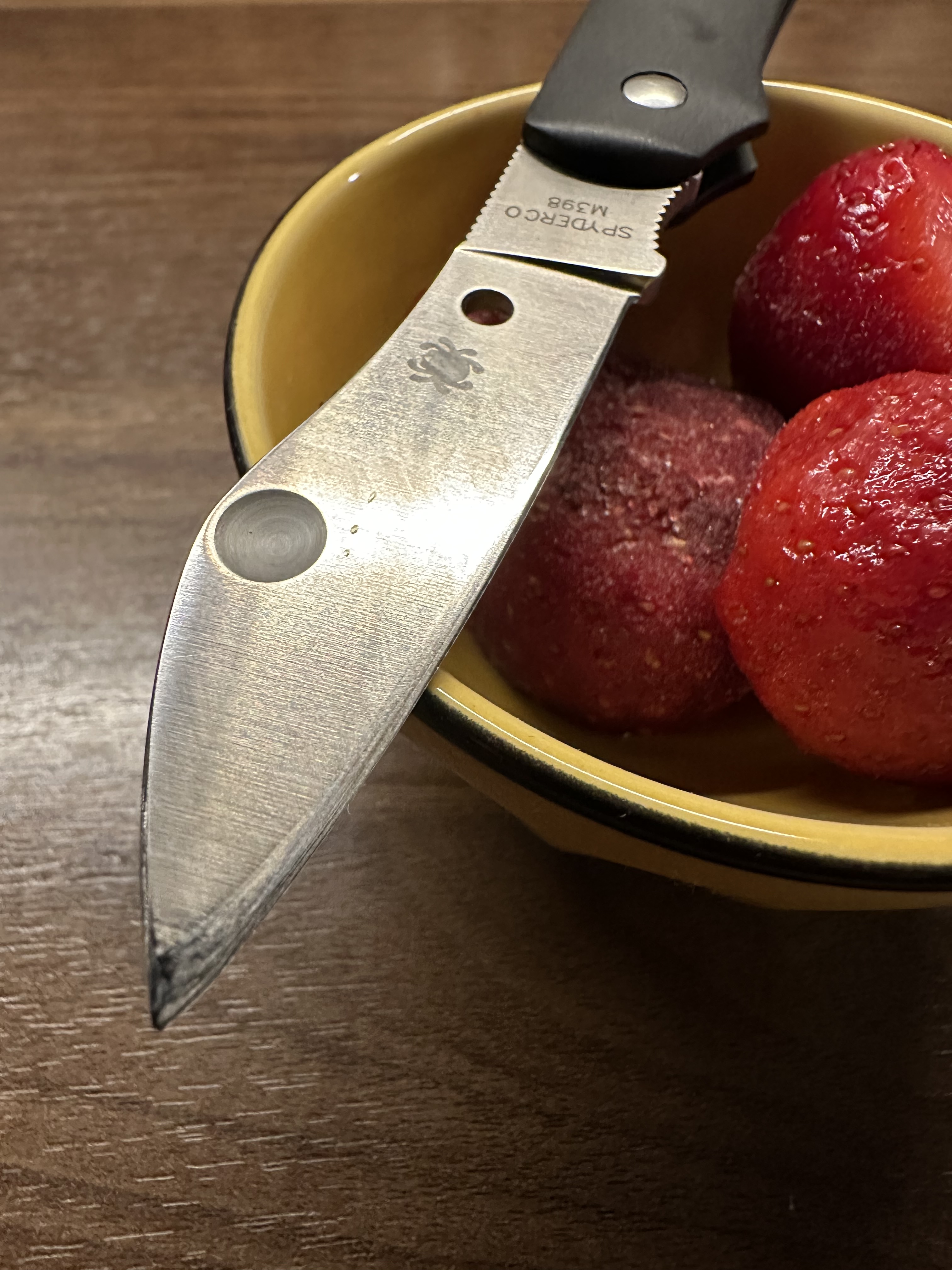
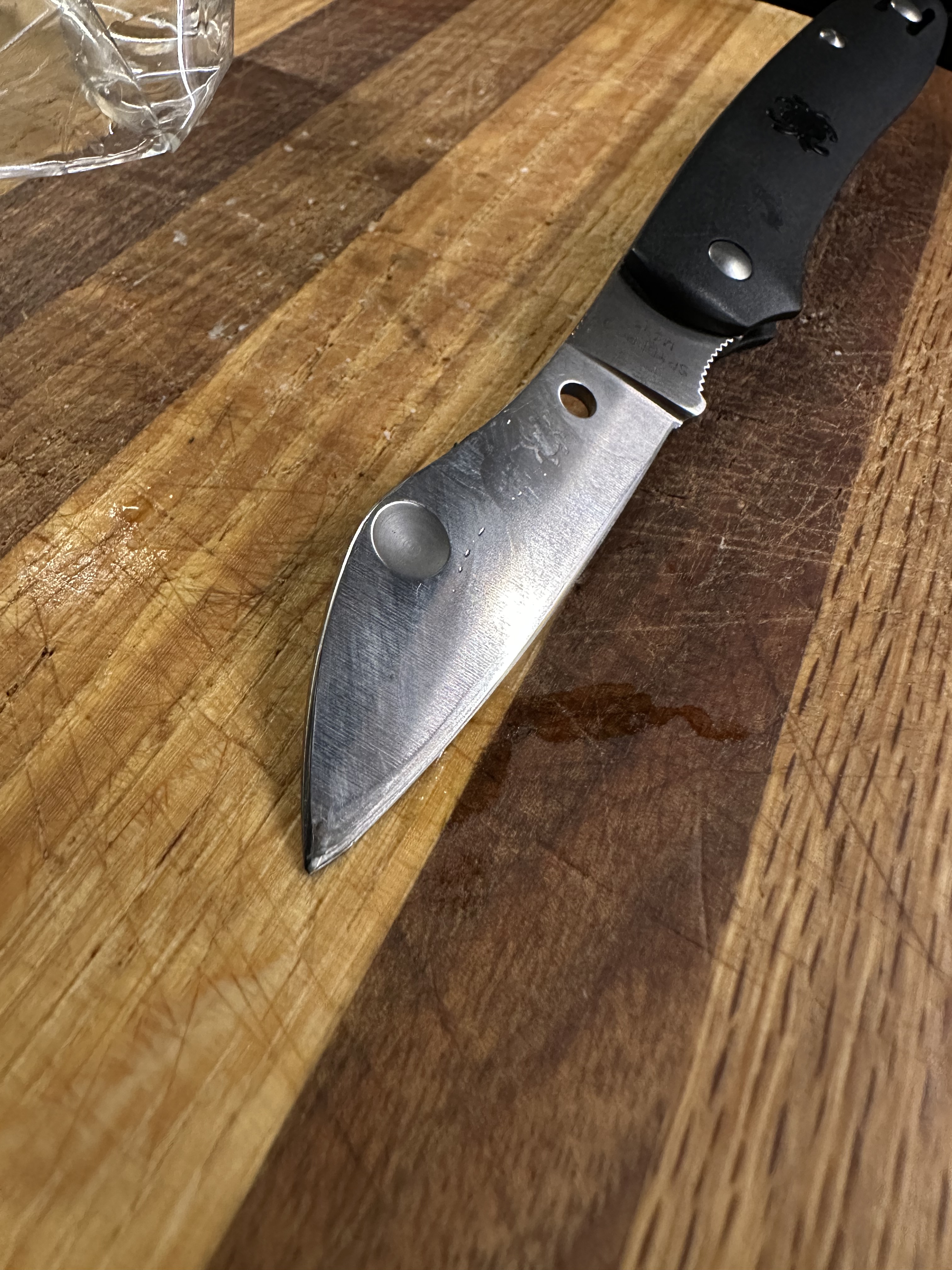
M398 is a fragile steel compared to M390. The encounter of the tip of the Roadie XL with a tile of my kitchen has been definitive. One mm has been shattered and now I got a micro flat screwdriver as a tip.
OK. Diamonds are steels best friend.
I’m able to form a new tip in a diamond shape.

For now I won’t baby that Roadie XL anymore. I decide to thin the edge.

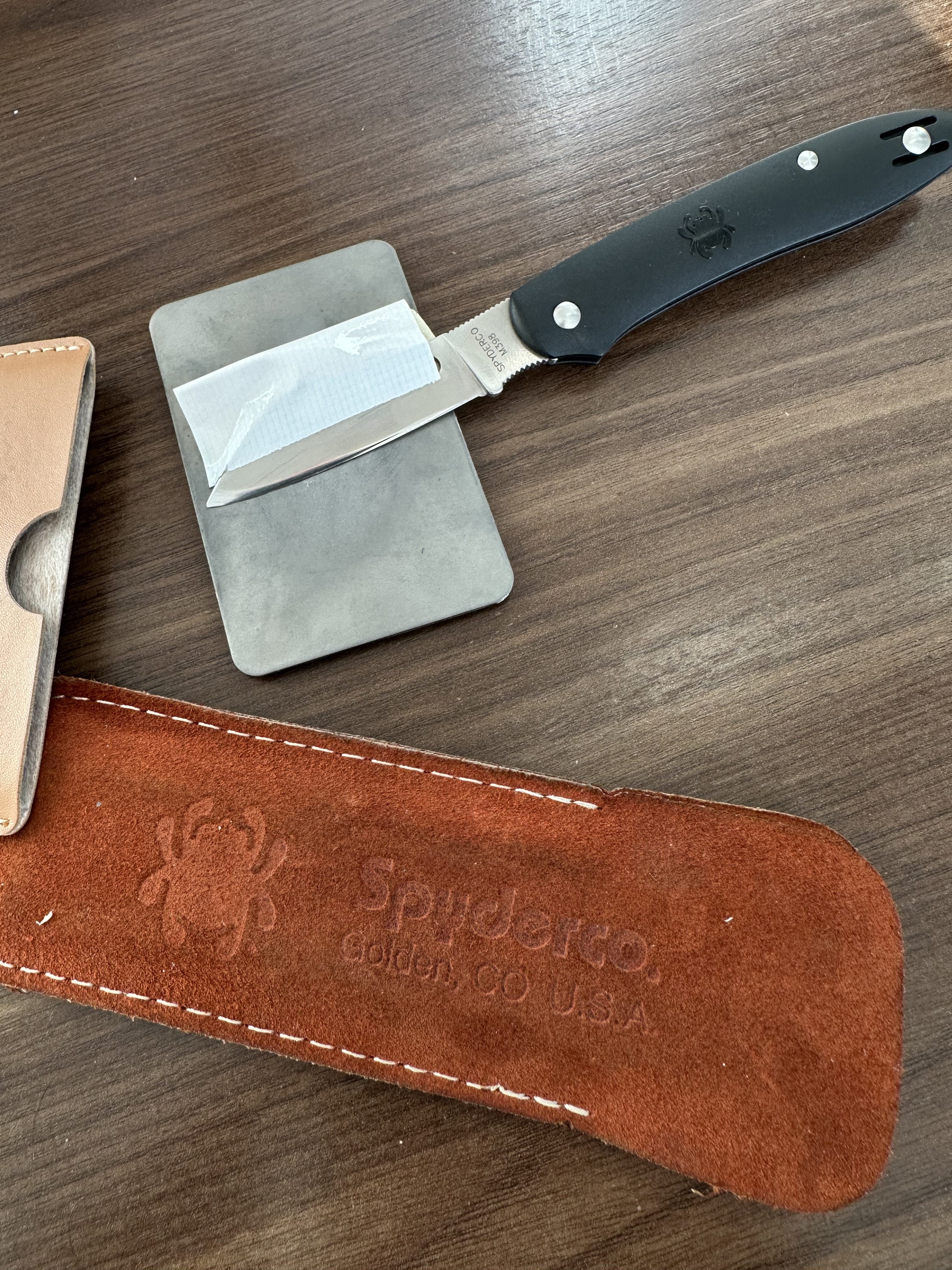
The best way is to protect the blade to avoid any big scratches.

Then it is time to play with industrial diamonds.

I will also use some diamond rod to round the jimping.

Of course I’m enough clumsy to scratch the blade twice and I’m obliged to use some diamond paste to treat the surface.

Then some polishing paste on the leather to slowly makes it like a mirror.

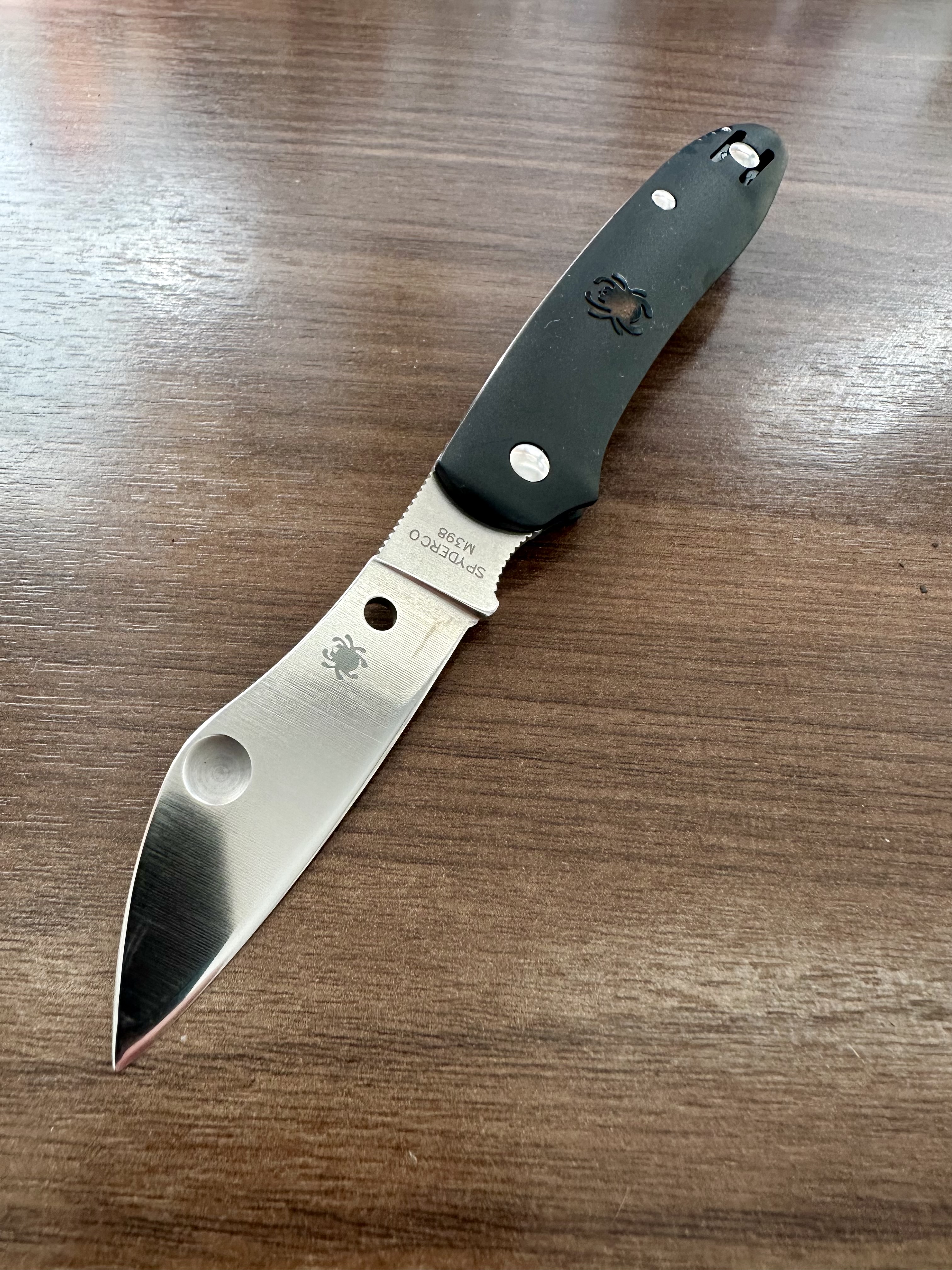
I’m quite happy with the result.

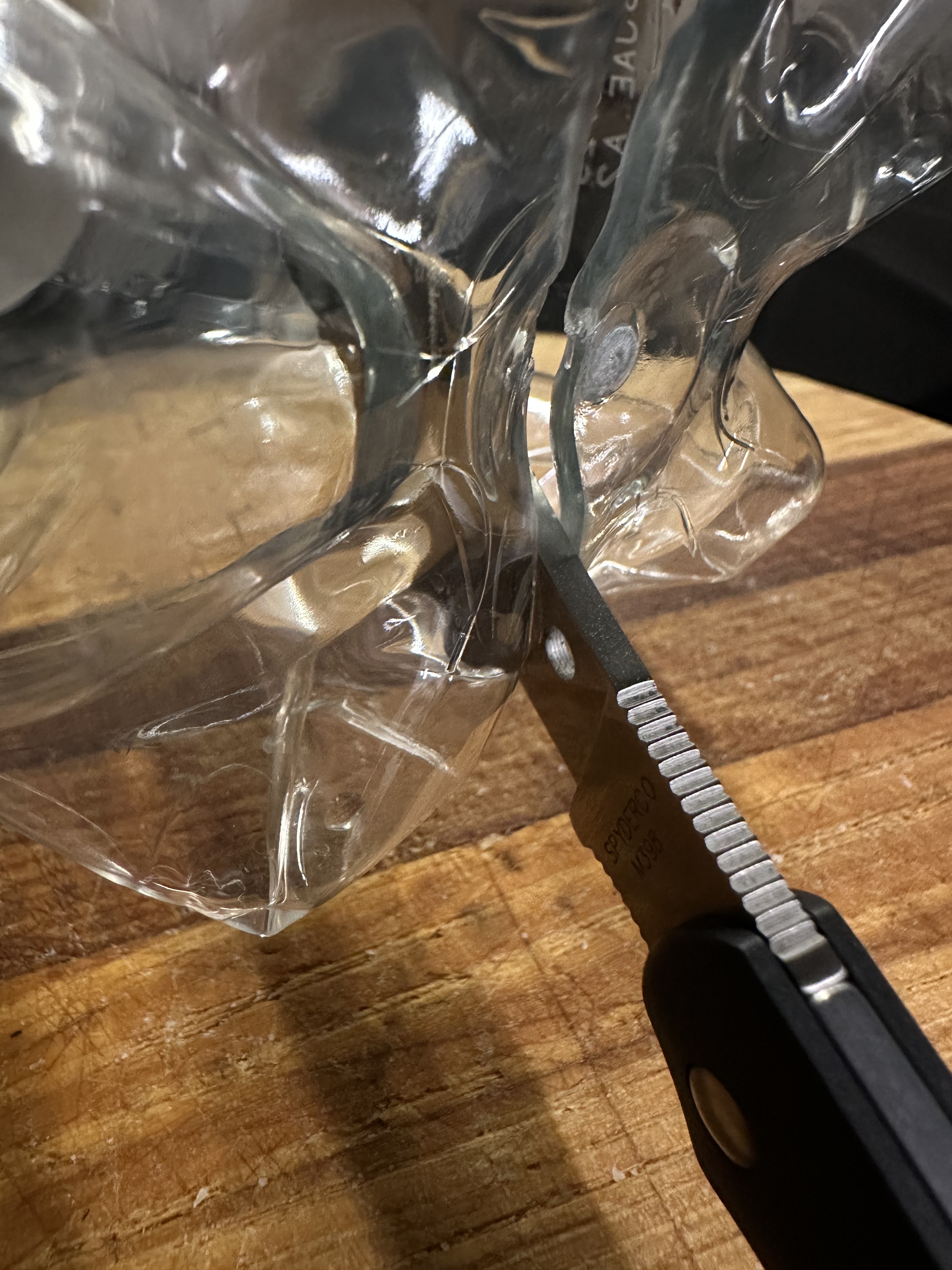
Time to test this new geometry. The edge has been convexed and thinned it should cut much better.

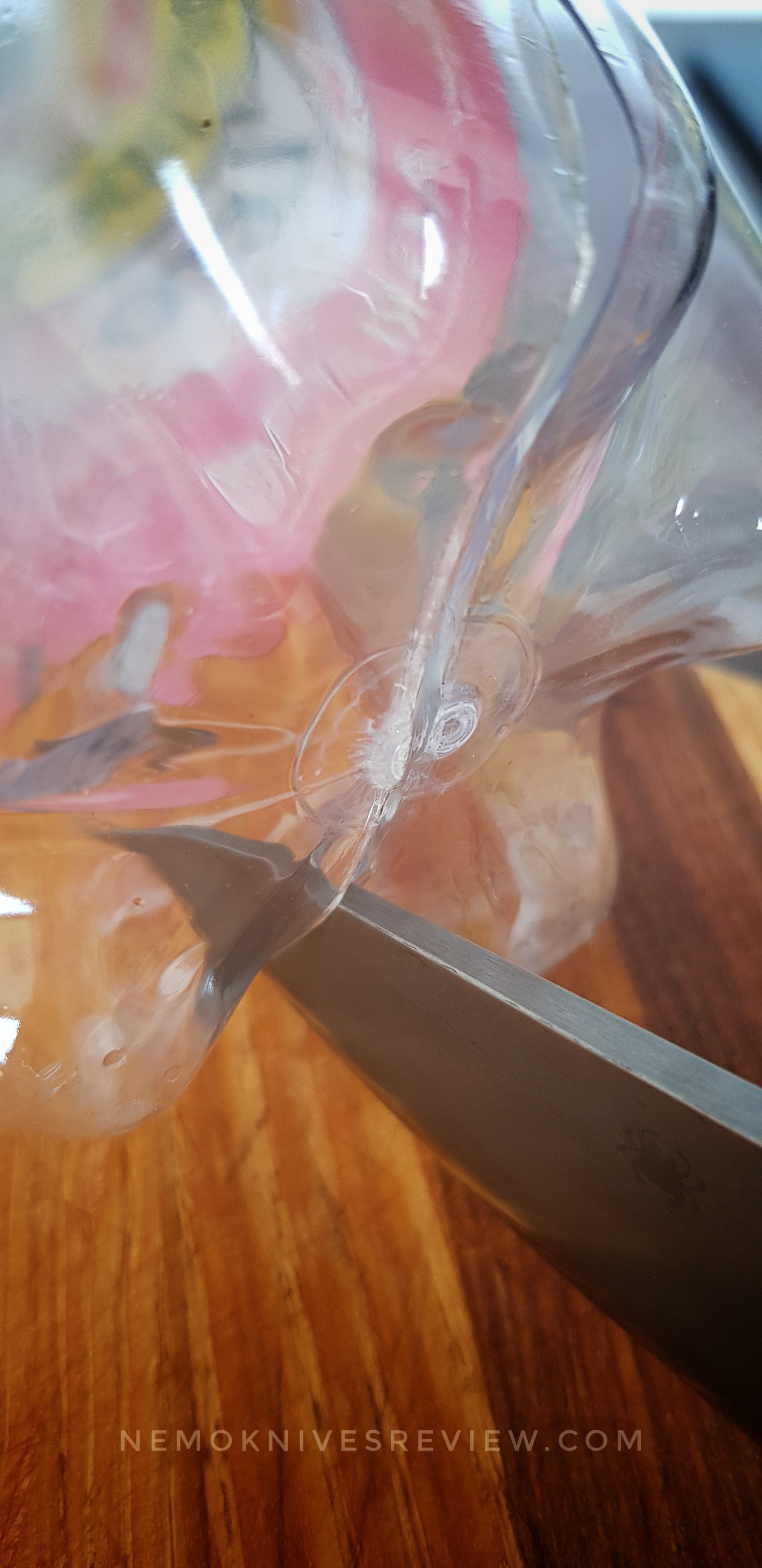
One of the most difficult task is to cut in two the butt of a two liters plastic bottle. This is a test my Scandi blades fail all the time. Any Opinel is king in that. Or the Manly Wasp ! My favorite being the Nilakka.

As a whittler it goes deep in wood.

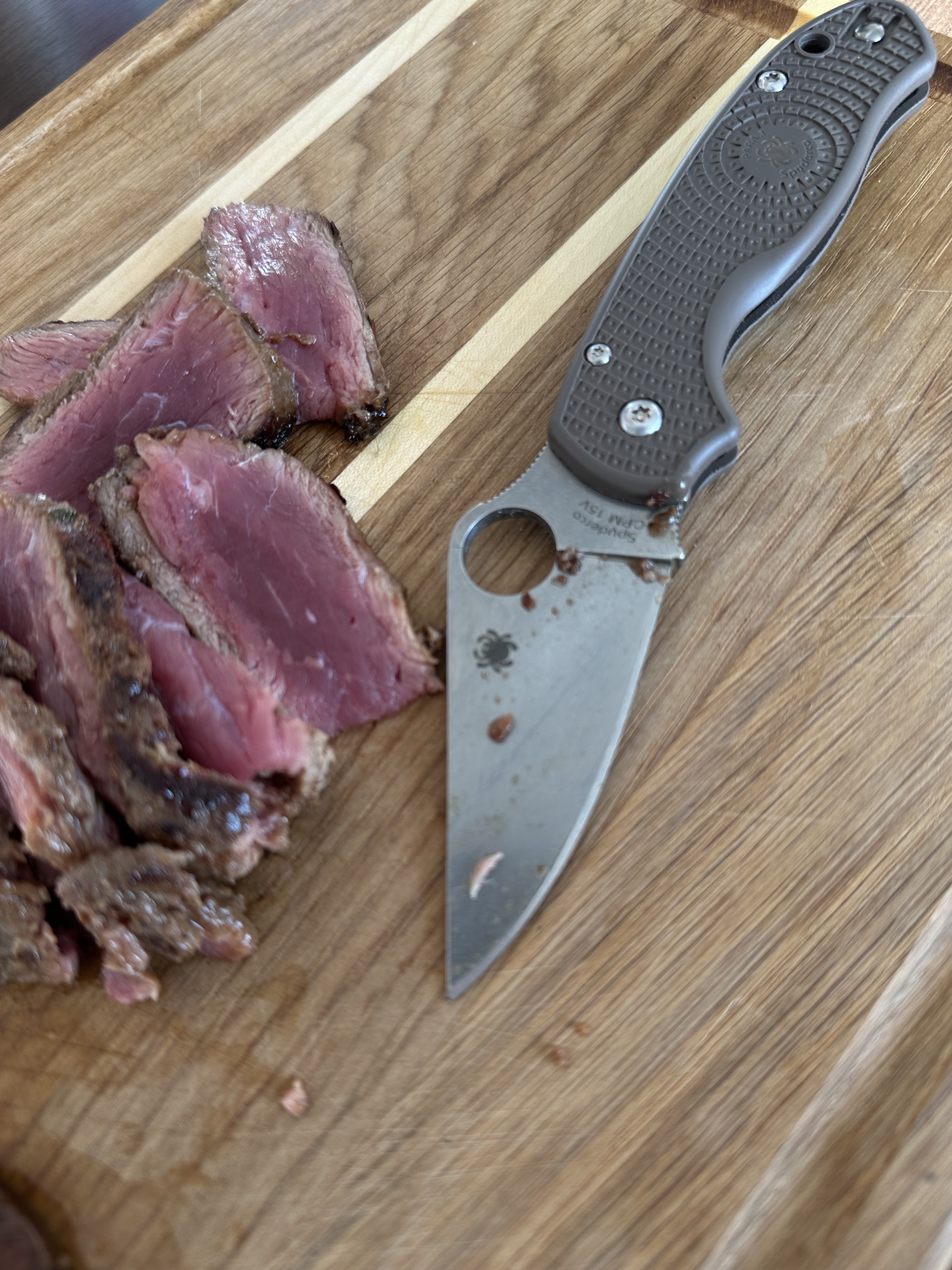
As a steak knife, the shape of the blade brings only the new tip in contact with the ceramic of the plate.

That new tip is strong enough to be able to pierce a metal lid of a green bean jar. A hole pierce help the release of the lid on some jar.
No damage no more.
Now the Roadie XL cuts much butter.

Benchmade BM275 Adamas part 2: Reprofiling – From Puff Daddy to Daddy Cool !

It’s time to de-shoulder that Benchmade Adamas‘s edge and to convex it a little to my own taste.
My tools are Spyderco Stuff 2 with diamonds, Fallkniven DC4 and leather strop.

First thing I will do is remove the stud which are in the way. I have found/learned that the hard way just by testing the angle, I have scratched them.

Two T6 torxs are necessary. One on each side.

Cerakote protection is found even inside the stub hole. In fact I was really tempted to remove it for good as the Adamas is so easy to open and close just by manipulating the Axis Lock button. But sometimes I need to be able to open it one hand and slowly too…

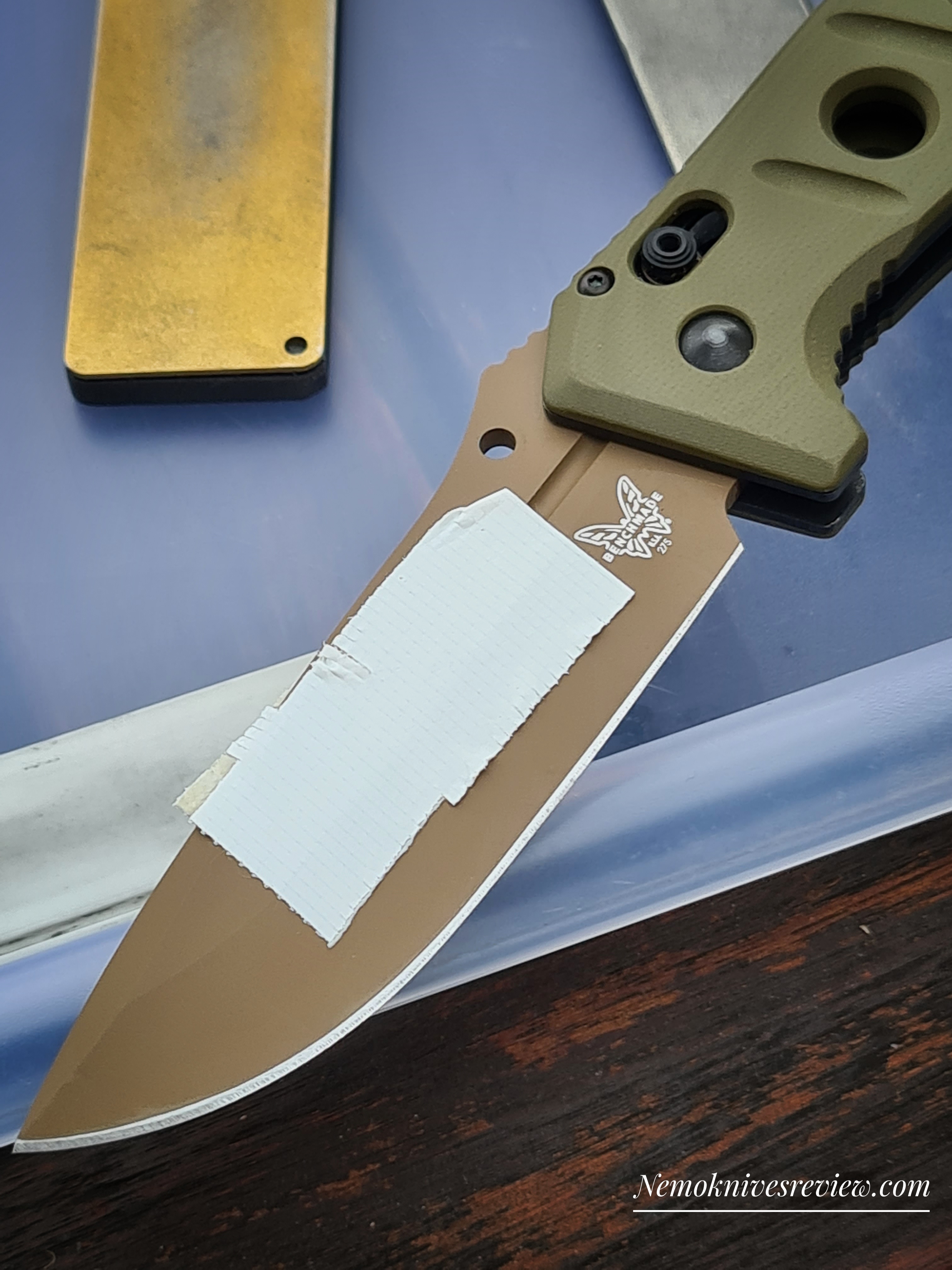
Next step is to protect each side of the blade, as I don’t want cerakote to be scratched… yet. I use white gaffer for that.

Slowly the edge is convexed and thinned. CPM Cruwear at 64 HRC is hard and diamonds are mandatory. It is a slow process all made by free hand.

Leather stropping is apply next. Again this is made slowly.

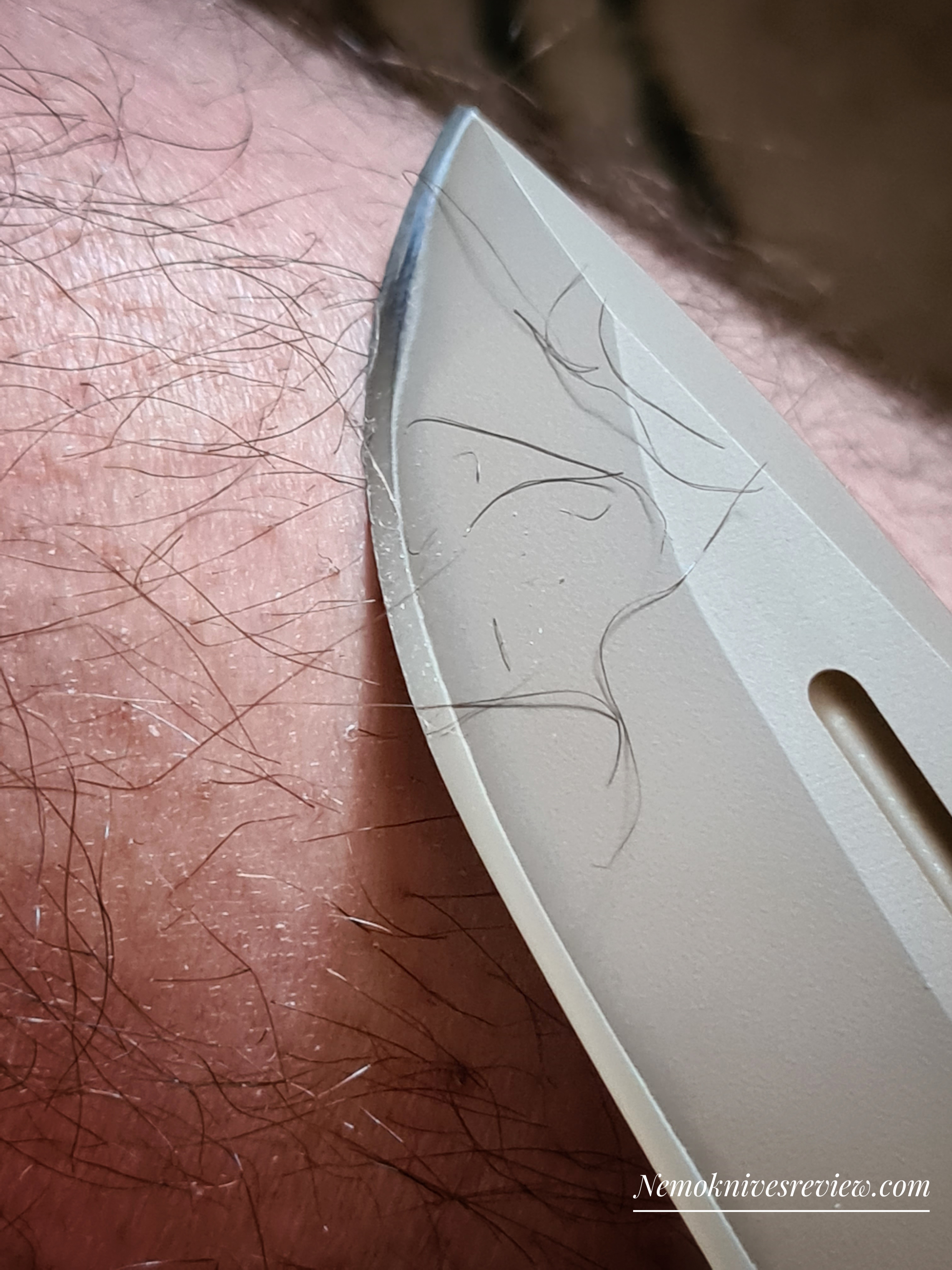
Soon this is a razorblade popping hairs just in one caress.

The Soda Bottle Butt Test was not passed in my previous test.
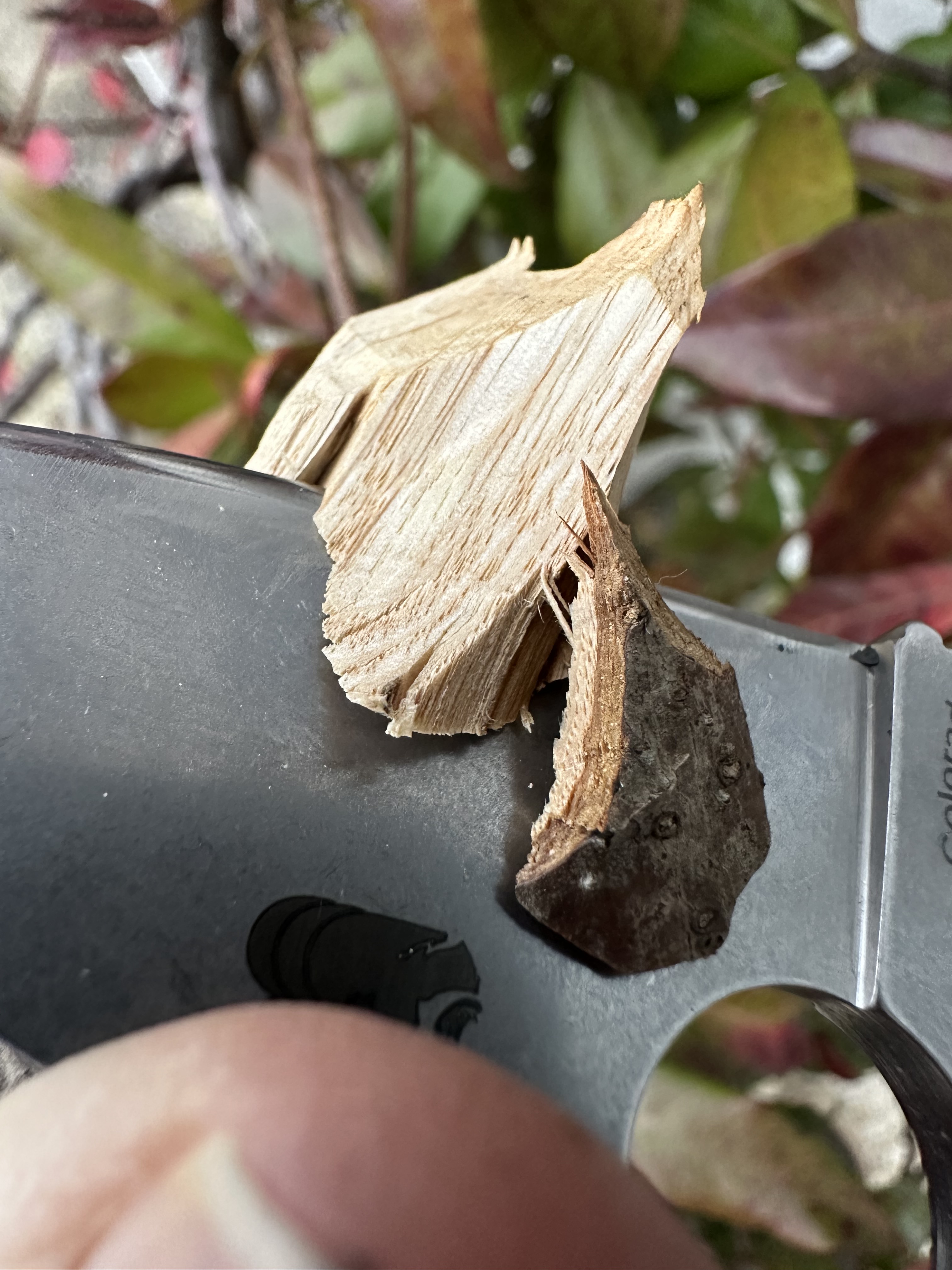
This is the reason I have decided to thin the edge of the Adamas in the first place.
Now it goes steady in like in butter.

The center of the butt is much thicker and harder to pass as the bottom can collapse. This is really my geometry test and many famous knives were not able to pass it.

The Adamas is now much better in terms of pushcutting and its steel (CPM Cruwear) is perfect for a thinner edge.
The stud has been put back and the big folder is ready !
Easy peazy lemon squizzy. It took me 1 hour.

Benchmade 200 Puukko – Call me Snake.

This is the first Benchmade’s review for a long time. Why ? Not because of the quality of Les De Asis company’s products but because I was not really excited by their production in the last decade after a huge love with their AFCK back in 90’s, and also with Nimravus and all those blades in M2HS which is a tungsten high speed steel, the granddaddy of CPM M4.
I still got a AFCK in M2HSS and browsing that blog, you will find it here.

So here we go, two words has caught my attention on that new Benchmade: Puukko and CPM3V.

“CPM 3V is a high toughness, wear-resistant tool steel made by the Crucible Particle Metallurgy process. It is designed to provide maximum resistance to breakage and chipping in a high wear-resistance steel. It offers impact resistance greater than A2, D2, Cru-Wear, or CPM M4, approaching the levels provided by S7 and other shock resistant grades. CPM 3V is intended to be used at 58/60 HRC in applications where chronic breakage and chipping are encountered in other tool steels, but where the wear properties of a high alloy steel are required.” Source Crucible.

COMPOSITION
C Mn Si Cr Mo V
0.80 0.30 1.00 7.50 1.30 2.75

To quote my friend Max Wedge:
“3V loses 1/3 of the toughness going from 58hrc to 60 hrc (still 1/3 above A2 at 60 hrc, and A2 is indestructible… almost). Both 4V and Cruware start to shine around 60-62 Hrc… so, 3V for choppers, 4V or Cruware for slicers, Cruware having best corrosion resistance ( trait appreciated by soldiers & foresters)”

So this tough short blade made of chopper steel is at a very good bargain !! Let see what it is all about.

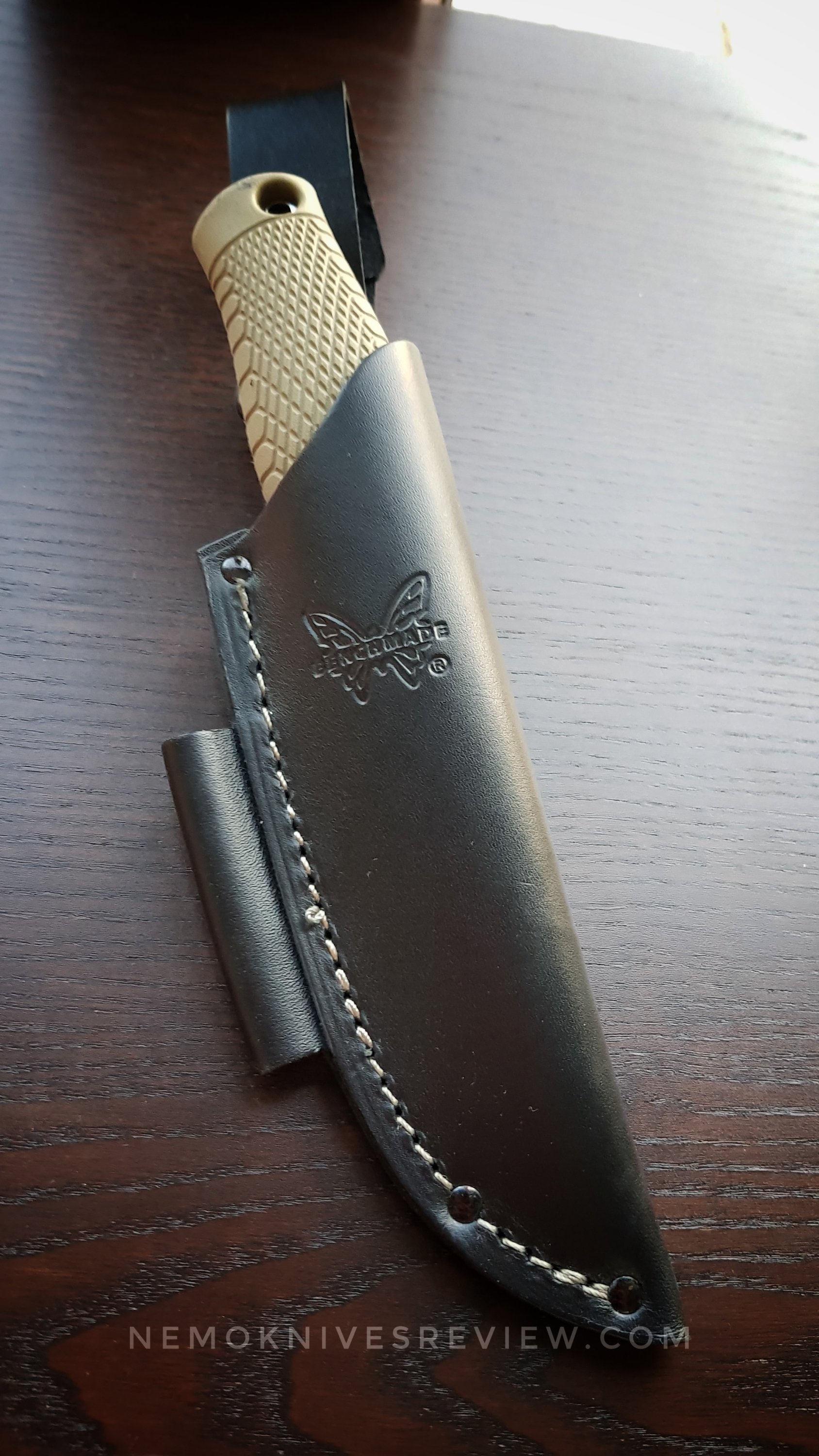
The leather sheath is beautiful even (if there is a loop in the stitching… I will upgrade it into a kydex for pocket carry.) and cleverly designed as a dangler. You can remove the loop to transform it into a classical sheath.
There is a place for sparkling rod in the Bushcraft fashion. I don’t care about carry a knife of that size attached to my belt. I prefer to have it inside my pocket or my bag.

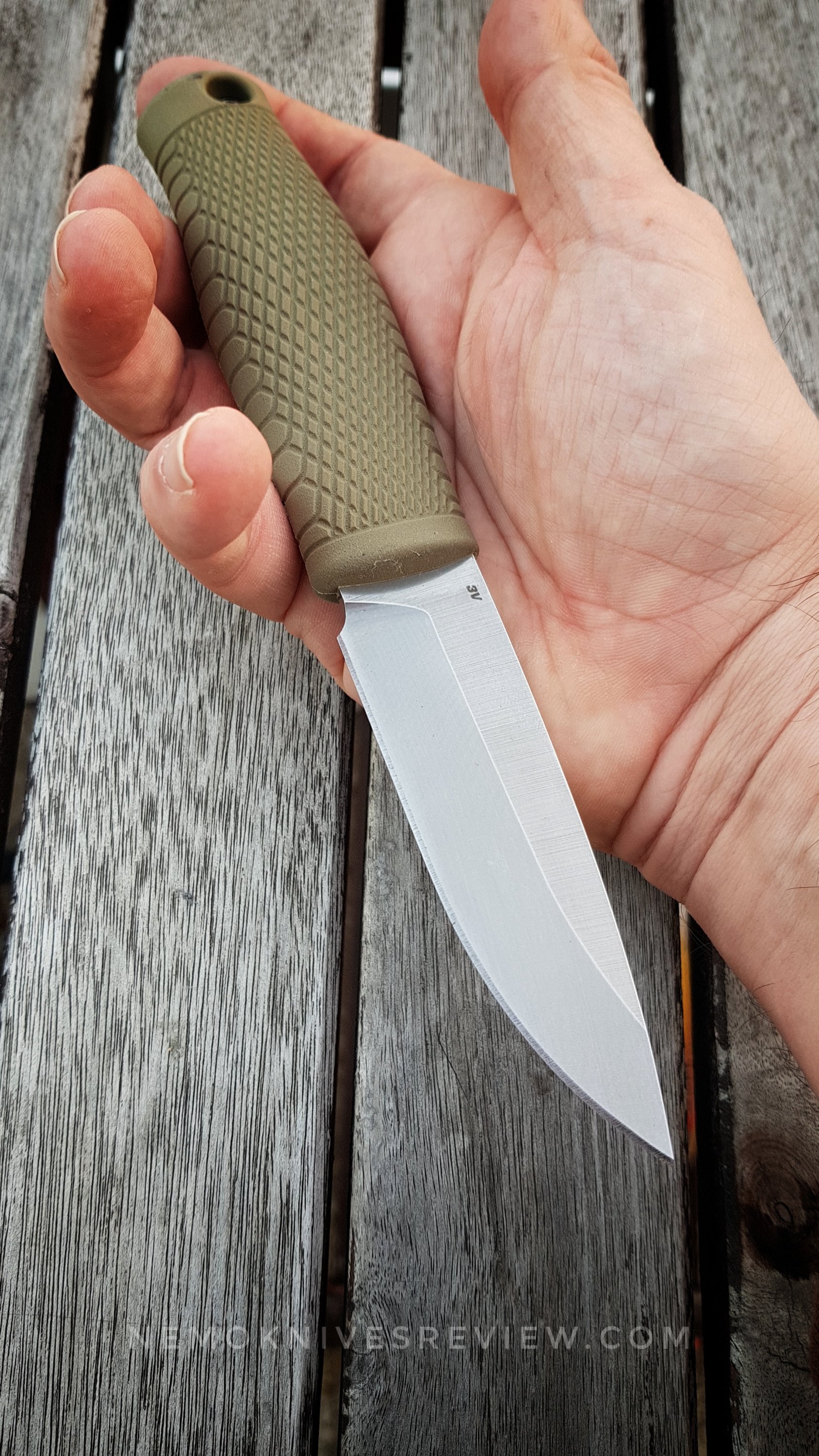
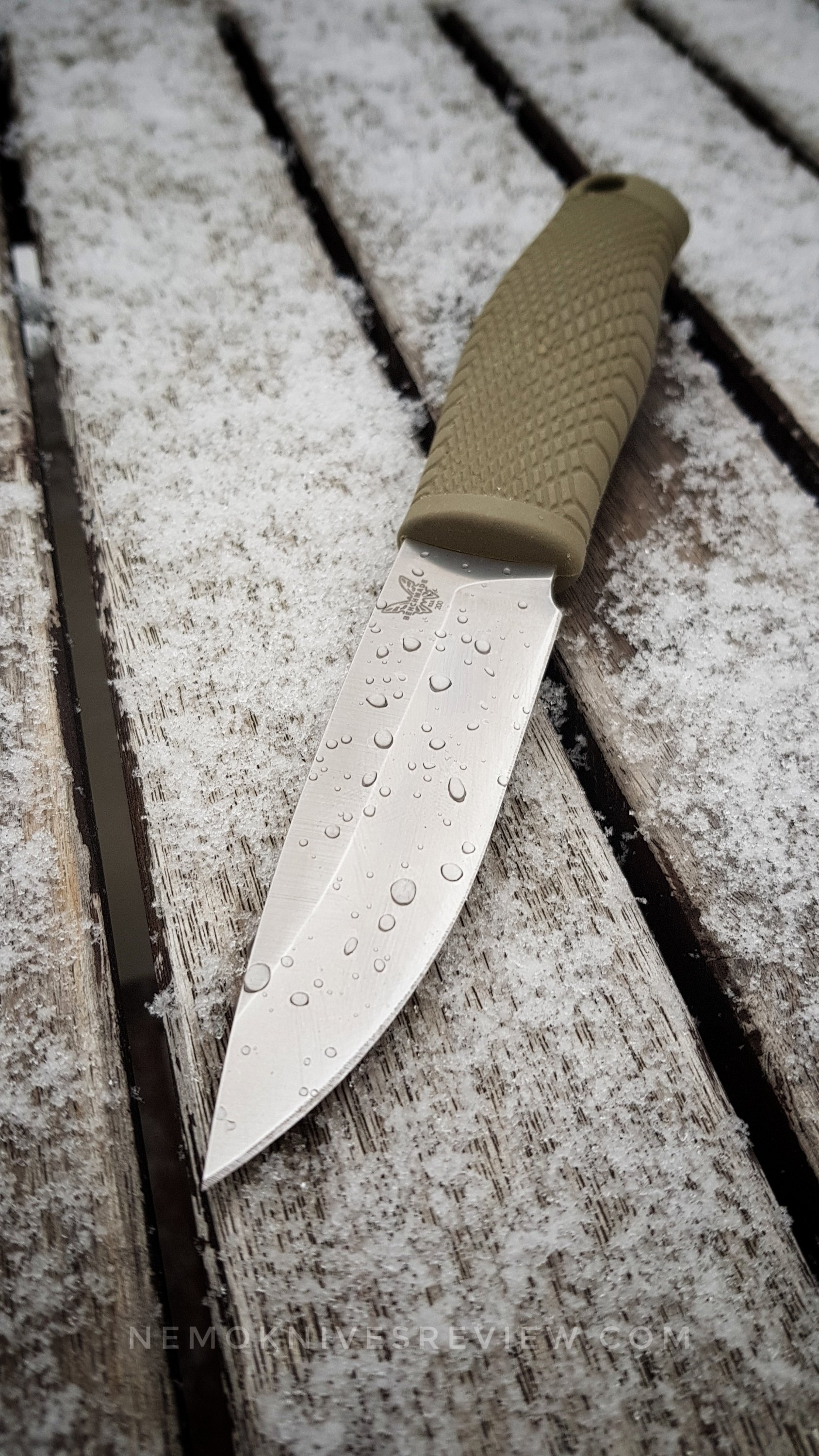
The blade is an eye candy for some reason it reminds me the small SOG Seal Pup knife with no false edge but that’s me… Is this a Puukko ?

That handle is made in some kinf of thermorun… but it is rubberized Santoprene is a soft, non-hygroscopic elastomer which exhibits excellent surface appearance, a durable soft-touch feel, excellent colorability and excellent “processability”… made by Exxon.

It is made from underground forgotten dinosaurs and jurassic biomass aka “petroleum” hence the look of scales on it ?  Because that handle looks like some sort of snake or cold blood creature. I love it.

Now is this a scandi ground blade ? Nope. There is a secondary bevel. Is the knife sharp ? Yep, very sharp but could be better. Later/soon on that.

It is a hidden tang construction and you can see the steel in the lanyard hole. This knife is solid as CPM3V is really tough !!
Hidden tang are great when you work in cold weather, protecting your hand from a frozen steel.

That blade is short but handy: it asks to be used hard like… Snake Plissken’s hard actually ! Because 3V is magic in toughness ! 😀

Compared to a Mora or the Urban Hunter (from Pekka Tuominen) the Benchmade 200 stands its ground.

Here are two vision of CPM3V industrial use. Ed Schempp Spyderco Tuff is pure business. So that BM200 should be even tougher as a fixed blade.

Teamed with a Manly Wasp, you got a great combo.


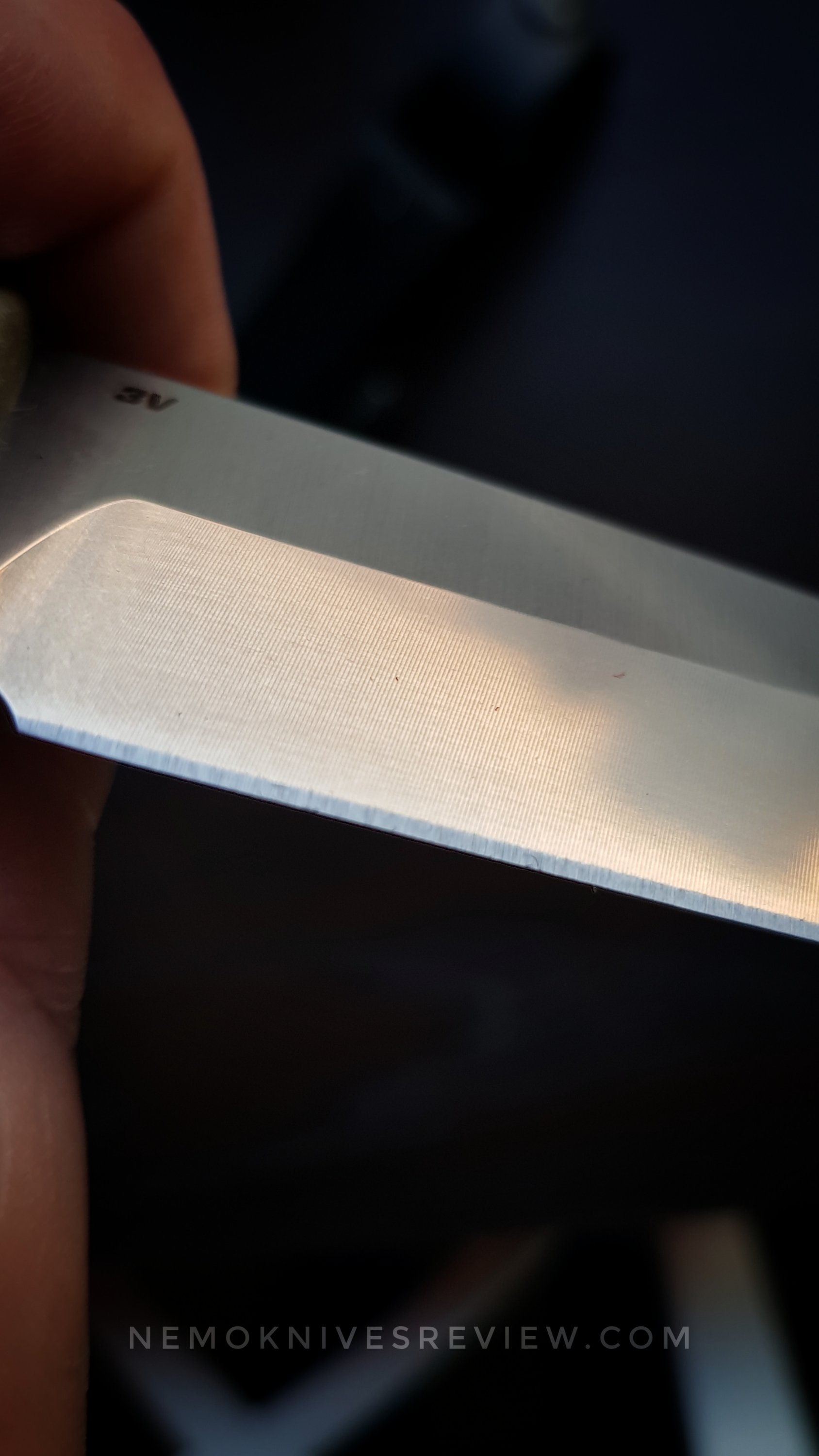
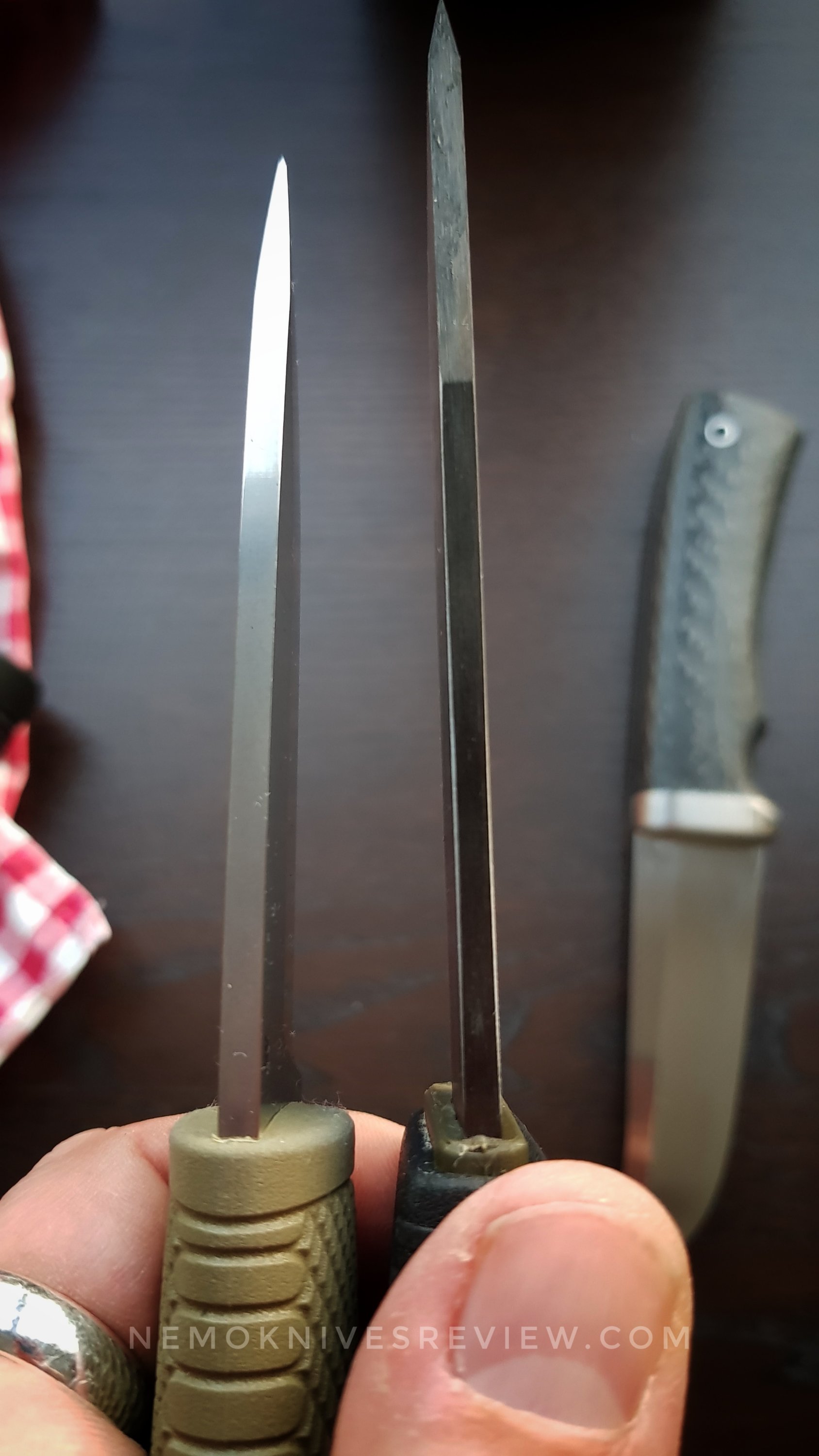
But a puukko (in my book) needs a thinner edge and it is time to scratch that blade to de-shoulder all that. Diamonds do scratches but then scratches will be polished later. Thinner convexed edge is destin to go deep and get twisted; this is a tough steel.

Diamonds, ceramic and leather. Who needs more ?  CPM 3V is really like chewing gum you need abrasive medium to form that convex edge.

A some compound with the leather stropping is mandatory to erase those scratches

See ? Now it is convexed and will be smooth on whittling wood. No worry for that edge stability again 3V is perfect for that use.

Standing next my Serrata which is my only naturally serrated knife.

So now, I just need some white ceramic to keep it sharp and some stropping. It is ready for testing. The Puukko shape is more for me a “Coutelas de Rahan” shape actually (French people will understand but here is the link: Rahan in Wikipedia.
making this little tough knife very appealing to bring it everywhere.
Everywhere is a good point to start. 😉

20190122_092816-017697724220268595202.jpeg

Convexing Cruwear!

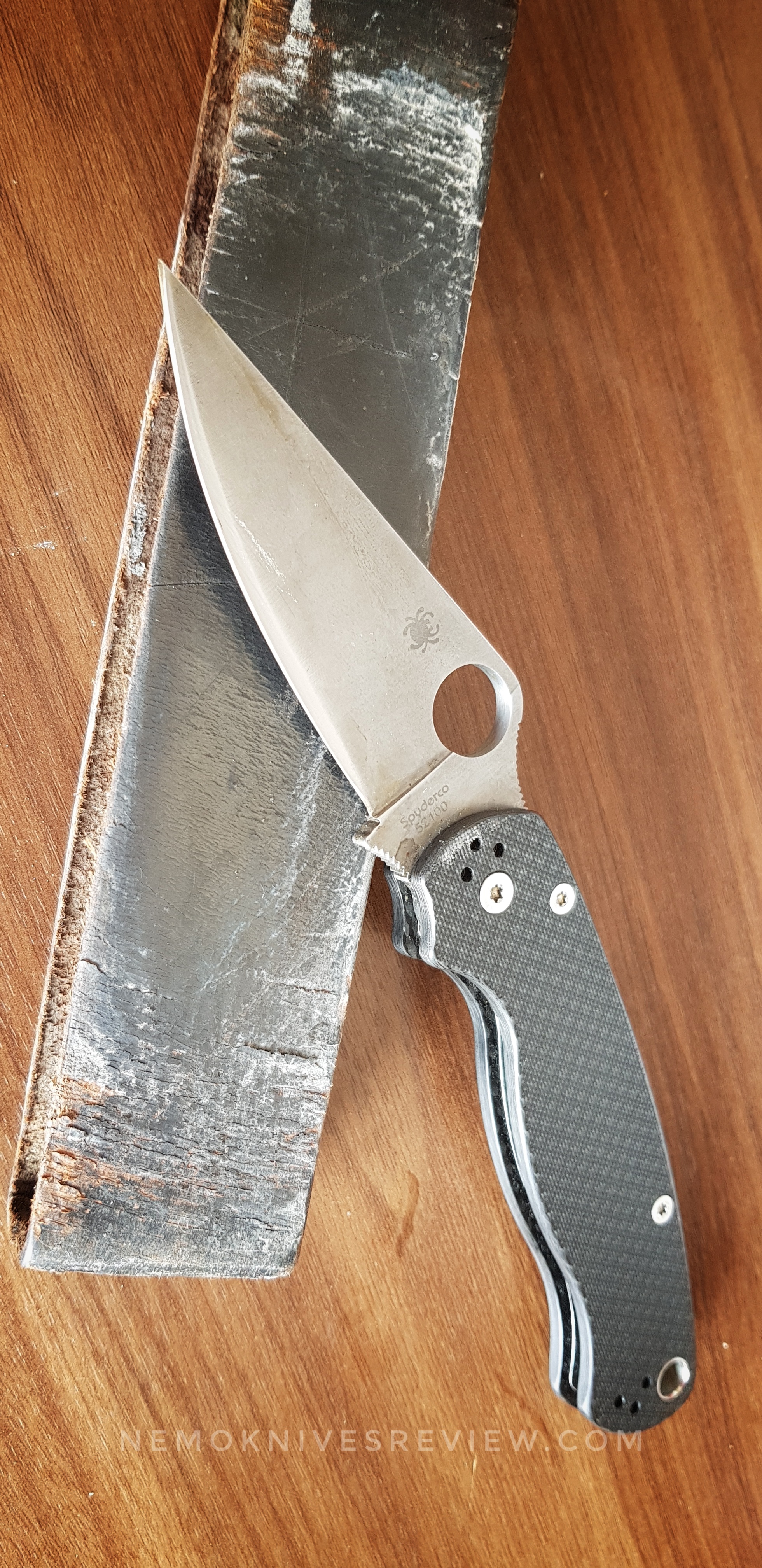
This time I have decided since the blade of this Paramillie is thin, to protect it with some gaffer tape.

Same process as usual: diamonds, then ceramic and stropping on leather.
The DC4 of Fallkniven and the Spyderco Double Stuff 2 were used.
I got also an old barber leather I use with some polish.

I use the diamonds to remove the shoulder of the edge to round it a little, this is where you can scratch the blade as the angle used is very shallow.
Once you see the edge is widen, you can switch to tsone and ceramics mainly to smooth the scratches made by the diamonds.
It is very simple and just ask for time and patience.

Cruwear is stropping friendly much less than 52100 though.

20180921_1838251677222632477732001.jpg

20180921_1923527993727319998866233.jpg

Edit of the 24th of September:

More convexing after failing to Patina

20180924_180342-014337770595947064602.jpeg

52100 A guilty pleasure !

20180823_111120-01.jpeg

As you know my experience with 52100 has been enhanced with the owning of a great Paramillie 2 Sprint Run. This steel is staining and pitting just by gazing at it hence the forced patina I have done to protect the pivot’s hidden part.

But then ? After almost a year of rotation how 52100 has behaved ?

“52100 will take a very keen edge. What is often called “sticky sharp” or “a hungry edge.” said Sal in March 2018.  He also said he wanted a Millie in 52100 to be used as Mountain knife.
And this is true. Like SuperBlue steel ! Those folding razor steel are flirting with lightsabers and are strong. Of course you don’t use your folders like a fixed blade as the pivot and lock can be weaker than a tang. “Batoning” (if any) with a folder should be made with the blade unlocked to avoid any stress on the locking mechanism. But lateral blade jolting inside the cutting medium is commun. I do that in plastics when It got resistance but it can happen inside a wooden knot too. So lateral strength especially on a thin pointy blade like the Millie/paramillie and Para3 is not a luxury as is also edge stability.

20180823_110915-01.jpeg

But the greatest joy and satisfaction in owning a 52100 blade is in its honing. This steel is made for leather stropping. In two passes it already get back to razor. Of course, I had convexed the blade to a very thin edge. In a simple 2 minutes round, after a full day of using, your knife is back to uncanny sharpness. This is so satisfying !!

20180823_110654-02.jpeg

The thick bottom of any plastic plastic soda bottle is my favorite test for geometry and bite as it can collapse under the force if not thin enough. The Nilakka is the queen in that game. But my full flat ground blade are all convexed to achieve powerful and controlled cuts. The thinnest of the bunch are my 72100 et CPM M4.

Ghost my CPM M4 millie has been used on various cutting duty involving food and grease as has been my 52100 Paramillie. I don’t do cutting ropes tests or anything which can be numbered, I go with the feeling. Even if I enjoy reading those tests it’s “quantity” over “quality” as a blade is 33% steel 33% heat treatment and 33% blade geometry. Cutting hard wood, looking and touching the wood’s grain and the cut fibers and how the edge behave when twisted inside is my way ad as 52100 is also used in razors: shaving sticks of hard wood is done with ease and control.

For Ed Fowler (grand manitou of forging 52100) when carefully forged and heat treated, this is the most versatile and dependable steel available to the knife industry. He feels that a man who depends on his knife deserves and needs the most reliable knife possible that will not bend easily or break when he needs it the most. A knife that can be sharpened easily and is friendly to his hand.

Ed got a very oldtimer advice for keeping his 52100 blade rust free:
“Any oil will keep rust from the blade, many times I simply apply the oil from the side of my nose or from behind my ear…”
One thing is certain: the more you use your 52100 blade, the more you check it and oil it with your hands.

Appleton_Ron Fowler Sheep-w.jpg

Ed is not stranger to folding knives as he has teamed up with Ron Appleton and forged the blade out of 52100 for his “Chub” in 2001. Ron wanted to create a folding knife that would be capable of withstanding the rigorous demands of a straight blade user.

Our friend Ed Schempp is another fan of 52100 here what he was saying about it in 2005
“52100 is a very good steel. Ed Fowler has spent a life time tweaking this steel to improve performance. With multiple thermal cycles, normalizing and interrupted quenches, and low temp forging has accomplished and extremely fine grained steel.
Most of the time a good smith can further refine the grain on production steel. Some of the grain can be smaller then but not of the homogenous size that Crucible attains in their CPM products.
This translates to a finer cutting edge that can be sharper than S30V. This edge will not necessarily last as long as a high Vanadium steel like S30V, but can a higher initial sharpness.
The thermal treatment to bring the best of what 52100 has to offer will be expensive, although a simple heat treatment will still bring forward a good amount of what the steel has to offer. Differentially hardened blades would be very difficult to do commercially.”

So 52100 is still a guilty pleasure, because you know it will stain, it will need maintenance but when it come to using it hard and hone it back to sharp, this steel shows is true colors !

20180823_111212-01.jpeg


.


The Spyderco PPT Round 2 — The Son of Anarchy.

20180424_184458-01.jpeg

Strangely I am coming back often to the PPT when I first thought it would be a collection and a safe queen. Safe queen my a$$ ! Pardon my French but there is something quite sensual when holding this knife, something which makes the other feel “hollow” in comparaison. The PPT got that heavy butt “anchoring” it to the palm but also the toxicated finish of the handle’s slab is a delight under the thumb.
There is something almost “paleo” in the finish. Something primal in the mechanical way it feels. It’s dense but is designed to be heavy metal. It’s a knife Opie could have admire…

20180424_184506-01.jpeg

On the performance side, I have decided to get a convexed edge. Diamonds are the only language stubborn S90V seems to understand and scratches on the blade side are, well especially for the clumsy sharpener, something hard to avoid especially when using the stone at a 10° angle to get rid of that secondary bevel. The performance in pushcutting are really enhanced now. I can measure it to the Manly Peak and its thin S90V blade.

20180424_184620-01.jpeg

I use white ceramic to make the steel shiny but S90V is really a tough cookie in the kindergarden of alloys: it’s a game of patience to obtain a nice finish.

But now on plastic I can enjoy the enhancement of that already very thin edge. It goes easy through.

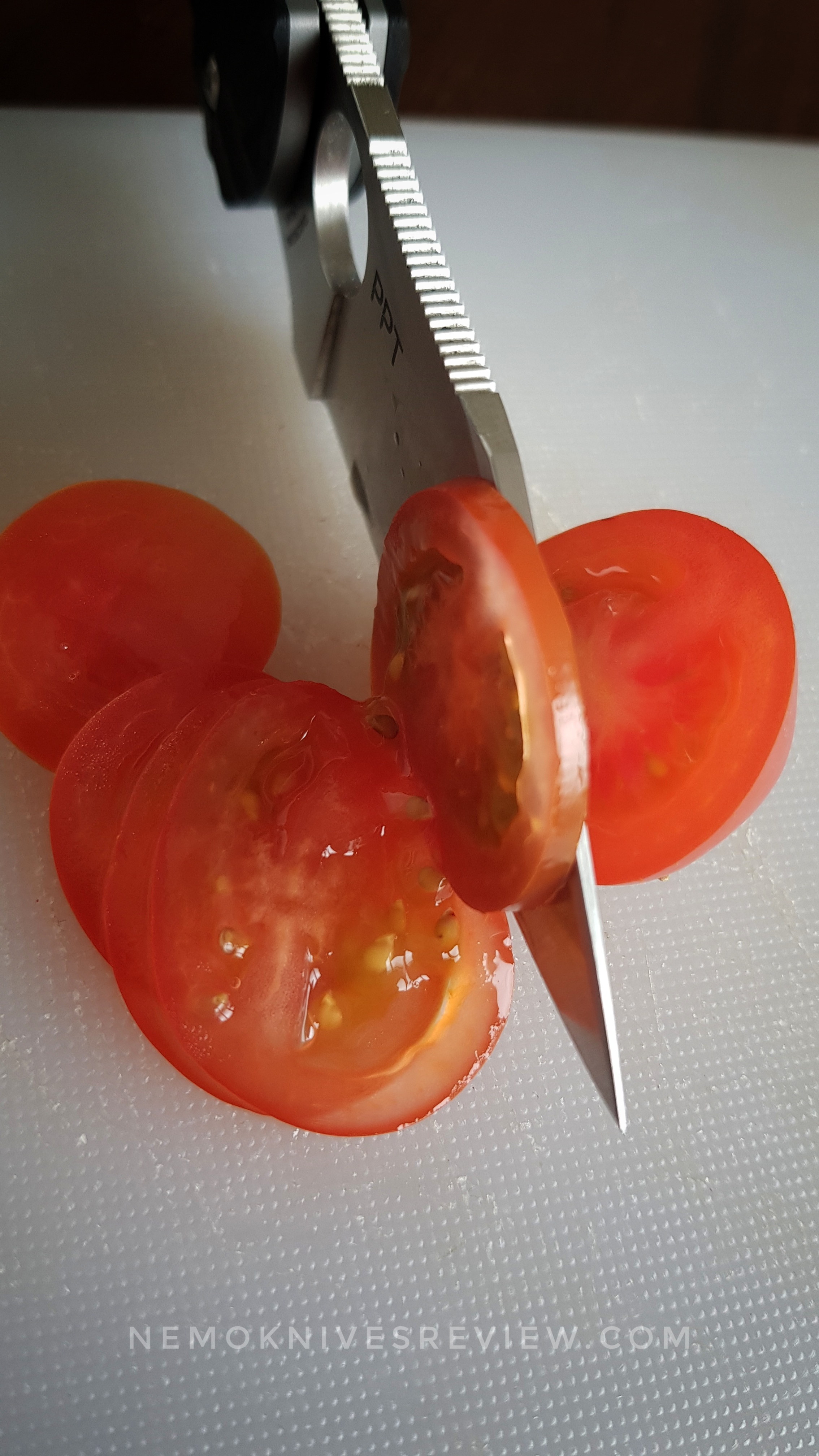
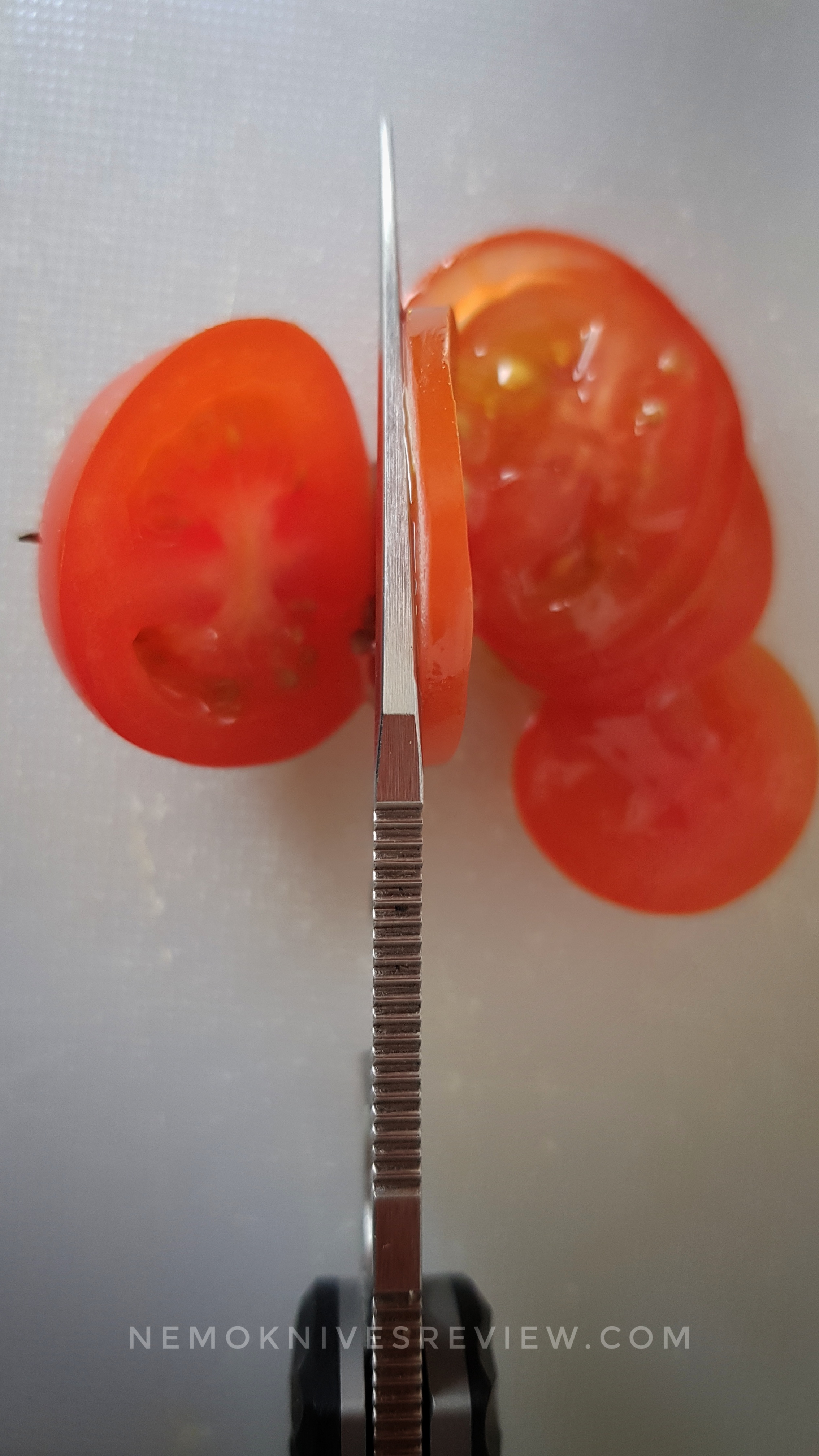
Someone asked me why using a workhorse knife on tomatoes ? Tomatoes may look like some fragile fruits but they are not: their skin got no pity for any dull knife and their flesh will give in under any pressure. The best tools for tomatoes are serrated and micro serrated knives.

20180429_134118-01.jpeg
Hence that test on my polished edges. You need a very keen blade to push cut in a tomato and make thin loaves. Plastic and bambou can be used to test the edge stability which often is only due to thermic treatment of steel.

20180429_134128-01.jpeg

The alignement of the point on the PPT is very different from my Millie and is very close to the experience of the YO2: its makes powerful cuts.
Also the handle makes Icepick/reverse grip very confortable, knowing this is the favorite grip of Philippe Perroti on La Griffe, a grip I have found handy in forcing a door. Just kidding but the confortable reverse grip (à la “griffe de chat” in French) is not a joke.

20180429_143749-01.jpeg

You get also an excellent blade/handle ratio for a choiled knife compared to my Para3 for example.

20180429_143822-01.jpeg

And as good as the non-choiled Sliverax !!

20180429_142459-01.jpeg
My PPT has been used in the kitchen is not easy to clean because the way the hole in the liners are not accessible. This is serious issue if, for example, a piece of raw meat get stuck there and could contaminated the blade. The full Reeve Integral Locks are the best lock for checking your folding for any debris. I would have preferred solid titanium liners without that hidden cheese holes which ask for special maintenance starting by unscrewing the slabs to get full access and complete cleaning.

So in a wrap, the PPT is a compact hard user with very high performances featured by great ergos. It has a really strong character (it feels like it has been done for some Hell’s Angel fan) but once deployed it will pierce and cut with high reliability. Once the PPT is entering the game: this is serious business. For the record being represented to bikers gathering, bikers love La Griffe and various neckknife which are handy on a ride. So it’s easy to understand some DNA in the PPT design.

20180429_141539-01.jpeg