Tag Archives: CPM Cru-Wear

The Exclusive Jess Horn is NOT Old Fashioned.

Nope, it is not.

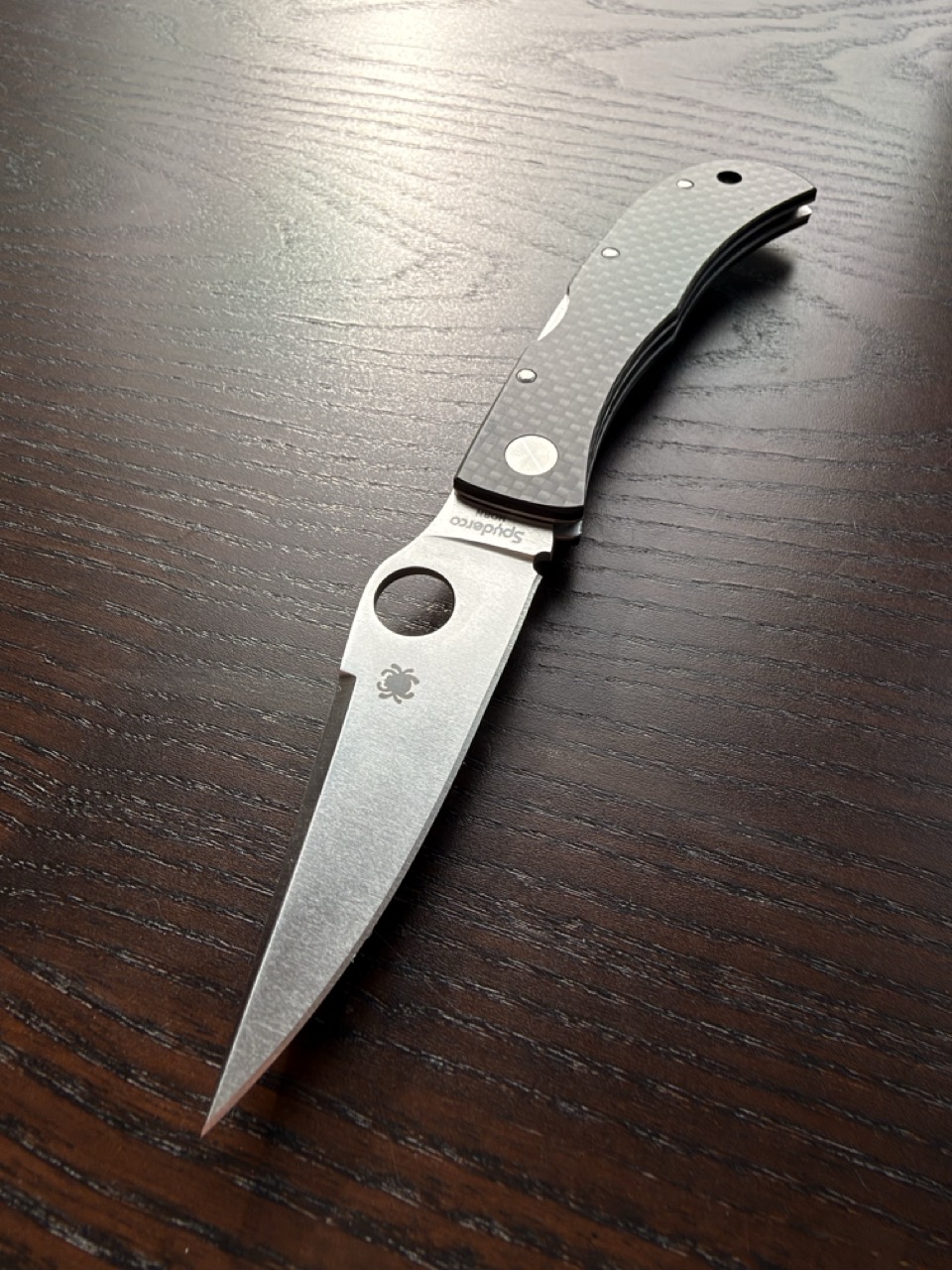
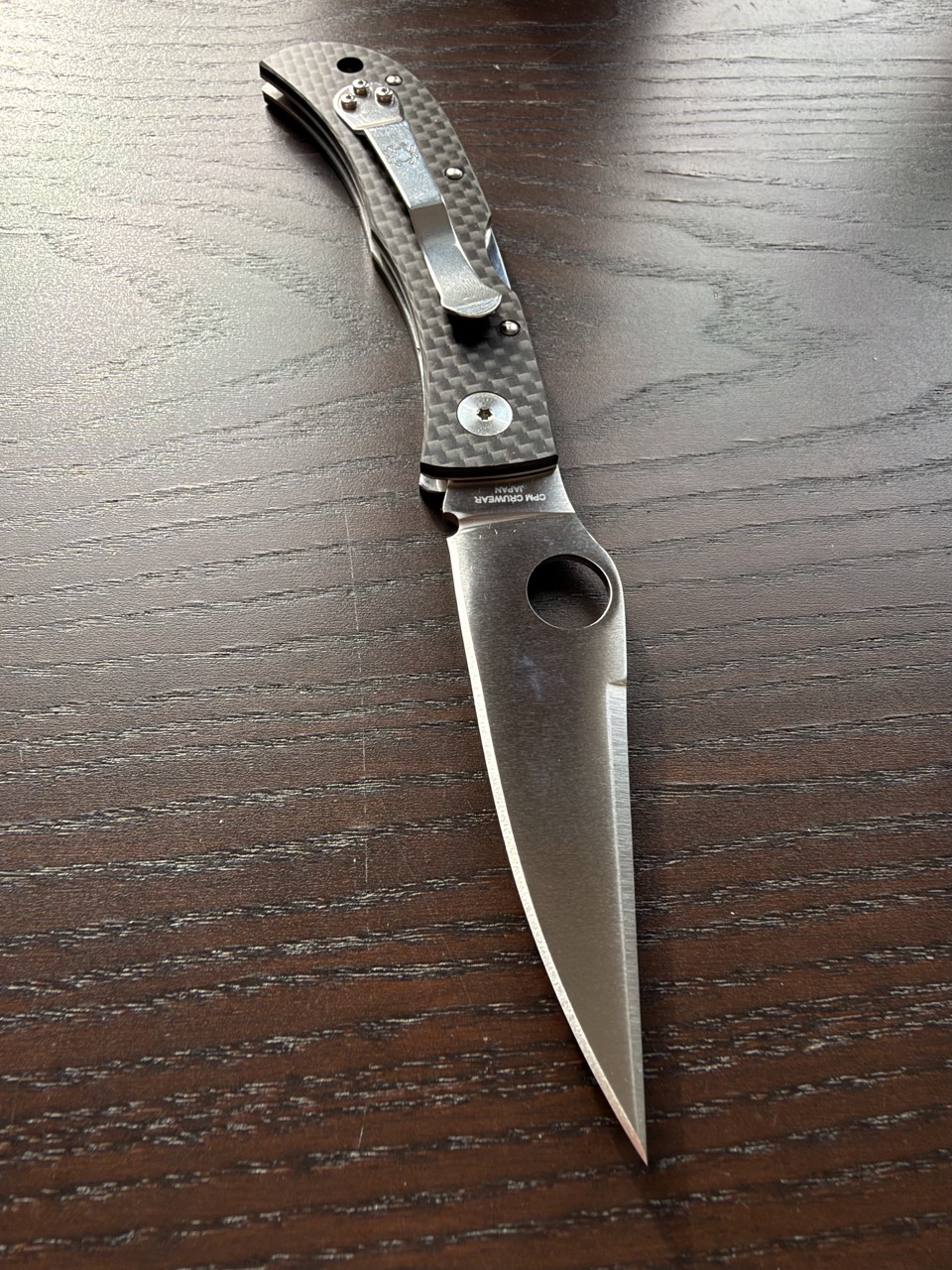
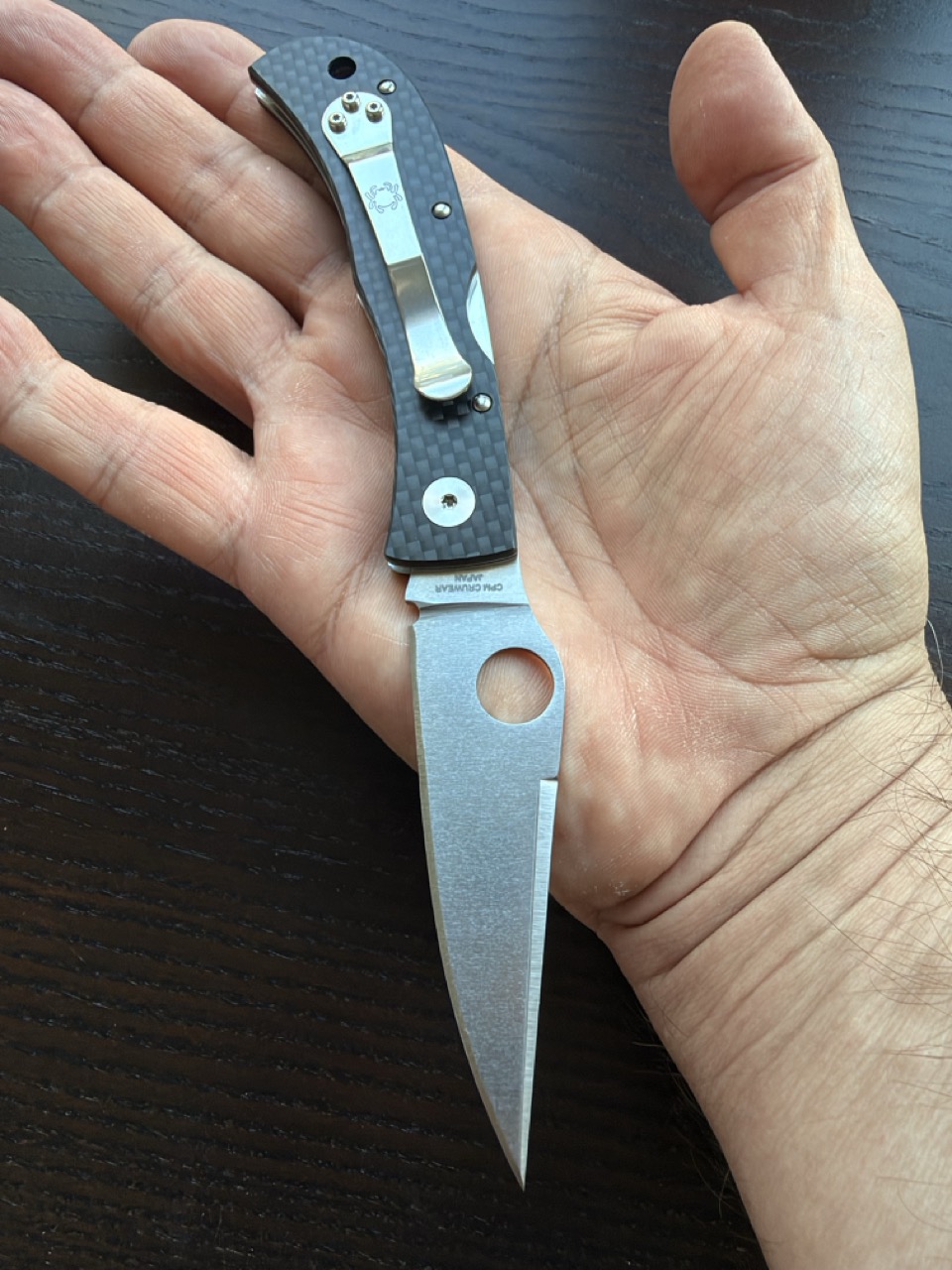
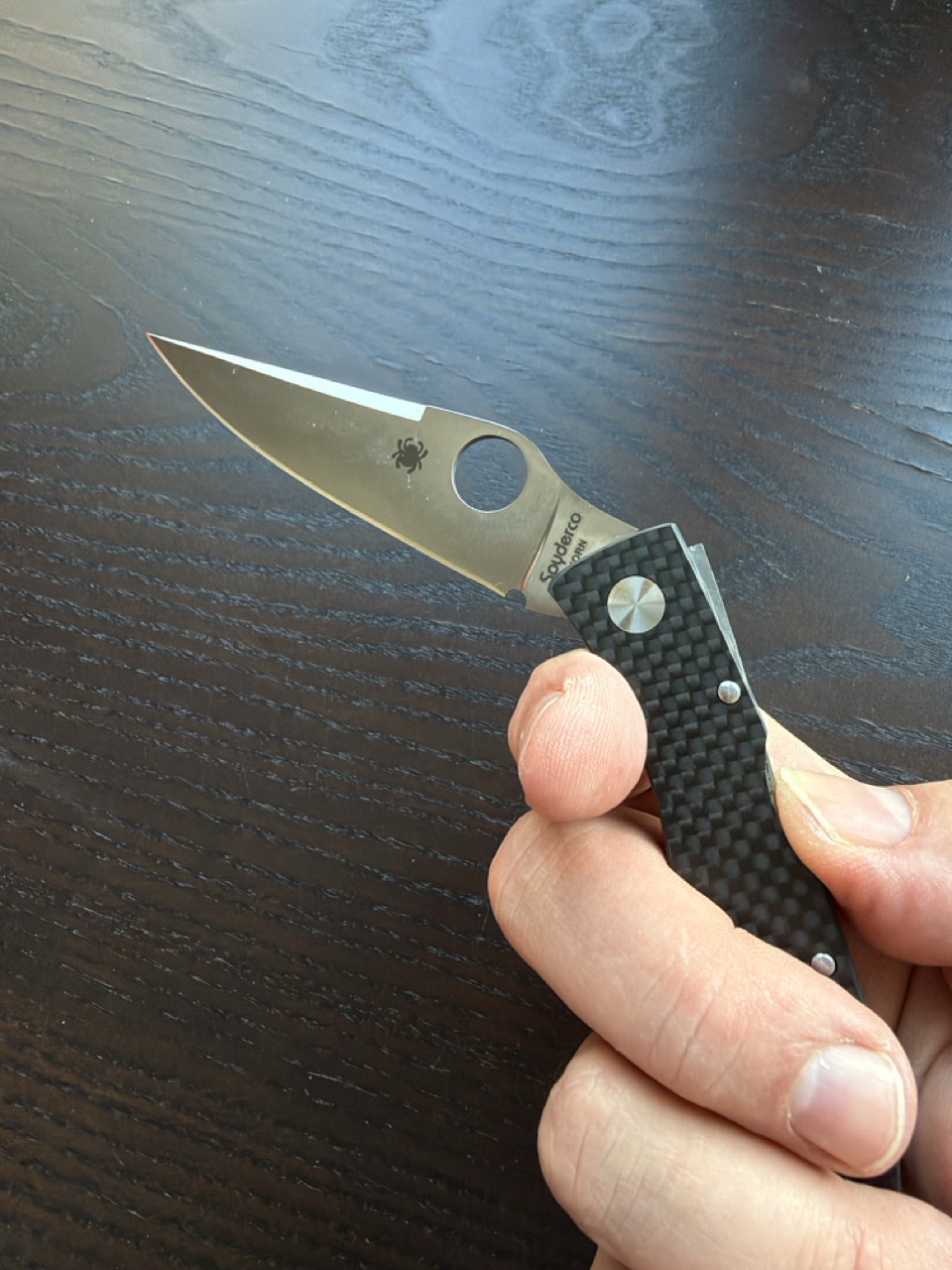
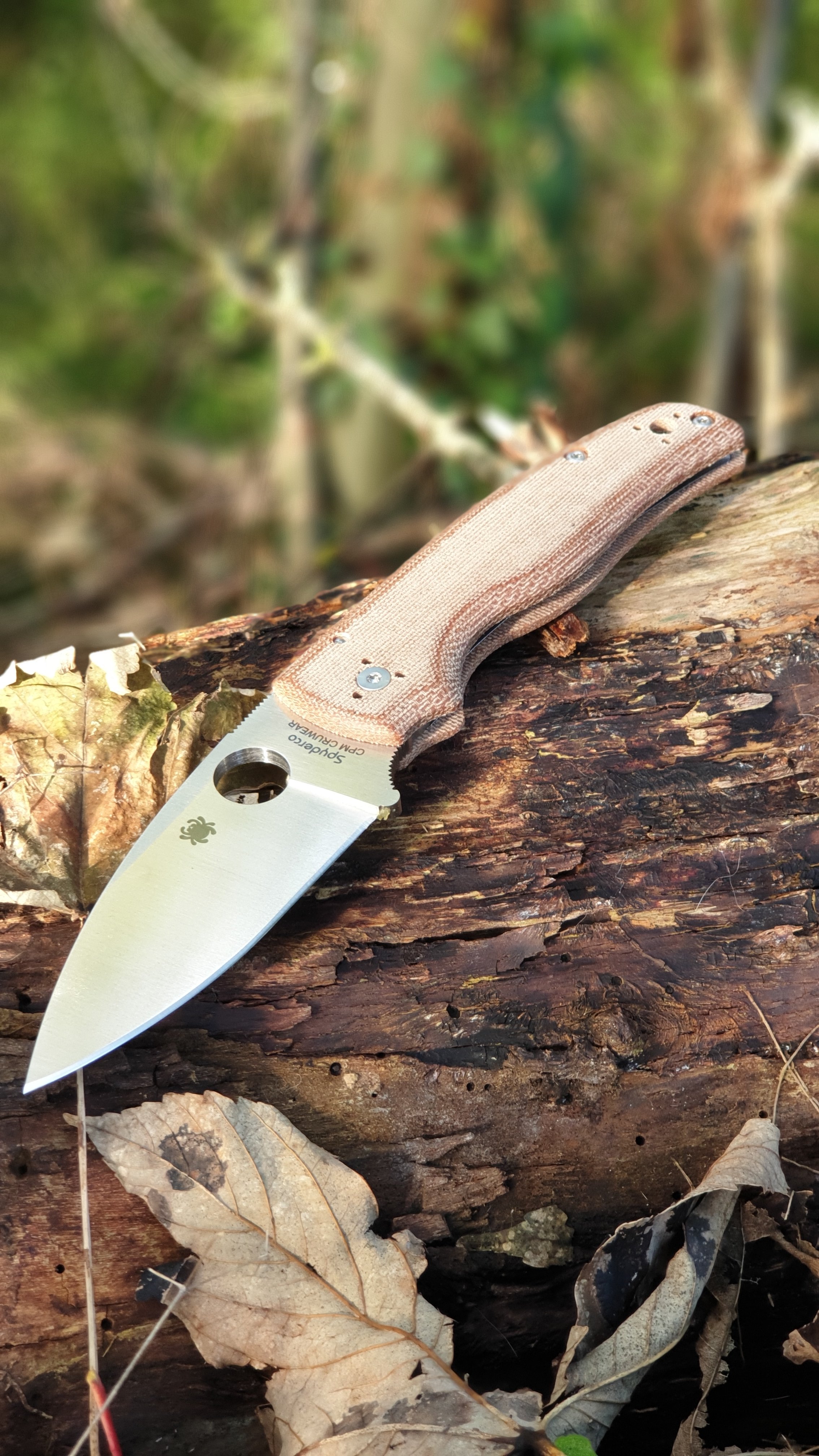
At first glance, the Jess Horn in CPM CruWear looks like a knife from another era. And that is a huge part of its charm. There is something wonderfully timeless about this folder—and I’m totally in love with it.

Oh, and I’ll take carbon fiber over just about anything, any day! These scales are absolutely gorgeous. Seriously gorgeous. The weave, the depth, the way they catch the light… I just love that sense of sheer quality.

Ah, those elegant lines, the slender blade, the big flat axis screw, the understated proportions—it immediately brings to mind the kind of traditional pocket knife that could have been carried decades ago. That is what makes the Jess Horn feel so timeless: its design relies on proportion, simplicity, and function rather than fashion. Nothing is exaggerated, nothing is trying too hard to look modern. There is nothing aggressive or overtly tactical about it. No futuristic geometry, no exaggerated blade shape, no visual statement about the technology hidden inside. Just a beautifully proportioned folder whose design could have existed decades ago and would still look right decades from now. Its quiet simplicity is precisely what gives it character.

But look closer, and the story changes completely.
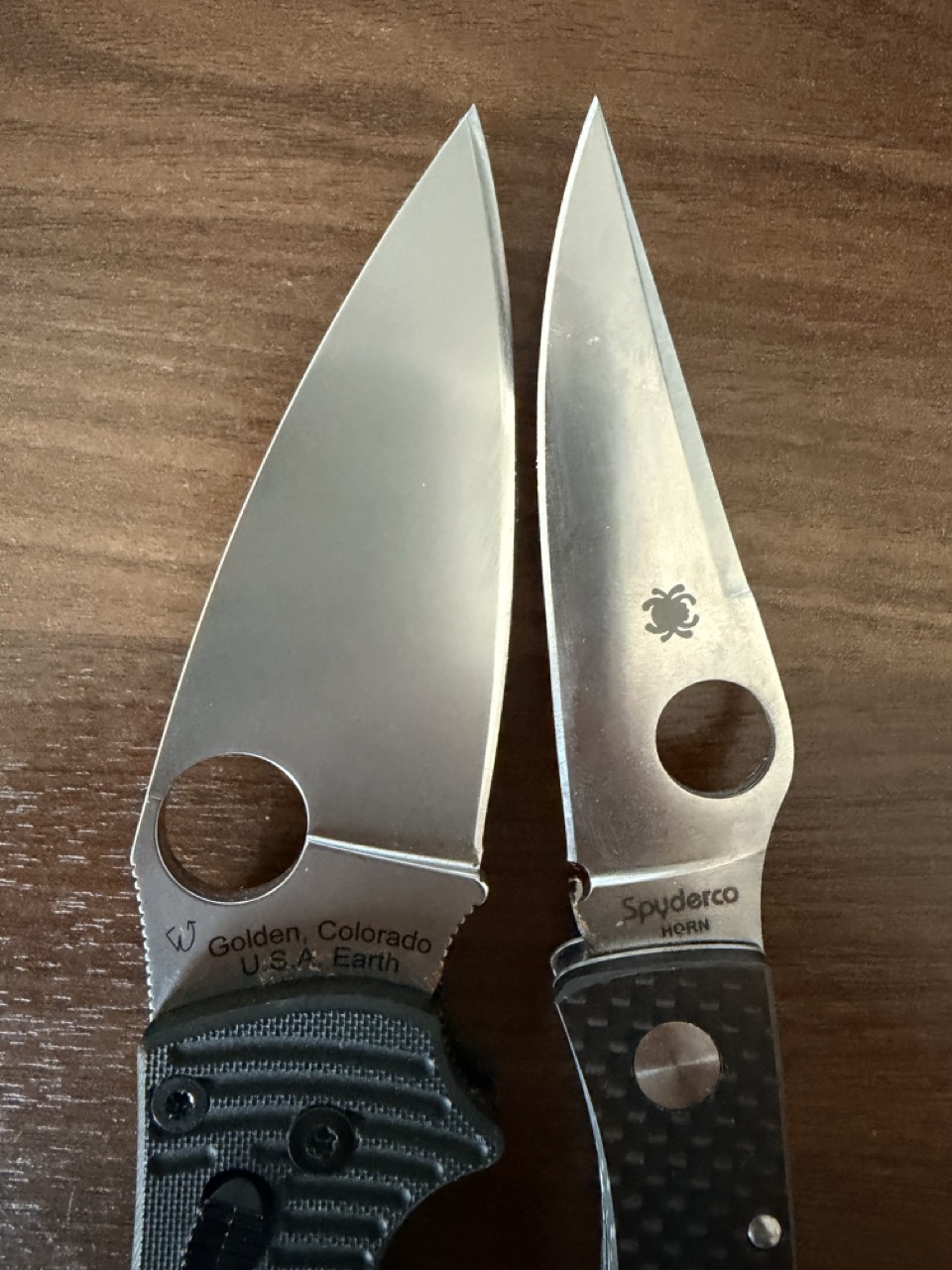
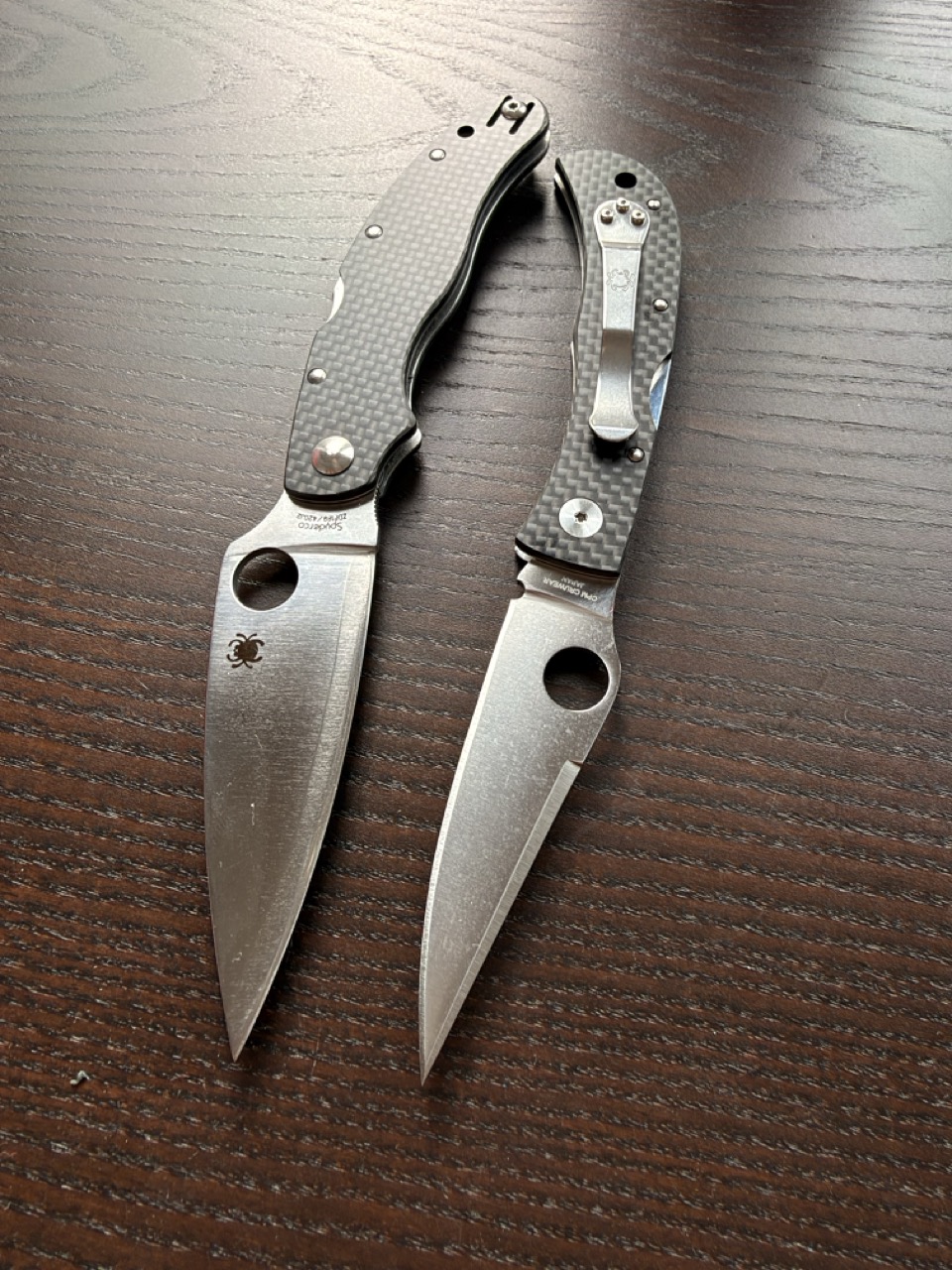
Just look at the edge length—it’s basically the same as a Manix 2. You’re getting a serious amount of cutting power in such a slim package. And the lock is rock solid, with absolutely zero blade play. Honestly… wow.
The secret ingredients? A healthy dose of CQI, a handful of clever choices !

Because putting a steel like CPM CruWear into such a thin, traditionally styled blade creates something that is, in many ways, remarkably modern. The real magic of this knife is the combination of old-school geometry and contemporary metallurgy.

I love CPM CruWear. It’s an exceptionally well-balanced tool steel, offering that peculiar combination of toughness, wear resistance and edge stability that makes it particularly well suited to the Jess Horn thin cutting blade that is meant to be also used. And for an everyday-carry knife, that balance is even more valuable. You get excellent edge retention without moving into the extreme territory of steels that are difficult to sharpen or prone to chipping, and enough toughness to trust a thin pointy blade in real-world use. More importantly, CruWear is really pleasant to maintain. A leather strop, a ceramic rod, a piece of jade… that’s often all it takes to bring the edge straight back to razor sharpness. For an EDC knife that gets carried, used, touched up and used again, that ease of maintenance is a huge advantage. A knife should not only perform when it is new—it should remain a pleasure to use and maintain week after week, and CruWear makes that sooooo easy.
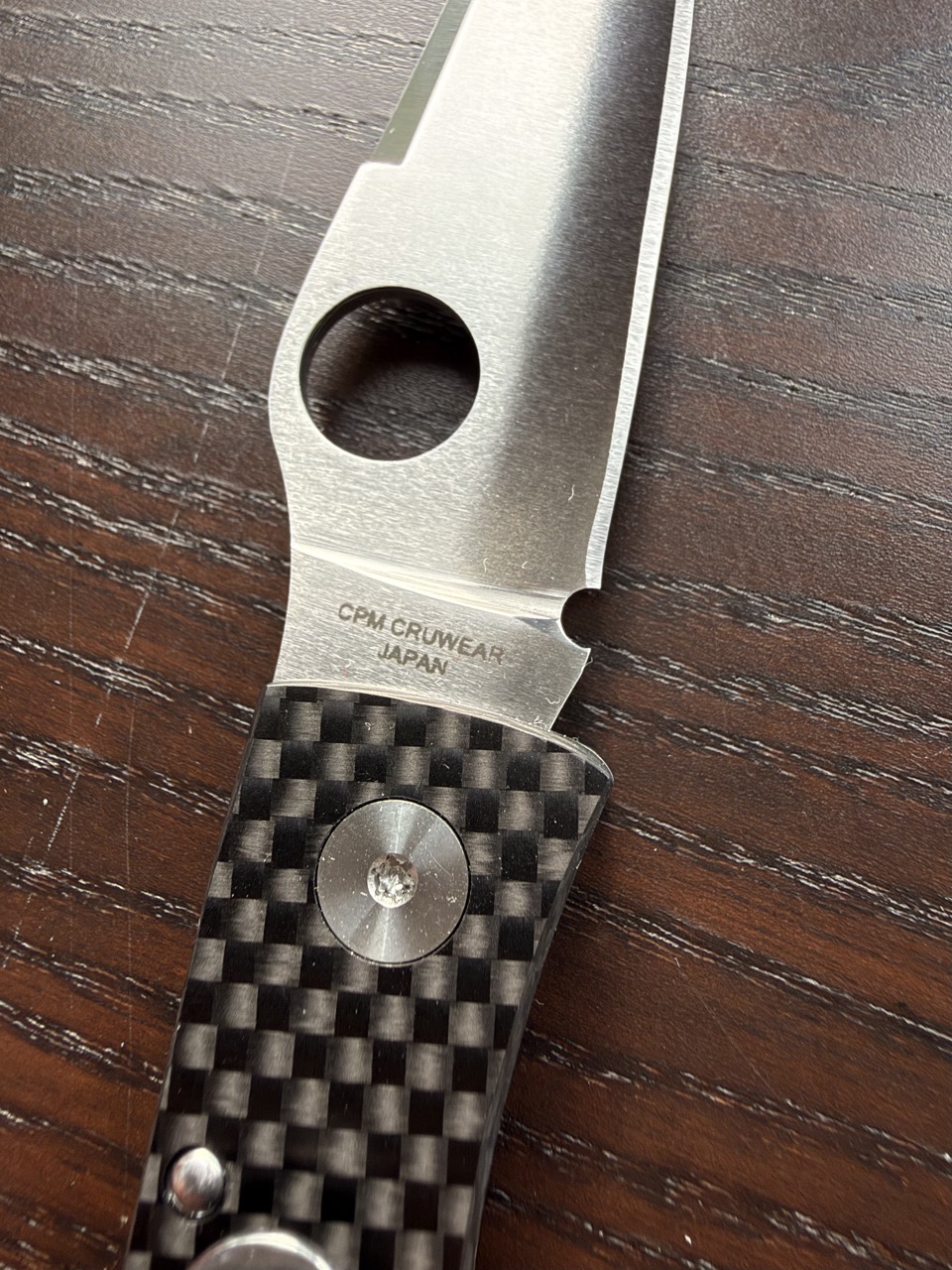
CPM Cru-Wear has a history that goes back long before our current obsession with “super-steels.” Its roots lie in the Vasco Die family of tool steels developed by Vasco Metals in the 1960s, originally for hot-forging dies rather than knives. Vasco later developed grades such as Vasco Tuf and Vasco Wear, the latter designed to combine wear resistance with useful toughness.

Crucible eventually developed its own version, Cru(cible)-Wear, introducing it in 1994 and later producing it through the Crucible Particle Metallurgy (CPM) process. The result is a steel containing around 1.1% carbon, 7.5% chromium, 1.6% molybdenum, 1% tungsten and 2.4% vanadium, with roughly 10% carbide volume. But the numbers only tell part of the story. What really matters is the fine and uniform distribution of those carbides (thanks to the CPM process). Compared with the tougher CPM 3V, which has a lower carbide volume (around 5%) and prioritizes toughness, Cru-Wear gives up some impact resistance in exchange for better wear resistance and edge retention. Compared with CPM 15V, however, it contains far fewer carbides and is therefore much less demanding when it comes to sharpening and generally less prone to chipping.
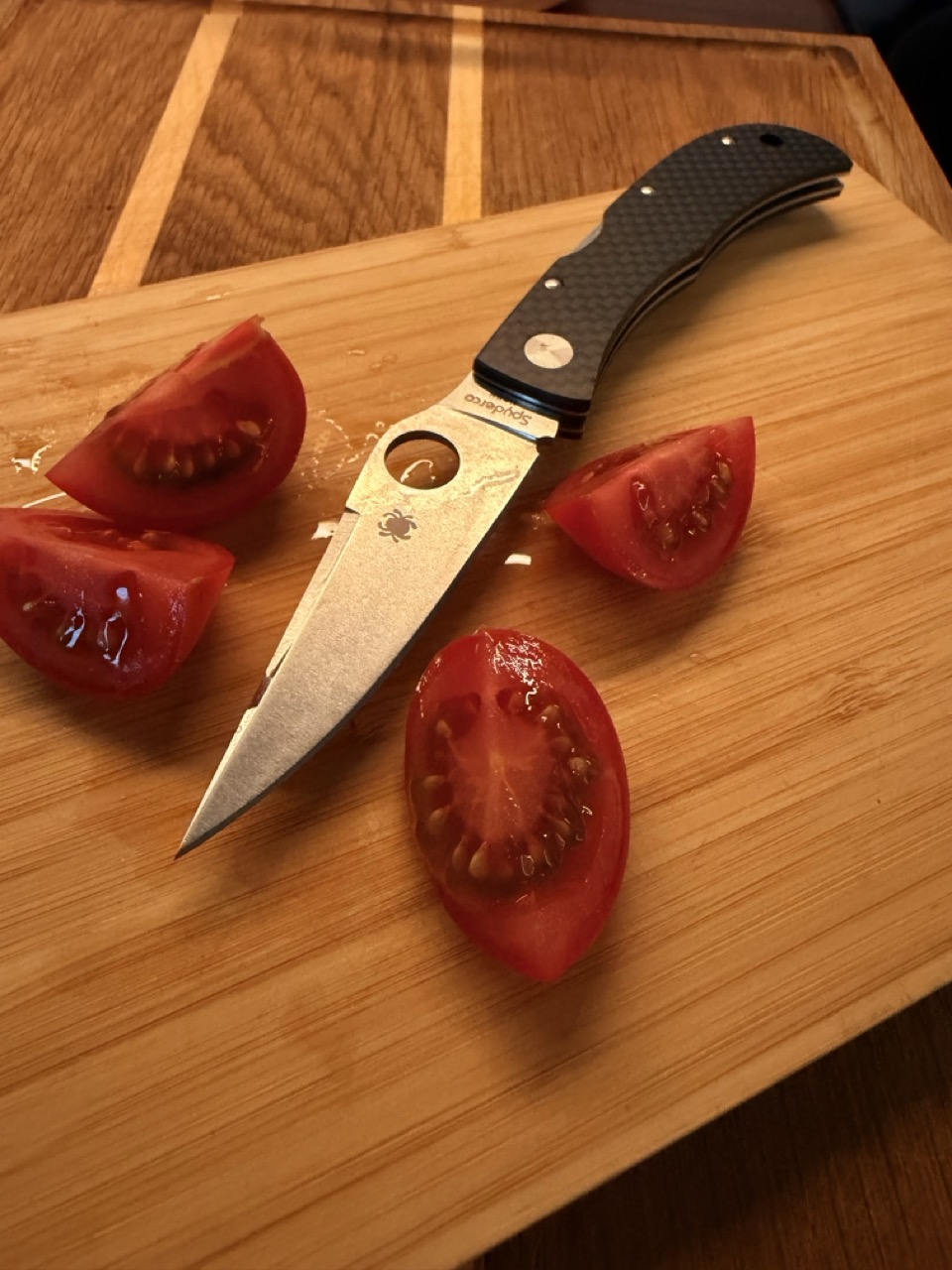
So, CPM Cru-Wear doesn’t try to win the edge-retention contest at any cost. Instead, it gives the user that praise very stable, durable edge that can take a very very fine apex, withstand hard cutting without constantly threatening to chip, and still be sharpened without turning the job into an rocket engineering project. What else ?

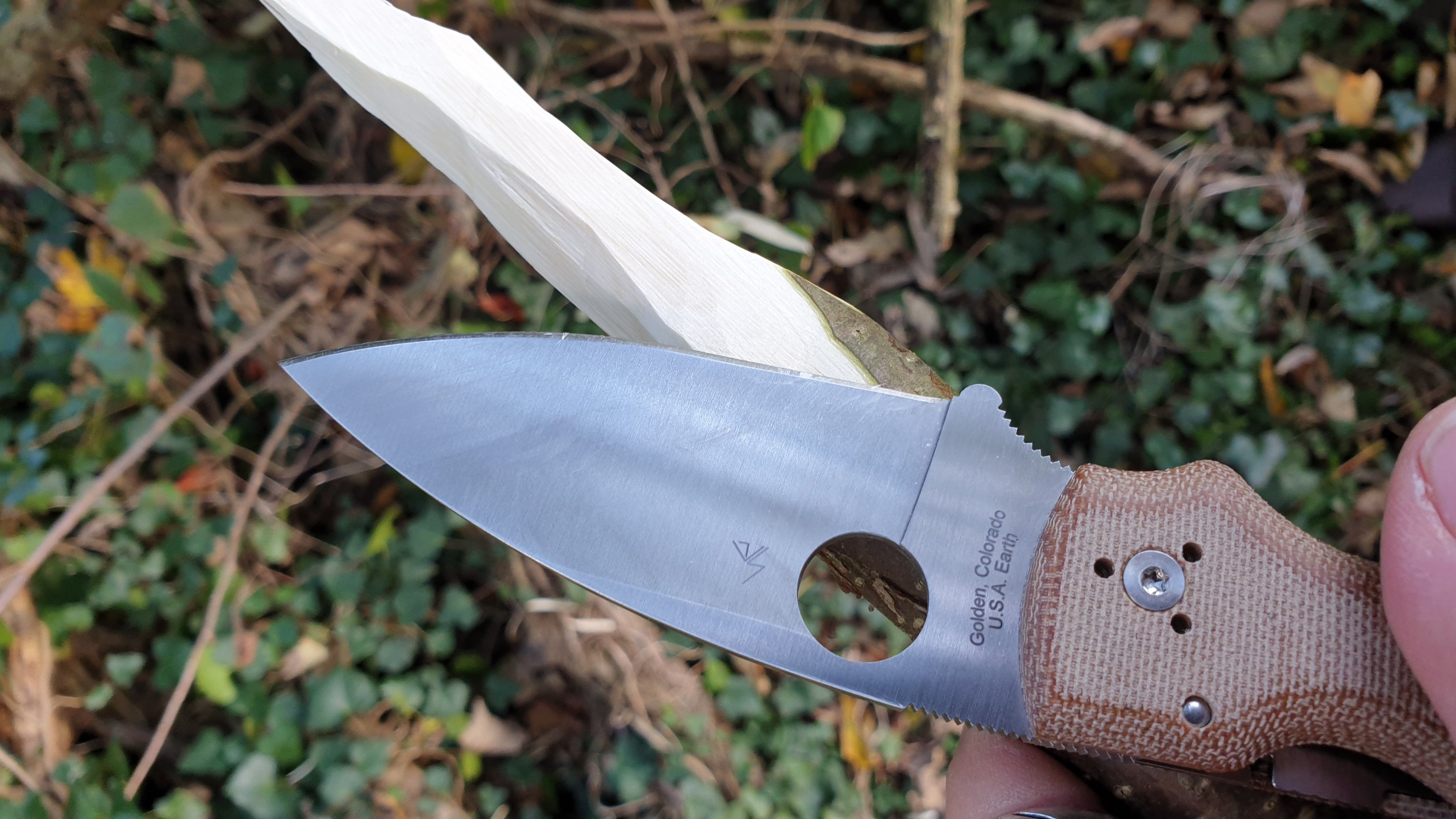
I’ve been using Horny in the kitchen, much like Cliff did with his ZDP-189 version some twenty years ago. I got it wet, rinsed it off, didn’t even oil it—and while cutting butter, I was practically greasing the blade anyway. A quick wipe with a paper towel and it was good to go.

And what a wonderful little kitchen knife, my friends! What a chef’s lightsaber! Its needle-like tip opens packages with barely a whisper, while the thin blade has more than enough authority to deal with cartons, plastic and all the usual packaging before it goes into the trash. And when it comes to actual food preparation, its precision is simply delightful. The thin, keen edge slips through vegetables, meat, butter and all sorts of ingredients with an almost surgical feel.

This is one of those knives that makes you want to keep finding things to cut—not because you have to, but because using it is just so damn satisfying.

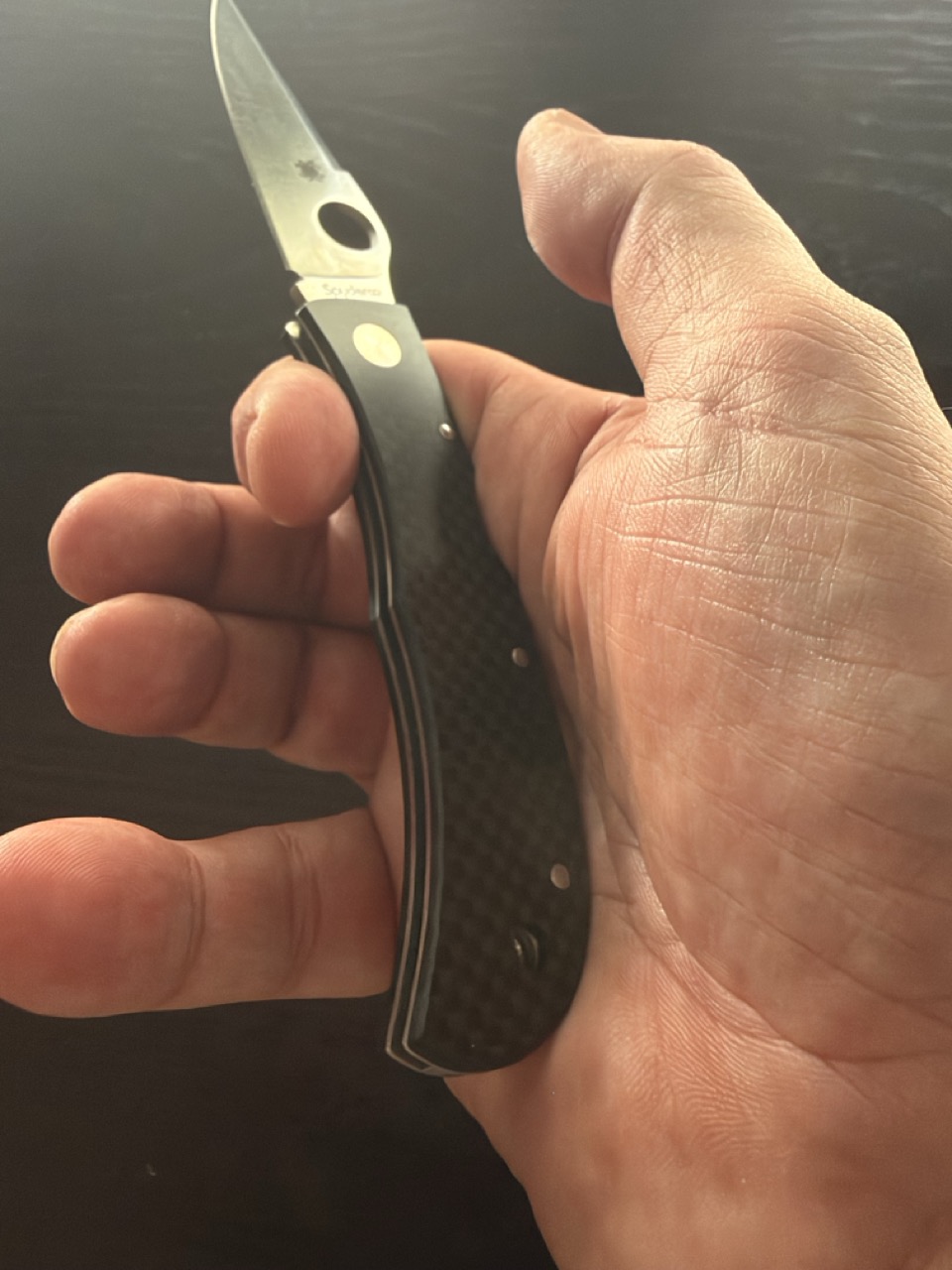
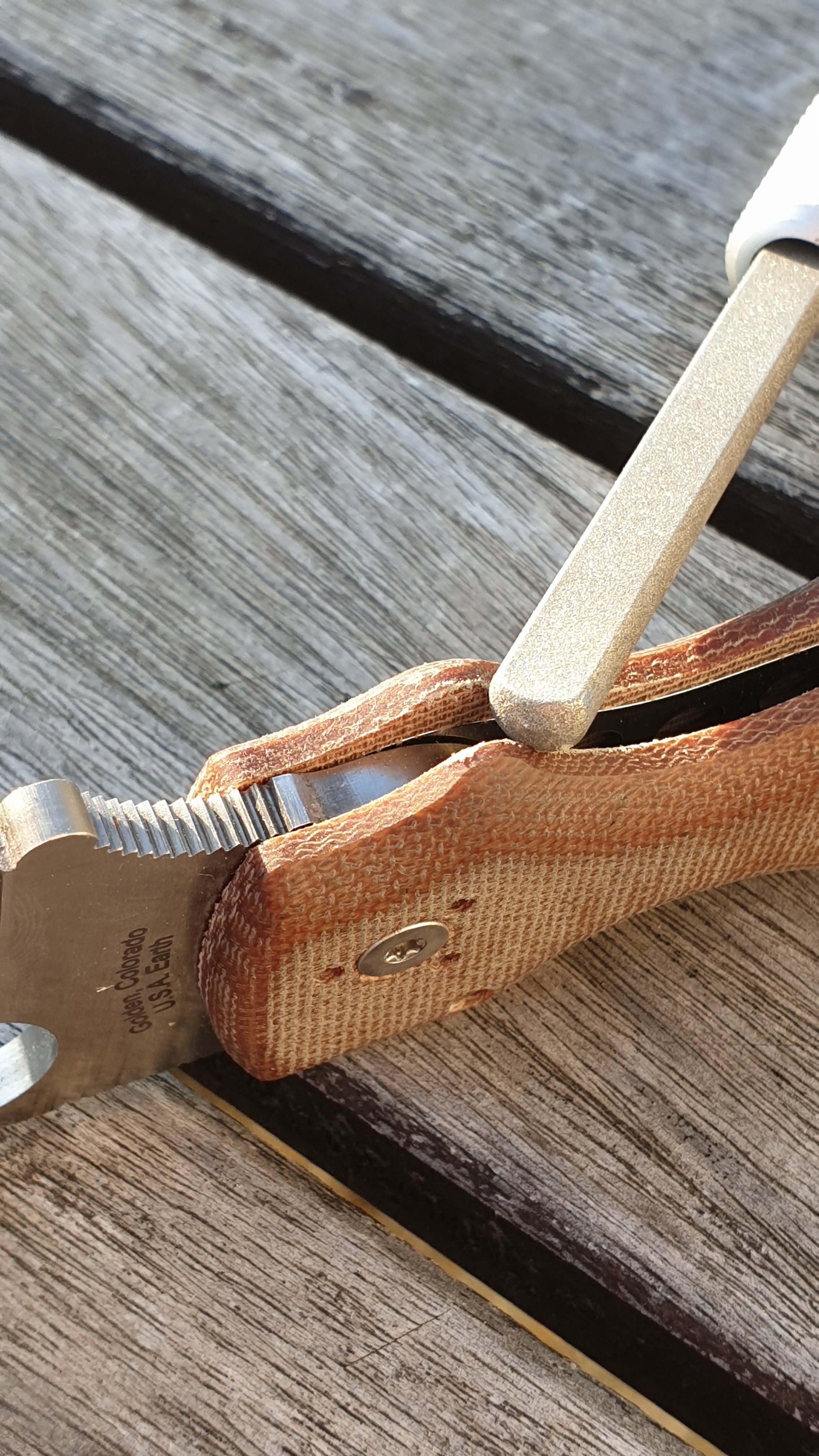
The handle is somewhat square in cross-section, and the exposed liners are a little sharp. I’ll probably give them a light pass with a diamond abrasive, but honestly, it doesn’t bother me much. If anything, the angular profile gives me a useful indexing reference: unlike a perfectly round handle such as an Opinel, I always know how the knife is oriented in my hand and where the edge is pointing. For precise cutting, that’s a real advantage.

The handle is also fully enclosed, with that steel backspacer requiring a quick inspection after rinsing the knife under hot water. But none of that got in the way of its mission in the kitchen. It simply did the job, every single time.

And that kind of reliability is always welcome.
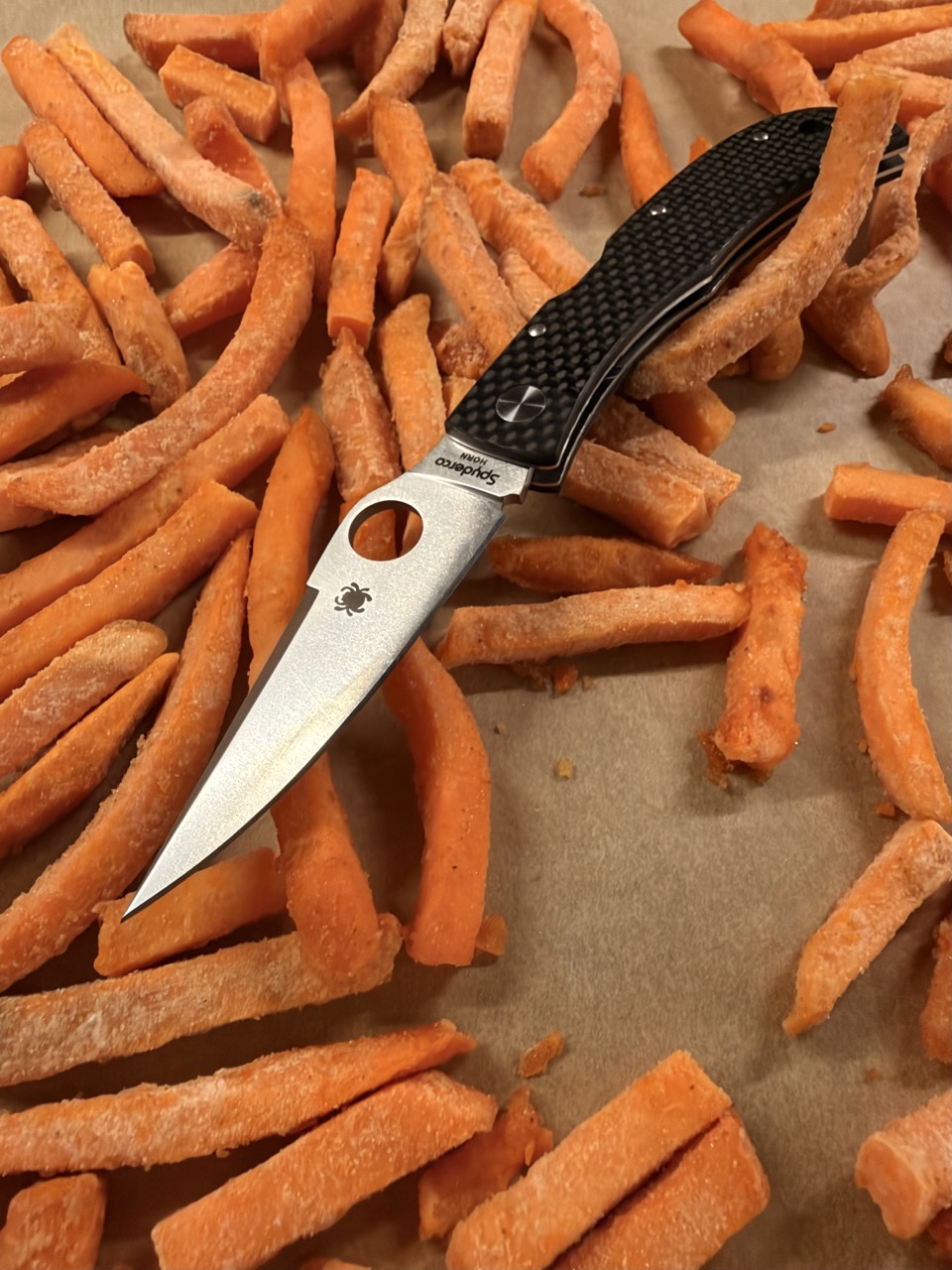
Ah, it is not stainless—the 7.5% chromium content is nowhere near enough for that—so it deserves a little care around moisture and corrosive environments. But for someone who actually uses a knife rather than simply admiring its steel designation, CPM Cru-Wear makes a tremendous amount of sense. It is one of those steels where the whole is greater than the individual numbers: excellent edge stability, very good wear resistance, high toughness, and reasonable sharpening effort, all in the same blade. And this is what I like about Cru-Wear ! It isn’t about having the most extreme steel on paper. It is about having a steel that makes an extremely good and pleasant knife in the real world.

And pleasure in holding, using, and cutting with force and precision is mandatory in my own appreciation of a knife. That matters just as much as the metallurgy itself. A knife can have outstanding specifications, but if it doesn’t feel right in the hand, if the edge doesn’t invite you to cut and pierce, or if using it simply isn’t enjoyable, then something is really missing.

Long story short: I don’t judge a knife only by what its steel can do—I judge it by how much I enjoy deploying it, holding it, and actually using it.
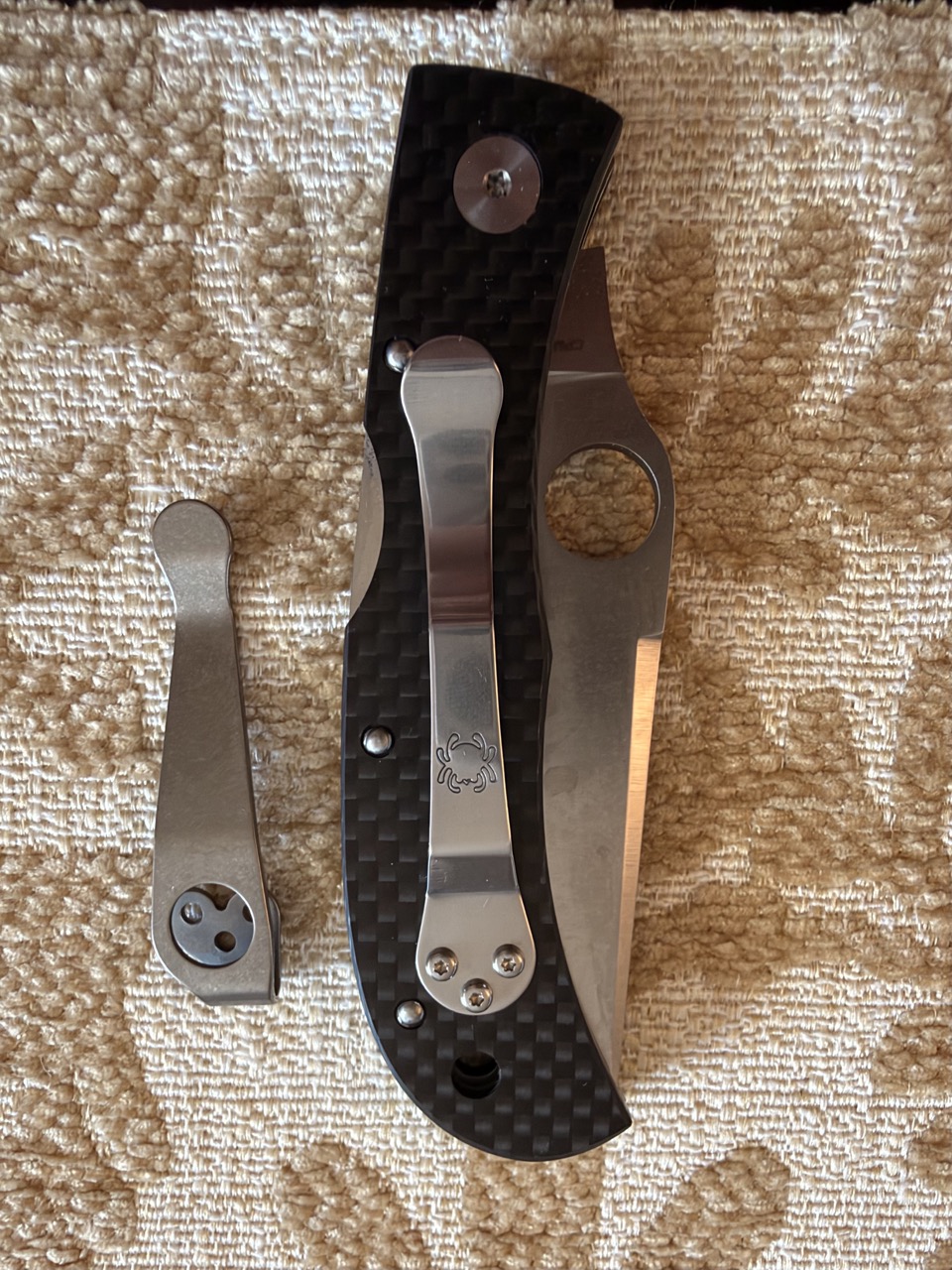
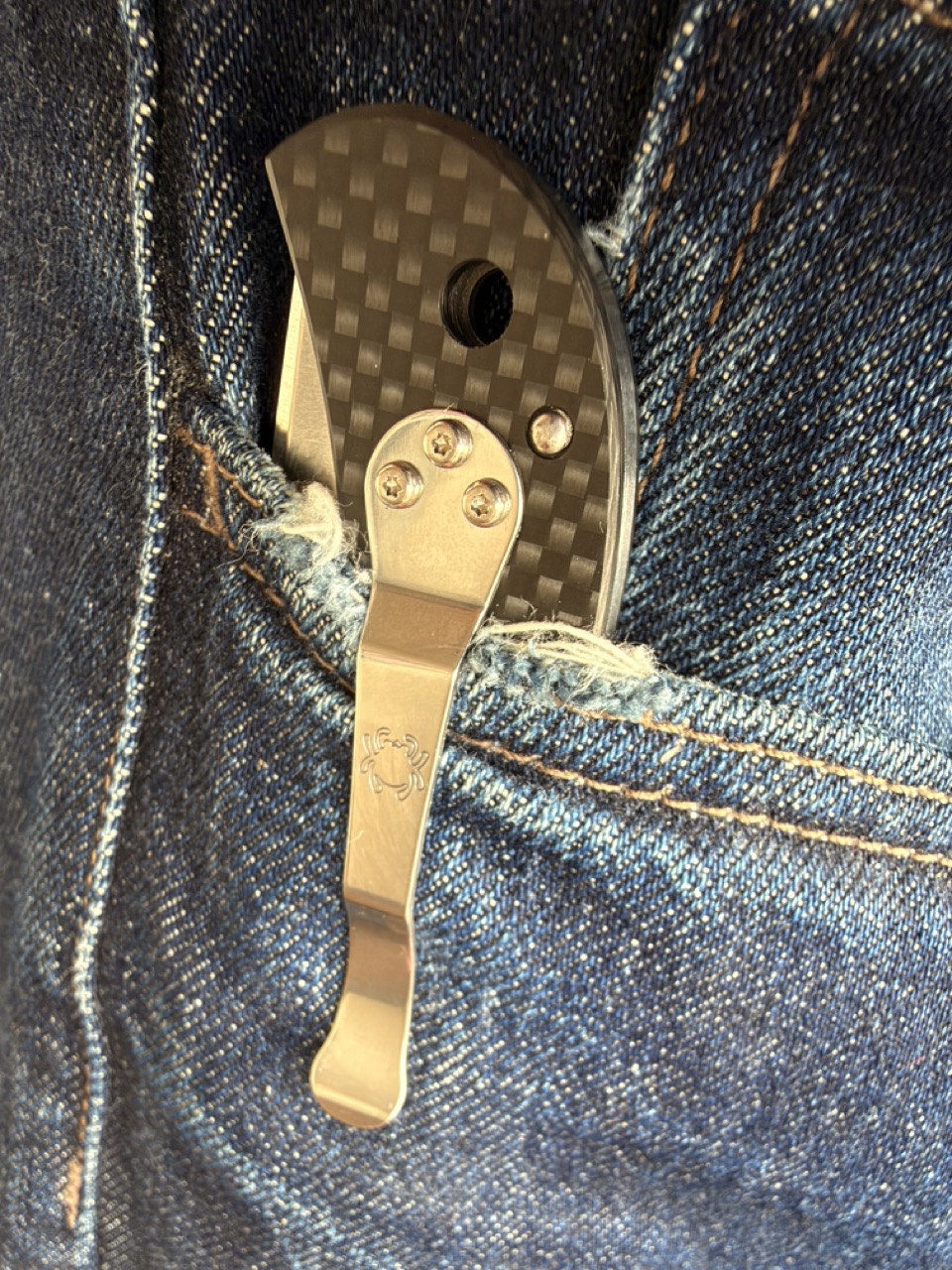
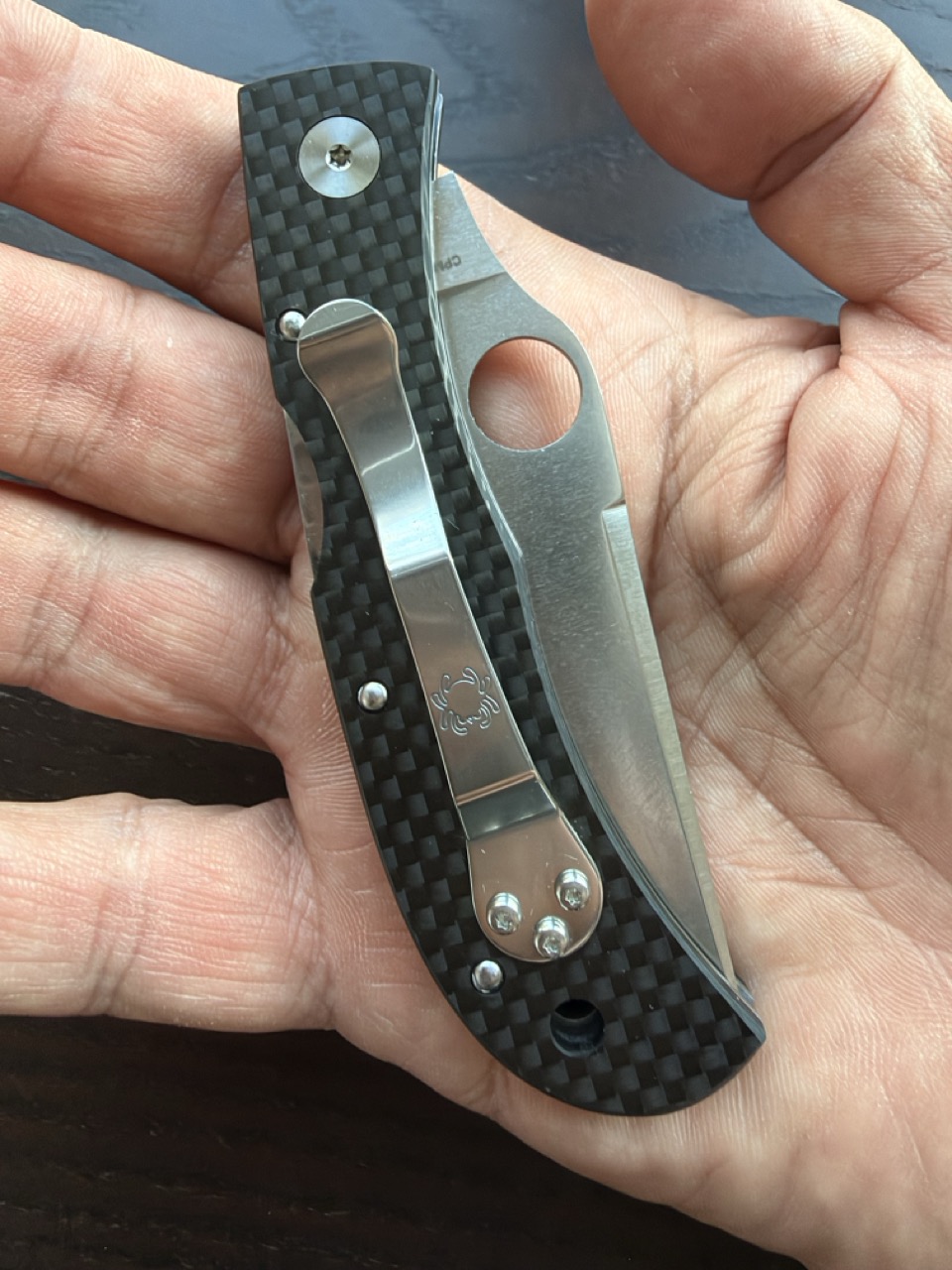
And I’m getting used to the clip position too. In the end, maybe it’s a good thing for a knife to have a bit of character in the way it carries. I tried fitting a deep-carry clip, but once installed, the screws couldn’t get enough purchase—the clip was just slightly too thick. No big deal. I’m even considering removing the clip altogether and carrying the knife in a dedicated pocket of my sling bag. To be honest, I rather like the idea. This Jess Horn is starting to feel less like something I simply carry and more like a knife I’ve given its own little place in my everyday life.
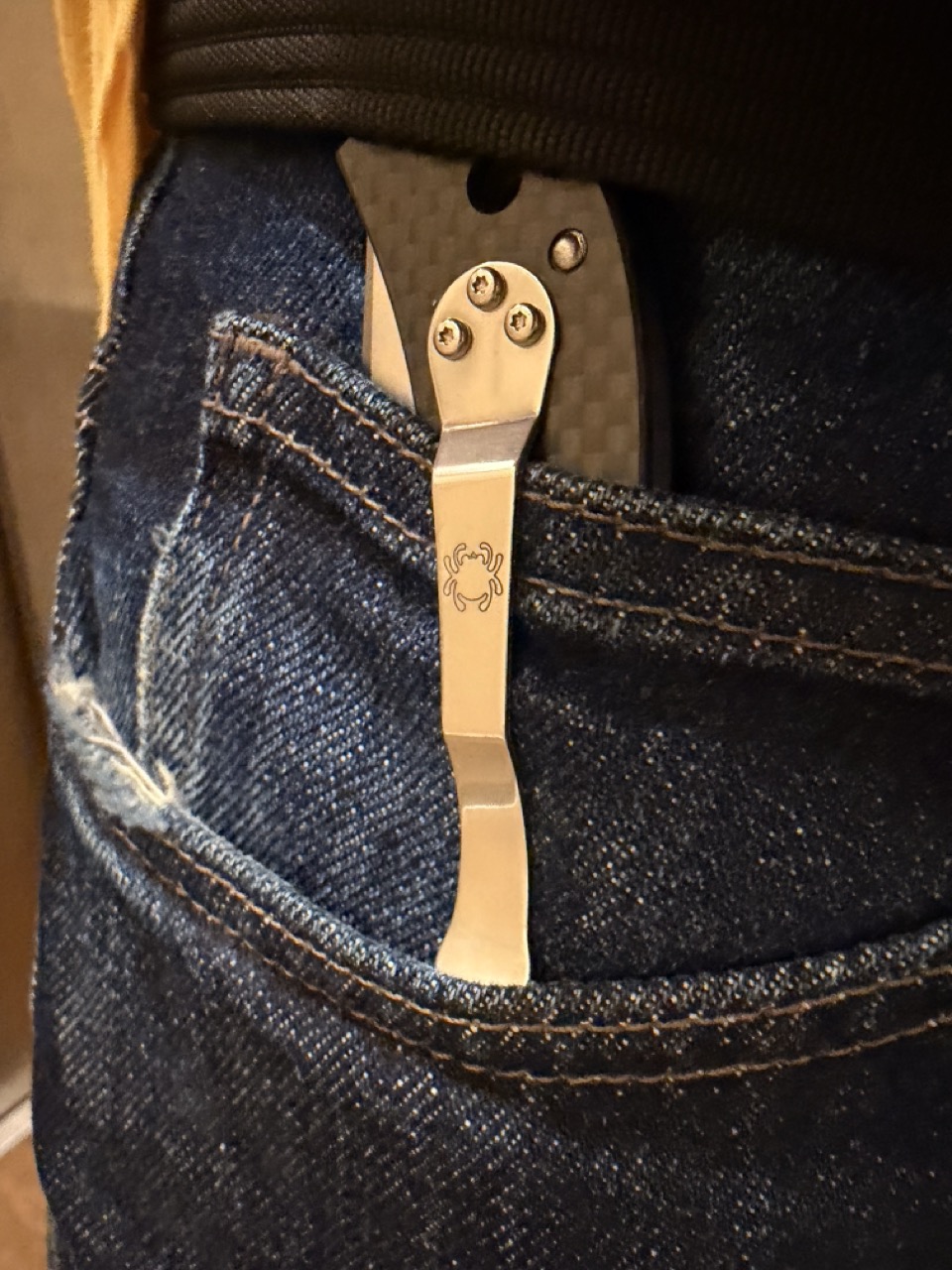
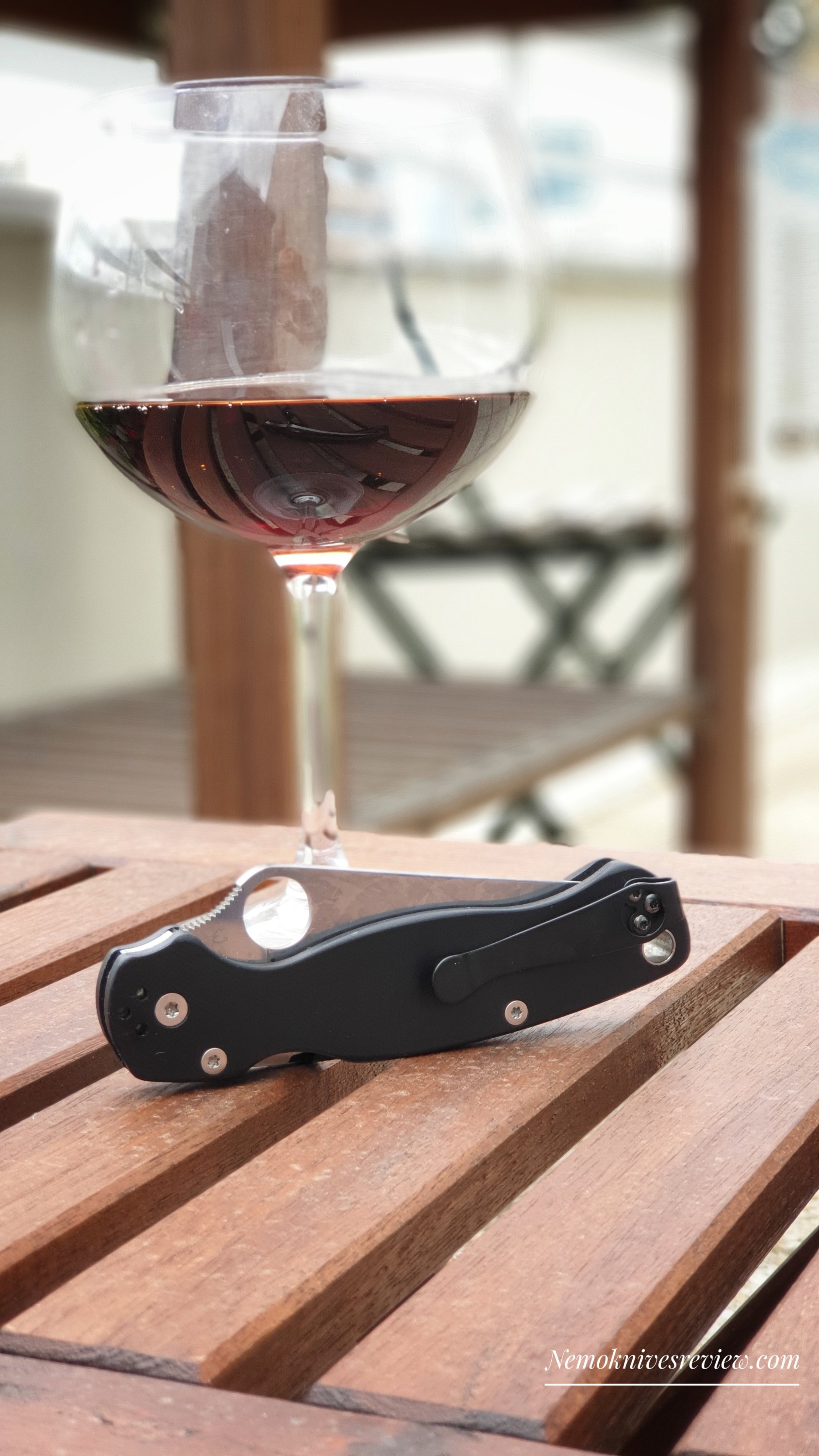
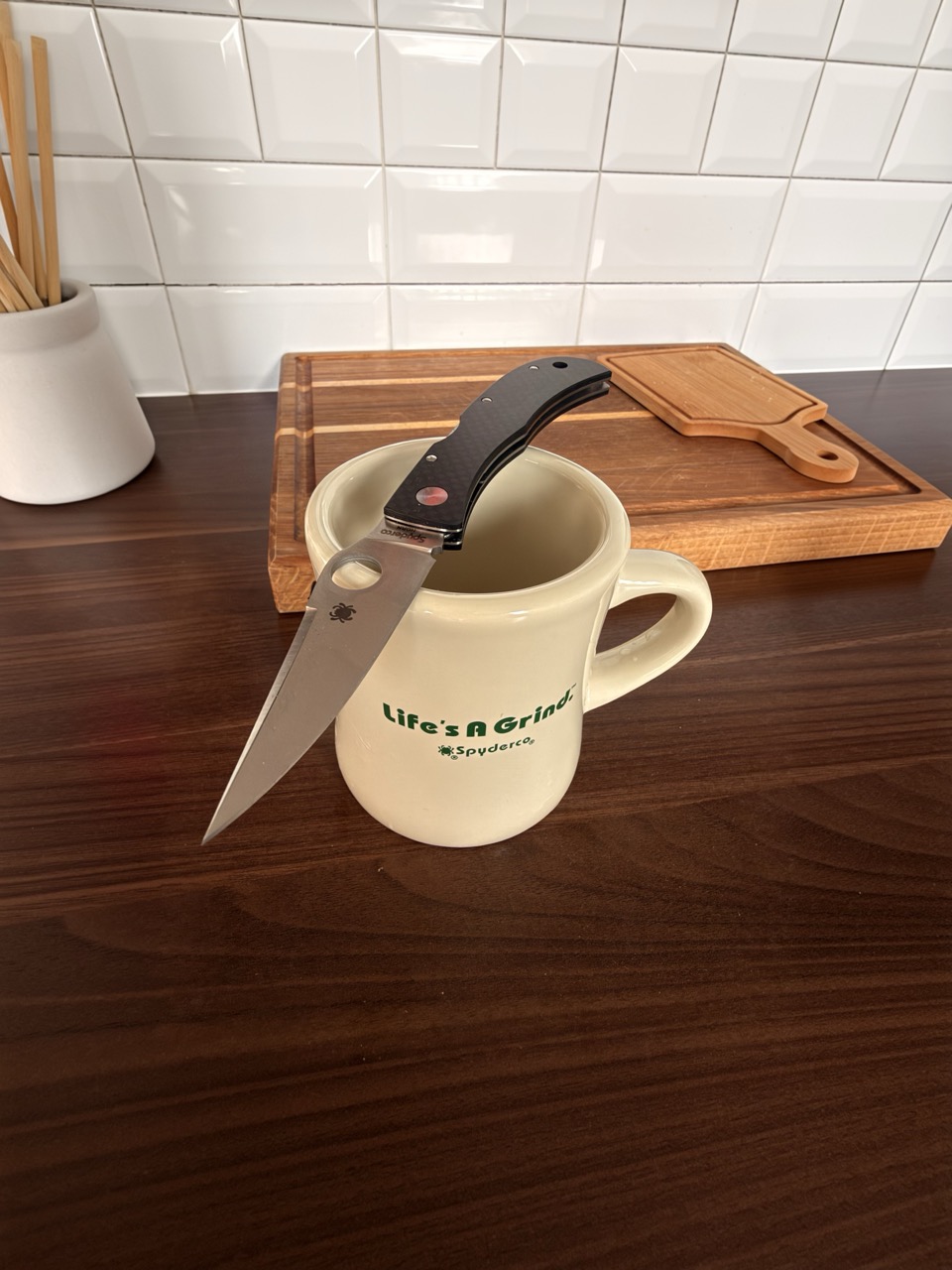
One rather nice thing about the clip is that I can actually rest the knife on it when my worktop is wet. The clip is flat, fairly large, and positioned right in the middle of the handle, so it acts almost like a little stand and keeps the handle and blade away from the wet surface.

You always discover little tricks like this when you learn to work with your tools rather than against them.
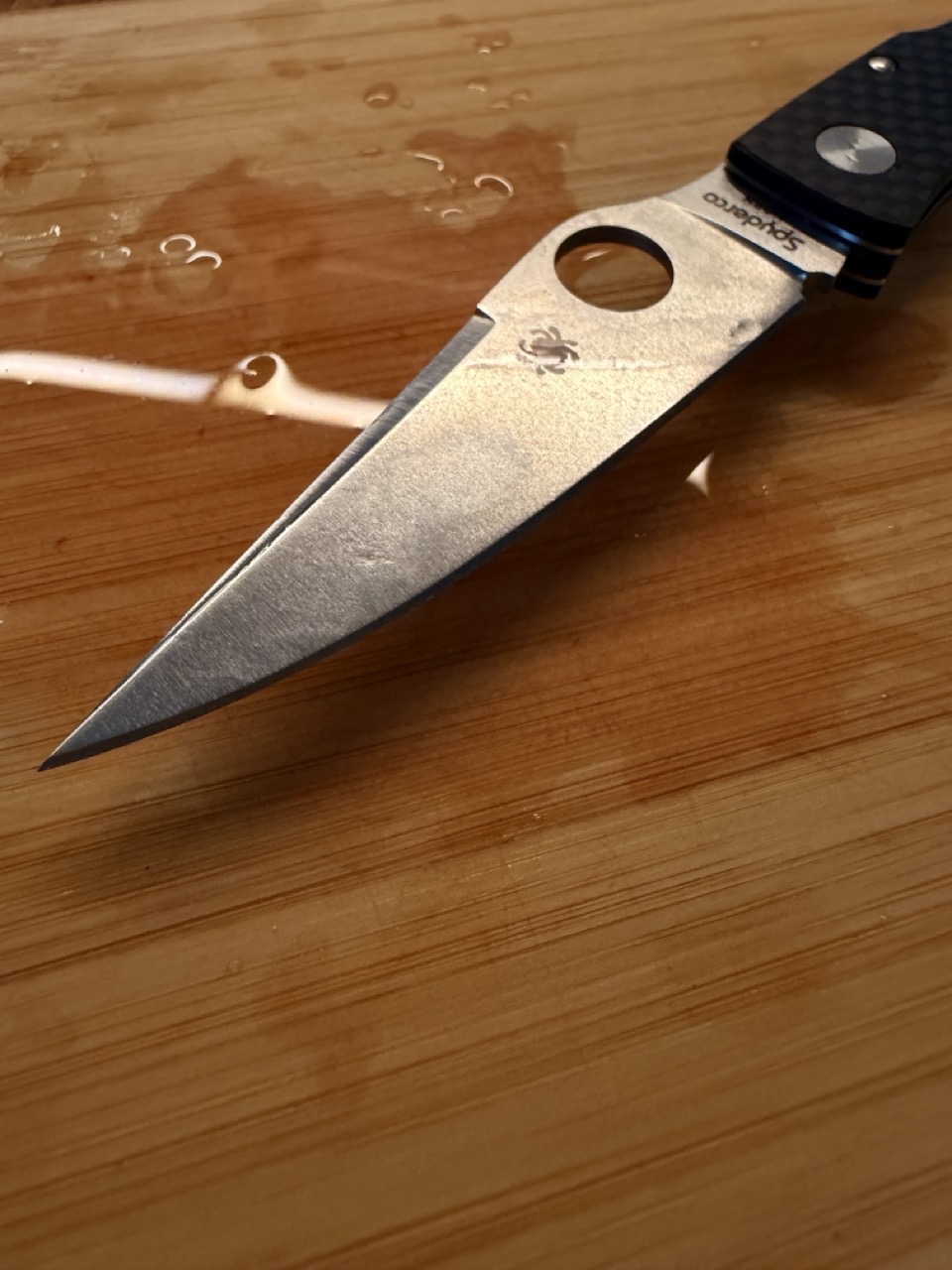
“USE ME! FOR GOD’S SAKE!” screamed the deployed Jess Horn.

And that thin blade is just… asking to be used ! Its geometry gives you effortless cutting performance, but it also means that the steel has to be able to support that geometry. A brittle or overly wear-resistant steel would make the concept much less appealing. CruWear brings a different balance: it is tough enough to tolerate real-world use while still offering excellent edge retention.
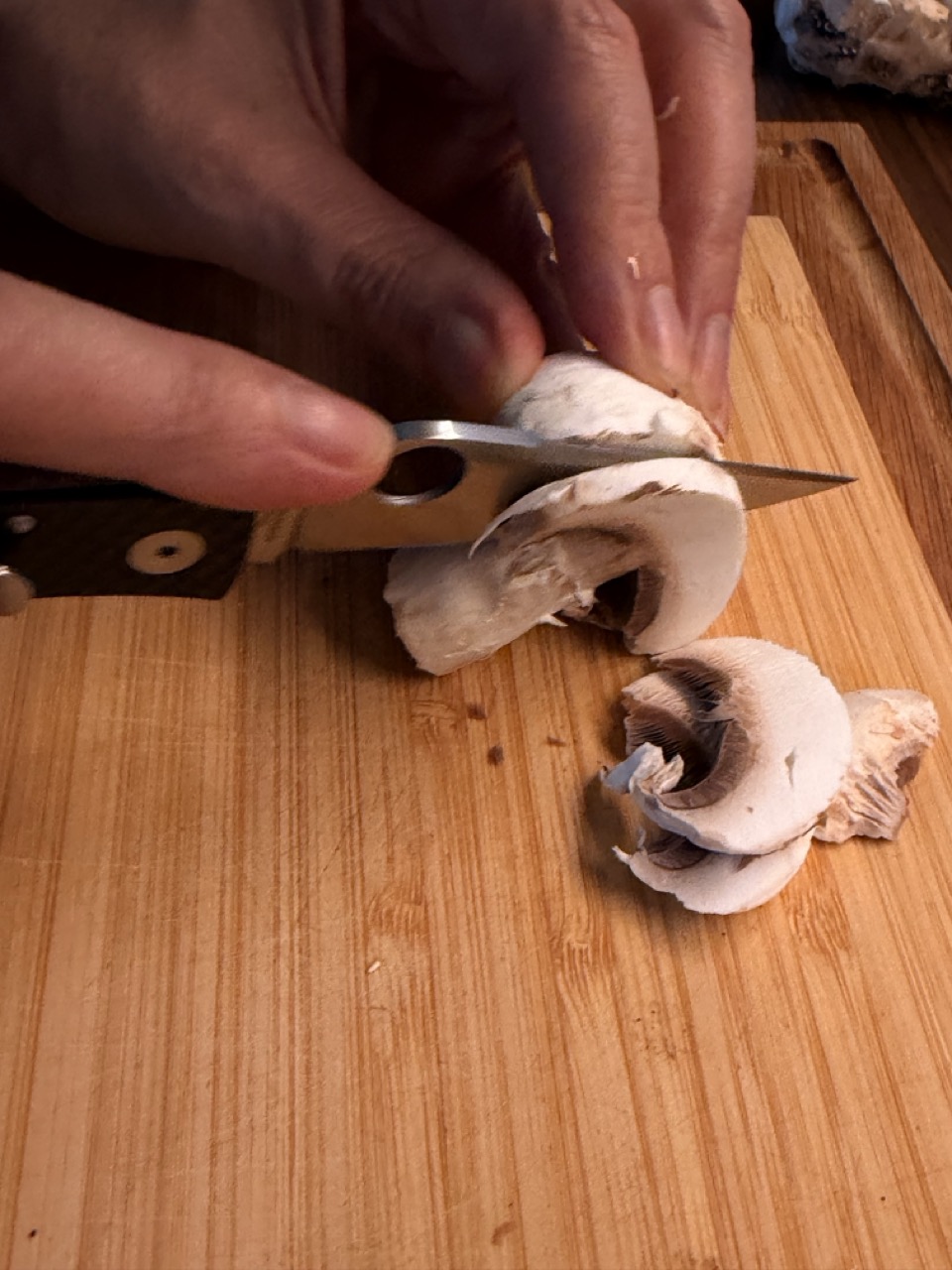
And when the edge eventually needs attention, CruWear is refreshingly easy to bring back.

It takes an extremely sharp edge without becoming a nightmare to sharpen. With the right stones and a good technique, bringing the Jess Horn back to a genuinely razor-sharp condition is almost part of the pleasure of owning it.

That is where the apparent contradiction becomes particularly interesting.

The blade doesn’t need to be thick and overbuilt. It doesn’t need a spectacular tactical design. It doesn’t need to advertise its strength.

Its technology is hidden in the steel.

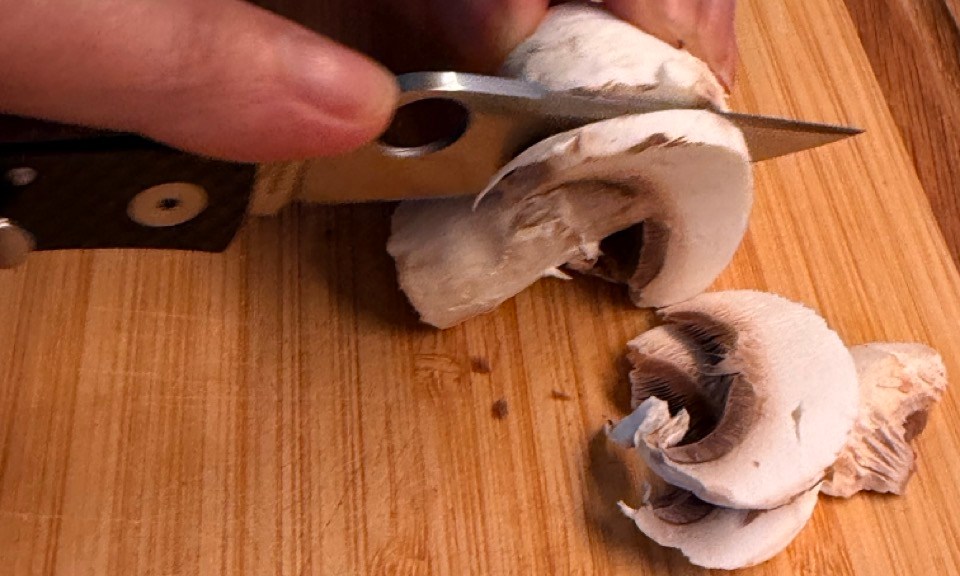
That is perhaps what makes the Jess Horn so compelling. Its modernity is almost invisible. You don’t experience it by looking at the knife. You experience it when you really cut into something, when you feel how effortlessly that thin blade passes through any material. Even mushrooms !:D
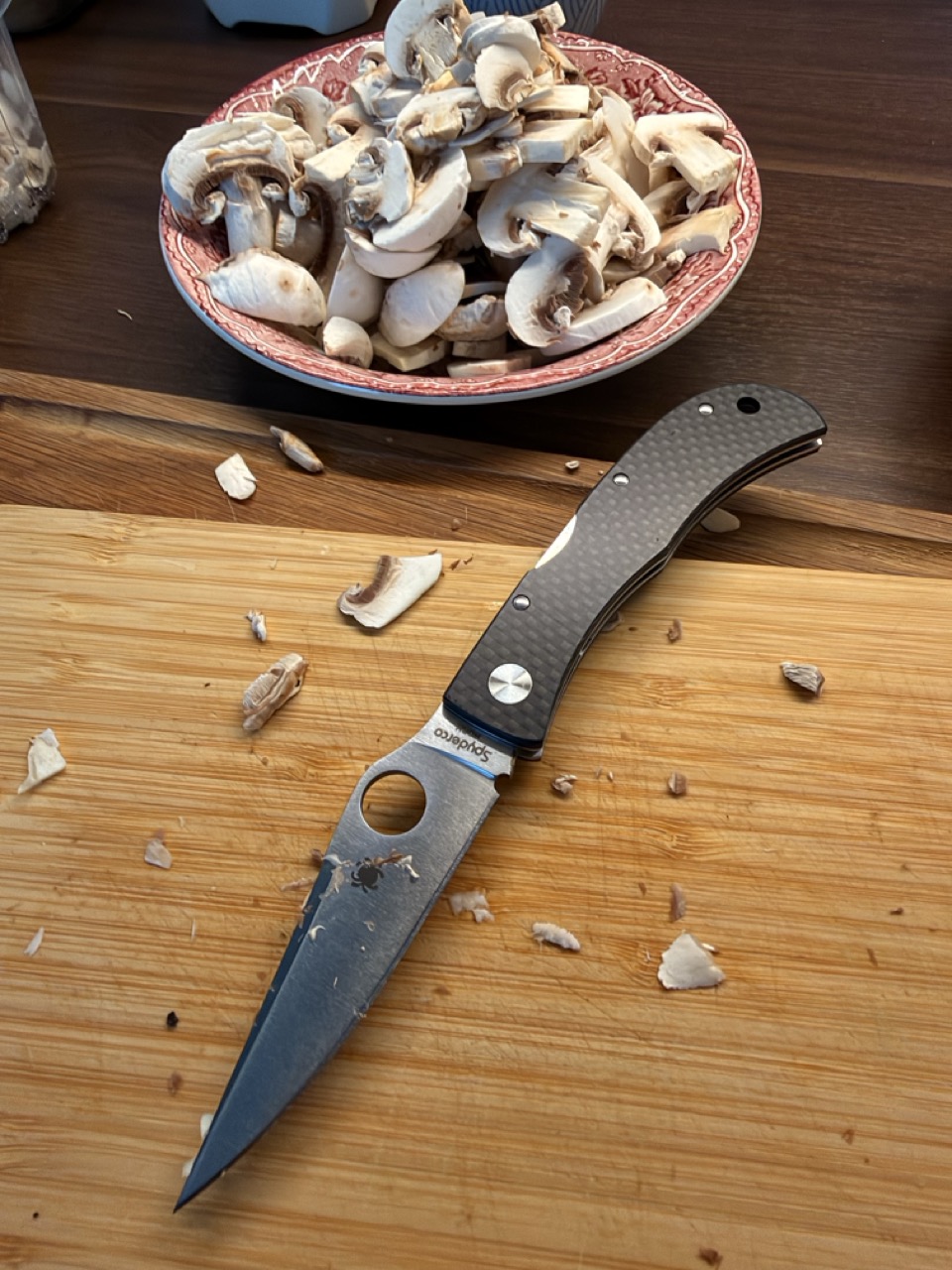
In a sense, the Jess Horn is a perfect example of how modern knife technology has evolved in the right direction.

We tend to think, myself included, of technological progress as a race toward ever-greater complexity: more intriguing parts, more micro-mechanisms, more unwanted features, more white-coat engineering. But real progress sometimes lies in the exact opposite direction—doing more with less, and making something simpler, more reliable, and genuinely useful. Take another Horn, Des Horn “450#” for example (link here)

Another example is the evolution of knife locks. Instead of adding more parts, springs, buttons, and mechanisms, clever engineering can achieve exceptional strength and reliability with remarkably few, precisely tuned components. Less complexity, more intelligent design, means fewer things to go wrong—and, ultimately, a knife that simply works when you need it.
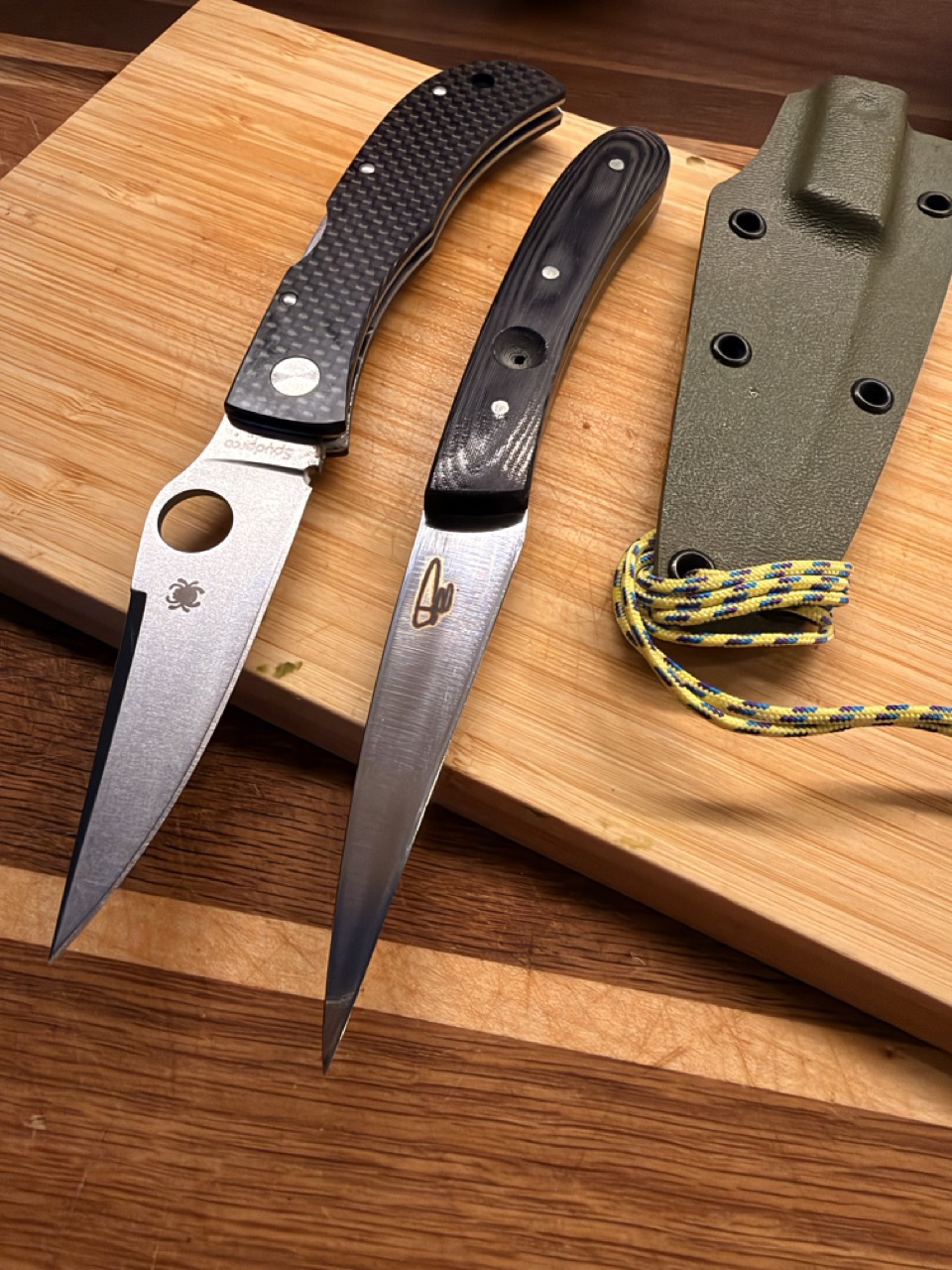
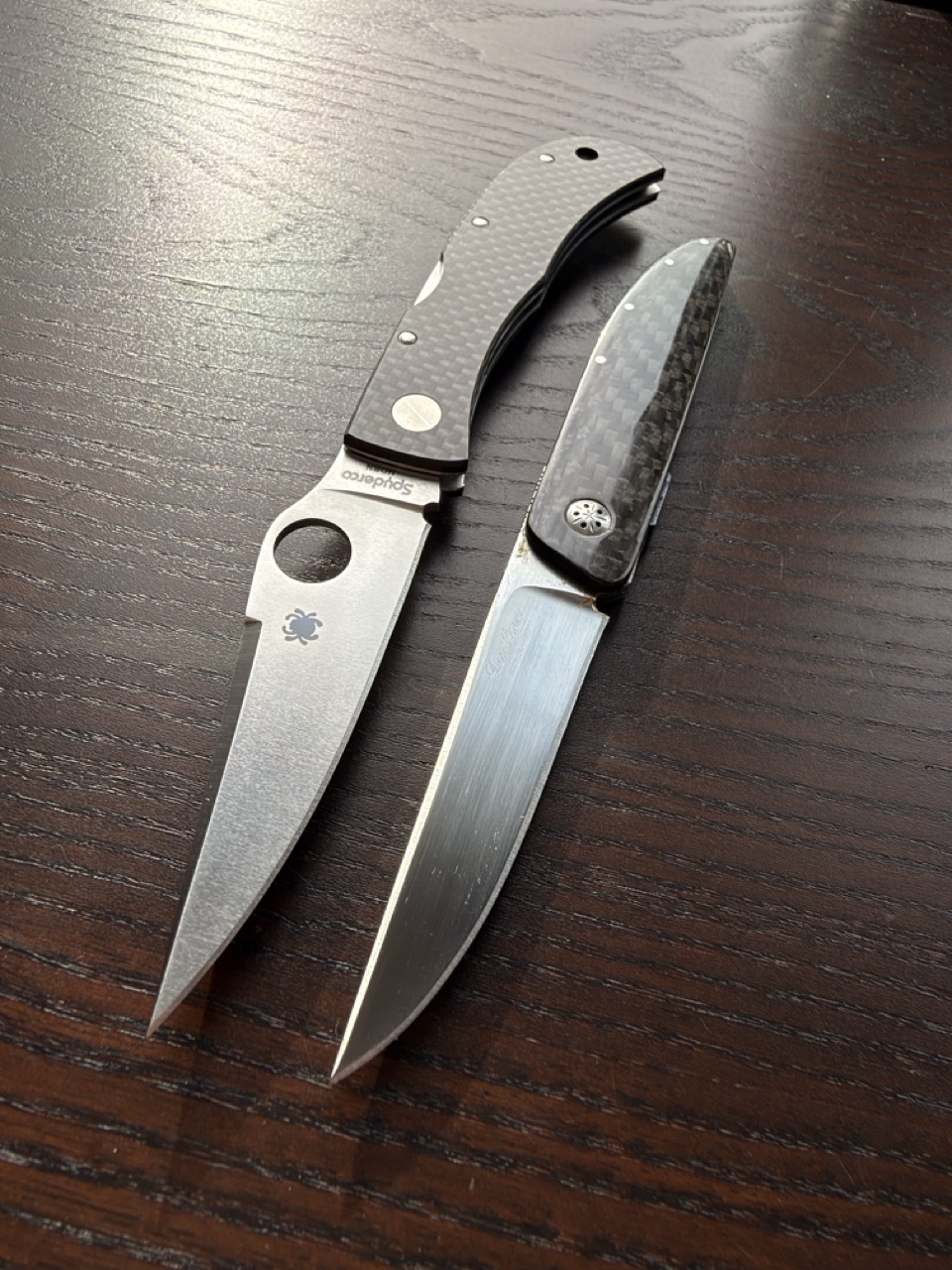
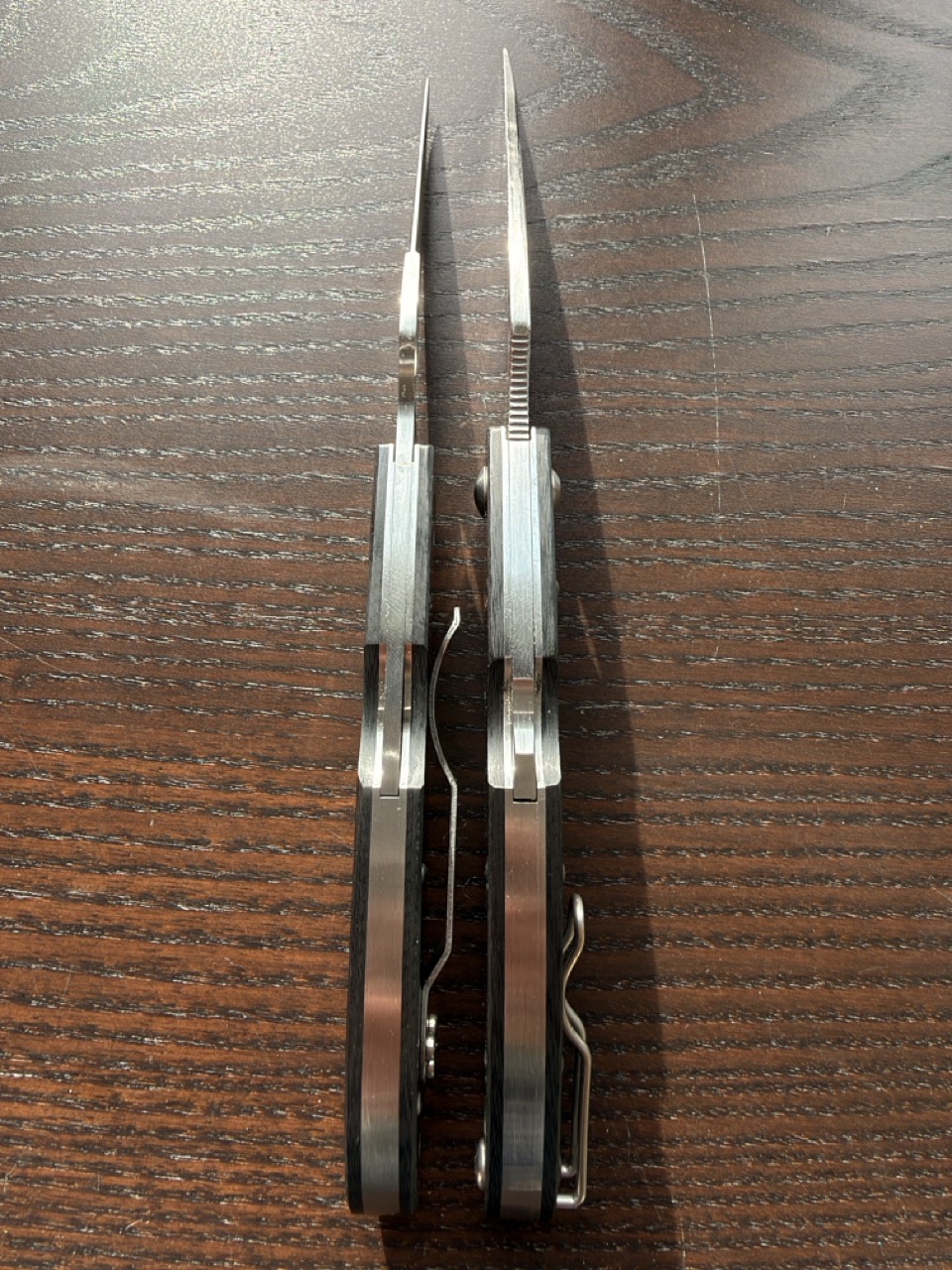
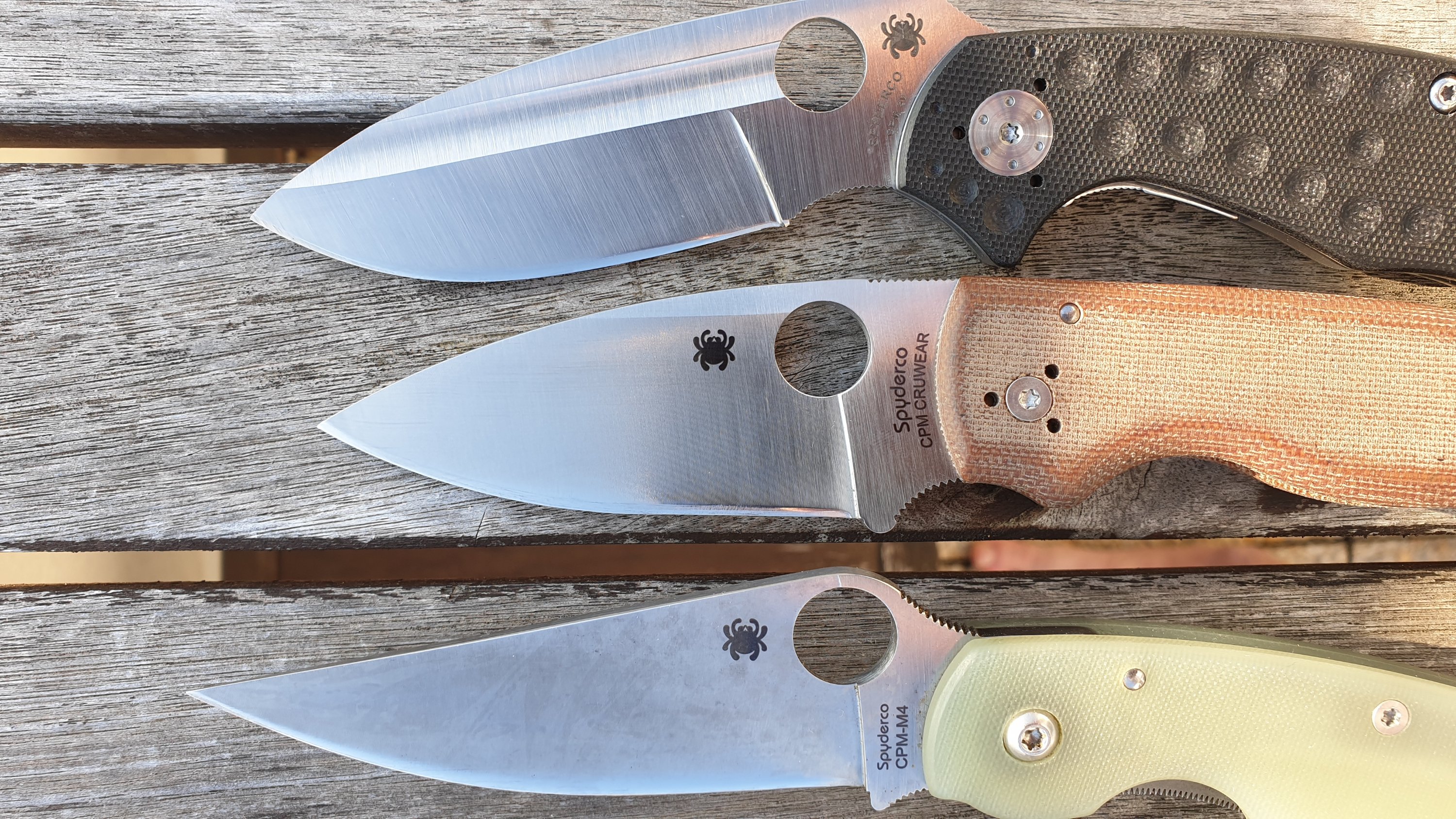
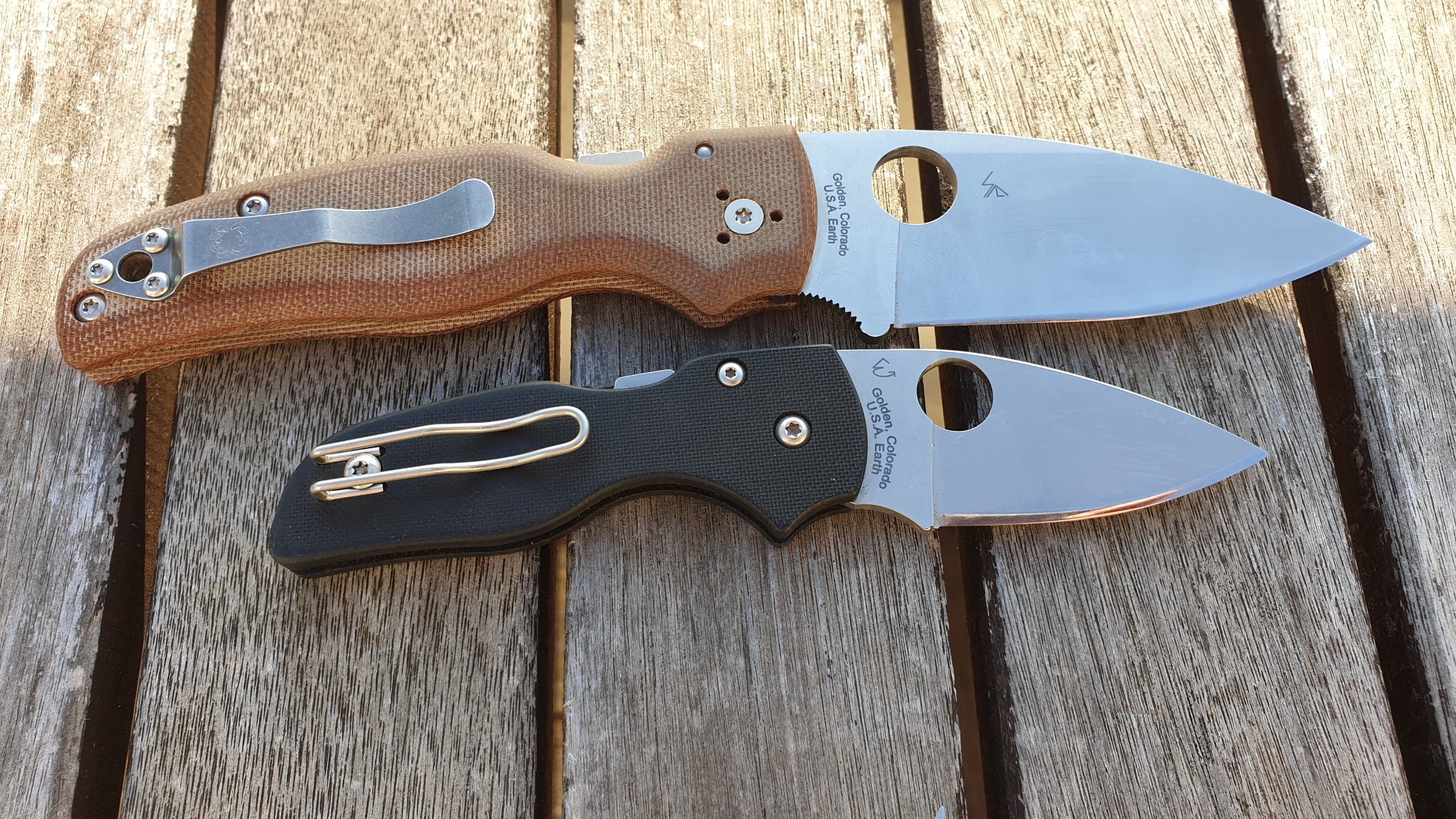
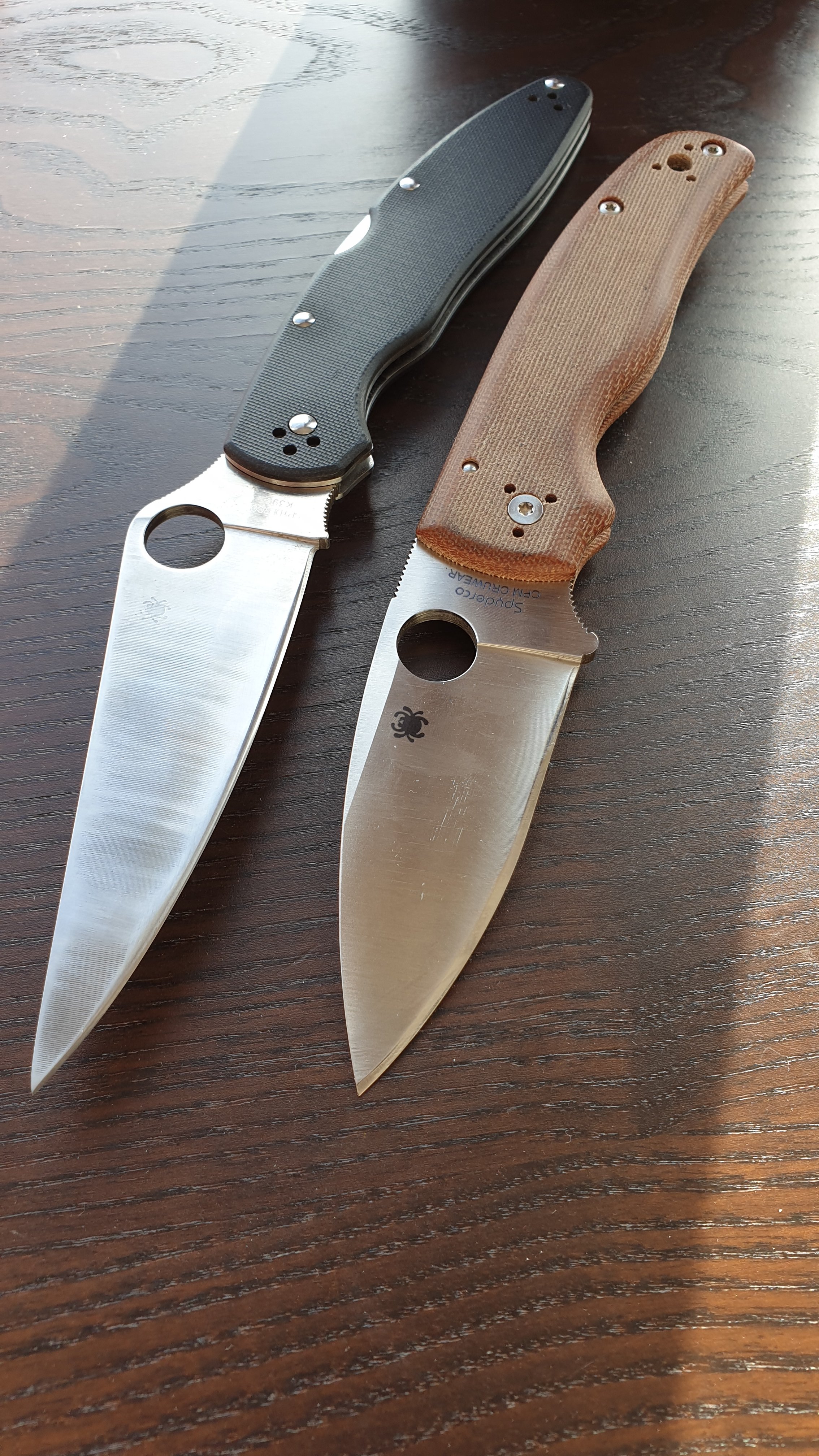
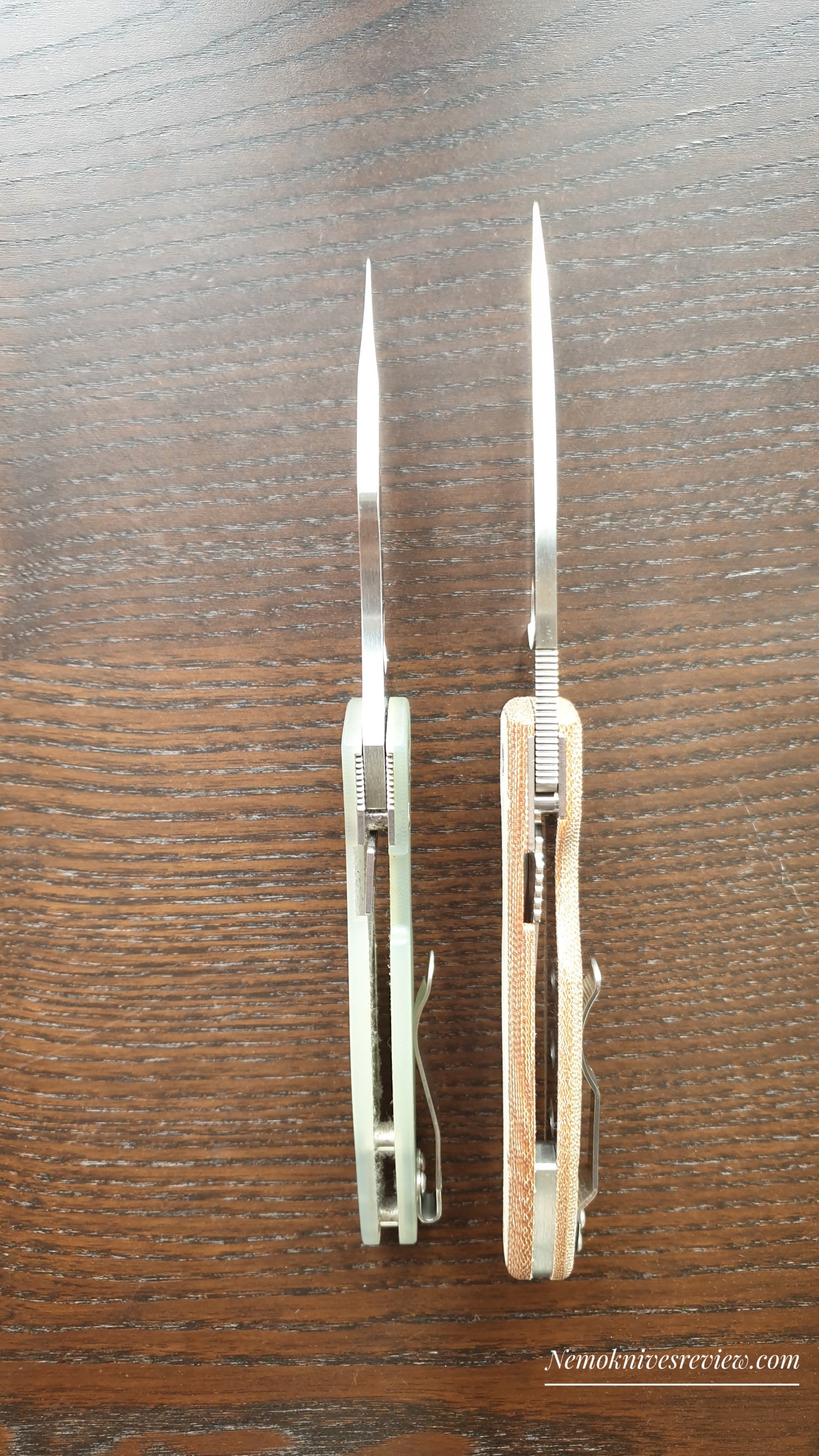
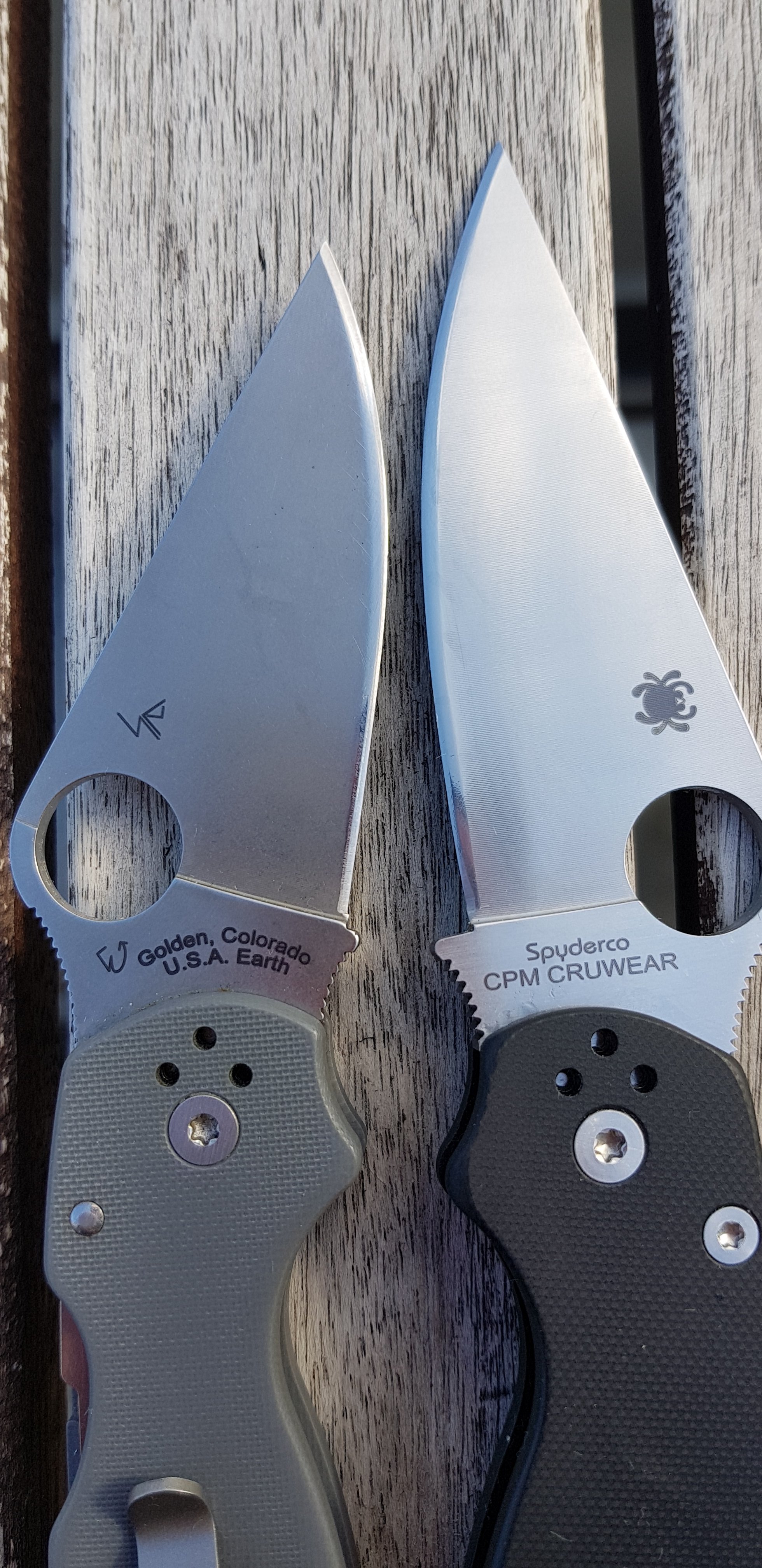
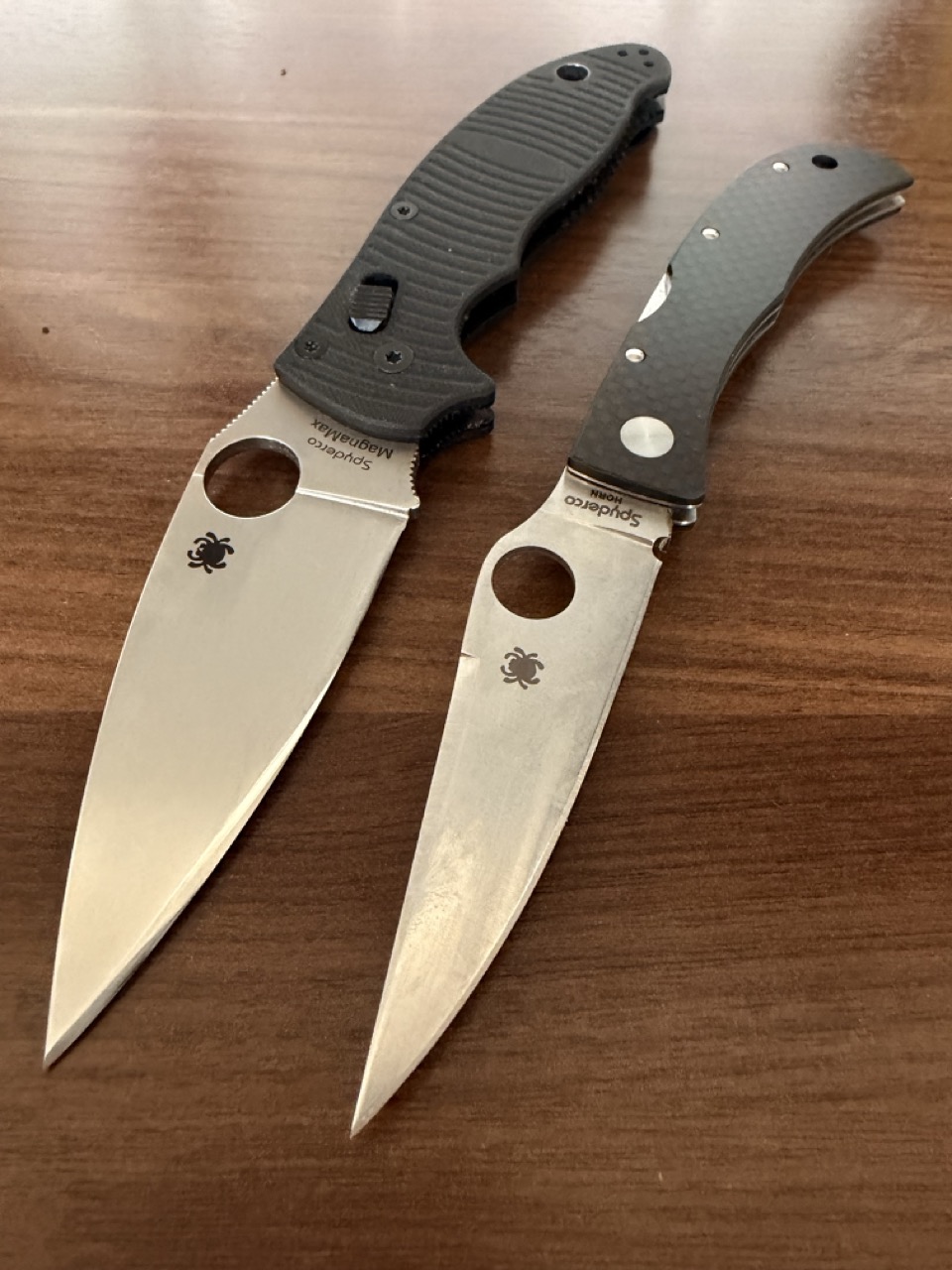
That thin, elegant blade (pictured here next to Patrick Bonetta Kitchen Warrior) can remain thin and elegant because modern metallurgy gives it that extra push in the right direction, providing a combination of properties that simply wasn’t available a few decades ago.

So yes, the Exclusive Jess Horn looks like an old-school knife. But underneath that vintage personality is a very modern piece of engineering.

Horny is not an old-fashioned knife made with modern steel. It is a modern knife deliberately disguised as an old-fashioned one.
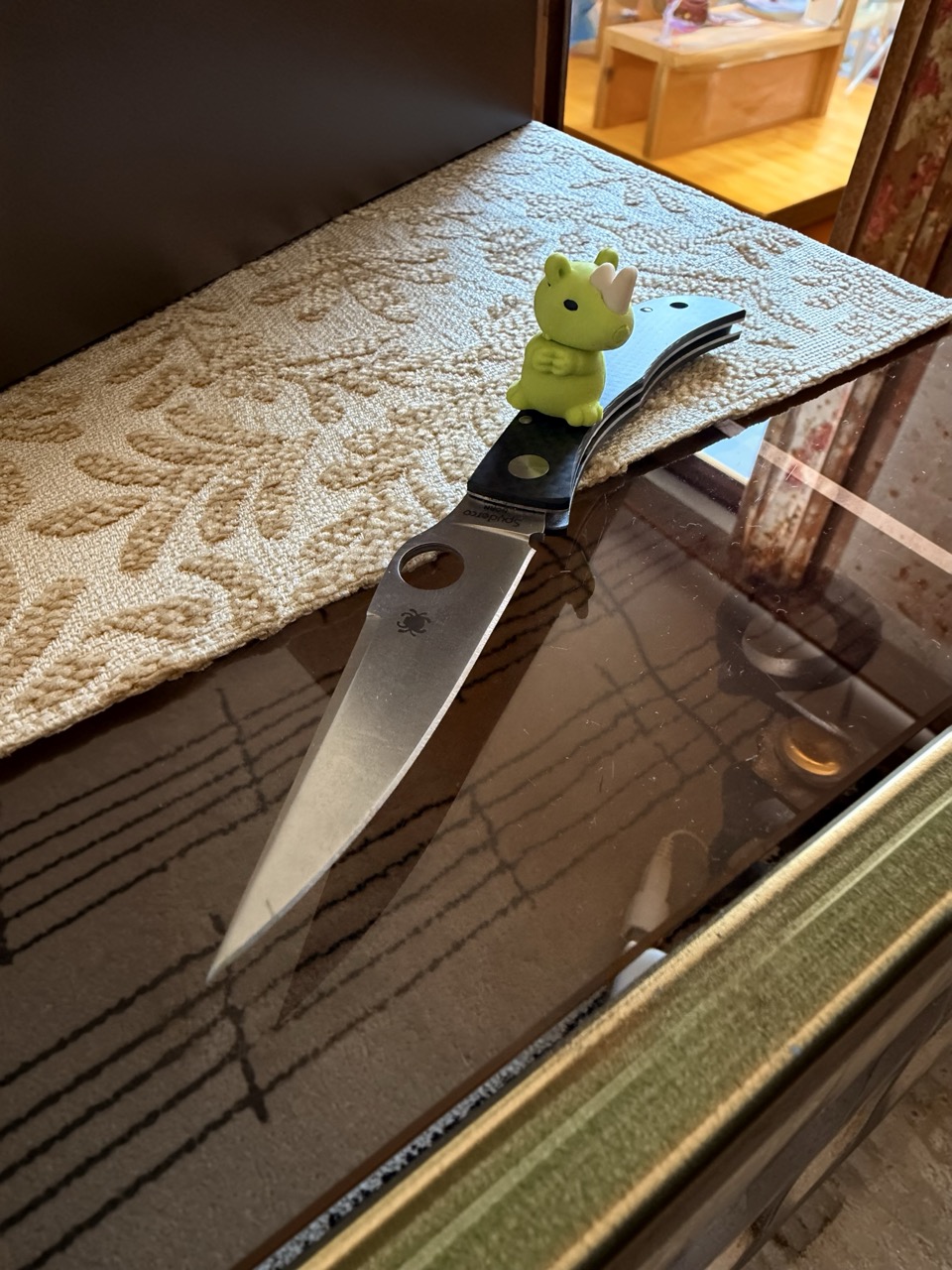
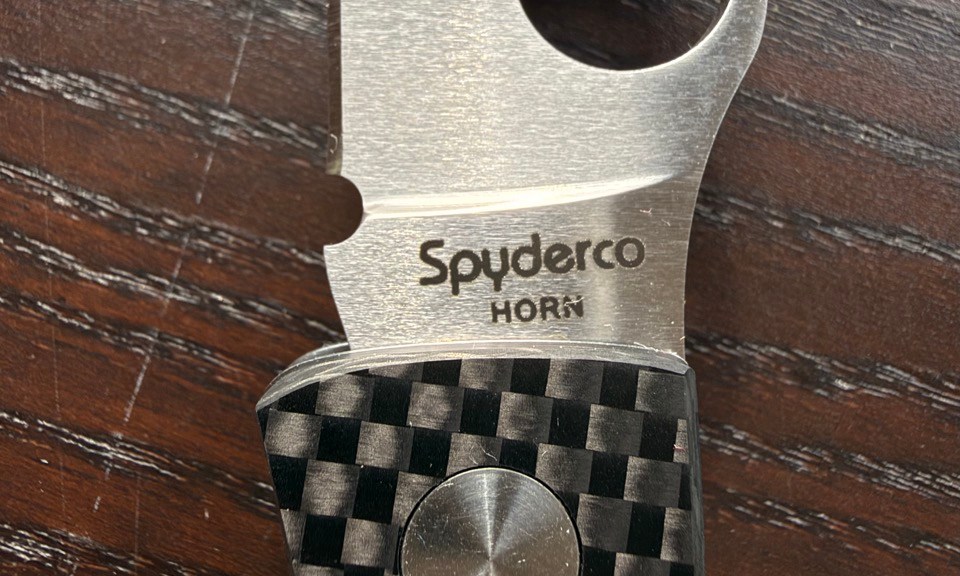
Spyderco C38CFP Jess Horn Exclusive – Horny is back !

This one is a long shot.

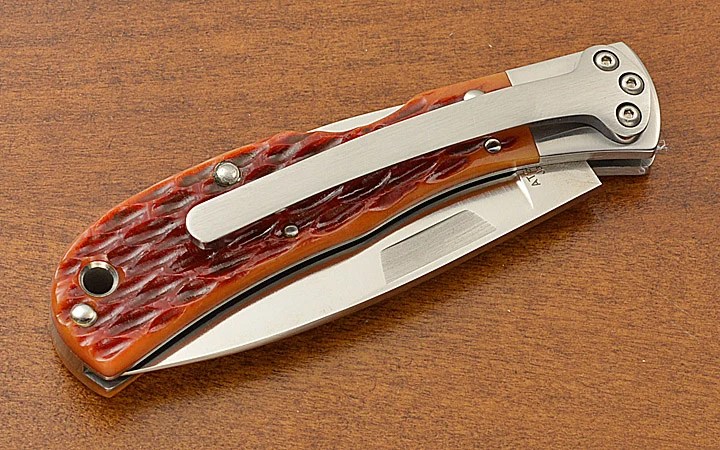
It takes me back 20 years ago when the Spyderco Jess Horn C38PBRG-ZDP-189/420J2 Burgundy was produced. In 2006, that 50 grammes ultra sharp folder was reviewed by Cliff Stamps. And I really enjoyed reading his reviews.

You can still find it here: https://cliffstamp.beyondt01micron.com/knives/reviews/jess_horn_zdp_189.html

Written on July 20, 2006, it’s a fascinating snapshot of what ZDP-189 was capable of more than twenty years ago. Tongue firmly in cheek, Cliff was even splitting logs with his ZDP Lightweight Jess Horn. 😉

Mine was named “Horny”, because of Jess, and was originally lent to me by a friend. I always missed that very pointy, capable little folder, despite its vertical and lateral play.

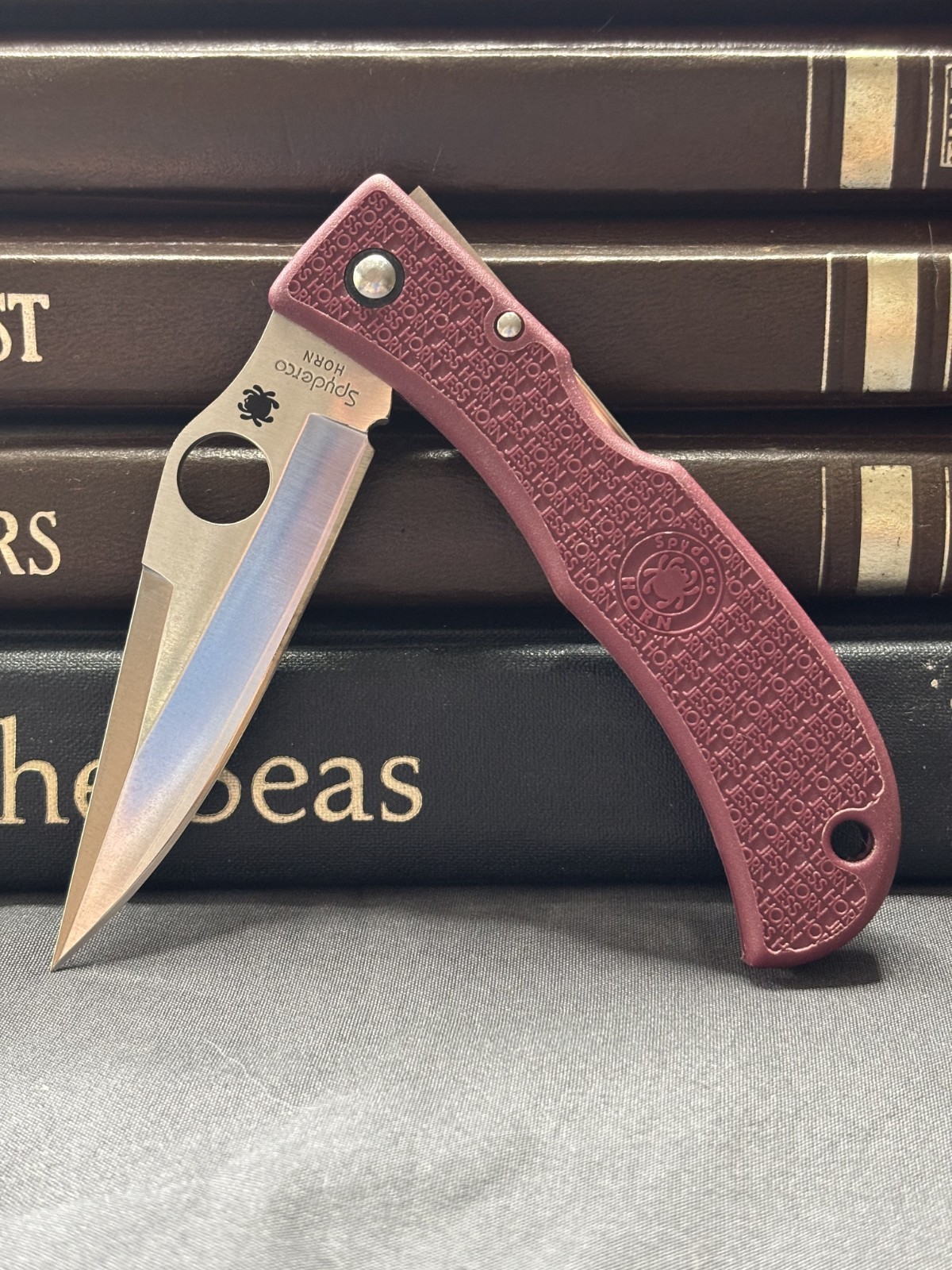
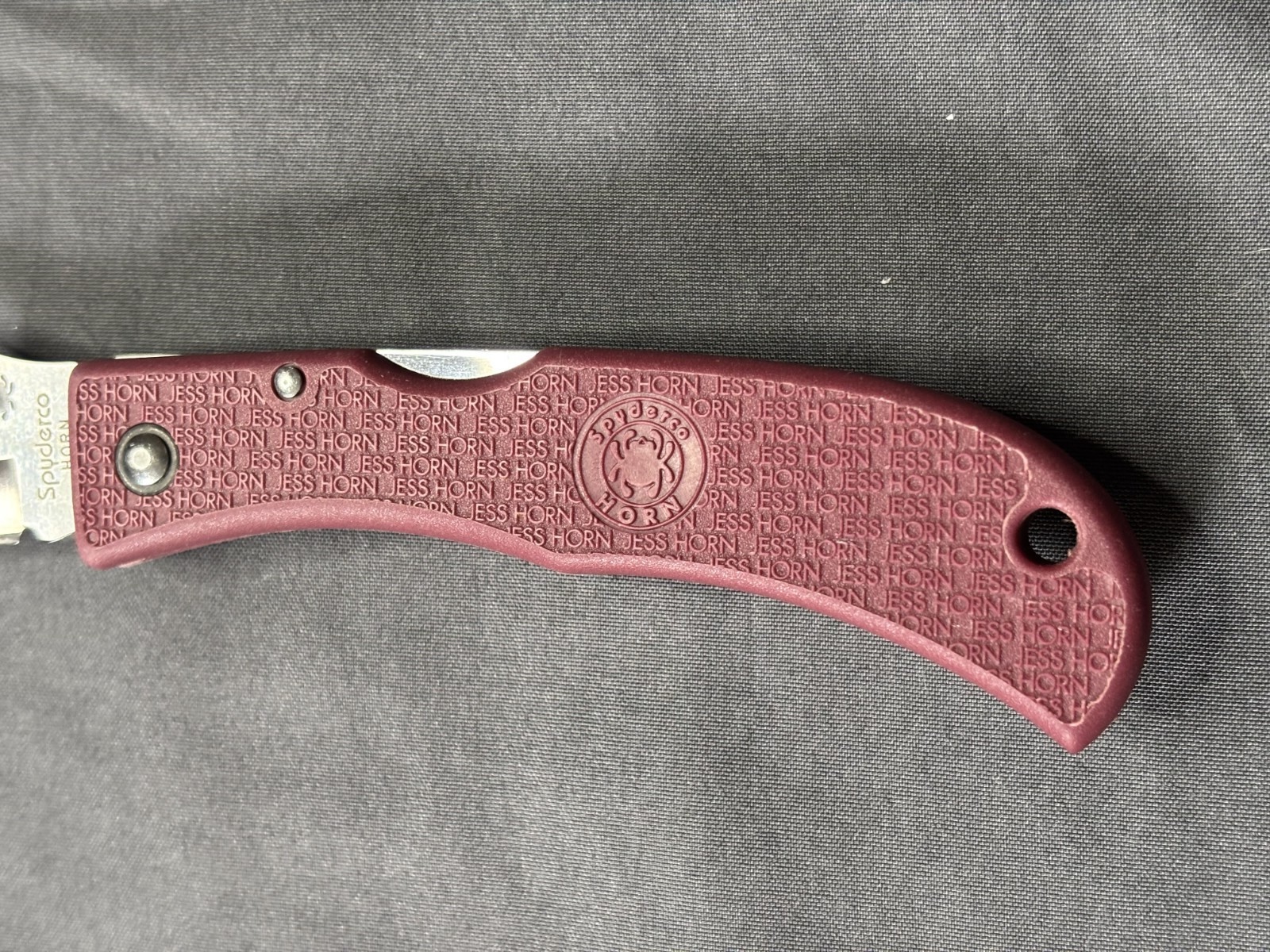
Its thin hollow-ground blade was incredibly sharp and stayed sharp for a remarkably long time. I also loved the FRN handle, which was textured and covered with a repeating “Jess Horn” pattern all over its burgundy surface. It gave the knife a very distinctive look and feel, and somehow made the otherwise simple little folder feel even more like a true Jess Horn.

Twenty years later, in 2026, when I discovered that a dealer exclusive was available in the US, I started looking into importing one. Eventually, I found out that it was being offered by Coutellerie Tournangelle, and two days later, it was sitting in my mailbox. Sometimes things just work out.

My first impression was simple: razor sharp and absolutely zero vertical play. Yep, vertical play is a real plague for me. I hate cutting on a wood board and feeling the blade move slightly back around the pivot. For me, a folder should lock up solidly, with zero lateral or vertical play. This new edition of the Jess Horn delivers exactly that. And I’m so glad about it.

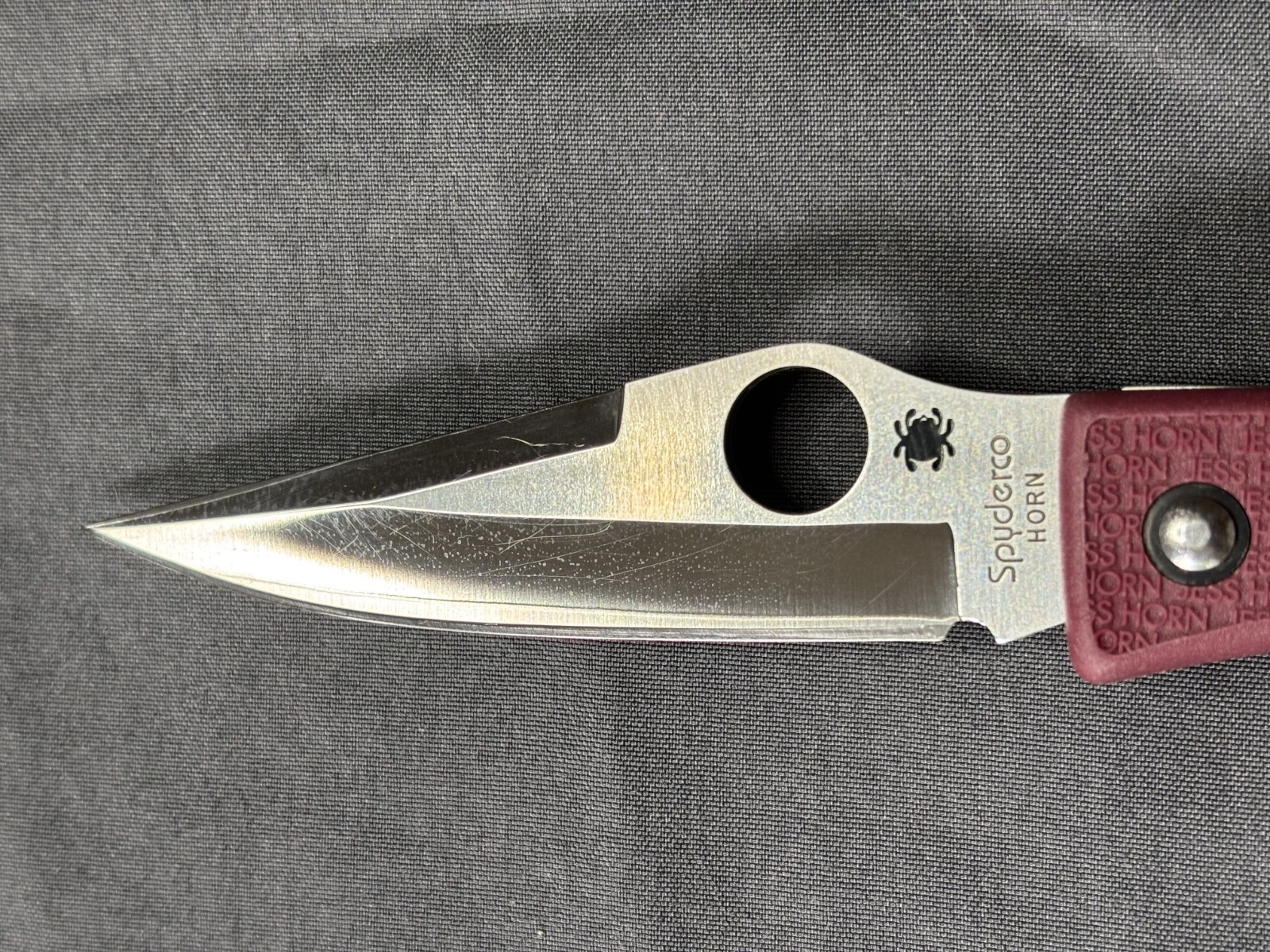
This new Jess Horn is a particularly interesting update of the original design. The most obvious difference is the full-flat grind, whereas the original version had a hollow grind. I guess a CPM Cruwear FFG is stronger than the hollow grind ZDP also Jess Horn was a master in FFG…

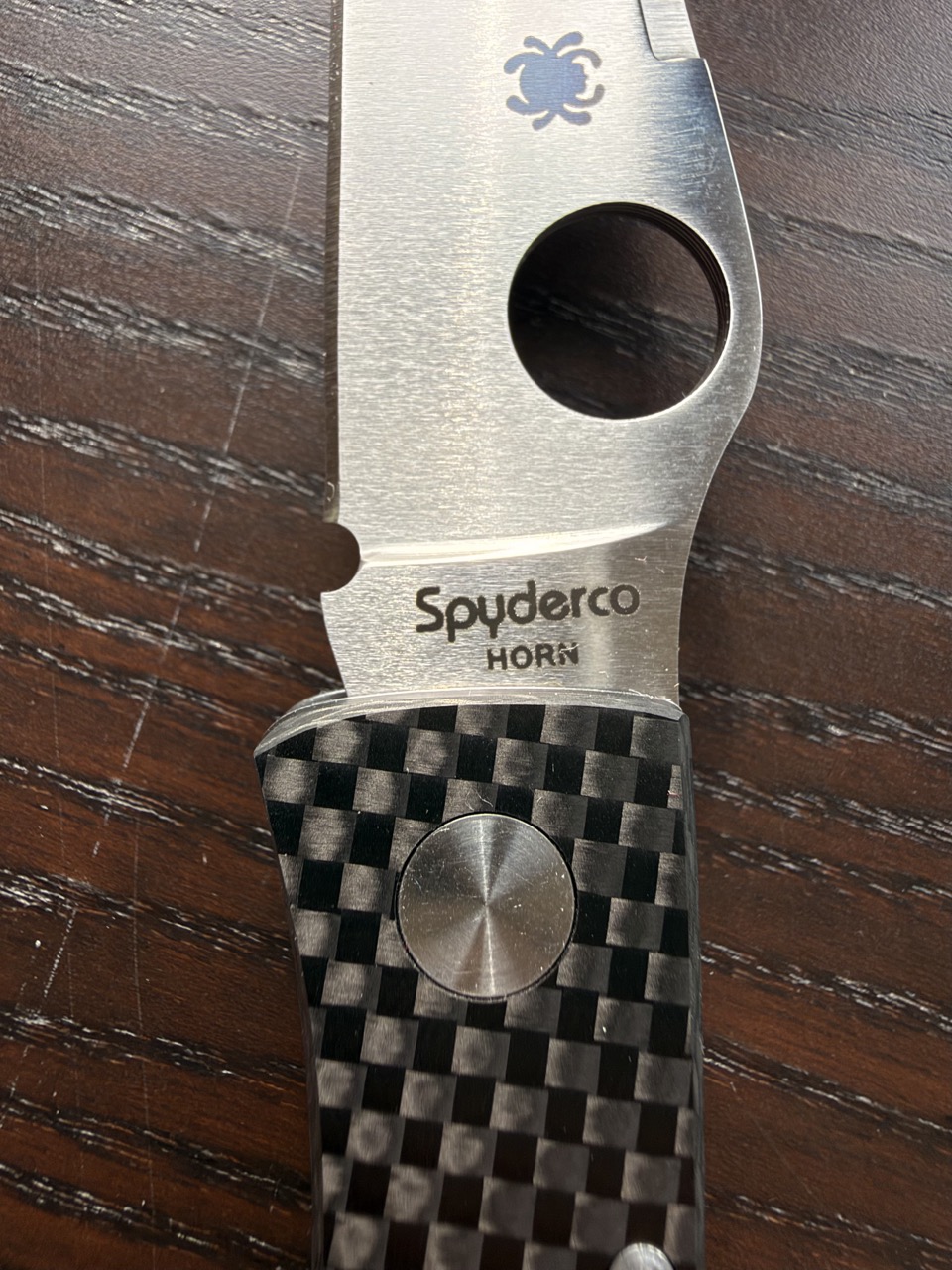
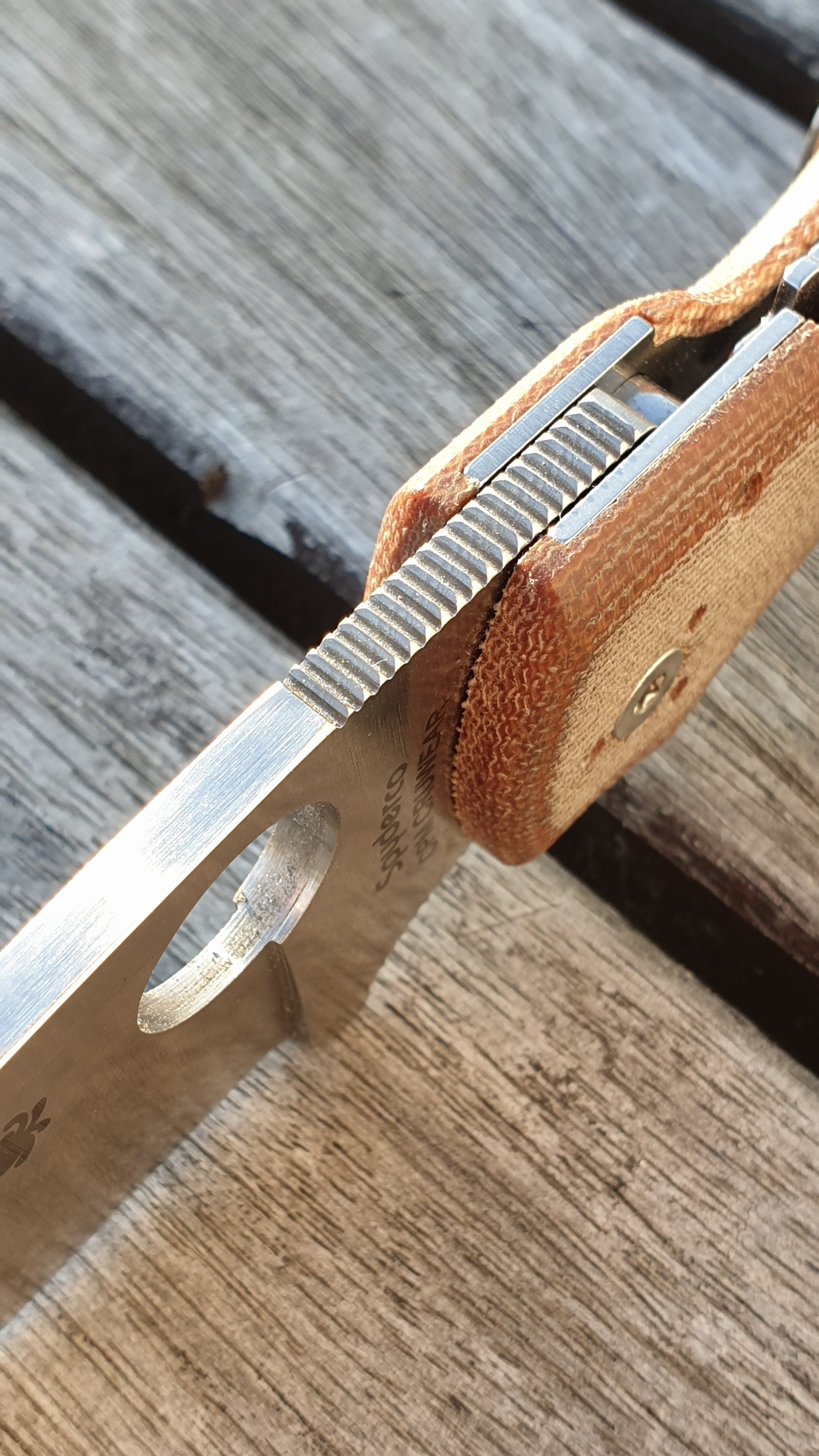
There is no choil here, but a sharpening notch (!), something quite rare on Spyderco knives. And given Jess Horn’s reputation for making very specific requests, I wouldn’t be surprised if this was another of his personal touches—especially since Sal Glesser has never been a big fan of sharpening notches. His concern is that the notch can snag the material being cut.

(On his very first collaboration with Spyderco, the C27, Jess disliked the Spyderhole and even considered it ugly, so its folder was designed without one. Instead, it used a pair of trapezoidal depressions, one on each side of the ATS-34 blade, allowing one-handed opening. The C27 was a remarkable knife for its time. When it was introduced, it was the most expensive single-blade folder Spyderco had produced. And notice that clip too! It was also the only Spyderco-branded folder ever offered with a serrated edge that did not use Spyderco’s trademark SpyderEdge pattern, but instead featured small, evenly sized serrations.)

Jess Horn seemed to have had some sort of a Joker card when it came to getting his way with Spyderco in the early 2000s. And somehow, you can still feel that influence in this 2026 edition.

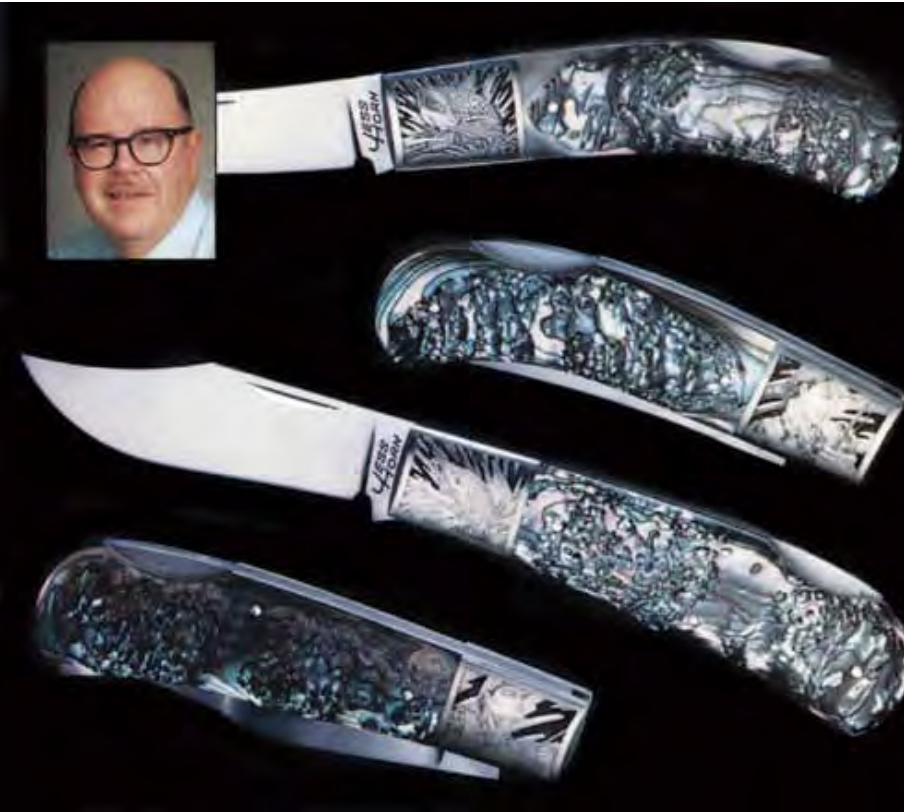
Jess Horn was an American knifemaker from Oregon, best known for his exceptionally refined folding knives. In 1968, while working as a public-works engineer, he made himself a folder because he found the knives available at the time too fragile and poorly designed. His personal designs soon attracted the attention of his hunting and fishing friends, who began asking him to make knives for them. What started as a small production for friends gradually grew as word spread and retailers began placing orders. Horn became known for his meticulous work and his very personal approach to knife design. His knives eventually earned an almost legendary reputation among collectors, particularly in Europe, Japan and the United States. He was never afraid to challenge Spyderco’s established design language. Jess Horn passed away in 2016, but his designs remain highly regarded and his influence is still visible today.

That 2026 “dealer exclusive” is a reminder that, ten years after his death, his distinctive approach to folding-knife design still has something to say. There is a kind of spicy, old-school sauce to this knife that you simply don’t find in much of today’s production. It has bags of character. It feels like a genuinely unique folder, almost deliberately going against the current direction of the knife industry.

For starters, it doesn’t try to be tactical, nor is it designed as a fidget toy. This is a proper folding knife: serious, purposeful, extremely pointy and genuinely razor sharp. It feels made to cut, not to entertain your thumb.

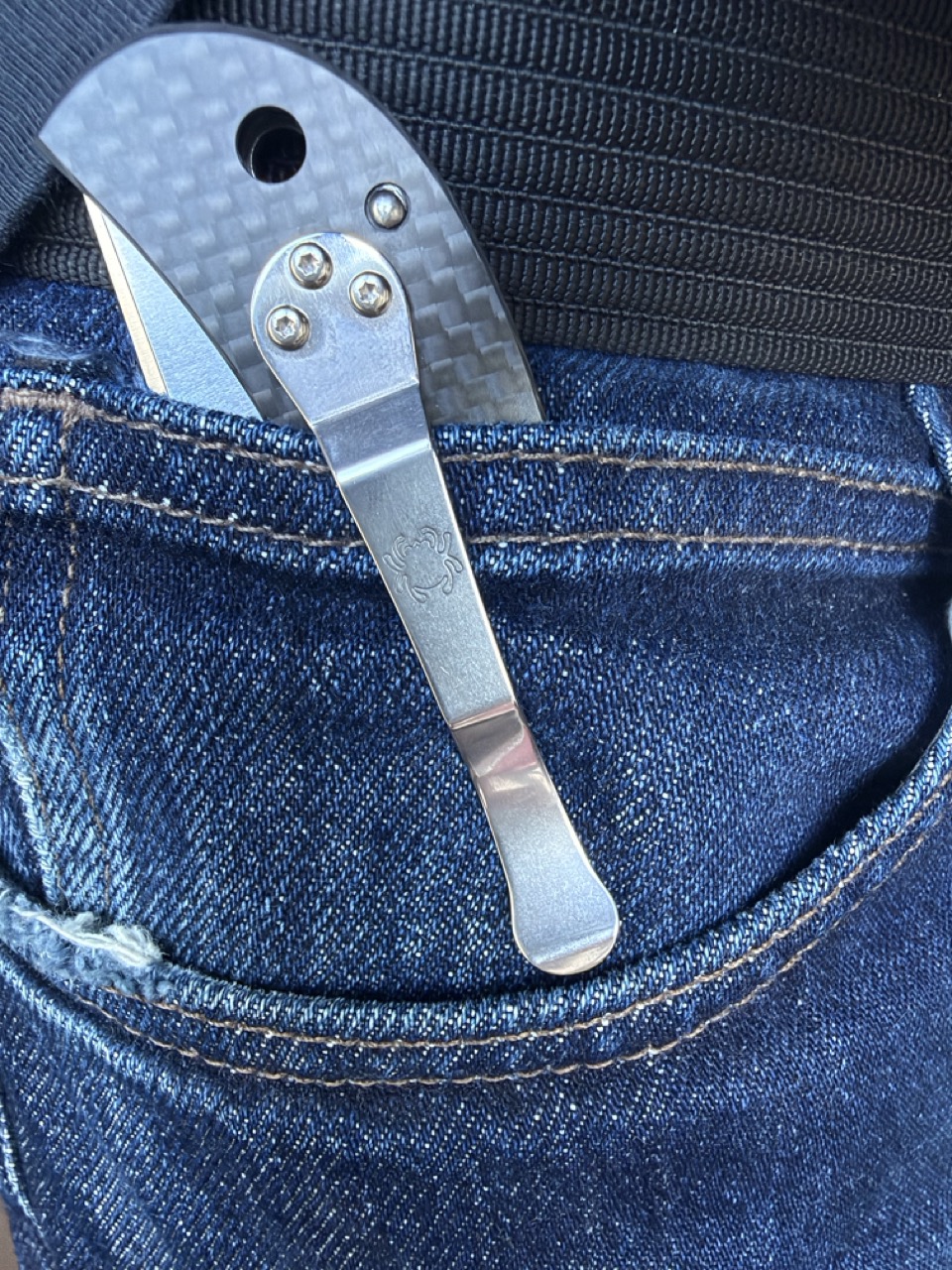
Then look at this handle. The clip sits very low, so the knife rides high in the pocket. There’s absolutely no attempt here to make it disappear into a deep-carry setup. In fact, it sits so high that you can even carry it in the watch pocket!

Plenty of the handle stays above the pocket, ready to grab.

(Is that a knife in your pocket, or are you just happy to see me?) 😏

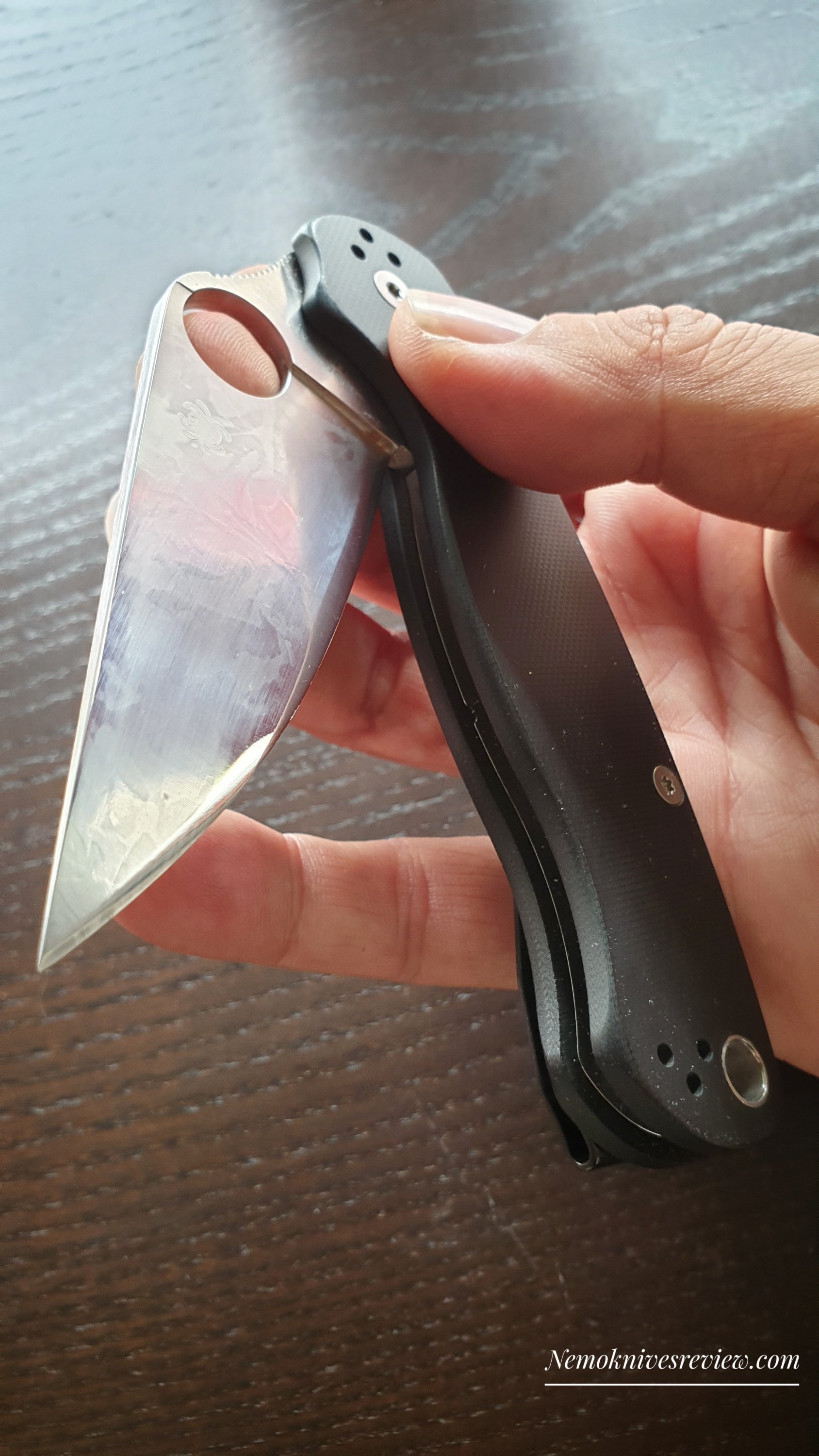
And once you grab it, the Jess Horn almost jumps into your hand. That crazy curved handle wraps itself around your palm with a comfort that is almost ridiculous. It looks simple, but the ergonomics are anything but.

There is something of a miniature Indian saber (a Khyber?) in that sweeping shape. The more I play with it, the more addictive it becomes. But the real trap is when you actually start cutting with it: that’s when the addiction kicks in for good.

That beautiful blade is made for working as it is now made from CPM CruWear, and this is where that 2026 version takes a different path from the ZDP Jess Horn.

The old Jess Horn used ZDP-189, famous for its extreme hardness—around 65 HRC in this application—and outstanding edge retention, but with relatively low toughness. It can be prone to chipping, especially when pushed hard, which makes edge geometry particularly important.

To quote JD: “I too had one of the ZDP ones. I remember I found the edge on mine too thick behind the edge and sold it.”

With such a thin hollow-ground blade, a very acute edge would have been impressive in terms of cutting performance, but would also leave less margin for abuse.

ZDP-189 was also offered in laminated constructions, with the extremely hard ZDP-189 core sandwiched between tougher steels. The cladding does not magically make the core tough, but it can provide additional support and improve the overall durability of the blade.

And this is where the new CruWear Jess Horn becomes really interesting: instead of protecting an extremely hard, wear-resistant core, Spyderco has wisely chosen a steel whose inherent toughness makes much more sense for a thin, aggressive working blade.

Two birds with one stone: change the steel, change the grind.

Moving from ZDP-189 to CPM CruWear completely changes the philosophy of the knife. CruWear gives up some of ZDP-189’s extreme wear resistance, but brings considerably more toughness and strength to the table. It is a much more forgiving steel when the knife is actually being used rather than simply admired for its edge retention.

CPM CruWear is almost synonymous with a hard-working blade. It’s a steel that invites you to use the knife rather than baby it. And changing the grind at the same time makes perfect sense: the old Jess Horn had that wonderfully thin hollow grind, while this new version gets a full-flat grind, giving it a different kind of cutting character.

(There is also an interesting connection here with CPM MagnaCut. MagnaCut was not simply designed as a stainless version of CruWear, but the philosophy is related: take the exceptional toughness associated with high-toughness tool steels such as CPM CruWear and CPM-4V, and combine it with genuinely high corrosion resistance and useful wear resistance.)

So Spyderco has effectively given the Jess Horn two birds with one stone: a new steel that is much more at home in hard use, and a stronger grind that lets that steel show what it can do. In that sense, CruWear is part of the same family of thinking: prioritizing toughness and overall balance rather than chasing maximum wear resistance at all costs. (CruWear itself is not stainless, of course, but it is surprisingly corrosion-resistant for a tool steel and can take a long time to develop any visible patina under normal use.)

And that makes a lot of sense on this particular knife. The Jess Horn is an exceptionally thin, pointy folder, and CruWear gives that delicate geometry a much tougher backbone. You still get excellent edge retention, but with a level of toughness that makes me much more confident about actually putting this little needle of a blade to work.

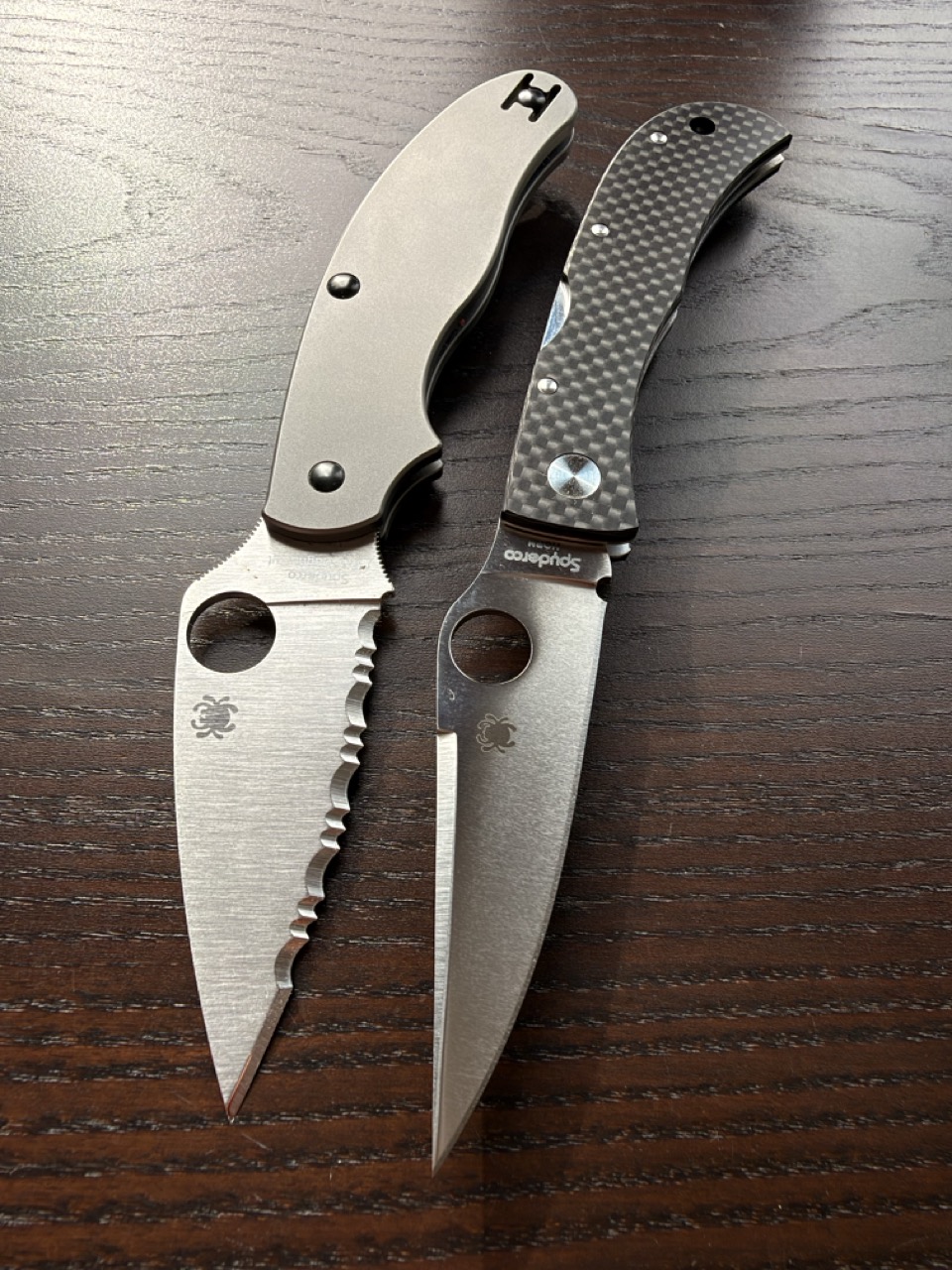
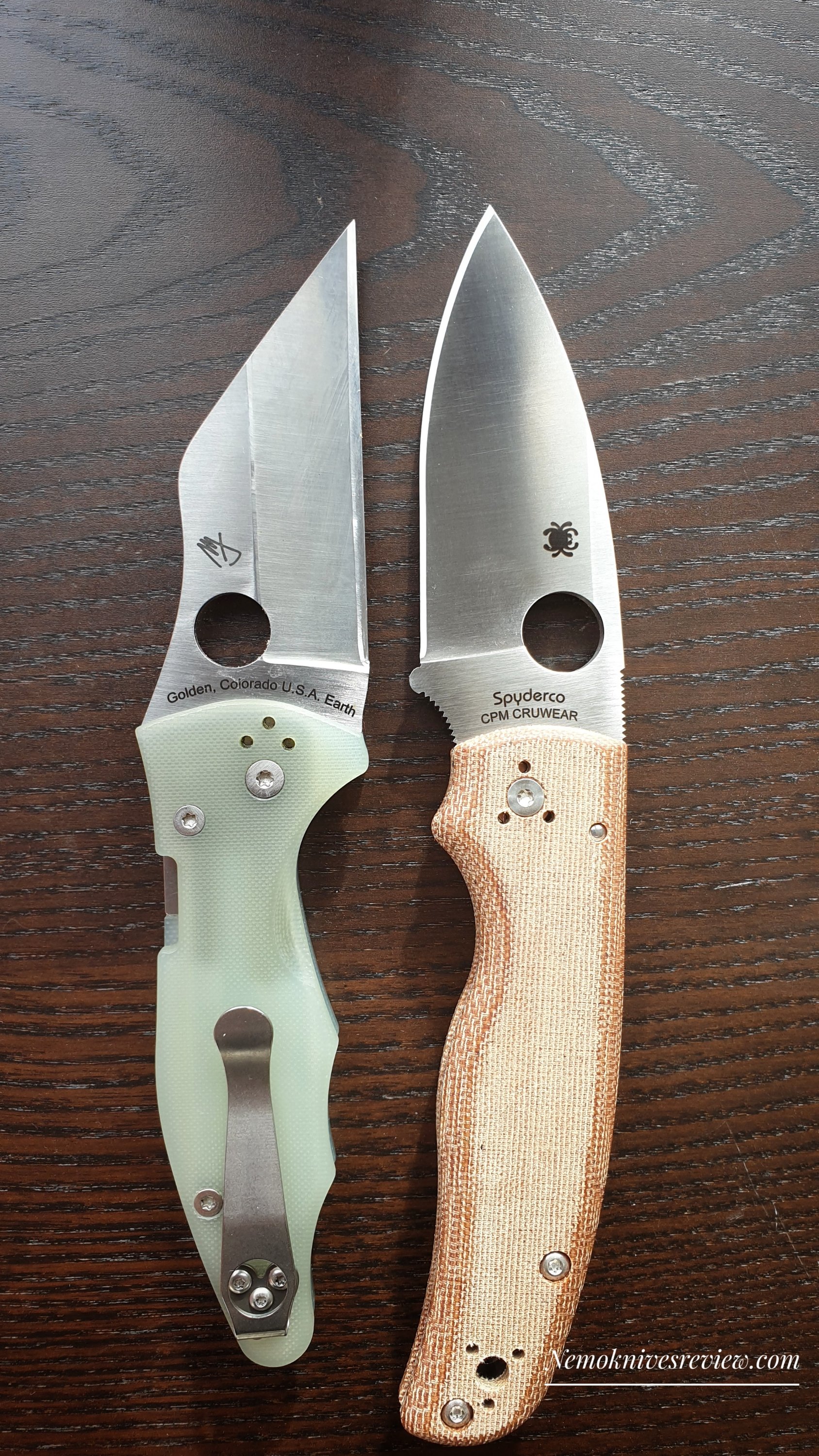
(Picture of two Horn, Jeff and Des, two high performance light folders hard as nails ! )

The result is Jess Horn with a thin, strong aggressive blade. Cliff Stamp would probably have loved it. (Sadly, Cliff left us in 2021, far too young, but his 2006 Jess Horn review remains a fascinating snapshot of both the knife and the way he approached steel, geometry and cutting performance. Reading it today, while holding this new CruWear version, makes the connection between these two generations of Jess Horn’s Spyderco particularly special.)

Finally, what I like about Jess Horn’s designs is that they never look like they are trying too hard. A Jess Horn is not a tactical brick with a thousand angles and a collection of gadgets. It feels more like a tool designed around the hand—simple, elegant and with a very clear idea of what a folding knife is supposed to do.

That philosophy is still very much alive in this new version. The materials may be modern (Carbon Fibers and CPM Tool Steel), but the knife itself feels wonderfully old-school: rivets instead of screws, for example, just like like on the Caly 3.5 !

The construction is equally straightforward and solid with steel liners and a steel backspacer adding weight exactly where you feel it most: in the palm of your hand. It gives the Jess Horn a surprisingly substantial feel for such a slim and elegant folder.

And when you actually start using it… ah ah. That satin-finished modified clip-point blade is a thin little devil: an extremely pointy matter separator built around a steel that balances edge retention with toughness.

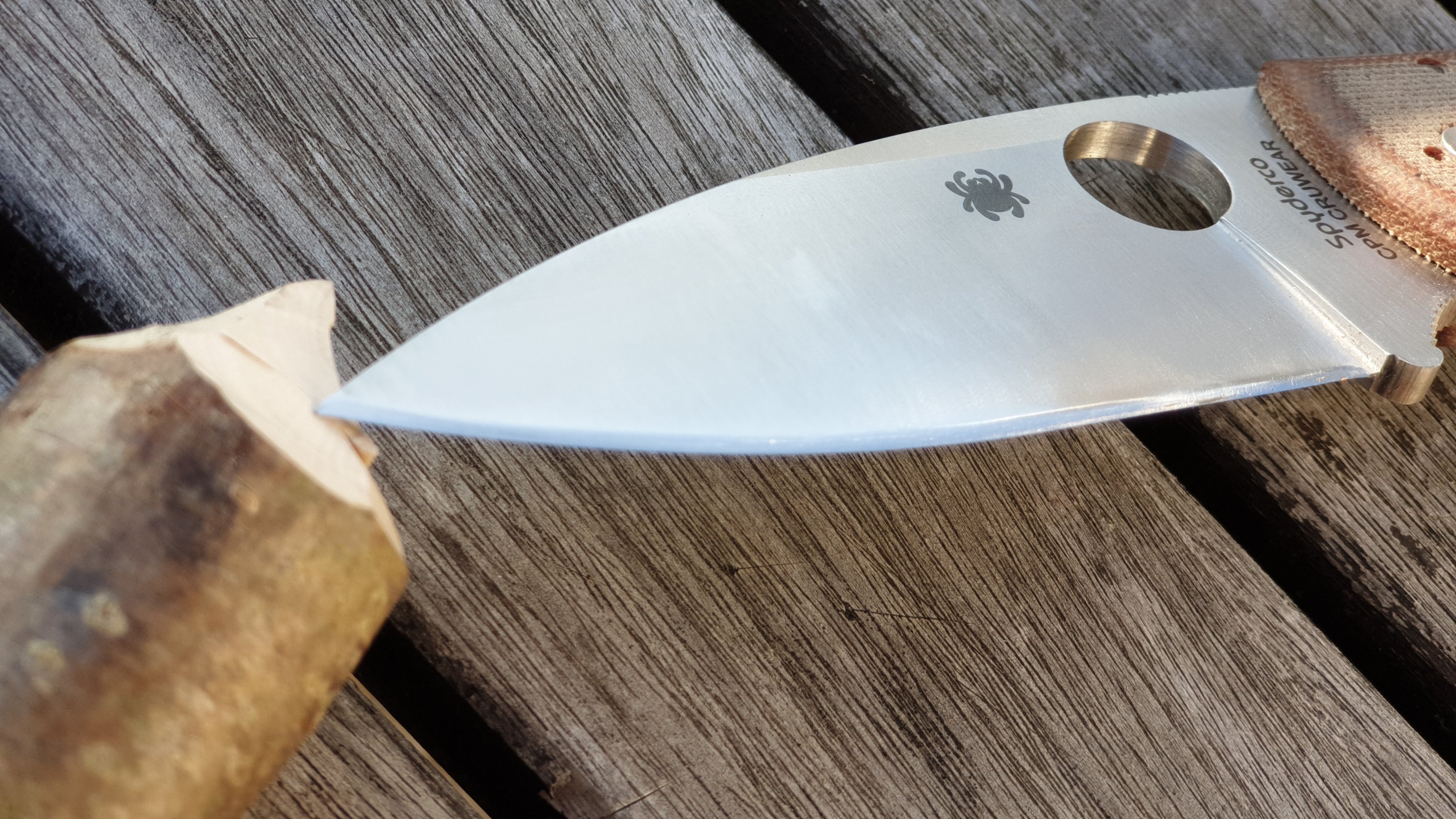
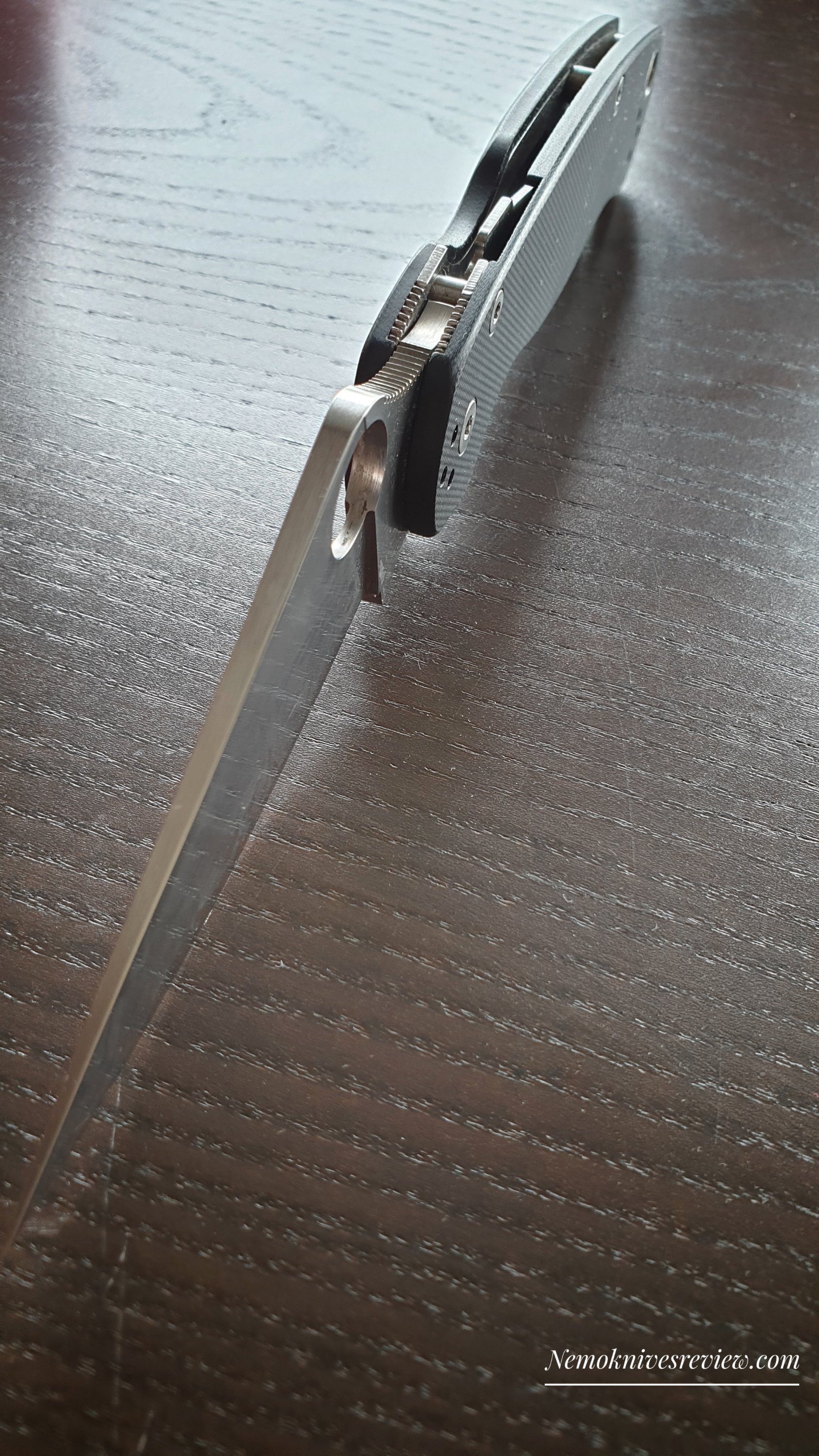
And look at that subtle false edge, or swedge, along the spine. It visually lightens the blade without turning it into some kind of tactical sculpture. But it is not just there for looks—it also helps the needle-like point glide into deeper cuts with less resistance.

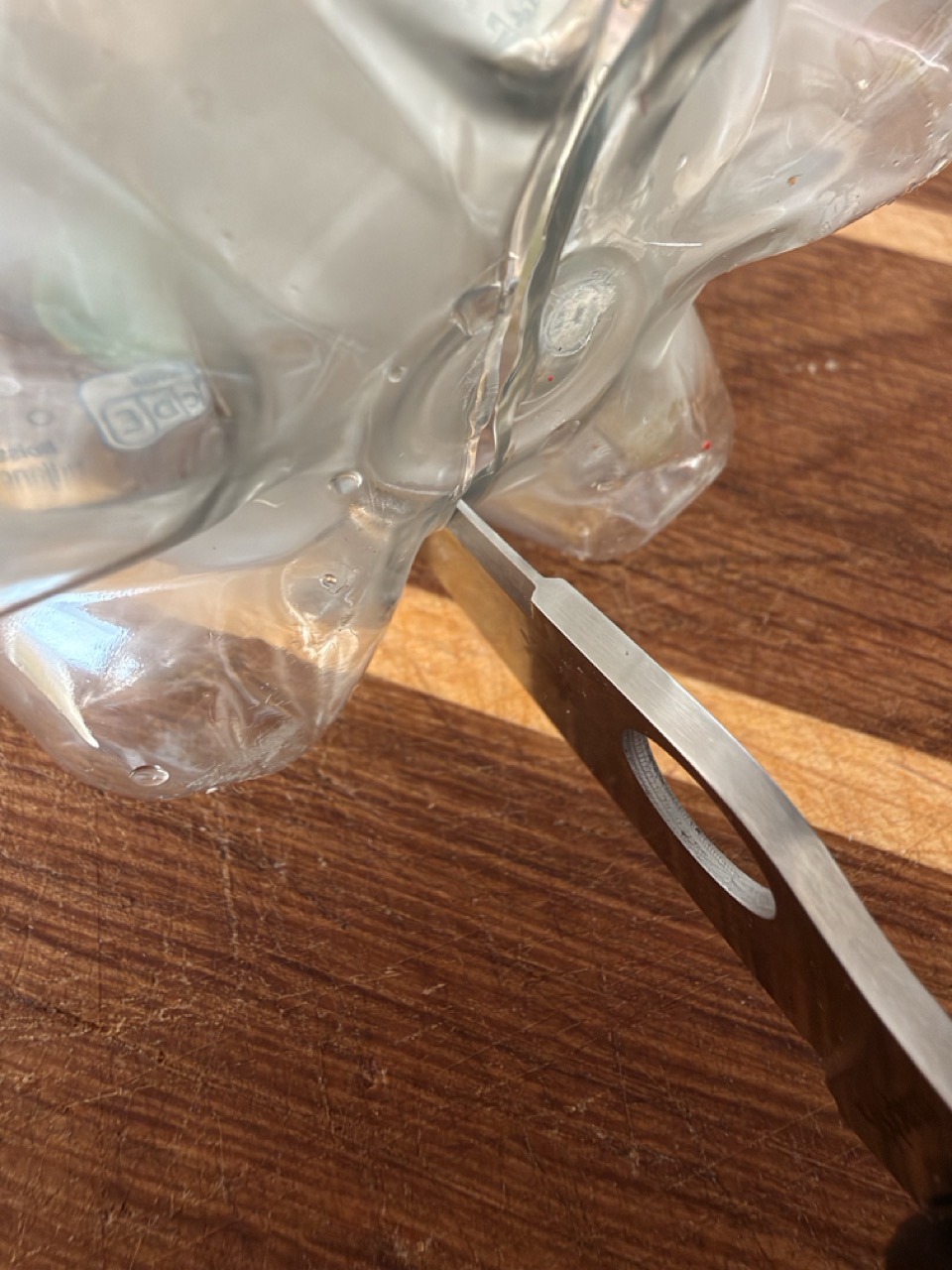
The testing begins, and the promised geometry really delivers. What a pleasure it is to slice through hard materials like plastic. The bottom of this bottle was cut through just as quickly as with my Nilakka.

That’s proof enough that I won’t need to reprofile the edge on diamond stones and risk scratching this beautiful blade.

Yes that needle blade is gorgeous. Seriously. It has the kind of profile that makes you want to keep looking at it before finding another excuse to cut something.

At the same time, CruWear gives this delicate-looking blade the toughness to be used as a real working knife rather than treated like a fragile collector’s piece.

Then come all those little details: the smooth transitions around the spine and ricasso, the absence of unnecessary machining, the restrained lines, the big, beautifully simple pivot screw… Nothing screams for attention. Everything looks as if it has been put exactly where it belongs.

It is understated, but far from boring. This blade has attitude.

Made in Japan, there is something distinctly Japanese about that Jess Horn’s design: a kind of Shibui simplicity, understated and refined, where nothing is there just for show. The knife doesn’t scream for attention. It quietly waits for you to pick it up—and then reveals all its character.

Yes, that is probably the best way to describe the Jess Horn: a knife with a quiet appearance, but a very loud personality once you put it in your hand.

Which is probably why I called mine HORNY. 😏

SC60GPGY Spyderco Massad Ayoob Sprint Run — The Pistol Folder is back but for who ?

This Spyderco folder, designed by Massad Ayoob, the well-known firearms instructor, was conceived as a self-defense folding knife. A concept I struggle with. In my view, almost any tool with an edge—or even a screwdriver—can be used similarly. The rest is largely marketing, especially in a country with a deeply rooted personal weapons culture.

Not for me.
But what if I’m wrong?

Massad Ayoob is a respected authority, LEO (law enforcement officer), firearms instructor, and writer on defensive use of force, including edged weapons. For over four decades, he has taught defensive firearms and knife programs and has frequently served as an expert witness in court cases involving such tools.

(Adapted from his bio: Backwoods Home Magazine)

He directed the Lethal Force Institute (LFI) in Concord, New Hampshire from 1981 to 2009, and now leads the Massad Ayoob Group (MAG).

So should I even be reviewing a self-defense knife when I’ve already stated elsewhere that, in my humble opinion, knife self-defense is the worst possible use of a blade?

This is less of an issue for professionals—law enforcement or military personnel—who may be forced to face knife attacks. But for civilians? Learning to defend oneself with a blade should remain an absolute last resort in a situation that likely could have been avoided through awareness and mobility.

As a design, I’ve always liked the C60, especially its ergonomics—not as a weapon, but as a cutting tool. It works exceptionally well for kitchen and general use. In fact, it was once one of my favorite “baguette openers” in the folding knife world, particularly in its serrated version.

Even knowing it was marketed with a design intent focused on deep penetration between ribs and vital organs, I’ve never been impressed by such narratives. Many everyday tools—chisels, screwdrivers, crowbars—can be used for harm. Intent matters more than geometry.

Spyderco, of course, is no stranger to this “self-defense niche”: Canis, Matriarch, Carahawk, P’Kal, Chinook, Civilian, Yojimbo…

Blast from the past.

In the 1990s, I had the opportunity to be among the first European reviewers of Master of Defense knives. Jim Watson, James Keating, Massad Ayoob, Graciela Casillas, and Michael Keating were all involved in the project.

Ayoob contributed the MoD Razorback, a fixed blade designed primarily for rapid deployment in reverse grip from a kydex sheath. He even timed his draws to demonstrate speed. I liked the concept, but it was clearly optimized for thrusting rather than cutting.

The same philosophy can be found in the C60: more oriented toward penetration than slicing, especially compared to something like the Yojimbo 2, which balances both.

The Razorback prototype is in the center, while Michael Janich’s Tempest appears at bottom right, featuring his Filipino grip concept.

On the C60 Sprint Run, Michael Janich wrote:

“From a utilitarian standpoint, the negative blade angle increases cutting power and leverage… I also strongly encourage you to consider a Schempp Bowie…”

Benchmade BM275 Adamas part 2: Reprofiling – From Puff Daddy to Daddy Cool !

It’s time to de-shoulder that Benchmade Adamas‘s edge and to convex it a little to my own taste.
My tools are Spyderco Stuff 2 with diamonds, Fallkniven DC4 and leather strop.

First thing I will do is remove the stud which are in the way. I have found/learned that the hard way just by testing the angle, I have scratched them.

Two T6 torxs are necessary. One on each side.

Cerakote protection is found even inside the stub hole. In fact I was really tempted to remove it for good as the Adamas is so easy to open and close just by manipulating the Axis Lock button. But sometimes I need to be able to open it one hand and slowly too…

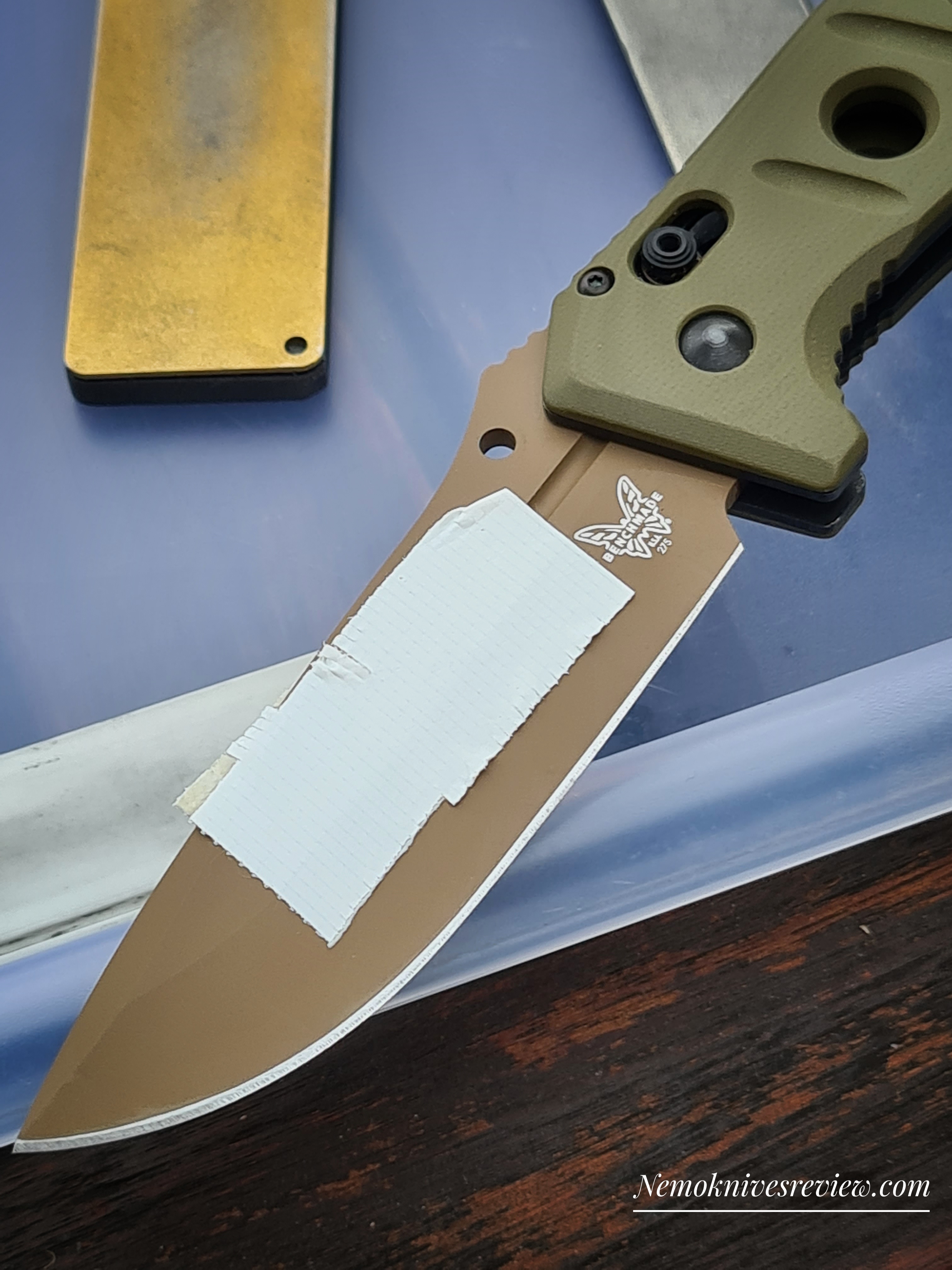
Next step is to protect each side of the blade, as I don’t want cerakote to be scratched… yet. I use white gaffer for that.

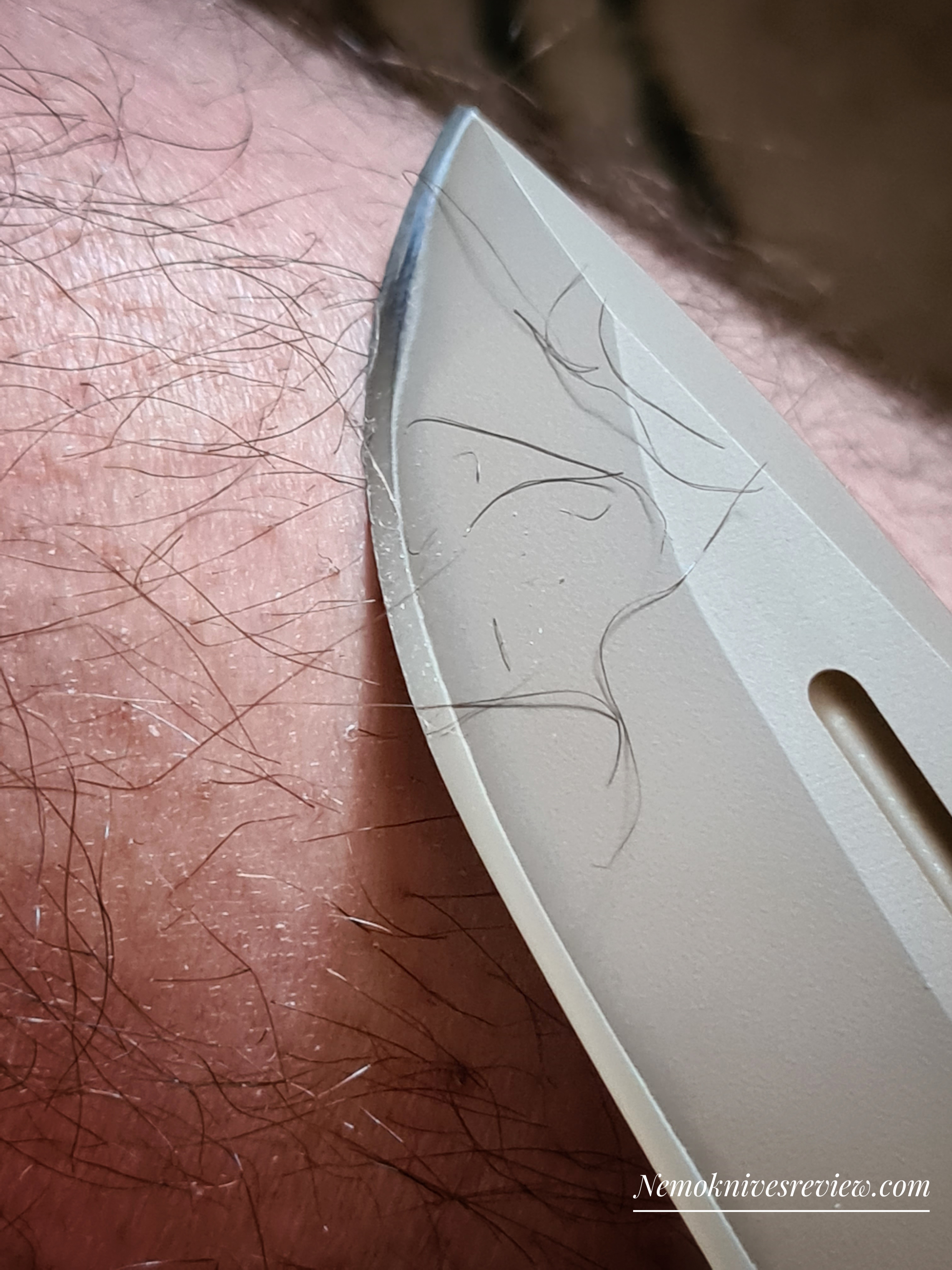
Slowly the edge is convexed and thinned. CPM Cruwear at 64 HRC is hard and diamonds are mandatory. It is a slow process all made by free hand.

Leather stropping is apply next. Again this is made slowly.

Soon this is a razorblade popping hairs just in one caress.

The Soda Bottle Butt Test was not passed in my previous test.
This is the reason I have decided to thin the edge of the Adamas in the first place.
Now it goes steady in like in butter.

The center of the butt is much thicker and harder to pass as the bottom can collapse. This is really my geometry test and many famous knives were not able to pass it.

The Adamas is now much better in terms of pushcutting and its steel (CPM Cruwear) is perfect for a thinner edge.
The stud has been put back and the big folder is ready !
Easy peazy lemon squizzy. It took me 1 hour.

The mighty Benchmade Adamas BM275FE-2 CPM – Cruwear for Flat Earth ? First glance at that Heavy Metal Hardcore Folder.

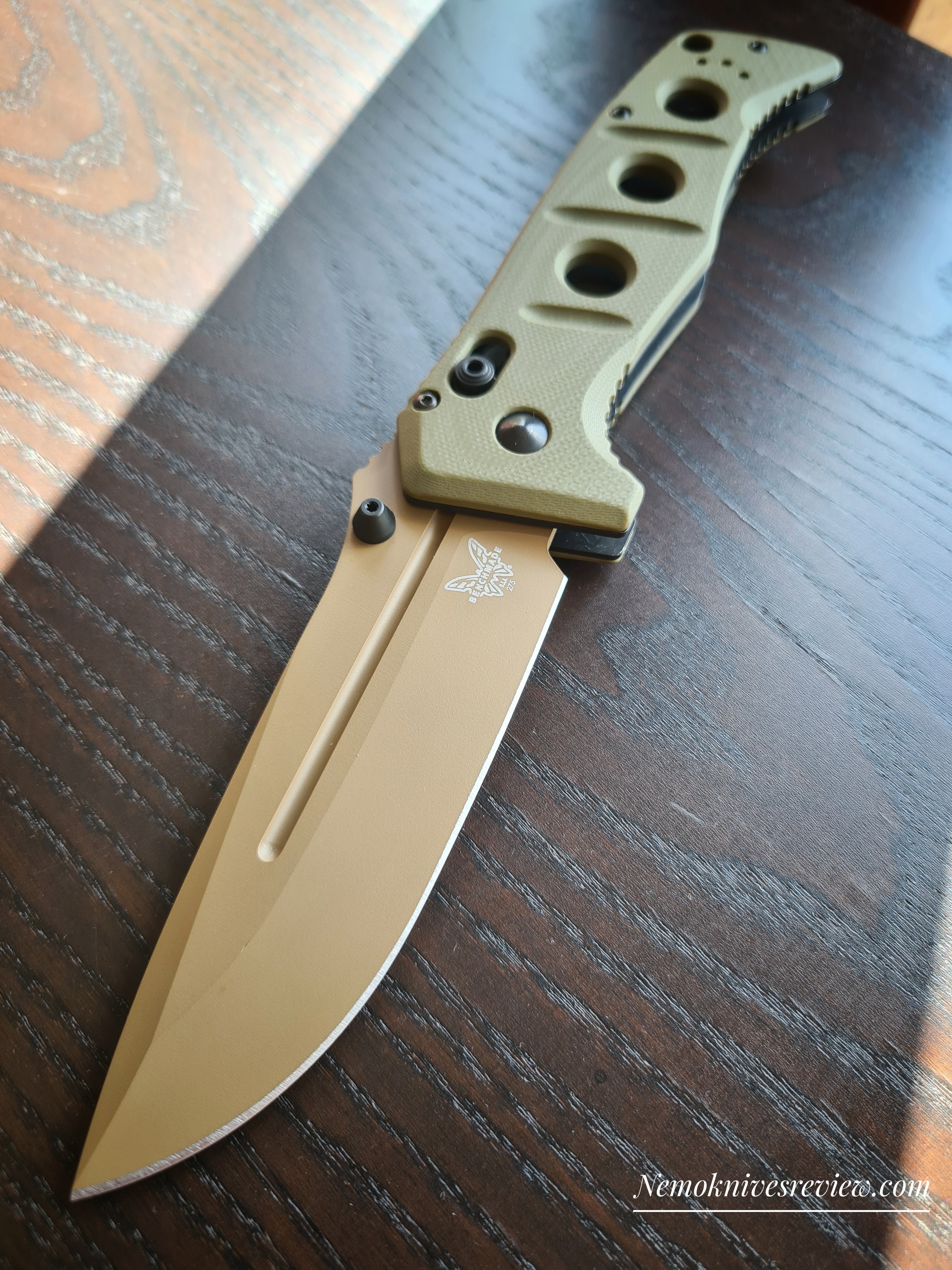
Here it is the Benchmade Adamas second generation with its CPM Cruwear heavy duty blade.
It has been almost 20 years since I have reviewed one of Benchmade hardchore (made for the Military) folder. The last one was the AFCK Axis in D2 and I even think it was not upload even if it was my EDC for two years. I loved the AFCKs because, well, Sal Glesser was involved in its design with Chris Caracci and Les de Asis and Bob Terzuola and I simply appreciate Sal Glesser’s way to invent and design “matter separators”.

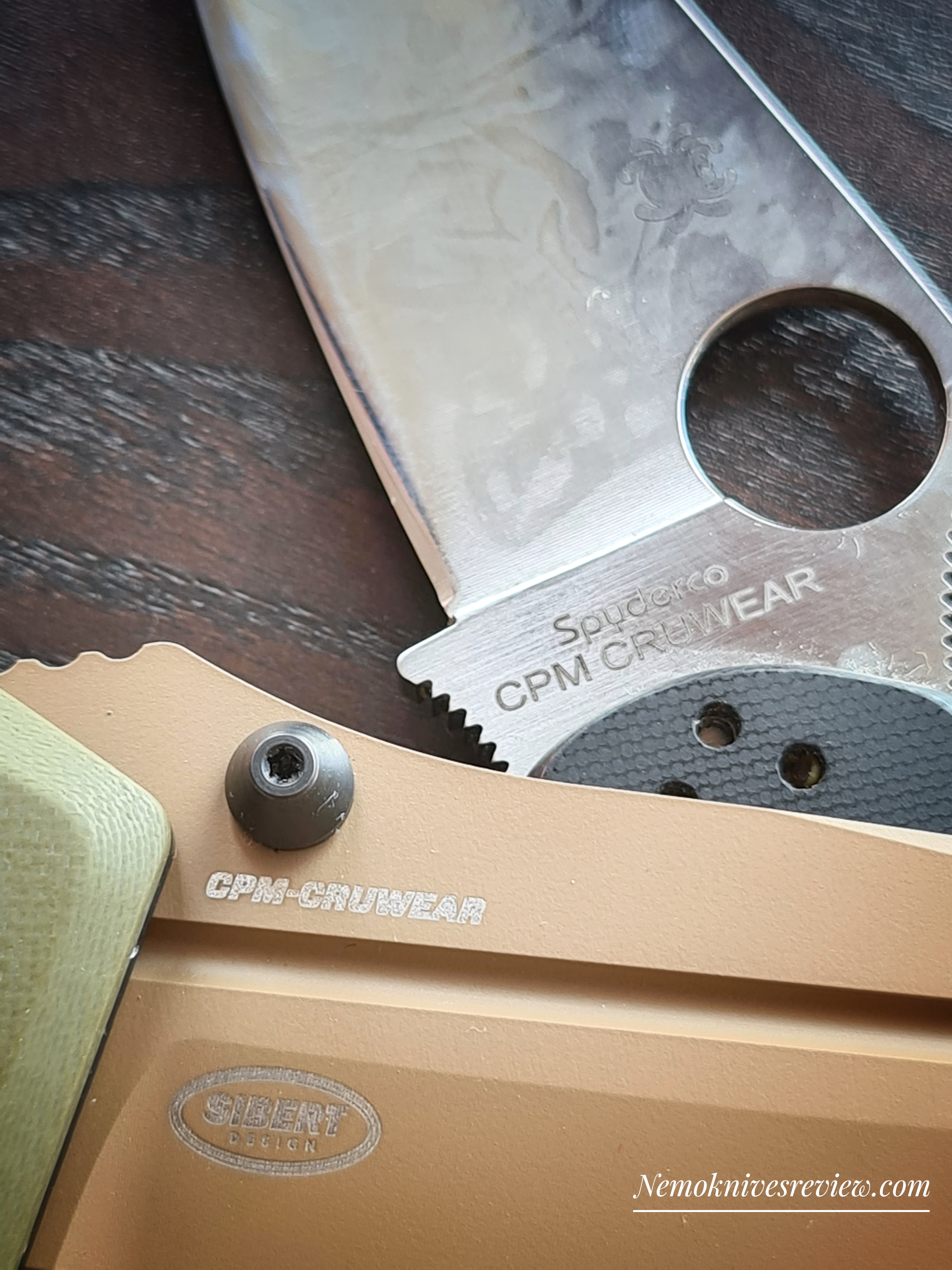
But here it is “Tabula Rasa” as far as I am concern ! Go figure: no hole in the blade, but holes in the handle, a gifted designer which I’m going to discover named Shane Sibert who has also designed the Bushcrafter for Benchmade… and Clive Owen’s knife in Sin City.
His signature seems to be fuller on his blade.
“I started making knives in 1994 with the idea of creating blade ware that is simple, practical and efficient. I have been a full-time knifemaker since 2004. Keeping with the theme of practicality, I avoid large metal guards, bolsters and heavy pommels to keep the knives balanced and agile in the hand. Materials have been carefully selected to ensure optimal edge retention and low maintenance. Although the knives incorporate slim handle slabs to decrease unwanted bulk and weight, the handles contour the hand for a synergistic fit. I strive to hold myself to high quality and design standards and produce a knife that will invoke pride of ownership and at the same time perform the task that it was designed for with exceptional ease.”
(quoted from Arizona Customs Knives)

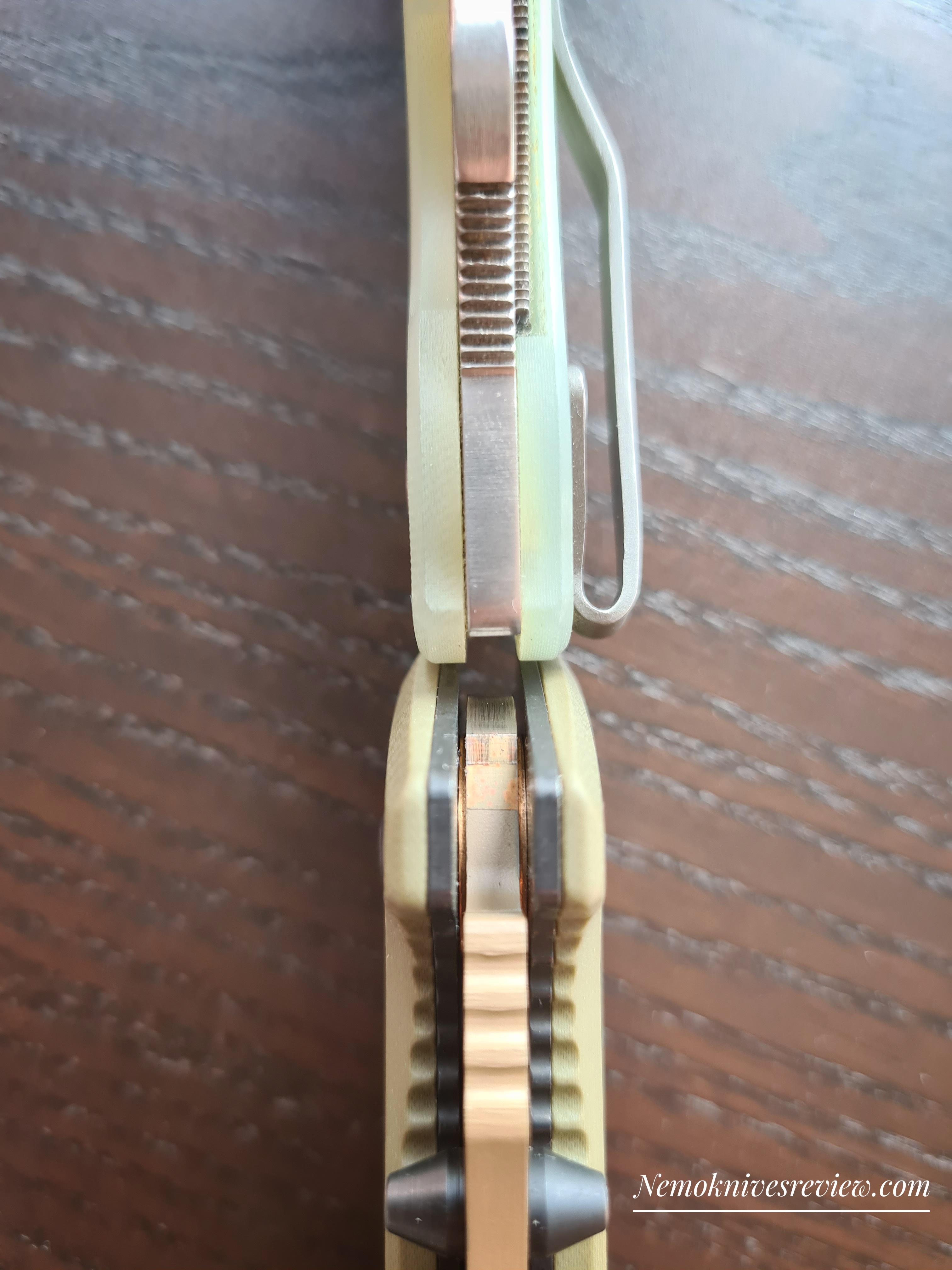
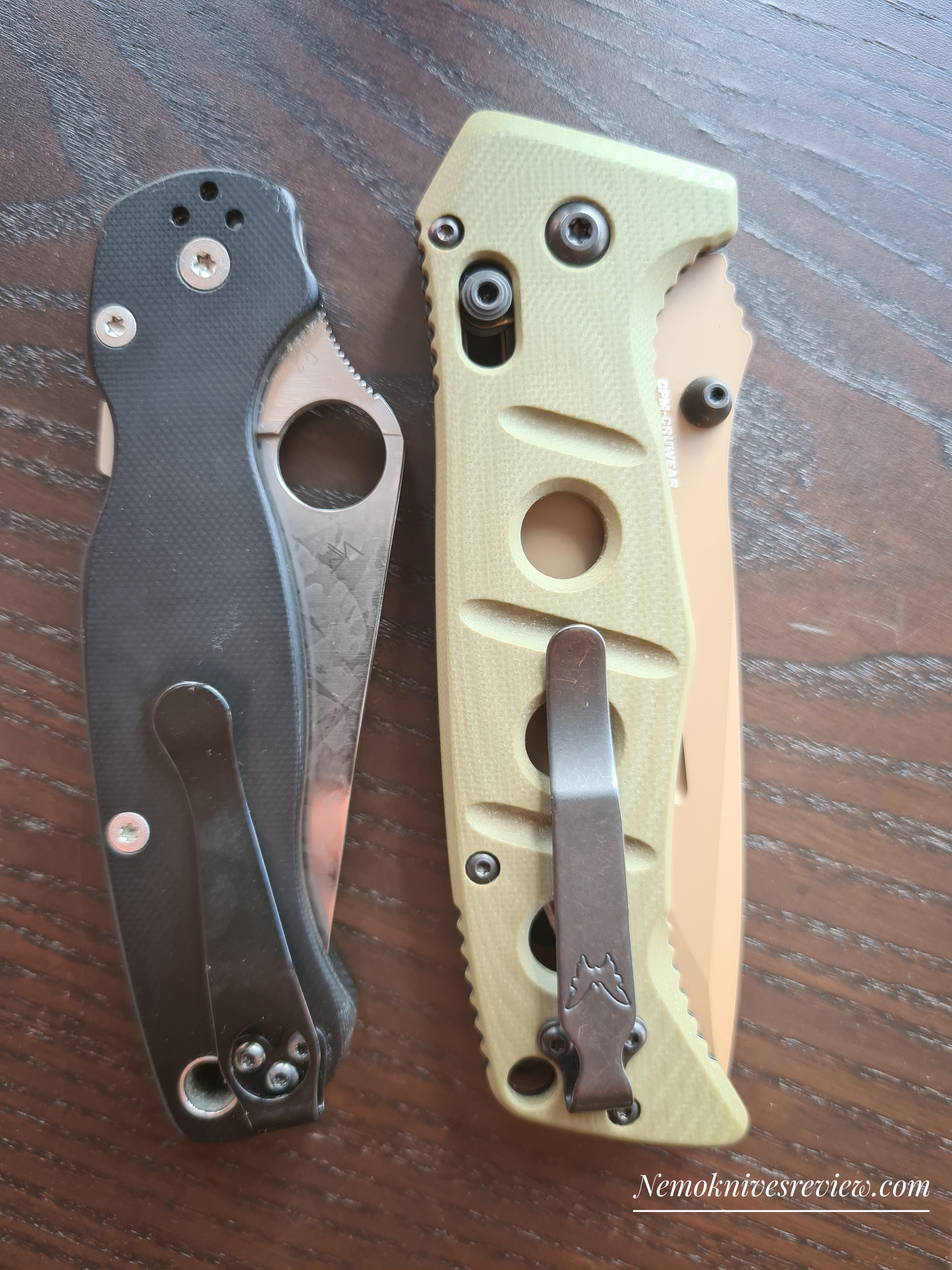
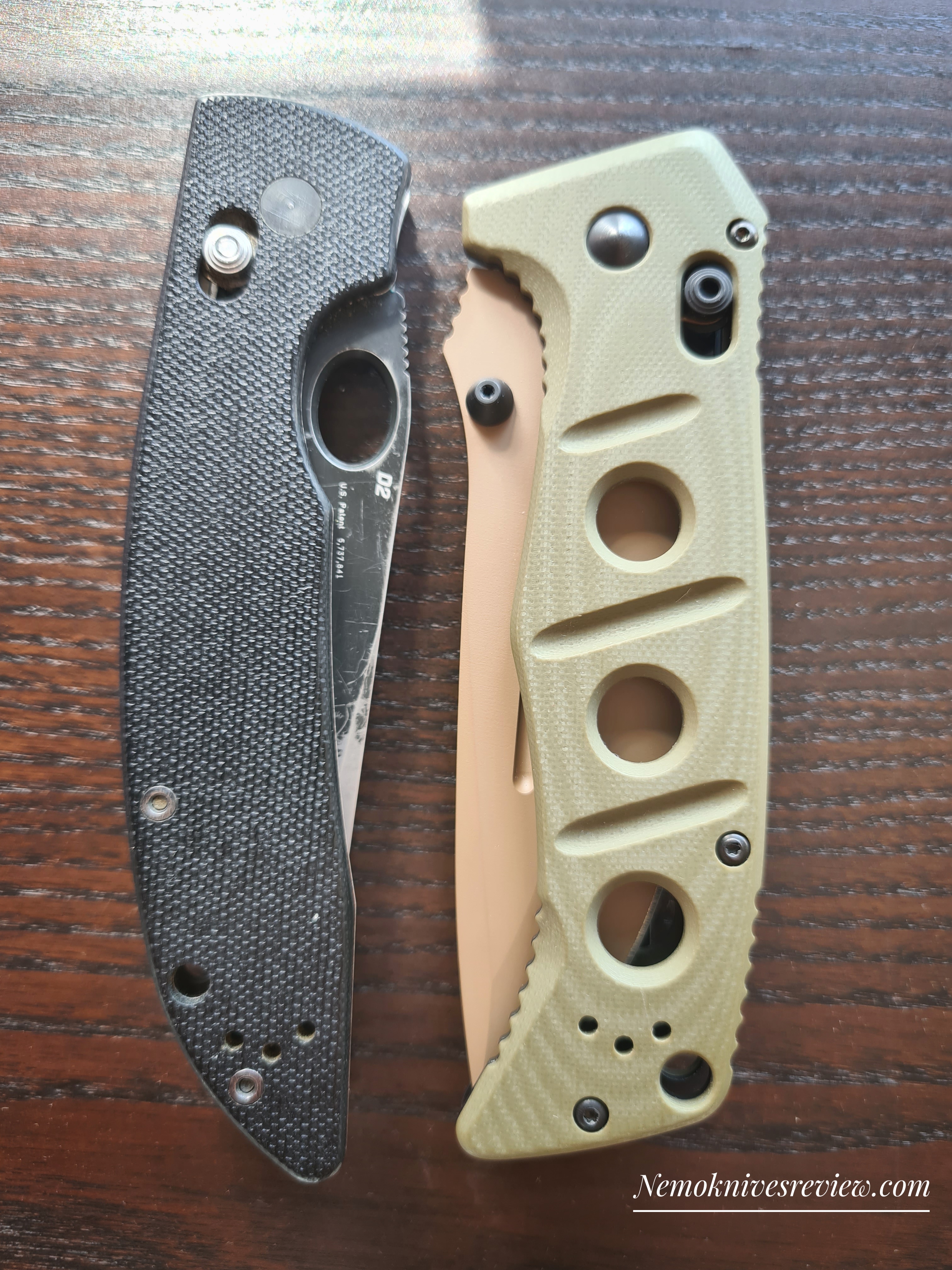
You can notice slabs and hole on the handle.
Actually for such a big knife the Adamas is not that big.
The first version was release in 2011 (you can see it here on Arizona Customs Knives) and was made of D2 the new version came ten years later and with its blade upgrade to CPM Cruwear.
This steel is known to be tough ! Less than CPM3V but with a better edge retention. The Cpm Cruwear Shaman was a big hit !
Here Benchmade has heat treated the CPM Cruwear to 63-65 HRC !
This is something I need to test as it is much harder than Spyderco HRC (61-62HRC) on their CPM Cruwear blades. (Sal tested his own blade at 61.1 HRC).

Cruwear Manix 2 – (63.2 – 63.7) HRC
Cruwear Military – 62.9 HRC
Cruwear Mule (re-release) – (62.1 -62.8) HRC
Cruwear Paramilitary 2 – (62 – 62.8) HRC
Cruwear Para 3 – 61.7 HRC
Cruwear Military – 61.1 HRC

At first touch, the Adamas oozes quality and delicate attention to details. The Olive Drab G10 slabs are wonderfully tappered on both ends and the jimping is done perfectly in my book, not as aggressive as G10 Manix for example. It is palm friendly even when closed. Well done. The holes in the handle help my thumb to index the tool.. There is no hot spots. The handle is totally open and easy to clean and check for debris. It is created as a workhorse which can get dirty but still reliable.
Of course this is an expensive knife with a MRSP at $280.00 but you can see where your money has gone. It is manufactured with love.
The blade is perfectly centered on mine and there is zero blade play in any direction.
I love the Axis Lock concept since its very first Henry&Williams BM710 release.
I have never had any issue with its Omega Spring. It is easy to use with one finger when the SPyderco Cage Ball Bearing needs two finger to work. The Axis Lock makes any knife as fast as automatics. I have never had any play on mine and I have been using them since their very very first release.
I won’t do batonning with the lock engaged like some youtubers seems to do until lock failure. For record, you can do batoning with an opinel…
But engaged lock (any lock) does not like to schoked and a beating can damage an disengaged any lock even a butterfly. Knowing how to use tools in the right situation should be mandatory before doing really stupid things on video and if anyone want to use a folder for batonning some wood (stupid millennial fashion as far as I am concern) just do it with no lock engaged or learn how to bring a better tool…

But once deployed, with just a gentle flick of the wrist — axis lock with heavy blade are just extraordinary easy to deplay— the blade is shown in all its power. I understand why some youtubers would like to shove it in concrete or in bricks…. I’m not certain they will be able to peel an apple in public with it but for that kind of task a Mini Adamas has been released with the same blade thickness…. Oooh well I’m not certain the thick Mini Adamas is made for fruits either. F<or that there is another tool too: the Kapara…
The Adamas offering a 0.14″ | 3.556mm thick blade, it is designed hardcore for hard chores for folders. How will it behave, that will be in our next article but that blade surely offers a lot of lateral strength.
For now it is just a very first glance.
All specs of the Adamas can be found on Benchmade here.
You can also notice on that picture its deep carry clip which can be a nice touch for such a big heavy folder. More on that later.
The action is smooth at the pivot but needs a little breaking at the lock release; nothing some nano oil can not fix.

This is a very beautiful folder which is very well balanced, its sweet point being just under the index finger when hold in hammer grip.
It is alive in my hands.
The axis lock makes it ambidextrous and you can notice on that picture the 3 points for adapting that clip or another three screw clip (not deep carry) if needed on both sides of the handle.

The blade handle ratio is almost to 1 with the Adamas compared to the Military C36 which is known for its long handle.
Of course the Adamas came very sharp out of the box, but not as sharp as I want. The blade is protected with cerakote coating Flat Earth colored which got excellent reputation in terms of tough protecting the CPM Cruwear from rusting. Cruwear can get a patina but it is not easy.
Here Benchmade and Shane Sibert have chosen to propose a stealthy look for the soldiers which need no blade reflection under the sun too.

It is also sold with a very nice sheath offering many carry options for soldiers and hunters alike.
The deep carry clip is perfect in term of retention and ease to retrieve the big and heavy knife.
Oh it is 183 grams (5,45 oz) which is really heavy. The liners are stainless steel not titanium. This is Heavy Metal !

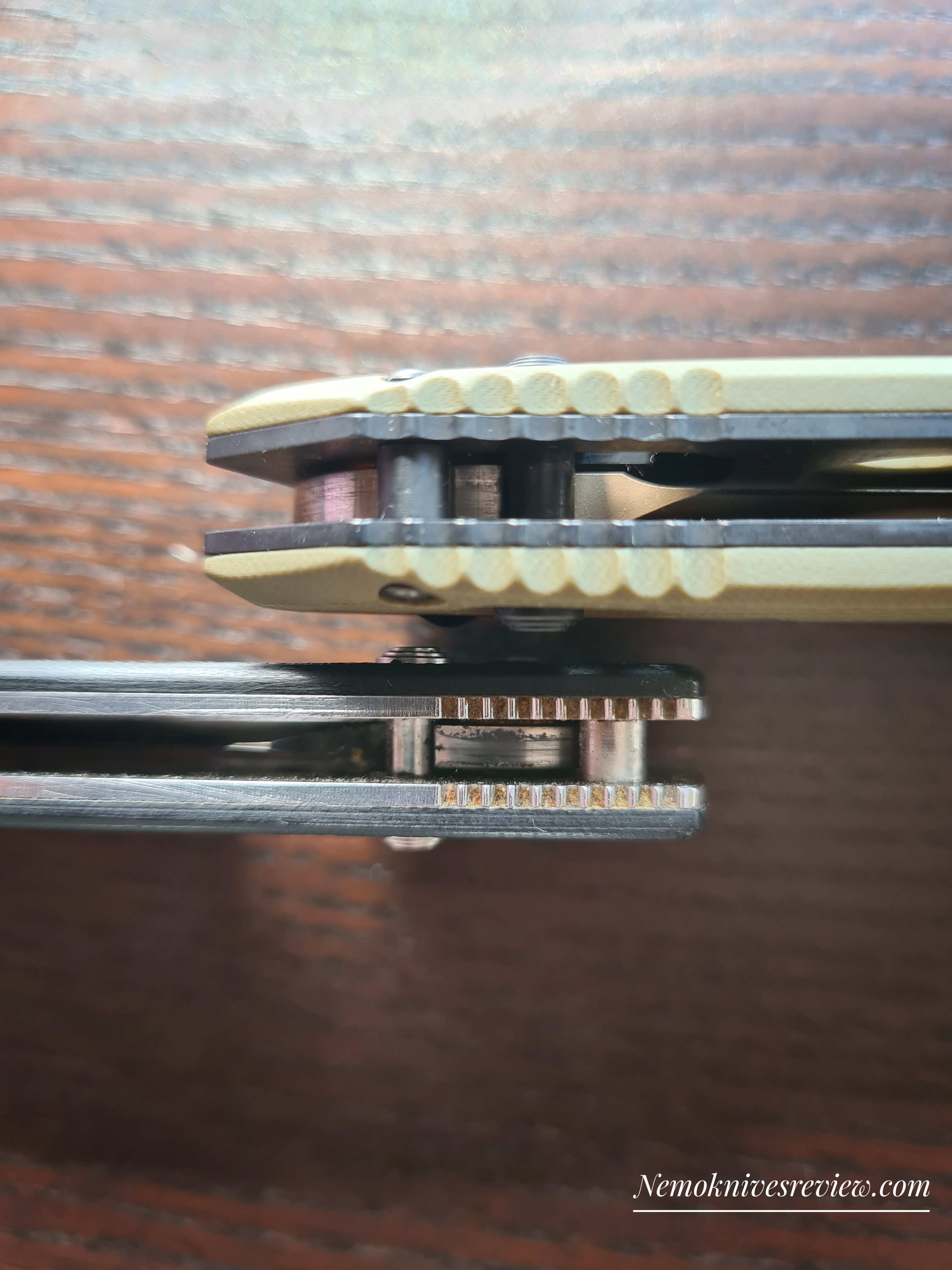
As you can notice the Adamas is much thicker than the C35 Military and much heavier too. Sal Glesser wanted his military to be as light as possible as a soldier got already many heavy things to carry.
Benchmade has taken another direction. The Adamas is beefierand thicker. Actually it can also been more confortable for long usage. We will see…

Another beefy released was the Shaman which almost has the same handle length. The Adamas provides a lot of edge.

Here is my good old AFCK Axis. It was used with a lot of love as you can notice. Zero issue with the lock BTW.

Now it is time to give some work to that Adamas designed to “deliver unrivaled performance throughout hard-use applications”. The next step will involve certainly some sharpening and reprofiling…
More to come soon…. But for now on, it is a knife which makes me grin when I open and close it. Kuddos to Benchmade and Shane Sibert for bringing this second gen of the mighty Adamas.

Crucarta’s Family — The Spyderco Shaman reveals its power.

Since its arrival my Crucarta has been used hard, fallen twice on rocks and pavement and been immerged in dirty water.
Well this Shaman is made for that.
In fact I have notice how well it could inserted between my CPM M4 Millie and my CPM 3V Tuff.  Theyu both could be his parents.
Knowing the Tuff is Ed Schempp design for a “Built As A Tank” folder and the Millie “Built As A Tool” Sal’s Glesser design, the Shaman got the best of both world:
A tank knife built as a tool: a solid folder which is really sharp.


This is not the easiest design to achieve. The result is a very powerful folder: solid in term of lateral strength and razor sharp for deep push cutting.
So yes, the Shaman is outstanding bring the slicing power of a Millie with the toughness of a Tuff.
CPM Cruwear is the right choice as it is really standing between CPM M4 and CPM 3V.
It is tougher than CPM M4 and less tough than CPM 3V and in term of pur edge retention it is also in between both.

Being clumsy and getting clumsier, my Shaman has fallen on tiles and rocks twice.
No damage after a very close inspection. Nothing on Micarta or on the blade. The recess steel spacer is immaculate too. The blade is not Stonewashed on the Crucarta sprint run, it it gets some scratches from use but nothing really bad so far.
It has been used on wood, dirty roots, plastic and kitchen duty.

20191204_1502532509795248339650716.jpg

For those who know how tricky a coke bottle butt push cutting can be… The Shaman  is “that” powerful.

I had notice some hot spots to my delicate hands.
The were easy to erase on the micarta handle.

A gentle filing is eliminating them and the rounded handle does marvel in terms of confort.


I have used the same diamond file, and it was a longer task, to file the teeth of the blade’s spine as I use my thumb for my push cuts. Also you can notice there is a flat place for the hand before the lock as I mentioned it in my previous review about the Para3 Lightweight which lack of that “flat bed”. It changes every thing in terms of confort when cutting in repetition hard thing without gloves.

Eventually IMHO the real son of the Shaman is designed by Sal’s own son: Eric.
TheLil’Native is really playing in the same league in term of strong workhorse folder but at a lesser scale. Like its father it conserves a thick spine for a very strong tip.
The Native and the Chief on one side with their thinner blade and lockbacks and the Shaman and the Lil’Native and the other.

Like father, like son. Les chiens ne font pas des chats as we say in French.

Massive Attack: First Glimpse at Sal’s Shaman Sprint Run C229MPCW

“The first drawing of the Shaman was dated December 17, 2014. That can give you an idea of how long I work on some of these creations.”
Sal Glesser.

Thanks to Tom Song and Howard Korn from the Knifecenter, I have been able to get one of the most coveted Sprint Run from Spyderco: The micarta cruwear Shaman.
Without Tom and Howard always excellent service (I know Howard since the very beginning of his Internet venture), it would have been mission impossible.

It was announced at the 2019 Minimeet by Eric Glesser and every ears were pricked up.
Since it has appears in the very frustrating way being immediately unavailable since the demand was so high.
But here it is after a long journey. This is my first Shaman actually as I was waiting for the first Sprint Run to jump on the bandwagon.

This folder got a massive blade on a smooth like butter pivot. Perfectly centered. And the blade is razor sharp. There is a lot of heft in that knife which is the absolute opposite to the Police “Cheetah” model. The Shaman is an outdoor’s folder dream. You can use it hard and clean it easily. I would compare the way it moves in the hand to the mighty Lionspy.

I regret the clip is not one of the wired but, hey, their must be reason to offer four positions.

The micarta is not polished like a Bark River Knife would be. It is rough but pleasant under the thumb. The handle is thick and made for hard use. I mean it is pleasant to old tight with no hotspot so far.
Now I need to use it but is a very solid folder not destined for the city.
More to come, stay tune… 🙂


“My designs begin with an “idea”, hard to put into words. The final design says it better than words can. I also refine that design (idea) over time to make it closer to the pure form originally envisioned. The P4 is in it’s 4th refinement and in my opinion, closer to my original “idea” than ever.
While the P4 is very different from the Shaman, they both embody the “spirit” of what I was thinking of for their purpose. I’ll start with pencil and paper, CAD it, make plastic models with Peter from CAD drawings, often for months until I get as close as I can at the time to my “idea”. Like carving an elephant; take a piece of material and cut away everything that isn’t elephant. Once the design is close to it’s “pure form”, I’ll refine the materials based on the original idea and run with it. I don’t have the “eye” of a Lum, so appearance plays little in the fished outcome.”
Sal Glesser.


SPYDERCO C81GPCW2 PARAMILLIE CPM CRUWEAR KNIFECENTER EXCLUSIVE — ONE YEAR LATER

20190909_151754-014576179872682513305.jpeg

One year ago I had ordering a Para2 in CPM Cruwear, an exclusive run made for the Knife center.  Since them It has been used as one of my reference knife toward other purchases which sometimes has not reached the blog review as I’m avoiding bad reviews unless there is something to learn from.

20190909_151658-012836386720377641815.jpegAfter some acid work on the blade and titanium scales, eventually I am back to the smooth G10 scales and a deep carry clip. So why ?
First thing, even if the titanium scales were gorgeous, they add some weight and a very slippery feel under the finger, especially during wet works. Also it shifted the balance of the millie in a strange way making it “dead” in the end. I really enjoy the heavy handle of my PPT for example or on my Copper scaled Para but on the Para2 it was not working for me. back on smooth G10, it is more grippy than titanium and the balance point is shifter near the pivot again.

20190909_151631-016064843687324620805.jpeg
Despite my love for “Spyderdropping” I have decided to carry it “tip up” with a cheap titanium clip made in Malaysia and sold in Hong Kong. It works great and it is really low profile when I forget to pull it out of the pocket while going urban. (I carry a Lil’Native, a Roady or a Urban when going in the city those days, too much controls and metal detectors to go with a longer blade…)

CPM Cruwear as heat treated by Spyderco is a steel which loves his owner. It is not tricky to get sharp like Maxamet. In fact it asks to get sharp. Of course it is not as easy as 52100 or AEL-B but it is very tough in every task when you twist your blade like a good tool steel. Not easily stained too, my tests and zests are the proof on that and once stained it won’t go off. My edge is polished and smooth as a razor and it got zero major damage in a year of random tasks, no chipping (nothing which can not be cure with ceramic) or anything like on my thinned hard ZDP189 experiences. In fact my home convexed edge is as thin as my 52100 Para2 and it does real wonder on wood or hard plastic. In the kitchen that polish edge needs sometimes more “teeth” (S90V provides that for example) and some passes on a  brown ceramic or on a “butcher’s steel” do the trick for a coarser edge (tomato’s skin are tricky…) !

20190909_151736-017465953477672977099.jpeg

The PM2 transfer a lot of power in the cuts. The first inch from the ricasso can go deep in push cuts helps with a thumb’s push. You got as much power as a good old Millie and this is why the Para2 is so loved. The strong tip (strong because of the alloy used in this sprint run) is not convexed (to keep some steel and relative thickness) and I was able to drill hole in hard material with no bending or damage. This is a workhorse like I love them.
It’s a medium knife I can use hard with no immediate discomfort or “palm soar”.
The flat clip I have mounted on it is part of my need for a confortable grip.
I soon going to review a Kapara which is suppose to be better with its rounded handle but at least I had done my best to round the Para2 handle to my taste and eliminate any hot spot including the blade’s spine.

20190909_151721-018262894525258720752.jpeg

So, in my book, CPM Cruwear is an excellent choice for a EDC high performance folder.
For your information, the Knifecenter got now a new Sprint Run: a Native 5 with CPM Cruwear. I’m very tempted but the Kapara comes first. Anyway this combinaison of CPM Cruwear and smooth G-10 is just a winning hand. Spyderco (Eric) has also announced at the last Amsterdam Minimeet a Shaman in cruwear and micarta as a sprint run too. So CPM cruwear is here to stay.

20190909_154707-01853884868430801688.jpeg


Cruwear and Patina, the Lemon Edition.


Back to trying to get a patina on cruwear after my first attempt.
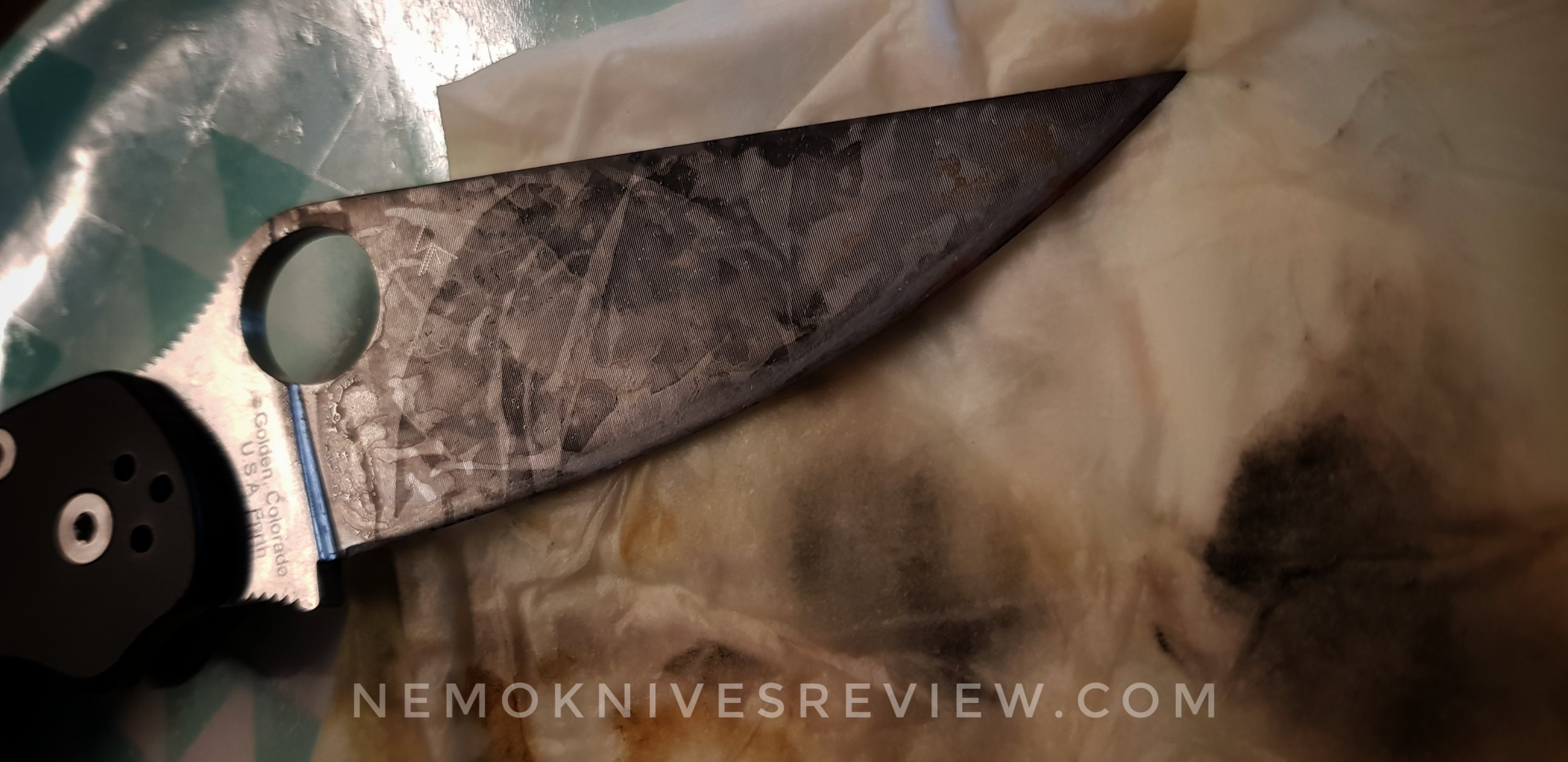
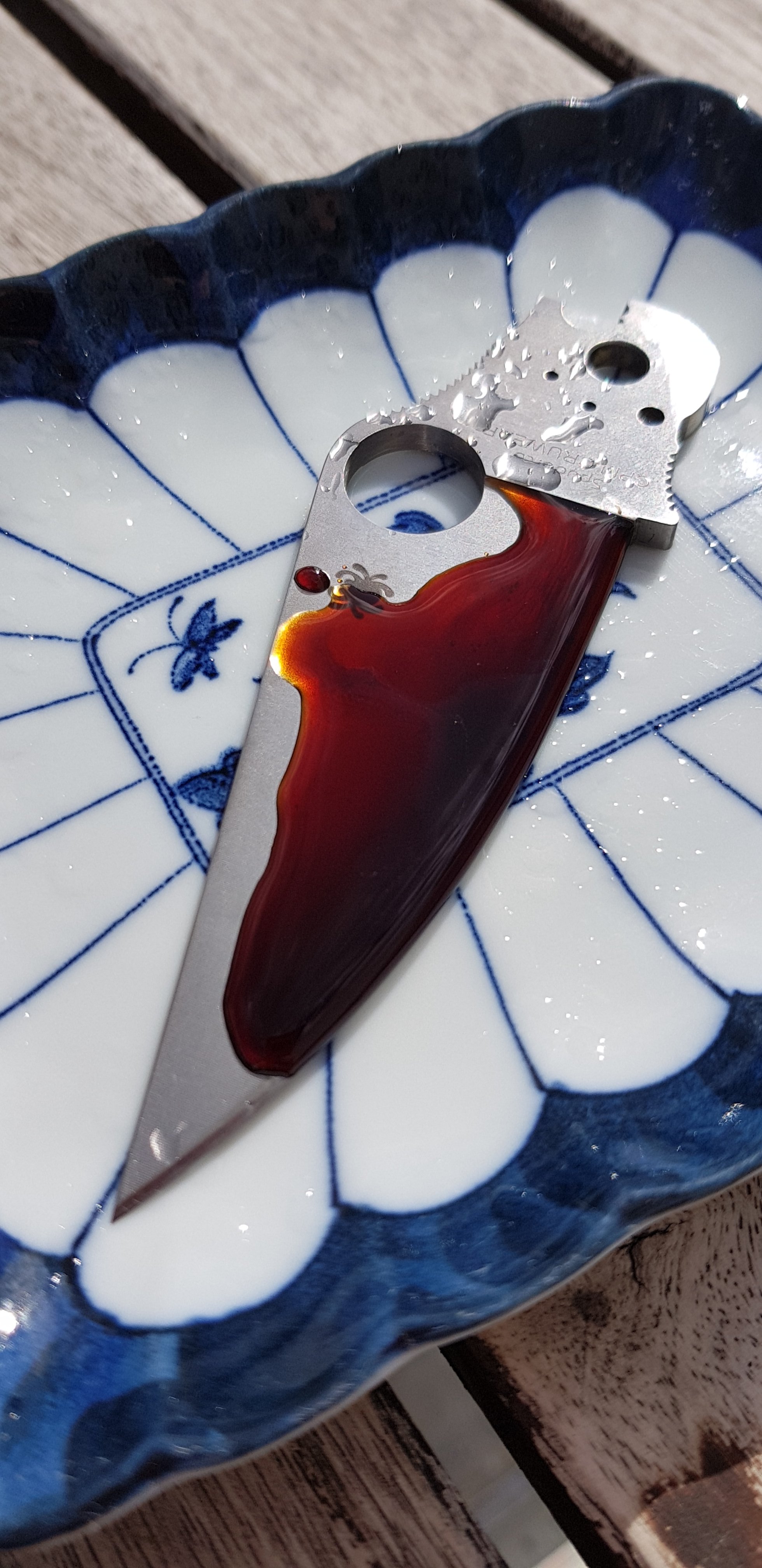
Because lemon juice is not smelly and we use it a lot in the house, I have tried to let the blade all night in a tissue imbibed.

Tissue seems to be some kind of catalyst as it help to keep a contact between the citric acid and the surface of the blade.


In the morning the tissue was dark!

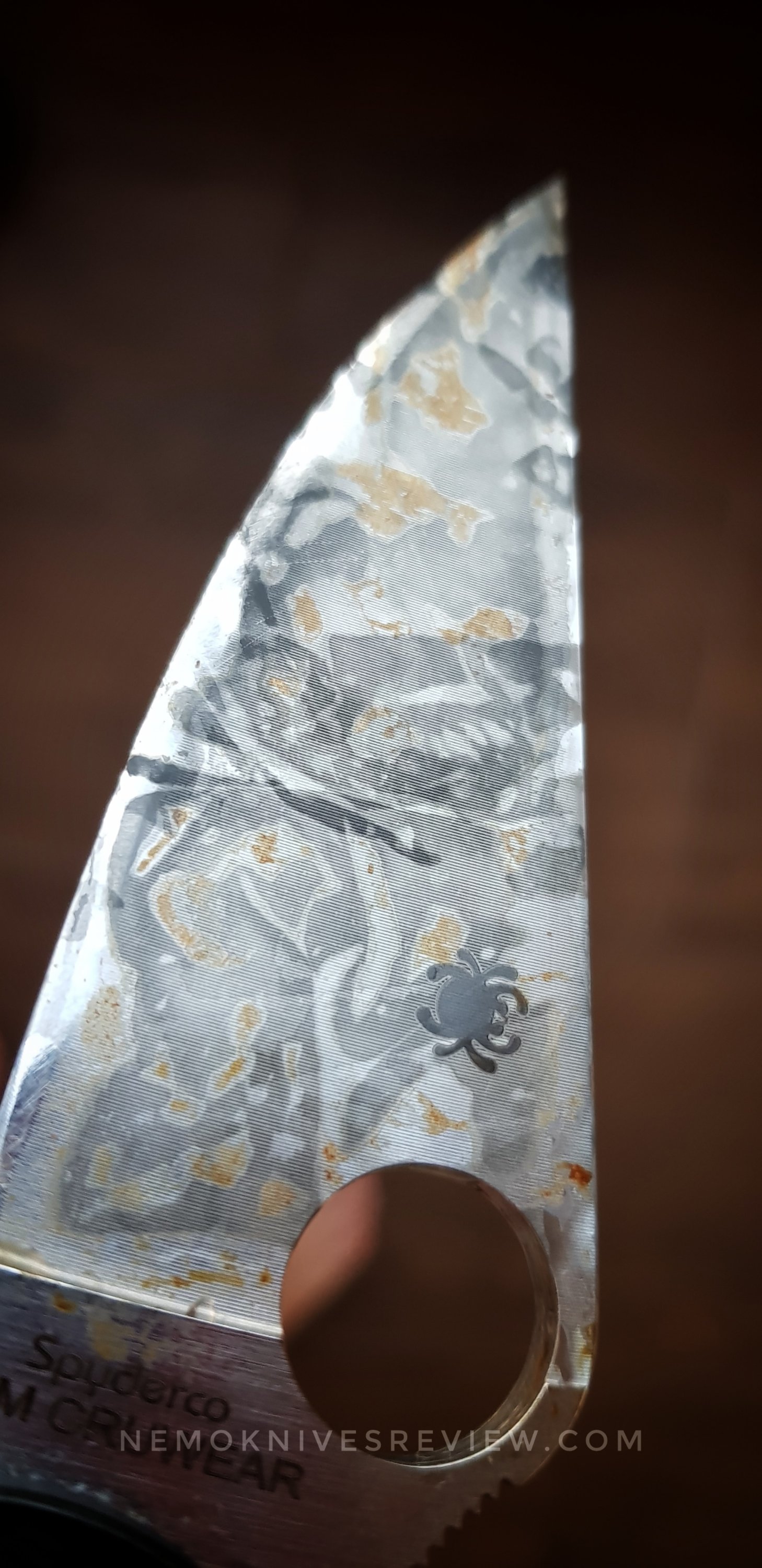
And you can notice rust starting to form in between strokes of the patina.

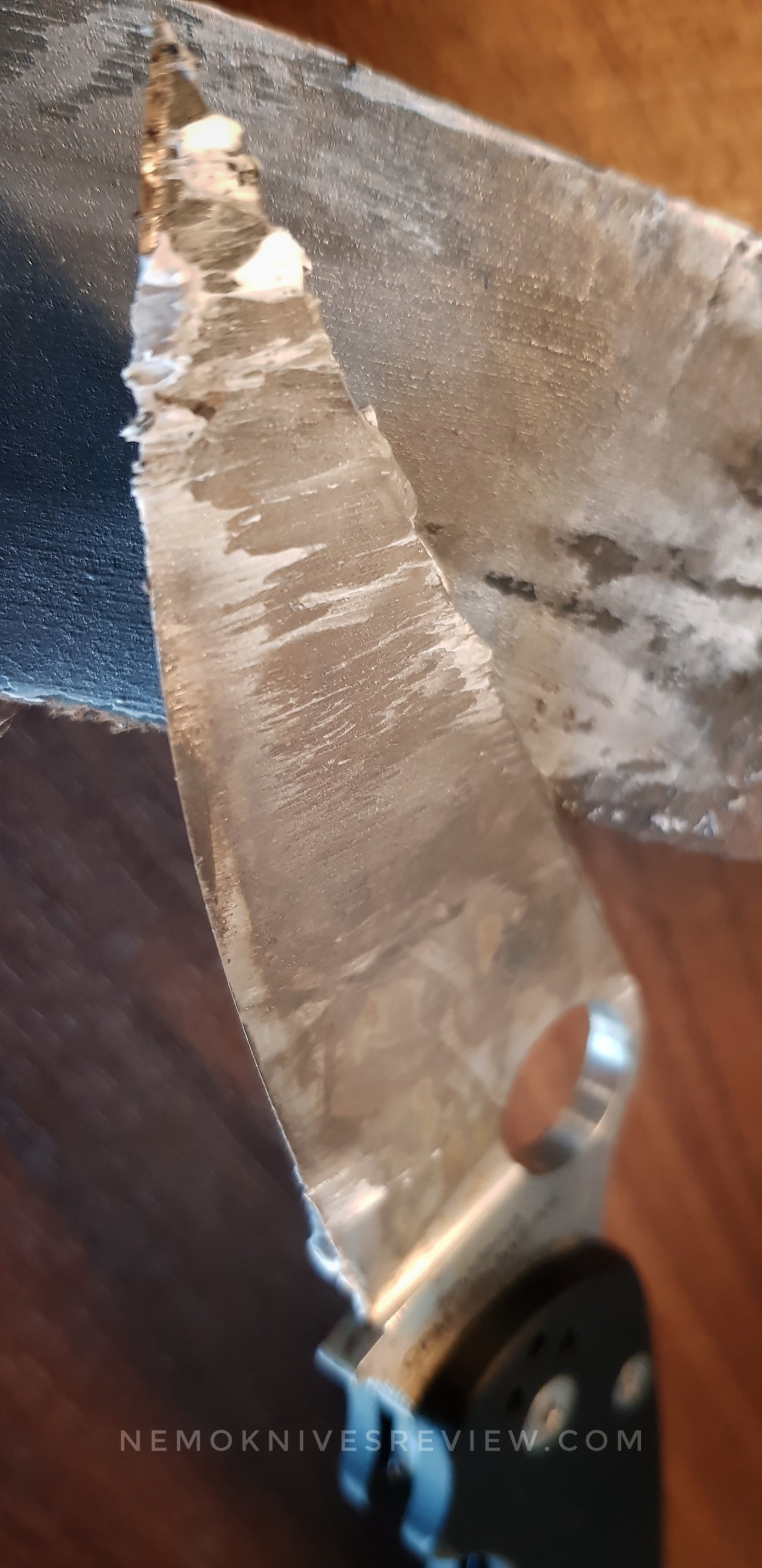
Rust is removed with some polishing which keeps the patina.

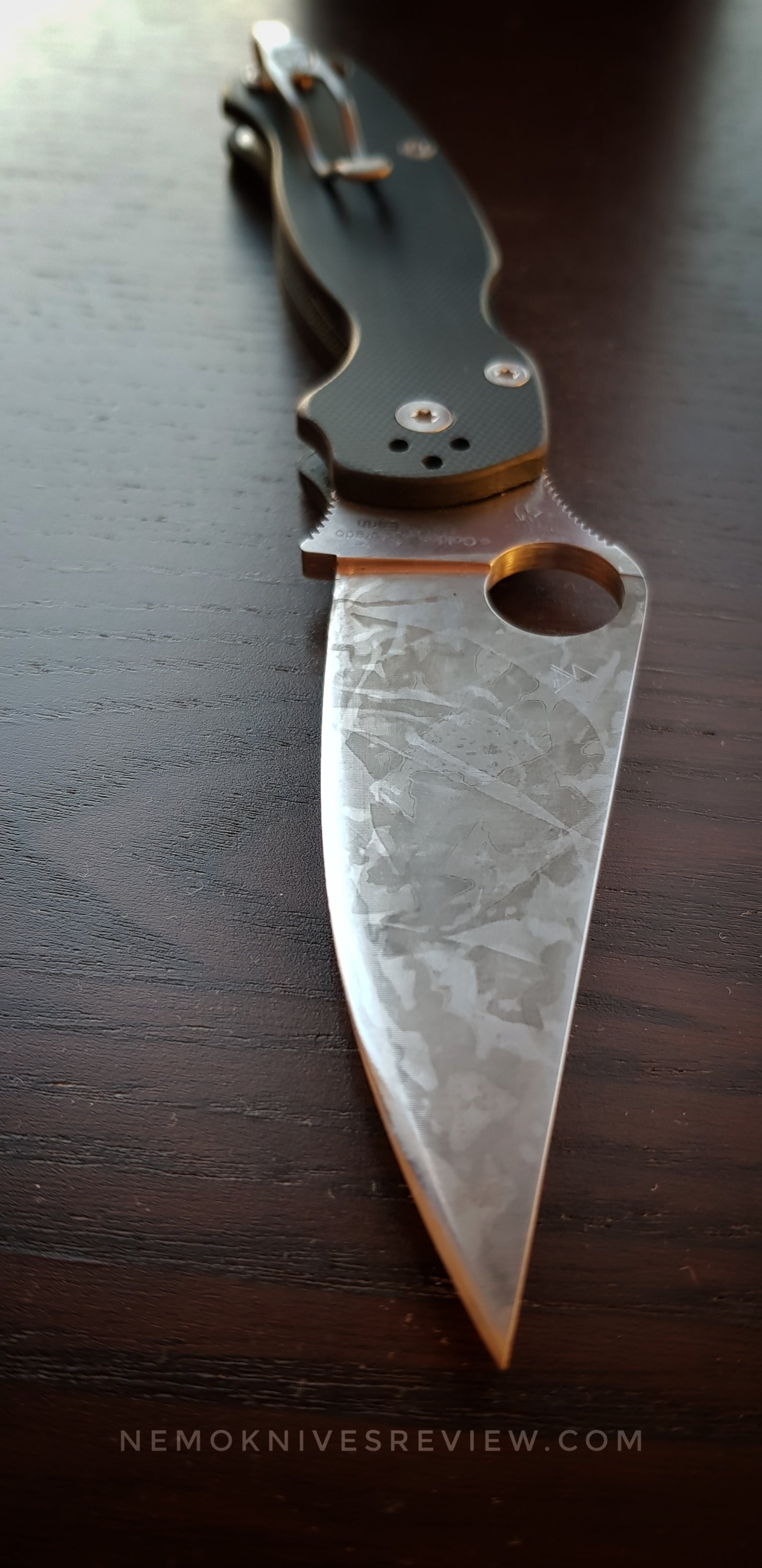
So here we are now with a kind of camouflage results.

It looks forced but should “mild” with uses but yes you can get a Patina from Cruwear with lemon juice and a night…

Which means if you forget your knife in the sink after making some salad, you can get rust on your Cruwear blade and a very swaggy patina.

Patina on Cruwear ? Not that easy !

20180924_140335-013344116327779251235.jpeg

Forcing a Patina on Cruwear!
Why?
Because I’m going to the sea and I just need to be certain it won’t pit.
Now Cruwear seems tricky compared to 52100 or Maxamet.
Let see how it will get…


45 minutes later… No patina yet some stains…
“It’s not as rusty as 1095 usually, so it’s easy to get complacent. It can go 3-4 days easier than O-1 or 1095 but 3-4 months is a different story. It’s easy to get fooled by steels with this level of chrome ( 8%) as to corrosion resistance. It will appear as a tiny spot of rust. Easy to overlook as it does not make it apparent that spot is deepening, not getting wider. The surface layer of rust covers up the hole. ”
The Mastiff

And he was right…

20180924_150702752150232258629731.jpg

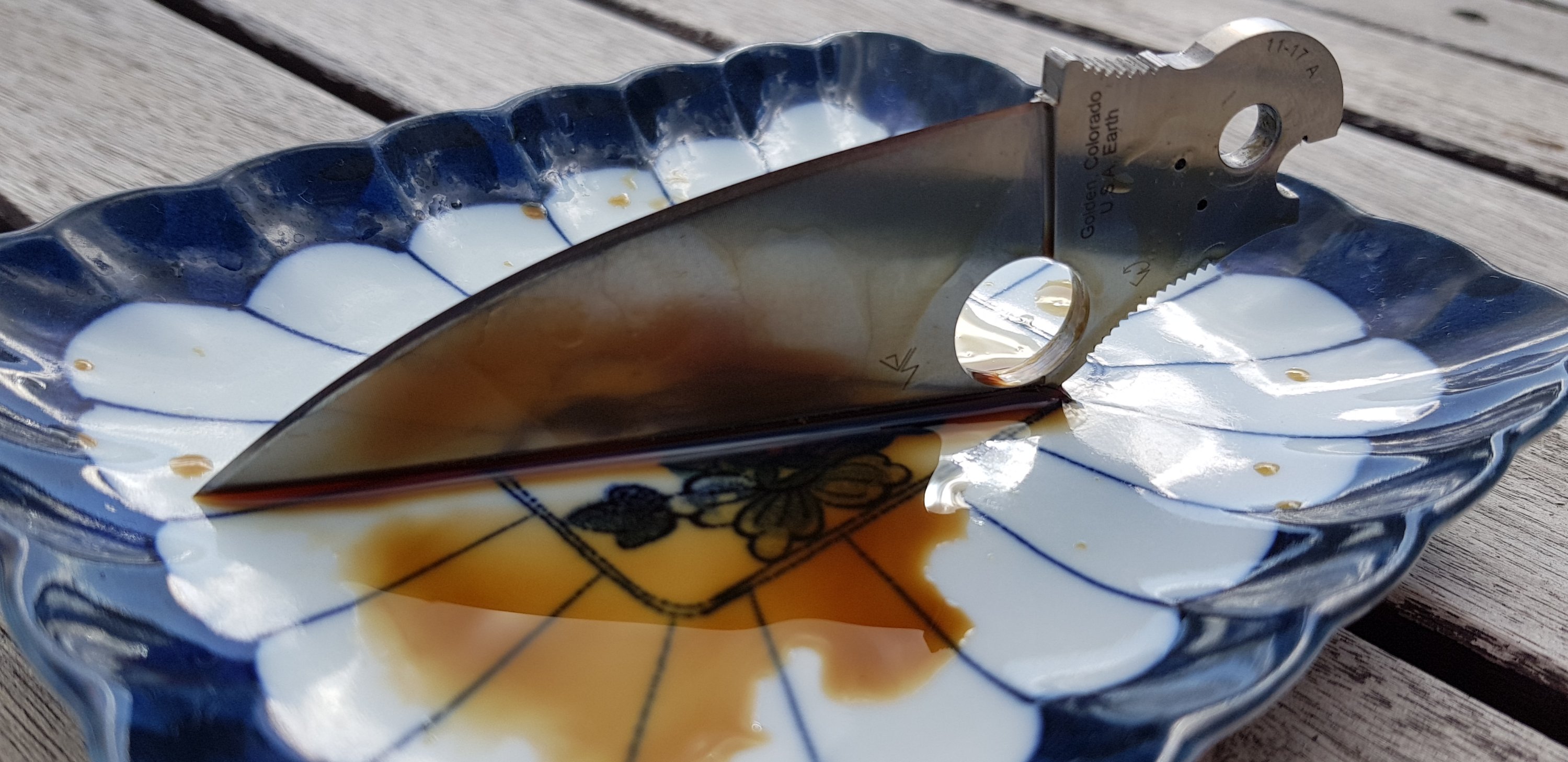
Trying to mix oxygen and vinegar using tissues and apple vinegar ?… Nope.

20180924_1450594242763307753491337.jpg

Apple vinegar and apple sugar under the sun….. Nope.

20180924_1512216039303394726229363.jpg

Aceto di Modena…. nope.

20180924_1516073383907032082667316.jpg

Even in the wind…

Naaah forget it. This steel won’t stain beautifully… Just a bit but not enough in my taste.
It will perhaps pit if let unclean some weeks but in my daily uses it should not.

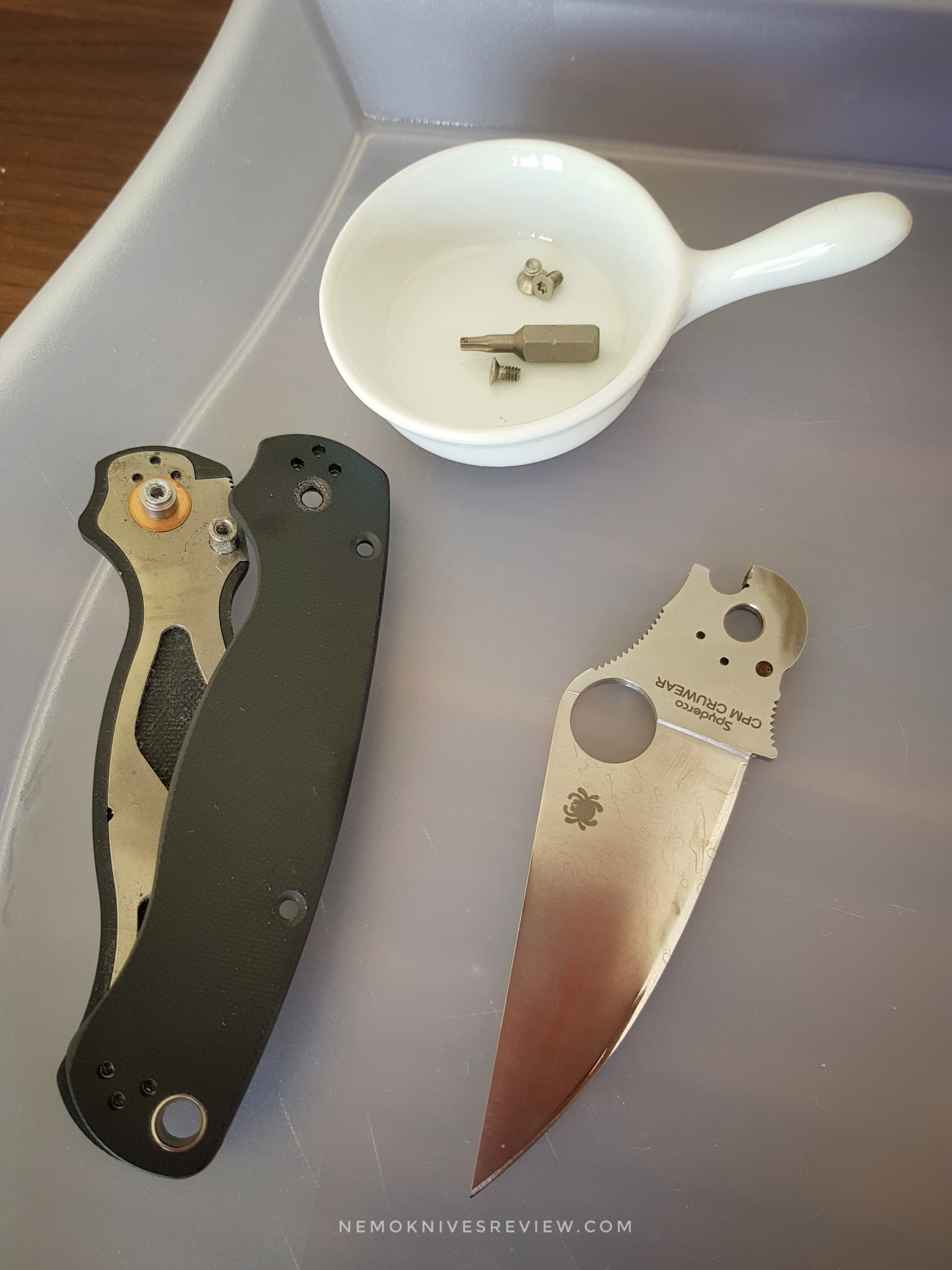
Putting the blade back in the handle the tolerances on that knife are so great you can tight the screws with locktite and pur a drop of nano oil… the pivot is smooth as butter.
Also ten passes on white ceramic and it is back to jumping hairs harvest again.
So cruwear seems to be a very “friendly” steel which doesn’t smell anything when confronted to apple, apple vinegar, various vinegar including aceto … nothing seems to harm it surface.
It is like CPM 3V and will be kept oiled and shiny. My Ed Schempp’s Tuff never needed or develop a patina as my grey Military in Cruwear.
At least I got less worry. 🙂

20180924_1546309102102475778995223.jpg