Tag Archives: wolfspyder

SPYDERCO LIL’ TEMPERANCE™ 3 LIGHTWEIGHT K390 -C69PBL3K390 -Part 3 – Use Shorty !

It has been established on the two previous chapters:
SPYDERCO LIL’ TEMPERANCE™ 3 LIGHTWEIGHT K390 -C69PBL3K390- Get Shorty ! – Part 1
and
SPYDERCO LIL’ TEMPERANCE™ 3 LIGHTWEIGHT K390 -C69PBL3K390 -Part 2 – Draw Shorty !

that the Lil’ Temp is very much a hidden gem, refined over two decades by Sal Glesser. In essence, it’s his answer to the compact, heavy-duty 3-inch folder — a kind of “Techno Glesser” that still offers a full, hand-filling grip. Its tall blade profile allows for a finely tuned convex geometry, translating into cutting performance that feels far beyond its size.

K390 is, in my book, a friendly steel. By that I mean it sharpens up to a razor edge without too much effort. It isn’t quite as easy to work with as CPM Magnacut, but it’s far more forgiving than something like CPM 15V. The trade-off is that K390 will stain readily, so regular wiping is part of the routine.

The trade-off is that K390 stains readily, so a quick wipe-down is essential to keep it looking and performing at its best.
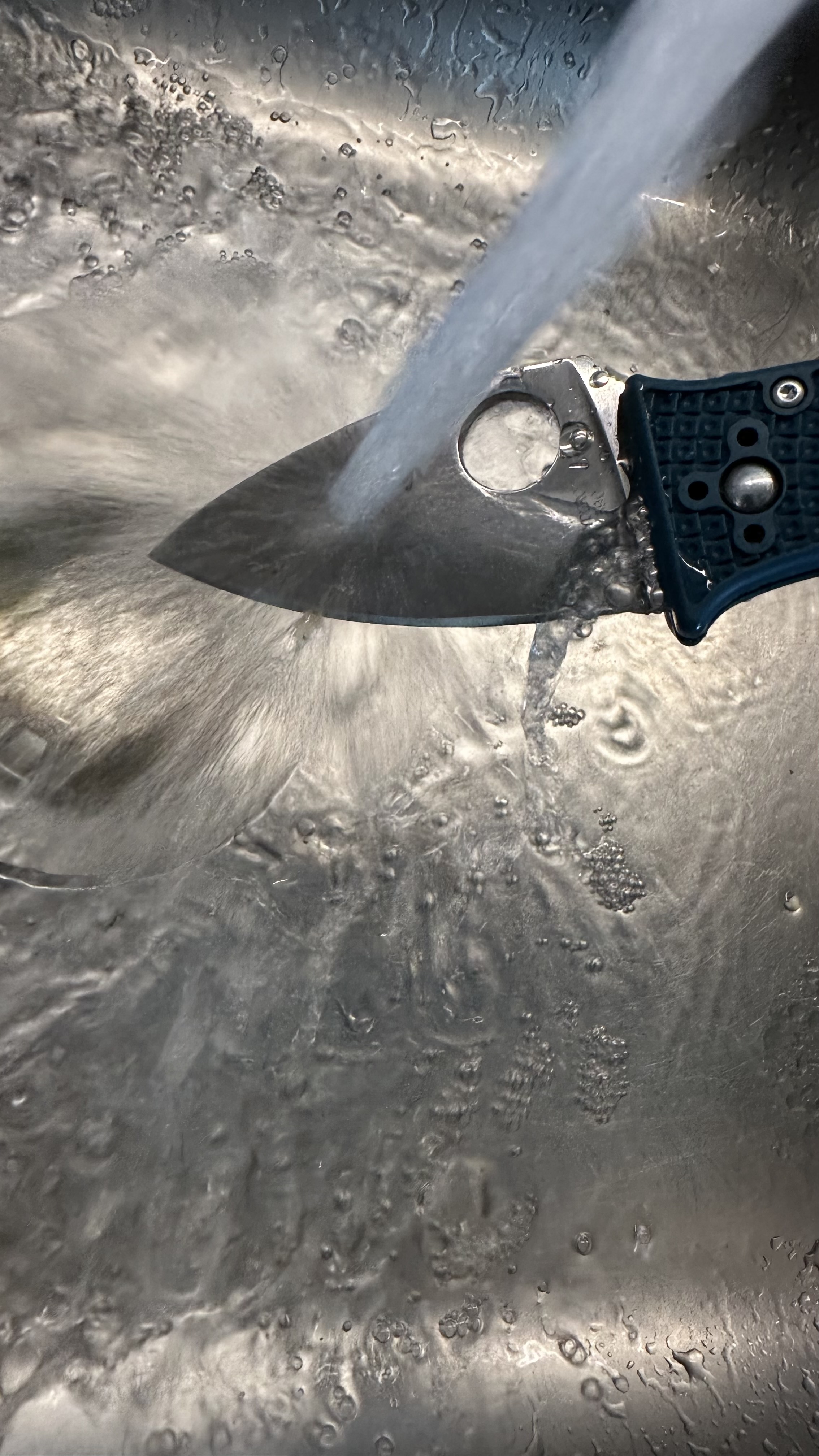
The fact that K390 isn’t stainless is not really an issue if you keep the blade clean and check it regularly for any sign of rust. In practice, a bit of grease or oil is enough to protect it, and over time the steel develops a natural patina that gives the knife real character. My own Lil’ Temp is already showing that patina, and it only adds to its appeal.

Geometry is absolutely critical when working with wood. No matter how tough the steel, without the right blade geometry the knife simply won’t bite or carve efficiently.
A full flat-ground high blade simply can’t compete when working on hard wood. That’s why Sal Glesser’s “Lambo of bushcraft knives,” the Proficient, stands out: it combines a high full-flat ground blade made from a high-carbide super steel (S90V) with an exceptionally comfortable handle. The result is a knife that slices, carves, and handles demanding tasks with ease — the kind of tool that performs all day without fatigue.

The relatively thick handle of the Lil’ Temp makes it extremely comfortable to hold and use. Its design also provides excellent indexation, making it easy to know exactly where the edge is — even easier than on an Opinel or the round handle of the Proficient.

In the woods, the Lil’ Temp is easy to deploy and put into action. Its point is robust enough to withstand some abuse. While K390 isn’t the toughest steel available, it’s still harder and more wear-resistant than many stainless alloys, making it highly capable in practical use.
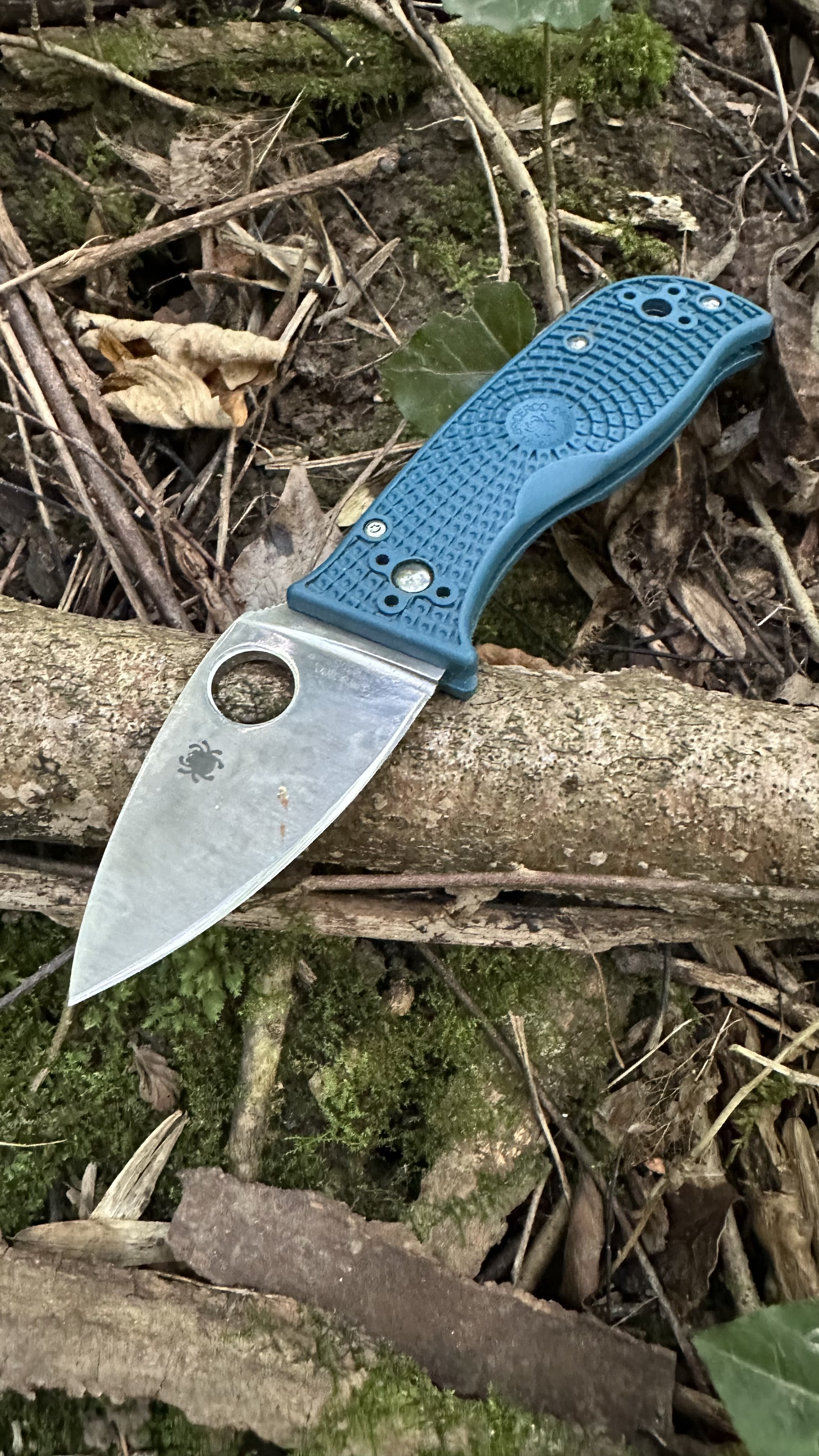
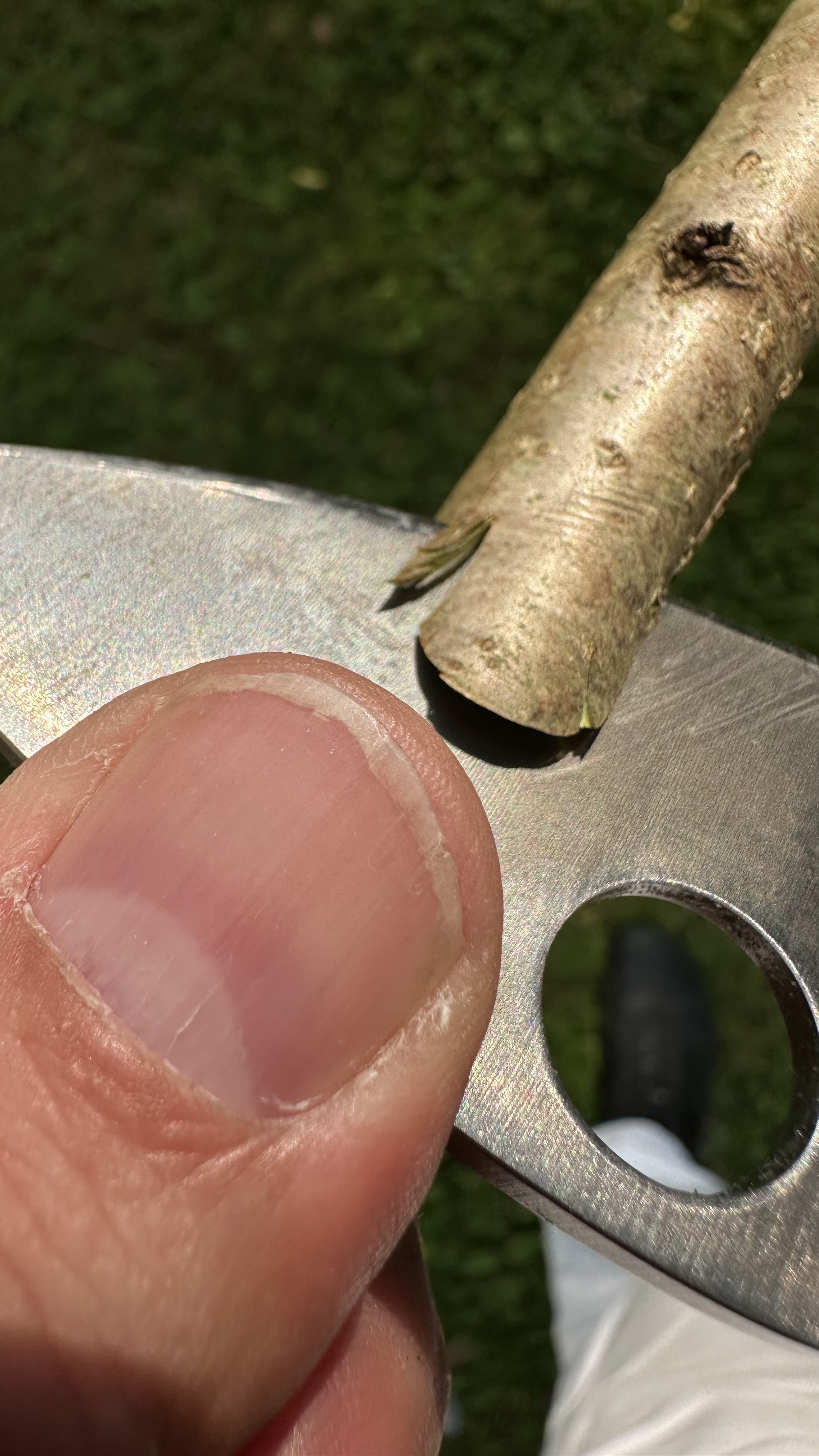
The thick spine of the Lil’ Temp provides an easy resting spot for the thumb, especially on push cuts. This gives excellent control and allows you to apply strength precisely where it’s needed.
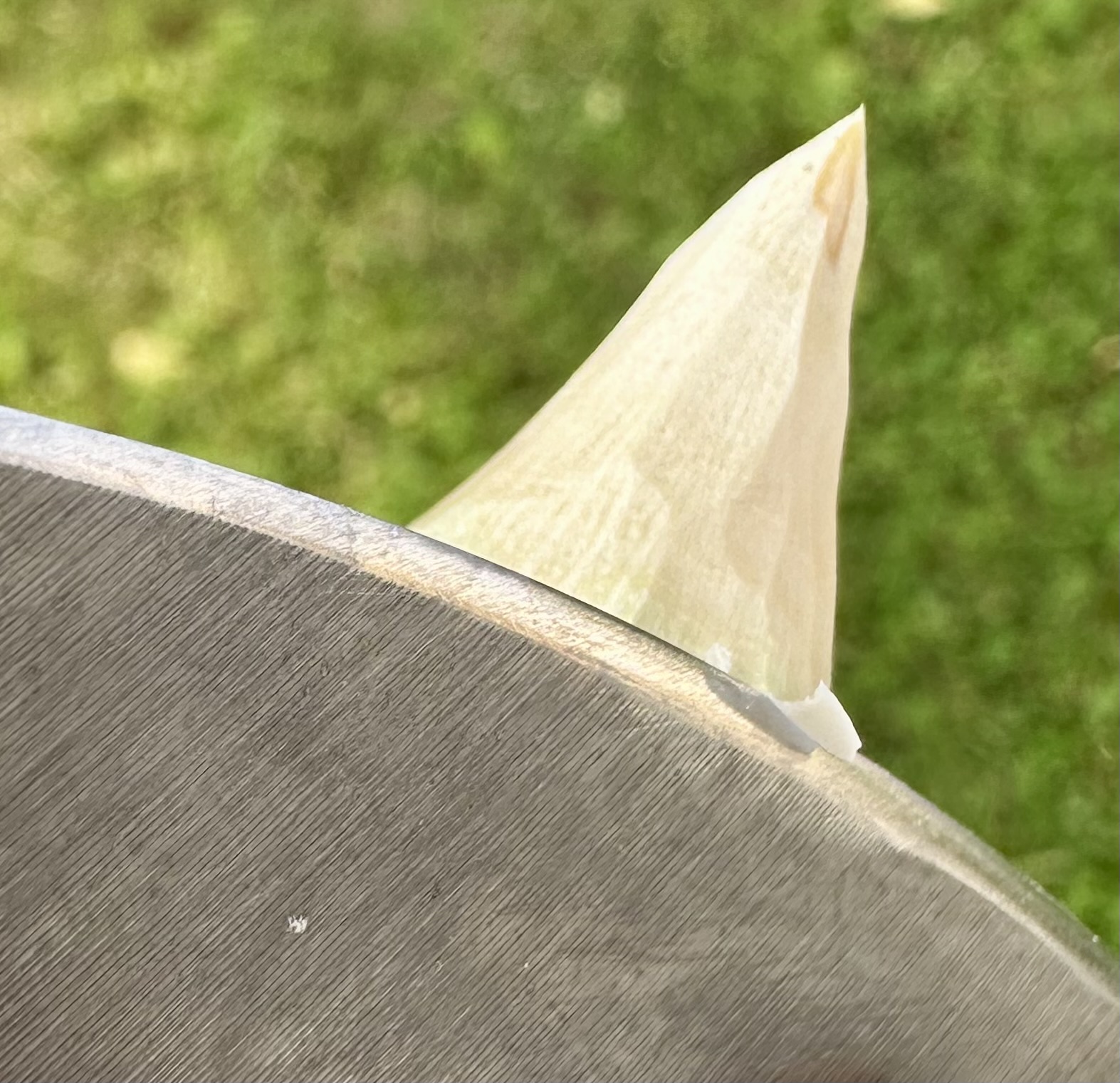
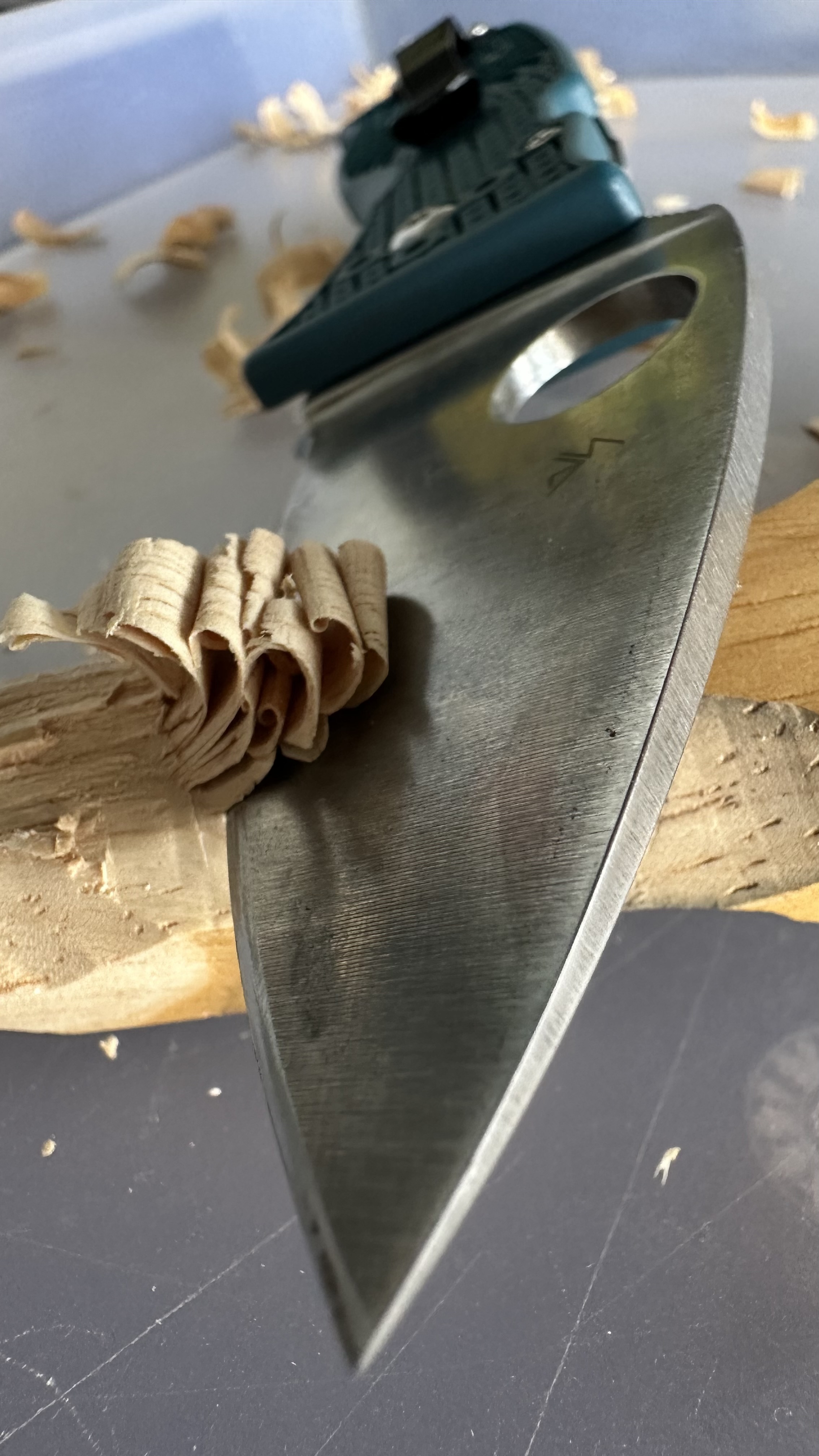
The grain structure of K390 responds exceptionally well when working on wood. After some careful convexing on diamond stones, the edge has developed a shape that balances sharpness and durability perfectly for carving and utility tasks.

I was able to carve pickets without breaking a sweat. The knife’s gentle belly plays a key role, working like a guillotine on the wood fibers and making controlled cuts effortless.

The true kings of woodworking and whittling remain the Wolfspyder and the Boker Vigtig vs Wild. Their authentic Scandi grinds allow them to bite into wood with astonishing ease, making controlled carving and fine whittling effortless.
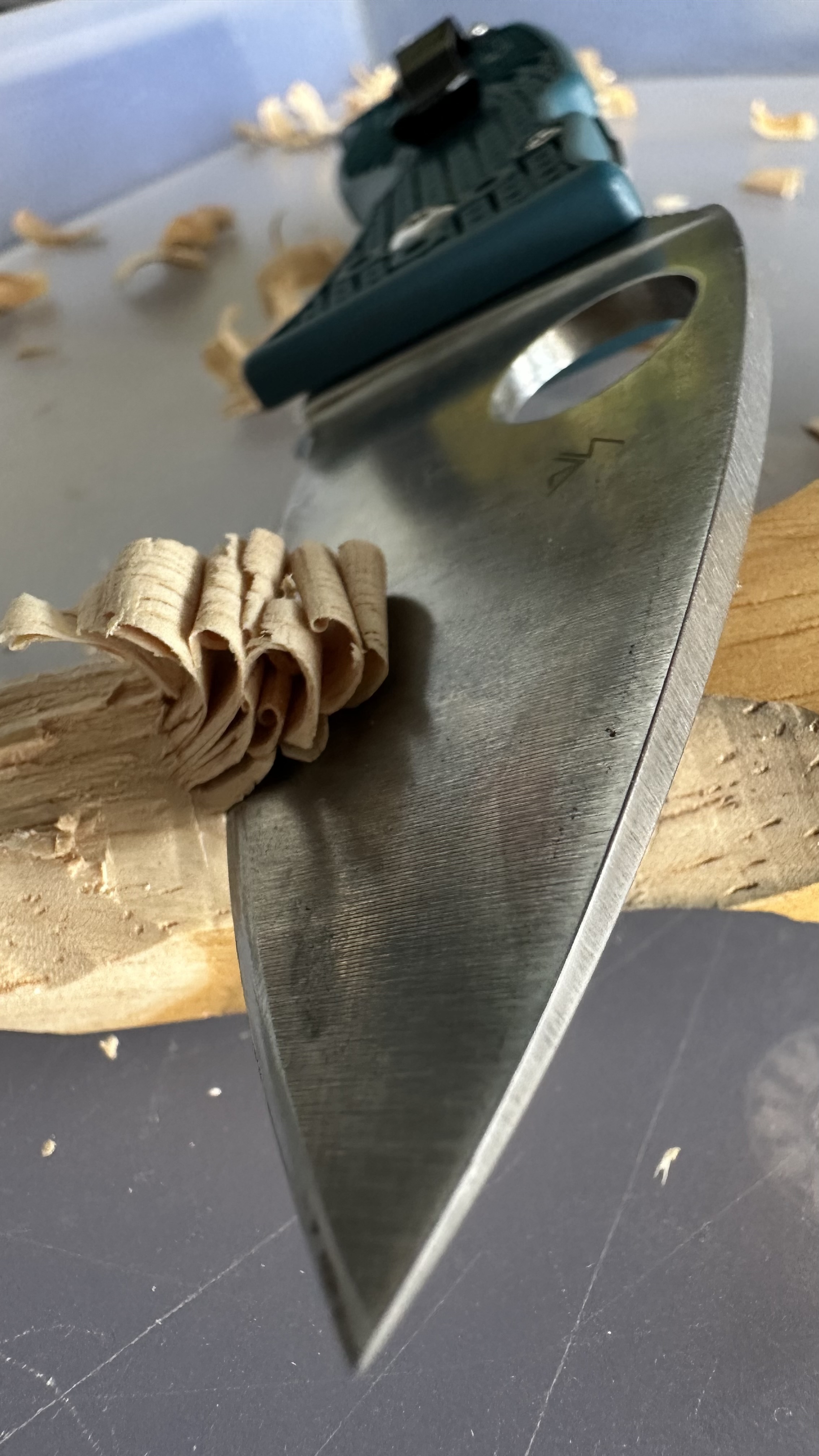
In that context, one of my favorite full-flat-ground folders for whittling is the Native 5 Salt, once convexed. It’s an absolute pleasure to use on wood, combining smooth slicing with precise control.

A folder’s handle will always be less comfortable than that of a good fixed blade, simply because of the compromise required to fold the blade into it.

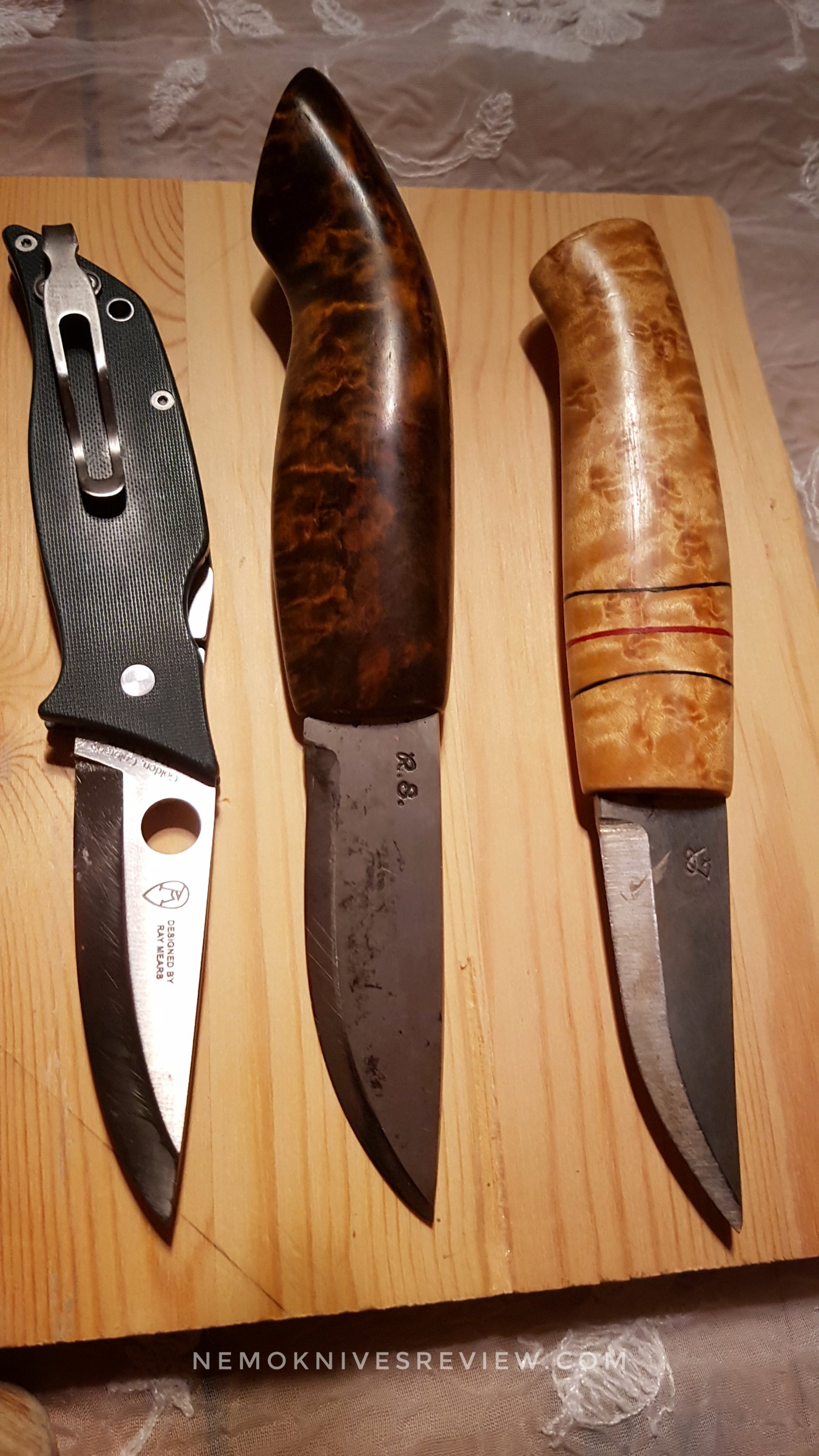
That said, the Lil’ Temp is among the very best in this regard. Other outstanding handles include the Manly Comrade, the Benchmade Adamas, the Cold Steel Recon 1, and the Wolfspyder — the latter benefiting from Ray Mears’ design philosophy, focused on knives you can use all day long without developing hot spots or splinters.
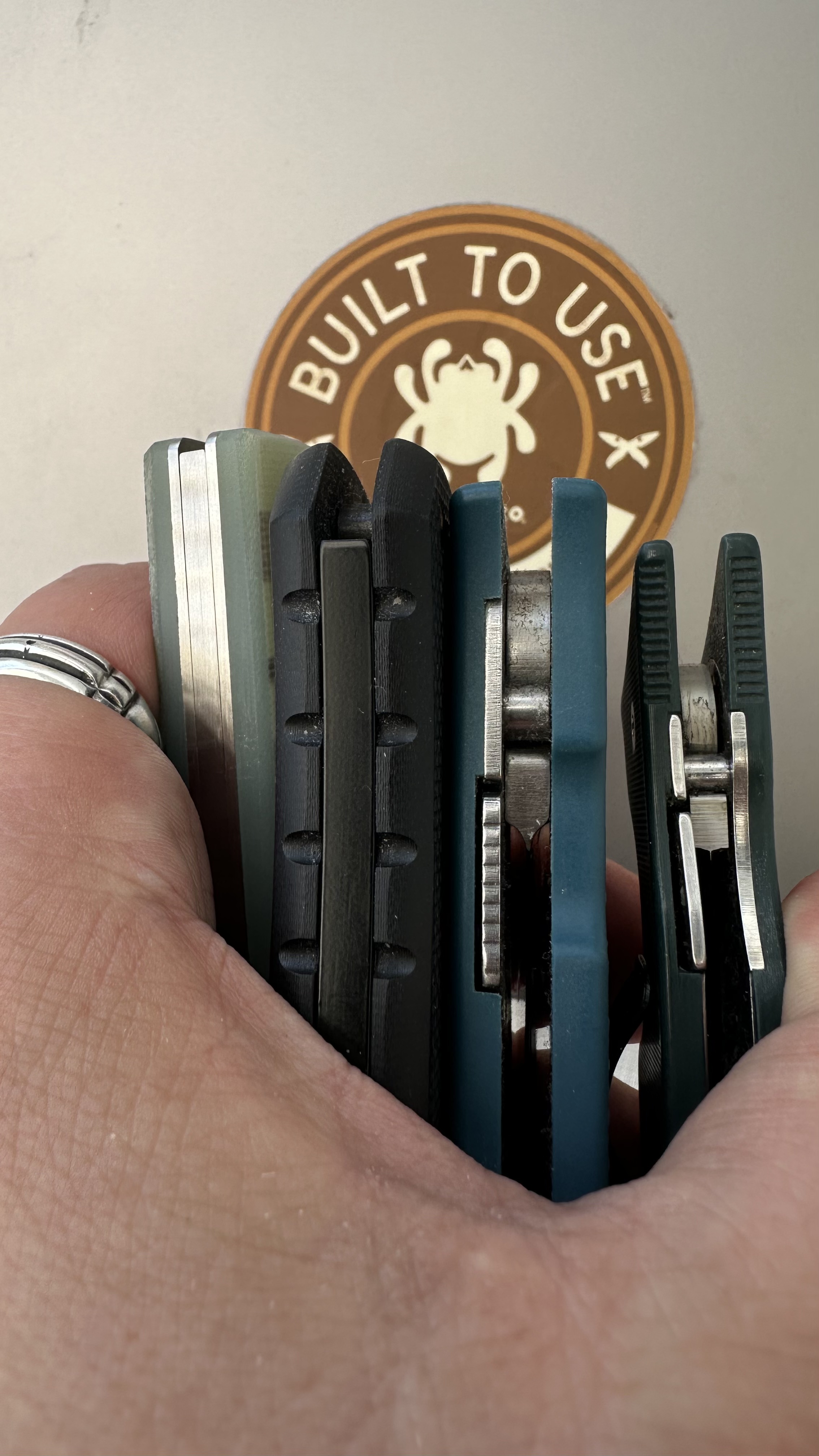
(Comrade, Recon 1 on the LT’s left and Wolfspyder on its right)
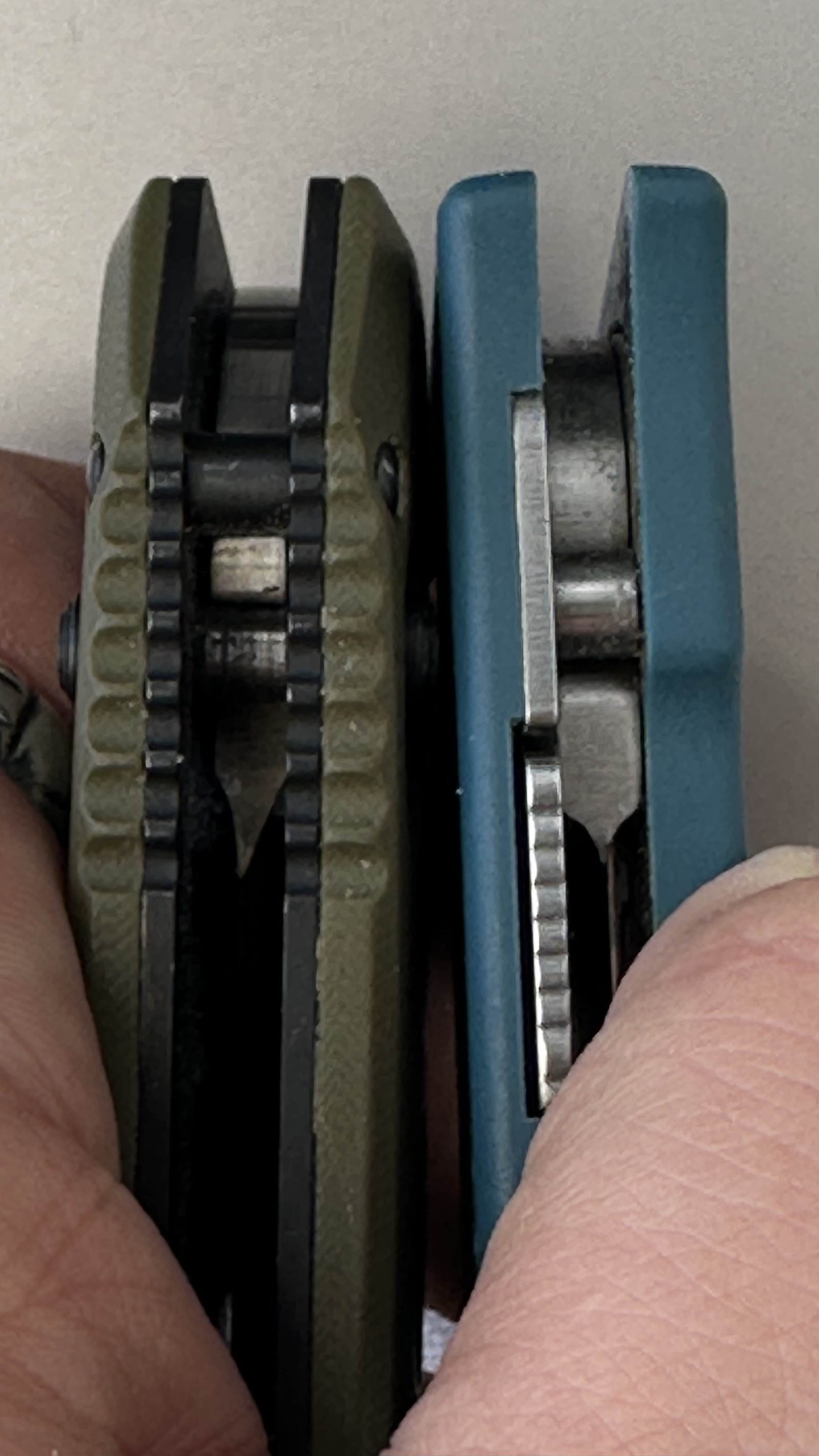
(Adamas and Lil’ Temp)

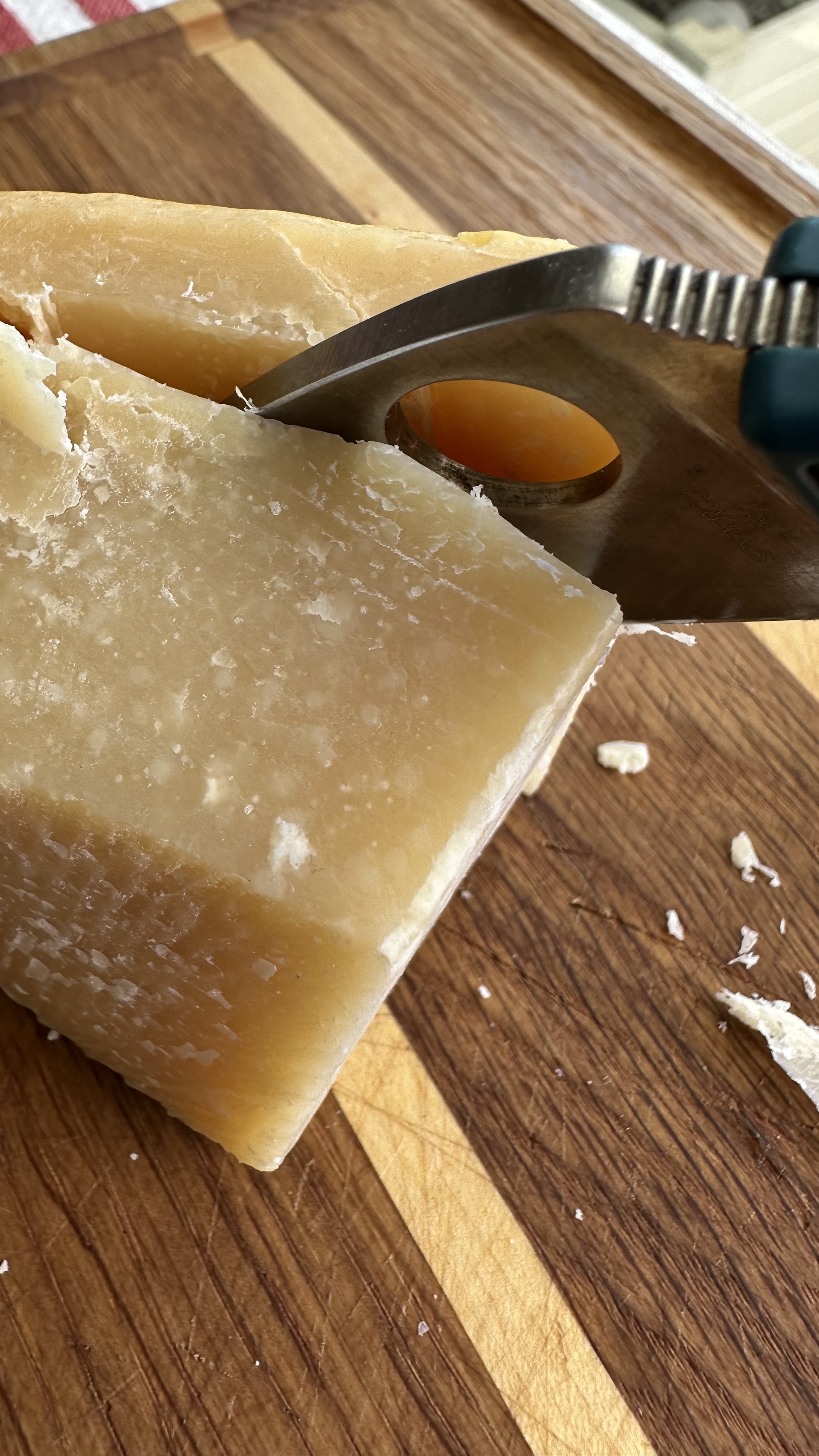
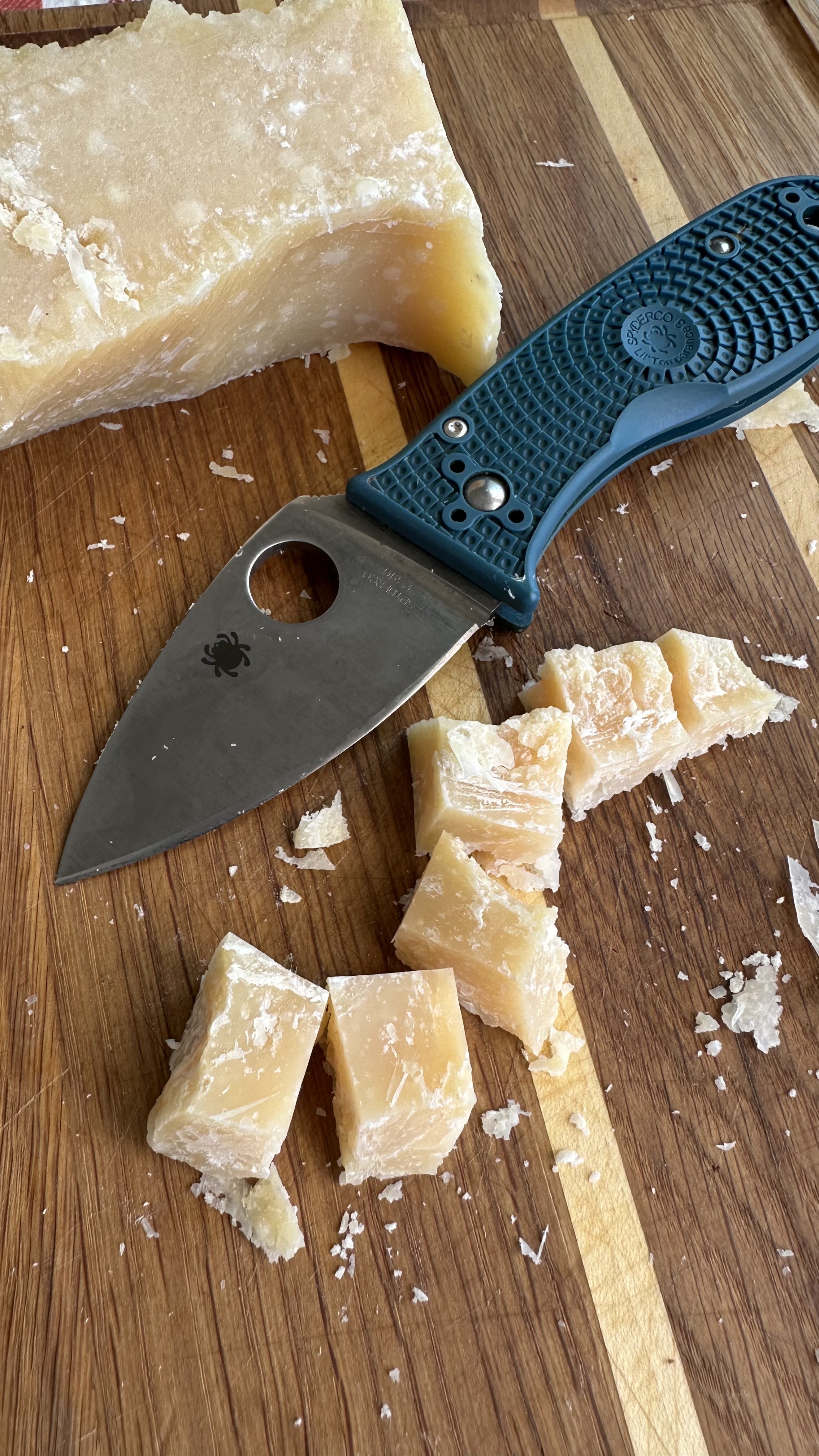
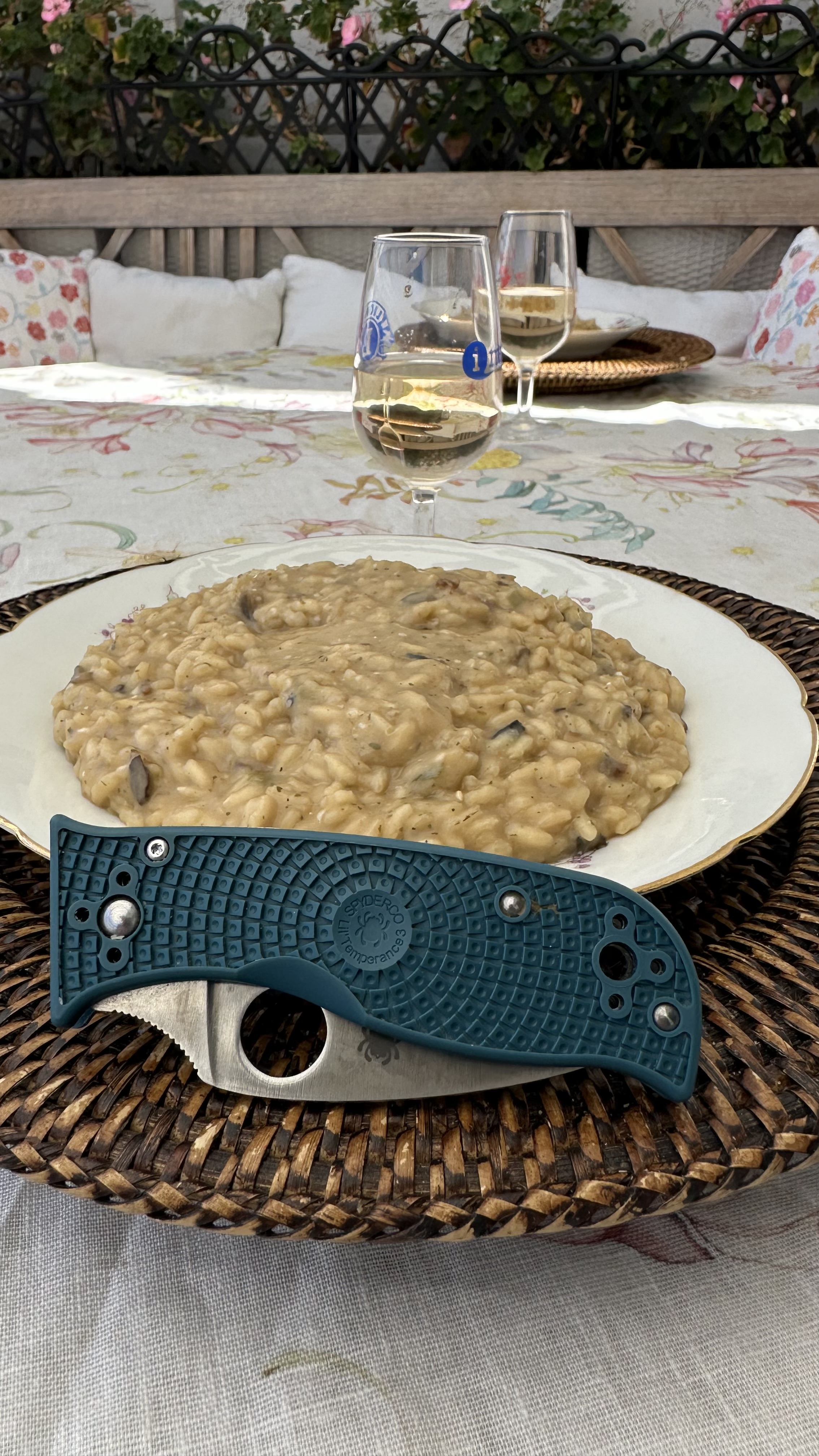
Another example of relatively demanding use is making this risotto using
an old chunk of dry Parmigiano which needs to have its rind removed, then cut into half-inch cubes — no easy task given how hard the cheese can be.

It’s also a great way to detect hot spots: the weakest point, if any, in the compression lock. That notch on the back of the handle all but guarantees a sore hand after extended use.

Apart from a single trip into the woods, I’ve mostly used the Lil’ Temp in the kitchen, where it’s been steadily building a nice patina. I’ve also taken the opportunity to test its ergonomics with wet hands. The FRN handle pattern is one of Sal Glesser’s great innovations: it gives the knife a no-nonsense, tool-like appearance while ensuring the handle stays locked in place once gripped.

Conclusion

The Lil’ Temperance 3 K390 Lightweight (“Shorty”) stands out as a compact powerhouse in Spyderco’s lineup. With its super-steel blade and excellent geometry, it elevates everyday carry versatility, combining cutting performance, ergonomics, and durability in a smaller format.

Its lightweight build and aggressive handle design make it a tool you can truly rely on. Whether in the kitchen, at the workbench, or outdoors, the Lil’ Temp proves itself capable of handling demanding tasks without compromise. The FRN handle texture, designed by Sal Glesser, not only lends a purposeful, tool-like look but also ensures a secure grip, even with wet hands.

From reviews across the community, a consistent picture emerges:

  1. Exceptional cutting performance — even in tasks where utility blades struggle
  2. Superior carving and utility — excels at both fine control and hard work
  3. Secure lockup — the compression lock feels noticeably beefier than on similar models
  4. Excellent ergonomics — comfortable for long use, even damp conditions
  5. Edge retention — the K390 steel holds its sharpness impressively well
  6. Durability — little to no wear after months of use
  7. Practical carry — light, compact, and easy to deploy one-handed
  8. Minimal maintenance — just regular wiping and light oiling keeps it in peak condition

As one reviewer put it, this “box-destroying little chode of a knife” punches well above its size. Another called it “a tank… carefree, strong AF, and super comfortable.” After extended use — from food prep to cardboard — users report only minor stropping needed, with many calling it one of their favorite Spydercos in decades.

In short, the Lil’ Temperance 3 K390 Lightweight is a sleeper hit: not the most popular Spyderco, but for those who carry it, often a personal favorite. A compact EDC with the heart of a work horse.
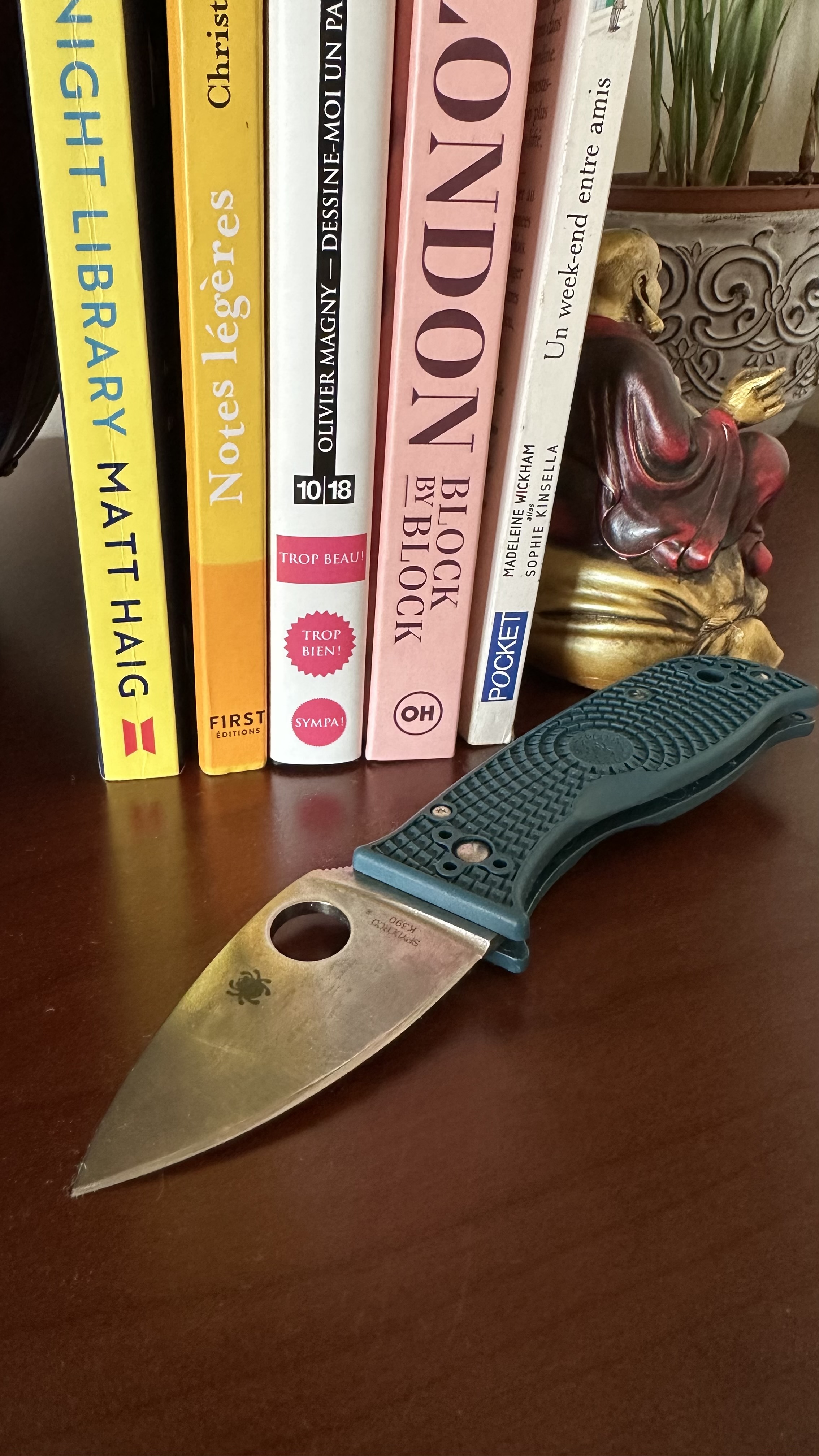
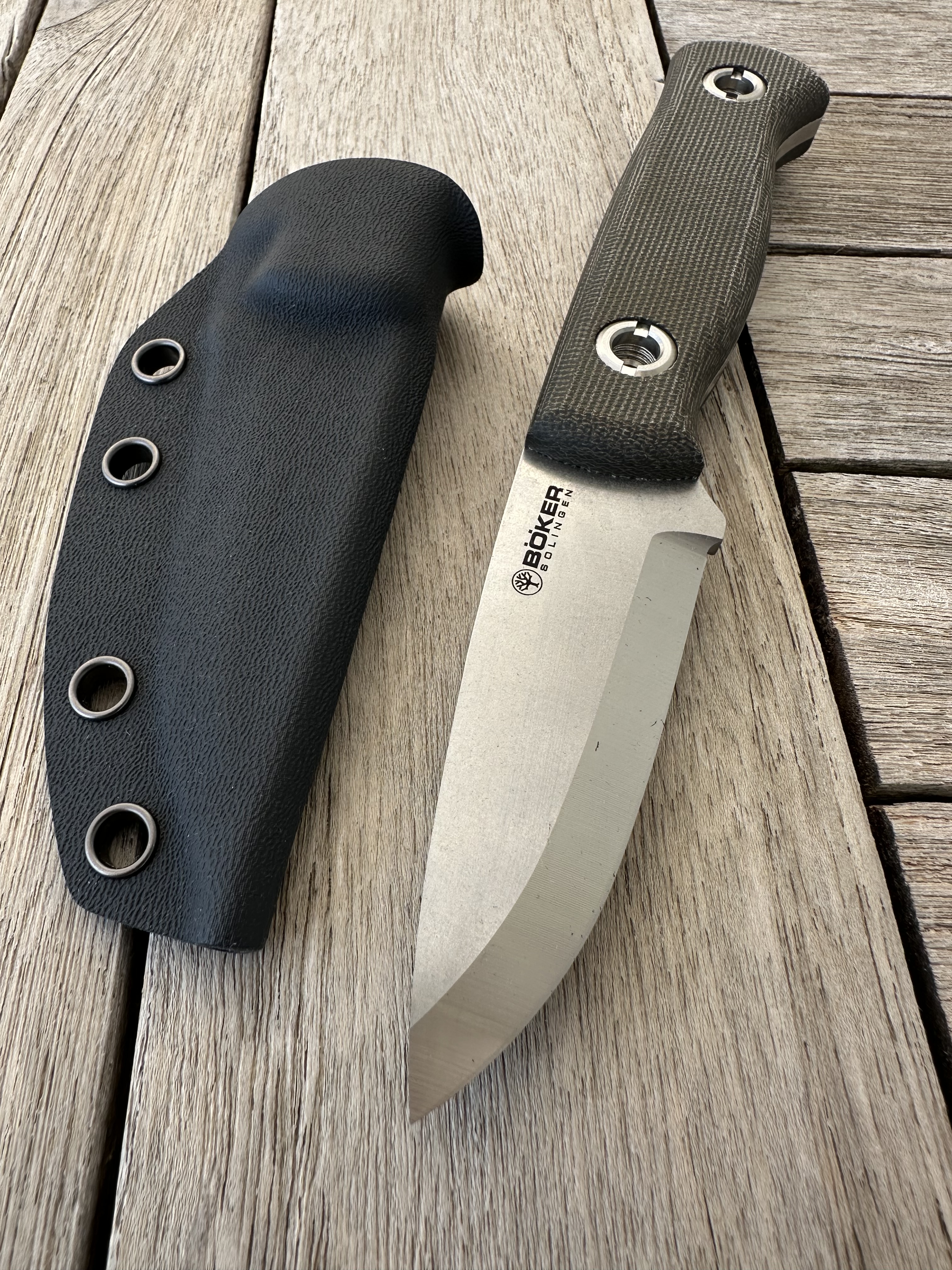
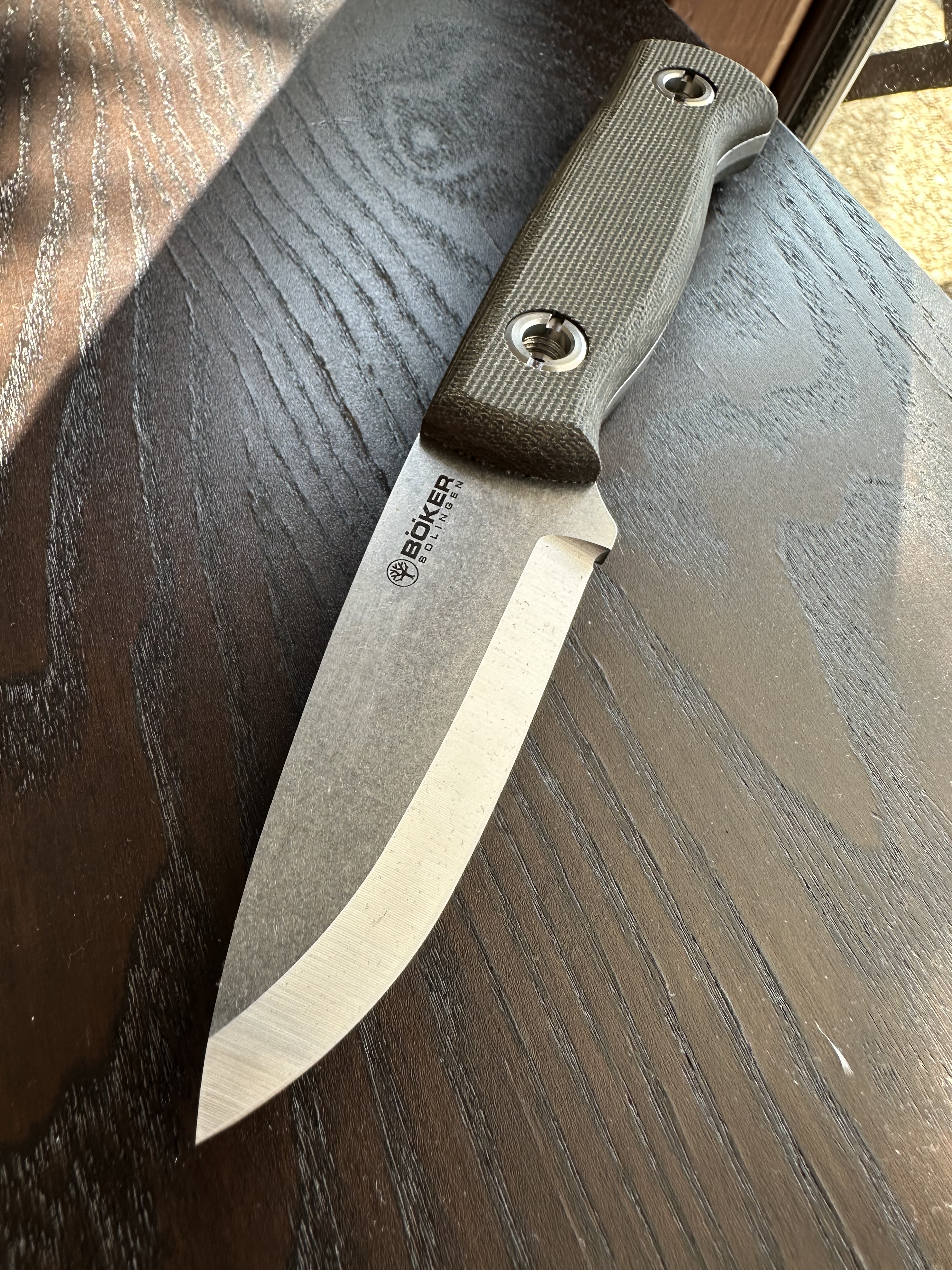
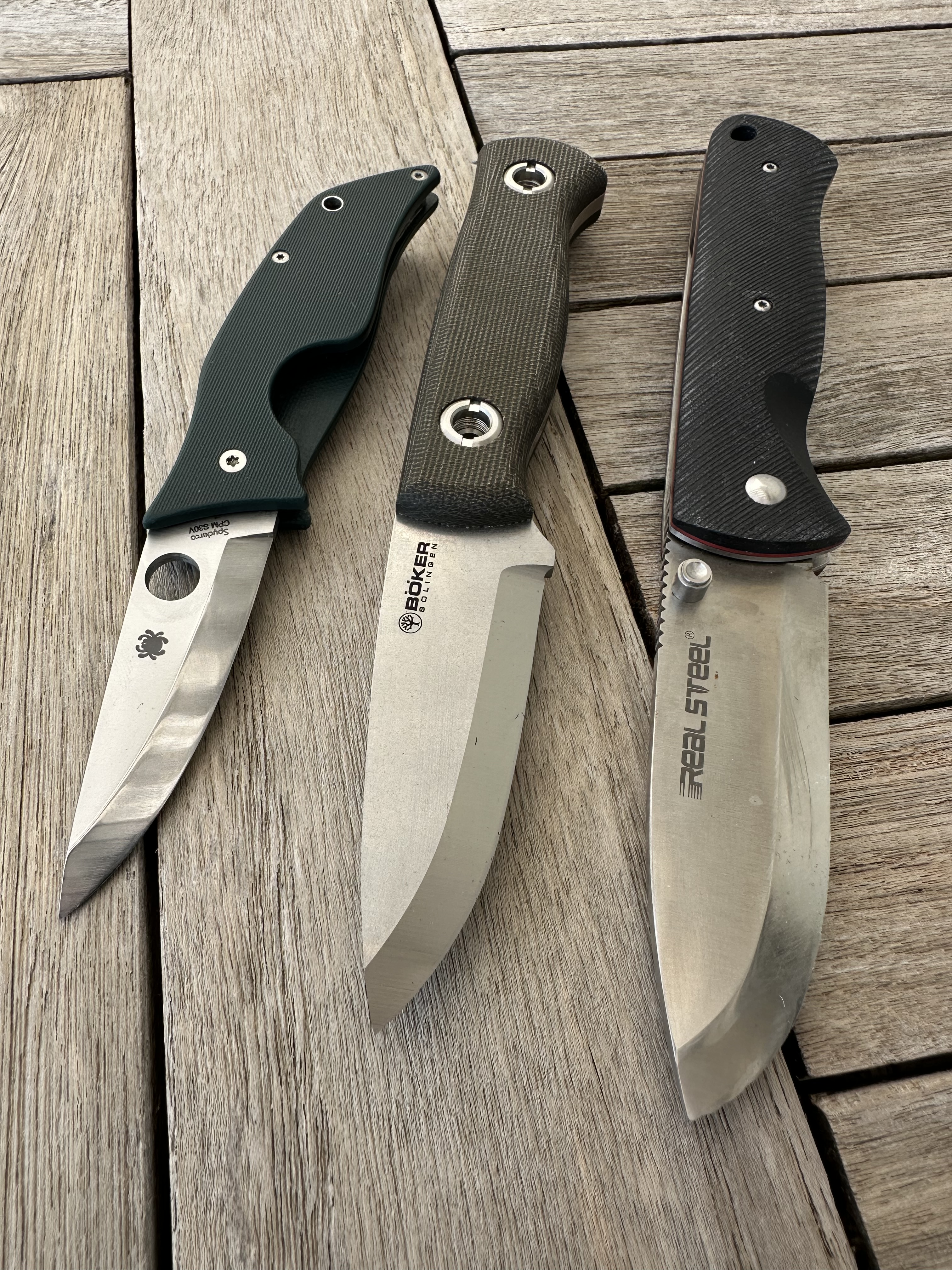
Böker “Vigtig vs. Wild” in CPM Magnacut – The Bushcraft Supreme EDC designed by David Wenger.


I got a passion for short fixed blades EDC. And they are hard to find.
Now the
I was lurking at the new Pocket Tango with its magnetic sheath but my first intention was to buy a Lulu from KNAFS. Until I have found it was a not true scandi with its microbevel because they have found that Magnacut was chipping with there grind.
At least they were honest to announced it but for the price I have found my Wolfspyder was doing the same job in a folding package.

So I wanted a robust small fixed blade which was bringing new option compared to a folding knife: lateral strength for example and by looking around all the new Magnacut fixed blades made in Italy, I have found one which was made in Solingen…. Germany !
And for less than half the price than the beautiful little Lulu.

I have found it has been designed for a TV game and for German Youtubers who are filmed while surviving in Canada.

Quoting Böker’s site:
Two streamers in the wilderness? (…) Trymacs (29) from Hamburg and Rumathra (27) from Bonn will compete together as a team in the upcoming season of 7 vs. Wild and face the 14-day adventure in the wilderness of Canada. The two heavyweights from the German streaming/gaming scene together have over 4 million followers on Twitch (Trymacs 3.4 million, Rumathra 0.7 million) and also have a strong presence on YouTube and Instagram. As part of the intensive preparation for this borderline experience, the choice of the right equipment – especially because all items have to be stored together in a 1L Nalgene bottle – played an elementary role for the two.”
OK. Why not. But eventually who was the designer ?
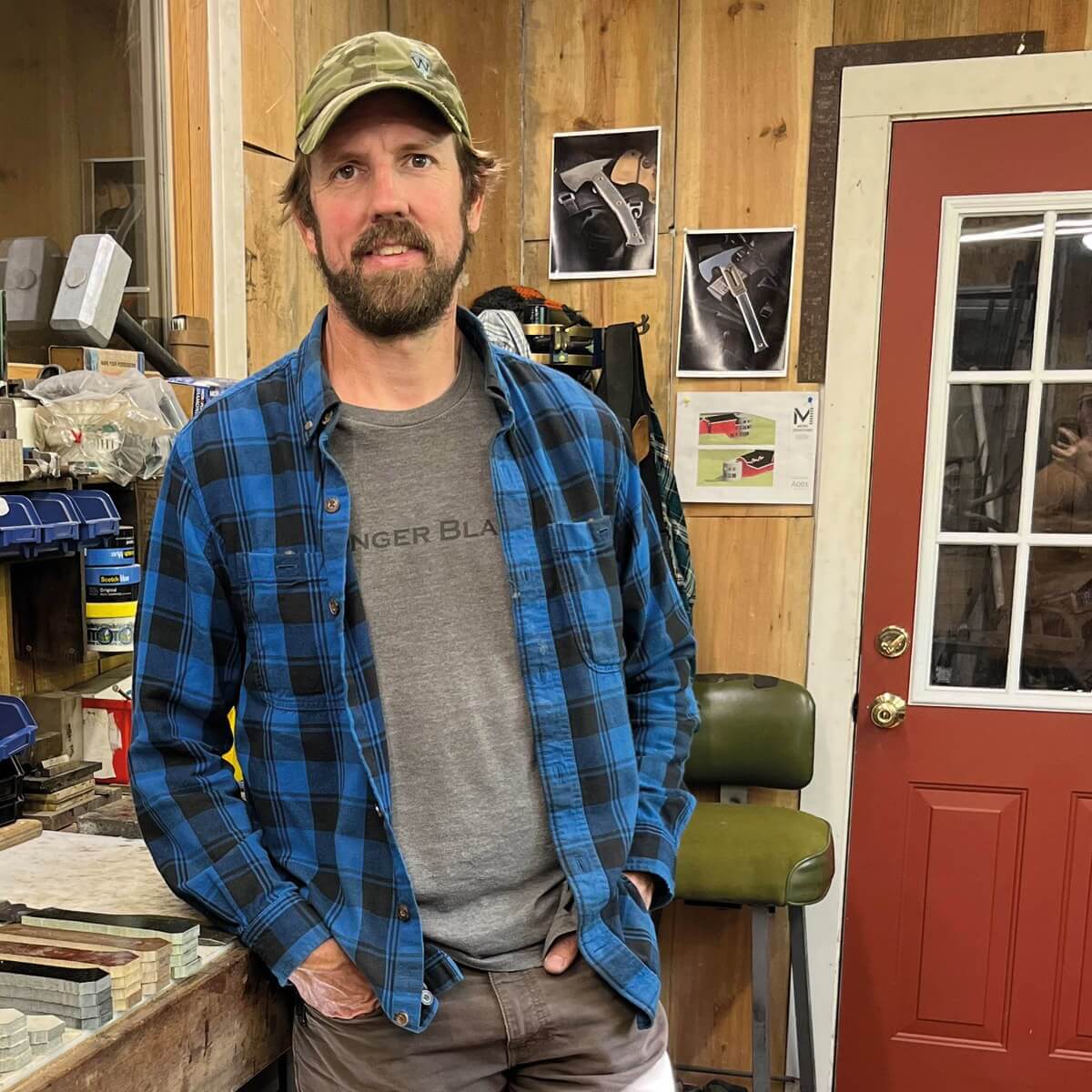
He’s American and his name is David Wenger and his interview can be found here on Böker site.

David knows his art as he is a bushcrafter and former builder. So looking at his own knives you can see his passion for dependable tools to be used hard in the wilderness or in the garden and as far as I am concern, he has created a great fixed blade for Böker.
Especially knowing that simple designs are not simple to create.

Remember how I was impressed by the Casström N°10, seven years ago ? This “Vigtig” is taking the same path as far as I am concerned. Its design looks simple but in fact it is really refined. It is a robust and sharp knife !

First thing to consider is the price of this knife: 135 euros with shipping in Knives&Tools. Not bad at all as K&T are not the cheapest on the web.
But it is sold cheaper than the Casström which is at 166 euros (June 2024). (The imported LULU is topping at 295 euros !!)
And the Vigtig (“Important” in German) is provided in CPM Magnacut like the LULU !! But with a real Scandi grind ! Sharp as my mother in law’s tongue !
And that’s simply one of the cheapest knife in CPM Magnacut today.
Also with a 8,5cm blade length it is not made as “companion” knife but as a main bushcrafter and truly solid survival tool.

Immediately when I held the Vigtig I have appreciated its ergos of its green micarta handle. This knife feels good in the hand. It well balanced. It is alive ! (Something I really miss in the Spyderco lately and that’s coming from a Spyderco french fanboy who loves to strop his Magnacut blade on leather. Because CPM Magnacut is a pleasure to strop.)
The micarta is smooth but naturally grippy. Oh boy, when you hold the “Important” you are gripping a real tool. Something to be used hard in a very compact size. Let’s not forget it even is shorter than an deployed Endura (22cm against 19cm for the Vigtig !)
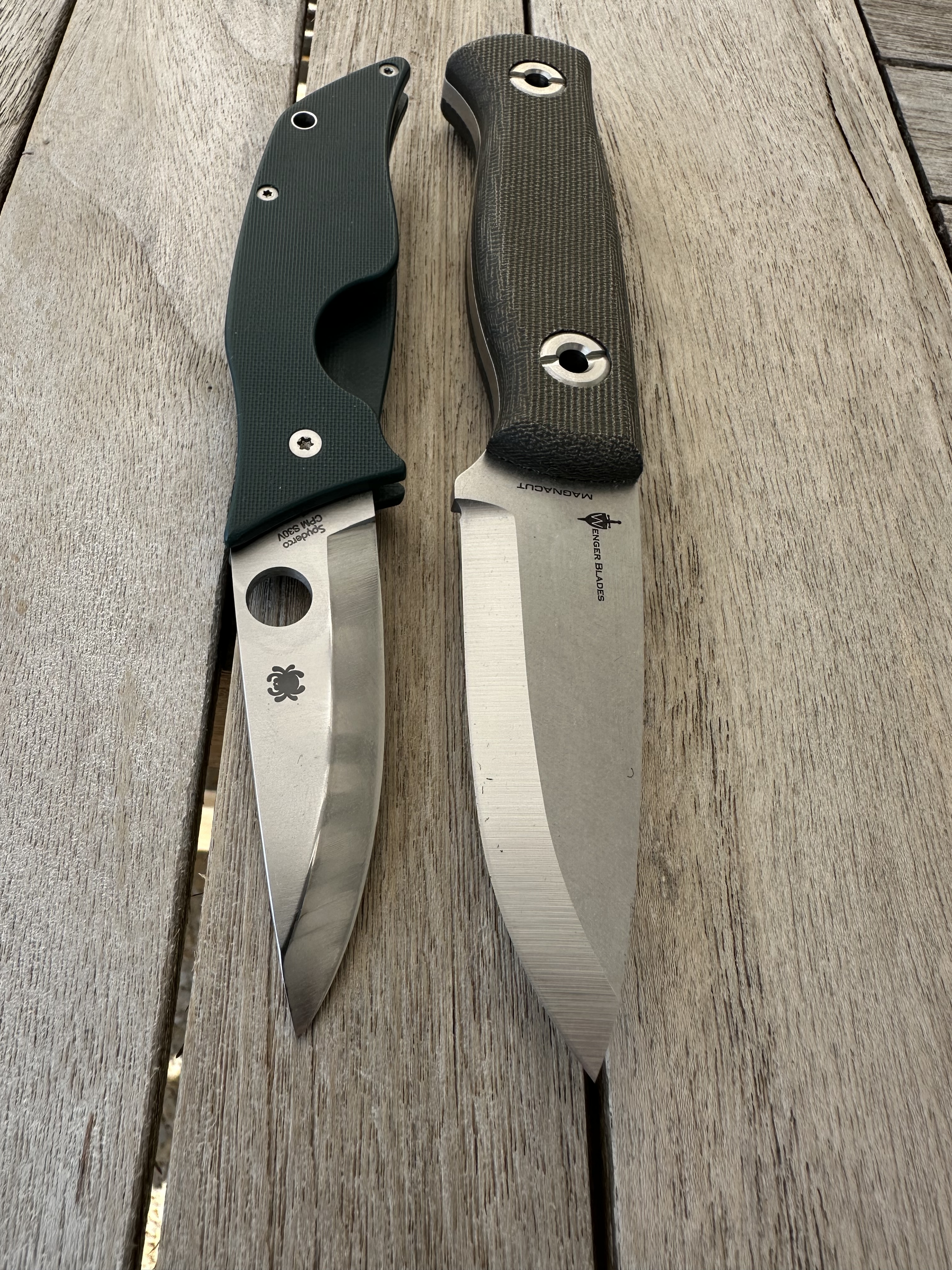
The scales are not totally rounded but this soft boxy shape helps to know in which direction/angle the edge is. That’s why I prefer boxy/flat folders like the Native or the Wolfspyder picture here.
The Vigtig is labelled as a “survival” knife but in my opinion it is also a bushcraft knife, lengthwide and it term of ergonomy.

The rounded handle of an Opinel has always been some kind of issue for me. You gain in comfort what you lose in precision in your cut. For that I was always using my thumb on the blade to know exactly at what angle it was.
On the Vigtig you feel the knife is at ease in your palm. It is really confortable and oozes quality and strength in the tool. There are some heavy working vibes (like just said David of the KCI about the new Manix XL Crucarta.) ! This is mandatory for a compact tool you suppose to use for hours (as the Proficient for example which is hard to beat but feels more premium, less Blue Collar than the Vigtig. The Vigtig is perhaps not “excellent” here but at least very very good in ergos and eventually is even qualified as Super Knife by the Dutch Bushcraft Knives boys.


There is a sharp spine to use with fire rod near the tip of the blade. As the stock is 4mm thick it is not an issue with my left thumb confort. Those sharp edge can also be used to scrap the bark for various uses. I would have preferred a round spine for my own use as I push cuts wiuth my left hand’s thumb.

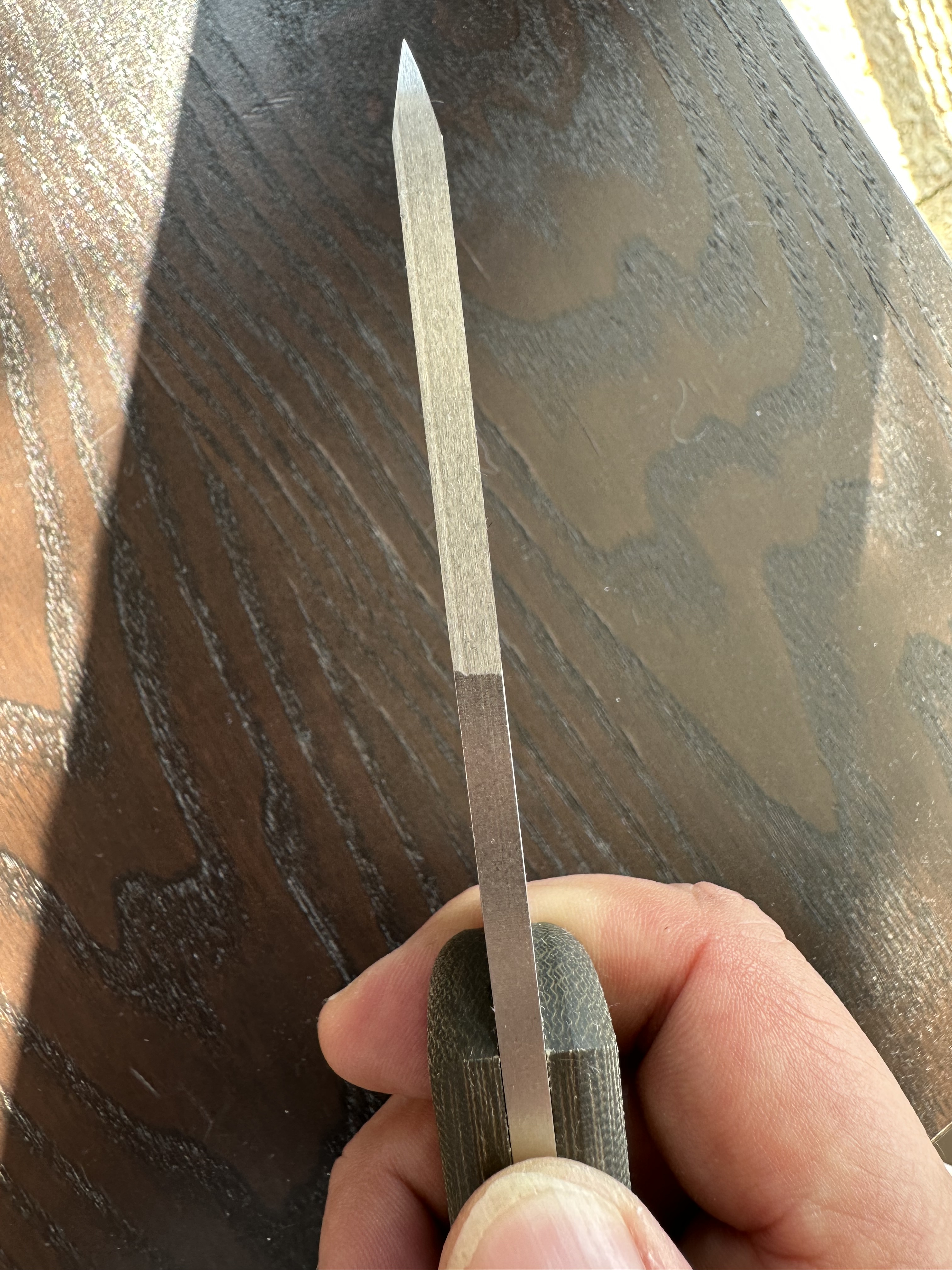
Now we got a True Scandi Grind. Not micro bevelled.
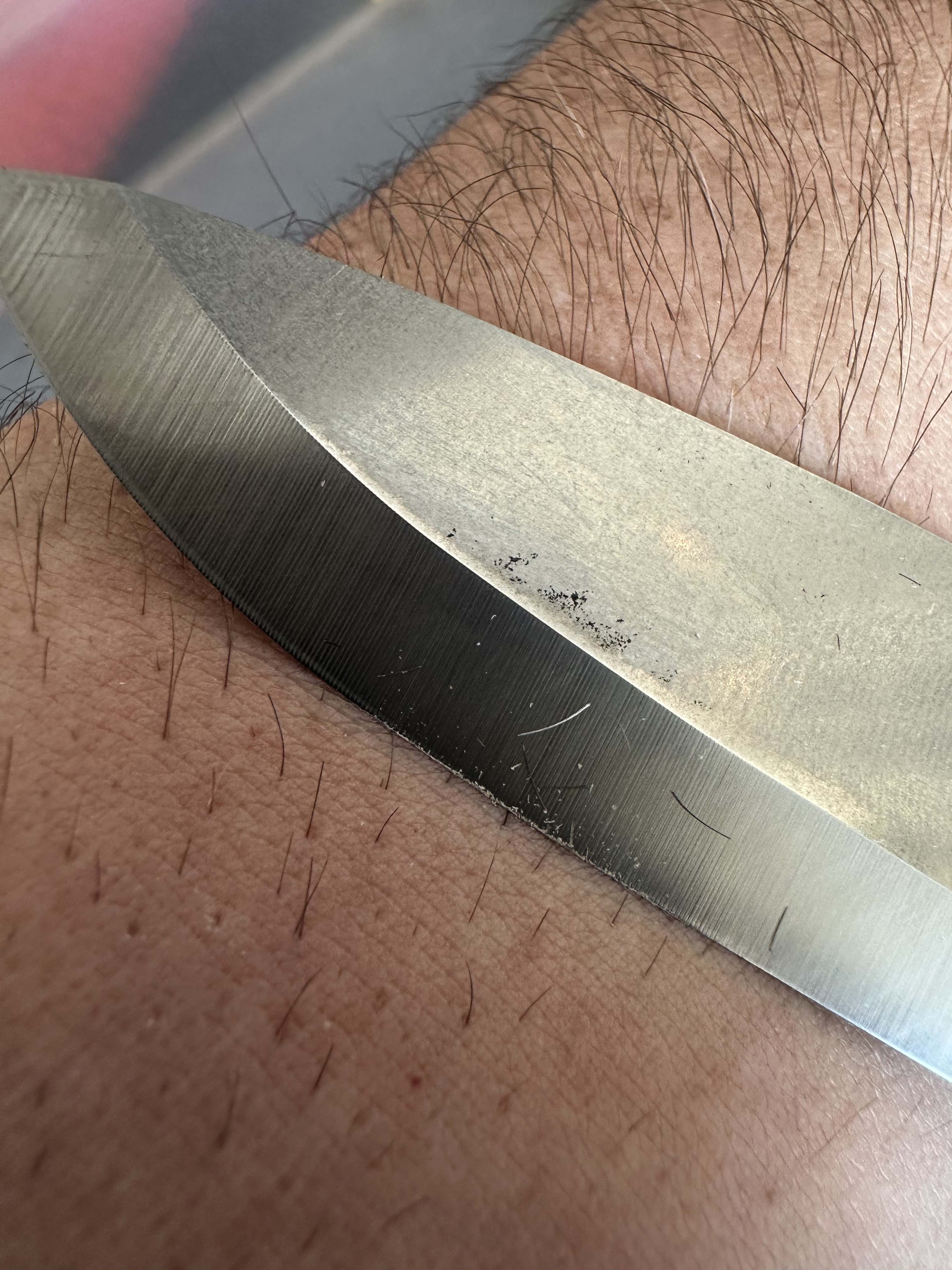
The Vigtig makes hair popping right out of the box.
Magnacut is known for its very very fine grain and strength and toughness.

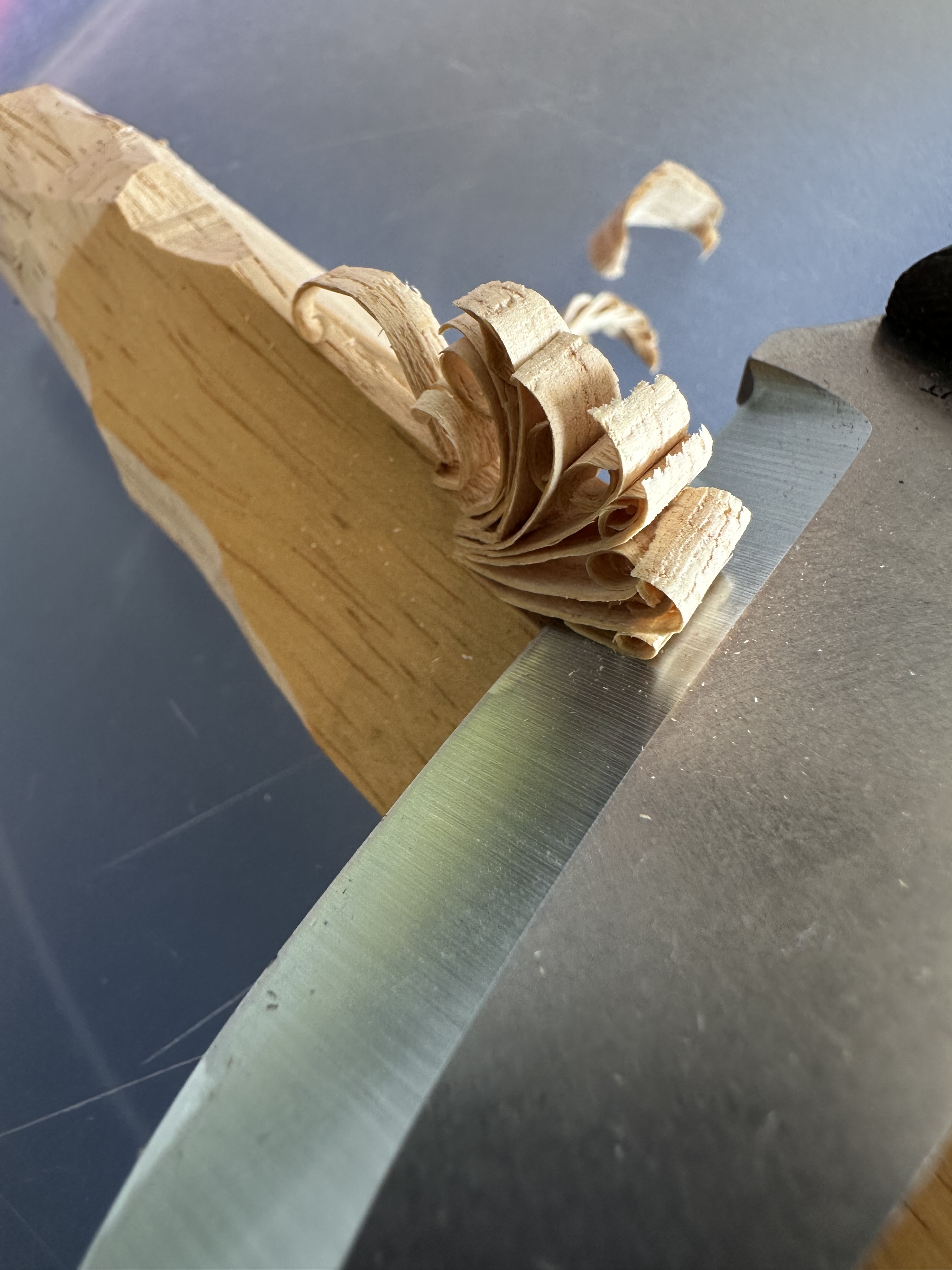
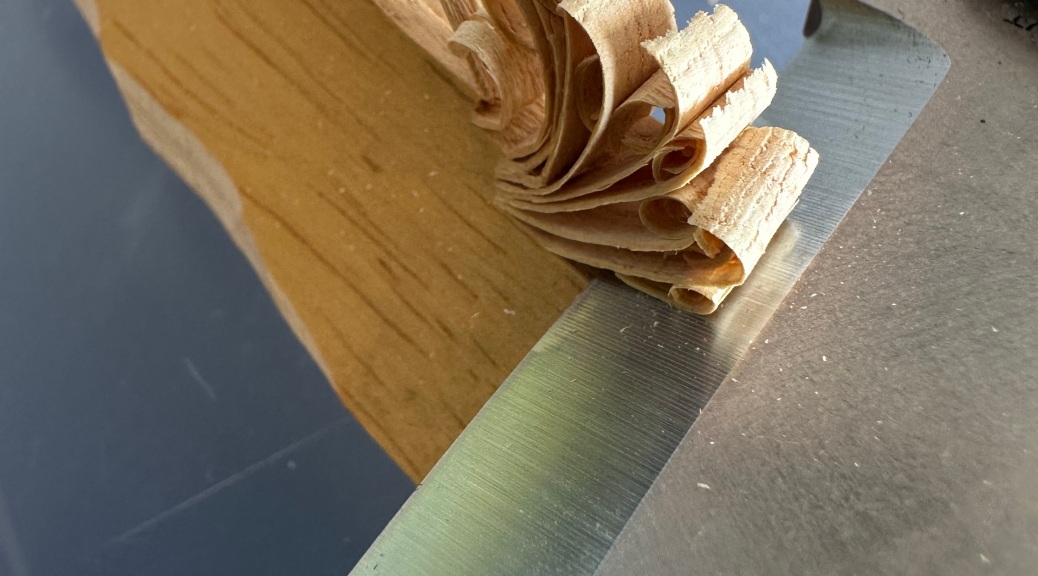
It bites in wood like nothing matters and keeps its crispy edge.
Böker announced a HRC of 62-63. Its hard but tough !

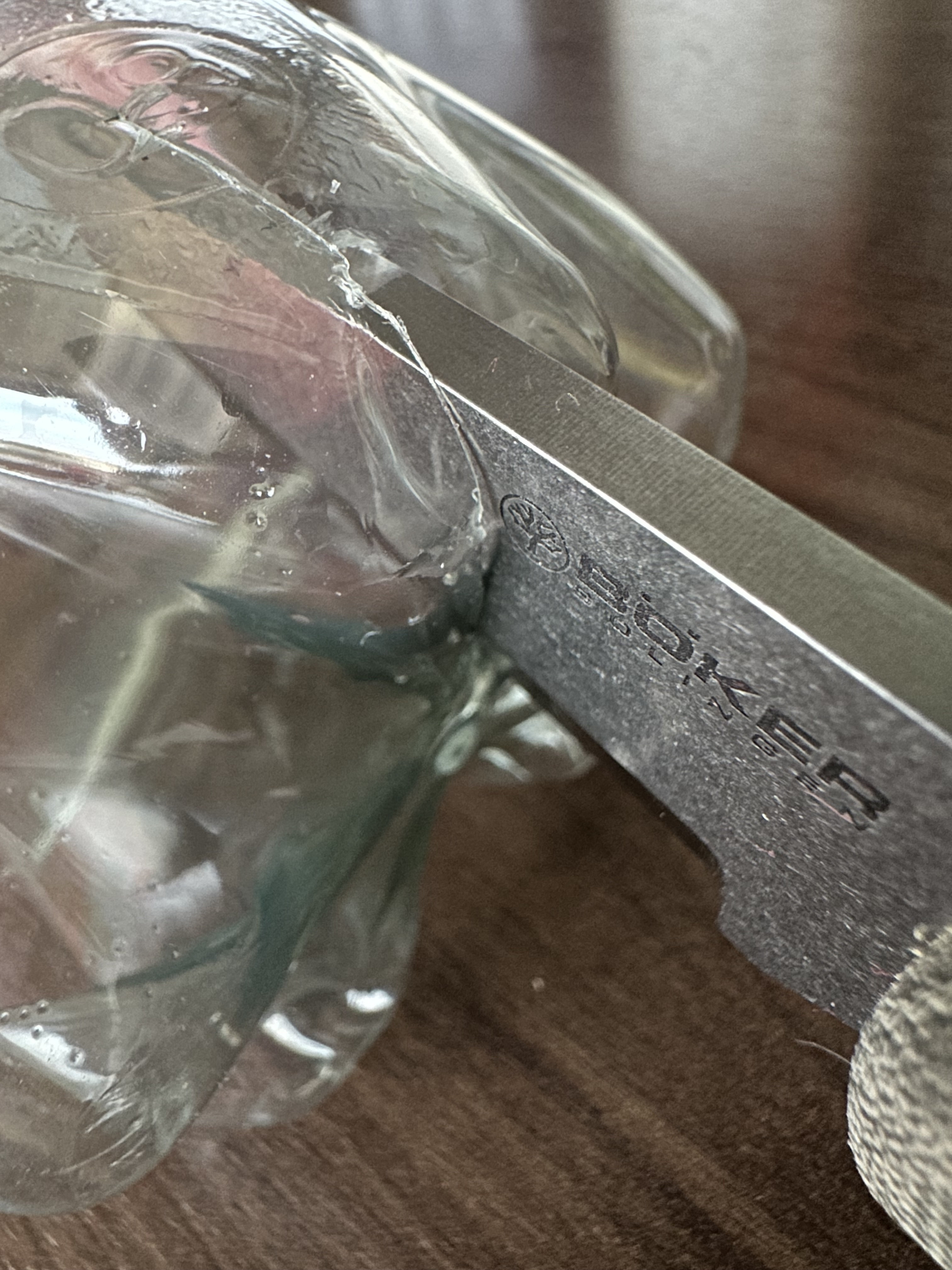
If there is one thing the scandi sucks at is my Plastic Butt Bottle test.
Where a Nilakka or an Opinel will got through it with ease, scandi get stuck and this is pure geometry issue. Scandi acts like a wedge.

CPM Magnacut is also a leather stropping lover. It brings the same behavior of tool steel in a very very stainless alloy. Frankly this is a bushcrafter dream ! The edge is impervious to the elements and it is a easy going tool which can be used even near saltwater without after thought.

Especially because there is an hidden compartment inside the handle.
A special highlight can be found inside the handle. Instead of hollow studs, the two large screws can be easily removed with the help of a coin, revealing an ample compartment with a depth of 14 mm compared to the outer dimensions of the handle, where tweezers, tinder, charcoal tablets, a fishing kit and safety pins, for example, can be easily accommodated.”

I will not use it. And certainly will secure the screws with some blue thread locker. But as least, if needed you can use the knife without its micarta scales and just use the hidden compartment. Rambo is never far away when we talk about survival knives.

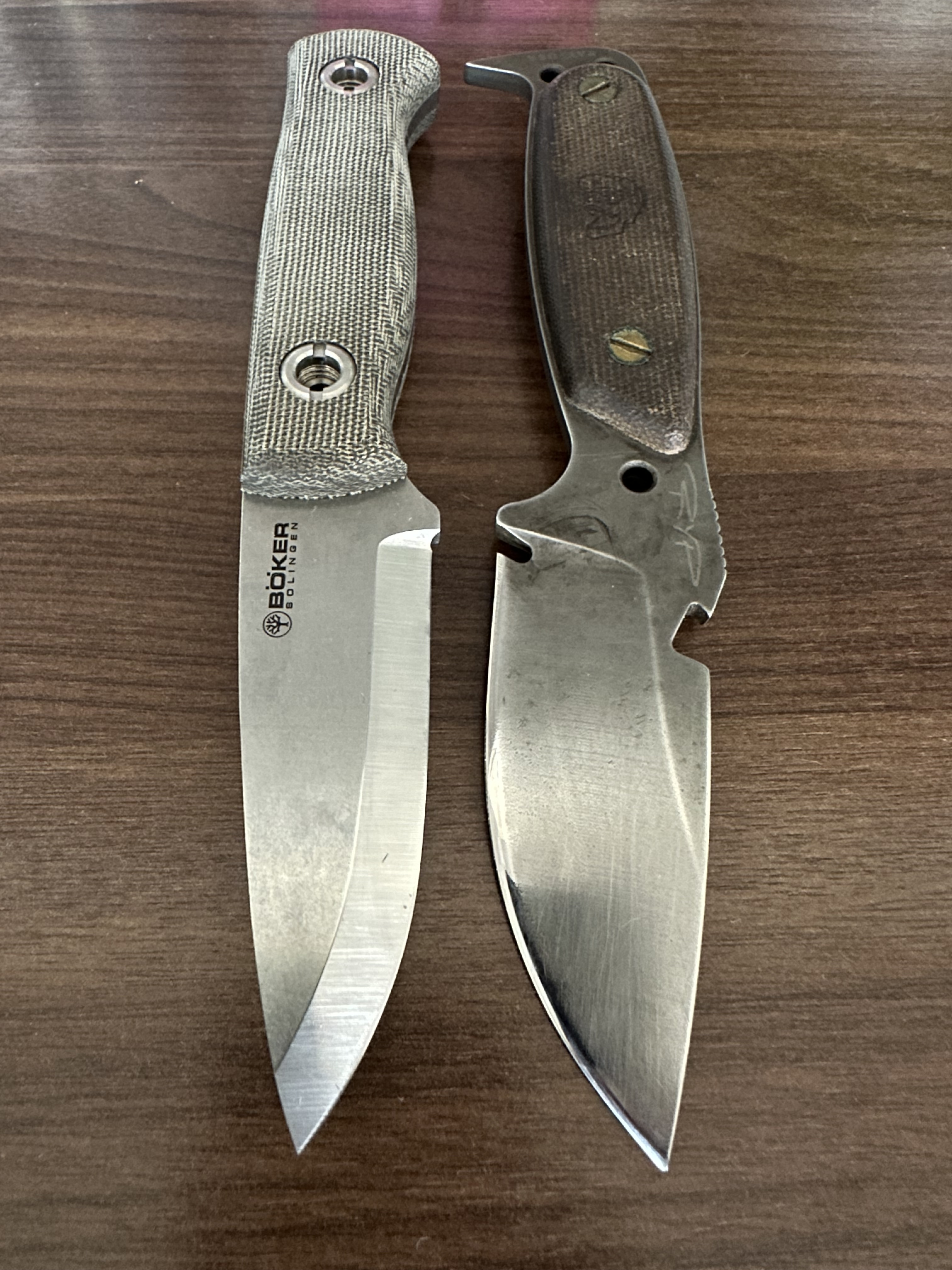
My previous hardchore EDC fixed blade has been this 1095 fixed multitool. It is now replaced by the Vigtig as it is much sharper and with a much better alloy. Notice how convexed I had the old 1095, I won’t need that with the CPM Magnacut scandi edge as I got zero damage even when used on hard dry bamboo. Those compact robust fixed blades can do everything a big folder can do and much more ! The main difference is the obligation to clean the blade before to resheath it.

And another important thing to test in a fixed blade is the sheath ! The Vigitig sheath is also perfect in my book and provided with a clip to be used on a belt or in the pocket. The taco style kydex shape is my favorite as it is slimmer than the pancake style shape.

I carry the knife directly in my pocket where it is easily removed by thumb pushing the kydex lip of the sheath and replace in the sheath with one hand. The sheath’s entry is wide enough for repositionning the knife back in it with one hand. The clip is a little on the strong side for me and I like to easily dispatch a sheathed knife into a bag. So the sheath only without any hardware but its slim profile fits perfectly in my pocket against my wallet.
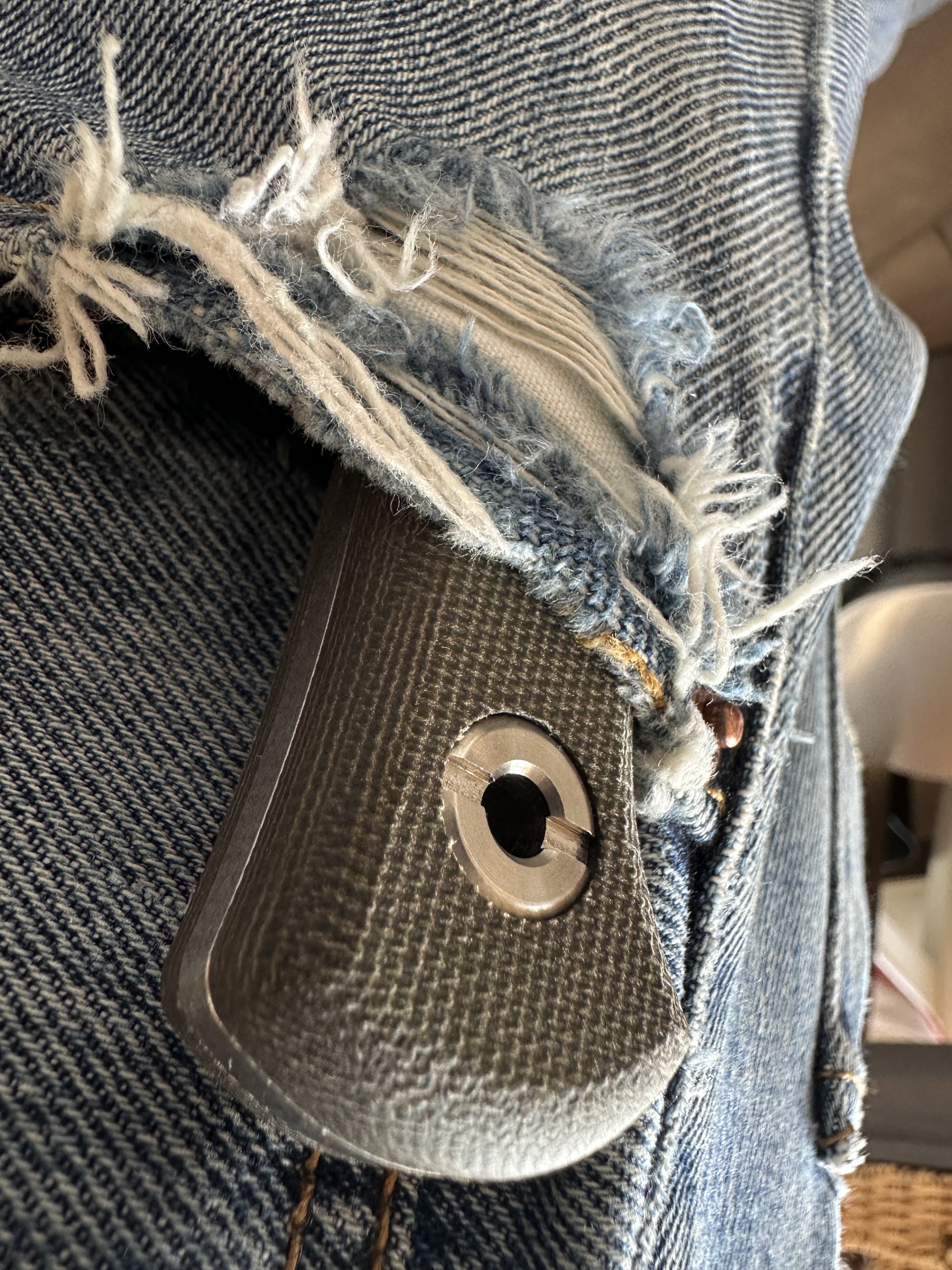
Inside the front pocket of my old denim, the Vigtig stays put and is immediately forgotten thanks to its perfect dimension for EDC.
Great sheath !

So, yes, really, it is designed to be a fixed blade EDC. It enters a territory forbidden to folding knives: to be ultra solid, robust and forgiving when used hard without compromising its carrying.
I’m really looking forward to use it in the forest and even I won’t mind using it by the sea ! The Vigtig could even be considered as an amphibious ambitious bushcrafter. For now it will be used in the house for mondane tasks as it is the best way to know it.

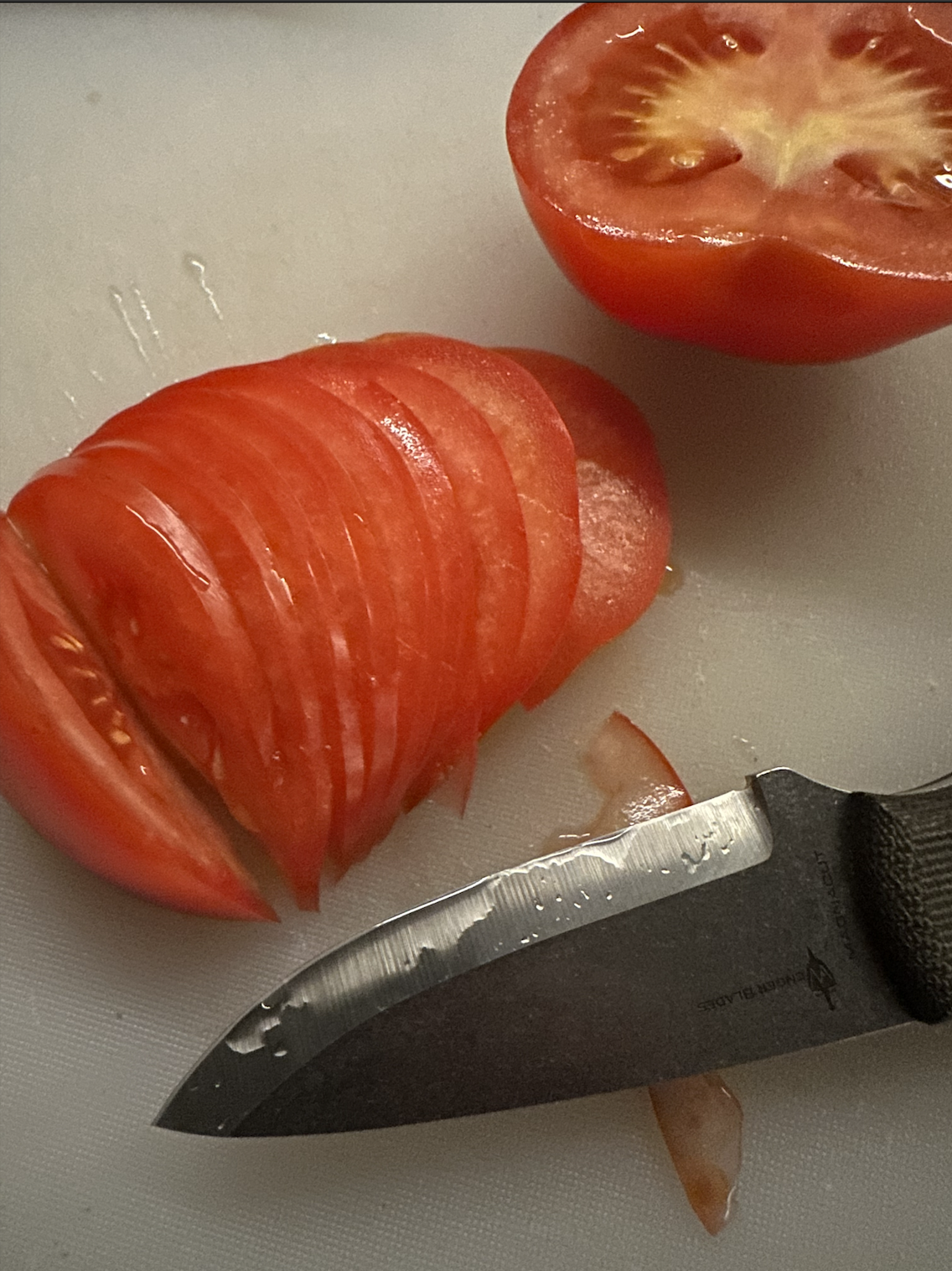
For those who consider Scandi not kitchen worthy… 😉
So far I have been able to use it with ease in the kitchen despite its 4mm thick stock blade. It zipped easily for thin loafs. Frabnkly for having using it in the kitchen, it works amazingly for such a short thick tool.

This is just a glimpse. I will certainly update that little review with new elements and pictures and make another chapter soon.
So, kuddos to David Wenger for this robust knife design and to Böker for bringing it at a great price.
The Vigtig is not a tool to destroy but a tool to build designed by a builder !

One video reviewer I really enjoy is Floriano Bitturini with his Vlog PDT Il Parchetto di Tagliagole . The Cutthroat Park.
Here is his video in Italian:

And here is a French video I really enjoyed too:

Pleasure of whittling — Which knife ?

A knife and a piece of wood make my day.
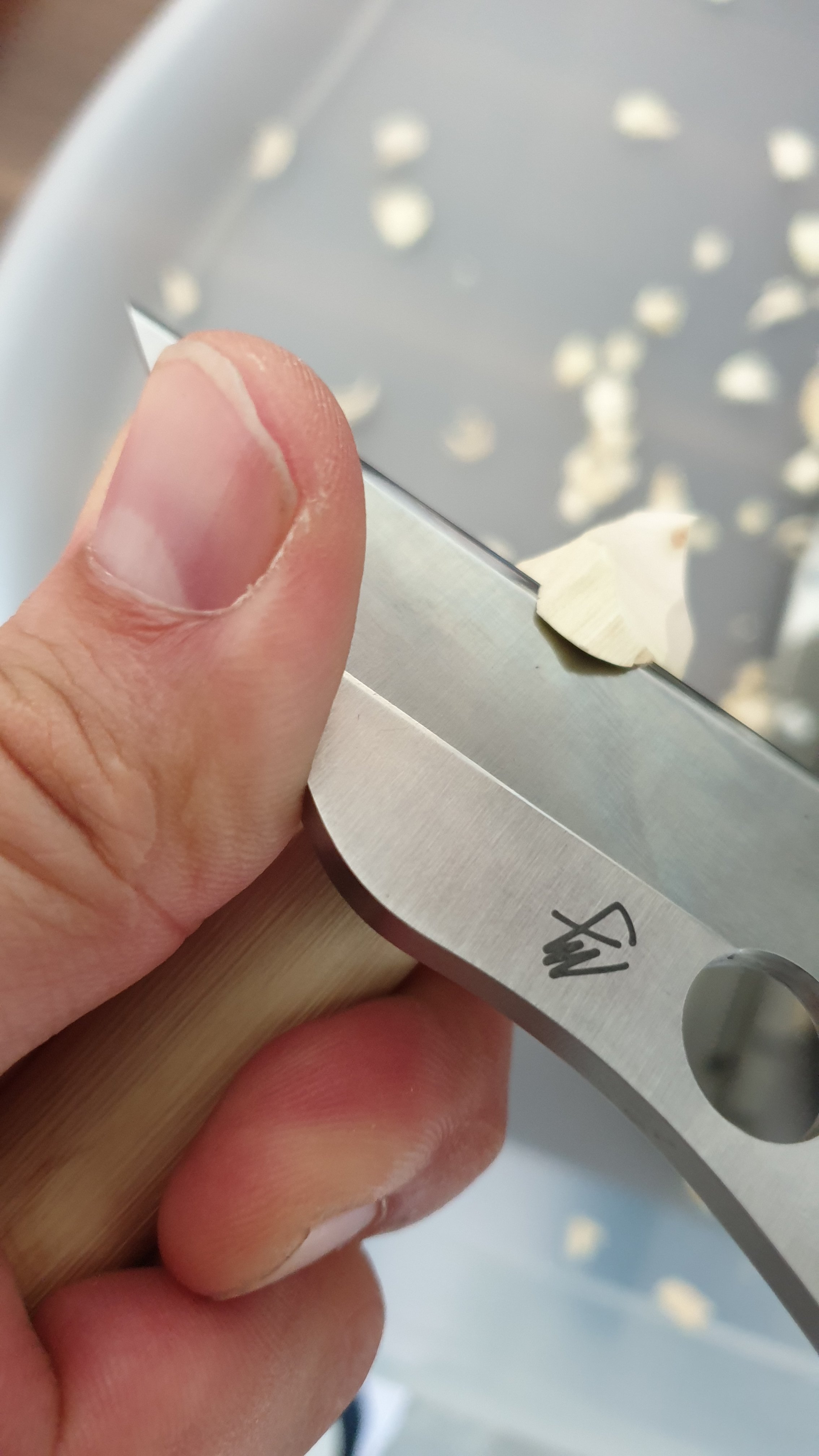
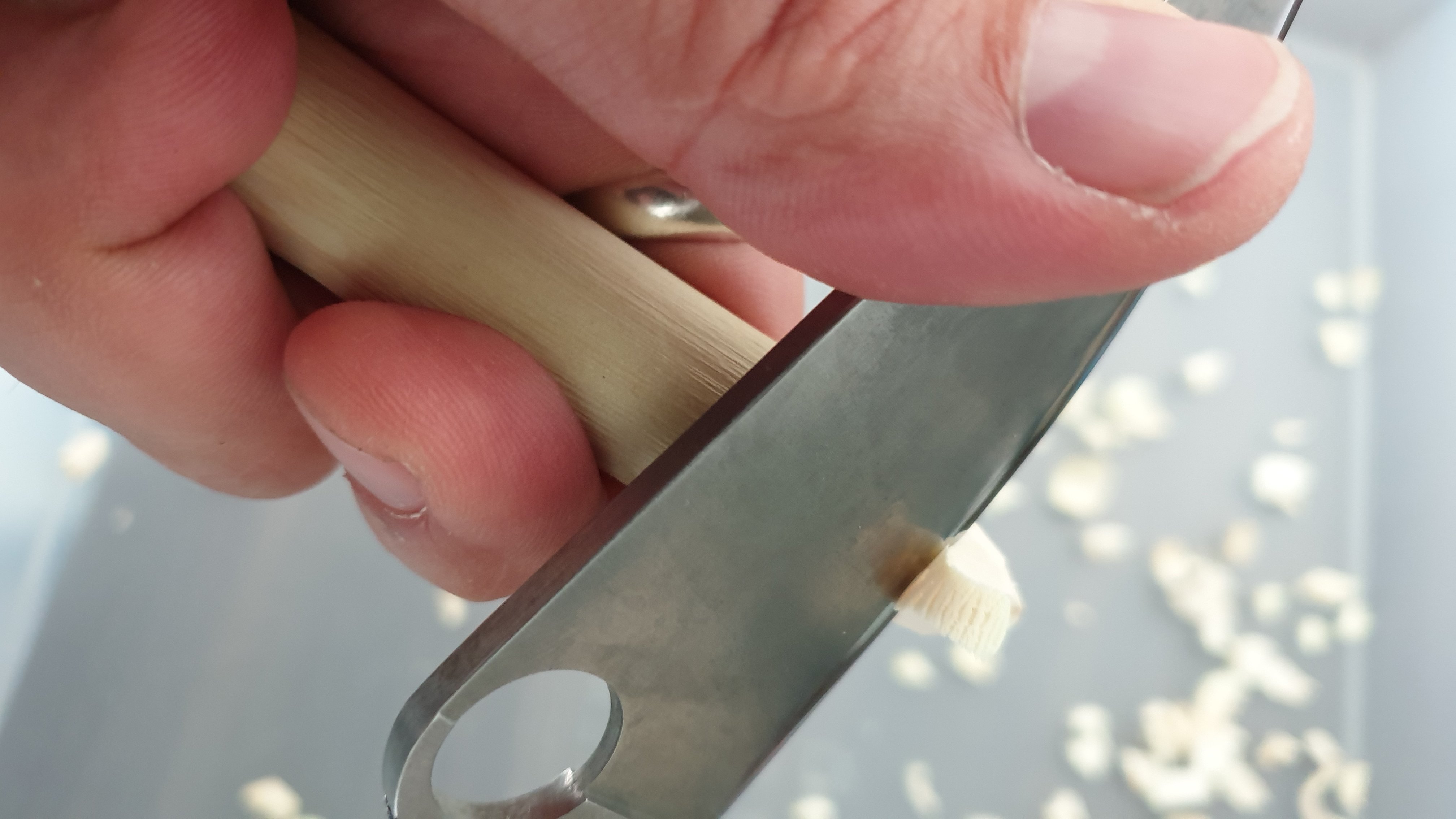
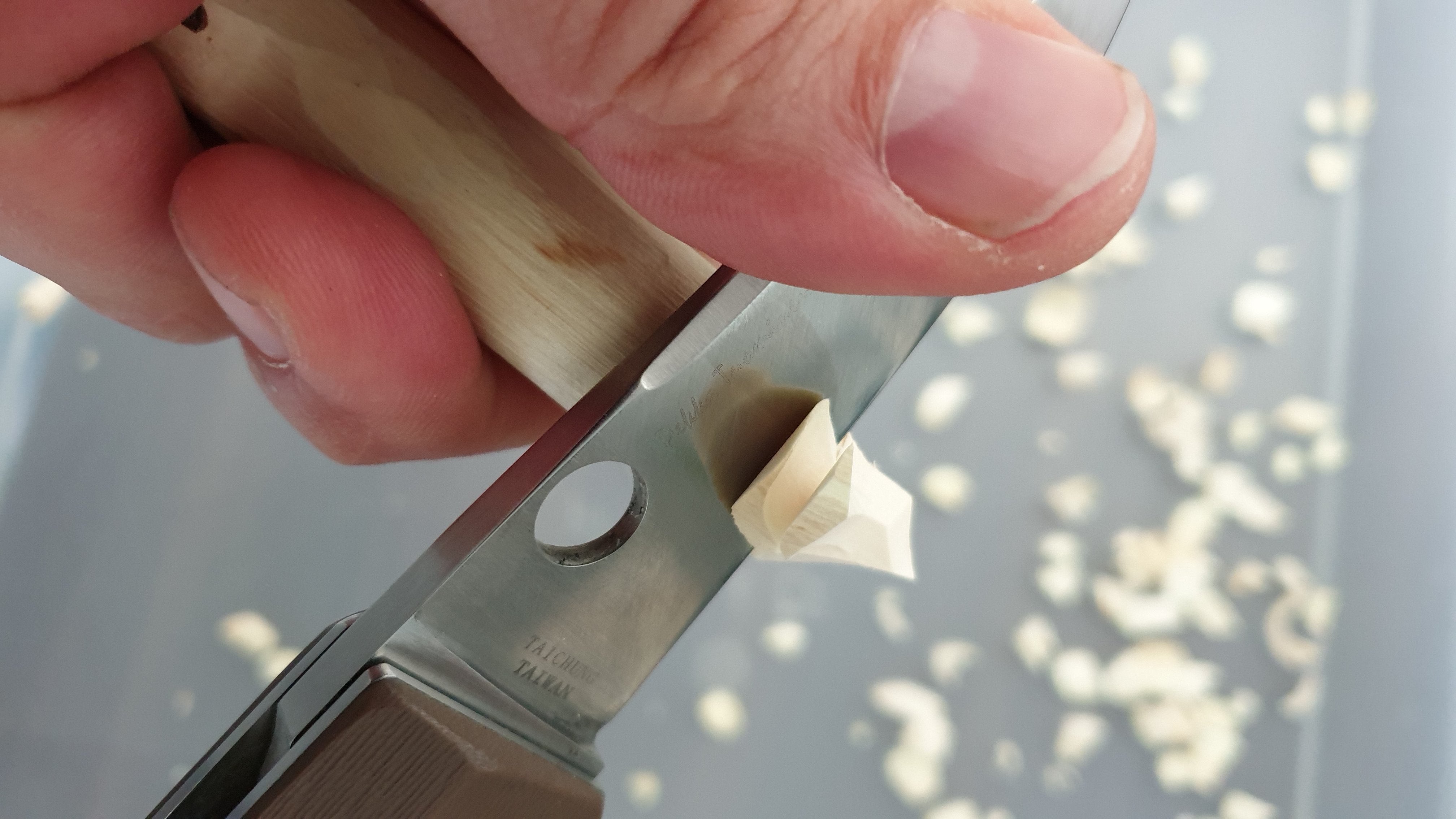
I can sit and enjoy a good blade taking nice wooden chips.
Steel chemistry is important, especially how fine its grain is.
Back in the 90’s I have found how a Benchmade in M2HSS was more enjoyable than the same model in ATS-34.
How is the blade is ground is also very important, scandi makes shallower cuts when hollow grind got deeper in my experience.
But more than this: the general ergonomy of the knife and especially the spine of the blade do make a difference for me.

But let’s have a look at the knives: Ed Schemp’s Tuff and Bowie, Police 4, Yojimbo 2, Sebenza, Spydiechef, PPT, Paramillie, Lil’Native, Wolfspyder, A little TOPS scandi, Mantra2, Millie and Nilakka.

A rounded spine like my Sebenza is great. It’s very thin edge is also a plus but ATS34 is not making the moment enjoyable. Of course it will cut but the pleasure of feeling how the edge is making the chips is not there. Its edge is like a mad cow !! Hard to control.


One of the great surprise in term of pleasure has been that Lil Blue 2 from Raker (Ray Kirk). Made of 52100 ball bearing steel and brought to razor by JD !
The rounded spine of that small fixed blade makes it super enjoyable. The fine grain 52100 makes thin chips but can also be use hard for deeper cuts. That would the kind of knife you can enjoy all an afternoon without thumb soar.

A good old Opinel N°8 is able to cut deep and with power, for sure. Do I enjoy it ? Not really. It does the job but there is no pleasure when the thin spine bites my thumb during push cuts.

A great surprise and even a better surprise that my previous whittling with a Yojimbo 2 in S90V is my Yo2 Jade with a CPM M4 blade.
It is not a knife designed for whittling but it does the job perfectly. Better even is a tougher blade in CPM M4 which is very aggressive. The spine also is thick and my thumb can push with with confort and control. The Yo2 and especially that version is a great wood companion I can use with serenity.

Another knife I highly recommend for going in the woods and whittling with pleasure. And another knife with some martial pedigree has proven to be a great whittler: the PPT.
The S90V thin blade of that edition with a very confortable handle has been eating wood like a chef.

Speaking of chef: lets’ continue with the surprises. One important side of the Spydiechef is how easily it can go out of the kitchen. Sailors and sea kayakists are using it without any risk of failure but within the woods? OK mine has been convexed but this is another great tool to bring with you everywhere. I was able to create beautiful chips and the spince have not bite my thumb. Really a nice experience with this one.

My CPM Cruewear Paramillie has been convexed and its edge was really hungry for wood.
It was in all the bunch the one which went the easiest in the rod of wood. But then the square spire was so sharp and thin: it was not enjoyable. More about it later.

The Lil’ Native with JD sharpening skill is nice and powerful for its size. Really a nice you should not judge by the size. But then again, JD reground it to almost a scandi level. The belly and the thin edge does marvel for whittling. Just a tad longer blade will improved the experience but then you got a Native not a Papoose no more.

Another knife improved by JD sharpening skill is the Mantra 2. I had rounded the spine on this one and it turned to be a very powerful wood cutter. The kind of knife which disappears in your pocket and once deployed is a game changer. The very solid construction and great ergos of that Eric Glesser design is blooming in the woods.

The Police 4, as powerful as its K390 thin convexed blade was a real disappointment. The thin spine is really hurting my thumb when push cutting. The Police is and stays a very urban design. I was not really able to enjoy fine whittling with it. It does the job but the thin spine ruined it for me. This one is much better in cutting cardboards or ropes…

Of course the Nilakka is a five stars experience. nothing new: thick spine, zero ground blade. It is powerful and accurate. Pekka Tuominen knows. Just the thin point could be an issue when digging in the wood to make a hole for example. This is were the Wolfspyder shines: a very solid point !

Another great surprise in term of pleasure has been the Gent knife from Massdrop. I had convexed the edge and its S35VN rounded spined blade is just great. Its natural belly helps a lot in term of push cuts. It is a great folder and 100% shot flipper, easy to keep clean, and look at the shape of that blade: it is stunning and for less than 100 dollars shipping included. It will be reviewed.

Sorry, but the Mora has been the worst. It was not able to bring me nice chips.
I’m certain it would be a great hard used tool in the wood but here for fine gentle whittling: zero pleasure.
The synthetic handle is becoming sticky, the scandi edge is rusting and it was not able to bite in the wood. Cheap fixed blade.

So eventually, using 400 grits sandpaper, I have decided to rounded the spine of my Paramillie 2 and of course it makes a huge difference. Actually I have been really surprise in how deep It was cutting in the wood, kind of remembering its brother in 52100.
Soon I will try AEB-L steel which is considered as a stainless 52100 on a Sprint Run Urban already in transit. So more will come.

In conclusion my more enjoyable whittler is still the Wolfspyder.
The surprise joy came for the Gent, The Yojimbo 2, the Mantra 2 and the Raker.
The Paramillie with a more rounded spine will be certainly part of the club.
The biggest down was the Police 4 and the Mora.

But in term of sitting under the porche and whittling a rod the Ray Mears designed Wolfspyder is winning. It was designed for that task.


Short Locking Folders — A plethora of choices !

Those are the knives I choose when going out. I prefer a 3 inches locking blade.
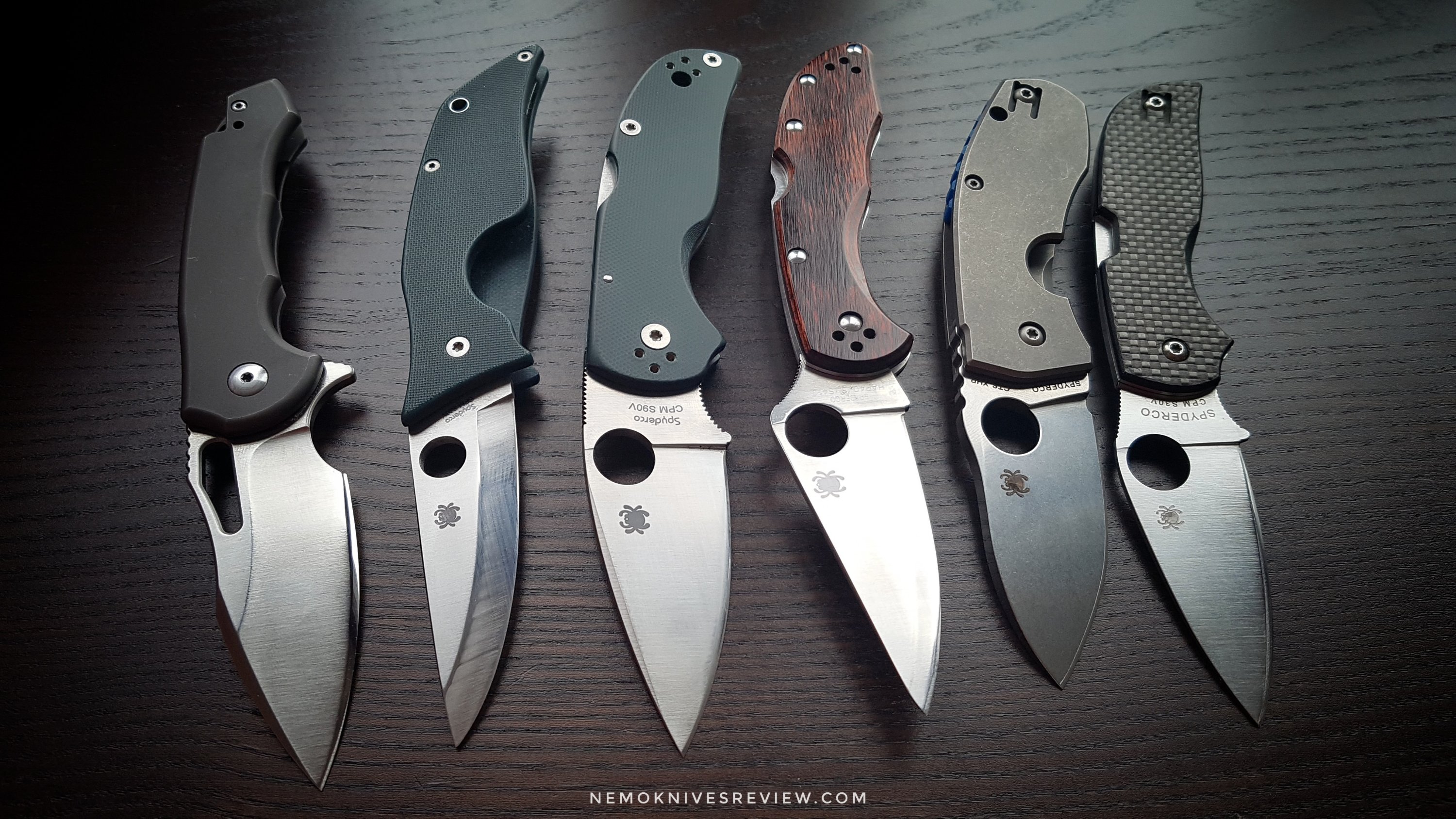
From left to right we have got: the Falcon, the Wolfspyder, the Native 5, the Delica, the Techno and the Chaparral. They are just examples of knives I have got around and which fit the purpose to carry a non threatening but useful locking knife.  You could easily add the Lil’Nilakka which are the favorite EDC of JD and Pjaffre.
As far as I love my Para2 or my Sliverax, I tend to go shorter on the blade and keep the 4 inches for in-house uses unless I’m going in the woods. Also, most of the chores can be done with a 3 in blade without rising any eyebrow.

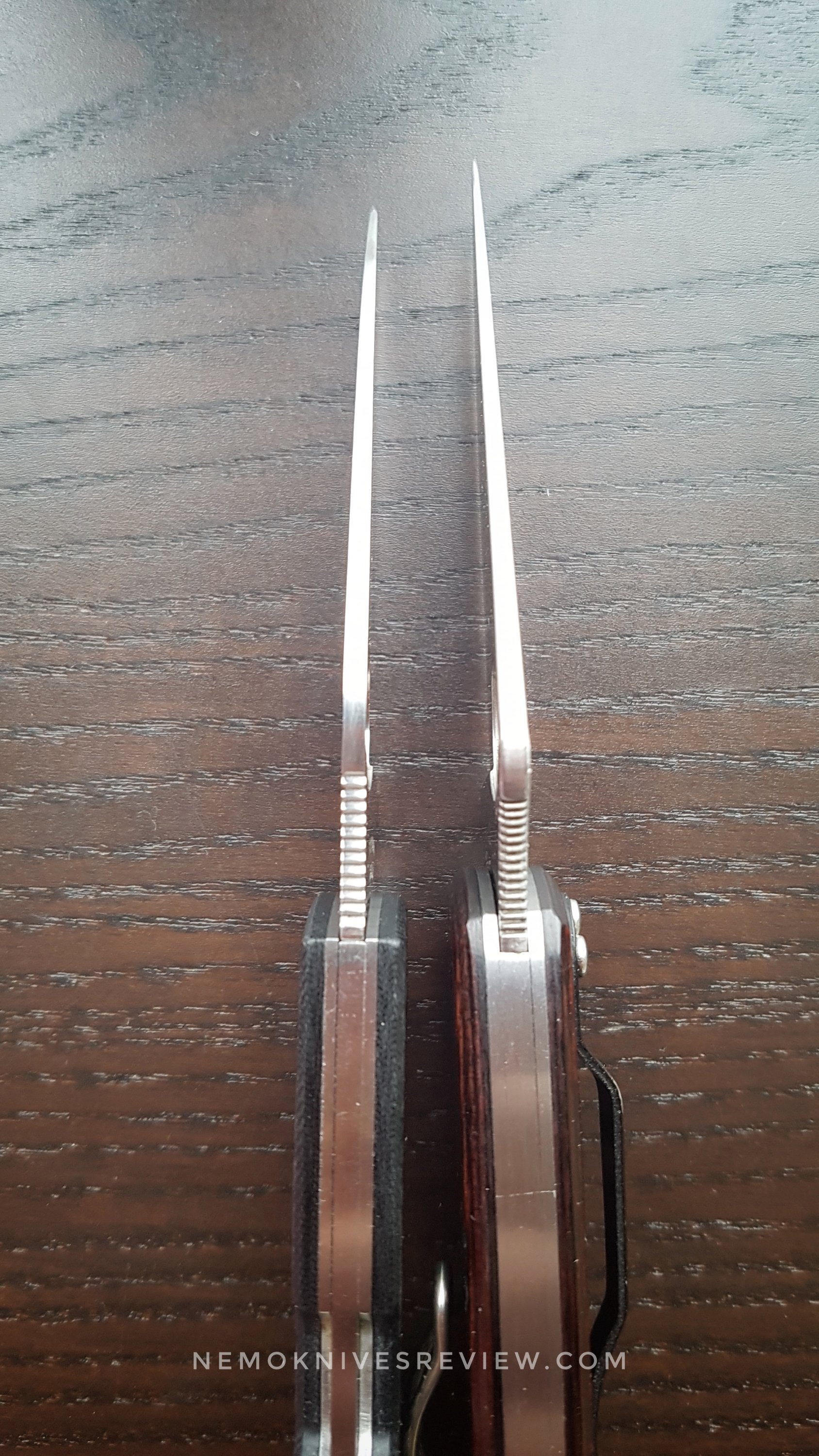
If you think to go thin in stock, the Delica and the Chaparral are the way to go. You can notice on the picture how thin the Delica goes and with the KnifeCenter special edition, your edge is made of HAP40, a steel which refuses to chip.

Lockbacks are in fashion since… the Buck110. On the three pictures, only one has got vertical play: the Delica. This tiny play is only felt when cutting on a board and won’t bother you.
The Chaparral has a hidden pin which acts as a second locking system ala Triadlock. The Native 5 has got very high tolerance and none of them I have handled has shown any play in any direction. Let say, in that matter, that the Delica although an old fashion folder with her own character, has the best thinner slicer of the bunch and her blade shape gives a lot of polyvalence. The Delica is also the only short folder I can Spyderdrop. It is made possible by the full steel spacer’s weight. Spyderdrops is the fastest way I know to have your knife ready to cut. It’s also the safest as you are holding it by the blade.

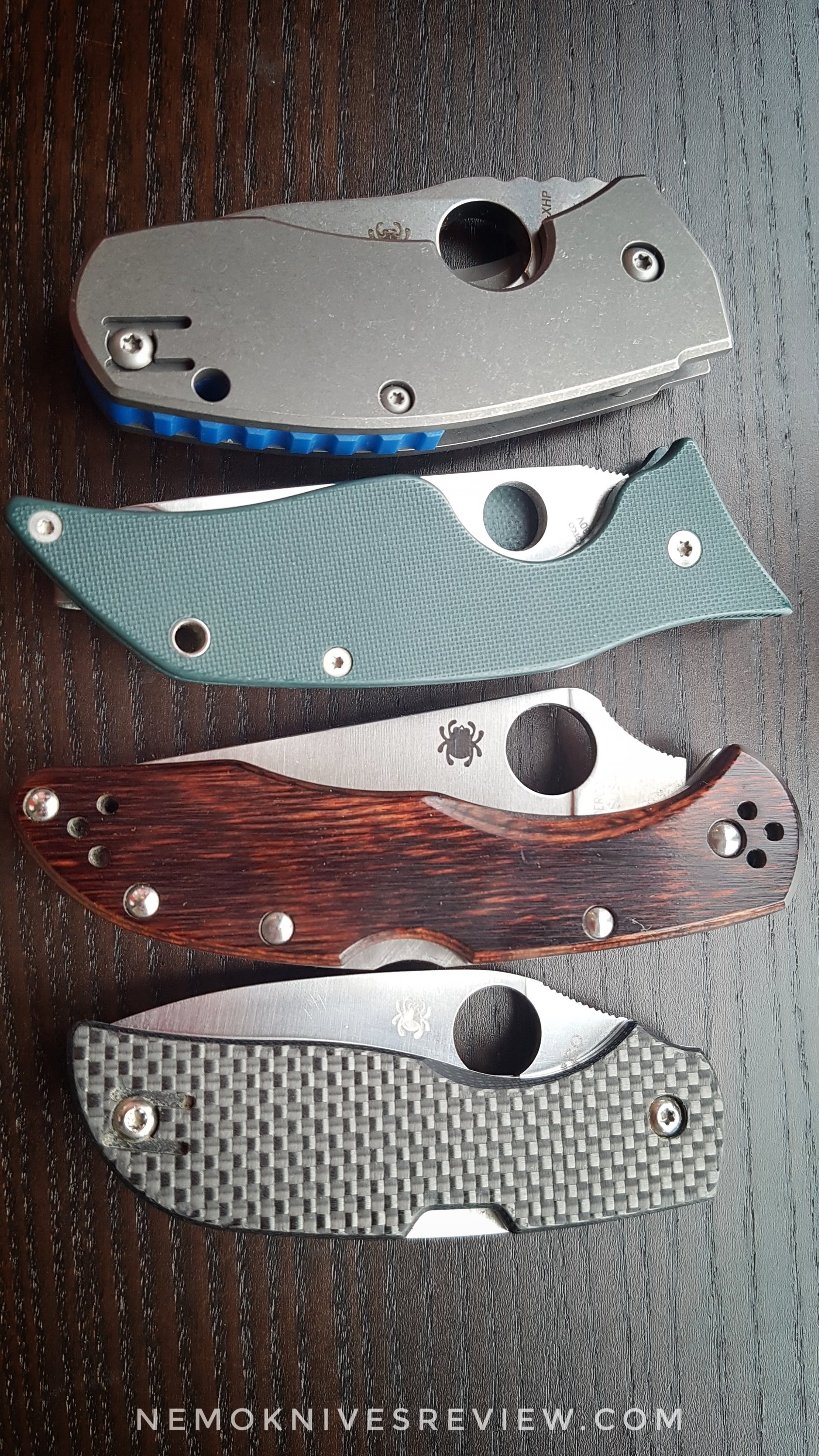
You can notice, there are a lot of materials for the handle. Titanium handle are great as they can be easily cleaned but can be scratched easily too. G10, I do love, especially thick G10 with no liners like found on that Native 5 version and the Cold Steel Recon 1 collection. Pakkawood is a new thing for me. It’s got a warm feeling and I can rinse the handle under the tap with no after-thought. Carbon Fibers (CF) are actually very resistant to abrasion. Your knife can fall and be kicked, the CF handle will not show any scars.

Now I do cut hard material by pushing with my thumb on the back of the blade. This is also why I tend to favor a thicker spine. The Techno is king in that matter, but lately I have discovered how much the Falcon and the Wolfspyder are great. What makes the Wolfspyder very special is the ease you can twist the blade in the cut thank to her lack of blade’s height.

You can notice the amount of pocket lint in the handle, giving you an hint on which knife I carry the most. You can get a lot of great locks: RIL’s, Compression Lock… The new Lil’Native offers a very small package (I think it’s the shortest of Spyderco’s with that lock nowadays) and the choil makes the blade even shorter on that design.

To have or not to have a choil ? On a very short folder, a choil can take a lot of edge off. The good old Delica shines again but the Wolfspyder and the Techno are beating her choil-wise; they both provide one of the best solid locks with the maximum edge possible. IMHO for the 3 inches folders, choils would be really important if the knives were slip joints. They are still important in my books on longer folders which are used harder, like on Millie,

Strangely short folders are often used out of their scope like a Pradel would be. Mondane chores and abuses can occured very easily. This is also a reason why I tend to choose strong locks and tips on my 3 inches folders. When it’s possible I also choose tool steels which can provide better lateral strength.

Delica: No real choil, vertical play, very thin blade, very thin spine. Bonus: spyderdrop.
Falcon: Choil, thick spine, nice belly but not deep carry clip. Bonus: great flipper.
Lil’Nilakka: No choil, deep carry clip, thin blade. Bonus: very thin geometry.
Native 5: Choil, thin spine, thin blade but not deep carry clip. Bonus: great ergonomy.
Techno: No choil, deep carry clip, thick blade and thick geometry. Bonus: built like a tank.
Chaparral: choil, deep carry and thin spine and thin blade. Bonus: idem pin lock.
Wolfspyder: no choil, thick blade, deep carry (now). Bonus: thin scandi edge.

The most eye candies would be the Native 5 and Falcon and the most surprisingly effective in cutting power would be the Lil’Nilakka and the Delica…
The easiest to carry would be the Chaparral which is the thinnest of the bunch.
That said my best pick for hard workers would be a deep carried, solid lock, no choil, strong, thick spine and thin geometry folder: the Techno and especially the Wolfspyder.

They are just a few example of brainstorming for choosing a 3 inches folder to carry.

Oh well, there is also the Kopa… Guess I need to start this over !
The Kopa has got a choil, no vertical play, can be spyderdropped…
Dragonfly? Where?!

More on https://nemoknivesreview.com/2017/10/05/choosing-a-knife-for-the-city/

20171230_113247-012025157230.jpeg

last edited: pjaffre 03 jan 2018

Bushcrafters and Whittling: when the true Scandi grinds stand their ground.

20171113_152859-01548548664.jpeg

As I have found, a Scandi grind blade is not the easiest to be honed to your desire especially with modern powder metallurgy steels but once obtained it is a pleasure for the whittler. With that in mind I have bought two Mora Knives: a Morakniv Pro-C and a Bushcraft Survival Knife both in Carbon Steel and rubber handle. My idea was to get easily razor sharp scandi edges like I was able to obtain on the BuscraftUK from Spyderco.

20171111_152503-01740016526.jpeg

On the picture above only 3 of the knives are true scandis with no micro bevels.

I have been able to compared how Scandi behave with plastic bottles and also on wood . In fact, in my own experience, Scandi edge bites with some kind of hunger the cellulose fibers and soon also acts as a wedge which makes all the cuts strong and controlled. It doesn’t go as deep as a thin convexed full flat ground blade but the wooden chips produced are thicks. It’s a pleasure to use a Scandi ground knife on wood, there is precision in the cuts which can be shallow or radical (with the wedge effect).

20171113_154434-01804443587.jpeg

The “Zero Ground” Nilakka being an exception as it combines the strong cuts of the Scandi with the deep push cuts of the full flat ground blades. Which makes it voracious on wood and explain the 5mm stock of the Nilakka blade.

On the two Mora Kniv, the cheaper was the sharper. The Pro-C bites immediately when the Mora BSK was dull. I have put that on the fact there is some kind of coating and no secondary edge. So, my first move has been to remove that coating.

20171111_152106-011616380728.jpeg

The secondary edge put flat on a stone, the coating was removed steadily and the edge was quick able to shave hairs then the Mora BSK was able to bite in wood and was a pleasure to hold and work with.
Both Mora are much lighter than my Spyderco Bushcrafters as they are not full tang. as i don’t plan to do any batoning with them, it is not an issue. Both Mora are true Scandis like my Spyderco Wolfspyder and Buscrafters.
It’s not always the case, even in Norway.

Normally Norwegian knives looks like that:
20171019_214153-021082467779.jpeg

Scandi knives are a pleasure to cut and drill with as the thickness of the blade runs to almost the point of the blade, making a very strong tip.

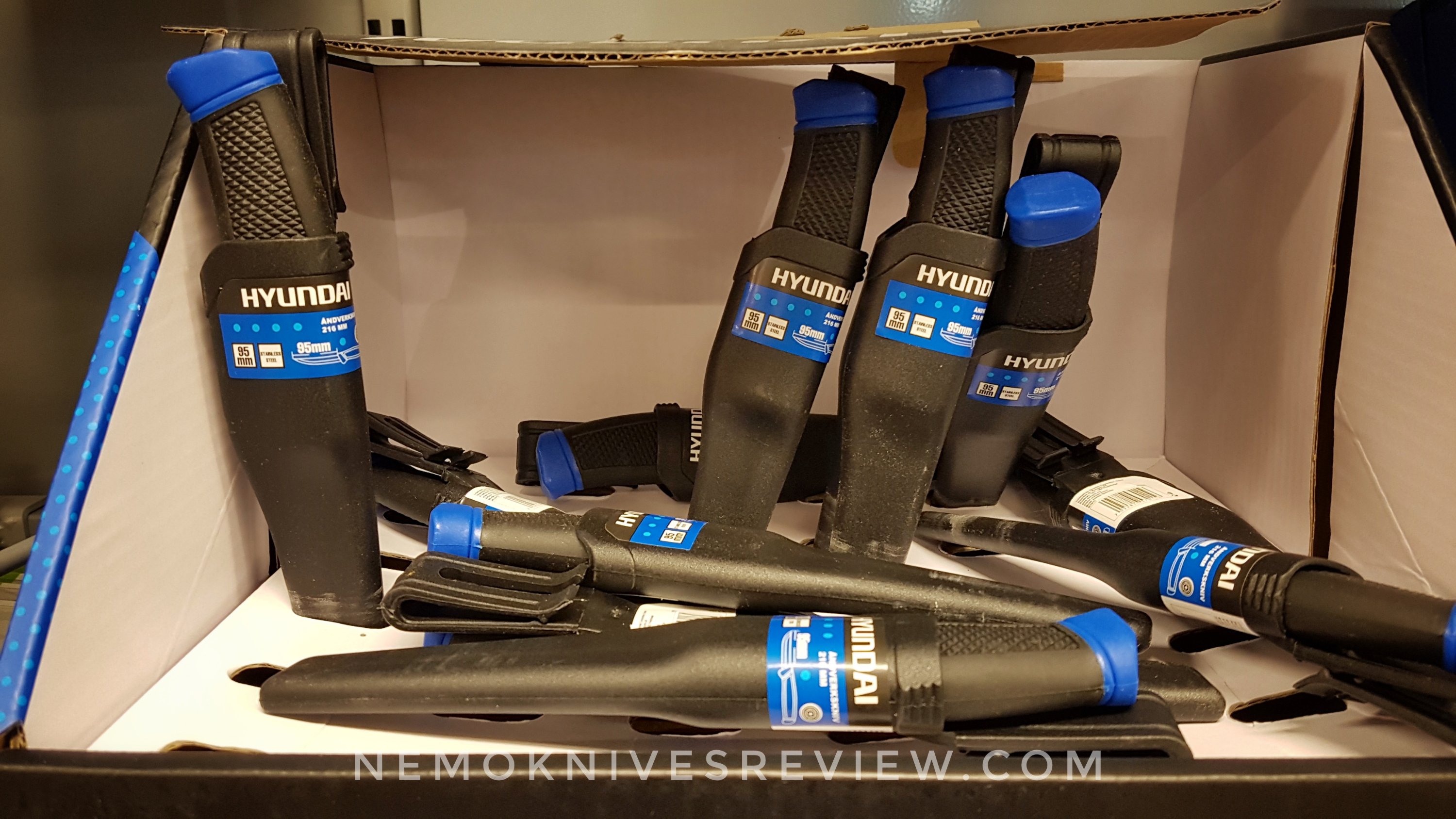
But now you can also buy a Korean Puukko from Hyundai.

20171019_154632-01245911696.jpeg

It will cost you around 40 Krons, which is around 4 Euros, 5 dollars…
But here you can see. It’s not a scandi but a thick saber grind with a visible micro bevel.

It means that even Scandinavian countries are not protected against pure cutlery heresy. It also means that Viking don’t mind to buy crappy tools for half the price of a Mora.

20171019_154716-01837024615.jpeg

Why ? Because true scandi means a good steel and a good heat treatment to stand the thin geometry. It’s a century old design adapted to people building everything from wood: home, tools, furnitures… A true scandi edge angle is acute enough to be reliable and sharp.
Quoting “Patriot Dan” on the blade forums:
“There isn’t one angle really but 22 degree inclusive (11 per side) is a typical swedish midway edge angle for a scandi grind. The angle can be anything from 15 – 25 depending on use. (This is with the steels and the heat treat typical for those knives, some steels may not be optimal for such acute edge angles).The swedish and Norwegian grinds/edges are more obtuse than their Finnish counterparts. I believe the english bushcraft (woodlore being the most famous) knives that sport a scandi grind are based on swedish grinds but that’s just because they’re very similar.”

So true Scandi are NOT saber grind on disguise and NOT convexed. You need to put the bevel on the stone to keep them “true” hence my work of patience on the Nilakka, restoring her edge to zero grind after some convexing.

I haven’t made that kind of mistake on my Wolfspyder and S30V have proven to be reliable with zero chipping making that little folder a pure joy to use on wood.

More to come soon as the tests will take some time.

20171019_132849-01692132311.jpeg

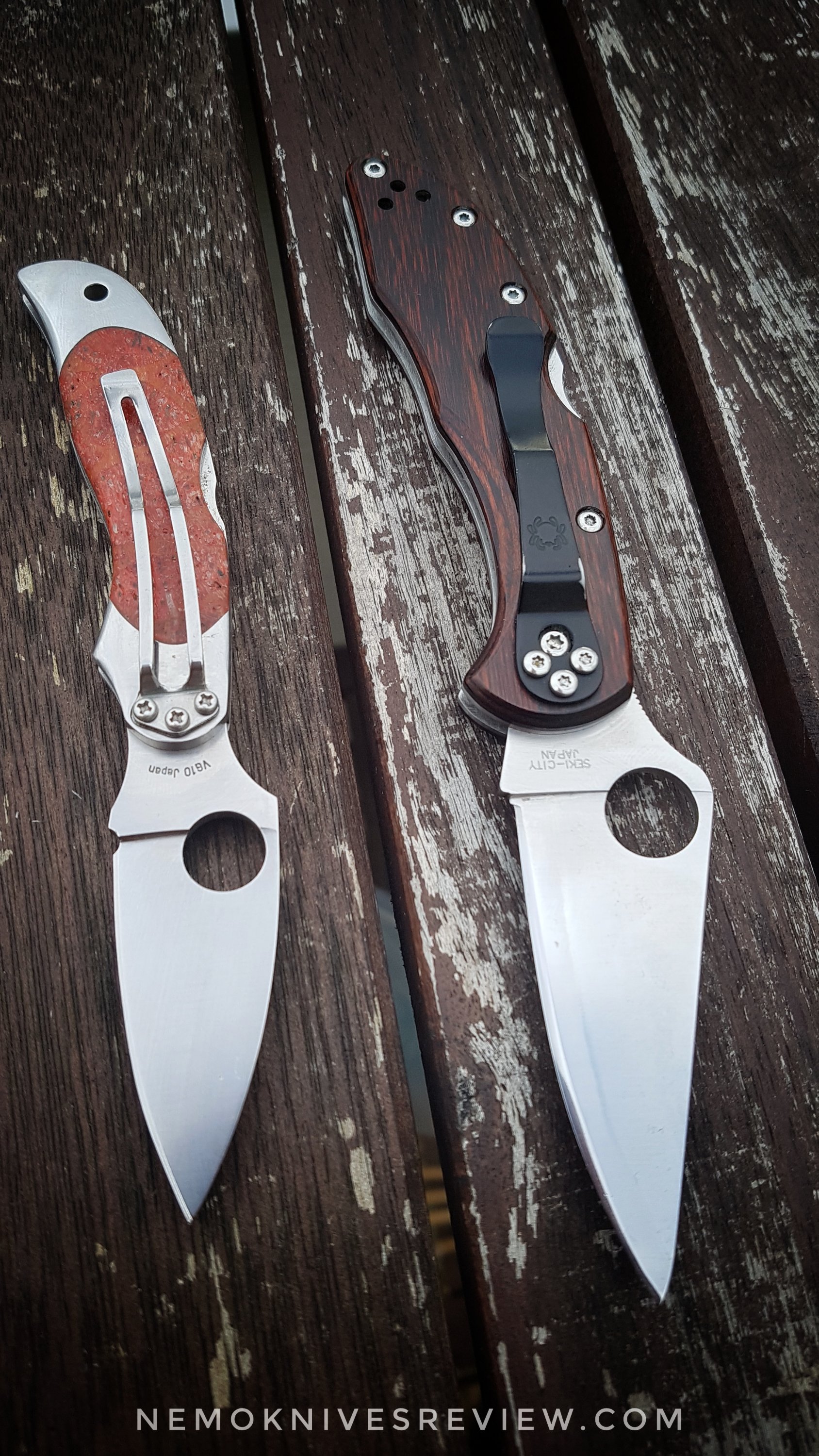
False Brothers — Wolfspyder and Yojimbo2

Like Apollo and Soyouz, those knives are different but got connections.
Both are Spyderco folders with no hump, no choils, both equipped with compression locks, nested liners, spoon clips and radical blade designs.

Both are made to be carried as EDC. Not too big but not too small with a blade around 3 inches / 9 cm.
Their looks are reflecting their designer’s minds and crafts. Ray Mears is a teacher in bushcraft and Michael Janich is a teacher in martial blade craft.

Both are best carried tip up and you need to pull on their tails to unsheath them. They leave a similar print in and especially out the pocket.
Also both got a consequent integral guards. Only the Yo2 got its guard double with a nested liner though.

The main difference is the way their respective blades are ground.
A scandi grind against a saber hollow ground: the Yin and the Yang of cutting perfs.
Eventually the Yo2 is much easier to get sharp as you got less material to remove. But the Wolfspyder scandi’s once sharp is a pleasure on wood works for very precise controlled cuts. In that area, the Yo2 is more like a wild hungry edge waiting for a firm hand to stay on the course.
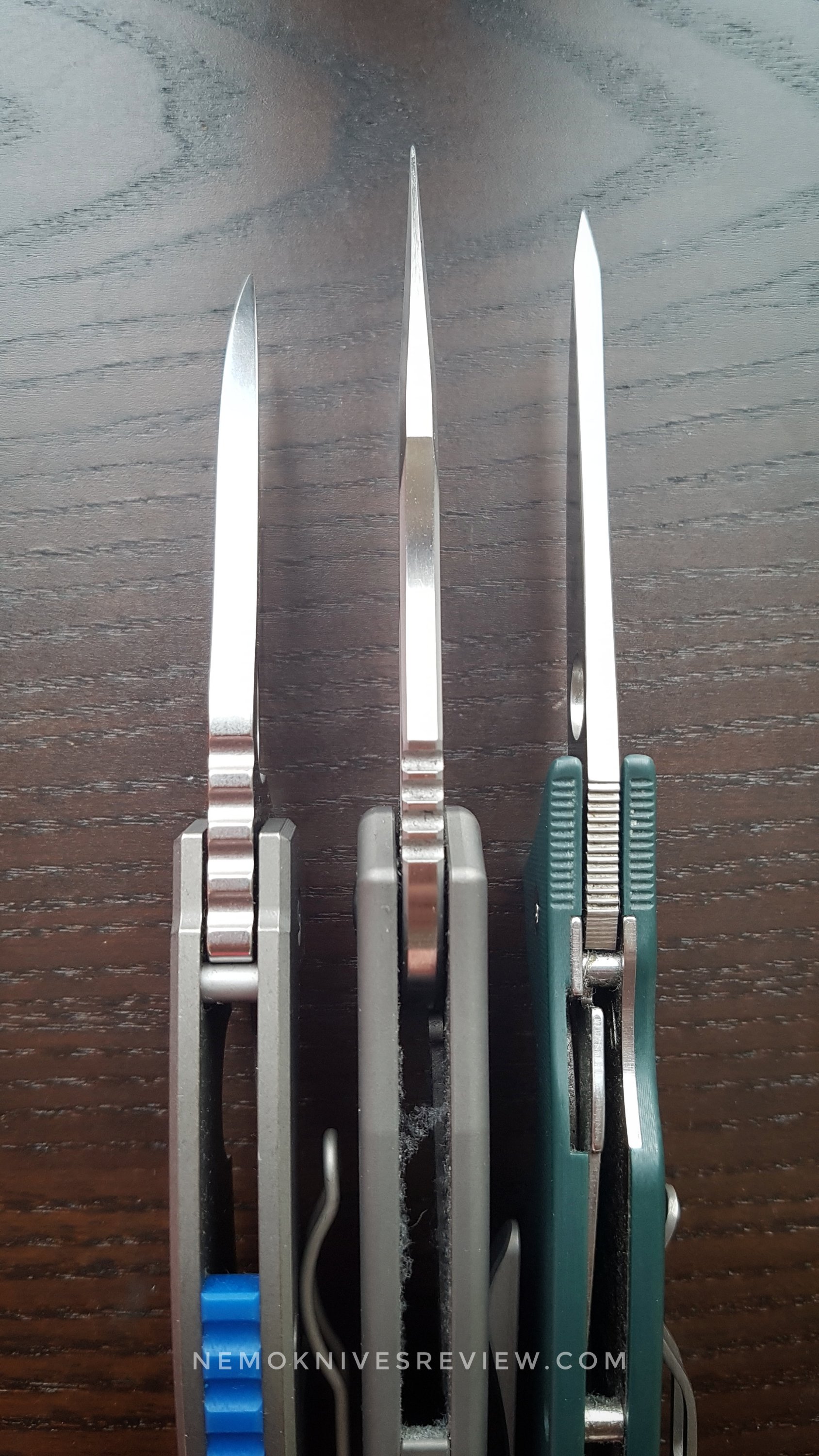
The thick point of the Wolfspyder is made to withstand drilling in hard wood.
The shard of the Yojimbo’s point is designed for deep penetrating thrusts… to the bone.

But in the end of the day, both knives are very pleasant EDC companions. Their ultra solid locks make them safe to use hard with no after thought. I was surprised how they can be adapted to mondaine chores with their own characters. Both got great ergonomics improved by a wide guard. The compression locks are not hurting my hand like on my Paramillies and the absence of jimping and hump is a plus in my book when you need to extend your thumb on the back of the blade for power cuts.