Category Archives: Folders

SPYDERCO MILITARY C36PIN PART III: WHITTLING WITH GHOST.

We all know that the steel is only 30 percent of the equation for a great blade. And I’m not talking about the whole knife — ergonomy, lock quality, sheath, clip —  just the blade: the main “Matter Separator” to quote Sal Glesser.
Apart from the Steel they are the Heat Treating, the Grind and the BET “Behind the Edge Thickness”.
And also the quality of the edge coarsed or polished change the way the blade will cut in materials.

Wood is a fibrous material which depend of its grain and freshness when whittled.
Again, a rabbit to skin or a cardboard box to dispatch will behave differently under a sharp edge.
And a Self Defense designed knife will not need to be a Scandinavian Grind for example…

So I have decided to gather the Yojimbo 2 (Black), the Wolf Spyder and Ghost to practising my scales and mastering the rudiments of whittling on a hazel rod which has been drying for a month (since the Lil Nilakka Review actually).  My whole idea was to see and experience how the very different blades grind and shape would behave and eventually adjust Ghost for better whittling.
I have not used my Nilakka as it is a game changer. It’s too hard to reach its performance. (The pictures has disappeared because Photobucket has changed their policies, I will need time to create new links, sorry for the convenience…)
Also I’m a lost cause in whittling compared to what my father was able to do as a kid when he was whittling his own toys but I do have affinities with wood as my grandfather was cabinetmaker and my other grand father was clogmaker.

I had noticed back in the 90’s when I owned a Benchmade AFCK in ATS-34 and on in M2HSS that wood would be almost “patined” differently depending of the grain of the steel. M2’s cuts were leaving a very soft surface compared to ATS-34 which was a more aggressive cutter. I have then found that one of the most expensive wood chisels were made in M2 High Speed Steel.

The Wolfspyder is in her element here. Since I have sharpened her back to razor, the scandi grind cut deep and with ease in the wood. This little knife is purely amazing when it comes to carve  deep or caress the rod. The sturdy design is asking to be used hard and the big chunks of wood were flying. It is a pocket beaver ! (OK no more kinky innuendo, pardon my French…). In pushcutting perpendicularly , the Wolfspyder was the more aggressive.
Again, S30V as heat-treated by Spyderco has proven to be a great “all terrain” steel as its edge was not dulled a bit. I’m surprised about the way it kept a perfect edge after all the cuts in a dirty bark and hard wood. Hairs were still flying of my arm. (I heard so much about it losing that very sharp fine edge beause of its relatively big carbids…). It will not be the was with…

Yojimbo 2 Sprint Run was another surprise. First I need to clarify that I had the edge “unshouldered” to be thinner. S90V is a bear to sharpen it feels like “plastic” and without diamonds it is time consuming.
But here it’s the ergos and geometry which made a difference. I was able to cut big chunks of wood with ease. The blade was going deep and my thumb got plenty of space to push behind the edge.
Michael Janich proved it: its Yo2 straight edge keep the pressure on the material. His design was primary made for cutting clothing and flesh in a attempt to keep an aggressor away but it has always proven to be a great EDC for mondaine task. Now I know that bringing the Yojimbo 2 in the woods won’t be a fashion faux-pas. This incredibly solid folder in the right hands can be a great wood processor.

Now I was surprised to notice how my razor S90V edge dulled. I mean, it was still in great shape and has reached the level of a “working edge” but it was not a reliable razor anymore. Twenty seconds on white ceramics and leather and it was back to Vorpal. S30V did not have that issue and of course not CPM M4 of…

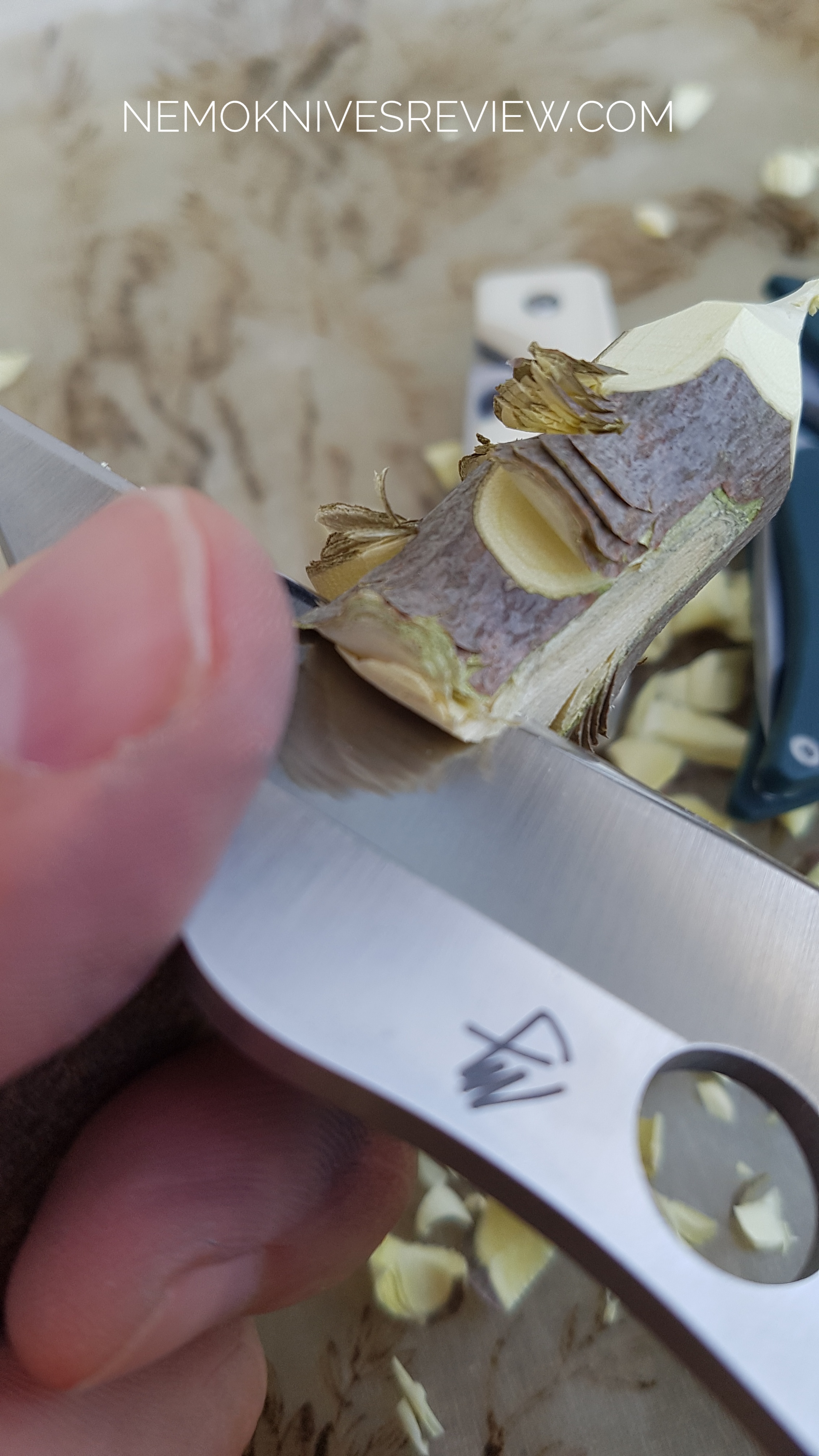
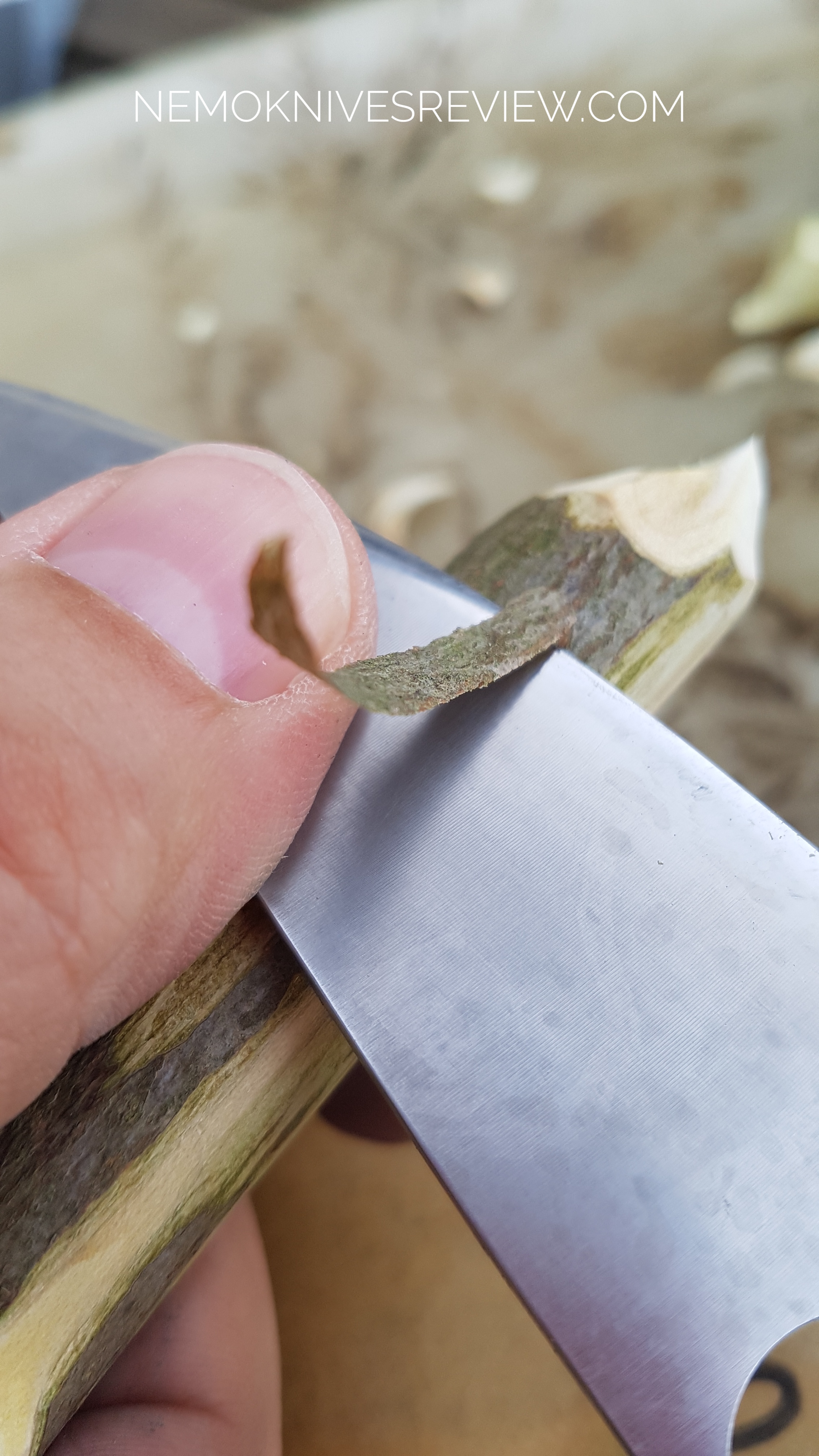
Ghost new convexed edge proved to be able to cut deep with a lot of control and also to remove bark with ease and no pressure as pictured. It was fun to use. CPM M4 got also that tendency to leave the wood’s fresh surface very smooth to touch. I could go on for hours but it needed some twist and home edjustment to ease my thumb sore.

The Wolfspyder’spoint is made to drill. It is thick solid, sharp and you can use all your force with no after thought. It’s not the case of…

…The Yo2 ! Back in the 90’s I had broken my Ronin point drilling in wood. It was a much thinner point and I was really stupid. So I was very careful with the Yo2. It’s clearly not its strong point (pun intended…) but I did not snap it.

C36’s pointy blades, first made of S60V (known as CPM440V) and then of S30V, are known to be relatively fragile but CPM M4 brings much more toughness to the whole design. Perhaps the CPM Cru-wear Sprint Run was even stronger but, anyway, I got zero concern with Ghost which was able to drill the hazel rod easily.

Eventually, the most important home improvement has been to rounded the blade’s spine. Of course the Sebenza is king in that matter, also the Slycz Bowie.

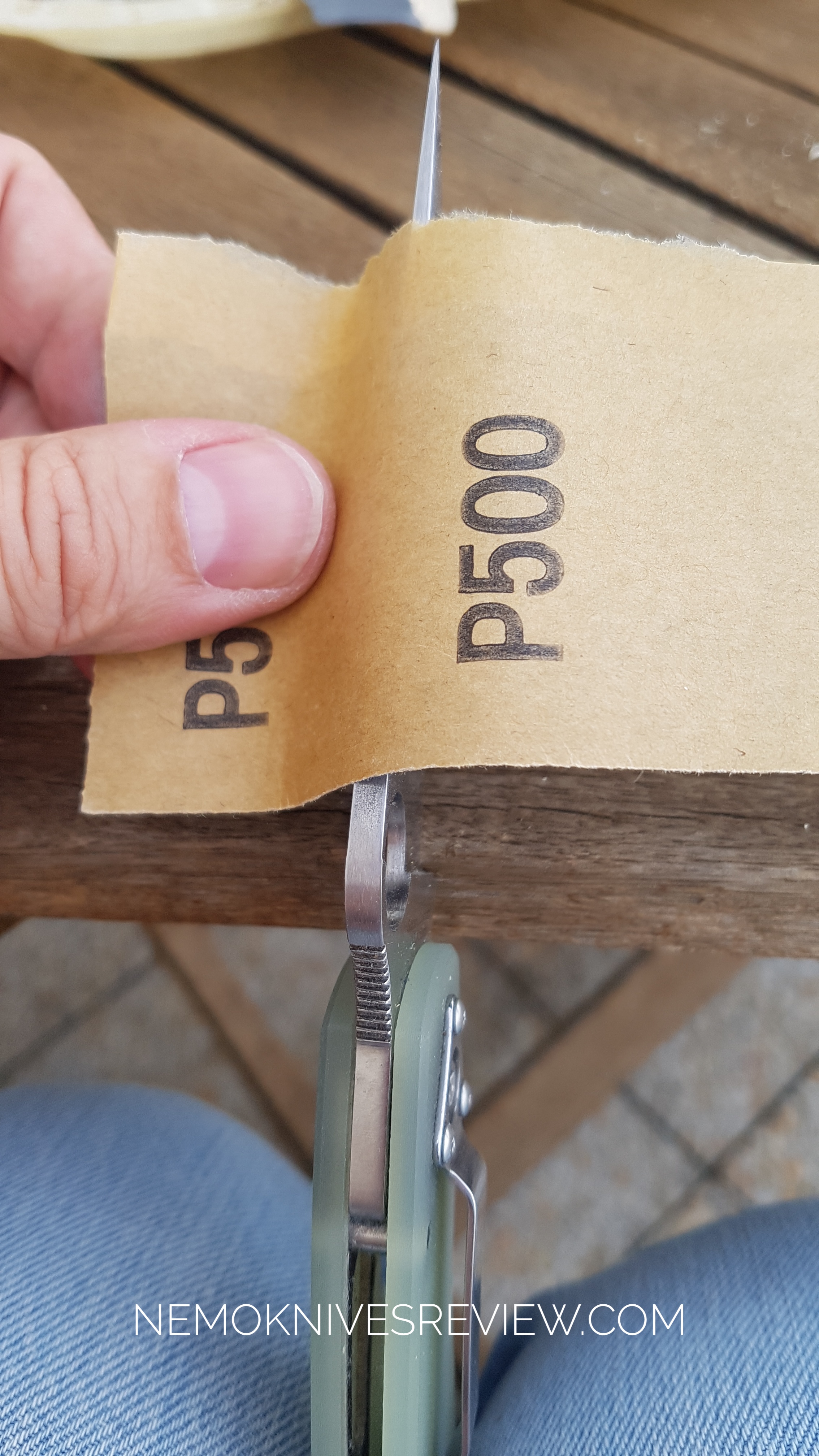
Sandpaper was used for that matter and if the edges has been removed I have not tried to round it completly but at least to make it much softer under the thumb and I don’t strike rods for sparks.

In conclusion, don’t be afraid to adjust and improve your expensive EDC knives to your own uses and tastes. My first attempt has been on my Paramilitary 2 handle. But a knife is a personal tool and it needs to fit you perfectly. Just take your time. Don’t use powertools and risk to heat the blade and ruin the heat treatment (done that in the 80’s…), just go slowly. Also don’t breath G10 and Carbon Fiber dust. Use a mask or do it under the tap. It would attack your lungs badly. Anyway my EDC have really been enhanced by all those little changes and Ghost is no exception to that thumb rule (pun…).
Enjoying your personal tools is always a joy when they are based on great designs in the first place.

Cold Steel Recon 1 XL — O’ Brother where art thou ?

Everything I could have said about that knife is already in my XL Voyager Review here !

Really, you should start by that post.

This Recon 1 XL version is just proposing some real great upgrades.
Compared to the Recon 1 normal version: this is a full flat ground bowie blade when the other version is hollow ground.

The DLC coating is really really nice and not easily scratched like the goo paint used before.

The CTS XHP made by Carpenter is a wonderful alloy I have had first discovered on the Spyderco Techno. But here you got 5,5 inches of steel !!

G10 is more luxurious than Grivory and it’s easily sanded to your preferences.
My Recon 1 XL could have been used as a wood file as the G10 was too grippy for my taste. G10 is so solid, you can make blades in G10, it doesn’t need any liners. The result is a very light package. (My Voyager XL got aluminium liners).


Sanded the G10 turns white but is cleaned back under tap water.
(Don’t breath that dust !!!)

The clip is not useable. anyway clipping such a knife is not the easiest way to carry it.
It disappear perfectly in a deep pocket or in my case in my travel bag.
I would be able to EDC my K2 but this voyager asked for a vest or a bag.

The detent is smooth. even a little too smooth to my taste. But nothing to worry about. The knife can be open with a gentle flick of the wrist as the heft and momentum is important with such a blade.

Again, like all CS blade I have chosen and which are manufactured in Taiwan: the thin edge is remarquable. That monster blade slits plastic, wood and flesh with an uncanny ease. There is a lot of power in the cuts. And all is served with their Triadlock which is the Mega lock by excellence. There is zero play in any direction.
The knife is fantastic, this is a dream for Crocodile Dundey !
It also perfectly balanced with it sweet point two centimeters behind the axis.
This blade is alive and fast in your hand.

I was able to import that big bad baby for less than 100 euros including shipping. Talking about power/price ratio, huh ?

Military C36PIN Part II: Ghost’s edge.


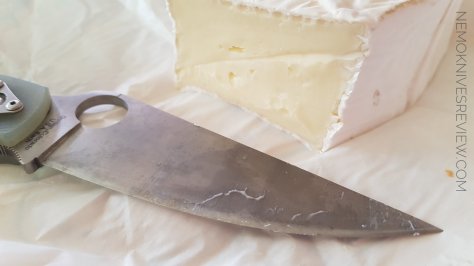
It has been 3 months since my Millie in CPM-M4 has landed in my pocket.
I believe it’s time for an update about it since it has been used a lot.

It is my first “new handle” C36 as mentioned here in my previous post.

Is there any change in my end line user experience ? Not really apart loving the new stop pin and the larger lanyard hole. It was easy to clean in the previous version, now it is easier and I clean it a lot as it’s used in the kitchen.

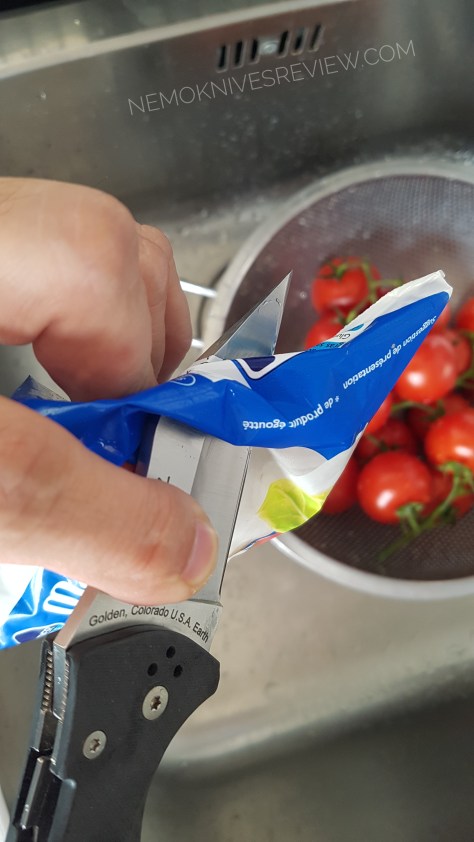
Smoothness ? As usual. The main break is the strong detent and the strong liner lock. It is open in a breeze with the major finger or by spyderdrop. The factory edge has been kept for almost three months. I have decided to refresh it at mid July and now the next step has been passed as I have convexed the edge to suit my need in cutting hard plastic (mainly bottles) before recycling.
There is no vertical or horizontal play and the liner has not moved since I got.
It’s a very very solid lock up !

Again CPM-M4 is my friend. In edge holding but also in refreshing by stropping on leather. The thin point of the blade has been used for delicate cutting on hard materials and it has been very reliable in that role. Choking up the blade gives a very nice whittling tool too.

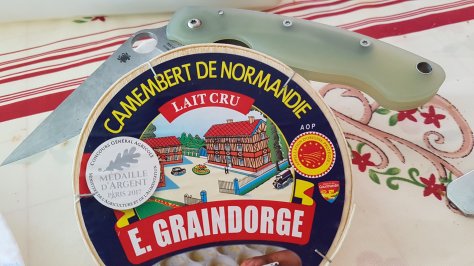
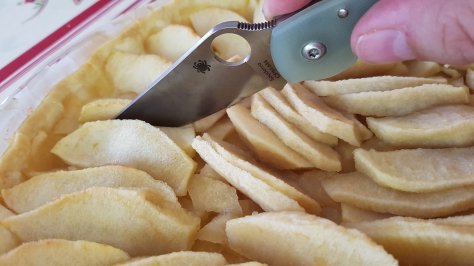
In the kitchen the knife has been confronted to meat processing: chicken, turkey, rossbeef but also sausages hot or cold, fish…

The pointy point has been used to open a lot of hazelnuts: meaning twisting the blade to open them.
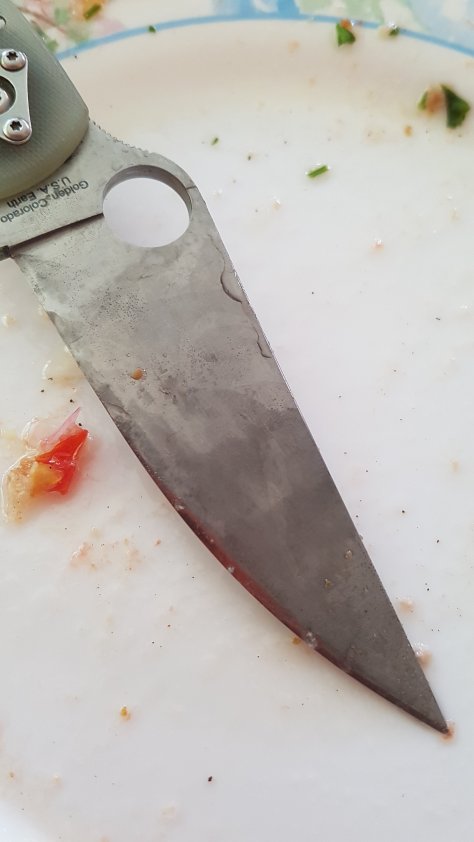
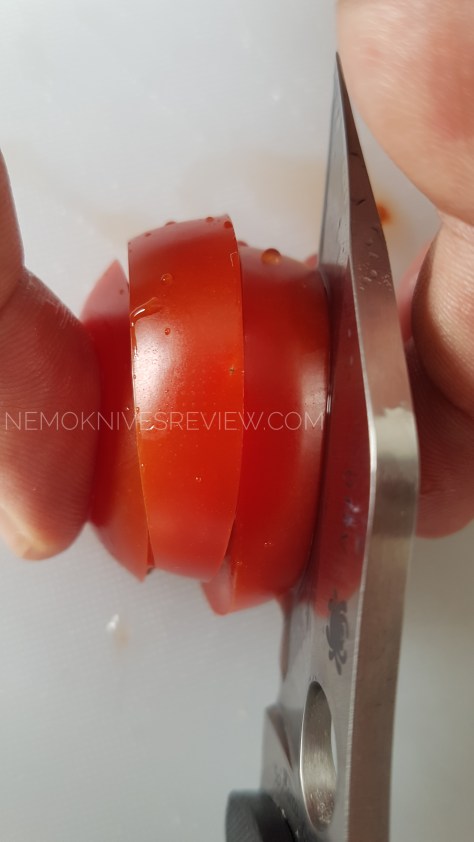
The favorite test in sharpness is how it cut tomatoes. This is a tricky fruit as it skin doesn’t have a lot of support from its flesh.

The Millie has also been used almost daily as silverware confronting its edge to hot and acidic materials. The patina did not come easily and no pit has been noticed. I use some nano oil or some olive oil to keep it in good shape, depending of my needs. Olive oil being less toxic of course.

I have invested in a titanium clip for deep carry. I have mounted it but for an unknown reason the pivot was much less smoother after. I think it is due to tolerances a the screw seems to be in some kind of tension but once removed the Millie was smooth again. Eventually I have found I love the original steel clip which is smoother to draw than any beadblasted titanium. But after sanding the titanium clip and bending it for less spring force on the pivot it was perfect for deep carry.

Today it was the opportunity to get rid of the factory edge and start a new chapter with a gently convexed edge. I have used sand paper on my old leather belt. Starting with 500 and finishing with 1000. I like a “rough” feel on my working blade. It comes from scratches and patina and it gives a lot of character but my pleasure is in a mirror finish edge.


On this model, the Jade or Natural G10 gives a very sheeple friendly look to that relatively big EDC knife. Of course it has been sand also to preserve my pocket lips. I have just kept the original feel/aggressivity of the G10 around the pivot as it is where I put my thumb.

Opinel N°8 Carbone — The Crowned Hand

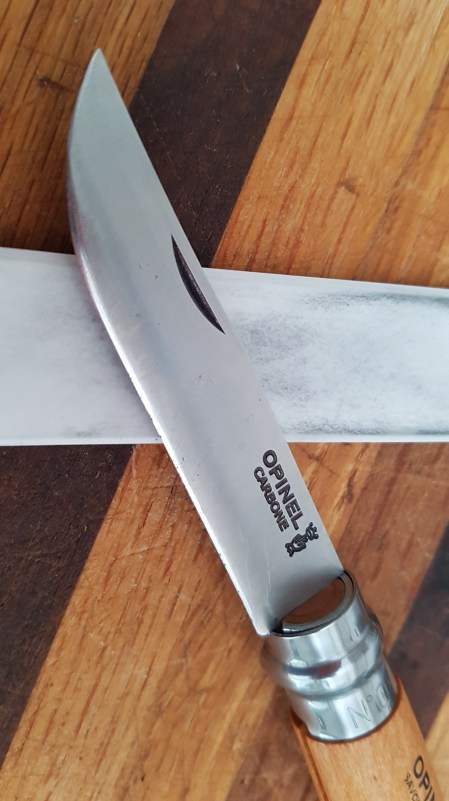
(You can notice the factory edge is a mess…  Easy to fix !)

I have been using Opinel since my very childhood. I was 8 years whe I was throwing my Opinel N°8 in the dirt figuring I was James Coburn in the Magnificent Seven. The blade was dull like a butter knife and black of stain but it was a constant companion.
Later when I had started to really use it I had discovered that it was really easy to get really really sharp and even to get it to razor sharp and keep it that way with just a steel sharpener. It was with an Opinel paired with a Glock knife (The Field Knife 78 (Feldmesser 78)) that I was living my first bushcraft adventures: building a shelter, making fire and cooking, making bows and arrows, sleeping in the woods…

I was buying some plants for the garden when I saw at the cashier some Opinel N°8 for 8 euros. It was the occasion to buy a new one just for the fun of using it.
I got a stainless N°10 somewhere and a filet… This Tradition Carbon is welcome.

As you can see the factory edge needs some work. But it’s so easy and fun to do.


Locked once closed.

The Jade CPM M4 Military looks like a BMW X5 compared to a Renaud 4L.
But both are fun in their own way.

Manufactured in the heart of the french Alps since 1890, Opinel N°8 hasn’t changed much. It got a new rotating ring which works also to block the blade when closed and this is a really great improvement in my own opinion.
“In the 90s, the Virobloc® system was modified to allow the blade to be locked in its closed position. ”

The con:  a round handle which not help to know in which direction the edge is. You need two hands (or your teeth and one hand) ton open the blade. Two hands to lock the blade. No clip, so the knife will disappear in the pocket. Carbon blade which can rust. But that not a problem if you know how to keep your tools oiled.

The pros: 8 euros !! This is a bargain. Half the price of Douk Douk. A very confortable rounded handle.
To quote them : “To protect our handles from external aggressions, there are two available finishes: buffing and varnishing.
Handles shaped from rare and precious tree species are buffed with wax applied with a cotton disk. For every other wood, we apply a varnish which has been selected for its highly protective properties against moisture and staining.
The varnish is tinted for the carbon range and clear for all the other ranges. To create coloured handles, we first apply a water-based wood stain before the varnish.”
The lock is reliable and easy to check.

A full flat ground blade with a thin edge. 40mm made by hand. German steel with 0.90% carbon heat treated in France at 57-59 HRC. (The Stainless version is Swedish 12C27).
“When it was first designed, the OPINEL blade was made from carbon steel. We still use a similar grade today, with an approximate carbon content of 0.90% which is still better than stainless steel. Our carbon steel is first produced in Germany and finalised in France before being worked by OPINEL.”

And this is where the Opinel is so fun to use. In all my knife it’s with my Opinels (stainless or not) that I got the best results in cutting plastic. Of course the steel won’t last like one of the new super steel but it’s so easy to go back to a very high sharpness: it’s fun.

Of course the Opinel beats all my other knives in my plastic butt/neck bottle tests. Even my great Nilakka or my reground Yojimbo 2.

The crowned hand.

Thinner and thinner !

I’ll  keep my new Opinel in my kitchen drawer. Sometime I will pocket it for going into the woods.
Compared to many modern folders, I know its performance are incredible and shows how thick the edges tend to be especially in the “tactical” scene. Strider comes to mind…
My Opinels wer beaten in wood work by the Dodo ! The Dodo got a belly which does miracle on cutting wooden rods.

I have read in a magazines some years ago that a famous hunter guide in Scotland was using an Opinel N°8 Carbone as his main hunting knife. He was using one knife by hunting season.

Anyway my good old new folder provides me “The original Opinel steel, the famous high quality cutting edge, easy to sharpen.”

Coke bottle are getting thicker at the butt, certainly a new manufacturing using more material and my new reprofile Zero Tolerance 0562CF cannot not cut through when she can still cut easily mineral water bottle’s butts.


The Opinel still can. Thin edge powaaa ! But you notice the 4mm thick plastic at the center.


False Brothers — Wolfspyder and Yojimbo2

Like Apollo and Soyouz, those knives are different but got connections.
Both are Spyderco folders with no hump, no choils, both equipped with compression locks, nested liners, spoon clips and radical blade designs.

Both are made to be carried as EDC. Not too big but not too small with a blade around 3 inches / 9 cm.
Their looks are reflecting their designer’s minds and crafts. Ray Mears is a teacher in bushcraft and Michael Janich is a teacher in martial blade craft.

Both are best carried tip up and you need to pull on their tails to unsheath them. They leave a similar print in and especially out the pocket.
Also both got a consequent integral guards. Only the Yo2 got its guard double with a nested liner though.

The main difference is the way their respective blades are ground.
A scandi grind against a saber hollow ground: the Yin and the Yang of cutting perfs.
Eventually the Yo2 is much easier to get sharp as you got less material to remove. But the Wolfspyder scandi’s once sharp is a pleasure on wood works for very precise controlled cuts. In that area, the Yo2 is more like a wild hungry edge waiting for a firm hand to stay on the course.
The thick point of the Wolfspyder is made to withstand drilling in hard wood.
The shard of the Yojimbo’s point is designed for deep penetrating thrusts… to the bone.

But in the end of the day, both knives are very pleasant EDC companions. Their ultra solid locks make them safe to use hard with no after thought. I was surprised how they can be adapted to mondaine chores with their own characters. Both got great ergonomics improved by a wide guard. The compression locks are not hurting my hand like on my Paramillies and the absence of jimping and hump is a plus in my book when you need to extend your thumb on the back of the blade for power cuts.

Yojimbo’s C85GP2 and C85CFP2 and a Ronin.

Following my first glimpse on a the Yojimbo Special Run of 2015 , I present you today the classic version of the Yojimbo: G10 handle and S30V steel. There is no difference between the knives but 4 grammes in favor of the CF version (110 vs 115).

Nemo Knives Review Yojimbos

The blade got the exact same length (on the photography, the Yo2 on the right is resting on her clip hence the parallax…). I have also found the detent to be harder on the S90V run but who minds ?

Now the main difference is the steel: S30V vs S90V.

Quoting Jerry Hossom on the knifenetwork.com :
“S90V contains 9% Vanadium. S30V contains 4% Vanadium (originally it was planned for 3% and thus the name). Vanadium carbides are VERY hard and provide a lot of wear resistance. On the flip side of that S30V was designed to be very tough; it resists chipping and breaking. S90V was designed to be very wear resistant, so it’s really a tradeoff. If you’re very careful with your knives, don’t toss them in the sink or hammer them through hard beef bones, S90V will do very well. If you’re rough on a knife, S30V will be a better choice. I’d likely choose S30V for larger knives, because they’re subjected to greater stresses. S90V is certainly fine for smaller knives. ”

So how S90V will behave on EDC chores with the Yojimbo blade particular shape especially its very narrow point. I remember the same kind of exchanges on the forums about the point of the CPM 440V (S60V)C36 military and our request to see a Millie with some strong tool steel hence the desire for CPM M4, CPM3V and CPM Cruwear version.

Back in 2002 I got the chance to own a Ronin made in VG10. The Ronin was a Mike Janich and Mike Snody collaboration on a SD fixed blade and more precisely a neck knife. I used mine for every day chore until the tip get broken and I was obliged to regrind it.

Here is my 15 year old Ronin next to the Yojimbo.

What I love in this design was the way It would cut on hard material without compromise the edge: only the point was touching the plate for example.
Then as S90V is known for its wear resistance, I should be able to keep the point sharp for a longer time…. And time will tell.

Some words from Mike Janich taken from the Spyderco Forums:

“Hey, Guys:

Thank you all for your comments and enthusiasm regarding the Yo2. I am very pleased to have it in production and I’m thrilled at the way it turned out.

I wanted to share a couple of fine points regarding the design. Like everything else I do, I like to explain why. You are free to agree or disagree, like or not like, but at least you’ll have the information to make a decision.

With regard to the not-fully-exposed Spyderco hole, I wrestled with various options on this during the design. I did not want to do the large index-finger choil of the original Yo because it narrows the grip too much in that area and starts to force the hand into a saber grip. The goal was to keep the closed knife as narrow as possible to preserve access to the pocket.

I had a similar challenge when I designed the Be-Wharned. One thing that I learned during that process was that the natural hand position for a thumb opening is typically not with the plane of the handle completely flat. Most people naturally hold the knife palm up, but with the knuckles at about a 45-60-degree angle to vertical. That means that your thumb also indexes the hole (or stud) at an angle, not flat on top of it. With the Be-Wharned, holding the knife at this natural angle and driving the thumb straight along the chamfer of the handle produces the most positive, reliable, and comfortable opening.

With that experience as a guide, I focused on the functional part of the Spyderco hole. When the closed knife is viewed with the edge down, tip to the left, this section is from 12 to 3 o’clock. That’s where the thumb actually bites and drives. That part of the hole is completely unobstructed.

As for the lock release cutout, I purposely made it smaller than that of the Para2. There are two reasons for this: First, some users–especially those who grip the handle tightly with their index fingers during opening–get a slight pinch from Compression Locks as the blade is opened. This is caused by the liner moving into the G-10 scale as the blade clears the detent ball. To mitigate this effect, I asked that the top of the Compression Lock tab be recessed slightly below the top edge of the G-10 scale and purposely made the recess smaller.

Second, speed closing of the knife is not high on my priority list. I close the knife by pinching the lock between my thumb (on the G-10 scale) and the nail of my index finger (on the lock tab). I can do this (and have done it) all day long without soreness or fatigue. For me, it’s perfect the way it is. Most importantly, the knife closes exactly when I want it to and I still enjoy both the extreme strength and the I-don’t-need-to-put-my-fingers-in-the-path-of-the-edge safety of one-handed closing.

I chose the standard hourglass clip for the Yo2 because it has been refined and perfected over the years. It works great, so why reinvent the wheel? Also, savvy Spyderco fans know that the same basic clip design used on the Yo2 is used on the Endura and Delica, but in black (and with the addition of the lanyard hole that matches the holes in those knives). Don’t like the shiny clip on the Yo2? Buy a replacement clip for an Endura for a few bucks and you’ve got an instant subdued clip. How easy is that?

As far as clip position goes, most folks know I prefer tip-up carry. The key to getting a personal defense knife into action quickly is being able to draw it and immediately open it without having to change grip position. The key to that is making sure that the overall size of the closed knife, the position of the Spyderco hole, and the height of carry are all proportionate to the average hand size. If you have a big knife with a deep-pocket clip, it may carry discreetly, but when you draw it, you’re holding it by the butt end with your thumb a long way from the hole. Unless you can magically Viagra your thumb into growing, you have to change your grip to get the knife open.

The clip placement on the Yo2 makes the knife ride high enough so that, with a proper draw, your thumb is automatically on the opening hole when the knife clears the pocket.

If you prefer discretion and a low profile over deployment speed, I purposely added tip-down carry to the Yo2. The clip holes at the pivot-pin end of the handle are as close to the front edge of the handle as physically possible to support deep-pocket carry. Yes, it’s tip down, which is slower. So is deep pocket carry in general. If you need deep-pocket carry and speed, arry tip down and use a Spyder-Drop opening. You’ll find that although a small portion of the Spyder Hole is obscured, there’s still plenty of surface area to grab onto. As you pinch the hole with your thumb and index finger, you’ll also find that your fingertips start to push the handle away from the blade, “cheating” your start on the opening.

As for a lanyard hole, I’m not a fan of fobs, so I opted for the additional strength of a screw post at the butt instead of a lanyard tube. However, if you are a lanyard fan, there is still enough room between the blade edge and the screw post to wrap a thin lanyard around the post with a cow hitch. That keeps the lanyard centered in the handle instead of wrapping around it and makes for a sleeker package. Think of a typical flashlight lanyard where the loop that attaches to the light is thin and strong and the rest of it is 550 cord sized. If you must use 550 cord for the whole lanyard, pull the guts out of it so it wraps flat around the screw post.

I hope this helps you better understand why the Yo2 is the way it is. A lot of thought went into it and it is truly a reflection of more than 35 years of experience, training, and daily carry of personal defense knives.

Stay safe,

Mike

P.S. As far as meat cutting tests go, yes, that was a big part of my personal R&D of the prototypes. Simple answer: It has more blade length than the original Yojimbo. It therefore cuts even deeper.”


Another one from Michael Janich in August 2012:

“Thanks for the discussion and your continued enthusiasm for the Yo2.

When I designed the blade for the Yo2, I took a lot of inspiration from the Manix2, both because I like the way it cuts and because, as a Golden-made product, its manufacture respresented a known core competency for Spyderco. Combining a partial hollow grind with a thick, strong spine provides a great balance of edge geometry and strength. Moving the point up towards the blade’s centerline moves it toward the thicker part of the blade; however, if the hollow grind runs parallel to the edge all the way to the point, the resulting point thickness is functionally the same as what you get with a wharncliffe.

The wharncliffe blade excels at cutting because it cuts with full power all the way to the tip. An acutely angled tip also provides superior penetration with minimal effort.

From a utility standpoint, the Yo2’s tip is analogous to an X-Acto knife and is excellent for detail work. The heel of the blade, closer to the handle, is extremely strong and more than capable of tackling most cutting chores for which knives are appropriate tools. In general, if you focus on using the part of the blade that is most appropriate to the task at hand, you can perform a wide range of cutting chores without a problem.

Having designed several wharncliffe blades now, I have also been privy to the warranty repair claims concerning these blades. In all honesty, broken tips are rare. The ones that do come in typically come with a story that begins “I dropped my knife on concrete/a hard tile floor….” or “I know I shouldn’t pry with a knife, but…”

Like a box cutter, a wharncliffe cuts with both power and finesse because of its straight edge. If your style of utility knife use actually focuses on cutting, it will serve you well. If your utility knife use focuses on prying, digging, or using your knife as a jack handle, buy a knife that is better suited to that type of use–and don’t expect it to cut very well…

I hope this helps.

Stay safe,

Mike
Michael Janich
Spyderco Special Projects Coordinator
Founder and Lead Instructor, Martial Blade Concepts”

 

Yojimbo 2 C85CFP2 – S90V & Carbon Fiber

“Number 17” has entered in my life yesterday as I was angry about an order blocked in the airport for 12 days. I had ordered a Yojimbo 2 (G10, S30V) and since the 5th of May it has disappeared from the tracking.
So yesterday I indulged myself with a very rare exclusive run for Knifeworks three years ago: a Yo2 with S90V and Carbon Fibers handle.
Better, I had ordered a deep carry clip and it’s now mounted.

My idea is to use the Yojimbo, not as a SD tool but as EDC tool. So this safe queen is going to see some mileage and S90V will be welcome for it’s very high abrasion resistance. This is my point, I hope the Yo2 will keep its own (point) sharp and solid.

Some intense sharpening was mandatory. The edge was uneven from one side to the other (3mm against 2mm)… Now it’s much better after some intense passes on the Fallkniven little diamond/black stone tool and the Spyderco ceramic grey/white.

And well, it works just fine.

Quoting Michael Janich about his own design on the Spyderco Forum:

“…With regard to the utilitarian function of the Yo2–absolutely. I grew up in pretty humble surroundings. Although we didn’t have much, my Dad was very smart and skilled with his hands. I learned that the best way to have stuff was to make it, so I used to spend hours making toys out of cardboard, scrap wood, string, and anything else I could scrounge. One of my most prized possessions back then was an X-Acto knife set my Dad bought me with all the different blade shapes. Initially, I thought the different blades were cool and spent time swapping blades to cut different materials and shapes. After a while, though, I realized that the standard straight cutting edge was the most versatile. If I needed precision, the tip did the job. At the same time, if I needed cutting power, the straight cutting edge transferred power all the way to the point.

The blade for the original Yojimbo was based very much on these experiences and the shape of a common utility knife/box cutter. It was designed before 9/11, but released after. Promoting it as a “box cutter on steroids” was not appropriate at that time, but functionally, that’s exactly what it was. The Yo2 does the same thing, but even better…”

And more from another thread:

” … Helping my Dad with DIY projects around the house, I noticed that most utility knives, electrician’s knives, and similar “trade-oriented” cutting tools were Wharncliffe or sheepfoot blades. Again, in practice, it made sense and they worked. I chose my first pocketknives–Case slipjoints with straight edges–based on that experience.

When I started studying combative knife skills as a teenager, I read all the classic WW2 books on the topic, many of which recommended Bowie-style blades with significant “belly” to the edge so they could be used to snap cut. My taste in knives changed as a result of that and I began carrying blades with more belly and well-centered points. My first commercial knife design–the Masters of Defense Tempest–even reflected that style. However, when I had a chance to design what ultimately became the Ronin, I went “back to the drawing board” and did a lot of live-blade cutting with everything in my collection. I found that the knife that cut best was actually my Spyderco C25 Centofante, which was a Wharncliffe. When I began to analyze and really understand the dynamics of cutting, I realized why.

Cutting is cutting, whether it’s utilitarian or defensive. For cutting power and dexterity in a small blade, the Wharncliffe really shines…”

There is nice video made by Michael Janich explaining his design here on Youtube.

And by the way, the collector is just using a Yojimbo2 (S30V/G10) as an EDC.
It got the scars to tell its story.

To be continued… here :
Yojimbos-c85gp2-and-c85…

Chris Reeve Sebenza ATS-34 — Honor is her name.

Nemo Sebenza Ats-34

What does it means to own a Sebenza ?

21 years ago, in September 1996, I received a phone call from Taiwan; the person calling was unknown to me, his name was Huan Chang Hsu and he told me he was an ophthalmologist, a diver and….. a knife collector! He had worked his way and managed to to get in contact with me after reading my first little blog on Geocities where I had written reviews with Fred Perrin. This call lasted 4 hours !!!

Eventually, he insisted I try a Sebenza which was, in his experience, the best of the best in folding knives. He was buying them like an investment and keeping them safe in the bank like others keep diamonds in a vault. He suggested I try out the new handle version but I wanted the classic one.
He also suggested I name it: “Honor”.

Two weeks later I received a parcel with a Microtech Socom (Huan Chang was so generous that he wanted to give me an other one of his knives) and in its box: “Honor”.

To thank Huan Chan, I sent a box back to Taipei containing a vintage Jacques Mongin; Jacques was a cutler legend who designed this folding hunting knife in response to Ernest Hemingway’s special request at Kindal.

The Sebenza was a shock. Smooth little butter. Even now it is one of my smoothest knives, really built like a tank, a absolute workhorse in pure beauty. It was not a tactical experience it was first a tactile discovery: the massive titanium slabs, the integral lock…

Back in the 90’s I remember a review in an American Magazine where the reviewer mauled his Sebenza into a log just to test the lock and was amazed by its reliability.

Two cons I had noticed:

– the thumb stub was a little in the catchy side — meaning it was able to rip the inside of a trouser pocker.
– the clip (Chris’ first attempt to mount one of his design) was scratching everything it could reach.

.

Old clip on the left.

Aware of that, Huan Chang sent me an original CRK leather pouch. Again I thanks to him for his generosity; it seemed really important for him to refine my experience with “Honor”.
So I carried the Sebenza in its leather pouch, horizontally on my belt, for years until I was able to order a better refined clip from Chris in 2000’s.

Honor rapidly became what I named “My Ambassador Knife”.

Back in those days, forums were just kickin-off and already people were arguing about “What is the best folder?”. Chris Reeve knives were the top of the list but also much more expensive than other industrial knives. “Shut up ! You are jealous because you can not afford a Sebenza !!” was a comment used in arguments against people who has doubts about Sebenza groupies.
So I got that crazy idea to send “Honor” to anyone who was criticizing the design without having the opportunity to try a CRK. Honor’s first trip was to Wales to my friend Wayne and six months later he told me Honor has broken his heart when flying back to France. Since he has been able to buy his own Sebbies.
In ten years, my Sebenza went in dozen of hands, strangers, forumites and even knivemakers for months. His last trip was to Alabama to Jeff Randall from RATS and now ESEE because he had written on his forums how he hated it before offering my knife to one of his friends for his retirement. I contact him immediately and after clearing the misunderstanding he got my knife from Nevada and sent it back to me ASAP.

The poor knife had been used hard. It was dull like a butter knife and its blade scratched like it has been used to drill holes in the soil. I was able to clean it, refurbish it with ease and it resumed its “workhorse” title after all. Spyderco’s Joyce Laituri then adviced me not to send it anymore and I have followed her advice ever since.

Honor is part of my rotation and its thin edge still does miracles.

My friend JD told me the grind and the geometry is not comparable to nowaday Sebbies which are thicker than my old one. I believe him, as I have been using a BG42 and S30V little Sebenza and I was not able to get it as sharp as my good old Honor.

Also her ATS-34 blade never chipped despite by having been used hard by many different reviewers; the last one showing genuine hate in her abuse.
Back in 1996, Chris was doing his own heat treatment and was already famous for that. The heat treatment is for half responsable of the blade’s quality; it is exceptional here.
Also 30% of quality comes from the geometry; this is a high and thin profile which is rare nowadays among tactical folding prybars sold as knives.

Despite its scars it performs as well as in 1996 when Huang Chang Hsu sent it to me.
What a legendary knife !
My advice: if you ever find an ATS-34 Sebenza… Go for it !

After all those years this is how the lock goes.

Perfectly centered.

Scrtaches on titanium can be removed with gum and elbow oil.

But it gives character !

edited by pjaffre: jan 5, 2018.

Real Steel “Megalodon 2017” RS9611 – Enter The Dragon !

RS9611 Real Steel Megalodon

Again I got a really great bargain and service from my favorite Ebay retailer: Caledon2 Whole Sale Knives and Swords. Kuddos to them to beat record in shipping each time, mine arrived 4 days before its ETA.

I have found this Real Steel Megalodon 2017 model while browsing for a sturdy flipper three months ago.
Eventually I have found the Zero Tolerance ZT0770 as the Megalodon was not available. But I was caught by the beautiful lines and the materials used in this model. Chinese knives production are getting better and better and Real Steel is the new kid on the block in high end cutting tools.

According to https://chinaknives.blogspot.fr (Thanks Wayne for the head up!)

The brand was created in 2013 by the same people who brought you Sanrenmu knives.
Those folks saw the factory, that produced good quality OEM knives for American companies and cheap, but well made budget “original” design knives and thoughty it could be something bigger.
At first, they based on the same designers, that produced Sanrenmu original knives, the most known of them is Liang Gang, that designed some of SRM’s best known models. That is the reason that some of RealSteel’s designs look a lot like the Sanrenmu models (probably are the same, but with different branding).
Their breakthrough (in my opinion) came when they started working with Huang Liang Zhi, better known by the name Carson (Tech Labs). His designs were well known to the people who are interested in Chinese knives, but the quality of his knives is incredible, and second to none (maybe except some of Kevin John work).
Together they made an aluminium version of the Carson Griffin and also released his boiling flipper design under the name Megalodon (probably just put RealSteel logo on the Carson made knife).
There has been some conspiracy on YouTube lately, claiming that Carson has sold his knifemaking factory to RealSteel, but that information was proven to be wrong and was just speculation of one specific Youtuber with big imagination. Carson himself took a photo with his knives to prove this wrong.”

According to Real Steel:
“At the request of many of our fans, we have re-dedicated ourselves to the Megalodon. However Realsteel would not be Realsteel if we were satisfied with a simple relaunch of the old model. We have taken the strengths of the original megalodon on the basis of your feedback and renewed every single component. The result is a megalodon, which at first glance looks like its predecessor, but in reality it is surpassing its predecessor in its blade steel, in its finish and in many other details. This makes it interesting not only for users with the highest demands, but also for collectors.”

The Meg is destined to be a flagship. Mine is numbered  “474 “and come in a very nice box with its certificate and the name of the knifemakers: Carson Huang and Mr Li in the city of Huangao on the Yellow Sea, facing Korea. Funny to see how many people are thinking the late Kit Carson who invented the flipper is behind this one.

I knew M390 mainly from that incredibly great Spyderco Military Sprint Run.
For Jim Ankerson: “M390 even after 550 cuts it was still not getting noticeably harder to cut the rope, after 600 cuts it was still pretty easy and it would still slice paper clean…” he said in a test versus ZDP189 7 years ago.
So M390 is something of a super steel which, if well heat treated, can beat records. Again Jim Ankerson tests makes M390 ahead of many competitors for rope cutting.

The clip is not has good as my Mantra 2 or ZT0770 but it does the trick despite a very unorthodox design made to get caught in the lips of the pocket. There is a warp in the clip look which combined with the gap in the handle can make the pocket insertion tricky. The G10 version doesn’t have this issue.

Anyway, the Megalodon handle is some kind of work of art. It shows how the industry has progressed in machining titanium. Though it is not as impressive as the Slycz Bowie handle … But beautiful curves and clever design which made the illusion of a longer blade compared to its handle. It’s a very sleek piece of cutlery.
You got all the last gizmo in the knife industry. The Integral Lock is renforced again wear and has a security to avoid bending the spring too far for example.


There is milling on the inside of the scales making the full titanium handle very light and the knife is very well balanced once the blade is deployed.

The action is incredibly smooth thanks to its “Pin Bearing”. Kevin Cleary in his great video on 7th minutes explain it. No balls but pins. Simple as that.
The action is as smooth as the Rubicon 2 which means a really really smooth experience. Better than my Mantra 2 and quieter than the ZT0770 spring assist authoritarian opening.

The 3,5mm thick beautiful full flat blade is a razor right out of the box and the edge is thin. With 10 cm long this is not a short tool but it carries quiet well.
I have start to thin the edge further and you can see pictures of the process on our Facebook Group here.

The full open design of the handle makes it easy to rinse after use and I really think this Chinese flipper is made for being used in the wood with no afterthought. China is making now great “separators of matters” for the money, from the Spyderco Polestar, the Byrd series and now to the Real Steel high ends top of the notch folders, I think, after “Made In Taiwan”, “Made In China” is soon going to be a quality label.
But yet they are really shy about that.
“Real Steel” are word in English not Chinese.
And nowhere on the knife you will found “Made In China”  or  “Huangao” written…
Shyness versus China ?

To quote Gary W. Graley on his review on Bladeforums. on the difference with G10 version:

“I did end up getting one of the Ti versions, also a very nice knife, VERY smooth flipper and solid lockup,
Some differences between the G10 and this Ti version

Price, yep, you knew that was going to be there, it’s quite a bit above but with that you do get needle bearings for the pivot mech, Ti frame lock and M390 steel, all add up to be worth the extra price tag

the blade is a smidgen longer than the G10 versions

the blade grind is slightly thicker and as you can see ground a bit different, I am getting about .023″ at the edge bevel where the G10 I’m getting about .017″ so that’s a good bit thicker, but, it is still pretty thinly ground compared to a lot of folders out there, it does cut well.

Handle, the thickness of the handle is thinner than the G10, and of course being Ti it is a little smoother, but the contours provide adequate grip, I do like the thicker G10 handles myself though.

Overall, these are BOTH excellent value knives, highly recommend either one.”

The blade is centered.


Comparaison with other classics.


Comparaison with my 1996 Sebenza.


With the Spyderco Slysz Bowie.


With my CPM Cruwear Military.


With the mighty K2 !


a very Steampunk clip.


It cuts the Coke bottle butt with zero issues but it could and should do better.
Reprofiling is on its way here.


On the edge of the Polestar by JD

Like Nemo I have received my Polestar as a gift from Spyderco. It was in the goodie bag at the 2017 Amsterdam Meet. When I took the knife out of the box and looked it over my first impressions were positive. The blade opened smoothly and locked solidly with the lock bar fully engaging the tang. I liked how the gray G10 looked and felt, a nice combination of grippy and smooth. Clip tension was also excellent. I could slide the knife in and out of the pocket and waistband without any problem. The edge it came with from was less impressive, it could push cut receipt paper but had no slicing aggression at all.

When I came home I put a drop of Nano oil on the pivot which made it even smoother. I could flip the knife open with my middle finger, which is a lot of fun! Other than flipping it a few times I didn’t know what to do with Polestar. For me it is quite a big knife, having a blade length of 8,5cm. In my urban environment and with my use I have found that a blade length between 5-7 is ample. Small knives are often just more convenient for me.

After a few weeks of from time to time picking it up and flipping it I decided to give it a try and see how I would like to carry and use it. Like Nemo I moved the clip to the tip down position. I was going to carry it in the waistband and tip down carry reduces the chances of the blade accidentally opening. Thanks to the Spyder hole hump it could still be easily and quickly opened with the Spydie drop.

Before I was going to use it the edge would need to have more slicing bite then it did new. So, I thought a few passes on a coarse DMT hone would be enough for a quick touch up. I was wrong! I found out that, especially close to the recasso, the edge was pretty uneven. In some places it was even a high angle convex. The edge would need to be formed anew!

I cut of the old edge with a few light cuts into a stone and then created a new edge with my extra coarse DMT hone. I was interested in how the knife would function as it was intended by Spyderco. So I did not change the angle of the edge much but just evened out the edge bevel and formed a new apex. The steel was not hard to grind but, due to the unevenness, some parts needed lots more work than other parts. After I had was sure of having formed an apex by creating a burr on either side of the edge, I removed as much of the burr as I could by using alternate and high angle strokes. The burr flip flopped from site to side a lot and was not easy to cut of. Once I had removed most of the burr on the extra coarse hone I repeated the procedure on the fine DMT with the same difficulty in removing the burr. At that time the edge would slice receipt paper well but I have had better edges.

From past experiences I know that often a new knife needs to be sharpened a few times before the edge reaches its full sharpness and edge holding potential. So, this did not disturb me much. It was to early for conclusions.

I proceeded to cut up some cardboard before repeating most of the afore mentioned sharpening procedure. Only this time I finished on the diamond side of the Fallknives DC4, one of my favorite hones, to an edge that would just split head hair. Removing the burr and finishing the edge had become a bit easier this time around. Over the following days I carried this knife and used it for my normal cutting tasks. Mostly cutting paper cardboard and plastic packaging material and perhaps a bread bun for lunch. A funny thing I noticed: the edge its cutting ability seemed to first increase, then settle down, before slowly starting to dull!

After about a week of use the edge would still work for most of my cutting tasks but had lost some of its sharpness. I decided to resharpen the edge with just the diamond side of the Fallkniven hone again. Getting it sharp enough to shave arm hair was easy but getting it to split head hair still proved to be a bit fiddly, although I did managed it in the end. By comparison: my Elmax Squeak went from not biting in to the hair to cutting the hair with much less effort. A few passes on the hone did the trick there.

Normally I would have put the knife in pocket pocket as it was sharp enough for me use, but out of curiosity and to check my findings I resharpened it once more. I had become a bit easier to remove the burr and to make the edge arm hair shaving sharp. But to get the edge to split head hair was still a challenge. With other knives like my Maniago Spyderco’s in N690 and Elmax and, for instance, my Victorinox Bantam this had never been this difficult.

Overall the Spyderco Polestar is an enjoyable and capable knife: flipping the blade open with the middle finger is still fun and the handle works well, it handled my cutting tasks fine ones I got it sharp, but I am not impressed with the condition of the steel at the edge on my example. Still, it was interesting playing around with a knife that is so different from my usual fare!

JD