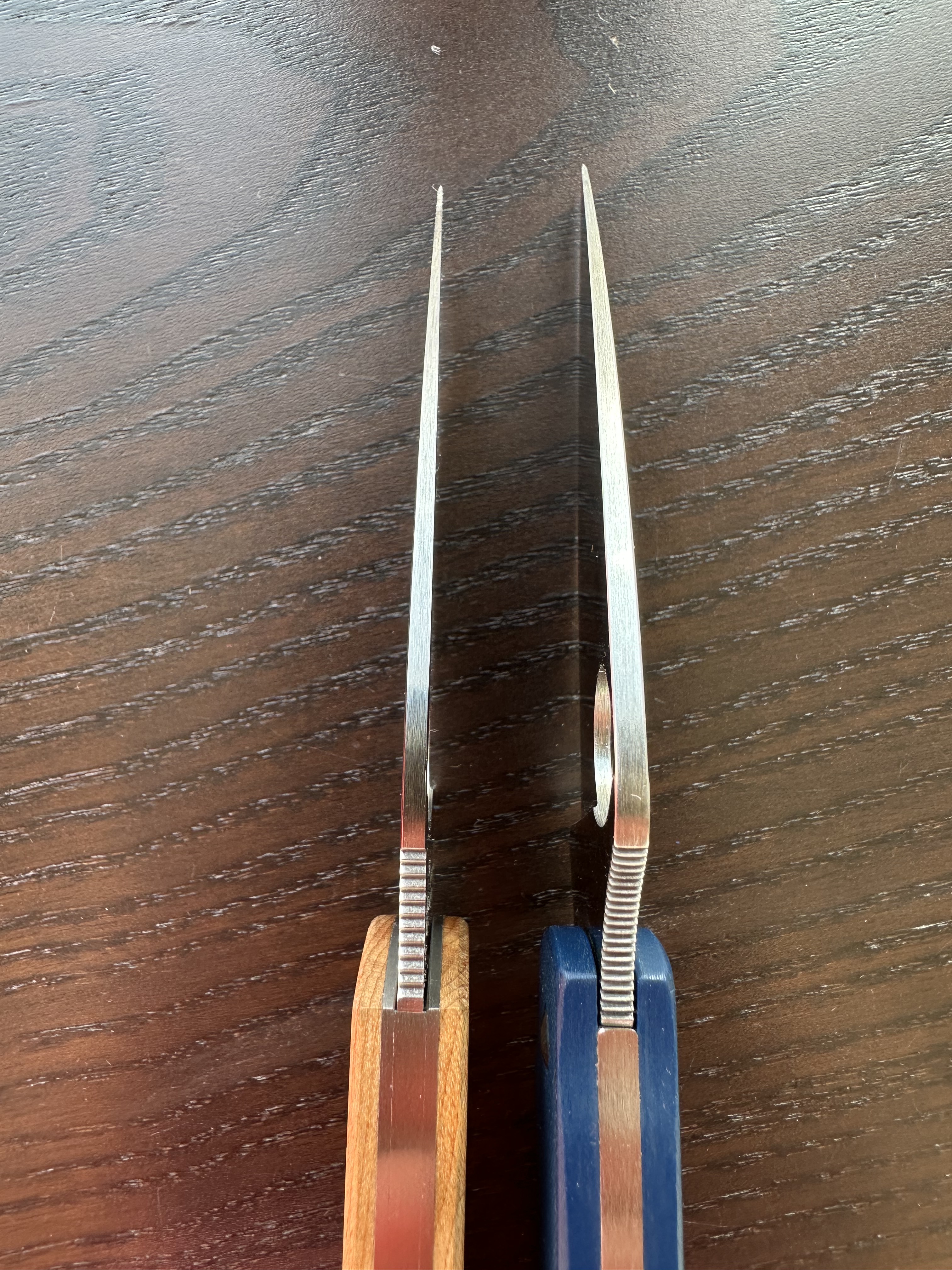
The Chaparral platform is one of Spyderco’s most refined designs. It is extremely thin—among the thinnest in their entire lineup—both in blade stock and handle thickness. This isn’t just about comfort: the blade geometry is optimized for slicing efficiency. Minimal stock, high grind, and a fine edge mean it cuts with very little applied force.
The SlipIt design removes the locking mechanism, making it legal in many jurisdictions that restrict blade length or prohibit locks. Despite being a slipjoint, it feels very solid and the choild provides an extra security. The internal construction—including the concealed stop pin near the pivot—adds stiffness and long-term durability that you don’t always get with non-locking folders.
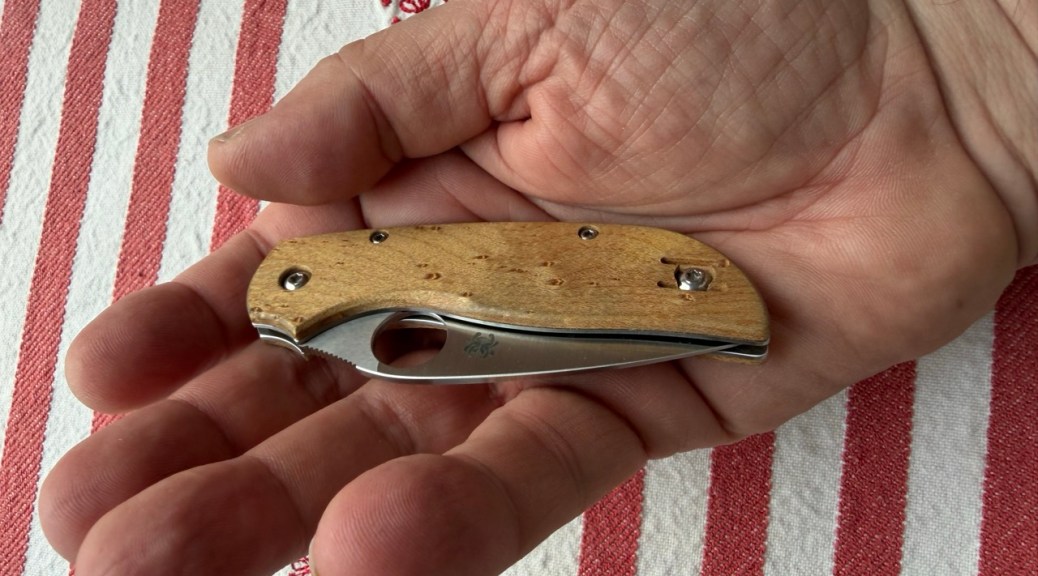
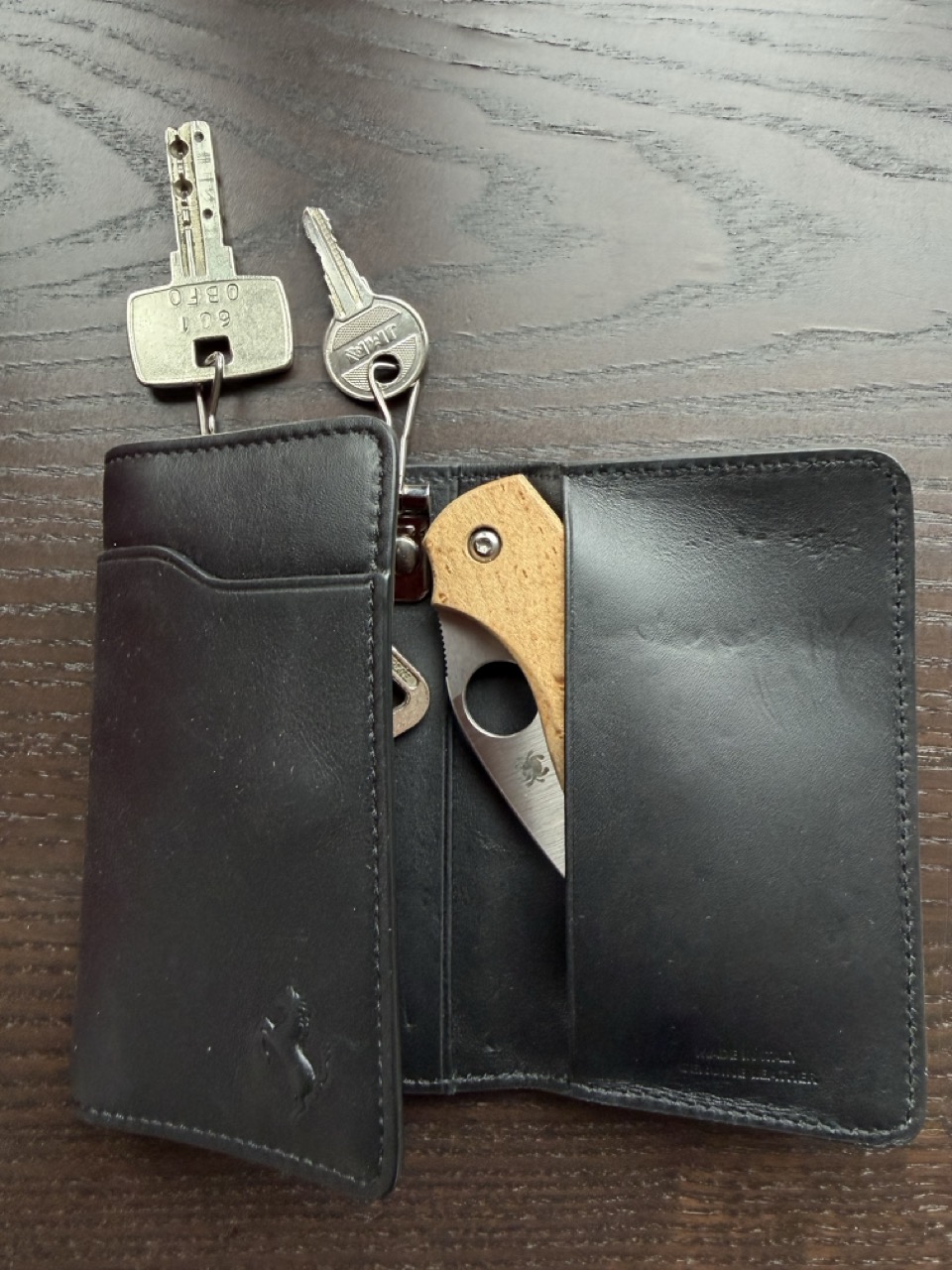
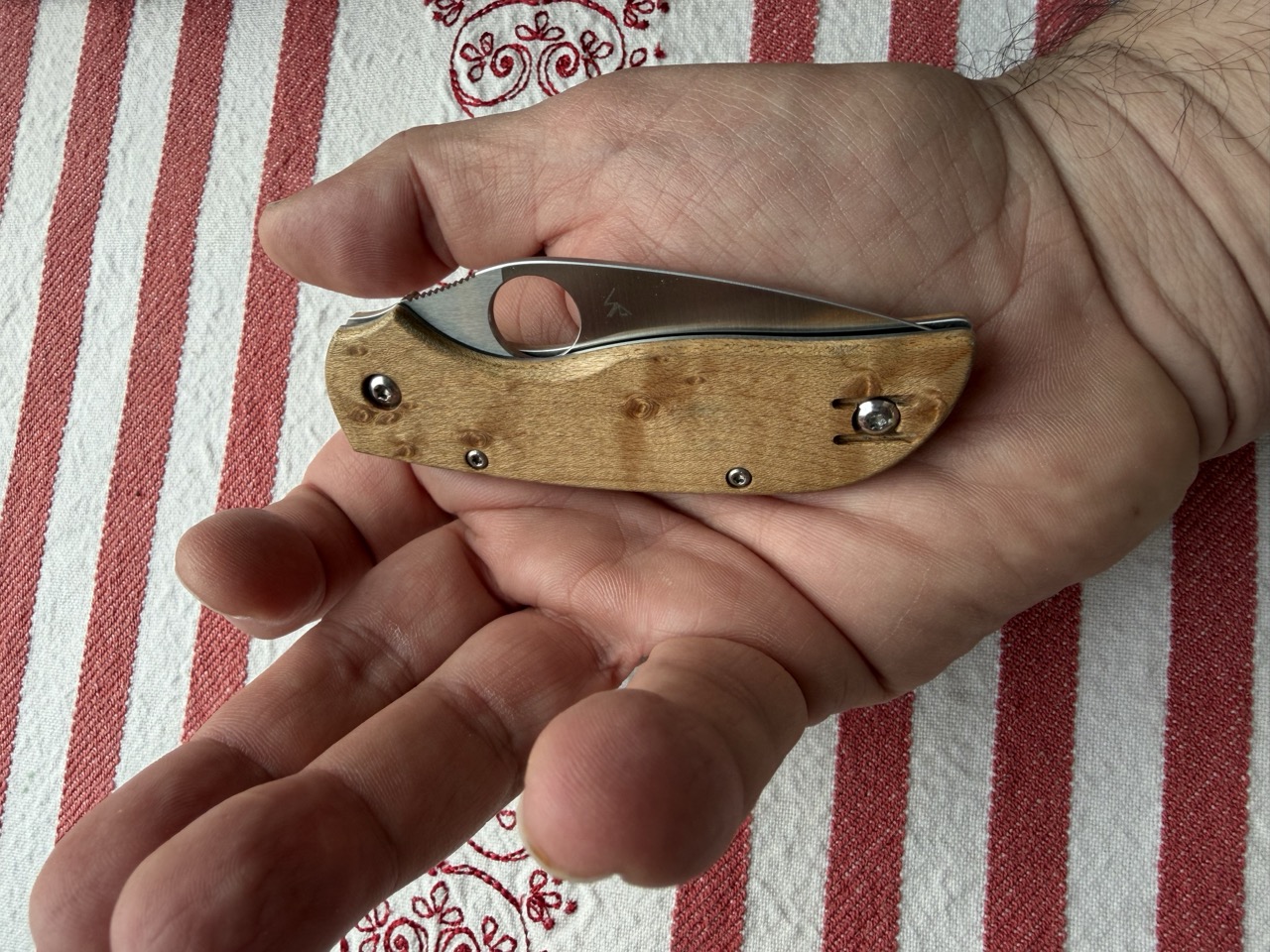
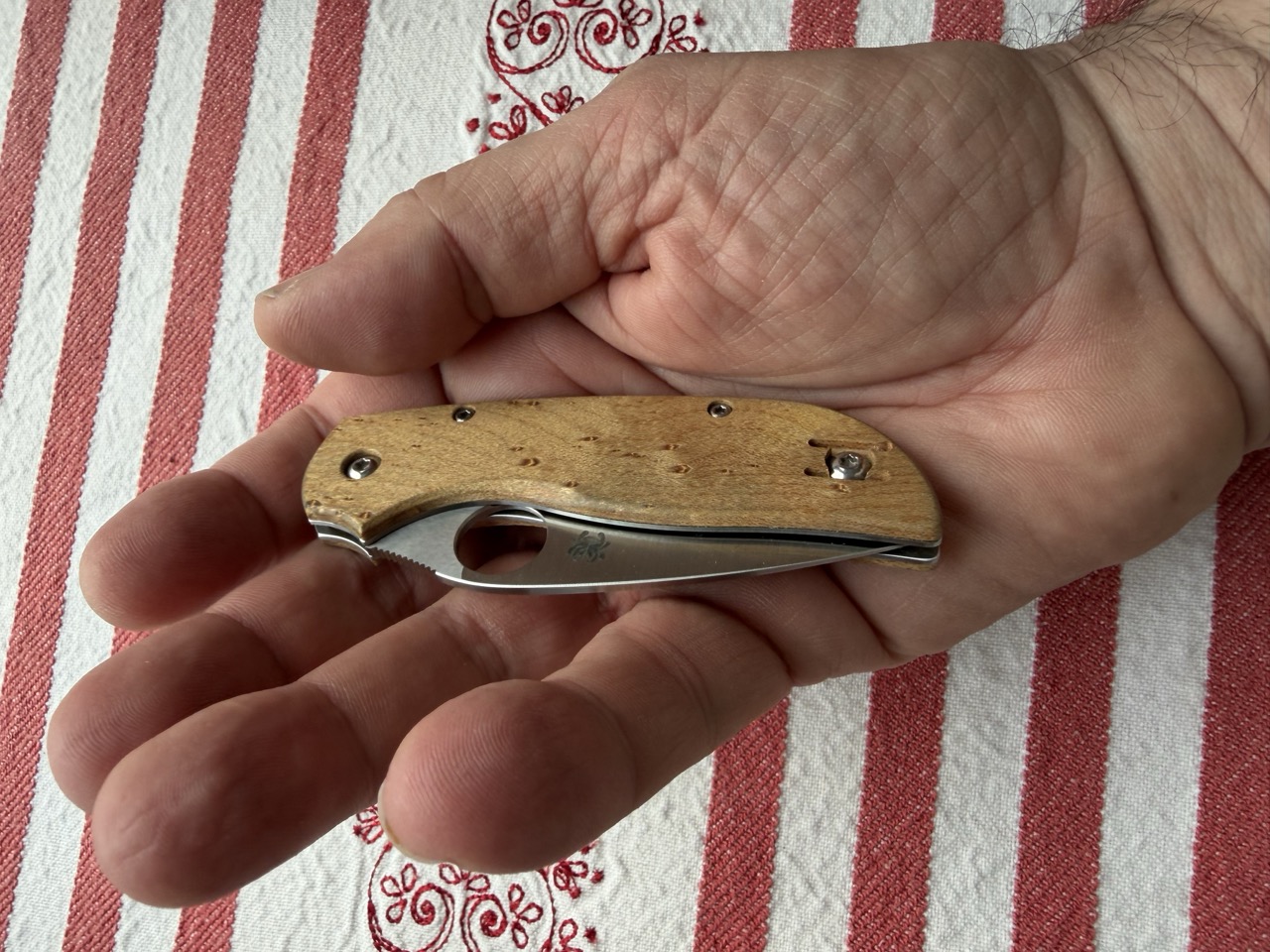
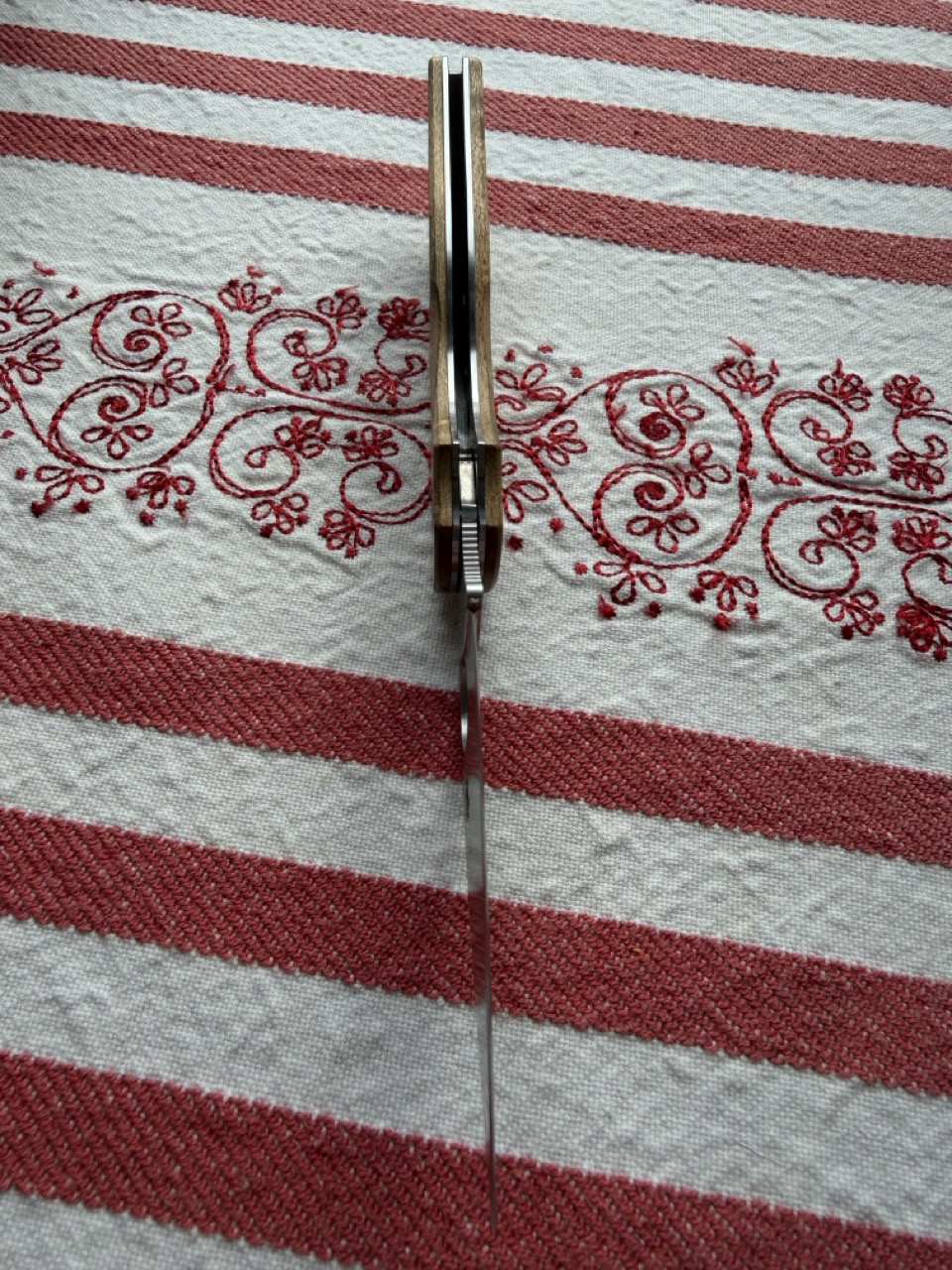
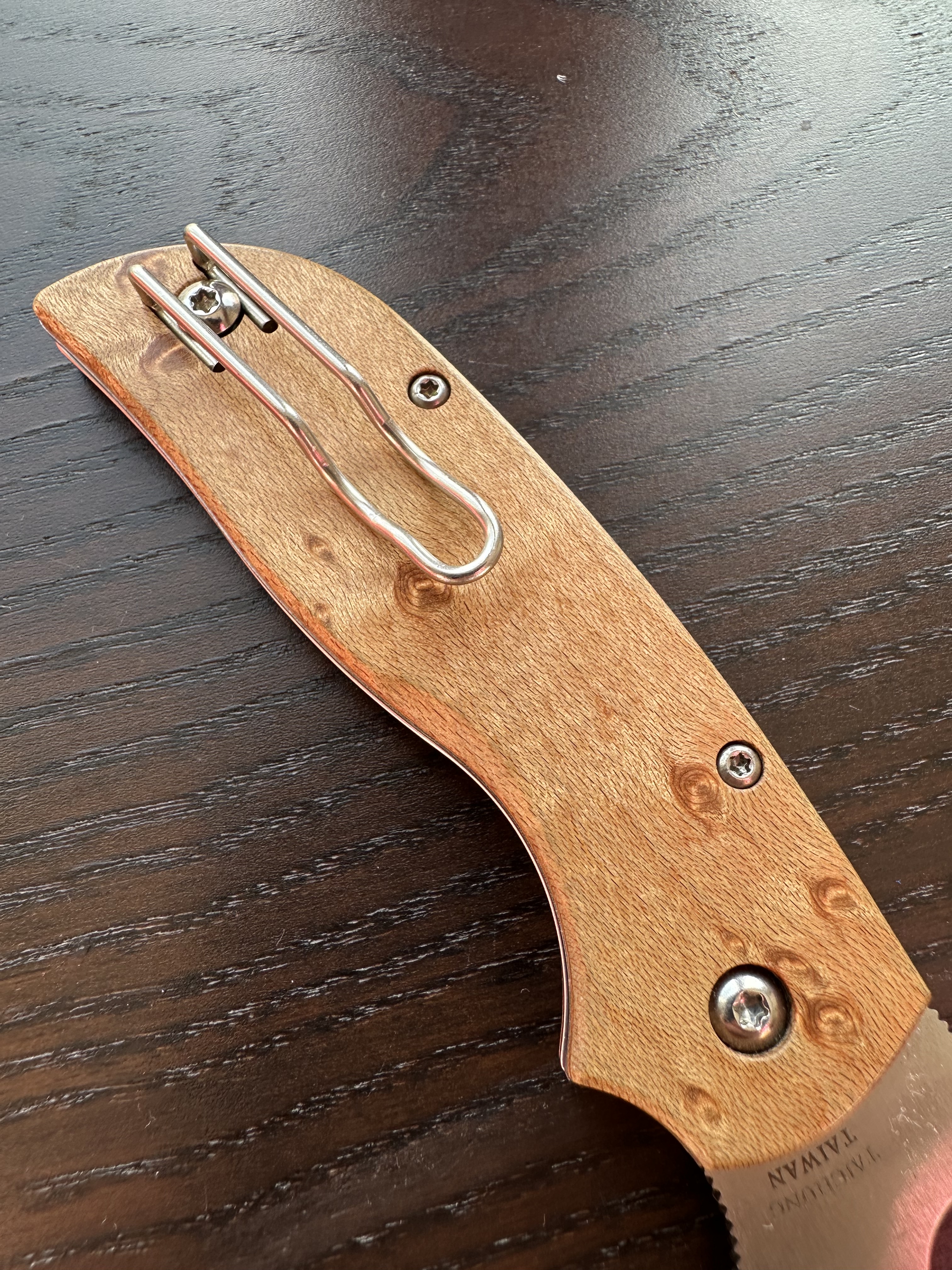
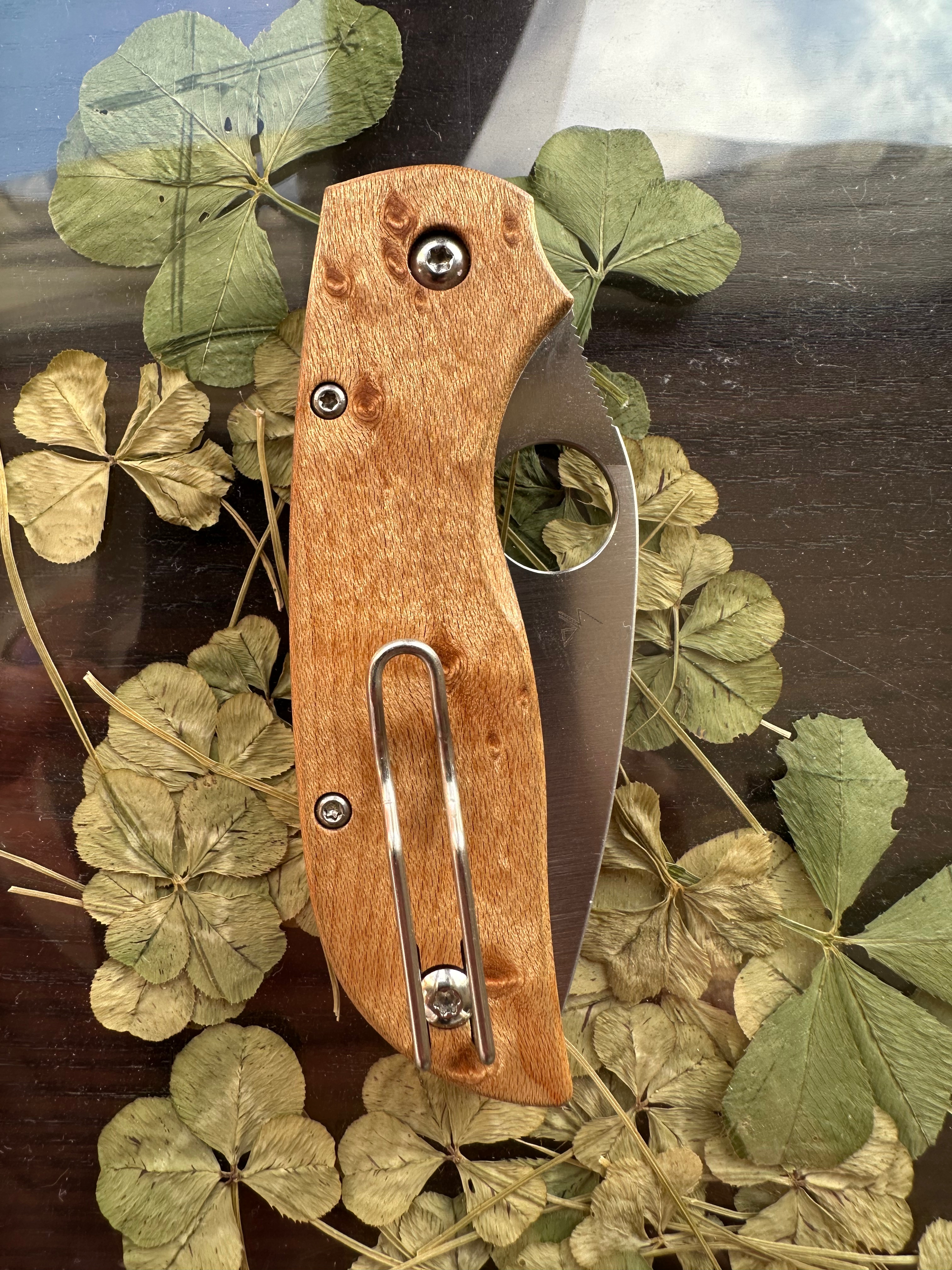
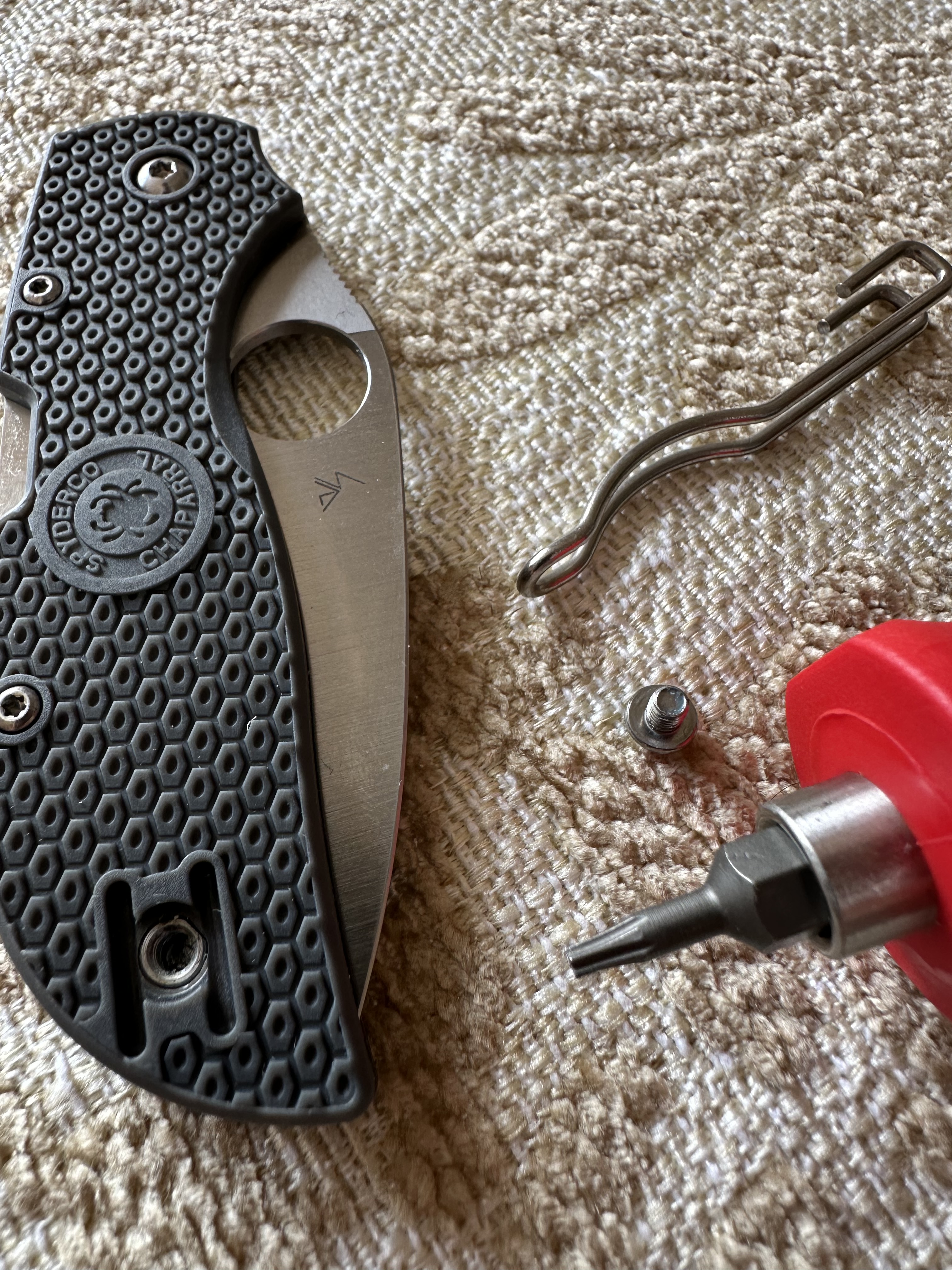
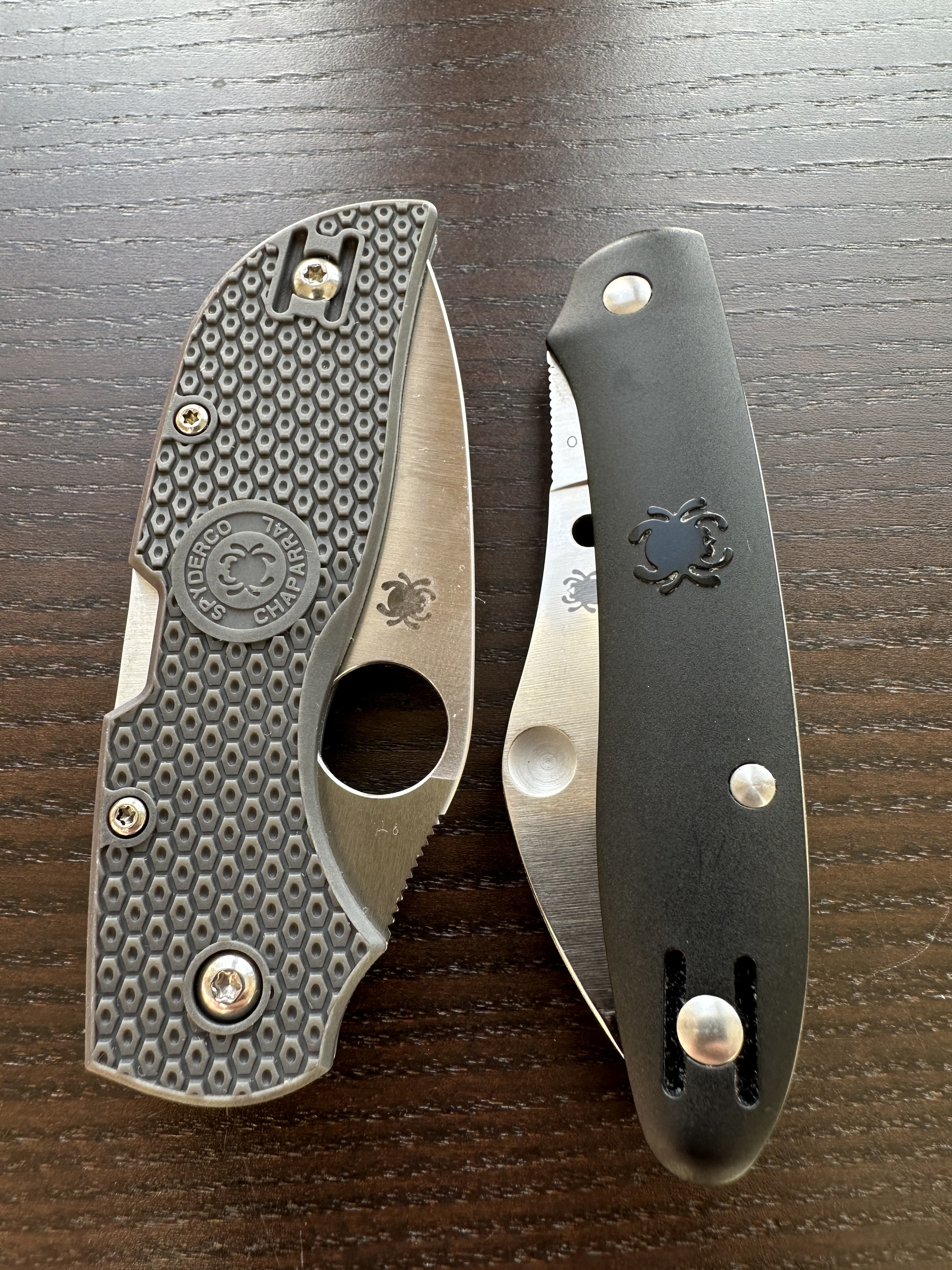
With the pocket clip removed, the Chap becomes almost invisible. It carries deep in the pocket, or even inside my keys wallet, without printing or drawing attention. Yet, once deployed, in use, it never feels inadequate. The cutting performance compensates for the modest size. Also the absence of clip makes it much comfy in my palm. It is again a sensual experience which contributes to the pleasure of useing your EDC. (I also use a smaller clip found on the Microjimbo when I need to have it clipped on my watch pocket.)
But removing the pocket clip takes about two minutes—just one screw— and requires no modification. Immediately turns the Chaparral SlipIt into a deep-carry in the bottom of the pockets, ultra-discreet folder civilian and refined as a beautiful object, not a thug favorite guillotine.
If you need a knife that stays well within legal boundaries, carries unnoticed, and still delivers real cutting capability, the Clipless Chaparral SlipIt is a smart, elegant, technically sound choice.
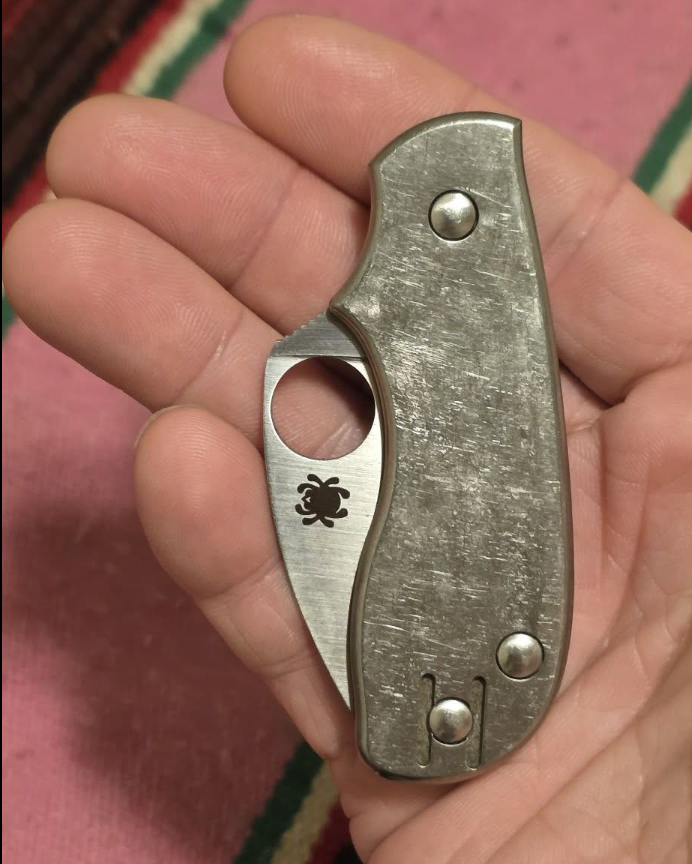
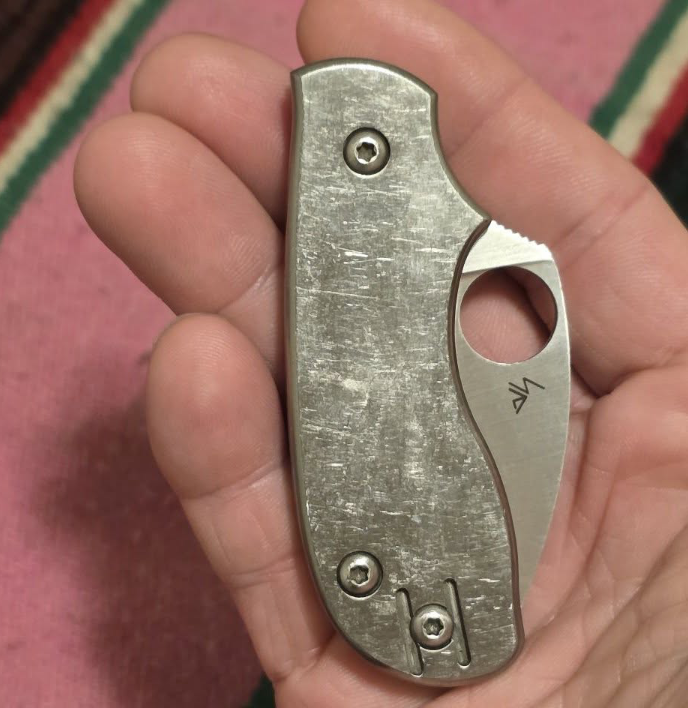
Edit: And if you’re worried about scratches, here’s a photo of a Squeak Titanium (not mine), clipless, living its best life at the very bottom of a pocket…
Keeping a titanium knife there is a bold choice—titanium (like wooden scales) is far softer than keys or coins—but it perfectly illustrates the beautility of EDC knives.
The Chaparral series is quite unique in Spyderco’s catalog. Originally designed to showcase different handle materials on the same platform, it has evolved into a performance-driven tool for one simple reason: the blade stock is exceptionally thin. That thinness means it cuts deep with minimal effort.
It is even thinner than the UKPK which is the thinnest of the SlipIt Family. (“SLIPIT®” is Spyderco’s trademark name for non-locking folding knives. These knives stay open through spring tension rather than a mechanical lock.)
2mm for the Chap and 2,5 for the UKPK.
I’ve owned the original carbon fiber version, and earlier this year I reviewed the Lightweight serrated model — still one of the most efficient “matter separators” you can carry in your pocket. Now, thanks to the Spyderco Ambassador Program, I’ve had the great opportunity to test the Slipjoint Chaparral.
It’s worth pointing out that the Chaparral is far from an entry-level model. It’s the premium, Taiwanese-built sibling in the SlipIt family — and at about twice the price of most SlipIt knives, it clearly plays in a higher class.
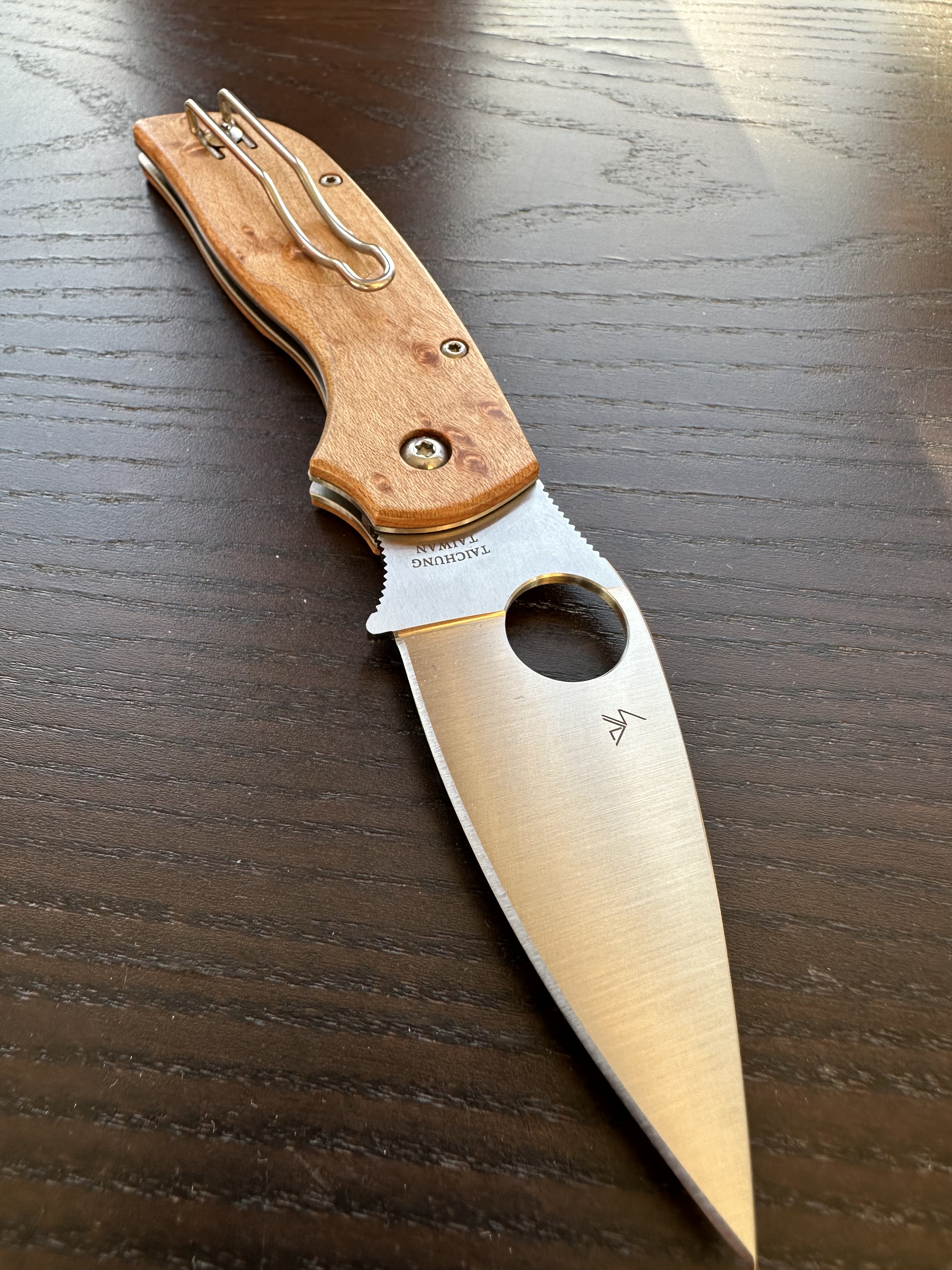
And this is an eye candy:
You can notice that Spyderco even includes a transparent protector over the clip area to prevent the handle from the clip during transport.
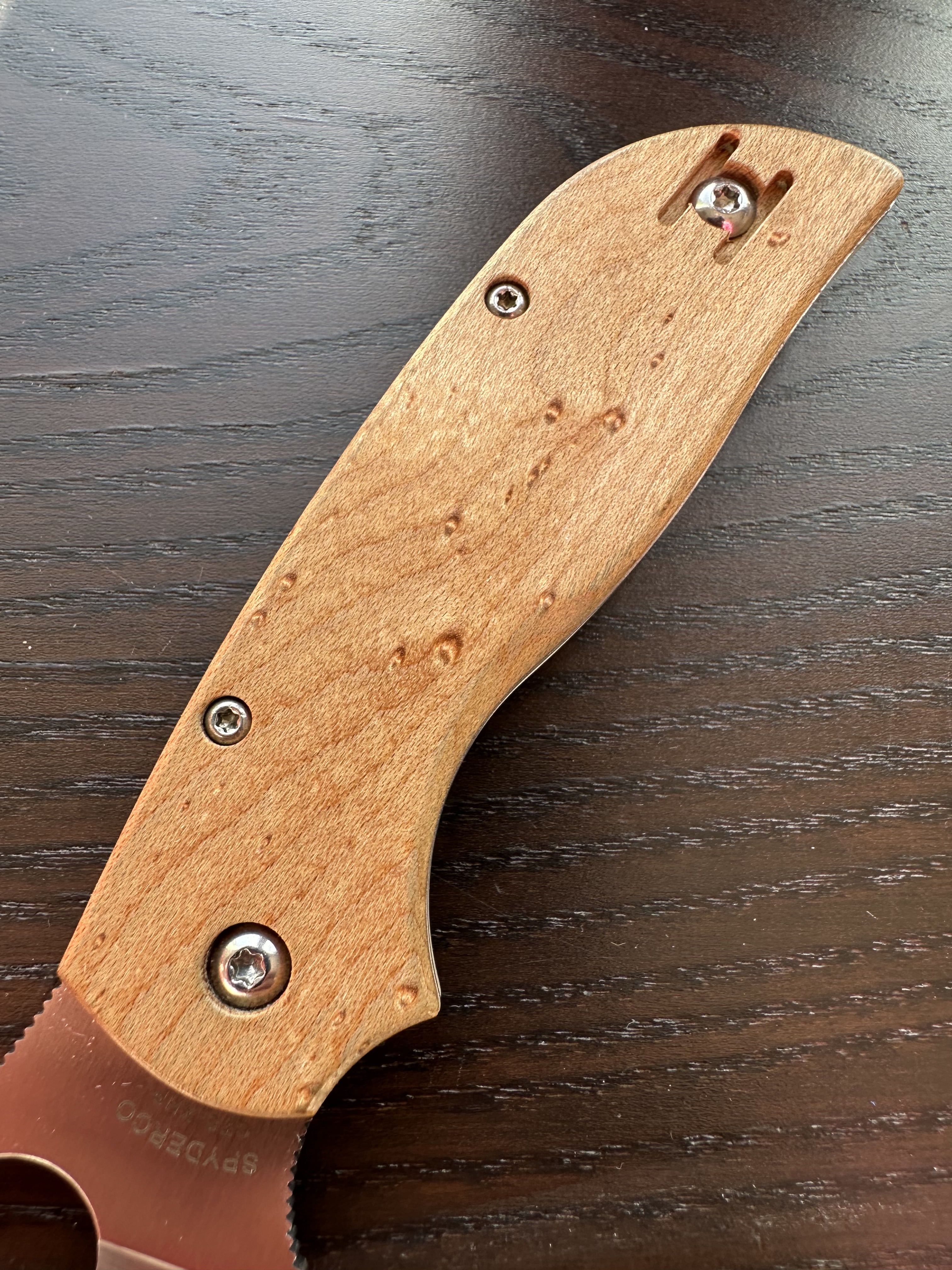
The knife arrived sealed in a plastic bag, likely to protect the wooden handles from changes in humidity. Made in Taichung, Taiwan, and shipped to Golden, Colorado, this precaution makes perfect sense — Golden’s dry climate has been known to affect wood scales before (as seen with their Bushcraft fixed blade). The handles themselves are beautiful. Carrying a piece of wood in your pocket almost feels like carrying a good luck charm.
This is my first Spyderco folder with wooden scales, and I must say — it has real charm.
The knife comes with Spyderco’s standard wire clip, but I have swapped it out for the shorter clip used on the MicroJimbo, Lil’ Native, or Dragonfly — it’s more discreet and I wanted to do it before leaving any mark on the wood.
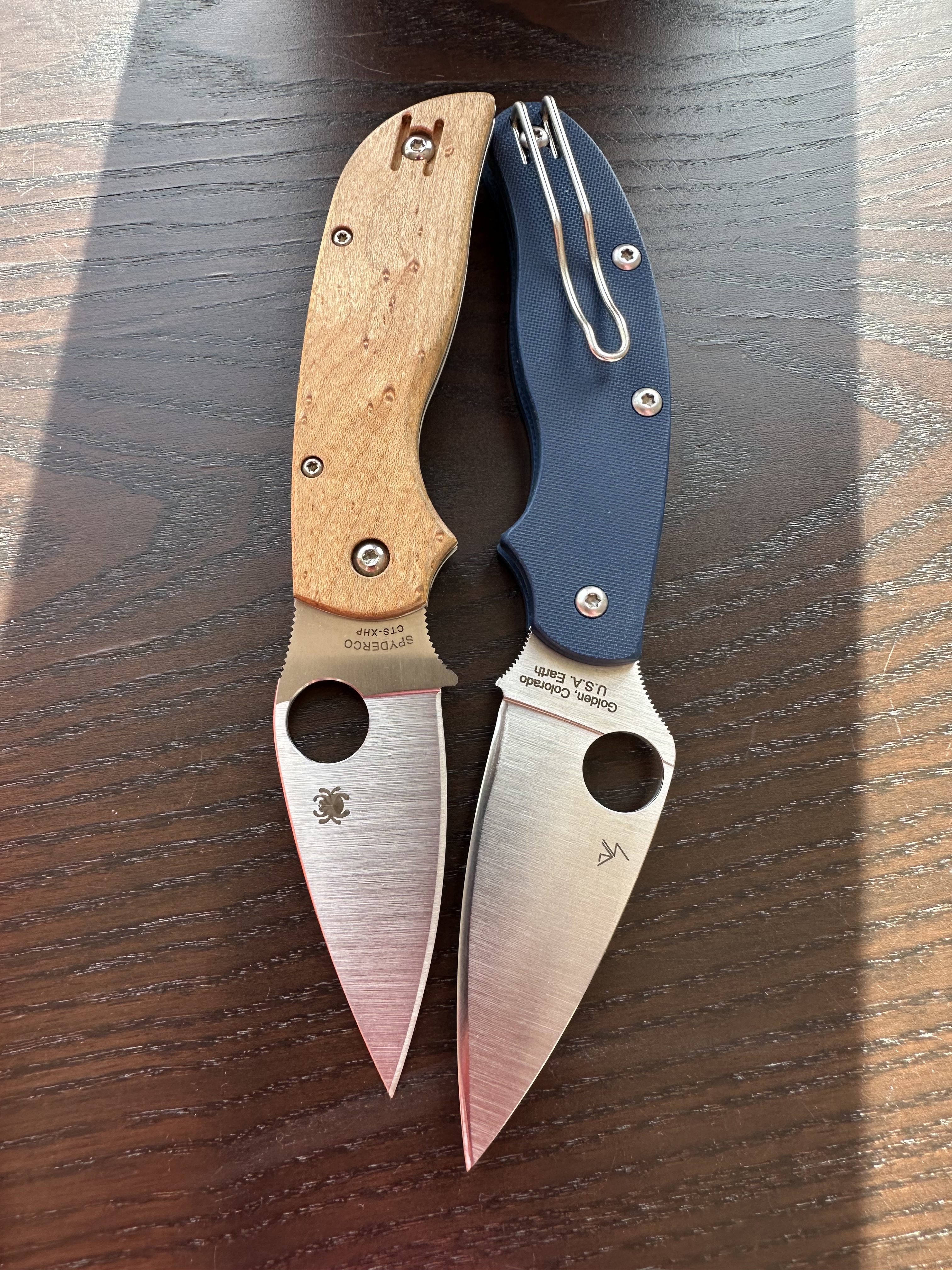
Here pictured with the Metropolitan and with the microclip mounted on. A downside of the wire clip is that it can create a “hotspot”, or point of discomfort, when applying significant pressure. That’s why I prefer that shorter clip cannibalized from another folder — it helps avoid this issue. When doing extended wood prep or cutting in the field, where downward force is applied, ergonomics really matter.
BTW the Metropolitan pictured above costs about half the price of the Chaparral, and while both fall into the same blade-length category, the Met’s blade is roughly 33% thicker. The Metropolitan’s M398 blade is impressive when it comes to edge retention, but the CTS-XHP used on the Chaparral has proven to be a reliable, all-terrain stainless steel that performs beautifully on that exceptionally thin blade stock. An M398 blade at just 2 mm thick would certainly be too brittle for practical use.
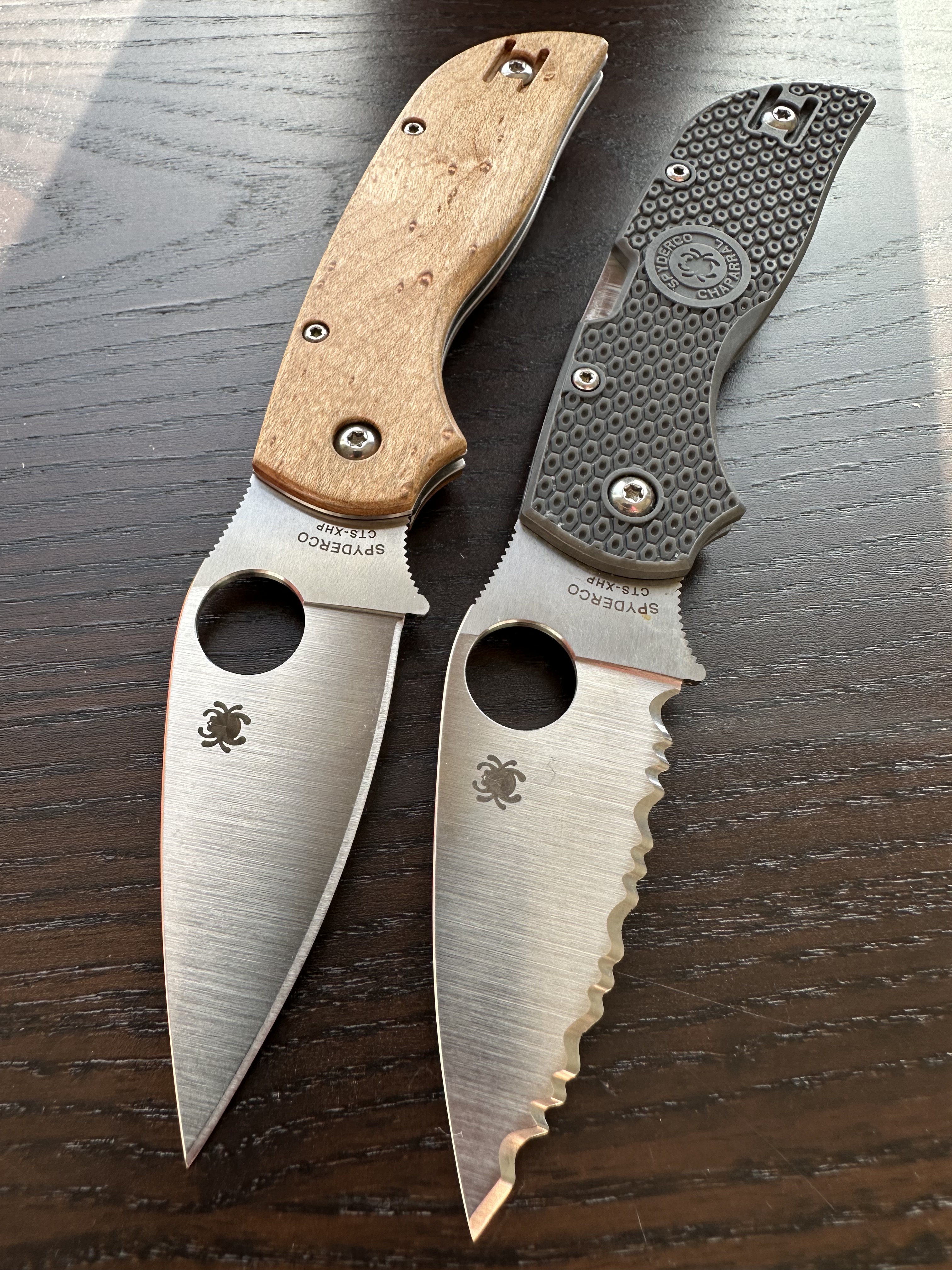
Here is the Chap pictured with the MicroJimbo, the UKPK, the Serrated Chap, the Wasp and the Roadie XL.
Now, about the mechanics: The Chaparral SLIPIT specifically replaces the usual Chaparral’s back-lock with this “notch-joint” spring system. The Chaparral backlock is also unique in the Spyderco catalog as it get an hidden pin for zero vertical play . Most Spyderco slipjoints close in two stages — first, disengaging the spring tension, then a mid-stop for safety. Not the Chaparral. Once you disengage the spring, the blade flows smoothly all the way to the closed position. (Compare that to the Manly Wasp (pictured in orange) or Comrade, which both have four distinct steps!) That said, disengaging the blade on the Chaparral requires a bit of effort — which is actually a good thing, especially for whittling. Feeling a blade start to close while it’s wedged in wood is never pleasant. I’ve had that experience with the beautiful COBOL, and it’s not something I’d want to repeat. Compared to other SlipIt models, the Chaparral is not in the same range of spring tension. I was initially afraid the action might feel too soft. It is not soft but noticeably less hard than my UKPK, Urban, Squeak or Metropolitan. My strongest being my Heinnie G10 Urban.
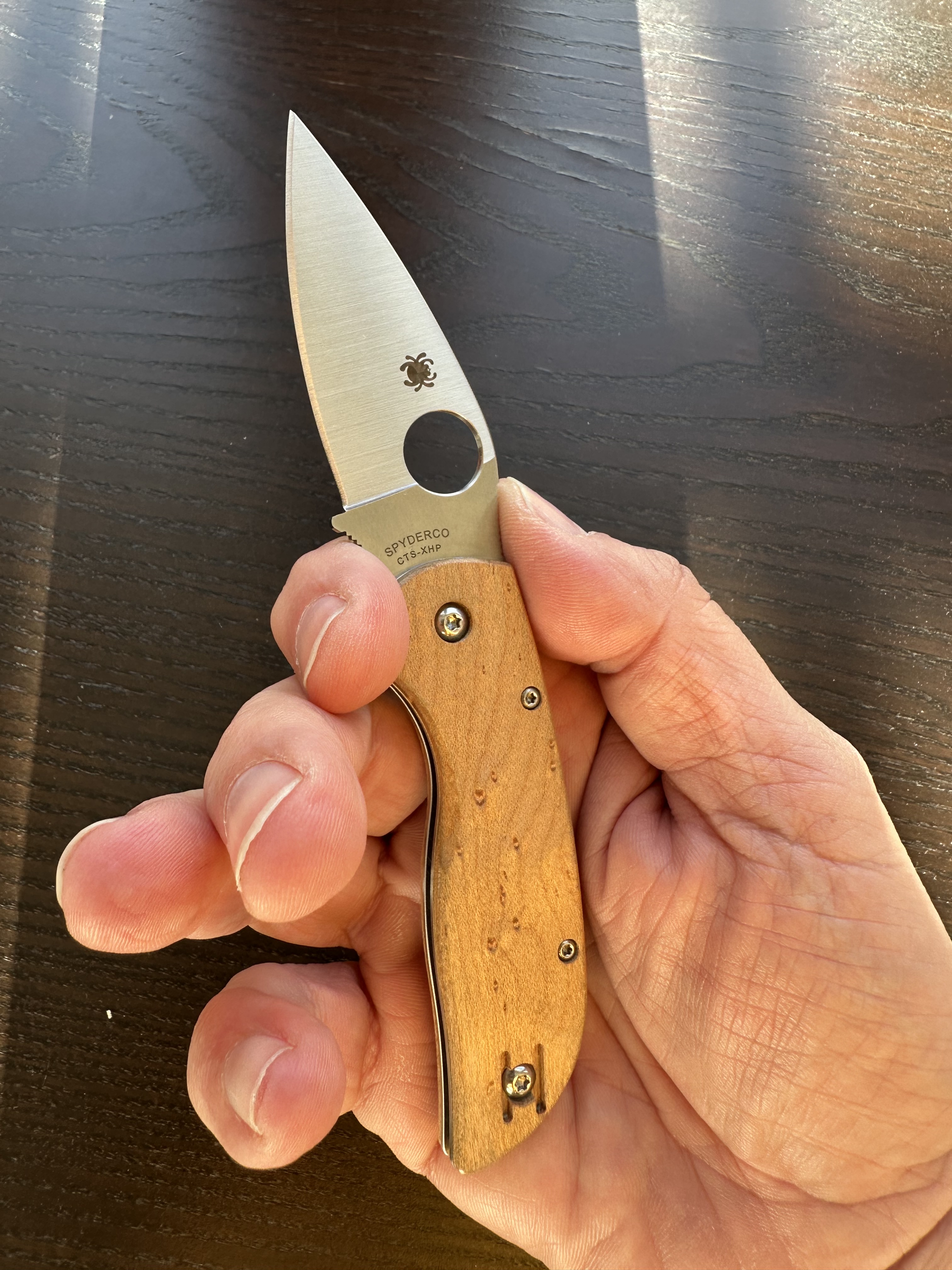
All in all, the Chaparral is a very capable tool — not just a pretty face. While its aesthetics are undeniably strong (especially with those bird’s-eye maple scales), some users have raised concerns about the stability and durability of the wood in moist or wet environments. Naturally, a wooden handle requires a bit of care — you don’t want to let it soak in the sink. (Buy a UKPK Salt instead !) Wood isn’t G10 or FRN; its warmth and character come at a small cost in terms of maintenance and environmental sensitivity. If you need something very rugged (wet/humid environments, rough carry), it might not be the best choice or you might pick a version with more durable scales.
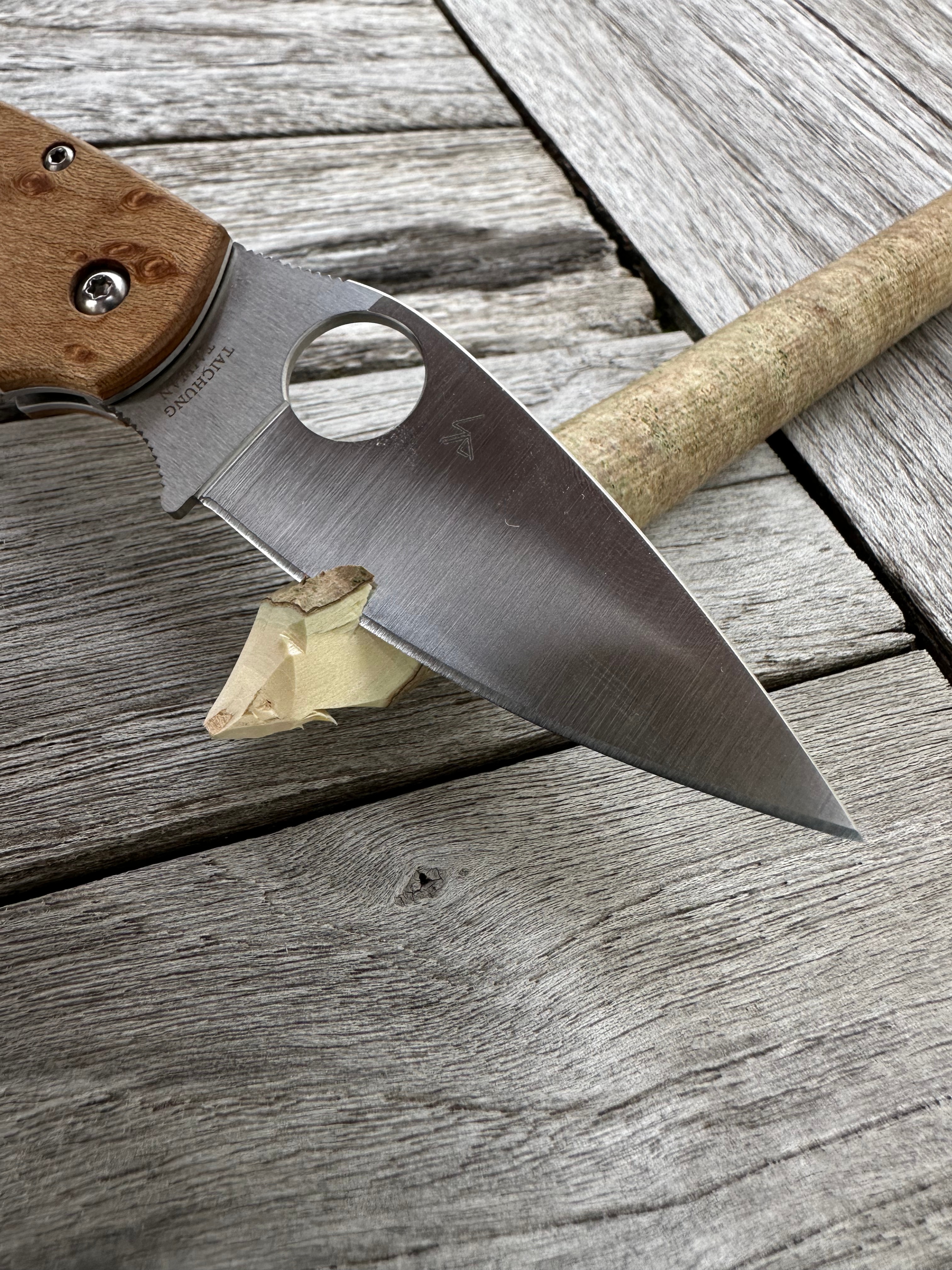
And again, that blade stock is so super thin which makes it an incredible slicer. Opinel class ! You need to experience it to believe it. That’s the case for all Chaparral anyway, nothing new about that.
The fit and finish is near perfect. Notice how the spine and handle are gently bevelled as always with Taichung’s ! This is little folder for users who prioritize slicing performance, sharpness, and elegance, the Chaparral SLIPIT is just appropriate for EDC/“gentleman, lady” use. The non-locking SLIPIT mechanism is suited for jurisdictions (including Europe/UK) where locking blades may be restricted — that adds to its appeal. If you want also a knife that carries lightly, looks premium, and doesn’t feel like a bulky tactical folder, this hits that niche. But you may want to treat its maple scales carefully and avoid heavy moisture. I will rinse my Chap under the tap but immediately wipe it dry, this is as simple as that. I will see if wood will change on the long run and it will surely add some character. No worry. The non-locking SLIPIT mechanism may not feel as secure as a lock-back, and the “no half-stop” means the feel is really different that other SlipIt designed by Sal Glesser. Anyway any Chaparral will teach you a lesson on the importance of grind and thin geometry but this one will keep it legal in many countries.
If you’re seeking a precise, elegant everyday-carry folder with top-tier steel, superb slicing geometry, refined looks and minimal pocket presence — the Chaparral SLIPIT delivers strongly. Oh boy does it slice, hell yes. And it brings luck.
This is not the first UKPK I have reviewed in this blog. I was a very early adopter of this Sal Glesser’s approach of the modern slipjoint all made in Golden Colorado. Some of my favorite are the Salt Versions in FRN: the Green LC200N and the Yellow CPM Magnacut. I even think, the serrated version of the Magnacut version could be an amazing legal travelling knife.
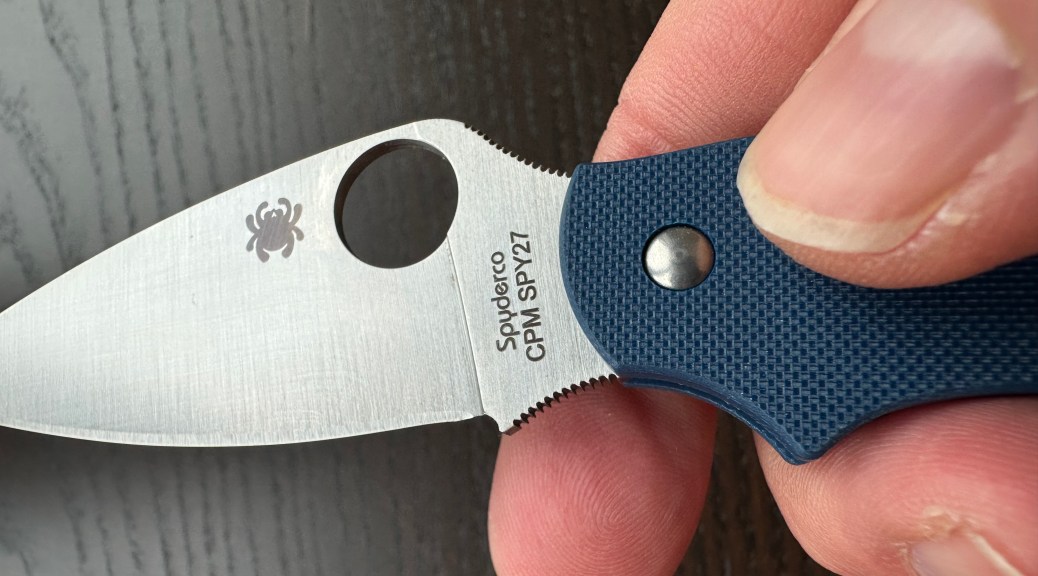
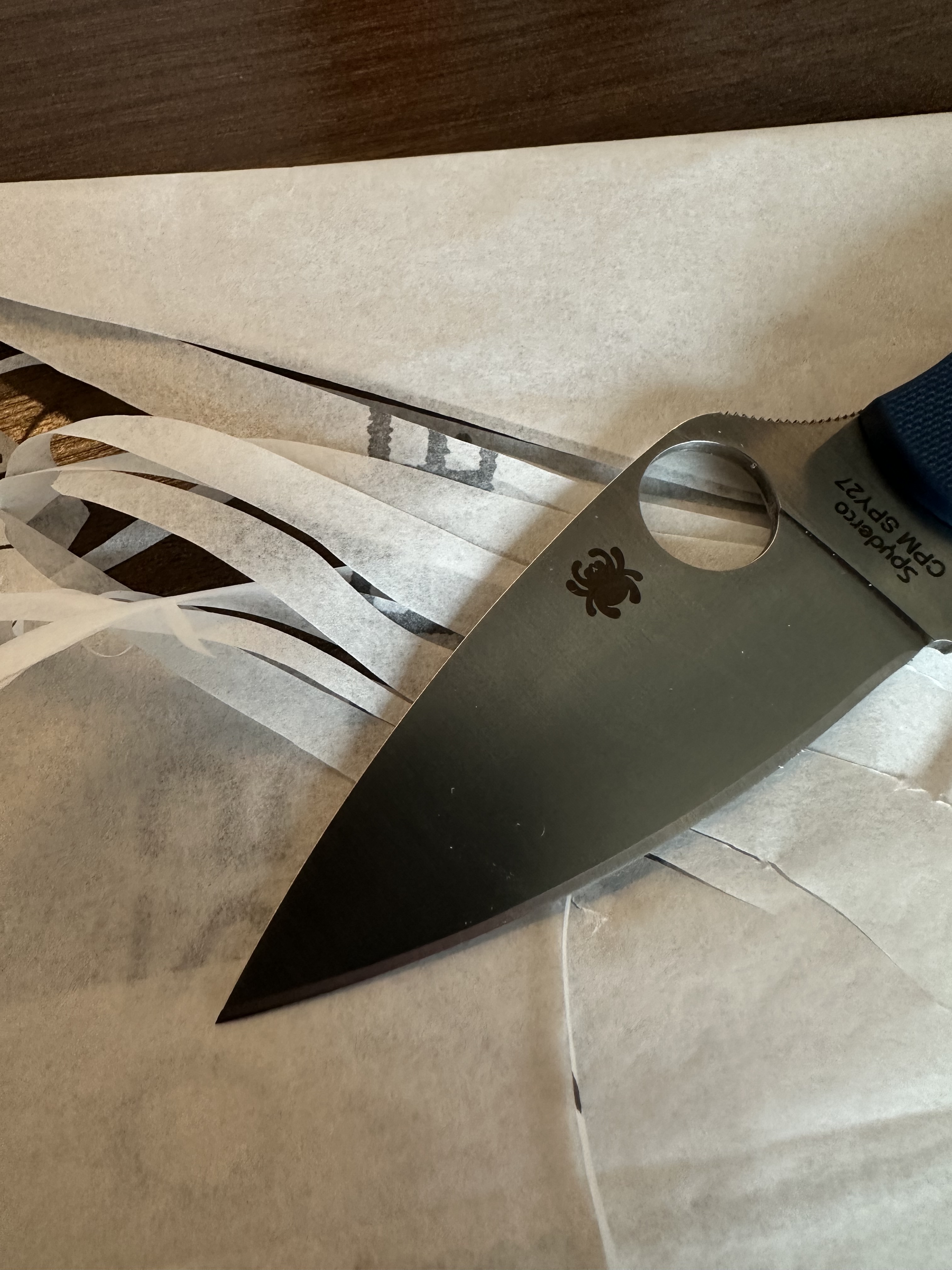
But they are FRN versions. I like FRN but I do love G10. Better, I’m a sucker for sanded G-10. Hence my love for the Heinnie Urban and its non-slip peel-ply texture. At first glance the satin-finished CPM SPY27 blade and signature cobalt blue peel-plytextured G-10 handle scales are juste gorgeous. Here are the full specs on Spyderco’s pages.
Like the Heinnie the skip joint got a strong mechanism. It is really a pleasure to feel this resistance which was totally absent from the very first drop point UKPK a decade ago. (Picture from Mr Blonde, Spydercollector site)
So far, I cannot imagine my self opening it with a flick like I was able to do on the LC200N FRN version. The Spring here on this G10 version is much stronger.
Let’s do some size comparaison. The UKPK is one of the long Slipit in Spyderco’s collection. It is almost a slipjoint Caly, even longer than a Chaparral. So you really don’t feel “underknifed” when you carry it in your pocket as your only EDC. It is also really handy and practical as a kitchen knife. The best thing is that this design keeps its blade length legal in most countries.
The long leaf shaped blade is a must in the kitchen almost idea. It is pointy enough and its is enough for vegetables. Most of the works done in the kitchen like peeling potatoes, cutting oinions, you name it, was always done with a short full flat ground knife like a “Nogent Couteau d’Office”.
Something about the G-10 version is the spring/back spacer closing the handle of the knife when the FRN got an open handle easier to rinse. But it is much more gorgeous and with a stronger spring for sure !
It also gives a little more heft to the knife. 48 grams for the FRN and 63 grams for the G10 version -> 31,25% heavier to be precise, almost a third ! But I do really love my heavy butt knives since my Schrade Sharpfinger.
Now this is my first CPM-SPY27 knife. Spy27 is a alloy recipe created in house with Crucible exclusively for Spyderco. It is a CPM ! So this is a premium super steel compared to VG10 or N690… In short it is a American Powder Metallurgy version of the Japanese VG10.
In Sal Glesser words: “We offer many steels for several reasons; 1) We are Steel Junky’s (even Edge Junky’s) and we like to experience the different flavors and we try to do that. 2) We believe that many of our customers are also Steel Junky’s (even Edge Junky’s) and they too get to experience and play with and “taste” as you say, the many options.
I wanted a USA made “tweaked” version of Gingami 1 by Hitachi and after some effort with Carpenter, we have a powdered USA made steel called CTS-BD1N Which is a refinement of Gingami 1. I wanted a USA made “tweaked” version of Takefu’s VG-10 and now we have a powdered “tweaked” SPY27.“
“However, it should be noted that the SPY 27 Larrin used for testing was not heat treated by Spyderco. Some minor differences between Larrin’s heat treatment and Spyderco’s heat treatment can probably be expected. That being said, Larrin is the best source of consistent, objective data and metallurgical interpretation for steel comparisons.” To quote Karl_H in https://forum.spyderco.com/viewtopic.php?t=87383
“SPY-27 will hold the fine edge longer… Its all about the stability of the fine edge, not the total wear resistance until fully dull. In this regard, SPY-27 can do what other stainless steels cant.” to quote Submicron in the same thread.
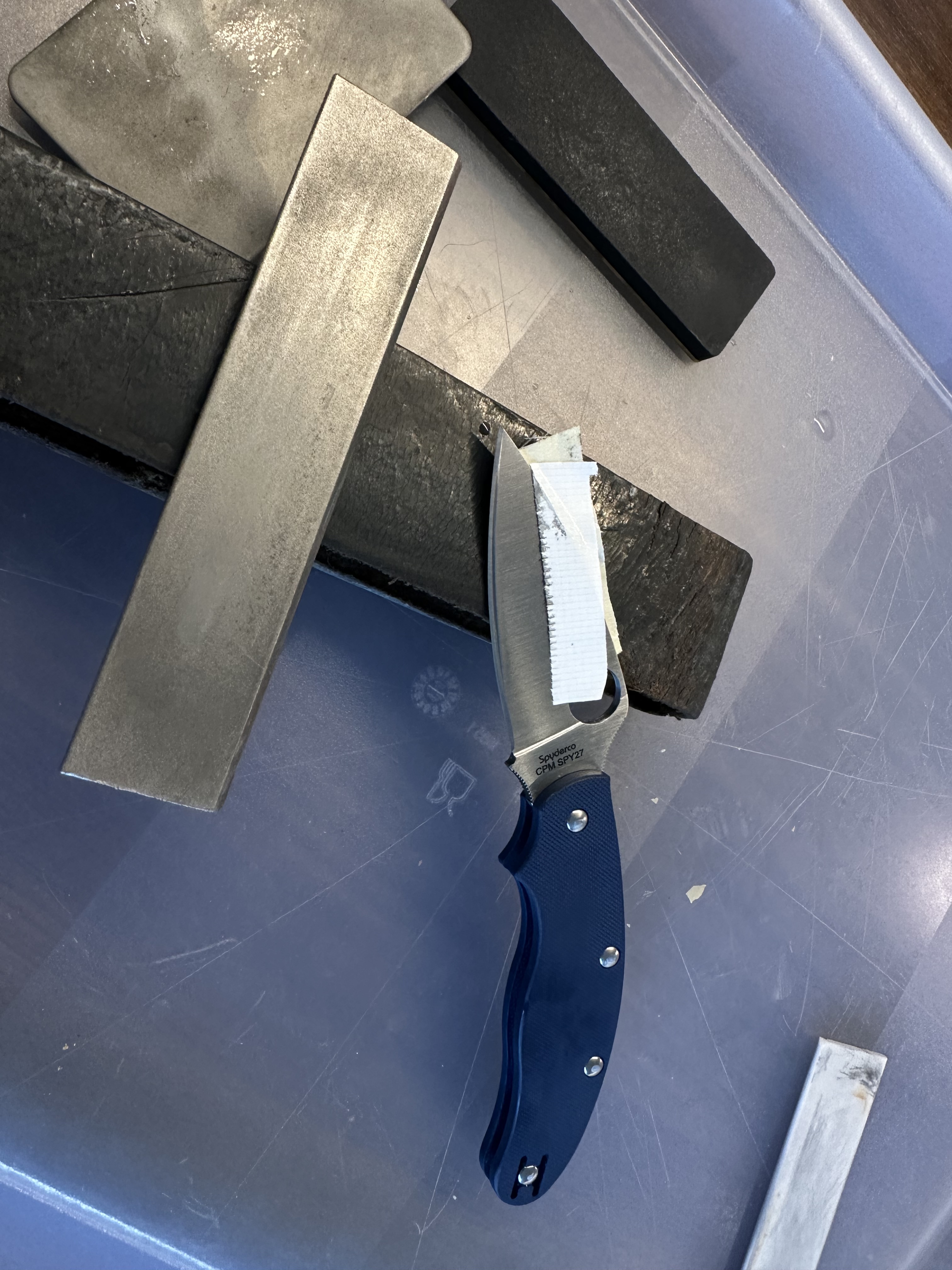
I am aware that Cobalt’s dust can be an health issue. Of course Rex 45 and Maxamet (10% of cobalt, 1,5% for SPY27) are the heavy weight steel in their tool steel category but the Spy27 (like VG-10), like all cobalt alloys needs to be carefully cleaned after a sharpening process. (Cobalt may cause an asthma-like allergy. Future exposure can cause asthma attacks with shortness of breath, wheezing, cough, and/or chest tightness. * Cobalt may affect the heart, thyroid, liver and kidneys. * Repeated exposure to Cobalt dust can cause scarring of the lungs (fibrosis) even if no symptoms are noticed. According to https://nj.gov/health/eoh/rtkweb/documents/fs/0520.pdf)
Let say SPY-27 is in the same club as the S35VN steels in terms of performance and it especially loves fine ceramic and leather stropping. It gets easily a very crispy edge like VG10 or BD1N . ( Steel which are “leather super friendly” are also LC200N, 52100, VG10, AEB-L… ) This is a must and a real pleasure for me as I keep my knives sharp mostly with leather. A touch up and it makes flying hairs from my arm again. And it seems true so far. I have not deshouldered the edge yet and intend to use it with the factory edge for some times but leather made it hair popping sharp. (Once deshouldered it is a straight razor with excellent edge retention… much better than S30V). To quote Sal: “SPY27 for some reason, seems to be punching above its weight.”
No crossroads, this Blue Djinn loves leather like the Bill Moran FB01 in VG10 loved it.
No need to use diamonds unless you want to reprofile the blade or round the shoulder then don’t forget to rinse the blade and to clean any dust. But talking about dangerous dust, I have sanded the scales to preserve my pockets. Never breath that dust !!! Do it under water or wear a mask. I got a neighbor who has been working around that kind of heavy dust and now he is breathing with two tubes in his nostrils. So be careful with your health. This Blue G10 got a very nice texture under the thumb like some denim, textil like. It is really pleasant, almost like some Micarta found on the QSP Penguin.
So when you sand G10, just go outside in the wind or work under water. You don’t want to breath G10 dust made of fiberglass and epoxy. Just rinse it under the tap to have it back to normal. Once tuned at your hand, G10 is a very very nice material.
As you can notice the scales are even thicket than the blade and the blade is perfectly centered.
There is the famous middle/half stop when closing or opening the knife. It works like a safety measure. This knife is harder to close than to open.
The UKPK is a very ergonomic knife. It feels like it melt in the hand. It is so confortable for heavy cuts. Because this blade can work hard with zero play.
The “pistol grip” is common in many Sal Glesser design like the Endura or the Military. It is much more pronounced on the Massad Ayoob.
No hotspots for me a very safe handle, really, this lil slipjoint is screaming to be used hard.
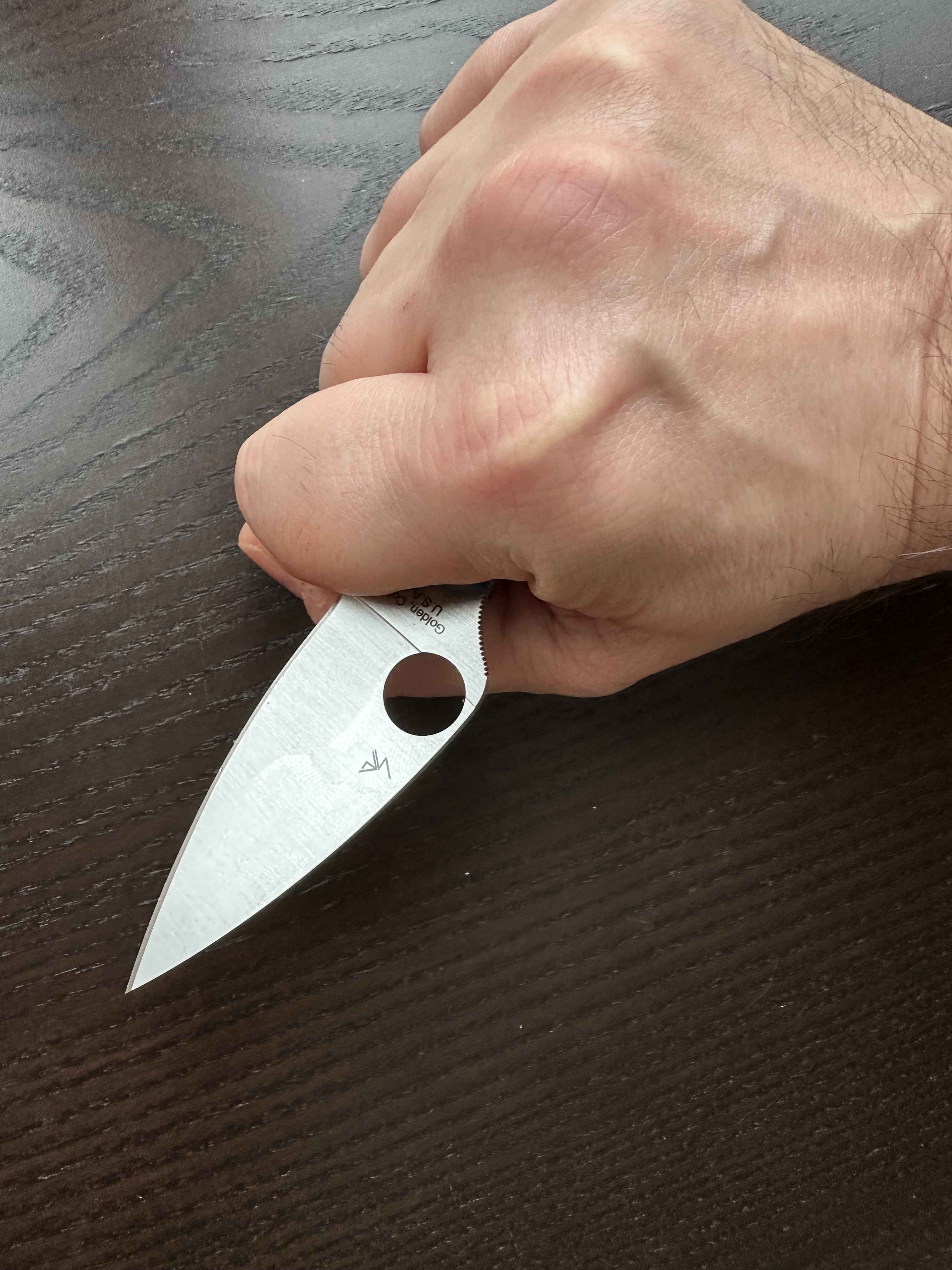
It is even confortable edge up.
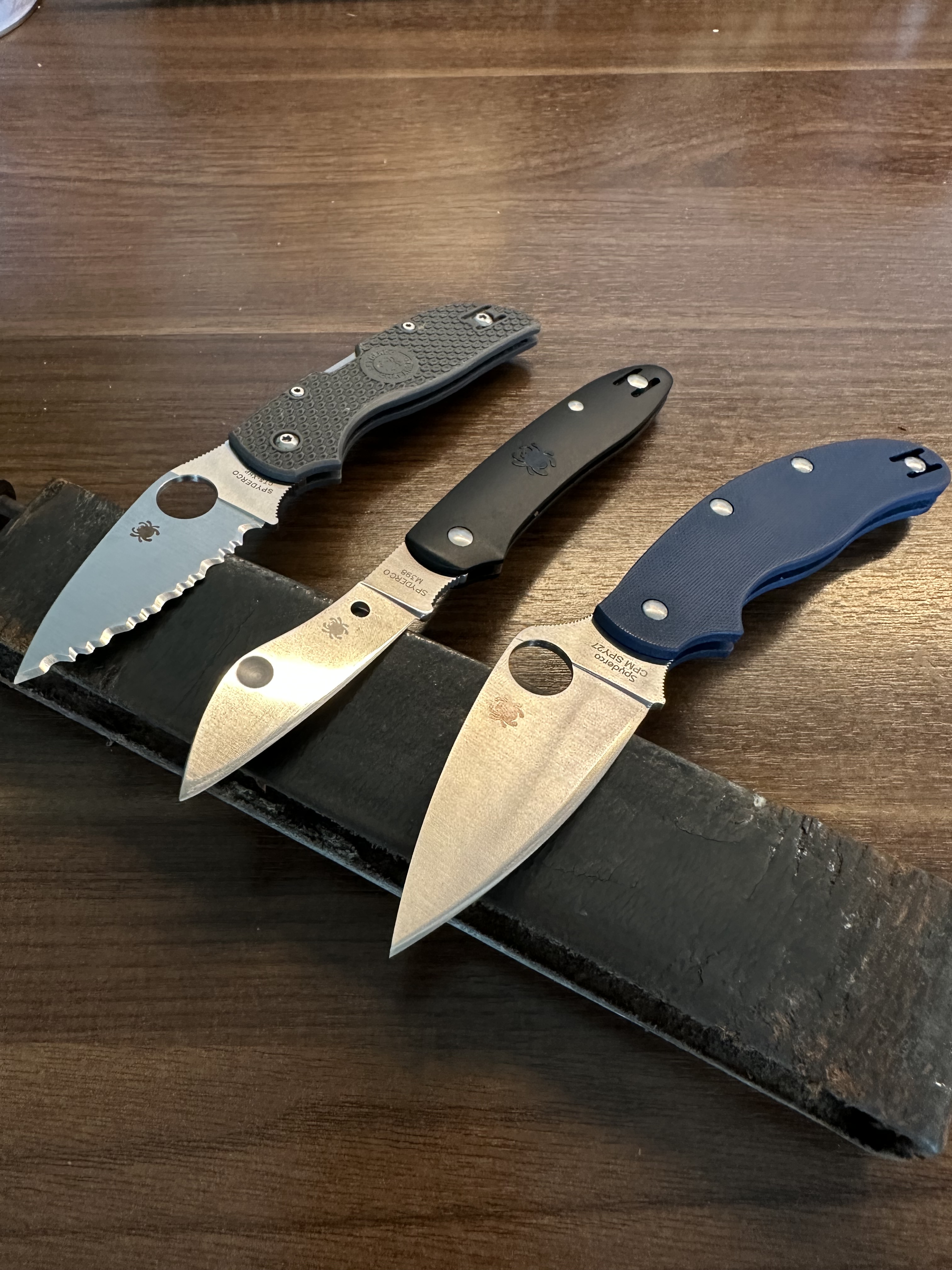
With the Roadie XL. Another great Slipit with a very low profile, almost like a pen in your shirt pocket.
And the mighty Chaparral serrated. Two of Sal’s best designs. Two wolves in sheep disguise thanks to their thin solid blades.
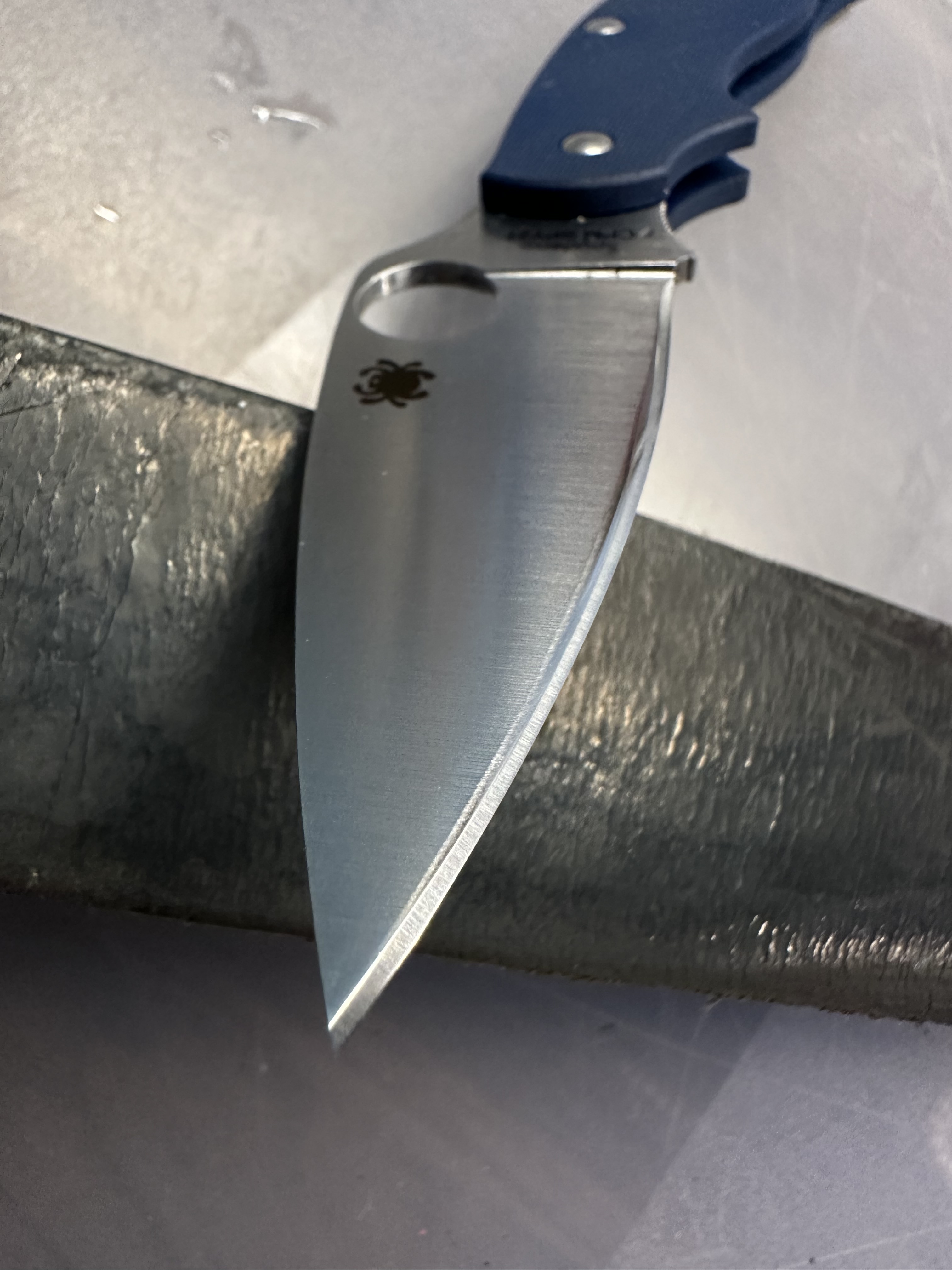
I have decided to de-shoulder the edge for a gentle convex result in the middle of the belly.
My old leather with some polish compound is ready again to smooth the edge to razor level.
Because I want a better touch on the leather, I usually keep the normal edge at the point to keep material there and near the ricasso as I use this portion for special shores like removing the aluminium cap on bottles.
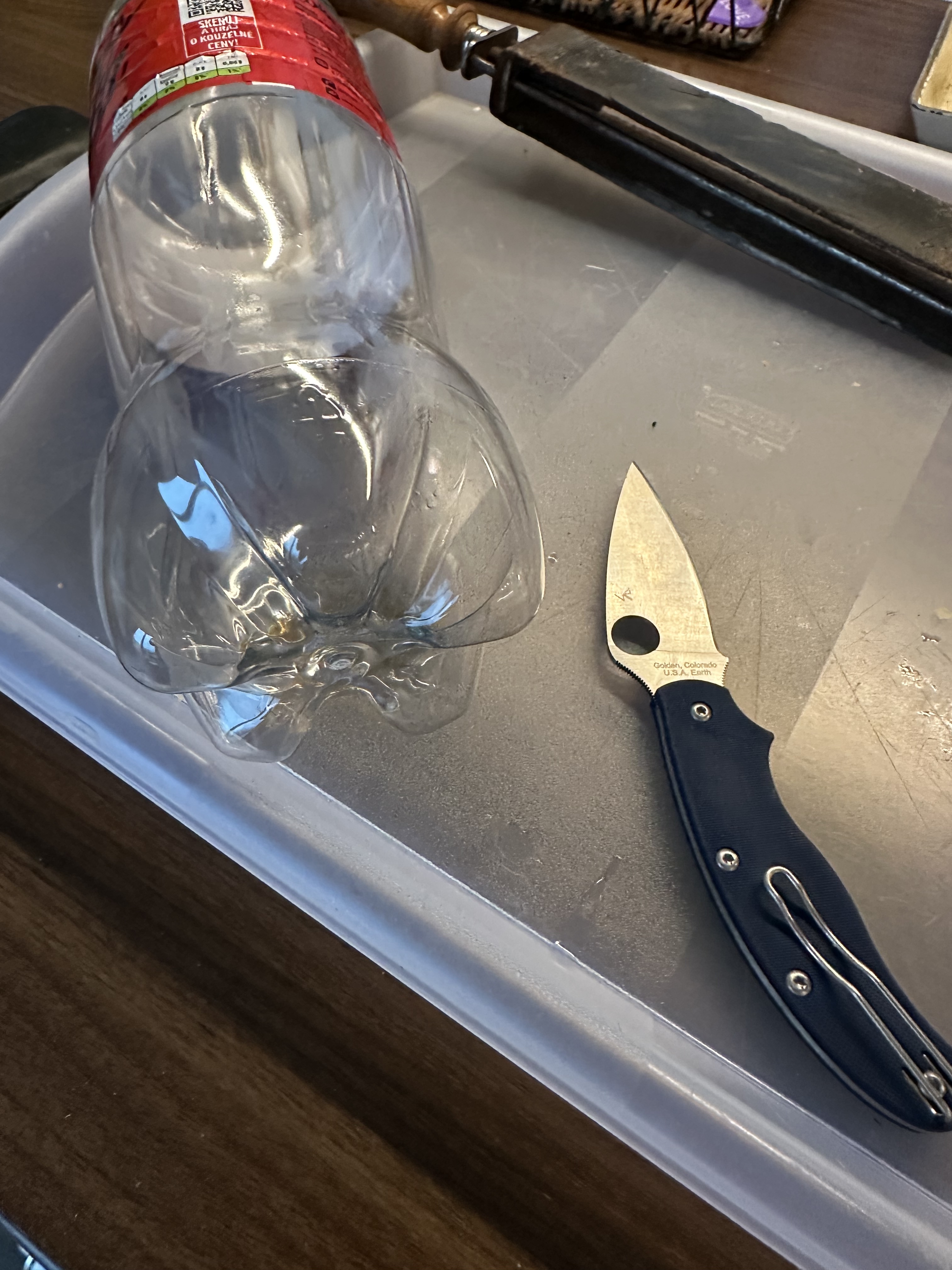
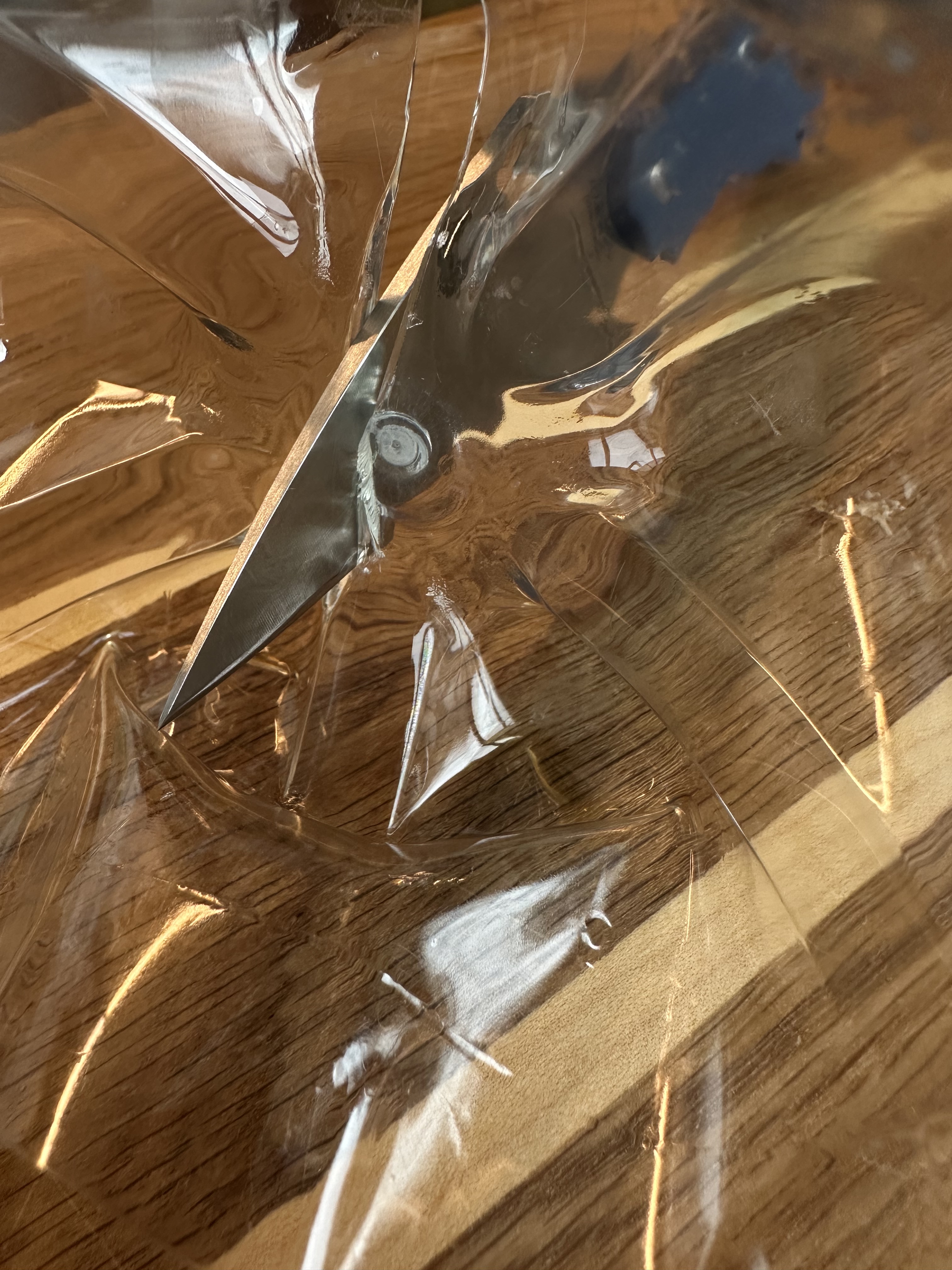
The Coke Bottle Butt test is passed with flying colors. As you can notice the plastic is 3mm thick. Not a single scratch on the blade.
So what do we got so far ? A master piece of knife design by monsieur Sal Glesser with a strong construction and state of the art in-house alloy serving a thin blade and an ergonomic handle. My advice: try to grab one before they disappear, it seems that G10 version is not here to last and it is really a sapphire: a true blue jewel !
I’ve been an early adopter of the Chaparral. Nearly 13 years ago, I called it the “Extra Flat Companion”in my first review from 2012. Back then, the Chaparral was designed to serve as a platform to test different handle materials, while the Sage (another model “made in Taichung”) showcased various lock designs used in folders.
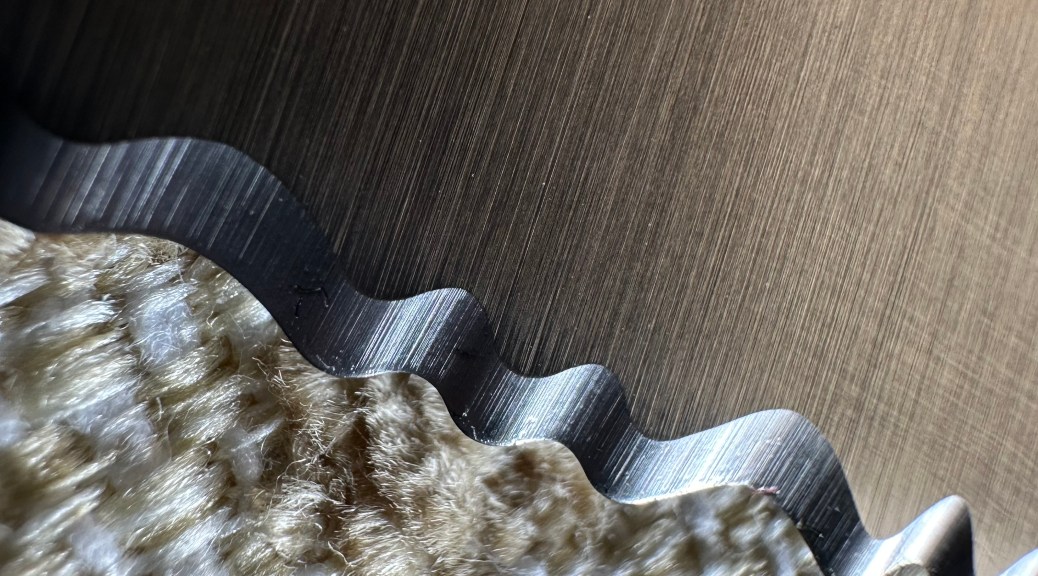
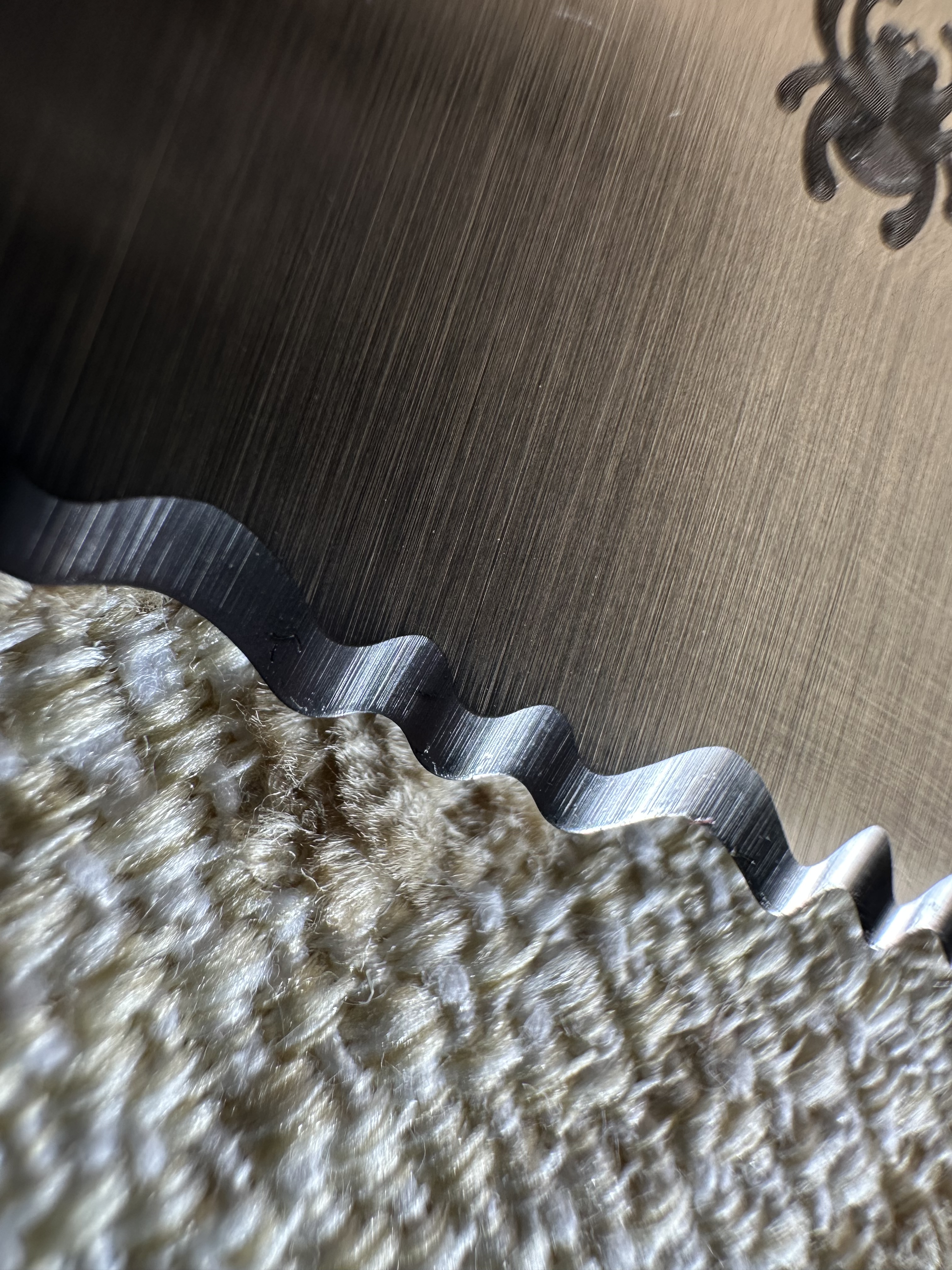
Twelve years later, Spyderco has introduced a major improvement to the Chap’s blade: their famous serrations. The brand is, of course, known for its Spyderhole, its clips, and… the performance of its serrated edges. Sal Glesser has long advocated the superior cutting performance of Spyderco’s sserrations. Scallops, moon quarters, and thin chisel geometry all work together to create the ultimate “matter separator,” making tough cutting tasks effortless.
Sal has refined his serrations into a recognized patterns and created the Spyderedge: “Spyderco’s two-step serration patterns consist of one large and two small serrations. The pattern increases the cutting edge’s surface area by up to 24%”. On the Chaparral, the serration are even better as they are rounded to avoid snagging when cutting. Those same enhanced serrations can be found on another serrated folder made in Taichung for Spyderco: the LC200N made Caribbean.
I’am not a serration’s fan. I prefer a short convexed blade like my Roadie XL to EDC but this is the opportunity to pocket a serrated knife designed to be low profile folder easily displayed in the middle of the sheeples.
The Chaparral is another Lil’ Big Knife in disguise. Go figure, his lock is equipped with an hidden pin which gives a lot of strength and stability. This improved backlock is also found on the Sage 4 but do not worry about vertical play.
Also the Chaparral’s blade is only 2 mm thick. A razor blade with serrations ? It should be interesting !
It even has teeth on its handle. The FRN scales feel almost like shark skin, which can be tough on pockets. My first step was to temporarily remove the pocket clip, then sand the scales to smooth them out.
The FRN doesn’t react as quickly as G10 when sanded. I still ended up with a slightly toothy handle, but it’s much more acceptable to me. Of course, this is a matter of personal taste — many users will appreciate the aggressive grip the pattern provides. I, however, prefer not to carry a pocket shredder anymore.
Lately, I’ve discovered that I really enjoy knives I can carry in my denim watch pocket. The Roadie XL, which I can now flick open with a wrist, is the king of that pocket and I use it hard despite its small size.
But this little “Tooth Faerie”, the Serrated Chaparral, also demands heavy use — and beware of its cutting power! Its steel, CTS-XHP, is known for being extremely reliable, even on thin edges. I’ve used it in many knives, including some Cold Steel Voyager XLs, and it never disappoints.
It will be very interesting to see how the Chaparral Light platform, equipped with a top-performance factory edge and an improved backlock, performs as a true workhorse — pushing the envelope of what the Chap’ can do. Spyderco has also just released a Slipit (non-locking) Chaparral, sold at nearly double the price of the FRN serrated version. Clearly, this one isn’t marketed as a “precious” collectible but as a pure performance tool. Spyderco has supercharged the Chaparral to be a user’s knife.
To summarize:
2 mm thick blade — this is thin !
Backlock enhanced with a hidden pin — zero vertical play !
Those are the knives I choose when going out. I prefer a 3 inches locking blade.
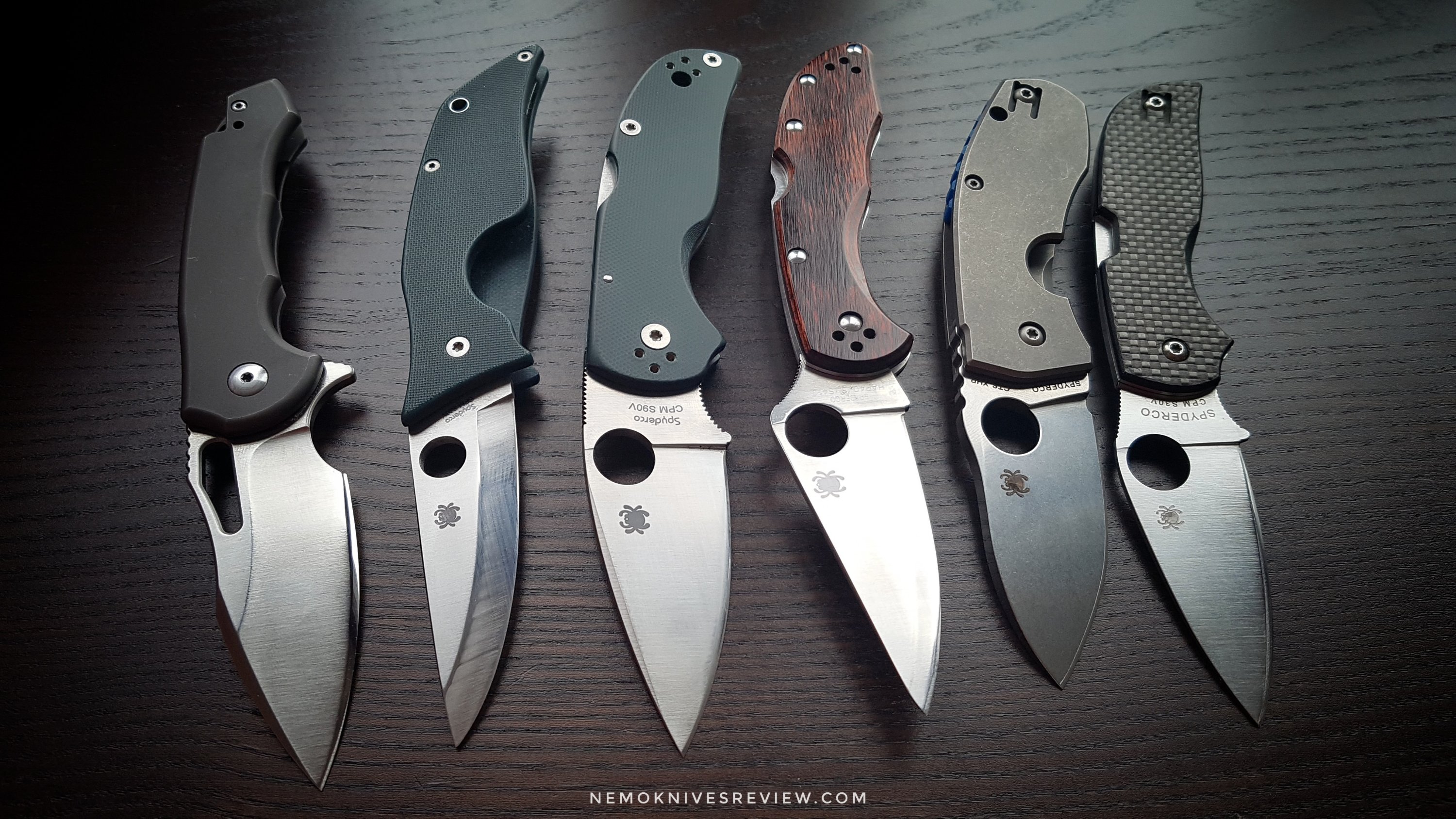
From left to right we have got: the Falcon, the Wolfspyder, the Native 5, the Delica, the Techno and the Chaparral. They are just examples of knives I have got around and which fit the purpose to carry a non threatening but useful locking knife. You could easily add the Lil’Nilakka which are the favorite EDC of JD and Pjaffre.
As far as I love my Para2 or my Sliverax, I tend to go shorter on the blade and keep the 4 inches for in-house uses unless I’m going in the woods. Also, most of the chores can be done with a 3 in blade without rising any eyebrow.
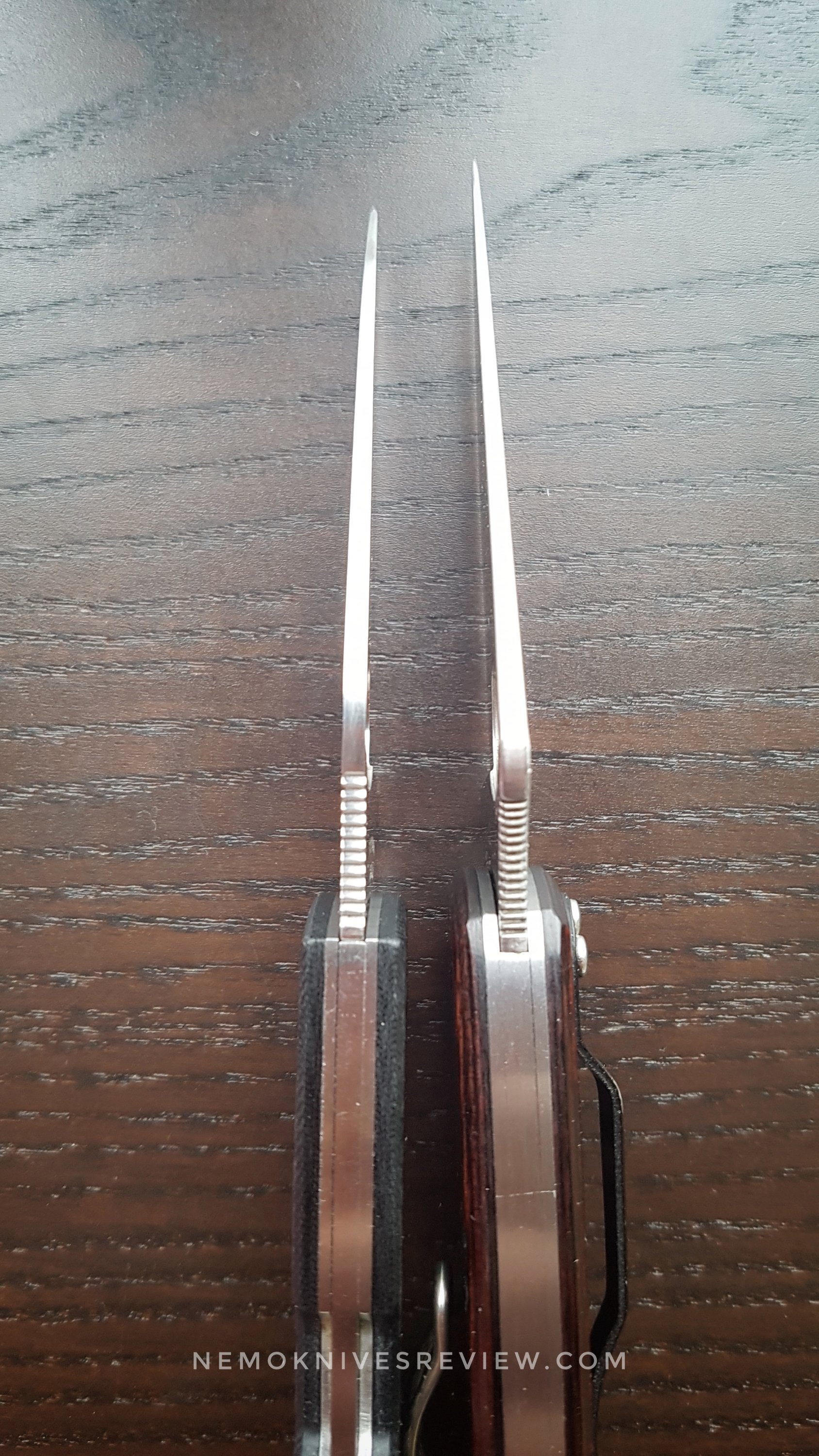
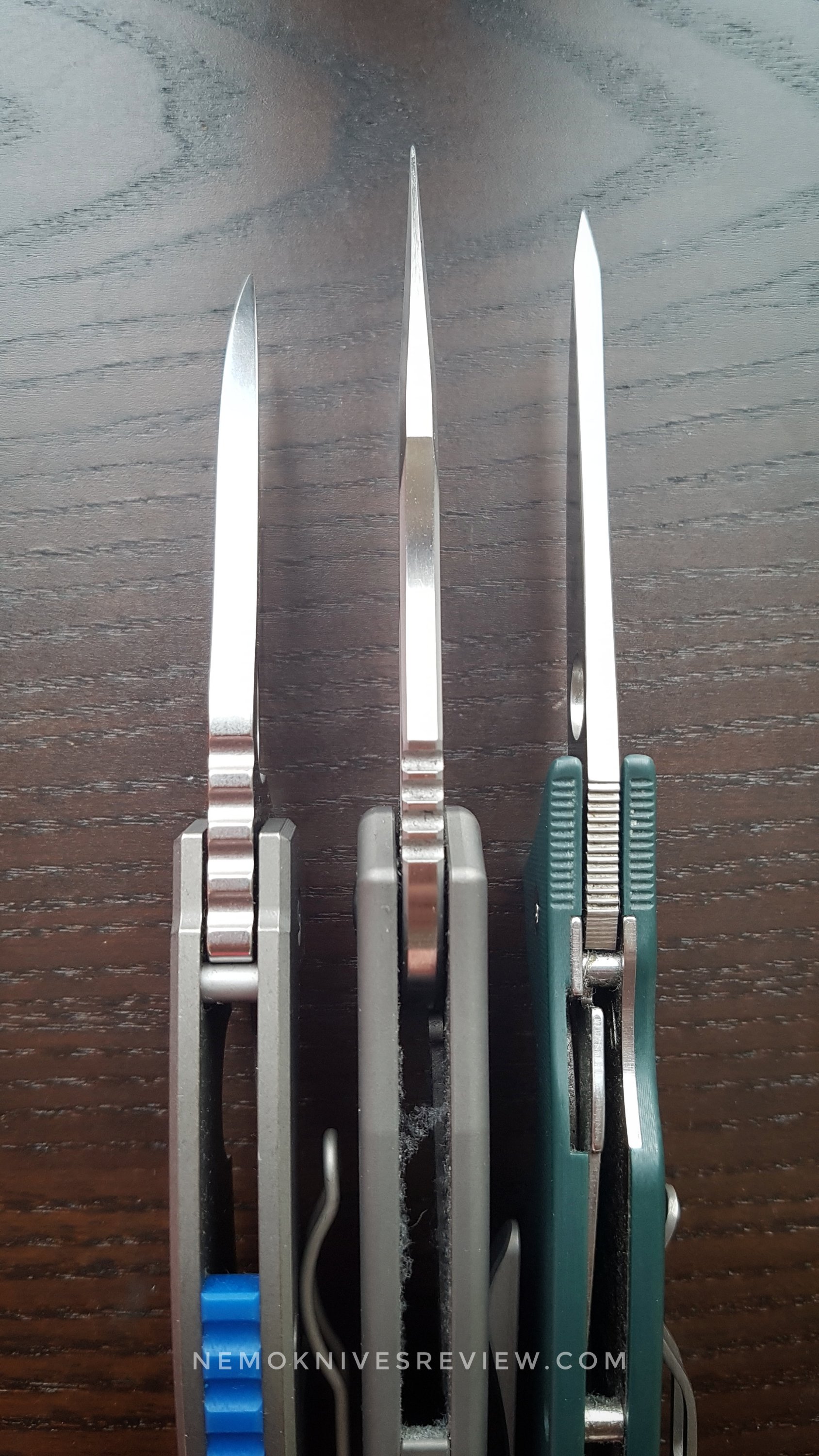
If you think to go thin in stock, the Delica and the Chaparral are the way to go. You can notice on the picture how thin the Delica goes and with the KnifeCenter special edition, your edge is made of HAP40, a steel which refuses to chip.
Lockbacks are in fashion since… the Buck110. On the three pictures, only one has got vertical play: the Delica. This tiny play is only felt when cutting on a board and won’t bother you.
The Chaparral has a hidden pin which acts as a second locking system ala Triadlock. The Native 5 has got very high tolerance and none of them I have handled has shown any play in any direction. Let say, in that matter, that the Delica although an old fashion folder with her own character, has the best thinner slicer of the bunch and her blade shape gives a lot of polyvalence. The Delica is also the only short folder I can Spyderdrop. It is made possible by the full steel spacer’s weight. Spyderdrops is the fastest way I know to have your knife ready to cut. It’s also the safest as you are holding it by the blade.
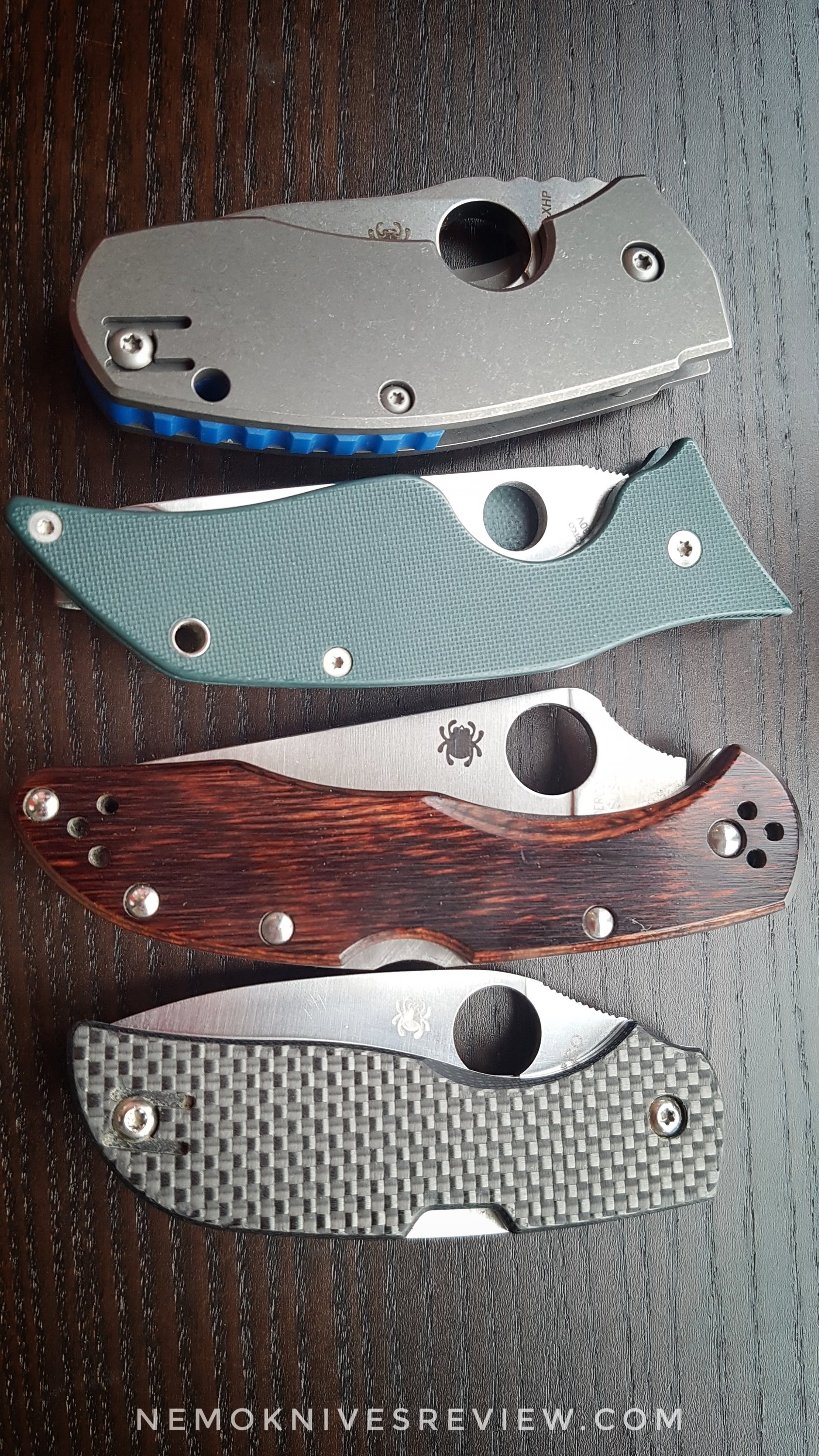
You can notice, there are a lot of materials for the handle. Titanium handle are great as they can be easily cleaned but can be scratched easily too. G10, I do love, especially thick G10 with no liners like found on that Native 5 version and the Cold Steel Recon 1 collection. Pakkawood is a new thing for me. It’s got a warm feeling and I can rinse the handle under the tap with no after-thought. Carbon Fibers (CF) are actually very resistant to abrasion. Your knife can fall and be kicked, the CF handle will not show any scars.
Now I do cut hard material by pushing with my thumb on the back of the blade. This is also why I tend to favor a thicker spine. The Techno is king in that matter, but lately I have discovered how much the Falcon and the Wolfspyder are great. What makes the Wolfspyder very special is the ease you can twist the blade in the cut thank to her lack of blade’s height.
You can notice the amount of pocket lint in the handle, giving you an hint on which knife I carry the most. You can get a lot of great locks: RIL’s, Compression Lock… The new Lil’Native offers a very small package (I think it’s the shortest of Spyderco’s with that lock nowadays) and the choil makes the blade even shorter on that design.
To have or not to have a choil ? On a very short folder, a choil can take a lot of edge off. The good old Delica shines again but the Wolfspyder and the Techno are beating her choil-wise; they both provide one of the best solid locks with the maximum edge possible. IMHO for the 3 inches folders, choils would be really important if the knives were slip joints. They are still important in my books on longer folders which are used harder, like on Millie,
Strangely short folders are often used out of their scope like a Pradel would be. Mondane chores and abuses can occured very easily. This is also a reason why I tend to choose strong locks and tips on my 3 inches folders. When it’s possible I also choose tool steels which can provide better lateral strength.
Delica: No real choil, vertical play, very thin blade, very thin spine. Bonus: spyderdrop.
Falcon: Choil, thick spine, nice belly but not deep carry clip. Bonus: great flipper.
Lil’Nilakka: No choil, deep carry clip, thin blade. Bonus: very thin geometry.
Native 5: Choil, thin spine, thin blade but not deep carry clip. Bonus: great ergonomy.
Techno: No choil, deep carry clip, thick blade and thick geometry. Bonus: built like a tank.
Chaparral: choil, deep carry and thin spine and thin blade. Bonus: idem pin lock.
Wolfspyder: no choil, thick blade, deep carry (now). Bonus: thin scandi edge.
The most eye candies would be the Native 5 and Falcon and the most surprisingly effective in cutting power would be the Lil’Nilakka and the Delica…
The easiest to carry would be the Chaparral which is the thinnest of the bunch.
That said my best pick for hard workers would be a deep carried, solid lock, no choil, strong, thick spine and thin geometry folder: the Techno and especially the Wolfspyder.
They are just a few example of brainstorming for choosing a 3 inches folder to carry.
Oh well, there is also the Kopa… Guess I need to start this over !
The Kopa has got a choil, no vertical play, can be spyderdropped…
Dragonfly? Where?!
When the holidays come, you are confronted to other members of your family, mostly sheeples, who will open huge eyes should you wave that K2 from your pocket to slice the turkey. That said, lets see what those sheeples bring to the table.
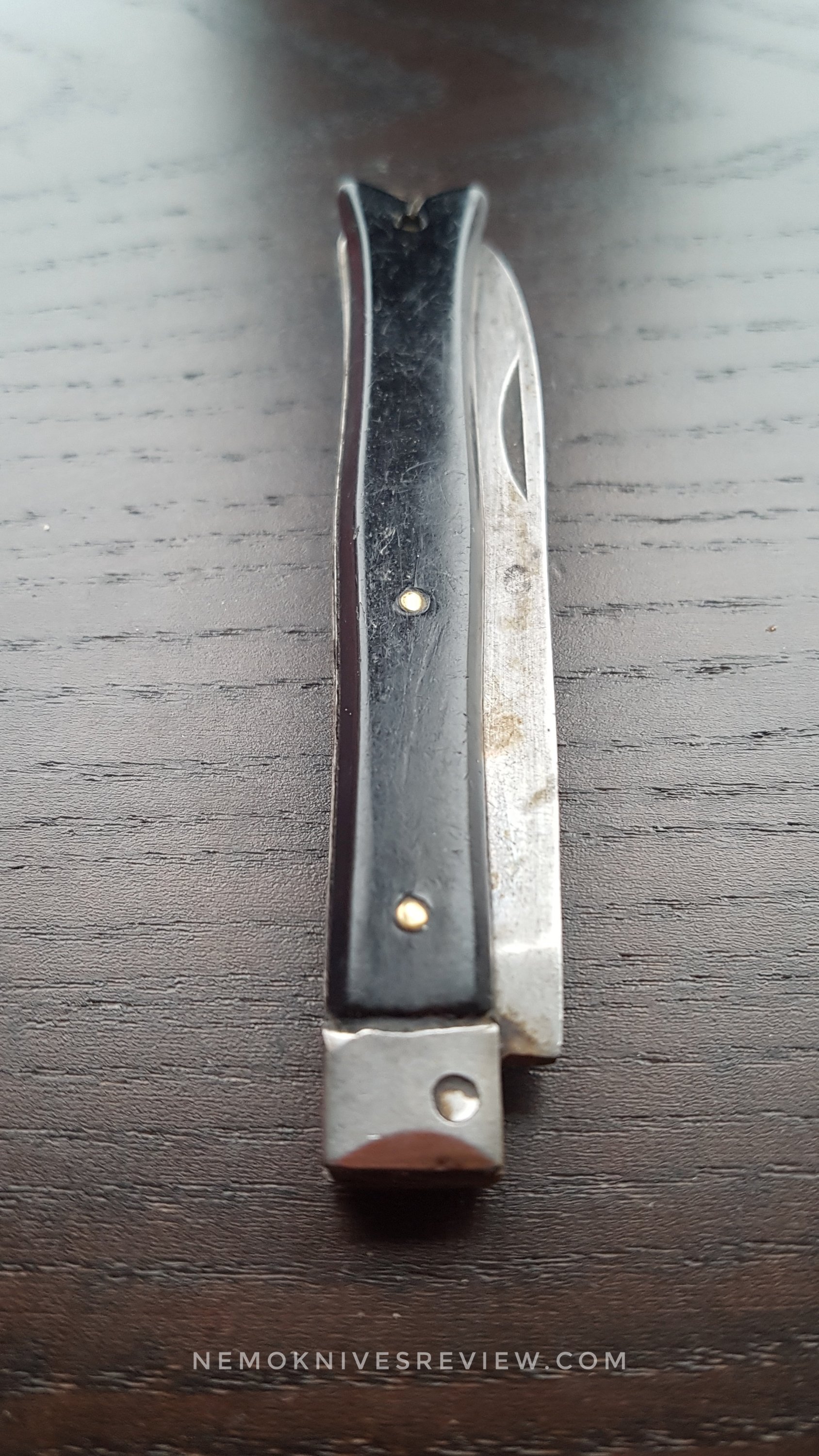
Oh! This is the kind of slipjoint elderlies are still carrying nowadays: a Pradel. This one is a fishtail bakelite carbon steel pocket knife still used for getting everything you can think of done. Let say this is Tim Leatherman main inspiration and as you can guess: this is a tool, not a weapon. It can be used as a screwdriver and is clean sometimes… let say it is wiped mostly because it could rust.
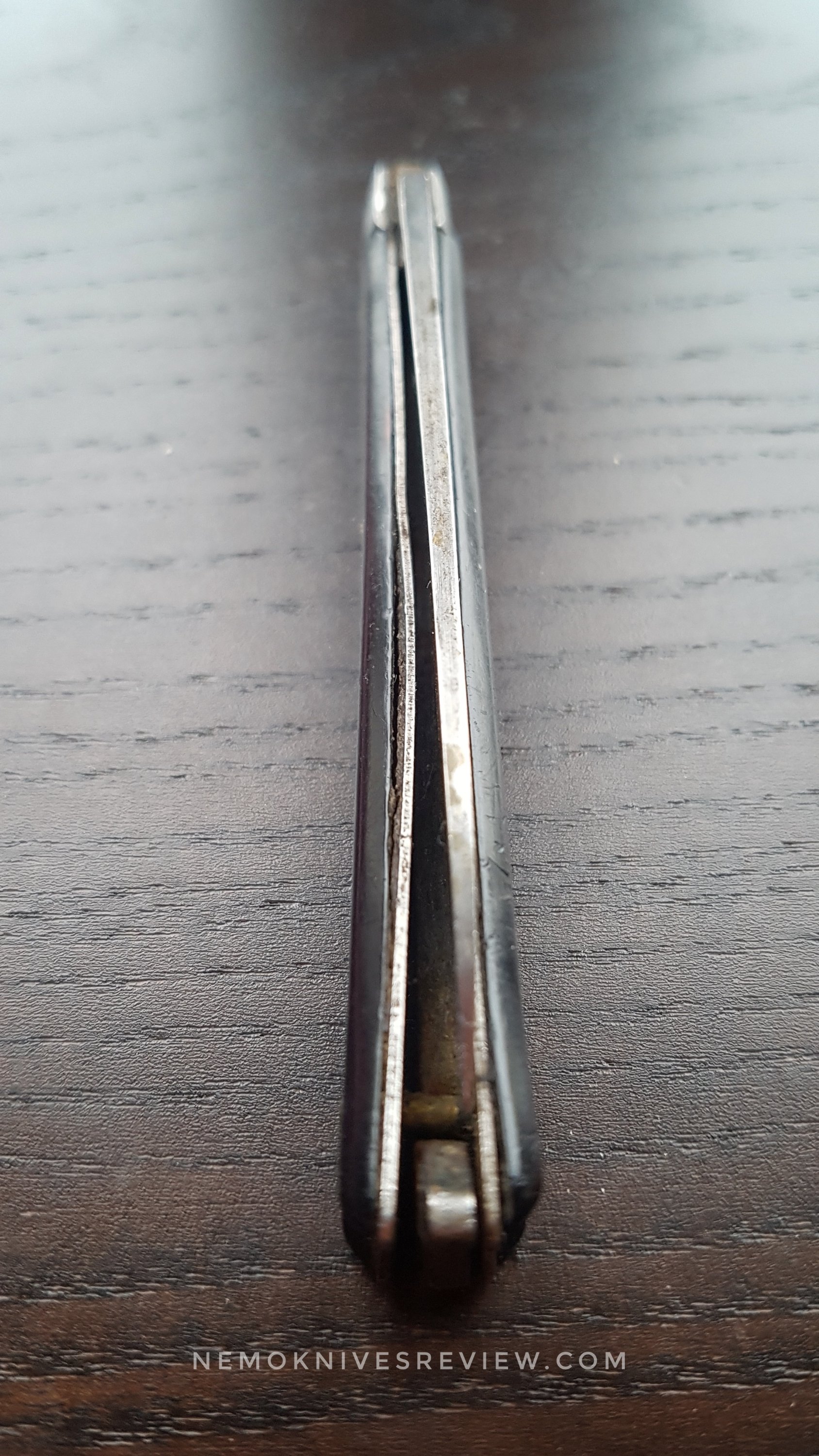
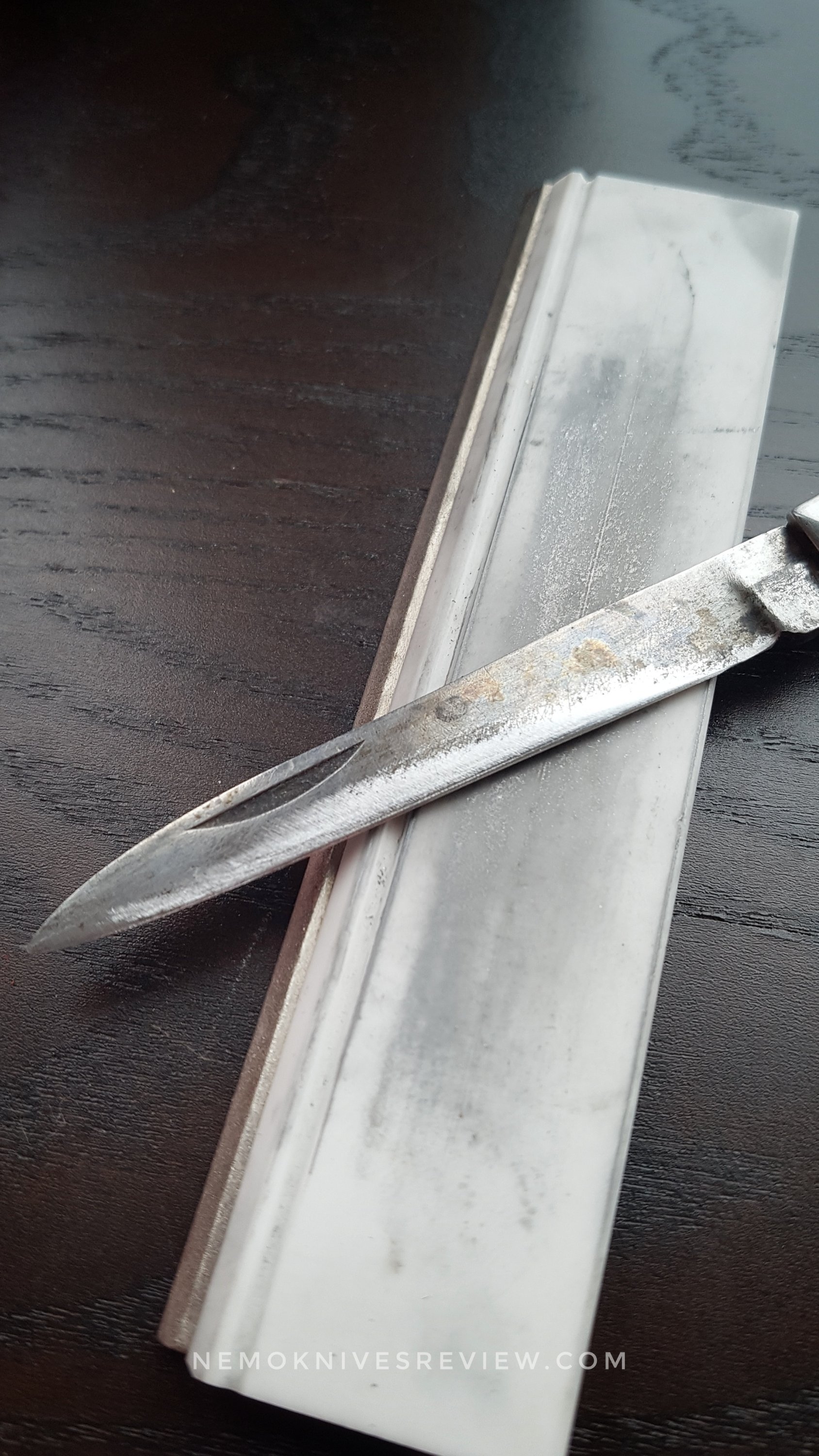
Like the Chaparral, this is a full flat ground blade. It’s a real razor blade or should we say it ‘used to be’ a real one, because this baby was dull as a knee when I got it. Fortunately the unknown carbon steel percentage enabled an easy shift back to decent sharpness.
The blade ‘was’ perfectly centered… a long time ago but, as you can see, the knife is an old timer still not decommissioned by its owner. Duty, that day, was to pick the potatoes to check if they were cooked and get them out of the hot water; who needs tactical flipper for that matter ?
The Pradel is a knife used to cut the french bread known as “baguette”, to remove stones stuck under a boot’s sole, to open envelopes and more generally all the chores which would be better suited to a more appropriate tool, like stripping wire, cutting tarp, scraping paint, probing, forcing, twisting, cutting over and over again, but… ending up being accomplished with Pradel; doing it all just beacause it’s at immediate reach.
No safety net, no lock, no guard, no clip, this is a tool for all dirty jobs and also takes its place in the kitchen and on the table: apples, potatoes, bottle necks, sink’s holes, flowers…
My Sliverax looks at it with its envious hole: how can such a simple knife live so many adventures? Nothing is reliable in this design but the will of her owner to keep going.
Where the Chaparral shows exquisite working mecanism and engineering and no play either vertical or horizontal, the little battered Pradel is still going strong, never defeated with all her battle scars otherwise it would have broken.
Now when it is used for harder chores, it’s held directly by the blade; the handle working as a folding sheath. This is uncommon; even for the Roman design folding knives two thousand years ago.
So what do I take back from the encounter between a modern folder and the Pradel ?
First and foremost we should use our knives, thick tactical toys or slim razors alike.
Second a locking blade is luxury and because it’s viewed to be immediately oriented towards some fighting realm… sheeples are allergic to it which is a shame as a locking blade is a great security for our fingers.
Eventually people who are still dreaming of knives as weapons are fooling themselves and give bad publicity by not using them for the most humble chores. Knives are tools to help, not ninja’s toys with “rings” and “skulls”, symbols of death and tragedy.
Real EDC knives have got battle scars and are humble. I will always respect a battered tool which wears the patina of years on its blade and handle because the true battle of a tactical folder is in its everyday chores not in the murdering fantaisies of childish dreamers that give knives a really bad name tainted with human blood. Sometimes I really understand sheeples…
The Chaparral is the new true gentleman folder designed by Sal Glisser. Is it destined to be proposed with various handles. The first batch was supposed to be titanium but due to some delays the carbon fiber handle version get released first.
What amazed me on that little jewelry is the flatness of the overall design and the smoothness of the operations.
I read somewhere (I think it was Paul the Deacon who wrote that) the Chaparral was an alternative to the Michael Walker.
It is ambidextrous and even smoother, flatter and its wire clip is much better than the metal one on the C22.
The Chaparral is inobstructive and sleek design. The CF handle give you perfect retention. It’s a joy to operate.
Like all Taichung release this a jewel. No blade play in any direction. A hidden pin mechanism has been added to the pivot to strengthen the lock and can be felt during opening and closing. The knife despite its ultra thin feel very solid.
Compared to my beloved C22 Michael Walker, well it’s almost beats it but on the edge, the steel, the blade to handle ratio.
I would say the Walker is a BMW Series One when the Chaparral is an Audi A3. 😉
Two great knives for sure but with different performance.
The edge on the Chaparral is a little thick for my test when the ZDP of the C22 is thin and hard.
On hard plastic the Walker is even better than my Gayle Bradley and since I have been able to buy a safe queen, my first Walker will be used hard this year.
On hard matters the Chaparral cannot compete with the Walker.
I have deshouldered its edge a bit but it is not as aggressive as that C22.
But for office task and EDC it is perfect. Also I’m certain someone gifted sharpeners like my friend JD or Tom Krein would easily turn their Chaparral into Vorpals.
Overall the Chaparral is pure pleasure to operate. I use mine when I need a discreet companion at the office or in the city. You will forget it is clipped on you and will bring you a big grin when you will use it.
Another great design with and incredible smooth and flat alternative.
This could be James Bond choice. 😉
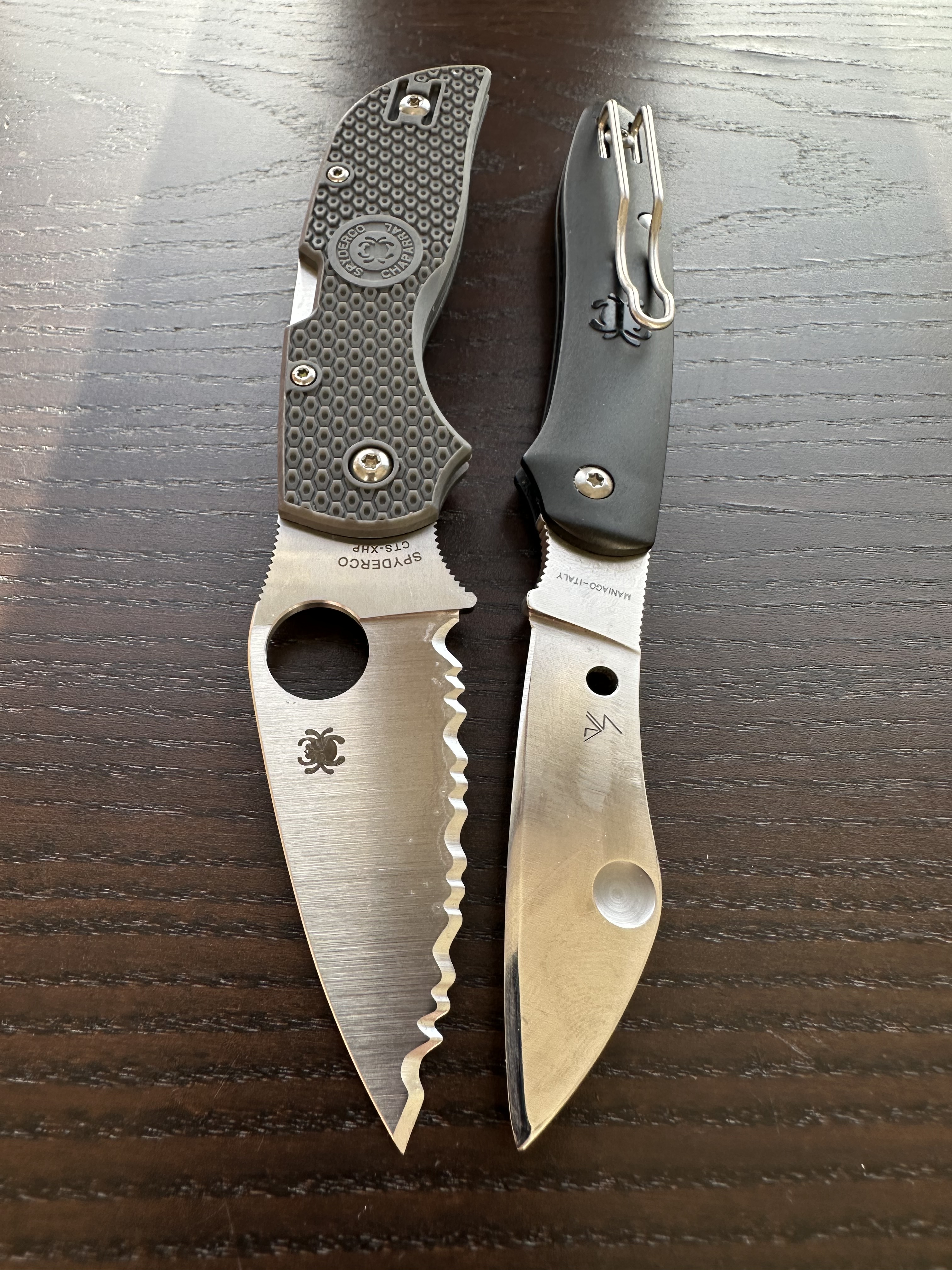
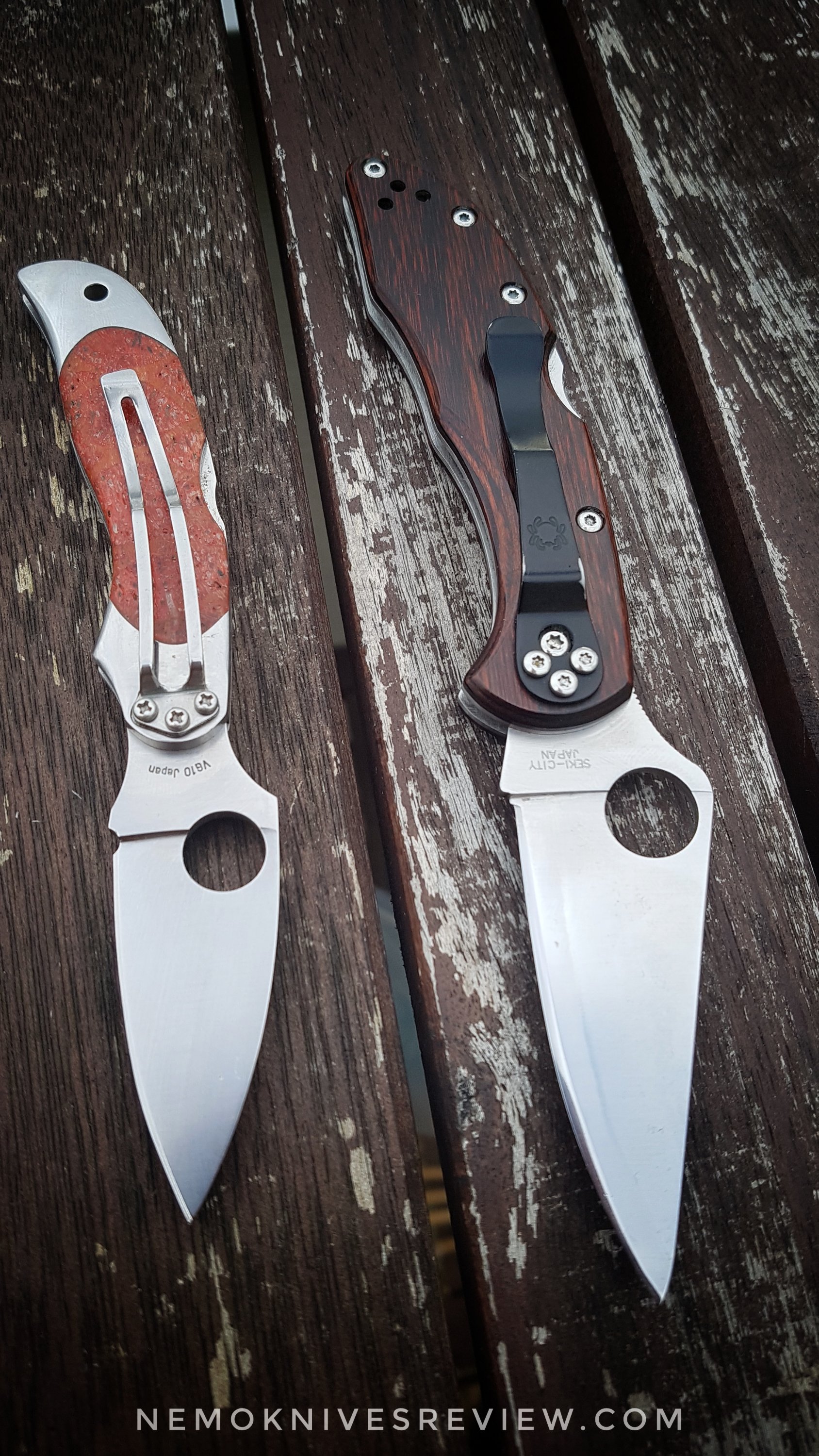
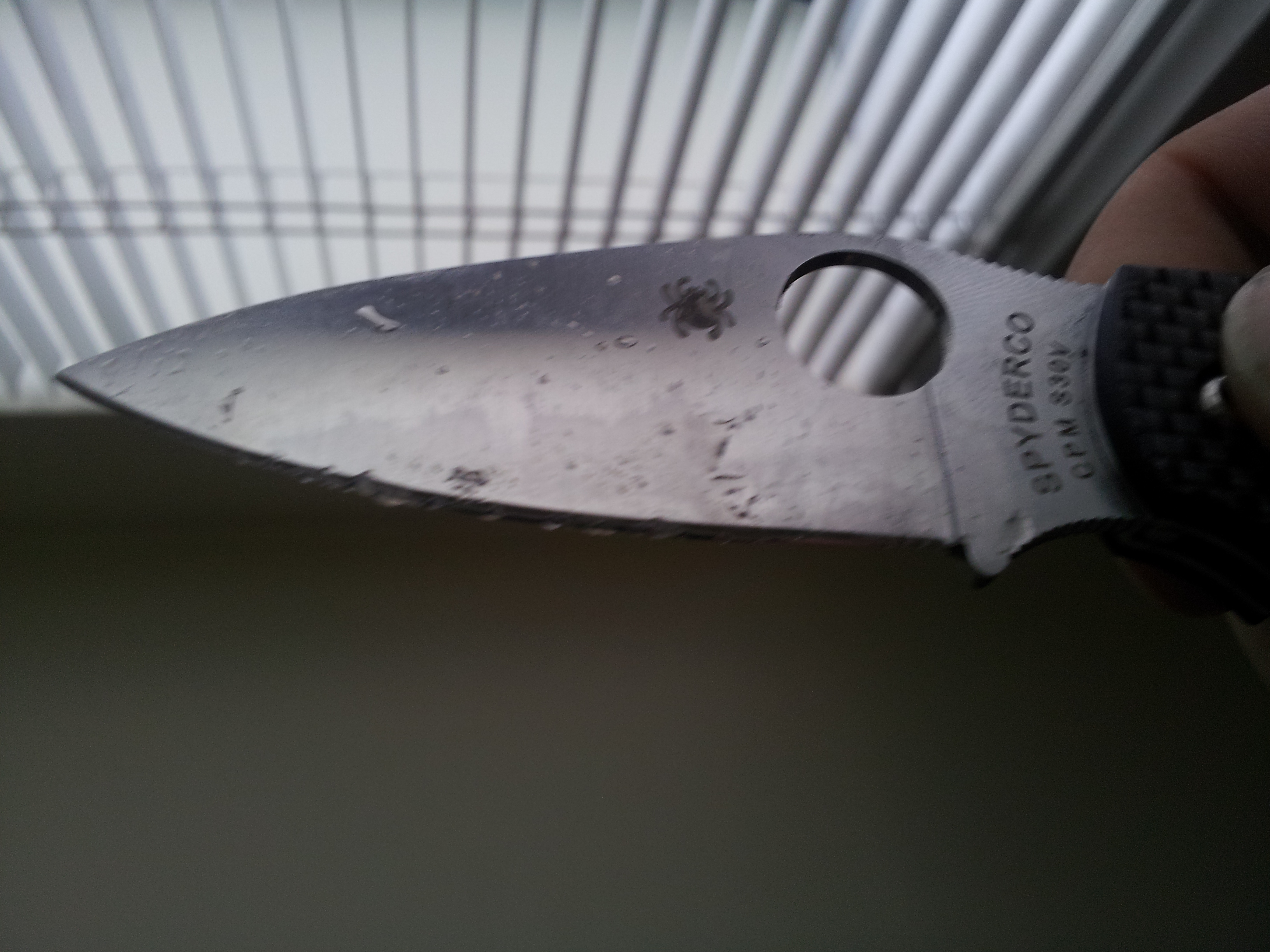
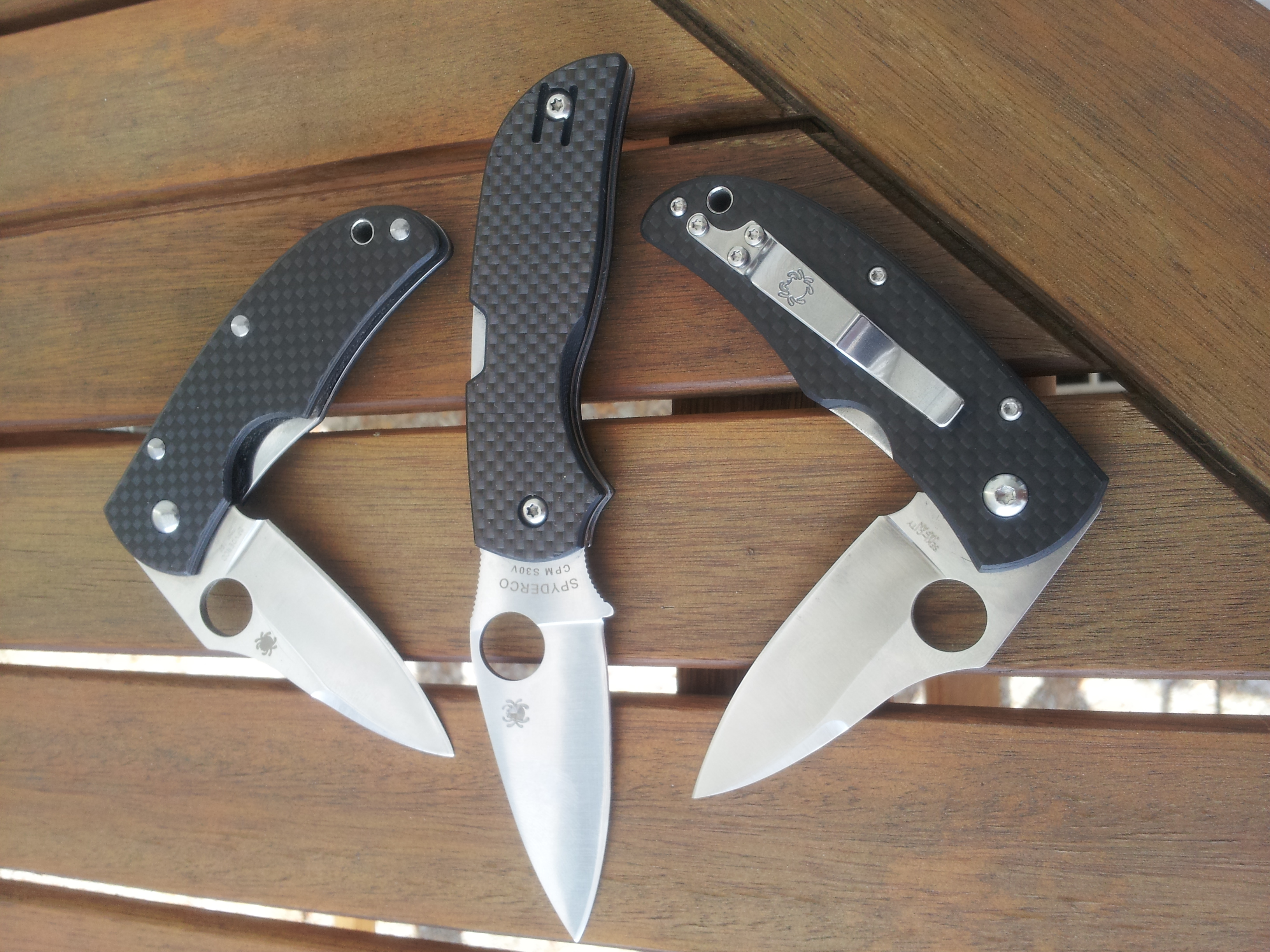
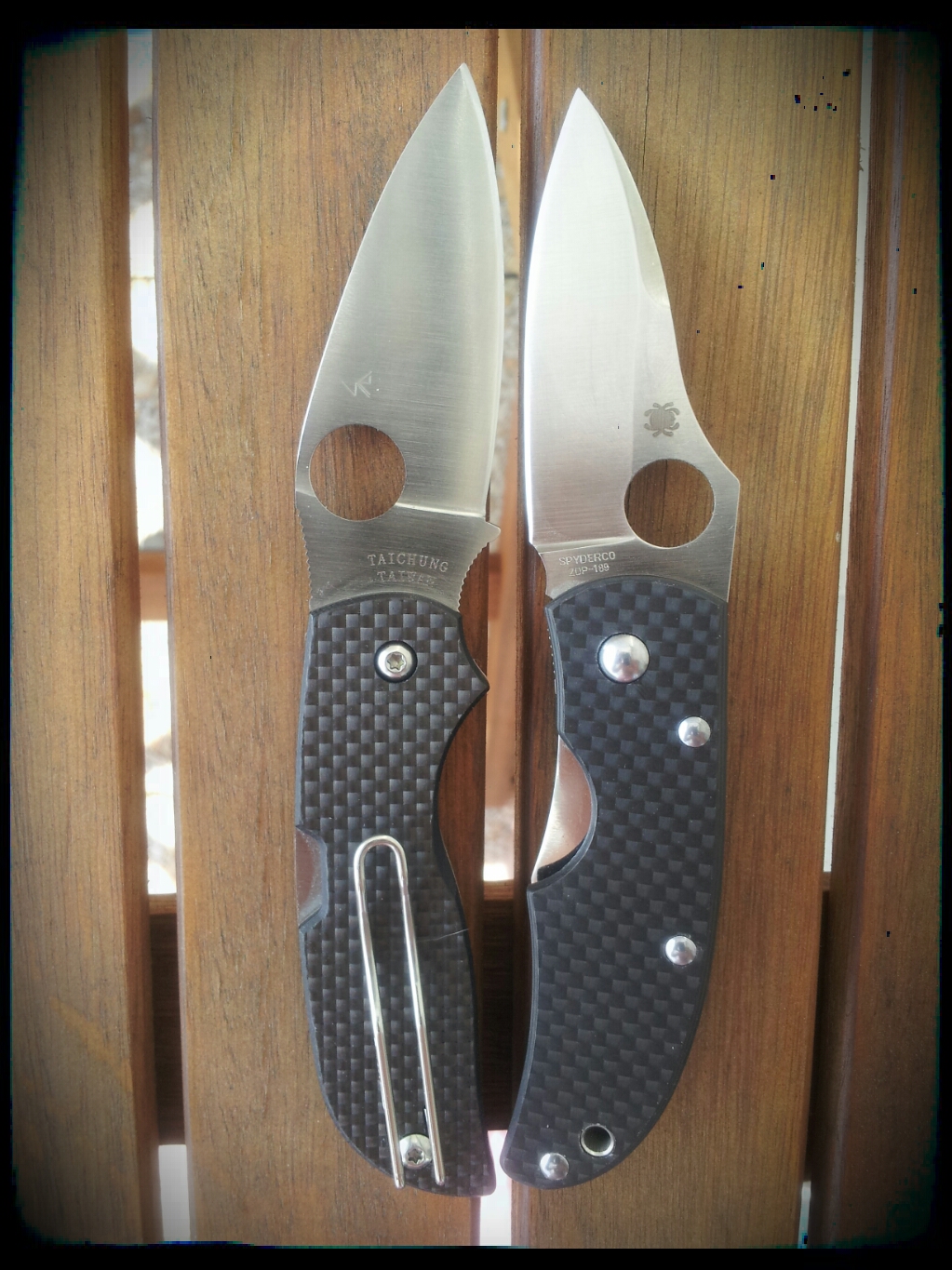
This is my Chaparral saluted by my two Walkers. Can you identified the safe queen? <






























 <
<
 NemoKnivesReview