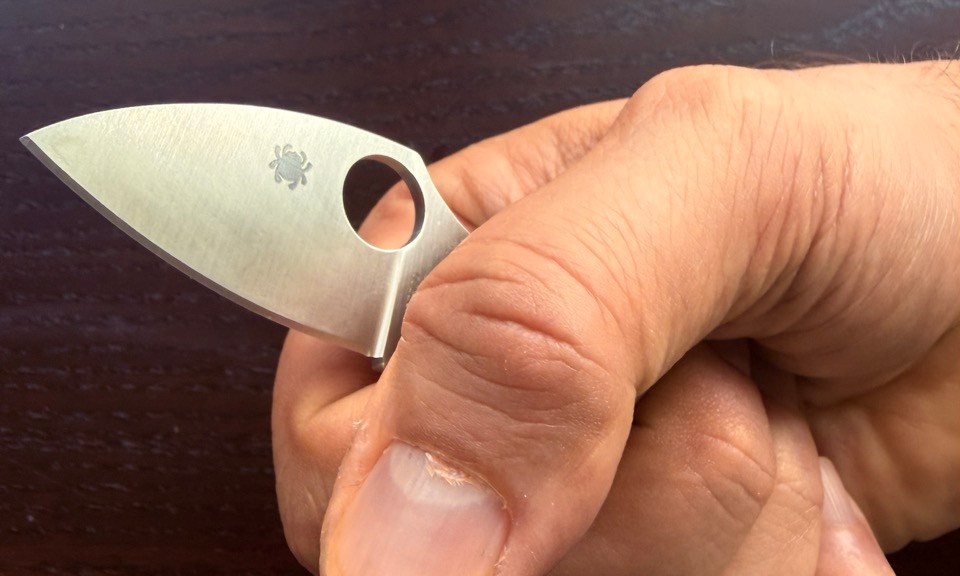
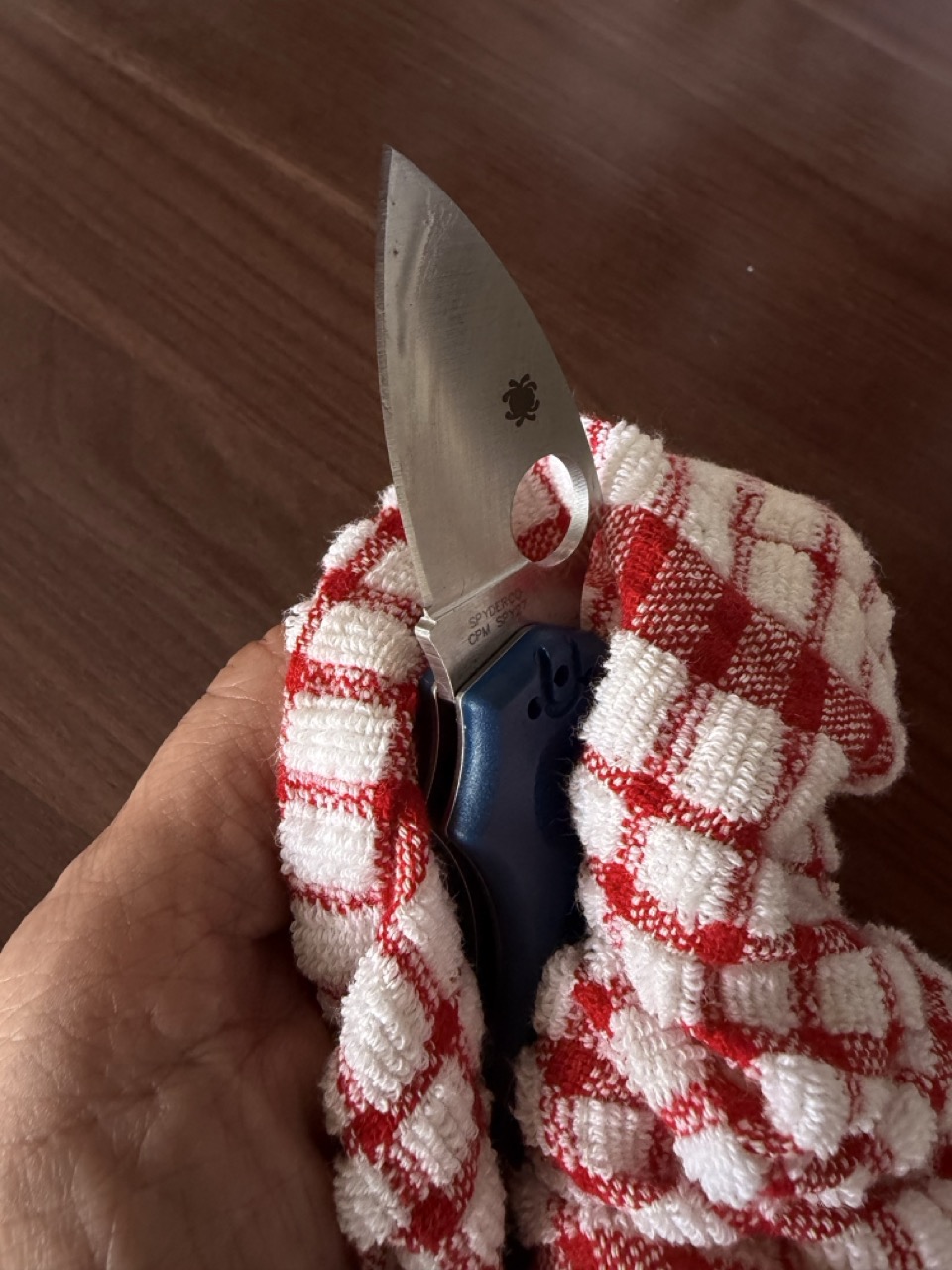
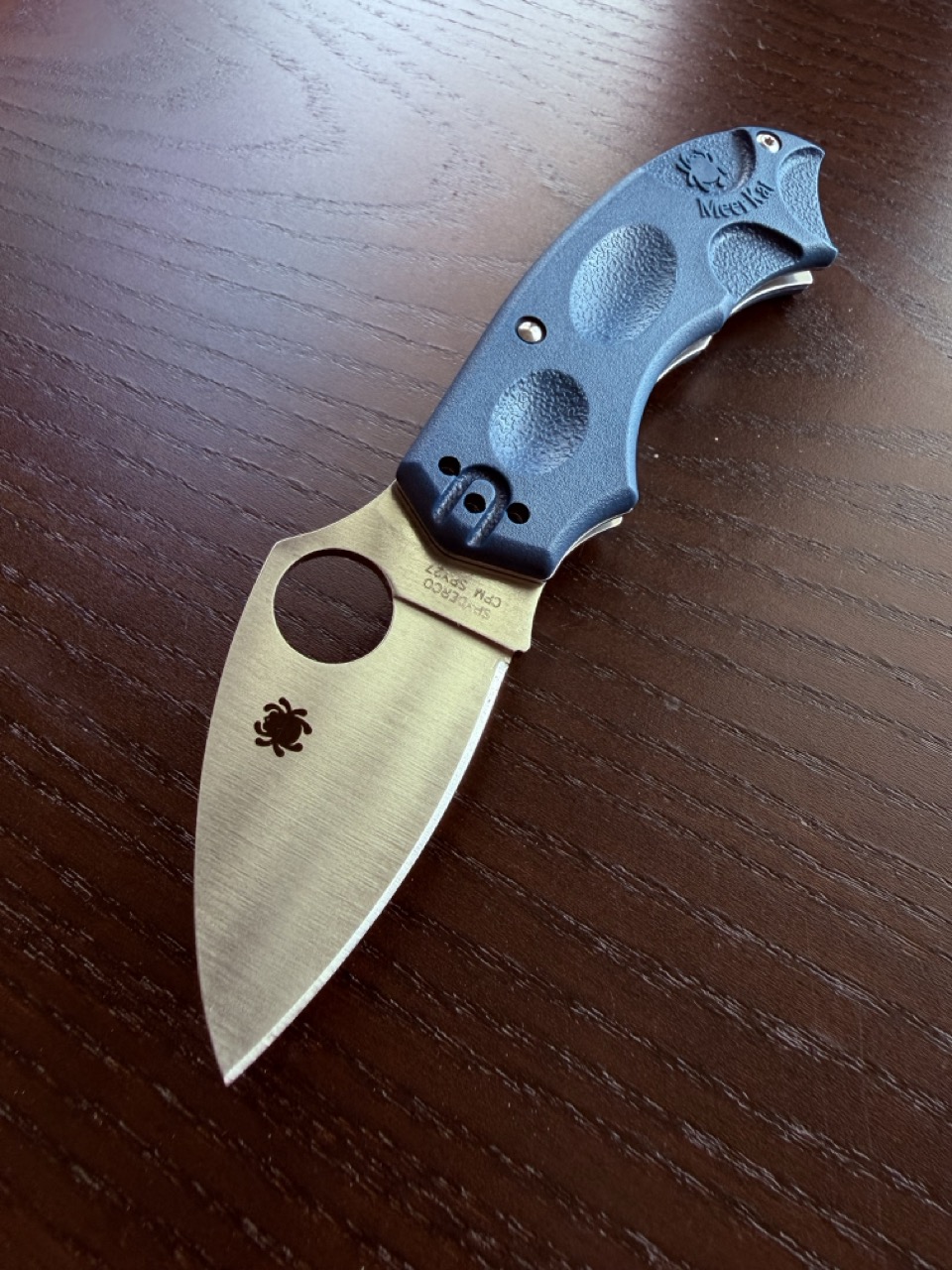
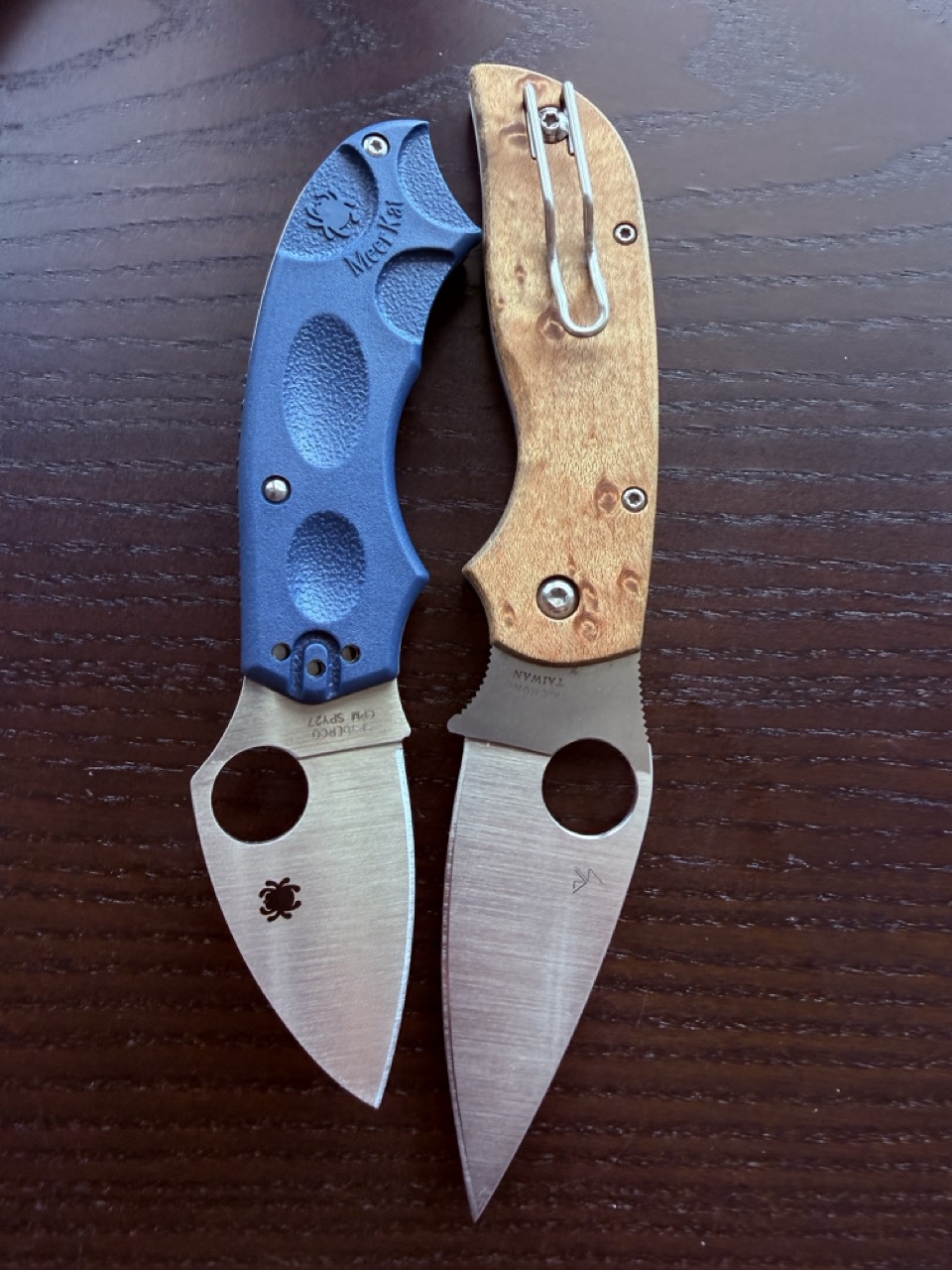
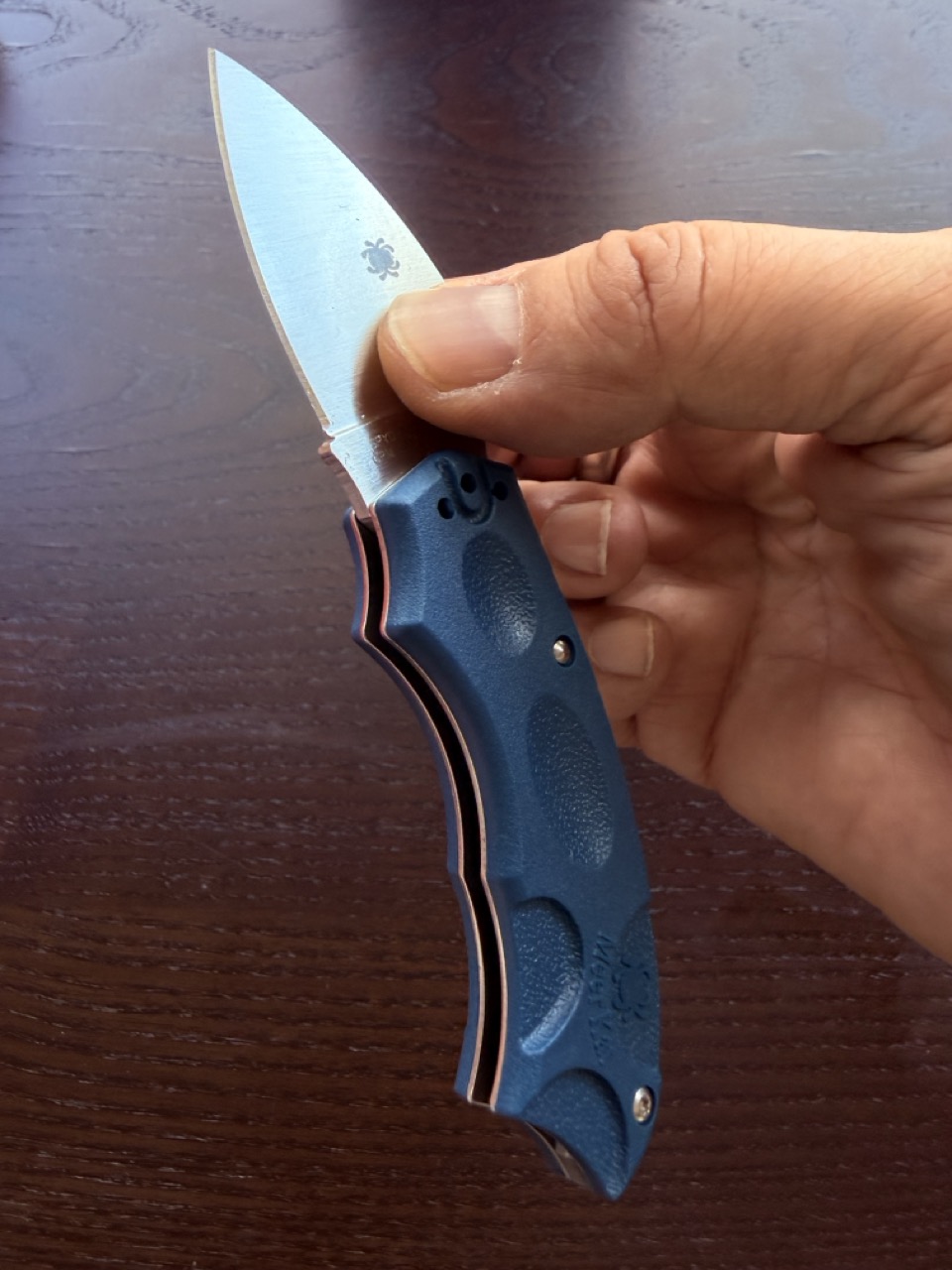
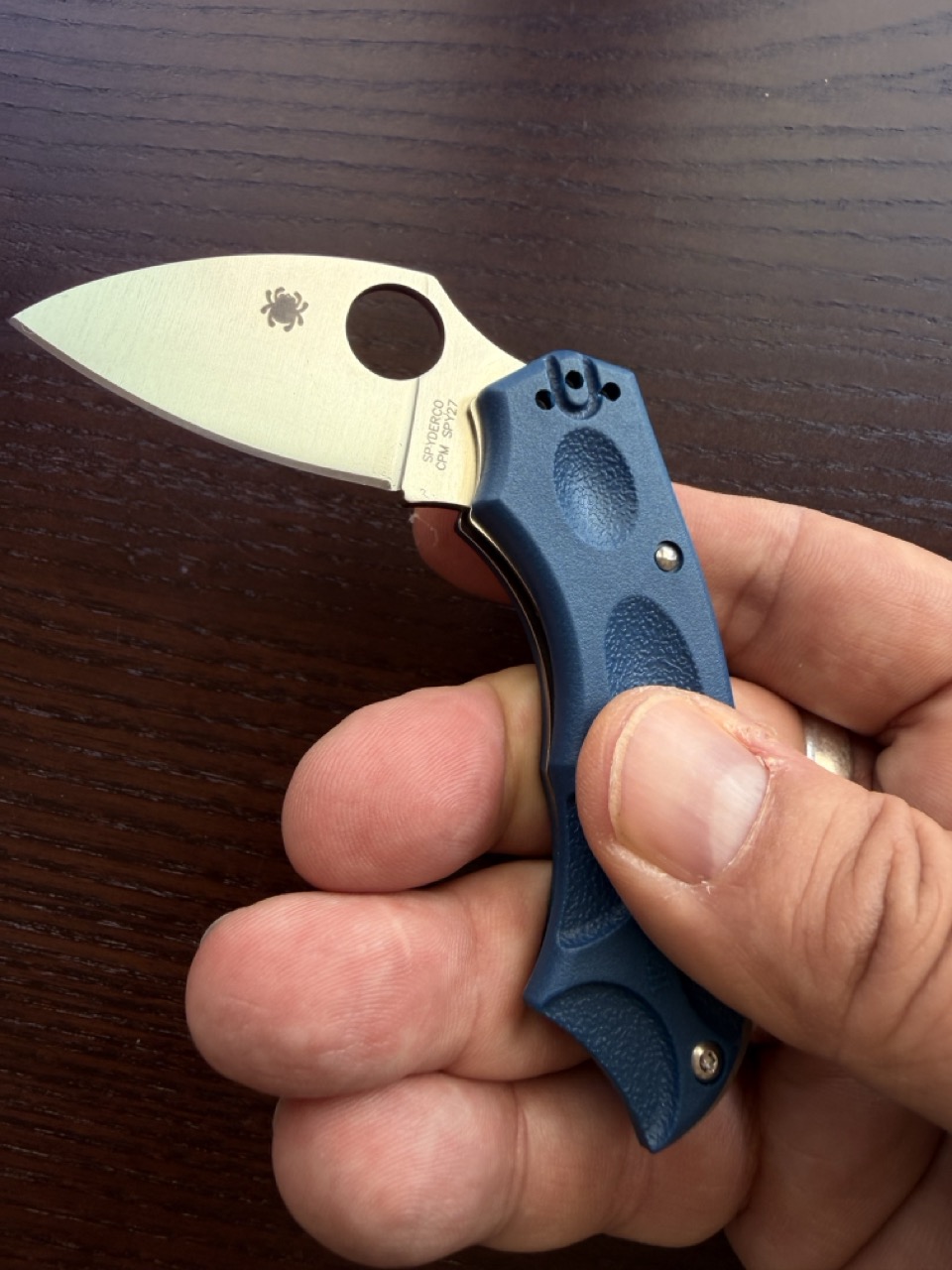
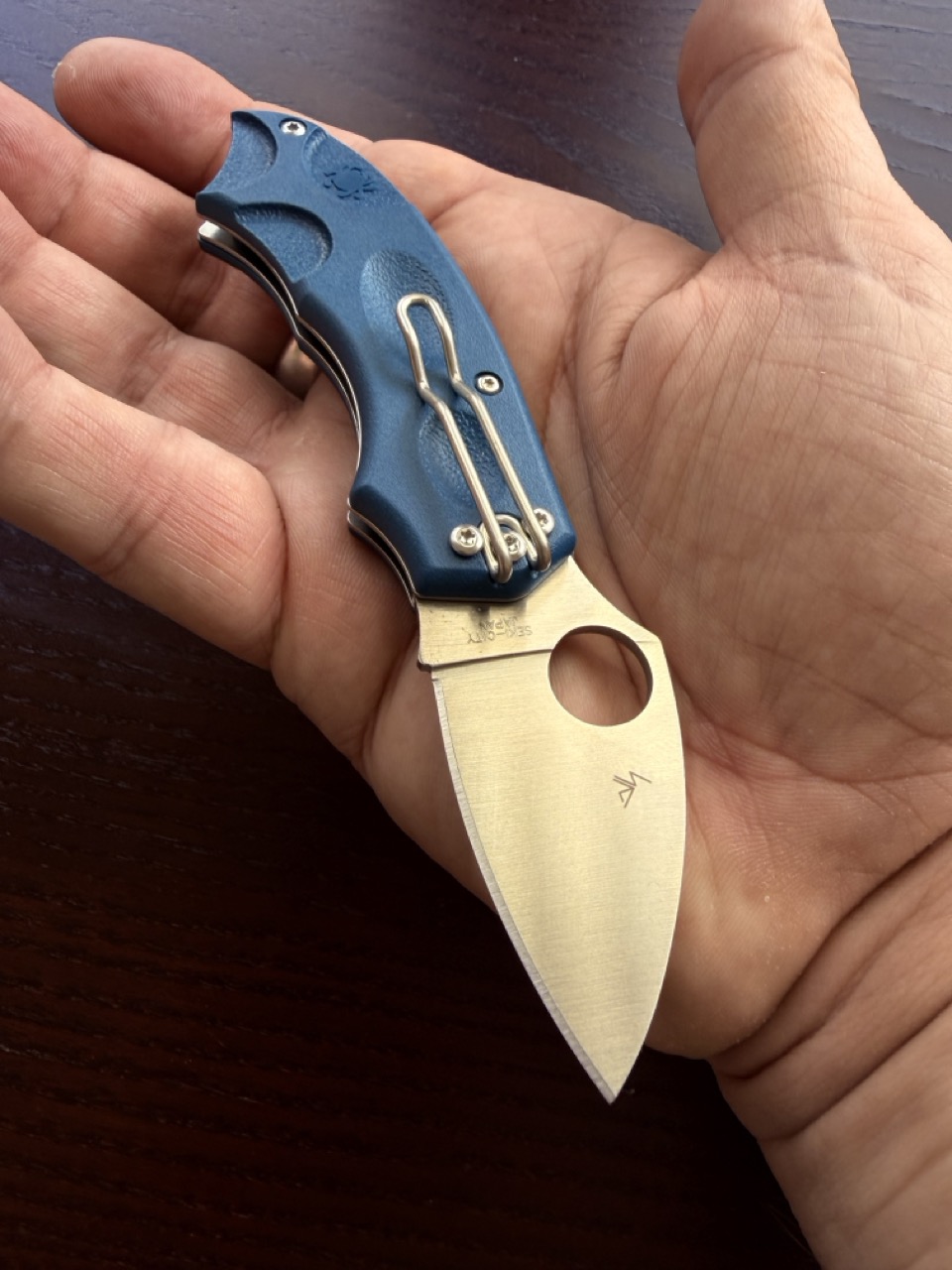
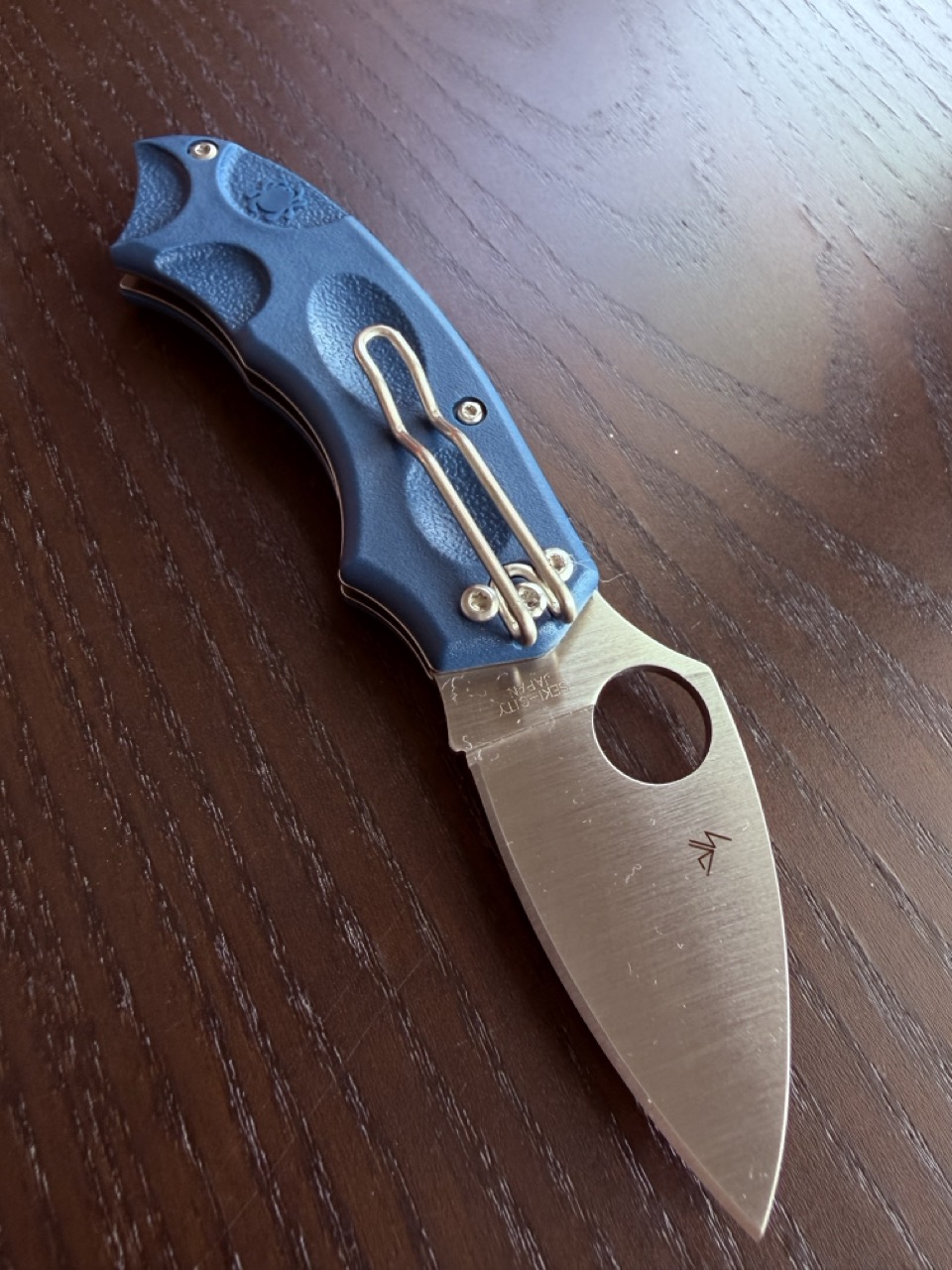
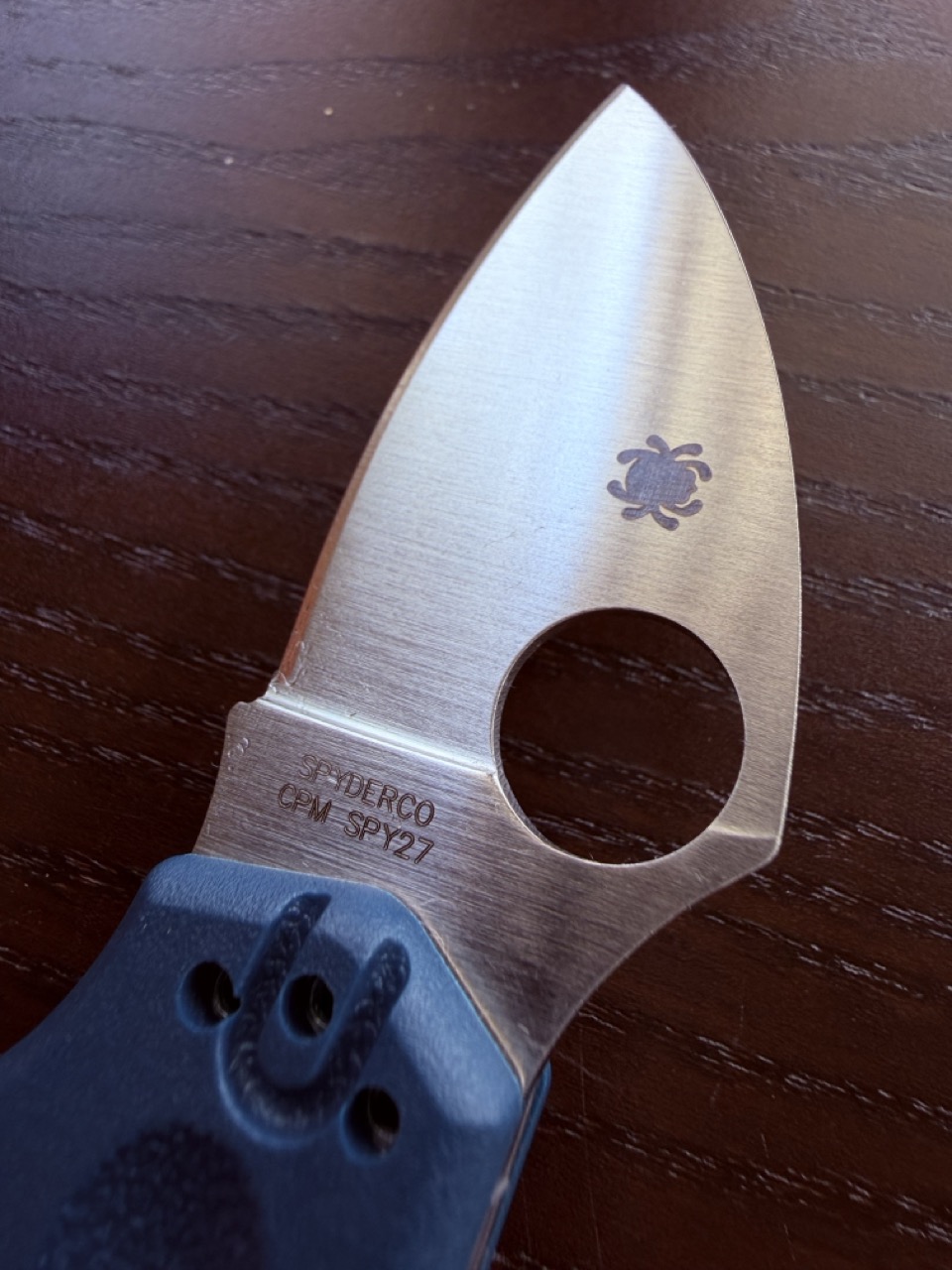
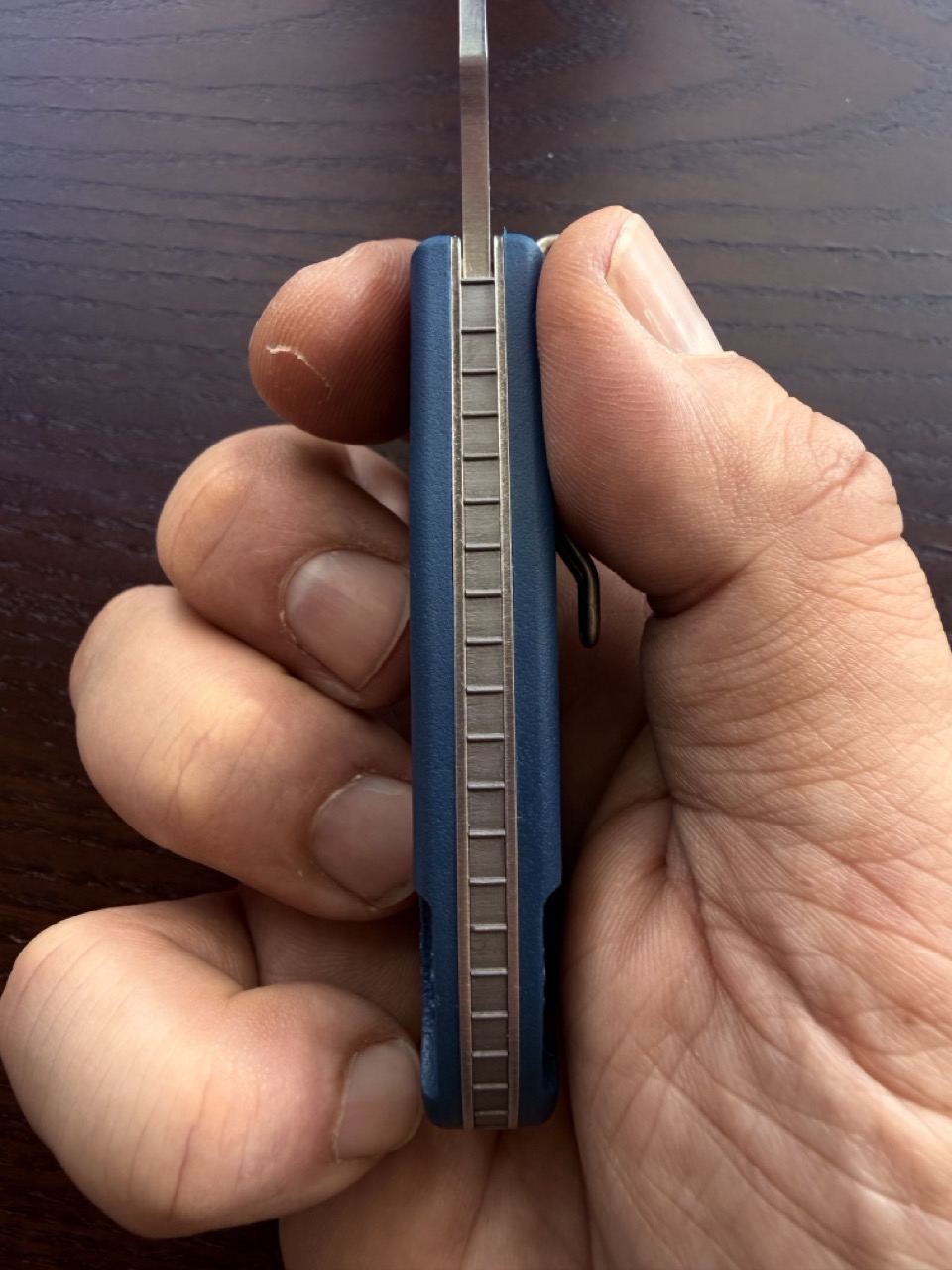
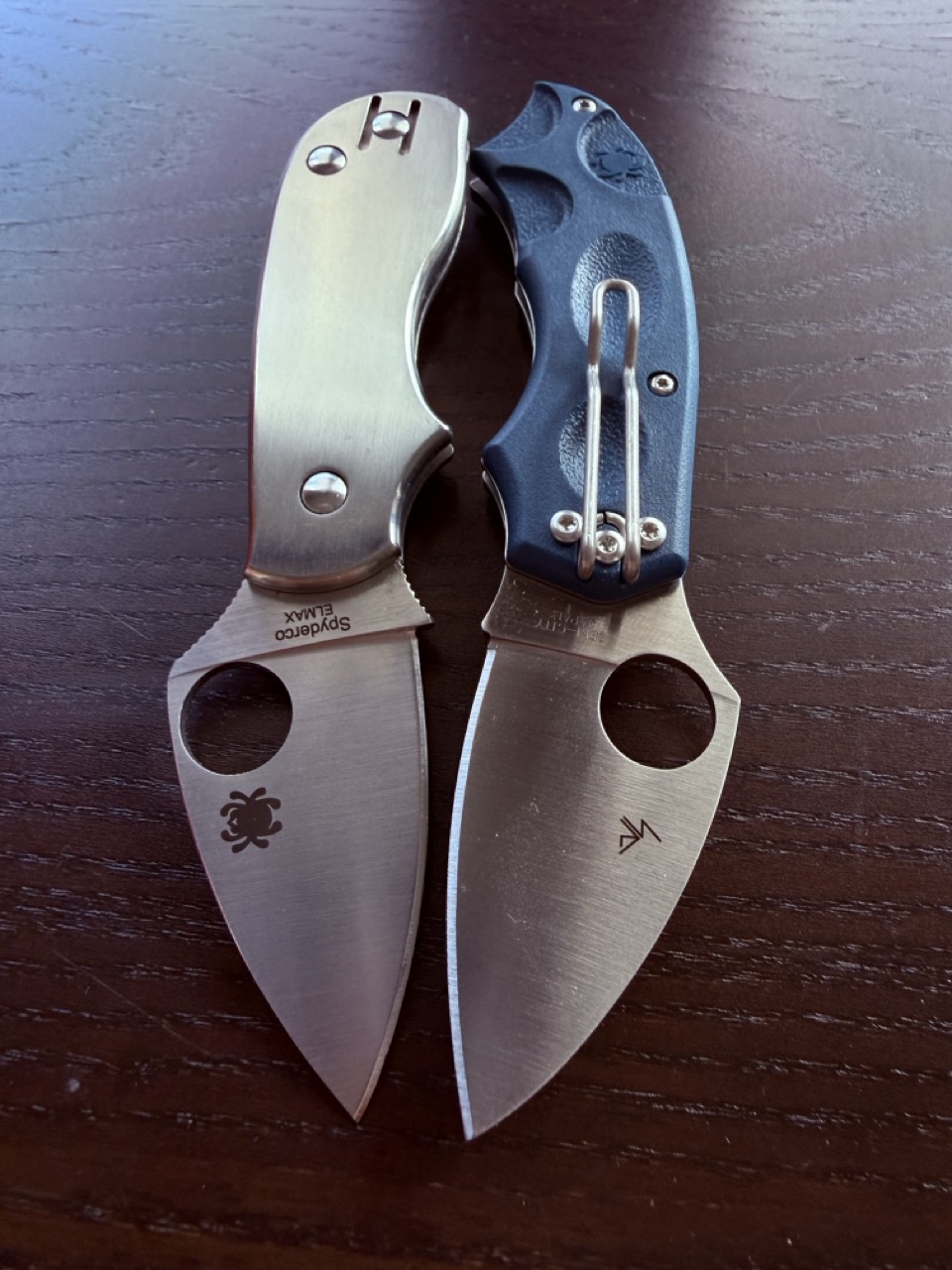
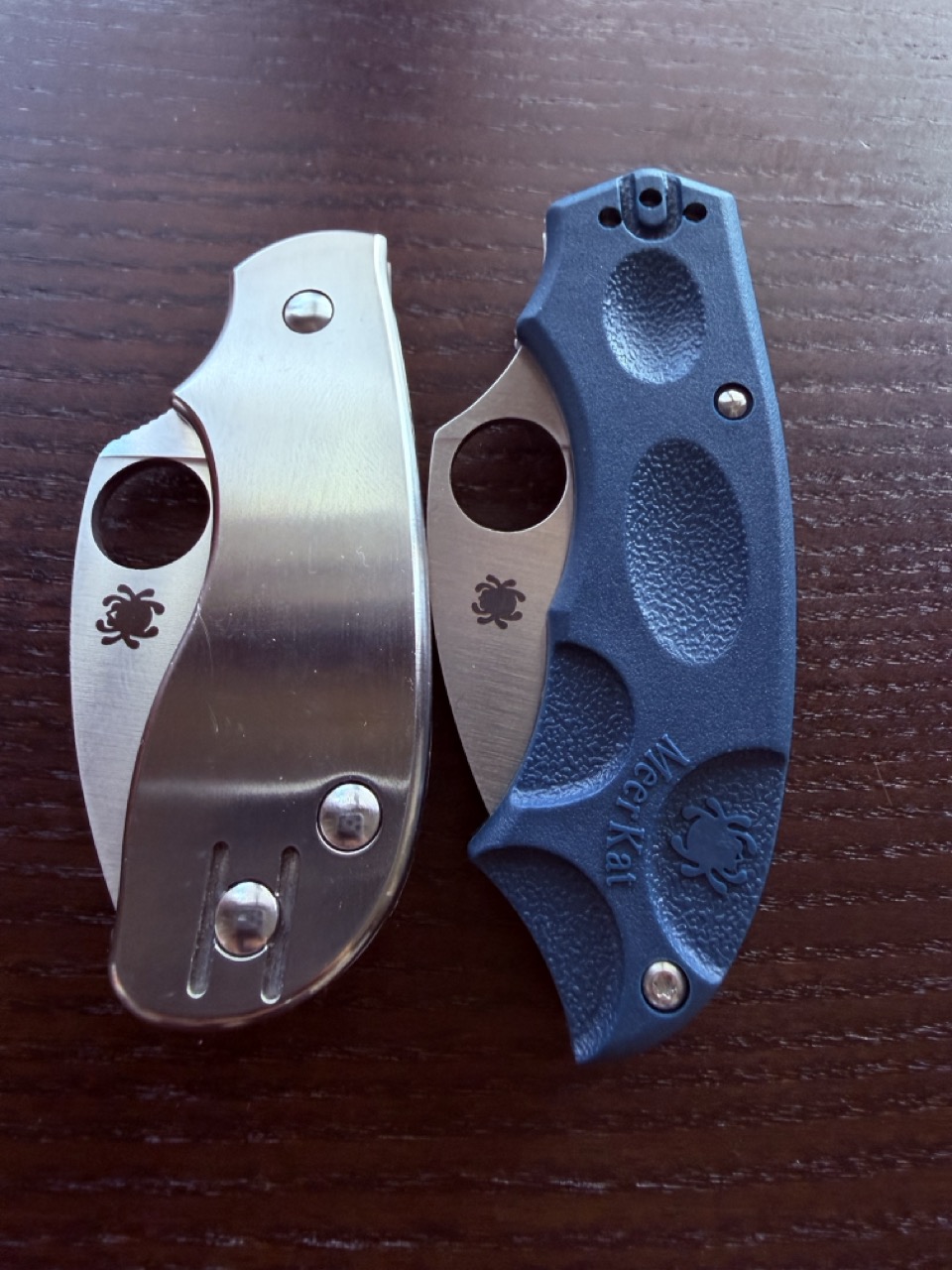
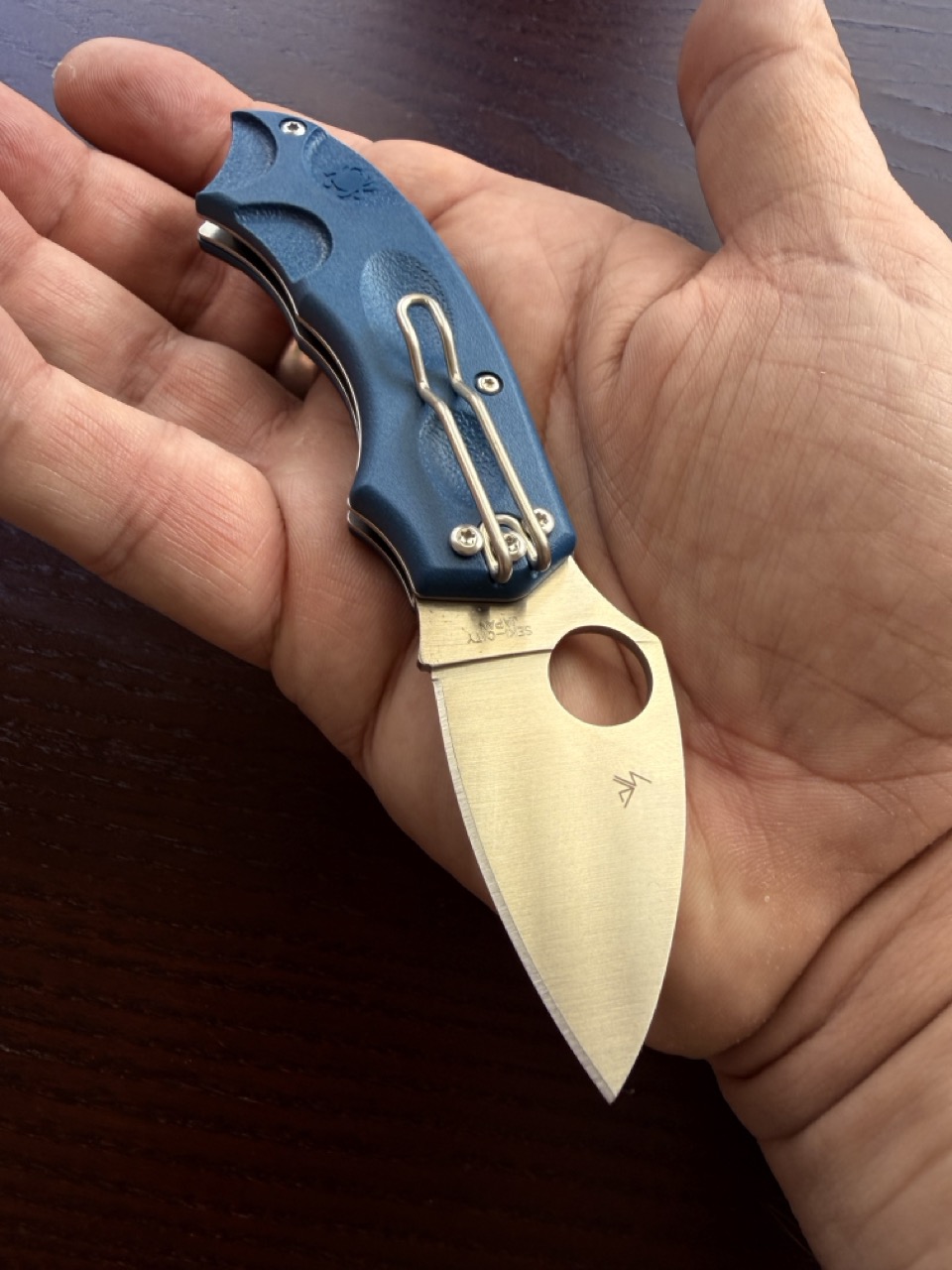
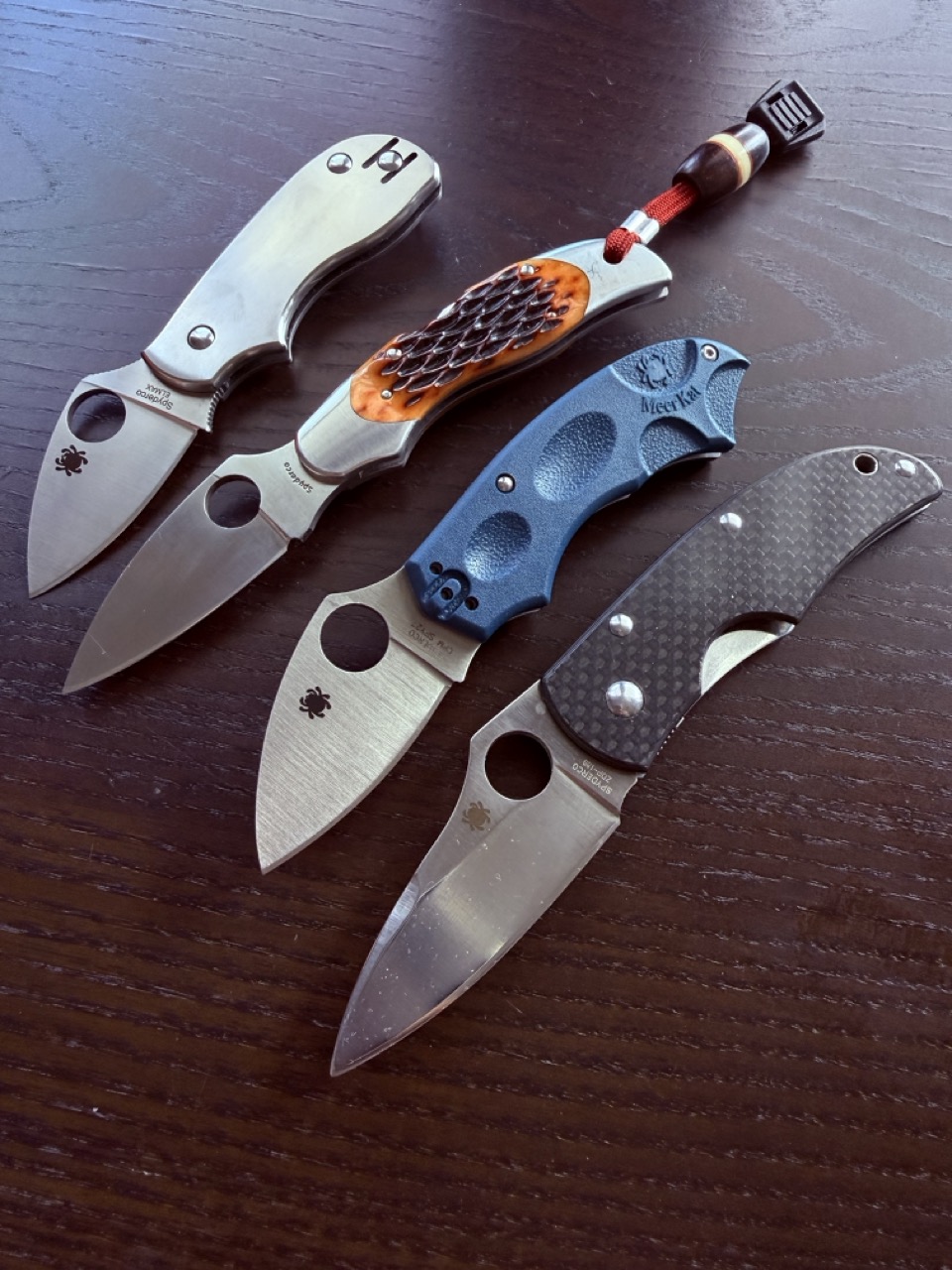
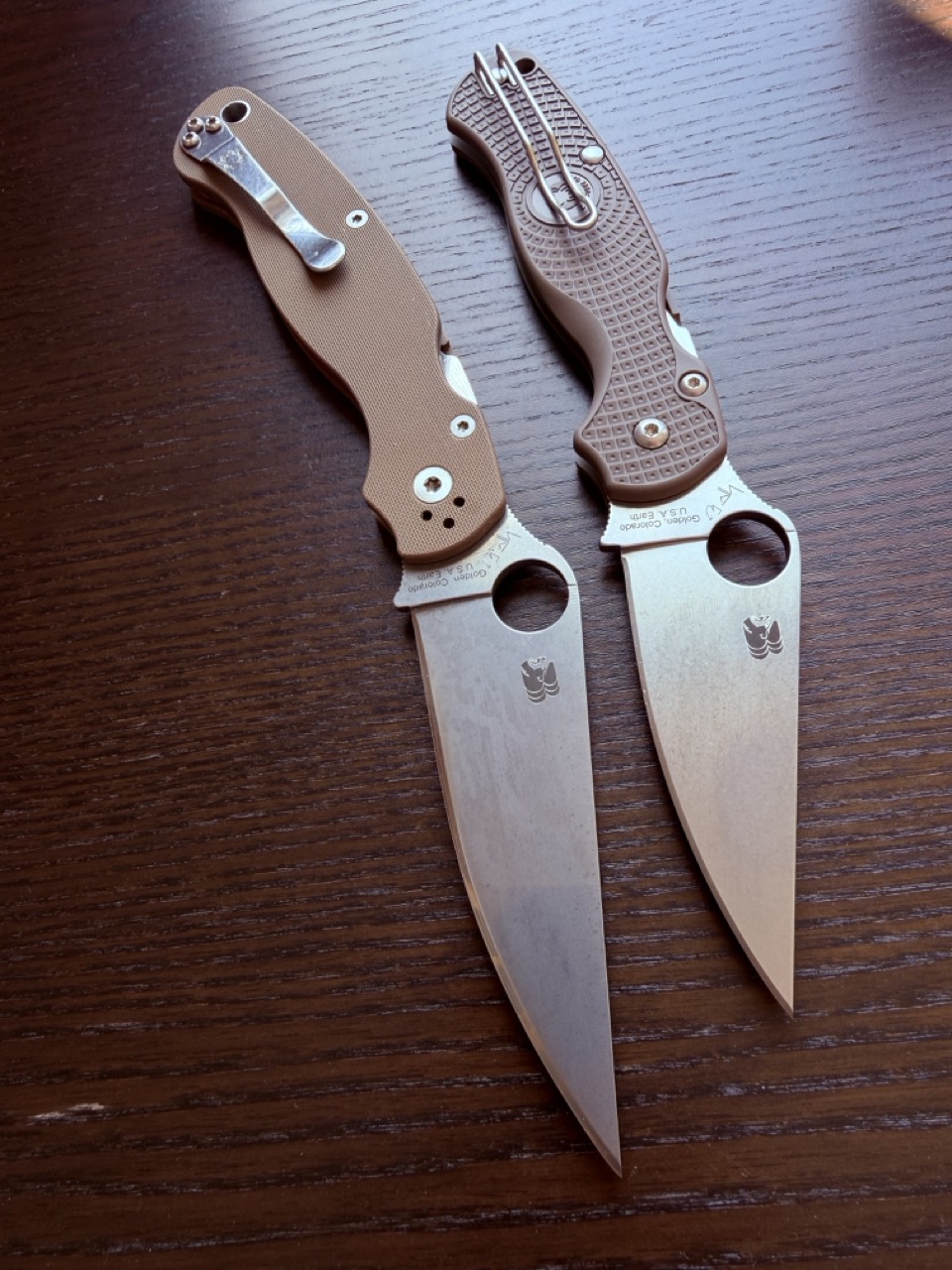
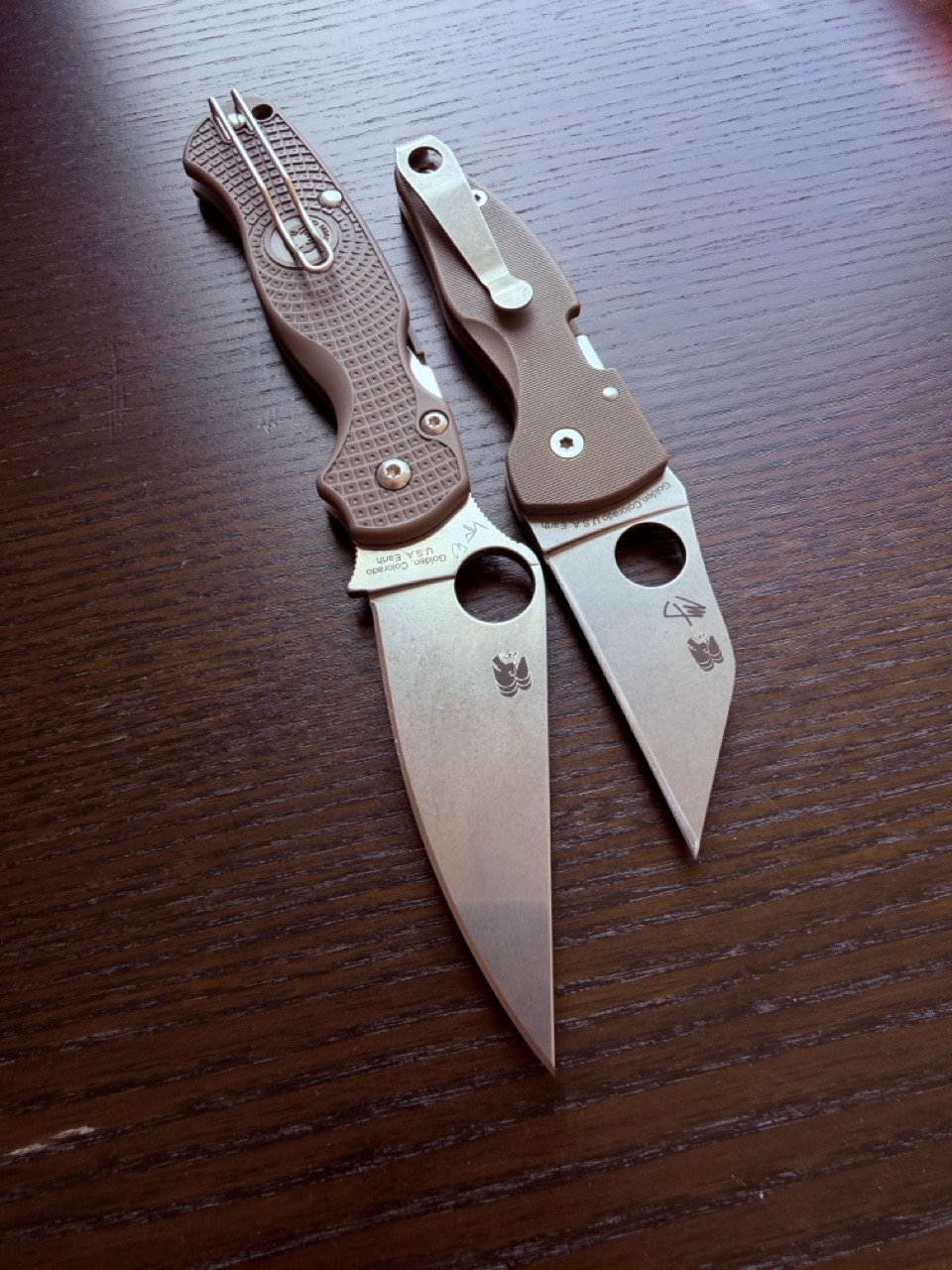
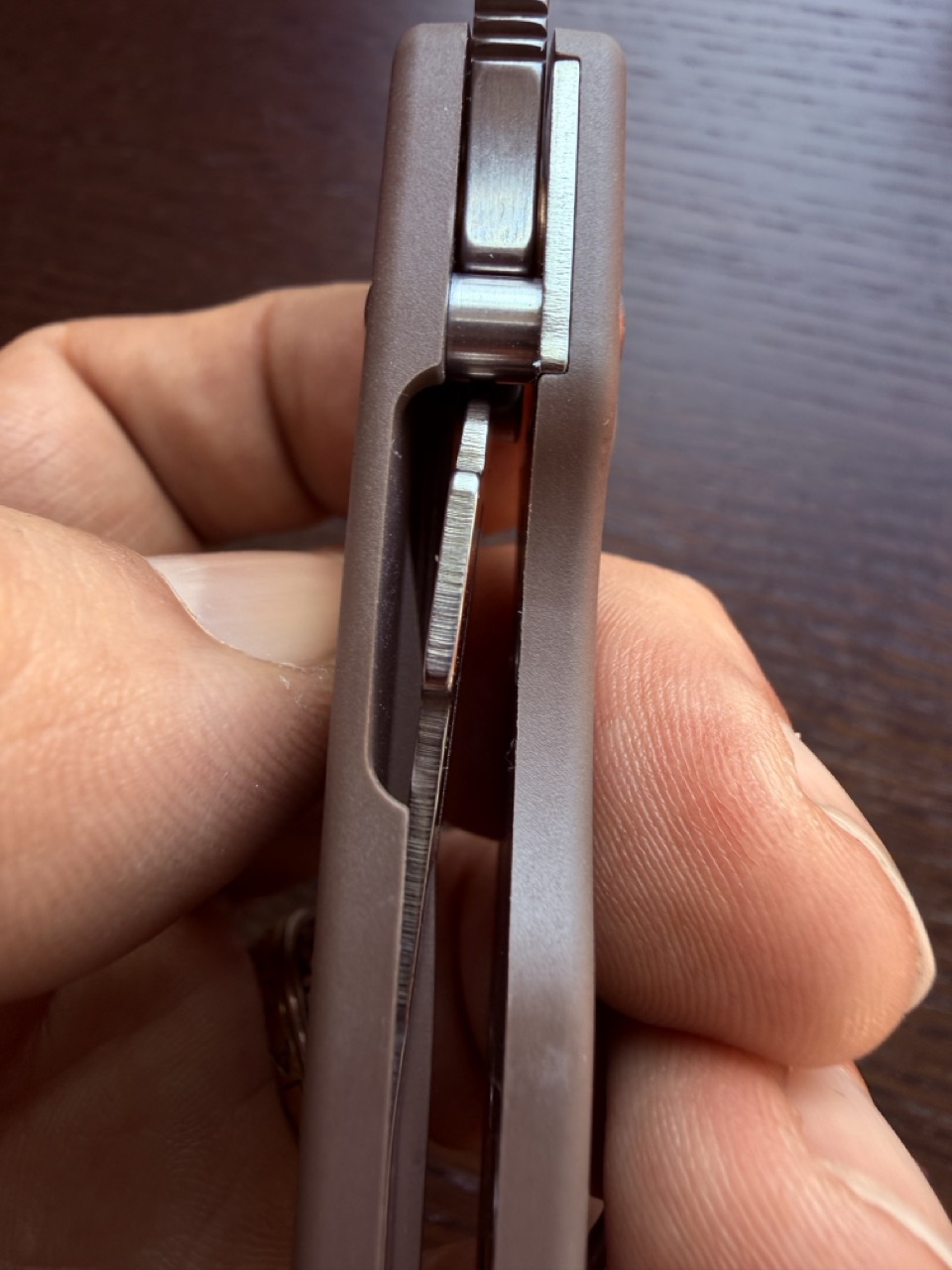
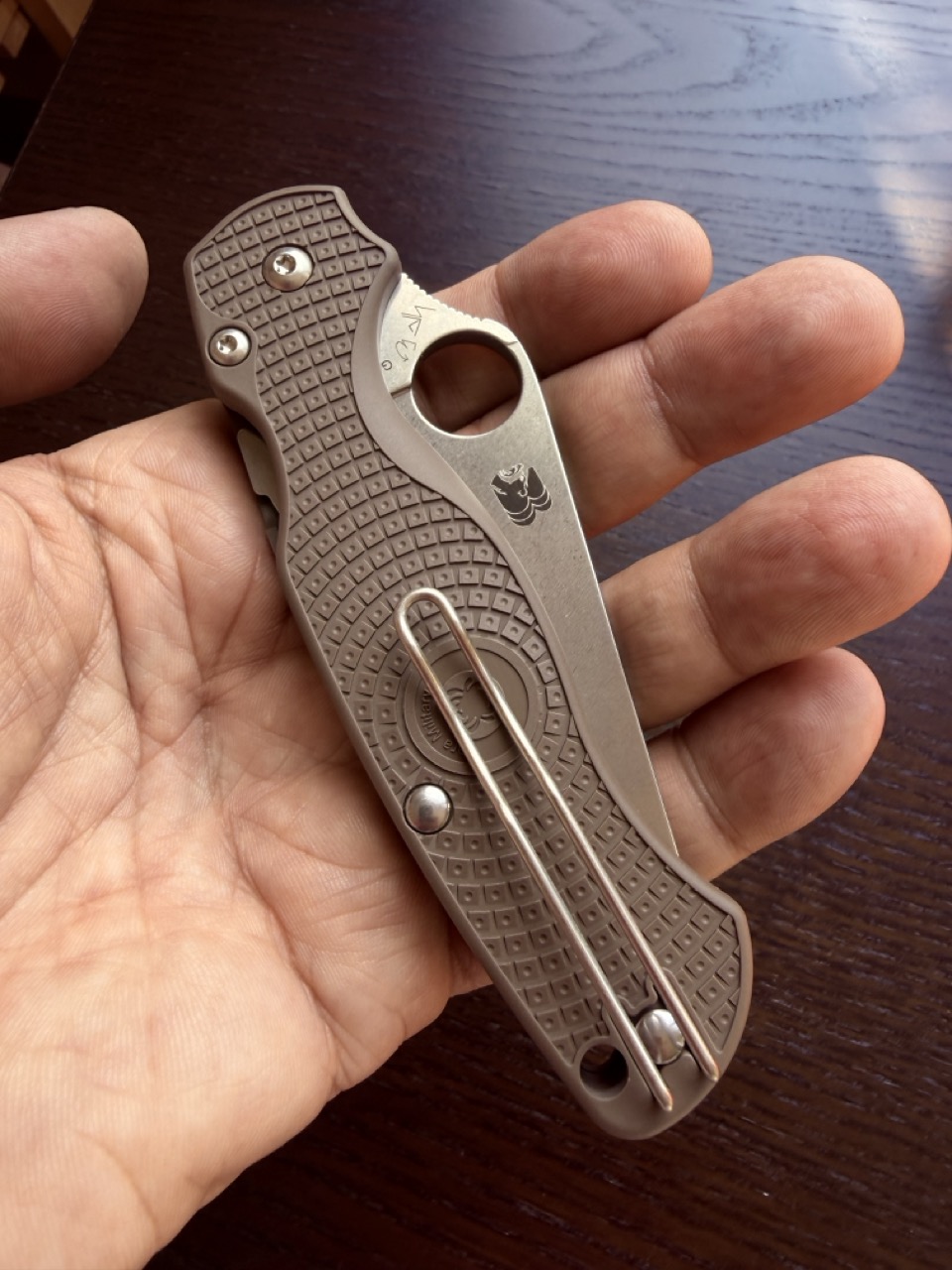
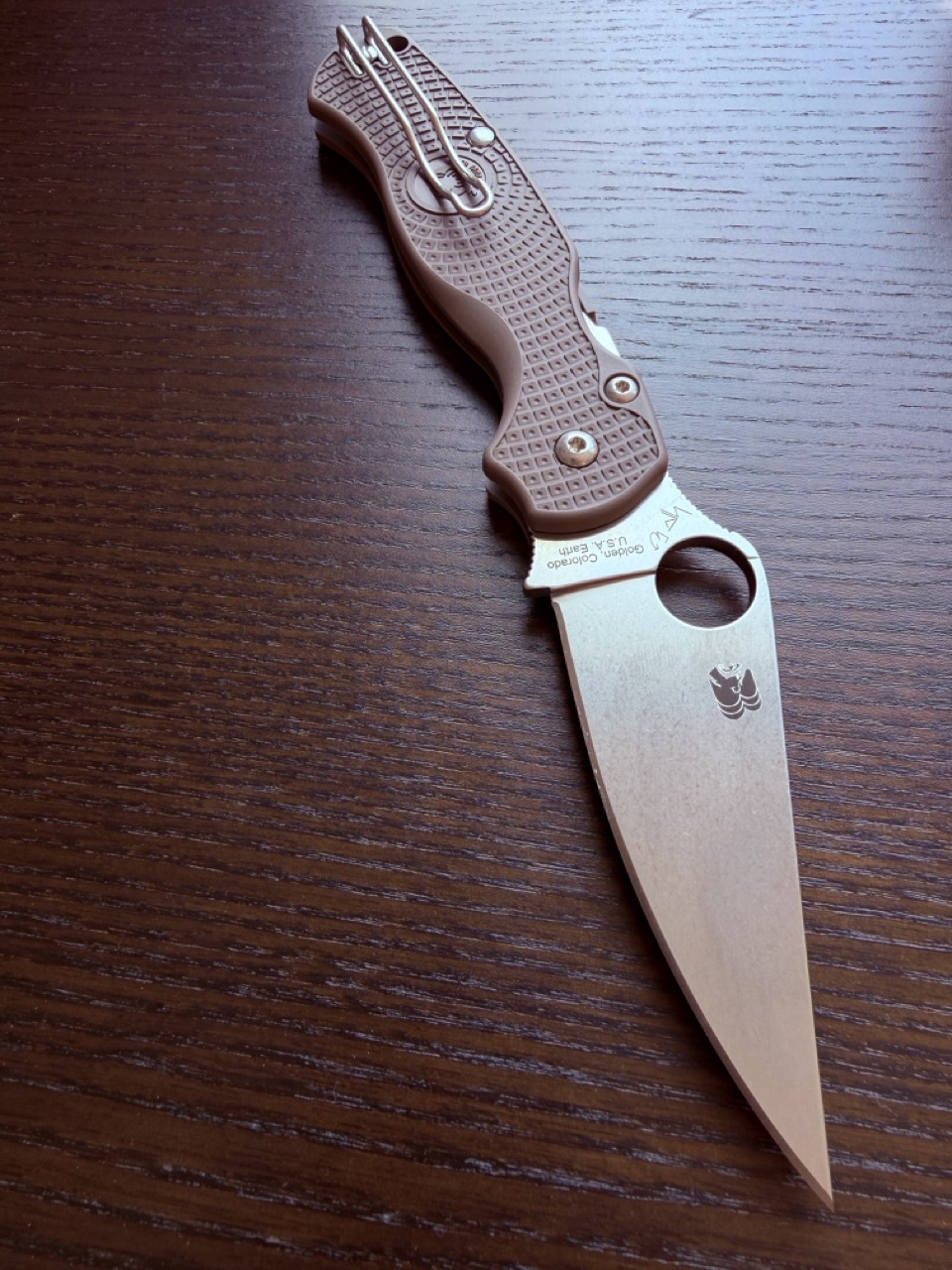
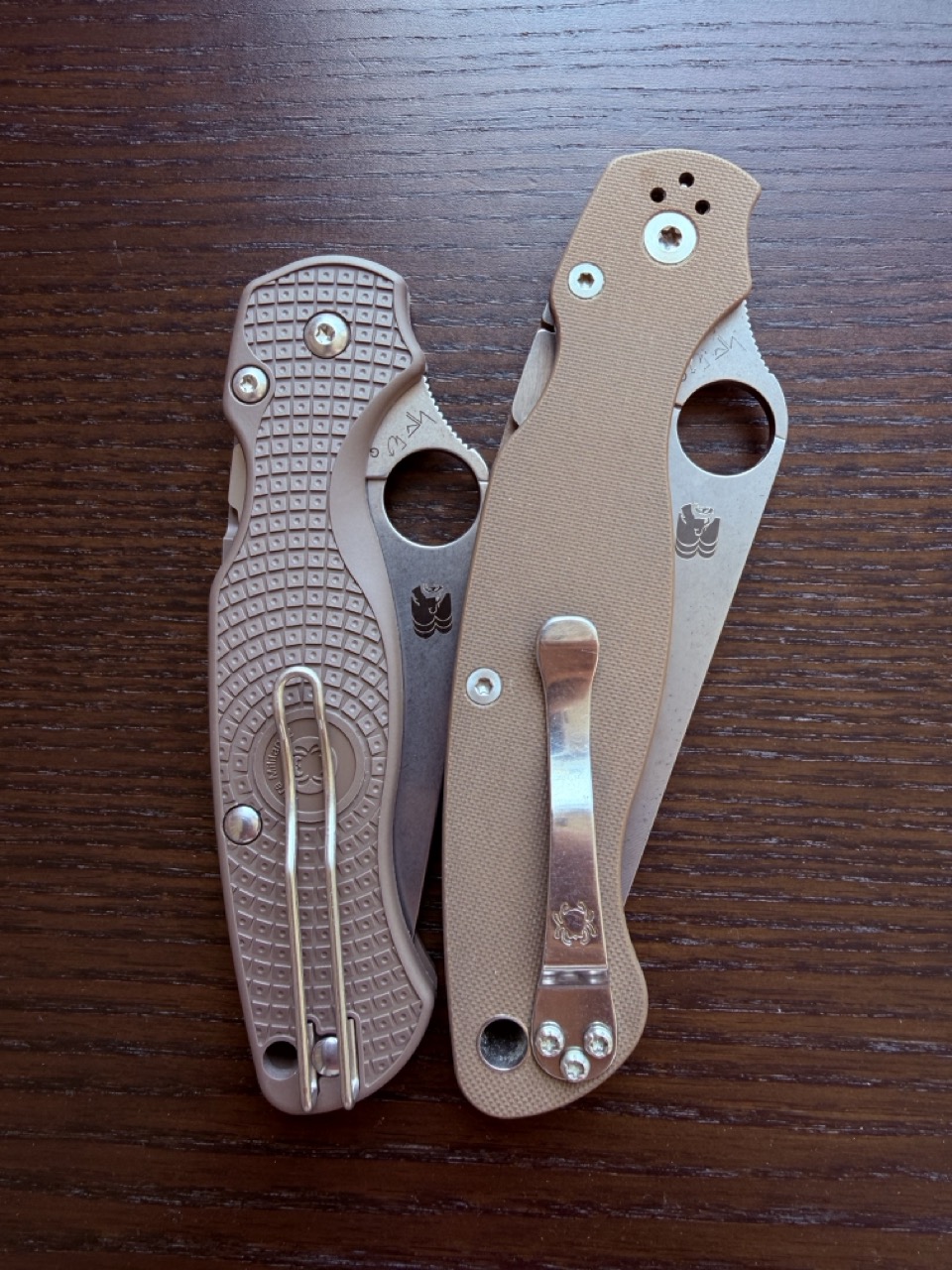
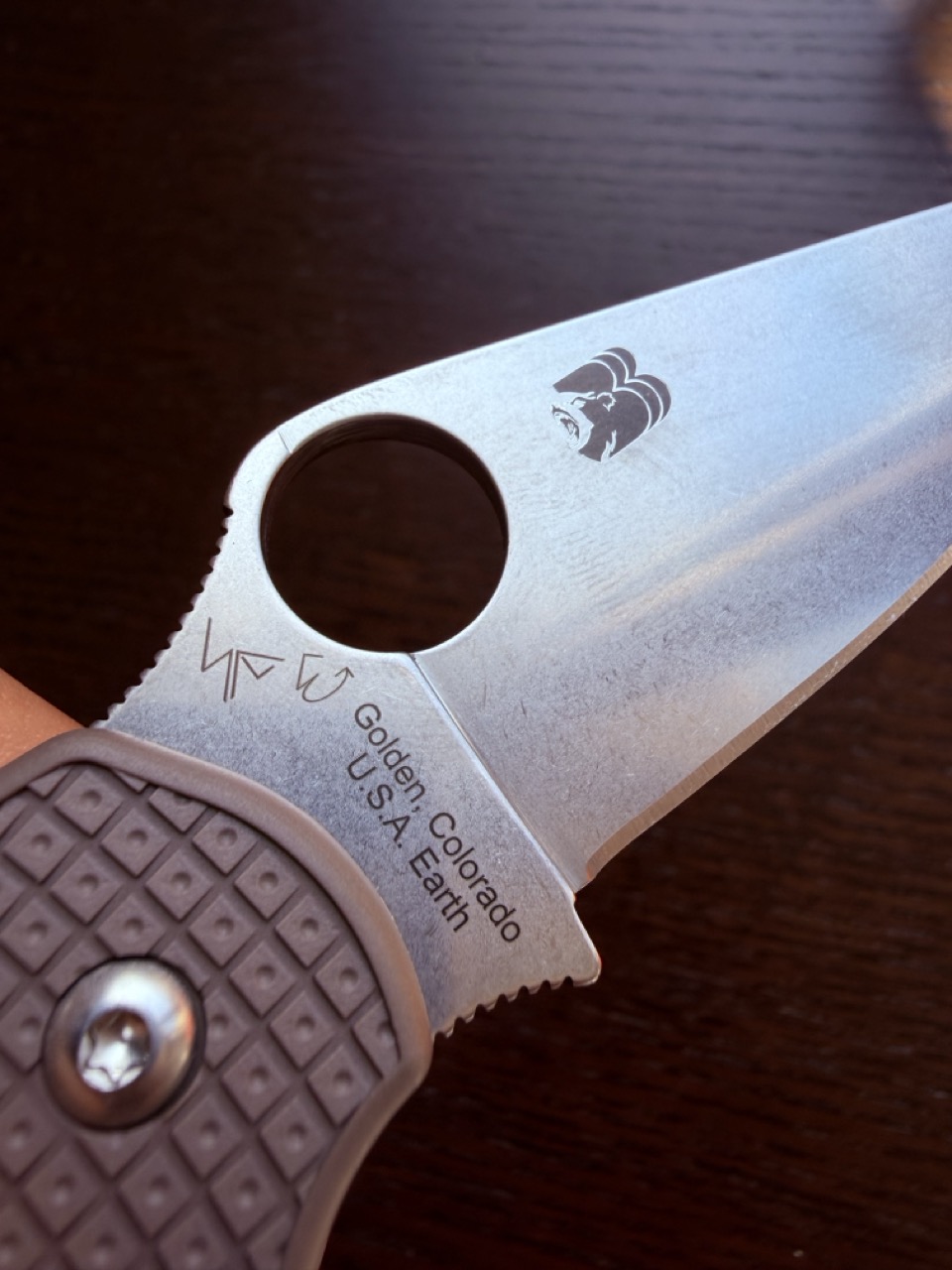
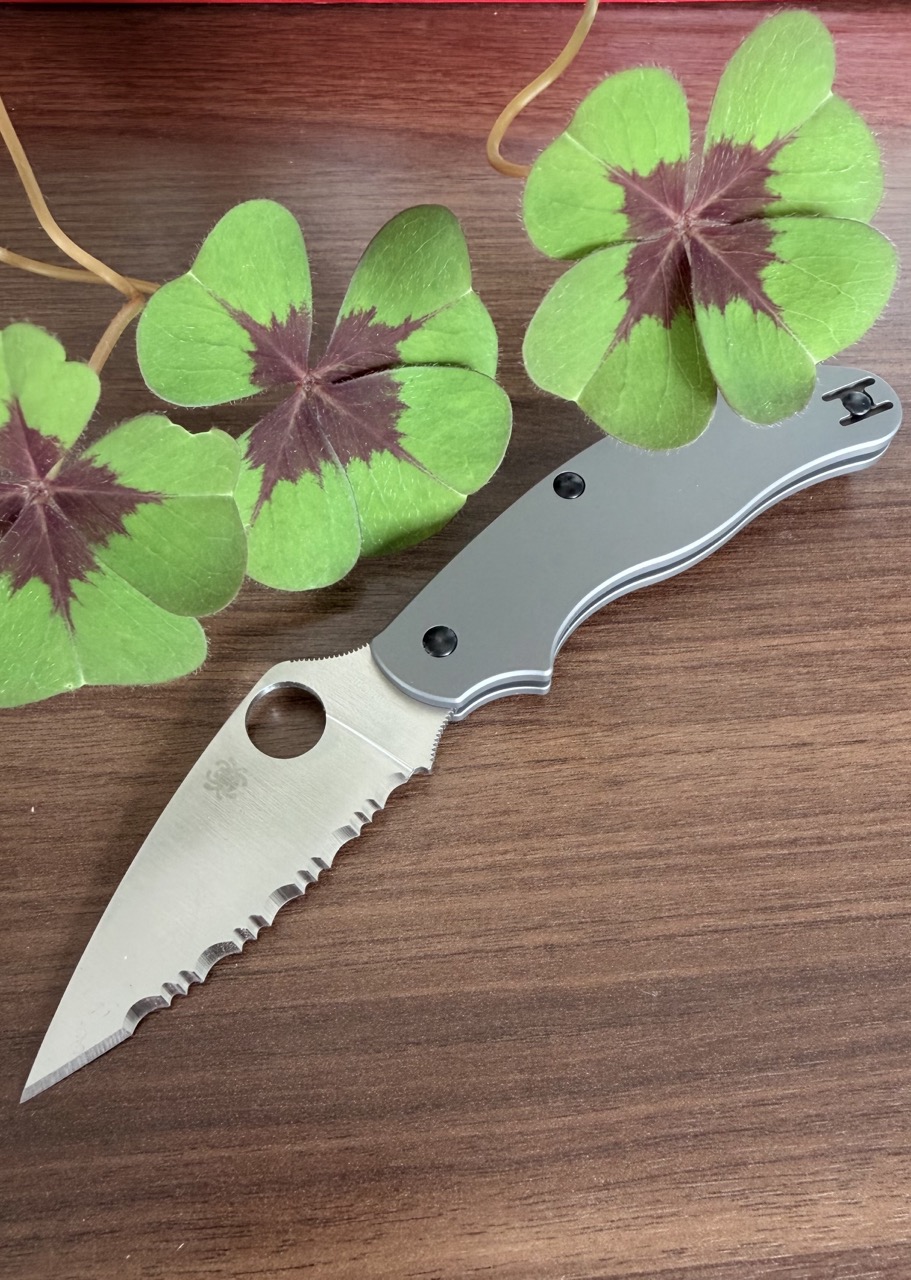
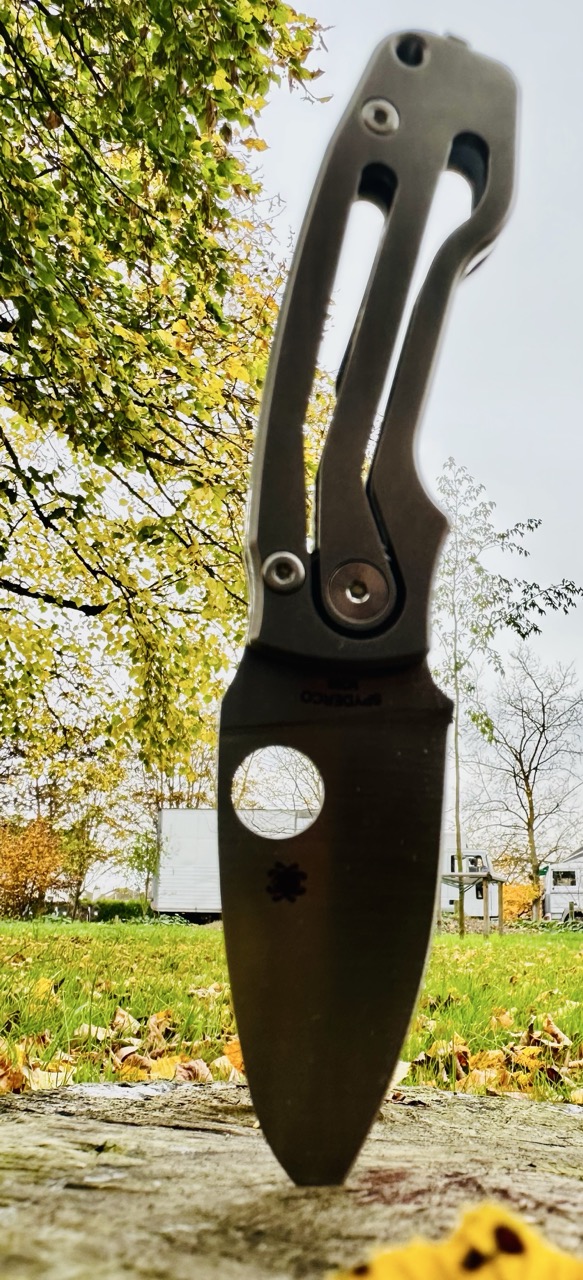
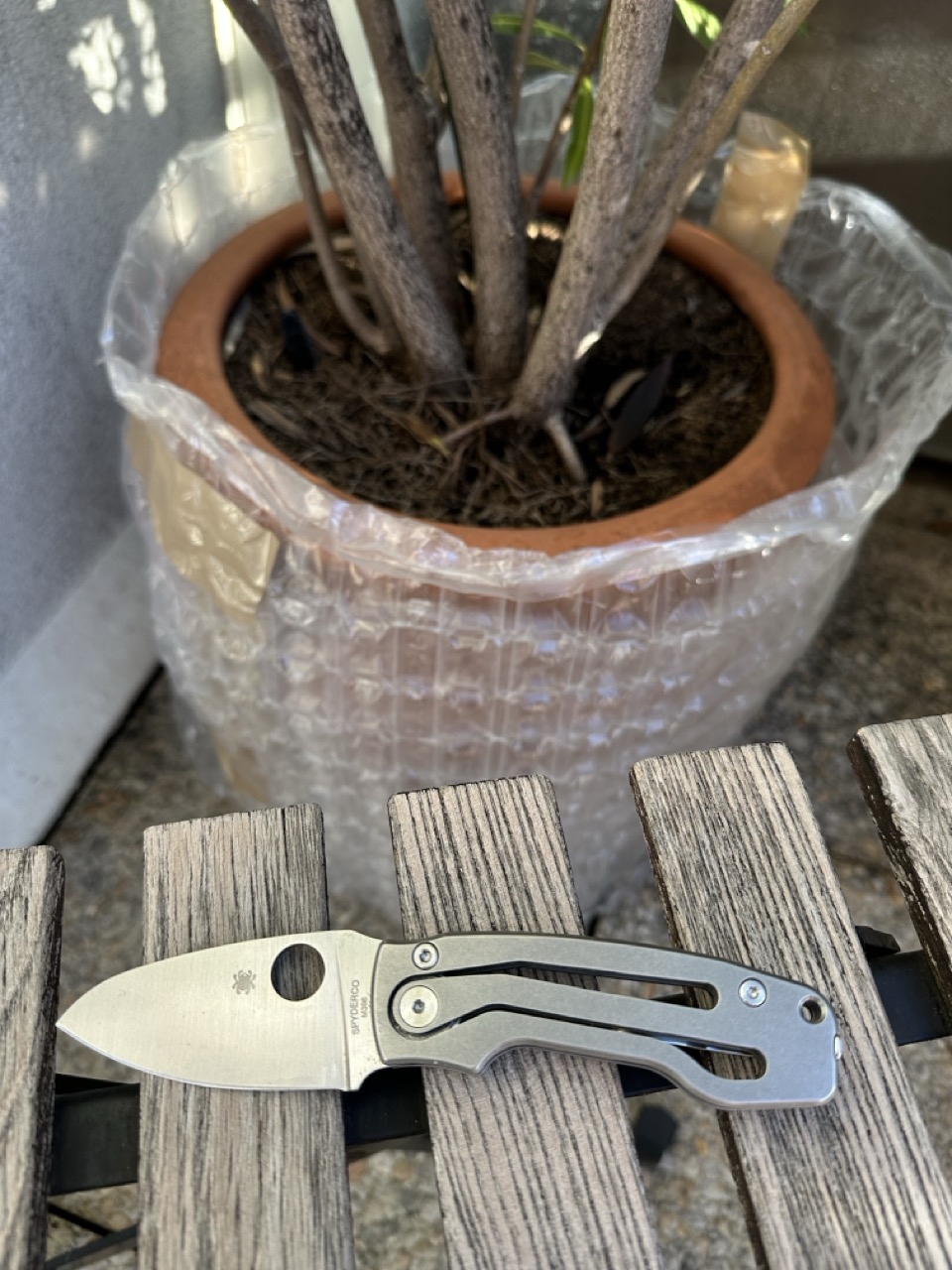
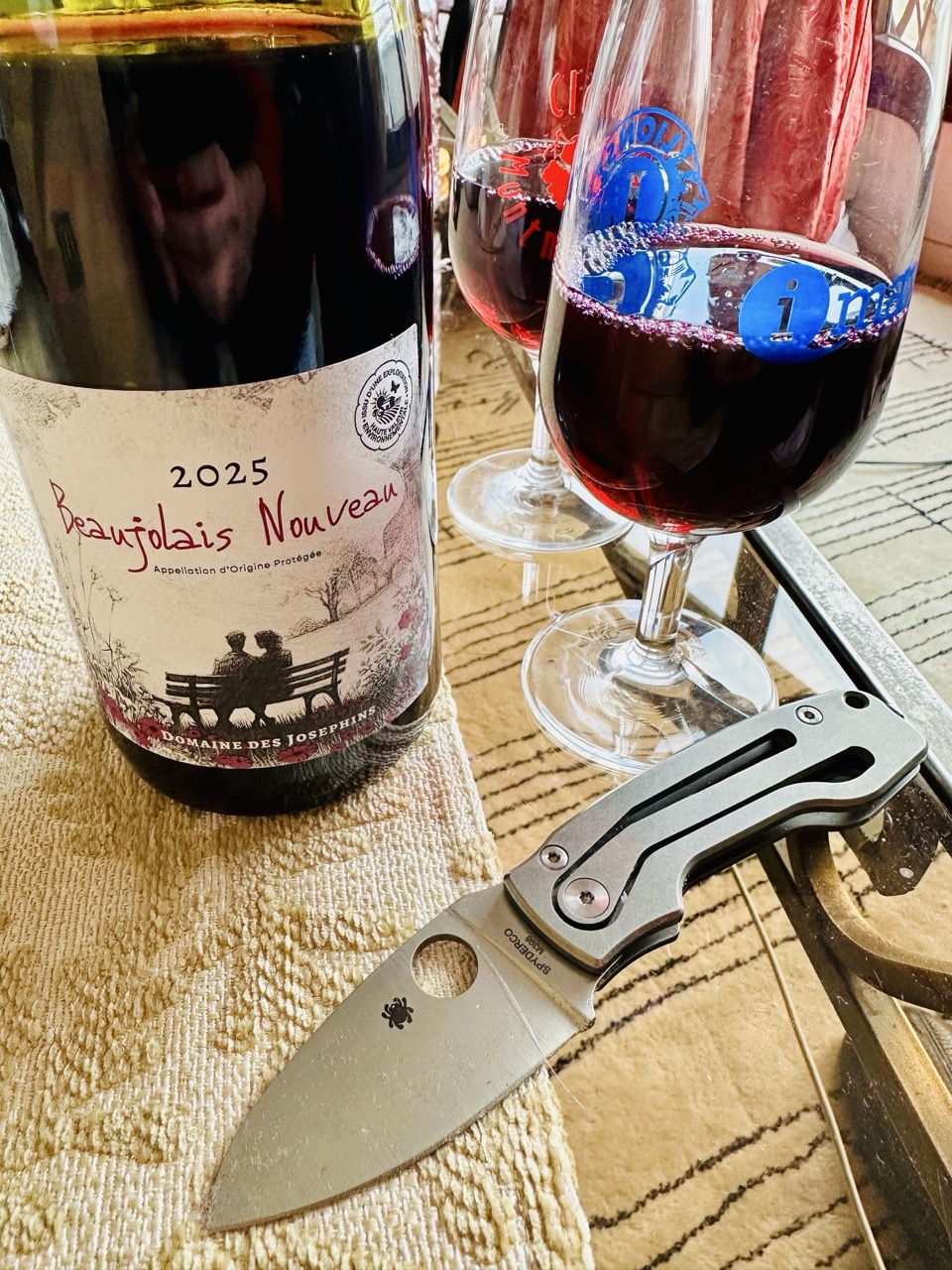
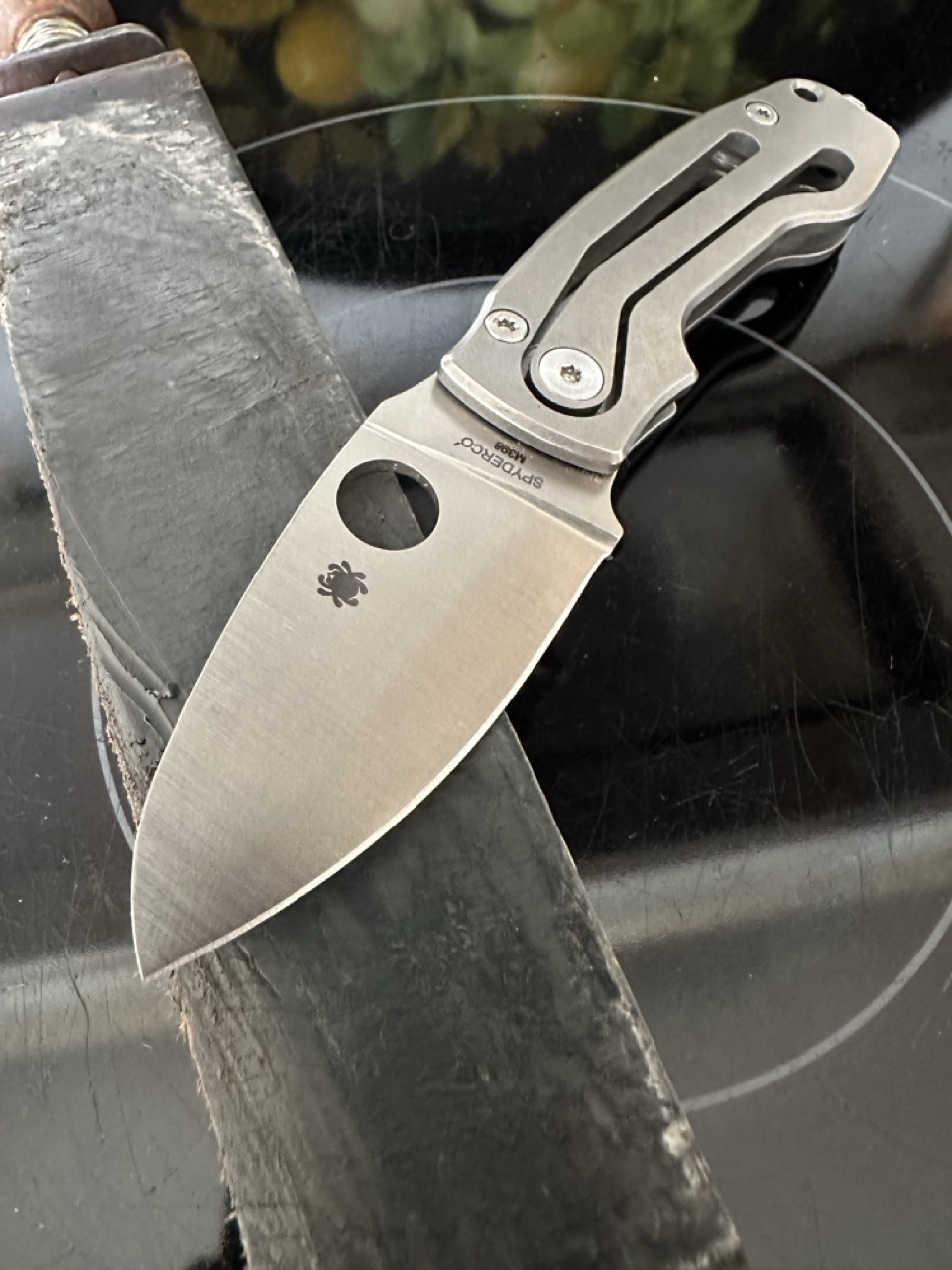
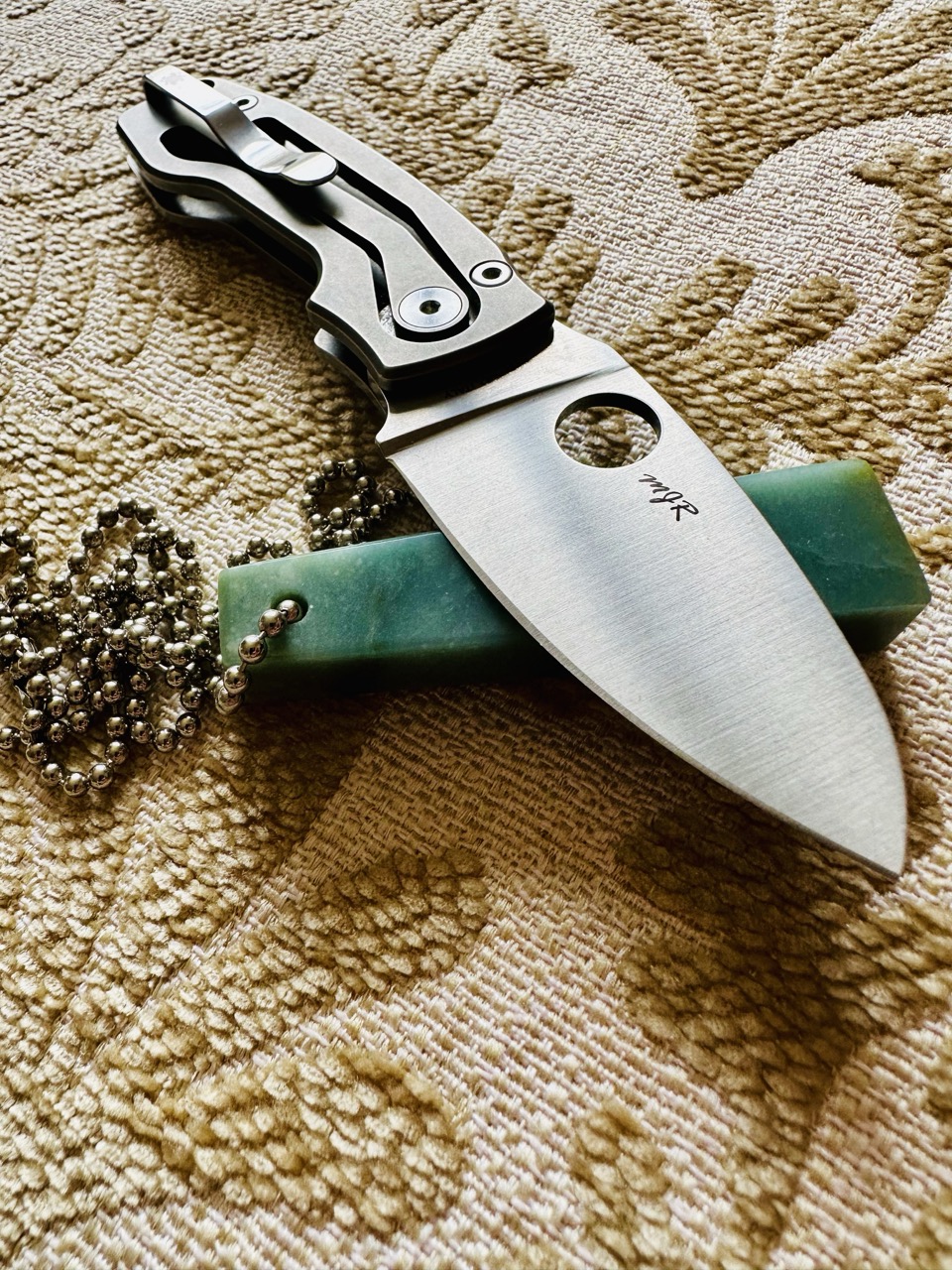
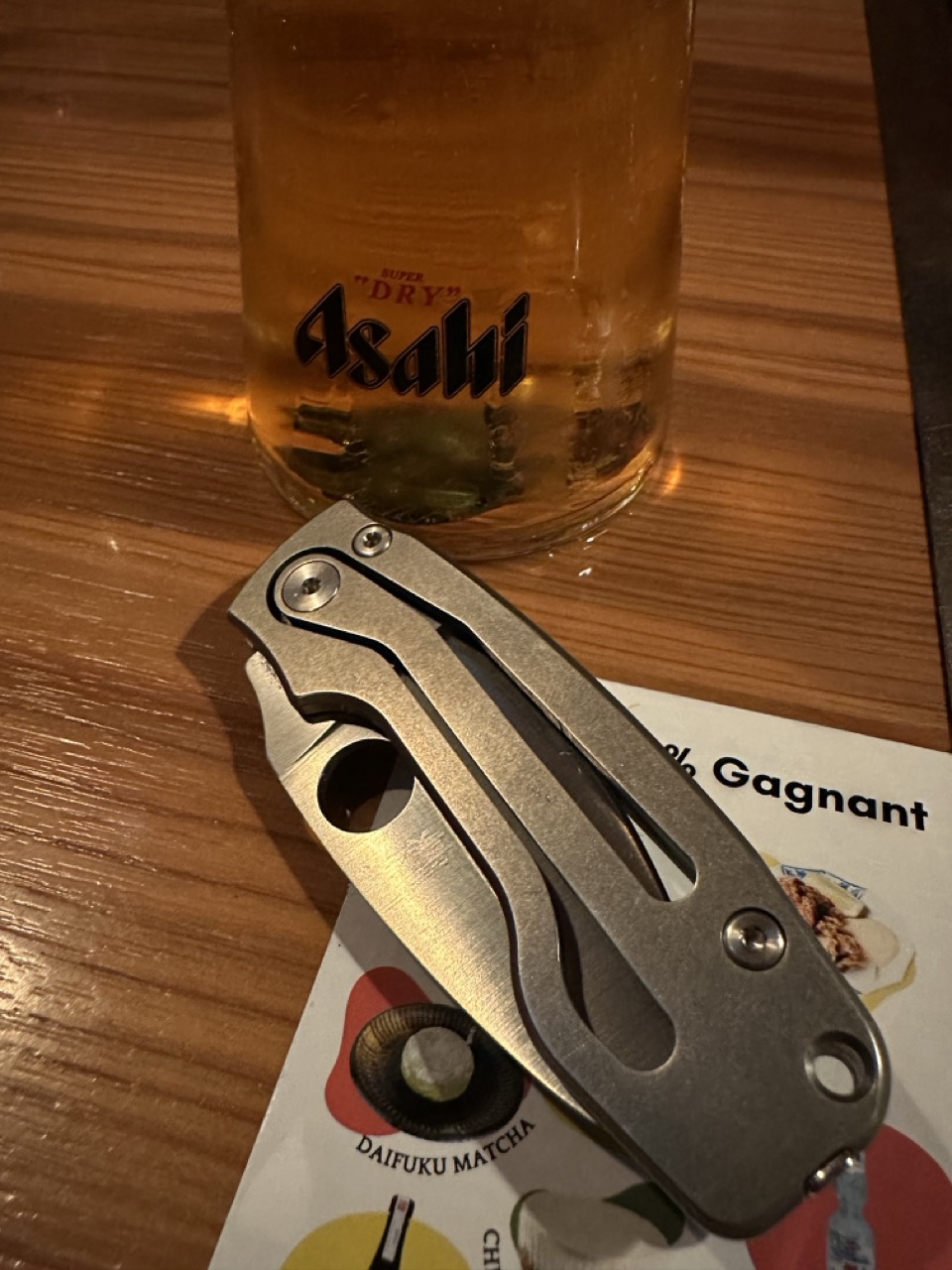
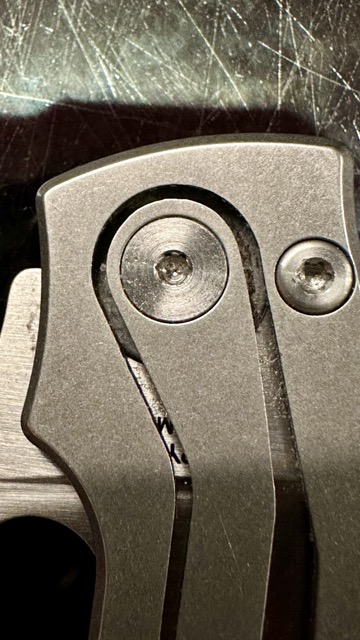
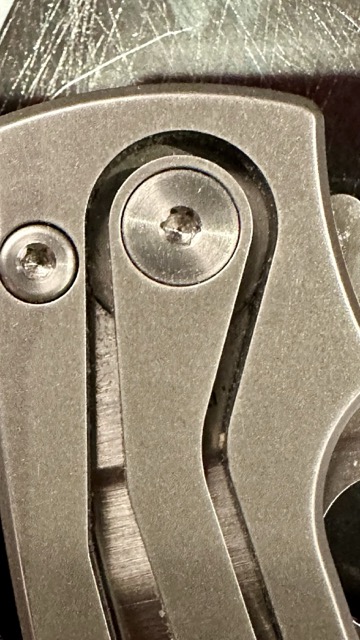
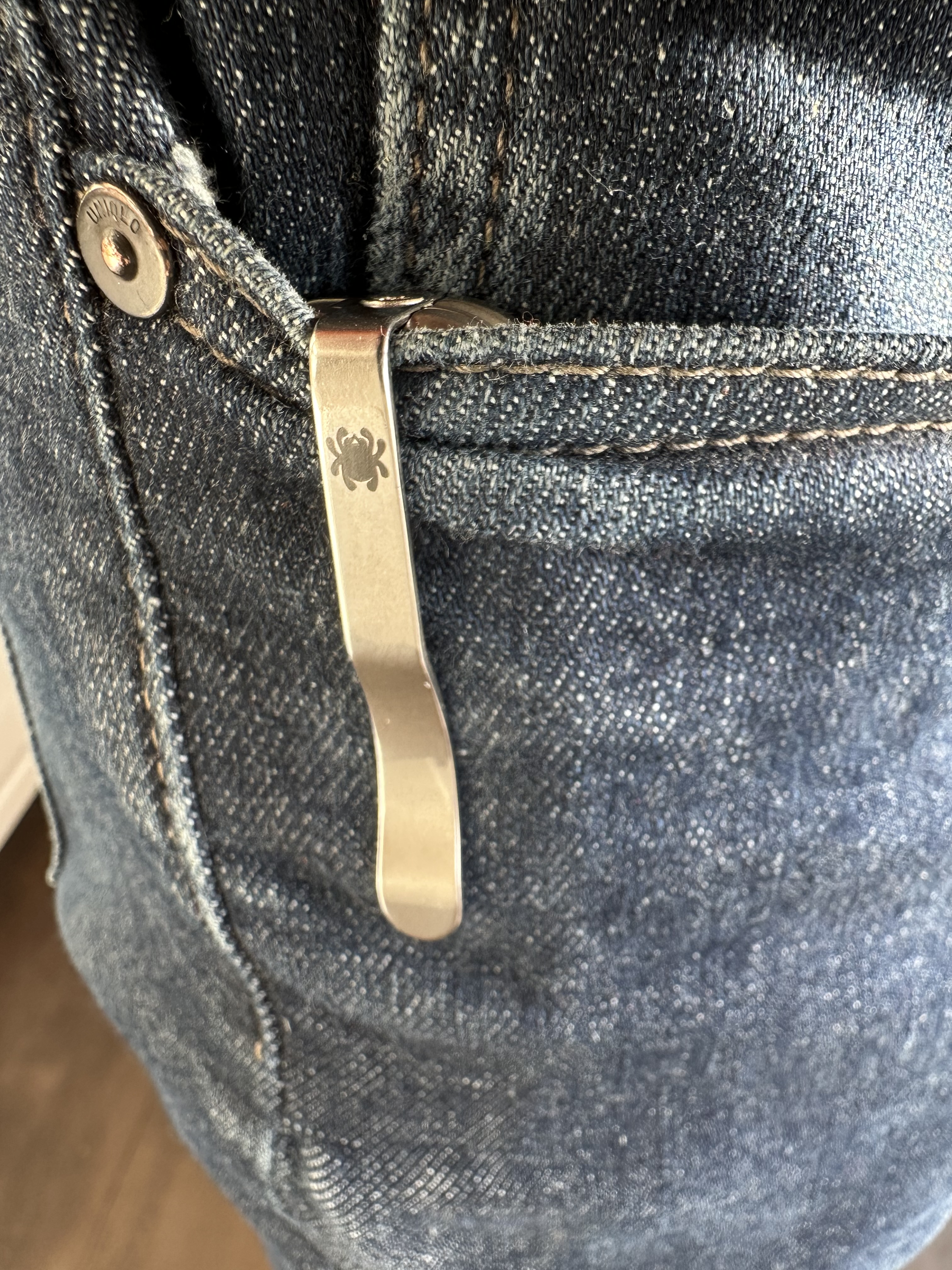
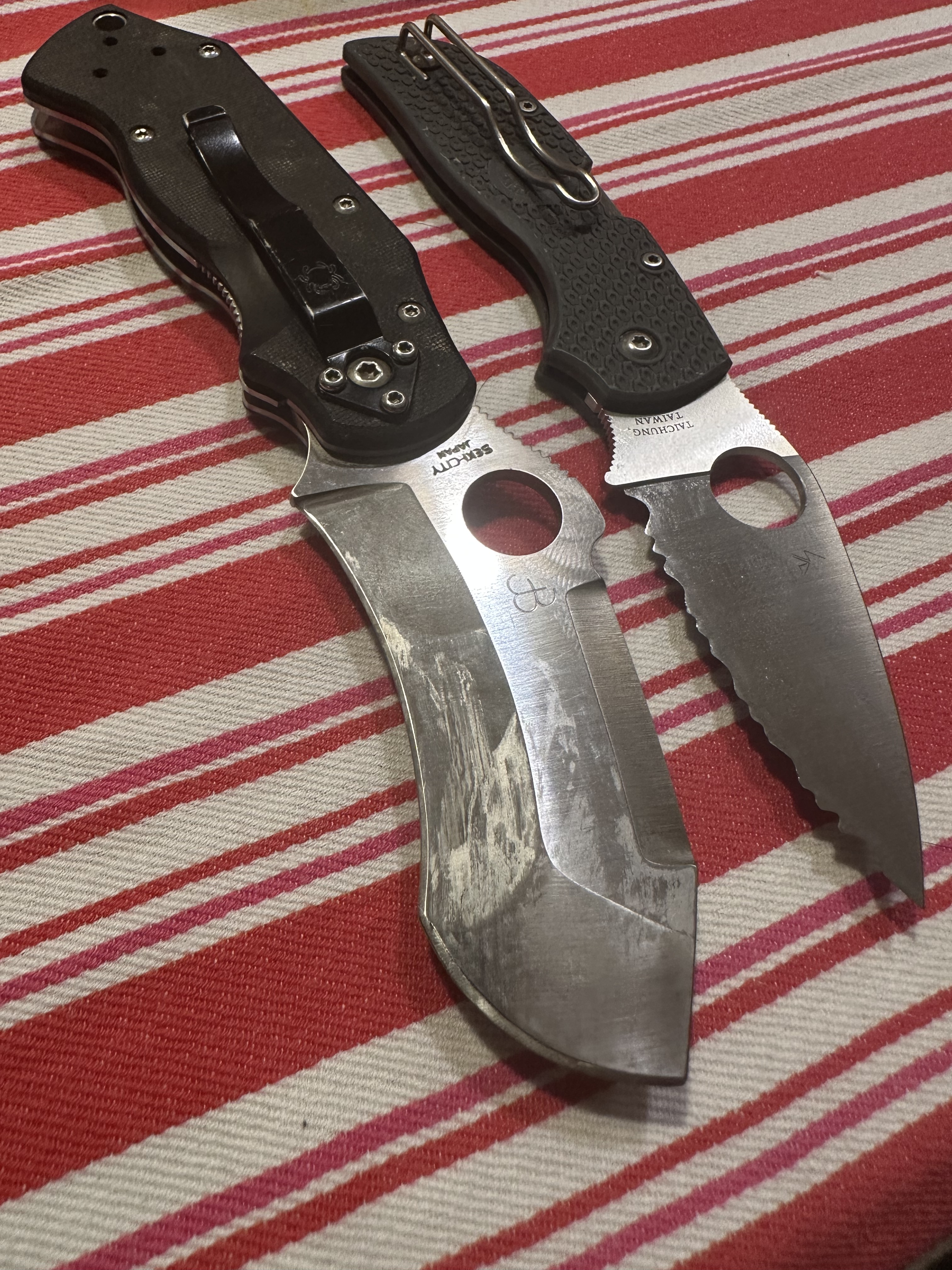
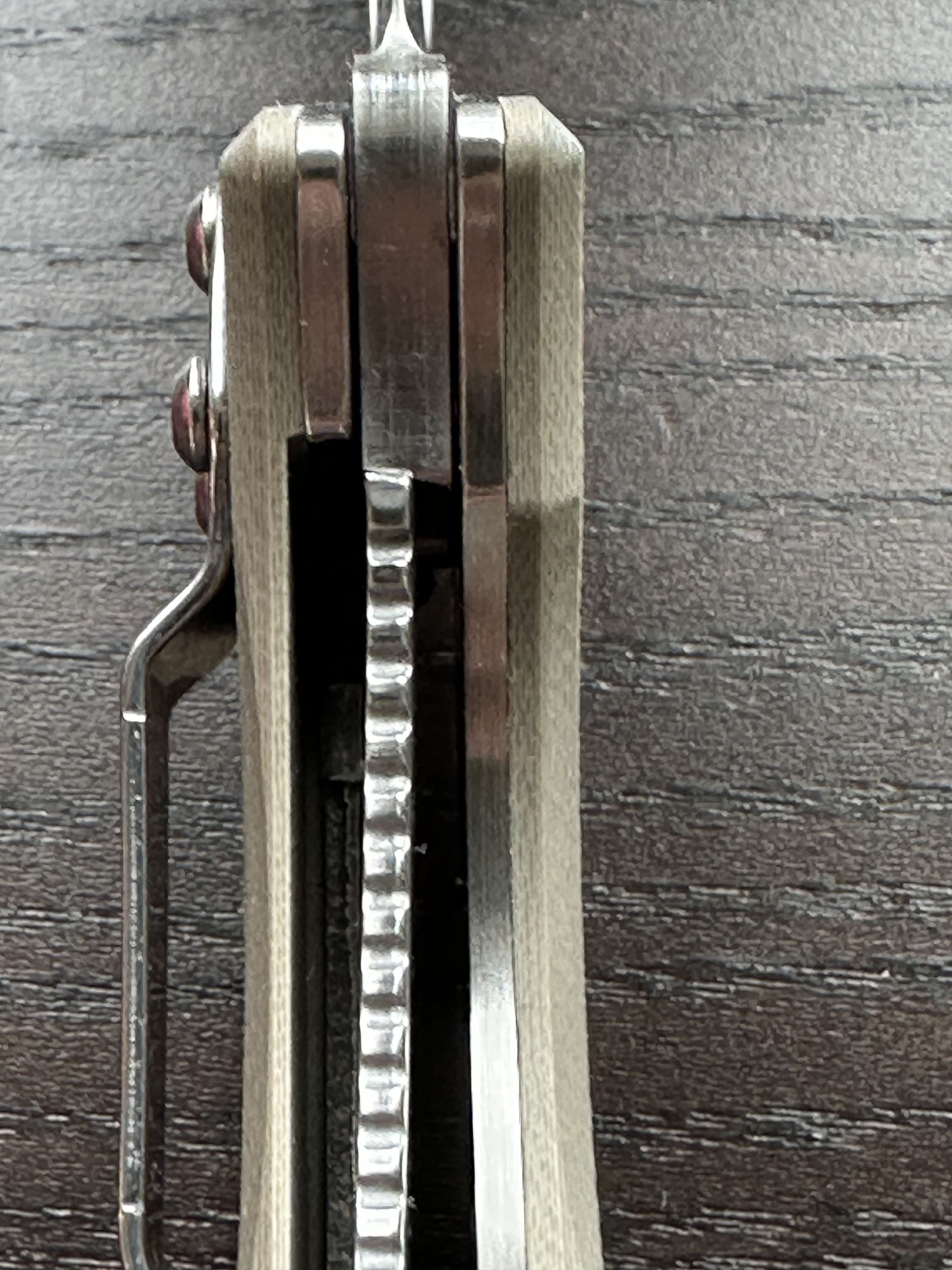
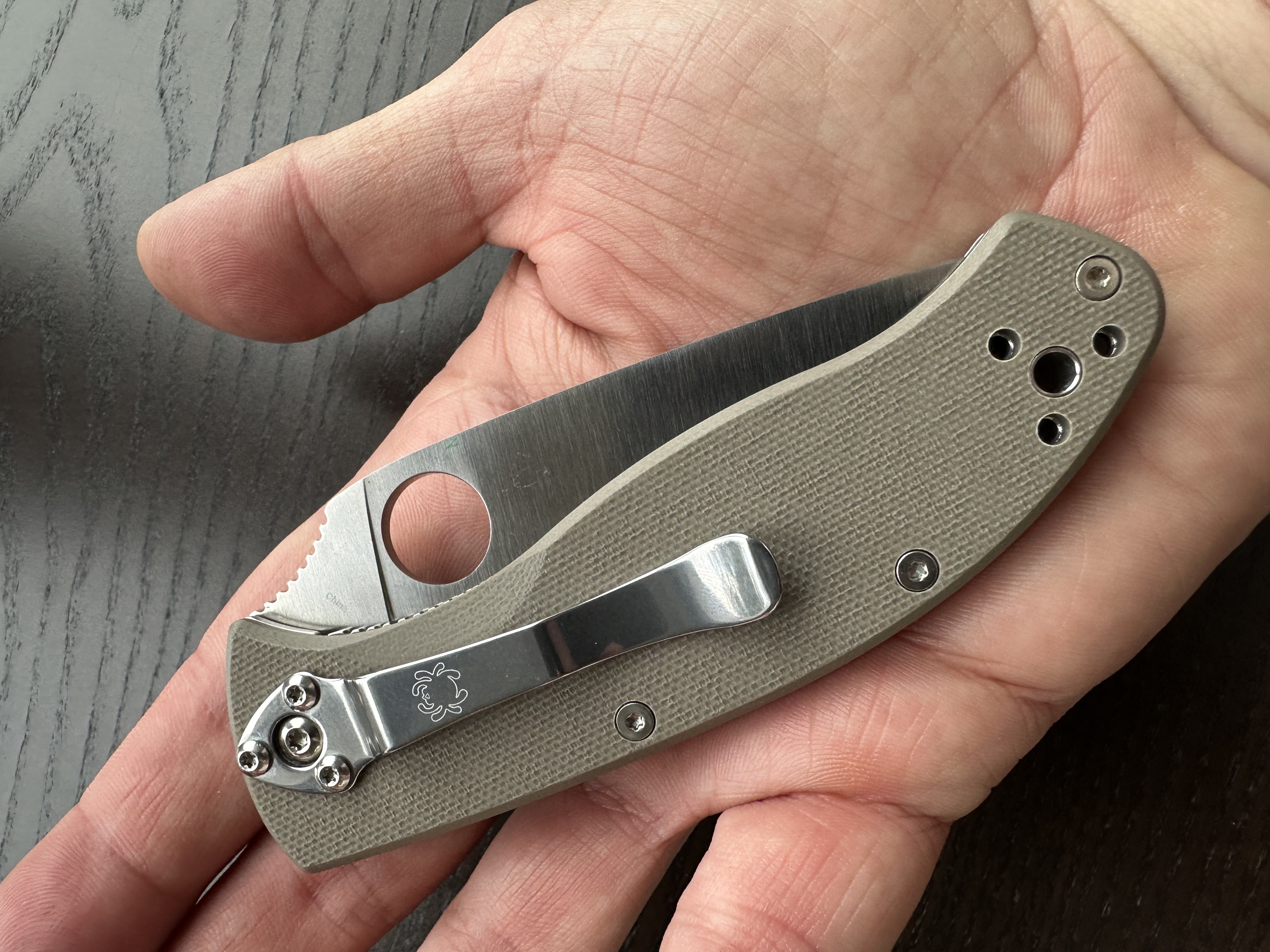
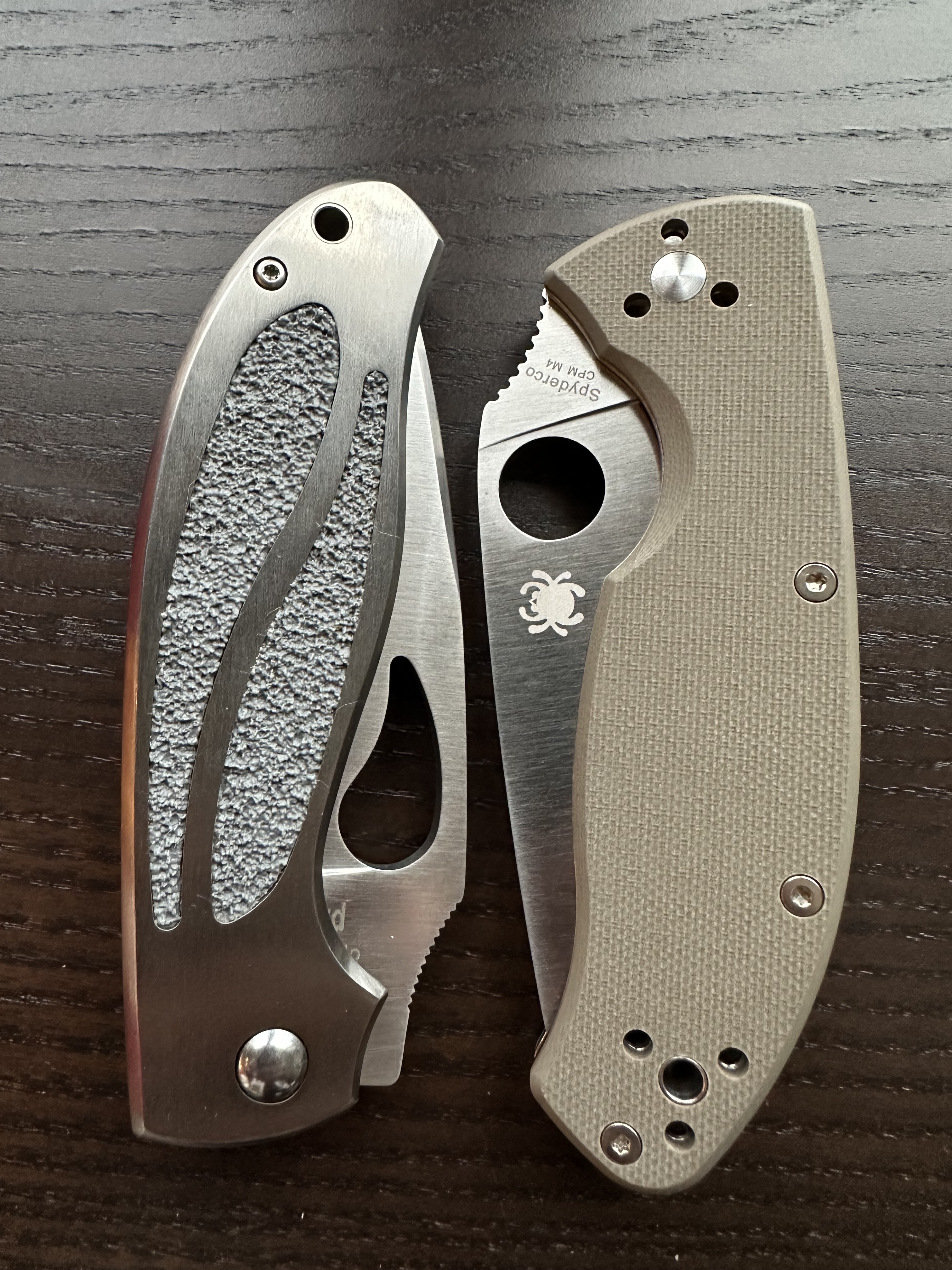
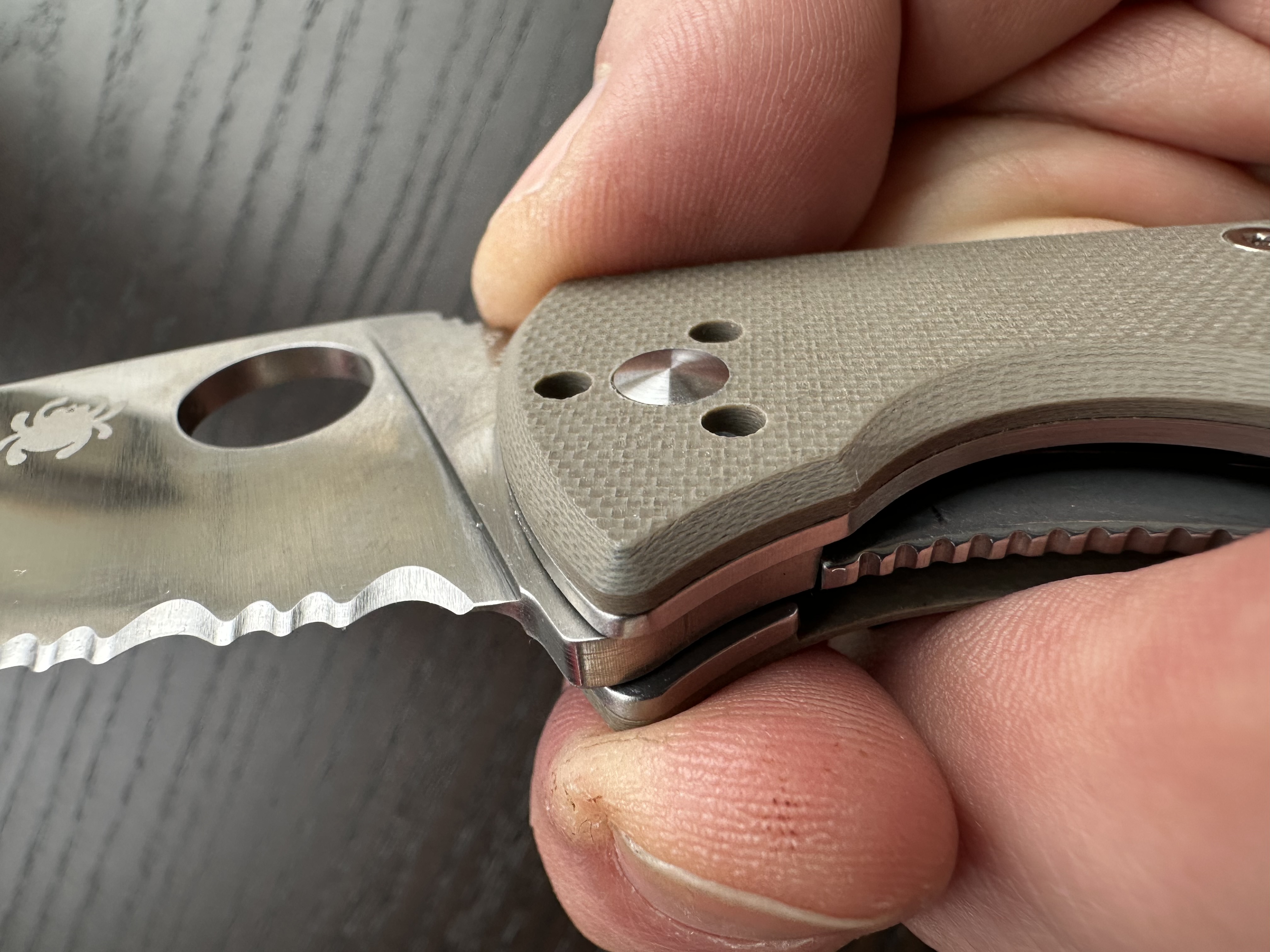
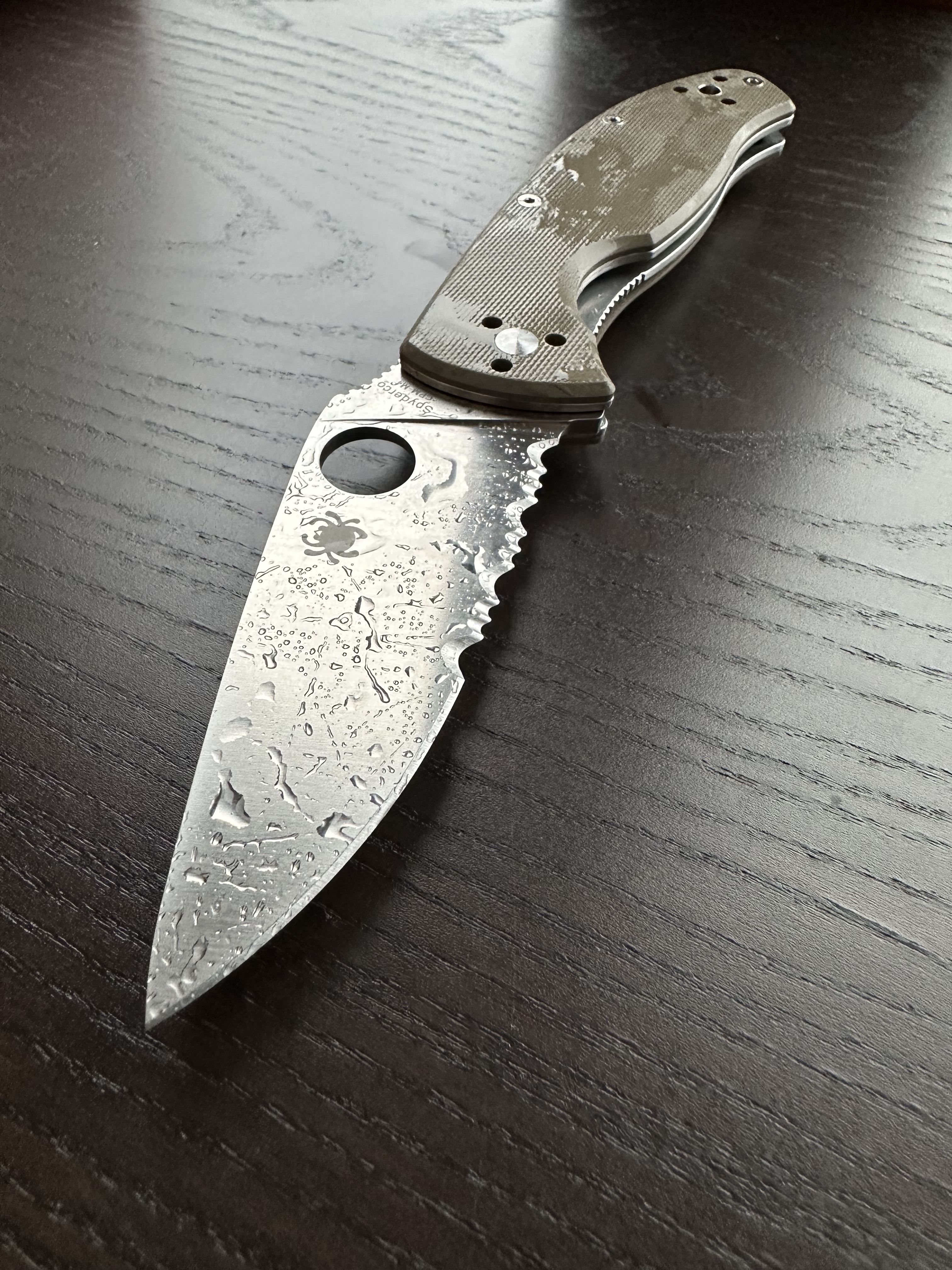
You know how much I enjoy giving names to my knives. Well, this Meerkat Sprint Run ( >>>>PART 1<<<<) is going to be called Casper.
Partly because of its very friendly personality, and partly because of its famous Phantom Lock. It seemed only fitting.
Like the friendly ghost, the Meerkat is small, harmless-looking and easy to like. It quietly disappears into a pocket, only to reappear when needed. And then, of course, there is that Phantom Lock. A lock that remains hidden, mysterious and just a little magical, even after all these years.
So yes, this Meerkat has officially become Casper the friendly folder, especially toward sheeples.
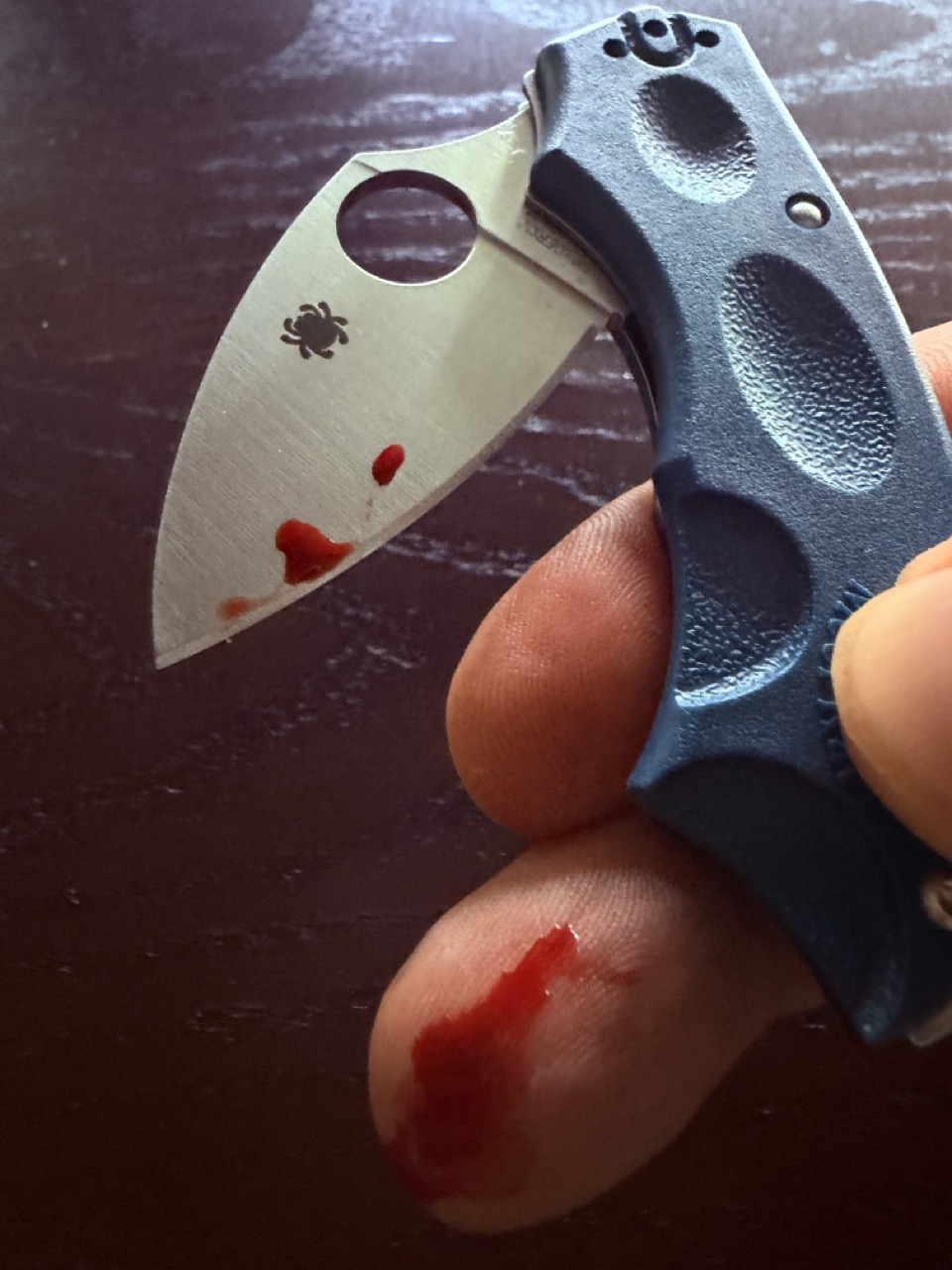
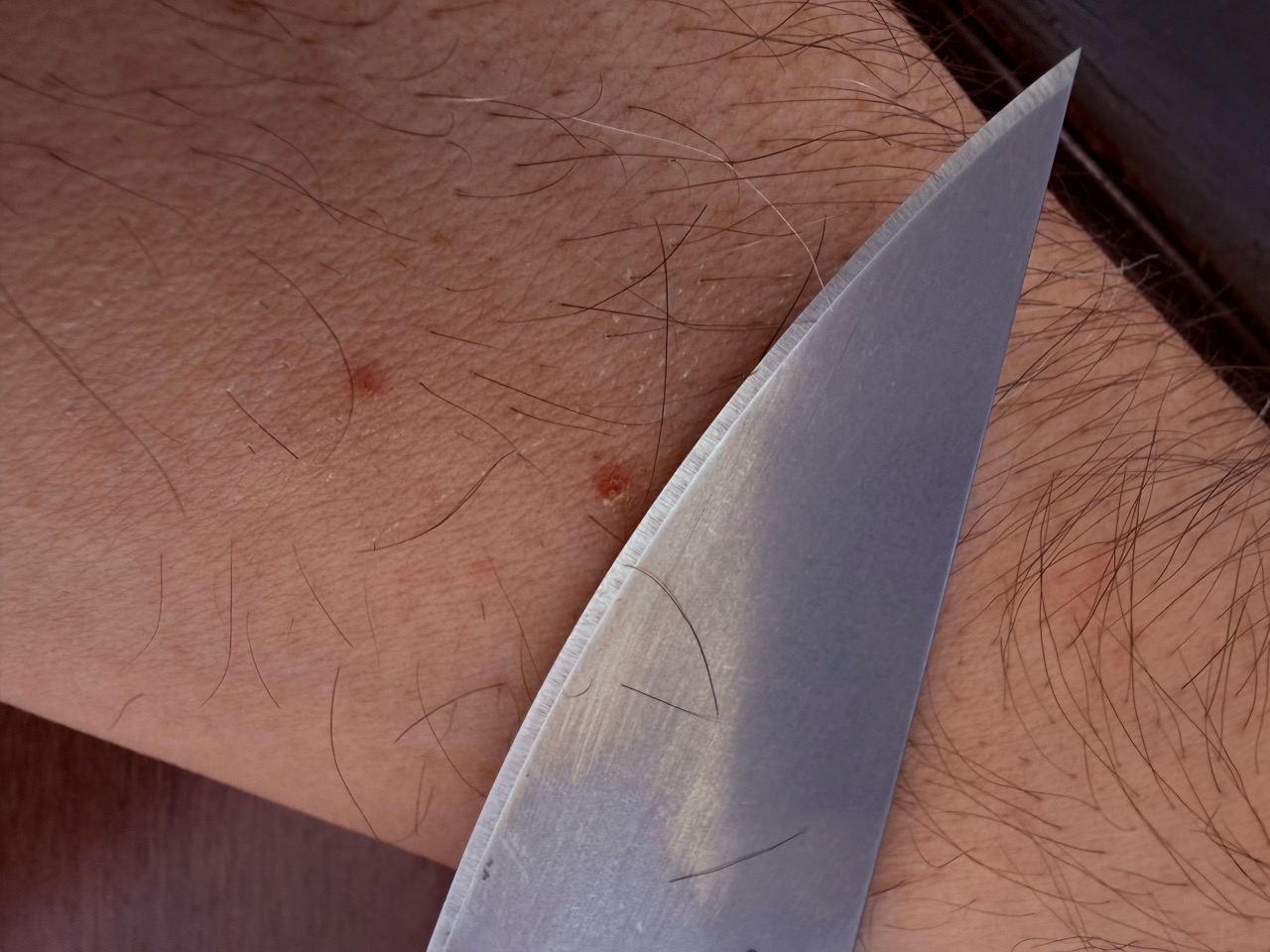
Now, as many of you know, I tend to baptize my knives the traditional Nemo way: with a little bit of my own blood.
And the Meerkat did not disappoint.
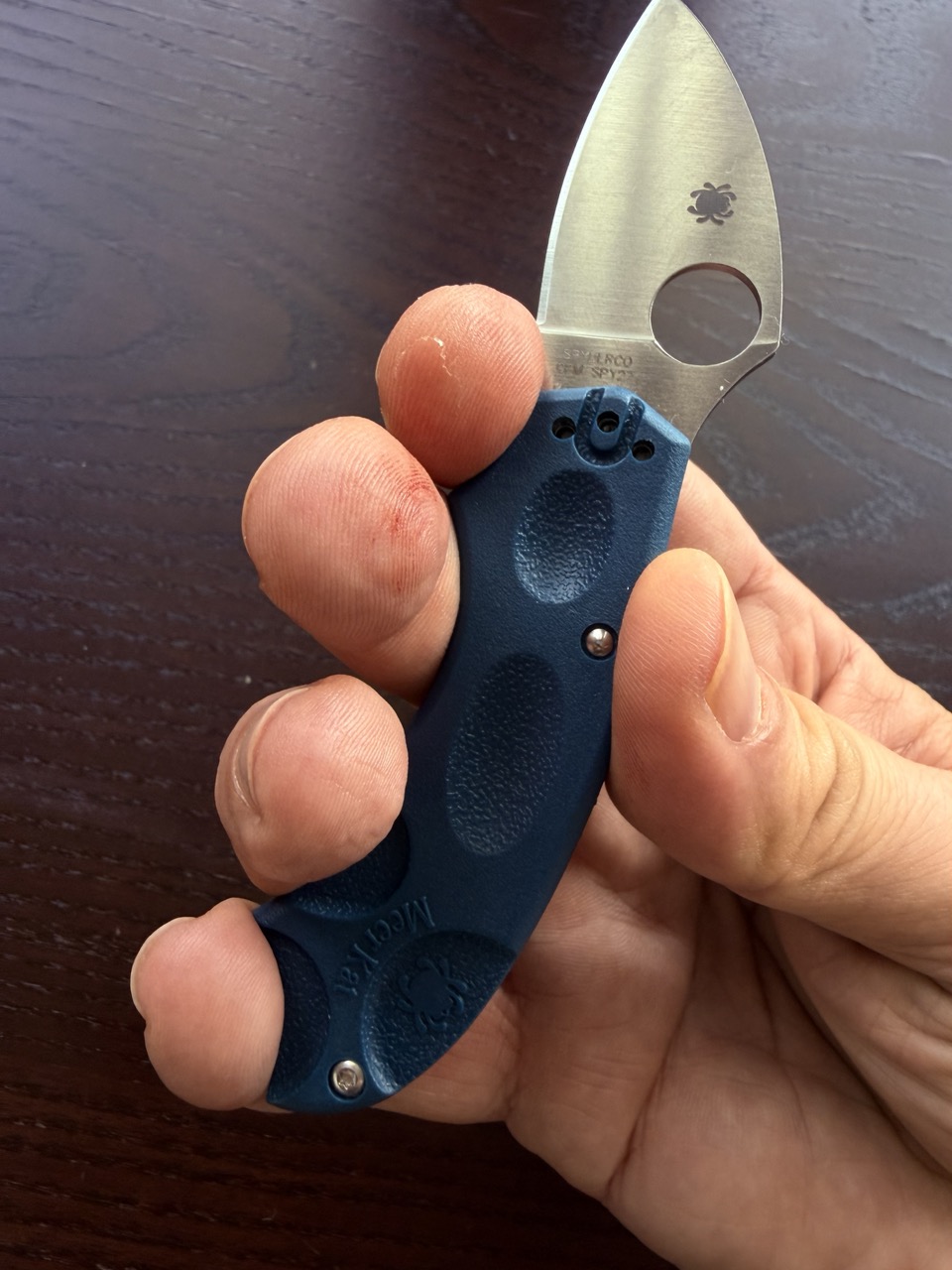
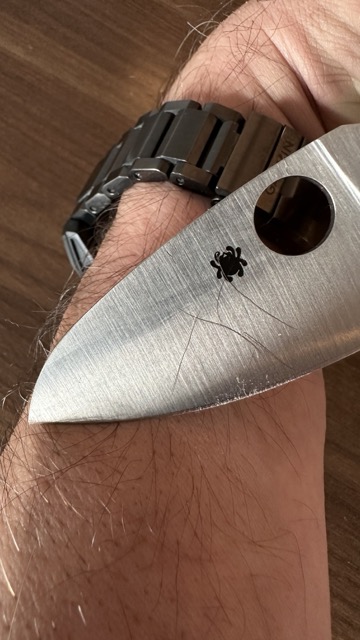
Ah ! When closing the blade with a wrist flick after disengaging the Phantom Lock, make sure your middle finger is well clear of the blade’s path. If it isn’t, it will quickly discover that the Meerkat’s edge is less friendly than its name suggests.
The closing blade comes down like a tiny guillotine, and yes, it cuts very well.
Ask me how I know. 😉
Nothing serious, just a small nick, but it serves as a useful reminder: the Meerkat may be compact and charming, yet it is still a very sharp Spyderco.
But once you start playing with the Meerkat, several things quickly become apparent.
First, it is surprisingly fidget-friendly.
Once you get the hang of it, disengaging the Phantom Lock and flicking the blade shut with a simple wrist movement becomes second nature. It is one of those knives that invites interaction. Before you know it, you find yourself opening and closing it repeatedly just for the pleasure of the mechanism. Just keep that middle finger away !
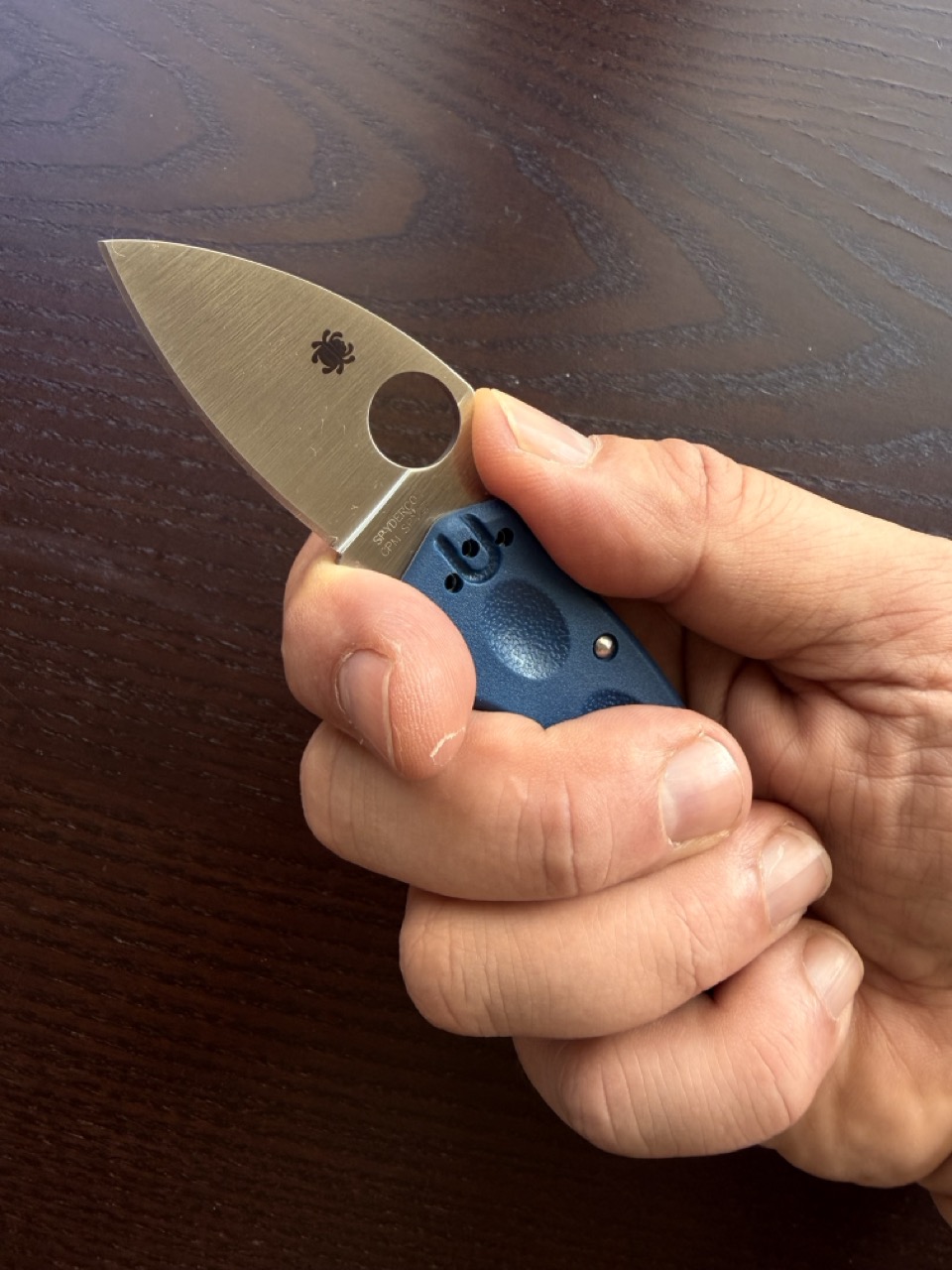
The second thing I noticed is how enjoyable the knife is to deploy using the good old Spyder Drop. Draw !!
Screenshot
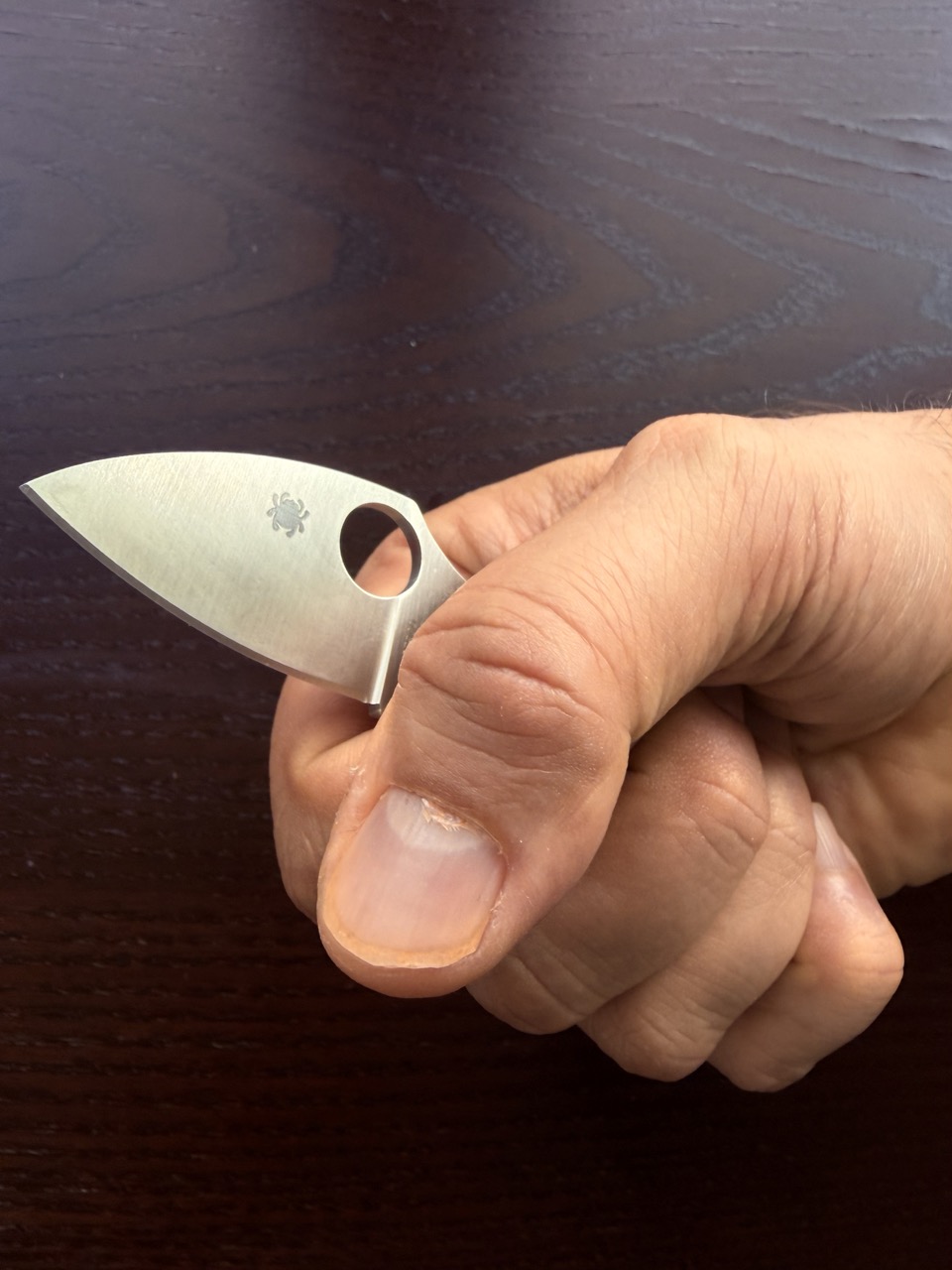
I know this opening method is no longer fashionable. Nowadays, many users prefer to flick open a tip-up folder with their index finger. But the classic Spyderco opening technique—grabbing the knife by the Round Hole and snapping the blade open with a wrist flick—works wonderfully well with the Meerkat. The reasons are simple: tip down carry and… The handle carries a surprising amount of weight thanks to its steel liners, full backspacer and robust construction. That extra mass gives the knife excellent momentum during deployment, making the opening feel smooth, positive and satisfying.
Another pleasant surprise is the ergonomics. Despite its compact size, the handle comfortably accommodates all four fingers. The index finger naturally settles into the choil, while even the pinky gets its own dedicated space. The result is a grip that feels far more secure and powerful than the knife’s dimensions would suggest.
Then there is the blade.
One detail genuinely surprised me. Looking at the blade stock thickness, the Meerkat is actually thinner than the famously thin UKPK.
Meerkat: 0.096” (2.4 mm)
UKPK: 0.098” (2.5 mm)
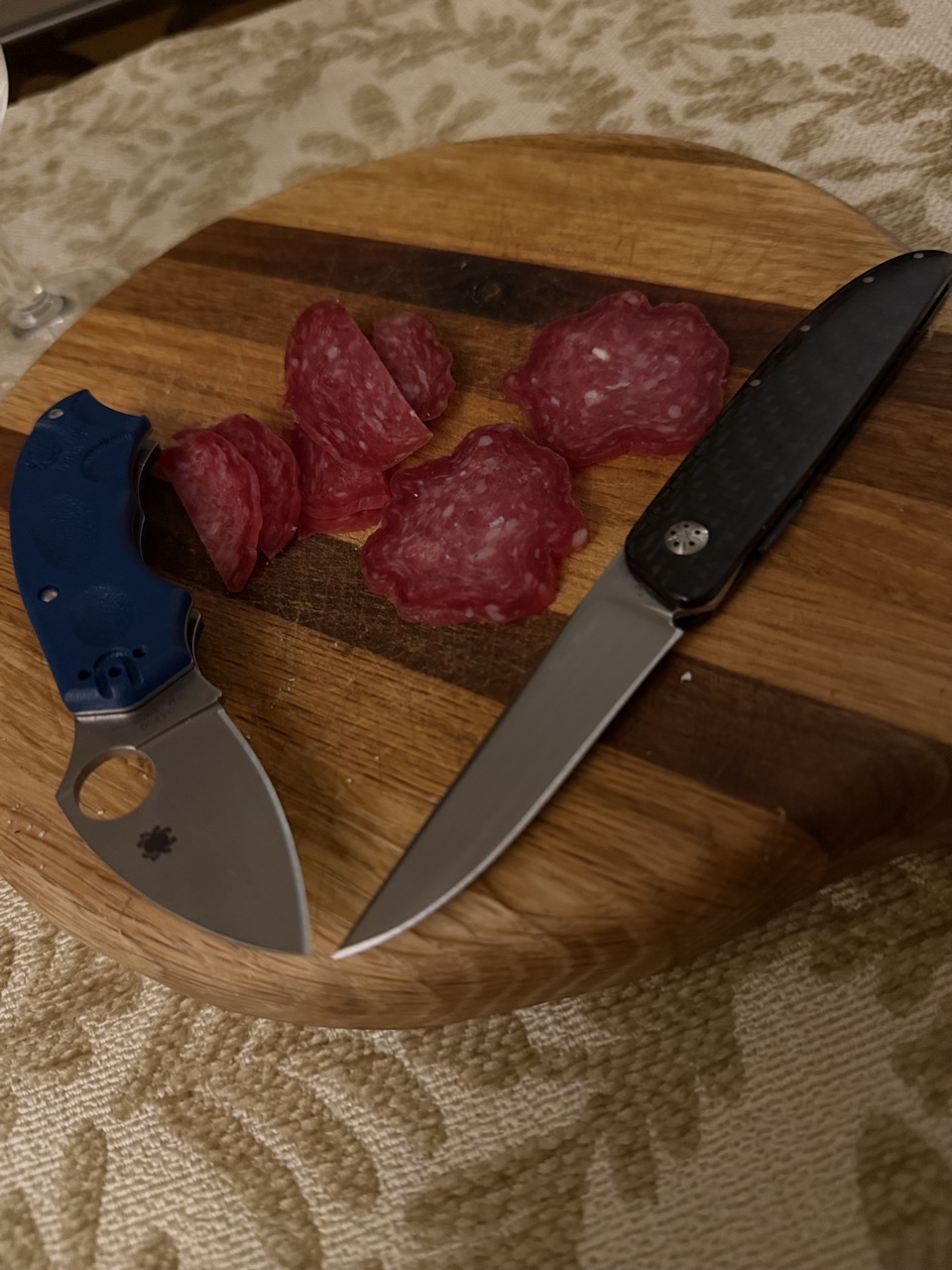
We’re only talking about a tenth of a millimeter, but I still found it amusing. The UKPK has long been my benchmark for a thin, high-performance cutting blade. Yet here comes this odd little Meerkat, quietly slipping underneath it. Perhaps that helps explain why the knife feels so eager when slicing wood, food, cardboard or just about anything else. The Meerkat may look chunky because of its stout handle and full stainless steel liners, but the blade itself is surprisingly lean.
Like many great Spydercos, it hides its elite cutting performance in plain sight.
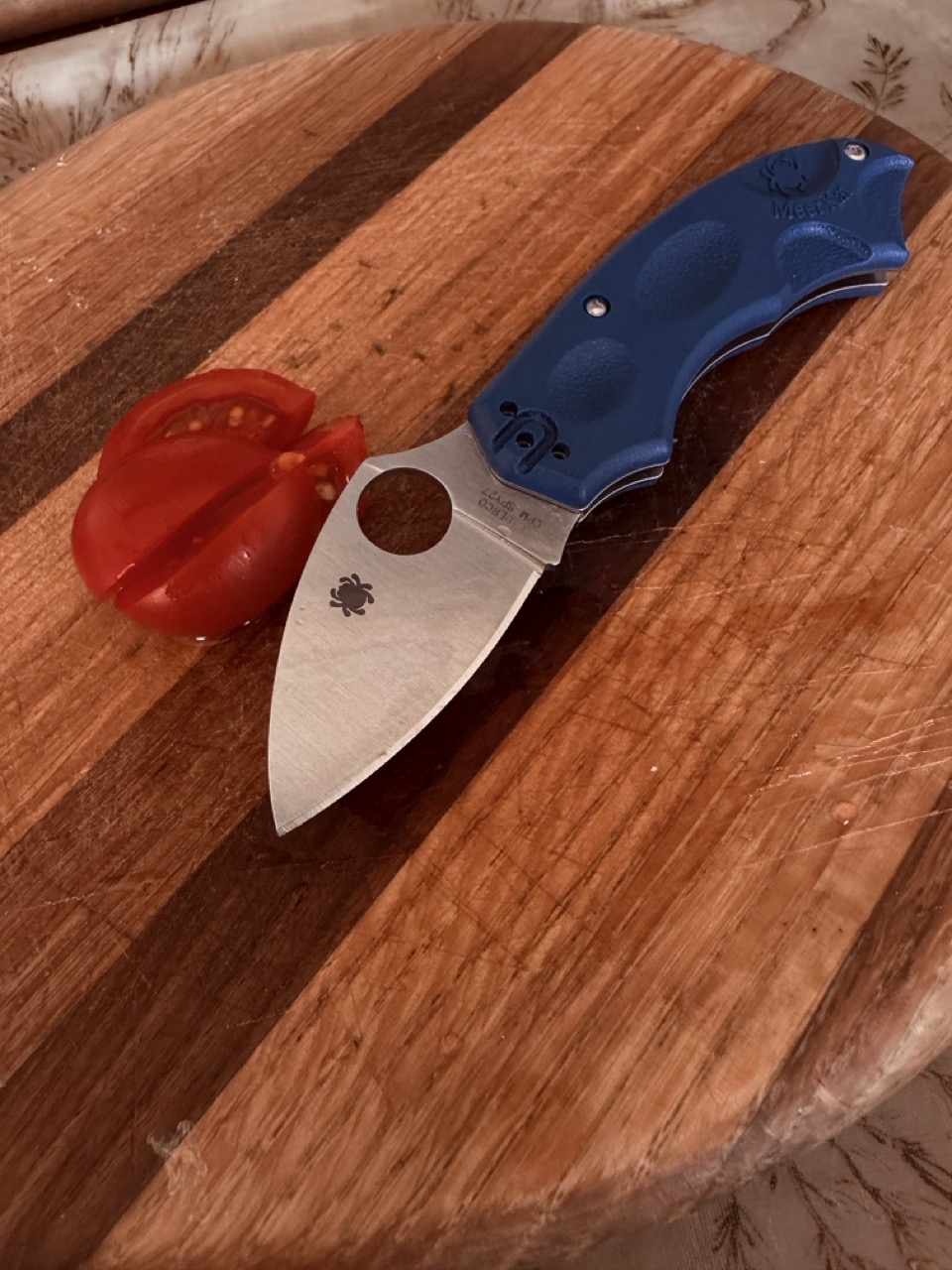
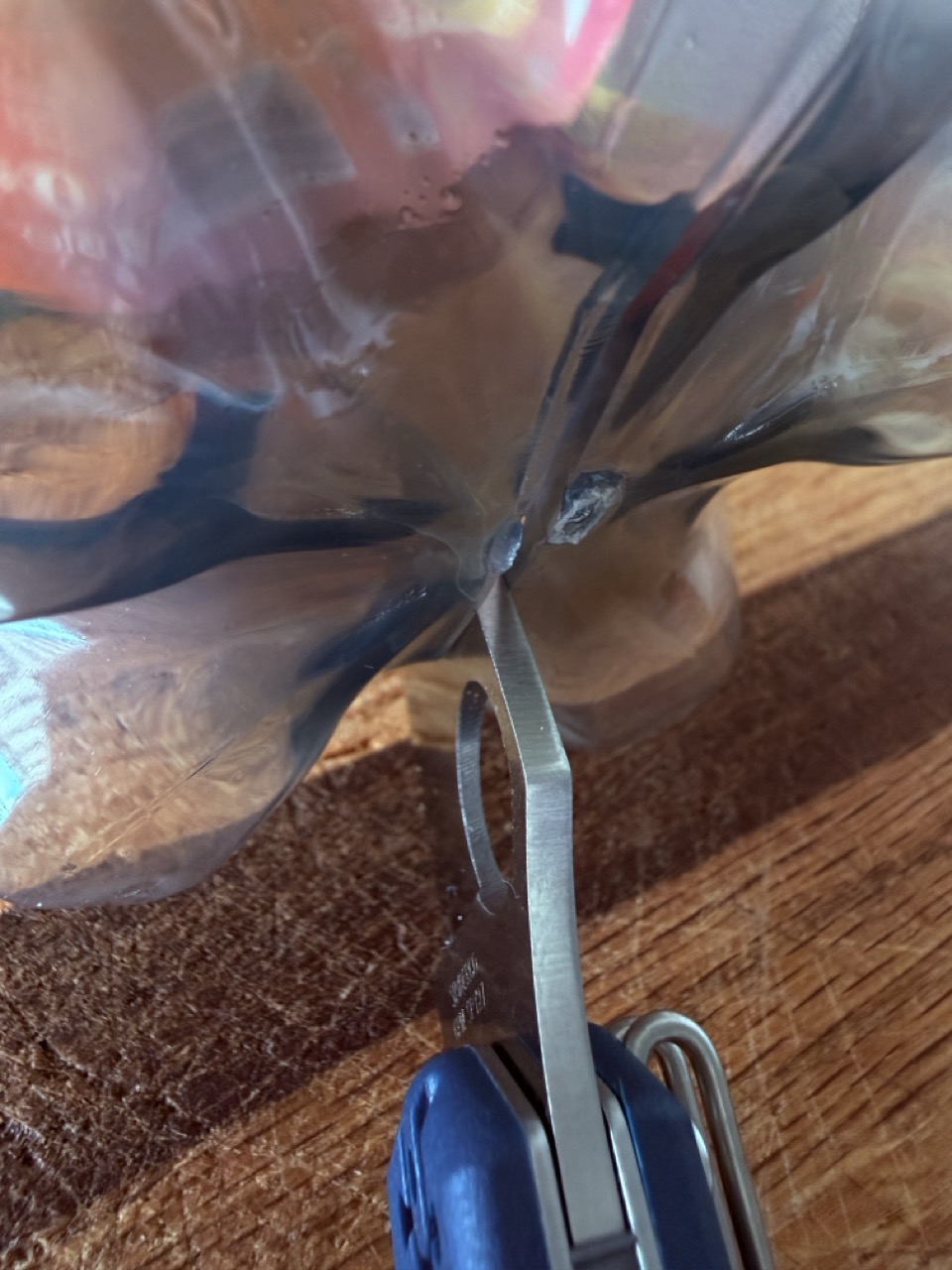
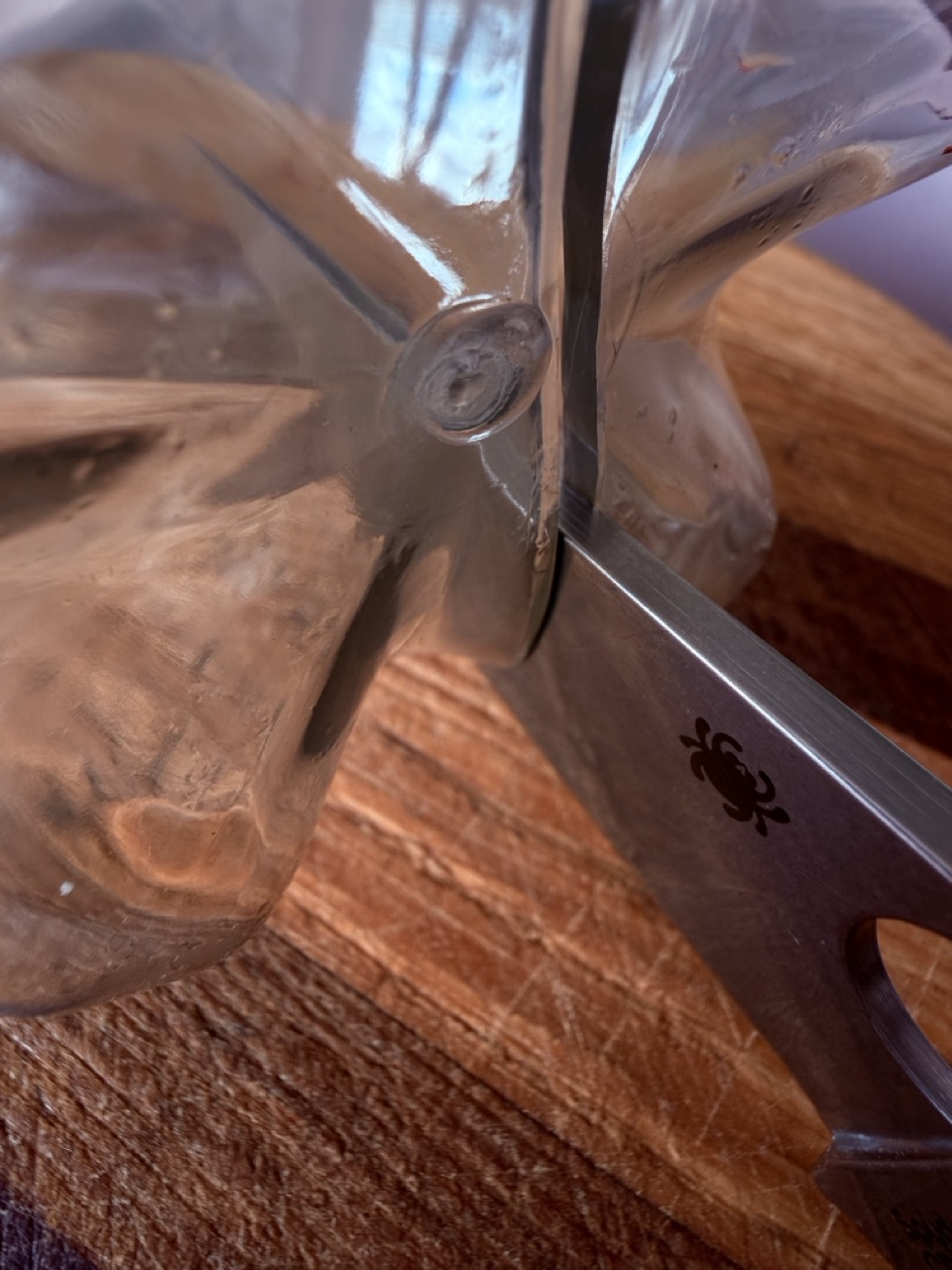
Its generous belly and thin geometry make it an outstanding cutter. The edge remains in contact with a cutting board through much of the cutting stroke, allowing clean and efficient slicing.
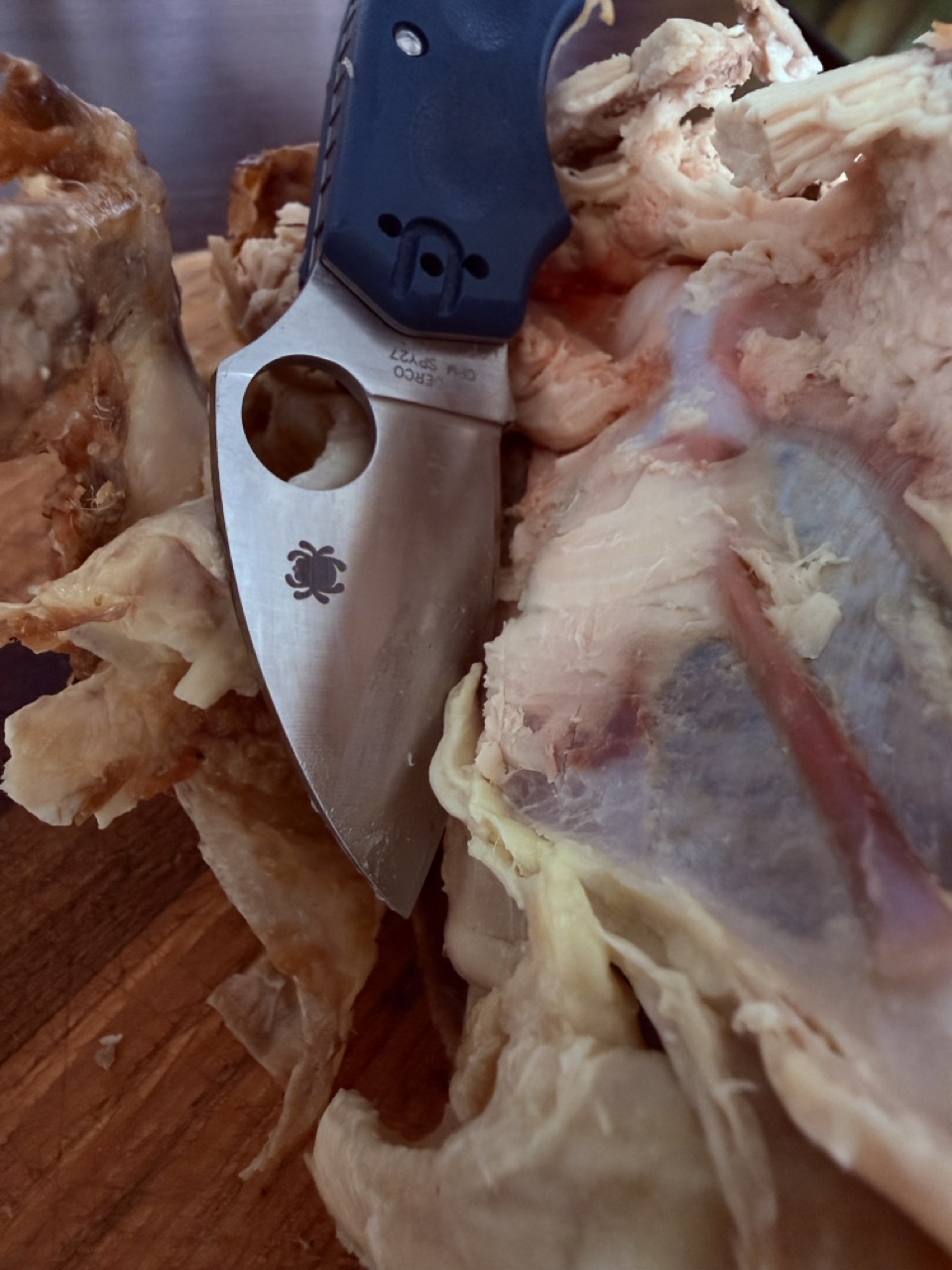
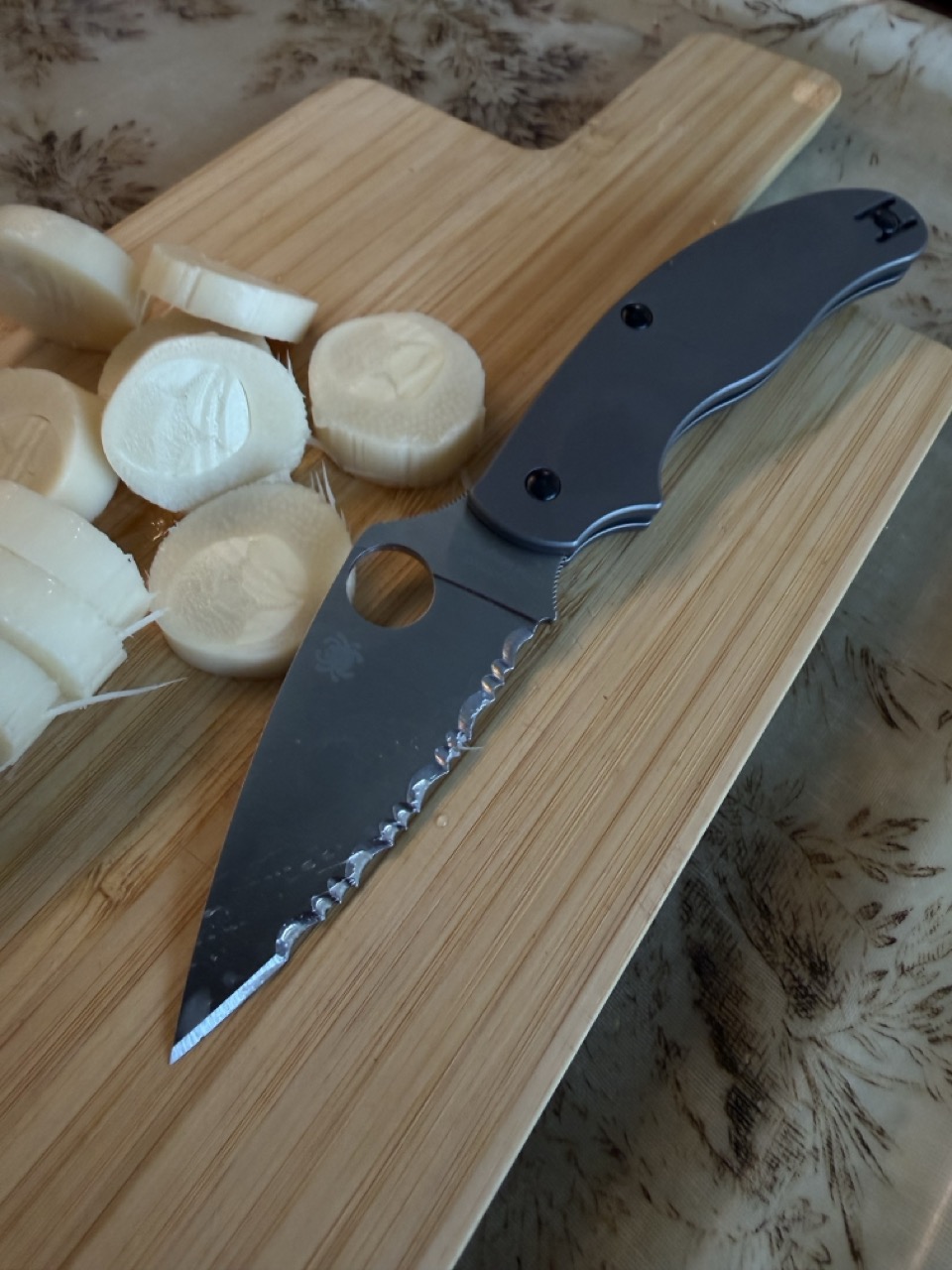
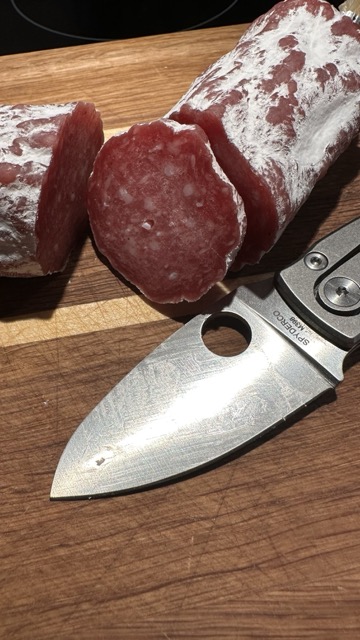
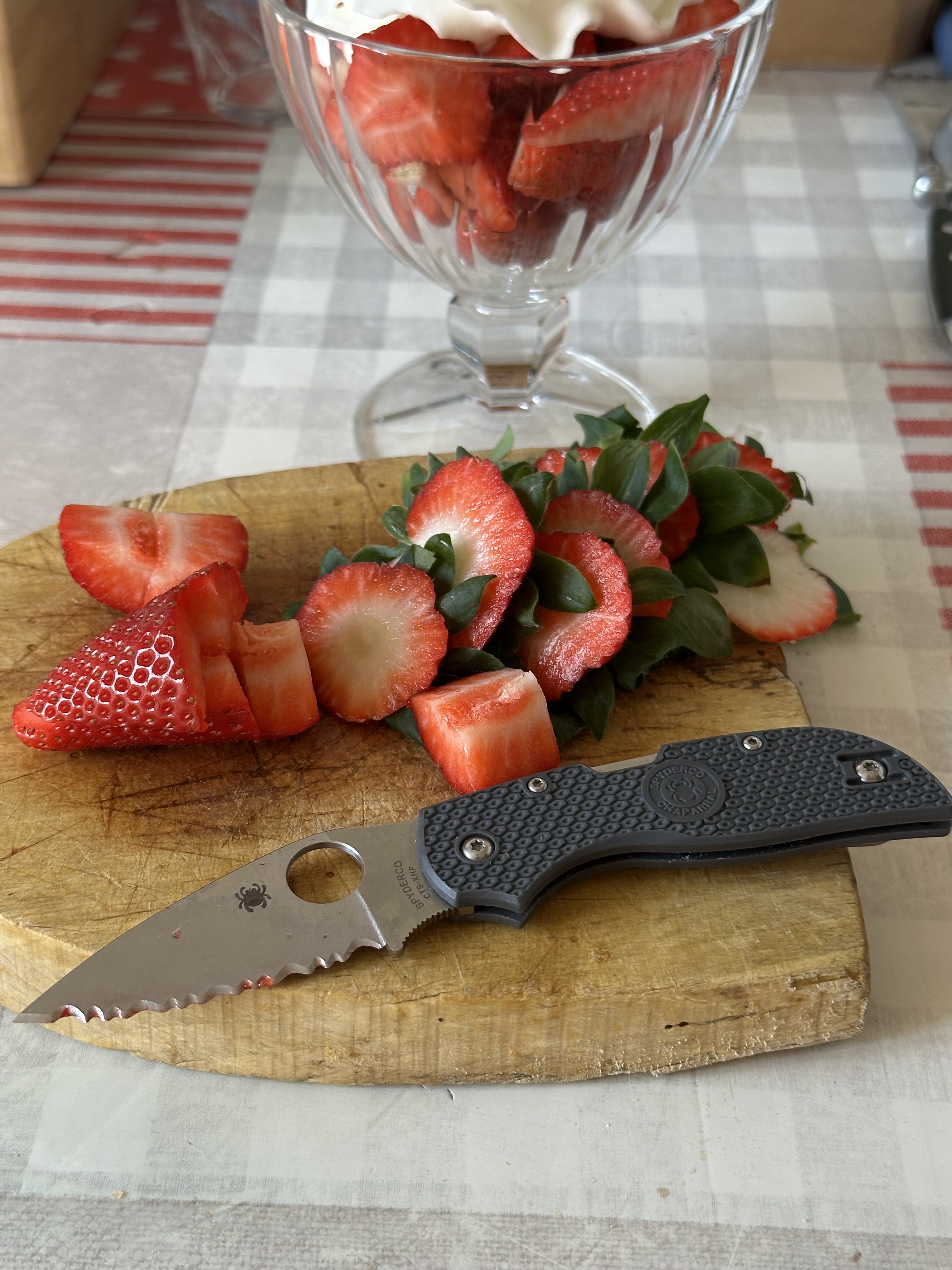
I’ll admit that, despite its tiny size, I ended up doing a surprising amount of kitchen work with it. Tomatoes, vegetables, even breaking down and portioning a chicken—the little Meerkat handled everything without complaint.
Agile in hand and eager to cut, it never feels overwhelmed.
This little knife is a genuine worker.
The textured FRN scales provide excellent traction, preventing any tendency to slip during use. Equally important, I found absolutely no blade play, either vertically or laterally. That’s reassuring on a knife whose pivot is not particularly accessible for adjustment.
In actual use, the Meerkat reveals itself as an exceptionally capable travel companion.
Low profile, discreet and easy to carry, yet remarkably efficient when called upon. Much of that comes from its relatively thick handle, which provides excellent control, while the thin, tall blade slices with a combination of precision and authority that continues to surprise me.
Small sheeple friendly folder, yes but very, very, very serious cutter. An impeccable companion that disappears into a pocket. Ghostlike. Always there when called upon. And far more capable than its size would ever suggest.
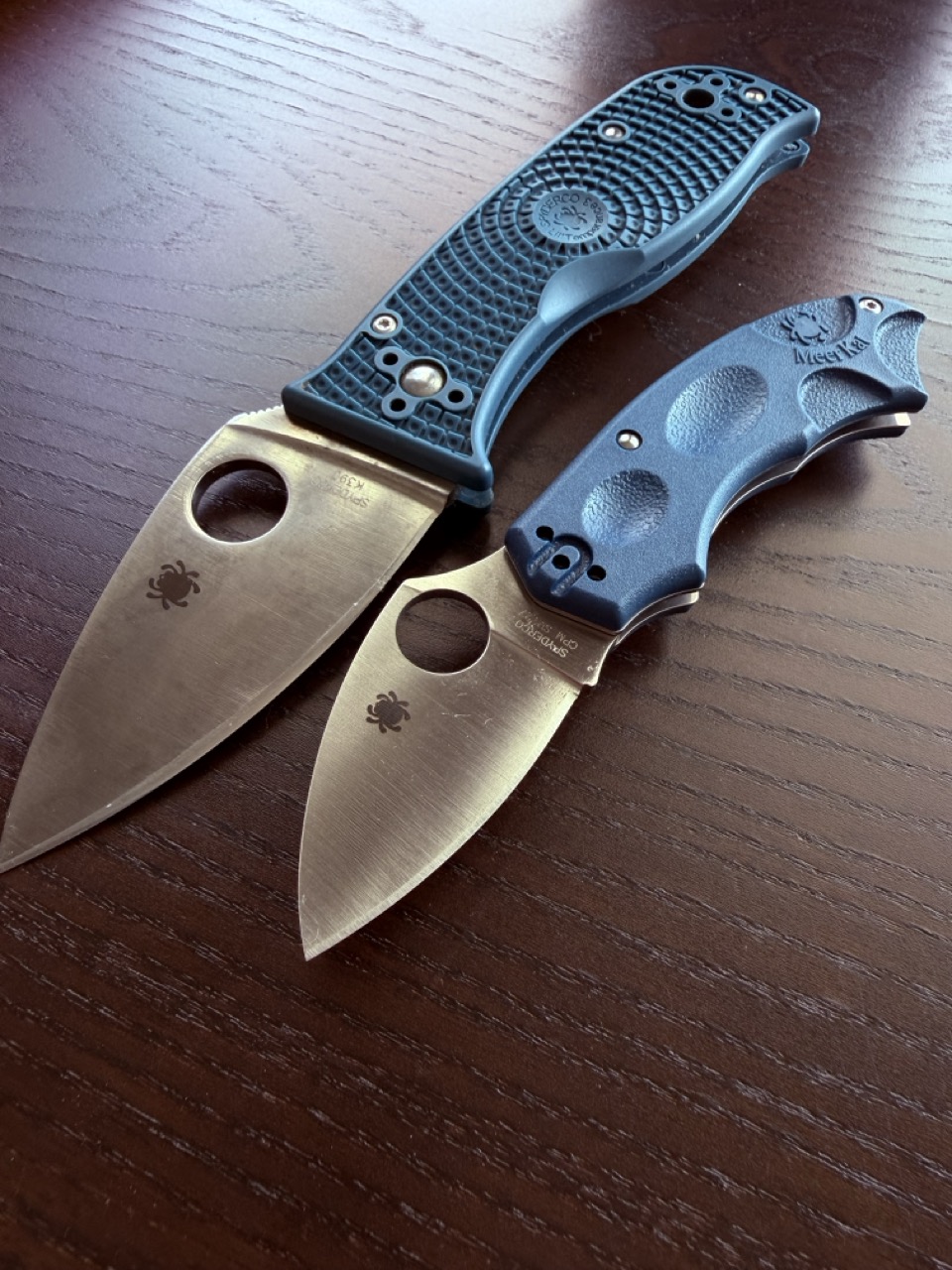
Ah, the Meerkat and its magical Phantom Lock… Ah ah ah! This one takes me straight back to 2002. Back to the Future, Spyderco style. The Meerkat is one of those knives that seems to have been designed for a single purpose: making knife enthusiasts scratch their heads. First impression? This is a very small knife. Even compared to the Chaparral. The Chaparral owes much of its DNA to the C62 Navigator. It was a compact lockback with the same short blade (saber hollow grind) optimized for travel and office-friendly carry. It also carries forward the spirit of the C09 CoPilot, continuing Spyderco’s long tradition of creating small knives that cut far bigger than their dimensions would suggest.
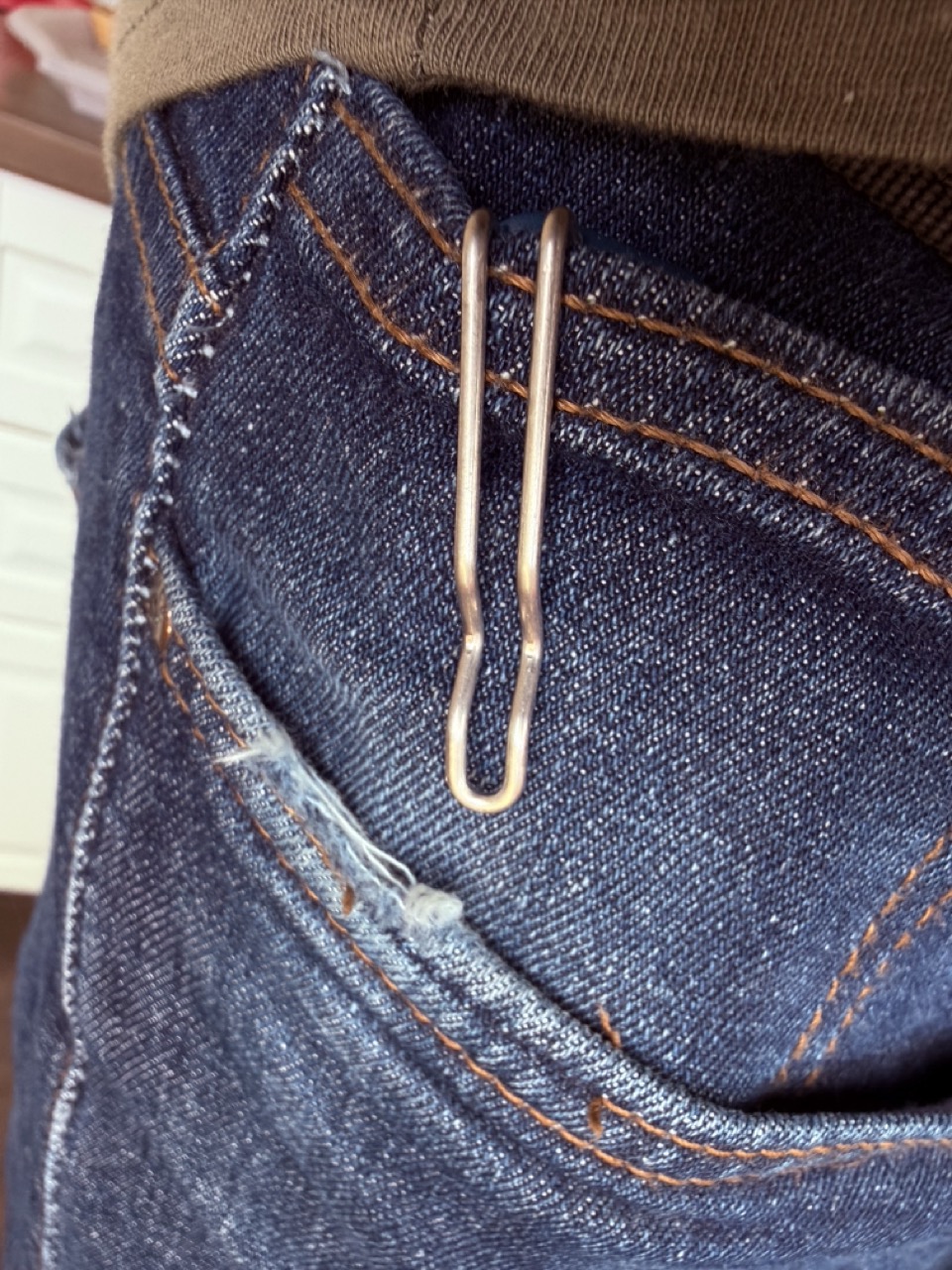
Naturally, I slipped the Meerkat into my fifth pocket, where it fits absolutely perfectly. In fact, it feels like it was designed for that role.
The second thing you notice is that this little oddball is set up for tip-down carry, just like the mighty Spyderco Military. And yes, you can still perform the classic Spyderco Drop without any issue ! 🙂
In hand, the Meerkat feels like a stout little worker. The action is firm, the lock-up is rock solid, and despite its compact size, there is nothing delicate about it. Everything feels purposeful and surprisingly robust.
Then comes the Phantom Lock. The Ghost in the Shell. 😉 I have just found that video made by Wouter (Spydercollector) 16 years ago !
Just hand the knife to another knife enthusiast and watch the show begin. They open it. They admire it. Then they try to close it.
Confusion follows. That’s when you starts smiling. 🙂
More than twenty years later, the Phantom Lock remains one of the cleverest and most entertaining locking mechanisms Spyderco has ever produced. It’s practical, it’s secure, and above all, it’s pure Spyderco: innovative, unconventional, and just a little bit crazy. 😄
Sliding the scale to unlock the blade.
Yep, some knives are designed to sell with some tactical bells and whistles. Others are designed to impress for their cleverness. The Meerkat never became a mainstream Spyderco classic. It was too small for tactical enthusiasts, too weird for traditionalists, and too clever for its own good. Yet more than twenty years later, Spyderco decided to bring it back as a Sprint Run equipped with CPM-SPY27 steel and cobalt blue FRN scales.
And honestly? I’m so glad they did ! Because the Meerkat was a knife from the future, designed twenty years ago.
And it is cute !
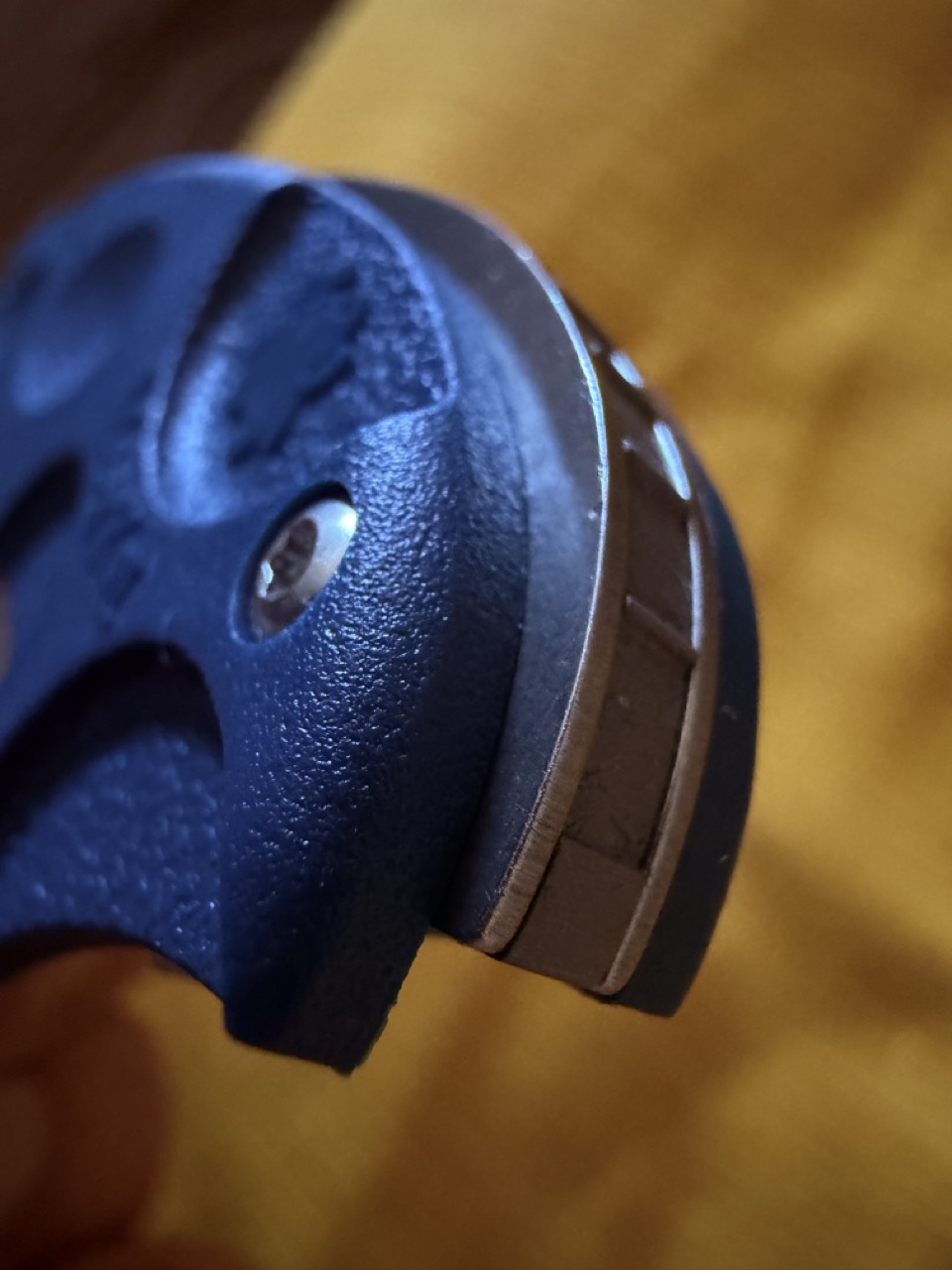
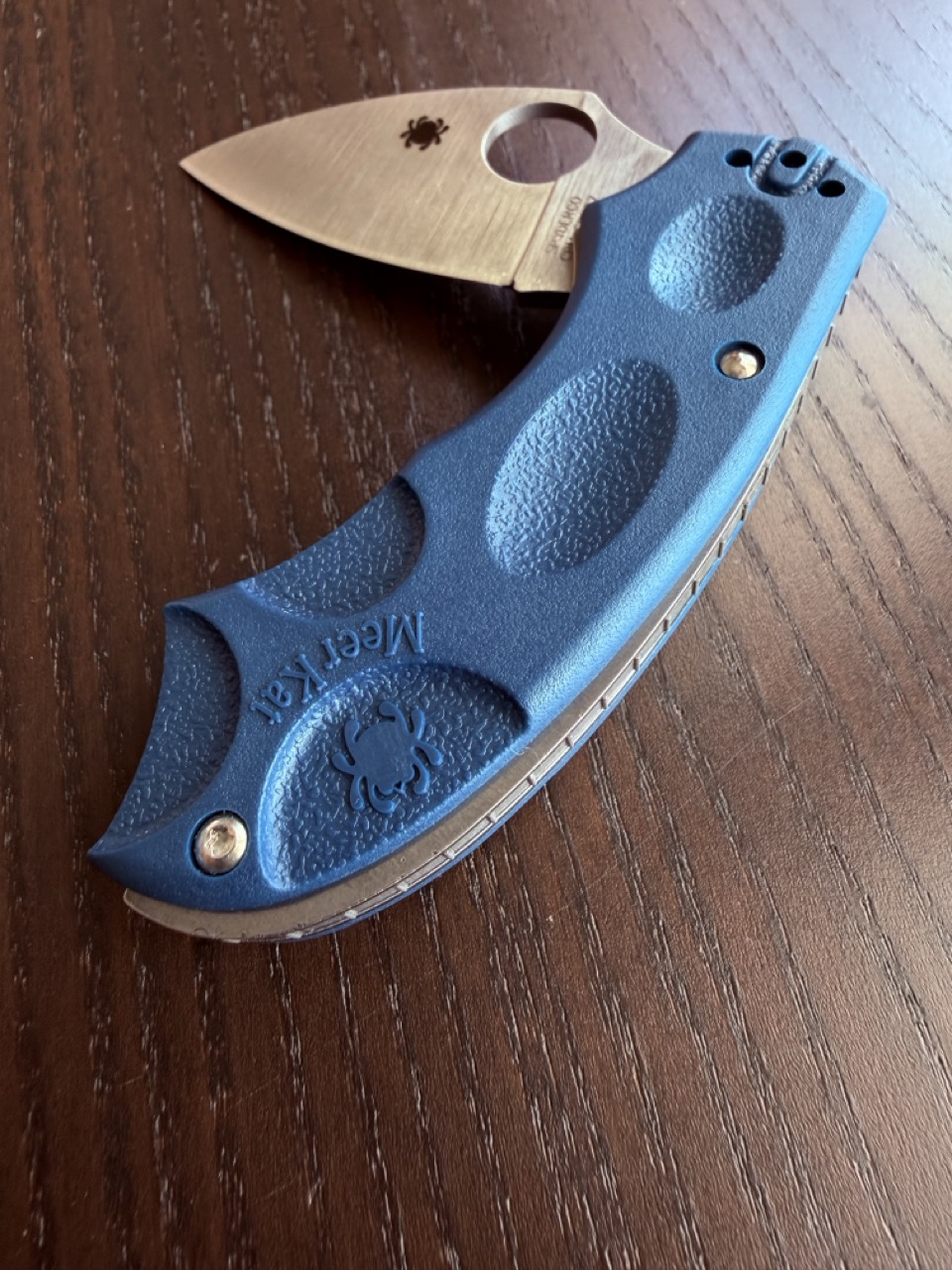
No, really, it remains one of the most futuristic designs ever released by Spyderco. At first glance, it looks like a tiny leaf-shaped folder with a humpback silhouette and a blade barely longer than your thumb. Full Flat Grind, the Spyderco Signature, deep carry clip Then you discover the lock. The famous Phantom Lock. Unlike a traditional back lock, the Meerkat closes by slightly twisting the handle scales in opposite directions. The mechanism releases almost magically, making the knife feel more like a gadget from a science-fiction movie than a conventional EDC your grand’pa would have chosen in a gun show.. Even today, very few production knives offer anything remotely similar. Sal Glesser is an inventor. He loves his craft. I still can hear his laugh when I have handing a Meerkat to a knife enthusiast, the reaction is the same: “Wait… how do you close this thing?”
Mission accomplished ! (Still confused by the Phantom Lock? Don’t worry, you’re not the first. Just push on the Spyderco logo to slide the scale. Suddenly, the magic trick reveals its secret. And you’ll soon be able to operate it with one hand.) 😉
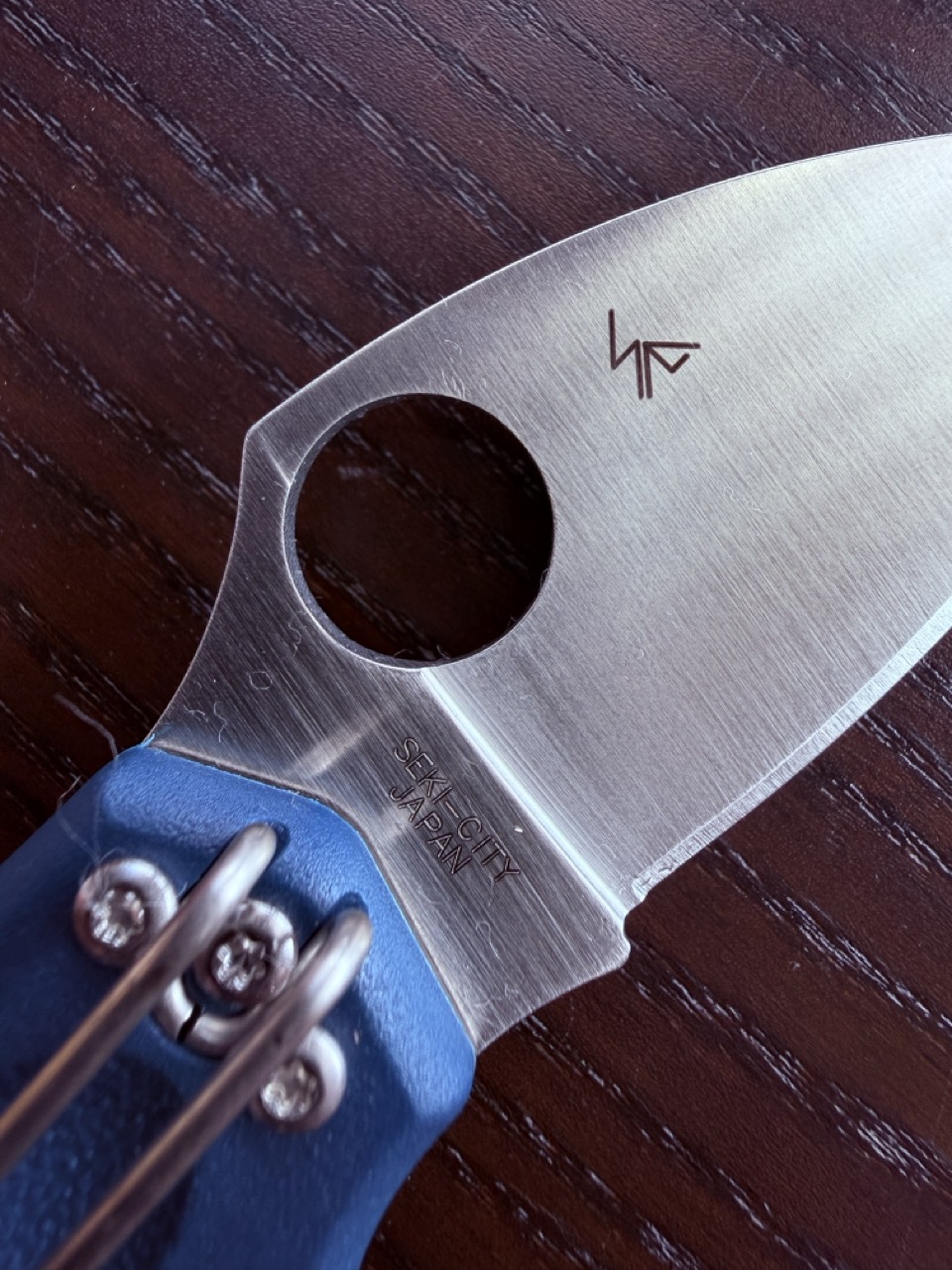
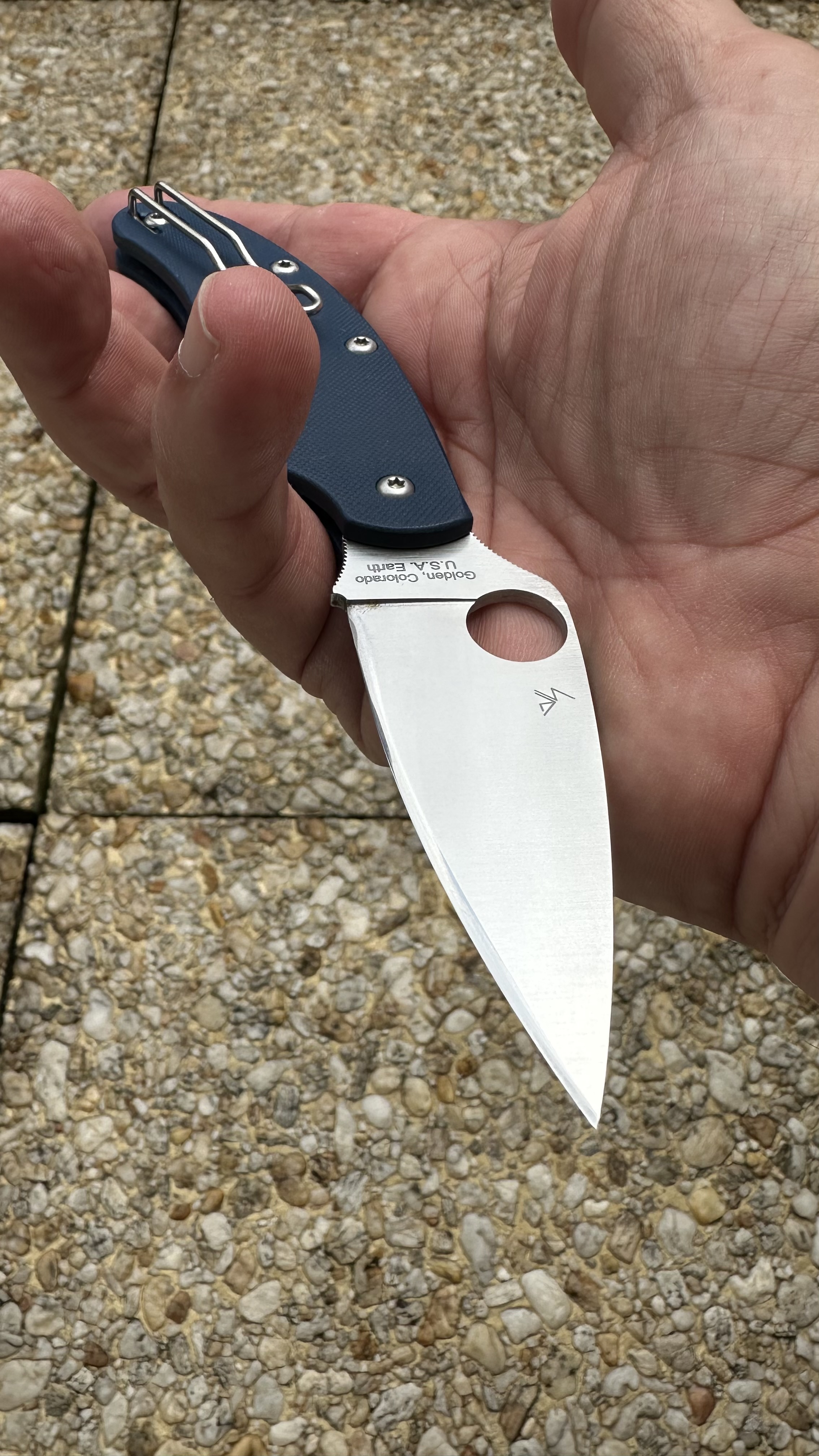
The Meerkat carries its fully flat-ground blade measuring just over 5 cm (2inches). On paper, that sounds ridiculously small. In practice, it slices like a miniature lightlaser.
Spyderco’s leaf-shaped blade profile has always been one of the most efficient cutting geometries in the business. Give it a thin full-flat grind and suddenly this tiny folder starts behaving like a much larger knife.
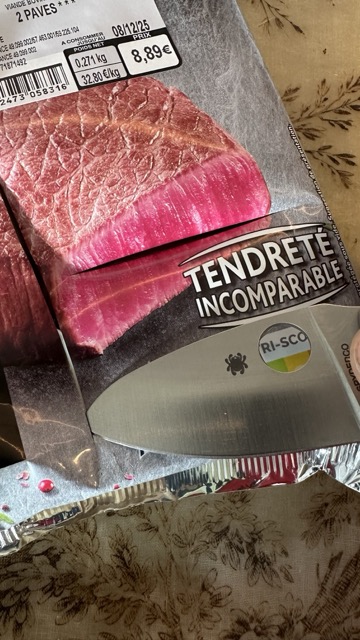
Opening parcels. Food prep. Sharing a fruit. Breaking down cardboard. Removing parcel. Protect your family against enraged bear attacks. You name it. The Meerkat will perform all of these tasks with surprising authority.
The blade disappears in any pockets with its deep tip down carry system.
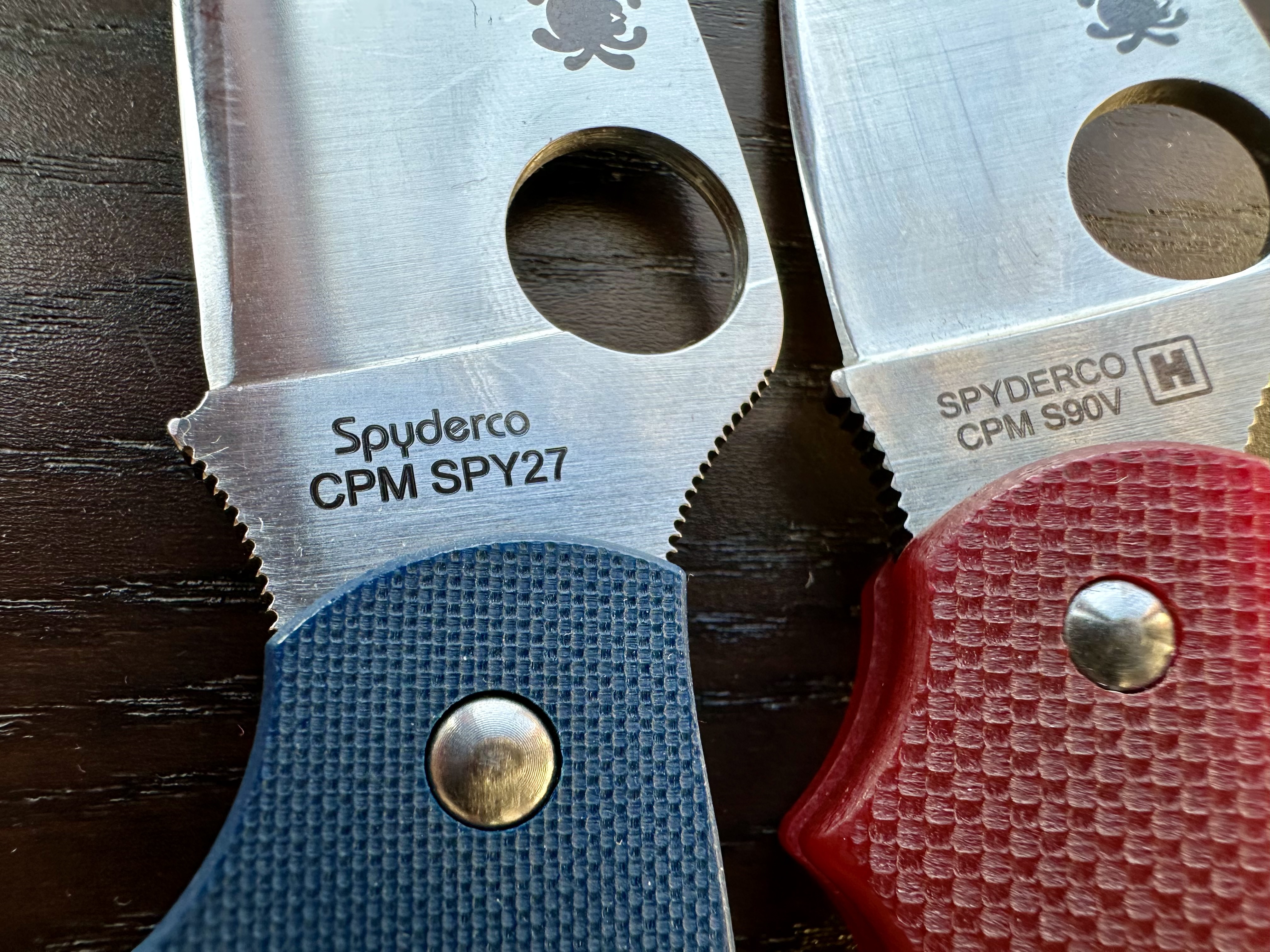
This Sprint Run upgrades the original steel to CPM-SPY27, Spyderco’s proprietary powder metallurgy stainless steel developed with Crucible. The goal was simple: create a steel offering a balance of edge retention, toughness, corrosion resistance and ease of sharpening.
I’ve not used enough SPY27 on larger folders like a Bodacious or a Manix 2 XL to fully explore its limits, but I do understand what Spyderco was trying to achieve with what I often call their “powder metallurgy VG-10.”
My own experience with SPY27 comes mainly from a UKPK that I have nicknamed The Golden Child.
What I’ve discovered is this: SPY27 doesn’t try to win steel competitions. It simply works. The edge stays keen for a long time, corrosion resistance is excellent, and maintenance remains refreshingly easy compared to some modern “super steels.” Much like Magnacut, SPY27 seems to love a leather strop. A few passes are often enough to bring back that crisp, shaving-sharp edge.
Many users compare its overall performance to S35VN, appreciating how straightforward it is to touch up. Perhaps they’re right. Personally, I don’t really care whether it lands closer to S30V, S35VN or S45VN. What matters is that Spyderco consistently gets the recipe right. Because a blade is never just an alloy. A blade is alloy + heat treatment + geometry.
And Golden’s people understand that better than most. What I want in 2026 is a blade steel that is easy on my mind. A steel that won’t punish me for grabbing the wrong sharpening tool while travelling.
A steel that can be maintained without turning sharpening into a science project.
A forgiving steel.
At sixty years old, I find myself caring less about ultimate edge retention and more about living with a knife. SPY27 feels like one of those steels that wants to work with its owner rather than against him. For a compact EDC like the Meerkat, that balance is exactly what I want.
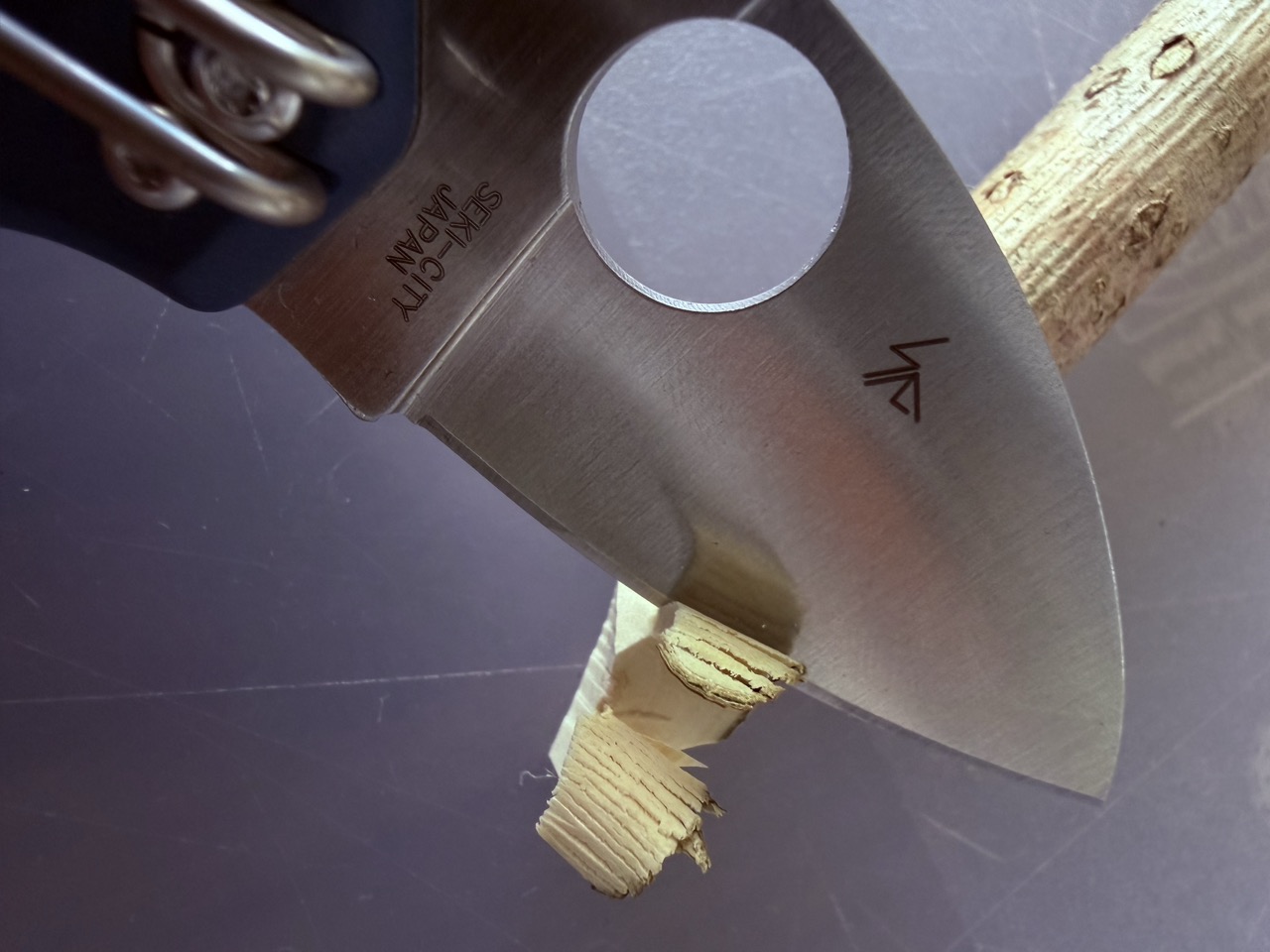
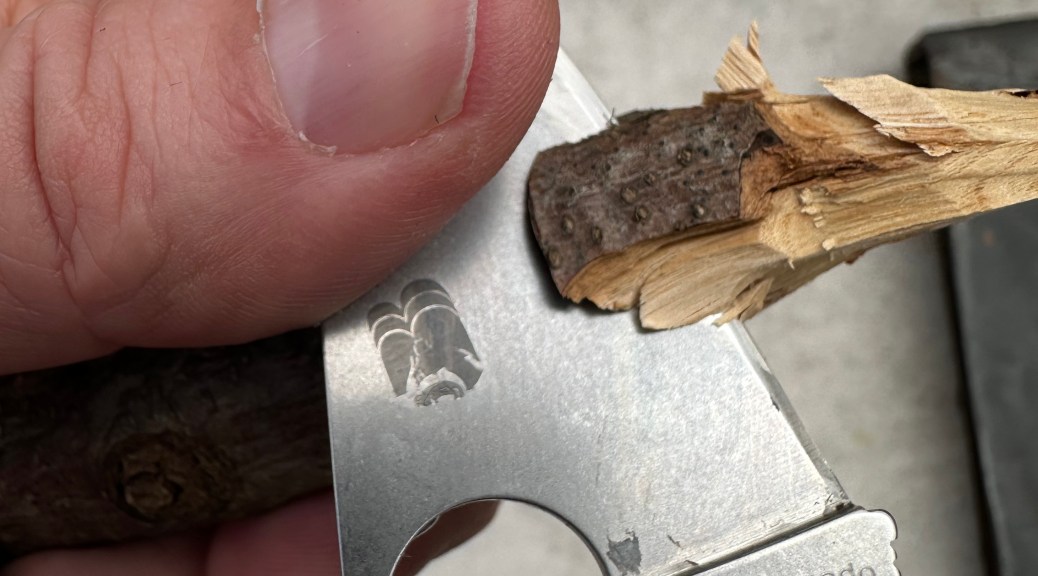
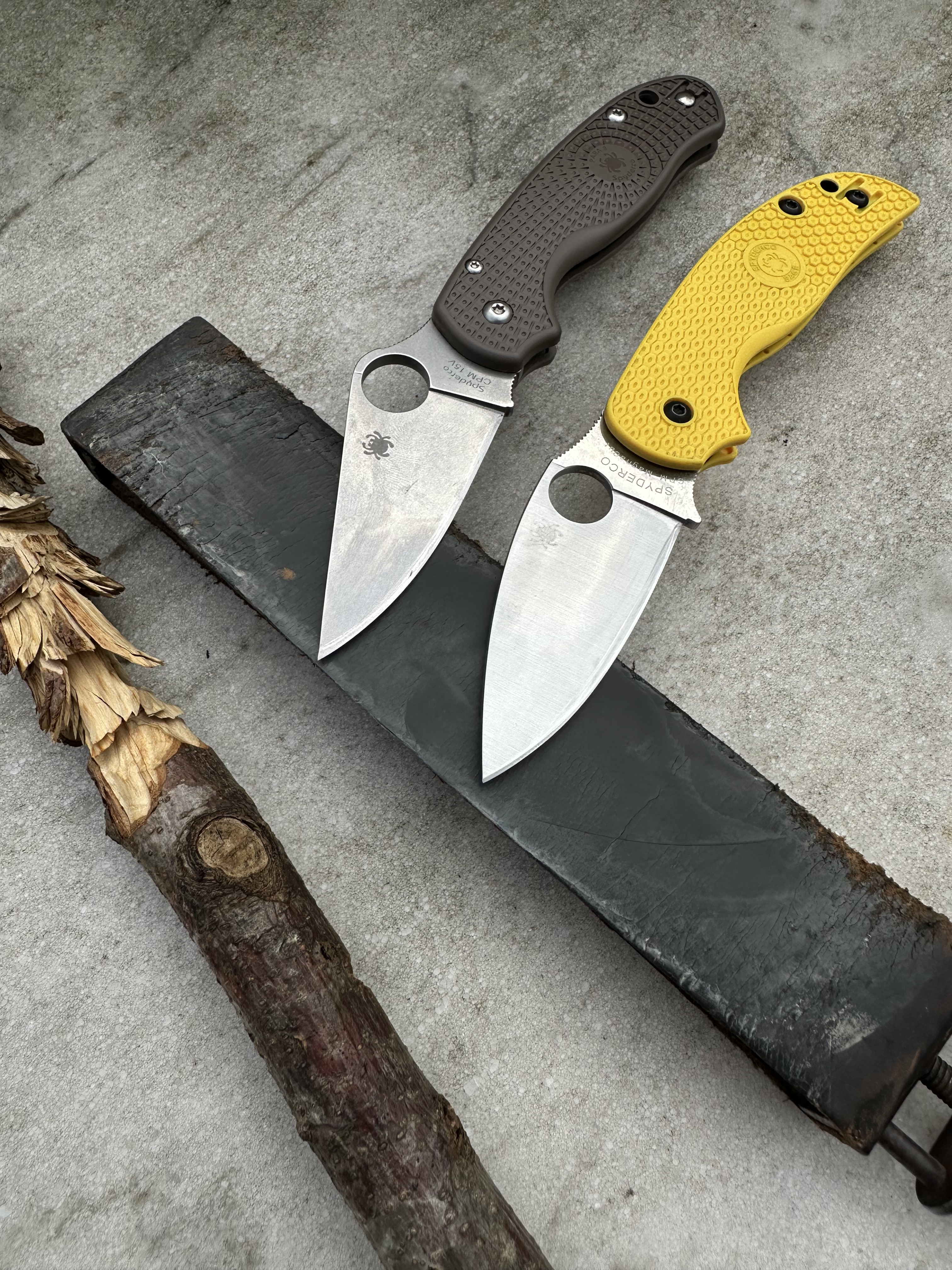
This is not a knife meant to chop down forests. It is, however, a surprisingly capable whittler. The generous belly, thin blade stock and full-flat grind simply devour wood. Whether shaping a tent peg, sharpening a stick for the barbecue or absent-mindedly carving curls while sitting by a campfire, the Meerkat performs far beyond what its dimensions would suggest.
The blade bites eagerly, tracks predictably and leaves behind clean, controlled cuts.
Small knife. Big appetite.
Yes, it really is that powerful.
The Meerkat is a knife meant to disappear into your fifth pocket and be forgotten.
Twenty years after its introduction, that’s still what impresses me most about the Meerkat: not the Phantom Lock, not the rarity, not the nostalgia.
The fact that such a small knife cuts so ridiculously well.
The knife represents an era when Spyderco was willing to experiment with strange concepts simply because they were interesting.
Today many manufacturers chase trends. The Meerkat reminds us of a time when designers chased ideas. Its unusual lock, compact dimensions and unmistakable silhouette make it instantly recognizable among hundreds of modern folders.
You don’t buy a Meerkat because it is the most practical knife. You buy it because it is unmistakably a… Meerkat. Cute, clever and sharp.
That SPY27 Sprint Run does not reinvent the Meerkat. Fortunately. It preserves everything that made the original memorable while upgrading the steel to something genuinely useful for modern everyday carry.
Tiny. Strange. Ingenious. Solid, Stout. Great ergonomics for a 2 inches blade. The Meerkat remains one of the most charming oddballs ever released by Spyderco. And in a knife world increasingly filled with tactical clones and oversized pocket swords, that may be exactly what makes it special.
Not because it is perfect. Because nothing else feels quite like it. Invention, innovation…. Open it. Read between the line and twist the scales to close it.
The Meerkat is a jewel of a user. The kind of little big knife you can clip into a pocket every morning and completely forget about—until you need a knife. Then it reminds you exactly why it’s there.
Much like the little African animal that inspired its name, the Meerkat has a habit of suddenly popping up when something interesting needs attention. That’s part of its charm.
Disclaimer: This knife has been provided through Spyderco’s Ambassador’s program and friendship. Thank you to them for letting me review it. It felt like welcoming back an old friend I hadn’t seen in over twenty years.
If the Meerkat has piqued your curiosity, do yourself a favor and visit the website of my friend Wouter (“Mr. Blonde”). Few people know Spyderco history better than he does:: https://spydercollector.wordpress.com/tag/meerkat/
Also, there is a great thread on the Spyderco Forums featuring information, anecdotes and historical details contributed by collectors (including my friend and contributor, Robin “Ramonade): https://forum.spyderco.com/viewtopic.php?p=1885029#p1885029
One of the things I enjoy most about the Spyderco community is that there is always somebody curious enough to take a knife apart and look beyond the catalog specifications.
This time, that somebody was my friend Robin Hette.
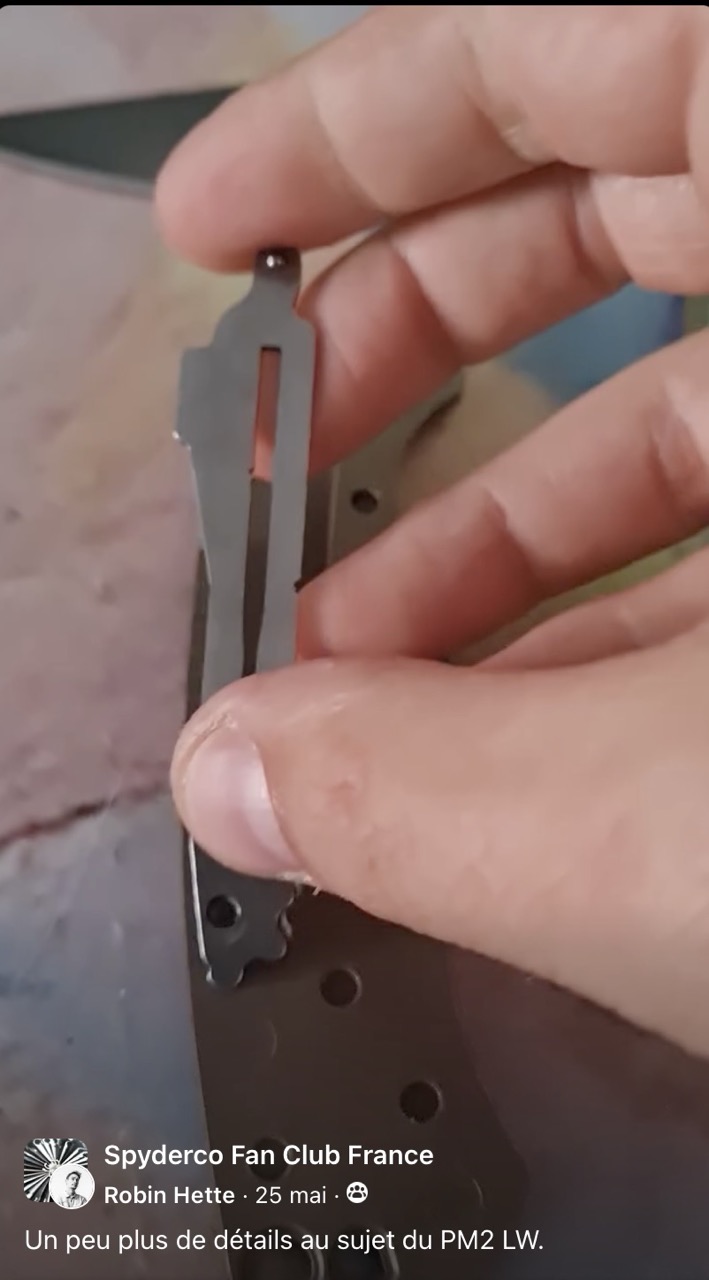
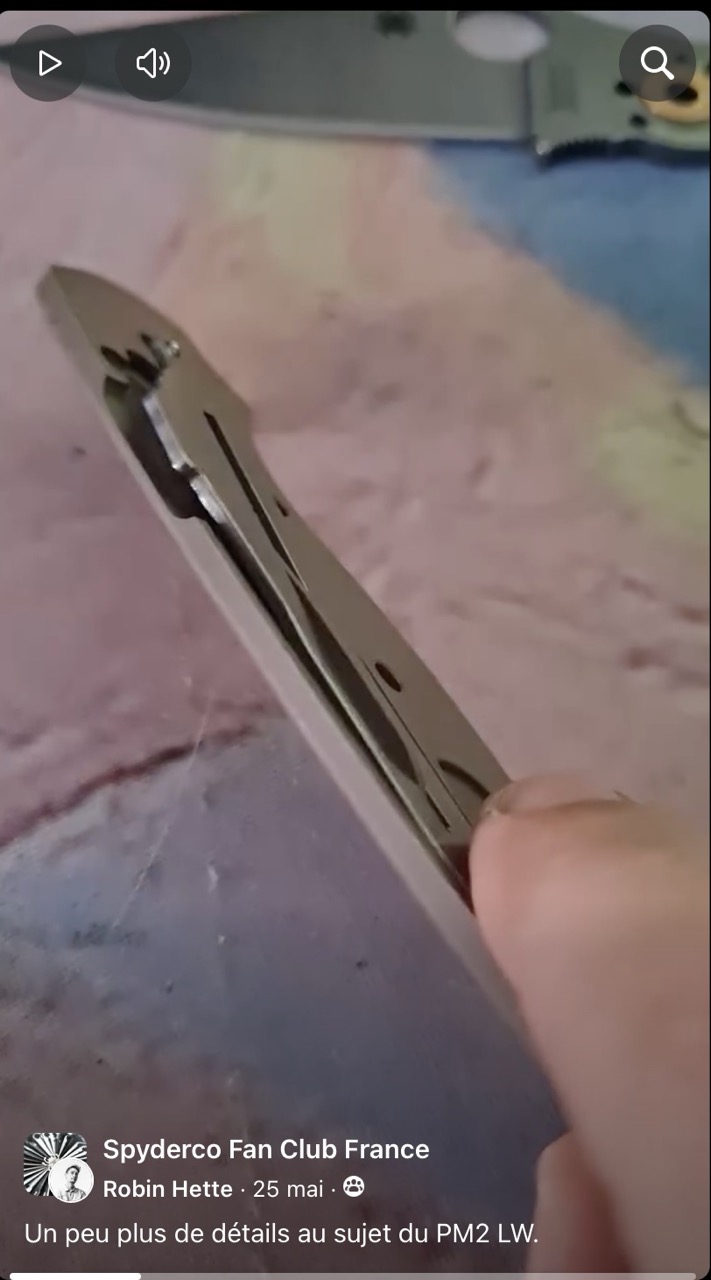
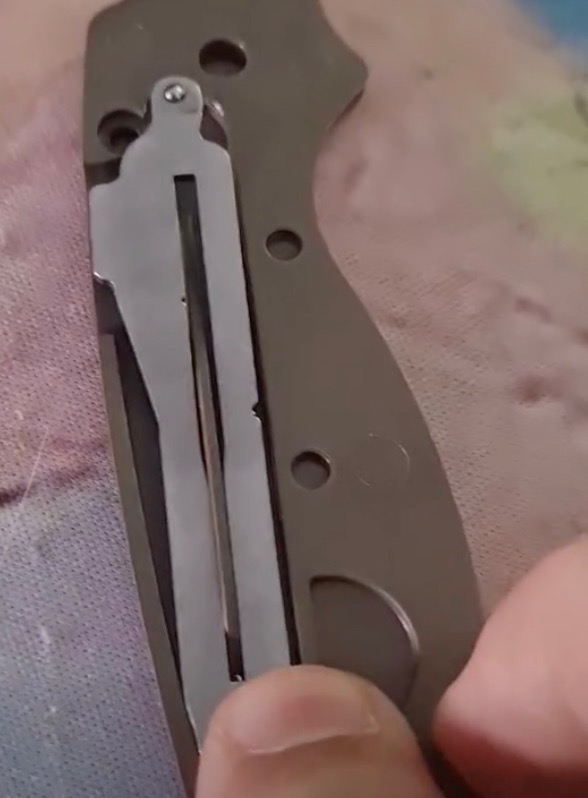
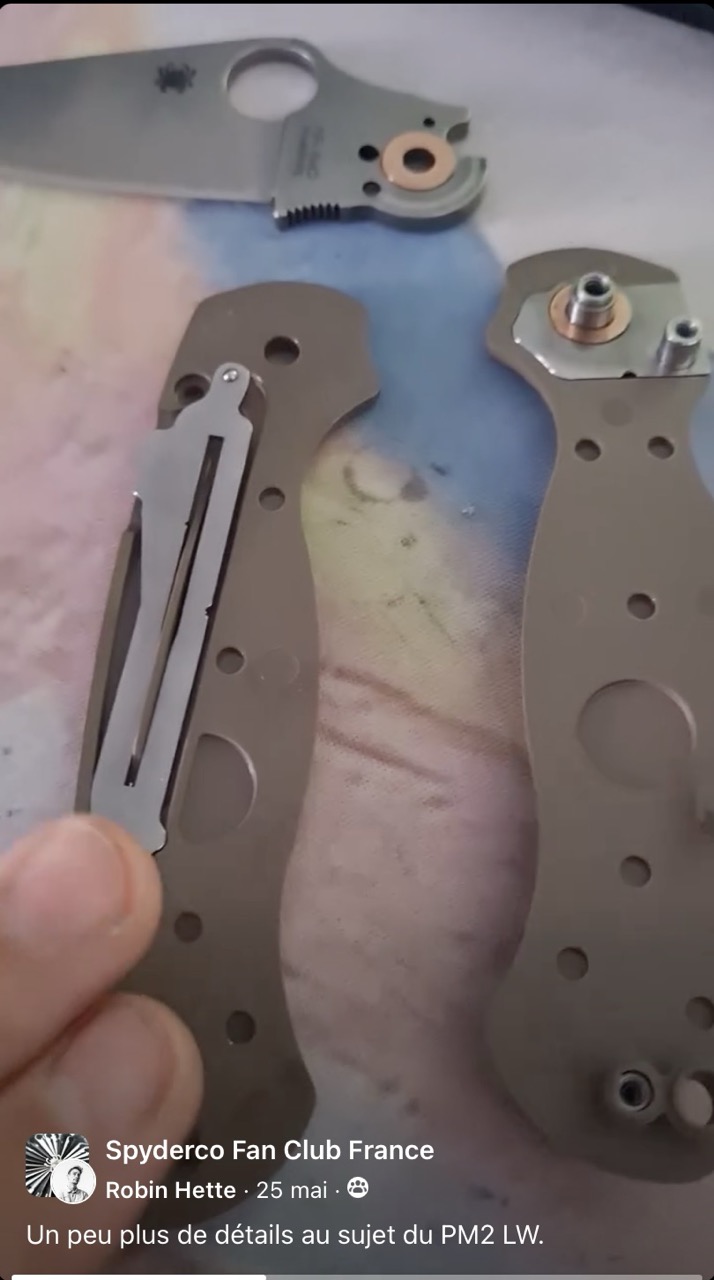
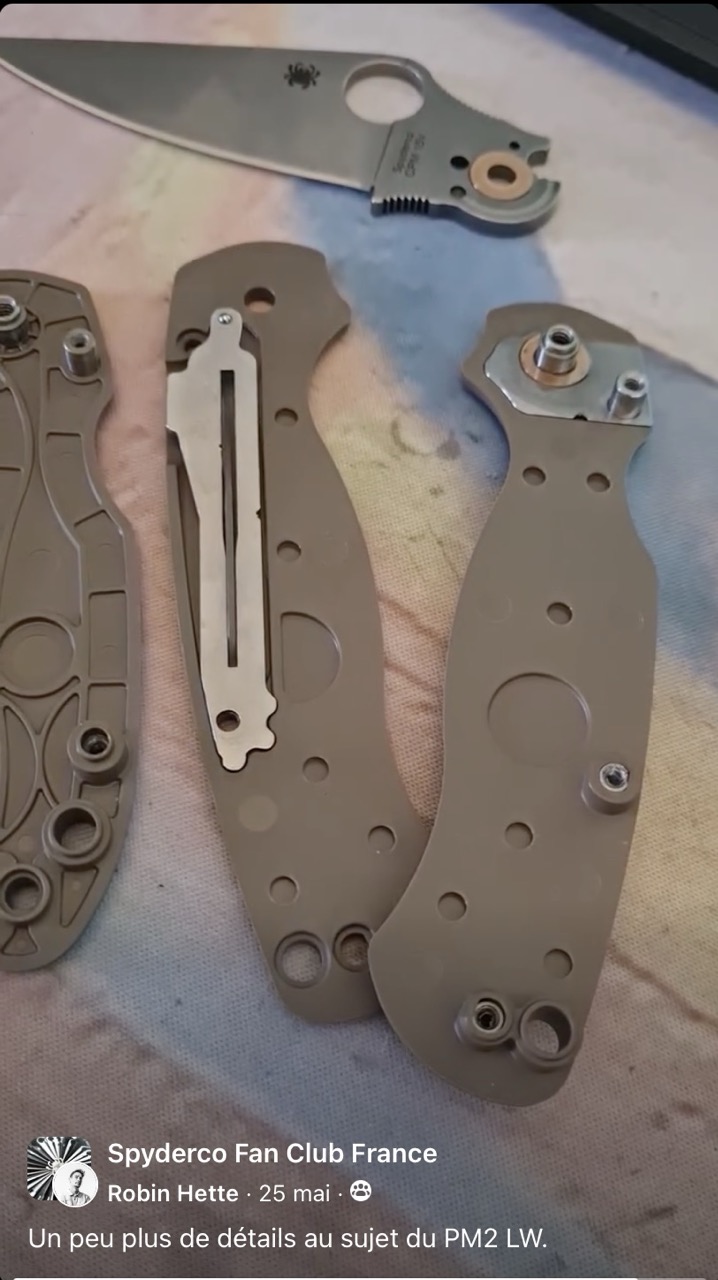
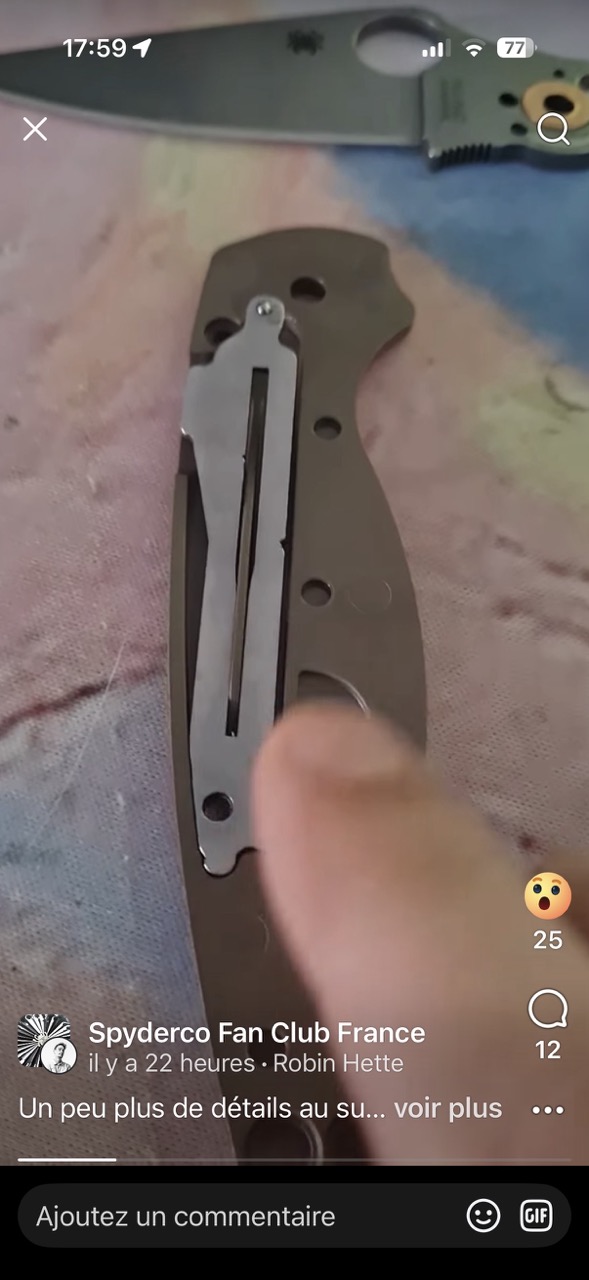
In a recent video, Robin completely disassembled his new Para Military 2 Lightweight and discovered a couple of interesting details showing how Spyderco has refined the design his compression lock.
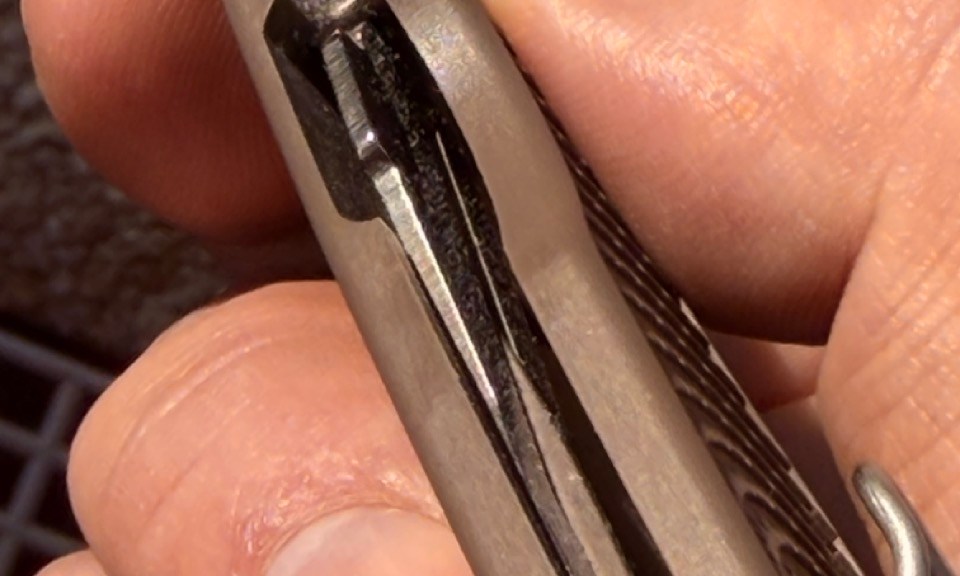
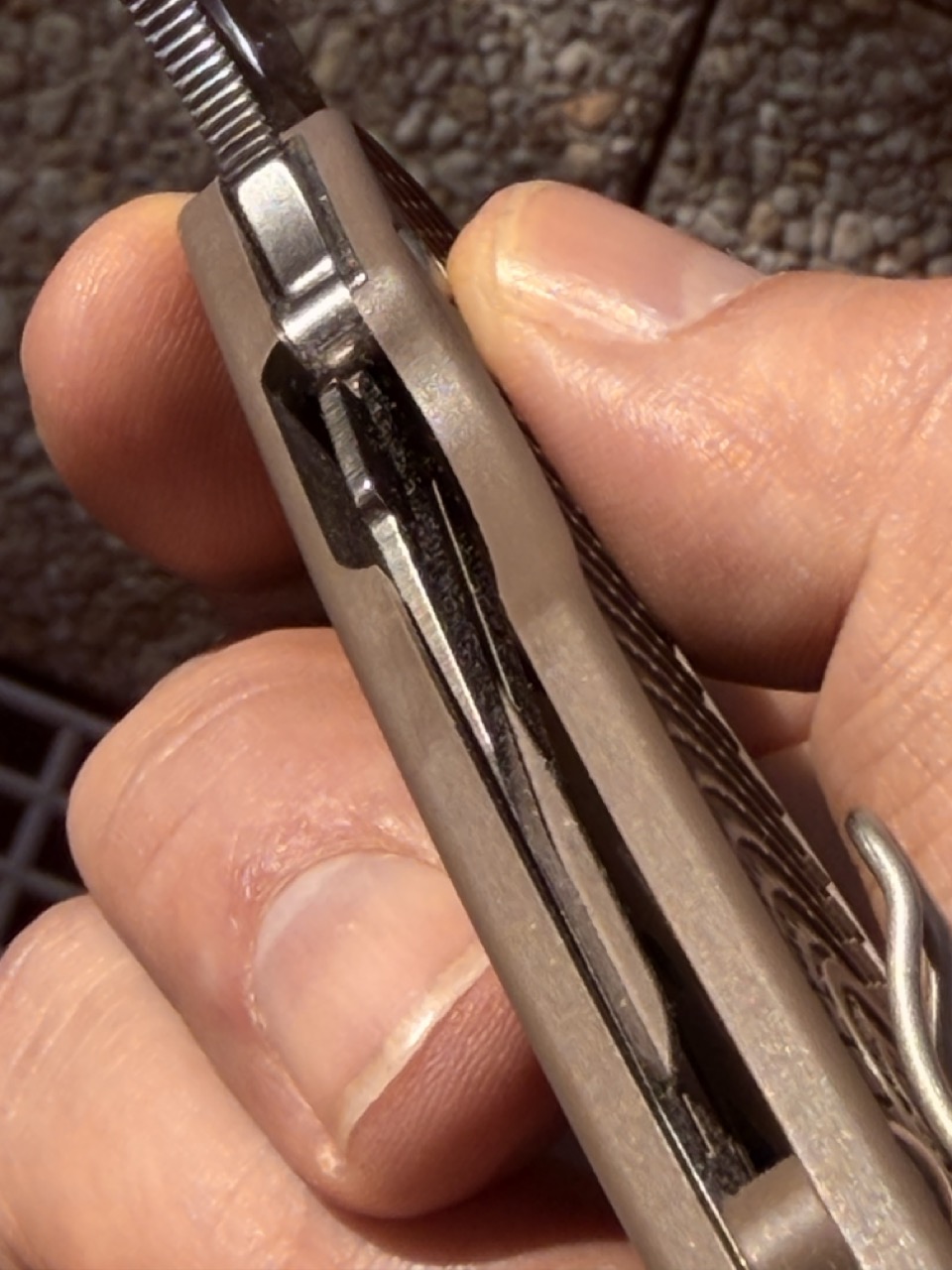
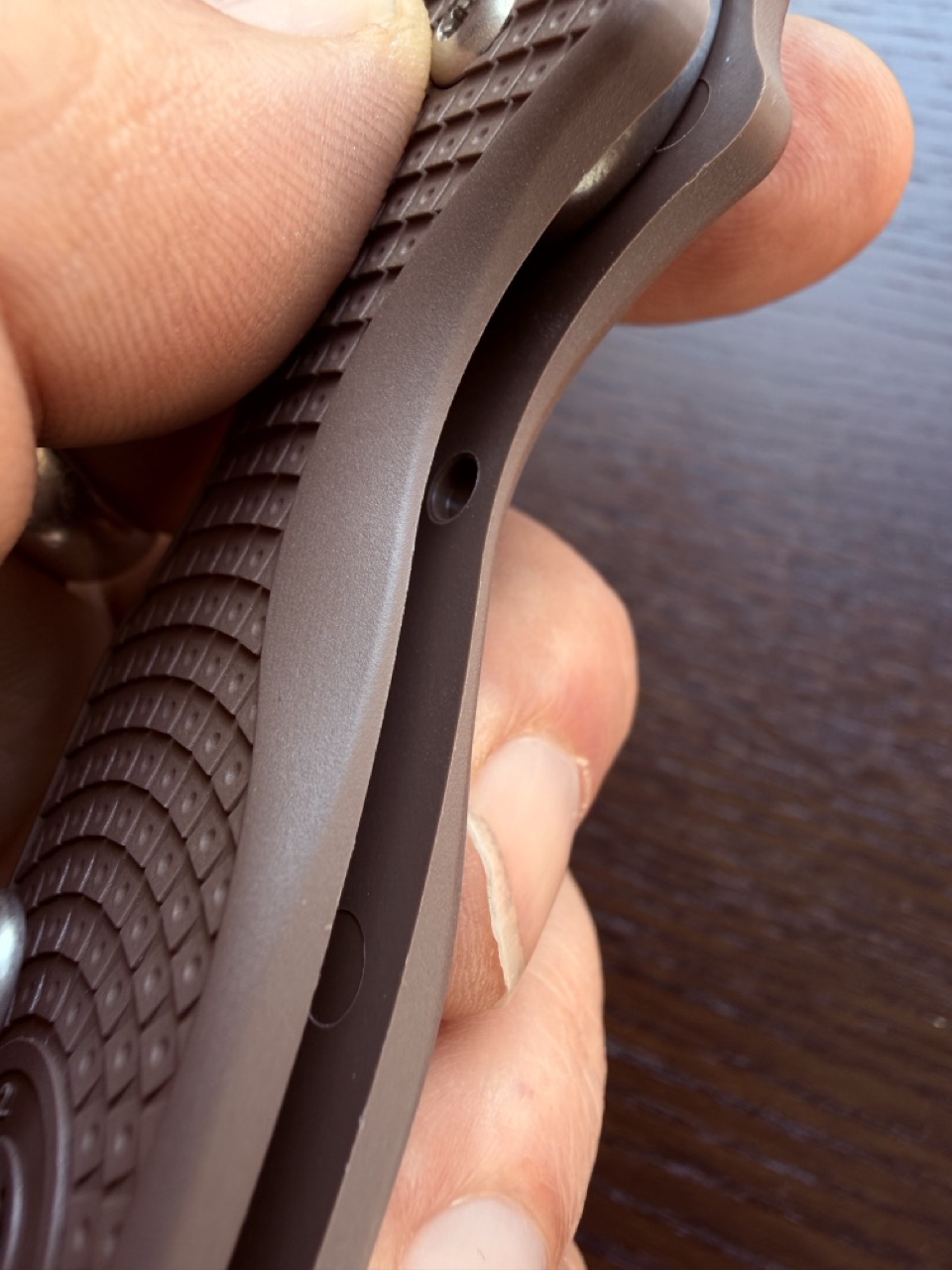
The changes become apparent as soon as the knife is taken apart: the Compression Lock spring got now a longitudinal groove running down its center. Its purpose appears straightforward: improving the spring’s lateral stability and reducing side-to-side movement during operation.
It’s a major modification possible only on a mold FRN scale.
Yet these are exactly the sort of details that reveal how seriously Spyderco treats continuous improvement.
Screenshot
The scales tell a similar story.
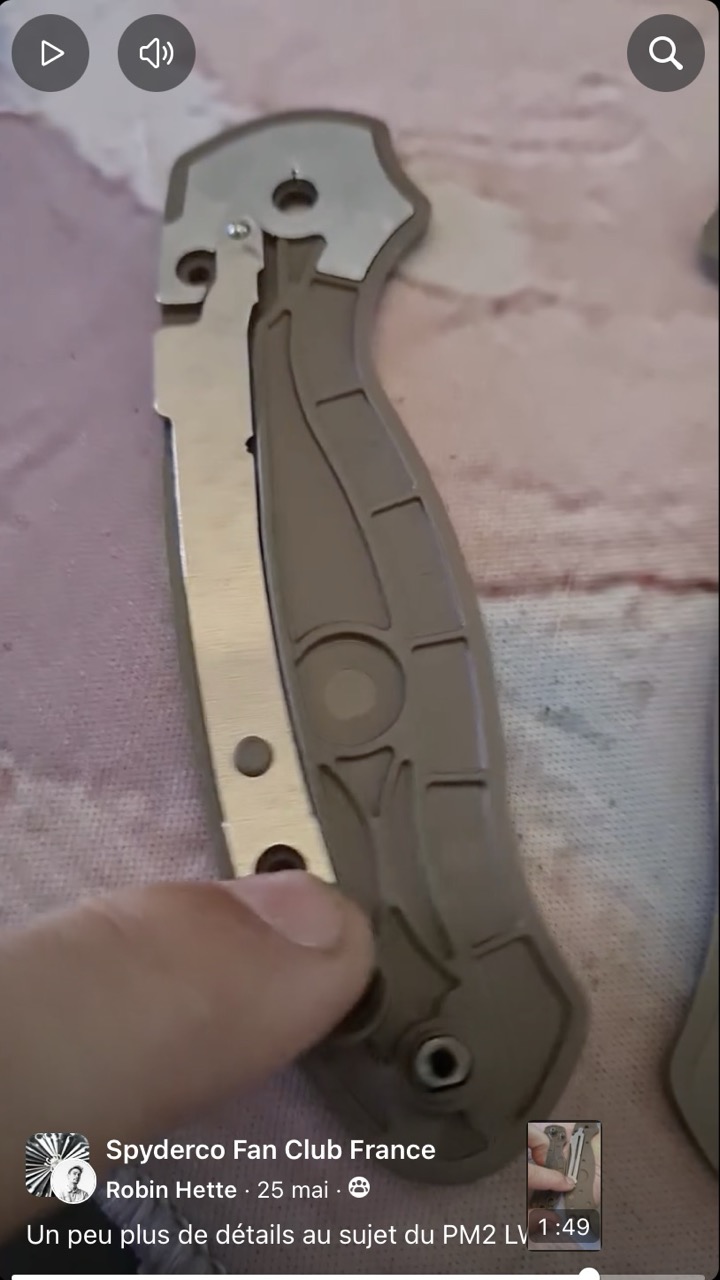
Comparing Robin’s disassembled PM2 Lightweight with the his Para3 LW reveals noticeably less internal milling. Spyderco has left more FRN in place on the PM2.
At first glance this may seem counterintuitive on a knife designed around weight reduction. But rigidity matters too.
The additional material should provide greater structural stiffness while adding very little weight to the overall package. The result is a handle that remains exceptionally light while feeling even more robust.
That philosophy of Constant Quality Improvement has defined Spyderco for decades. Observe. Test. Improve. Repeat.
Thanks to Robin’s curiosity—and willingness to completely tear down his knife—we get a rare glimpse of that process in action.
The latest PM2 Lightweight under its scales, however, it tells a familiar Spyderco story:
“Good enough has never been good enough.” 😉 So, kudos to Eric Glesser and the Spyderco team for continuing to push the envelope.
But enough about engineering. What’s the PM2 Lightweight actually like to live with?
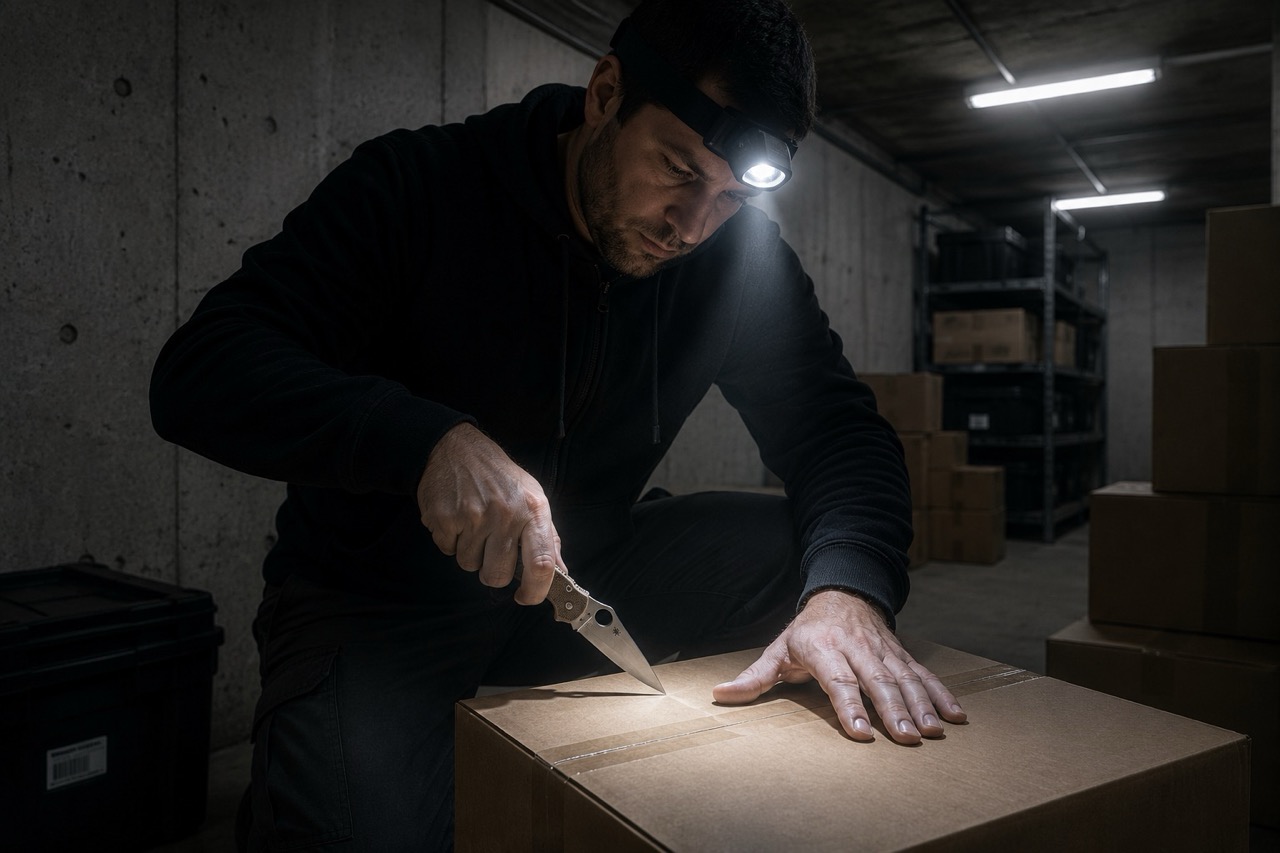
Well, let’s just say it’s a lot more pleasant than trying to get an AI image generator to accurately reproduce a knife model from reference photos. 🙂
But…Now imagine… It’s dark in the basement. You’ve had a long day. You’re tired. Nothing seems to go quite as planned. You need a sharp tool. Anything ! For a moment, you think you don’t have one. Then you remember. Your knife should be sitting in your right front pocket. Exactly where it has been all day. So light that you forgot it was there. So comfortable that it never demanded your attention until the precise moment you needed it.
A few ounces of FRN. A blade in CPM 15V. Or K390. Or MagnaCut. It doesn’t really matter. It could be that new PM2 Lightweight Sprintrun. It could be the built-like-tank Lil’ Temperance Lightweight in K390. It could be the sleak Sage 5 Salt Lightweight in MagnaCut.
Different knives. Same philosophy. But that PM2 Lightweight pushes really the concept one step further. No stainless steel liners. Just enough material to hold together one of the most capable folders Spyderco has ever designed. A reliable cutting tool so light that I forget it’s there—until the moment I need it.
And that’s the whole point: the best pocket knife isn’t the one you admire all day long. It’s the one you completely forget about—right up until it does exactly what it’s supposed to do. That’s what Lightweight means.: “When you need it, it’s already there.”
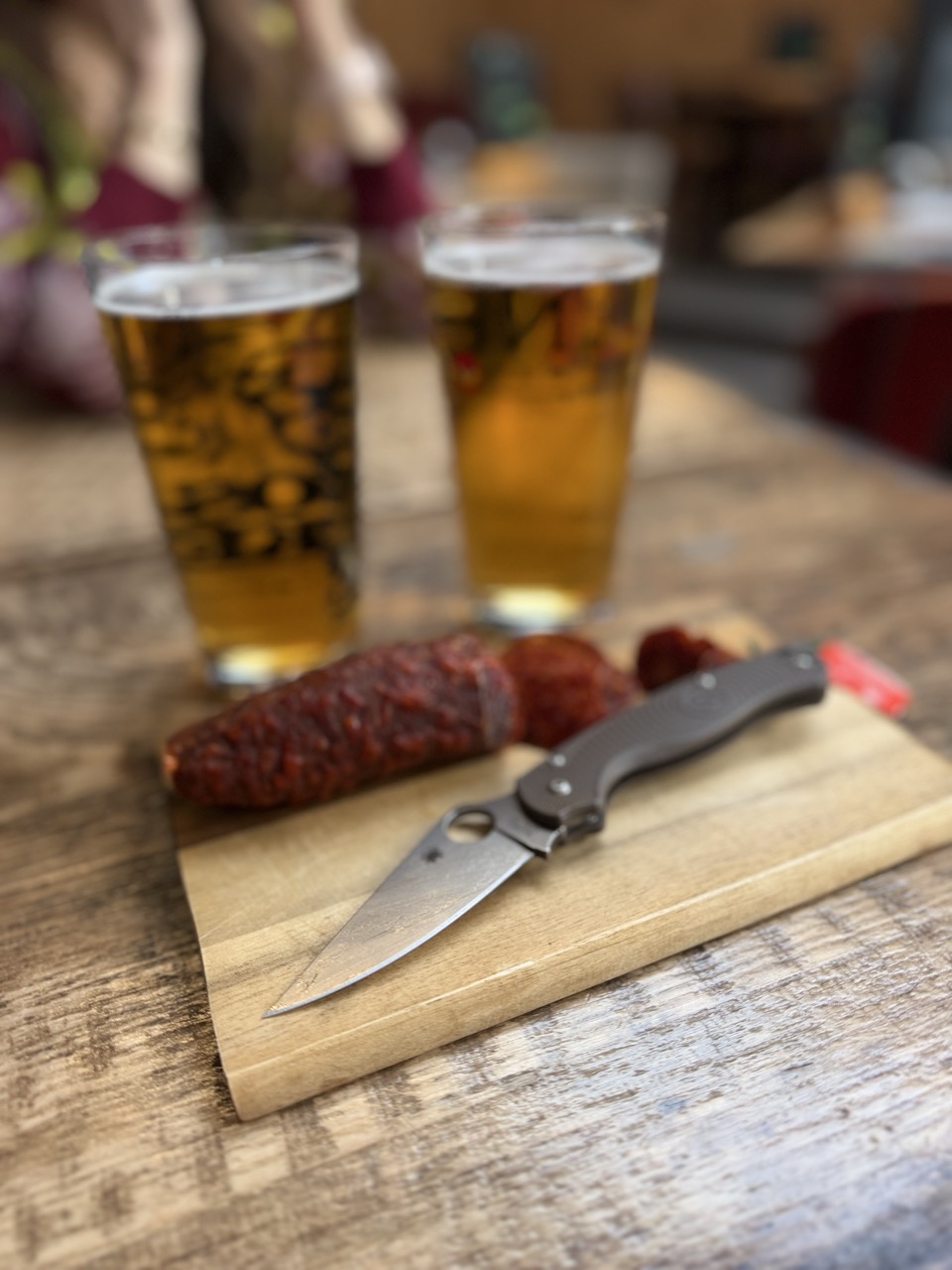
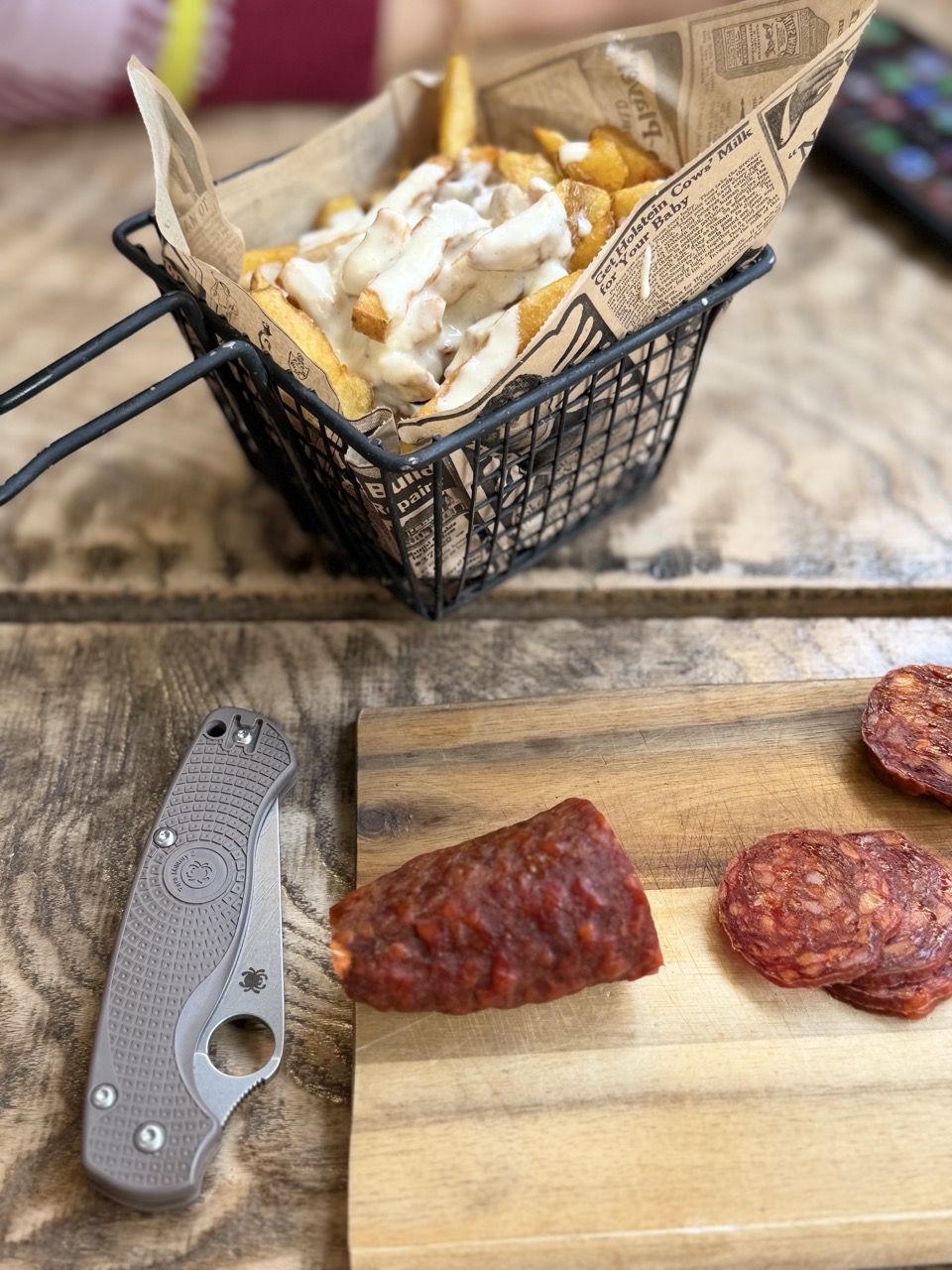
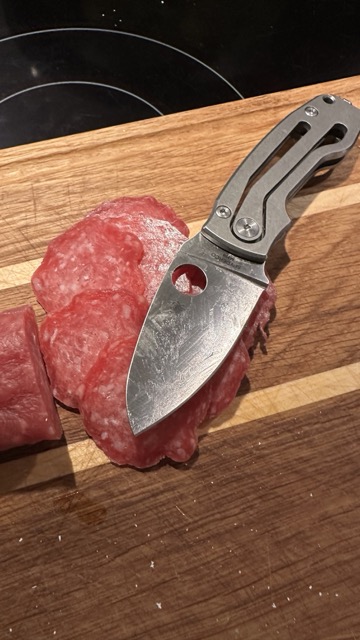
I recently used the PM2 Lightweight in a French pub to slice some rather excellent chili dry sausage on a wooden board. The pub had kindly provided a knife, of course. I didn’t use it. Instead, I reached into my pocket and pulled out the PM2 LW. Same size as the dull kitchen knife provided. Nobody noticed that PM2 LW. Not a single glance. Not a single raised eyebrow. The sausage, however, attracted plenty of attention.
By the end of the evening, everyone had enjoyed a few slices and a few beers. The PM2 simply returned to my pocket, unnoticed.
And somehow, that feels like the ultimate compliment for an everyday carry knife.
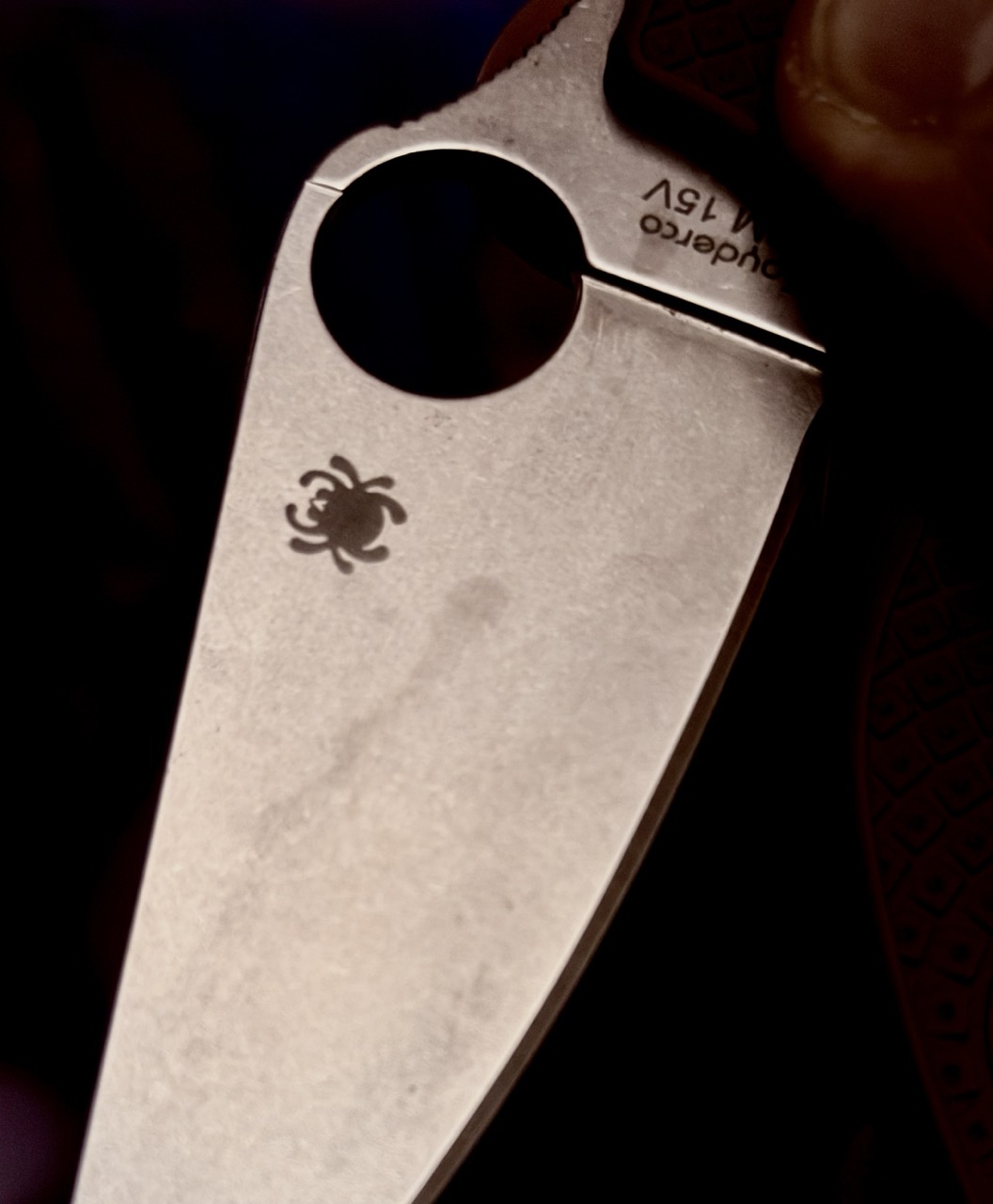
Mine has also been used in all condition, and for kitchen duty, my own PM2 Lightweight in CPM15V is starting to develop that beloved slight patina after processing several kilos of fresh tomatoes. That’s perfectly normal for CPM 15V. A little discoloration is simply part of the deal.
A pocket knife that never shows signs of use is usually a pocket knife that isn’t being used enough, don’t you think ?
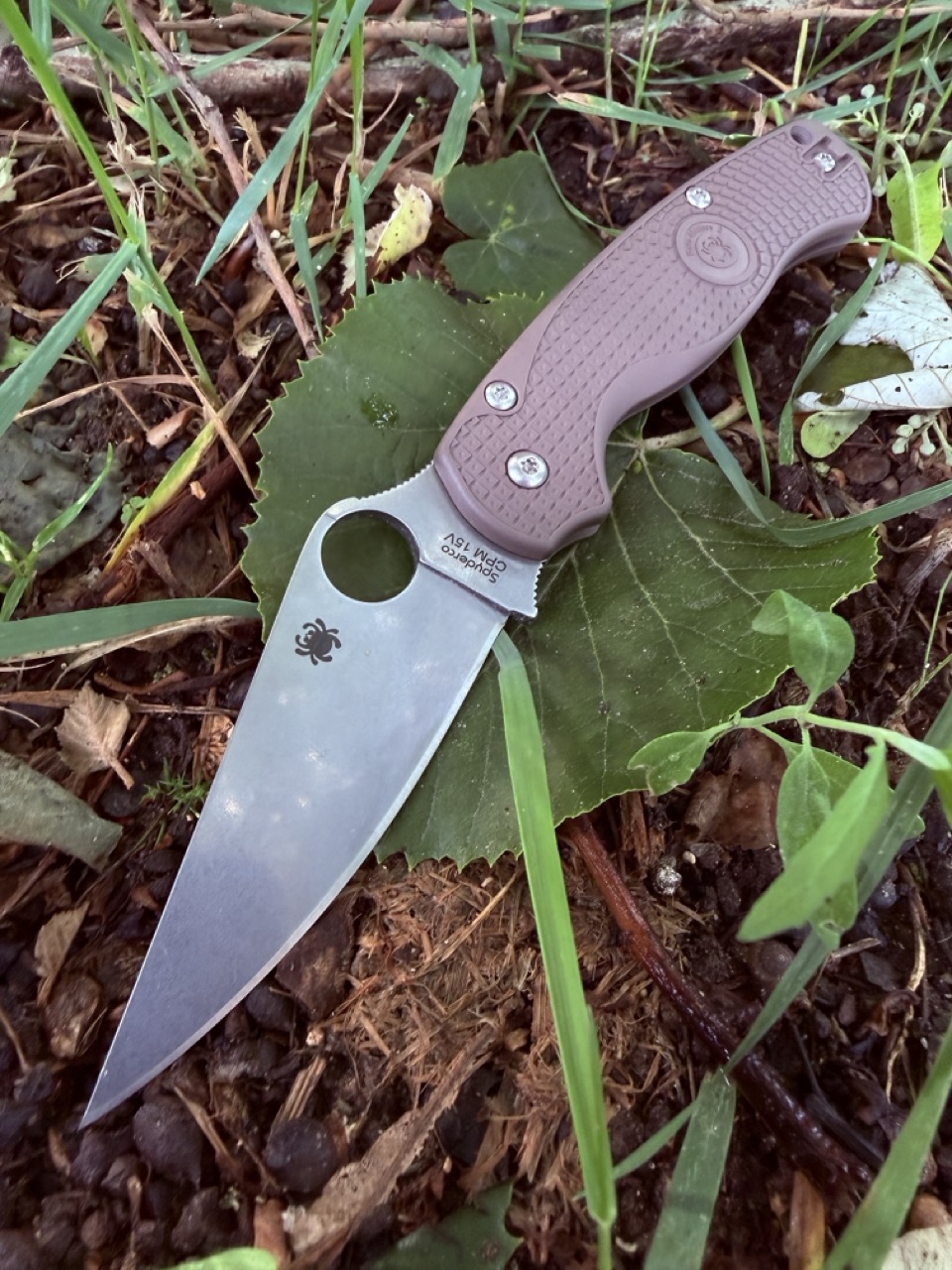
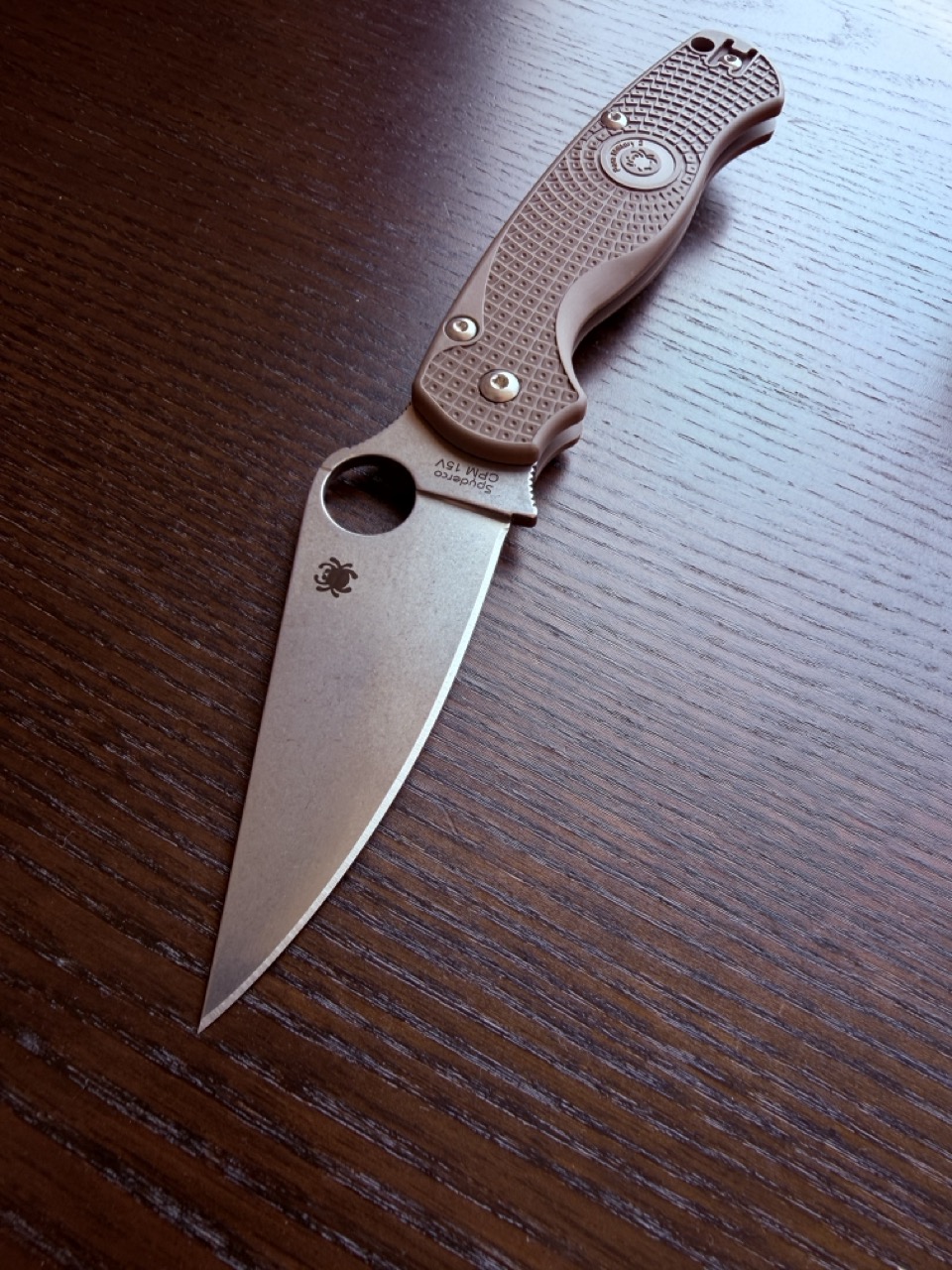
So far, the PM2 Lightweight has proven itself to be a reliable and faithful companion. The color of the FRN scales on this particular version won’t appeal to everyone. Personally, I rather like it. Combined with the stonewashed blade, it creates a surprisingly discreet package. A kind of visual camouflage. The knife doesn’t draw attention to itself.
And that’s another quality I look for in an everyday carry knife: civilian stealth. Not stealth in the tactical sense. Stealth in the social sense. The ability to be perceived as a tool rather than a weapon.
A good EDC knife should solve problems, open packages, slice food, cut cardboard and occasionally rescue a stubborn piece of string. It doesn’t need to announce its presence.
That PM2 Lightweight excels at exactly that. Despite its relatively generous blade length, it remains remarkably unthreatening in appearance. The muted gray-green handle and stonewashed finish help it blend into everyday life, where it belongs.
After all, the best EDC knife is rarely the one that attracts the most attention. It’s the one that quietly gets the job done without attracting any at all like a silent companion.
There are knives that become products, and there are knives that become dialects. The Spyderco Para Military 2 since its inception belongs firmly to the second category.
For sixteen years, the PM2 has occupied a rare position in the knife world: not merely respected, but culturally embedded. Made in Golden Colorado USA Earth, designed in the lineage of the original C36 Military model and its offspring the Paramilitary 1 from 2004, the Paramilitary 2 refined the formula into something more agile, more urban, more universally wearable. Key improvements introduced in 2010 were: Ergonomics: Thinner, refined G-10 handle. Mechanism: New Bushing Pivot System for smoother action. Clip: 4-position pocket spoon clip. Blade: Slightly thinner blade profile with an elongated tip. From there, the Spyderco Paramilitary 2 quickly established itself as a modern classic in the knife industry. It also became the most compelling ambassador for Spyderco’s in-house Compression Lock system, turning simple fidgeting into something unexpectedly addictive.
Its full-flat, leaf-shaped blade geometry delivers near-universal utility — a fine, precise tip paired with a confident, efficient cutting edge. In use, it feels less like compromise and more like calibration.
And then there is the ergonomics: that unmistakable Spyderco palm swell and forward choil, which transform hard tasks into something almost composed, almost effortless.
Even AI now generates imaginary PM2 variants — sometimes hilariously inaccurate ones with back locks — which says a lot about how deeply the Spyderco Paramilitary 2 has embedded itself into modern knife/EDC culture.
Because the PM2 was never just a tactical folder. It became the Porsche 911 of contemporary EDC: instantly recognizable across a room, endlessly reinterpreted, yet impossible to mistake for anything else but one of the Spyderco Millie family.
And yet, for all its success, the classic PM2 always carried a subtle contradiction. It was a knife celebrated for everyday carry that still weighed like a “serious” tool. A tool which floats like a butterfly but sting like a bee. So, the same process which turned its little brother Para3 G10 into Para3 Lightweight has been applied: get rid of G10 scales and bring the Fiber Renforced Resin / FRN !
The new Spyderco Paramilitary 2 Lightweight changes that entirely.
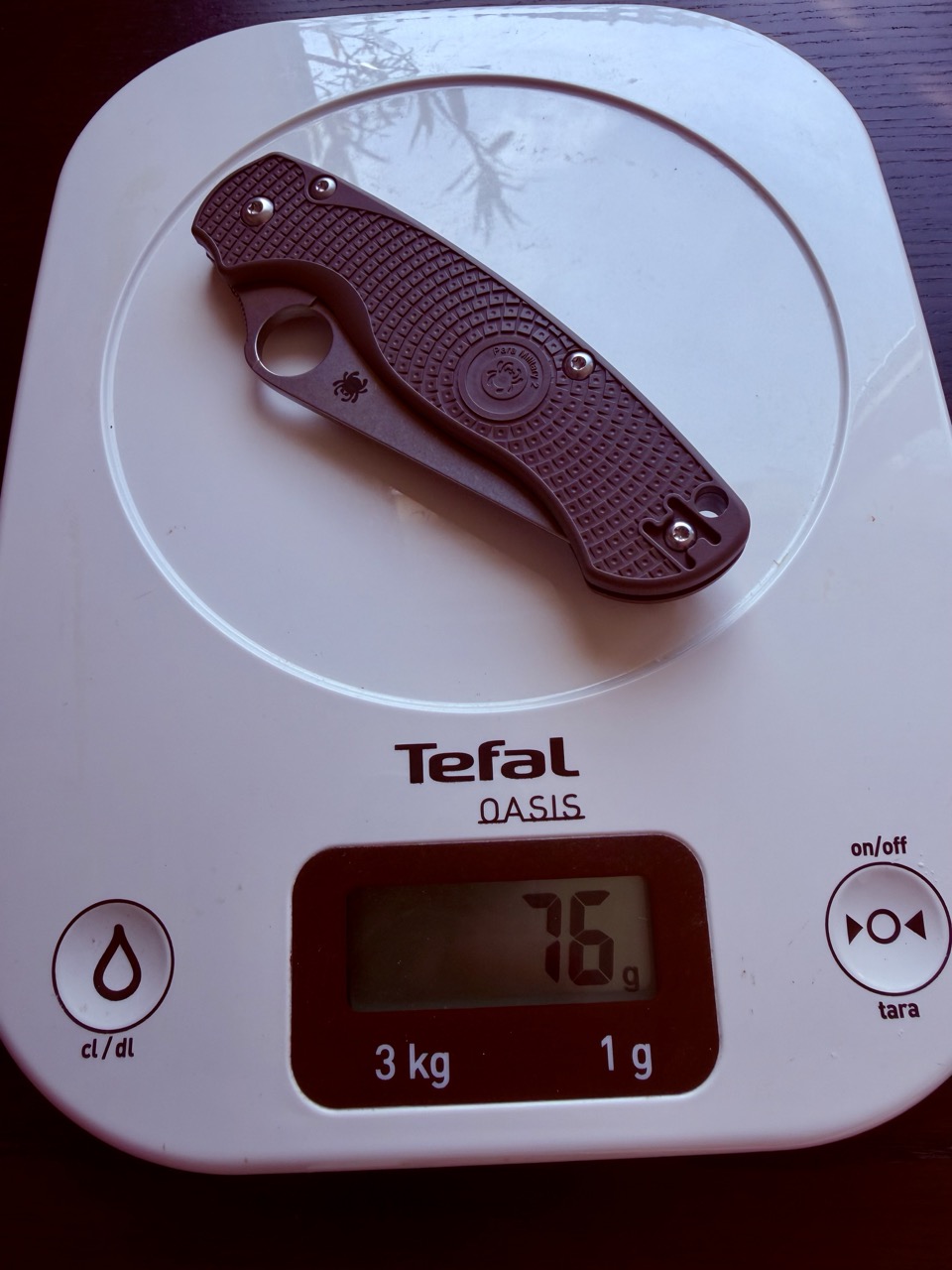
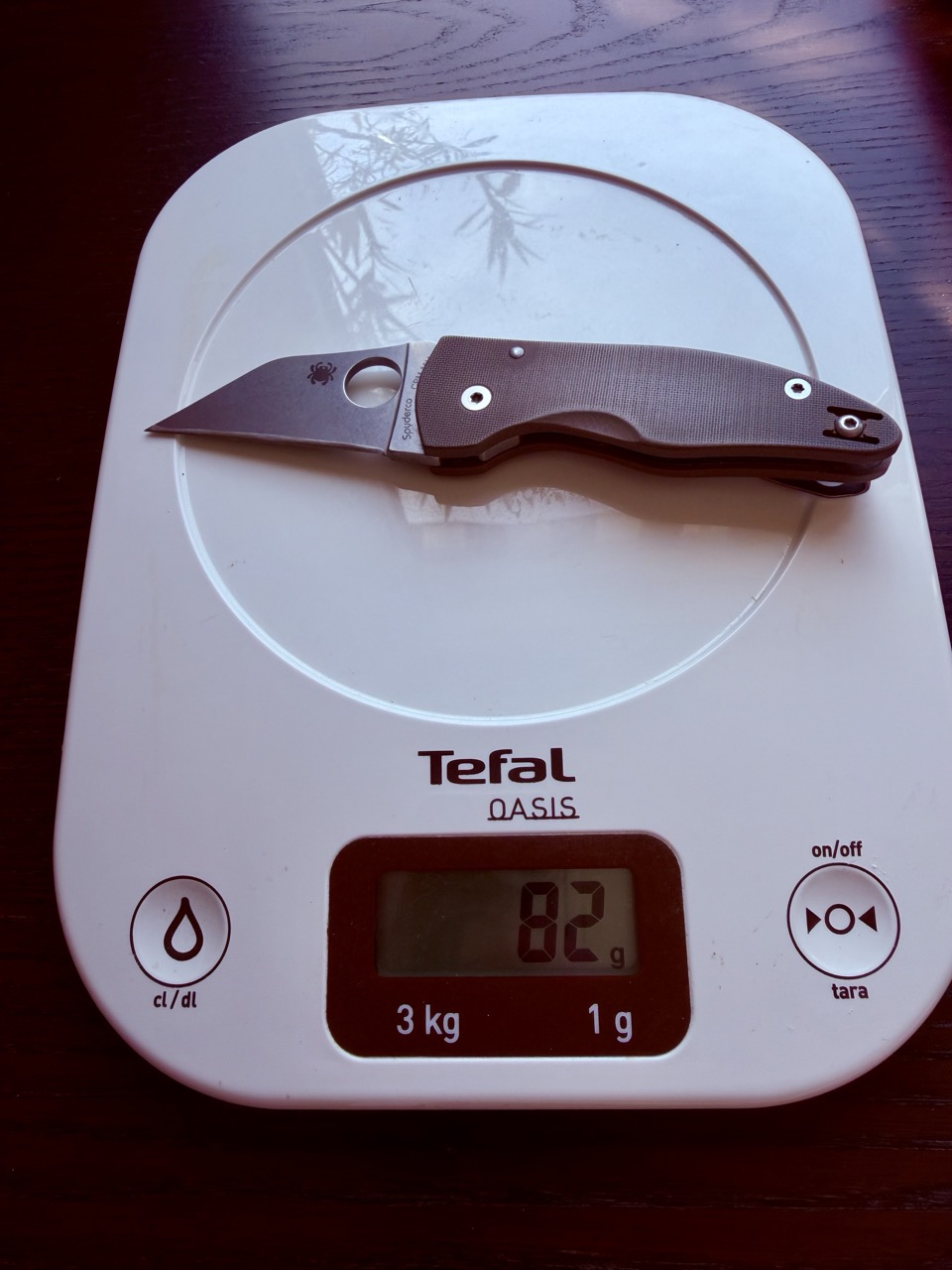
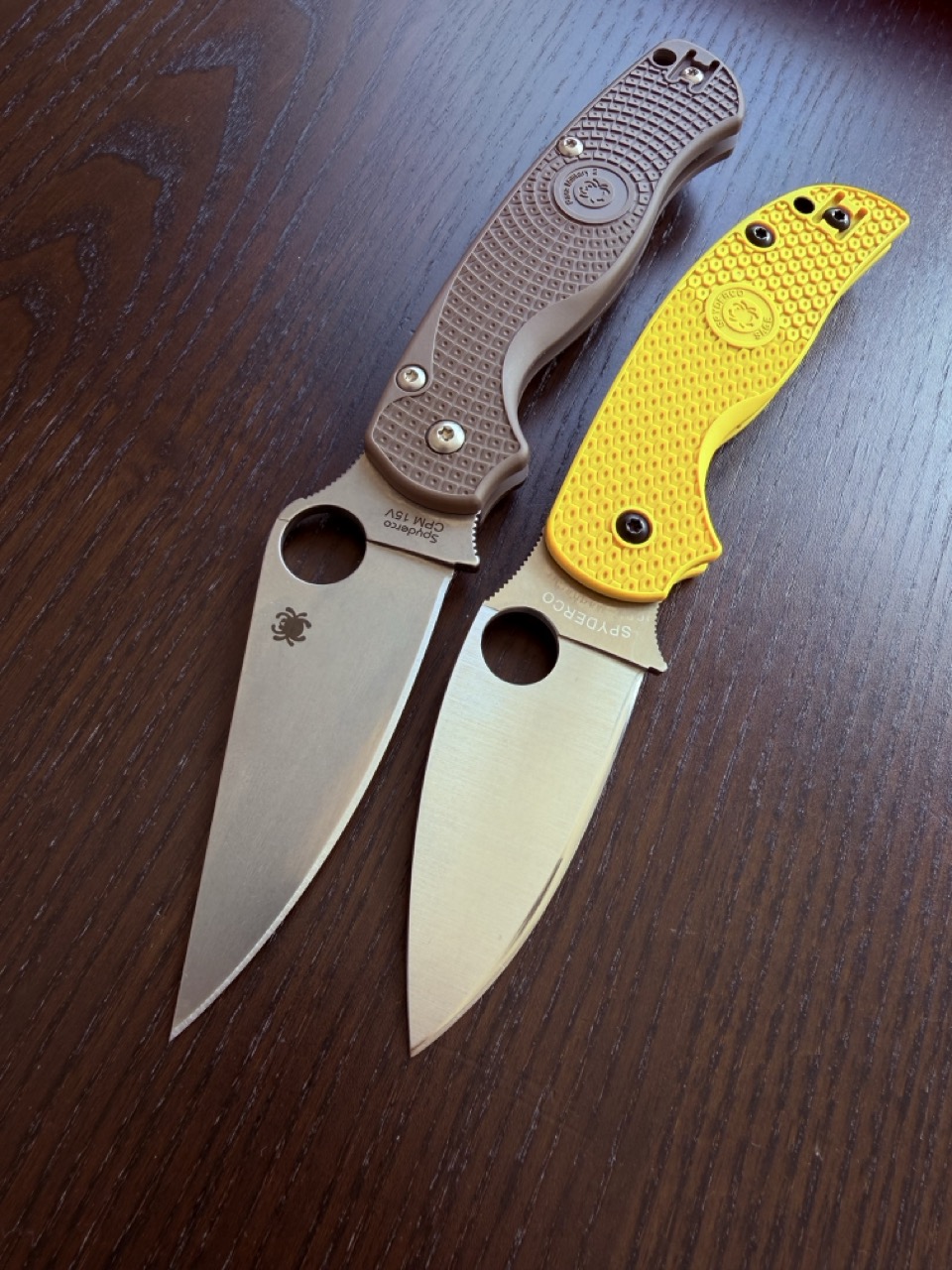
At roughly 76 grams, the PM2 LW does not feel like a trimmed-down PM2. It feels like an entirely different interpretation of the design. To put that into perspective, it is even 16 grams lighter than the Spyderco MicroJimbo — a knife already considered compact and featherweight by EDC standards.
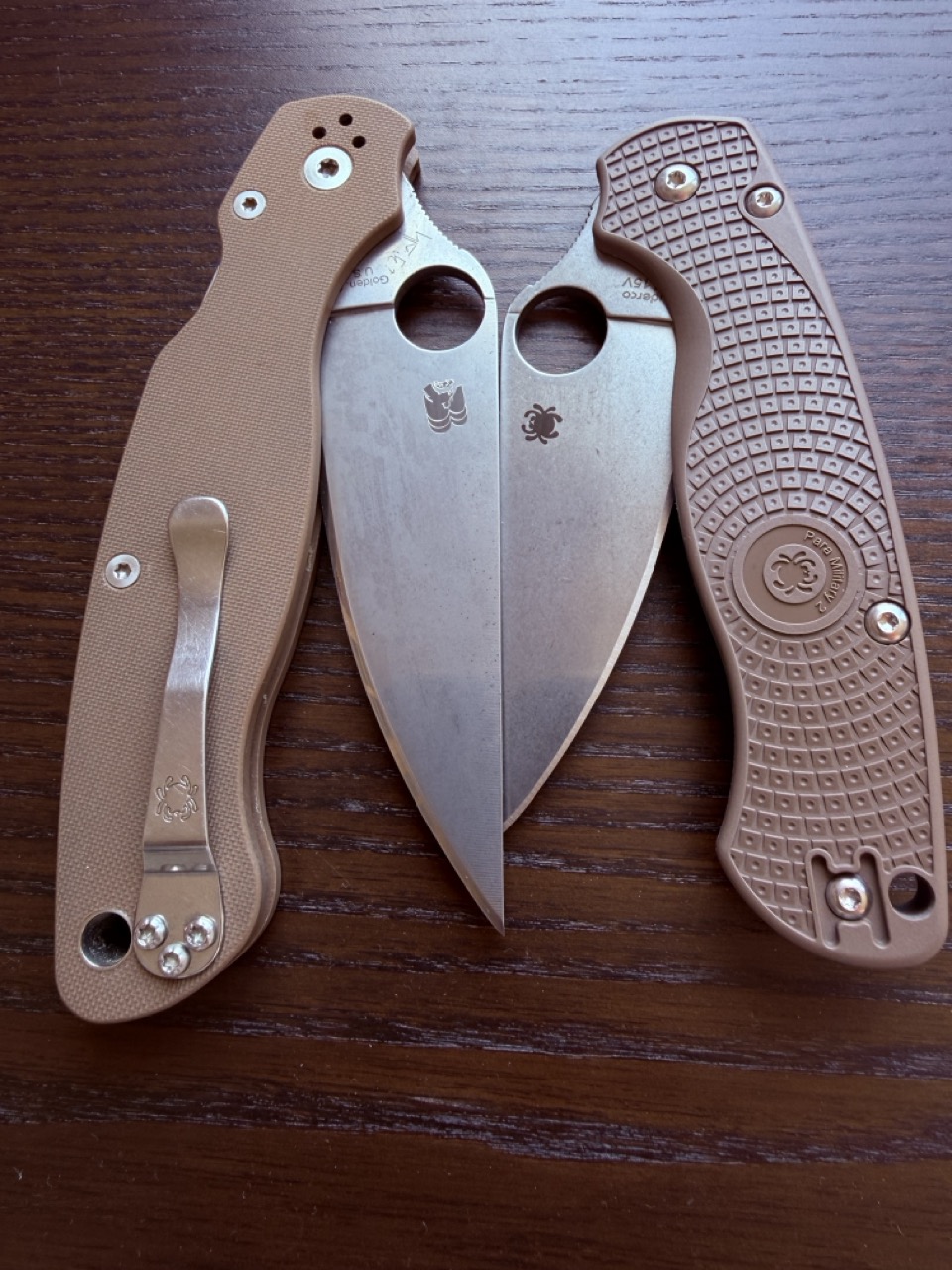
Compared to the classic G-10 PM2, the difference becomes almost startling: 32 grams gone, dropping from 108 grams to just 76. That is nearly a 30% reduction in weight.
Edge-wise, the blade-to-weight ratio is remarkable — and decisively in favour of the Spyderco Paramilitary 2. 😉 Oh well, I’m joking — these two knives were never meant to compete. They simply occupy different territories of utility, and both earn their place in my pocket for different reasons. Still, this new Lightweight feels like the moment Spyderco finally allowed the PM2 to become what it was always destined to be: not merely lighter, but almost spectral. The Para3 LW vibes haves been compared to the Delica. The PM2 got the Endura’s: a ghost of a knife you completely forget is clipped to your pocket… until the exact second you need it. Another clue? The clip. Look closely.
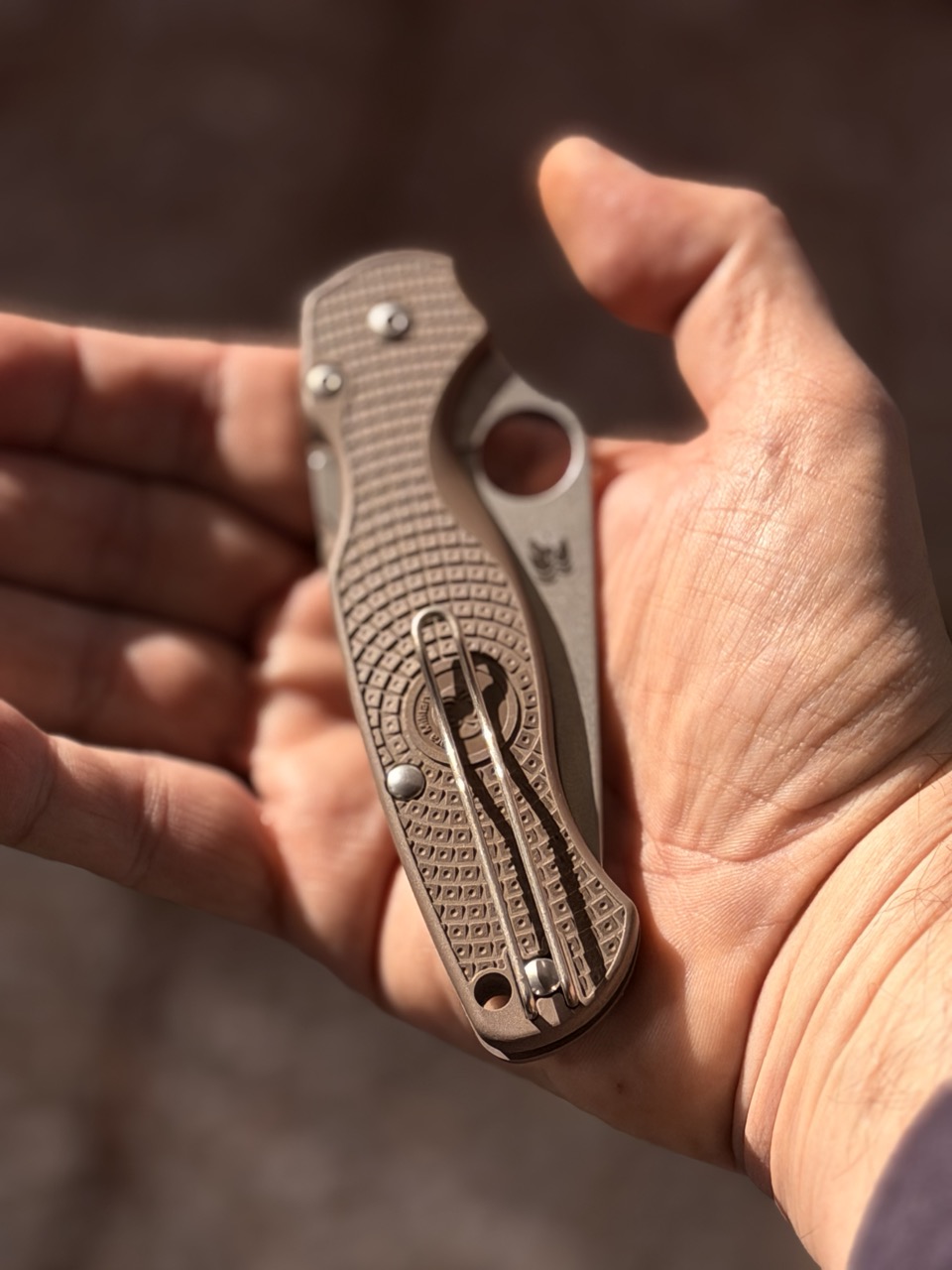
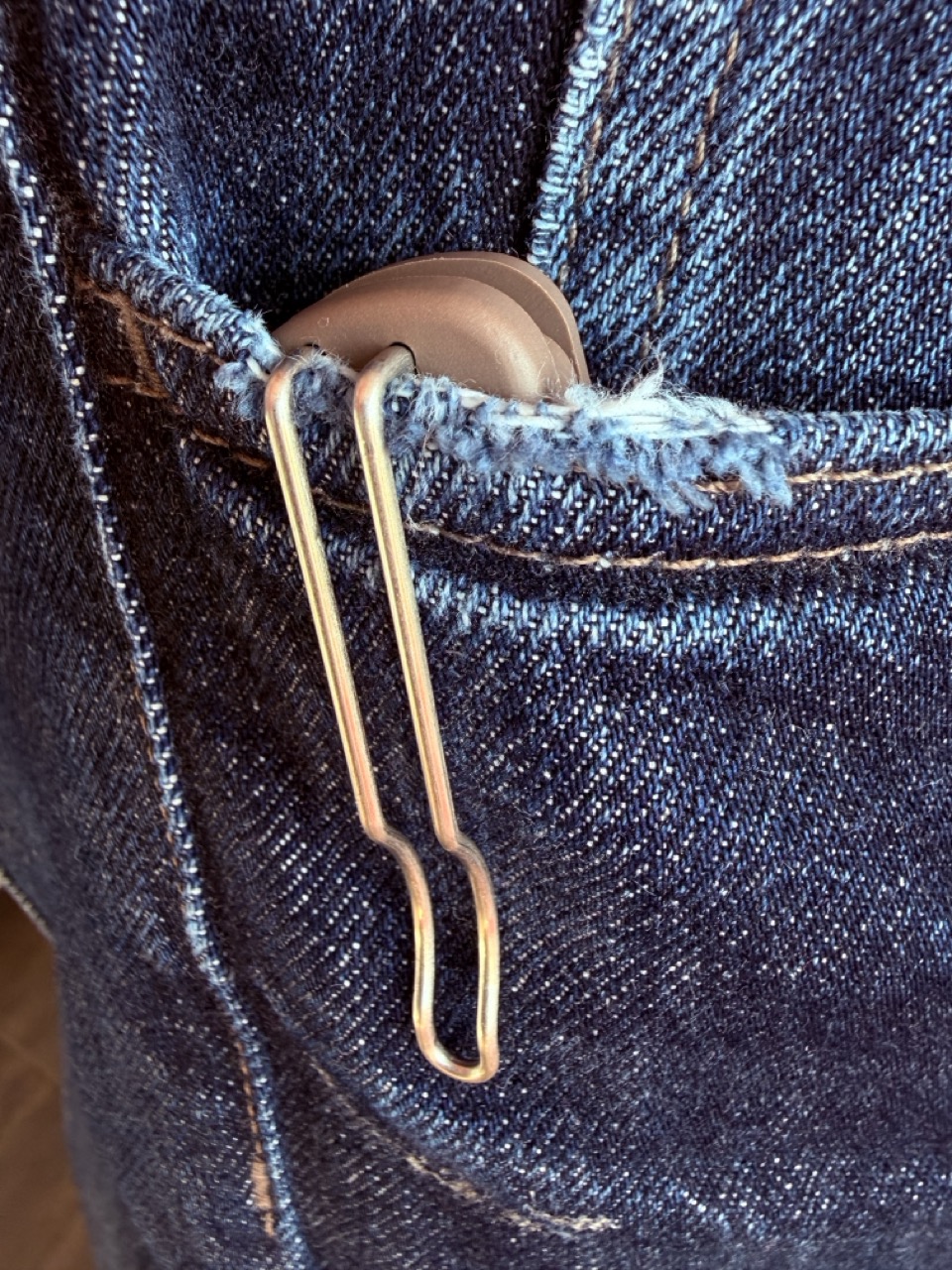
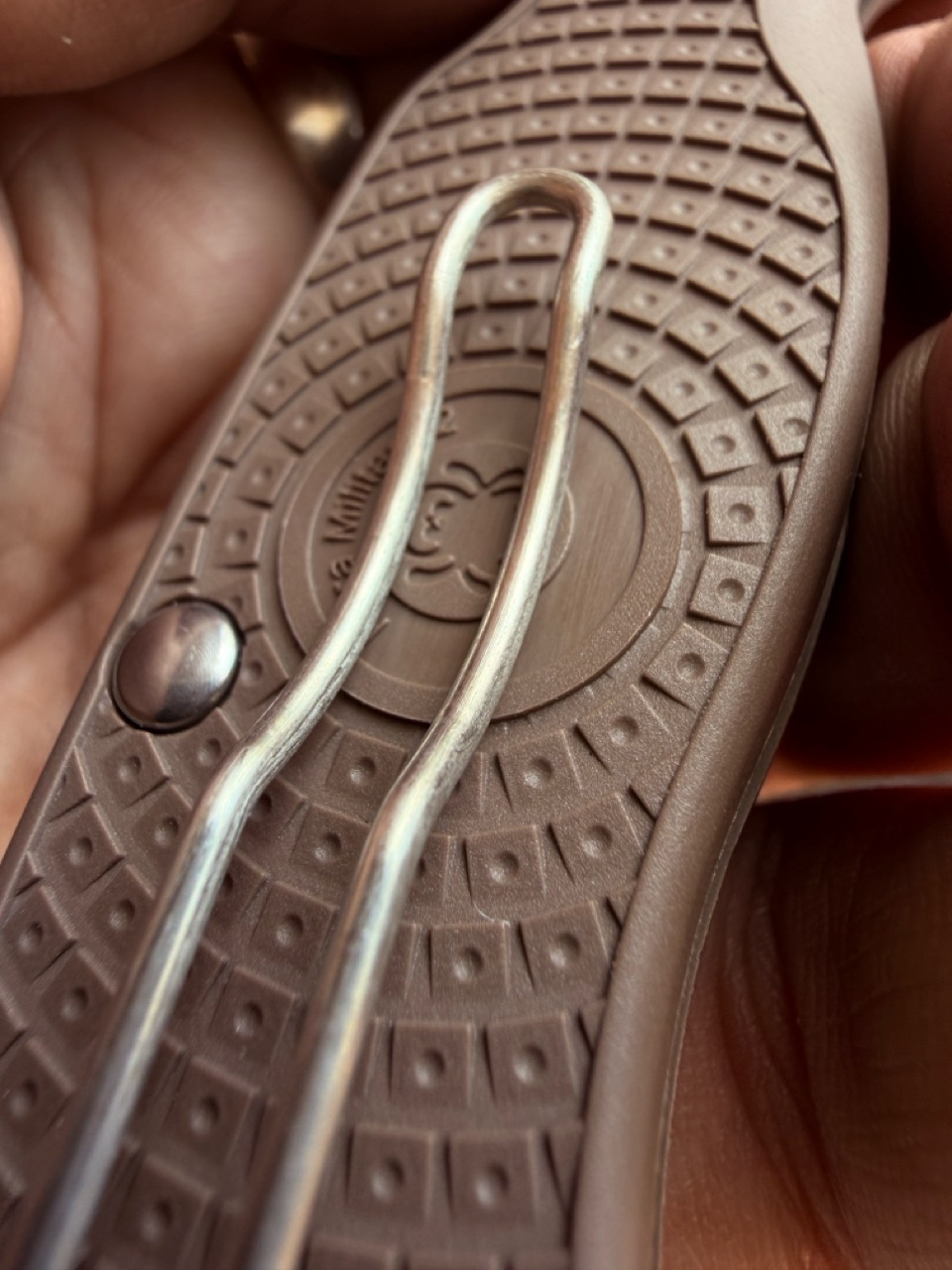
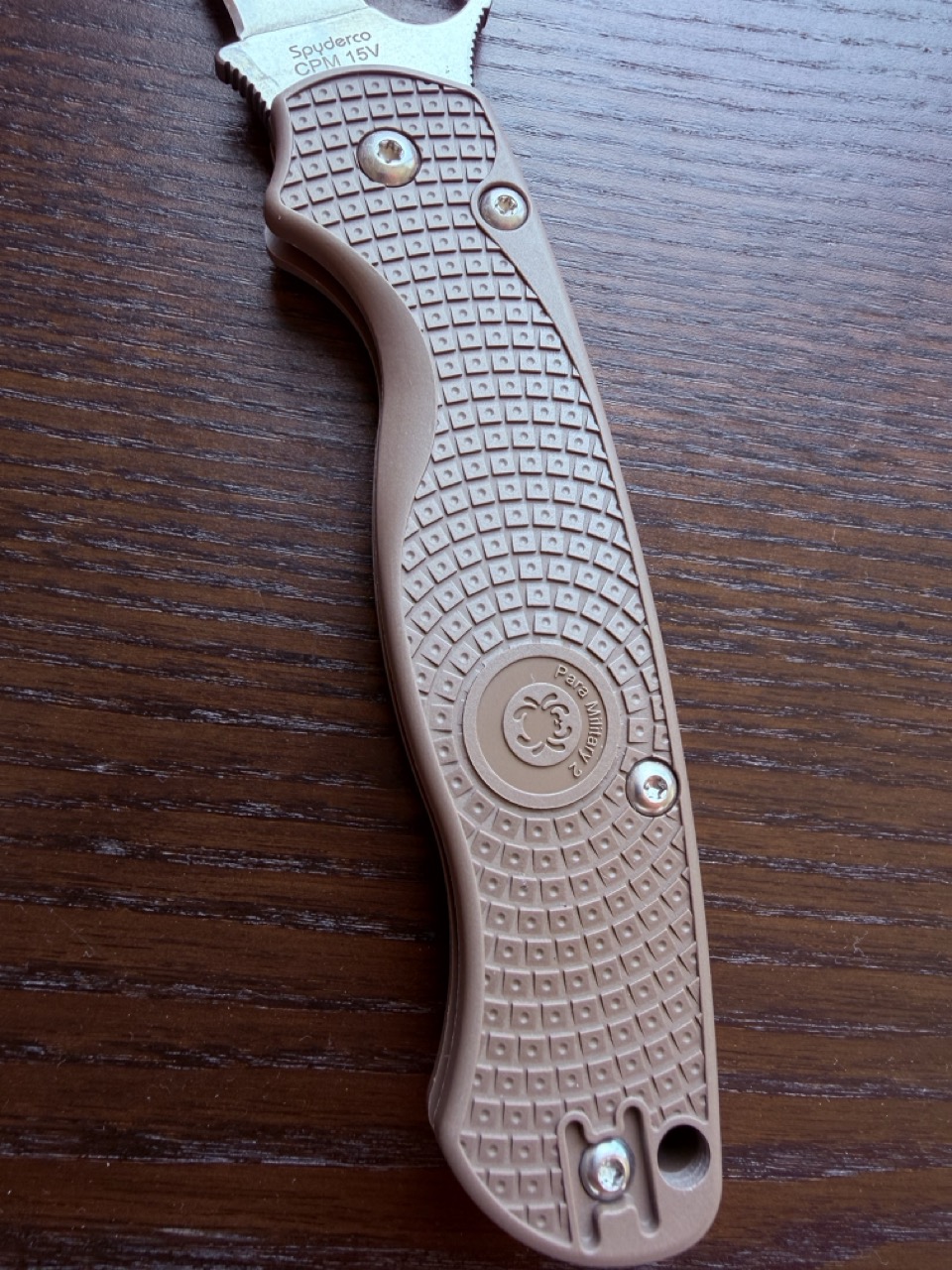
The deep-carry clip makes the knife feel even stealthier in the pocket, almost invisible in daily carry. Tip-up only, though. It’s not exactly a pocket shredder, but it’s not the gentlest on pocket seams either — even if the clip geometry and FRN patterning have clearly been tuned to make deployment and carry as smooth as possible.
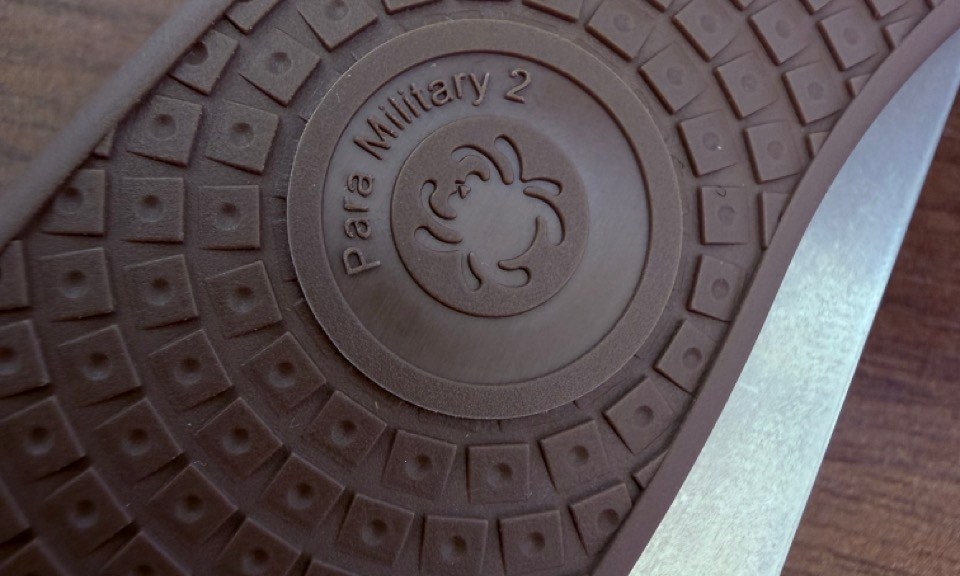
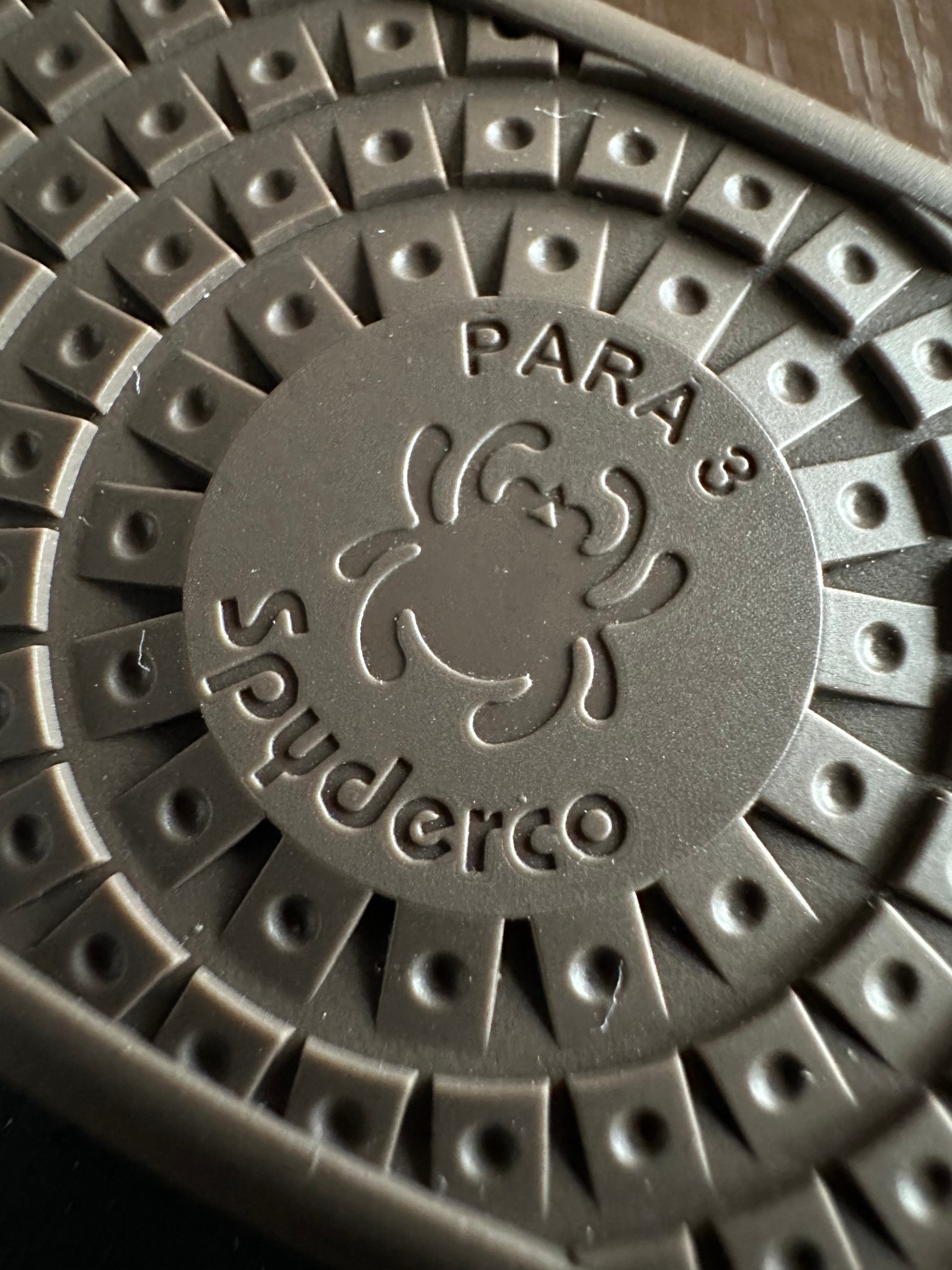
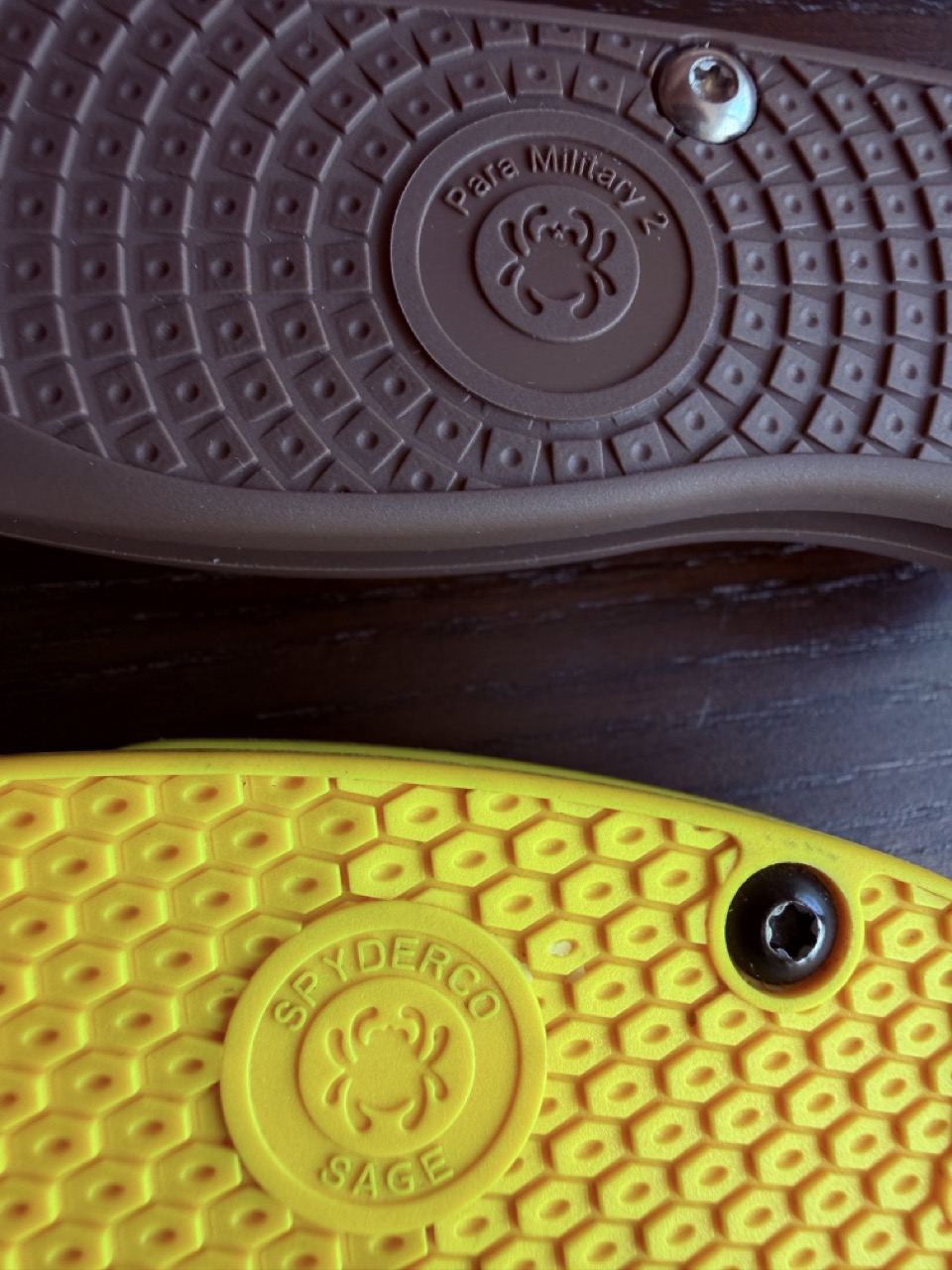
In my view, the central “medallion” on the Spyderco Para 3 (pictured here) feels more refined and better resolved visually. It has a cleaner, more intentional integration into the design.
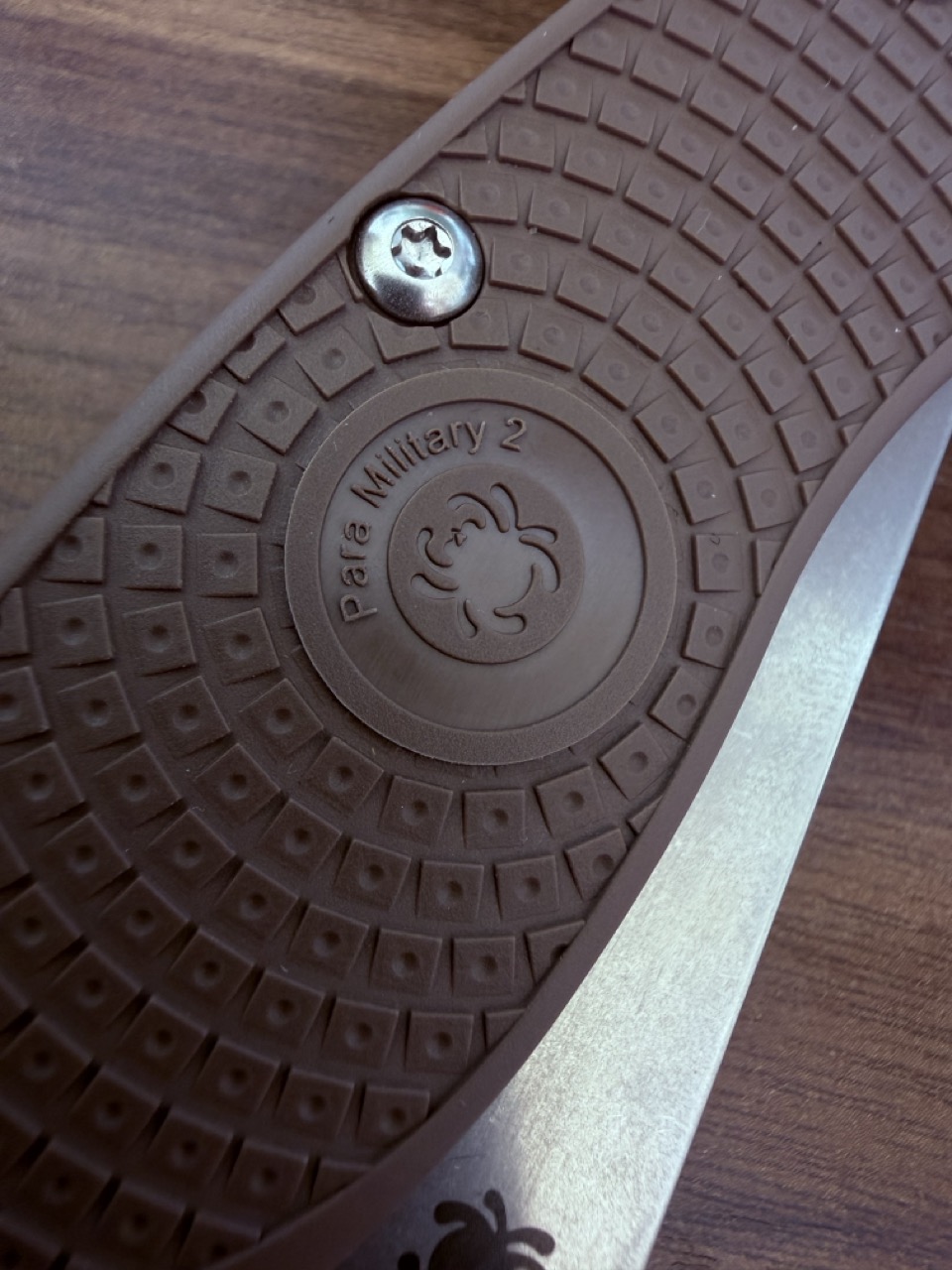
Here, on the PM2, it simply reads “Para Military 2” — which feels oddly understated. Curiously, the Spyderco name itself is nowhere to be found on that element, a surprising omission for such an iconic model.
But then again, this is exactly the kind of detail enthusiasts obsess over.
Personally, I prefer the FRN molding of the Spyderco Para 3 Lightweight in the epicenter of the pattern — it feels slightly more refined and cohesive. On the other hand, I find the Spyderco Paramilitary 2 Lightweight superior around the Compression Lock interface and the access to the Spyderhole, both of which feel more open, more natural, and ultimately more satisfying in use.
The handle transformation comes primarily through the FRN handle — fiberglass reinforced nylon — a material longtime knife enthusiasts still love to debate with almost religious intensity. Traditionalists often associate premium folders with layered G-10, titanium, or carbon fiber. FRN, by comparison, can seem almost too practical, too honest about its intentions. Forums discussions around Spyderco’s lightweight models reveal the familiar divide: some users still perceive FRN as less luxurious, while others praise its traction, comfort, and remarkable reduction in carry fatigue. One thing is certain: FRN brings a significant leap in ergonomics.
You can see how the design has been subtly refined to erase the boxy, almost overbuilt feel of the G-10 version. Spyderco’s history with FRN stretches back through legendary lightweight models like the Spyderco Delica, Spyderco Endura and the Spyderco Salt Series — knives that became icons precisely because they vanished into the pocket while remaining utterly dependable in dirty, wet, unforgiving environments. The people at Golden has spent decades refining FRN into something uniquely their own. On a Spyderco, FRN is not budget plastic. It is engineered utility. The texture, invented by Sal Glesser, is the key.
That bidirectional pattern grips the hand with a kind of mechanical confidence — less refined than blasted titanium perhaps, but more secure when life becomes sweaty, cold, rushed, or imperfect.
What makes the Spyderco Paramilitary 2 Lightweight genuinely fascinating is not merely its weight reduction, but the engineering compromise Spyderco somehow refused to make. Because removing mass from a back lock or liner lock is relatively straightforward. Removing mass from a Compression Lock platform is something else entirely. The Compression Lock is one of the defining mechanical signatures of Spyderco — a brilliantly elegant system designed by Sal Glesser that combines strength, fluidity and one-handed safety with an almost addictive tactile character. But unlike simpler locking systems, it traditionally depends on nested steel liners and a rigid chassis architecture.
In other words: it was never meant to live inside an ultralight FRN body. That is the hidden tour de force of the PM2 Lightweight.
Spyderco did not simply shave material away from the classic design. They had to rethink how the Compression Lock itself could survive — and still feel reassuringly precise — inside a platform whose entire philosophy is flexibility, lightness and minimal structure.
FRN has a very different mechanical behavior from G-10. It flexes differently. Resonates differently. Carries load differently. The scale’s edges can feel a touch sharp/aggressive out of the box, but I usually knock the initial bite down slightly with my thumbnail. Not a big deal.
And yet, in hand, the PM2 LW still delivers that familiar Compression Lock experience: the sharp metallic click, the secure lockup, the controlled drop-shut feel, the confidence under pressure. The knife retains the mechanical identity of a “real” PM2 despite having shed nearly a third of its weight.
That balance is far harder to achieve than most users realize.
Too much liner removal, and the knife begins to feel hollow or vague. Too much FRN flex, and the lock loses its aura of precision. Too much steel reinforcement, and the entire Lightweight philosophy collapses under its own contradiction.
Spyderco somehow threaded the needle. In hand, the result is fascinating because the PM2 LW does not feel cheap, nor stripped-down. It feels optimized — almost industrially purified. As though the designers kept asking themselves a brutal question: “How little knife can we leave… before it stops feeling like a PM2?” And the answer, apparently, was 76 grams.
So who, exactly, is this new Spyderco Paramilitary 2 Lightweight really made for? Not the collector seeking desk-jewel materials. Not the enthusiast who wants maximal heft and polished mechanical theater. This PM2 is for people who actually carry a knife every day and do not want to feel it in their pocket. Like a ghost… a spirit. For the light traveler, moving through the world in technical fabrics and ultralight luggage — absolutely yes. The Spyderco Paramilitary 2 Lightweight is exactly on point. For the architect, photographer, paramedic, cyclist, climber, sailor, or city commuter who notices every unnecessary gram. For those in the field where every gram really matters — soldiers, paratroopers, operators, and anyone carrying their world on their person — the Spyderco Paramilitary 2 Lightweight makes immediate sense. For the those who slips a knife into athletic shorts and forgets it exists until the moment it is needed. And when needed, the action remains fluid , smooth and effortless, while the absence of heft is almost disorienting at first. This is where the name Lightweight stops being a designation and becomes an identity — carried here to its purest, most unapologetic expression. Yes—there is something almost pure in handling this Spyderco Paramilitary 2 Lightweight, something slightly disorienting in its lightness. Almost paradoxical. Elegant, refined, stripped to essentials — and yet fully present in the hand. It doesn’t try to impress through mass or presence anymore. Instead, it disappears, and that absence becomes the experience itself. As the late Mark Hollis (*) once suggested, “Only silence is more beautiful than music…” and in a strange way, that idea translates surprisingly well here. This almost weightless refinement might be the closest thing cutlery has to silence: a design so resolved it no longer insists on its own existence, only its function.
The genius of the Lightweight is psychological as much as physical. A heavy knife asks for commitment. A 76 grams PM2 becomes invisible — and invisibility is the highest achievement in EDC design.
Ironically, reducing the weight also sharpens the very essence of the PM2 itself. The famous blade suddenly feels more dominant, more alive. Several early owners have described the sensation as though “all the weight is in the blade,” giving the knife a startling immediacy in hand.
Pictured beside a 120-gram Spyderco Military 2, the contrast becomes almost absurd. Of course, the Lightweight will not seduce everyone.
Some users will always prefer the denser, almost bank-vault solidity of G-10 scales and full steel liners. Others simply enjoy the tactile indulgence of heavier materials. (I once installed Flytanium bronze scales on a Spyderco Para 3. The result was magnificent — and roughly as subtle as carrying a ship anchor.)
And that is perfectly fair, because the classic G-10 Spyderco Paramilitary 2 remains one of the greatest production folders ever created.
But the Lightweight introduces something unexpectedly contemporary to the platform: efficiency without compromise.
This particular example happens to be a Sprint Run equipped with CPM 15V — a truly high-octane alloy. Yet the steel is almost secondary to the broader philosophy behind the knife. Much like the celebrated 15V Para 3 Lightweight before it, this PM2 LW pairs one of the most extreme high-performance steels available with an astonishingly light 76-gram platform.
The CPM 15V Sprint Run is the enthusiast’s reading of the idea — a limited-production exercise in maximum performance taken to its logical edge. 15V itself borders on the extreme in the best possible way. With an unusually high vanadium content of nearly 15%, it was developed for exceptional wear resistance and outstanding edge retention. In Spyderco’s implementation, it is further elevated by Shawn Houston’s specialised heat treatment, identifiable by the discreet “Triple B” mark engraved on the blade.
The beautifully stonewashed blade arrives with an edge that is immediately convincing — thin, precise, and unmistakably sharp straight out of the box. In my experience, it may well be one of the finest factory edges Spyderco has ever delivered. Hair-popping performance is effortless, almost casual, and geometrically speaking, even the informal “bottle” or light push-cut tests feel almost trivial. Much better than on my Para 3.
Oh well, the exotic steel may attract the headlines. (As a bit of a steel enthusiast, CTS-BD1N on the “vanilla” Spyderco Paramilitary 2 Lightweight doesn’t really excite me — it’s solid, reliable, easy to keep razor sharp, forgiving but uninspiring. I wouldn’t seek it out like I would CPM Cruwear steel, but I’d never pass on a great design just because of it.)
But the real story lies elsewhere: the revelation that one of the most iconic hard-use folders ever produced can suddenly feel almost effortless, friction less… pure.
Not diminished. Distilled. Purified. And distillation brings spirit. Spirit is light. And this purity is no lie.
Disclaimer: This knife has been provided through Spyderco’s Ambassador Program, upon my own request. Thank you to the Spyderpeople for letting me review it.
(*) For a musician and singer, Mark Hollis is unusually interested in silence, in what could be described as the gaps and intervals between notes. To listen to Spirt of Eden (1988) and Laughing Stock(1991), the last two albums by Talk Talk, the band of which he was singer and principal songwriter for more than a decade, is to encounter a music of fragments and dissolution, his murmured vocals often simply fading away as a song does not so much end as expire.
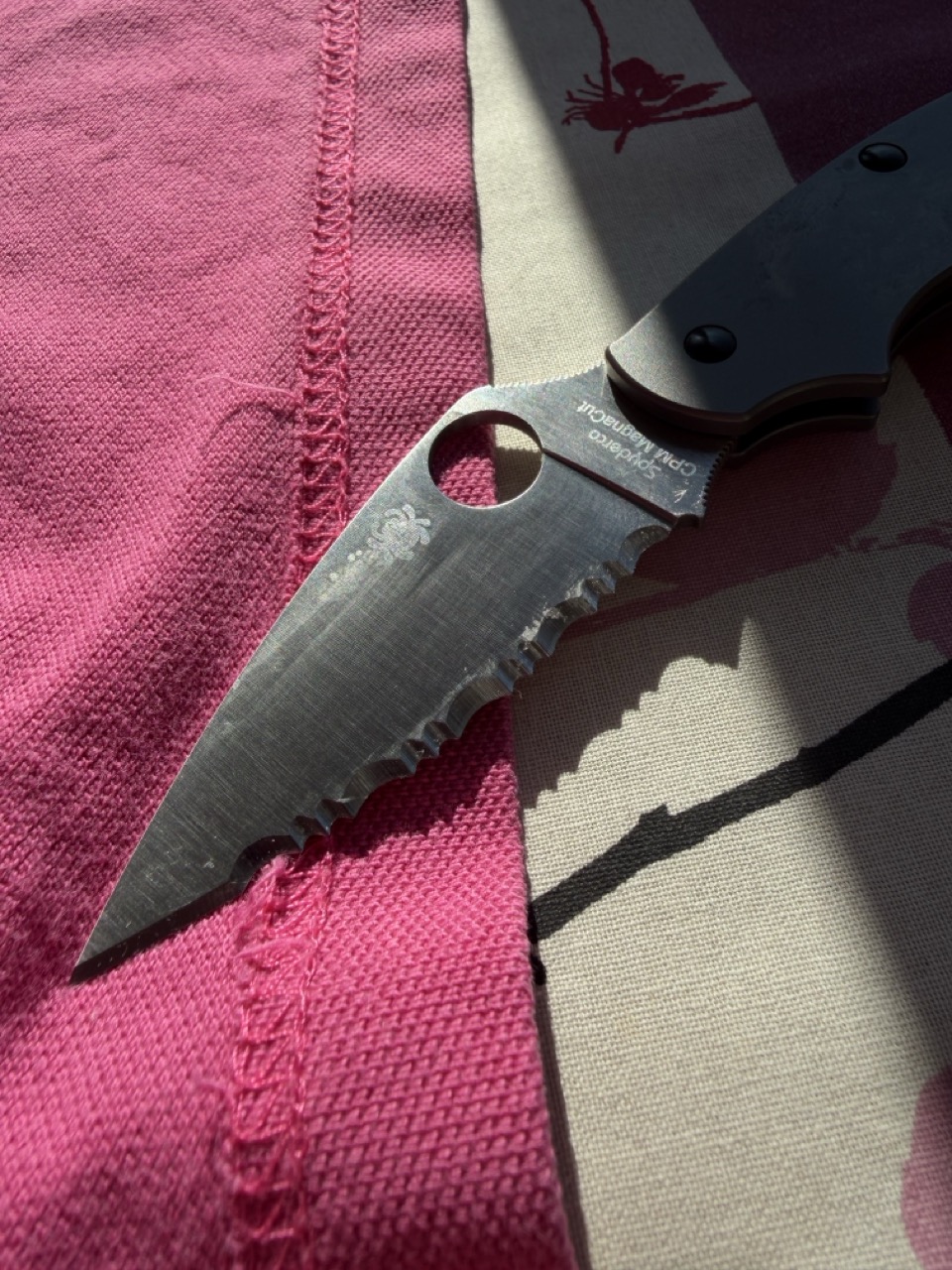
There are objects we own, and others that, through use, quietly become extensions of our hand. The UKPK in Magnacut—here in its serrated form, dressed in Heinnie’s Titech titanium scales—belongs firmly to the latter. Not a piece to be admired at a distance, but one to be lived with. Everyday. Tested. Carried without ceremony. This tool is low profile but with an hungry edge.
What strikes first is the paradox. A familiar, ergonomic silhouette—born from a will shaped by strict legal constraints—yet delivering a level of cutting performance that feels anything but limited. That serrated edge does not flatter at first glance. It unsettles some, even repels others. And that is precisely where its relevance begins.
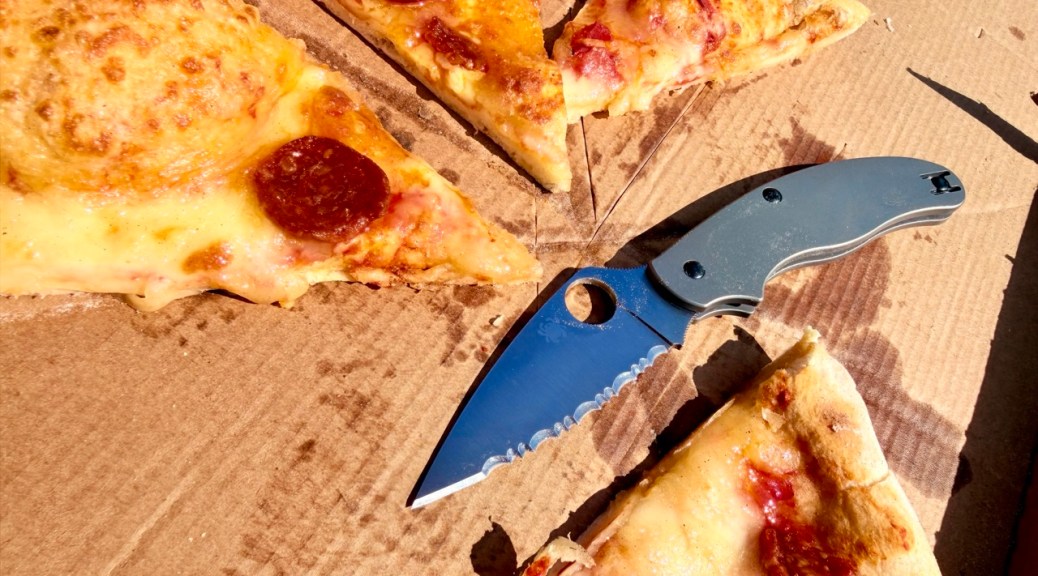
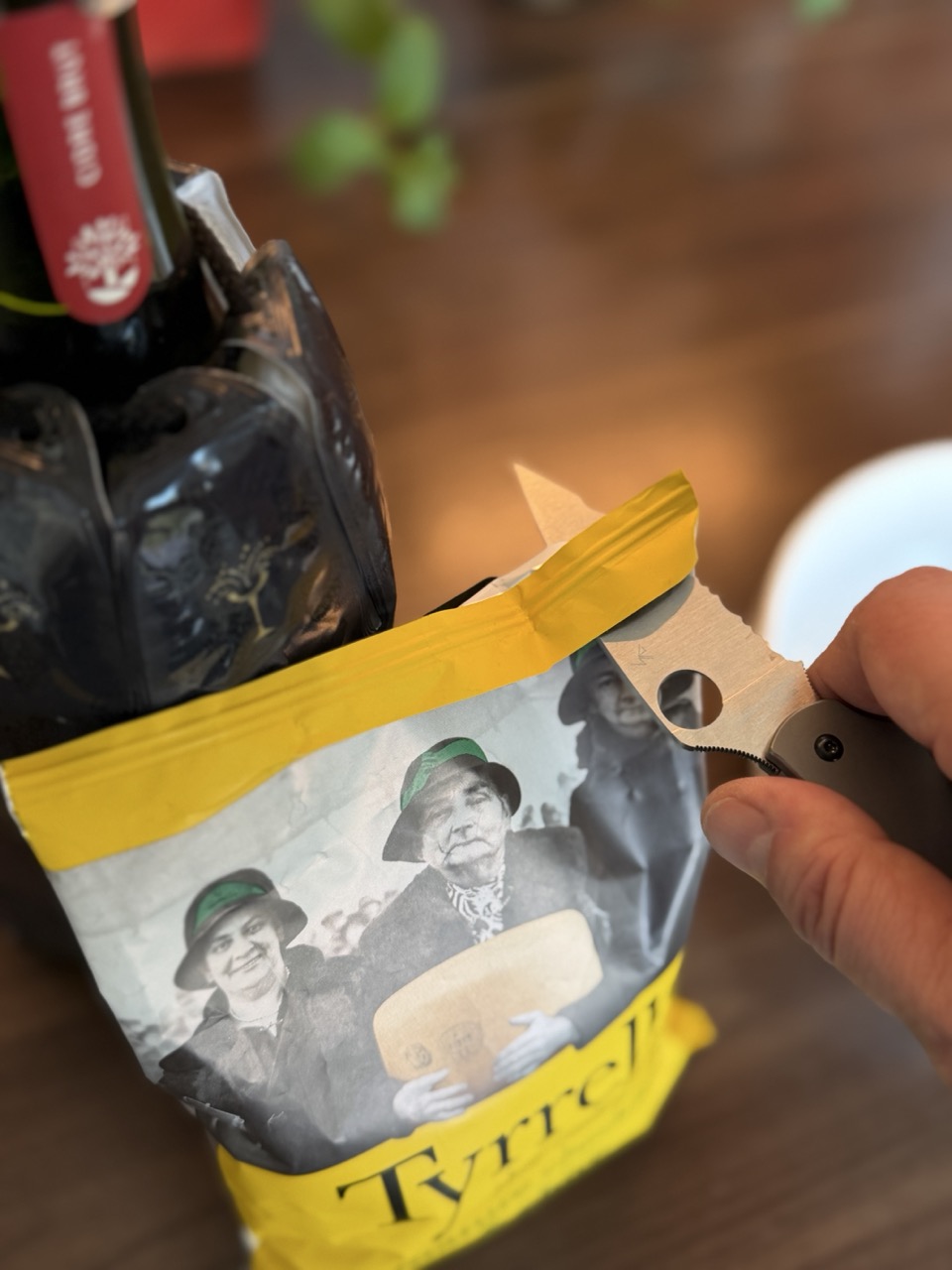
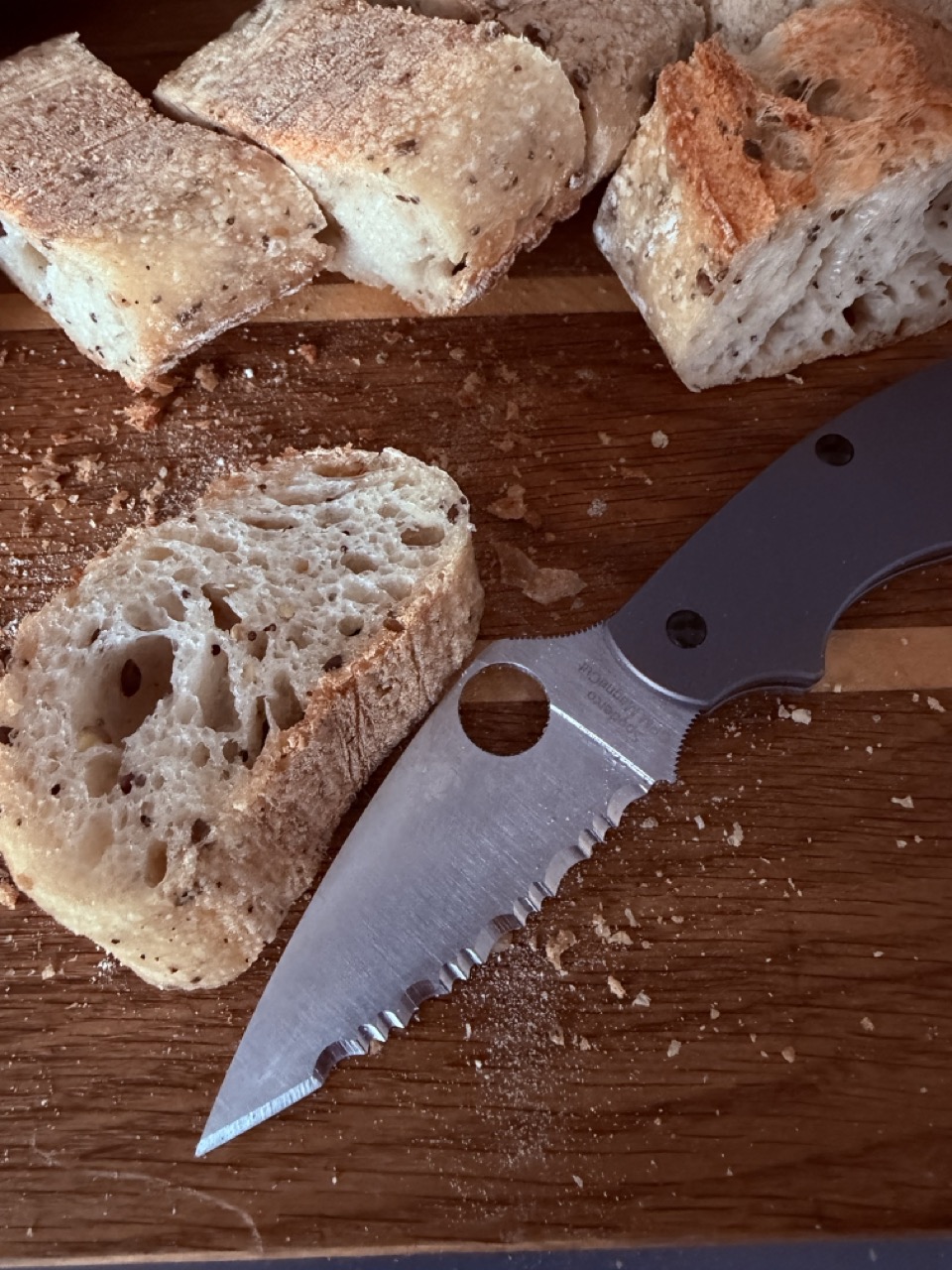
Because real life does not deal in ideal materials or perfect technique. A slice of cooling pizza, a stubborn thread, double-wall cardboard, an electrical cable—each offers a different resistance. Where a plain edge demands precision, serrations adapt. They bite and initiate cuts. From a caresse to firm push cuts, using thin SpyderEdge serrations is an escalation in my cutting intentions. I need that material to be cut fast !! It helps a lot when you cut a label in a store without to be noticed (once you bought it of course…)
In this configuration, Magnacut reveals a deeper character. I had noticed it on the wonderful Chief Salt . Its reputation is well established, but it is in repetition—across mundane, unremarkable tasks—that it truly asserts itself. Edge retention ceases to be a technical metric and becomes something tangible. Days pass, materials accumulate, and yet the initial sensation—a ready, immediate hungry bite—remains intact with a quiet, almost disconcerting consistency. That makes a real difference for an EDC.
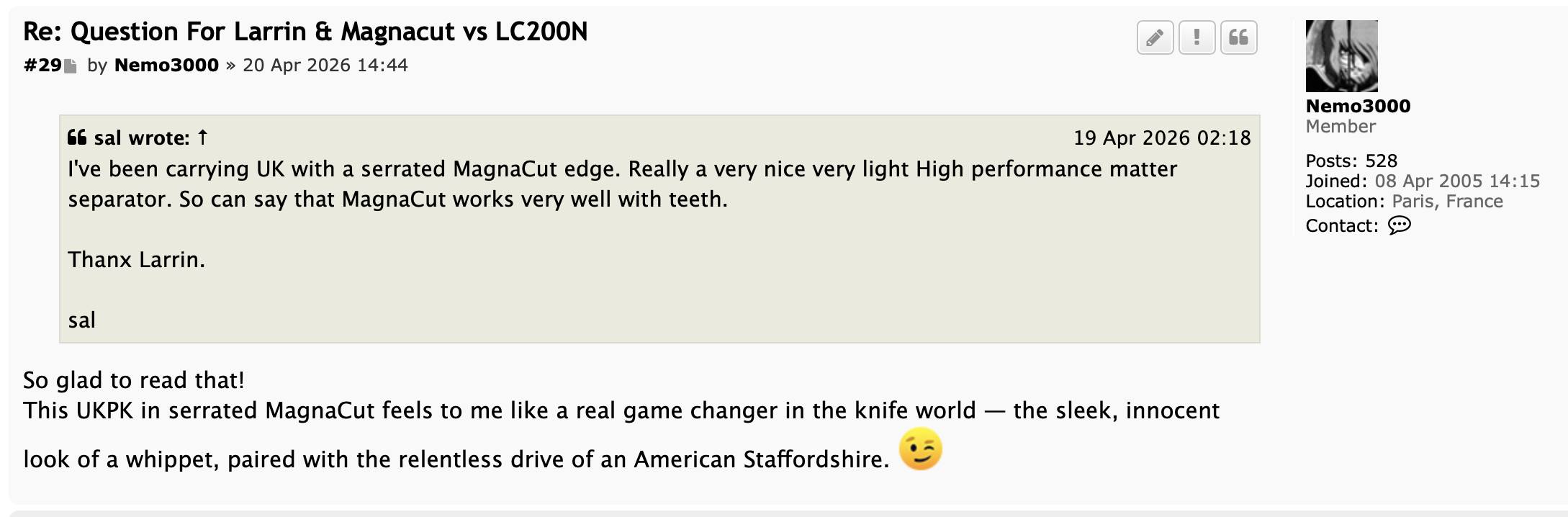
It is telling that even its own designer, Sal Glesser, found himself rediscovering the knife through this serrated Magnacut expression.
Notice my “preaching to the choir” post 😄
This is a genuine sense of surprise at the endurance of the edge, accompanied by a nod to Larrin Thomas, whose metallurgical work made this steel possible. This is more than technical acknowledgment; it is recognition of a rare alignment between design intent and material innovation.
The titanium scales subtly shift the relationship further. The knife gains density, heft and presence. I just love that. It’s no more a lightweight though but the tactile experience becomes cooler, more deliberate. There is something almost architectural about it—a structure defined as much by its material honesty as by its purpose, ready to meet the unpredictability of daily use by sea, air or land.
Over time, what emerges is a quiet redefinition of the serrated edge itself. Long confined to specialized roles—rescue, rope, marine environments—it finds here a broader legitimacy. Not as an alternative to the plain edge, but as a different philosophy of cutting. More instinctive. More pragmatic.
I have felt the same with the Chaparral serrated, offering those performance in a lady/gentleman format. The UKPK offers a longer blade but a legal solution.
The serrated Chaparral brings this same idea into a more restrained, almost tailored format—slim, discreet, almost polite in profile, yet unexpectedly serious once it starts working. It’s the kind of tool that disappears into a pocket and reappears only when needed, delivering performance without ever looking like it intends to.
The UKPK serrated Magnacut, on the other hand, pushes the concept further in a different direction. Same underlying logic, but with more reach, more cutting length, more immediate utility when the task scales up. It’s not trying to be more aggressive—it simply extends the capability envelope while staying within a legal framework that forces discipline into the design.
Put together, they sketch an interesting continuum rather than a category: the thinner Chaparral as refined minimalism with bite, the thin UKPK as everyday legality stretched to its most useful expression.
Different formats, same underlying surprise: serrations stop being “special-purpose” and start behaving like a perfectly normal, highly efficient everyday cutting system !
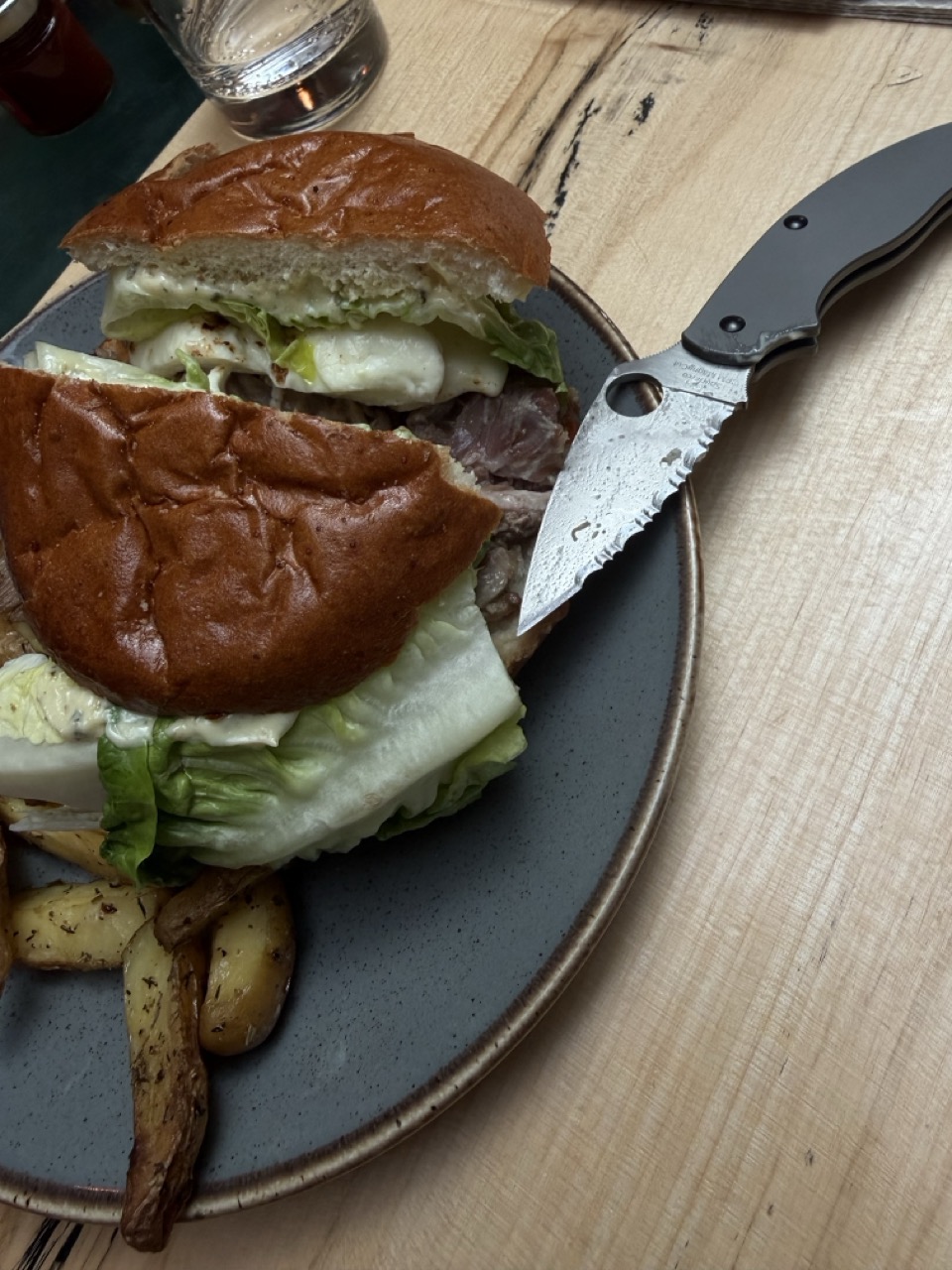
To reach for a serrated blade to cut burger or break down a box should no longer feel unusual. If anything, it is where this knife feels most at home. Its modernity lies not in spectacle, but in normalization—in making high performance feel natural within the ordinary.
The serrated Magnacut UKPK does not argue its case. It does not need to. It simply works—and in doing so, it quietly resets expectations.
Low-profile in the pocket, yet unmistakably assertive at the edge, it pairs a hungry, enduring bite with a reassuringly solid construction. All of it contained within a form that remains legally acceptable in many places—an understated balance of restraint and capability.
Digression: Did you think we were born in peaceful times?
In Western Europe today, amid increasing concerns over violence and insecurity, carrying a fixed blade — something I’ve done for decades with a short fixed blade — or even a locking folder can easily be misinterpreted.
And every single day, in the fall of 2025, the European newspapers report yet another knife attack or crime.
Knife attacks in the United Kingdom have shown a persistent and worrying upward trend in recent years. National data indicate that police recorded just over 53,000 knife‑enabled offences in the latest annual cycle, with assaults and robberies accounting for a substantial portion. While knife-related homicides represent a small percentage of overall offences, the absolute numbers remain high, with young people disproportionately affected. Offences involving the possession of bladed weapons have also risen, highlighting broader issues of accessibility and carrying habits in urban areas. Compared to a decade ago, knife-related violence has increased significantly.
(From a locking folder to slipjoint folder…. Sign of the times ?)
Most knife crimes in the UK use everyday knives like kitchen knives, because they’re cheap and easy to access. But a significant minority of attacks involve more “exotic” or dangerous blades: like machetes !
In Germany, some state-level police offices estimated more than 21,000 knife attacks in 2022, which corresponds to about 60 knife attacks per day nationally.
In France, knife attacks also remain a major concern, with more than ten thousand recorded assaults involving bladed weapons in the most recent year across areas policed by the national force alone. This figure corresponds to roughly a few dozen attacks per day and does not include all regions or the gendarmerie’s jurisdiction. Schools in the Paris region reported over a hundred knife-related incidents within a year, highlighting a sharp increase in youth involvement and the normalization of carrying knives. Broader national indicators show rising attempted homicides and a high proportion of armed robberies committed with knives, underscoring the central role of bladed weapons in everyday violence. French law places certain knives (e.g., automatic opening, butterfly/balisong knives, fixed-blades over a certain size, double-edged blades) into stricter categories (Category D weapons) when carried without legitimate reason. Folding pocket-knives of everyday use (e.g., classic French models) are more tolerated — they may be treated as tools rather than weapons if not used aggressively or carried without justification.
~89 / 100,000 (using ~55,008 knife-enabled offences and a population of ~61.8 M)
France
~15 / 100,000 (based on ~10,397 reported “knife attacks” and a population of ~68.6 M)
Germany
~10.7 / 100,000 (using ~8,951 knife-attack figure from 2023 data)
In the UK, the rules are straightforward: a non-locking knife with a blade under 3 inches. But now it seems that one-hand-operated folders are no longer welcome; For the record, one-hand operation is actually safer: not only for opening, but also for closing the knife. A closed folder is a safe folder, and being able to switch your tool into “safe mode” quickly is a genuine advantage.
In France, things are far murkier — everything hinges on intention and context of use. It’s almost a Minority Report situation.
Ironically, in the country of Opinel and Laguiole, we’re now backpedaling because of sheer stupidity. And I’m not blaming the criminals who use knives to hurt people — that’s obvious. I’m blaming the people who carry a knife for self‑defense. After a search from the Police in front of an high school: “Why do you bring this knife to school ?” “To defend myself !” A knife is not a self‑defense tool — it’s a catalyst for problems. Awareness, on the other hand, is a self‑defense tool, and that’s something you really need to keep sharp. Even something as simple as wearing AirPods can compromise your ability to stay safe, cutting you off from your surroundings.
Unless you’re a gangster settling scores with your own kin, a knife will never be your bodyguard — not even with training. In fact, it can make things worse, especially if you think you’re “trained in knife fighting.” A knife as a weapon is a killer’s tool, meant for ambush and combat, not for duels.
(The only blade that might actually “help” you — for example in an attempted‑rape situation where you are physically overwhelmed, dominated, and restrained — is also the one that will almost certainly land you in even more trouble afterward. And if you ever reached that true last‑ditch moment, your best hope would ironically be a short serrated edge rather than a razor edge; under an adrenaline surge, an aggressor won’t even register a clean cut. The Spyderco Manbug Wharncliffe SpyderEdge comes to mind. But even then, you would need the mindset to become the aggressor just to survive — and you must be prepared to defend your actions in court afterward.)
I remember reading about an elderly man who was being harassed by a gang of young men. In the confrontation, he slashed the hand of one of his aggressors with his Swiss Army Knife — and in the end, he was the one standing before the judges. “To claim self‑defense, sir, there must be proportionality between the attack and the response.”
“It’s also a mindset. I’ve carried a knife since I was 9 and have never had the inclination to cut or stab someone. It’s all about how you have been raised.” Des Horn
So let’s remain ladies and gentlemen, and let’s be low profile in our EDC choices. The knives we carry and appreciate are not pocket bodyguards — they’re tools we genuinely enjoy using for simple, everyday tasks.
Carrying a knife in today’s civilian world means opening parcels, prepping food, cooking, doing small repairs — being a handyman or -woman, or at least trying to be. I’ve written before about the modern slipjoints we now have access to: knives that benefit from three decades of “tactical” evolution. They offer deep-carry clips, true one-hand opening and closing, and high-performance steels refined for modern cutlery.
So why would you choose a Mike Read folder? Is it better than a UKPK or an Urban? Nope. The SlipIt flagship UKPK, for example, also has a thin edge, and you can even dress it up with titanium scales if you feel like it. Its mechanism is also stiffer, with a two-stage closing “safety” that makes the blade feel more controlled on the way down.
So why choose the PITS2? It ultimately comes down to taste — your willingness to spend a bit more, your appreciation for the mechanism, the maker behind it, and of course a love for titanium and M398.
So what does the Alien/PITS2 truly bring in the long run?
In my case, I was genuinely surprised by how this “hard-to-open-one-handed” knife has grown on me. That stiffness actually makes it reassuring to carry — you know the blade won’t pop open by accident. Especially when you carry it in the back right pocket.
First: it slides in and out of the pocket effortlessly. That deep-carry clip is a real asset. It reminds me of the C181GTIP Lil’ Lionspy — also made in Maniago — but this one is even better than a wire clip: smooth, secure, and gentle on pockets.
Even though it’s light, the PITS2 feels dense and substantial in the hand. If you love titanium, you immediately recognise that warm, almost organic sensation it gives in the palm. Chris Reeve was the first to offer that pure‑titanium tactile experience, and the PITS2 carries that same aura.
Then your thumb finds the hole. It’s stiffer than most Spydercos I know, but that final click when fully opened is immensely satisfying. Forget about using your ring finger — it’s your thumb or nothing.
The hole is sharp enough to allow a “Spyder‑Drop,” though it occurs in two deliberate steps rather than one smooth motion.
Another major advantage: the PITS2 cannot pinch your fingers during opening or closing — a problem that the PITS1 sometimes had.
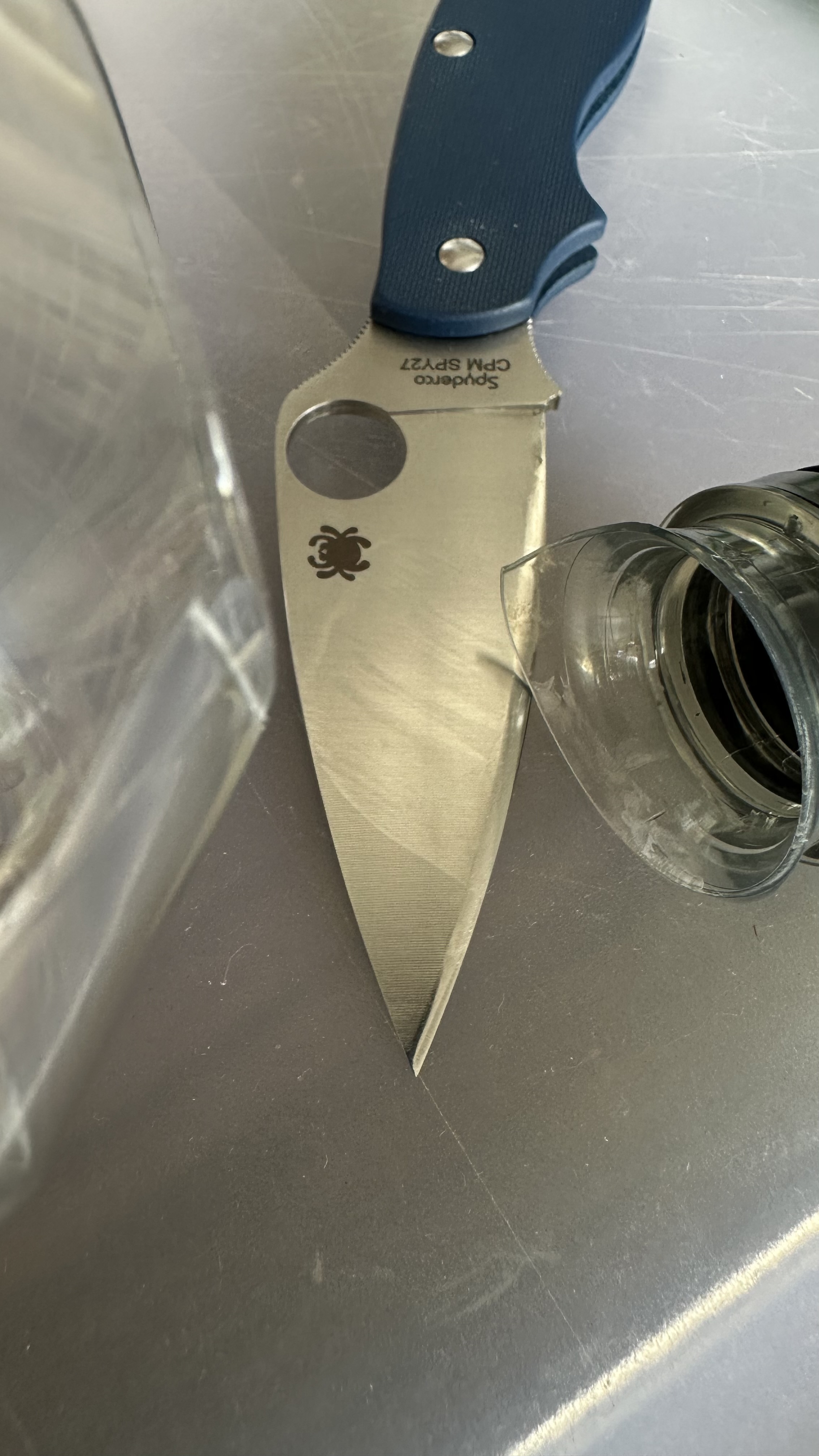
And, as I mentioned in the quick first‑look, that relatively tall blade comes with very thin geometry. This is the first Spyderco edge in a very long time—aside from my Chaparrals—that didn’t need to be convexed. I usually “de‑shoulder” everything to my taste and to my standard test: the plastic bottle butt.
This is where the PITS2 truly shines: pure cutting performance. So far, it has never disappointed me. At first, I thought its more “gentle” blade tip wouldn’t be pointy enough for my tastes—especially since I’m used to the UKPK, Yojimbo 2 or the Microjimbo—but the PITS2’s tip is razor‑keen. It finds its way into soft or dense materials with nothing more than a light, controlled pass.
Actually, butter knives do not need to be sharp. 😉 The PITS2’s thin edge can slip effortlessly through delicate materials—like slicing a layered birthday cake without crushing it. And it can zip through cherry tomatoes, which is always a great test of geometry and edge aggressiveness. Tomato skin resists, tomato flesh is fragile; a good blade needs to pierce the first without mangling the second.
Well, well, well… go figure: tomatoes can be tricky — and a perfect opportunity to put your favorite edge to the test. But honestly, what more could you ask for from a good EDC, superb slicing ability. A sharp knife is a safe knife.
M398 in that matter continues to surprise me. It reacts to leather like… K390 ! Amazing steel ! I’ve already used M398 on the Roadie XL and the Metropolitan, and it proved far more forgiving than I expected. I initially thought it would be brittle — especially after snapping about half a millimeter off the tip of my Roadie XL — but in everyday use it has shown itself to be an excellent alloy that also responds beautifully to stropping.
After some real use, I still haven’t managed to chip or even noticeably dull the PITS2’s thin edge. What’s remarkable is that it’s still as razor-sharp as it was right out of the box.
I also love how easy it is to check, clean, and oil the PITS2. I can appreciate how skeletonized hidden liners have added lightness and strength to folding knives, but they also tend to become little nests for rust. For that reason, I really appreciate it when liners are DLC‑coated — and even better when they’re made of titanium.
Regarding the PITS2’s titanium handle, the absence of hotspots and the beautifully beveled edges make it a real pleasure to hold.
The cutout for the mechanism isn’t beveled, so you can feel its slightly sharper edge. I’ve also noticed that the two handle slabs are symmetrical, while the cutouts around the pivot are not identical.
Low profile usually comes with a deep‑carry clip or no clip at all… but the PITS2 clip is really shiny, so it still catches the eye. I know, because I’ve checked my reflection in a mirror and eventually had to unclip it and drop it deep into my pocket before passing through security recently. Low profile wise: a tip if you are ever checked, do not open your knife with one hand, use both.
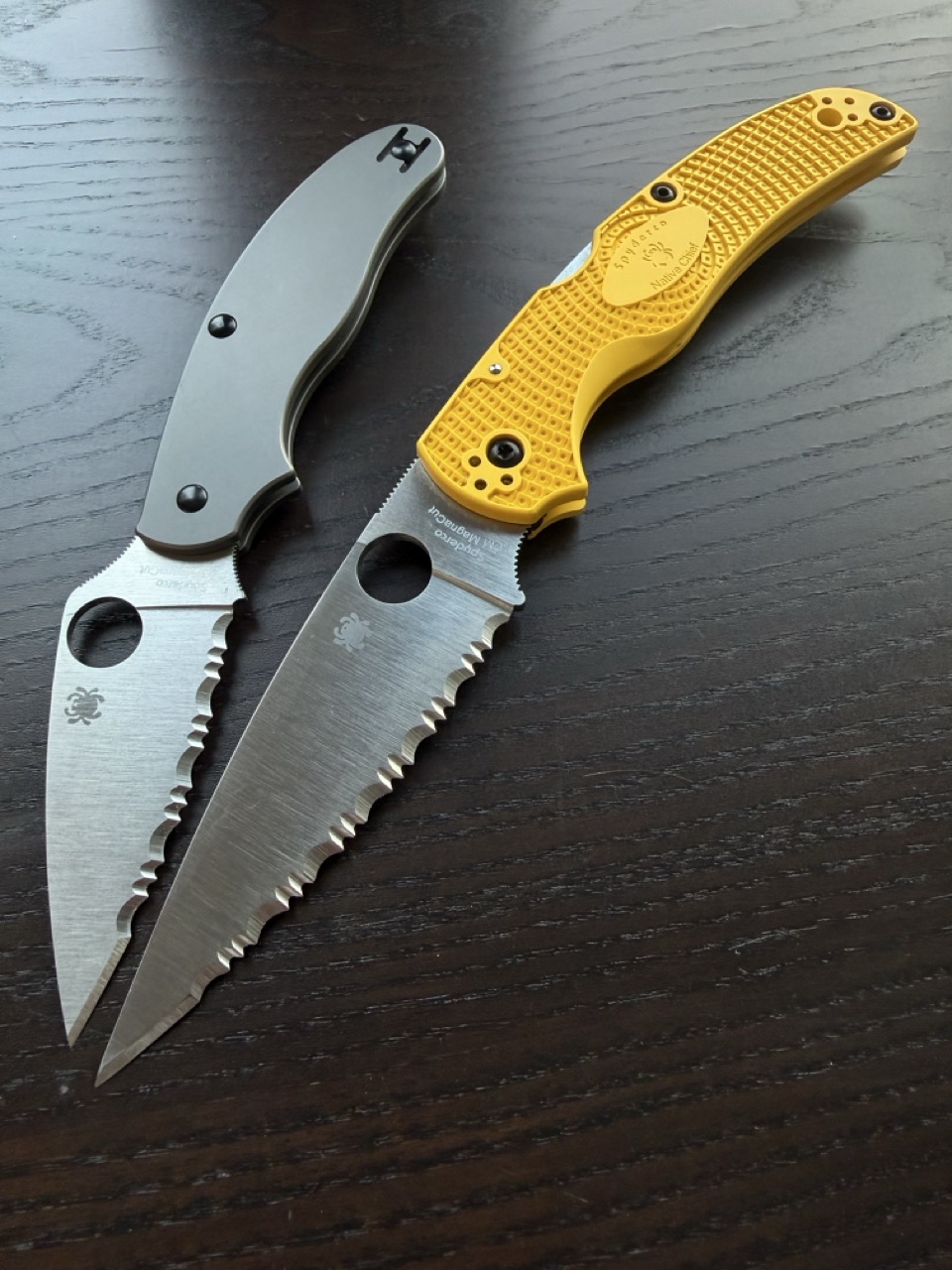
In those days of increasing knife crime and genuily believe that your EDC’s shape needs to be sheeple‑friendly. If I pull out my fully serrated Native Chief Salt, anyone around will instantly assume that this long, pointy, toothy, shiny blade is straight out of Jack the Ripper’s toolkit.
The PITS2, with its rounded profile and non‑threatening blade shape, is a perfect example of a legal and friendly high tech EDC that won’t raise any eyebrows if used in public. It’s actually even less threatening than a UKPK.
ll in all, the PITS2 delivers on its promises. Incredible thin edge. Enjoyable mechanism. Low profile. Easy to clean.
It’s a friendly, high‑tech luxury tool that can be brought to the table to slice a sausage, yet also serves as a reliable outdoor companion capable of carving a walking stick. I’m loving the Alien in these times of shifting paradigms.
So let the weary land be rested and the killing season over Let the shadows stretch forever in the light of burnished silver For I fear the age of consequence and I wish that it was over Bring me the snowfall, bring me the cold wind, bring me the wiener…
(My Nano has been heavily resharpened into a convex edge, while my PITS2 comes with its thin, perfectly even factory edge.)
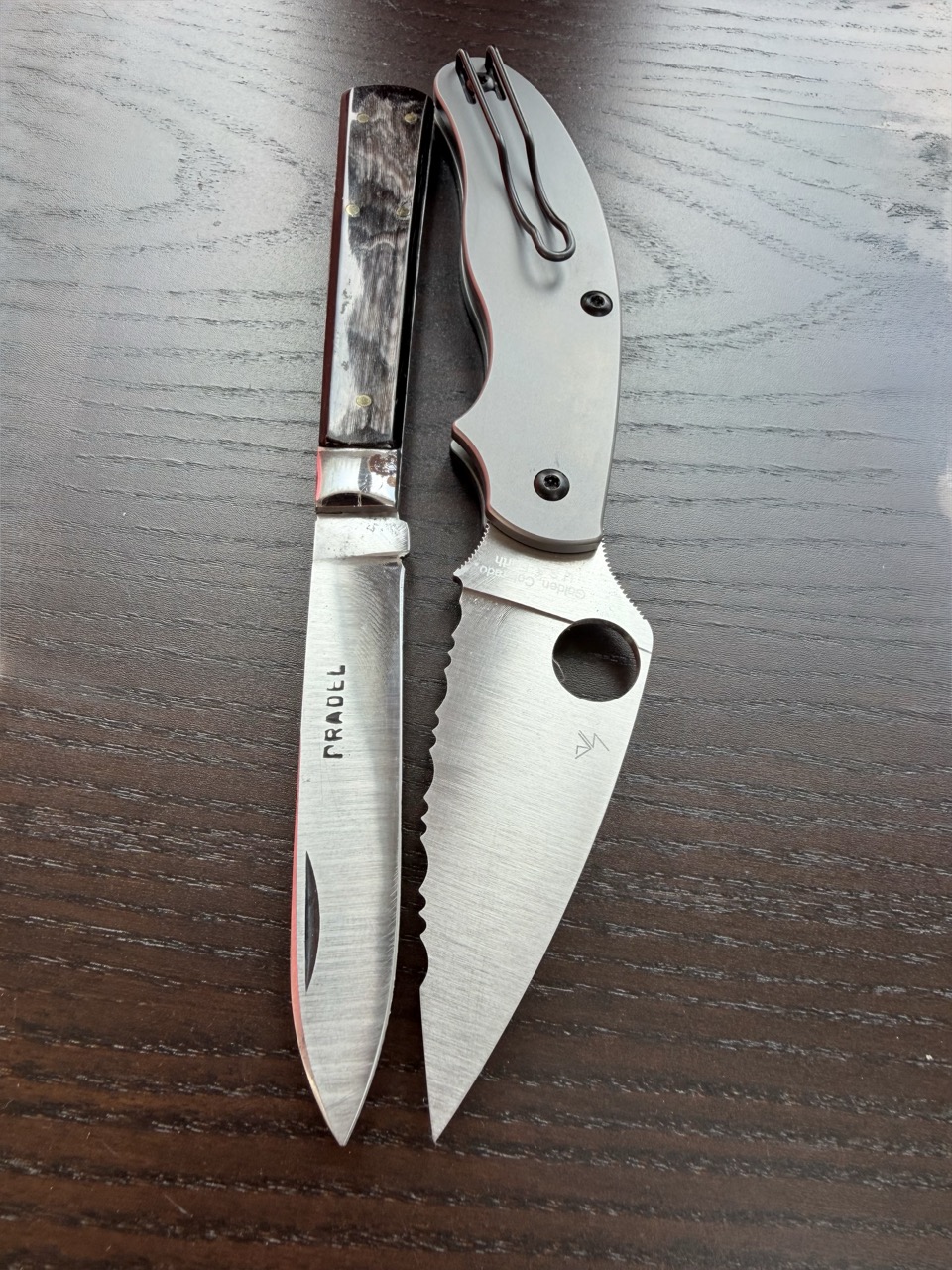
I have had the chance to buy that UKPK in G10 for 100 euros in January 2025. Since, it has been my “go to the city” favorite folder.
Sometimes replaced by the Roadie XL for a lower profile or Dredd my Urban in S90V made in Maniago and exclusive to Heinie in the UK.
The UKPK is remarkably versatile, proving itself even in woodworking. Its strong, reliable mechanism keeps it ready for anything — all while remaining fully within legal limits. Stripping vines, carving rods, scraping, cutting — it handles everything with ease. The spring “lock” never falters, and the finger choil adds an extra layer of passive safety, even if it’s rarely needed.
Its thin yet strong CPM SPY27 blade is a true joy to use on wood. In this domain, the UKPK stands out as one of Spyderco’s best hidden gems across all categories made in Golden. And if I ever had to defend myself against an animal, I believe it would perform every bit as well as the legendary Calypso (all the story here).
The tip has seen plenty of use, and all I can say is that Spyderco’s in-house SPY27 steel is extremely forgiving. You can push it hard with no damage to the edge. I’ve compared it with many of my favorite wood-cutting knives — including some specialized for woodworking — and it performs impressively in the same league.
One way I now measure the value of a pocket knife is by the pleasure I get from using it. The UKPK easily ranks among the top on my list. Strong, thin, and precise, it excels as a true “matter separator,” handling everything from everyday tasks to more demanding jobs like scraping paint.
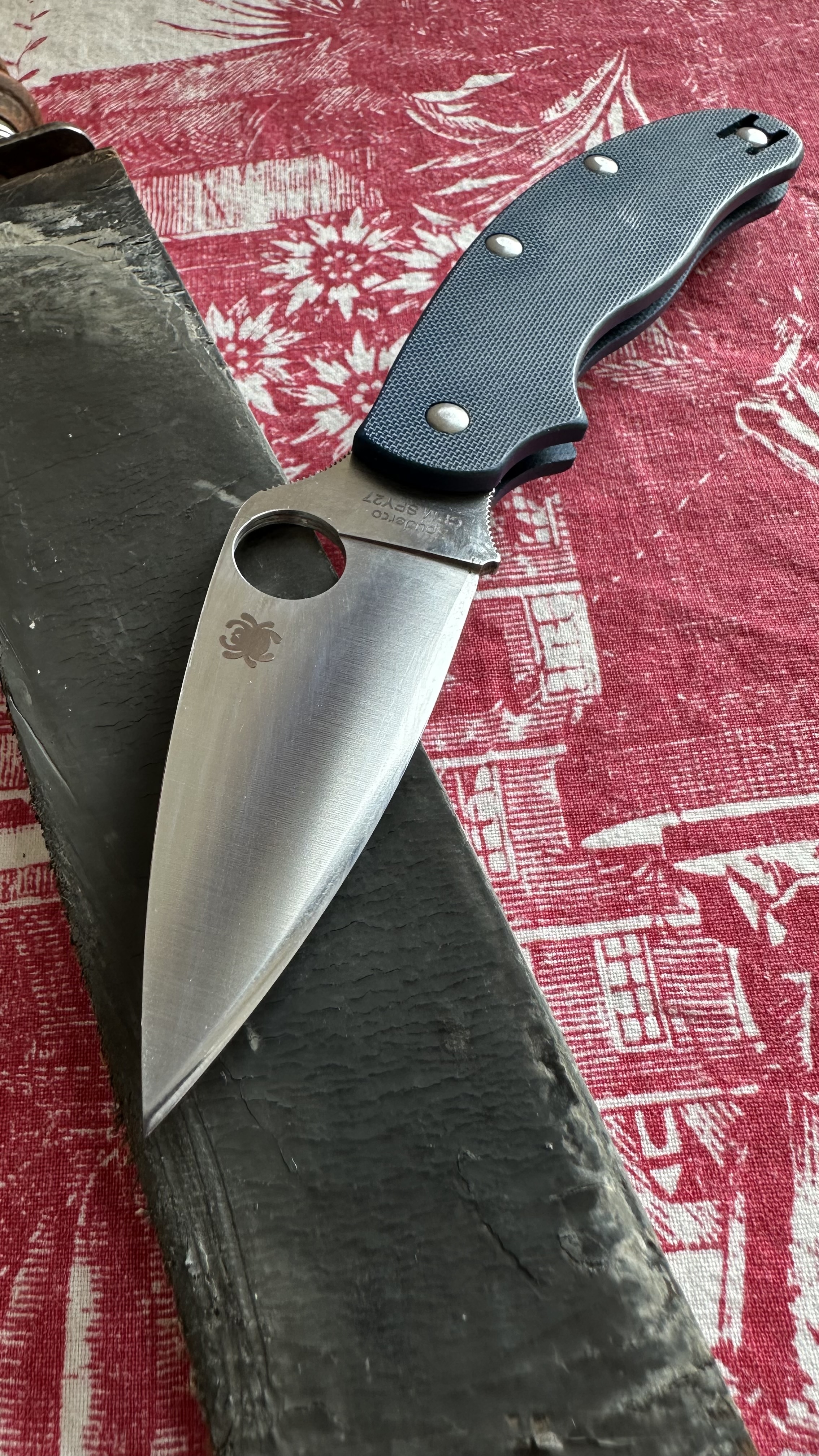
There’s also a distinct joy in keeping the edge razor-sharp, and SPY27 has become my new favorite for that. Achieving a razor edge is a breeze. Being in the AEL-B class, it’s even easier to work on than Magnacut and is extremely leather-stropping friendly. After just a quick session on leather, SPY27 regained that legendary crisp edge — and it’s such a pleasure to use!
Hairs are flying and the convexed home made edge is shining like a mirror. This is really part of the joy to use leather strops on a steel.
So it is a joy just to strop it again and again just to maintain this razor edge.
Then for forced push cuts, the geometry of the UKPK is just a killer. It goes deep like a thin Opinel blade can go.
To keep the knife sharp, I’ve mostly relied on leather stropping, with occasional touch-ups on white ceramic, even after cutting cardboard, plastic, acidic food, and hard wood. The UKPK in SPY27 is a winner, offering a significant boost in edge retention and versatility. Maintaining its vorpal edge is even easier and more enjoyable than with the excellent Magnacut or LC200N versions.
It’s no wonder this steel has earned such a special place in my heart.
And I was not able to get any chipping or edge bending in six months. It gives an hint about the high quality of the inhouse heat treatment on that inhouse steel.
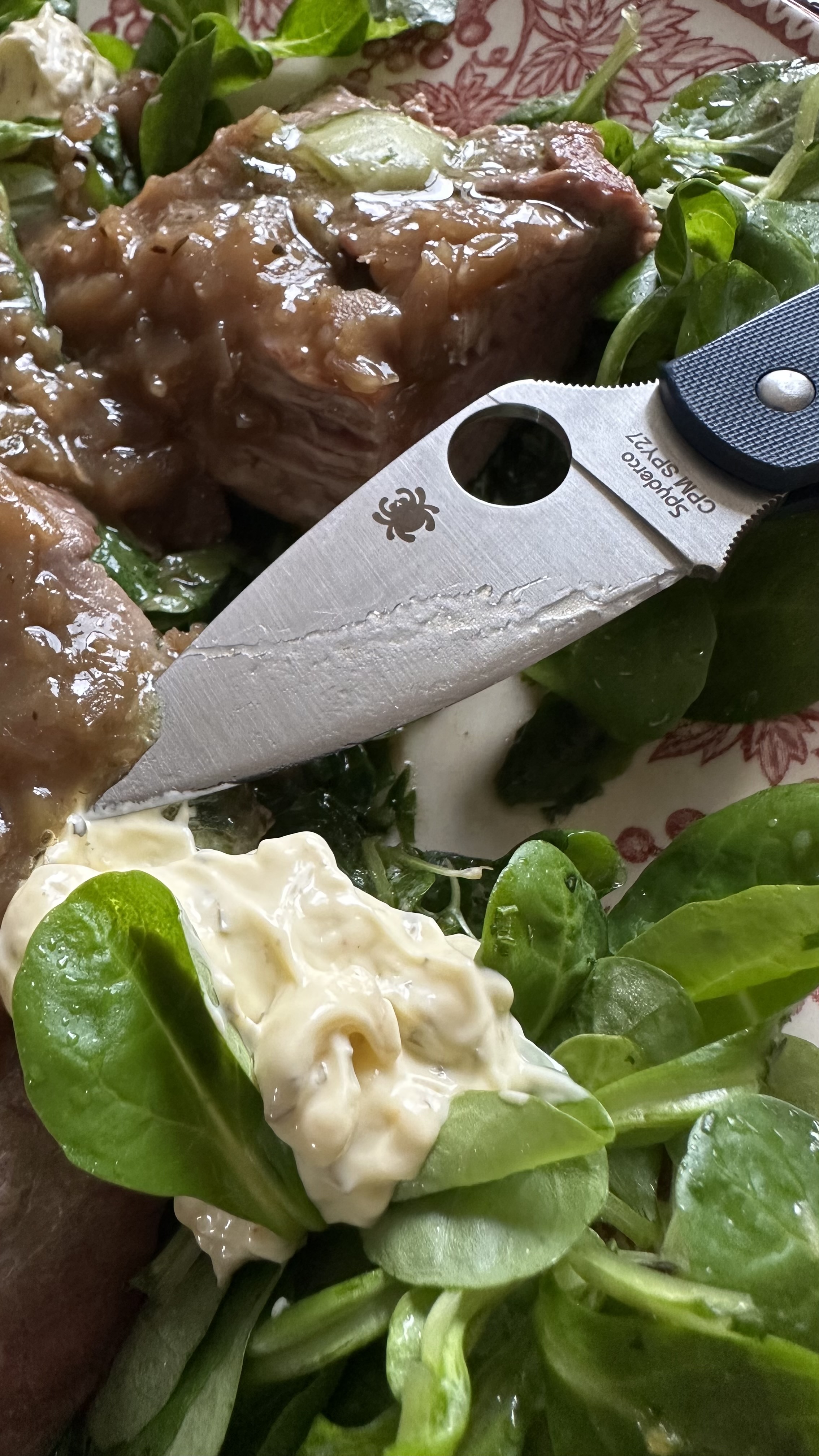
Used in the plate, the SPY27’s core refused to be damaged: no pitting, no rust, no stain. No damage on the plate ceramic too. It a gourmet companion and a wonderful carnivorous friend.
In the kitchen, geometry-wise, the UKPK can compete with the best — for example, the Patrick Bonetta Kitchen Warrior. The G10 version is also a visual delight. I never felt “under-knifed” with my Urban, but the UKPK could easily be my one and only Spyderco. A three-inch, legal, high-performance sharp blade is a must-have for EDC, and such knives are surprisingly rare.
This is 100% Sal Glesser design. This Golden-made gem is the all-terrain pocket knife my grandfather would have dreamed of! Hence its name The Golden Child. 😉
For an alternative you can now get The Metropolitan. Its little brother.
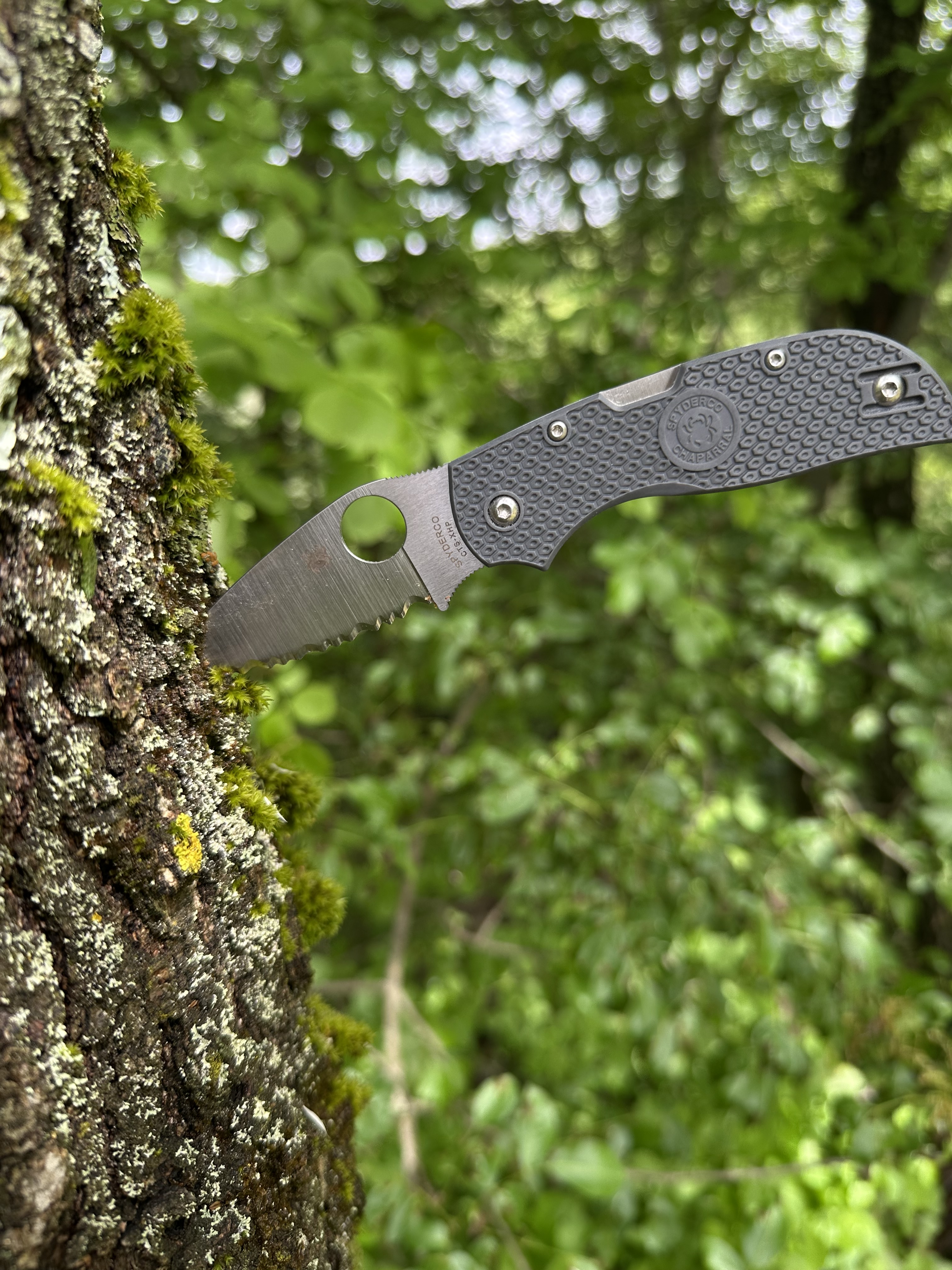
For a two-week road trip in Italy, the serrated Chaparral was my only knife. Sal Glesser’s Chaparral has been studied many times on this blog, but lately, the serrated version has become a central part of my rotation.
Why is this knife such a great traveling companion?
Friendly FRN handle: The grey FRN offers excellent grip, even with wet hands, making it comfortable and reliable in a variety of conditions.
Blade length: At less than 3 inches (71 mm), it’s easily accepted as a pocket knife. The serrations effectively add about 25 % more cutting edge, boosting performance without increasing size.
Flat and thin: Its slim profile allows it to comfortably fit in a watch pocket.
Sturdy mechanism: The hidden pin ensures zero vertical play, providing a rock-solid feel.
So this little big knife was my main cutting gear for two weeks.
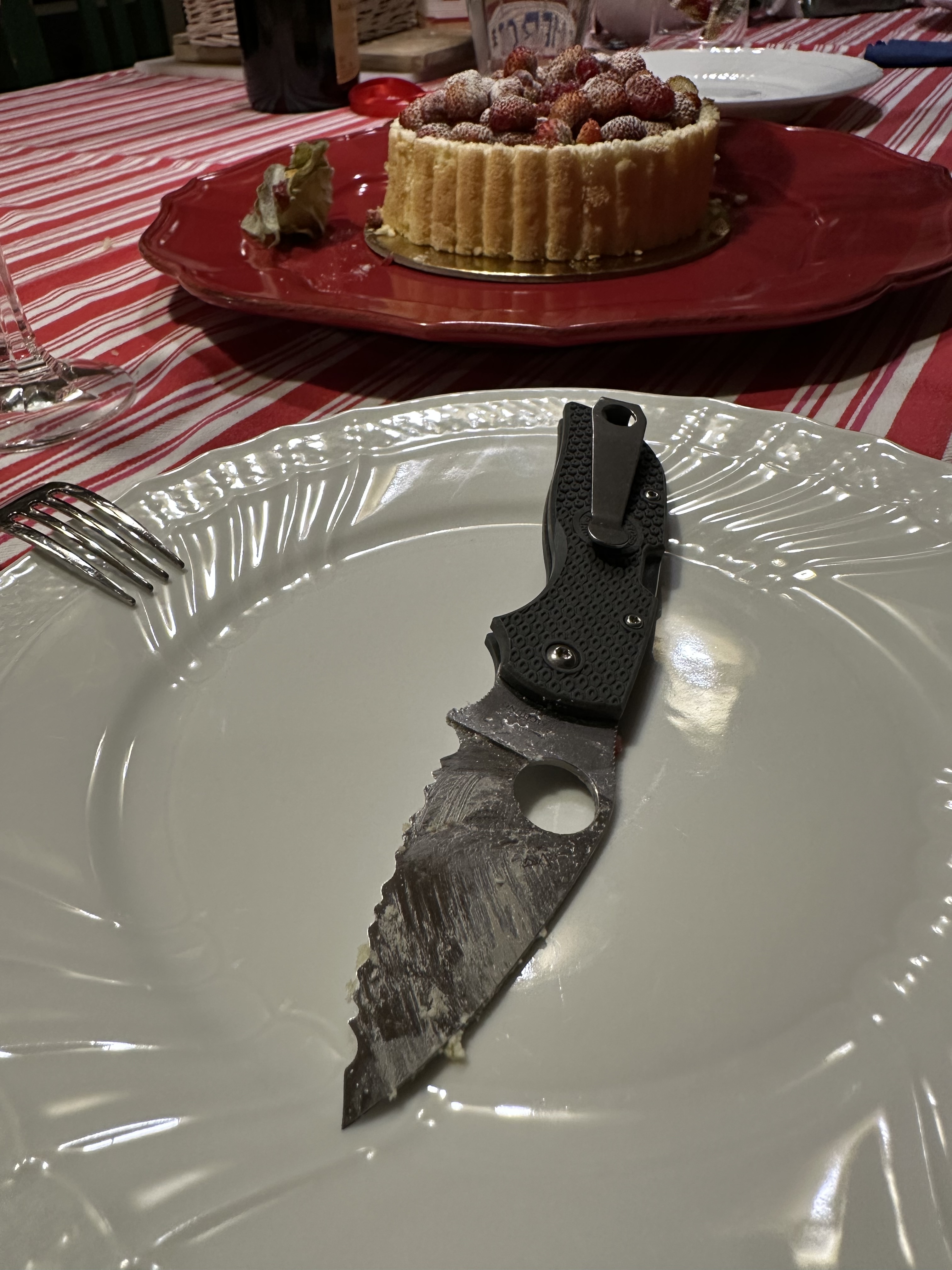
I was able to open it in restaurant without to be noticed and replace the dull silverware provided. The serrated Chap is a folding steak knife by essence.
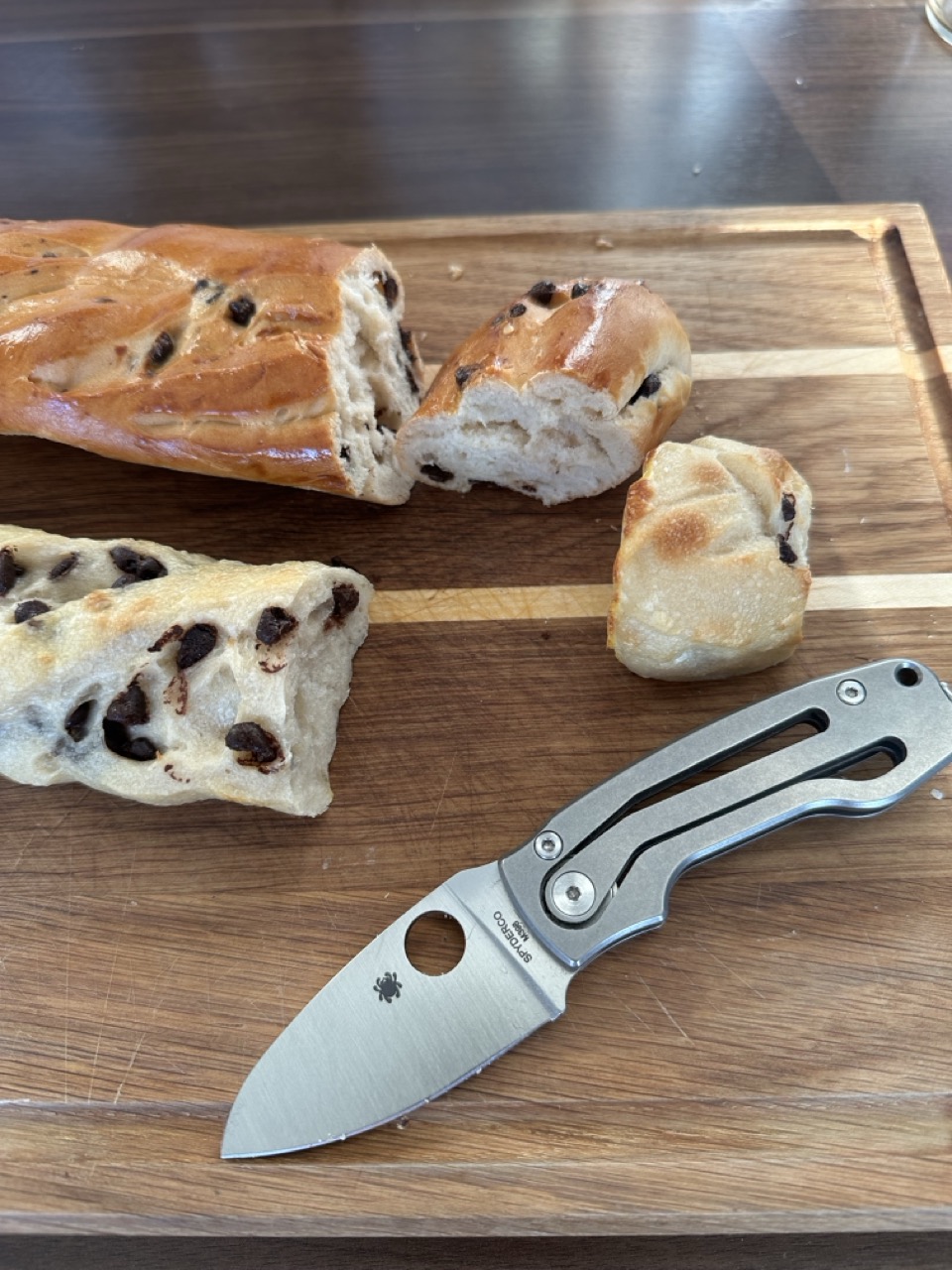
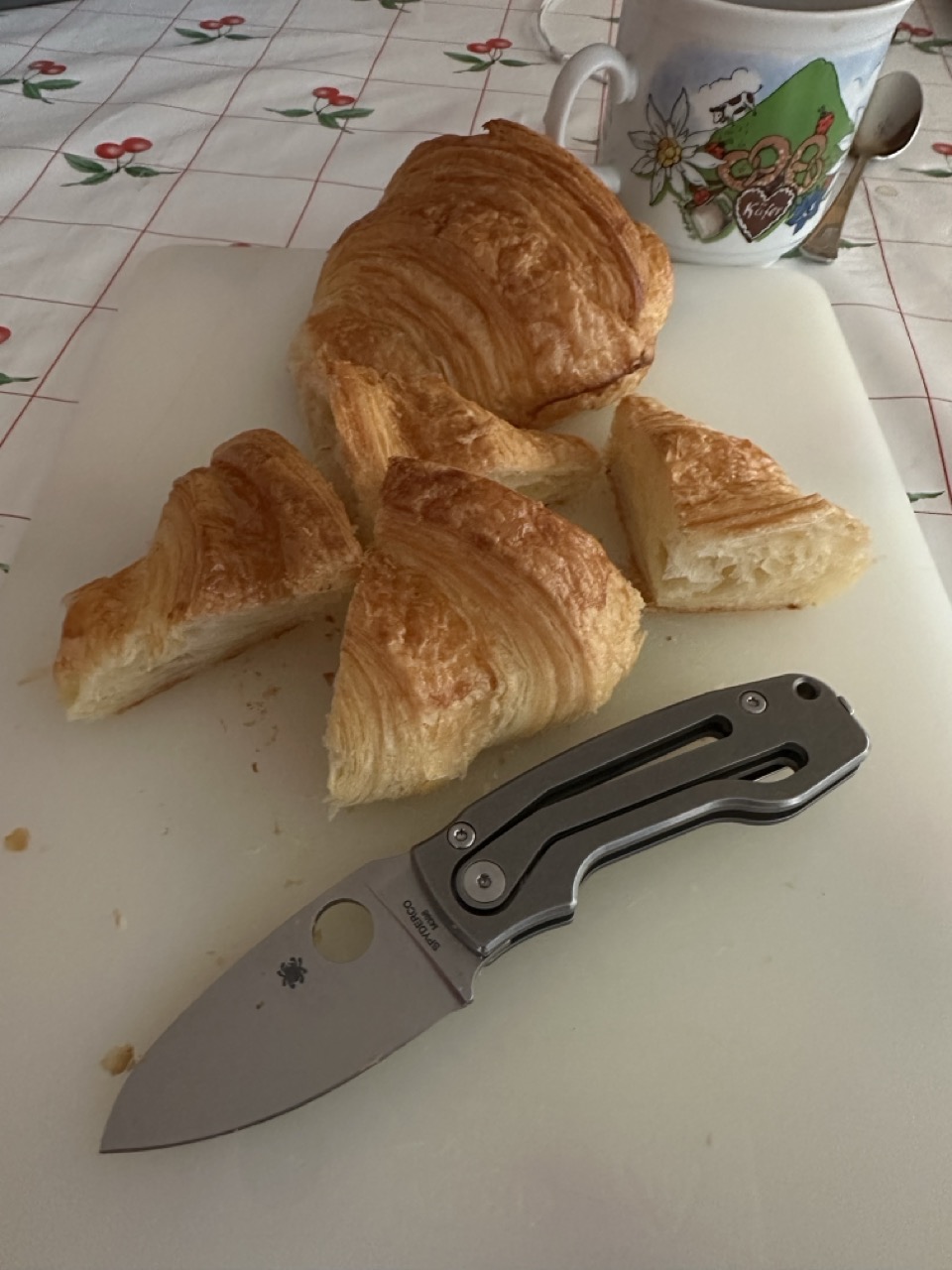
Its thin blade is making the cuts accurate even on delicate cream croissant shared with a coffee.
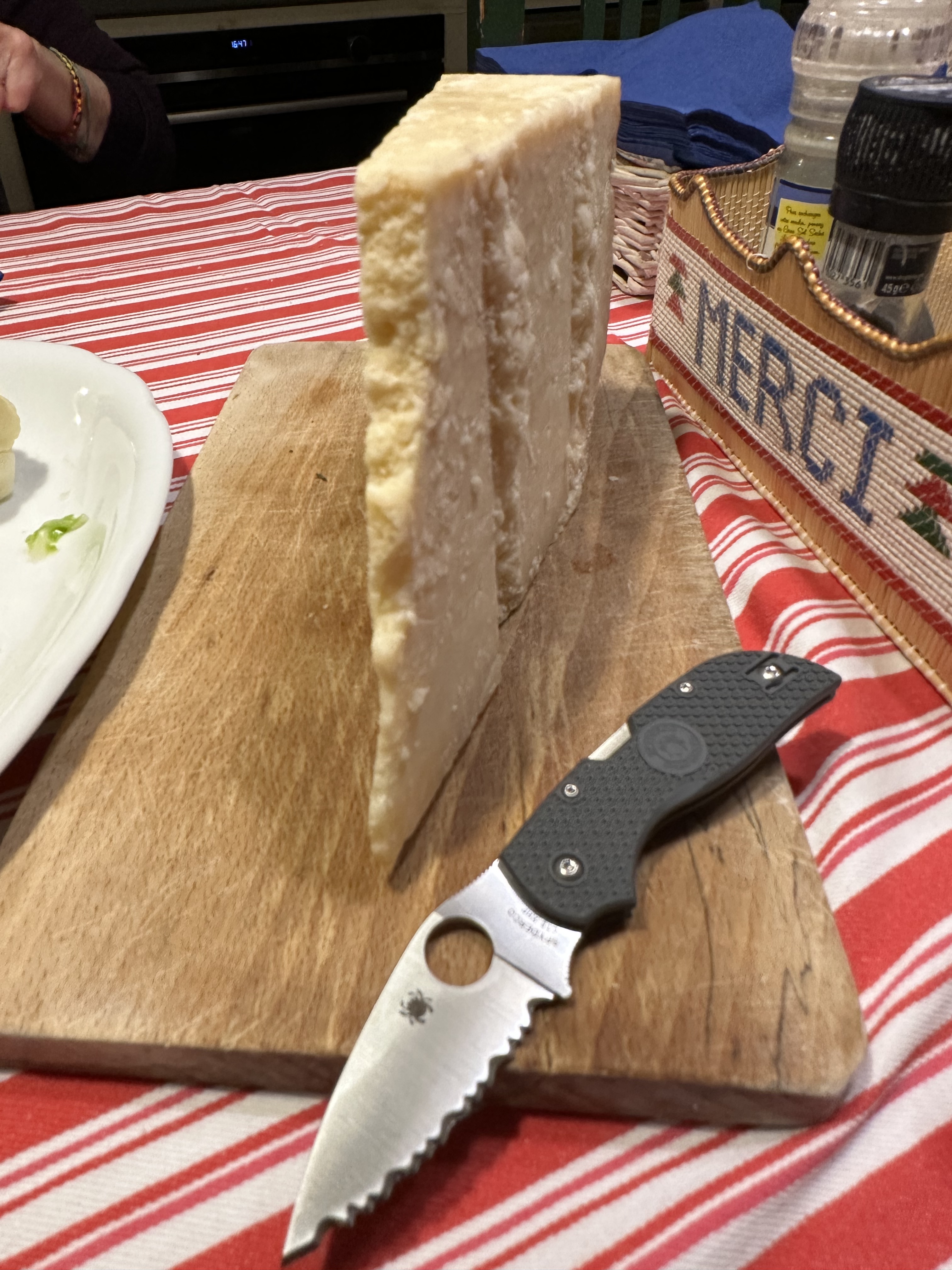
One of the challenge for such a thin blade is the famous hard cheese found in Emilia-Romagna: the Parmigiano Reggiano.
Normally, Parmigiano is not “cut” — a traditional leaf-shaped short knife is stuck into it and breaks off large chunks like a wedge. That approach wasn’t a problem for the thin CTS-XHP blade of the Chaparral. It dug in deeply and, with a slight torsion, fragmented the cheese effortlessly.
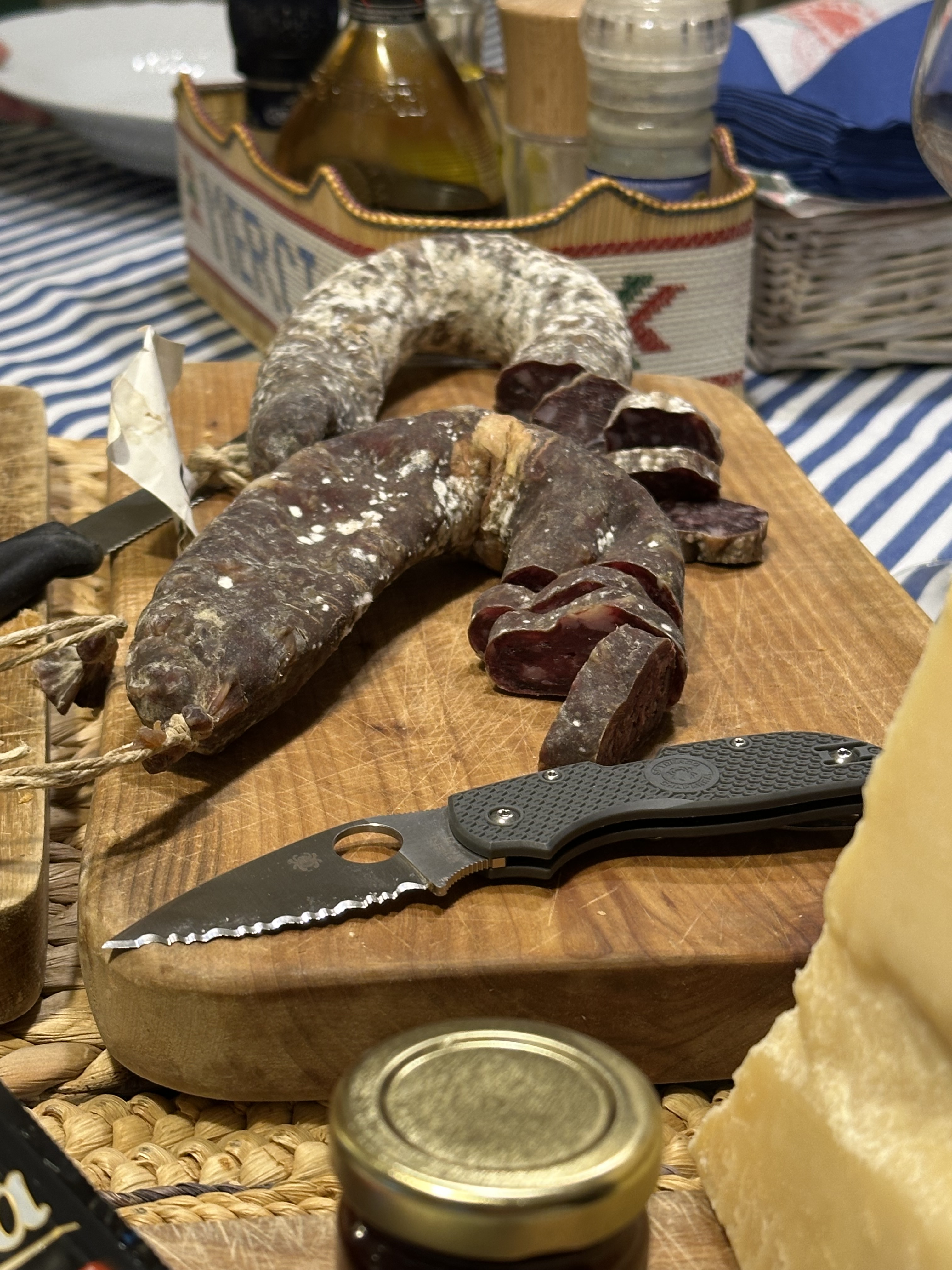
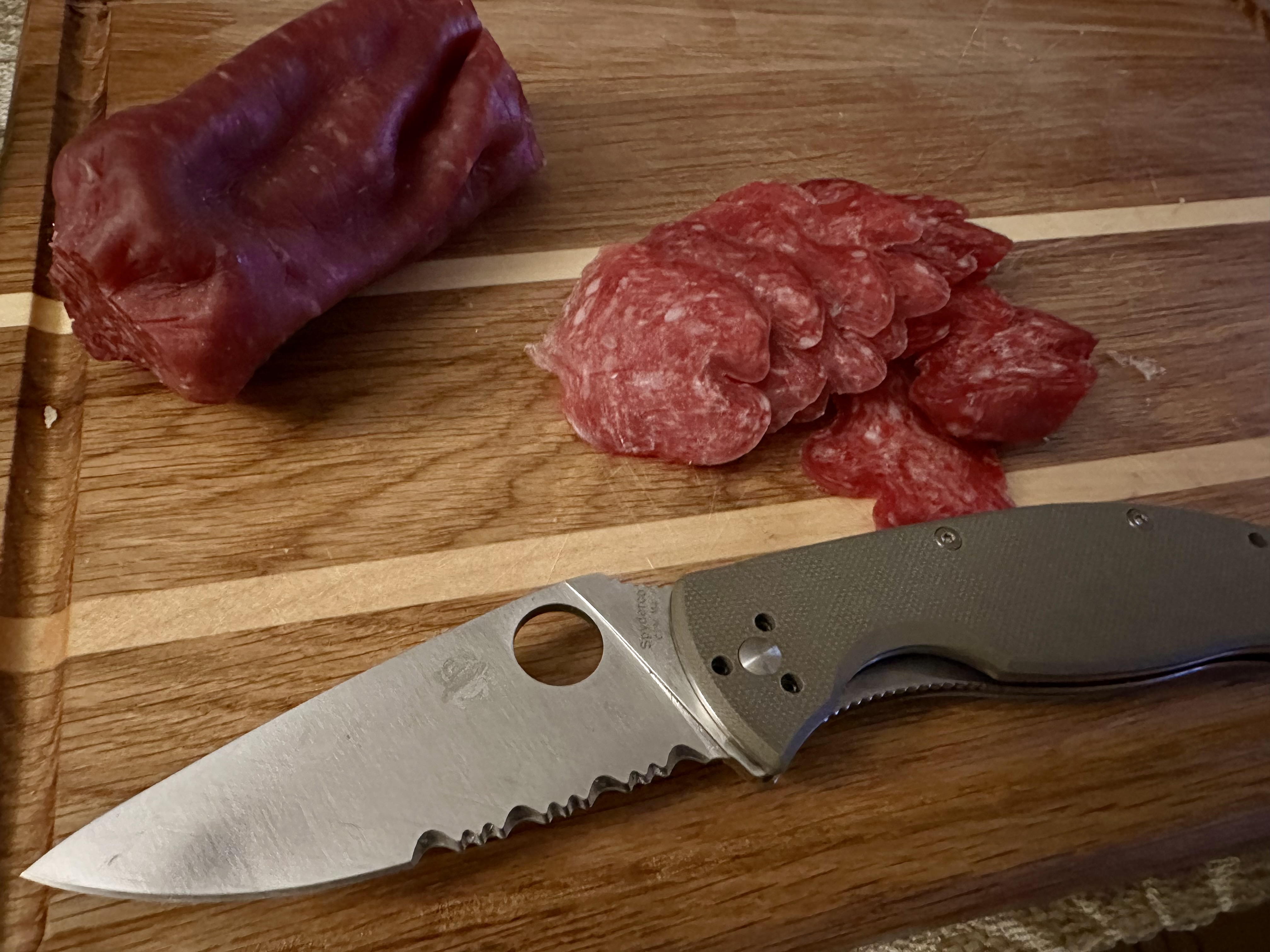
Hard sausages in Tuscany can be made from deer or doe or even boar. Again, bring a thing serrated edge to the board and it will be a success.
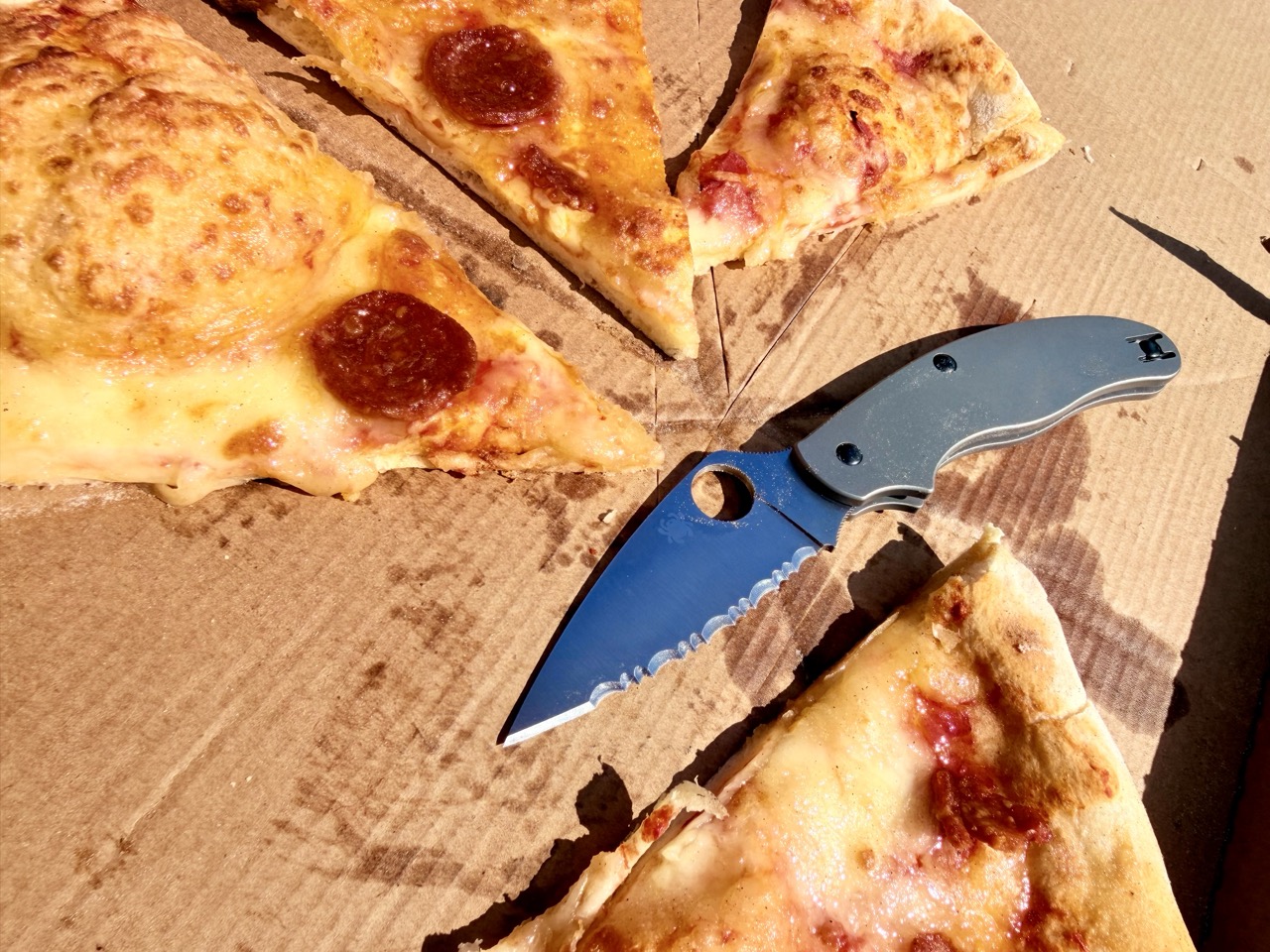
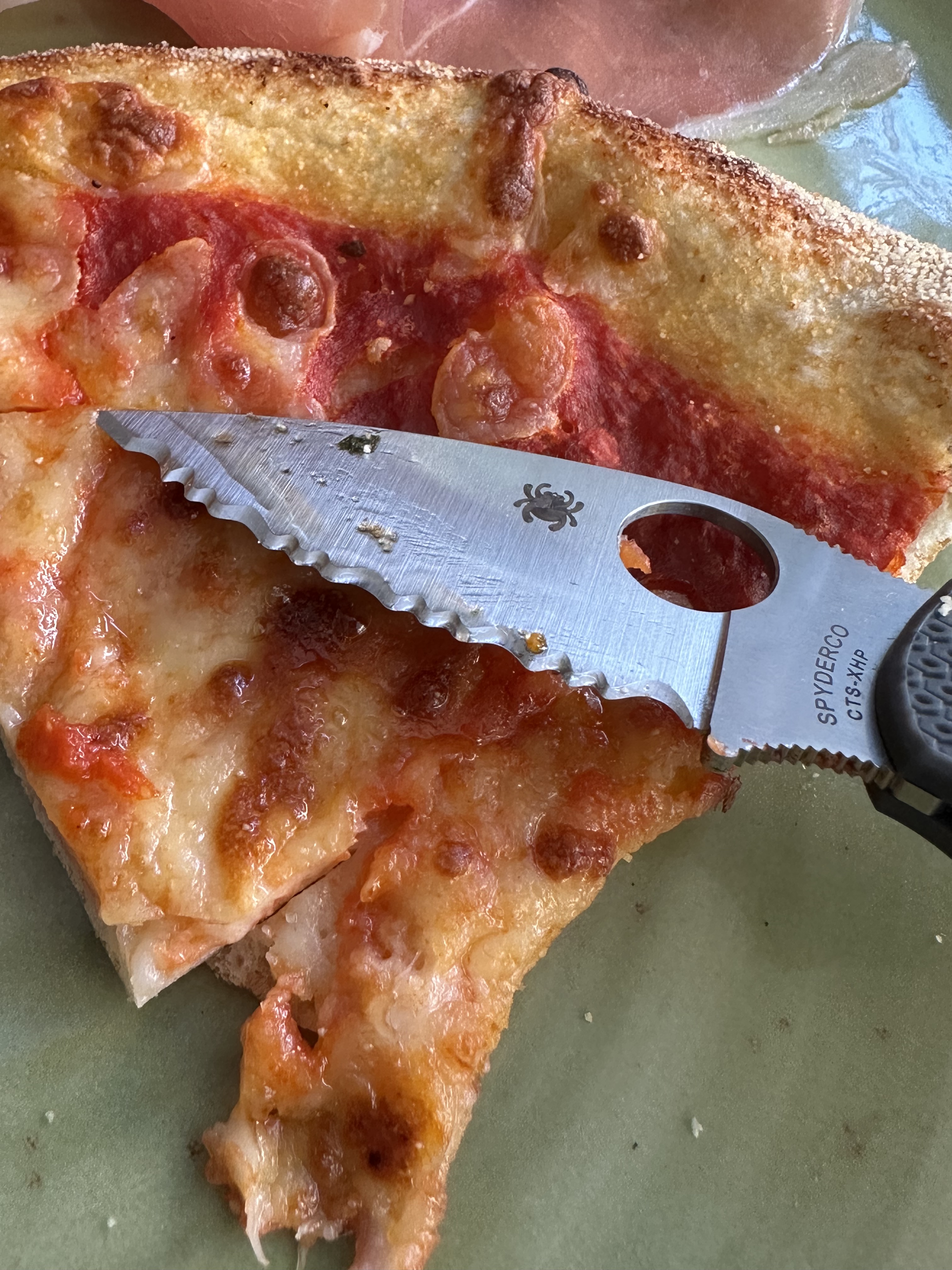
Pizza can be a challenge. You want to cut through all the layers without dulling the edge on the plate. Serrated edges do not dull easily in the plate. And even some knives encountered provide serrations at the end of the edge like this one:
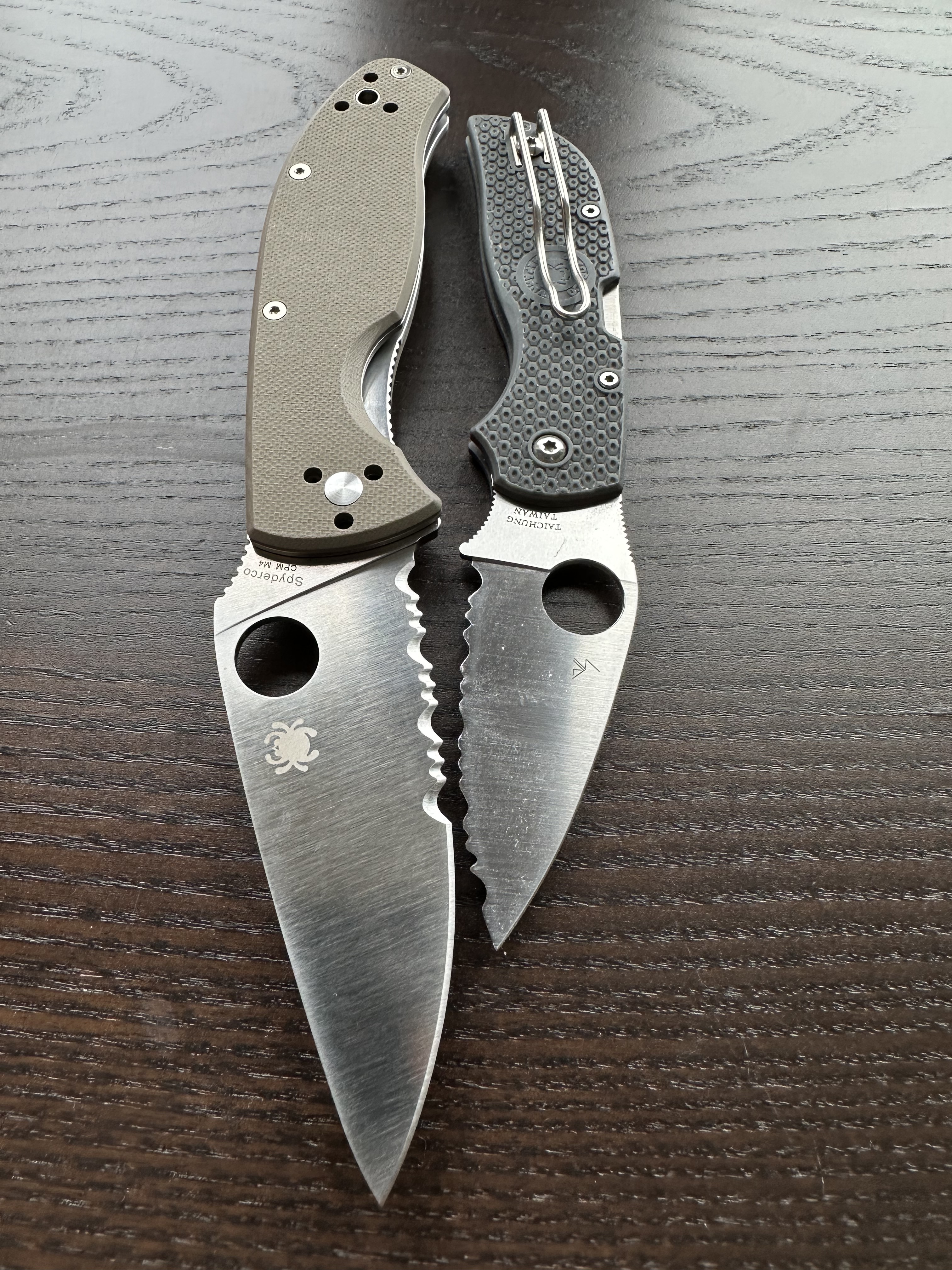
Here the Chap near a friend’s Captain which has been used to deal with mozzarella.
It feels good to be not the only Spyderco in the village.
After two weeks with the Chaparral, I never felt “under-knifed.” It performed reliably in all conditions — rain, seashore, and forest — and remained socially unobtrusive. Its cutting power, thanks to the thin, hard CTS-XHP blade, proved that a pocket-sized chainsaw can be an essential part of any traveling kit.
After two weeks of use, the Chaparral showed no rust issues, no bent serrations, and no gritty mechanism. I simply rinsed it under the tap and let it dry in my pocket.
Even now, I don’t feel any need to resharpen the blade — the serrations are extremely difficult to dull. For a travel folder, I can confidently say: the Chaparral comes highly recommended!
If you want to see some spectacular moments from my two-week Italian road trip, I’ve released four video postcards on YouTube, all filmed and edited on the same iPhone 14 Pro that provided the photos for this article. If you enjoy them, feel free to give a thumbs up and subscribe to my Youtube channel.
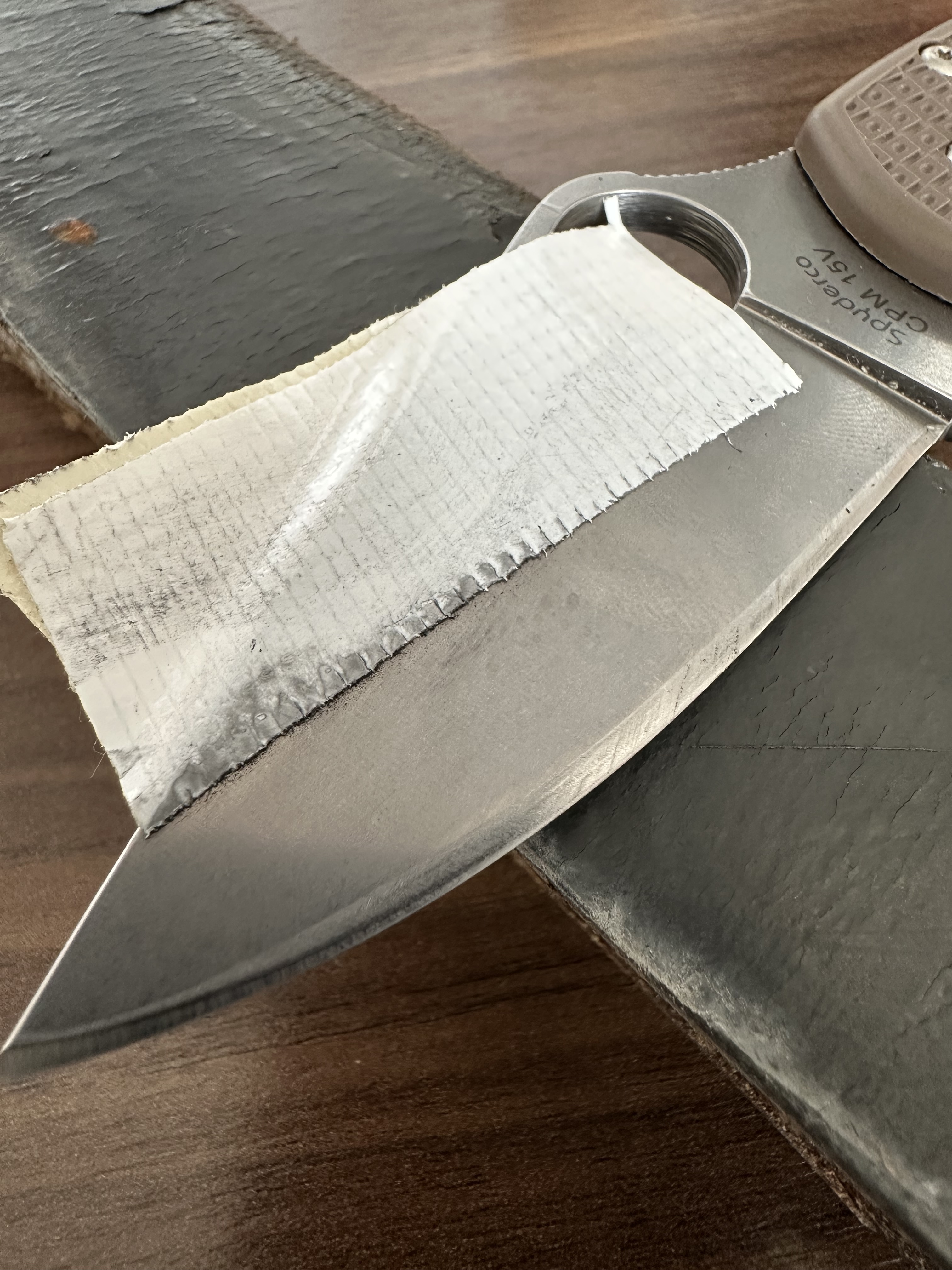
My goal here isn’t to touch the edge itself, but to smooth the border between the flat of the blade and the edge angle. This allows me to maintain the edge primarily on leather while reducing drag when cutting hard materials like plastic or wood.
The equipment I used was again the Spyderco Double Stuff 2, focusing mainly on the diamond side. I experimented with gentle, round strokes on the flat diamond stone instead of always moving in the same direction — it seems to remove metal much faster.
For aesthetics, I plan to follow up with white ceramic or jade stones to approach a mirror finish, similar to the Sage 5. Magnacut responds beautifully to polishing, whereas CPM-15V doesn’t particularly care.
The use of gaffer helps preventing any deep scratches on the blade finish. It works great. The black dust is metal removed by the diamonds. I do that outside in the wind. I don’t want to breath that dust.
Eventually this second round has gone so smoothly (compared to the first one linked at the start of this review) that i was on the verge to work on the Military 2.
Remember Sal saying: “The Edge is a Ghost. Always changing. Dying (dulling) being reborn (sharpened) split personality (angles and geometry changing). Think of the edge as gas in a vehicle. It runs out of gas and you put in more gas. We provide the format, materials, design for use, variety to avoid boredom and create interest, but the edge is your creation. The result of your understanding, education, experience and practice.“
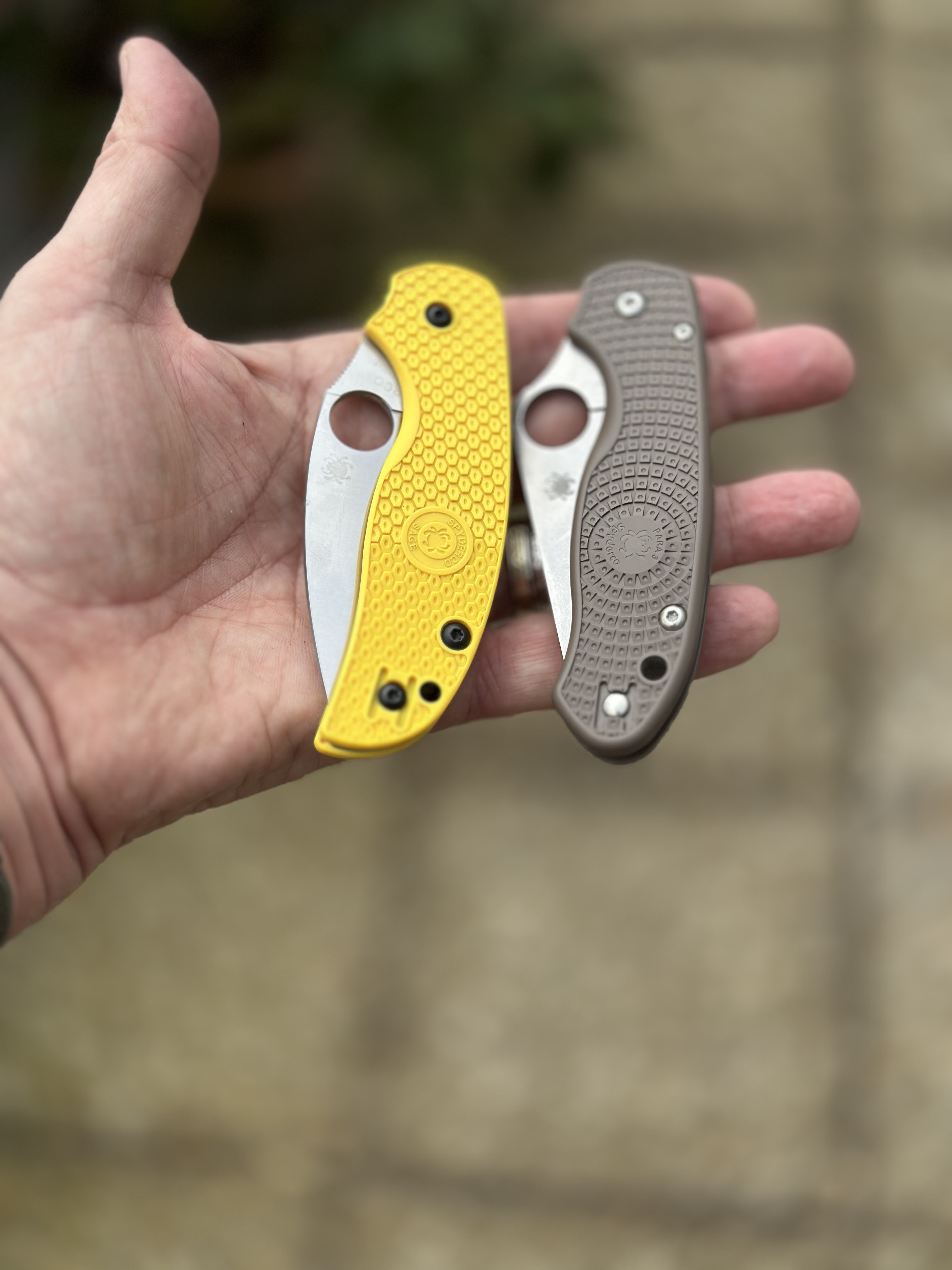
The comparison between the Sage 5 Salt and the Para 3 continues. In short: the Sage 5 has superior geometry thanks to its high 3 mm FFG blade, while the Para 3 features a sturdier blade, a thinner point, and is overall lighter (no steel liners).
It’s really your choice — both are highly capable and complement each other, coming from the same design mind. Shawn Houston even notes that the Para 3 carries “that Delica vibe.”
I’m impressed by the Sage 5’s exceptionally smooth action — one of the best among Spyderco’s compression lock knives. I love both knives. These days, the Sage Salt rides with me, but while both won’t let you down, the smooth Sage is more fidget-friendly. Both are great, but the Sage 5 is simply less popular… 😉
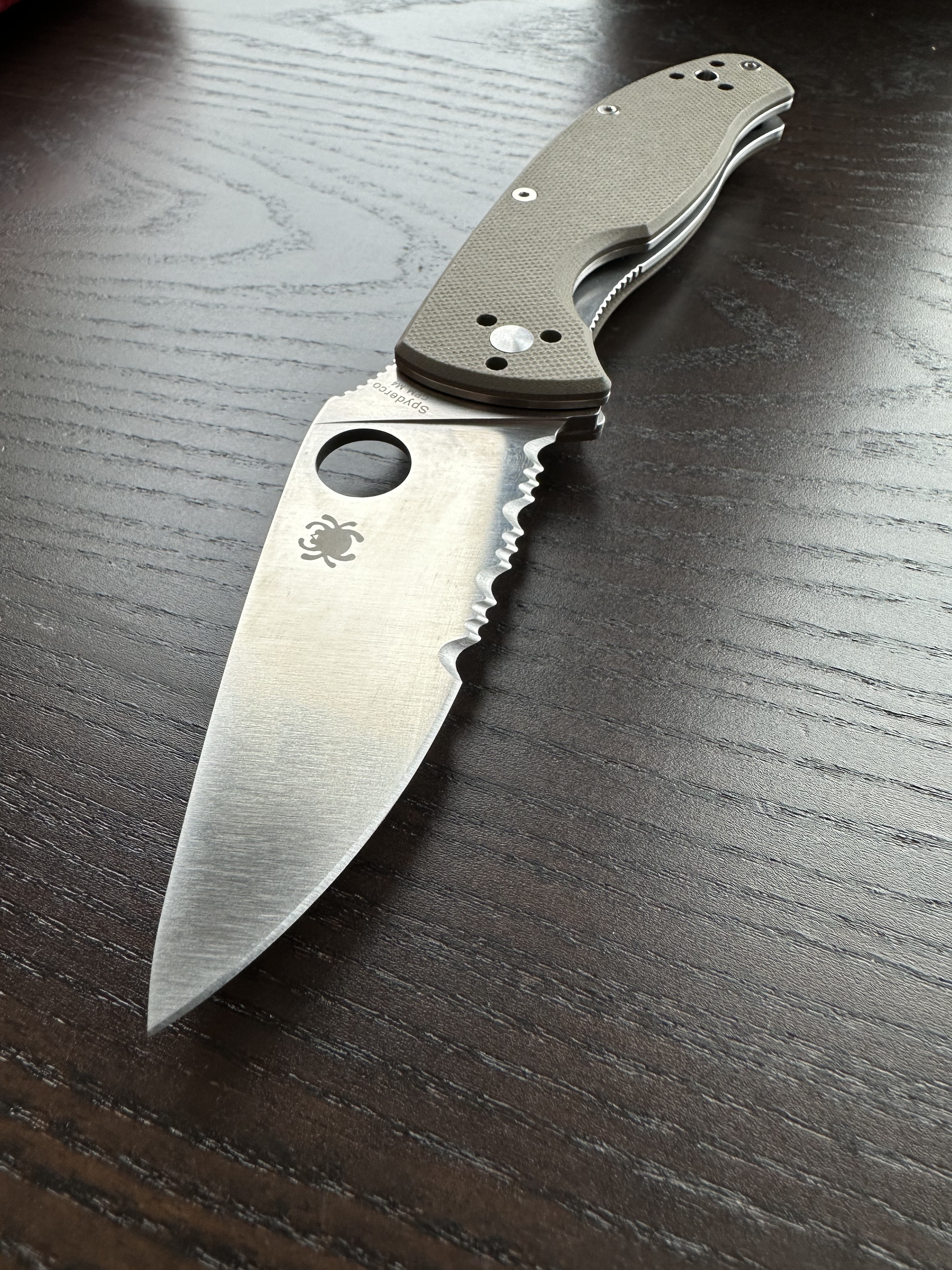
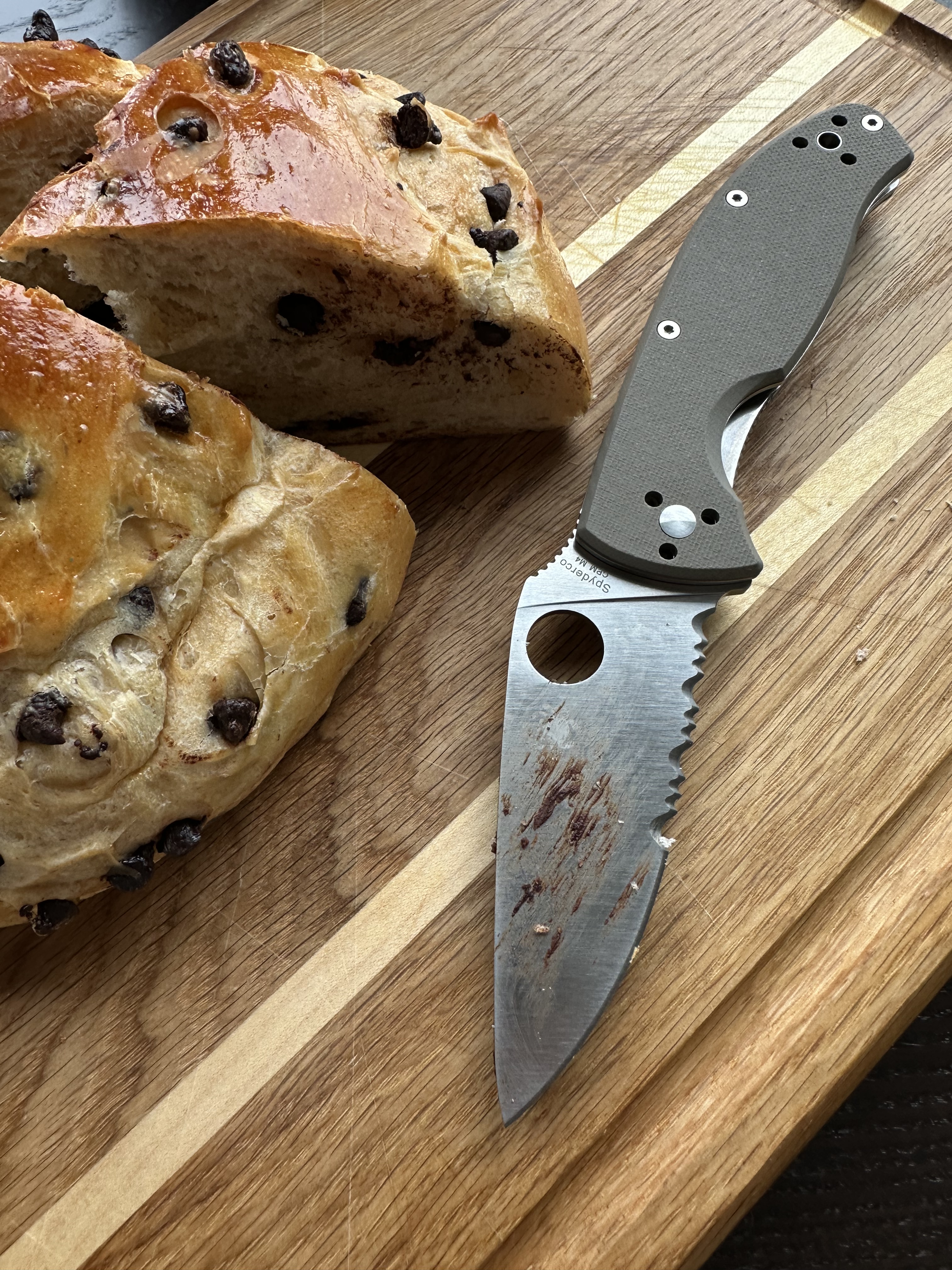
I’ve been tenacious — truly tenacious — in resisting the C122 Tenacious, even though I’d had my eye on that folder since 2008. After 17 years of flirtation, I finally ordered one. Why the delay? Its main weakness was always the less-than-stellar steel compared to the high-end knives I already owned.
Now, the CPM-M4 version is here to quench that long-standing thirst.
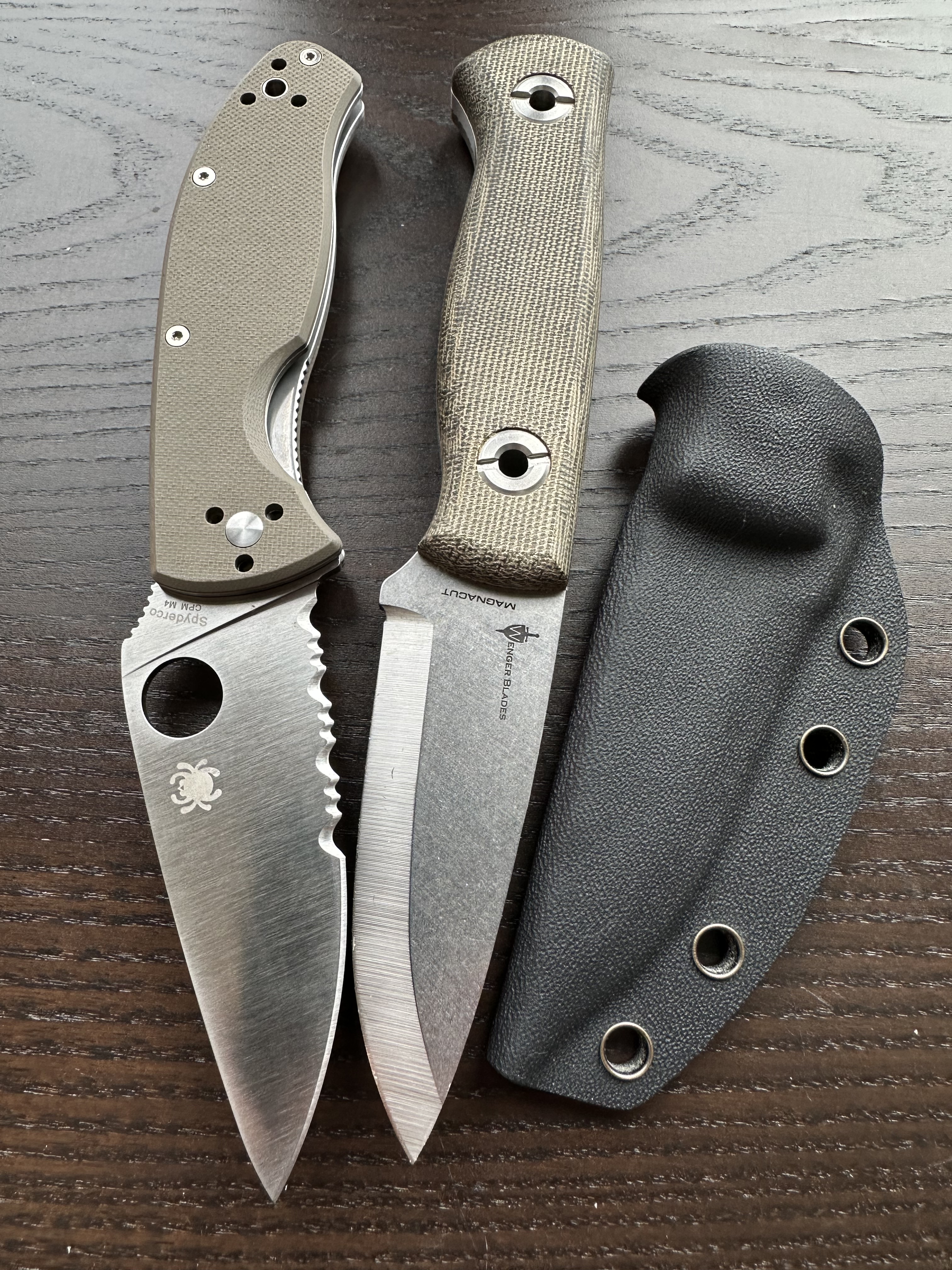
I don’t have much memory of a CPM-M4 serrated edge, except with another Eric Glesser design: the Dodo Exclusivefrom Blade HQ (C80GM4S). The Dodo was a real wood slasher — its S-shaped blade trimmed vines deeper and faster than almost any other, and the comfortable handle was perfect for power cuts.
Opportunities to play with a serrated CPM-M4 edge have been rare — until now. Here it is.
Back in 2008, when the Tenacious have been released it was a success.
Eric Glesser’s design was appealing to many for a simple reason: it was a well-thought-out, tough workhorse knifeavailable for around €30 (or less). A true blue-collar tool — built to be used and abused, like a modern-day Buck 110 for the pocket.
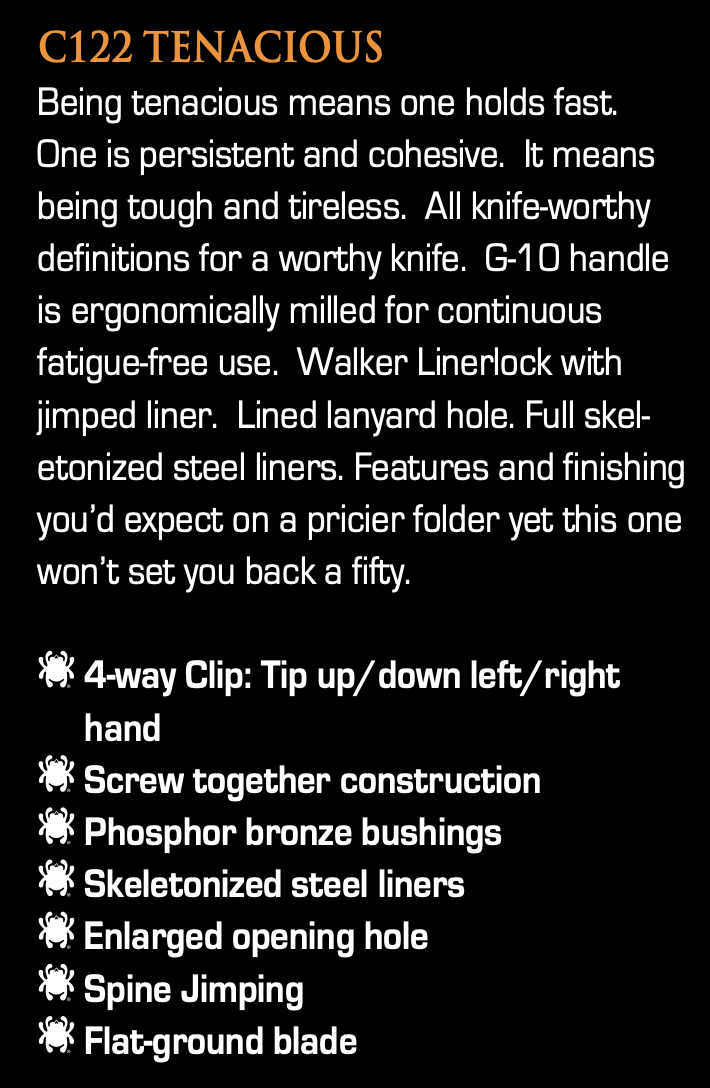
The best thing about the Tenacious was that it offered a thick, sturdy, well-built liner lock at a time when liner locks were falling out of fashion. Easy to display, easy to use, this no-choil, long-edge, compact working folder from Eric Glesser was a hit — and one of the best ways to catch the Spydervirus.
Now there is a FRN version in CPM S35VN. But it is as heavy as the G10 version and I’m not really a fan of FRN… Even if I absolutely love the FRN scales of my Serrated Chaparral.
“I’ve thrown it, dropped it, batoned wood as thick as my wrist, chipped the edge multiple times (didn’t think 8cr13mov could chip, thought it was too soft but was wrong), I’ve left in outside ONCE in the rain overnight because I forgot I placed it on my front porch the previous day, I have spine whacked it (just don’t, I most likely have an impulse problem… lol … same problem that causes me to buy a lot of knives) I’ve dug holes, stabbed the ground to cut weed roots out, and much much more...
I think by now you get the point. I treated the tenacious as if I got it for free and had 1000 more to replace it if something happened. I treated this knife as if I hated it.
The result? 4 years later, the Tenacious opens smoother than it ever has, not a speck of rust since I purchased it, I have oiled the blade a couple times but I can guarantee it was less than 20 times total in the last 4 years, lockup is a bit less solid, BARELY any blade play from side to side, even less blade play from front to back, g10 scales look smoothed over and scarred, but to be honest there is still plenty of traction. All in all, this knife is much more than what most of you need from a folder.”
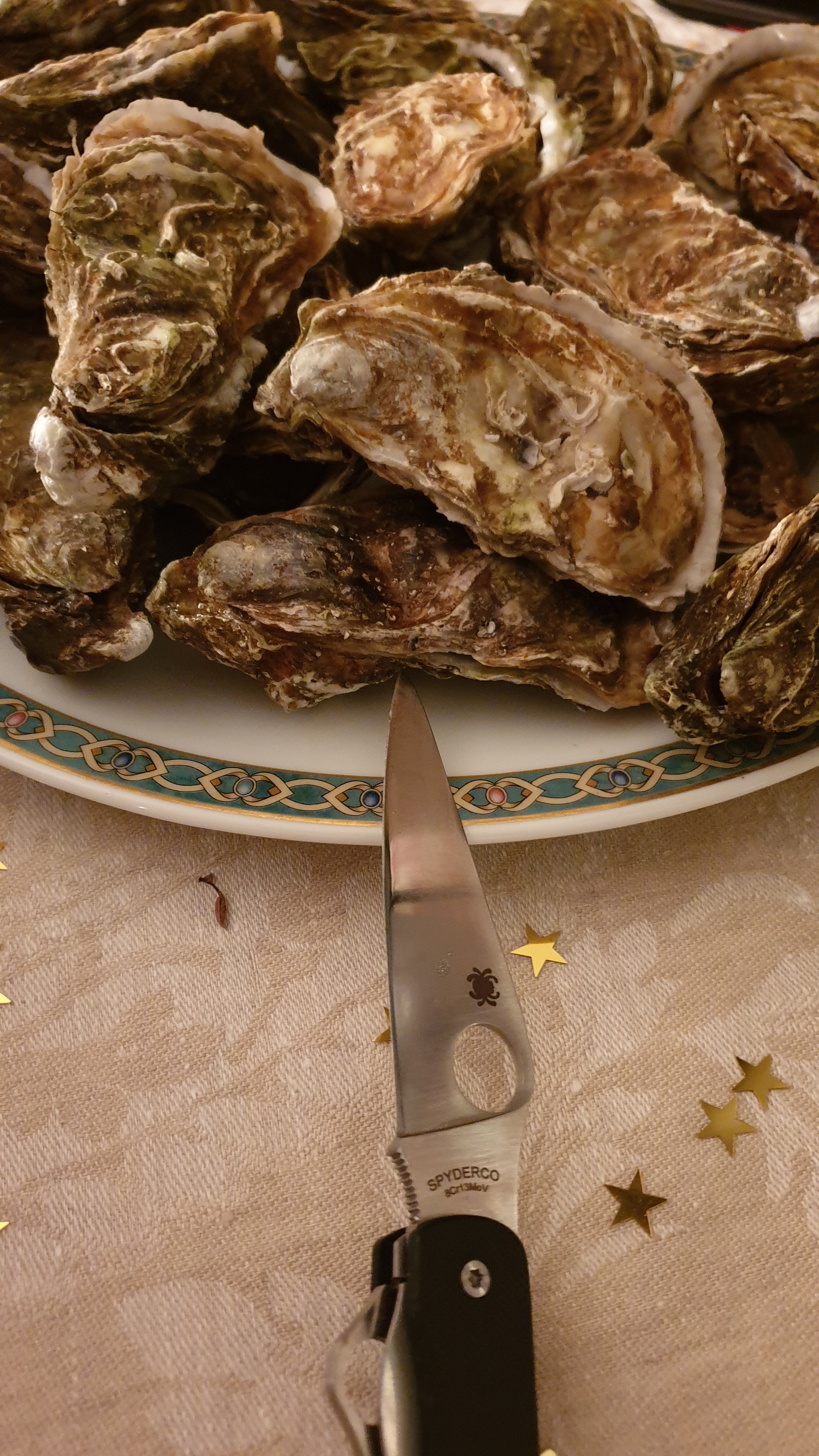
My Persistence experience was excellent as described in my 2012 review (green words lead to link) but eventually I was disappointed with their steel. 8Cr13MoV can get sharp but lose sharpness much too fast for my uses. It was frustratring. I still got 8Cr13MoV knives like the Clipitool which is a great oyster knife. 8Cr13MoV is tough for a stainless steel, no surprise it was chosen for the Tenacious line.
The Tenacious is a sturdy well made liner lock folder with a super tool steel blade.
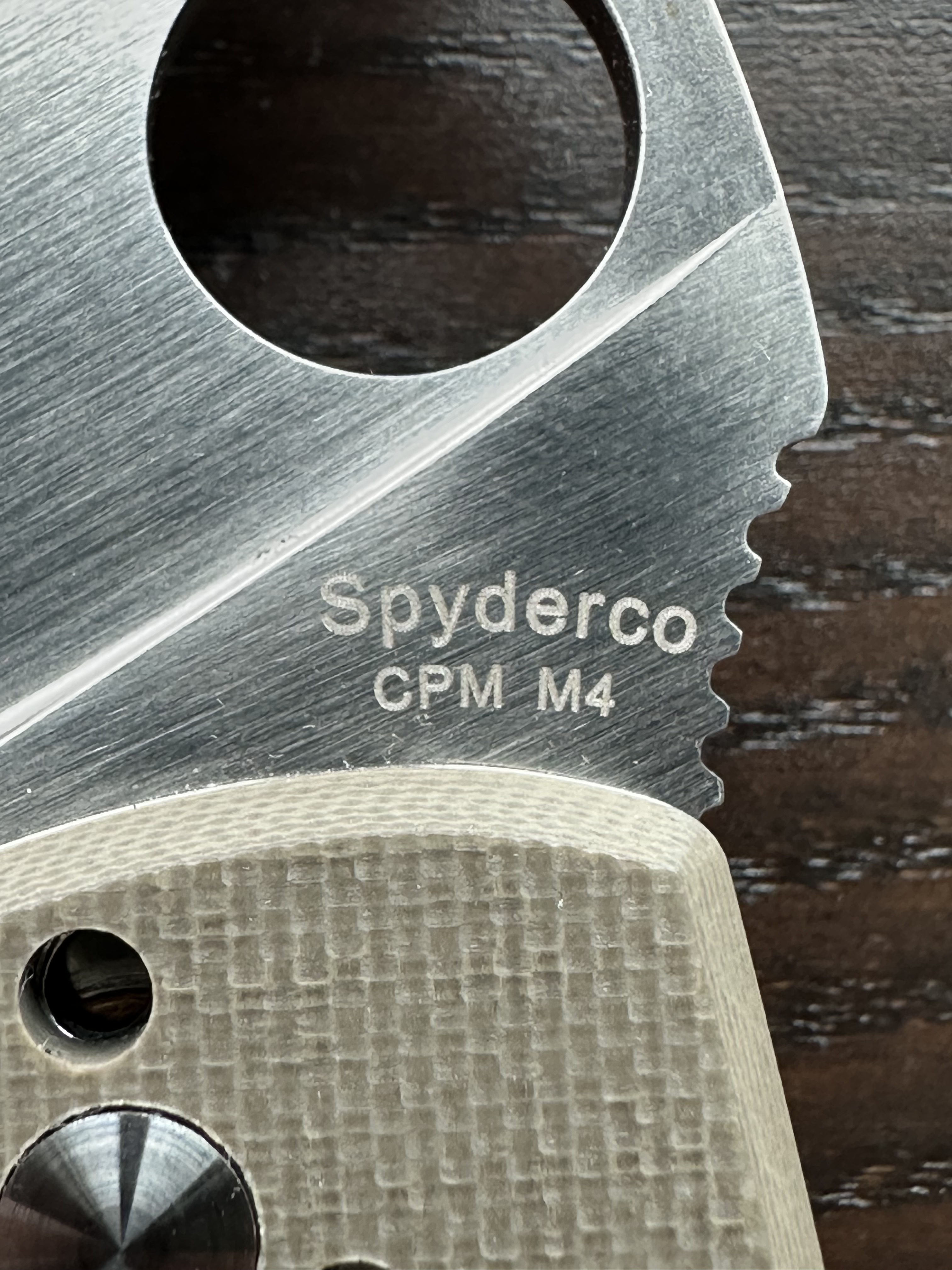
“This remarkable expression of the Tenacious® elevates this best-selling design to all-new heights with a blade crafted from American-made CPM M4 tool steel. Produced by the particle metallurgy process, CPM M4’s sophisticated alloy composition, high vanadium content, and extremely fine grain structure give it exceptional wear resistance and toughness-properties that translate to outstanding edge retention and impact resistance in knife blades. This knife’s full-flat-ground blade is available in both PlainEdge™ and CombinationEdge™ formats and is housed in a handle featuring brown peel-ply-textured G-10 scales.“
I have written many reviews about that fabulous alloy CPM-M4 it has never disappointed me and since I have sold my CPM-M4 Military and kept my Yojimbo 2 and Mantra 2 (reviewed and sharpened by JD) and use them hard, I know it is reliable and get a nice patina.
A lil’oil will prevent rust. CPM M4 is not 52100 and the patina will come slowly after cutting some lemons… “CPM M4 has good edge holding, sharpening ease, toughness, strength, and is not a rust monster…” to quote Rangodash.
Now a blade is 1/3 steel, 1/3 Heat Treatment and 1/3 geometry.
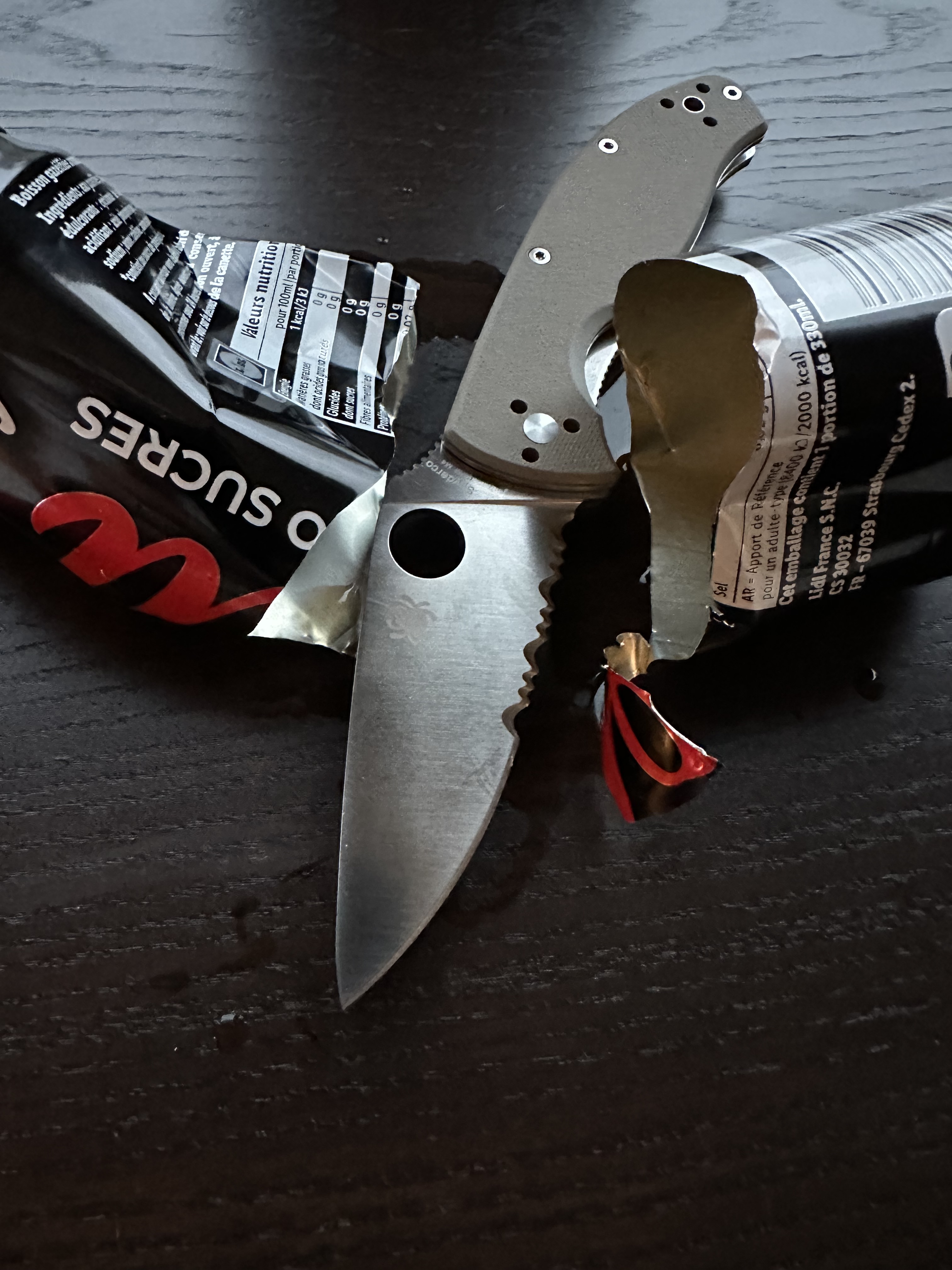
The Coke butt bottle pushing cutting test has been done with the factory edge right out of the box. It is thin behind the edge. It’s a good blade thickness for more nuanced jobs, but there is added strength from the thicker spine.
The knife sliced right in the middle were the materiel is thicker. This is just outstanding !
There are a great geometry and a thin edge on that tough CPM-M4 blade. The result is a sturdy matter separator.
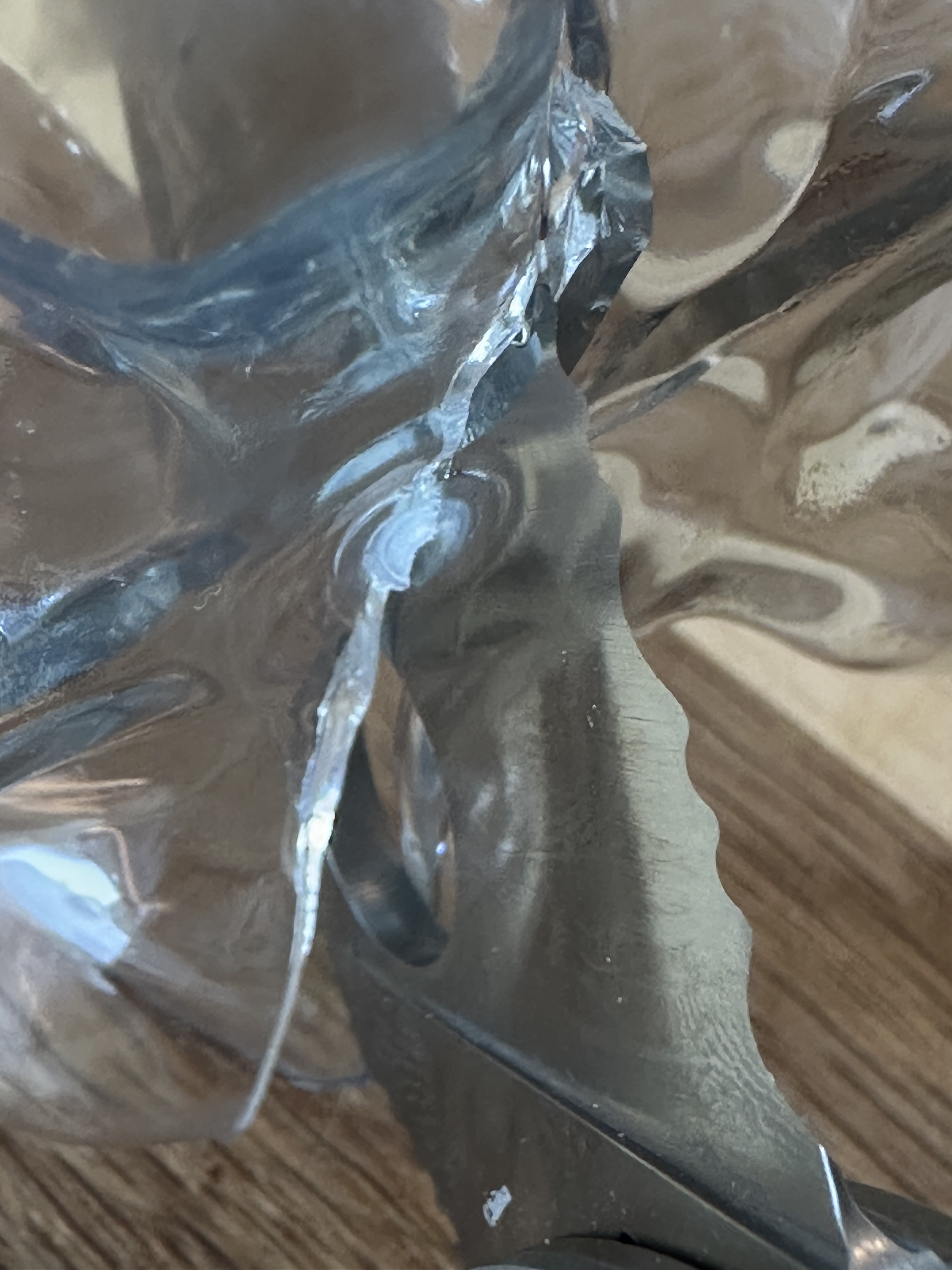
It is not an exploit to cut into some tin can but the same “shallow”, “non snaggy” kind of serrations as the Chaparral made it easy.
Again, this is a “performance oriented” knife. The blade is not too thick like some “tactical” toys. It is made to perform not to show off.
“For notching, serrated edges work great. Feathersticking, maybe, maybe not. Serrated edges are ground on the show side, so they actually work better when used left-handed for cuts like that. I carry a serrated K390 Police4 all the time for rough work. It goes through little volunteer elm trees like a chainsaw. A SharpMaker makes it a breeze to maintain the edge.” to quote Yablanowitz.
The liner lock is thick in the same spirit of Gayle Bradley’s folders. The knife opens with a loud KLAK! — no blade play in any direction. The detent is strong but slightly “elastic,” meaning the blade moves a little before the release/tipping point engages. This makes it very secure, with no risk of accidental opening. I’ve noticed the same elasticity on the titanium version of the Tenacious. It’s important to note: this is not a weak detent — the blade won’t open without a deliberate, serious force.
Using the knife in Spyderdrop mode, a flick of the wrist catches the blade in the Spyderhole with no issue. Closing remains perfectly secure. There’s a tiny squeak out of the box, but a few drops of nano oil should mute it. The action isn’t buttery smooth like a compression lock on ball bearings, but after a bit of breaking-in and running-in, it will be wonderful.
The solid clip is delivered mounted in Tip Down carry, which suits well this knife for the Spyderco Drop featured on the Military 1 which got the same kind of “around the pivot” clip.
I have no intention of using tip-up carry or a deep-carry clip. This knife is a tool, meant for easy access rather than a stealthy edge. The Tenacious is always noticeable in the pocket, but that sturdy clip guarantees quick availability — reminding me of Massad Ayoob’s teachings.
Spyderdropping is an extremely fast way to get the blade into action — faster than many switchblades. Sal Glesser was already demonstrating this skill almost 30 years ago: grab the knife by the Spyderhole and SCHLAK! — it’s open and ready to cut.
The Tenacious features full steel liners, unlike the nested liners on the Military line. There are no backspacers, making it easy to clean under running water. At 120 grams, it’s not a lightweight folder — I appreciate a bit of heft on a working tool. (For reference, the new titanium version is 93 grams.)
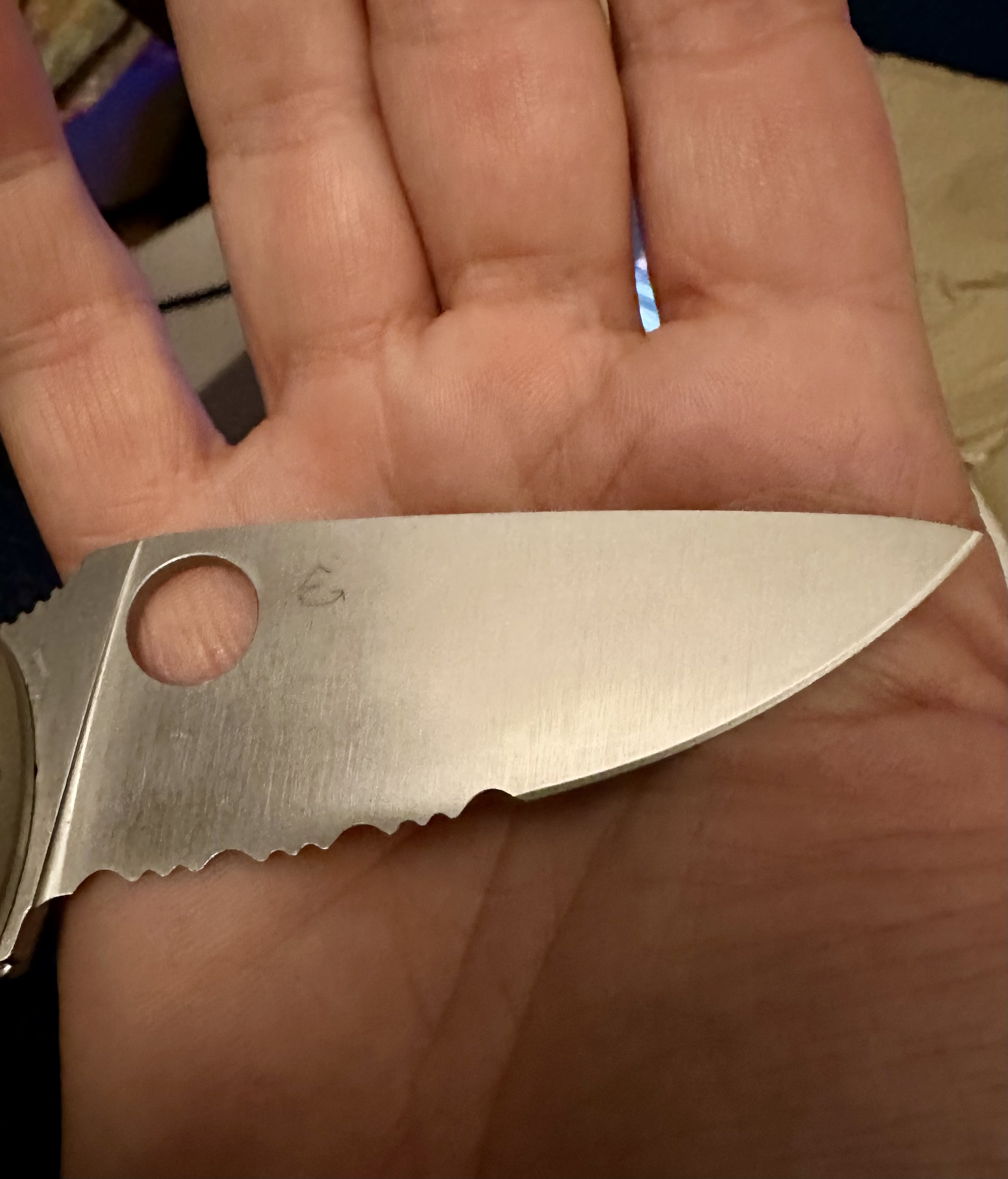
Notice how perfectly centered the blade is right out of the box. The quality control on this “made in China” folder is impressively high.
(Sal’s Titanium Catbird (only 200 were made) next to Eric’s Tenacious.)
Eric and Sal have taken their time with the Byrd Line and their budget line to get the best from a family of makers in China. The Glessers have moved slowly but steadily, developing a trustworthy and excellent relationship with the knifemakers there.
To quote JustinRose40 on the forums in 2011: “Yes, every time I show someone my Tenacious I have to say “well it’s made in China but it’s not a China Knife, it’s still a Spyderco”. To which they usually say something like, “yeah I could tell that as soon as you handed to me”.
Since 2011, China has made huge leaps in knife manufacturing quality, and this steady improvement is clearly noticeable in the “new” rendition of the venerable Tenacious.
On Eric’s designs, there’s sometimes no choil, but you can notice a clever feature: a “proto-flipper” that acts as a quillon or guard to protect your fingers in case the lock ever failed.
Since 2008, I haven’t heard of any critical lock failures on the Tenacious or the larger Resilience. The Tenacious has earned its legendary status for a reason.
Another Eric design with an excellent blade-to-handle ratio is the Mantra 2, which uses a flipper. (I’m not a fan of that little opening hole — dirt always collects there!) Still, it’s a great design. The Mantra 1, with an opening hole, feels like the Taichung-made “uncle” of the M4 Tenacious.
The peel-ply-textured G10 scales don’t need sanding; they’re well balanced and won’t shred pockets. The brown color makes it feel less threatening, in my book.
Let’s put it to use while the satin blade is still silver.
The knife bites into wood like no tomorrow. The serrated CPM-M4 edge is a joy to use — it goes deep and steady, putting a smile on my face every time.
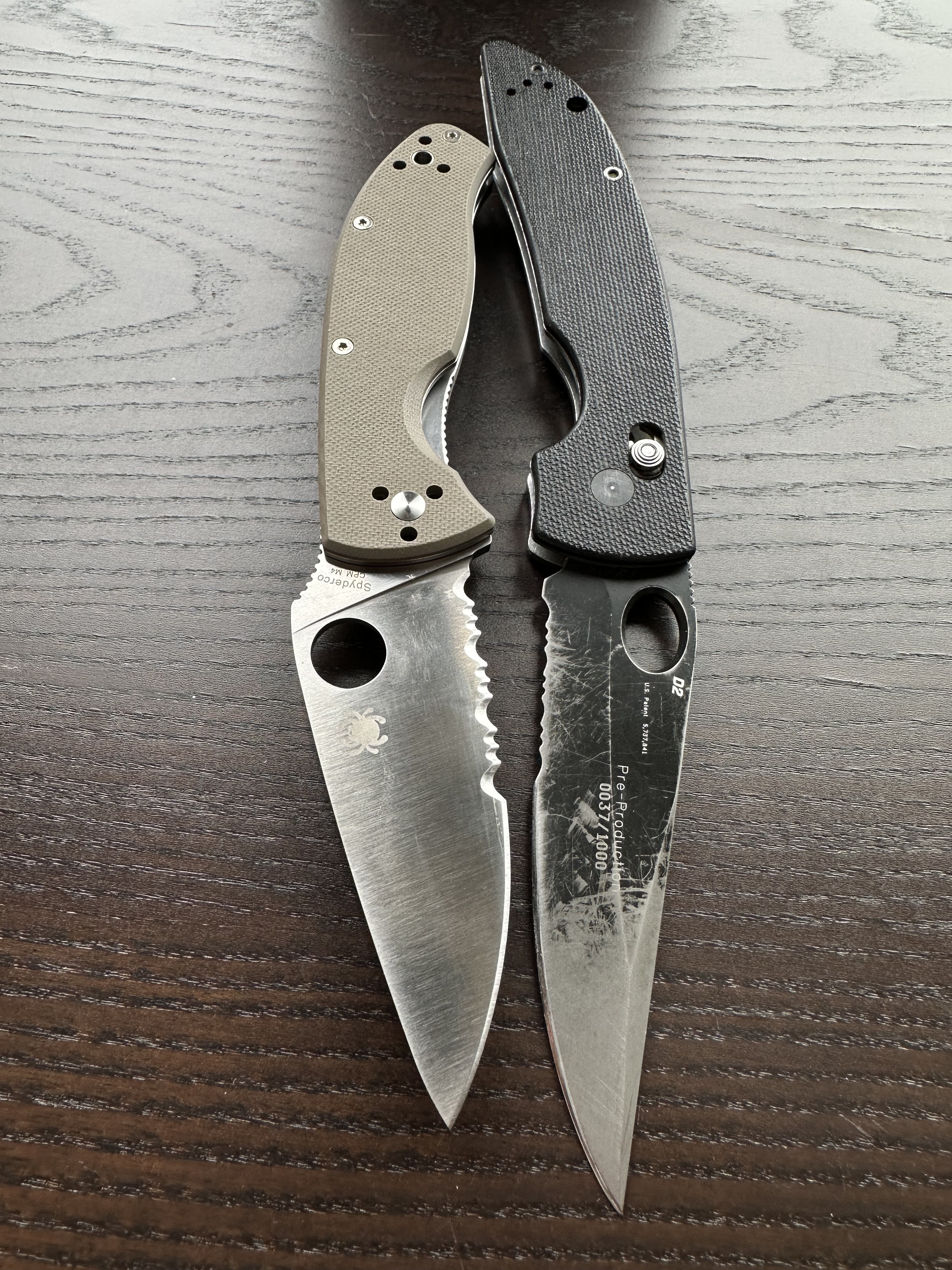
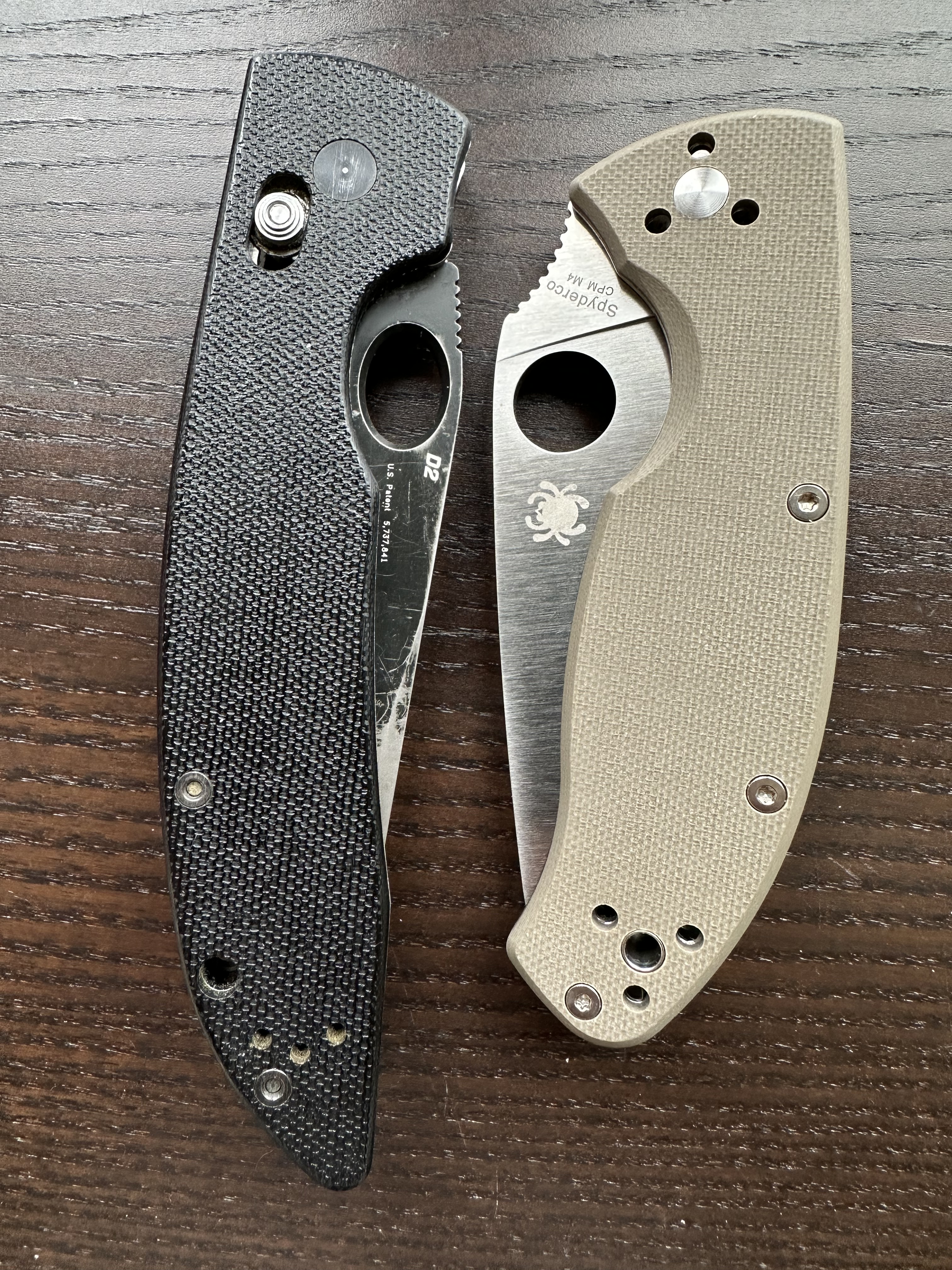
Blast from the past: the last combo-edge/semi-serrated knife I used was over 20 years ago — a Pre-Production D2 AFCK. As you can see, it’s been heavily used, and its geometry, steel, and blade-to-handle ratio aren’t nearly as refined as the Tenacious.
That macro shot shows the very smooth way to go from chisel ground serrations to plain edge.
“Serrated edges aren’t for everyone, and you may not like them, but you’ve got to get at least one just to try! Keep it around for nasty work, wet abrasive rope, zip-ties, yardwork, or playtime like in the pool, or at the lake or beach. Not to mention fishing duties.”to quote Benben.
The difference in cutting efficiency between a saber grind and a full flat grind is obvious. I don’t need to tiptoe around it — the advantage is clear.
Now let’s compare the Tenacious with various folders and fixed blades.
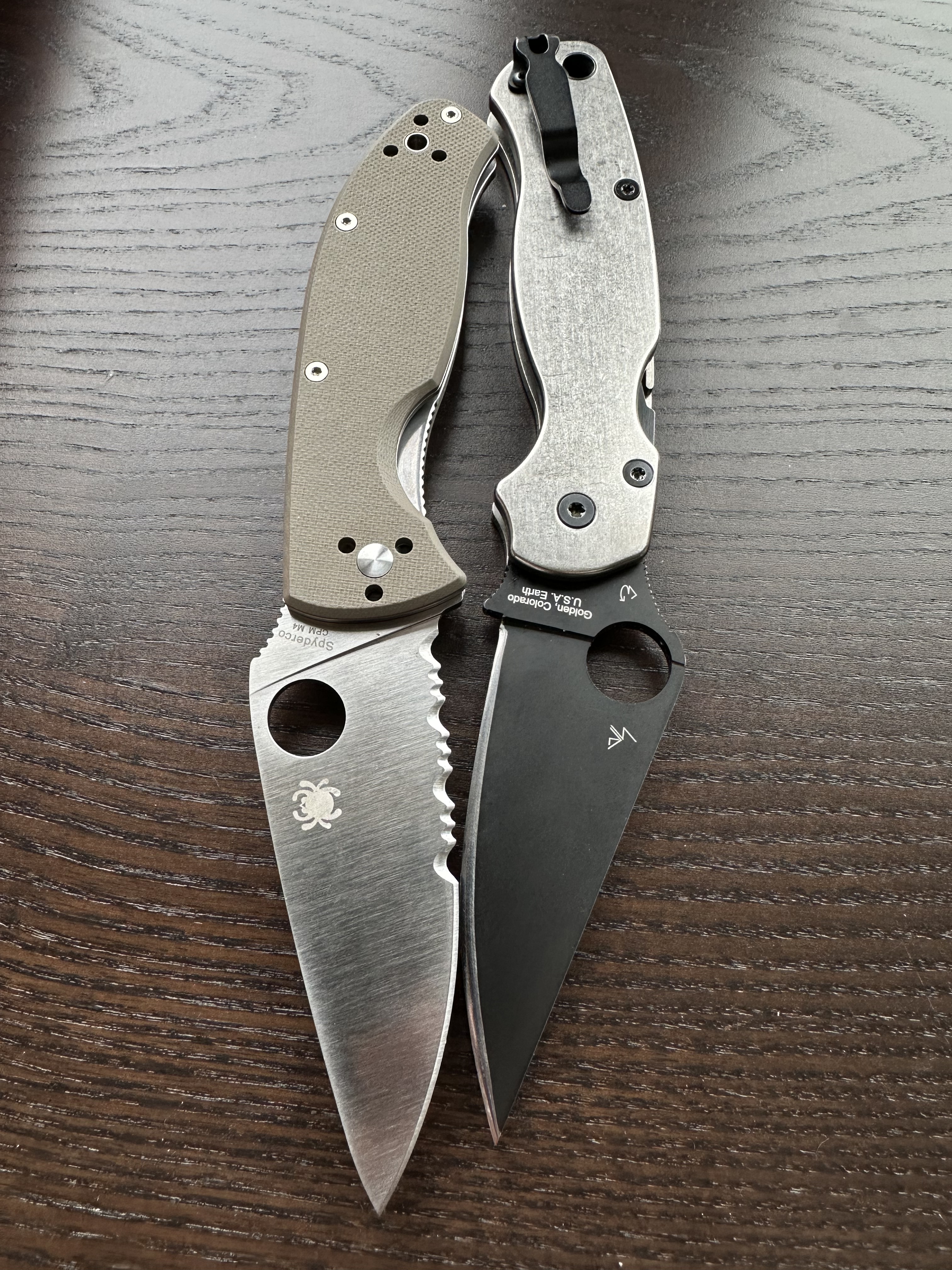
The Tenacious got a better blade/handle ratio than the Paramilitary 2 and a longer blade for a shorter handle. This is one key of the success of that design.
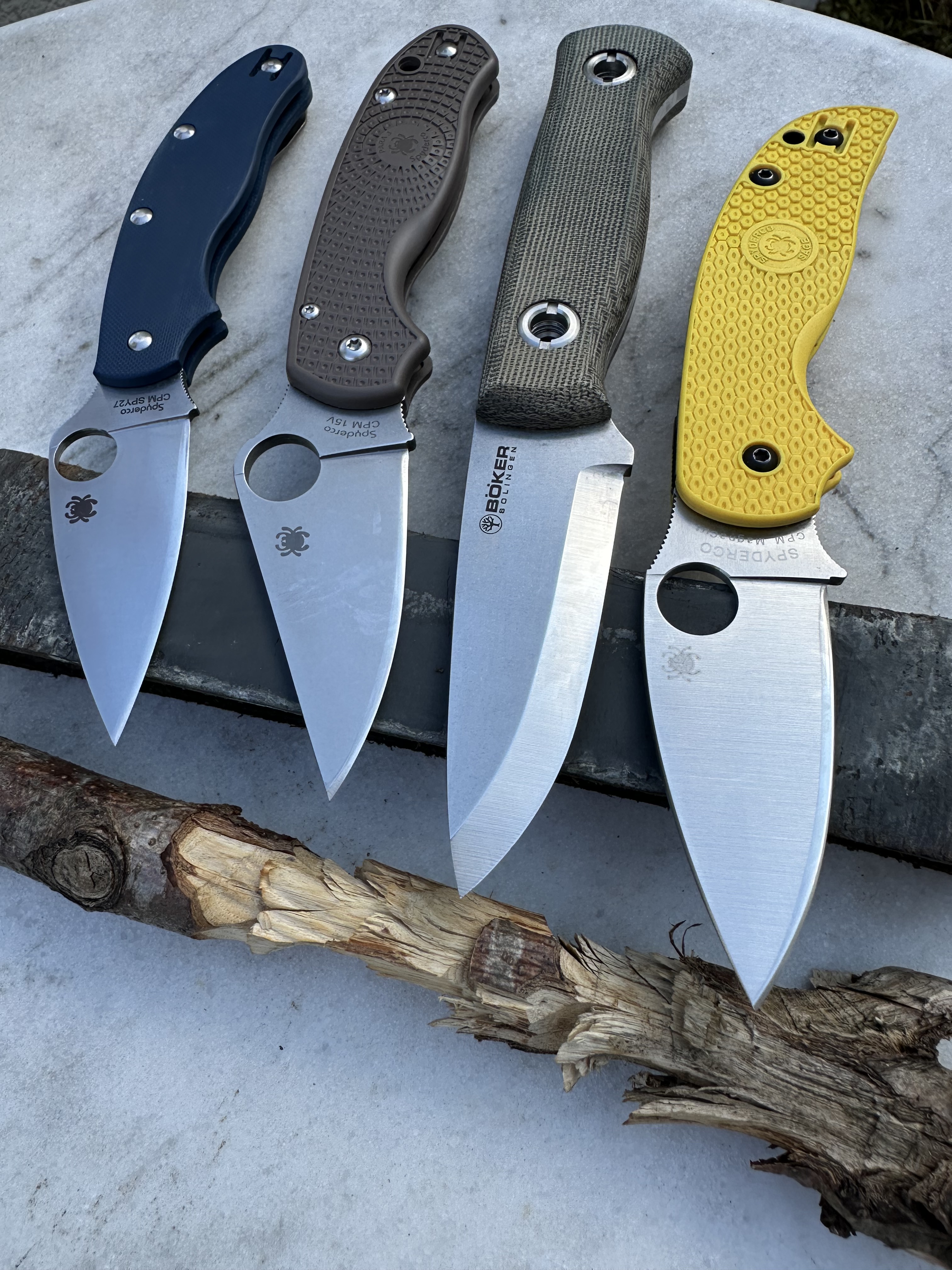
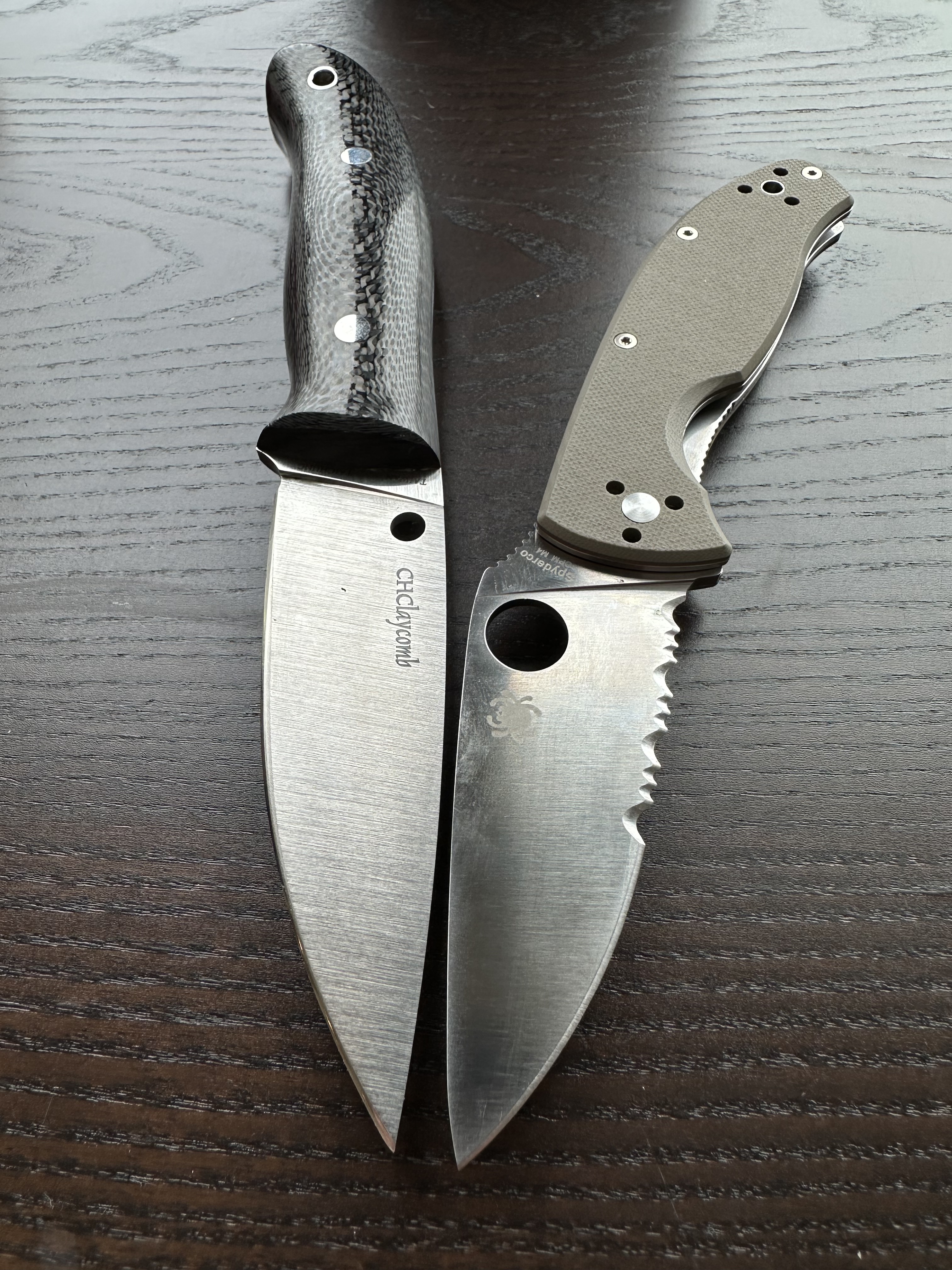
Since I play with Bushcraft here a nice combo to go in the wood. The Proficient is a masterpiece.
And with the ultra solide Boker in Magnacut. The 8,6 centimeter long blade of the Tenacious is generous edge wise.
Of course, I’ll strop that partially serrated blade on leather — no fear at all. I have my method for serrations, using the corner of the leather pad.
Maintaining the combo edge won’t be an issue; I’ll keep it sharp with cornered ceramic and jade stones.
So what do you get for €139 — the price I paid at the Coutellerie Champenoise? I’m really happy with my purchase. I plan to use the Tenacious a lot and on anything, simply for the pleasure of testing it on various materials. This knife isn’t afraid of plastic, wood, food, bones, cardboard, or aluminum.
This CPM-M4 version is set to show the full potential of one of the beefier EDC knives, especially with its serrated half-edge carved from super tool steel. Over 17 years, the Tenacious has proven it can withstand a lot of abuse.
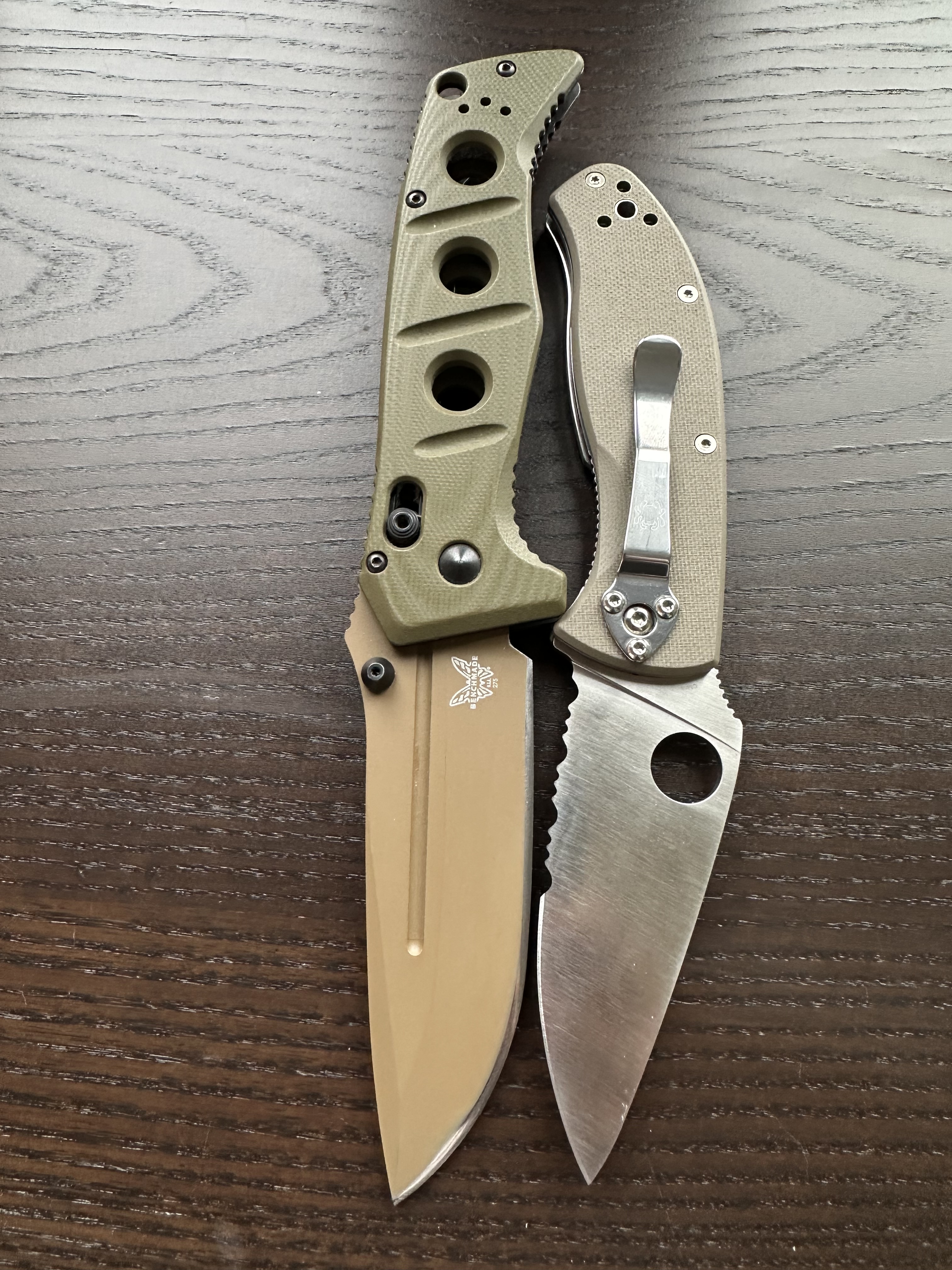
The CPM-M4 Tenacious is not only a workhorse but a warhorse, like the pictured Adamas. I can easily imagine any soldier being glad to have such a reliable knife at this budget.
It’s slightly larger than small pocket knives, but smaller than the oversized ones some carry just to show off. The Tenacious would make an excellent day-hiking knife — a folder ready for the great outdoors. I’d take it on a trip to Africa or on a photo safari in the natural parks of Tuscany.
(this will often dull the blade’s edge with a little shining spot. Not here… Thanks to the serrations again ! )
This CPM-M4 Tenacious is sold at roughly double the price of the standard version, but in my opinion, it’s a rare chance to have this alloy on that knife. CPM-M4 pushes the boundaries of reliability and is a real pleasure to keep razor-sharp.
CPM-M4 will not chip and stays sharp for long. It’s a steel that has been used in cutting competitions. While Tuff Glideand various oils can keep it spotless, I prefer the protection of a gentle natural patina.
For twice the price of the vanilla Tenacious, this upgraded version delivers another level of performance in terms of toughness and edge retention.
“Old school cool with the Walker lock and satin finish. Well done Eric Glesser!” to quote Clay H on the Forums. My brown Tenacious looks gorgeous in its “beautility”, practically begging to be used across all terrains — sand, rain, or more. All in all, this beater is a beefed-up workhorse, built to be used hard and carried proudly.