Category Archives: Review

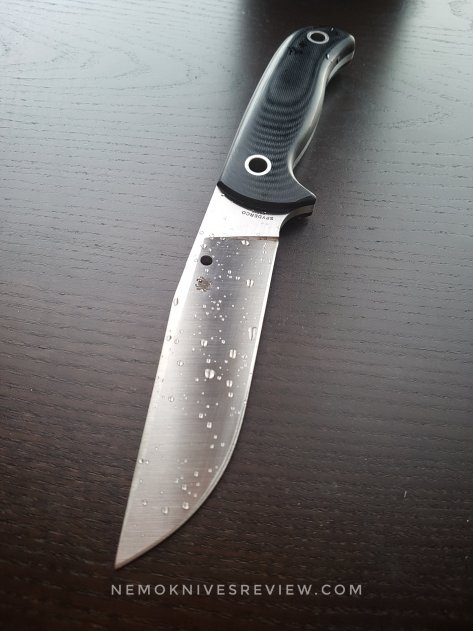
52100 Paramilitary 2 by the ocean.

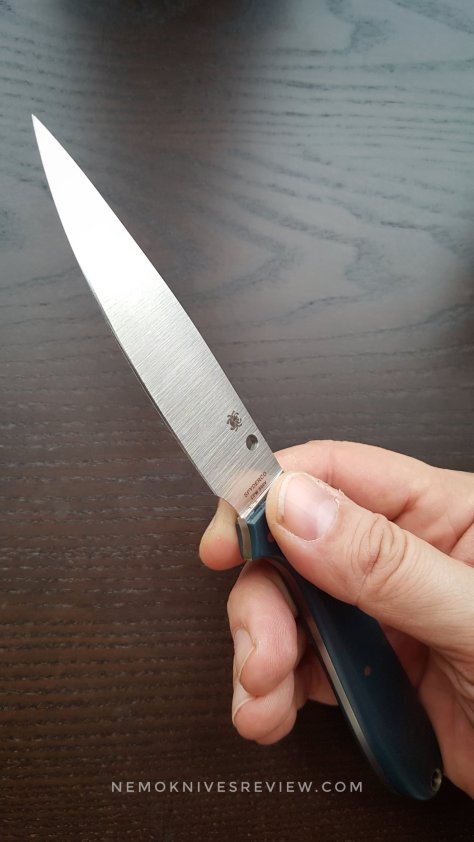
So here I’m in Southern Bretagne near Lorient, city of Eric Tabarly with my Paramillie Exclusive Run in 52100 Ball Bearing Steel.
For those who don’t know Sal is a fan, this is why Eric is named Eric. 🙂

The moisture and salt are present and cars got a serious tendacy to rust just by being parked outdoor.

The knife has been used on food and for all the chores around another anniversary preparations. The Patina is a real surface protector as no pit or coloration has been noticed during that 4 days week end.

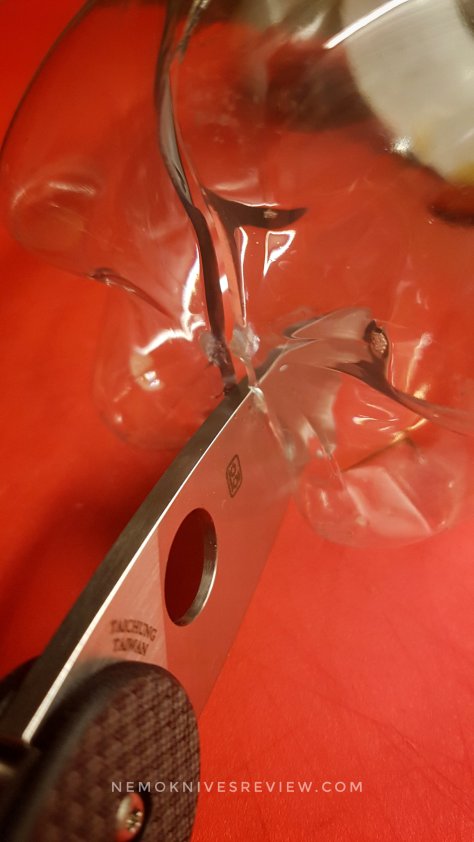
It eventually has been used to pop the remaining balloons after the party.
No oil needed. The edge did not rust. It was used daily. Very happy with that knife.
This is a very robust folder, with a strong blade.
It was still shaving hairs after 4 days of mild but constant uses. I did not process a lot of cardboard for example, but a lot of meat ! Duck for the matter.

The 52100 makes a beautiful blade with its mirror convexed edge. It was noticed.

52100 Fight the rust ! Force Patina !!

20171026_101318-011949251843.jpeg

After doing that picture for the Spyderco Forums….
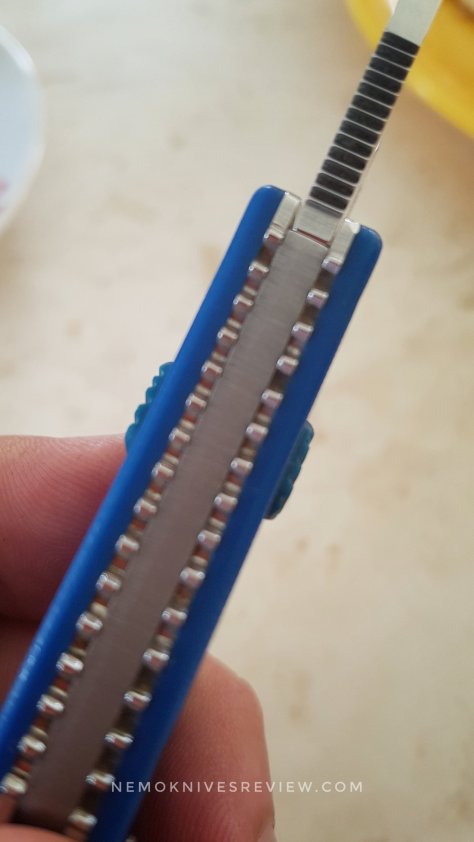
I have noticed those red dots near the pivot on my Paramillie 2 in 52100.

Some “voiding the warranty” time later I noticed that…

Edited the 2nd of November 2017. This is not the case anymore as stated in Spyderco new warranty:
“If a knife has been disassembled and reassembled correctly—so as to maintain its proper mechanical function—this warranty remains in full effect. “

The problem is not the rust or the patina. 52100 is not stainless.
The problem is the fact that the pivot area is hidden under the scales and that rust can easily develop there without to be noticed.

20171026_102745-011365010555.jpeg

So the idea is to develop a patina on the whole blade and pivot area, to create a smooth “crust” protecting the surface.

20171026_102754-011293282873.jpeg

Of course yesterday I have put some vinegar to create my patina and some drops have been near the pivot… It was fast in rusting in that area without patina.

Let’s clean that first. I will use white compound and some paper towels.

20171026_103200-011352795203.jpeg

As you can notice this is not really deep pitting. There is just some patina forming under.
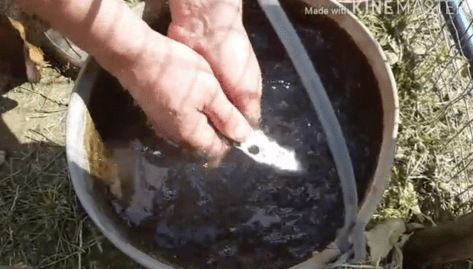
So now it’s time for a great vinegar bath…. It was really three screws to remove and I had access to the blade. No big deal. Warranty voided easily.

20171026_105222-011355942298.jpeg

Soaking the blade completely is not the most aggressive way to develop a patina as it needs to form acid and oxygen. It’s better to take the blade out of the bath and envelop it with paper towels. But here I wanted a slow and steady patina. So I let it submerged for one hour.

20171026_103325-01809241532.jpeg

On the picture above, you can still see the polished edge….

And after one hour of socking : all his grey and my polished edge is also stained gray now. So everything is cover with patina.

20171026_113859-011156554878.jpeg

Time to put some nano oil in the pivot and around.

20171026_114039-011893626695.jpeg

Working it an hundred time to smooth it. And cut myself in the process.

20171026_114417-01678644516.jpeg

Add some Ballistol for good measure and protect the blade. Stropping the blade on leather… The blade is perfectly centered. No play, smooth like on glass. The tolerance are really high in the construction of that knife.

20171026_115235-01414219514.jpeg

Et voilà: fight rust ! Force patina !!

20171026_114928-011587806665.jpeg

“52100 Tool Steel
AISI 52100 is a high carbon tool steel containing low quantities of manganese and chromium to improve hardening. Because of the low chromium levels in 52100 steel, it has very low corrosion resistance compared to other higher chromium tool steels.

In applications where corrosion is less of an issue, 52100 tool steel is considered an ideal, affordable option, offering a very fine grain with superior edge retention. It is capable of cutting a wide range of materials because of its combination of toughness, wear-resistance, and hardness.”
According to Carolina Knife Company.

(Thanks Brian for the head up !)

Spyderco Paramilitary 2 C81CF52100P2 52100 Exclusive Run – New Old Timer Workhorse !

I love Grandpa’s knives in a modern form, like the AFCK in M2HSS twenty years ago. But I was not able to jump on bandwagon to catch a Military in 52100. Lucky me, soon a Paramillie II designed by Sal and Eric Glesser was able with the same Carbon Fiber handles and the same 52100 blade.

“52100 is a very good steel for cutting organic material. If you stay with organic material it will edge hold very well.
I use it for a core steel on high carbon pattern welded laminate. My competition cutters are a laminate of 15n20-52100-15n20.” Ed Schempp

“52100 is a ball bearing steel. Most ball bearing steels make pretty decent blade steel. Especially where edges are concerned. It is my favorite steel to forge. It is hard to find in sheet. Actually, I would like to do a run of a model in 52100, but I’d prefer to make it in Golden, so it will be a year or so.”   Sal

Ed Fowler in his many articles in Blade Magazine and his books introduced me in the “magic” of 52100. Also my first blades in 52100 are my two gifted Lil Blue II made by my friend Ray Kirk of Raker knivesRaker knives. Ed as a cowboy and Ray as a Native American ? Made in Golden ? This knife is the true heir of American traditional blades !

“52100 is the steel of which most of the bearings used in all walks of life today are made. Civilization rides on 52100 steel. If it were less than reliable, another steel would be used instead. I have used 52100 exclusively in my knives for the past five years. I have forged many bearings into blades. I have given my blades every opportunity to fail, subjecting them to rigorous, destructive tests. I have found 52100 to be the cleanest, most uniform steel that I have ever used. Properly forged and heat treated, 52100 produces a high-performance blade that knows no peers. I have reached this conclusion based upon extensive personal research, testing knives for the things that they need to do in the real world of knife function.

Bearing-quality 52100 steel blades are tough and normally pass the 90° flex test without cracking or breaking. Their strength is evidenced by the force required to flex them.

I demand three levels of performance from any knife intended for serious use. First, it must have the ability to cut and cut well. Second, the blade must be tough. By tough I mean it must flex without breaking like a piece of glass. Last, but not least, it must be relatively easy to sharpen. Through the years, I have tried many steels and heat-treating methods and have tested the results by cutting a lot of rope and breaking many blades. Some combinations have cut extremely well, but have
broken or chipped when subjected to hard use. Drawn to a point where they were tough, these blades were too soft to cut effectively. I had settled upon one steel that when properly forged and heat treated cut very well. I had invested a great amount of time and effort getting the most out of that steel, so I was reluctant to change.

The nature of 52100 has changed drastically since that first bearing was made more than 100 years ago. Bearings are performance oriented, and those that last and gain a reputation for high performance are in demand. Every bearing is, by nature of its job description, routinely tested to its limit of performance. Competition is based solidly upon quality steel, and the outfit that makes the best steel enjoys a ready market for its product. Quality control is a high priority in the manufacture of bearing steel.

In addition to everything else, 52100 is easy to work, grind, and heat treat. Even less than perfect heat treatment can result in a good knife, though it never should be said that bladesmiths should settle for simply “good enough.” As the knifemaker’s skills develop, the performance potential of the steel will offer ample room for growth.
The high chrome content of 52100 promotes a beautiful mirror polish and enhances the steel’s machinability. The 1 percent carbon is more than can go into solution in the steel. However, unlike 1095, which has about the same amount of carbon, the excess carbon in 52100 also has 1.5 percent chrome to react with to make chromium carbides that can enhance cutting performance.
The “Cadillac of steels,” 52100 has been and continues to be one of the cleanest blade materials suitable for cutlery. Its primary use demands great care in manufacture. It’s also extremely versatile. For example, I’m aware of one man who makes
“52100 has been and continues to
be one of the cleanest steels suitable for cutlery.”

Ed Fowler, the lover of 52100 ball-bearing steel, sheep horn, and dedication to the functional knife.

For Sal Glesser, the functionnal knife is carbon fiber handle and impervious to wear and tear. CF got that magic to age great even after some falls on concrete.

As you can notice mine came perfectly centered. The Colorado Plant is now bringing perfect quality controls and a love to details you can appreciate in all angles.
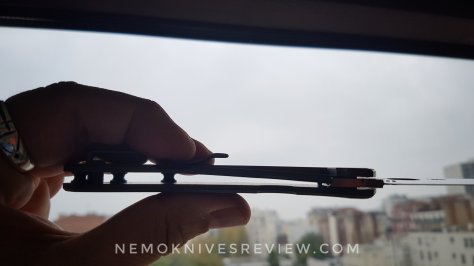
The action is smooth ans the blade can fall by gravity when the lock is released.
As on the Yojimbo2 the compression is lock provides an action which is one of the smoothest out of the box but othing new about that.

Ok time to smooth the peel ply CF for saving my trousers from being filed and also smooth the hump which catch my pocket’s lip. Sandpaper at 500 has been used.

For the hump, like on my previous Paramillie, a diamond file is mandatory. 15 minutes later it’s much better !

Then, knowing 52100’s fun is the fact it can get a patina very quick, green lemon juice was used to start a gentle patina.

For good measure I wanted to compare how a 1075 carbon steel Opinel and that 52100 knife will react to the lemon juice.

In the same time I could try the new Double Stuff 2, Howard korn from the Knifecenter of The Internet has just offered me.

I was able to remove the shoulder and convexe my grind in a pair of minutes. Then with the white ceramic it was own to a mirror polish.
This is true 52100 get polished very easily. And the edge is like a mirror after some pass on leather. So this is also going to be fun.

WIth the lemon juice drying on its size, a patina soon appears.

And I was able to get a nice contrats with the convexed edge.

The knife bites in the wood like an hungry edge will. This should be a dream for Bushcrafters to get that kind of steel on such a modern and reliable plateform.
It can be turned into beyond razor very easily just by stropping my new convexed edge.
Yes, so easy to get it dangerously sharp and whittling hairs !!

The good thing also is that 52100 is supposed to be tougher than S30V and the thin point of the Paramillie needs plenty of strenght. Now I wonder what is the HRC of that blade.

I also like the matte black clip provided. It’s made for a low profile EDC.

It seems like the 1075 is getting drak faster than the 52100 as the wipe marks are visible on the Opinel blade.

So the Paramillie 2 is now ready to get some used. I will go near the Ocean for four days at the end of the week. It will be occasio to test it in a humid and salty environment.


The new king of bottle butt cutting is my Opinel N°12. It goes through plastic like in butter. The Paramillie is stuck but slowly and steady goes through.
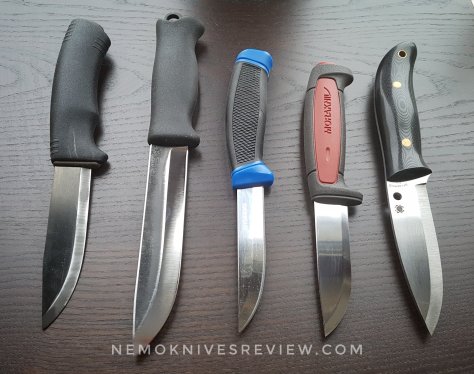
But so far nothing beats the Nilakka or the Opinel in that exercise.
But the 52100 will be slowly more thinned for that matter. 52100 is a steel to be thinned on the edge.

20171024_161430-01551097416.jpeg

20171024_163653-0185090506.jpeg

Cutting bread is another great test. The cruch is hard and the inside is soft. That’s why Opinel are great on that too. But here the Paramillie is also reliable.
52100 is “alive” . It means it needs care and the patina will evolve in time.
I have greased the pivot and now the cheese is greasing the blade. Let’s not forget Carbon Steel folders have been in use much more longer than stainless steel. Roman folders have been found in archeologic sites. So this Eric and Sal design enhanced by this bold move — bringing 52100 to a modern folder — is all an adventure !!
So…
“New” because it’s a new idea to give ball bearing steel to a tactical folder when the tendance is to S35V and M390 manufactured in China (Don’t mistake me I do love my Falcon). “Old Timer” remembering the Schrade 1095 collection made in the USA and Workhorse because this is a knife made to be used not kept in a safe. It needs to be oiled and sharpened and used and oiled and honed…
More to come !!

20171024_162326-01128561663.jpeg

20171025_121742-01516747397.jpeg

20171025_122149-01711124613.jpeg

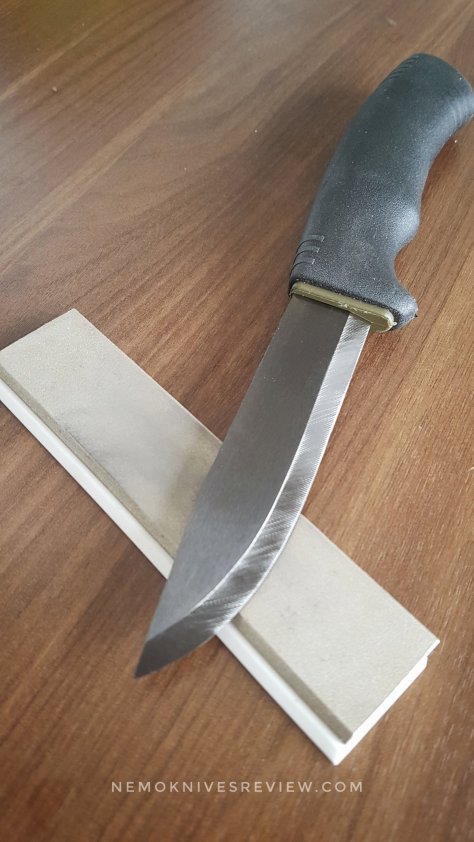
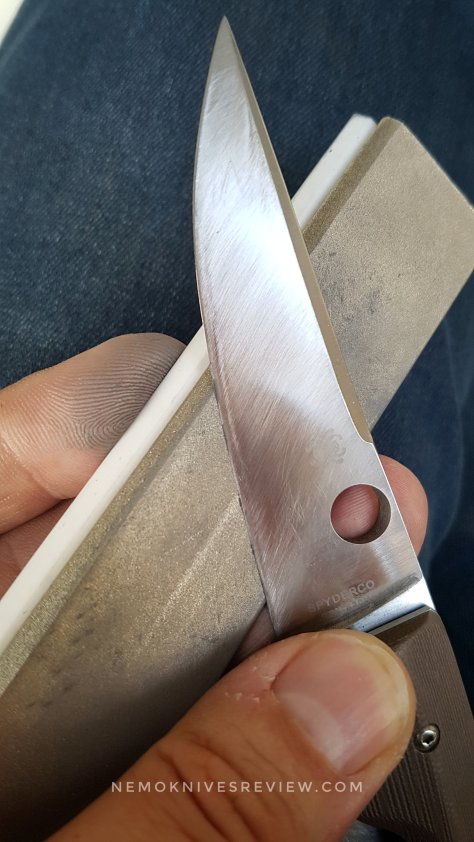
I remove the edge’s shoulder with the diamond side of a Double Stuff 2. I do that until I got a burr.

Doing it without guide, free hands, gives a gentle convex edge.
Then I use the white ceramic to erase the deep diamonds cuts.
And then leather stropping. On 52100 it is a breeze to do.
Now it can whittling hairs.


And for good vintage look, some P1000 sand paper on the clip will age it.
But rust could be a problem in the pivot area… as shown on part II.

20171025_154513-01410924470.jpeg


Massdrop x Ferrum Forge Falcon S35VN Folding Knife — Flipping Modern Lady/Gentleman Knife at a bargain !

20171010_113323-011525776241.jpeg
(Fresh from out of the box)

As my friend and co author JD I had ordered the Ferrum Forge Falcon for 124 dollars. Titanium handle à la Sebenza (* the RIL is a South African invention ) with steel insert in the lock to prevent excessive wear, S35V blade with high flat grind, reasonable size for the city. And a two main screws construction ? What not to love ?


(Here with a new convexed edge the day after)

This was a first time for me with those companies. The knife has been made by WE knives in China and designed by San Diego based Ferrum Forge.
124 dollars for a knife this quality, this is almost the third I would normally pay.
This kind of excellent ratio price/quality have been noticed on the Megalodon folder.
And like the Meg, the only flaw on my Falcon is…. the clip.


Error
This video doesn’t exist

First thing I have noticed: it was smooth as my ZT0562CF. It fires easily. A lot of work has gone on the blade and the handle to smooth everything. It’s as good as Taichung factory in the attention to details. It runs on ball bearings and the detent is perfect on mine. The blade feels heavier than the handle, it gives a nice momentum.

Zero play in any direction. The handle is smooth with its rounded edges and so nice under the thumb. No hot spot even if the jimping are quite aggressive. The blade is chanfered on the right places making a very precious package.


Second thing I had noticed is the great balance. The knife is perfectly balanced. The blade looks wider than the thick titanium handle.

20171010_113206-011497905212.jpeg

See how small it is ? I even think it would be a great knife for smaller female hands. For bigger hand it would be a three finger handle unless using the big choil.
This big choil is part of the charm of that design and it could be some kind of Native hommage: thick handle and false edge drom point blade.

20171010_113217-011997002469.jpeg

It’s about the size of my beloved Wolfspyder but more elegant. Let’s not forget Spyderco places function before the look. But the wide blade on the thinner handle does a lot in easthetics. The hole in the blade is purely for the looks and to remove some weight, you won’t open he knife with it. OK, you can do it but this is not made for that.
Also the large choil can be a problem when you cut ropes or strings and they get stuck into it. But the Native 5 got the same issue, it’s no major when the finger is in the choil.


The insert of steel in visible and the lock is new and the blade is perfectly centered.
As you can notice the titanium notch to bend the integral liner to create the lock is not on the outside but inside. This is pleasure to keep the handle smooth.
This notch combine to pocket clips often get caught in the pocket lip while drawing. It was the case of the Megalodon or even the Slyscz Bowie where I had changed the clip size !

20171011_111117-0123625350.jpeg

20171010_113443-01383379047.jpeg

Right out of the box the knife is not shaving but the edge is thin and the geometry is good. It will be a matter of minutes on ceramics to get to the sharpness I want.

Only the clip is an issue. Like on the Megalodon, this is the only flaw but unlike the Real Steel flagship, I will get rid of the Falcon clip if it bends and carry it in the pocket.
First this clip is too thick and is not going enough deep inside the pocket. It has also a tendancy to bend, So we will see how it will go.

20171010_113511-01856726999.jpeg

20171010_131438-011913492656.jpeg

Compared to my Delica, you can notice it is even shorter.

20171010_131510-01126596164.jpeg

And delica is a tad longer in edge value.


Now its thick handle makes it very confortable in the palm for hard cuts.


You can see the attention to details on the titanium spacer and the pivot.

page_20170419105825

Two screws construction. The pivot and handle. Add the two clip screws and the two from the steel insert and a pin for the spacer but after all it is a very clean design.

“The Falcon’s 2.9-inch drop-point blade features a sizable choil for index finger placement when choking up. The spine has a concave cutout offering a natural thumb rest for a forward grip. As far as hardware, the Falcon has been crafted with the best materials on the market. Thanks to titanium’s spring properties, it makes for a safe and reliable frame lock that is almost impossible to accidentally disengage. The hardened steel lockbar insert won’t wear out in the long haul, drastically increasing the folder’s longevity. Holding the knife together is a titanium backspacer, bead blasted in gray. Also notable is the titanium clip, which has been adjusted for tension so that it stays put on the go, but it won’t rip your pants apart when taking out the knife.”
From the Massdrop page.


Compared to the ZT0562CF the Falcon can sustain the comparaison. But the clip in the ZT is one of the best ever made making the big folder easy to carry.


Sharpening is OK. CPM S35V is not the easiest steel to deal with but it can hold an edge if well heat treated. After diamonds, ceramics and leather, my edge is now convexed and the high flat grind gives deep cuts.
This is something wich needs to be tested on a long run. So more to come soon… But so far for the price 124 dollars shipping including, this is a great bargain and a beautiful knife especially compared to over marketed knives…
And once convexed the edge was able to cut through the 4mm plastic butt of a 2 liters Coke bottle. Excellent !!


*(Like…. the 300 dollars Urban S35V and Titanium handle from Canadian Robert Young Peyton claiming the Integral lock is an American invention when, Chris got an South African Award for his Pre Sebenza in 1987, move to Boise in 91 and get naturalized in 2001…The Integral lock is a South African invention by Chris Reeve !! )


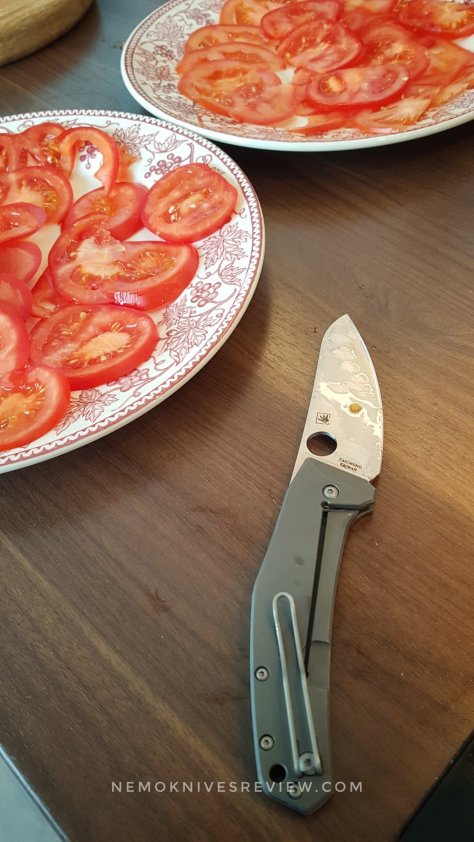
Cutting the leaves of sucres…

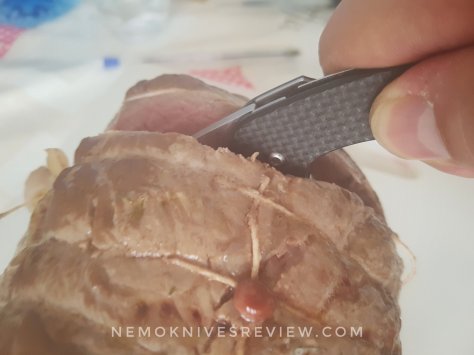
Slicing the dried duck breast.

Removing the fat.

Dicing the cantal cheese.

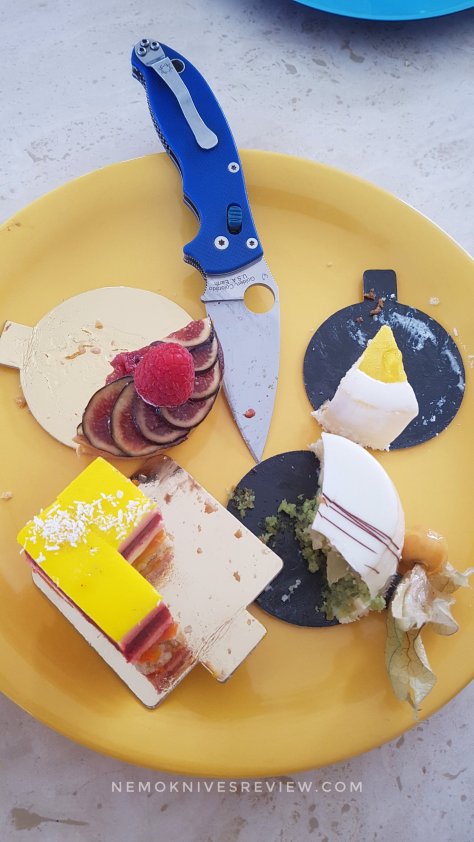
Splitting fresh figs…

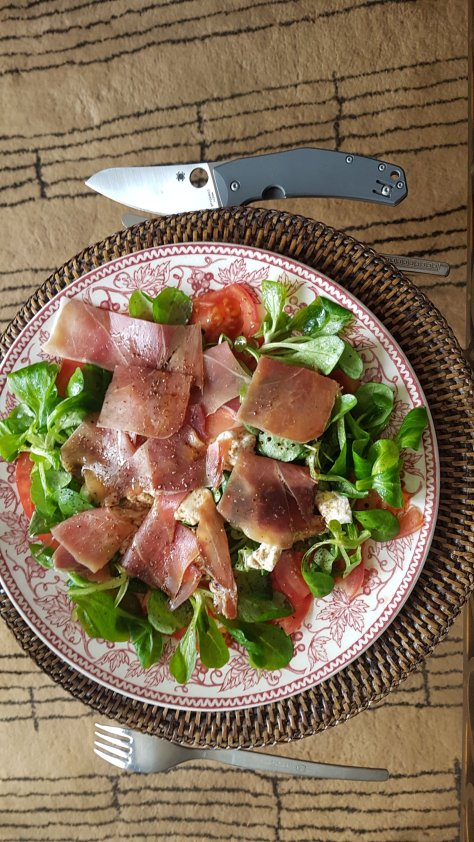
All the ingredients are ready. Add some sauce mixing olive oil, mustard, wine vinager and soja sauce.
The soft texture and fruity taste of the young cantal combine particularly well with figs and duck breast. But you can replace it with other cheeses, for example, tomme de Savoie, salers or laguiole.

JD got also a Falcon but he did not like it: here is review.
https://nemoknivesreview.com/2017/10/14/the-falcon-has-landed-by-jd/

Spyderco C22 in ZDP189 — Amazing After Six Years Hunting in Tuscany !

Six years ago, my friend Valter Nencetti took my Walker for a one year mission which turned into a six years journey. It was his favorite knife for hunting and he reported that to me in this article:  https://nemoknivesreview.com/2012/12/30/spyderco-c22-in-zdp189-italian-hunter-update-by-valter-nencetti/

This year, he has given it back to me after I had offered him my Native 5 in 110V which is IMHO an upgrade for Hare Hunting. The Backlock of a Native 5 is a perfect lock for that kind of use, but you can notice the Walker lock as not travel very far. The curved concave notch prevents it to go further.
There is absolutly no play !

For the record skinning hares is not an easy task for an edge as the hairs and the skin are ruining the sharpness very fast. There is a lot of dirt which acts as abbrasive. I have made a video and soon will put it on line.

Being used everyday, Valter eventually broke the clip which is a very fragile part of the walker compared to spoon clips used noawadays in spyderco line. You can also see it was not clean everyday and used as an EDC in the countryside of his beloved national Park in the North of Florence in Italy.

You notice the normal wear on the handle but Carbon fibers is incredibly sturdy as an slob material. It can be easily cure with some 1000 sandpaper work.

There were also no pitting on the blade or on the liner lock. ZDP189 is known for pitting strangely with its 3% of carbon and 20% of chromium. But here anyway, no issues.

I have started to clean the marks on the blade with some sandpaper.

Then I have restored the edge to razor.

No chipping.
No pitting.
No blade play.
No marks on the handle.
A broken clip.

Valter used his knife with no afterthoughts. I know it was not used on wood but mainly as a skinning tool. It has processed hares but also been used on boars and deers. Also it was used on plastic and everyday mondane tasks as Walter is breeding hunting dogs.

That’s not bad for a little gentleman knife which is a true workhorse.

Wolfspyder upgrade – adding a deep pocket clip on the folding bushcrafter.

I had ordered a titanium deep carry clip for my Yojimbo2 but eventually I did not like how it was slowing the draws on that SD folder. But there is one knife which desserved another attempt: the beloved Wolfspyder. So here it goes ! I’m always amazed at how thick the blade is and how solid this little folder is after one year without real maintenance. I have found the scandi S30V quite easy to maintain razor sharp and to my surprise it is easy to keep that way without any convexing and losing the “zero ground” scandi edge. But the best thing about the Wolfspyder is how hard you can use it with now after thoughts. You can drill with its point and cut hard in wood or plastic. There is no risk of failure from the point to the lock and the thick G10 slabs are confortable during long cuts sessions. Mine has developped zero play in any direction after one year of use. It’s one of the knife which is sheeple friendly and gives a lot of joy in use. Controlling the whittling cut is really something which gives you a grin of satisfaction. The Wolfspyder ? Still highly recommanded in my book. 😉 Easy to carry and easy to reach in the pocket. This one will be in my pocket for a trip in Norway very soon ! The Scandi ground little big knife in Scandinavian territory ! 20171004_192619-011485188651.jpeg 20171004_172752-021531683036.jpeg20171004_192521-011447988755.jpeg20171004_192536-011341008177.jpeg

20171005_093640-01981766584.jpeg

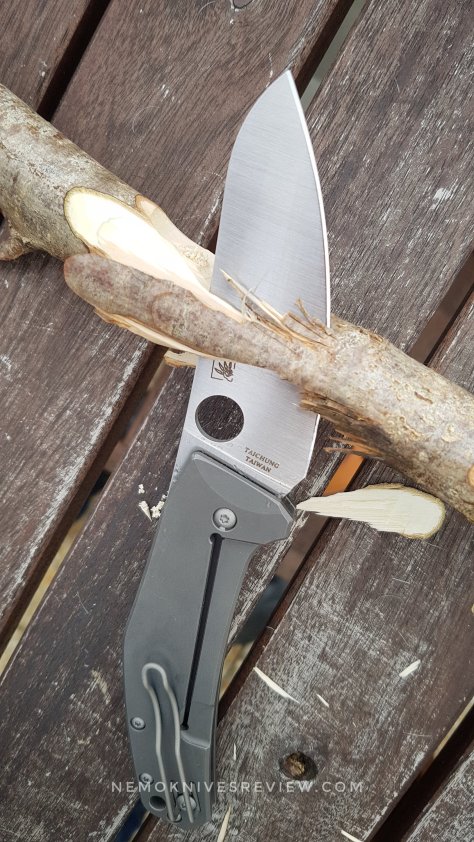
It can take big chips of wood from hazelnut trees.

Geometry rules!

And after a week end of whittling it is still razor sharp.

Spyderco Delica Vertical Play Solution

As I had pointed earlier, going back to the Endura or the Delica (no choil, lockback, steel spacer) is like going vintage in a beautiful way. Those are the roots of  modern “tactical” folders: “one hand opening and closing” and “Clip-it”.  The Endura I have bought from the Knifecenter is just flawless: zero blade play. It’s a great perfectionist work from Seki knifemakers but lockwise it was not the case with my Delica: it has a noticed vertical play while cutting hard things.

wp-image-291512078

The results on wood cutting were top-of-the-notch despite that annoying recoil of the lock on each hard cut.

I have been looking on the internet and the forums and someone mention to tight the screws. Why not ?

I have found those torx screws were not tied and I could easily adjust them in an half of a turn clockwise.

The lock screw was also easy to turn and now I don’t have that annoying vertical play anymore. Hurrah !!
Here is my solution: the handle screws need half a turn. I have done it on my Stretch and it is also now perfect.

Before when only bolts were used in knife construction it was not possible… But with the Delica 4 all screws construction it’s easy to adjust them.
The action is a little more stiff but no more recoil while cutting hard things like wood or plastic.

Tuscan Raider #6 — Ed Schempp Bowie at his best, in the plates !

It’s not a surprise but Ed Schempp Bowie is not only a knife to keep in a safe for collection.
I have been taking a lot of knives in Tuscany. Fixed blades to test in the wood of the national parks and some folders. But eventually the Bowie has taken an important place in my trip.
Why ?
First it’s a gorgeous knife which create a lot of conversation.
Also it’s so easy to pocket. This is a huge plus for this EDC: it’s stay in your pocket like a much shorter folder. It’s easy to grab it and to take it. It’s always with you.
I have thinned the edge to the level of my Delica and the result on whittling wood are really outstanding.

It was easy to keep clean and classy. Meaning it can be used in the farm and in the city.

But it’s in the plate and in the kitchen that the Bowie was able to shine bright.

On the table, the Bowie takes its place with pride.

And the Kukri’s curve (Ed Schempp Signature) helps a lot when cutting in the plate.
At the opposite of my ZT0562CF with its flipper getting in the way…

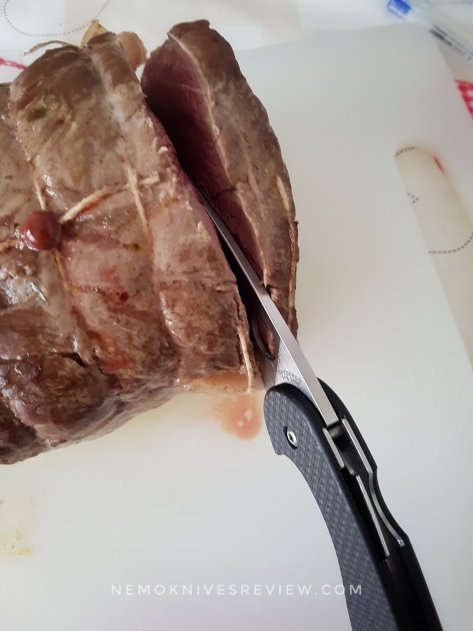
The beef meat cookes at the flame is zipped open by the convexed edge.

The Tuscanian crostini are made of liver are gently spread on bread.

The trip back home leaded us through the Alps and the Opinel birth place.

Spritz, beer, hams and cheeses. The bowie was easy to open and close without to be noticed.


The roblochon is a cheese which needs a long blade.

Eventually the Bowie excellence can be expressed in the woods and in the plate. This is not the case of all folding knives. Ed Schempp’s EDC does it with elegance and efficiency.
So no, really it’s not a safe queen this is a knife to be used every day with pride.


Tuscan Raiders #4 – Geometries, Gayle Spyderco Gayle Bradley Junction and whittling.

It has all started when I wanted to review the Spyderco Gayle Bradley Junction. It’s a great design for an EDC fixed blade which can be used for everything. Easy to carry in its pancake constructed bolteron sheath. But the edge was just too thick for my own use. To my knowledge, SPF27 is some kind of CPM D2 steel. A lot of carbon 1.5% and not a lot of chromium around 12%. Not the easiest on the stone as a semi stainless. It was not very soft under the diamonds compared to another blade in N690 HRC59 I got with me. And it was not really easy to remove the shoulder to create a gentle convex edge. Patience… In sharpening is important. And I often lack of it but I was able to improve it. Next some black stone mostly to remove the scratches. And then the white ceramic to get a better finish and a razor steel. You can notice the chamfered signature hole on the Junction. A première. The cuts were deeper. It was better! Much more enjoyable. But the spine was too sharp for my thumb and diamonds came handy to rounded the angles. It would never be a Sebenza spine…. Again the control during whittling was much much better. One should never be scared to round the edges for suiting your own needs. The handle is very flat on that knife. It’s an attention for people who wish to stash their knife in a pocket or a backpack without leaving a print. But a flat knife is not the most comfortable in the palm of your hand… Especially when cutting hard things for a long time. I decided to make a quick comparison with the Spyderco Sprig which is a pleasure to use. You can notice how the Phil Wilson’s Sprig got a thicker handle. And it change everything when cutting hard things. Also Phil Wilson’s is all about performances. Its geometry is stellar. It immediately cuts deep in wood without any real improvement needed…. But diamonds were there to be usef. 🙂 I was able to get thin regular cuts into the wood. So I have decided to try the diamonds on the Gayle Bradley Bowie I have brought with me. This one got a thicker geometry and is made if the same pulverized alloy as the Junction You can always improve an edge. Used as a light chopper it worked just fine. Gayle Bradley has provided a great compact Bowie which can be used as a light camp knife. You can see: it’s not a lot bigger compared to my Ed Chempp Bowie. And the edge once thinned is honorable. Of course it is not as thin as my Pekka Tuominen Urban II for example. And not as aggressive as the Sprig… I got…. too much knives on my table…

It was time to go to lunch. An Francesca knows how to prepare the pasta with pomodori. Crostini a la Toscane. Poultry liver, oignons, red wine, bread and a Bowie. Back in the outside I was thinking of a simple way to see the “impact” of good geometry on whittling. On the right, a single cut if the thin Delica and, on the left, a single cut of the thicker ZT0562CF. The Delica cuts deeper on a more open angle. Better geometry. But the ZT was pleasant to use even if it was not as fast at the job. Also the Delica was able to cut from the ricasso to the point without any hard pressure. In the end, I had noticed that the Junction was less good than the Sprig and the Delica was still the best whittler in the batch. No matter the steel, for wood cutting, geometry is queen. So I have taken my Bowie back to the diamonds and put a keener edge. Tomorrow it will be hunting day.

Tuscan Raider #3 – Spyderco C215GP Euroedge.

20170916_175148-0114312562.jpeg

Again this is all made with my smartphone as I’m far from any computer.

A folding dagger as beautifully designed and made is not a bushcraft knife.

But my very first modern folder back in 1993 has been a Gerber Applegate folding dagger.

The first models were made in a stainless steel close to 420Hc.

The Euroedge is made of S30V.

Cutting wood with it is like making chop sticks with a bastard sword: it was not designed for that. The Euroedge is like a weapon a Templar will keep at hand. The blade is massive and the stock is thick.

The handle is so well made G10 feels like carbon fibers.

It is one of the most beautiful Spyderco ever made and a real tour de force in pure hommage to ancient times.

“”I can do anything”, Ed Schempp, will push the envelope, often just to see if he can. I did a “hammer” in at Ed’s house. Just a bunch of knife afi’s with great skill working on a globe. But no hammers. Ed designed and built a series of miniature rolling mills so we can produce mosaic
Damascus pieces, each with an assignment. Ed’s my “go to” guy for Ethnic series knives. Take a design hundreds, or even thousands of year old, capture the purpose and function and re-create that in a modern folder. He studies the design, the history, function and purpose before beginning. Those of you that have studied and used Ed’s designs know what I’m talking about. True original classics, each and every one.”
Sal Glesser.