Tag Archives: Spyderco

Yojimbo’s C85GP2 and C85CFP2 and a Ronin.

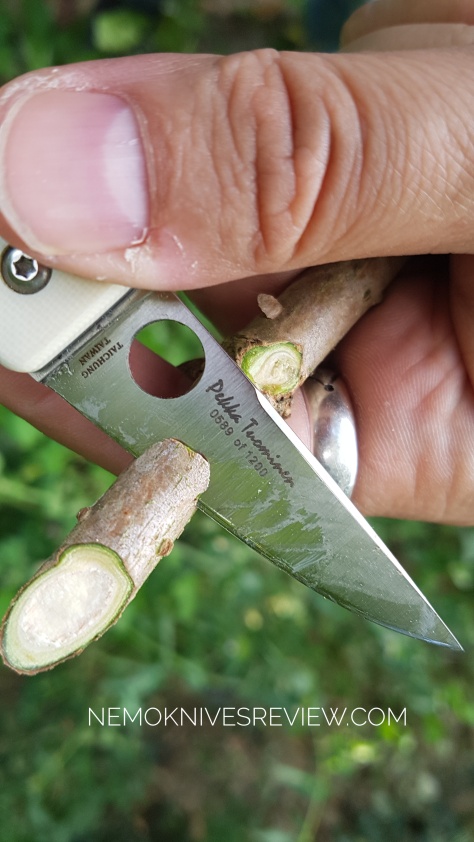
Following my first glimpse on a the Yojimbo Special Run of 2015 , I present you today the classic version of the Yojimbo: G10 handle and S30V steel. There is no difference between the knives but 4 grammes in favor of the CF version (110 vs 115).

Nemo Knives Review Yojimbos

The blade got the exact same length (on the photography, the Yo2 on the right is resting on her clip hence the parallax…). I have also found the detent to be harder on the S90V run but who minds ?

Now the main difference is the steel: S30V vs S90V.

Quoting Jerry Hossom on the knifenetwork.com :
“S90V contains 9% Vanadium. S30V contains 4% Vanadium (originally it was planned for 3% and thus the name). Vanadium carbides are VERY hard and provide a lot of wear resistance. On the flip side of that S30V was designed to be very tough; it resists chipping and breaking. S90V was designed to be very wear resistant, so it’s really a tradeoff. If you’re very careful with your knives, don’t toss them in the sink or hammer them through hard beef bones, S90V will do very well. If you’re rough on a knife, S30V will be a better choice. I’d likely choose S30V for larger knives, because they’re subjected to greater stresses. S90V is certainly fine for smaller knives. ”

So how S90V will behave on EDC chores with the Yojimbo blade particular shape especially its very narrow point. I remember the same kind of exchanges on the forums about the point of the CPM 440V (S60V)C36 military and our request to see a Millie with some strong tool steel hence the desire for CPM M4, CPM3V and CPM Cruwear version.

Back in 2002 I got the chance to own a Ronin made in VG10. The Ronin was a Mike Janich and Mike Snody collaboration on a SD fixed blade and more precisely a neck knife. I used mine for every day chore until the tip get broken and I was obliged to regrind it.

Here is my 15 year old Ronin next to the Yojimbo.

What I love in this design was the way It would cut on hard material without compromise the edge: only the point was touching the plate for example.
Then as S90V is known for its wear resistance, I should be able to keep the point sharp for a longer time…. And time will tell.

Some words from Mike Janich taken from the Spyderco Forums:

“Hey, Guys:

Thank you all for your comments and enthusiasm regarding the Yo2. I am very pleased to have it in production and I’m thrilled at the way it turned out.

I wanted to share a couple of fine points regarding the design. Like everything else I do, I like to explain why. You are free to agree or disagree, like or not like, but at least you’ll have the information to make a decision.

With regard to the not-fully-exposed Spyderco hole, I wrestled with various options on this during the design. I did not want to do the large index-finger choil of the original Yo because it narrows the grip too much in that area and starts to force the hand into a saber grip. The goal was to keep the closed knife as narrow as possible to preserve access to the pocket.

I had a similar challenge when I designed the Be-Wharned. One thing that I learned during that process was that the natural hand position for a thumb opening is typically not with the plane of the handle completely flat. Most people naturally hold the knife palm up, but with the knuckles at about a 45-60-degree angle to vertical. That means that your thumb also indexes the hole (or stud) at an angle, not flat on top of it. With the Be-Wharned, holding the knife at this natural angle and driving the thumb straight along the chamfer of the handle produces the most positive, reliable, and comfortable opening.

With that experience as a guide, I focused on the functional part of the Spyderco hole. When the closed knife is viewed with the edge down, tip to the left, this section is from 12 to 3 o’clock. That’s where the thumb actually bites and drives. That part of the hole is completely unobstructed.

As for the lock release cutout, I purposely made it smaller than that of the Para2. There are two reasons for this: First, some users–especially those who grip the handle tightly with their index fingers during opening–get a slight pinch from Compression Locks as the blade is opened. This is caused by the liner moving into the G-10 scale as the blade clears the detent ball. To mitigate this effect, I asked that the top of the Compression Lock tab be recessed slightly below the top edge of the G-10 scale and purposely made the recess smaller.

Second, speed closing of the knife is not high on my priority list. I close the knife by pinching the lock between my thumb (on the G-10 scale) and the nail of my index finger (on the lock tab). I can do this (and have done it) all day long without soreness or fatigue. For me, it’s perfect the way it is. Most importantly, the knife closes exactly when I want it to and I still enjoy both the extreme strength and the I-don’t-need-to-put-my-fingers-in-the-path-of-the-edge safety of one-handed closing.

I chose the standard hourglass clip for the Yo2 because it has been refined and perfected over the years. It works great, so why reinvent the wheel? Also, savvy Spyderco fans know that the same basic clip design used on the Yo2 is used on the Endura and Delica, but in black (and with the addition of the lanyard hole that matches the holes in those knives). Don’t like the shiny clip on the Yo2? Buy a replacement clip for an Endura for a few bucks and you’ve got an instant subdued clip. How easy is that?

As far as clip position goes, most folks know I prefer tip-up carry. The key to getting a personal defense knife into action quickly is being able to draw it and immediately open it without having to change grip position. The key to that is making sure that the overall size of the closed knife, the position of the Spyderco hole, and the height of carry are all proportionate to the average hand size. If you have a big knife with a deep-pocket clip, it may carry discreetly, but when you draw it, you’re holding it by the butt end with your thumb a long way from the hole. Unless you can magically Viagra your thumb into growing, you have to change your grip to get the knife open.

The clip placement on the Yo2 makes the knife ride high enough so that, with a proper draw, your thumb is automatically on the opening hole when the knife clears the pocket.

If you prefer discretion and a low profile over deployment speed, I purposely added tip-down carry to the Yo2. The clip holes at the pivot-pin end of the handle are as close to the front edge of the handle as physically possible to support deep-pocket carry. Yes, it’s tip down, which is slower. So is deep pocket carry in general. If you need deep-pocket carry and speed, arry tip down and use a Spyder-Drop opening. You’ll find that although a small portion of the Spyder Hole is obscured, there’s still plenty of surface area to grab onto. As you pinch the hole with your thumb and index finger, you’ll also find that your fingertips start to push the handle away from the blade, “cheating” your start on the opening.

As for a lanyard hole, I’m not a fan of fobs, so I opted for the additional strength of a screw post at the butt instead of a lanyard tube. However, if you are a lanyard fan, there is still enough room between the blade edge and the screw post to wrap a thin lanyard around the post with a cow hitch. That keeps the lanyard centered in the handle instead of wrapping around it and makes for a sleeker package. Think of a typical flashlight lanyard where the loop that attaches to the light is thin and strong and the rest of it is 550 cord sized. If you must use 550 cord for the whole lanyard, pull the guts out of it so it wraps flat around the screw post.

I hope this helps you better understand why the Yo2 is the way it is. A lot of thought went into it and it is truly a reflection of more than 35 years of experience, training, and daily carry of personal defense knives.

Stay safe,

Mike

P.S. As far as meat cutting tests go, yes, that was a big part of my personal R&D of the prototypes. Simple answer: It has more blade length than the original Yojimbo. It therefore cuts even deeper.”


Another one from Michael Janich in August 2012:

“Thanks for the discussion and your continued enthusiasm for the Yo2.

When I designed the blade for the Yo2, I took a lot of inspiration from the Manix2, both because I like the way it cuts and because, as a Golden-made product, its manufacture respresented a known core competency for Spyderco. Combining a partial hollow grind with a thick, strong spine provides a great balance of edge geometry and strength. Moving the point up towards the blade’s centerline moves it toward the thicker part of the blade; however, if the hollow grind runs parallel to the edge all the way to the point, the resulting point thickness is functionally the same as what you get with a wharncliffe.

The wharncliffe blade excels at cutting because it cuts with full power all the way to the tip. An acutely angled tip also provides superior penetration with minimal effort.

From a utility standpoint, the Yo2’s tip is analogous to an X-Acto knife and is excellent for detail work. The heel of the blade, closer to the handle, is extremely strong and more than capable of tackling most cutting chores for which knives are appropriate tools. In general, if you focus on using the part of the blade that is most appropriate to the task at hand, you can perform a wide range of cutting chores without a problem.

Having designed several wharncliffe blades now, I have also been privy to the warranty repair claims concerning these blades. In all honesty, broken tips are rare. The ones that do come in typically come with a story that begins “I dropped my knife on concrete/a hard tile floor….” or “I know I shouldn’t pry with a knife, but…”

Like a box cutter, a wharncliffe cuts with both power and finesse because of its straight edge. If your style of utility knife use actually focuses on cutting, it will serve you well. If your utility knife use focuses on prying, digging, or using your knife as a jack handle, buy a knife that is better suited to that type of use–and don’t expect it to cut very well…

I hope this helps.

Stay safe,

Mike
Michael Janich
Spyderco Special Projects Coordinator
Founder and Lead Instructor, Martial Blade Concepts”


Yojimbo 2 C85CFP2 – S90V & Carbon Fiber

“Number 17” has entered in my life yesterday as I was angry about an order blocked in the airport for 12 days. I had ordered a Yojimbo 2 (G10, S30V) and since the 5th of May it has disappeared from the tracking.
So yesterday I indulged myself with a very rare exclusive run for Knifeworks three years ago: a Yo2 with S90V and Carbon Fibers handle.
Better, I had ordered a deep carry clip and it’s now mounted.

My idea is to use the Yojimbo, not as a SD tool but as EDC tool. So this safe queen is going to see some mileage and S90V will be welcome for it’s very high abrasion resistance. This is my point, I hope the Yo2 will keep its own (point) sharp and solid.

Some intense sharpening was mandatory. The edge was uneven from one side to the other (3mm against 2mm)… Now it’s much better after some intense passes on the Fallkniven little diamond/black stone tool and the Spyderco ceramic grey/white.

And well, it works just fine.

Quoting Michael Janich about his own design on the Spyderco Forum:

“…With regard to the utilitarian function of the Yo2–absolutely. I grew up in pretty humble surroundings. Although we didn’t have much, my Dad was very smart and skilled with his hands. I learned that the best way to have stuff was to make it, so I used to spend hours making toys out of cardboard, scrap wood, string, and anything else I could scrounge. One of my most prized possessions back then was an X-Acto knife set my Dad bought me with all the different blade shapes. Initially, I thought the different blades were cool and spent time swapping blades to cut different materials and shapes. After a while, though, I realized that the standard straight cutting edge was the most versatile. If I needed precision, the tip did the job. At the same time, if I needed cutting power, the straight cutting edge transferred power all the way to the point.

The blade for the original Yojimbo was based very much on these experiences and the shape of a common utility knife/box cutter. It was designed before 9/11, but released after. Promoting it as a “box cutter on steroids” was not appropriate at that time, but functionally, that’s exactly what it was. The Yo2 does the same thing, but even better…”

And more from another thread:

” … Helping my Dad with DIY projects around the house, I noticed that most utility knives, electrician’s knives, and similar “trade-oriented” cutting tools were Wharncliffe or sheepfoot blades. Again, in practice, it made sense and they worked. I chose my first pocketknives–Case slipjoints with straight edges–based on that experience.

When I started studying combative knife skills as a teenager, I read all the classic WW2 books on the topic, many of which recommended Bowie-style blades with significant “belly” to the edge so they could be used to snap cut. My taste in knives changed as a result of that and I began carrying blades with more belly and well-centered points. My first commercial knife design–the Masters of Defense Tempest–even reflected that style. However, when I had a chance to design what ultimately became the Ronin, I went “back to the drawing board” and did a lot of live-blade cutting with everything in my collection. I found that the knife that cut best was actually my Spyderco C25 Centofante, which was a Wharncliffe. When I began to analyze and really understand the dynamics of cutting, I realized why.

Cutting is cutting, whether it’s utilitarian or defensive. For cutting power and dexterity in a small blade, the Wharncliffe really shines…”

There is nice video made by Michael Janich explaining his design here on Youtube.

And by the way, the collector is just using a Yojimbo2 (S30V/G10) as an EDC.
It got the scars to tell its story.

To be continued… here :
Yojimbos-c85gp2-and-c85…

Military C36PIN CPM M4 Exclusive Run — Ghost in the Machine

For a funny reason I give name to knives I keep. It gives them more personality. For a strange reason all my C36 Military got name starting with G like Glesser.
My Military Sprintrun CPM Cruewear is “Gandalf” because of its grey handle.
My new Military with Natural G10 (or Jade G-10) and CPM M4 blade will be name Ghost. It’s an exclusive run for Blade HQ.

This is the first time I got the chance to handle the new version: no spacer, bigger lanyard hole, bigger screws… My first Millie “Glesser”, back in 1996 was already a new version with CPM440V (S60V) and the three screws clip. 21 years later here is what I consider the apogee in this design: a blade alloy I really love and a “light” construction.
Gandalf and Ghost weight almost the same: 124g versus 123g on my cooking electronic scale. This is a light package with a lot of cutting power.
I also love the fact that the Jade handle makes it very sheeple friendly and less “military”.

Since I have reviewed the M390 CF version and the Titanium handle version.

Now I have really convexed the grind on Gandalf for wood working.
But I wonder how it will compare to CPM M4 on Ghost.
It will be the subject of another review.

Real Steel “Megalodon 2017” RS9611 – Enter The Dragon !

RS9611 Real Steel Megalodon

Again I got a really great bargain and service from my favorite Ebay retailer: Caledon2 Whole Sale Knives and Swords. Kuddos to them to beat record in shipping each time, mine arrived 4 days before its ETA.

I have found this Real Steel Megalodon 2017 model while browsing for a sturdy flipper three months ago.
Eventually I have found the Zero Tolerance ZT0770 as the Megalodon was not available. But I was caught by the beautiful lines and the materials used in this model. Chinese knives production are getting better and better and Real Steel is the new kid on the block in high end cutting tools.

According to https://chinaknives.blogspot.fr (Thanks Wayne for the head up!)

The brand was created in 2013 by the same people who brought you Sanrenmu knives.
Those folks saw the factory, that produced good quality OEM knives for American companies and cheap, but well made budget “original” design knives and thoughty it could be something bigger.
At first, they based on the same designers, that produced Sanrenmu original knives, the most known of them is Liang Gang, that designed some of SRM’s best known models. That is the reason that some of RealSteel’s designs look a lot like the Sanrenmu models (probably are the same, but with different branding).
Their breakthrough (in my opinion) came when they started working with Huang Liang Zhi, better known by the name Carson (Tech Labs). His designs were well known to the people who are interested in Chinese knives, but the quality of his knives is incredible, and second to none (maybe except some of Kevin John work).
Together they made an aluminium version of the Carson Griffin and also released his boiling flipper design under the name Megalodon (probably just put RealSteel logo on the Carson made knife).
There has been some conspiracy on YouTube lately, claiming that Carson has sold his knifemaking factory to RealSteel, but that information was proven to be wrong and was just speculation of one specific Youtuber with big imagination. Carson himself took a photo with his knives to prove this wrong.”

According to Real Steel:
“At the request of many of our fans, we have re-dedicated ourselves to the Megalodon. However Realsteel would not be Realsteel if we were satisfied with a simple relaunch of the old model. We have taken the strengths of the original megalodon on the basis of your feedback and renewed every single component. The result is a megalodon, which at first glance looks like its predecessor, but in reality it is surpassing its predecessor in its blade steel, in its finish and in many other details. This makes it interesting not only for users with the highest demands, but also for collectors.”

The Meg is destined to be a flagship. Mine is numbered  “474 “and come in a very nice box with its certificate and the name of the knifemakers: Carson Huang and Mr Li in the city of Huangao on the Yellow Sea, facing Korea. Funny to see how many people are thinking the late Kit Carson who invented the flipper is behind this one.

I knew M390 mainly from that incredibly great Spyderco Military Sprint Run.
For Jim Ankerson: “M390 even after 550 cuts it was still not getting noticeably harder to cut the rope, after 600 cuts it was still pretty easy and it would still slice paper clean…” he said in a test versus ZDP189 7 years ago.
So M390 is something of a super steel which, if well heat treated, can beat records. Again Jim Ankerson tests makes M390 ahead of many competitors for rope cutting.

The clip is not has good as my Mantra 2 or ZT0770 but it does the trick despite a very unorthodox design made to get caught in the lips of the pocket. There is a warp in the clip look which combined with the gap in the handle can make the pocket insertion tricky. The G10 version doesn’t have this issue.

Anyway, the Megalodon handle is some kind of work of art. It shows how the industry has progressed in machining titanium. Though it is not as impressive as the Slycz Bowie handle … But beautiful curves and clever design which made the illusion of a longer blade compared to its handle. It’s a very sleek piece of cutlery.
You got all the last gizmo in the knife industry. The Integral Lock is renforced again wear and has a security to avoid bending the spring too far for example.


There is milling on the inside of the scales making the full titanium handle very light and the knife is very well balanced once the blade is deployed.

The action is incredibly smooth thanks to its “Pin Bearing”. Kevin Cleary in his great video on 7th minutes explain it. No balls but pins. Simple as that.
The action is as smooth as the Rubicon 2 which means a really really smooth experience. Better than my Mantra 2 and quieter than the ZT0770 spring assist authoritarian opening.

The 3,5mm thick beautiful full flat blade is a razor right out of the box and the edge is thin. With 10 cm long this is not a short tool but it carries quiet well.
I have start to thin the edge further and you can see pictures of the process on our Facebook Group here.

The full open design of the handle makes it easy to rinse after use and I really think this Chinese flipper is made for being used in the wood with no afterthought. China is making now great “separators of matters” for the money, from the Spyderco Polestar, the Byrd series and now to the Real Steel high ends top of the notch folders, I think, after “Made In Taiwan”, “Made In China” is soon going to be a quality label.
But yet they are really shy about that.
“Real Steel” are word in English not Chinese.
And nowhere on the knife you will found “Made In China”  or  “Huangao” written…
Shyness versus China ?

To quote Gary W. Graley on his review on Bladeforums. on the difference with G10 version:

“I did end up getting one of the Ti versions, also a very nice knife, VERY smooth flipper and solid lockup,
Some differences between the G10 and this Ti version

Price, yep, you knew that was going to be there, it’s quite a bit above but with that you do get needle bearings for the pivot mech, Ti frame lock and M390 steel, all add up to be worth the extra price tag

the blade is a smidgen longer than the G10 versions

the blade grind is slightly thicker and as you can see ground a bit different, I am getting about .023″ at the edge bevel where the G10 I’m getting about .017″ so that’s a good bit thicker, but, it is still pretty thinly ground compared to a lot of folders out there, it does cut well.

Handle, the thickness of the handle is thinner than the G10, and of course being Ti it is a little smoother, but the contours provide adequate grip, I do like the thicker G10 handles myself though.

Overall, these are BOTH excellent value knives, highly recommend either one.”

The blade is centered.


Comparaison with other classics.


Comparaison with my 1996 Sebenza.


With the Spyderco Slysz Bowie.


With my CPM Cruwear Military.


With the mighty K2 !


a very Steampunk clip.


It cuts the Coke bottle butt with zero issues but it could and should do better.
Reprofiling is on its way here.


On the edge of the Polestar by JD

Like Nemo I have received my Polestar as a gift from Spyderco. It was in the goodie bag at the 2017 Amsterdam Meet. When I took the knife out of the box and looked it over my first impressions were positive. The blade opened smoothly and locked solidly with the lock bar fully engaging the tang. I liked how the gray G10 looked and felt, a nice combination of grippy and smooth. Clip tension was also excellent. I could slide the knife in and out of the pocket and waistband without any problem. The edge it came with from was less impressive, it could push cut receipt paper but had no slicing aggression at all.

When I came home I put a drop of Nano oil on the pivot which made it even smoother. I could flip the knife open with my middle finger, which is a lot of fun! Other than flipping it a few times I didn’t know what to do with Polestar. For me it is quite a big knife, having a blade length of 8,5cm. In my urban environment and with my use I have found that a blade length between 5-7 is ample. Small knives are often just more convenient for me.

After a few weeks of from time to time picking it up and flipping it I decided to give it a try and see how I would like to carry and use it. Like Nemo I moved the clip to the tip down position. I was going to carry it in the waistband and tip down carry reduces the chances of the blade accidentally opening. Thanks to the Spyder hole hump it could still be easily and quickly opened with the Spydie drop.

Before I was going to use it the edge would need to have more slicing bite then it did new. So, I thought a few passes on a coarse DMT hone would be enough for a quick touch up. I was wrong! I found out that, especially close to the recasso, the edge was pretty uneven. In some places it was even a high angle convex. The edge would need to be formed anew!

I cut of the old edge with a few light cuts into a stone and then created a new edge with my extra coarse DMT hone. I was interested in how the knife would function as it was intended by Spyderco. So I did not change the angle of the edge much but just evened out the edge bevel and formed a new apex. The steel was not hard to grind but, due to the unevenness, some parts needed lots more work than other parts. After I had was sure of having formed an apex by creating a burr on either side of the edge, I removed as much of the burr as I could by using alternate and high angle strokes. The burr flip flopped from site to side a lot and was not easy to cut of. Once I had removed most of the burr on the extra coarse hone I repeated the procedure on the fine DMT with the same difficulty in removing the burr. At that time the edge would slice receipt paper well but I have had better edges.

From past experiences I know that often a new knife needs to be sharpened a few times before the edge reaches its full sharpness and edge holding potential. So, this did not disturb me much. It was to early for conclusions.

I proceeded to cut up some cardboard before repeating most of the afore mentioned sharpening procedure. Only this time I finished on the diamond side of the Fallknives DC4, one of my favorite hones, to an edge that would just split head hair. Removing the burr and finishing the edge had become a bit easier this time around. Over the following days I carried this knife and used it for my normal cutting tasks. Mostly cutting paper cardboard and plastic packaging material and perhaps a bread bun for lunch. A funny thing I noticed: the edge its cutting ability seemed to first increase, then settle down, before slowly starting to dull!

After about a week of use the edge would still work for most of my cutting tasks but had lost some of its sharpness. I decided to resharpen the edge with just the diamond side of the Fallkniven hone again. Getting it sharp enough to shave arm hair was easy but getting it to split head hair still proved to be a bit fiddly, although I did managed it in the end. By comparison: my Elmax Squeak went from not biting in to the hair to cutting the hair with much less effort. A few passes on the hone did the trick there.

Normally I would have put the knife in pocket pocket as it was sharp enough for me use, but out of curiosity and to check my findings I resharpened it once more. I had become a bit easier to remove the burr and to make the edge arm hair shaving sharp. But to get the edge to split head hair was still a challenge. With other knives like my Maniago Spyderco’s in N690 and Elmax and, for instance, my Victorinox Bantam this had never been this difficult.

Overall the Spyderco Polestar is an enjoyable and capable knife: flipping the blade open with the middle finger is still fun and the handle works well, it handled my cutting tasks fine ones I got it sharp, but I am not impressed with the condition of the steel at the edge on my example. Still, it was interesting playing around with a knife that is so different from my usual fare!

JD

Spyderco C220GPGY Polestar – Workhorse for the budget-conscious user.

Spyderco Polestar

Designed for budget-conscious knife users who demand genuine Spyderco quality, the Polestar was offered to all attendants at the last Amsterdam Minimeet (2017). That’s how I got mine.

What could be the definition of a Workhorse ? We got example of knives which has been used hard, lost, bought again, always in our pocket, the one we use for dirty jobs and that we trust.
Classic examples are: Swisschamp from Victorinox and their Spartan, Buck110, Spyderco Delica, Opinel N°8, Mora’s Companion, Benchmade’s Griptilian, Coldsteel’s Voyager, Pradel’s folder, Doukdouks… to name a few…
Those manufactured knives do not have the best new hyper duper high carbide power metallurgy steel but they can get a keen edge and you won’t need a sharpmaker on the field to keep them sharp. And you don’t pay a premium.
So the Polestar leaf-shaped plain edge blade is a full-flat ground from American-made CTS BD1 stainless steel.

Again, the equation for a great blade is: steel + Heat Treatment + geometry. Fred Perrin uses 1075 steel but his geometry, heat treatment and great ergonomy makes the trick.
Twenty years ago, with Fred, we were testing a famous “tactical” collection names “Master of Defense” now discontinuited. Eventually we found, despite their high sexiness (black blade, premium material and designs) they were not able to hold an edge for a long time. Compared to our Spyderco Military (CPM440V) and my Sebenza (ATS34) they were almost useless for us. Thick edges on CPM154 did not make the trick for users.
The same year (I think it was 1996) we got the opportunity to test some Pakistani 1 dollars folders (Laguiole knockoff). Their thin blade were really capable. We were really impressed. Those shitty knives were users and keepers.

In June 2012 I was able to test a Spyderco Persistence. I enjoy many things in that knife but I did not like how fast its edge could get dull. I have tried to get beyond the factory (burned) edge but without any improvement. Based on that sample, it was really frustrating for my use. No chipping though, but a real tendency to ask for ceramic touch up twice a day. Since then, I have been staying away from Chinese Spyderco and Byrds.

I still got a Titanium Catbyrd wich has been a running test of 200 pieces to try the equivalent of 440C in China 9CR13MO. And despite a thick edge to my own standard, it has proven to be a much better option for an EDC user.

Back to the Polestar, this time the steel is American, made by Carpenter. You can find it on Spyderco Kitchen knives, a Mule, my UKPK and a lightweight version of the Manix 2. So this is a folding kitchen knife blade after all !!

What make the Polestar loveable is its design. Even if Spyderco recognised it has made some kind of retro engineering on one of their Byrd linerlock, for me the Polestar is the heir of their infamous Tenacious: there is no choil ! 🙂
The open construction makes cleaning easy. The wide lanyard hole is a reminiscence of the Paramillie 2. You got four positions for the clip which is much better than the Rubicon 2 in term of usability and “clipability”.

It can be easily open using the Spyderdrop technique so I have mounted the clip for tipdown carry. It’s fast and the knife is ready to cut. It suits my need.
At 3,3mm (0,13″) of thickness the full flat ground blade is a really beauty. There is a lot of Spyderco DNA in it. And it works great.
Yes, there are also a lot of quality  and attention in the manufacturing: my Polestar is perfectly centered and locks with zero play. This knife is serious business.
The G10 texture is something new. Some kind of peeled blue and grey G10 which gives IMHO a premium look to that knife. And under the thumb it is not abrasive at all. No sandpaper needed for my own use. The stainless steel construction give also some weight and no lateral bending.

So what do we got for around 60 dollars ? A solid sharp knife you can use with no second thought.
Like I wrote in the very first article of that blog here quality is not synonym with the geography. Viking used to got to Persia (using the Volga river) to buy the best steel for their swords because back in that time, some of the best alchemists were there. Chinese manufacturers are getting better and better. Just look at the Real Steel collection and especially at their Megalodon flipping folders. Chinese production will soon get pricey as they are investing a lot in robots. If you study the age pyramid in China they will be confronted to a demographic problem. So they need robots and computer controlled production able to deliver constant quality in manufacturing. Never forget all our expensive Apple toys are made in China not in Frankfurt !!

So, the Polestar is the choice for a hard use EDC and also a great guinea pig if you want to master the art of sharpening too. You will enjoy how fast you can get a popping edge back. And you won’t mind using the blade on hard surfaces. This what a workhorse also made for, cutting on a plate or on concrete, with no second thought.

My FranckenStrech is equipped with a Super Blue Steel. That was my idea of a EDC Workhorse: thin angry edge, easy to maintain, easy to carry and sheeple friendly. This tough cookie is hard to beat. Both designed by Sal Glesser.

The edge is not the thinnest (not bad actually !) but the cuts are precise and powerful. It can be thinned easily with sandpaper.

The Parmigiano chips is also a good test. They are transparent !

After whittling hairs, to cut against hard material like glass is not a concern.

You can notce where the edge has rolled. In two ceramic passes it was straight again.
I won’t have the same ease of realignment with K390 I think. 🙂

Some of my Spyderco workhorses: the Millie, the Manix, the Polestar, the Stretch and the Slysz Bowie.
Different budgets for different tastes. All those knives are easy to clip, got enough edge for a lot of application and are easy to clean. The three knives I have not reprofiled are the Slysz and the Polestar.


Team Cuscadi new Carbon Fibers Scale on K390 Urban.

Why the change ?

After my Urban review I wanted a smoother experience. And give a more precious apparence.
Carbon fiber is a really sturdy material and twenty years ago you could only find it in Formula One and jetfighters.
The feel under the thimb is wonderful and the knife get clipped with ease.

Great work from Team Cuscadi and great service.

Team Cuscadi Scales on Urban K390

A first glimpse at the Spyderco C187CFP2 Peter Carey Rubicon 2

I’m not a fan of thick hollow blades for quite long time now. The Gil Hibben Rambo III knife is not in my dreamlist anymore and the last hollow ground knife I have reviewed has been the Recon 1. But one of my favorite knife, which has not been reviewed is my 1994 Sebenza. Anyway, the Sebbie and the Cold Steel or even the Gayle Bradley are holow ground but not thick blades.
The Peter Carey Rubicon 2 is 3,5mm thick and for a 3 inches blade it is substantial.
(The Slycz Techno was 5 mm though…)

The Rubicon 2 is not a big knife, is it destined to be an EDC. He’s not heavy, its liners are made of titanium and the scales of peel carbon fiber.

The first you enjoy is the ease of deployment. This knife flips like no other in my collection. No need for assisted opening on this baby: the heavy blade, the ball bearing pivot and the well designed flipper make the trick. The opening is positive everytime.

Eric Glesser told how difficult is it to have a flipper which also provides an alternative opening system. Meaning: sometimes you just want to open your blade gently with the Spyderhole and not with the flipper. You want to trade a “shlack!” for a “click!”.
The Rubicon can be open with the thumb and even the index. It’s fun how easy it is! The operation is so smooth and could be catagorized into the gravity knives family. This ease of operation has been a big charm upon me: the more I’ve played with the knife, the more I have enjoyed it.

The blade got a beautiful satin finish perfectly executed, perfectly executed, symetrical and and centered.

The second big charm on the Rubicon 2 is the handle. The way the flipper create a guard and a subguard, depending how you hold it. This short handle is married litteraly to my hand. For once, there is no lanyard hole and the butt of the knife is pointer than its blade.

A beautiful orange spacer gives a very hightech look to the knife as everyparts are perfectly adjusted: spacer, scales and liners. This high quality of manfacture is again provided by Taichung in Taiwan.

The bronze washers and the ball bearing gives the smoothness and the exterior stop pin assure that the washer are wide enough for stability: no lateral play.
The only break to the action could be the ball detent of the titanium liner lock but it is minor compared to the momentum of the blade.

The design is well thought also once the knfe is closed.  The Rubicon 2 gently rests in you palm confortably. The peels carbon fiber is very nice against the skin giving a very positive grip. The jimping on the blade are purely decorative and this is the way I like them two.
I won’t need to file them.

The blade is wide and thinly ground and very effective thanks to its nice belly. I was able to push cut through hard material easily. It has surprised me how it zipped though.

The balance of the Rubicon 2 is perfect IMHO. The choice of the material again provides that. The handle is very light.

I haven’t been able yet to find an easy to clip carry the knife. The texture of the scale and the very strong clip give a lot of friction. I was even able to carry it in the pocket watch.

Compared to the Ed Schempp Bowie for example: the Rubicon 2 is not pocket friendly at all.

It is not carried deep and the orange spacer screams loud : “Hey look !!!”

I’m so unhappy with the way the knife rides in the pocket that I’m thinking to use a pouch and get rid of the clip !

For the moment my cutting test with the Rubicon 2 has been really positive. It’s a short knife with a big potential.  Also your thumb can easily rest on the spine giving you more leverage.

So here we go with a first glimpse to a very well designed knife. I would have been more excited to get some exotic steel on such a radical design but S30V heat Treated by Spyderco does the trick.

The Rubicon 2 is destined to be a reliable workhorse and not only a looker and a very addictive flipping toy. There is a strong will behind its design to provide strong cutting power in a small package in its design and all is served by an ergonomy which is for me magnificent. The knife is simply anchored to your hand.

Spyderco C127PGY Urban K390 – Lil’Grey Alien armed with Hyper Steel.

20170227_003137_zpscvv2wsax

Mostly knives company gives the best steel to there flagship models but again Spyderco create the surprise in bringing a 1200 pieces sprintrun of their lightweight Urban slipjoint folder with the best of the best of the cold tool steel: the Austrian Swedish-made Bohler K390.

The steel is a third generation powder steel and to quote them:
“Just as mountaineers need the best equipment to conquer the highest peaks, it‘s essential to use the best materials for your tooling to ensure trouble-free production and achieve outstanding tool life. Three reasons why BÖHLER K390 MICROCLEAN is highly cost effective: Extremely high wear resistance, excellent toughness and very high compressive strength. The high-performance powder-metallurgy steel BÖHLER K390 MICROCLEAN is a reliable solution for your difficult cutting, die-cutting and cold forming operations, and it has a very good track record for applications in the plastics industry.”


Phil Wilson has been using it and he’s known for getting the best of super steels.
“I have been using K390 from the start ever since it was introduced by Bohler and I got some small samples to try. A bit of history is that it is the European version of CPM 10V but not the exact chemistry (about 1% less V plus small addition of a few others). That is because the CPM 10V chemistry was protected by patent at the time. If you check the K390 data sheet it claims that the bit less V gives K 390 a little boost in impact toughness. It also can be heat treated at a lower temp. than 10v. So it is pretty much the same as the A11 grade but different in a few small details. It is hard to tell the difference between CPM 10v and BU K390 in the real world in my experience. I like both grades and they are the base line (along with Vanadius 10 and K294) from which I measure wear resistance. The 5 chrome is there to make them all air hardening among other things and does not contribute much to corrosion resistance. It is going to make a killer knife in the new offering and be another classic. Phil”  On the Spyderco forums.

So one of the best steel is available on a slipjoint the C127.
It’s almost the same cockpit as the Squeak, the blade is a tad under three inches with a full flat ground blade. The backspace is in stainless steel and is used as main spring and the handle are FRN: fiber reinforced nylon. A generous choil gives you security as the blade cannot close on your finger. It’s the same idea as on the C36 Military you hold the open folder by the blade so there is less stress on the pivot. The hump and the choil work as the quillons of a boot dagger. It means also you can give a lot of power into your cuts.

The C127 is modest. This is not the K2. The Urban is a gentleman knife legal in many places. If it was a car, it would not be a Landrover but a Mini.
But here the Mini is turned into a mini Cooper with a very powerful prepared engine as the steel is the chore of the knife.
Again steel is nothing without a good heat treating and without a great geometry adapted to the steel.
And my C127 arrived with a very thin edge. The Maniago naufacturer seems to be very good lately in the way it provide good edges to its blade. Like the Elmax Squeak I was able to cut through the bottle butts with ease and control. The knife cut precisely with not a great amount of force, this is always a pleasure to fill the thick center crossed without the rest of the bottle to collapse due to too much strenght.

Now K390 is not stainless and it suppose to develop a patina. This is good news as it will gives to the knife a lot of character by turning it full grey !

It’s not the first time that Spyderco equipped his FRN knives with the best exotic super duper steel. It was the case with CPM110V on the Blue Manix 2 FRN and the Blue Native FRN . K390 is going also on another flagship: it will equiped the 4th edition of the Police Model. I had the chance to handle it yesterday at the Minimeet and this is going to be a great big folder with a lot of cutting power (Full flat ground large blade) on a sturdy construction (I just regret the did not bring the Power Lock on the Police model, but this is just me…).

For my European fellow have found easily the knife for 77 euros shipping included.
You can use the search functions and do your math and have the chance to try K390 on a very low profile plateform.
I have since mounted Cuscadi Carbon Fibers on this little gem.

Spyderco C154TIP – Every Day Squeak !

It’s time to present a one year old friend who doesn’t want to leave my watchpocket.

The Squeak in its Deluxe Sprint version: Titanium handle and Elmax steel blade.

This little knife is made in Maniago Italy but has been designed by Sal Glesser.
You can find Sal signature engraved / laser etched on the blade near the hole.

This is one of the shorted blade I own, but again, unique to Spyderco, this is a little big knife.

The first sensation is purely tactile. The smooth titanium handle is a pleasure under the thumb and in the palm: its smooth surface and rounded edges are very appealing. The ergonomy is superb in its three fingers grip.

Noted that Satin finished Titanium can be a scratch magnet but you can easily remove them with light sandpaper or jeweller erasers.No big deal.

It’s a very minimalist construction every is hold by two screws. A third one is used for the deep carry clip which is my SPyderco’s favorite

The blade is full flat ground and especielly thin edge witha great steel: Elmax.

The choil makes it a reliable folding tool even if its a slipjoint.
The sprint is strong, much stronger than my UKPK, and the short blade offered less leverage for closing. To quote Spyderco: “The Squeak’s blade is held in the open position when cutting by a notched-joint at the knife’s pivot.  When closing the blade, the notch generates resistance functionally similar to traditional slip-joint penknife and performs the additional function of smoothing the motion of the blade opening.”

It’s a very very sharp blade. It goes through plastic bottle butts very very easily. The excellence in steel choice and the great edge geometry is so great that I have not touch it at all since I got it. After one year on regular use, the knife is still razor sharp. I keep it that way with some white ceramic and stropping on leather. That’s all. It is ‘that’ great.

I was very surprised by how usefull a short blade like this one can be.
Carried as a second folder (when usually I only use one knife or one multitool)

in my pocketwatch, the Sqweak has proven to be very useful.
I have been also able to eat with it. Its belly helps a lot to cut the meat in a plate. Again, the knife is not rising any eyebrows, nobody seems to notice the little tool in public places or even in a restaurant. Let’s be clear, knives in restaurant suck, one of my favorite low profile knife for that is the Mantra 2. It’s always handy to carry a small sharp blade in places where any knife could afraid the sheeples. I use mine a lot in the supermarket. It gets fast in the hand, open fast and closed fast. Very discreet and very powerful on cardboard and plastic tags of all sorts. Also last year I have been obliged to carry a Leatherman Wingman and the lil’ Squeak was my main eating knife for bread, cheese, sausages, meat and it was easily a much better blade than the multitool’s short thick blade…

The Squeak has also replaced my Pingo as my UK knife. I was on the verge to by an elmax Pingo but eventually I really need the opening hole. I need a one hand opening knife. Also it has renewed my love for Elmax so badly that I have bought the Zero Tolerance ZT0770.