Tag Archives: Spyderco

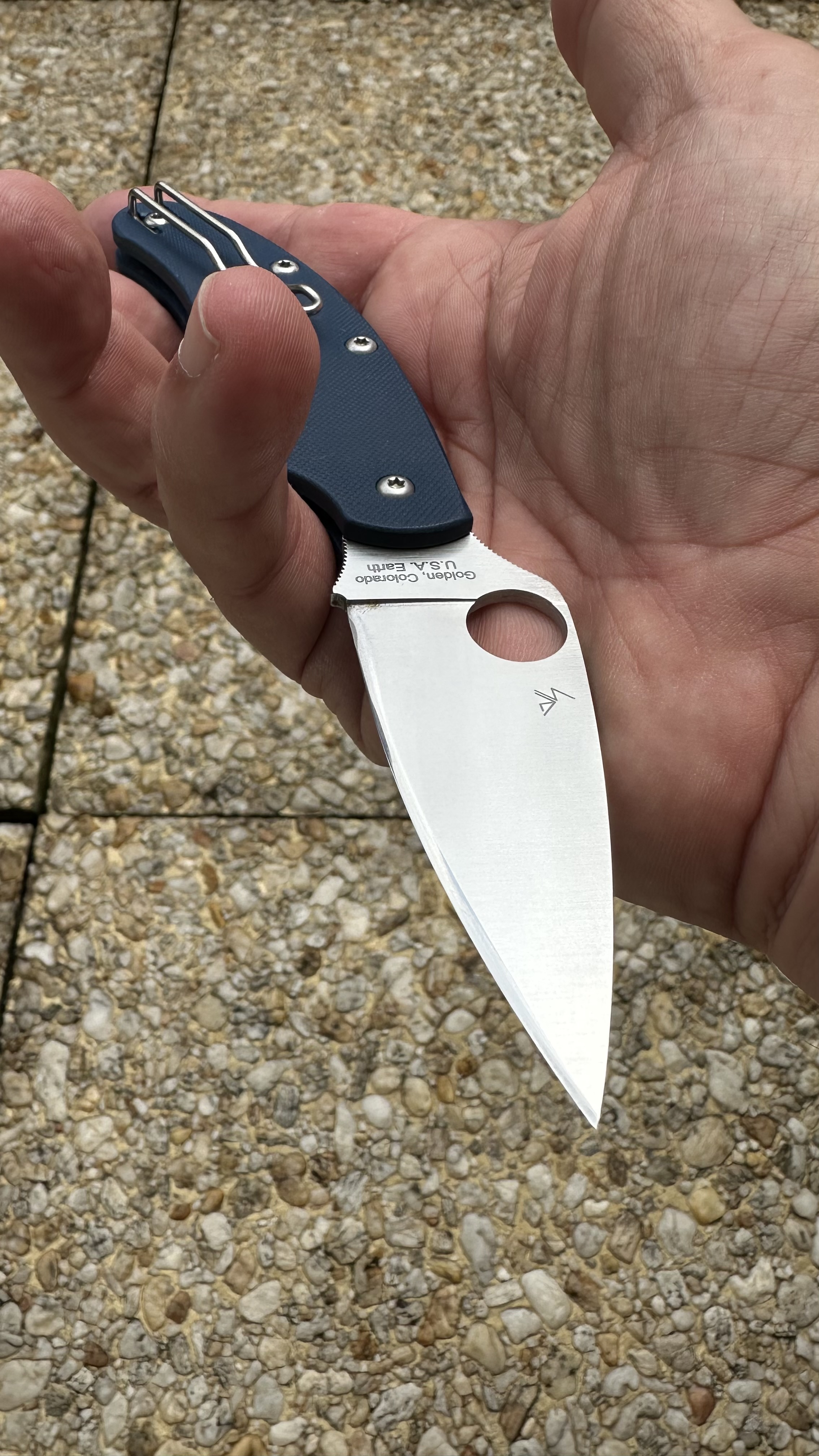
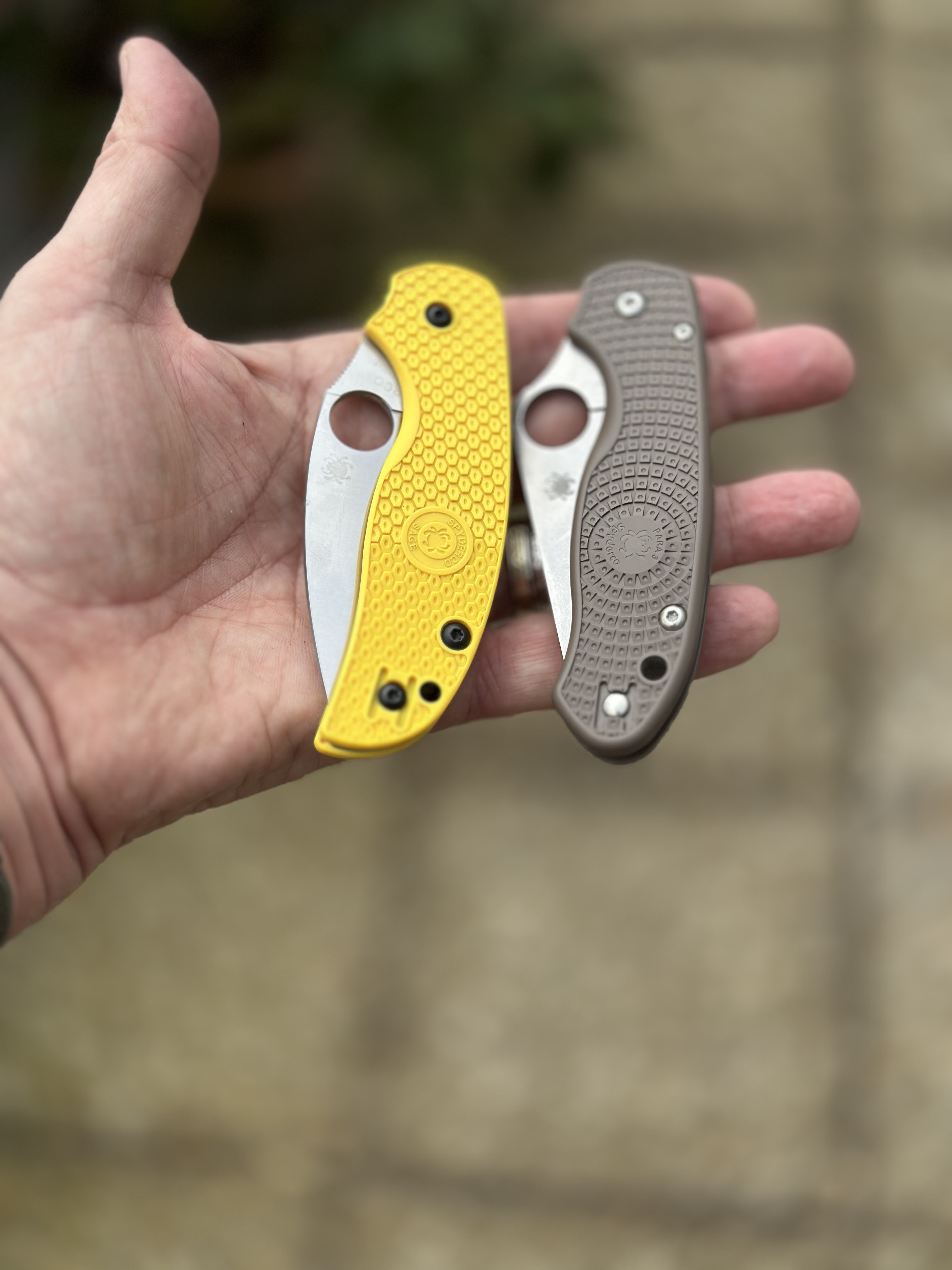
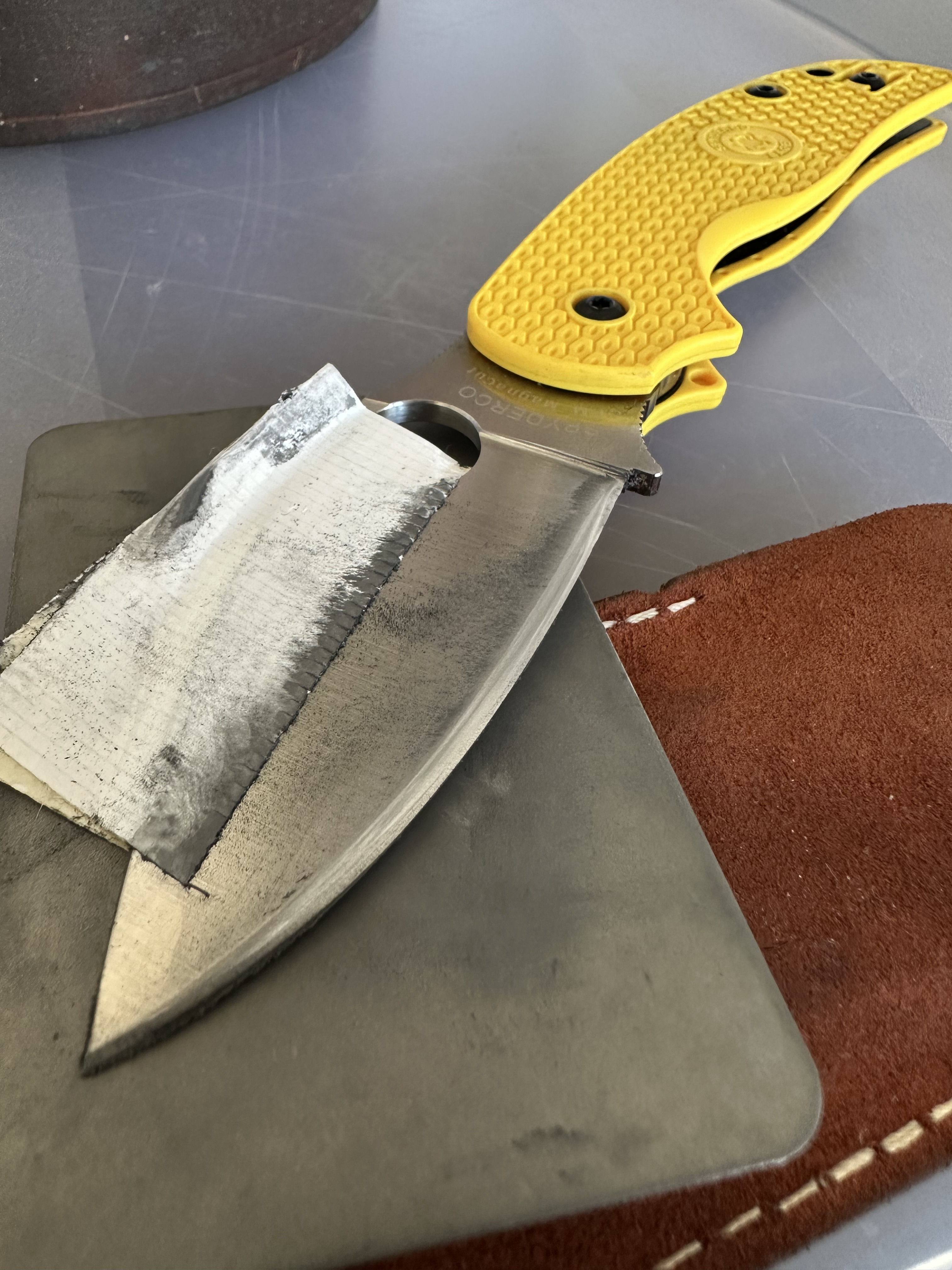
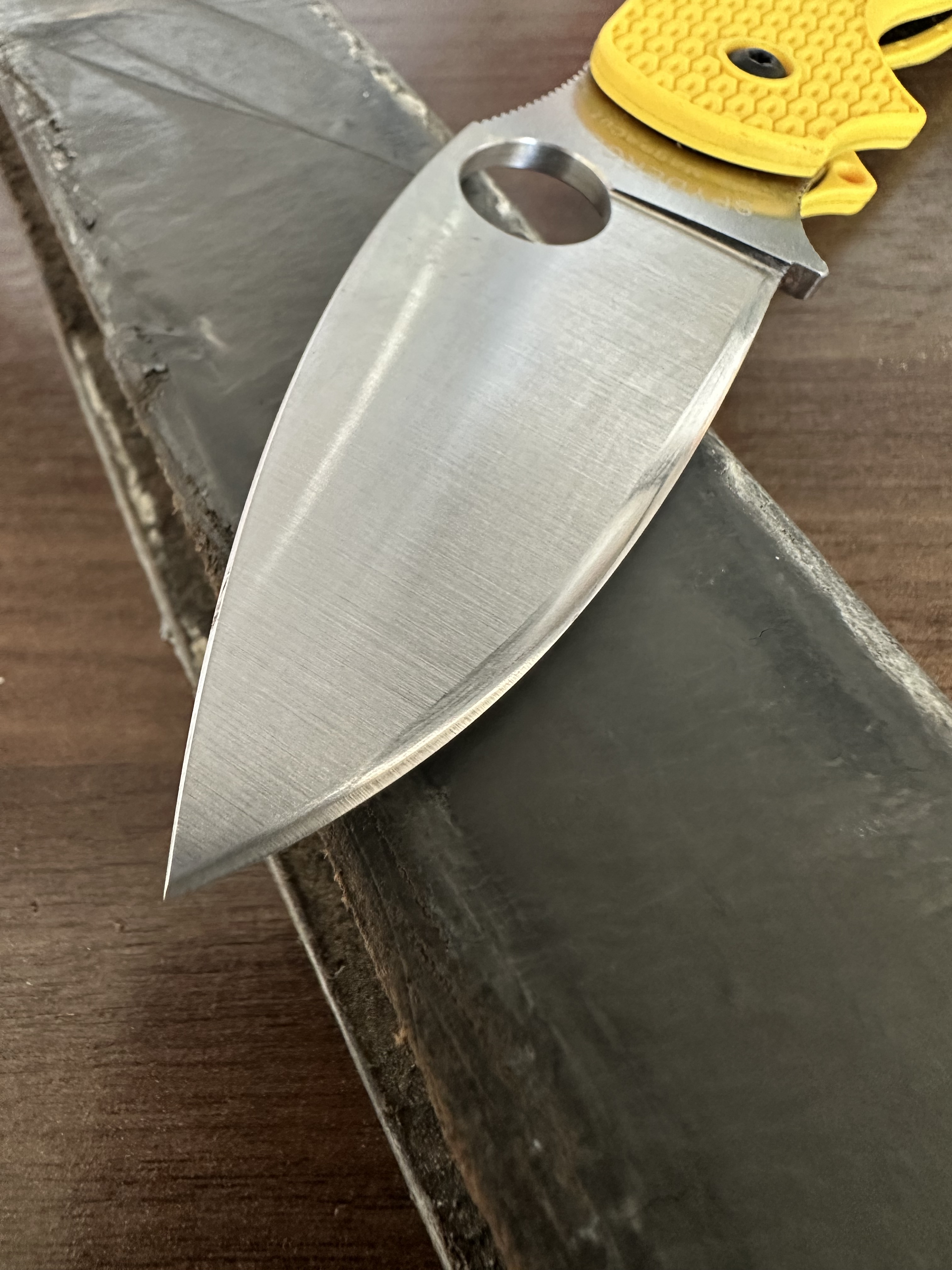
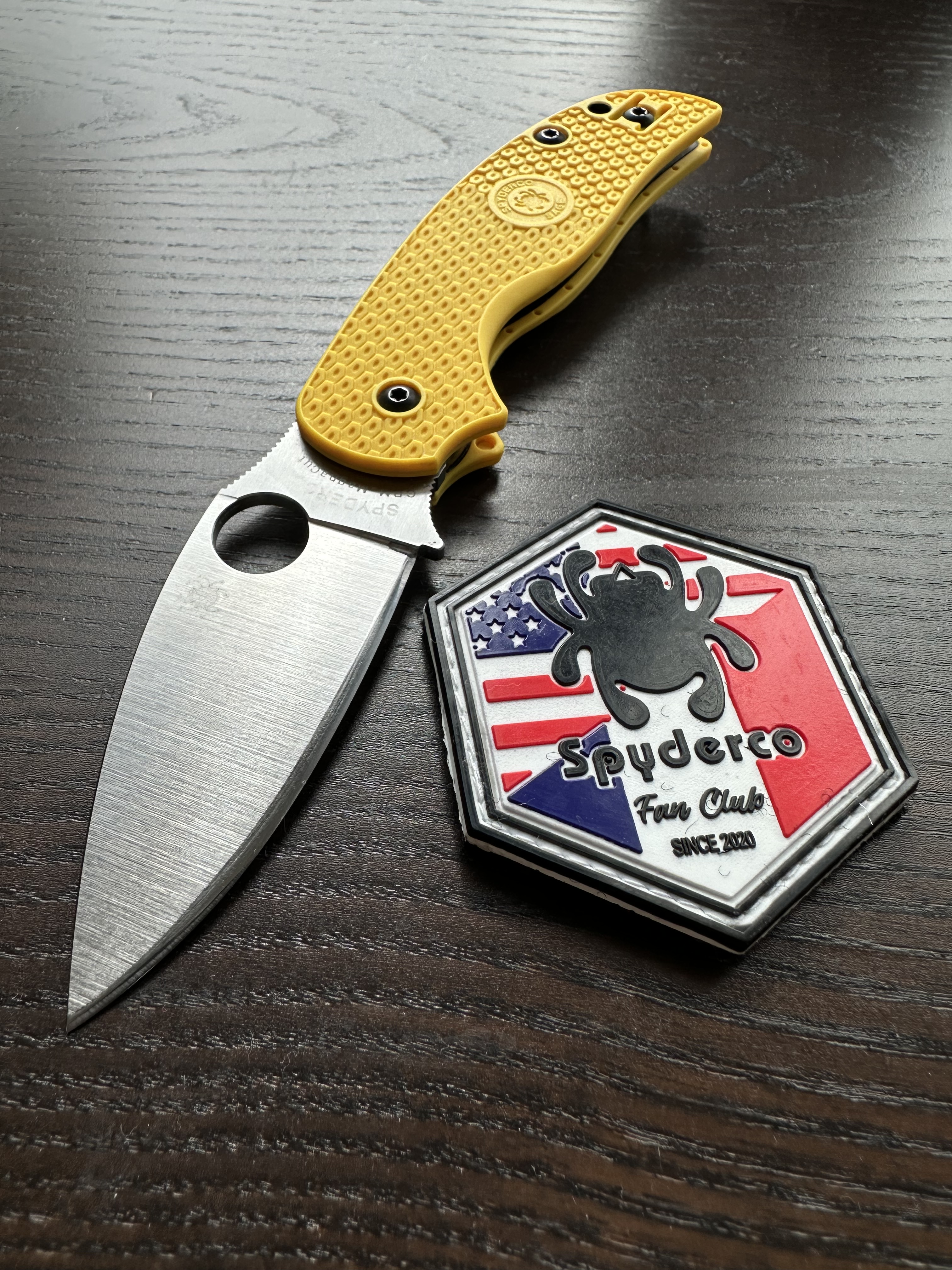
Delica K390 with Lynch Titanium Scales – A Wolf in Sheep’s Clothing !

I got the chance to get that customized Delica through Henri Ramsey, a Spydiefriend from the Facebook French Spyderco Fan Club.

The K390 Delica has always been a monster of pocket knife (click on the name to go to my old review of the Delica with buffed sprint alloy). The thin blade mixed with the super tool steel allow (K390) alloy has proven to be amazing for hardchore.
From their Seki Japan plant, Spyderco is producing many different K390 model, folders and fixed blades. The Stretch 2 being highly regarded as one of their best design.

The Blue Pingo has been made in Golden though.

So here you got an incredibly tough, strong and wear resistant blade on scales produced by Lynch. A typical Sal Glesser design: performance first !

But Lynchnw has taken that game to another league with their scale:

A few years ago Casey put out a very limited run of the LynchNW MOD 1 Delica 4 and some scale sets. This is our newest Delica MOD 2 Titanium Scale Kit, modifying your choice of Delica 4 Knife with a set of Custom Titanium scales, featuring a forward finger choil, blade profiled scale holes, smooth bellied profile, a custom titanium back-spacer, enlarged lanyard hole, and a custom designed deep carry titanium clip. ” To quote Lynchnw.com site.”

What bring these new scales apart of adding titanium for the pure neo industrial look of it ?
It bring many things:

A finger choil. A real one.


A longer handle and your pinkie will thank you for that.


A slim package which is soft on your pocket trousers.


Seven holes which are showing the edge of your knife when it’s closed.

See how cute is it ?

So here we got a very friendly city pocket knife which is not screaming “I’m a sword from Hell !!” like my new beloved Hellboy Chief or this AFCK in M2.


It looks like a lady and gentleman knife.
But beware of the wolf in sheep’s clothing.

This one share the same core engine as a Police 4: K390 at 65HRC in a thin geometry ! It is a Metropolice knife.


The Amphibian Milestone in CPM Magnacut : the Paramillie 2 Salt has landed !

The Amphibian Milestone in CPM Magnacut iq PARA MILITARY® 2 SALT® BLACK G-10 CPM MAGNACUT® BLACK BLADE – C81GMCBK2, which is much too long to fit in a title.

This is not my first Paramillie 2. I usually wear the 52100 carbon fiber version, but I have used many versions in S90V, CPM Cruwear, and S30V. The 52100 is actually the exact opposite of this new version.
Announced at the 2023 Amsterdam Minimeet, a Paramillie impervious to the elements. Better: a nautical version ready to stand tall in front of the salty waves of the ocean’s breakers.
Then the wait began.

And here it is, in all its glory!
Delivered with Larrin Thomas’ dreamlike alloy: the CPM Magnacut!
A steel that hits a lot of sweet spots. Like a sort of totally rust-free CPM M4: strong, resilient, and able to withstand thin edges without chipping.
So why add a DLC on that alloy? Overkill can be fun, can’t it?

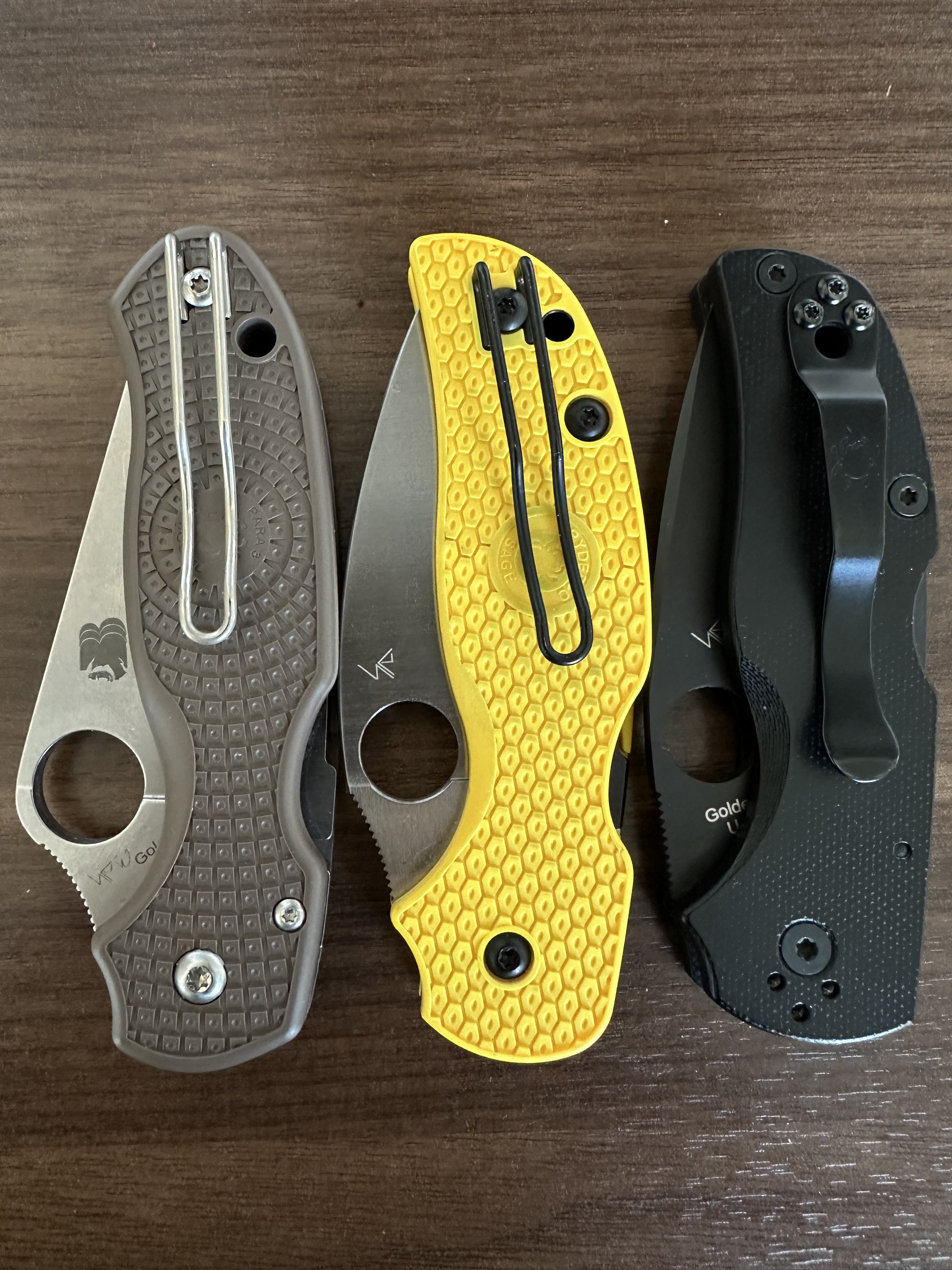
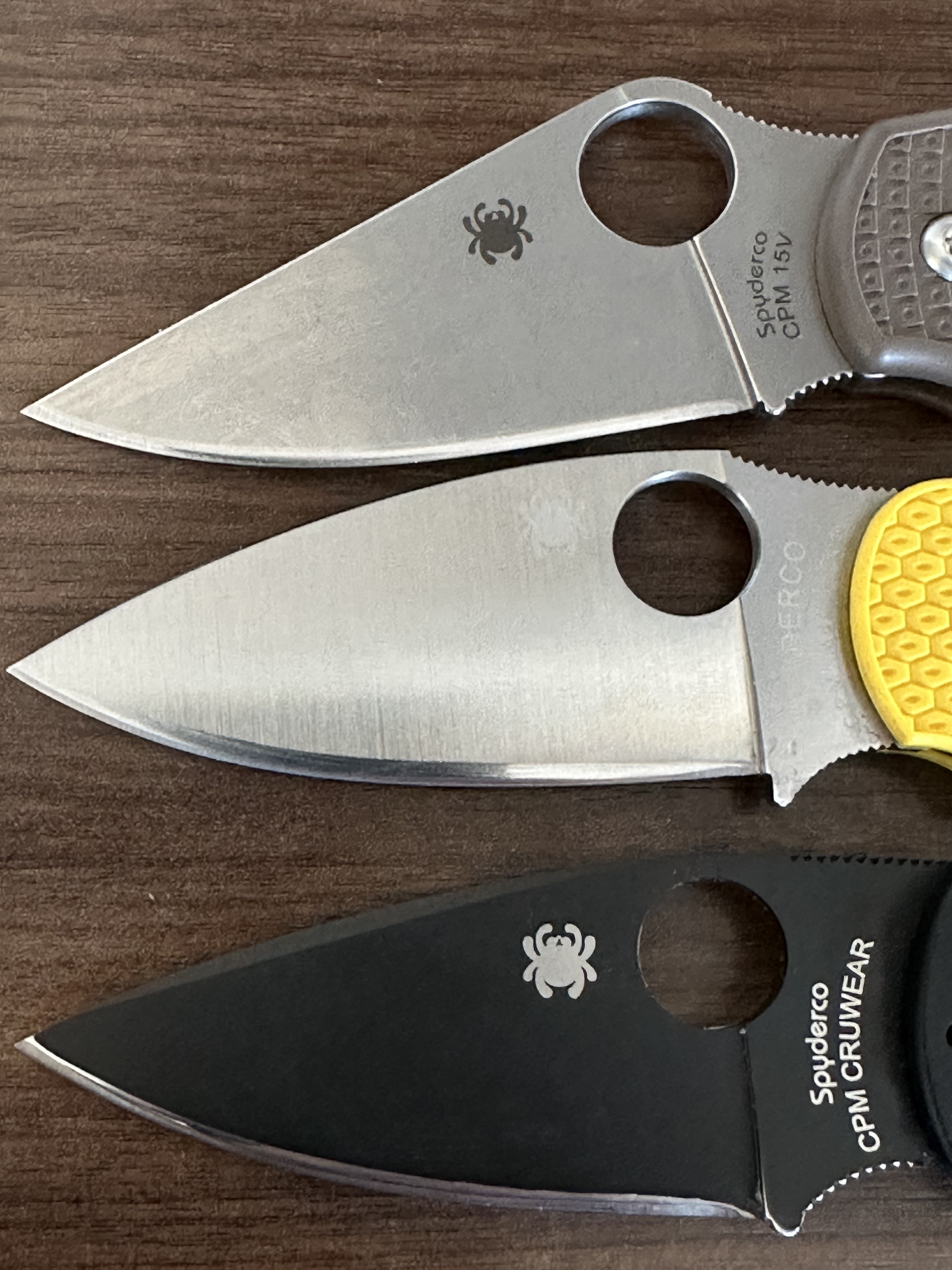
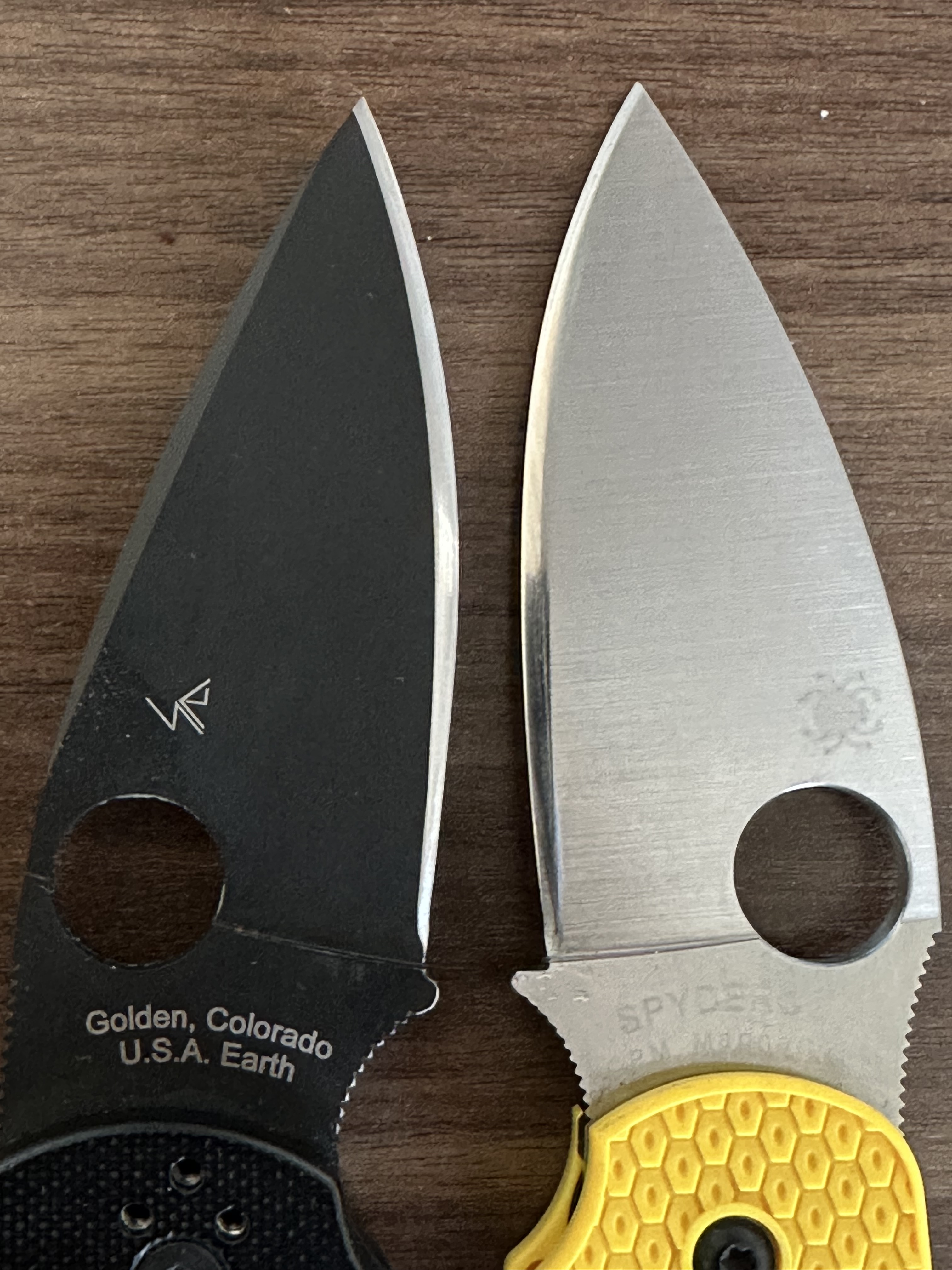
Here are 3 versions. The 52100, the CPM Cruwear, and CPM Magnacut from right to left. Three excellences in their own way, all designed by Sal and Eric Glesser.
CPM Magnacut is a story of love.
Quoting its metallurgist and designer:
“The carbide structure of MagnaCut is much finer than the common powder metallurgy stainless steels such as CPM-154, M390, Elmax, S35VN, etc. The only stainless PM steel I have imaged which is competitive in terms of carbide/nitride size is Vanax. MagnaCut is even somewhat finer than CPM-4V and Vanadis 4 Extra, the non-stainless steels that MagnaCut was modeled after. This is an excellent result and should lead to excellent properties.”

Quoting Spyderco:
“This tour-de-force expression of the Para Military 2 showcases a full-flat-ground blade crafted from CPM MagnaCut—a state-of-the-art particle metallurgy steel that offers an exceptional balance of edge retention, toughness, and superior corrosion resistance. Cloaked in a non-reflective Diamond-Like Carbon (DLC) coating, the PlainEdge blade is housed in a handle featuring peel-ply-textured black G-10 scales machined with the signature Caribbean Bi-Directional Texture pattern of Spyderco’s US-made Salt Series knives. To complement its blade steel and finish, the knife’s nested stainless steel liners, four-position pocket clip, and all other hardware are also made from ultra-corrosion-resistant materials and black coated.”

That new Salty Paramillie is destined to be an amphibian workhorse, a hippocampus!!
All hardware is black coated except the stop pin, which is silver and made of “fearlessly corrosion-resistant marine-grade materials“.
The handle (as efficient as it is in being non-slip) is destined to be a pocket shredder, as it is carved to be used with wet, oily hands. Your trousers will suffer!!
Unless, like myself, you are a compulsive user of sandpaper. Even then, it will be hard on pocket lips.

The Diamond-Like Coating is not only protecting a blade that doesn’t need any protection; it also gives a strong Mall Ninja vibe.
Usually, coatings bring some kind of lubrication to material separation. I’m not impressed so far, even on sausages.
The geometry is perfect on my PM Salty—thin as a razor though.

One thing I had to change was the clip. It was replaced by a Flytanium Universal Titanium Clip, which is short and deep-carry.
Also, I moved the clip for a tip-up carry, which suits the Paramillie better in my book.

Of course, de-shouldering the edge is the first step before convexing, which I do on new knives. Especially since I have read that Magnacut loves leather stropping.

And this is true! The edge turned quickly into a über-razor state.

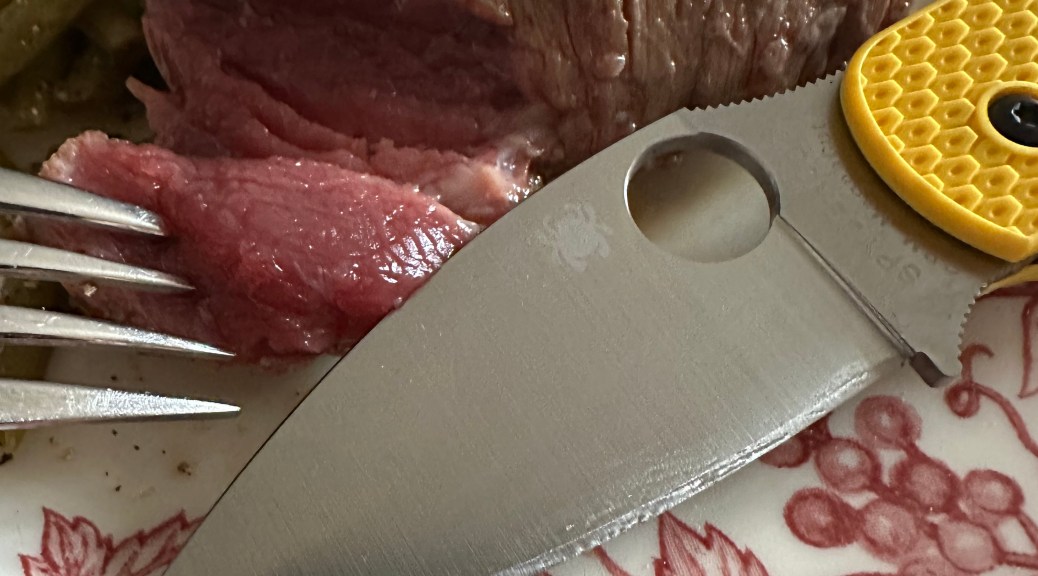
It zipped through meat like a lightsaber into bantha meat.

So now the game is on. The Salty Magnacut Paramillie is ready to kick all other knives from my pockets and be used long term.
Let’s see what this cutlery apogee-era knife has to propose in the long run!

Spyderco Dragonfly Wharncliffe K390 SC28FP2WK390 – Roar like a Dragon, fly like a bee.

Behind the code “SC28FP2WK390” lies one of the gems designed in-house by Sal Glesser. The Dragonflies are legion.
(All green text in this review links to related articles.)

Quoting Spyderco: “The Dragonfly 2 is one of the most size-efficient folding knives ever created, especially when expressed with a straight-edged Wharncliffe-style blade. When that blade is crafted from tough, wear-resistant K390 tool steel, the result is a compact powerhouse cutting tool that will take and hold an exceptional edge.

Like the standard Dragonfly 2, this knife also features a user-friendly back lock and a reversible deep-pocket wire clip, but its linerless FRN handle is molded in the signature blue color of Spyderco’s K390 family of knives.

The Dragonfly is a very small locking knife that has been produced in many variations: stainless steel handles, Salt Series rustproof versions, and numerous sprint runs. This version uses a Wharncliffe blade in one of the finest modern tool steels available: K390. Such a capable steel on such a small, thin blade is always worth experiencing.

Wharncliffe blades offer outstanding cutting performance, and I’ve reviewed them many times. Backlocks (or lockbacks) are among the strongest folding knife mechanisms by design. The hand pressure is transferred directly through the choil and spine, meaning the force goes into the blade rather than the handle, preserving the mechanism even under hard use.

Despite its reduced size, the handle still allows a full four-finger grip. This is a true tour-de-force of design.

My Pingo features a thicker blade and, with its slipjoint mechanism, has proven to be a truly reliable everyday companion.

The Dragonfly, on the other hand, offers a more aggressive cutting geometry in a much more compact package.

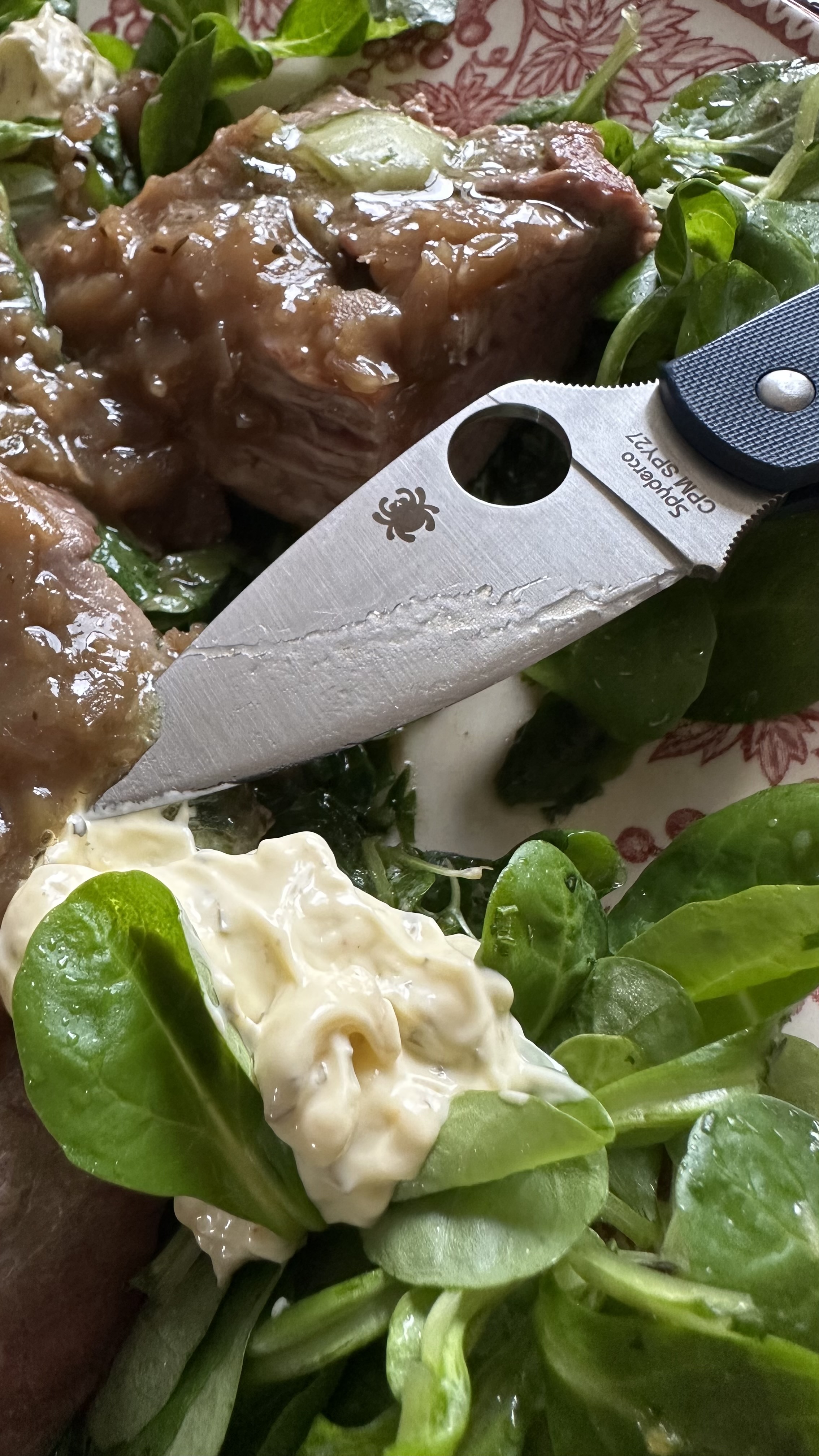
The Wharncliffe blade really shines in use: only the tip makes initial contact, which helps preserve the edge from harsh impacts on hard surfaces such as ceramic plates. As a result, this small knife can even function as a surprisingly capable compact steak knife.

As my friend Jur once told me, “The older you get, the smaller the knives you’ll prefer.” Over time, I’ve come to realize just how true that is.

The Dragonfly in K390 is a remarkably refined combination. Ultra-compact and slim in the pocket, yet equipped with a blade that performs far beyond its size, it delivers outstanding cutting power and edge retention in a minimalist format.

Lightweight, discreet, and highly capable, it’s the kind of tool that quietly earns its place as a daily companion — equally suited to anyone who appreciates precision and performance in a compact form.

Spyderco Proficient FB36CFP — The Nasa Lamborghini Bushcrafter – Part 1

Article written by Nemo Sandman – Edited the 5th of November 2025.
All rights (pictures and text) reserved.

Have you ever wondered why so many Spyderco Sprint Runs seem to appear out of nowhere, featuring gorgeous carbon fiber handles and impressive CPM S90V blades?

It’s simple — Sal Glesser loves both materials.

For him, carbon fiber reflects his lifelong passion for motorsports, while S90V stands out as a stainless steel in a league of its own, combining high performance and outstanding reliability.

So, long story short:
Full Flat Grind + Carbon Fiber + S90V = Sal Glesser’s favorite combo!

And to quote my friend Spydercollector:

“When the Bushcraft fixed blade was first announced, Sal also planned to do a so-called NASA version; a version of the Bushcraft knife with all high-tech materials. I believe NASA is a protected name, but Endeavour still evokes the high-tech approach most people associate with the famous space agency. The Endeavour features a full flat grind S90V blade and full sculpted carbon fiber handles. It was a beautiful knife with a grip that had me looking around for stuff to cut.”

https://spydercollector.wordpress.com/tag/chris-claycomb-endeavour-prototype/

Here is the Proficient: it is designed by wilderness expert Chris Claycomb of Bushcraft UK, the Proficient functions perfectly with traditional bushcraft skills and cutting methods. Carefully contoured and polished to eliminate hot spots and ensure maximum comfort during prolonged use.

https://www.spyderco.com/catalog/details/FB36CF/Proficient-trade-/943

Bushcraft knives are defined by specific parameters — typically featuring blades between 4 and 6 inches. Spyderco’s Bushcraft model fits perfectly within that tradition: a 4-inch, full-tang blade with no handguard, purpose-built for control and versatility.

In true Bushcraft spirit, users generally favor high-carbon tool steels over stainless options, prioritizing edge retention and cutting performance rather than corrosion resistance. The O-1 tool steel used here, with its high carbon content, delivers excellent long-term sharpness while remaining easy to resharpen in the field.

Carried on the belt or strap in a leather sheath, this knife is blueprinted for wilderness chores — slicing, chopping, whittling, and processing game — all in the traditional Bushcraft style.

To quote Spyderco:
The Spyderco Proficient takes the concept of the traditional “do-all” bushcraft knife and elevates it to new levels of performance with state-of-the-art materials and manufacturing methods. Designed by wilderness expert Chris Claycomb of Bushcraft UK, the Proficient functions perfectly with traditional bushcraft skills and cutting methods while offering superior durability, edge retention, cutting performance, and corrosion resistance
Instead of traditional carbon steel and an axe-like “Scandi” (Scandinavian) grind, the Proficient’s blade is crafted from vanadium-rich CPM®S90V particle-metallurgy stainless steel and boasts a full-flat grind for low-friction cutting performance.

This concept of a stainless blade paired with a black polished handle has, ten years later, been fully embraced — a perfect example being the Casström No.10 Swedish Forest Knife in Black Micarta with a 14C28N flat grind.

I first discovered CPM S90V back when it was still known as CPM 420V, thanks to Darrel Ralph (RIP) and his beautiful Apogee folder. The blade was astonishingly wear-resistant — so much so that, without diamond abrasives, only a backstand could bring it from dull to sharp. It was a bear to sharpen then… and still is today.

The difference is, as end-line users, we now have easy access to industrial diamond tools, making steels like S90V finally practical to maintain at their full potential.


I have written a lot about S90V. This alloy has proven it can be tough enough as a stainless steel to be used in any all terrain tools; especially since it is available on Manly folders which got the reputation of using a very fine thin geometry on their blades.
Modern Bushcrafters (like the Benchmade Puukko) are focused on toughness with the use of the very tough CPM 3V.

What does CPM S90V bring to the table?

It’s incredibly wear-resistant.
This steel is notoriously hard to dull, even when cutting abrasive materials like brown cardboard loaded with silica. It keeps its edge far longer than most steels, making it ideal for demanding, real-world use.
Also the full flat grind is a must in a matter separator specialized in wood works. As much as I love Scandi Grind found on Woodlore clones (first designed by Ray Mears).
I have found that especially in the wonderful Spyderco Sprig full flat ground knives can be really efficient on hard wood.
(BTW when the writing appears in green: it is a link !! and I have tested them here.)

It’s stainless!
Even if you (like me) enjoy the patina that forms on a great carbon steel blade, there’s real peace of mind in using a reliable stainless steel — especially when working near water, in the rain, or by the sea.

The Sprig was an impressive tool in terms of pure geometry. Designed as a hunting and fishing knife, it was a real wood eater — a beaver of a blade, cutting deep and effortlessly.

Guess what? The Proficient shares the same profile, especially after a bit of convexing — which I’ll be covering soon in a second article.

So far, that contoured handle is an absolute delight to use, and I’ll be putting it to the test in the upcoming piece. While the old O1 Bushcrafter had enough heft for light chopping, the Proficient excels at powerful push cuts — a completely different experience.

Interestingly, the Proficient isn’t a big knife. Once sheathed, it can disappear into the front pocket of a pair of denim jeans — no need to let it dangle from a belt.
So what do we got ? Imagine the plateforme of the Bushcrafter (link) a solid companion, a reliable 4×4 and you just turn it into some Urus from Lamborghini: stellar alloy and lighter tougher handle.
The Proficient is Sal Glesser’s gambit — a bold move in a world where the bushcraft community traditionally favors carbon steel and natural wooden handles. This knife dares to break from that norm.

Of course, this jewel comes at a price, and most bushcrafters aren’t Wall Street sharks. They use OpinelMora, or at best a €100 fixed blade — unless they’re ready to splurge on an original Woodlore.

So, the “stealth wealth” of this NASA-grade bushcrafter isn’t for everyone.
It’s like a Lamborghini — not the most practical, but a statement of refined performance and engineering excellence.
Because in the end, real performance comes at a price.

Article written by Nemo Sandman – Edited on November 5th, 2025.
All rights (pictures and text) reserved.

Spyderco UK Penknife Salt – All terrain slipjoint Part II

Prologue: “Seeing what I believe.”
On one of the social networks an happy owner of a new Spydiechef in LC200N steel (like the UKPK) was displaying some pictures of his new acquisition. And there go the comments, mostly to congratulate him and share experiences… when I have noticed some young guy’s: “Too bad this knife is provided with a steel softer than the wooden board it is displayed on.”
I thought to myself: could LC200N have a reputation of being soft ?
Immediately I have checked the Rockwell of Spyderco’s LC200N found on various sites and apart the LC200N Mule being at 56 HRC, it is known to be currently at 58 HRC.
So I have asked to young guy (very proud of its REX45 collection) what LC200N knife he has had such a bad experience with, sharing with him my own mostly excelelnt experience with LC200N I own.
After a very long passive-aggressive answer from him (we know how people are such a d1ck with a keyboard under their fingers…) about how he was so knowledgable by just watching videos on youtube he then wrote me that he had never owned any knife in LC200N.
So eventually this guy was pissing on the parade with zero knowledge of the subject. It is typically the kind of behavior we can notice on the social networks those days. Some so called “experts” don’t believe what they see but only they only see what they believe. The armchairs specialists are long disappeared and here comes the arrogance of the “believers”.
This is the plague of our time: not being your own source. Not checking twice. And not experiencing first hand what is put as a statement.
This is some kind of Reign of Assumptions with its digital garden where flourish fake informations in all subjects. This is not something to be taken lightly. And the only cure is being your own source then read, check and cross opinions.


Anyway…
Is LC200N as soft as wood ? Certainly not. It is even much better than H1 in terms of edge holding. (H1 being the other steel on the Salt Serie).
But H1 is excellent on serration blade, as it is getting harder during the serrating process like 67HRC. (H1 being a work hardened steel, the process that grinds the SE blades hardens the edge to 67, while the PE blades are 58.) Also you can’t have flat ground blade with H1 but you can with LC200N.
So far, LC200N as 58HRC has amazed me. Of course it is not in the range of Maxamet or 20CV but it is worry free good edge holding and not chipping edge’s steel.


Also I have notice how people believe cutting wood is the ultimate edge holding challenge. Nope. Cutting clean piece of wood is not challenging in my own experience. I have found different grain of steel react on different grain of wood. M2HSS (Speedstar steel) gave me soft surface on chestnut cuts for example. The challenging media to cut through are brown cardboard for example because of sand in it. Cardboard and also great way to refresh an edge by stropping the blade on it.
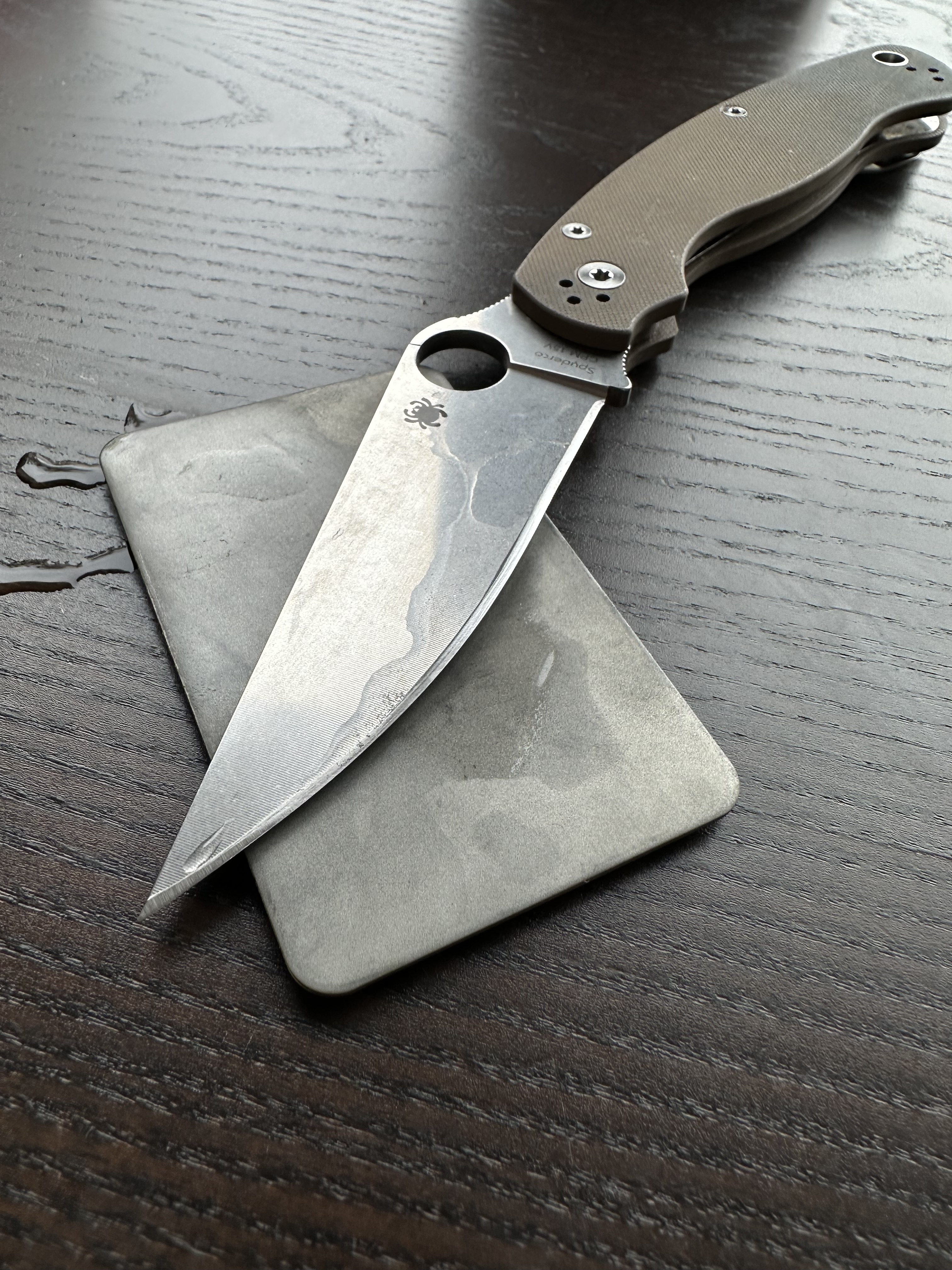
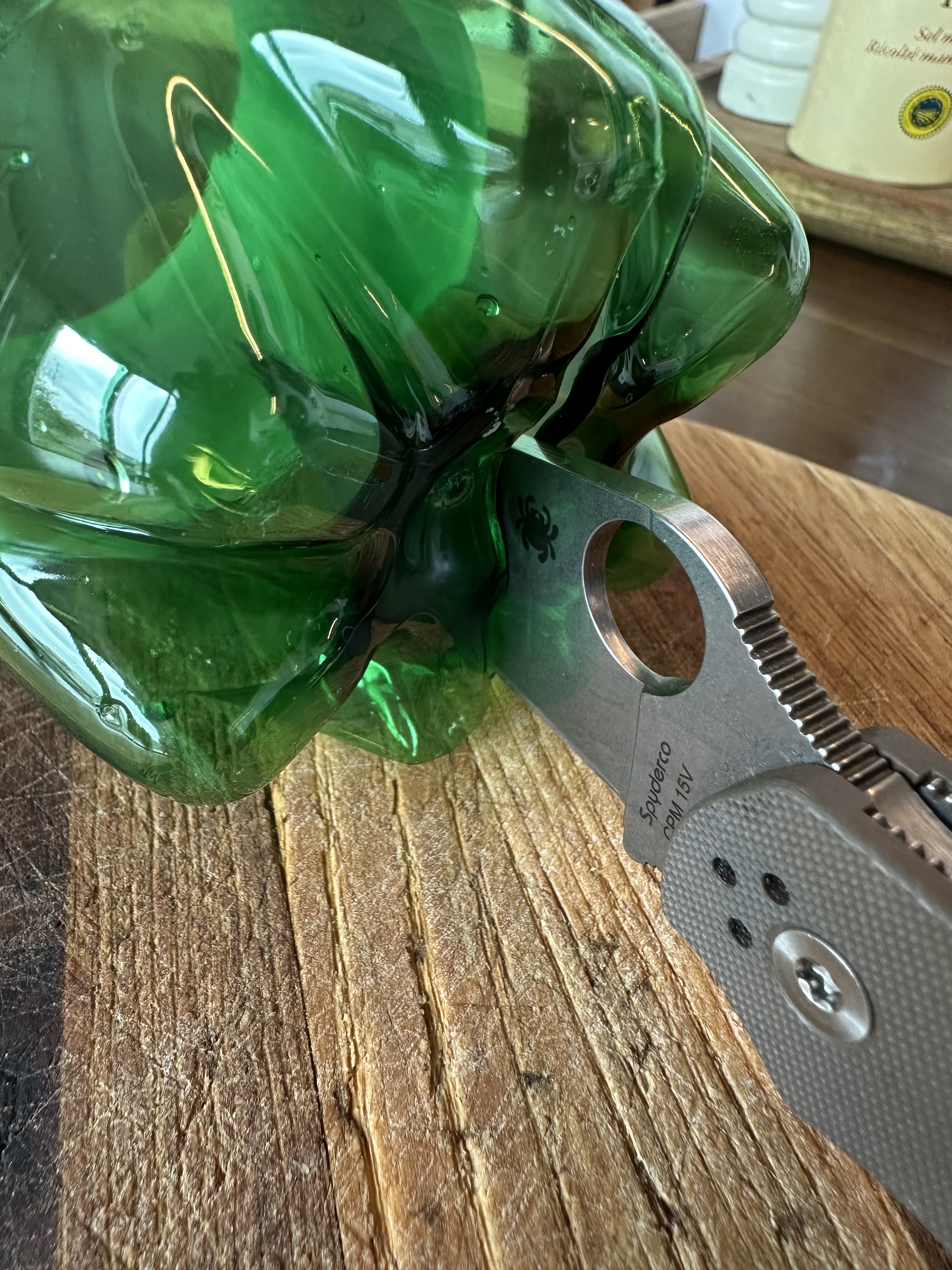
You can have a look at my journey in Tuscany with the Spydiechef.

Back on the UKPK. I have “unshouldered” my edge to get to a gentle convex, keeping the manufactured edge with its microserrations. I always do that when I love a knife as my favorite way to refresh my edge is using an old barber leather bought in Tuscany on a garage sale 15 years ago.

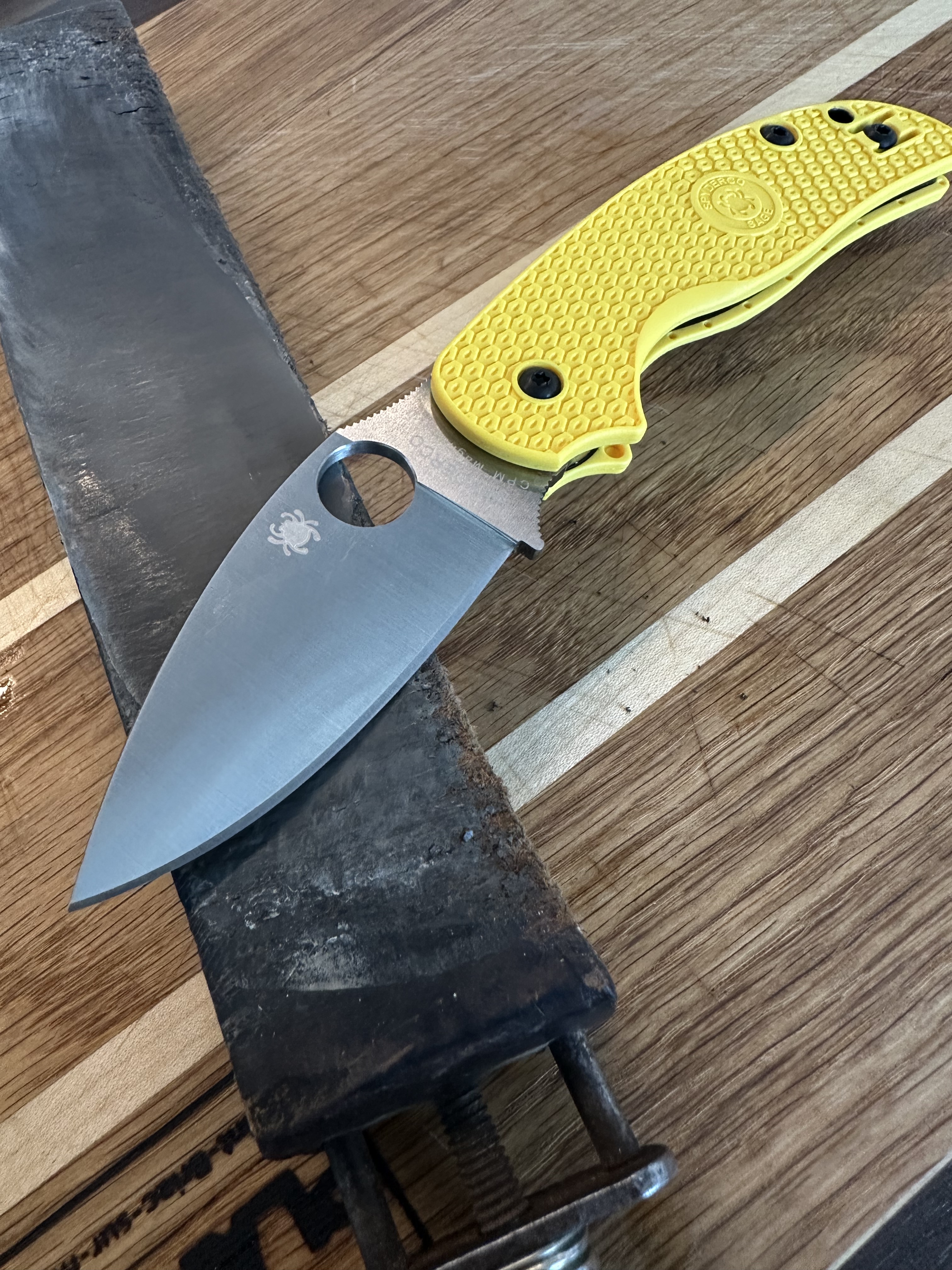
The blade stays “lock” in open position when stropping and this is much better that previous version of the UKPK like I have stated in the first glimpse. The razor’s level of sharpness is easily restored and the thin blade goes steadily into all material it has encountered.
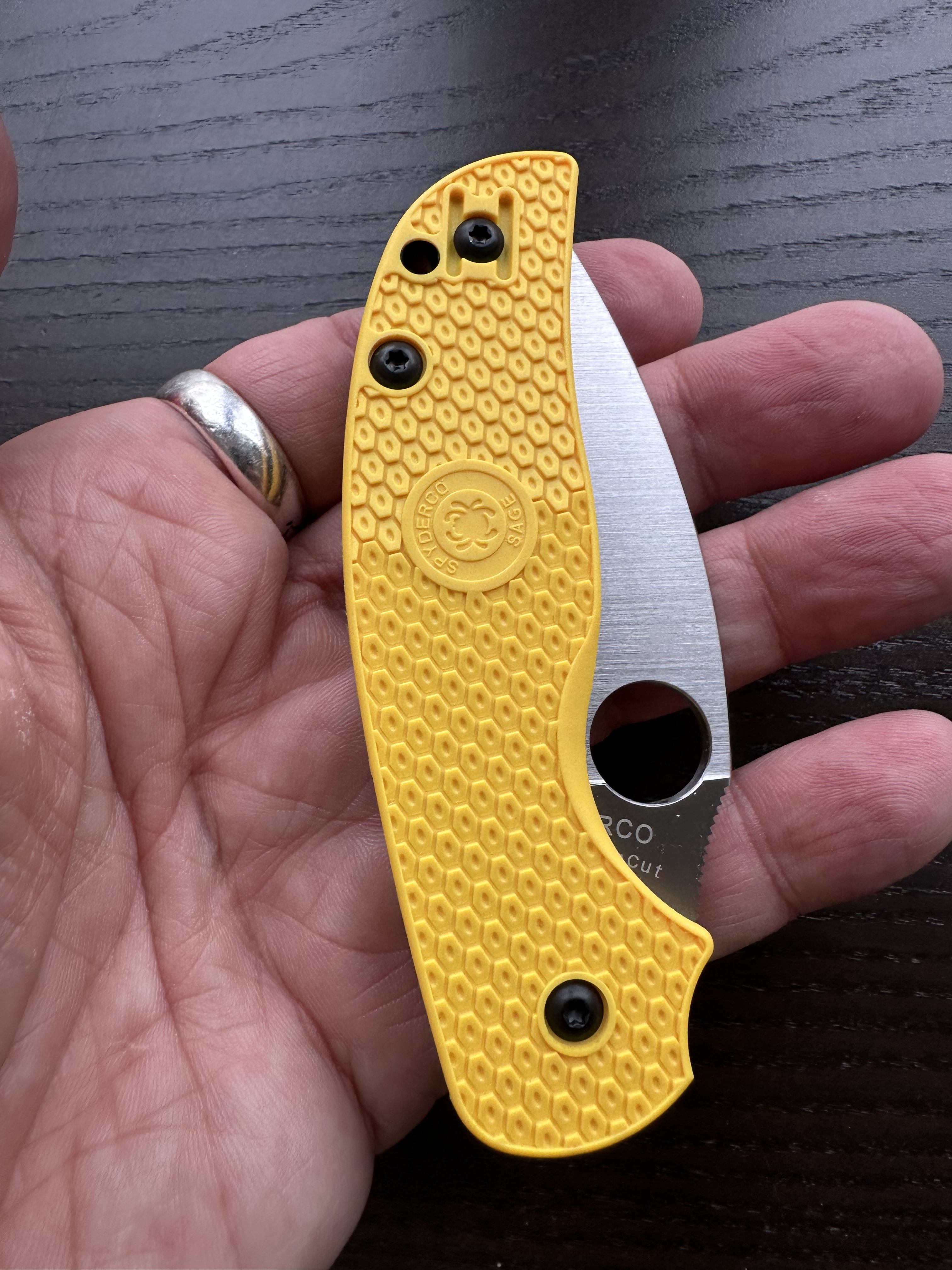
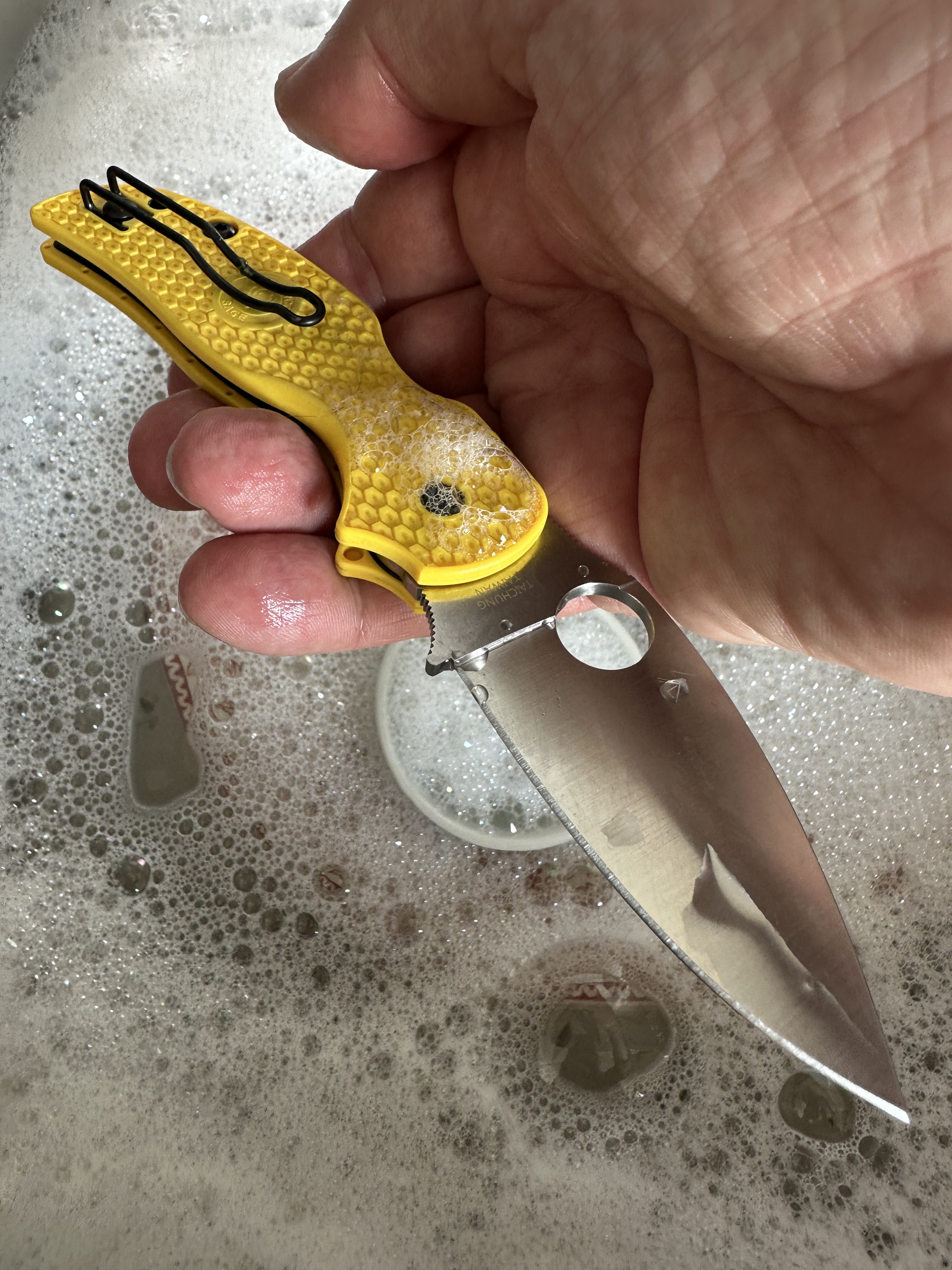
One great enemy of a fine edge is the plate under the meal. Many times I have given an angle to my knife to avoid touching the ceramic at a 90° angle. With the UKPK I have not given a shoot. I have use it as my steak knife like they were no tomorrow. Also the the yellow knife has been friendly approved by the rest of the family who has used it also on plates and stuff without any sign of pity.
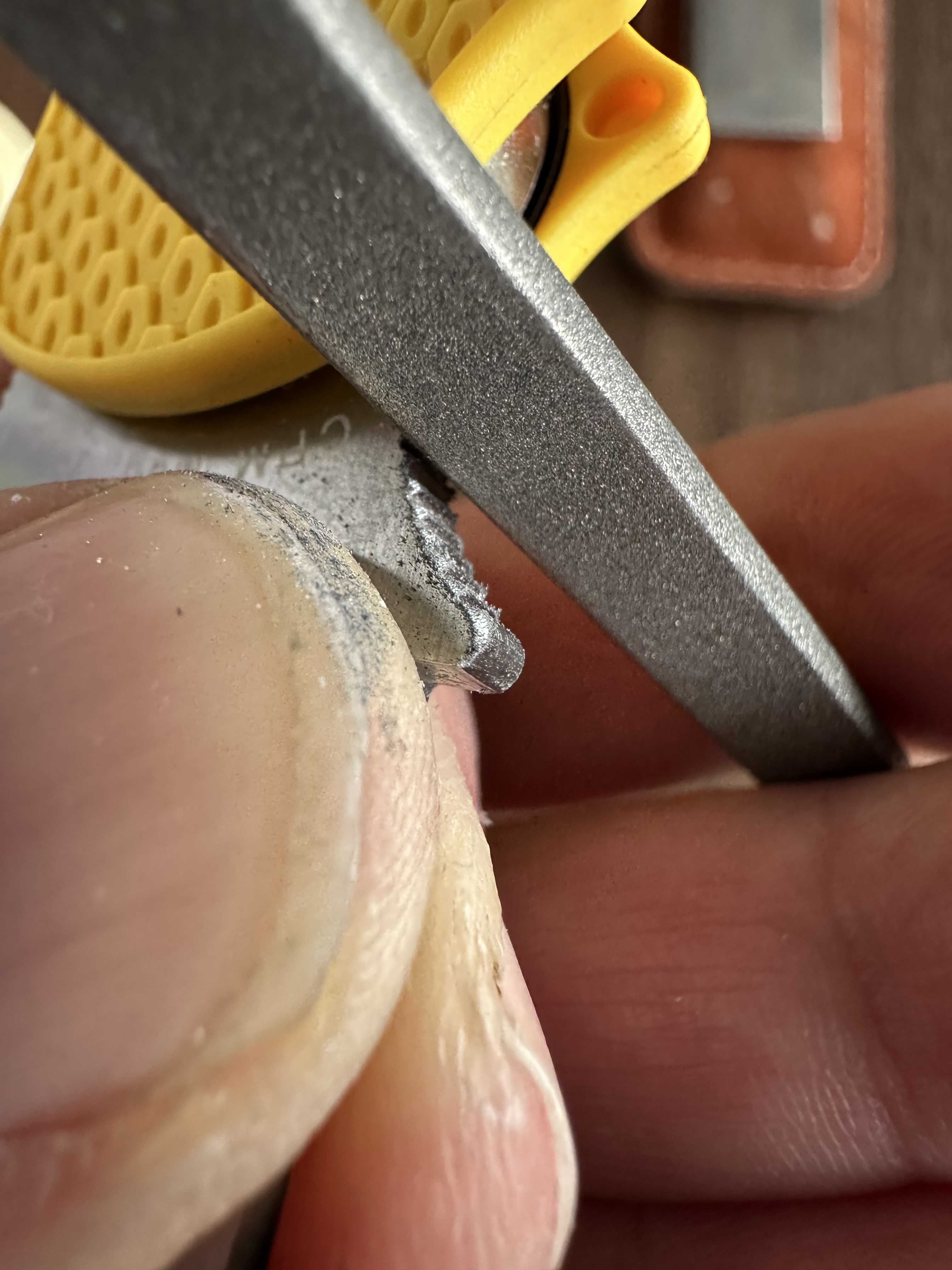
The edge near the point has rolled but nothing I could not fix in less than 5 seconds on a ceramic rod. Eventually the rest of the blade was mostly as razor as before. On short blades mostly the point and the very first part of the blade are used on board/plate cutting. It is also a part I have less convexed to keep some useful thickness there.
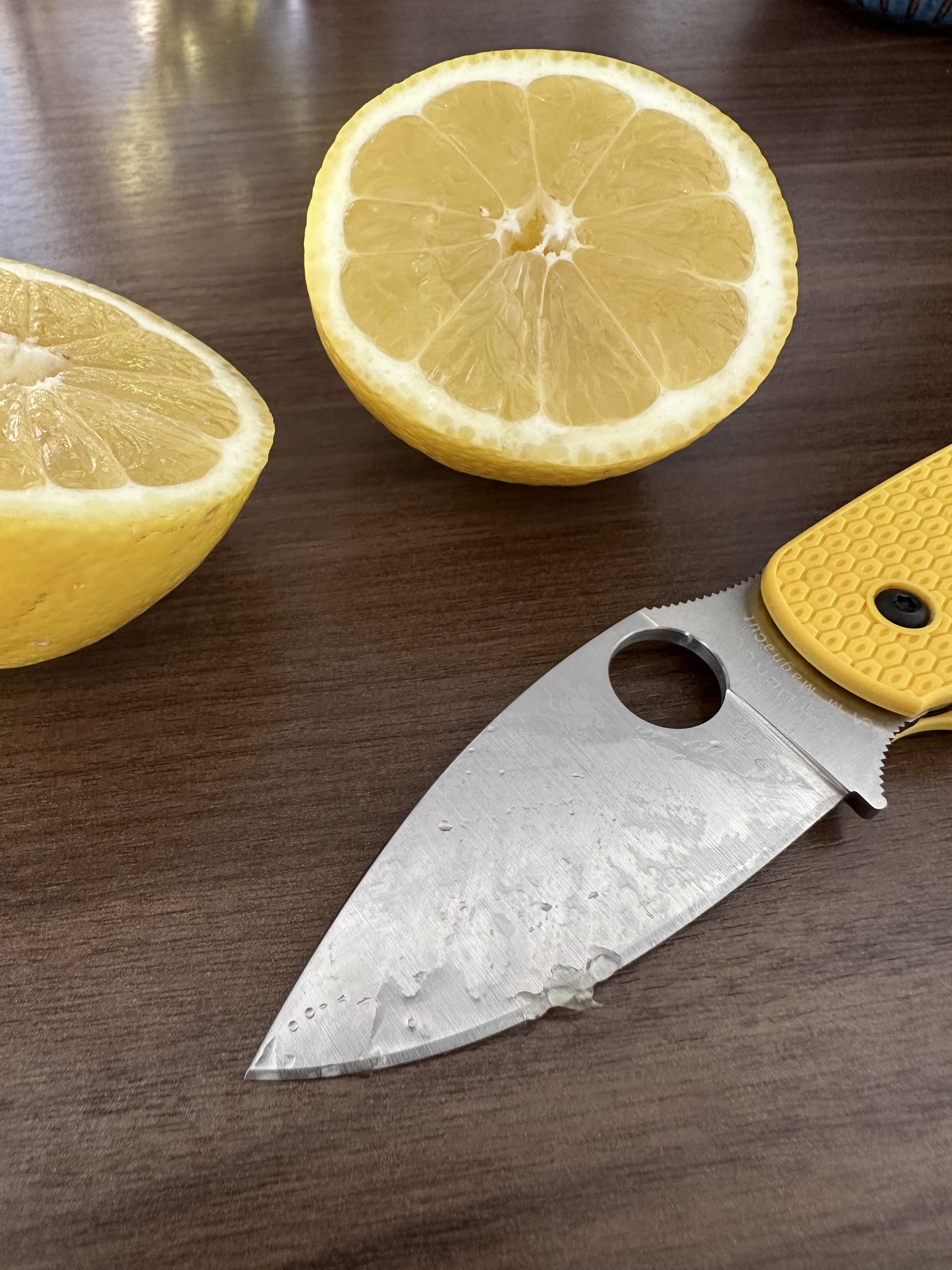
Of course cutting lemons and any acid food will never bring any sign of patina on LC200N and many times I have fold it dirty when it was not just quickly rinsed under the tap.
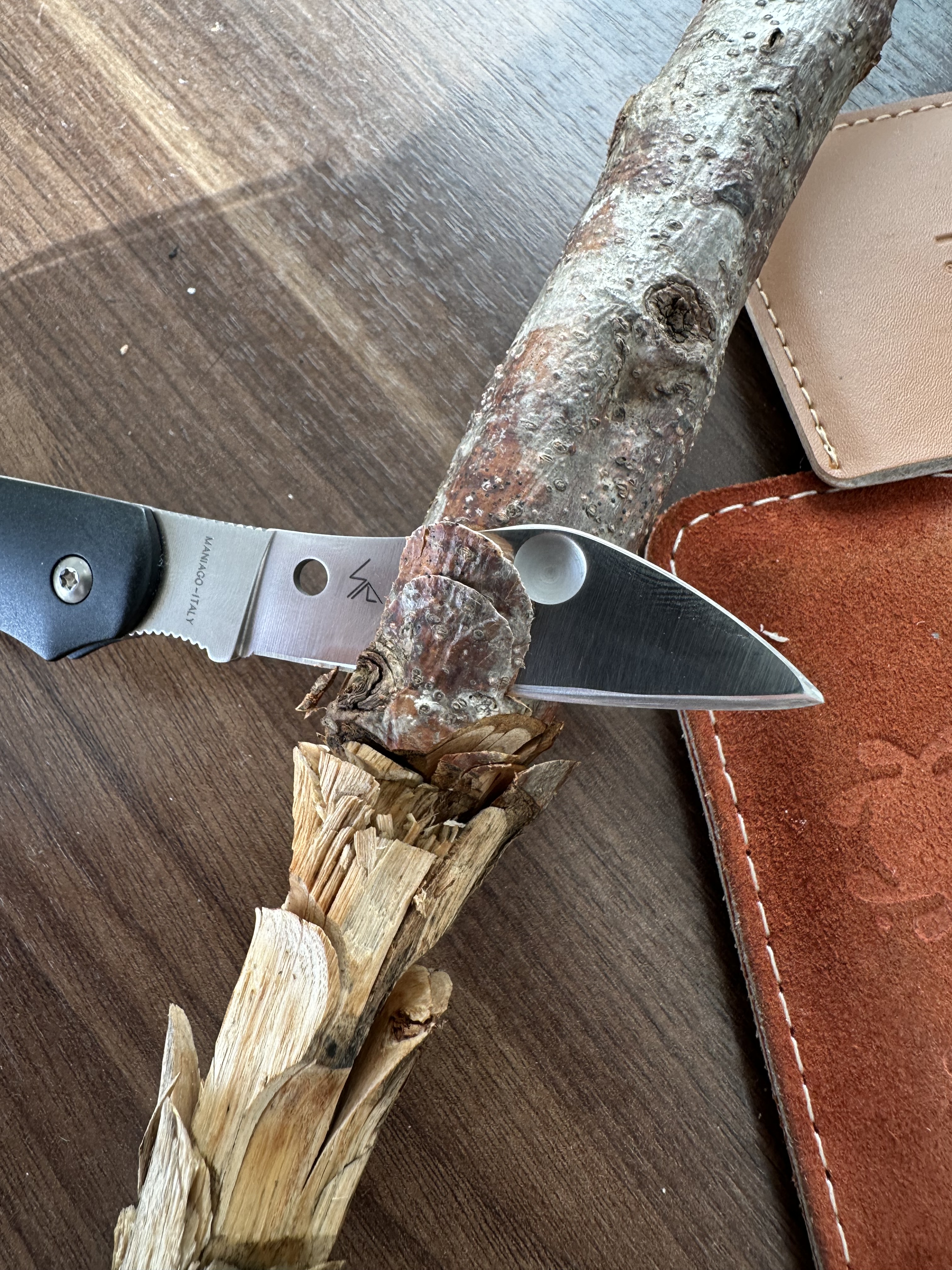
The UKPK also offers a very pointy blade which proves to be very useful in many task. LC200N being very forgiving it is sturdy enough for not having any concern about it. Of course I won’t use a slipjoint like a bushcrafter or even the great Wolfspyder but still, old timers used to go in the wood only with Swiss Army Knives or Pradel slipjoints folders and were able to use them for many camp tasks. The choil and hump of the UKPK’blade working as quillions you can apply a lot of force directly to the blade as I have also been whittling with it.
The thin spine makes it not really confortable for thumb pushing cuts though. In that game of pushcuts the Yojimbo 2 is king with its 4mm spine.
But the UKPK goes deep in its cut without much pressure on the spine.
Also when the blade is stuck in the wood it has no tendencies to fold on your finger like previous version of it. This is a great relief.
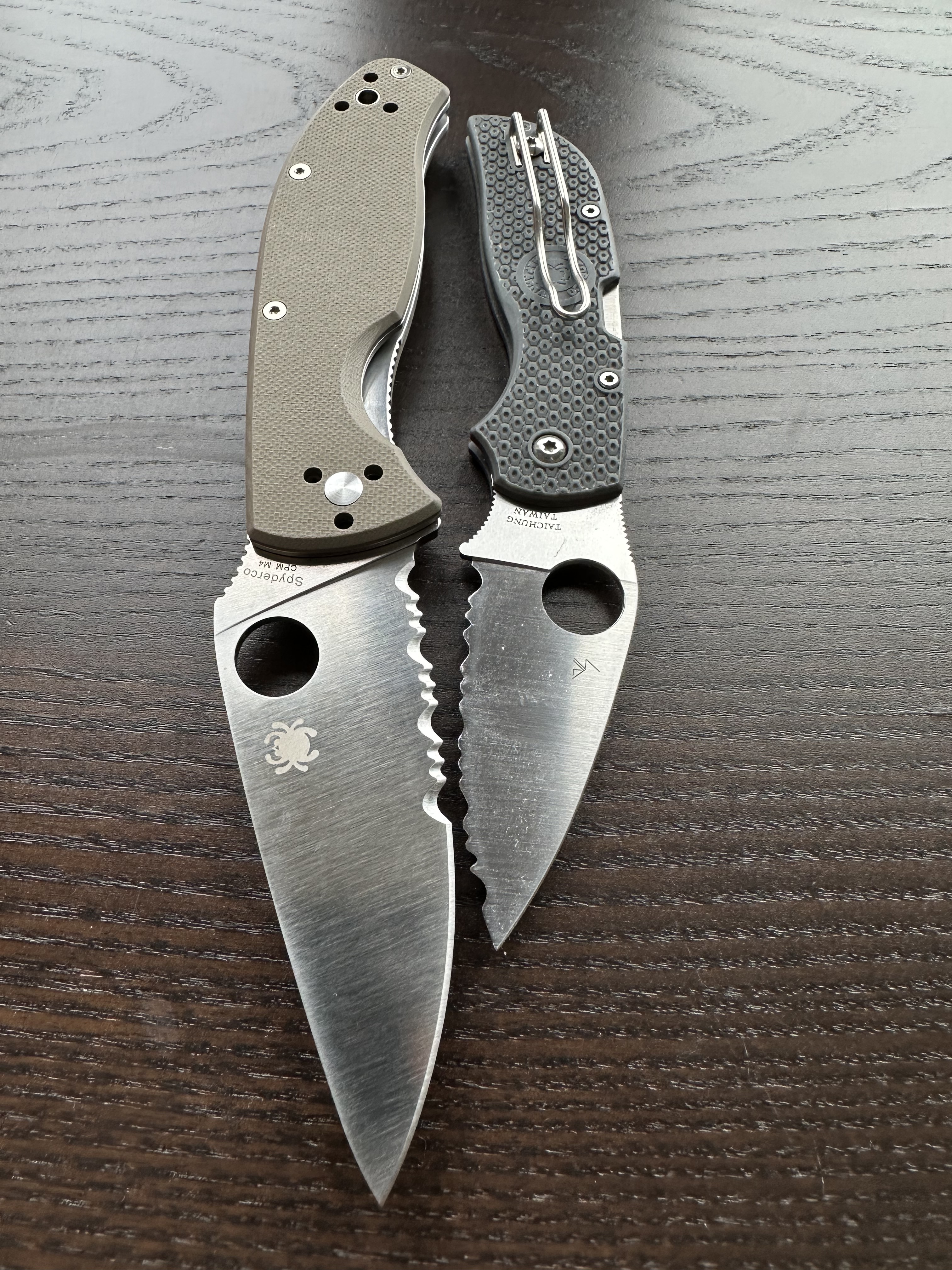
The yellow handle looks like plastic but those FRN slabs are very rigid. There is no play and it gives you a felling of confidence in your tool. Also the “pro-sheeple” general look helps a lot when using the UKPK in public.
So far it has developed zero plays which is enjoyable.

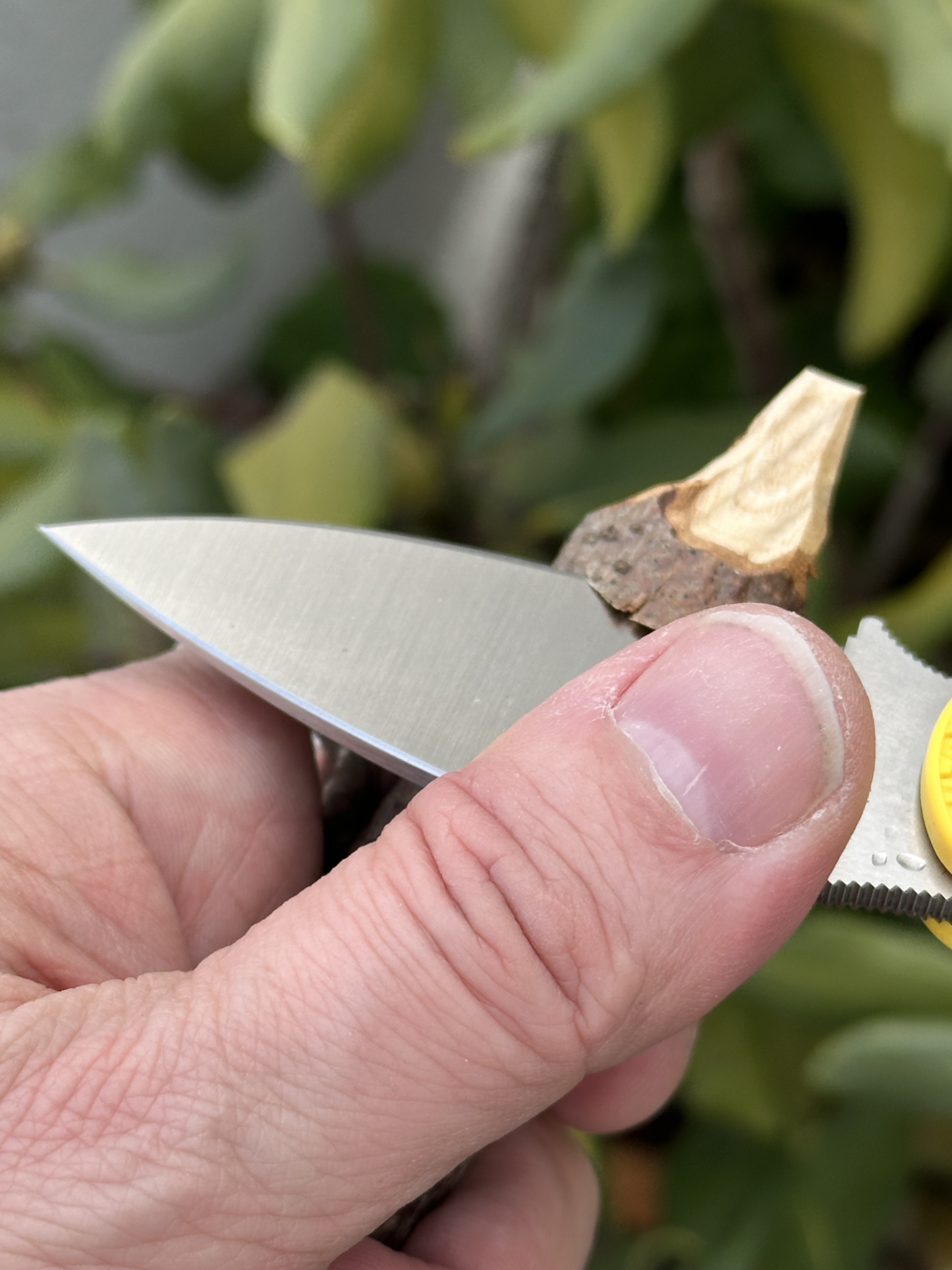
Quick draw: a friend has challenged me to open the knife using my major finger. At first I thought it would not be possible unless being Check Norris. Eventually:

But this is in Spyderdrop that the UKPK is steadily open: holding the knife by the hole and with a flick of the wrist.
So it is a slipjoint with a very fast draw opening.
The previous Spyderco Splijoint as fast as this one is my Pingo which can be open by inertia as the momentum of the thick blade helps a lot.

So far the UKPK has proven to be a fun knife to use. It is easy to deploy and reliable on the tasks. It can be a primary knife in the city and secondary knife in the woods and its lightness makes it easy to keep in the pocket. It will also find a place to be clipped on any swimsuit and that what makes it so unique. Fishermen will be very glad also as it is so easy to clean and to spot. The opening of the 3 screws montage on this UPKP (some other G10 UKPK got a longer spring/backspacer and 4 screws) make it a breeze to rinse. It is a Gentleman/Lady knife with an all terrain attitude and a very reliable positive semi locking system which can sustain a lot of power cuts. Really a unique gem !

Yellow and black works well together…

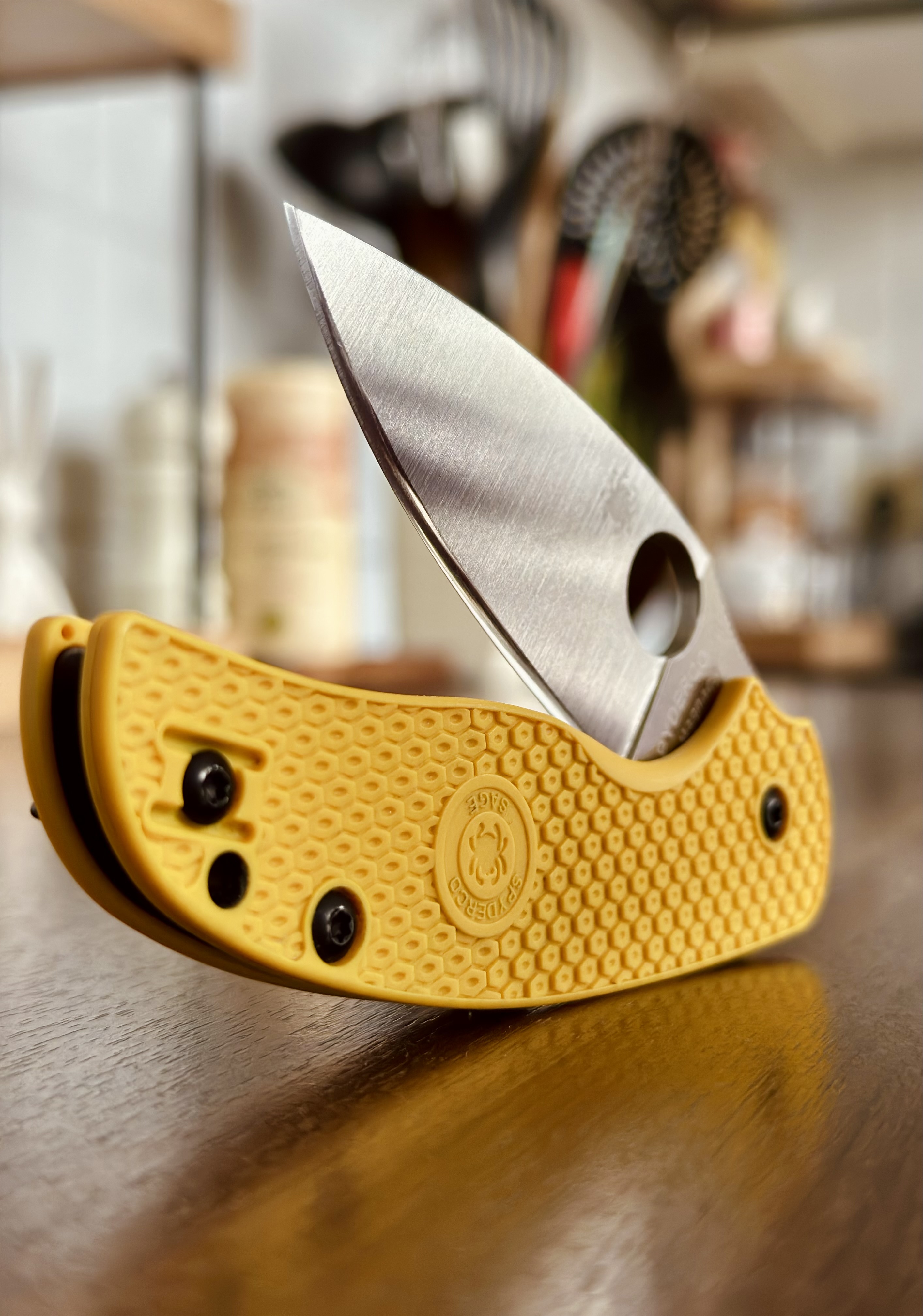
Spyderco UK Penknife Salt LC200N C94PYL Yellow — First Glimpse at The Diver Slipjoint !

“Originally developed in response to restrictive knife laws in England that prohibited the carry of one-hand-opening lock-blade knives, the UK Penknife was the trailblazer of Spyderco’s unique SLIPIT™ line of knives. Now this iconic knife makes history again as the first non-locking member of our ultra-corrosion-resistant Salt® Series.

Its full-flat-ground, leaf-shaped blade is precision machined from nitrogen-enriched LC200N steel and housed in a high-visibility yellow FRN handle. A reversible deep-pocket wire clip and fully accessible Trademark Round Hole ensure that this fearlessly corrosion-resistant cutting tool is both left and right-hand friendly.”


That’s Spyderco’s original topo—and in many ways, still the best way to describe it.
I’ve had a UKPK before.
Got it as a gift at the Amsterdam Minimeet—early days. GIN-1 steel, different blade shape… and, if I’m honest, a disappointing slipjoint.
The spring was weak.
Much too weak. Not unsafe—but not pleasant either. It lacked that decisive resistance you want when the edge gets serious.
So expectations were… cautious. And then came that Salt version.
What a surprise.
The slipjoint is finally where it should have always been: strong, confident, reassuring.
No lock but strong enough to make real work enjoyable again.
It changes everything.

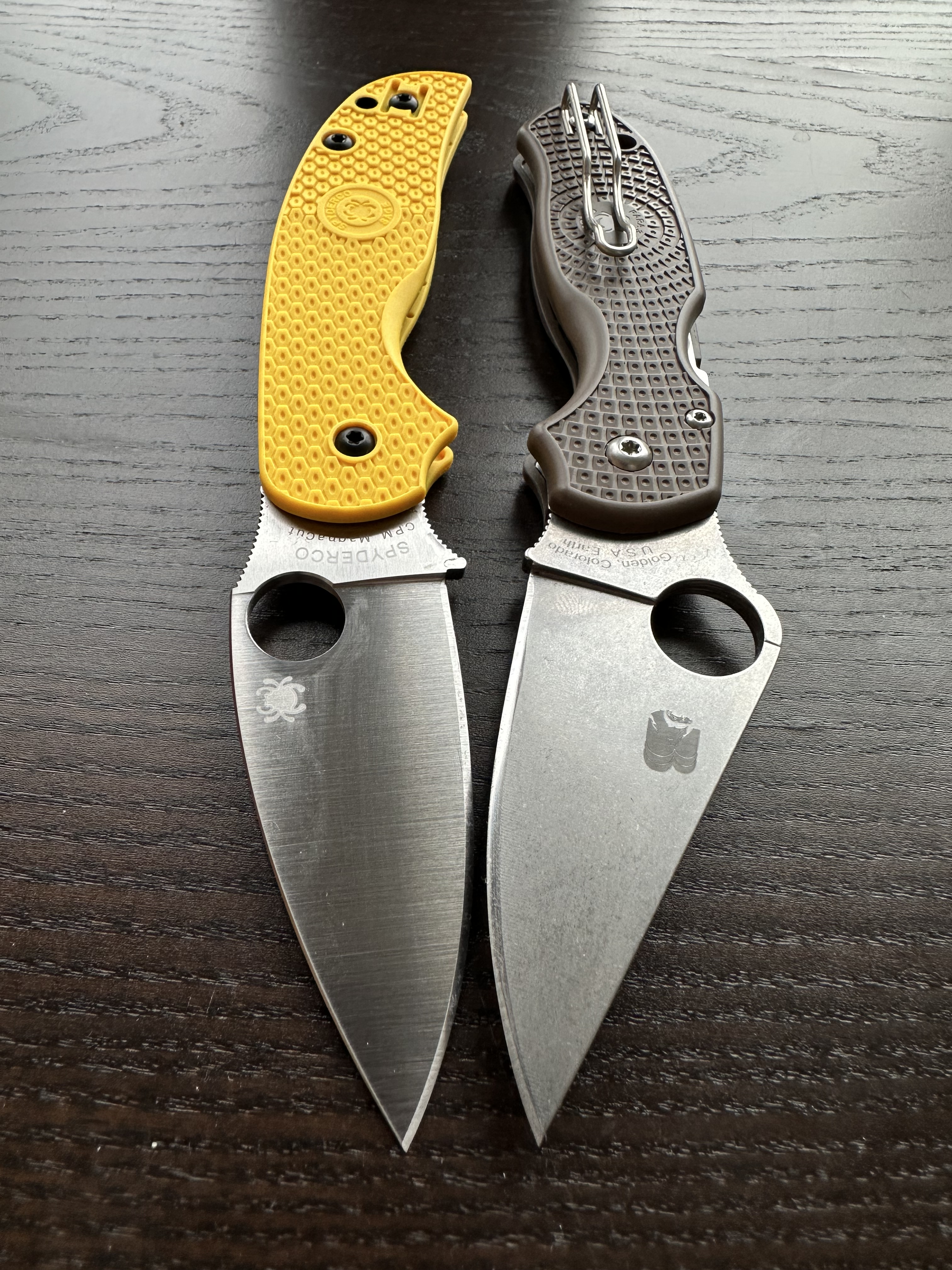
Unlike its smaller siblings (the Spyderco Urban and the Spyderco Squeak) the Spyderco UKPK got a true four-finger handle.
Index finger is placed into the choil as secondary security.
Hand wrapped fully around the handle.
That’s your safety. Not a mechanism: your grip.
And in use, it makes perfect sense.

The choil on the Spyderco UKPK—much like on the Spyderco Military C36—is not just a modern ergonomic flourish.
It’s actually a throwback.
A direct echo of 19th-century San Francisco gambler’s boot daggers.
From the engineer point of view (and inventor like Sal) with your index finger locked into that choil, force is transferred straight into the blade—not “lost” in the handle, not stressed through the pivot.

This is closer to the logic of ancient Roman folding knives, where the handle was almost secondary—more considered as sheath than a structure.

The UKPK’s blade is thin—and Spyderco delivers one of the highest out-of-the-box cutting performances in the game. Mine cuts like a razor.
Pure, immediate efficiency.

Geometry-wise, this sits right alongside the best European slicers—think Manly’s famously thin grinds, or even the simplicity of an Opinel knife.

This is not a knife for Medford Knife & Tool fans.
No overbuilt slabs. No brute-force thickness. This is finesse.

There’s a strong European flavor in that leaf-shaped blade—very reminiscent of the Spyderco Caly3. In fact… this might just be a kind of UK Caly.

The blade is long, lean, and pointy which means one thing: it requires less force to do the job.
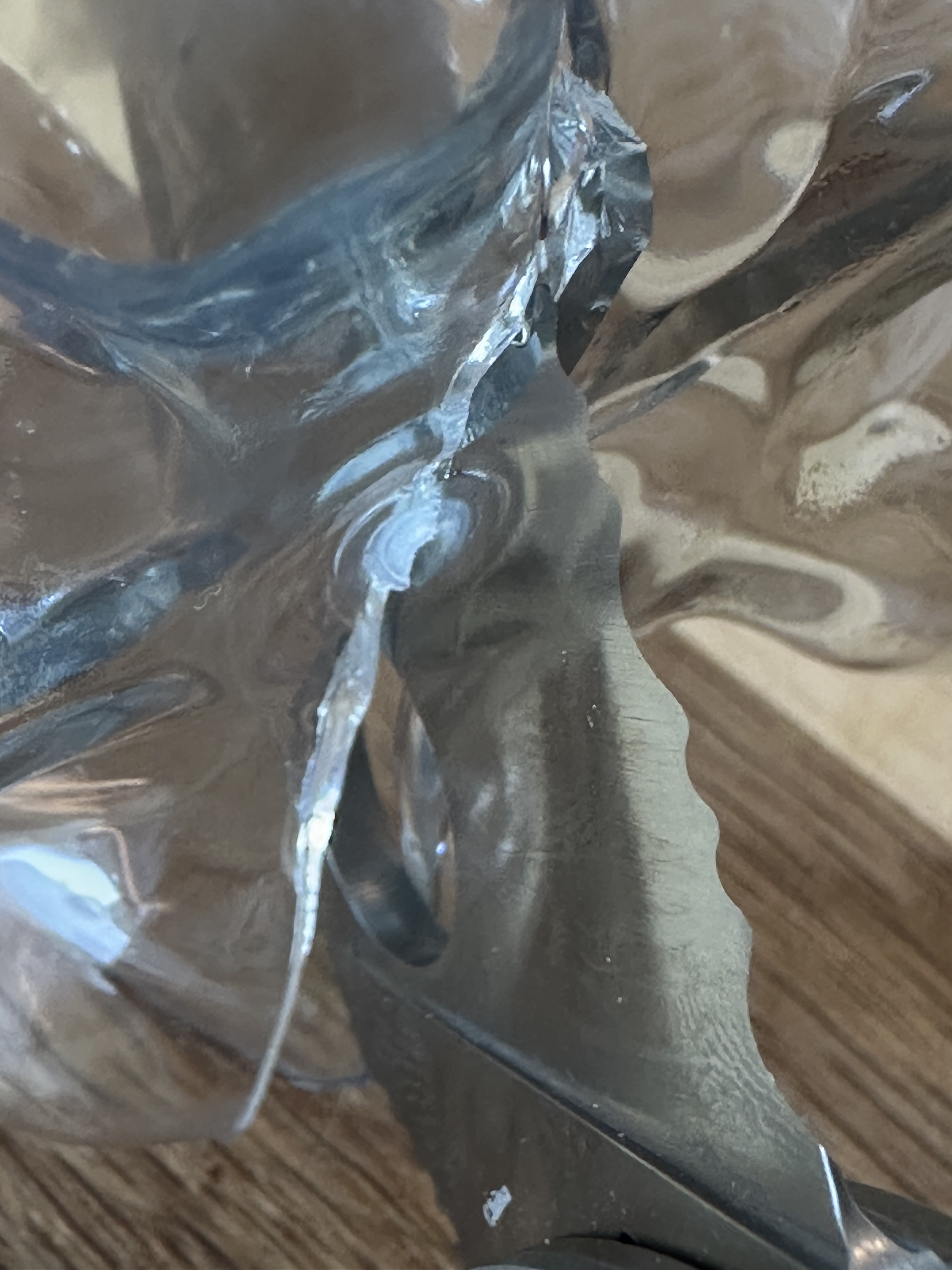
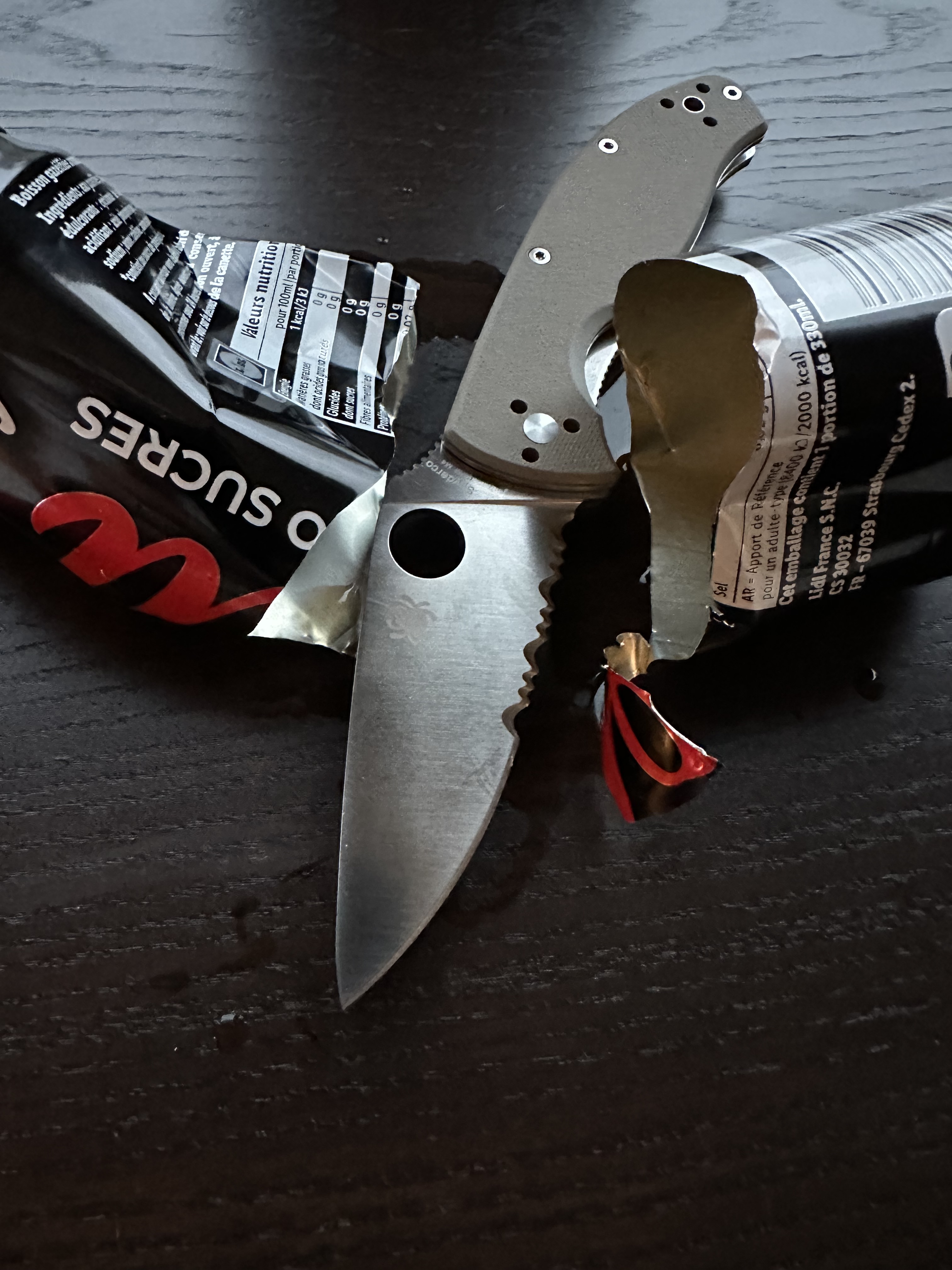
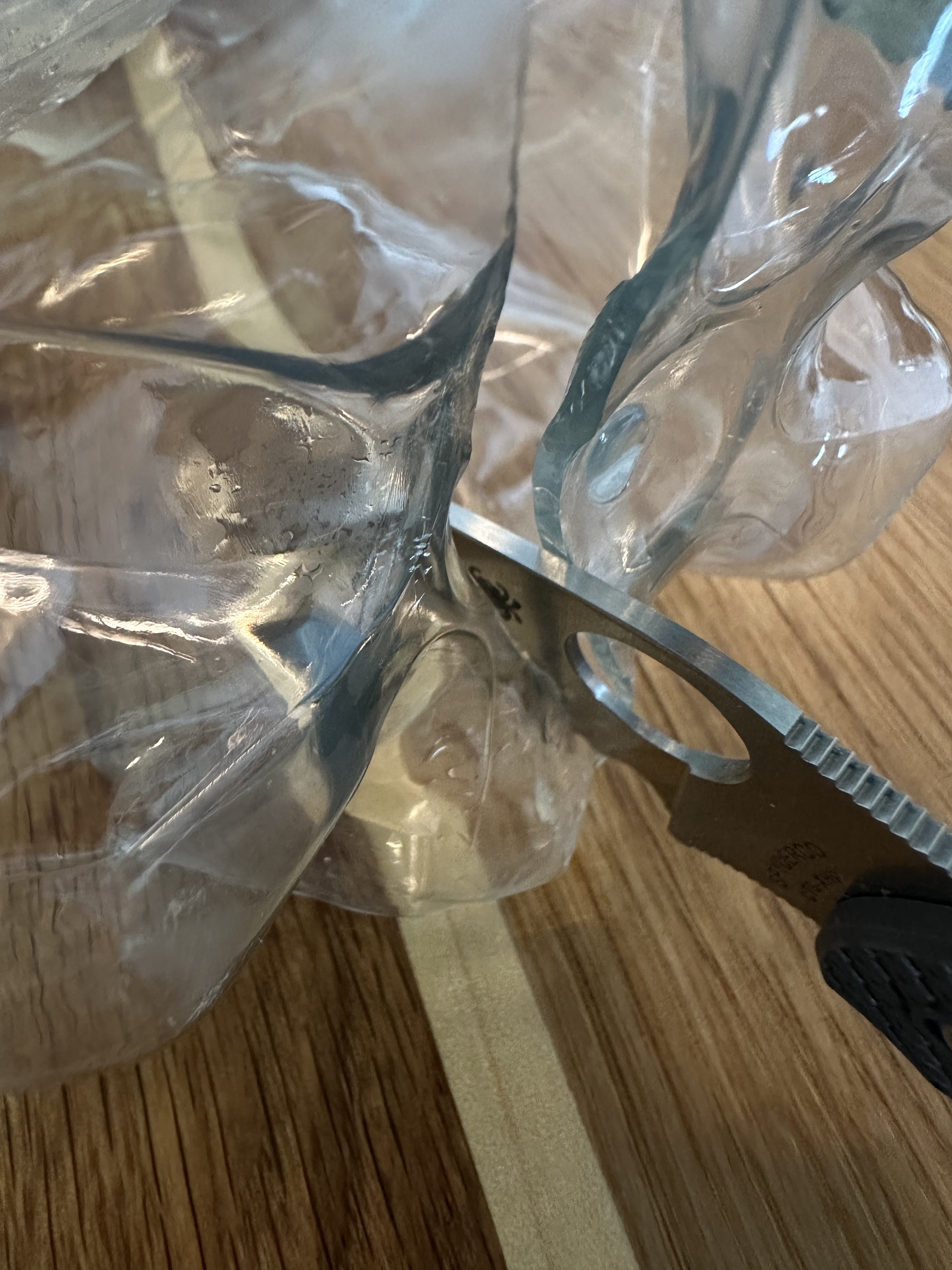
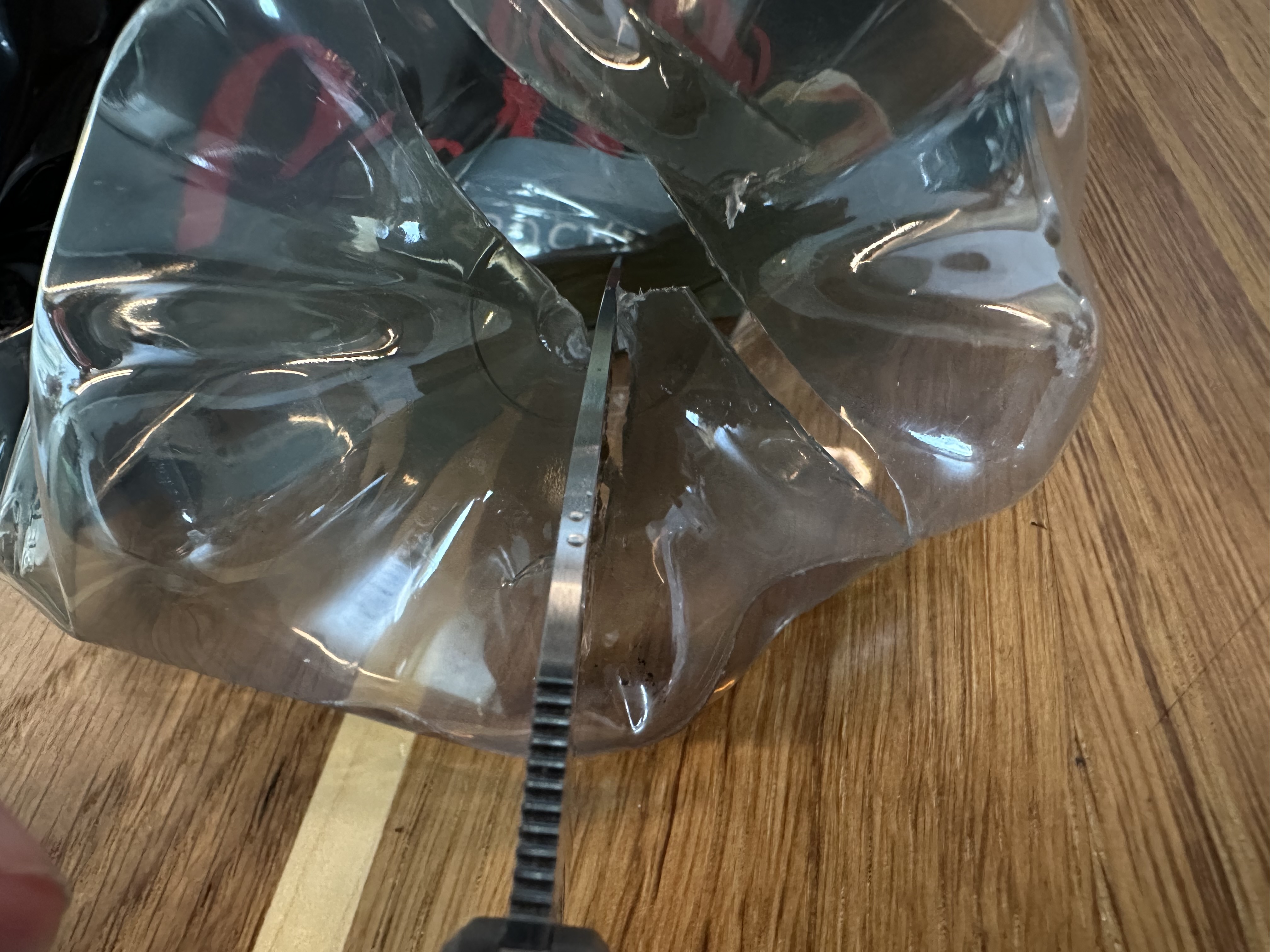
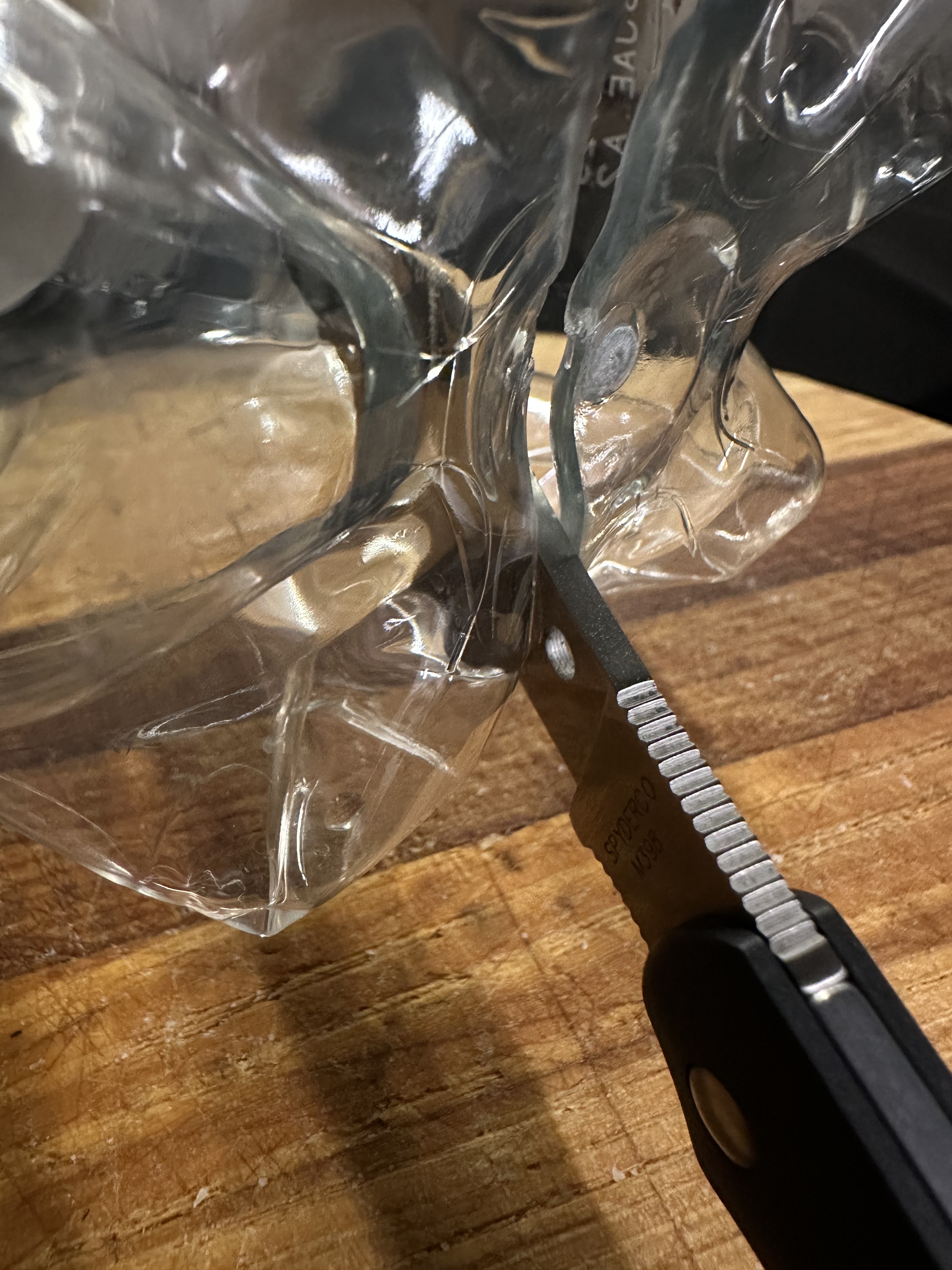
My plastic bottle “butt test” says it all.
Right through the thickest part, dead center, with steady control. No slipping, no tearing—just clean penetration and continuous cut. With your index finger locked into the choil, you can choke up for delicate work, gaining precision without sacrificing reach.

In fact, it completely cancels my long waited/need for a slipjoint Native.

Before Magnacut, there was LC200N steel—a true “space steel” used by NASA that proved its worth far beyond corrosion resistance.
Users of the Spyderco Spydiechef—myself included—know how stable that edge is, how easy it is to bring back, and how forgiving it remains under real work. A true workhorse’s steel. Like a rustproof 52100 ball bearing steel.

The yellow handle? Sooooo friendly. Almost playful.
WIth its black screws and clip, it looks like scuba gear—and that’s exactly the point. This is a knife made for the sea. Pure marine gear.
For salt, humidity and neglected pockets.

The serrated version takes it even further—perfect for mariners dealing with fibrous materials day in, day out. You can read the review of the Magnacut version from 2026 here.

That’s the whole idea behind the Salt Series:
carry it dirty, soaked in saltwater, forgotten in a pocket…
and do not care.

At just 48 grams (1.7 oz), the UKPK FRN is a true travel companion.
Light enough to disappear. Capable enough to matter.
The deep-carry wire clip is perfect—even tucked into a watch pocket on a pair of jeans.

Always there. Never in the way.

There is no vertical or side to side play on my Spyderco UKPK.
The spring retention is excellent—firm, consistent, confidence-inspiring.
The jimping bites just right under the pads of the fingers.
Everything feels locked in… even without a lock.

It stands as a serious contender to the hyper-polyvalent Spyderco Native Salt—which, in my book, still suffers from one flaw: its clip, and a slightly toyish, boxy handle.

Subjective? Of course.
But the UKPK feels more refined. More… intentional.

What you get here is something rare:

A true all-terrain slipjoint.
Strong mechanism. Thin, pointy blade.
A knife impervious to the elements.

Clip it to a swimming suit.
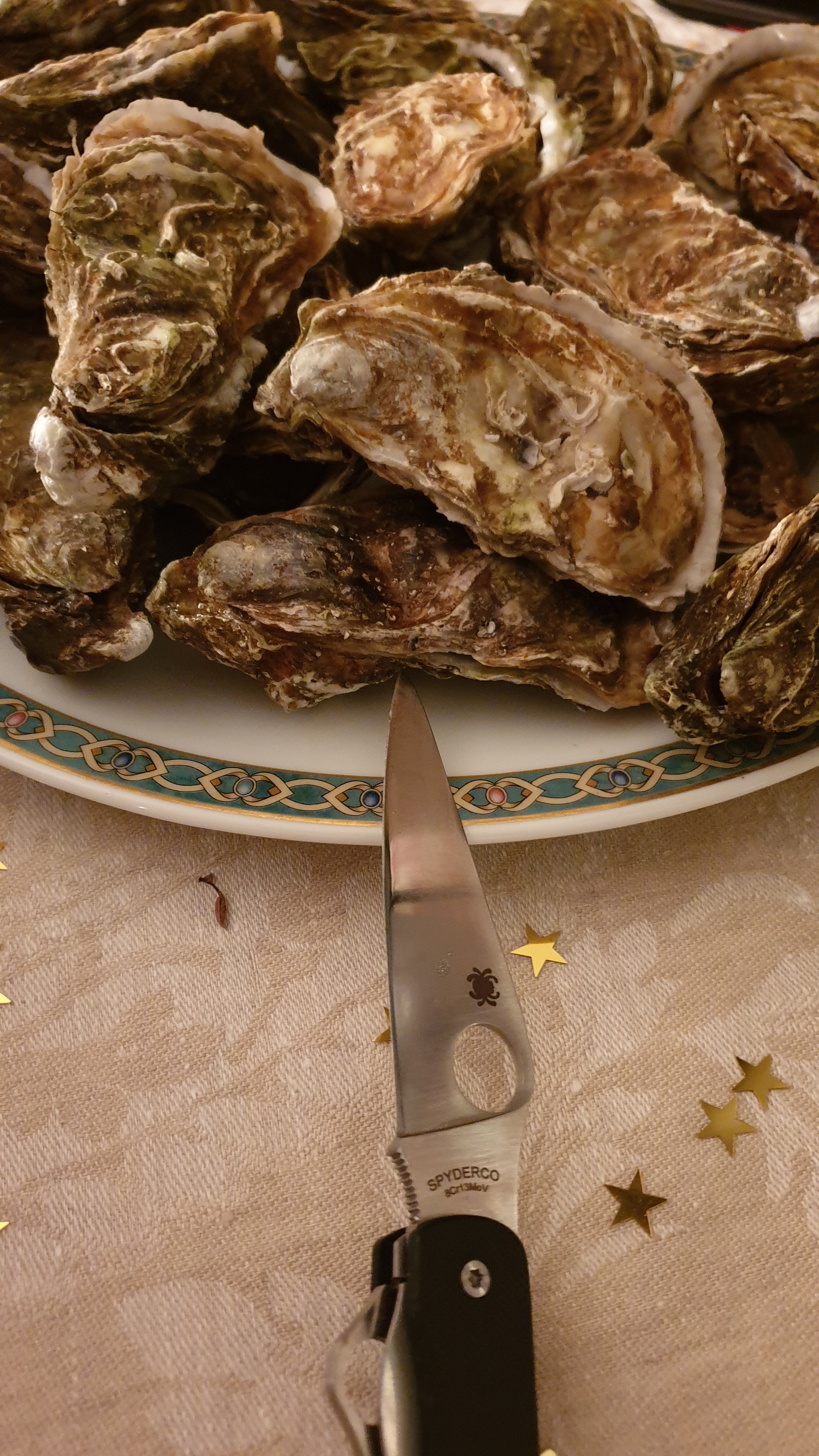
Shuck oysters. Cut rope. Open boxes.
Forget it in saltwater—and just keep going.

The UKPK Salt may well be one of the best “Made in Golden, Colorado” folders.
More than that—
it might be the very first true scuba-diving slipjoint. The serrated FRN could be even better. (Now their FRN is green for all LC200N versions)

And here’s the real trick:
It’s a marine slipjoint that makes you forget it has no lock.

There is a Part II here:

NATIVE CHIEF™ REX 45 SPRINT RUN™ – C244GBORE – The Joker !

“It’s been a long road
Getting from there to here
It’s been a long time
But my time is finally near…”

Yes, it has been 22 years (since 1999) that we have been waiting for the Native Chief to be produced.

Sal Glesser said:

In 2008: “We only made one prototype. The model never went into production.”

In 2017: “The Native “Chief” has been on hold for some 15 – 20 years. I imagine we can get it to queue if there is demand. I’ll watch the thread. The Shaman is designed to be 3.5″ blade length which is legal in more places that the Chief’s 4.0″ blade.”

In 2018 “Working on the refinements for the 3rd prototype. We work on roughly 20-30 designs at any given time…. We’ll use a Golden back lock.”
Then…
I’ve been carrying a “Chief prototype. A 20 year old “sal” design with modern “Eric” mods.” had written Sal Glesser in March 2019.

As shown on Eric Glesser video “Native Chief Breakdown”, the prototype looks a lot like the finale version.

Here is also a video from Wouter (Spydercollector) presenting the production sample:

Also, knowing the Vanilla version released in 2019, all made in their new facility in Golden Colorado Earth, was in S30V, waiting for a Sprint Run was mandatory in my case.
I got my eye on the Rex45 Chief before even to be able to get the Tree Rex Shaman. Rex45 seems to me a great steel for such a “toothpick”. Last year I had the chance to get a Tree Rex and my experience with that alloy made the wait of the Chief even longer.
You can read my thoughts about CPM REX45 here:

https://nemoknivesreview.com/2020/02/07/the-tree-rex-also-known-as-the-shaman-in-cpm-rex-45-and-dymondwood/

To quote Spyderco’s site:
Crucible® CPM® REX® 45 is a super-high-speed particle metallurgy tool steel enriched with large volumes of cobalt, tungsten, molybdenum, and vanadium. Its high cobalt content increases the steel’s attainable hardness and enhances the positive properties of the steel’s other alloys. The addition of vanadium promotes the formation of vanadium carbides, which provide high wear resistance, fine grain size and increased toughness.

CPM Rex45 is just great: no chipping, pleasant to keep ultra sharp with only some leather + compound stropping: a great super steel. Just be careful with its dust with 10% of toxic cobalt, better be safe than sorry.

OK, my Chief was expected for the first of April, hence the name “Joker”. The slim shade and the burnt orange color scales also inspired me… (Certainly not the Joachim’s or Jared’s crappy interpretations, much more Ledger and Bolland.)

Back to the knife: stretching in length the Native is a beautiful result. Since the Native model people were asking for a longer version and a shorter version, they have been heard.

Right out of the box, the Chief felt very angular: sharp edges on the scales, gritty G10, and a lot of hot spot on the choil/ricasso and the blade spine.
My Mandy City felt the exact opposite and it cost me a third of the Chief Price. So I was a little disappointed. It was not love at the first sight. Luckily , I know my Spyderco for a looooong loooong time and get my sandpaper ready.

I have send it under the tap to avoid any G10 dust which are really toxic for the lungs. Now the handle is suiting my taste.

The last experience I got with thick all-G10 construction knife in the Spyderco Family was the great Manix 2 Lockback (sold for 99 euros !) which was a great hard working folder.


The G10 slabs are much more thick than with the steel liners construction.
Quoting Sal:
“Actually Eric and Tom went over this model with the engineers for quite a while before making the decision to make it liner-less. We’ve done a lot of experimenting lately and you can see a lot in the many different designs and options. It surprises me that some would think to make decisions on values without any experience. if we screwed it up, we’ll fix it, but we don’t screw up often considering the many envelopes we’re willing to push.”

Compared to the Police:

You can compared thick G10 and thinG10+Liners.

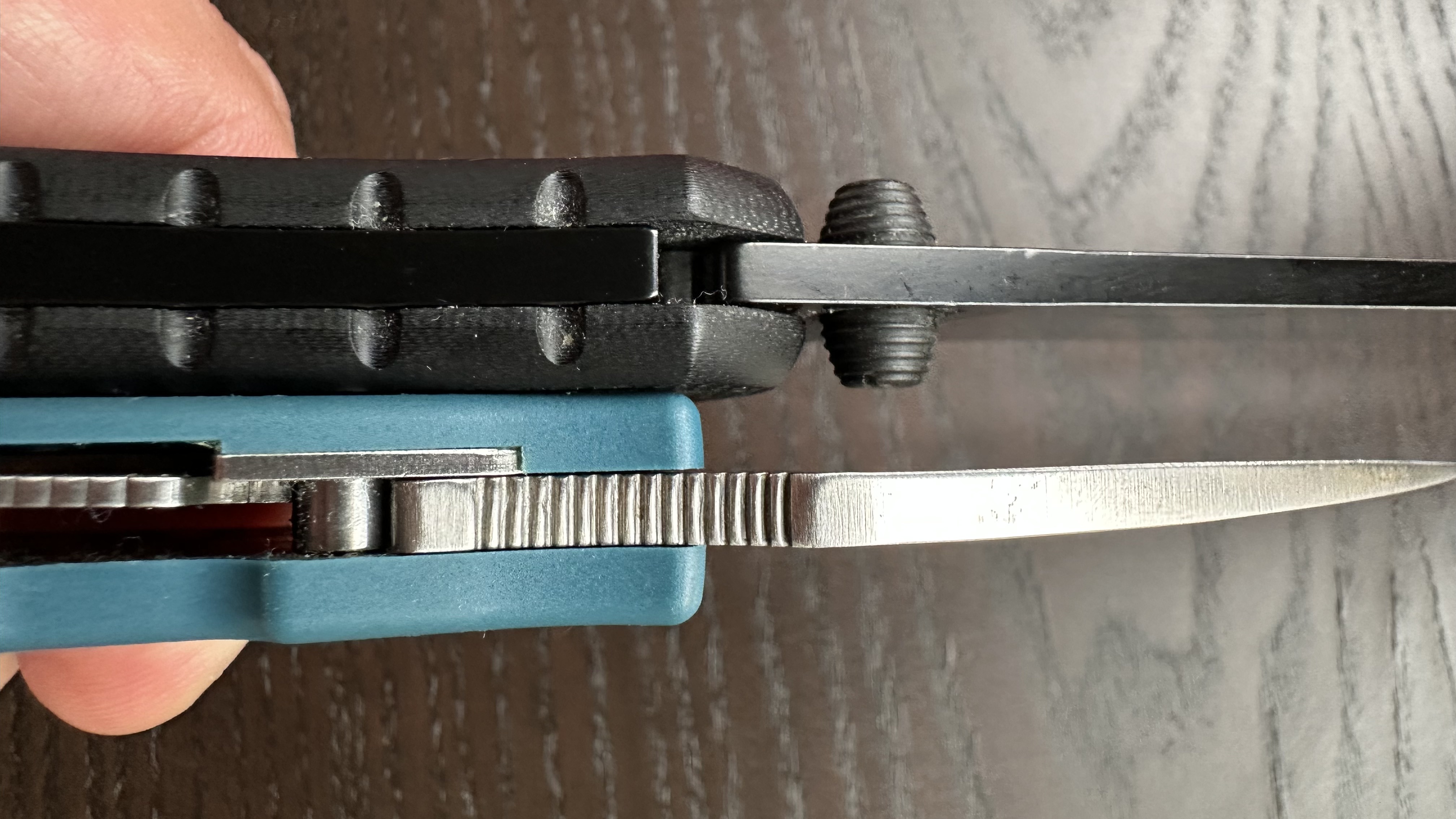
As with the steel liner’s knives, there is zero flex and zero play, horizontal or vertical. It is like a vault. (My old Benchmade AFCK BM800HSS got titanium liners and flexes a lot.)
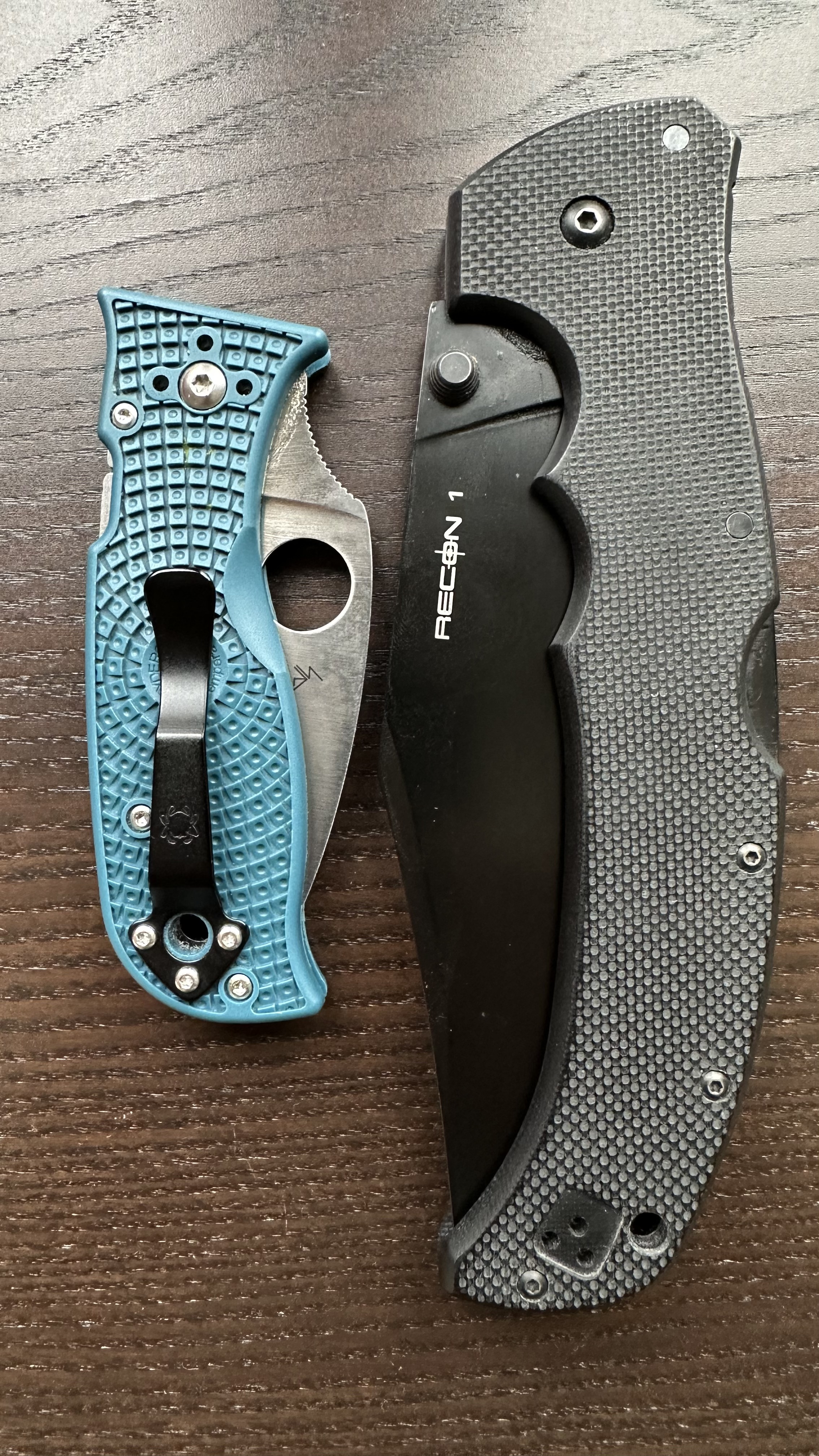
G10 is a really solid material. They even makes stealthy fixed knives with G10 blades… A steel liner could also bend and warp, not a thick G10 slab IMHO. Also the Cold Steel Recon folders are steel linerless and Cold Steel’s Recons are known for their sturdiness. I got an XL Recon and the lack of liner is really not an issue.
The blade, helped by two bronze phosphorous washers, chutes free when unlock which is very reliable and easy to learn to put back the knife in the pocket. It is done smoothly and fast.
It is a very secure way to close your knife.

Let’s not forget: a one hand opening knife needs to be a one hand closing knife. The best example is using a knife at the top of a ladder: you want to be able to get the knife back in the pocket easily and safely.

I’m not a huge fan of the hour glass clips founded on the Native 5 and the Delica/Endura/Paramillie/Para3. It has been immediately replaced mine with a Blade4sell small titanium clip.
Let’s do a family photo:

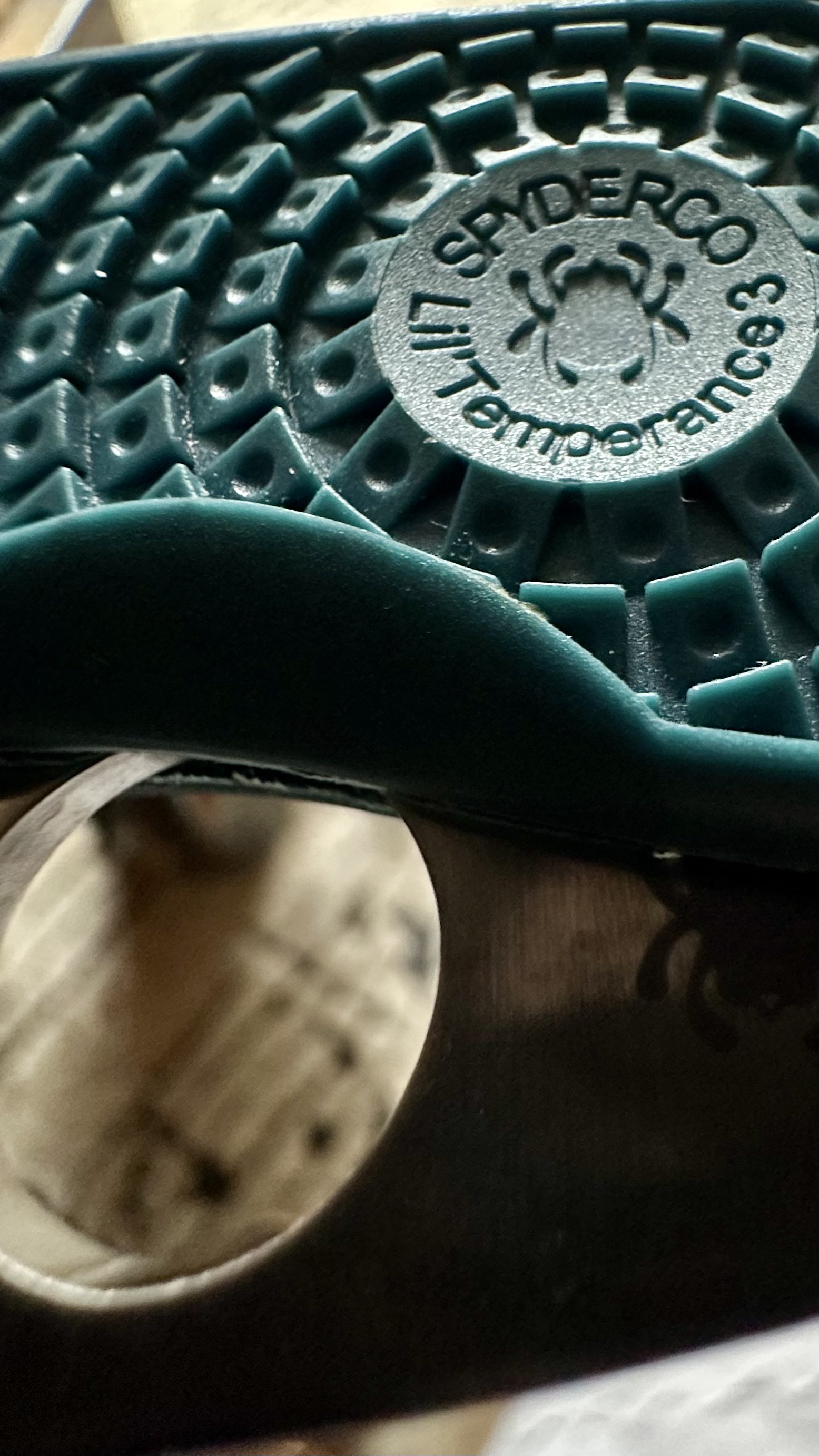
On the Shaman (“made to be a fairly heavy duty folder. Simple, but stout.” according to Sal), the Chief, the Native and the Lil’ Native my favorite clip is that last one.

The Native family is the no “hump” clan of the Spyderco Catalog.
The Chief is co signed by Eric and Sal.

Back to the Orange Chief, I was not really pleased also by its edge geometry. I felt it thick behind the edge. Even if the knife was razor sharp out of the box, it could not pass my plastic bottle test which consist in cutting the butt of a soda bottle by the center which is thicker.
The thin Manly City was able to do it right out of the box, as were able my Swayback, my PPT or even my Delica too for example… The champions being the Michael Walker and the Nilakka.
It is a matter of “deshouldering”, convexing the edge as always.

Diamonds are super steel best friends.

And now it is able to pass the test. 🙂
But let’s do it again for good measure.

Once thinned with diamonds, I usually strop it for a nice shining results. So far I need more elbow grease but it slowly get better and better.

Also the choil was very sharp to my taste. A little diamond filing and it was much more finger friendly.

So far, the Chief is a slim knife but destined to be very polyvalent. When the Shaman is very outdoors oriented, the Chief finds its place also in the kitchen.
It takes time to built a natural patina on Rex45 but it will come later after some fruits and hot meats.

The orange scales make it very table’s friendly too, despite its very pointy shape which could make sheeples nervous.

In a plate nothing force you to keep the edge perpendicular to the surface. I have found REX45 being hard to dull on plates anyway. It is a very easy going steel.

Another easy going steel is K390 found in the Police Model. You can see it is a tad longer than the Chief with also a thinner stock blade.

The Chief is elegant and certainly one of the most beautiful design in the Spyderco scuderia. Their backlock is so solid, the handle will break before it. Sal Glesser knows that making a longer version of the Native was not as simple as a sketch on a drawing board. You can watch the video at the end of this article about that.

The double signature, Eric and Sal.

Spy Opera Un’aria degli anni ’70

Do you want to drive an Electric Ferrari Dino ? Like Maranello would provide some Danny Wilde’s Persuaders car with the last computerized engine ?
Maranello, no. Maniago, si !

This picture found on https://forum.spyderco.com/viewtopic.php?f=2&t=87264&start=40#p1442735

shows is all. You can make a vintage lockback folder with a ball bearing driven pivot. And suddenly your understand the Spy Opera is a nostalgia flick opening knife.

The Spy Opera is a version of Lionsteel Opera “spyderized” which means:
adding a spyderhole, a clip, a topnotch hype steel… It’s the difference between a BMW Series 3 and a BMW M3. Also the price has been multiplied by 3 compared to the modest Lionsteel Opera in this rendition.
Taxes for importing to US a European made knife is not stranger to the high prices.

At the first glimpse, the micarta handle, the decorating screws, the beveled and rounded lockbar and spacer: this is a looker, but is the Spy Opera a keeper.
In my case, no, as it belong to my friend Geoffrey from Normandeep.com (a diver’s shop in Normandy near Omaha Beach) who was gentle enough to send to me some of his personal knives we wanted to review. Thank you Geoffrey !
He told me he has bought this knife and was not expecting to be surprised by that quality.
He’s true. The action is stellar. certainly the smoothest lockback I have ever used. Just a little smoother than the Native V or the Siren.
Now we know why: a ball bearing instead of washers.

A great detail about that knife is the total absence of any vertical bladeplay. This is the plague of lockbacks in my book and the Maniago folder is rock solid.

Ball bearing are great for fidgeting and smooth action but could be tricky in sandy or muddy environment. But the Spyopera is destined to be some gentleman folder for the US residents and typically a hunting folder for the Italian.

That shape of blade, that long handle, it is typically what my friend Valter would love for hunting and skinning. He would be especially keen of that M390 blade as hare’s skinning is especially hard on blade.
For that take a look at the Walker C22 in ZDP189 or his Native in CPM110V he has used for many hunting seasons.

Follow the link for the articles with Valter and his hunting dogs:

https://nemoknivesreview.com/tag/valter-nencetti/

Holding the knife with the blade shocked his its way to use and the ergos of this knife are just perfect for that. The rounded handle is contributing to avoid the boxy feel you can have with a Native Lightweight for example. Our hands love rounded shape and once you get used to it its is very hard to go back.

Now the handle won’t be easy to clean. Some parts are pinned and not screwed together.
Example found on the forums:


So, the need for short folding hunter’s knives with high retention blade is real for hare’s hunter and I can really the design of the SpyOpera shining in that niche.


The sharpness is OK but if it was not Geoffrey’s knife, I would have thinned the edge much more. I have tested on the butt of a 1,5 liter Coke’s bottle and it has been stuck twice, not able to pass that test (which is not that easy as the plastic collapses under the pushcut).
With a little deshouldering of the edge using diamonds, it would be a lightsaber. I have donc that with the Urban shown or my Para3 in M390. Out of the box the factory edge is just OK but again this is not my knife so I won’t touch it. Of course zero bladeplay while using the Spy Opera harder on a cutting board during that test.

So who is its designer Massimo Salice Sanna AKA Max ?

“Massimo Salice Sanna: after starting make knives in 1993 as a hobby, soon his passion became a real job and day-to-day activity. Well known for his accurate touch and the eye for details, he is considered one of the first knifemakers in Italy: he was noticed and therefore chosen by LionSteel for his precision and attention to design and mechanical features of the knives he makes. The Opera model was born in 2006, followed by other product families – Daghetta, Mini and Skinner. Currently, new designs and projects are under way to be put into production soon.”
Says Lionsteel’s site.

Max Opera pictured with another Made In Maniago M390 folder with rounded spine and liners: the Clap. designed by Bob Terzuola.

Once thing I do not like, and this is purely personal and is the absence of Ricasso. I know I often calls it a “choil” as Spyderco Ricassi are often half mooned like a choil but ou understand this is the place you can put safely your index finger on the blade, as the start of the edge.
In Sal Glesser’s designs they act like a lower quillon with the hump of the spyderhole acting like a upper quillon. Sal has reproduced the quillons of a boot dagger on his folding designs: the Military being the first example.

This design found of the Military (or the Slipjoint Urban pictured) transfers the force directly to the blade, without impacting the pivot which still is the most fragile part of a folding knife, the weakest link !
When you cut with a Millie, it is like using an antique folding knife where the handle was mostly a folding scabbard and the knife was hold like a razor. You cannot do that with Spy Opera when the slipoints designs by Sal like the Urban for example bring you that great security of holding the knife by its blade. But again the lockback is so sturdy on this Maniago’s knife you can confortably rest your thumb on the hump and your index finger on the micarta’s handles.

So the Spy Opera is a fidgeting, beautiful jewel, high quality Italian design gentleman (and lady) locking folding knife. It is easy in and out of the pocket. The attention to details is stunning. It is flawless. It got a real 70’s flavor. It is like a Ford T turned into a Hot Road to me: lovely but not for everyone. Good thing is: you can really fall in love with it as your main EDC.

Edit: thanks to JD for the heads up=> I meant “Hare” not “Heir”. 😀

Kevin Wilkins Leafstorm- SPYDERCO C128G

Thanks to Geoffrey from Normandeep.fr , I have the opportunity to test various knives of his collection. The Leaf Storm is one of them.
And it was a thick bird and have bought second hand…

They are a rattle when closed and the culprit was easy to find. The previous owner has pushed to much on the lock slab…
First step: I remove the screws on the G10 side. They are long and goes into the titanium liner on the other side.

It is a very simple construction made in Golden Colorado.

The lock bar has been forced outward and has not enough tension anymore. The detent ball is even not working anymore.

By gently pressing inward I was able to give more tension to the lock. Much better !

Some nano oil drops for good measure.

And voilà. I have not put any blue lock tite, leaving Geoffrey free to do it, as it can stain the jade G10 too…

What a beautiful little critter ! It has been design by American Kevin Wilkins started as a graphic designer and art student then an art director. He moved to Berlin in the early 90s where the knife bug really sank in. By 1995 he worked out how to make his hobby a livelihood and one of his favorite designs he called the Leaf Storm, dixit Spyderco card.

It is small lady and gentleman knife that fits and carries in the watch-pocket of a pair of denim jeans. Let’s compare it with one of the best little big knife Spyderco is producing.

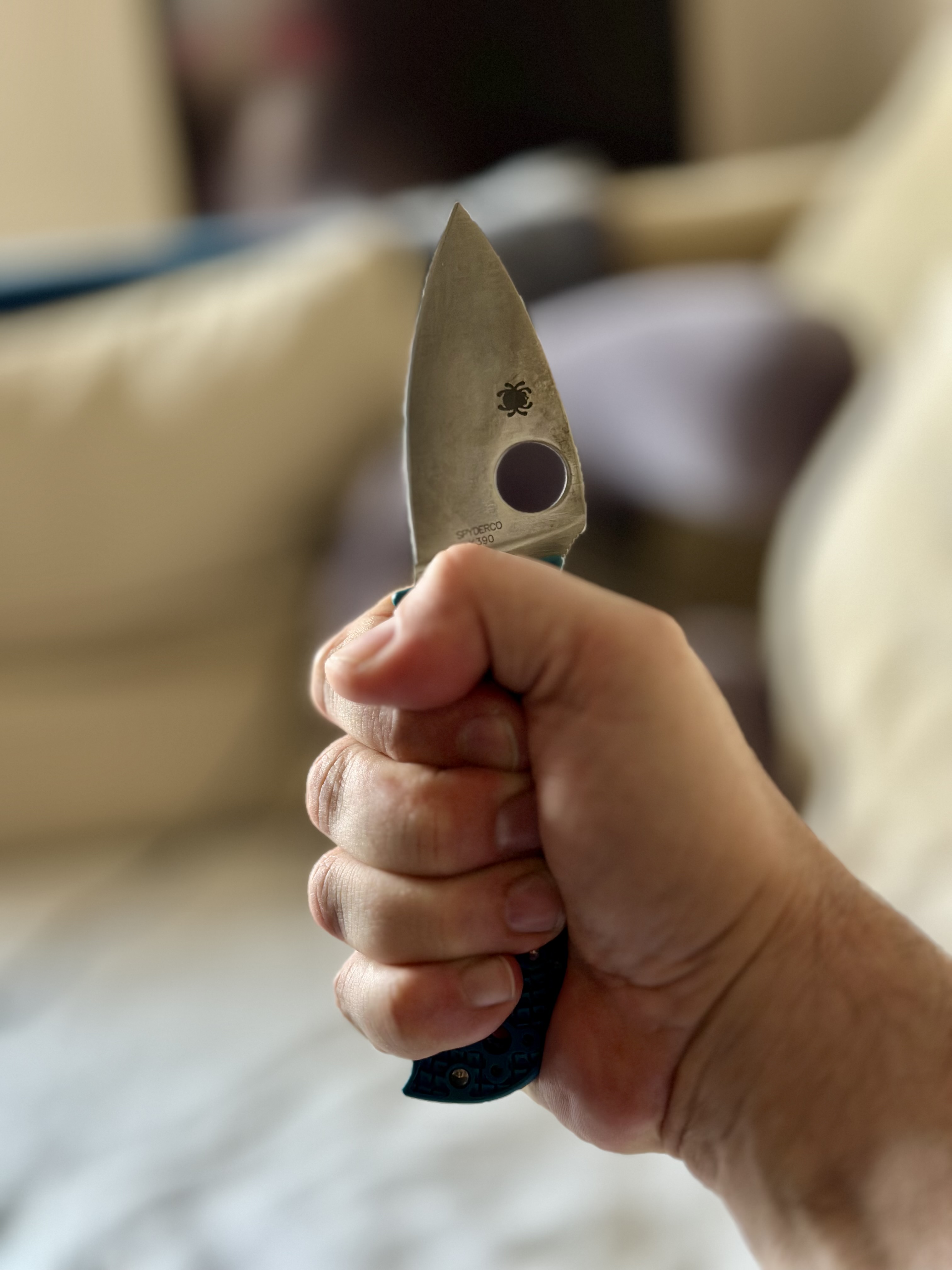
My Lil’Native (featuring JD’s edge) got the same size and I carry it in my watch pocket. Main difference could be the hollow grind versus the full flat grind but not for me. What I miss the most is the choil…

Because as both knives got the same blade length, the Native give the opportunity to chock up the knife and have plenty of space for 4 fingers.

The Leaf Storm got no protection with its large ricasso and could be an issue if it is sharp. And it is sharp. My pinkie could be cut easily.

With the hammer grip, this is my index knife which is now the next candidate for a flesh wound…
In my own opinion, the Leafstorm is an eye candy and a collector knife, as it is rare now, been discontinuited but the action is not smooth and gritty and the ergos not to my taste, I rather go with my little Walker C22CFPE or my Lil’Native. There is even some lock sticking as there is no steel interface… It is a little on the crude side compare to smooth Lil’Native. Golden factory has made a lot of progress since the release of the LeafStorm. Designing little folders is not an easy task and esthetics are not mandatory. The LeafStorm is a beauty but not palm friendly.

The Spyderco Drunken – A True Rimbaud’s Knife.

Did you know that John Rambo was inpired by a Season In Hell by Arthur Rimbaud. Also David Morrell, First Blood’s author, was looking for a name for his heroe and his wife brought him some apple: Rambo’s Apples. Anyway, Rimbaud was not born in Bowie, Arizona like John Rambo but in Charleville, a city dear to my heart, in the Ardennes and for fans of Nine Princes in Amber from Zelazny. So let’s see why that knife could be a Rimbaud’s knife.

As you can notice, they are dust… No, I mean you can notice the “Drunken” texture designed for a high performance grip: a wave pattern. There is a poem from Arthur Rimbaud named “Le Bateau Îvre” -“The Drunken Boat”. This poem is famous because, at least in French, its verses are built like waves and you can feel in your guts, the fear of a sailor on a boat going out of control in the middle of a tempest. (“The poem describes the drifting and sinking of a boat lost at sea in a fragmented first-person narrative saturated with vivid imagery and symbolism.” dixit Wikipedia. ” Rimbaud, then aged 16, wrote the poem in the summer of 1871 at his childhood home in Charleville in Northern France. Rimbaud included the poem in a letter he sent to Paul Verlaine in September 1871 to introduce himself to Verlaine. Shortly afterwards, he joined Verlaine in Paris and became his lover. Rimbaud was inspired to write the poem after reading Jules Verne‘s novel Twenty Thousand Leagues Under the Sea, which had recently been published in book form, and which is known to have been the source of many of the poem’s allusions and images. Another Verne novel, The Adventures of Captain Hatteras, was likely an additional source of inspiration.” More there: https://en.wikipedia.org/wiki/Le_Bateau_ivre).
Rambo was a very young poet genius but the second half of his life he was a “blade runner”, also a weapon’s and spices’ retailer in the Red Sea and Abyssinie Africa, a true adventurer. Again you can read is incredible life here: https://en.wikipedia.org/wiki/Arthur_Rimbaud

But there is more link with John Rambo’s character freedom and survival:
“After studying several languages (german, italian, spanish), he went on to travel extensively in Europe, mostly on foot. In May 1876 he enlisted as a soldier in the Dutch Colonial Army to get free passage to Java in the Dutch East Indies (now Indonesia). Four months later he deserted and fled into the jungle. He managed to return incognito to France by ship; as a deserter he would have faced a Dutch firing squad had he been caught.”

So back to the Dmitry Sinkevich’s Drunken, and its poetic pattern, name and … price. As you can notice, this is not huge folder but it deliver a tremendous blade length for its size. The blade is shape is beautifully flat ground and is gently bevelled on the spine. Another oozing qualities knife and of course it is justifying its high price. This is not a flash batch like the Bombshell but a regular Spyderco release.
Again I need to thank Geoffrey from Normandeep.fr who has sent me his own Drunken for me to have a taste. Actually I was very surprised in a good way.
It is a light (the titanium scale is “webbed” to reduce weight) and solid knife with a tanked RIL mechanism equiped with a steel interface, absolutely well balanced, alive in your hand. It’s a looker, you can gaze for hours: a true gem made in Taichung.

The big issue with that near to perfect knife is the clip. I have noticed it when I found myself not able to insert the clip in my trouser.

As you can see, the lip of the pocket is getting caught between the hole in “step” in the titanium scale and the clip.

Unless I’m helping it with my index finger by lifting the clip… which is also pointy… I can’t clip it.
Another issue pointed by our friend Alexandre Constantinoff in the Spyderco Fan Club France on Facebook is…

The one-screw-clip got some serious lateral play. And that’s for a knife that price is a shame especially coming from Spyderco which are the first to promote clips for more than 30 years.

As you can see Geoffrey’s Drunken got its clip already already marked and he told me he will find a solution to suit his need.

Here is the Drunken with two very similar Spyderco releases: the PPT on the left and the Spydiechef. The PPT Sprint Run share a S90V Blade and a Carbon Fiber/Titanium handle and unusual clip and the Spydiechef is really a brother in design.

They are a lot in common with those two, don’t you think ? From the side of the hole to the shape of the blade and the handle…

Actually you can notice the Spydiecheff clip is perfect, it goes far from the cut slab and the deep carry wire clip is perhaps the best clip in the Spyderco line.

So the Drunken in use is also very pleasant. The action is not especially smooth but you feel the solid lock with a loud KLAK once engaged.
Then the handle is even more confortable than the one of the Spydiechef, less blocky with its facets and bevels. The large pivot screw is great for shocking up the knife and the angle of the blade is providing a lot of power and control in the cuts. If the clip’s issue was forgotten, we could have here one of the best Spyderco ever release with zero compromise in terms of pleasure to use. Just that pointy shaggy ugly clip which ruins the experience and that’s a real problem for a knife at that price.
But, oh, what a beautiful geometrically handle…

And a really beautiful knife.