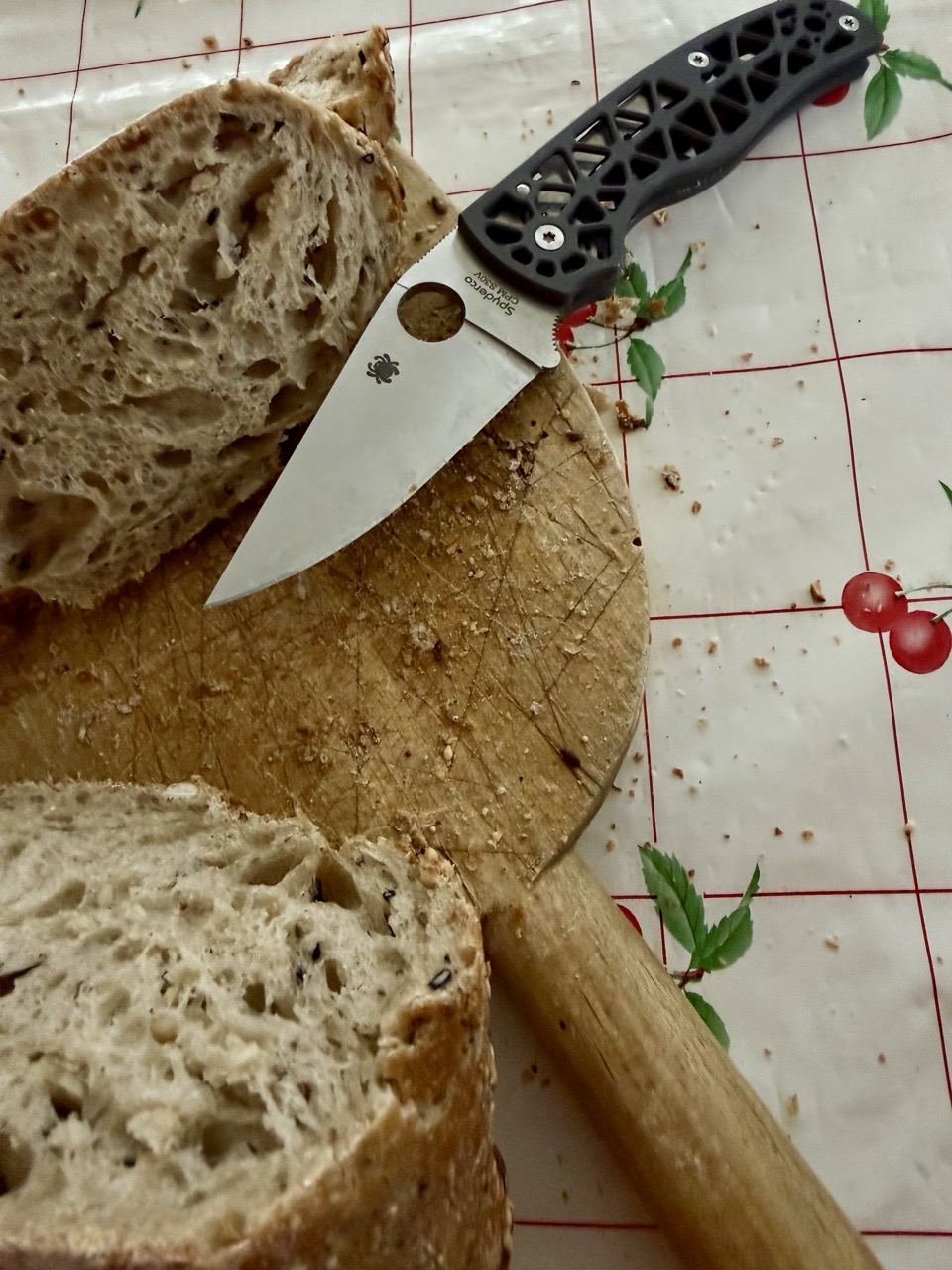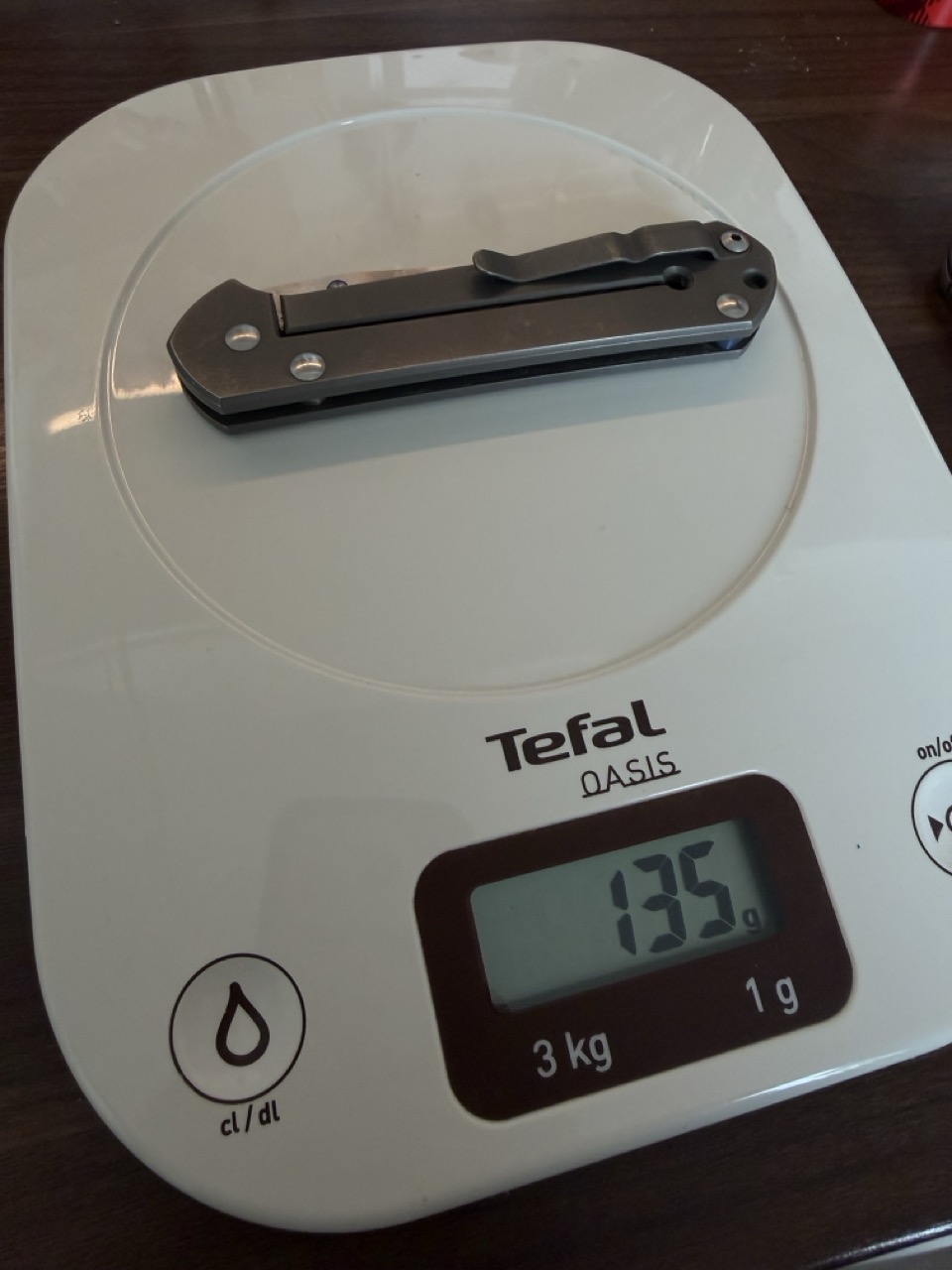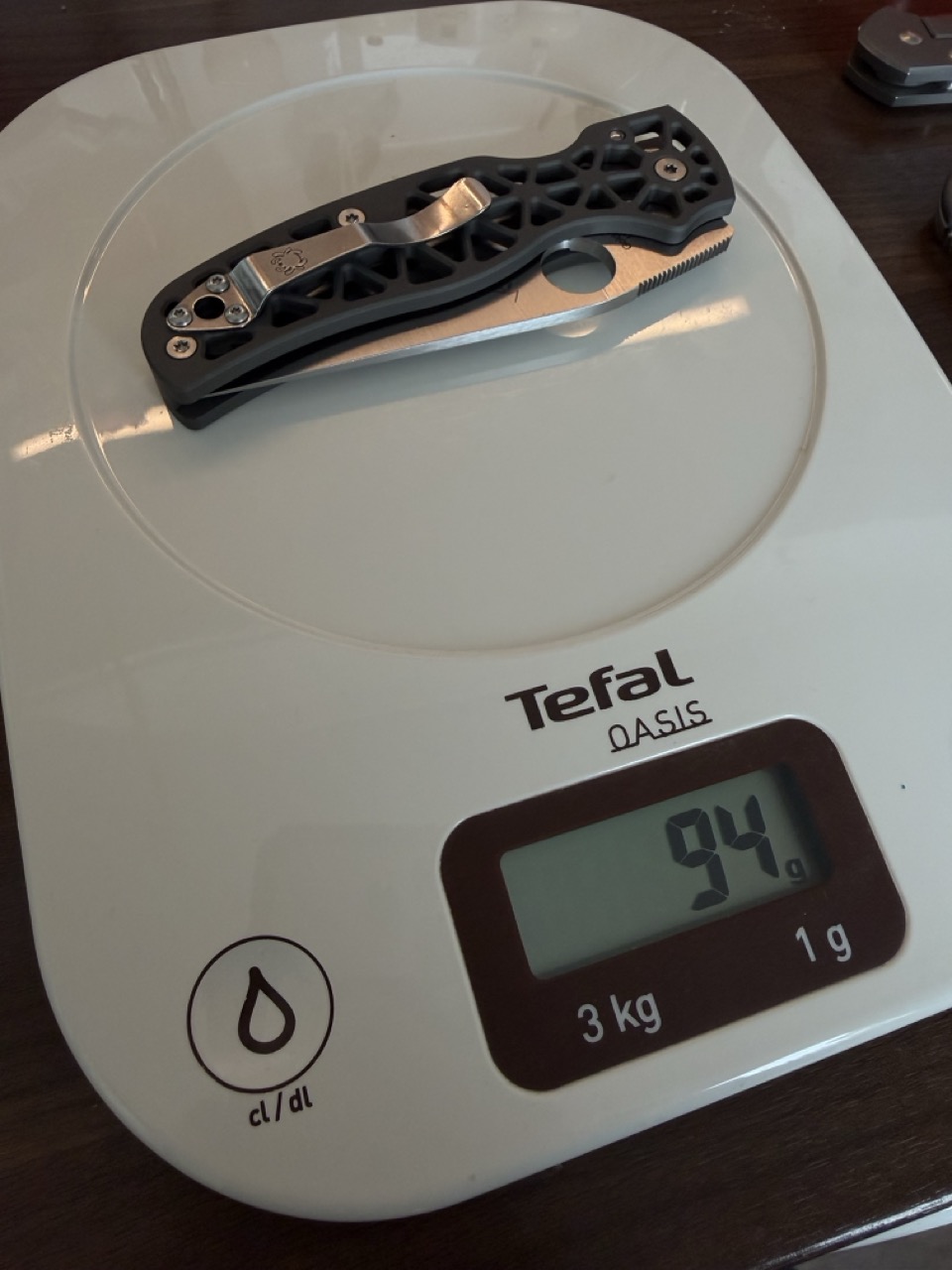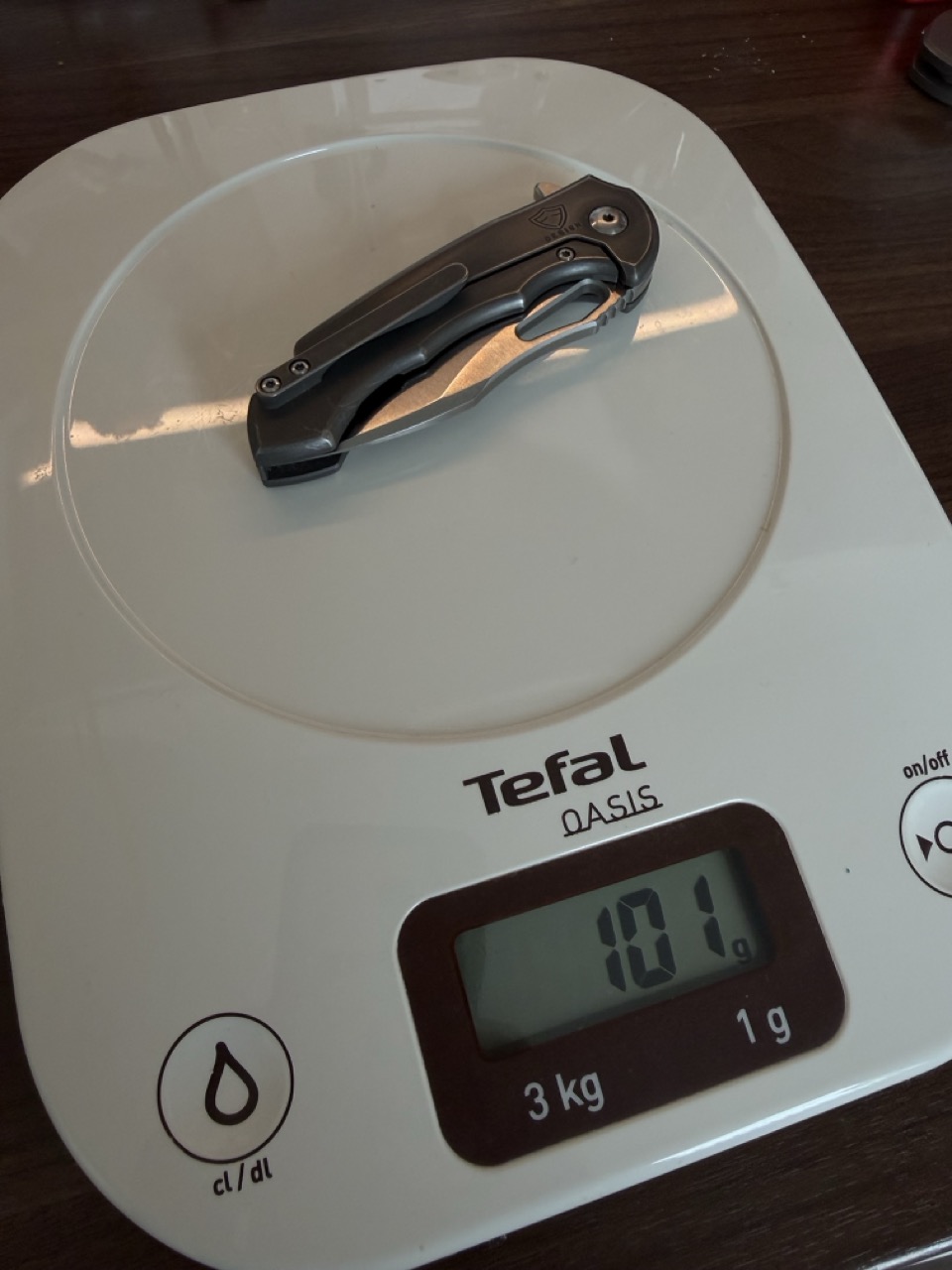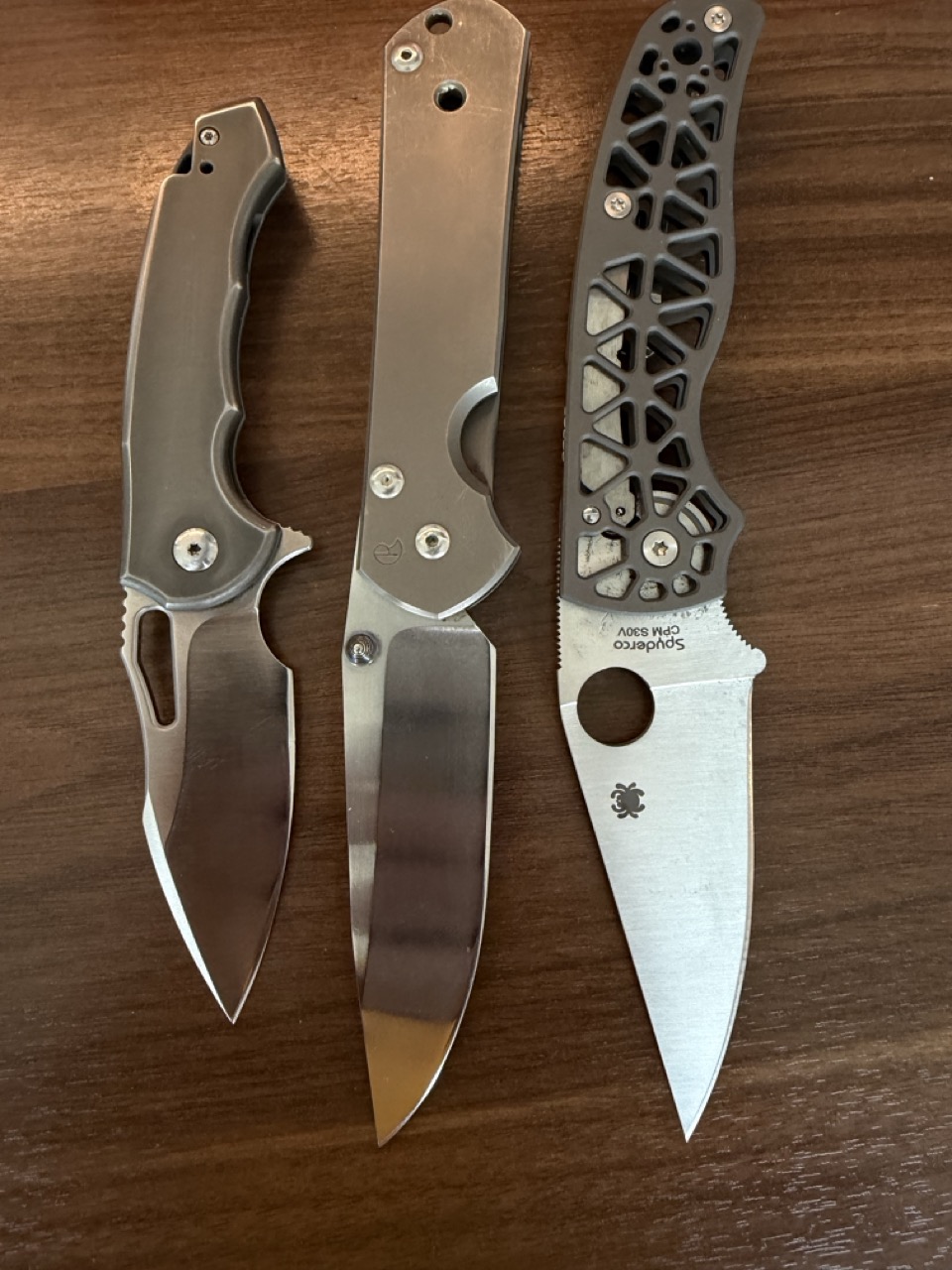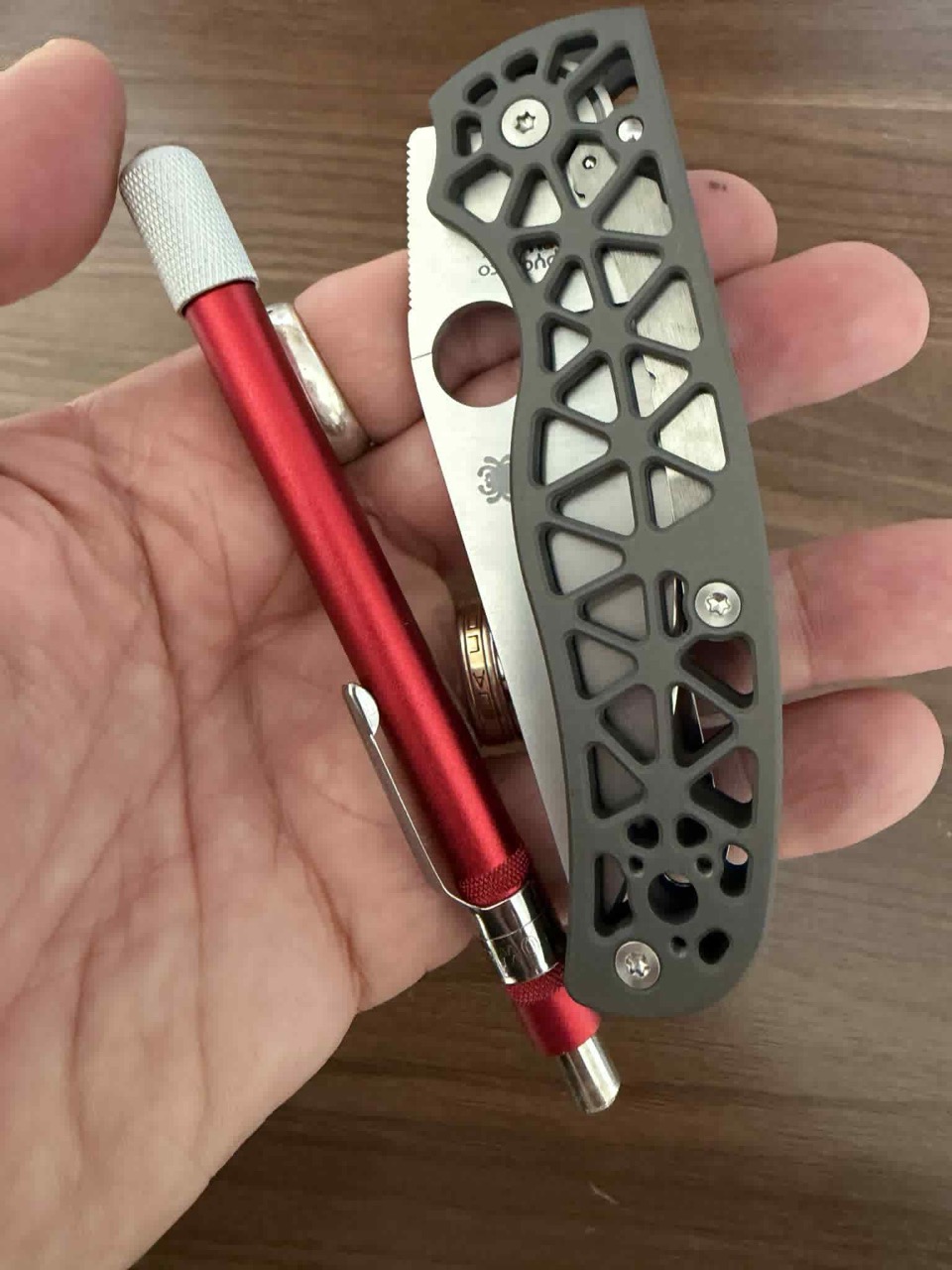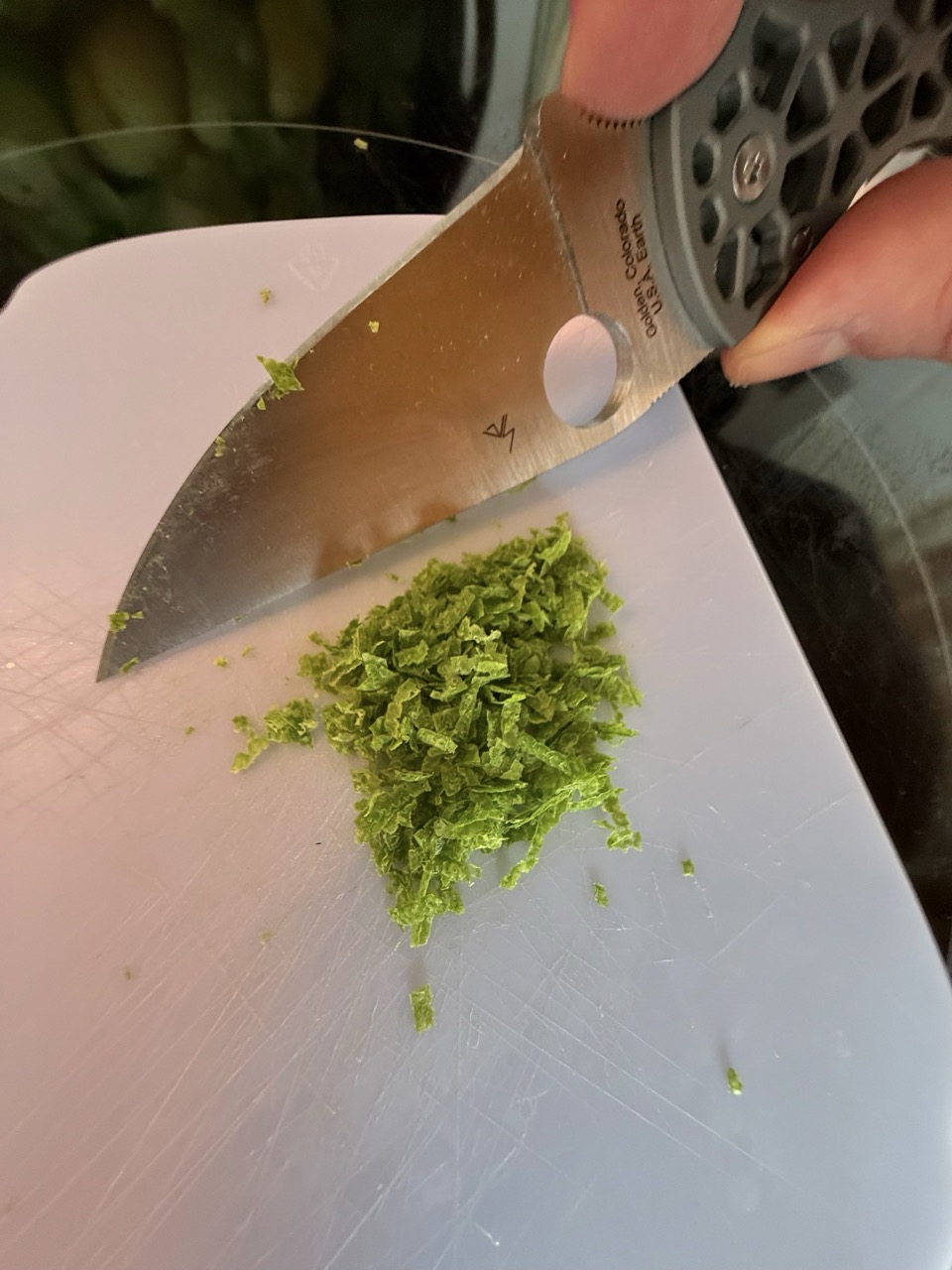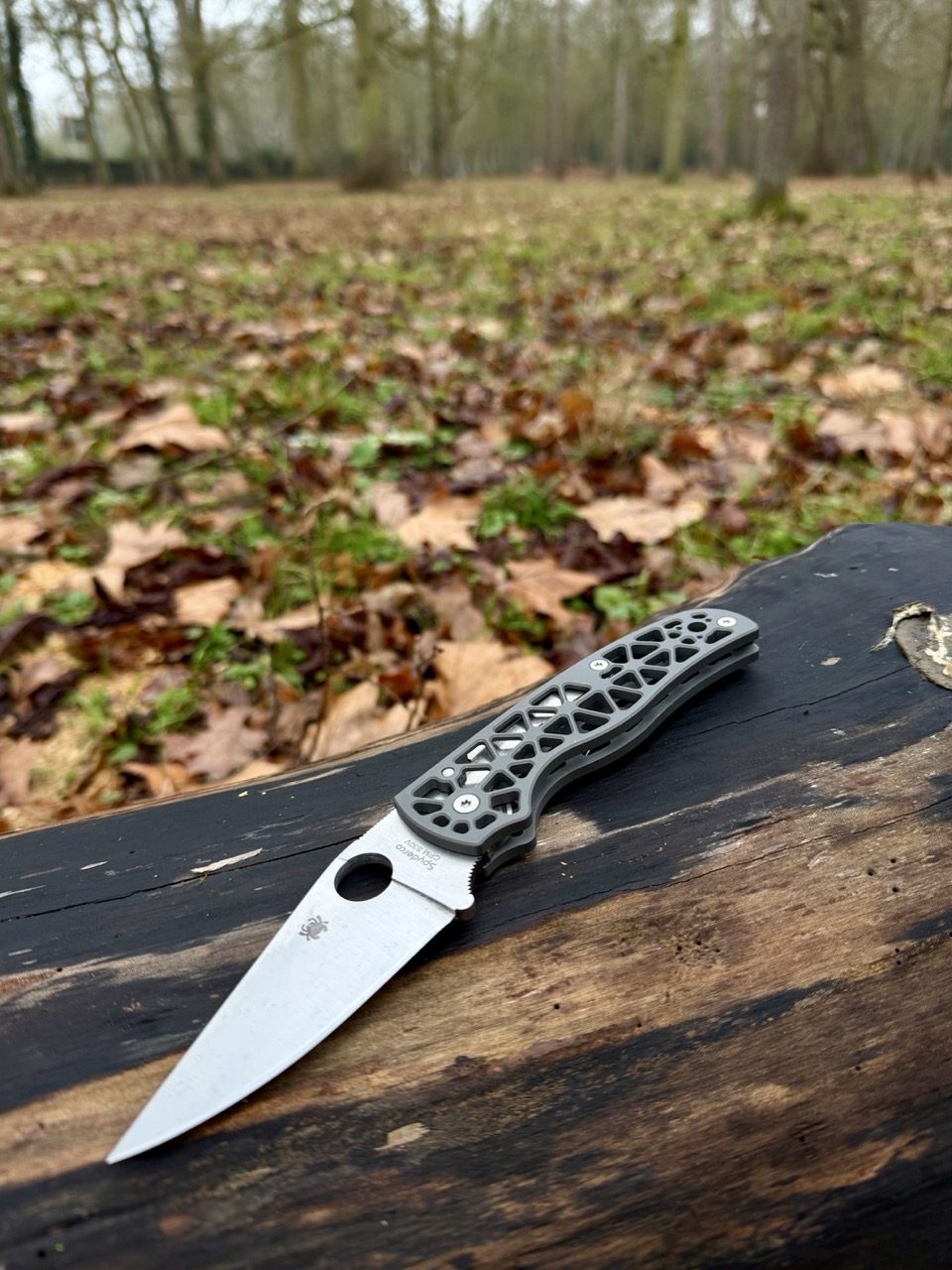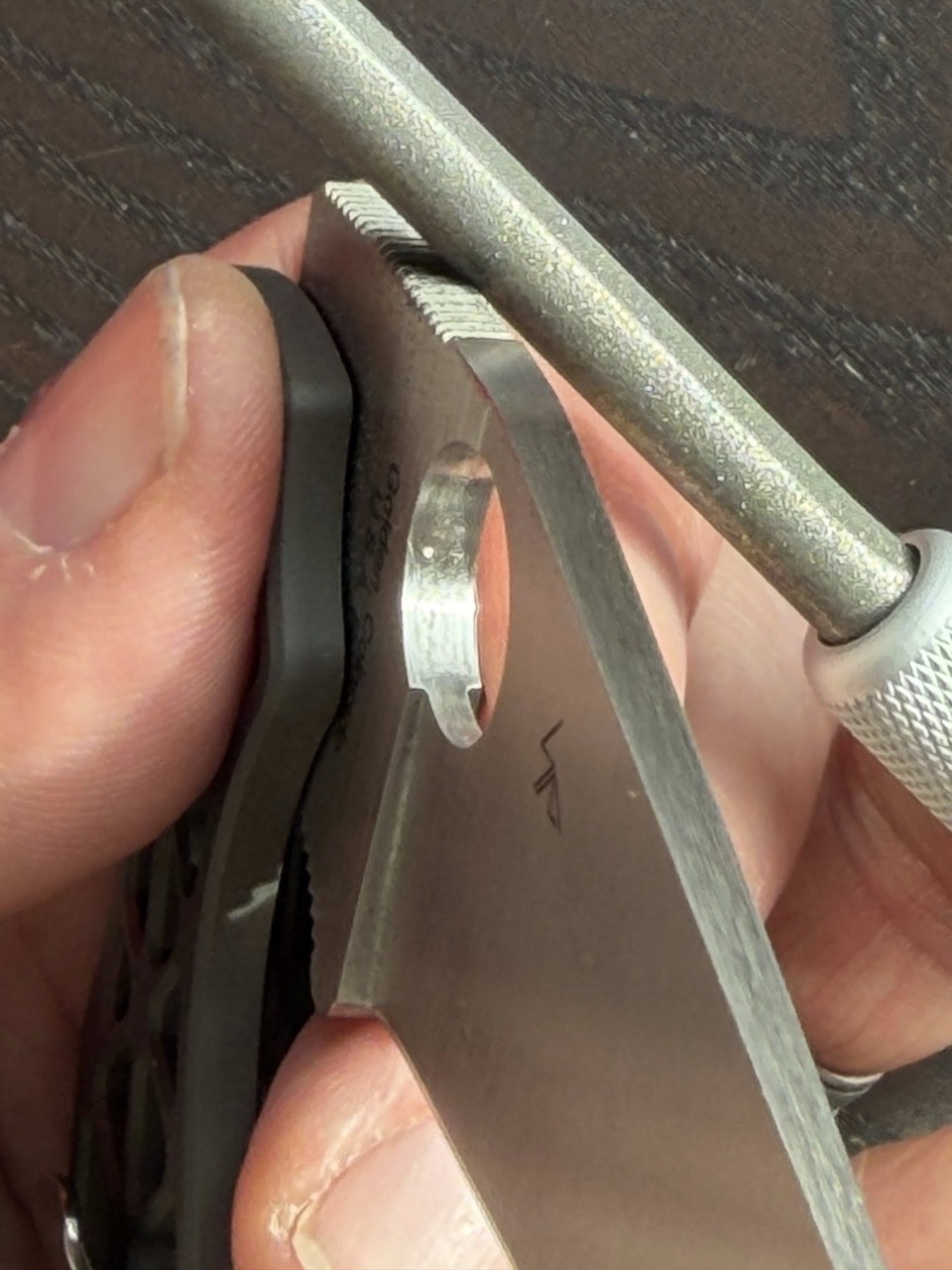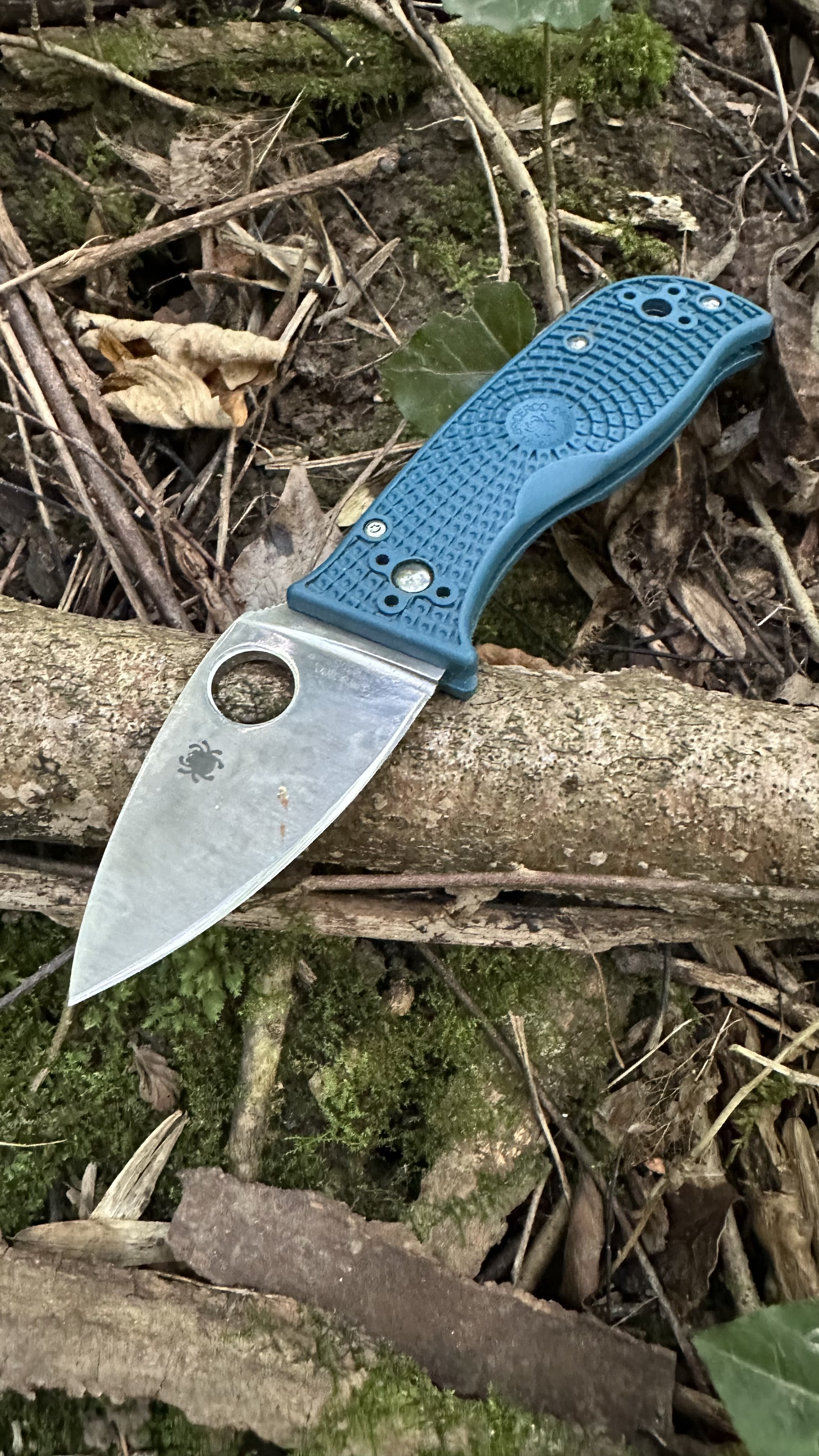
Disclaimer: This knife has been provided through Spyderco’s Ambassador Program, upon my own request. Thank you to the Spyderpeople for letting me review it.
This is a first look, first glimpse review — my very first impressions!
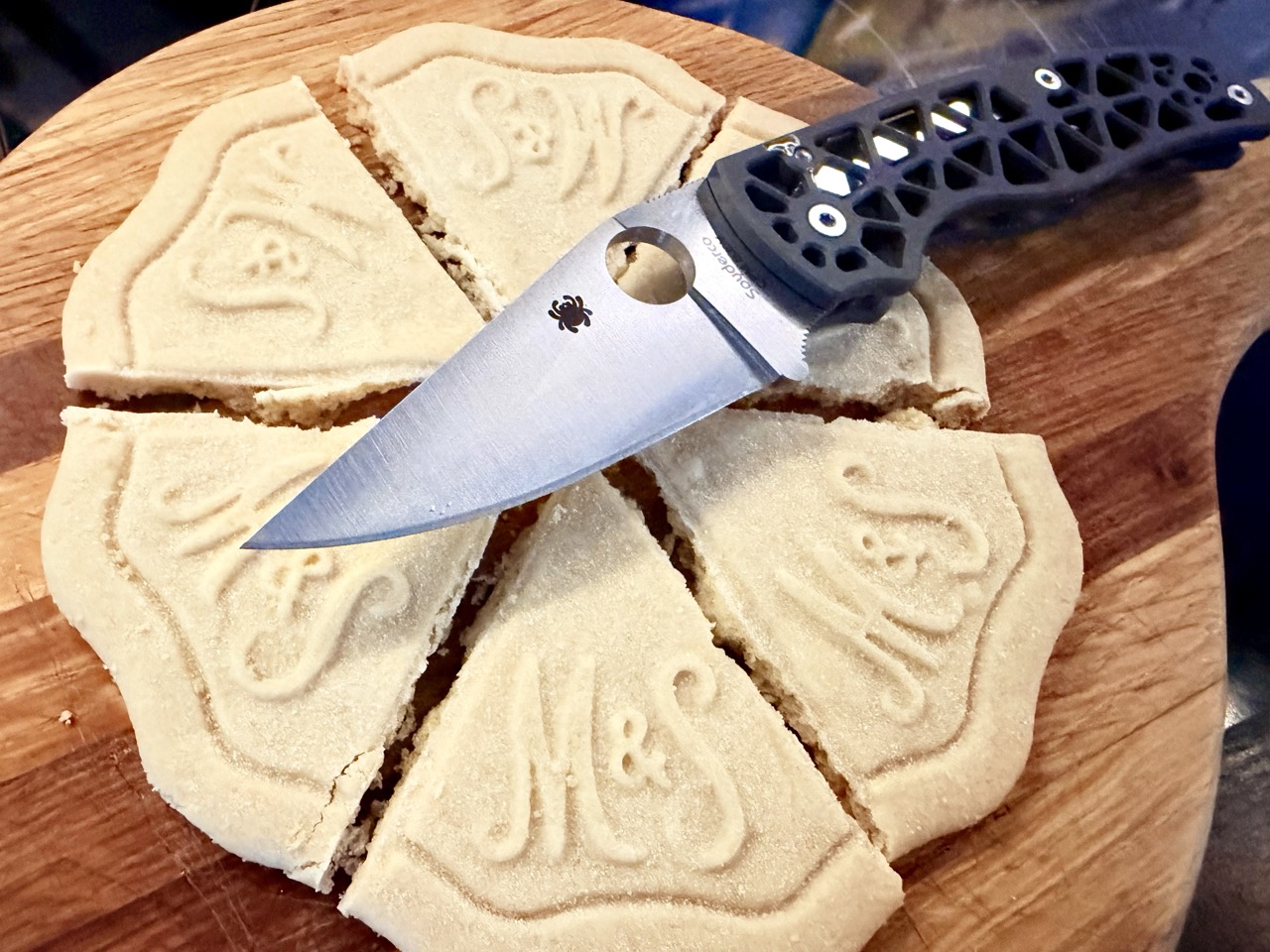
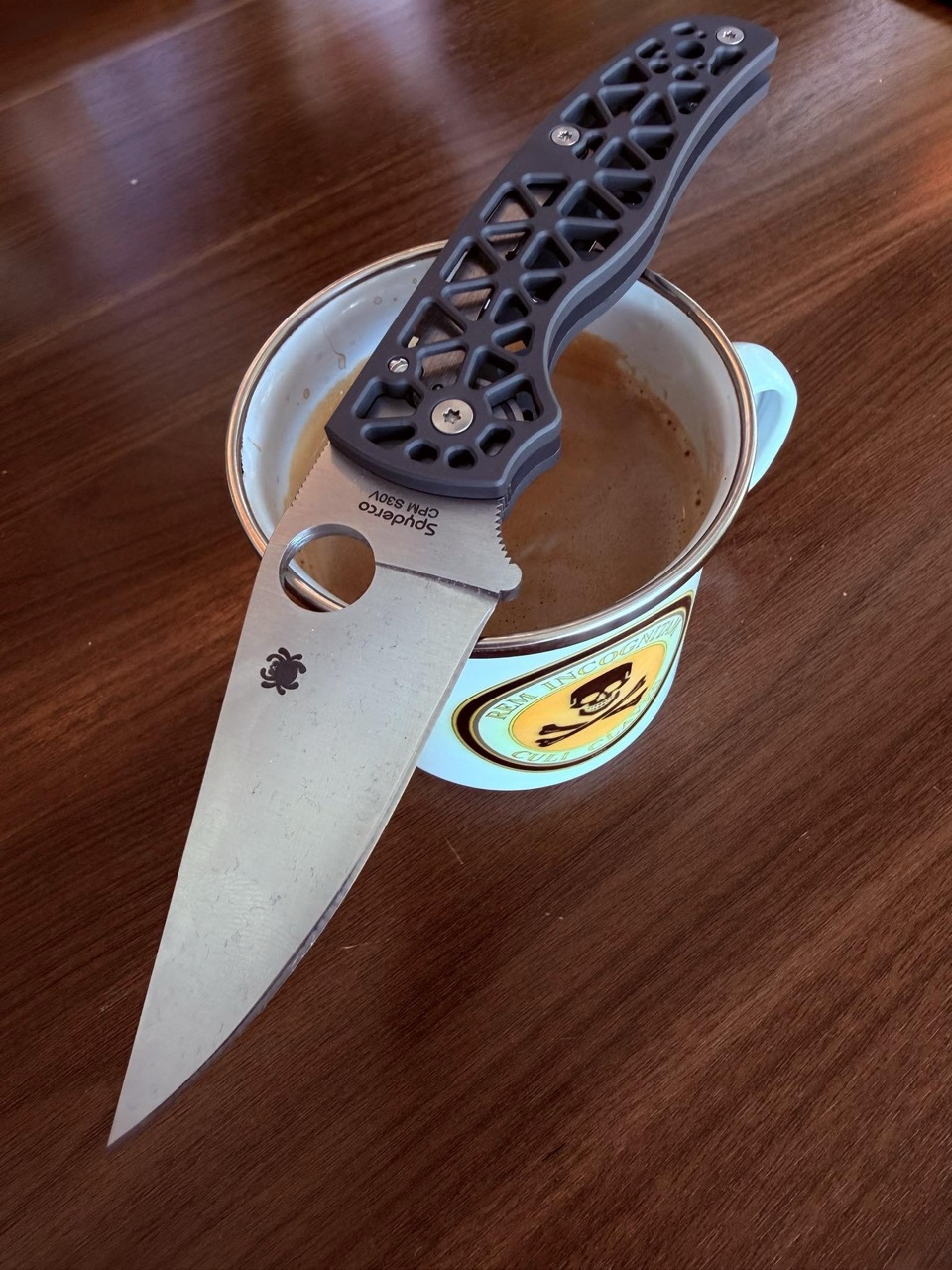
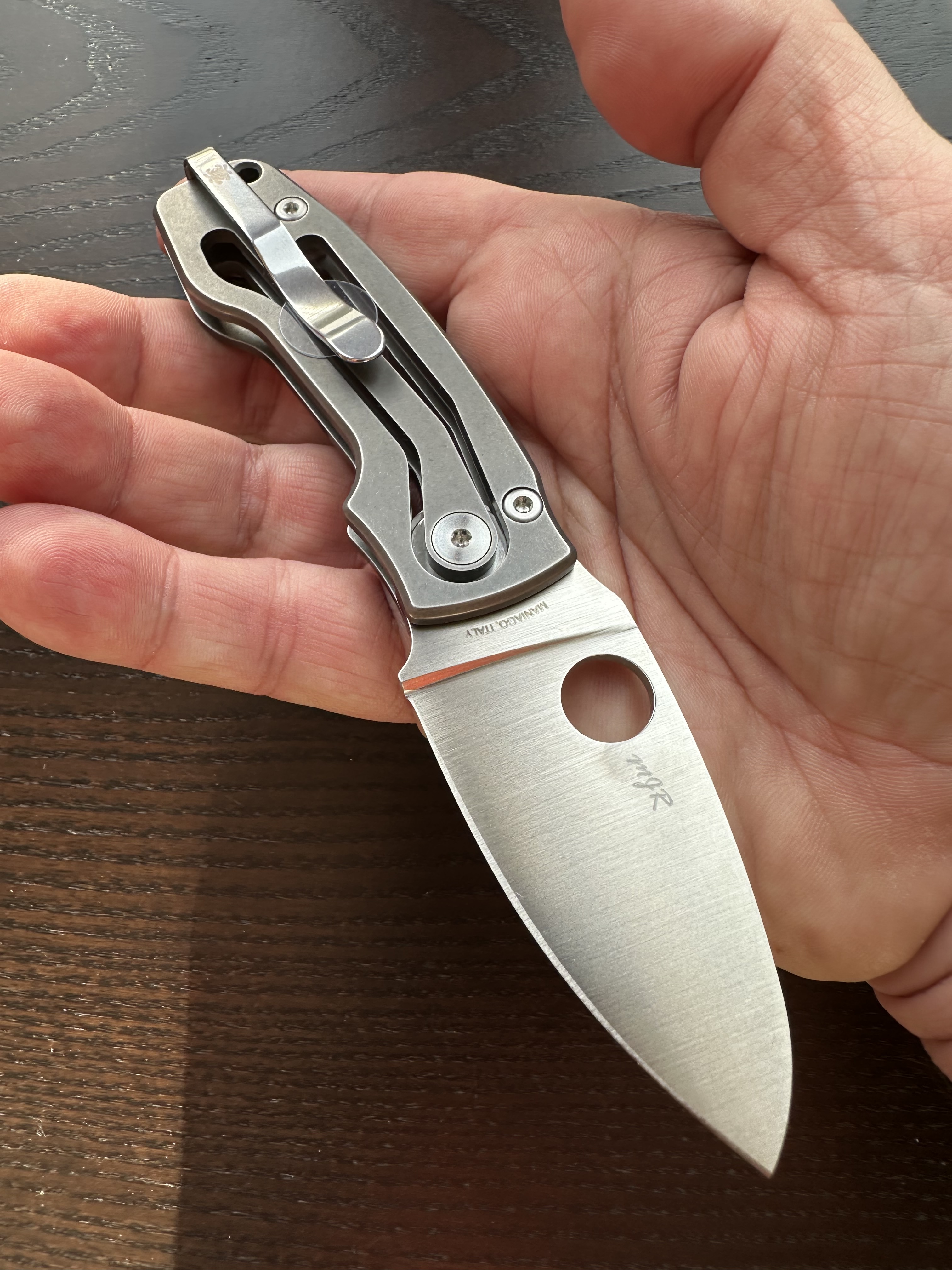
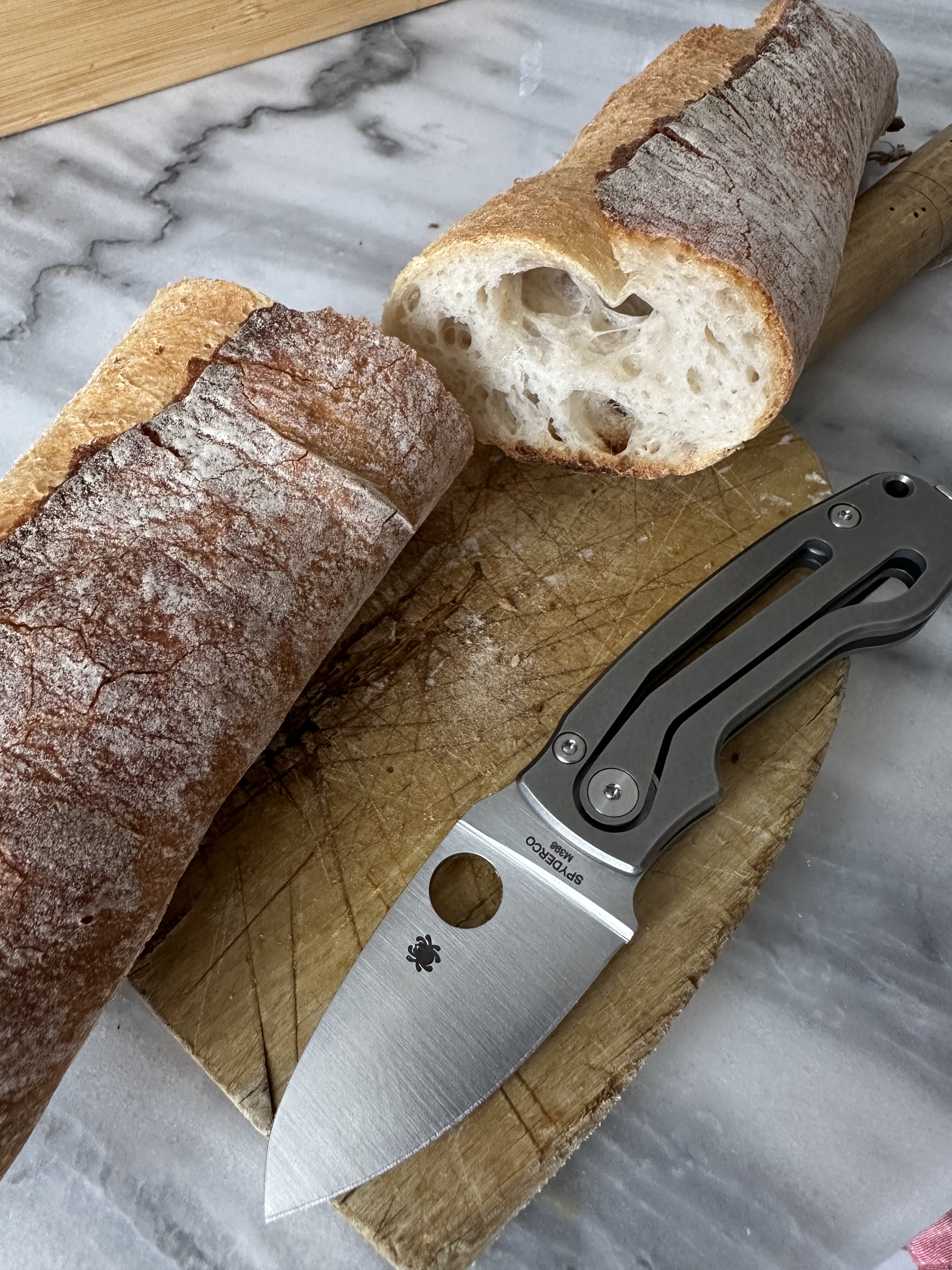
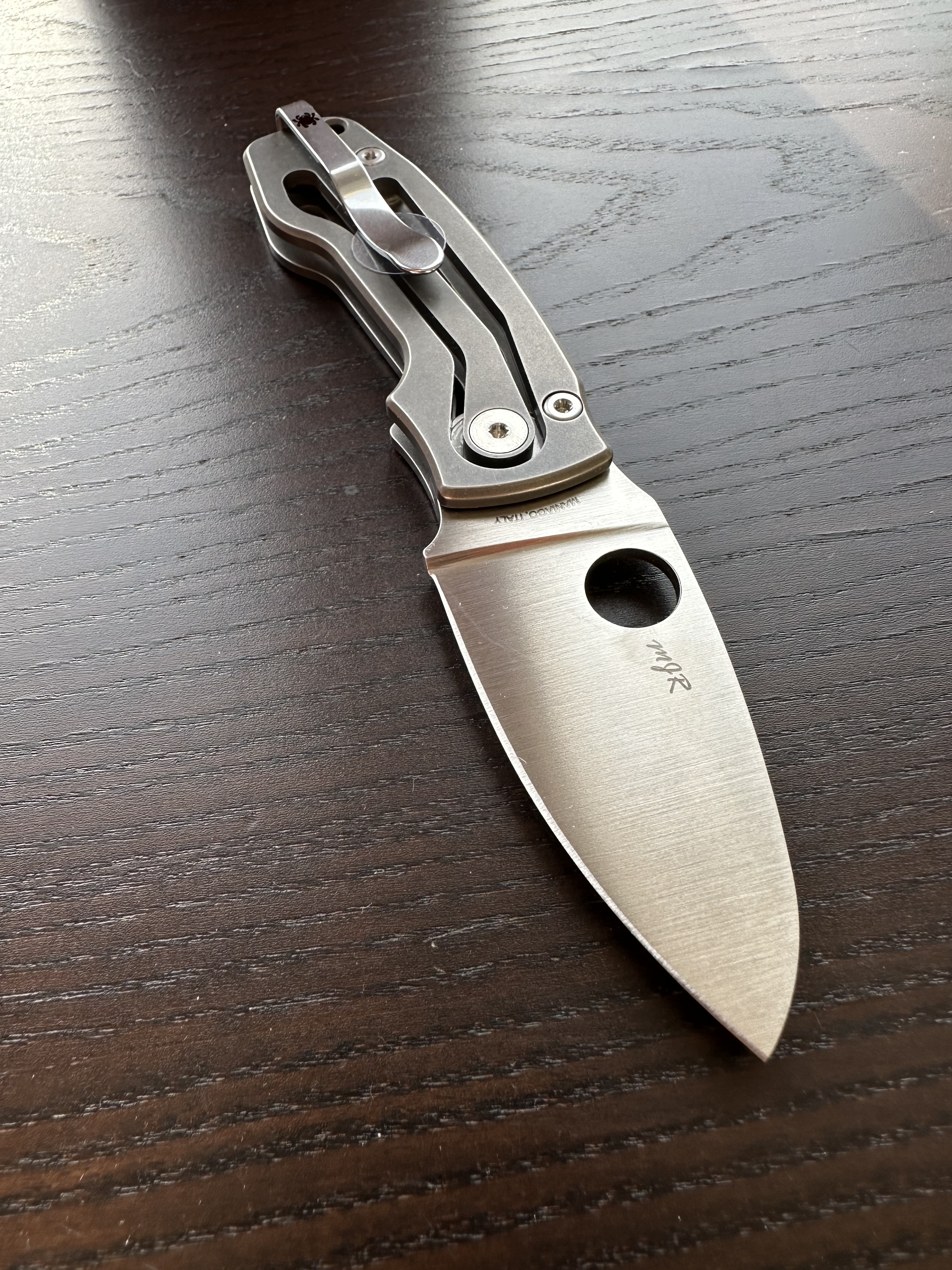
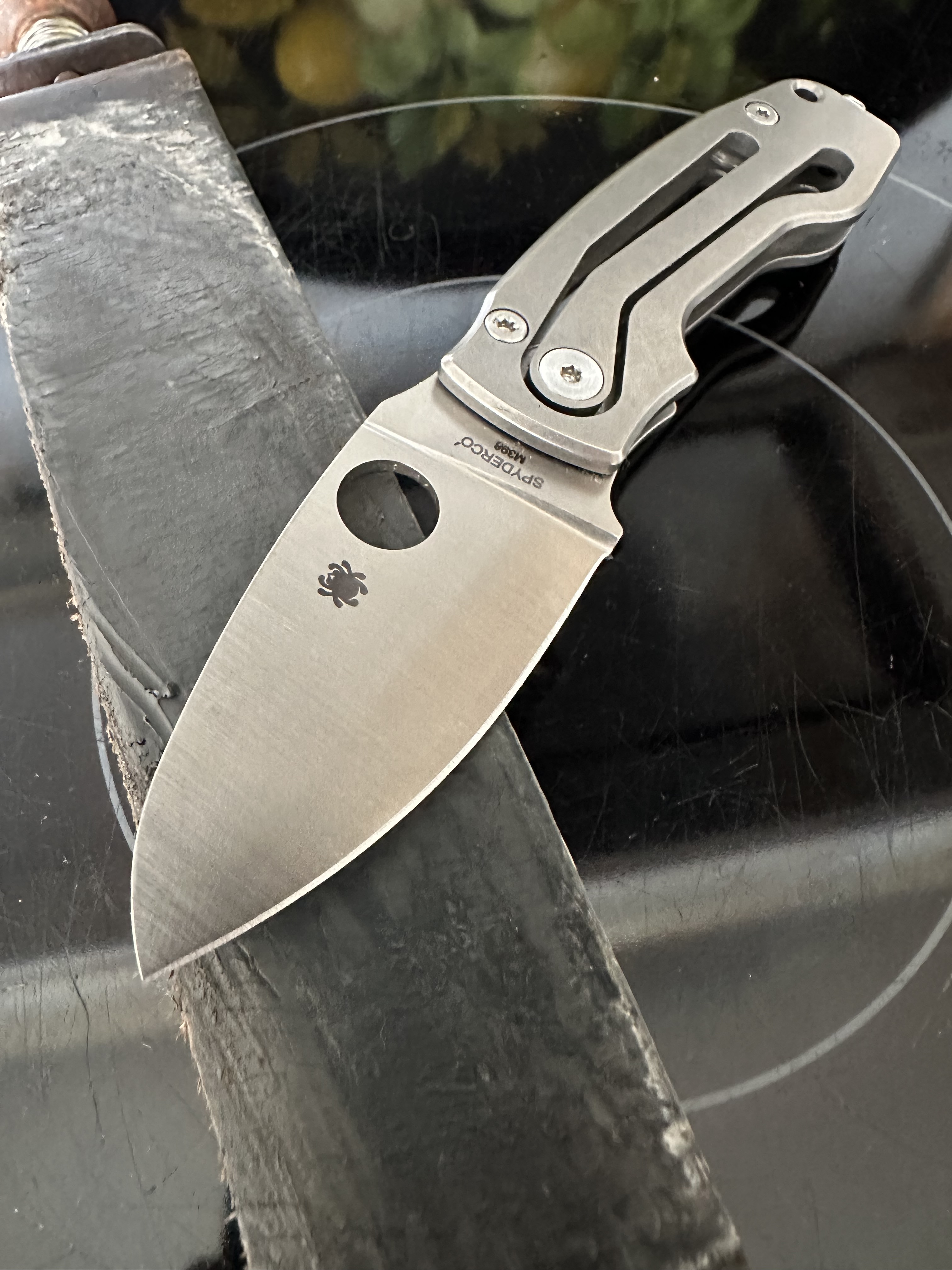
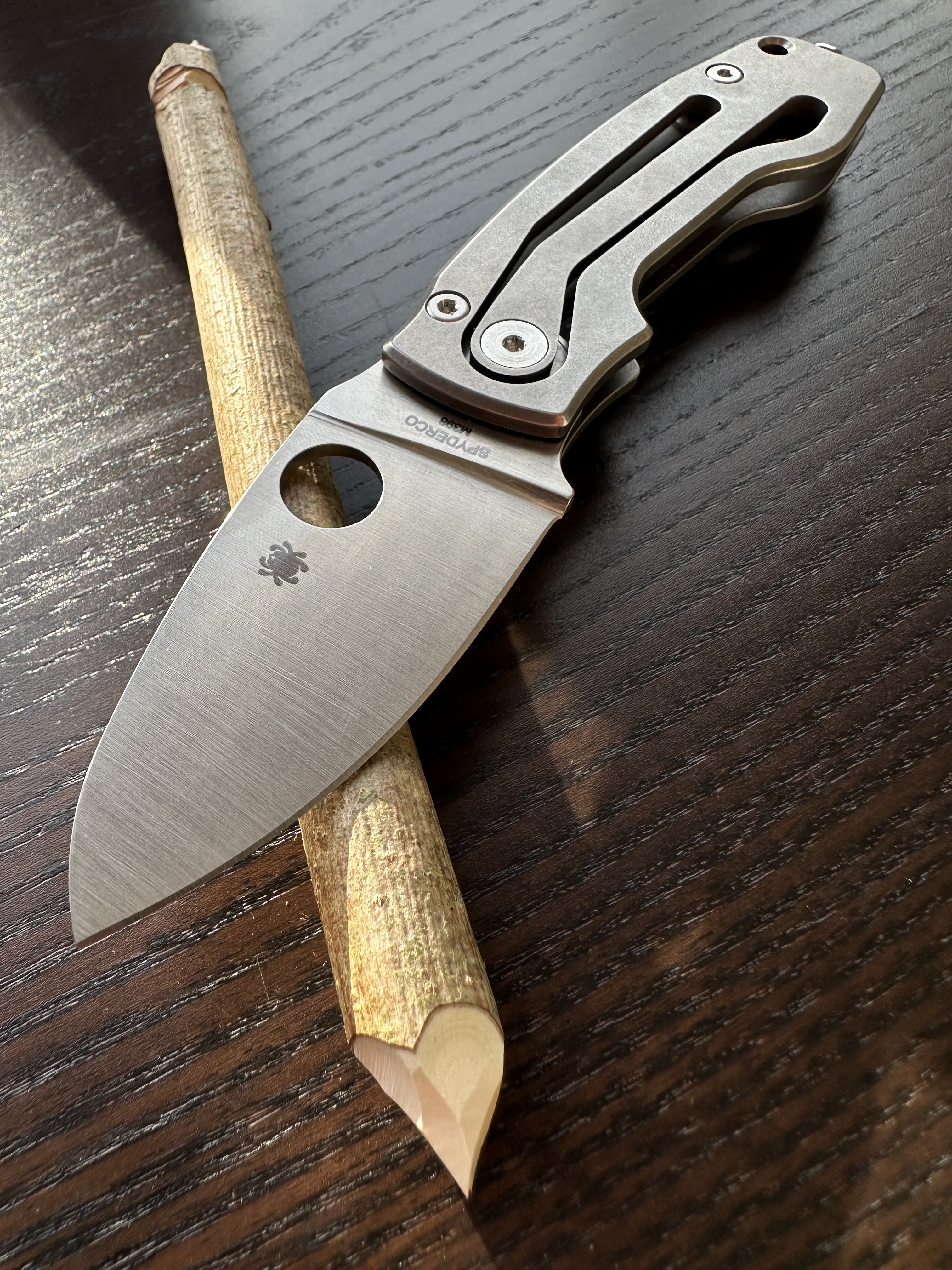
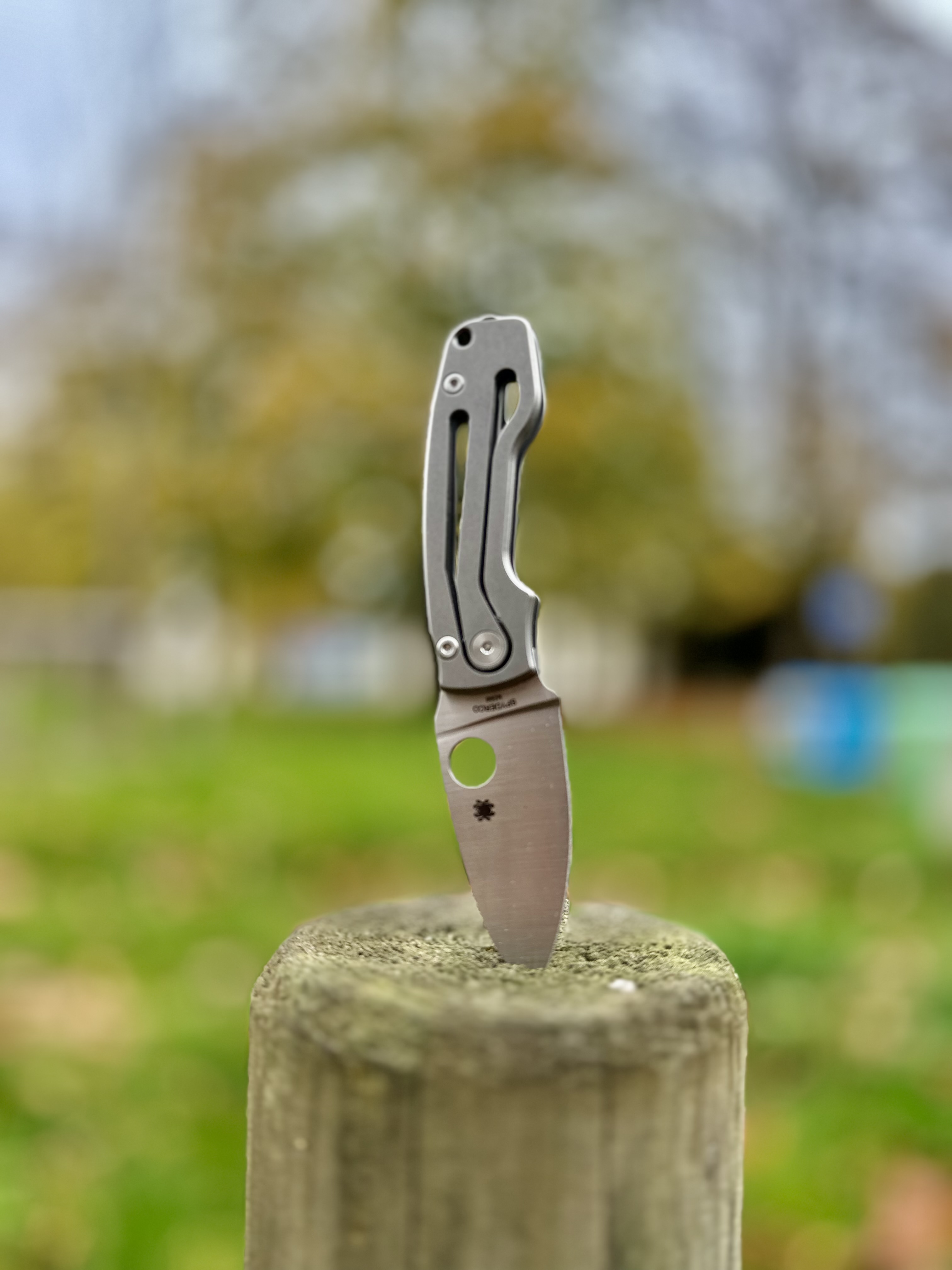
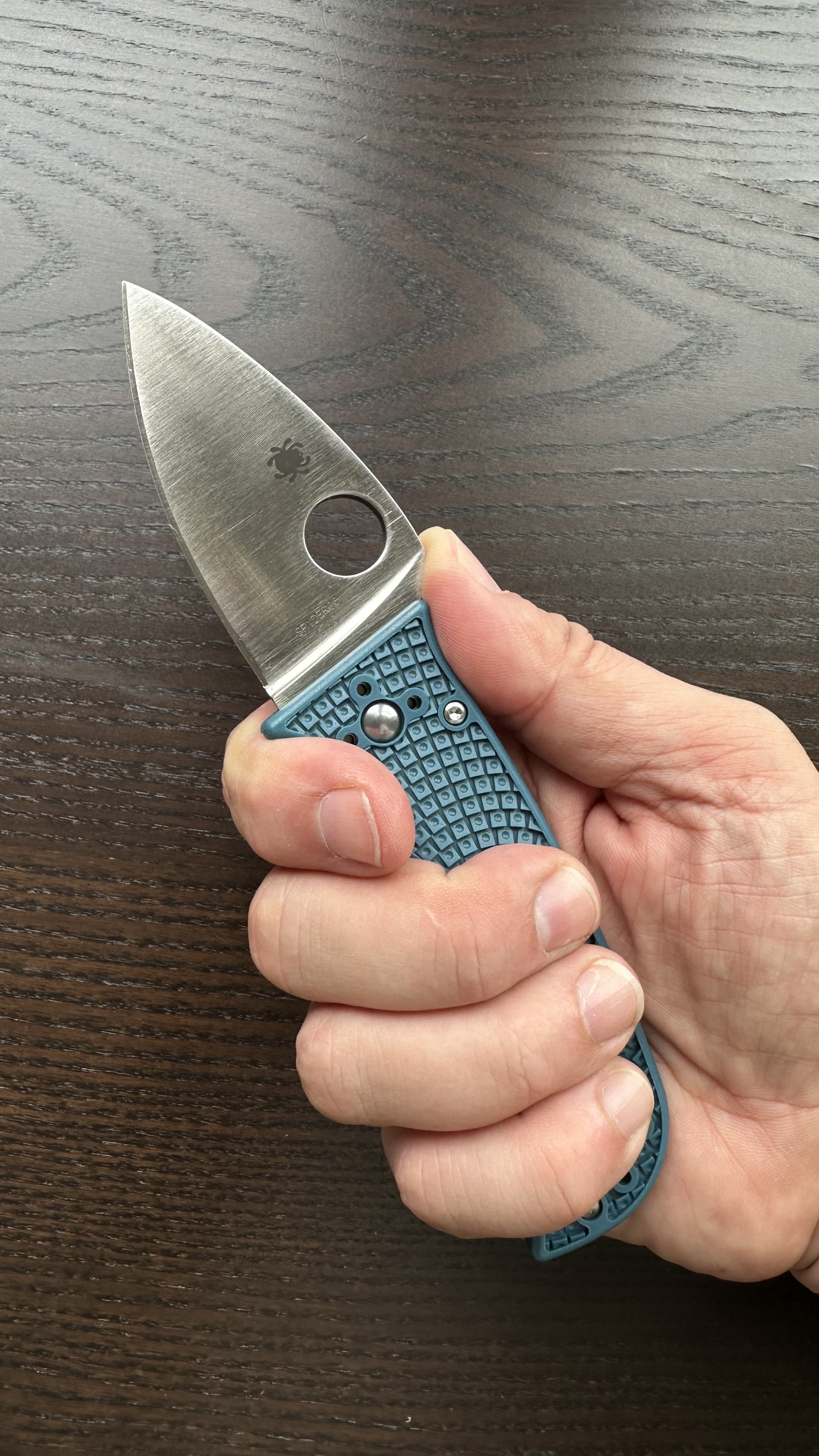
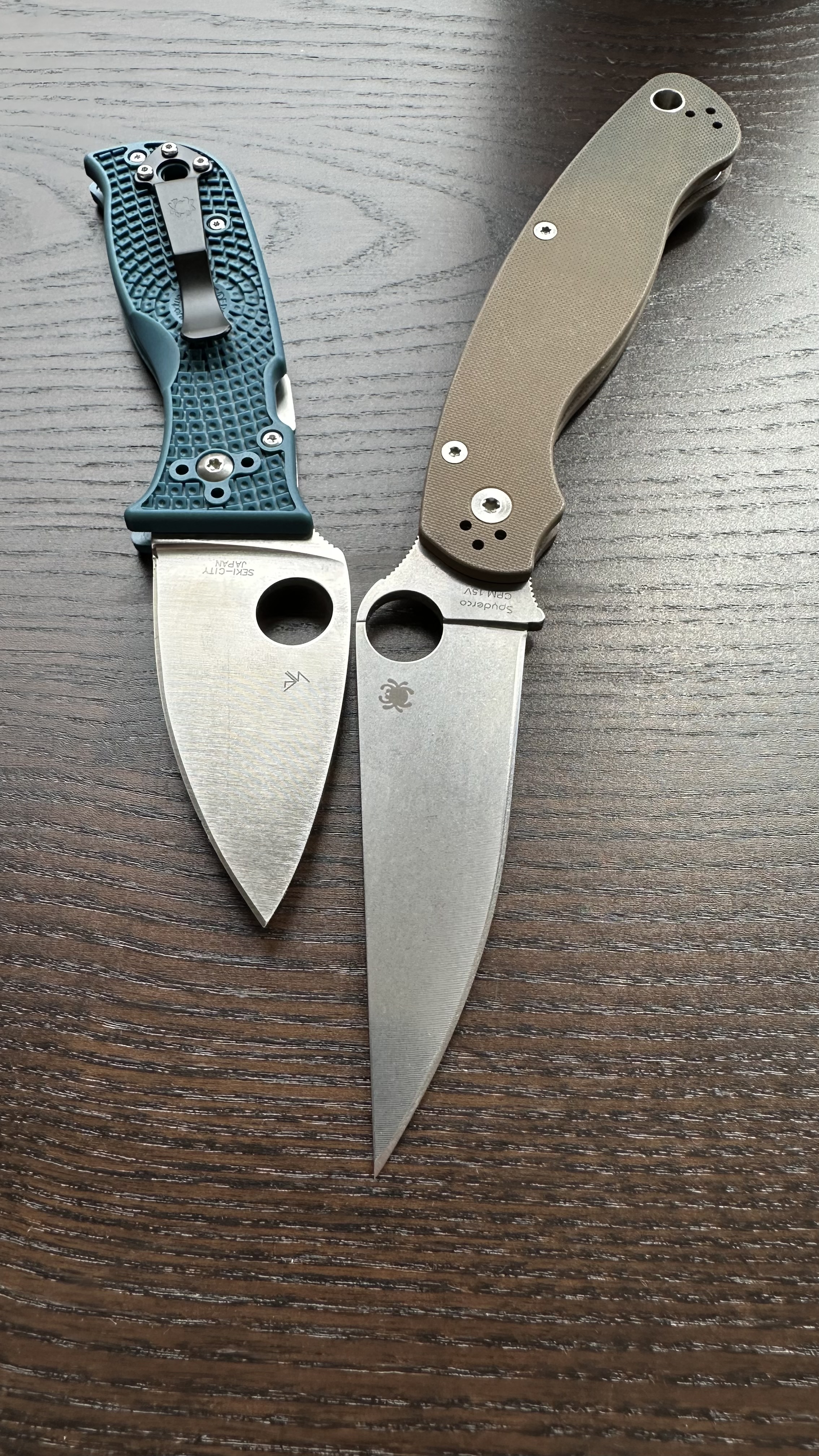
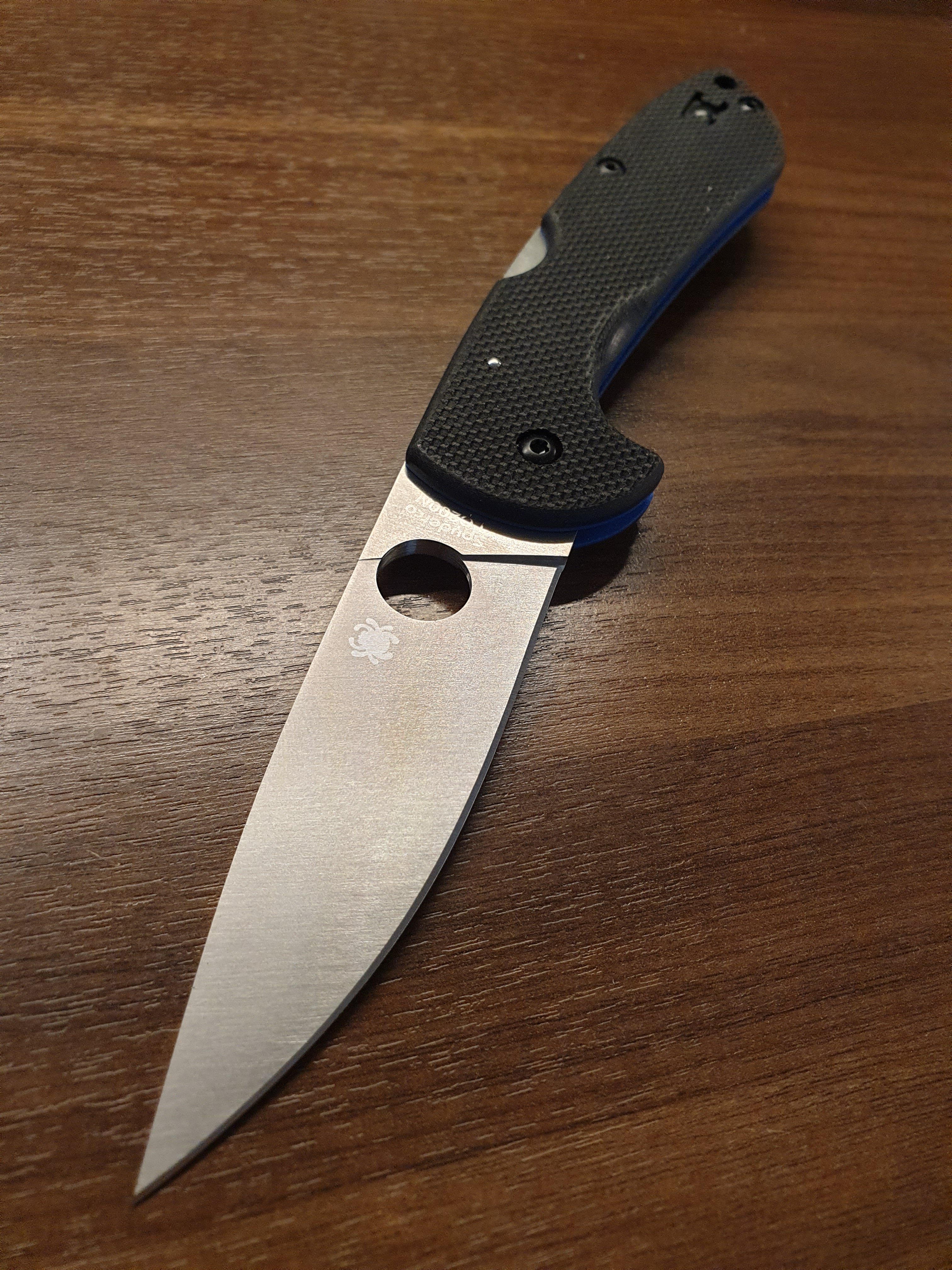
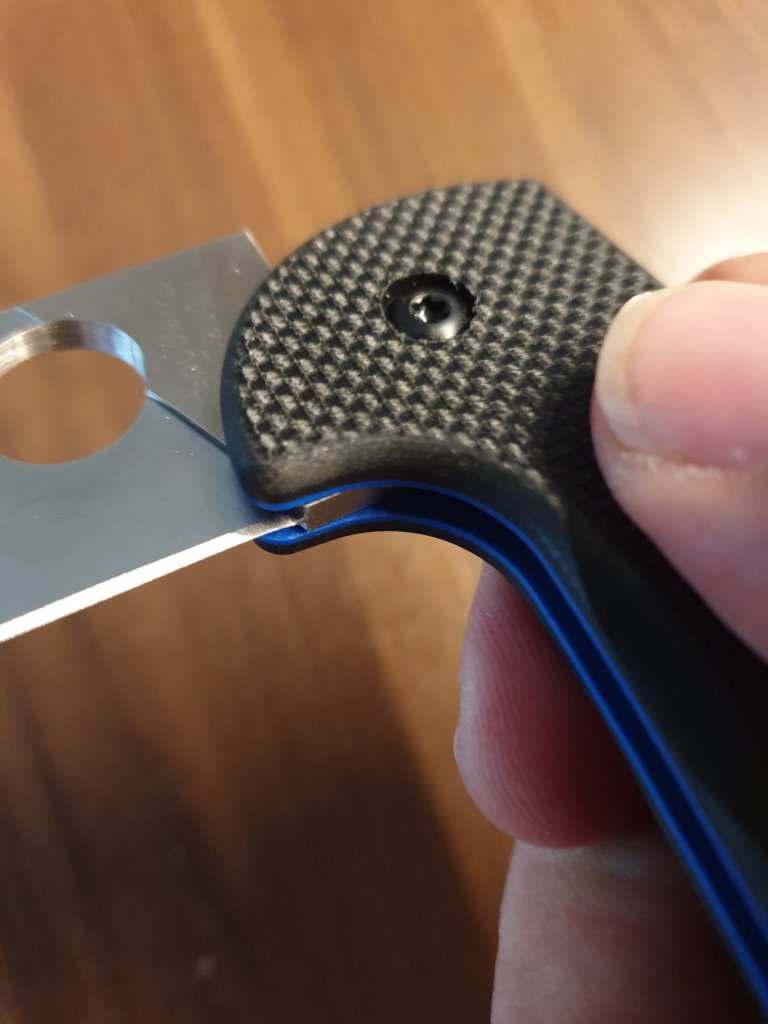
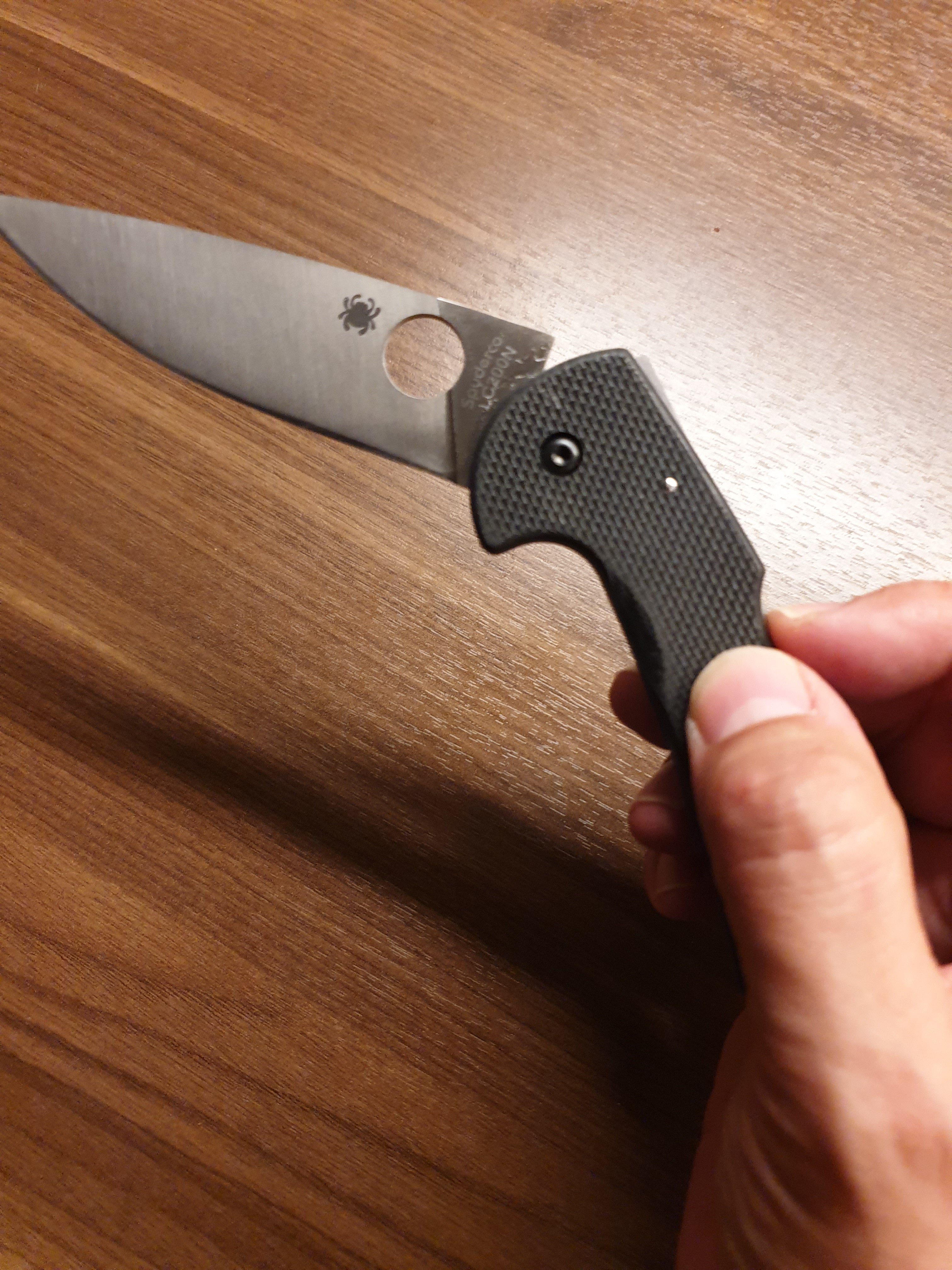
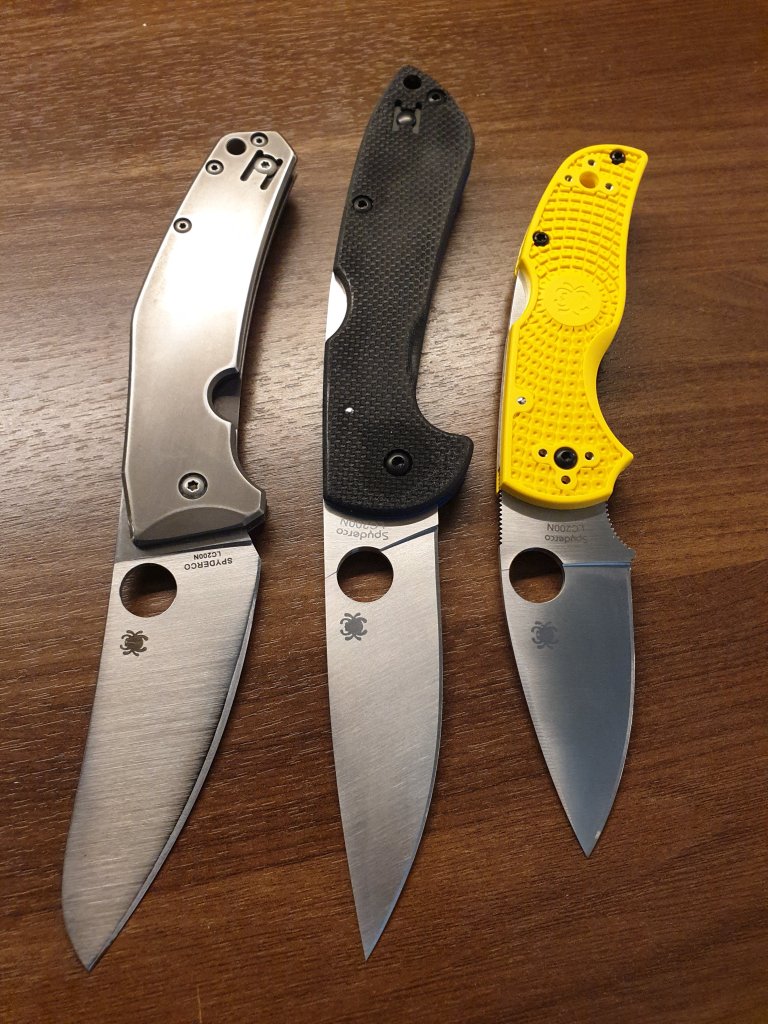
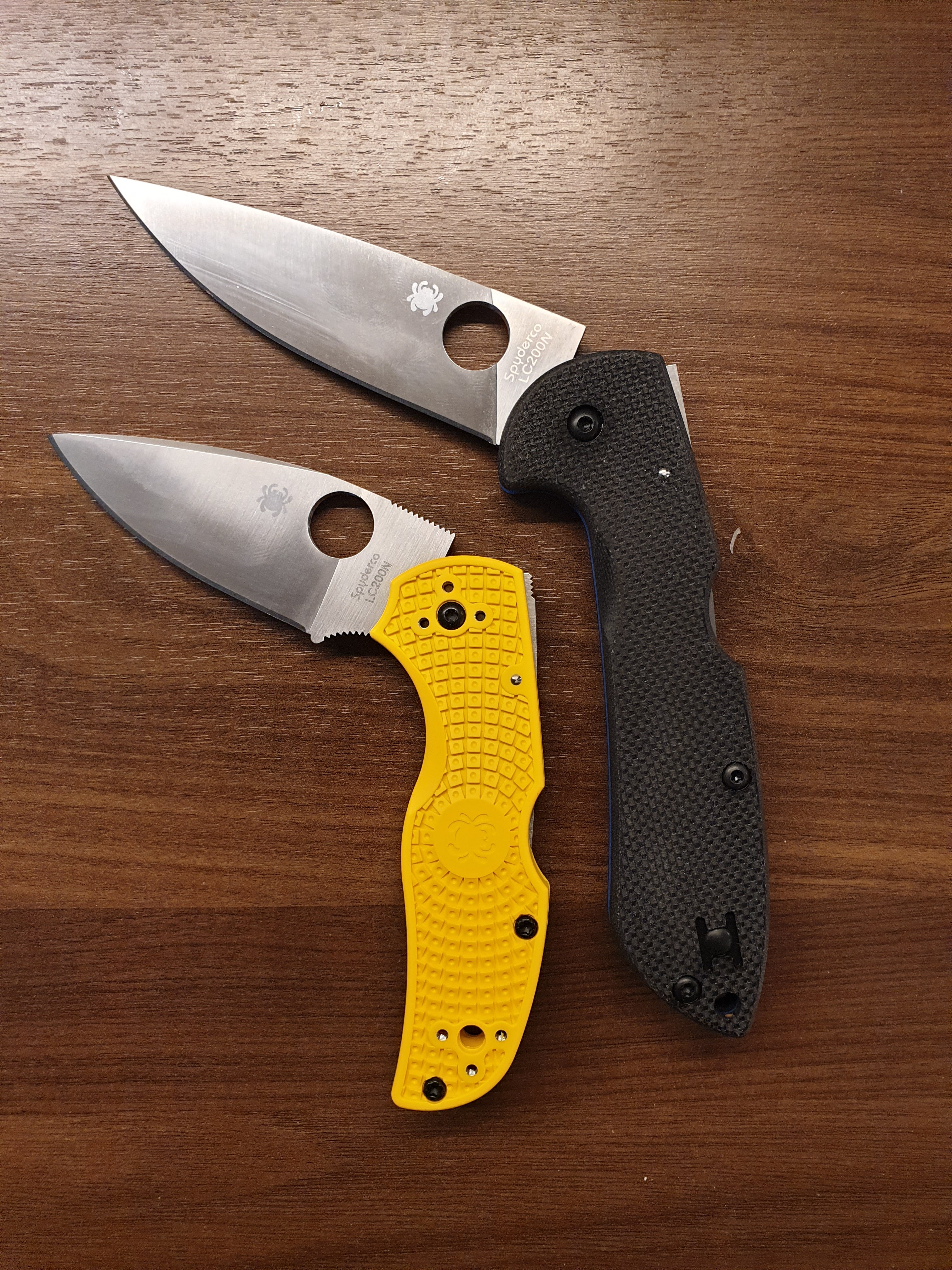
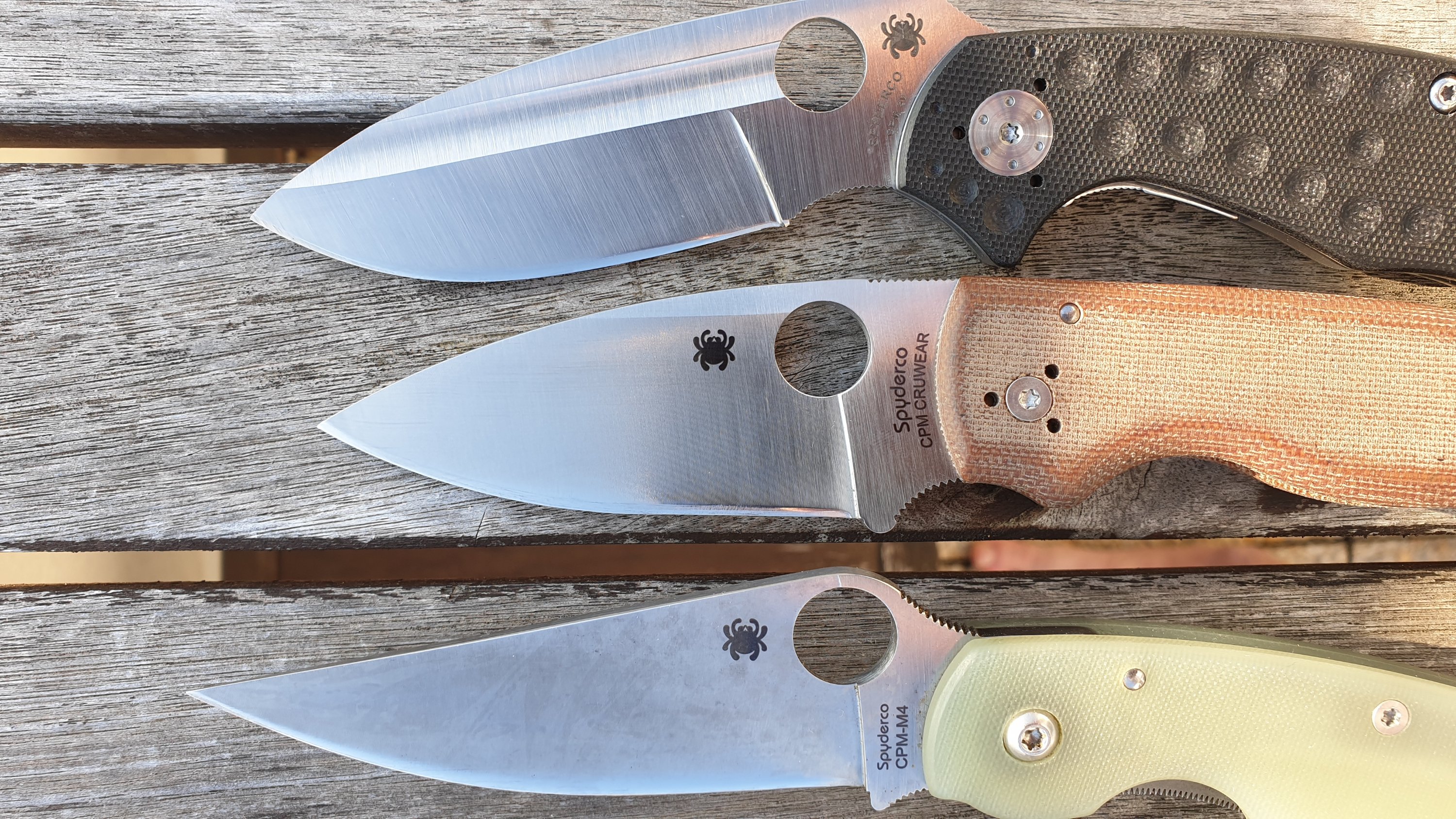
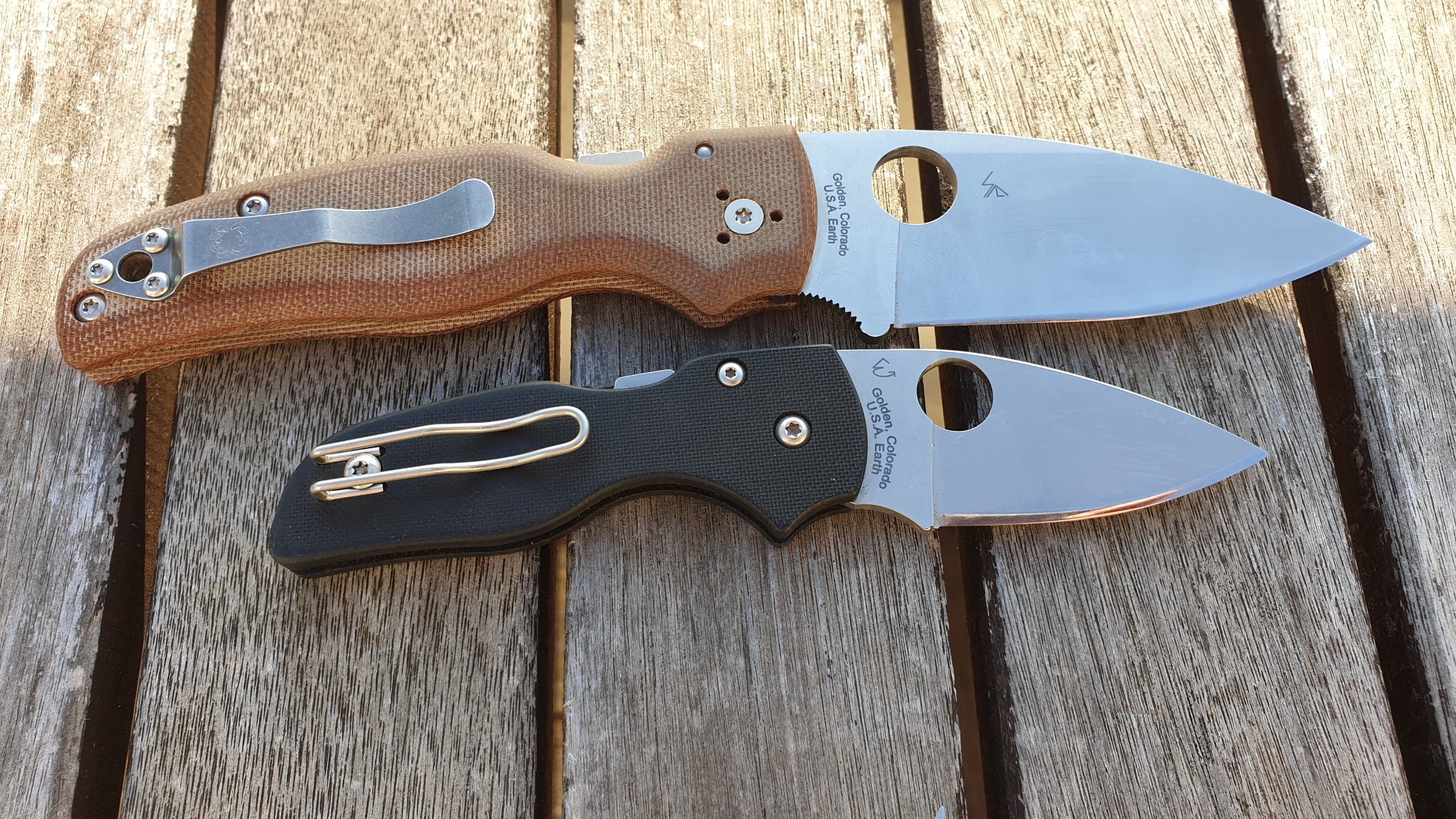
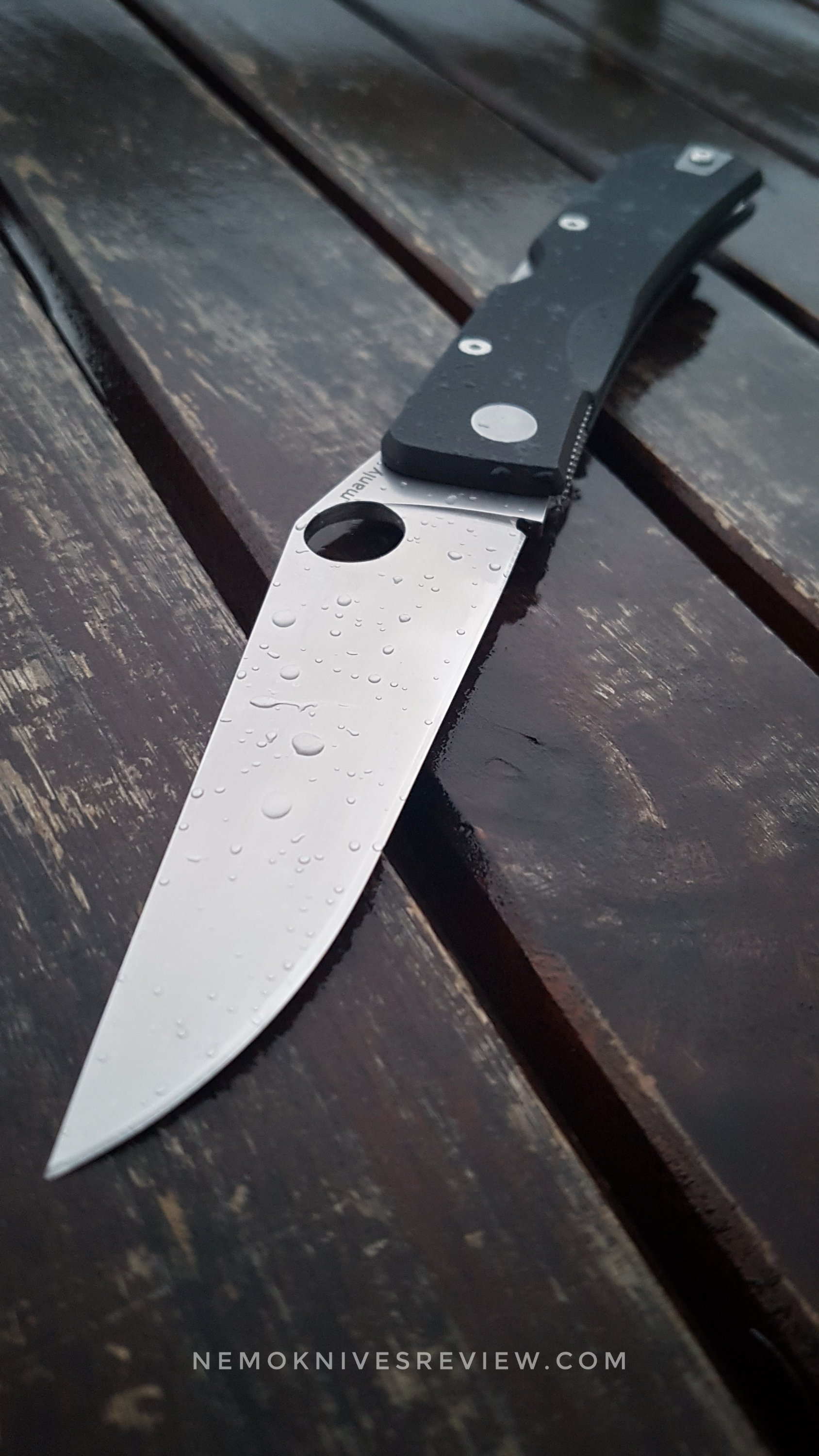
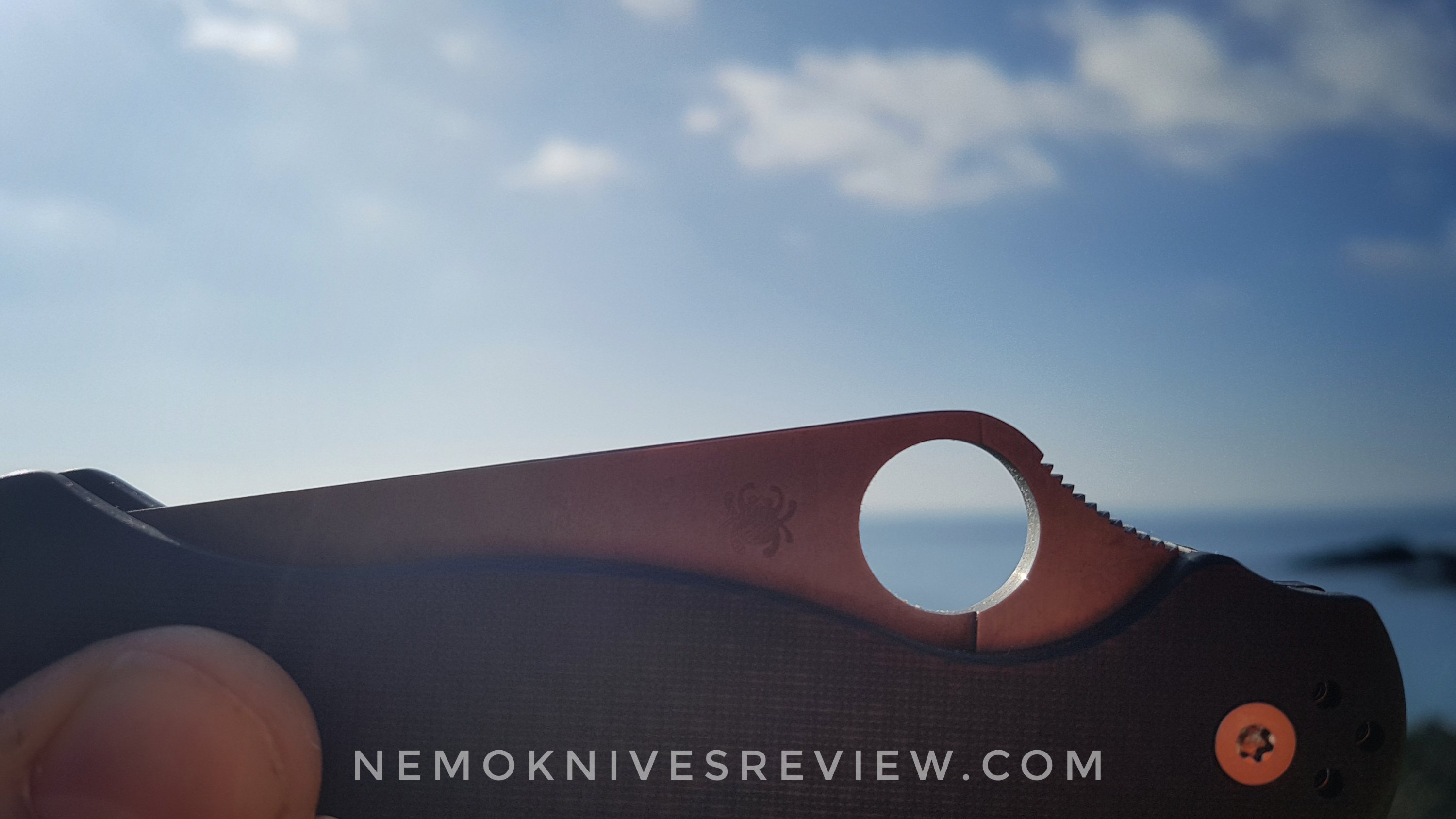
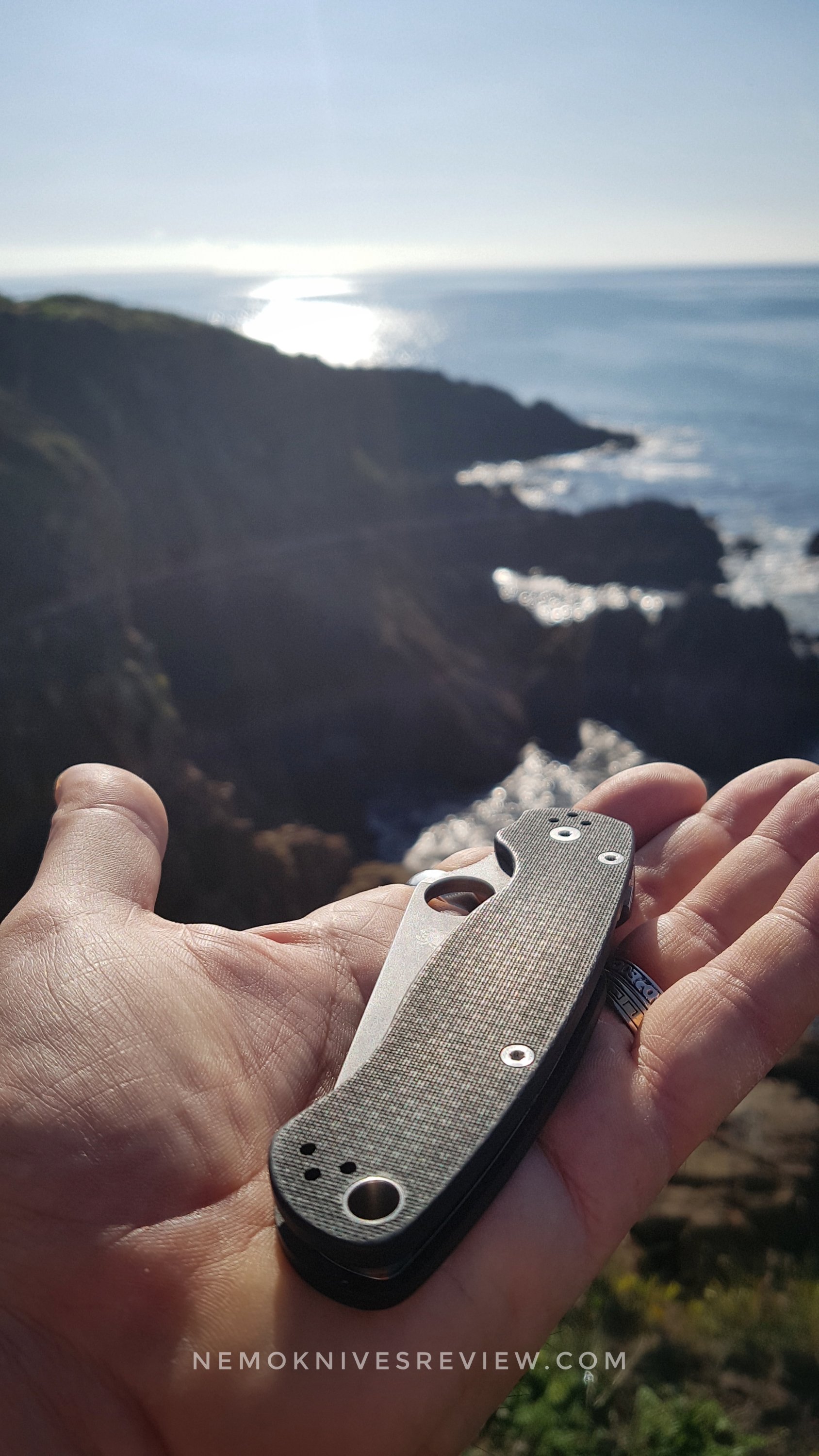
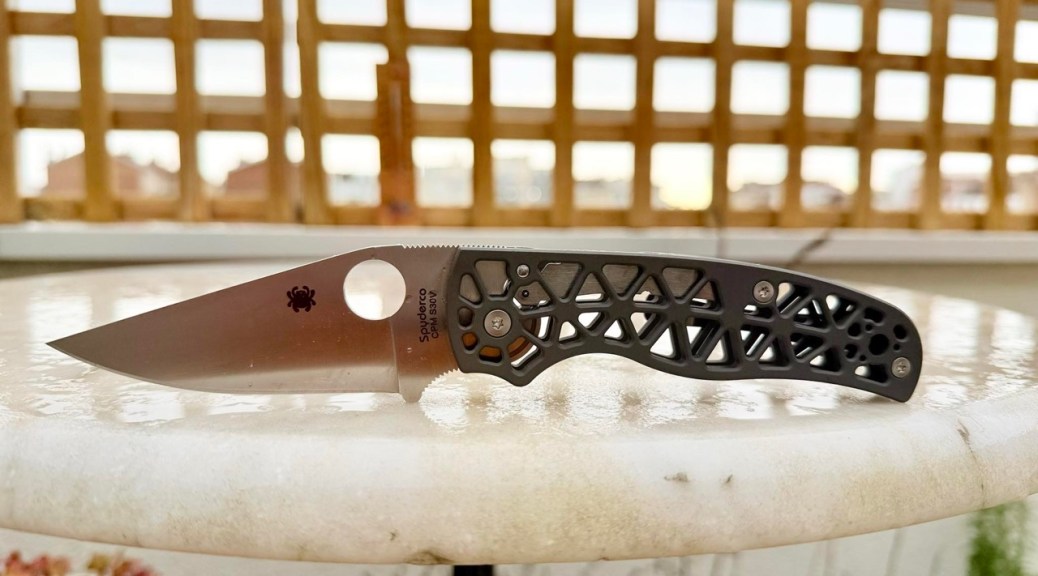
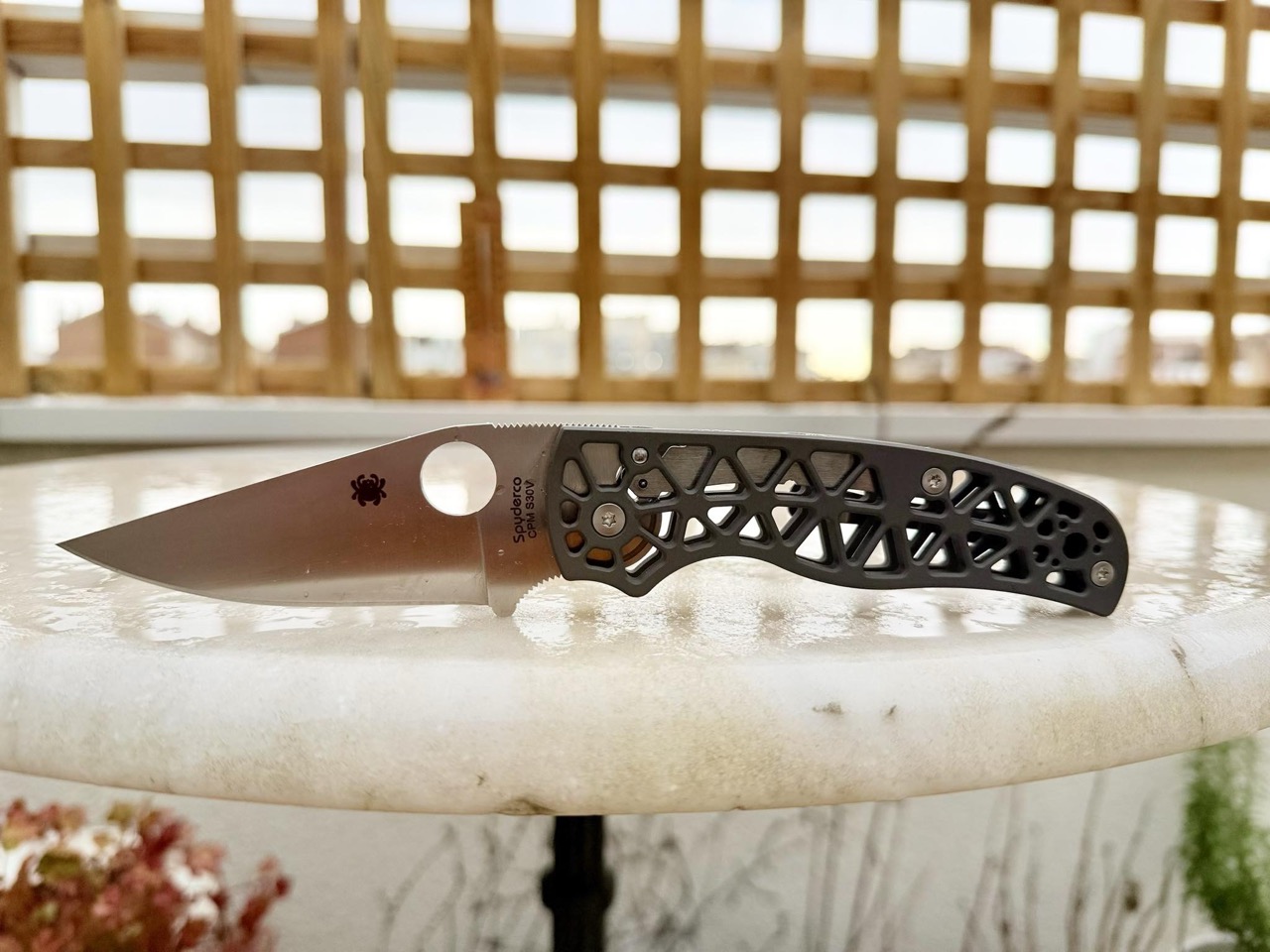
Mike Read’s custom Alien (£400,00 Elmax Blade) was presented to the world in November 2023, and it is now produced by Spyderco through Maniago, Italy under the name PITS 2 in 2025 for around €300,00. So this is an English design, produced by a Colorado-based company, and manufactured in Italy — you can’t get more international than that.
To respect the King’s Law in the UK, you need to carry a non-locking knife with a blade under 3 inches, and also have a good reason to carry it on your person. The PITS 2 respects those rules and looks far less threatening than the original PITS 1.
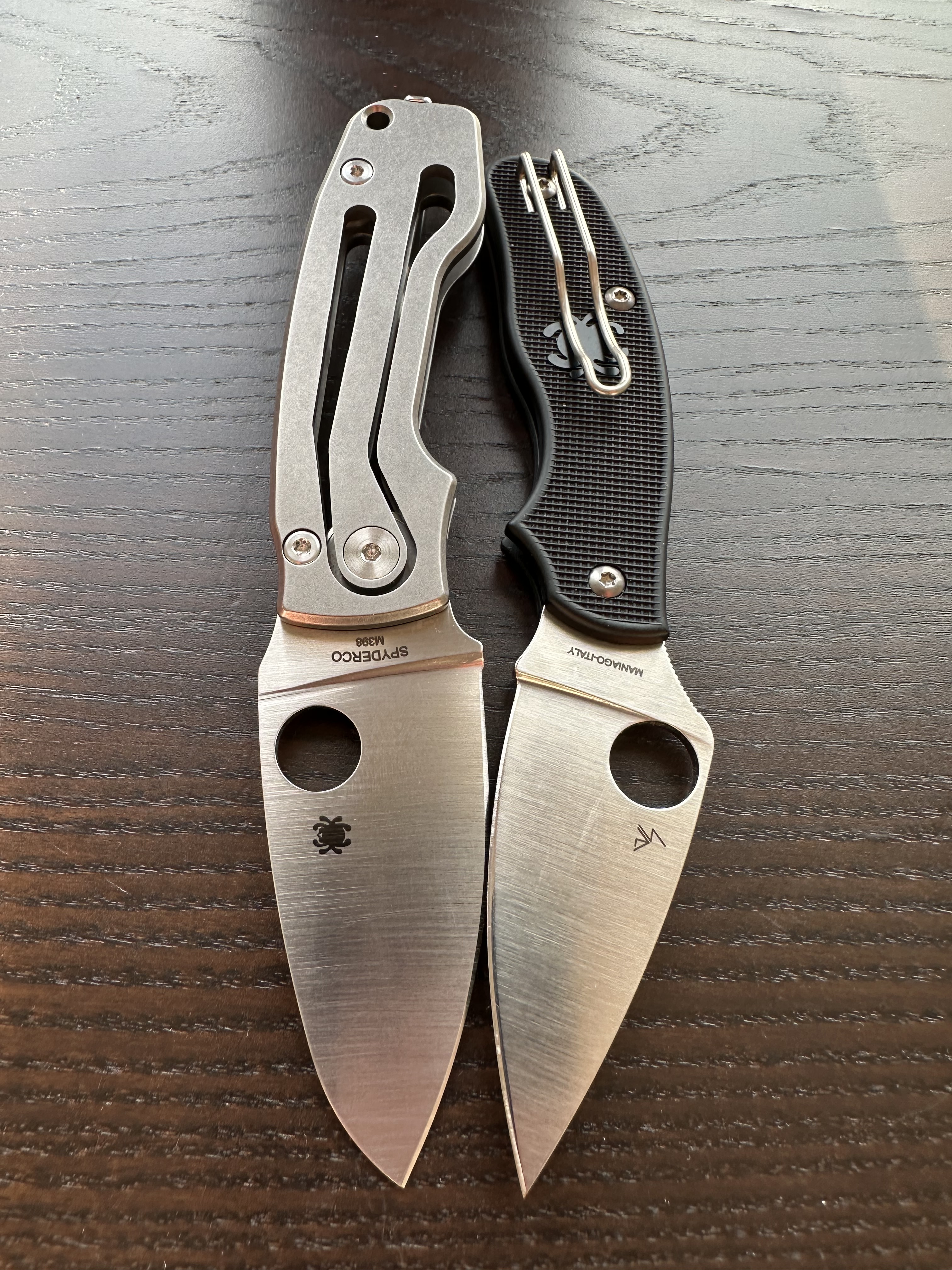
This isn’t my first Mike Read design — I reviewed his PITS 1 back in 2018 and loved it. That knife was his very intention of creating a solid workhorse with no lock. Two years ago, a sprint run in M390 appeared. Now comes the PITS 2, in M398, and to me, this is a much better design. Here’s why.
“Pie In The Sky” (not pig!) was Mike Read’s nom de guerre on the British forums. His specialty as a knifemaker is crafting non-locking knives: state-of-the-art tools with titanium handles and obsessive attention to detail. The PITS 1 was a looker — but the PITS 2? It’s eye candy.
Here’s a video from The Crafter Carry about the Alien:
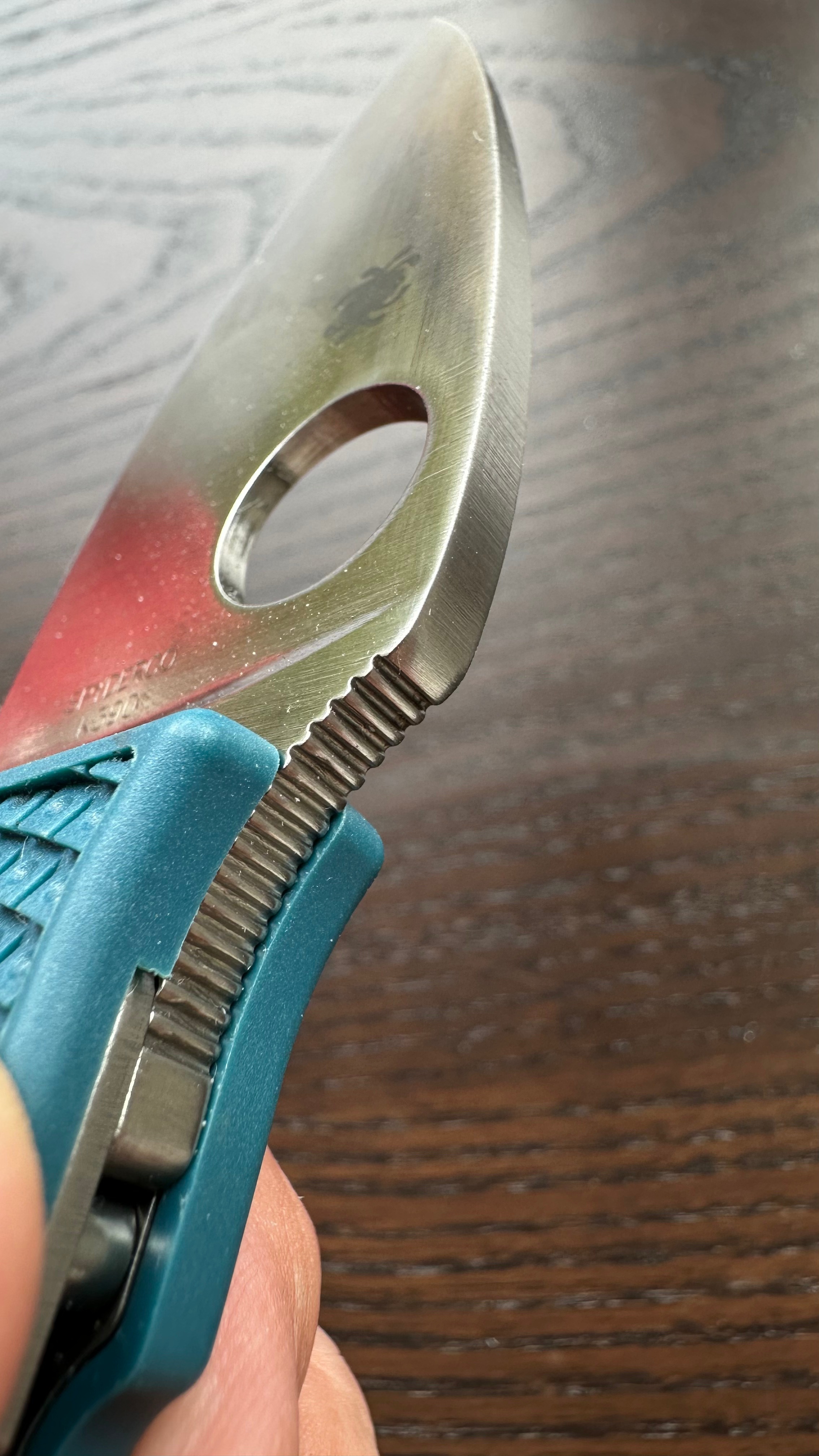
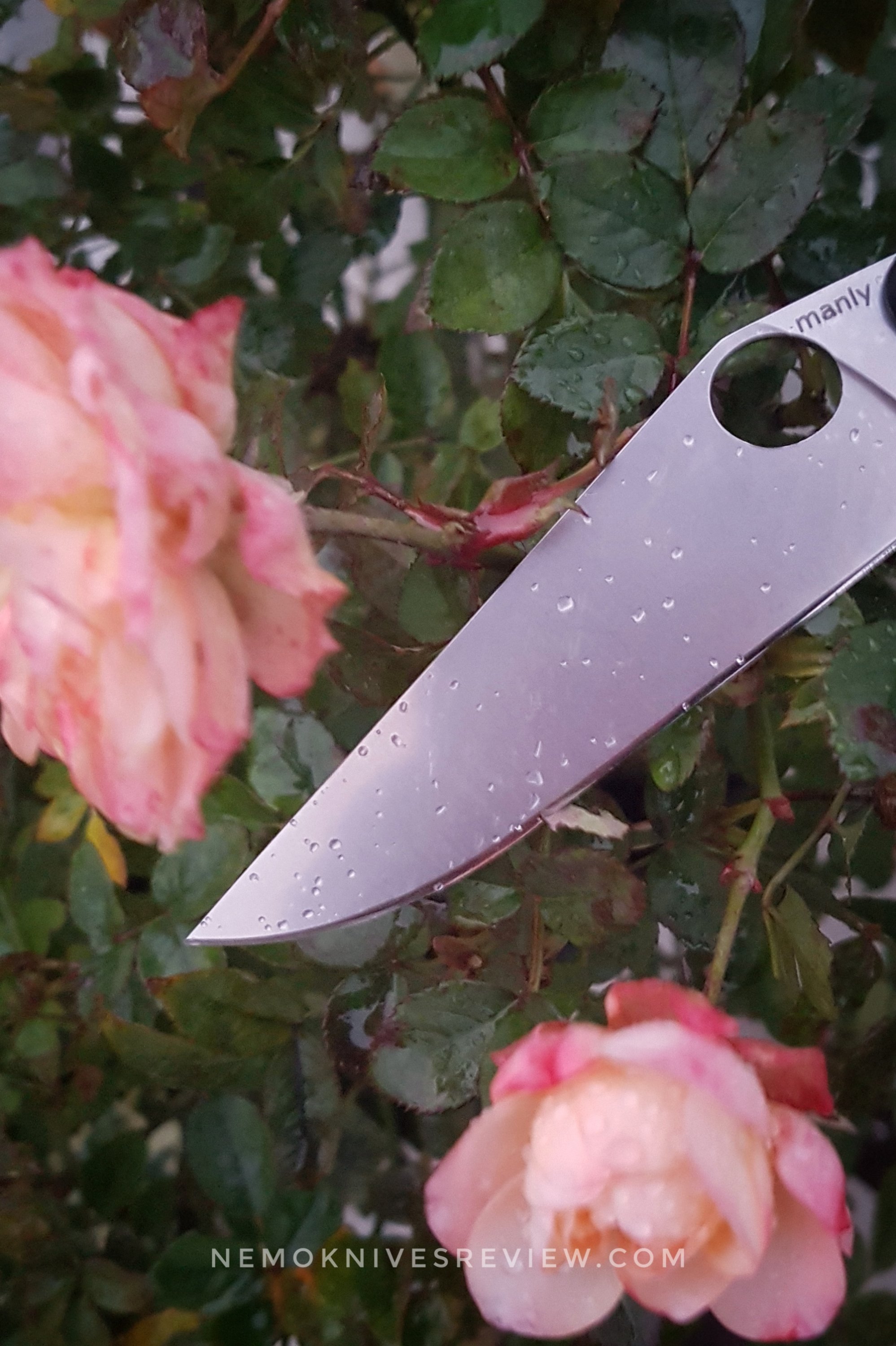
Compared to the more angular tip of the custom Alien, I find the PITS 2 blade shape more graceful, with a nicer drop to the point.
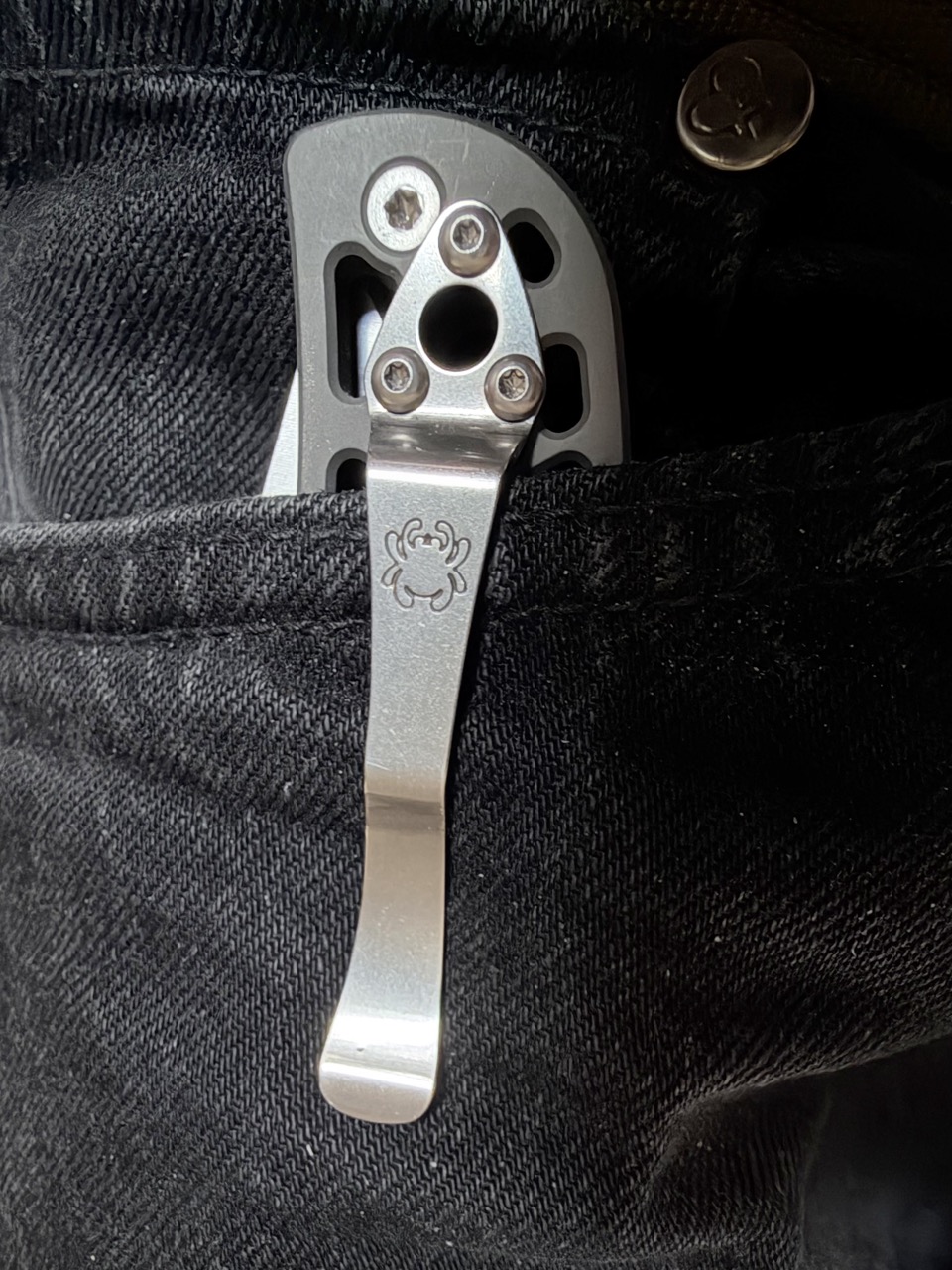
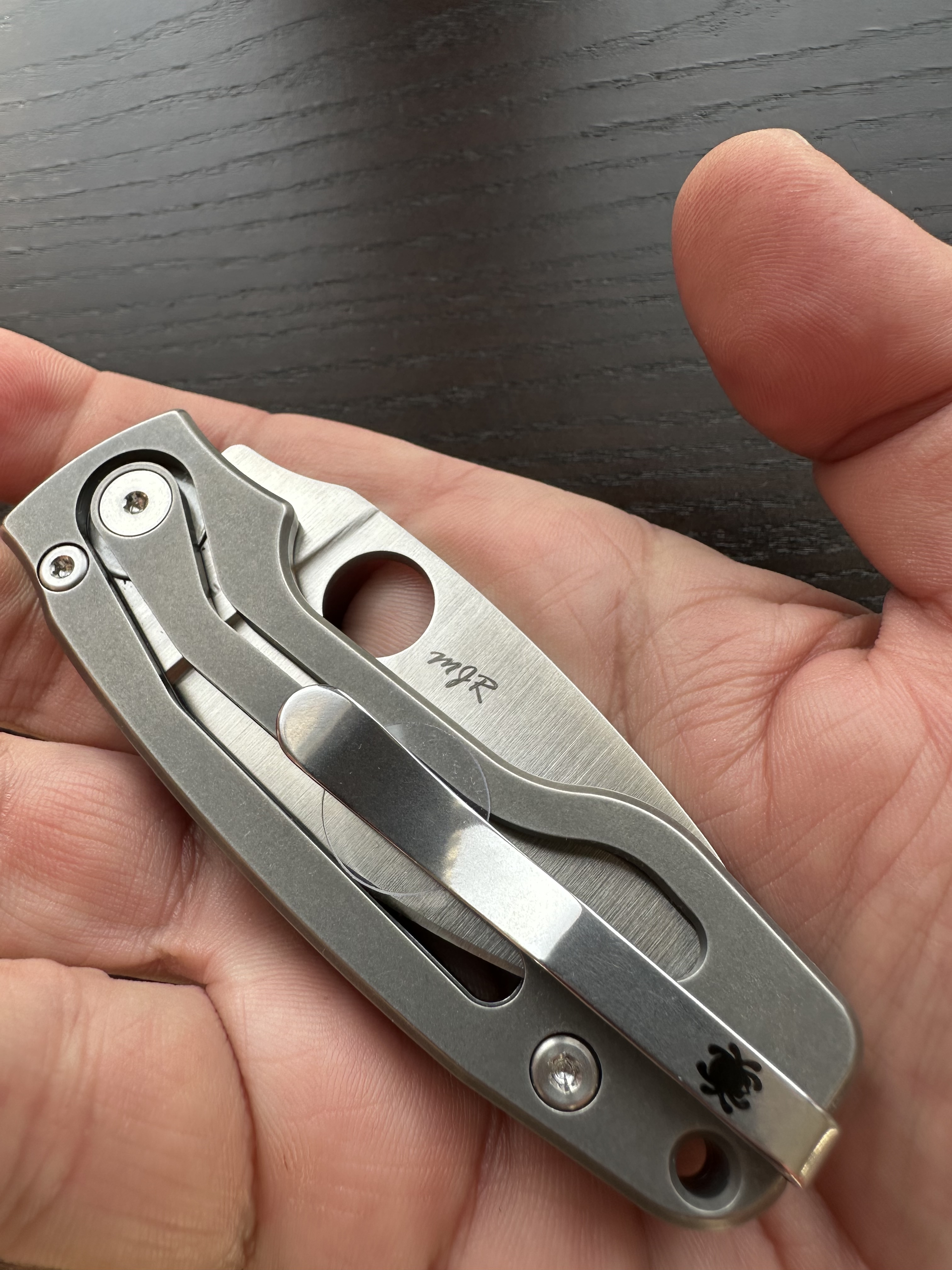
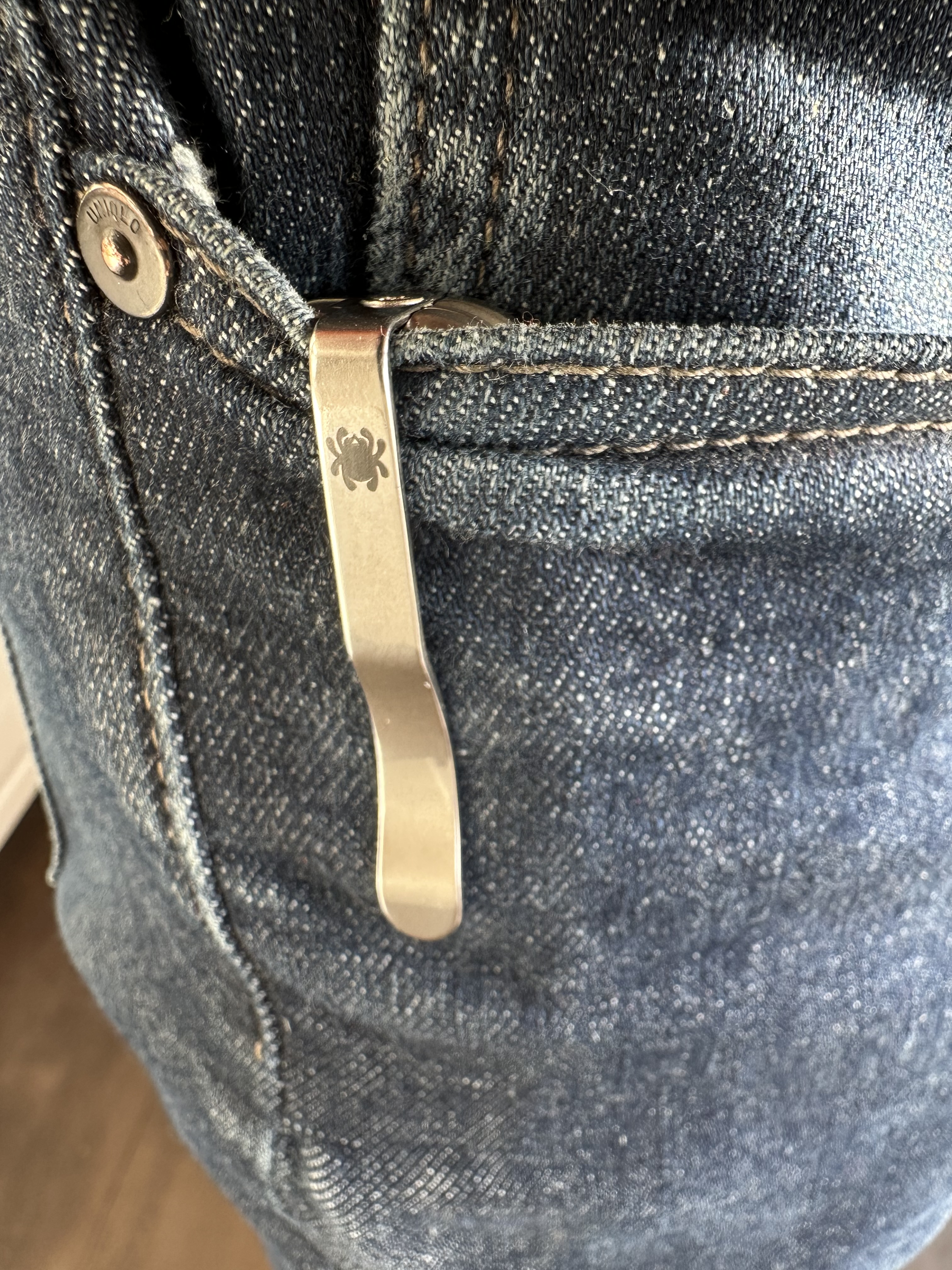
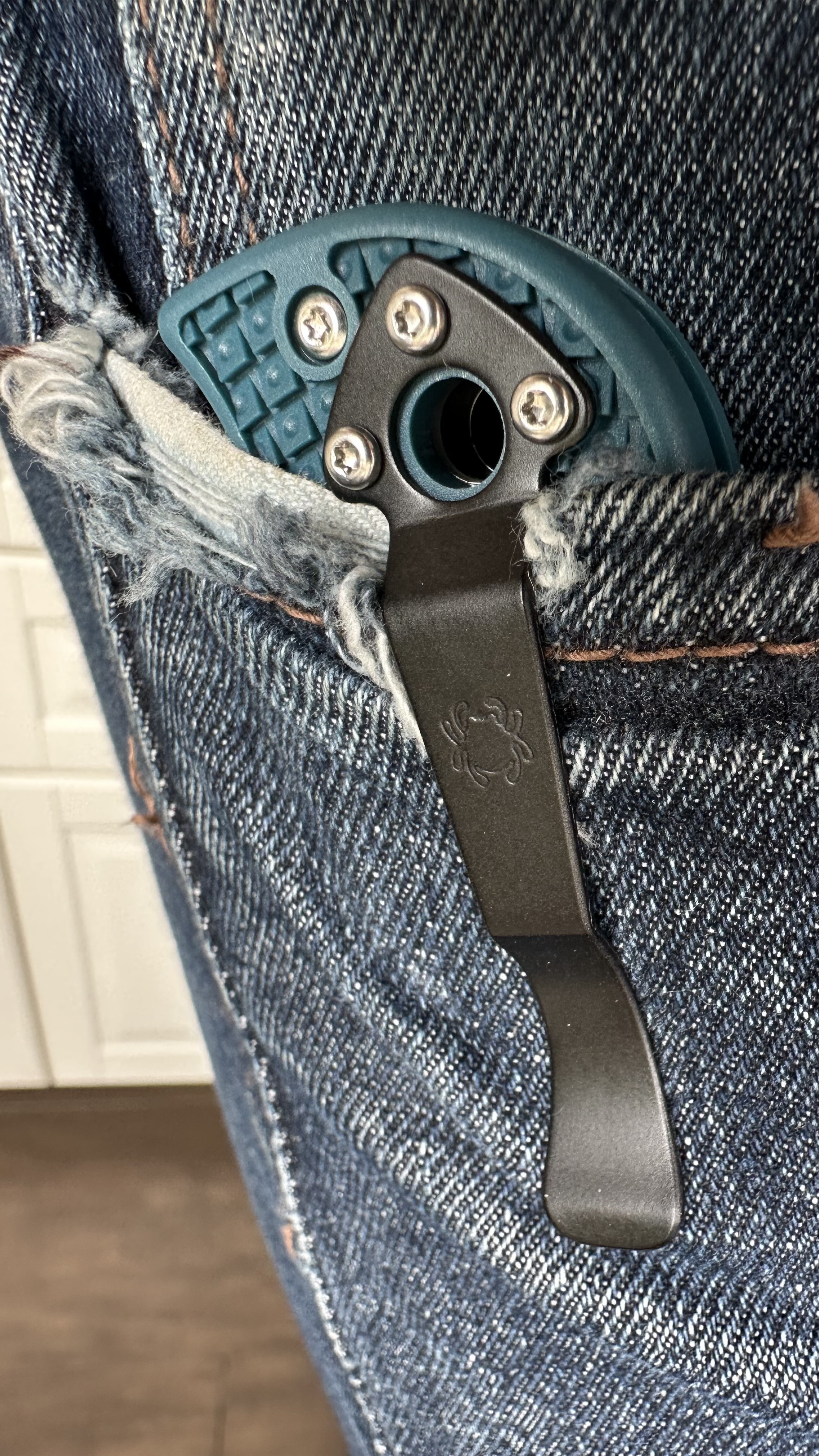
The custom Alien used a titanium clip, whereas the production PITS 2 wears a steel one — but I actually prefer Spyderco’s version here.
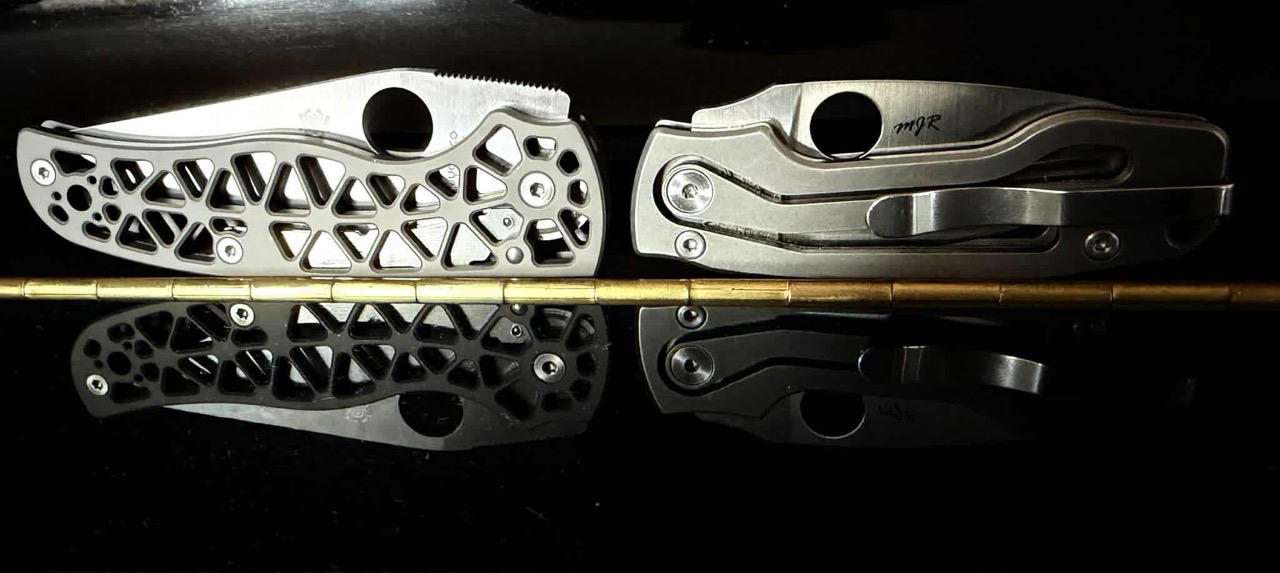
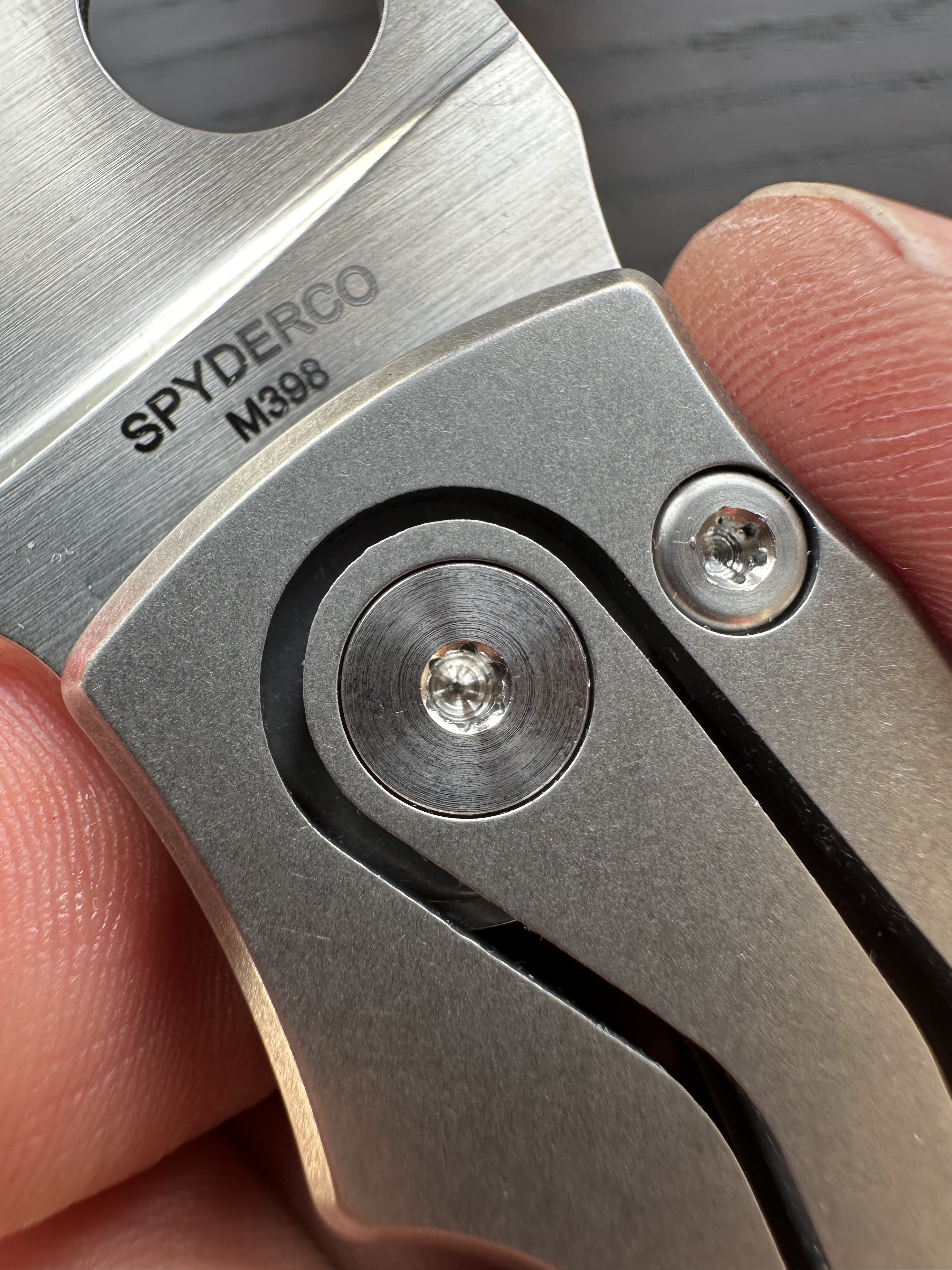
What really makes it stand out is the handle mechanism:
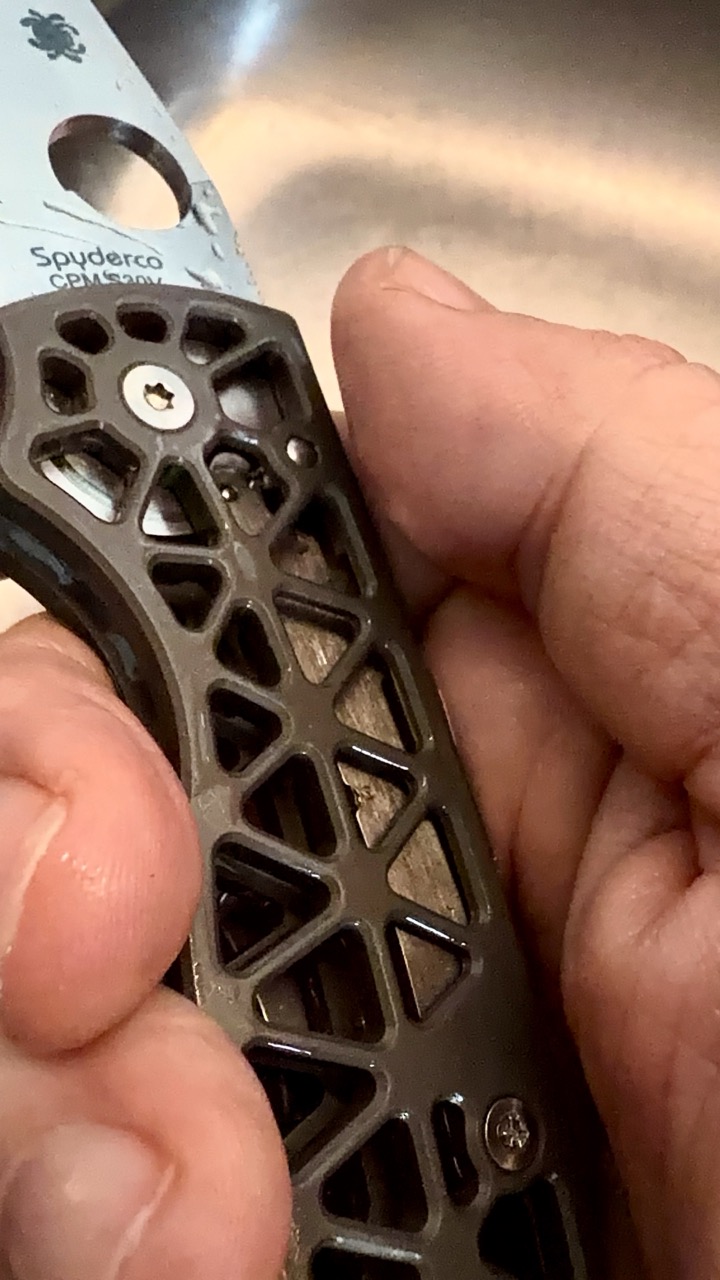
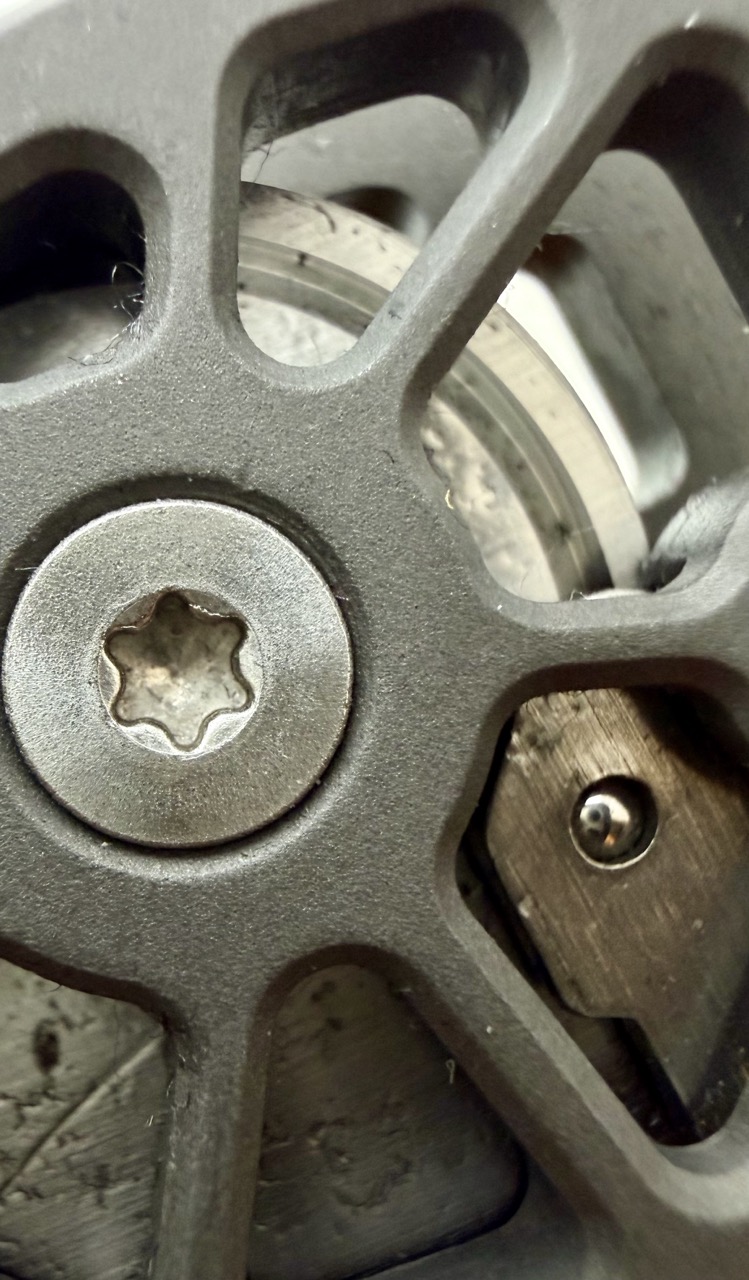
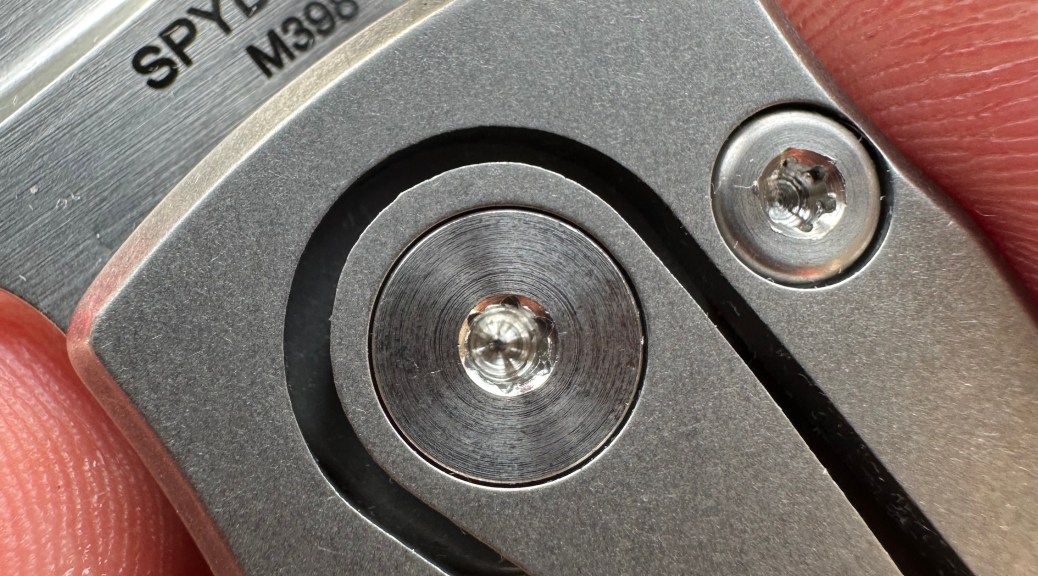
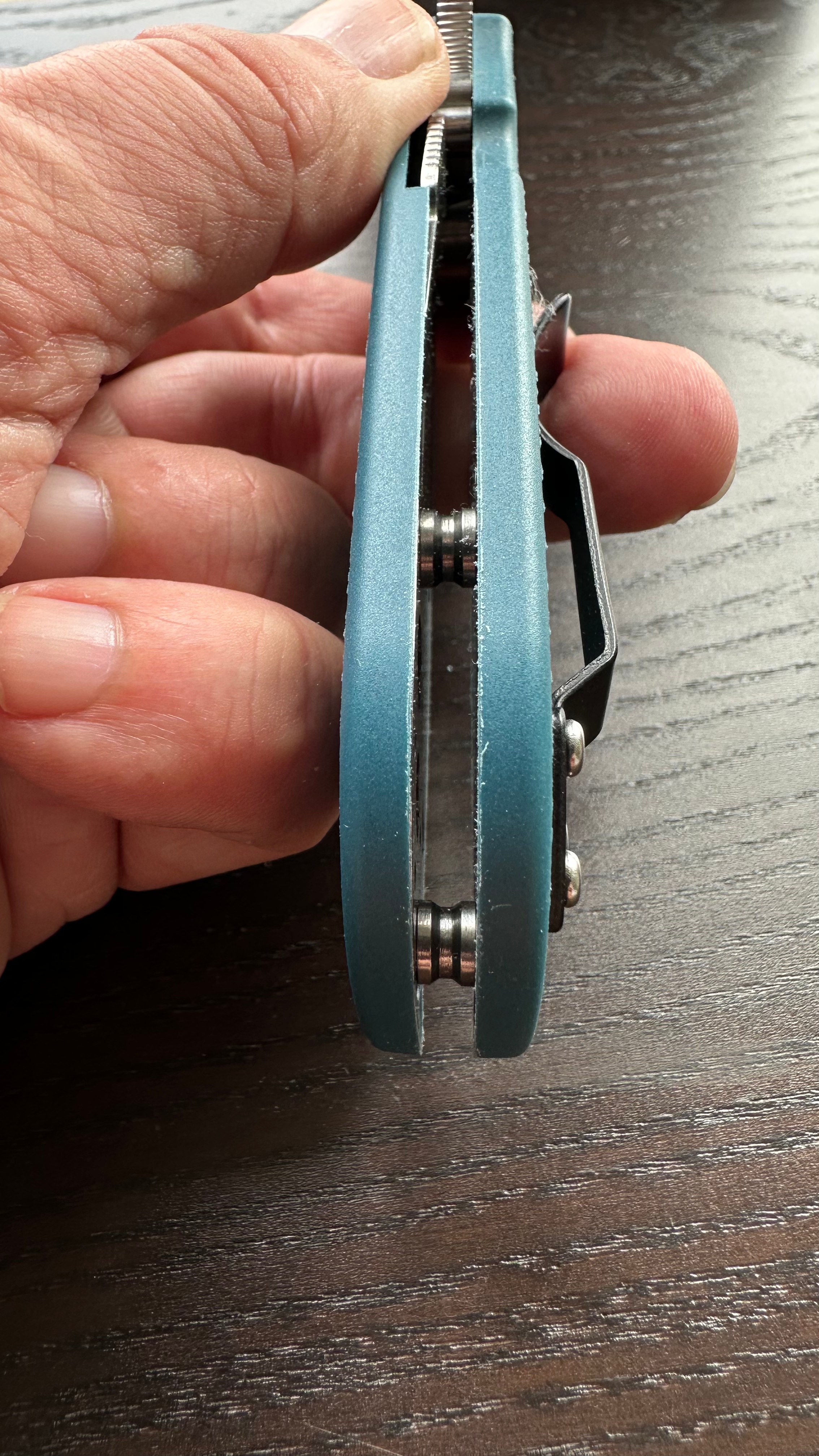
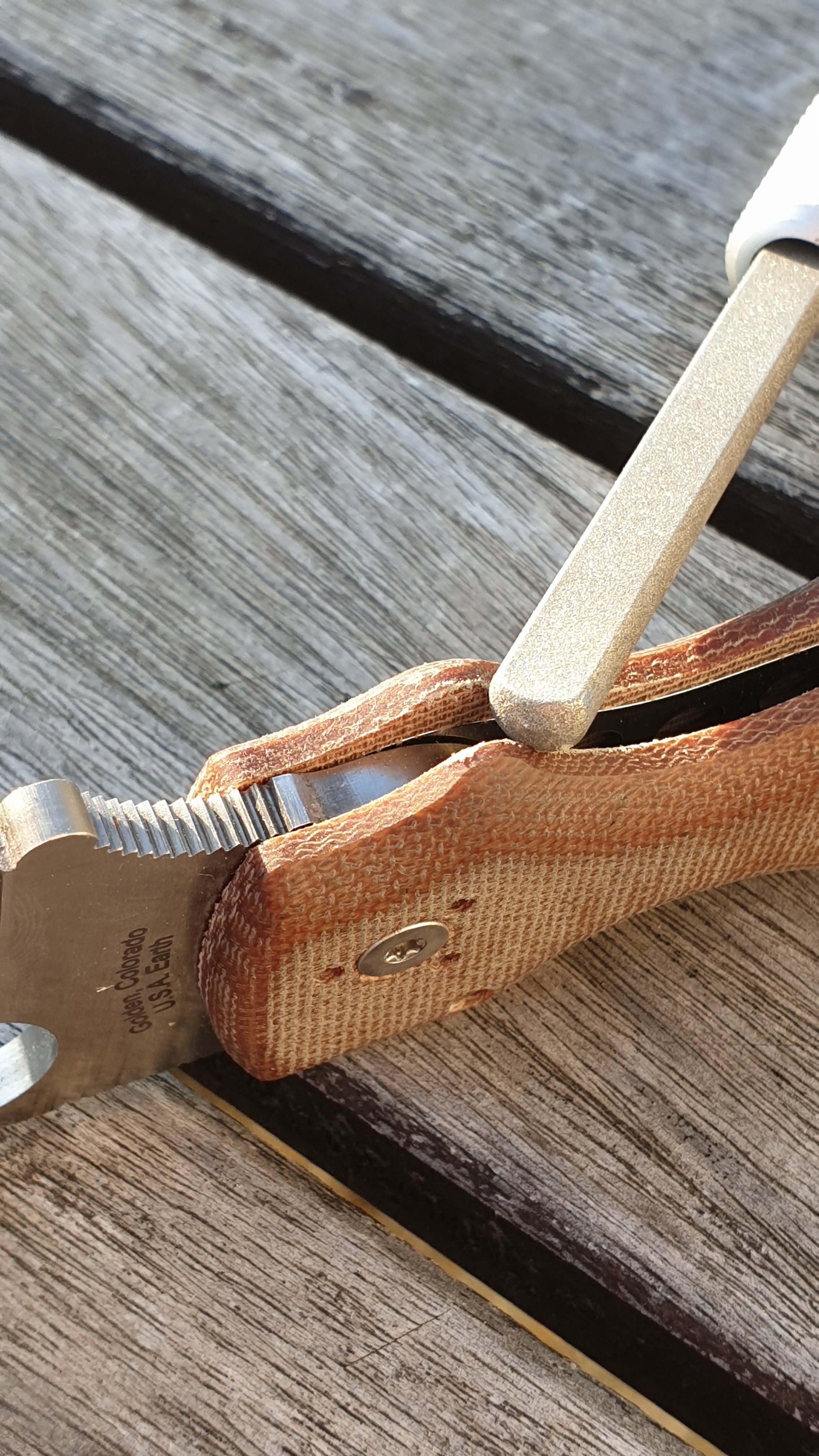
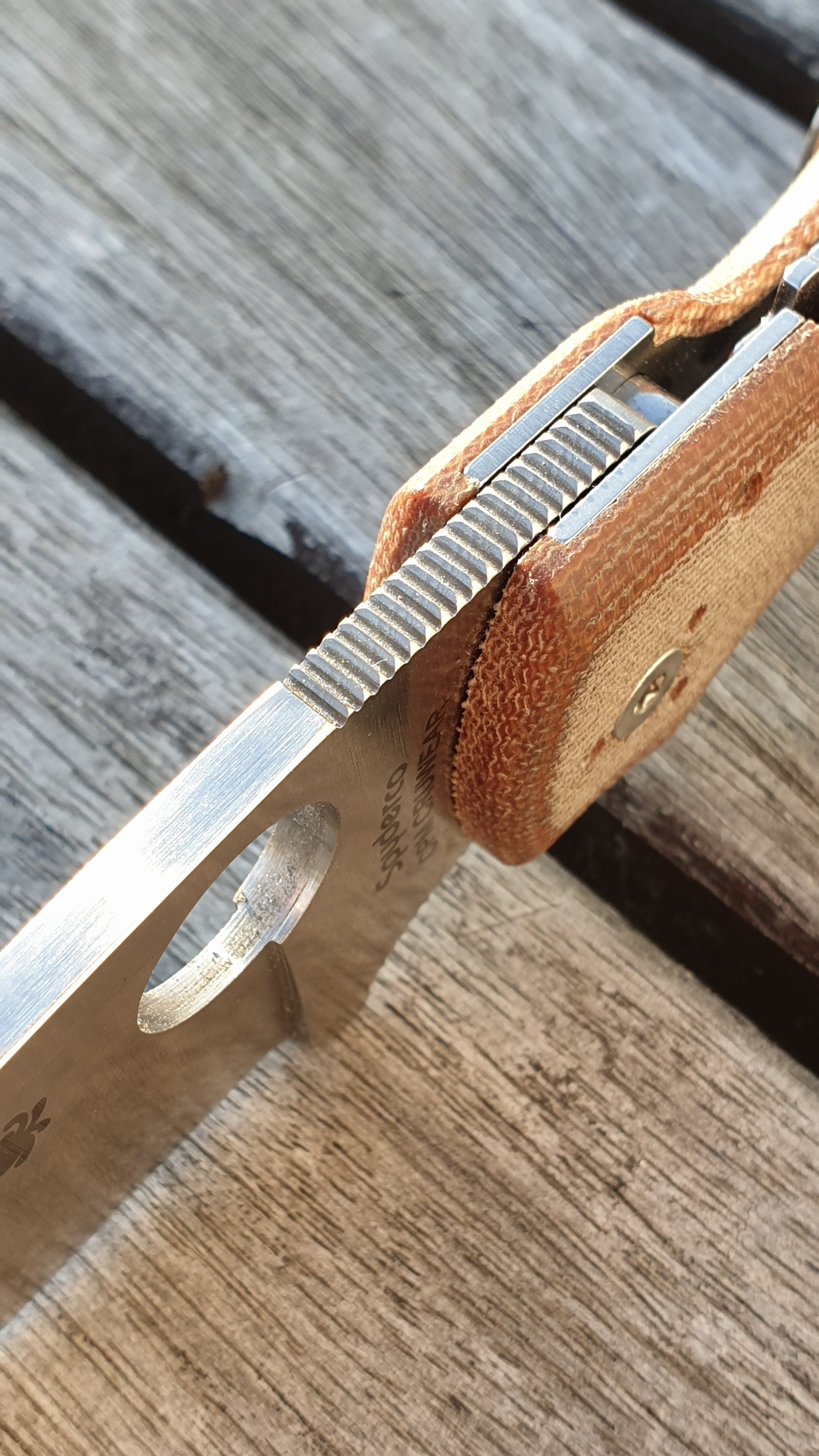
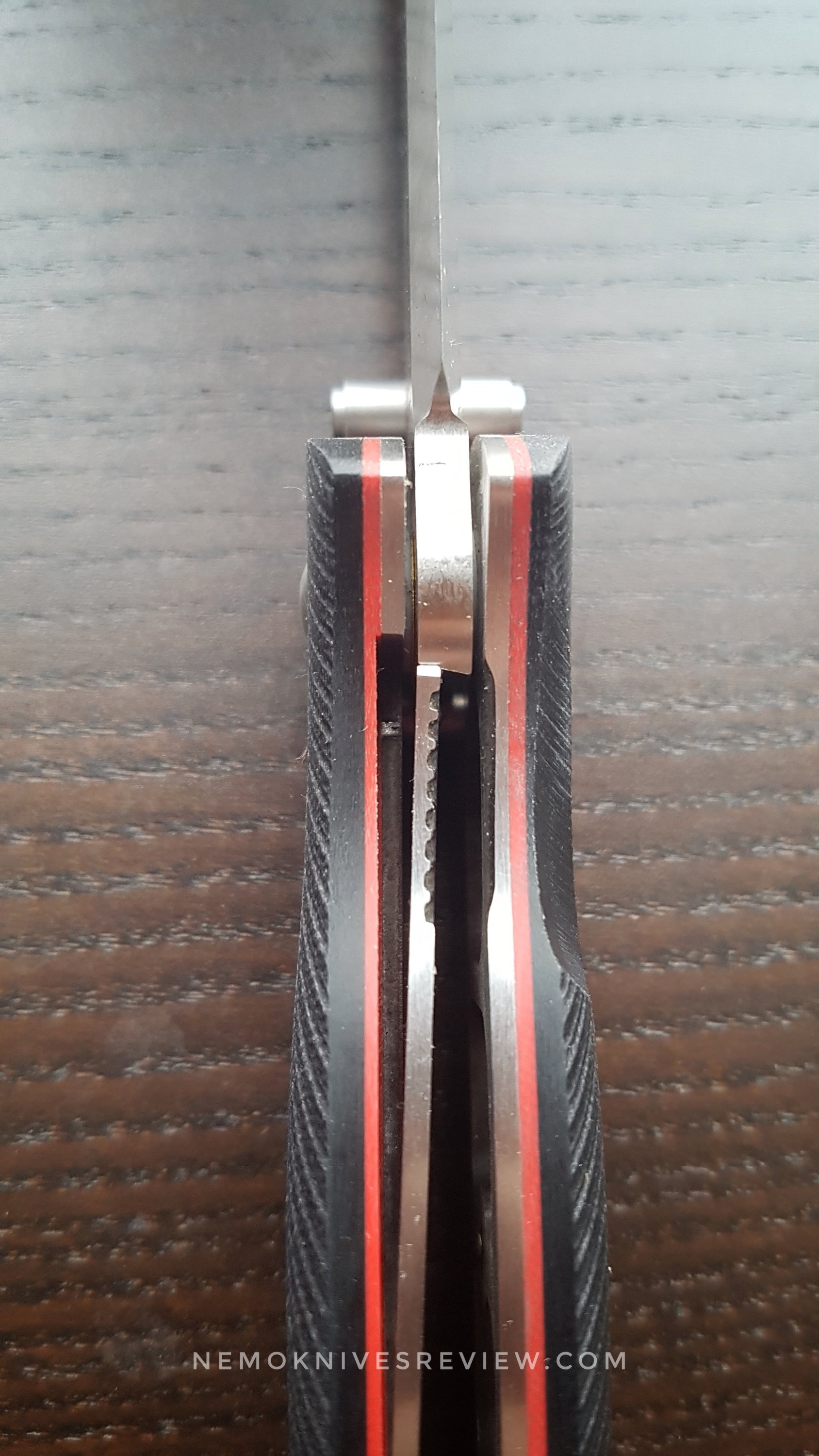
“A truly unique non-locking mechanism that consists of two integral spring arms machined into the handle scales. The forward end of these arms, which supports the blade pivot, flexes as the blade is opened to provide pressure for its notched-joint mechanism to bear against the stop pin.”
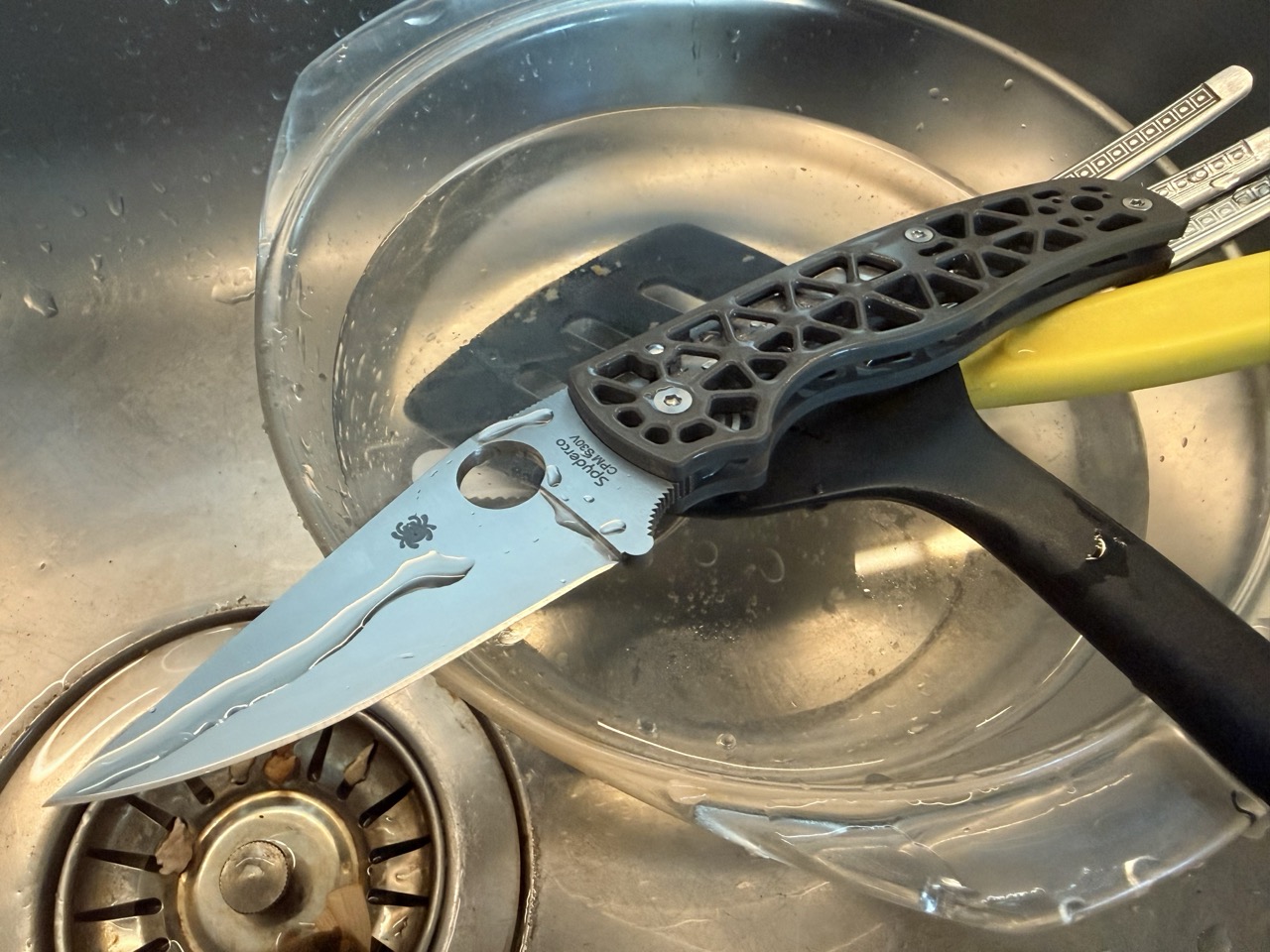
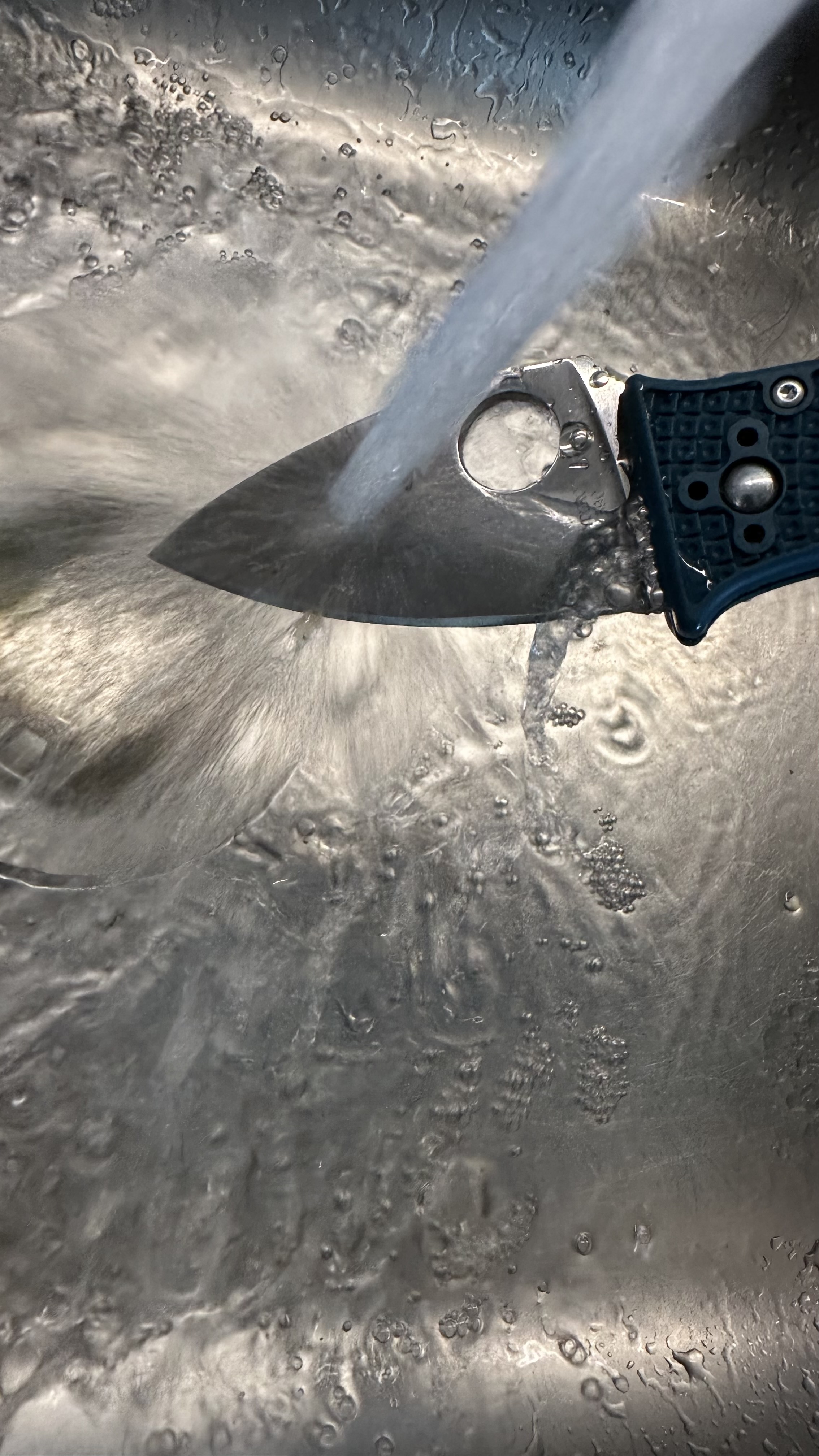
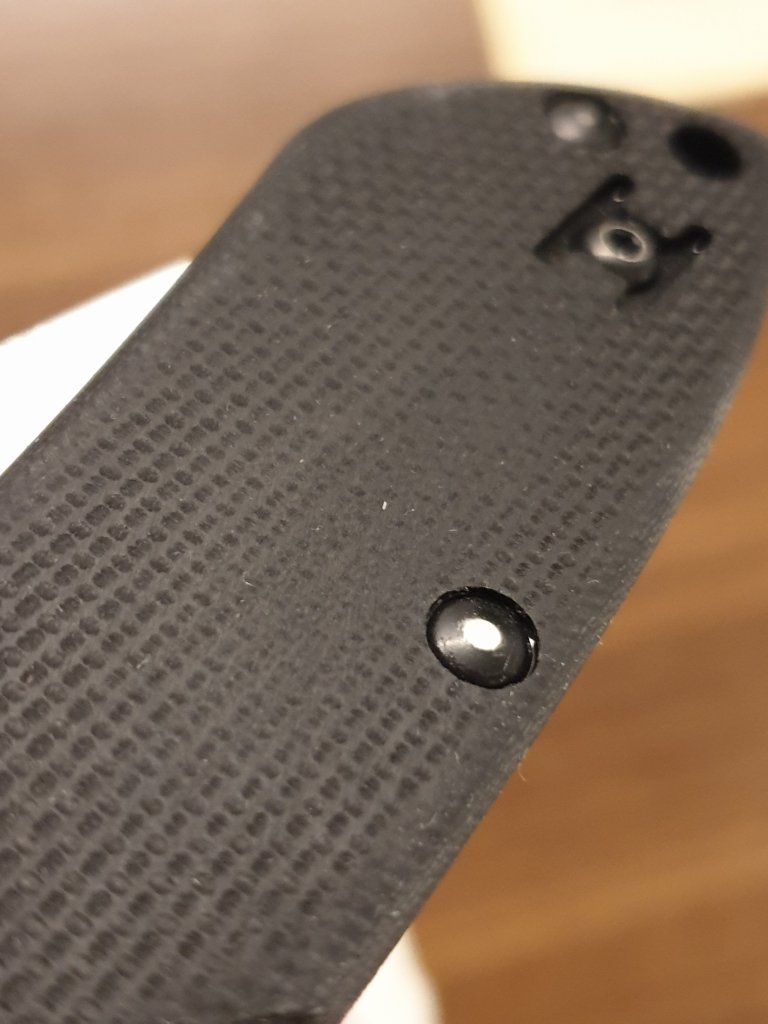
That’s clever: just two integral spring arms machined into the handle that hold tension on the blade pivot. The absence of a traditional backspring makes for an open-handle design — easier to rinse under the tap and keep clean. Exactly what you want in a workhorse. (Let’s be clear: If you anticipate heavy-duty work (construction, field outdoors, survival uses) where a strong locking mechanism is required, then this may not be the optimal choice — you’d trade some robustness for style and finesse.)
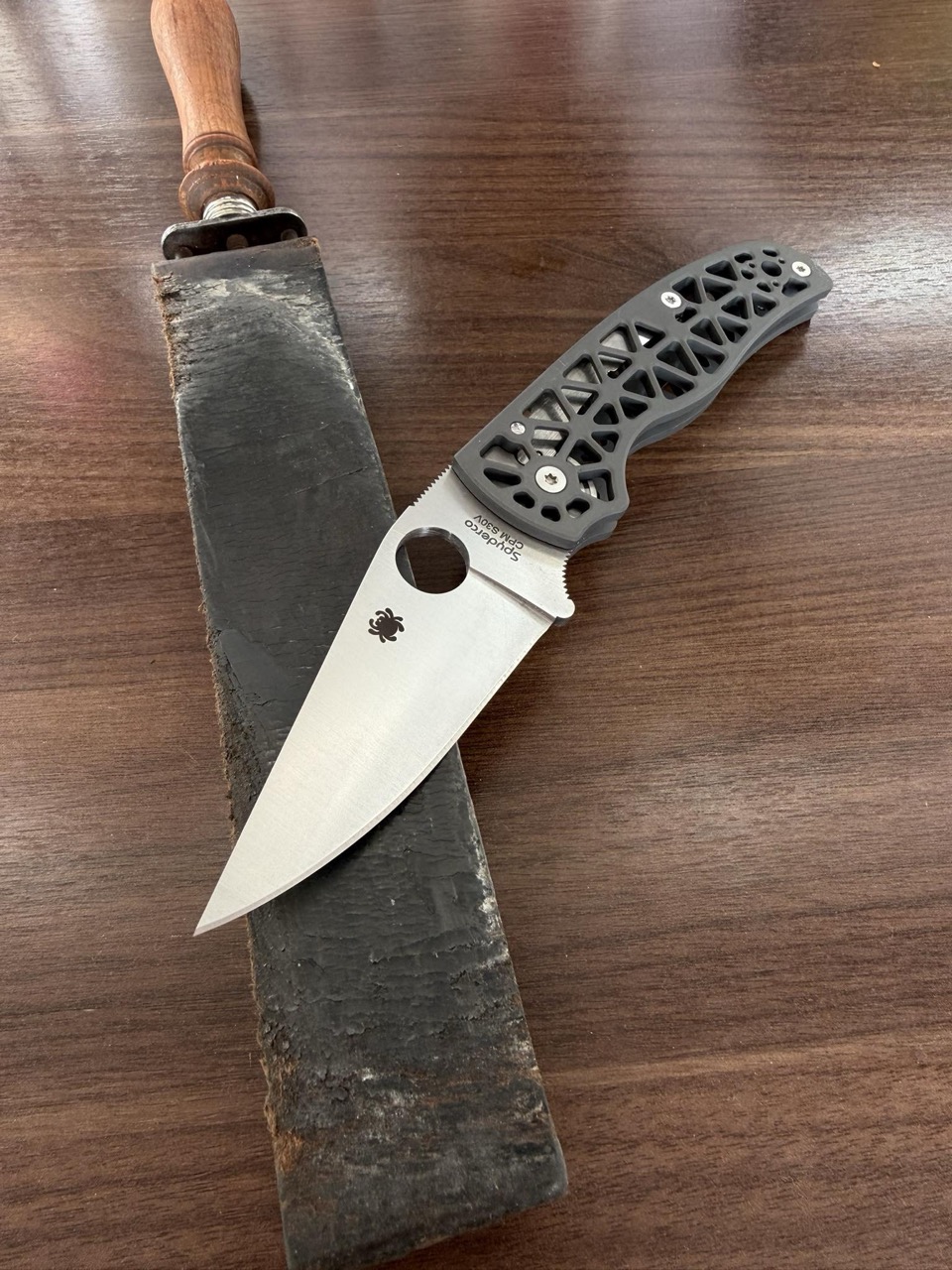
The blade is made of Böhler-Uddeholm M398 particle metallurgy stainless steel — a steel in the same class as CPM S90V. It holds an edge forever, though it’s not the toughest, and you’ll need diamonds to sharpen it. I once broke the tip of my Roadie XL after a fall on tiles, but when used as intended, M398 is delightful. I’ve worked my Roadie XL and Metropolitan hard, and M398 has never failed me. This steel would be perfect also for hunters which need long edge holding when skinning.
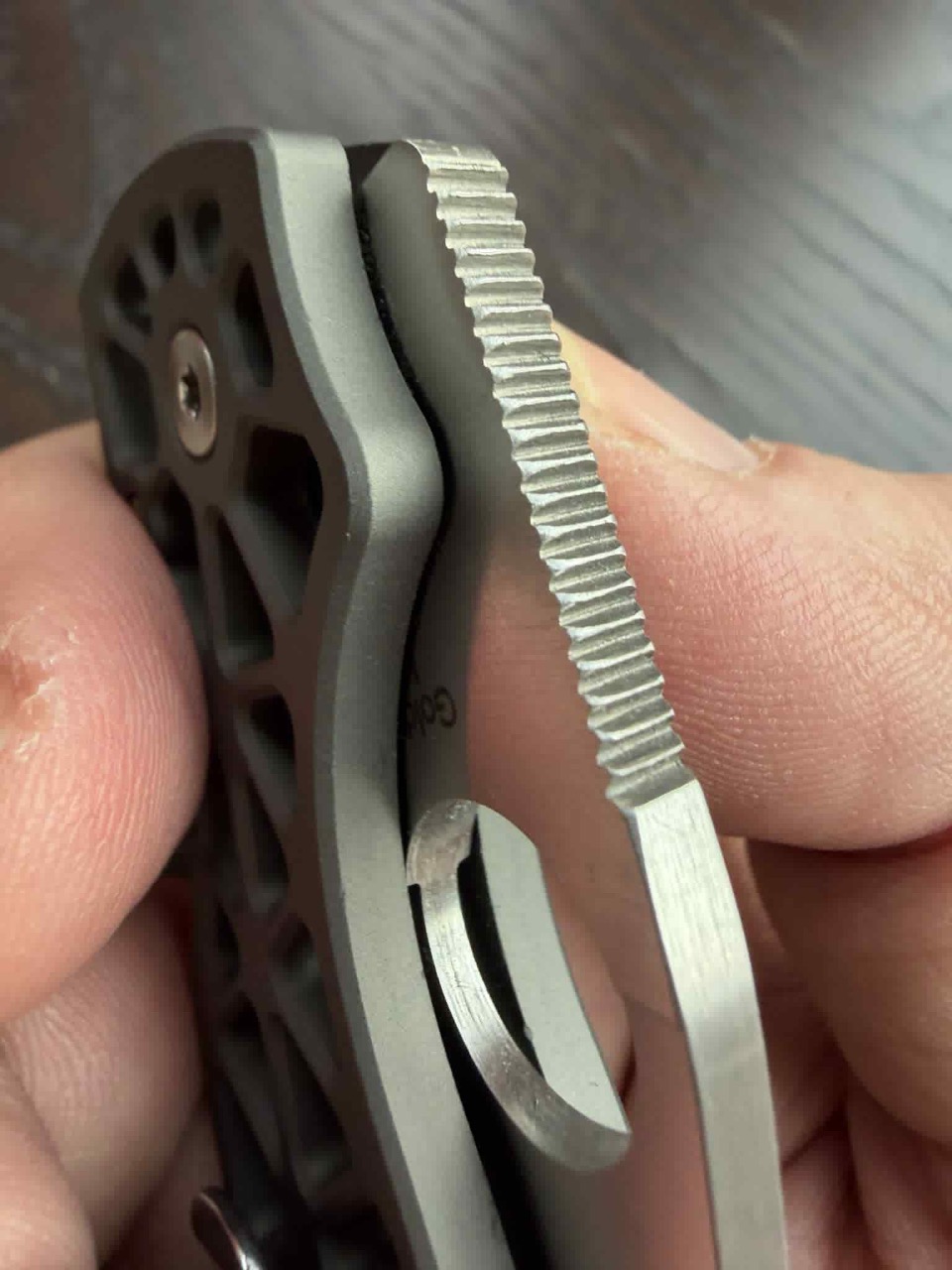
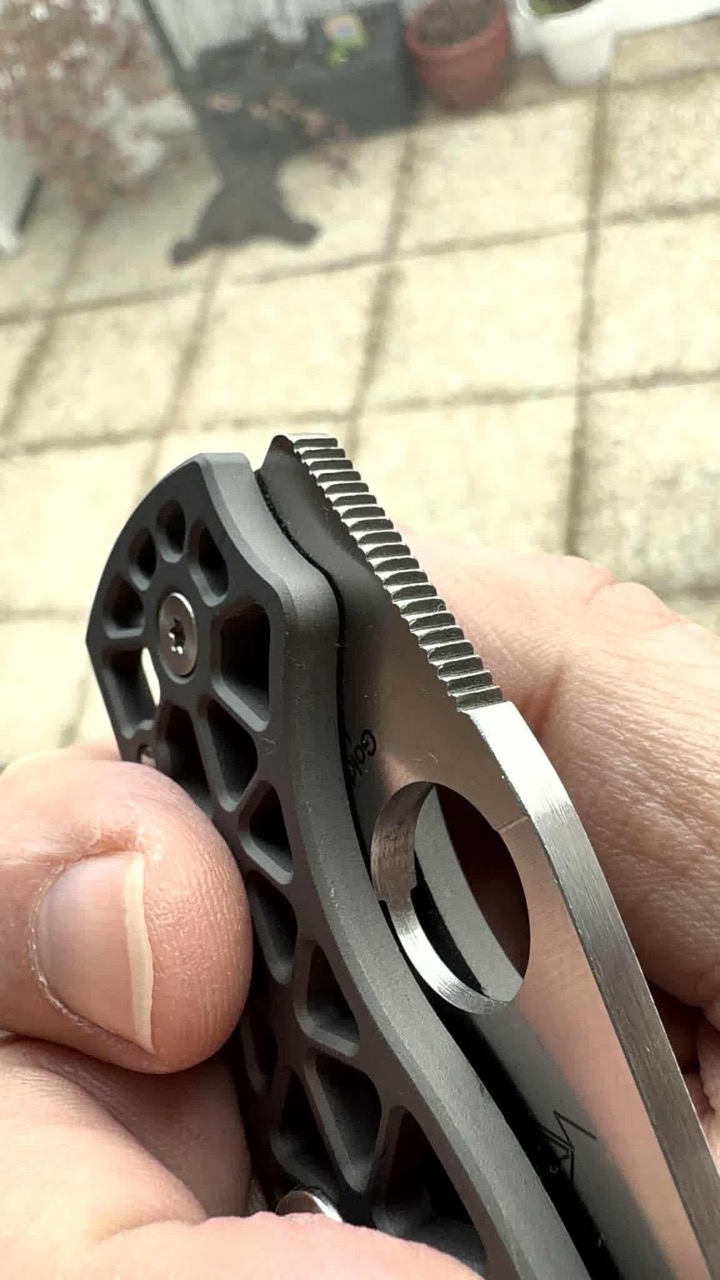
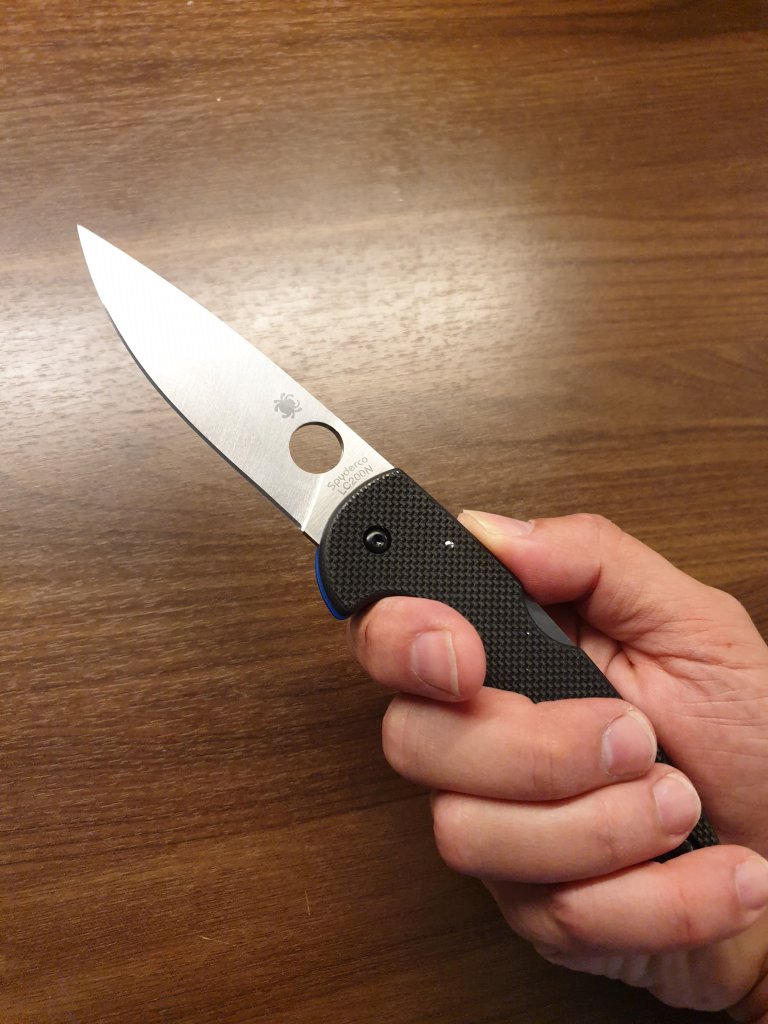
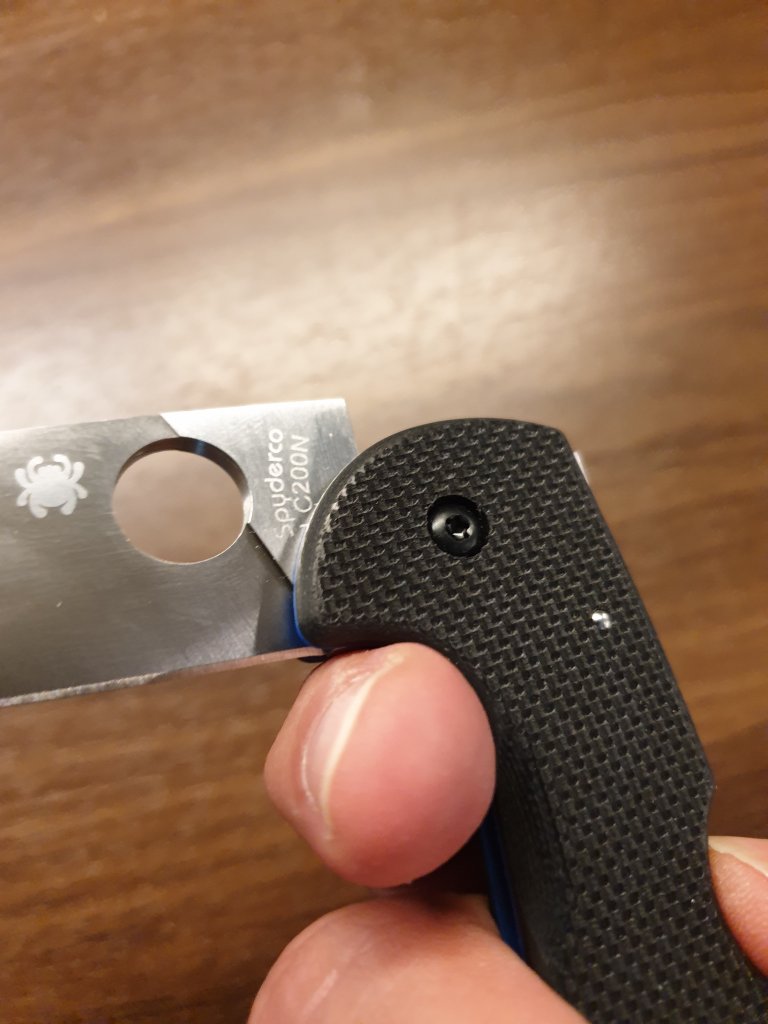
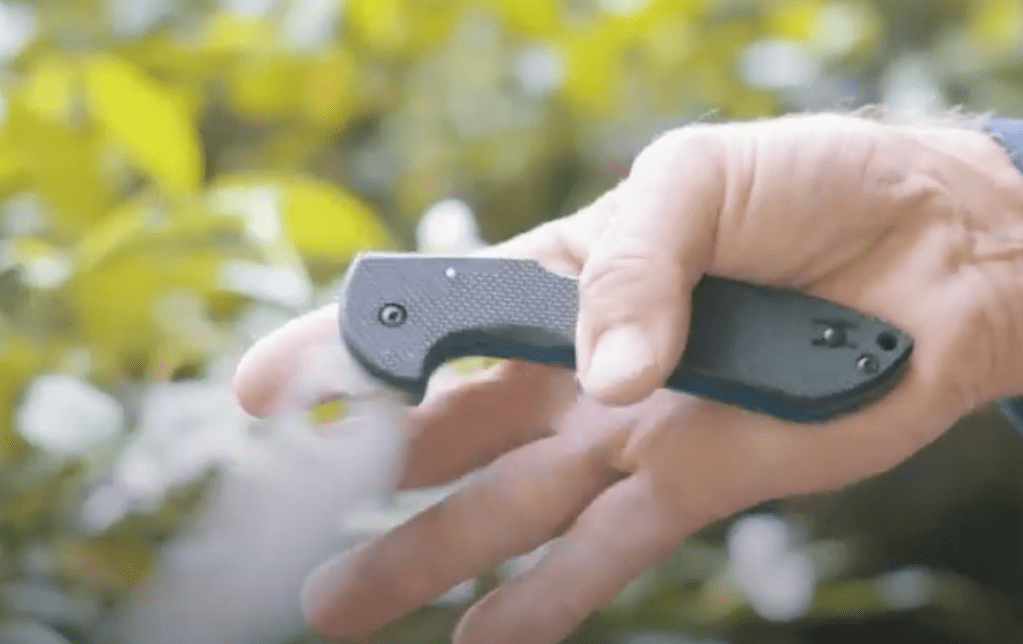
Mechanically, this is the first Spyderco I’ve handled that’s harder to open than to close. The blade retention in the closed position is quite strong, while closing is much softer than most slipjoints. With wet hands, I even find it tricky to open — I have to “Spyder-drop” it by holding it by the hole!
At least, if a Police officer asks to see it, you must open it with two hands — another good point, as it’s clearly a gentleman’s knife, not a weapon. Also, while the PITS 1 looked somewhat like a skinner, the PITS 2’s drop point blade is much less aggressive-looking.
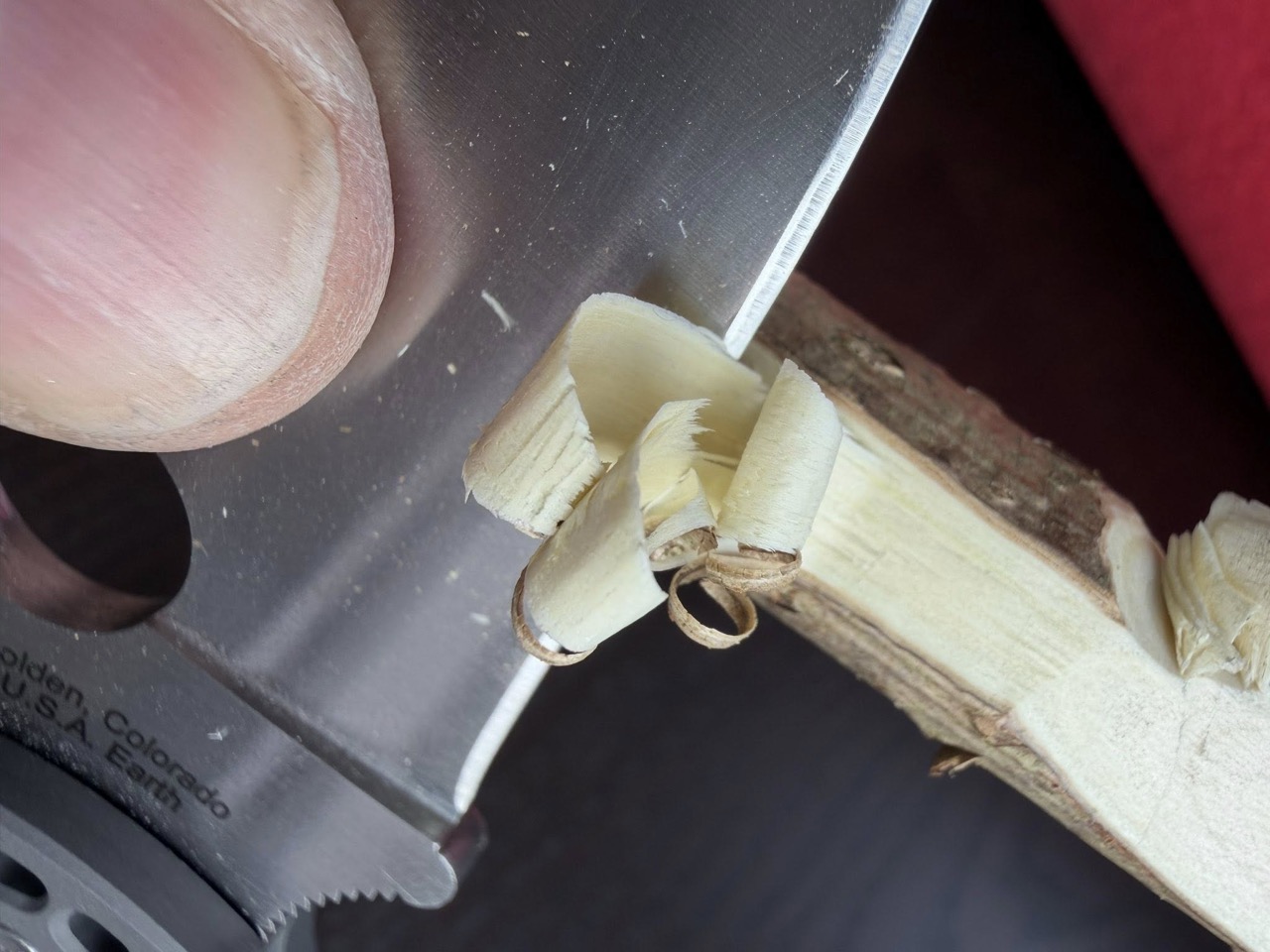
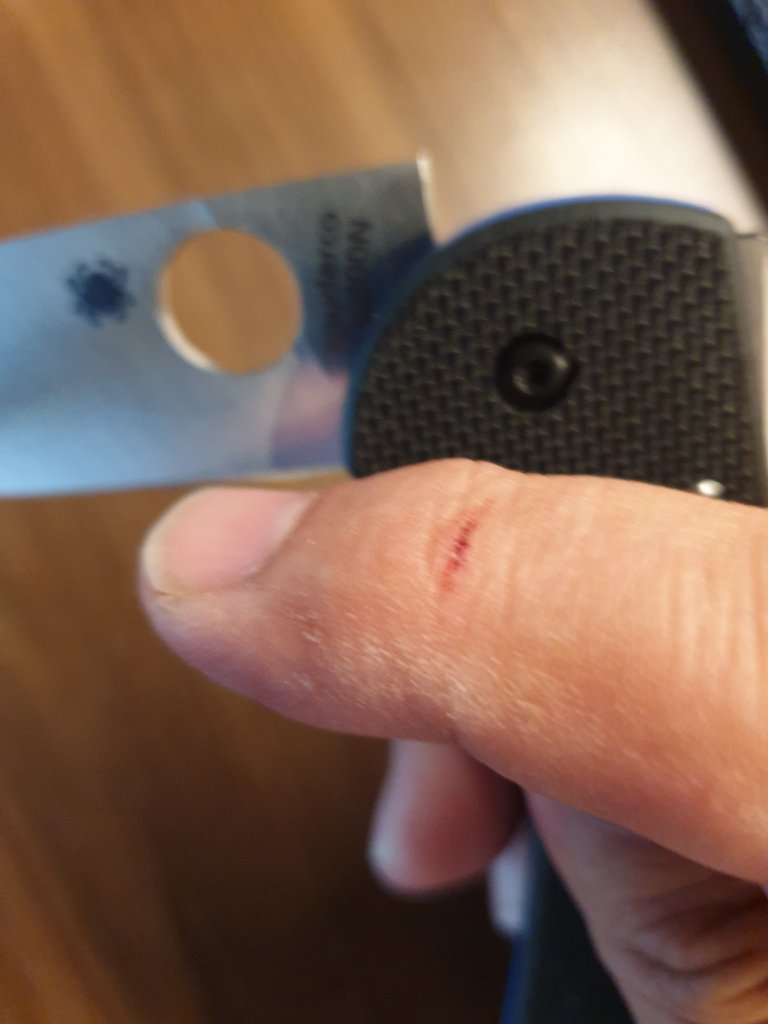
Inside the “cockpit,” there’s now a choil and a gentle hump, allowing a secure grip near the blade — something the PITS 1 lacked with a more aggressive quillon or guard for the index finger. So even with its softer closing action, it’s not a real issue. Still, when whittling hardwood, beware: that tall blade can snap shut faster than a UKPK or an Urban, both of which have stronger backsprings. Always use the choil!
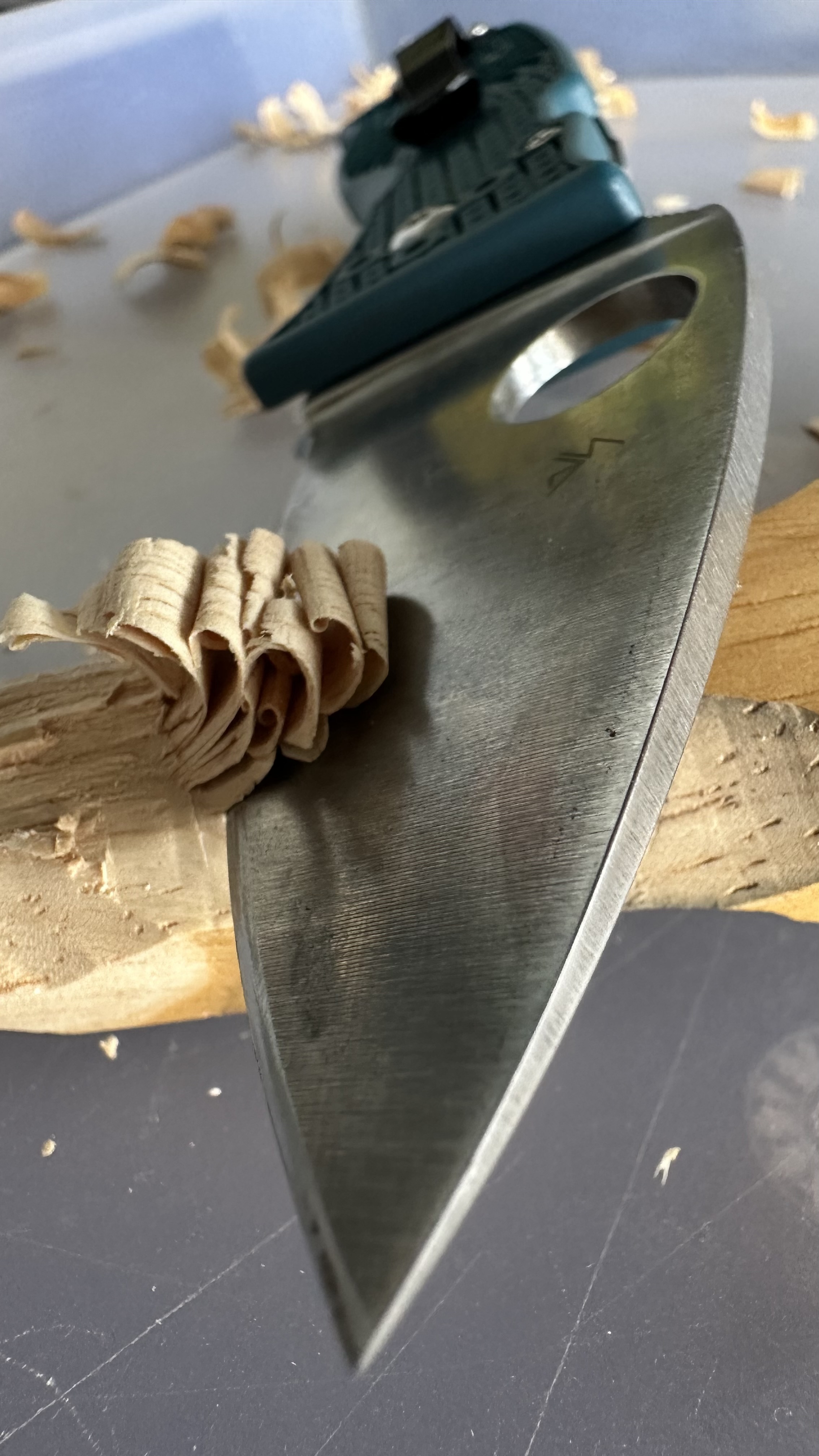
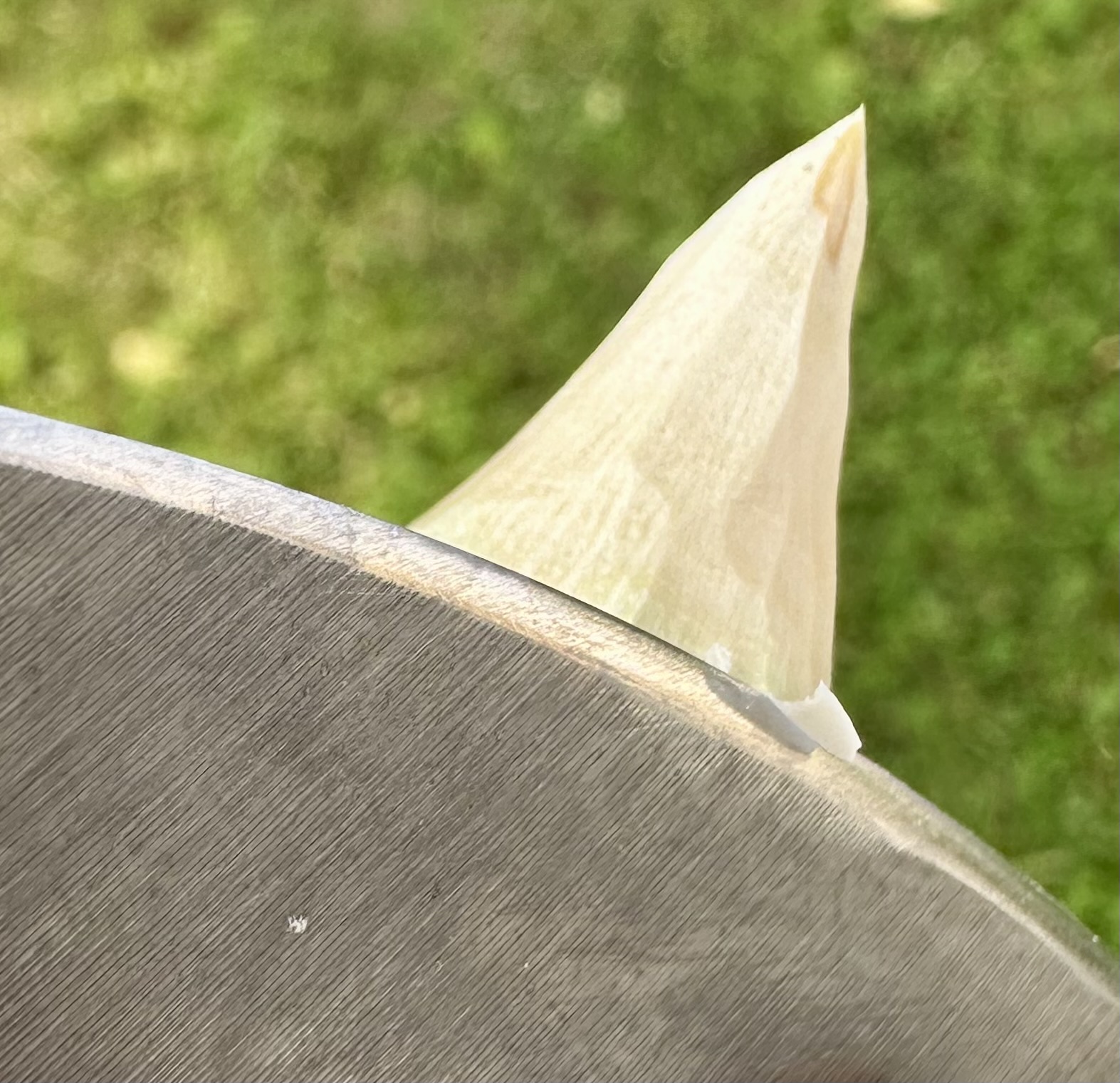
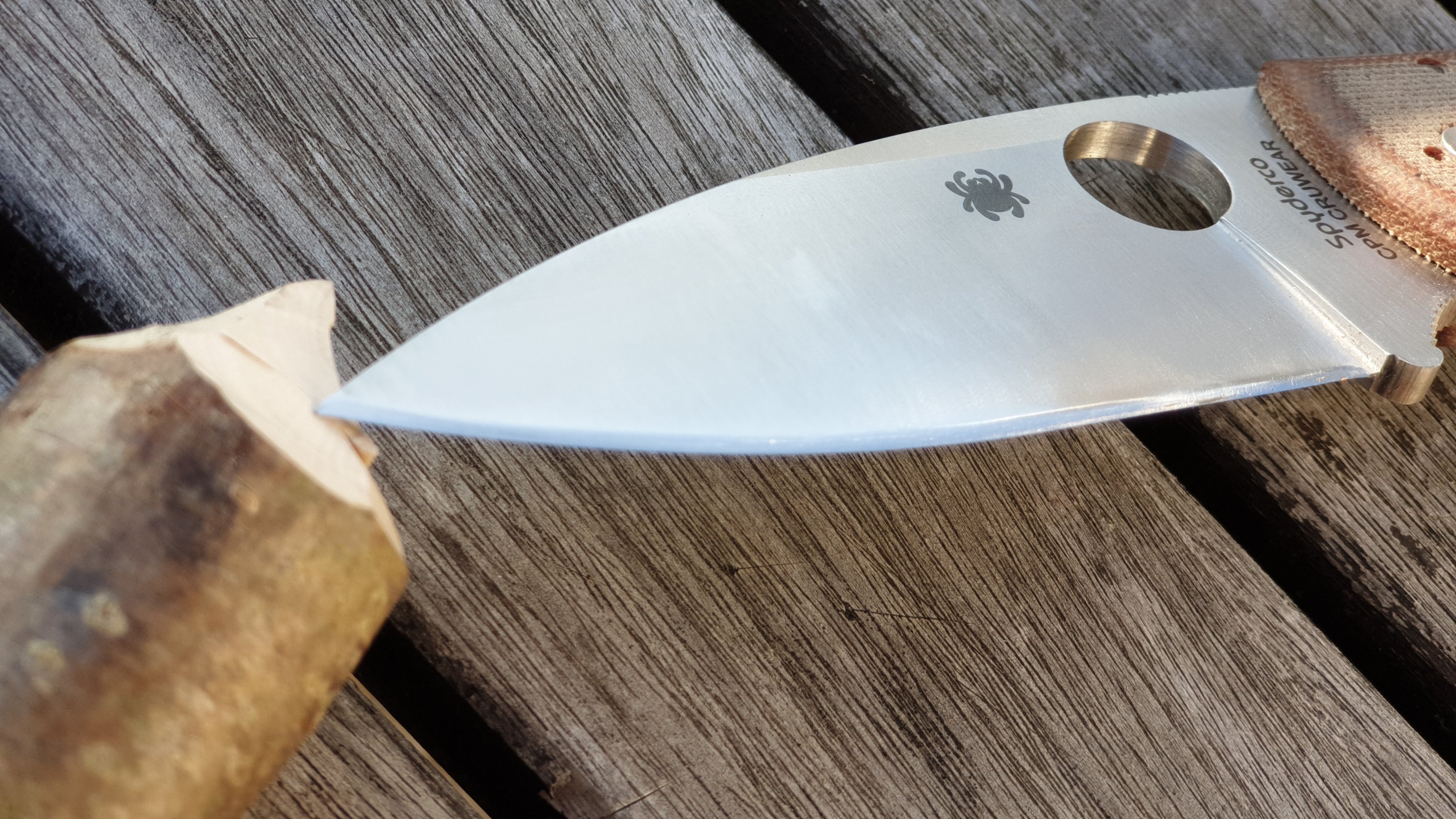
The tall, thin blade arrives razor sharp out of the box. Geometry is spot-on for push cuts, and like the Slipjoint, Manly Wasp, Chaparral, or UKPK, performance is excellent. Let’s call that: “Perf In The Sky.” This will be a great travelling companion and even a hunter best friend.
Totally UK legal and of the highest quality imaginable, the PITS 2 is not a cheap knife — in fact, it’s pricier than the Chaparral Slipjoint — but it has that “Sebenza-like”feel of a high-quality titanium folder. A gem of a knife, and one of the rare non threatening slipjoints truly designed to be a hard worker.
that the Lil’ Temp is very much a hidden gem, refined over two decades by Sal Glesser. In essence, it’s his answer to the compact, heavy-duty 3-inch folder — a kind of “Techno Glesser” that still offers a full, hand-filling grip. Its tall blade profile allows for a finely tuned convex geometry, translating into cutting performance that feels far beyond its size.
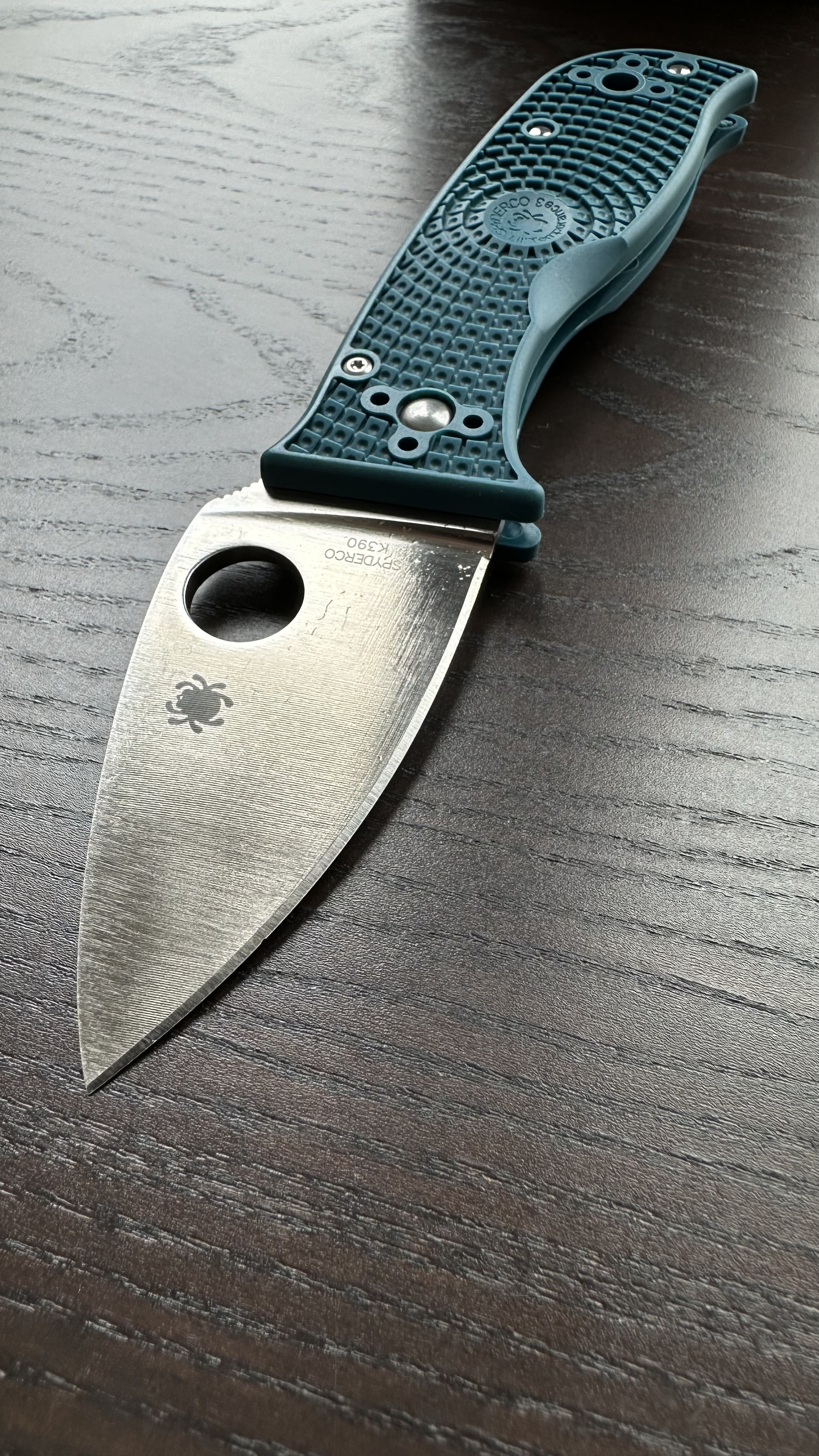
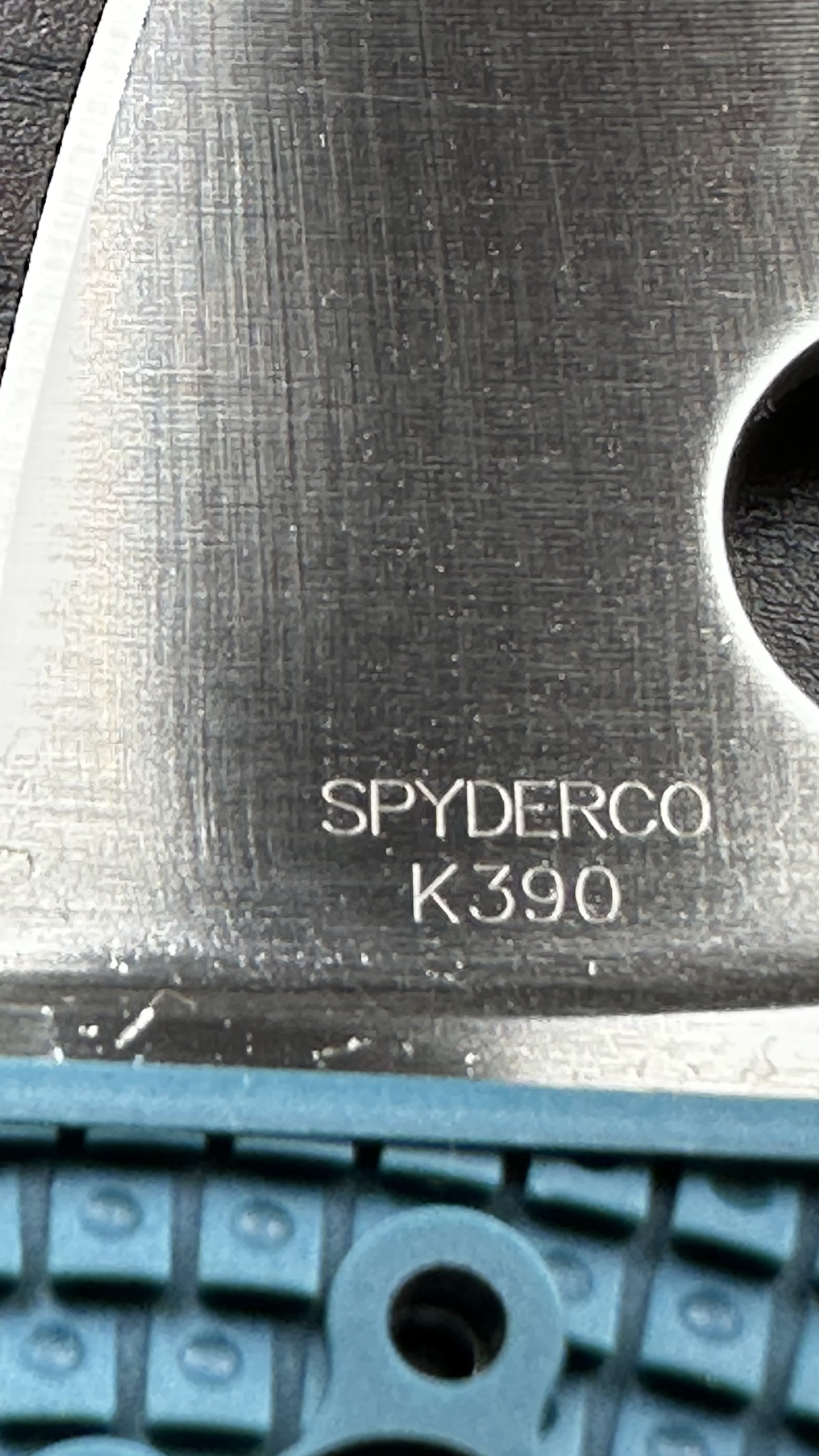
K390 is, in my book, a friendly steel. By that I mean it sharpens up to a razor edge without too much effort. It isn’t quite as easy to work with as CPM Magnacut, but it’s far more forgiving than something like CPM 15V. The trade-off is that K390 will stain readily, so regular wiping is part of the routine.
The trade-off is that K390 stains readily, so a quick wipe-down is essential to keep it looking and performing at its best.
The fact that K390 isn’t stainless is not really an issue if you keep the blade clean and check it regularly for any sign of rust. In practice, a bit of grease or oil is enough to protect it, and over time the steel develops a natural patina that gives the knife real character. My own Lil’ Temp is already showing that patina, and it only adds to its appeal.
Geometry is absolutely critical when working with wood. No matter how tough the steel, without the right blade geometry the knife simply won’t bite or carve efficiently.
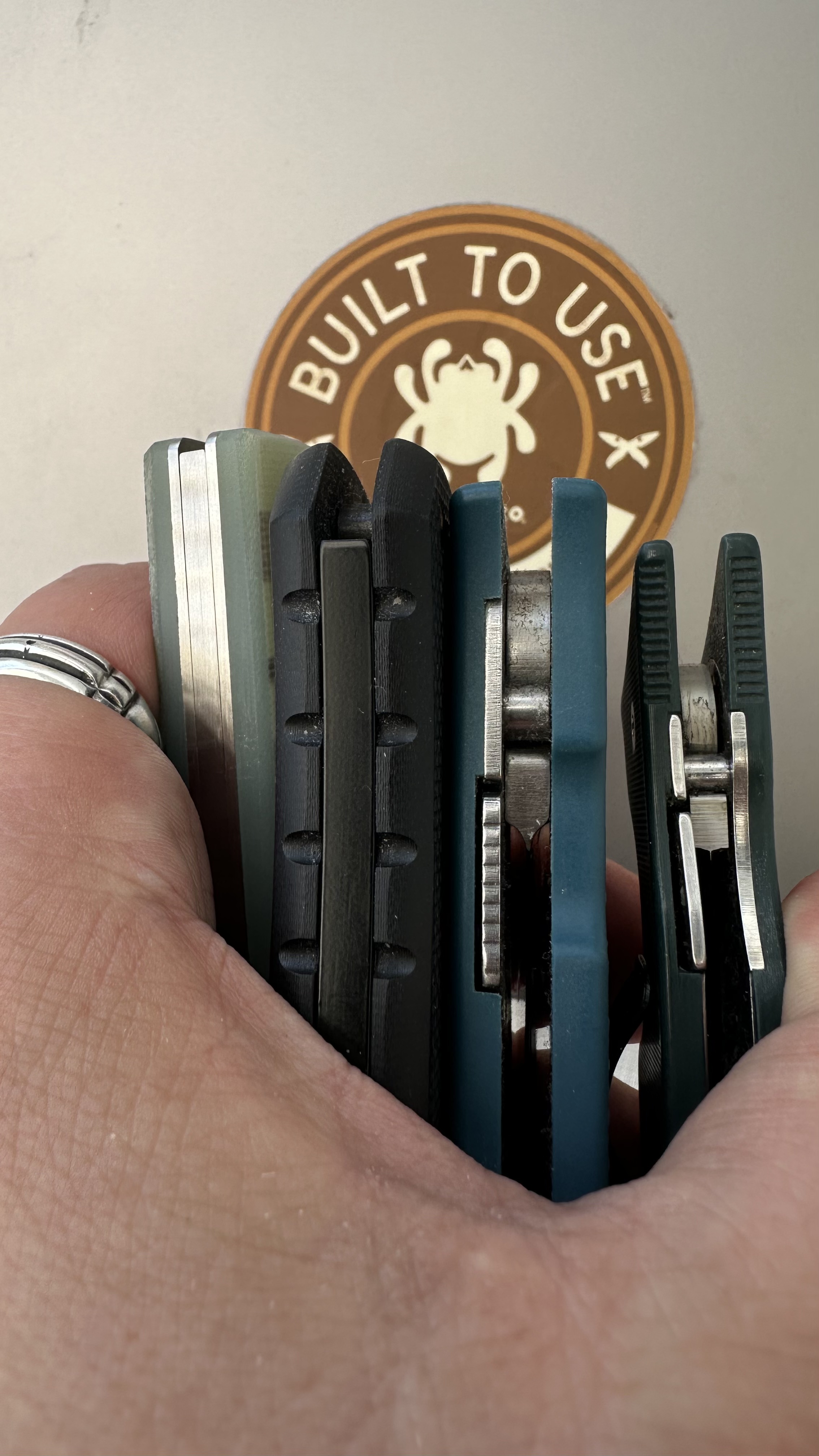
A full flat-ground high blade simply can’t compete when working on hard wood. That’s why Sal Glesser’s “Lambo of bushcraft knives,” theProficient, stands out: it combines a high full-flat ground blade made from a high-carbide super steel (S90V) with an exceptionally comfortable handle. The result is a knife that slices, carves, and handles demanding tasks with ease — the kind of tool that performs all day without fatigue.
The relatively thick handle of the Lil’ Temp makes it extremely comfortable to hold and use. Its design also provides excellent indexation, making it easy to know exactly where the edge is — even easier than on an Opinel or the round handle of the Proficient.
In the woods, the Lil’ Temp is easy to deploy and put into action. Its point is robust enough to withstand some abuse. While K390 isn’t the toughest steel available, it’s still harder and more wear-resistant than many stainless alloys, making it highly capable in practical use.
The thick spine of the Lil’ Temp provides an easy resting spot for the thumb, especially on push cuts. This gives excellent control and allows you to apply strength precisely where it’s needed.
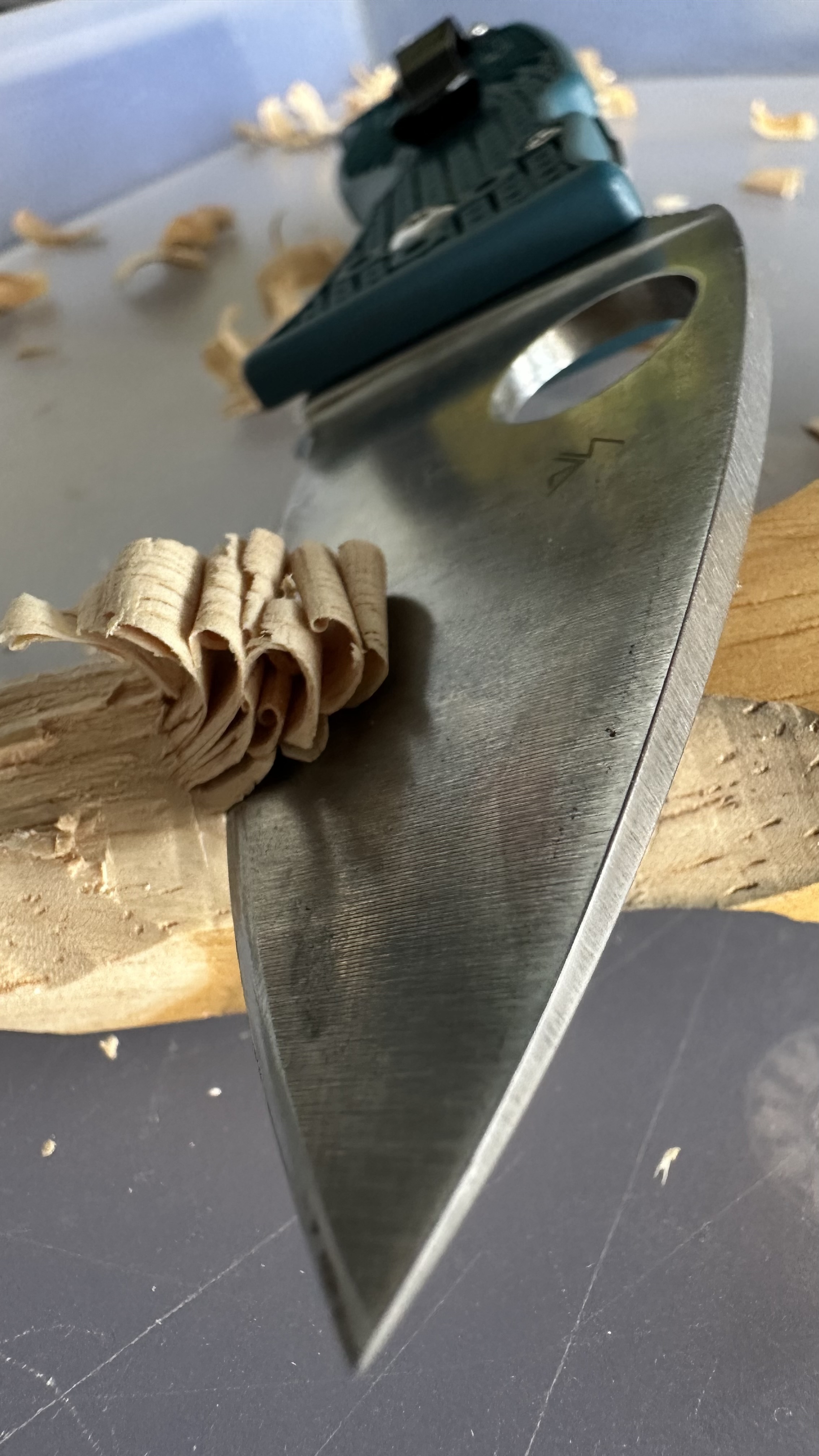
The grain structure of K390 responds exceptionally well when working on wood. After some careful convexing on diamond stones, the edge has developed a shape that balances sharpness and durability perfectly for carving and utility tasks.
I was able to carve pickets without breaking a sweat. The knife’s gentle belly plays a key role, working like a guillotine on the wood fibers and making controlled cuts effortless.
The true kings of woodworking and whittling remain the Wolfspyder and the Boker Vigtig vs Wild. Their authentic Scandi grinds allow them to bite into wood with astonishing ease, making controlled carving and fine whittling effortless.
In that context, one of my favorite full-flat-ground folders for whittling is the Native 5 Salt, once convexed. It’s an absolute pleasure to use on wood, combining smooth slicing with precise control.
A folder’s handle will always be less comfortable than that of a good fixed blade, simply because of the compromise required to fold the blade into it.
That said, the Lil’ Temp is among the very best in this regard. Other outstanding handles include the Manly Comrade, the Benchmade Adamas, the Cold Steel Recon 1, and the Wolfspyder — the latter benefiting from Ray Mears’ design philosophy, focused on knives you can use all day long without developing hot spots or splinters.
(Comrade, Recon 1 on the LT’s left and Wolfspyder on its right)
(Adamas and Lil’ Temp)
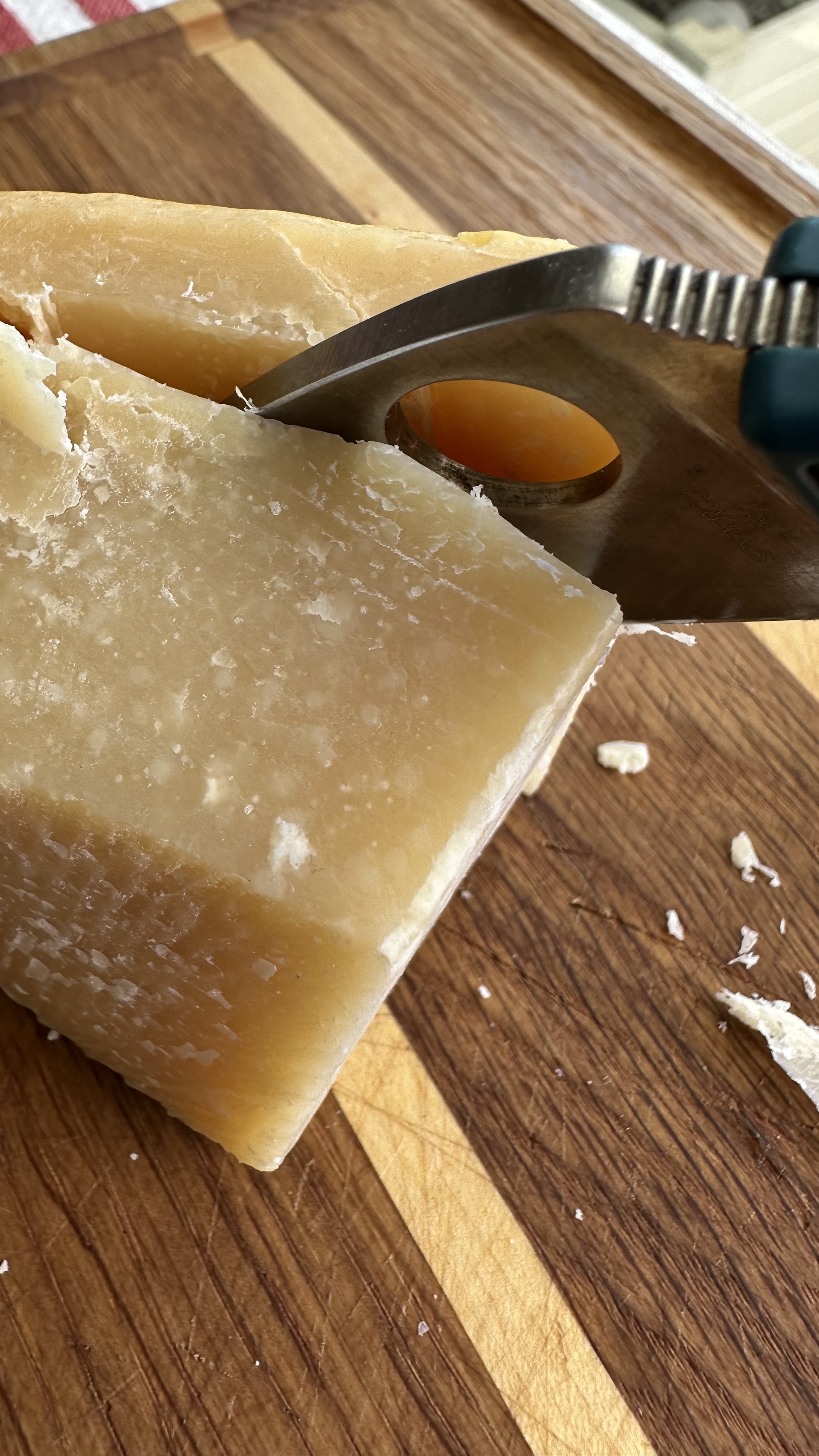
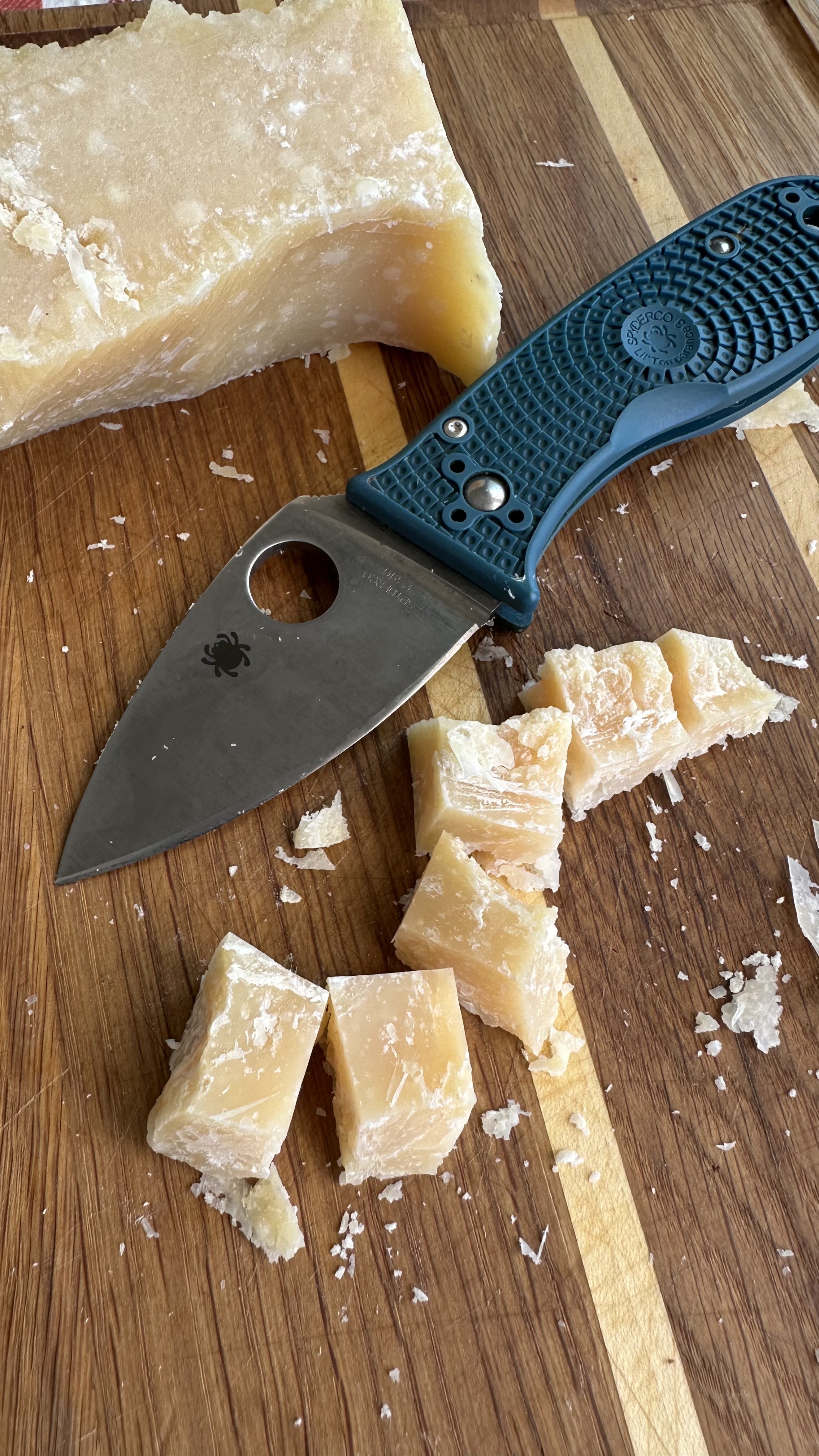
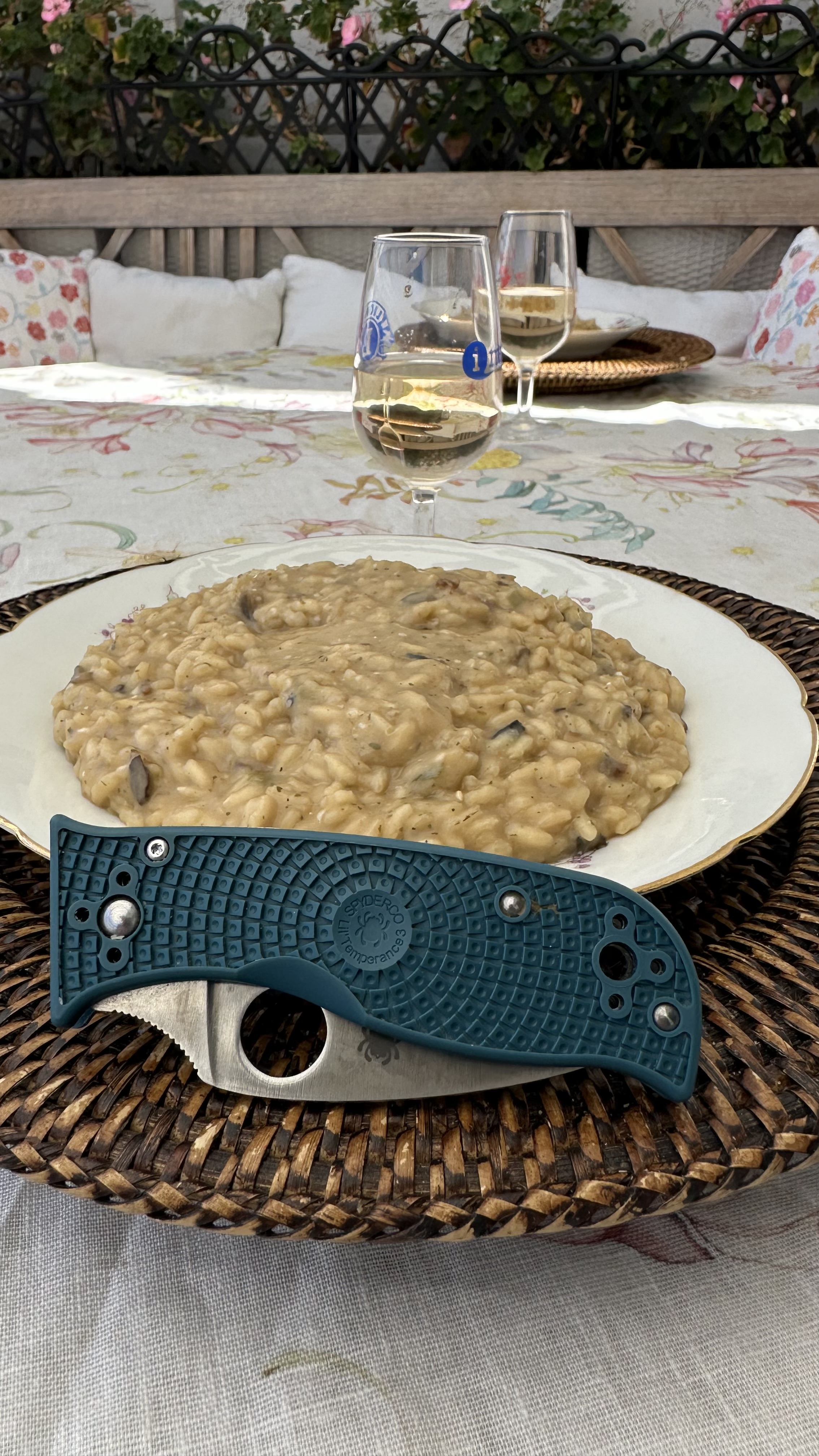
Another example of relatively demanding use is making this risotto using an old chunk of dry Parmigiano which needs to have its rind removed, then cut into half-inch cubes — no easy task given how hard the cheese can be.
It’s also a great way to detect hot spots: the weakest point, if any, in the compression lock. That notch on the back of the handle all but guarantees a sore hand after extended use.
Apart from a single trip into the woods, I’ve mostly used the Lil’ Temp in the kitchen, where it’s been steadily building a nice patina. I’ve also taken the opportunity to test its ergonomics with wet hands. The FRN handle pattern is one of Sal Glesser’s great innovations: it gives the knife a no-nonsense, tool-like appearance while ensuring the handle stays locked in place once gripped.
Conclusion
The Lil’ Temperance 3 K390 Lightweight (“Shorty”) stands out as a compact powerhouse in Spyderco’s lineup. With its super-steel blade and excellent geometry, it elevates everyday carry versatility, combining cutting performance, ergonomics, and durability in a smaller format.
Its lightweight build and aggressive handle design make it a tool you can truly rely on. Whether in the kitchen, at the workbench, or outdoors, the Lil’ Temp proves itself capable of handling demanding tasks without compromise. The FRN handle texture, designed by Sal Glesser, not only lends a purposeful, tool-like look but also ensures a secure grip, even with wet hands.
From reviews across the community, a consistent picture emerges:
Exceptional cutting performance — even in tasks where utility blades struggle
Superior carving and utility — excels at both fine control and hard work
Secure lockup — the compression lock feels noticeably beefier than on similar models
Excellent ergonomics — comfortable for long use, even damp conditions
Edge retention — the K390 steel holds its sharpness impressively well
Durability — little to no wear after months of use
Practical carry — light, compact, and easy to deploy one-handed
Minimal maintenance — just regular wiping and light oiling keeps it in peak condition
As one reviewer put it, this “box-destroying little chode of a knife” punches well above its size. Another called it “a tank… carefree, strong AF, and super comfortable.” After extended use — from food prep to cardboard — users report only minor stropping needed, with many calling it one of their favorite Spydercos in decades.
In short, the Lil’ Temperance 3 K390 Lightweight is a sleeper hit: not the most popular Spyderco, but for those who carry it, often a personal favorite. A compact EDC with the heart of a work horse.
Disclaimer: before going further I need to precise that this knife has been sent to me for free by Golden as part of their brand ambassador program. I thank Spyderco for choosing this little blog and for their trust in my reviews.
“The Lil’ Temperance has been a 20 year personal project. We planned an FRN version 10 years ago, but because it is a smaller market to serve, and I wanted to epitomize the concept, the progress was slow. We changed the design, locks, clips, patterns, etc. Made many prototypes over the years.
The “Spirit” of the design has remained the same. Essentially, a tough, legal 3″ blade MBC folder. Along with my own experience, I had input from James Keating (the Riddle of Steel), Bob Taylor (Warrior designer), Mike Janich (whom we all trust and revere), Bram Frank, Craig Douglas and Laci Szabo.
The first runs made for an interesting design, that was effective for two grips. Then I altered the design to also serve Pikal concepts (forward edge up and reverse edge in.), which was not incorporated in the original design. I’m looking forward to the FRN version. sal“
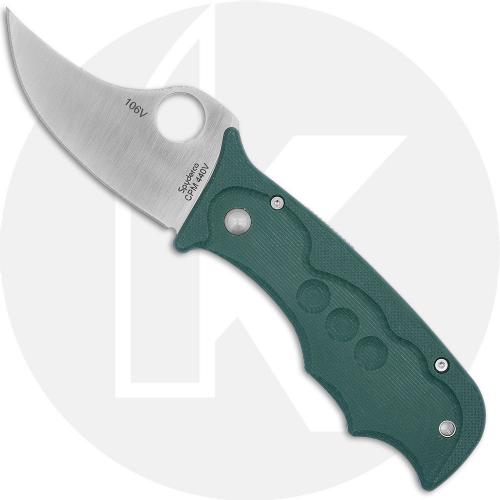
My first Lil’ Temperance was a “Rhino” — the nickname for the C69 full-flat-ground trailing point blade. That model was released 25 years ago. At the time, I also gave it another nickname: the Lil’ Chinook, after James Keating’s Chinook — a stout folder with a thick trailing-point blade made from CPM440V.
I even found a picture from Knives Plus to document it:
That folder was also available in Leaf Shape Blade like this new K390 just received from Golden today.
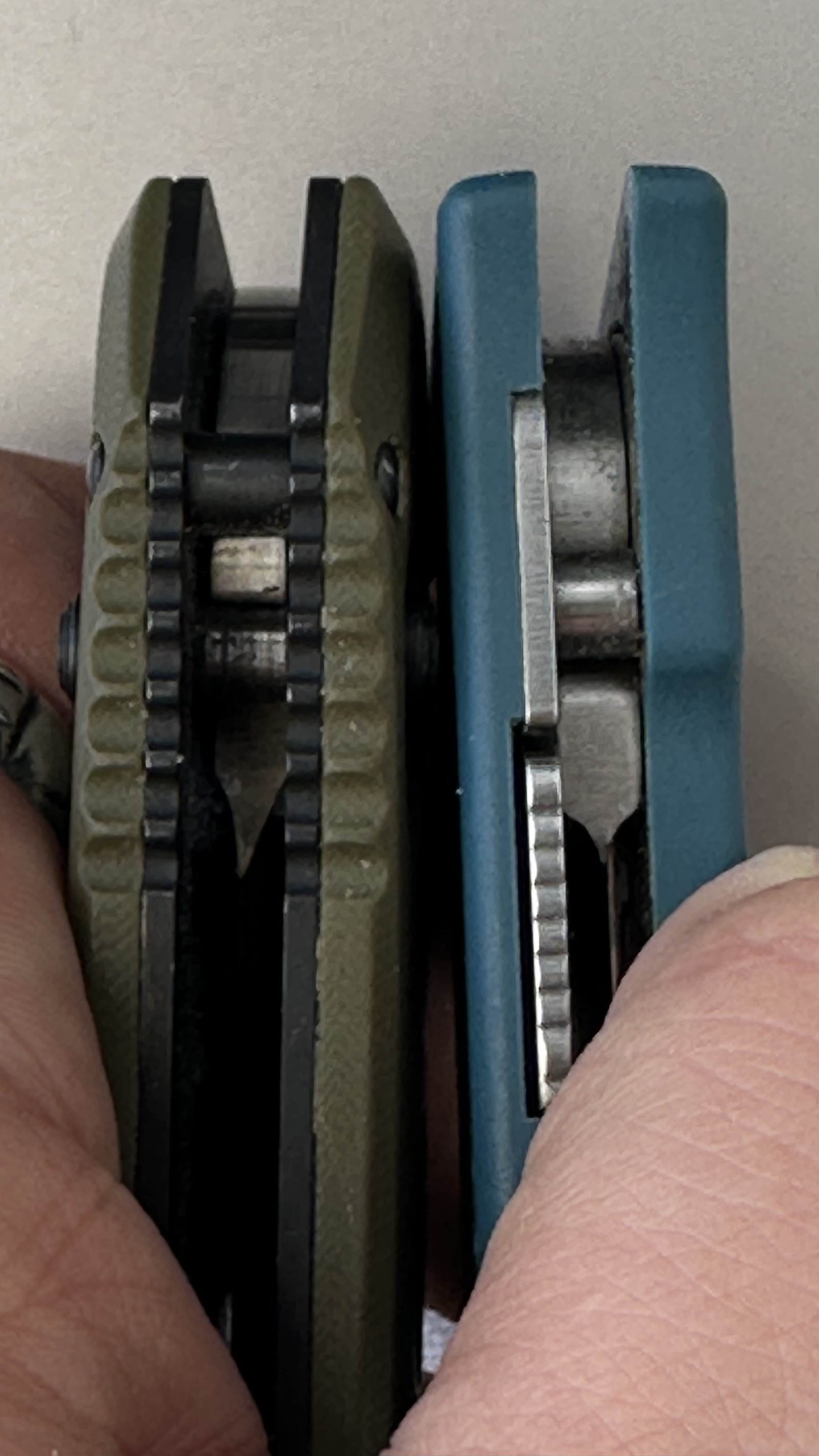
Twenty-five years ago, Sal Glesser was deeply influenced by the Martial Blade Craft approach. During that period, he designed the FB05 Temperance, a fixed blade in VG10 made in Japan with combat applications in mind. A trainer version was also available, featuring a red handle and a dull, skeletonized blade.
Sal also created a folding companion: the very stout Lil’ Temp C69, made in S60V (440V) in Golden. It was marketed as “a compact yet heavy-duty folding knife suitable for defensive use.”
Both the FB05 and the Lil’ Temp C69 featured round marks in their handles to facilitate quick grip changes — for example, transitioning from an icepick grip to a hammer grip — a key element in knife fighting. The C69 even had a special clip designed to match its three craters, showcasing the new in-house Compression Lock. The first iteration was extremely strong, often painfully pinching the skin between thumb and index, but in every other way, it was a true “folder on steroids.”
I don’t advocate using knives for defense; they should be a last-ditch option — the very last weapon you’d want to rely on. Historically, knives have always been tools of attack, from backstabbing to throat cutting, not instruments for self-preservation.That’s why I was glad to see that the Temperance II shifted toward a more “camp utility–oriented” design. The current Sprint Run of the Lil’ Temp I features a CPM Cruwear blade, which emphasizes tooling performance over combat potential. Unlike a VG10 blade, which could be used as a weapon, Cruwear is designed to stay sharp reliably over time — a knife for work, not just to be sharp once and used in aggression.
The K390 version of the Lil’ Temperance 3, following the path of the VG10 model, continues this shift from weapon to tool. Gone are the rotating points on the clip and handle; the focus is now purely on utility. With K390 steel, the knife becomes a genuinely tough, long-lasting edge tool — a folder built for work rather than combat.
That 4 mm-thick blade with its high full-flat grind really begs to be used hard — it inspires confidence in every cut. Its leaf-shaped profile would even make it an excellent Parmigiano knife, allowing you to twist the blade into the cheese to fragment it with ease. 😉 For reference, the Millie and Shaman feature slightly thinner blades at 3.7 mm.
K390 is simply a great steel. Period. I’ve already written extensively about it — for those interested, here’s a link to one of my detailed reviews.
In short, K390 is a high-vanadium tool steel with outstanding wear resistance. It can hold an edge through extended wood carving, feathersticking, or fire prep. Although K390 is non-stainless and will develop a patina, it is forgiving, strong, and maintains a razor-sharp edge for a very long time.
K390 is made for workers who need a reliable tool and know how to care for their blade. It responds exceptionally well to leather stropping, which helps maintain its edge. (For reference, the upcoming CPM Magnamax is expected to be a stainless version of K390, similar to how CPM Magnacut relates to CPM 4V.)
Keep in mind that K390 loves to patina and will rust if left unprotected. A light coating of mineral oil — like the kind sold by Ikea for cutting boards — is an easy and effective way to keep corrosion at bay.
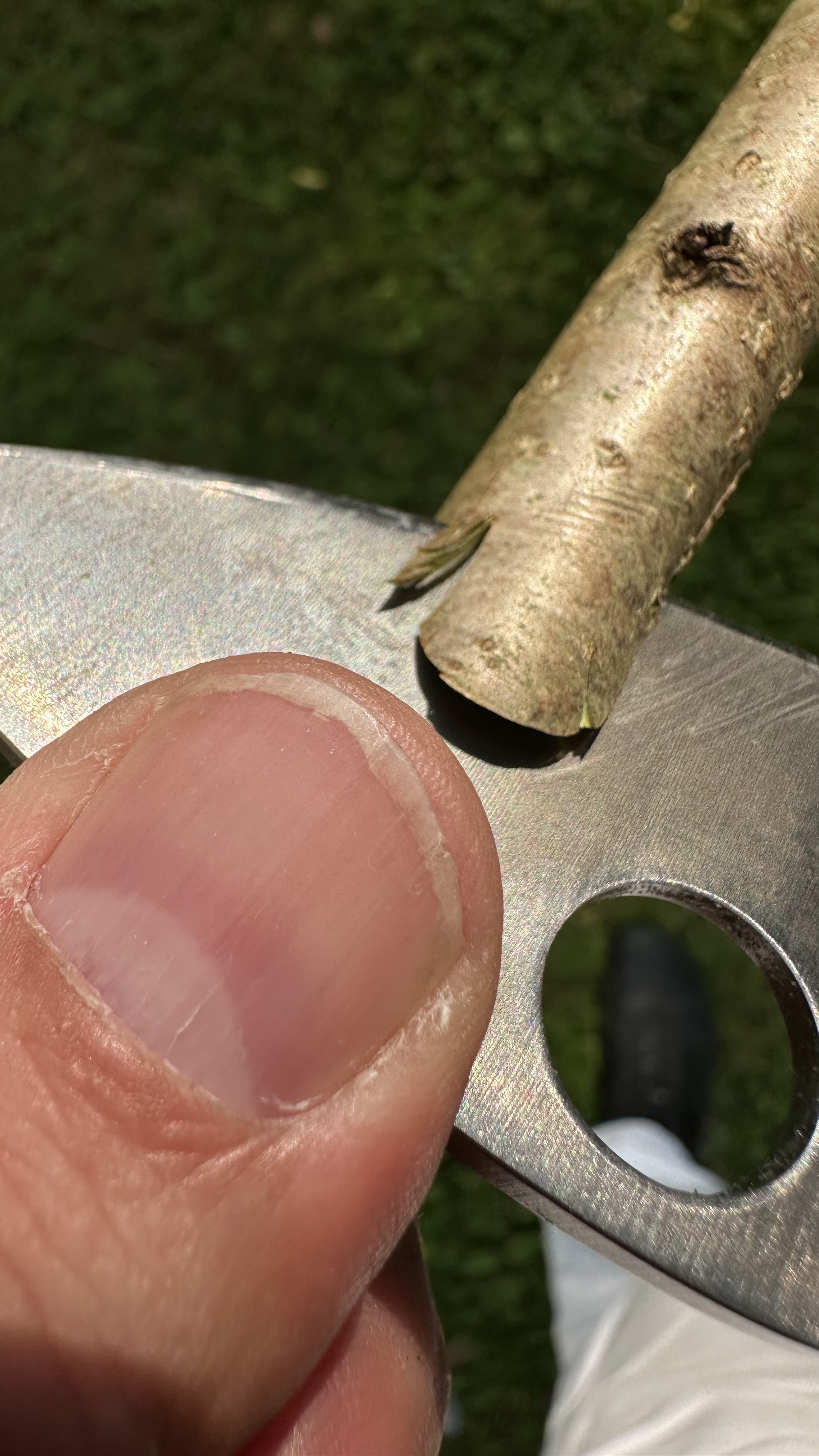
I noticed a small nick on the out-of-box factory edge. No big deal — it happens, especially since the knife had just been “chipped” to France. 😉
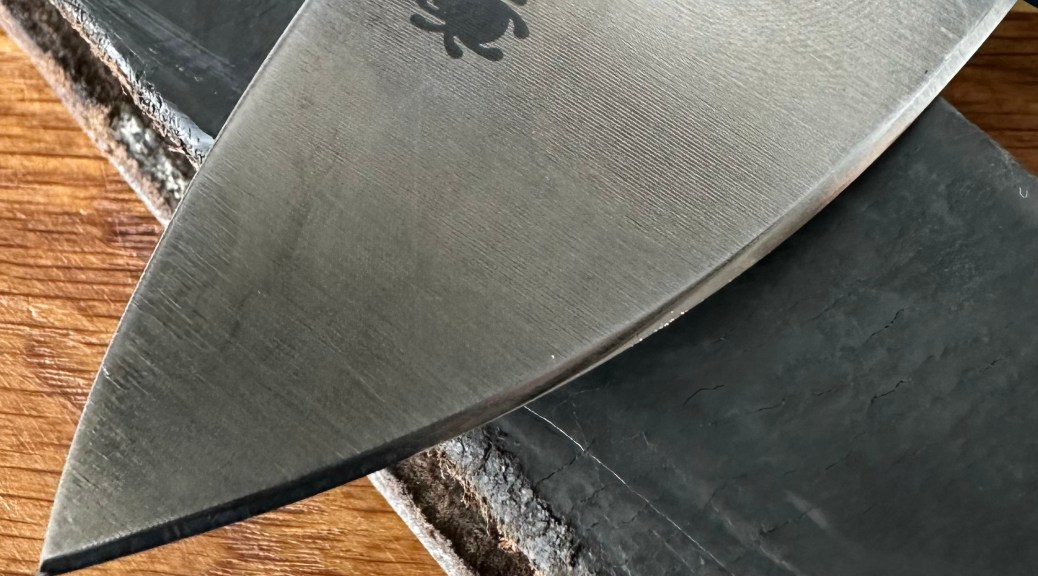
To fix it, I reached for my Spyderco Stuff 2 and Fällkniven DC4 diamond stones. I worked the blade carefully, avoiding the edge on leather, until the nick was no longer visible. A few passes on a white ceramic rod brought the edge back to razor sharpness. Ten minutes later… the Lil’ Temp was ready for action.
It’s now impossible to spot the chipping — or maybe it was a slight bend. Either way, it’s fixed. I’ve seen the same issue with my Tenacious in M4 after it hit a stone floor, and once again, diamond stones worked their magic.
K390 behaves similarly to CPM-M4: it’s forgiving and easy to maintain despite being a stellar alloy. While I love CPM-15V for its toughness, it’s a bear to sharpen, whereas K390 is much easier to fix.
That said, K390 is still non-stainless: it will pit and rust if neglected. Take care of it. I know plenty of people who would struggle — they throw their knives in a toolbox and never clean them. K390 is not for them. But for those who maintain their tools, it’s a super duper steel that rewards proper care.
The Lil’ Temp has no choil, which means you rely entirely on the handle for grip and control. I love choils on slipjoints, where there’s no lock and you often grab the folder by the blade. But on a reliable locking folder, a zero choil works perfectly.
The Compression Lock is ultra-reliable, strong, and designed to prevent accidental disengagement. You can depend on it completely — there’s no fumbling, no second-guessing.
That thumb ramp is wide and a perfect comfy spot for your thumb or for that tender web skin between the thumb and the index finger. The action is smooth but as smooth as the Sage5 or the Millie 2. No vertical play. No pinching. Drop chute after a little wrist flick. The opening arc is a little wider on this one due to the placement of the hole a little far from the axis but the Spyderflick is easily done. It is fidget pleasant folder ! I don’t think it is good for tip down carry and “spyderdrops” as the guard is a little to wide. But for tip up carry and middle finger’s flips, it is perfect. The relatively thick handle is really comfy even when squeezed. So far I have not find any hot spot. I will certainly sand the edge off the FRN but nothing is really needed, it is just my taste in smoothing everything.
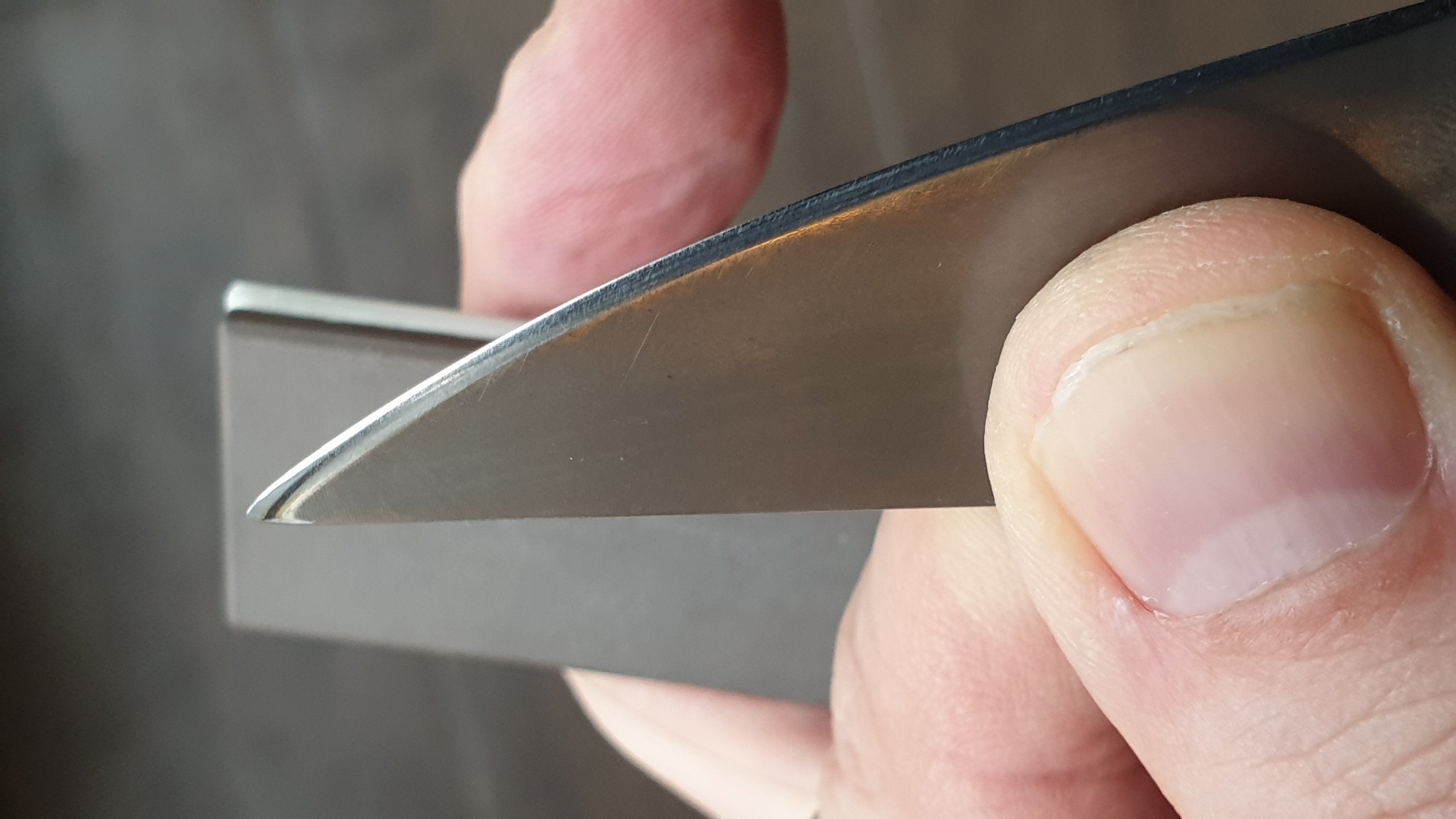
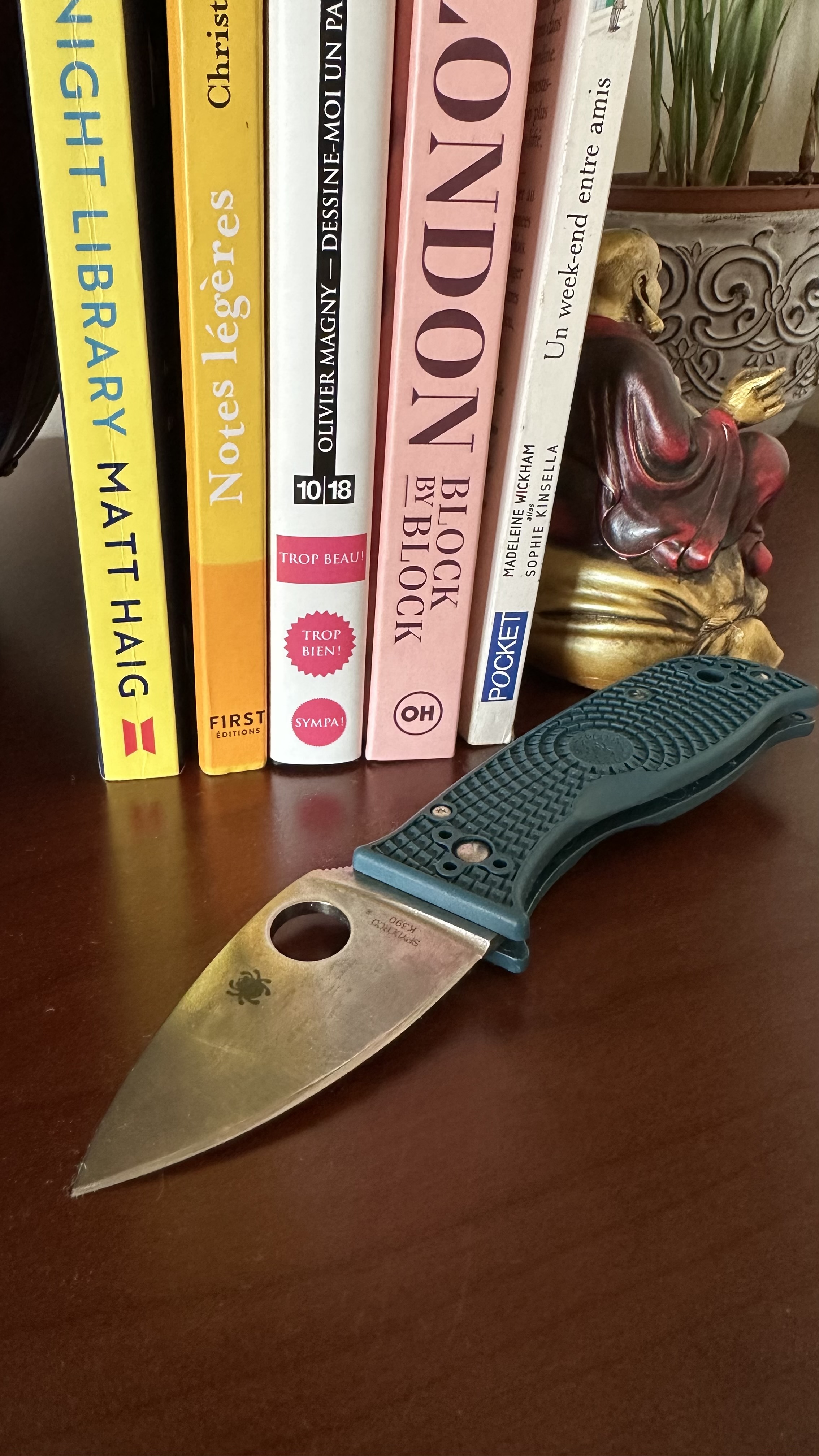
Lightweight ? Not really at 108 grams for a 3 each blade. Only 5 grams less than the G10 version. This “Lightweight” version has kept its two recessed skeletonized stainless steel liners (when the Para3 Lightweight, for example, ditched them). Here, only the G-10 scales has been replaced by two beautiful thick blue scales. This color is really sheeple friendly and the wife already likes it. The black clip is also a very nice touch. This folder oozes some very toolish scents: this is a work poney !
The open construction of the Lil’ Temp also makes it very easy to keep clean. You can rinse it and quickly check for any dirt or debris, which is especially useful after outdoor or kitchen use.
The heavy-duty clip is built for work. That FRN handle can be a pocket shredder — no doubt about it. Sanding the FRN scales doesn’t change that in my experience. This is a true blue-collar folder, meant to be clipped in solid pockets and relied upon day after day.
The knife is enough compact to jump into the watch pocket !
« I bend the clip slightly on almost every knife I carry.
I usually take something wedge shaped and slide it under the clip a small amount at a time until I get the bend I like. Not everyone will like the same bend so incremental bending works best. I like very little resistance in retrieving my knife from my Right-Front-Pocket. Just enough to keep it from falling out of my pocket. YMMV.
sal » That’s a game changer and pocket savior once you have found the sweet spot of clip retention.
Once a samurai, now a wandering ronin. Once a self-defense knife, now a powerful tool. Regardless of its past, the Lil’ Temp is a true gem — thoughtfully designed, finely crafted, and made in Japan.
“The maker said it was a very difficult model to make, and for him to say that, I’m guessing it’s true. They’ve been making our knives since 1980. I worked with the Grand Father and the Father and Eric works with the son. I think we’re fortunate to be able to bring the model to you.
Sal“
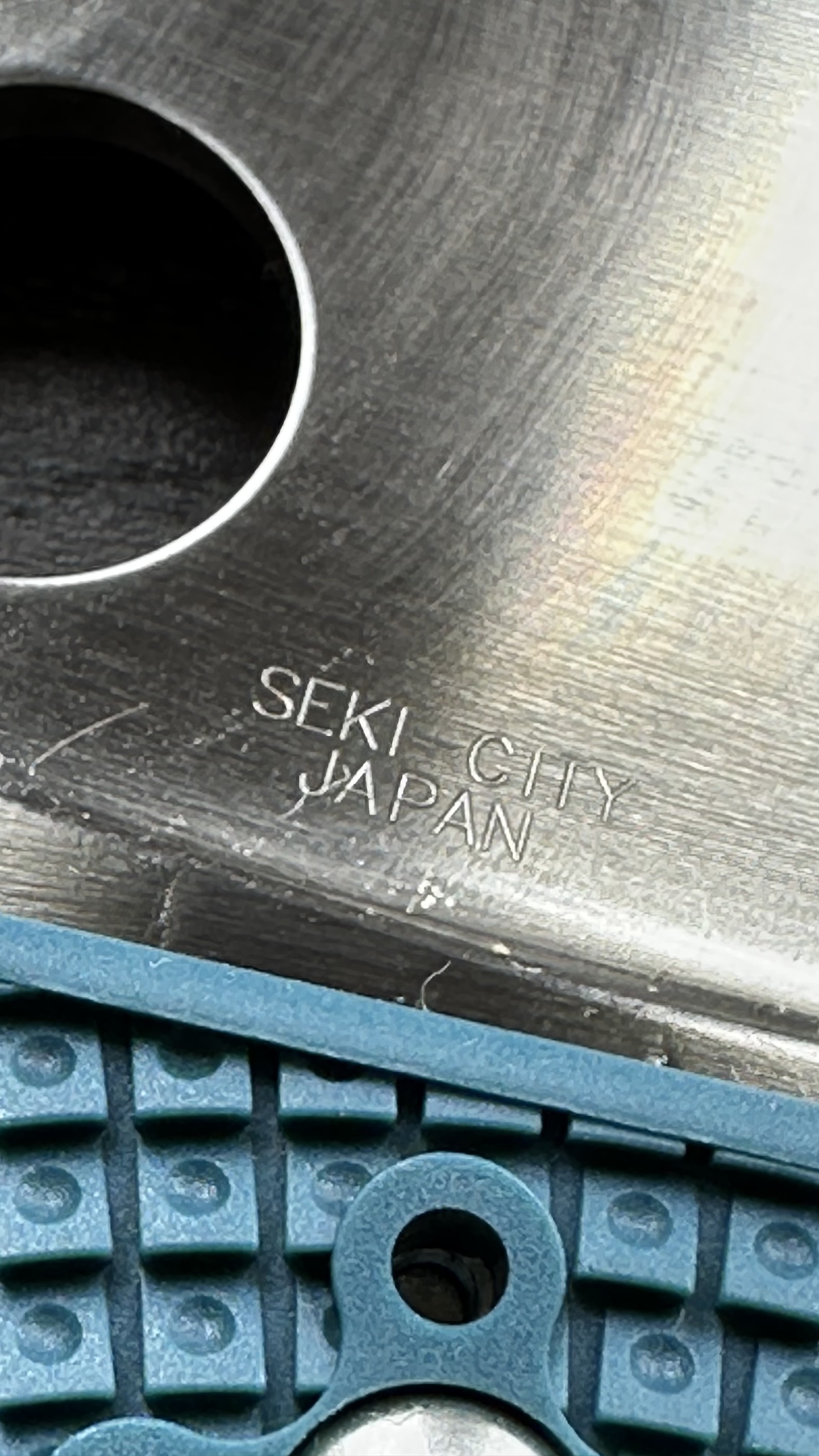
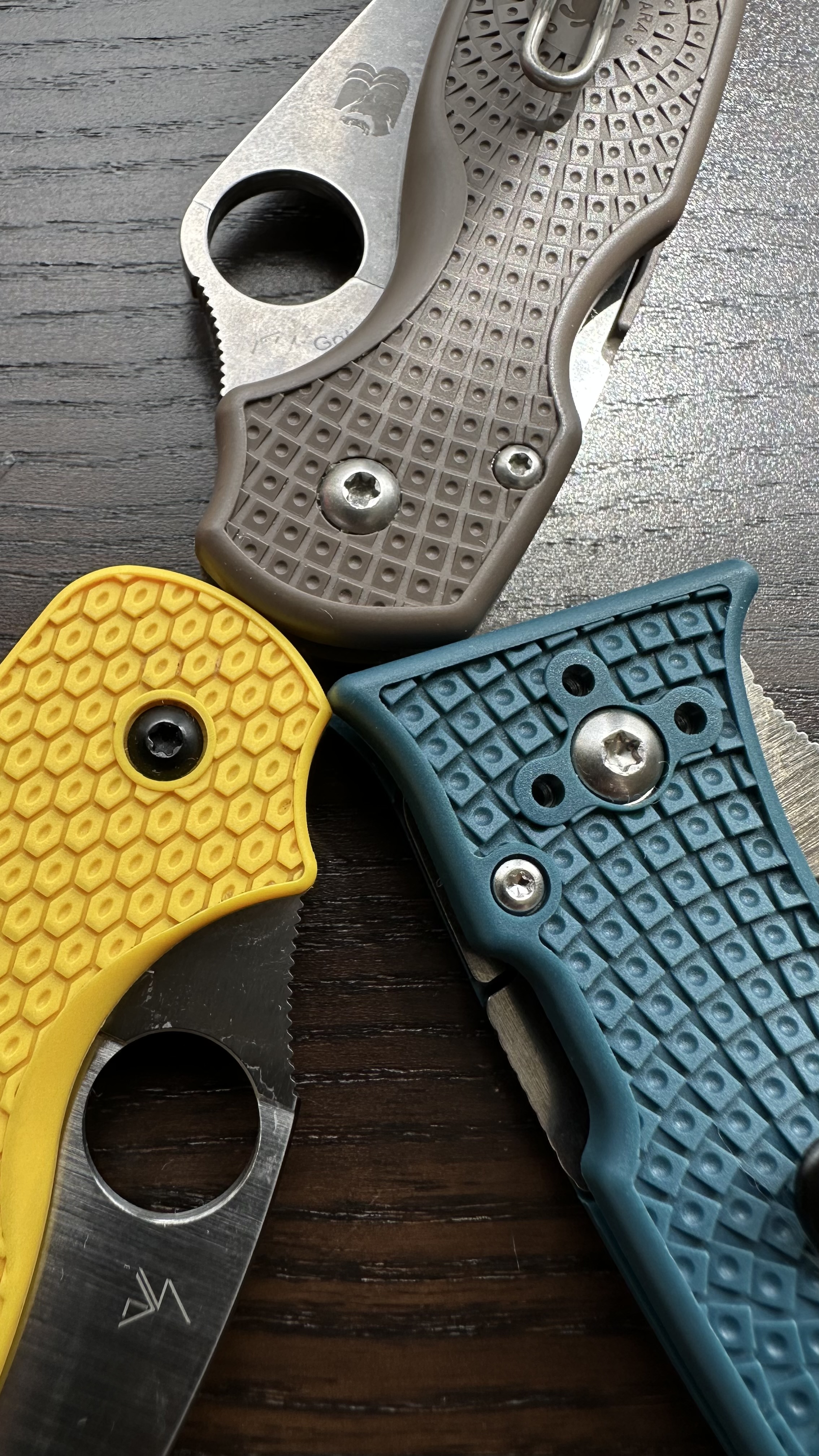
Sharing the same FRN pattern as the Golden-made folders, the Lil’ Temperance features a larger pivot screw than the Para 3 and Sage 5 (made in Taichung). Despite its small size, the lack of a choil gives it plenty of usable edge.
Edge-wise, it’s impressive: the Lil’ Temp offers virtually the same cutting edge length as the larger and heavier Manix 2, all within a form factor similar to the Para 3. Its “no choil” design is reminiscent of my Tenacious, maximizing the usable blade while keeping the knife compact.
The blade length is just shorter than 3 inches with 74mm. It is not designed to reach the heart between the ribs. It is designed to work hard on various materials. It is designed as a formidable “hard use” cutting tool.
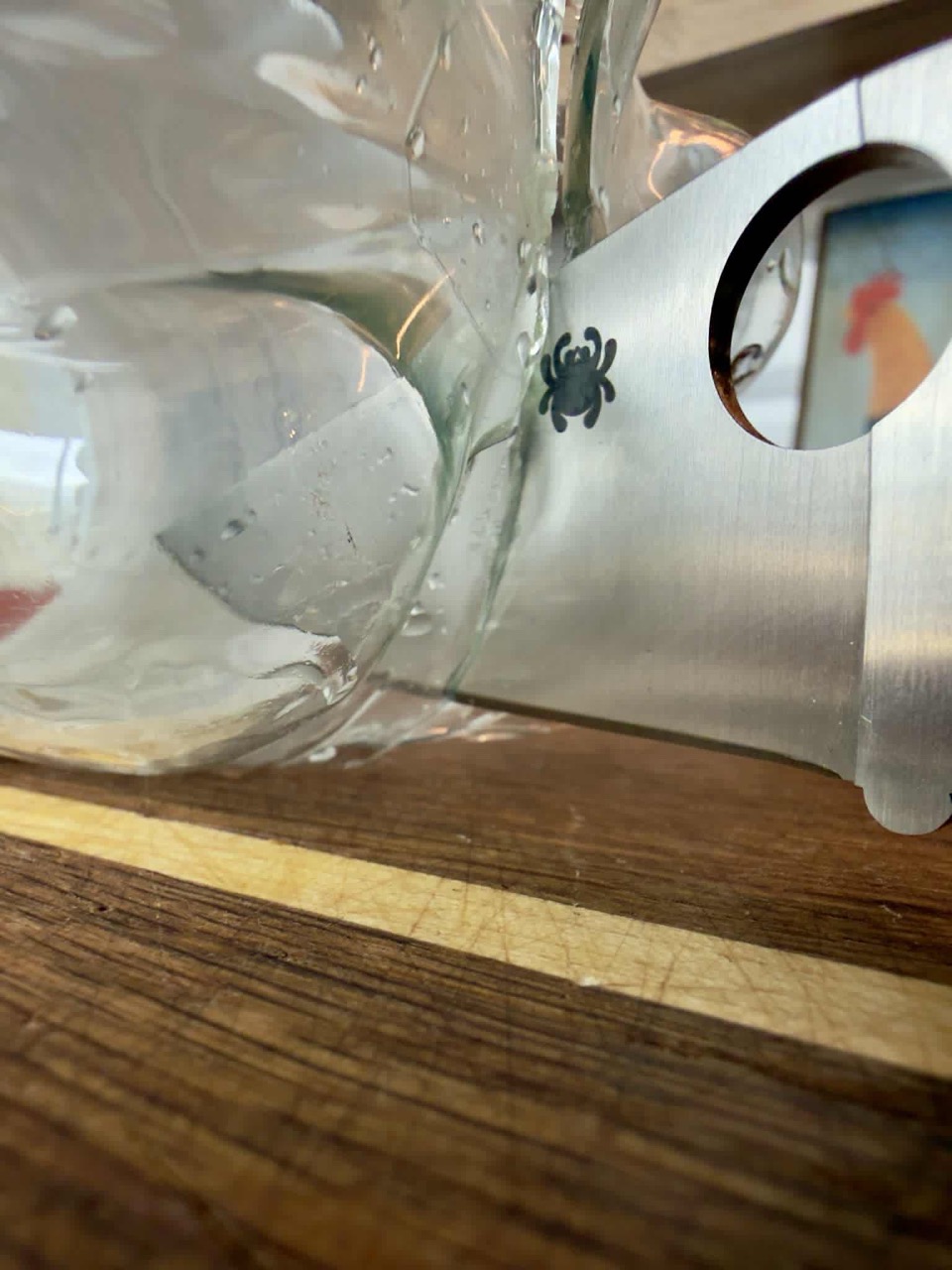
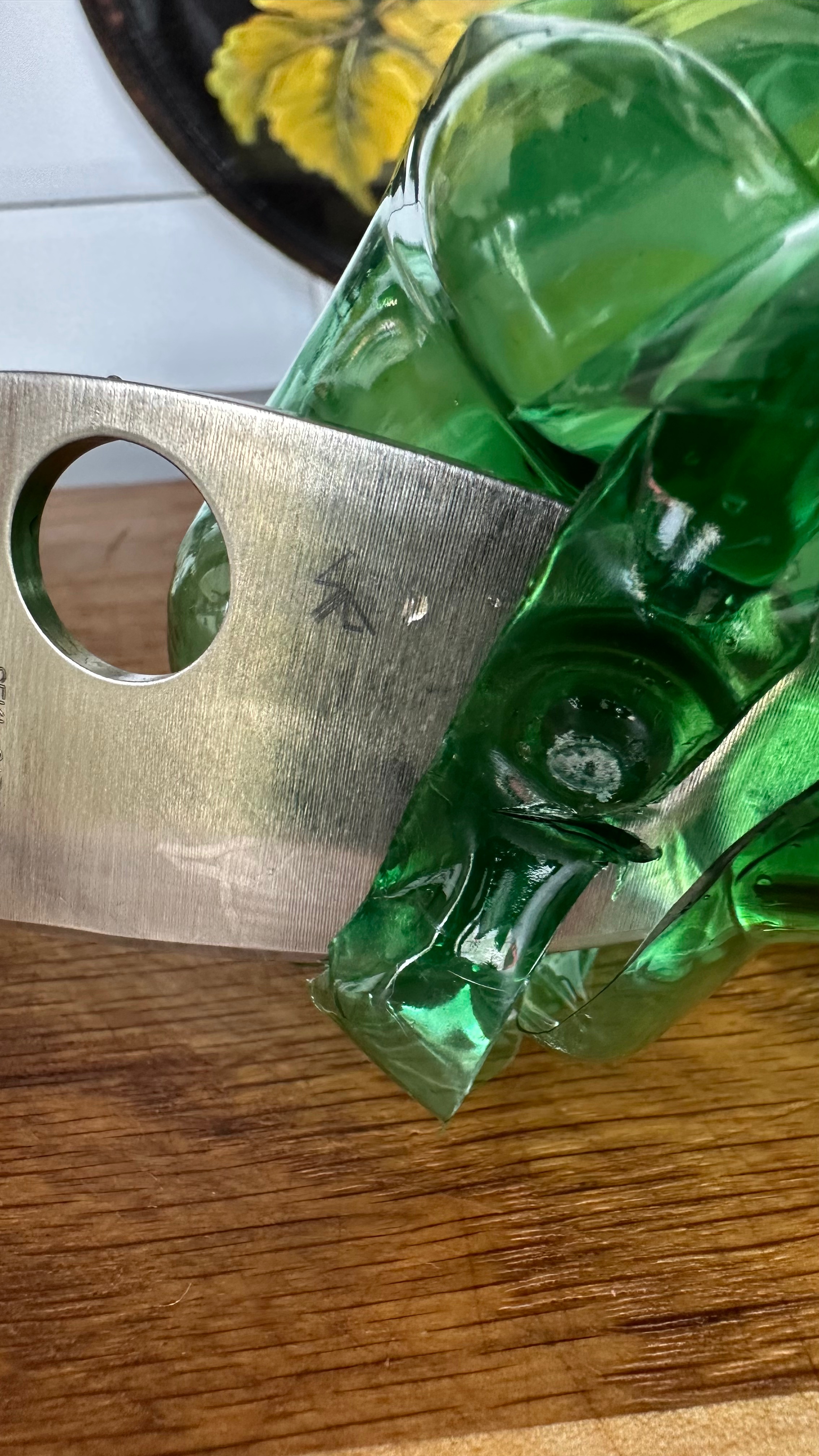
See how the poor bottle falls apart under the Lil’ Temp’s edge!
I remember seeing the Spyderco Police showcasing K390 — a knife originally oriented toward martial use, gradually drifting into more practical, tool-like applications. I’m glad to see the same evolution with the Lil’ Temperance: “Although rooted in Martial Blade Craft design, it provides reliable, full-service performance for any cutting task.”
And it doesn’t hide its abilities. Compact though it is, it’s unapologetically loud about its cutting power.
I couldn’t agree more — this is shaping up to be a truly tough, little big knife, perfect for Part 3 of my adventures. But don’t forget the Part 2, first.
Here it is, the famous Lance “Surfingringo” Clinton’s folder: the Siren. Une sirène in French is a mermaid. This knife is maid to be an rustproof EDC. This is more a glimpse review, first impressions but you will have a follow up in the coming weeks. So far I’m very impressed by the quality of the knife. Here is a little video of presentation:
I love that video because it is rich in different scenes showing the everyday application of that tool . Also this is a knife designed as an EDC tool not a mall ninja nightmare. As Lance Clinton has repeated: this is not a specialized fisherman knife but an EDC knife designed by a fisherman.
Immediately you notice how grippy the G10 handle is. Even with oily hands you got a grip. Also the guard is substantial. This shape makes the choke up of the knife easy with the ring finger anchored in the guard, as seen in the video. The handle looks like one of Spyderco’s earliest collaborations: their folding knife designed by Master Bladesmith Wayne Goddard. Over the years, this design has been produced in various forms and sizes and remains a favorite among dedicated Spyderco fans. It also the exact shape of the other Lance Clinton’s design: the Waterway. Also I have noticed how smooth the mechanism is and the blade was able to dropchut out of the box !
OUCH !! Be careful. There is no choil on this knife and the blade is sharp !
Here we go: first blood ! Good omens.
See? There is only two places for your index finger when you close the knife: against the guard or out of the way. You will notice how Lance closes his knife on the video: he unlock it with his index, not his thumb !
This is the reason why the handle is a little bit longer: it gives you the possibility to unlock with index and to hold the knife with your fingers out of the way.
So this is a aquatic tool. A knife Lance Clinton tosses and forgets in the bottom of his sea kayak. For his living, he is a professional fisherman.
Three knives with no humps. Lance Clinton has also been a reviewer of the Spydiechef (which he had reground the blade now looking s a lot like his Siren, on the picture this is my own knife so no regrind) and also he as reviewed the fantastic Native 5 Salt. All those knives share the same steel for their blade: the now famous ultra-corrosion-resistant LC200N steel ! (read the Spydiechef review for a presentation). The Chef offers the same edge length in a shorter handle but the Siren got a thinner profile.
The choil of the Native 5 is much more safe but the Siren also offers a maximum of edge.
The edge is sharp but a little thick in my book. It is destined to be thinned. Also the LC200N works great with a little rough toothy edge.
The smoothness of the action is uncanny. I’m also able to flip it open (like in the video) with a push from the index in the Spyderhole.
The great confort of handle lake the knife usable in all condition and a great companion for any trip around the world.
But that grip will chew your pocket’s lips fast. To prevent that I have sanded the G10 under the clip. Now It is perfect a I have especially kept the grippy G10 around the pivot.
It would be also a great folding diving knife like all Spyderco Salt. For the record the Salt Pacific was used by Navy Seals. LC200N got an amazing edge retention which made it perfect for an EDC solution.
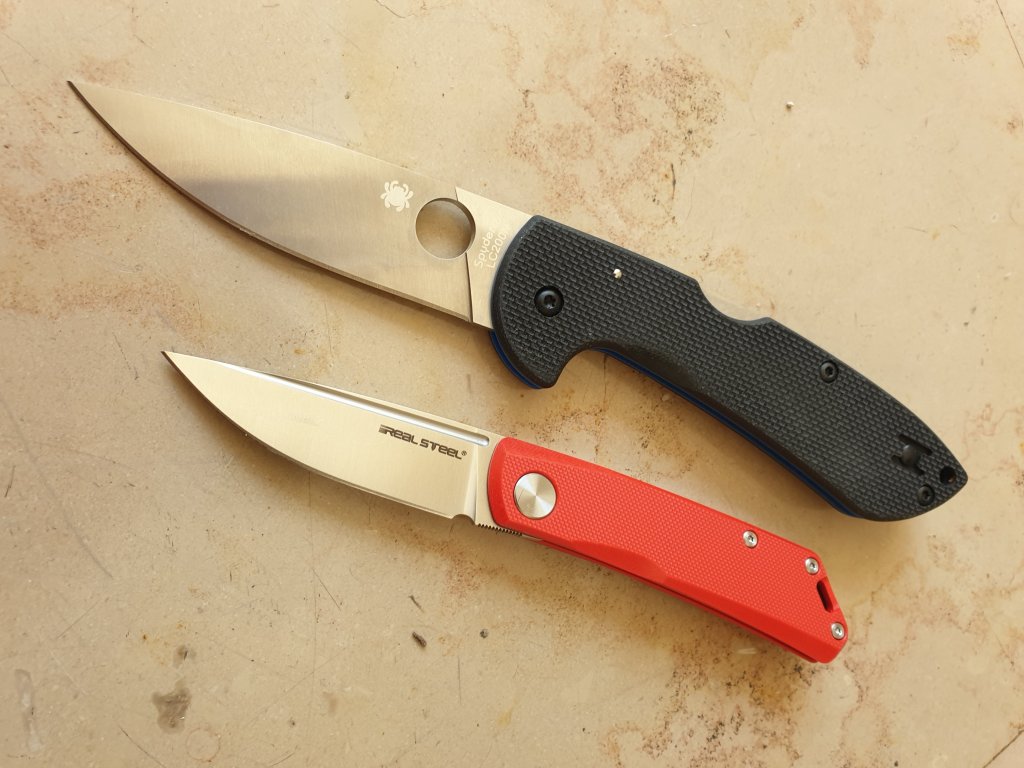
Talking about EDC solution here is a 4 times less expensive EDC, the Luna Real Steel Heinie Edition, It is a slipjoint with an hidden choil. Another EDC solution with a razor edge soon to be reviewed…
Anyway the Siren is a well balanced all terrain workhorse. Spyderco’s backlocks are some of the strongest made and there is no blade play in any direction. It is also a light folder which disappears in the pocket. The black deep carry clip makes it invisible. So far I’m very impressed and I’m looking forward to playing with it.
As far as I know I have always noticed how blunt and scratched were my father, grandfather and father in law EDC folders. The old timers were using their knives hard and their blades were tools to be reliable in all situations. They were not expensive and used as screwdrivers and skinners and staples removers and whittlers and they were in contact with plates while eating with them…
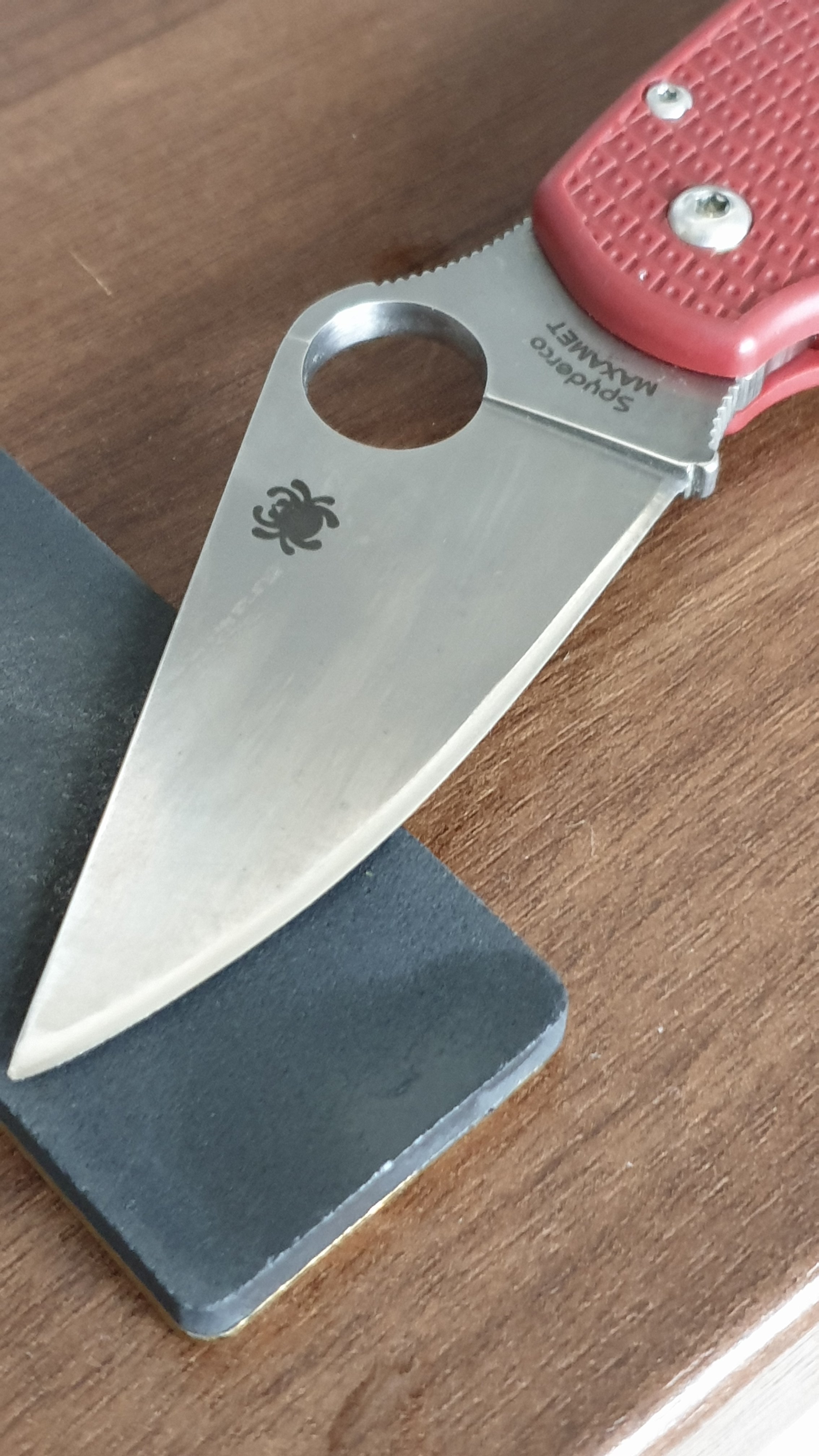
Swapping the Maxamet blade on the Lightweight plateform was done for “Mule” testing on a steel I had always babied since Eric told me it was 70HRC and since I have been waiting 9 months for getting the Para3 Maxamet.
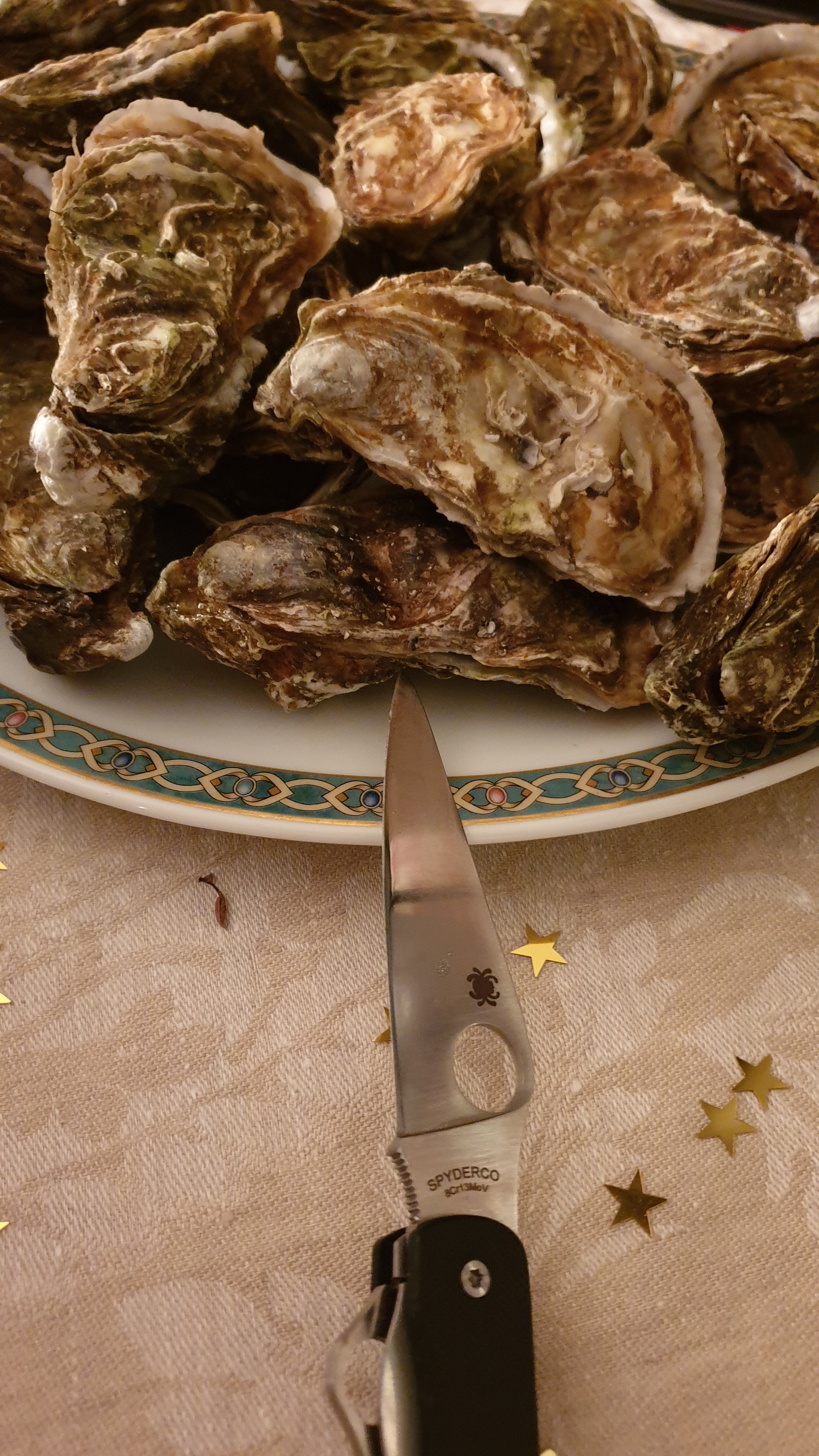
Anyway encouraged by the Cliptools great results on opening oysters…
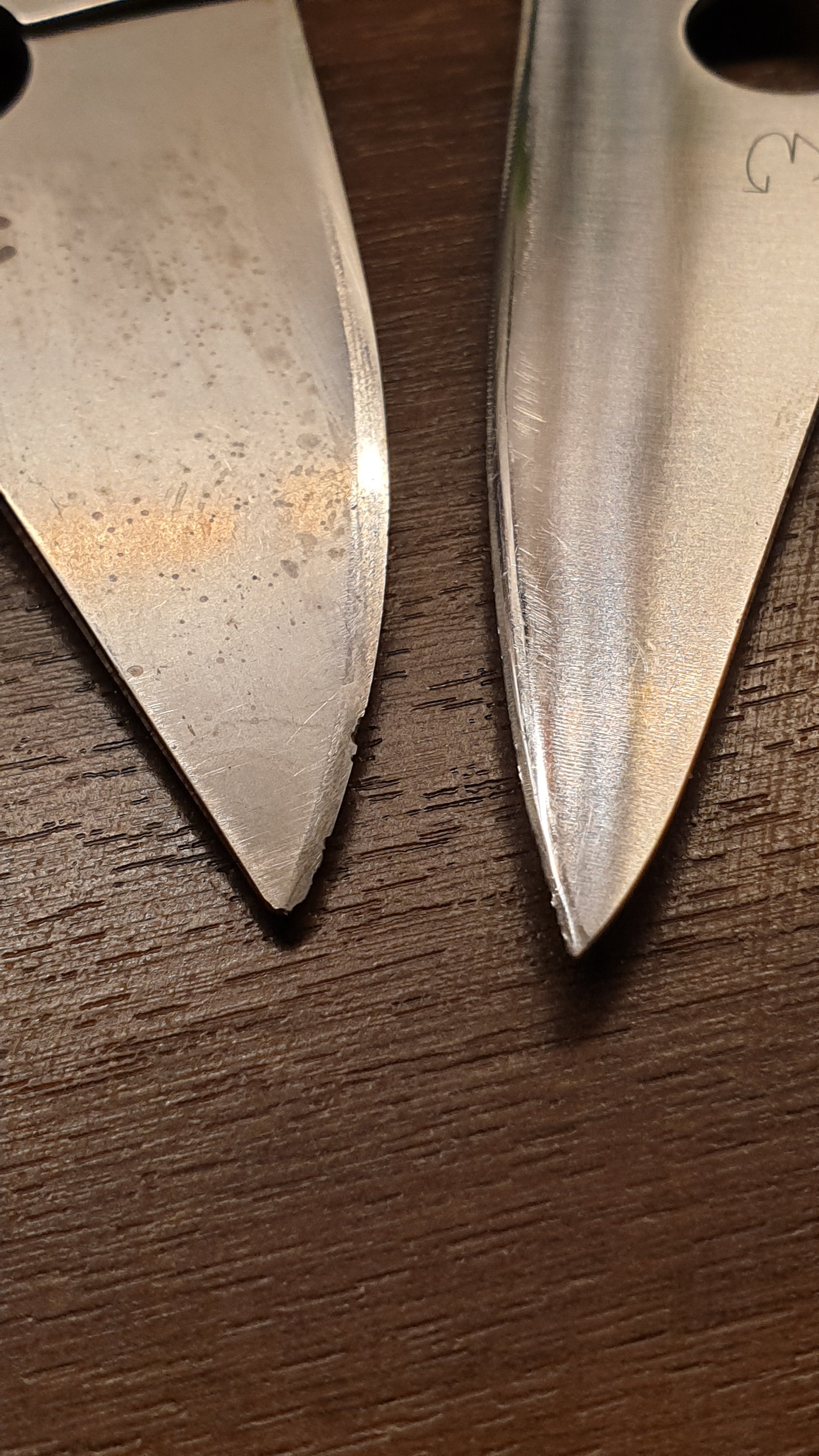
Well the maxamet lost its blade tip at the first attempt. I was able to open 4 oysters but the blade was already a mess.
On the other side the Clipitool was able to open 32 oysters with almost no damage but light scratches and edge bending. This is the kind of knife my family fathers would have chosen: thin and strong blade was always their favorite.
So really kuddos to Eric for designing the clipitoolas a reliable workhorse.
So now time to fix the Maxamet blade. And with no pity !
It means using diamonds DC4 and Double Stuff 2 to repair that edge.
Actually when you got nothing to lose, you go hard on the fixing.
Also doing that by hand will repair any factory burnt edge syndrome…
It a matter of minutes it was already going back to part serrated to plain edge.
The tip is going to take a little more time but it will be reshaped slowly.
Anyway, it is back to razor and ready to be used harder than before.
Since its arrival my Crucarta has been used hard, fallen twice on rocks and pavement and been immerged in dirty water.
Well this Shaman is made for that.
In fact I have notice how well it could inserted between my CPM M4 Millie and my CPM 3V Tuff. Theyu both could be his parents.
Knowing the Tuff is Ed Schempp design for a “Built As A Tank” folder and the Millie “Built As A Tool” Sal’s Glesser design, the Shaman got the best of both world:
A tank knife built as a tool: a solid folder which is really sharp.
This is not the easiest design to achieve. The result is a very powerful folder: solid in term of lateral strength and razor sharp for deep push cutting.
So yes, the Shaman is outstanding bring the slicing power of a Millie with the toughness of a Tuff.
CPM Cruwear is the right choice as it is really standing between CPM M4 and CPM 3V.
It is tougher than CPM M4 and less tough than CPM 3V and in term of pur edge retention it is also in between both.
Being clumsy and getting clumsier, my Shaman has fallen on tiles and rocks twice.
No damage after a very close inspection. Nothing on Micarta or on the blade. The recess steel spacer is immaculate too. The blade is not Stonewashed on the Crucarta sprint run, it it gets some scratches from use but nothing really bad so far.
It has been used on wood, dirty roots, plastic and kitchen duty.
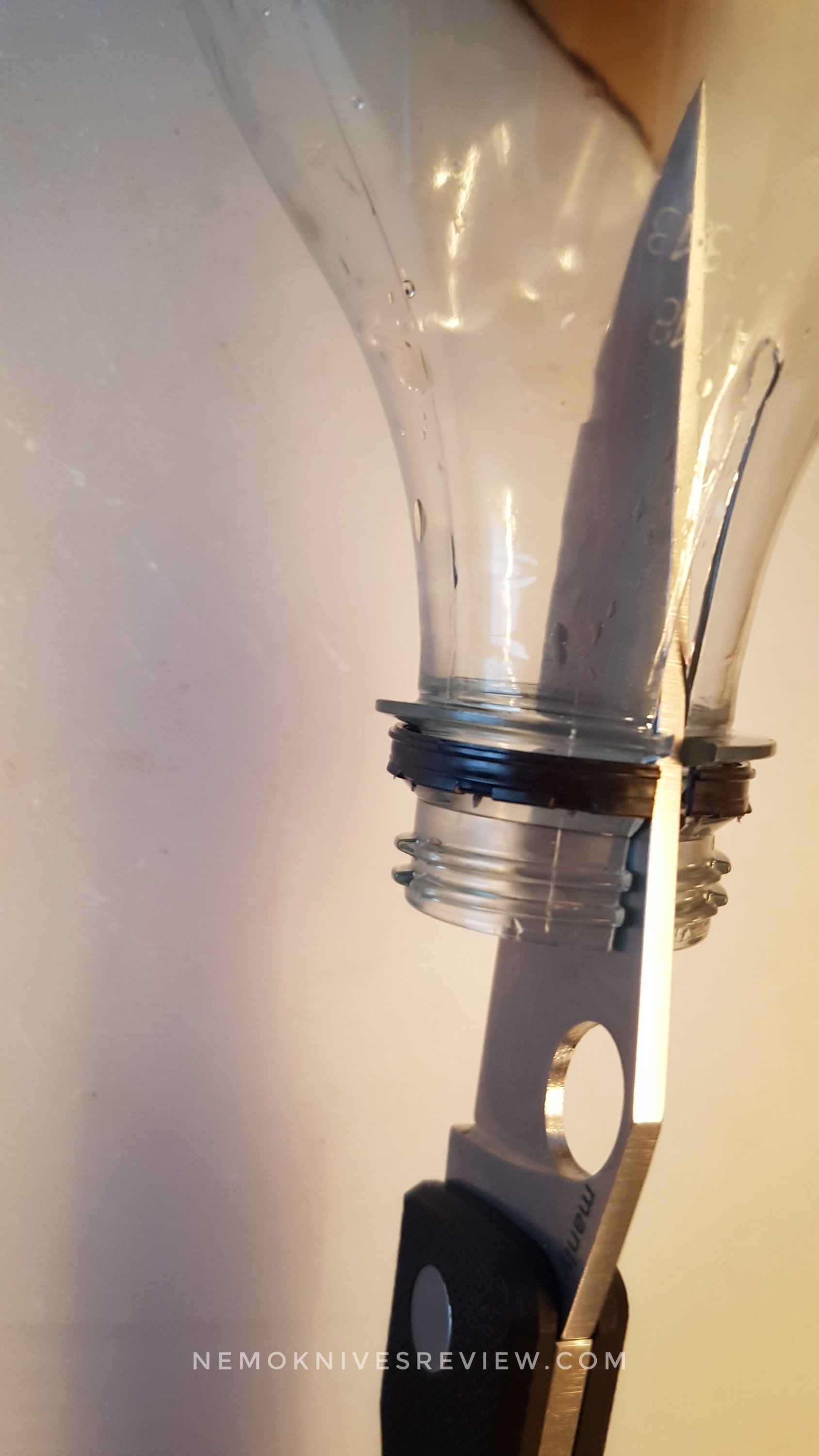
For those who know how tricky a coke bottle butt push cutting can be… The Shaman is “that” powerful.
I had notice some hot spots to my delicate hands.
The were easy to erase on the micarta handle.
A gentle filing is eliminating them and the rounded handle does marvel in terms of confort.
I have used the same diamond file, and it was a longer task, to file the teeth of the blade’s spine as I use my thumb for my push cuts. Also you can notice there is a flat place for the hand before the lock as I mentioned it in my previous review about the Para3 Lightweight which lack of that “flat bed”. It changes every thing in terms of confort when cutting in repetition hard thing without gloves.
Eventually IMHO the real son of the Shaman is designed by Sal’s own son: Eric.
TheLil’Native is really playing in the same league in term of strong workhorse folder but at a lesser scale. Like its father it conserves a thick spine for a very strong tip.
The Native and the Chief on one side with their thinner blade and lockbacks and the Shaman and the Lil’Native and the other.
Like father, like son. Les chiens ne font pas des chats as we say in French.
I have been dreaming about that kind of folder for quite a long time. Something heavy, strong with a rounded handle to take in the forest and built some shelter.
RealSteel Knives, a Chinese company, may have heard my prayer as they are producing a Bushcraft Folder in two versions: with and without the one hand opening option provided with two studs.
180 grams of a very well balanced 90mm blade length beefy companion.
My first experience with Real Steel was the beautiful Megalodon which has had review here. Its main flaw was the awful clip and you know what ? The Bushcraft Folder has no clip but a beautiful textured G10 handle. Also the red liners are a very nice touch bringing a real touch of class. The blade is perfectly centered; the action is smooth; the action Southpaw friendly…
So let’s have a look:
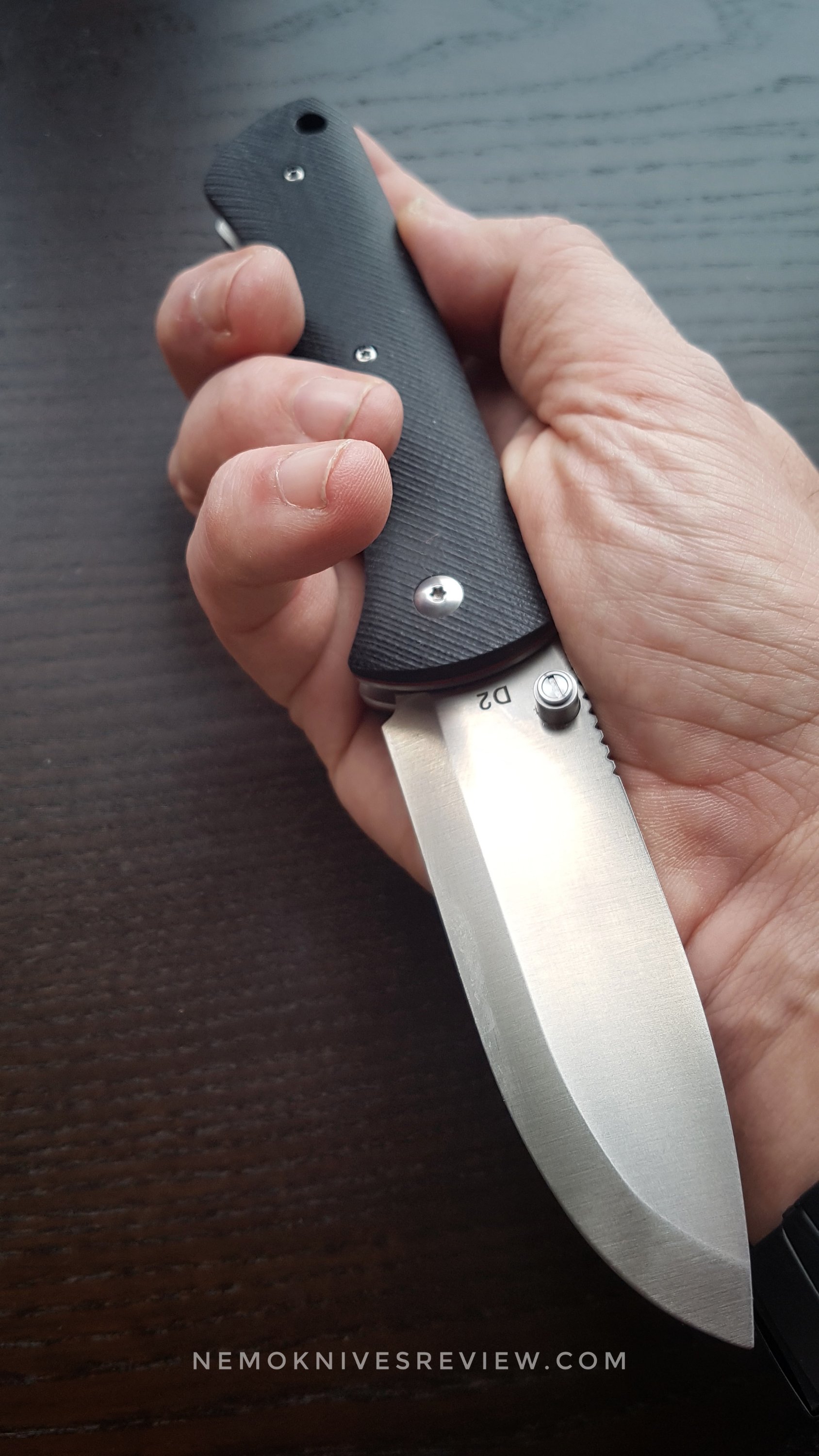
The blade is made of D2. This air hardening classical steel is not my favorite but some of my friends and co-writers like JD do have an excellent opinion about it. As a reminder let’s not forget D2 has 13% chrome steel which can stain and can be a bear to get sharp. RealSteel seems to have bought tons of D2 as their production of fixed blades is mainly using that alloy. The HRC is 58-60 which is not the hardest heat treatment for that steel but it seems appropriate for a knife destined to resharpen in the field. Oh and this is a true scandi: no secondary bevel on that baby ! You can put it flat on some stone and you should be able to keep it like a razor !
The lock is a thick Michael Walker’s liner lock and it reminds me of the one on Spyderco Gayle Bradley; thick liners locks are easy and confortable to use. Here the steel liners are heavily skeletonized to reduce weight and keep a great balance.
Don’t forget: batoning with a folder is not a good idea with the lock engaged. Let’s say it’s not a good idea, period. Some chores are better kept for the uses of thick fixed blades. But the RealSteel BF can easy drill in wood and be twisted while cutting: there is no movement, no play; everything is very well adjusted. So this is a very serious outdoor knife. The spine of the blade is sharp, certainly for striking a rod and lighting fire. I will soon round mine, as I prefer to have a confortable ramp to push with my thumb during woodworking. The handle does not have a fully open construction; there is a G10 spacer in the butt along with a lanyard hole. It looks really easy to rinse and keep clean.
The G10 has got a very nice texture: not harsh. You can notice it on the picture. Also there is no hot spot on that handle so you can hold it really tight; it’s almost like a fixed blade. The linerlock is recessed and you can not disengage it by holding tight the handle. Just be careful and always remember: regardless how strong a folder is, it will never be as strong as fixed blade. Use it with respect and care; should the lock fail, there is no choil to protect your precious fingers!
This the heaviest folding blade in a 4 inches folder I have ever owned!
You certainly can put that 3,5mm thick blade in good use. Especially as the scandi is very keen and easy to keep ultra sharp – as much as you don’t create a bevel.
Even though the studs do not get in the way when sharpening, it should be easy to remove them with a flat screwdriver if you want a pure two hands opener.
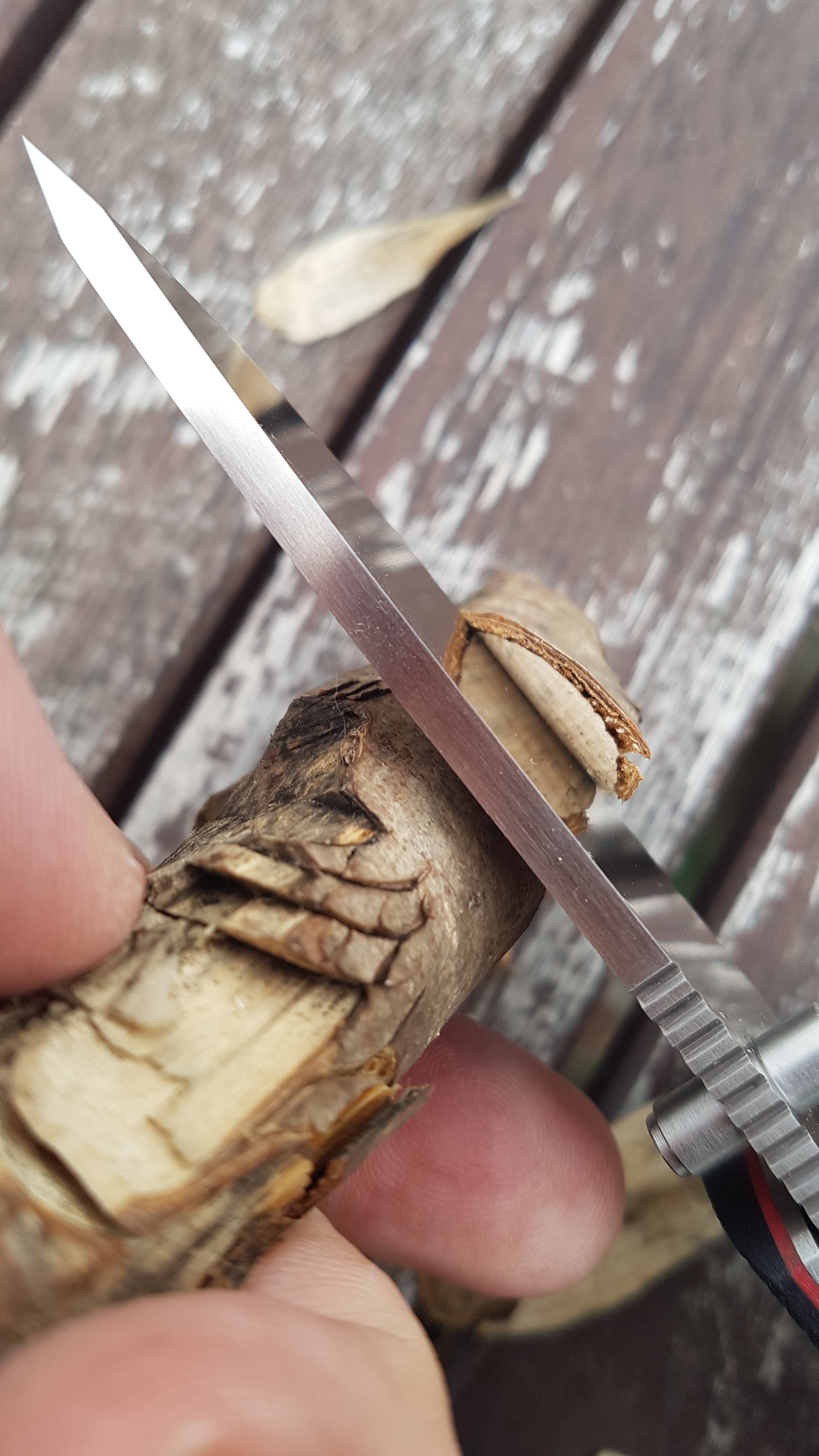
A first test on dry wood shows I have got a very serious contender; the blade cuts deep and makes as good chips as my Casstrom (Scandi type blades give you a lot of control when cutting wood). This is always such a pleasure to use them. Also the solid tip is great to drill and open crates without fear of breaking it.
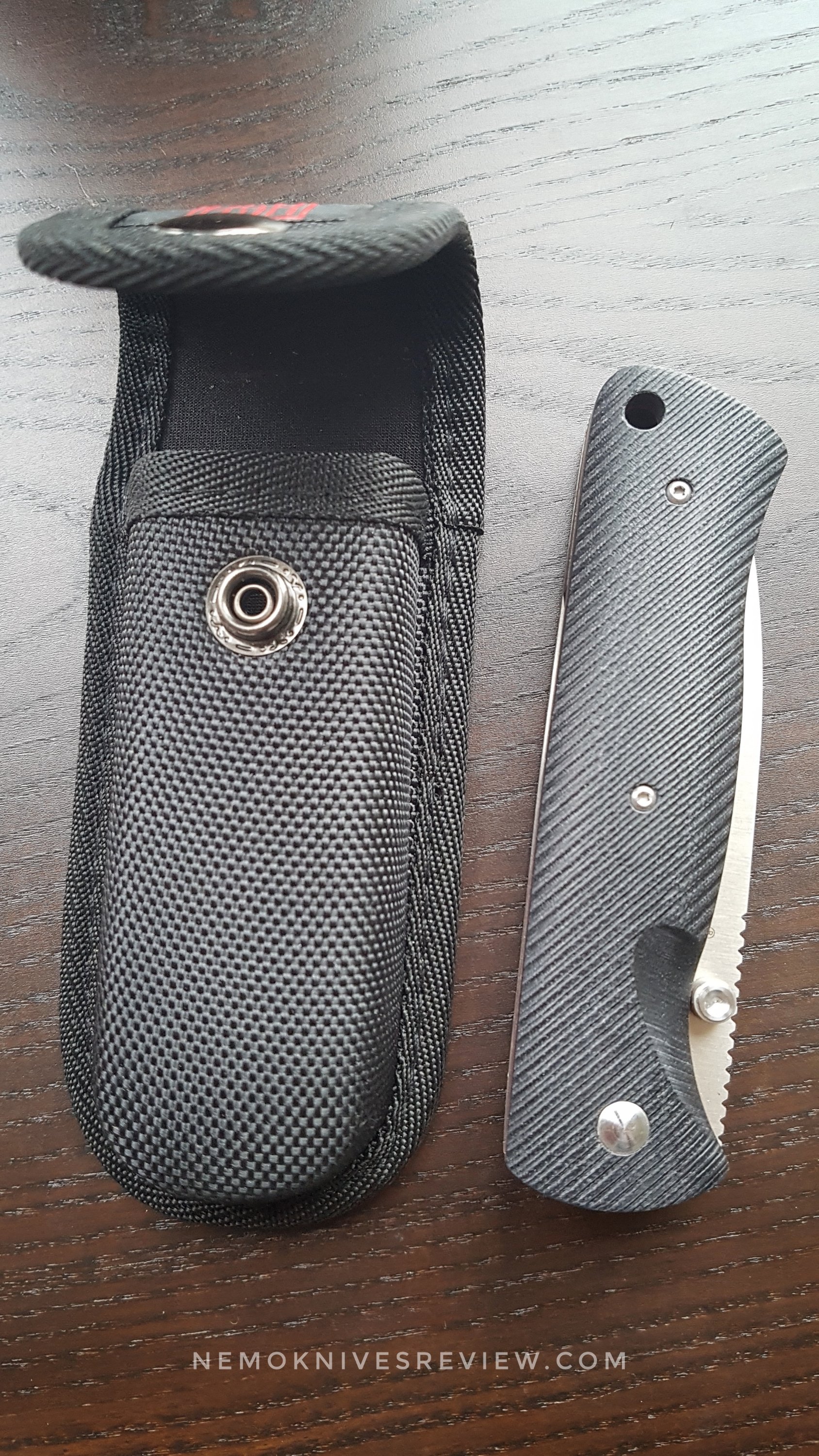
The pouch which is provided with that big heavy workhorse is well made, but I will certainly carry it vertically in my front pocket against my leather wallet. I have tried that before going for a one hour walk and the knife did not move.
The knife snuggles perfectly inside the pouch you can pass in a belt.
In my opinion a nice cocoon to transport the knife in a coat pocket or in a bag, featuring its toolish function in opposition to all those fast draw tactical response tools always regarded as weapon and also marketed as “tactical” knives, conveys a comforting message.
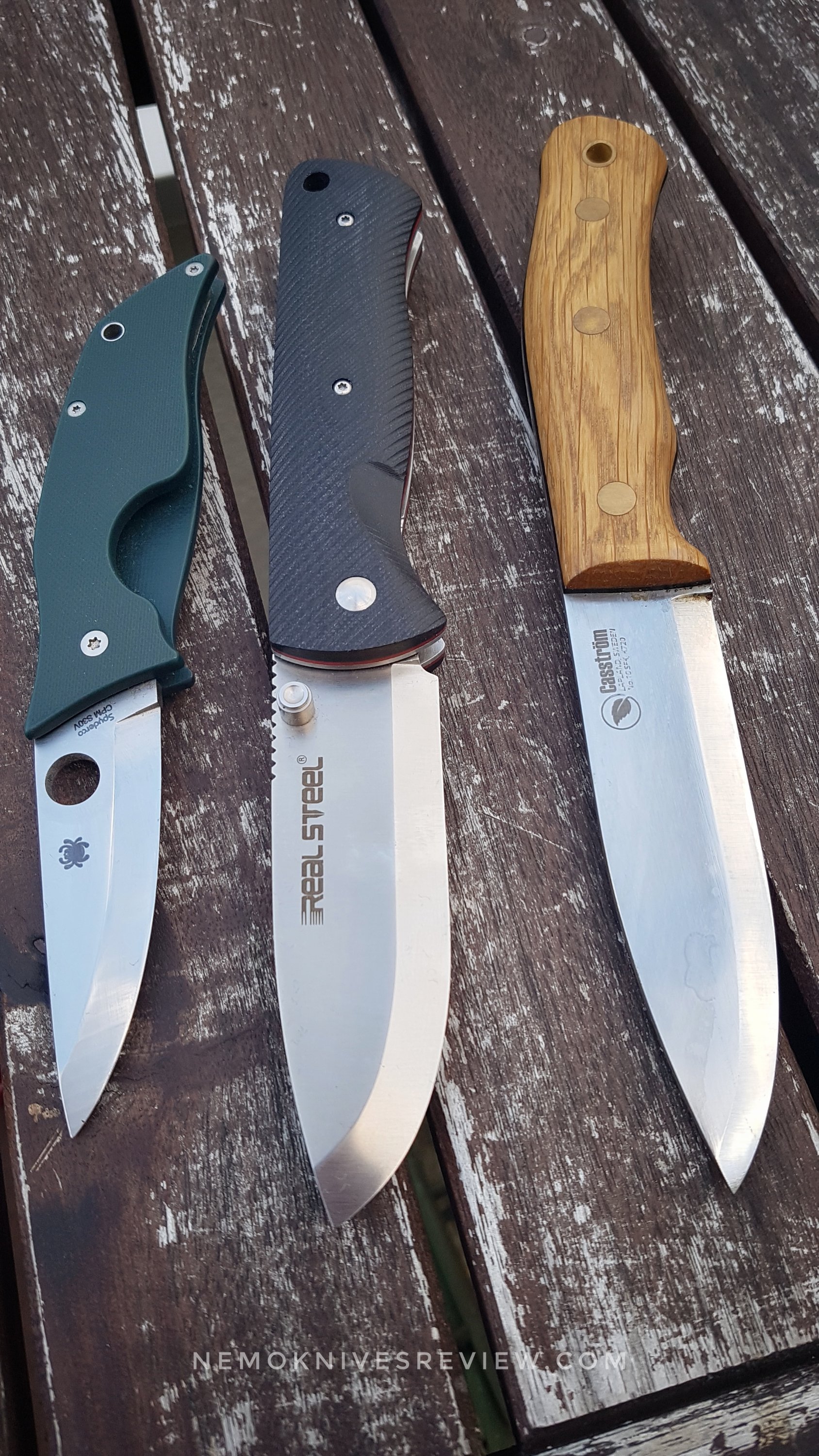
My wonderful Wolfspyder is dwarfed by the heavy RealSteel folder which’s size is very close to any classical bushcraft fixed blade. You feel you can easily use it for light chopping, for finishing off a cut. Again, impacts are not folding knives’ best friends, but the momentum of that heavy blade could be used for light chopping in wood, like trimming branches in one whip of the wrist.
This is a mean blade perfectly centered beware parallax illusion in this photography.
And the handle is even thicker than the fixed blade.
Of course the main limitation of a folder is the blade length which cannot exceed the handle length (except for some hunting daggers).
So what have we got in the end ? An heavy, solid, easy to keep sharp bushcraft tool.
OK. But for what price ? Mine was bought for less than 60 euros ! This is great for a knife destined to be used a lot and not kept in a safe.
In my opinion, this is a very solid bargain for a very serious wood companion.
“Made in China” tools are getting better and better in terms of quality, prices are competitive and don’t forget…. your Iphone X are also made in China. Here you have got a Chinese Viking Folding Knife, which is great !!
More to come soon !
The Manly Peak is a workhorse. So, it has been put to good use in various tasks.
The main features of that folder are a very thin geometry and a zero play mid backlock.
It has not developed any play and the edge has ever been thinned for outstanding results.
Tomatoes are great for testing. As you can notice, it was a very easy task to cut through the skin.
The same for any fruits it was confronted to. The thin and long blade gives a lot of hand control when peeling and cutting or on the cutting board. No pitting on the S90V alloy after intense and daily kitchen duty.
Pushing the envelop, I have thinned both my S90V Native and S90V Peak. I was inclined to think that the Native 5 with its belly would be better than the Bulgarian folder but in fact not. The thinner grind of the Manly got better results on hard plastic and when the Native was stuck, the Peak was going through like the Nilakka or my Opinel would do.
I was even able to do multiple cuts on the same bottle butt. This is really impressive. Let’s not forget that should should have the same results on a 45 euros Peak with D2 steel.
The mechanism feels a little smoother now on opening and closing but it is also due to a drop of nano oil. The clip is really perfect, it is deep, secure and smooth. It has been well thought and I really wish the future generation of Manly folders will be likewise equipped.
So the Manly Peak is really a high quality workhorse in terms of reliability, power cuts and ease to wear. This is a serious tool for any users, from the LEO to the ELU. It’s a thrill to see it compete against folders which can reach 4 times its price and see how easily it can beat them. Now this is a stiff mechanism “à la Cold Steel” and you will need some open and close mileage so that it folds and unfolds with ease. Once in action though you have a pocket lightsaber able to work hard and keep going. Highly recommended!
The moisture and salt are present and cars got a serious tendacy to rust just by being parked outdoor.
The knife has been used on food and for all the chores around another anniversary preparations. The Patina is a real surface protector as no pit or coloration has been noticed during that 4 days week end.
It eventually has been used to pop the remaining balloons after the party.
No oil needed. The edge did not rust. It was used daily. Very happy with that knife.
This is a very robust folder, with a strong blade.
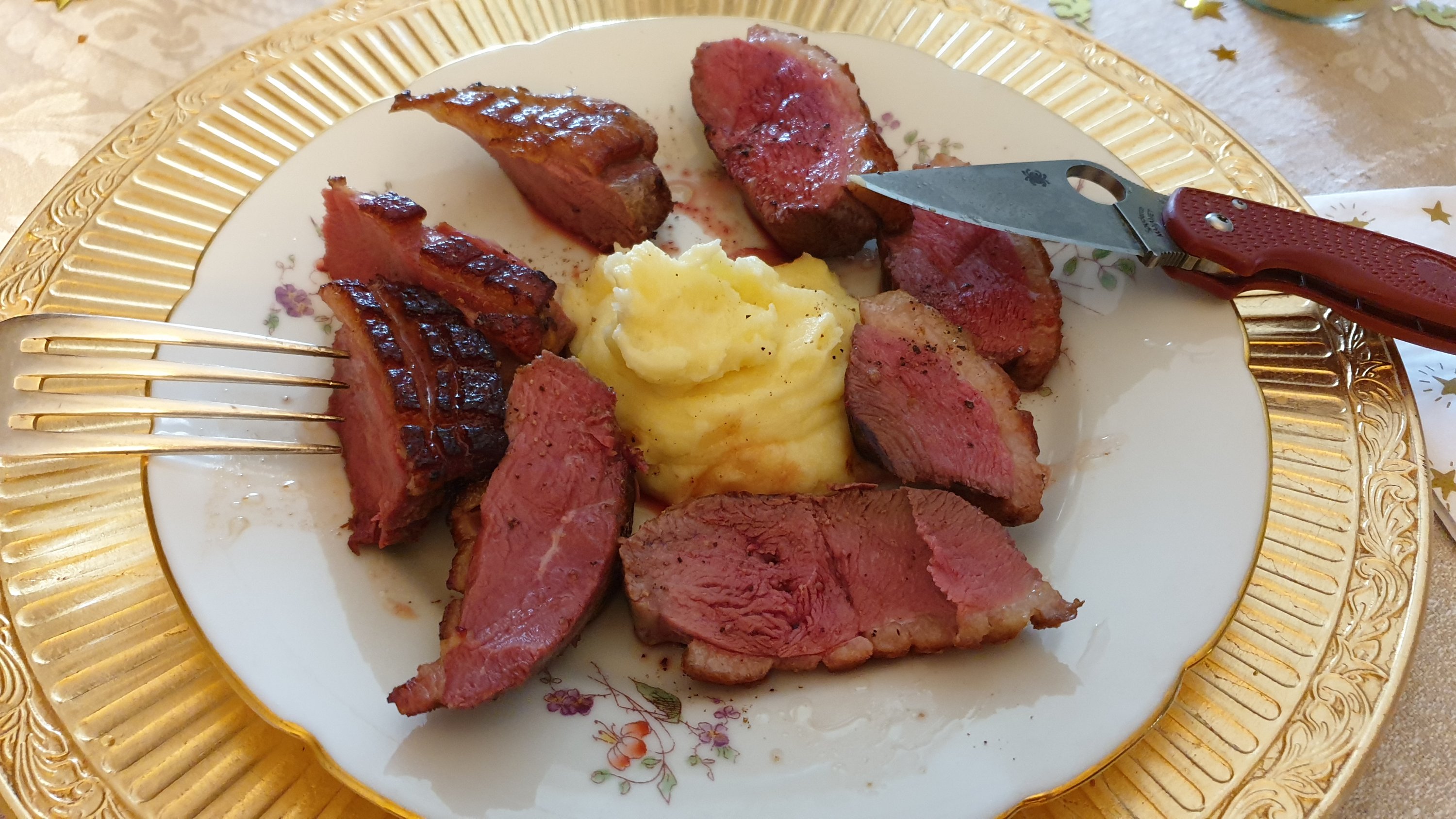
It was still shaving hairs after 4 days of mild but constant uses. I did not process a lot of cardboard for example, but a lot of meat ! Duck for the matter.
The 52100 makes a beautiful blade with its mirror convexed edge. It was noticed.
Designed for budget-conscious knife users who demand genuine Spyderco quality, the Polestar was offered to all attendants at the last Amsterdam Minimeet (2017). That’s how I got mine.
What could be the definition of a Workhorse ? We got example of knives which has been used hard, lost, bought again, always in our pocket, the one we use for dirty jobs and that we trust.
Classic examples are: Swisschamp from Victorinox and their Spartan, Buck110, Spyderco Delica, Opinel N°8, Mora’s Companion, Benchmade’s Griptilian, Coldsteel’s Voyager, Pradel’s folder, Doukdouks… to name a few…
Those manufactured knives do not have the best new hyper duper high carbide power metallurgy steel but they can get a keen edge and you won’t need a sharpmaker on the field to keep them sharp. And you don’t pay a premium.
So the Polestar leaf-shaped plain edge blade is a full-flat ground from American-made CTS BD1 stainless steel.
Again, the equation for a great blade is: steel + Heat Treatment + geometry. Fred Perrin uses 1075 steel but his geometry, heat treatment and great ergonomy makes the trick.
Twenty years ago, with Fred, we were testing a famous “tactical” collection names “Master of Defense” now discontinuited. Eventually we found, despite their high sexiness (black blade, premium material and designs) they were not able to hold an edge for a long time. Compared to our Spyderco Military (CPM440V) and my Sebenza (ATS34) they were almost useless for us. Thick edges on CPM154 did not make the trick for users.
The same year (I think it was 1996) we got the opportunity to test some Pakistani 1 dollars folders (Laguiole knockoff). Their thin blade were really capable. We were really impressed. Those shitty knives were users and keepers.
In June 2012 I was able to test a Spyderco Persistence. I enjoy many things in that knife but I did not like how fast its edge could get dull. I have tried to get beyond the factory (burned) edge but without any improvement. Based on that sample, it was really frustrating for my use. No chipping though, but a real tendency to ask for ceramic touch up twice a day. Since then, I have been staying away from Chinese Spyderco and Byrds.
I still got a Titanium Catbyrd wich has been a running test of 200 pieces to try the equivalent of 440C in China 9CR13MO. And despite a thick edge to my own standard, it has proven to be a much better option for an EDC user.
Back to the Polestar, this time the steel is American, made by Carpenter. You can find it on Spyderco Kitchen knives, a Mule, my UKPK and a lightweight version of the Manix 2. So this is a folding kitchen knife blade after all !!
What make the Polestar loveable is its design. Even if Spyderco recognised it has made some kind of retro engineering on one of their Byrd linerlock, for me the Polestar is the heir of their infamous Tenacious: there is no choil ! 🙂
The open construction makes cleaning easy. The wide lanyard hole is a reminiscence of the Paramillie 2. You got four positions for the clip which is much better than the Rubicon 2 in term of usability and “clipability”.
It can be easily open using the Spyderdrop technique so I have mounted the clip for tipdown carry. It’s fast and the knife is ready to cut. It suits my need.
At 3,3mm (0,13″) of thickness the full flat ground blade is a really beauty. There is a lot of Spyderco DNA in it. And it works great.
Yes, there are also a lot of quality and attention in the manufacturing: my Polestar is perfectly centered and locks with zero play. This knife is serious business.
The G10 texture is something new. Some kind of peeled blue and grey G10 which gives IMHO a premium look to that knife. And under the thumb it is not abrasive at all. No sandpaper needed for my own use. The stainless steel construction give also some weight and no lateral bending.
So what do we got for around 60 dollars ? A solid sharp knife you can use with no second thought.
Like I wrote in the very first article of that blog here quality is not synonym with the geography. Viking used to got to Persia (using the Volga river) to buy the best steel for their swords because back in that time, some of the best alchemists were there. Chinese manufacturers are getting better and better. Just look at the Real Steel collection and especially at their Megalodon flipping folders. Chinese production will soon get pricey as they are investing a lot in robots. If you study the age pyramid in China they will be confronted to a demographic problem. So they need robots and computer controlled production able to deliver constant quality in manufacturing. Never forget all our expensive Apple toys are made in China not in Frankfurt !!
So, the Polestar is the choice for a hard use EDC and also a great guinea pig if you want to master the art of sharpening too. You will enjoy how fast you can get a popping edge back. And you won’t mind using the blade on hard surfaces. This what a workhorse also made for, cutting on a plate or on concrete, with no second thought.
My FranckenStrech is equipped with a Super Blue Steel. That was my idea of a EDC Workhorse: thin angry edge, easy to maintain, easy to carry and sheeple friendly. This tough cookie is hard to beat. Both designed by Sal Glesser.
The edge is not the thinnest (not bad actually !) but the cuts are precise and powerful. It can be thinned easily with sandpaper.
The Parmigiano chips is also a good test. They are transparent !
After whittling hairs, to cut against hard material like glass is not a concern.
You can notce where the edge has rolled. In two ceramic passes it was straight again.
I won’t have the same ease of realignment with K390 I think. 🙂
Some of my Spyderco workhorses: the Millie, the Manix, the Polestar, the Stretch and the Slysz Bowie.
Different budgets for different tastes. All those knives are easy to clip, got enough edge for a lot of application and are easy to clean. The three knives I have not reprofiled are the Slysz and the Polestar.