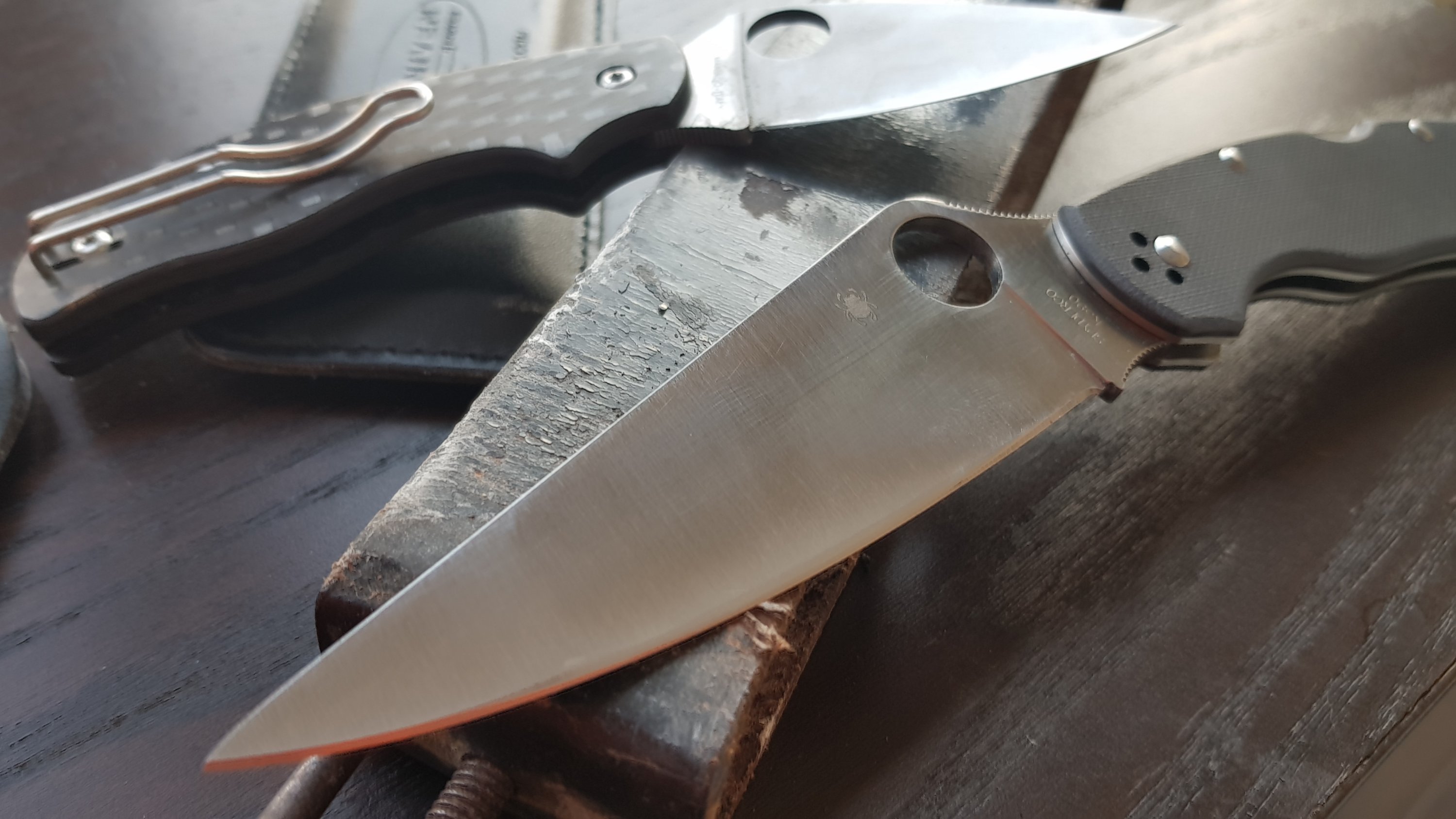
Like I had mentioned in the glimpse review of the Serrated Chaparral, this little, thin folder is built to punch above its weight. Thanks to its sturdy construction and relatively strong stainless steel — the same type found on my Cold Steel Recon 1 XL — it can be tested and used like a much larger knife without compromising performance.
Solid steel, sturdy lock? Not much difference from a larger knife, in fact. 😉
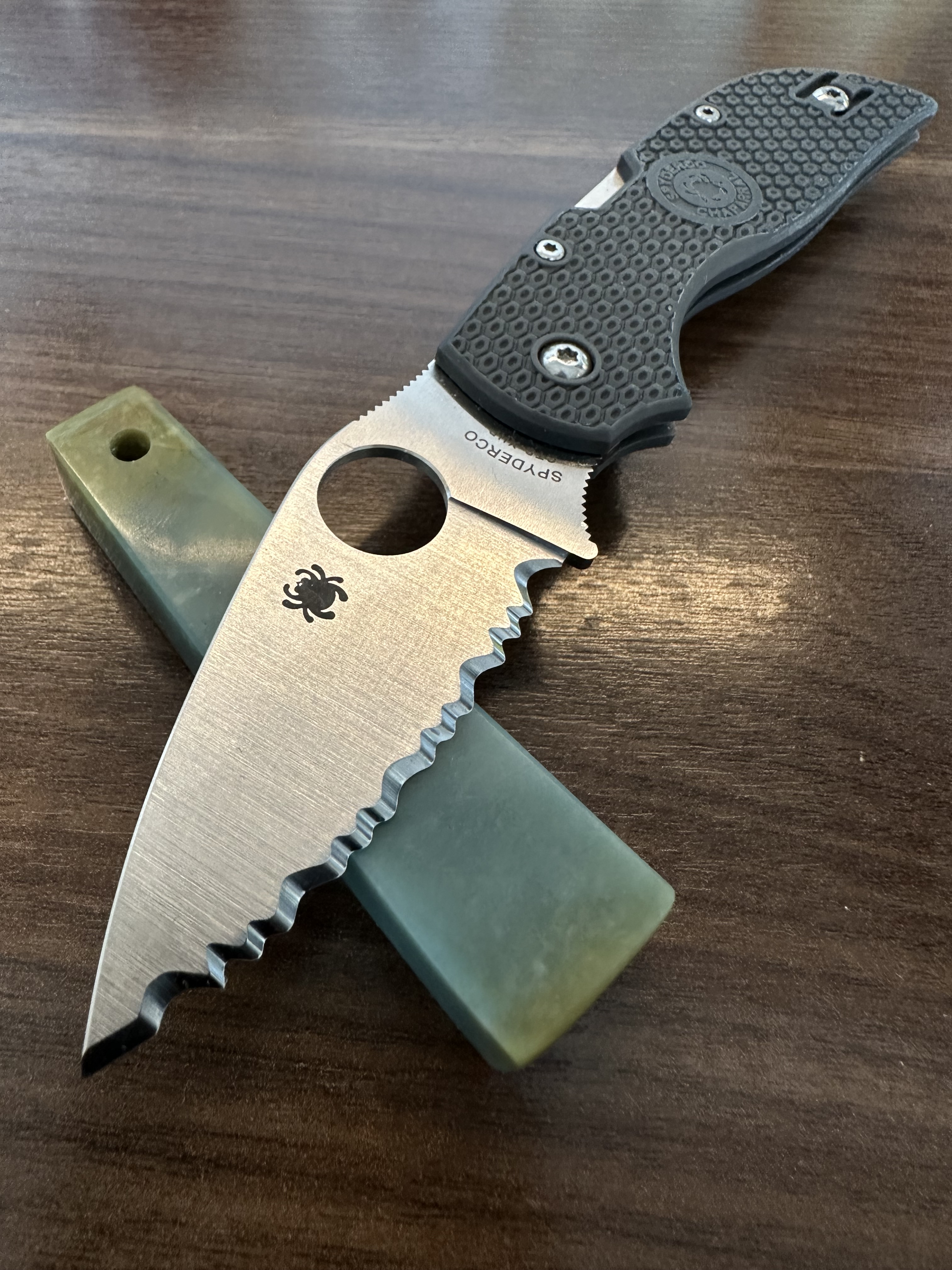
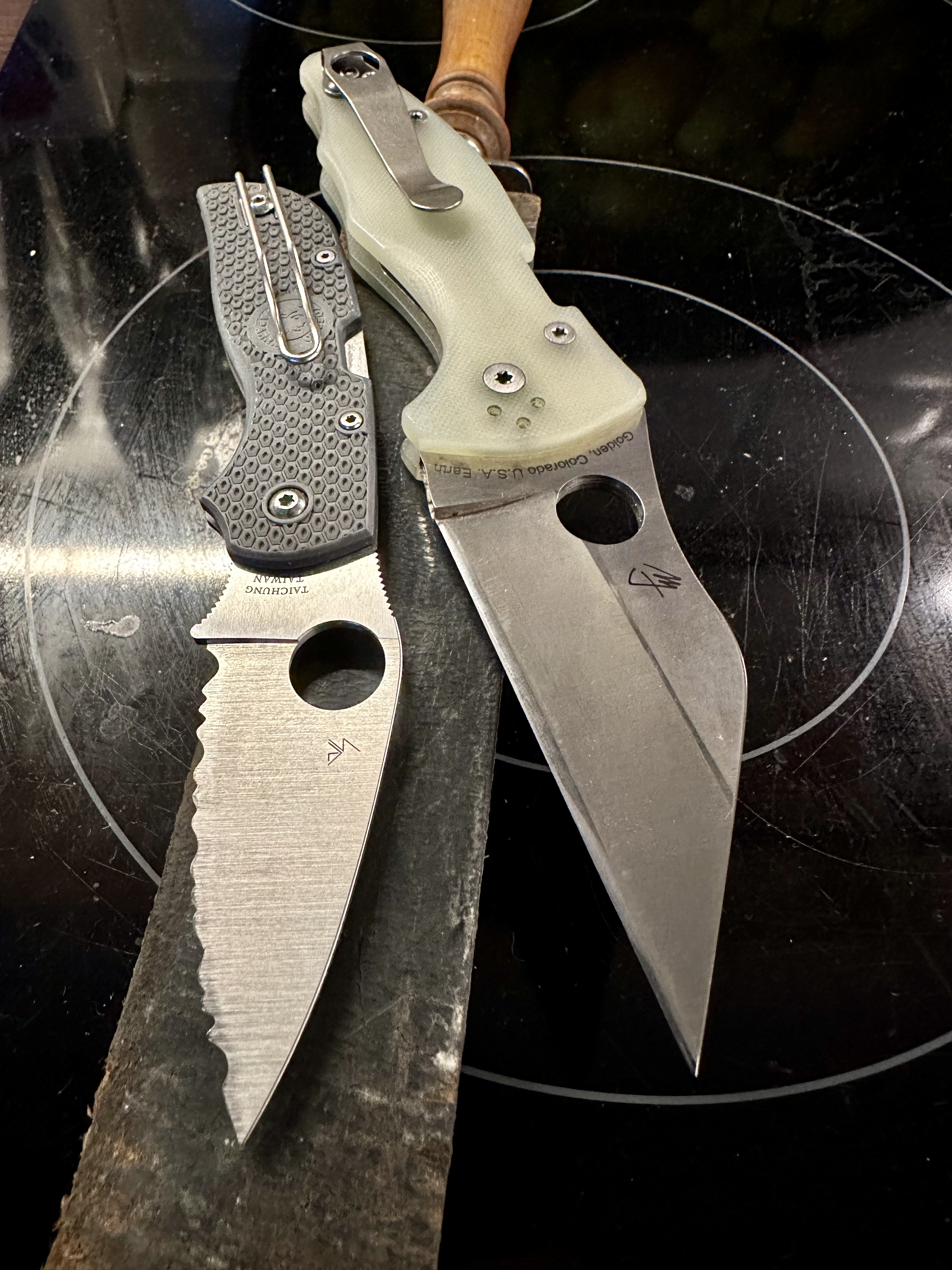
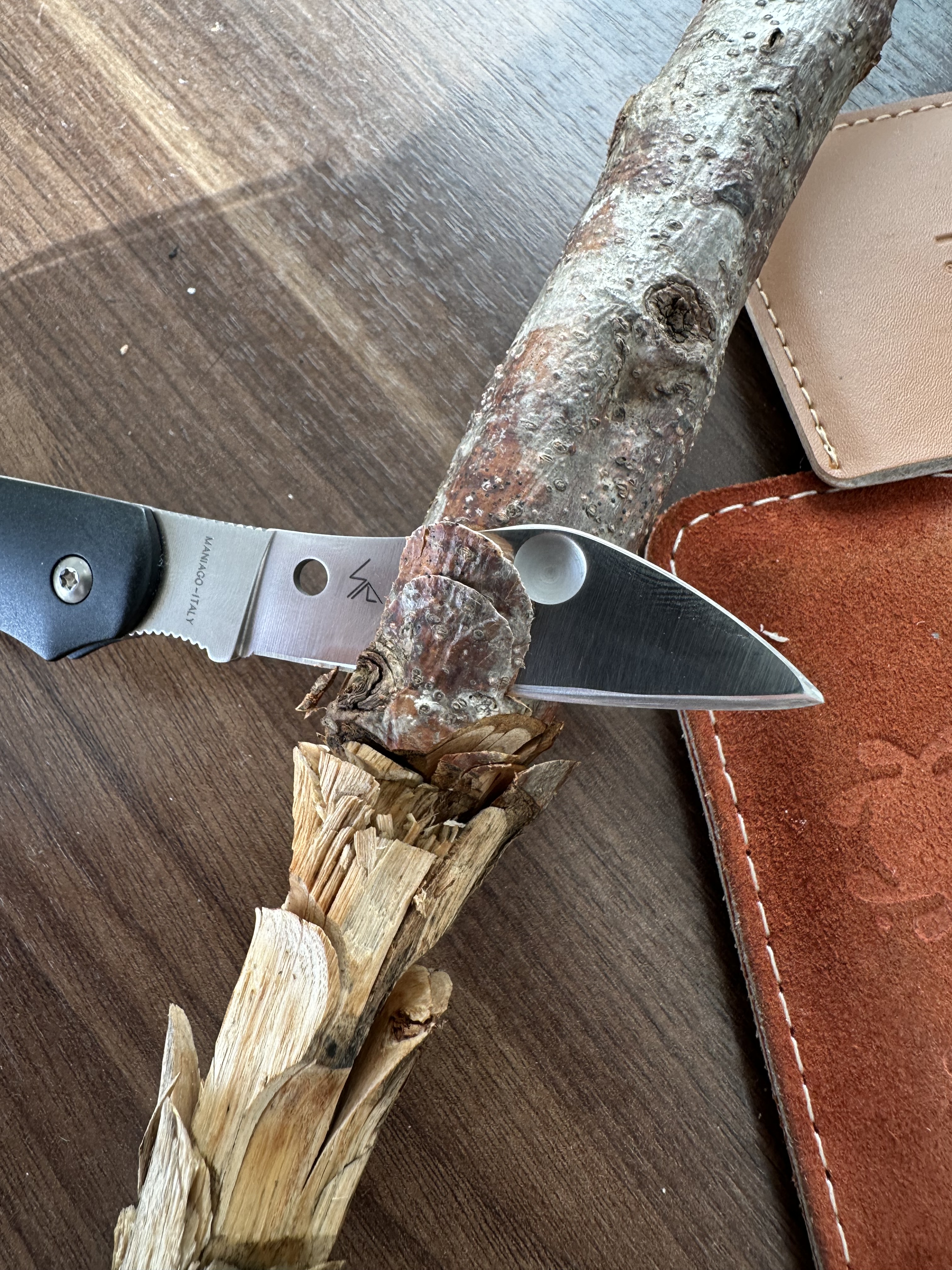
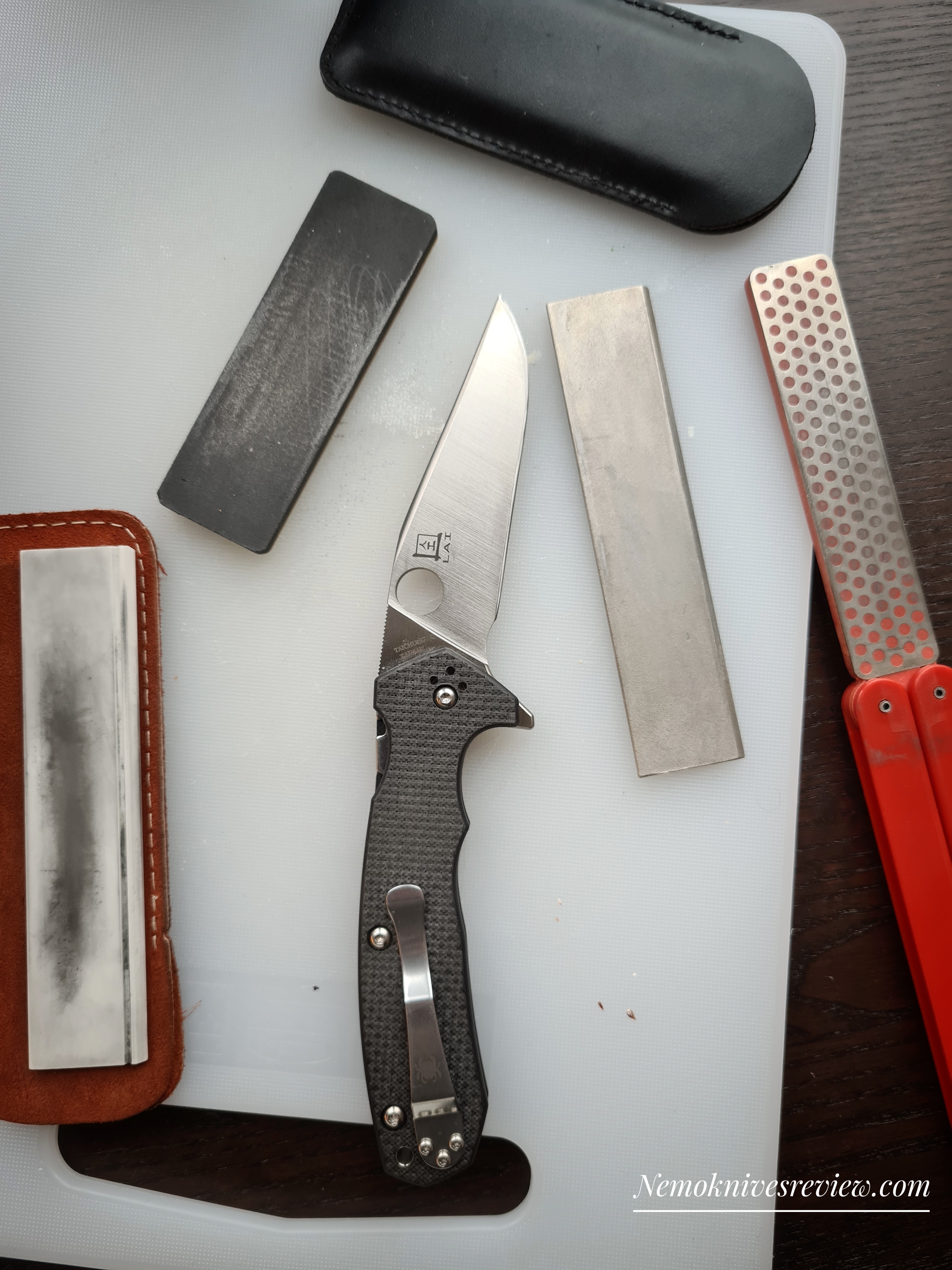
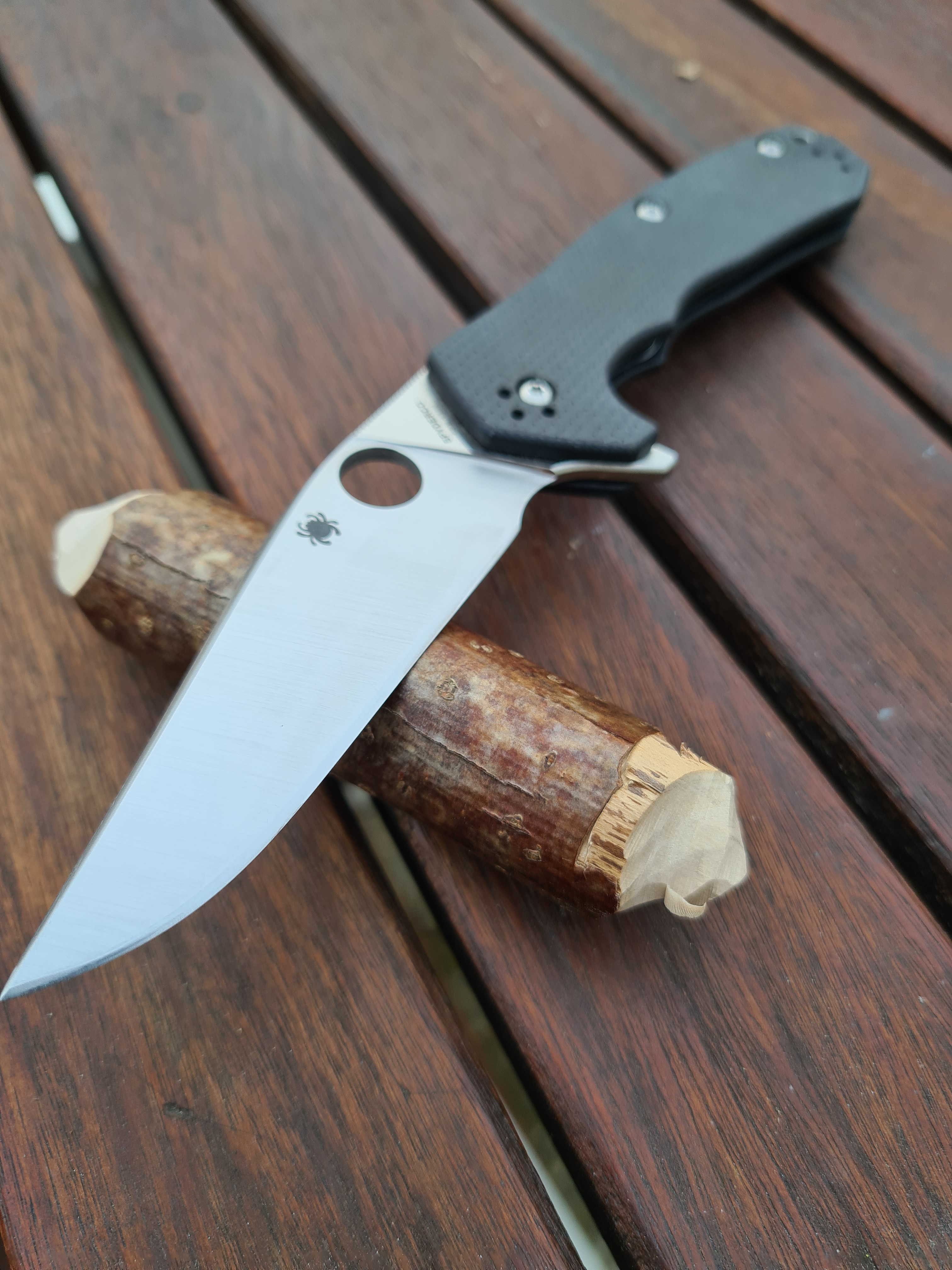
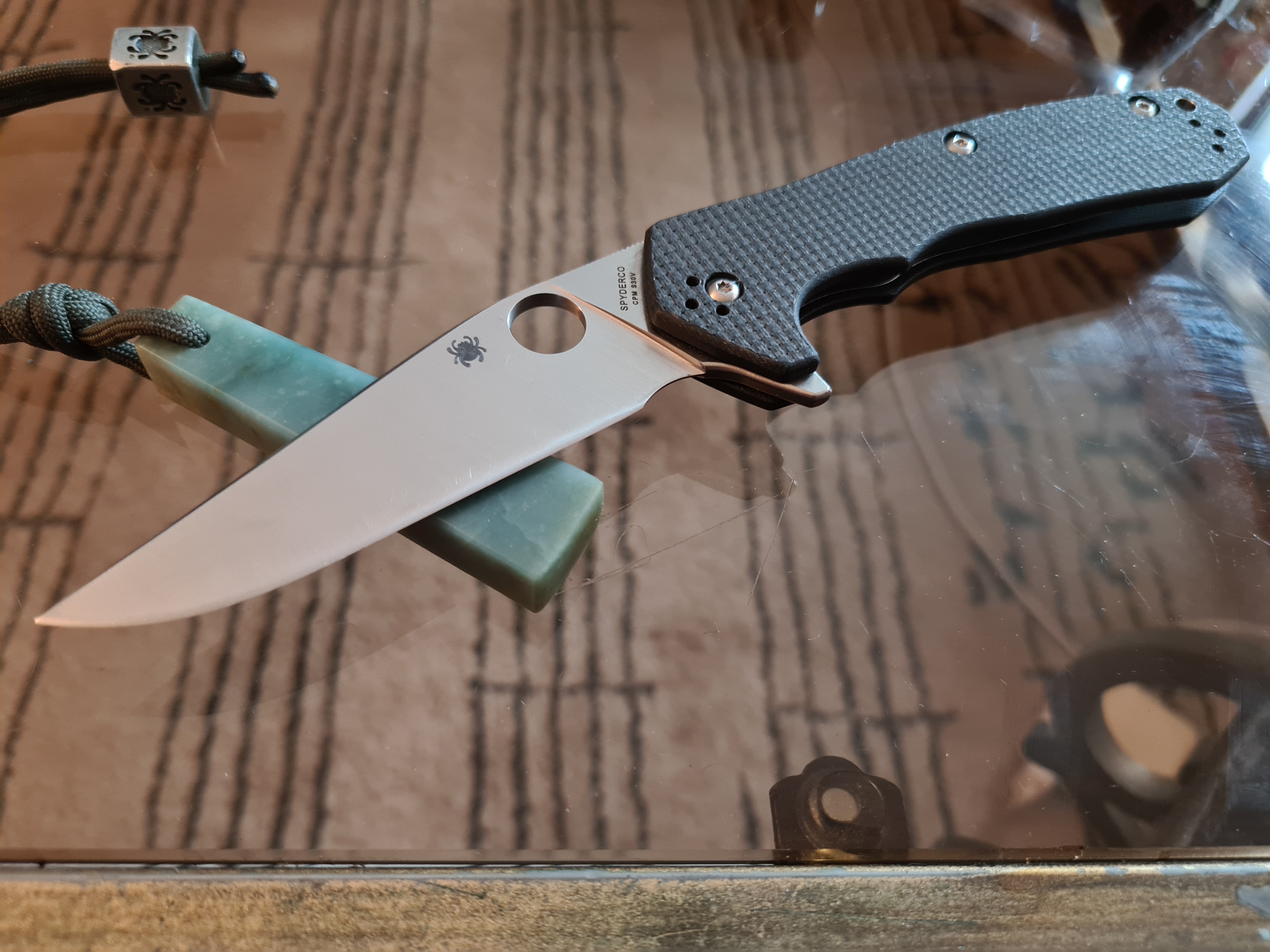
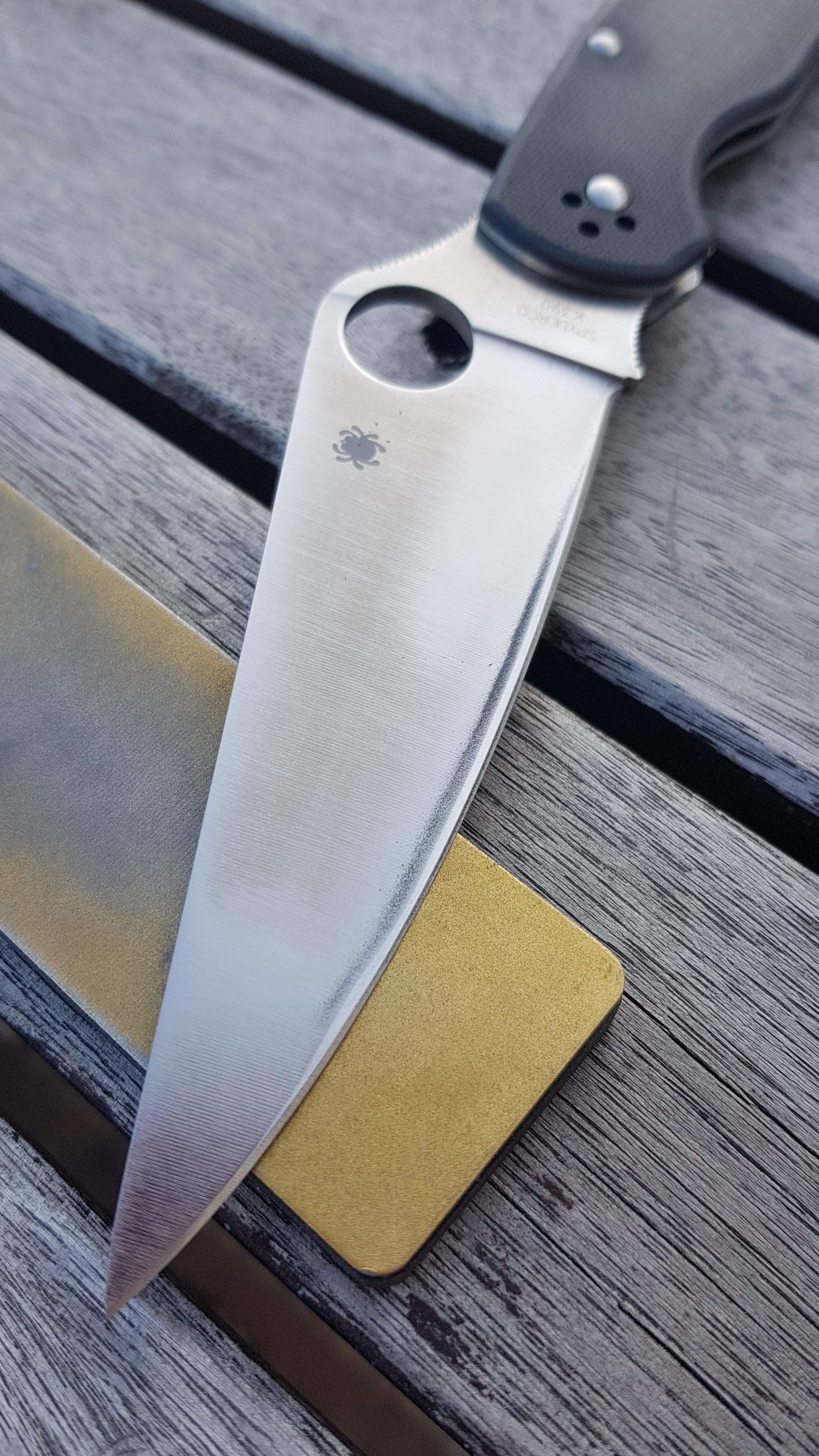
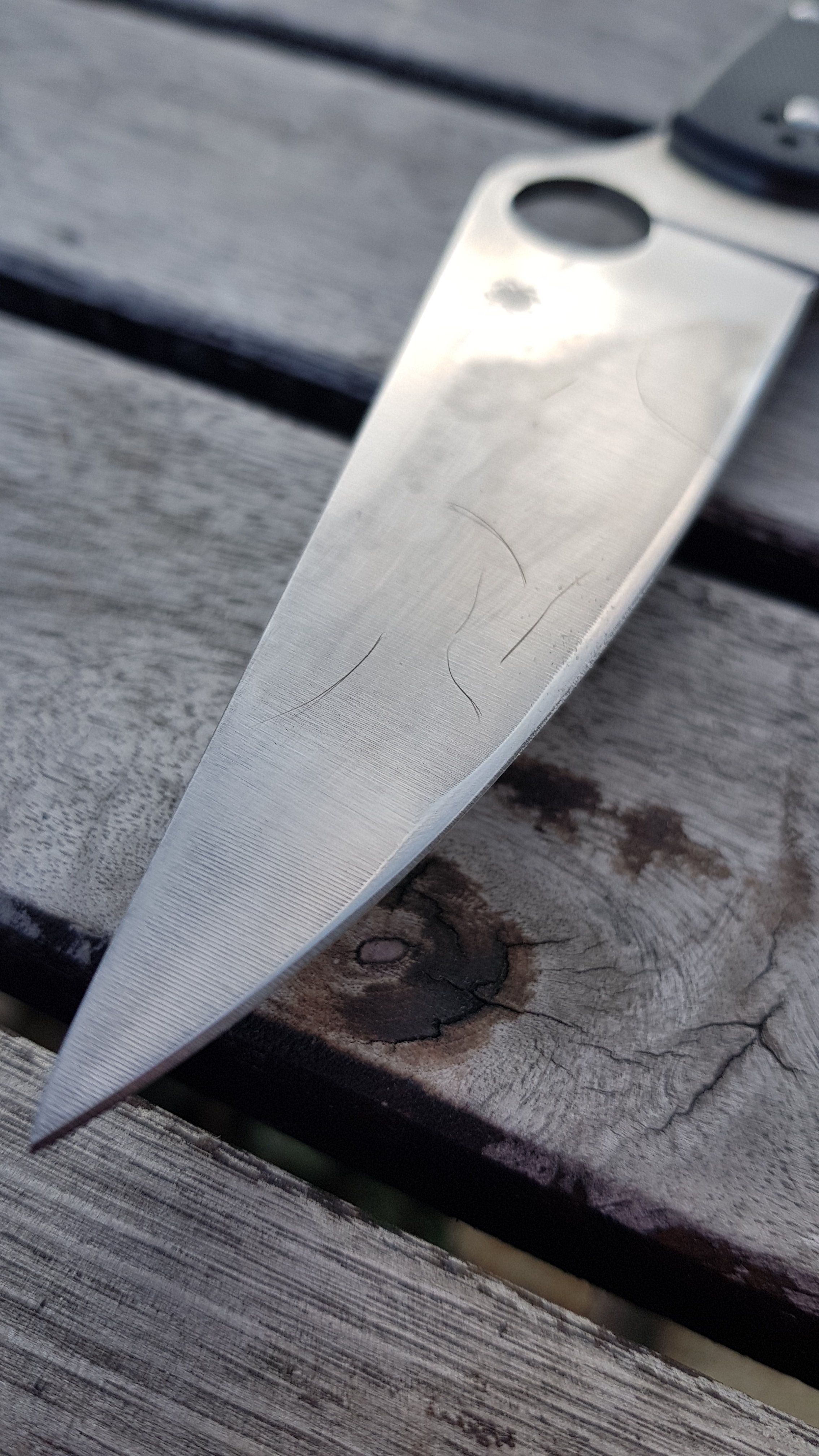
So far, I’ve put the knife through its paces, cutting anything I could, and maintaining the edge with some Jade stones (see first picture). The mechanism shows no signs of play in any direction — rock-solid performance.
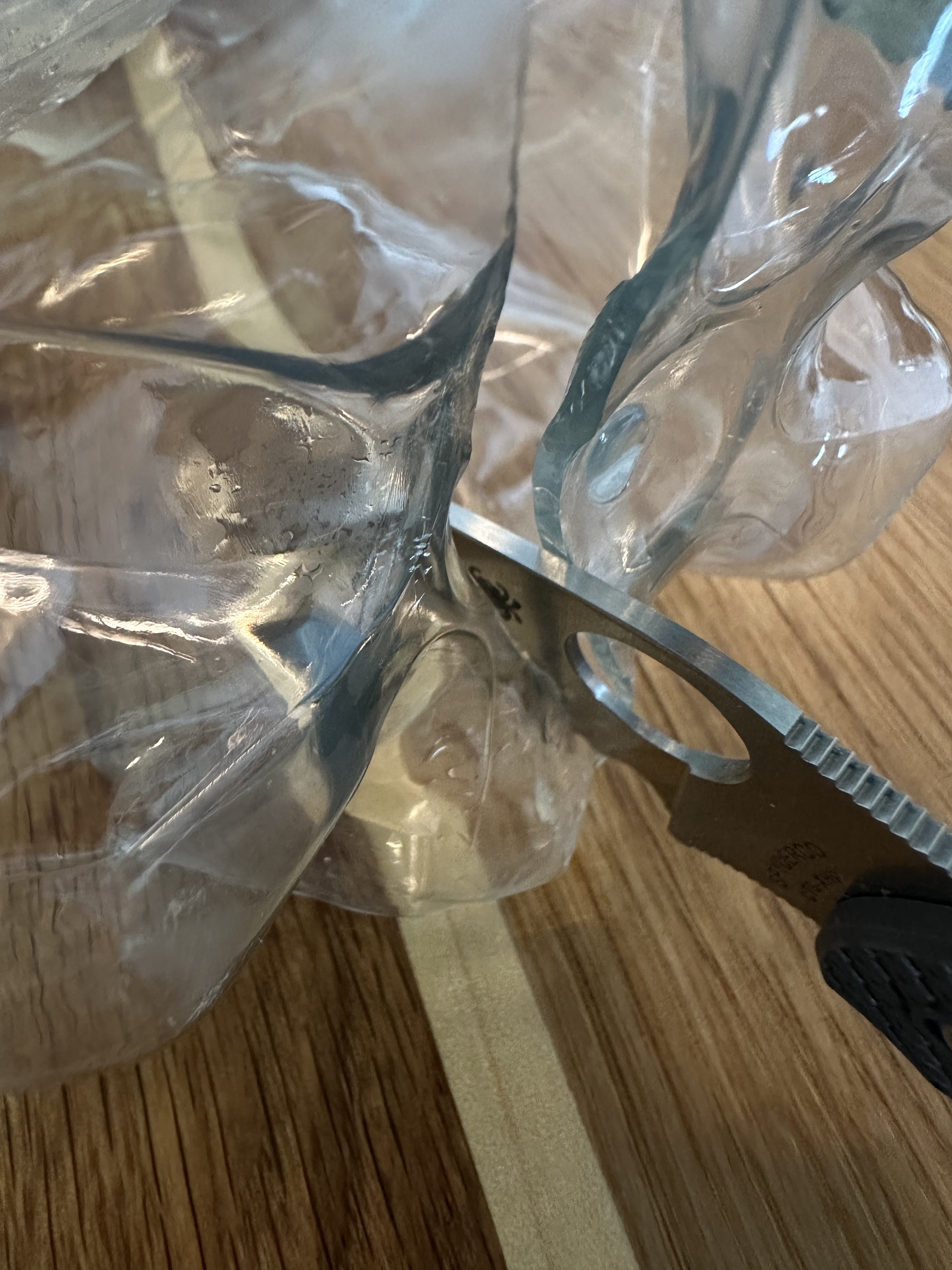
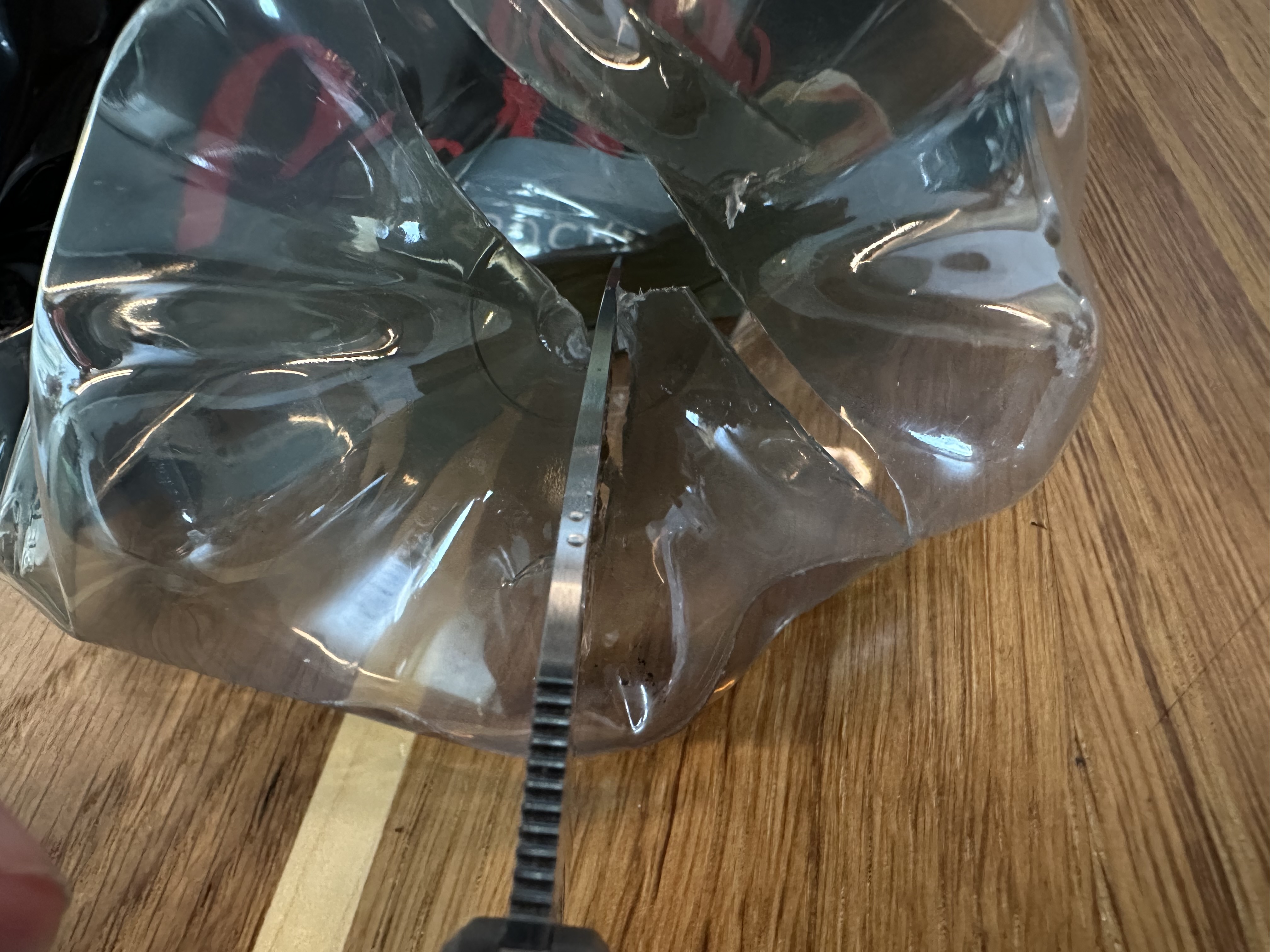
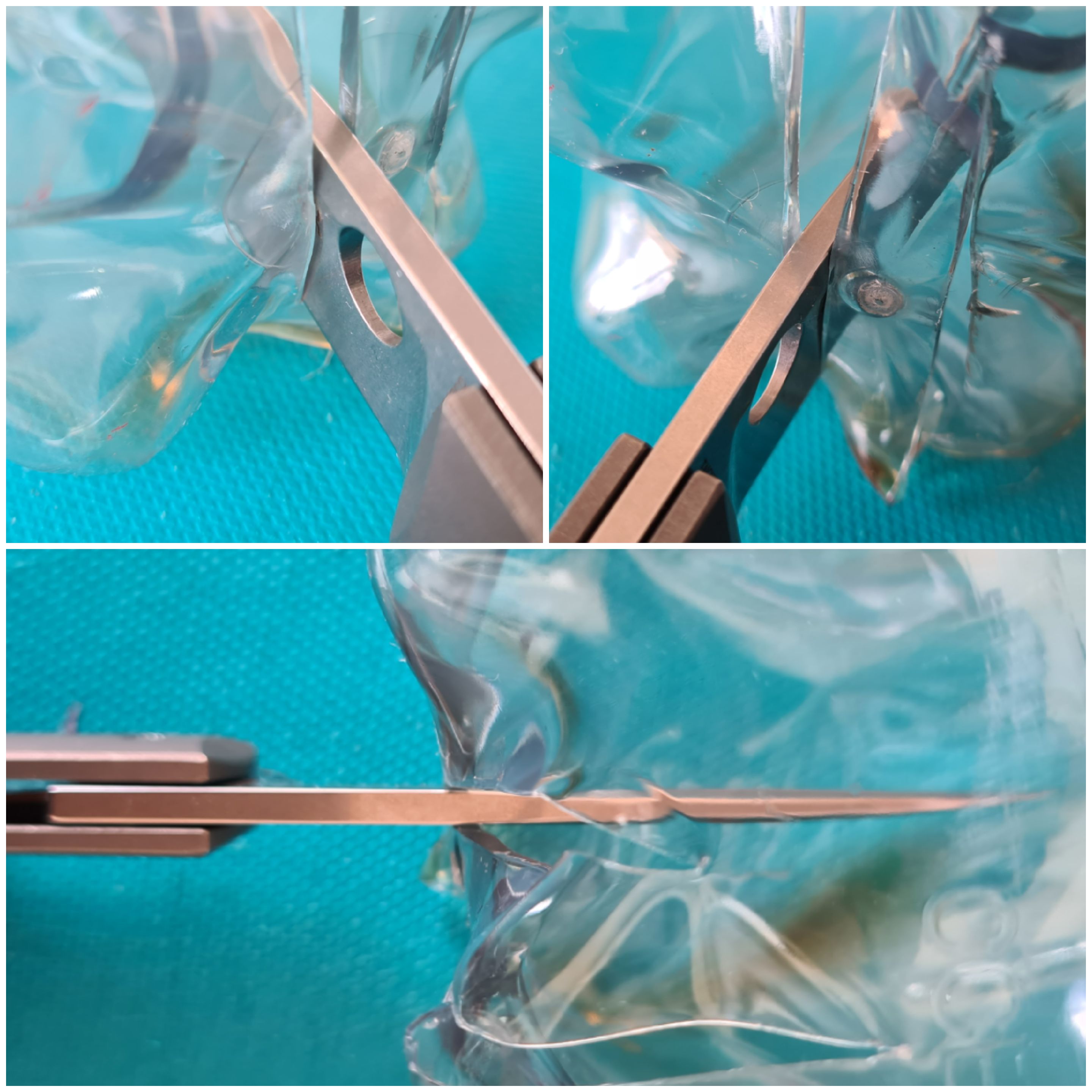
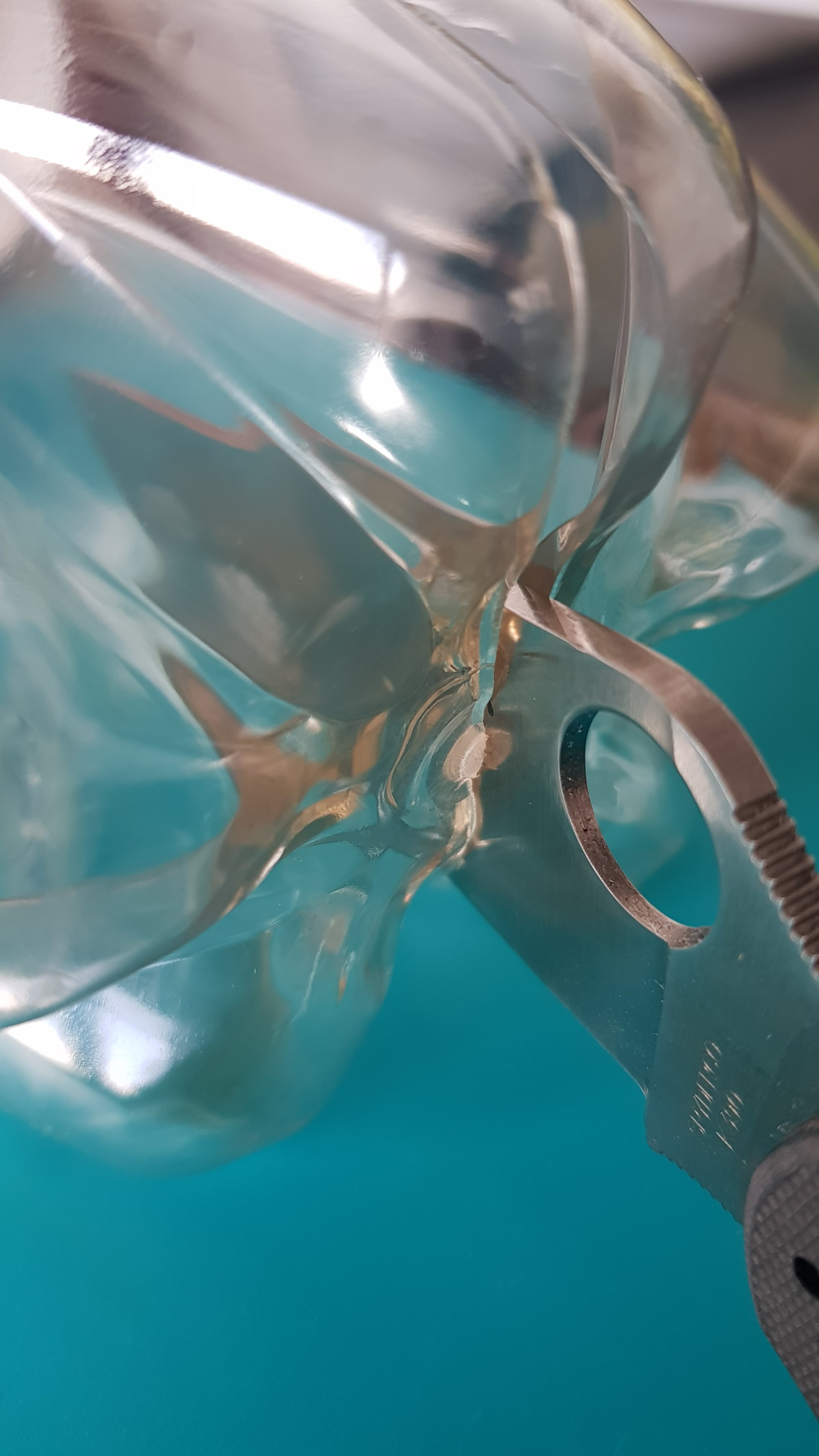
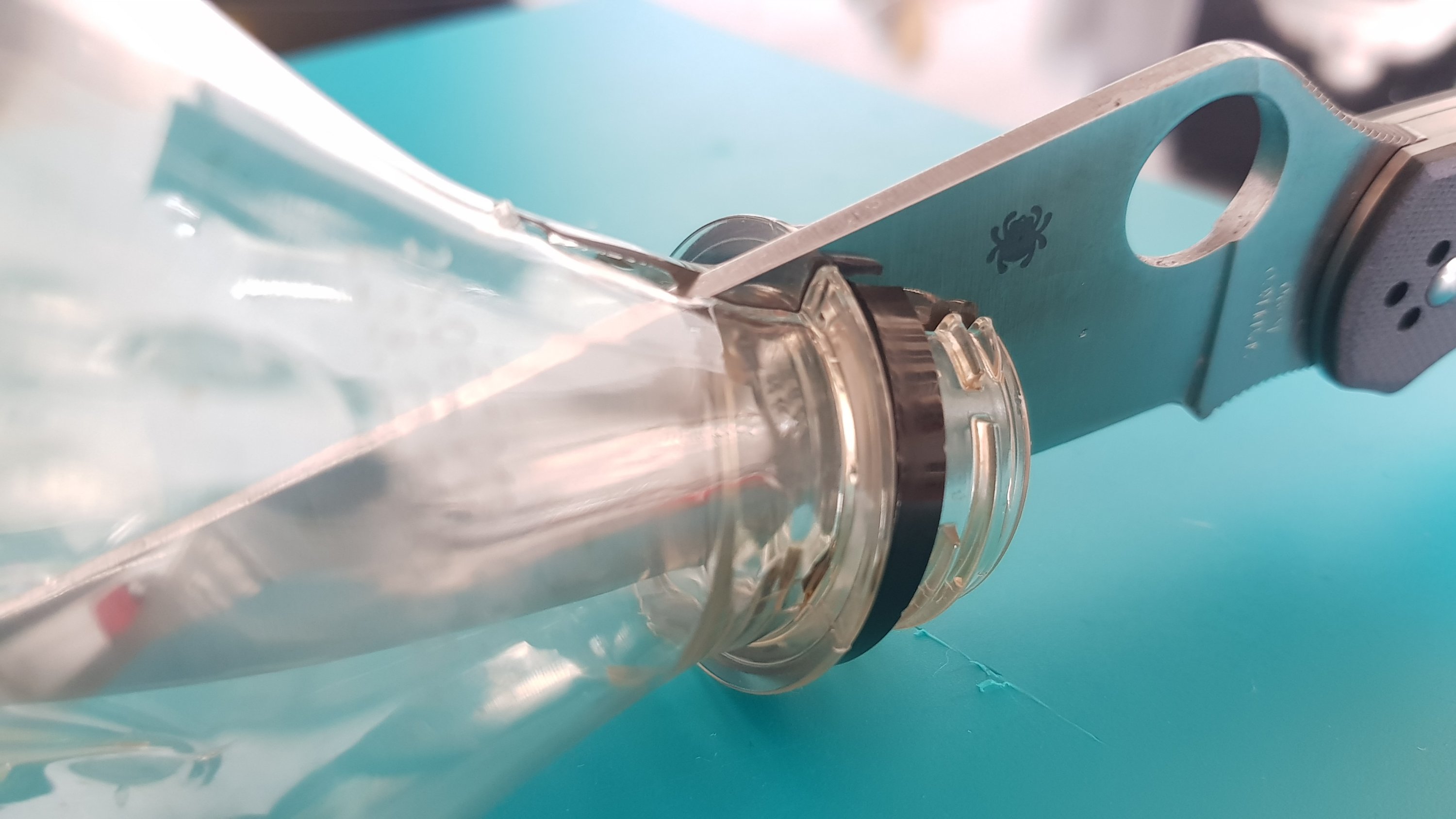
The plastic is thicker that the blade.
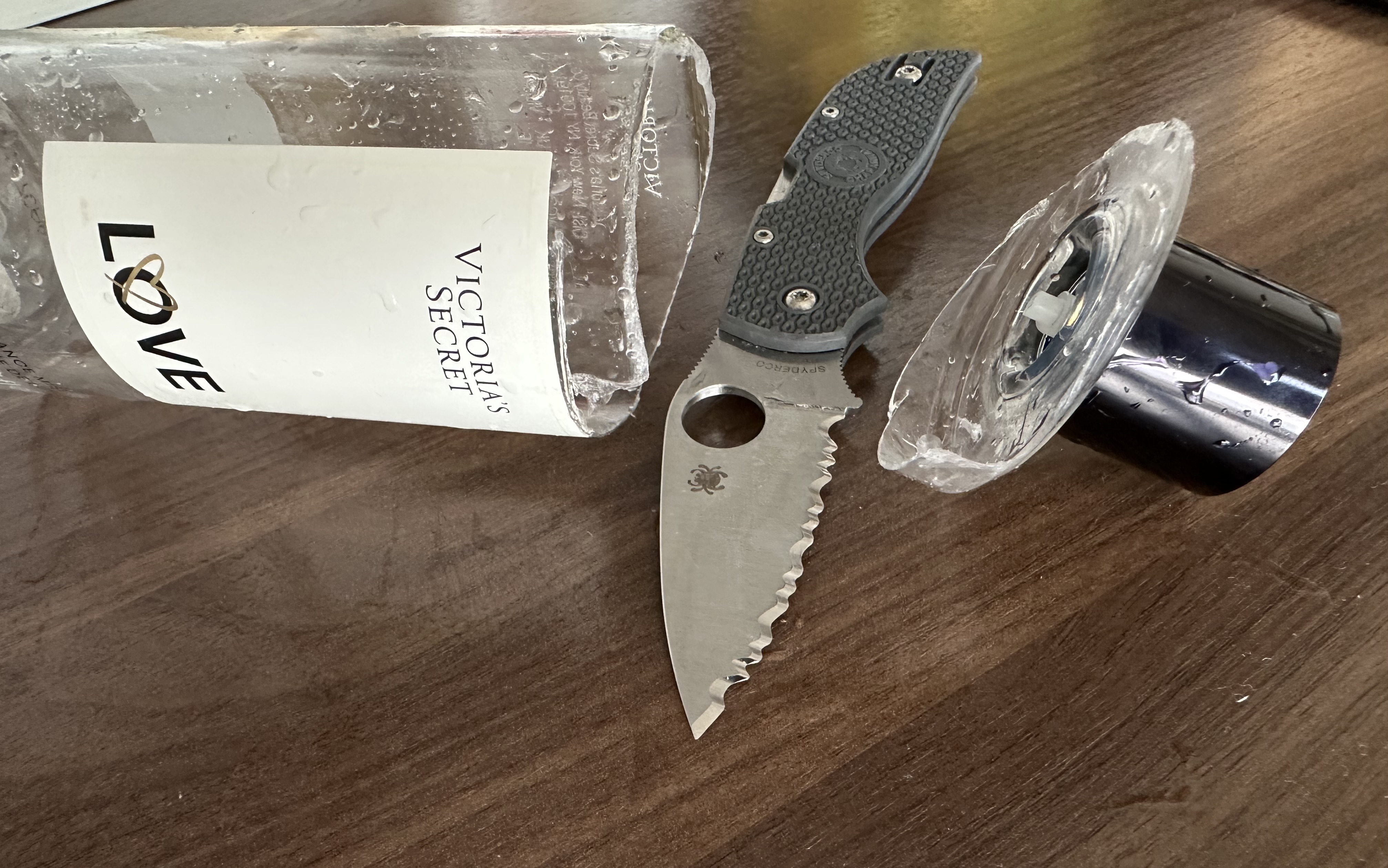
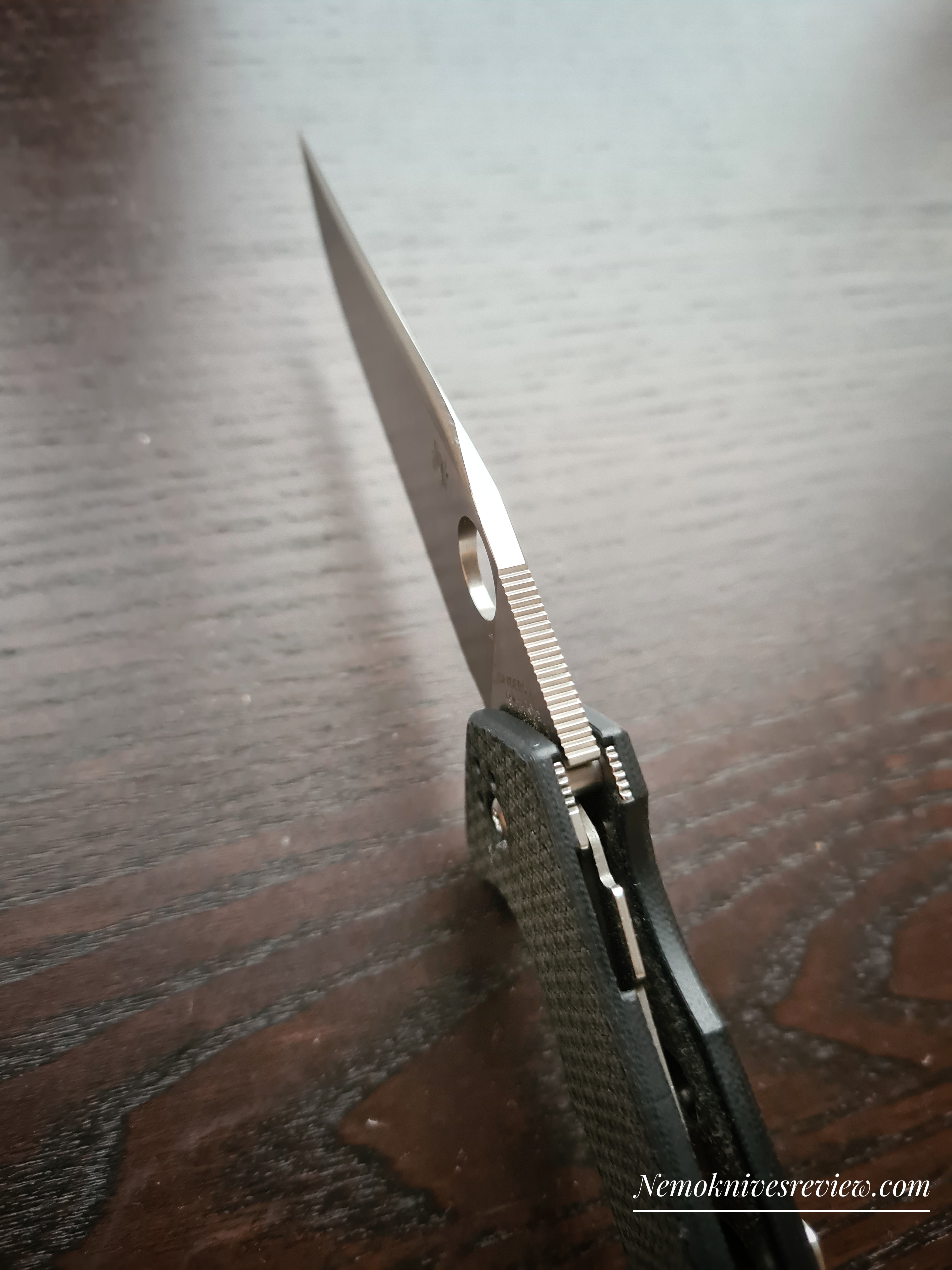
As you can see, the serrated edge is a chisel grind, which means it tends to deviate slightly to the right of the material being cut, much like a fin in water. I started the cuts with a bit of sawing, then transitioned to push cuts, and the knife effortlessly sliced through the thick plastic used to form the bottle.
This little knife is fierce in term of cutting performance. It is a lot of power in your pocket ! It is a pocket chainsaw !
The serrations really shine on the plate. You can push the knife hard against ceramic surfaces, and if the points ever need a touch-up, a few passes on a ceramic corner — or in my case, a jade corner — brings them back like new.
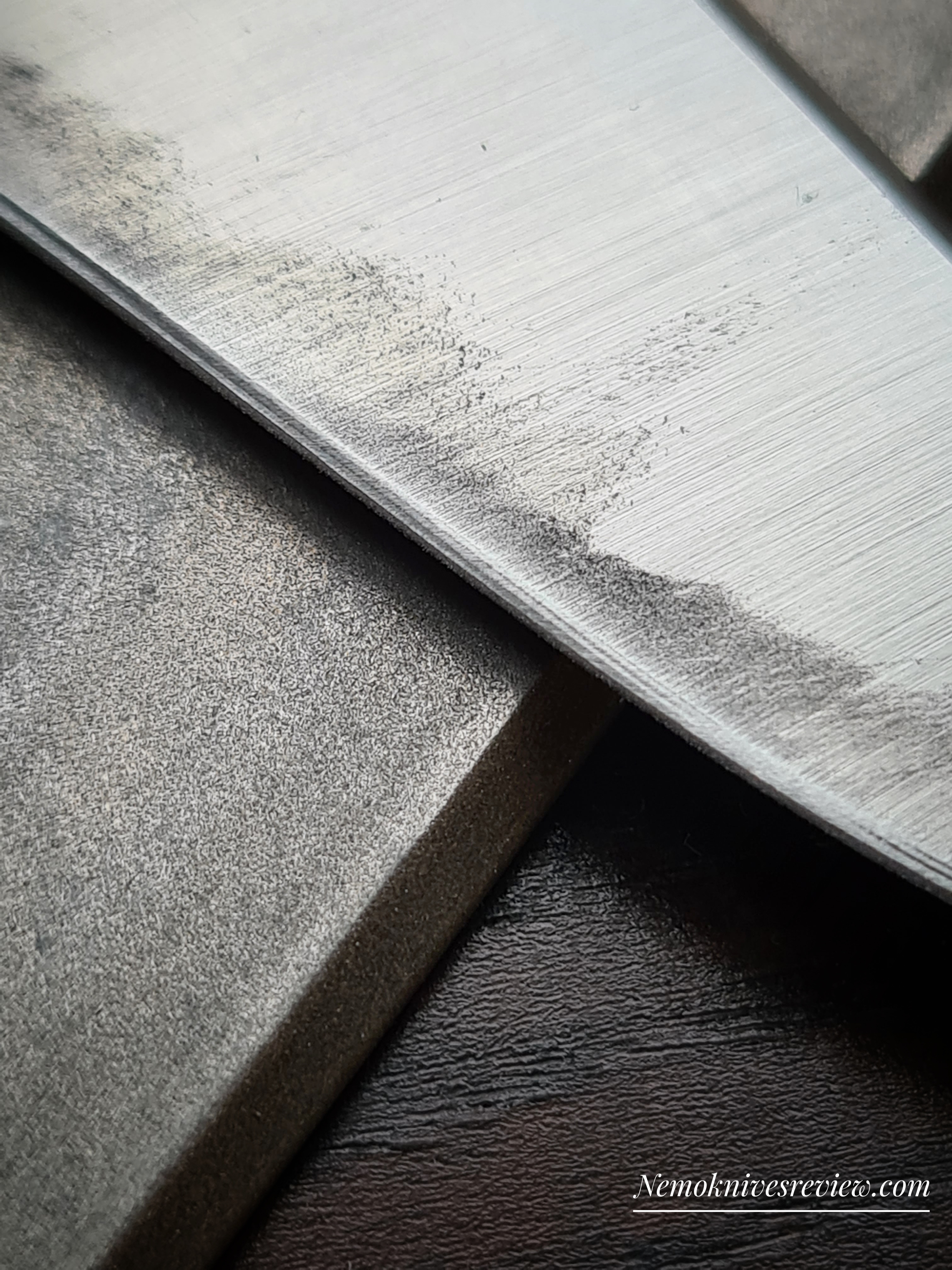
I have been able to reach razor level just by passing gently the Jade on it.
Actually it is fun to enhance the edge.
Actually, this is a bit of a comeback for me with serrations, dating back to my AFCK experience 25 years ago. Back then, I mostly used partly serrated edges, which helped initiate cuts on hard materials.
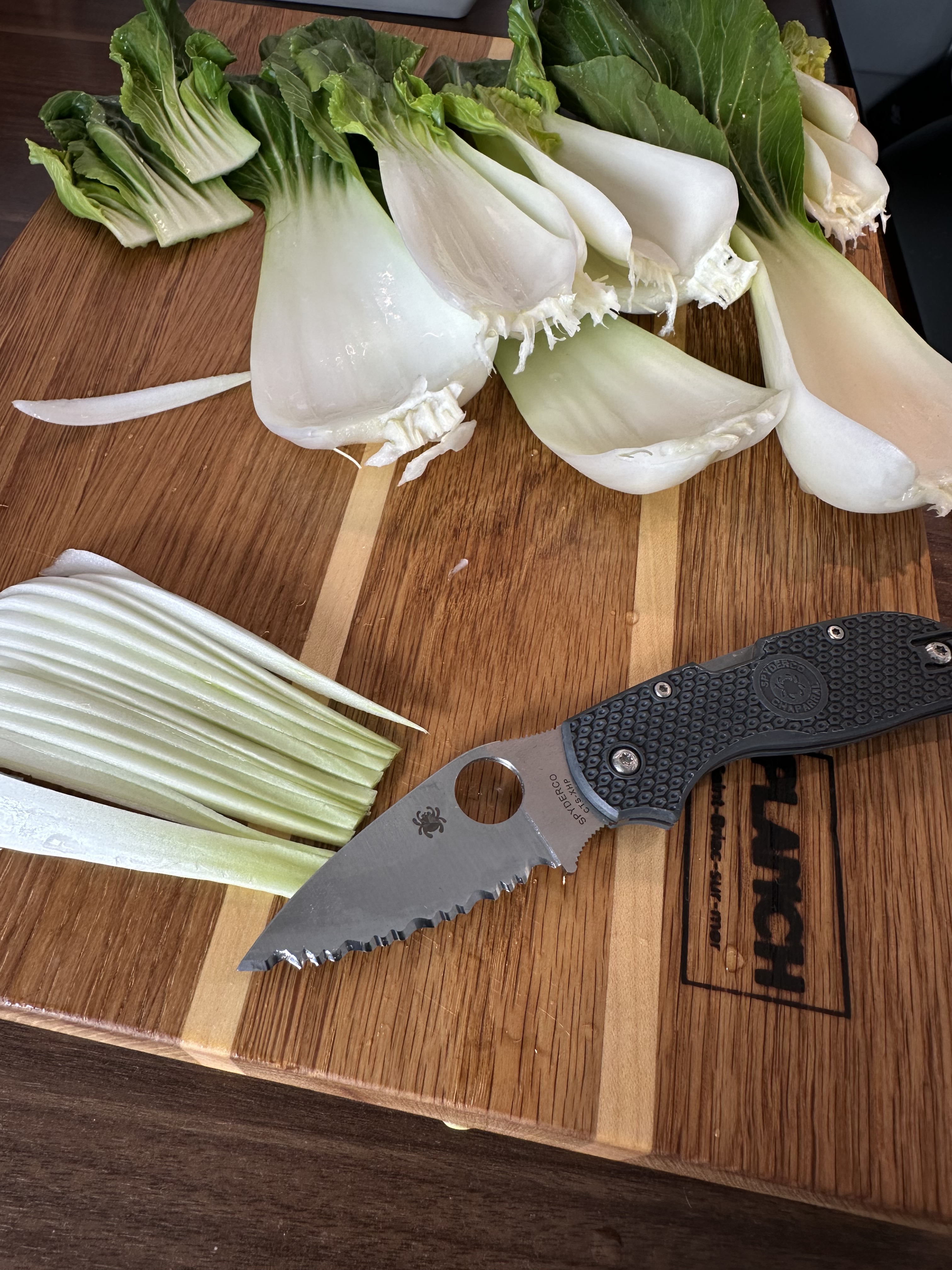
With a fully serrated thin blade and no plain edge, I initially wondered how useful it would be in the kitchen — especially since my wife’s favorite knives are Victorinox fruit knives (serrated). But it turns out, neither fruits nor vegetables can withstand the sharp, wavy edge of the Chaparral.
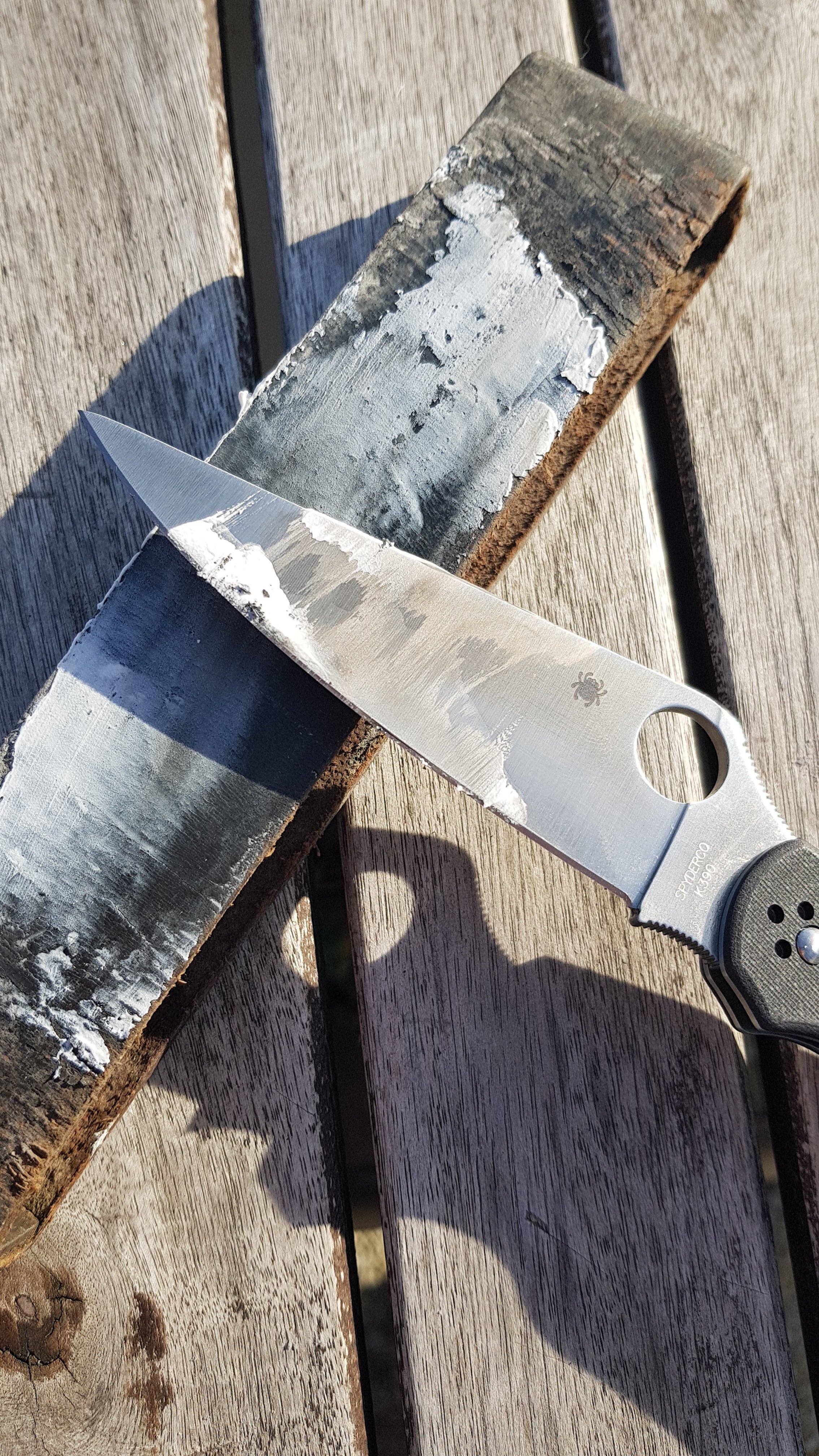
Funny enough I have been able to strop the edge of the Chap by using the side of the leather belt. CTS XHP is a steel which loves leather in my experience.
All in all, so far, so good. The Chaparral delivers impressive cutting power. Its thin, fully serrated edge is unique within the Spyderco line, pushing the design out of its comfort zone — and for a “knifeaholic” like me, that’s pure fun.
The next step is to trust this little knife enough to take it on a road trip in Italy — handling food prep, wood, and low-profile carry as my only pocketed folder. The Chaparral will make its return in May.
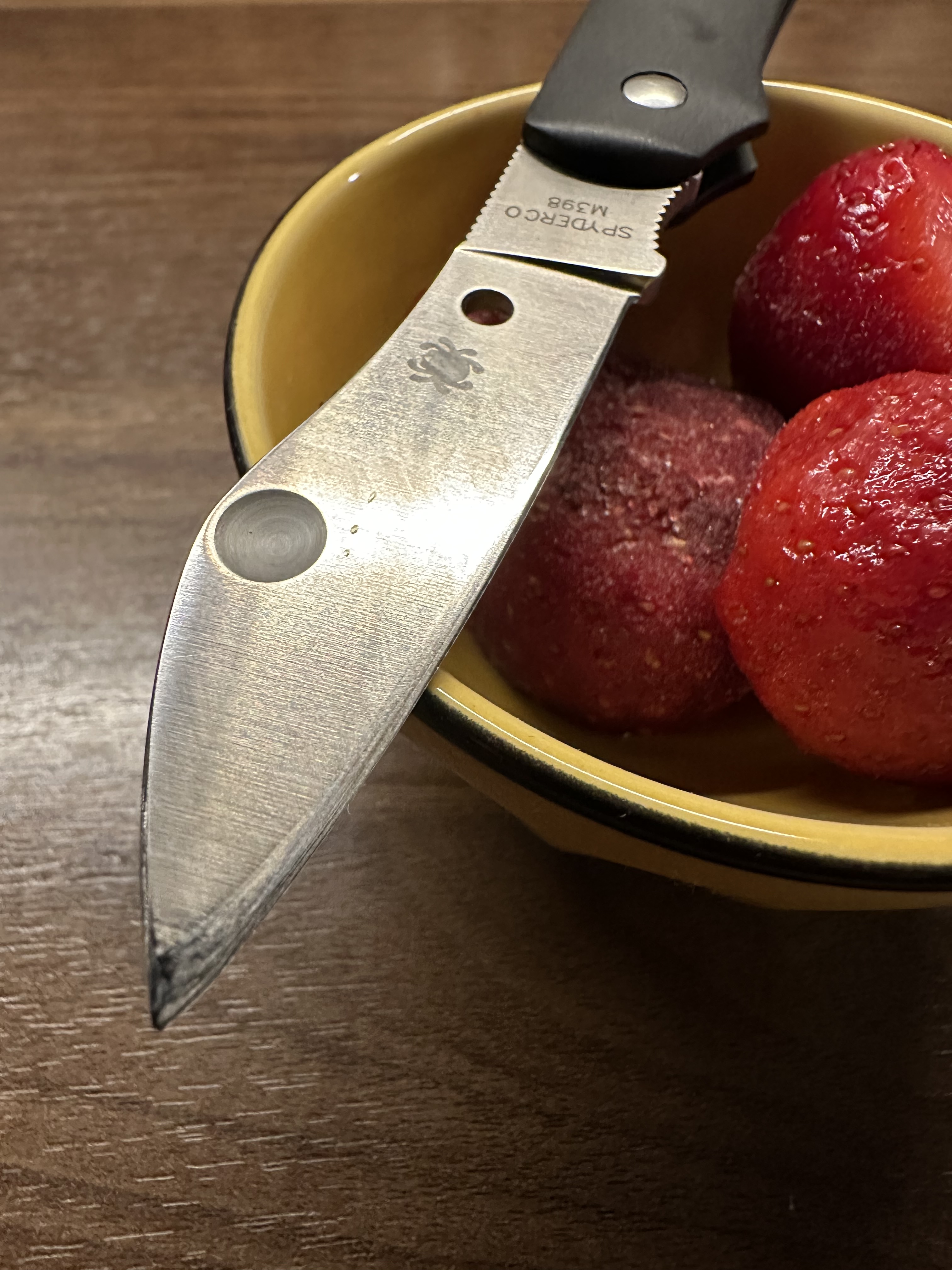
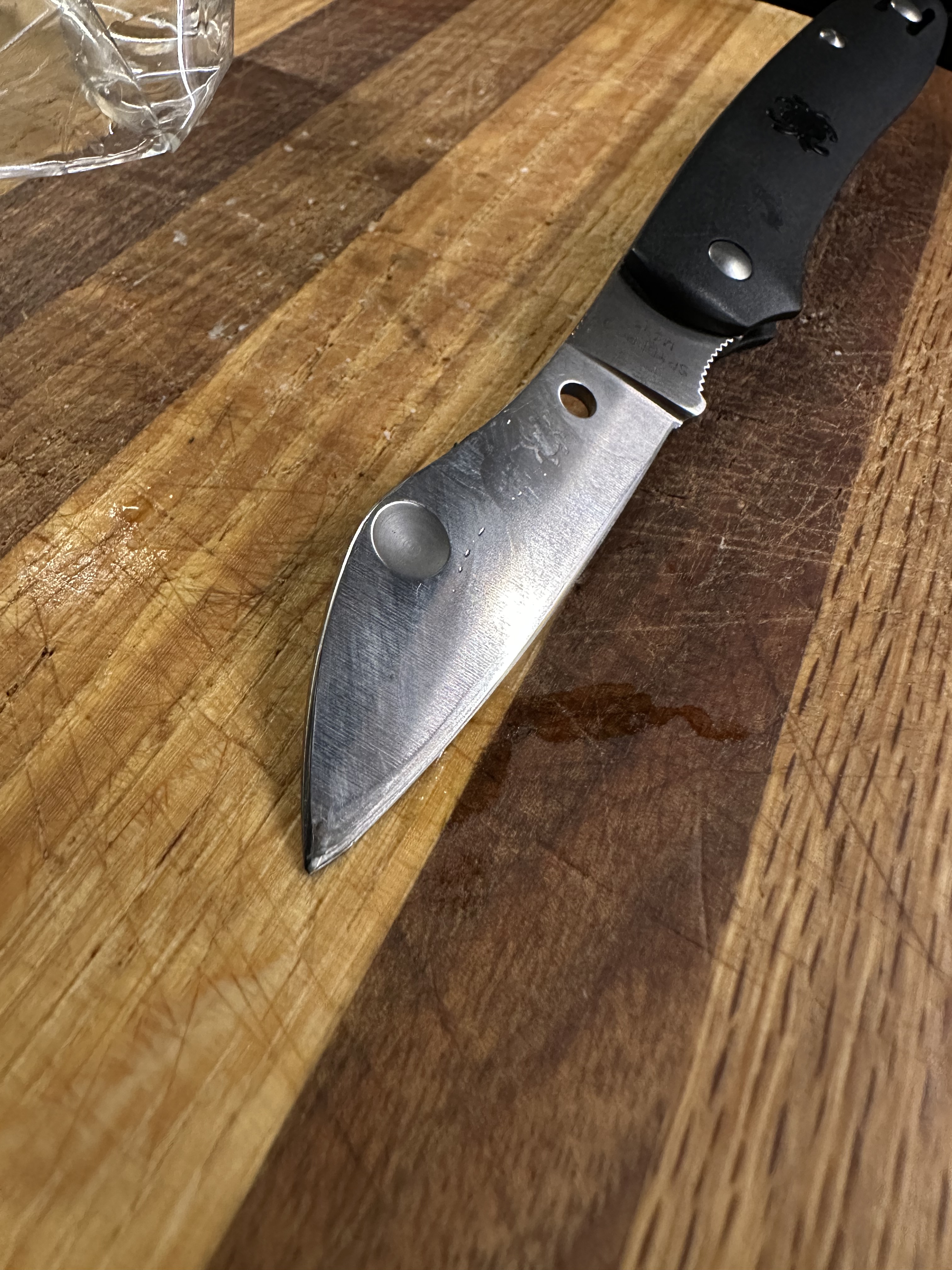
M398 is a fragile steel compared to M390. The encounter of the tip of the Roadie XL with a tile of my kitchen has been definitive. One mm has been shattered and now I got a micro flat screwdriver as a tip. OK. Diamonds are steels best friend. I’m able to form a new tip in a diamond shape.
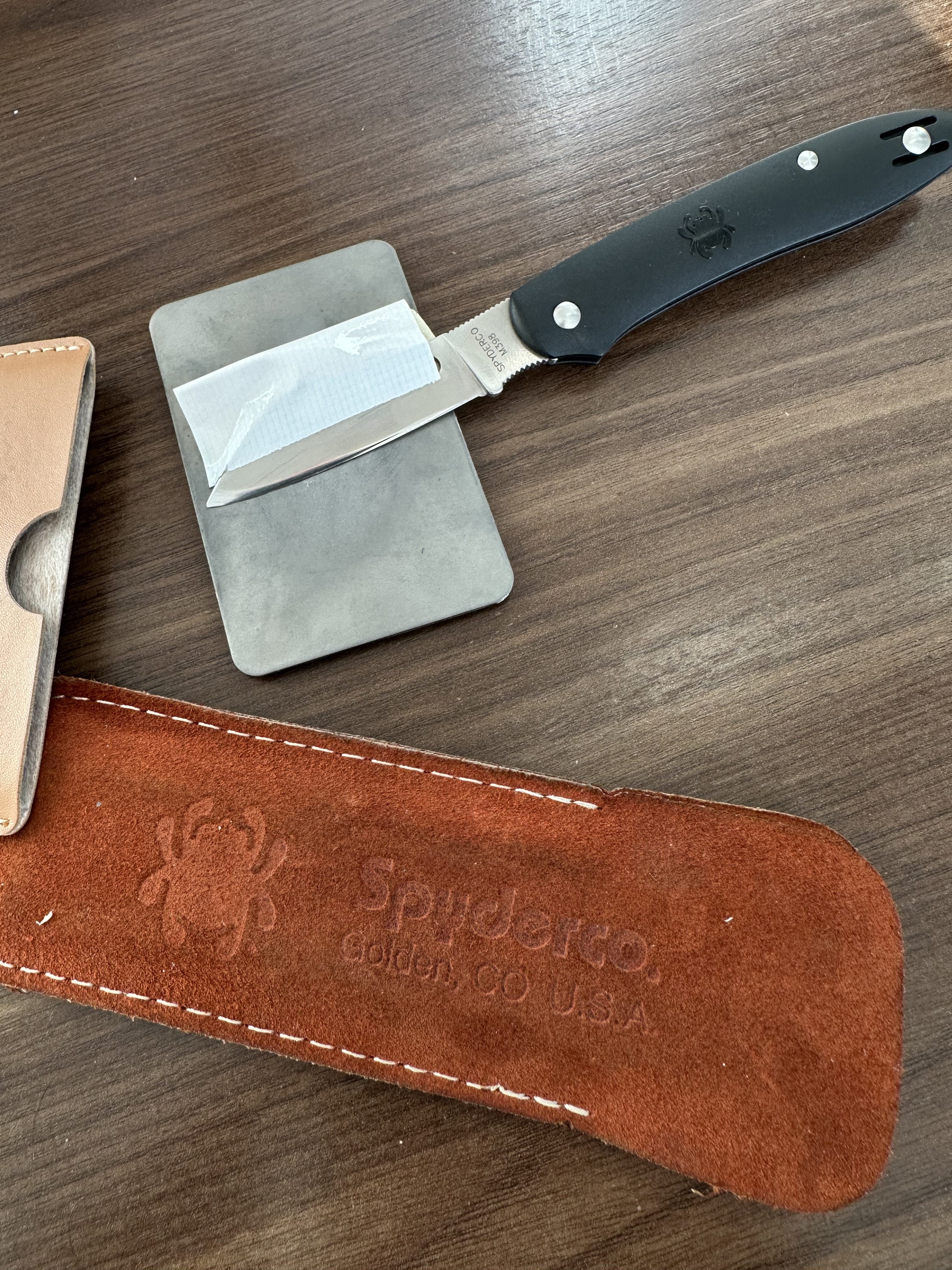
For now I won’t baby that Roadie XL anymore. I decide to thin the edge.
The best way is to protect the blade to avoid any big scratches.
Then it is time to play with industrial diamonds.
I will also use some diamond rod to round the jimping.
Of course I’m enough clumsy to scratch the blade twice and I’m obliged to use some diamond paste to treat the surface.
Then some polishing paste on the leather to slowly makes it like a mirror.
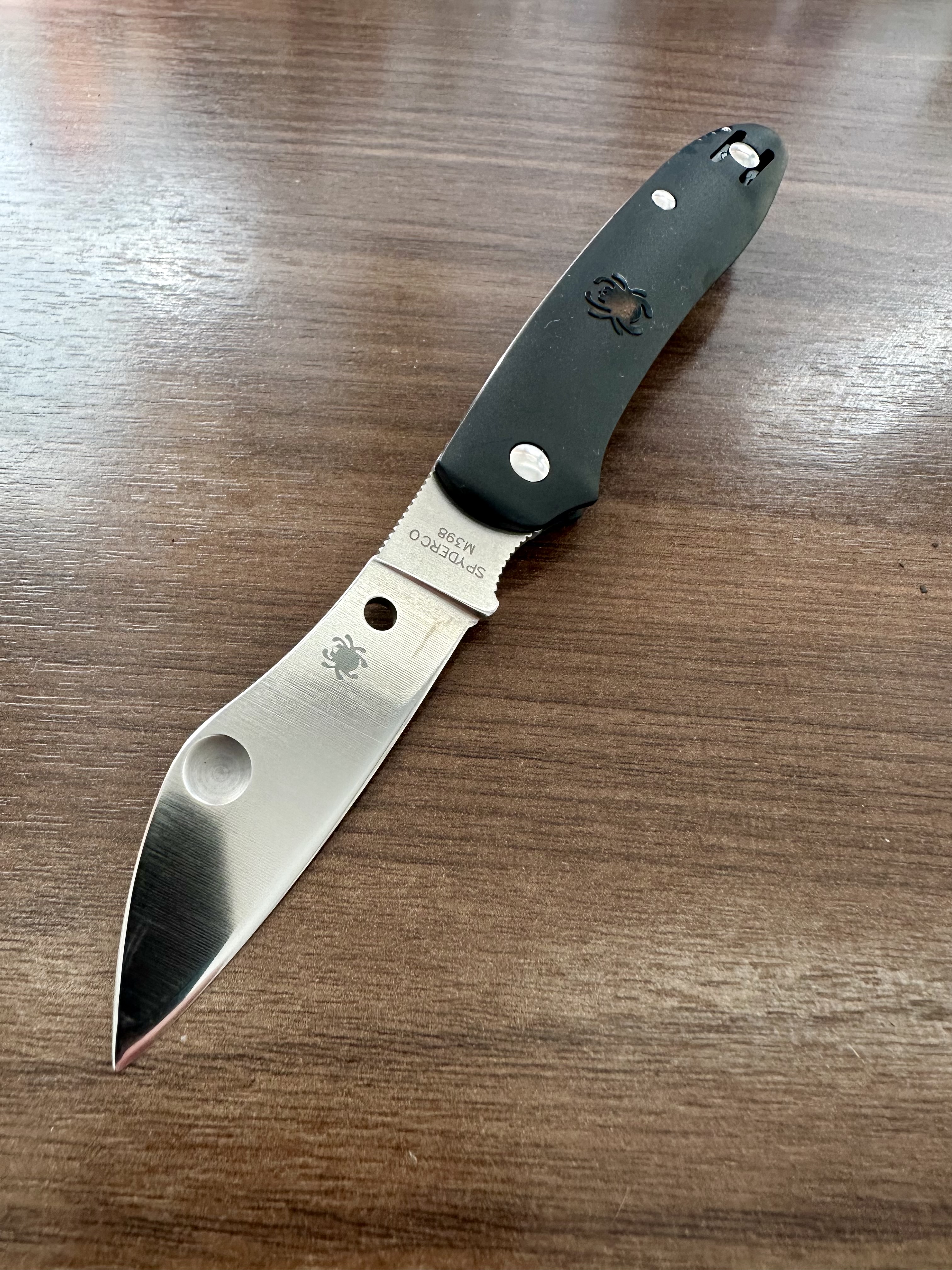
I’m quite happy with the result.
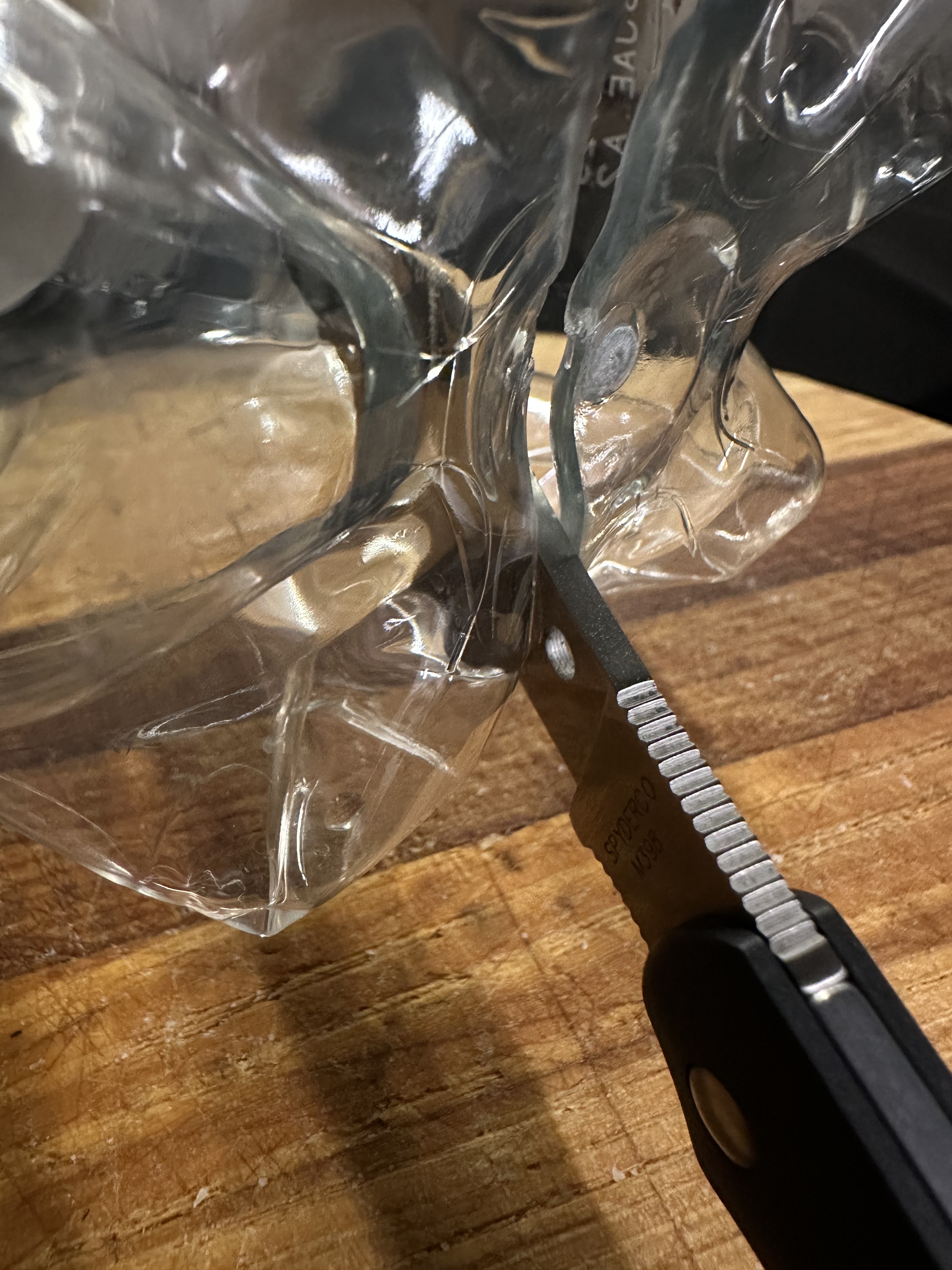
Time to test this new geometry. The edge has been convexed and thinned it should cut much better.
One of the most difficult task is to cut in two the butt of a two liters plastic bottle. This is a test my Scandi blades fail all the time. Any Opinel is king in that. Or the Manly Wasp ! My favorite being the Nilakka.
As a whittler it goes deep in wood.
As a steak knife, the shape of the blade brings only the new tip in contact with the ceramic of the plate.
That new tip is strong enough to be able to pierce a metal lid of a green bean jar. A hole pierce help the release of the lid on some jar. No damage no more. Now the Roadie XL cuts much butter.
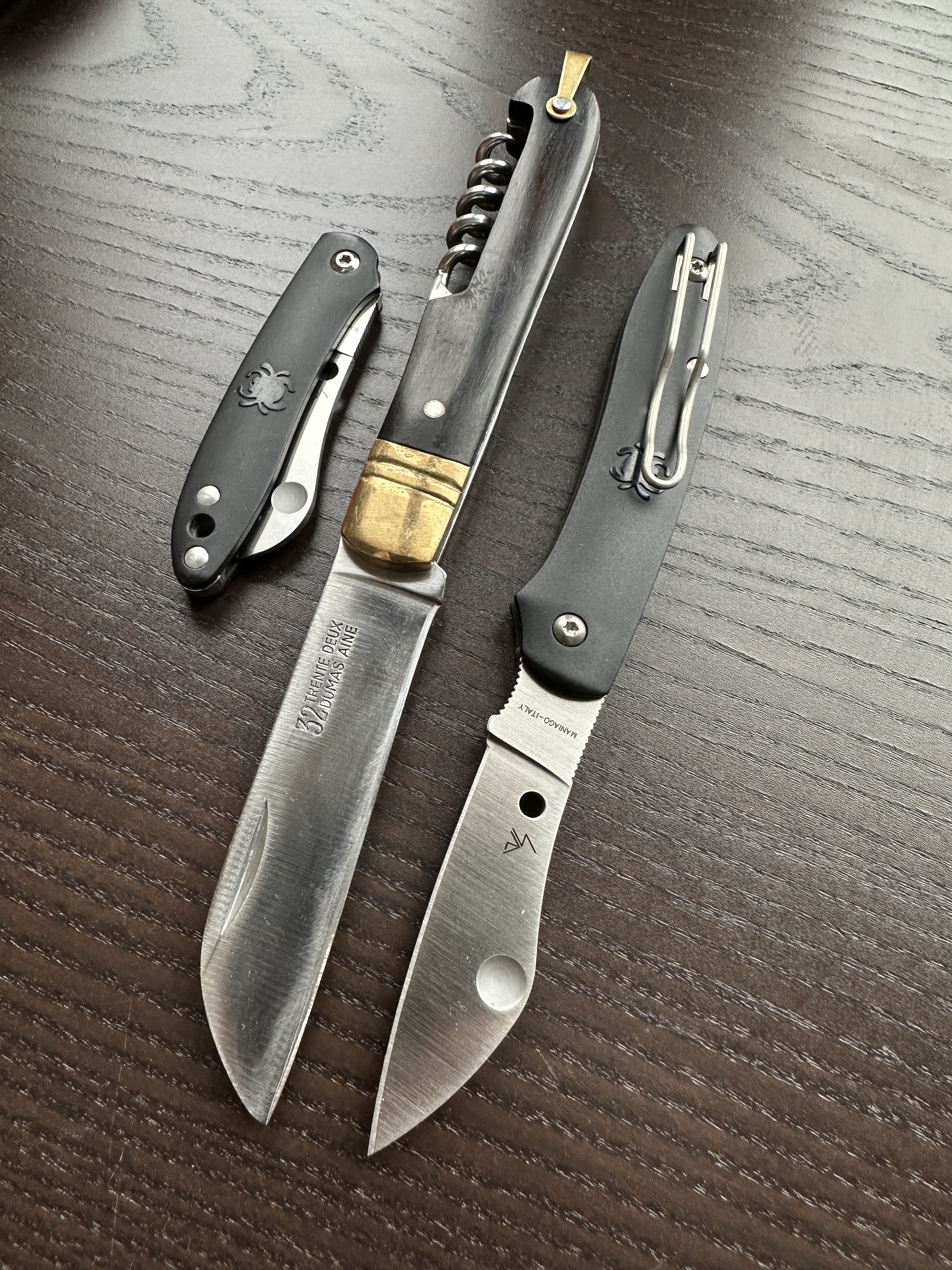
Six years ago, I reviewed the Working Poney, also known as the Roadie. Mine had been reprofiled by Jan Dirk, and even on its tiny scale, it proved to be an outstanding performer. For six years, it quietly stowed away, accompanying me across the UK, Vietnam, and countless places where knives were frowned upon.
Then, in 2024, I noticed the announcement of an XL version — the C267BK — featuring a better steel and a clip. Right away, I saw the new pointed blade, replacing the classic sheepfoot-style blade, now ground from Böhler-Uddeholm N690Co. Even more exciting, the XL uses M398, an exotic steel reserved for flashbatches — a serious step up in terms of performance and collector appeal.
And so, here it is: Ladies and gentlemen, the Roadie XL !
They say an image is worth a thousand words, so here you have 4,000 words with no syntax or spelling errors.
Back to the Roadie XL: it is made in Maniago, Italy, just like my Nano and many other excellent knives these days. The Maniago plant remains one of the best worldwide in terms of quality and precision.
Specifications:
Overall Length: 6.51″ (165mm)
Blade Length: 2.74″ (70mm)
Steel: M398
Closed Length: 3.76″ (95mm)
Edge Length: 2.31″ (59mm)
Weight: 1.5oz (43g)
Blade Thickness: 0.108″ (2.8mm)
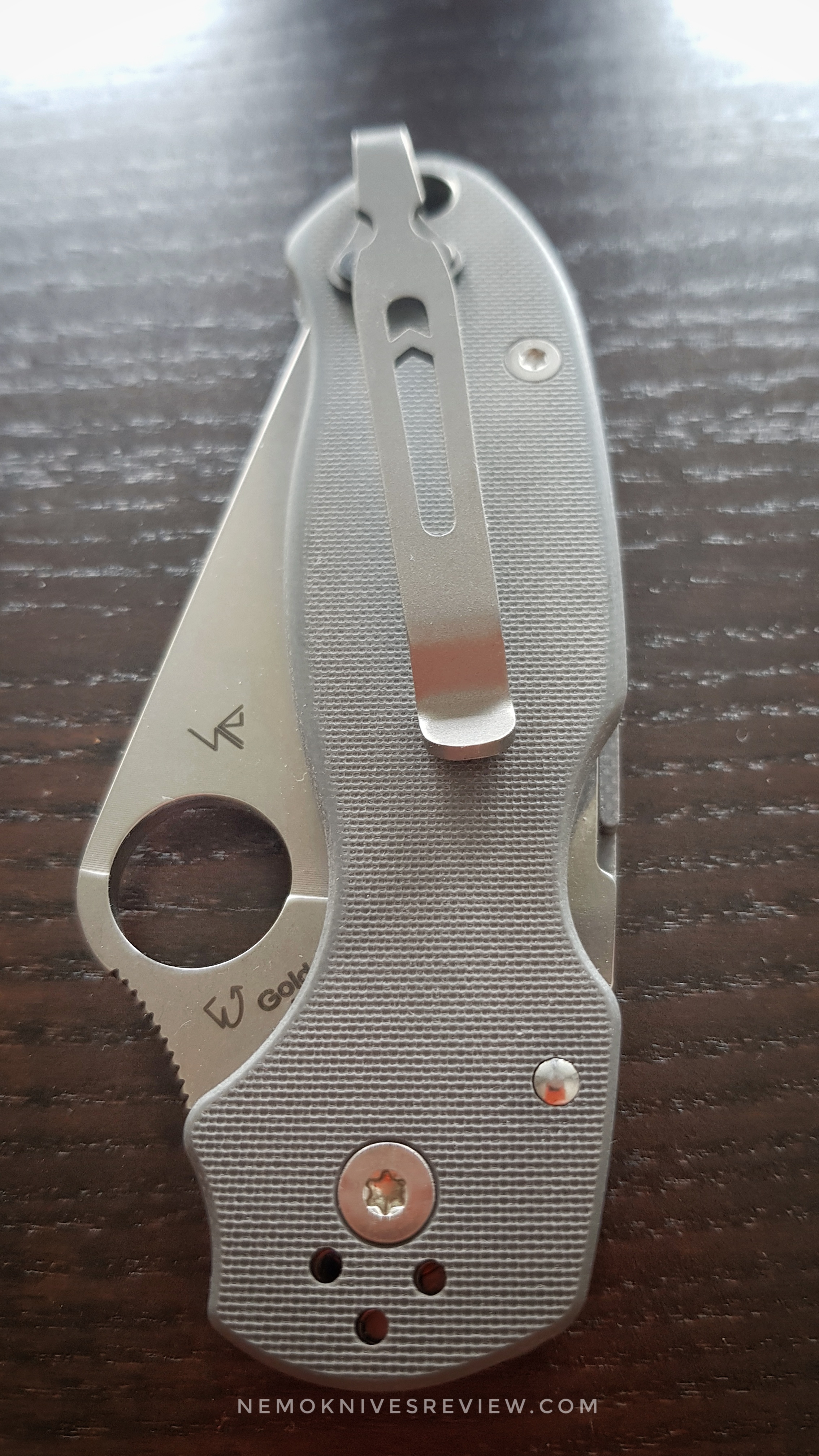
Its shape and size make it extremely pocket-friendly, easily fitting into the watch pocket of a pair of denim jeans thanks to its deep-carry wire clip. You could remove the clip, but why? It keeps the knife perfectly on the pocket’s lip. The clip is also reversible, though that’s not mandatory for a two-handed opening folder.
With its thin profile and light weight, combined with the clip, the Roadie XL can even be carried in a shirt pocket like a pen. In short, it’s a knife meant to stay on your person almost unnoticed.
The action is smooth, with two stops/steps before the blade fully opens. In practice, it feels smoother than my Urban, which only requires a single hand to deploy.
With a slightly longer blade than the Urban, the Roadie XL remains legal to carry in countries such as Denmark, the UK, or Germany. Mine arrived razor sharp straight out of the box, so I’m in no particular hurry to convex the edge.
Mine came razor sharp right out of the box. So I’m not in a special hurry to convex its edge.
You can immediately recognize Sal Glesser’s signature design—a clear mark that it’s his invention. Sal is an inventor, and it’s always impressive to see how he manages to create clever, practical tools. Quoting him directly:
“When the Transportation Security Administration (TSA) briefly considered allowing the carry of knives on airplanes again, Spyderco designed the Roadie™ to fit their guidelines. We created an incredibly popular modern expression of the classic penknife. Since bigger can indeed be better, the Roadie now has a big brother: the Roadie XL. It faithfully offers all the defining features of its smaller counterpart—including a non-locking “notched-joint” mechanism, a textured index-finger choil, and contoured, injection-molded handle scales. Its full-flat-ground sheepfoot-style blade is crafted from M398 stainless steel and features our distinctive “Double Dent™”—a pair of symmetrical dimples in the blade that provide a solid purchase for a fingernail-free two-handed opening. In addition to its larger size, the Roadie XL also adds a deep-pocket wire clip for convenient top-of-the-pocket carry.”
Now, let’s talk about M398, one of Spyderco’s premium powder metallurgy steels, only available in limited flash batches, all made in Maniago, Italy.
From what I understand, M398 is closer to CPM-90V than to M390. Quoting Darrin Thomas’s analysis (which is worth reading in full):
“The original M390 has a reported carbide volume of 20.5%, and the new M398 has about 30%, so there has been an increase in carbide of almost 50%. We would expect this to lead to a significant reduction in toughness along with an increase in wear resistance. The datasheet shows that the toughness of M398 is only about a third of M390, though at somewhat higher hardness. So it is apparent that the design of M398 is all about wear resistance and essentially ignores toughness. M390 has only slightly lower toughness than K390 with similar carbide volume (though K390 was tested at 62 Rc). M398, on the other hand, has significantly less toughness than the similar carbide volume S290. However, M398 does have some positive traits, such as increased hardness and reduced retained austenite relative to M390. I’m personally not all that interested in yet another high edge-retention steel that sacrifices toughness, ease in sharpening, and workability. We had other options and this initial look doesn’t make M398 appear to be an improvement over the other available steels. M398 was a relatively simple modification of M390 and I can’t help but think that a more optimized version could be made. M390 did offer similar toughness to cold-work tool steels like K390 with a similar carbide volume, but M398 has significantly lower toughness than the similar carbide volume S290. So M398 doesn’t appear to be over-performing relative to its composition and carbide content. I wrote about some Bohler-patented high wear resistance steels using niobium instead that look very interesting but haven’t seen a commercial release. Those steels would be breaking new ground and potentially offering new property combinations not previously available. But if Bohler pushes out M398 more broadly it will be interesting to see how knifemakers utilize the steel for applications that benefit from high wear resistance and edge retention.”
When M398 was used in a previous flash batch for the SpyMyto, I wasn’t particularly excited—it felt like overkill for a folder that seemed built for hard use. The Myto is essentially the big brother of my Nano made in CPM Magnacut, and a SpyNano in M398 is also on the bench. In comparison, Magnacut is far tougher than M398, making it more suitable for wide, workhorse blades.
On the Roadie XL, though, this is a different story. Like with my Heinie Urban in S90V, these small blades are not intended for bushcraft—but some highly skilled bushcrafters can make miracles with even a 2-inch slipjoint, as shown in an inspiring video I recently saw.
Slip-joints are gentle companions for both ladies and gentlemen. For those with long nails, the Roadie XL is equipped with its distinctive “Double Dent™”—a pair of symmetrical dimples in the blade that provide a solid purchase for a fingernail-free, two-handed opening.
Its high wear resistance comes in handy, as these small blades often encounter cardboard, which can be surprisingly abrasive. I also recall Roger, my father-in-law, wielding his old Pradel slip-joint like a crowbar or flat screwdriver, without a second thought. Old-timers often treated knives mercilessly, using them until the blade was as thin as a needle.
I’m confident the Roadie XL with its M398 blade would make an excellent hare skinner—the fur is full of sand that can destroy an edge almost instantly. Tuscan hare hunters would likely appreciate its durability. Its high wear-resistant alloy makes perfect sense here. Additionally, the blade is relatively thick at 2.8 mm, which would otherwise be prone to breakage.
Ergonomically, the Roadie works beautifully for a slip-joint because you can hold the blade by its choil—a feature rarely found on traditional slip-joints. Even most Swiss Army Knives lack that level of security, and with M398’s toughness, the blade cannot close on your fingers. As Spyderco notes:
“Unlike traditional penknives, the Roadie also features a subtle index-finger choil that increases control of the knife during use and acts as a safeguard against unintentional closure.”
There’s no undue pressure on the pivot, often the most delicate part of many folding knives. If you are careful not to twist the point in wood, the Roadie XL can withstand applied force directly to the blade. This makes it another “Lil Big Blade”—small but versatile.
It can serve as a steak knife, whittler, label remover, balloon popper, nail cleaner, or cardboard cutter. Brown cardboard is notorious for edge damage, but not for an alloy like M398, packed with carbides.
And in today’s world, one more practical advantage: it is extremely sheeple-friendly. The Roadie XL looks like a pocket knife, not a tactical or soldier’s tool, making it socially unobtrusive yet highly capable.
Beauty is in the eye of the beholder, but to me, this blade—shaped almost like a scaled-down cutlass—is pure eye candy.
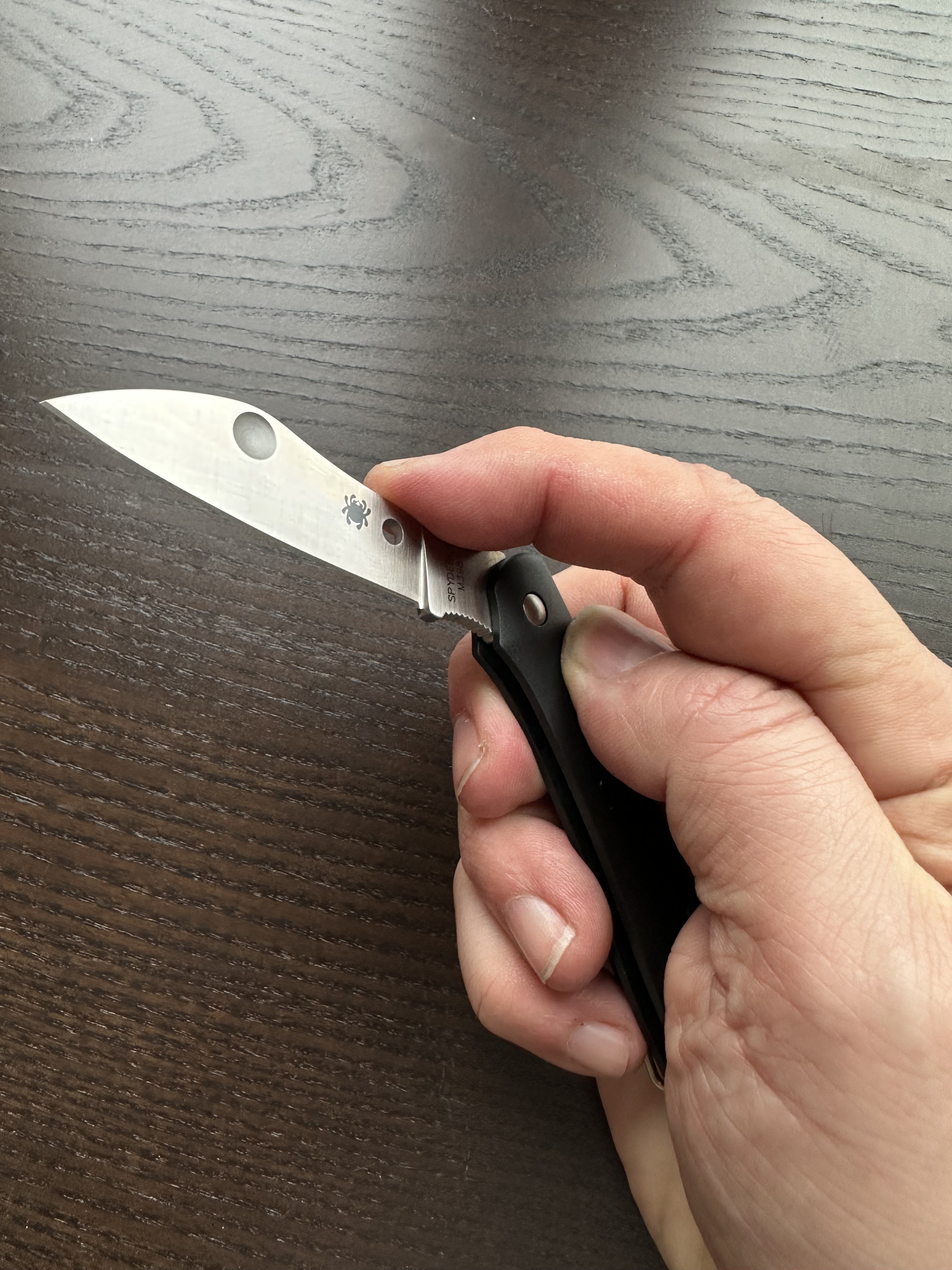
Interestingly, I’ve discovered that I can open it one-handed in two distinct ways:
A fast wrist flick while holding the blade itself.
By gripping the blade with thumb and index finger and gently pushing the handle away with the middle and ring fingers.
So, even though it wasn’t designed as a one-hand opener, the Roadie XL can function surprisingly well as a one-handed knife in either technique.
Compared to a traditional sheepfoot slipjoint, the Roadie XL is incredibly light yet sports a premium alloy blade (Since August 2025 another slipjoint with M398 is available: The Metropolitan.). And at under 100 euros, the Roadie XL is an exceptional bargain for what it offers.
This is one of Sal Glesser’s finest EDC designs—a true Every Day Carry folder that balances elegance, utility, and performance. And for once, size really matters with a Roadie. No wonder it’s already sold out on the Golden site! There is part II here.
Since the reception of my Chief Native I have found that he was a sole survivor from a Xmas Mystery Box bought in Spyderco’s plant in Golden in December. In that box were different items and a rare Sprint Run Second Factory which was destined to end in my pocket and considered by myself IMHO as the perfect realisation of Sal and Eric ideas about pocket knives. In fact I think it is my favorite Spyderco ever. I have written a first review here. And now it is time for a second approach of Hellboy which has succeeded in kicking other knives from my pocket and quench my thirst for novelty.
So why ?
First the Native family feature an absence of hump on the blade making them very slick and beautiful.
Even the Shaman benefits from that.
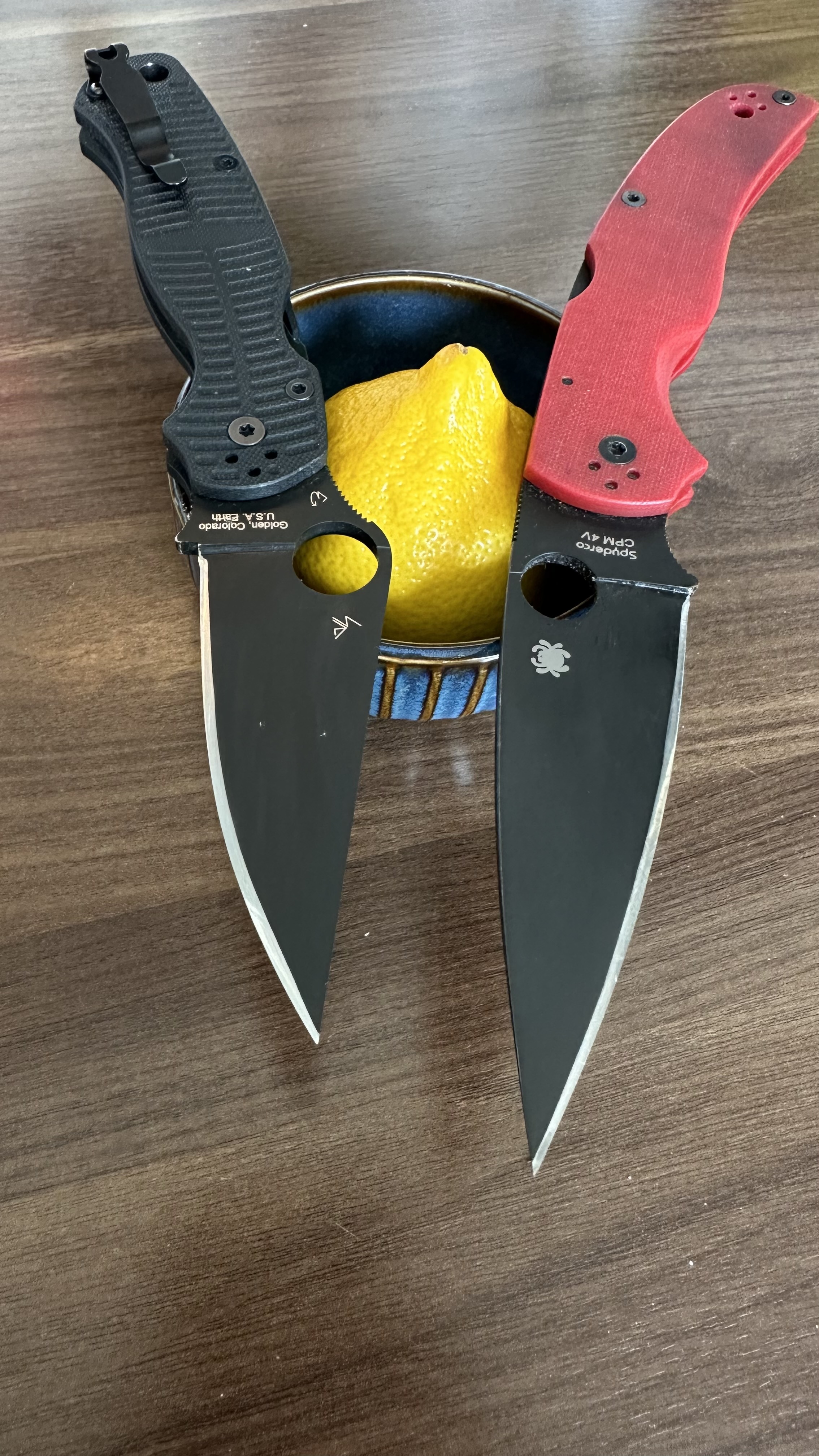
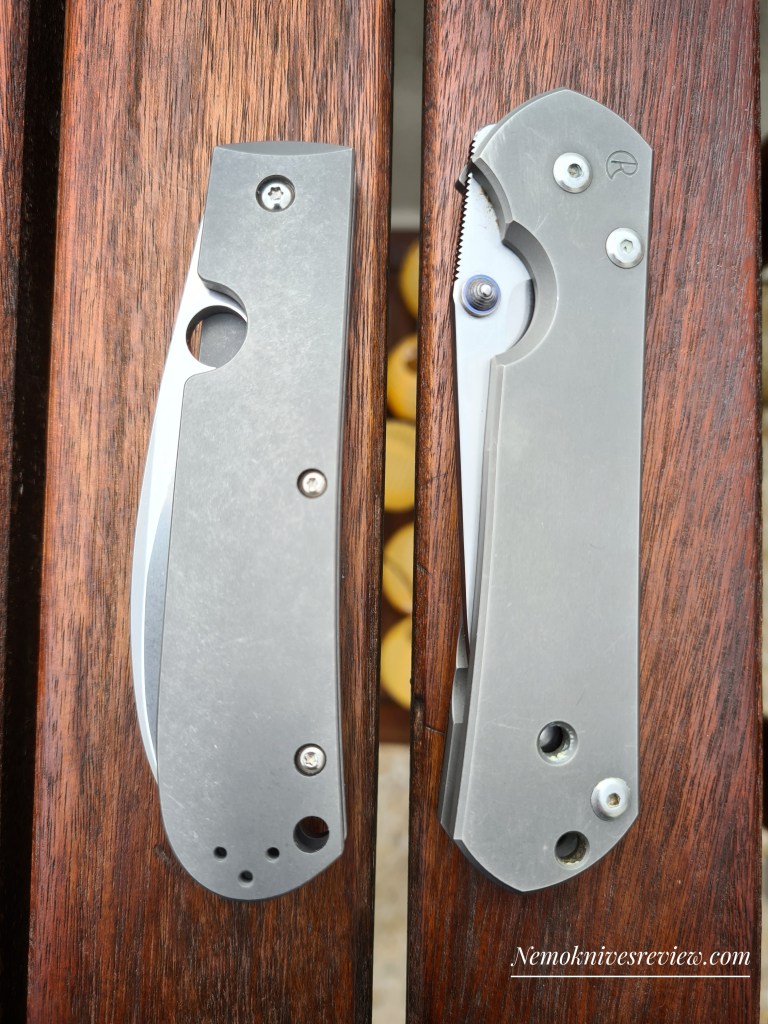
The Chief is on the left and the Shaman on the right.
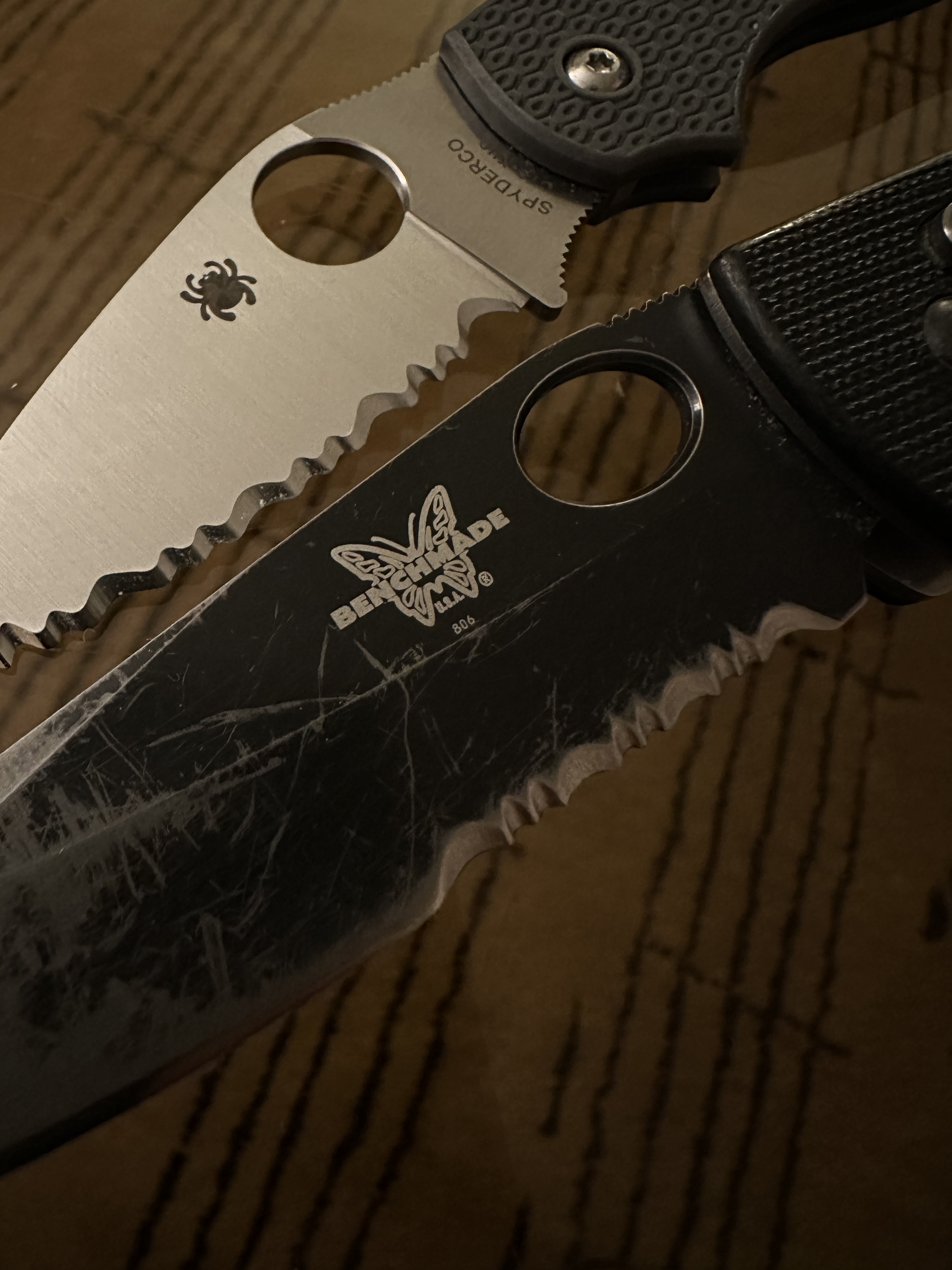
As you can notice the design of the Native Chief is really close to one of my favorite design: the AFCK. Sal Glesser was no stranger in the Benchmade BM800 AFCK back in the 90’s. He helped Les De Asis founder of Benchmade on it. They had both learned how to make Michael Walker’s linerlocks at Bob Terzuola shop. Both company were accelerating on the tactical lane in close formation.
As you can notice, my AFCKs (Advanced Folding Combat Knife) which was also designed by Chris Caracci a former Navy SEaL have been used a lot. The first version got a Spydiehole and the second version got an oval hole and an axislock. This design was one of my favorite for a big folding knife as EDC. And back then I was really in love with concept of tool highspeed steel on a modern plateform.
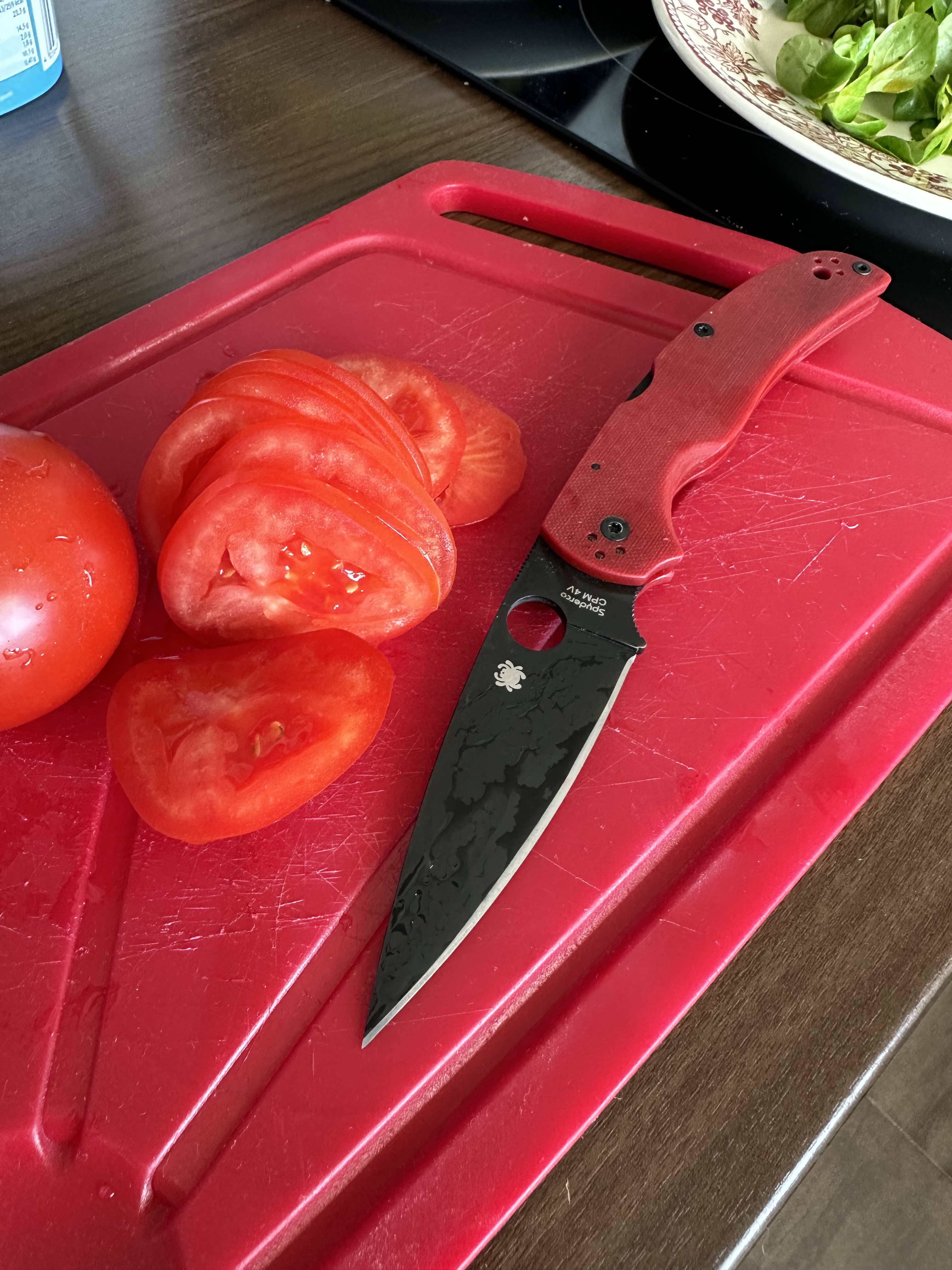
The same happend with that special Native Chief which got a very special alloy for its blade: CPM-4V. With that steel, the edge is strong and the thin blade is very solid. It gives a lot of confidence when cutting on a plate made of ceramic of glass. No chipping can happen. Hellboy has been used a lot for cutting pies and cake on glass plates and the edge behavior was not disappointing. When I have noticed a little shiny spot, some white ceramic was able to put everything back on line but it was really minor.
Now CPM4V is not stainless. It will form a patina or, worst, rust very quick and easily when used in acidic matters like cutting lemons and being used on a salad with vinegar. DLC coating is really welcome for that kind of behavior. Back in the 90’s Benchmade was offering only PVD coating which is really inferior to Diamond Like Coating. So far the blade of my Chief is not marked and scar by it various cutting tasks even when cutting. My previous Chief was a naked Rex45 blade and it was another story told here.

Even strawberries can darken the edge of CPM 4V.
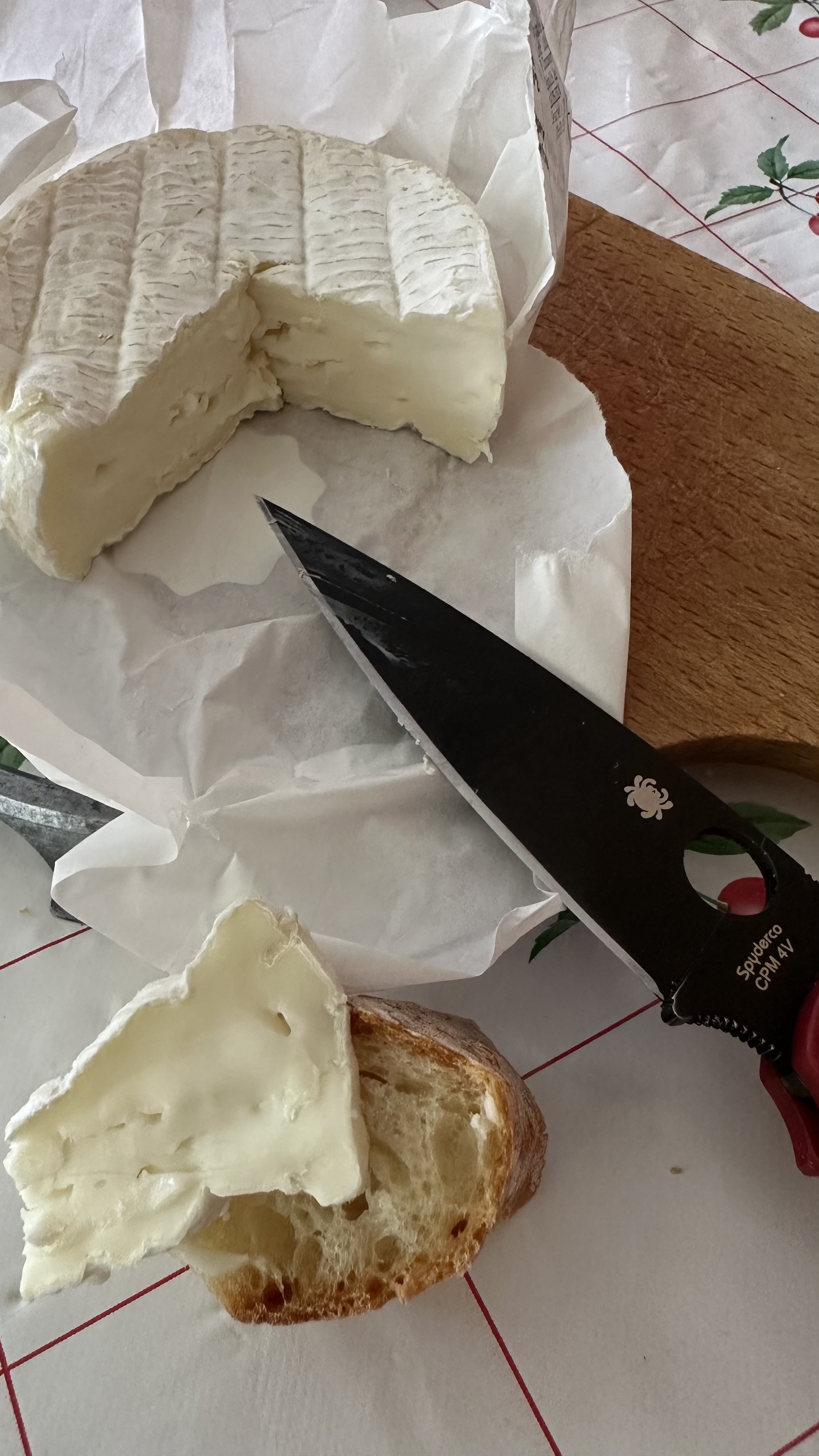
But cheese is a great way to notice how DLC is making the surface of the blade less sticky but more stinky.
The Chief was not always used on gentle medium like wood.
It was also used on plate with vinegar salsa. Here it is basamic vinegar from Modena.
In the kitchen the knife is really behaving like an paring knife. It is really handy on fruits and vegetables. Its very pointy blade is great to carve. .The mechanism has never suffered from being wet and rinsed under water. The knife was smooth through and through its various wet works.
Now I like to have chamfered and smooth handles and blade spine. The Chief is known to be very square everywhere. The G10 has been easy to smooth with sandpaper used wet to avoid toxical dust. Now the blade spine is DLC coated and it was my esthetic choice to remove the coating on all the length of its spine.
I love the result.
It has been done with some diamond rods. Now the spine is much more confortable for my thumb in case of push cuts.
CPM 4V on that Native Chief platform is really the bread and butter for a strong thin folder. I’m not afraid to use hard on wood and plastic. And it is a must in the kitchen various missions. It has been also test on different hard wood and compared (geometry speaking) with many other knives I got. One of my champion is the Swayback in term of smooth pushcuts. But also the Wolfspyder and the Yojimbo.
My Chief needed more convexing and thinning to go to the level I was expecting. Again diamonds has been used handfree to remove the shoulder of the edge. CPM 4V keeps a very very crispy edge and bites in the wood very aggressively.
CPM M4 is a stunning alloy which is prefered on fixed blade but it is a gem on a long and thin folder. It makes it super solid with a very permissive edge.
Some will argue that toughness is not important in folders or fine slicing knives and feel that only edge retention matters in that case because they don’t use their knives in aggressive ways which are likely to lead to chipping. However, broken tips are still common on small knives and kitchen knives. And with higher toughness, the knives are better able to handle thin, low angle edges without chipping. And they can be heat treated to higher hardness to help prevent edge rolling and deformation, while still maintaining good toughness. This means that, indirectly, higher toughness can lead to better cutting performance because of the possibility of thinner edges.
The good news is that CPM Magnacut has been copied on CPM 4V behavior.
When Geoffrey from http://www.normandeep.com has sent to me is Spyderco Amalgam to test and review, he had already reground the shape of the blade from drop point to clip point.
Here is a picture of the original:
Geoffrey made a beautiful work. He was even able to create an almost sharp false edge. I understood his project and also the distance of what I loved in a folding knife. I rather use a tool than a weapon and his Bowie Amalgam was really tilting the balance toward the weapon side of that knife.
First thing first. The Brian Lai’s brainchild is a knife which can be flipped and is equipped with a compression lock. It can also be open with its generous spyderhole with a push of the middle finger or the thumb. It is a fidgeting configuration after you have found a way to avoid the flipper’s return through the lock. You need, like on the Shaman, to get your index finger out of the way when closing the knife. The action is smooth thanks to ball bearings equipped pivot and the knife is light and well balanced.
Once open it is really a knife which get a very confortable grip. The flipper once deployed is half hidden in the lower quillon, and the blade could not close on your fingers. There is zero play. It feels very solid, very tactical hence the beautiful bowie blade Geoffrey wanted to grind from the massive utility drop point blade.
Since he wanted to sell it. We have made an exchange (he will get my Siren, as he is a diver and own a diver’s shop near the D-Day beaches in Normandy) and I will finish the customization to my liking.
The first thing I have noticed is how thick the blade was to my liking. So, I have “unshouldered” its edge and decided for an aggressive convexing.
As you can notice, there is nothing fancy in my equipment. A Double Stuff 2, an Fallkniven DC4 and some lansky bali diamonds. Also some sandpaper and my old leather belt.
Some compound for erasing all the scratches I have made and polishing it all.
The first test on my wallnut rod were stellar. The Amalgam is now able to shave and also able to cut deep. The large finger choil/ricasso is great to choke up the blade.
Also I have decided to mount a deep carry pocket clip. A black one for a low profile.
One of my goal has been also to round completely the false edge Geoffrey has painfully created as I use the spine of my blade’s knife to push with the thumb of my left hand. Now it is rounded like a Sebenza’s spine which was the first design to introduce me to that confort.
So here we are, ready to test the Amalgam. The Amalgame is on ! Stay tune for another post.
Here it is, the new Marcin Slysz designed Spydie some have been dreaming for almost 10 years. Inspired by 19th Century pocket knives design this is another grand child of the Mighty Sebenza with a Reeve Integral Lock and many other details which relie on Reeve’s legacy of making high quality folding workhorses. (BTW big kuddos to the Coutellerie Tourangelle which has been able to send it during vacation’s period in 3 days.) You will see, it is more a Sebenza’ heir that I thought.
Let’s read the description:
“Inspired by 19th century English Jack knives, the sway back pattern is a stylish and extremely functional cutting tool. In his latest Spyderco collaboration, renowned Polish knifemaker Marcin Slysz supercharges this classic design by rendering it with state-of-the-art materials and craftsmanship. The SwayBack’s hollow-ground Wharncliffe blade is crafted from CTS® XHP stainless steel and has a handsome stonewashed finish. It is housed in an open-backed handle constructed with solid titanium scales. Both scales are beautifully crowned for comfort and the reverse-side scale forms the foundation of a sturdy Reeve Integral Lock (R.I.L.) with a stainless steel interface. A polished stainless steel clip provides convenient carry and is reversible for left or right-side tip-up access.“ OK… Polished stainless steel on a Polish expensive knife… tss.. tss… Now the specs: Overall Length 204mm Blade Length 90mm Steel CTS XHP Closed Length 115mm Edge Length 84mm Weight 111g Blade Thickness 3.5mm
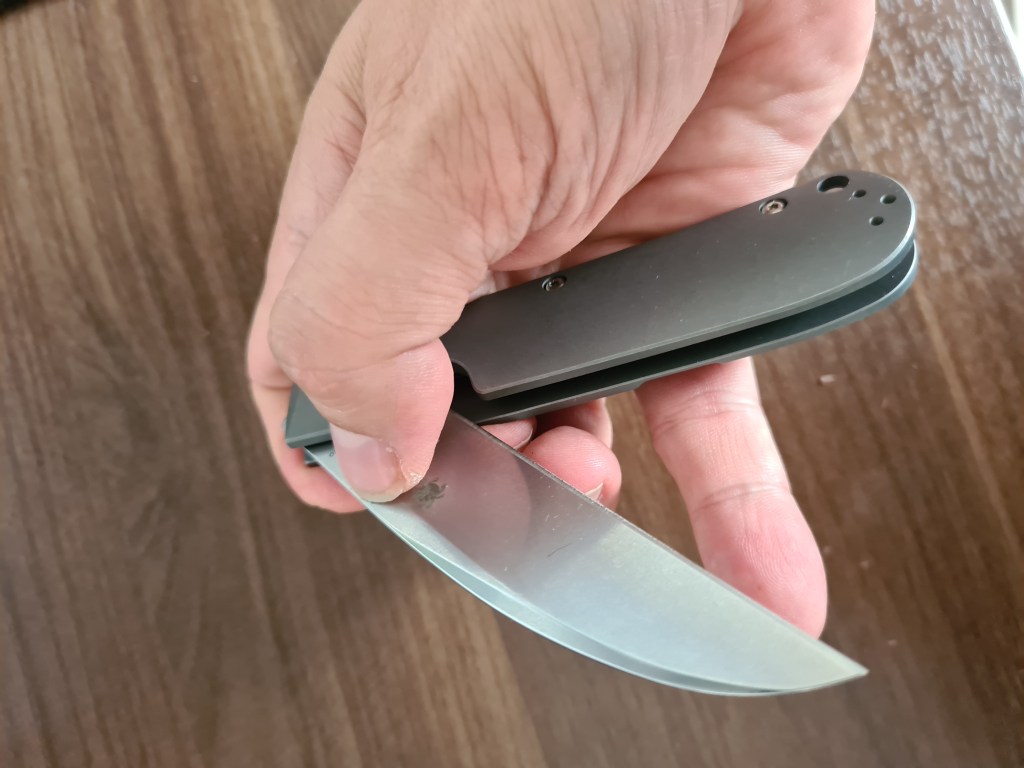
When I have receive the knife I was chocked. Chocked by a simple fact: I could not open that damn folder with one hand ! It was like glued !! Two hands I could. One hand -> impossible. Glued. Again: IMPOSSIBLE. And again. And again. The hole is not sharp, he got a light bevel and my thumb cannot catch it.
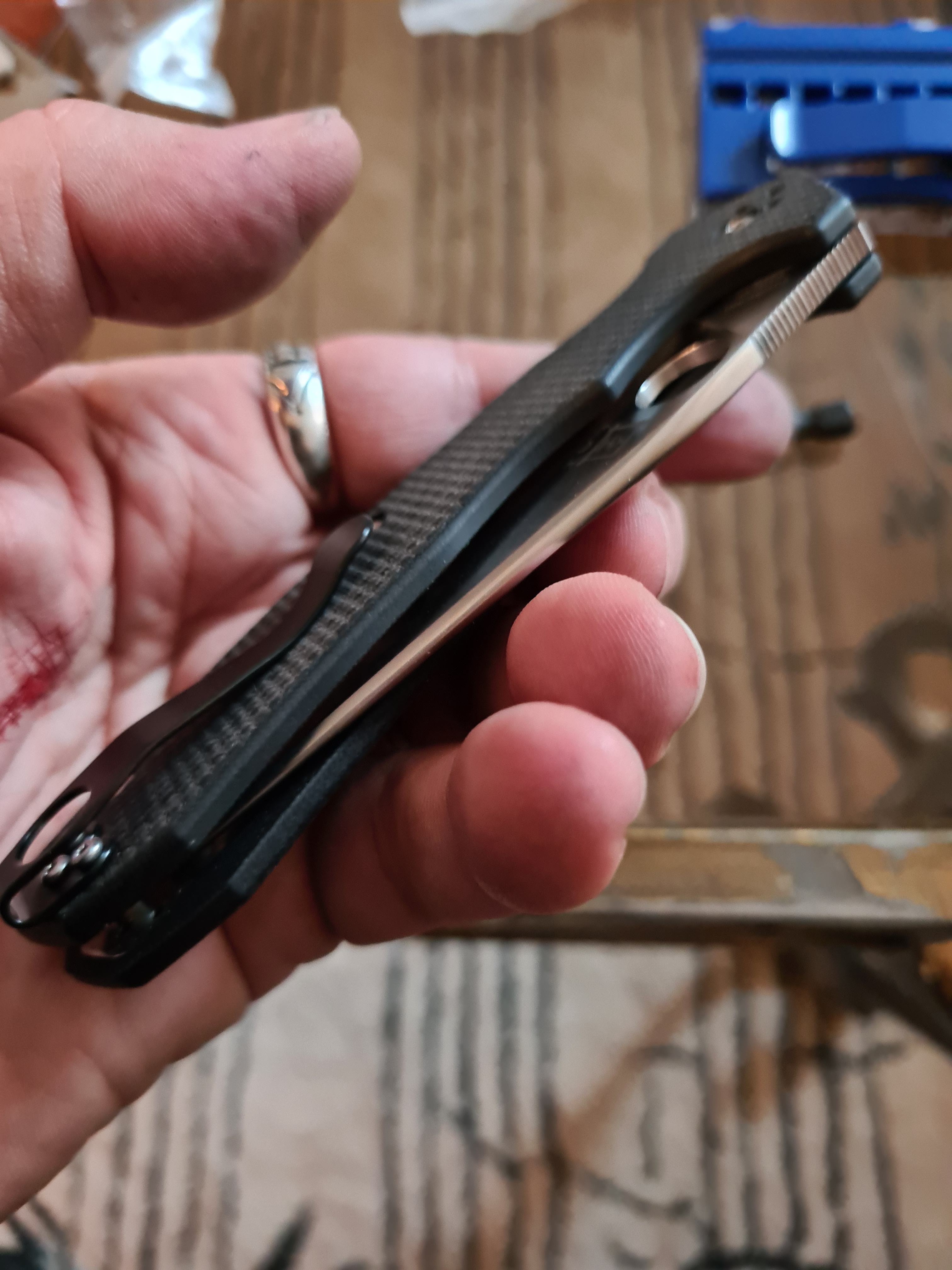
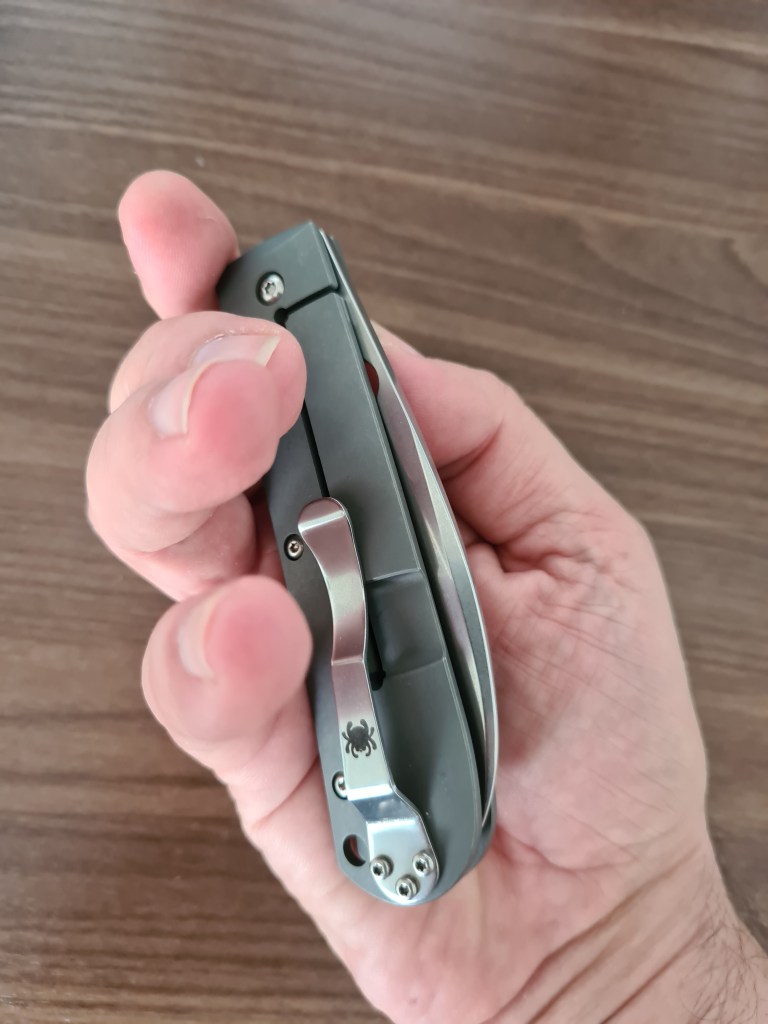
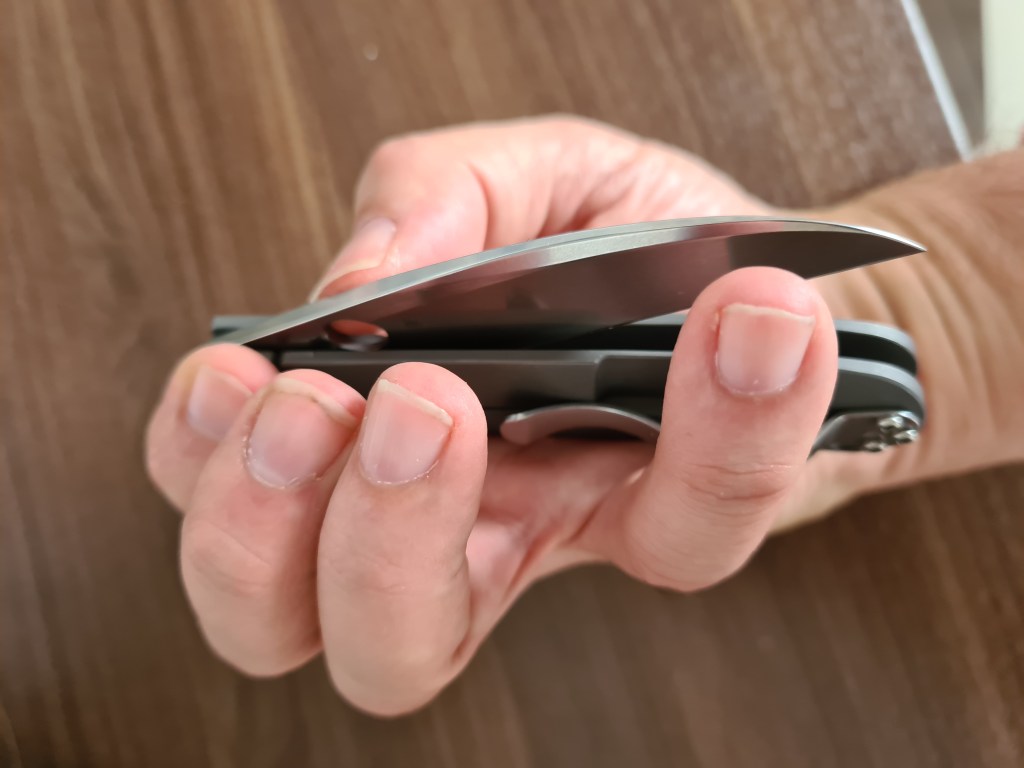
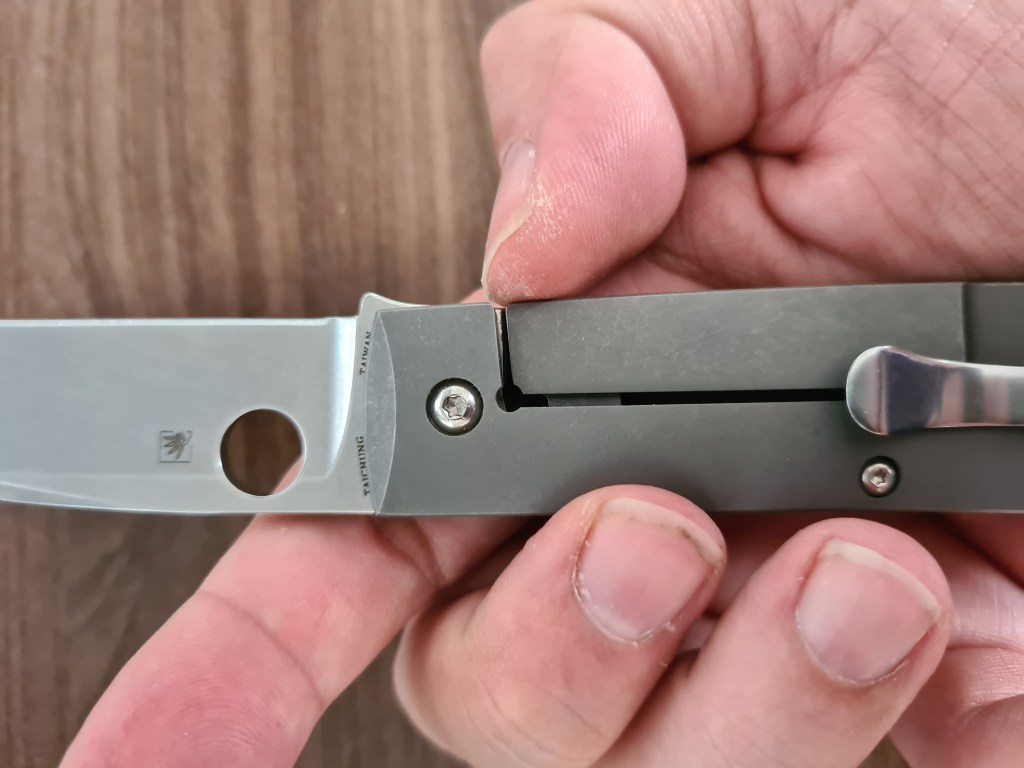
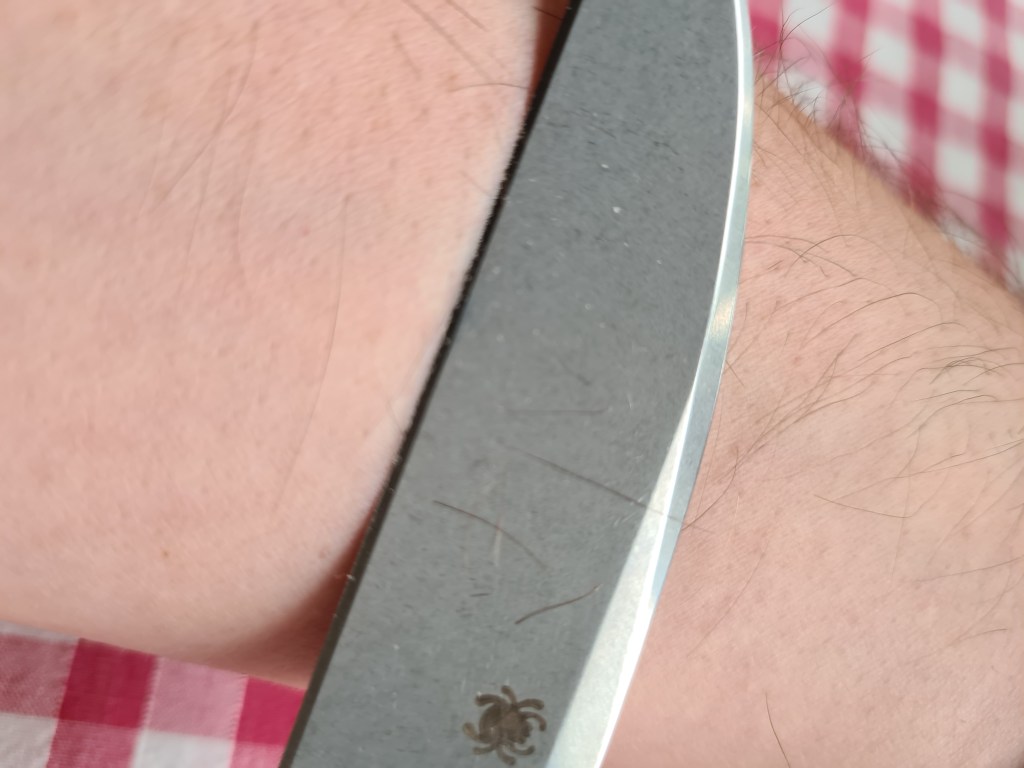
In fact, as seen on the 3rd picture, the lock bar is wide, the hole is deep in the handle, so instinctively my other fingers push the bar and augment the detent strength -> you can not open it. On the second picture you can notice my middle finger pushing the handle’s bar of the the frame lock. So I was the source of my problem. Not the knife. It is just a matter of NOT touching the lock bar when opening the damn thing ! Also it is also important to push at 90° from the handle, like Chris Reeve was advising 20 years ago about his Sebenza. You see ? It is really a Sebbie grand child. 🙂 With the Spyderco Ikushi, this is my second tricky Spyderco. Eventually I gave up on the Ikushi. The Swayback is more on a learn curve and finding new muscle motors way.
As you can notice, it ask a little gymnastical way: holding the knife by the pivot and the clip. But it is learnt quick. I really thought it is the answer of Marcin to all that fidget fashion. For example the Para3 is so easy to open and close it is almost a game for some people. Click open. Clack closed. But here, the Swayback tells you “I am a very serious knife ! Not a toy.” Like Chris Reeve said: “Think twice, cut once”. You open it with a certain joy and he closes just by gravity. It is ‘that’ good.
Perhaps this is also a way to force you to use two hands to opening it. It is a polite way to open your knife in public. Also it prevents children or other people to open the knife without your permission. In this case it is great ! 🙂 I also found a way to open it in reverse grip with my ring finger. It is also a very polite way to open a folder as the point is turned toward yourself. Also the reverse grip is really made for that knife.
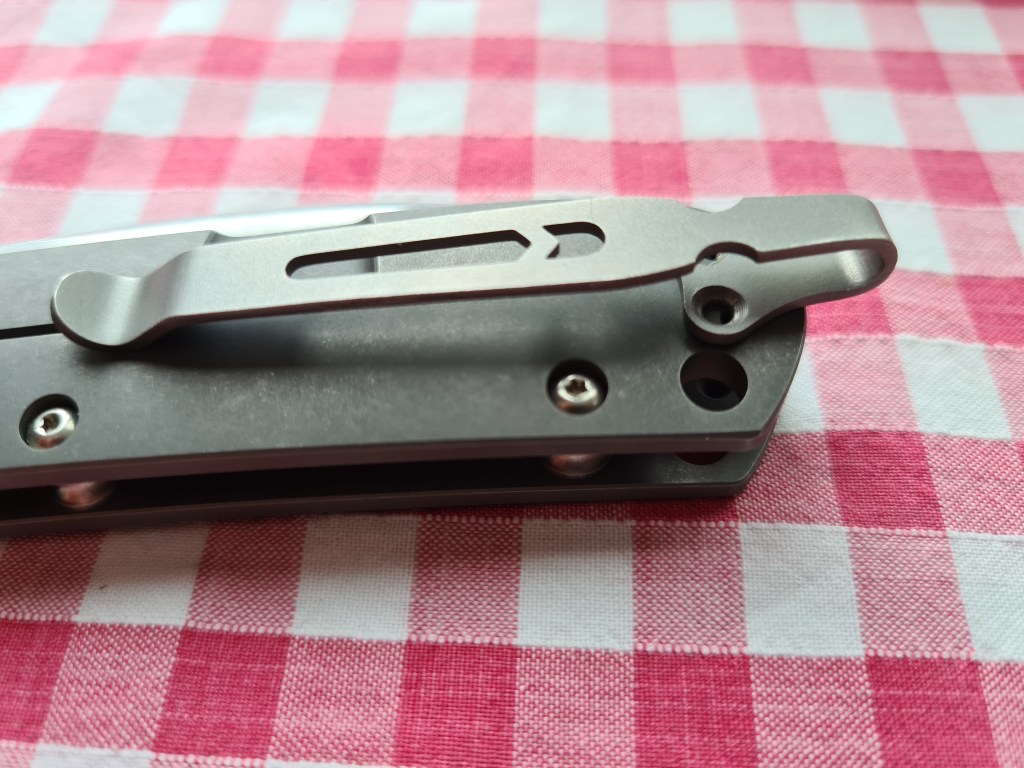
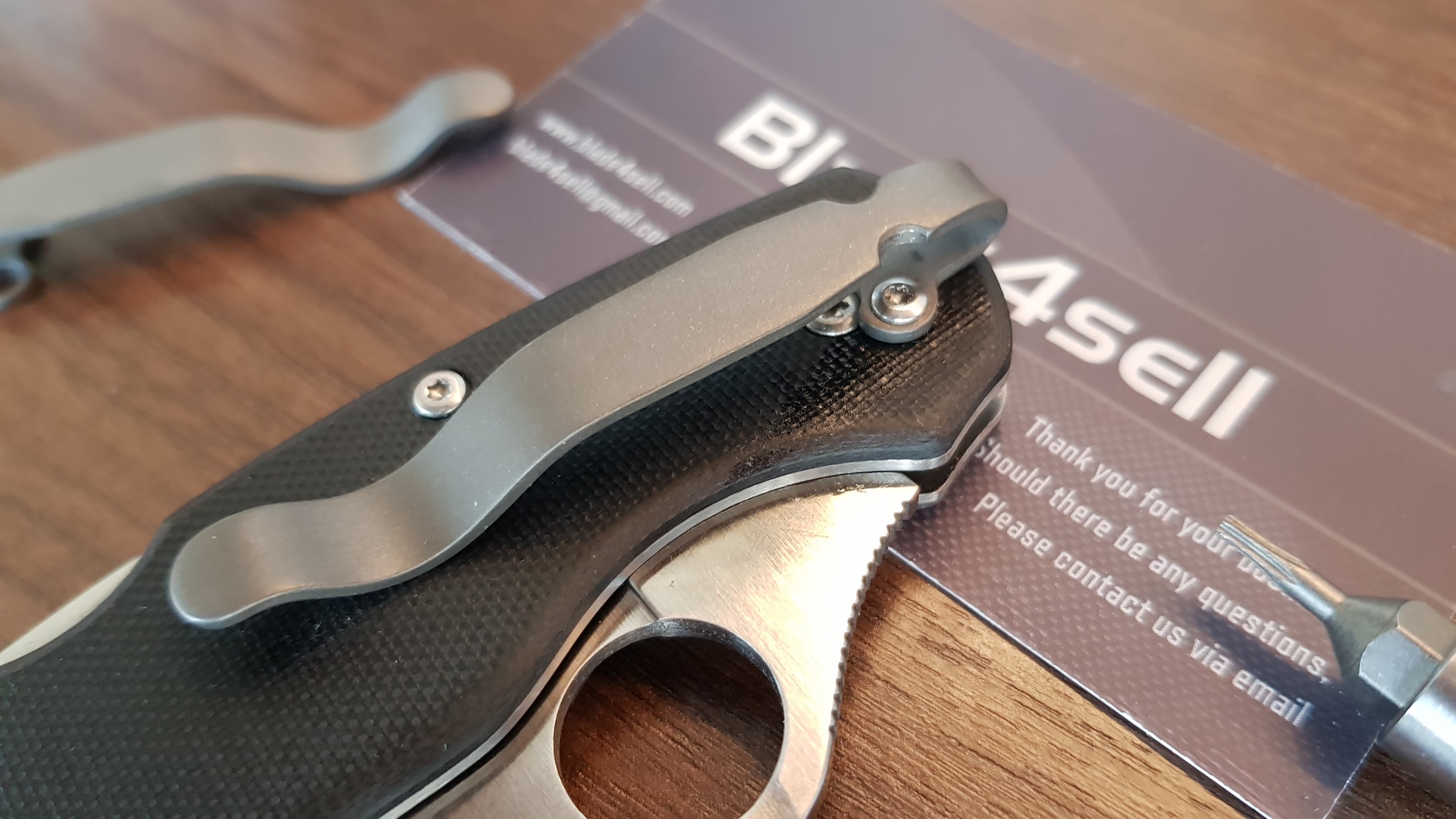
Now the other point of disappointment is the stainless steel clip.
It is high and really not in the style of all the previous Spyderco Slycz which were wired like you can see it on my picture of the Swayback next to the Spydiechef.
I got some titanium clips in spare so let see… which one could fit.
They are all as high as the OEM Spyderco but I do not wanted the deep carry titanium clip to stand over the handle edge. Also I wanted it to match the handle better.
Too long….
Too shiny…
Perfect.
So let’s make some pictures:
You can notice how wide the bar lock is on the Swayback compared to the Spydiechef.
So now the edge is very thin on this knife. It is an hollow ground blade like the Sebbie. My 1997 ATS34 is still in a great shape.
Let’s try the edge….
The factory edge is impressive. Just a few pass on leather and it get to real razor. CTX XHP fine grain is known for that behavior. I have used it on tomatoes and it passed the test with the famous flying colours.
It is a relatively big folder with great ergos. I appreciate the hidden “choil” or hidden guard and the sway back fits the meat of my palm perfectly. No hot spot there, even with the old or new clip.
The plastic coke bottle’s butt has been perfectly passed. It is really amazing.
The edge/handle ratio is also great. It is really a tool which screams to be used and looking forward to use it on wood for whittling. There is plenty of space for my thumb to push on the spine. The Swayback is also an exquisite work of love by Taichung plant. Many details are hidden like the double pins screw inside the blade around the pivot. They works as stop pin with bevel inside the slabs. Nick Shabbaz has made a nice video about it. Taichung rocks really.
So here we got a very elegant folder with a lot of very thin edge. I told you it is very CRK in his blood. The clip provided is OK but it is a matter of preference to find another one. Once you have learned to put your index high on the handle, near the pivot, the opening is flawless.
It is very very sharp and the straight edge us generous in length and geometry. I’m looking forward using it and it will the in another article.
And now you can proudly say: “THIS IS THE SWAY !!” 😉
My former colleague and now friend Pascal is a new blacksmith; he makes folders and also fixed blades in the Picardie region near by the Paris area. I recently purchased one of his early makes that has become my “EDOT” (“Every Day On Table”).
The overall size of the knife is 17.5 cm. The length of the blade is 7.7 cm long and 2.2 cm wide with a small boister and a spine a bit over 2 mm. This is a full flat ground blade made from D2 steel with a belly; the profile looks to be a mix between wharncliffe and sheepfoot. The handle is made of Zircote (a tree of Central America having brown wood streaked with dark almost black lines – thanks Meriam Webster) with indentations for the fingers. The rivets are discrete and the scales perfectly joint with the tang; it’s a full tang.
I really like the caper shape which if we were to simulate the curve would be at minimum a 3rd degree polynomial function with an inflection point: the caper! Goto https://www.mathe-fa.de/fr#result, enter f(x)= (x/10)^3 and g(x) = (x/10)^3+2 and you will have a good idea of the knife’s overall wave! For me the size is right and the handle’s organic design fits well in my hand. Said otherwise and in a much simpler way: “ça tient dans la main, ça tient dans la main!” (Coluche)
… and the blade’s curve (belly) enables to concentrate the force in one point for increased efficiency. The hardest I cut with it has been very dry saucisson and the result was great enabling energy optimization and transfer between the forearm muscle and the masseter muscle!
So I am very satisfied with my capper born in Picardie and do recommend “Les Lames du Phenix”! https://www.lamesduphenix.fr/
“The original Police model was a response to a request from Police for a Mariner with a point. I saw that as an opportunity to create a new design that was closer to what I personally liked. I thought to call it “LaSalle”, but in the end, i pushed the ego out and called it the Police model. As the design evolved, details changed and from those changes I was able to see what I didn’t like and went from there. As you said, it was decades in the development.”
Sal Glesser
I remember one of the very first advertising of the Clip It collection of Spyderco. The Police was presented in its stainless handle serrated edge version of that time (80’s…) and it was written something like: “Pure Performance” … The cheetah is a good example of incredible fast and lean animal and as this knife, it is thin and light and totally performance oriented.
The venerable Police model designed by Sal Glesser is at its 4th version. Born in the early 80’s it is now part of Spyderco’s Legendary knives. I remember seeing some models with “Pride Integrity and Guts” engraved on their blade: they were the very first. This knife can be spotted in so many Hollywood movies, mostly in the hands of bad guys and even in the excellent classical Spike Jonze’s musical video for the Beastie Boys: Sabotage ! The stainless serrated hollow ground blade was really catching the lights hence it’s success for a dramatic entry in various films !
I was never a real fan of the first 3 versions of the Police models even if I recognized it has a valuable tool. In my book, the Tantaka was the true heir of those years. The fourth version caught my eye as it was promoting a new steel the KC390.
Many times I had noticed some vertical play on “Made In Japan” folders from Spyderco and decided to buy one if only I could test it before.
But this one came from a Massdrop sale and I was very happy to get one with zero blade play in any direction. Mine feels solid and knowing how strong a good backlock is, this flat long folder is really impressive. So it was about time to review this venerable classic folder which is delivered with a plain edge only and K390 … but why choosing a “staining “steel high performance steel when the Police as always been serrated and stainless ?
“We make quite a few designs for the Law Enforcement market at this time, so the design for Police use is (not?) necessarily the case anymore, like it was in 1984. I designed the Police 4 to include what I would like in a knife, more than what a LEO might like. It’s still a kissing cousin, and large for most people. I widened the blade, enlarged the hole and selected a steel that I like to use. The design’s success in the marketplace is unknown at this time. But I get to have one. ” Sal Glesser on Spyderco Forums in 2016.
Also the blade is perfectly centered. The construction is the same as my Endura and Delica, sandwiching the steel liners with the handle material. Here it’s black G10 on skeletonized liners: the knife doesn’t feel heavy at all but very well balanced and fast in the hands.
The long flat blade is still intimidating while deployed. Let’s see some comparaison pictures. Notice the black could of forming patina in the middle.
Here with Ed Schempp’s Bowie which is one of the best blade/handle ratio folder in the Spyderco collection, full flat ground versus high saber flat ground. The Bowie has been convexed to my taste. The large choil on the police is confortable though.
Here compared to the wonderful Manly Peak, another thin backlock lightsaber. The Manly has not been really convexed; it is really thin ground ! With its S90V blade, better edge/handle ratio and zero blade play construction, it is a real contender to the fourth version of the Police.
They share the same thin stock blade. The Manly (on the right) is even pushing the envelop a little further by proposing hidden nested liners for the same handle thickness.
It is obvious the Delica and the Police are sharing the same DNA even if the Delica main difference is the absence of real choil to choke up the blade. I have both in tip down carry position for easy spyderdrops opening. Here is the Knifecenter special edition of the Delica.
The Delica still got the Boy indentation on the lock when the Police is now leaner. This raffinement has never made a real difference to me. The spring on the Police model is quite strong actually so no worry about unlocking it will chocking the handle.
Here you can notice how longer the Millie handle is compared to the Police. Also the belly of the Millie is much more pronounced. I think now the Police 4 has been also designed to be used while wearing gloves (one of the Military plusses). Both finger holes are equally wide with a very pronounced blade’s hump. The Police’s choil is even wider than the Millie’s !
Also the Military blade is thicker as is its handle. The Police is perhaps more “urban” oriented: it is a large folder easy to wear with any suits.
Here you can admire how the Police is a steel cheetah: lean and mean. The clip was mounted that way and I was tempted to add a deep carry clip but eventually, the spyderdrop is the more handy way to open that large folder so the clip is now mounted near the pivot.
This thin blade enhanced by a great steel (K390) is pushing that venerable model to new heights. We are far from the serrated hollow ground model of the 80’s which was respecting special requirements from the LEO. “It was designed to have an as large as possible blade built into a thin, equally sized handle. Because of this, Save and Serve professionals continue buying the Police Model as an essential tool for their trade.” From Spydiwiki.
It is a flat and elegant design with a very clever purpose: to insert easily the knife inside the pocket when tip down carried.
Some sanding was required to get the handle even smoother for easier pocketing.
Aerodynamism is one thing, pocketodynamism is another.
Again, never breath that dust it is toxic for your lungs.
“”The benefits of G-10 as a handle material are many. It can support a building, be drilled and sawed. It’s doesn’t retain heat or cold, shuns chemicals, discoloration and peeling. “
And that makes it long folder which can easily be pocketed. Carried tip down, the handle shape pushes my wallet away when inserted and allow very quick and positive spyderdrop openings. They are four positions to mount the clip on the Police since the 3rd version in 2008.
Next step, with some diamonds, it was time to reprofile the blade to a Manly Peak level and to thin the edge by “deshouldering”. Not an easy task as K390 is a bear to sharpen.
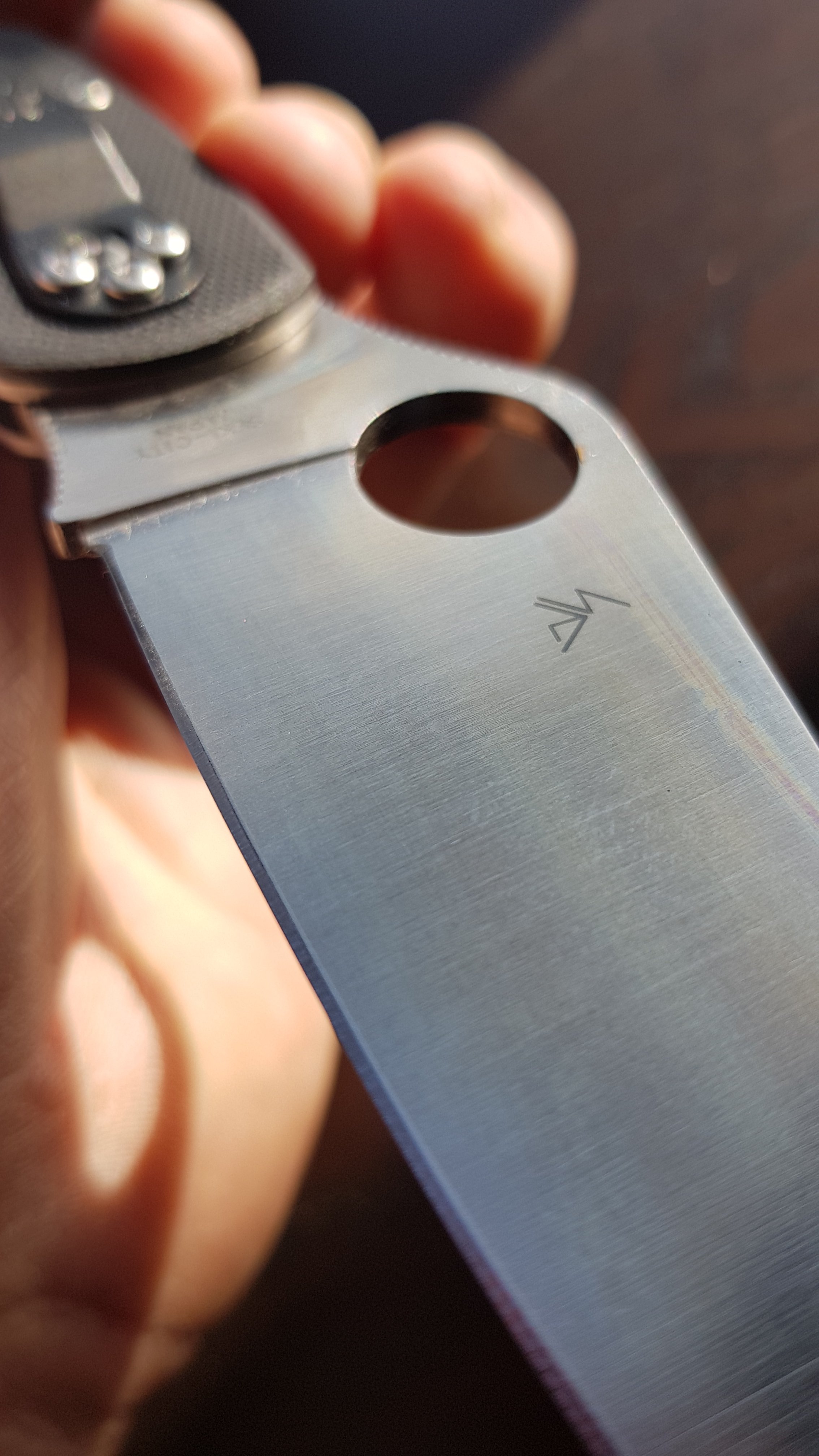
The occasion to picture the blade before to scratch it.
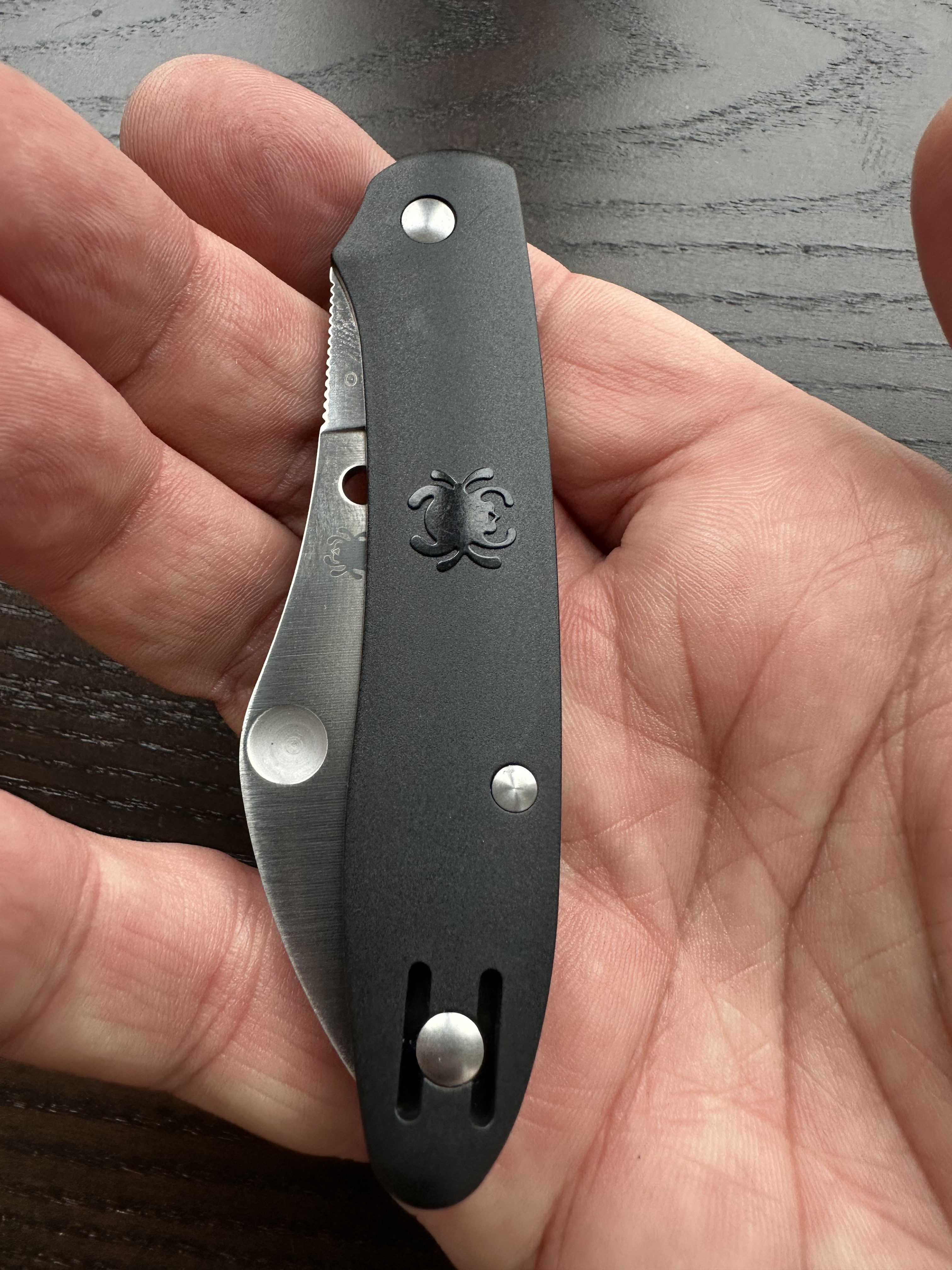
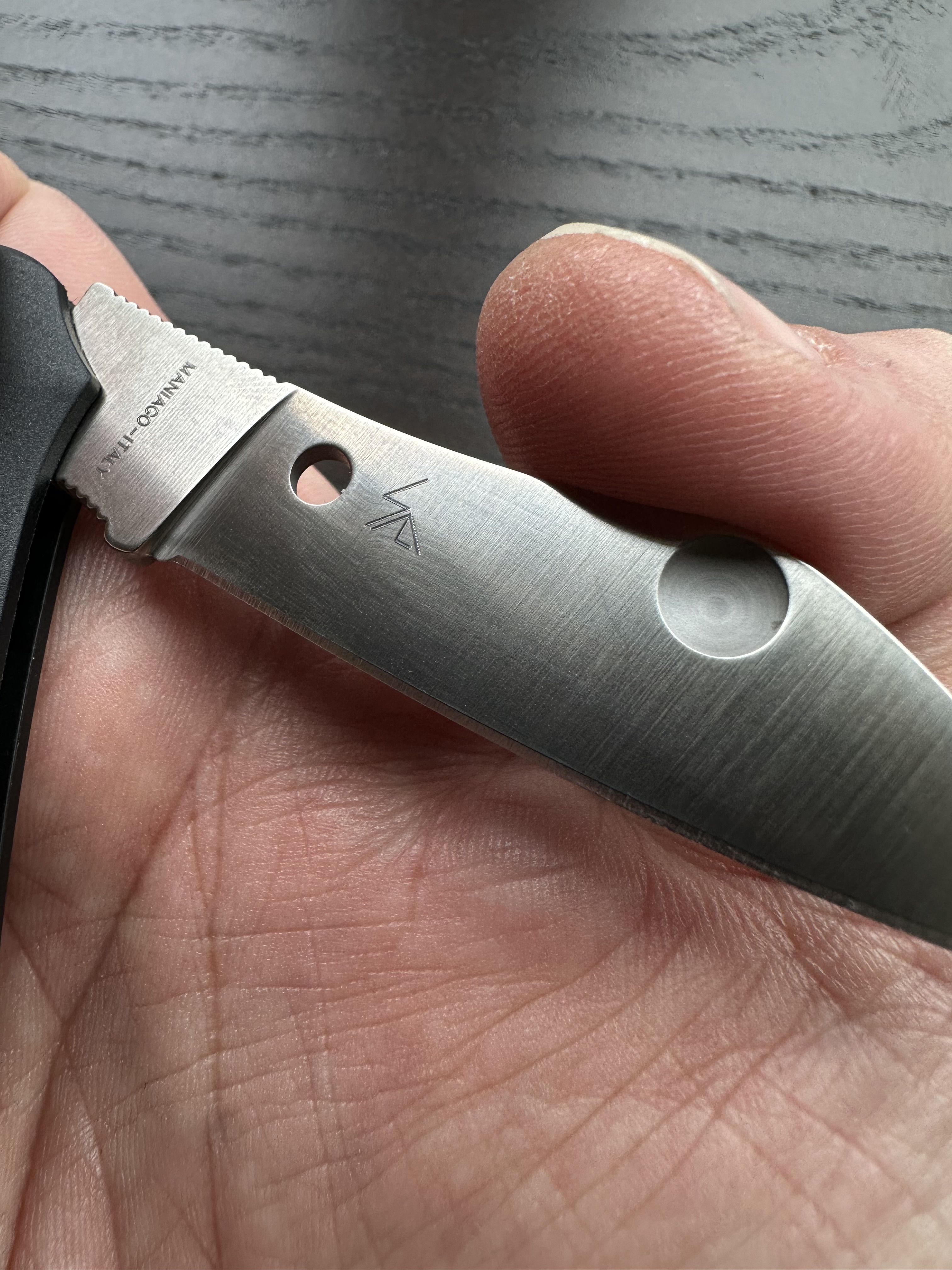
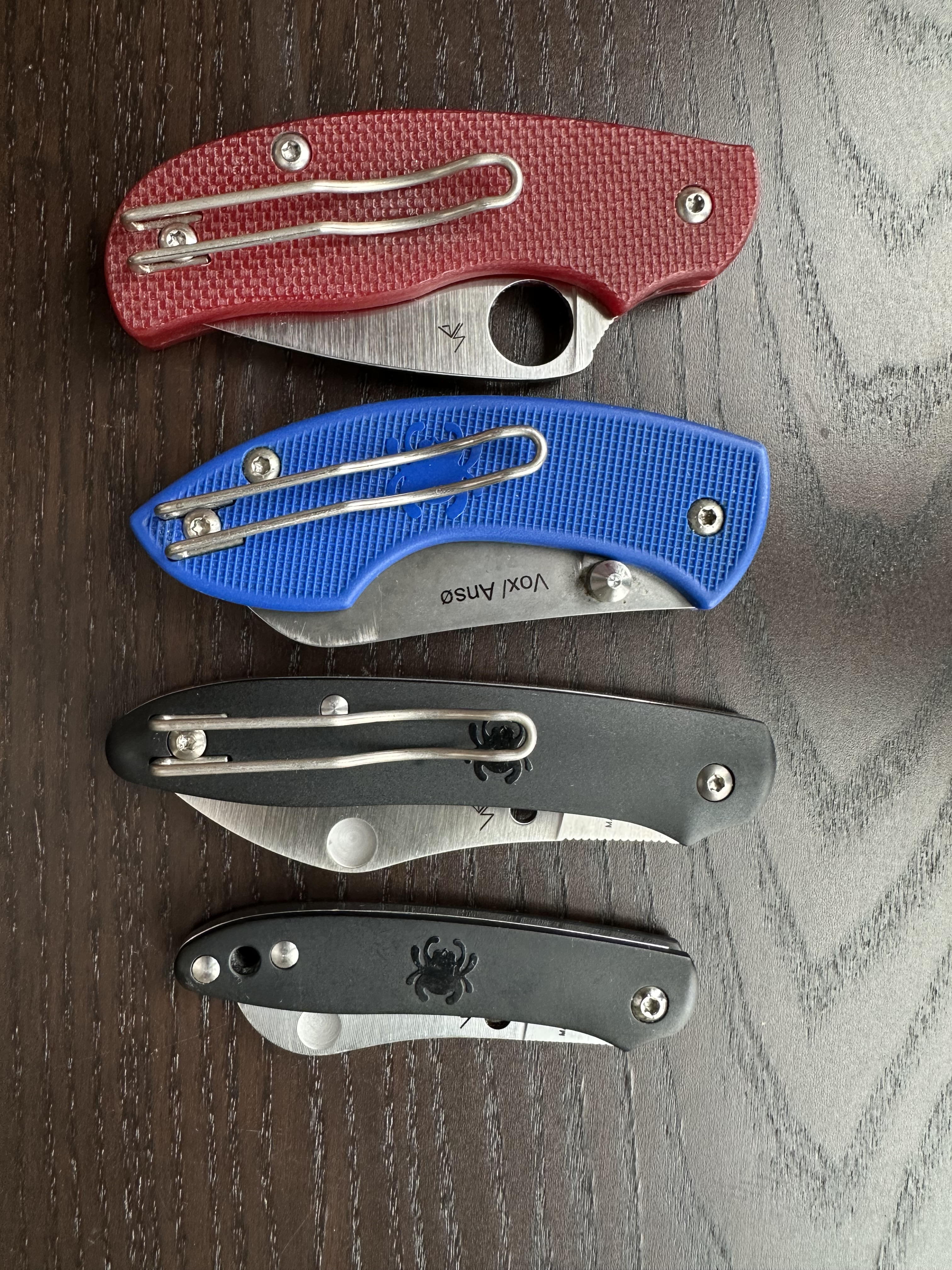
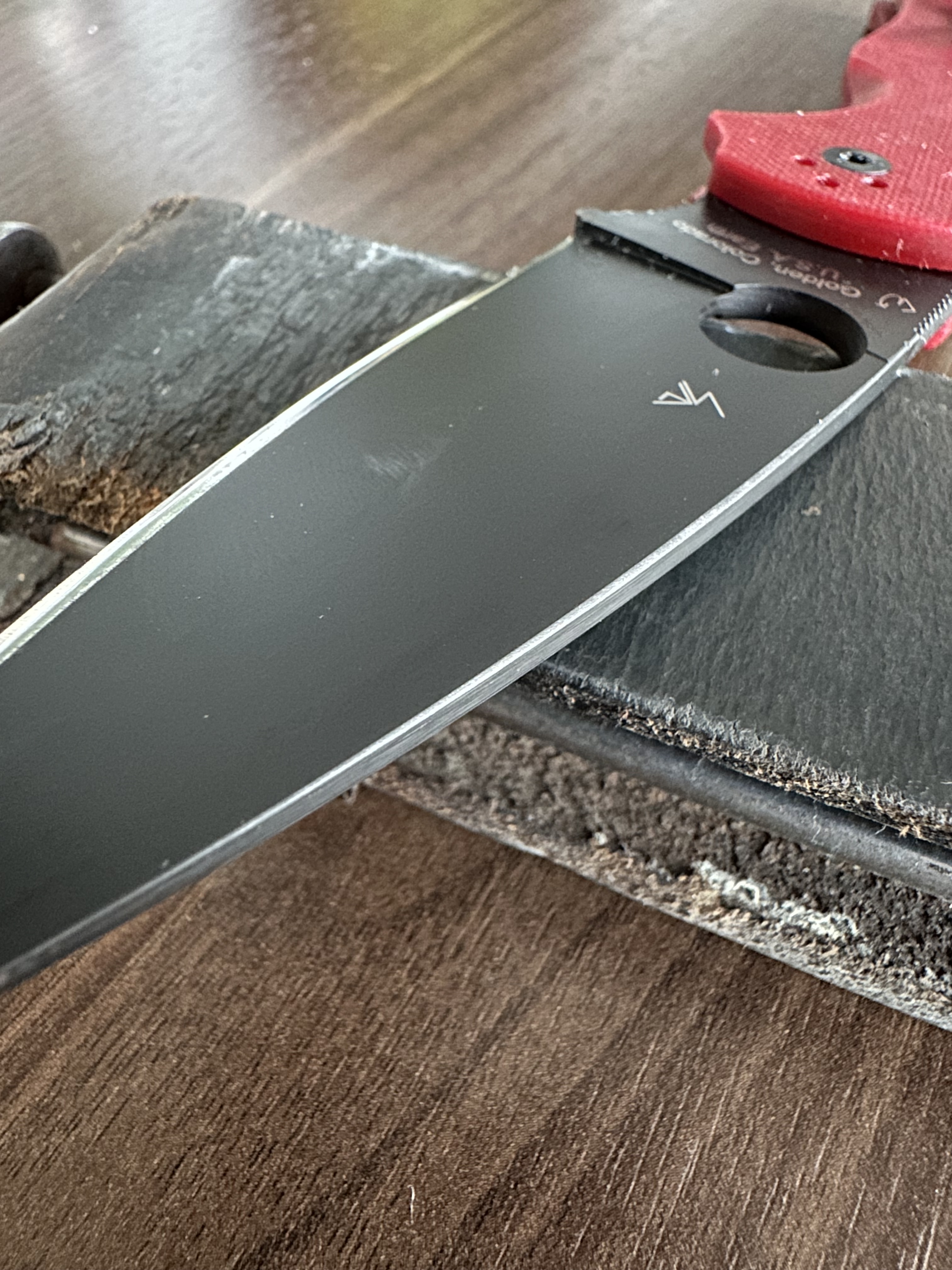
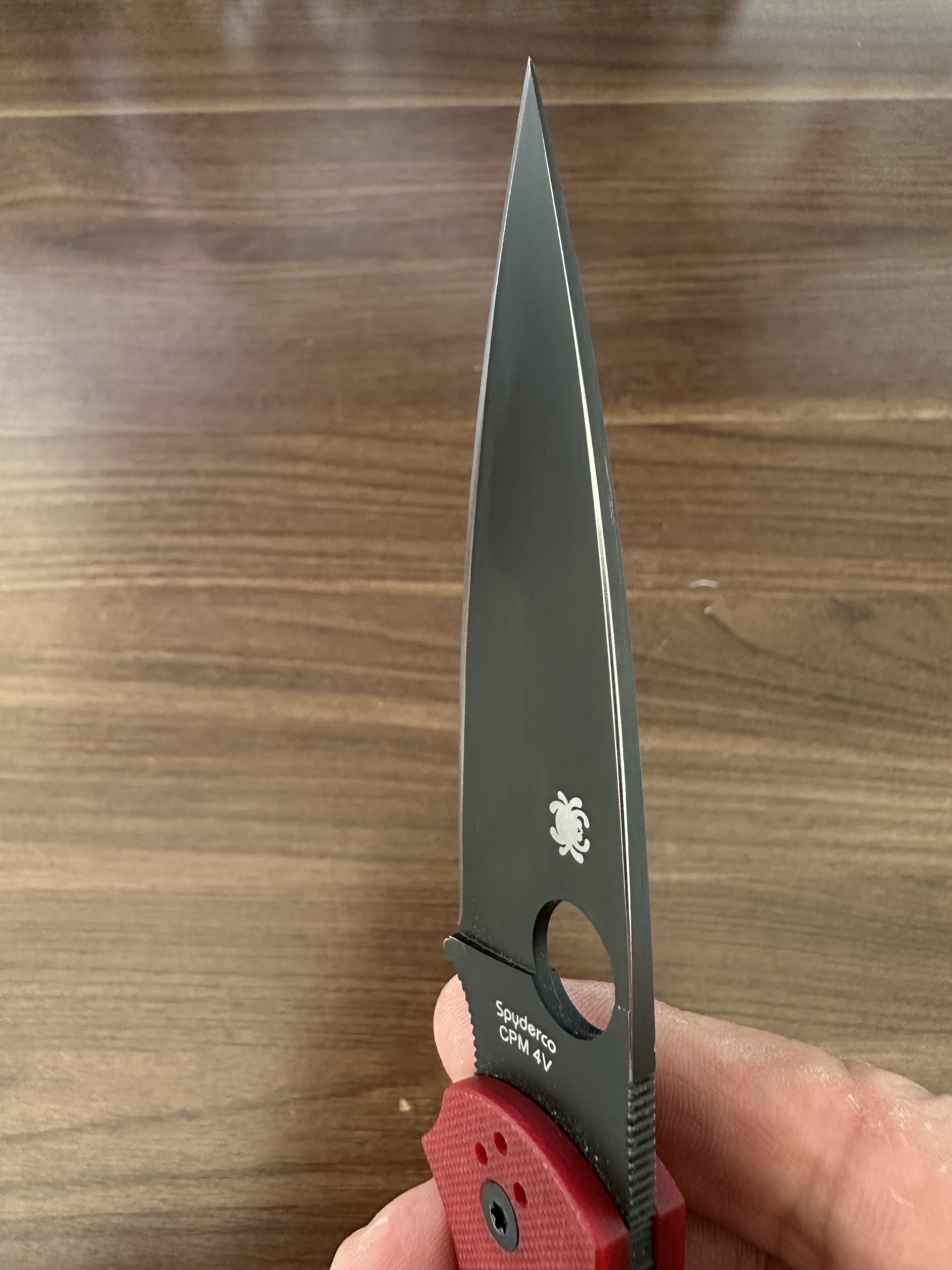
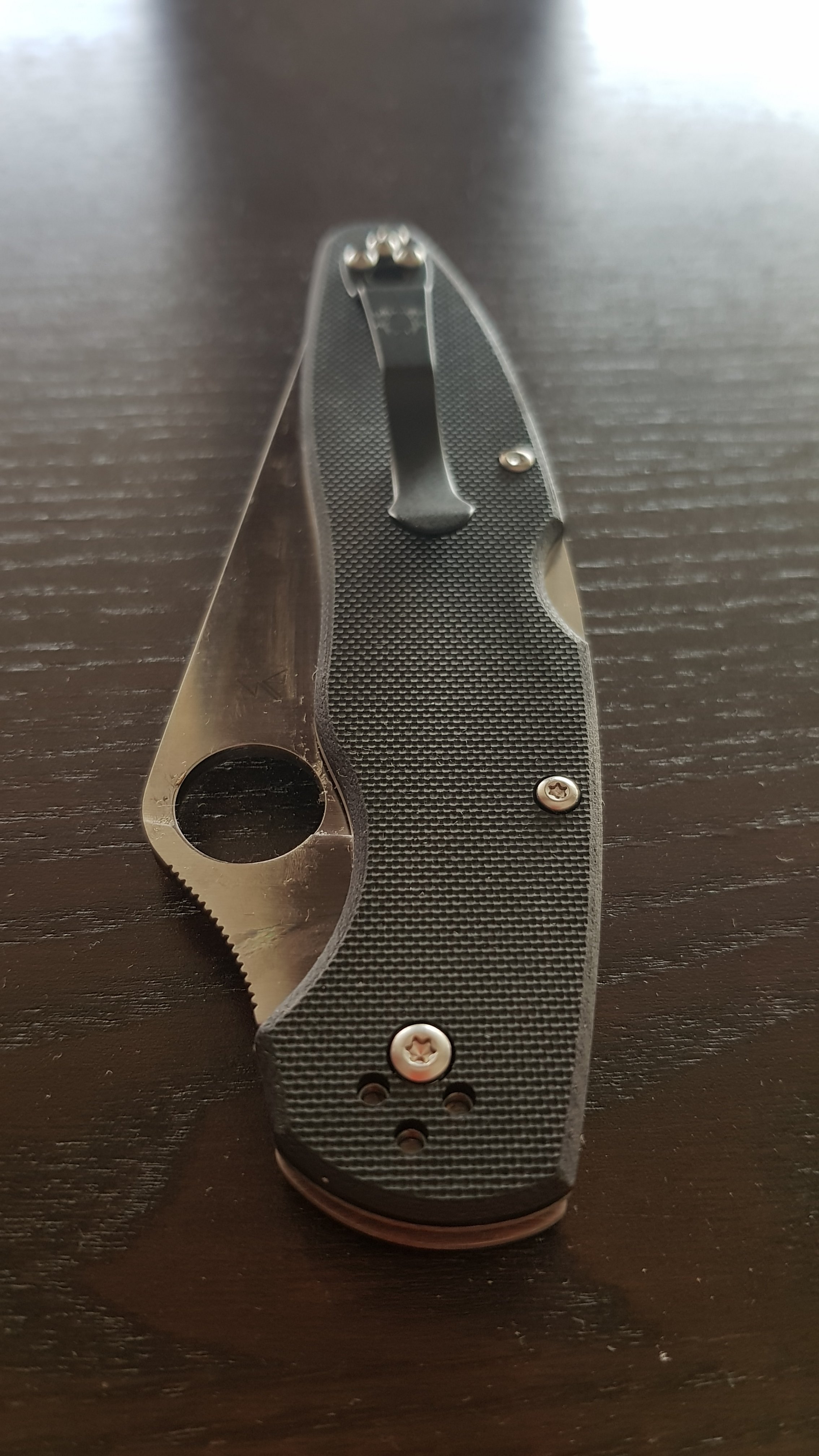
The light reflections on the blade shows it has already started a mild patina while being stored.
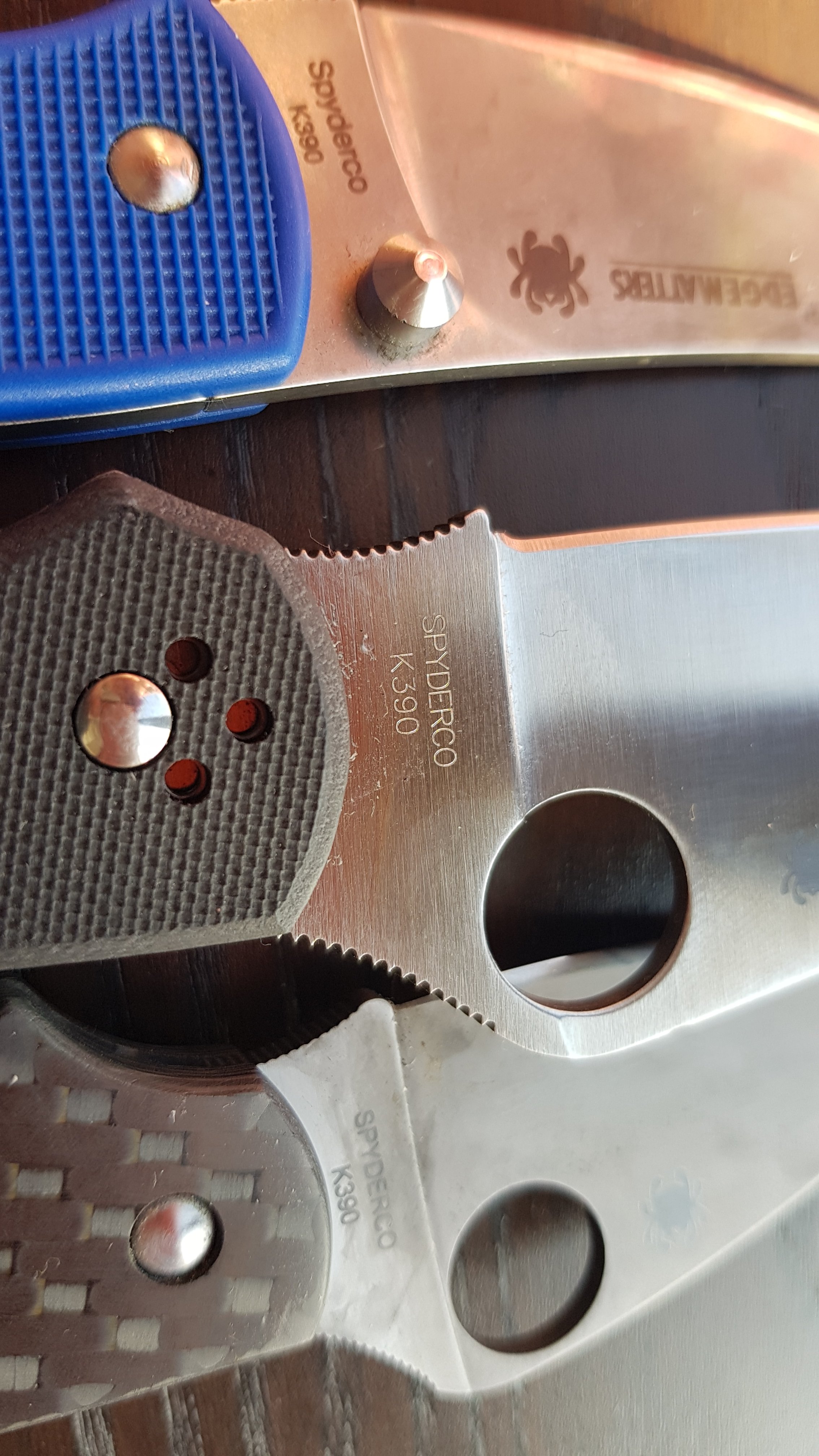
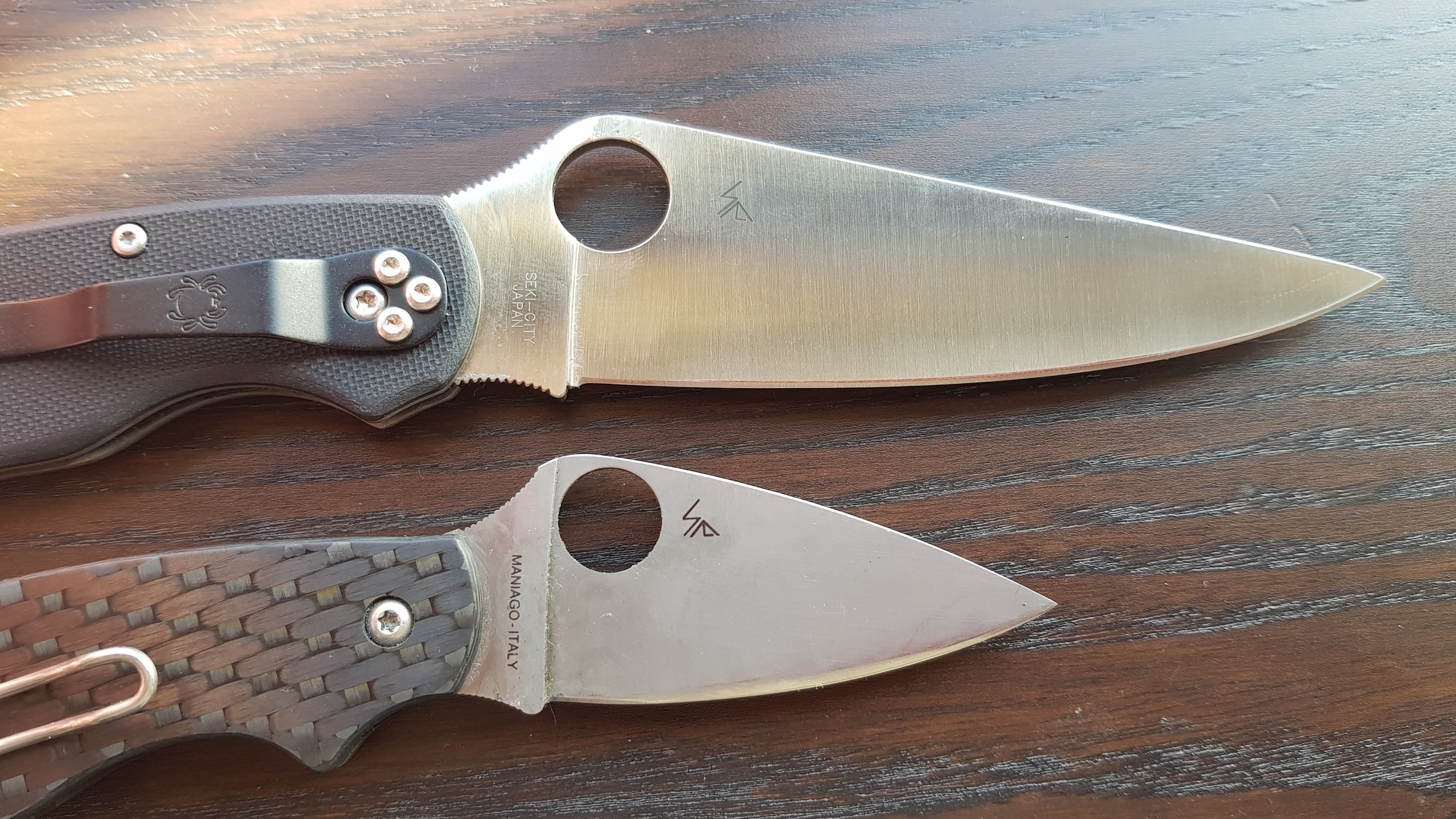
K390 develops naturally a beautiful patina like storm clouds. Here is the Police with my Pingo and Urban.
Funny how it is hard to catch on photography but the Urban got the convexed grind I want to achieve for the Police. Both knives are signed by Sal Glesser’s logo.
I have check how the patina was easy to remove before going back to sharpening.
Here you can see the dust formed by the diamonds of a DC4.
K390 is a very wear resistant steel…
Here what Phil Wilson said about it in the Spyderco Forums: “I have been using K390 from the start ever since it was introduced by Bohler and I got some small samples to try. A bit of history is that it is the European version of CPM 10V but not the exact chemistry (about 1% less V plus small addition of a few others). That is because the CPM 10V chemistry was protected by patent at the time. If you check the K390 data sheet it claims that the bit less V gives K 390 a little boost in impact toughness. It also can be heat treated at a lower temp. than 10v. So it is pretty much the same as the A11 grade but different in a few small details. It is hard to tell the difference between CPM 10v and BU K390 in the real world in my experience. I like both grades and they are the base line (along with Vanadius 10 and K294) from which I measure wear resistance. The 5 chrome is there to make them all air hardening among other things and does not contribute much to corrosion resistance. It is going to make a killer knife in the new offering and be another classic. Phil”
So slowly it is deshouldered but I will be obliged to go back to the blade later. It is, for me, like painting a ceiling… I always come back for another layer… 😉
All right, the performance are already promising. The plastic Bottle Butt is as thick as the blade itself but it has been able to got through it right in the middle. Again, zero blade play on that huge folder: very happy. Same punition for the bottle neck. The Police shows how powerful it is and that the recipe of “thin blade + super steel” is always a winner for high performance knives. More to come, as this one is going to be user !
It has been half a year of patience before my pre order turns into a mail call. Howard Korn from the Knifecenter.com was kind enough to send it to me as soon as he has received it. It was a quick 6 days of travelling from Fredericksburgh, Virginia to Paris.
The name of this Para3 should be”Desire” but it will be “Mouser” in honor of its color: grey. Also in honor of its almost magical alloy used: Maxamet.
What is Maxamet ?
According to Spyderco its full name is “Carpenter® steel’s Micro-Melt® Maxamet® alloy”. “Maxamet is an extremely hard high-speed powdered tool steel possessing properties that transcend conventional high-speed tool steels and approach those of cemented carbides – the ultra-hard materials used to machine other steels. When Carpenter developed this amazing alloy for the rollers in their steel mills, they sent samples to various companies in the knife industry to evaluate as a blade material. Although many tried, Spyderco was one of only a handful of companies to successfully develop the specialized methods necessary to machine, heat treat, and grind this demanding material to yield reliable, high-performance knife blades.”
It so difficult to work with that it has given some headaches to Eric and Sal hence the 6 months late in the production of that Para 3.
Maxamet should have better performance than CPM110V. Now that I got both steel, I will try to see if I feel and see a difference.
What its composition reveals ? Carbon 2,15% ; sulfure : 0.070% – 0,23%; chromium : 4,75% ; vanadium 6,00% ; manganese 0,30% ; silicium 0,25% ; cobalt : 10,00% ; tungsten 13,00%.
It’s not a stainless steel it’s an high tech tungsten alloy !!
The wear resistance of Micro-Melt Maxamet alloy is better than that of conventional powder metal high speed steel grades and is equivalent to AISI A11 cold work powder metal tool steel. A11 is CPM 10V. Better? How much better ?
According to Cliff Stamps: “Maxamet is an extreme alloy, for comparison, it is to 10V what S90V is to 420J2. Maxamet is used when HSS like M4 fail because they are too soft or wear too fast – just consider that for a matter of perspective.”
(For the record he’s not talking about CPM M4 which comes from powder metallurgy process but good old M4HSS.)
So far Mouser is shaving my arm’s hairs which are flying of its blade. Its factory edge is really thin. With that amount of tungsten it should not be sensitive to its final tooling in the Golden plant. I’m not planning to work on it yet and keep it that way for its first run.
Its complex heat treatment and the HRC should be on the very high..
Spyderco is offering that steel on many knives: not counting a Mule but a LW grey Manix 2 , a G10 grey Paramillie 2 and a lightweight grey Native…
The Maxemet version is not a Sprint run.
I have also noticed the chamfered work they have made on the spine and the spyderhole and the jimping behind the hump. I don’t have to use my diamond rat tail file anymore !!
Thank you Golden ! 🙂
Also the blade has been gently beadblasted which gives it a very industrial look. The grind is perfectly symetrical as always on my Colorado’s made.
The thick grey G10 slab also concours to give that toolish look, again the attention to detail are stellar. There is nothing to change when you open your black and red box.
So far what I have changed is the clip, as I don’t plan to spyderdrop this little guy.
The smooth compression lock permits a lot of other way to open it elegantly.
Also I have sanded the G10 to smooth it to my taste and keep my pocket lips healthy.
I keep the pivot area rough for the ergos.
Now the game is on, let see all this fuzz about that Maxamet steel !
Spyderco catalog’s sheet is here.
EDIT: Eventually I have gone back to the OEM hourglass clip in a Tip Down carry option.
Because it’s so fast to draw like a I do on my Millie and Paramillie 2.
The spyderdrop is so elegant and bound to the spyderhole: it works like a breeze.
Also I have starting to test the sharpness which is uncanny right our of the box.
I did not have that kind of result with its S30V bro. The Maxamet thin edge goes through the plastic bottle butt to make tagliatelle !! The edge is really hungry.
Between both knives there is a little difference. It is the sound of the mechanism.
The opening and locking on the S30V version will be a TAK.
When the opening of the Maxamet version will be a TIK.
The pitch of Mouser is much higher. Different alloys, different hardness produce different sounds.
The Mouser is a small (not much more than five feet) mercurial thief, gifted and deadly at swordsmanship (often using a sword in one hand named “Scalpel” and a long dagger or main-gauche in the other named “Cat’s claw”), and a former wizard’s apprentice who retains some skill at magic.
The cynical-sounding Mouser is prone to showing strains of sentiment at unexpected times. He’s a rogue, living in a decadent world where to be so is a requirement of survival. It was created by Fritz Leiber.
Part II is here: https://nemoknivesreview.com/2018/06/12/spyderco-c223gpdgy-para-3-maxamet-part-ii/
Following the arrival of the PITS, the daily testing has come quite quickly as it hasn’t left my pocket still so there have been a bunch of opportunities to put it in play.
The first thing I noticed was the action required to open the folder which is much harder than for any compression locks. This is something to keep in mind as you won’t be opening it quicky; the Urban for example is faster to open.
This resistance is also a proof of how sturdy the spring and the design are.
The second thing I had noticed was how quickly the blue handle was subjet to getting scratched.
So, I was obliged to put my mind at rest by simply sanding the handle…
I just used a 600 grind sandpaper and the result kept the blue inside the holes and inside the mechanism, like a well worn denim jacket… The scratches are easy to keep at bay and the blue aura and reflections are beautiful.
Another thing which I had noticed: there is one very hot spot…. The horn on the talon of the blade can bite you ! It happen once when I was sanding; a sharp and neat cut!
After some convexing of the blade’s bevel, I was able to improve the geometry and cut really easily through plastic bottles which are everyday processed before recycling.
This is also a knife I wanted to compare with my faithful Urban.
My Urban has got a hightech tool steel blade and a customized Cuscadi carbon fiber handle. I can carry it in my watch pocket. The PITS cannot go there but it provides a much stronger mechanism and a longer blade which makes it a real all terrain folder when the Urban is really limited to the city sleakers.
So far, and that’s not surprising, the N190co steel blade has been kept as a razor using some white ceramic and leather stropping. The PITS unique mechanism makes it great to strop on leather as the blade cannot easily fold on your fingers when the Urban softer mechanism asks for a lot more attention.
The PITS is really easy to live with. The steel keeps an excellent edge with no chipping or rolling and is easy to touch up. The bad weather these days makes it outside wet and cold but the titanium handle conveys a warm touch and the grip is secure. Currently I make it team up with the big bad Real Steel D2 bushcraft folder and both seems to go very well together.
Those are the two extreme among the folding cutlery bow.
Oh and just for the pleasure, you can also play the comparaison game with the Spydiechef !



















































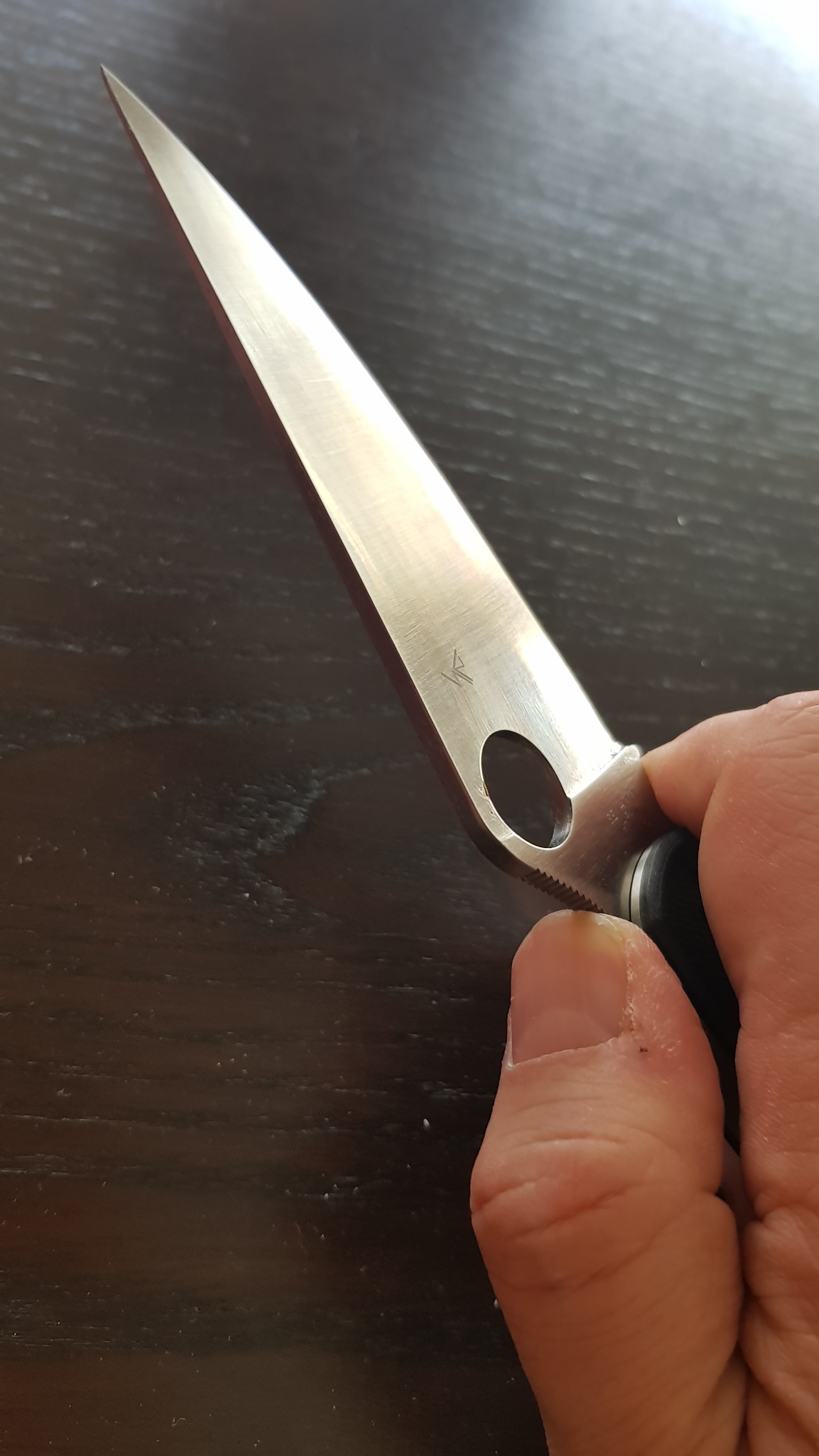
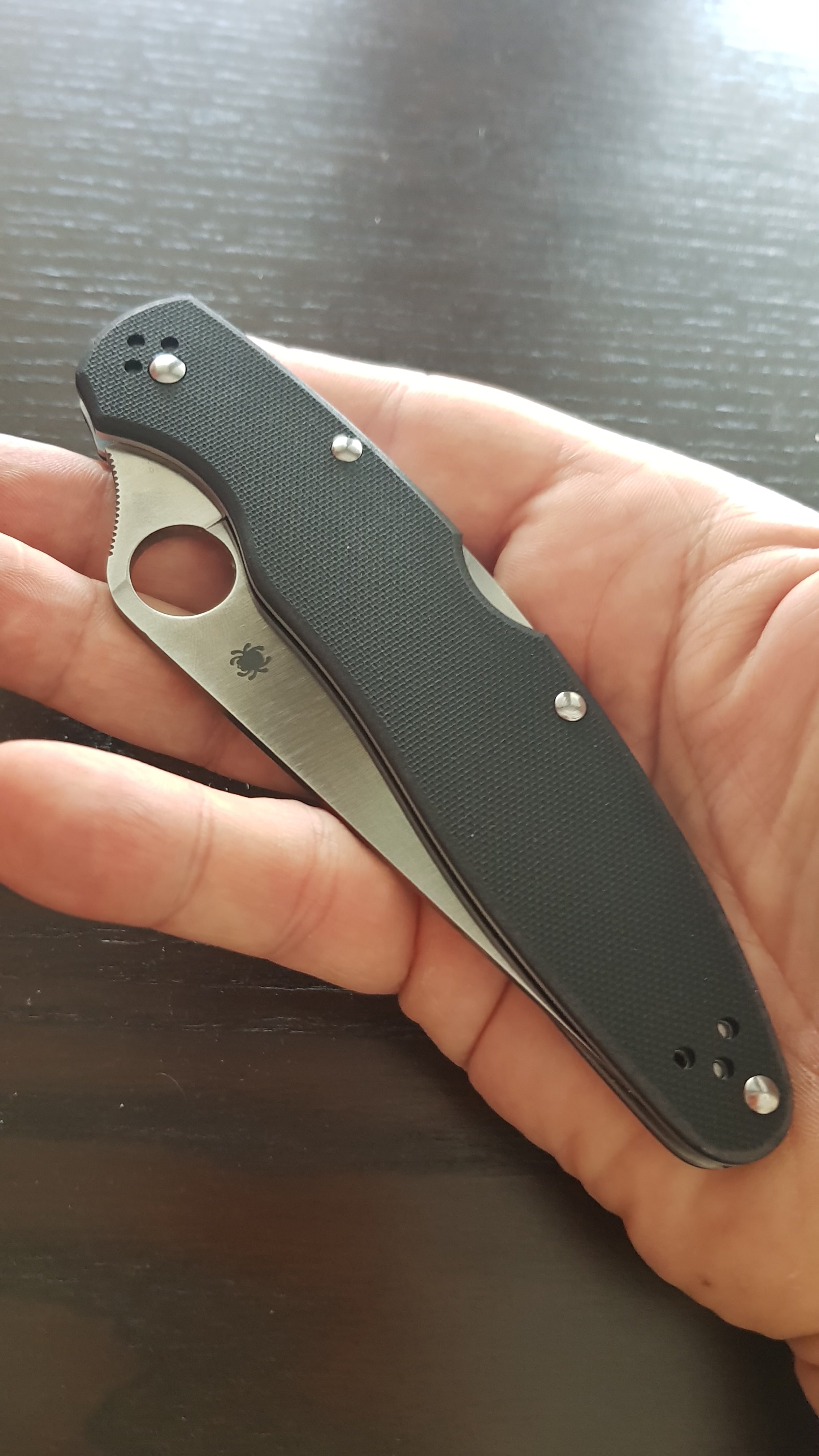


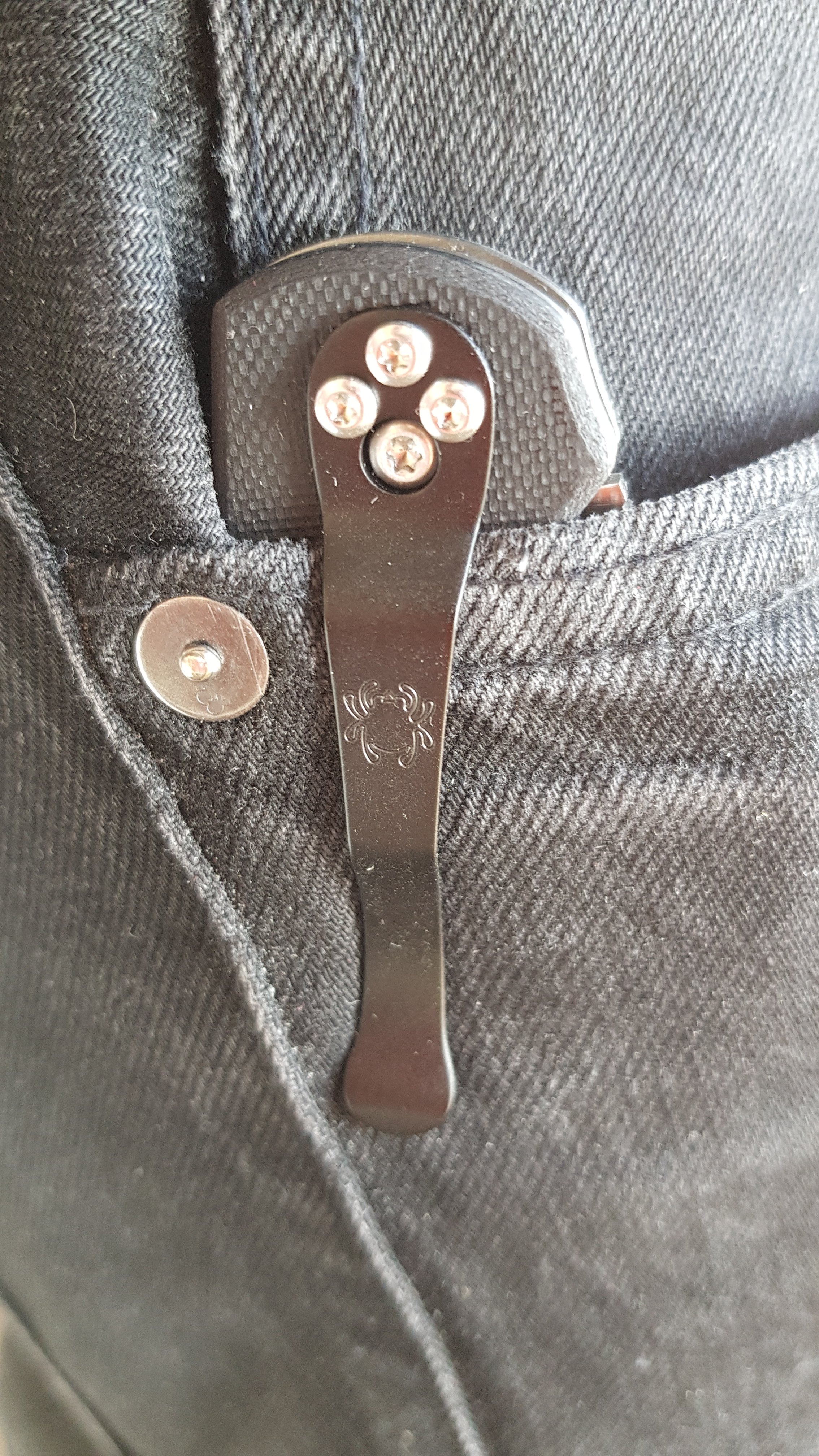
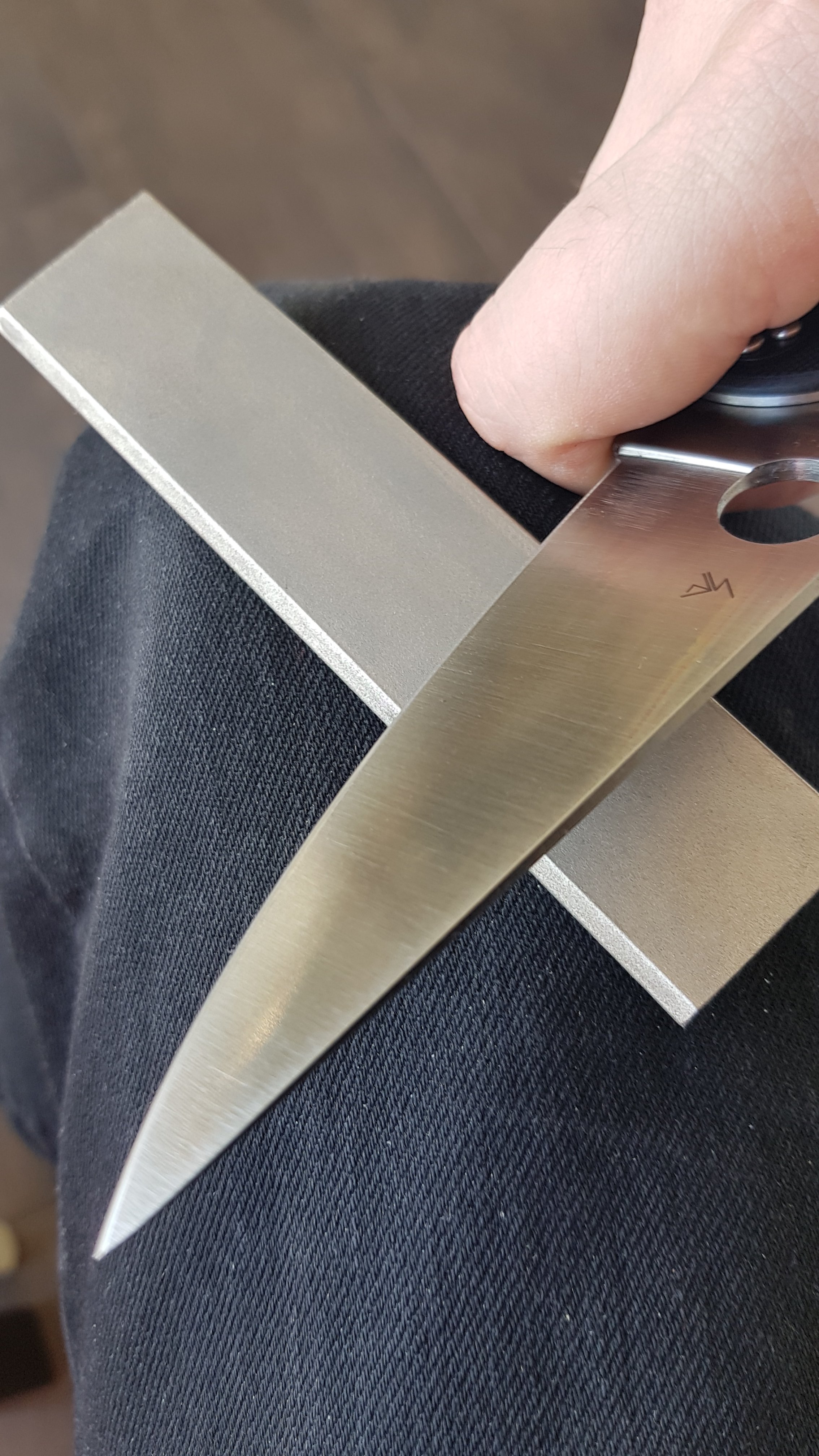
 The light reflections on the blade shows it has already started a mild patina while being stored.






 NemoKnivesReview