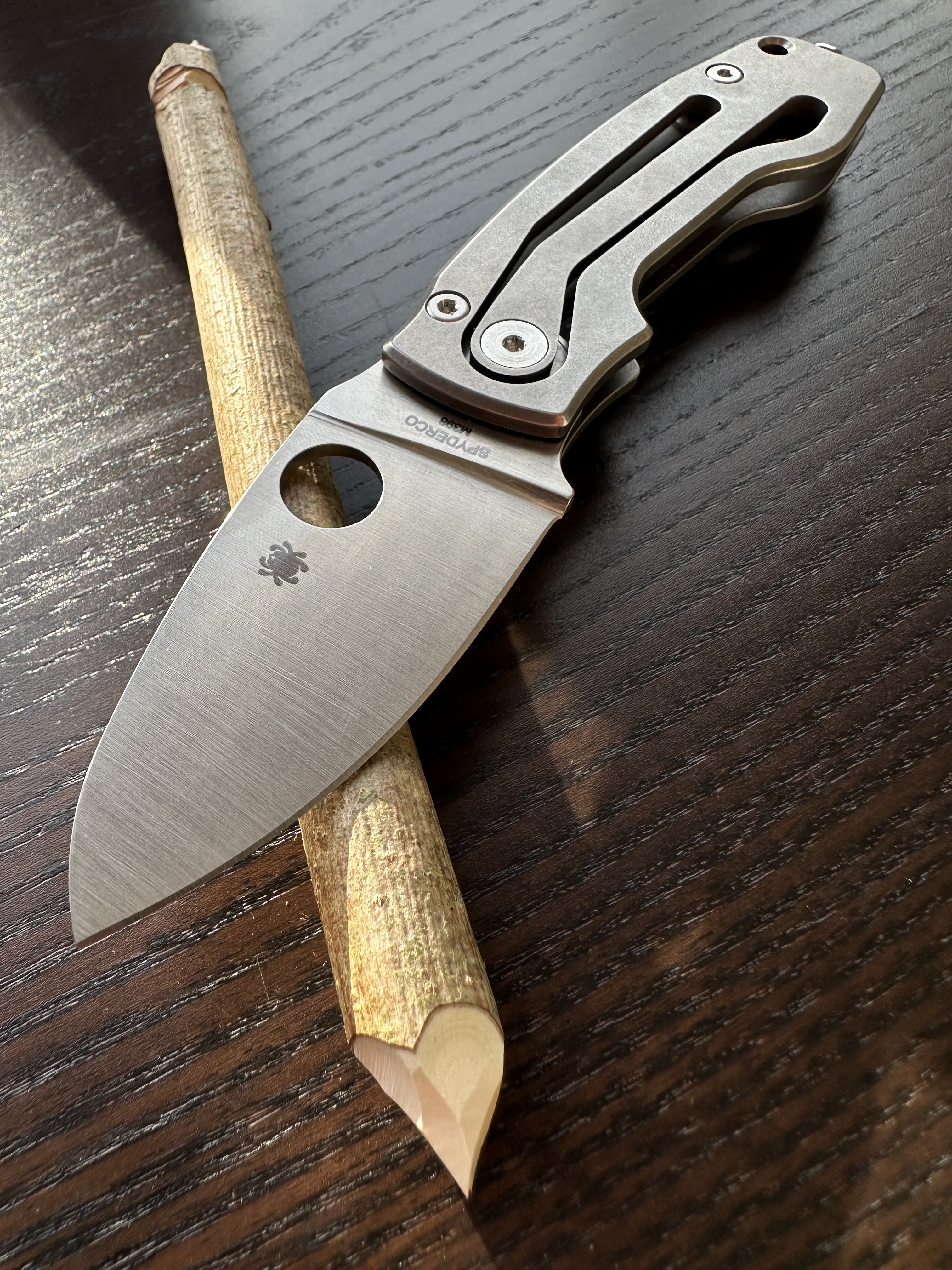
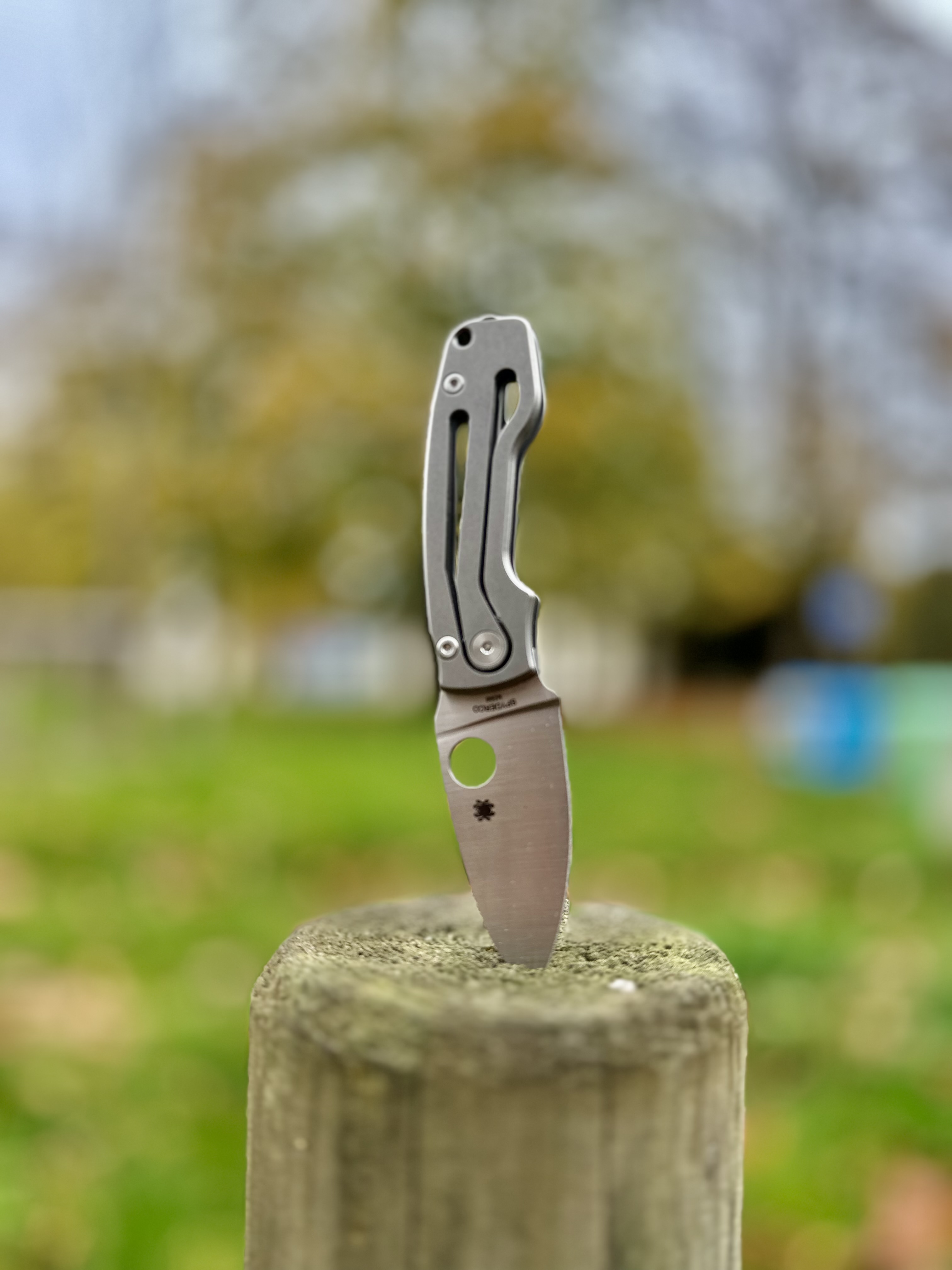
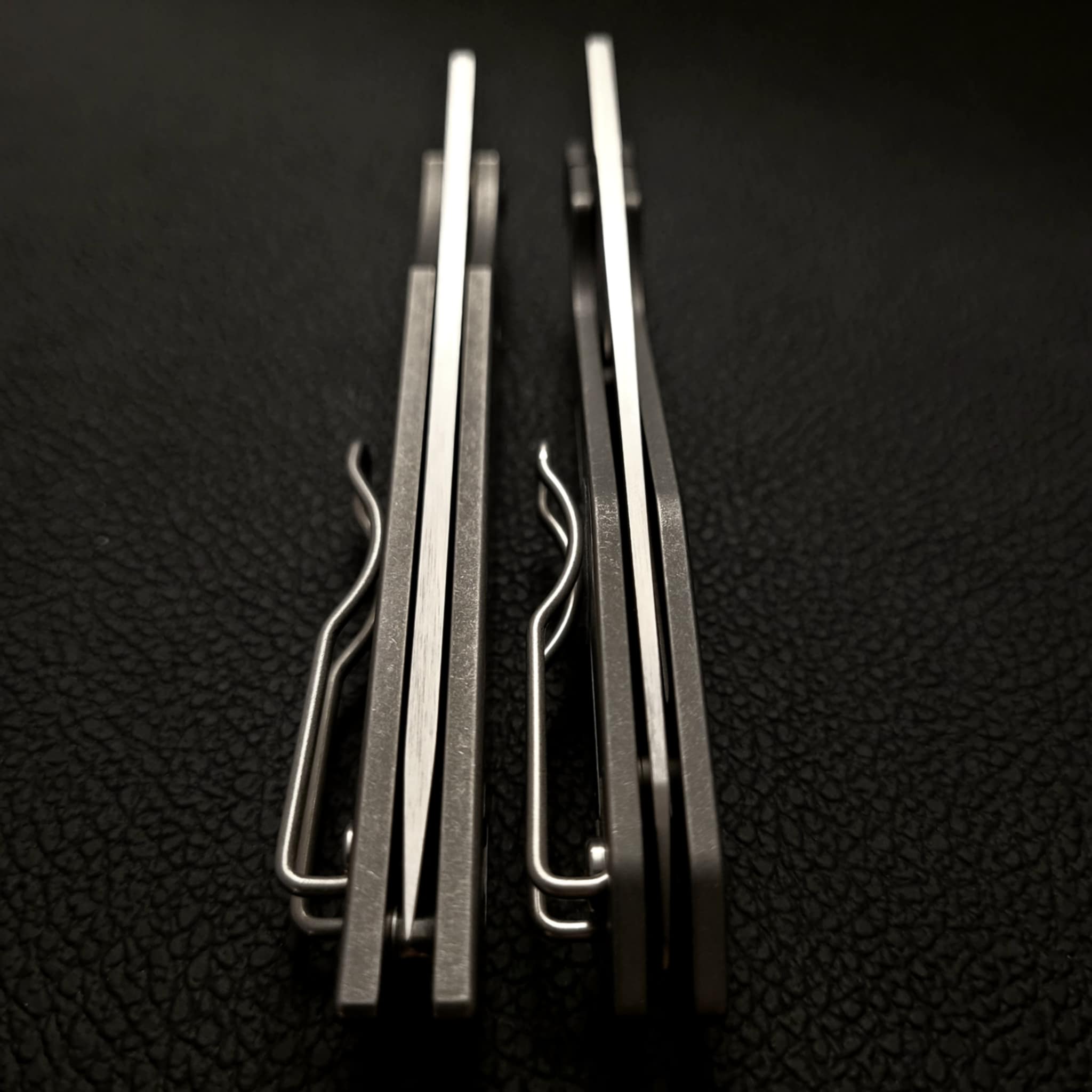
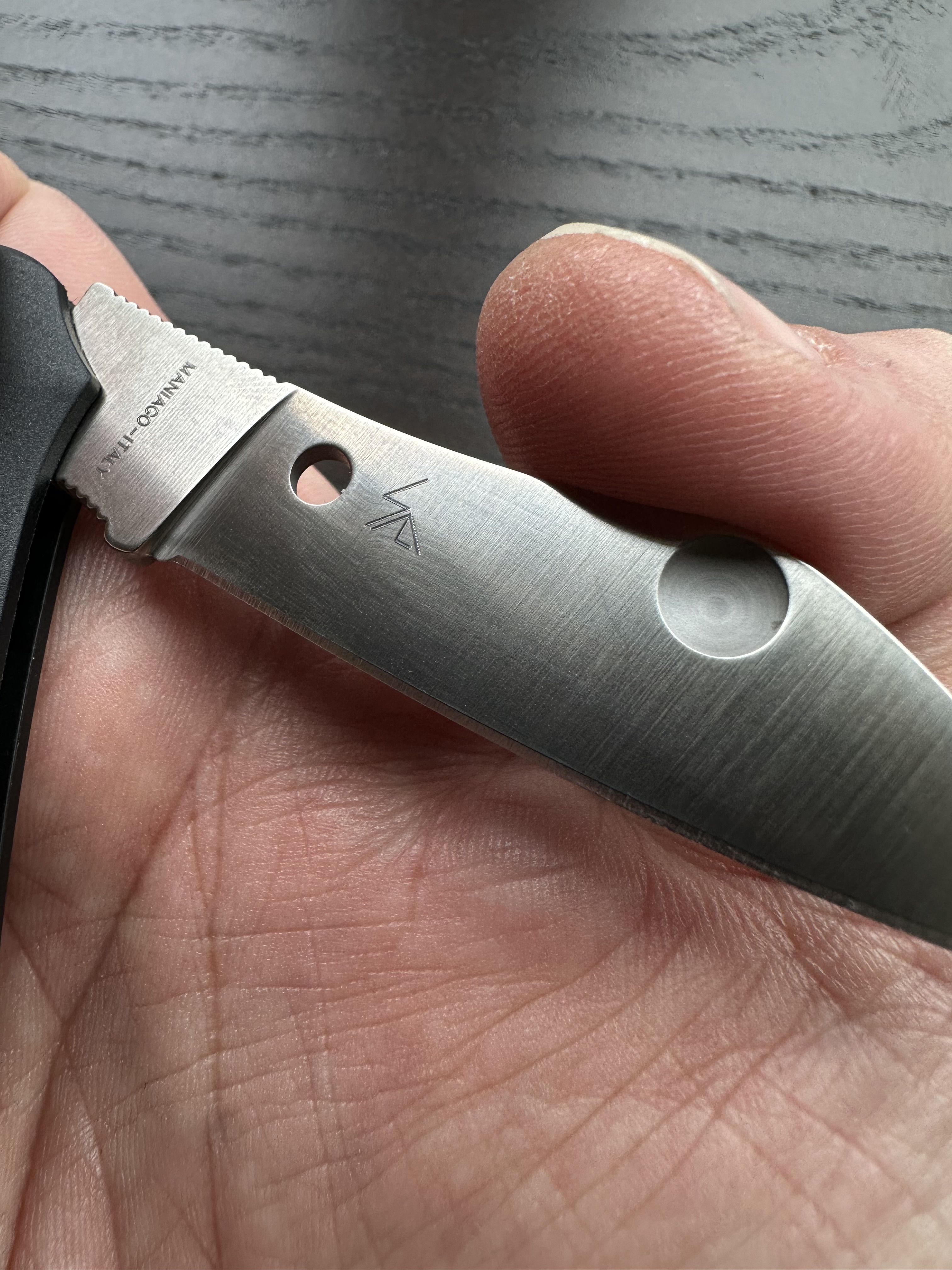
The Chaparral platform is one of Spyderco’s most refined designs. It is extremely thin—among the thinnest in their entire lineup—both in blade stock and handle thickness. This isn’t just about comfort: the blade geometry is optimized for slicing efficiency. Minimal stock, high grind, and a fine edge mean it cuts with very little applied force.
The SlipIt design removes the locking mechanism, making it legal in many jurisdictions that restrict blade length or prohibit locks. Despite being a slipjoint, it feels very solid and the choild provides an extra security. The internal construction—including the concealed stop pin near the pivot—adds stiffness and long-term durability that you don’t always get with non-locking folders.
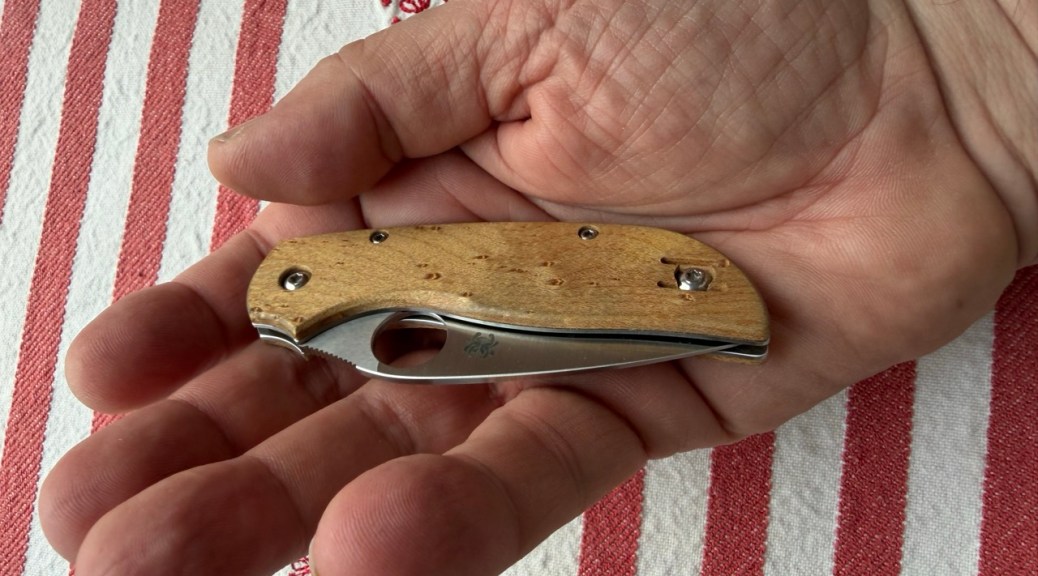
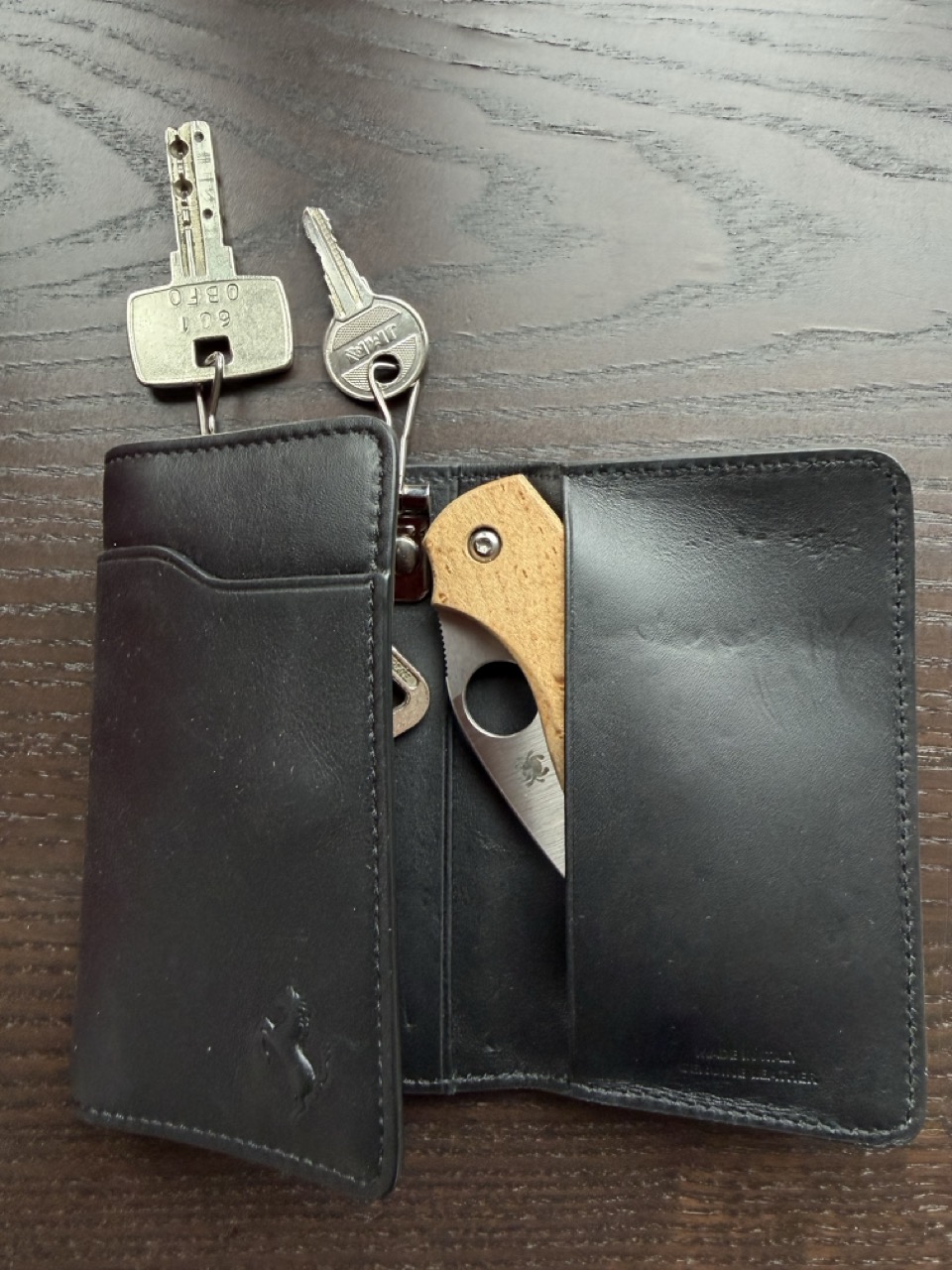
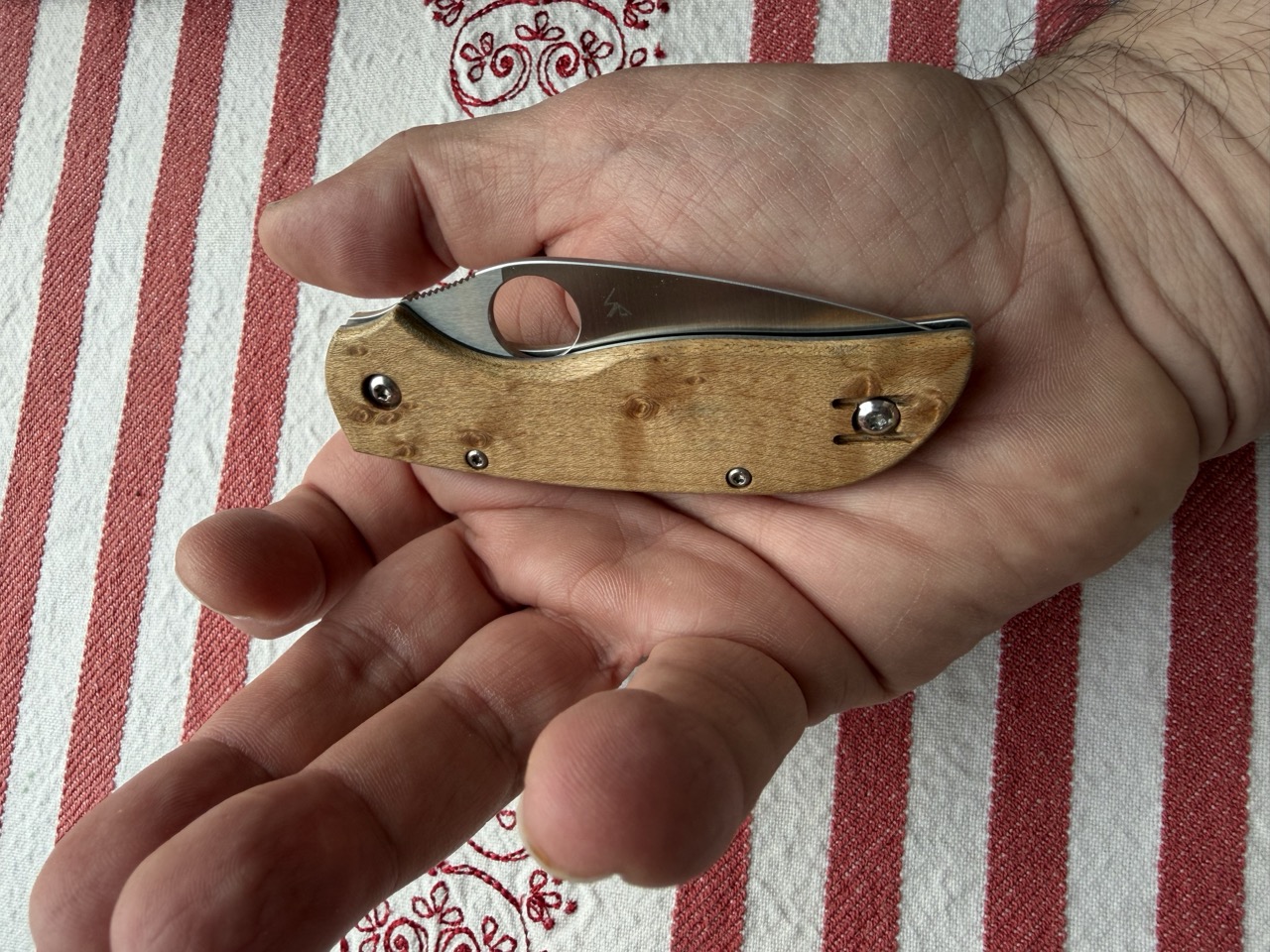
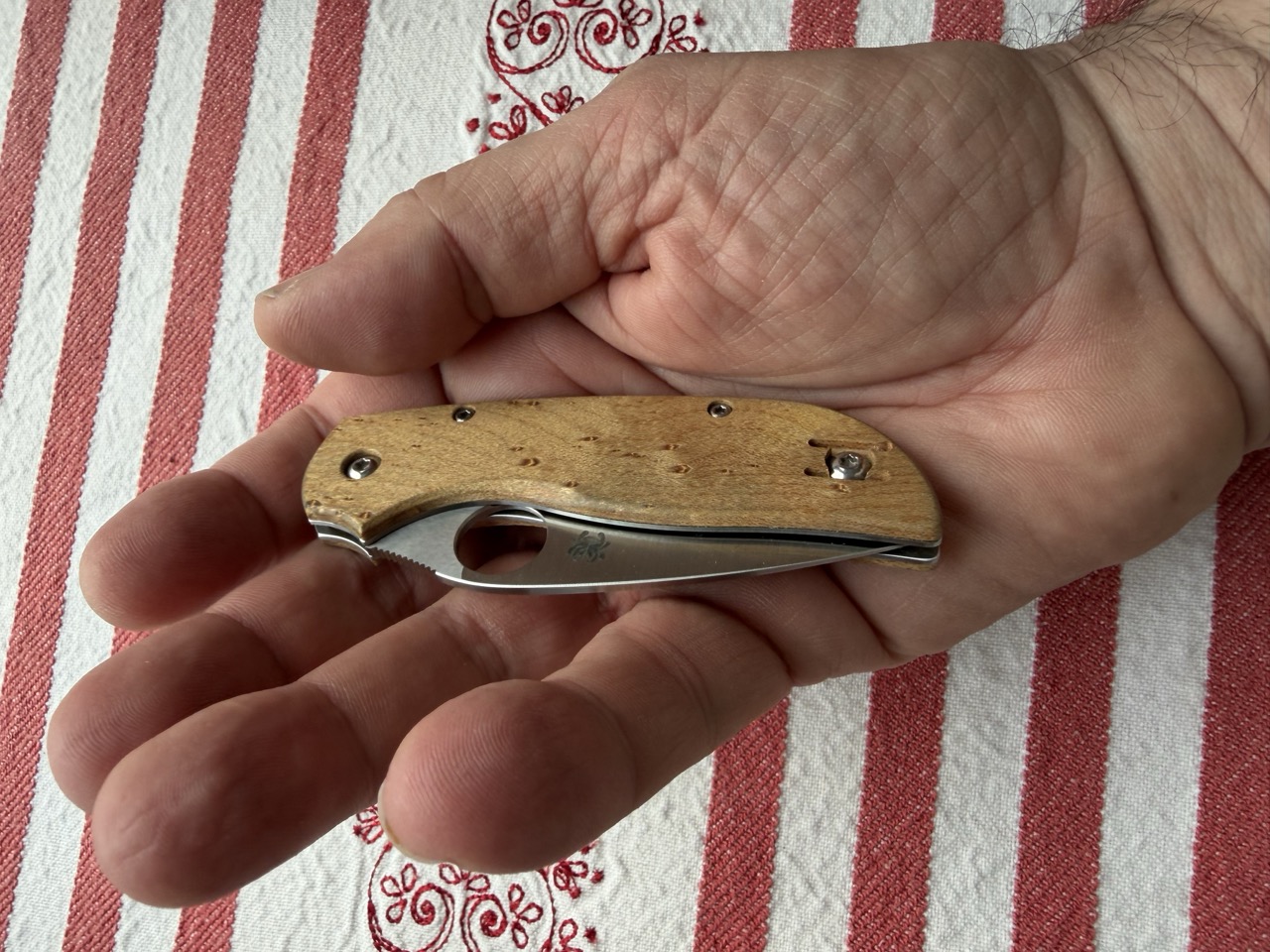
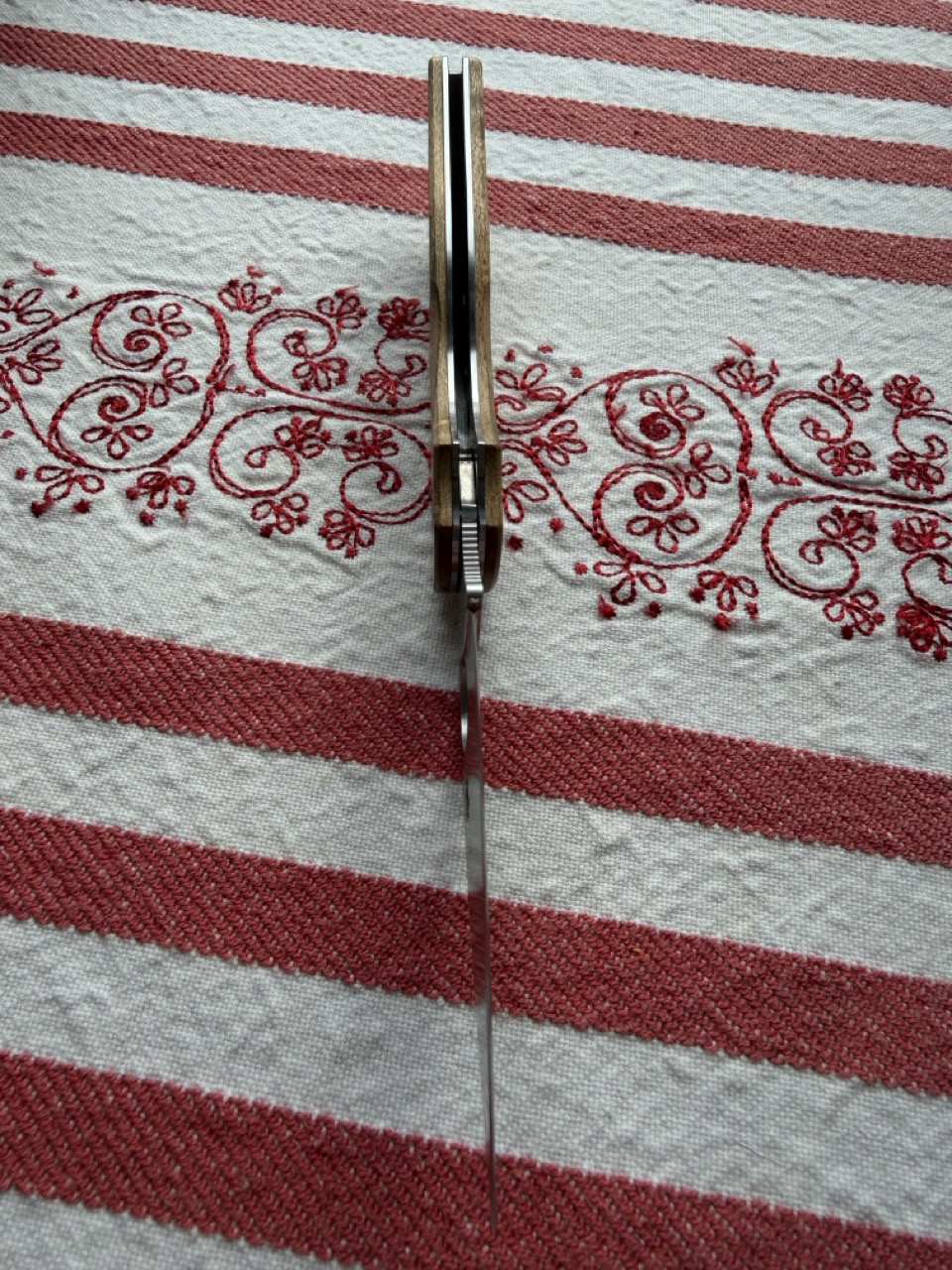
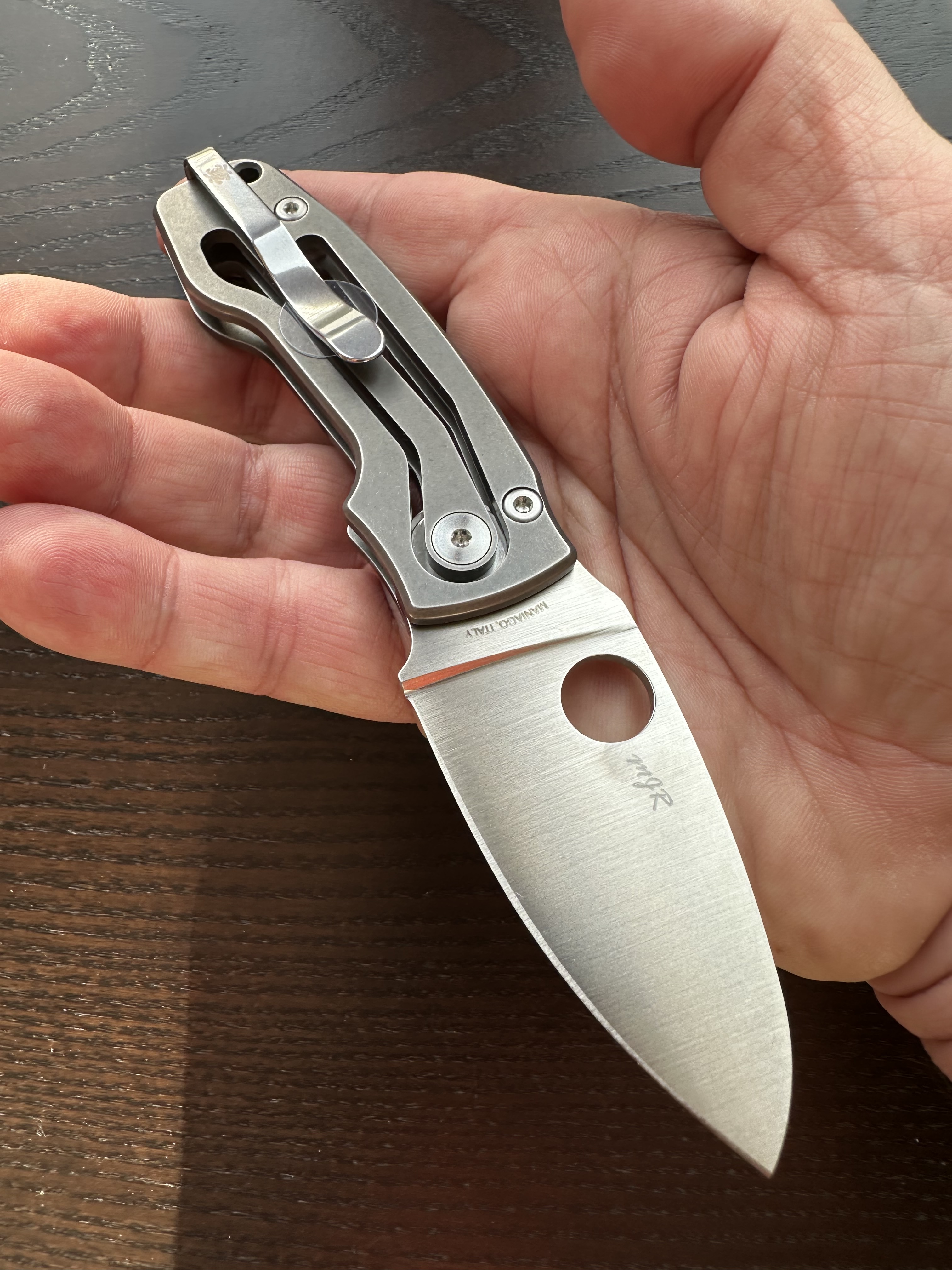
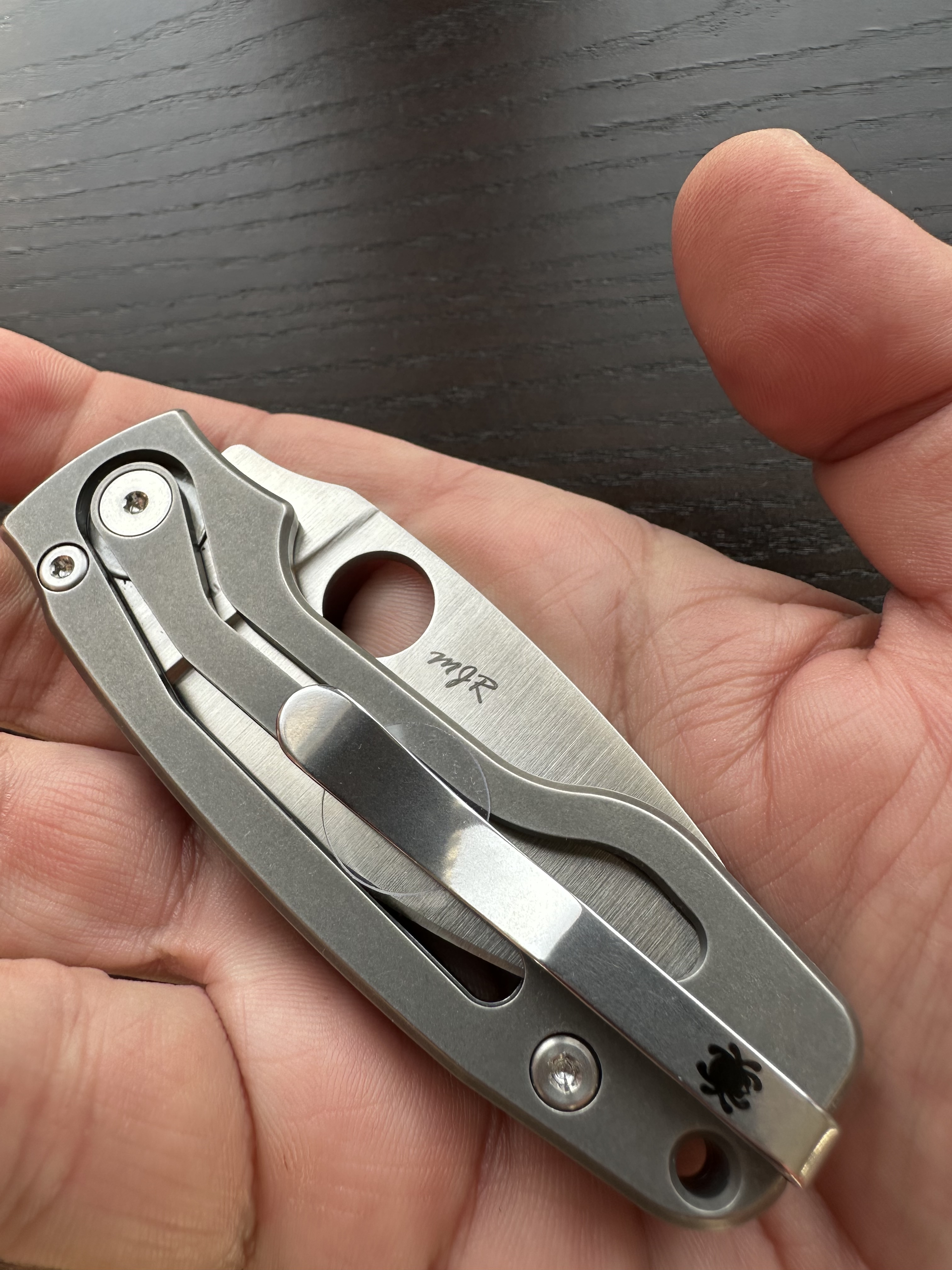
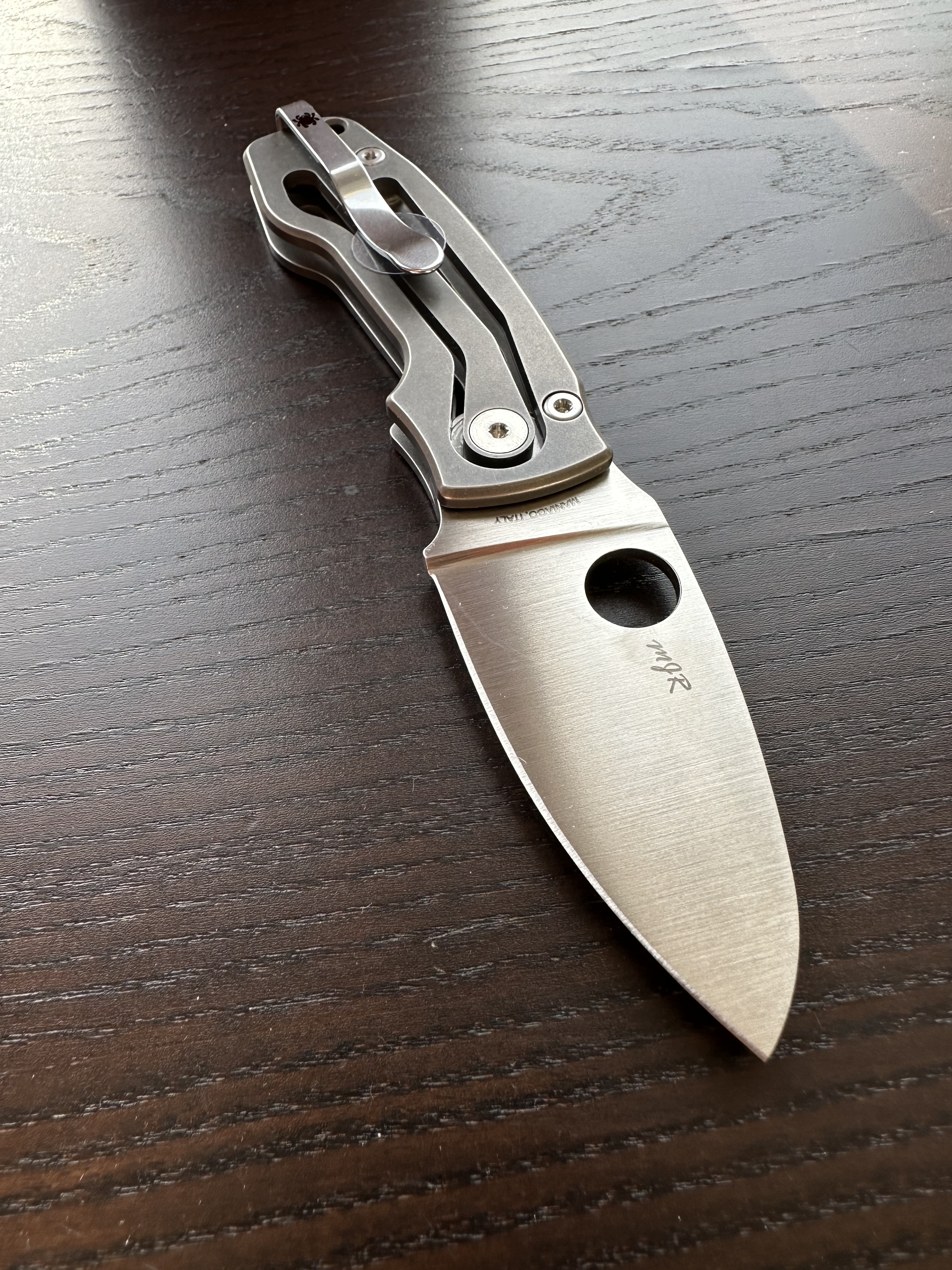
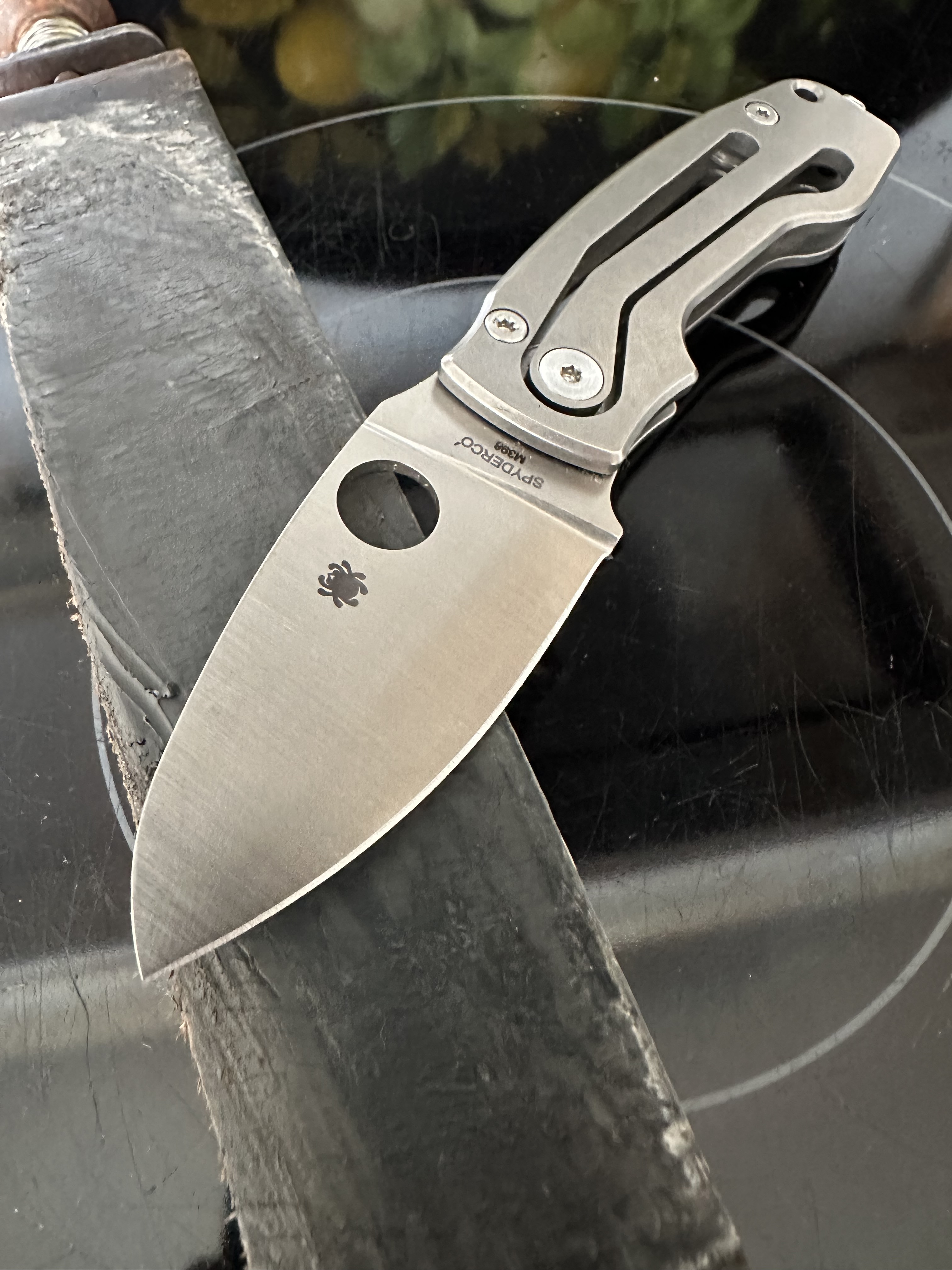
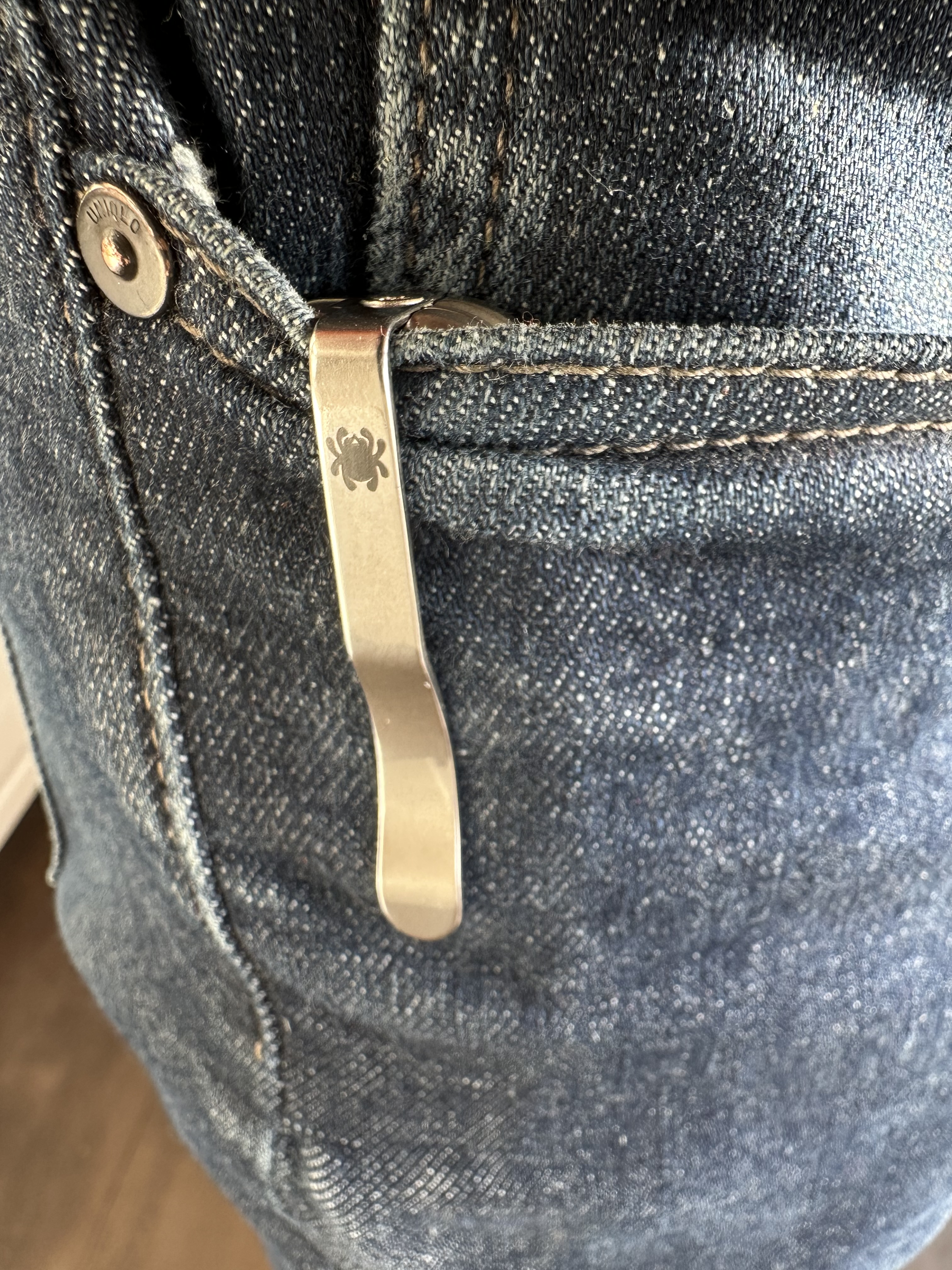
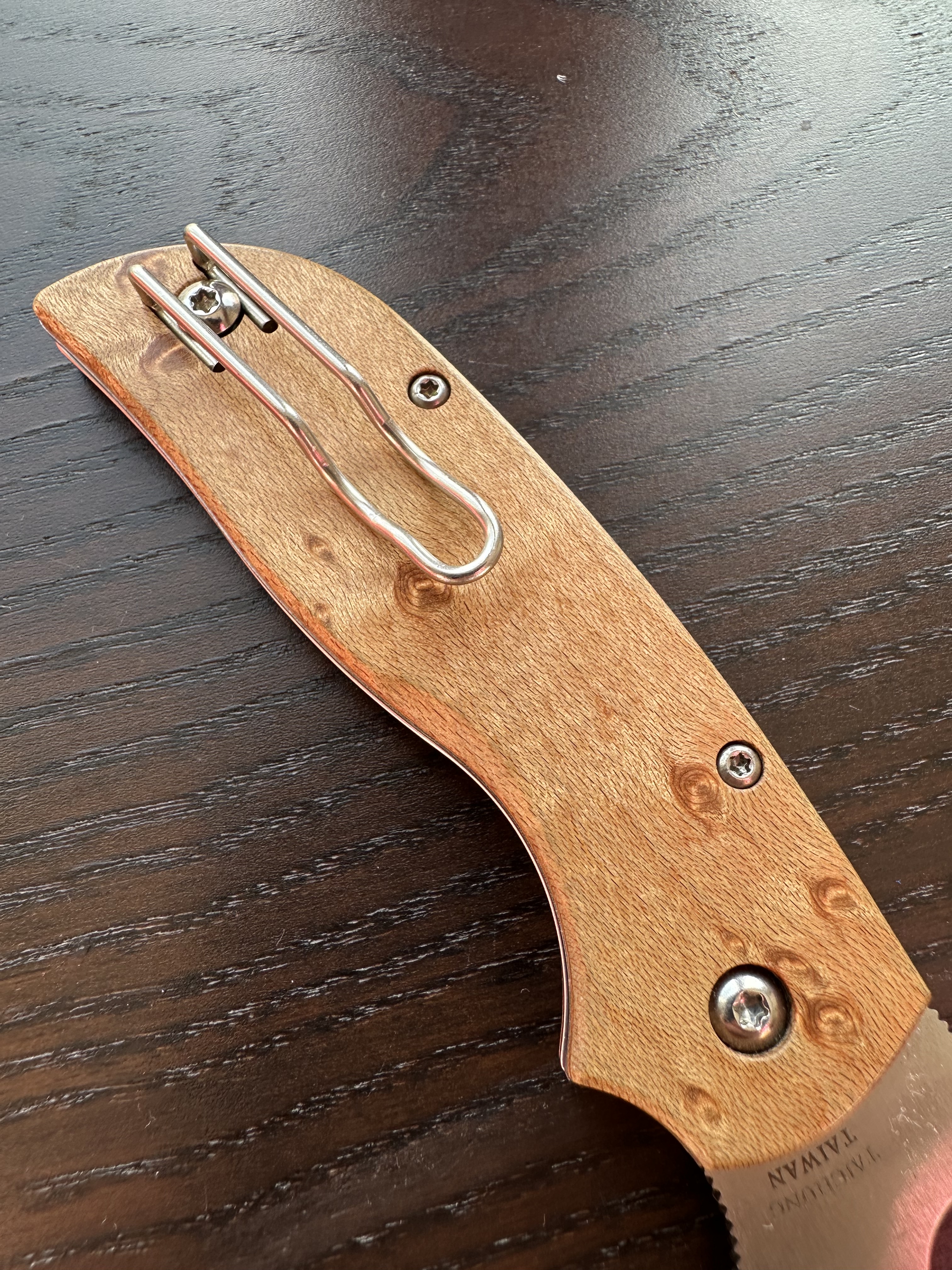
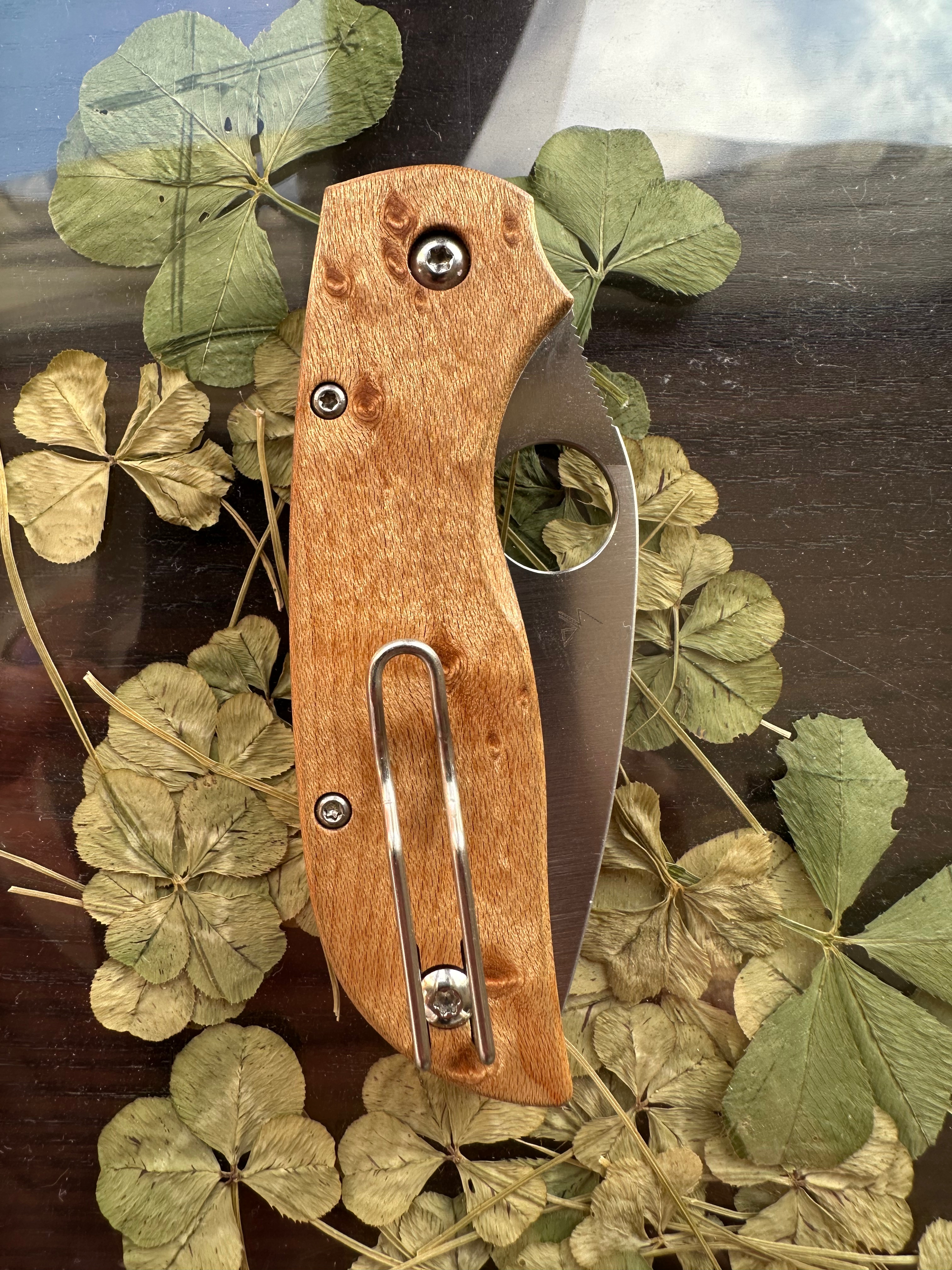
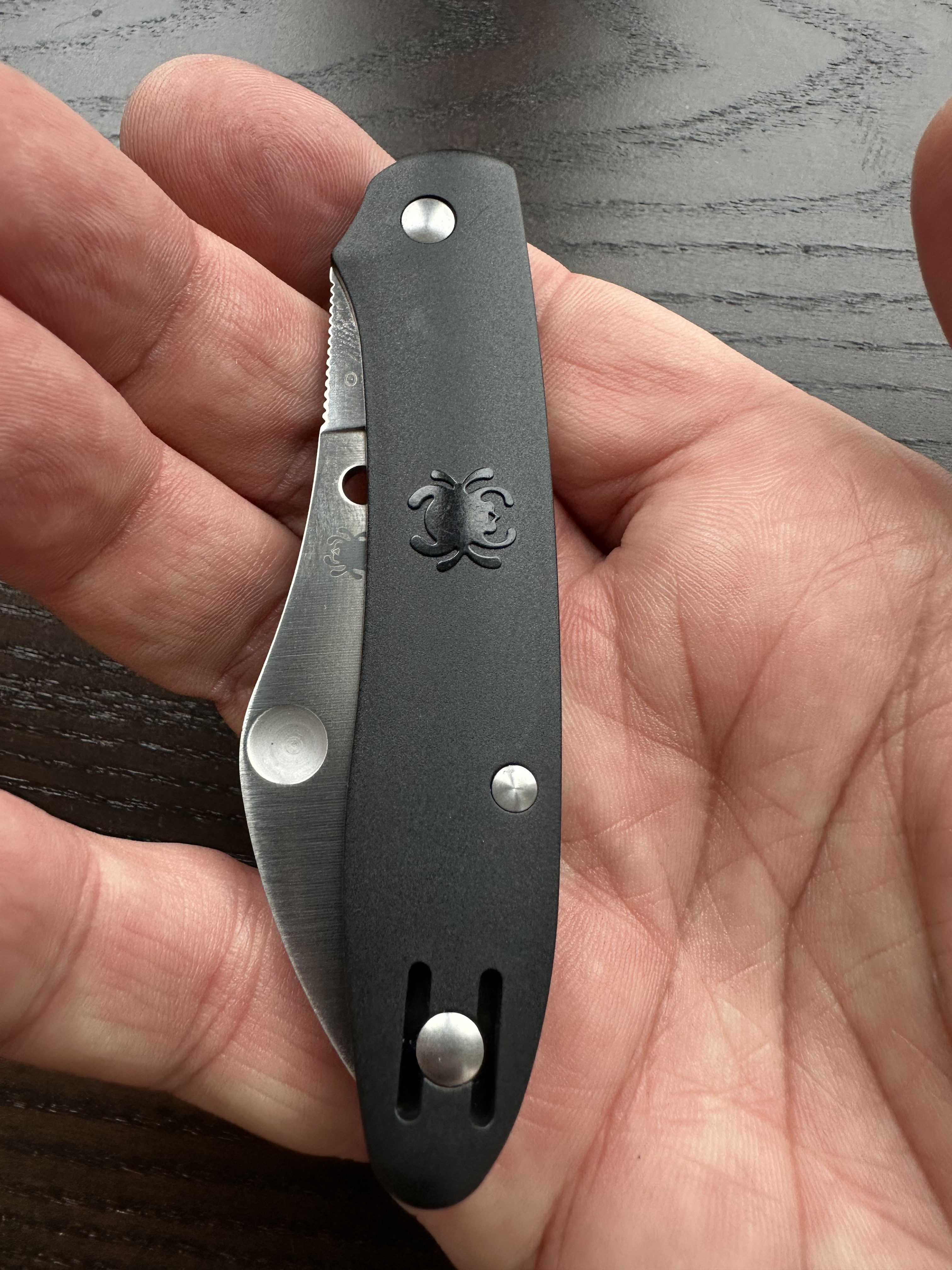
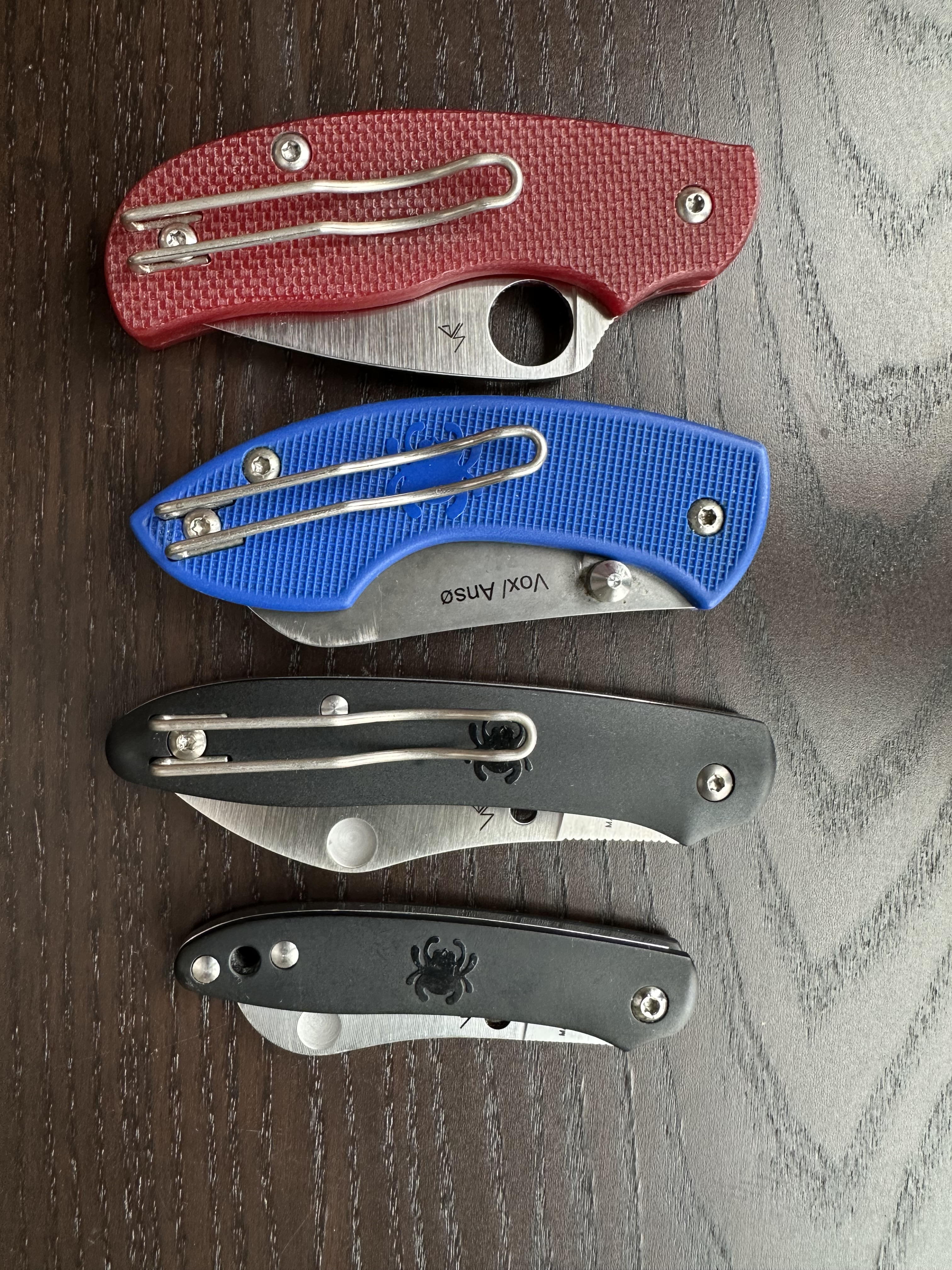
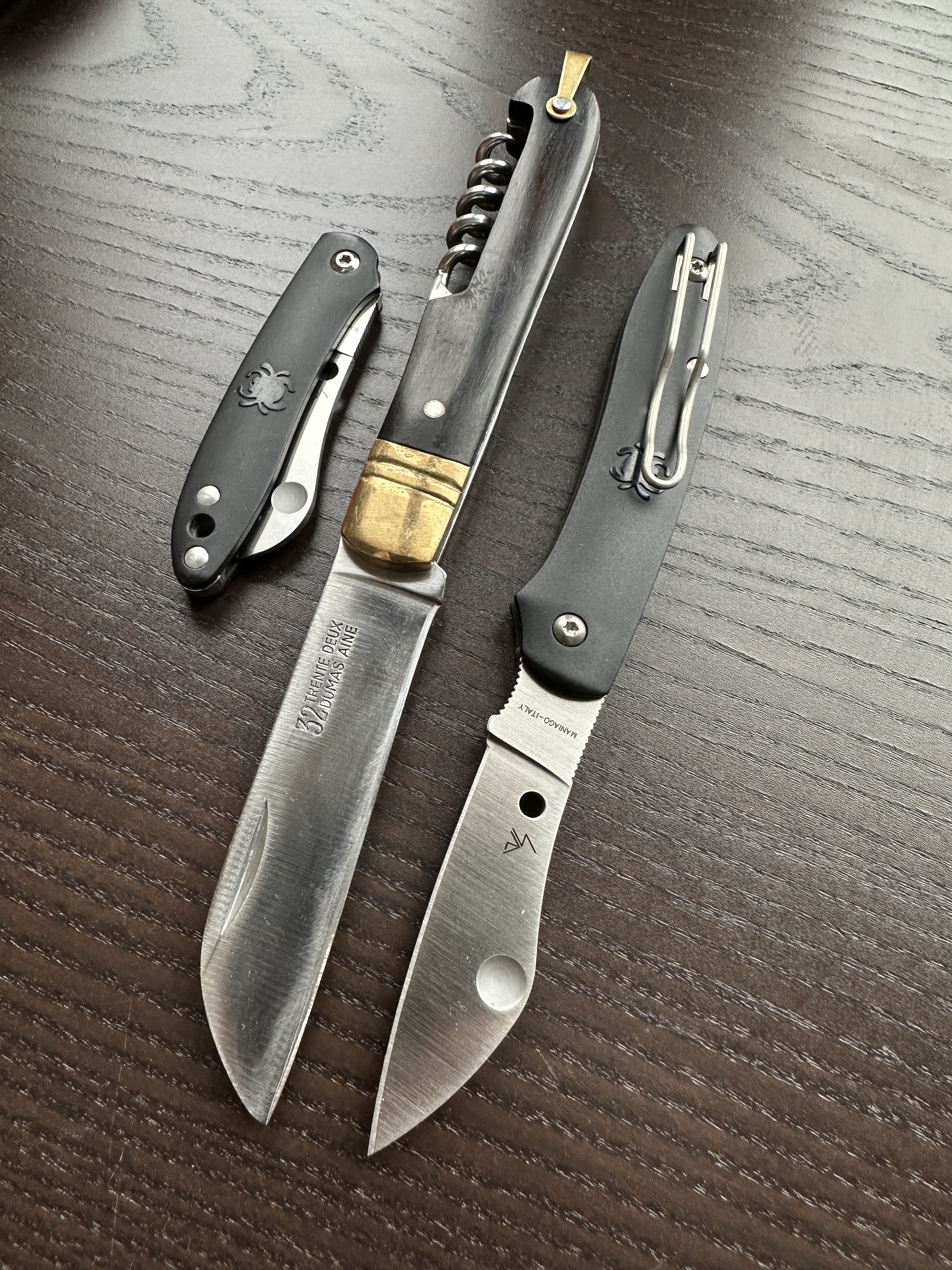
With the pocket clip removed, the Chap becomes almost invisible. It carries deep in the pocket, or even inside my keys wallet, without printing or drawing attention. Yet, once deployed, in use, it never feels inadequate. The cutting performance compensates for the modest size. Also the absence of clip makes it much comfy in my palm. It is again a sensual experience which contributes to the pleasure of useing your EDC. (I also use a smaller clip found on the Microjimbo when I need to have it clipped on my watch pocket.)
But removing the pocket clip takes about two minutes—just one screw— and requires no modification. Immediately turns the Chaparral SlipIt into a deep-carry in the bottom of the pockets, ultra-discreet folder civilian and refined as a beautiful object, not a thug favorite guillotine.
If you need a knife that stays well within legal boundaries, carries unnoticed, and still delivers real cutting capability, the Clipless Chaparral SlipIt is a smart, elegant, technically sound choice.
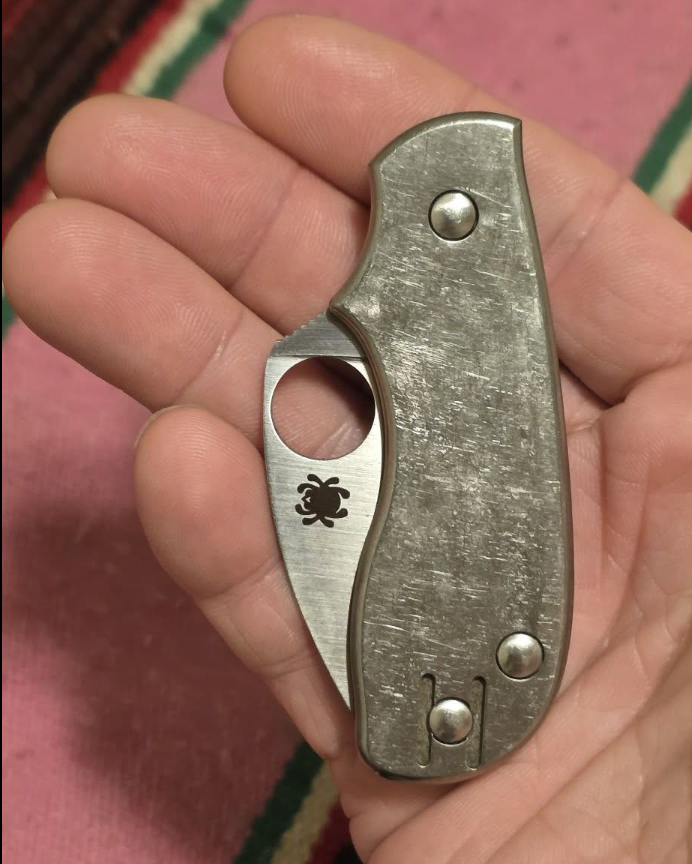
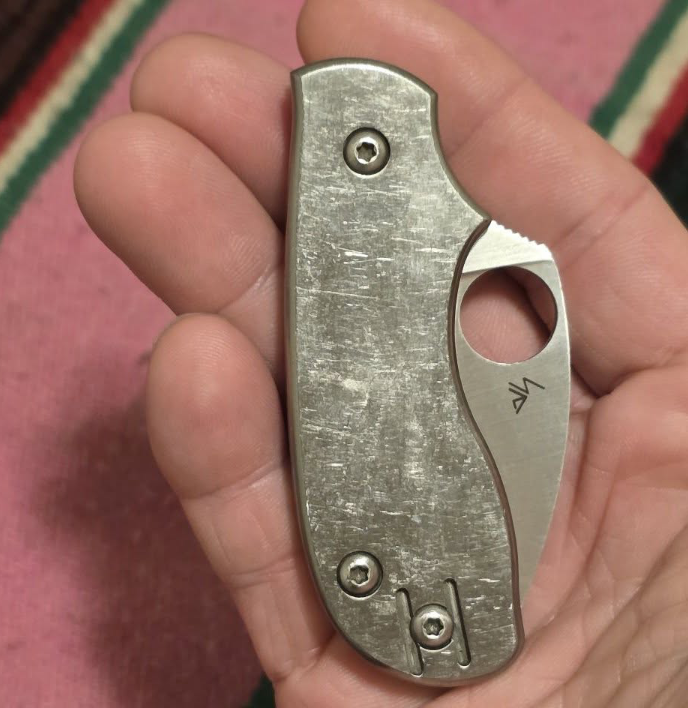
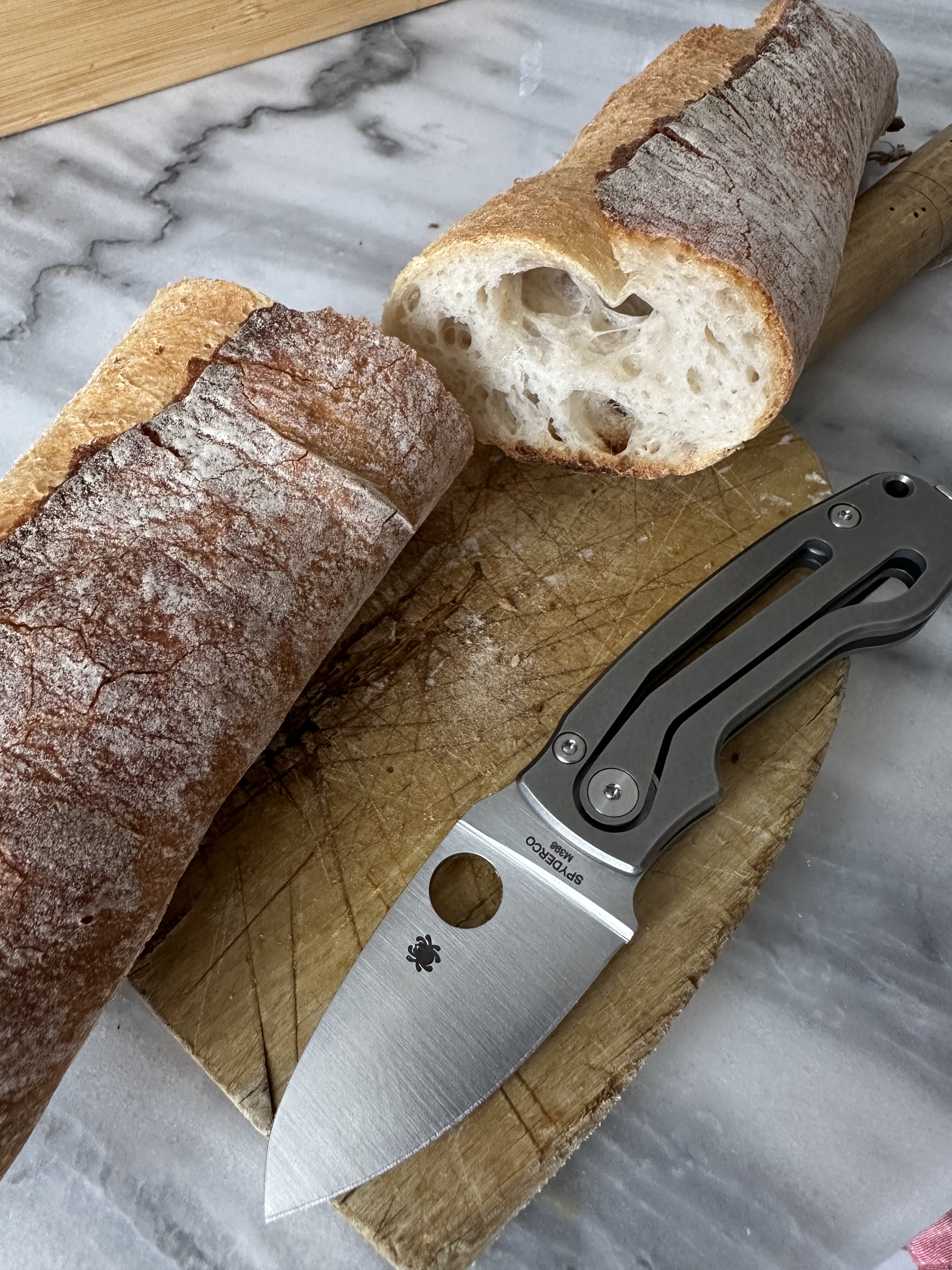
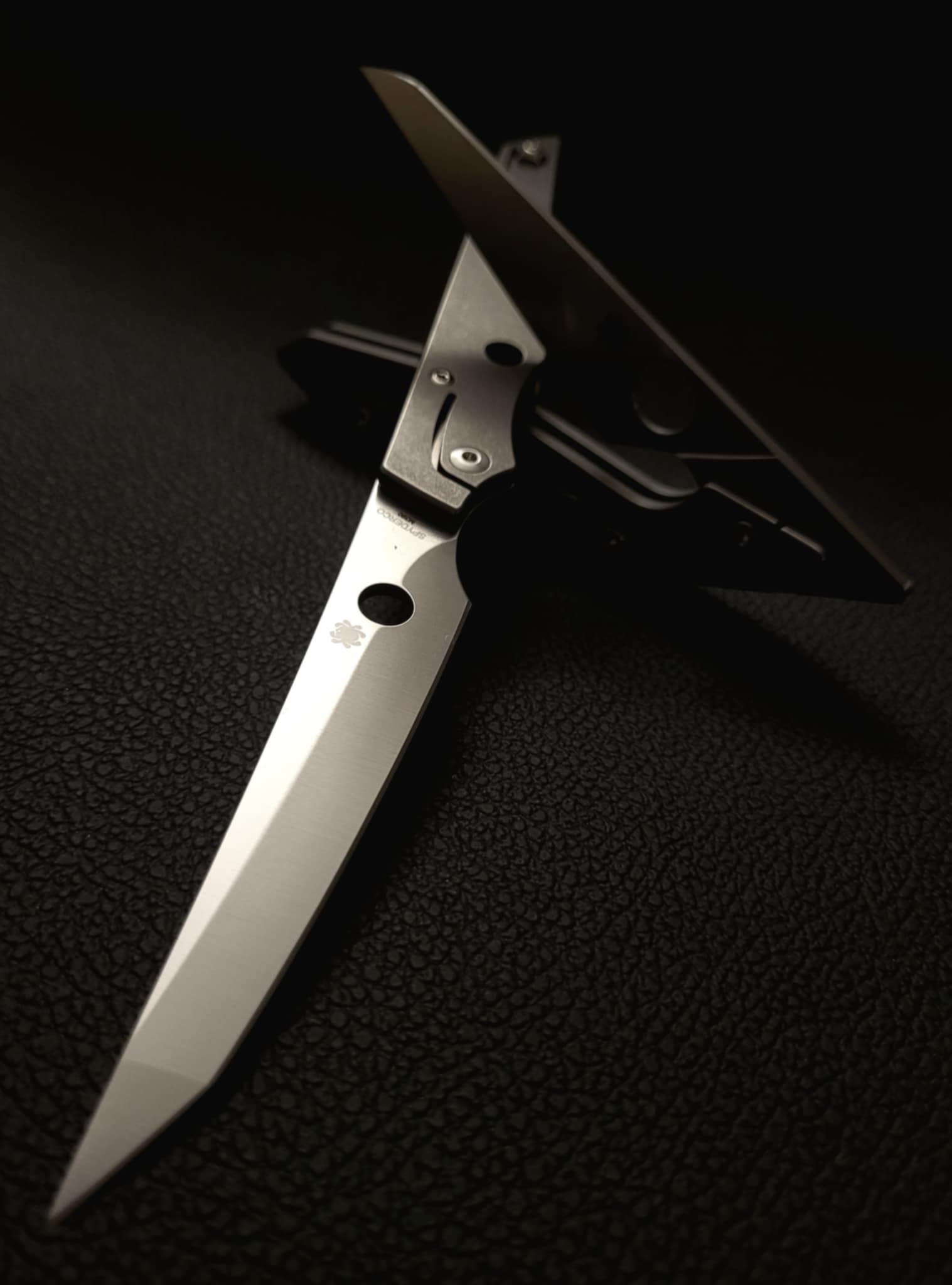
Edit: And if you’re worried about scratches, here’s a photo of a Squeak Titanium (not mine), clipless, living its best life at the very bottom of a pocket…
Keeping a titanium knife there is a bold choice—titanium (like wooden scales) is far softer than keys or coins—but it perfectly illustrates the beautility of EDC knives.
Disclaimer: This knife has been provided through Spyderco’s Ambassador Program, upon my own request. Thank you to the Spyderpeople for letting me review it.
This is a first look, first glimpse review — my very first impressions!
Mike Read’s custom Alien (£400,00 Elmax Blade) was presented to the world in November 2023, and it is now produced by Spyderco through Maniago, Italy under the name PITS 2 in 2025 for around €300,00. So this is an English design, produced by a Colorado-based company, and manufactured in Italy — you can’t get more international than that.
To respect the King’s Law in the UK, you need to carry a non-locking knife with a blade under 3 inches, and also have a good reason to carry it on your person. The PITS 2 respects those rules and looks far less threatening than the original PITS 1.
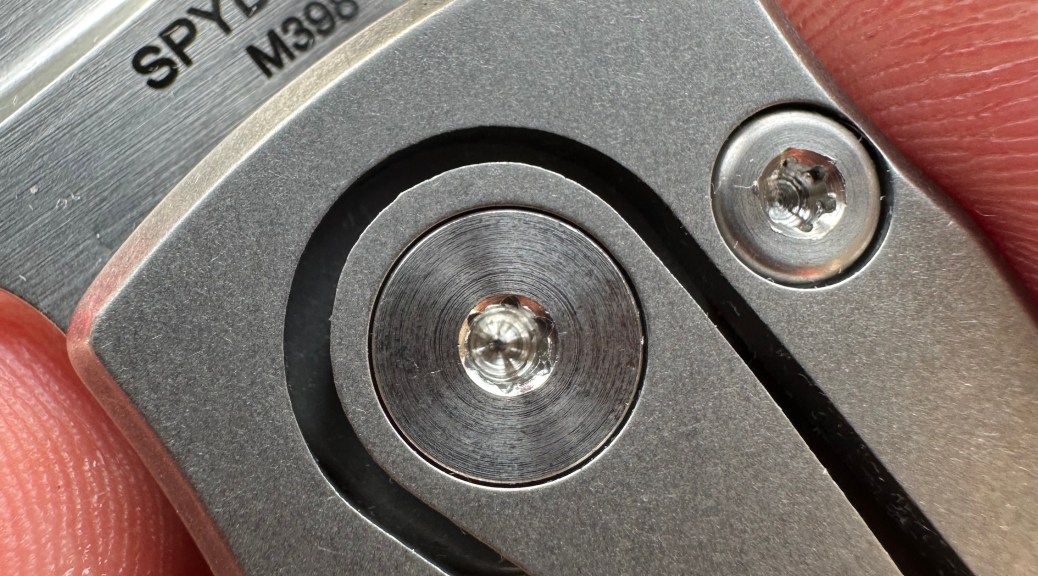
This isn’t my first Mike Read design — I reviewed his PITS 1 back in 2018 and loved it. That knife was his very intention of creating a solid workhorse with no lock. Two years ago, a sprint run in M390 appeared. Now comes the PITS 2, in M398, and to me, this is a much better design. Here’s why.
“Pie In The Sky” (not pig!) was Mike Read’s nom de guerre on the British forums. His specialty as a knifemaker is crafting non-locking knives: state-of-the-art tools with titanium handles and obsessive attention to detail. The PITS 1 was a looker — but the PITS 2? It’s eye candy.
Here’s a video from The Crafter Carry about the Alien:
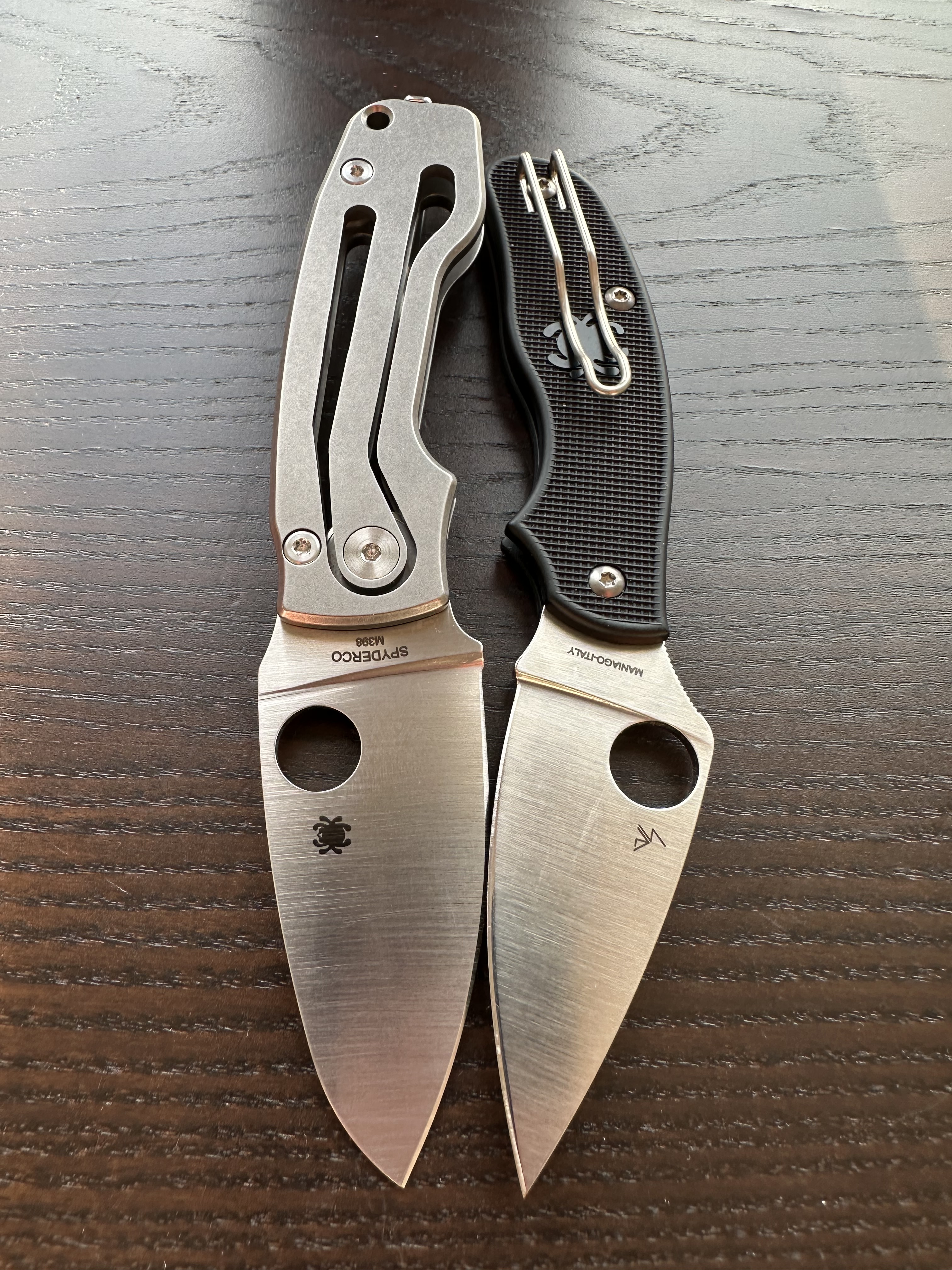
Compared to the more angular tip of the custom Alien, I find the PITS 2 blade shape more graceful, with a nicer drop to the point.
The custom Alien used a titanium clip, whereas the production PITS 2 wears a steel one — but I actually prefer Spyderco’s version here.
What really makes it stand out is the handle mechanism:
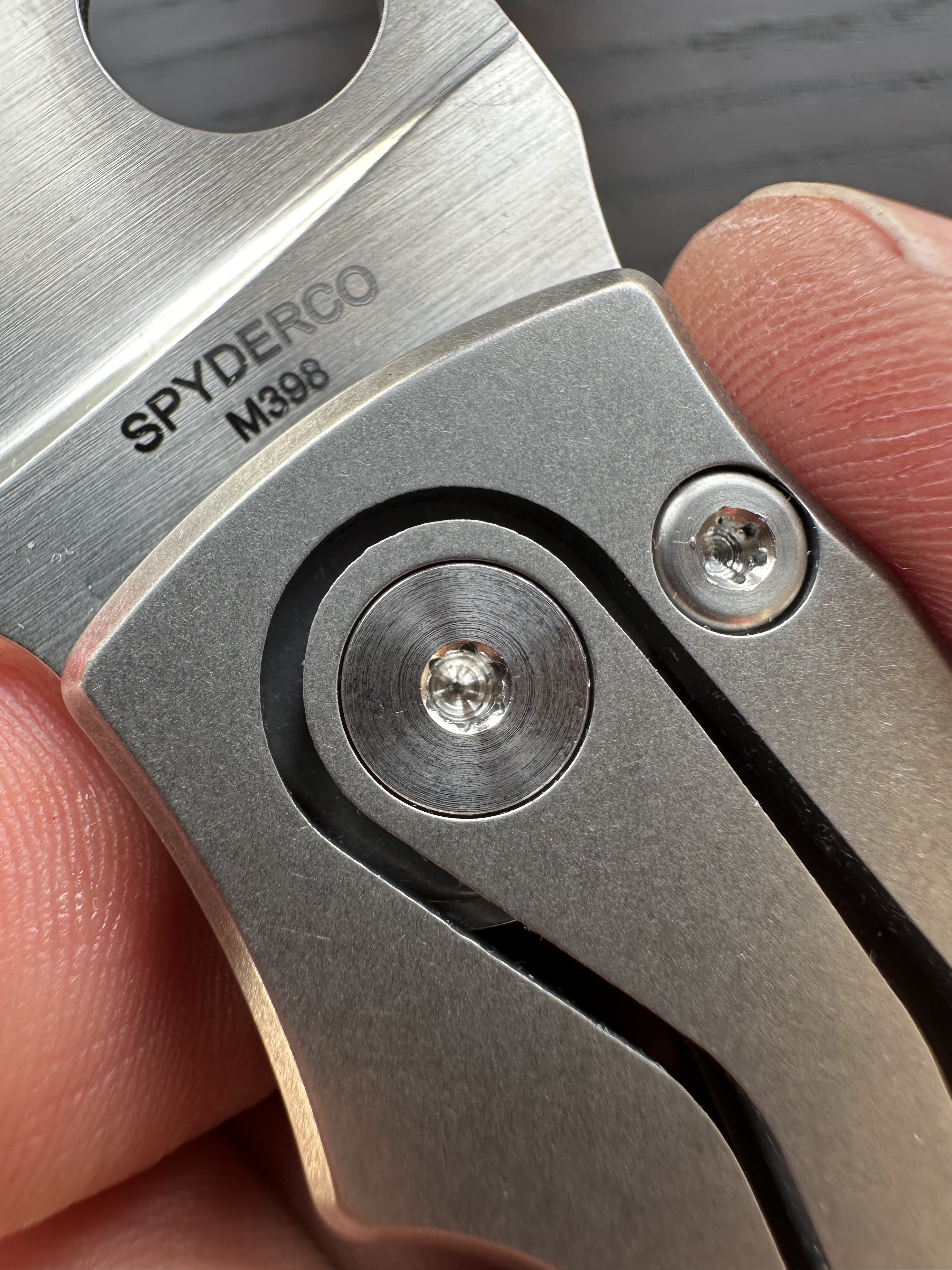
“A truly unique non-locking mechanism that consists of two integral spring arms machined into the handle scales. The forward end of these arms, which supports the blade pivot, flexes as the blade is opened to provide pressure for its notched-joint mechanism to bear against the stop pin.”
That’s clever: just two integral spring arms machined into the handle that hold tension on the blade pivot. The absence of a traditional backspring makes for an open-handle design — easier to rinse under the tap and keep clean. Exactly what you want in a workhorse. (Let’s be clear: If you anticipate heavy-duty work (construction, field outdoors, survival uses) where a strong locking mechanism is required, then this may not be the optimal choice — you’d trade some robustness for style and finesse.)
The blade is made of Böhler-Uddeholm M398 particle metallurgy stainless steel — a steel in the same class as CPM S90V. It holds an edge forever, though it’s not the toughest, and you’ll need diamonds to sharpen it. I once broke the tip of my Roadie XL after a fall on tiles, but when used as intended, M398 is delightful. I’ve worked my Roadie XL and Metropolitan hard, and M398 has never failed me. This steel would be perfect also for hunters which need long edge holding when skinning.
Mechanically, this is the first Spyderco I’ve handled that’s harder to open than to close. The blade retention in the closed position is quite strong, while closing is much softer than most slipjoints. With wet hands, I even find it tricky to open — I have to “Spyder-drop” it by holding it by the hole!
At least, if a Police officer asks to see it, you must open it with two hands — another good point, as it’s clearly a gentleman’s knife, not a weapon. Also, while the PITS 1 looked somewhat like a skinner, the PITS 2’s drop point blade is much less aggressive-looking.
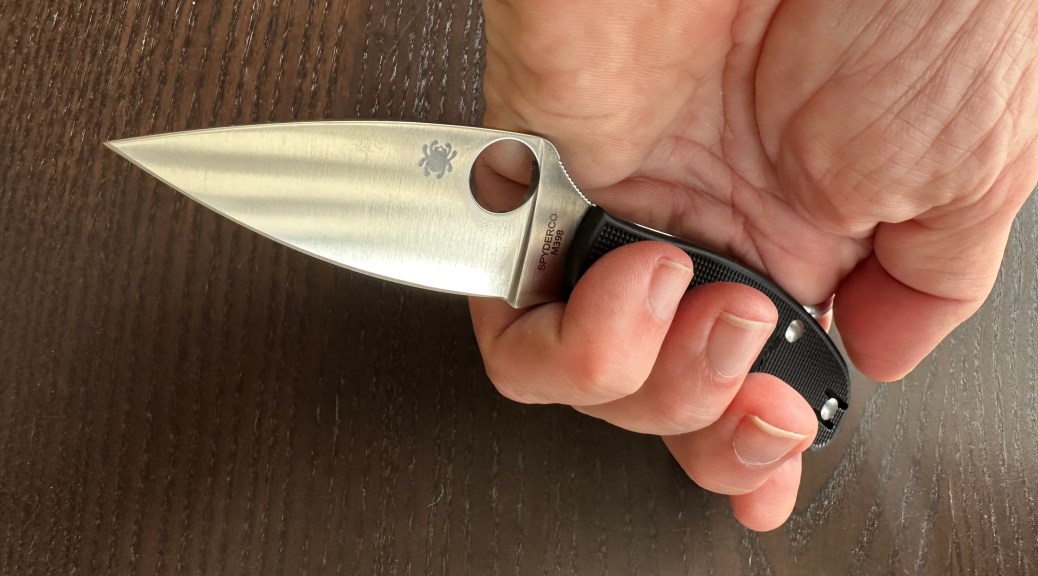
Inside the “cockpit,” there’s now a choil and a gentle hump, allowing a secure grip near the blade — something the PITS 1 lacked with a more aggressive quillon or guard for the index finger. So even with its softer closing action, it’s not a real issue. Still, when whittling hardwood, beware: that tall blade can snap shut faster than a UKPK or an Urban, both of which have stronger backsprings. Always use the choil!
The tall, thin blade arrives razor sharp out of the box. Geometry is spot-on for push cuts, and like the Slipjoint, Manly Wasp, Chaparral, or UKPK, performance is excellent. Let’s call that: “Perf In The Sky.” This will be a great travelling companion and even a hunter best friend.
Totally UK legal and of the highest quality imaginable, the PITS 2 is not a cheap knife — in fact, it’s pricier than the Chaparral Slipjoint — but it has that “Sebenza-like”feel of a high-quality titanium folder. A gem of a knife, and one of the rare non threatening slipjoints truly designed to be a hard worker.
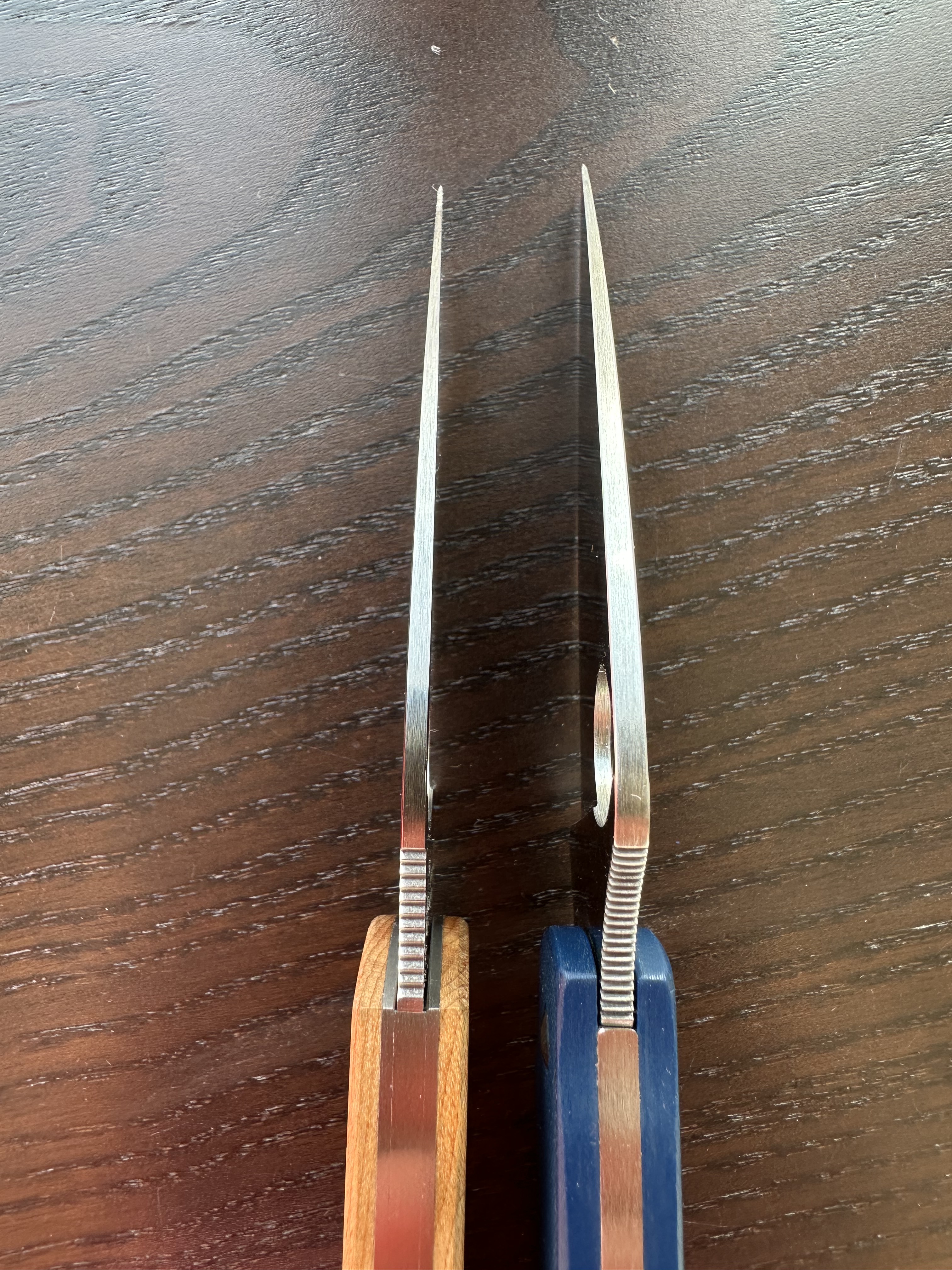
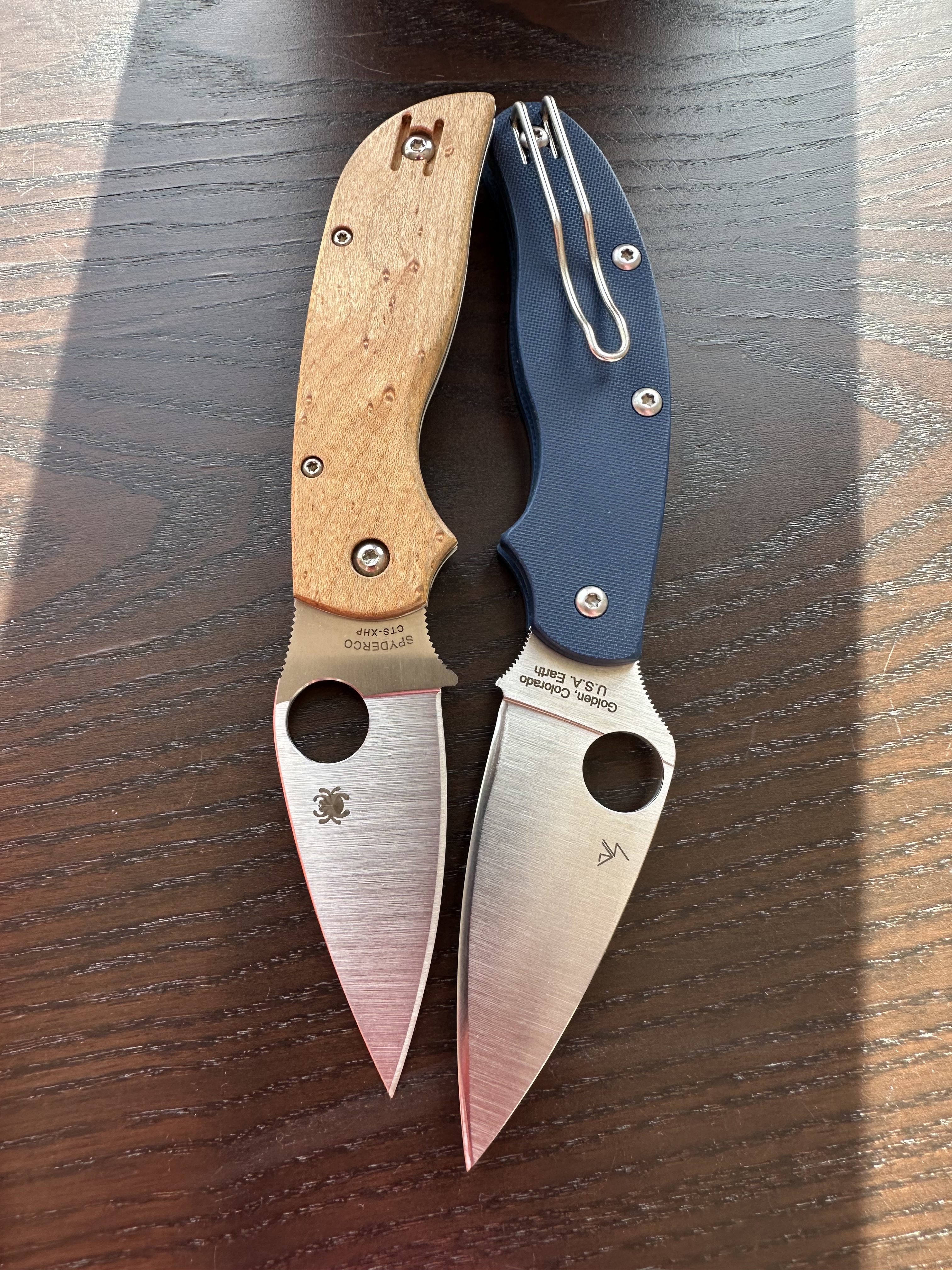
The Chaparral series is quite unique in Spyderco’s catalog. Originally designed to showcase different handle materials on the same platform, it has evolved into a performance-driven tool for one simple reason: the blade stock is exceptionally thin. That thinness means it cuts deep with minimal effort.
It is even thinner than the UKPK which is the thinnest of the SlipIt Family. (“SLIPIT®” is Spyderco’s trademark name for non-locking folding knives. These knives stay open through spring tension rather than a mechanical lock.)
2mm for the Chap and 2,5 for the UKPK.
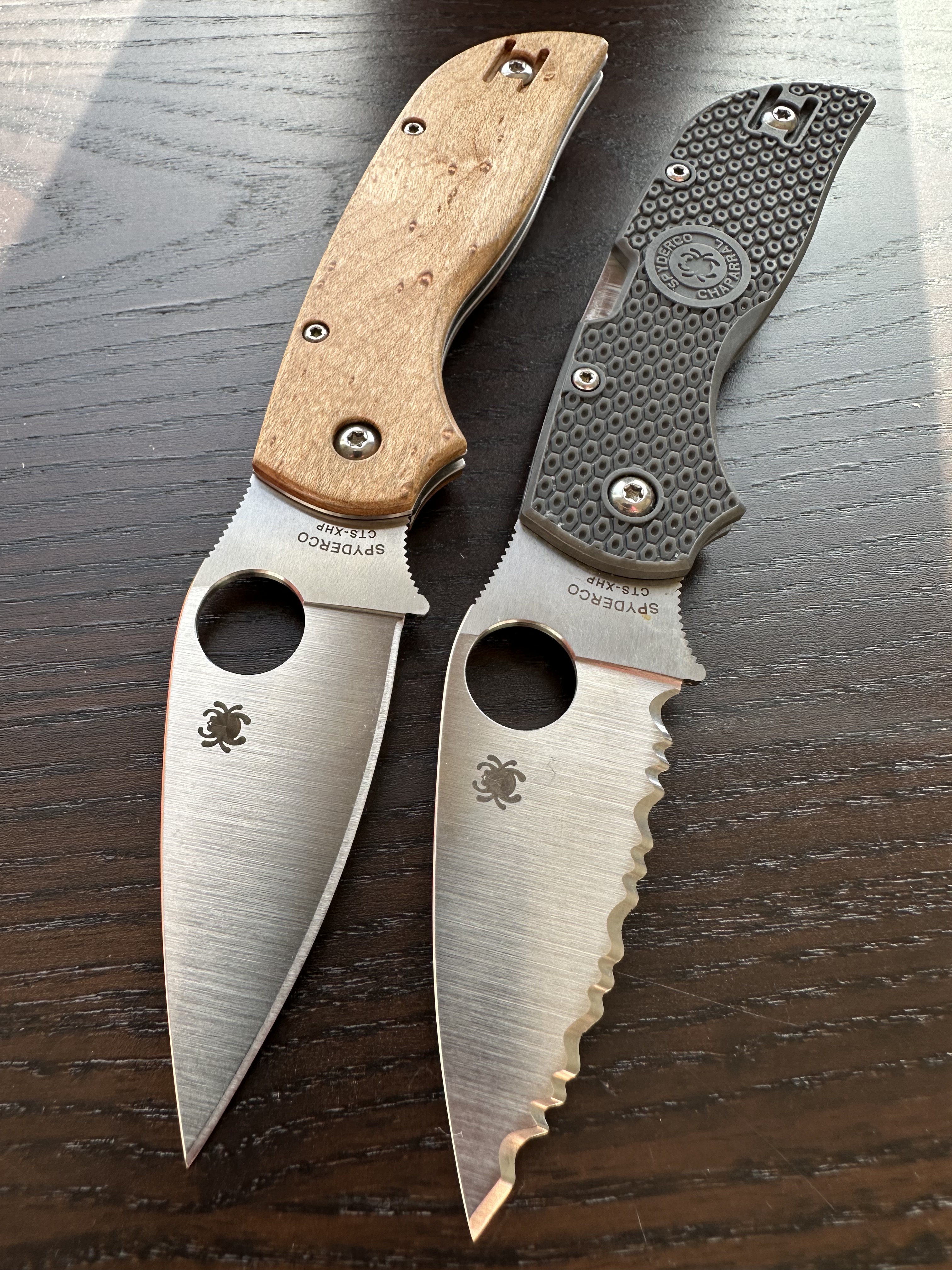
I’ve owned the original carbon fiber version, and earlier this year I reviewed the Lightweight serrated model — still one of the most efficient “matter separators” you can carry in your pocket. Now, thanks to the Spyderco Ambassador Program, I’ve had the great opportunity to test the Slipjoint Chaparral.
It’s worth pointing out that the Chaparral is far from an entry-level model. It’s the premium, Taiwanese-built sibling in the SlipIt family — and at about twice the price of most SlipIt knives, it clearly plays in a higher class.
And this is an eye candy:
You can notice that Spyderco even includes a transparent protector over the clip area to prevent the handle from the clip during transport.
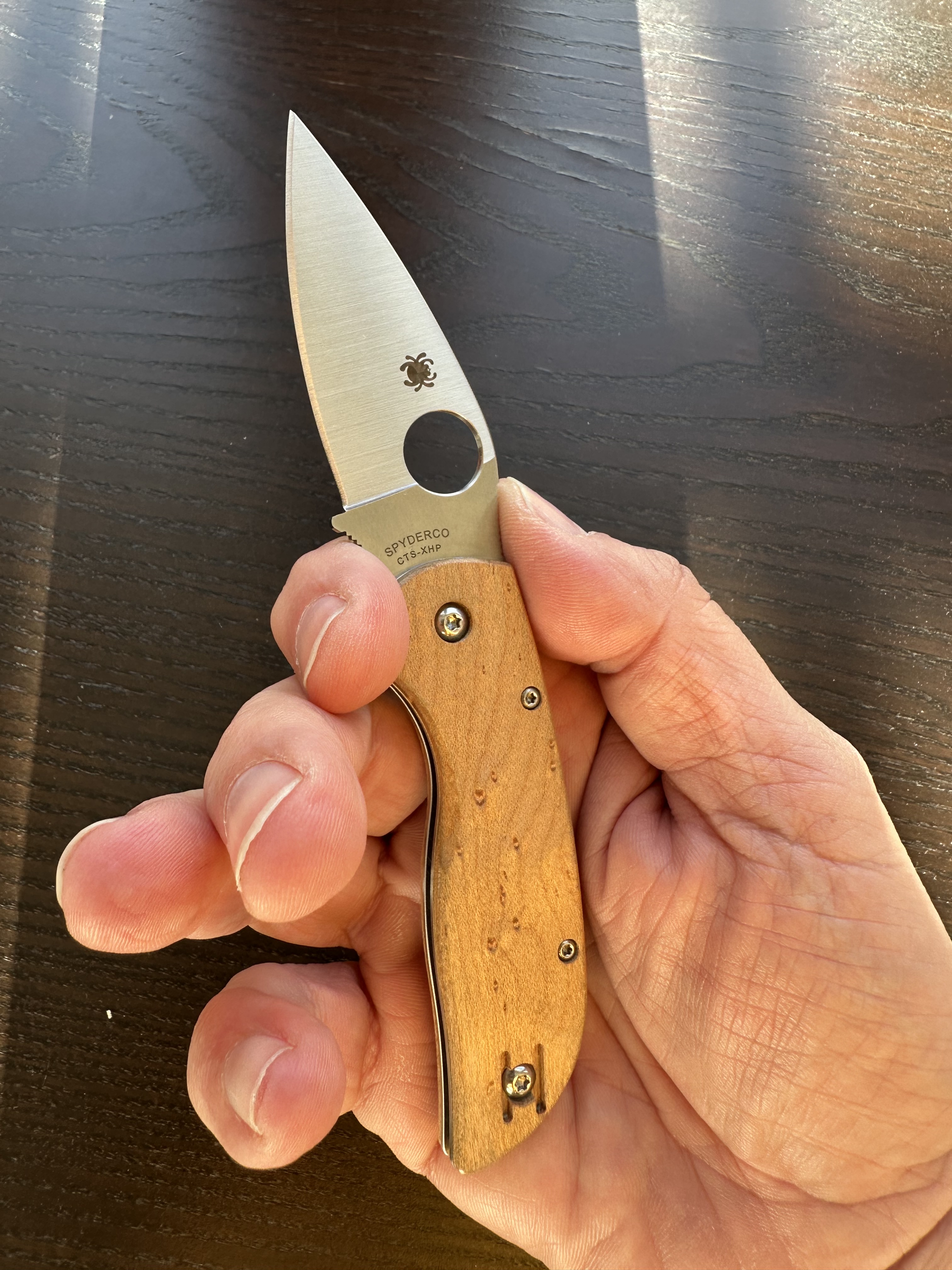
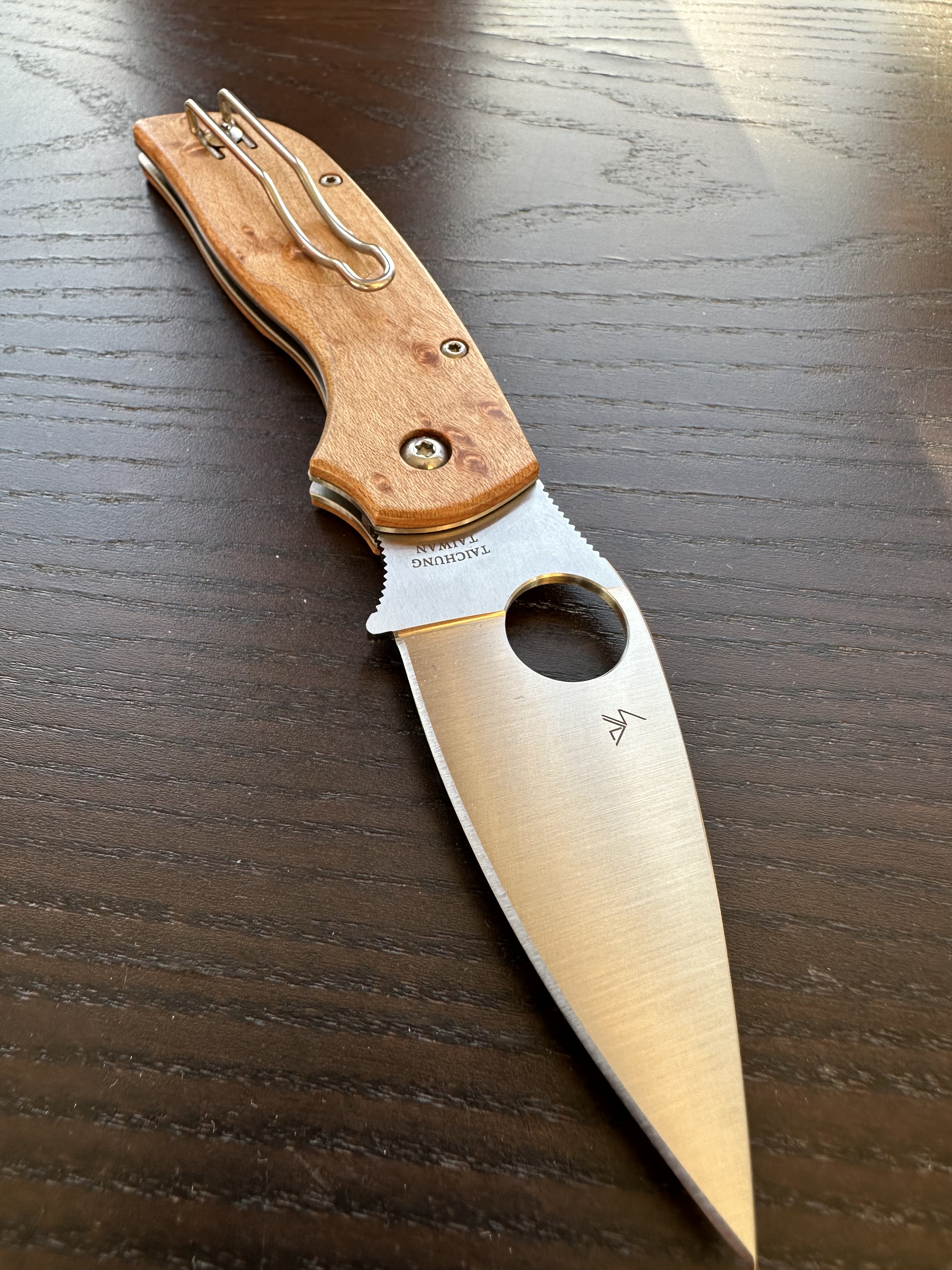
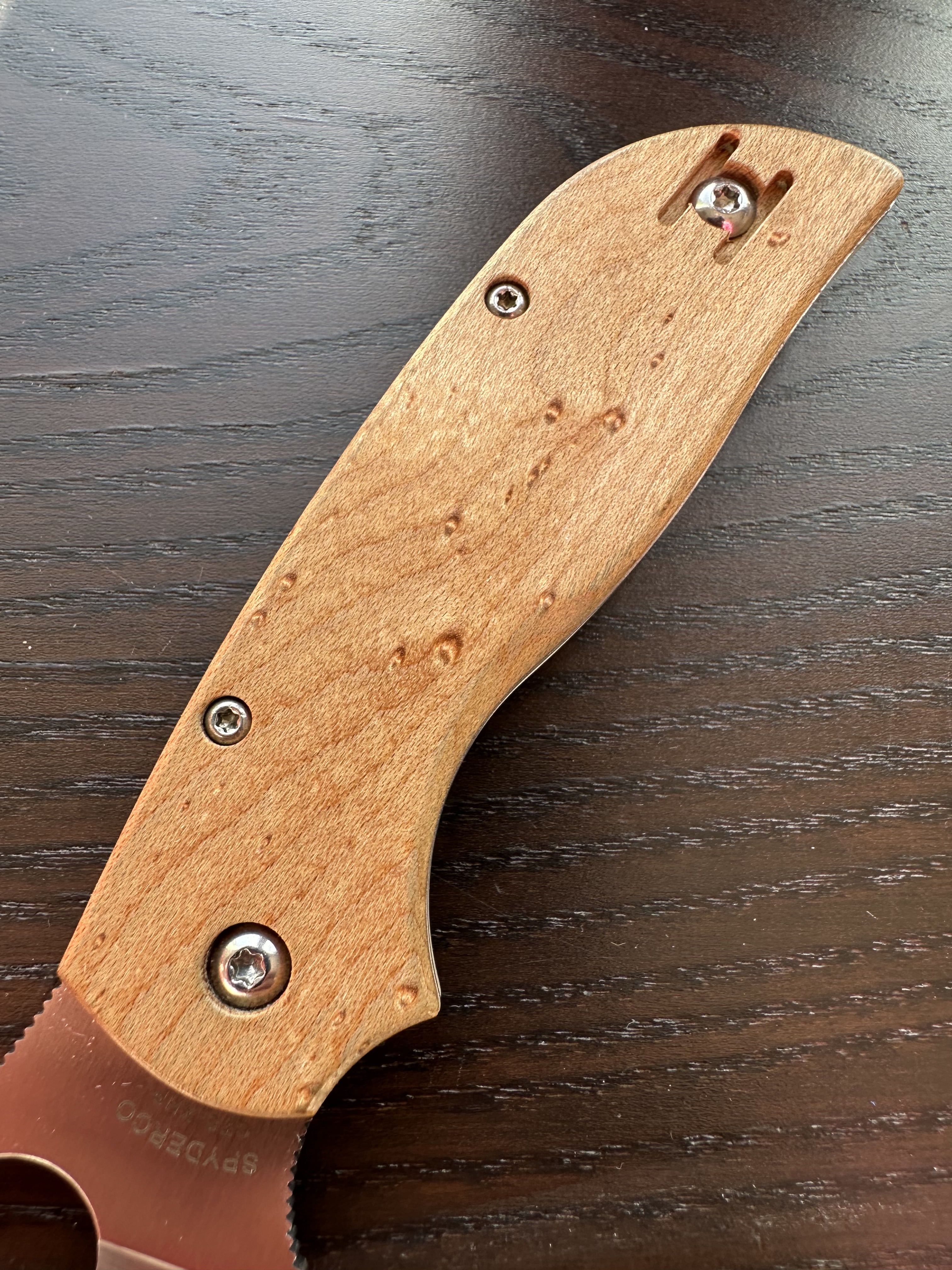
The knife arrived sealed in a plastic bag, likely to protect the wooden handles from changes in humidity. Made in Taichung, Taiwan, and shipped to Golden, Colorado, this precaution makes perfect sense — Golden’s dry climate has been known to affect wood scales before (as seen with their Bushcraft fixed blade). The handles themselves are beautiful. Carrying a piece of wood in your pocket almost feels like carrying a good luck charm.
This is my first Spyderco folder with wooden scales, and I must say — it has real charm.
The knife comes with Spyderco’s standard wire clip, but I have swapped it out for the shorter clip used on the MicroJimbo, Lil’ Native, or Dragonfly — it’s more discreet and I wanted to do it before leaving any mark on the wood.
Here pictured with the Metropolitan and with the microclip mounted on. A downside of the wire clip is that it can create a “hotspot”, or point of discomfort, when applying significant pressure. That’s why I prefer that shorter clip cannibalized from another folder — it helps avoid this issue. When doing extended wood prep or cutting in the field, where downward force is applied, ergonomics really matter.
BTW the Metropolitan pictured above costs about half the price of the Chaparral, and while both fall into the same blade-length category, the Met’s blade is roughly 33% thicker. The Metropolitan’s M398 blade is impressive when it comes to edge retention, but the CTS-XHP used on the Chaparral has proven to be a reliable, all-terrain stainless steel that performs beautifully on that exceptionally thin blade stock. An M398 blade at just 2 mm thick would certainly be too brittle for practical use.
Here is the Chap pictured with the MicroJimbo, the UKPK, the Serrated Chap, the Wasp and the Roadie XL.
Now, about the mechanics: The Chaparral SLIPIT specifically replaces the usual Chaparral’s back-lock with this “notch-joint” spring system. The Chaparral backlock is also unique in the Spyderco catalog as it get an hidden pin for zero vertical play . Most Spyderco slipjoints close in two stages — first, disengaging the spring tension, then a mid-stop for safety. Not the Chaparral. Once you disengage the spring, the blade flows smoothly all the way to the closed position. (Compare that to the Manly Wasp (pictured in orange) or Comrade, which both have four distinct steps!) That said, disengaging the blade on the Chaparral requires a bit of effort — which is actually a good thing, especially for whittling. Feeling a blade start to close while it’s wedged in wood is never pleasant. I’ve had that experience with the beautiful COBOL, and it’s not something I’d want to repeat. Compared to other SlipIt models, the Chaparral is not in the same range of spring tension. I was initially afraid the action might feel too soft. It is not soft but noticeably less hard than my UKPK, Urban, Squeak or Metropolitan. My strongest being my Heinnie G10 Urban.
All in all, the Chaparral is a very capable tool — not just a pretty face. While its aesthetics are undeniably strong (especially with those bird’s-eye maple scales), some users have raised concerns about the stability and durability of the wood in moist or wet environments. Naturally, a wooden handle requires a bit of care — you don’t want to let it soak in the sink. (Buy a UKPK Salt instead !) Wood isn’t G10 or FRN; its warmth and character come at a small cost in terms of maintenance and environmental sensitivity. If you need something very rugged (wet/humid environments, rough carry), it might not be the best choice or you might pick a version with more durable scales.
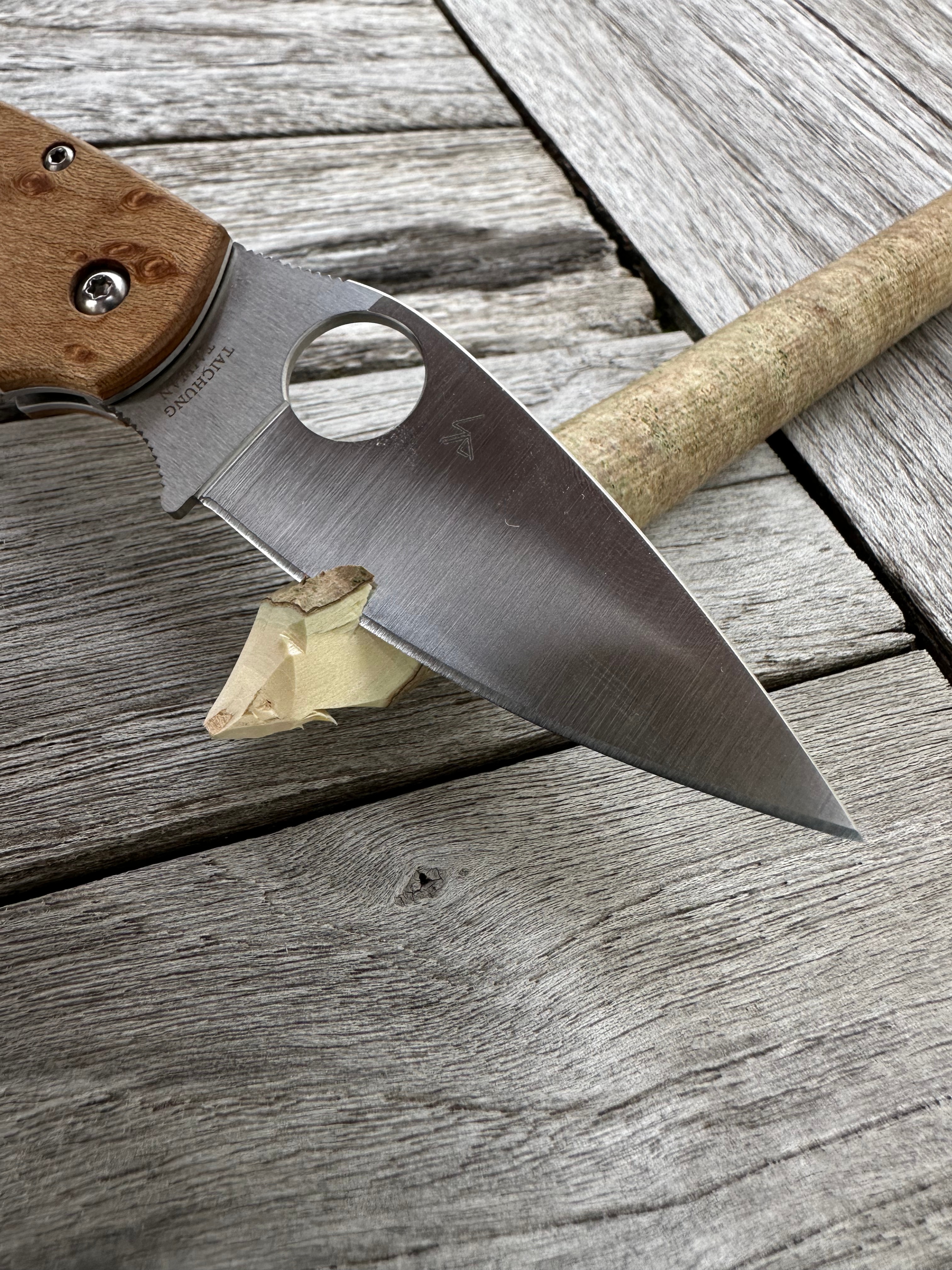
And again, that blade stock is so super thin which makes it an incredible slicer. Opinel class ! You need to experience it to believe it. That’s the case for all Chaparral anyway, nothing new about that.
The fit and finish is near perfect. Notice how the spine and handle are gently bevelled as always with Taichung’s ! This is little folder for users who prioritize slicing performance, sharpness, and elegance, the Chaparral SLIPIT is just appropriate for EDC/“gentleman, lady” use. The non-locking SLIPIT mechanism is suited for jurisdictions (including Europe/UK) where locking blades may be restricted — that adds to its appeal. If you want also a knife that carries lightly, looks premium, and doesn’t feel like a bulky tactical folder, this hits that niche. But you may want to treat its maple scales carefully and avoid heavy moisture. I will rinse my Chap under the tap but immediately wipe it dry, this is as simple as that. I will see if wood will change on the long run and it will surely add some character. No worry. The non-locking SLIPIT mechanism may not feel as secure as a lock-back, and the “no half-stop” means the feel is really different that other SlipIt designed by Sal Glesser. Anyway any Chaparral will teach you a lesson on the importance of grind and thin geometry but this one will keep it legal in many countries.
If you’re seeking a precise, elegant everyday-carry folder with top-tier steel, superb slicing geometry, refined looks and minimal pocket presence — the Chaparral SLIPIT delivers strongly. Oh boy does it slice, hell yes. And it brings luck.
Today’s review is a bit special. Every now and then, I like to invite other reviewers and true knife enthusiasts to share their perspective. This one comes from Guillaume Gx, moderator of the Spyderco Fan Club on Facebook — and a man who definitely knows his way around an edge. Also all photography featured in this review is the work of Guillaume Gx.
Let’s get straight to the point — much like its sibling, the Nand, the Cobol doesn’t carry a knifemaker’s DNA. This is not a blade born from the forge, but rather a stylistic exercise, a conceptual piece with a distinctly “Japan-inspired” design. And that’s where any comparison to the Ikuchi ends.
Mechanically, this slipjoint shares the same traits as the Nand: soft tension, little to no sense of security. A light press on the spine will start the blade folding, which instantly rules out anything beyond light, food-related tasks.
But perhaps that’s the idea. The dining table seems to be the natural battlefield for this miniature katana. Unfortunately, the sweeping arc drawn by the handle and blade demands contortionist wrist angles, while the tanto-style tip hardly helps when it comes to cleanly separating food. In this arena, the Ikuchi—or even the Nand, with its almost twice thinner blade—will fare gracefully where the Cobol clearly struggles to hide its discomfort.
Gone is the Nand’s M398 steel. The Cobol features an M390 blade—beautiful to admire, but challenging to sharpen. Guided systems will have trouble catching such a low-profile edge. Seasoned sharpeners will need to rely on freehand skill to bring out a proper cutting edge (the factory edge being nothing to brag about).
So, is reason telling us this is a flop? Not quite. Let’s remember that, like the Nand, the Cobol wasn’t crafted by a bladesmith but by designer Paul Alexander. This knife should be viewed as a concept piece, a non-knifemaker’s take on knife design, a genuine exercise in style.
You can’t help but salute the intent—and the audacity. Spyderco showed real boldness in releasing two designs that stand as true UFOs in the eight-legged universe.
And so, I look to the sky, hoping to see another one someday.
Disclaimer: This knife was supplied at no cost by Golden as part of their brand ambassador program. Spyderco’s decision to include this publication is appreciated, though the review that follows remains independent and unbiased.
This is my first glimpse at the middle Brother of the SLIPIT™, the Metropolitan. Made in Maniago. It is an Italian Spyderco. Un altro piccolo grande coltello !
It is made in Maniago like my Heinnie Urban and it is a pure Sal Glesser design. The blade comes razor-sharp straight out of the box. The factory edge is excellent, though I know it can be refined just a touch on leather. It’s a very thin grind—thinner even than on my Roadie XL. While M398 isn’t as leather-friendly as SPY27, it can still be brought to a high polish, as I managed with my Roadie XL after breaking its tip.
Being slightly longer than the Urban, the Metro’s handle comfortably fits four fingers when using the choil. This choil also adds an important safety feature, preventing accidental closure on your fingers. The choil-hump combinaison—acts like a guard, directing cutting force straight into the blade while relieving stress on the handle and pivot.
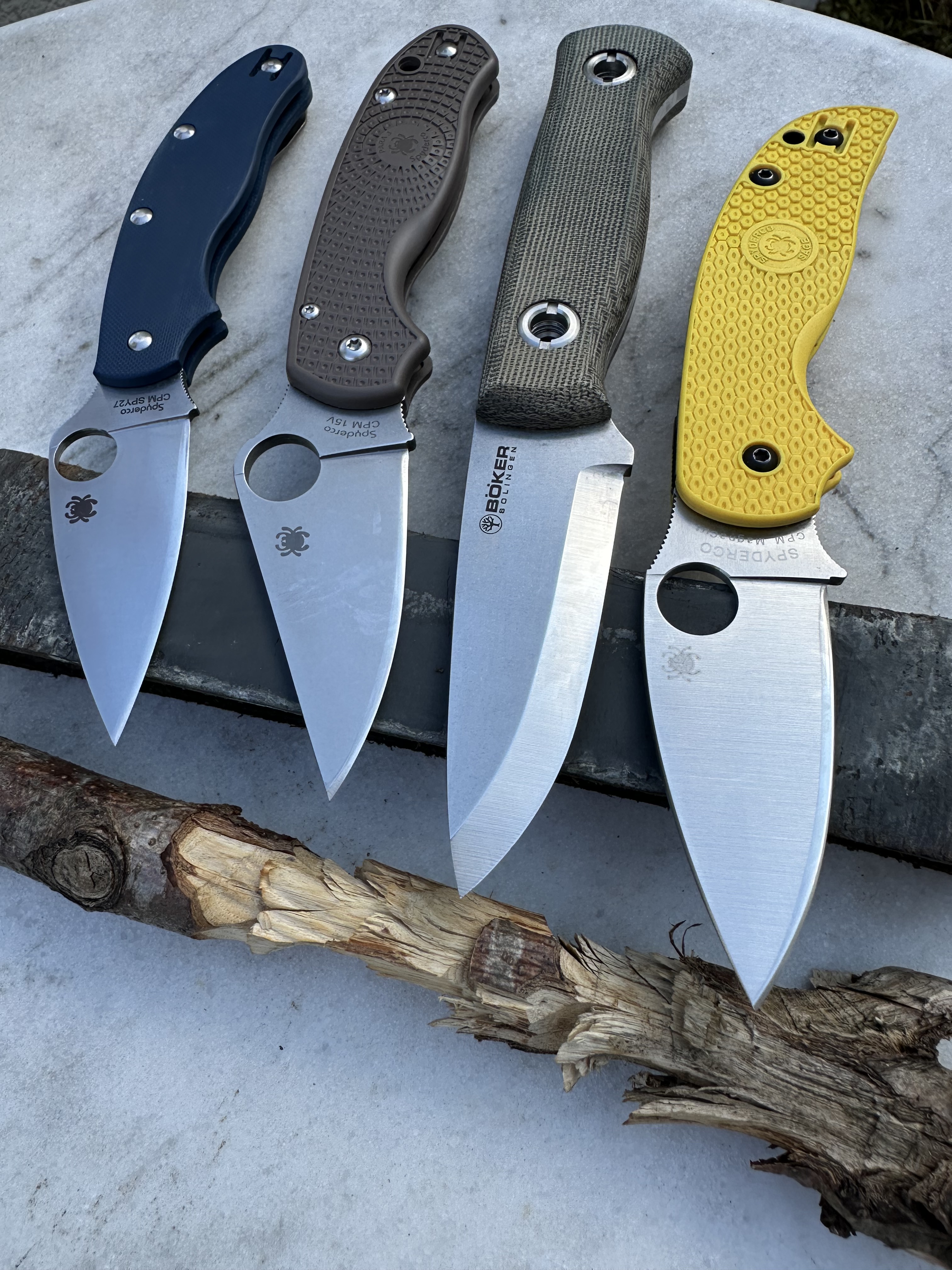
“Metro In the Middle” pictured: the G10 SPY27 UKPK “Golden Child”, the Metro and the Heinnie G10 S90V Urban.
To quote my friend Wayne Thomas Heywood Adamson: “So now we have a middle ground between the UKPK and the Urban. I was surprised when the Urban shrank in size but that was clearly now to make room for the Metropolitan.”
(Made in Golden – Maniago – Maniago.) The 68mm Metro’s blade thickness measures 3 mm at the spine, with a full flat grind in a leaf-shaped profile. By comparison, the longer UKPK “Golden Child” comes in at just 2.5 mm, which makes it the undisputed king of SlipIt designs. That said, opting for a slightly thicker blade in M398 is a sound choice. M398 is not known for its toughness—certainly less forgiving than Spyderco’s in-house CPM SPY27 alloy—so the added thickness provides welcome reinforcement.
The S90V Urban is 2,9mm !
And the Roadie XL is 2,8mm
Making the Metropolitan the thicker of the wild bunch ! By an hair !
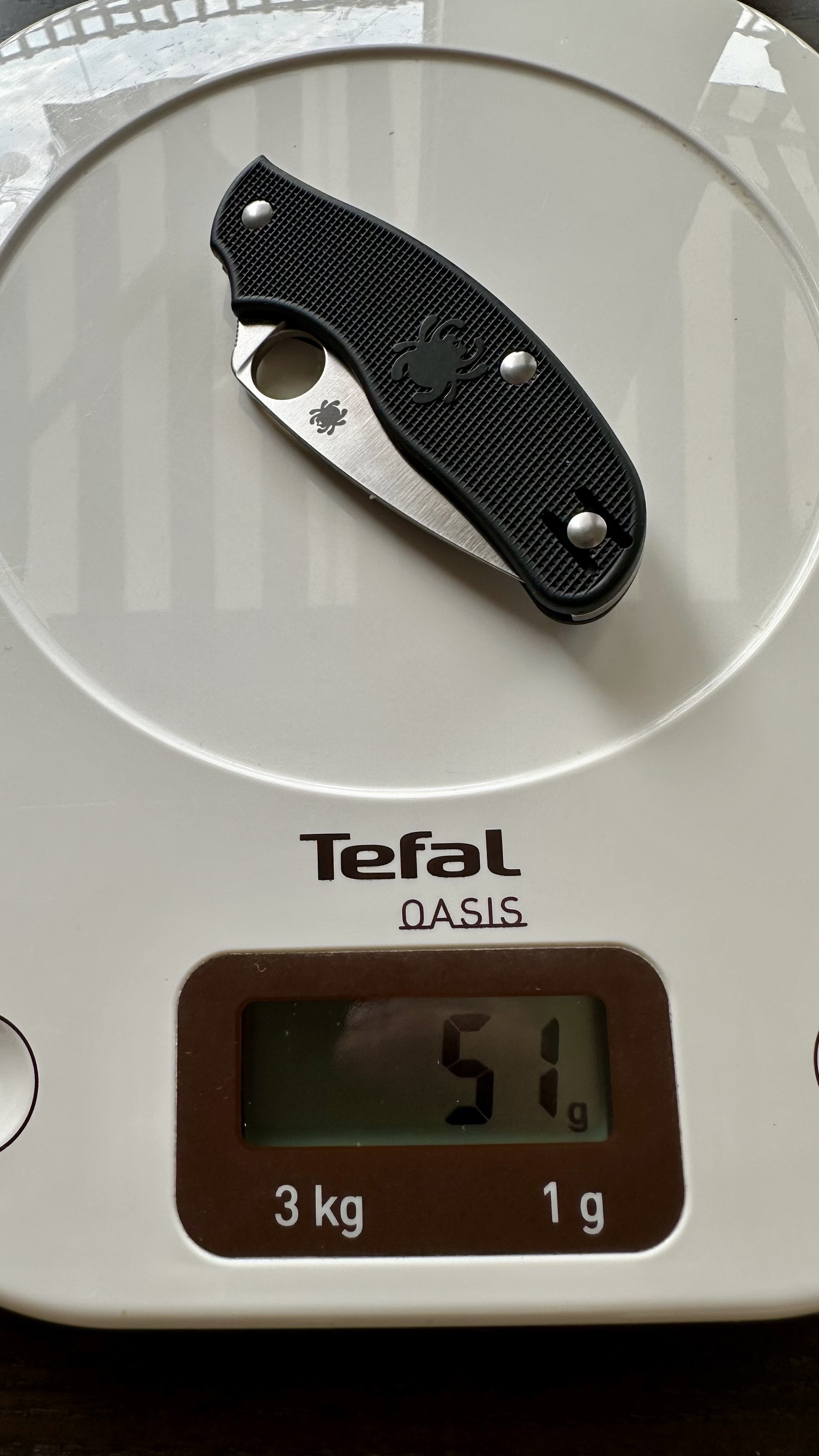
Now about the weight…
At 51 grammes it is really light in the pocket.
The action is very good. It is as strong as my Urban and UKPK. perhaps a bit less hard to close but this is not really an issue. I have noticed the Metro’s back is a full spacer/spring construction like a G10 version (when the UKPK FRN Salt is not for example.) It does not share the same “fork” spring of the UKPK but the same slipjoint mechanism as the Urban. You can feel the spacer moving up when closing.
So what can we expected from this Metropolitan compared to its siblings? A little more room for your fingers. The Urban and the Squeak are three fingers knives, the Metro and UKPK are four fingers. This is also an opportunity to showcase M398 in a high, full-flat-ground, thin blade. The Roadie XL’s narrower profile already favors cutting efficiency, and the Metro builds on that. In terms of edge retention, M398 belongs in the same category as S90V—a steel I know well from my Urban model, where securing an exclusive sprint run was a real challenge. With the Metro, however, M398 is now part of the regular production lineup, offering users a true “super stainless” steel in an accessible package. But beware M398 does not like torsions, like my Walker in ZDP189 which has been able to survive all those years.
The Metropolitan could really be a major upgrade for my Italian Hares Hunter in Tuscany. For the record, skinning game—especially dealing with hair full of sand and dirt—puts a significant challenge on edge retention. Hunters typically don’t use their knives for woodcraft; their main task is working on hares and similar game. In that context, a blade of 68mm in M398 could offer a real advantage.
The Metropolitan—easy to carry, legal in many countries, and made of stainless steel—could be the perfect hunter’s SlipIt, which is great news for many of my friends.
I have had the chance to buy that UKPK in G10 for 100 euros in January 2025. Since, it has been my “go to the city” favorite folder.
Sometimes replaced by the Roadie XL for a lower profile or Dredd my Urban in S90V made in Maniago and exclusive to Heinie in the UK.
The UKPK is remarkably versatile, proving itself even in woodworking. Its strong, reliable mechanism keeps it ready for anything — all while remaining fully within legal limits. Stripping vines, carving rods, scraping, cutting — it handles everything with ease. The spring “lock” never falters, and the finger choil adds an extra layer of passive safety, even if it’s rarely needed.
Its thin yet strong CPM SPY27 blade is a true joy to use on wood. In this domain, the UKPK stands out as one of Spyderco’s best hidden gems across all categories made in Golden. And if I ever had to defend myself against an animal, I believe it would perform every bit as well as the legendary Calypso (all the story here).
The tip has seen plenty of use, and all I can say is that Spyderco’s in-house SPY27 steel is extremely forgiving. You can push it hard with no damage to the edge. I’ve compared it with many of my favorite wood-cutting knives — including some specialized for woodworking — and it performs impressively in the same league.
One way I now measure the value of a pocket knife is by the pleasure I get from using it. The UKPK easily ranks among the top on my list. Strong, thin, and precise, it excels as a true “matter separator,” handling everything from everyday tasks to more demanding jobs like scraping paint.
There’s also a distinct joy in keeping the edge razor-sharp, and SPY27 has become my new favorite for that. Achieving a razor edge is a breeze. Being in the AEL-B class, it’s even easier to work on than Magnacut and is extremely leather-stropping friendly. After just a quick session on leather, SPY27 regained that legendary crisp edge — and it’s such a pleasure to use!
Hairs are flying and the convexed home made edge is shining like a mirror. This is really part of the joy to use leather strops on a steel.
So it is a joy just to strop it again and again just to maintain this razor edge.
Then for forced push cuts, the geometry of the UKPK is just a killer. It goes deep like a thin Opinel blade can go.
To keep the knife sharp, I’ve mostly relied on leather stropping, with occasional touch-ups on white ceramic, even after cutting cardboard, plastic, acidic food, and hard wood. The UKPK in SPY27 is a winner, offering a significant boost in edge retention and versatility. Maintaining its vorpal edge is even easier and more enjoyable than with the excellent Magnacut or LC200N versions.
It’s no wonder this steel has earned such a special place in my heart.
And I was not able to get any chipping or edge bending in six months. It gives an hint about the high quality of the inhouse heat treatment on that inhouse steel.
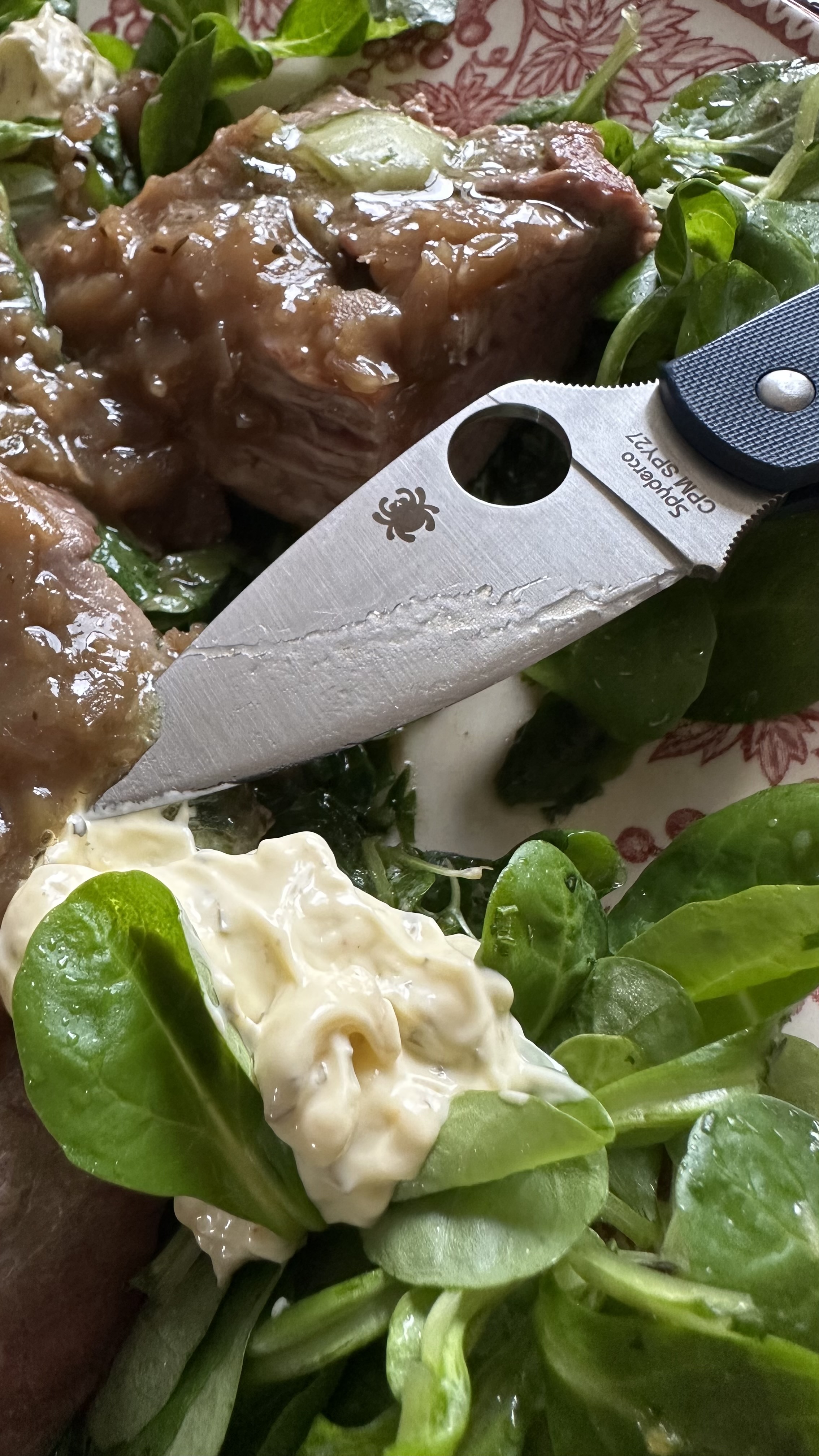
Used in the plate, the SPY27’s core refused to be damaged: no pitting, no rust, no stain. No damage on the plate ceramic too. It a gourmet companion and a wonderful carnivorous friend.
In the kitchen, geometry-wise, the UKPK can compete with the best — for example, the Patrick Bonetta Kitchen Warrior. The G10 version is also a visual delight. I never felt “under-knifed” with my Urban, but the UKPK could easily be my one and only Spyderco. A three-inch, legal, high-performance sharp blade is a must-have for EDC, and such knives are surprisingly rare.
This is 100% Sal Glesser design. This Golden-made gem is the all-terrain pocket knife my grandfather would have dreamed of! Hence its name The Golden Child. 😉
For an alternative you can now get The Metropolitan. Its little brother.
This is not the first UKPK I have reviewed in this blog. I was a very early adopter of this Sal Glesser’s approach of the modern slipjoint all made in Golden Colorado. Some of my favorite are the Salt Versions in FRN: the Green LC200N and the Yellow CPM Magnacut. I even think, the serrated version of the Magnacut version could be an amazing legal travelling knife.
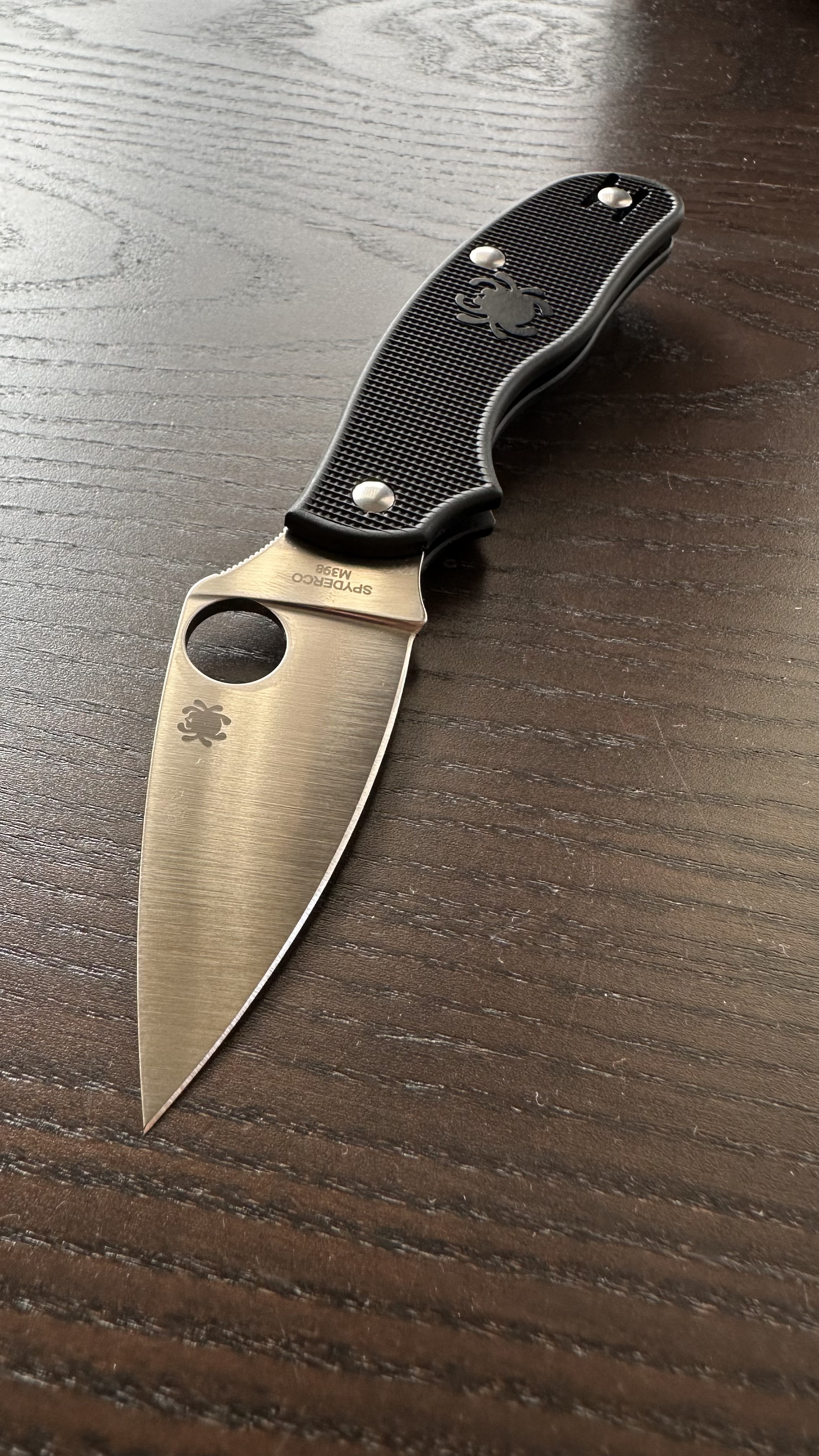
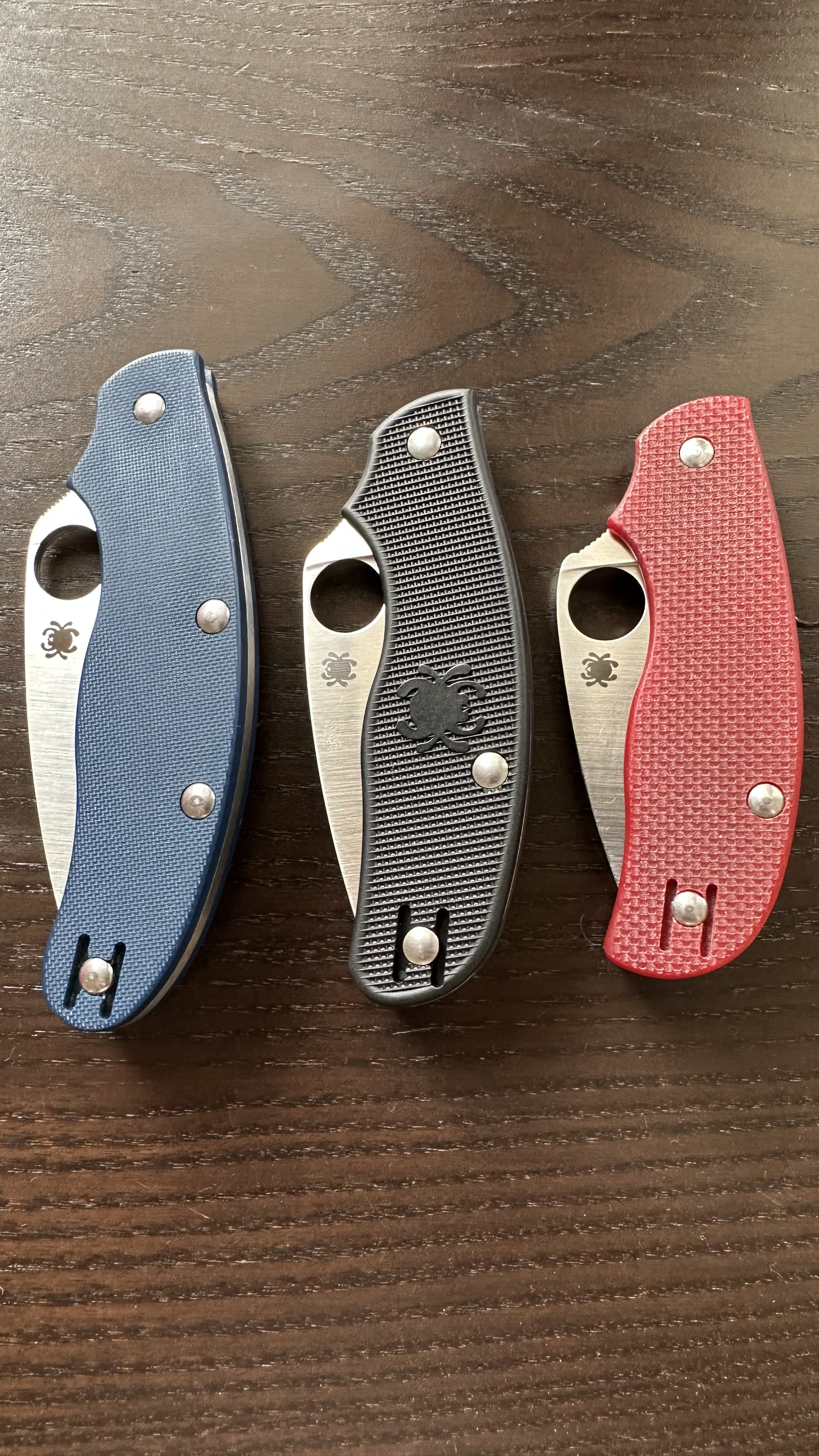
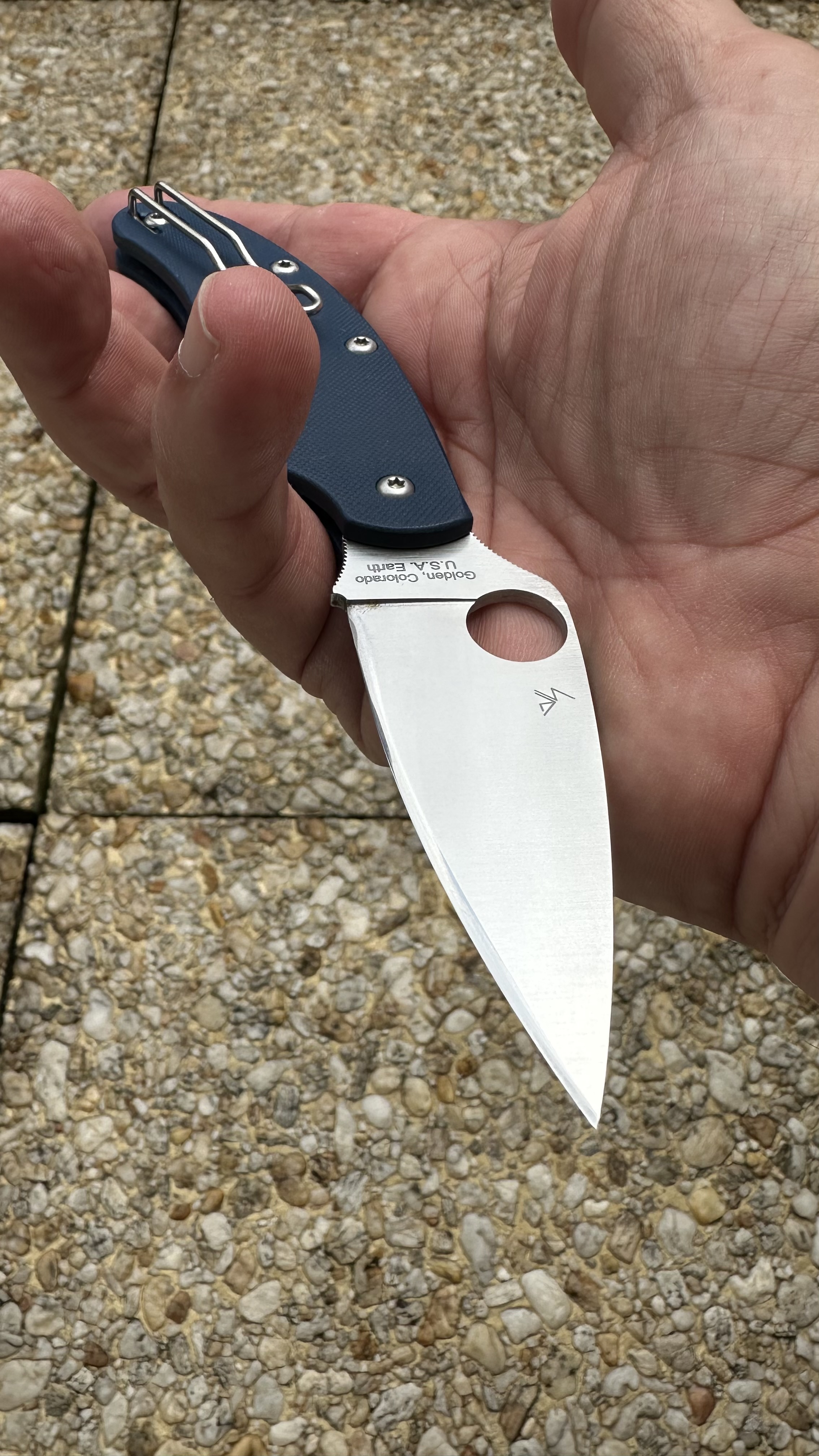
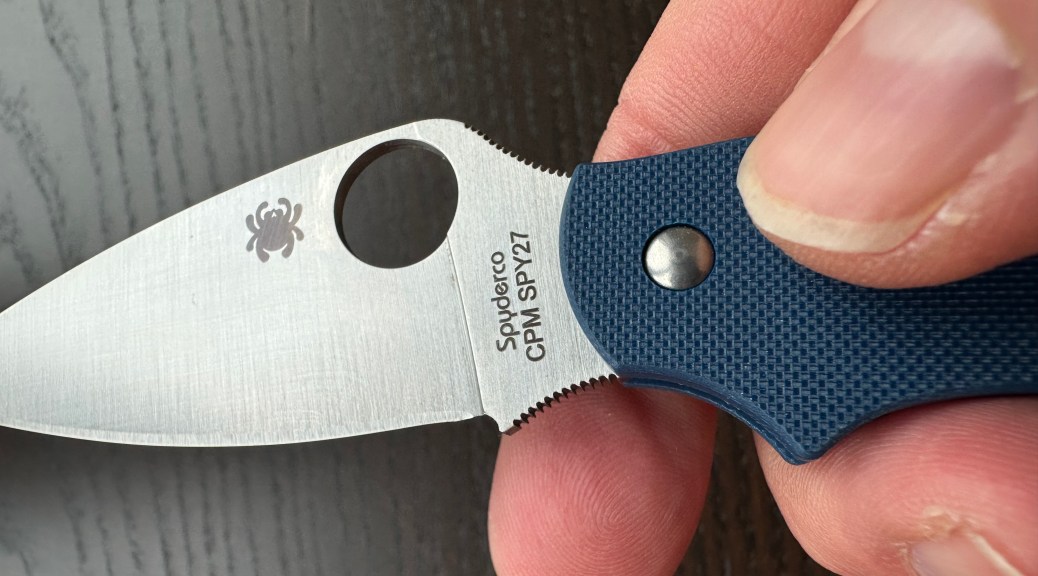
But they are FRN versions. I like FRN but I do love G10. Better, I’m a sucker for sanded G-10. Hence my love for the Heinnie Urban and its non-slip peel-ply texture. At first glance the satin-finished CPM SPY27 blade and signature cobalt blue peel-plytextured G-10 handle scales are juste gorgeous. Here are the full specs on Spyderco’s pages.
Like the Heinnie the skip joint got a strong mechanism. It is really a pleasure to feel this resistance which was totally absent from the very first drop point UKPK a decade ago. (Picture from Mr Blonde, Spydercollector site)
So far, I cannot imagine my self opening it with a flick like I was able to do on the LC200N FRN version. The Spring here on this G10 version is much stronger.
Let’s do some size comparaison. The UKPK is one of the long Slipit in Spyderco’s collection. It is almost a slipjoint Caly, even longer than a Chaparral. So you really don’t feel “underknifed” when you carry it in your pocket as your only EDC. It is also really handy and practical as a kitchen knife. The best thing is that this design keeps its blade length legal in most countries.
The long leaf shaped blade is a must in the kitchen almost idea. It is pointy enough and its is enough for vegetables. Most of the works done in the kitchen like peeling potatoes, cutting oinions, you name it, was always done with a short full flat ground knife like a “Nogent Couteau d’Office”.
Something about the G-10 version is the spring/back spacer closing the handle of the knife when the FRN got an open handle easier to rinse. But it is much more gorgeous and with a stronger spring for sure !
It also gives a little more heft to the knife. 48 grams for the FRN and 63 grams for the G10 version -> 31,25% heavier to be precise, almost a third ! But I do really love my heavy butt knives since my Schrade Sharpfinger.
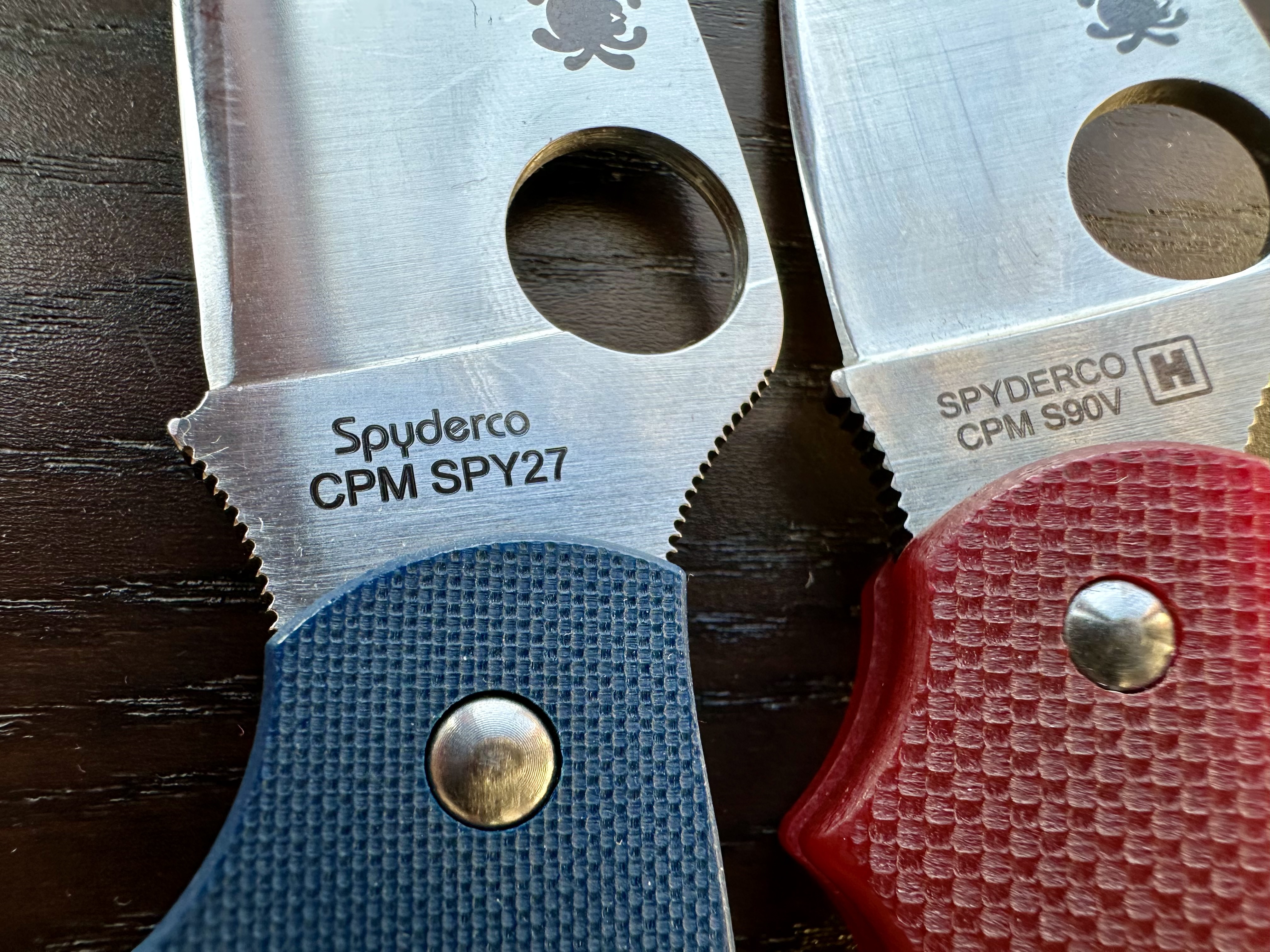
Now this is my first CPM-SPY27 knife. Spy27 is a alloy recipe created in house with Crucible exclusively for Spyderco. It is a CPM ! So this is a premium super steel compared to VG10 or N690… In short it is a American Powder Metallurgy version of the Japanese VG10.
In Sal Glesser words: “We offer many steels for several reasons; 1) We are Steel Junky’s (even Edge Junky’s) and we like to experience the different flavors and we try to do that. 2) We believe that many of our customers are also Steel Junky’s (even Edge Junky’s) and they too get to experience and play with and “taste” as you say, the many options.
I wanted a USA made “tweaked” version of Gingami 1 by Hitachi and after some effort with Carpenter, we have a powdered USA made steel called CTS-BD1N Which is a refinement of Gingami 1. I wanted a USA made “tweaked” version of Takefu’s VG-10 and now we have a powdered “tweaked” SPY27.“
“However, it should be noted that the SPY 27 Larrin used for testing was not heat treated by Spyderco. Some minor differences between Larrin’s heat treatment and Spyderco’s heat treatment can probably be expected. That being said, Larrin is the best source of consistent, objective data and metallurgical interpretation for steel comparisons.” To quote Karl_H in https://forum.spyderco.com/viewtopic.php?t=87383
“SPY-27 will hold the fine edge longer… Its all about the stability of the fine edge, not the total wear resistance until fully dull. In this regard, SPY-27 can do what other stainless steels cant.” to quote Submicron in the same thread.
I am aware that Cobalt’s dust can be an health issue. Of course Rex 45 and Maxamet (10% of cobalt, 1,5% for SPY27) are the heavy weight steel in their tool steel category but the Spy27 (like VG-10), like all cobalt alloys needs to be carefully cleaned after a sharpening process. (Cobalt may cause an asthma-like allergy. Future exposure can cause asthma attacks with shortness of breath, wheezing, cough, and/or chest tightness. * Cobalt may affect the heart, thyroid, liver and kidneys. * Repeated exposure to Cobalt dust can cause scarring of the lungs (fibrosis) even if no symptoms are noticed. According to https://nj.gov/health/eoh/rtkweb/documents/fs/0520.pdf)
Let say SPY-27 is in the same club as the S35VN steels in terms of performance and it especially loves fine ceramic and leather stropping. It gets easily a very crispy edge like VG10 or BD1N . ( Steel which are “leather super friendly” are also LC200N, 52100, VG10, AEB-L… ) This is a must and a real pleasure for me as I keep my knives sharp mostly with leather. A touch up and it makes flying hairs from my arm again. And it seems true so far. I have not deshouldered the edge yet and intend to use it with the factory edge for some times but leather made it hair popping sharp. (Once deshouldered it is a straight razor with excellent edge retention… much better than S30V). To quote Sal: “SPY27 for some reason, seems to be punching above its weight.”
No crossroads, this Blue Djinn loves leather like the Bill Moran FB01 in VG10 loved it.
No need to use diamonds unless you want to reprofile the blade or round the shoulder then don’t forget to rinse the blade and to clean any dust. But talking about dangerous dust, I have sanded the scales to preserve my pockets. Never breath that dust !!! Do it under water or wear a mask. I got a neighbor who has been working around that kind of heavy dust and now he is breathing with two tubes in his nostrils. So be careful with your health. This Blue G10 got a very nice texture under the thumb like some denim, textil like. It is really pleasant, almost like some Micarta found on the QSP Penguin.
So when you sand G10, just go outside in the wind or work under water. You don’t want to breath G10 dust made of fiberglass and epoxy. Just rinse it under the tap to have it back to normal. Once tuned at your hand, G10 is a very very nice material.
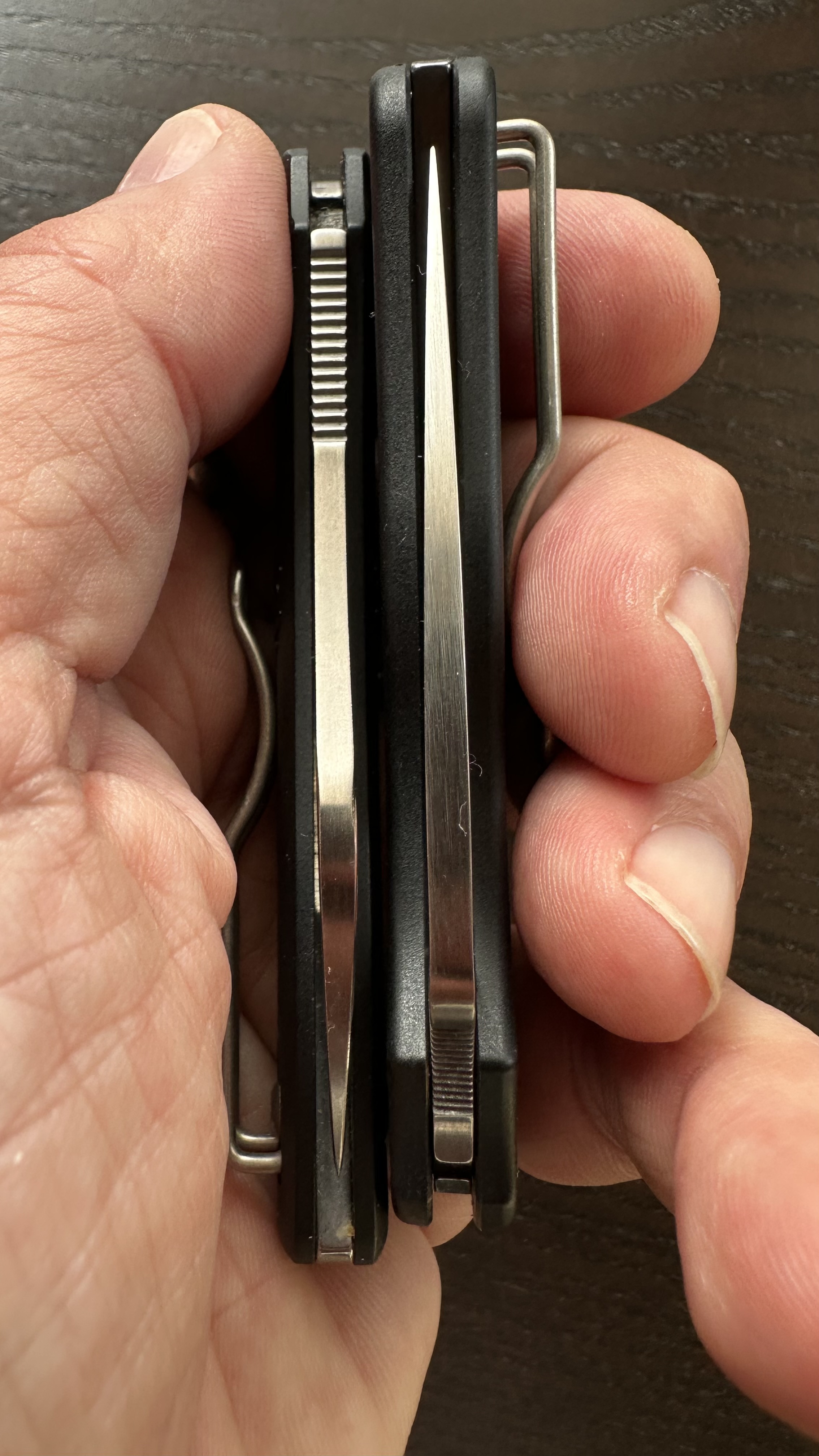
As you can notice the scales are even thicket than the blade and the blade is perfectly centered.
There is the famous middle/half stop when closing or opening the knife. It works like a safety measure. This knife is harder to close than to open.
The UKPK is a very ergonomic knife. It feels like it melt in the hand. It is so confortable for heavy cuts. Because this blade can work hard with zero play.
The “pistol grip” is common in many Sal Glesser design like the Endura or the Military. It is much more pronounced on the Massad Ayoob.
No hotspots for me a very safe handle, really, this lil slipjoint is screaming to be used hard.
It is even confortable edge up.
With the Roadie XL. Another great Slipit with a very low profile, almost like a pen in your shirt pocket.
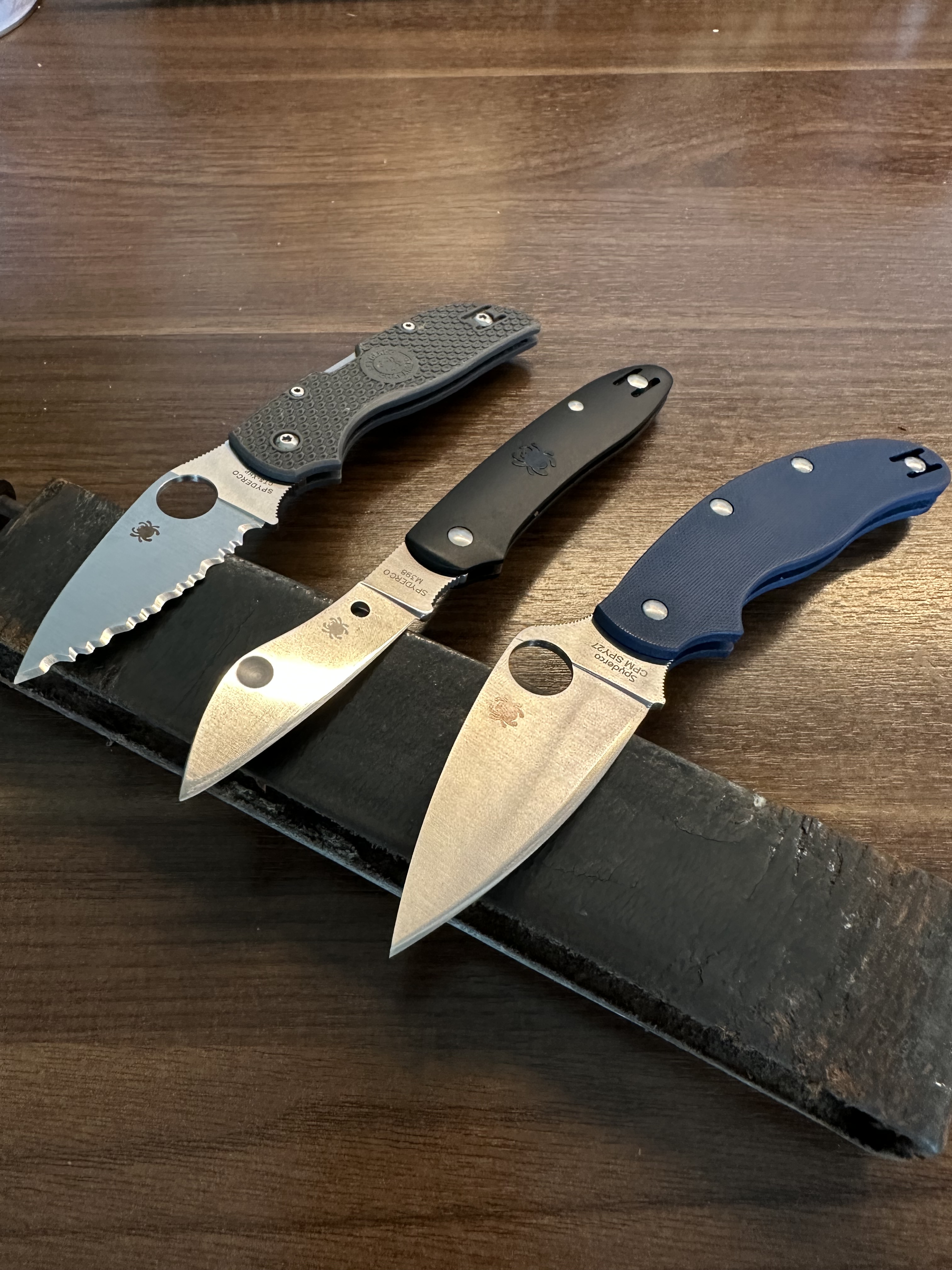
And the mighty Chaparral serrated. Two of Sal’s best designs. Two wolves in sheep disguise thanks to their thin solid blades.
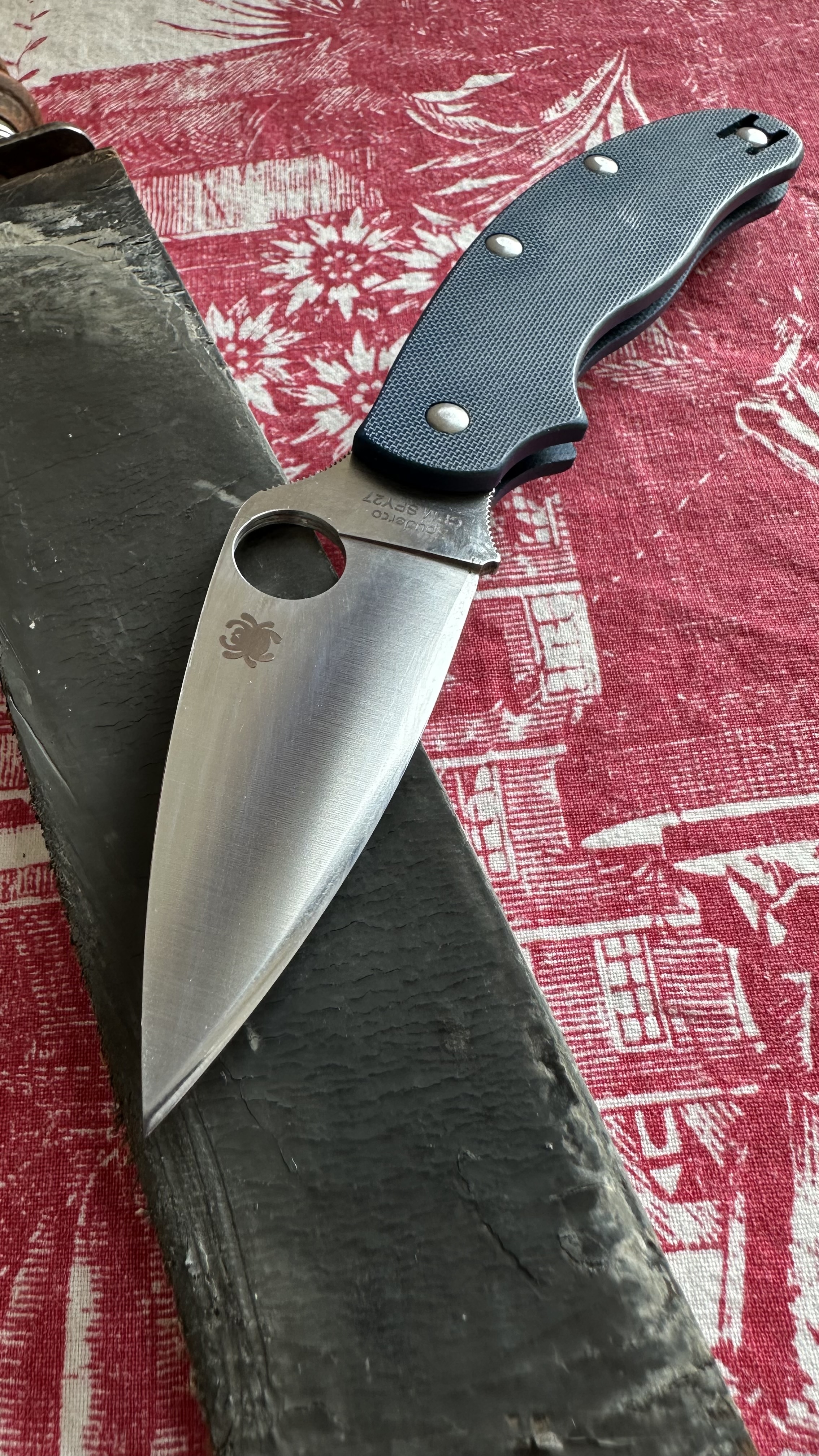
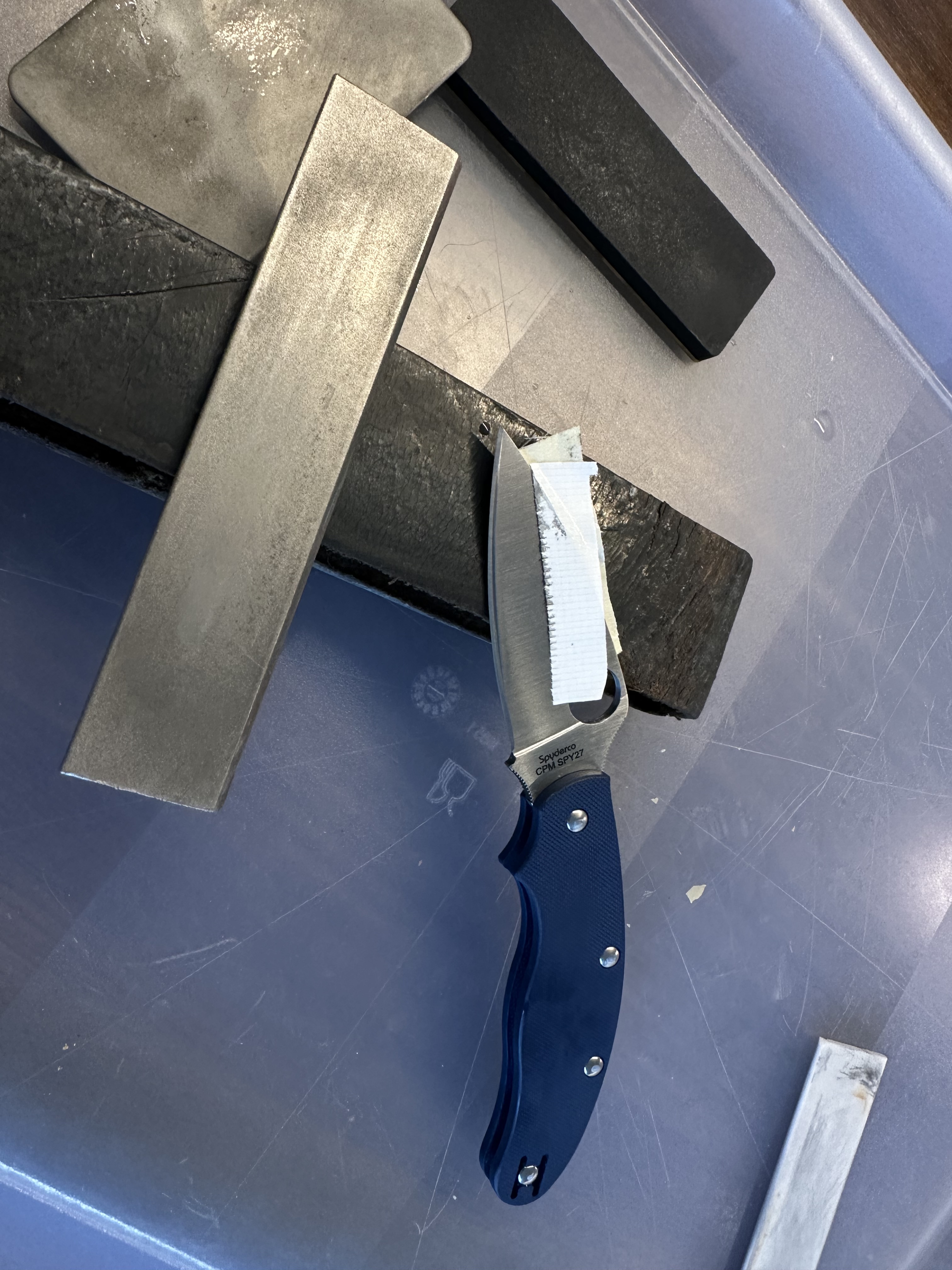
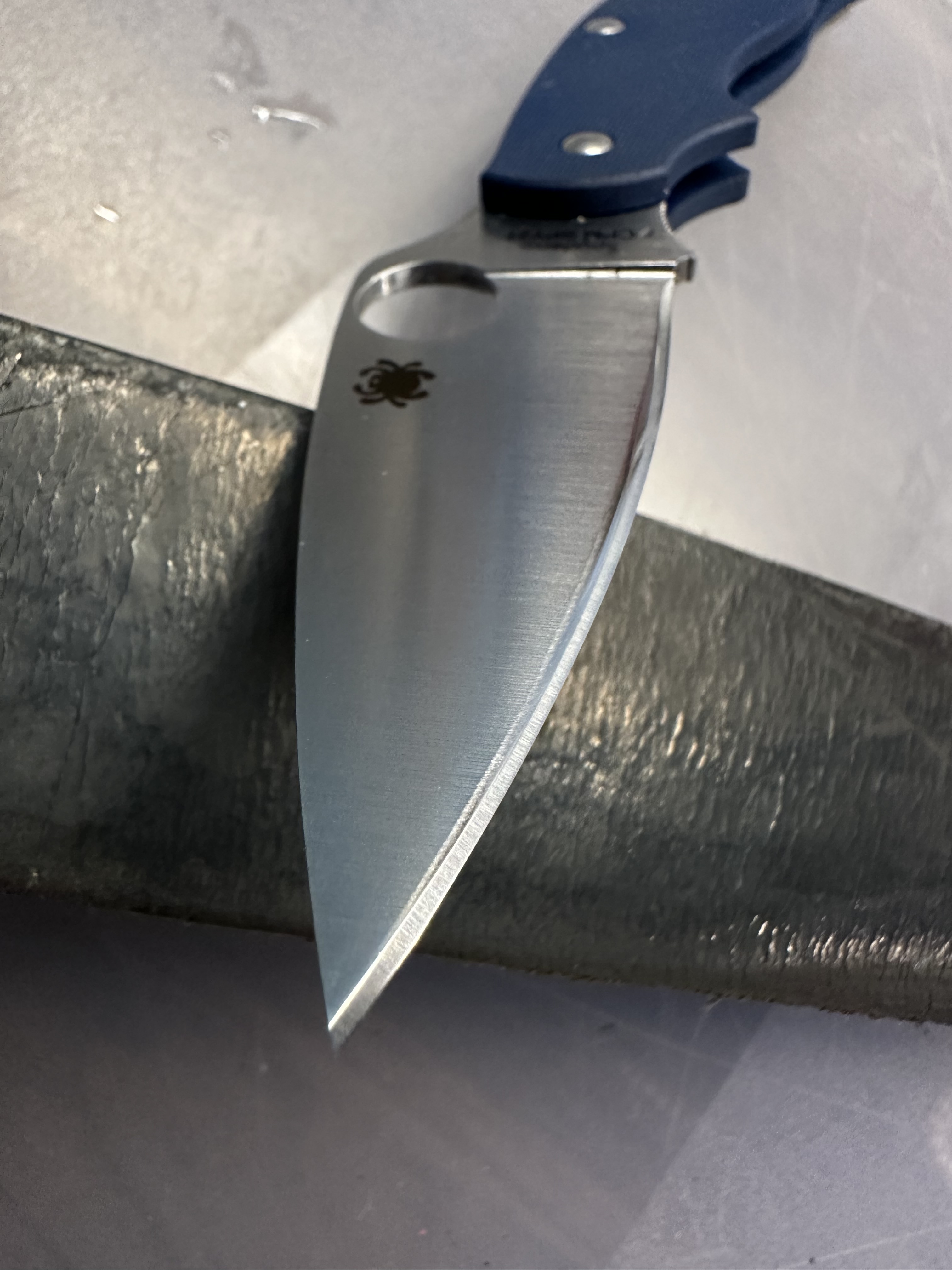
I have decided to de-shoulder the edge for a gentle convex result in the middle of the belly.
My old leather with some polish compound is ready again to smooth the edge to razor level.
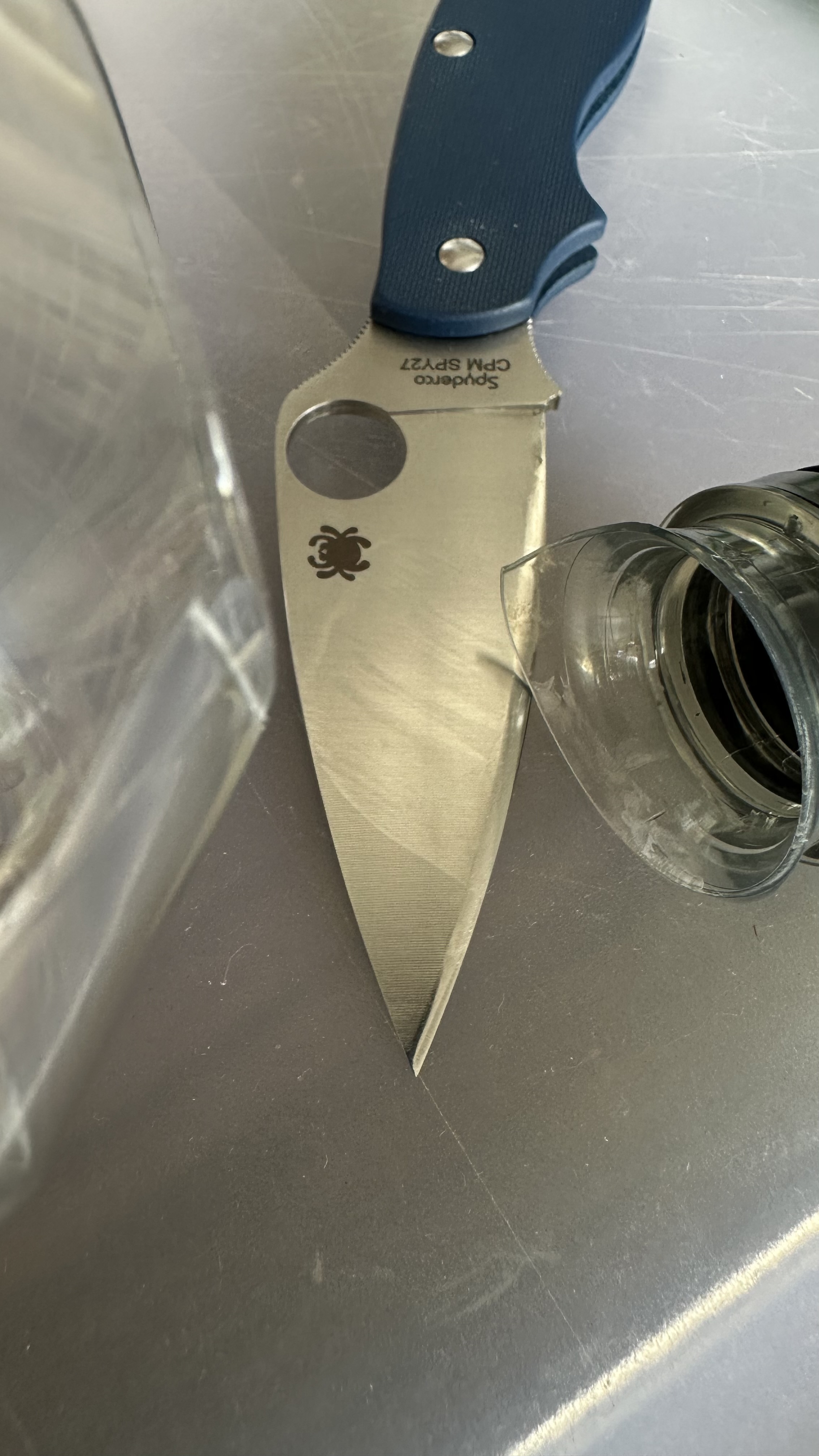
Because I want a better touch on the leather, I usually keep the normal edge at the point to keep material there and near the ricasso as I use this portion for special shores like removing the aluminium cap on bottles.
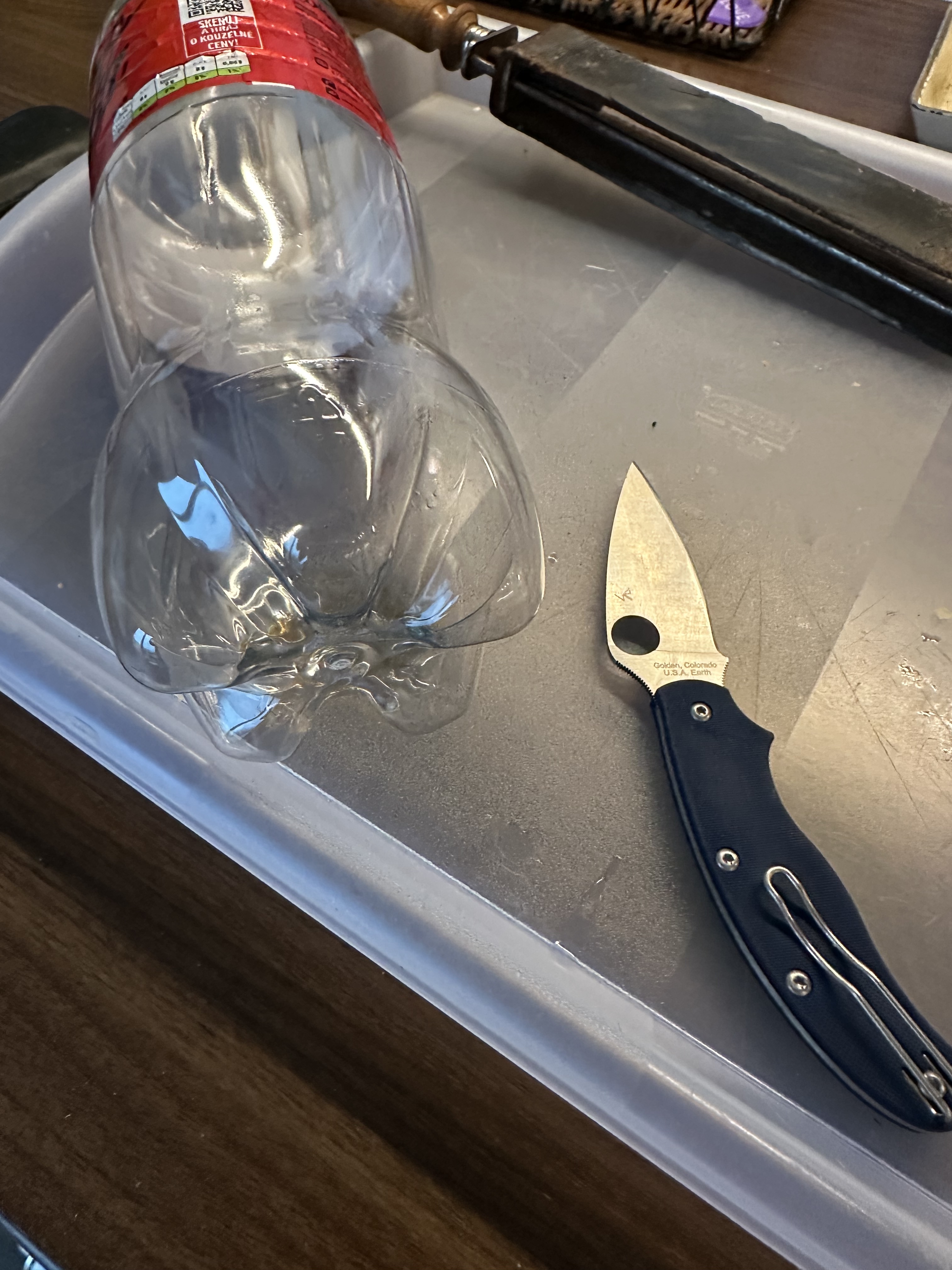
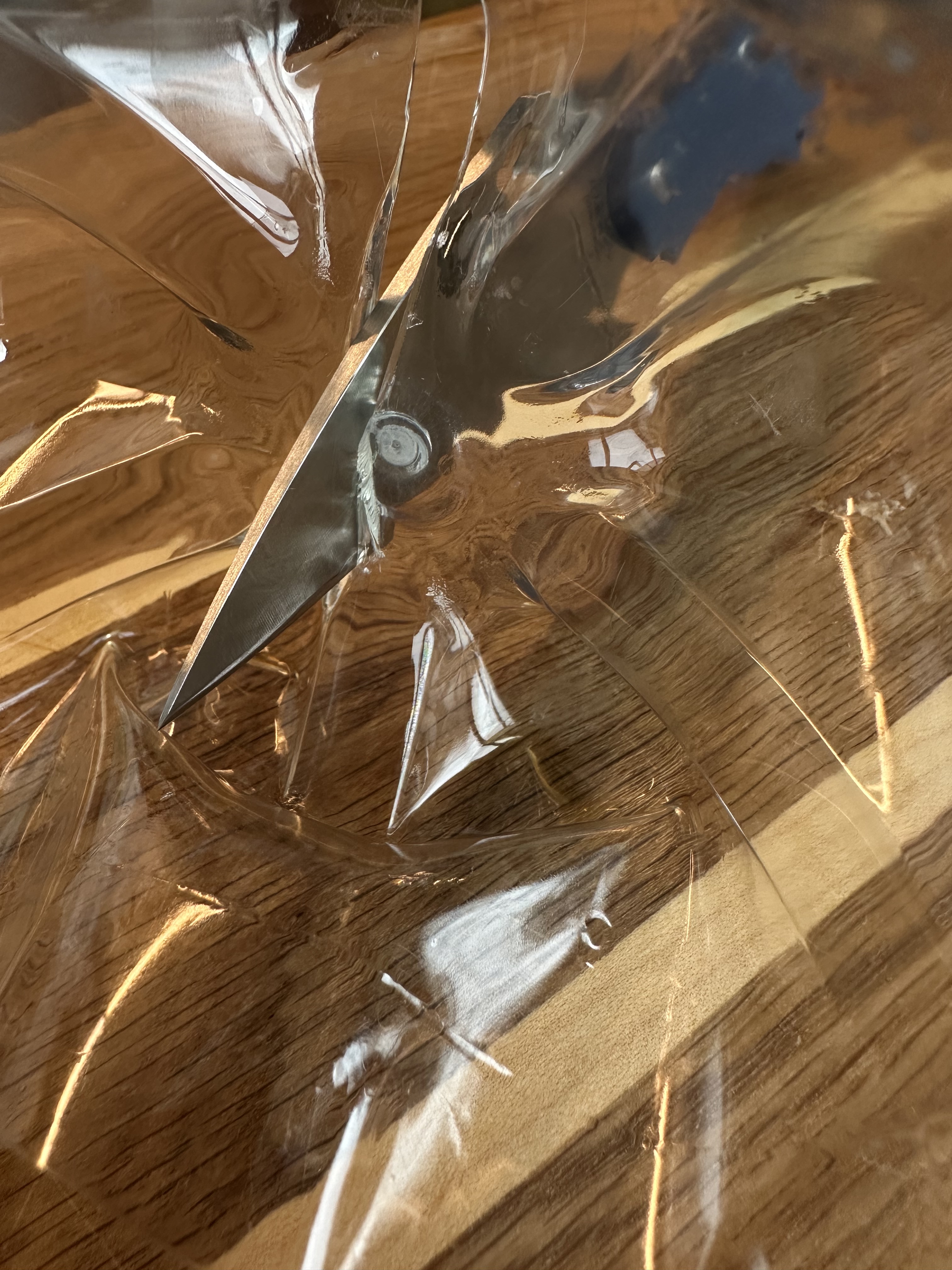
The Coke Bottle Butt test is passed with flying colors. As you can notice the plastic is 3mm thick. Not a single scratch on the blade.
So what do we got so far ? A master piece of knife design by monsieur Sal Glesser with a strong construction and state of the art in-house alloy serving a thin blade and an ergonomic handle. My advice: try to grab one before they disappear, it seems that G10 version is not here to last and it is really a sapphire: a true blue jewel !
Six years ago, I reviewed the Working Poney, also known as the Roadie. Mine had been reprofiled by Jan Dirk, and even on its tiny scale, it proved to be an outstanding performer. For six years, it quietly stowed away, accompanying me across the UK, Vietnam, and countless places where knives were frowned upon.
Then, in 2024, I noticed the announcement of an XL version — the C267BK — featuring a better steel and a clip. Right away, I saw the new pointed blade, replacing the classic sheepfoot-style blade, now ground from Böhler-Uddeholm N690Co. Even more exciting, the XL uses M398, an exotic steel reserved for flashbatches — a serious step up in terms of performance and collector appeal.
And so, here it is: Ladies and gentlemen, the Roadie XL !
They say an image is worth a thousand words, so here you have 4,000 words with no syntax or spelling errors.
Back to the Roadie XL: it is made in Maniago, Italy, just like my Nano and many other excellent knives these days. The Maniago plant remains one of the best worldwide in terms of quality and precision.
Specifications:
Overall Length: 6.51″ (165mm)
Blade Length: 2.74″ (70mm)
Steel: M398
Closed Length: 3.76″ (95mm)
Edge Length: 2.31″ (59mm)
Weight: 1.5oz (43g)
Blade Thickness: 0.108″ (2.8mm)
Its shape and size make it extremely pocket-friendly, easily fitting into the watch pocket of a pair of denim jeans thanks to its deep-carry wire clip. You could remove the clip, but why? It keeps the knife perfectly on the pocket’s lip. The clip is also reversible, though that’s not mandatory for a two-handed opening folder.
With its thin profile and light weight, combined with the clip, the Roadie XL can even be carried in a shirt pocket like a pen. In short, it’s a knife meant to stay on your person almost unnoticed.
The action is smooth, with two stops/steps before the blade fully opens. In practice, it feels smoother than my Urban, which only requires a single hand to deploy.
With a slightly longer blade than the Urban, the Roadie XL remains legal to carry in countries such as Denmark, the UK, or Germany. Mine arrived razor sharp straight out of the box, so I’m in no particular hurry to convex the edge.
Mine came razor sharp right out of the box. So I’m not in a special hurry to convex its edge.
You can immediately recognize Sal Glesser’s signature design—a clear mark that it’s his invention. Sal is an inventor, and it’s always impressive to see how he manages to create clever, practical tools. Quoting him directly:
“When the Transportation Security Administration (TSA) briefly considered allowing the carry of knives on airplanes again, Spyderco designed the Roadie™ to fit their guidelines. We created an incredibly popular modern expression of the classic penknife. Since bigger can indeed be better, the Roadie now has a big brother: the Roadie XL. It faithfully offers all the defining features of its smaller counterpart—including a non-locking “notched-joint” mechanism, a textured index-finger choil, and contoured, injection-molded handle scales. Its full-flat-ground sheepfoot-style blade is crafted from M398 stainless steel and features our distinctive “Double Dent™”—a pair of symmetrical dimples in the blade that provide a solid purchase for a fingernail-free two-handed opening. In addition to its larger size, the Roadie XL also adds a deep-pocket wire clip for convenient top-of-the-pocket carry.”
Now, let’s talk about M398, one of Spyderco’s premium powder metallurgy steels, only available in limited flash batches, all made in Maniago, Italy.
From what I understand, M398 is closer to CPM-90V than to M390. Quoting Darrin Thomas’s analysis (which is worth reading in full):
“The original M390 has a reported carbide volume of 20.5%, and the new M398 has about 30%, so there has been an increase in carbide of almost 50%. We would expect this to lead to a significant reduction in toughness along with an increase in wear resistance. The datasheet shows that the toughness of M398 is only about a third of M390, though at somewhat higher hardness. So it is apparent that the design of M398 is all about wear resistance and essentially ignores toughness. M390 has only slightly lower toughness than K390 with similar carbide volume (though K390 was tested at 62 Rc). M398, on the other hand, has significantly less toughness than the similar carbide volume S290. However, M398 does have some positive traits, such as increased hardness and reduced retained austenite relative to M390. I’m personally not all that interested in yet another high edge-retention steel that sacrifices toughness, ease in sharpening, and workability. We had other options and this initial look doesn’t make M398 appear to be an improvement over the other available steels. M398 was a relatively simple modification of M390 and I can’t help but think that a more optimized version could be made. M390 did offer similar toughness to cold-work tool steels like K390 with a similar carbide volume, but M398 has significantly lower toughness than the similar carbide volume S290. So M398 doesn’t appear to be over-performing relative to its composition and carbide content. I wrote about some Bohler-patented high wear resistance steels using niobium instead that look very interesting but haven’t seen a commercial release. Those steels would be breaking new ground and potentially offering new property combinations not previously available. But if Bohler pushes out M398 more broadly it will be interesting to see how knifemakers utilize the steel for applications that benefit from high wear resistance and edge retention.”
When M398 was used in a previous flash batch for the SpyMyto, I wasn’t particularly excited—it felt like overkill for a folder that seemed built for hard use. The Myto is essentially the big brother of my Nano made in CPM Magnacut, and a SpyNano in M398 is also on the bench. In comparison, Magnacut is far tougher than M398, making it more suitable for wide, workhorse blades.
On the Roadie XL, though, this is a different story. Like with my Heinie Urban in S90V, these small blades are not intended for bushcraft—but some highly skilled bushcrafters can make miracles with even a 2-inch slipjoint, as shown in an inspiring video I recently saw.
Slip-joints are gentle companions for both ladies and gentlemen. For those with long nails, the Roadie XL is equipped with its distinctive “Double Dent™”—a pair of symmetrical dimples in the blade that provide a solid purchase for a fingernail-free, two-handed opening.
Its high wear resistance comes in handy, as these small blades often encounter cardboard, which can be surprisingly abrasive. I also recall Roger, my father-in-law, wielding his old Pradel slip-joint like a crowbar or flat screwdriver, without a second thought. Old-timers often treated knives mercilessly, using them until the blade was as thin as a needle.
I’m confident the Roadie XL with its M398 blade would make an excellent hare skinner—the fur is full of sand that can destroy an edge almost instantly. Tuscan hare hunters would likely appreciate its durability. Its high wear-resistant alloy makes perfect sense here. Additionally, the blade is relatively thick at 2.8 mm, which would otherwise be prone to breakage.
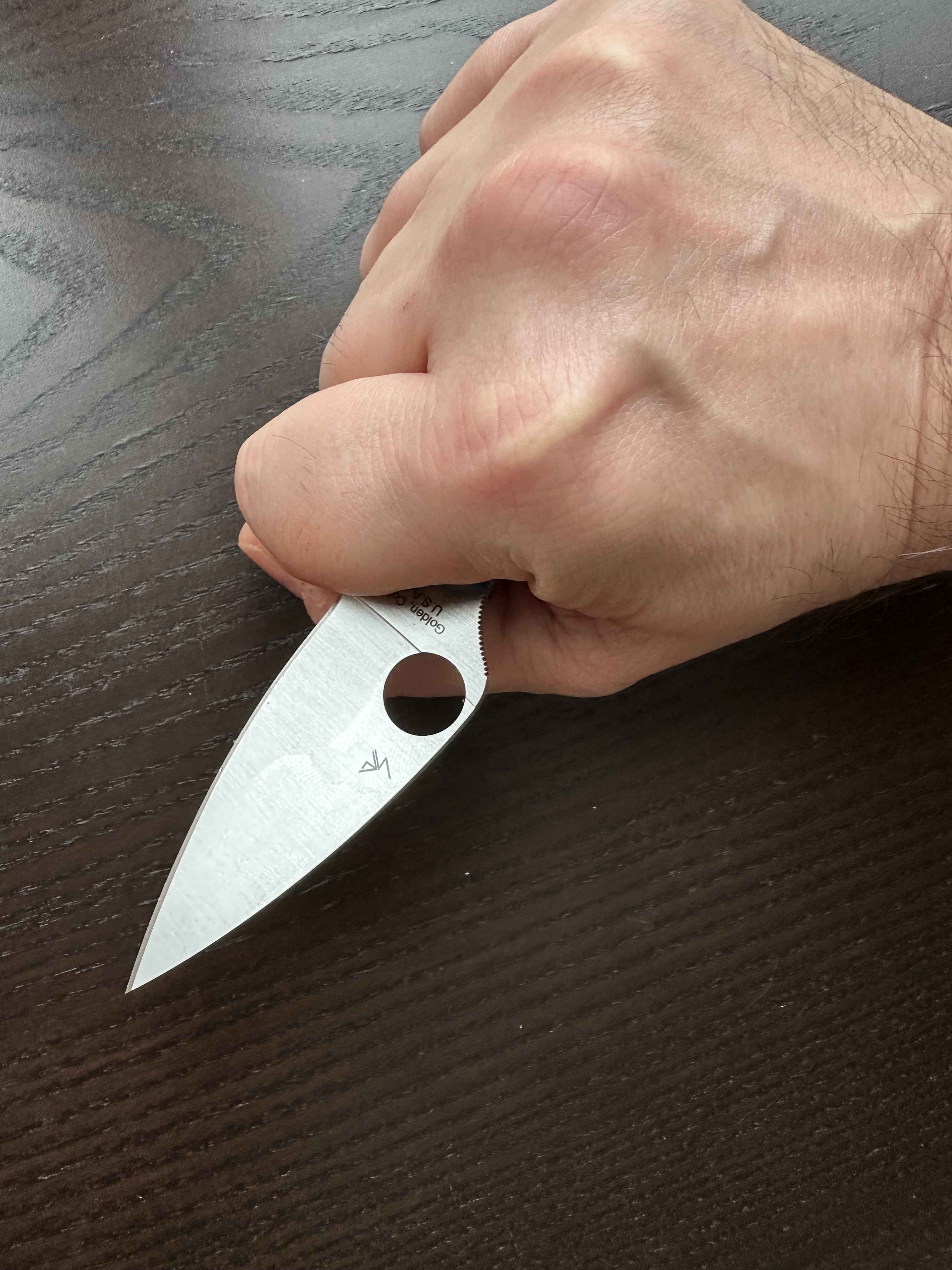
Ergonomically, the Roadie works beautifully for a slip-joint because you can hold the blade by its choil—a feature rarely found on traditional slip-joints. Even most Swiss Army Knives lack that level of security, and with M398’s toughness, the blade cannot close on your fingers. As Spyderco notes:
“Unlike traditional penknives, the Roadie also features a subtle index-finger choil that increases control of the knife during use and acts as a safeguard against unintentional closure.”
There’s no undue pressure on the pivot, often the most delicate part of many folding knives. If you are careful not to twist the point in wood, the Roadie XL can withstand applied force directly to the blade. This makes it another “Lil Big Blade”—small but versatile.
It can serve as a steak knife, whittler, label remover, balloon popper, nail cleaner, or cardboard cutter. Brown cardboard is notorious for edge damage, but not for an alloy like M398, packed with carbides.
And in today’s world, one more practical advantage: it is extremely sheeple-friendly. The Roadie XL looks like a pocket knife, not a tactical or soldier’s tool, making it socially unobtrusive yet highly capable.
Beauty is in the eye of the beholder, but to me, this blade—shaped almost like a scaled-down cutlass—is pure eye candy.
Interestingly, I’ve discovered that I can open it one-handed in two distinct ways:
A fast wrist flick while holding the blade itself.
By gripping the blade with thumb and index finger and gently pushing the handle away with the middle and ring fingers.
So, even though it wasn’t designed as a one-hand opener, the Roadie XL can function surprisingly well as a one-handed knife in either technique.
Compared to a traditional sheepfoot slipjoint, the Roadie XL is incredibly light yet sports a premium alloy blade (Since August 2025 another slipjoint with M398 is available: The Metropolitan.). And at under 100 euros, the Roadie XL is an exceptional bargain for what it offers.
This is one of Sal Glesser’s finest EDC designs—a true Every Day Carry folder that balances elegance, utility, and performance. And for once, size really matters with a Roadie. No wonder it’s already sold out on the Golden site! There is part II here.
Spyderco Urban, Squeak and UKPK family is one of the most addictive slipjoint proposition in the modern world. I have already written about them in this blog. The UKPK Salt is simply one of the best modern folder available nowadays. The Squeak is totally sheeple friendly and of course the Urban made for the city and to be carry everywhere but on the airlines.
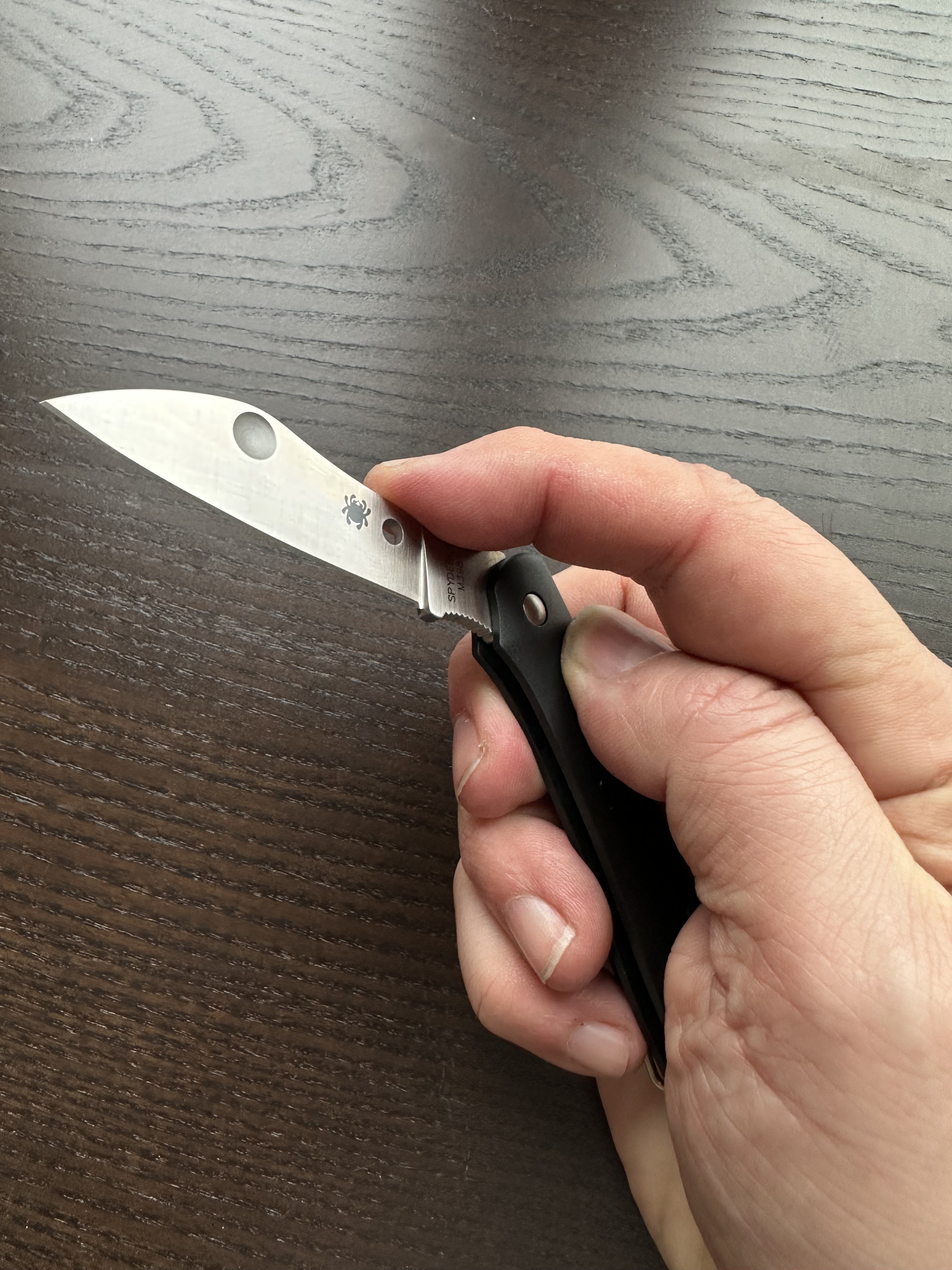
Spyderco’s description: “This Exclusive version of the Spyderco Urban™ was manufactured specifically for Heinnie Haynes (heinnie.com) and is available only through their sales channels. Originally introduced in 2009 and later discontinued, the Urban remains a cult classic among devoted fans of Spyderco’s non-locking, one-hand-opening, clip-carried SLIPIT™ knives. This distinctive expression of it showcases a leaf-shaped blade crafted from premium CPM® S90V® particle metallurgy stainless steel. The PlainEdge™ blade is full-flat ground for exceptional edge geometry and is proudly laser engraved with the Heinnie Haynes logo.Not to be outdone, the handle of this knife features distinctive red G-10 scales with a non-slip peel-ply texture. They complement the jimping (textured grooves) on the blade’s thumb ramp and index-finger choil to ensure a positive grip and outstanding control during use. A reversible deep-pocket wire clip provides a choice of left or right-side tip-up carry, making every aspect of the design completely ambidextrous.”
This Red One is my third Urban. The first one was in K390, the second one was in AEBL and named Cappucino. All of them has been pushed out of my pocket because of the greatness of the UKPK Salt in LC200N. Anyway they all have been great companion during my UK travels as they are totally legal: non locking under 3 inches blade (76mm)… Eventually I have been looking for a G10 version with a full stainless steel back spacer and I have found the Heinnie Haynes exclusive version available on their site. It is not a cheap knife be aware of that but it oozes quality on paper and in the hand.
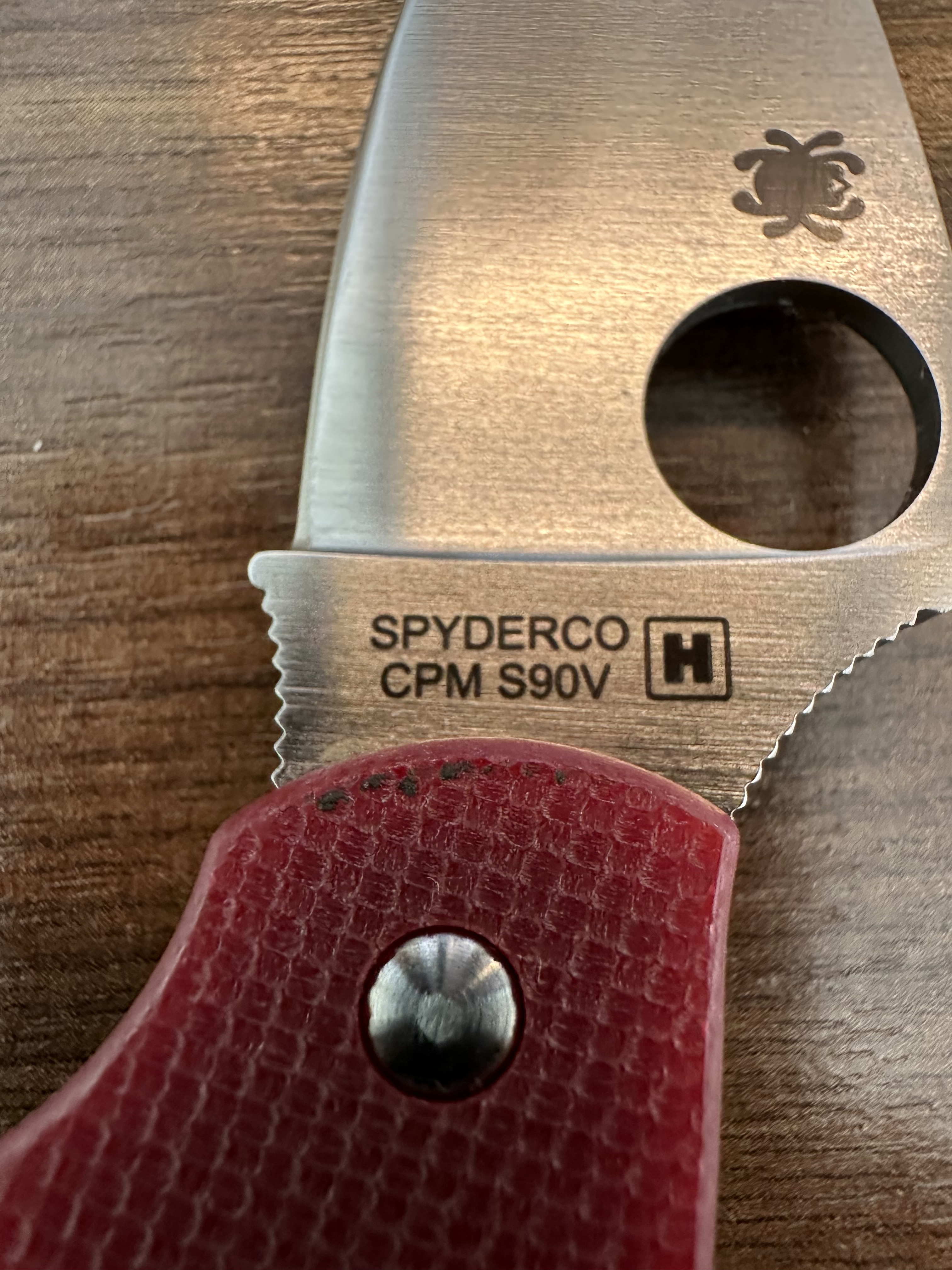
First thing first, this Urban got a CPM S90 V blade, the same found on the Proficient Bushcraft knife. S90V was known before as CPM420V and it is still one of Sal Glesser favorite steel ever to be produced by Crucible.
S90V is known for its incredible edge retention and in the last 25 years of using it, I can tell you this one can be a bear to resharpen. Diamonds are its best friends and even then it needs a lot of white ceramic time and stropping… Compared to non stainless super steel like Maxamet it can be really tedious to get really sharp. But one it is sharp, its working edge seems to stay forever on. This is exactly the opposite of my previous experience with Cappucino my AEB-L Urban. This one was strong and a breeze to keep razor but it was back to butter knife level quick when used on abrasive matters like cardboard for example. S90V eats brown cardboard for breakfast and it stays sharp for very long but is it tedious to put it back to a crispy razor edge. That’s great when you need long lasting working knife on a trip when you have not planned to bring a sharpening stone for example and Sal trusts enough S90V to put that very alloy on all his own special Sprint Runs with CF Handle. I have never been disappointed by S90V and even on fixed blades or on the Manny folders it has always been a game changer in term of long lasting sharpness and is even better than CPM100V in my book. S90V is also very stainless. Unless you want to use your knife in the ocean, it can handle some hard work in the forest without to be cleaned immediately. It has been found that this S90V Urban got a little thinner blade 0.23 cm against 0.29 cm… The blade is also a little shorter than previous Urban bot nothing I have noticed in terms of utility.
This Urban has been made in Italy and in my own experience Maniago craftmanship has never been a bad surprise. Your mileage may vary but this is mine. I have been happy with my Spytalians !
G10 is not a current material on Urbans as FRN is everywhere and, better, the texture of this G10 is even more unique. I was first thinking to turned this knife into a pebble but, naah ! It is great as it is. I have just adjust the feel by sanding it but all in all this is great high quality made handle and again kuddos to Maniago. All Heinnie Haynes exclusive got that red treatement on the handle, this is their signature. And a G10 version got a longer steel backspace on the handle closing it.
Now about the action, this Urban has been the most hard to close of all my splipjoints ! It is really a positive point. I can still open it with quick movement of my wrist but the closing ask for some force which is really rare (even in Spyderco production, the first UKPK were chewing gums to quote Guillaume, Spyderco Fan Club moderator). Strong spring, and no lock make it a great candidate for carrying a legal folder nowadays.
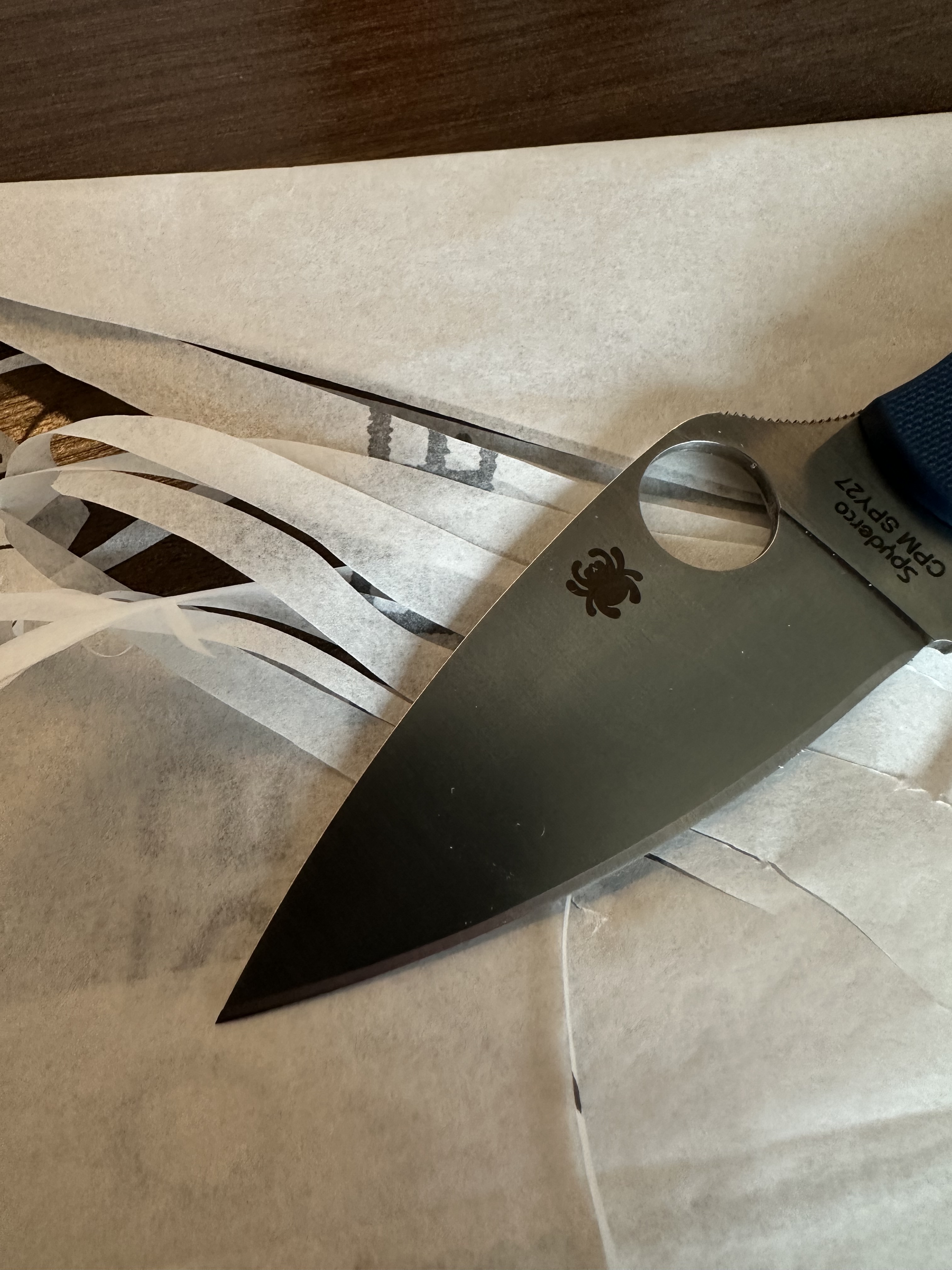
Now about geometry, Maniago desserves another kuddos ! As you can see on the picture above, I was able to split a bottle butt in a single pass with the factory edge. This is also rare ! Even my lovely Hellboy needed some thinning before to reach that level. This is thin geometry right out of the box !! The short blade drop point makes it a great whittler and Spyderco knows how to make little big knife. The hump and the choil are transmitting your force’s cuts directly to the blade, sparing the handle, its axis and its mechanism. This is clever and Sal has been inspired by San Francisco Gambler’s knives. His first implementation of this “cockpit” has been 30 years ago on the C36 military. So choils/humps binome are clever and great for avoiding a non locking blade to close on your finger. This is a must have !
So here we got a legal folder with a non threatening blade, strong non locking spring, great geometry and stellar particule metallurgy steel. What not to love in this wonderful Urban ?
You can cut a pizza in your plate and use it as a steak knife without raising any eyebrows. I use my knives in plates and I know how to avoid to get them dull on the plate ceramic. My mother in law is never putting a knife near my plate, this is how I can spot where I’m going to sit on her table eventually.
Also the Urban got the perfect size to be carry in A 501 watchpocket, and as you can see mine has been shredded by many aggressive G10 handles before massive sanding.
So I highly recommend this great exclusive little knife, again it is not cheap but quality is there from the tip to the clip.
Prologue: “Seeing what I believe.” On one of the social networks an happy owner of a new Spydiechef in LC200N steel (like the UKPK) was displaying some pictures of his new acquisition. And there go the comments, mostly to congratulate him and share experiences… when I have noticed some young guy’s: “Too bad this knife is provided with a steel softer than the wooden board it is displayed on.” I thought to myself: could LC200N have a reputation of being soft ? Immediately I have checked the Rockwell of Spyderco’s LC200N found on various sites and apart the LC200N Mule being at 56 HRC, it is known to be currently at 58 HRC. So I have asked to young guy (very proud of its REX45 collection) what LC200N knife he has had such a bad experience with, sharing with him my own mostly excelelnt experience with LC200N I own. After a very long passive-aggressive answer from him (we know how people are such a d1ck with a keyboard under their fingers…) about how he was so knowledgable by just watching videos on youtube he then wrote me that he had never owned any knife in LC200N. So eventually this guy was pissing on the parade with zero knowledge of the subject. It is typically the kind of behavior we can notice on the social networks those days. Some so called “experts” don’t believe what they see but only they only see what they believe. The armchairs specialists are long disappeared and here comes the arrogance of the “believers”. This is the plague of our time: not being your own source. Not checking twice. And not experiencing first hand what is put as a statement. This is some kind of Reign of Assumptions with its digital garden where flourish fake informations in all subjects. This is not something to be taken lightly. And the only cure is being your own source then read, check and cross opinions.
Anyway… Is LC200N as soft as wood ? Certainly not. It is even much better than H1 in terms of edge holding. (H1 being the other steel on the Salt Serie). But H1 is excellent on serration blade, as it is getting harder during the serrating process like 67HRC. (H1 being a work hardened steel, the process that grinds the SE blades hardens the edge to 67, while the PE blades are 58.) Also you can’t have flat ground blade with H1 but you can with LC200N. So far, LC200N as 58HRC has amazed me. Of course it is not in the range of Maxamet or 20CV but it is worry free good edge holding and not chipping edge’s steel.
Also I have notice how people believe cutting wood is the ultimate edge holding challenge. Nope. Cutting clean piece of wood is not challenging in my own experience. I have found different grain of steel react on different grain of wood. M2HSS (Speedstar steel) gave me soft surface on chestnut cuts for example. The challenging media to cut through are brown cardboard for example because of sand in it. Cardboard and also great way to refresh an edge by stropping the blade on it. You can have a look at my journey in Tuscany with the Spydiechef.
Back on the UKPK. I have “unshouldered” my edge to get to a gentle convex, keeping the manufactured edge with its microserrations. I always do that when I love a knife as my favorite way to refresh my edge is using an old barber leather bought in Tuscany on a garage sale 15 years ago.
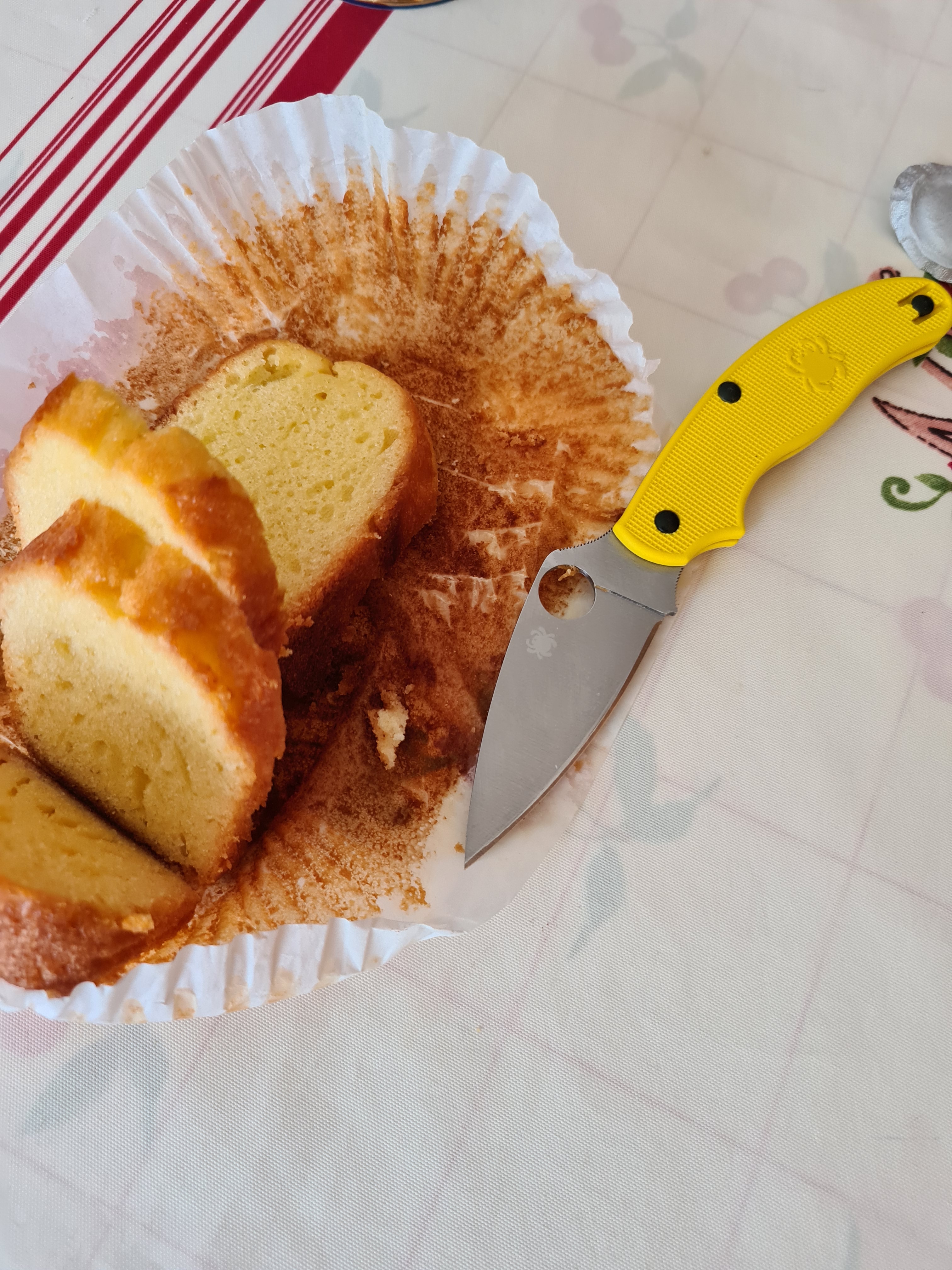
The blade stays “lock” in open position when stropping and this is much better that previous version of the UKPK like I have stated in the first glimpse. The razor’s level of sharpness is easily restored and the thin blade goes steadily into all material it has encountered. One great enemy of a fine edge is the plate under the meal. Many times I have given an angle to my knife to avoid touching the ceramic at a 90° angle. With the UKPK I have not given a shoot. I have use it as my steak knife like they were no tomorrow. Also the the yellow knife has been friendly approved by the rest of the family who has used it also on plates and stuff without any sign of pity. The edge near the point has rolled but nothing I could not fix in less than 5 seconds on a ceramic rod. Eventually the rest of the blade was mostly as razor as before. On short blades mostly the point and the very first part of the blade are used on board/plate cutting. It is also a part I have less convexed to keep some useful thickness there. Of course cutting lemons and any acid food will never bring any sign of patina on LC200N and many times I have fold it dirty when it was not just quickly rinsed under the tap. The UKPK also offers a very pointy blade which proves to be very useful in many task. LC200N being very forgiving it is sturdy enough for not having any concern about it. Of course I won’t use a slipjoint like a bushcrafter or even the great Wolfspyder but still, old timers used to go in the wood only with Swiss Army Knives or Pradel slipjoints folders and were able to use them for many camp tasks. The choil and hump of the UKPK’blade working as quillions you can apply a lot of force directly to the blade as I have also been whittling with it.
The thin spine makes it not really confortable for thumb pushing cuts though. In that game of pushcuts the Yojimbo 2 is king with its 4mm spine. But the UKPK goes deep in its cut without much pressure on the spine. Also when the blade is stuck in the wood it has no tendencies to fold on your finger like previous version of it. This is a great relief. The yellow handle looks like plastic but those FRN slabs are very rigid. There is no play and it gives you a felling of confidence in your tool. Also the “pro-sheeple” general look helps a lot when using the UKPK in public. So far it has developed zero plays which is enjoyable.
Quick draw: a friend has challenged me to open the knife using my major finger. At first I thought it would not be possible unless being Check Norris. Eventually:
But this is in Spyderdrop that the UKPK is steadily open: holding the knife by the hole and with a flick of the wrist. So it is a slipjoint with a very fast draw opening. The previous Spyderco Splijoint as fast as this one is my Pingo which can be open by inertia as the momentum of the thick blade helps a lot.
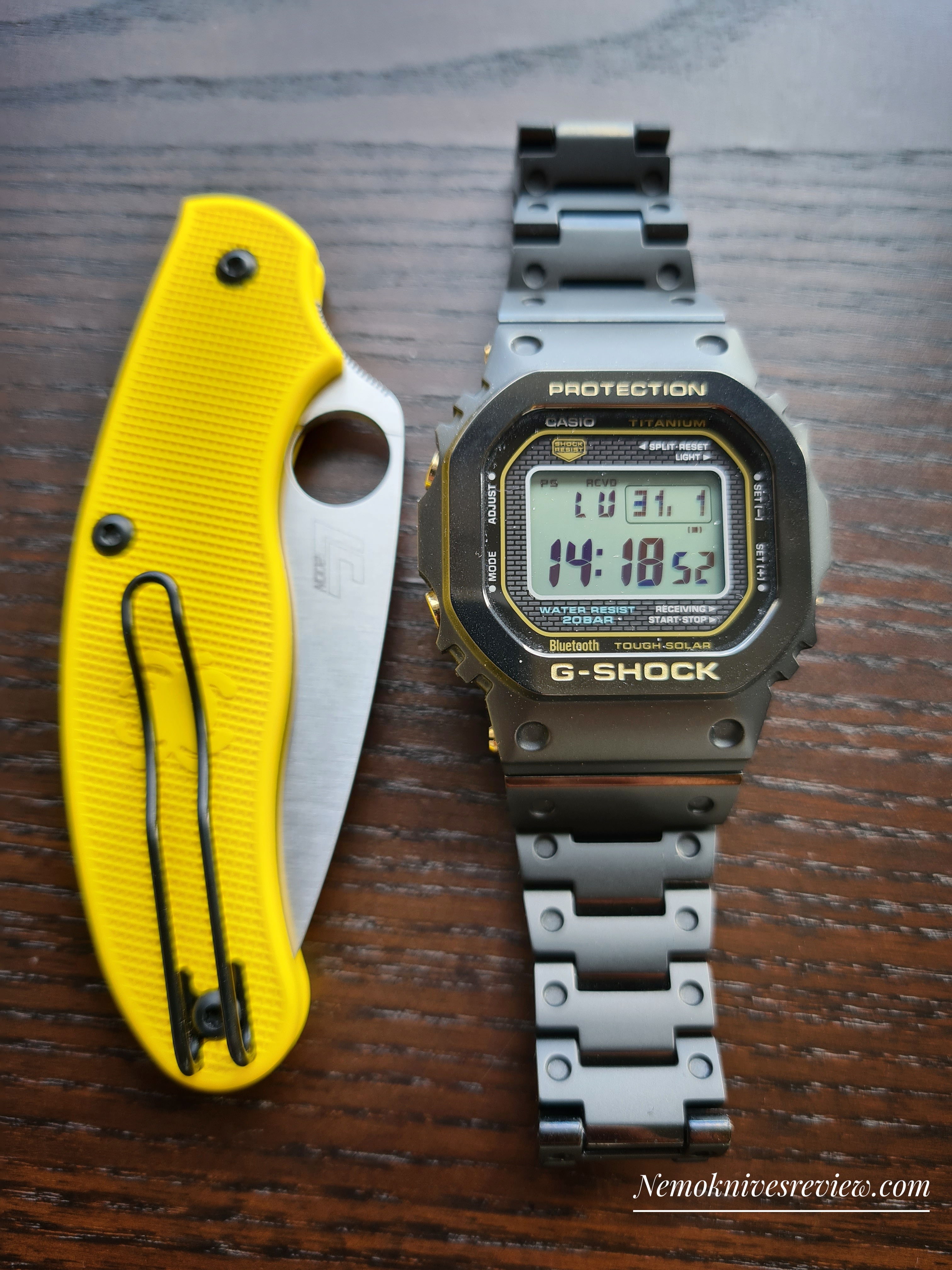
So far the UKPK has proven to be a fun knife to use. It is easy to deploy and reliable on the tasks. It can be a primary knife in the city and secondary knife in the woods and its lightness makes it easy to keep in the pocket. It will also find a place to be clipped on any swimsuit and that what makes it so unique. Fishermen will be very glad also as it is so easy to clean and to spot. The opening of the 3 screws montage on this UPKP (some other G10 UKPK got a longer spring/backspacer and 4 screws) make it a breeze to rinse. It is a Gentleman/Lady knife with an all terrain attitude and a very reliable positive semi locking system which can sustain a lot of power cuts. Really a unique gem !























































 NemoKnivesReview