Tag Archives: Kitchen

Spyderco Native Chief: HELLBOY 2 – The Kitchen Army

Since the reception of my Chief Native I have found that he was a sole survivor from a Xmas Mystery Box bought in Spyderco’s plant in Golden in December.
In that box were different items and a rare Sprint Run Second Factory which was destined to end in my pocket and considered by myself IMHO as the perfect realisation of Sal and Eric ideas about pocket knives. In fact I think it is my favorite Spyderco ever.
I have written a first review here.
And now it is time for a second approach of Hellboy which has succeeded in kicking other knives from my pocket and quench my thirst for novelty.

So why ?

First the Native family feature an absence of hump on the blade making them very slick and beautiful.

Even the Shaman benefits from that.

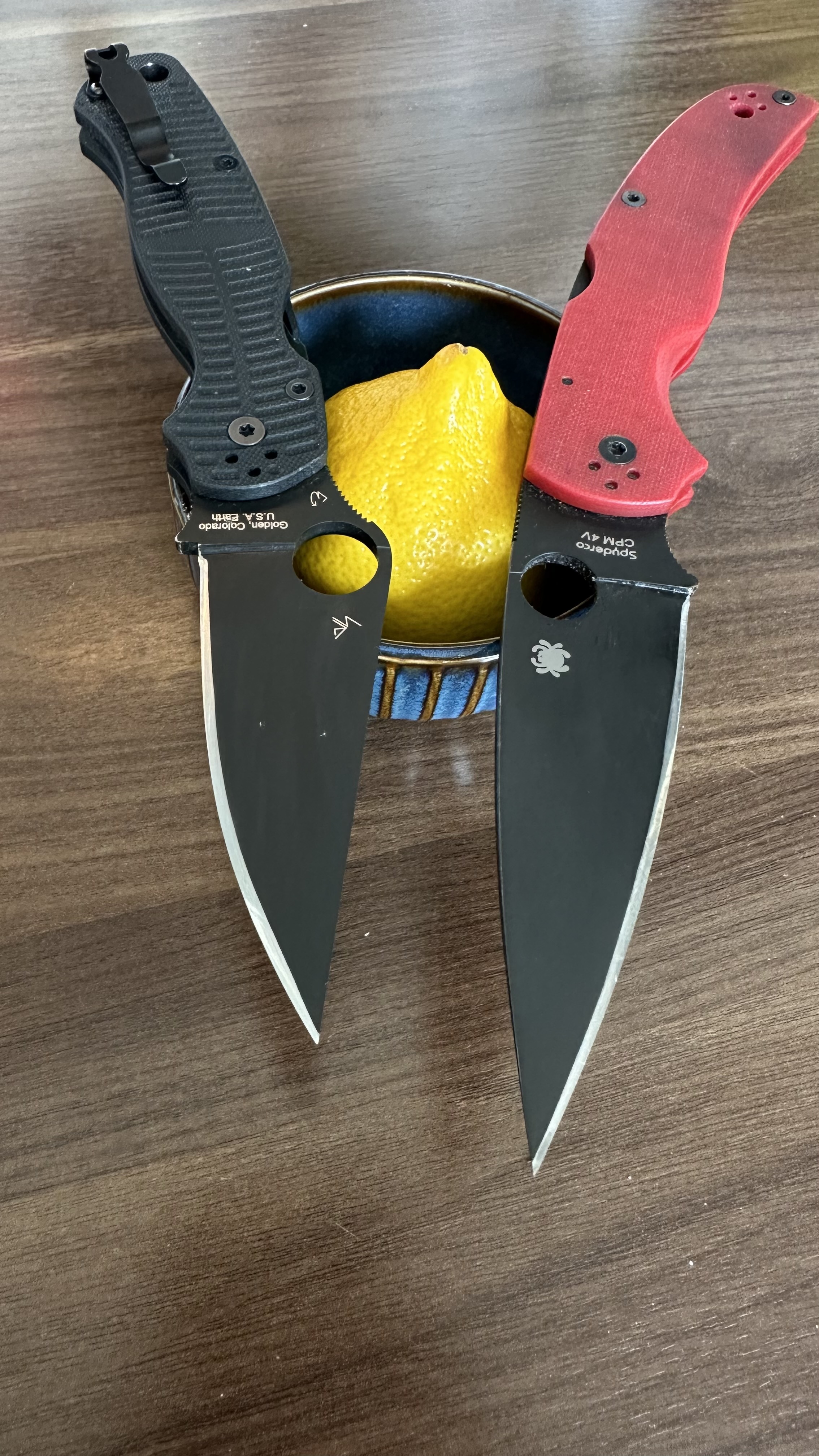
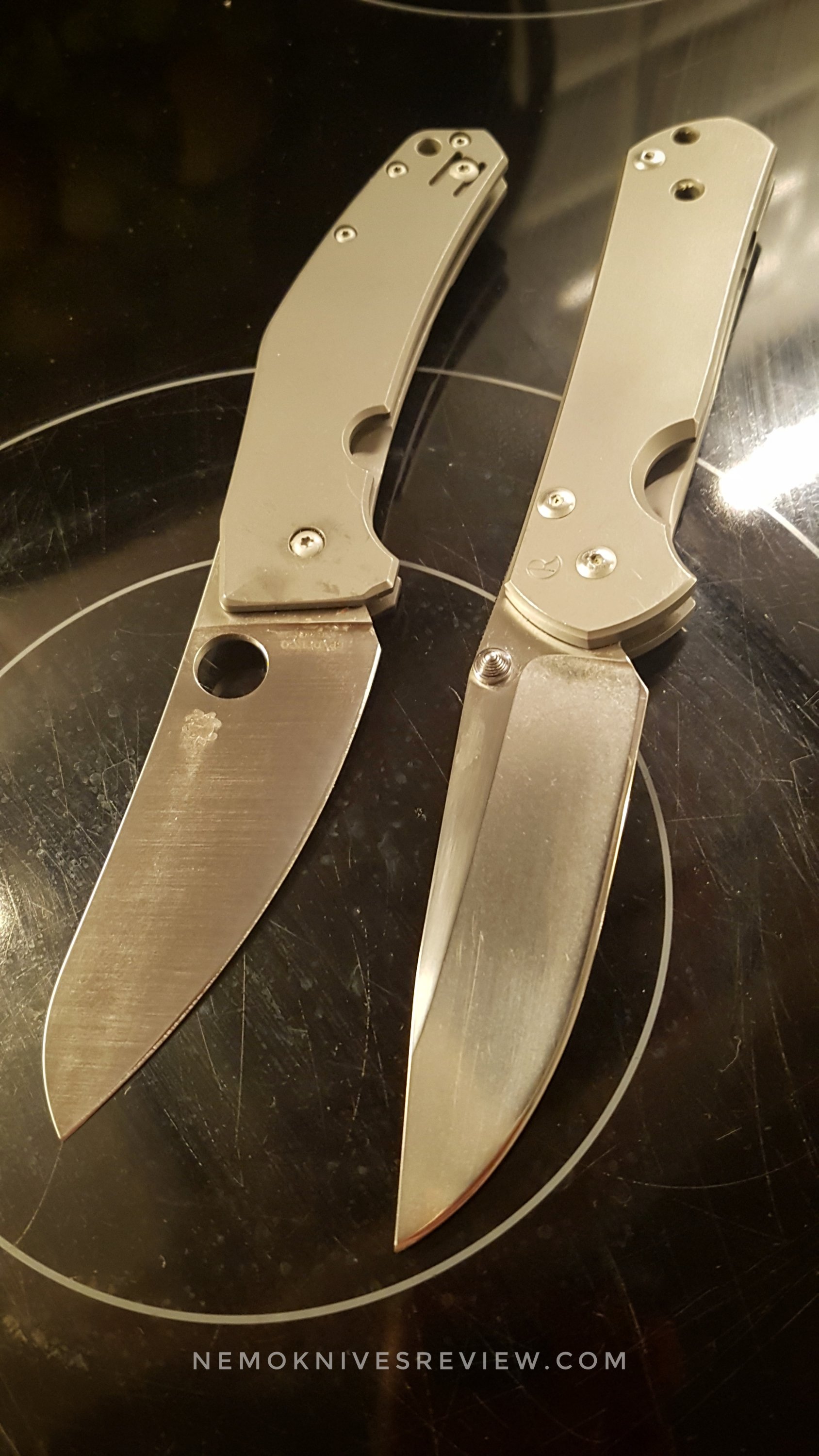
The Chief is on the left and the Shaman on the right.

As you can notice the design of the Native Chief is really close to one of my favorite design: the AFCK.
Sal Glesser was no stranger in the Benchmade BM800 AFCK back in the 90’s. He helped Les De Asis founder of Benchmade on it. They had both learned how to make Michael Walker’s linerlocks at Bob Terzuola shop.
Both company were accelerating on the tactical lane in close formation.

As you can notice, my AFCKs (Advanced Folding Combat Knife) which was also designed by Chris Caracci a former Navy SEaL have been used a lot. The first version got a Spydiehole and the second version got an oval hole and an axislock.
This design was one of my favorite for a big folding knife as EDC.
And back then I was really in love with concept of tool highspeed steel on a modern plateform.

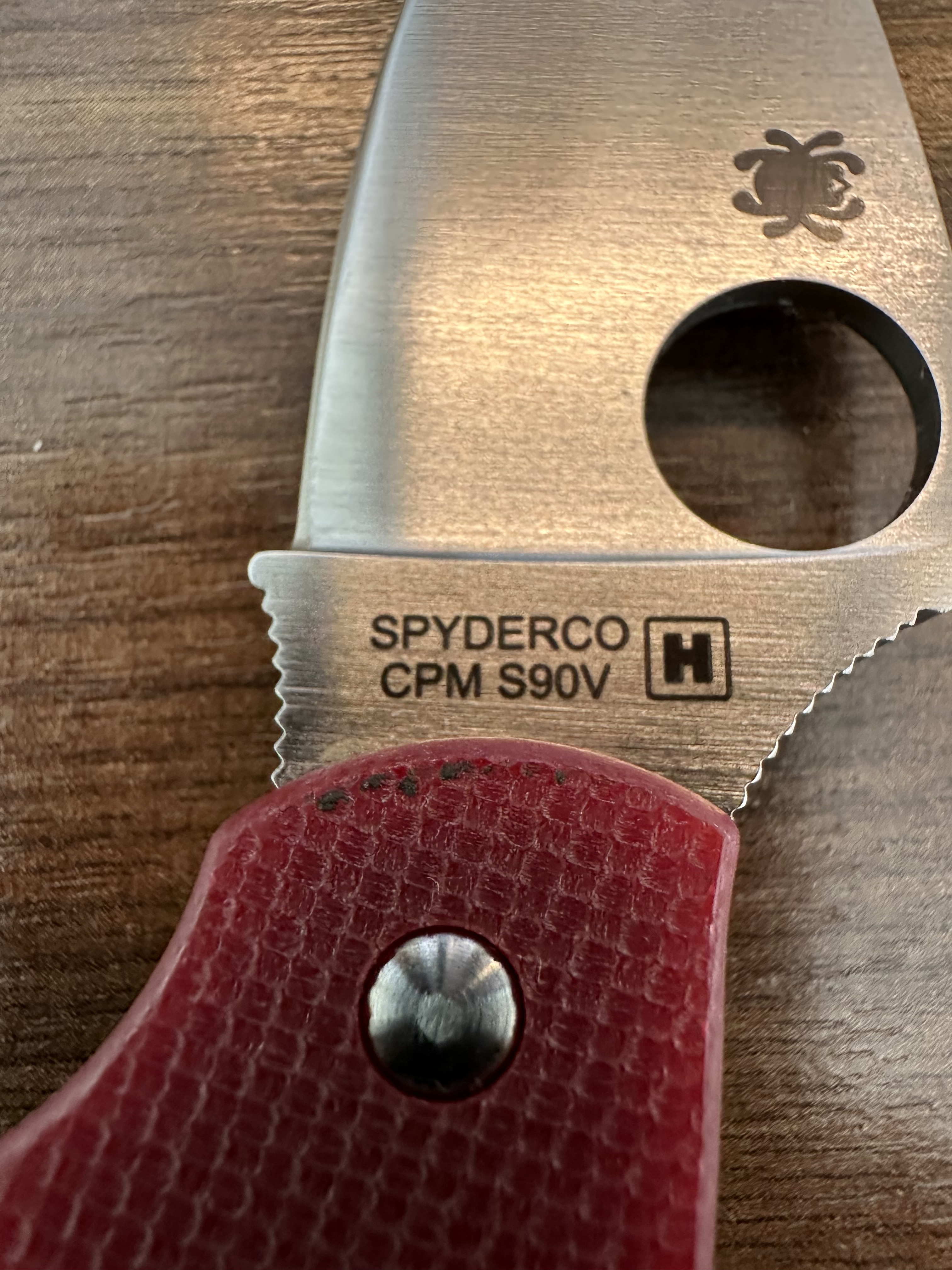
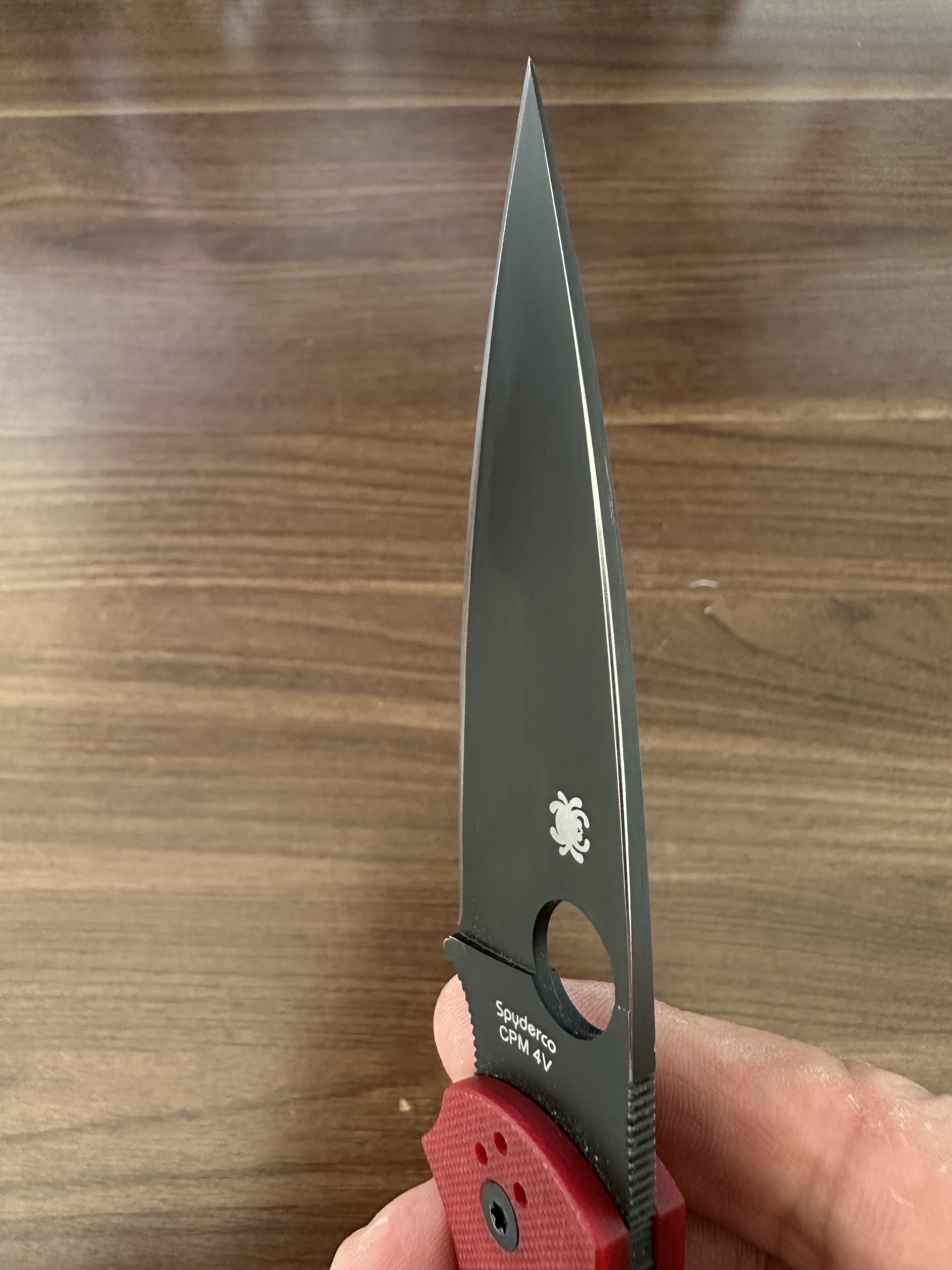
The same happend with that special Native Chief which got a very special alloy for its blade: CPM-4V.
With that steel, the edge is strong and the thin blade is very solid.
It gives a lot of confidence when cutting on a plate made of ceramic of glass. No chipping can happen.
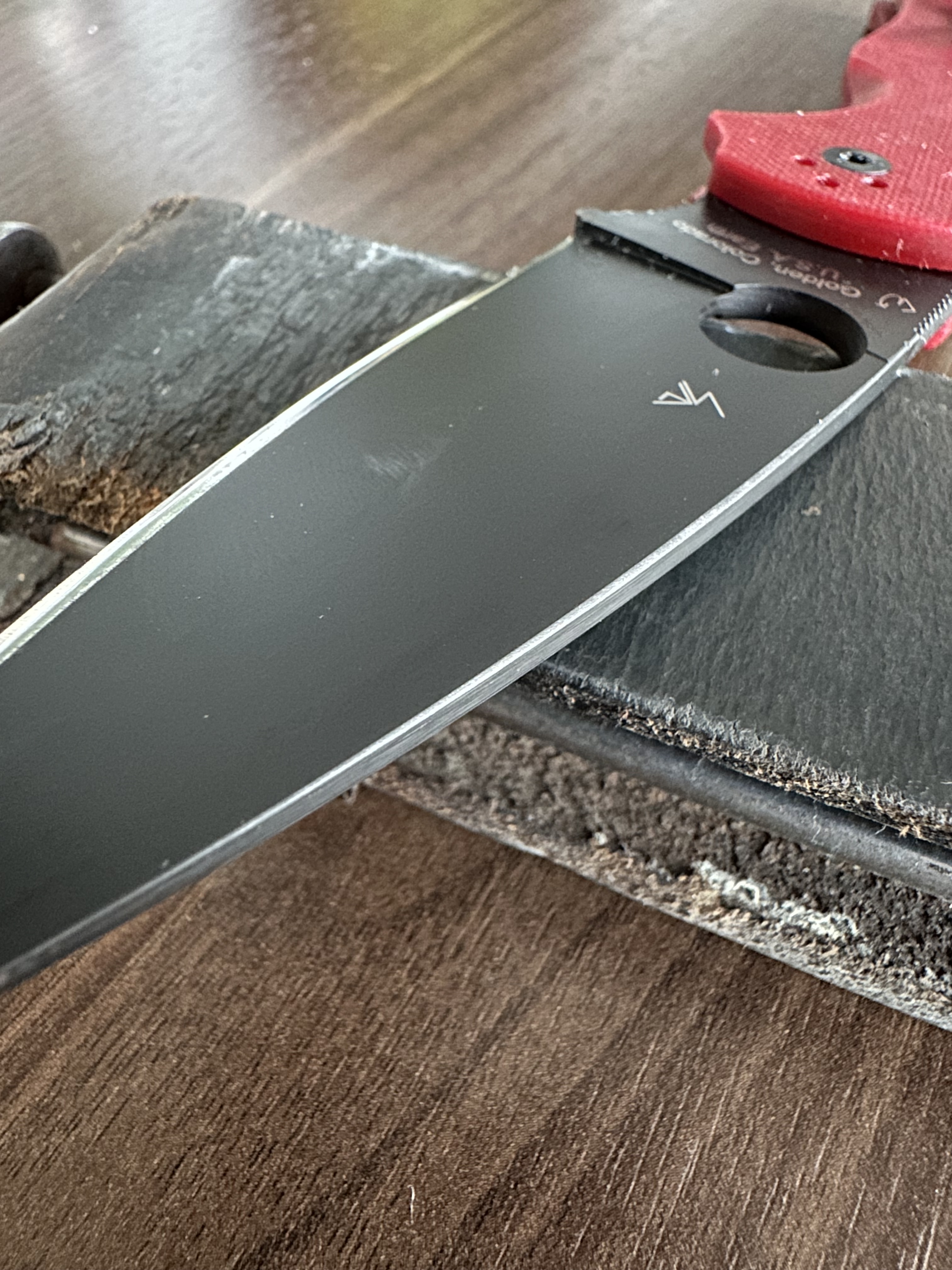
Hellboy has been used a lot for cutting pies and cake on glass plates and the edge behavior was not disappointing. When I have noticed a little shiny spot, some white ceramic was able to put everything back on line but it was really minor.

Now CPM4V is not stainless. It will form a patina or, worst, rust very quick and easily when used in acidic matters like cutting lemons and being used on a salad with vinegar.
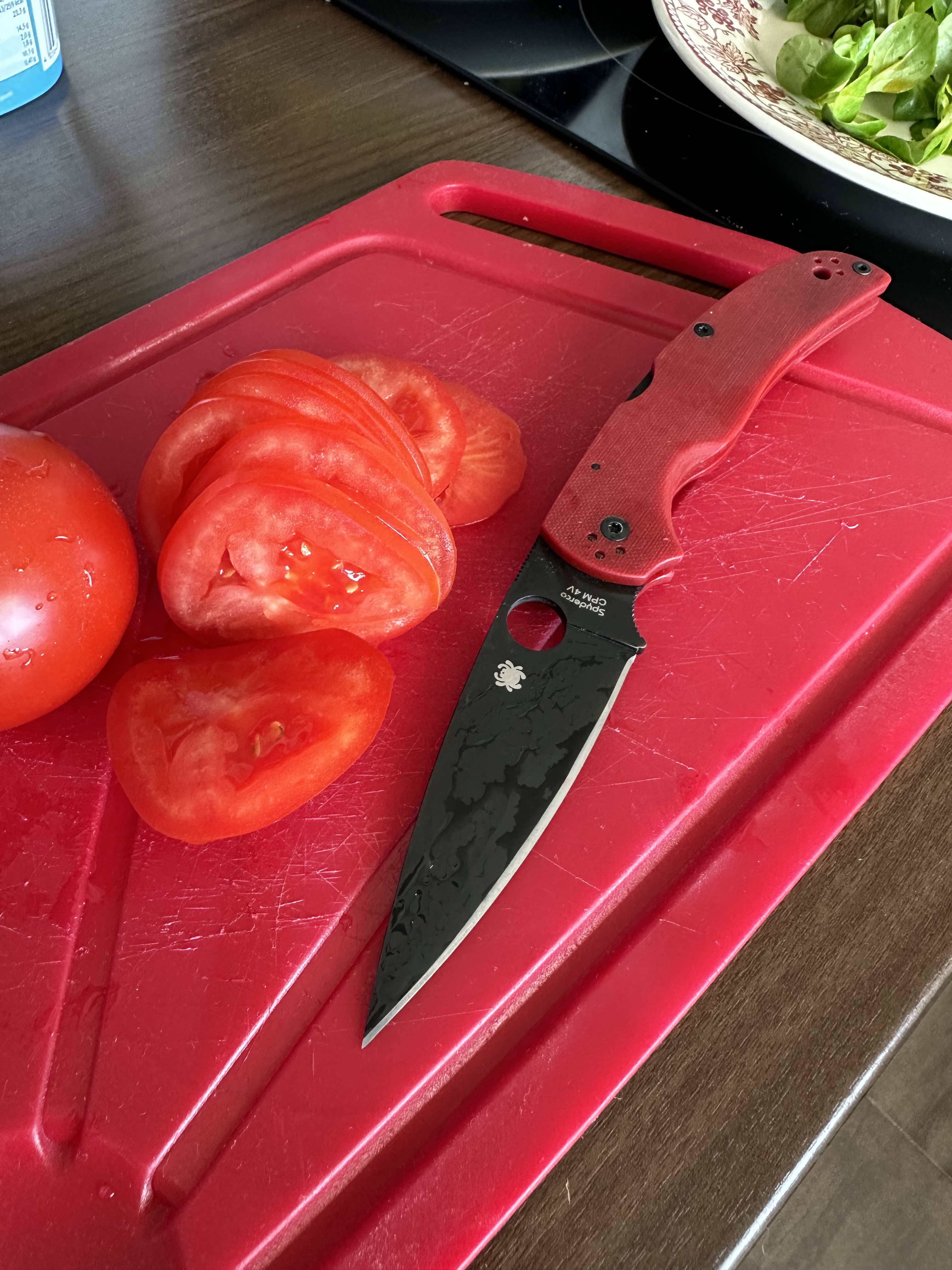
DLC coating is really welcome for that kind of behavior. Back in the 90’s Benchmade was offering only PVD coating which is really inferior to Diamond Like Coating. So far the blade of my Chief is not marked and scar by it various cutting tasks even when cutting.
My previous Chief was a naked Rex45 blade and it was another story told here.


Even strawberries can darken the edge of CPM 4V.

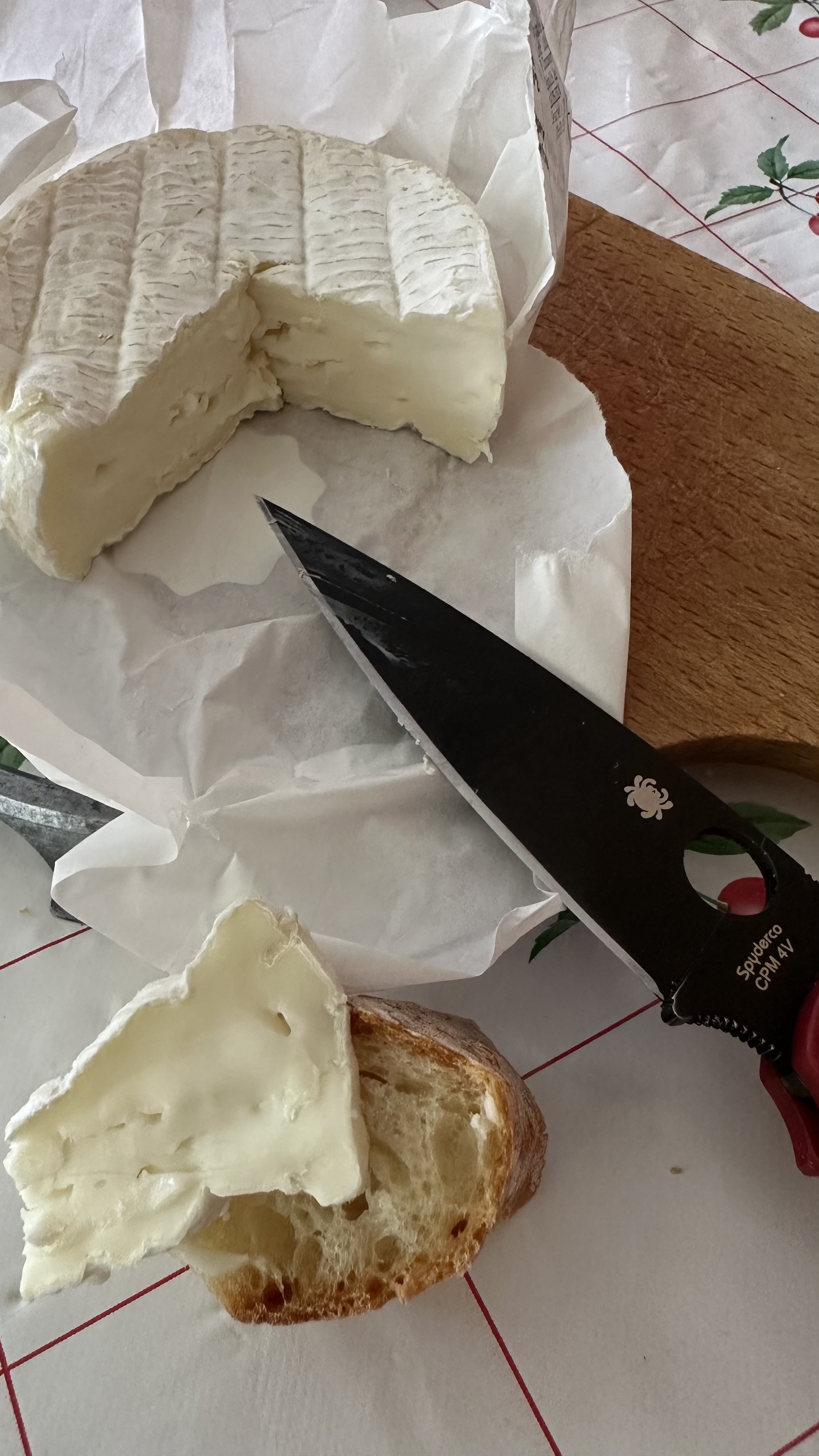
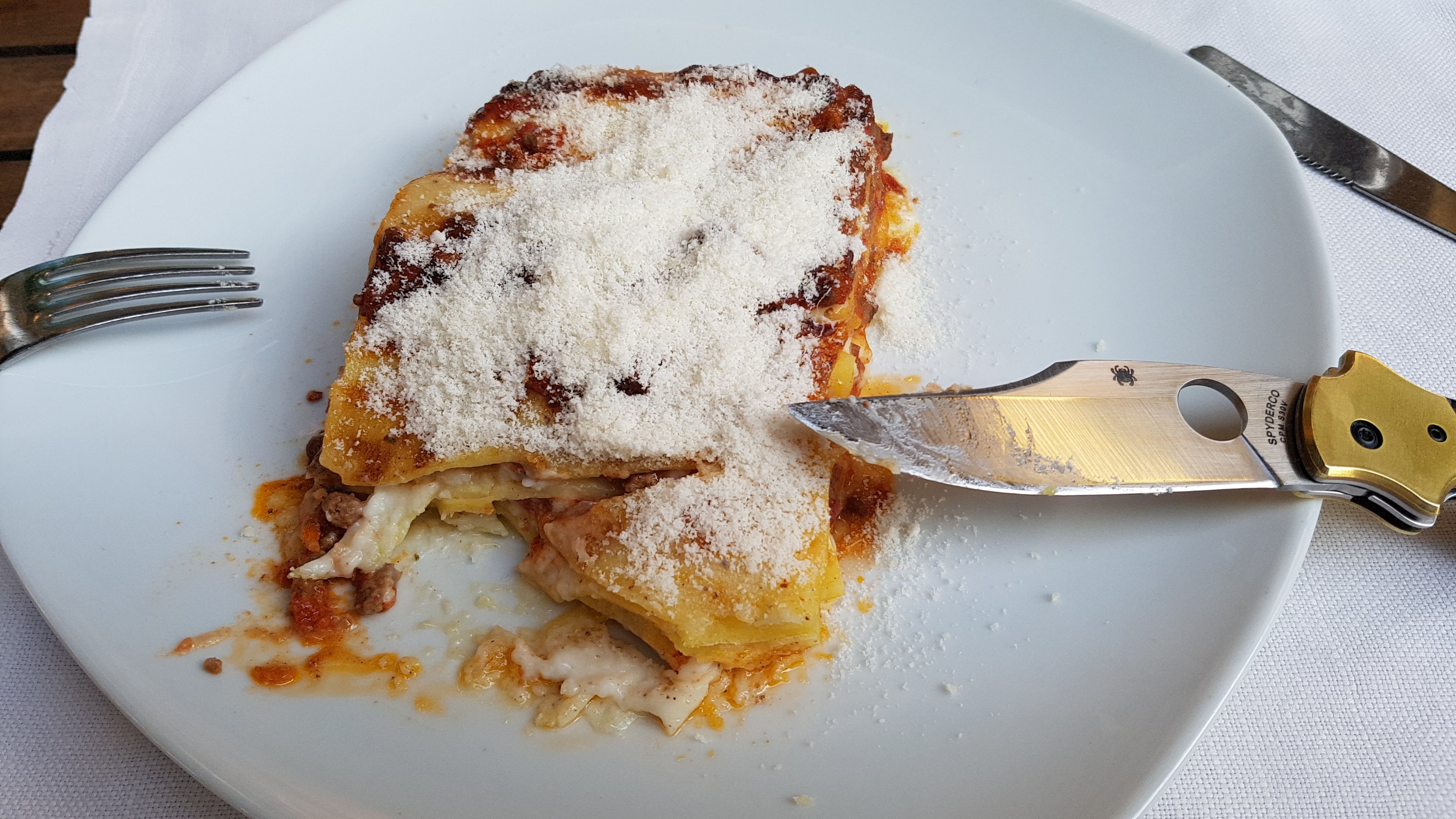
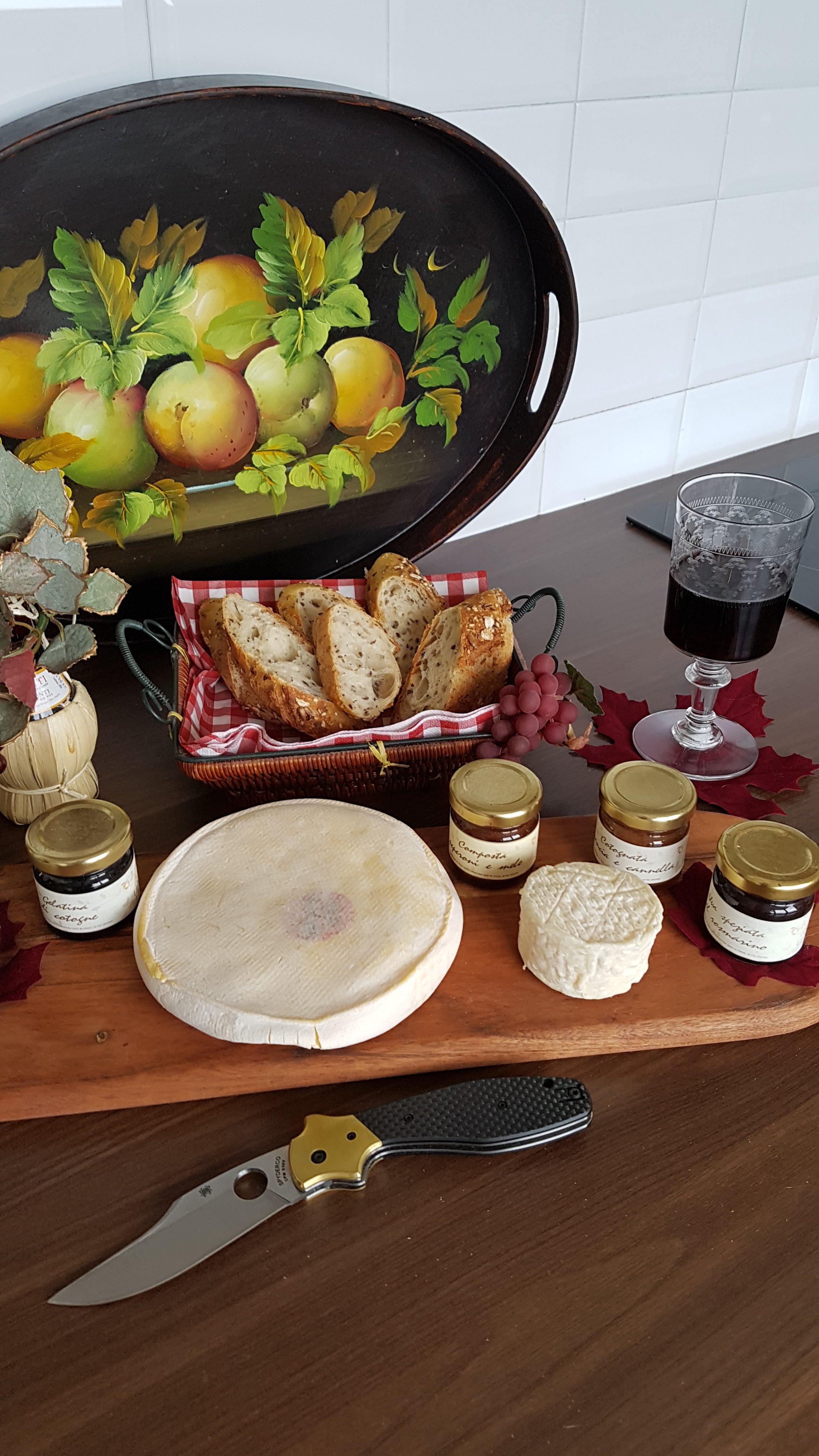
But cheese is a great way to notice how DLC is making the surface of the blade less sticky but more stinky.

The Chief was not always used on gentle medium like wood.

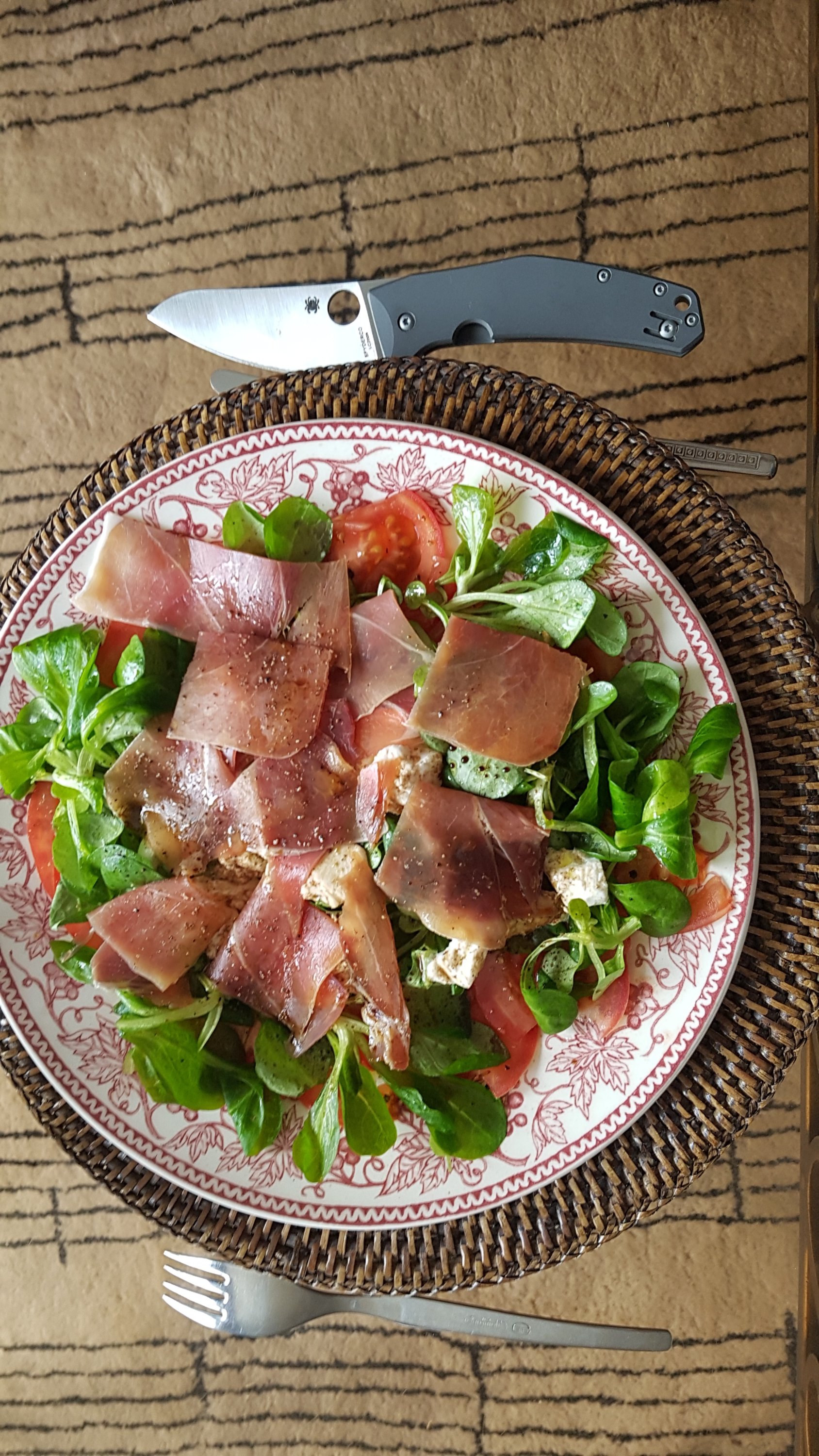
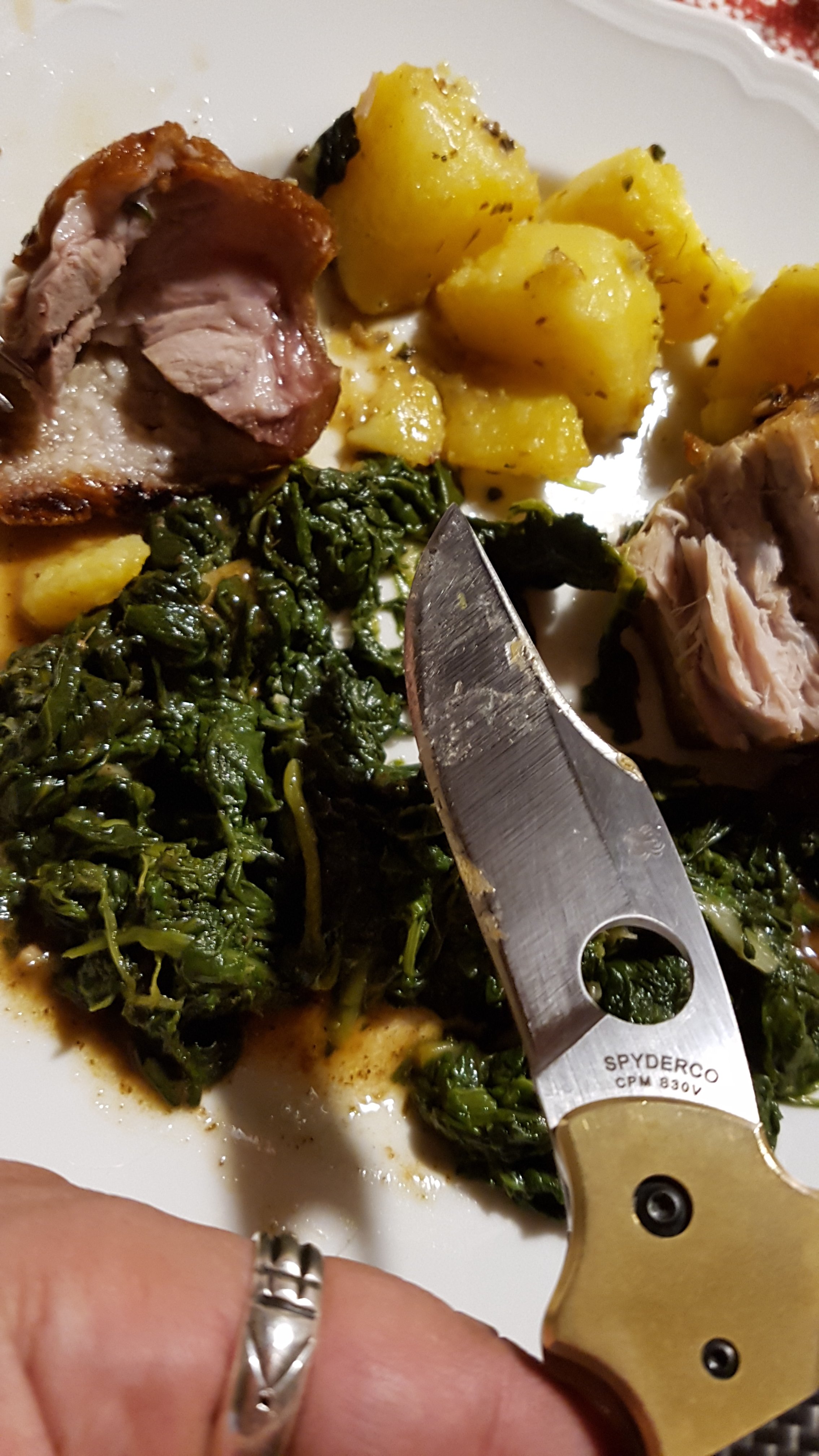
It was also used on plate with vinegar salsa. Here it is basamic vinegar from Modena.

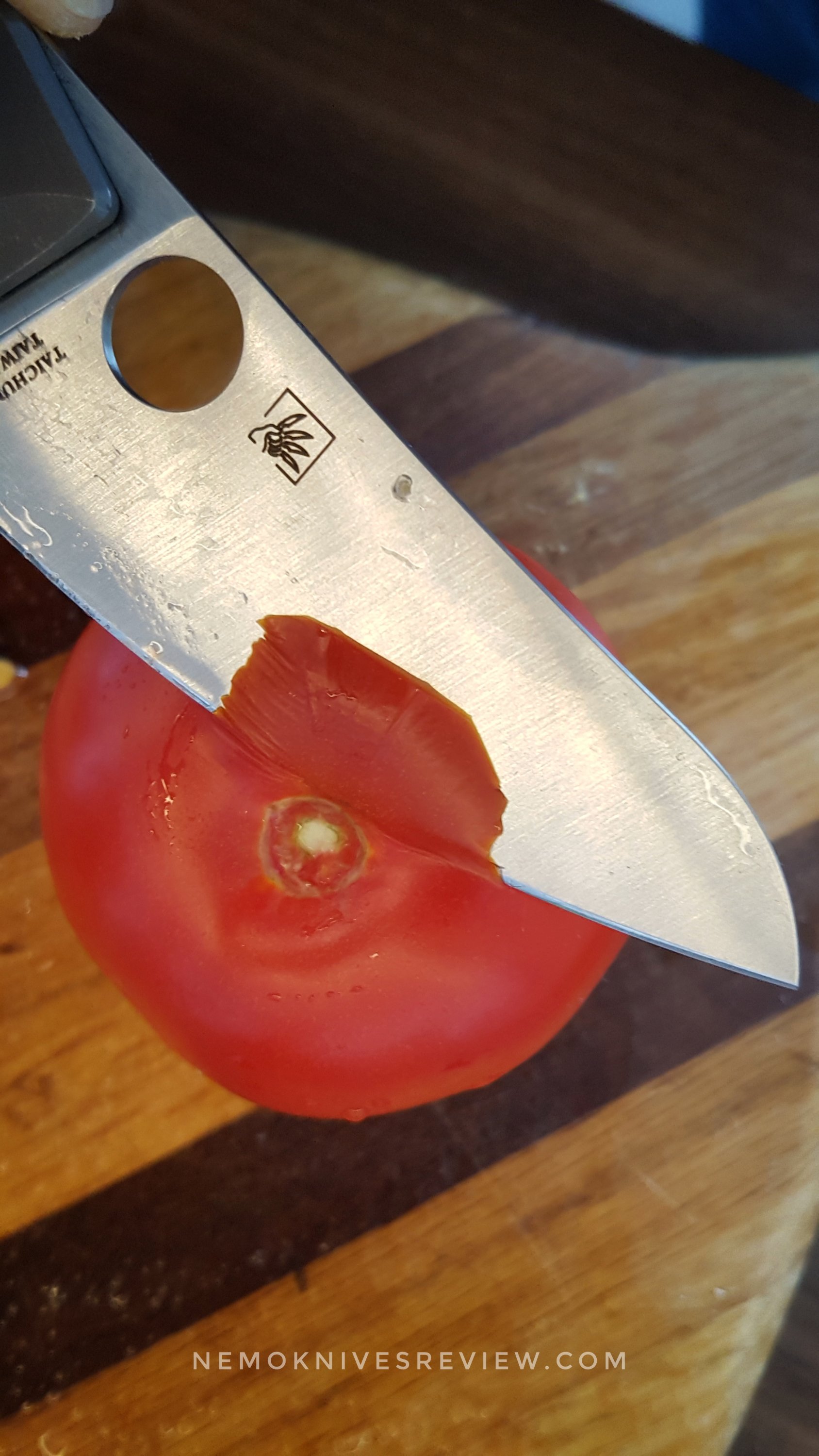
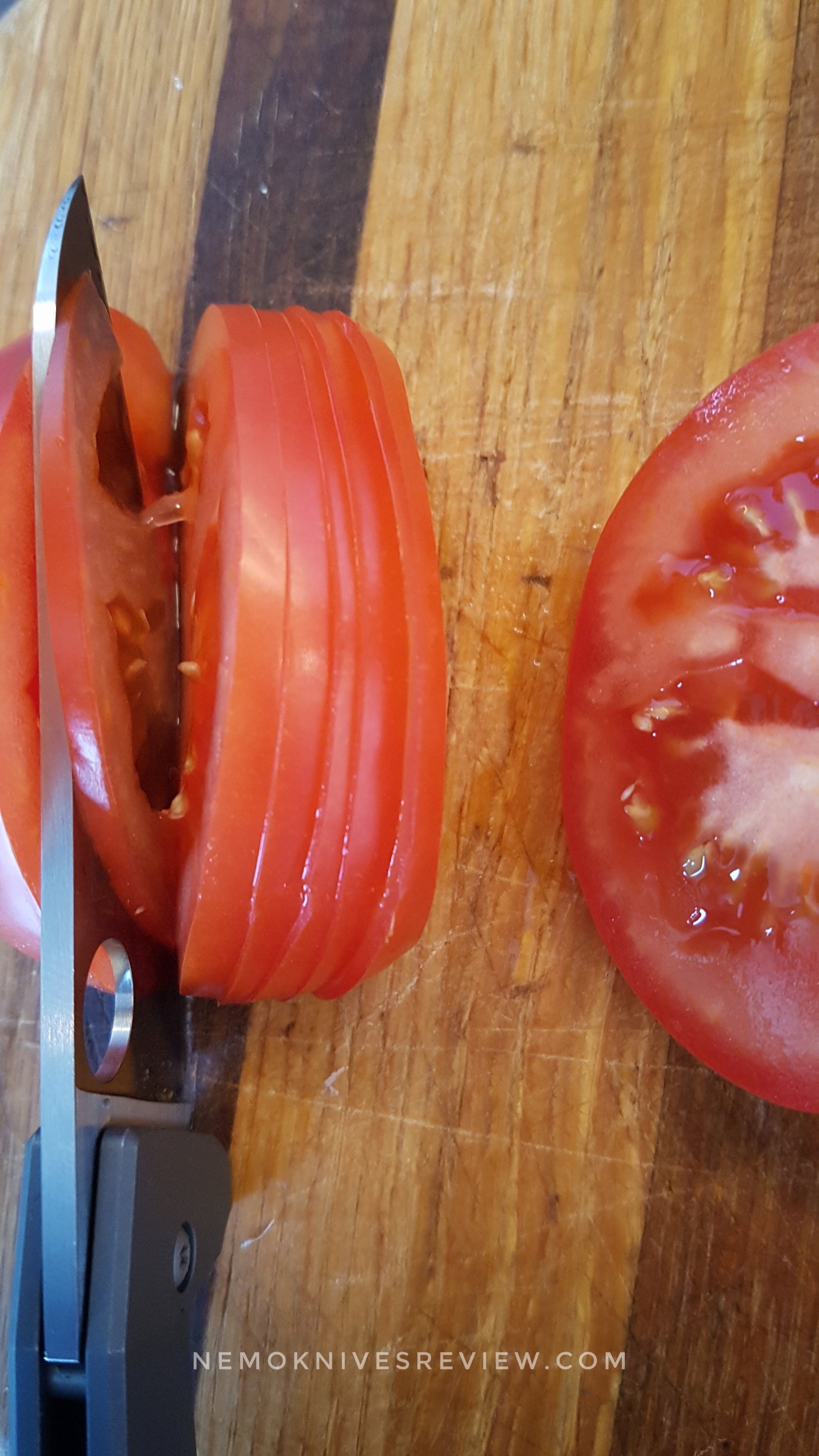
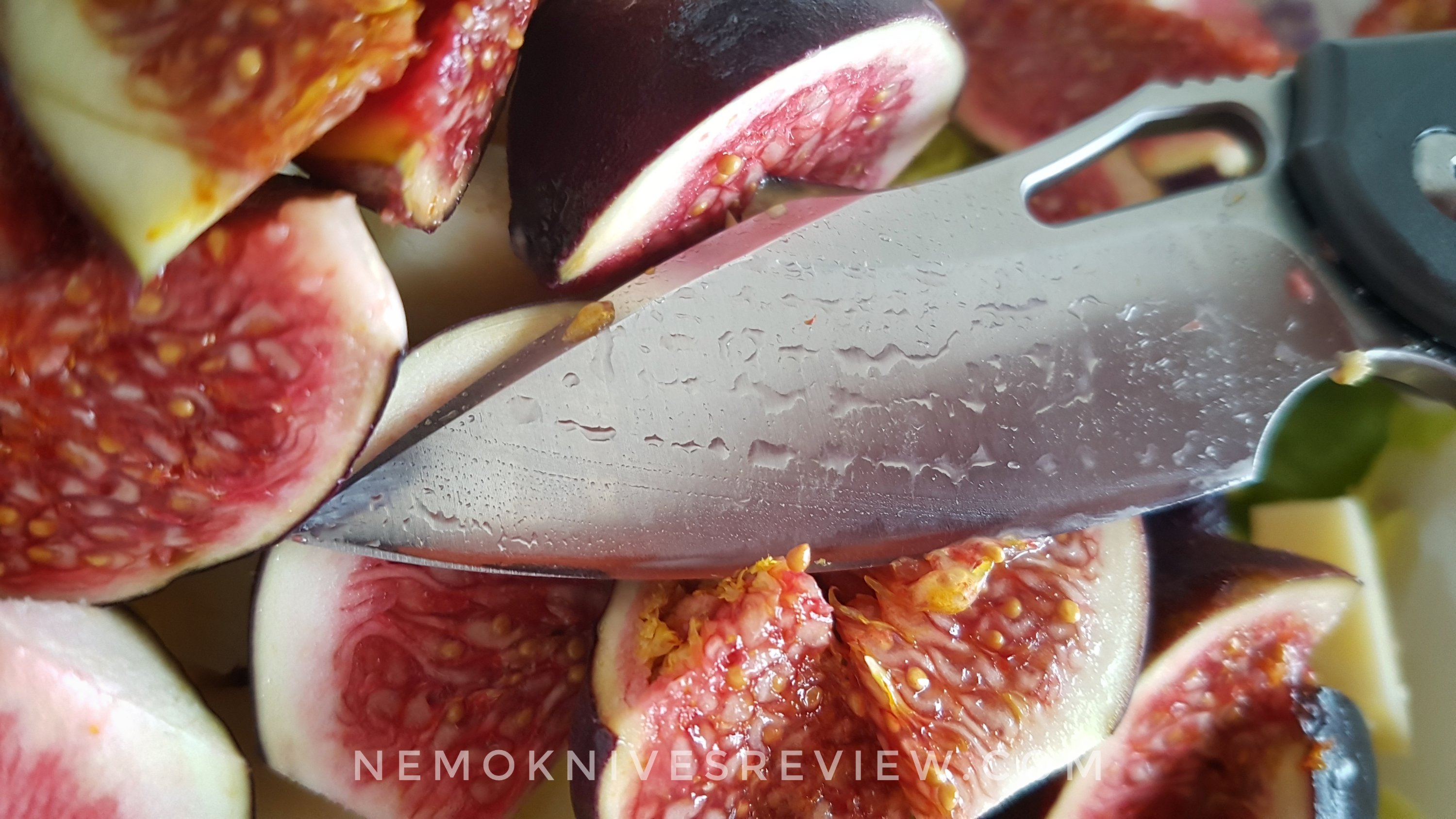
In the kitchen the knife is really behaving like an paring knife. It is really handy on fruits and vegetables. Its very pointy blade is great to carve.
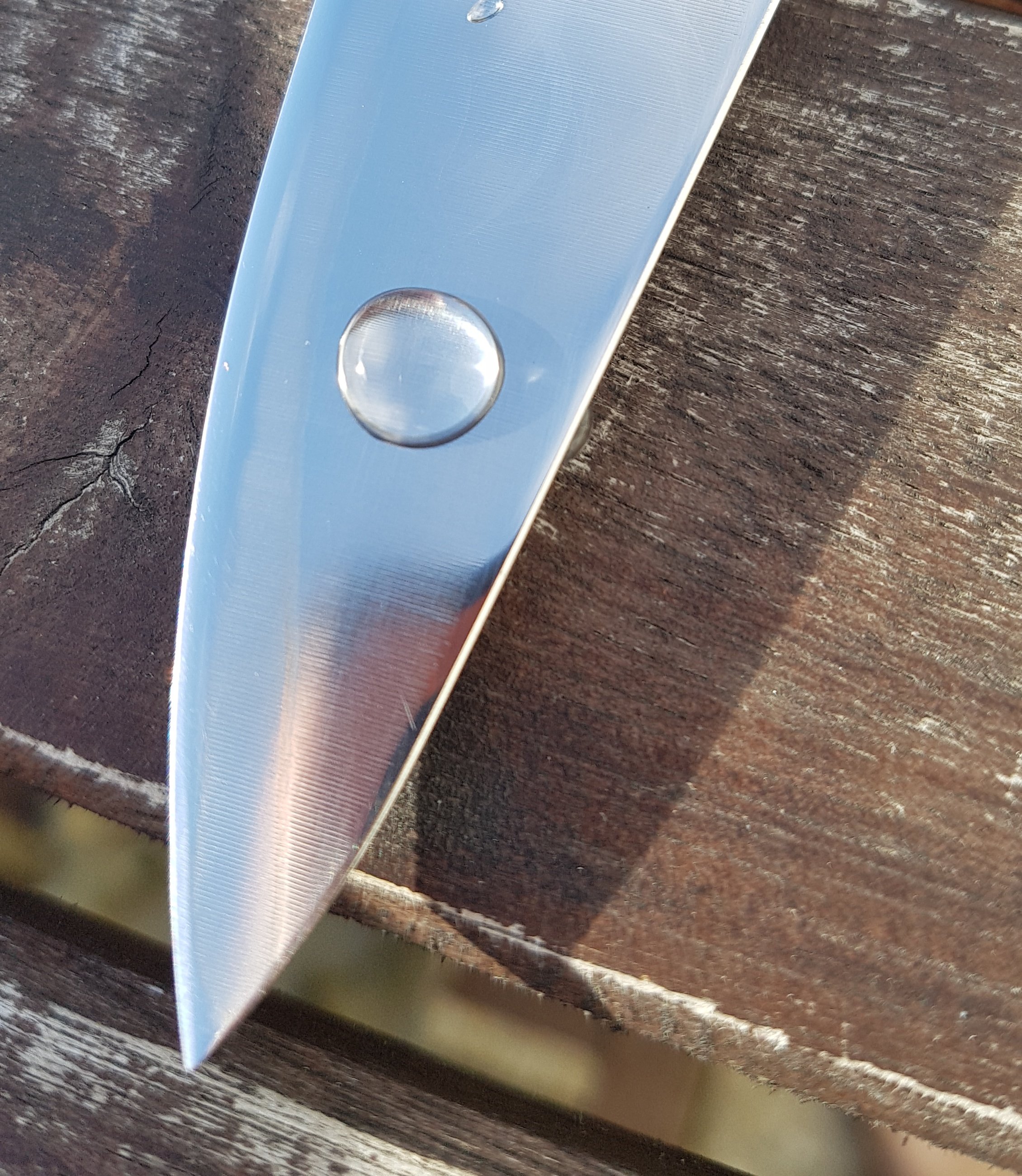
.The mechanism has never suffered from being wet and rinsed under water. The knife was smooth through and through its various wet works.

Now I like to have chamfered and smooth handles and blade spine. The Chief is known to be very square everywhere. The G10 has been easy to smooth with sandpaper used wet to avoid toxical dust.
Now the blade spine is DLC coated and it was my esthetic choice to remove the coating on all the length of its spine.

I love the result.

It has been done with some diamond rods.
Now the spine is much more confortable for my thumb in case of push cuts.

CPM 4V on that Native Chief platform is really the bread and butter for a strong thin folder. I’m not afraid to use hard on wood and plastic.
And it is a must in the kitchen various missions.
It has been also test on different hard wood and compared (geometry speaking) with many other knives I got.
One of my champion is the Swayback in term of smooth pushcuts.
But also the Wolfspyder and the Yojimbo.

My Chief needed more convexing and thinning to go to the level I was expecting. Again diamonds has been used handfree to remove the shoulder of the edge.
CPM 4V keeps a very very crispy edge and bites in the wood very aggressively.

CPM M4 is a stunning alloy which is prefered on fixed blade but it is a gem on a long and thin folder. It makes it super solid with a very permissive edge.

Quoting Larrin Thomas Phd:

Some will argue that toughness is not important in folders or fine slicing knives and feel that only edge retention matters in that case because they don’t use their knives in aggressive ways which are likely to lead to chipping. However, broken tips are still common on small knives and kitchen knives. And with higher toughness, the knives are better able to handle thin, low angle edges without chipping. And they can be heat treated to higher hardness to help prevent edge rolling and deformation, while still maintaining good toughness. This means that, indirectly, higher toughness can lead to better cutting performance because of the possibility of thinner edges.

The good news is that CPM Magnacut has been copied on CPM 4V behavior.

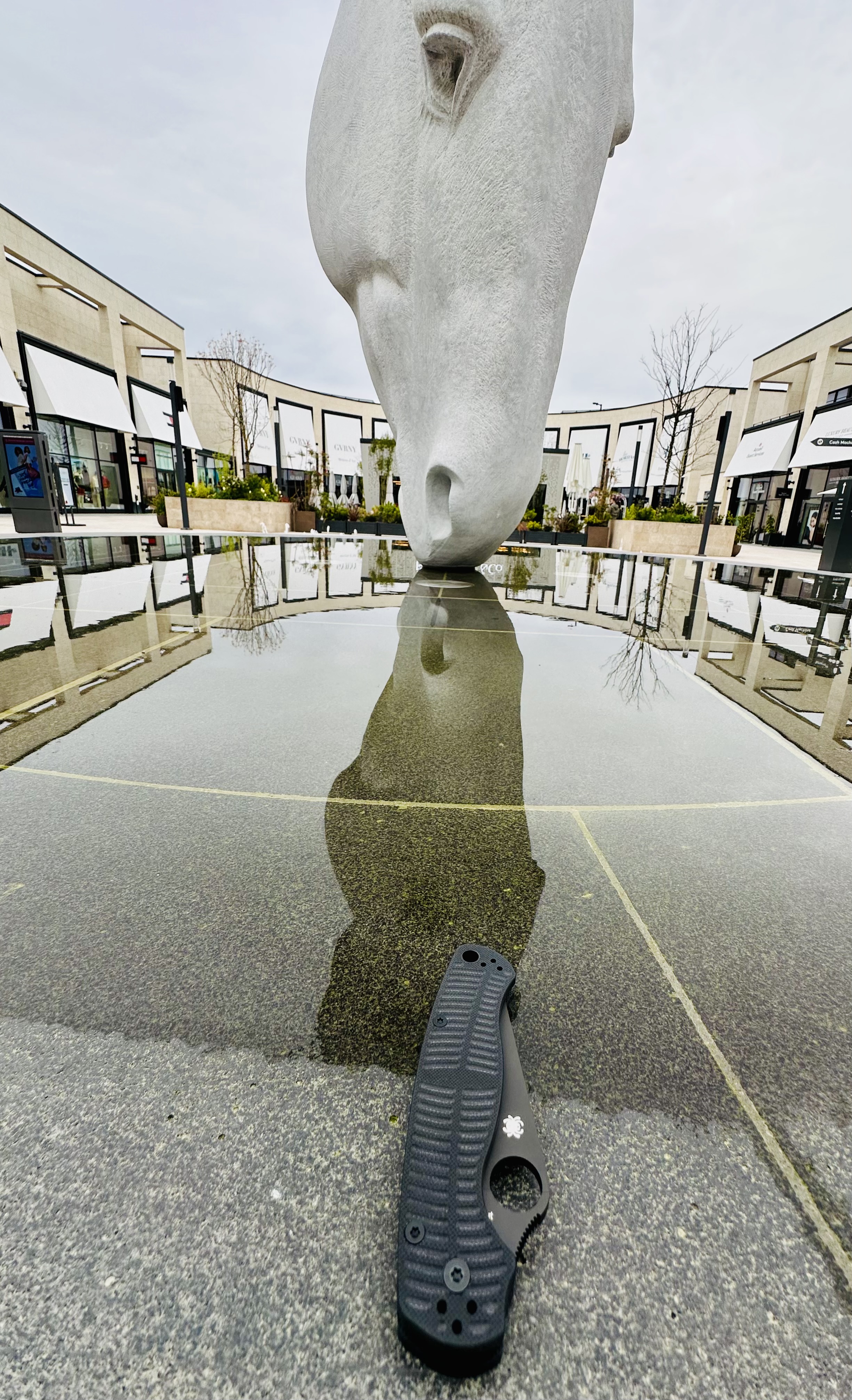
The Amphibian Milestone in CPM Magnacut : the Paramillie 2 Salt has landed !

The Amphibian Milestone in CPM Magnacut iq PARA MILITARY® 2 SALT® BLACK G-10 CPM MAGNACUT® BLACK BLADE – C81GMCBK2 which is much too long to fit in a title.

This is not my first Paramillie 2, I usually wear the 52100 carbon fiber version but I have used many many version in S90V, CPM Cruwear and S30V. The 52100 is actually the exact opposite of this new version.
Announced at the 2023 Amsterdam Minimeet, a Paramillie impervious to the element. Better: a nautical version ready to stand tall in frond of the salty waves of the ocean’s breakers.
Then the wait began.

And here it is, in all its glory !
Delivered with Larrin Thomas dreamlike alloy: the CPM Magnacut !
A steel which hits a lot of sweet spots. Like some sort of totally rustfree CPM M4: strong, resilient and able to withstand thin edges without chipping.
So why adding a DLC on that alloy ? Overkill can be fun, can’t it be ?

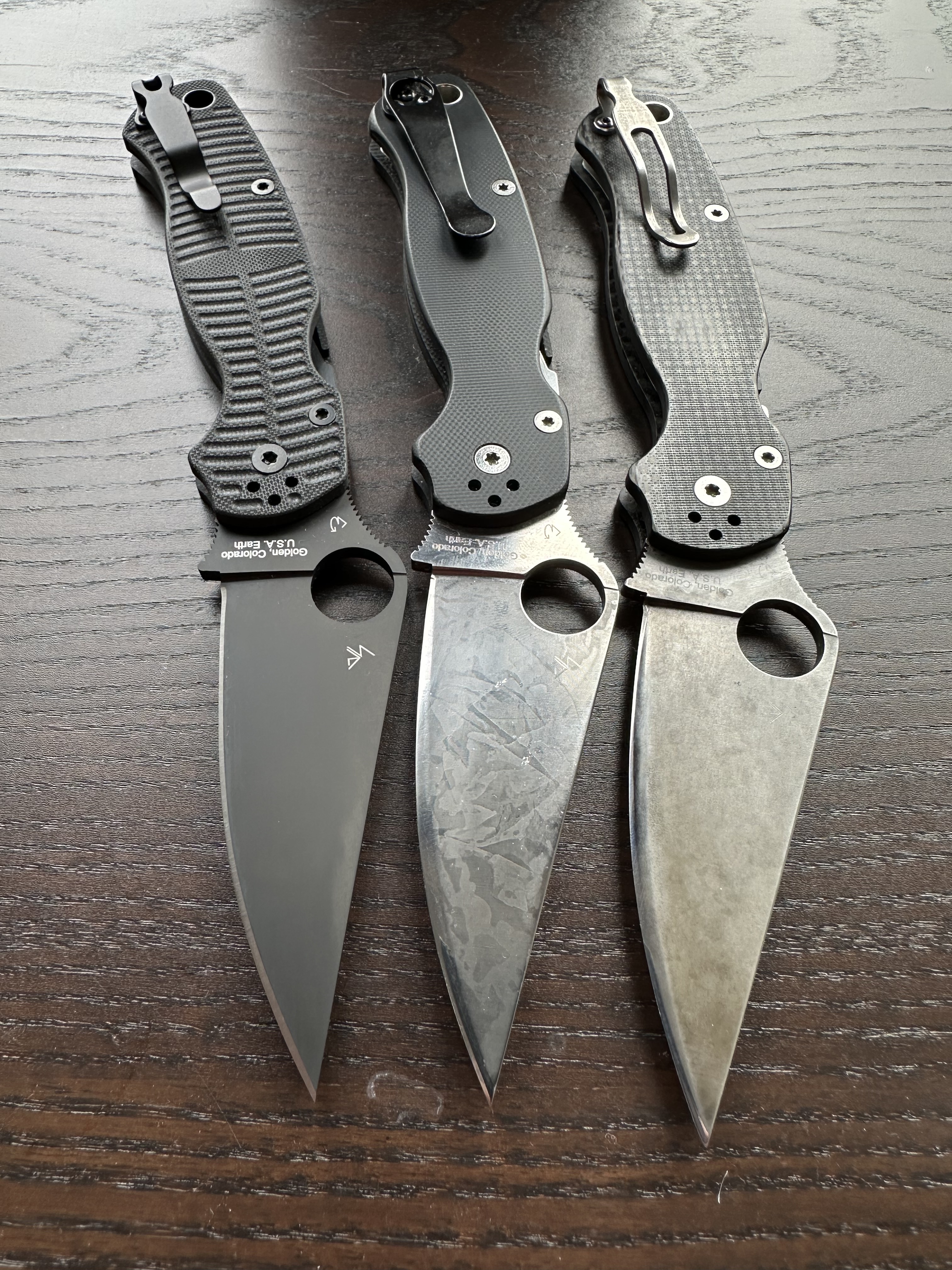
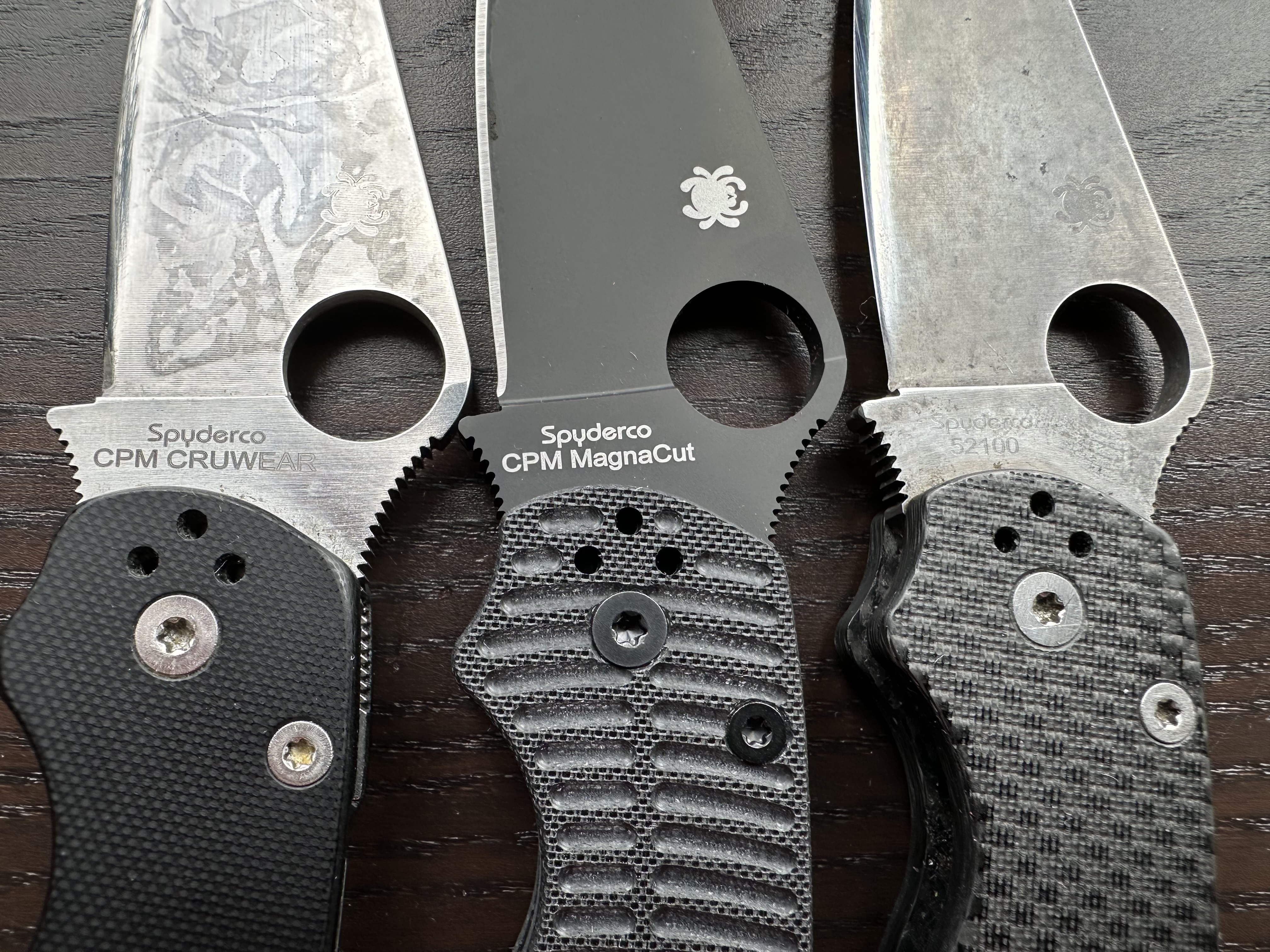
Here are 3 versions. The 52100, the CPM Cruwear and CPM Magnacut from right to left. Three excellences in their own way all designed by Sal and Eric Glesser.
CPM Magnacut is a story of love.
Quoting his metallurgist of designer:
“The carbide structure of MagnaCut is much finer than the common powder metallurgy stainless steels such as CPM-154, M390, Elmax, S35VN, etc. The only stainless PM steel I have imaged which is competitive in terms of carbide/nitride size is Vanax. MagnaCut is even somewhat finer than CPM-4V and Vanadis 4 Extra, the non-stainless steels that MagnaCut was modeled after. This is an excellent result and should lead to excellent properties.”

Quoting Spyderco:
“This tour-de-force expression of the Para Military 2 showcases a full-flat-ground blade crafted from CPM MagnaCut—a state-of-the-art particle metallurgy steel that offers an exceptional balance of edge retention, toughness, and superior corrosion resistance. Cloaked in a non-reflective Diamond-Like Carbon (DLC) coating, the PlainEdge blade is housed in a handle featuring peel-ply-textured black G-10 scales machined with the signature Caribbean Bi-Directional Texture pattern of Spyderco’s US-made Salt Series knives. To complement its blade steel and finish, the knife’s nested stainless steel liners, four-position pocket clip, and all other hardware are also made from ultra- corrosion-resistant materials and black coated.”

That new Salty Paramillie is destined to be an amphibian workhorse, an hippocampus !!
All hardware is black coated but the stop pin which is silver and made of “fearlessly corrosion-resistant marine-grade materials“.
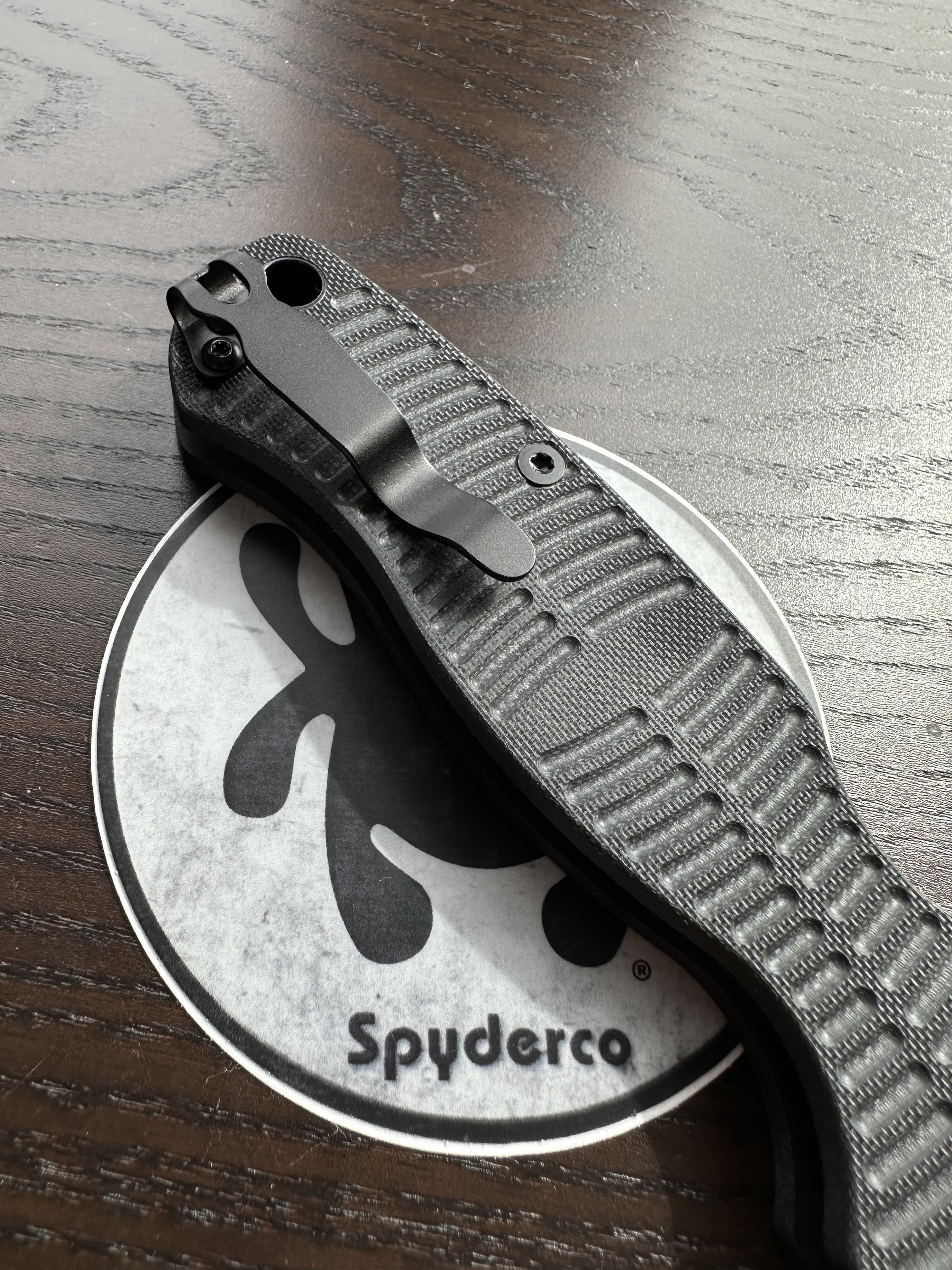
The handle (as efficient it is to be non slippery) is destined to be a pocket shredder as it is carved to be used with wet oily hands. Your trousers will suffer !!
Unless, like myself you are a compulsive user of sandpaper. And even then, it will be hard on pocket’s lips.

The Diamond Like Coating is not only protecting a blade which doesn’t need any protection, it gives a strong Mall Ninja vibe also.
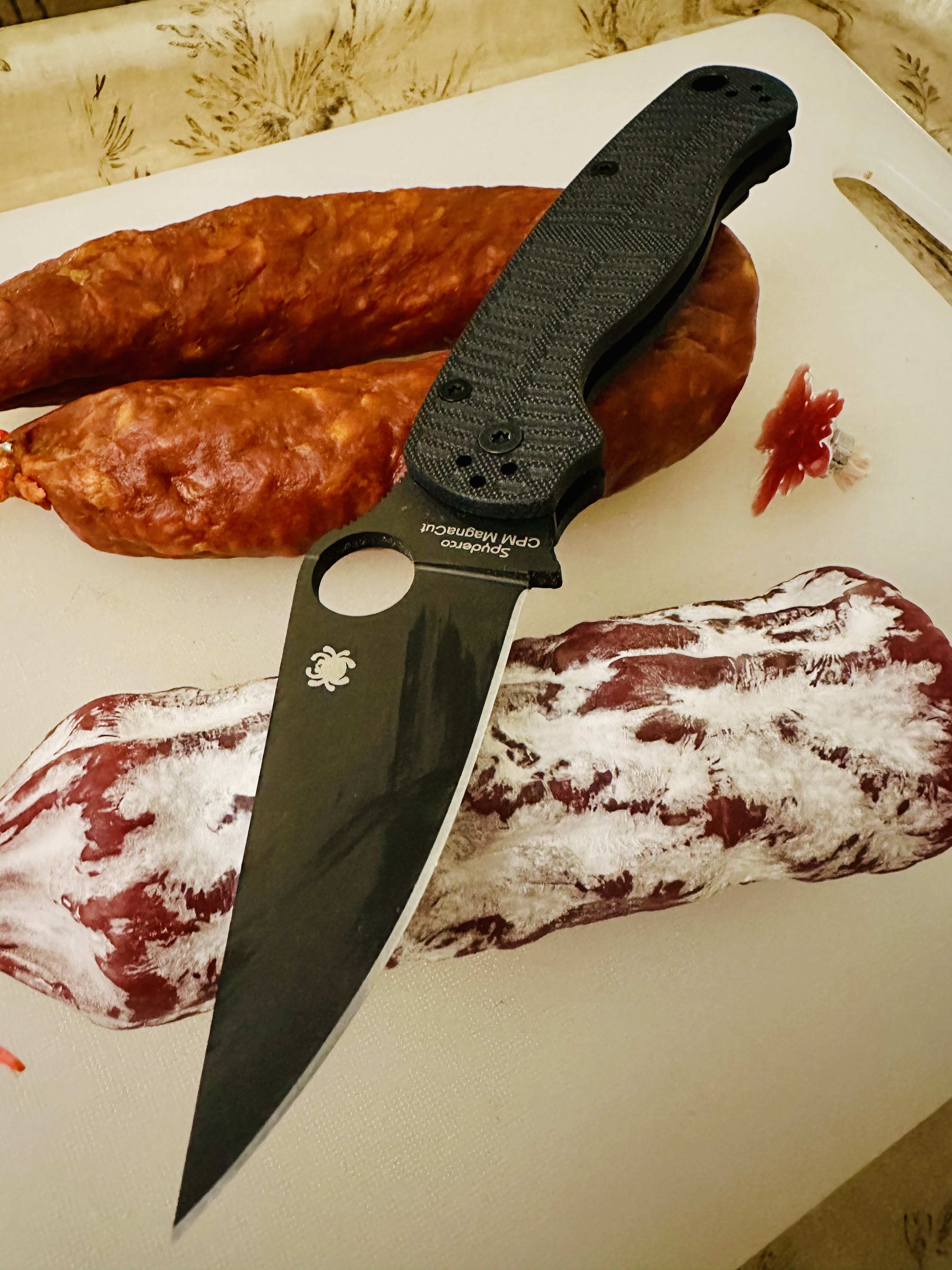
Usually coating brings some king of lubrification to the matter separation. I’m not impressed so far, even on sausages.
The geometry is perfect on my PM Salty. Thin as a razor though.

One thing I had to change was the clip. It was replaced by a Flytanium Universal Titanium Clip which is short and deep carry.
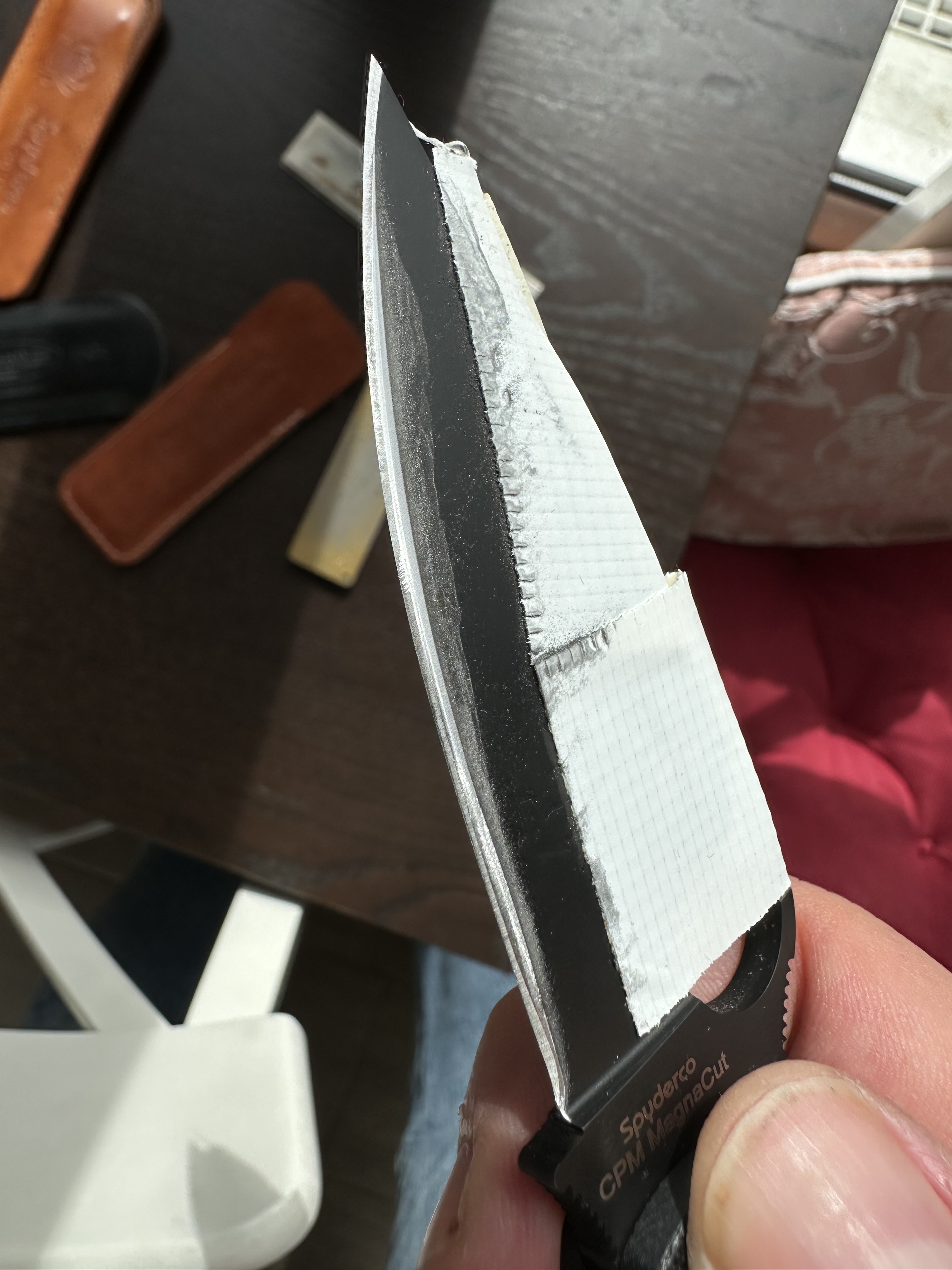
Also I have moved the clip for a Tip Up carry which suit the Paramillie better in my book.

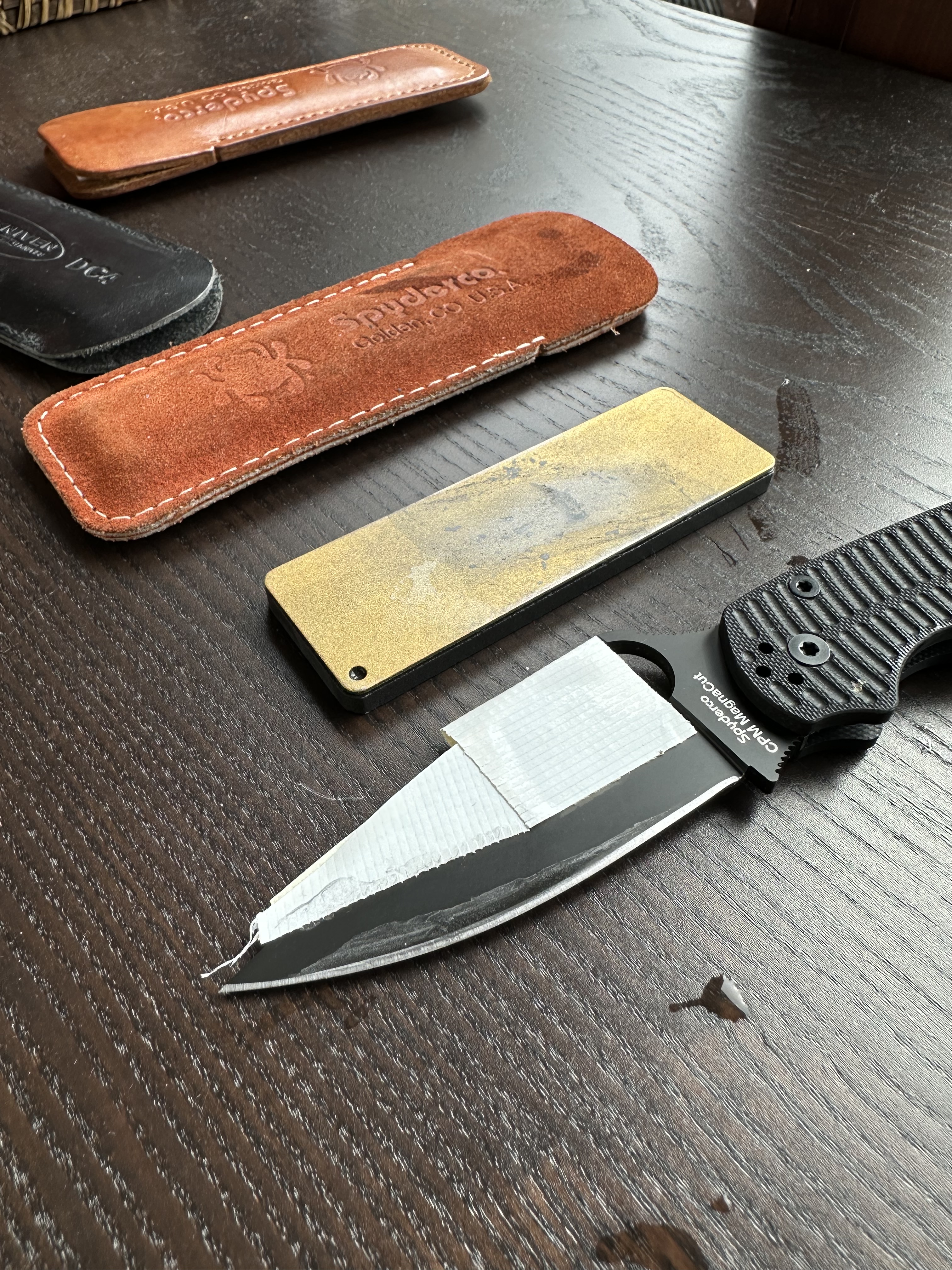
Of course de-shouldering the edge is the first step to convex that I do on new knives. Especially I have read that Magnacut loves leather stropping.

And this is true ! The edge turned quick into a über razor state.

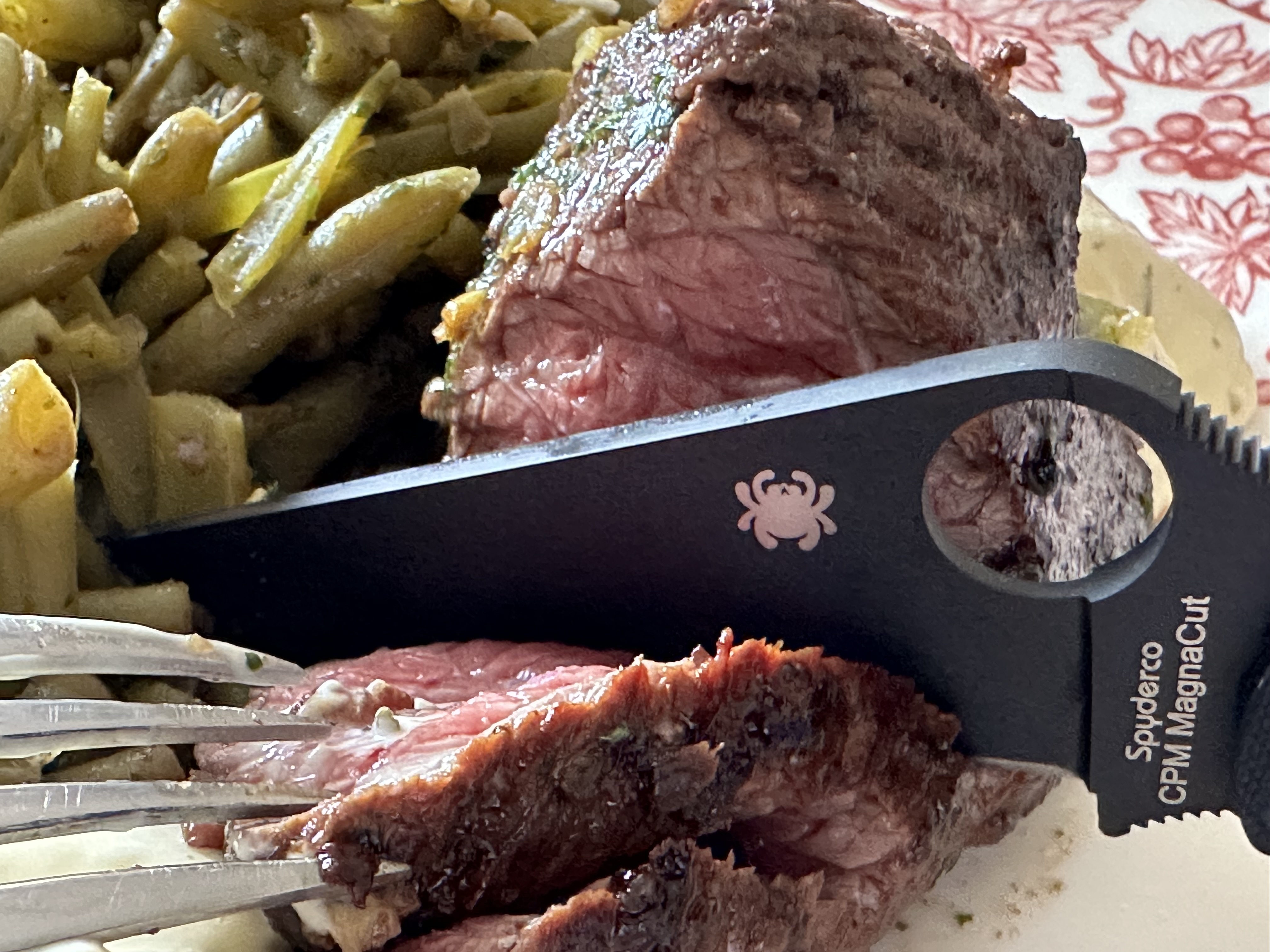
It zipped through meat like a lightsaber into banta meat.

So now the game is on. The Salty Magnacut Paramillie is ready to kick all other knives from my pockets and be used on the long run.
Let see what this cutlery apogee era knife has to propose on the long run !

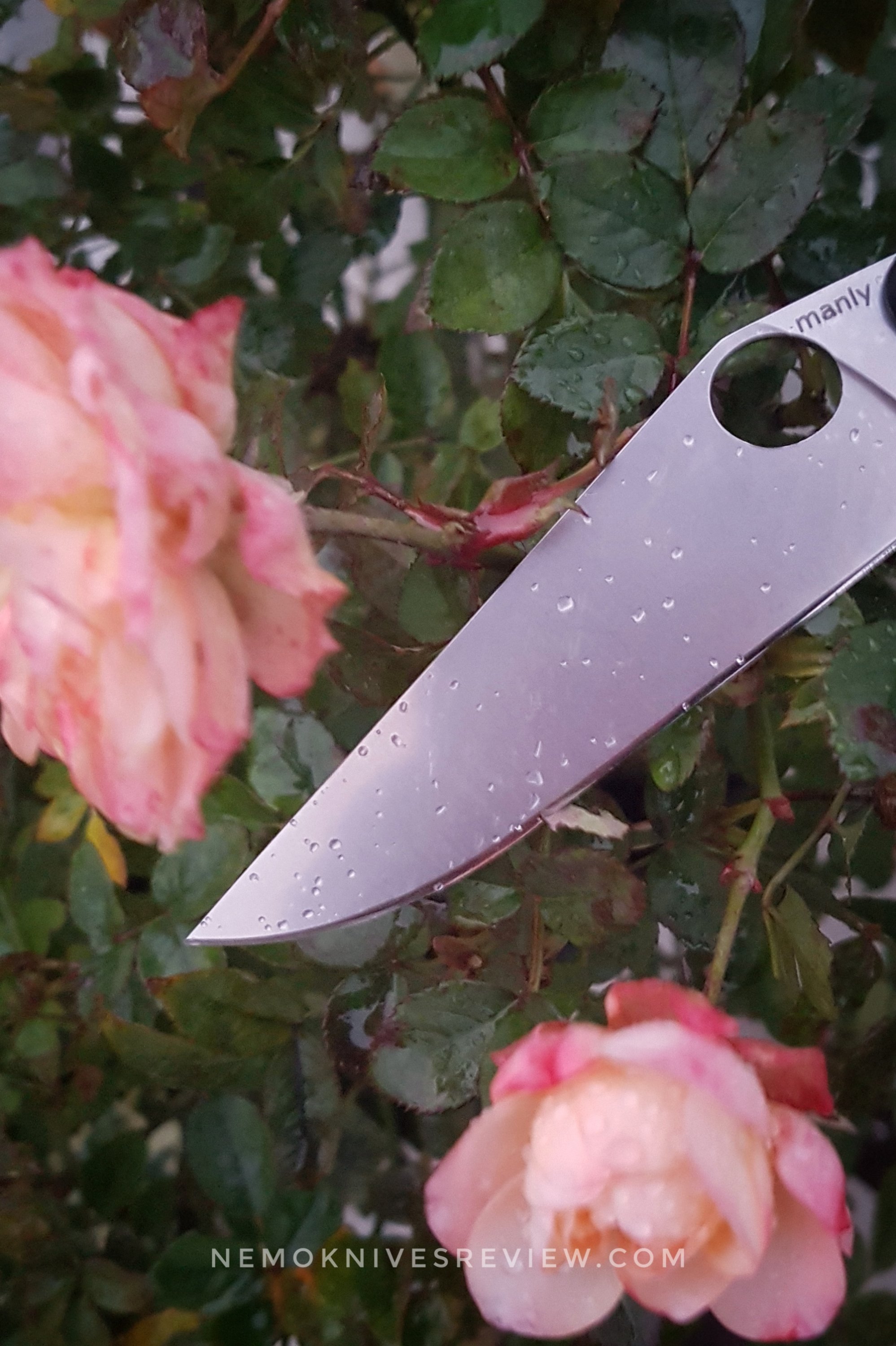
MANLY PEAK S90V — THE BULGARIAN WONDER AT WORK.

20180115_173130-011574733019.jpeg

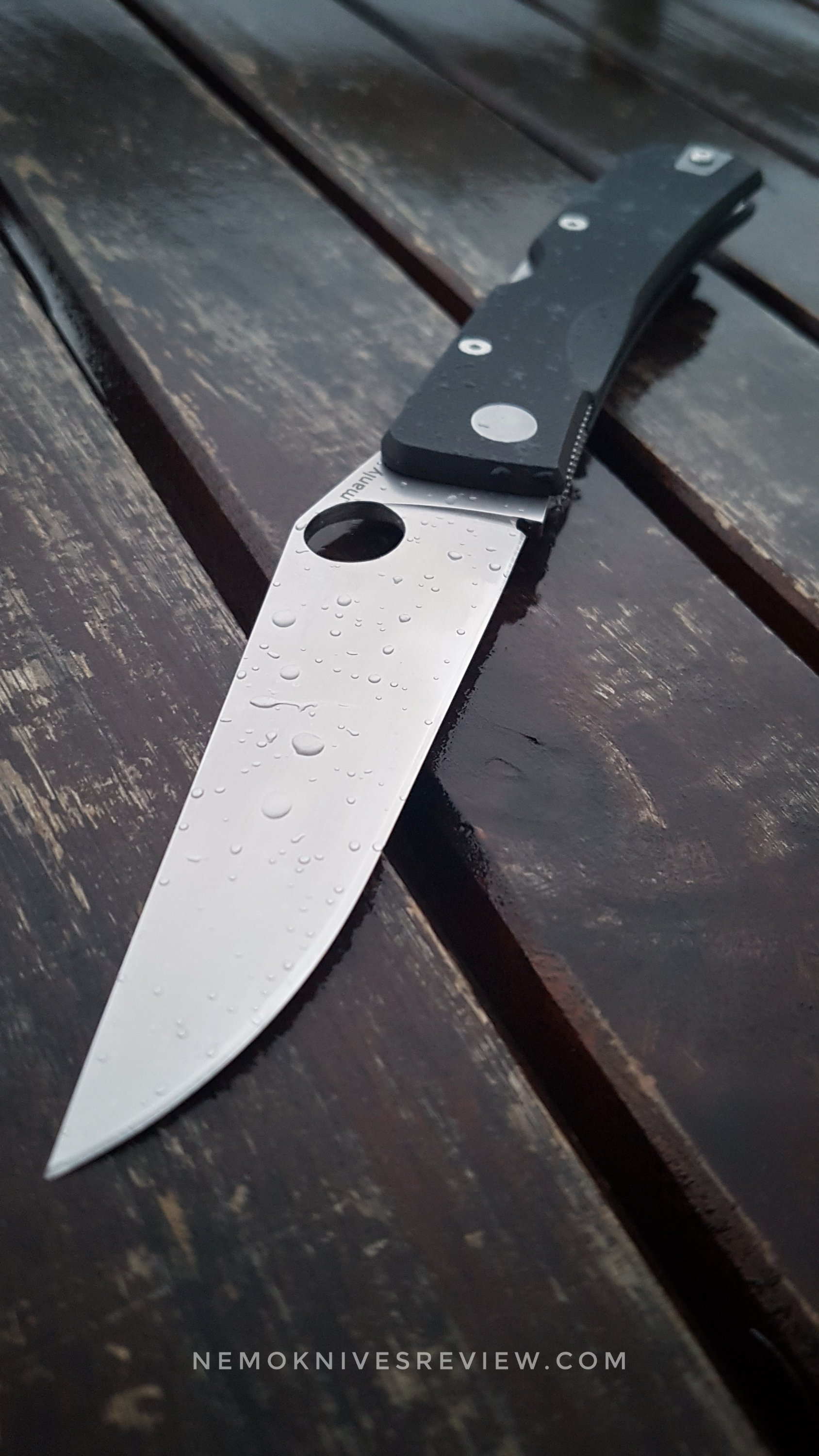
The Manly Peak is a workhorse. So, it has been put to good use in various tasks.

The main features of that folder are a very thin geometry and a zero play mid backlock.
It has not developed any play and the edge has ever been thinned for outstanding results.

20180104_124548-012054372158.jpeg

Tomatoes are great for testing. As you can notice, it was a very easy task to cut through the skin.

The same for any fruits it was confronted to. The thin and long blade gives a lot of hand control when peeling and cutting or on the cutting board. No pitting on the S90V alloy after intense and daily kitchen duty.


Pushing the envelop, I have thinned both my S90V Native and S90V Peak. I was inclined to think that the Native 5 with its belly would be better than the Bulgarian folder but in fact not. The thinner grind of the Manly got better results on hard plastic and when the Native was stuck, the Peak was going through like the Nilakka or my Opinel would do.

20180104_163619-011694634690.jpeg

20180104_163558-011414100735.jpeg

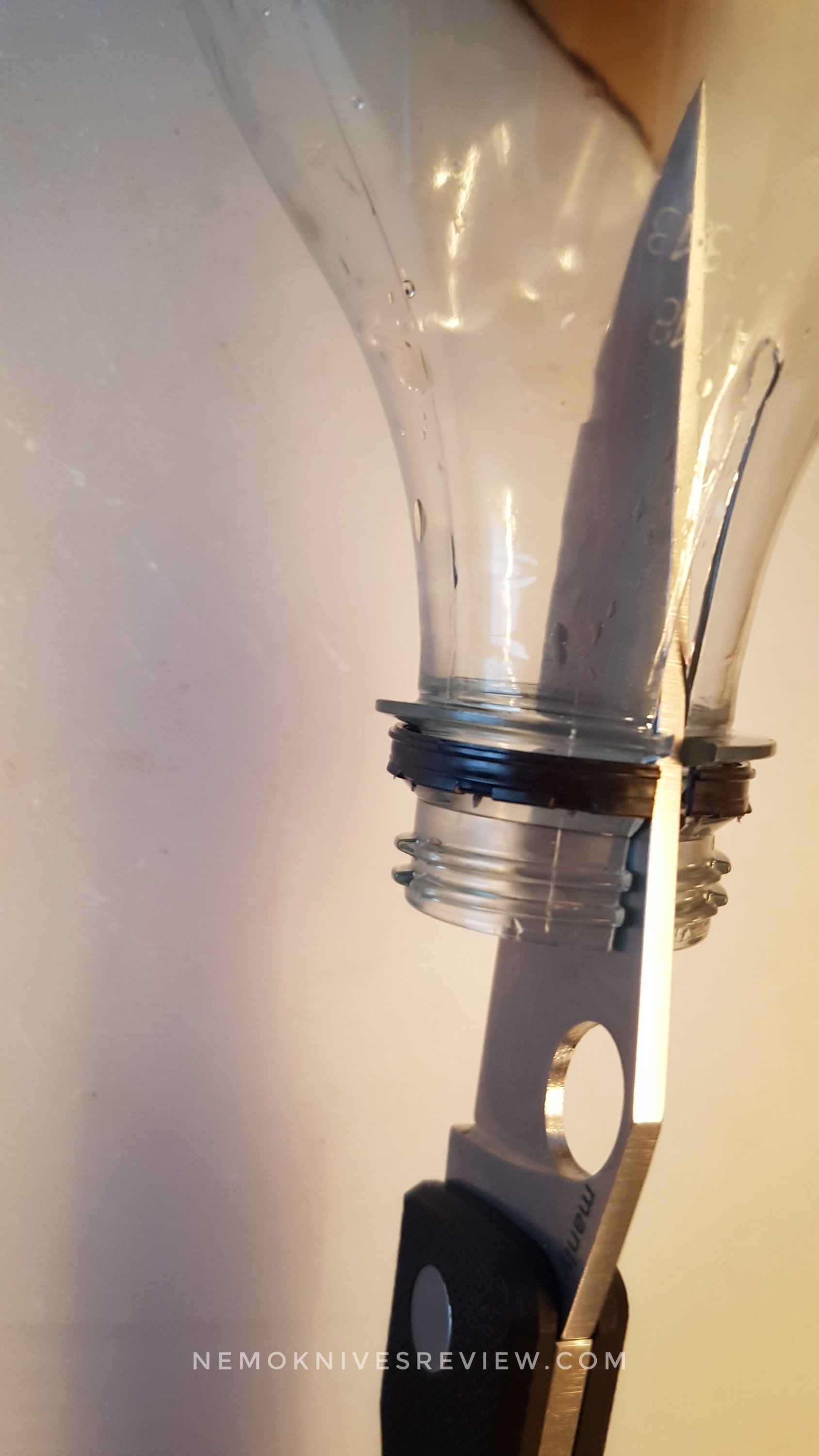
I was even able to do multiple cuts on the same bottle butt. This is really impressive. Let’s not forget that should should have the same results on a 45 euros Peak with D2 steel.

The mechanism feels a little smoother now on opening and closing but it is also due to a drop of nano oil.  The clip is really perfect, it is deep, secure and smooth. It has been well thought and I really wish the future generation of Manly folders will be likewise equipped.
So the Manly Peak is really a high quality workhorse in terms of reliability, power cuts and ease to wear. This is a serious tool for any users, from the LEO to the ELU.  It’s a thrill to see it compete against folders which can reach 4 times its price and see how easily it can beat them. Now this is a stiff mechanism “à la Cold Steel” and you will need some open and close mileage so that it folds and unfolds with ease. Once in action though you have a pocket lightsaber able to work hard and keep going. Highly recommended!

More Manly folders here.

20180115_173208-01566735243.jpeg

last edited by Pascal Jaffré on 18 jan 2018

Spyderco C211TIP Marcin Slysz SpydieChef — Folding Utilitarian Cooking Knife.

20171109_110835-011207972581.jpeg

OK , I do love acronyms, pardon my French but when I have received the Spydiechef I was very excited to test a design made for chefs: a folding tool cooks could keep in their pocket.
Knowing my needs to turn SD design into tools, this time the grass was cut under my feed. Marcin Slysz purpose was very clear even in the material choice.
But first the design.

20171109_111444-01811877249.jpeg

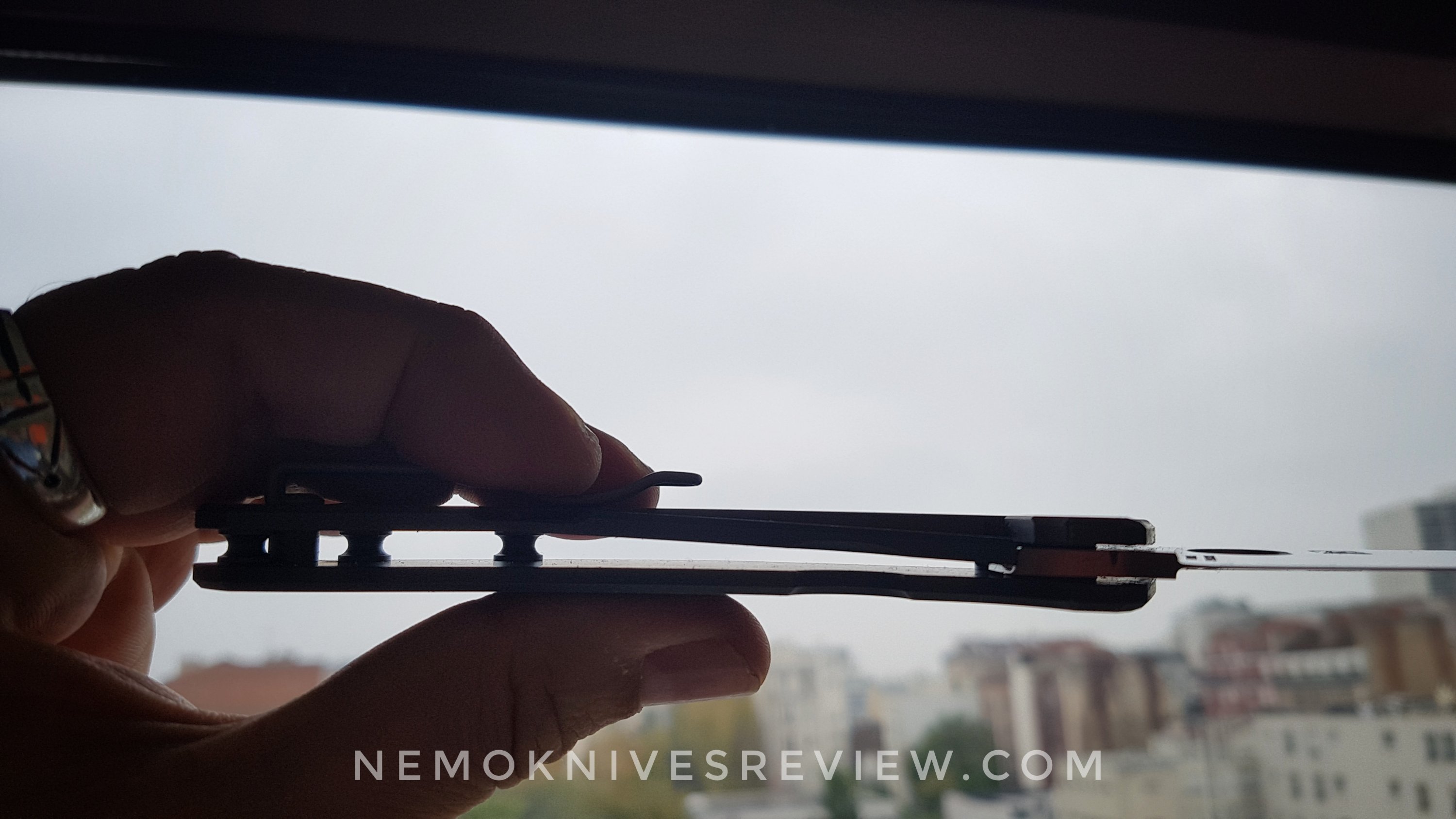
Why using a Sebenza like handle ? Because Titanium is stainless and the opening construction is easy to clean. It’s also a relatively thin design, easy to pocket. No jimping, no need for and again easier to rince under water.
Because a cooking tool do get dirty. Here for example are the remain of Mozzarella di Buffala…
20171109_113238-01131262360.jpeg

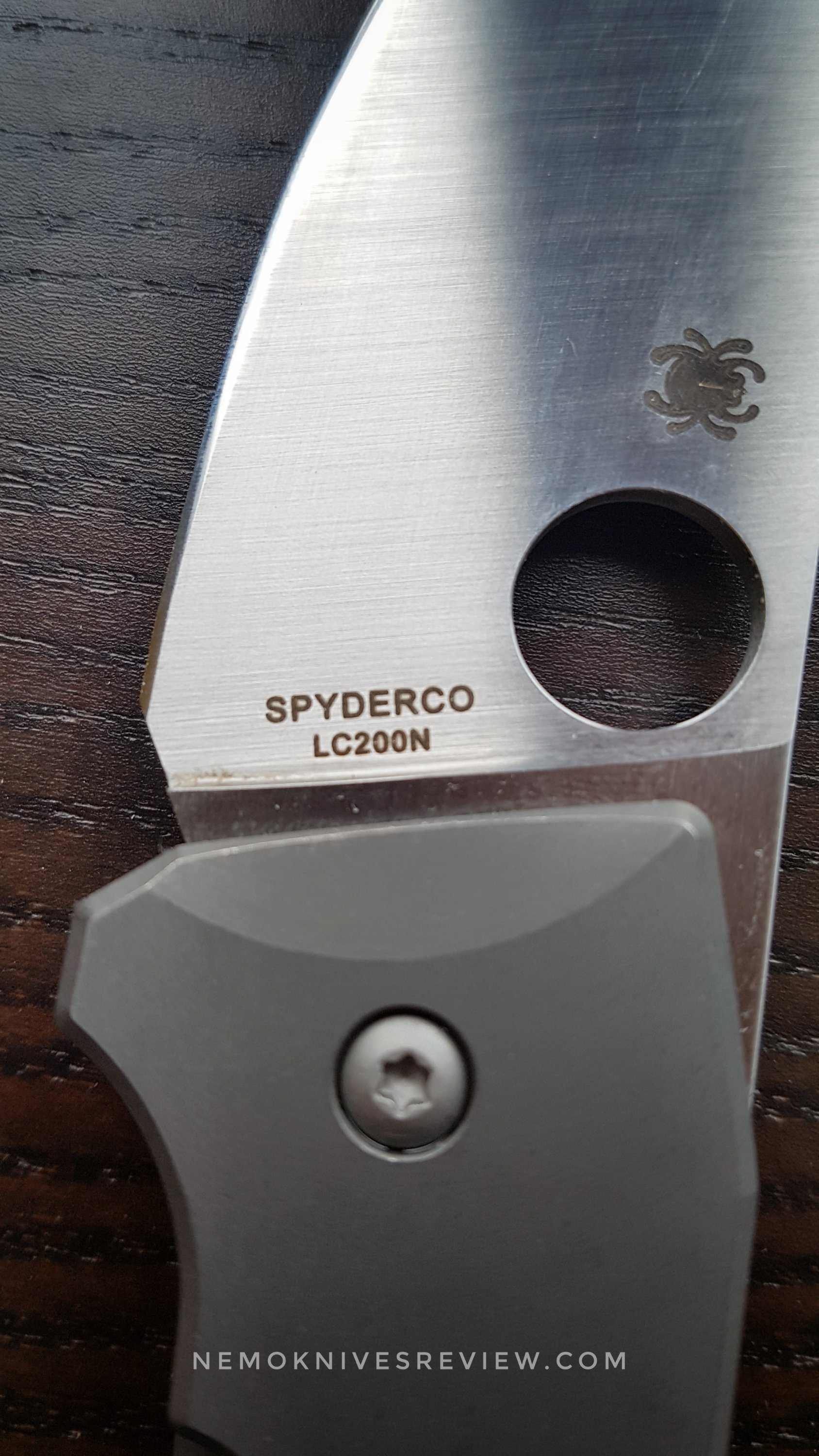
The choice of the blade steel is also interesting. LC200N is a state-of-the-art high nitrogen alloyed tool steel that is specifically formulated to offer superior corrosion resistance and extreme toughness, even at high levels of hardness. I have used carbon steel with patina on it and no smell or taste has been noticed during their use with food, but here with that kind of steel you are certain to show a clean knife to inspection before starting your recipes…

20171109_111511-011364459906.jpeg

So the whole knife is very much completely impervious to rust. That means it could also been used near the sea and even on a boat where the possibility to open and close a rust free knife with one hand can be really safe and useful. There is no steel insert to prevent excessive wear on the lock, like many new RIL locks nowadays. I don’t know if the titanium has been heated to be harder, or perhaps the nitrogen alloy is not abrasive ?
One thing which can be noticed is that this alloy can be ground flat when H1 could not. All H1 steel were hollow ground blade.


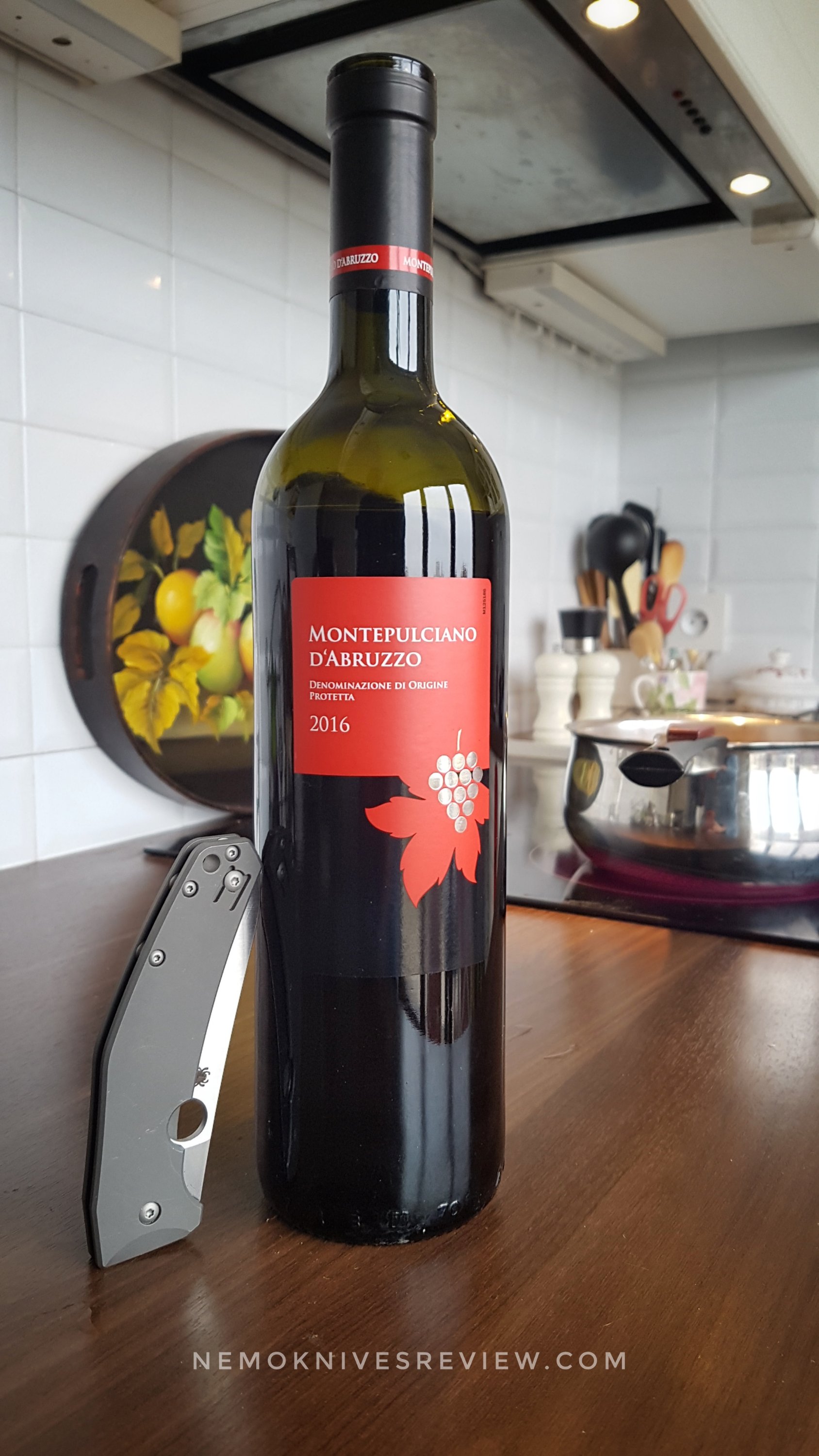
Back to the kitchen. Once closed it needs a bottle to stand up right. Chose your poison !
20171109_111421-011713540165.jpeg

The detent is quite strong and is the main brake to the opening and closing of the blade. The more it will be in use the better it will become. unlock, the blade falls free and there is no blade lateral or vertical. Taichung has done a great work again.

20171024_153821-011950064838.jpeg
But what is especially great with that Marcin’s design is the possibility to cut on board.
It’s much easier than to use a flipper knife for example as here all the edge can get in contact with the cutting board with nothing on the way even no choil. Practical to do all those moves for vegetable preparations for example. This is very very practical in my book.

20171109_111552-01619952168.jpeg
20171109_112351-01808066952.jpeg

The factory edge was so sharp and toothy, it was a breeze to cut into tomatoes. Tomatoes are a good test for sharpness as those fruits can have a resilient skin on very soft flesh.
The Spydiechef was a razor right out of the box and the geometry is thin enough for its main battlefield: the kitchen.

20171109_111720-011679500858.jpeg

The broad blade goes easily with a lot of control. And the lenght makes it handy in polyvalence. You would need a longer blade too, but the Spydiechef can do 90% of the work with precision and ease. It is also a beautiful tool to use and feel under the hand.

20171109_112158-011261822741.jpeg

20171109_120927-01445039217.jpeg

And out of the kitchen ? Is the Spydiechef a knife to go ?
Yes it is.  With it’s belly, this knife can be a nice tool to bring with you during hunting season. You can hold it by the broad blade and you got a very efficient skinner.  I still don’t know how the edge will last on dirty rabbit hairs but so far it was easy to keep the edge razor sharp with a light touch up.
On wood, the knife goes steady and deep as the edge is thin and the belly helps a lot. The lock is also very sturdy. I was able to get big chips of wood. The blade is not fragile either especially the tip which won’t break easily. So yes, the cook can go camping ! There is even a lanyard hole, so the knife was thought with outdoor safety in mind.
Overall this is a lovely knife, which can be a great EDC. At least it’s not a free ticket to jail.
It works great in the kitchen and I’m looking forward using it on bigger chores.

20171109_113622-01287808915.jpeg

20171109_111342-01369045934.jpeg

20171109_110932-011009821988.jpeg

And the Chef and Honor.

20171111_215453-01840920890.jpeg

Tuscan Raider #6 — Ed Schempp Bowie at his best, in the plates !

It’s not a surprise but Ed Schempp Bowie is not only a knife to keep in a safe for collection.
I have been taking a lot of knives in Tuscany. Fixed blades to test in the wood of the national parks and some folders. But eventually the Bowie has taken an important place in my trip.
Why ?
First it’s a gorgeous knife which create a lot of conversation.
Also it’s so easy to pocket. This is a huge plus for this EDC: it’s stay in your pocket like a much shorter folder. It’s easy to grab it and to take it. It’s always with you.
I have thinned the edge to the level of my Delica and the result on whittling wood are really outstanding.

It was easy to keep clean and classy. Meaning it can be used in the farm and in the city.

But it’s in the plate and in the kitchen that the Bowie was able to shine bright.

On the table, the Bowie takes its place with pride.

And the Kukri’s curve (Ed Schempp Signature) helps a lot when cutting in the plate.
At the opposite of my ZT0562CF with its flipper getting in the way…

The beef meat cookes at the flame is zipped open by the convexed edge.

The Tuscanian crostini are made of liver are gently spread on bread.

The trip back home leaded us through the Alps and the Opinel birth place.

Spritz, beer, hams and cheeses. The bowie was easy to open and close without to be noticed.


The roblochon is a cheese which needs a long blade.

Eventually the Bowie excellence can be expressed in the woods and in the plate. This is not the case of all folding knives. Ed Schempp’s EDC does it with elegance and efficiency.
So no, really it’s not a safe queen this is a knife to be used every day with pride.


Knife conversation part 1 — Sharpening !!

20171012_105624-014060260.jpeg

Nemo: when you buy a knife you will be sooner or later, depending of many factors, confronted to a dull edge. Getting away from the factory edge is like leaving your parent’s home: it is uncharted territory for most of us. So should you waith for the knife to be dull or immediatly hit the stones to make it yours and why ?

cropped-p1070881.jpg

JD: When I get a new knife I check the edge to see what condition it is in. I pinch it between my fingers to see how thick it how thick the blade is just behind the edge. And just look at the edge see if the edge bevel is even. Some times you can see unevenness close to the ricasso. That will take some extra attention and work on the hone to get right. I use light to see if it reflects of the edge, if it does there is a dull spot. Then I check for a burr with my thump nail.
20171010_125828-01177728853.jpeg

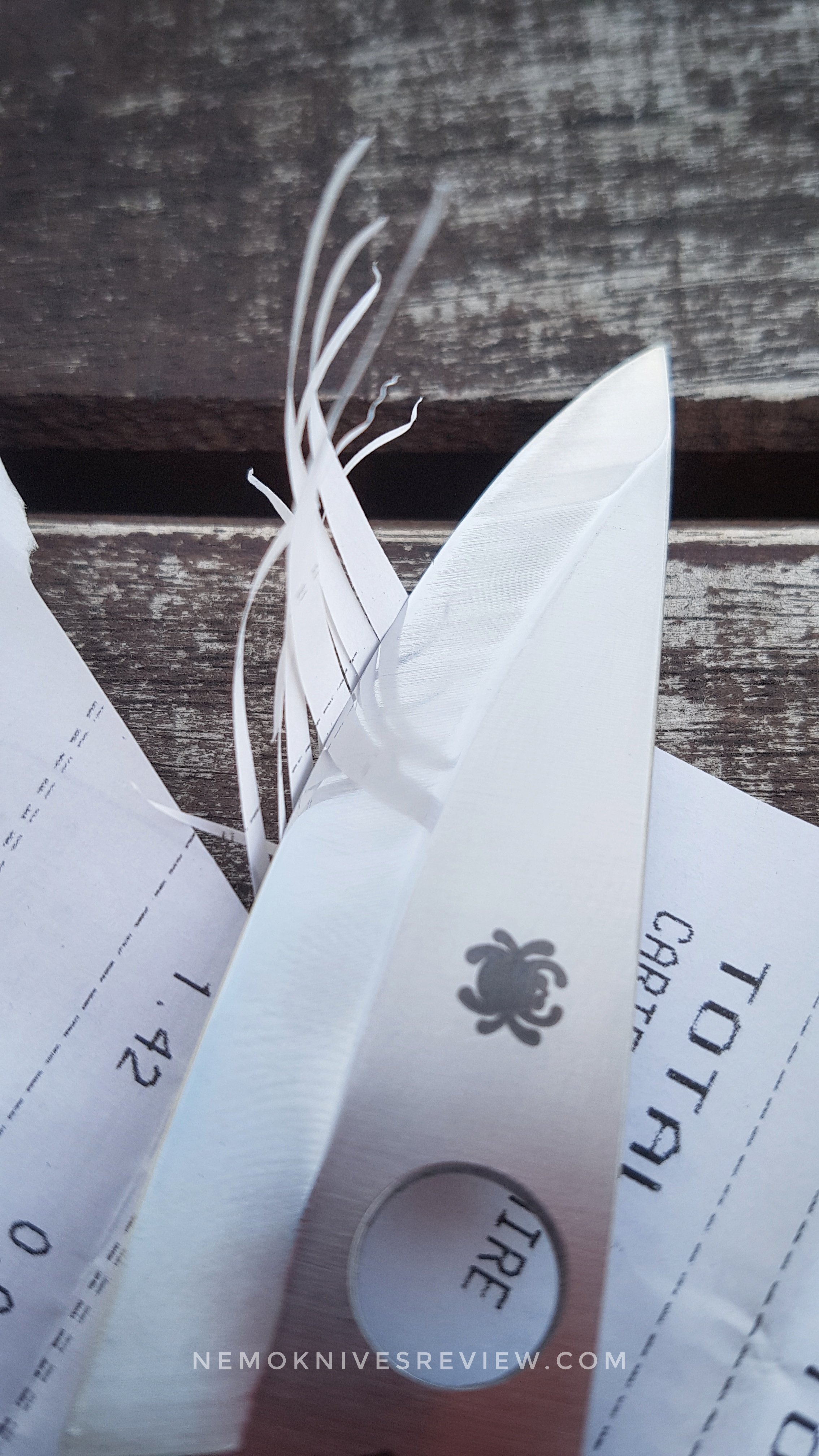
If there is a burr I take a hone, usually the diamond side of the Fallkniven DC4, and remove it. Now I take a receipt of shopping, they are usually thin and consistent, and try push cutting and slicing it. If it cuts the paper cleanly and easily it is good enough to start using. If not, then I will sharpen it first. Depending on edge thickness, edge angle, and steel and what I feel like (knives are a hobby for me!) I will pic a hone and start sharpening.

20171004_180416-011239339540.jpeg

Nemo: knowing sharpening is your hobby is a knife easy to get dull a dream for you ? Or do you prefer your sharp edge to remain sharp for a long time ?
Would you enjoy D2 more than Elmax ?

20171012_104749-0277866023.jpeg

JD: a knife is for cutting and it cut better when sharp. I prefer a sharp knife! 🙂 It needs to cut what I need to cut with ease otherwise it is back to the hone it goes! I also like a knife that when it looses sharpness is easy to get sharp again. So I have no need for high wear resistant steels. But if they are thin at the edge and I like the rest of the knife it would not hold me back either.
If they are both well heat treated and kept cool in production and sharpening there after, both D2 and Elmax would work fine form me. I do not think I could tell them apart in use or sharpening. I am not much of a steel junky, though I like reading about the science of how steel works in knives. (I highly recommend the following books: (in German) Roman Landes: Messerklingen und Stahl and (in English): John D. Verhoeven: Metallurgy of Steel for Bladesmiths!) For me blade geometry and sharpness make a relevant difference. I can tell a thick knife from a thin knife and a dull one from a sharp one far better than the edge retention one steel from another.

20171011_151451-011592961934.jpeg

The biggest differences in steel that I notice are, first, how they sharpen, how easy or hard it is to remove steel, and second, how stainless they are. The last bit mostly when cutting fruit.

wpid-CameraZOOM-20120314164015602.jpg

Nemo: Sharpening wise: what would be the main difference between hollow ground knives and flat grind ?

JD: If they are the same thickness behind the edge the hollow ground blade wil take less effort to make the blade even thinner behind the edge, and take less effort to keep the blade thin behind the edge. Hollow ground knives can be laid flat on a hone to make and keep them thin. I have done this with a few knives. One of them a Spyderco Salt1. Now it is almost a single bevel grind (‘scandi’) and much thinner behind the edge. This has made it cut a lot better.  

The same can be done with a knife with flat bevels, it just takes more work. When you use and sharpen a knife for a while the edge gets closer to the back of the blade and gets thicker. When it gets thicker it cut worse. To make it cut well again the area behind the edge needs to be thinned out. As a hollow ground knife has less steel behind the edge it takes less work to keep it thin behind the edge.

On flat ground you often need to remove the scratches after …

20171012_103055-011631308535.jpeg

Spyderco Yojimbo2 – Mission: Italian Salad.

This is my first post sent directly from my smartphone. As I’m looking for easier way to publish on the blog.
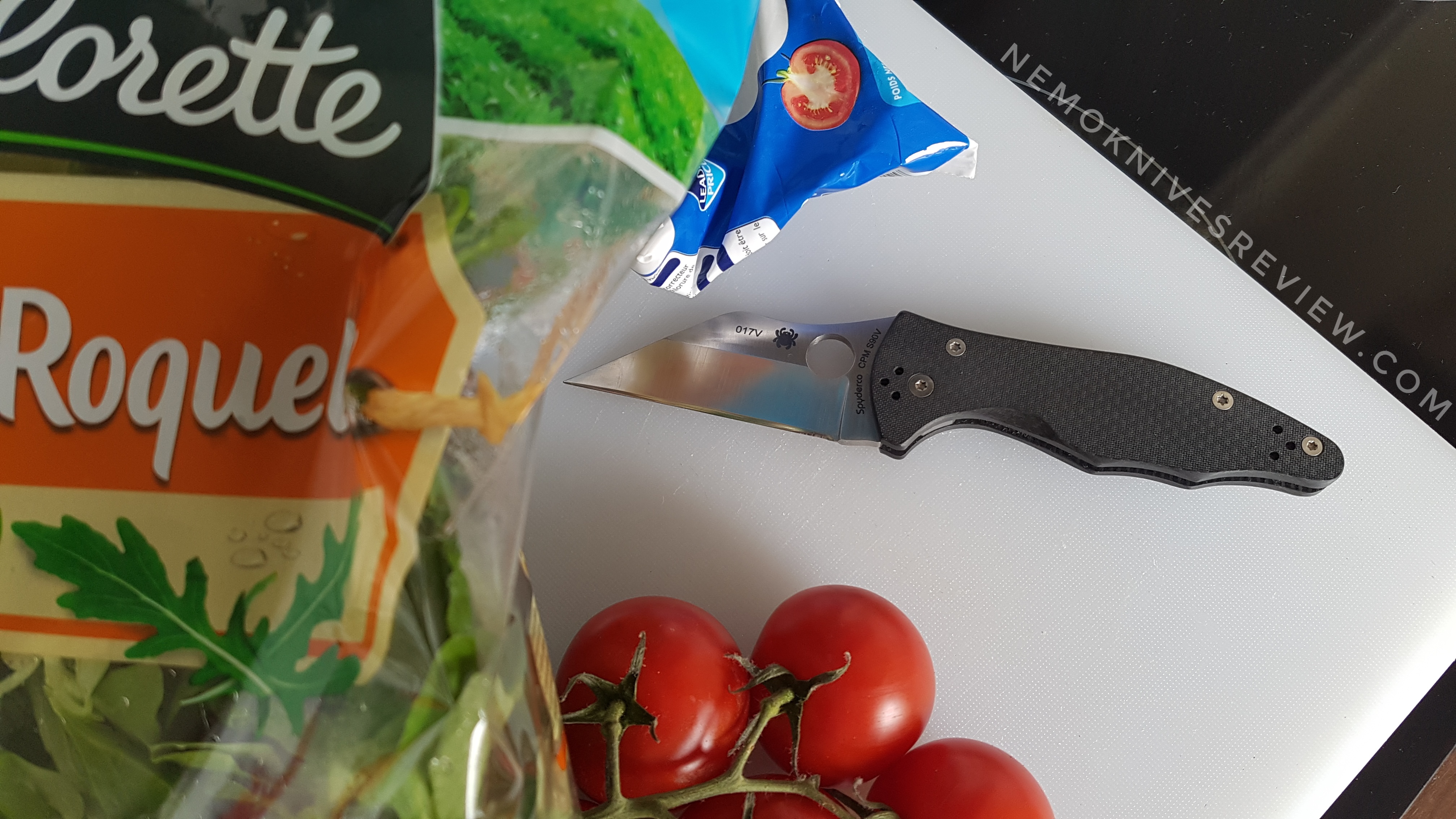
It was made at the occasion of preparing a quick lunch with mozzarella, salade and tomatoes with my Yojimbo2. Nothing fancy really but a very sharp and easy to clean knife is mandatory.

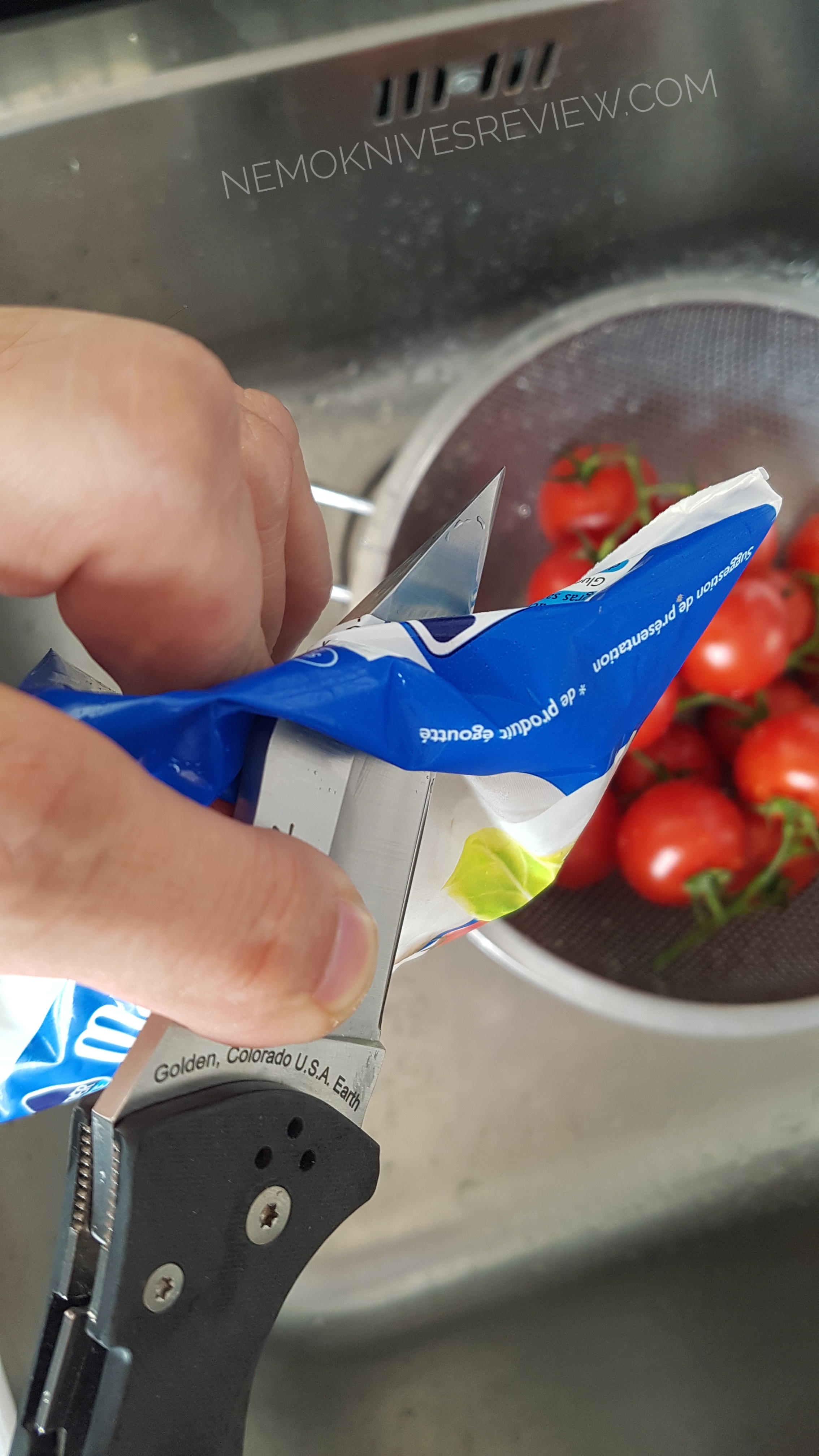
In the kitchen, its first use is to open bags. Many times you won’t find a pointy knife in a kitchen drawer so the sharp EDC like the Yojimbo 2 is handy to pierce plastics.

Another great test for the edge is the tomatoe skin. Tomatoes are fragile fruits and their skin can be tricky. If the knife is dull it will squash the tomatoe. You need a sharp toothy edge for best results. Chef goes very fast for that matter. Fast means sharp fresh edge.
The S90V has been refreshed yesterday after whittling with Ghost.

The last part was the mozzarella balls to cut in loaf. It’s sticky on the blade and very flabby.  You need a broad knife to work on it. A Chef knife could have been handy but the Yo2 was able to deliver its task.
Again SD knives can be used for EDC tasks especially kitchen unless they are a Kerambit. 😉