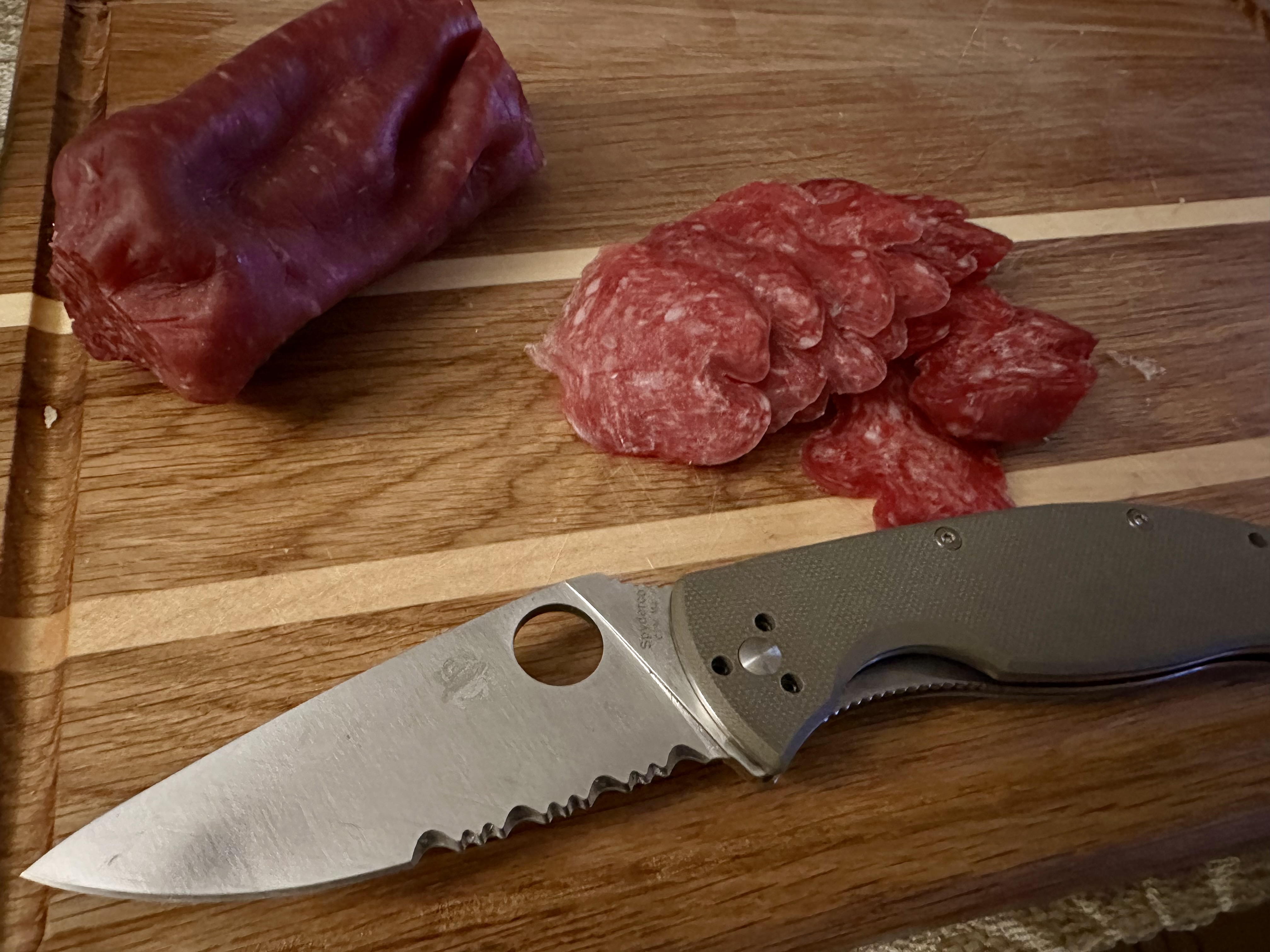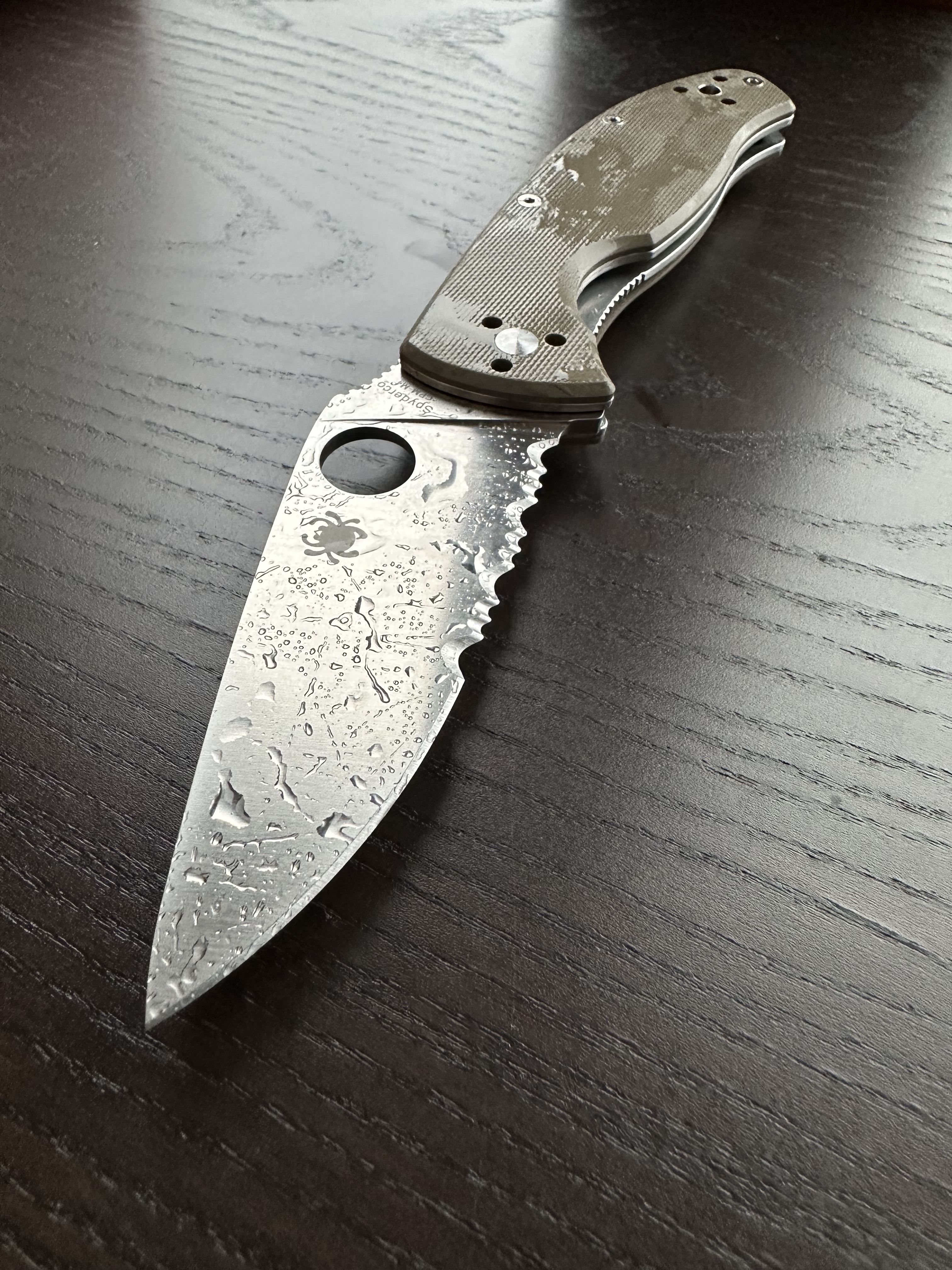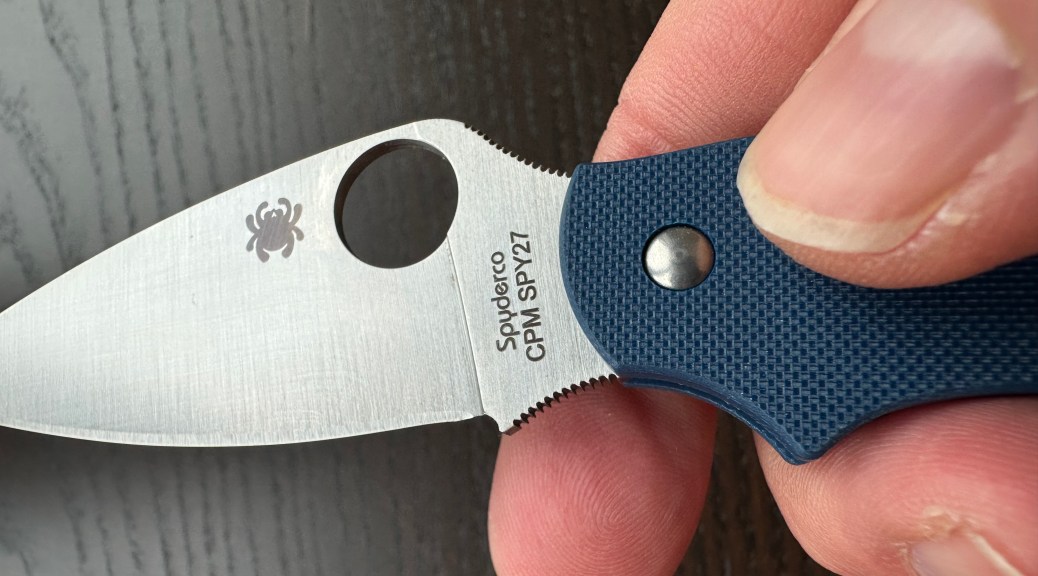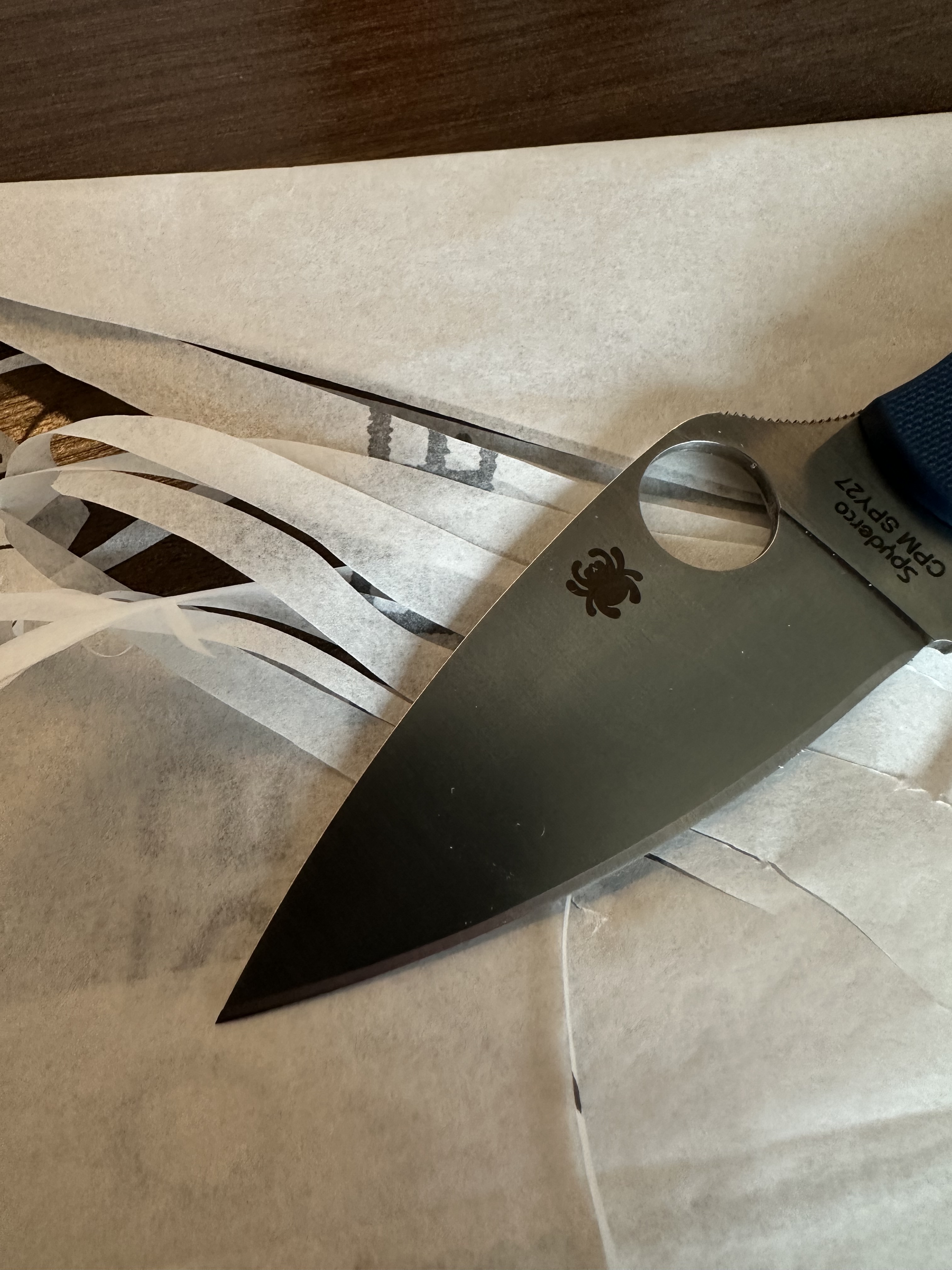
Tag Archives: Nemoknivesreview.com

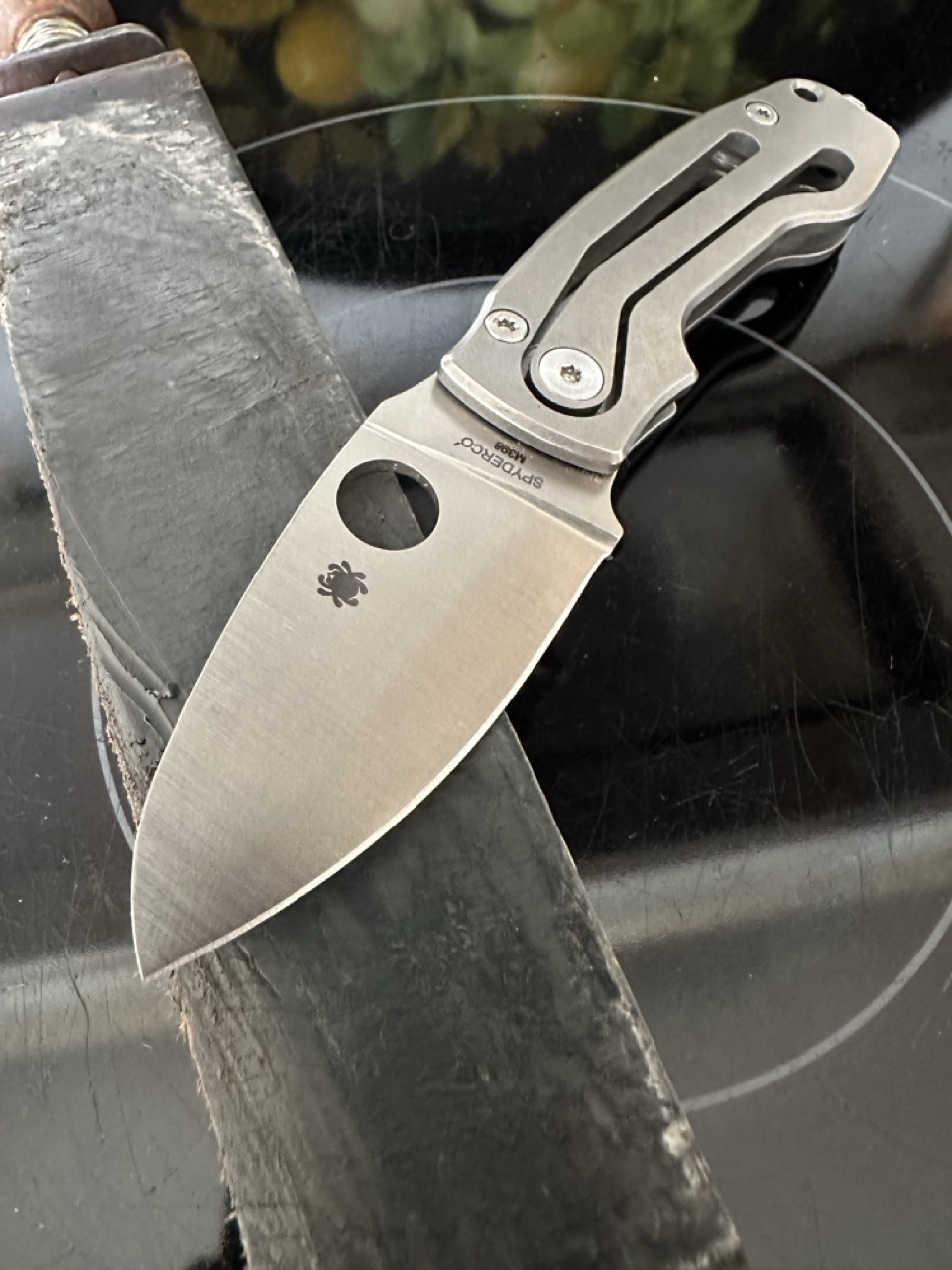
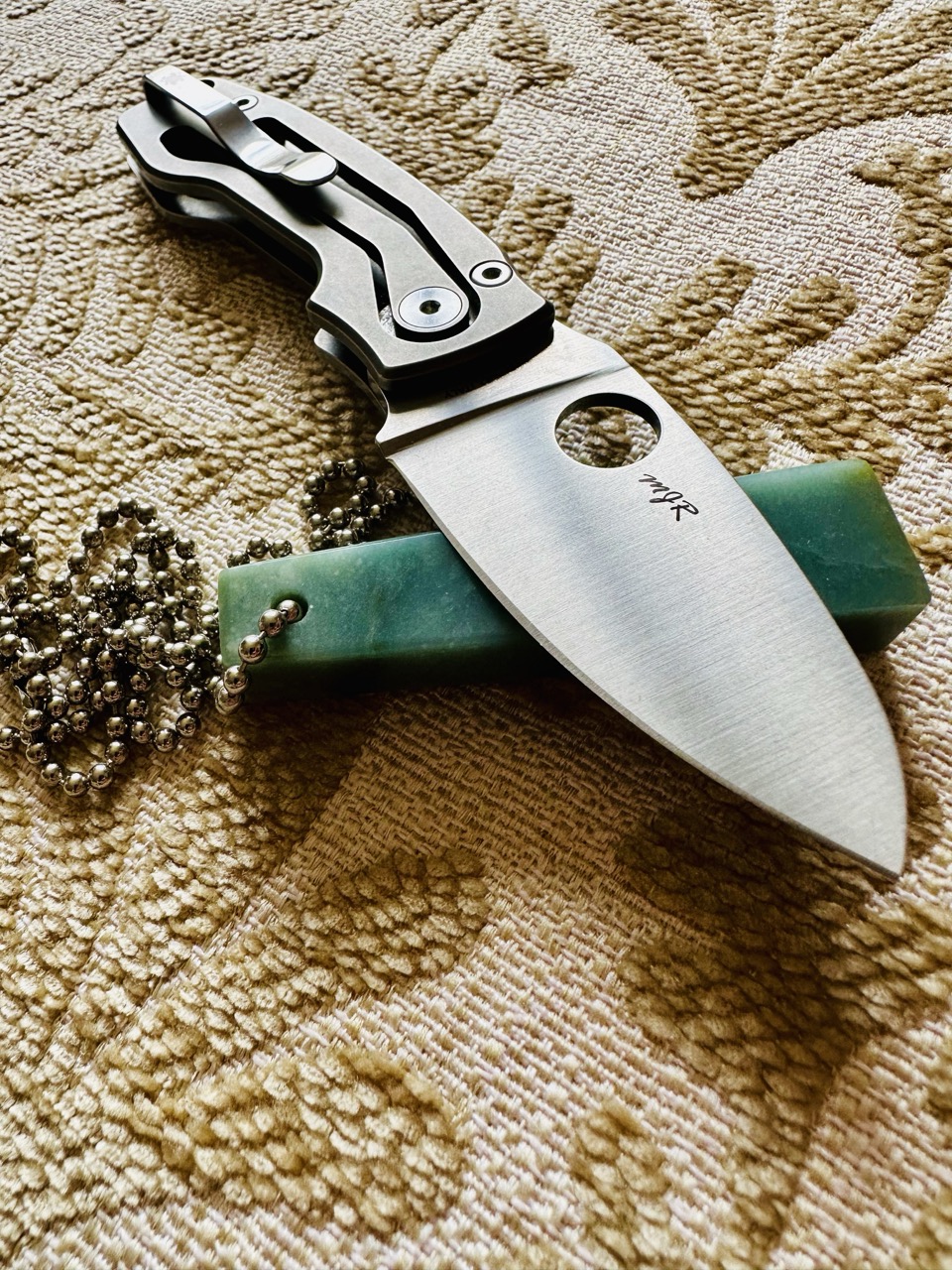
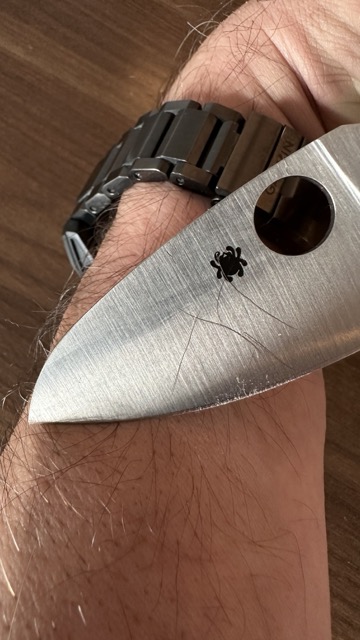
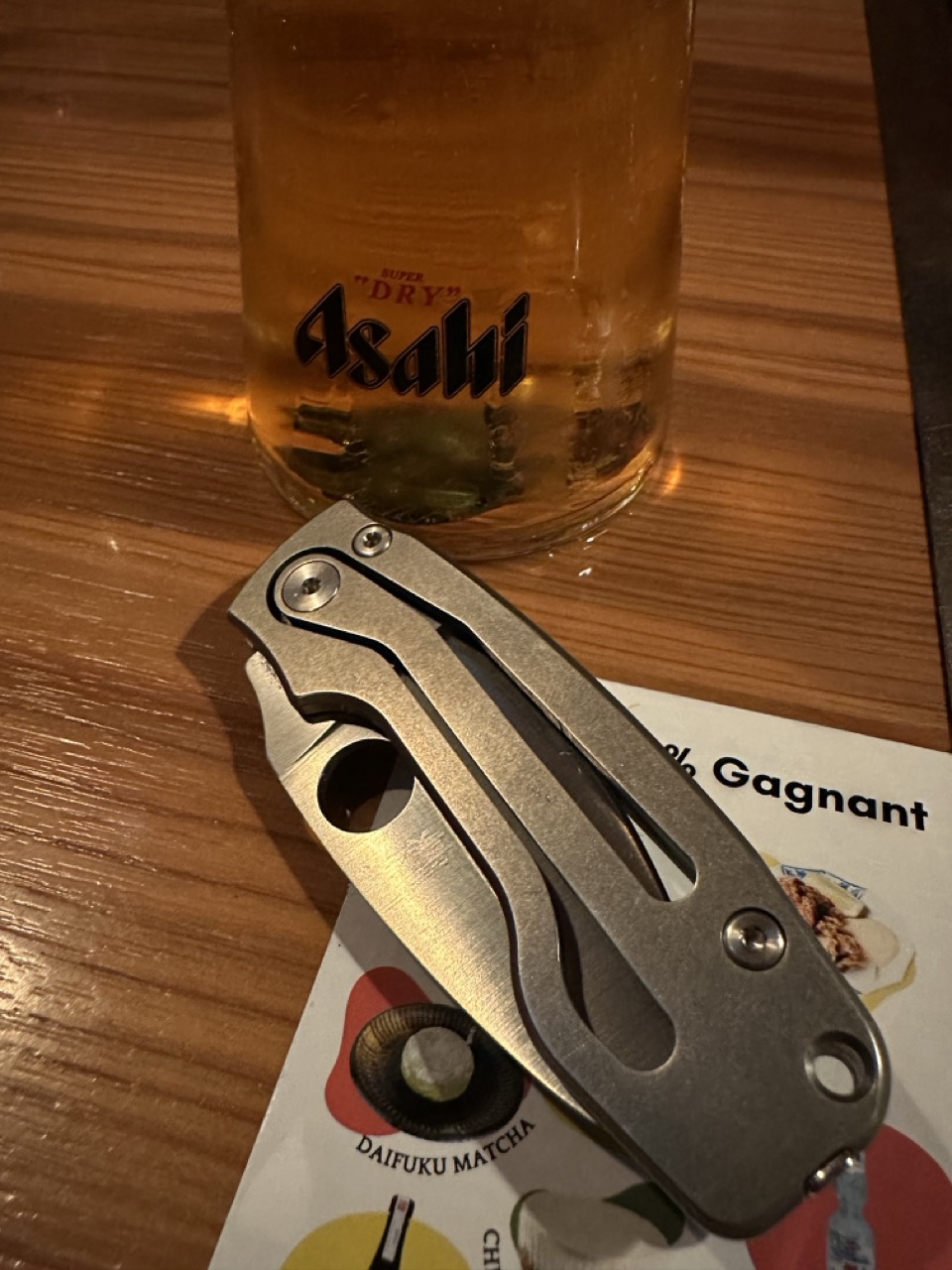
MIKE READ PITS™ 2 – C269TIP – Part 2 – Low Profile De Luxe SlipIt.
Digression: Did you think we were born in peaceful times?

In Western Europe today, amid increasing concerns over violence and insecurity, carrying a fixed blade — something I’ve done for decades with a short fixed blade — or even a locking folder can easily be misinterpreted.

And every single day, in the fall of 2025, the European newspapers report yet another knife attack or crime.

Knife attacks in the United Kingdom have shown a persistent and worrying upward trend in recent years. National data indicate that police recorded just over 53,000 knife‑enabled offences in the latest annual cycle, with assaults and robberies accounting for a substantial portion. While knife-related homicides represent a small percentage of overall offences, the absolute numbers remain high, with young people disproportionately affected. Offences involving the possession of bladed weapons have also risen, highlighting broader issues of accessibility and carrying habits in urban areas. Compared to a decade ago, knife-related violence has increased significantly.

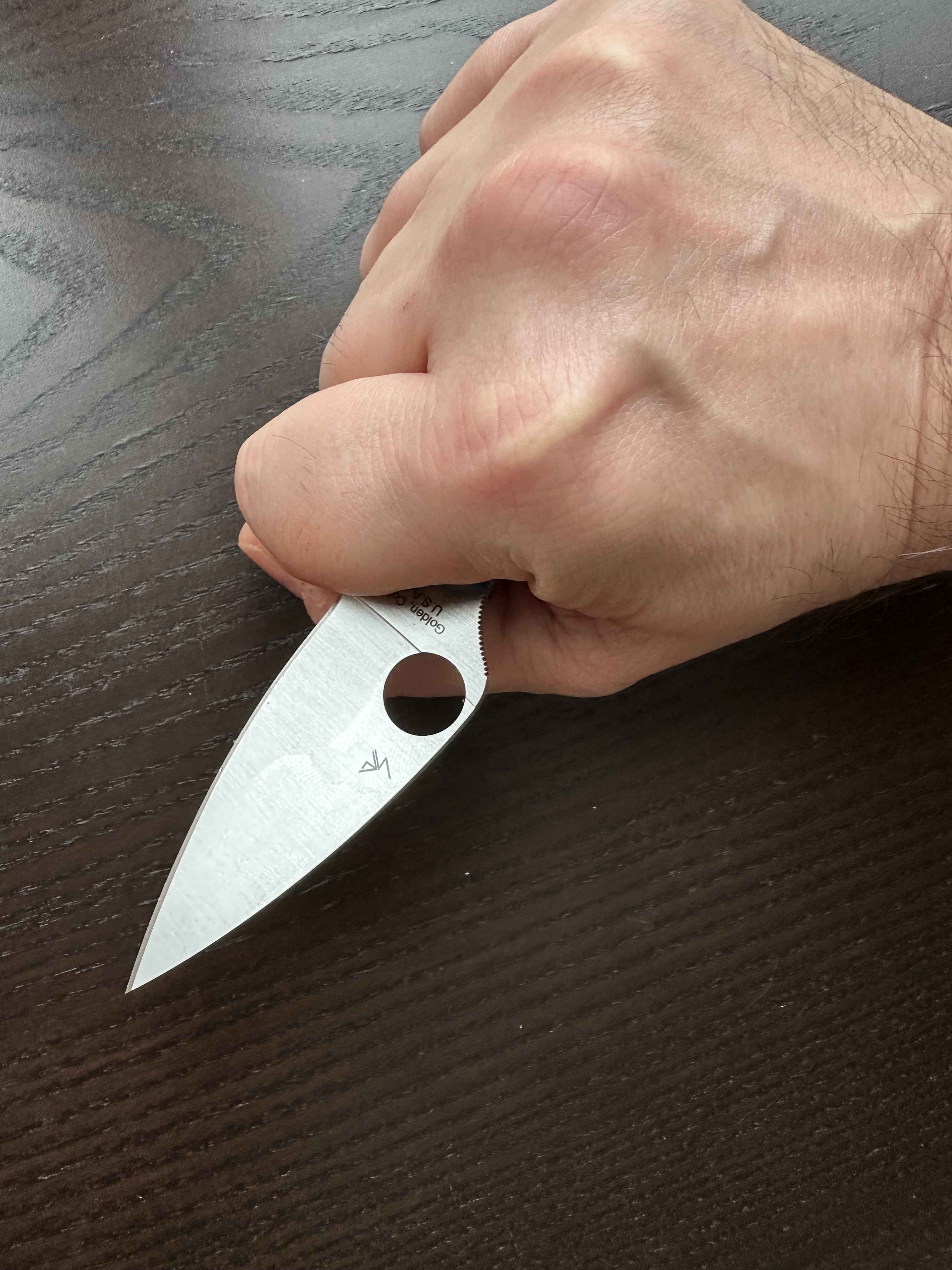
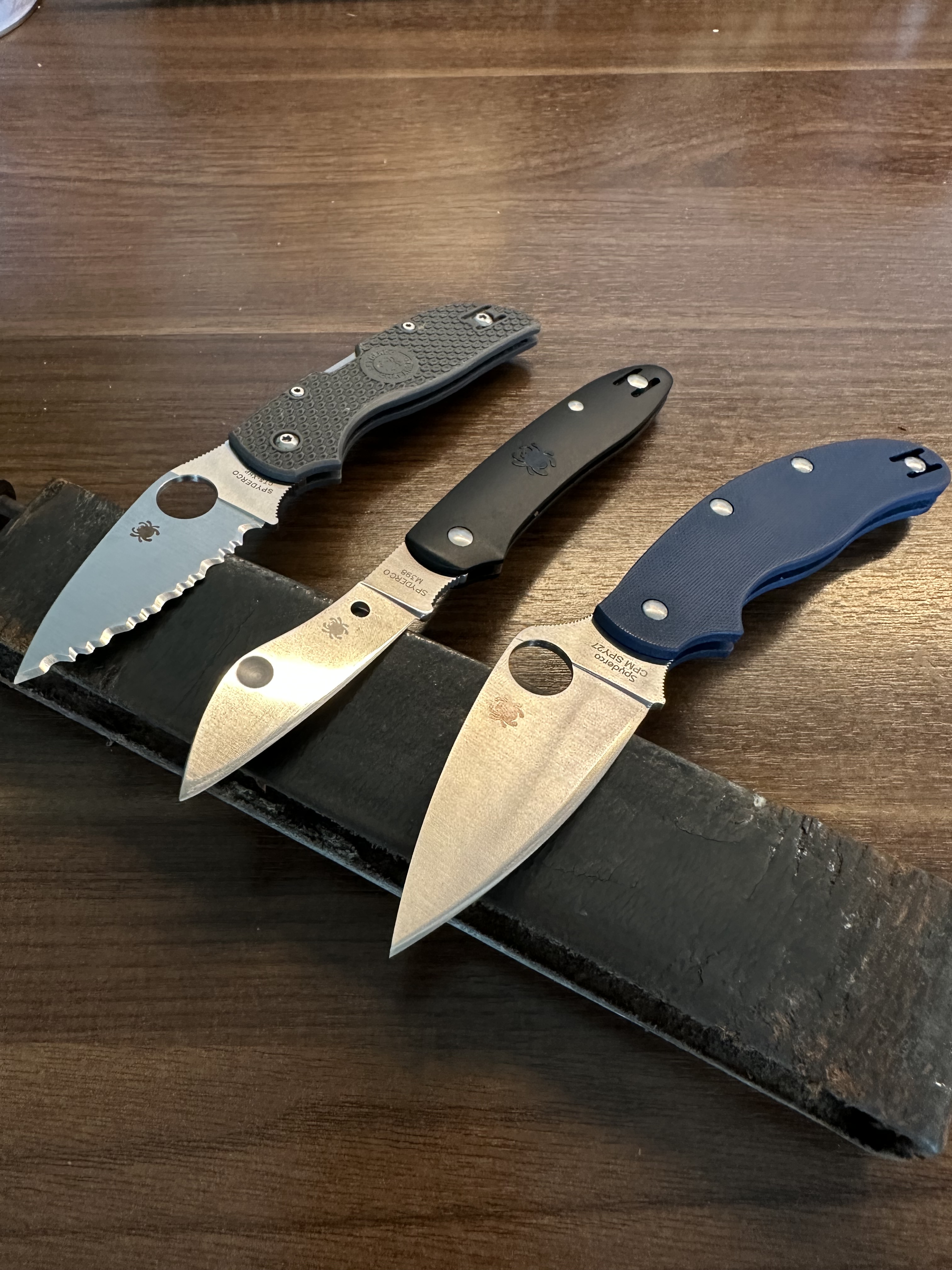
(From a locking folder to slipjoint folder…. Sign of the times ?)

Most knife crimes in the UK use everyday knives like kitchen knives, because they’re cheap and easy to access. But a significant minority of attacks involve more “exotic” or dangerous blades: like machetes !

In Germany, some state-level police offices estimated more than 21,000 knife attacks in 2022, which corresponds to about 60 knife attacks per day nationally.

In France, knife attacks also remain a major concern, with more than ten thousand recorded assaults involving bladed weapons in the most recent year across areas policed by the national force alone. This figure corresponds to roughly a few dozen attacks per day and does not include all regions or the gendarmerie’s jurisdiction. Schools in the Paris region reported over a hundred knife-related incidents within a year, highlighting a sharp increase in youth involvement and the normalization of carrying knives. Broader national indicators show rising attempted homicides and a high proportion of armed robberies committed with knives, underscoring the central role of bladed weapons in everyday violence.
French law places certain knives (e.g., automatic opening, butterfly/balisong knives, fixed-blades over a certain size, double-edged blades) into stricter categories (Category D weapons) when carried without legitimate reason. Folding pocket-knives of everyday use (e.g., classic French models) are more tolerated — they may be treated as tools rather than weapons if not used aggressively or carried without justification.

CountryEstimated Knife-Crime / Knife-Attack Rate (per 100,000)
England & Wales (UK)~89 / 100,000 (using ~55,008 knife-enabled offences and a population of ~61.8 M)
France~15 / 100,000 (based on ~10,397 reported “knife attacks” and a population of ~68.6 M)
Germany~10.7 / 100,000 (using ~8,951 knife-attack figure from 2023 data)


In the UK, the rules are straightforward: a non-locking knife with a blade under 3 inches.
But now it seems that one-hand-operated folders are no longer welcome;
For the record, one-hand operation is actually safer: not only for opening, but also for closing the knife. A closed folder is a safe folder, and being able to switch your tool into “safe mode” quickly is a genuine advantage.

In France, things are far murkier — everything hinges on intention and context of use. It’s almost a Minority Report situation.

Ironically, in the country of Opinel and Laguiole, we’re now backpedaling because of sheer stupidity. And I’m not blaming the criminals who use knives to hurt people — that’s obvious. I’m blaming the people who carry a knife for self‑defense.
After a search from the Police in front of an high school:
“Why do you bring this knife to school ?”
“To defend myself !”
A knife is not a self‑defense tool — it’s a catalyst for problems.
Awareness, on the other hand, is a self‑defense tool, and that’s something you really need to keep sharp.
Even something as simple as wearing AirPods can compromise your ability to stay safe, cutting you off from your surroundings.

Unless you’re a gangster settling scores with your own kin, a knife will never be your bodyguard — not even with training.
In fact, it can make things worse, especially if you think you’re “trained in knife fighting.” A knife as a weapon is a killer’s tool, meant for ambush and combat, not for duels.

(The only blade that might actually “help” you — for example in an attempted‑rape situation where you are physically overwhelmed, dominated, and restrained — is also the one that will almost certainly land you in even more trouble afterward. And if you ever reached that true last‑ditch moment, your best hope would ironically be a short serrated edge rather than a razor edge; under an adrenaline surge, an aggressor won’t even register a clean cut. The Spyderco Manbug Wharncliffe SpyderEdge comes to mind.
But even then, you would need the mindset to become the aggressor just to survive — and you must be prepared to defend your actions in court afterward.)

I remember reading about an elderly man who was being harassed by a gang of young men. In the confrontation, he slashed the hand of one of his aggressors with his Swiss Army Knife — and in the end, he was the one standing before the judges.
“To claim self‑defense, sir, there must be proportionality between the attack and the response.”

It’s also a mindset.
I’ve carried a knife since I was 9 and have never had the inclination to cut or stab someone.
It’s all about how you have been raised.”
Des Horn

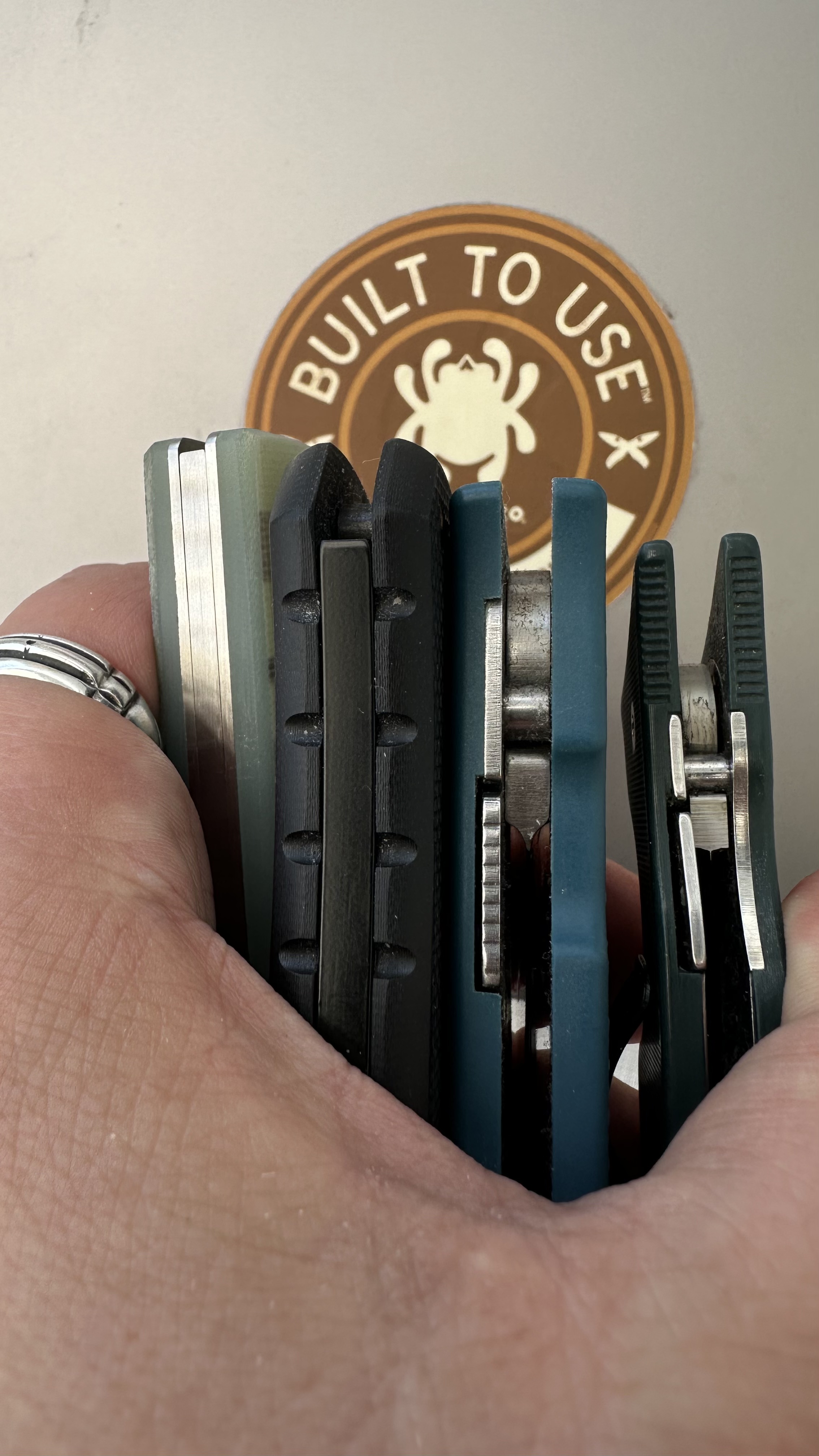
So let’s remain ladies and gentlemen, and let’s be low profile in our EDC choices.
The knives we carry and appreciate are not pocket bodyguards — they’re tools we genuinely enjoy using for simple, everyday tasks.

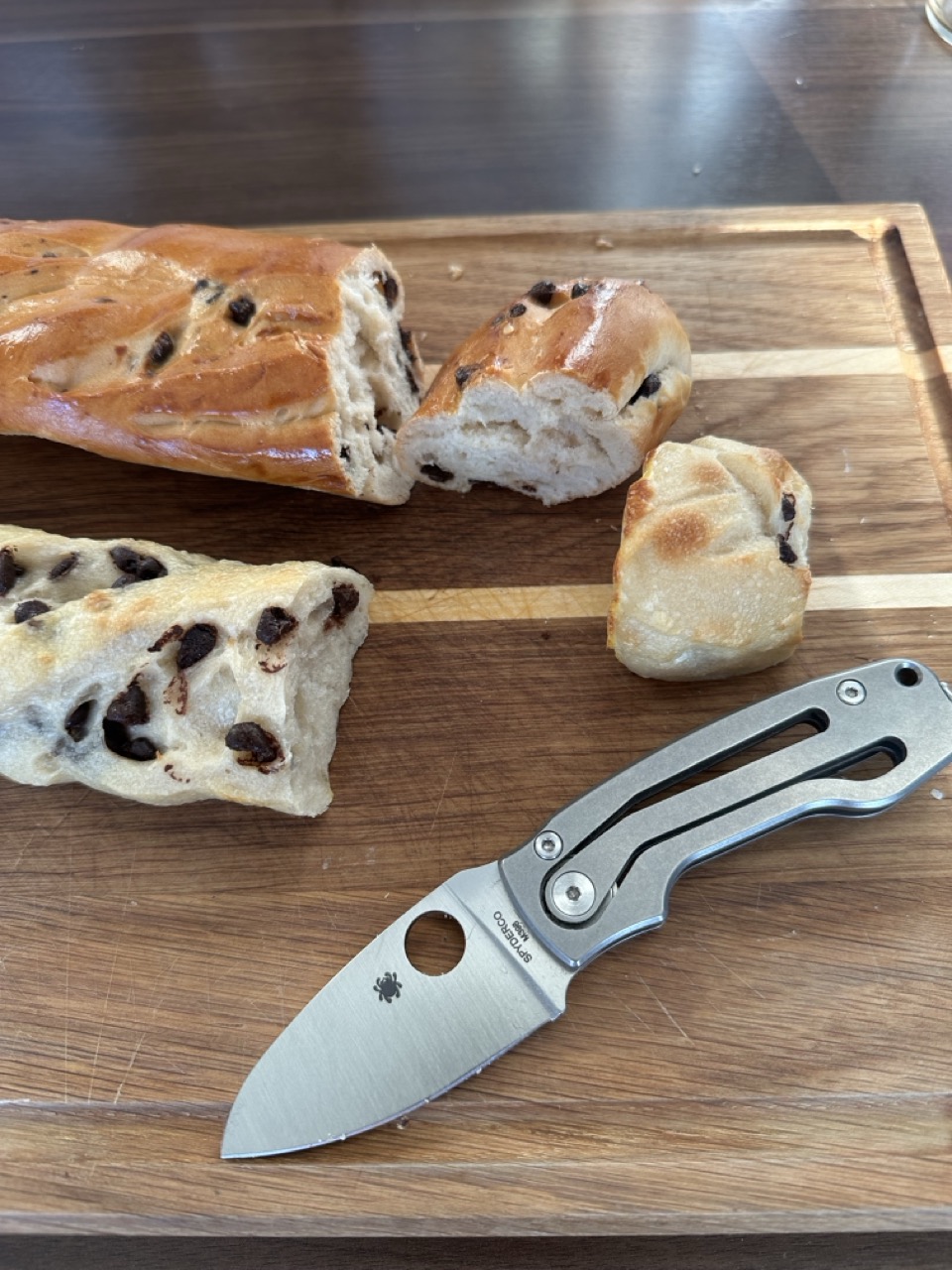
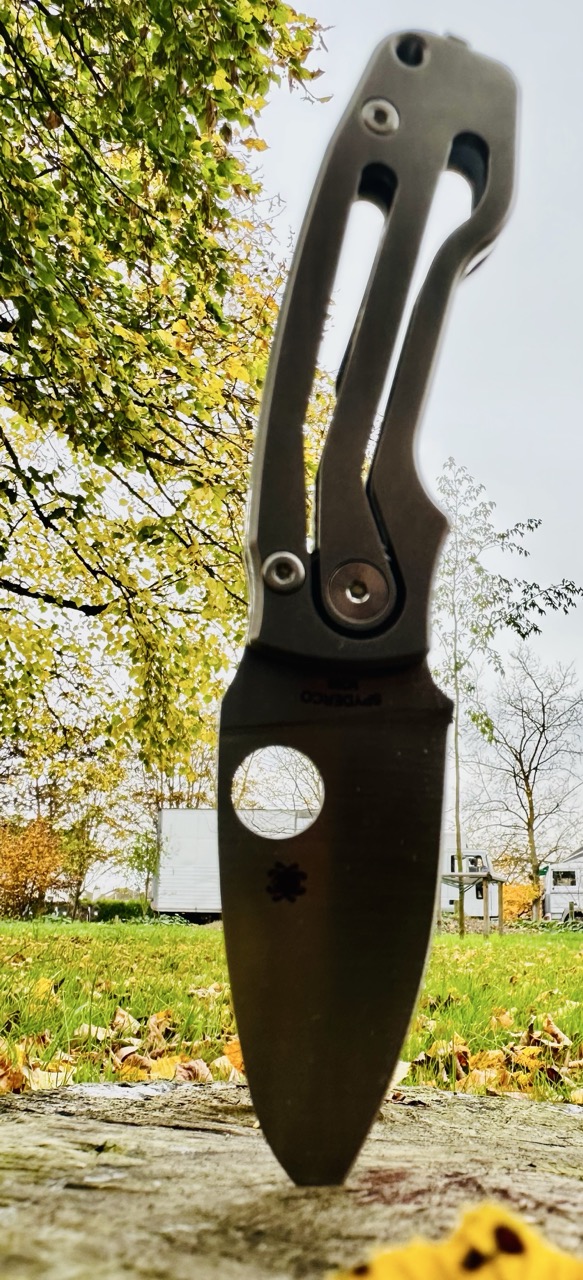
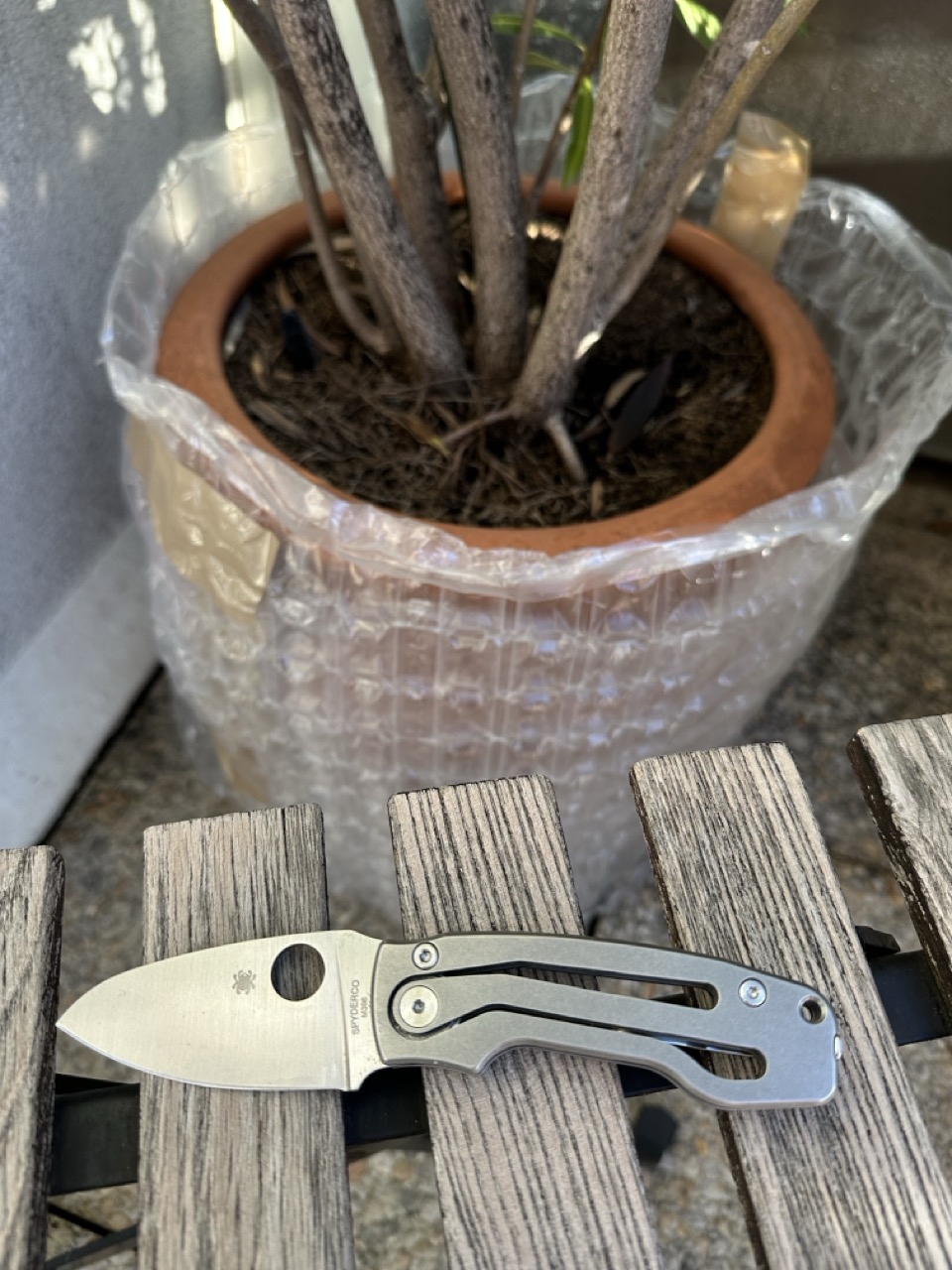
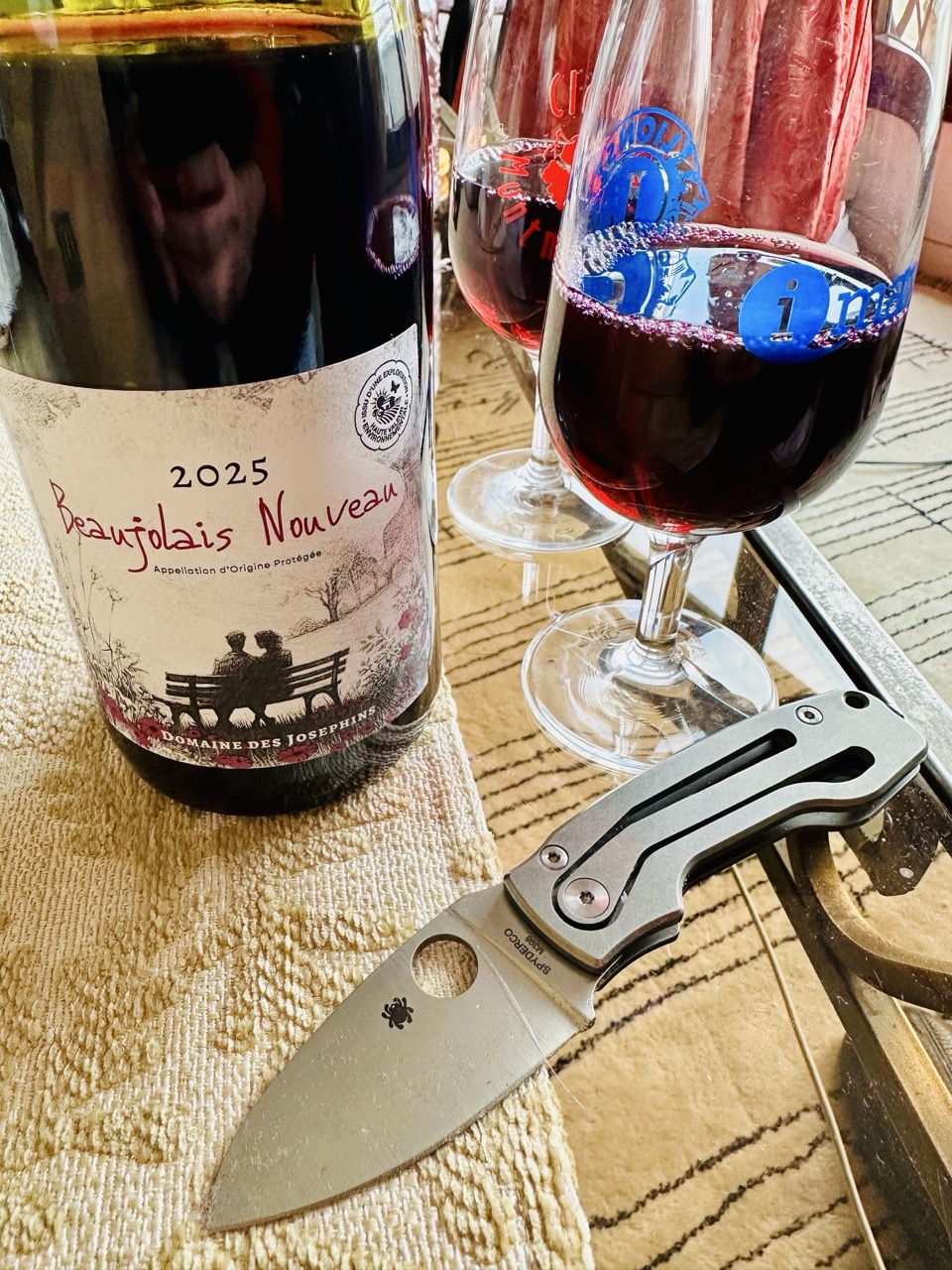
Enter the Alien/PITS2 and the whole generation of modern slipjoints.

Carrying a knife in today’s civilian world means opening parcels, prepping food, cooking, doing small repairs — being a handyman or -woman, or at least trying to be. I’ve written before about the modern slipjoints we now have access to: knives that benefit from three decades of “tactical” evolution. They offer deep-carry clips, true one-hand opening and closing, and high-performance steels refined for modern cutlery.

All of that is perfectly embodied in Spyderco’s SlipIt line.


So why would you choose a Mike Read folder? Is it better than a UKPK or an Urban?
Nope. The SlipIt flagship UKPK, for example, also has a thin edge, and you can even dress it up with titanium scales if you feel like it. Its mechanism is also stiffer, with a two-stage closing “safety” that makes the blade feel more controlled on the way down.

So why choose the PITS2?
It ultimately comes down to taste — your willingness to spend a bit more, your appreciation for the mechanism, the maker behind it, and of course a love for titanium and M398.

So what does the Alien/PITS2 truly bring in the long run?

In my case, I was genuinely surprised by how this “hard-to-open-one-handed” knife has grown on me.
That stiffness actually makes it reassuring to carry — you know the blade won’t pop open by accident. Especially when you carry it in the back right pocket.

First: it slides in and out of the pocket effortlessly.
That deep-carry clip is a real asset. It reminds me of the C181GTIP Lil’ Lionspy — also made in Maniago — but this one is even better than a wire clip: smooth, secure, and gentle on pockets.

Even though it’s light, the PITS2 feels dense and substantial in the hand. If you love titanium, you immediately recognise that warm, almost organic sensation it gives in the palm. Chris Reeve was the first to offer that pure‑titanium tactile experience, and the PITS2 carries that same aura.

Then your thumb finds the hole. It’s stiffer than most Spydercos I know, but that final click when fully opened is immensely satisfying. Forget about using your ring finger — it’s your thumb or nothing.

The hole is sharp enough to allow a “Spyder‑Drop,” though it occurs in two deliberate steps rather than one smooth motion.

Another major advantage: the PITS2 cannot pinch your fingers during opening or closing — a problem that the PITS1 sometimes had.

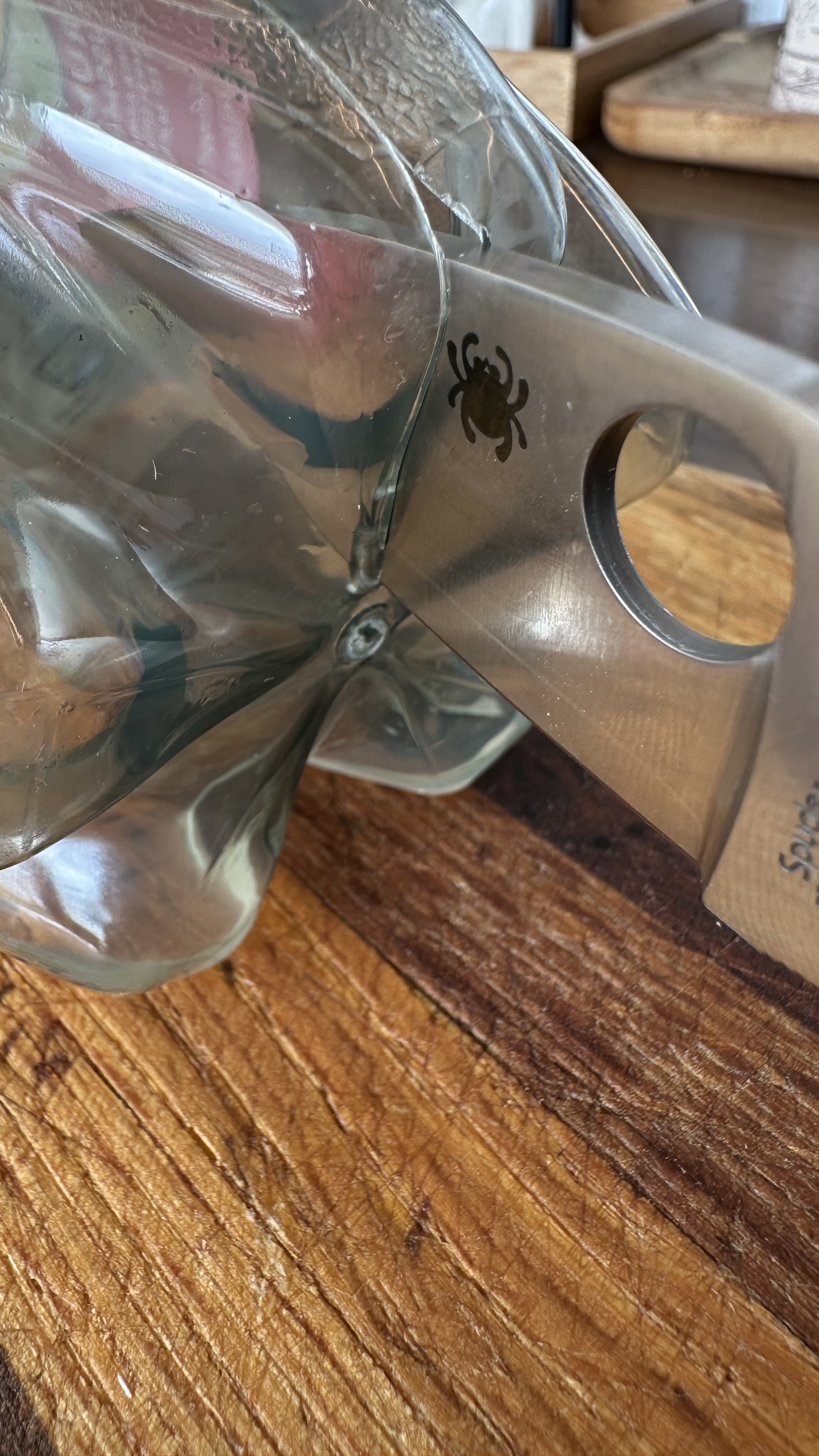
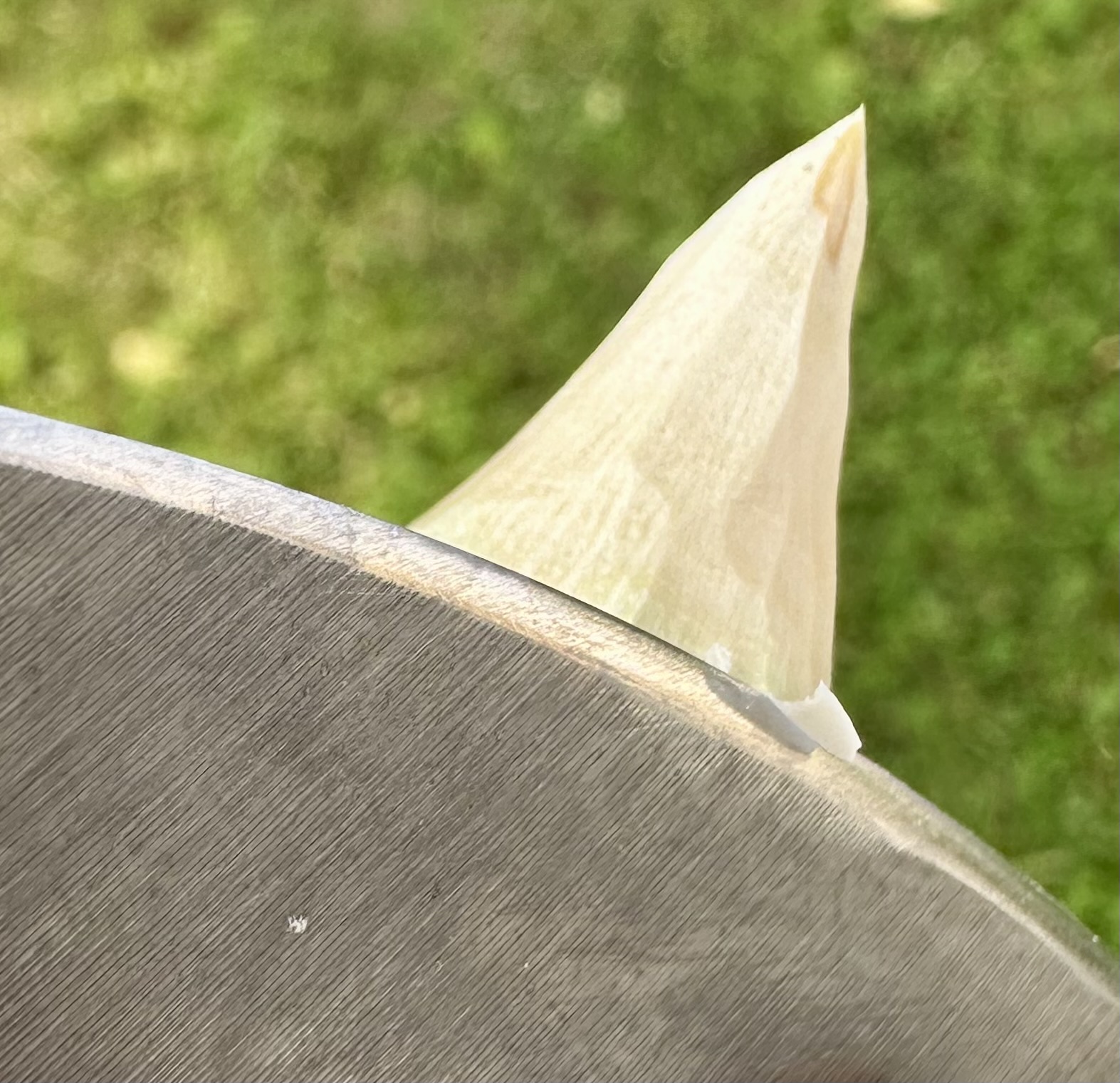
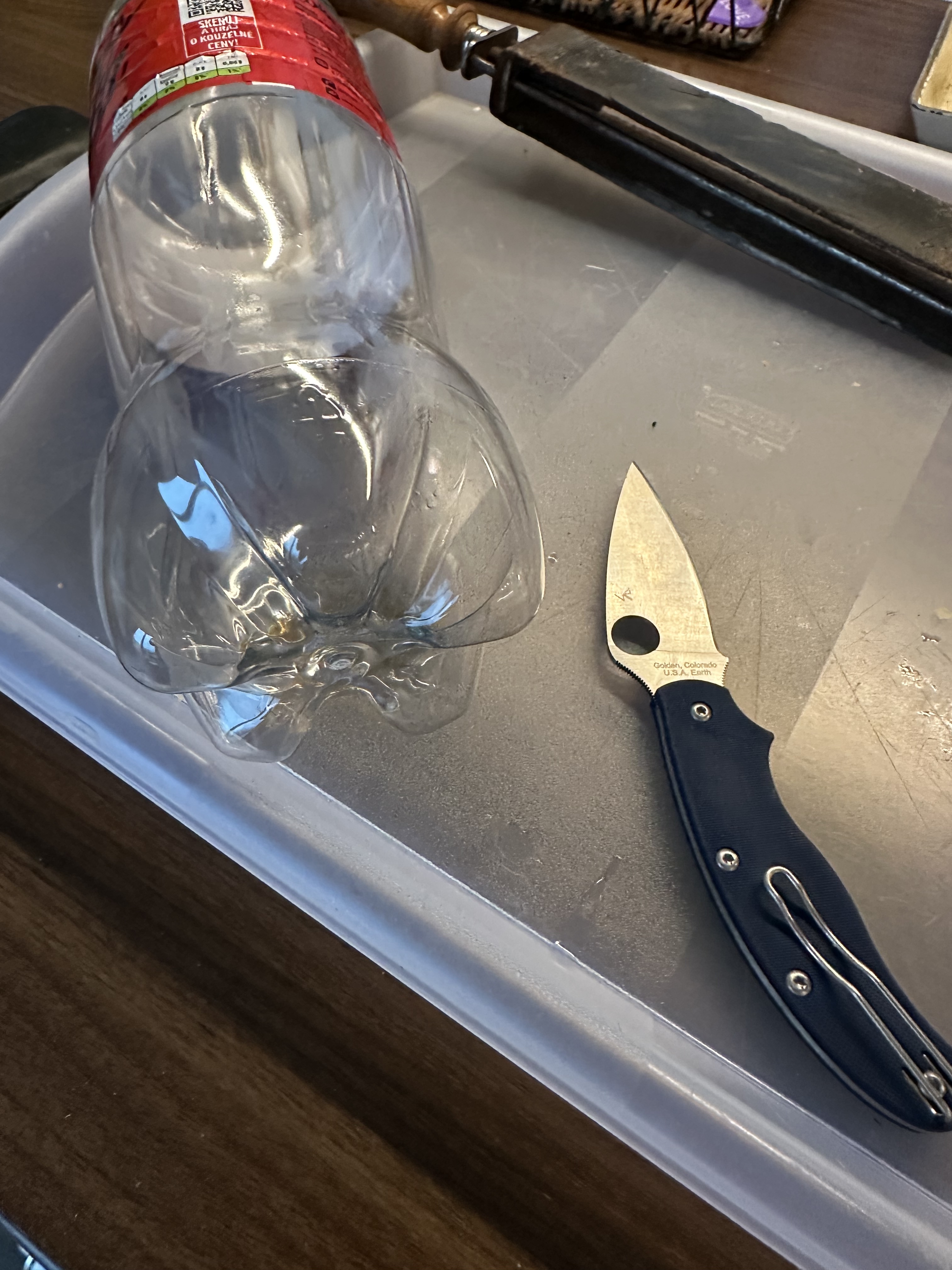
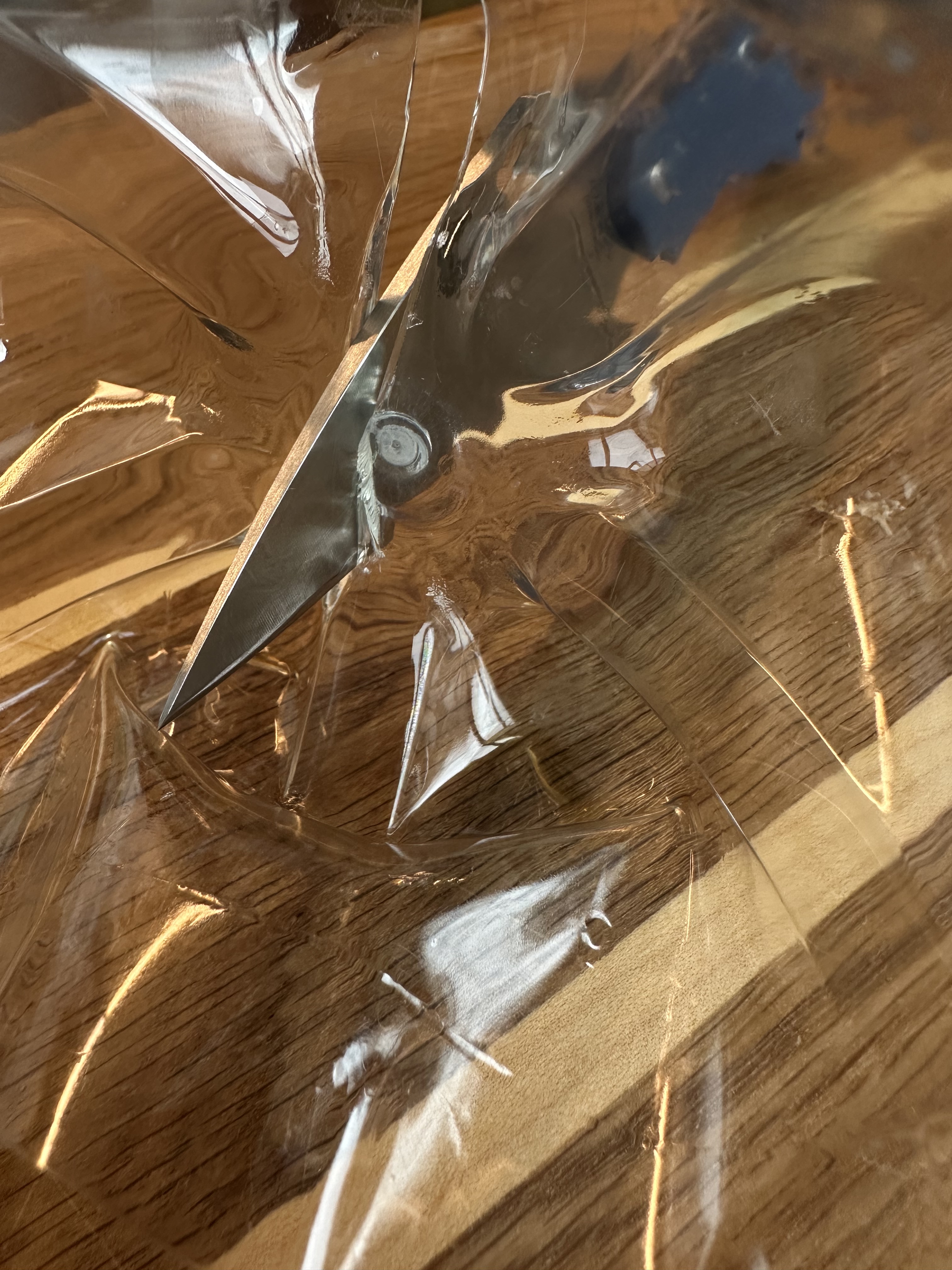
And, as I mentioned in the quick first‑look, that relatively tall blade comes with very thin geometry. This is the first Spyderco edge in a very long time—aside from my Chaparrals—that didn’t need to be convexed. I usually “de‑shoulder” everything to my taste and to my standard test: the plastic bottle butt.

This is where the PITS2 truly shines: pure cutting performance.
So far, it has never disappointed me. At first, I thought its more “gentle” blade tip wouldn’t be pointy enough for my tastes—especially since I’m used to the UKPK, Yojimbo 2 or the Microjimbo—but the PITS2’s tip is razor‑keen. It finds its way into soft or dense materials with nothing more than a light, controlled pass.

Actually, butter knives do not need to be sharp. 😉
The PITS2’s thin edge can slip effortlessly through delicate materials—like slicing a layered birthday cake without crushing it. And it can zip through cherry tomatoes, which is always a great test of geometry and edge aggressiveness. Tomato skin resists, tomato flesh is fragile; a good blade needs to pierce the first without mangling the second.

Well, well, well… go figure: tomatoes can be tricky — and a perfect opportunity to put your favorite edge to the test.
But honestly, what more could you ask for from a good EDC, superb slicing ability. A sharp knife is a safe knife.


M398 in that matter continues to surprise me. It reacts to leather like… K390 ! Amazing steel !
I’ve already used M398 on the Roadie XL and the Metropolitan, and it proved far more forgiving than I expected. I initially thought it would be brittle — especially after snapping about half a millimeter off the tip of my Roadie XL — but in everyday use it has shown itself to be an excellent alloy that also responds beautifully to stropping.


After some real use, I still haven’t managed to chip or even noticeably dull the PITS2’s thin edge. What’s remarkable is that it’s still as razor-sharp as it was right out of the box.


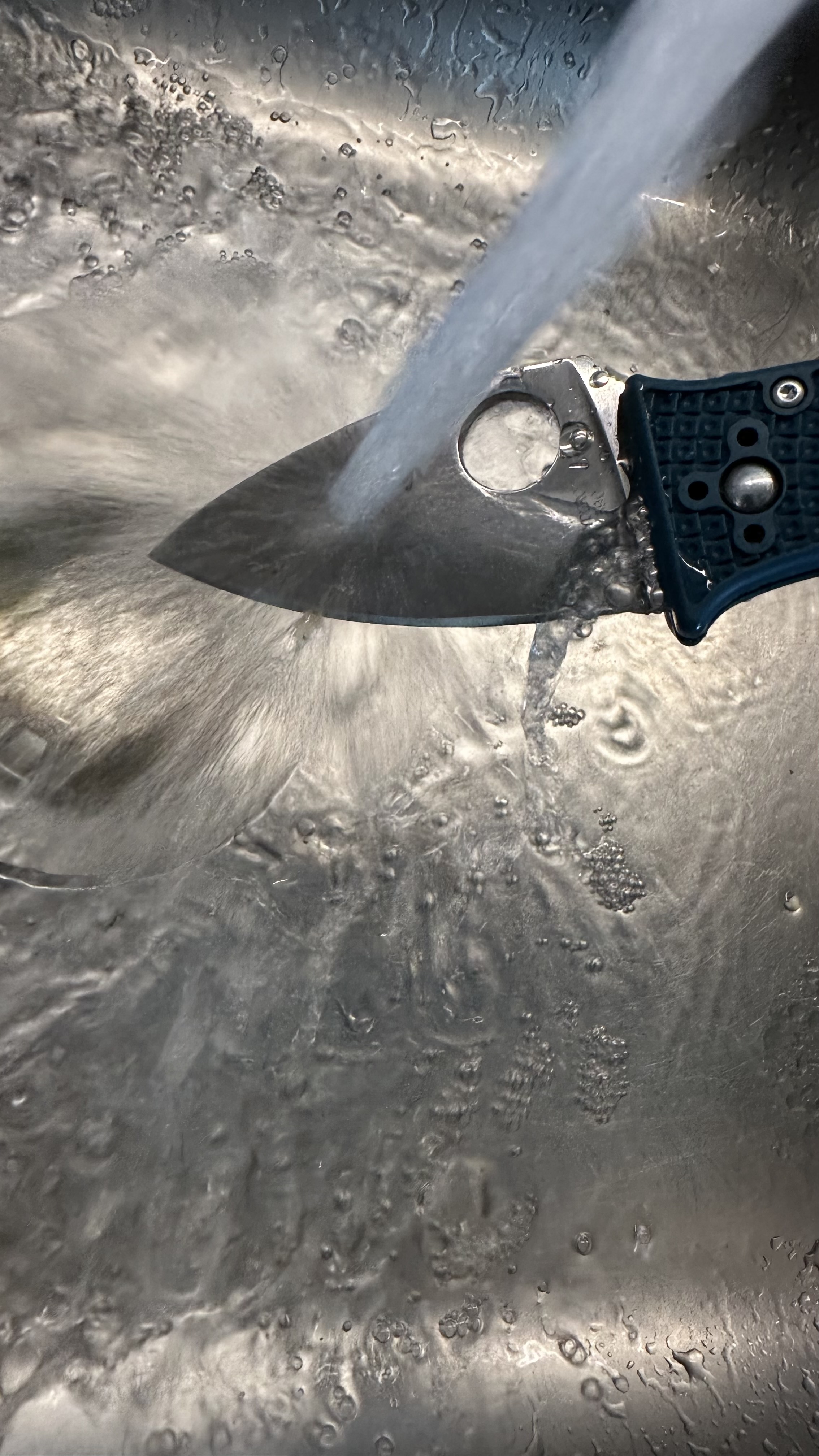
I also love how easy it is to check, clean, and oil the PITS2.
I can appreciate how skeletonized hidden liners have added lightness and strength to folding knives, but they also tend to become little nests for rust. For that reason, I really appreciate it when liners are DLC‑coated — and even better when they’re made of titanium.

Regarding the PITS2’s titanium handle, the absence of hotspots and the beautifully beveled edges make it a real pleasure to hold.

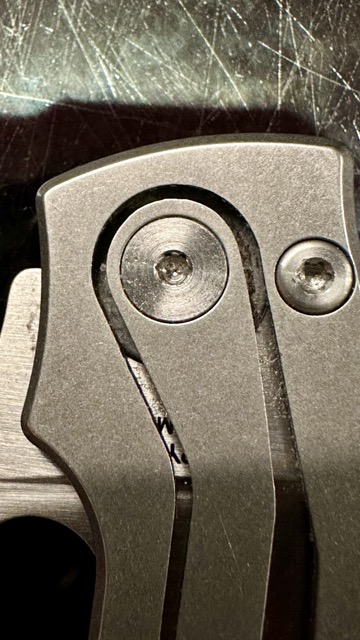
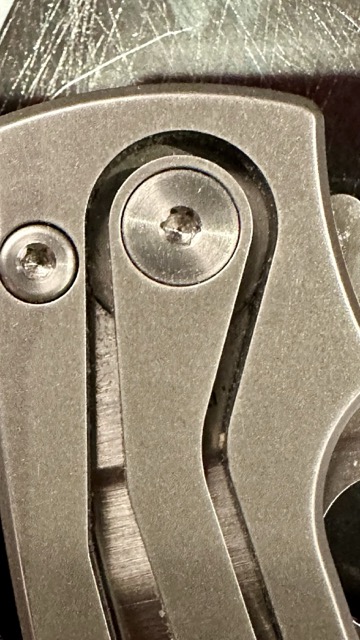
The cutout for the mechanism isn’t beveled, so you can feel its slightly sharper edge. I’ve also noticed that the two handle slabs are symmetrical, while the cutouts around the pivot are not identical.


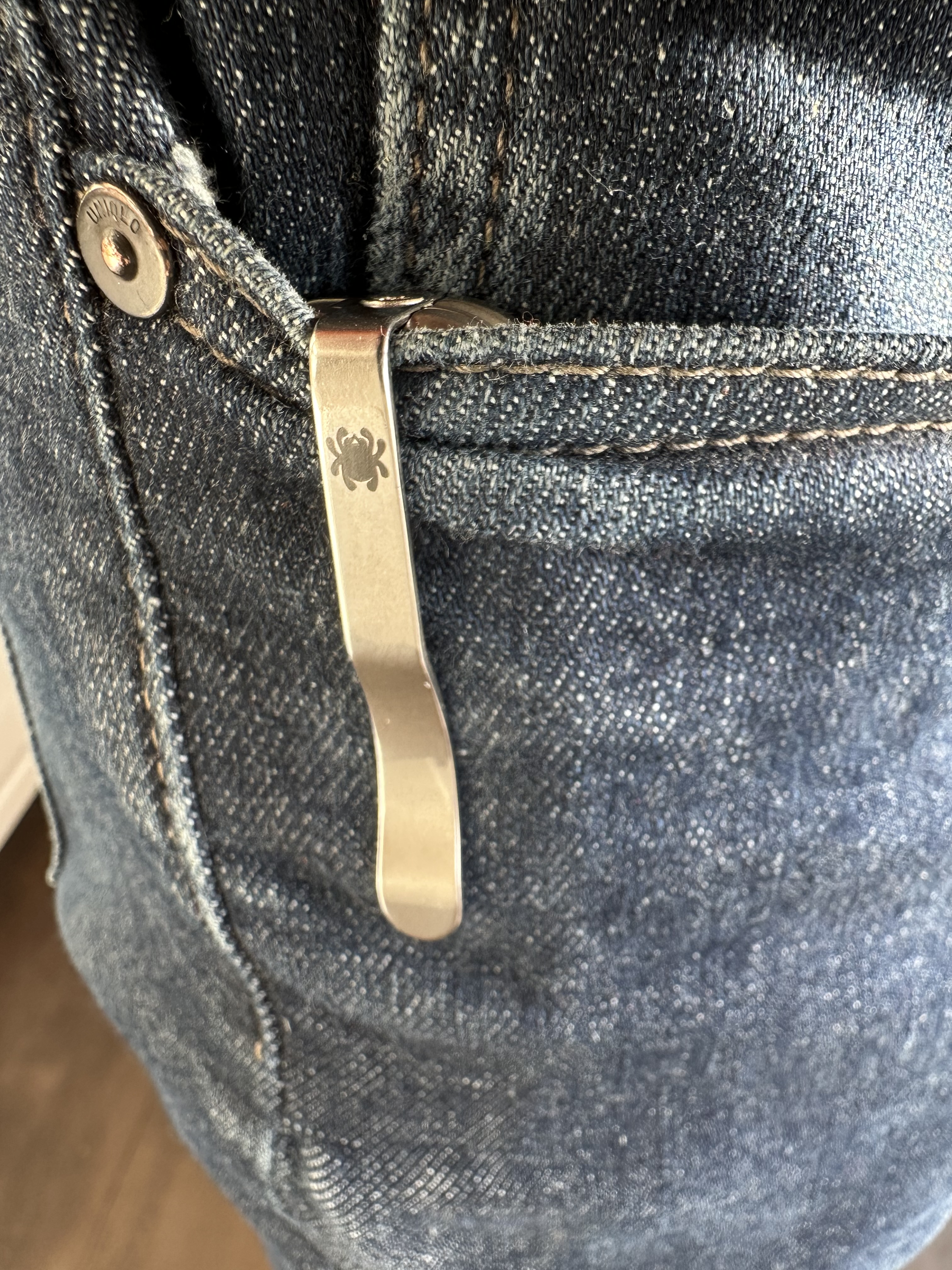
Low profile usually comes with a deep‑carry clip or no clip at all… but the PITS2 clip is really shiny, so it still catches the eye. I know, because I’ve checked my reflection in a mirror and eventually had to unclip it and drop it deep into my pocket before passing through security recently.
Low profile wise: a tip if you are ever checked, do not open your knife with one hand, use both.

In those days of increasing knife crime and genuily believe that your EDC’s shape needs to be sheeple‑friendly.
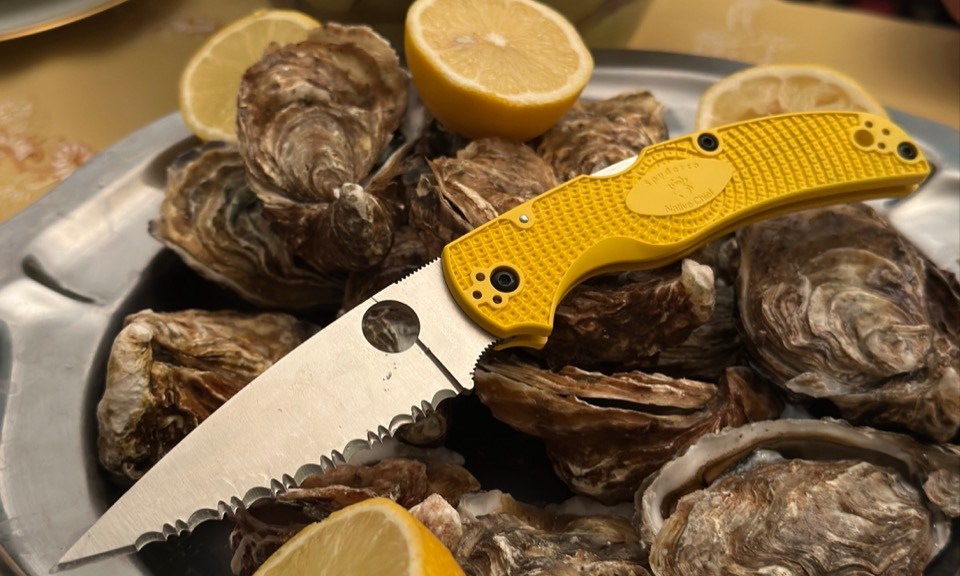
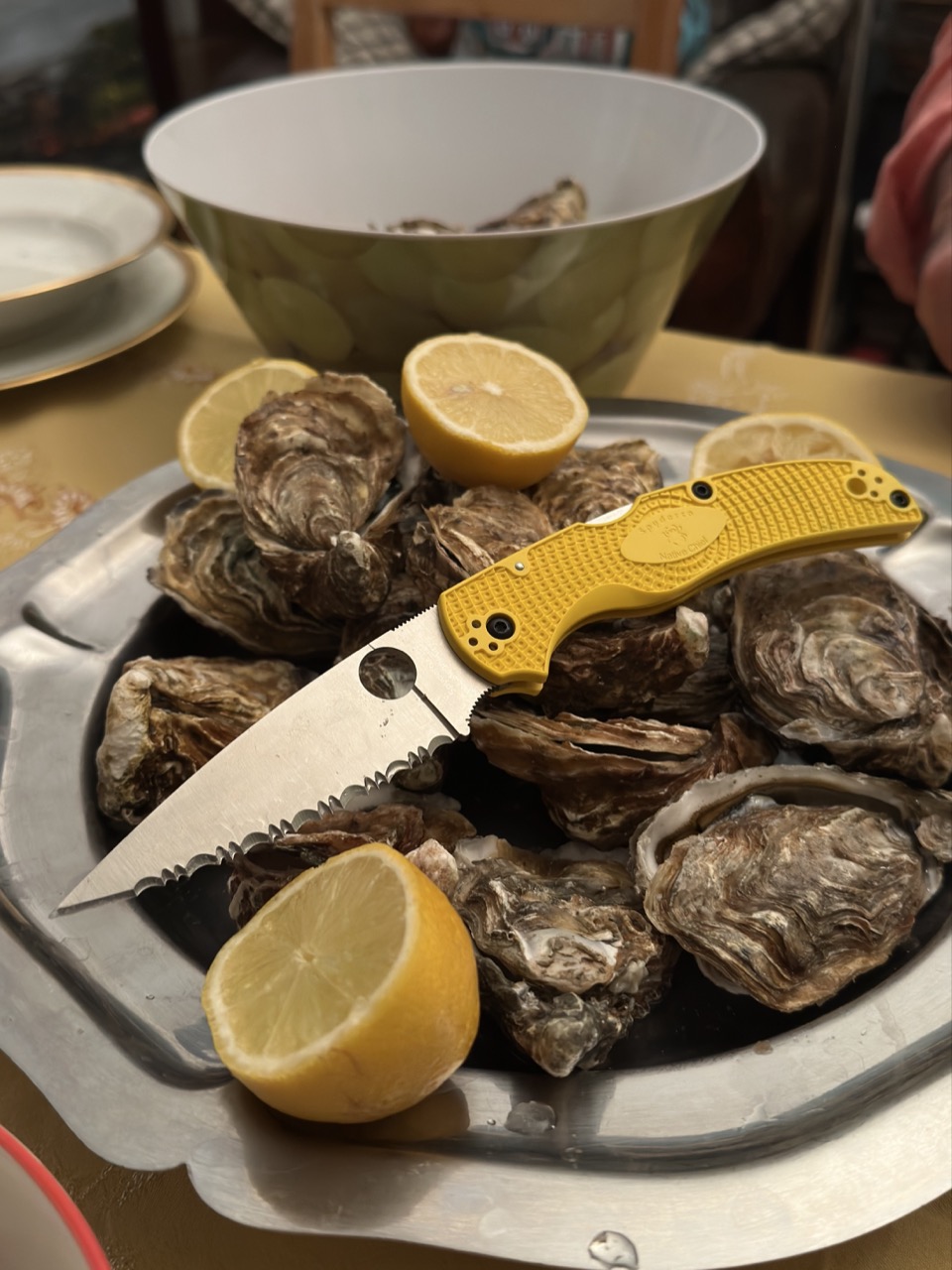
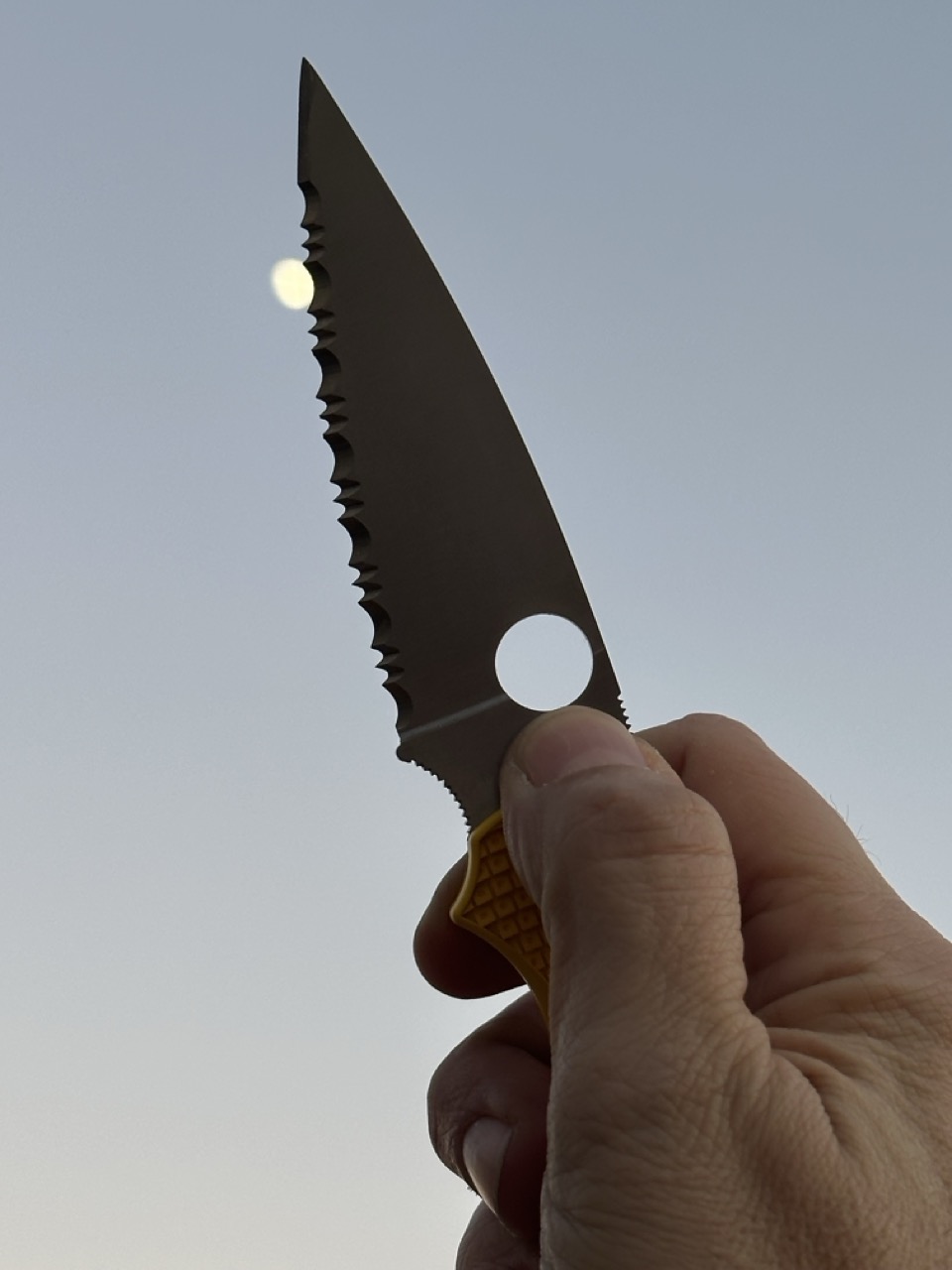
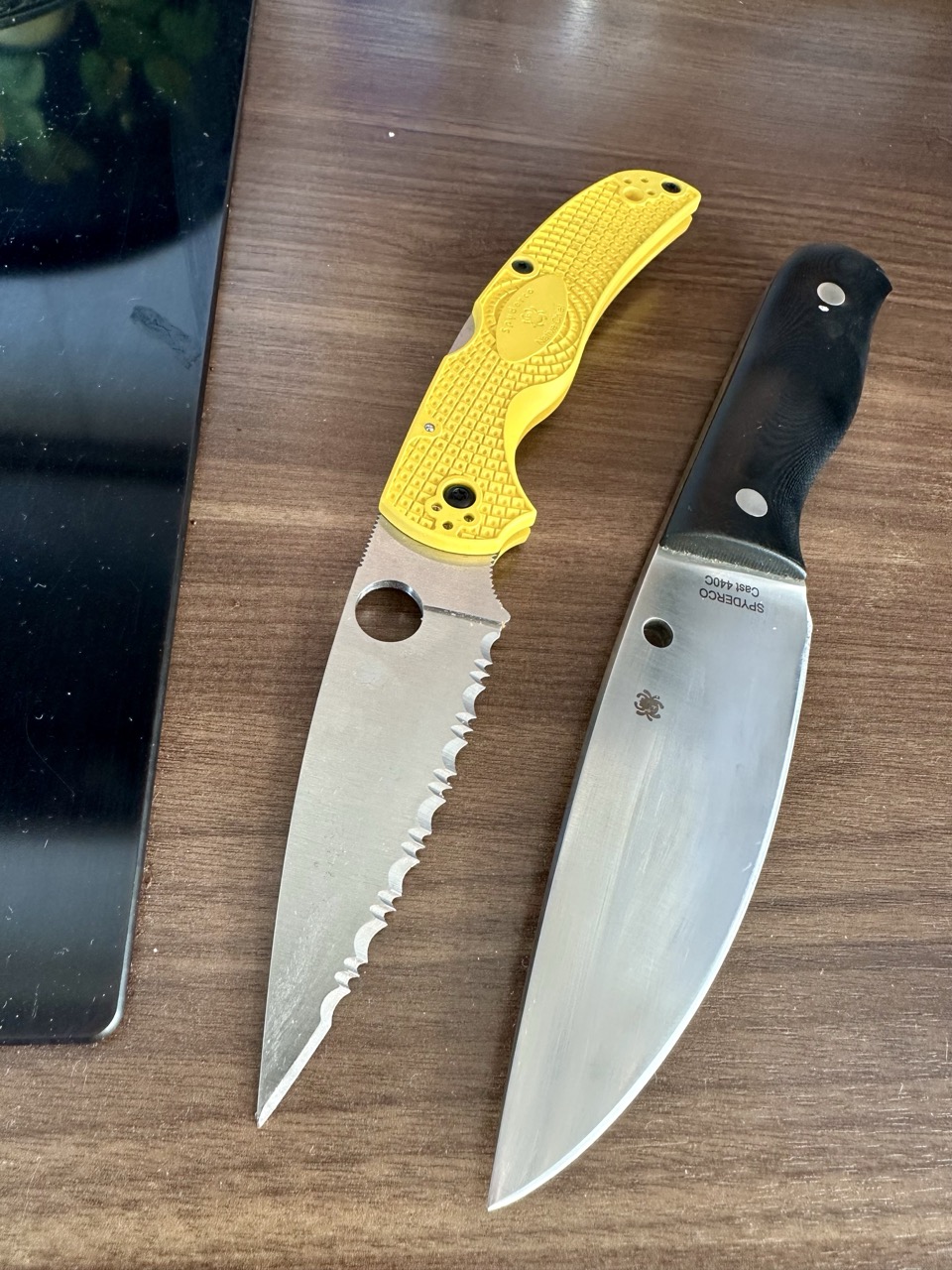
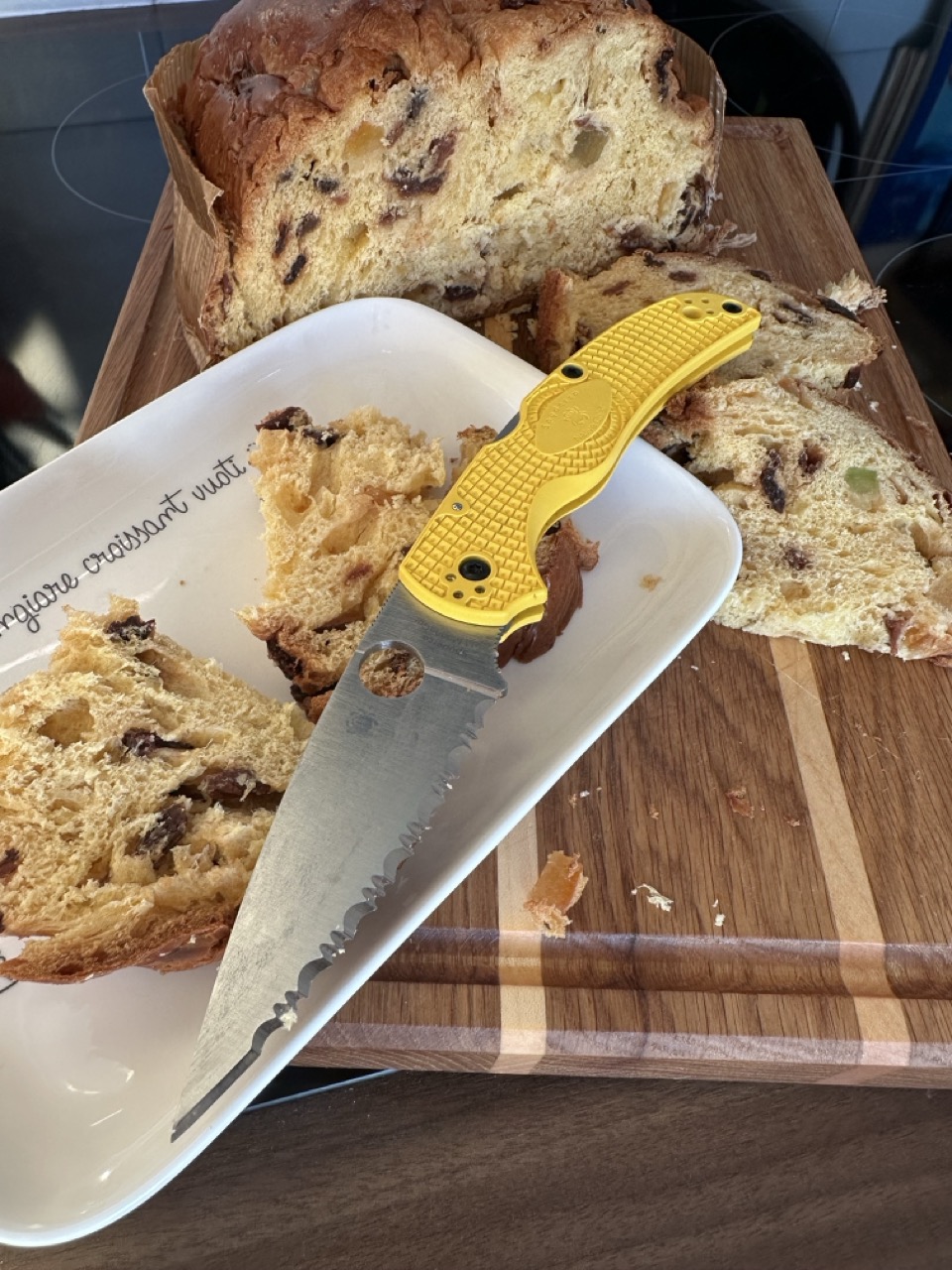
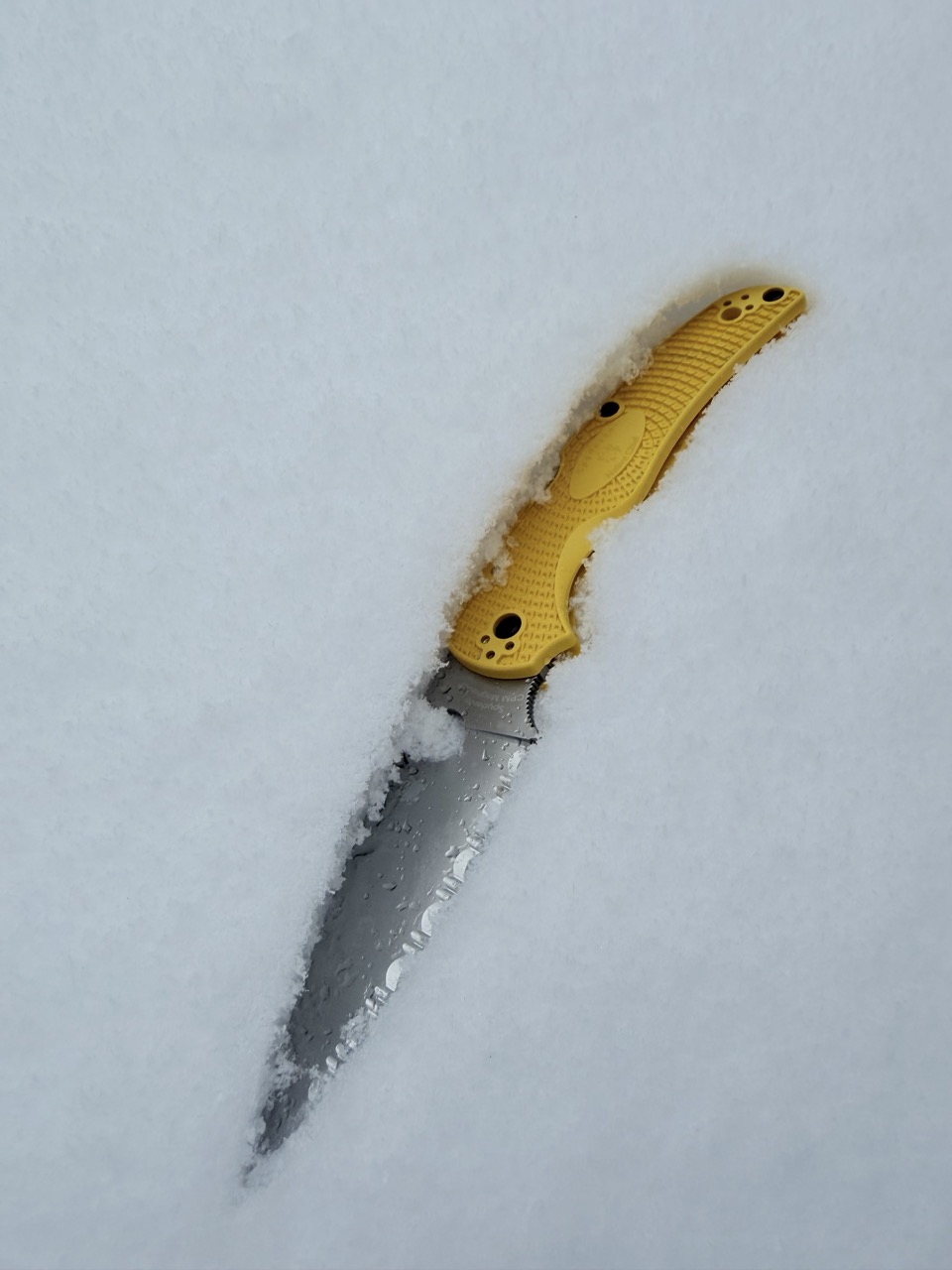
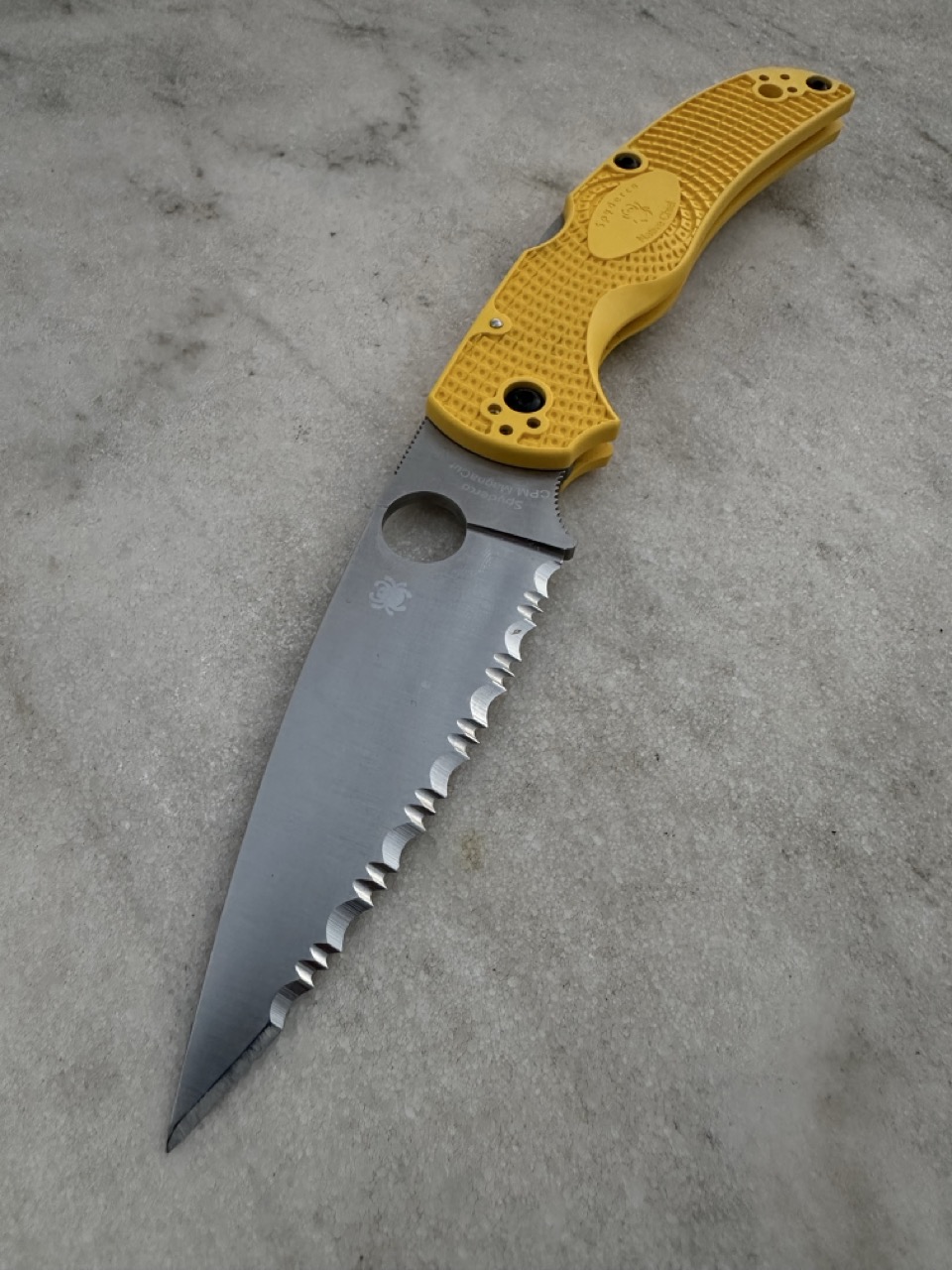
If I pull out my fully serrated Native Chief Salt, anyone around will instantly assume that this long, pointy, toothy, shiny blade is straight out of Jack the Ripper’s toolkit.


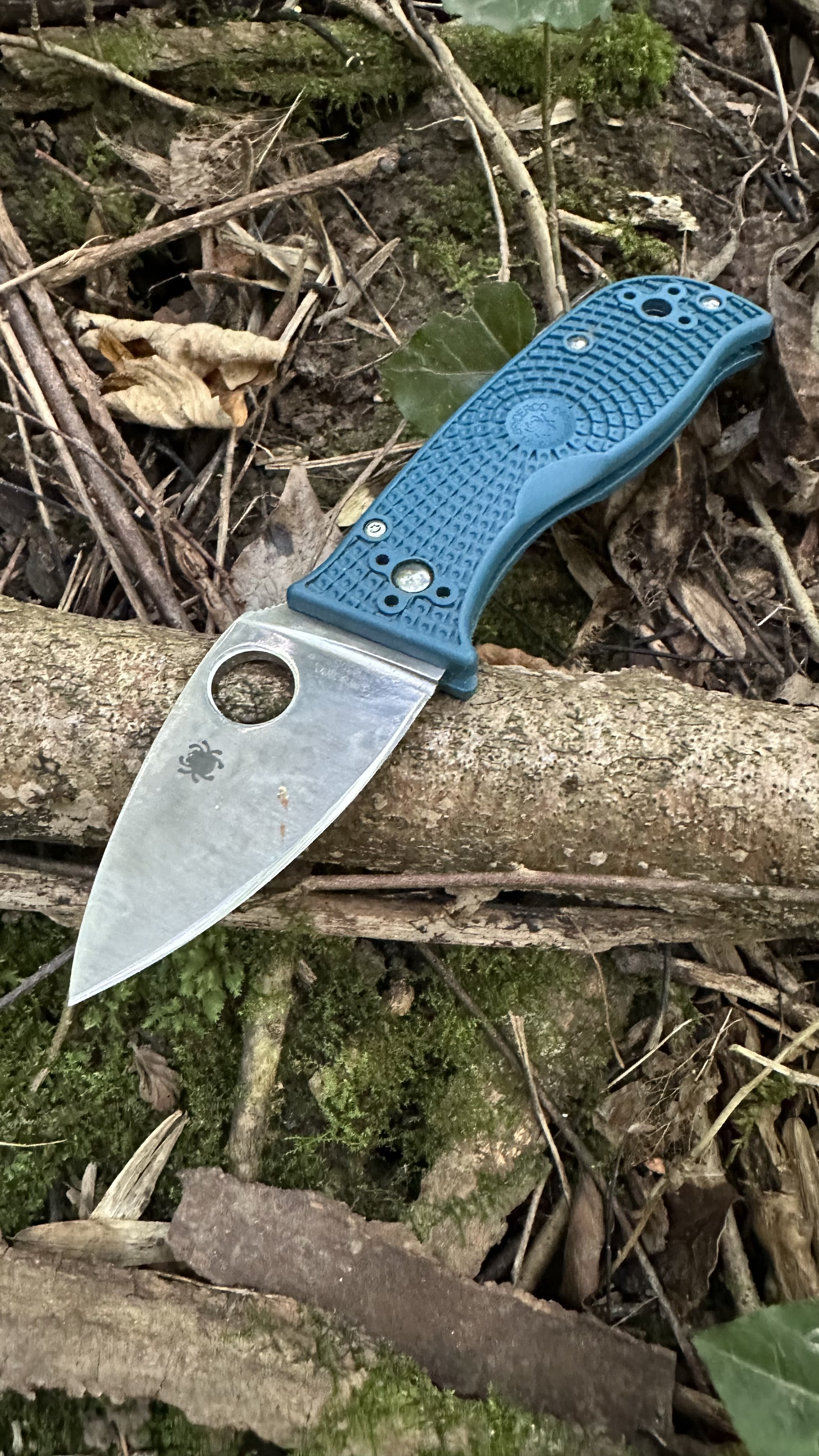
The PITS2, with its rounded profile and non‑threatening blade shape, is a perfect example of a legal and friendly high tech EDC that won’t raise any eyebrows if used in public.
It’s actually even less threatening than a UKPK.

ll in all, the PITS2 delivers on its promises.
Incredible thin edge. Enjoyable mechanism. Low profile. Easy to clean.

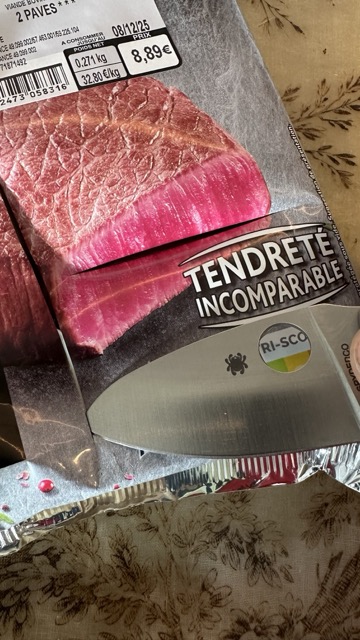
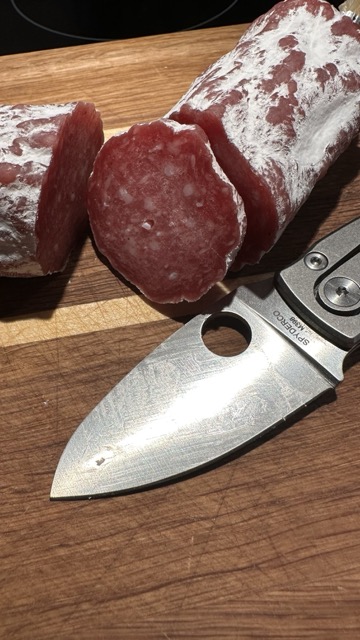
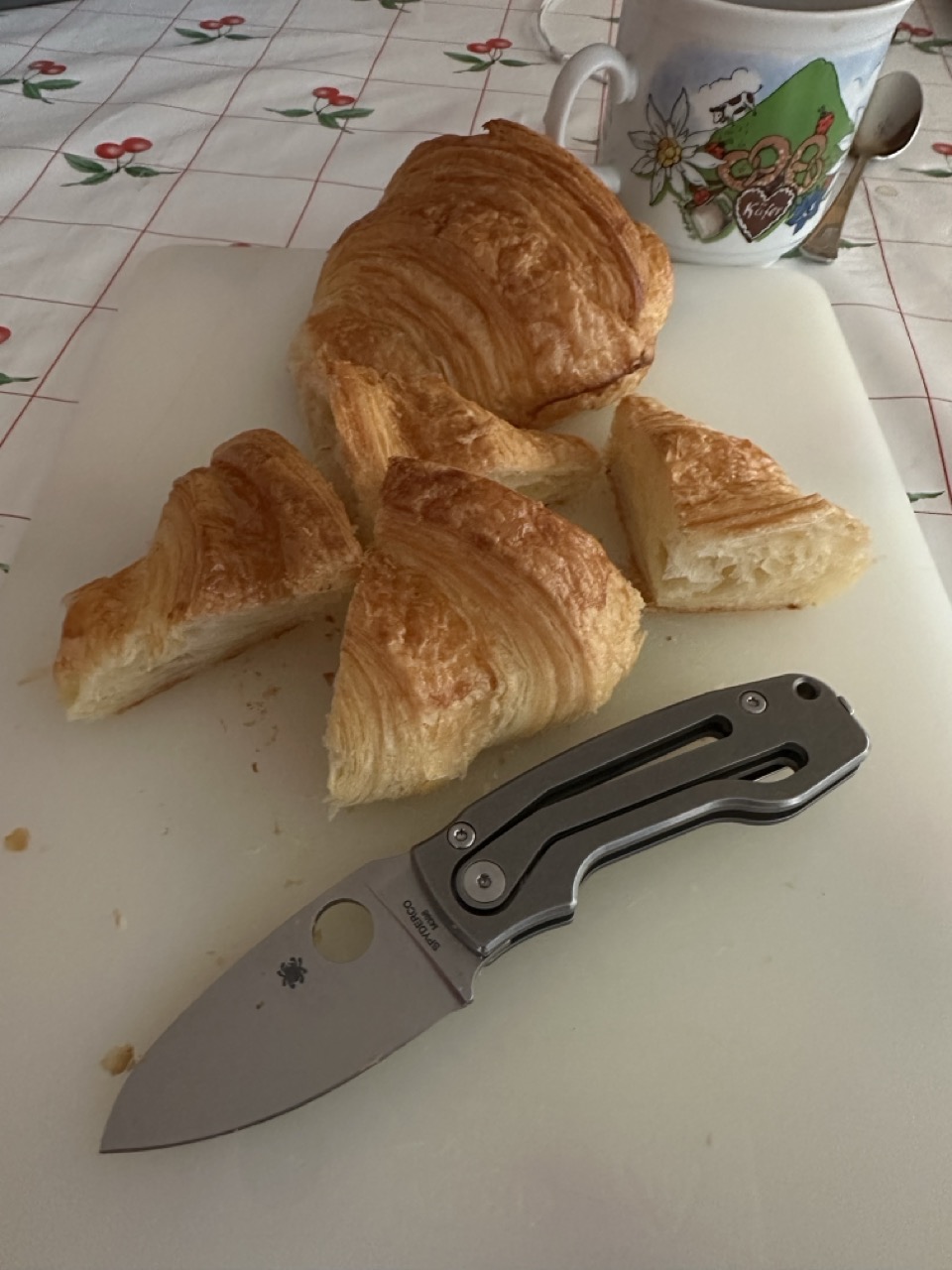
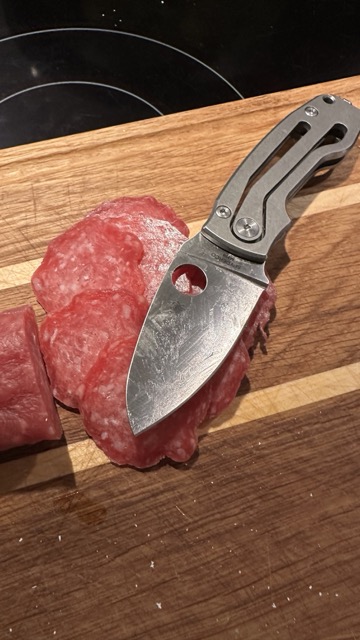
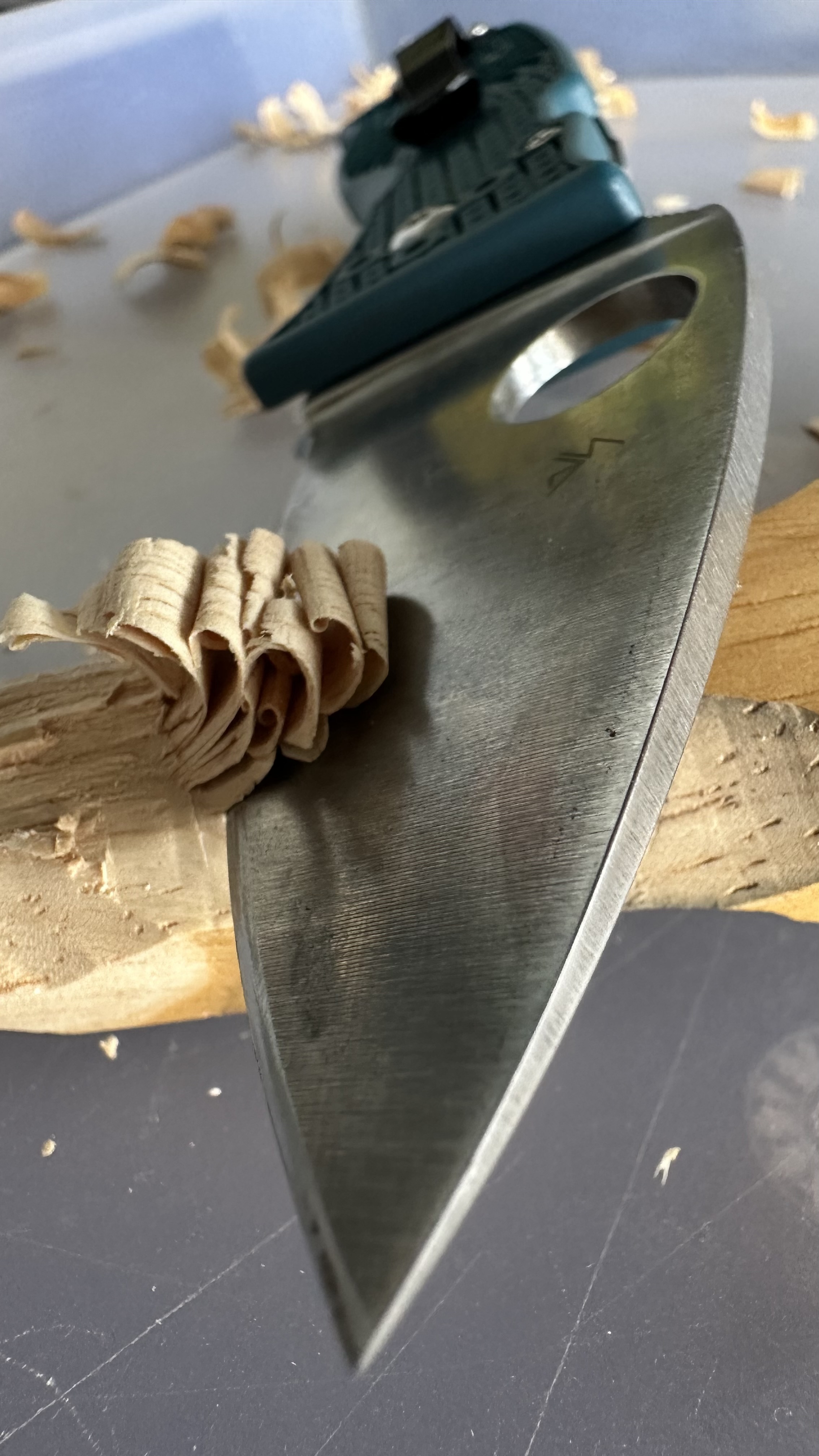
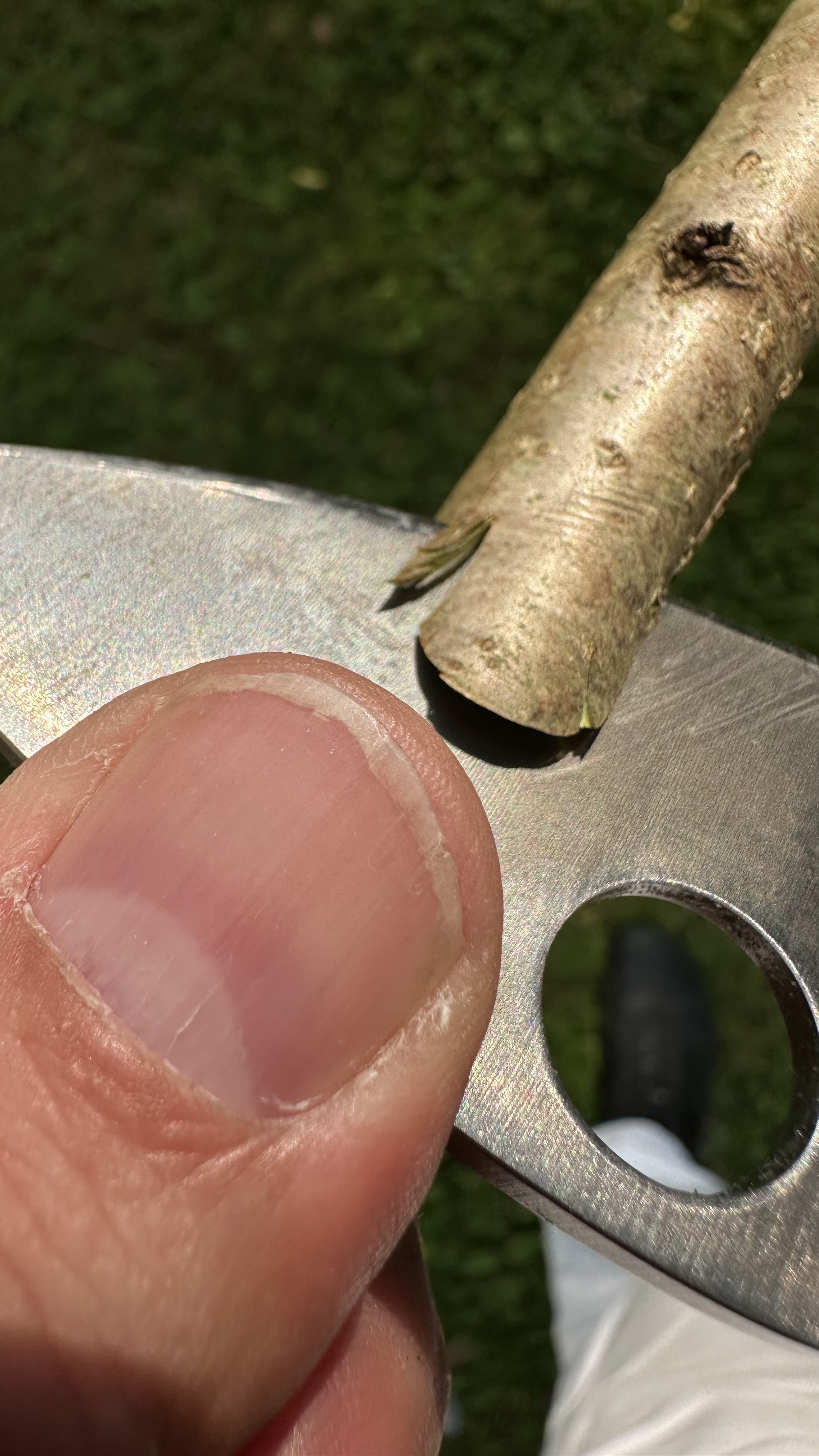
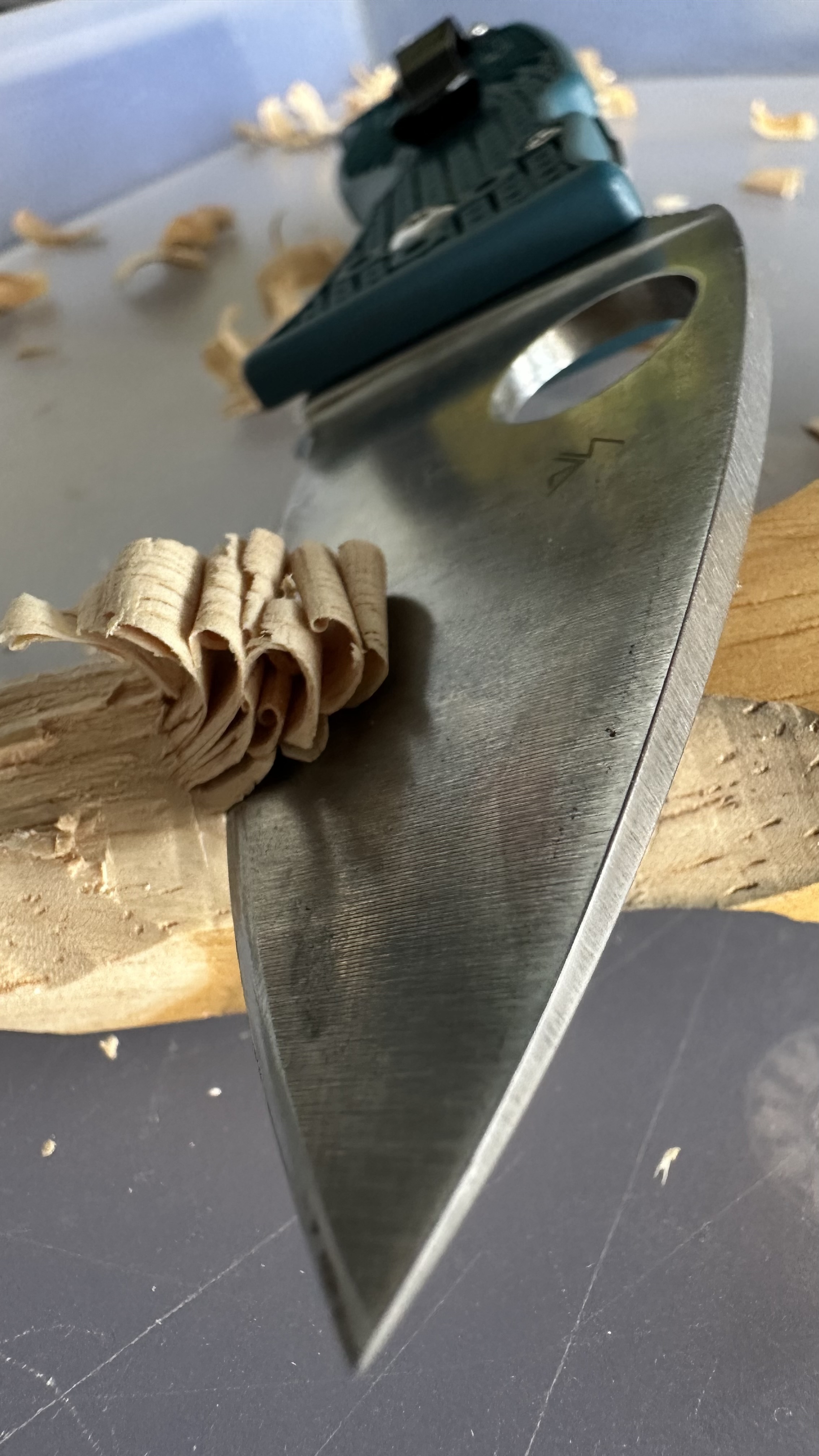
It’s a friendly, high‑tech luxury tool that can be brought to the table to slice a sausage, yet also serves as a reliable outdoor companion capable of carving a walking stick. I’m loving the Alien in these times of shifting paradigms.

So let the weary land be rested and the killing season over
Let the shadows stretch forever in the light of burnished silver

For I fear the age of consequence and I wish that it was over
Bring me the snowfall, bring me the cold wind, bring me the wiener

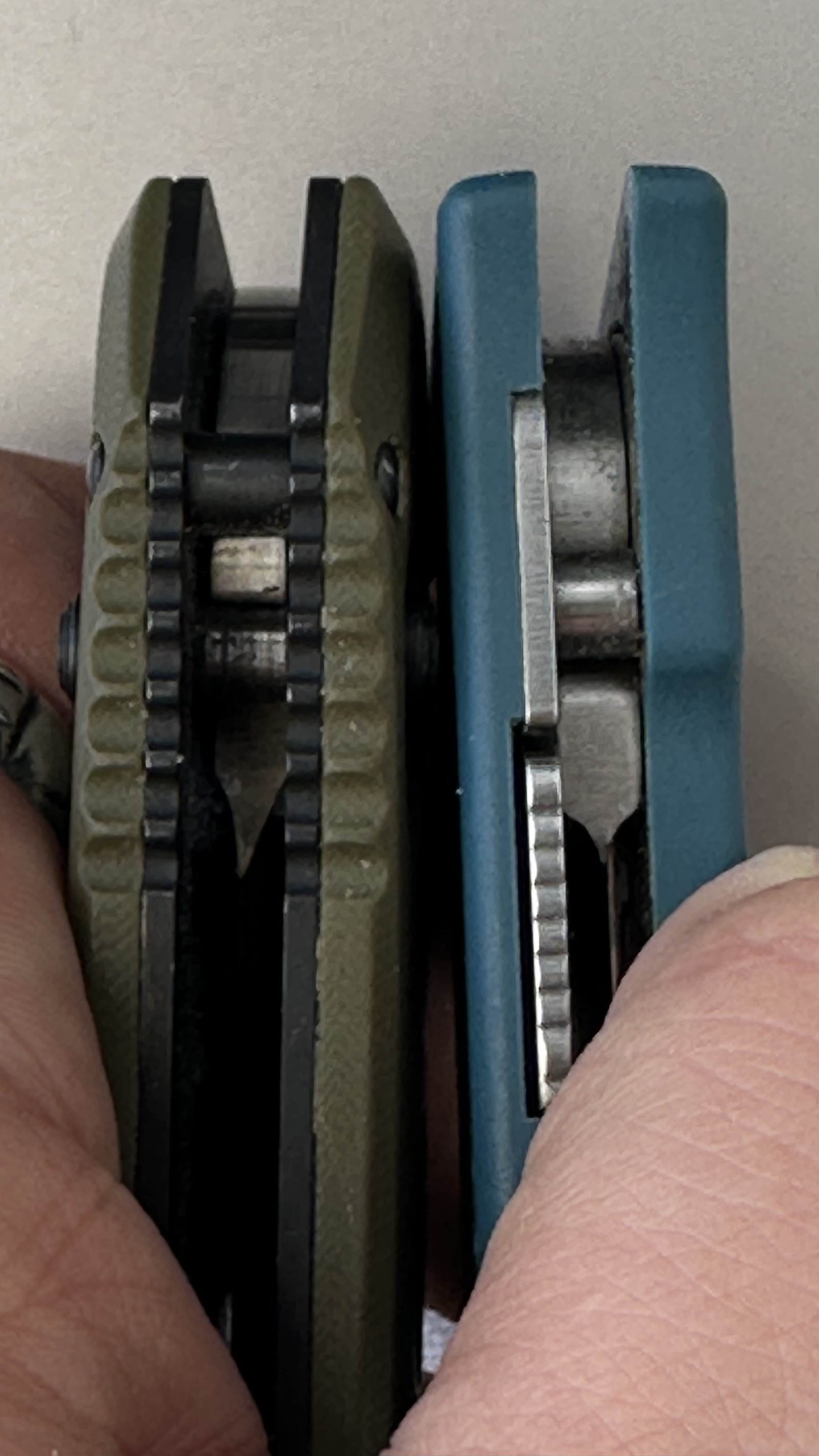
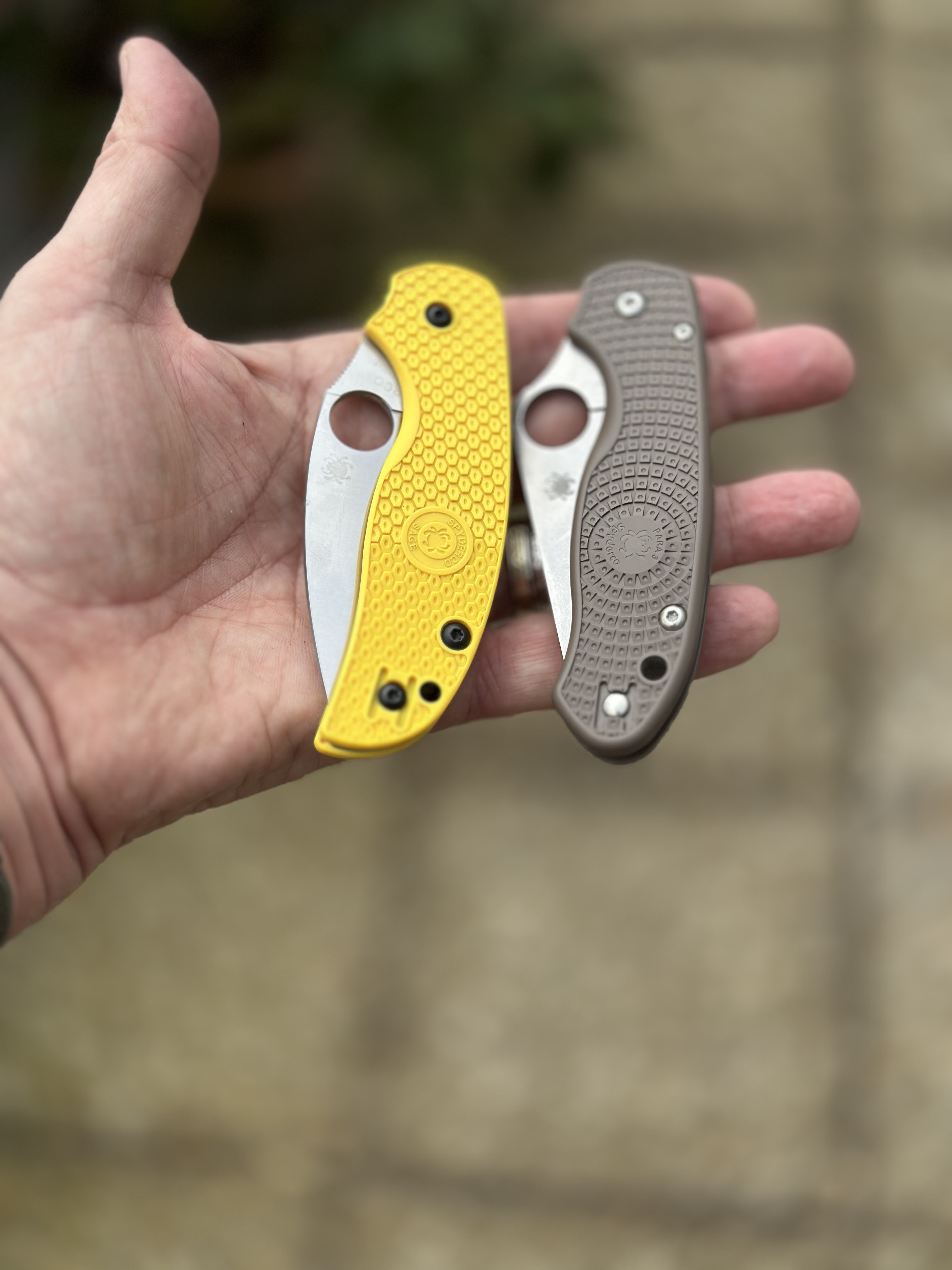
(My Nano has been heavily resharpened into a convex edge, while my PITS2 comes with its thin, perfectly even factory edge.)

Spyderco CALY™ 3.5 – C144CFPE Caly 3.5 ZDP – Back To The Future !
Disclaimer: this knife was supplied at no cost by Spyderco as part of their brand ambassador program. The review that follows, however, remains entirely independent and unbiased. I thank them for placing their trust in this little blog.

Let’s take a walk back to 2010! It was a year marked by major natural and environmental disasters—the Haiti earthquake, the Deepwater Horizon oil spill, and the Chile earthquake. The swine flu pandemic, which had begun the year before, finally dissipated. On the cultural side, Lady Gaga made history with 13 VMA nominations (the most ever at the time), plus another 5 for her contribution to Beyoncé’s Video Phone. Meanwhile, Justin Bieber won Best New Artist, becoming the youngest person ever to claim a VMA.

But enough about disasters!

In 2010, ZDP-189 was the new kid on the block. The big questions were: does it stain? Is it brittle? What’s its exact composition? And carbon fiber—once a rare luxury—was suddenly being mass-produced for knife handles and had become the must-have material. I was 45.
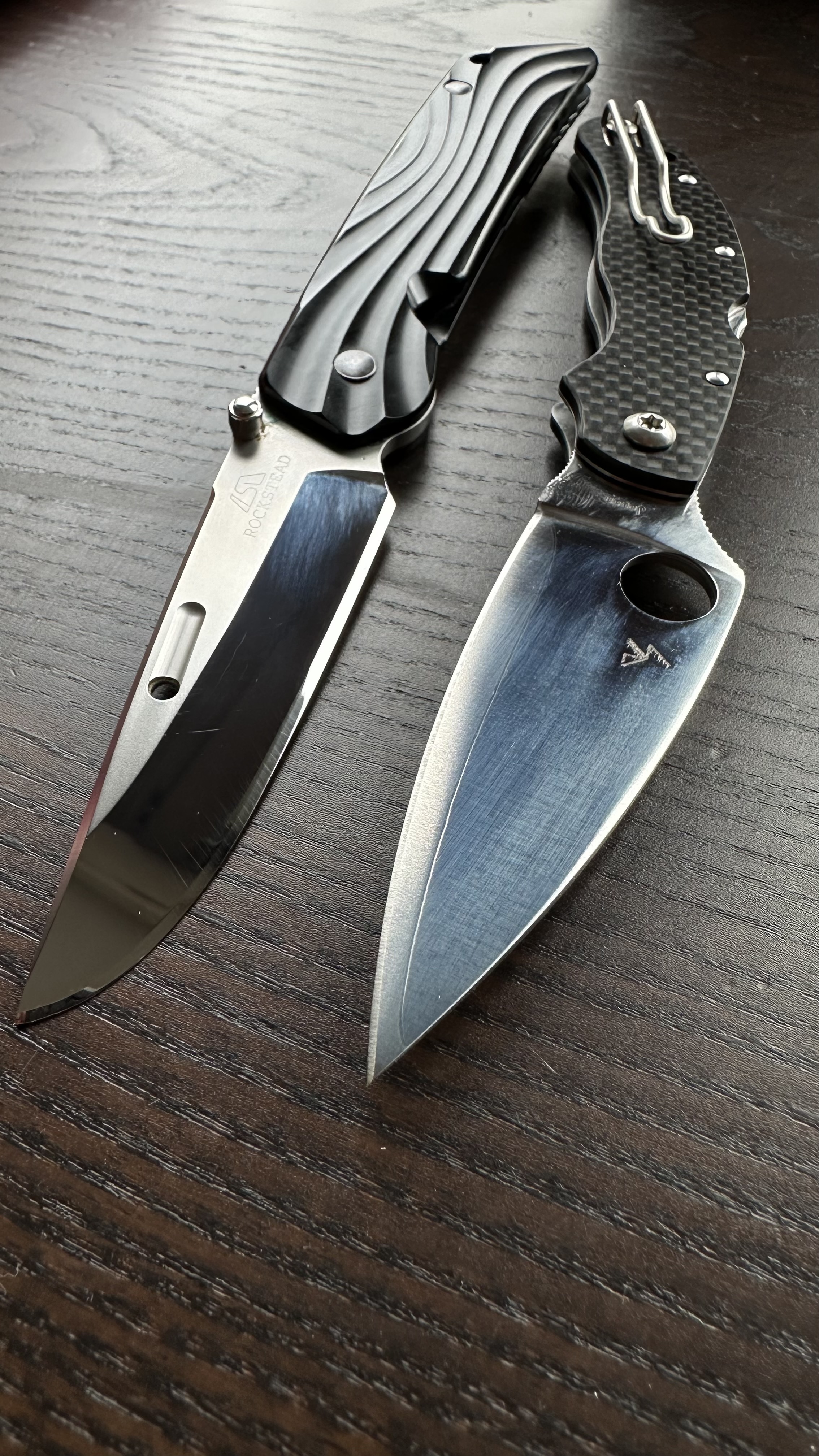
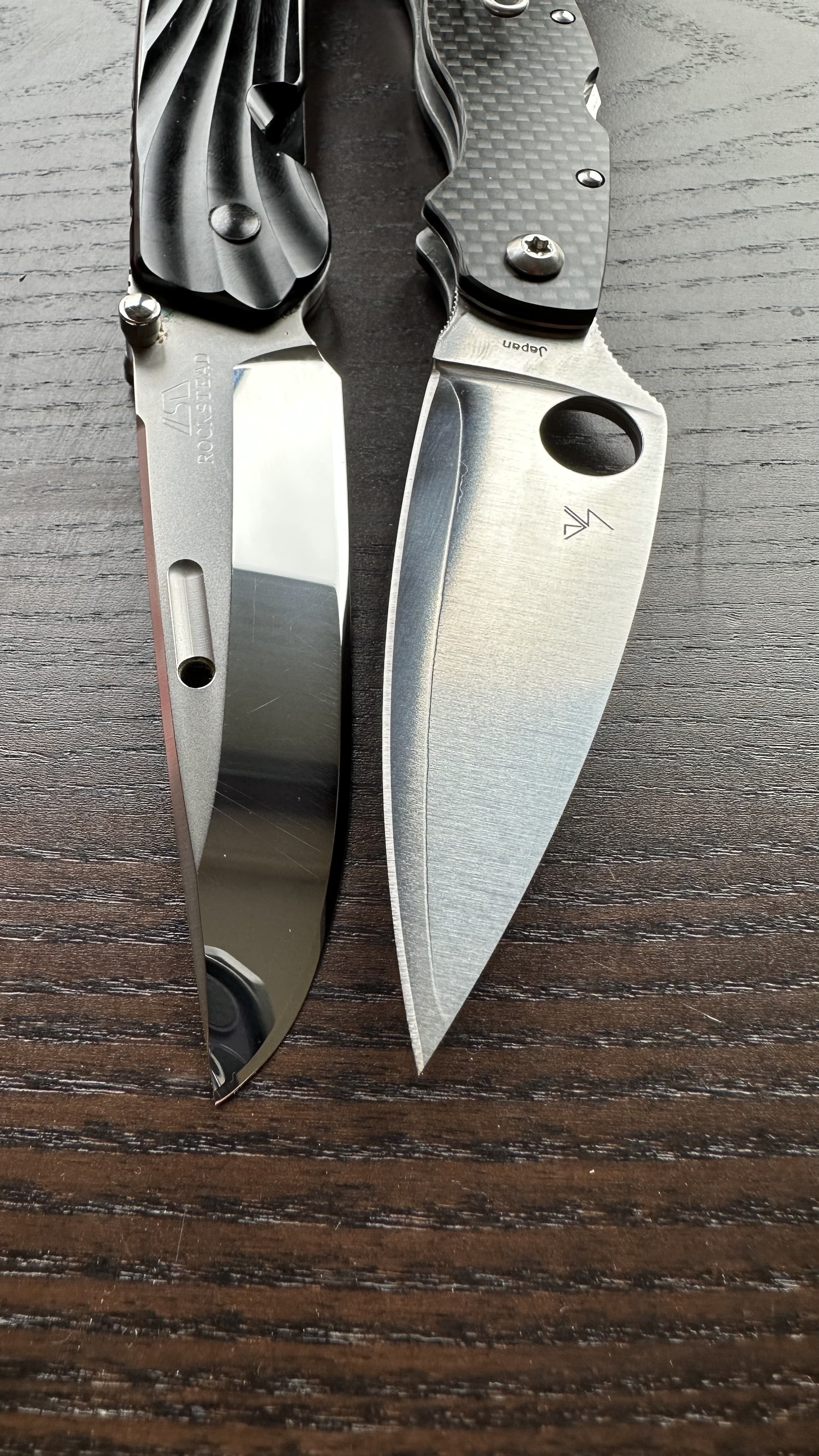
It was the year I got a wonderful gift from Rockstead: their Higo to review in ZDP189.
The Michael Walker in ZDP189 was neatly carried in my watch pocket.


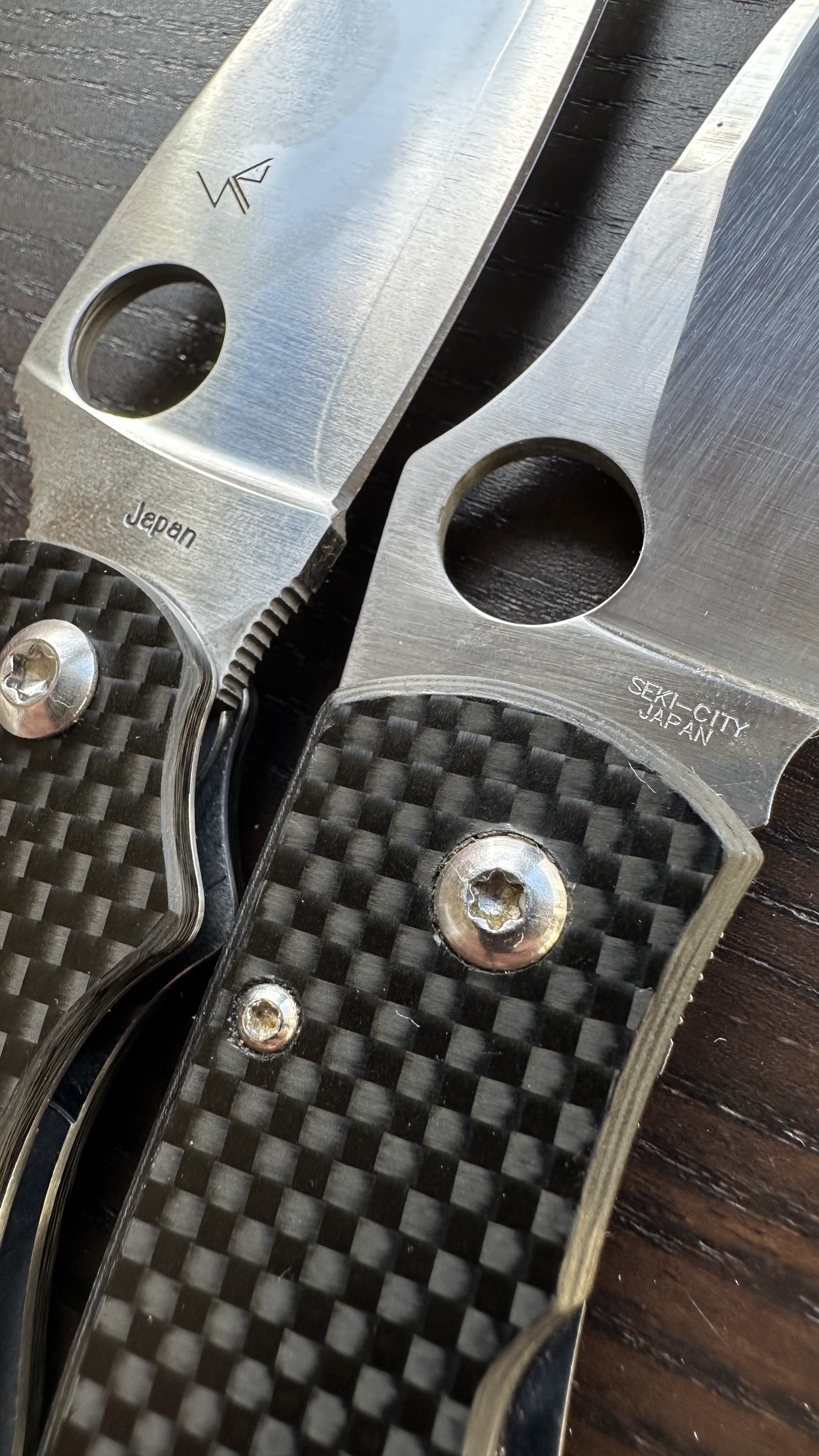
Proudly made in Japan.

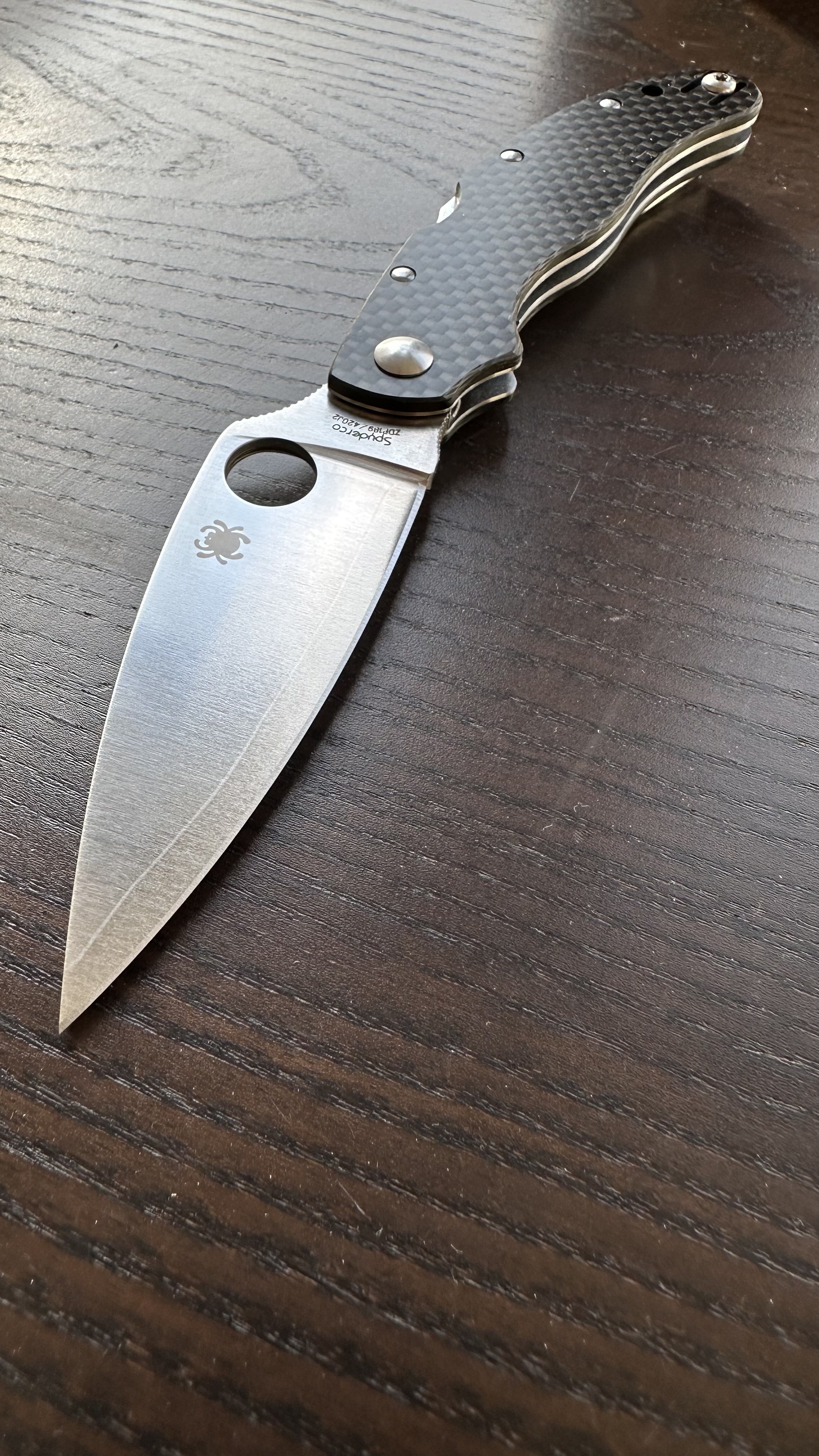
Fifteen years later, a parcel lands at my door. Inside: a blast from the past—the Caly 3.5. Or should I say, the Mighty Caly. Clad ZDP-189 steel, proud axis screws, and that unmistakable aura. A gentleman’s knife that decided to play the outlaw with its 3.5-inch locking blade.

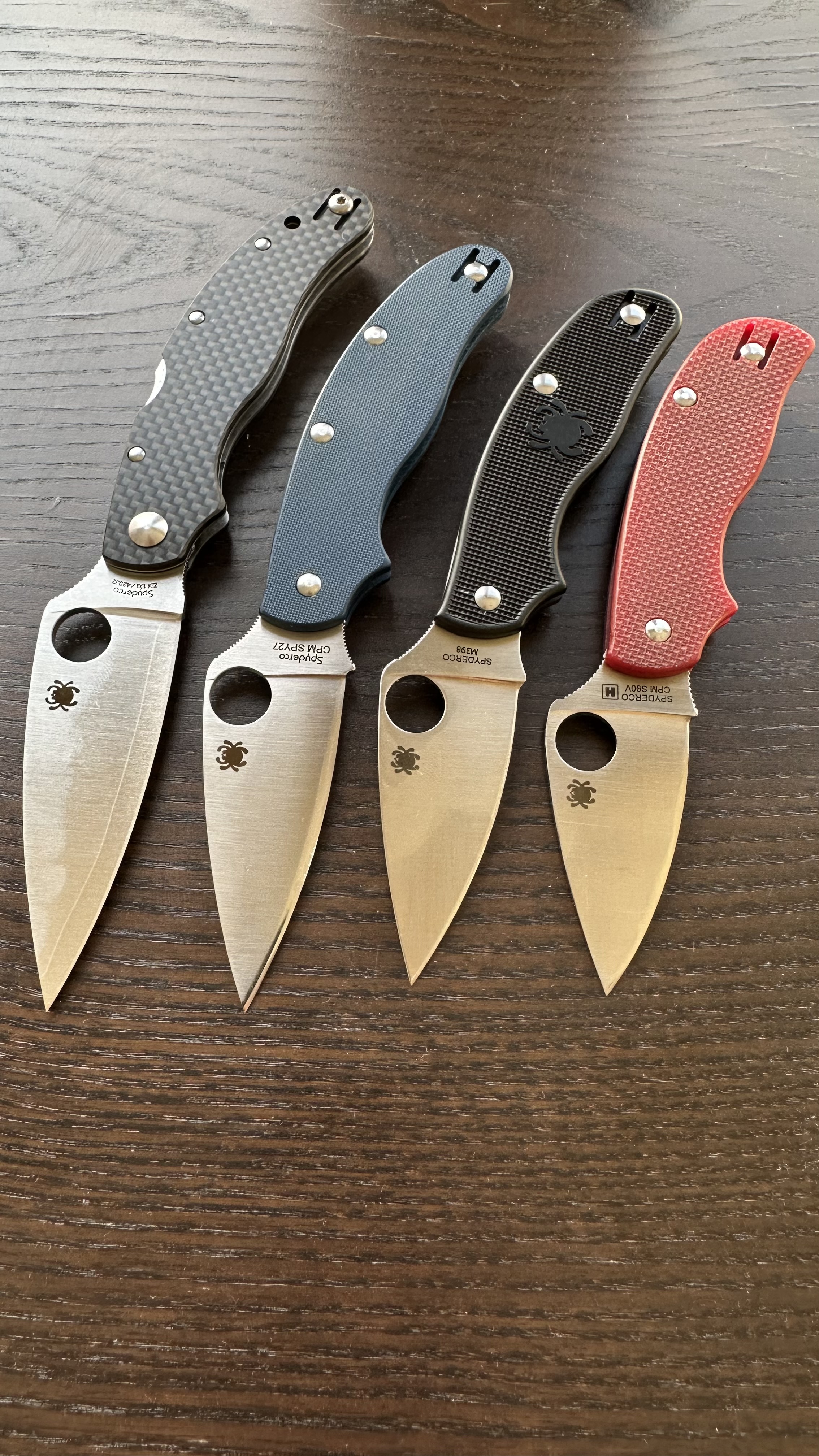
The father of the UKPK.

And many of the ClipIt offsprings:

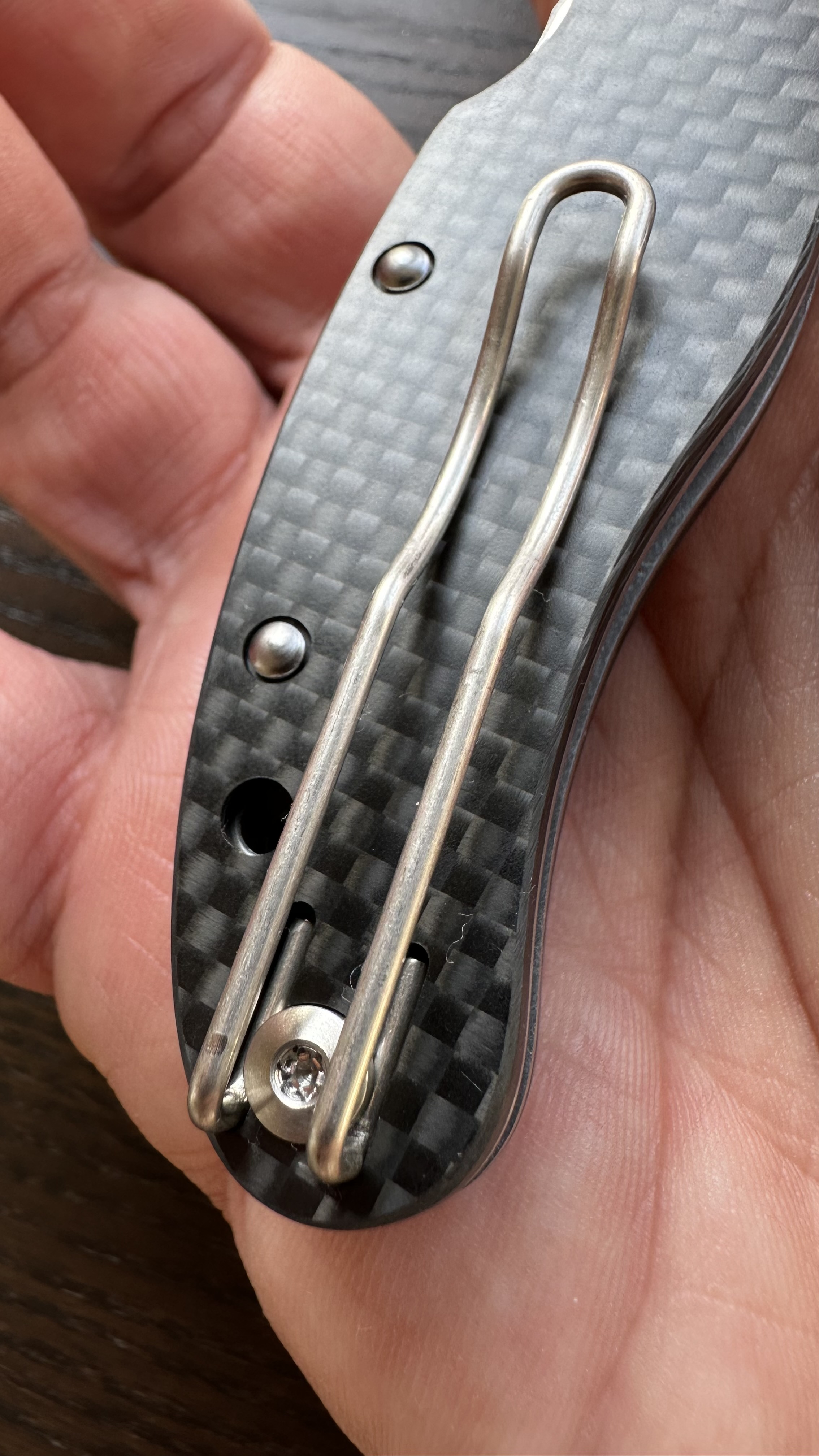
Out of the box, the Caly 3.5 is incredibly pocket-friendly. The smooth carbon fiber scales make it glide in and out effortlessly, adding to its everyday usability.

This is one thing I won’t need to polish on the Caly. 😉

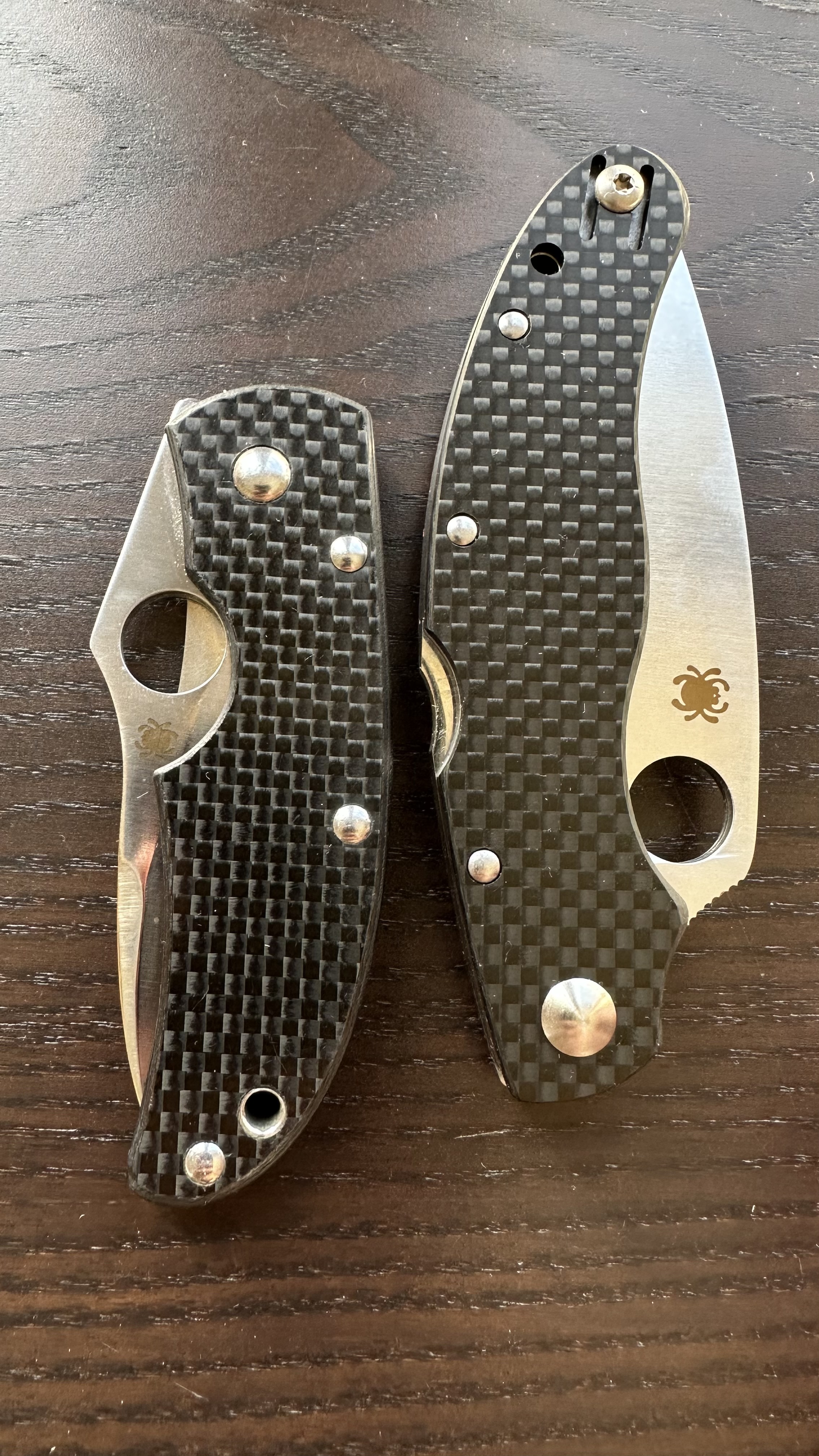
Now, the Caly is one of the rare Spyderco models that hasn’t been converted to full screw construction in 2025. It still carries those three rivets on the handle, radiating an unmistakable early-2000s vibe.

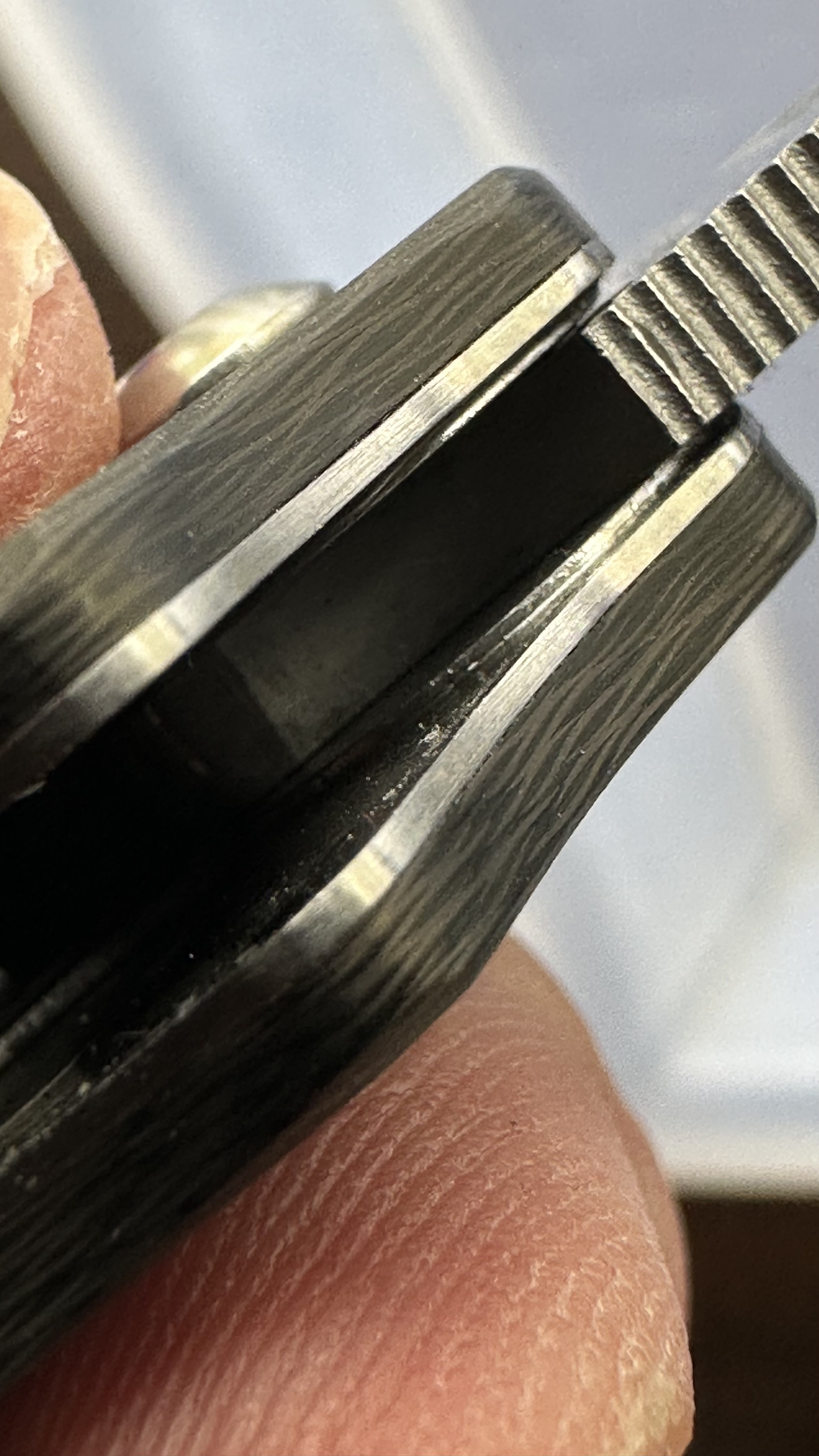
Most modern folders are assembled with screws, which makes them easy to disassemble and service. The Caly 3.5, by contrast, is riveted—apart from the pivot and clip screw—which means full disassembly isn’t really an option.

I understand why some people have a visceral dislike for rivets. But in my experience, they work reliably and don’t loosen over time—an important factor when you’re using a knife in remote places for long stretches. A friend of mine, once a hunter’s guide in the African rainforest, swore by riveted knives for exactly that reason: nothing to rattle loose, nothing to lose.

Personally, I won’t be field-dressing game or digging in the mud with my Caly. For me, the lack of full disassembly isn’t an issue. Cleaning with hot soapy water, a rinse, and a blast of compressed air is more than enough. No worries at all.
But to quote a user back in 2013: “Disassembly for cleaning is as simple as the design: Open blade, Remove pivot pin screw, Depress lock bar, Pull out pivot and the blade falls out. Voila, that’s as far as it breaks down. No washers, nothing falls out, etc. Reassembly, just reverse the process.”

And then there’s the BIG pivot screw—so bold it practically becomes the Caly’s signature.

This is pure Sal Glesser design: a knife that melts into your hand. The carbon fiber slabs are smooth, almost glassy, while that oversized pivot not only anchors the construction but also serves as a subtle functional detail. It works as a natural index point on the handle—almost like a thumb guard, without ever creating a hot spot.

It’s not just practical; it’s a stylistic stamp. You see the same oversized pivot screw on the Michael Walker, another hallmark of Spyderco’s design language from that era.

Now, let’s talk about ZDP-189—a steel I’ve reviewed many times over the years.

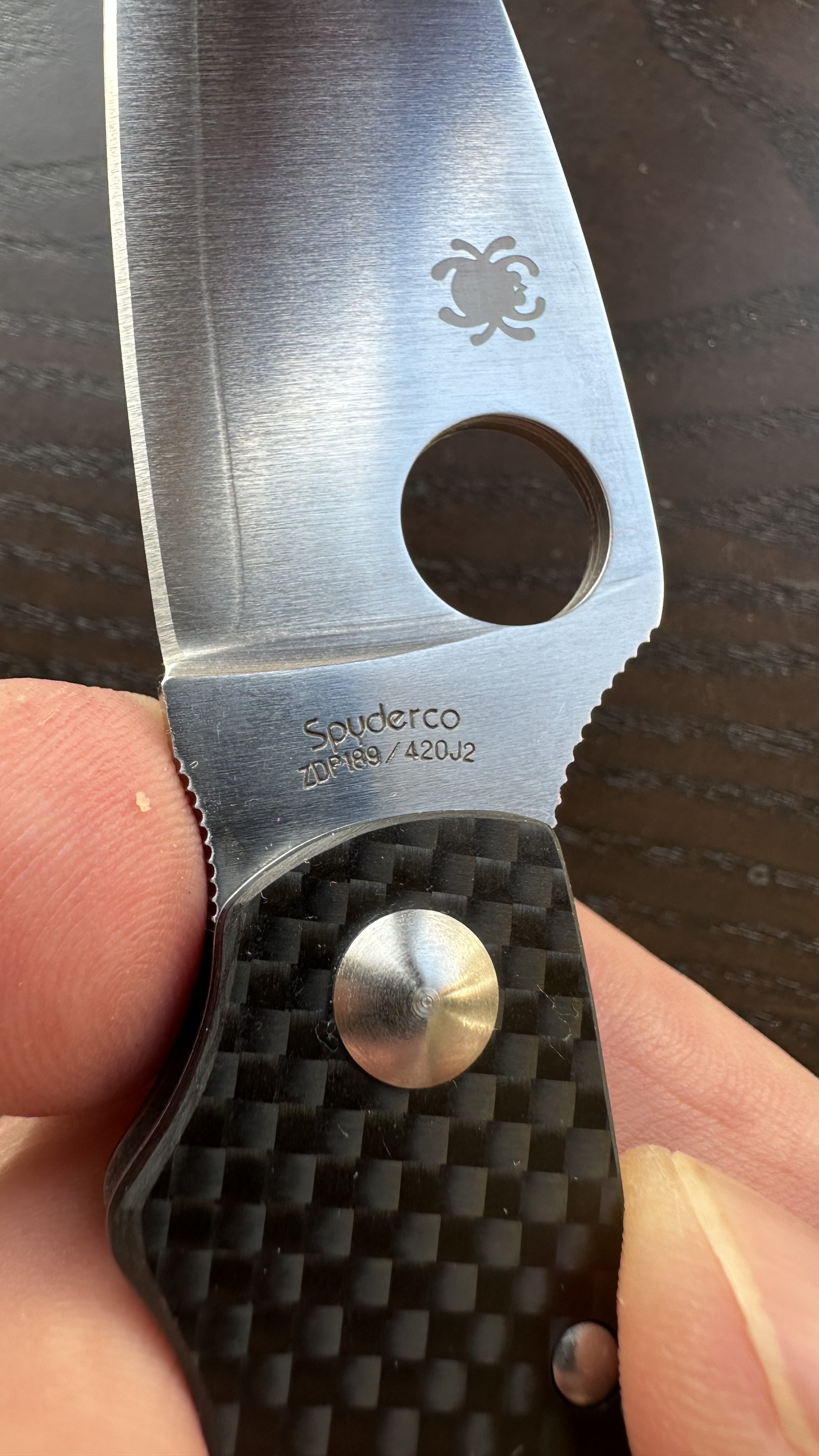
ZDP-189 is a Japanese premium stainless steel produced by Hitachi through powder metallurgy. It’s one of the landmark developments in that field, known for pushing the limits of what stainless steel can do. With an unusually high chromium and around carbon, it achieves extreme hardness, excellent corrosion resistance, and outstanding wear resistance.

While it’s most often found in high-end kitchen knives, ZDP-189 has also carved out a place in EDC designs. My own Higo J from Rockstead, for example, proudly measures in at 66.6 HRC—a testament to how hard this steel can go when heat-treated to its full potential.
(ZDP-189 steel can reach a maximum hardness of 67 HRC, which is well above the values of average mass-production knives.)

ElementPortionEffect
Chromium20.0%Improves wear resistance, heat resistance and scale resistance. It increases tensile strength because it acts as a carbide former. Use of rust-proof or stainless steel, as it increases corrosion resistance from a mass proportion of 12.2%. Reduction in weldability.
Carbon3.0%Increasing hardness and tensile strength. In larger quantities, increase in brittleness and a reduction in forgeability and weldability.
Manganese0.5%Improves hardness and tensile strength.
Molybdenum1.4%Improves hardenability, tensile strength and weldability. Reduction in forgeability and ductility.
Silicon0.4%Improves strength.
Vanadium0.1%Increasing hardness, increasing wear resistance and improving tempering resistance.
Wolfram0.6%Increase in heat strength, tempering resistance and wear resistance at high temperatures up to red heat.


The magic of ZDP-189 lies in its unusual recipe. With about 3% carbon—a huge amount compared to most steels—and a massive 20% chromium, it pushes the limits of what stainless steel can be. That mix makes it harder, more wear-resistant, and more corrosion-resistant than almost anything else in the pocketknife world.
If you’ve ever used knives made from softer steels (well below 60 HRC), you know the frustration: the edge dulls quickly. Instead of chipping, the steel tends to roll, with the fine cutting edge flattening under pressure and losing its bite. A few quick passes through a sharpener will bring it back, but the cycle repeats too often.

With a harder steel like ZDP-189, the story is different. Edges don’t roll nearly as easily, which means the blade keeps its razor-sharp performance for far longer, even under demanding use. That’s where ZDP-189 really shines in 2010 and still shines in 2025—it holds a cutting edge like almost no other stainless steel in the EDC world.
But beware as ZDP189 is also known for chipping especially on factory edges..


15 years ago my ZDP-189 Higo gave me a scare: its factory convexe edge started chipping quite badly (arrrgh!). I hadn’t been using it hard, so it caught me off guard. My guess is that the ultra-thin edge at the tip, maybe combined with a careless fumble or contact with something hard, was the culprit.
The tip may have contacted something hard, which can happen without noticing. I’ve had a similar experience with another knife: a mirror-finished, thin stainless blade I was testing on bamboo. After just ten cuts, the edge looked almost serrated—but I realigned it, and the damage became nearly invisible while restoring high sharpness.

To bring it back to new, I gave it many gentle pass on a Spyderco white ceramic rod, then spent a solid hour stropping on leather with compound. The result? The knife came back sharper than ever, and with a touch of convexing the edge now feels stronger and less prone to be damaged. For all its hardness, ZDP-189 is surprisingly forgiving.

My other ZDP-189 blade ,back in 2010, the Michael Walker, hasn’t rolled or chipped, though it isn’t as “smooth” sharp as the Higo. It’s also slightly less hard than the Higo-J.
It will be the same story with the Caly 3.5. I also feel that its beautiful full-flat-ground blade, with its already even edge, could benefit from a bit of convexing. Doing so would create a safety net against potential chipping, making the blade even more durable in everyday use.
Sooner or later I will also smooth the blade’s spine. Good news the 420J2 steel is soft to work.


Why does the Caly 3.5 have a laminated blade made of ZDP-189/420J2?

The inner core is ZDP-189, while the outer shell is 420J2. The idea behind a laminated or “clad” blade is simple: the inner core provides a very hard, high-performance edge, while the outer layers are softer and more corrosion-resistant. This combination gives you the best of both worlds: excellent edge retention from the ZDP-189, and a tougher, more flexible spine that helps prevent damage when pressure is applied.

The softer 420J2  outer layer will scratch over time but it will be easy to polish back. It also improves corrosion resistance, especially near the pivot area. Even though ZDP-189 has a very high chromium content, it can still stain, but won’t rust like other hard laminated steels such as HAP40. The cladding adds a bit of toughness to the overall blade, compensating for the fact that ZDP-189 is not the toughest stainless steel in case of torsion.

Carrying the Caly 3.5 is another smooth experience—it practically disappears in your pocket. The deep-carry clip, smooth handle, and thin profile combine to make it a true pocket ghost.
But deployment is definitely the Caly 3.5’s vintage characteristic, especially compared to modern compression-lock knives like the Microjimbo. The action is less smooth and a bit slow—which, in fairness, suits a gentleman’s (or lady’s) folder. Out of the box, it was quite grippy, but a few drops of nano oil helped.


One reason for this feel is that the knife lacks washers. The blade and stainless liners are polished at the Seki factory to minimize friction, but they remain in direct contact. Over time, the blade gradually leaves “traces” at the pivot where it rubs against the liners, which is normal for this type of construction. With a little oil, there is no issue.


Using, carrying, and deploying the Caly 3.5 is like going from a 2025 electric Kia to a classic common-rail diesel BMW. It’s rougher, yes, but still comfortable, reliable, and full of character—part of its undeniable charm. And it gets better and better…
One big asset is how easy to goes in and out of my pockets where it’s disappears like a much smaller knife. This is purely the opposite of a pocket shredder. It makes the carrying experience pleasant and confortable.

Details like Boyle’s dent on the lock (which flushes with hand), the proud liners and the full stainless steel spacer held by rivets add to that vintage appeal. My Caly 3.5 exhibits zero vertical play, giving the same solid backlock experience I enjoy on my Police 4 in K390. This is rock-solid.
And that 3 mm-thick blade contributes significant lateral strength, meaning the Caly can be used harder than its elegant appearance might suggest.

The factory edge is a bit on the thick side, so its performance doesn’t fully meet my needs. At the moment, the Caly 3.5  can’t even slide cleanly through the base of a plastic bottle.

So for my personal taste, I’ll likely smooth the spine, convex the edge, and round that blade jimping (a real hot spot for hard cutting), as well as soften the handle edges until they feel like a pebble. But this will take time—I don’t want to compromise the overall beauty of the Caly 3.5. It’s a true looker, eye candy for anyone who appreciates Sal Glesser’s designs.

But as Bob Terzuola always says: “If your knife is still sharp, it means you don’t use it enough!”
So let’s put that Caly 3.5 to work. First step: rounding the angles.

Link to the Caly 3.5 used to save a child from mountain lion on Blade Magazine.

EDIT from 24th of October 2025:

I have installed a shorted clip:

SPYDERCO LIL’ TEMPERANCE™ 3 LIGHTWEIGHT K390 -C69PBL3K390 -Part 3 – Use Shorty !

It has been established on the two previous chapters:
SPYDERCO LIL’ TEMPERANCE™ 3 LIGHTWEIGHT K390 -C69PBL3K390- Get Shorty ! – Part 1
and
SPYDERCO LIL’ TEMPERANCE™ 3 LIGHTWEIGHT K390 -C69PBL3K390 -Part 2 – Draw Shorty !

that the Lil’ Temp is very much a hidden gem, refined over two decades by Sal Glesser. In essence, it’s his answer to the compact, heavy-duty 3-inch folder — a kind of “Techno Glesser” that still offers a full, hand-filling grip. Its tall blade profile allows for a finely tuned convex geometry, translating into cutting performance that feels far beyond its size.

K390 is, in my book, a friendly steel. By that I mean it sharpens up to a razor edge without too much effort. It isn’t quite as easy to work with as CPM Magnacut, but it’s far more forgiving than something like CPM 15V. The trade-off is that K390 will stain readily, so regular wiping is part of the routine.

The trade-off is that K390 stains readily, so a quick wipe-down is essential to keep it looking and performing at its best.

The fact that K390 isn’t stainless is not really an issue if you keep the blade clean and check it regularly for any sign of rust. In practice, a bit of grease or oil is enough to protect it, and over time the steel develops a natural patina that gives the knife real character. My own Lil’ Temp is already showing that patina, and it only adds to its appeal.

Geometry is absolutely critical when working with wood. No matter how tough the steel, without the right blade geometry the knife simply won’t bite or carve efficiently.

A full flat-ground high blade simply can’t compete when working on hard wood. That’s why Sal Glesser’s “Lambo of bushcraft knives,” the Proficient, stands out: it combines a high full-flat ground blade made from a high-carbide super steel (S90V) with an exceptionally comfortable handle. The result is a knife that slices, carves, and handles demanding tasks with ease — the kind of tool that performs all day without fatigue.

The relatively thick handle of the Lil’ Temp makes it extremely comfortable to hold and use. Its design also provides excellent indexation, making it easy to know exactly where the edge is — even easier than on an Opinel or the round handle of the Proficient.

In the woods, the Lil’ Temp is easy to deploy and put into action. Its point is robust enough to withstand some abuse. While K390 isn’t the toughest steel available, it’s still harder and more wear-resistant than many stainless alloys, making it highly capable in practical use.

The thick spine of the Lil’ Temp provides an easy resting spot for the thumb, especially on push cuts. This gives excellent control and allows you to apply strength precisely where it’s needed.

The grain structure of K390 responds exceptionally well when working on wood. After some careful convexing on diamond stones, the edge has developed a shape that balances sharpness and durability perfectly for carving and utility tasks.

I was able to carve pickets without breaking a sweat. The knife’s gentle belly plays a key role, working like a guillotine on the wood fibers and making controlled cuts effortless.

The true kings of woodworking and whittling remain the Wolfspyder and the Boker Vigtig vs Wild. Their authentic Scandi grinds allow them to bite into wood with astonishing ease, making controlled carving and fine whittling effortless.

In that context, one of my favorite full-flat-ground folders for whittling is the Native 5 Salt, once convexed. It’s an absolute pleasure to use on wood, combining smooth slicing with precise control.

A folder’s handle will always be less comfortable than that of a good fixed blade, simply because of the compromise required to fold the blade into it.

That said, the Lil’ Temp is among the very best in this regard. Other outstanding handles include the Manly Comrade, the Benchmade Adamas, the Cold Steel Recon 1, and the Wolfspyder — the latter benefiting from Ray Mears’ design philosophy, focused on knives you can use all day long without developing hot spots or splinters.

(Comrade, Recon 1 on the LT’s left and Wolfspyder on its right)

(Adamas and Lil’ Temp)

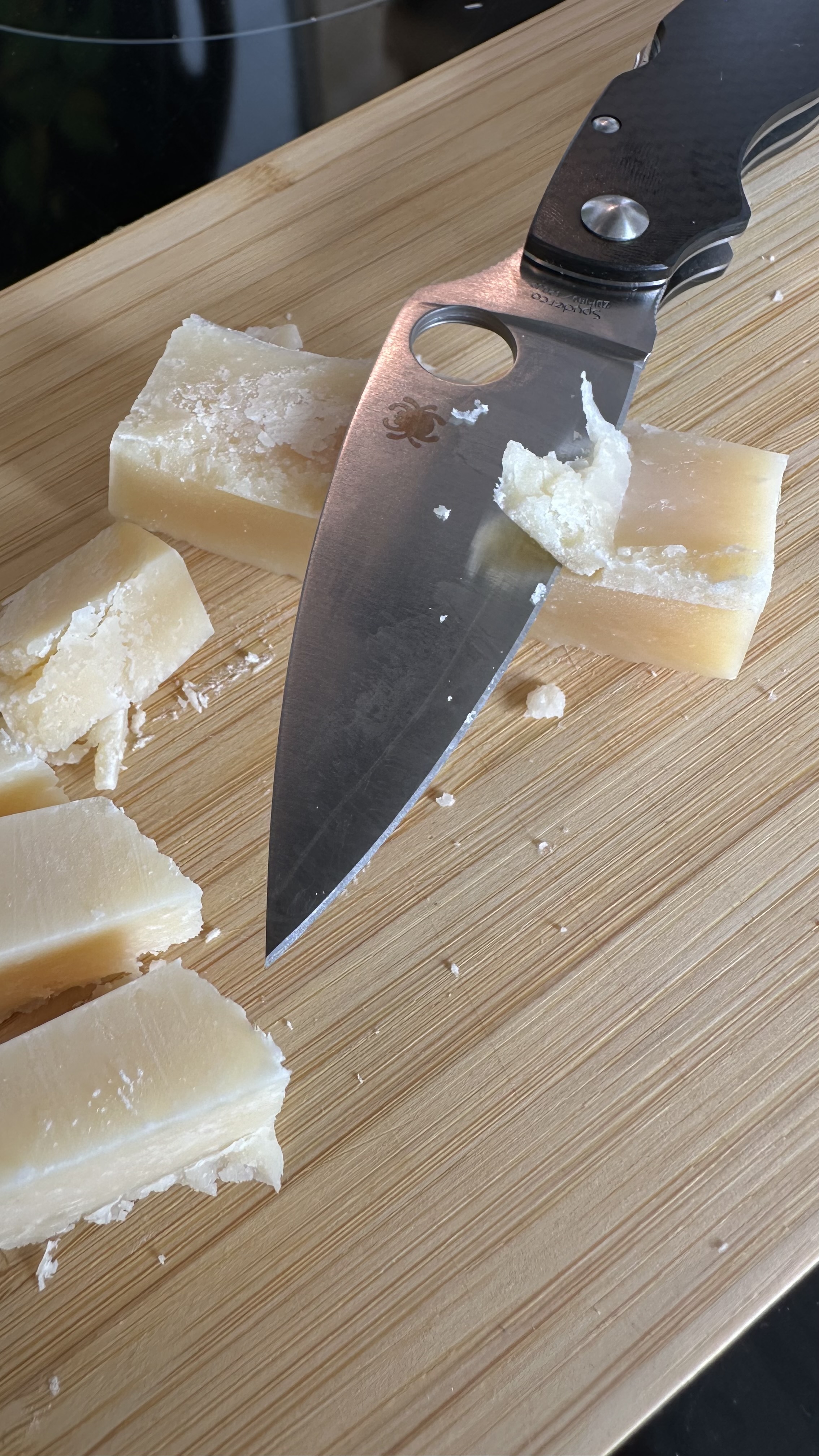
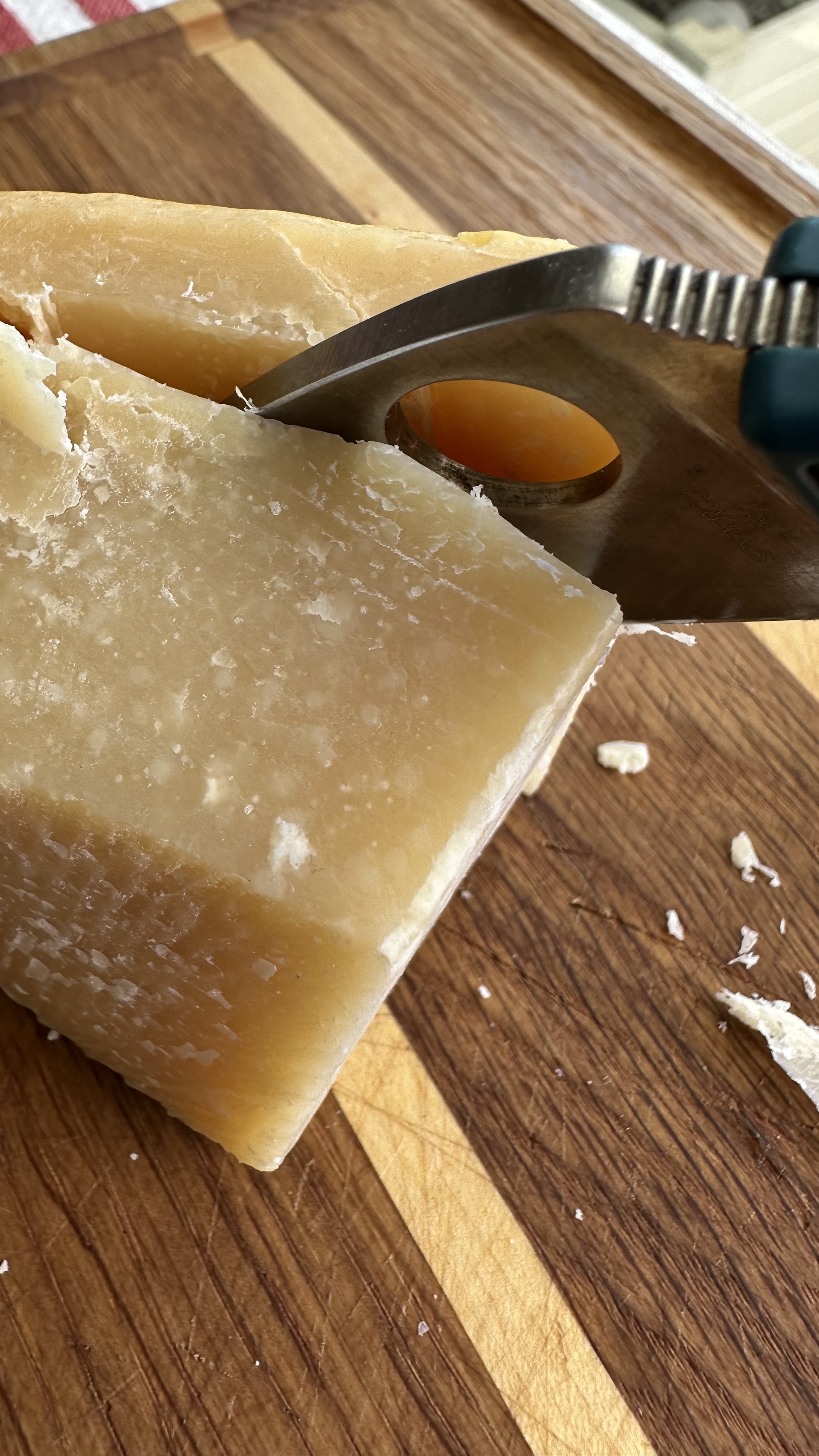
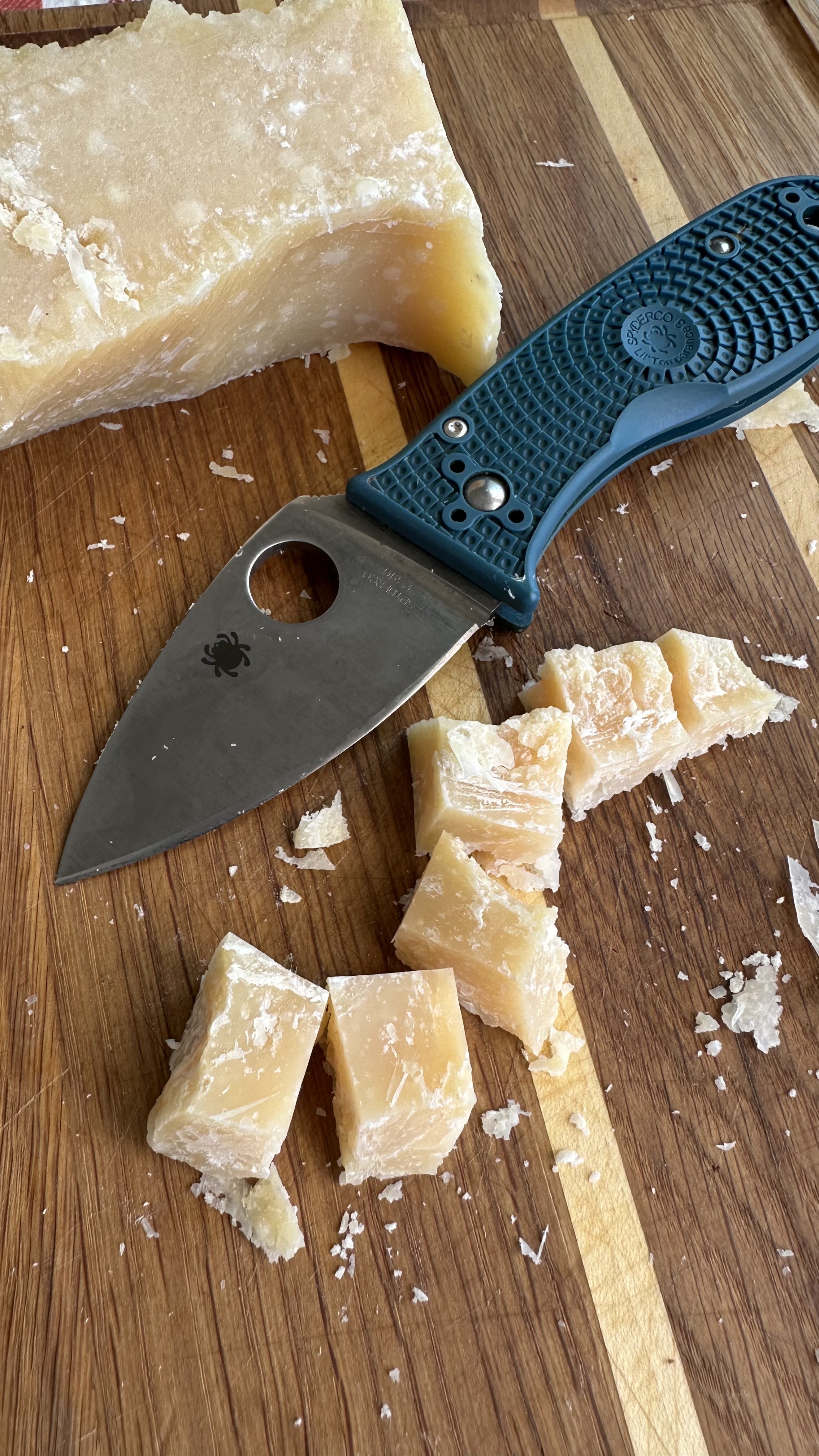
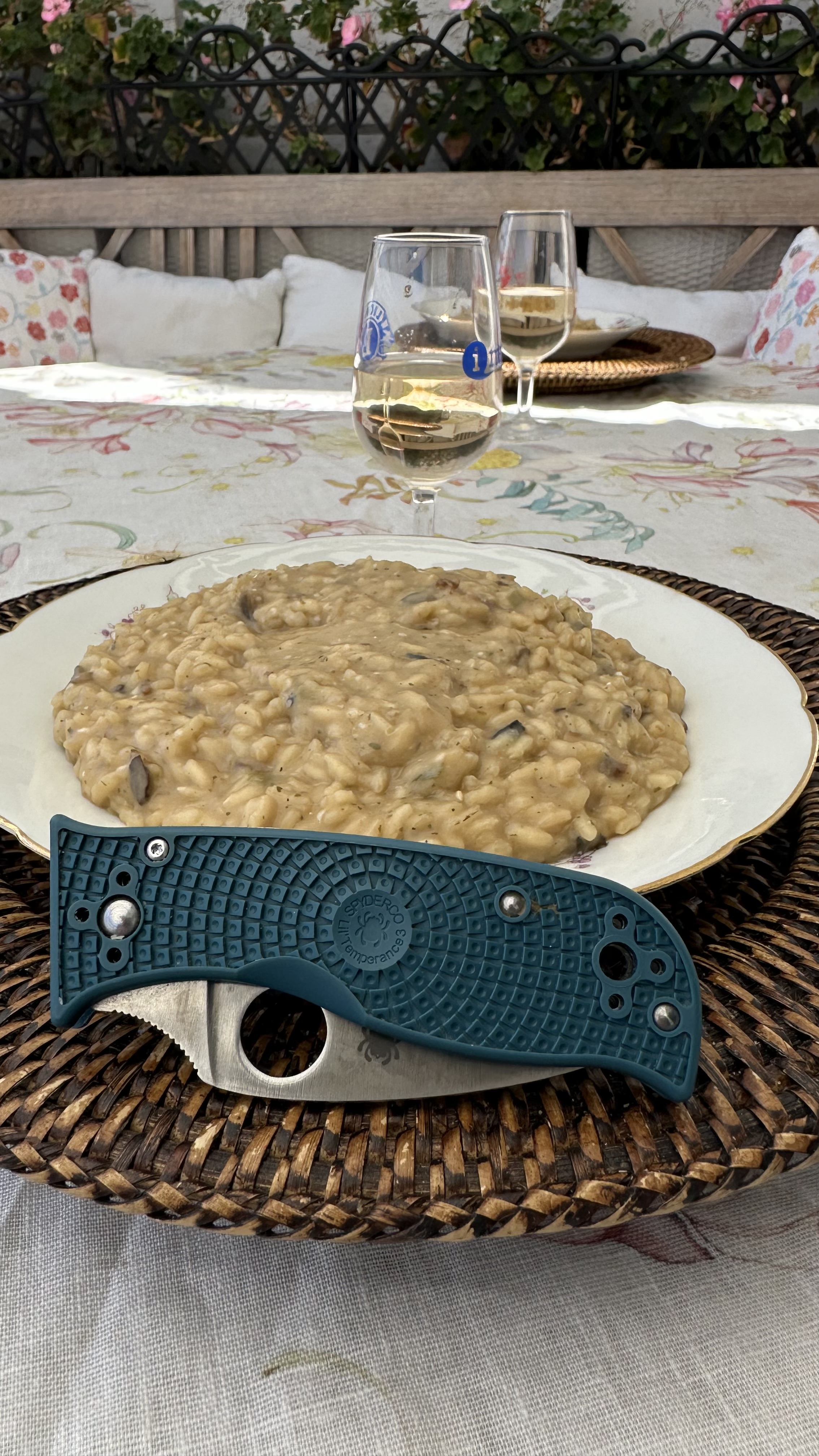
Another example of relatively demanding use is making this risotto using
an old chunk of dry Parmigiano which needs to have its rind removed, then cut into half-inch cubes — no easy task given how hard the cheese can be.

It’s also a great way to detect hot spots: the weakest point, if any, in the compression lock. That notch on the back of the handle all but guarantees a sore hand after extended use.

Apart from a single trip into the woods, I’ve mostly used the Lil’ Temp in the kitchen, where it’s been steadily building a nice patina. I’ve also taken the opportunity to test its ergonomics with wet hands. The FRN handle pattern is one of Sal Glesser’s great innovations: it gives the knife a no-nonsense, tool-like appearance while ensuring the handle stays locked in place once gripped.

Conclusion

The Lil’ Temperance 3 K390 Lightweight (“Shorty”) stands out as a compact powerhouse in Spyderco’s lineup. With its super-steel blade and excellent geometry, it elevates everyday carry versatility, combining cutting performance, ergonomics, and durability in a smaller format.

Its lightweight build and aggressive handle design make it a tool you can truly rely on. Whether in the kitchen, at the workbench, or outdoors, the Lil’ Temp proves itself capable of handling demanding tasks without compromise. The FRN handle texture, designed by Sal Glesser, not only lends a purposeful, tool-like look but also ensures a secure grip, even with wet hands.

From reviews across the community, a consistent picture emerges:

  1. Exceptional cutting performance — even in tasks where utility blades struggle
  2. Superior carving and utility — excels at both fine control and hard work
  3. Secure lockup — the compression lock feels noticeably beefier than on similar models
  4. Excellent ergonomics — comfortable for long use, even damp conditions
  5. Edge retention — the K390 steel holds its sharpness impressively well
  6. Durability — little to no wear after months of use
  7. Practical carry — light, compact, and easy to deploy one-handed
  8. Minimal maintenance — just regular wiping and light oiling keeps it in peak condition

As one reviewer put it, this “box-destroying little chode of a knife” punches well above its size. Another called it “a tank… carefree, strong AF, and super comfortable.” After extended use — from food prep to cardboard — users report only minor stropping needed, with many calling it one of their favorite Spydercos in decades.

In short, the Lil’ Temperance 3 K390 Lightweight is a sleeper hit: not the most popular Spyderco, but for those who carry it, often a personal favorite. A compact EDC with the heart of a work horse.


GETTING A CONVEX EDGE WITH THE CPM-15V BLADE OF THE HOULAHOULA PARA3 LIGHTWEIGHT PART 2.

Since the first try of convexing the Para 3, it is time now to reach the same level of de-shouldering as on my Sage 5 Salt.

My goal here isn’t to touch the edge itself, but to smooth the border between the flat of the blade and the edge angle. This allows me to maintain the edge primarily on leather while reducing drag when cutting hard materials like plastic or wood.

The equipment I used was again the Spyderco Double Stuff 2, focusing mainly on the diamond side. I experimented with gentle, round strokes on the flat diamond stone instead of always moving in the same direction — it seems to remove metal much faster.

For aesthetics, I plan to follow up with white ceramic or jade stones to approach a mirror finish, similar to the Sage 5. Magnacut responds beautifully to polishing, whereas CPM-15V doesn’t particularly care.

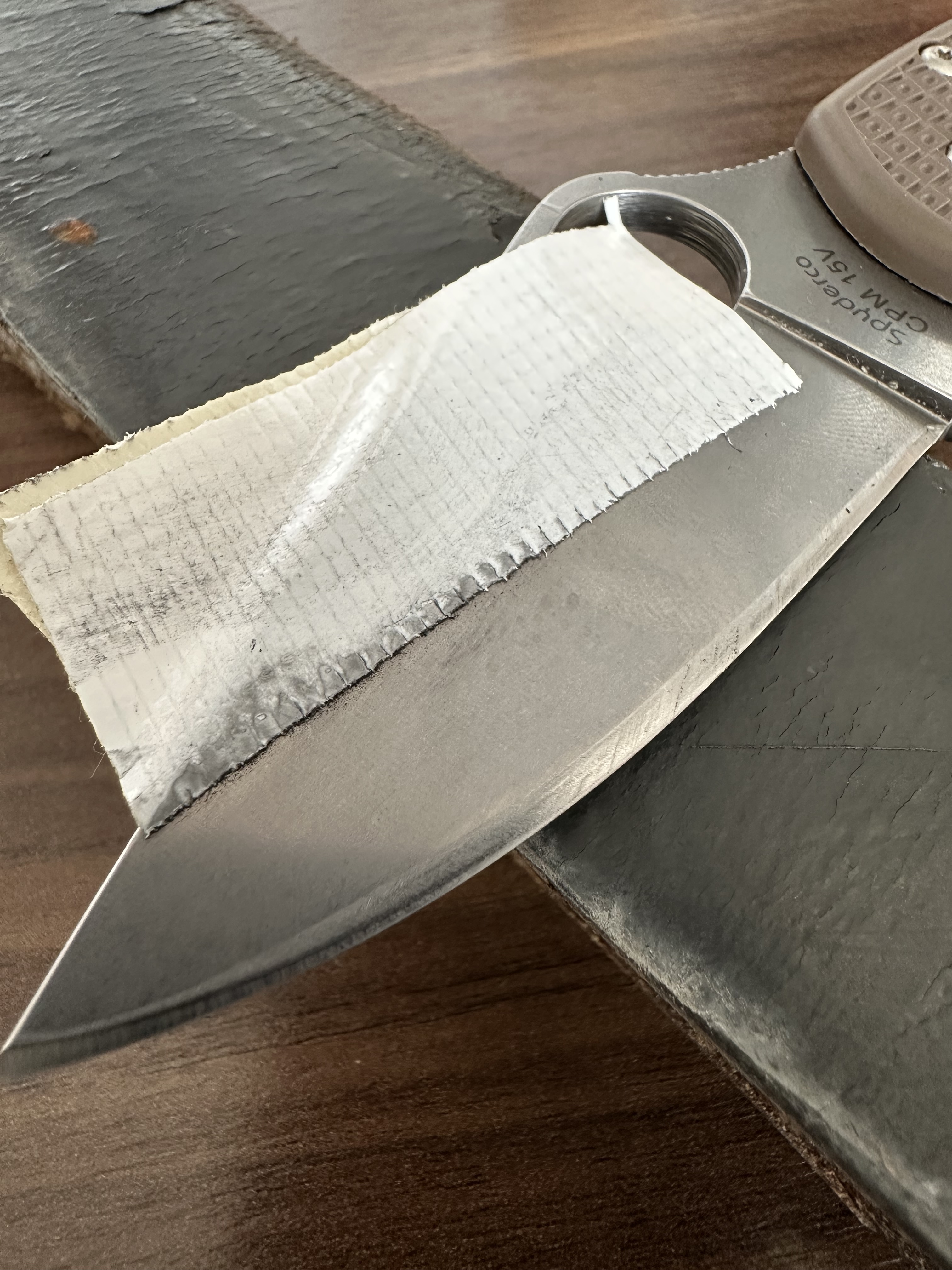
The use of gaffer helps preventing any deep scratches on the blade finish.
It works great. The black dust is metal removed by the diamonds.
I do that outside in the wind. I don’t want to breath that dust.

Eventually this second round has gone so smoothly (compared to the first one linked at the start of this review) that i was on the verge to work on the Military 2.

Remember Sal saying:
The Edge is a Ghost. Always changing. Dying (dulling) being reborn (sharpened) split personality (angles and geometry changing). Think of the edge as gas in a vehicle. It runs out of gas and you put in more gas. We provide the format, materials, design for use, variety to avoid boredom and create interest, but the edge is your creation. The result of your understanding, education, experience and practice.

The comparison between the Sage 5 Salt and the Para 3 continues. In short: the Sage 5 has superior geometry thanks to its high 3 mm FFG blade, while the Para 3 features a sturdier blade, a thinner point, and is overall lighter (no steel liners).

It’s really your choice — both are highly capable and complement each other, coming from the same design mind. Shawn Houston even notes that the Para 3 carries “that Delica vibe.”

I’m impressed by the Sage 5’s exceptionally smooth action — one of the best among Spyderco’s compression lock knives. I love both knives. These days, the Sage Salt rides with me, but while both won’t let you down, the smooth Sage is more fidget-friendly. Both are great, but the Sage 5 is simply less popular… 😉

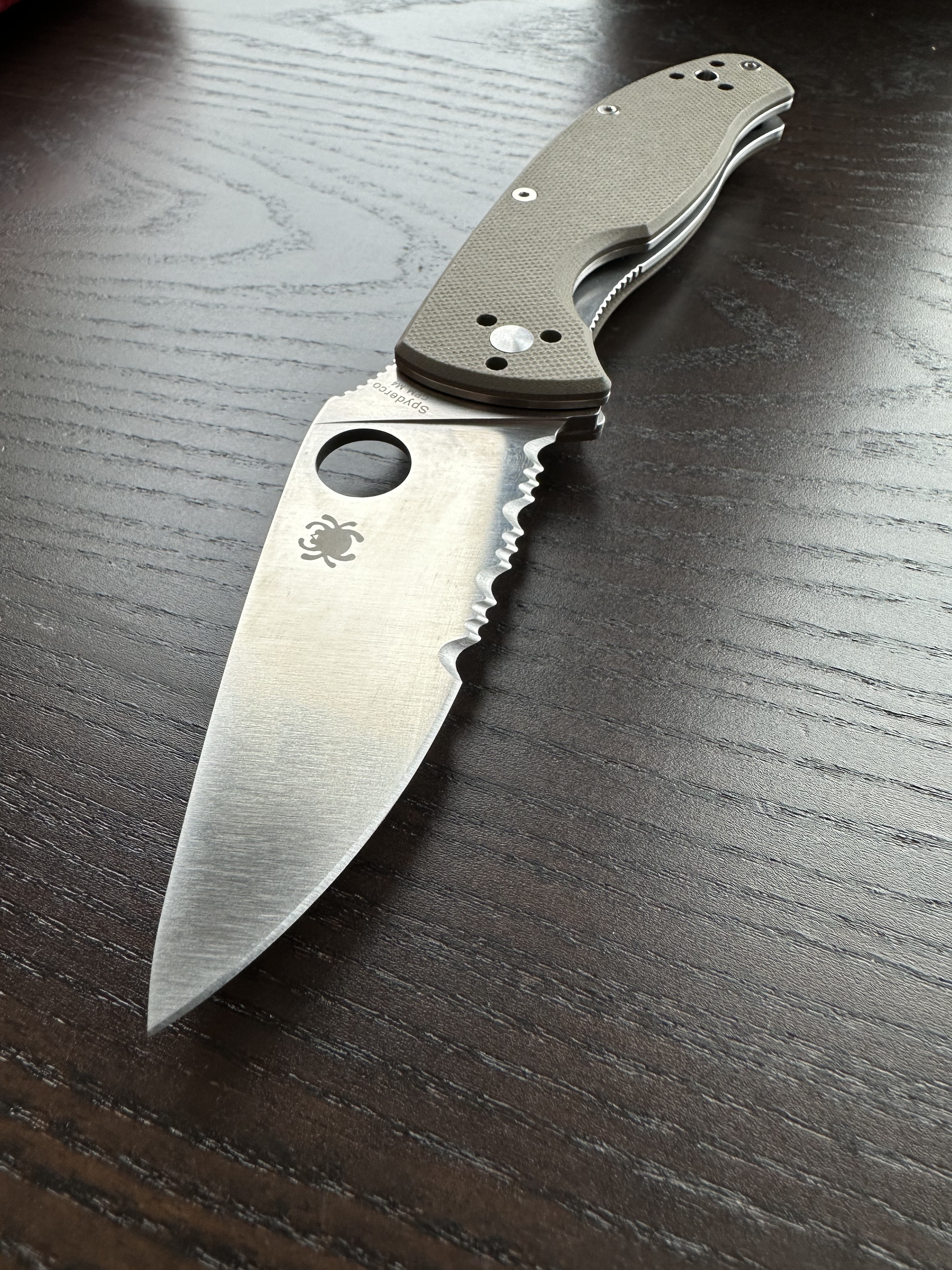
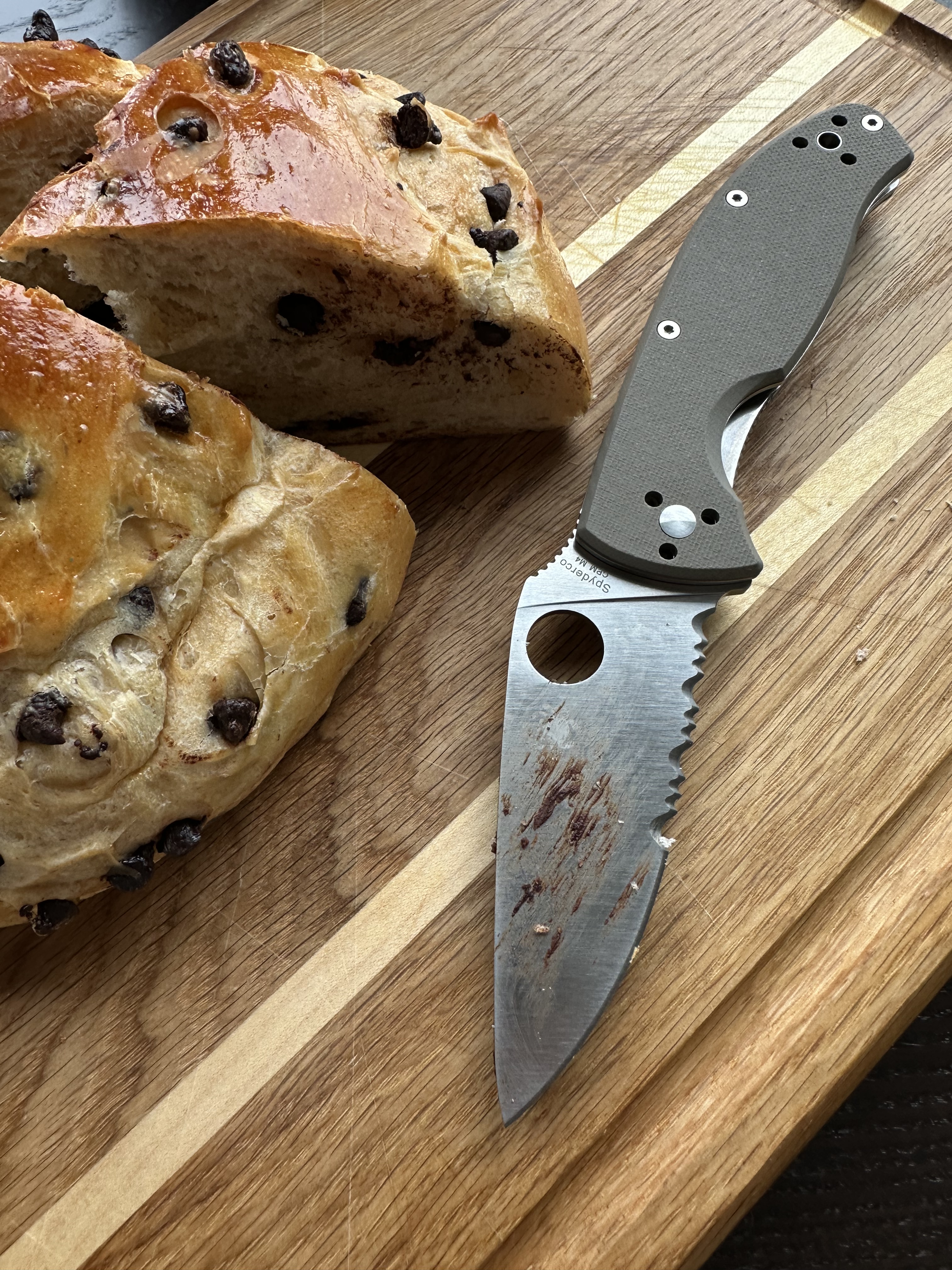
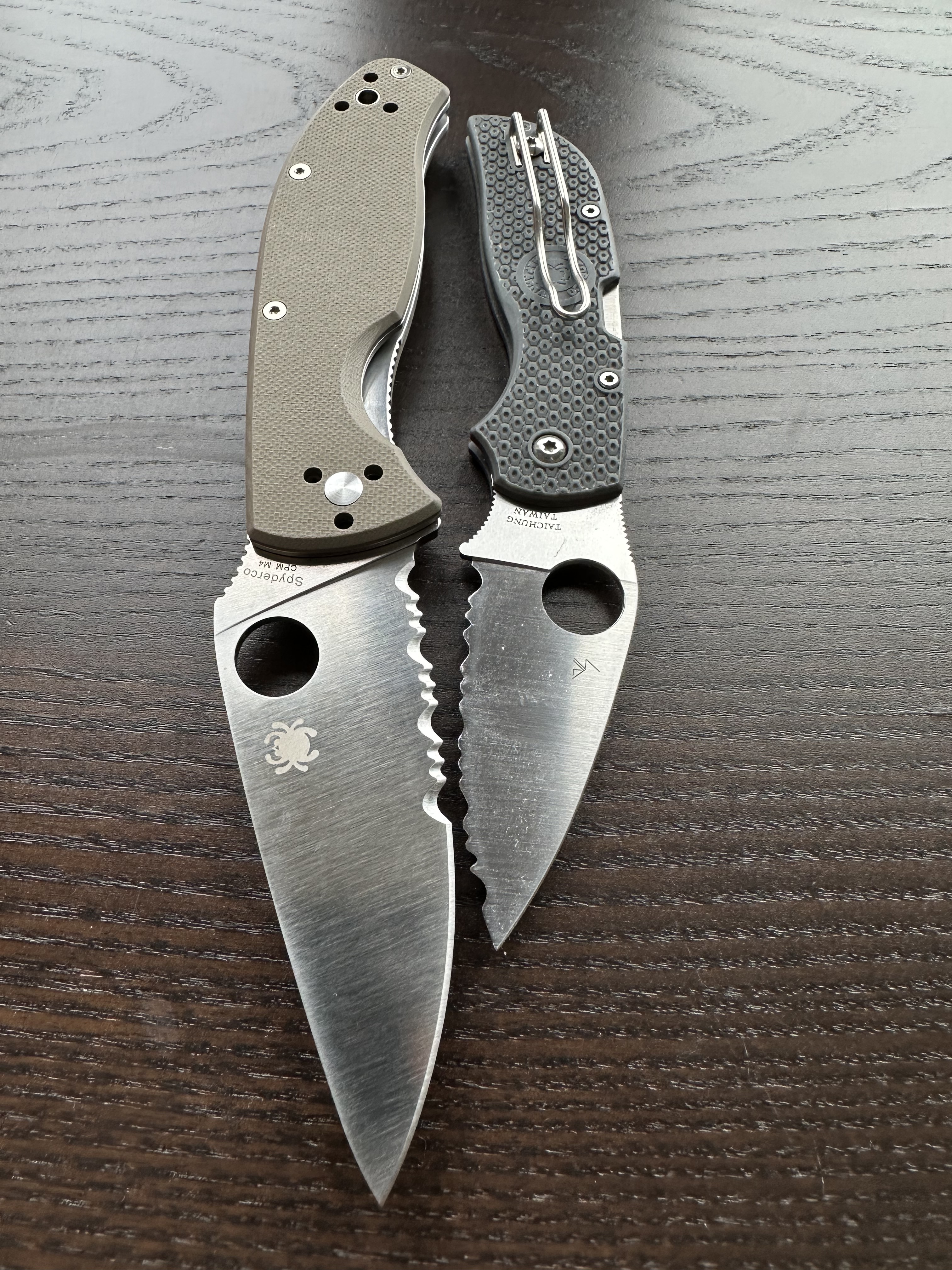
Spyderco Tenacious C122GBNM4PS – CPM-M4 with Serrations – Pure Workhorse

I’ve been tenacious — truly tenacious — in resisting the C122 Tenacious, even though I’d had my eye on that folder since 2008. After 17 years of flirtation, I finally ordered one. Why the delay? Its main weakness was always the less-than-stellar steel compared to the high-end knives I already owned.

Now, the CPM-M4 version is here to quench that long-standing thirst.

I don’t have much memory of a CPM-M4 serrated edge, except with another Eric Glesser design: the Dodo Exclusivefrom Blade HQ (C80GM4S). The Dodo was a real wood slasher — its S-shaped blade trimmed vines deeper and faster than almost any other, and the comfortable handle was perfect for power cuts.

Opportunities to play with a serrated CPM-M4 edge have been rare — until now. Here it is.

Back in 2008, when the Tenacious have been released it was a success.

Eric Glesser’s design was appealing to many for a simple reason: it was a well-thought-out, tough workhorse knifeavailable for around €30 (or less). A true blue-collar tool — built to be used and abused, like a modern-day Buck 110 for the pocket.


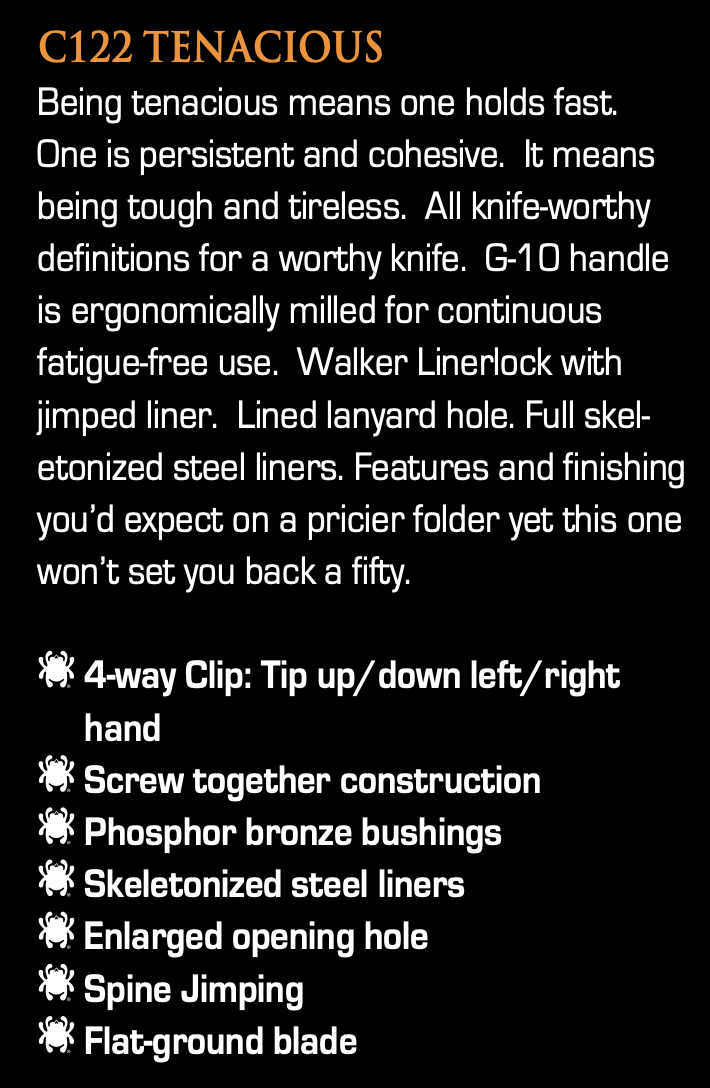
The best thing about the Tenacious was that it offered a thick, sturdy, well-built liner lock at a time when liner locks were falling out of fashion. Easy to display, easy to use, this no-choil, long-edge, compact working folder from Eric Glesser was a hit — and one of the best ways to catch the Spydervirus.


Now there is a FRN version in CPM S35VN. But it is as heavy as the G10 version and I’m not really a fan of FRN… Even if I absolutely love the FRN scales of my Serrated Chaparral.

I remember Bushcrafters being the first to sing the praises of the Tenacious. An example:

I’ve thrown it, dropped it, batoned wood as thick as my wrist, chipped the edge multiple times (didn’t think 8cr13mov could chip, thought it was too soft but was wrong), I’ve left in outside ONCE in the rain overnight because I forgot I placed it on my front porch the previous day, I have spine whacked it (just don’t, I most likely have an impulse problem… lol … same problem that causes me to buy a lot of knives) I’ve dug holes, stabbed the ground to cut weed roots out, and much much more...

I think by now you get the point. I treated the tenacious as if I got it for free and had 1000 more to replace it if something happened. I treated this knife as if I hated it.

The result? 4 years later, the Tenacious opens smoother than it ever has, not a speck of rust since I purchased it, I have oiled the blade a couple times but I can guarantee it was less than 20 times total in the last 4 years, lockup is a bit less solid, BARELY any blade play from side to side, even less blade play from front to back, g10 scales look smoothed over and scarred, but to be honest there is still plenty of traction.
All in all, this knife is much more than what most of you need from a folder.”

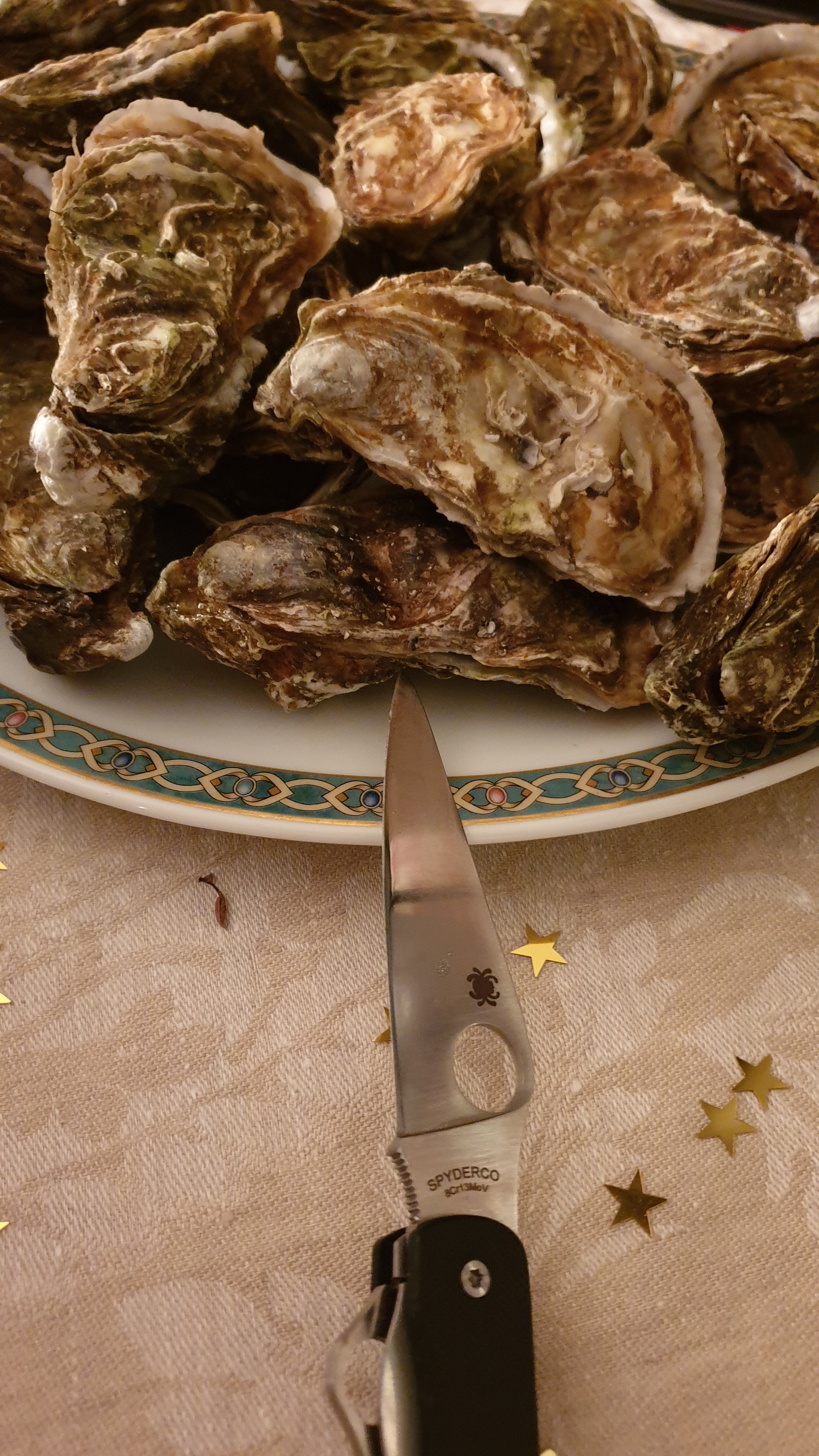
My Persistence experience was excellent as described in my 2012 review (green words lead to link) but eventually I was disappointed with their steel. 8Cr13MoV can get sharp but lose sharpness much too fast for my uses. It was frustratring. I still got 8Cr13MoV knives like the Clipitool which is a great oyster knife. 8Cr13MoV is tough for a stainless steel, no surprise it was chosen for the Tenacious line.

The Tenacious is a sturdy well made liner lock folder with a super tool steel blade.

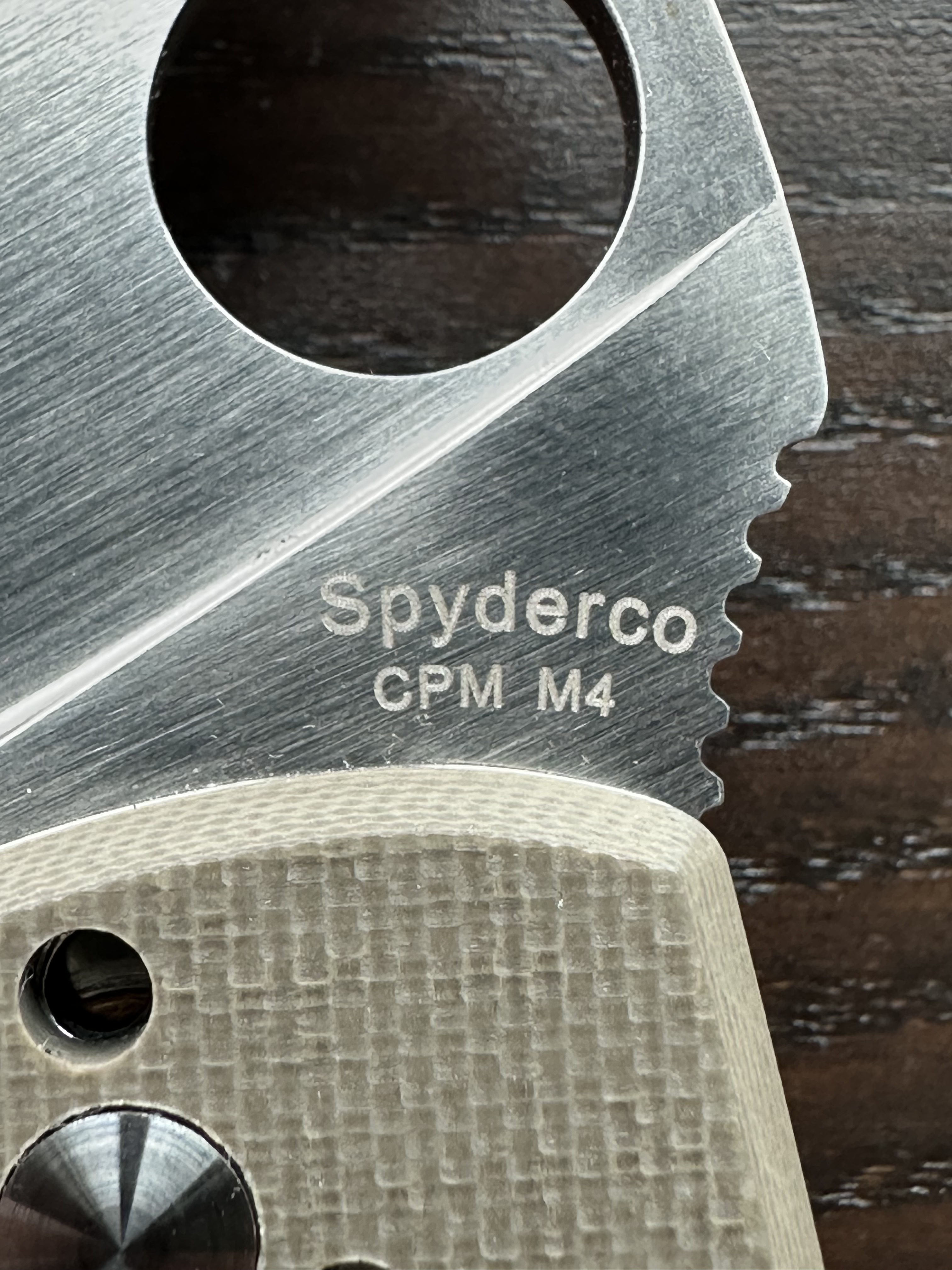
“This remarkable expression of the Tenacious® elevates this best-selling design to all-new heights with a blade crafted from American-made CPM M4 tool steel. Produced by the particle metallurgy process, CPM M4’s sophisticated alloy composition, high vanadium content, and extremely fine grain structure give it exceptional wear resistance and toughness-properties that translate to outstanding edge retention and impact resistance in knife blades. This knife’s full-flat-ground blade is available in both PlainEdge™ and CombinationEdge™ formats and is housed in a handle featuring brown peel-ply-textured G-10 scales.

I have written many reviews about that fabulous alloy CPM-M4 it has never disappointed me and since I have sold my CPM-M4 Military and kept my Yojimbo 2 and Mantra 2 (reviewed and sharpened by JD) and use them hard, I know it is reliable and get a nice patina.

A lil’oil will prevent rust. CPM M4 is not 52100 and the patina will come slowly after cutting some lemons…
CPM M4 has good edge holding, sharpening ease, toughness, strength, and is not a rust monster…” to quote Rangodash.

Now a blade is 1/3 steel, 1/3 Heat Treatment and 1/3 geometry.

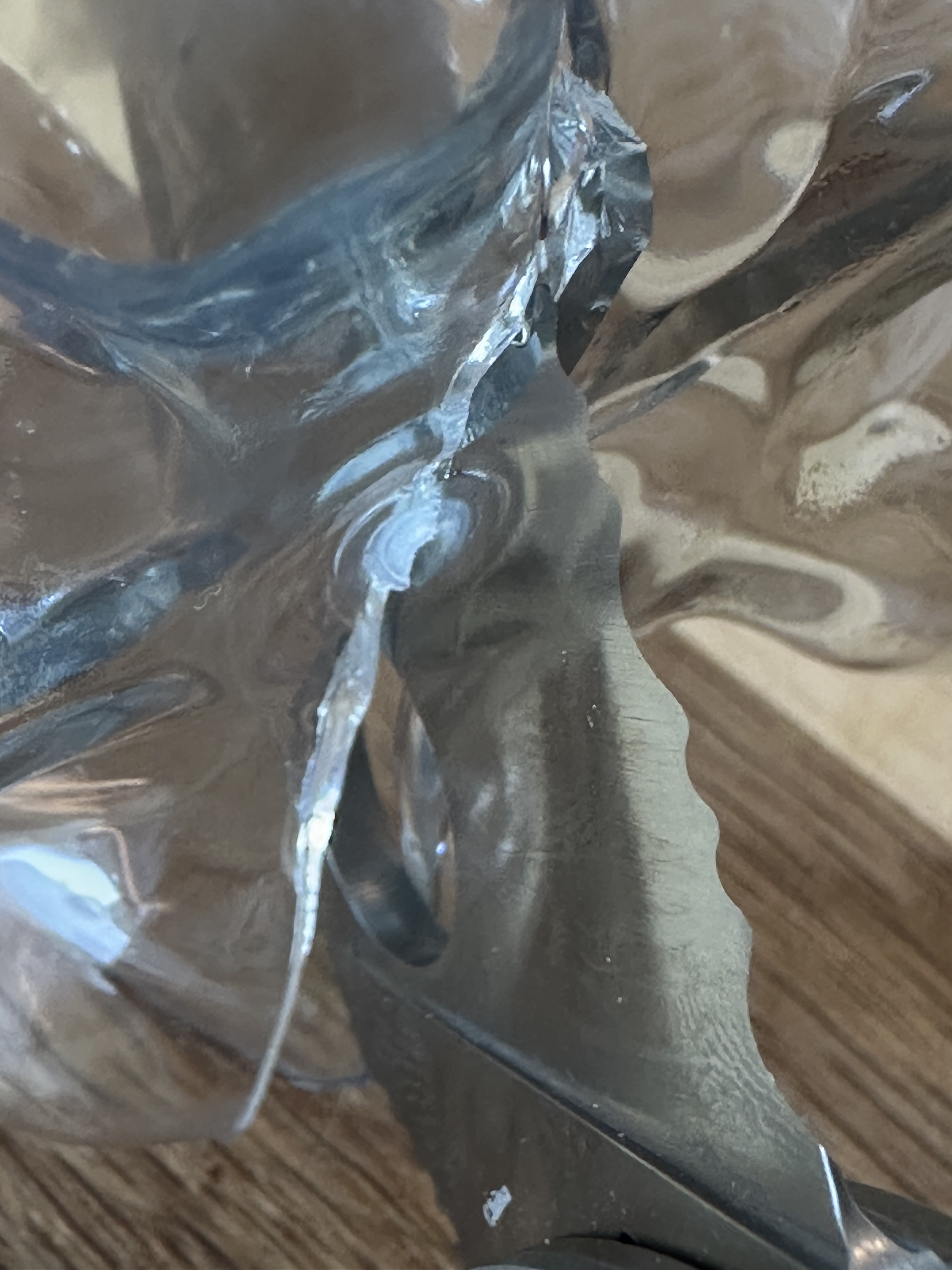
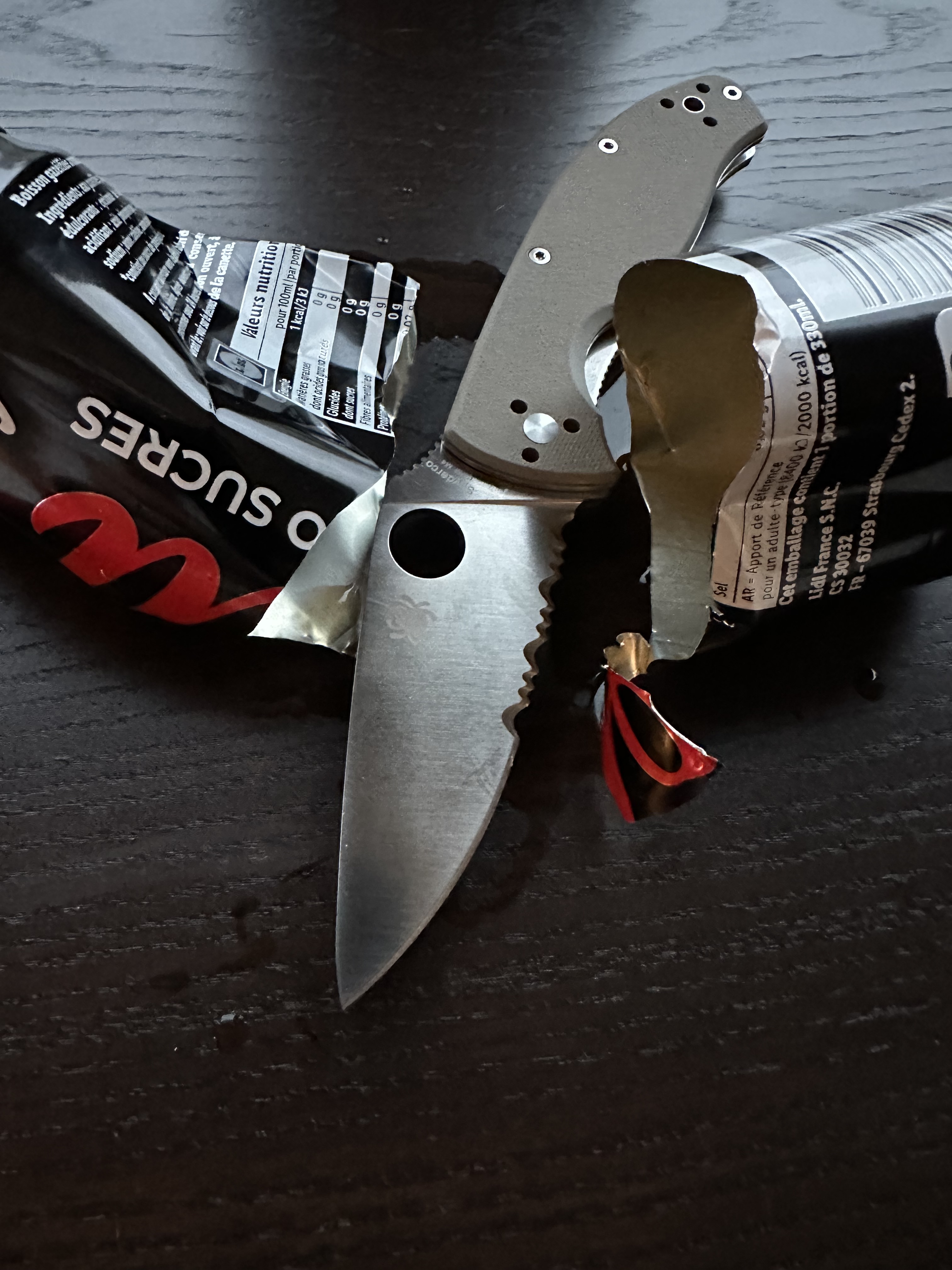
The Coke butt bottle pushing cutting test has been done with the factory edge right out of the box. It is thin behind the edge.  It’s a good blade thickness for more nuanced jobs, but there is added strength from the thicker spine. 

The knife sliced right in the middle were the materiel is thicker.
This is just outstanding !

There are a great geometry and a thin edge on that tough CPM-M4 blade. The result is a sturdy matter separator.

It is not an exploit to cut into some tin can but the same “shallow”, “non snaggy” kind of serrations as the Chaparral made it easy.

Again, this is a “performance oriented” knife. The blade is not too thick like some “tactical” toys. It is made to perform not to show off.

“For notching, serrated edges work great. Feathersticking, maybe, maybe not. Serrated edges are ground on the show side, so they actually work better when used left-handed for cuts like that. I carry a serrated K390 Police4 all the time for rough work. It goes through little volunteer elm trees like a chainsaw. A SharpMaker makes it a breeze to maintain the edge.” to quote Yablanowitz.

The liner lock is thick in the same spirit of Gayle Bradley’s folders.
The knife opens with a loud KLAK! — no blade play in any direction. The detent is strong but slightly “elastic,” meaning the blade moves a little before the release/tipping point engages. This makes it very secure, with no risk of accidental opening. I’ve noticed the same elasticity on the titanium version of the Tenacious. It’s important to note: this is not a weak detent — the blade won’t open without a deliberate, serious force.

Using the knife in Spyderdrop mode, a flick of the wrist catches the blade in the Spyderhole with no issue. Closing remains perfectly secure. There’s a tiny squeak out of the box, but a few drops of nano oil should mute it. The action isn’t buttery smooth like a compression lock on ball bearings, but after a bit of breaking-in and running-in, it will be wonderful.

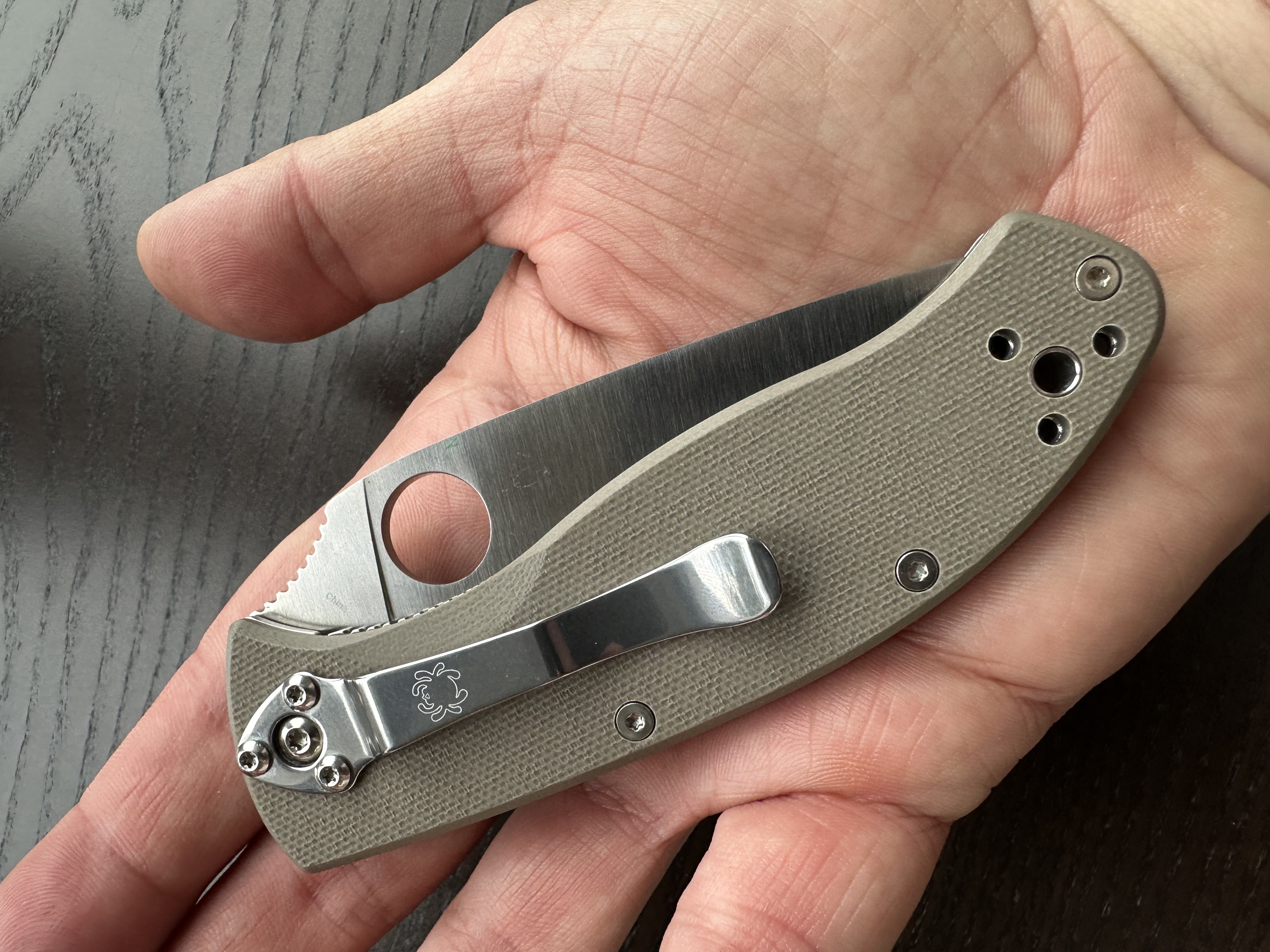
The solid clip is delivered mounted in Tip Down carry, which suits well this knife for the Spyderco Drop featured on the Military 1 which got the same kind of “around the pivot” clip.

I have no intention of using tip-up carry or a deep-carry clip. This knife is a tool, meant for easy access rather than a stealthy edge. The Tenacious is always noticeable in the pocket, but that sturdy clip guarantees quick availability — reminding me of Massad Ayoob’s teachings.

Spyderdropping is an extremely fast way to get the blade into action — faster than many switchblades. Sal Glesser was already demonstrating this skill almost 30 years ago: grab the knife by the Spyderhole and SCHLAK! — it’s open and ready to cut.

The Tenacious features full steel liners, unlike the nested liners on the Military line. There are no backspacers, making it easy to clean under running water. At 120 grams, it’s not a lightweight folder — I appreciate a bit of heft on a working tool. (For reference, the new titanium version is 93 grams.)

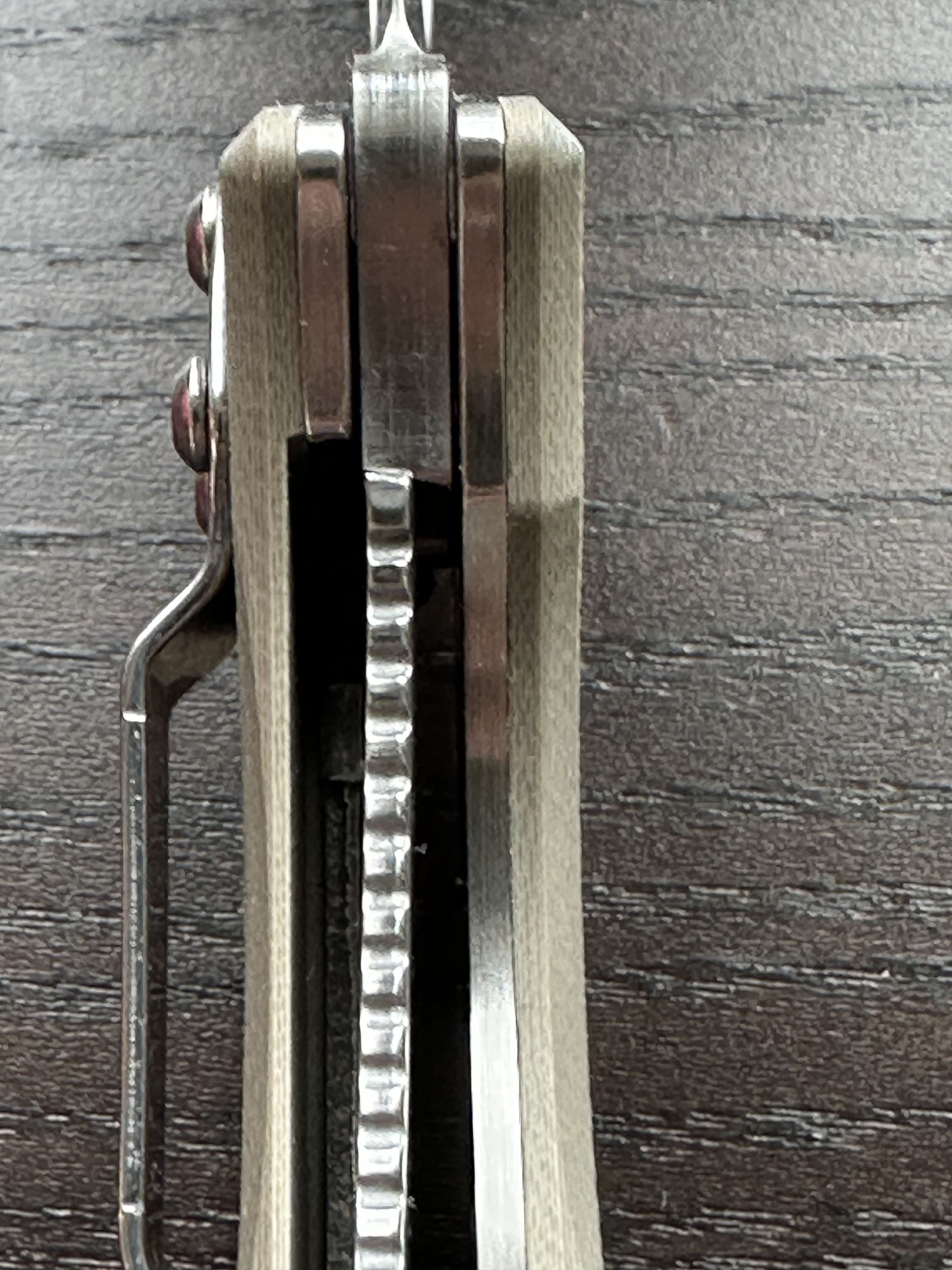
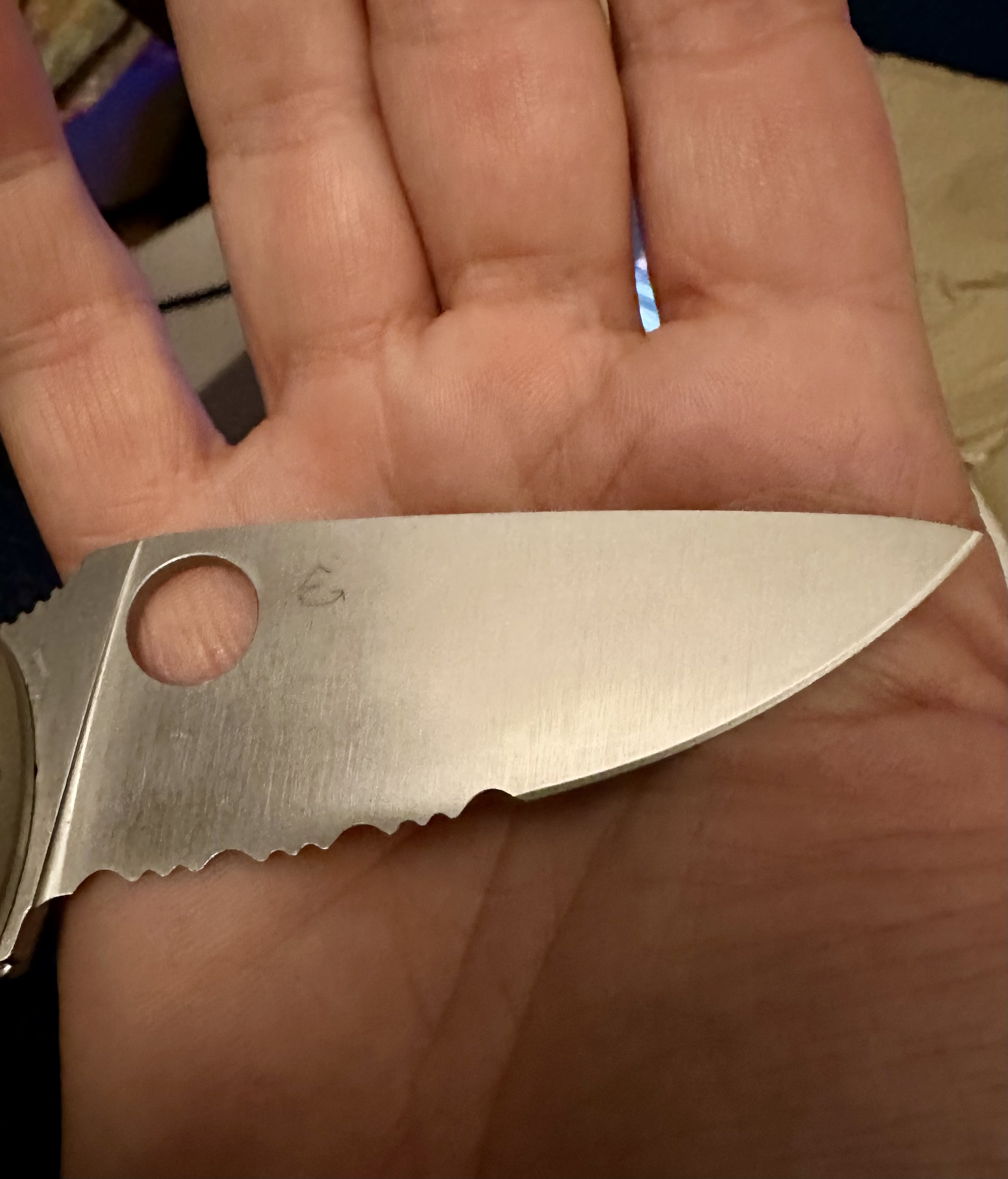
Notice how perfectly centered the blade is right out of the box. The quality control on this “made in China” folder is impressively high.

(Sal’s Titanium Catbird (only 200 were made) next to Eric’s Tenacious.)

Eric and Sal have taken their time with the Byrd Line and their budget line to get the best from a family of makers in China. The Glessers have moved slowly but steadily, developing a trustworthy and excellent relationship with the knifemakers there.


To quote JustinRose40 on the forums in 2011:
“Yes, every time I show someone my Tenacious I have to say “well it’s made in China but it’s not a China Knife, it’s still a Spyderco”. To which they usually say something like, “yeah I could tell that as soon as you handed to me”.

Since 2011, China has made huge leaps in knife manufacturing quality, and this steady improvement is clearly noticeable in the “new” rendition of the venerable Tenacious.

On Eric’s designs, there’s sometimes no choil, but you can notice a clever feature: a “proto-flipper” that acts as a quillon or guard to protect your fingers in case the lock ever failed.

Since 2008, I haven’t heard of any critical lock failures on the Tenacious or the larger Resilience. The Tenacious has earned its legendary status for a reason.

Another Eric design with an excellent blade-to-handle ratio is the Mantra 2, which uses a flipper. (I’m not a fan of that little opening hole — dirt always collects there!) Still, it’s a great design. The Mantra 1, with an opening hole, feels like the Taichung-made “uncle” of the M4 Tenacious.

The peel-ply-textured G10 scales don’t need sanding; they’re well balanced and won’t shred pockets. The brown color makes it feel less threatening, in my book.

Let’s put it to use while the satin blade is still silver.

The knife bites into wood like no tomorrow. The serrated CPM-M4 edge is a joy to use — it goes deep and steady, putting a smile on my face every time.

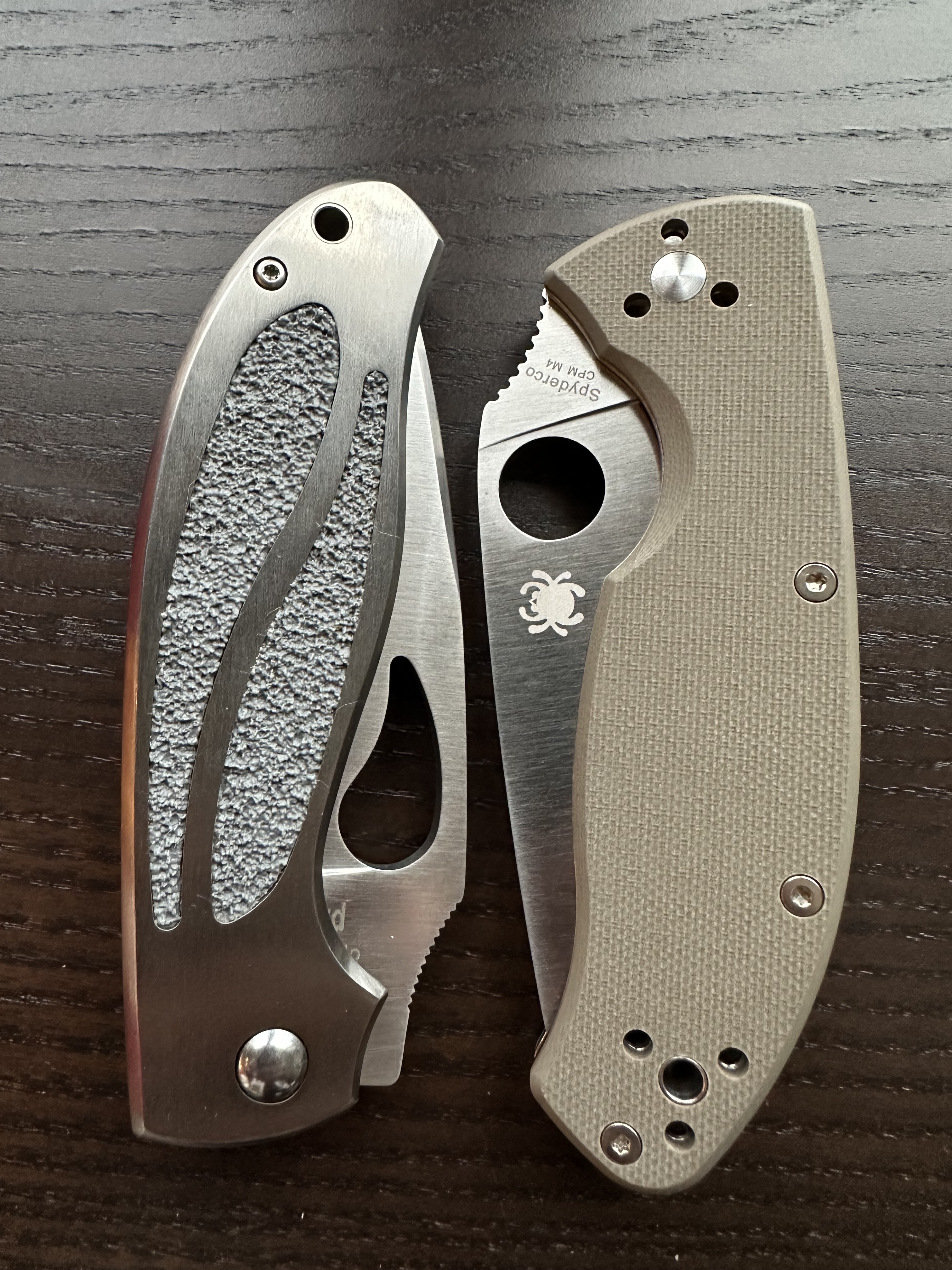
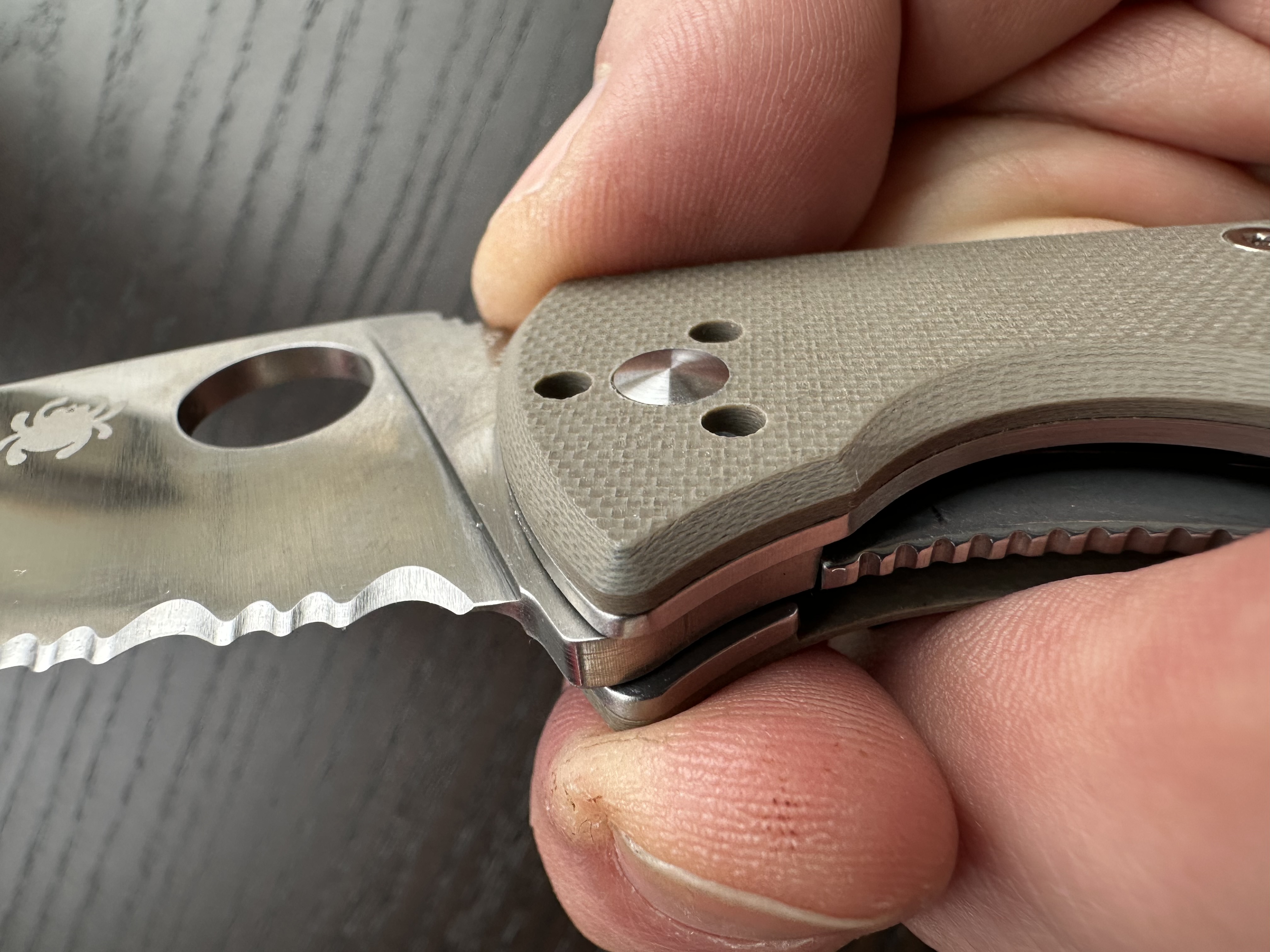
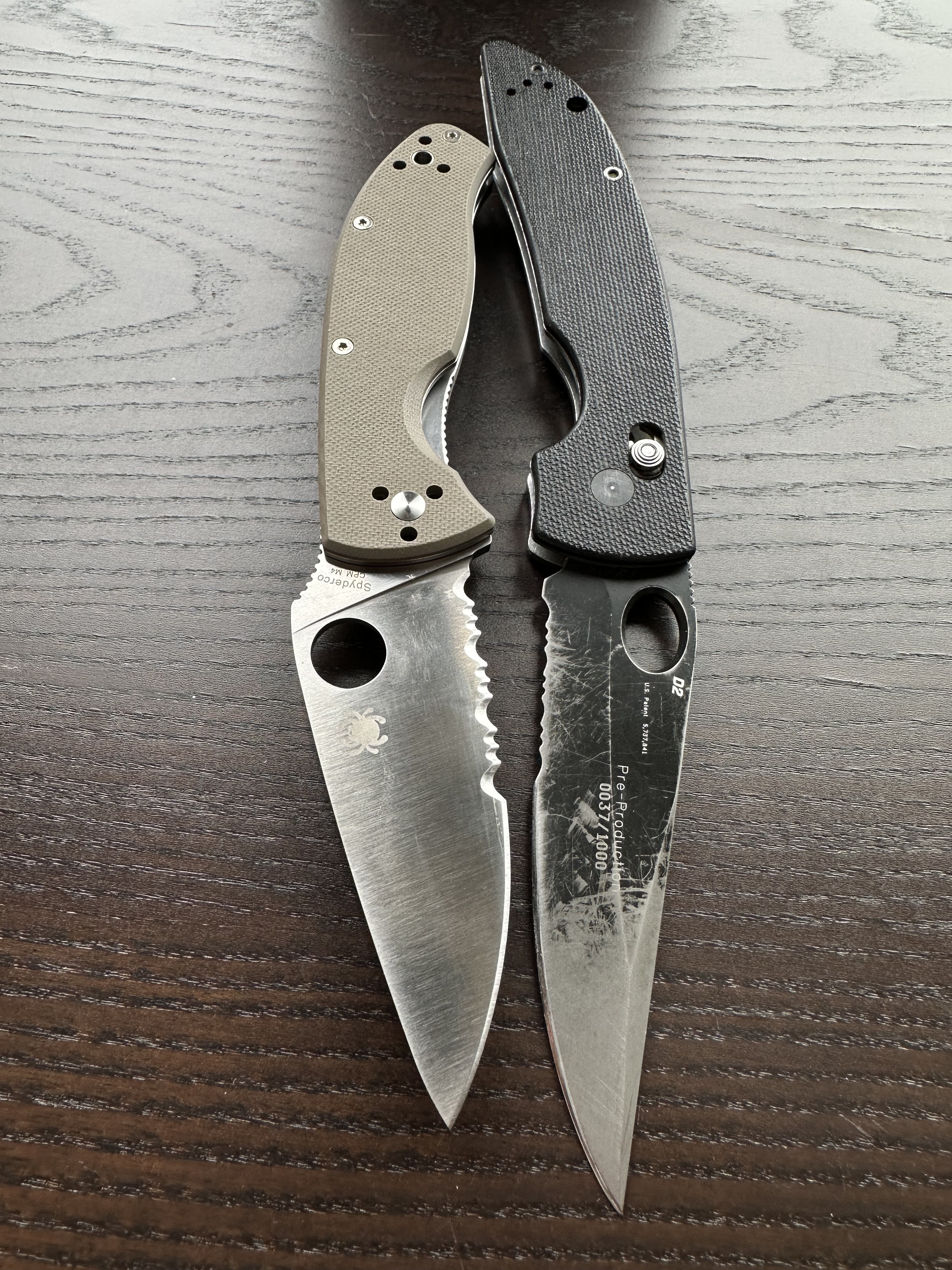
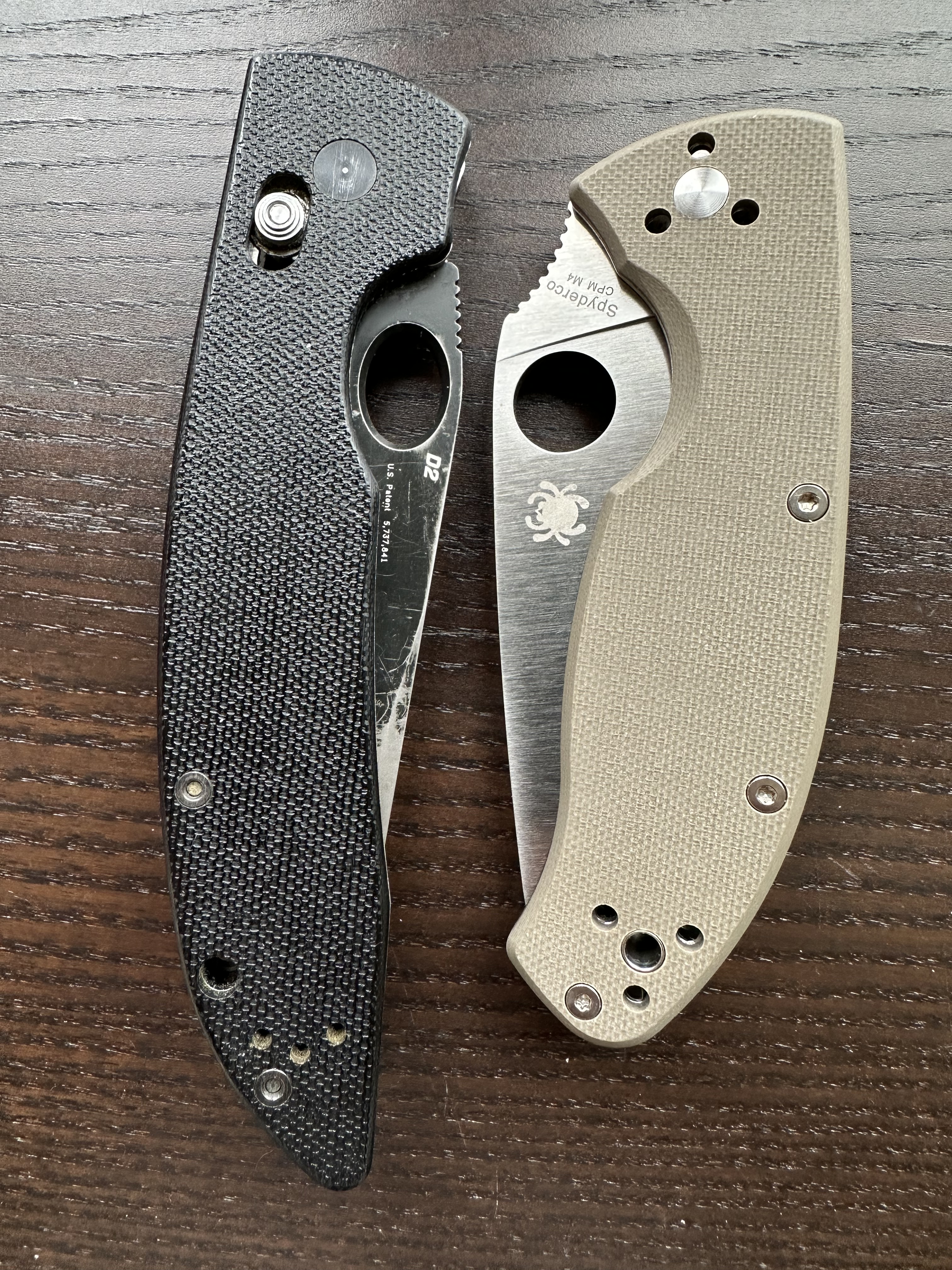
Blast from the past: the last combo-edge/semi-serrated knife I used was over 20 years ago — a Pre-Production D2 AFCK. As you can see, it’s been heavily used, and its geometry, steel, and blade-to-handle ratio aren’t nearly as refined as the Tenacious.

That macro shot shows the very smooth way to go from chisel ground serrations to plain edge.

“Serrated edges aren’t for everyone, and you may not like them, but you’ve got to get at least one just to try! Keep it around for nasty work, wet abrasive rope, zip-ties, yardwork, or playtime like in the pool, or at the lake or beach. Not to mention fishing duties.” to quote Benben.

The difference in cutting efficiency between a saber grind and a full flat grind is obvious. I don’t need to tiptoe around it — the advantage is clear.

Now let’s compare the Tenacious with various folders and fixed blades.

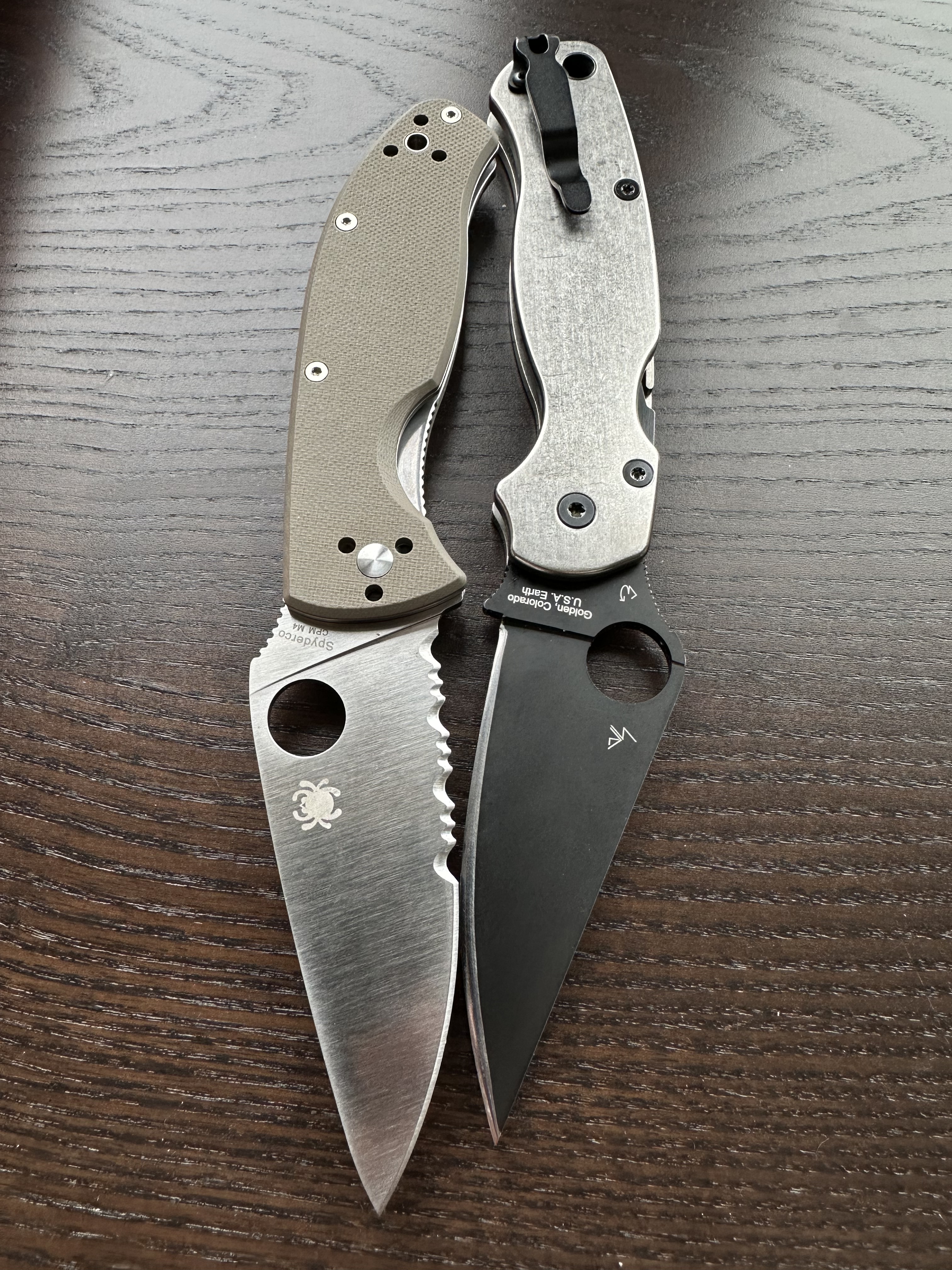
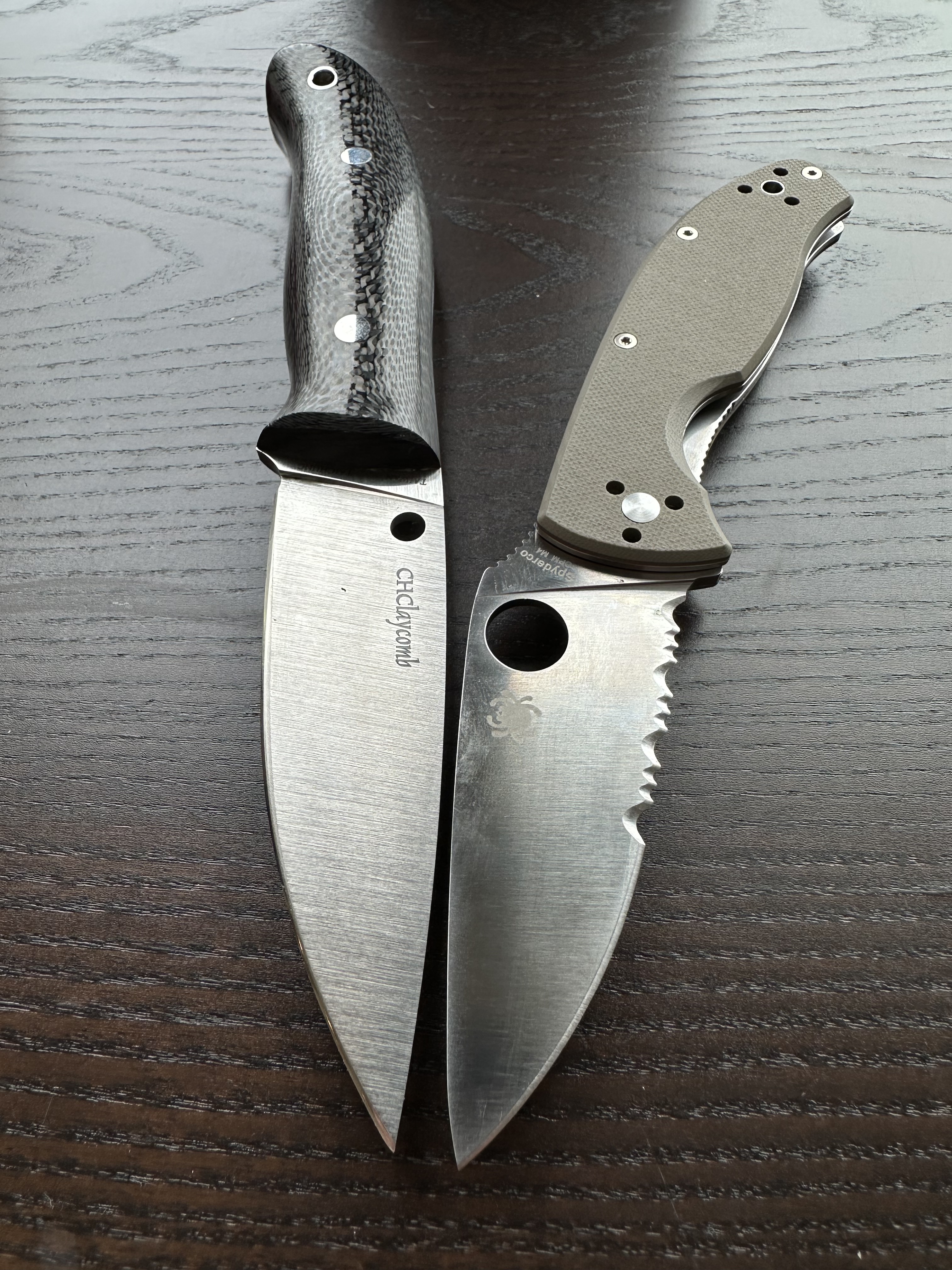
The Tenacious got a better blade/handle ratio than the Paramilitary 2 and a longer blade for a shorter handle. This is one key of the success of that design.

Almost the same length as the Chief.

No choil on the Wolfspyder too.

Since I play with Bushcraft here a nice combo to go in the wood. The Proficient is a masterpiece.

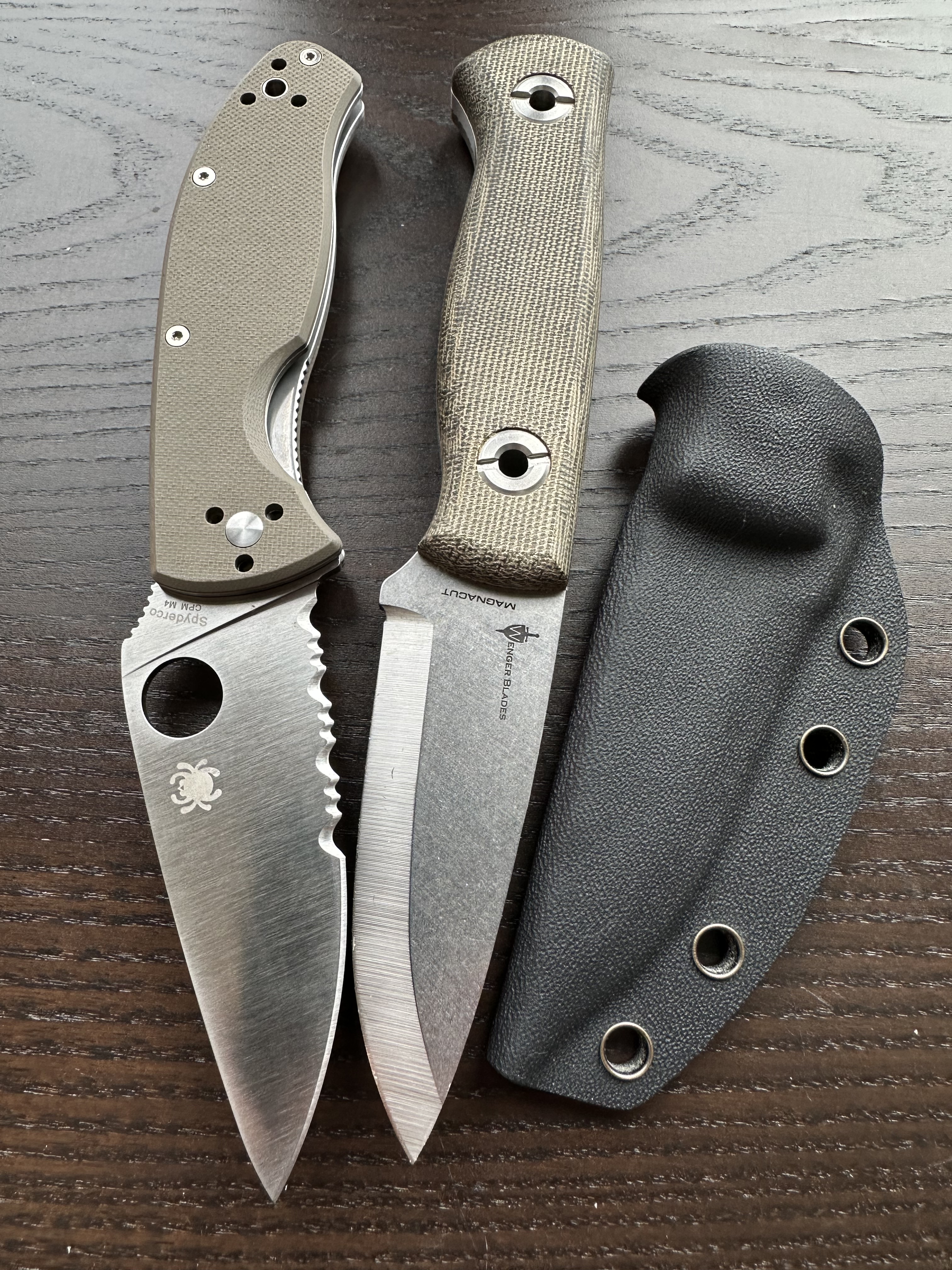
And with the ultra solide Boker in Magnacut. The 8,6 centimeter long blade of the Tenacious is generous edge wise.

Of course, I’ll strop that partially serrated blade on leather — no fear at all. I have my method for serrations, using the corner of the leather pad.

Maintaining the combo edge won’t be an issue; I’ll keep it sharp with cornered ceramic and jade stones.

So what do you get for €139 — the price I paid at the Coutellerie Champenoise? I’m really happy with my purchase. I plan to use the Tenacious a lot and on anything, simply for the pleasure of testing it on various materials. This knife isn’t afraid of plastic, wood, food, bones, cardboard, or aluminum.

This CPM-M4 version is set to show the full potential of one of the beefier EDC knives, especially with its serrated half-edge carved from super tool steel. Over 17 years, the Tenacious has proven it can withstand a lot of abuse.

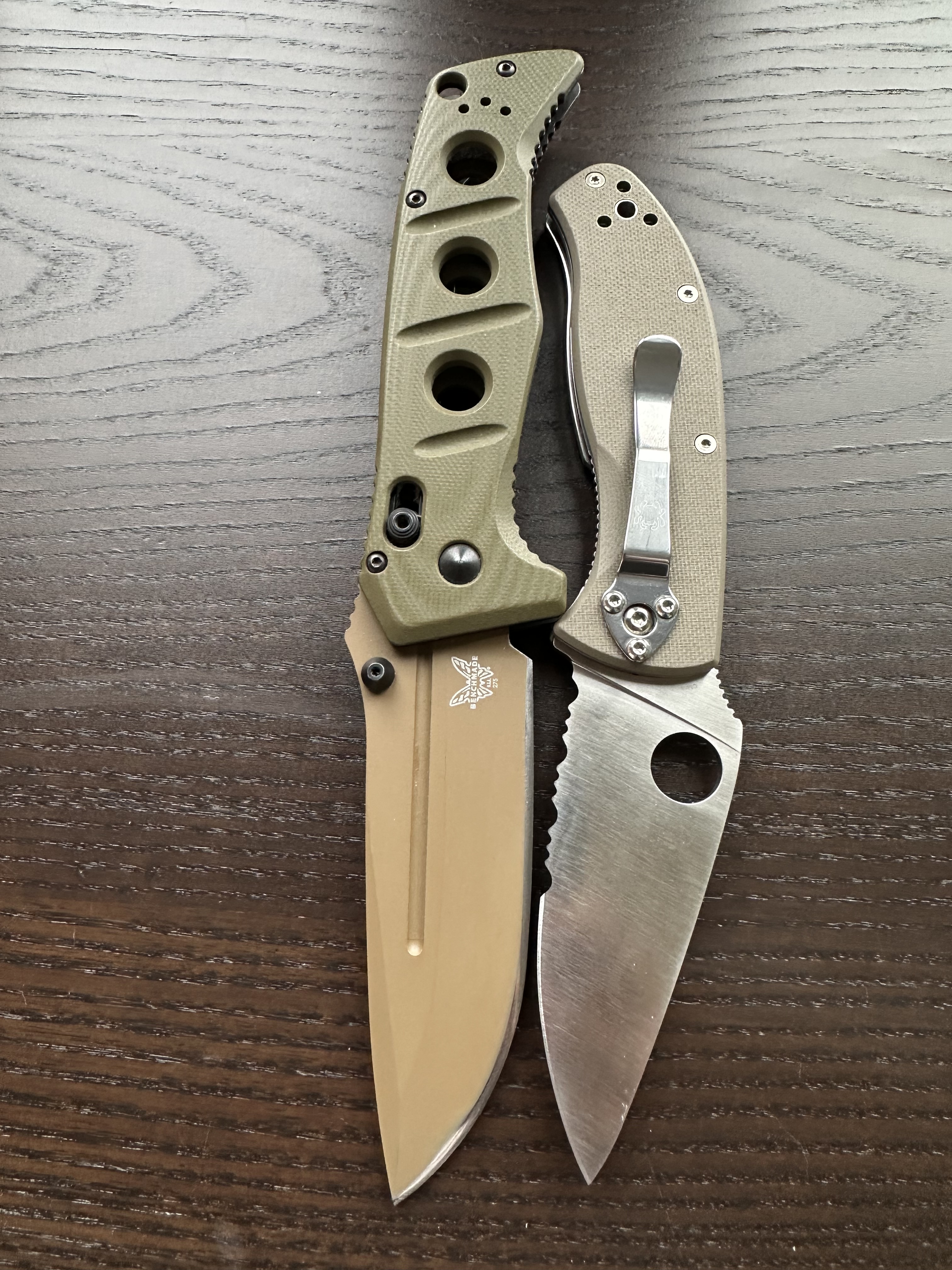
  The CPM-M4 Tenacious is not only a workhorse but a warhorse, like the pictured Adamas. I can easily imagine any soldier being glad to have such a reliable knife at this budget.

It’s slightly larger than small pocket knives, but smaller than the oversized ones some carry just to show off. The Tenacious would make an excellent day-hiking knife — a folder ready for the great outdoors. I’d take it on a trip to Africa or on a photo safari in the natural parks of Tuscany.

(this will often dull the blade’s edge with a little shining spot. Not here… Thanks to the serrations again ! )

This CPM-M4 Tenacious is sold at roughly double the price of the standard version, but in my opinion, it’s a rare chance to have this alloy on that knife. CPM-M4 pushes the boundaries of reliability and is a real pleasure to keep razor-sharp.

CPM-M4 will not chip and stays sharp for long. It’s a steel that has been used in cutting competitions. While Tuff Glideand various oils can keep it spotless, I prefer the protection of a gentle natural patina.

For twice the price of the vanilla Tenacious, this upgraded version delivers another level of performance in terms of toughness and edge retention.

“Old school cool with the Walker lock and satin finish. Well done Eric Glesser!” to quote Clay H on the Forums.
My brown Tenacious looks gorgeous in its “beautility”, practically begging to be used across all terrains — sand, rain, or more. All in all, this beater is a beefed-up workhorse, built to be used hard and carried proudly.


Spyderco -C94GCBL- UK PENKNIFE™ COBALT BLUE G-10 CPM® SPY27® – The Blue Djinn Who Loved Leather.

This is not the first UKPK I have reviewed in this blog. I was a very early adopter of this Sal Glesser’s approach of the modern slipjoint all made in Golden Colorado.
Some of my favorite are the Salt Versions in FRN: the Green LC200N and the Yellow CPM Magnacut. I even think, the serrated version of the Magnacut version could be an amazing legal travelling knife.

But they are FRN versions. I like FRN but I do love G10. Better, I’m a sucker for sanded G-10. Hence my love for the Heinnie Urban and its non-slip peel-ply texture.
At first glance the satin-finished CPM SPY27 blade and signature cobalt blue peel-plytextured G-10 handle scales are juste gorgeous. Here are the full specs on Spyderco’s pages.

Like the Heinnie the skip joint got a strong mechanism. It is really a pleasure to feel this resistance which was totally absent from the very first drop point UKPK a decade ago. (Picture from Mr Blonde, Spydercollector site)

So far, I cannot imagine my self opening it with a flick like I was able to do on the LC200N FRN version. The Spring here on this G10 version is much stronger.

Let’s do some size comparaison. The UKPK is one of the long Slipit in Spyderco’s collection. It is almost a slipjoint Caly, even longer than a Chaparral. So you really don’t feel “underknifed” when you carry it in your pocket as your only EDC. It is also really handy and practical as a kitchen knife. The best thing is that this design keeps its blade length legal in most countries.

For cooking I often use a Native Chief.

The long leaf shaped blade is a must in the kitchen almost idea. It is pointy enough and its is enough for vegetables. Most of the works done in the kitchen like peeling potatoes, cutting oinions, you name it, was always done with a short full flat ground knife like a “Nogent Couteau d’Office”.

Something about the G-10 version is the spring/back spacer closing the handle of the knife when the FRN got an open handle easier to rinse.
But it is much more gorgeous and with a stronger spring for sure !

It also gives a little more heft to the knife. 48 grams for the FRN and 63 grams for the G10 version -> 31,25% heavier to be precise, almost a third ! But I do really love my heavy butt knives since my Schrade Sharpfinger.

Now this is my first CPM-SPY27 knife. Spy27 is a alloy recipe created in house with Crucible exclusively for Spyderco. It is a CPM ! So this is a premium super steel compared to VG10 or N690… In short it is a American Powder Metallurgy version of the Japanese VG10.

In Sal Glesser words:
“We offer many steels for several reasons;
1) We are Steel Junky’s (even Edge Junky’s) and we like to experience the different flavors and we try to do that.
2) We believe that many of our customers are also Steel Junky’s (even Edge Junky’s) and they too get to experience and play with and “taste” as you say, the many options.

I wanted a USA made “tweaked” version of Gingami 1 by Hitachi and after some effort with Carpenter, we have a powdered USA made steel called CTS-BD1N Which is a refinement of Gingami 1. I wanted a USA made “tweaked” version of Takefu’s VG-10 and now we have a powdered “tweaked” SPY27.

Carbone1.25%
Chrome14%
Molybdène2%
Vanadium2%
Niobium1%
Azote0.1%
Cobalt1.5%
Manganèse0.5%
Silicium0.5%


There is a very nice analysis in Knifesteelnerd and discussion here: https://forum.spyderco.com/viewtopic.php?t=94182

However, it should be noted that the SPY 27 Larrin used for testing was not heat treated by Spyderco. Some minor differences between Larrin’s heat treatment and Spyderco’s heat treatment can probably be expected. That being said, Larrin is the best source of consistent, objective data and metallurgical interpretation for steel comparisons.” To quote Karl_H in
https://forum.spyderco.com/viewtopic.php?t=87383

“SPY-27 will hold the fine edge longer… Its all about the stability of the fine edge, not the total wear resistance until fully dull. In this regard, SPY-27 can do what other stainless steels cant.” to quote Submicron in the same thread.

I am aware that Cobalt’s dust can be an health issue. Of course Rex 45 and Maxamet (10% of cobalt, 1,5% for SPY27) are the heavy weight steel in their tool steel category but the Spy27 (like VG-10), like all cobalt alloys needs to be carefully cleaned after a sharpening process.
(Cobalt may cause an asthma-like allergy. Future exposure can cause asthma attacks with shortness of breath, wheezing, cough, and/or chest tightness. * Cobalt may affect the heart, thyroid, liver and kidneys. * Repeated exposure to Cobalt dust can cause scarring of the lungs (fibrosis) even if no symptoms are noticed. According to https://nj.gov/health/eoh/rtkweb/documents/fs/0520.pdf)


Let say SPY-27 is in the same club as the S35VN steels in terms of performance and it especially loves fine ceramic and leather stropping. It gets easily a very crispy edge like VG10 or BD1N . ( Steel which are “leather super friendly” are also LC200N, 52100, VG10, AEB-L… )
This is a must and a real pleasure for me as I keep my knives sharp mostly with leather. A touch up and it makes flying hairs from my arm again.
And it seems true so far. I have not deshouldered the edge yet and intend to use it with the factory edge for some times but leather made it hair popping sharp. (Once deshouldered it is a straight razor with excellent edge retention… much better than S30V).
To quote Sal:
“SPY27 for some reason, seems to be punching above its weight.”

No crossroads, this Blue Djinn loves leather like the Bill Moran FB01 in VG10 loved it.

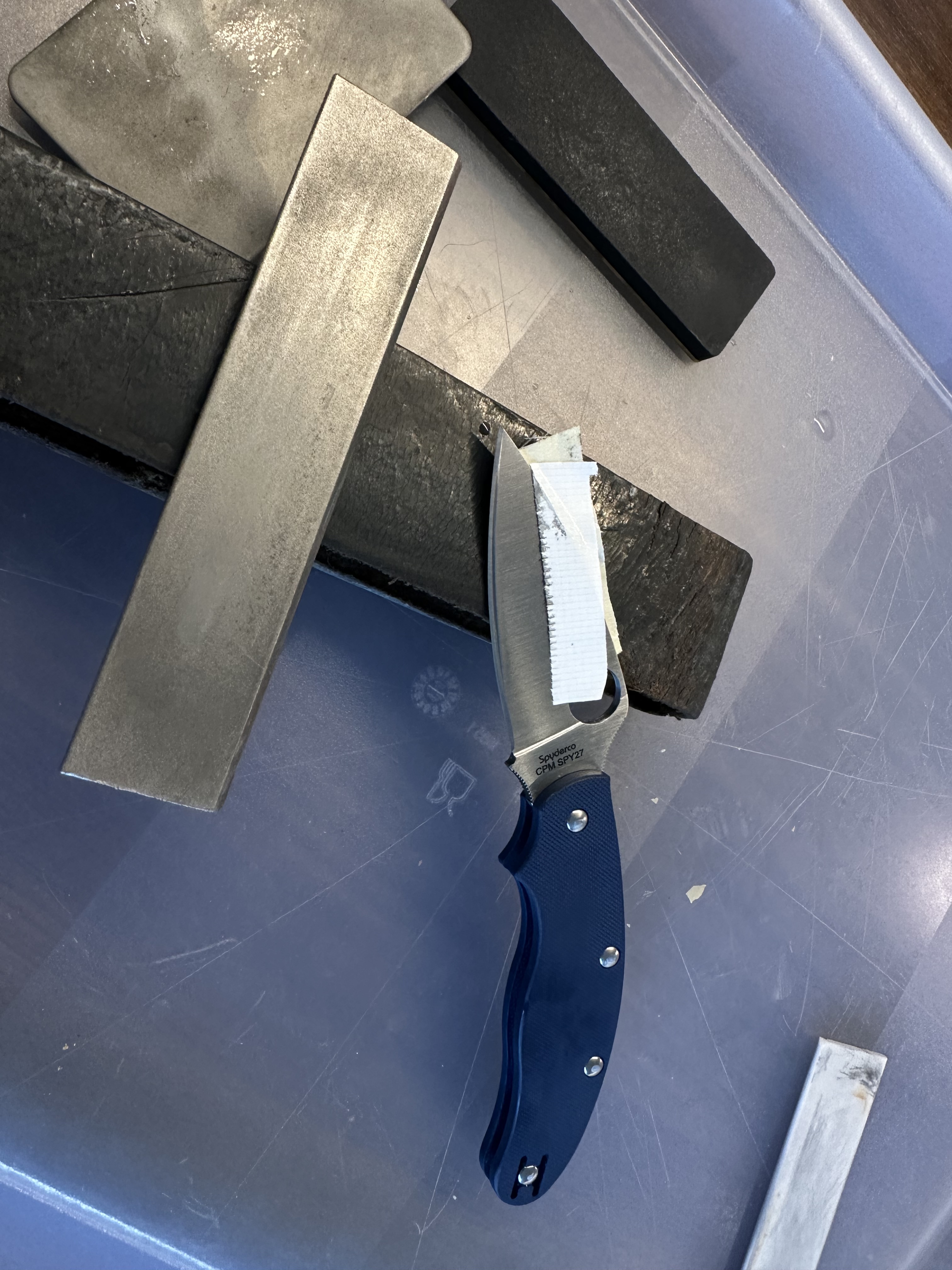
No need to use diamonds unless you want to reprofile the blade or round the shoulder then don’t forget to rinse the blade and to clean any dust.
But talking about dangerous dust, I have sanded the scales to preserve my pockets. Never breath that dust !!! Do it under water or wear a mask.
I got a neighbor who has been working around that kind of heavy dust and now he is breathing with two tubes in his nostrils. So be careful with your health.
This Blue G10 got a very nice texture under the thumb like some denim, textil like. It is really pleasant, almost like some Micarta found on the QSP Penguin.

So when you sand G10, just go outside in the wind or work under water. You don’t want to breath G10 dust made of fiberglass and epoxy.
Just rinse it under the tap to have it back to normal.
Once tuned at your hand, G10 is a very very nice material.

As you can notice the scales are even thicket than the blade and the blade is perfectly centered.

There is the famous middle/half stop when closing or opening the knife. It works like a safety measure. This knife is harder to close than to open.

The UKPK is a very ergonomic knife. It feels like it melt in the hand. It is so confortable for heavy cuts. Because this blade can work hard with zero play.

The “pistol grip” is common in many Sal Glesser design like the Endura or the Military. It is much more pronounced on the Massad Ayoob.

No hotspots for me a very safe handle, really, this lil slipjoint is screaming to be used hard.

It is even confortable edge up.

With the Roadie XL. Another great Slipit with a very low profile, almost like a pen in your shirt pocket.

And the mighty Chaparral serrated. Two of Sal’s best designs. Two wolves in sheep disguise thanks to their thin solid blades.

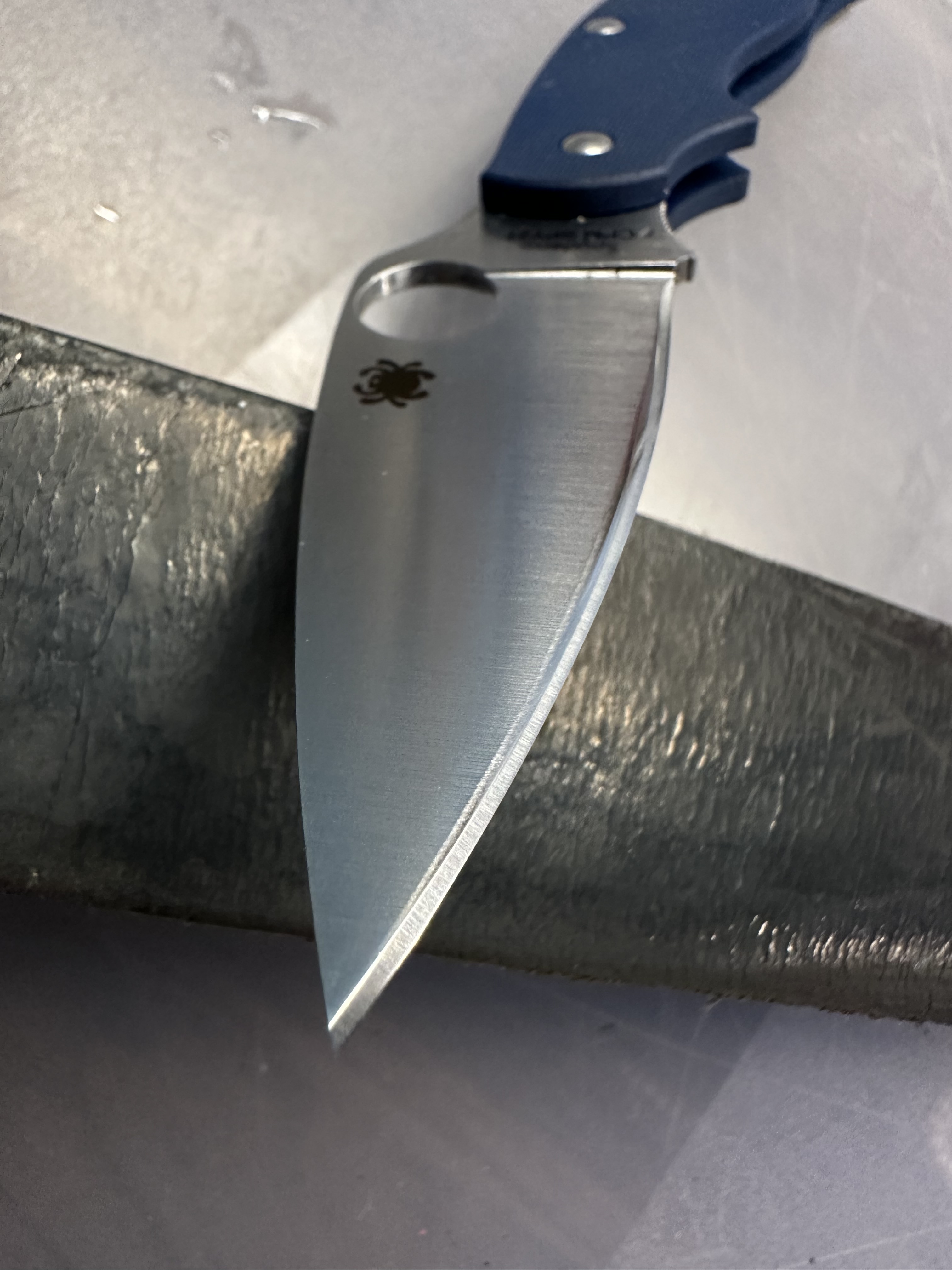
I have decided to de-shoulder the edge for a gentle convex result in the middle of the belly.

My old leather with some polish compound is ready again to smooth the edge to razor level.

Because I want a better touch on the leather, I usually keep the normal edge at the point to keep material there and near the ricasso as I use this portion for special shores like removing the aluminium cap on bottles.

The Coke Bottle Butt test is passed with flying colors. As you can notice the plastic is 3mm thick. Not a single scratch on the blade.

So what do we got so far ?
A master piece of knife design by monsieur Sal Glesser with a strong construction and state of the art in-house alloy serving a thin blade and an ergonomic handle.
My advice: try to grab one before they disappear, it seems that G10 version is not here to last and it is really a sapphire: a true blue jewel !

Spyderco Proficient FB36CFP — The Nasa Lamborghini Bushcrafter – Part 1

Article written by Nemo Sandman – Edited the 5th of November 2025.
All rights (pictures and text) reserved.

Have you ever wondered why so many Spyderco Sprint Runs seem to appear out of nowhere, featuring gorgeous carbon fiber handles and impressive CPM S90V blades?

It’s simple — Sal Glesser loves both materials.

For him, carbon fiber reflects his lifelong passion for motorsports, while S90V stands out as a stainless steel in a league of its own, combining high performance and outstanding reliability.

So, long story short:
Full Flat Grind + Carbon Fiber + S90V = Sal Glesser’s favorite combo!

And to quote my friend Spydercollector:

“When the Bushcraft fixed blade was first announced, Sal also planned to do a so-called NASA version; a version of the Bushcraft knife with all high-tech materials. I believe NASA is a protected name, but Endeavour still evokes the high-tech approach most people associate with the famous space agency. The Endeavour features a full flat grind S90V blade and full sculpted carbon fiber handles. It was a beautiful knife with a grip that had me looking around for stuff to cut.”

https://spydercollector.wordpress.com/tag/chris-claycomb-endeavour-prototype/

Here is the Proficient: it is designed by wilderness expert Chris Claycomb of Bushcraft UK, the Proficient functions perfectly with traditional bushcraft skills and cutting methods. Carefully contoured and polished to eliminate hot spots and ensure maximum comfort during prolonged use.

https://www.spyderco.com/catalog/details/FB36CF/Proficient-trade-/943

Bushcraft knives are defined by specific parameters — typically featuring blades between 4 and 6 inches. Spyderco’s Bushcraft model fits perfectly within that tradition: a 4-inch, full-tang blade with no handguard, purpose-built for control and versatility.

In true Bushcraft spirit, users generally favor high-carbon tool steels over stainless options, prioritizing edge retention and cutting performance rather than corrosion resistance. The O-1 tool steel used here, with its high carbon content, delivers excellent long-term sharpness while remaining easy to resharpen in the field.

Carried on the belt or strap in a leather sheath, this knife is blueprinted for wilderness chores — slicing, chopping, whittling, and processing game — all in the traditional Bushcraft style.

To quote Spyderco:
The Spyderco Proficient takes the concept of the traditional “do-all” bushcraft knife and elevates it to new levels of performance with state-of-the-art materials and manufacturing methods. Designed by wilderness expert Chris Claycomb of Bushcraft UK, the Proficient functions perfectly with traditional bushcraft skills and cutting methods while offering superior durability, edge retention, cutting performance, and corrosion resistance
Instead of traditional carbon steel and an axe-like “Scandi” (Scandinavian) grind, the Proficient’s blade is crafted from vanadium-rich CPM®S90V particle-metallurgy stainless steel and boasts a full-flat grind for low-friction cutting performance.

This concept of a stainless blade paired with a black polished handle has, ten years later, been fully embraced — a perfect example being the Casström No.10 Swedish Forest Knife in Black Micarta with a 14C28N flat grind.

I first discovered CPM S90V back when it was still known as CPM 420V, thanks to Darrel Ralph (RIP) and his beautiful Apogee folder. The blade was astonishingly wear-resistant — so much so that, without diamond abrasives, only a backstand could bring it from dull to sharp. It was a bear to sharpen then… and still is today.

The difference is, as end-line users, we now have easy access to industrial diamond tools, making steels like S90V finally practical to maintain at their full potential.


I have written a lot about S90V. This alloy has proven it can be tough enough as a stainless steel to be used in any all terrain tools; especially since it is available on Manly folders which got the reputation of using a very fine thin geometry on their blades.
Modern Bushcrafters (like the Benchmade Puukko) are focused on toughness with the use of the very tough CPM 3V.

What does CPM S90V bring to the table?

It’s incredibly wear-resistant.
This steel is notoriously hard to dull, even when cutting abrasive materials like brown cardboard loaded with silica. It keeps its edge far longer than most steels, making it ideal for demanding, real-world use.
Also the full flat grind is a must in a matter separator specialized in wood works. As much as I love Scandi Grind found on Woodlore clones (first designed by Ray Mears).
I have found that especially in the wonderful Spyderco Sprig full flat ground knives can be really efficient on hard wood.
(BTW when the writing appears in green: it is a link !! and I have tested them here.)

It’s stainless!
Even if you (like me) enjoy the patina that forms on a great carbon steel blade, there’s real peace of mind in using a reliable stainless steel — especially when working near water, in the rain, or by the sea.

The Sprig was an impressive tool in terms of pure geometry. Designed as a hunting and fishing knife, it was a real wood eater — a beaver of a blade, cutting deep and effortlessly.

Guess what? The Proficient shares the same profile, especially after a bit of convexing — which I’ll be covering soon in a second article.

So far, that contoured handle is an absolute delight to use, and I’ll be putting it to the test in the upcoming piece. While the old O1 Bushcrafter had enough heft for light chopping, the Proficient excels at powerful push cuts — a completely different experience.

Interestingly, the Proficient isn’t a big knife. Once sheathed, it can disappear into the front pocket of a pair of denim jeans — no need to let it dangle from a belt.
So what do we got ? Imagine the plateforme of the Bushcrafter (link) a solid companion, a reliable 4×4 and you just turn it into some Urus from Lamborghini: stellar alloy and lighter tougher handle.
The Proficient is Sal Glesser’s gambit — a bold move in a world where the bushcraft community traditionally favors carbon steel and natural wooden handles. This knife dares to break from that norm.

Of course, this jewel comes at a price, and most bushcrafters aren’t Wall Street sharks. They use OpinelMora, or at best a €100 fixed blade — unless they’re ready to splurge on an original Woodlore.

So, the “stealth wealth” of this NASA-grade bushcrafter isn’t for everyone.
It’s like a Lamborghini — not the most practical, but a statement of refined performance and engineering excellence.
Because in the end, real performance comes at a price.

Article written by Nemo Sandman – Edited on November 5th, 2025.
All rights (pictures and text) reserved.

All Archives in NKR are now in HD for all the photography.

Since the knife2.com plagiarism attempt, I have decided to be harder to copy and paste for Chinese knockoff selling sites !
All the archives and previous posts are now in stunning HD for the images.
Revisiting the past by scrolling the menu on the left side.
And get back to the Golden Age of Tactical Cutlery in Nemo Knives Review !

Found here actually:
https://nemoknivesreview.com/2010/07/24/spyderco-sage-ii-the-wise-choice/

Nemo Knives Reviews articles are stolen by knife2.com known as “the theft for Knives”.

Proof “knife2” is now the shown as the author of my articles.

This articles are not written by “knife2” but by “Nemo” from nemoknivesreview.com.
Because for a months now, a blog based in UTAH name as “knife2.com” is systematically stealing Nemo Knives Review articles for its own benefits.

Jur’s funeral article stolen with a creepy death head generated.

Even Jur’s funeral post has been stolen… This is a very personal article not for total strangers to copy and paste it on their own blog.
Also original Nemo Knives Review’s photographs (even when marked for copyrights) are copied and displayed on knife2.com without permission.

I have asked to WordPress to help us but as knife2.com is not a wordpress blog, they could not help.
So I have contacted Google for this pirating to be noticed.

Google’s removal Dashboard – More pages has been add since that screen copy.

And you know what ? I really hope knife2.com will steal that article too.
As they are not only stealing from Nemo Knives Review but from many blogs about knives they can find, I do hope this will be a heads up for my fellow bloggers.
So don’t uphold thieves and plagiarists, read the original articles on nemoknivesreview.com not on the stolen material stolen without authorization on the crappy site of knife2.com
So this article is not written by “knife2” but by Nemo from nemoknivesreview.com !
And pardon my English but Knife2 is not the “zest for knives” but just the “theft for knives”.

Edit: they have stolen that article too. I think they don’t understand what they are stealing. hence the Chinese connection is this other article.

(c) Le Tampographe Sardon

Spyderco UK Penknife Salt LC200N C94PYL Yellow — First Glimpse at The Diver Slipjoint !

“Originally developed in response to restrictive knife laws in England that prohibited the carry of one-hand-opening lock-blade knives, the UK Penknife was the trailblazer of Spyderco’s unique SLIPIT™ line of knives. Now this iconic knife makes history again as the first non-locking member of our ultra-corrosion-resistant Salt® Series.

Its full-flat-ground, leaf-shaped blade is precision machined from nitrogen-enriched LC200N steel and housed in a high-visibility yellow FRN handle. A reversible deep-pocket wire clip and fully accessible Trademark Round Hole ensure that this fearlessly corrosion-resistant cutting tool is both left and right-hand friendly.”

OK that’s Spyderco’s original topo. Eventually it is the best way to describe it. I have had a UKPK as a gift at Amsterdam Minimeet. I think it was in GIN-1 steel and the blade was in another shape. But long story short the spring was so weak it was not pleasant to use.
What a great surprise on this Salt UKPK: at least the slipjoint locking system is much stronger than ever make it really a pleasure to use.
Of course, unlike on his little brothers: the Urban and the Squeak the UKPK is a four finger grip slipjoint folder with the index on the choil, used as the main security.


The choil on the UKPK (like the Military C36) is reminiscence of San Francisco Gambler’s boots daggers in the 19th century which means on the force during a cut is transfered to the blade directly not the handle and pivot. It is the Roman folding knife system where the handle was more considered as a sheath more than a handle.

The blade is thin and Spyderco provide one of the highest performance in cutting experience out of the box. My UKPK cut like a razor.
The performance on this one, geometry wise, are on par with Manly’s thin blades and even Opinel’s. It is not made for Midford’s fans.
There is a lot of European flavour in that leave shaped blade which looks a lot like the Caly3. It is some kind of UK Caly actually.


The Blade is long and pointy and requires less force to do the job as seen on my plastic bottle butt test. It has cut right in the middle steadily right in the thicker part of the matter. With your major finger on the choil you can shock up the blade for delicate works. Really it is versatile and polyvalent. Actually it cancel my need for a slipjoint Native. 3 inches blade on a 10cm handle, when Imperial meets metrics.
LC200N is a space steel which has shown great properties and not only in the stainless department. The users of the Spydiechef, like myself have found how steady the edge was kept and how easy it was to keep it fresh. LC200N has shown how it was forgiving (not chipping on mine) and ready to work long hours. A true workhorse steel !

Colour wise the yellow and black handle on the UKPK is very friendly. It looks like a scuba diving accessory. This is a knife made for going on the ocean. A real all terrain friendly companion. There is even a serrated version for the mariners with many rope and fibrous matter cutting tasks. The Salt collection is made for that: having a dirty knife in a sea salty socked pocket and not minding at all.
At 48 grammes (1,7oz) this is thought a travelling companion. The deep carry wire clip is a must even to wear it inside the watch pocket of denims.

There is no play in my UKPK. The spring retention is great. The jimpings are really positive under the pulp of the fingers. It is a serious contender to the hyper polyvalent Native Salt which has got one major issue in my book: its clip and a little more toyish and “boxy” handle. I know this really subjective but the UKPK handle feels more qualitative.
So here we got an all terrain slipjoint with strong mechanism and thin pointy blade. A knife impervious to the elements which can be clipped to a swimming suit and take care of oysters easily.
Really the UKPK Salt is one of the best Made In Golden folder and the first Scuba Diving Slipjoint. It is even a slipjoint which makes you forget it has no lock. Highly recommended.