Tag Archives: Spyderco

Pingo Star…

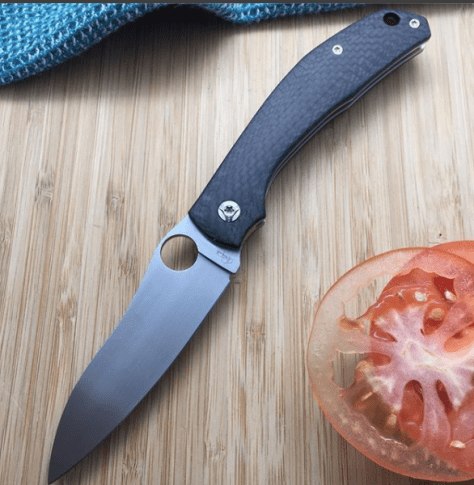
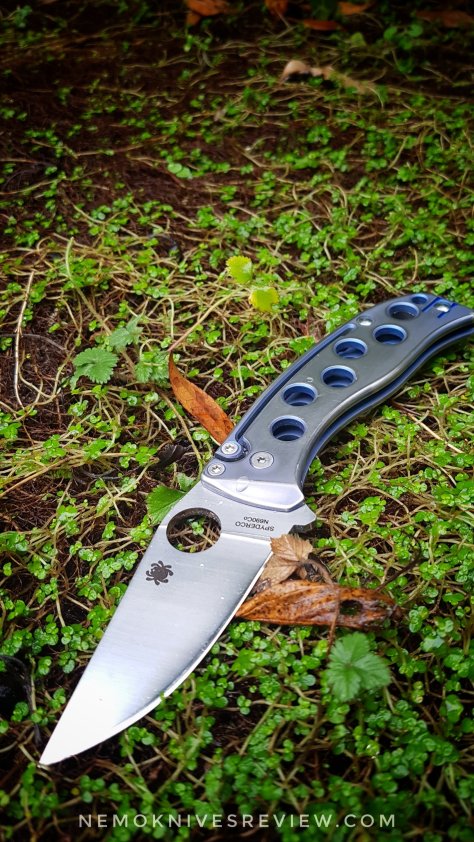
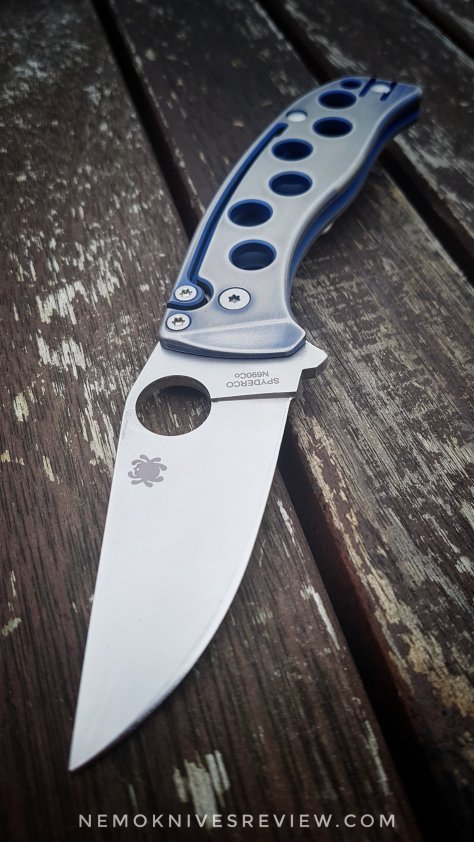
IMG_6523Another inspiring knife but what more to bring to the table about the Pingo that has not yet been written either in Spyderco’s catalog or in captain Nemo’s great Pingo review ?

Here we go…


Parsley stem cut very neatly tree times thanks to the N690Co stainless steel full-flat ground blade. Next time i’ll have to test in supplement of parsley, Sage, Rosemary and Thyme! More seriously recent outdoor chores have been cut a branch of mexican orange blossom and wisteria vine; really simple!


IMG_6503
Lillian is jealous as Pingo gets along very will with Stitch.

IMG_6506
Perfect baguette push cut.


IMG_6502
Another tribute to 1966 (after Simon and Garfunkel) and to the first round debate of the last french presididential election: Pingo and pudeurs de gazelles!


Pingo and the pumpkins: the blade’s belly shape concentrates cutting power and Pingo sinks in with ease. Sorry Linus!


IMG_6520
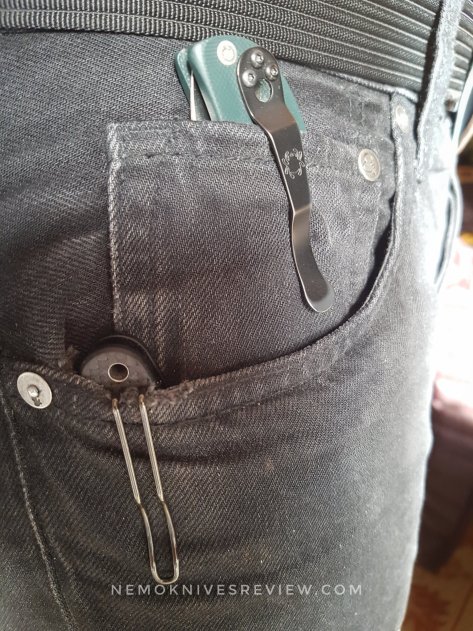
The wire clip enables Pingo to be snug real deep in the pocket.


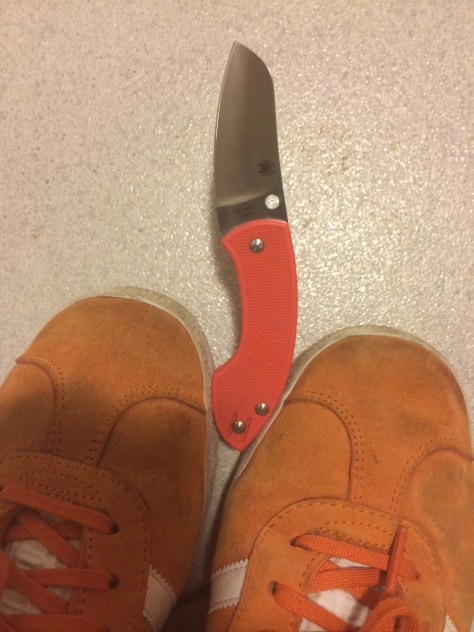
Now we know whom Prokofiev’s three oranges really love!


IMG_6546
Just before the soup, where is Pingo?


Pingo Star and the groupies!

Short Locking Folders — A plethora of choices !

Those are the knives I choose when going out. I prefer a 3 inches locking blade.
From left to right we have got: the Falcon, the Wolfspyder, the Native 5, the Delica, the Techno and the Chaparral. They are just examples of knives I have got around and which fit the purpose to carry a non threatening but useful locking knife.  You could easily add the Lil’Nilakka which are the favorite EDC of JD and Pjaffre.
As far as I love my Para2 or my Sliverax, I tend to go shorter on the blade and keep the 4 inches for in-house uses unless I’m going in the woods. Also, most of the chores can be done with a 3 in blade without rising any eyebrow.

If you think to go thin in stock, the Delica and the Chaparral are the way to go. You can notice on the picture how thin the Delica goes and with the KnifeCenter special edition, your edge is made of HAP40, a steel which refuses to chip.

Lockbacks are in fashion since… the Buck110. On the three pictures, only one has got vertical play: the Delica. This tiny play is only felt when cutting on a board and won’t bother you.
The Chaparral has a hidden pin which acts as a second locking system ala Triadlock. The Native 5 has got very high tolerance and none of them I have handled has shown any play in any direction. Let say, in that matter, that the Delica although an old fashion folder with her own character, has the best thinner slicer of the bunch and her blade shape gives a lot of polyvalence. The Delica is also the only short folder I can Spyderdrop. It is made possible by the full steel spacer’s weight. Spyderdrops is the fastest way I know to have your knife ready to cut. It’s also the safest as you are holding it by the blade.

You can notice, there are a lot of materials for the handle. Titanium handle are great as they can be easily cleaned but can be scratched easily too. G10, I do love, especially thick G10 with no liners like found on that Native 5 version and the Cold Steel Recon 1 collection. Pakkawood is a new thing for me. It’s got a warm feeling and I can rinse the handle under the tap with no after-thought. Carbon Fibers (CF) are actually very resistant to abrasion. Your knife can fall and be kicked, the CF handle will not show any scars.

Now I do cut hard material by pushing with my thumb on the back of the blade. This is also why I tend to favor a thicker spine. The Techno is king in that matter, but lately I have discovered how much the Falcon and the Wolfspyder are great. What makes the Wolfspyder very special is the ease you can twist the blade in the cut thank to her lack of blade’s height.

You can notice the amount of pocket lint in the handle, giving you an hint on which knife I carry the most. You can get a lot of great locks: RIL’s, Compression Lock… The new Lil’Native offers a very small package (I think it’s the shortest of Spyderco’s with that lock nowadays) and the choil makes the blade even shorter on that design.

To have or not to have a choil ? On a very short folder, a choil can take a lot of edge off. The good old Delica shines again but the Wolfspyder and the Techno are beating her choil-wise; they both provide one of the best solid locks with the maximum edge possible. IMHO for the 3 inches folders, choils would be really important if the knives were slip joints. They are still important in my books on longer folders which are used harder, like on Millie,

Strangely short folders are often used out of their scope like a Pradel would be. Mondane chores and abuses can occured very easily. This is also a reason why I tend to choose strong locks and tips on my 3 inches folders. When it’s possible I also choose tool steels which can provide better lateral strength.

Delica: No real choil, vertical play, very thin blade, very thin spine. Bonus: spyderdrop.
Falcon: Choil, thick spine, nice belly but not deep carry clip. Bonus: great flipper.
Lil’Nilakka: No choil, deep carry clip, thin blade. Bonus: very thin geometry.
Native 5: Choil, thin spine, thin blade but not deep carry clip. Bonus: great ergonomy.
Techno: No choil, deep carry clip, thick blade and thick geometry. Bonus: built like a tank.
Chaparral: choil, deep carry and thin spine and thin blade. Bonus: idem pin lock.
Wolfspyder: no choil, thick blade, deep carry (now). Bonus: thin scandi edge.

The most eye candies would be the Native 5 and Falcon and the most surprisingly effective in cutting power would be the Lil’Nilakka and the Delica…
The easiest to carry would be the Chaparral which is the thinnest of the bunch.
That said my best pick for hard workers would be a deep carried, solid lock, no choil, strong, thick spine and thin geometry folder: the Techno and especially the Wolfspyder.

They are just a few example of brainstorming for choosing a 3 inches folder to carry.

Oh well, there is also the Kopa… Guess I need to start this over !
The Kopa has got a choil, no vertical play, can be spyderdropped…
Dragonfly? Where?!

More on https://nemoknivesreview.com/2017/10/05/choosing-a-knife-for-the-city/

20171230_113247-012025157230.jpeg

last edited: pjaffre 03 jan 2018

Spyderco C41GPFGR5 Native 5 — A Smooth Operator.

20171208_130139-012017345095.jpeg Every Spyderco’s fan needs an all American Made Native. Why? Because it’s one of the short folders well designed to accommodate every type of hands. It is like a super Delica: wider, stronger, with zero vertical play and as recently I have offered a Native to a friend who use it for hunting, I needed a new one. There is a lot of choice those days, with a lightweight version, even with a Maxamet blade. Maxamet is one of the new Über Super Steel and I have a Para3 ordered with Maxamet. There is also a carbonfiber version with S90V and even one to celebrate the 40th Anniversary of Spyderco with Damascus blade, also a S35V blade with G10 and one with a flutted titanium handle… Many choices. 20171208_120241-011309705577.jpeg Anyway this Knifecenter Native special edition brings one of the most amazing steel available: S90V on a stunning dark green smooth G10 handle. In the 80’s Phil Wilson was making fillet knives in CPM420V (S90V previous name) and find out it was exceptional in terms of edge retention for filleting salmons. It’s not a new steel but certainly one of the uncanny in terms of behavior: it looses it’s razor edge fast but seems to keep a keen working edge forever. Spyderco use diamonds wheels to work on it and it’s really a steel which refuse to give away its molecules. So you can use it on cardboard and any abrasive materials without worrying to lose its edge. But what that Knifecenter’s exclusive Native brings also is a lighter construction for the handle: they are no steel liners. The slabs of G10 as thicker for good measure. You can notice also the construction is very cleverly made as in hole screw holes for the clip (they are 4 position you can use, tip down, up on both side), you can see some steel. It means they are hidden nested construction under the G10 slab. 20171208_120329-011500186881.jpeg But the only steel parts visible are the spacer and the lock (pictured here before sanding). It makes a very clean design. And also a knife more impact resistant. I have had steel liners knives warped after a fall. A tiny tiny change which made the blade touch the liner. You oblige to bend it back. Also steel liners are a place were rust can appears and you cannot spot it. So the more G10 the happier I am, as I need to rinse my knives often under the tap. Also the balance it now just perfect: just behind the pivot. Also there is only 2×3 screws in its construction, the pivoting part of the lock is a pin not a screw like on the majority of Native. You can find that pin on the lightweight versions, but also the new carbon fiber version C41CFFP5 which also share a S90V blade… Again, the less screws, the better. (Screws can get loose and be lost) This is the same kind of construction found in Cold Steel Recon 1. But also, the G10 in the Native is smooth as a polish piece of ebony. This will save your pocket’s lips, trust me on that. They are jimping on the blade, on the top and on the choil so there is no problem with wet palms to held the knife. G10 is an amazing material (Glass fiber mixed with epoxy) and I love to sand it to my taste. But this time I will focus on the edges. Again, be careful not to breath the dust of G10, it’s very not good for your health.


At first I wanted to rounded the handle like the new Shaman (a bigger version of the Native with a compression lock) but the second screw of my Native is too close to the edge. Rounding it would be an issue. At least I wanted to feel no sharp edge under my fingers. The Native did not have sharp edges, it has some very nicely squared angle like a musical instrument but to sharp for me. Even if It gives some kind of Bauhaus style to the handle. Very classy. 20171208_125932-01358522911.jpeg Anyway, sanding is a way for me to appropriate that knife, to custom it to my taste. Rare are the knives I did have the urge to do it but it’s also a pleasure to twist it to my likings and I prefer it that way. 20171208_125928-01124803101.jpeg The Native is, like my Delica, my Falcon, my Techno, my Lil’Nilakka, a locking non threating knife I can carry in the city. It’s in my eyes a little “Clip-it” perfect to be EDCed. So I will keep the black clip as it gives a very low profile for a knife which is not deep carried. We will see how long the black coating will remain.
20171210_130738-011515207884.jpeg20171208_142047-01757854268.jpeg And of course it was able to push cut through a plastic bottle butt with ease. More to come soon. 20171208_130333-012021035791.jpeg 20171208_162319-011347483770.jpeg

Knives for Self Defense — Is it a good idea ?

20170517_134936-01
Some knives are marketed on self defense purpose but self defense is not a current situation in the use of a knife. Before you get yourself in a situation where your life is at stake, there is a lot of extraordinary thresholds you have already crossed where your personal knife was not part of the equation.
It’s not the famous Sandbar Duel anymore and we are not, any of us, Jim Bowie’s heirs.
Finding yourself facing dangerous people with guns is not a good situation for “knife self defense”. As you know: “never bring a knife to a gunfight”.
Finding yourself assaulted by someone unarmed, is not a good situation for drawing a blade, especially in front of witnesses. Your lethal response is much too high.

When coud be the knife a good equalizer ? And in what situation ?
Against many opponents, drawing a blade can make you win some times but then your aggressors will adjust their ways to attack you, like throwing chairs and miscellaneous missiles for example.

Also, knife wounds are not painful, especially if the blade is razor sharp: you don’t feel the cuts or the stabs. A furious or drugged opponent won’t feel anything and will continue to attack and even bleed on you…

An opponent in a dark alley draws a knife  on you? Are you ready for a duel “mano a mano” ? Do you think the knife in your hand would be the best way to get away without being wounded yourself ?
Knives are part of the dirty fighting arts; if used as a weapons they are for attack – not defense..

wp-image-258869882(Bud Nealy’s knives were sold as “fast response defense knives”. Here a Peshkab near a Spyderco Mantra 2 for scale purposes.)
It’s like a piano string, the famous “wetworks” used in the commando. Warfare knives are made to kill silently. They can be good stealth weapons in the hands of specially trained soldiers but as a “defense” tool, they are much better equipment like…

The good old hiking staff, a walking stick or the humble cane.
In France, when swords were forbidden, cane fencing developed as a way to protect oneself against knives and for the record common used and carried knives were slipjoints.
After some training, rods, staffs, canes and even solid umbrellas can be used for parrying and inflicting pain should you be in need.

Before to get yourself in dangerous situations where self-defense can be useful, there are certainly other things to be honed than a knife’s edge: your awareness. This is the most important skill. Check your surroundings: always. Being immerse in music under your headphones won’t help. You need your ears and your eyes. Avoiding dangerous areas and avoiding people who makes your instinct react; so many ways to avoid a real self-defense situation. Don’t fall asleep in the subway!
Professionals who get themselves in that kind of situation will not count on their blade as their main self-defense tool. They have telescopic rods, electrical weapons, mace, even flat suitcases they carry are in fact used to “protect” as a shield. Remember: a knife will not protect you; it can arm the opponent. There are no parrying methods with a knife. Also a knife does not have any reach. It’s a close quarter combat weapon. Even a kick has got more reach than a lunge made with a knife in one’s hand. Agreed it’s not the case with a sword or a rapier, or a spear or a staff…

Now you can always learn from those various technics of using a knife as a weapon. It’s like fencing or iaido, it’s always good to learn fighting skills with all tools and the knife is one of the oldest tools used in combat. It helps you to understand a culture. It helps you also to understand the threats and the body language and the stance and the balance. You will learn that from boxing too; footwork and mobility are the first things to master…. “fly like butterfly”. Learning how to fight can also help you to learn how to carry out first aid if someone gets hurt. Knowledge is always good and the more you will learn about knife fighting the less you will dream about using it in a real self-defense situations even though dreams fuel good marketing.

wp-image-91153265

(Edited by Pascal Jaffre)

Spyderco C214TIP: The Devil’s Advocate by Gayle Bradley.

20171130_1127091842919763.jpg

“You sharpen the human appetite to the point where it can split atoms with its desire…”

I feel like in the “Honest Trailers”: “Please review the Advocate…” OK here we go:

Oh yes, the Advocate is a looker and really catches the light.  Knowing Gayle Bradley since his first hard chores folder, I really wanted to see his new design.

20171130_1131321053577775.jpg

At the moment I write those lines, we are all under the official statement from Spyderco about the Advocate. To sum it up: “A careful review of the Advocate’s design revealed that the steel washers used in its pivot are measurably thinner than those used in our other flipper models and are therefore vulnerable to the effects of overtightening….We have suspended production of the current version and are working diligently to redesign the pivot to completely eliminate this concern. We have also decided to suspend shipment of our current inventory of Advocate knives until a satisfactory redesign is complete.” Michael Janich 10th of April 2017.
I don’t have any issues with my Advocate pivot, so I’m not concerned.

20171130_113103867874246.jpg

Unless major purpose, I don’t feel the urge to disassemble my knives and I always find that rinsing them under hot tap water and oiling them back once dry, is more than enough to keep them going. I do however have got a gripping pivot issue with my Southard but this was before discovering and using nano oil. Here on the advocate, it seems like even nano oil did not help. but again It do not have any issue on mine. I got other issues and they are from the design, not the manufacturing.

20171130_113020468886516.jpg
So I was able to snatch a model before the factory line stopped and I really wanted to try and love another great Gayle Bradley design. The Advocate is his first flipper and he’s using my favorite steel: CPM-M4 (drawing from Gayle Bradley’s extensive experience as a competitive cutting champion, CPM® M4 is a high-performance tool steel renowned for its extreme edge-holding ability).

“The Advocate’s handle consists of two 3-D-machined solid titanium scales that are radiused across their width and feature a unique “orange peel” finish that is both visually striking and provides an enhanced grip texture. The precision machining of these features ensures maximum comfort in the hand and contributes to the knife’s stunning, custom-quality appearance.”

20171130_1129381694055380.jpg

See how the knife looks great? This is a very thin design. It slips into your pocket very confortably but, in my own experience, its thin handle create a lot of hotspots. I would have preferred a thicker handle even if the finish and lines are wonderful, it is really more a looker than a user so far.
OK mine fires perfectly and once unlocked, the blade falls free. So the action is OK but there is a strong break to it: the ball detent on the lock making the action less smooth than on my other flipper: ZT0562 or Falcon. It’s even noisy, you hear it. What is the point of having ball bearings when you put a brake on it ? Spyderco knows what smooth means ie Ed Schempp’s Bowie the Paramillie. Why not the Advocate ?


Also you can notice how the Zero Tolerance’s (ZT) handle is thicker and hence much better ergonomic-wise. I would not mind that for a Chaparral or for a shorter folder but the Advocate is a medium folder with a 9 centimeters blade and weighs 111 grammes; so it’s not a small folder! Even on the last picture you can see that it’s thinner than the Sliverax….

Error
This video doesn’t exist

Also flippers have got a fun factor shared with spinners and balisongs. We love to play with them and because of that, we have tendancies to “test” them more in their opening and closing.
Again, the Advocate’s thin profile doesn’t make it easy to close. The tension on the lock bar is very important and the edge to unlock it is sharp. So it’s not easy on your thumb, almost painful sometimes compared to my ZT and its fat lock… Even the flipper’s tab feels too thin for such a strong detent. It’s biting into the index finger’s pulp….

20171130_113116465167529.jpg

20171130_115113937134801.jpg

You can see the sharp edge of the lock bar; actually it comes from the steel insert.

20171130_133127-011464298529.jpeg

You can notice the marks on my thumb.

20171130_133237-01928540783.jpeg

Look at the way the lock bar is chamfered on the ZT. Rick Hinderer is not at his first flipper design obviously…

After playing for some time, there is no real fun. The detent is so strong it makes thumb-opening impossible on mine; only reverse grip works for me.

Error
This video doesn’t exist

So the strong lock acts like a break; you understand why Compression Lock flippers like the Sliverax are a path to explore.  That said, after playing with both knives, I also feel the Sliverax could have benefited from a stronger detent.

So far the Advocate is not my favorite Gayle Bradley design.

My opinion is not based on any pivot issues as mine doesn’t have it but in my book,
it’s too thin, too slippery, not easy to close nor is it easy to open with the thumb hole.  It’s not smooth… It’s the total opposite to its famous GB1.
Perhaps it will grow on me but even the clip is not a deep carry option… Oh well.
I need to play with my Ed Schempp bowie for good measure… as it’s the perfect opposite in the way Taichung can deliver a great folder with great ergos.

So in summary, if you want a really fun and light Spyderco to play with, try the Sliverax.

20171128_184033-02726952399.jpeg

edited by pjaffre: jan 5, 2018.

Spyderco FB33GP Gayle Bradley Pocket Bowie !

20171128_142427-01320227037.jpeg

This is Gayle Bradley first Fixed Blade collaboration with Spyderco. A “unique blend of expert design and state-of-the-art metallurgy”… But is it a real Bowie ?

A true Bowie is “the most effective fighting and survival knife ever made.”
Just to quote Bill Bagwell as he was attending the Paris Knife Show, where one of his Bowies won the award for the best fixed-bladed Damascus knife in 1995…
A stiletto can pierce, but not more effectively; a cleaver or kukri can chop with similar result; and a razor can slice, but only in one direction and without the power of a combat Bowie. A 10 inches perfectly balanced beast with a false edge ready for a back cut… This is Bill definition of a big bad Bowie.
Actually I got a Cold Steel Trailmaster but much prefer the Fallkniven A2 for camp knife purpose. The A2 is not a proper bowie but the 8 inches blade gives you the scale of the Bradley Bowie which is not much longer than a Phil Wilson South Fork.
20171128_142314-011164019776.jpeg

Also I have noticed the edge is quite thick on the Bowie. It’s not a great whittler. I was immediately tempted to get a thinner edge. I felt also the edge to be very far from the handle because of its large choil.


In that matter its little brother the Junction was much more capable. Being much more thinner behind the edge.
But a 5 inches blade is not the best chopper. The size emphases the portability but not the chopping performance. This Bowie must be designed with a special purpose: hunting knife, pocket camp knife ? It’s a bastard dog but Gayle Bradley don’t design by guessing, he must have a reason. I have asked him in an email and will update this review as soon as he will be kind enough to answer me.

20171128_144850-01402770663.jpeg

To quote Bill Bagwell: ” There is a difference between the ideal fighting Bowie and an ideal survival Bowie, even though the basic design is relatively similar. The ideal fighting Bowie and survival Bowie would have roughly the same blade length of about nine to ten inches, because this is the length that offers the perfect amount of balance and leverage in both scenarios. But the ideal survival Bowie might be a fair amount heavier overall and have a greater concentration of the weight further up the blade. This concentration of weight further up the blade gives the Bowie a balance more like a hatchet, so that it has greater chopping power, separating it from the more nimble fighting Bowie class.”

20171128_142355-01775841927.jpeg

The Bradley Bowie is a Jack Of All Trade focused on a Sub 6 inches fixed blade market.
In that domain I already got some favorites Spyderco: the Serrata !
20171128_142836-01584628714.jpeg

The Serrata offers a cleaver power in the field. But the Bowie is tougher in the choice of its steel. “An incredibly tough spray-formed tool steel. Like the particle metallurgy process, spray forming rapidly solidifies molten steel into small particles so its component alloys cannot “segregate” or settle. This creates an ultra-fine, extremely homogenous grain structure that is ideal for knife blades. PSF27’s alloy composition includes molybdenum, vanadium and a generous 1.55% carbon, but because its chromium content is 12%—just below the official threshold for stainless steel—care should be taken to maintain it properly.”

20171128_142714-01534366658.jpeg

The Bradley Bowie is also an eye candy, even if I don’t like where the trademark hole has been placed, at least it is very very small and even smaller than on the Junction.

The contoured polished G10 handle is very confortable in the hands. much better than the Junction which is very very flat. I’m not a fan of the tubular holes on both models but it offers some potential in creativity: who want to make a spear from they knife ? Boar hunting anyone ? And it respects the prime designs of Gayle Bradley.
I also love the balance of the Bowie making it “alive” in the hands.

IMHO the Bradley Bowie would be great as a soldier’s knife. Some kind of modern KABAR…
It’s thick enough to withstand some serious abuse. The tip and the blade shape would make it easy for opening crates if needed.  It can be used for batoning of even light chopping.

20171128_142644-01632066016.jpeg

So it’s a Bowie easy to pocket in its boltaron sheath or rigged upside down thanks to its great retention. The pancake sheath works great and is very secure. There is no play or rattle when shaken. It’s a sheath of great quality.

20171128_163713-012067509247.jpeg

Conclusion, the Pocket Bowie made in Taichung is ready to follow you in any kind of expedition you got in mind. Its full tang construction and general design make it fit for any tasks where a solid and reliable knife is needed. The Bradley Bowie is a tough cookie.

More to come soon.


SLIVERAX — ELEGANT DREAMED ENGINEERED KNIFE – ACT III: Using.

20171122_150203-031772969397.jpeg My Sliverax is a dancer. you can open in a lot of different ways. The flipper is the first. The thumb with the hole. The middle finger with the hole. The ring finger while holding it handle first and some kind of gravity opening: just a flick of the wrist and “Schlak!” it is ready. So there is a lot of way to waltz with that folder hence her name: “Dancer”. This is bringing the fun factor to high rate. 20171124_163414-01208185727.jpeg You can see I have mounted my Ed Schempp Bowie clip for now. Now that I feel confident with S30V heat treated by Spyderco, since I have play with the Nilakka (Taichung) and the Wolfspyder (Golden), both radicaly scandi ground knives, I have decided to give the Nilakka a very very thin convex edge. The first step was here. But then I have decided to give sandpaper a try and work on thinning the factory edge not only de-shouldering it.

So it’s very simple: P800 SP on my old leather belt to thin the edge, then white ceramics (a lot) to turn it into mirror. One hour later, I got a incredible performer ! On wood: it goes deep and smoothly. You got a lot of control. Of course it has been used daily in the kitchen and on meat preparation and guess what, the flipper eventually is not a problem for board cutting. On plastic and wood, I have twisted the blade inside and no harm has been noticed to the edge or the mechanism. I have used it hard at full grip and got full confidence in it in hammer or reverse grip. Like on the other compression locks knives it’s so easy to close it and put it back in the pocket, preventing any way to harm yourself or the others. It is especially great when working around animals like horses for example, when you want your edge to be out of play as soon as possible. I have also the chance to compared it to my ZY0562CF which is an excellent flipper with a sure fire every time. But it’s a knife much more heavy and less elegant, more rugged, full of screws… Another philosophy in folder making that I enjoy also, but the Hinderer design is more of a Toyota Landcruiser when the Silverax is a BMW Serie 4. I enjoy both but the Sliverax offers a very light solution for high perf. I also like the fact I can easily check/ have access to the pivot to grease it with a micro drop of nano oil BTW. In the woods , I was able to whittle a lot without any hot spots on the handle. The clip did not bother me in that matter. I have also rounded a little more the spine to feel confortable as my main technic asks for my thumb to push there, giving les stress to the pivot. Also I place my index on the flipper most of the time choking up the blade. Despite the absence of choil, I have not cut myself. Oh and I really enjoy the fact their zero jimping. Most of the time I’m obliged to file them a bit on the corner to have them to my taste. Here no need for jimping and as a tool the Sliverax is perfectly anchord to my hand. The CF/G10 material is working perfectly without chewing my pants. After EDCing the Paramillie in 52100 it’s a pleasure to get the benefits from stainless steel researches and use the knife with zero concern about rust. It’s a luxury I am rediscovering. I can pocket my dirty knife and I don’t mind. I feel like a man making fire for the first time with a gaz lighter instead of some flint… Then back home it’s very easy to rinse under hot water. It can go in my denim front pocket to dry. On of the main characteristic of the Sliverax is the long edge in such a compact design. i cannot remember a knife which has given me that impression, especially in a folder. I love my Native 5 for example but the choil “eats” a lot of blade length. This length available is another luxury. You can of course pushcut but also keep in mind that any saw motion will be very easy thanks to the absence of choil to trap the matter you are cutting. So the Sliverax is great, providing a long edge easily from a light and wasp shaped handle, giving a lot of cutting performance for a SUB 4 inches knife. More to come soon as I always got new things to write once it is published…So this is a first draft but this week end I’ll be in wood … 😉 20171123_151314-01264186372.jpeg

SPYDERCO SPRIG FB37GGR — Phil Wilson Bird & Trout Companion.

20171121_100407-01539792713.jpeg

Bird & Trout knives are small thin fixed blades, lightweight sharp knives able to process a bird or a trout. Those knives got of course no chopping purposes and no bushcrafting purposes but we have found the Sprig by Phil Wilson to be a reliable wood companion.

I already knew Phil Wilson as a knifemaker and clever metallurigist for his writing on CPM420V (S90V) back in 90’s. He was the first to provide fillet knives for people who process salmons all day and was measuring the edge retention of this new powder steel back in the past century.  His results were outstanding: the S90V steel was able to process much more fish than the normal stainless steel used on that time (440C ?). He was also able to heat treat them to 60HRC and higher. Bringing the powder steel edge to uncharted territories long before people were spoiled with S30V and S110V and Elmax…
When Phil Wilson did edge holding test, lower Rockwell numbers yielded much poorer edge holding in real world use. High hardness prevents rolling and blunting of the edge, a major cause of loss of sharpness, even though the steel has very high abrasion resistance. His blades do have very high soak temps, oil quenched followed by deep cryo in liquid nitrogen but he did not have any problems with chipping as he considers the use for his S90V knives to be only for slicing.  (source Bladeforums).

To quote him:
“Edge holding will be proportional to hardness to a large degree. Experience with CPM 10V, S90V, and 3V showed me that, with a particle-based steel, the hardness can be pushed a little higher up the Rockwell scale and still retain enough toughness to prevent edge chipping. (CPM S60V is the exception; it has it’s best qualities at about Rc56.) This is because the particle-metallurgy-based steels have a very fine grain structure.”

20171121_100415-011815640864.jpeg

Let’s quote Phil Wilson about knife making and steel testing to understand the way he design knives, this is from an article he wrote in 2002 about the coming of S30V then new to all 15 years ago:
” I chose to make a fillet knife because, in my opinion, it has the hardest work life of any knife. Use around salt water will reveal a fillet blades ability to resist corrosion in a short time. Edge holding is tested quickly when cutting through scales and bones and working against an abrasive cutting board. A fillet knife must have a thin, flexible blade to ride over the rib bones during the fillet cut. A brittle steel will soon chip out or break under such use. A fillet knife also makes a very handy kitchen blade. It’s a natural for boning a chicken breast, slicing prime rib, or filleting out a grapefruit. Kitchen knives are left wet on the counter and bounced around in a drawer with other utensils, which is another pretty severe test for a new steel.

In addition to the fillet knife, I made a simple slab-handle semi skinner with the new S30V, and two other [nearly identical] knives from CPM S90V and 3V. This effort would give me a fresh comparison on the heat treating, grinding and finishing of all three steels. It would allow me to do some cutting and edge-holding tests against the new grade. Does the new S30V meet the challenges? The answer is yes, and I’m willing to bet that it will be the favorite steel of many knifemakers in a short time.”

— August issue of Blade Magazine in 2002 —

So as you can see Phil Wilson knows his craft and was testing those new particle-metallurgy-based steels to their limits. No surprise Jim Ankerson and Sal Glesser are huge fans of Wilson’s knives.

20171121_100509-01514419659.jpeg

The Sprig is not the first Spyderco edition of Wilson knives. The South Fork FB30GB was the first. This design combines very high cutting ability, point penetration and grip ergonomics into a very high performance working knife, to quote Cliff Stamps test of the custom original version. Strangely I was never able to bound with the South Fork when with the Sprig it was love at first cut !!

20171121_100715-011362243192.jpeg

First thing was the handle. The rounded Sprig handle is much more confortable in my hand when the South Fork feels more square.  The Sprig is nested in my palm very very confortably and I can cut i wood for long time without any hotspots noticed. It’s important for a fixed blade. With folders there is often some kind of compromised due to the folding of the blade into the handle, but for fixed blade the confort during cutting needs to be optimum hence the Mora’s handles compared to any thick edged squeleton tactical gadgets.

The Sprig is great on wood, even with its factory edge. It is ground thin in Taichung and is able to get to work right out of the box. The belly also helps a lot to push cut fibers acting like a guillotine edge. So really this knife can be used for bushcrafting purposes which are not implemented hard drilling in wood or batoning. The thin point is wonderfully handy and not made for snuff Russian tests.

20170923_122125-02970291423.jpeg

But for cutting wood and whittling the Sprig is even better than the South Fork or the Gayle Bradley Bowie and Junction, because its edge is so thinly ground.

20170923_123440-011828196874.jpeg

I had used some diamonds on it but it was not really necessary really. Just a compulsive attitude of mine when I got too much time on my hands… S90V is a legendary steel. I already quote Phil Wilson’s articles in my Paramillie 2 review.

“Crucible Materials Corp has introduced three winning steels in the past 10 years: CPM S90V, CPM 3V, and now CPM S30V. CPM 3V is still the undisputed toughness champ, even surpassing some carbon steels such as A-2. Originally known as CPM420V, S90V was introduced as an upgrade for S60V (originally called CPM 440V), and met all the targets of improved corrosion resistance and toughness. It has the reputation of being hard on heat-treating equipment and is a bear to finish, but is still the best edge-holding stainless steel going.”

20170923_122414-02137667105.jpeg

Easy to carry in my denim pockets with its kydex sheath, the Sprig is not really bigger than the Sliverax. The sheath is well made and flat enough to be packed in any Go-Hunting bag. So it’s very easy to bring him along for a walk in the forest or near the sea as S90V is very stainless.

I was really surprised by the cutting abilities of the Sprig. It really caught me by surprise.
The drop point design is useful even in the kitchen , so the Sprig will suit hunters as much as cooks and also it will take a very serious place in any expeditions needing a reliable cutting tool which you won’t need to sharpen every hours.

20171121_100547-01602839848.jpeg

You can find a lot to read and learn in Phil Wilson’s site here:
http://www.seamountknifeworks.com/articles.htm

SLIVERAX — ELEGANT DREAMED ENGINEERED KNIFE – ACT II: Convexing.

20171118_103910-01362796173.jpeg

Many times, people asked me how I was honing my knives to my taste.
I love thin edges and I love edges which can be maintain by stropping on leather.
For that any sharp angle but the edge itself need to removed.

So my first step on the Sliverax full flat ground blade is to remove the shoulder on the secondary bevel. For that I use Fallkniven FB04 diamonds or Spyderco Double Stuff II.

As I don’t want recreate two other angles, I do it free hand creating a gentle natural convexed medium between the grind and the edge.

20171120_123347-01267367917.jpeg

Soo some dark dust of removed metal appears. The edge of the blade is untouched as after some initial testing I do trust it.

20171120_124143-011125093009.jpeg

I need that convexed edge on the belly of my blade, I don’t minde about the tip and the choil which are not where I do apply the most force to push cut through wood for example. It takes 30 minutes to get where I want without to make a mess by scratching the blade finish. It means each pass on the diamond is check with my finger before, sto be certain to focus on that edge shoulder. To obtuse it will scratch the edge and to acute it would scratch the blade finish. So it takes time to be certain for each stroke.

Luckily the manufacturing lines on the blade exactly follow my pass and some miss strokes were not visible.  It takes around 500 passes on each side on S30V.
Then I switch to white ceramic directly.

20171120_125333-011773286312.jpeg

White ceramic brings some mirror polish on the convexed edge and also hone it to razor.
Here I can go much faster as I won’t ruin my blade if I’m clumsy. White ceramic are very forgiving…
Soon I got a very nice mirror on both side and I can go to leather.

20171120_125945-01492821791.jpeg

I use a century old barber accessories I have found in a garage sale in Italy. With some white compound, it has honed my blade for 15 years.
Time to test the blade on a chesnut road.
20171120_125455-011458232424.jpeg

The thinner edge goes much more deeper and with more control and more ease.
Eventually after playing with the knife for 5 minutes on various material, I inspect the edge and there is no chipping or rolling.
It takes me around 45 minutes.
That’s how I proceed to get an edge which suits my need. 🙂
20171120_130035-011101427946.jpeg

Spyderco C228CFP Paul Alexander’s Sliverax — Elegant Dreamed Engineered Knife – Act I.

20171117_170004-012070932378.jpeg

This is a first glimpse review with Paul Alexander explanation at the end.

So I got the knife for less than an hour in my hand and this is just what passed through my mind just playing with it during photographies.
So it will be followed by more in situ testing. I remember Paul Alexander’s proto at the Minimeet and the fact that he is an engineer in automotive and not a knifemaker. I liked that. Sal Glesser is an inventor and he loves engineering, so it was logical for him to welcome some bold new designs coming out of the bladeshows sphere.

Oh, the Sliverax !!  She’s a looker. Pure beauty and this is not only in the eye of the beholder. Perfection of the grind, the bolt starship design. I’m whittling while I’m holding her. She got a wasp shape, something of a spaceship, created for performance…

But the first thing I have noticed is how light (94 grammes) she felt and how well balanced she was. The sweet point is just behind the pivot making the Sliverax alive. Also the blade got that angle with the handle which reminded me Ed Schempp’s design: once open all the back of the knife forms a bow. It’s ready to cut and really ergonomic.

20171117_165600-01174043455.jpeg

The Sliverax got that kind of wasp shape very biological, organical and natural in her lines.

This is pure a full flat grind with a perfect finish. Taishung at their best again. No jimping, no tactical frills: clean and pure lines.

And once closed she’s very much like a Yin and Yang symbol.

20171117_170027-01737794856.jpeg

This very thin handle is possible thanks to the Compression Lock which as the center of the design. It seems like an improved version with two pins which makes it feel very solid. Also two bronze phosphorous cages for the ball bearing is a very nice improvement compared to the Advocate or Mantra 2 pivots.

Quoting Paul Alexander on the Spyderco Forums:
“So, the compression lock is by far my favorite locking mechanism, and once I felt I had a good handle on how to implement the lock in a sound manner, I pretty quickly started to consider incorporating a flipper mechanism. As an aside, I have a bit of a love/hate relationship with flippers. On the love side, I do really enjoy the almost instantaneous deployment you get with a good flipping mechanism; and somehow, incessant flipping never gets old… at least not for me, the wife and kids get understandably annoyed after a while. On the hate side, I’m not a fan of the protrusion flipper tabs usually entail. They can be cumbersome in pocket (I really do spend a lot of time considering the closed form of my designs, and while actual use is paramount, my personal knives probably spend a fair bit more time in my pocket than in my hand… sigh, office life). Plus, the tab can almost ruin the knife aesthetic if you’re going for really clean, svelte lines for a particular design. 

The Sliverax mechanism was the first workable version of a compression lock flipper I came up with, and it’s pretty straight forward. The flipper tab is just an extension on the tang, wrapping around the stop pin to get the tab into a location that gives it the right amount of leverage and generates a big enough moment to open reliably. This ends up creating a detail that looks a lot like a portion of an internal stop pin track just inboard of the flipper tab, but the cut out is further away from the pivot than a full internal stop configuration, to keep the blade as robust as possible. And that’s about it. I’ve got 2 or 3 other flipper incarnations I’m trying to work into newer designs, but really at their heart they are all fairly similar, you have to have certain features and components to make it functional, and then you come up with design inversions that better integrate into your target package.

I also believe in simplicity and elegance in a design whenever possible, so I try and not get overly intricate or complex, and start forcing extra elements or components into a knife. We’re already putting bearings in these things, and that’s probably on the upper end of what I consider reasonable for what is supposed to be a ‘basic’ hand tool. In the end, bearings are still a far sight better than most opening assist mechanisms out there, and they do provide consistent, smooth flipping action in a pretty cost efficient manner.”
20171118_104017-011006131766.jpeg

The CompLock makes it also a breeze to fire. It flips open with fast. My detent is OK.
The handle shape makes it also perfect for classical hole opening. This is a real pleasure to be able and to have access to the Spyderhole even with the left hand.
I can open it like my Paramillies: with a middle finger opening.

The texture of the carbonfiber/g10 handle is perfect in my book. It won’t tear my pocket. And the wire clip install is one of my favorite. Again It look a lot like the clip mounted on the Ed Schempp bowie. Both knives are cousin:


So as much as I love my Bowie, the Sliverax is a love at first sight. But she’s much lighter in my hand and in my pocket and the blade is actually thicker 3,6mm vs 2,5mm for the Bowie.

So the Sliverax feels like a dancer in my hands but the blade shape is oriented toward reliability in cutting and using as a tool. Sure, there is no play vertical or lateral what so ever.
But the funniest and amazing particularity of Paul Alexander’s design is the way the edge is actually longer than the blade. The edge goes under the pivot and stops at 2mm from the flipper.

20171117_170019-011868616472.jpeg
This design gives a lot of edge for a light EDC. On a portable solution we are always looking for the maximum of performance and here, for once, the cutting edge has been generously thought! This is a first for me.

The Sliverax seems also easy to clean thanks to its open construction. Really a serious tool for going in the wild or to be rinse in the kitchen sink. This is not a safe queen but a folder to be used.

Spyderco links is here.

So far here are the pictures:


And some comparaison with other knives…


And yes she cut right through the plastic bottle but with her factory edge.
And you can notice how the spine is chanfered too.

20171117_181404-01333288587.jpeg

I have asked Paul Alexander the story behind his design.
Here is his answer:
“As far as design intent, I was definitely going for a comfortable, average use EDC knife.  I’m a huge fan of negative blade angles and the less fatiguing loads it puts on the users wrist and forearm.  I personally think of this design in two different ways, it’s either a modified wharncliffe with a slightly negative blade angle or a thin leaf blade with a much more pronounced negative blade angle, it really comes down to how you approach the material to be cut with the edge/tip and what task you’d like to perform.
It was definitely not a design focusing on use on a cutting board or other flat backing surface (the negative blade angle limits that quite a bit, as does the flipper), but more for free cutting tasks such as breaking down cardboard, opening plastic clam-shell containers, opening packages, shaving/stripping the surface of various wood stock, etc.; and I think it performs tasks like this quite capably.
It’s been years since the design was submitted to Spyderco, but at the time making a compression lock flipper was a novel feature which I was trying to accomplish.  I also prefer a generous swell to the butt of the handle to fill the palm.  I like to secure the grip of almost all of my designs by primarily pinching it between the thumb and index finger in a saber grip, with the bulbous handle allowing the rest of your fingers to rather loosely wrap around it and be used to subtly direct the blade pitch and rotation when needed, but also be readily gripped much more tightly when necessary. “

20171117_2006251220101071.jpg

Time to start gently to convex that beautiful blade…. And here is the link to that.