From Spyderco:
“The original concept of the Tusk was conceived by Sal Glesser in the early 1980’s. More than 25 years later, his son Eric picked up the project and made it a reality, creating a truly extraordinary multi-function mariner’s tool. The Tusk’s handle is precision machined from two slabs of solid titanium. One end houses a Plain Edged blade ground from LC 200 N steel—a nitrogen-alloyed tool steel that offers extreme toughness and superior corrosion resistance—and locks open via a sturdy Reeve Integral Lock (R.I.L.) mechanism.
At the other end of the Tusk’s handle is a 300-series stainless steel marlinspike, which features a unique round-to-square cross section for increased leverage when loosening knots. A milled slot in the marlinspike’s body and the gap between it and the handle also serve as shackle keys for unscrewing and tightening threaded shackles. To allow the marlinspike and its shackle key to withstand extreme leverage during use, it locks securely in place with Spyderco’s patented Ball Bearing Lock™ mechanism containing a special ceramic ball. Constructed entirely of highly rust-resistant, state-of-the-art materials, the Tusk literally began as a tool that was ahead of its time, but whose time has now come.”
This is something of a “heritage” knife for Spyderco (i.e., the father’s idea, and the son’s design)…
The blade’s saber grind is not on the thin side but it can get a little better with diamonds. The Tusk is like a Ferrari hence its high price. I do believe it was also some tests for the Taichung factory. Some kind of high prized yachtman tool.
On the Amazon.com dumb side of their site: because of the ceramic ball lock they have add a message:
“WARNING: CHOKING HAZARD — Toy contains a marble. Not for children under 3 yrs.”
The shackle key is a little on the small size and did not work with all the shackles Pascal had on his boat. Also we were able to force close the marlinspike with our bare hands. The ceramic ball lock-up for the marlin spike is free floating and, therefore will not form any wear spot while in use and, is very smooth in operation. It also seems I cannot reproduced that lock failure now…Perhaps it was dirty or something ? Anyway…
It does not make the Tusk spike dangerous for hard use (the spike got a choil) and it can get a lot of utility from board to starboard… And yes, it’s almost addictive to untie an dry salty knot with it hence the handy clip to keep the Tusk close.
The tusk is a handy tool to loosen knots without having to cut the rope or cordage and forget about any corrosion in salty environment.
It’s also a crew knife that would deploy its blade with ease, and remain locked open under any aggressive uses while under way.
Why ? Because it’s take a razor sharp edge and keeps it, it’s a tougher than stainless steel super steel and its edge stability is better: no chipping or warping in my uses. Of course it will get stained but that is the part of his multiple charms. This is a steel used in blade competitions and Gayle Bradley is a fan of it.
The Yojimbo2 design asked for a very thin point and a stronger, tougher steel. M4 is a must if you want to use it (like myself) in everyday chores… hard !!
Because such great ergos ask for hard working.
Compared to my previous YO2, the closing sound “TICK” got a much higher pitch than my S90V version. I had noticed that kind of higher pitch on another super tool steel: Maxamet.
Does it mean the steel is harder ? Will see.
So stay tuned!
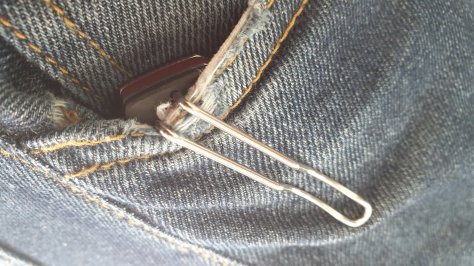
I have changed the OEM clip for this one.
It’s a shortest deep carry clip.
The Para 3 in Maxamet got the same high pitch TICK.
Dirty blade ready for some chores.
Both knives are excellent EDC. The Yo2 offers really powerful cuts on wood.
A word which comes back a lot with my Yo2 review is “power”. The heft of the saber ground hollow blade and the confortable thick spine is a call for pushcuts and “very light” chopping. You will see what I mean in a few photographies…
Deshouldering and starting to get a thinner edge. The factory edge is excellent though.
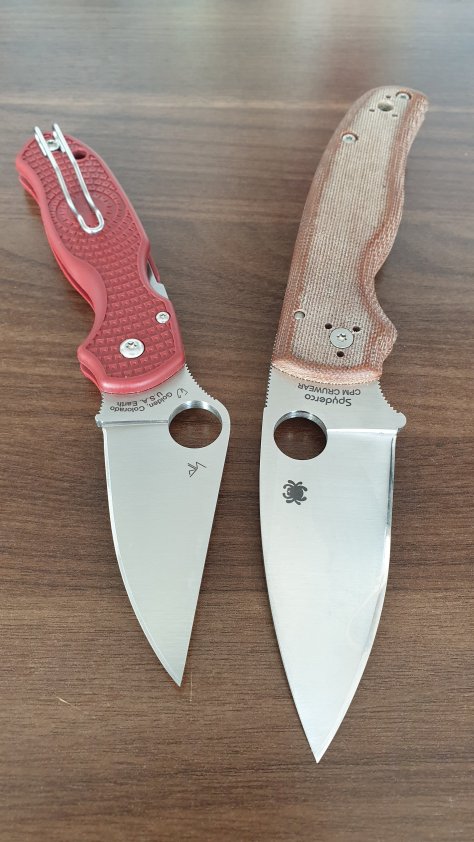
“Ghost” and “Jade” together: same materials.
The handle lengths are different just because one is standing on its clip.
Push cuts are easy.
This is the kind of “very light” chopping cuts which are made in blink of an eye.
The Yo2 is a great trimmer. The edge bites deep and the straight edge won’t let go.
It’s very efficient !
M4 steel erases any fear of breaking the thin tip easily but I do respect too much my knife to try any lateral forcing. At least I’m no afraid to use that blade tip hard !
Rinsing and cleaning the blade in a spring stream. No real patina so far but soon it will come. M4 get darker in a slow way on my experience: no hurry !
But that Jade handle goes so well with natural environments…
There is a lot of charm in the Yo2: the heavy blade smooth action, the straight edge power and the great ergos ! Nobody seems to notice it while used in a restaurant, the Jade helps a lot to make it less a weapon and more a tool.
My first experience with Massdrop exclusive design was one year ago. The Falcon has been a surprise in its quality and design and since has been my Spyderco Techno replacement. The Gent is even a better deal !! We are in presence of a real masterpiece in modern cutlery and, pardon my French but I weight my words.
First thing I have noticed is the blade to handle ratio: in a folder, the blade will be most of the time shorther than the handle but with some designers tricks you can give the illusion… It was already the case with the Falcon: we got a real elegant knife despite being short, the blade is perfectly centered, the blade evenly ground, the action is smooth as butter and the edge cut my hairs… WOW !!
The large choil seems to be a Ferrum Forge signature and it is handy for precision cutting. Also when not using it I can hold the handle with 4 fingers. It is much more ergonomic and fonctionnal that my Izulas in that matter.
The lock is similar to the Spyderco PPT. It is a thick pride liner lock made of bead blasted grey titanium. The slabs are G10 with a very nice texture. Attention to details is stunning: quality is at the rendez vous. The lock feels strong and any way your hand is protected by the flipper used a guard and by the choil if you choose to use it. This is a very solid folder.
The blade is exquisitely ground and the edge is thin, razor sharp our of the box.
The opening construction is ultra minimalist and VERY EASY to keep clean !!
I love ultra minimalists design as found on the Spyderco K2 for example.
The spine is gently chanferred for an excellent confort in thumb pushing cuttings.
Something I won’t have to do myself.
Immediatly you want to play with and put the high saber flat ground S35VN blade in its pace. A steel first introduced to me through the Spyderco Native 5.
As a Lady/Gent knife it is small like a jewel.
Non threatening is a must in that kind of EDC knife. But don’t get fooled by its size; this is a real workhorse !
The detent is a little harder than the one of my Falcon or my ZT0562CF but it works and fires every time. It is really smooth and no side play so far. I was not able easily to open the blade without using the flipper.
The deep carry clip is well thought and it makes the knife disappearing in the pocket. EDC is often better in low profile configuration.
So let’s put a little convexing on that baby: Stuff 2, Fallkniven DC4 and leather…
Diamonds are in play for the first round. The thin edge makes it easy to scratch and of course I have scratched it. You can notice the very nice belly on the blade.
But nothing some use and future stropping won’t erase in a “beautility” attempt. The idea is just to bring convex in the middle of the belly.
Leather stropping, razor sharp let try it on my favorite test in ergos and edge: the Bottle Butt !!
As you can see it was an easy cut for that little knife. There is power in this one. The blade is just thick enough to provide a comfortable spine to strongly push through.
The Belly always help for push cutting in hard material.
So far what do we got:
an elegant, non threatening short folder with premium materials (Titanium and S35VN).
It can be deployed and close with one hand. Great balance with its sweet spot just behind the pivot. Great ergos, thin edge and easy to clean ?
This is almost the perfect EDC, worst it the best EDC you can buy for 80 dollars !!
This kind of high quality knife could be the only folder to bring with you anywhere. A great little big knife ready for anything ! Thank you to my friend Dan Sharpe for having introduced me to that little wonder !
SPECS
Produced by Drop
Designed by Ferrum Forge
Manufactured by WE Knife (in Guangdong, China)
Blade: CPM-S35VN stainless steel
HRC: 58–61
Blade type: Drop-point
Grind: Flat saber
Finish: Stonewashed
Handle: 6AL4V titanium with rosewood or carbon fiber scales
Lock: Liner lock
Open: Flipper tab
Ceramic detent ball
Caged pivot bearings, hardened steel washers
Choil for easy sharpening
Reversible, deep-carry steel pocket clip
Blade thickness: 0.13 in (3.2 mm)
Handle thickness: 0.4 in (1.1 cm)
Blade length: 3 in (7.8 cm)
Closed length: 3.6 in (9.7 cm)
Overall length: 6.6 in (17.5 cm)
Weight: 2.4 oz (68 g)
Founded in 2009, Ferrum Forge started from humble beginnings in Elliot Williamson’s garage in Southern California. Using found pieces of steel like old files and leaf springs, Elliot gradually taught himself the art of knifemaking and metallurgy. As his skills and passion grew, so too did the demand for his work. Luckily, Elliot’s brother Chris joined the team in 2012 to help expand Ferrum Forge to what it is today: a small operation dedicated to designing and producing custom knives through a rigorous process of development, machining, iteration, and quality control.
The story of the Gent starts back in 2016 when Elliot and Chris Williamson from Ferrum Forge teamed up with Drop (formerly MassDrop) for a cross brand collaboration. Ferrum Forge designed a series of unique Drop x Ferrum Forge knives that they produced, but none would compare to the Gent. After the success of the first few models, Drop asked for a less aggressive design better suited for carrying in an office environment. It was time for Elliot from Ferrum Forge to break away from aggressive, “tactical” style and give the world his take on a modern, gentlemen’s folding knife. Not only did he accomplish his goal, he created the most popular, best selling knife that Drop ever sold.
Ironically, Elliot didn’t like the Gent after he rendered it in 3D. His artistic side screamed it was boring and too simple. Meanwhile, Chris, lacking that artistic side, saw the elegance in the simplicity and loved it. Drop cast the tie breaking vote and the Gent came to life.
The Gent started their evolution toward slimmer, lighter, more pocket friendly, and less expensive knives. It was the first ever Ferrum Forge liner lock design and would eventually lead them to creating liner locks like the Stinger, Mini Archbishop, and Prolix.
Unfortunately their collaboration with Drop ran its course and they discontinued the Gent.
Back to trying to get a patina on cruwear after my first attempt.
Because lemon juice is not smelly and we use it a lot in the house, I have tried to let the blade all night in a tissue imbibed.
Tissue seems to be some kind of catalyst as it help to keep a contact between the citric acid and the surface of the blade.
In the morning the tissue was dark!
And you can notice rust starting to form in between strokes of the patina.
Rust is removed with some polishing which keeps the patina.
So here we are now with a kind of camouflage results.
It looks forced but should “mild” with uses but yes you can get a Patina from Cruwear with lemon juice and a night…
Which means if you forget your knife in the sink after making some salad, you can get rust on your Cruwear blade and a very swaggy patina.
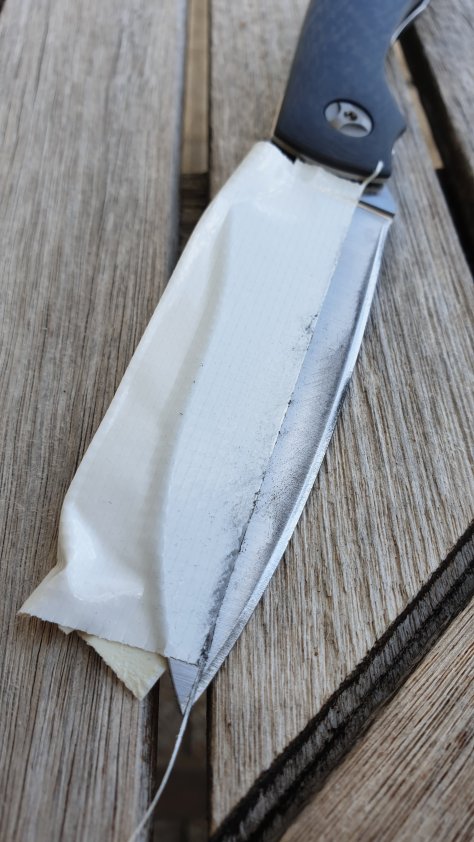
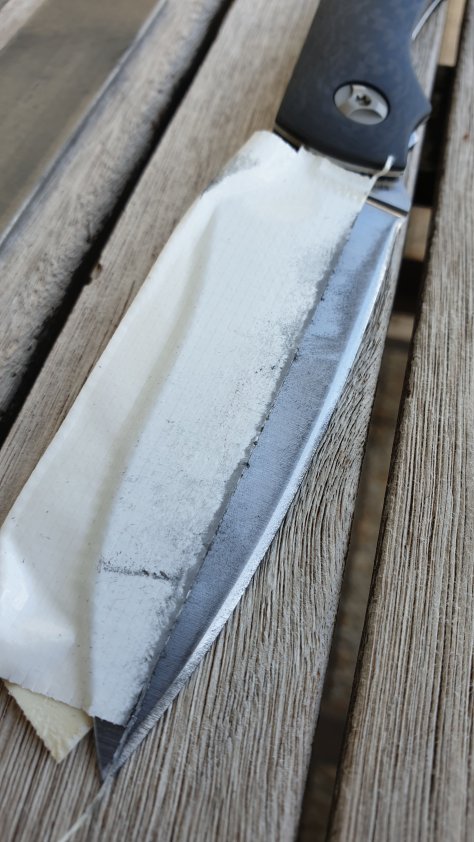
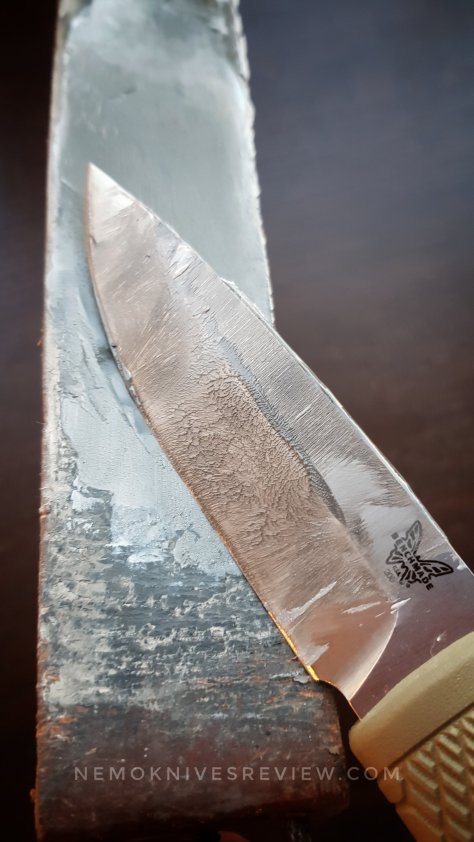
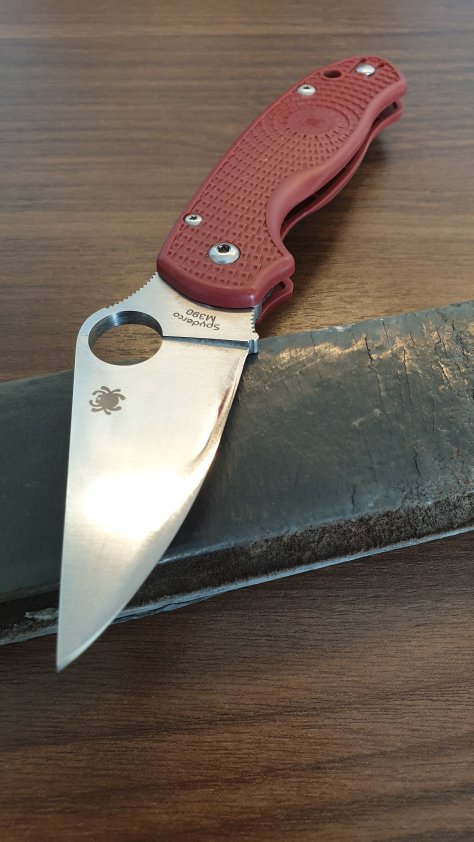
This time I have decided since the blade of this Paramillie is thin, to protect it with some gaffer tape.
Same process as usual: diamonds, then ceramic and stropping on leather.
The DC4 of Fallkniven and the Spyderco Double Stuff 2 were used.
I got also an old barber leather I use with some polish.
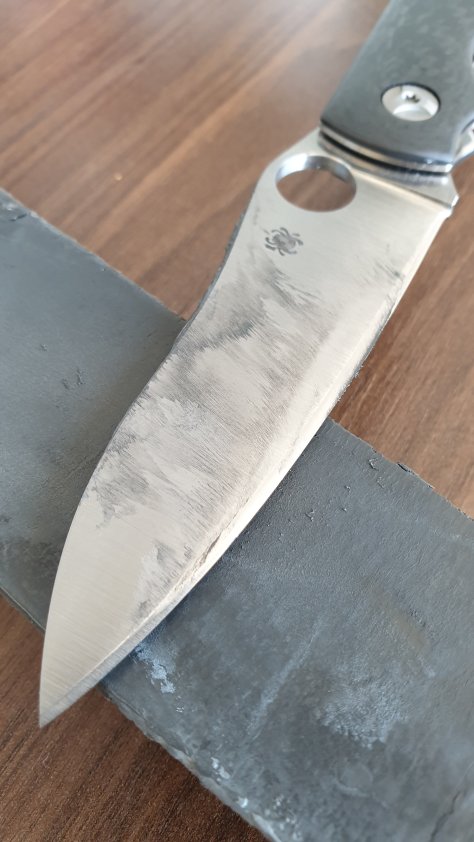
I use the diamonds to remove the shoulder of the edge to round it a little, this is where you can scratch the blade as the angle used is very shallow.
Once you see the edge is widen, you can switch to tsone and ceramics mainly to smooth the scratches made by the diamonds.
It is very simple and just ask for time and patience.
Cruwear is stropping friendly much less than 52100 though.
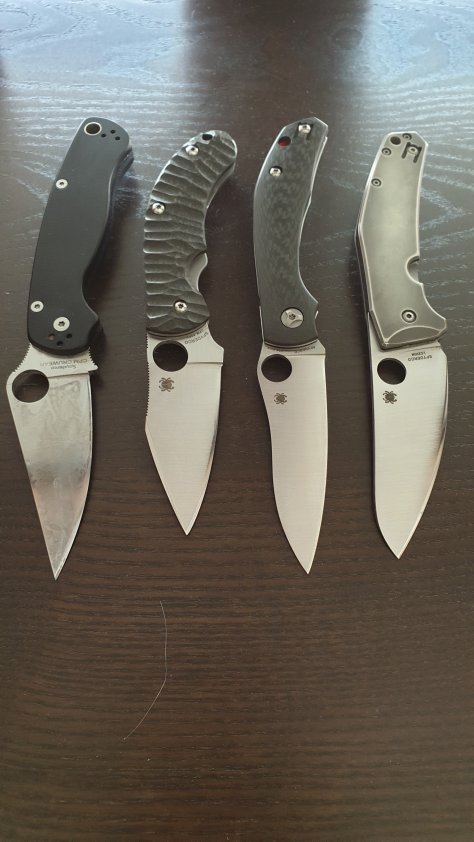
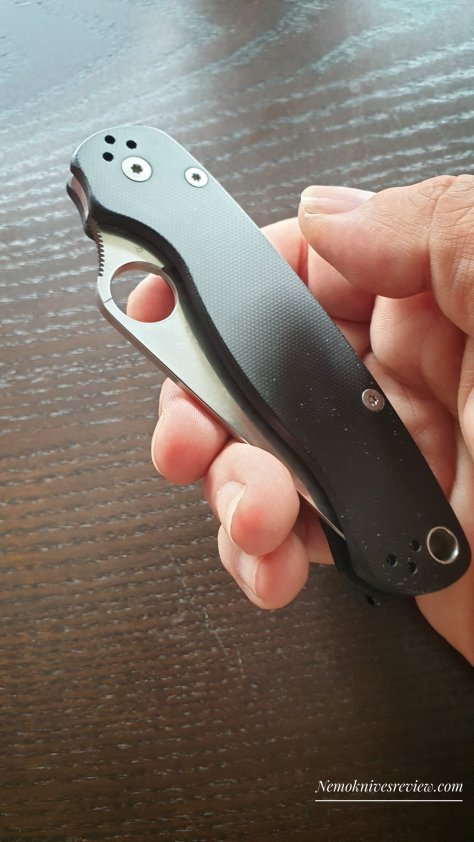
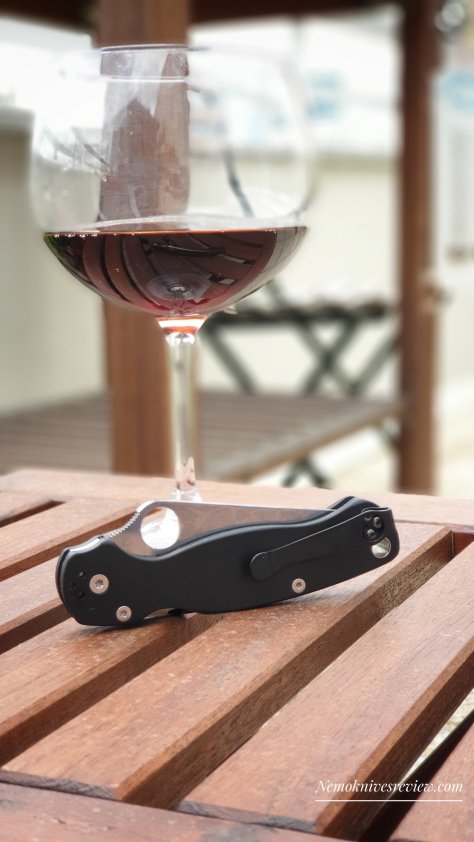
This one will be my 5th Paramillie 2, so it is a well known plateforme but the offer was to great to pass: a CPM Cruwear blade and a smooth black G10 handle: another exclusive run from the Knifecenter which is synonym of of a great attention to detail. This sprint run is absolutely flawless and its operation is smooth like butter. You really feel in your hand one of the greatest all-terrain EDC version ever made by Spyderco, no more no less. You can also check my previous review of the Knifecenter Smooth S90V Native 5.
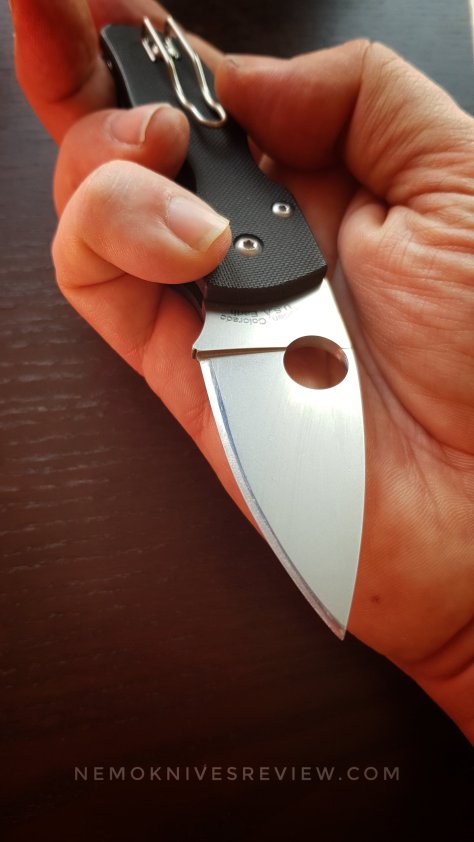
Perfectly centered and the grind lines just great. Golden is getting better and better through the years, it is like a real jewel of a “tactical knife”. Sal and Aric can be proud of that one !
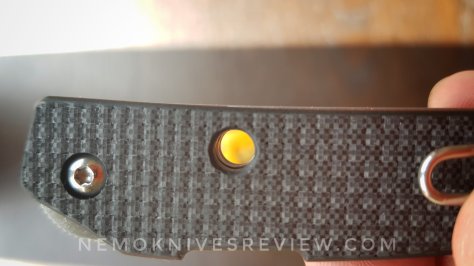
This sprint run got smooth black G10 handles but pardon my French, I do love my edges even smoother than that. It’s really a matter of personal choice but the relation with my tools goes through the finger and the palm of my hands.
So OK It was really a matter of minutes just to round a bit the G10, as I was not obliged to sand all the slabs. So it was an minor adjustment.
The edge is already thin, So I cannot really improve it.
CPM Cruwear is great for stropping: a mirror edge is done very easily.
It is just the first try at deshouldering, the factory edge is still there and I want to test it that way.
This is not my first CPM Cruwear blade as my Grey Millie “Gandalf” was my first.
The knife operates so smoothly I have decided to carry it tip up and have installed a short deep carry clip which disappears under my ring finger once deployed. My intention is also to use the version of the Paramillie 2 hard so I want to hold it by the pivot without a clip coming in the way.
More to come soon.
En this black smooth handle reminds me that knife of my childhood: Le Couteau d’Office Nogent Carbon (Nogent carbon steel paring knife) which was the sharpest knife in the kitchen.
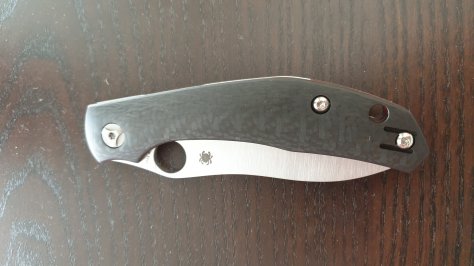
My first impression is that this little folder is designed as a very strong little workhorse. Nested liners, carbon fiber, compression lock, integral guard (short choil), full flat ground blade, belly on the edge ? What no to like ?
The hour glass clip !! Because it’s not deep carry friendly ! At least it doesn’t create a real hotspot even when holding the handle tight.
See ? The Rhino could be compared to the PITS in the way the guard/choil is working.
So far it’s another “Little big Knife” by Spyderco which could be used in the woods or in the city. Taichung is again top notch in the manufacturing, the liners are polished for example. Visible bronze phosphorous washers are visible and gives a very smooth opening.
This is the kind of knife which is crying to be used and the belly with the thin edge will certainly give a max of cutting power.
The Grey Mouser has been in my EDC rotation since it has arrived in my pocket.
So this a little report.
Maxamet is like a super CPM M4 to me, it cannot seem to get dull. I have deshouldered the edge and keep it sharp (razor) with white ceramic and leather. The edge behaviour in wood is like M2, it gives a gentle patina to the part cut.
The gently rounded spine is a must for thumb push cutting.
The lock is solid and did not give in to any vertical or lateral play.
The Para3 is really a friendly 3 inches knife with a wide spectrum of uses.
Near the pivot you got as much as any C36 Millie strenght for power cutting as this is the same “cockpit” as the good old Military. The point is easier to control as your hand grabs the blade and the handle with more ease on smaller knives. So you got a very capable knife for the outdoors, able to carve and trim wood.
Maxamet is giving a beautiful orange red patina. I have not been able to get any pit of rust despite my every day use on acidic foods.
It’s less sensitive to medium than K390 and close to CPM10V. You got stain but nothing more in my experience.
I clean it directly under the tap of in a soapy water. Nothing extravagant. The action is on the smooth side even without any oil near the pivot. I have decided to treat it the hard way.
So far I’m really impressed by the ease of keeping razor sharp that very special alloy. It’s not difficult with only white ceramic and leather and it happen once a week just for a refresh.
The deep carry clip is back for tip up carry and it makes a very low signature for an EDC.
It’s used every day for eating and mostly I use the spine to push in the plate.
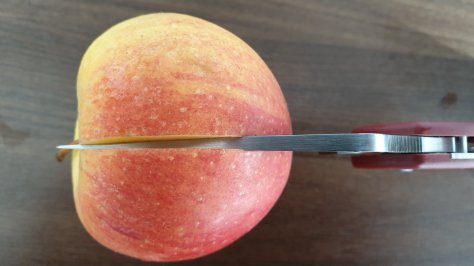
An apple a day keep the doctor away, especially if you got a good aim.
More to come soon but so far this is a very satisfying experience.
Strangely I am coming back often to the PPT when I first thought it would be a collection and a safe queen. Safe queen my a$$ ! Pardon my French but there is something quite sensual when holding this knife, something which makes the other feel “hollow” in comparaison. The PPT got that heavy butt “anchoring” it to the palm but also the toxicated finish of the handle’s slab is a delight under the thumb.
There is something almost “paleo” in the finish. Something primal in the mechanical way it feels. It’s dense but is designed to be heavy metal. It’s a knife Opie could have admire…
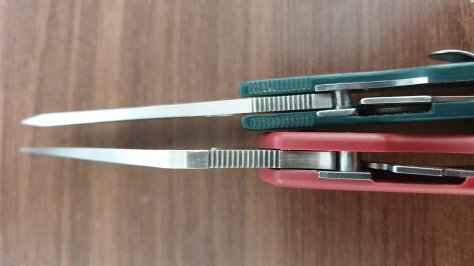
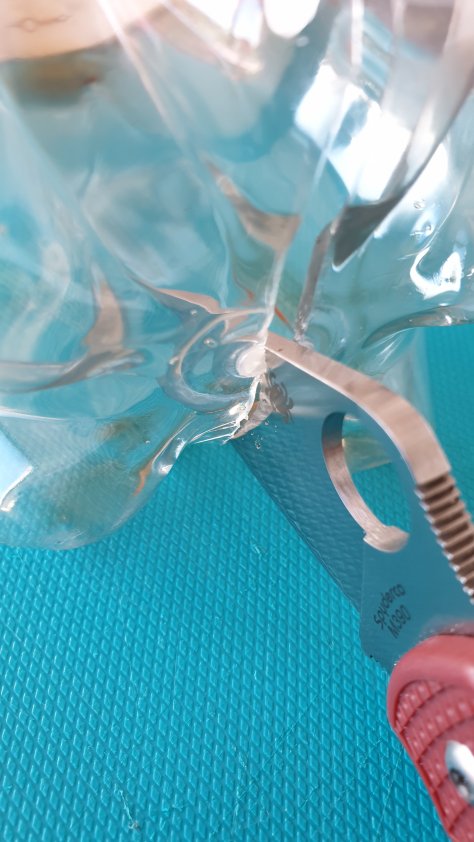
On the performance side, I have decided to get a convexed edge. Diamonds are the only language stubborn S90V seems to understand and scratches on the blade side are, well especially for the clumsy sharpener, something hard to avoid especially when using the stone at a 10° angle to get rid of that secondary bevel. The performance in pushcutting are really enhanced now. I can measure it to the Manly Peak and its thin S90V blade.
I use white ceramic to make the steel shiny but S90V is really a tough cookie in the kindergarden of alloys: it’s a game of patience to obtain a nice finish.
But now on plastic I can enjoy the enhancement of that already very thin edge. It goes easy through.
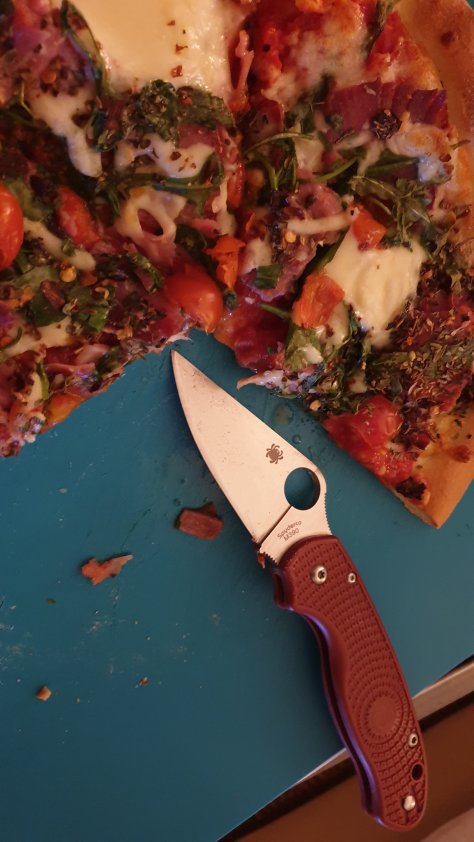
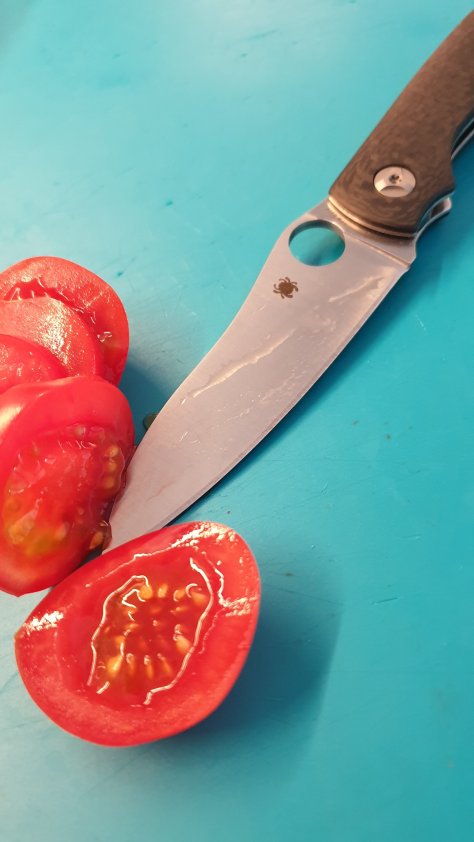
Someone asked me why using a workhorse knife on tomatoes ? Tomatoes may look like some fragile fruits but they are not: their skin got no pity for any dull knife and their flesh will give in under any pressure. The best tools for tomatoes are serrated and micro serrated knives.
Hence that test on my polished edges. You need a very keen blade to push cut in a tomato and make thin loaves. Plastic and bambou can be used to test the edge stability which often is only due to thermic treatment of steel.
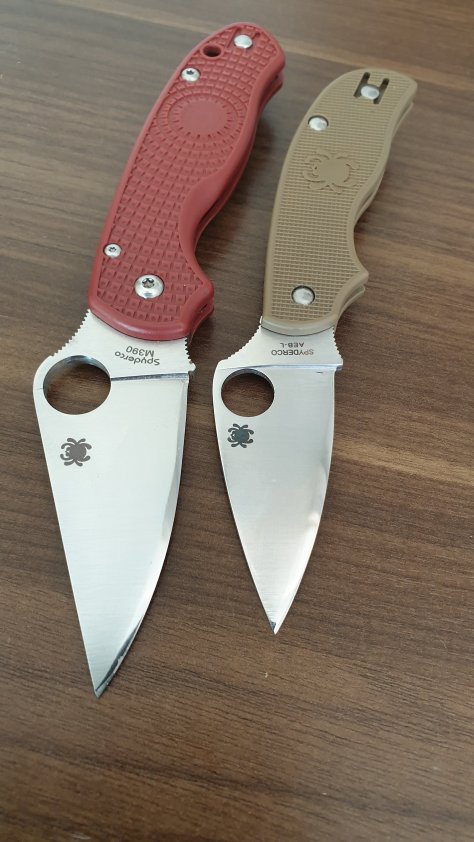
The alignement of the point on the PPT is very different from my Millie and is very close to the experience of the YO2: its makes powerful cuts.
Also the handle makes Icepick/reverse grip very confortable, knowing this is the favorite grip of Philippe Perroti on La Griffe, a grip I have found handy in forcing a door. Just kidding but the confortable reverse grip (à la “griffe de chat” in French) is not a joke.
You get also an excellent blade/handle ratio for a choiled knife compared to my Para3 for example.
And as good as the non-choiled Sliverax !!
My PPT has been used in the kitchen is not easy to clean because the way the hole in the liners are not accessible. This is serious issue if, for example, a piece of raw meat get stuck there and could contaminated the blade. The full Reeve Integral Locks are the best lock for checking your folding for any debris. I would have preferred solid titanium liners without that hidden cheese holes which ask for special maintenance starting by unscrewing the slabs to get full access and complete cleaning.
So in a wrap, the PPT is a compact hard user with very high performances featured by great ergos. It has a really strong character (it feels like it has been done for some Hell’s Angel fan) but once deployed it will pierce and cut with high reliability. Once the PPT is entering the game: this is serious business. For the record being represented to bikers gathering, bikers love La Griffe and various neckknife which are handy on a ride. So it’s easy to understand some DNA in the PPT design.
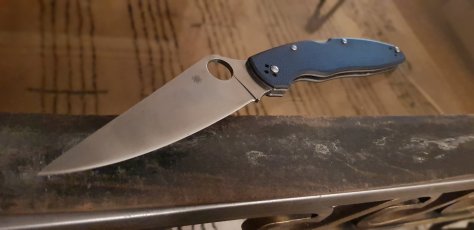
Nowadays rendering of three iconic 90’s lock: Liner Lock, Back Lock and Integral Lock.
They are plethora of locks since the 90’s when the Tactical Folders trend started.
“Tactical” , a term which has been mainly used in a marketing way, means you can get access to your knife easily — A clip or a well thought pouch — and more important: to be able to open it and close it with one hand.
The blade needs to be locked in open position and also to stay closed while in the pocket.
Let’s have a look on the locks I prefer and use.
The Compression Lock.
Described as: “A lock mechanism that uses a leaf-like spring from a split liner in the handle to wedge laterally between a ramp on the blade tang and the stop pin (or anvil pin).”
What I like about that Spyderco in-house engineered system is how smooth the action is.
Spyderco is now developing and proposing flippers with the CL because the breaking action on the pivot is minimal. On my different CL folders I can open the blade in different ways: using the index, pushing the paddle to unlock the blade…
It’s fun. It depends on a detent ball to keep the blade closed.
It’s a lock easy to clean and check as the handle are all open framed. It also asked for some nested liners which, when they are skeletonized, need more attention for cleaning, especially when you use you knife in the kitchen like I do. I rinse them under hot tap water , wipe the blade and make them dry inside the pocket with body heat.
Also the compression lock can be hurting the palm of your hand when cutting hard matters.
The Back Lock.
Described on the Spyderco” Edge-U-Cation pages as: “A locking system positioned on the back of the handle that uses a rocker arm that pivots in the center. A lug on one end of the arm engages a notch in the blade’s tang to lock the blade open.”
The Manly Peak and the Native 5.
This lock has been infamous since the Buck110 and all its copycats. Spyderco has developed mainly mid-locking system which can be unlock without changing your grip lick on a Buck110. It was demonstrated with the first Native how safe it was it unlock their knife and let the choil of the blade get in touch with your finger before to close it.
This is still the way I do it, even on my Delica and Endura which got no proper choil: unlocking the blade by pushing the lock free and let the blade falling half way on your finger. The Back Lock got a spring which is strong enough to avoid a detent ball. Old timers used to pu a match inside their closed Buck110 to pass the stronger spring tension and get it open faster. On Spyderco’s, it’s also easy to avoid any locking noise just by pression the paddle before it get completely opened. Unless the blade is very heavy like on XL Cold Steel Voyager, it’s not a lock for gravity opening. But it’s one of the most solid lock. In fact because of the way it’s engaged, it can be much more solid than all the other locks. Spyderco were testing their strong back found on the Chinooks and Manix with amazing results.
It’s not the easiest lock to clean as there is no open framed handle. It’s hard to see if debris can be jammed in. Also it’s not the funniest lock to use as the spring tension is felt during all the opening and closing motion. The Spydies with relatively heavy handles can be spyderdropped for quick opening. I do that on my Knifecenter stainless steel spacered Delica for example. It’s also easy on your palm during hard cuts because of their closed handle spine. Some Compression Lock haters are Back Lock lovers because of that confortable handles.
Also I have noticed on many of my Back Locks knives some vertical play when cutting on board which brings us to…
The TriAd Lock
Featured on Cold Steel’s folders it is essentially a Back Lock with a stop pin. There is no more vertical play when cutting. It doesn’t change anything toward the negative force used to close the lock blade.
You can also find inside the Chaparral an hidden stop pin invisible as it’s hidden near the pivot.
The Liner Lock.
“A locking system developed by custom knifemaker Michael Walker that uses a leaf-like spring split from the liner to wedge laterally against a ramped surface on the tang of the blade.”
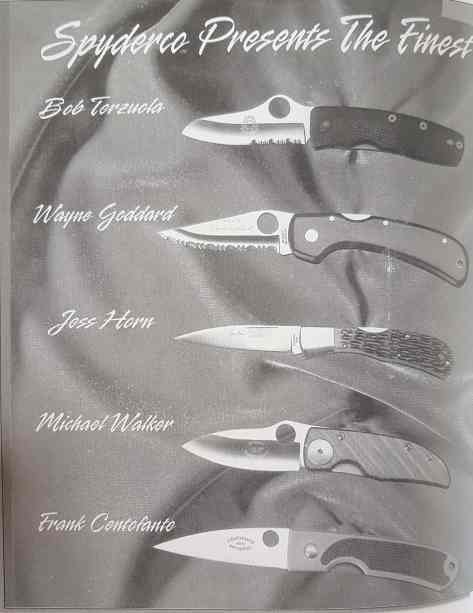
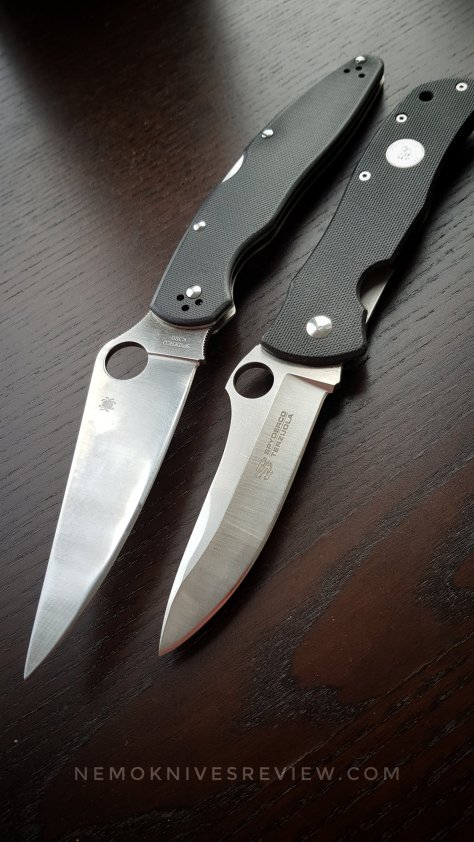
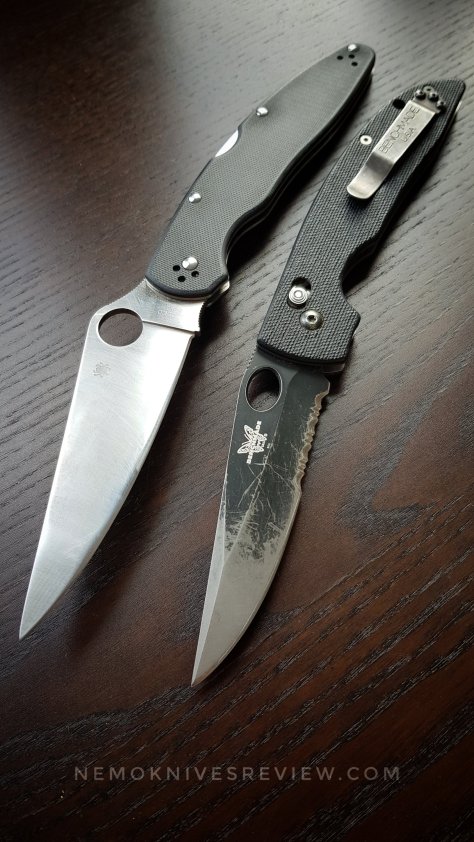
This lock was the king of Tactical frenzyness back in the 90’s. The Benchmade CQC7 and AFCK promoted them in titanium and Spyderco developped their Military with a stainless steel liner lock. If I remember well Sal Glesser and Les de Asis were together private students of Bob Terzuola which is a master in liner locks making before to start their own production. Depending on a detent ball, the liner lock was bringing that smoothness the Back Lock could not provide but it was not the strongest lock available.
To test it many people tried the infamous and stupid spine whack and many time with shock the liner was unlocked and damaged by that treatment.
It’s a very easy to lock to get open and close fast just be careful to put your finger out of the way when closing.
Titanium liner locks are wearing more than stainless steel liners.
It should not be difficult to clean depending of the handle conception. On that matter the last version of the C36 Military got rid of they spacer and got now a full open handle for easy check.
The RIL
Then Chris Reeve came with his Sebenza and used a lock bar that is integral to one of the handle scales. It was giving you the sentiment, you hand’s grasp was also enhancing the locking mechanism. It’s also a very easy mechanism to clean and check hence the Spydiechef, or the K2 which are easy to use in the kitchen even after being defiled by grease and meat… RIL of the Advocate and the ZT550.
The PPT is a mix of both RIL and liner designs with the possibility to grasp it and hold it in opening position.
BALL BEARING LOCK
“A patented compressive lock that wedges a ball bearing between a fixed anvil and the blade tang. The mechanism also serves as a detent to hold the blade in the closed position.” I was developed by Eric Glesser for his Dodo and can be found on the Manix 2 folders with a caged ball version. Some people found a lot of similitude with the Axis Lock from Benchmade but here, instead of two omega springs, it is a coil spring pushing a ball bearing made of ceramic of stainless steel. It’s smooth but not as easy to clean as other locks. Actually I prefer it on the Lightweight version of the Manix which is my main travelling knife with its CPM110V blade. It’s engineering makes it one of the strongest as you can not squeeze a ball bearing easily and it is also self adjusting.
The cage ball can be exchange with a custom titanium cage in case of breaking after years of using. It happen to my cousin who has modeled his own resin ball.
The Balisong Lock.
This could be the most fun system to use and also the strongest. Easy maintenance, no spring… It’s a very old design. The first trace was found in 1780 in France with a knife called “Le Pied Du Roy” (The King’s Foot) and circa 1800, butterfly knives were uncommon. They were made in Paris and Thier. There is a beautiful collection of the old Butterfly Knives in the Thiers Museum. French Army troops were provided with Butterfly Knives, but after WW2 there is no more trace of Butterflies made by this brand.
(More to come in the re-edition of the Fred Perrin’s balisong review soon.)
Locking a folding blade has been a puzzle for engineers for centuries. The roman folders were not locking and 2000 years ago a folding knife’s handle was considered as an attached sheath which means it was hold like a razor: by the blade.
So how to choose a lock ? Recently I have been surprised on how well the Bulgarian Manly Peak was operating: no vertical or lateral play on its very strong Back Lock. I have been playing with the Sliverax Compression Lock flipping options. My old Sebenza RIL lock is still in great shape and my Ed Schempp Bowie flies in opening position…
Lock is just a matter of taste and use, selling a design just by its lock won’t work. Some designs are made for compression lock like the Sliverax wasp shape flipper design could not go easily with another lock.
But always remember a folder cannot be as strong as a fixed blade. Marketing can be your enemy but the main enemy of locks are shocks because its weakest element will give in, bend or broke. Now when you choose a knife made by reknown makers and manufacturers you can trust their locks but it’s not the case with all the copycats and cheap knives which often got very bad quality elements ready to break or bend at the first use. I’m not saying the best locks are the most expensive but looking for quality in the making should be mandatory in your choice.