Today’s review is a bit special. Every now and then, I like to invite other reviewers and true knife enthusiasts to share their perspective. This one comes from Guillaume Gx, moderator of the Spyderco Fan Club on Facebook — and a man who definitely knows his way around an edge. Also all photography featured in this review is the work of Guillaume Gx.
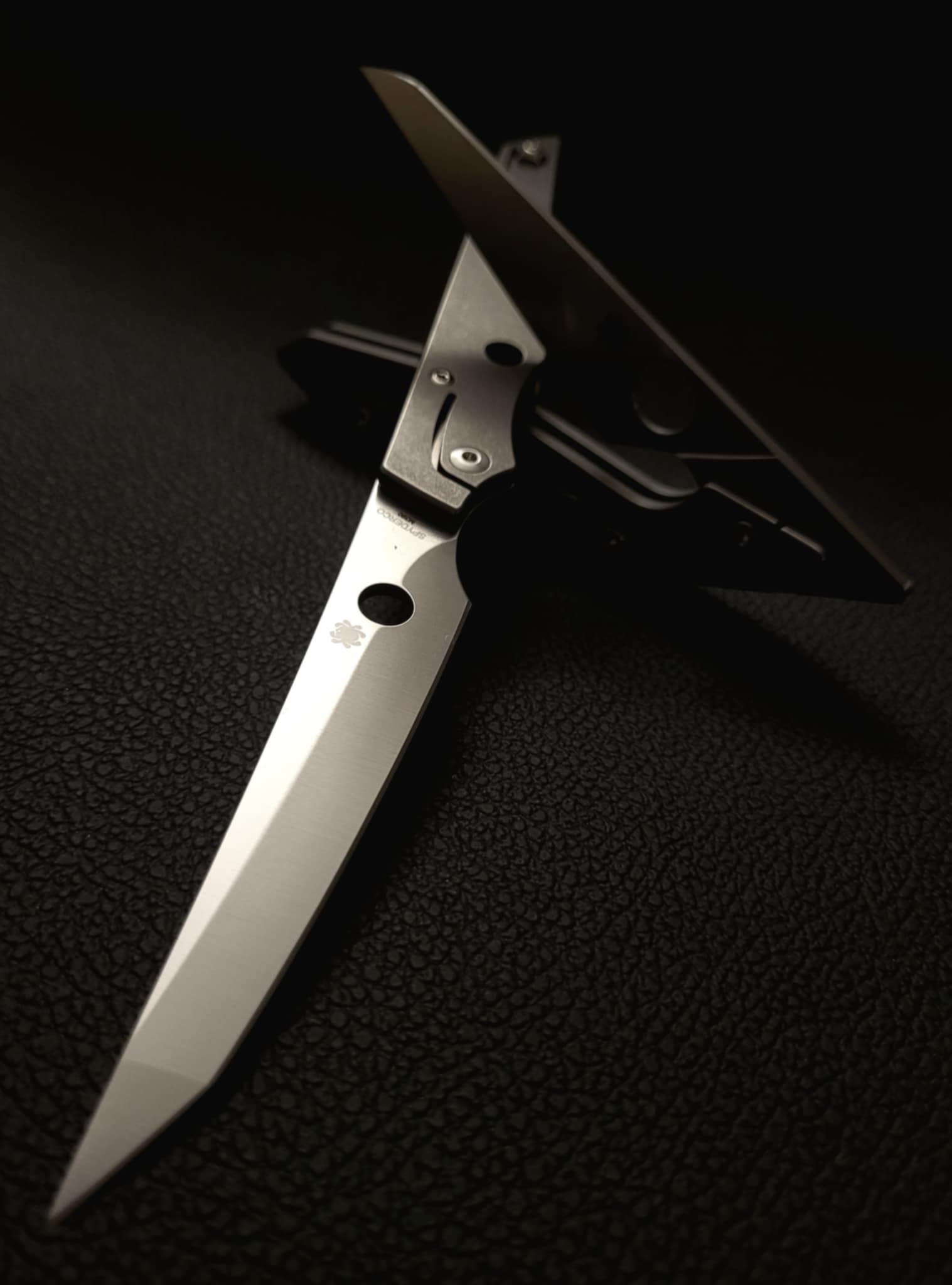
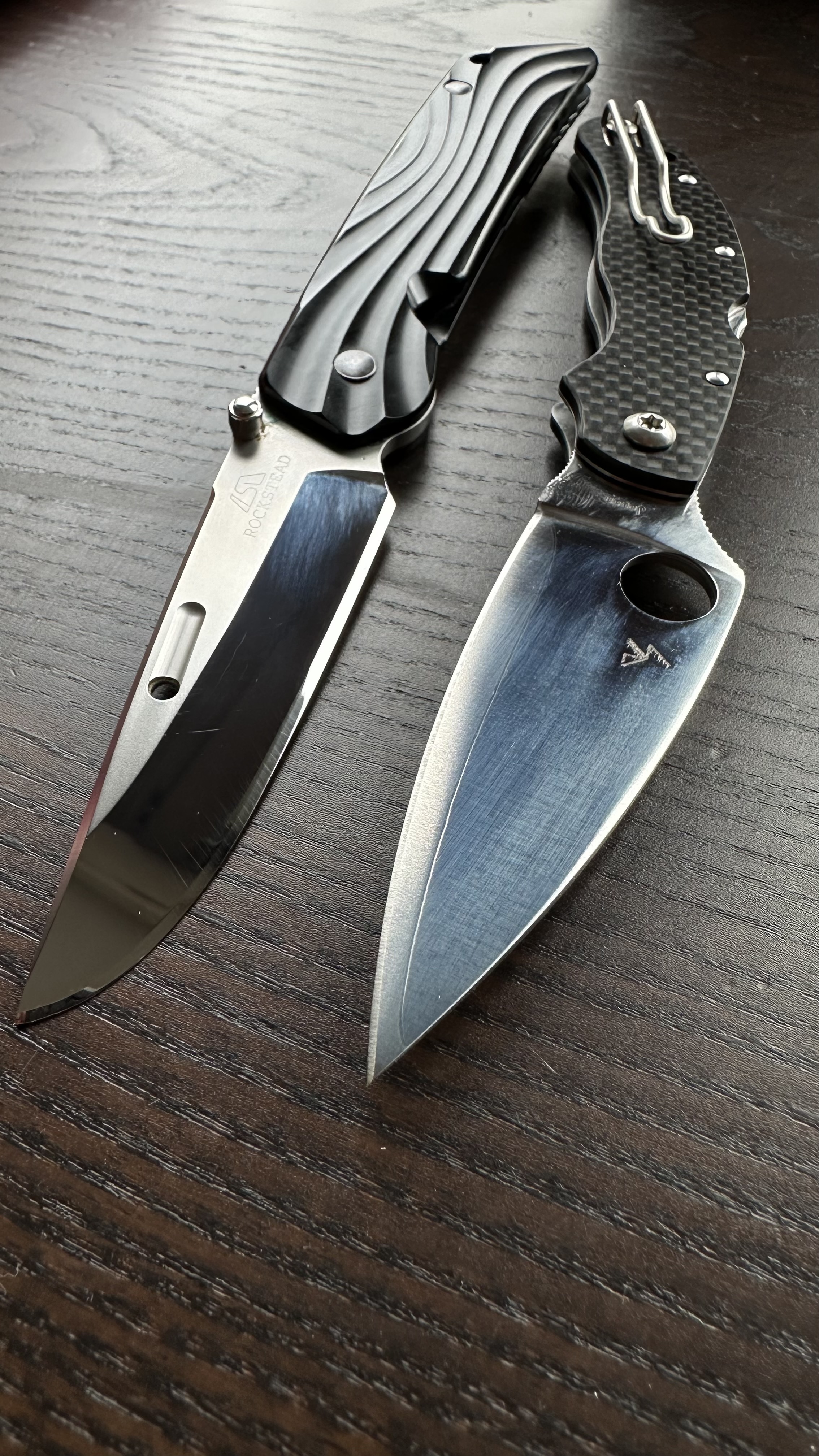
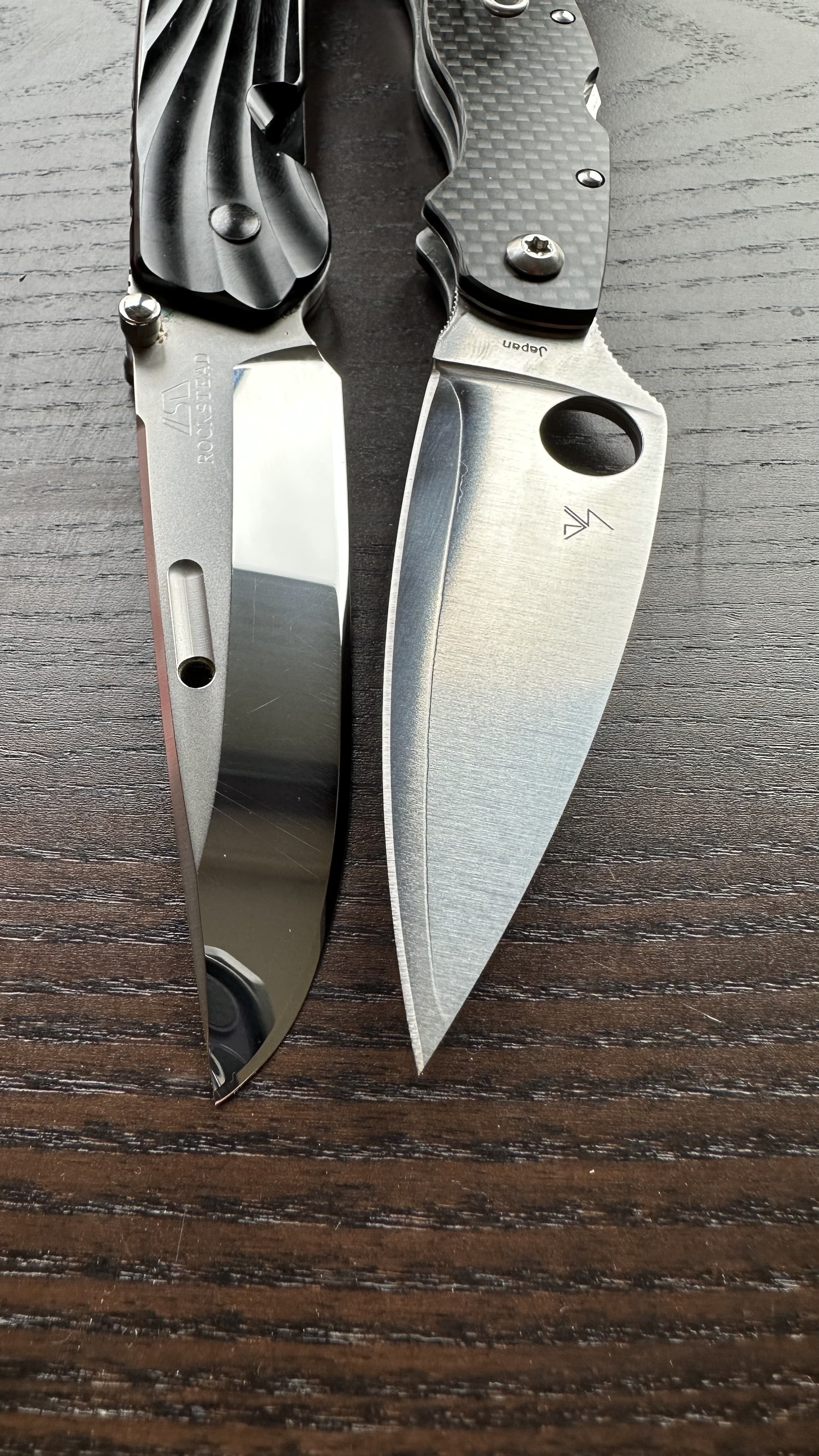
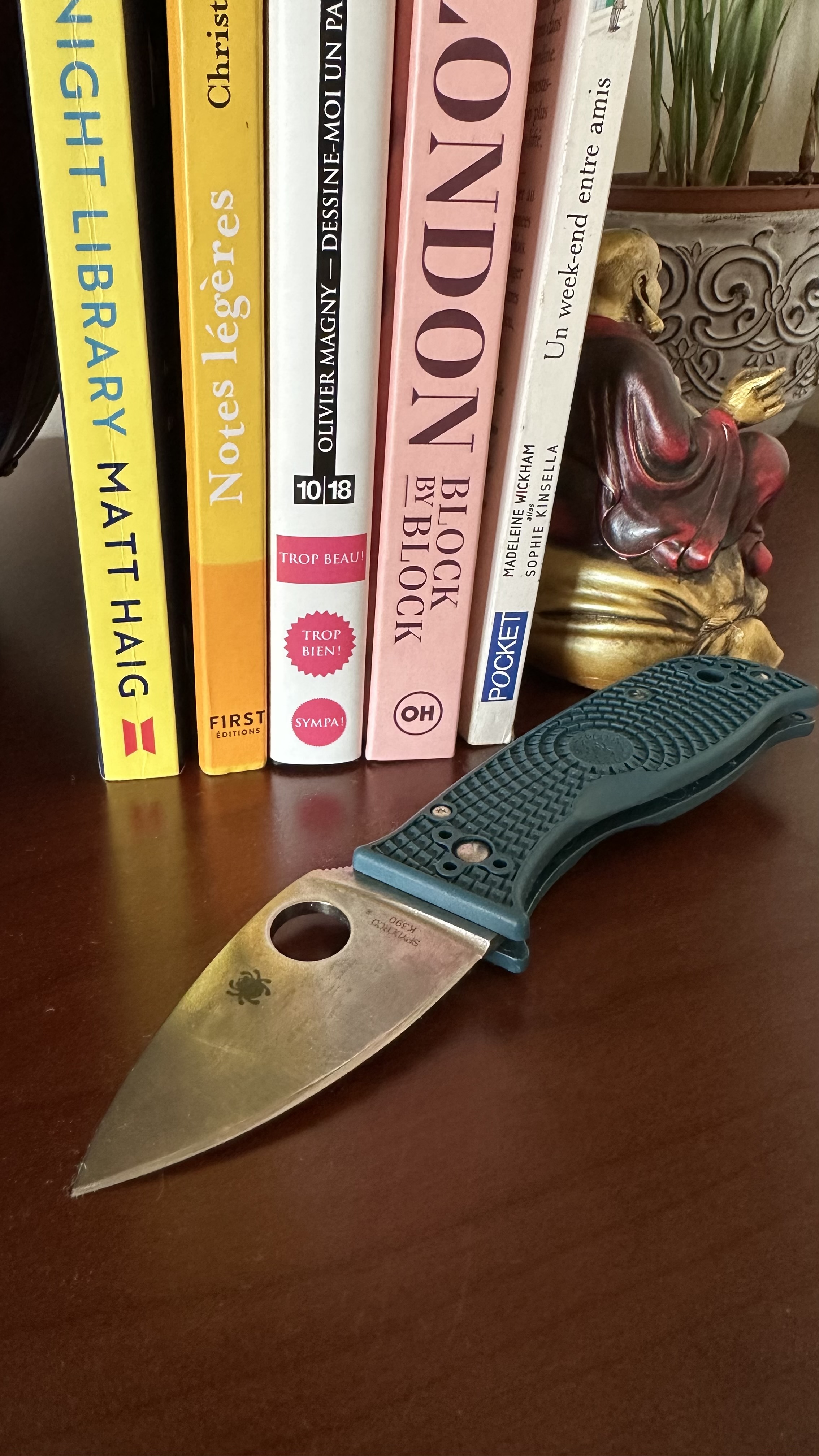
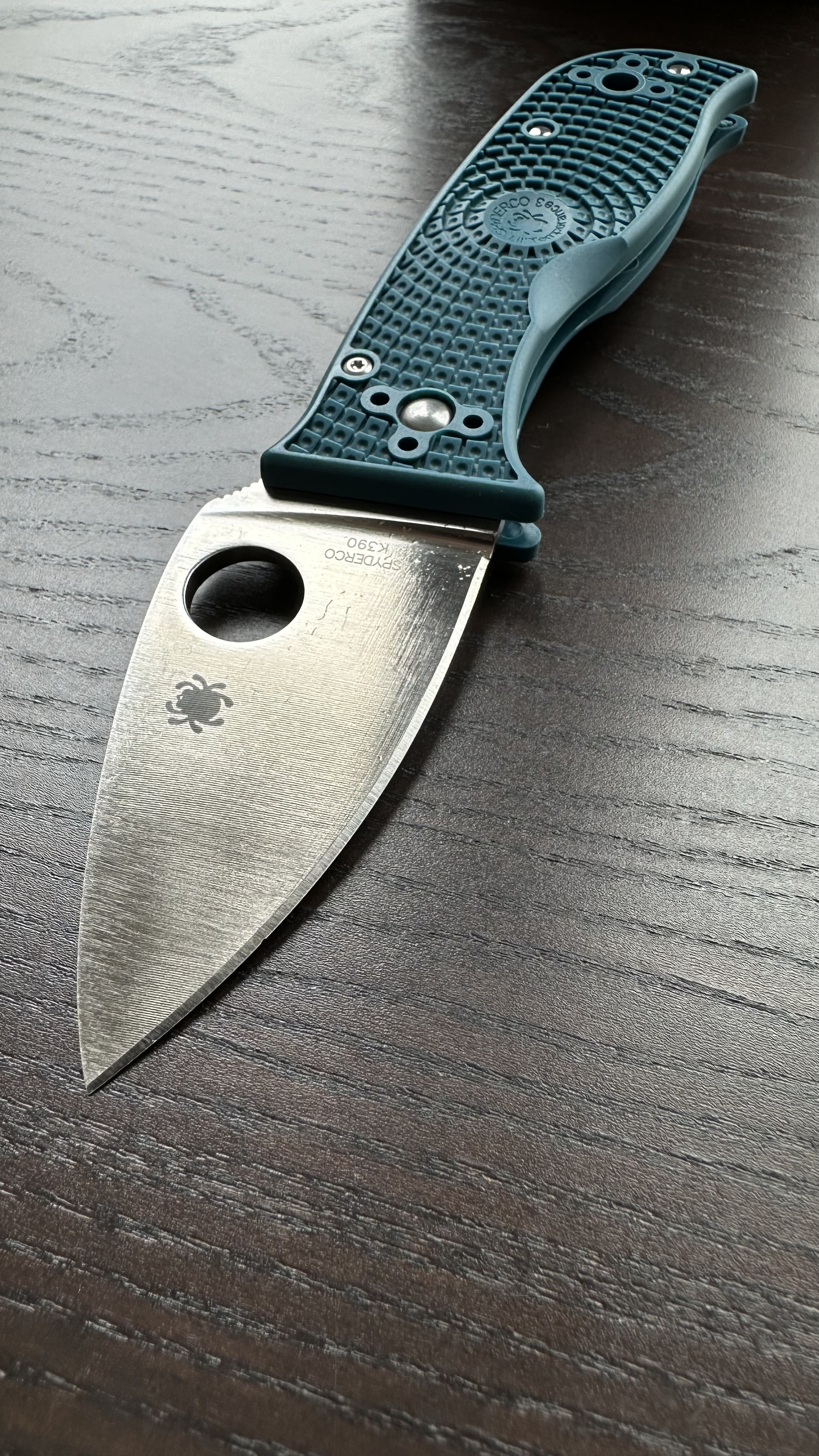
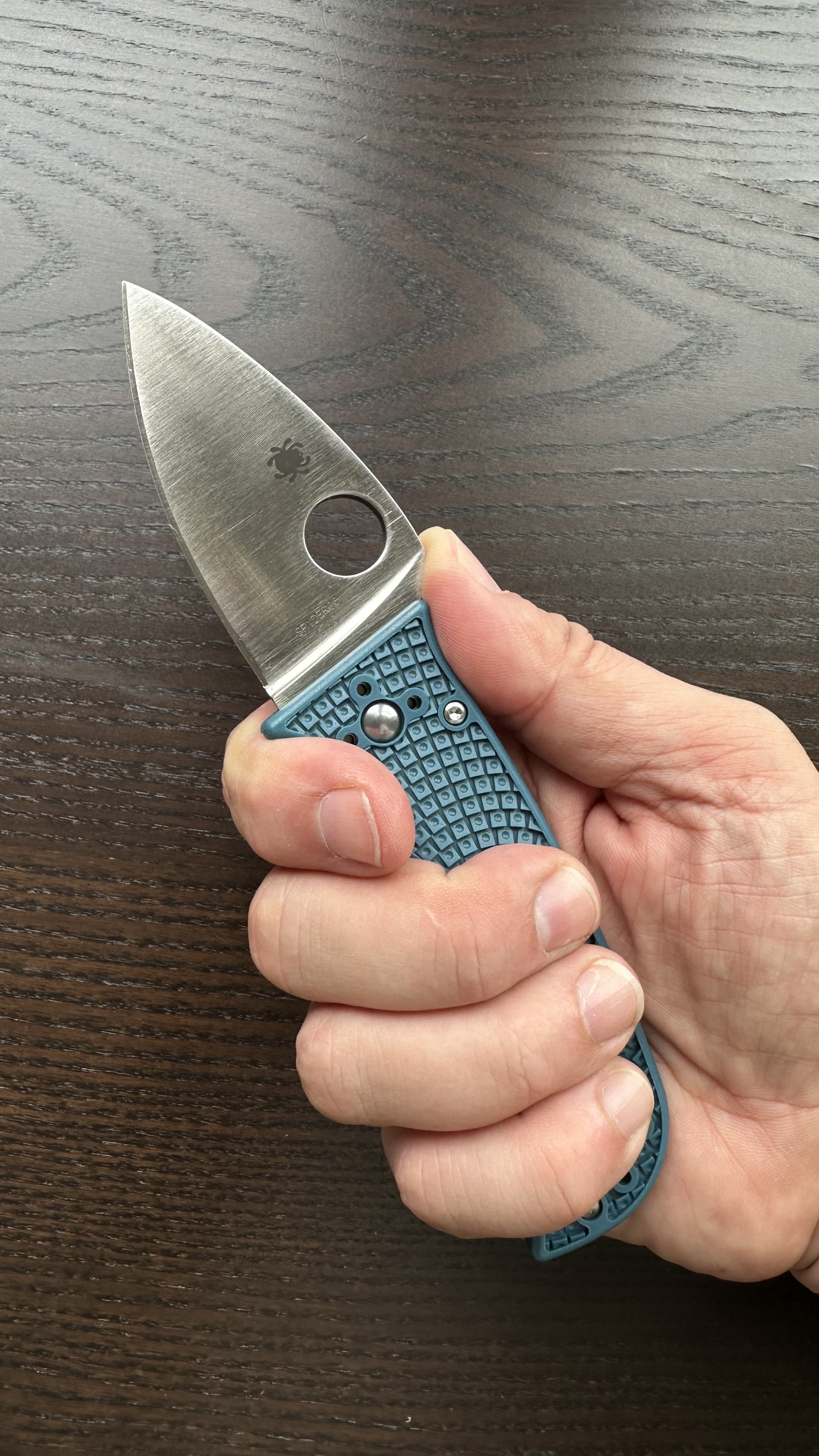
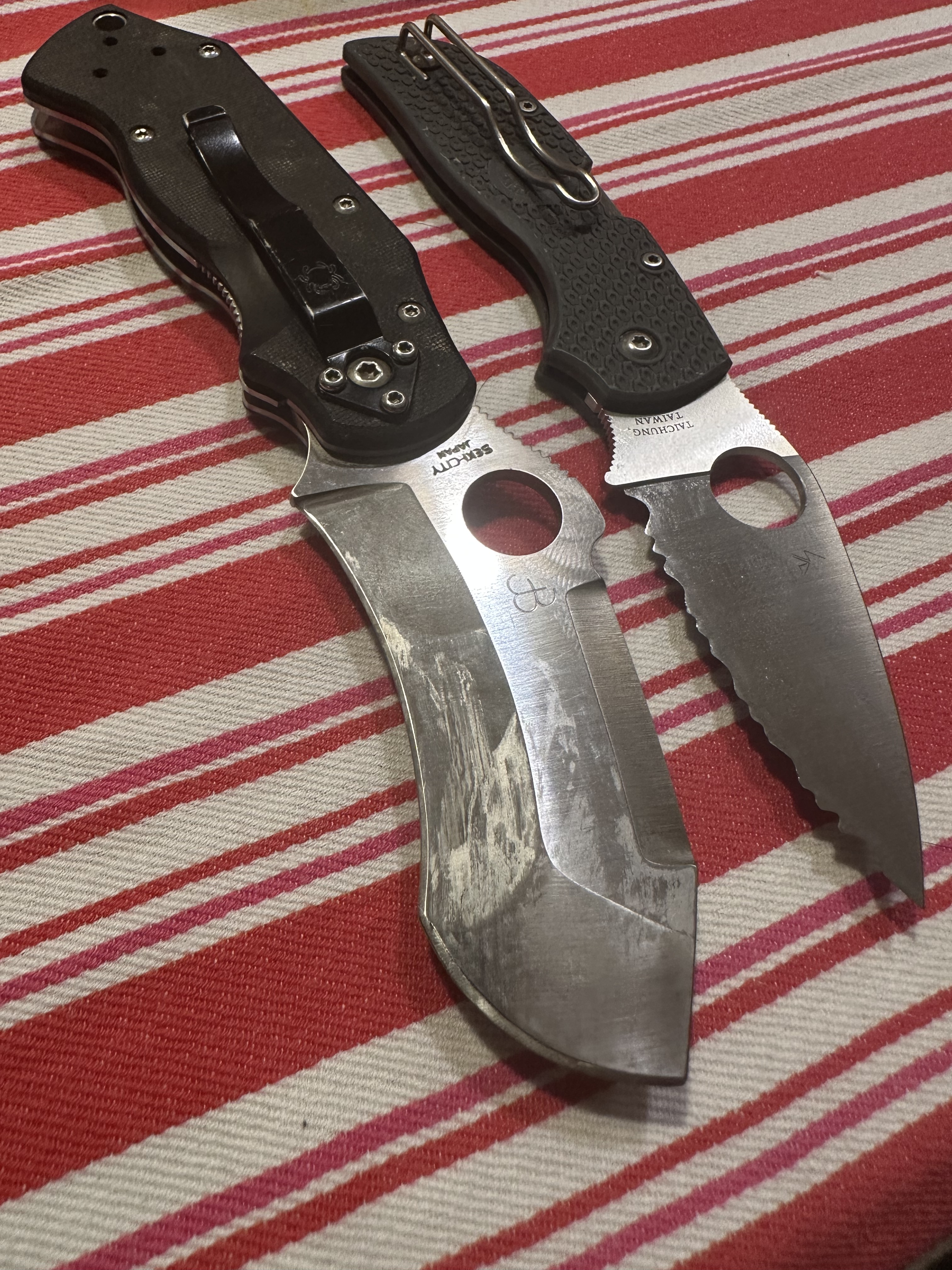
Let’s get straight to the point — much like its sibling, the Nand, the Cobol doesn’t carry a knifemaker’s DNA. This is not a blade born from the forge, but rather a stylistic exercise, a conceptual piece with a distinctly “Japan-inspired” design. And that’s where any comparison to the Ikuchi ends.
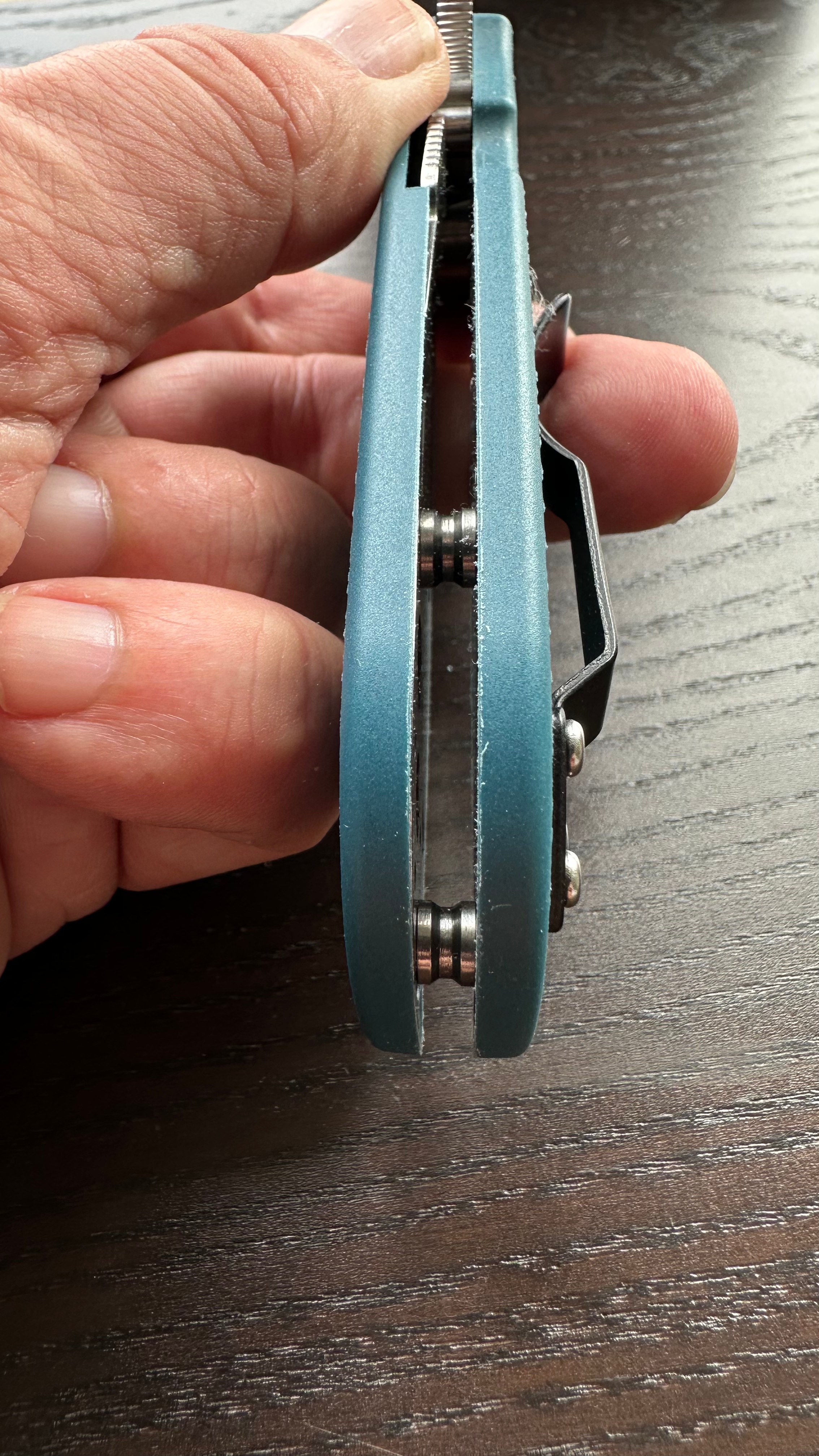
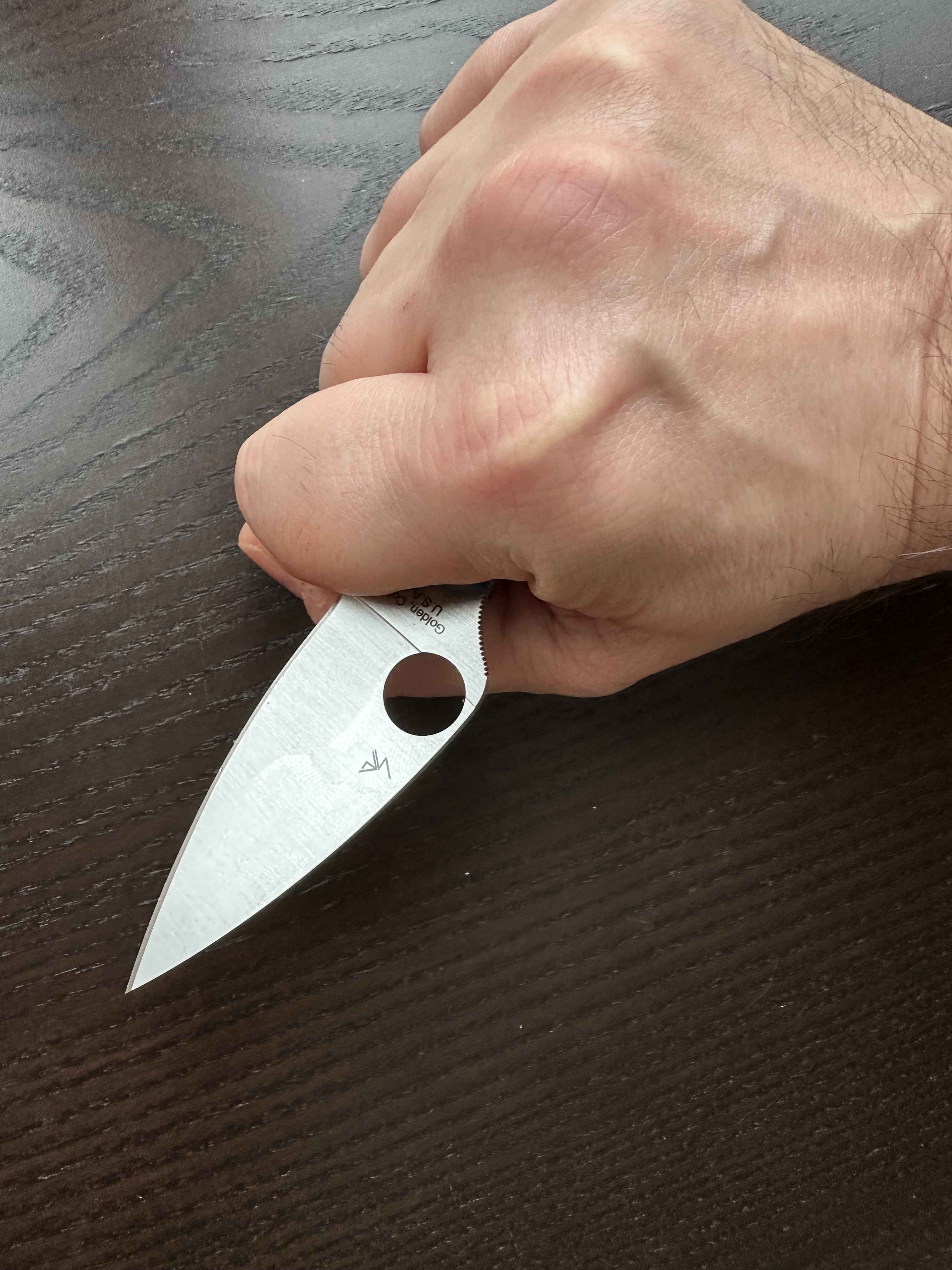
Mechanically, this slipjoint shares the same traits as the Nand: soft tension, little to no sense of security. A light press on the spine will start the blade folding, which instantly rules out anything beyond light, food-related tasks.
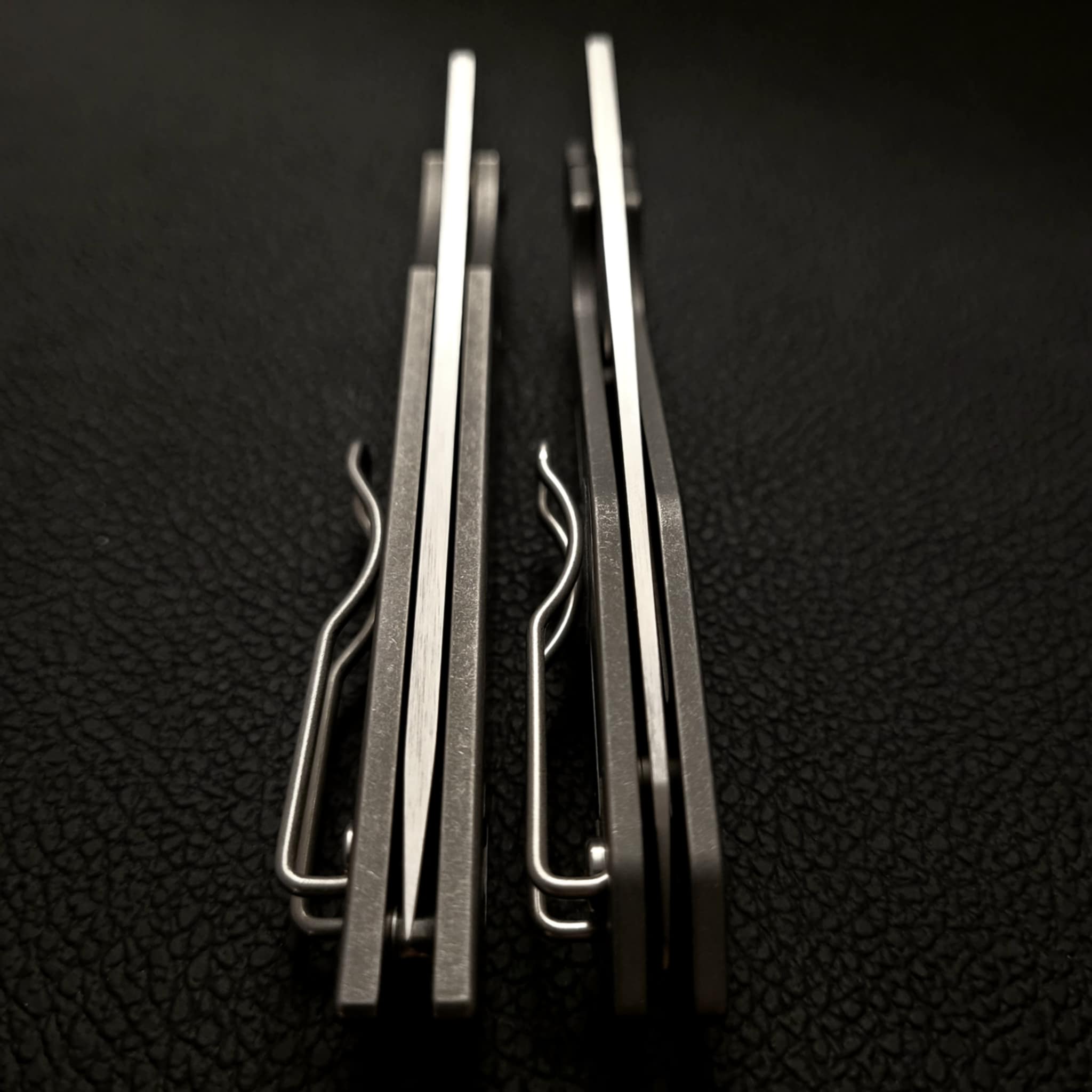
But perhaps that’s the idea. The dining table seems to be the natural battlefield for this miniature katana. Unfortunately, the sweeping arc drawn by the handle and blade demands contortionist wrist angles, while the tanto-style tip hardly helps when it comes to cleanly separating food. In this arena, the Ikuchi—or even the Nand, with its almost twice thinner blade—will fare gracefully where the Cobol clearly struggles to hide its discomfort.
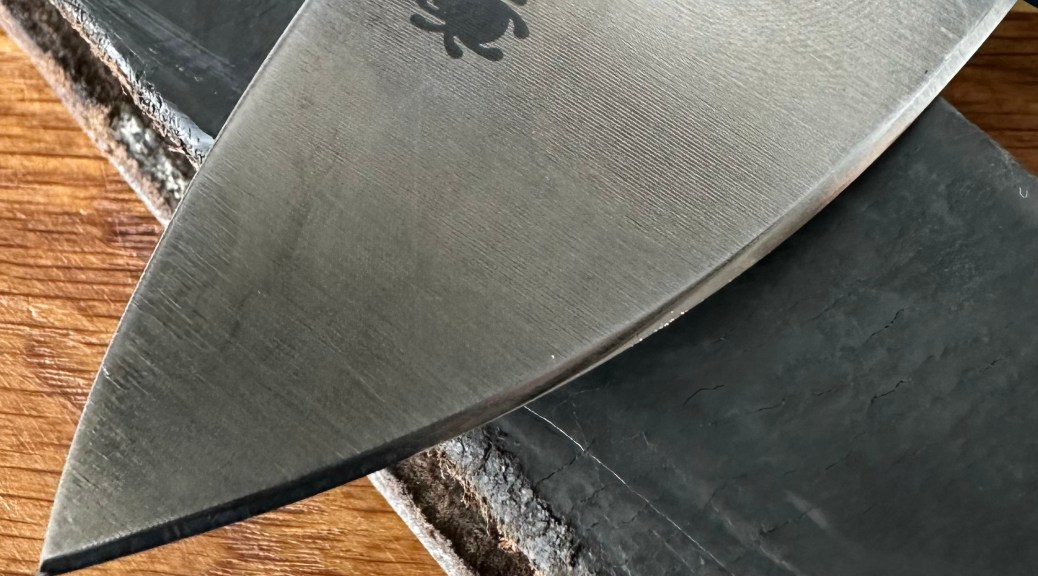
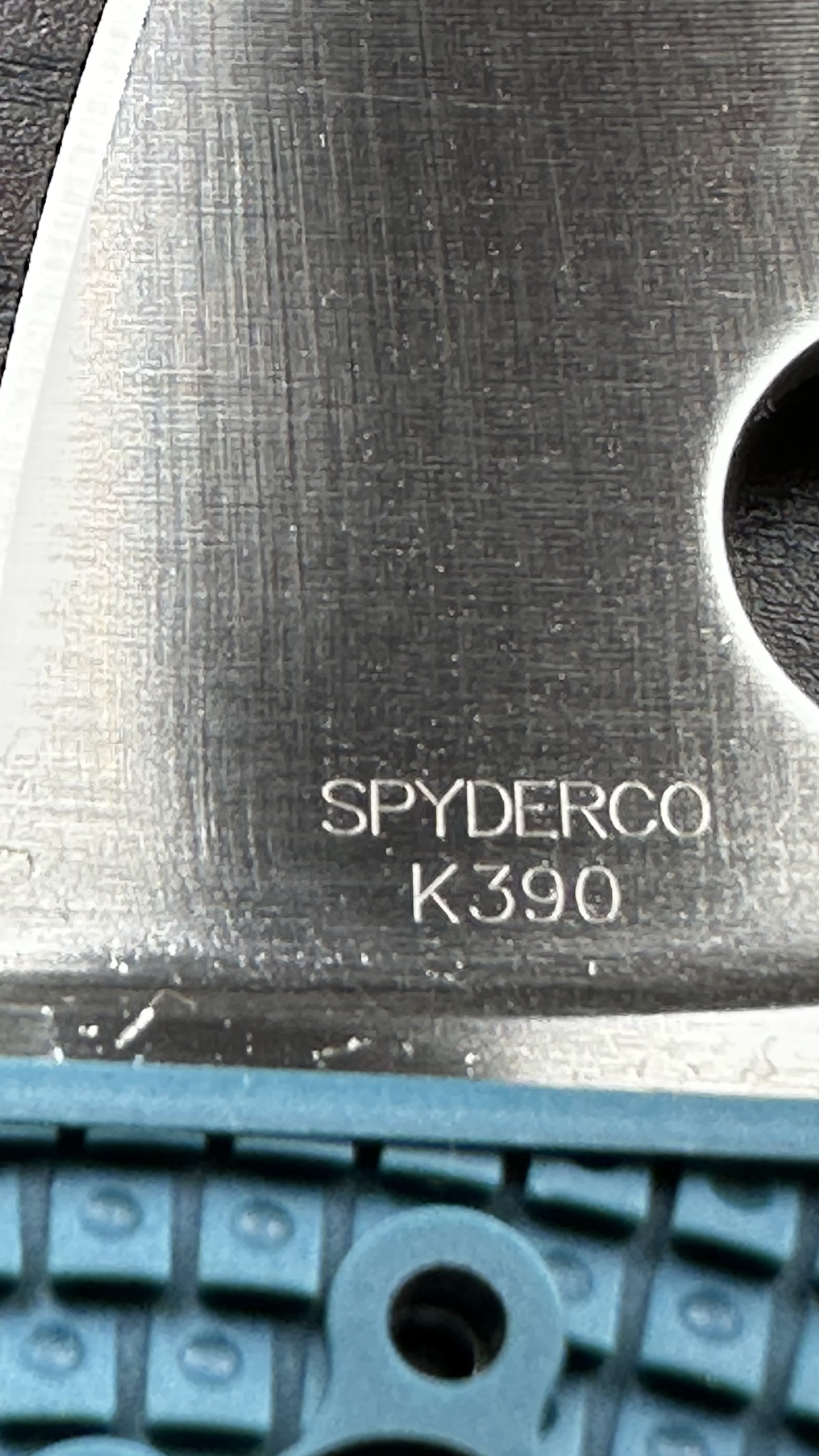
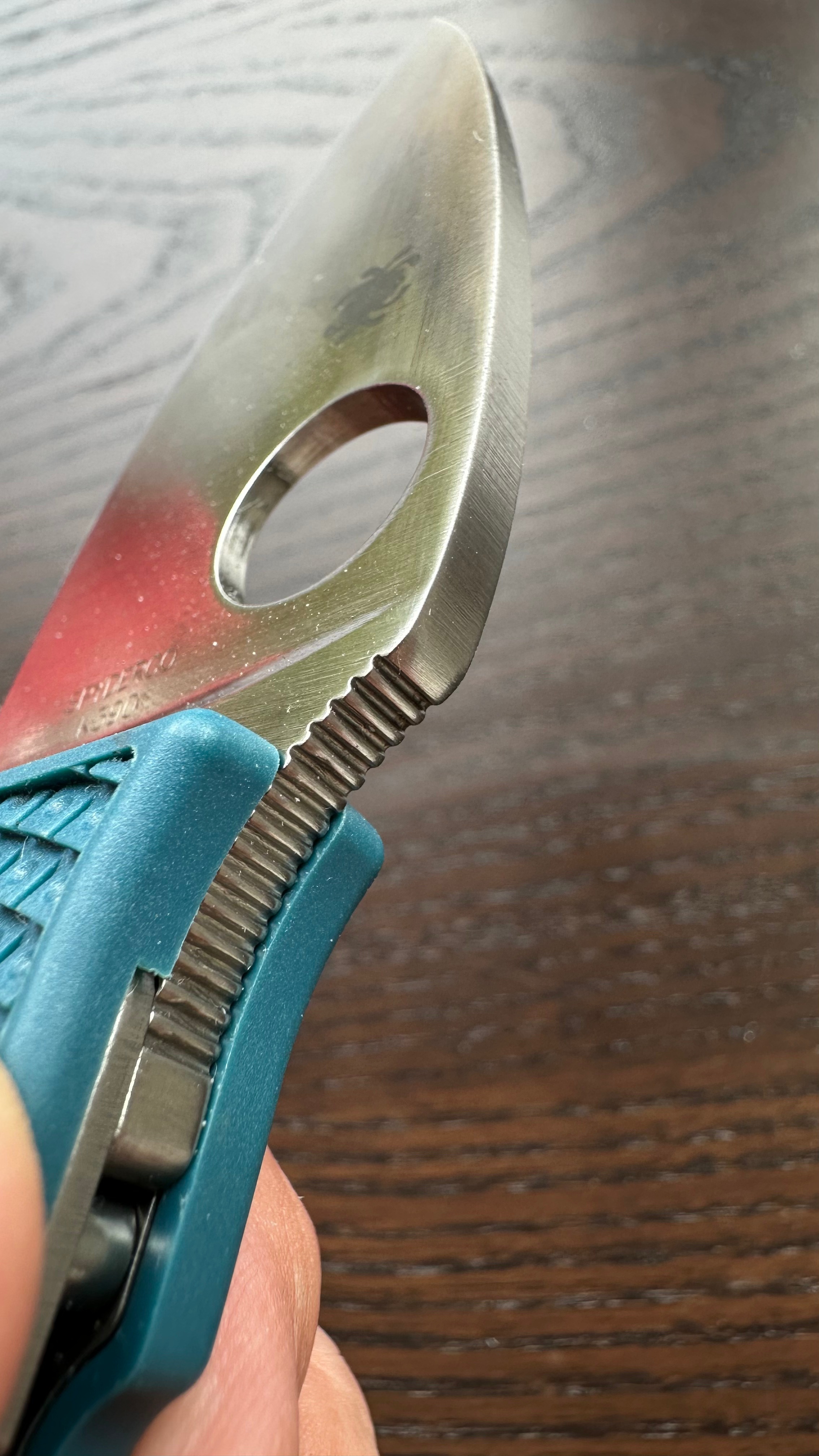
Gone is the Nand’s M398 steel. The Cobol features an M390 blade—beautiful to admire, but challenging to sharpen. Guided systems will have trouble catching such a low-profile edge. Seasoned sharpeners will need to rely on freehand skill to bring out a proper cutting edge (the factory edge being nothing to brag about).
So, is reason telling us this is a flop? Not quite. Let’s remember that, like the Nand, the Cobol wasn’t crafted by a bladesmith but by designer Paul Alexander. This knife should be viewed as a concept piece, a non-knifemaker’s take on knife design, a genuine exercise in style.
You can’t help but salute the intent—and the audacity. Spyderco showed real boldness in releasing two designs that stand as true UFOs in the eight-legged universe.
And so, I look to the sky, hoping to see another one someday.
Disclaimer: this knife was supplied at no cost by Spyderco as part of their brand ambassador program. The review that follows, however, remains entirely independent and unbiased. I thank them for placing their trust in this little blog.
Let’s take a walk back to 2010! It was a year marked by major natural and environmental disasters—the Haiti earthquake, the Deepwater Horizon oil spill, and the Chile earthquake. The swine flu pandemic, which had begun the year before, finally dissipated. On the cultural side, Lady Gaga made history with 13 VMA nominations (the most ever at the time), plus another 5 for her contribution to Beyoncé’s Video Phone. Meanwhile, Justin Bieber won Best New Artist, becoming the youngest person ever to claim a VMA.
But enough about disasters!
In 2010, ZDP-189 was the new kid on the block. The big questions were: does it stain? Is it brittle? What’s its exact composition? And carbon fiber—once a rare luxury—was suddenly being mass-produced for knife handles and had become the must-have material. I was 45. It was the year I got a wonderful gift from Rockstead: their Higo to review in ZDP189. The Michael Walker in ZDP189 was neatly carried in my watch pocket.
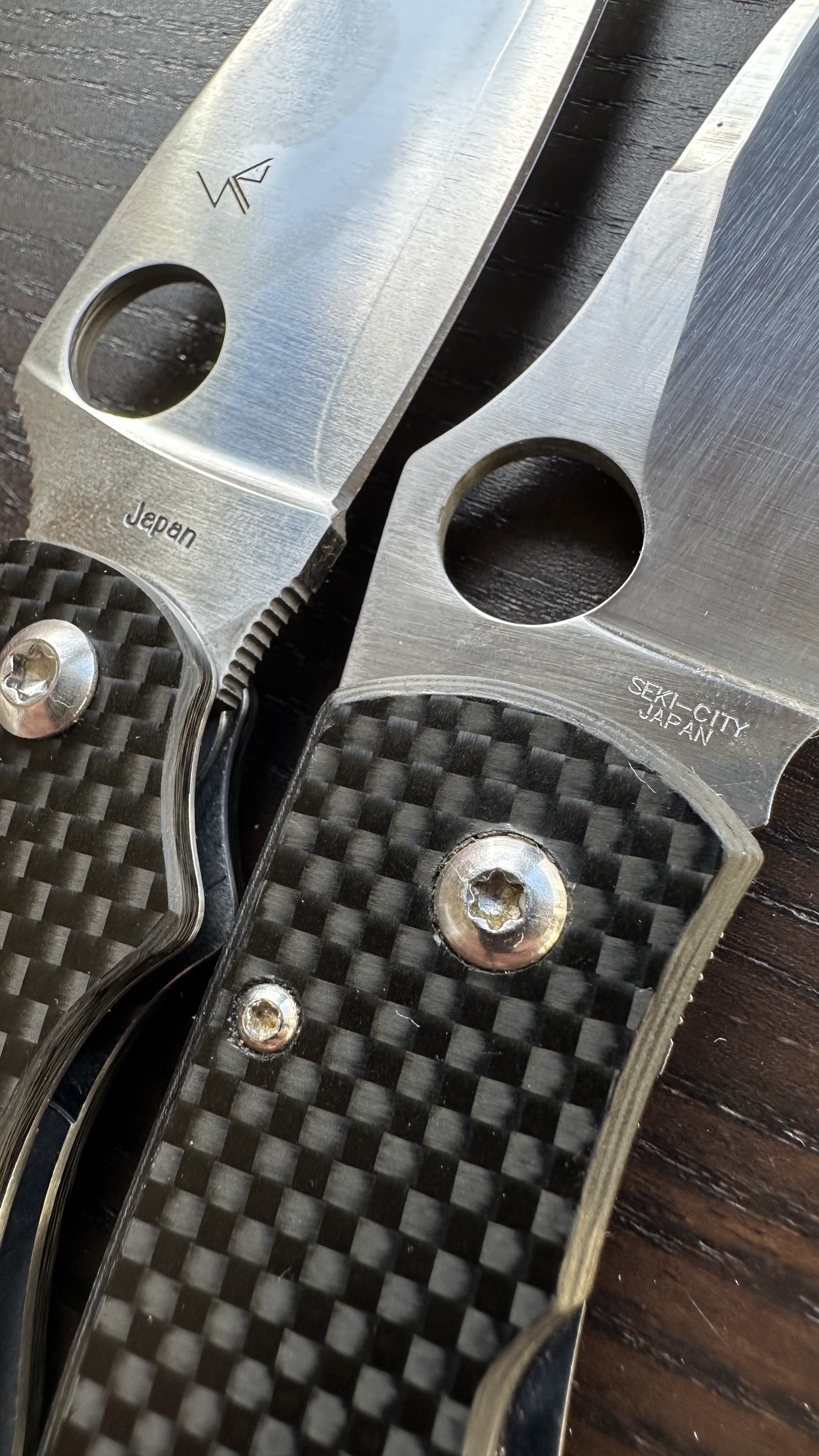
Proudly made in Japan.
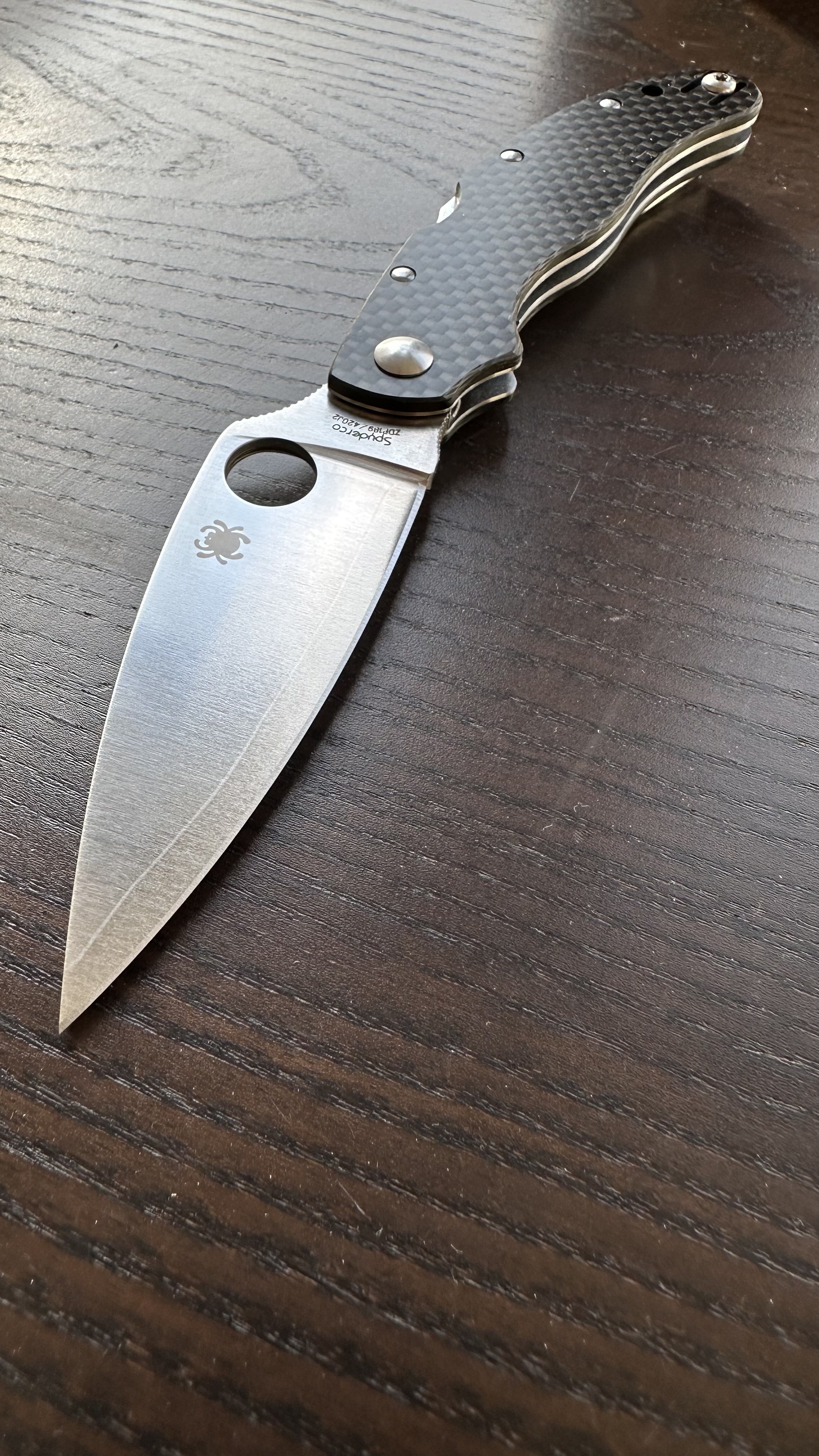
Fifteen years later, a parcel lands at my door. Inside: a blast from the past—the Caly 3.5. Or should I say, the Mighty Caly. Clad ZDP-189 steel, proud axis screws, and that unmistakable aura. A gentleman’s knife that decided to play the outlaw with its 3.5-inch locking blade.
The father of the UKPK.
And many of the ClipIt offsprings:
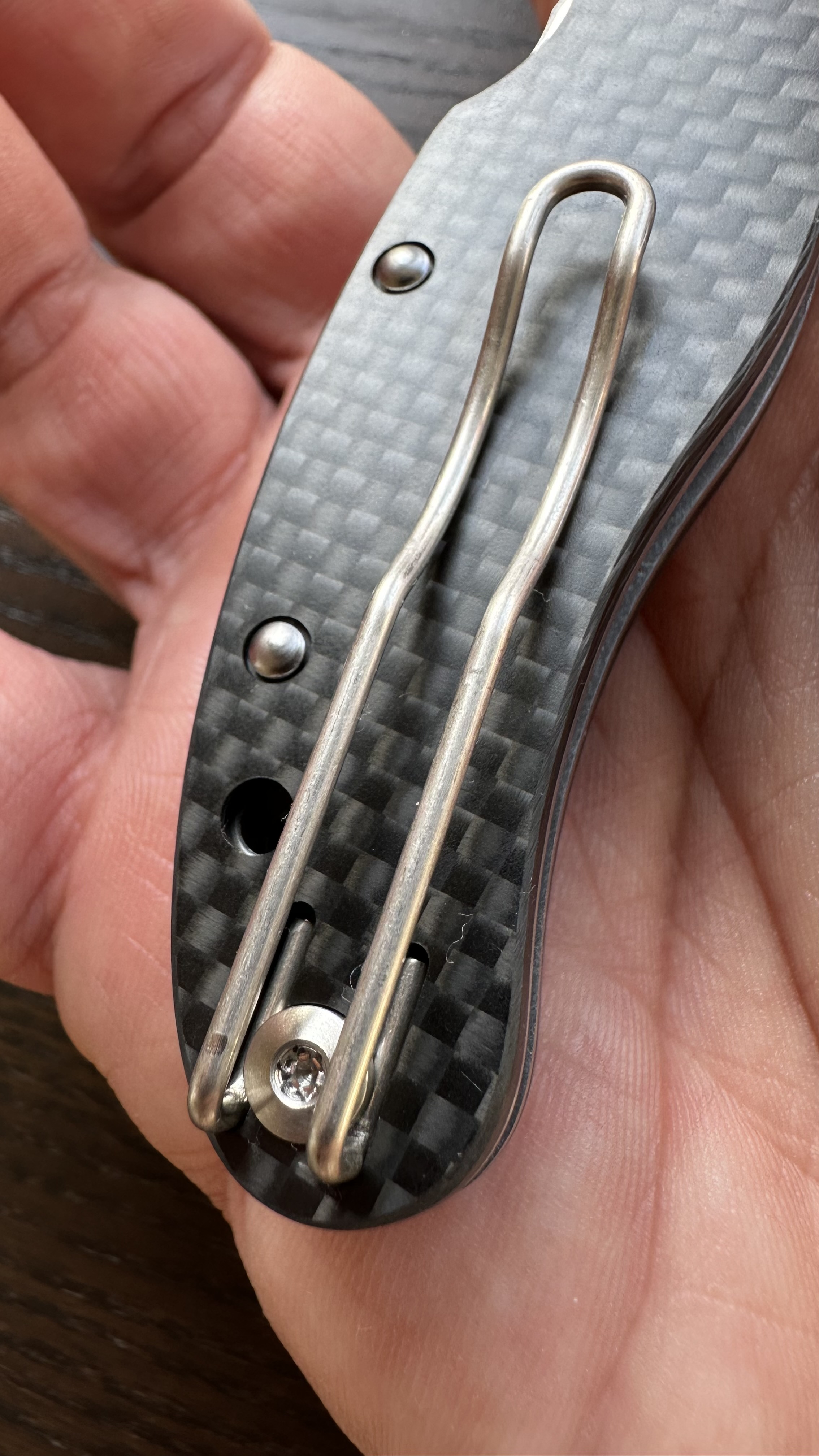
Out of the box, the Caly 3.5 is incredibly pocket-friendly. The smooth carbon fiber scales make it glide in and out effortlessly, adding to its everyday usability.
This is one thing I won’t need to polish on the Caly. 😉
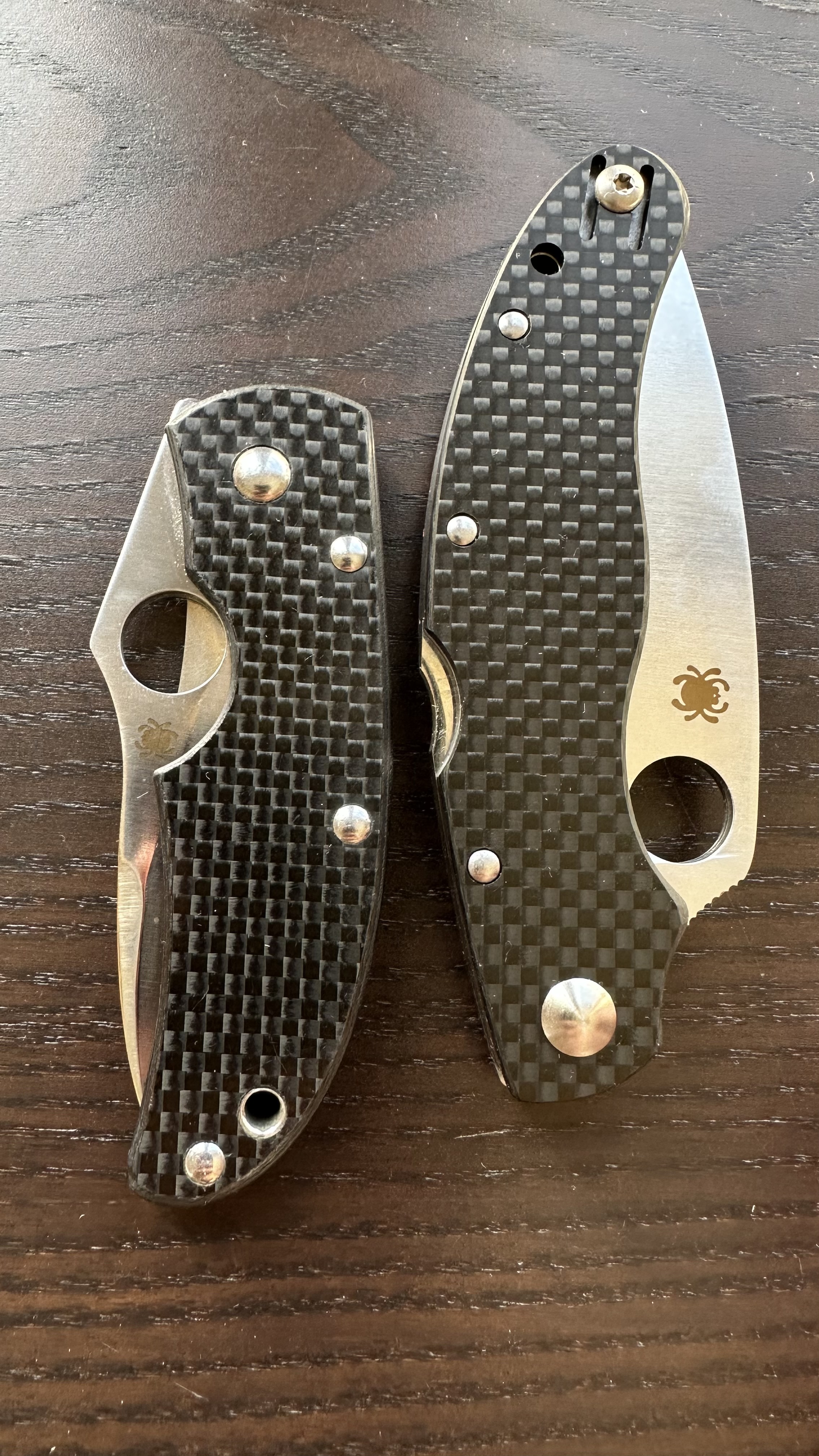
Now, the Caly is one of the rare Spyderco models that hasn’t been converted to full screw construction in 2025. It still carries those three rivets on the handle, radiating an unmistakable early-2000s vibe.
Most modern folders are assembled with screws, which makes them easy to disassemble and service. The Caly 3.5, by contrast, is riveted—apart from the pivot and clip screw—which means full disassembly isn’t really an option.
I understand why some people have a visceral dislike for rivets. But in my experience, they work reliably and don’t loosen over time—an important factor when you’re using a knife in remote places for long stretches. A friend of mine, once a hunter’s guide in the African rainforest, swore by riveted knives for exactly that reason: nothing to rattle loose, nothing to lose.
Personally, I won’t be field-dressing game or digging in the mud with my Caly. For me, the lack of full disassembly isn’t an issue. Cleaning with hot soapy water, a rinse, and a blast of compressed air is more than enough. No worries at all. But to quote a user back in 2013: “Disassembly for cleaning is as simple as the design: Open blade, Remove pivot pin screw, Depress lock bar, Pull out pivot and the blade falls out. Voila, that’s as far as it breaks down. No washers, nothing falls out, etc. Reassembly, just reverse the process.”
And then there’s the BIG pivot screw—so bold it practically becomes the Caly’s signature.
This is pure Sal Glesser design: a knife that melts into your hand. The carbon fiber slabs are smooth, almost glassy, while that oversized pivot not only anchors the construction but also serves as a subtle functional detail. It works as a natural index point on the handle—almost like a thumb guard, without ever creating a hot spot.
It’s not just practical; it’s a stylistic stamp. You see the same oversized pivot screw on the Michael Walker, another hallmark of Spyderco’s design language from that era.
Now, let’s talk about ZDP-189—a steel I’ve reviewed many times over the years.
While it’s most often found in high-end kitchen knives, ZDP-189 has also carved out a place in EDC designs. My own Higo J from Rockstead, for example, proudly measures in at 66.6 HRC—a testament to how hard this steel can go when heat-treated to its full potential. (ZDP-189 steel can reach a maximum hardness of 67 HRC, which is well above the values of average mass-production knives.)
Element
Portion
Effect
Chromium
20.0%
Improves wear resistance, heat resistance and scale resistance. It increases tensile strength because it acts as a carbide former. Use of rust-proof or stainless steel, as it increases corrosion resistance from a mass proportion of 12.2%. Reduction in weldability.
Carbon
3.0%
Increasing hardness and tensile strength. In larger quantities, increase in brittleness and a reduction in forgeability and weldability.
Manganese
0.5%
Improves hardness and tensile strength.
Molybdenum
1.4%
Improves hardenability, tensile strength and weldability. Reduction in forgeability and ductility.
Silicon
0.4%
Improves strength.
Vanadium
0.1%
Increasing hardness, increasing wear resistance and improving tempering resistance.
Wolfram
0.6%
Increase in heat strength, tempering resistance and wear resistance at high temperatures up to red heat.
The magic of ZDP-189 lies in its unusual recipe. With about 3% carbon—a huge amount compared to most steels—and a massive 20% chromium, it pushes the limits of what stainless steel can be. That mix makes it harder, more wear-resistant, and more corrosion-resistant than almost anything else in the pocketknife world. If you’ve ever used knives made from softer steels (well below 60 HRC), you know the frustration: the edge dulls quickly. Instead of chipping, the steel tends to roll, with the fine cutting edge flattening under pressure and losing its bite. A few quick passes through a sharpener will bring it back, but the cycle repeats too often.
With a harder steel like ZDP-189, the story is different. Edges don’t roll nearly as easily, which means the blade keeps its razor-sharp performance for far longer, even under demanding use. That’s where ZDP-189 really shines in 2010 and still shines in 2025—it holds a cutting edge like almost no other stainless steel in the EDC world. But beware as ZDP189 is also known for chipping especially on factory edges..
15 years ago my ZDP-189 Higo gave me a scare: its factory convexe edge started chipping quite badly (arrrgh!). I hadn’t been using it hard, so it caught me off guard. My guess is that the ultra-thin edge at the tip, maybe combined with a careless fumble or contact with something hard, was the culprit. The tip may have contacted something hard, which can happen without noticing. I’ve had a similar experience with another knife: a mirror-finished, thin stainless blade I was testing on bamboo. After just ten cuts, the edge looked almost serrated—but I realigned it, and the damage became nearly invisible while restoring high sharpness.
To bring it back to new, I gave it many gentle pass on a Spyderco white ceramic rod, then spent a solid hour stropping on leather with compound. The result? The knife came back sharper than ever, and with a touch of convexing the edge now feels stronger and less prone to be damaged. For all its hardness, ZDP-189 is surprisingly forgiving.
My other ZDP-189 blade ,back in 2010, the Michael Walker, hasn’t rolled or chipped, though it isn’t as “smooth” sharp as the Higo. It’s also slightly less hard than the Higo-J. It will be the same story with the Caly 3.5. I also feel that its beautiful full-flat-ground blade, with its already even edge, could benefit from a bit of convexing. Doing so would create a safety net against potential chipping, making the blade even more durable in everyday use. Sooner or later I will also smooth the blade’s spine. Good news the 420J2 steel is soft to work.
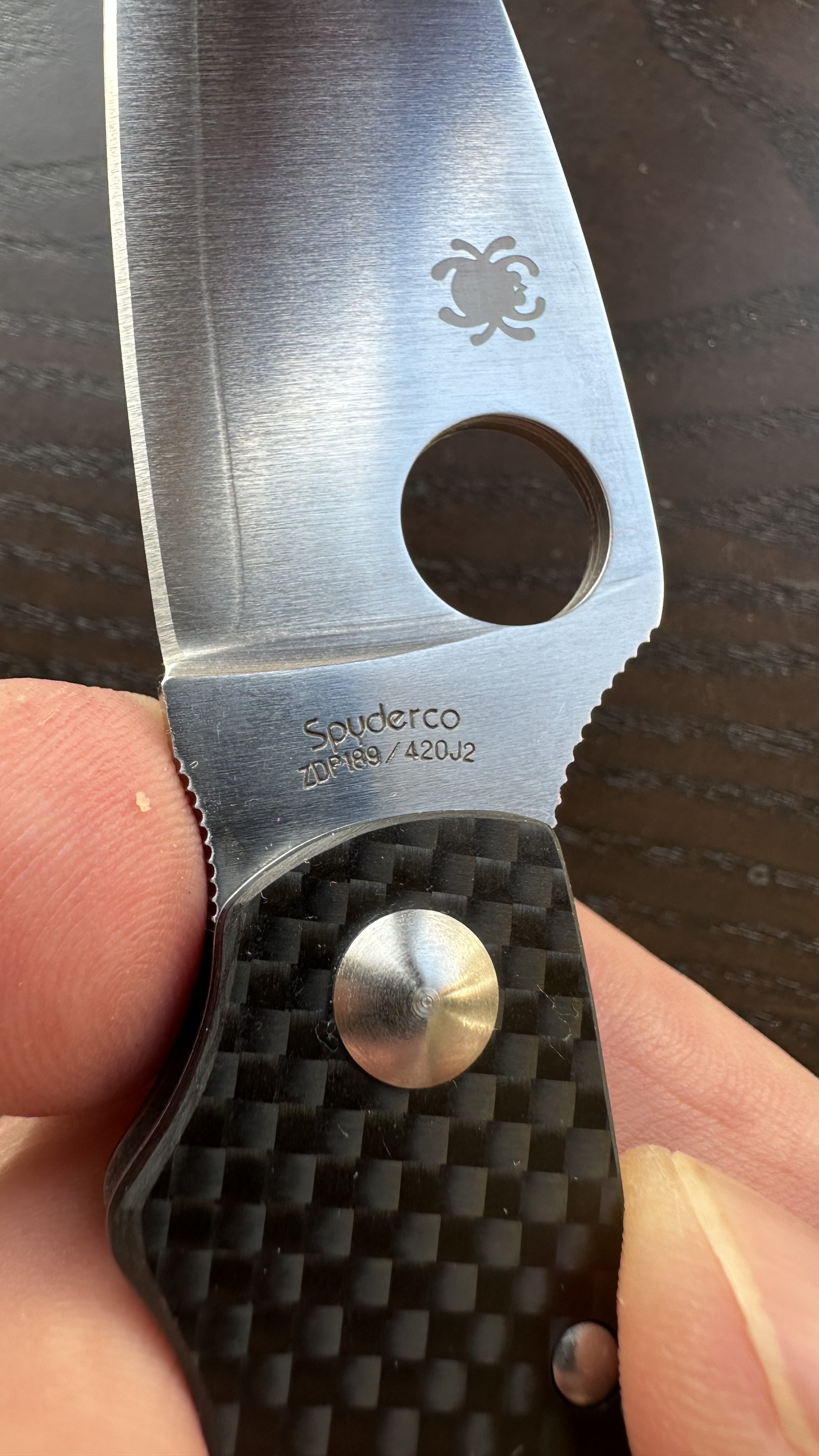
Why does the Caly 3.5 have a laminated blade made of ZDP-189/420J2?
The inner core is ZDP-189, while the outer shell is 420J2. The idea behind a laminated or “clad” blade is simple: the inner core provides a very hard, high-performance edge, while the outer layers are softer and more corrosion-resistant. This combination gives you the best of both worlds: excellent edge retention from the ZDP-189, and a tougher, more flexible spine that helps prevent damage when pressure is applied.
The softer 420J2 outer layer will scratch over time but it will be easy to polish back. It also improves corrosion resistance, especially near the pivot area. Even though ZDP-189 has a very high chromium content, it can still stain, but won’t rust like other hard laminated steels such as HAP40. The cladding adds a bit of toughness to the overall blade, compensating for the fact that ZDP-189 is not the toughest stainless steel in case of torsion.
Carrying the Caly 3.5 is another smooth experience—it practically disappears in your pocket. The deep-carry clip, smooth handle, and thin profile combine to make it a true pocket ghost. But deployment is definitely the Caly 3.5’s vintage characteristic, especially compared to modern compression-lock knives like the Microjimbo. The action is less smooth and a bit slow—which, in fairness, suits a gentleman’s (or lady’s) folder. Out of the box, it was quite grippy, but a few drops of nano oil helped.
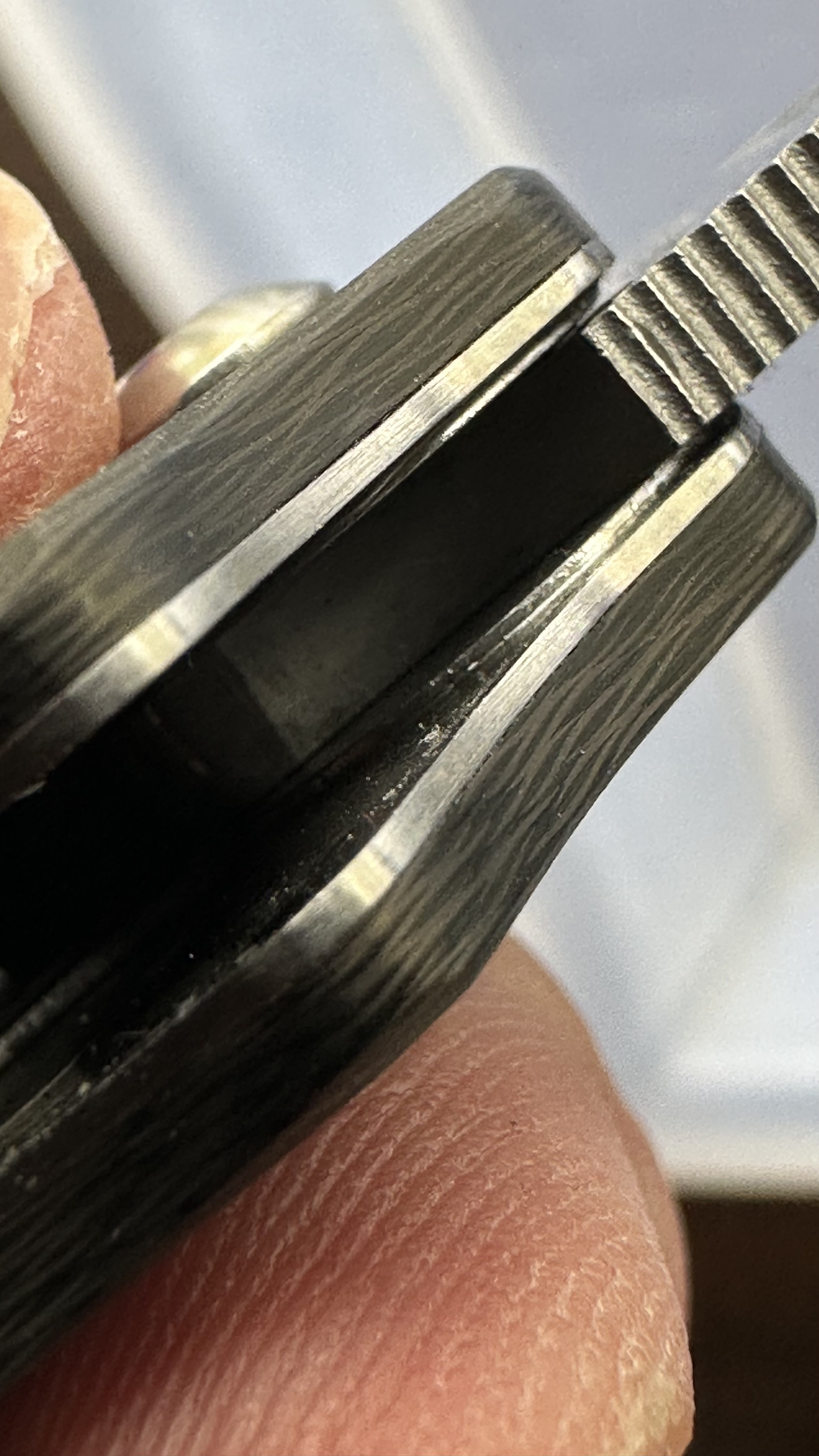
One reason for this feel is that the knife lacks washers. The blade and stainless liners are polished at the Seki factory to minimize friction, but they remain in direct contact. Over time, the blade gradually leaves “traces” at the pivot where it rubs against the liners, which is normal for this type of construction. With a little oil, there is no issue.
Using, carrying, and deploying the Caly 3.5 is like going from a 2025 electric Kia to a classic common-rail diesel BMW. It’s rougher, yes, but still comfortable, reliable, and full of character—part of its undeniable charm. And it gets better and better… One big asset is how easy to goes in and out of my pockets where it’s disappears like a much smaller knife. This is purely the opposite of a pocket shredder. It makes the carrying experience pleasant and confortable.
Details like Boyle’s dent on the lock (which flushes with hand), the proud liners and the full stainless steel spacer held by rivets add to that vintage appeal. My Caly 3.5 exhibits zero vertical play, giving the same solid backlock experience I enjoy on my Police 4 in K390. This is rock-solid. And that 3 mm-thick blade contributes significant lateral strength, meaning the Caly can be used harder than its elegant appearance might suggest.
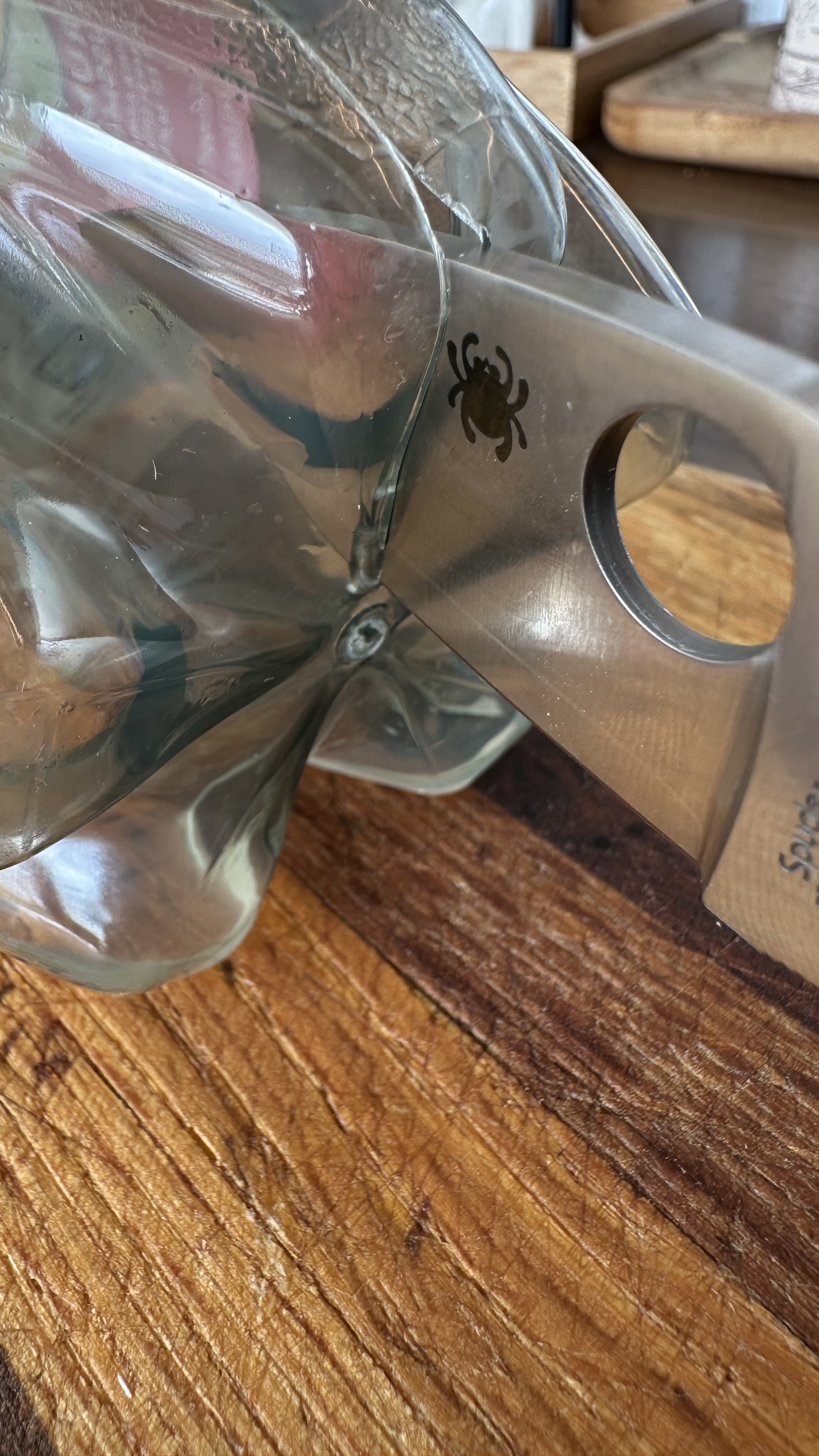
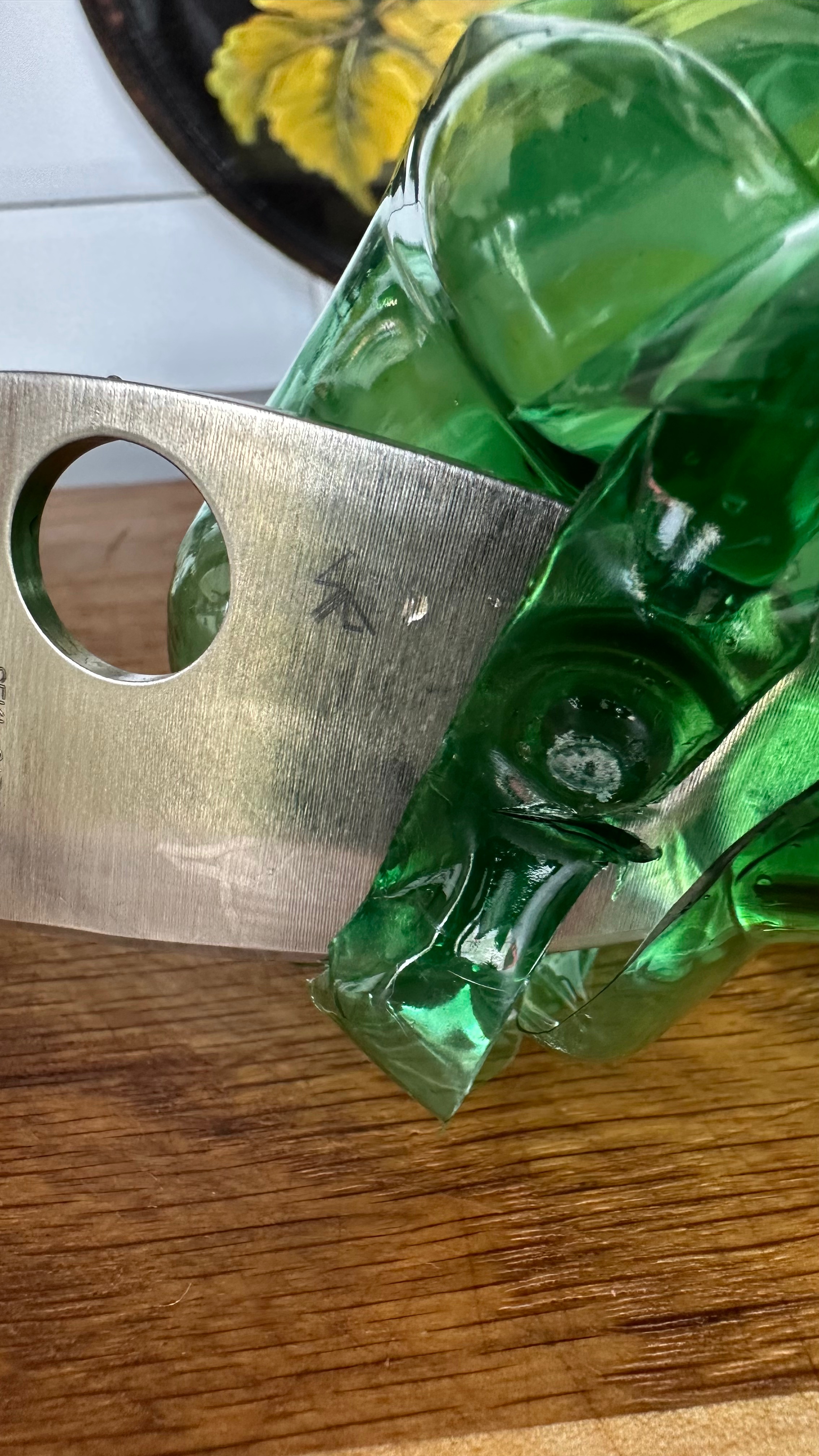
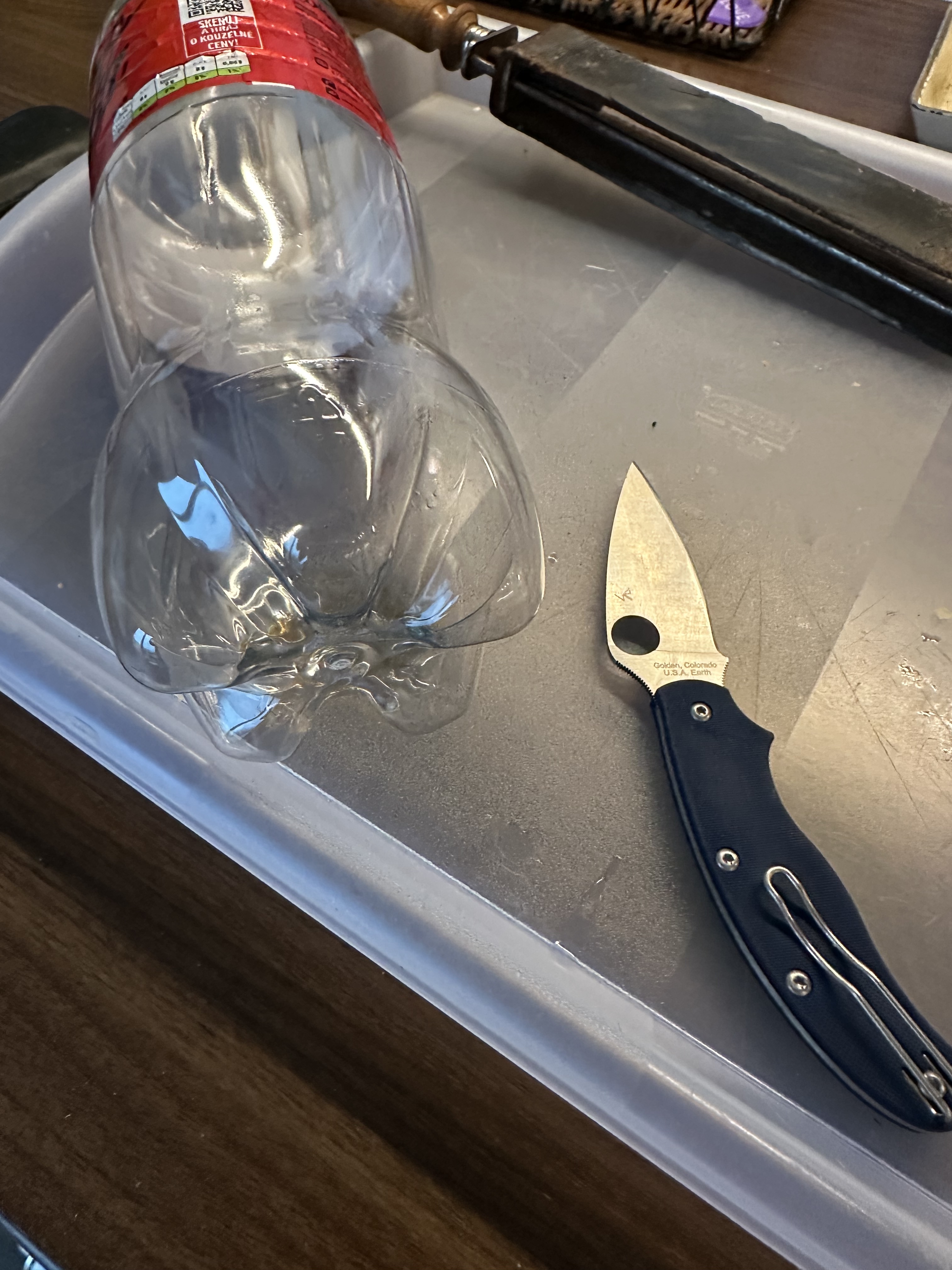
The factory edge is a bit on the thick side, so its performance doesn’t fully meet my needs. At the moment, the Caly 3.5 can’t even slide cleanly through the base of a plastic bottle.
So for my personal taste, I’ll likely smooth the spine, convex the edge, and round that blade jimping (a real hot spot for hard cutting), as well as soften the handle edges until they feel like a pebble. But this will take time—I don’t want to compromise the overall beauty of the Caly 3.5. It’s a true looker, eye candy for anyone who appreciates Sal Glesser’s designs.
But as Bob Terzuola always says: “If your knife is still sharp, it means you don’t use it enough!” So let’s put that Caly 3.5 to work. First step: rounding the angles.
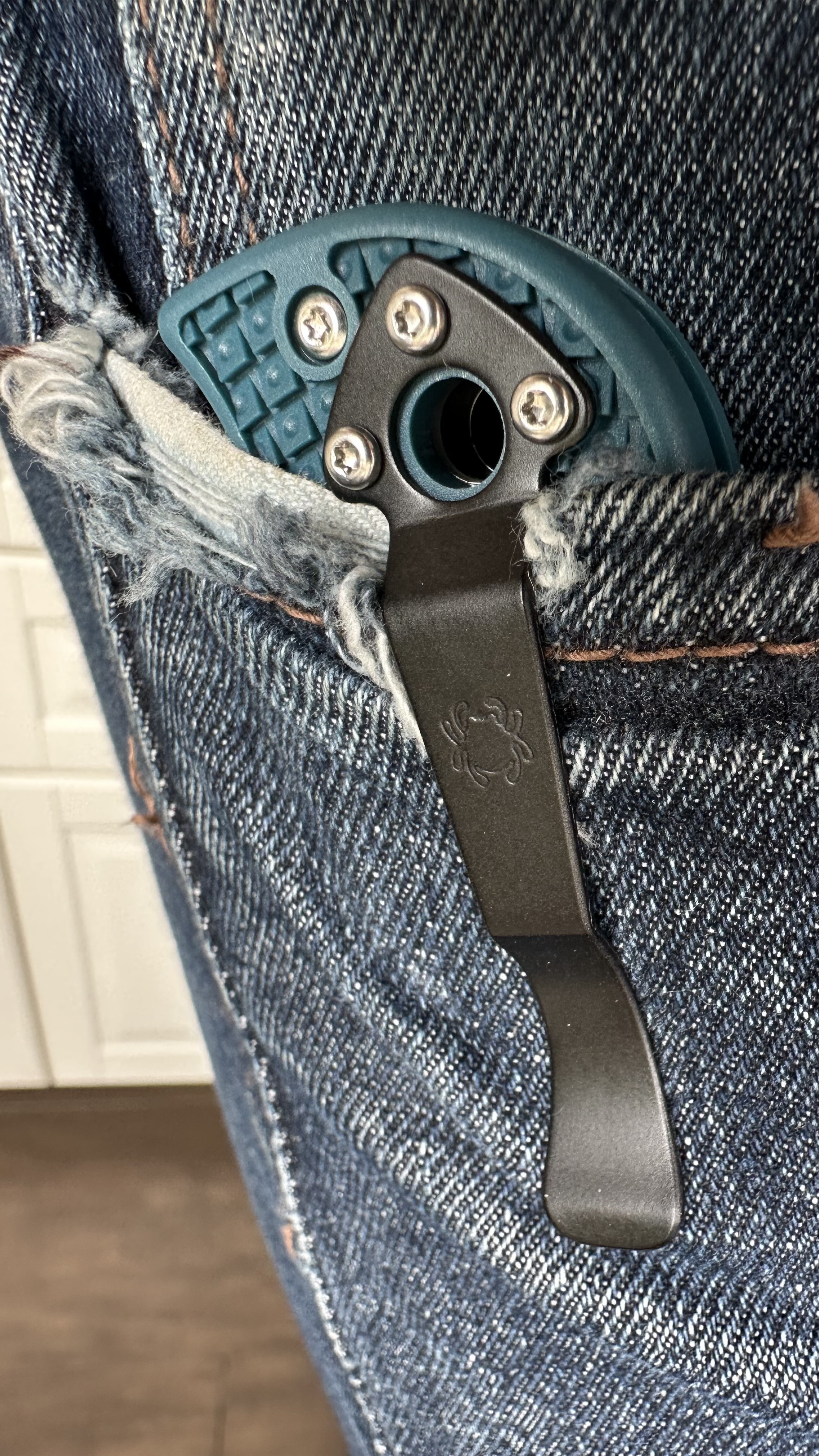
that the Lil’ Temp is very much a hidden gem, refined over two decades by Sal Glesser. In essence, it’s his answer to the compact, heavy-duty 3-inch folder — a kind of “Techno Glesser” that still offers a full, hand-filling grip. Its tall blade profile allows for a finely tuned convex geometry, translating into cutting performance that feels far beyond its size.
K390 is, in my book, a friendly steel. By that I mean it sharpens up to a razor edge without too much effort. It isn’t quite as easy to work with as CPM Magnacut, but it’s far more forgiving than something like CPM 15V. The trade-off is that K390 will stain readily, so regular wiping is part of the routine.
The trade-off is that K390 stains readily, so a quick wipe-down is essential to keep it looking and performing at its best.
The fact that K390 isn’t stainless is not really an issue if you keep the blade clean and check it regularly for any sign of rust. In practice, a bit of grease or oil is enough to protect it, and over time the steel develops a natural patina that gives the knife real character. My own Lil’ Temp is already showing that patina, and it only adds to its appeal.
Geometry is absolutely critical when working with wood. No matter how tough the steel, without the right blade geometry the knife simply won’t bite or carve efficiently.
A full flat-ground high blade simply can’t compete when working on hard wood. That’s why Sal Glesser’s “Lambo of bushcraft knives,” theProficient, stands out: it combines a high full-flat ground blade made from a high-carbide super steel (S90V) with an exceptionally comfortable handle. The result is a knife that slices, carves, and handles demanding tasks with ease — the kind of tool that performs all day without fatigue.
The relatively thick handle of the Lil’ Temp makes it extremely comfortable to hold and use. Its design also provides excellent indexation, making it easy to know exactly where the edge is — even easier than on an Opinel or the round handle of the Proficient.
In the woods, the Lil’ Temp is easy to deploy and put into action. Its point is robust enough to withstand some abuse. While K390 isn’t the toughest steel available, it’s still harder and more wear-resistant than many stainless alloys, making it highly capable in practical use.
The thick spine of the Lil’ Temp provides an easy resting spot for the thumb, especially on push cuts. This gives excellent control and allows you to apply strength precisely where it’s needed.
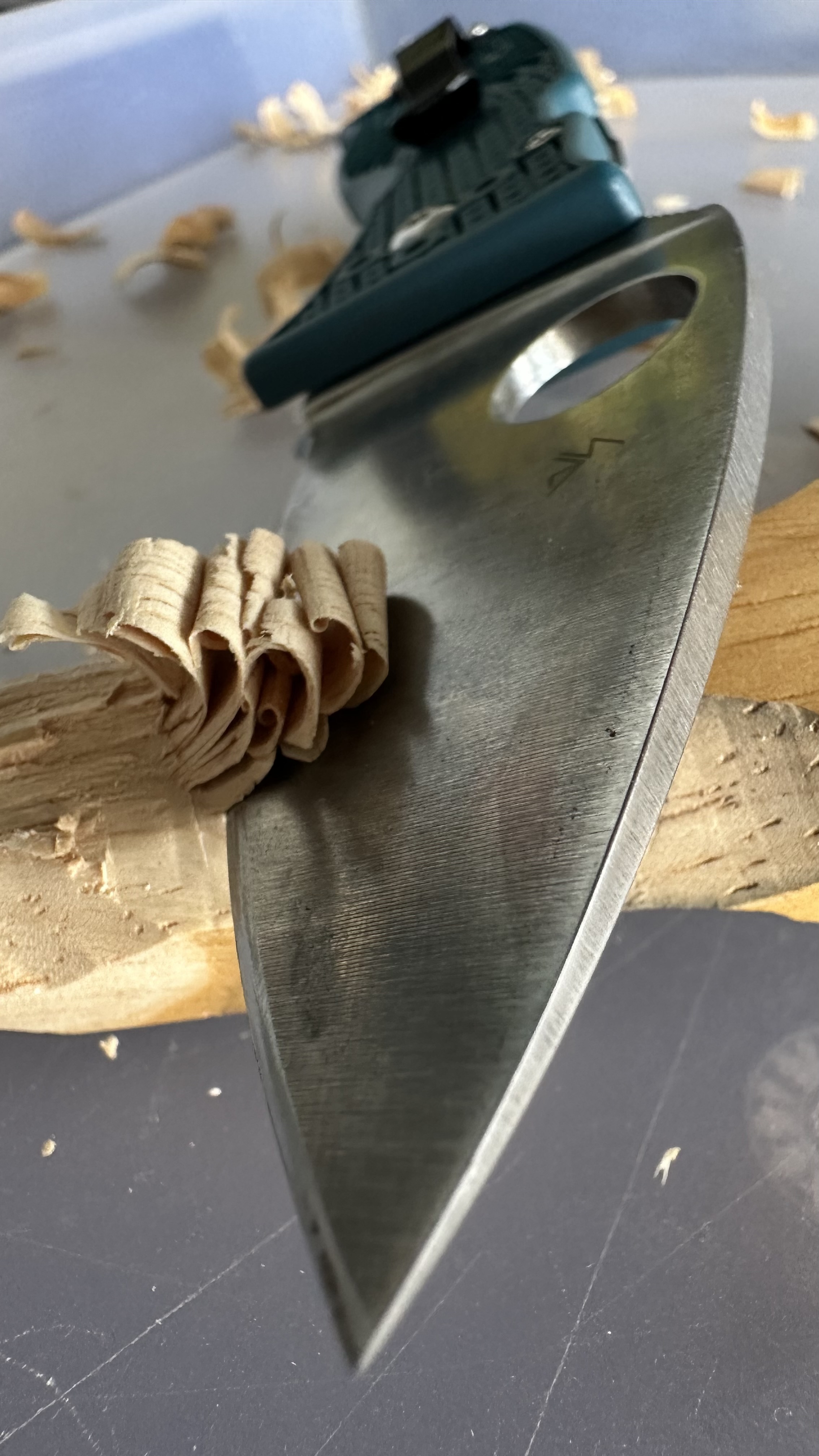
The grain structure of K390 responds exceptionally well when working on wood. After some careful convexing on diamond stones, the edge has developed a shape that balances sharpness and durability perfectly for carving and utility tasks.
I was able to carve pickets without breaking a sweat. The knife’s gentle belly plays a key role, working like a guillotine on the wood fibers and making controlled cuts effortless.
The true kings of woodworking and whittling remain the Wolfspyder and the Boker Vigtig vs Wild. Their authentic Scandi grinds allow them to bite into wood with astonishing ease, making controlled carving and fine whittling effortless.
In that context, one of my favorite full-flat-ground folders for whittling is the Native 5 Salt, once convexed. It’s an absolute pleasure to use on wood, combining smooth slicing with precise control.
A folder’s handle will always be less comfortable than that of a good fixed blade, simply because of the compromise required to fold the blade into it.
That said, the Lil’ Temp is among the very best in this regard. Other outstanding handles include the Manly Comrade, the Benchmade Adamas, the Cold Steel Recon 1, and the Wolfspyder — the latter benefiting from Ray Mears’ design philosophy, focused on knives you can use all day long without developing hot spots or splinters.
(Comrade, Recon 1 on the LT’s left and Wolfspyder on its right)
(Adamas and Lil’ Temp)
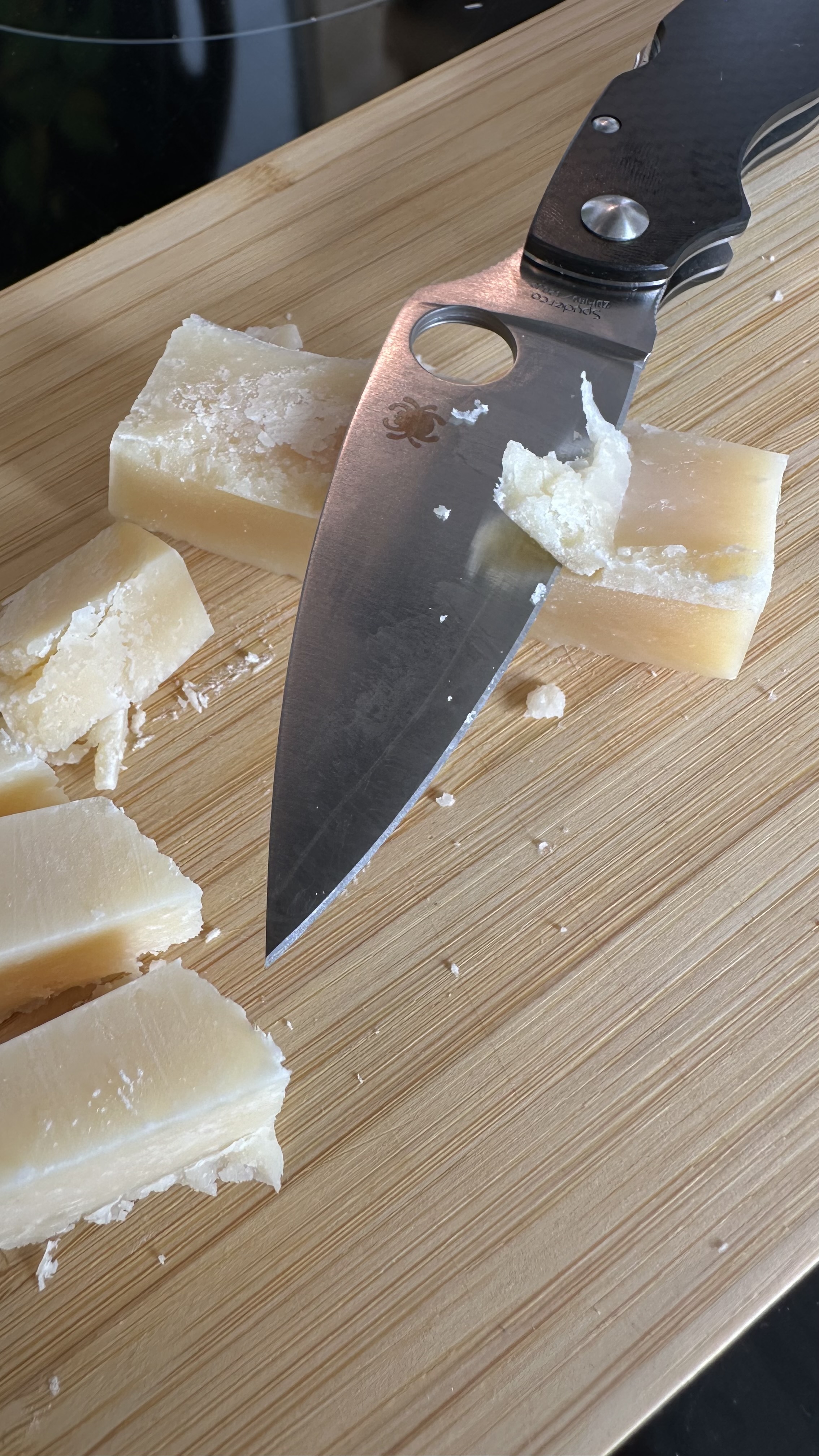
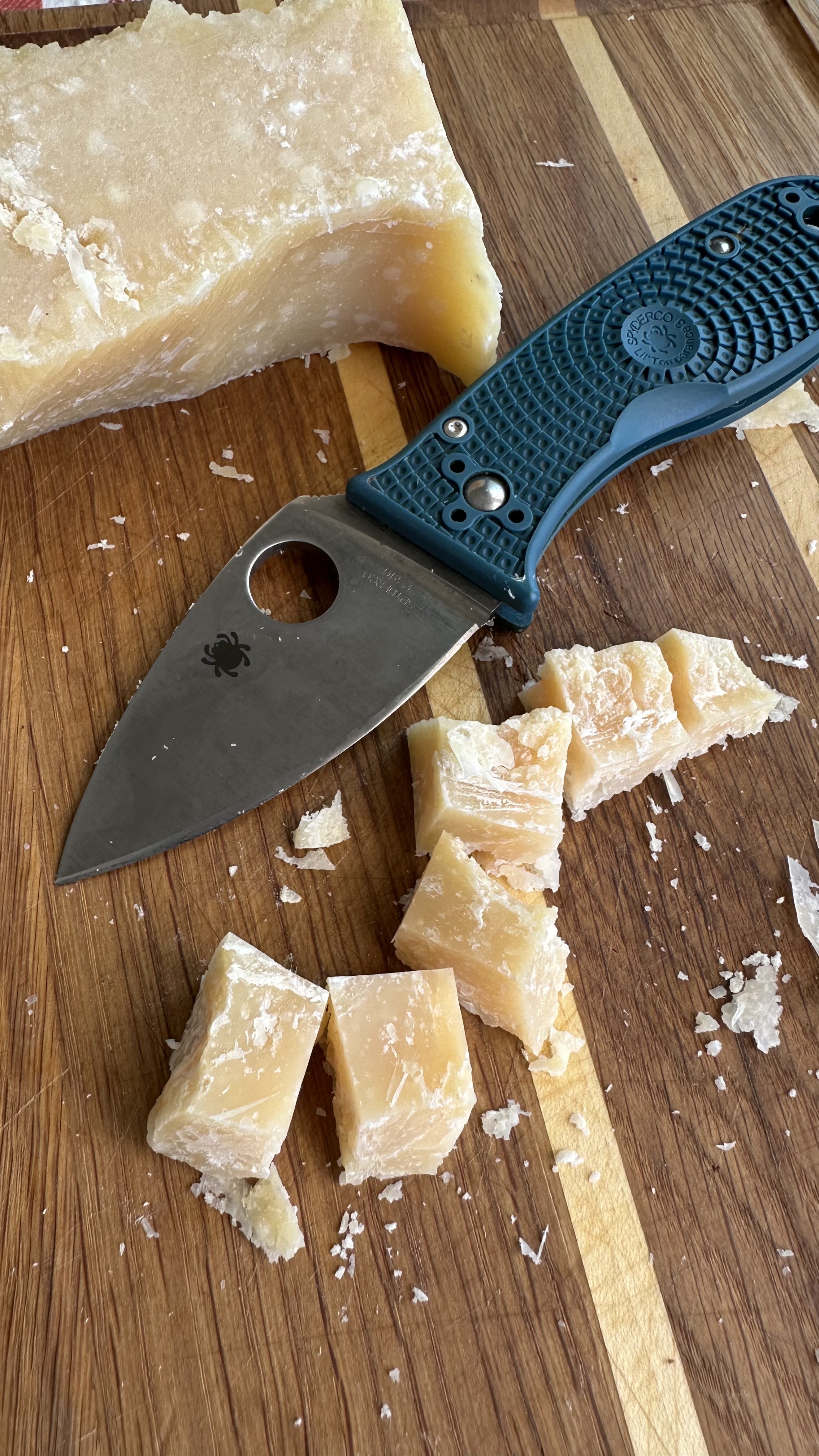
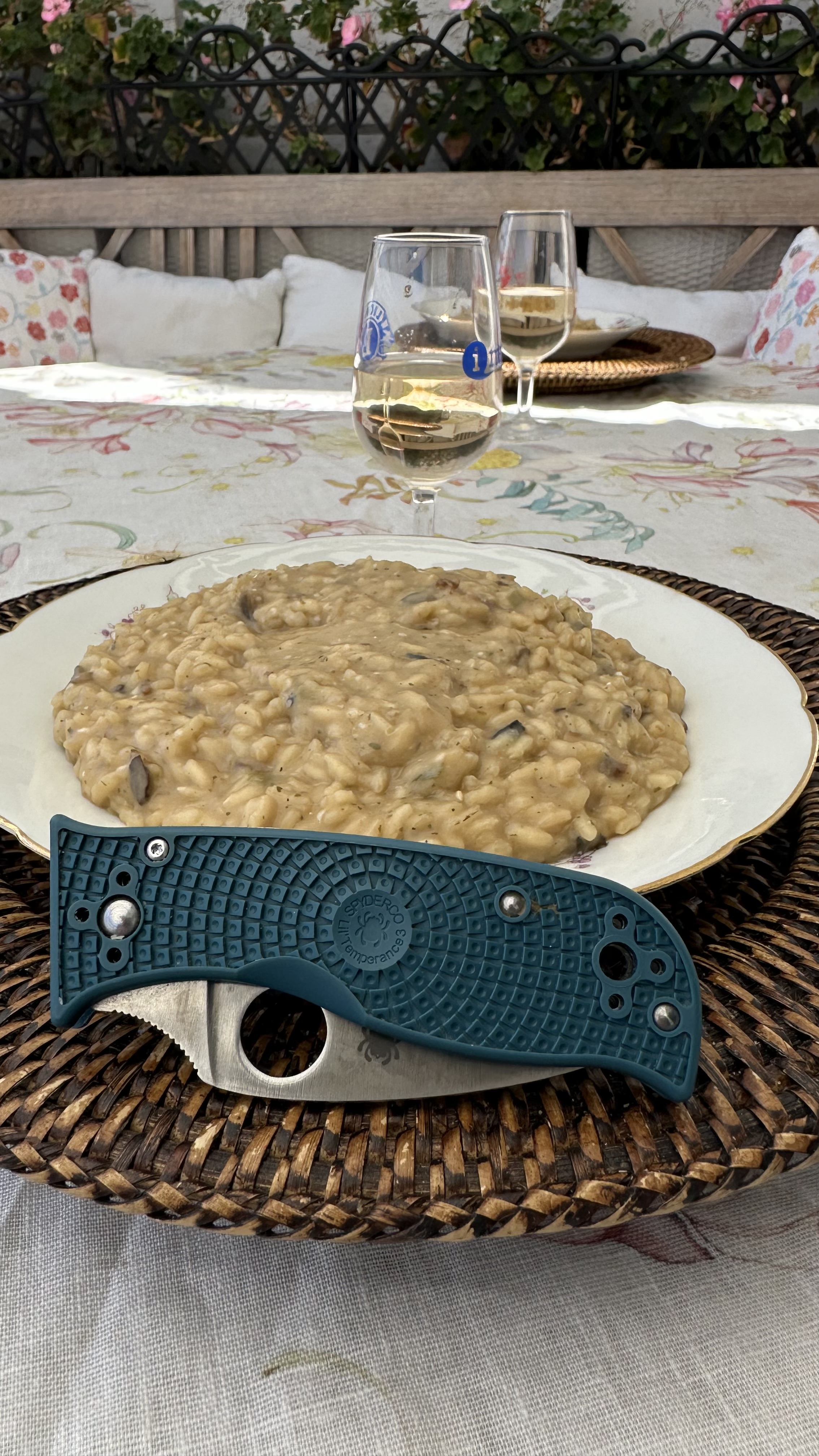
Another example of relatively demanding use is making this risotto using an old chunk of dry Parmigiano which needs to have its rind removed, then cut into half-inch cubes — no easy task given how hard the cheese can be.
It’s also a great way to detect hot spots: the weakest point, if any, in the compression lock. That notch on the back of the handle all but guarantees a sore hand after extended use.
Apart from a single trip into the woods, I’ve mostly used the Lil’ Temp in the kitchen, where it’s been steadily building a nice patina. I’ve also taken the opportunity to test its ergonomics with wet hands. The FRN handle pattern is one of Sal Glesser’s great innovations: it gives the knife a no-nonsense, tool-like appearance while ensuring the handle stays locked in place once gripped.
Conclusion
The Lil’ Temperance 3 K390 Lightweight (“Shorty”) stands out as a compact powerhouse in Spyderco’s lineup. With its super-steel blade and excellent geometry, it elevates everyday carry versatility, combining cutting performance, ergonomics, and durability in a smaller format.
Its lightweight build and aggressive handle design make it a tool you can truly rely on. Whether in the kitchen, at the workbench, or outdoors, the Lil’ Temp proves itself capable of handling demanding tasks without compromise. The FRN handle texture, designed by Sal Glesser, not only lends a purposeful, tool-like look but also ensures a secure grip, even with wet hands.
From reviews across the community, a consistent picture emerges:
Exceptional cutting performance — even in tasks where utility blades struggle
Superior carving and utility — excels at both fine control and hard work
Secure lockup — the compression lock feels noticeably beefier than on similar models
Excellent ergonomics — comfortable for long use, even damp conditions
Edge retention — the K390 steel holds its sharpness impressively well
Durability — little to no wear after months of use
Practical carry — light, compact, and easy to deploy one-handed
Minimal maintenance — just regular wiping and light oiling keeps it in peak condition
As one reviewer put it, this “box-destroying little chode of a knife” punches well above its size. Another called it “a tank… carefree, strong AF, and super comfortable.” After extended use — from food prep to cardboard — users report only minor stropping needed, with many calling it one of their favorite Spydercos in decades.
In short, the Lil’ Temperance 3 K390 Lightweight is a sleeper hit: not the most popular Spyderco, but for those who carry it, often a personal favorite. A compact EDC with the heart of a work horse.
Disclaimer: before going further I need to precise that this knife has been sent to me for free by Golden as part of their brand ambassador program. I thank Spyderco for choosing this little blog and for their trust in my reviews.
“The Lil’ Temperance has been a 20 year personal project. We planned an FRN version 10 years ago, but because it is a smaller market to serve, and I wanted to epitomize the concept, the progress was slow. We changed the design, locks, clips, patterns, etc. Made many prototypes over the years.
The “Spirit” of the design has remained the same. Essentially, a tough, legal 3″ blade MBC folder. Along with my own experience, I had input from James Keating (the Riddle of Steel), Bob Taylor (Warrior designer), Mike Janich (whom we all trust and revere), Bram Frank, Craig Douglas and Laci Szabo.
The first runs made for an interesting design, that was effective for two grips. Then I altered the design to also serve Pikal concepts (forward edge up and reverse edge in.), which was not incorporated in the original design. I’m looking forward to the FRN version. sal“
My first Lil’ Temperance was a “Rhino” — the nickname for the C69 full-flat-ground trailing point blade. That model was released 25 years ago. At the time, I also gave it another nickname: the Lil’ Chinook, after James Keating’s Chinook — a stout folder with a thick trailing-point blade made from CPM440V.
I even found a picture from Knives Plus to document it:
That folder was also available in Leaf Shape Blade like this new K390 just received from Golden today.
Twenty-five years ago, Sal Glesser was deeply influenced by the Martial Blade Craft approach. During that period, he designed the FB05 Temperance, a fixed blade in VG10 made in Japan with combat applications in mind. A trainer version was also available, featuring a red handle and a dull, skeletonized blade.
Sal also created a folding companion: the very stout Lil’ Temp C69, made in S60V (440V) in Golden. It was marketed as “a compact yet heavy-duty folding knife suitable for defensive use.”
Both the FB05 and the Lil’ Temp C69 featured round marks in their handles to facilitate quick grip changes — for example, transitioning from an icepick grip to a hammer grip — a key element in knife fighting. The C69 even had a special clip designed to match its three craters, showcasing the new in-house Compression Lock. The first iteration was extremely strong, often painfully pinching the skin between thumb and index, but in every other way, it was a true “folder on steroids.”
I don’t advocate using knives for defense; they should be a last-ditch option — the very last weapon you’d want to rely on. Historically, knives have always been tools of attack, from backstabbing to throat cutting, not instruments for self-preservation.That’s why I was glad to see that the Temperance II shifted toward a more “camp utility–oriented” design. The current Sprint Run of the Lil’ Temp I features a CPM Cruwear blade, which emphasizes tooling performance over combat potential. Unlike a VG10 blade, which could be used as a weapon, Cruwear is designed to stay sharp reliably over time — a knife for work, not just to be sharp once and used in aggression.
The K390 version of the Lil’ Temperance 3, following the path of the VG10 model, continues this shift from weapon to tool. Gone are the rotating points on the clip and handle; the focus is now purely on utility. With K390 steel, the knife becomes a genuinely tough, long-lasting edge tool — a folder built for work rather than combat.
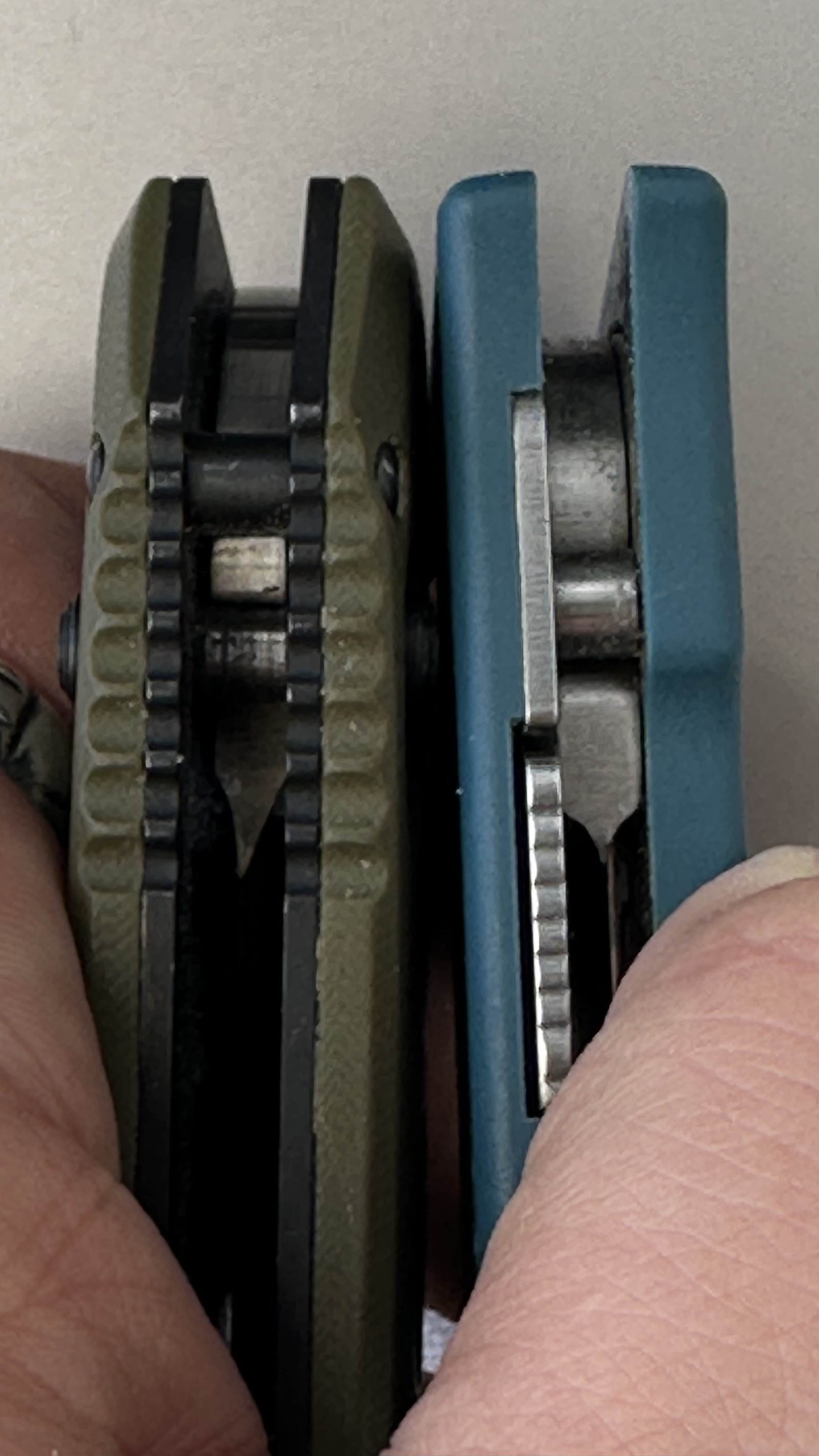
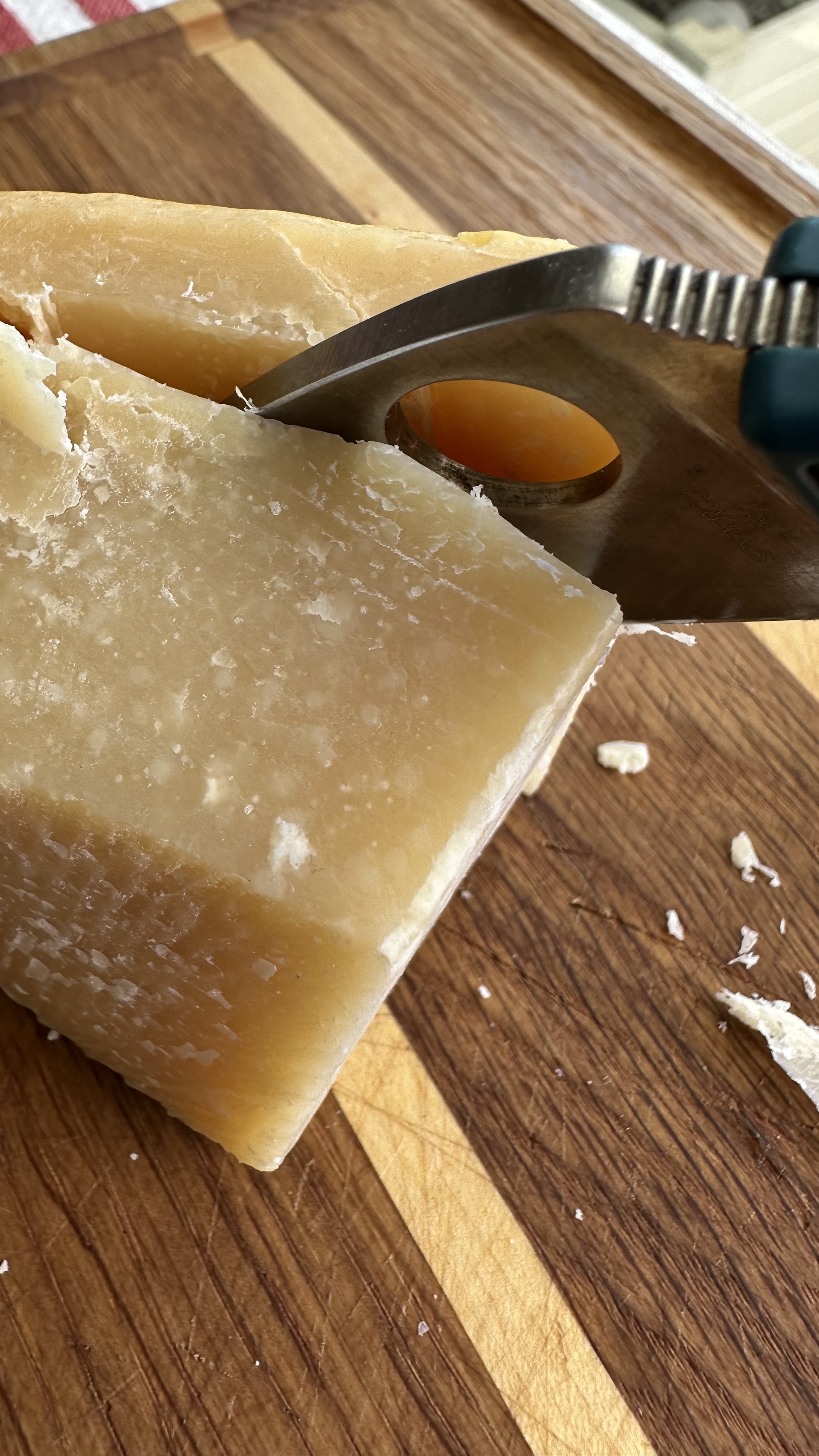
That 4 mm-thick blade with its high full-flat grind really begs to be used hard — it inspires confidence in every cut. Its leaf-shaped profile would even make it an excellent Parmigiano knife, allowing you to twist the blade into the cheese to fragment it with ease. 😉 For reference, the Millie and Shaman feature slightly thinner blades at 3.7 mm.
K390 is simply a great steel. Period. I’ve already written extensively about it — for those interested, here’s a link to one of my detailed reviews.
In short, K390 is a high-vanadium tool steel with outstanding wear resistance. It can hold an edge through extended wood carving, feathersticking, or fire prep. Although K390 is non-stainless and will develop a patina, it is forgiving, strong, and maintains a razor-sharp edge for a very long time.
K390 is made for workers who need a reliable tool and know how to care for their blade. It responds exceptionally well to leather stropping, which helps maintain its edge. (For reference, the upcoming CPM Magnamax is expected to be a stainless version of K390, similar to how CPM Magnacut relates to CPM 4V.)
Keep in mind that K390 loves to patina and will rust if left unprotected. A light coating of mineral oil — like the kind sold by Ikea for cutting boards — is an easy and effective way to keep corrosion at bay.
I noticed a small nick on the out-of-box factory edge. No big deal — it happens, especially since the knife had just been “chipped” to France. 😉
To fix it, I reached for my Spyderco Stuff 2 and Fällkniven DC4 diamond stones. I worked the blade carefully, avoiding the edge on leather, until the nick was no longer visible. A few passes on a white ceramic rod brought the edge back to razor sharpness. Ten minutes later… the Lil’ Temp was ready for action.
It’s now impossible to spot the chipping — or maybe it was a slight bend. Either way, it’s fixed. I’ve seen the same issue with my Tenacious in M4 after it hit a stone floor, and once again, diamond stones worked their magic.
K390 behaves similarly to CPM-M4: it’s forgiving and easy to maintain despite being a stellar alloy. While I love CPM-15V for its toughness, it’s a bear to sharpen, whereas K390 is much easier to fix.
That said, K390 is still non-stainless: it will pit and rust if neglected. Take care of it. I know plenty of people who would struggle — they throw their knives in a toolbox and never clean them. K390 is not for them. But for those who maintain their tools, it’s a super duper steel that rewards proper care.
The Lil’ Temp has no choil, which means you rely entirely on the handle for grip and control. I love choils on slipjoints, where there’s no lock and you often grab the folder by the blade. But on a reliable locking folder, a zero choil works perfectly.
The Compression Lock is ultra-reliable, strong, and designed to prevent accidental disengagement. You can depend on it completely — there’s no fumbling, no second-guessing.
That thumb ramp is wide and a perfect comfy spot for your thumb or for that tender web skin between the thumb and the index finger. The action is smooth but as smooth as the Sage5 or the Millie 2. No vertical play. No pinching. Drop chute after a little wrist flick. The opening arc is a little wider on this one due to the placement of the hole a little far from the axis but the Spyderflick is easily done. It is fidget pleasant folder ! I don’t think it is good for tip down carry and “spyderdrops” as the guard is a little to wide. But for tip up carry and middle finger’s flips, it is perfect. The relatively thick handle is really comfy even when squeezed. So far I have not find any hot spot. I will certainly sand the edge off the FRN but nothing is really needed, it is just my taste in smoothing everything.
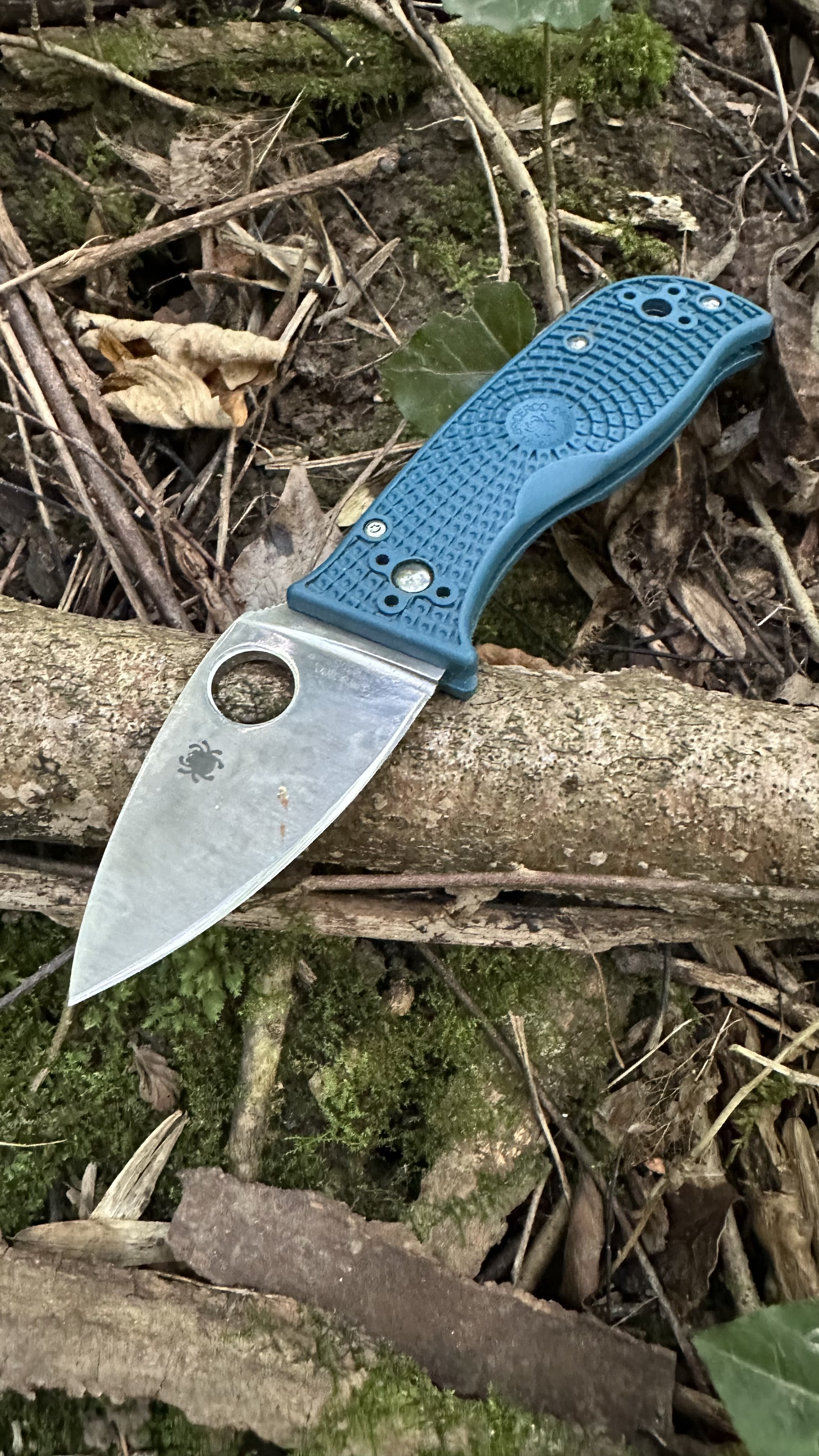
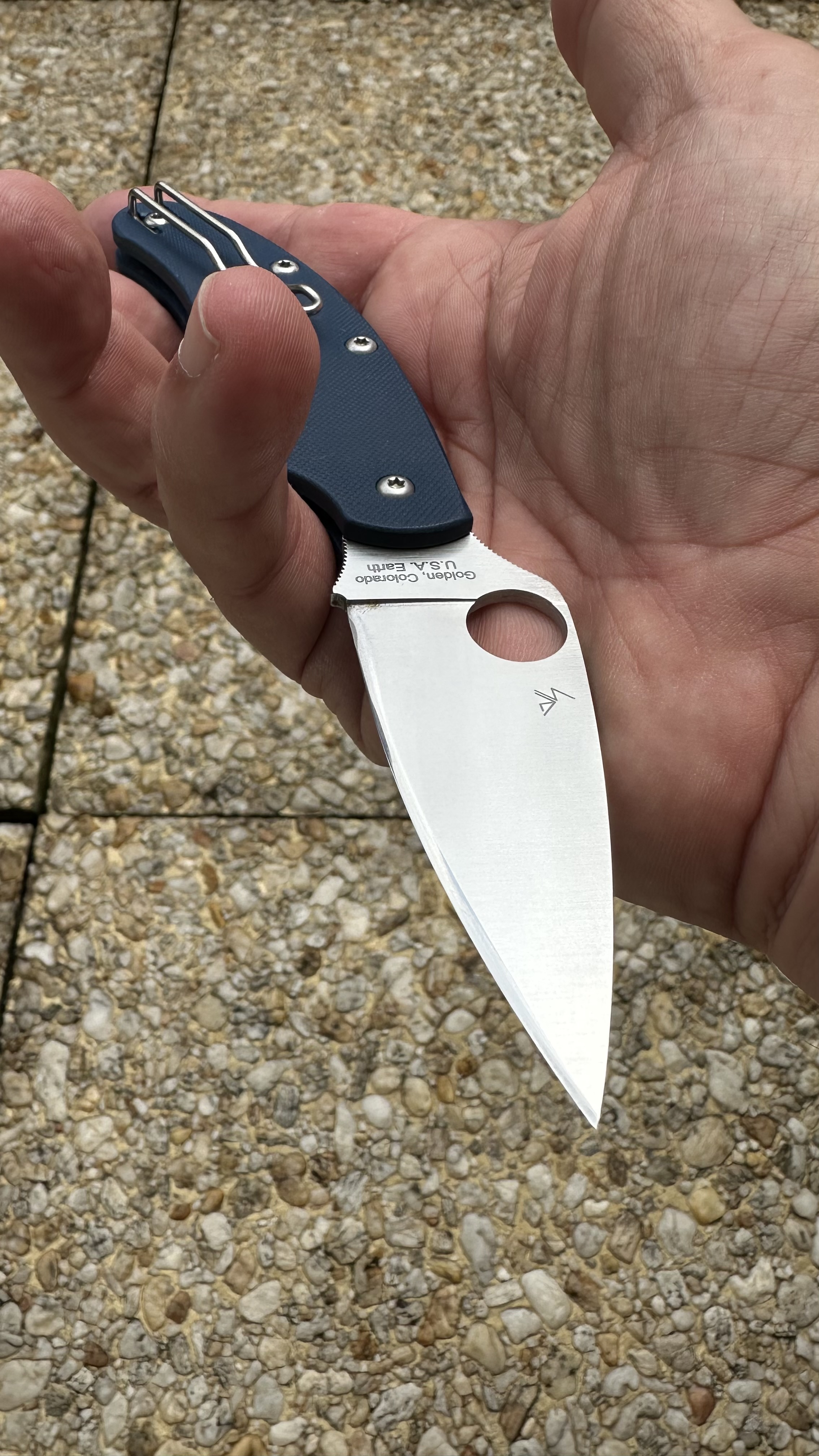
Lightweight ? Not really at 108 grams for a 3 each blade. Only 5 grams less than the G10 version. This “Lightweight” version has kept its two recessed skeletonized stainless steel liners (when the Para3 Lightweight, for example, ditched them). Here, only the G-10 scales has been replaced by two beautiful thick blue scales. This color is really sheeple friendly and the wife already likes it. The black clip is also a very nice touch. This folder oozes some very toolish scents: this is a work poney !
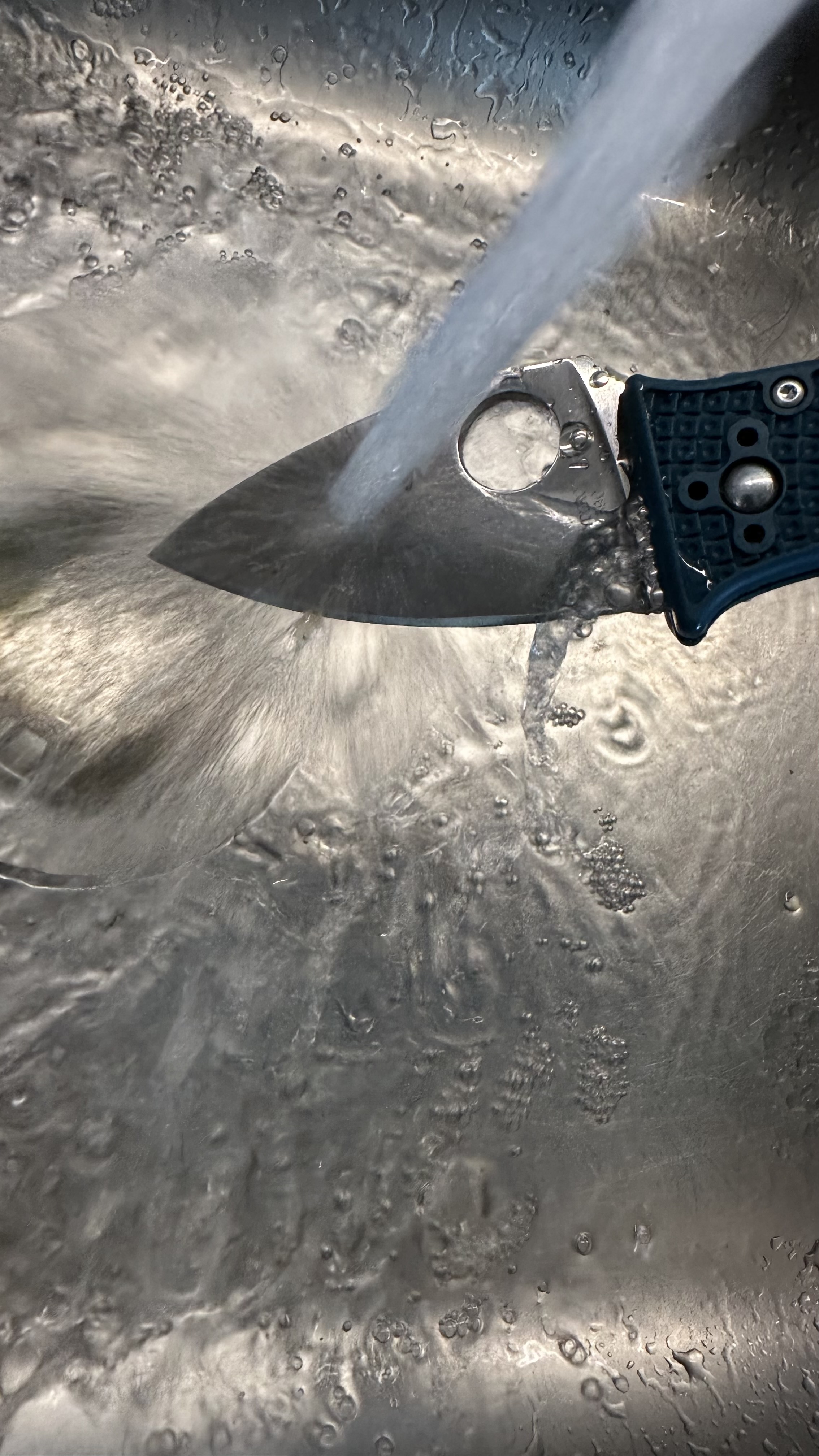
The open construction of the Lil’ Temp also makes it very easy to keep clean. You can rinse it and quickly check for any dirt or debris, which is especially useful after outdoor or kitchen use.
The heavy-duty clip is built for work. That FRN handle can be a pocket shredder — no doubt about it. Sanding the FRN scales doesn’t change that in my experience. This is a true blue-collar folder, meant to be clipped in solid pockets and relied upon day after day.
The knife is enough compact to jump into the watch pocket !
« I bend the clip slightly on almost every knife I carry.
I usually take something wedge shaped and slide it under the clip a small amount at a time until I get the bend I like. Not everyone will like the same bend so incremental bending works best. I like very little resistance in retrieving my knife from my Right-Front-Pocket. Just enough to keep it from falling out of my pocket. YMMV.
sal » That’s a game changer and pocket savior once you have found the sweet spot of clip retention.
Once a samurai, now a wandering ronin. Once a self-defense knife, now a powerful tool. Regardless of its past, the Lil’ Temp is a true gem — thoughtfully designed, finely crafted, and made in Japan.
“The maker said it was a very difficult model to make, and for him to say that, I’m guessing it’s true. They’ve been making our knives since 1980. I worked with the Grand Father and the Father and Eric works with the son. I think we’re fortunate to be able to bring the model to you.
Sal“
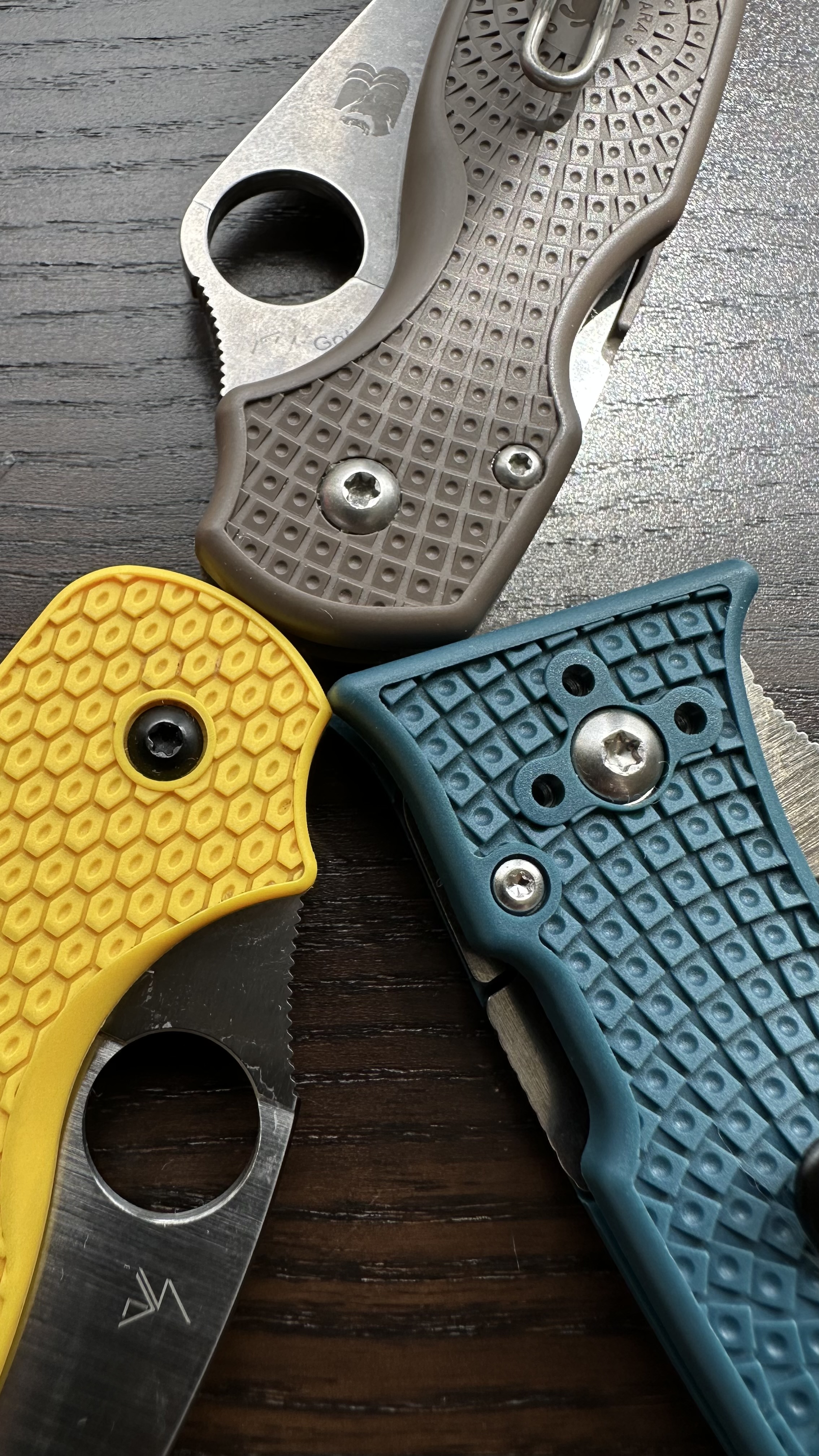
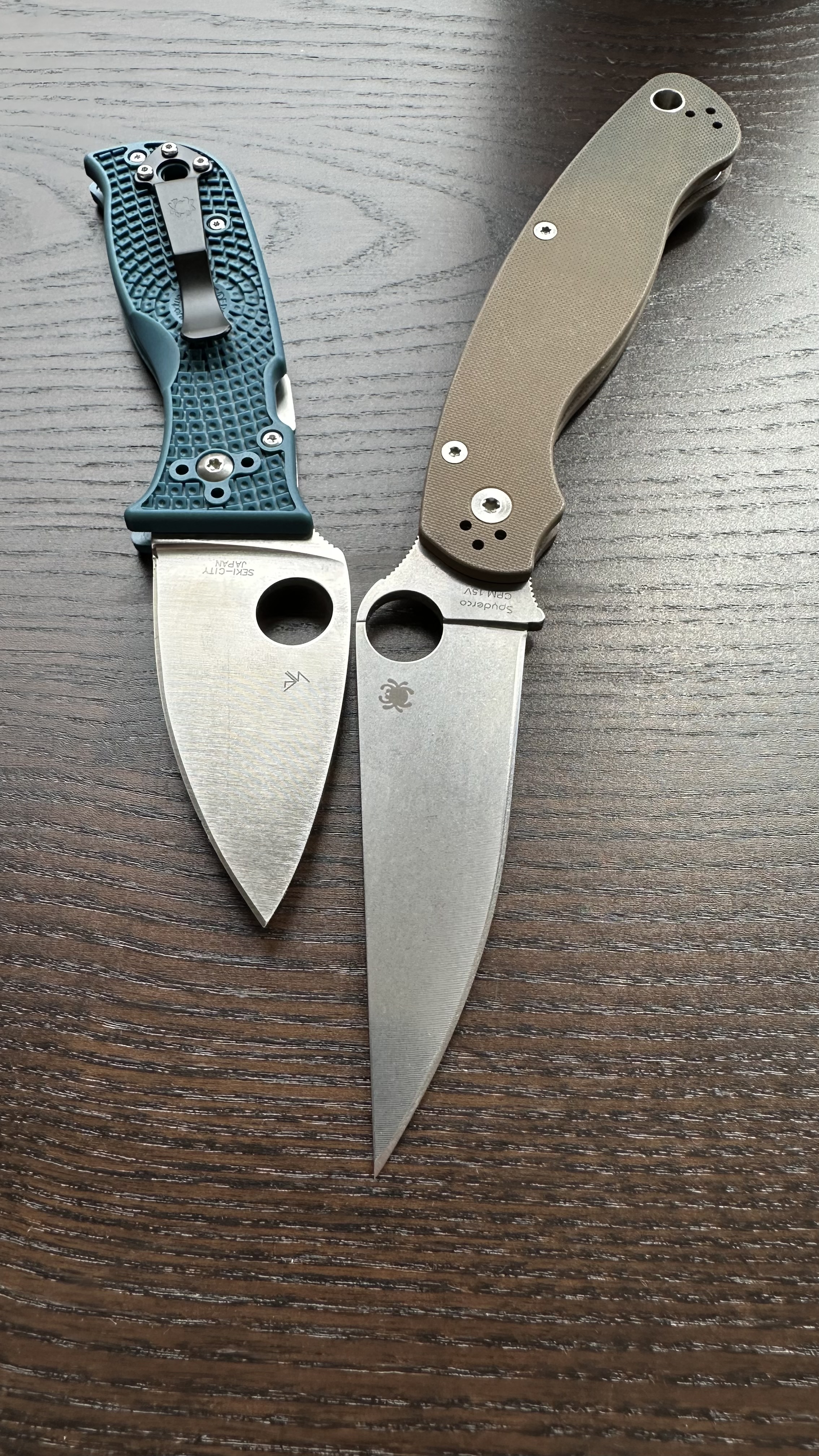
Sharing the same FRN pattern as the Golden-made folders, the Lil’ Temperance features a larger pivot screw than the Para 3 and Sage 5 (made in Taichung). Despite its small size, the lack of a choil gives it plenty of usable edge.
Edge-wise, it’s impressive: the Lil’ Temp offers virtually the same cutting edge length as the larger and heavier Manix 2, all within a form factor similar to the Para 3. Its “no choil” design is reminiscent of my Tenacious, maximizing the usable blade while keeping the knife compact.
The blade length is just shorter than 3 inches with 74mm. It is not designed to reach the heart between the ribs. It is designed to work hard on various materials. It is designed as a formidable “hard use” cutting tool.
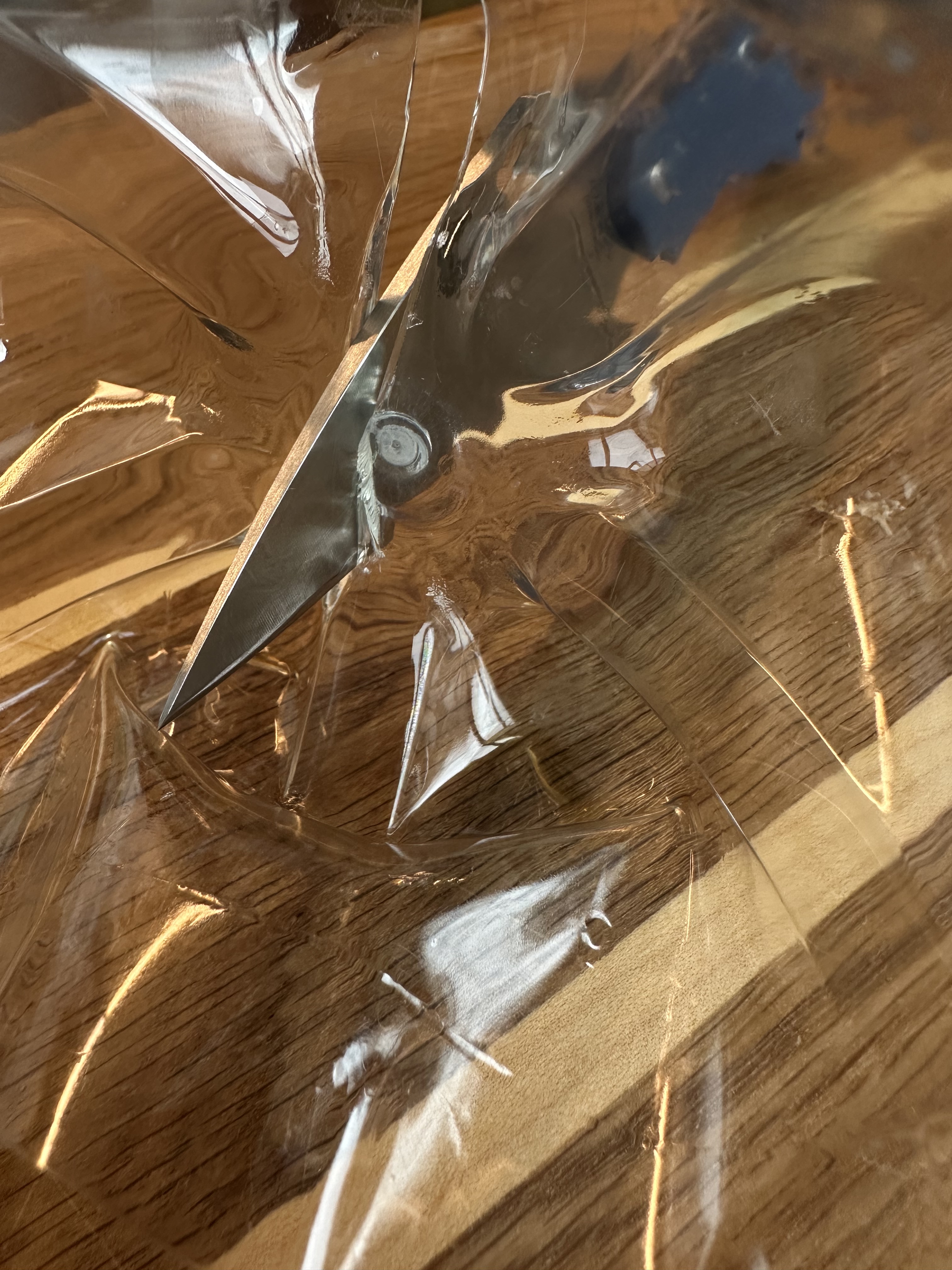
See how the poor bottle falls apart under the Lil’ Temp’s edge!
I remember seeing the Spyderco Police showcasing K390 — a knife originally oriented toward martial use, gradually drifting into more practical, tool-like applications. I’m glad to see the same evolution with the Lil’ Temperance: “Although rooted in Martial Blade Craft design, it provides reliable, full-service performance for any cutting task.”
And it doesn’t hide its abilities. Compact though it is, it’s unapologetically loud about its cutting power.
I couldn’t agree more — this is shaping up to be a truly tough, little big knife, perfect for Part 3 of my adventures. But don’t forget the Part 2, first.
I have had the chance to buy that UKPK in G10 for 100 euros in January 2025. Since, it has been my “go to the city” favorite folder.
Sometimes replaced by the Roadie XL for a lower profile or Dredd my Urban in S90V made in Maniago and exclusive to Heinie in the UK.
The UKPK is remarkably versatile, proving itself even in woodworking. Its strong, reliable mechanism keeps it ready for anything — all while remaining fully within legal limits. Stripping vines, carving rods, scraping, cutting — it handles everything with ease. The spring “lock” never falters, and the finger choil adds an extra layer of passive safety, even if it’s rarely needed.
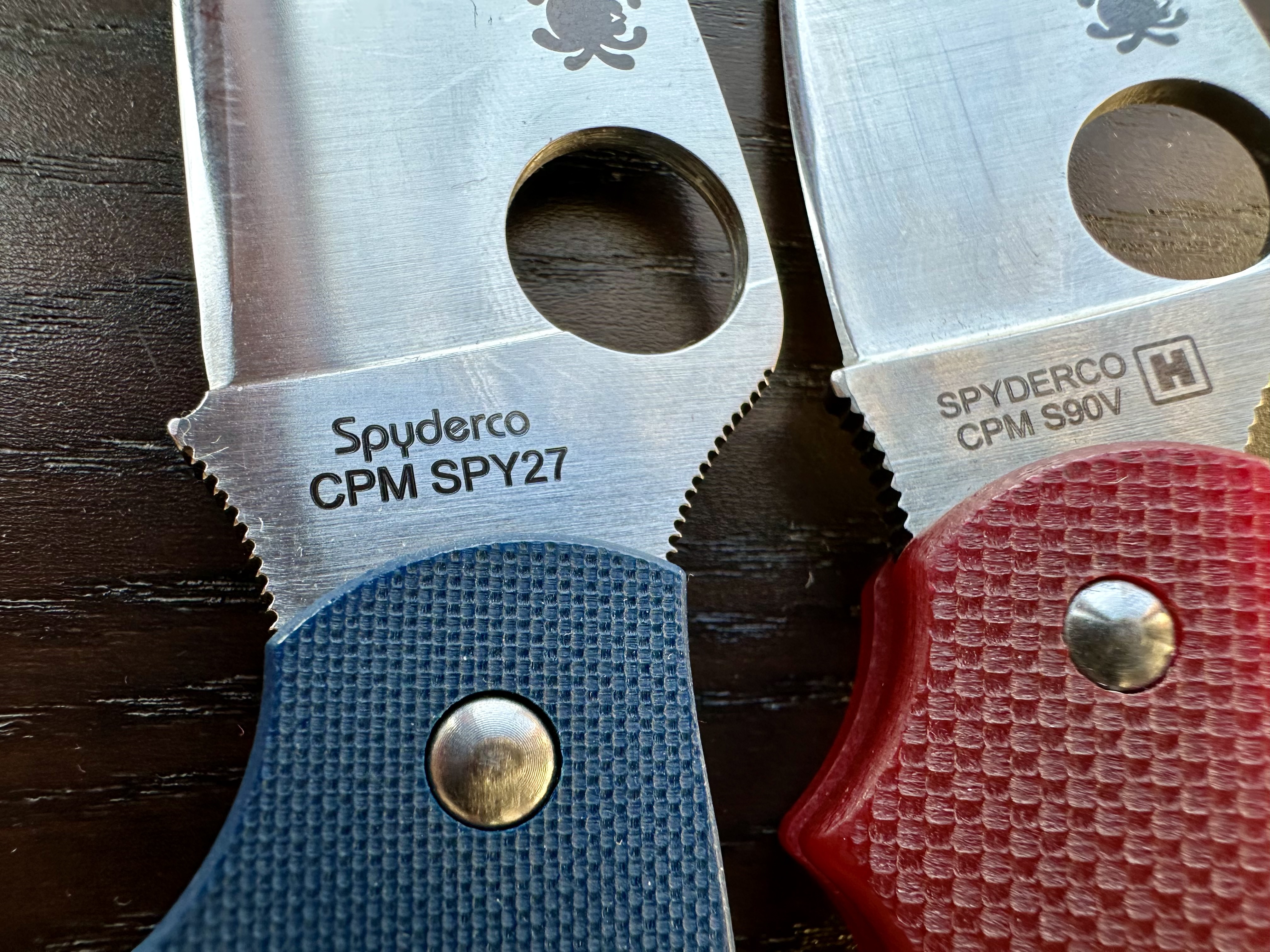
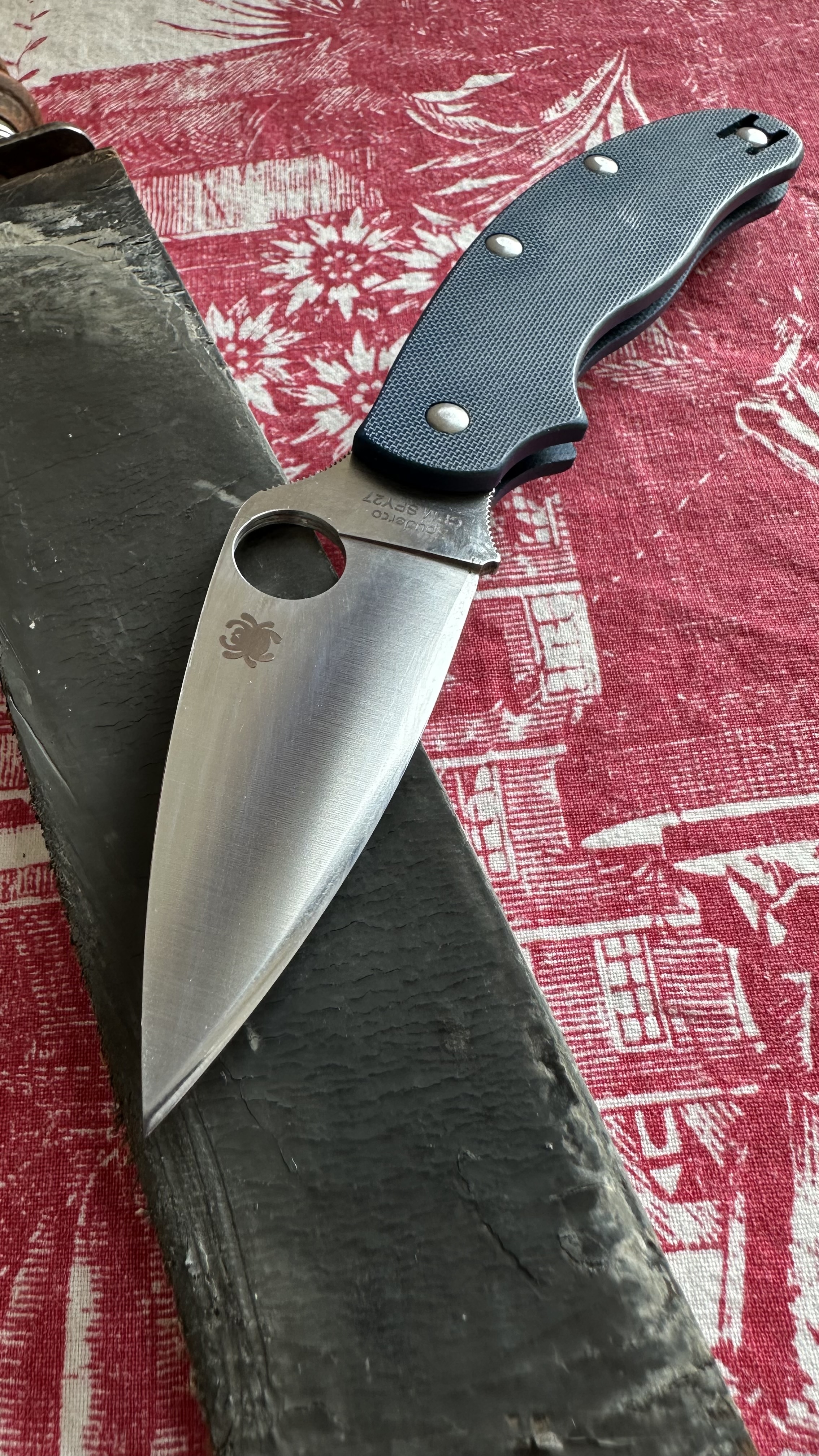
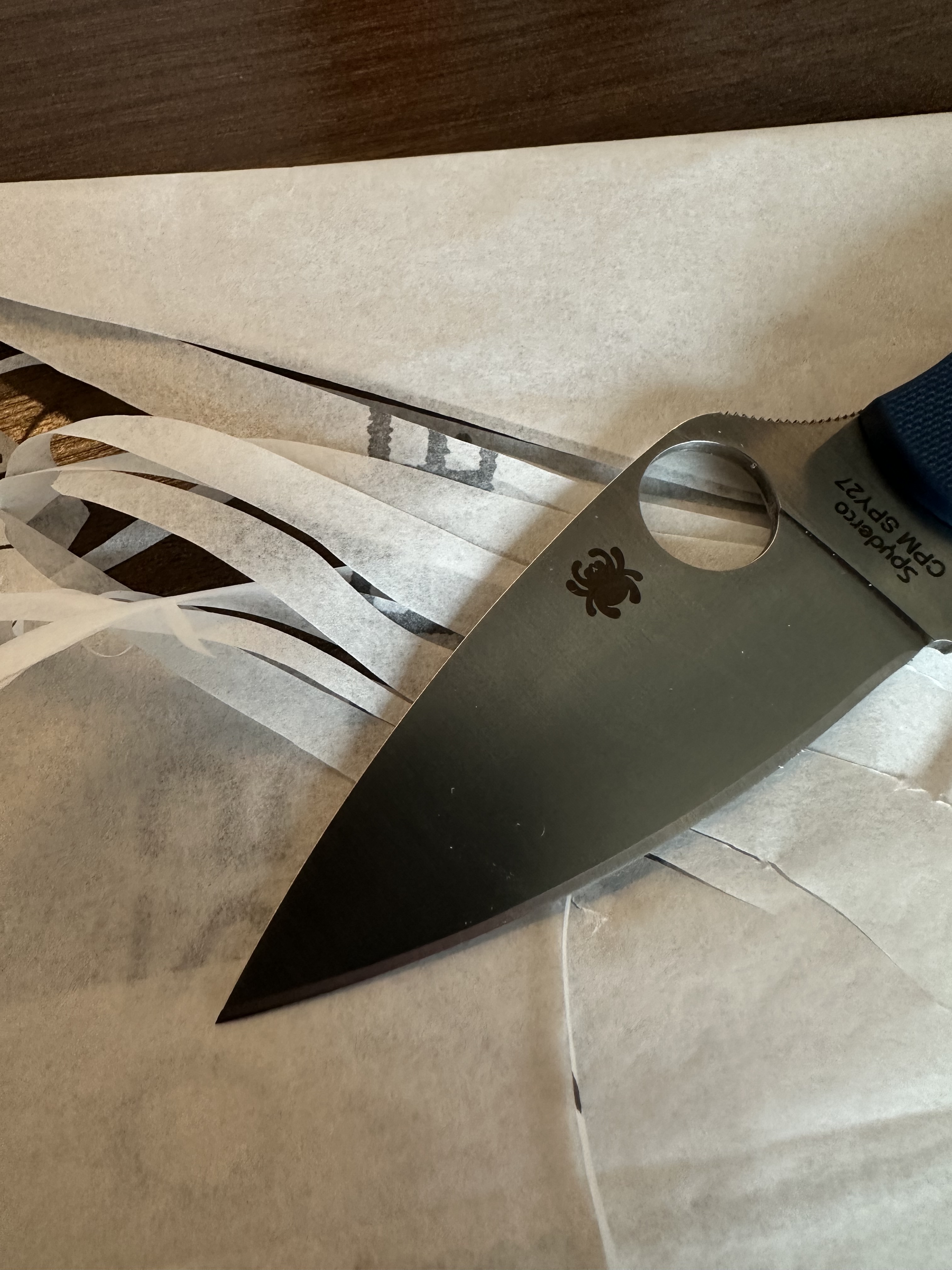
Its thin yet strong CPM SPY27 blade is a true joy to use on wood. In this domain, the UKPK stands out as one of Spyderco’s best hidden gems across all categories made in Golden. And if I ever had to defend myself against an animal, I believe it would perform every bit as well as the legendary Calypso (all the story here).
The tip has seen plenty of use, and all I can say is that Spyderco’s in-house SPY27 steel is extremely forgiving. You can push it hard with no damage to the edge. I’ve compared it with many of my favorite wood-cutting knives — including some specialized for woodworking — and it performs impressively in the same league.
One way I now measure the value of a pocket knife is by the pleasure I get from using it. The UKPK easily ranks among the top on my list. Strong, thin, and precise, it excels as a true “matter separator,” handling everything from everyday tasks to more demanding jobs like scraping paint.
There’s also a distinct joy in keeping the edge razor-sharp, and SPY27 has become my new favorite for that. Achieving a razor edge is a breeze. Being in the AEL-B class, it’s even easier to work on than Magnacut and is extremely leather-stropping friendly. After just a quick session on leather, SPY27 regained that legendary crisp edge — and it’s such a pleasure to use!
Hairs are flying and the convexed home made edge is shining like a mirror. This is really part of the joy to use leather strops on a steel.
So it is a joy just to strop it again and again just to maintain this razor edge.
Then for forced push cuts, the geometry of the UKPK is just a killer. It goes deep like a thin Opinel blade can go.
To keep the knife sharp, I’ve mostly relied on leather stropping, with occasional touch-ups on white ceramic, even after cutting cardboard, plastic, acidic food, and hard wood. The UKPK in SPY27 is a winner, offering a significant boost in edge retention and versatility. Maintaining its vorpal edge is even easier and more enjoyable than with the excellent Magnacut or LC200N versions.
It’s no wonder this steel has earned such a special place in my heart.
And I was not able to get any chipping or edge bending in six months. It gives an hint about the high quality of the inhouse heat treatment on that inhouse steel.
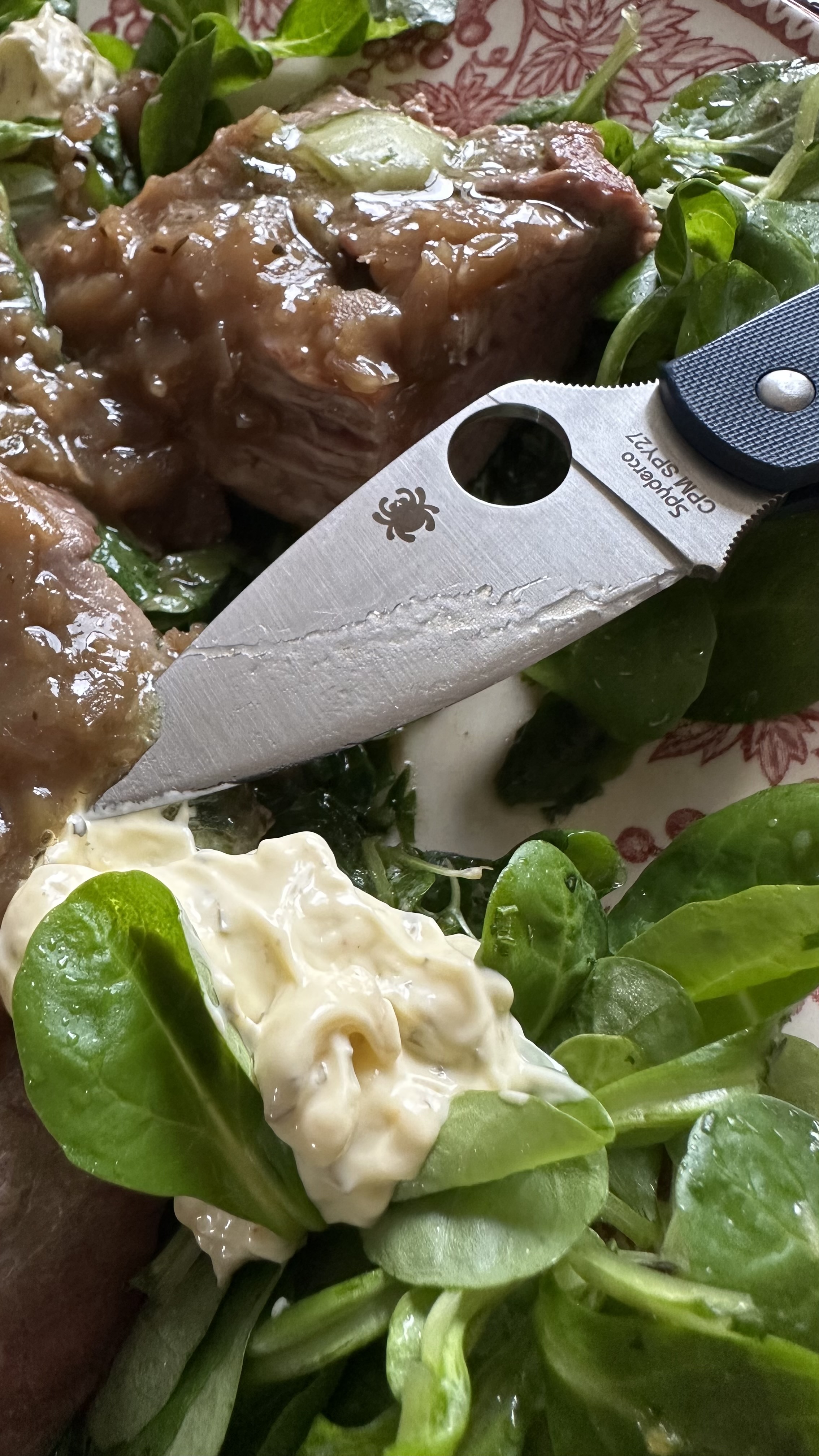
Used in the plate, the SPY27’s core refused to be damaged: no pitting, no rust, no stain. No damage on the plate ceramic too. It a gourmet companion and a wonderful carnivorous friend.
In the kitchen, geometry-wise, the UKPK can compete with the best — for example, the Patrick Bonetta Kitchen Warrior. The G10 version is also a visual delight. I never felt “under-knifed” with my Urban, but the UKPK could easily be my one and only Spyderco. A three-inch, legal, high-performance sharp blade is a must-have for EDC, and such knives are surprisingly rare.
This is 100% Sal Glesser design. This Golden-made gem is the all-terrain pocket knife my grandfather would have dreamed of! Hence its name The Golden Child. 😉
For an alternative you can now get The Metropolitan. Its little brother.
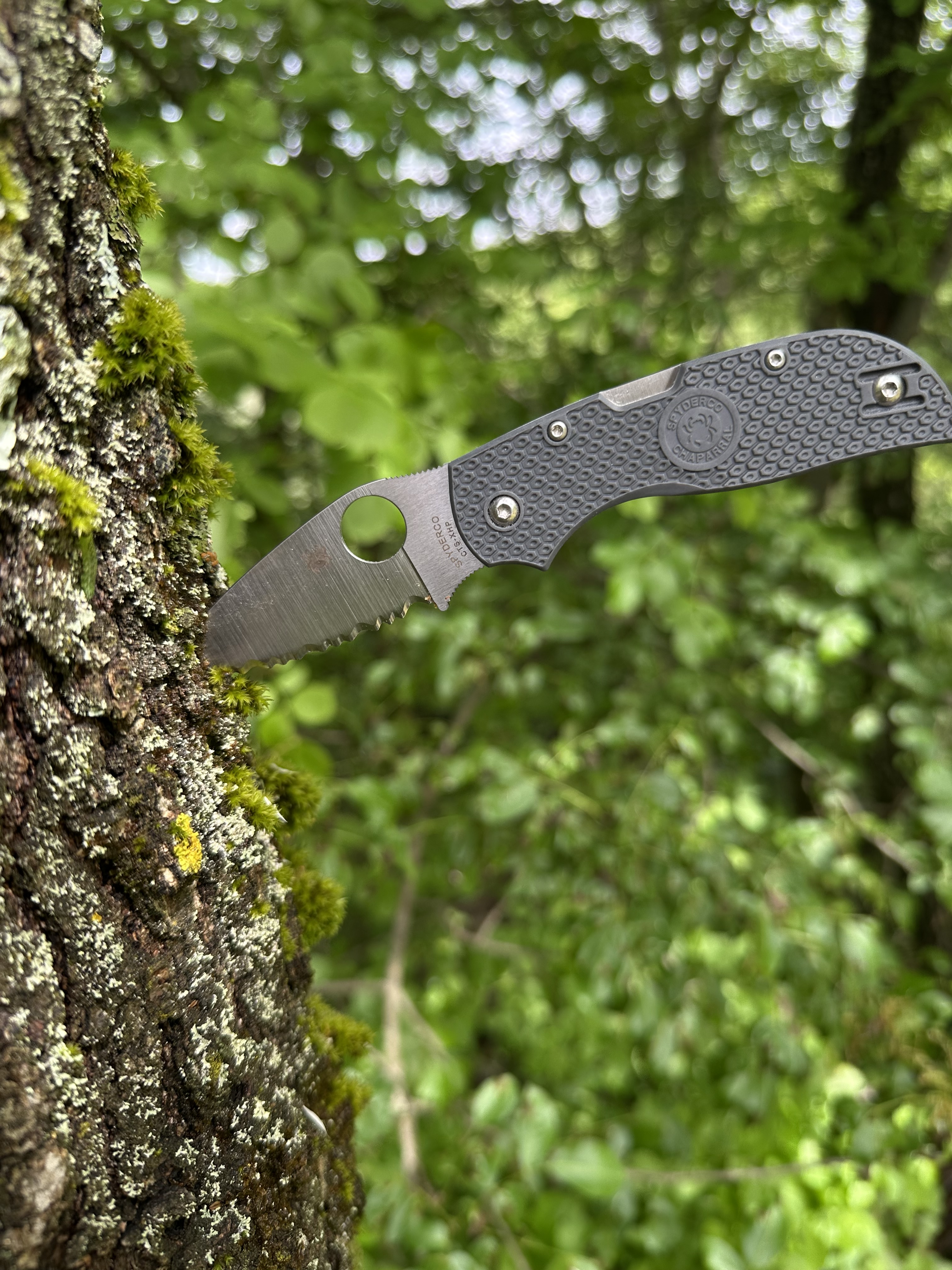
For a two-week road trip in Italy, the serrated Chaparral was my only knife. Sal Glesser’s Chaparral has been studied many times on this blog, but lately, the serrated version has become a central part of my rotation.
Why is this knife such a great traveling companion?
Friendly FRN handle: The grey FRN offers excellent grip, even with wet hands, making it comfortable and reliable in a variety of conditions.
Blade length: At less than 3 inches (71 mm), it’s easily accepted as a pocket knife. The serrations effectively add about 25 % more cutting edge, boosting performance without increasing size.
Flat and thin: Its slim profile allows it to comfortably fit in a watch pocket.
Sturdy mechanism: The hidden pin ensures zero vertical play, providing a rock-solid feel.
So this little big knife was my main cutting gear for two weeks.
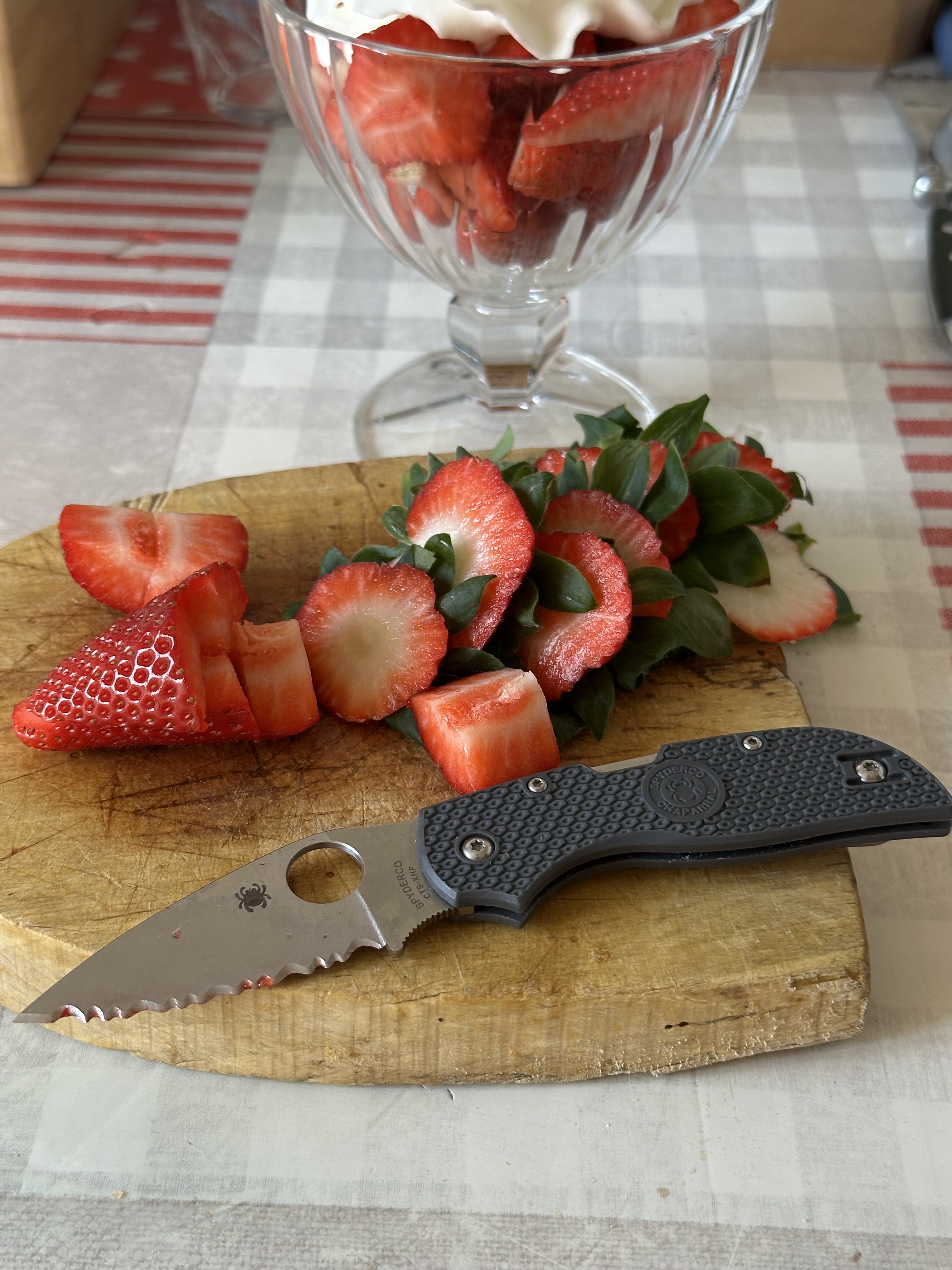
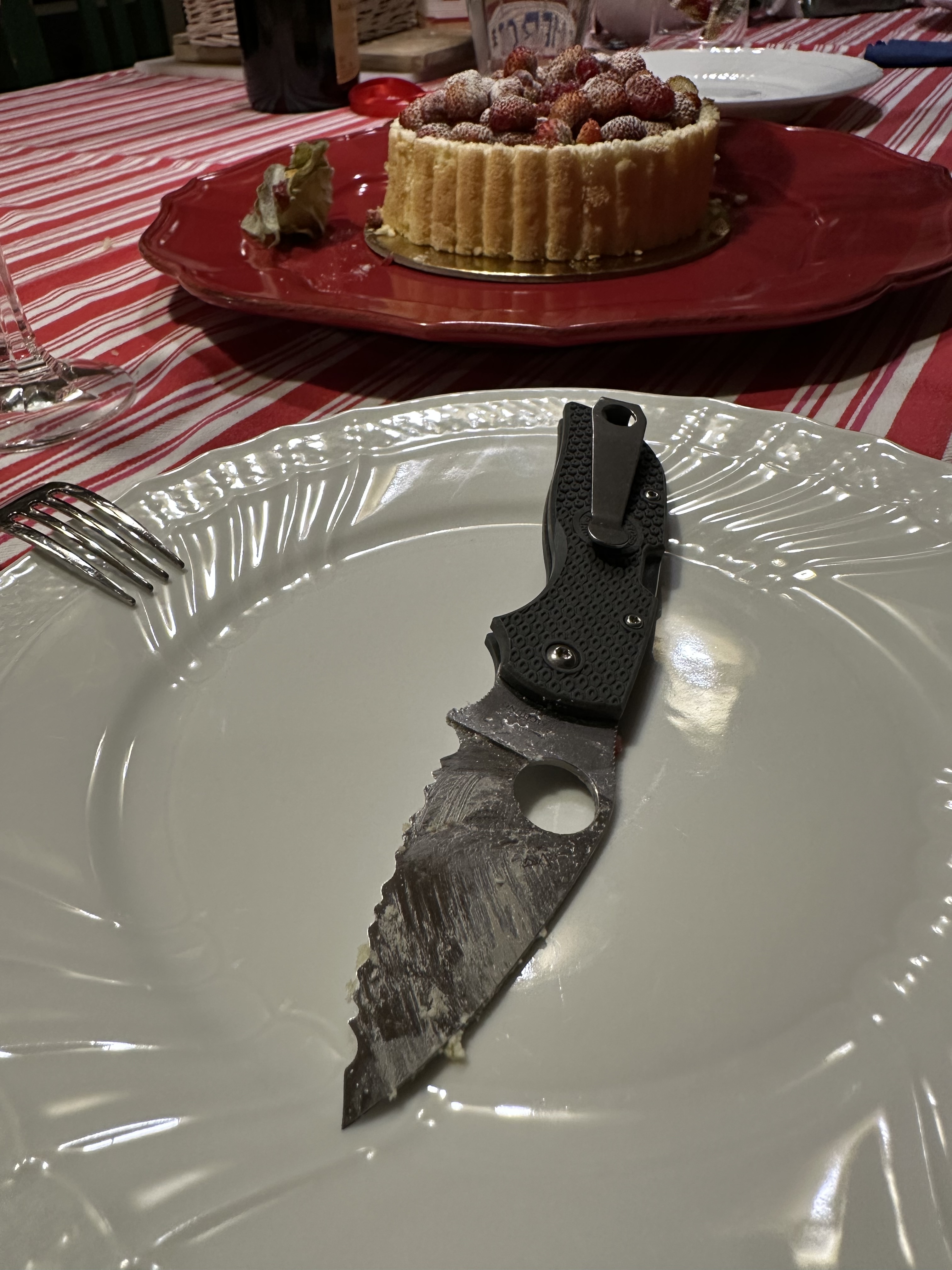
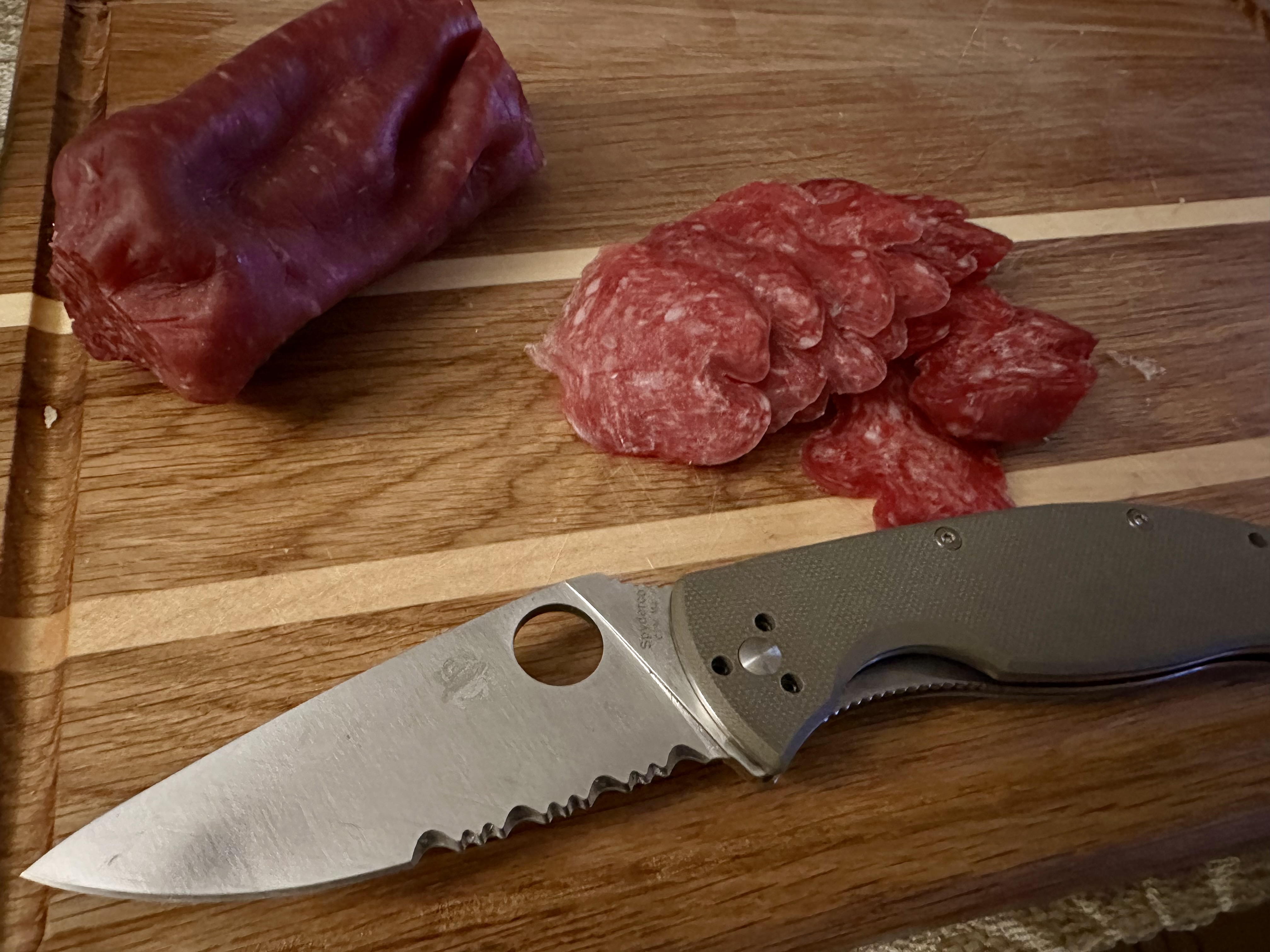
I was able to open it in restaurant without to be noticed and replace the dull silverware provided. The serrated Chap is a folding steak knife by essence.
Its thin blade is making the cuts accurate even on delicate cream croissant shared with a coffee.
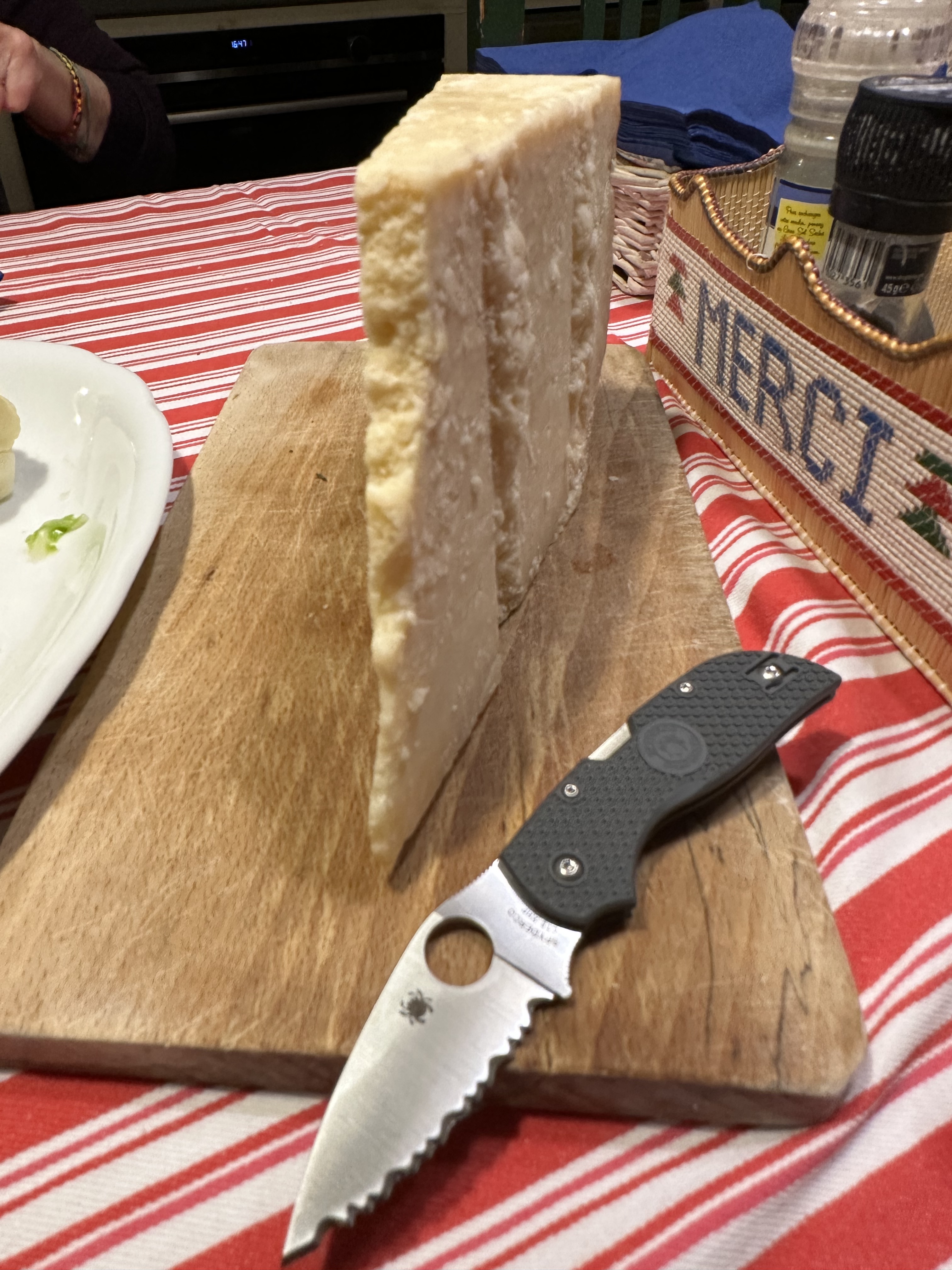
One of the challenge for such a thin blade is the famous hard cheese found in Emilia-Romagna: the Parmigiano Reggiano.
Normally, Parmigiano is not “cut” — a traditional leaf-shaped short knife is stuck into it and breaks off large chunks like a wedge. That approach wasn’t a problem for the thin CTS-XHP blade of the Chaparral. It dug in deeply and, with a slight torsion, fragmented the cheese effortlessly.
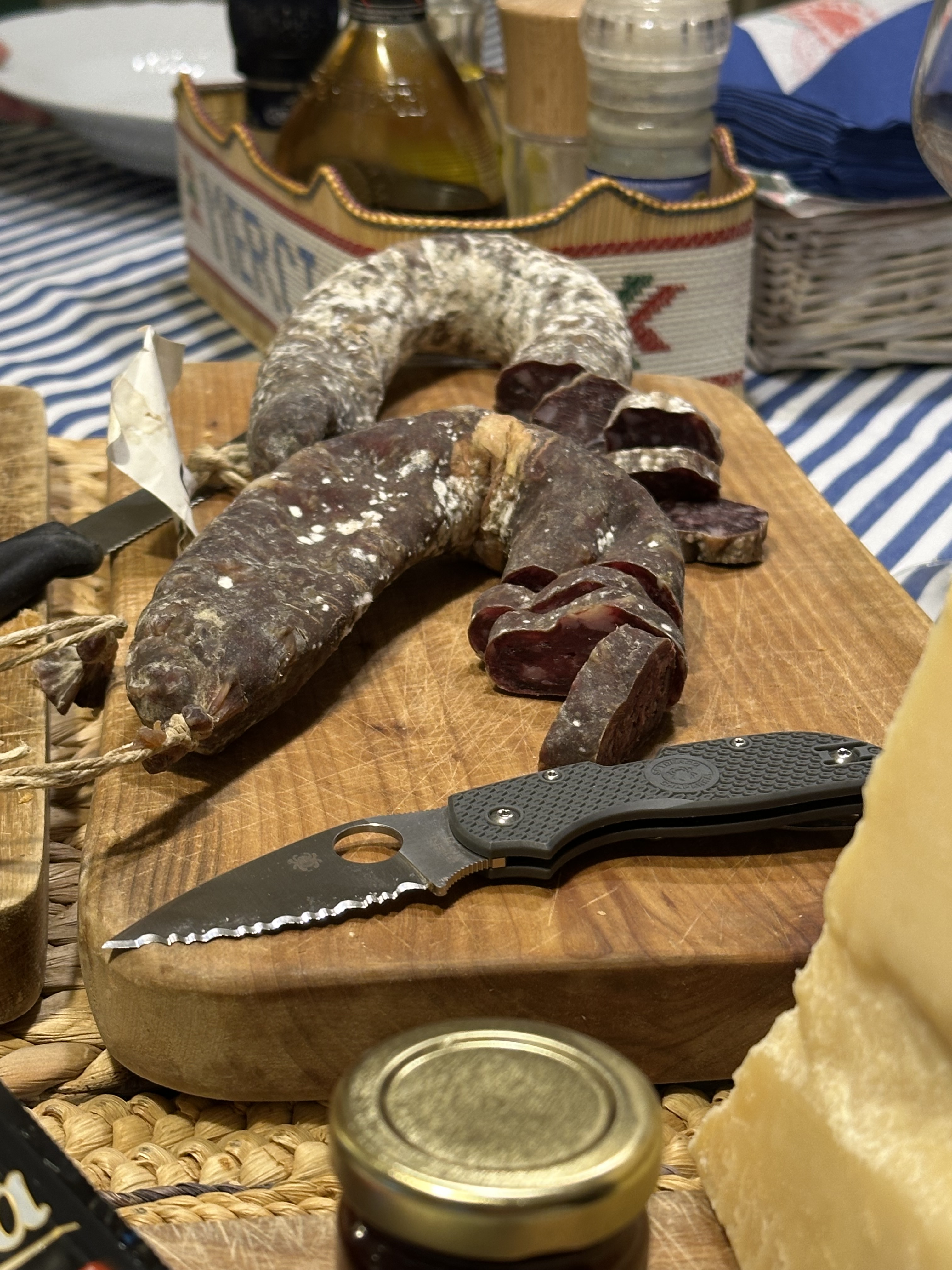
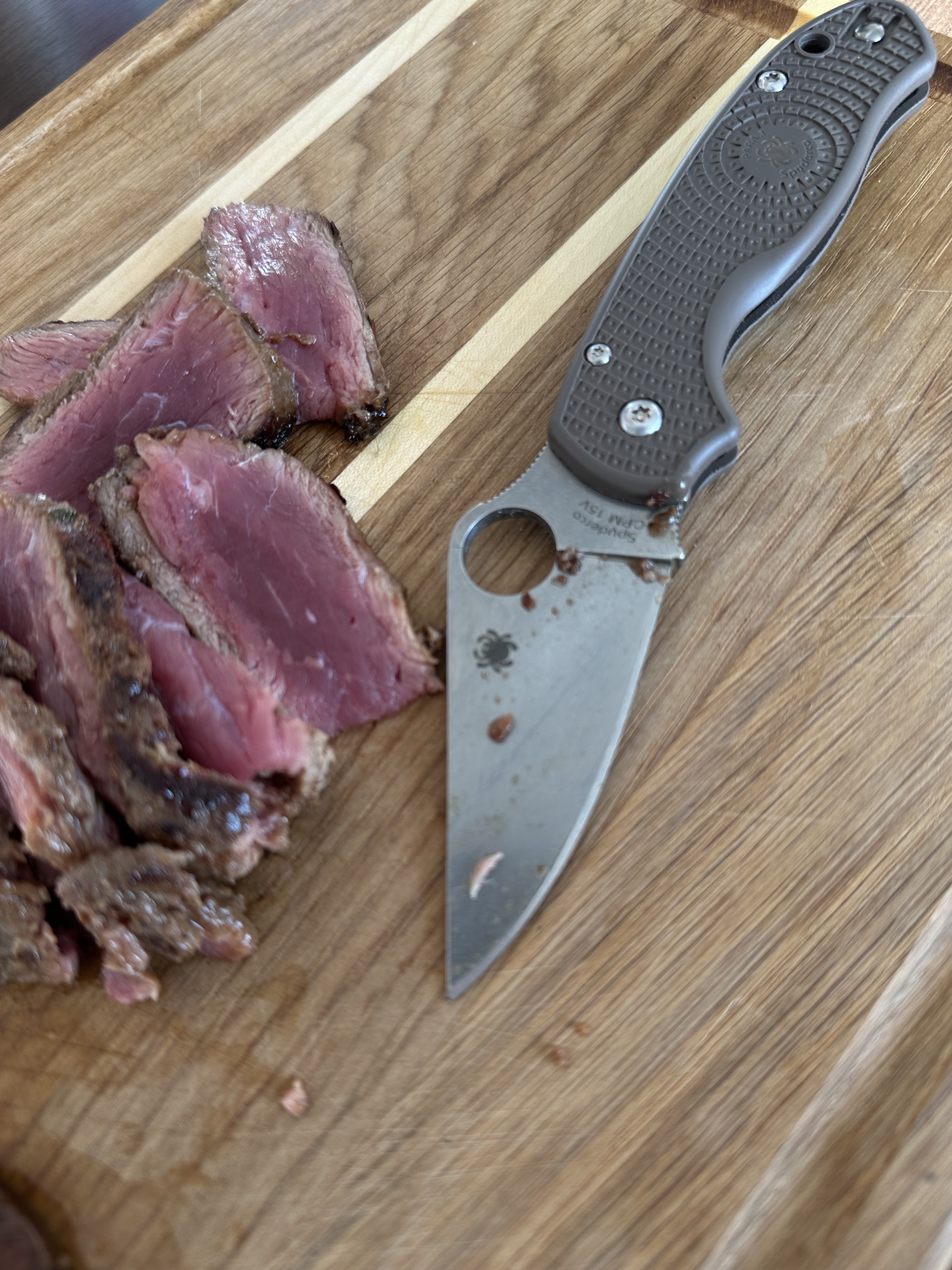
Hard sausages in Tuscany can be made from deer or doe or even boar. Again, bring a thing serrated edge to the board and it will be a success.
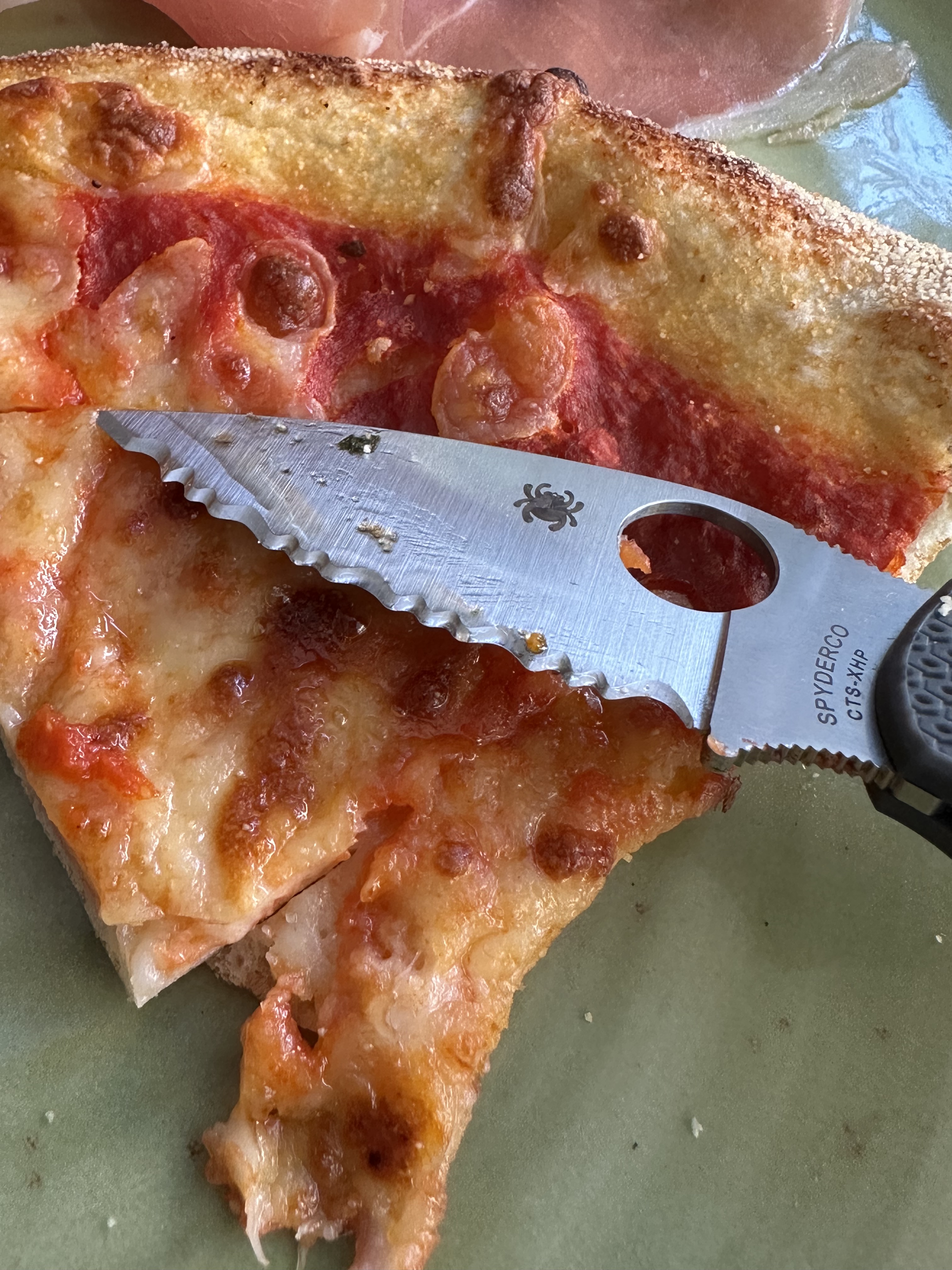
Pizza can be a challenge. You want to cut through all the layers without dulling the edge on the plate. Serrated edges do not dull easily in the plate. And even some knives encountered provide serrations at the end of the edge like this one:
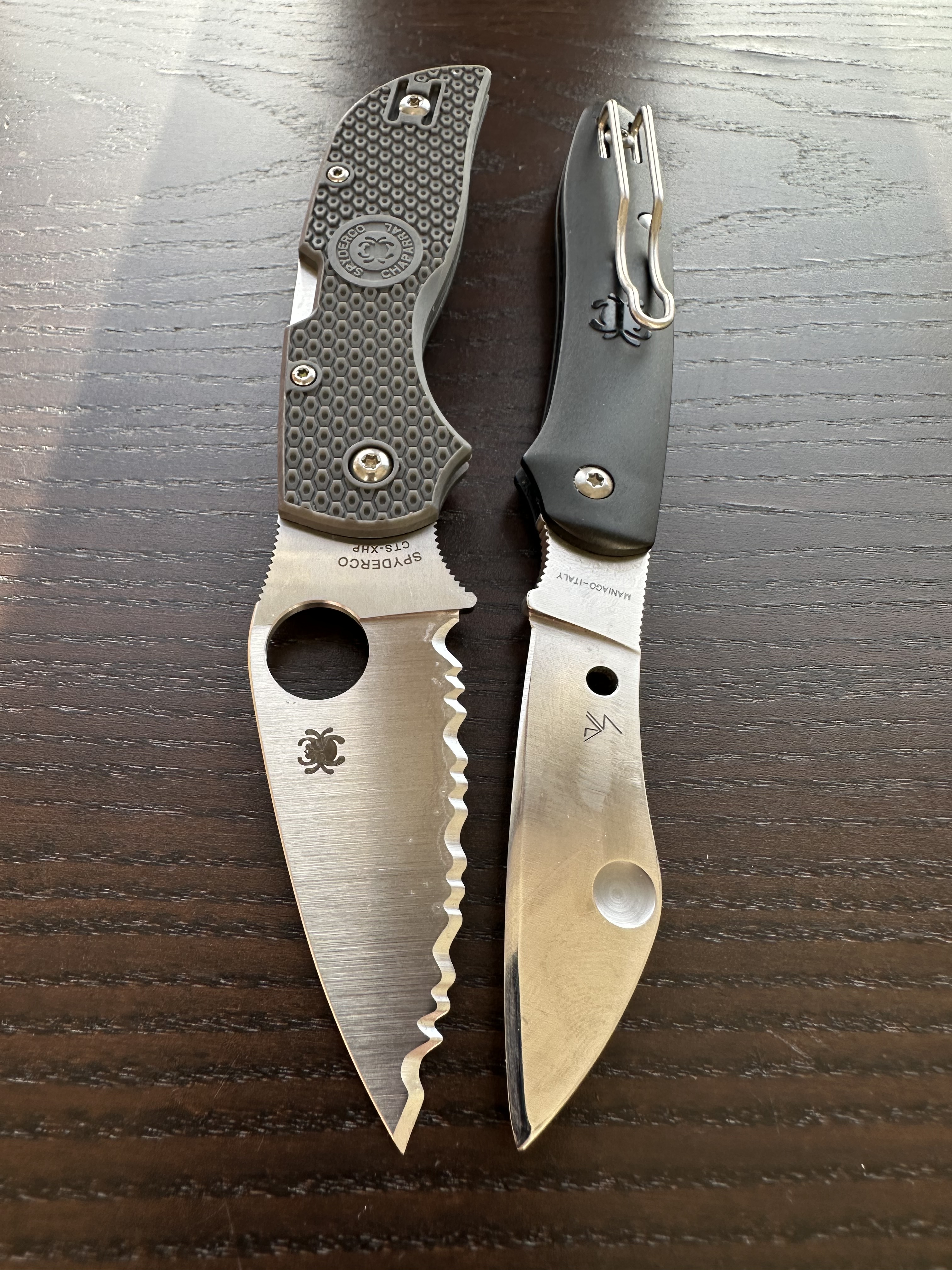
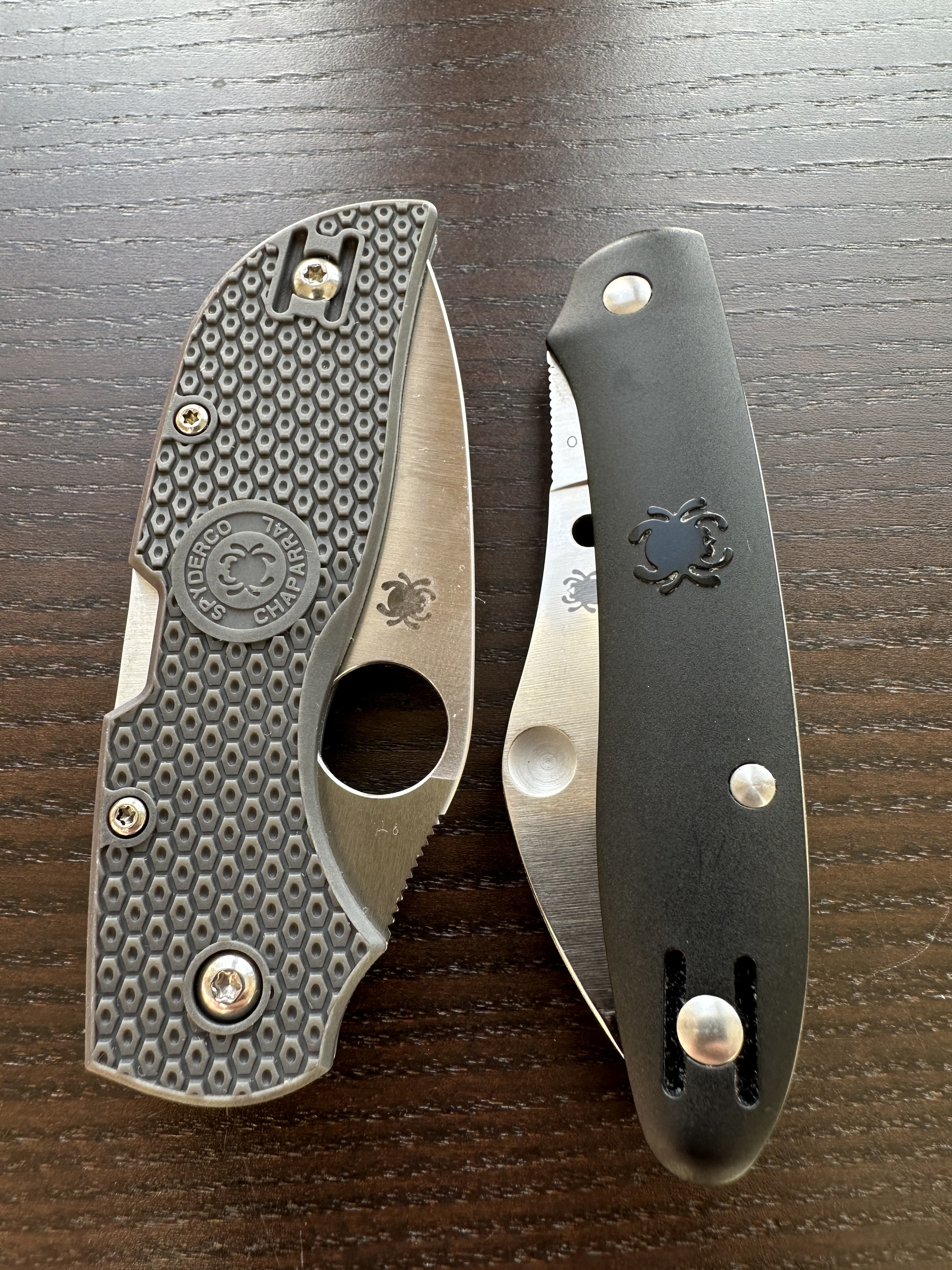
Here the Chap near a friend’s Captain which has been used to deal with mozzarella.
It feels good to be not the only Spyderco in the village.
After two weeks with the Chaparral, I never felt “under-knifed.” It performed reliably in all conditions — rain, seashore, and forest — and remained socially unobtrusive. Its cutting power, thanks to the thin, hard CTS-XHP blade, proved that a pocket-sized chainsaw can be an essential part of any traveling kit.
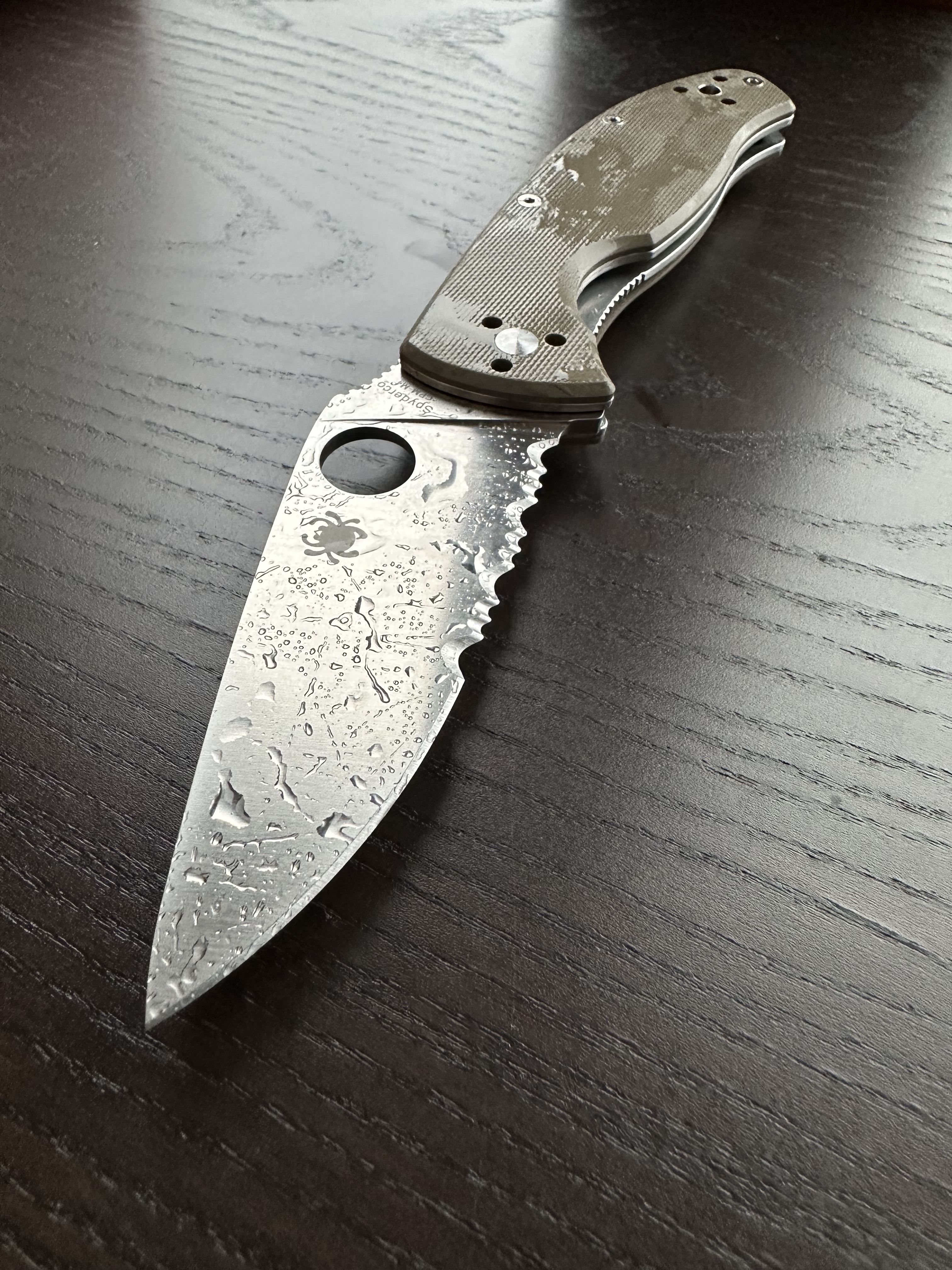
After two weeks of use, the Chaparral showed no rust issues, no bent serrations, and no gritty mechanism. I simply rinsed it under the tap and let it dry in my pocket.
Even now, I don’t feel any need to resharpen the blade — the serrations are extremely difficult to dull. For a travel folder, I can confidently say: the Chaparral comes highly recommended!
If you want to see some spectacular moments from my two-week Italian road trip, I’ve released four video postcards on YouTube, all filmed and edited on the same iPhone 14 Pro that provided the photos for this article. If you enjoy them, feel free to give a thumbs up and subscribe to my Youtube channel.
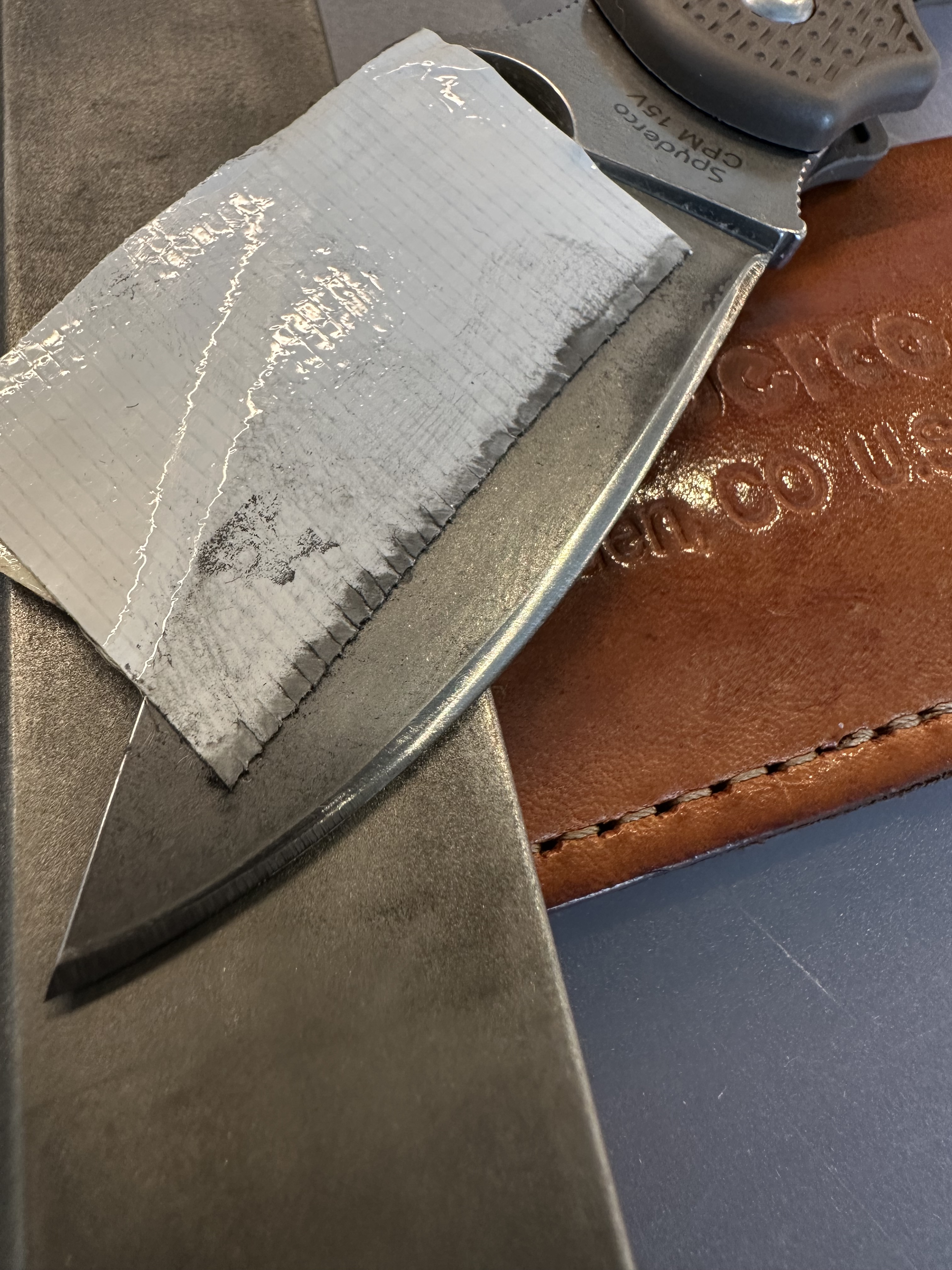
I have enjoyed the Para3 in CPM15V for a week now and after the first pictures, one of my friend Alexandre wrote to me “Looking forward for a convex edge”. And I have answered to him that I was not in a hurry to do it on this little wonder of modern cutlery. The steel seemed so hard ! But guess what ? What’s bred in the bone will come out in the flesh. After a week of frustration trying to get any good (spectacular) result on leather and white ceramic….
Some gaffer is on the blade to protect it from any scratches. My goal is just to “de-shoulder” the edge, to round it for a better leather stropping experience.
It is not rocket science and I’m clumsy and impatient. So I’m not helped by natural tendencies. As you can notice the edge near the guard will have less attention. My friend JD is able to go even but I’m not to his level in making beautiful edges.
But as you can notice it is getting better. I use a Double Stuff 2 from Spyderco. Mine is old and the glue between the ceramic slate has gone. The diamond slate is not as efficient as some decades ago but it should bite into CPM15V despite its humungous pourcentage of vanadium.
“Since CPM 15V has a high volume (23%) of vanadium carbides (87 HRC) which are harder than the ceramic alumina abrasives. (79 HRC)
That means 23% of the overall microstructure is being pulverized, burnished and adhesively worn to shape rather than cut at the apex.
Over the years I’ve observed a pattern in some folks complaining that these types of steels cannot get very sharp yet the same folks seemingly would refuse to use the abrasive that will cut the remaining 23% of that microstructure cleanly.
I do think that would be fascinating to do a controlled test and look at the differences between the starting sharpness and how that sharpness dies off with cut testing and then compare the loss of sharpness between the two with the same amount of cuts.
I’ve certainly seen this behavior in my personal experience, however, I’ve not documented and shared data publicly.
I’ve mentioned many times that my current favorites for sharpening are the bonded super abrasives rather than the electroplated abrasives. However, there is a cost difference, but in my experience it certainly pays for itself and has better performance.“ Shawn Houston on the Spyderco Forums
First look at the result.
Humm it needs to go one more round.
Ah, I am starting to enjoy the result and how the steel takes the light on the belly of the blade.
Now time to put some white compound polish on the leather.
Again I’m not focusing on getting it sharper it but just to polish the edge and remove any scratches. I want a better geometry like I use to have on the Para3 in M390.
CPM15V does not like to give away its particules. When I have been able to get mirror edges on D2, 52100 or SPY27 I’m not able to get it on 15V. I need certainly to upgrade my equipement and my game for that. I will polish it on Jade stone and post better results in the coming weeks. So far I’m happy with the result. More to come later as 15V is not as easy as I thought to work on (JD adviced me “I think diamond past would help with the stropping. Diamonds or cbn can cut the vanadium carbides, of with this steel has a lot”. Not impossible, especially with diamonds but easy. Maxamet on the other side has proven to be much easier to restore even after catastrophic damages. But I’m very happy with that Para3 which could be the HoulaHoula (*) of folding knives.
(*) Houlahoula are little birds with big balls and when they land they sing “Houla ! Houla !
On the Spyderco ForumsShawn Houston was kind enough to give some advice about how to get a mirror edge on CPM 15V:
“I recommend skipping the White Ceramic and Jade. 23% of the matrix in the 15V is harder than those abrasives. A bonded diamond/cBN stone should help with the desired finish.
You deburr the best you can with light alternating passes on the stone. From here, the edge should be sharp enough to cut paper cleanly before moving on. Afterwards, go to a leather strop loaded with 1um Gunny Juice and use alternating edge trailing passes.
This is a good benchmark; keeps the “bite” at the edge without smoothing out the slicing effect. It also helps keep the “grab” at the edge for draw cuts but still keen enough for push cuts.
There’s different kinds of stones. They’re not all created equal. You can take a diamond stone with the same abrasive and the same grit and it will leave a different surface roughness depending on the construction of the stone. Yes, there are three major types of bonded stone.
Metallic, resin and vitrified.
There’s even some that are hybrids. However, these are not the same as electroplated diamond abrasives.The work more like regular water stones with better surface finishes.
“Diamond or CBN are the way. You can put a functional edge on 15V with ceramics, but if you’re wanting the real performance 15V has to offer, you need to sharpen with abrasives that will cut the carbides in the steel.” Wandering_About on the Forums has sum it up.
“Based on the latest set of reviews, BBB CPM 15V steel demonstrates exceptional performance and user satisfaction.
Performance: * Excellent edge retention: Maintains a sharp edge for extended periods, even with demanding use (e.g., cutting blackberry roots, heavy use). * High edge stability: Resistant to chipping and rolling, even with hard use. * Versatile: Performs well with different edge angles and finishes (from toothy to mirror).
Comparisons: * Compared to K390, Maxamet, S90V: Sharpening is considered easier than K390 and Maxamet. * Compared to M4: Sharpening is considered comparable in difficulty to M4.
Key findings: * Sharpening Ease: Despite its high hardness and carbide content, 15V is surprisingly easy to sharpen. Users report successful sharpening experiences on a variety of tools, from diamond stones and CBN plates to simpler systems. Burr removal is consistently described as effortless. * Edge Retention and Stability: 15V exhibits excellent edge retention, maintaining sharpness through demanding tasks and heavy use. It also demonstrates high edge stability, showing resistance to chipping and rolling. * Versatility: The steel is versatile, capable of achieving both aggressive, toothy edges and refined, smooth edges. * User Enthusiasm: Many users express high levels of satisfaction with 15V, with some even considering it their favorite steel. Overall: BBB CPM 15V appears to be a top-tier steel that effectively balances exceptional performance with user-friendly sharpening characteristics. Its combination of edge retention, stability, and ease of use makes it a strong contender for demanding tasks and a highly recommended choice for knife enthusiasts.”
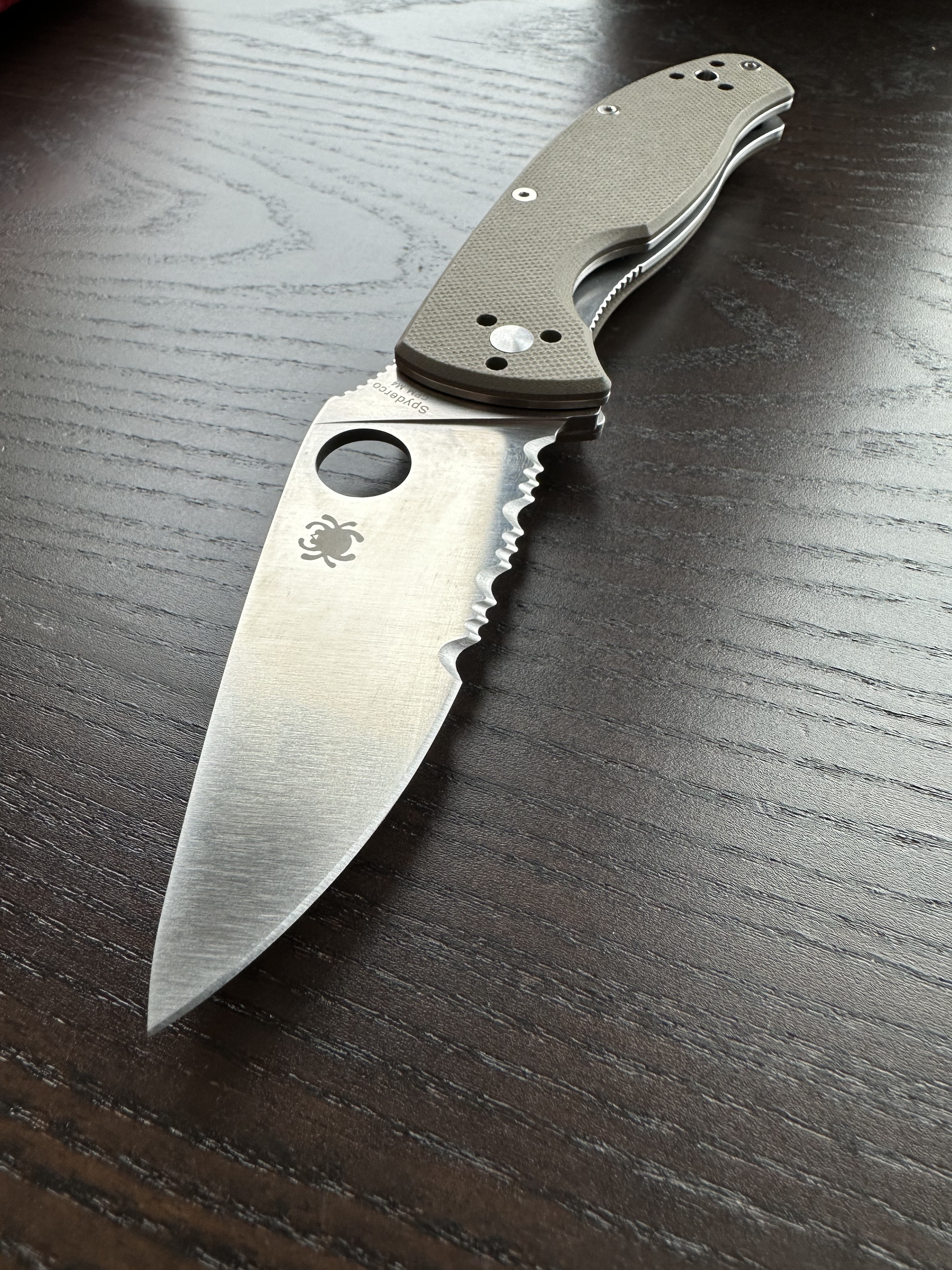
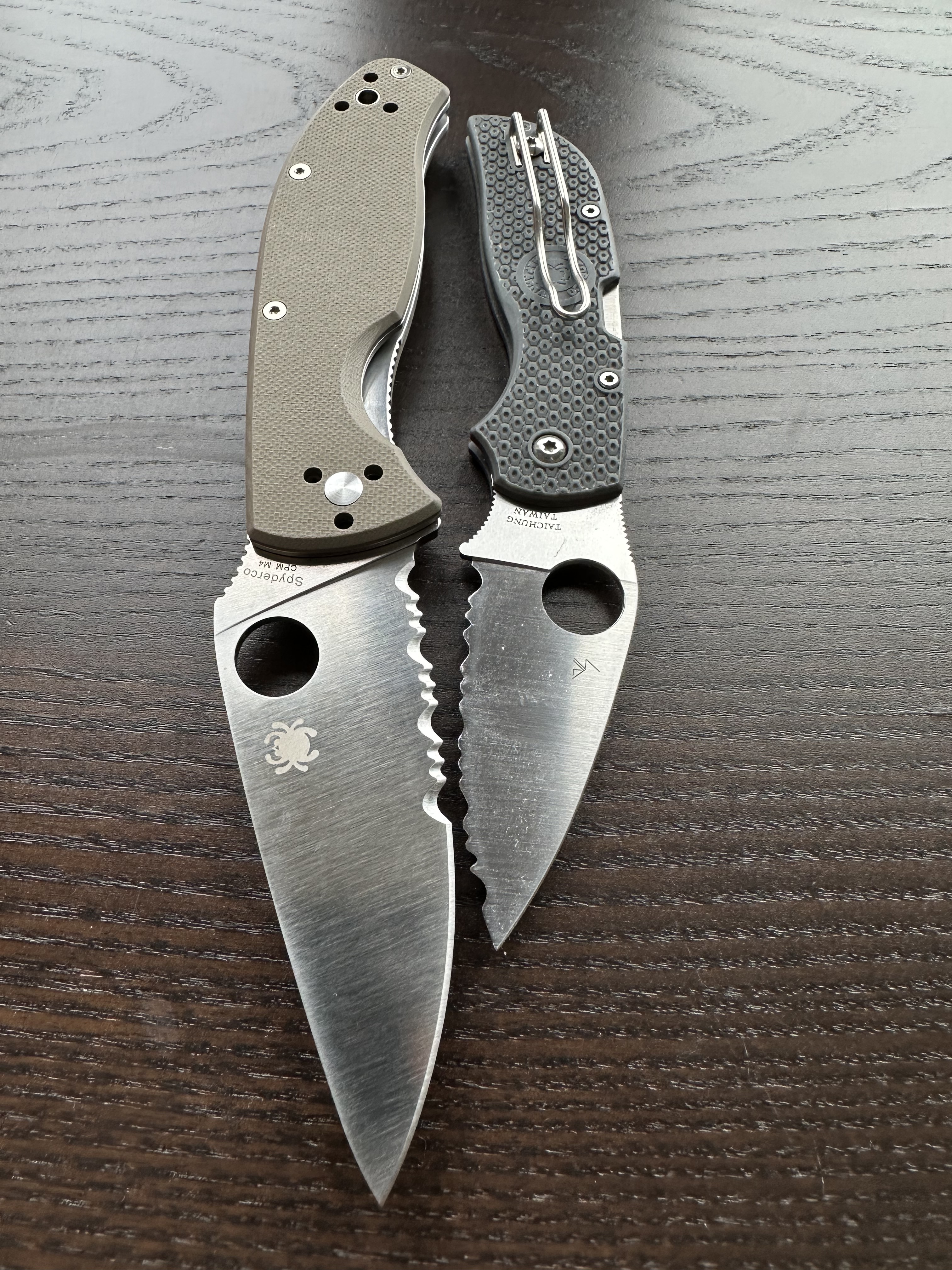
I’ve been tenacious — truly tenacious — in resisting the C122 Tenacious, even though I’d had my eye on that folder since 2008. After 17 years of flirtation, I finally ordered one. Why the delay? Its main weakness was always the less-than-stellar steel compared to the high-end knives I already owned.
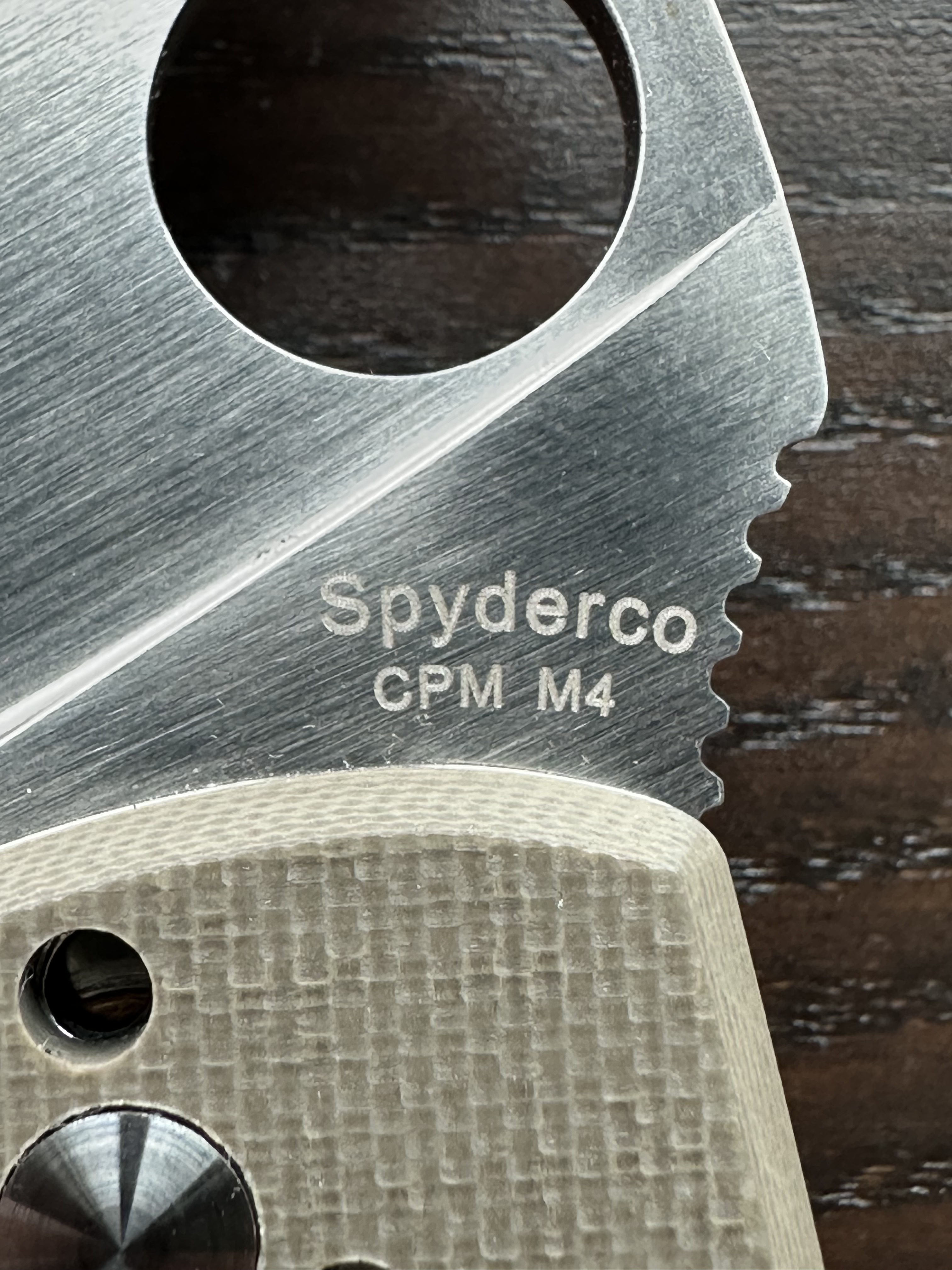
Now, the CPM-M4 version is here to quench that long-standing thirst.
I don’t have much memory of a CPM-M4 serrated edge, except with another Eric Glesser design: the Dodo Exclusivefrom Blade HQ (C80GM4S). The Dodo was a real wood slasher — its S-shaped blade trimmed vines deeper and faster than almost any other, and the comfortable handle was perfect for power cuts.
Opportunities to play with a serrated CPM-M4 edge have been rare — until now. Here it is.
Back in 2008, when the Tenacious have been released it was a success.
Eric Glesser’s design was appealing to many for a simple reason: it was a well-thought-out, tough workhorse knifeavailable for around €30 (or less). A true blue-collar tool — built to be used and abused, like a modern-day Buck 110 for the pocket.
The best thing about the Tenacious was that it offered a thick, sturdy, well-built liner lock at a time when liner locks were falling out of fashion. Easy to display, easy to use, this no-choil, long-edge, compact working folder from Eric Glesser was a hit — and one of the best ways to catch the Spydervirus.
Now there is a FRN version in CPM S35VN. But it is as heavy as the G10 version and I’m not really a fan of FRN… Even if I absolutely love the FRN scales of my Serrated Chaparral.
“I’ve thrown it, dropped it, batoned wood as thick as my wrist, chipped the edge multiple times (didn’t think 8cr13mov could chip, thought it was too soft but was wrong), I’ve left in outside ONCE in the rain overnight because I forgot I placed it on my front porch the previous day, I have spine whacked it (just don’t, I most likely have an impulse problem… lol … same problem that causes me to buy a lot of knives) I’ve dug holes, stabbed the ground to cut weed roots out, and much much more...
I think by now you get the point. I treated the tenacious as if I got it for free and had 1000 more to replace it if something happened. I treated this knife as if I hated it.
The result? 4 years later, the Tenacious opens smoother than it ever has, not a speck of rust since I purchased it, I have oiled the blade a couple times but I can guarantee it was less than 20 times total in the last 4 years, lockup is a bit less solid, BARELY any blade play from side to side, even less blade play from front to back, g10 scales look smoothed over and scarred, but to be honest there is still plenty of traction. All in all, this knife is much more than what most of you need from a folder.”
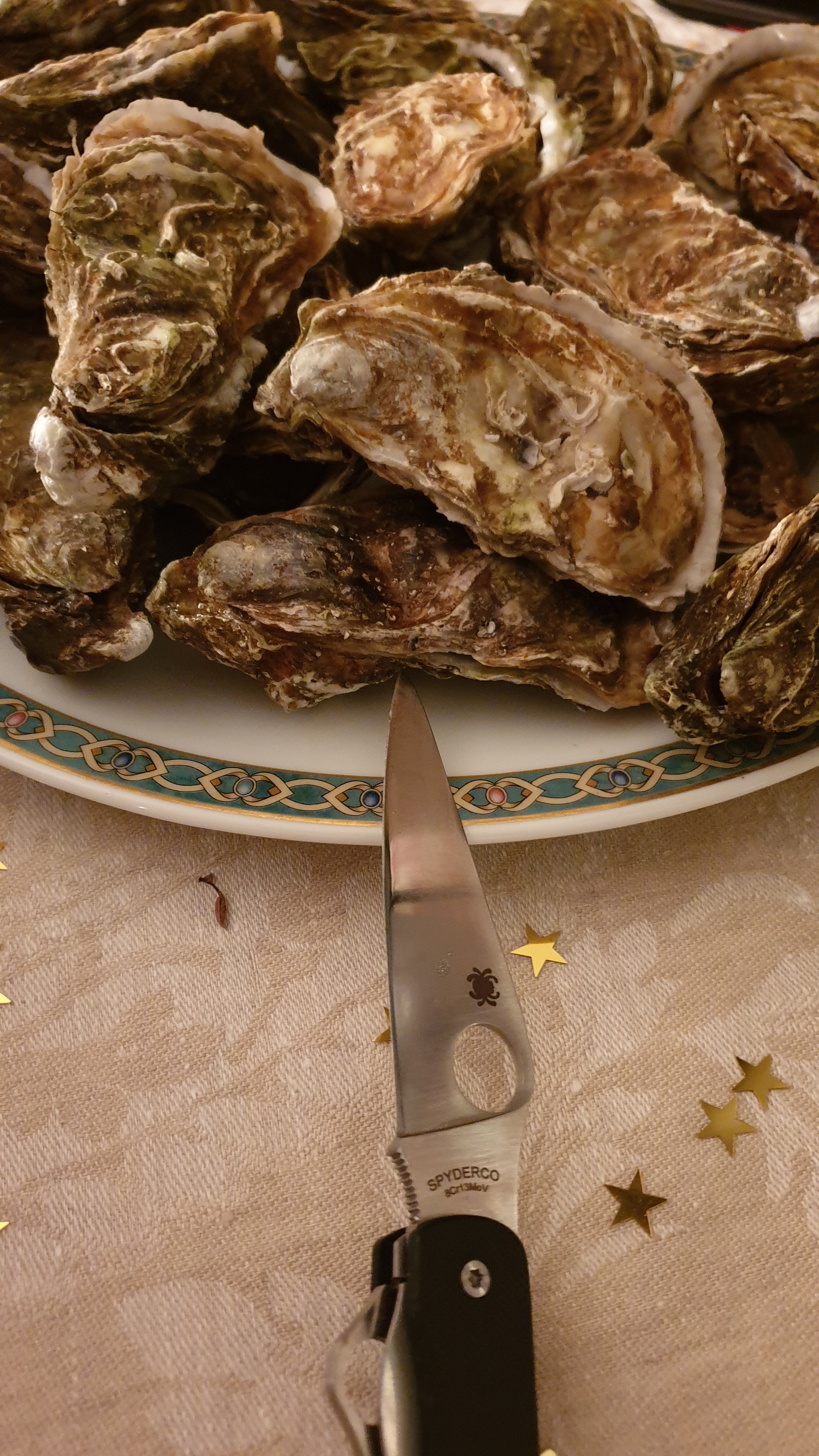
My Persistence experience was excellent as described in my 2012 review (green words lead to link) but eventually I was disappointed with their steel. 8Cr13MoV can get sharp but lose sharpness much too fast for my uses. It was frustratring. I still got 8Cr13MoV knives like the Clipitool which is a great oyster knife. 8Cr13MoV is tough for a stainless steel, no surprise it was chosen for the Tenacious line.
The Tenacious is a sturdy well made liner lock folder with a super tool steel blade.
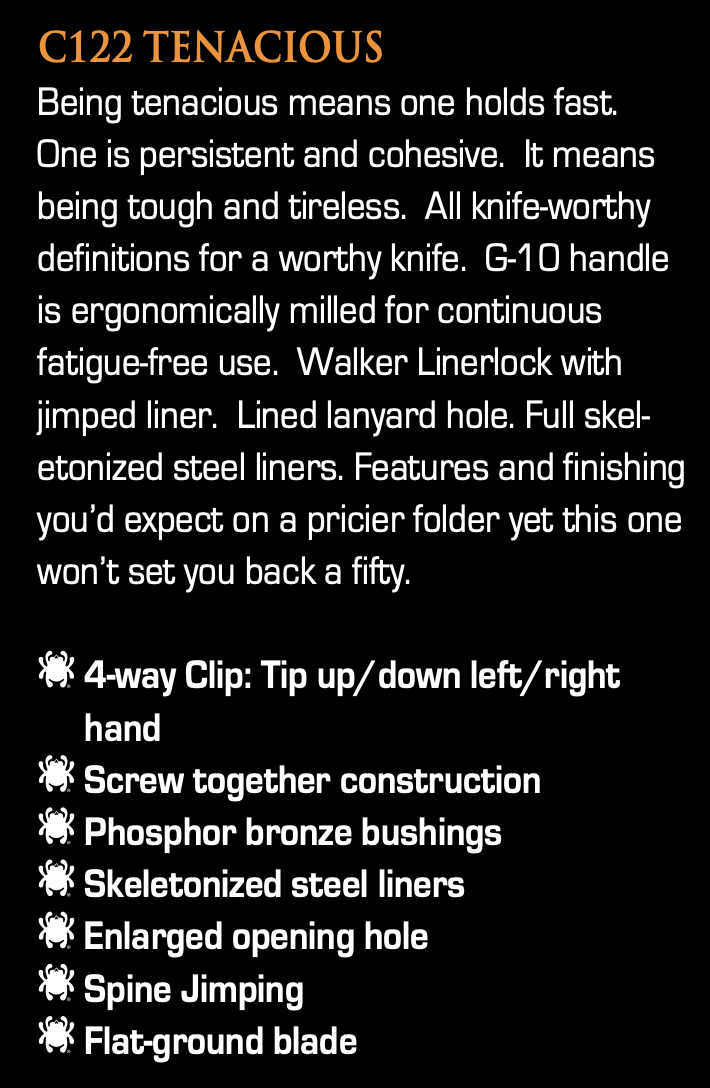
“This remarkable expression of the Tenacious® elevates this best-selling design to all-new heights with a blade crafted from American-made CPM M4 tool steel. Produced by the particle metallurgy process, CPM M4’s sophisticated alloy composition, high vanadium content, and extremely fine grain structure give it exceptional wear resistance and toughness-properties that translate to outstanding edge retention and impact resistance in knife blades. This knife’s full-flat-ground blade is available in both PlainEdge™ and CombinationEdge™ formats and is housed in a handle featuring brown peel-ply-textured G-10 scales.“
I have written many reviews about that fabulous alloy CPM-M4 it has never disappointed me and since I have sold my CPM-M4 Military and kept my Yojimbo 2 and Mantra 2 (reviewed and sharpened by JD) and use them hard, I know it is reliable and get a nice patina.
A lil’oil will prevent rust. CPM M4 is not 52100 and the patina will come slowly after cutting some lemons… “CPM M4 has good edge holding, sharpening ease, toughness, strength, and is not a rust monster…” to quote Rangodash.
Now a blade is 1/3 steel, 1/3 Heat Treatment and 1/3 geometry.
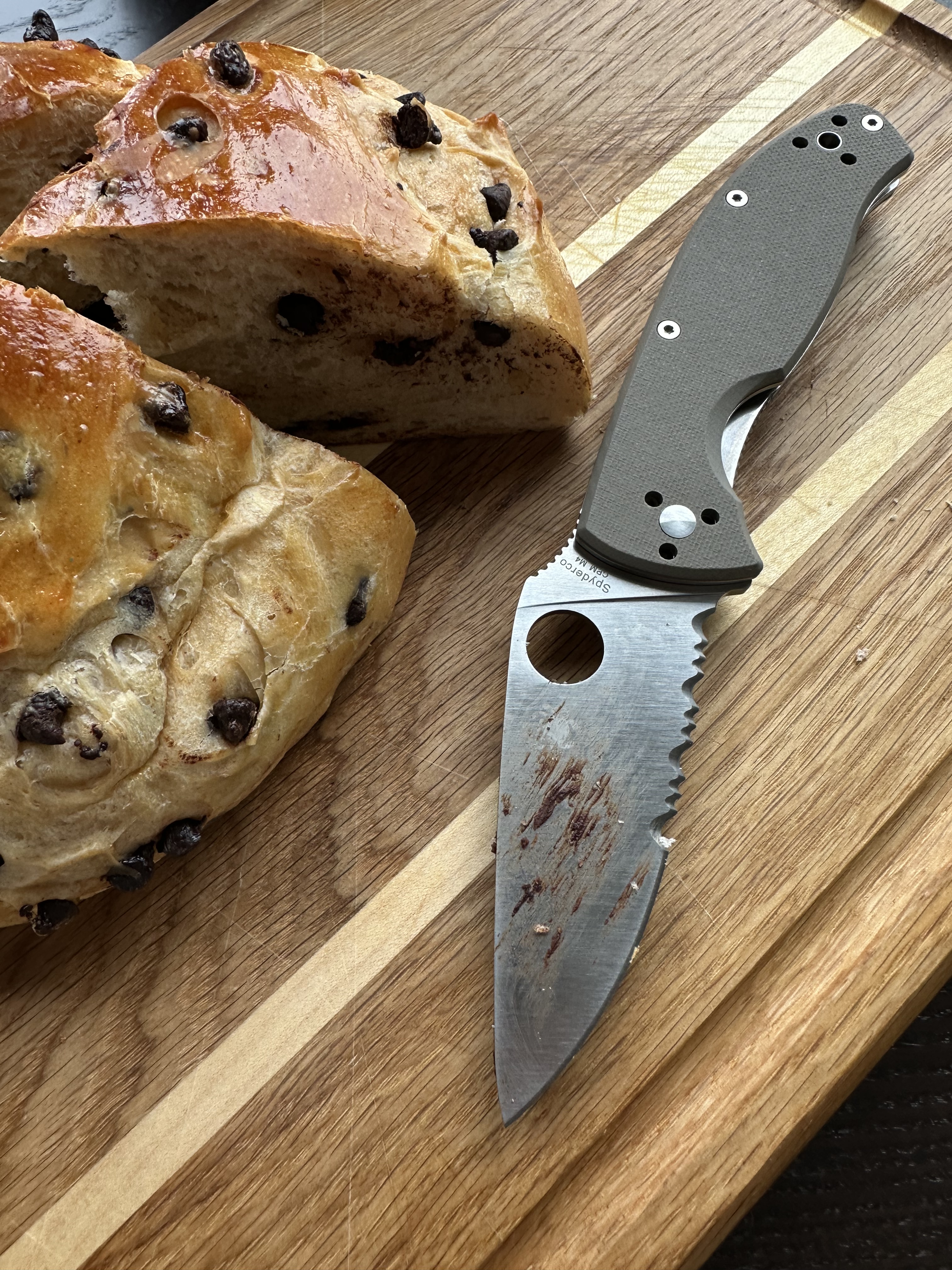
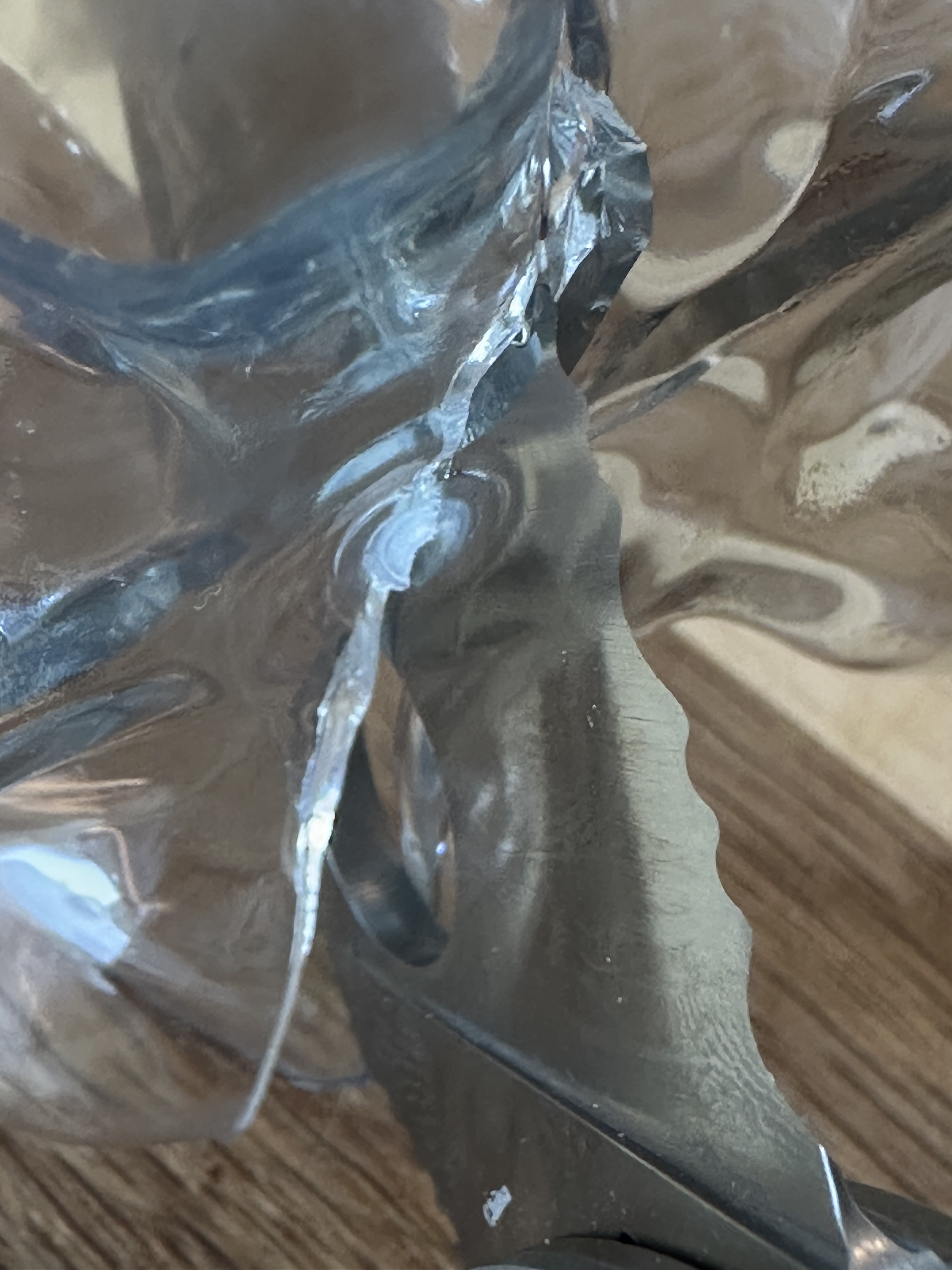
The Coke butt bottle pushing cutting test has been done with the factory edge right out of the box. It is thin behind the edge. It’s a good blade thickness for more nuanced jobs, but there is added strength from the thicker spine.
The knife sliced right in the middle were the materiel is thicker. This is just outstanding !
There are a great geometry and a thin edge on that tough CPM-M4 blade. The result is a sturdy matter separator.
It is not an exploit to cut into some tin can but the same “shallow”, “non snaggy” kind of serrations as the Chaparral made it easy.
Again, this is a “performance oriented” knife. The blade is not too thick like some “tactical” toys. It is made to perform not to show off.
“For notching, serrated edges work great. Feathersticking, maybe, maybe not. Serrated edges are ground on the show side, so they actually work better when used left-handed for cuts like that. I carry a serrated K390 Police4 all the time for rough work. It goes through little volunteer elm trees like a chainsaw. A SharpMaker makes it a breeze to maintain the edge.” to quote Yablanowitz.
The liner lock is thick in the same spirit of Gayle Bradley’s folders. The knife opens with a loud KLAK! — no blade play in any direction. The detent is strong but slightly “elastic,” meaning the blade moves a little before the release/tipping point engages. This makes it very secure, with no risk of accidental opening. I’ve noticed the same elasticity on the titanium version of the Tenacious. It’s important to note: this is not a weak detent — the blade won’t open without a deliberate, serious force.
Using the knife in Spyderdrop mode, a flick of the wrist catches the blade in the Spyderhole with no issue. Closing remains perfectly secure. There’s a tiny squeak out of the box, but a few drops of nano oil should mute it. The action isn’t buttery smooth like a compression lock on ball bearings, but after a bit of breaking-in and running-in, it will be wonderful.
The solid clip is delivered mounted in Tip Down carry, which suits well this knife for the Spyderco Drop featured on the Military 1 which got the same kind of “around the pivot” clip.
I have no intention of using tip-up carry or a deep-carry clip. This knife is a tool, meant for easy access rather than a stealthy edge. The Tenacious is always noticeable in the pocket, but that sturdy clip guarantees quick availability — reminding me of Massad Ayoob’s teachings.
Spyderdropping is an extremely fast way to get the blade into action — faster than many switchblades. Sal Glesser was already demonstrating this skill almost 30 years ago: grab the knife by the Spyderhole and SCHLAK! — it’s open and ready to cut.
The Tenacious features full steel liners, unlike the nested liners on the Military line. There are no backspacers, making it easy to clean under running water. At 120 grams, it’s not a lightweight folder — I appreciate a bit of heft on a working tool. (For reference, the new titanium version is 93 grams.)
Notice how perfectly centered the blade is right out of the box. The quality control on this “made in China” folder is impressively high.
(Sal’s Titanium Catbird (only 200 were made) next to Eric’s Tenacious.)
Eric and Sal have taken their time with the Byrd Line and their budget line to get the best from a family of makers in China. The Glessers have moved slowly but steadily, developing a trustworthy and excellent relationship with the knifemakers there.
To quote JustinRose40 on the forums in 2011: “Yes, every time I show someone my Tenacious I have to say “well it’s made in China but it’s not a China Knife, it’s still a Spyderco”. To which they usually say something like, “yeah I could tell that as soon as you handed to me”.
Since 2011, China has made huge leaps in knife manufacturing quality, and this steady improvement is clearly noticeable in the “new” rendition of the venerable Tenacious.
On Eric’s designs, there’s sometimes no choil, but you can notice a clever feature: a “proto-flipper” that acts as a quillon or guard to protect your fingers in case the lock ever failed.
Since 2008, I haven’t heard of any critical lock failures on the Tenacious or the larger Resilience. The Tenacious has earned its legendary status for a reason.
Another Eric design with an excellent blade-to-handle ratio is the Mantra 2, which uses a flipper. (I’m not a fan of that little opening hole — dirt always collects there!) Still, it’s a great design. The Mantra 1, with an opening hole, feels like the Taichung-made “uncle” of the M4 Tenacious.
The peel-ply-textured G10 scales don’t need sanding; they’re well balanced and won’t shred pockets. The brown color makes it feel less threatening, in my book.
Let’s put it to use while the satin blade is still silver.
The knife bites into wood like no tomorrow. The serrated CPM-M4 edge is a joy to use — it goes deep and steady, putting a smile on my face every time.
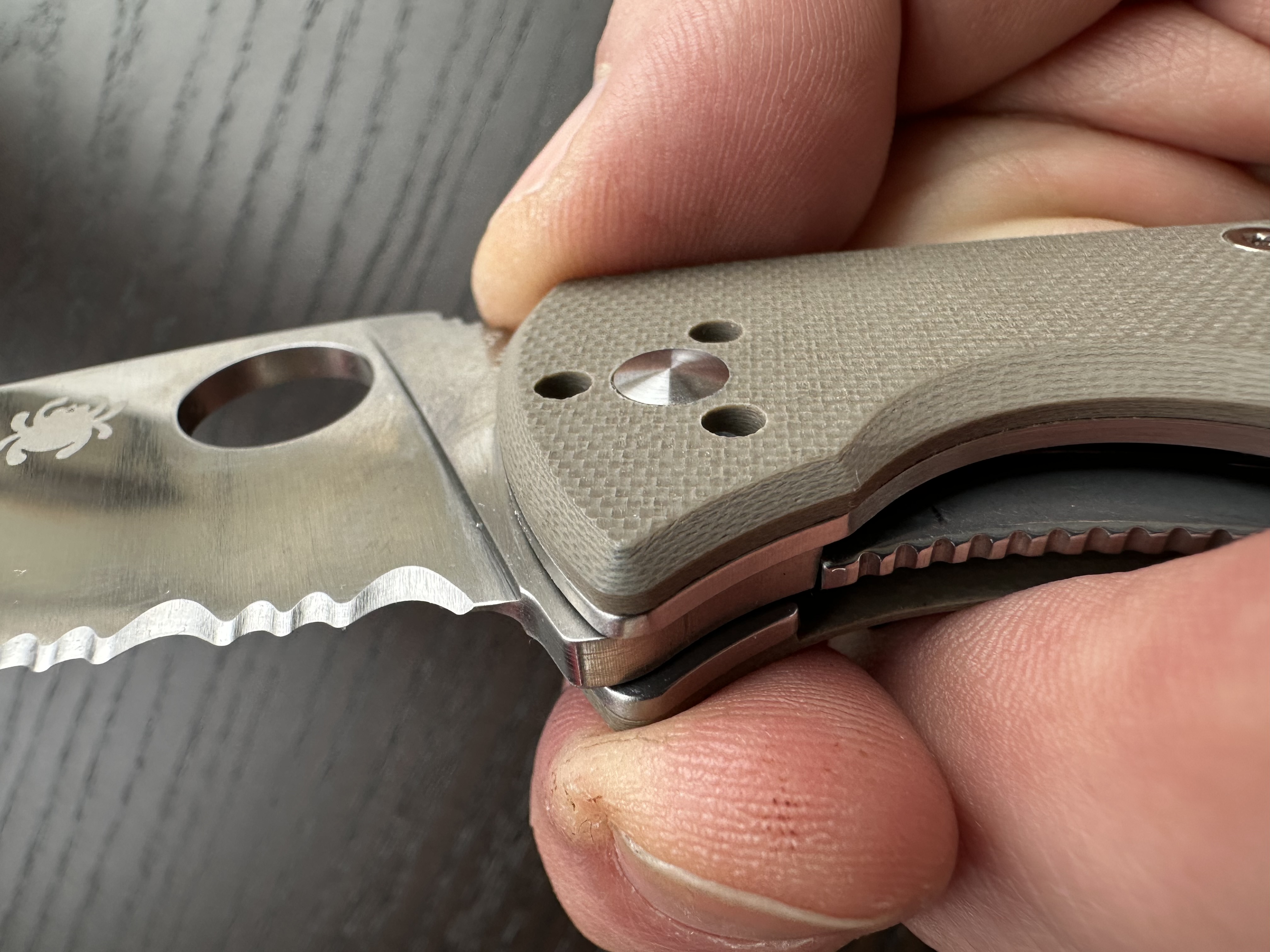
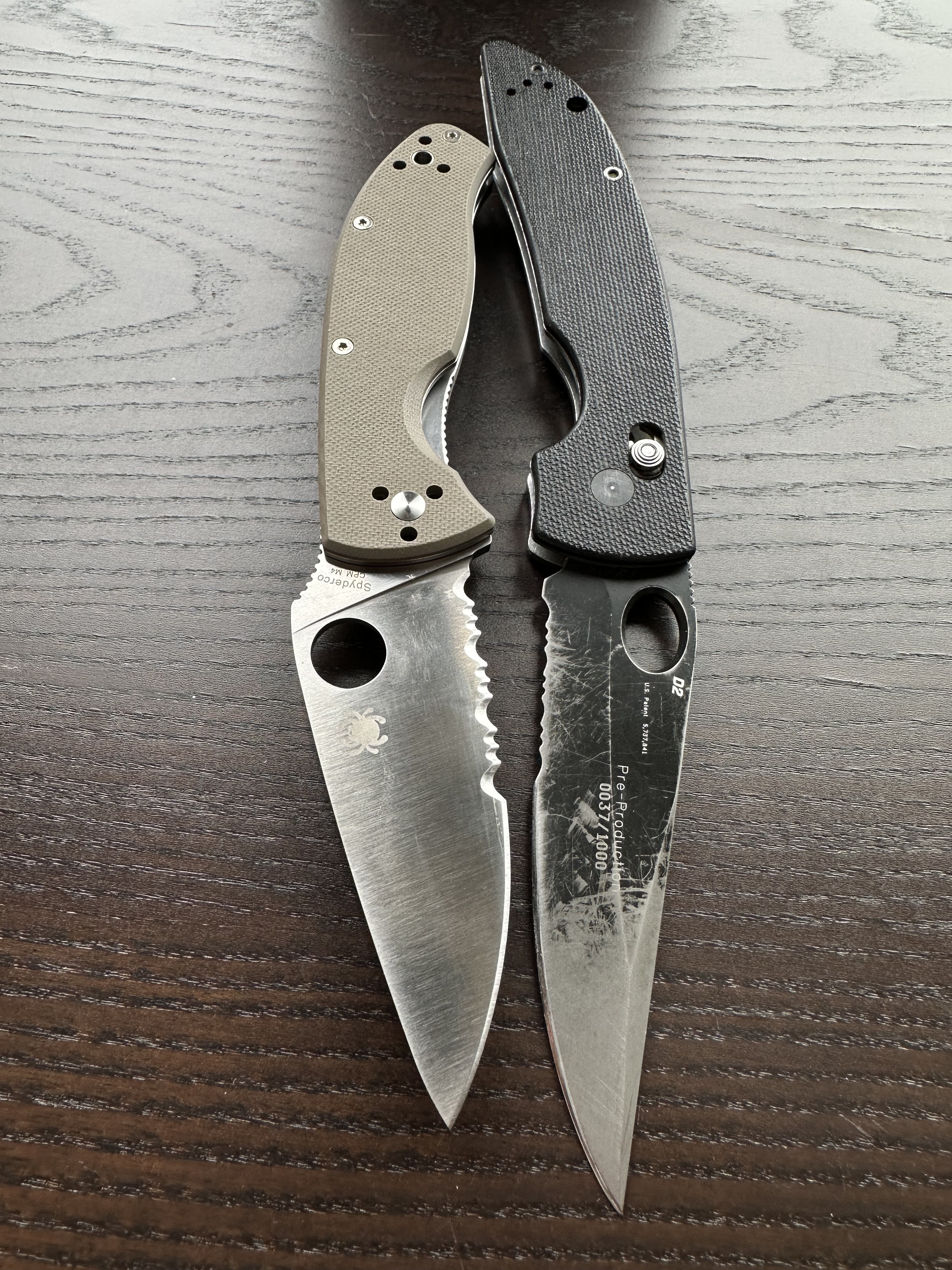
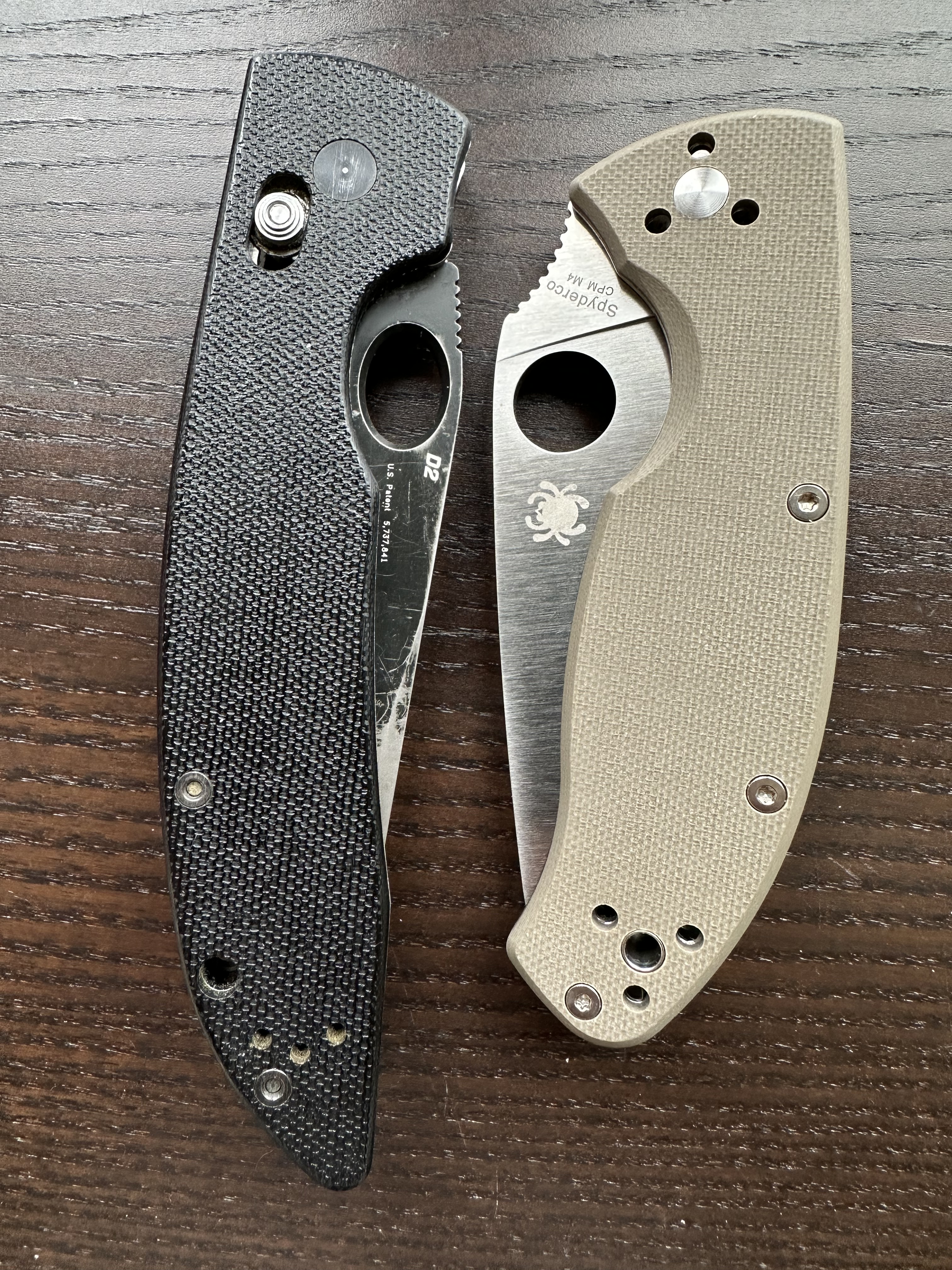
Blast from the past: the last combo-edge/semi-serrated knife I used was over 20 years ago — a Pre-Production D2 AFCK. As you can see, it’s been heavily used, and its geometry, steel, and blade-to-handle ratio aren’t nearly as refined as the Tenacious.
That macro shot shows the very smooth way to go from chisel ground serrations to plain edge.
“Serrated edges aren’t for everyone, and you may not like them, but you’ve got to get at least one just to try! Keep it around for nasty work, wet abrasive rope, zip-ties, yardwork, or playtime like in the pool, or at the lake or beach. Not to mention fishing duties.”to quote Benben.
The difference in cutting efficiency between a saber grind and a full flat grind is obvious. I don’t need to tiptoe around it — the advantage is clear.
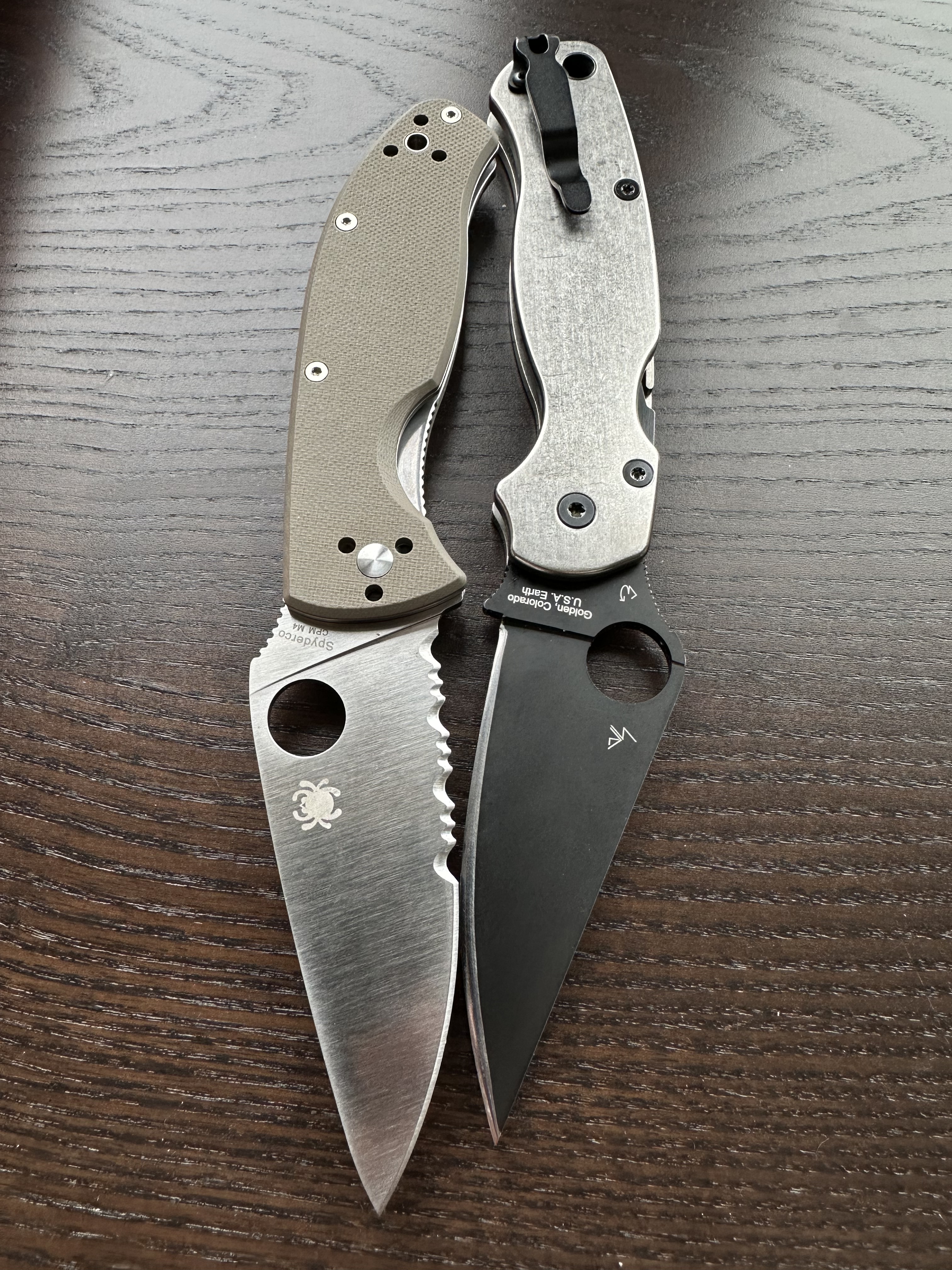
Now let’s compare the Tenacious with various folders and fixed blades.
The Tenacious got a better blade/handle ratio than the Paramilitary 2 and a longer blade for a shorter handle. This is one key of the success of that design.
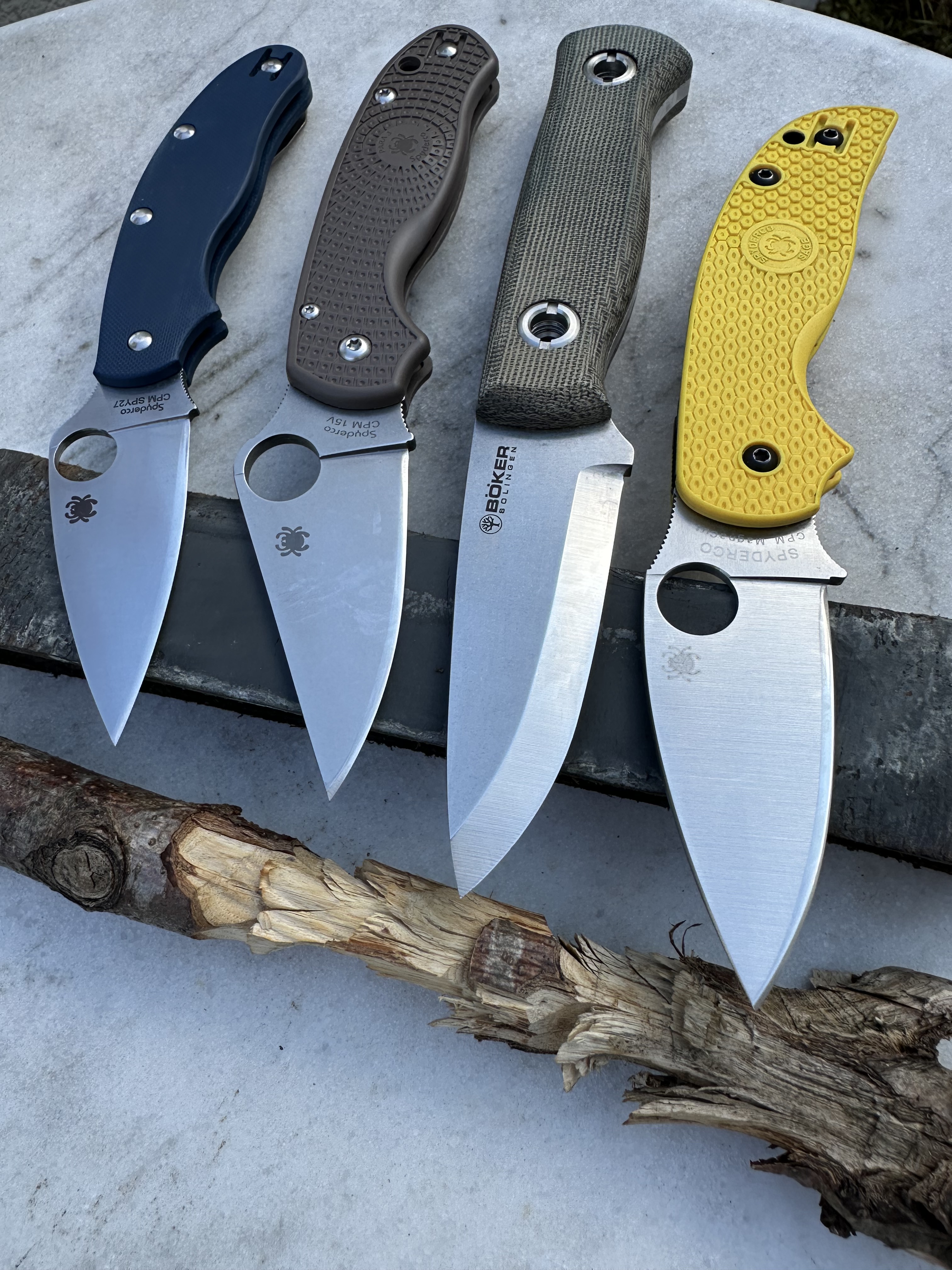
Since I play with Bushcraft here a nice combo to go in the wood. The Proficient is a masterpiece.
And with the ultra solide Boker in Magnacut. The 8,6 centimeter long blade of the Tenacious is generous edge wise.
Of course, I’ll strop that partially serrated blade on leather — no fear at all. I have my method for serrations, using the corner of the leather pad.
Maintaining the combo edge won’t be an issue; I’ll keep it sharp with cornered ceramic and jade stones.
So what do you get for €139 — the price I paid at the Coutellerie Champenoise? I’m really happy with my purchase. I plan to use the Tenacious a lot and on anything, simply for the pleasure of testing it on various materials. This knife isn’t afraid of plastic, wood, food, bones, cardboard, or aluminum.
This CPM-M4 version is set to show the full potential of one of the beefier EDC knives, especially with its serrated half-edge carved from super tool steel. Over 17 years, the Tenacious has proven it can withstand a lot of abuse.
The CPM-M4 Tenacious is not only a workhorse but a warhorse, like the pictured Adamas. I can easily imagine any soldier being glad to have such a reliable knife at this budget.
It’s slightly larger than small pocket knives, but smaller than the oversized ones some carry just to show off. The Tenacious would make an excellent day-hiking knife — a folder ready for the great outdoors. I’d take it on a trip to Africa or on a photo safari in the natural parks of Tuscany.
(this will often dull the blade’s edge with a little shining spot. Not here… Thanks to the serrations again ! )
This CPM-M4 Tenacious is sold at roughly double the price of the standard version, but in my opinion, it’s a rare chance to have this alloy on that knife. CPM-M4 pushes the boundaries of reliability and is a real pleasure to keep razor-sharp.
CPM-M4 will not chip and stays sharp for long. It’s a steel that has been used in cutting competitions. While Tuff Glideand various oils can keep it spotless, I prefer the protection of a gentle natural patina.
For twice the price of the vanilla Tenacious, this upgraded version delivers another level of performance in terms of toughness and edge retention.
“Old school cool with the Walker lock and satin finish. Well done Eric Glesser!” to quote Clay H on the Forums. My brown Tenacious looks gorgeous in its “beautility”, practically begging to be used across all terrains — sand, rain, or more. All in all, this beater is a beefed-up workhorse, built to be used hard and carried proudly.
This is not the first UKPK I have reviewed in this blog. I was a very early adopter of this Sal Glesser’s approach of the modern slipjoint all made in Golden Colorado. Some of my favorite are the Salt Versions in FRN: the Green LC200N and the Yellow CPM Magnacut. I even think, the serrated version of the Magnacut version could be an amazing legal travelling knife.
But they are FRN versions. I like FRN but I do love G10. Better, I’m a sucker for sanded G-10. Hence my love for the Heinnie Urban and its non-slip peel-ply texture. At first glance the satin-finished CPM SPY27 blade and signature cobalt blue peel-plytextured G-10 handle scales are juste gorgeous. Here are the full specs on Spyderco’s pages.
Like the Heinnie the skip joint got a strong mechanism. It is really a pleasure to feel this resistance which was totally absent from the very first drop point UKPK a decade ago. (Picture from Mr Blonde, Spydercollector site)
So far, I cannot imagine my self opening it with a flick like I was able to do on the LC200N FRN version. The Spring here on this G10 version is much stronger.
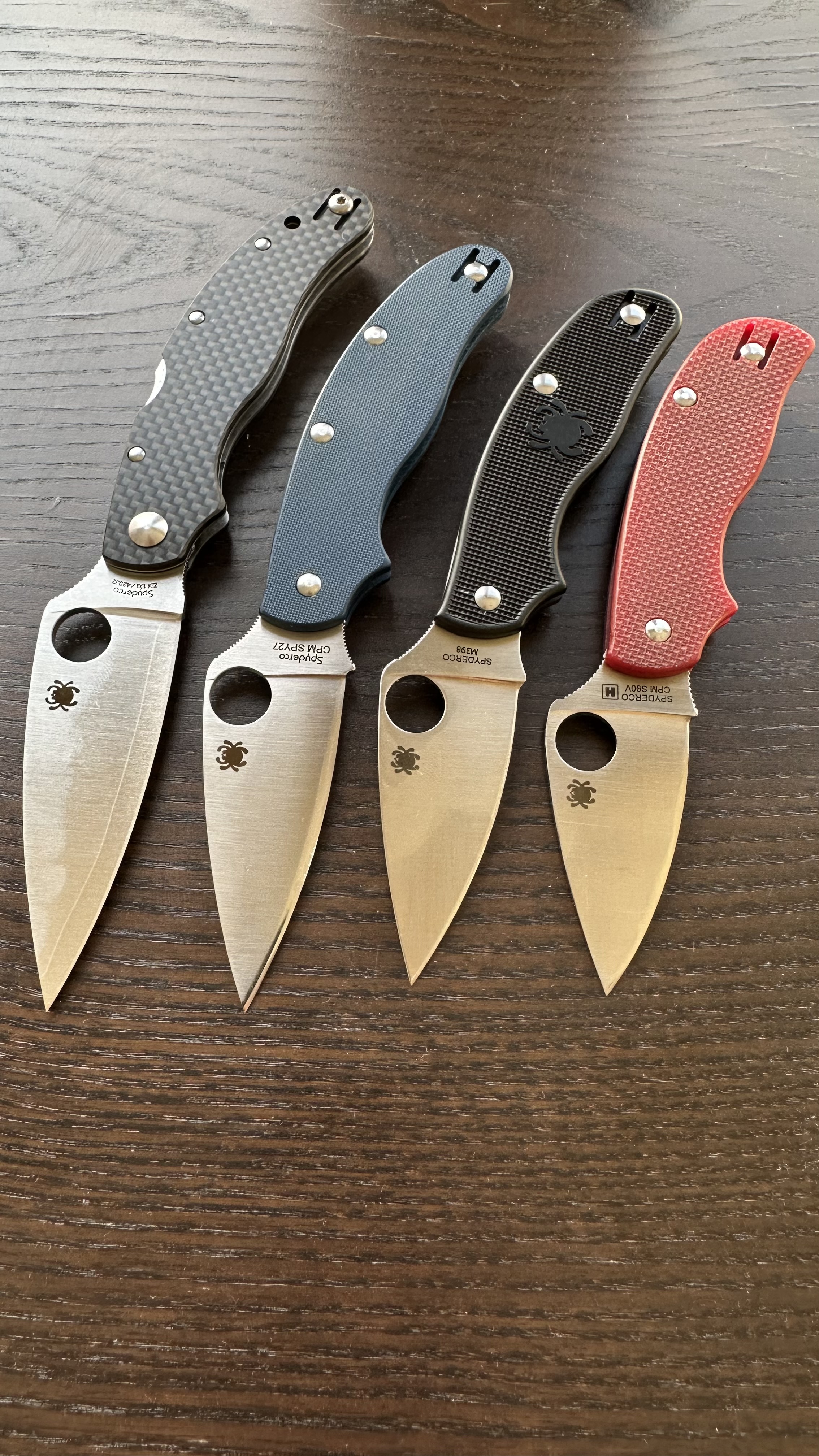
Let’s do some size comparaison. The UKPK is one of the long Slipit in Spyderco’s collection. It is almost a slipjoint Caly, even longer than a Chaparral. So you really don’t feel “underknifed” when you carry it in your pocket as your only EDC. It is also really handy and practical as a kitchen knife. The best thing is that this design keeps its blade length legal in most countries.
The long leaf shaped blade is a must in the kitchen almost idea. It is pointy enough and its is enough for vegetables. Most of the works done in the kitchen like peeling potatoes, cutting oinions, you name it, was always done with a short full flat ground knife like a “Nogent Couteau d’Office”.
Something about the G-10 version is the spring/back spacer closing the handle of the knife when the FRN got an open handle easier to rinse. But it is much more gorgeous and with a stronger spring for sure !
It also gives a little more heft to the knife. 48 grams for the FRN and 63 grams for the G10 version -> 31,25% heavier to be precise, almost a third ! But I do really love my heavy butt knives since my Schrade Sharpfinger.
Now this is my first CPM-SPY27 knife. Spy27 is a alloy recipe created in house with Crucible exclusively for Spyderco. It is a CPM ! So this is a premium super steel compared to VG10 or N690… In short it is a American Powder Metallurgy version of the Japanese VG10.
In Sal Glesser words: “We offer many steels for several reasons; 1) We are Steel Junky’s (even Edge Junky’s) and we like to experience the different flavors and we try to do that. 2) We believe that many of our customers are also Steel Junky’s (even Edge Junky’s) and they too get to experience and play with and “taste” as you say, the many options.
I wanted a USA made “tweaked” version of Gingami 1 by Hitachi and after some effort with Carpenter, we have a powdered USA made steel called CTS-BD1N Which is a refinement of Gingami 1. I wanted a USA made “tweaked” version of Takefu’s VG-10 and now we have a powdered “tweaked” SPY27.“
“However, it should be noted that the SPY 27 Larrin used for testing was not heat treated by Spyderco. Some minor differences between Larrin’s heat treatment and Spyderco’s heat treatment can probably be expected. That being said, Larrin is the best source of consistent, objective data and metallurgical interpretation for steel comparisons.” To quote Karl_H in https://forum.spyderco.com/viewtopic.php?t=87383
“SPY-27 will hold the fine edge longer… Its all about the stability of the fine edge, not the total wear resistance until fully dull. In this regard, SPY-27 can do what other stainless steels cant.” to quote Submicron in the same thread.
I am aware that Cobalt’s dust can be an health issue. Of course Rex 45 and Maxamet (10% of cobalt, 1,5% for SPY27) are the heavy weight steel in their tool steel category but the Spy27 (like VG-10), like all cobalt alloys needs to be carefully cleaned after a sharpening process. (Cobalt may cause an asthma-like allergy. Future exposure can cause asthma attacks with shortness of breath, wheezing, cough, and/or chest tightness. * Cobalt may affect the heart, thyroid, liver and kidneys. * Repeated exposure to Cobalt dust can cause scarring of the lungs (fibrosis) even if no symptoms are noticed. According to https://nj.gov/health/eoh/rtkweb/documents/fs/0520.pdf)
Let say SPY-27 is in the same club as the S35VN steels in terms of performance and it especially loves fine ceramic and leather stropping. It gets easily a very crispy edge like VG10 or BD1N . ( Steel which are “leather super friendly” are also LC200N, 52100, VG10, AEB-L… ) This is a must and a real pleasure for me as I keep my knives sharp mostly with leather. A touch up and it makes flying hairs from my arm again. And it seems true so far. I have not deshouldered the edge yet and intend to use it with the factory edge for some times but leather made it hair popping sharp. (Once deshouldered it is a straight razor with excellent edge retention… much better than S30V). To quote Sal: “SPY27 for some reason, seems to be punching above its weight.”
No crossroads, this Blue Djinn loves leather like the Bill Moran FB01 in VG10 loved it.
No need to use diamonds unless you want to reprofile the blade or round the shoulder then don’t forget to rinse the blade and to clean any dust. But talking about dangerous dust, I have sanded the scales to preserve my pockets. Never breath that dust !!! Do it under water or wear a mask. I got a neighbor who has been working around that kind of heavy dust and now he is breathing with two tubes in his nostrils. So be careful with your health. This Blue G10 got a very nice texture under the thumb like some denim, textil like. It is really pleasant, almost like some Micarta found on the QSP Penguin.
So when you sand G10, just go outside in the wind or work under water. You don’t want to breath G10 dust made of fiberglass and epoxy. Just rinse it under the tap to have it back to normal. Once tuned at your hand, G10 is a very very nice material.
As you can notice the scales are even thicket than the blade and the blade is perfectly centered.
There is the famous middle/half stop when closing or opening the knife. It works like a safety measure. This knife is harder to close than to open.
The UKPK is a very ergonomic knife. It feels like it melt in the hand. It is so confortable for heavy cuts. Because this blade can work hard with zero play.
The “pistol grip” is common in many Sal Glesser design like the Endura or the Military. It is much more pronounced on the Massad Ayoob.
No hotspots for me a very safe handle, really, this lil slipjoint is screaming to be used hard.
It is even confortable edge up.
With the Roadie XL. Another great Slipit with a very low profile, almost like a pen in your shirt pocket.
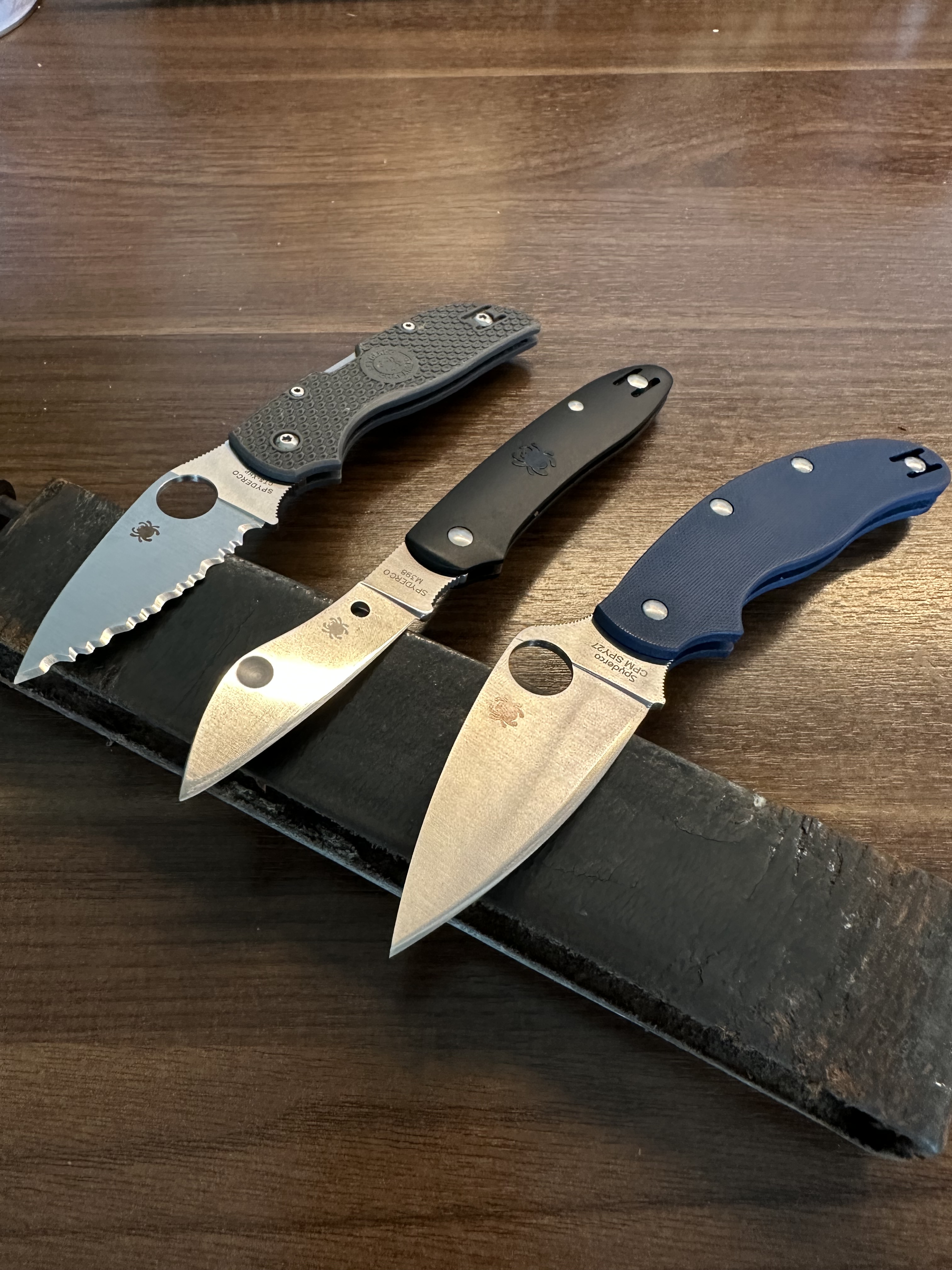
And the mighty Chaparral serrated. Two of Sal’s best designs. Two wolves in sheep disguise thanks to their thin solid blades.
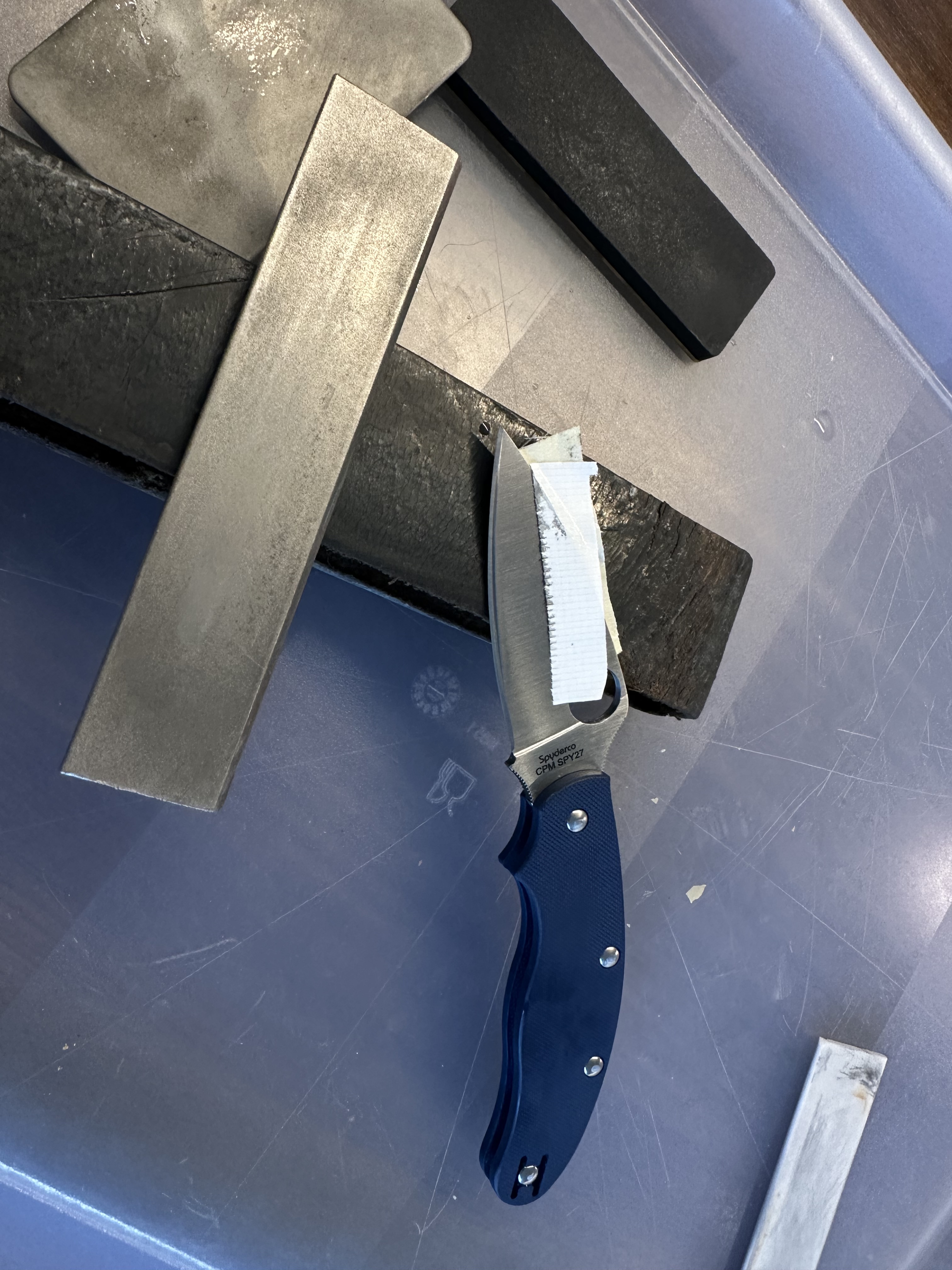
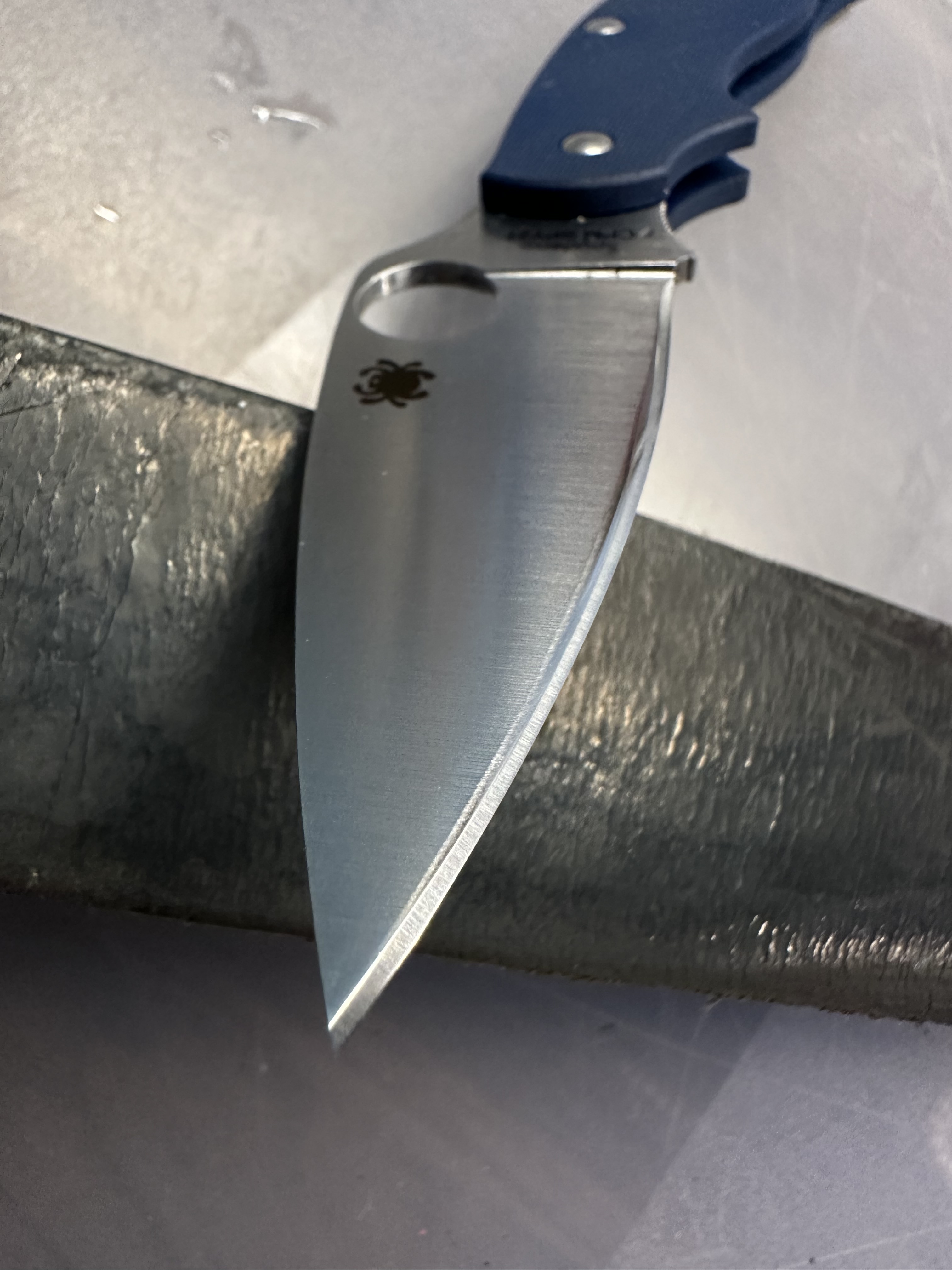
I have decided to de-shoulder the edge for a gentle convex result in the middle of the belly.
My old leather with some polish compound is ready again to smooth the edge to razor level.
Because I want a better touch on the leather, I usually keep the normal edge at the point to keep material there and near the ricasso as I use this portion for special shores like removing the aluminium cap on bottles.
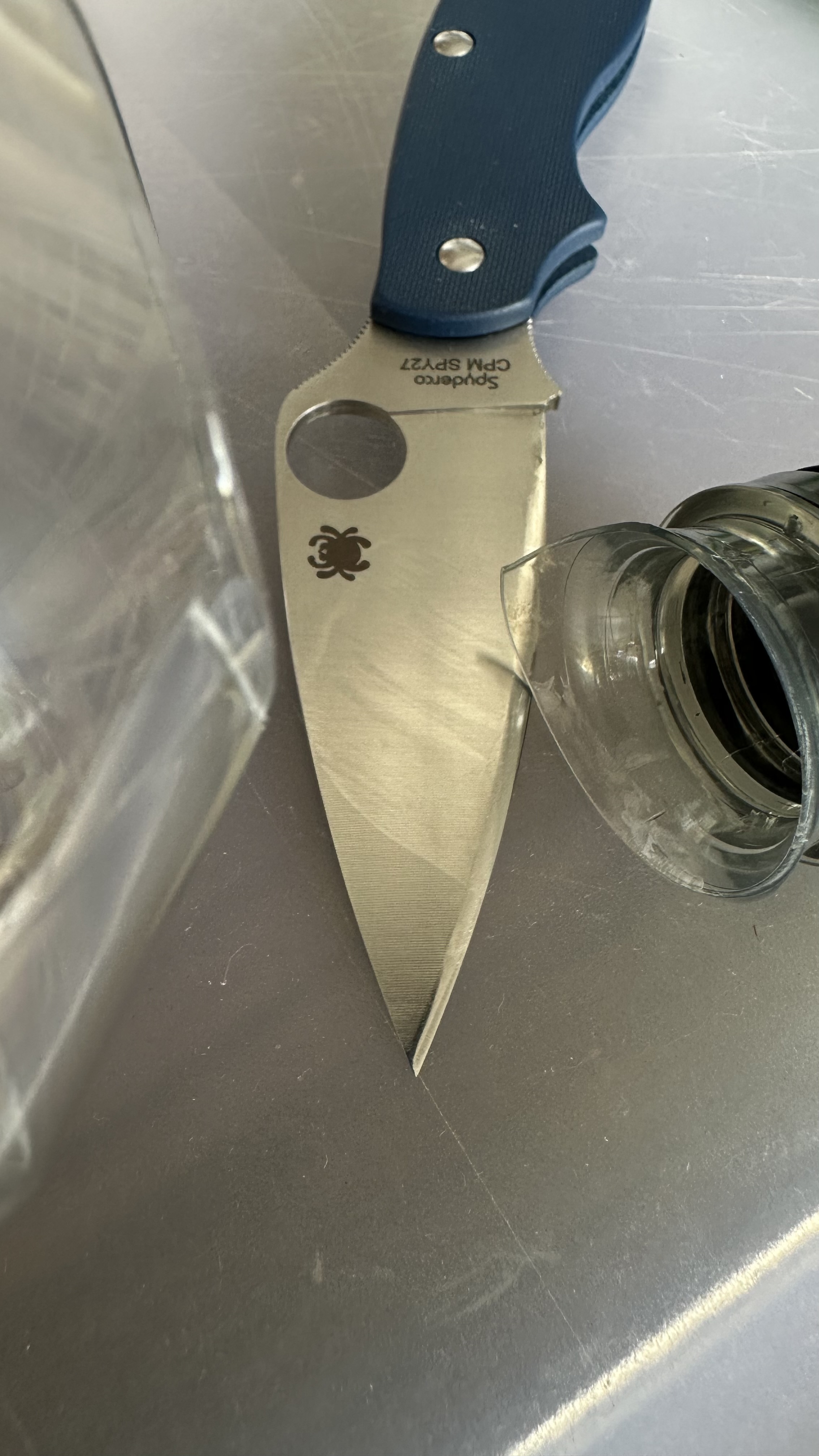
The Coke Bottle Butt test is passed with flying colors. As you can notice the plastic is 3mm thick. Not a single scratch on the blade.
So what do we got so far ? A master piece of knife design by monsieur Sal Glesser with a strong construction and state of the art in-house alloy serving a thin blade and an ergonomic handle. My advice: try to grab one before they disappear, it seems that G10 version is not here to last and it is really a sapphire: a true blue jewel !
I’ve been an early adopter of the Chaparral. Nearly 13 years ago, I called it the “Extra Flat Companion”in my first review from 2012. Back then, the Chaparral was designed to serve as a platform to test different handle materials, while the Sage (another model “made in Taichung”) showcased various lock designs used in folders.
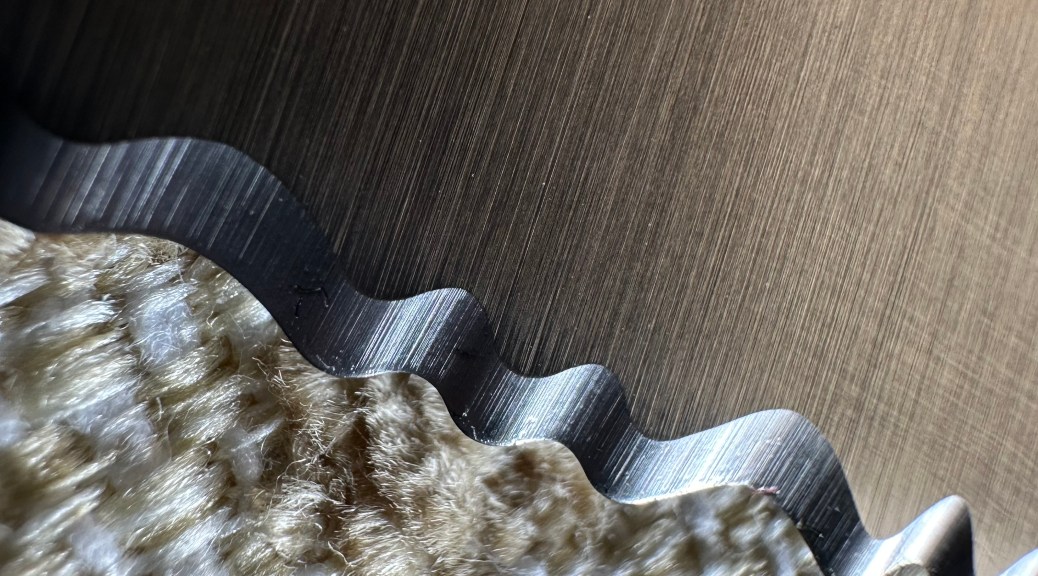
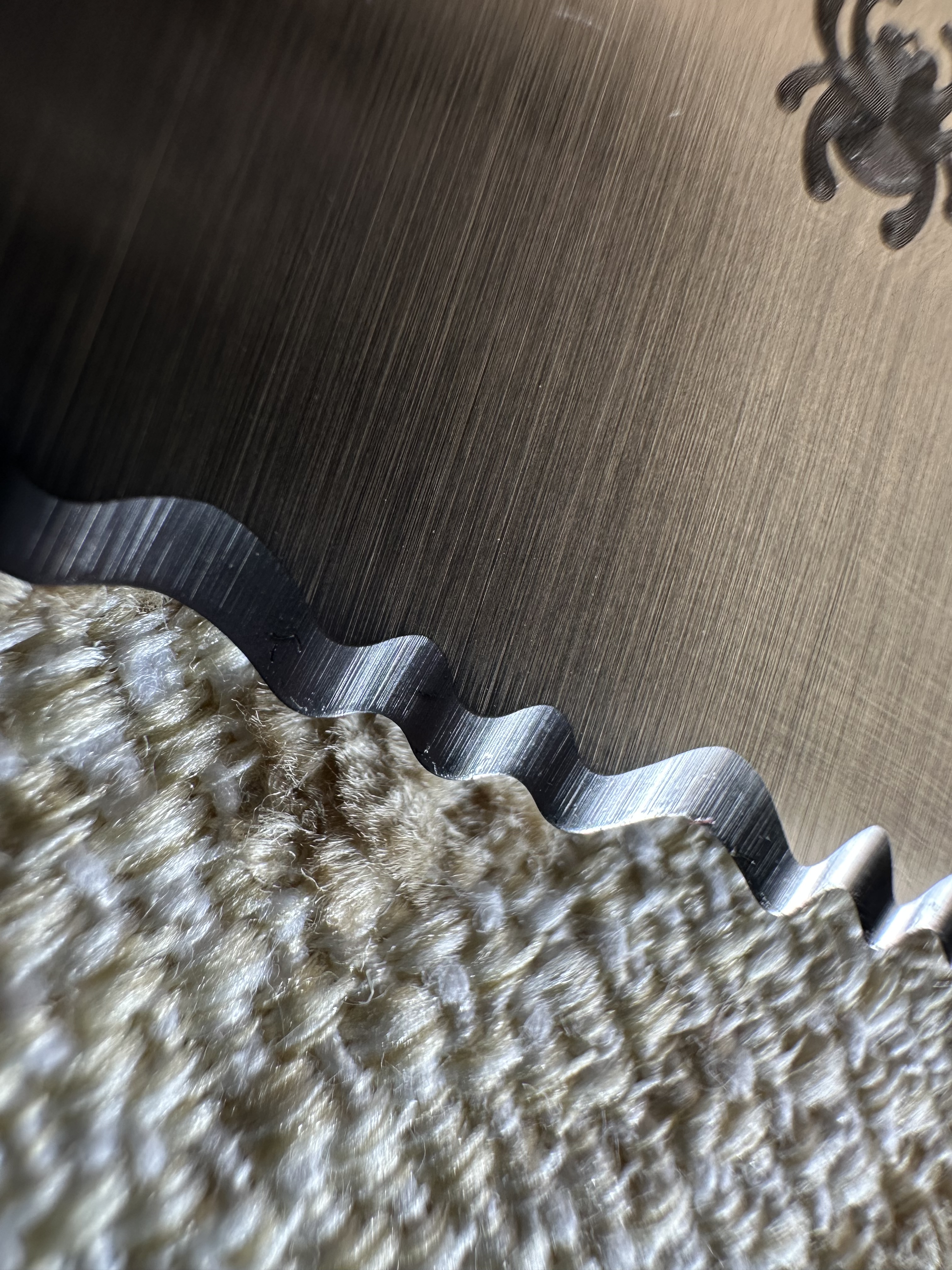
Twelve years later, Spyderco has introduced a major improvement to the Chap’s blade: their famous serrations. The brand is, of course, known for its Spyderhole, its clips, and… the performance of its serrated edges. Sal Glesser has long advocated the superior cutting performance of Spyderco’s sserrations. Scallops, moon quarters, and thin chisel geometry all work together to create the ultimate “matter separator,” making tough cutting tasks effortless.
Sal has refined his serrations into a recognized patterns and created the Spyderedge: “Spyderco’s two-step serration patterns consist of one large and two small serrations. The pattern increases the cutting edge’s surface area by up to 24%”. On the Chaparral, the serration are even better as they are rounded to avoid snagging when cutting. Those same enhanced serrations can be found on another serrated folder made in Taichung for Spyderco: the LC200N made Caribbean.
I’am not a serration’s fan. I prefer a short convexed blade like my Roadie XL to EDC but this is the opportunity to pocket a serrated knife designed to be low profile folder easily displayed in the middle of the sheeples.
The Chaparral is another Lil’ Big Knife in disguise. Go figure, his lock is equipped with an hidden pin which gives a lot of strength and stability. This improved backlock is also found on the Sage 4 but do not worry about vertical play.
Also the Chaparral’s blade is only 2 mm thick. A razor blade with serrations ? It should be interesting !
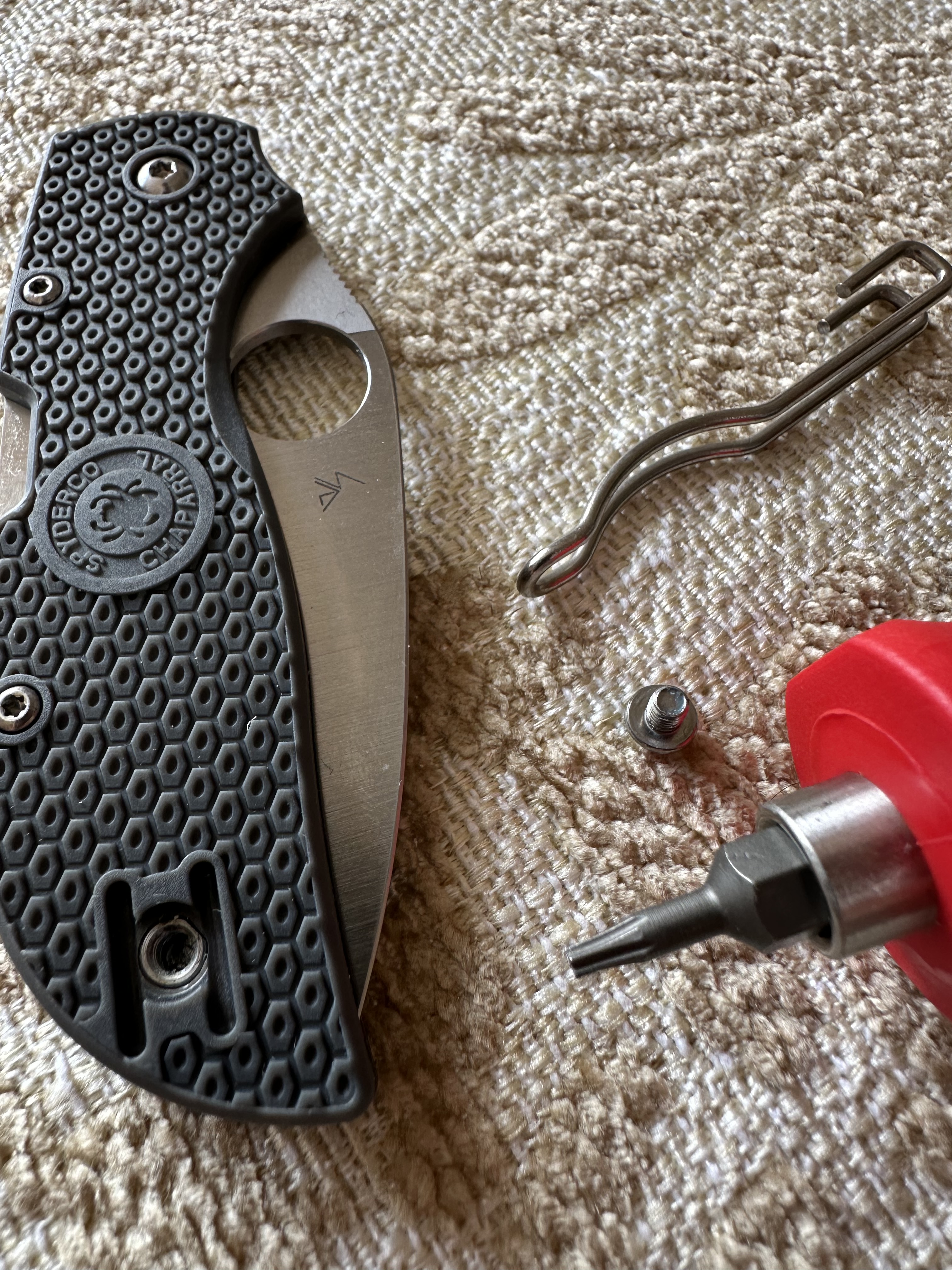
It even has teeth on its handle. The FRN scales feel almost like shark skin, which can be tough on pockets. My first step was to temporarily remove the pocket clip, then sand the scales to smooth them out.
The FRN doesn’t react as quickly as G10 when sanded. I still ended up with a slightly toothy handle, but it’s much more acceptable to me. Of course, this is a matter of personal taste — many users will appreciate the aggressive grip the pattern provides. I, however, prefer not to carry a pocket shredder anymore.
Lately, I’ve discovered that I really enjoy knives I can carry in my denim watch pocket. The Roadie XL, which I can now flick open with a wrist, is the king of that pocket and I use it hard despite its small size.
But this little “Tooth Faerie”, the Serrated Chaparral, also demands heavy use — and beware of its cutting power! Its steel, CTS-XHP, is known for being extremely reliable, even on thin edges. I’ve used it in many knives, including some Cold Steel Voyager XLs, and it never disappoints.
It will be very interesting to see how the Chaparral Light platform, equipped with a top-performance factory edge and an improved backlock, performs as a true workhorse — pushing the envelope of what the Chap’ can do. Spyderco has also just released a Slipit (non-locking) Chaparral, sold at nearly double the price of the FRN serrated version. Clearly, this one isn’t marketed as a “precious” collectible but as a pure performance tool. Spyderco has supercharged the Chaparral to be a user’s knife.
To summarize:
2 mm thick blade — this is thin !
Backlock enhanced with a hidden pin — zero vertical play !

























































































 NemoKnivesReview